Licensed Low-Voltage Contractor · Ditmars to Broadway · Two-Families, Walk-Ups, Storefront Buildings & Studio Blocks
Fiber Optic Installation in Astoria
One Sealed Entry · A Strand Pair per Household · Shop Kept Separate · Any Carrier Welcome
Most Astoria buildings have one owner, a handful of households and maybe a shop on the ground floor — and that one owner is the person every internet provider has to ask. We build small, owner-controlled fiber plants sized for those buildings: a single sealed way in from the street, a compact enclosure in the cellar, a labelled pair of strands to each apartment and the storefront, and a one-page drawing the owner can keep with the deed. After that, any carrier a tenant picks connects to what is already there instead of drilling a new hole.
Reviewed and updated October 17, 2026 · Written by Anwar Timothy, NYS licence #12000287431 · One of the neighbourhoods covered by our fiber optic installation in Queens
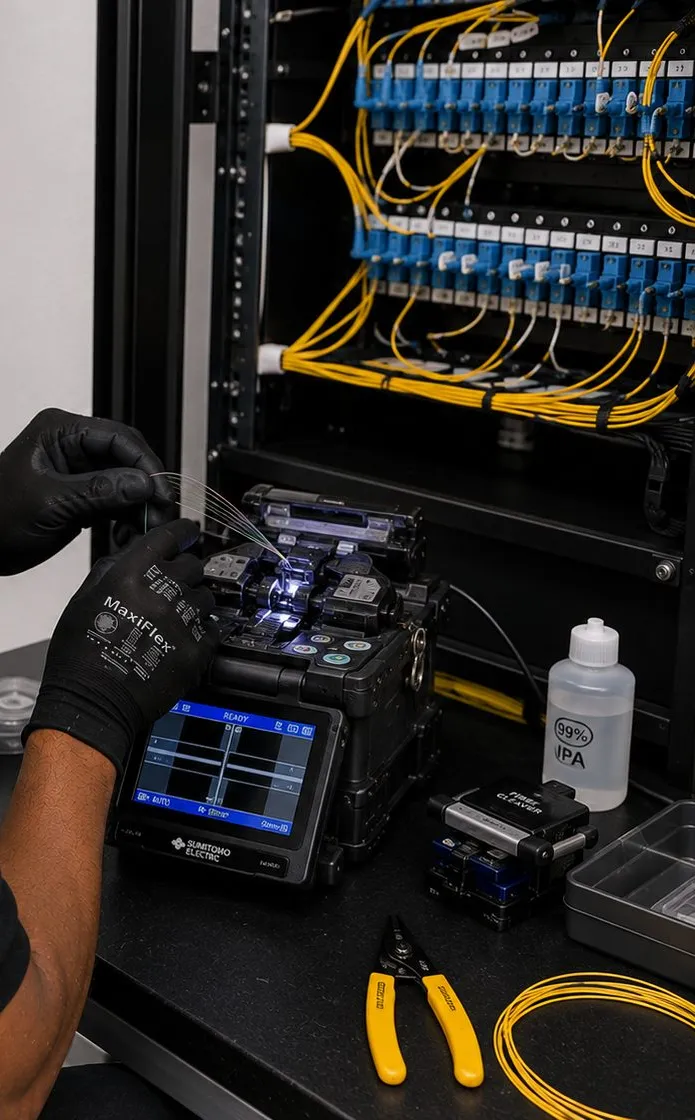
Gloved hands feed bare strands into a fusion splicer; behind it, a rack of blue SC adapters with yellow jumpers, and on the bench a cleaver, yellow strippers and a bottle of IPA.
Astoria Fiber Quote
Tell us the building, how many households and shops it has, and who owns it — a licensed installer calls back the same business day
✅
Request Sent!
An installer who works in Astoria will call you back the same business day.
25+
Years Experience
✓
Same-Day Estimates
100%
Licensed & Insured
4.7★
201 Google Reviews
Own a three-family on 23rd Avenue or a six-unit walk-up off Broadway and keep hearing "the building isn't wired for it"? That sentence is usually about the owner's side of the building, and the owner's side is the part we build. Call the Queens line at (347) 434-6392 or send the 60-second form.
Sized to the building: a few strands per household, not a tower-scale riser you never use
One sealed entry for every carrier, so tenants can switch providers without new holes in your brick
Licensed in New York State (#12000287431); crews dispatched from our East Fordham Road base in the Bronx
Why Astoria Properties Need Fiber Optic Installation
Astoria is a neighbourhood of small owners and many renters. The NYU Furman Center's profile of Queens Community District 1, which it labels Astoria, counted an estimated 198,608 residents and 99,819 homes in 2024, and put the homeownership rate at 18.5% against a citywide 32.7%. Put those figures beside the streets themselves — two-storey brick rowhouses and prewar apartment buildings south of Ditmars Boulevard, corner shops with flats upstairs, walk-ups on the side streets off 30th Avenue and Broadway — and the pattern is plain. Most Astorians rent, most of the buildings they rent in are modest, and each of those buildings answers to a single owner, often a family that has held it for decades and sometimes lives on the ground floor.
That owner is the gatekeeper for everything that comes in from the street. Ask Astoria renters why they cannot get the service they want and the answer sounds the same every time. "The key is your landlord or co-op board has to let them wire the place up," one r/astoria commenter wrote in a thread about local providers. Another, asking what neighbours do for internet, explained: "I'm stuck with Spectrum because my landlord won't allow wiring for another provider." A third put the technical half of the problem in one line: an ISP can run cable to your building with the landlord's permission "as long as the conduit into the building supports it." These are search-result excerpts rather than full threads, but they describe exactly the decision this page is about.
Small owners say no for understandable reasons. Every new provider means another installer in the cellar, another hole through the front wall or the foundation, another cable stapled up the stairwell and across the roof, and nobody left behind to explain what any of it is. After twenty years of that, a three-family house can carry three generations of coax, two sets of telephone pairs and a provider's fiber drop that serves one apartment, all entering at different places. Saying "no more" is the only control most owners have.
Generic elevations drawn for this page. Red circles mark openings through the wall; on the right there is one, below grade, and every provider uses it.
There is a better form of control. A small owner fiber plant — a sealed entry sleeve, a lockable enclosure in the cellar and a few strands to each apartment and the shop — gives the owner one place where every carrier must hand off, and gives tenants a real choice of provider without another hole being made. In a building this size it is a modest job measured in drops, not storeys, and it is the job we do most often in Astoria. The rest of this page explains how it is planned, what it costs at our published Queens prices, and where Astoria's other buildings — the studio blocks around 35th Avenue, the piano factory on 19th Avenue, the waterfront towers at Hallets Point — need something different.
Astoria figures that shape fiber work
Fact
Figure
Source
Residents and homes, Queens Community District 1
198,608 people; 99,819 housing units (2024)
NYU Furman Center neighbourhood profile
Homeownership rate
18.5% in Astoria vs 32.7% citywide (2024)
NYU Furman Center
Storefronts on six commercial corridors
1,450 — Steinway Street alone 477; 64% of surveyed merchants rent, 6% own
NYC SBS Astoria Commercial District Needs Assessment, 2022–23
Astoria Line over 31st Street
Elevated since February 1, 1917; Astoria–Ditmars Boulevard station 3,309,906 riders in 2024
Wikipedia, BMT Astoria Line and station articles
Halletts Point development
About 2,000 homes planned across three buildings; phase two is 647 units in towers of 27 and 32 storeys
QNS, Nov. 1, 2023
Ravenswood Generating Station
About 20% of New York City's electricity, opened 1963, bordered by Astoria Houses
City Limits, Aug. 15, 2023
Owners who open the cellar for fiber often fix the front door in the same season. Our Queens intercom installers can put a new entry panel on a reserved strand from the same enclosure, and the team behind smart lock installation in Astoria handles the doors themselves.
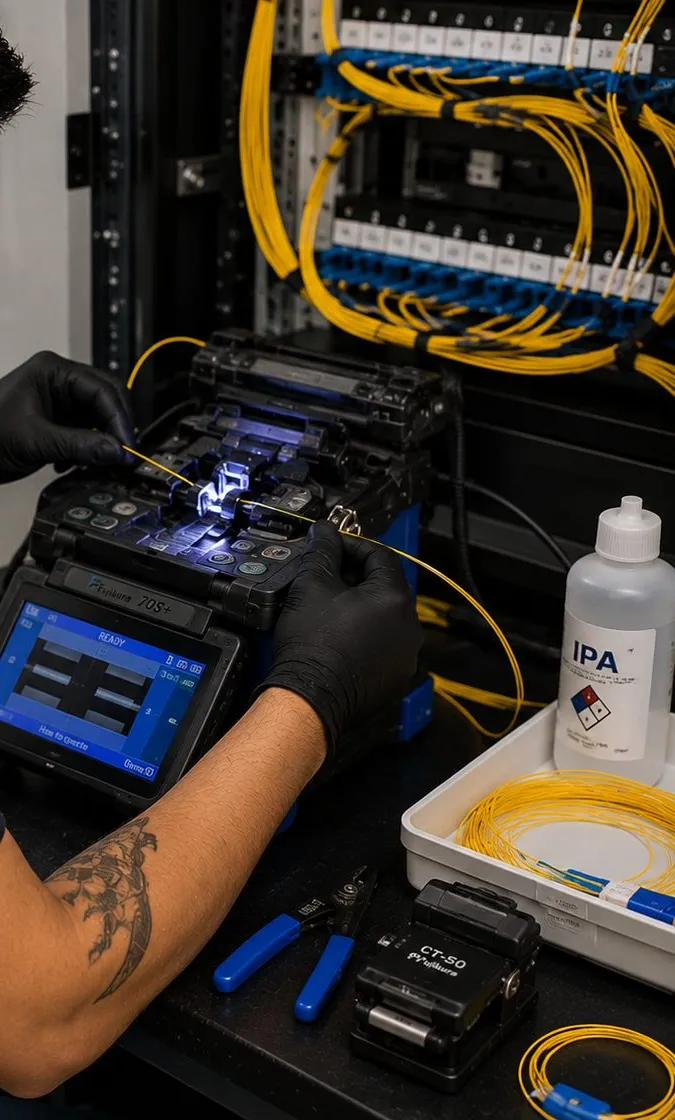
A splicer screen reads READY with two fiber ends lined up; a tray of yellow jumpers, an IPA bottle, a cleaver and blue-handled strippers sit on the bench.
Repair Capture
Astoria Building Offline Since This Morning?
When every apartment in a walk-up loses service at once, or the restaurant downstairs and the flats above go dark together, the fault is usually in the shared part of the building: a provider's terminal knocked off the cellar wall during a boiler repair, a jumper pulled in the owner enclosure, a drop crushed where it crosses the roof. That is a repair, not a new installation. Call (347) 434-6392 and say "fiber repair"; we send a technician the same day when the schedule allows, and most single faults are found and fixed within one to two hours of reaching the cellar. If a tenant's own wall jack or patch cable is the problem, the Astoria Cat6 repair team can come on the same visit.
What We Install
Fiber Optic Installation Services in Astoria
In a small building the owner's fiber begins at the foundation wall and ends at each apartment door. The carrier is responsible for its plant in the street and its equipment inside a subscriber's home; everything in between, in a building with no superintendent and no telecom room, is ours to plan and the owner's to keep.
Sealed Street Entry
One sleeve through the front or side foundation wall, sized with spare room and sealed against water and pests, so every provider arrives in the same place instead of picking its own spot in the brick.
Cellar Owner Enclosure
A compact, lockable wall enclosure mounted high and dry in the cellar, where carriers hand off and the owner's strands begin. In most two- to six-family buildings it is the size of a briefcase, not a rack.
Strand Pairs to Each Apartment
Single-mode fiber from the enclosure to a small outlet inside each unit, two strands per household, labelled by apartment so a new tenant or a new provider finds the right pair without tracing anything.
Storefront Link Kept Apart
The shop or restaurant on the ground floor gets its own strands and, where it wants one, its own small enclosure, so the business never shares a box, a key or an outage with the households upstairs.
Stair and Chase Routes
Vertical paths that suit Astoria walk-ups: an old telephone chase, a closet stacked floor over floor, the back corner of a public hall in neat raceway, chosen to avoid opening plaster wherever a quieter route exists.
Unit-by-Unit Additions
For owners who renovate one apartment at a time, a riser and enclosure installed once with capped spare strands, so each apartment is connected when it is opened up rather than all at once.
Rear-House and Garage Links
Fiber from the main house to a rear cottage, a garage workshop or the second building on a deep lot, run in conduit and terminated in a small box at each end.
Studio and Production Floors
Links between edit rooms, machine rooms and stage-side offices in the converted buildings around the studio blocks, where moving large media files is the whole point of the network.
Tracing and Tidying Old Drops
Identifying which of the cables on the front wall and in the cellar are still live, testing what can stay, labelling it, and listing the dead runs the owner can ask each provider to remove.
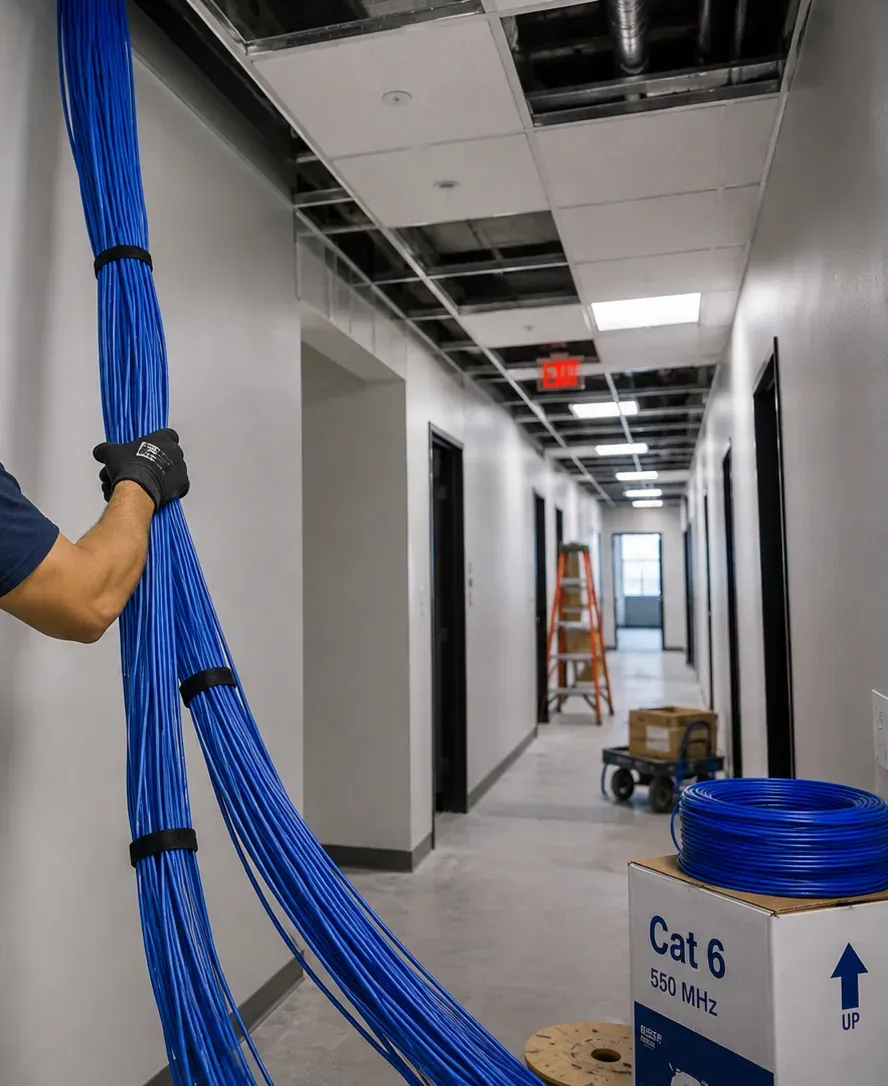
A blue copper cable bundle, strapped with hook-and-loop ties, is lifted toward an opened ceiling grid in a corridor, with a reel box at the right — the copper side of a job, inside the rooms.
Building Specialists
Fiber Optic Installation for Astoria's Architecture
Astoria's building stock reads like a timeline of the factories that once employed it. William Steinway's company bought farmland along the East River in the 1870s and built a company town around its piano works; rowhouses, apartment buildings and corner shops filled the blocks south of Ditmars Boulevard in the early twentieth century; the Astoria Line's elevated tracks reached Ditmars in 1917 and pulled walk-ups along 31st Street; and since 2019 towers have begun to rise on the old industrial waterfront at Hallets Point. Each layer hides its way in, its vertical path and its decision-maker somewhere different.
Two-Family Brick Rowhouses
Two storeys over a cellar, often with the owner on one floor and a tenant on the other. One stair, no common hall worth the name, a party wall on each side and a roof shared visually with the whole row. The smallest plant we build: one entry, one enclosure, two or three drops.
Three- and Four-Family Houses
Taller frame or brick houses with a private stair to each upper floor or a small shared hall. The vertical route is the puzzle, because every stair belongs to somebody's apartment; a closet stacked floor over floor is often the answer.
Prewar Walk-Up Apartment Buildings
Four to six storeys, a public stair, a cellar with the boiler and meters, and somewhere between eight and thirty apartments. Old telephone chases and dumbwaiter corners exist in some; in others the cleanest path is raceway in the stair hall.
Storefront-and-Apartment Buildings
Two to four storeys on Steinway Street, 30th Avenue, Broadway and Ditmars Boulevard, with a shop or restaurant below and flats above, the shop often owning the cellar space in practice if not on paper. Two clients in one building, with different hours and different needs.
Converted Industrial and Garage Buildings
One- and two-storey masonry structures around the studio blocks and in the northern industrial streets, now holding post-production suites, scenic shops, rehearsal rooms and small manufacturers. Long open floors, exposed roof structure, few ceilings to hide cable in.
Waterfront Towers and Campus Housing
The new buildings on Halletts Point Road and Astoria Cove beside the 22 six- and seven-storey buildings of NYCHA's Astoria Houses, completed in 1951. Full telecom rooms and managed risers — a different kind of job from the rest of the neighbourhood.
How the cable gets through each type
Two-family rowhouses: entry sleeve under the front stoop or through the cellar wall at the meter end, enclosure beside it, drop to the upper apartment up the inside of a closet or along the stair stringer in slim raceway, outlet placed where the tenant's router will actually sit.
Three- and four-family houses: a stacked-closet route where one exists; otherwise a short exterior run in painted conduit up the rear wall into each floor, never across the front facade.
Walk-ups: a small-diameter riser cable from the cellar enclosure up the stair hall or an old chase, a splice point every two or three floors only where the count demands it, and firestop restored at each floor crossing.
Storefront buildings: the shop's strands broken out in the cellar into its own box, with a route to its back office or counter agreed with the tenant, and the residential riser kept out of the shop's ceiling entirely.
Converted industrial space: cable in conduit or tray fixed to the structure, routed along walls rather than across open roof bays, with equipment kept off floors that might be washed or flooded.
Waterfront towers: work inside the building's existing telecom room and risers under management's rules, which is closer to our Long Island City fiber work than to the rest of Astoria.
A rowhouse owner who is running fiber to each floor rarely stops at the internet. Owners often ask for a small camera system at the cellar door and the rear yard at the same time; our Queens camera installers can feed it from a reserved strand pair in the same enclosure.
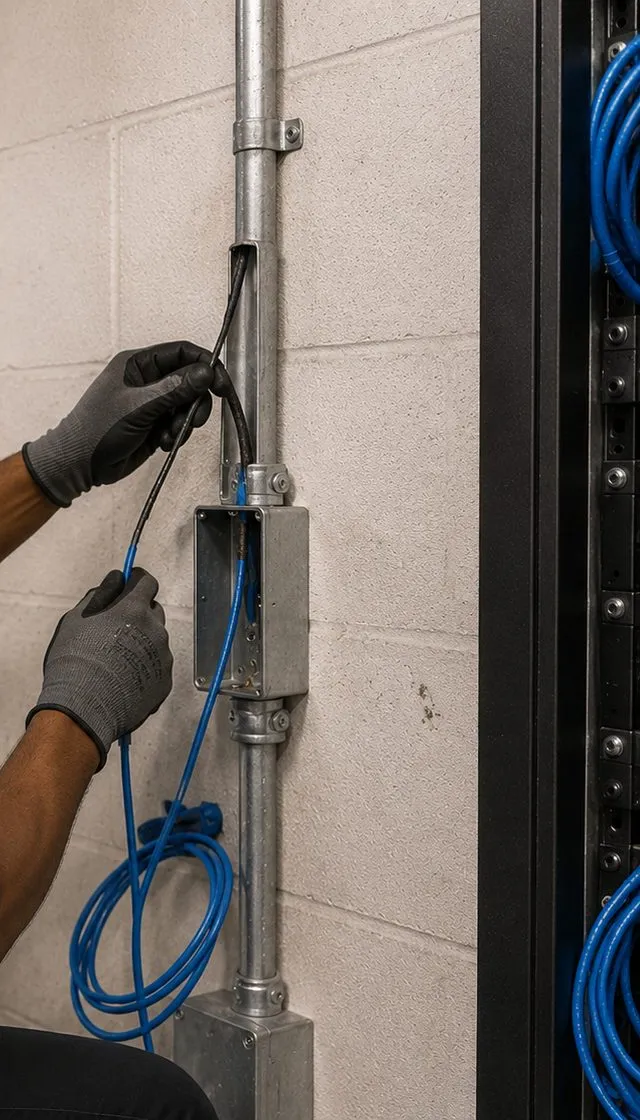
Gloved hands draw cable out of a steel pull box on a run of EMT conduit fixed to a block wall, with a coil of blue cable below and a rack edge at the right.
Commercial Fiber Optic Installation
Business Fiber Optic Installation in Astoria
The city's 2022–23 needs assessment for Astoria counted 1,450 storefronts on six corridors and found that only 6% of the merchants it surveyed own their property, against 64% who rent. Commercial fiber in Astoria is therefore mostly a three-way conversation between a business, the owner of a small building and whichever carrier serves the block. These are the corridors where we see it.
Steinway Street
The longest commercial strip, with 477 storefronts in the city's count and the Steinway Astoria Partnership as its business organisation. Small businesses, cafés and family-run restaurants in two- and three-storey buildings; most jobs are a shop link from the owner's cellar enclosure.
30th Avenue
Restaurants and shops under apartments, with the lowest vacancy of the six corridors in the city's survey. Kitchens need card terminals, order screens and printers that never drop out on a Friday night, and a cellar that holds the walk-in and the beer lines as well.
Broadway
342 storefronts running from the waterfront to Steinway Street, crossing the el at 31st Street. Professional offices above shops, small gyms and studios, and the Kaufman Arts District at its southern edge.
Ditmars Boulevard
The civic and commercial spine of Ditmars–Steinway, from the subway terminal toward Astoria Park: a strip remembered for its bakeries, markets and cafés, in buildings with deep cellars and owners who have often held them for generations.
36th Avenue and the Kaufman Arts District
The blocks the City Council named Queens' first arts district in 2014, roughly Steinway Street to 31st Street and 34th to 37th Avenue: Kaufman Astoria Studios, the Museum of the Moving Image, a performing arts high school, production offices and post houses.
Astoria Boulevard and 31st Street Under the El
Storefronts beneath and beside the elevated tracks, plus the highest vacancy on the city's list at 17%. Turnover means fit-outs, and each new tenant is a chance for the owner to put a proper shop link in before the ceiling closes.
Compliance callouts for Astoria fiber work
Permits and firestop. Cabling that carries less than 50 volts generally needs no Department of Buildings permit, as our own structured cabling pricing pages state. Every floor or rated-wall crossing is still closed with a listed firestop system and photographed for the owner.
Cable listings. Anything climbing from one floor to the next is OFNR riser cable or better; a converted shop or studio ceiling that doubles as an air return calls for OFNP plenum cable. Substitution only works upward — plenum can replace riser, riser can never replace plenum.
Fair access for providers. City housing guidance summarising federal rules notes that exclusive agreements between owners and providers, and sale-leaseback arrangements for inside wiring, are banned. An owner-built plant open to every carrier sits comfortably inside those rules.
Designated landmarks. The Steinway Mansion on 41st Street has been a New York City Landmark since 1967. Exterior changes to designated buildings go through the Landmarks Preservation Commission; our work on any such property stays inside and is left to the owner's architect where the exterior is involved.
Carrier equipment stays the carrier's. We do not move, cut or re-terminate a provider's live terminal; where it must move, we prepare the new location and the provider relocates its own equipment.
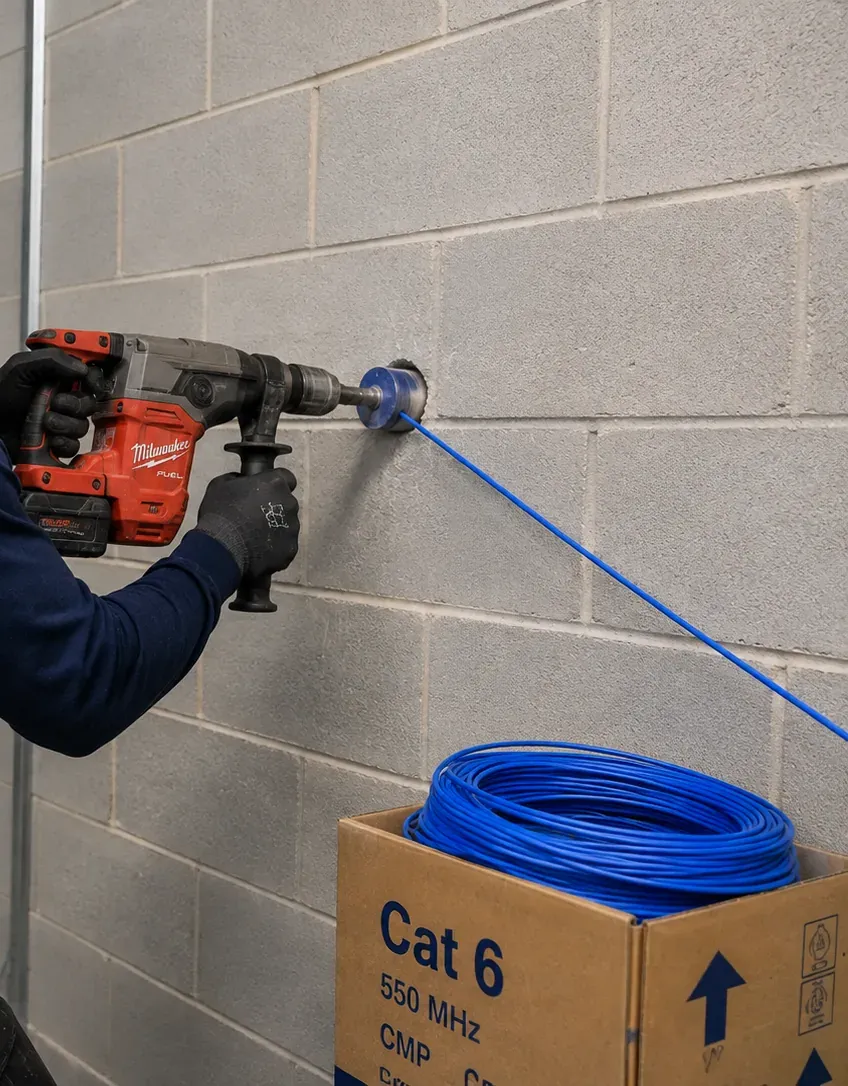
A cordless rotary hammer opens a round hole through a concrete-block wall with cable already threaded through, and a reel box on the floor below.
Small-Building Fiber
One Owner, a Few Households: How a Small-Building Fiber Plan Works
Most fiber advice is written for towers, and most Astoria buildings are not towers. A guide that starts with telecom rooms, riser sleeves and forty-eight-strand backbones is describing a building with a management office and a superintendent. A three-family house on 21st Street or a twelve-unit walk-up near Ditmars has none of those things. It has one owner, a cellar shared with the boiler and the meters, a stair, and a front wall that providers have been drilling into since the first telephone line arrived. The right fiber plan for it is small, cheap to maintain and easy for a non-specialist to understand.
We plan those buildings around four decisions, made in this order:
Where does every provider come in? One entry point, chosen with the owner, usually at the end of the cellar nearest the street plant and the electric meters. A new sleeve through the foundation is sealed and sized with room to spare; old holes that served dead cables are listed so they can be closed.
Where does the owner's part begin? A lockable enclosure on the cellar wall, high enough to stay dry if the floor ever takes water, holding the carriers' handoff on one side and the owner's strands on the other. In a two-family house it may hold four strands; in a twenty-unit walk-up, forty-eight.
How does the glass get upstairs? The one route through the building that disturbs the fewest tenants and the least plaster — a closet stack, an abandoned chase, a corner of the stair hall in painted raceway — with a firestop seal at every floor.
Who gets which strands? Two strands per apartment and per storefront as a minimum, a few more for the owner's own systems (door entry, cameras, the laundry room), and spares. Every pair is labelled with the apartment number, never a tenant's name.
The result fits in the owner's head. It is one box in the cellar, one cable going up, one outlet in each home, and one page of paper that says which pair goes where. When a tenant on the third floor signs up with a different provider, the provider's technician connects in the cellar enclosure to the third-floor pair and installs its own equipment in the apartment. Nobody drills, nobody runs a new cable up the outside of the house, and the owner knows exactly what changed.
Building
Typical households
Owner strands we usually plan
Vertical route we usually find
Two-family rowhouse
2 (often one is the owner)
4–6: a pair each, plus a pair for the owner's door camera or entry
Inside a closet or along the stair stringer
Three- or four-family house
3–4
8–12
Stacked closets, or painted conduit up the rear wall
Storefront with flats above
1 shop + 2–6 apartments
12, with the shop's strands broken out separately in the cellar
Apartment stair, kept out of the shop ceiling
Walk-up, 8–30 apartments
8–30
24–48
Old chase or stair hall raceway, firestopped at each floor
Two buildings on one lot
Varies
12–24 between buildings
Conduit across the yard or along a shared wall
Generic diagram drawn for this page, not a drawing of any particular building. Red is the owner’s single-mode plant; the dashed black line is the storefront’s separate pair.
One practical warning from this kind of work: plans written for large buildings often try to put switches, routers and a battery backup in the cellar. In a small building we would rather not. Fiber itself needs no power, so the enclosure in the cellar can stay passive — nothing to plug in, nothing to overheat beside the boiler. Each household's active equipment lives in that household, on its own outlet, and the owner's own systems get a small powered shelf on a dry upper floor if they need one.
Generic plan for this page, not a survey of any building. The enclosure sits beside the meters, not in front of them, and its cable keeps clear of the boiler's service space.
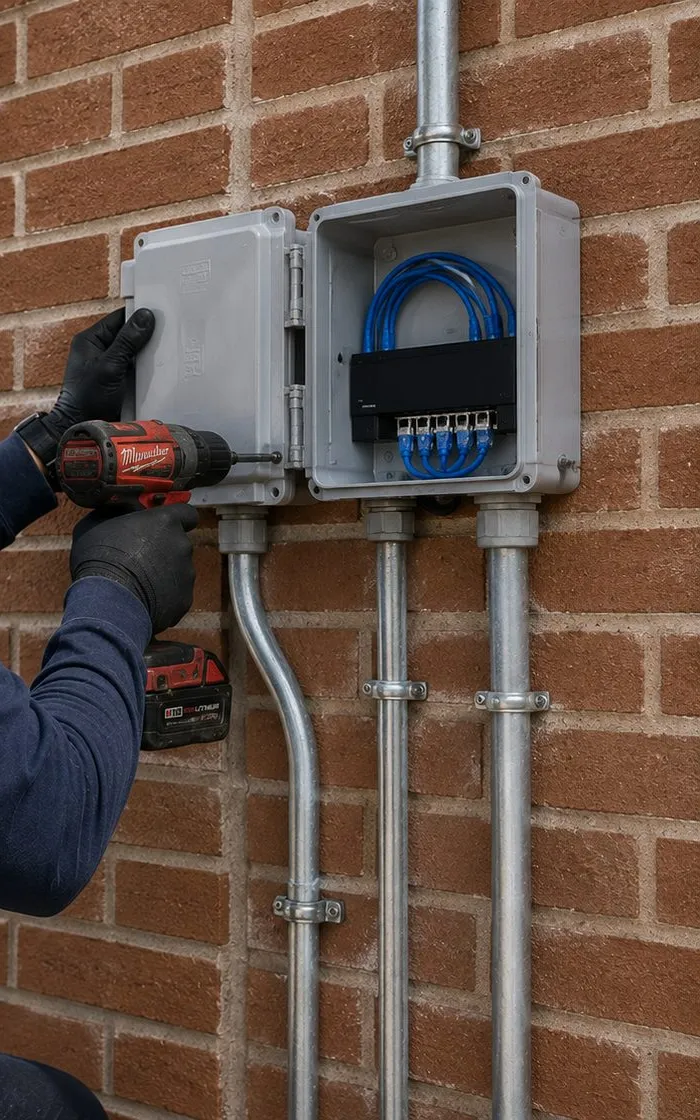
Gloved hands with a cordless drill fix the lid of a grey outdoor enclosure on a brick wall; steel conduits run up into it and down the wall.
Your Questions Answered
Fiber Optic Installation in Astoria: Questions Answered
These are the questions Astoria owners, tenants and small businesses put to us before a job is booked, grouped by who usually asks them. The short answer comes first; how it works in practice follows. Shorter practical points sit in the FAQ further down.
Owners, tenants and the carriers they choose
A tenant has asked us to let a second internet provider into our building — what should a small landlord require before saying yes?
Require a route you have approved, a sealed entry and a label — and if you can, make the provider use a path you already own. Saying yes is worth doing: tenants with a choice of provider stay longer and complain less. What owners regret is not the yes but the installation that followed it, with a new hole beside the front door, cable stapled up the stairwell and nothing to show which apartment it serves.
Before the provider's technician arrives, write down three conditions. First, where the cable enters: name the sleeve or the spot on the cellar wall, and say that no new holes through the facade are allowed. Second, how it reaches the apartment: through the existing riser or a route you have already approved, never across the roof or down the outside of the house. Third, what it leaves behind: a label at both ends with the apartment number and the provider's name, and a sealed opening wherever it crossed a floor. Providers generally have an access or easement form for the owner to sign; read what it lets them do in common areas before you sign it.
If an owner fiber plant is already in place, the conversation is much shorter. The provider hands off in your cellar enclosure and uses the strands already assigned to that apartment. That is the strongest reason for a small owner to install one: it turns every future "can I get a different provider?" into a ten-minute visit rather than a negotiation.
We live downstairs in our two-family house and rent out the upstairs — can both households share one fiber line, or should each have its own?
Each household should have its own strands, even if you decide to share one subscription for now. Sharing a single internet account between an owner and a tenant is common in Astoria two-families, and it usually starts amicably: one bill, one router, the password given to the tenant. It tends to end with one household's streaming slowing the other's work calls, a router reset that knocks the tenant offline, or a disagreement about who pays when the price goes up.
Running a separate pair of strands to each floor costs little more than running one, because the expensive parts of the job — the entry, the enclosure and the vertical route — are shared either way. Once both floors have their own pair, you can still share one subscription by patching both to the same provider handoff, but either household can switch to its own account at any time without new wiring. It also keeps the tenant's devices off the network your own computers and cameras use, which is the better arrangement for both of you.
Generic diagram for this page. The extra pair on the right costs one drop; the entry, enclosure and route are shared.
The same thinking applies if you later convert the house or sell it. A building with a pair to each apartment is easy to explain to a buyer or a new tenant; a building where the upstairs borrows the downstairs connection over a cable through the ceiling is not.
We renovate our apartments one at a time as tenants move out — can fiber be added the same way, or does the whole building have to be done at once?
It can be added the same way, provided the shared parts go in first. Many Astoria owners renovate on turnover: when a long-term tenant leaves, that apartment gets new floors, a new kitchen and new wiring, while the others stay as they are. Fiber suits that rhythm well, because the only parts that must be built all at once are the entry, the cellar enclosure and the vertical cable.
In practice we do one visit for the shared plant: entry sleeve, enclosure, and a riser cable with enough strands for every apartment, each pair assigned on the drawing and coiled at the floor where it will one day be used. Apartments that are occupied are left alone. When an apartment is opened up for renovation, its walls are already open, so the last few metres from the hall into the unit are quick, cheap and invisible; we splice or connect the waiting pair, install the outlet and test it.
The one thing to avoid is running a riser sized only for the apartments being renovated this year. Adding strands to a stair hall later means doing the hardest part twice. Size the riser for the whole building on the first visit and the rest becomes routine.
Illustrative schedule only; the order follows whichever apartments become vacant. The riser is sized for all six from the first day.
A tenant who moved out left a provider's fiber box and jack on the apartment wall — who owns it, and can the next tenant use it?
The small electronic box usually belongs to the provider and should go back to it; the jack and the cable behind it may be reusable if they are labelled and tested. When a provider installs fiber service in an apartment it typically leaves an optical terminal — a small powered box — and a wall outlet where its drop cable ends. The terminal is the provider's equipment, often listed on the former tenant's account, and the provider will expect it returned.
The drop cable and outlet are a grey area that depends on the provider and on how it was installed. If it came in through your owner plant, it is simply your pair of strands with the provider's connector on the end, and the next tenant can use it with any provider that hands off in your cellar. If the provider ran its own cable from the street, the next tenant can usually reuse it with that same provider, but not with a competitor.
Either way, a short visit settles the question: we test the outlet back to the cellar, identify whose cable it is, label it with the apartment number and note it on your drawing. An unlabelled jack is a mystery that the next tenant's installer will solve by running a new cable.
We manage our own building and aren't technical — once owner fiber is in, what are we actually responsible for?
Very little, if it is built right: keeping the enclosure locked and dry, letting providers in, and keeping the drawing. A passive fiber plant has no moving parts and nothing that needs power in the cellar. Glass that is installed, protected and sealed properly does not wear out in the way old copper corrodes, and there is no software to update. Most of the owner's job is access and paperwork.
In practice that means four habits. Keep the key to the enclosure somewhere you can find it, and give providers access only while you or someone you trust is present. Do not let anyone store paint, mops or boxes against the enclosure or hang anything from the cable. When a provider's technician finishes, check that the label on the patch matches the apartment on your drawing. And when you hire a plumber, an electrician or a boiler contractor to work in the cellar, show them where the fiber runs before they start.
If something stops working, the drawing and the test results we leave let any competent technician — ours or someone else's — find the problem quickly. That is the real value of the paperwork: it means the plant does not depend on any one installer, including us.
Roofs, crawlspaces and Astoria's older houses
A wireless carrier leases space on our roof — does the fiber running up to its antennas change anything in our own plan?
It changes where you should not put your own cable, and it is a reason to label everything. Rooftop antenna sites on walk-ups and mixed-use buildings are usually fed by the carrier's own fiber and power, run under the terms of the lease, often up a dedicated conduit on the outside of the building or through a shaft the lease assigns to the carrier. That cable is the tenant's property under that lease, not part of the building's plant, and the lease usually limits who may touch it.
For your own plan, it means two things. Keep the owner's riser physically separate from the carrier's route, in its own path and its own sleeves, so neither party ever has to work on the other's cable. And label both clearly in the cellar and on the roof, because a technician who finds two unmarked fiber cables side by side will guess, and a wrong guess can take down a cell site or an entire building's internet.
Before we plan the route we ask to see the relevant drawings or the lease exhibit that shows the carrier's path. If they cannot be found, we trace the carrier's cable only far enough to stay clear of it, without opening or disturbing anything that belongs to the lessee.
Our older frame house near Astoria Park has a crawlspace instead of a full cellar — where should fiber come into the building?
Usually at the point where the house meets the street plant most easily and stays driest, which is often not the crawlspace. In houses without a full cellar, the temptation is to bring the cable under the house and up through the floor wherever is closest. Crawlspaces are tight, damp and hard to reach for repairs, and an enclosure or splice down there is one nobody will want to visit again.
Better options depend on the house. Sometimes a utility closet or a hall cupboard on the ground floor against the front wall can hold the enclosure, with the entry sleeve straight through the wall behind it. Sometimes a short run in conduit along the foundation brings the cable to a rear service area where the electrical panel already lives. Where the crawlspace really is the only path, we run the cable through it in protected conduit and keep every connection above, so the crawlspace holds nothing but a sleeve and a straight run.
Old frame houses have one more consideration: their walls are often balloon-framed or packed with decades of alterations. We check what is inside a wall before we drill it, and we prefer closets and existing openings to new holes in finished plaster.
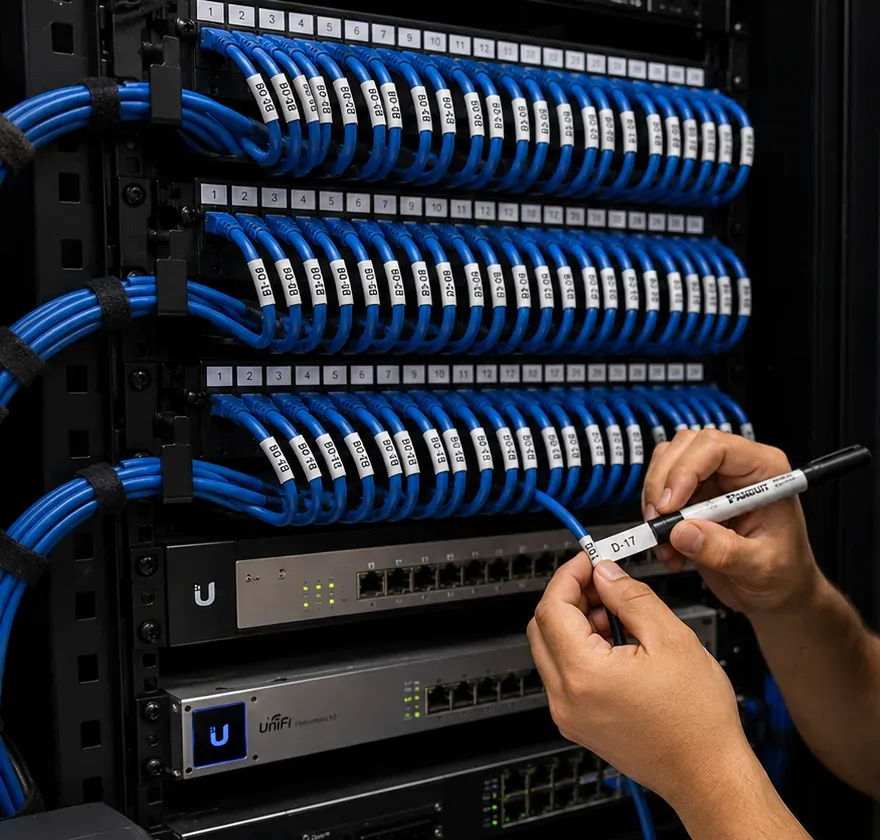
Hands mark a printed label on a patch cord in front of numbered patch panels and switches, every cord above already tagged.
Equipment
Types of Fiber Optic Cabling We Install
The parts list for an Astoria small building is short on purpose. Every item has to survive a cellar shared with a boiler, be understood by an owner who is not a network engineer, and accept any provider's handoff for decades.
OS2 Single-Mode Drop and Riser Cable
The default for every owner strand. Carriers hand off on single-mode, so a single-mode plant accepts any of them now and whatever speeds they sell later, without a second cable.
Bend-Tolerant Indoor Cable
Small-diameter cable that tolerates the tight corners of a walk-up stair and the inside of a closet, so routes can follow the building rather than demanding wide sweeps.
Compact Cellar Enclosures
Lockable wall boxes with a carrier side and an owner side, splice trays inside, sized to the building: a handful of ports for a two-family, a few dozen for a larger walk-up.
Apartment Outlets
A small wall outlet in each unit where the provider's equipment plugs in, placed where the household's router will actually sit rather than wherever the cable happened to end.
Sealed Entry Sleeves
A sleeve through the foundation or front wall with a water- and pest-proof seal and spare capacity, so the next provider uses it instead of making its own opening.
Painted Raceway and Conduit
Slim surface raceway for stair halls where nothing can be hidden, and conduit for rear walls and yards, finished to sit quietly against brick or plaster.
Outdoor and Direct-Burial Cable
For links to a rear house, a garage workshop or a second building on the lot, in conduit across the yard or along a shared wall.
Plenum-Rated Cable for Converted Floors
OFNP cable where a converted commercial floor uses its ceiling as an air return, as some studio-district and storefront fit-outs do.
SFP Optics and Small Media Converters
For owners' and businesses' own links — a camera at the rear yard, an edit room to a machine room — matched to the switches already in use.
Provider-by-provider wiring, an owner plant, or letting tenants share: what each leaves an Astoria building
Approach
What the owner sees after five years
What tenants get
What it costs the building
Each provider wires its own subscribers
Several entries, cables up the facade and across the roof, nothing labelled
Whichever provider the owner and the last installer allowed
Nothing up front; holes, clutter and no control over time
One household shares its service with the others
One connection, informal cabling through ceilings
Shared speed, shared outages, one bill to argue about
Little, until tenants change
Small owner fiber plant
One sealed entry, one enclosure, one riser, a labelled pair per apartment
Free choice of any provider that serves the block
A one-time installation priced per drop; little upkeep
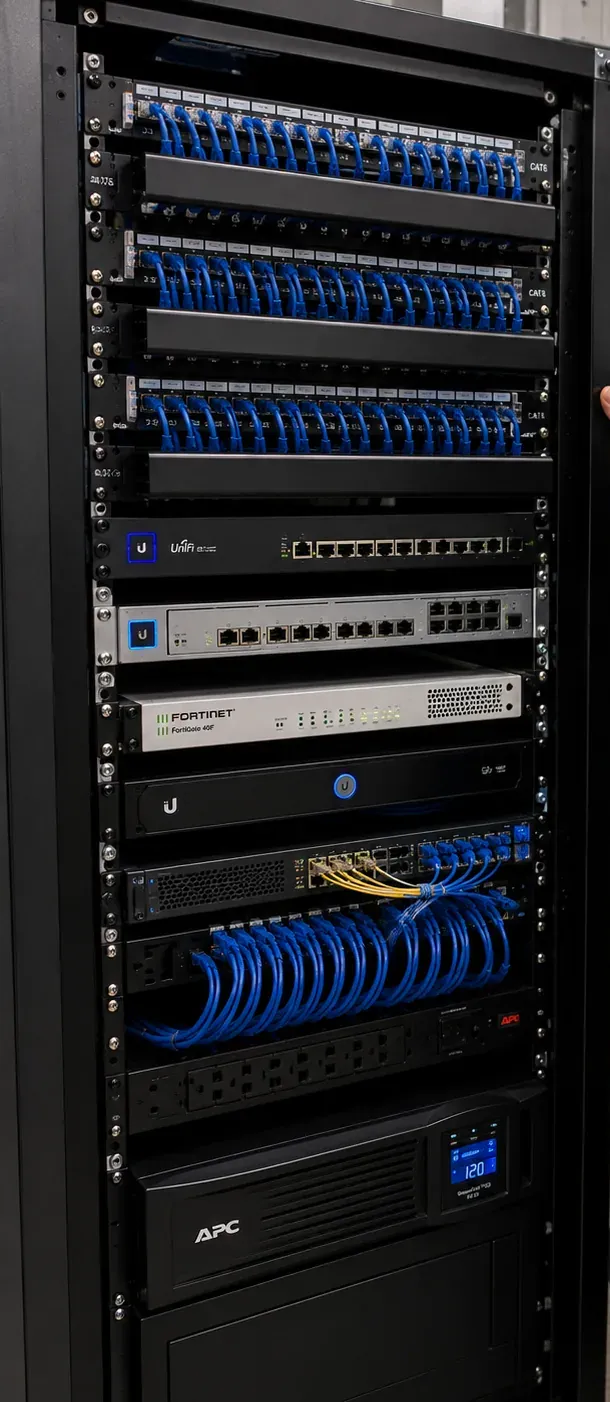
A floor rack holds patch panels, switches and a firewall, with a power strip and a UPS battery unit at the bottom — the powered end of a network, which we keep out of flood-prone cellars.
AI Overview Reality Check
What AI Gets Wrong About Fiber Optic Installation in Astoria
Search summaries and cost-guide pages answer fiber questions as if every building were a suburban house or an office tower. Below are seven claims, most quoted as written on forum threads, provider pages and cost guides, set against what a small Astoria building actually involves. We looked for Angi, HomeAdvisor and Fixr pages on fiber installation costs and none was returned, so none is quoted here.
"If the building doesn't have FiOS then you can't have FiOS."
That line, from an r/astoria thread about Wi-Fi options, is true on the day it is written and wrong as a permanent rule. A building without a provider's fiber usually lacks it because nobody has given that provider a route from the street to the apartments, and in a small Astoria building that route is the owner's to give.
Another commenter in the same community described a building where the landlord said Fios was available, while the provider's website showed it only for "the basement and top floor." That is a building with a partial route: the provider wired the apartments it was asked to wire and stopped.
An owner plant with a pair to every apartment ends the patchwork. Whether a provider then serves the building is its business decision, but the absence of wiring is no longer the reason.
"Fiber-optic cable costs anywhere from $1-6 per linear foot to install."
A Manhattan-area fiber contractor publishes that range, and per-foot pricing makes sense for long horizontal runs in open ceilings. In a three-family house the total cable length might be under a hundred feet; at a few dollars a foot the cable is the cheapest part of the job.
What costs money in a small building is the entry sleeve through the foundation, the enclosure, the splicing and the termination at each end, the firestop at each floor, and the care taken to keep plaster intact. That is why we price Astoria work per drop and per enclosure, from our published Queens list, rather than by the foot.
An owner comparing quotes should therefore compare the number of drops, the enclosure and what is tested and documented, not the cable footage.
"Residential projects typically range from $1,500 to $6,000."
A national cost guide gives that range for residential fiber work. It is a reasonable bracket for a single house with a long run to a garage or a home office, but it says nothing about how many households the work serves, which is the question that matters in Astoria.
At our published Queens prices, three single-mode drops for a three-family house add up to $1,341 before any extras, and six drops for a small walk-up to $2,682. Spread across the apartments, the cost per household is closer to the price of a few months of internet service than to a renovation.
The real variables are the entry, the vertical route and the condition of the cellar, which is why the walkthrough comes before the number.
"$300 to $800 for each fiber drop"
A structured-cabling firm's cost article quotes that per-drop range, roughly two to three times a copper drop. Our Queens drop prices, $391 for multimode and $447 for single-mode, sit inside it, so the claim is broadly fair.
What the figure leaves out is what a drop connects to. A drop in an office runs from a switch in a closet to a desk. A drop in an Astoria walk-up runs from the owner's enclosure to an apartment outlet, and it is only useful if the entry and enclosure exist at the other end.
So the first drop in a small building costs more than the per-drop figure suggests, and every drop after it costs less in proportion. That is an argument for doing all the apartments in one visit, or at least sizing the riser for all of them.
A fiber install "can take up to 4 hours"
Ask a national carrier how long fiber takes and you will hear that its visit "can take up to 4 hours"; a second carrier says "four to six hours". Both numbers are about hooking up one subscriber in a building where a path already exists.
Building the owner plant that makes such quick installs possible is a separate job. In a two- or three-family house it is usually a single working day; in a larger walk-up it can take two or three, depending on the vertical route and how many apartments must be entered.
After that, each provider visit really can be short, because the hard part is already done.
A provider’s apartment-building rollout runs to roughly four months, so owner fiber must take as long
One provider’s multifamily programme lists a month of off-site construction, a month on site and another forty to sixty days before activation. For a big complex that a carrier wires at its own cost, that schedule is believable. It is not the timeline for a small owner-built plant.
An Astoria owner who commissions a small plant controls the schedule: a walkthrough, a quote, a working day or two, and a test report. Provider service then depends on each provider's own order process, which the owner does not control and we do not promise.
Owners should be wary of anyone, us included, who promises a provider's activation date. What we can promise is that the building will be ready for it.
An owner can sign one provider for the whole building and keep the others out
This is an assumption rather than a quotation — we did not find it stated on a page we could cite — but the rule it ignores is documented, and it is outdated. City housing guidance summarising federal rules says exclusive agreements between owners and providers are banned, along with sale-leaseback deals for inside wiring.
An owner can still choose not to grant a particular provider access to common areas, and bulk or marketing arrangements exist, but an exclusive lock-out deal is not the tool it once was.
The practical lesson is the same as the rest of this page: owners keep control by owning the route, not by signing it away. Nothing here is legal advice; the building's attorney should review any provider agreement before it is signed.
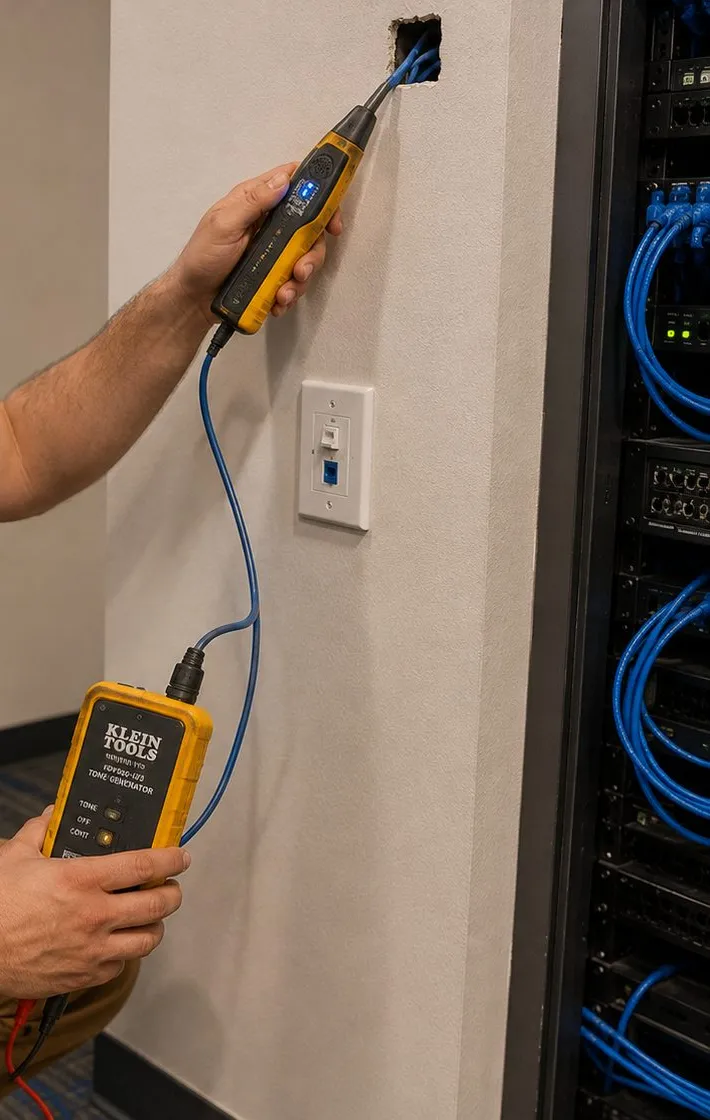
A yellow tone probe is held at a cable coming out of a wall opening above a wall switch, with a tone generator in the other hand and a rack at the right.
Show Us the Cellar. We'll Show You the One Way In.
A free walkthrough of the cellar, the stair and the roof, a one-page drawing of where every provider should enter, and a price per apartment.
Tell us the cross streets, how many apartments and shops the building has, and which providers serve it now. An installer who works in Astoria will reply that business day, or call (347) 434-6392.
✅
Request Received
Thanks — we have the building details. Expect a call from our Queens desk today; for anything urgent, ring (347) 434-6392 now.
How It Works
Our Installation Process
Seven steps. In a small Astoria building the technical work is quick; the care goes into choosing one route that suits the owner, the tenants and every provider that will ever use it.
1. Walk the building with the owner
Front wall, cellar, stair and roof, with the person who knows the building best: counting the cables that come in, finding where they land, and looking for a chase or stacked closets.
2. Choose one entry and the enclosure spot
A single sealed way in for every provider, usually near the street plant and the meters, and a dry wall high in the cellar for a lockable owner enclosure.
3. Draw the route and the strand plan
One page: the vertical route, a pair for every apartment and the storefront, strands for the owner’s own systems, and the spares, each labelled by apartment number.
4. Price per drop and agree access
A proposal from our published Queens prices, appointments for occupied apartments, and a note of any roof lessee or provider whose equipment must be left alone.
5. Entry, enclosure and riser
Sleeve through the wall and sealed, enclosure mounted, riser cable up the chosen route in a chase or painted raceway, and a listed firestop at every floor crossing.
6. Splice, terminate and test
Strands fusion-spliced in the enclosure, outlets fitted in each unit, a loss reading on every pair and an OTDR trace on the riser strands.
7. Label and hand over
Apartment numbers on every pair at both ends, the drawing and test results to the owner, and the building ready for any provider to connect.
Coverage Area
Fiber Optic Installation Near Astoria's Landmarks
Astoria's landmarks are mostly working places — a studio, a factory, a beer garden, a pool — and the blocks around each of them have their own kind of building, and so their own kind of fiber job.
Kaufman Astoria Studios and the Museum of the Moving Image, 36-01 35th Avenue
Opened by Famous Players-Lasky, later Paramount, in 1920 at what is now 35th Avenue and 35th Street; run by the Army Signal Corps from 1942; known as Kaufman Astoria Studios since 1982 and now at twelve stages. The museum next door reopened in January 2011 after an expansion to 97,700 square feet.
Steinway & Sons Factory, 19th Avenue and Steinway Place
The piano works at the northern end of Astoria, on land the company has held since the late nineteenth century, still building pianos by hand — about 1,300 a year according to a Time Out New York feature, with roughly 225 union workers.
Steinway Mansion, 18-33 41st Street
Built in 1857–58 by Benjamin Pike Jr. and bought by William Steinway in 1870; a New York City Landmark since 1967 and on the National Register since 1983 — a reminder that the company town around it is older than most of Queens.
Astoria Park, the Hell Gate and RFK Bridges
About 60 acres on the East River, crossed by the Hell Gate Bridge, opened in 1917 and still carrying Amtrak's Northeast Corridor, and by the Triborough (now RFK) Bridge, opened July 11, 1936. The park's pool, opened nine days earlier, was the largest of the city's WPA pools that year.
Bohemian Hall, 29-19 24th Avenue
Home of the Bohemian Citizens' Benevolent Society, formed in 1892; the hall's cornerstone was laid on October 1, 1910 and its outdoor bar and garden were finished in 1919. The surrounding blocks of houses and walk-ups are typical of the small buildings we wire.
Astoria–Ditmars Boulevard Station
The northern terminal of the elevated Astoria Line over 31st Street, opened February 1, 1917, renovated in 2018–19, and used by 3,309,906 riders in 2024. Storefronts and walk-ups line the street beneath it all the way south to 36th Avenue.
We also serve the rest of Astoria and its edges: Ditmars–Steinway, Astoria Heights toward LaGuardia, Old Astoria and the Hallets Point peninsula beside the NYC Ferry landing that opened at 3-10 Astoria Boulevard in August 2017, the Socrates Sculpture Park blocks along Vernon Boulevard, and the streets toward Woodside and Sunnyside, plus every other part of the borough through our Queens fiber optic installation team.
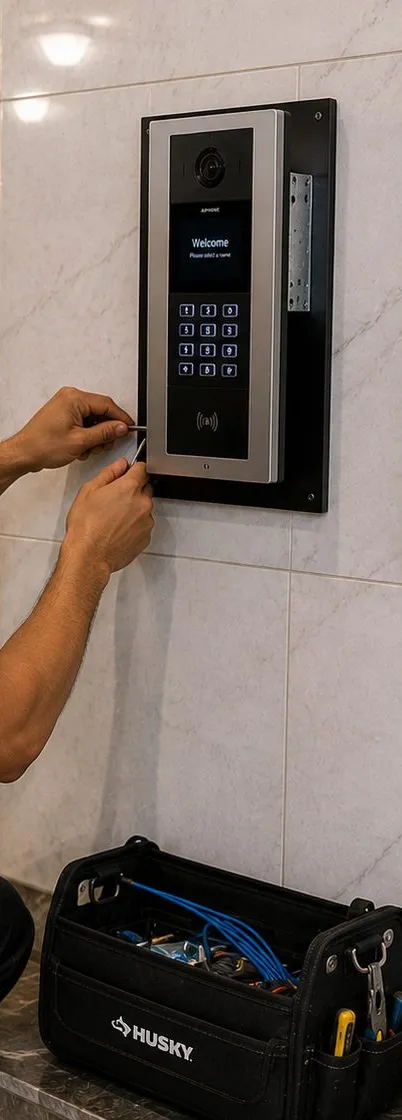
Hands work at the side of a keypad-and-camera entry panel mounted on a tiled wall, with a tool bag of blue cable on the ledge below.
Pricing
Fiber Optic Installation Cost in Astoria
Astoria jobs use our Queens price list, line for line. A firm figure follows the walkthrough; until then an owner can multiply these published unit prices by the number of apartments and get close. The termination, testing, backbone and second-room figures are our Brooklyn and Bronx base with the 1.05× Queens rate applied; the two drop prices are the fiber options shown in our Queens structured cabling configurator, as on our Queens borough page.
Item
Queens price
Where it usually fits in an Astoria building
Single-mode fiber drop
$447 per drop
One apartment or storefront connected from the cellar enclosure to its own outlet — the building block of most Astoria jobs
Multimode fiber drop
$391 per drop
A short private link inside one business, such as an edit room to a machine room on the same floor
Fiber termination on an existing cable
$37 per termination
Finishing strands left coiled by an earlier contractor, or a pair left waiting for an apartment renovated later
OTDR test
$42 per strand
Shows each riser strand’s length and pinpoints a poor splice or a tight bend; owners keep the trace with the drawing
12-strand OM4 floor-to-floor backbone
$4,725 – $7,350
A private backbone between floors of a converted commercial or studio building
24-strand OS2 between buildings or along a long structure
$8,400 – $15,750+
Two buildings on one lot, or a larger walk-up where every apartment and the owner's systems need strands
Second telecom room with fiber link
from $2,520
A small powered equipment space upstairs, linked to a passive cellar enclosure
Service and callback rate
$195/hr, 3-hr minimum ($585)
Repairs, re-labelling after tenant changes, connecting an apartment later; installation itself is priced separately
What moves an Astoria fiber quote
Number of households and shops. Most of the price is per drop, so a six-family costs more than a two-family mainly because it has more apartments, not because the cable is longer.
The entry. A sleeve through a brick or concrete foundation where none exists takes longer than reusing an existing opening that can be resealed.
The vertical route. An old chase or stacked closets is quick; painted raceway up a four-storey stair hall, firestopped at each floor, takes more care.
Apartment access. Occupied apartments need appointments; owners who renovate on turnover can leave some apartments for later and save visits now.
The state of the cellar. A cellar full of dead cable that has to be traced and listed adds time, but it is time that pays for itself the first time a provider asks where to connect.
Why not ADT, Ring or SimpliSafe? Those brands sell alarms and cameras to households, and none of them builds the fiber path between a cellar and the apartments above it. The real alternatives for an Astoria owner are the providers themselves, each wiring only its own subscribers wherever its technician chooses, or a general handyman running cable he cannot splice or test. We are the licensed option in between: our own splicer and test gear, a drawing the owner keeps, and the same Queens prices whether the building is on Ditmars Boulevard or 36th Avenue.
Shop Our Systems
Fiber Optic Installation Packages & Pricing
Three worked examples, each built only from the published unit prices above and matched to the Astoria buildings we see most. Your proposal replaces them with the real count of apartments, the route and anything the walkthrough turns up.
Starter — Three-Family House
$1,341
Three single-mode drops at $447, one to each household, from a compact enclosure beside a sealed entry in the cellar, each outlet labelled and tested. If the building needs a new entry sleeve or an enclosure we supply, those are itemised separately on the proposal.
Standard — Six-Unit Walk-Up
$2,934
Six single-mode drops at $447 ($2,682) plus an OTDR trace on each of the six riser strands at $42 ($252), so the owner holds a record of every apartment's connection on the day it was finished.
Premium — Two Buildings or a Larger Walk-Up
$8,400 – $15,750+
A 24-strand OS2 single-mode run between two buildings on one lot, or up a larger walk-up where every apartment, the storefront and the owner's own systems need strands, with OTDR on every strand.
Bring Your Own Equipment — Labour Only
Already holding a reel of single-mode, an enclosure and outlets from your own supplier or a past renovation? We can install your materials and bill only our time: $195 an hour, three hours minimum ($585), covering the pull, the splices, the tests and the labels. Your parts keep whatever warranty their maker gives, and before your cable goes behind a wall we check the reel end to end so a damaged spool never ends up in the building.
Full terms — including 50% deposit, one-year parts-only warranty on AESS-supplied products, and the late-fee schedule — are set out in the service agreement. Every strand we finish is handed over with the test result that shows it passed on the day.
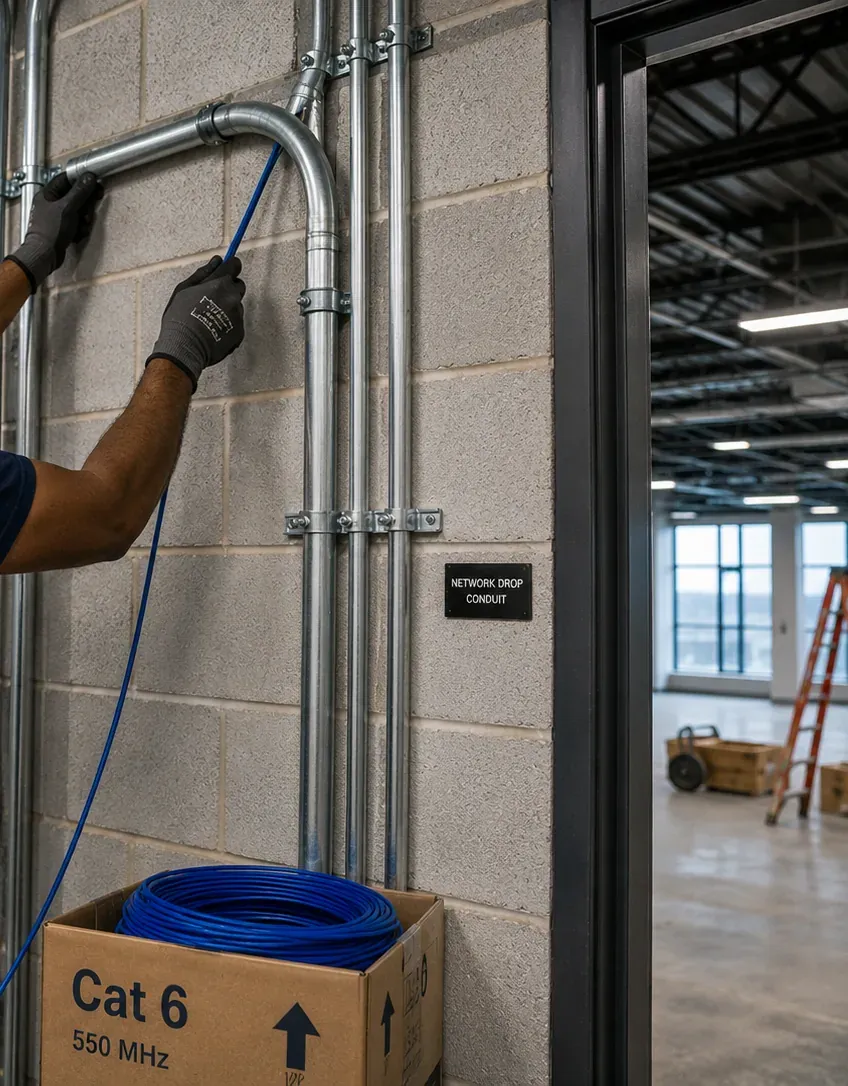
Gloved hands pull blue cable through a bent EMT sweep on a block wall beside a small sign reading NETWORK DROP CONDUIT, with a reel box below and an open floor through the doorway.
Want a Price Per Apartment Before You Decide?
The walkthrough is free. You get the drawing, the strand count and a figure you can divide by the number of households.
Astoria runs from the East River to roughly the Brooklyn–Queens Expressway and from the Queensboro Bridge approaches north to the water at Ditmars, and the buildings change every few blocks. So does the job.
Ditmars–Steinway, north of Astoria Boulevard
Wide residential streets of brick rowhouses, detached houses and prewar apartment buildings, many held by the same families for generations, with Ditmars Boulevard as the shopping street. This is two-family and three-family country: an owner downstairs, one or two tenants above, and a cellar that holds the boiler, the meters and forty years of stored furniture. Jobs here are the smallest plants we build, often finished in a day, and the conversation is with the owner at the kitchen table.
The 31st Street corridor under the el
From Ditmars Boulevard south to 36th Avenue the Astoria Line runs overhead on its steel structure, with storefronts and walk-ups on both sides of the street. Buildings here are taller and more mixed than on the side streets, and the shops beneath the tracks change hands more often. We plan entries on the side or rear of these buildings where we can, keep cable and enclosures away from the street-side cellar walls that take the most dirt and water, and give the storefront its own strands so a new shop tenant never has to touch the residential riser.
30th Avenue and Broadway
The restaurant and shopping streets of central Astoria, lined with two- to four-storey buildings that put a business on the ground floor and two to six apartments upstairs. Here the job is two clients in one building: a restaurant that needs its card terminals and kitchen screens to work on a Friday night, and households upstairs who want a choice of provider. The cellar is often busy with the restaurant's walk-in, stock and beer lines, so the enclosure goes where the owner and the tenant both agree it can stay untouched.
The Kaufman Arts District, 34th to 37th Avenue
Around Kaufman Astoria Studios and the Museum of the Moving Image the buildings are more commercial: production offices, post-production suites, scenic and prop shops, rehearsal spaces and a performing arts high school, many in converted garages and light-industrial buildings. Jobs here are private links inside a business — machine room to edit suite, office to stage-side workspace — and occasionally between two buildings a company rents on the same block.
Steinway Street
The long commercial spine, with 477 storefronts in the city's survey and a $12 million city redesign announced in November 2023 for the blocks between 30th and 34th Avenues. Buildings range from one-storey taxpayers to four-storey mixed buildings. A street being rebuilt is a reminder to owners to check where their provider's cable enters before contractors start digging at the curb.
Old Astoria and the Hallets Point peninsula
Around Astoria Park and down toward the river, nineteenth-century houses from Astoria's village days sit near 1950s public housing and the new towers of Halletts Point and Astoria Cove. Old frame houses raise crawlspace and wall-cavity questions; the towers are full telecom-room jobs; the public housing is managed by NYCHA, where we take no work without the authority's approval.
The northern industrial blocks and Astoria Heights
North and east of the factory, toward the power plants and the expressway, the streets turn industrial and then residential again in Astoria Heights. Industrial clients want links between a front office and a shop floor or yard; the houses of Astoria Heights look much like Ditmars–Steinway and get the same small-building treatment.
Studio Blocks
Production Space Around Kaufman Astoria: Fiber Inside the Business
Astoria has been making moving pictures for more than a century. The studio on 35th Avenue opened in 1920 as the East Coast production centre of Famous Players-Lasky, later Paramount; the Army's Signal Corps Photographic Center took it over in 1942; the city awarded its management to George S. Kaufman in 1980; and it has carried his name since 1982. A forty-thousand-square-foot Stage K opened in 2010, a backlot in 2013 and two more stages in 2019, bringing the total to twelve. In 2014 the surrounding blocks became the Kaufman Arts District, the first arts district in the borough.
Studios like this one run their own networks under their own rules, and we do not claim any work inside the lot. The fiber we see in the arts district is in the businesses around it: a post-production company on the second floor of a converted garage, a production office that rents a floor for a series and then gives it up, a prop shop that needs a camera link to its loading door. Their needs differ from the households on the side streets in three ways.
Files are enormous, and they move inside the building. Camera originals, render output and dailies travel between a machine room and the rooms where people work. A short private fiber link inside the business carries that traffic regardless of what the internet line outside can do.
Noise and heat are unwelcome in the rooms where people listen. Moving loud, warm machines to a back room or the cellar and connecting them by fiber keeps edit and mix rooms quiet. Fiber has no trouble with the distance; copper links for that kind of traffic often do.
Tenancies can be short. A production that leases space for a season wants cable it can take away or leave cleanly. We terminate in enclosures that can be unmounted and label everything so the landlord can see what stays.
For these jobs the multimode and OM4 lines on our price list are often the right fit, because the link stays inside one business and one building. Where a company also needs a carrier's service into its space, the same small-building logic as everywhere else in Astoria applies: one sealed entry, agreed with the building owner, and a clearly labelled handoff.
The Power Waterfront and the 2006 Blackout: What Fiber Needs From Electricity
Astoria lives next to the plants that light the city, and it remembers when its own lights went out. The Ravenswood Generating Station on the river, opened in 1963 and bordered by Astoria Houses, supplies about a fifth of New York City's electricity, according to a 2023 City Limits report on its owner's plans to replace old steam units with offshore wind and solar power delivered by underground cable. Yet in July 2006, during a heat wave, the network serving northwest Queens failed: power loss began on July 17 and lasted about eight days for many residents of Astoria, Long Island City, Sunnyside and Woodside. Accounts put the people affected at around 174,000; Con Edison, which counts a whole building as one customer, first reported 1,600 customers and later revised that figure roughly tenfold.
For a fiber plan, the lesson is simple and often misunderstood. Glass needs no electricity. An owner plant made of cable, splices, connectors and a passive enclosure keeps working through any outage, because nothing in it is powered. What stops working in a blackout is everything at the ends: the provider's equipment upstream, the optical terminal in each apartment, the router, the switch in a business's back office.
Part of the connection
Needs power?
Who keeps it running in an outage
Provider's network in the street and beyond
Yes, upstream
The provider, with its own backup
Entry sleeve, cellar enclosure, riser and outlets
No
Nobody needs to — it is passive
Optical terminal and router in each apartment
Yes
The household; a small battery unit is its own choice
Business switch, cameras or entry system
Yes
The owner or business, sized to how long it must last
Drawn for this page. The red middle of the chain is what an owner pays us to build; none of it plugs in.
That is one more reason we keep active equipment out of the cellar in small buildings. A passive enclosure near the floor of a cellar is harmless if the cellar floods or the power fails; a switch and battery in the same spot are not. When an owner wants door entry, cameras or a building Wi-Fi network to ride through an outage, we put the powered equipment on a dry upper floor — or in a small second telecom space at the price above — and size a battery for the hours the owner actually needs, leaving generator connections to a licensed electrician.
None of this predicts the next outage, and we make no claim about the grid's reliability. It simply means that when the power comes back, a building with a properly built owner plant is back online as soon as each household's equipment restarts, with nothing in the shared part of the building to repair.
Waterfront
Hallets Point: New Towers Beside a 1951 Campus
The one part of Astoria that looks like Long Island City is the peninsula at the end of Astoria Boulevard. The Durst Organization finished its first Halletts Point tower at 10 Halletts Point Road in 2019, topped out a second phase of two towers at 20 and 30 Halletts Point Road — 27 and 32 storeys, 647 units — in October 2023, and describes the three buildings as adding about 2,000 homes. It also opened a 163-home affordable building at 3-24 27th Avenue and invested in the heating plant and public spaces of NYCHA's Astoria Houses next door, completed in November 1951 as 22 buildings of six and seven storeys on almost 27 acres. Inland, the Astoria Cove plan by Fogarty Finger calls for 469 apartments in four buildings west of 9th Street.
These are a different kind of fiber job from the rest of the neighbourhood. New towers have telecom rooms, managed risers and building management that decides which contractors may work and when. A tenant or retail occupant who wants private fiber there works through management's rules, and the work looks like our tower jobs elsewhere in Queens. A resident who simply wants a different provider should ask management which carriers already serve the building rather than asking a contractor to add a cable.
Public housing is different again. Astoria Houses is managed by the New York City Housing Authority, and nothing is installed in a NYCHA building without the authority's approval; we do not suggest otherwise. Residents' internet in NYCHA developments has been the subject of city programmes delivered through large providers, and questions about it belong with NYCHA and those programmes.
Waterfront parcels also carry flood considerations that inland rowhouse blocks mostly do not. Owners of buildings near the river should look up their lot on the city's flood hazard map before deciding where cellar equipment goes; our default of a passive cellar enclosure, mounted high, with powered equipment upstairs, was written with that in mind.
Before You Call
Six Things an Astoria Owner Should Know Before Calling Any Installer
Whether you call us or someone else, an owner who arrives with these six answers gets a better plan and a faster quote.
Question
Why it matters
Where to find the answer
How many apartments and shops does the building legally have?
Every household gets its own strands; the count sets most of the price
The certificate of occupancy or the building's DOB record
Which providers serve the building now, and to which units?
Shows which entries and cables are live and which can be retired
Ask tenants, and look for provider labels on the cellar wall
Where do the current cables come in?
Usually the best place for the single sealed entry
The cellar wall nearest the street, and the front facade
Is there an old chase, dumbwaiter corner or stacked closet?
The cheapest vertical route with the least plaster work
A walk up the stair with a flashlight
Does anyone lease the roof?
A carrier's antenna cable must stay separate from yours
Your lease files
Are any apartments due for renovation soon?
Those units can be connected later, when their walls are open
Your own plans
If any of these is a blank, that is fine: the walkthrough fills it in. The point is that a small-building fiber plan starts with the building and the people in it, not with a parts list.
Complete Services
Every Fiber Optic Installation Service in Astoria
An owner who opens the cellar and the stair for fiber usually has a short list of other low-voltage jobs. These services share the same enclosure, the same route and the same drawing.
Video entry panels for walk-up lobbies and storefront-building doors, networked over the building's own strands.
Field Notes
Field Notes From Astoria Cellars and Stair Halls
Written as our routine for Astoria houses and walk-ups in general; it does not describe any single client's building
In a small building the client is usually standing next to us, and often lives upstairs. So the first ten minutes are a walk with the owner: the front wall to count the cables coming in, the cellar to find where they land, the stair to look for a chase, and the roof if anything crosses it. Owners tend to know their buildings better than any drawing does, and they know which tenant works from home.
In the cellar, our habit is to find the driest wall near the electric meters, check what the boiler contractor and the plumber will need in front of them, and mount the enclosure where none of them will ever lean a ladder against it.
Last, we write the drawing for someone who has never met us: apartment numbers on every pair, the provider's name where one is connected, and the date of the test. In buildings where tenants change every few years and owners sometimes change once a generation, that page is the part of the job that lasts longest.
Full Service List
Fiber Optic Services We Provide in Astoria, Queens
For owners, tenants and businesses who search by the name of a task, this is the whole list, organised the way an Astoria job actually runs.
Planning, routing and pulling
Every fiber optic installation in Astoria, Queens begins with a route survey: where the fiber optic cable installation can enter, which fiber optic cable routing up the building disturbs the fewest people, and how fiber optic cable pulling can be done through a closet, chase or stair hall without dragging glass across sharp edges. For a deep lot we provide underground fiber optic installation in conduit between a front building and a rear house or garage, armored fiber optic cable installation where a run crosses a yard or a cellar used for storage, and fiber optic conduit installation wherever a clean new pathway is needed. Inside walk-ups we handle fiber optic riser installation and apartment building fiber optic installation that brings a labelled pair to every unit.
Business and production fiber
Commercial fiber optic installation in Astoria means storefronts, restaurants, offices above shops and the production businesses of the arts district. We install fiber optic backbone installation between floors of converted commercial buildings, fiber optic network switch installation and SFP transceiver installation at each end, and fiber optic network upgrades when a business has outgrown a consumer router in the dining room.
Splicing, termination and enclosures
Our fiber optic splicing services use a fusion splicer; fiber optic fusion splicing follows careful fiber optic cable stripping and fiber optic cable cleaving, and each splice is laid into a tray during fiber optic splice tray installation. Fiber optic termination happens at both ends: fiber optic termination box installation and fiber optic distribution box installation in the cellar, fiber optic wall outlet installation in each apartment, LC fiber connector installation, fiber optic patch cord installation and, in businesses, fiber optic patch panel installation, fiber distribution panel installation and fiber optic rack installation where a rack is needed.
Testing and certification
Nothing is handed over untested. Fiber optic testing and certification includes fiber optic OTDR testing on riser strands, fiber optic signal loss testing with optical power meter testing and fiber optic light source testing on every pair, and fiber optic network certification reports for owners, managing agents and IT providers who ask for them. Fiber optic cable testing and fiber optic signal testing are also how we prove a repair worked.
Repair and troubleshooting
When an apartment or a shop goes dark, fiber optic troubleshooting starts at the cellar enclosure. Fiber optic break detection uses the OTDR to find the distance to a fault, fiber optic visual fault locator testing lights a broken or over-bent strand, and fiber optic connector inspection and fiber optic connector cleaning deal with the commonest cause of trouble. Broken fiber optic cable repair, fiber optic cable repair at a connector, fiber optic cable replacement, fiber optic network repair and fiber optic network restoration follow as needed.
Labelling and upkeep
Fiber optic cable labeling by apartment number, fiber optic cable management inside the enclosure, fiber optic rack cleanup in businesses and periodic fiber optic maintenance visits keep the fiber optic infrastructure installation readable as tenants and providers change. As a licensed low-voltage fiber optic installation contractor serving Astoria, Queens, we handle the job from the first survey to the final test.
FAQ
Astoria Fiber Optic Installation FAQ
Do you take fiber work in Ditmars–Steinway, Astoria Heights, Old Astoria and out on the Hallets Point peninsula?
+
Yes. Most of our Astoria jobs are small buildings in Ditmars–Steinway, central Astoria and Astoria Heights, but we also work in Old Astoria, along the 31st Street corridor and in the commercial buildings of the Kaufman Arts District. Astoria work runs through our Queens line and is dispatched from our office on East Fordham Road in the Bronx.
Can your crew work alongside the handyman or super who already looks after our building?
+
Yes, and it usually helps. Whoever looks after the building knows where the shut-offs are, which closets connect and which tenants need notice. We agree with them where we will drill and what they should avoid afterwards, and show them the enclosure and the drawing before we leave.
Can the same visit fix a tenant’s dead Ethernet jack or a damaged cable inside one apartment?
+
Often, yes. If we are already in the building for fiber, a failed wall jack, a crushed patch cable or a bad in-apartment run can usually be repaired on the same visit at the service rate, with the tenant’s and owner’s agreement, rather than booking a separate trip.
While you’re on the roof, can you take down old satellite dishes and the coax that fed them?
+
We can remove dishes and dead coax that the owner confirms are abandoned and owned by the building. We leave anything that might belong to a current subscriber or a provider, and anything belonging to a roof lessee, until the owner confirms who owns it.
Can you work from a lockbox code or a spare key while we’re at our own jobs?
+
Yes, if the owner prefers. Many small owners work during the day. We can arrange access by key or lockbox for the cellar and common areas, send photos as the work progresses, and book occupied apartments directly with tenants at times the owner approves.
Can the owner fiber enclosure go on the same cellar wall as the electric meters?
+
Usually nearby, but not in front of them. We keep the working space in front of electrical panels and meters clear, as the electrical code requires, and mount the fiber enclosure to one side where the utility and electricians can still reach everything they need.
All Areas Served
Fiber Optic Installation Across New York City
This page sits under our Queens fiber optic installation page, which in turn sits under the NYC fiber optic installation hub covering all five boroughs. Below are the sixteen borough, county and regional pages, plus every neighbourhood page written so far, each built around the buildings of its own district.
If every household in the building lost service together, or the 30th Avenue restaurant downstairs cannot take cards, or the link to the rear house died after yard work, phone (347) 434-6392. We send a technician the same day when the schedule allows; the usual causes — a jumper disturbed in the cellar enclosure, a drop damaged where it crosses a joist, a dirty connector — are normally put right within an hour or two on site, and the strand is tested again before we leave.
Fiber Optic Installation Astoria — One Way In, Every Household Its Own Pair
Abstract Enterprises Security Systems · 460 E Fordham Rd, Bronx, NY 10458 · Queens line (347) 434-6392 · WhatsApp (718) 679-0359 via wa.me
NYS Low-Voltage Licence #12000287431 · 100% Licensed & Insured · Same-Day Estimates · Rated 4.7★ from 201 Google Reviews
Full terms — including 50% deposit, one-year parts-only warranty on AESS-supplied products, and the late-fee schedule — are set out in the service agreement. See our warranty page.
Page reviewed and updated October 17, 2026. Changelog: first published on 17 October 2026 as the Astoria neighbourhood page of our Queens fiber series.