What are you looking for?
About Us Contact Us Careers Get a Free Quote (800) 486-0943
Pick a service
✅ Got Your Own System?
🎬 Home TheatreQuote 🎶 AV SoundQuote 🔑 Access ControlQuote
Now pick your area
Pick your area
Long Island
Hudson Valley
Services available
Pricing & Tools
Pick a service for pricing
🚪 Intercom Pricing 🔔 Buzzer Repair Pricing
Calculators
📹 Camera System Calculator 🚨 Alarm Calculator ⚡ Cabling Quote Builder ✅ Got Your Own System?
Select your area
Home › Fiber Optic Installation NYC › Staten Island › Bloomfield
Licensed Low-Voltage Contractor · West Shore of Staten Island · Distribution Buildings, Office Parks & Hotels

Fiber Optic
Installation in
Bloomfield

High-Bay Backbones · Dock-Wall Zones · Yard & Gate Links · Office-Park Risers · Fusion Splicing · OTDR Records

Bloomfield is where Staten Island keeps its biggest roofs. Distribution buildings measured in hundreds of thousands of square feet stand off Gulf Avenue, the office towers of the Teleport and the Corporate Park line South Avenue, and hotels serve the traffic coming off the Goethals Bridge. Networks out here do not fail for want of a carrier — they fail because one closet cannot reach the far walls of a building that size on copper alone, or the gate, the yard and the guard booth. We design the glass that closes those distances, fusion-splice and test every strand ourselves, and leave you a record of where it all runs.

Reviewed and updated October 17, 2026 · Written by Anwar Timothy, NYS licence #12000287431

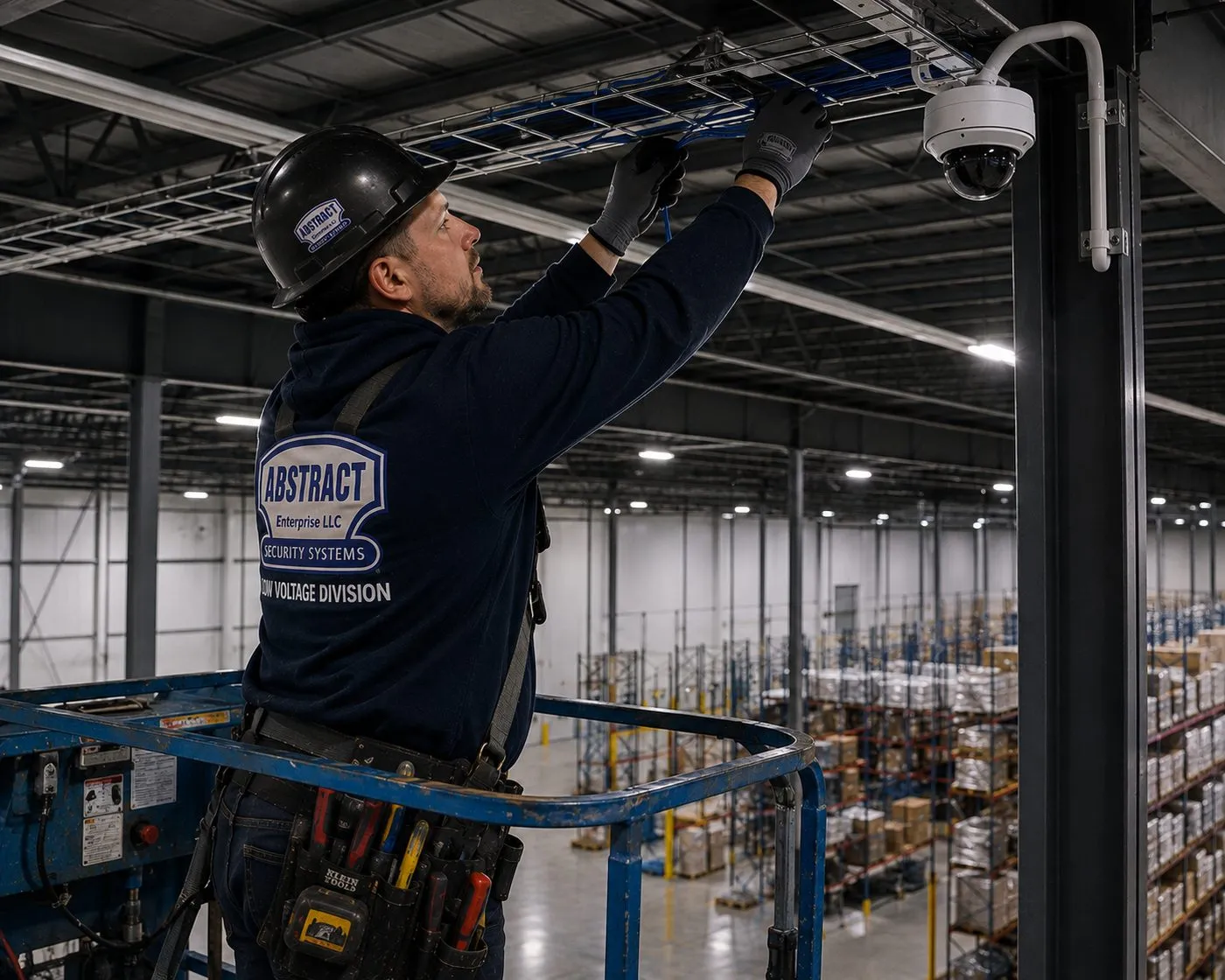
Technician on a scissor lift reaching into overhead wire-basket cable tray beside a dome camera in a high-bay warehouse, for Bloomfield, Staten Island fiber optic installation
Standing in a lift basket and wearing a hard hat, an installer works on a wire-basket tray under a warehouse roof, a white dome camera on a bracket beside him and pallet racking stretching away below.
Bloomfield Fiber Quote
Name the building and the two points that need joining — a tech calls back the same business day

✅
Request Sent!
A tech who knows the West Shore will call you back the same business day.
25+
Years Experience
✓
Same-Day Estimates
100%
Licensed & Insured
4.7★
201 Google Reviews

One building, two ends a quarter-mile apart? Ring the Staten Island line at (347) 934-8335 or use the 60-second form. Tell us the building, where the main network room sits and what has to reach it — dock doors, a mezzanine office, a gatehouse, a second building on the lot.

  • Free site walk anywhere on the West Shore, Gulf Avenue to Teleport Drive
  • Splicing and testing by AESS staff, never subcontracted, with every reading handed to you
  • NYS licence #12000287431 · dispatched from 1282 Troy Ave, Brooklyn, by way of the Verrazzano
The Neighborhood

Why Bloomfield Properties Need Fiber Optic Installation

Bloomfield has never had many residents. For most of the twentieth century its land held oil tanks and parked construction equipment; a Gulf Oil terminal built in 1936 covered some 440 acres, with 82 tanks holding about 215 million gallons, and the service road beside the West Shore Expressway still carries its name: Gulf Avenue. When the terminal closed in 1998 and the tanks came down, Bloomfield was left with something rare inside New York City — hundreds of acres of flat, open ground beside a highway, a bridge to New Jersey and the Arthur Kill. Commercial development had already arrived in the late 1980s, when large office buildings went up along South Avenue, and the logistics industry followed once the old terminal land was cleared and raised.

That history decides what a network here looks like. The buildings are few, new and very large. Matrix Development Group broke ground in October 2016 on the first two buildings of its Global Logistics Park — one of 975,000 square feet and one of 450,000 — on 200 acres it had bought off Gulf Avenue, and the park opened in the fall of 2018 with tenants that included Amazon and IKEA. Spread over one level, 975,000 square feet works out to roughly 90,000 square metres, so even a perfectly square footprint would measure about 300 metres a side — three times the 100-metre limit of a copper Ethernet channel. So the first fiber question in Bloomfield is not how to get service into the building; it is how to carry the network from one end of the building to the other, and out to the yard, the gate and the scale house, without anybody's scanners or cameras falling off at the far wall.

The office side of the neighbourhood asks different questions. The Teleport opened in the 1980s as the world's largest satellite dish farm — 17 dishes, each 25 feet across, inside an 18-acre walled compound — and its biggest tenant, AT&T, employed some 4,000 people there before leaving in 2001. Fiber made the dishes obsolete, and the campus became an office park for doctors, lawyers, schools and small firms, with the Corporate Commons buildings added by the Nicotra Group and the Telehouse data centre at 7 Teleport Drive. Tenants in those buildings are usually not short of carriers. What they need is the owner-side glass between their suite, their floor's closet and the building's entrance room, and the paperwork that lets a landlord, a hotel operator or a school administrator sign off on it.

The third thread is the ground itself. Much of the new logistics land was raised to at least ten feet above sea level before the warehouses were built, and roughly 252 acres of the same tract were set aside as preserved wetland. Next door, the city's first wetland mitigation bank restored 54 acres of tidal marsh and mudflat in the Saw Mill Creek watershed. A fiber run that leaves a building in Bloomfield therefore crosses engineered fill, truck pavement and, sometimes, the edge of protected ground. Getting that right is ordinary groundwork, but it is not something to improvise — and it is where most of our Staten Island structured cabling proposals on the West Shore begin, because the fiber we lay outside almost always feeds copper inside.

Bloomfield in six facts that shape a fiber design

  • 975,000 and 450,000 square feet: the first two buildings Matrix began at its Global Logistics Park in October 2016, out of four planned (NJBIZ, October 13, 2016).
  • 440 acres and 82 tanks: the Gulf Oil terminal that occupied Bloomfield from 1936 until it closed in 1998; Gulf Avenue is named after it.
  • At least 10 feet above sea level: the height the logistics development area was being raised to under an emergency watershed programme, with about 252 acres preserved as wetland (New York YIMBY, May 2016).
  • 162,000 square feet: the Telehouse data centre at 7 Teleport Drive, completed in 1989, whose fiber entry points rose to three in 2007 (Data Center Knowledge, June 2021).
  • 17 dishes, 25 feet across: the satellite farm the Teleport opened with, inside an 18-acre walled compound, before fiber made it redundant (Forgotten New York, 2023).
  • 54 acres of tidal wetland, marsh and mudflat restored in the Saw Mill Creek watershed, the city's first mitigation bank, after more than 40,000 cubic yards of debris were removed (Stormwater, October 2019).
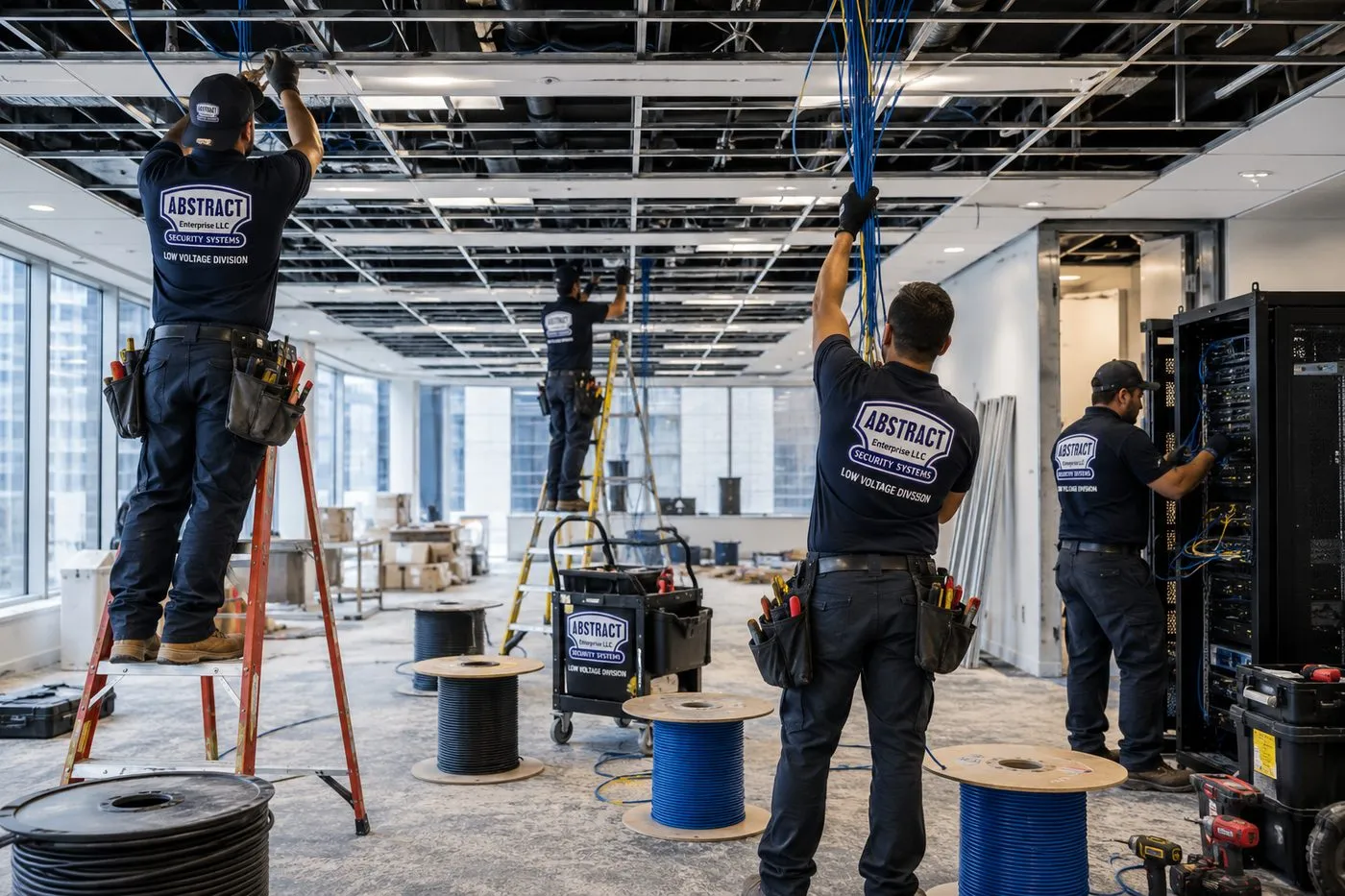
Four technicians pulling cable from reels set out on the floor into an open ceiling on a fit-out floor, illustrating backbone work for Bloomfield, Staten Island businesses
Two installers on ladders and one standing on the floor feed cable up through an exposed ceiling grid from reels spaced across the slab, while a fourth works at an open network rack by the wall.
Repair Capture

Bloomfield Fiber Down? Same-Day Repair Where We Can

Big buildings break their networks in big-building ways: a lift mast drags a low cable off its hangers, a trailer backs into the gate pedestal, a racking crew moves a cabinet without telling anyone. Repair work is priced apart from new installation, and our aim is a same-day visit to Bloomfield. With a technician on site, a typical single fault — a pinched jumper, a dirty end-face, a snapped pigtail in a tray, a cable yanked from its gland — usually takes one to two hours to find and put right, and the strand is tested again afterwards. Call (347) 934-8335 and say "fiber repair," or go to our Staten Island network cable repair page if the failure is on copper.

What We Install

Fiber Optic Installation Services in Bloomfield

Carriers deliver service to one room; we deliver it to the rest of the property. Every link below is fusion-spliced by our own technicians and handed over only after a power meter and, on longer runs, an OTDR have read every strand.

End-to-End Building Backbones

Fiber from the main network room to zone cabinets spaced along a distribution building, so no copper run to a scanner, camera or access point has to stretch past its limit. Routed in tray or on high-bay supports above the racking and the sprinklers' clear space.

Dock-Wall Distribution

Strands laid along the loading-dock side to small enclosures that feed door-by-door devices: trailer-door cameras, dock lights' controls, handheld charging stations and the wireless that follows freight off the truck.

Gate, Scale and Guard-Booth Links

Outdoor-rated or armored cable from the building to the entrance — across a truck court, under a curb or along a fence line — so the gate camera, intercom, badge reader and booth computer sit on the same network as the office.

Yard Pole Feeds

Fiber up private light poles and camera poles in trailer yards and parking fields, with a sealed enclosure and surge-protected power at the head and the glass doing the long run back.

Office-Park Suite Backbones

Strands from a tenant's suite to its floor closet and down to the building's entrance room in the 1980s office buildings along South Avenue and on the Teleport campus, built to the landlord's riser and firestop rules.

Hotel Back-of-House Fiber

Links from the main equipment room to housekeeping closets on guest floors, to meeting rooms and to restaurant or bar spaces, so guest Wi-Fi, point-of-sale and event networks each have room to grow.

Second-Building Links

Buried or overhead fiber between two buildings on one property — a warehouse and its maintenance shop, an office and its annex — with the route chosen around truck traffic and protected ground.

Fusion Splicing and Repair

Splice-on connectors, pigtails and mid-span repairs for links someone else installed, including restoring service after a cable is cut by a contractor, a mower or a vehicle.

Testing, Labels and As-Builts

Loss testing on every strand, OTDR traces on single-mode runs, labels at both ends, and a drawing of the route that your facilities team can hand the next contractor.

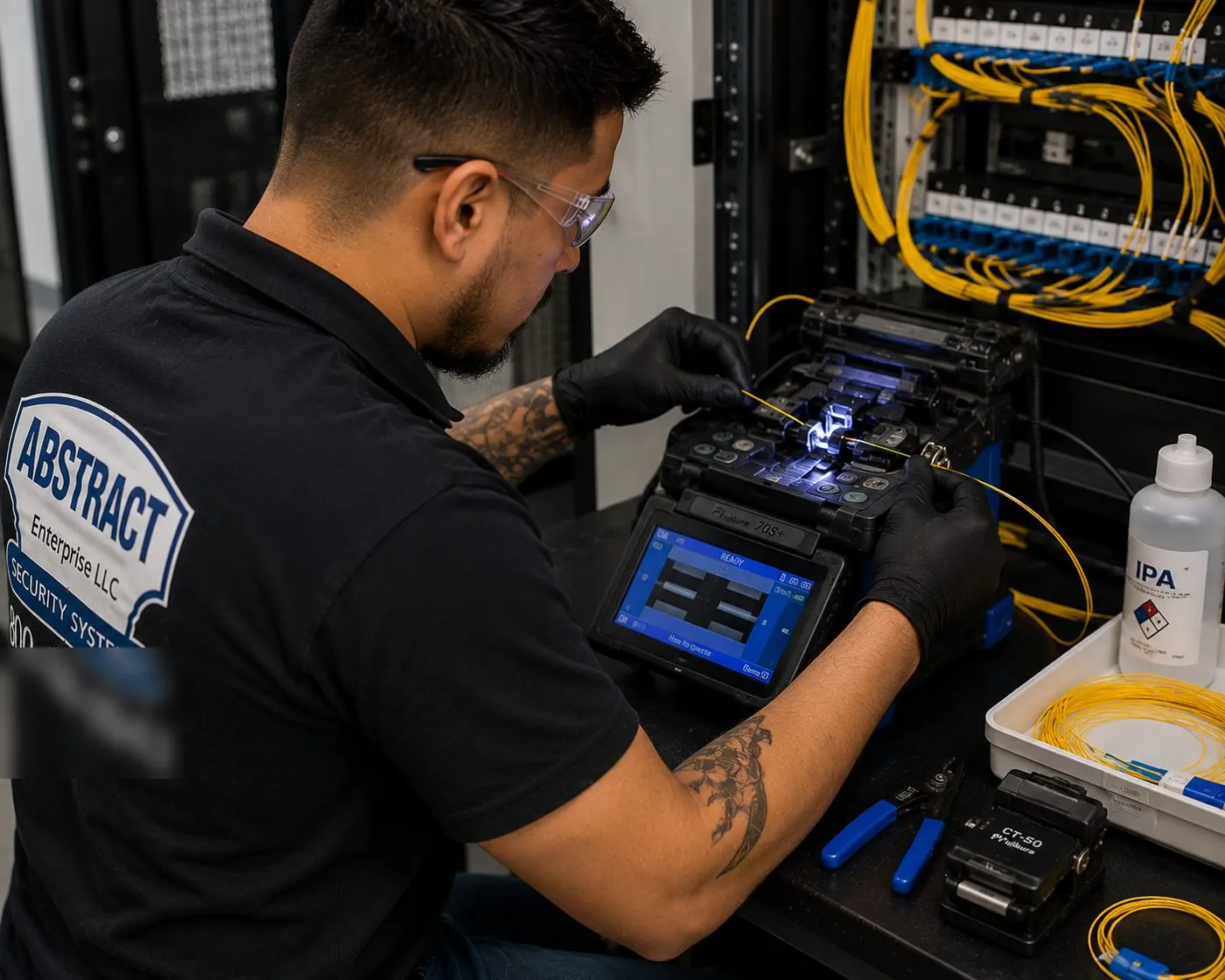
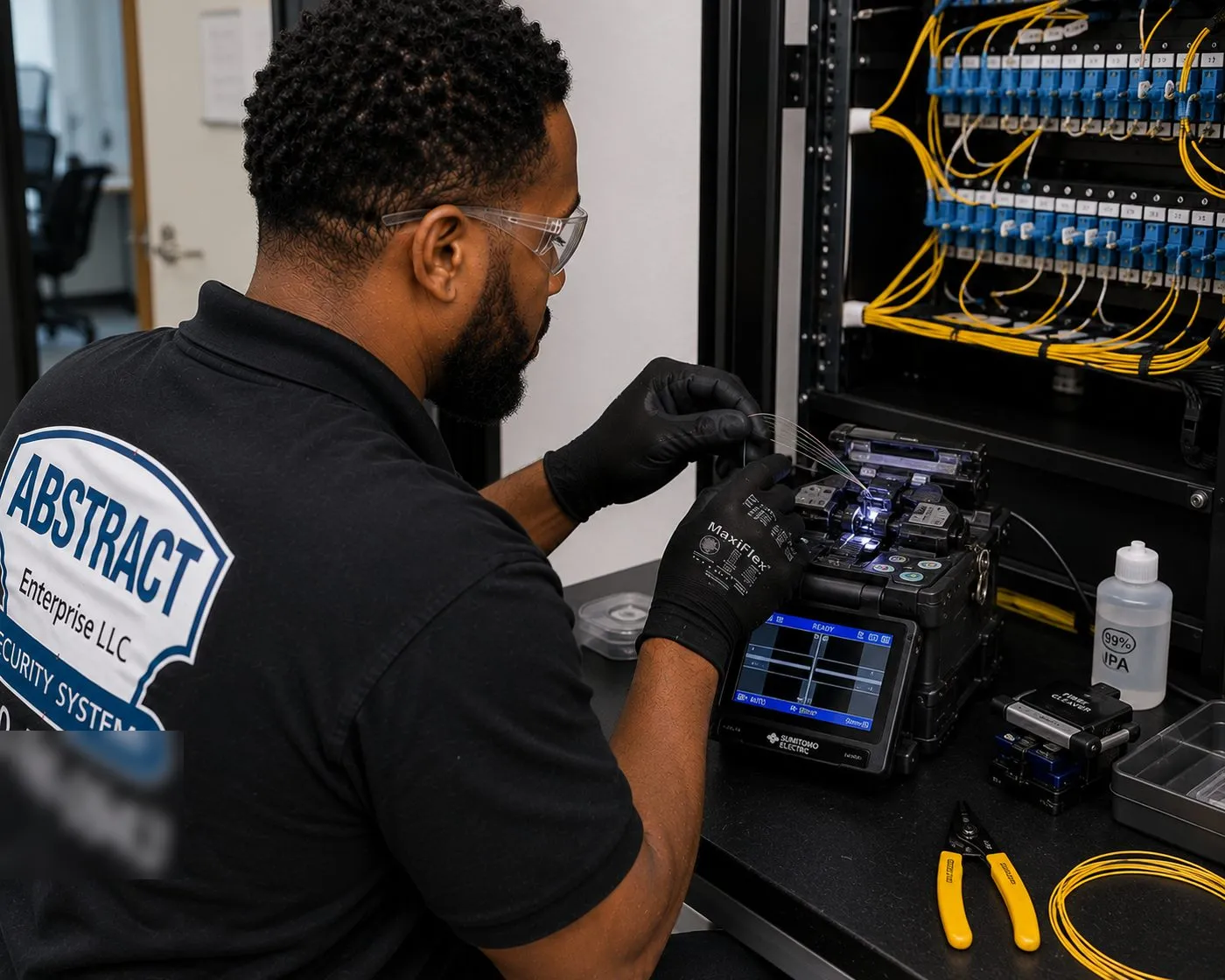
Technician fusion-splicing optical fiber at a bench beside a rack of yellow patch cords, the core method behind Bloomfield, Staten Island fiber optic installation
Wearing safety glasses and black gloves, a technician feeds a fiber into a fusion splicer whose screen shows two aligned cores; yellow jumpers fill the rack behind and an alcohol bottle sits in a tray of fiber at his elbow.
Building Specialists

Fiber Optic Installation for Bloomfield's Architecture

Bloomfield has almost no houses and almost no old buildings. What it has are a handful of building types, each with its own way of swallowing cable. These are the ones we plan for.

Big-Box Distribution Buildings

Steel frame, tilt-up or insulated-panel walls, a roof deck far overhead and a slab poured to carry heavy lift trucks. The network room is usually in the front office block; the devices that matter most are a long way from it, along the dock wall and up in the racking aisles.

Mezzanine Offices Inside the Warehouse

Shift offices, break rooms and control rooms built on steel mezzanines within the high bay. They often end up closer to the operation than the main office does, which makes them tempting places for a secondary network cabinet.

1980s Mid-Rise Office Buildings

The office complexes that went up along South Avenue in that decade: suspended ceilings, central cores with stacked closets, and decades of tenants' abandoned cable above the tiles. Fiber here climbs a riser and threads around what earlier occupants left behind.

Newer Campus Office Buildings

Buildings such as Corporate Commons Three — announced in 2017 as a 330,000-square-foot LEED-certified office building with a rooftop farm and medical tenants — come with cleaner risers and stricter rules about what goes in them.

Select-Service Hotels

Multi-storey guest floors stacked over a ground floor of lobby, breakfast room, meeting space and back-of-house. Each guest floor typically has a housekeeping closet that doubles as a network closet, and the links between them are the backbone.

Equipment Yards and Shops

Contractors' yards and maintenance shops — the descendants of the heavy-equipment storage that once filled the West Shore — where a single steel building and a fenced yard need cameras, a gate and an office on one network.

How the method changes with the building

In a distribution building the main decision is where the zone cabinets go. We favour building columns along the main aisles and the dock wall, mounted high enough to be clear of lift-truck forks and low enough to be serviced from a lift without shutting an aisle for a day. Fiber reaches each cabinet from the main room in cable tray or on a messenger wire, and short copper runs fan out from there. We keep the high bay's sprinkler zone in mind at every step: anything we hang under the deck has to stay out of the space the fire-protection engineer needs clear.

In an older office building the work is mostly about the riser: confirming which sleeves have room, opening and resealing firestop at each floor, and writing down what we found so the building manager has a better picture than before we arrived. Abandoned cable is common in buildings of that age; where the landlord wants it removed, it is priced as its own line rather than slipped into the fiber job.

In a newer campus building the rules come first. Plenum-rated cable above return-air ceilings, labelled sleeves, and drawings submitted before anyone climbs a ladder are normal requests. We read the building's tenant-work guidelines before quoting so the price includes what the building will actually require.

In a hotel the constraint is occupancy. Guest floors cannot be closed for days, so we plan the vertical links to run through closets and service shafts, work corridor by corridor, and keep noisy coring to the hours the general manager chooses.

In a yard or shop the outdoor run is the job. Cable goes in conduit across the yard or on a span to a pole, and both ends get weatherproof, lockable enclosures. Where heavy vehicles cross the route, the conduit is sleeved or encased and the route is marked on the drawing we leave behind.

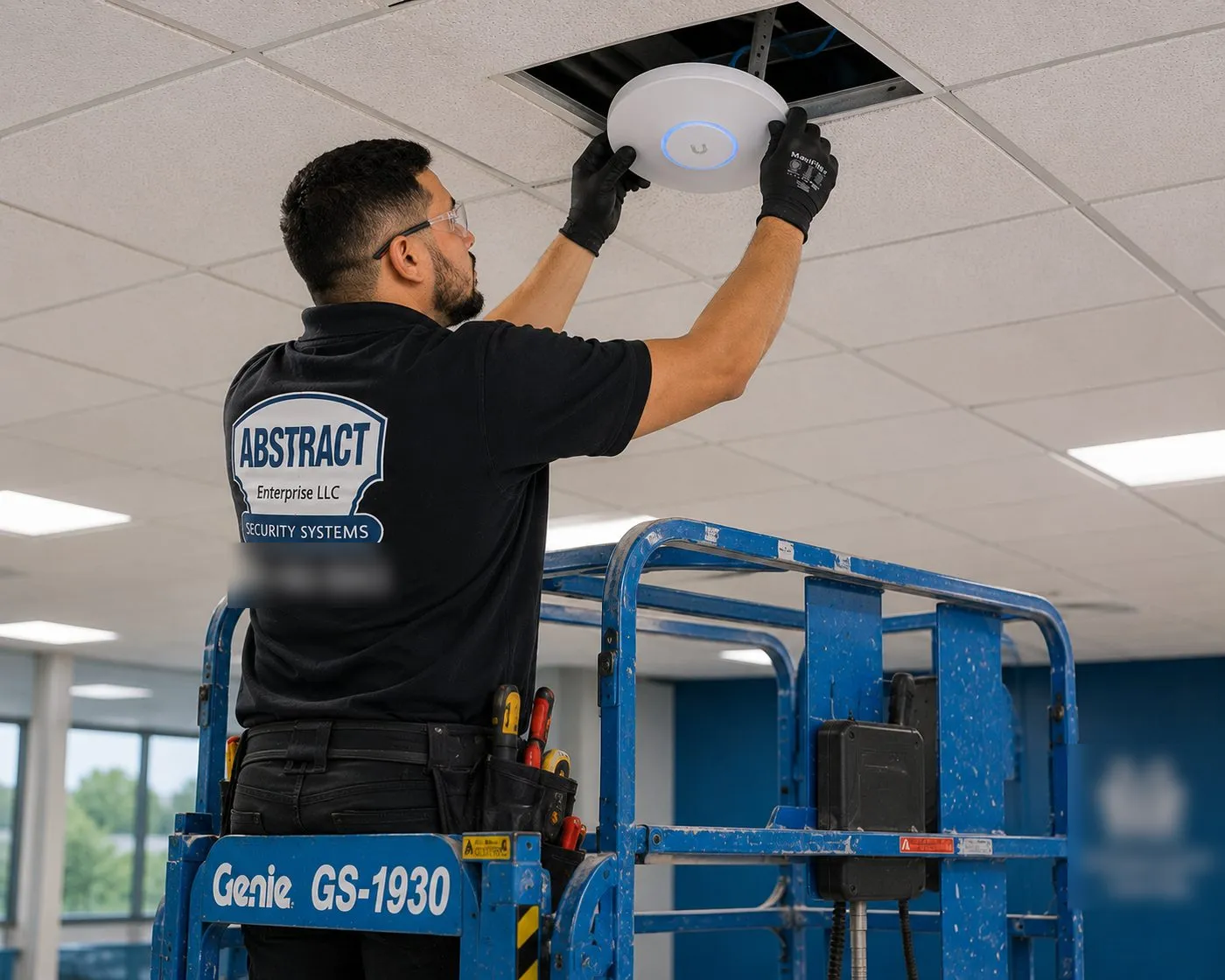
Installer on a scissor lift fitting a white ceiling access point into a drop-ceiling tile, typical of office-park network work in Bloomfield, Staten Island
From the platform of a blue scissor lift, a technician pushes a white disc-shaped access point with a glowing ring up into an opened ceiling tile in a bright, tiled-ceiling room.
Commercial Fiber

Business Fiber Optic Installation in Bloomfield

Bloomfield is almost entirely commercial and industrial, and its addresses cluster along a few roads. This is who we find on each of them, and what their fiber usually has to do.

Gulf Avenue and the Logistics Park

The service road on the west side of the West Shore Expressway, now lined with the distribution buildings of Matrix Global Logistics Park. Fiber work here means building backbones, dock zones and links to gates and yard poles — often on a schedule set by peak shipping weeks. The S40 and S90 buses serve the park, which was reported to bring more than 2,000 jobs to the West Shore.

South Avenue Office Buildings

South Avenue runs about three and a half miles from Mariners Harbor to Chelsea, and in the 1980s a string of large office complexes went up along it — among them 900 and 1000 South Avenue, built in woodland before the land around them was restricted. Tenants are professional offices, medical practices and schools; the fiber work is suite-to-closet-to-entrance-room.

The Teleport Campus

Reached only from South Avenue by Teleport Drive. Once a satellite earth station, now offices, the Corporate Commons buildings and a data centre. Here the questions are about landlord approvals, riser space and reaching the building's carrier entrance cleanly.

The Corporate Park and Lois Lane

The office and industrial park around Lois Lane, named for Lois Nicotra, set within preserved woodland. Buildings here can share a campus without sharing an owner, so any link between two of them begins with who controls each end and the ground between.

The Hotels on South Avenue

The Hilton Garden Inn opened in 2001 and the Hampton Inn & Suites in 2007, both on South Avenue. The Hilton Garden Inn alone has 198 rooms, a restaurant with cabaret nights and shuttles to the ferry and Newark Airport; networks in buildings like these carry guest Wi-Fi, property-management systems, point-of-sale and meeting-room AV.

Bloomfield Avenue and the Waterfront Edge

The logistics tract sits west of the expressway and north of Bloomfield Avenue, running toward the Arthur Kill and its preserved wetland. Anything built or dug near that edge starts with the owner's site plan and its environmental conditions, not with a shovel.

Compliance callouts for Bloomfield fiber

  • Cable listings. Indoor fiber is chosen by the space it runs through: riser-rated (OFNR) between floors, plenum-rated (OFNP) above ceilings that carry return air, and indoor/outdoor or armored cable wherever a run leaves the building.
  • Firestopping. Every penetration of a rated wall or floor is sleeved and sealed with a listed firestop system, and photographed before the ceiling closes. Distribution buildings often have rated separations between the office block and the warehouse; those count too.
  • Sprinkler clearance. Cable and tray under a high-bay roof are kept out of the clear space beneath sprinkler heads. Where the drawings are unclear, we ask the building's fire-protection contractor before hanging anything.
  • Digging. No trench or bore starts until New York 811 has been called and the private utilities on the lot have been located. On remediated or wetland-edge land, the owner's environmental requirements are checked first.
  • Permits. Low-voltage cabling under 50 volts does not by itself call for a Department of Buildings permit, but the work around it — cutting into a rated assembly, opening a sidewalk or street — can carry its own requirements, and we tell you which ones apply before the proposal is signed.
  • Licence and insurance. AESS holds NYS low-voltage licence #12000287431, and we issue certificates of insurance naming the landlord or management company before we arrive.
Building on Old Industrial Land

Tank Farm to Truck Court: Digging Fiber Into Bloomfield's Ground

Most Staten Island lots have lawns and driveways between their buildings. Bloomfield's lots have truck courts, trailer yards and engineered fill. That changes how an outdoor fiber route is planned, and it starts with knowing where the ground came from.

The large logistics tract off Gulf Avenue was an oil-storage site. When it was being prepared in 2016, its developer reported that remediation had begun in 2013 and that the development area was being raised to at least ten feet above sea level, with about 252 acres permanently preserved as wetland and New York State's environmental agency involved in that preservation. We do not know the conditions on any individual parcel, and we do not guess. What we do is ask the owner or landlord, before quoting a trench, whether the site has an environmental management plan, a cap or soil-handling rules, and we build the route and the price around the answer.

Where the ground is ordinary fill under pavement, the route choices are familiar ones. Conduit can go under a truck court in a trench that is cut, laid and patched, or it can be directionally bored beneath the pavement without opening it. Cutting is usually cheaper on day one; boring avoids weeks of patched asphalt under loaded trailers. Either way, conduit that will sit under heavy traffic is specified for it and protected where it rises out of the ground at a building, a pole or a pedestal — the points where vehicles actually hit things.

Overhead is the other option. Bloomfield's yards are full of tall light poles and camera poles that the property owner controls, and a fiber cable can often be carried from the building to a pole, and pole to pole, on a messenger wire high above the trucks. Aerial runs cost less to build and are easier to repair, but they are exposed to storms and to the occasional high load. We price both wherever both are possible and let you decide with the numbers in front of you.

Then there are the wetlands. The Saw Mill Creek mitigation bank restored 54 acres of tidal marsh on the West Shore, and the logistics tract itself kept roughly 252 acres in preserved wetland. Fiber does not need to go anywhere near most of that land, and on a well-planned site it never does. When a route comes close to a wetland edge, a drainage swale or a preserved buffer, the owner's site plan and its permits decide where the cable may go, and we route around rather than through.

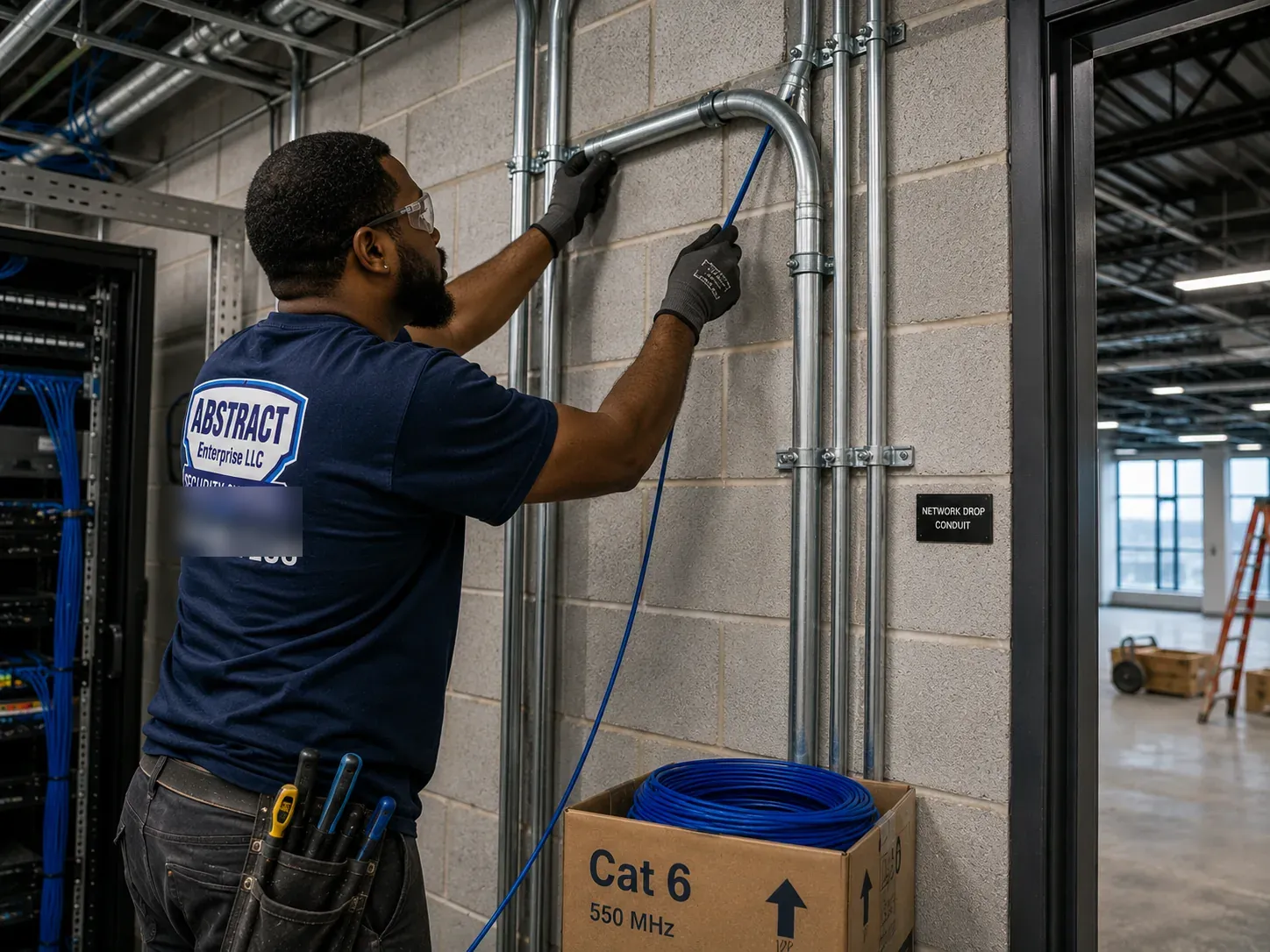
Technician pulling blue cable into a run of metal EMT conduit on a concrete block wall, the kind of protected pathway used on Bloomfield, Staten Island fiber jobs
A technician guides blue cable into a bend of metal conduit fixed to a grey block wall, a boxed reel at his feet and a large open floor visible through the doorway beside him.
Inside a Big Building

Planning Fiber Across a Million-Square-Foot Floor

A copper Ethernet channel is limited to 100 metres, including the patch cords at both ends. In an office that is rarely a problem. In a Bloomfield distribution building it is the whole design problem, because the devices that keep freight moving — scanners' access points, dock-door cameras, label printers, conveyor controllers, time clocks — are spread across a floor many times that size.

The answer is a star of fiber. One main network room, usually in the office block at the front, connects by fiber to a number of zone cabinets placed so that every device in the building is within reach of one of them on copper. Where the zones go depends on the floor plan: one or two along the dock wall, others at the ends of the main aisles, sometimes one on the mezzanine. The fiber itself is laid in tray or supported on the building's steel well above the racking, away from the sprinklers' clear space and from the paths of lift masts.

Strand count is where owners most often save money in the wrong place. A zone cabinet that needs two strands today may need six once a second network — for cameras, for building controls, for an automation vendor — arrives. Pulling a 12-strand cable instead of a 6-strand one adds little to the cost; pulling a second cable the length of the building later adds a great deal. We size each zone's cable for the uses you can name and leave spare strands, terminated and tested, for the ones you cannot.

Finally, a building this size needs a record. Every zone cabinet is labelled with its name, the strands that feed it and where they come from, and the as-built drawing shows the route on the floor plan. When a lift operator someday drives into a cabinet, the person who comes to fix it should not have to trace the building to find out what was in it.

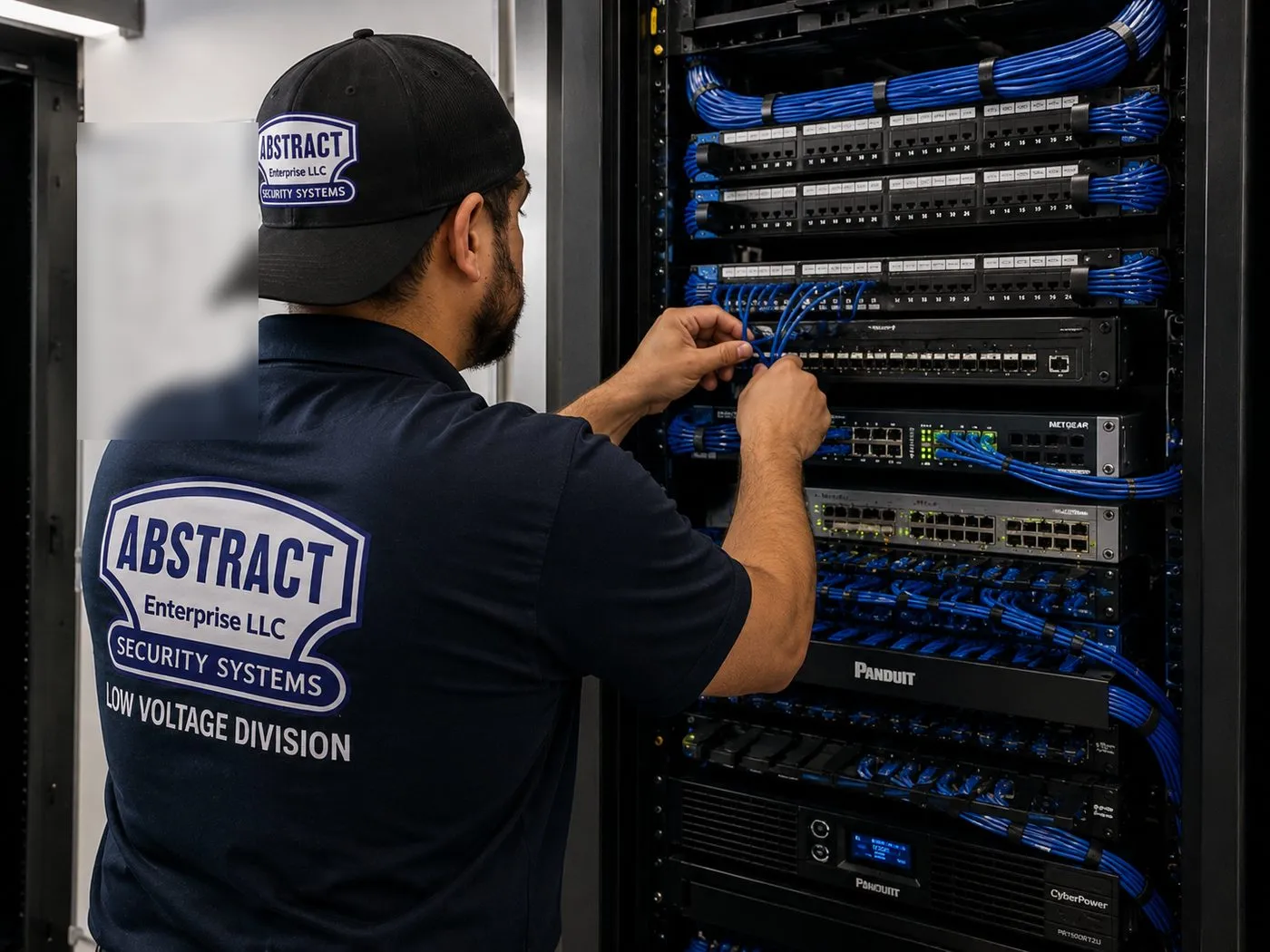
Technician dressing blue patch cords between patch panels and switches in a floor-standing network rack, the type of zone cabinet fed by fiber in Bloomfield, Staten Island buildings
Seen from behind in a cap and work shirt, a technician seats a blue patch cord into a switch port in a tall rack full of neatly bundled blue cabling, panels and a power unit below.
Offices on South Avenue and the Teleport

Fiber for Office Tenants in Bloomfield's Office Parks

The office side of Bloomfield grew up around communications. The Teleport was built in the 1980s to house communications-industry companies around a satellite earth station; the office complexes on South Avenue followed in the same decade. Four decades on, the satellite dishes are gone, the big single tenants have left, and the buildings are divided among doctors, lawyers, schools and small businesses. Each of those tenants arrives with its own network and its own idea of what the building already provides.

What it usually provides is a carrier entrance room near the ground floor, a riser with a closet on each floor, and a ceiling full of whatever earlier tenants installed. Fiber work for a tenant here follows a predictable path. We confirm with the building manager which riser sleeves have room and which closet the suite is allowed to use; we run a small-count fiber cable from the suite's equipment cabinet to that closet and on down to the entrance room; we terminate it in panels the building can identify; and we test it end to end against the carrier's handoff point. The tenant then has a clean, documented path from the internet's front door to its own rack, and the next carrier it orders can be connected without new construction.

Medical tenants add their own demands. Imaging, records and telehealth systems move larger files and tolerate less downtime than a general office, and practices often want two separate paths out of the building so that one carrier's outage does not close the clinic. Within a single building, the second path depends on what the landlord's entrance arrangements allow, and we start that conversation early rather than promise something the building cannot give.

Schools and training providers in office buildings ask a different question: how to keep a student network, a staff network and a building system apart without three sets of cable. Fiber strands are cheap once a cable is being pulled, so a single run from the school's floor to the entrance room with enough strands for each network is usually the answer, with the separation done in the switches at each end.

Every office job ends with paperwork the landlord can use: which sleeve we used, which closet panel holds the tenant's strands, test results and a marked-up floor plan. In buildings that have seen forty years of tenants come and go, that record is often the first accurate one the building manager has had for that riser.

Hotels by the Goethals

Fiber Inside West Shore Hotels

Bloomfield's hotels are a few minutes from I-278 and the Goethals Bridge. The Hilton Garden Inn on South Avenue opened in 2001 with 198 rooms, an indoor pool, a restaurant and a rooftop lounge, and runs shuttles to the ferry and to Newark Airport; the Hampton Inn & Suites followed on the same road in 2007. Buildings like these depend on their networks for almost everything a guest touches: Wi-Fi in every room, the property-management system at the front desk, keycard encoders, point-of-sale in the restaurant and bar, and the screens and microphones in the meeting rooms.

Hotel networks are usually built around a main equipment room on the ground floor and a closet on each guest floor, often shared with housekeeping. In many hotels those vertical links are still copper, and copper between closets becomes the bottleneck once the access points on each floor are upgraded. Replacing those vertical links with fiber is one of the most cost-effective upgrades a hotel can make: the work is concentrated in the closets and the riser, guest rooms are not touched, and each floor gains far more capacity than its access points can use.

The work has to fit around guests. We agree a floor-by-floor schedule with the general manager, keep drilling and coring to the hours the hotel chooses, protect corridors and carpets, and leave each closet locked and tidy at the end of every shift. Cutover from the old links to the new happens one floor at a time, at the quietest hour available, with the old link kept in place until the new one has passed its tests.

Back-of-house areas get the same attention. Kitchens, laundries and engineering rooms are hot, humid or both, and network equipment there needs to be placed and enclosed with that in mind. Fiber itself is unaffected by heat and steam; the switches and connectors at its ends are what need protecting.

Multi-Tenant Buildings

Spare Strands, Records and the Next Tenant

Distribution buildings change hands and tenants more often than their size suggests. A building that one company fills today may be split between two tomorrow, and a tenant's ten-year lease can end with an entirely different operation moving in. The fiber is one of the few things that stays.

That makes it worth deciding, at the start, who owns what. Landlords increasingly prefer to own a base backbone — fiber from the carrier entrance to a few points around the building — and let tenants add their own zone cabling on top. Tenants who build their own backbone should agree in the lease whether it stays or goes at the end of the term. Either way, a backbone with labelled spare strands, a complete set of test results and an accurate drawing has value to the next occupant; one without them is often abandoned and replaced.

We build to that standard whether the client is the landlord or the tenant. Cabinets and panels are labelled with names that will still make sense when the current tenant's department names are forgotten, test results are delivered as files rather than only on paper, and the drawing shows the route against fixed building features — column lines, doors, the dock wall — rather than against racking that will be moved.

When a building is split, the backbone has to be split with it. The usual approach is to give each new tenancy its own strands from the carrier entrance, terminated in its own lockable panel, so neither tenant has to enter the other's space to reach its own network. Strands that cross the new demising wall are either reassigned, cut back and re-terminated, or left dark and labelled as belonging to the landlord. Deciding which, and writing it down, takes an hour at the start of the project and saves an argument at the end of it. The same thinking applies to yards and gates shared by two tenancies: the gate camera and intercom need a clear owner, a clear network and a clear path back to whoever answers them.

Your Questions Answered

Fiber Optic Installation in Bloomfield: Questions Answered

These are the questions West Shore operations managers, landlords and hotel engineers actually ask on site walks. Each is answered here once; the shorter FAQ further down covers different ground.

Distribution floors and loading docks

Our main network room is in the front office but most of our devices are at the back of the building — should the room move rather than run fiber all that way?

Usually not, and the reason is the carriers. The front office is normally where the providers' circuits enter, where the building's power and cooling for IT were designed to be, and where the people who look after the equipment work. Moving the main room deeper into the building moves all of that with it, and the fiber you would save is often cheaper than the electrical and HVAC work you would create.

The better answer in most Bloomfield buildings is to leave the main room where it is and treat the back of the building as one or more zones: a fiber cable from the front to a well-placed cabinet near the devices, and short copper from there. When a building is still on paper, the calculation changes, and we will happily sit with the architect to put the main room nearer the centre of gravity of the devices.

The automation vendor installing our conveyors and sorters wants its own network — should it get dedicated strands, and who answers for them?

Usually yes, and the line of responsibility should be written down before anything is pulled. Conveyor and sortation systems are commonly delivered by integrators who want their control network kept apart from the building's office and Wi-Fi traffic, both for performance and so their support contract is not exposed to changes they did not make. Separate strands in the same backbone cable give them that separation at very little extra cost.

We suggest a simple split: AESS installs, splices, tests and documents the strands up to a labelled patch panel in each zone cabinet; the vendor owns everything they plug into it. The test results for those strands go to both you and the vendor, so if their network misbehaves later there is a dated record showing the glass was good when it was handed over.

Handheld scanners drop out at the far end of the floor while the office Wi-Fi is fine — is this a wiring problem?

Often it is, even though it looks like a wireless one. In big buildings, access points at the far end are sometimes fed by copper runs that are too long, or chained through extra switches, or mounted where racking now blocks them. The radio gets the blame, but the problem is the link behind it.

We test the cabling to each far-end access point first. If runs are over length or failing, bringing fiber to a zone cabinet nearer those access points and re-feeding them on short copper usually fixes the dropouts. If the cabling passes, we say so and point you toward a wireless survey instead, because more glass will not cure a coverage gap.

Yards and remote support

Our IT team works from headquarters in another state — what do they need from you to support the fiber without visiting?

A record good enough to manage the network from a desk. Many Bloomfield buildings are run by national companies whose network engineers never see the site, and when something breaks at 3 a.m. they depend on what the installer left behind. We deliver a strand map showing which strand in which cabinet goes where, test results as files, photographs of every cabinet and panel with labels legible, and the route marked on the floor plan.

We also agree the labelling scheme with the remote team before the job starts, so cabinet and port names match what their monitoring system will call them. On handover day we can join a video call from the site, open each cabinet on camera and confirm every link with the engineer who will own it. After that, a local technician sent to a fault can follow their instructions without guessing.

Can fiber run up our yard light poles to reach cameras mounted high above the trailer lot?

Yes, on poles you own, and it is one of the most common jobs on the West Shore. The cable comes up through the pole's base or in conduit on its face to a sealed enclosure near the top, where a small hardened switch or media converter turns light back into an Ethernet port for the cameras. Power for that switch comes from the pole's own circuit, through a surge protector.

What we check first is the pole: whether it has a handhole and room inside, whether the owner's engineer allows extra load and drilled openings on it, and how the cable will get from the building to the pole — buried in conduit, or on a span between poles. Utility-owned poles are a different matter and are not ours to use.

Old industrial ground

Our site was part of a remediated former oil terminal — can we dig through the ground for fiber, and who has to agree?

Probably, but the property's environmental paperwork decides how, and the owner or landlord is the one who knows it. Sites cleaned up under a state programme can carry conditions on disturbing soil — a cover that must be restored, rules on handling or disposing of what is dug up, or a requirement to notify someone first. Other sites carry none.

So before we price a trench on former terminal land, we ask the owner for any site management plan or environmental restrictions and, if there is one, for the name of the environmental consultant who administers it. Often the route can avoid disturbed areas altogether, by boring at depth, going overhead or following an existing utility corridor. If digging is unavoidable, the work follows the plan, and any soil handling it demands is priced openly rather than discovered halfway through.

Our building pad sits on deep new fill — will settling ground damage fiber buried between the warehouse and the outbuildings?

It can strain it at one predictable spot: where buried conduit meets a structure that does not move. Buildings on deep fill are usually carried on foundations designed not to settle, while the paving and the ground around them may still sink a little over the years. The conduit in between can bend or pull apart right at the building wall.

We design for that. Conduit entering a building on fill gets a flexible or expansion fitting near the wall, the trench is bedded and compacted properly, and the cable inside is left with some slack in a pull box nearby rather than pulled tight from end to end. Fiber itself tolerates gentle movement well; it is a sharp kink at a sheared conduit joint that breaks it.

Office suites and hotels

We're moving our servers into a nearby data centre — what changes for the fiber inside our office?

The office becomes a place that reaches its systems over the internet or a private circuit, rather than down the hall. That usually means fewer servers to cable inside the suite but a greater dependence on the path out of the building, so the work shifts from the server room to the route between your suite and the building's carrier entrance.

We typically recommend a clean, tested fiber run from the suite to the entrance room, with spare strands so a second carrier can be added later without new construction, and we test both ends against the carrier's handoff. The cross-connect inside the data centre and the circuit between the two sites are arranged with the carrier and the data centre operator; we make sure your side of the building is ready when they arrive.

Our hotel's ballroom and meeting rooms host events that need live streaming — can they get capacity separate from guest Wi-Fi?

Yes, and fiber is how it is usually done. Event streaming and presentation traffic behave badly when they share a network with a few hundred guests watching video upstairs. Dedicated strands from the main equipment room to a small rack serving the meeting rooms let the hotel run a separate event network, with its own internet allocation if the provider offers one.

We put fiber outlets where AV crews actually set up — at the back of each room near the technical table, and at any wall box that feeds a projector or a stage — and leave spare strands for production companies that bring their own equipment. The result is that the night a corporate client books the ballroom, the guest Wi-Fi does not slow down, and the client's stream does not either.

Is passive optical LAN a sensible choice for a hotel's guest floors?

It can be, on new construction or a full renovation, and it rarely is on a light refresh. Passive optical LAN replaces the switches in every floor closet with unpowered optical splitters and sends single-mode fiber to small terminals near the rooms. It saves closet space and power and suits buildings that are being opened up anyway.

In an operating hotel with working copper to every room, the cost of new cable to each room and new terminals usually outweighs the savings, and a fiber backbone between closets with refreshed switches does the job. We lay both options out side by side, with your room count and your closet layout, so the decision is made on numbers rather than on fashion.
Equipment

Types of Fiber Optic Cabling We Install

OS2 Single-Mode

The default for long building backbones, gate links and anything leaving the building. It reaches far beyond the length of any Bloomfield site and supports future speed upgrades without new cable.

OM4 Multimode

Suited to shorter runs inside an office block or hotel, such as a server room to floor closets, where multimode optics are already in use.

Indoor/Outdoor Tight-Buffer

One cable that can run from a yard enclosure straight into the building without a transition splice, rated for the indoor space it enters.

Interlocking Armored Cable

A metal armor sleeve over the fiber for runs at forklift height, through mechanical spaces or anywhere a cable may be stepped on, crushed or chewed.

Aerial Cable on Messenger

Fiber lashed to a steel messenger wire or self-supporting cable for spans between a building and private yard poles.

Conduit, Innerduct and Pull Boxes

Schedule-rated conduit under truck courts, innerduct to keep cables separate inside it, and pull boxes at the bends so the cable can be pulled without exceeding its tension.

Zone Cabinets and Wall Enclosures

Lockable, column-mounted cabinets for zone switches, and sealed outdoor enclosures for poles, gates and chargers.

Panels, Splice Trays and Optics

Rack-mount and wall-mount fiber panels with splice trays, LC adapters, and the SFP optics or media converters that join fiber to your switches.

Distribution floor, office suite or yard: matching cable to place

Across a high bay, we normally run single-mode in tray, with armored cable for any section that drops to within reach of lift trucks. Inside an office building, riser- or plenum-rated cable is chosen to match the space, multimode if the existing optics are multimode and single-mode if the building is starting fresh. Out in a yard, it is indoor/outdoor cable in conduit or aerial cable on a messenger, never ordinary indoor cable laid in the open. We put the cable type for each section in the proposal so you can see where the money is going.

Technician operating a fusion splicer in front of a fiber distribution panel of blue adapters and yellow jumpers, used to terminate Bloomfield, Staten Island backbones
Gloved hands hold a stripped fiber over the open splicer while the screen shows the cores lined up; behind it, rows of blue adapters with yellow jumpers fill the panel and a cleaver and stripper wait on the bench.
AI Overview Reality Check

What AI Gets Wrong About Fiber Optic Installation in Bloomfield

Ask a search engine's AI summary about fiber installation and it will stitch together claims from installers' blogs, cost guides and forums. Below are seven we found while preparing this page, quoted as published, with what each misses on the West Shore.

"Most fiber installations are retrofits and do not require major construction"

That line comes from an installer's page in Phoenix, and for an office fit-out in an existing building it is often true. Pull cable through a ceiling, terminate it, test it, done.

Bloomfield's fiber work is frequently the opposite: new or nearly new buildings, outdoor runs across truck courts, poles in a trailer yard. Some of it is construction in every sense — trenching or boring, conduit encasement, pole-mounted enclosures — and it is planned alongside the electrician and the paving contractor rather than after them.

The useful takeaway is to tell your installer early which kind of job you have. If the fiber has to leave the building, the proposal should show how it gets out, what it crosses and who restores the ground; if it does not, it should not be priced as if it does.

"Construction is usually 6-12 weeks. Cable placement is a week, splicing is 1-2 weeks including testing."

That timeline was posted by a commenter on a fiber forum describing provider network construction — the work a carrier does to bring fiber down streets to many customers.

A private backbone inside one distribution building or a link from a warehouse to its gate is a much smaller project. Once materials and access are settled, the cable work typically takes days, and splicing and testing a handful of zone cabinets is measured in shifts, not weeks. What stretches a Bloomfield schedule is usually access to the floor during operations, approval from a landlord, or waiting on a lift and a quiet aisle.

If you are waiting on a carrier, their schedule is theirs. If you are waiting on your own backbone, ask for a schedule built around your shifts and your peak weeks, with the noisy work grouped together.

"Fiber Optic Cabling (Backbone) $3,000-$5,000+ (varies by strand count)"

That range appears in a Dallas installer's cost guide for structured cabling. It is a reasonable figure for a modest office backbone in that market, and the "varies by strand count" note is fair.

It does not describe a backbone the length of a Bloomfield distribution building, or one that leaves the building. Our own Staten Island price for a 12-strand OM4 building backbone is $4,950 to $7,700, and a 24-strand single-mode link between buildings starts at $8,800. Long high-bay runs add lift time and support work; outdoor runs add groundwork.

Use a published range to check that a quote is in the right universe, not to judge it. Then compare quotes line by line: strands, route length, how the cable is supported, what testing is included, and who does the splicing.

"Dark Fiber: Higher upfront cost, lower ongoing costs"

This is how a fiber network provider explains leasing unlit strands in its own network versus buying a managed "lit" service, and as a comparison of two carrier products it is a fair summary.

It gets confused with something else. A fiber link that you own between two of your own buildings, or across your own floor, is neither dark fiber leased from a carrier nor a lit service. You pay to build it once, then there is no monthly charge for the glass at all. AI summaries often blur these together and leave owners thinking any private fiber means a carrier contract.

On a Bloomfield property, the question is usually simpler: carrier service to the building, owner-built fiber inside and around it. We build the second part; the carrier sells the first.

"Fiber internet is 94.4% available in Staten Island"

This figure comes from a broadband comparison site that tracks provider availability by address. It tells a household whether a fiber provider can sell it service.

For a West Shore business it answers a different question from the one that matters. A carrier's fiber can reach the building's entrance room and still be several hundred metres from the dock door, the mezzanine or the gatehouse where the network is actually needed. Availability statistics say nothing about that distance.

Check availability to see which carriers can serve the building, then plan the owner-side fiber separately. The two decisions are linked only at the point where the carrier hands off.

"The directional boring cost is $15K"

That number comes from a member's post on a smart-home forum, passing on an installer's estimate for an underground fiber run. It is one quote, for one site, from one company.

Boring cost depends on length, soil, what has to be avoided, and how the machine reaches the start and end points. Under a Bloomfield truck court, boring can be the cheapest option once the cost of cutting and restoring heavy-duty pavement — and keeping trucks off it while it cures — is counted. On a short crossing of a lawn strip, an open trench is usually cheaper.

We price boring as its own line, measured from the site walk, and we say when a trench, an overhead span or an existing conduit would do the same job for less.

"glofiber is non existent, and Verizon is hit or miss"

That is a Staten Island resident's comment on the borough's subreddit, in a thread asking which internet providers people use. It reflects a real frustration with provider choice on the Island.

Provider choice is not something a cabling contractor can fix. What we can fix is the part of the problem that sits on your side of the carrier's equipment: an overloaded copper run, a closet daisy-chained to another closet, a link to a back building that drops in the rain. Those failures get blamed on the provider more often than they deserve.

Before switching carriers, it is worth having the owner-side wiring tested. If it passes, you have ruled something out; if it fails, you have found the real problem for the price of a service call.

Send the Floor Plan. We'll Walk the Building.

Dock wall, mezzanine, gatehouse or meeting rooms — mark where the network room is and where it needs to reach, and we will come and measure it at no charge.

Get In Touch

Request a Free Quote

Tell us the building and the points to connect; every Bloomfield request is answered within the business day. Rather talk? Call (347) 934-8335.

✅

Request Received

Thanks. One of our West Shore installers will ring you today. For a link that is down at this moment, call (347) 934-8335.

How It Works

Our Installation Process

Seven steps, built around a building that keeps working while we are in it.

1. Site walk and floor plan

We walk the building with you from the main network room outward, measure every route to the dock wall, mezzanine, office block, gate and yard, and note sprinklers, steel, traffic and anything in the ground.

2. Proposal and route drawing

An itemised proposal with zone locations, cable type and strand count for each section, support method, lift time, testing plan and exclusions, drawn on your floor plan.

3. Access plan and approvals

Aisle and door closures agreed with operations, peak-week blackouts respected, landlord submittals and insurance certificates sent, and an 811 markout plus any environmental checks done before ground is opened.

4. Supports and pathways

Tray, messenger wire or conduit installed, zone cabinets mounted on columns, building entries cored, sleeved and sealed, and outdoor enclosures fixed to poles or pedestals.

5. Cable placed and protected

Cable hung or pulled without exceeding its rated tension or bend radius, sleeved in armor wherever lift trucks or trailers could reach it, sealed through each fire-rated wall, and photographed in place before the ceiling or trench is closed.

6. Splice and prove every strand

Strands fusion-spliced to pigtails, every end-face inspected under a scope before it is mated, loss measured on every strand at both wavelengths, and single-mode runs traced with an OTDR.

7. Cutover and handover

Old links left live until the new ones pass, cutover at the quietest hour you choose, then labelled cabinets, test results, an as-built drawing and a walk-through for your team.

Coverage Area

Fiber Optic Installation Near Bloomfield's Landmarks

Bloomfield's landmarks are mostly working places. These six help locate the jobs we take on and nearby.

Telehouse, 7 Teleport Drive

A 162,000-square-foot data centre completed in 1989 on the Teleport campus, steps from Telehouse's NYIIX internet exchange, with three fiber entry paths since 2007.

Matrix Global Logistics Park

The distribution park off Gulf Avenue, opened in the fall of 2018 on the old oil-terminal land, with Amazon and IKEA among its first tenants.

Corporate Commons Three

The 330,000-square-foot LEED-certified office building that broke ground on the Teleport campus in October 2017, known for its rooftop farm.

Hilton Garden Inn, 1100 South Avenue

A 198-room hotel at Lois Lane, opened in 2001, set in the Corporate Park's preserved woodland a few minutes from I-278.

The Goethals Bridge

Its first new cable-stayed span opened in June 2017, replacing an 89-year-old bridge and linking the West Shore with Elizabeth, New Jersey.

Saw Mill Creek Wetlands

Fifty-four acres of tidal marsh and mudflat on the West Shore, restored as New York City's first wetland mitigation bank.

We also serve Bloomfield's neighbours: Travis, Chelsea, Bulls Head, Mariners Harbor, Arlington and New Springville, and the rest of Staten Island through our Staten Island fiber optic installation page.

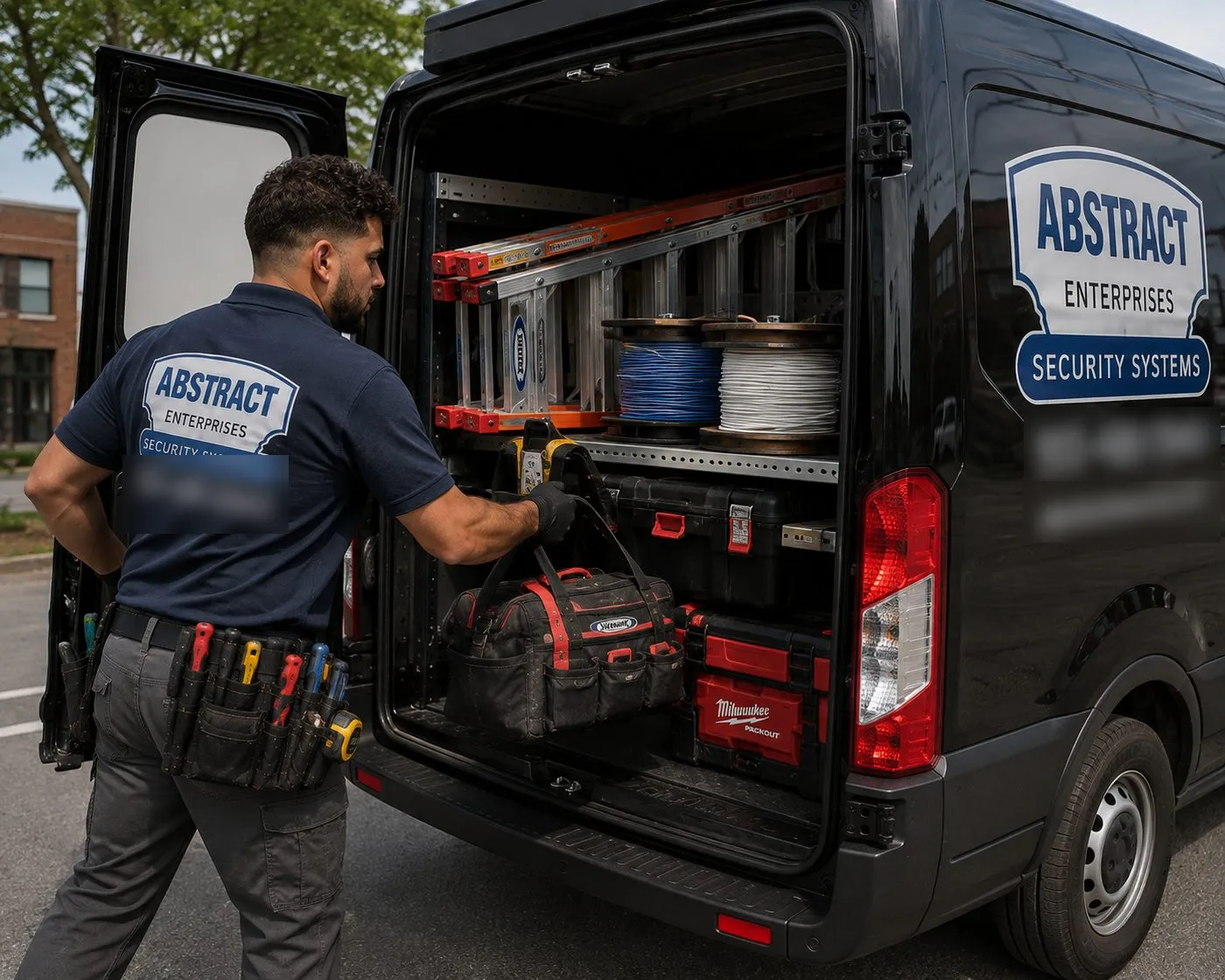
Technician loading a tool bag into a work van fitted with ladders and cable reels, ready for a Bloomfield, Staten Island fiber optic installation
At the open back doors of a black van, an installer lifts a tool bag onto a shelf below racked ladders and two reels of cable, red tool cases stacked beside it.
Pricing

Fiber Optic Installation Cost in Bloomfield

Bloomfield is priced as Staten Island: 1.10× our Brooklyn base rate. These are the same published Staten Island figures that appear on our borough page; big-building routes, groundwork and spans are measured and quoted after the site walk.

ItemBloomfield priceWhat it covers
Fiber termination on an existing cable$39 per terminationLC, SC, ST or MPO end added to cable already in place, fused or mechanical
OTDR test$44 per strandTrace and event table for each strand, on top of loss testing
Multimode fiber drop$385 per dropA shorter indoor run, terminated and tested
Single-mode fiber drop$440 per dropA shorter indoor run, terminated and tested
12-strand OM4 backbone$4,950 – $7,700Fusion-spliced, enclosures at both ends, firestopped and loss-tested
24-strand OS2 single-mode backbone or building-to-building link$8,800 – $16,500+Single-mode, with an OTDR trace on every strand
Second telecom room with fiber linkfrom $2,640An added closet or zone room built out, plus the strands joining it to the main room
Service and callback rate$195/hr, 3-hr minimum ($585)Repairs, troubleshooting and return visits — not the initial install; the same rate in every area

What moves a Bloomfield fiber quote

  • Working height. Cable hung under a high-bay roof needs a lift and an operator; every zone cabinet up a column is lift time.
  • Operating hours. A building that cannot close aisles during the day pushes work to quieter shifts, which we plan rather than surprise you with.
  • Number of zones. Each extra zone cabinet adds a cable, two sets of splices and its own line in the test report.
  • Leaving the building. Trenching, boring, conduit encasement under truck traffic and pole enclosures are priced line by line.
  • Site rules. Landlord submittals, environmental conditions on former industrial land and escort requirements are included where we know of them before quoting.

Compared with the alternatives. The household-name alarm companies (ADT, Ring, SimpliSafe) do not build private fiber backbones in distribution buildings. A carrier's technician stops at the carrier's own box. A managed-IT provider may run your switches yet hire out the cable work. AESS is a licensed low-voltage contractor with its own fusion splicer and OTDR, and quotes in writing.

Shop Our Systems

Fiber Optic Installation Packages & Pricing

Three sample scopes built only from the table above. A real proposal replaces the assumptions with your measured routes, your zone count and your groundwork.

Starter — Two Fiber Drops

$880

Two single-mode drops at $440 each inside one building — for instance from the main room to a mezzanine office and to a single dock-wall cabinet — terminated and tested. Lift time on a high-bay route and any outdoor crossing are quoted separately.

Standard — Building Backbone

$4,950 – $7,700

Twelve OM4 strands tying a hotel's or an office building's main equipment room to its floor closets, enclosed at both ends, sealed wherever a rated floor is crossed, and handed over with a loss reading for each strand.

Premium — Building to Building

$8,800 – $16,500+

A 24-count OS2 cable from one structure to another on the same site — distribution building to maintenance shop, office block to gatehouse — laid in conduit or carried on a messenger, with an OTDR trace filed for each strand.

Bring Your Own Equipment — Labour Only

Corporate procurement or an automation integrator sometimes ships the cable and hardware to site. In that case our charge is labour only: $195 an hour, three hours minimum ($585), covering the pull, the splicing and the test report. Anything you supply is covered by its maker's warranty, not by ours, which is why every supplied reel is checked with a light source before a metre of it is hung.

Every Zone, Every Crossing, Priced Line by Line

The walk is free and the proposal is itemised: zone cabinets, lift time, groundwork and testing each on their own line.

Working Around Operations

Installing Fiber in a Bloomfield Building That Never Stops

Most of the buildings we work in on the West Shore are running when we arrive and will still be running when we leave. Distribution floors work in shifts, hotels never close, and office tenants expect their phones to ring on Monday morning. That shapes the job more than any cable choice.

Distribution floors: aisles, lifts and shift changes

On a working distribution floor the scarce resource is not time but space. A scissor lift parked in an aisle blocks pickers; a boom lift near the dock blocks a door. Before we start, we sit down with the operations manager and a floor plan and agree which aisles and doors can be closed, for how long and on which shifts. Work under the roof is then grouped so that each aisle is closed once, not five times.

We follow the building's own safety rules — high-visibility vests, pedestrian walkways, lift-truck right of way, escorts where required — and we keep a technician on the floor watching traffic whenever a lift is raised. Cable reels, ladders and boxes are staged in a corner the building assigns, not left in the nearest empty bay.

Security is part of the same conversation. Distribution buildings control who comes and goes, and our technicians arrive with identification, sign in where the building asks, and stay within the areas agreed for the day. If the site needs names, vehicle details or insurance certificates in advance, we send them before the first visit so the crew is not left waiting at the gate.

Peak weeks

Retail distribution buildings get busier as the holidays approach, and many operators restrict non-essential work on the floor during their peak. We ask for your blackout dates at the first meeting and build the schedule backwards from them. Where the work cannot all be finished before a blackout, we finish whole zones rather than leave every zone half done.

Office buildings and hotels

In an office building, the building manager sets the rules: when freight elevators can be used, which hours allow noisy work, what must be submitted beforehand. In a hotel, the general manager does: which floors are lightly booked, when meeting rooms are free, how far housekeeping closets can be disturbed. In both, the cutover from old links to new ones happens at the quietest hour available, with the old link left in place until the new one has been tested end to end.

Clean-up and handover

Every day ends with the floor swept, ceiling tiles back in place and any opened firestop resealed or temporarily closed. At the end of the job the building gets labelled cabinets, a set of test results, an as-built drawing and a short walk-through with whoever will look after the network.

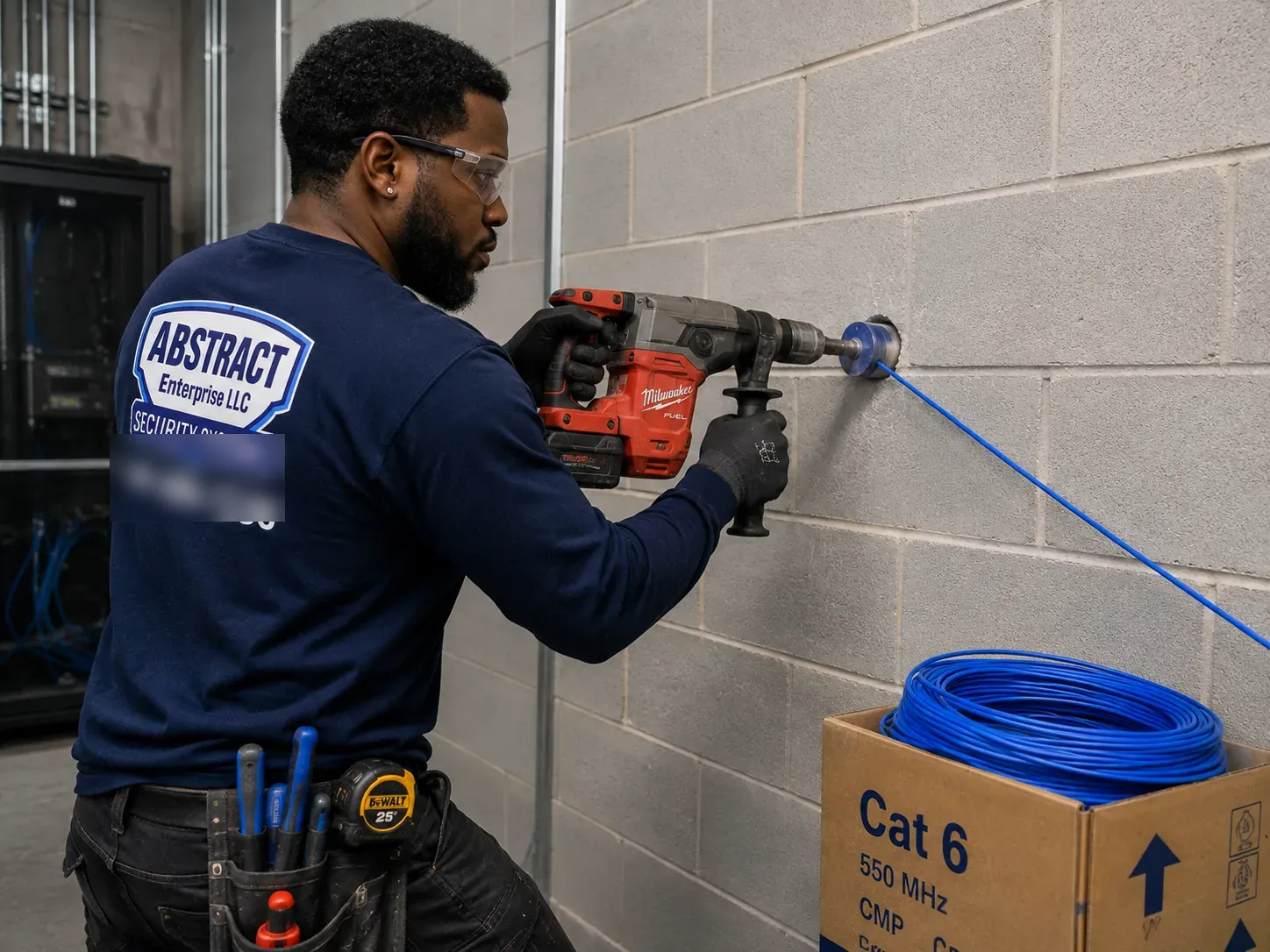
Technician drilling a concrete block wall with a pull line already threaded through the hole, a wall penetration step on Bloomfield, Staten Island cable routes
Wearing safety glasses, a technician braces a rotary hammer against a block wall where a blue pull line already runs through the opening, a boxed reel of cable on the floor beside him.
On the Island

How Bloomfield's Fiber Work Differs From the Rest of Staten Island

Staten Island as a whole is a borough of houses, yards and shopping strips, and most fiber jobs elsewhere on the Island are short links between buildings on one lot: a house and its garage, a shop and a back office. Bloomfield turns that pattern inside out. The links are long and indoors, across very large single buildings, and the outdoor runs cross truck courts and yards rather than lawns and driveways.

Its neighbours shade into it. Travis, to the south, is the West Shore's residential neighbourhood, and work there looks more like the rest of the Island. Bulls Head and New Springville, to the east, mix houses with the retail and offices around Richmond Avenue. Mariners Harbor and Arlington, to the north along South Avenue, combine homes with older industrial land near the Kill Van Kull. A Bloomfield job is the one where nobody asks about the flowerbeds and everybody asks about the forklifts.

The planning around it is changing too. The city's Working West Shore 2030 plan lists Bloomfield and the Teleport as a zone for modern industrial and distribution development on vacant sites, expanded uses at the Corporate Park and Teleport campus, truck connections from the Goethals Bridge to industrial sites, and a drainage plan for the northern West Shore. If more buildings come, so will more fiber between them; owners who leave spare conduit and spare strands now will spend less when that happens.

Reading a Proposal

Seven Lines Every West Shore Fiber Proposal Should Show

Fiber proposals for large buildings are easy to make look cheap by leaving things out. Whoever you hire, check that these appear in writing.

  1. A route drawing. Where each cable runs on the floor plan, with zone cabinets and outdoor sections marked.
  2. Which cable goes where. For each stretch of route, the fiber type, how many strands, and the fire or outdoor rating that stretch demands.
  3. Support method. Tray, messenger wire, existing structure or conduit, and who supplies the supports.
  4. Lift and access. How much lift time is included, whose lift it is and which hours the work assumes.
  5. Splicing and termination. Fusion-spliced pigtails or field connectors, panel types and the number of spare strands left terminated.
  6. Testing. Loss testing on every strand at both wavelengths, OTDR traces on single-mode, and in what form the results are delivered.
  7. Exclusions. What is not included — switches and optics, groundwork, abandoned-cable removal, landlord fees — so nothing appears for the first time on the invoice.

An AESS proposal lists each of these, with prices against the lines in our published table and the warranty terms set out in the service agreement.

The Site Walk

What Happens on a Free Bloomfield Site Walk

A site walk on the West Shore usually takes an hour or two, depending on the size of the building. We start in the main network room, because everything is measured from there: what is in the rack, where the carriers come in, how much room is left for new panels.

Then we walk the routes. In a distribution building that means the dock wall, the main aisles, any mezzanine and the office block, looking up at the steel and the sprinklers to see where tray or a messenger can go. Outside, it means the path to the gate, the poles and any second building, noting pavement, drainage and anything in the ground that the owner knows about. In an office building or hotel it means the riser closets floor by floor.

We ask about the things we cannot see: the operation's peak weeks, the landlord's tenant-work rules, environmental conditions on the land, vendors who will plug into the fiber later. Within a few business days you receive an itemised proposal with a route drawing, and if both an underground and an overhead route are possible, both are priced.

Complete Services

Every Fiber Optic Installation Service in Bloomfield

A backbone is only useful for what it carries. On West Shore jobs, clients most often add the following services from our Staten Island pages to the same proposal.

Staten Island Structured Cabling

Copper drops from each zone cabinet to the devices it serves.

Cat6 Installation

Category 6 runs for access points, scanners' chargers and office desks.

Network Installation

Switches, optics and racks configured to use the new fiber.

Commercial Security Cameras

Dock, aisle and perimeter cameras fed from the zones.

Parking Lot and Yard Cameras

Pole-mounted cameras over trailer yards and parking fields.

Low-Voltage Installation

The wider low-voltage scope around a new or refitted building.

Network Cable Repair

Faults on the copper side of the network traced and fixed.

Cabling Pricing

Published per-drop prices for the copper that the fiber feeds.

Intercoms at the Gate

Gate and lobby intercoms carried on the same network.

Field Notes

Field Notes for West Shore Buildings

The three things our installers look at first in a Bloomfield building

The first is the sprinkler heads. In a high-bay building every piece of tray or cable has to stay out of the space under the heads, and that space decides the route before anything else does. Our installers look up before they look at the floor plan.

The second is the traffic. Where do lift trucks turn, where do trailers swing, where do people walk at shift change? Every cabinet, riser and pole enclosure is placed where it will not be hit, and anything that must sit near traffic gets a guard or armor.

The third is the people who come after us. A building this big will be re-cabled, re-racked and re-tenanted many times. Labels at both ends, spare strands and an honest drawing are what make the next job quick and cheap, and they are the part of our work clients thank us for years later.

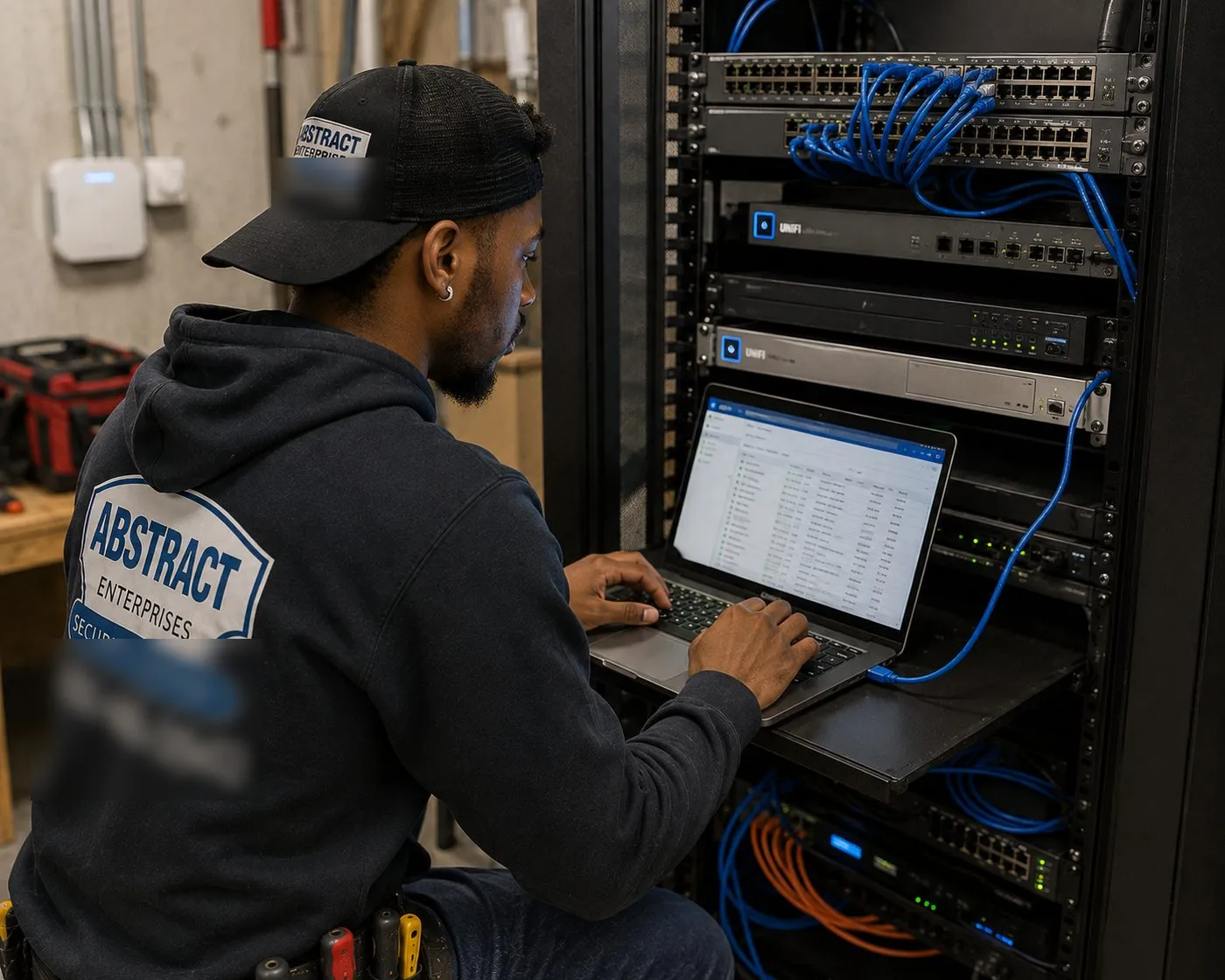
Technician configuring network switches on a laptop at a rack with blue uplink cords, the step that brings Bloomfield, Staten Island fiber links into service
Kneeling at a rack, a technician types on a laptop resting on a shelf among switches and routers, blue patch cords running from the top panels and orange cables lower down.
FAQ

Bloomfield Fiber Optic Installation FAQ

Do you cover Travis, Chelsea, Bulls Head and the rest of the West Shore near Bloomfield?
+

Yes. We work across the whole West Shore — Bloomfield, Travis, Chelsea, Bulls Head, Arlington and Mariners Harbor — and the rest of Staten Island. Crews come from our Brooklyn office over the Verrazzano, and West Shore jobs are scheduled like any other part of the Island.

Do you carry out wireless surveys, or only the cabling?
+

Both. Where the real question is coverage rather than capacity, a survey of the floor comes first, so the fiber and the access points it feeds go where the radio readings say they should. If a survey is not needed, we say so and leave it out of the price.

How does fiber cross an expansion joint in a large warehouse floor or roof?
+

With slack and a flexible section rather than a rigid one. Where tray or conduit crosses a building expansion joint, we use a fitting or gap designed to move, and leave a little extra cable in the run so the joint can open and close without pulling on the glass.

Can fiber run through a forklift battery-charging room?
+

The cable itself can, because optical fiber carries light rather than electricity. We still keep splice enclosures and network electronics out of the charging area, route the cable along the walls rather than over the chargers, and follow whatever rules the building has set for that room.

Will you coordinate with our sprinkler contractor before hanging tray under the roof?
+

Yes. In a high-bay building the space beneath the sprinkler heads must stay clear, and the rules depend on the system installed. When the drawings do not make the clearances obvious, we ask the fire-protection contractor to confirm the route before any tray or cable goes up.

Is there a temperature below which fiber cable should not be pulled?
+

Yes, and it is printed on each cable's data sheet as a minimum installation temperature, which is often higher than the temperature the cable can live at once installed. In an unheated shell building in winter, we check that figure, warm reels indoors and plan cold-weather pulls accordingly.

Can fiber, cameras and door access be quoted as one project?
+

Yes. Many West Shore clients want the backbone, the cameras it feeds and the badge readers at the doors planned together. We can price them as one proposal with separate lines, so you see what each part costs and can phase them if the budget needs to be split.

Can a zone network cabinet go on a mezzanine instead of the warehouse floor?
+

Often that is the better spot. A mezzanine keeps the cabinet out of lift-truck traffic and closer to the operation than the front office. We check the mezzanine's load, power, ventilation and access first, and make sure the fiber route up to it is protected where it leaves the main floor.

Who takes away the empty reels, boxes and offcuts at the end of the job?
+

We do. Reels, packaging and cable offcuts leave with our crew rather than going into your dumpsters, and fiber scraps from splicing are collected in a sealed container as we work, never left on benches or the floor.

Can you work above running conveyors without stopping them?
+

Only where a safe, guarded work position exists, and only with the operation's agreement. Usually we schedule work above conveyors for a planned downtime or a quiet shift, and agree lock-out and exclusion zones with your maintenance team before anyone goes up.

Can fiber reach the staff entrance where time clocks, turnstiles and badge readers sit?
+

Yes. Staff entrances in large buildings are often at the far end from the network room. A short fiber run to a small cabinet near the entrance gives time clocks, readers and turnstile controllers a reliable local connection, with copper doing the last few metres.

How much spare fiber should be left coiled at each zone cabinet?
+

Enough to move the cabinet a short distance or re-terminate the cable a few times without a new pull. We leave a neat service loop in or beside each enclosure and note its length on the drawing, sized to the cabinet and the route rather than to a fixed rule.

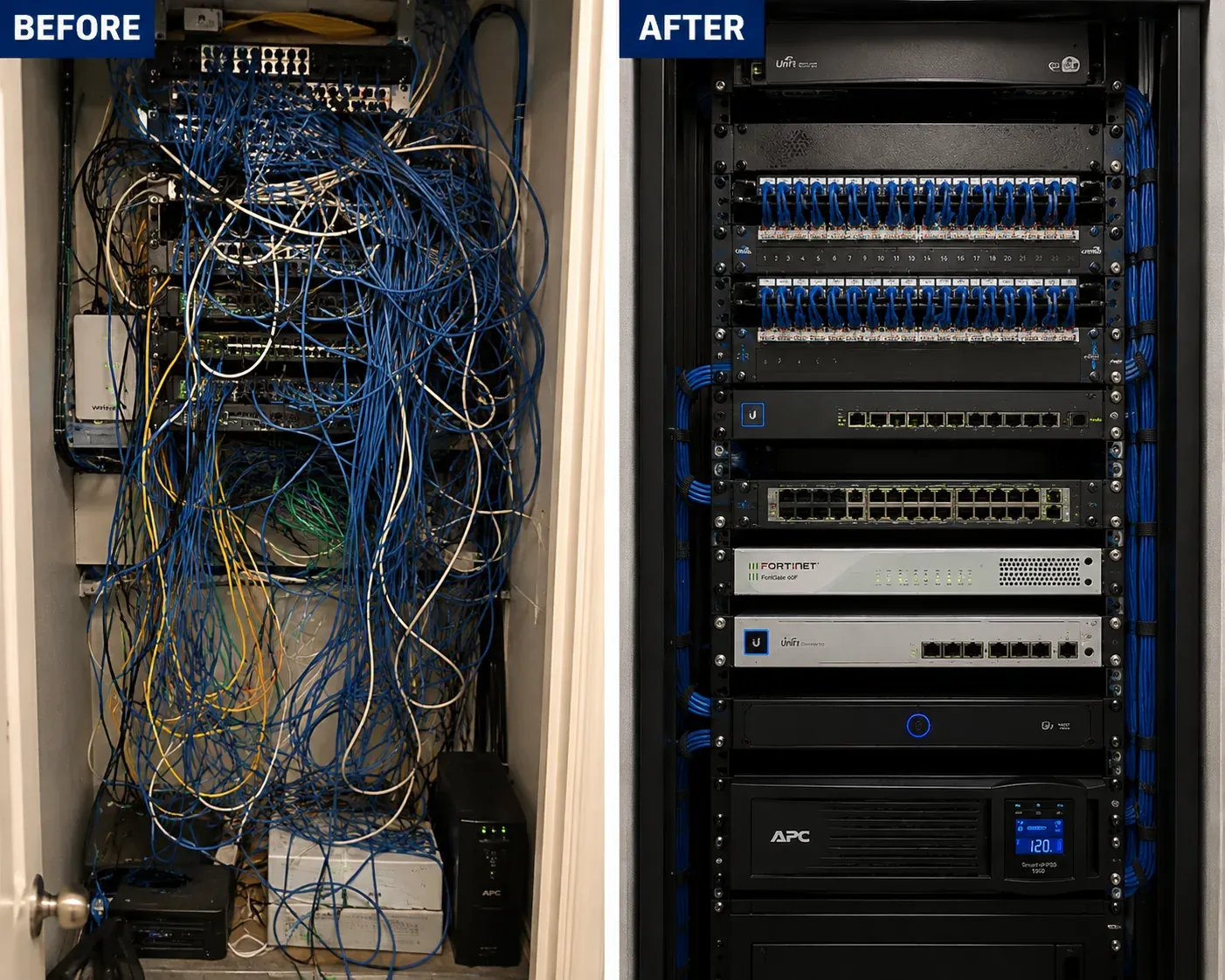
Before and after photos of a network rack, a tangle of cables replaced by labelled panels and switches, the kind of cleanup that accompanies Bloomfield, Staten Island fiber work
On the left, a closet rack buried in loose blue, white and yellow cords; on the right, the rebuilt rack with patch panels, switches, a firewall and a battery backup set out in order.
All Areas Served

Fiber Optic Installation Across New York

This page covers Bloomfield. It sits under our Staten Island fiber optic installation page, which is part of the New York City fiber optic installation hub for all five boroughs. Each borough and county page is written for its own building stock.

If your part of the city has no page of its own yet, the quote form reaches the same crews. For our cameras, door access, intercoms and alarms, start at the home page; the background on the company is under about AESS.

Dock Zone or Gate Link Offline in Bloomfield?

When half a distribution floor loses its network at 6 a.m., the cause is rarely mysterious: a zone cabinet knocked by a lift, a jumper pulled during a move, a connector fouled by dust. Phone (347) 934-8335, name the zone or the gate that went down, and we will try to have someone on the West Shore that day. Most single faults of that kind take one to two hours to locate and correct, and we re-test the repaired strand before handing the link back.

Fiber Optic Installation Bloomfield — Zoned for the Floor, Proven on the Meter

Abstract Enterprises Security Systems · 1282 Troy Ave, Brooklyn, NY 11203 · Staten Island line (347) 934-8335 · WhatsApp (718) 679-0359 via wa.me

NYS Low-Voltage Licence #12000287431 · 100% Licensed & Insured · Same-Day Estimates · Rated 4.7★ from 201 Google Reviews

Full terms — including 50% deposit, one-year parts-only warranty on AESS-supplied products, and the late-fee schedule — are set out in the service agreement. See our warranty page.

Page reviewed and updated October 17, 2026. Changelog: first publication of the Bloomfield fiber optic installation page.