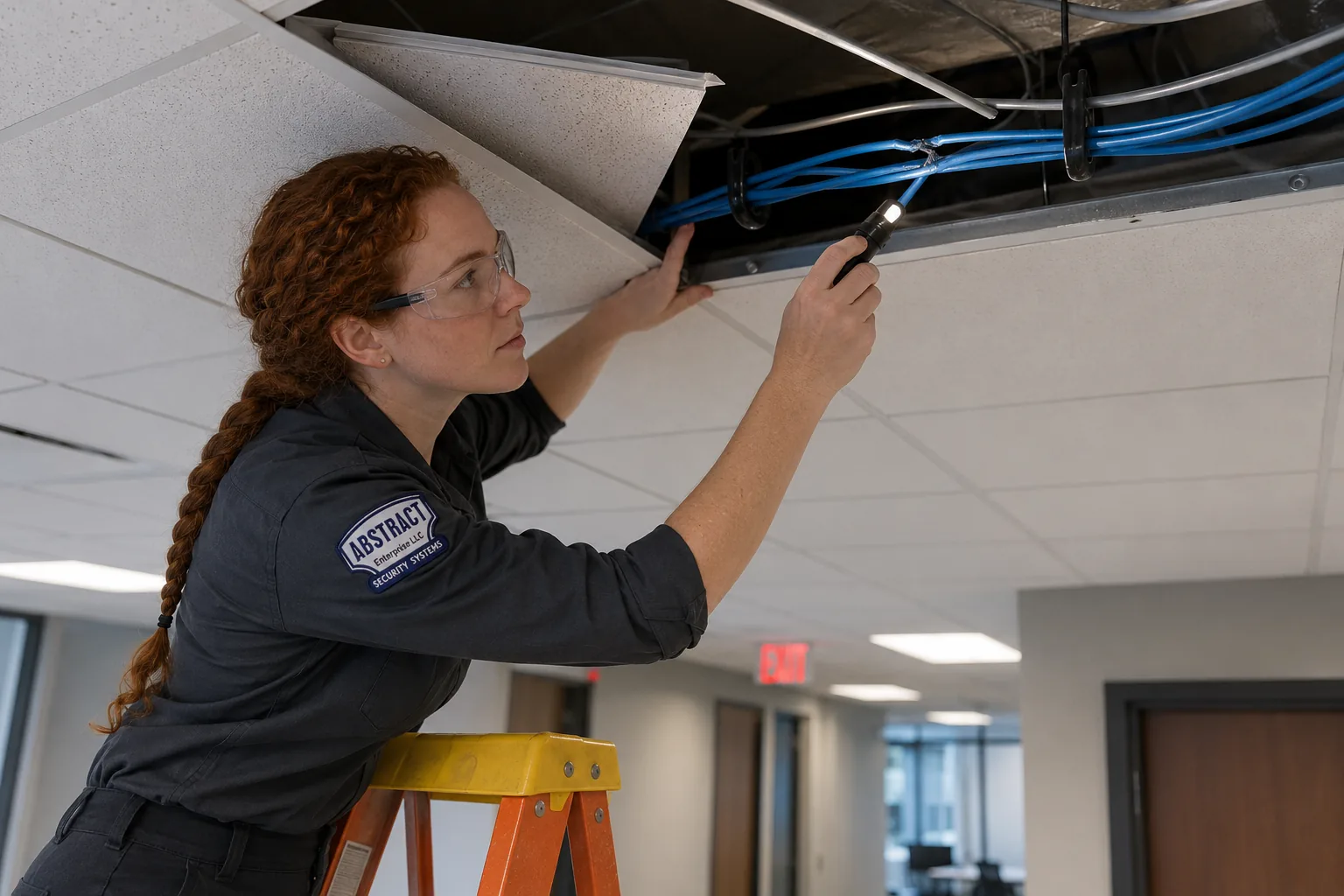
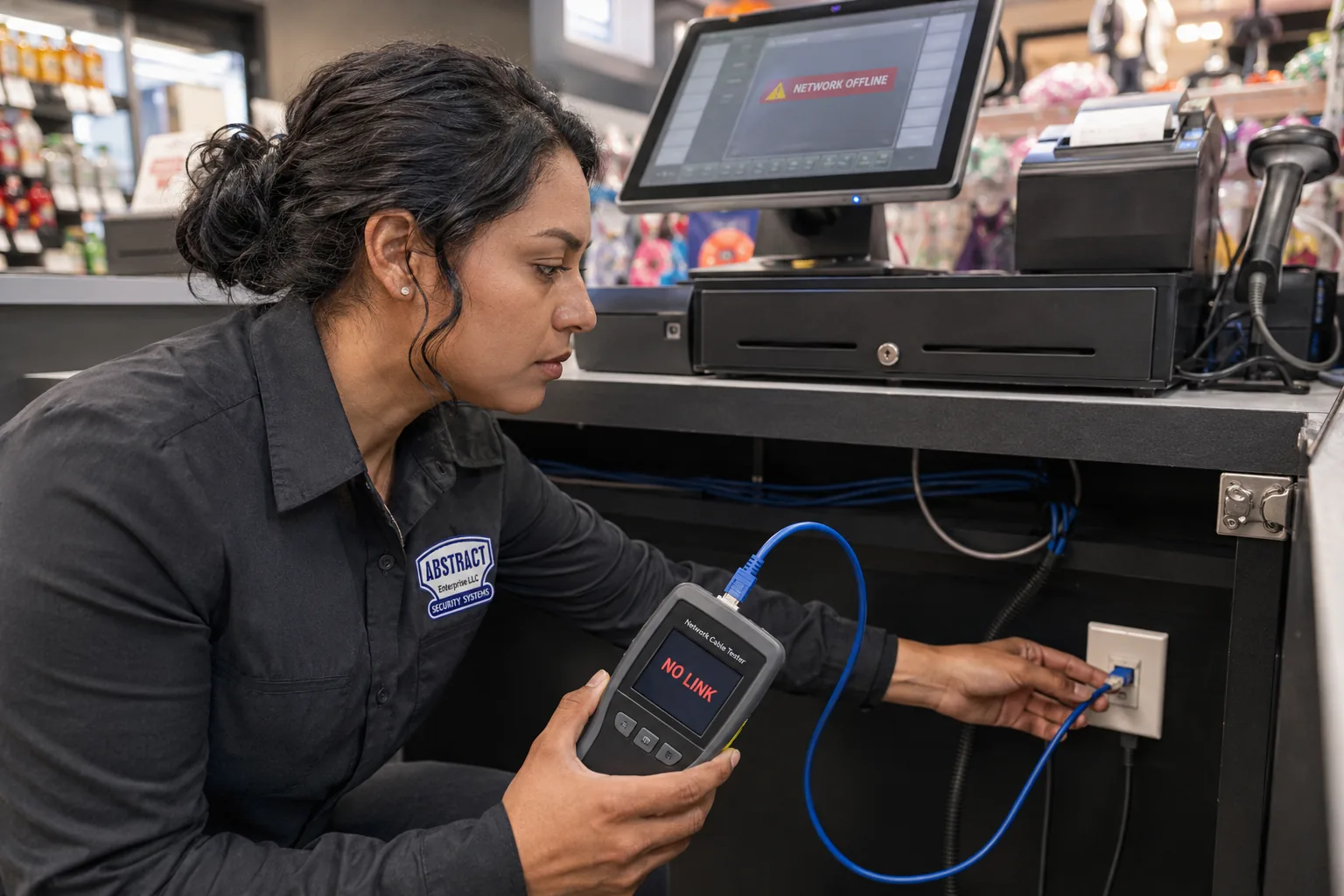
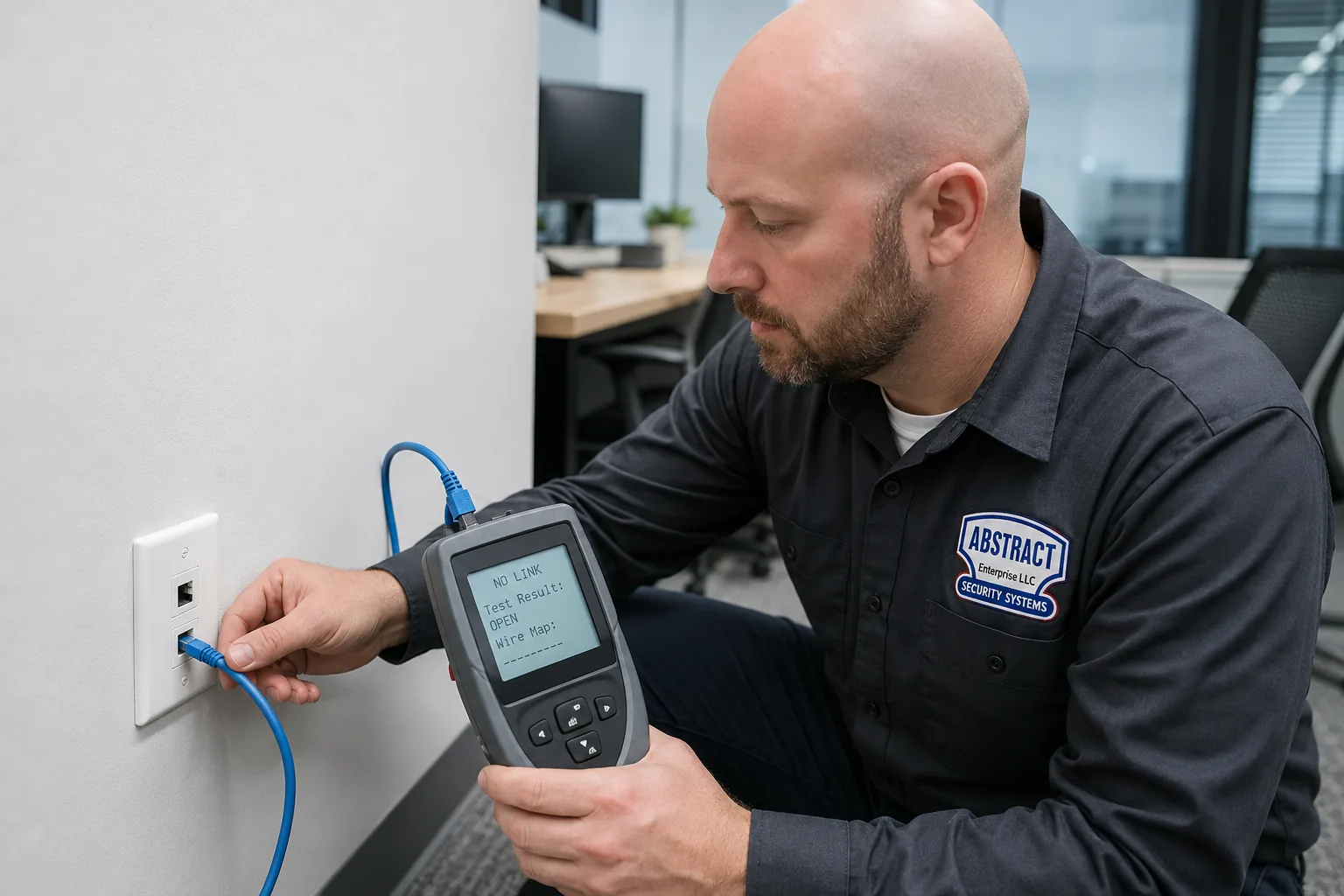
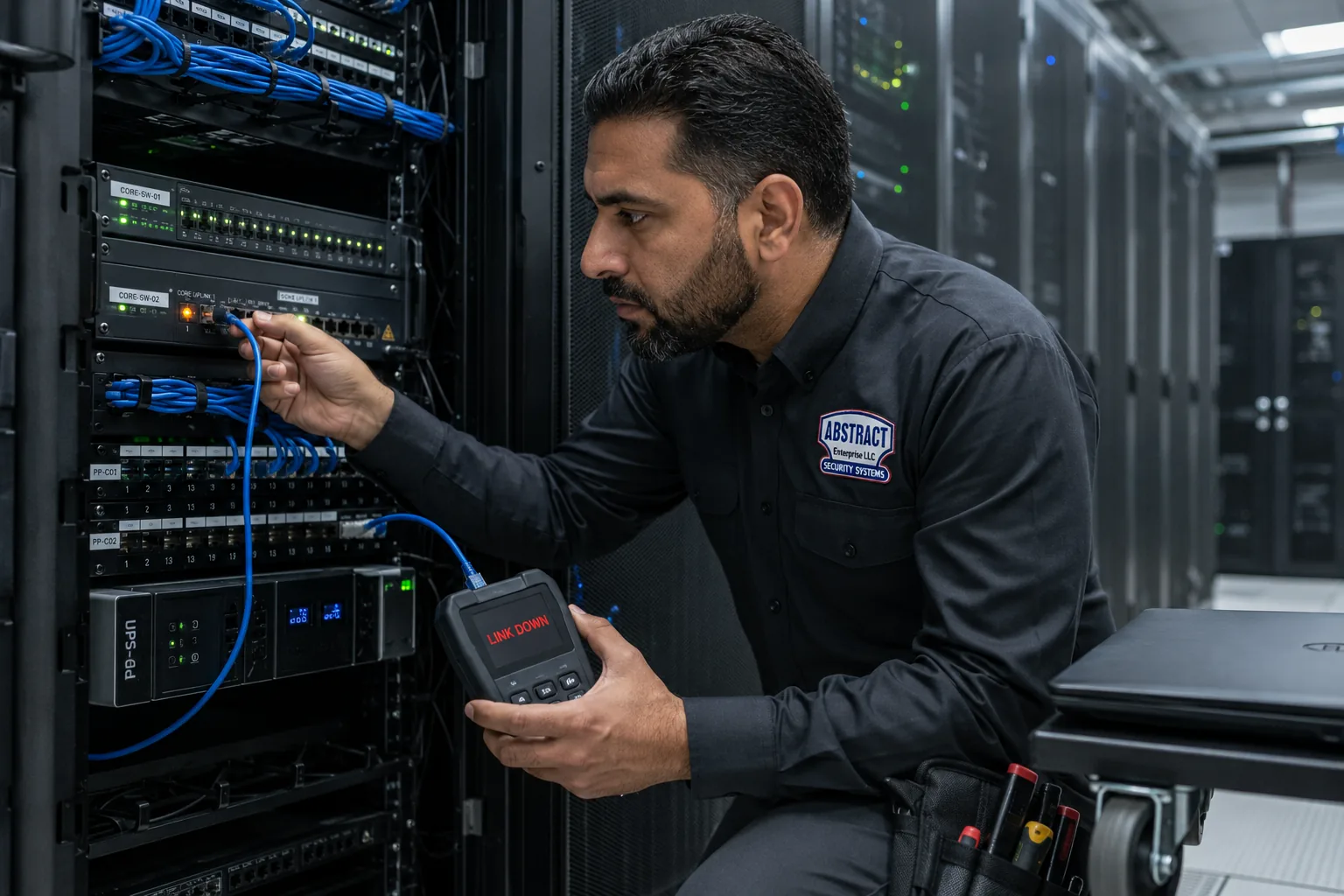
Fault location, retermination, network jack and patch panel repair, PoE troubleshooting and certified cable testing across Staten Island. Licensed NYS low-voltage contractor. Visits scoped to finish in one trip, because the bridge is not free.
Ethernet, Cat6 and Data Jack Repair Across Staten Island
Staten Island is the only borough where most commercial property sits on its own lot, and that single fact drives the cabling. Detached buildings with parking, yards, outbuildings, signage and gates mean a large share of runs leave the building at some point — and a run that goes outdoors follows different rules than one that stays inside. Abstract Enterprises Security Systems repairs Ethernet, Cat6 and data cabling across the island, from the St. George terminal district to Tottenville.
The pattern of calls reflects it. A West Shore warehouse whose gate camera drops out in the wet. A Hylan Boulevard practice where the run to the rear annexe was buried in a conduit that has been holding water since it went in. A New Dorp retailer whose till loses its link at peak. A Teleport office suite behaving like a mainland office park. A Great Kills business that flooded years ago and whose links have been quietly deteriorating since.
Repair is charged at our specialty service rate of $195/hr with a three-hour minimum ($585), and the visit is scoped to finish rather than to diagnose. That is deliberate: on an island reached by a bridge or a boat, a return trip costs everybody more than doing the adjacent testing while the crew is already standing there.
Network Down on Staten Island?
Same-day and next-morning coverage across the island. We scope visits to finish the job in one trip rather than book a diagnostic call and a return, because a second crossing helps nobody.
✔ NYS Lic. #12000287431✔ Certified wiremap & performance testing on every repair✔ 4.7★ from 201 reviews
Local Conditions
Why Staten Island Cabling Is an Outdoor Problem
The borough's commercial building stock is low-rise, detached and surrounded by its own land. Warehouses on the West Shore, retail on Hylan and Richmond Avenue, offices at the Teleport and Corporate Park, practices in converted houses along Forest and Victory — almost all of them have a parking area, frequently a yard, often an outbuilding or a trailer, and usually a camera on a pole somewhere. Every one of those is a run that leaves the building, and the failures cluster there rather than at the desks.
Second, what actually goes wrong on those runs. Three details decide whether an exterior drop lasts: a jacket rated for sunlight and water, a penetration that is sleeved and sealed, and a bond at the entry. Miss the jacket and it degrades over a couple of seasons. Miss the seal and water tracks along the cable into the building. Miss the bond and weather puts surge energy into a switch port. We find all three missing regularly, usually on a run somebody added themselves in an afternoon.
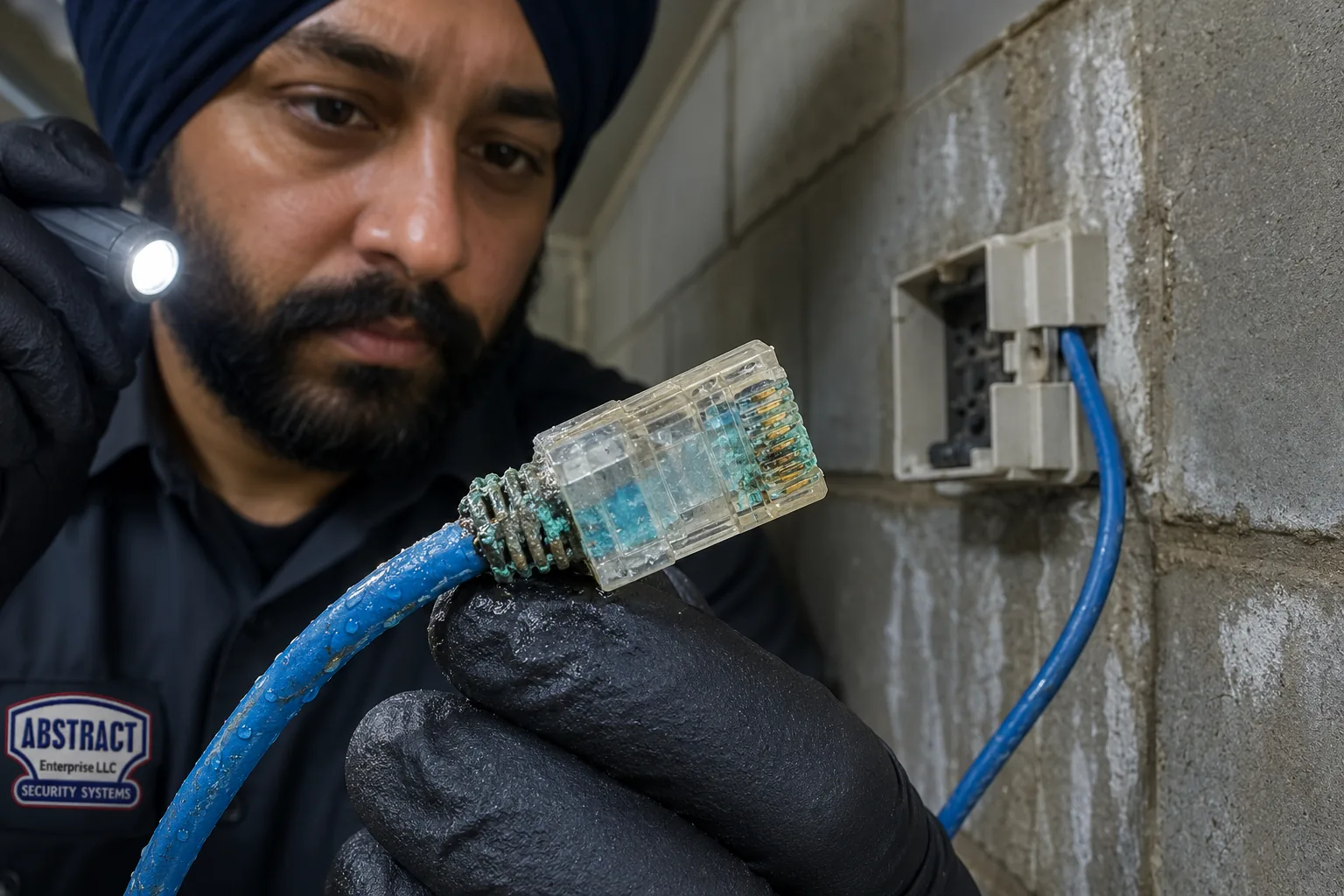
Third, buried conduit that holds water. A great many island properties have a duct under a driveway or a lawn linking a main building to an annexe, a garage or a trailer. Conduit that was never drained or sealed at the ends fills, and cable sits in standing water for years. It does not fail cleanly — it corrodes at whichever end is lower, and the decline is gradual enough to be blamed on the carrier.
Fourth, flood exposure. The East and South Shores — Midland Beach, New Dorp Beach, Oakwood, Great Kills, Tottenville — and the low ground along the Arthur Kill have real flood history. Where equipment or a panel has been under water, corrosion continues long after the visible damage is dealt with, and it is worth knowing the property's history before diagnosing anything as a switch problem.
Fifth, the trip. There is no subway here and there is a bridge or a ferry in the way. That does not change how a repair is done, but it changes how it should be scoped: test the neighbouring drops, map the closet, label what is unlabelled, all in the visit you are already paying for. A contractor who books a look-and-quote and then a second appointment is charging you twice for the crossing.
What We Repair
What a Staten Island Cable Repair Call Covers
We repair the physical layer, correct the outdoor detail that caused the fault, and prove it with a measurement.
Exterior Run Repair
Gate, pole, sign, yard and parking-area drops. Correct jacket, sleeved and sealed penetration, bonded entry, and protection where vehicles move.
Buried Conduit Diagnosis
Runs between a main building and an annexe, garage or trailer. We check whether the duct is holding water before recommending anything, because that decides repair from replacement.
Building-to-Outbuilding Links
Restoring links to a second structure on the same lot, with the entry detail at both ends done properly rather than drilled and forgotten.
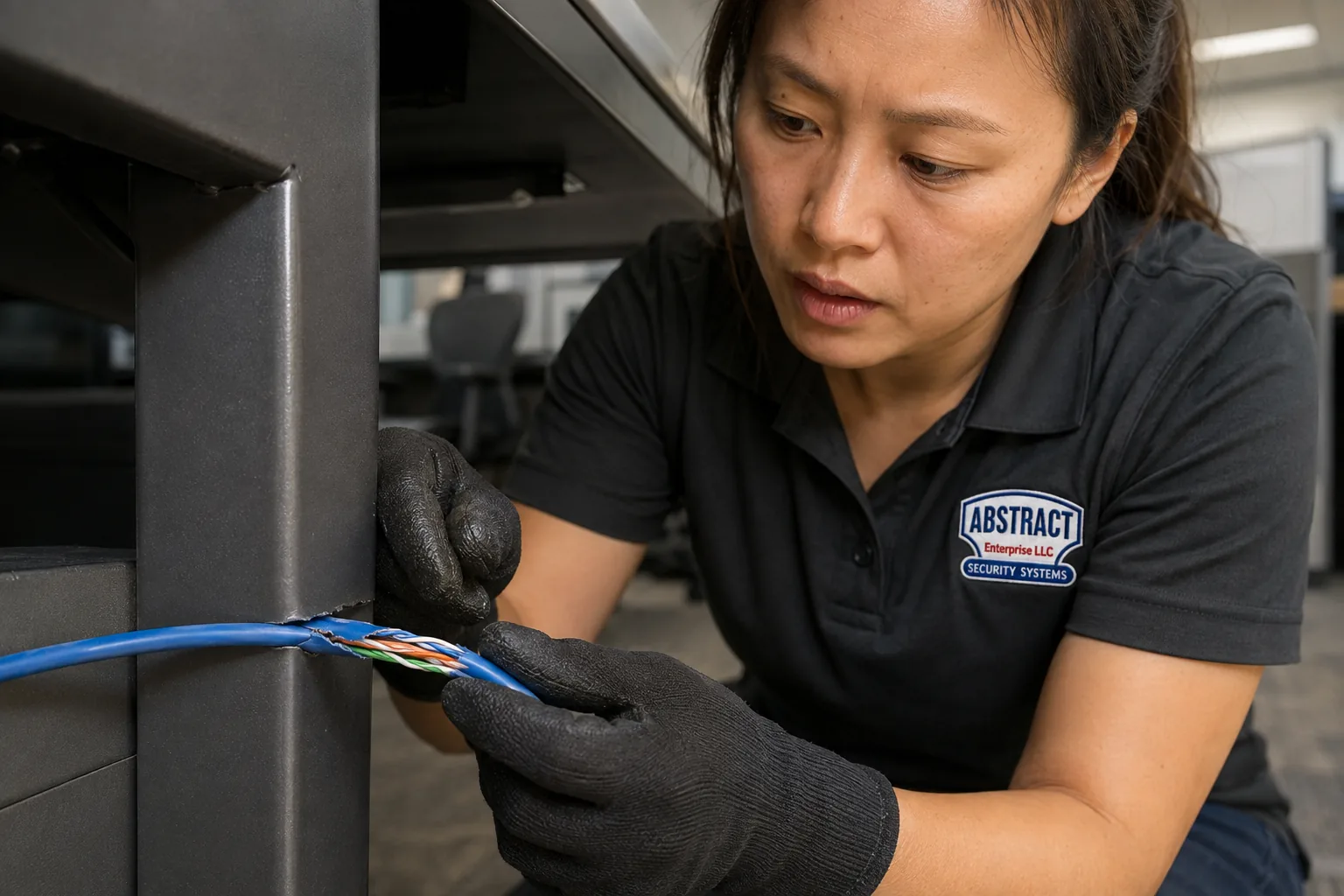
Ethernet Cable Repair
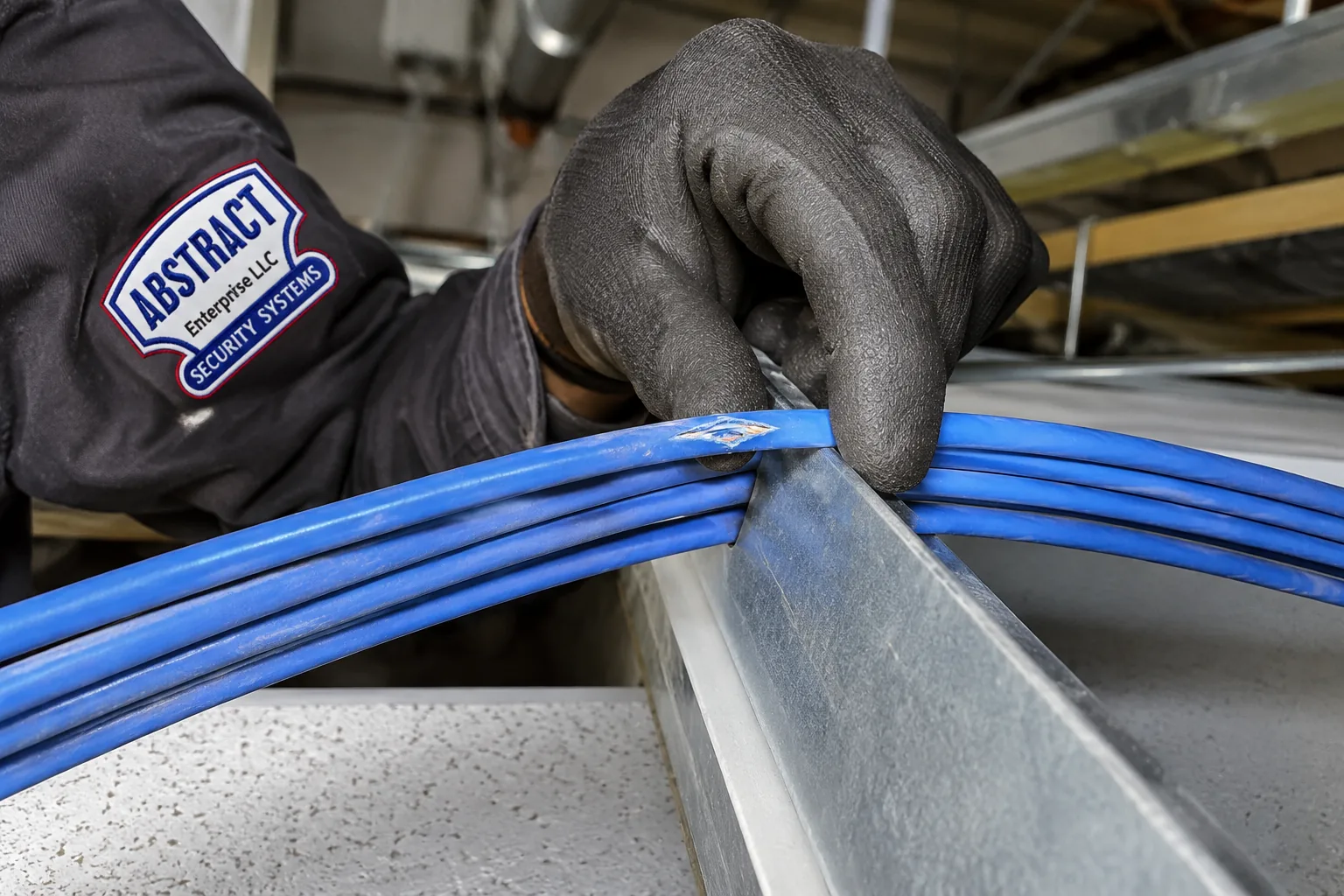
Cut, crushed, corroded or sun-degraded runs restored with a category-appropriate junction and re-tested.
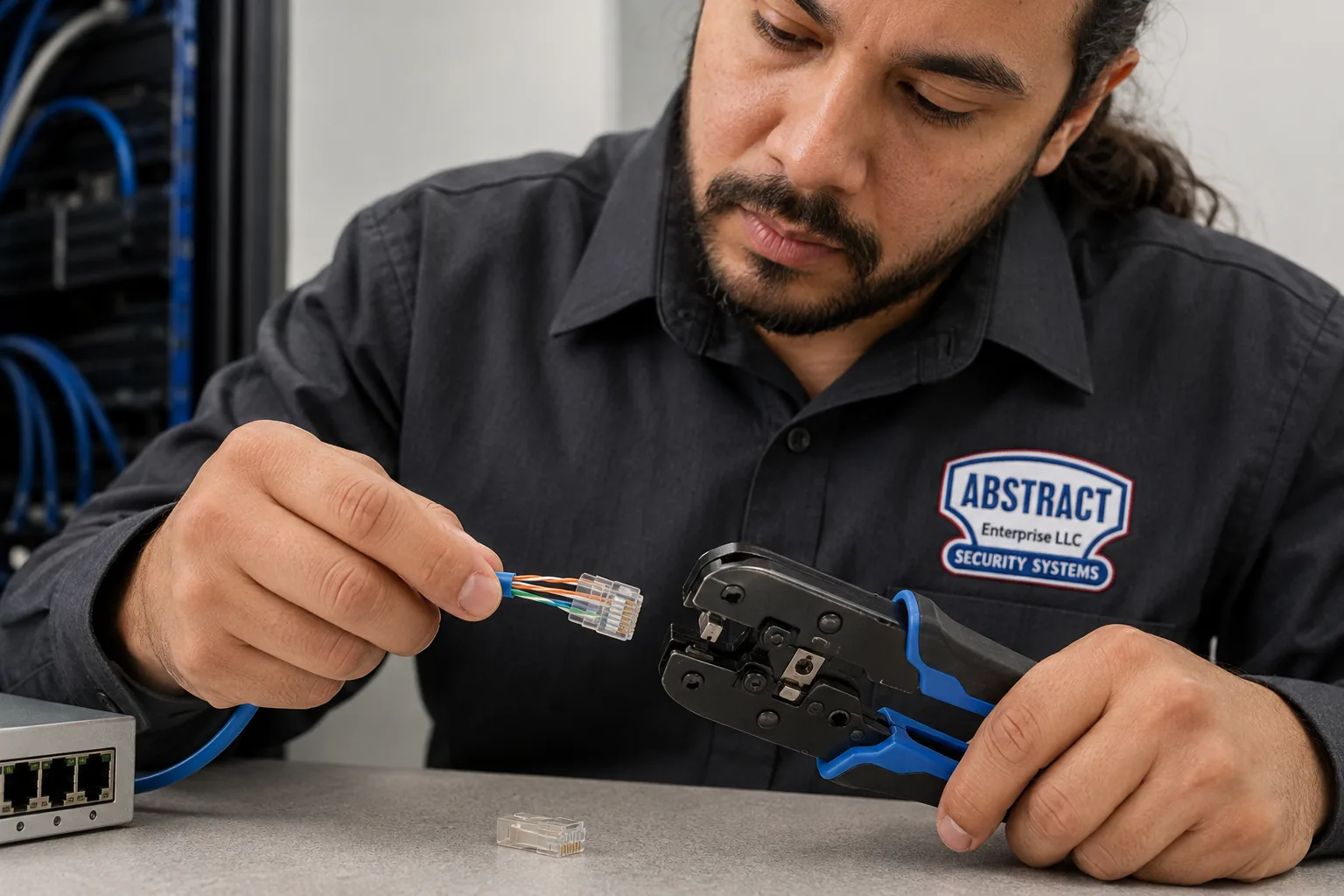
Cat6 and Cat6A Retermination
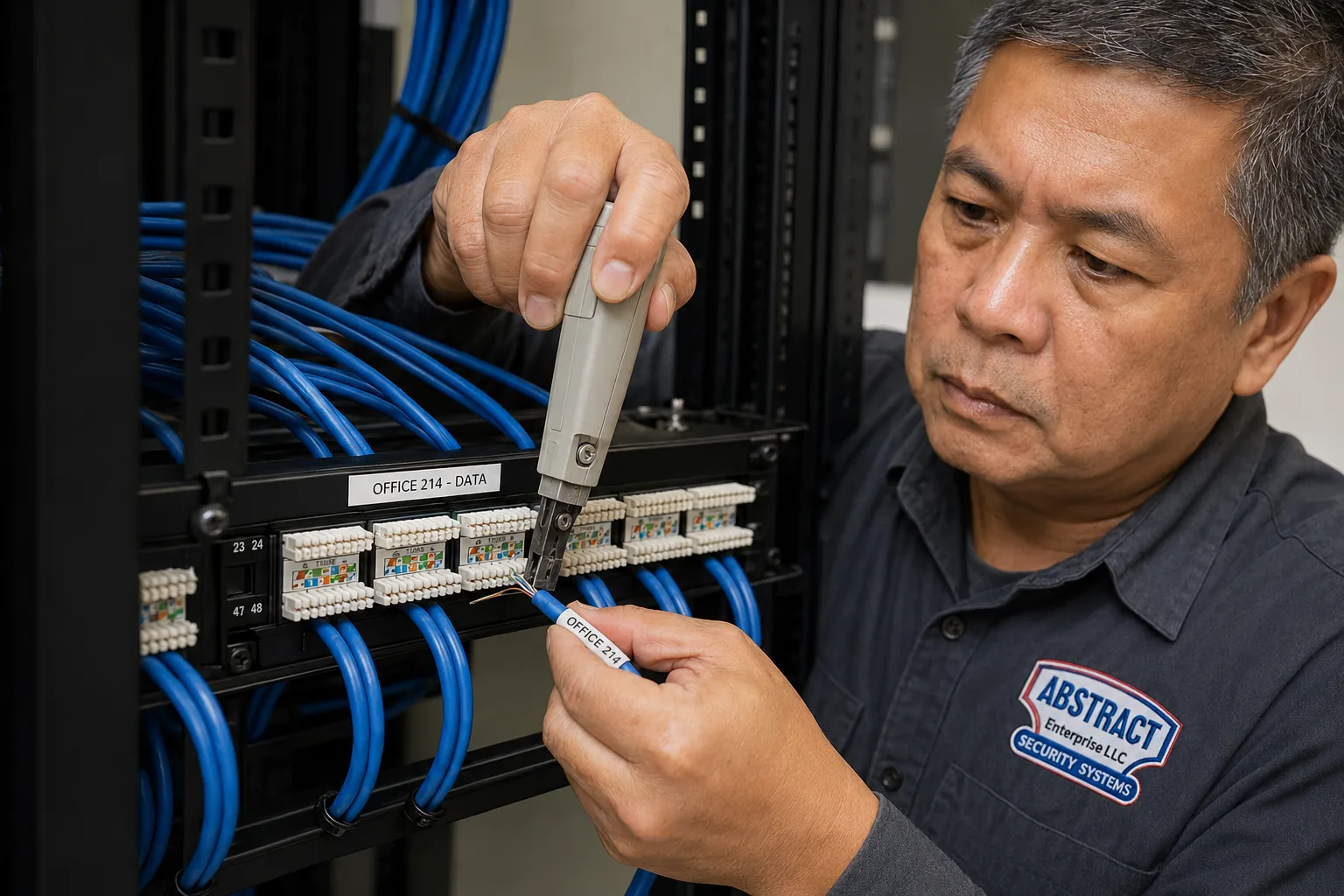
Both ends redone to T568B with the twist held to the contact, so the channel certifies rather than merely lighting up.
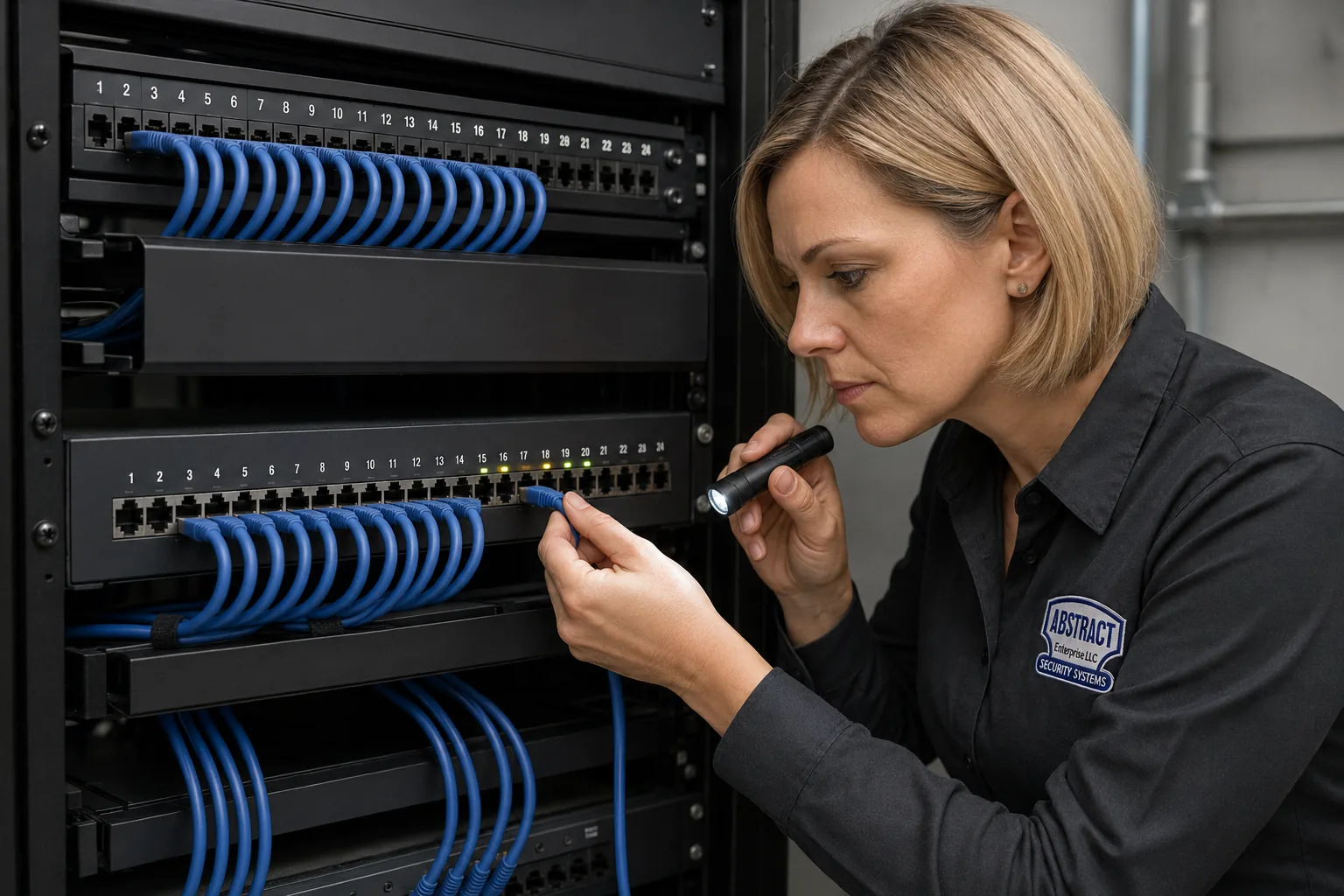
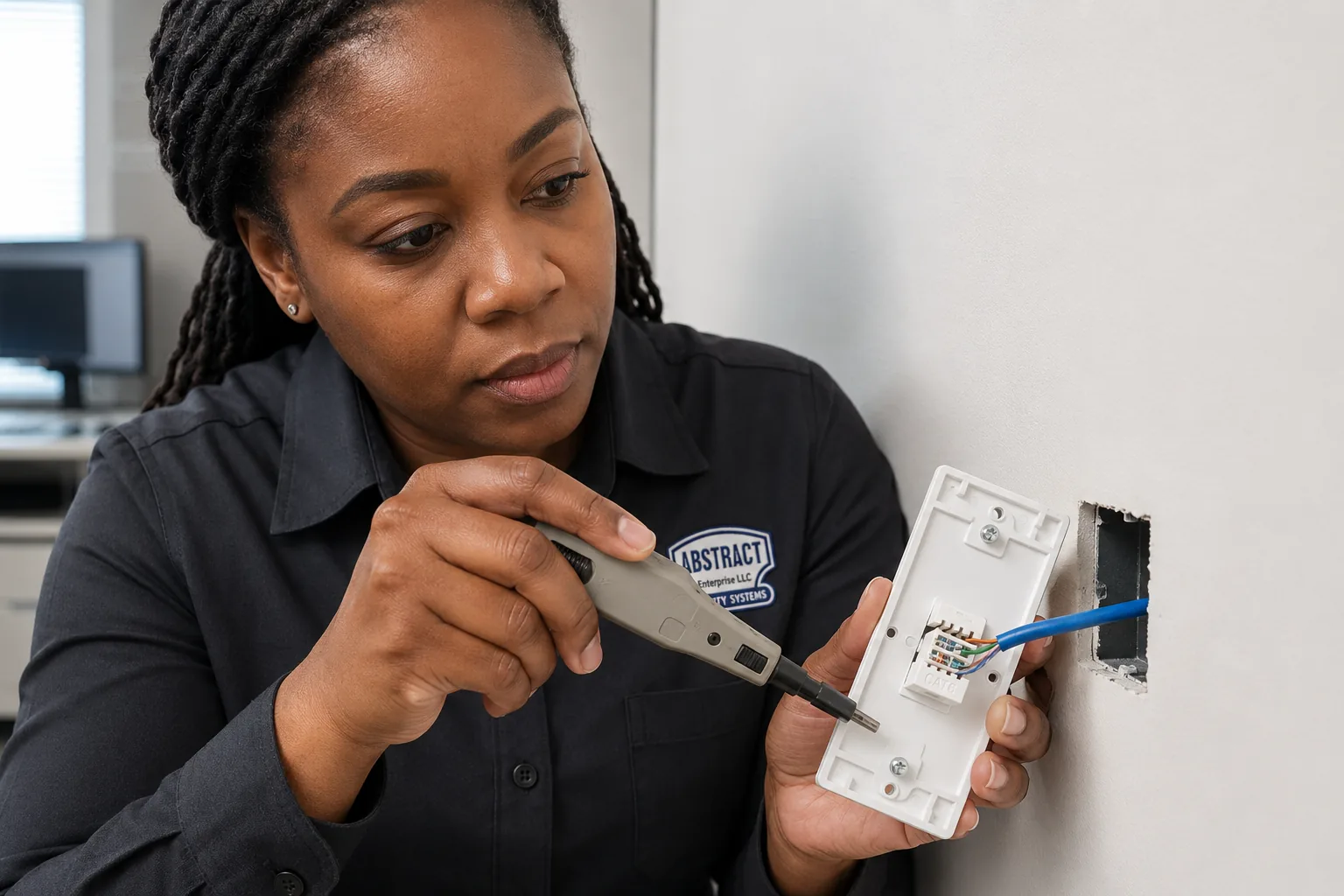
Network Jack and Panel Repair
Dead outlets, keystones seated but never punched through, panel positions wired to the opposite standard, and hardware that has been under water.
Post-Flood Assessment
Identifying which terminations were wet, re-terminating them, and recommending elevation where the space allows it.
Certified Testing
Wiremap, distance and performance verification with saved reports including headroom.
PoE Circuit Troubleshooting
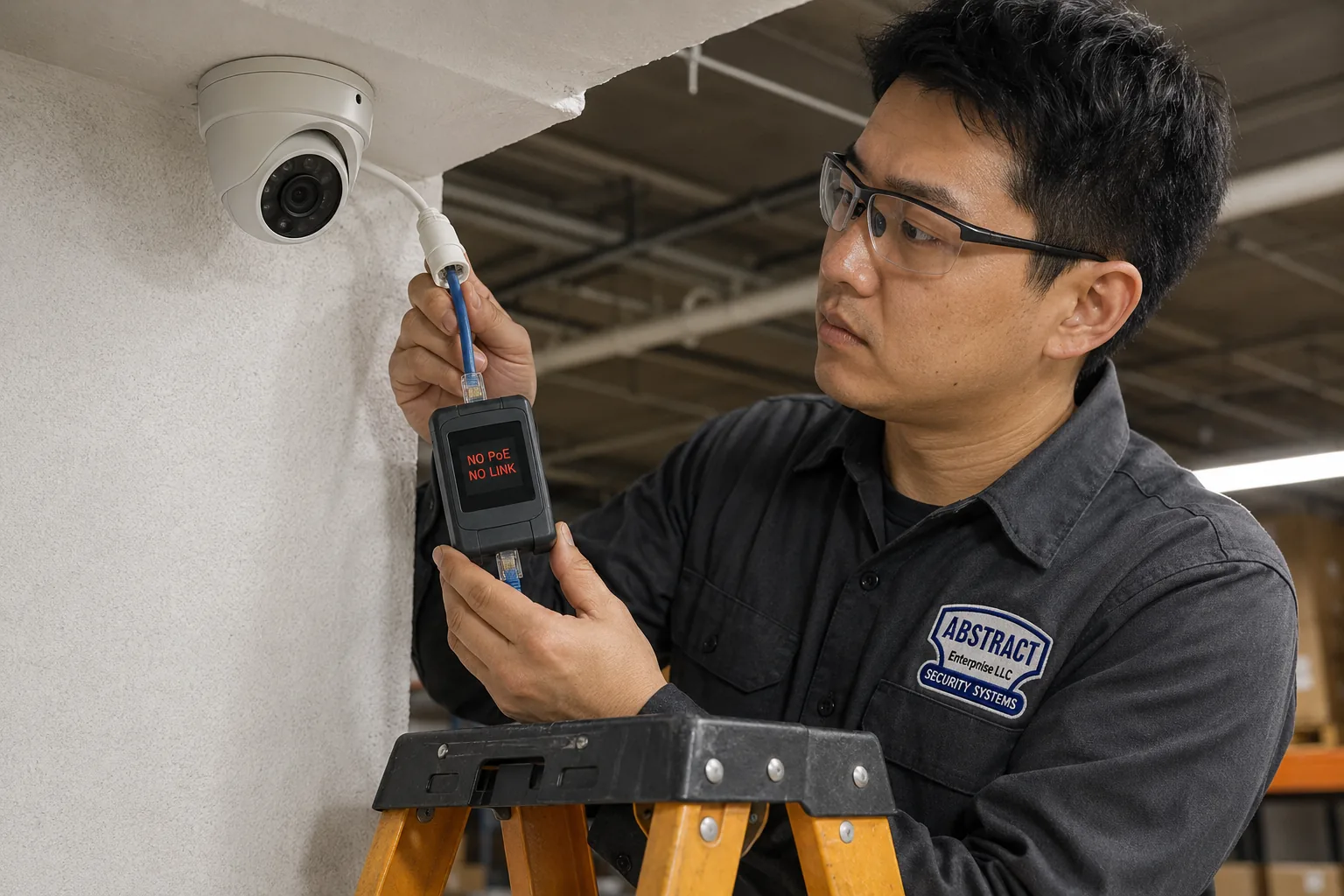
Cameras on poles and gates that reboot the moment a heater or night illuminator draws current. We put a meter on the device itself while it is working.
Commonly paired: on a detached lot the camera, gate and intercom runs follow the same route out of the building as the data. If one has failed to weather or a wet duct, the others on that route are worth testing while the crew is on site — see camera repair and access control.
Plain English
Terms That Come Up on a Staten Island Job
Nearly all of these describe what happens where cable leaves the building, which is where island faults live.
Term
What It Means on a Staten Island Property
Outdoor-rated jacket
Cable built for sunlight and water. Indoor cable outdoors survives a season or two and then degrades permanently, usually blamed on the device it feeds.
Sleeve and seal
The lined, sealed penetration where a run enters the building. Without it, water follows the cable inside and appears somewhere unexpected.
Bonding
Tying protection at the entry to building ground. Missing bonds are how a storm becomes a switch replacement.
Direct burial
Cable specified to sit in soil, or ordinary cable inside conduit rated for it. Neither is what we usually find under a driveway here.
Water-logged duct
Buried conduit that has filled and never drained. The cable inside sits submerged, and the lower end corrodes first.
Drip loop
The deliberate low bend before an entry so water runs off rather than following the cable in. Cheap, effective and almost always absent.
Split pair
All conductors connected, the pairing wrong. Trains at 100 Mbps, refuses gigabit, gets reported as slowness.
Certification
A recorded measurement against the category standard with headroom noted. Distinct from a continuity beep.
Insertion loss
Signal lost along the run, rising with temperature and with water in the path. It is what turns a passing drop into a failing one on a hot afternoon.
Demarc
The handover point between the carrier network and yours. Everything inboard of it is the property owner's responsibility, and that is the boundary our scope begins at.
Equipment
Hardware and Test Equipment on a Staten Island Repair
We repair what is installed and replace with commercial-grade parts matched to the existing channel — Belden, CommScope, Panduit, Leviton, Hubbell, Ortronics, ICC, Berk-Tek and Superior Essex, plus outdoor-rated and direct-burial cable, sealed enclosures, gel-filled connectors and proper entry hardware wherever a run leaves the building. Mixing categories defeats the exercise: a Cat5e jack on a Cat6 channel pulls the whole channel down regardless of what is in the ground.
On the equipment side we chase cable faults behind Cisco, Meraki, Aruba, Ubiquiti UniFi, Netgear, TP-Link, Luxul and Araknis switching, and behind PoE devices — pole and gate cameras, radios, handsets, readers and displays. Configuration is outside our remit: no switch administration, no VLANs, no controllers, no firewall policy. The channel gets certified and the results go to whoever runs the network.
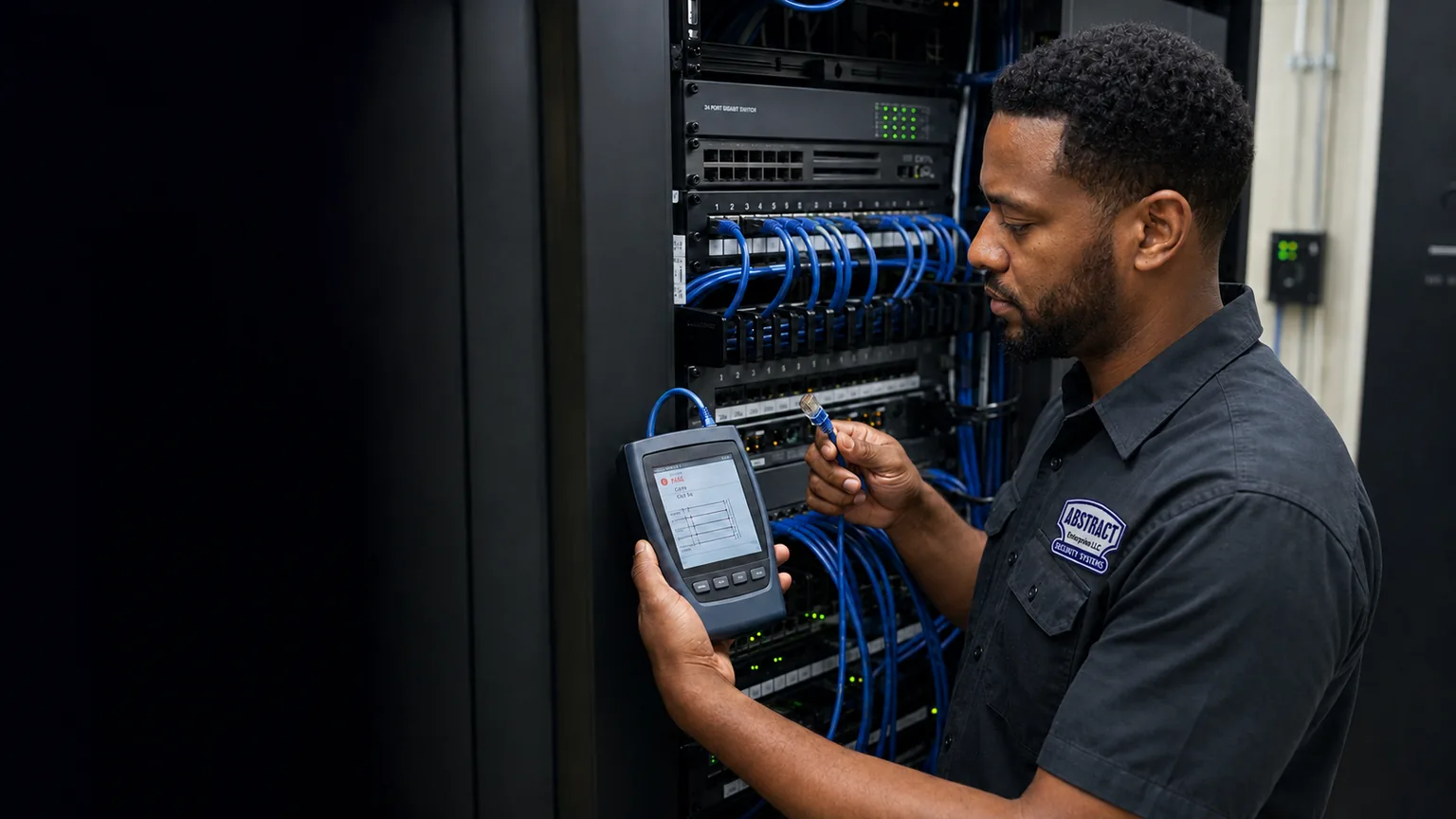
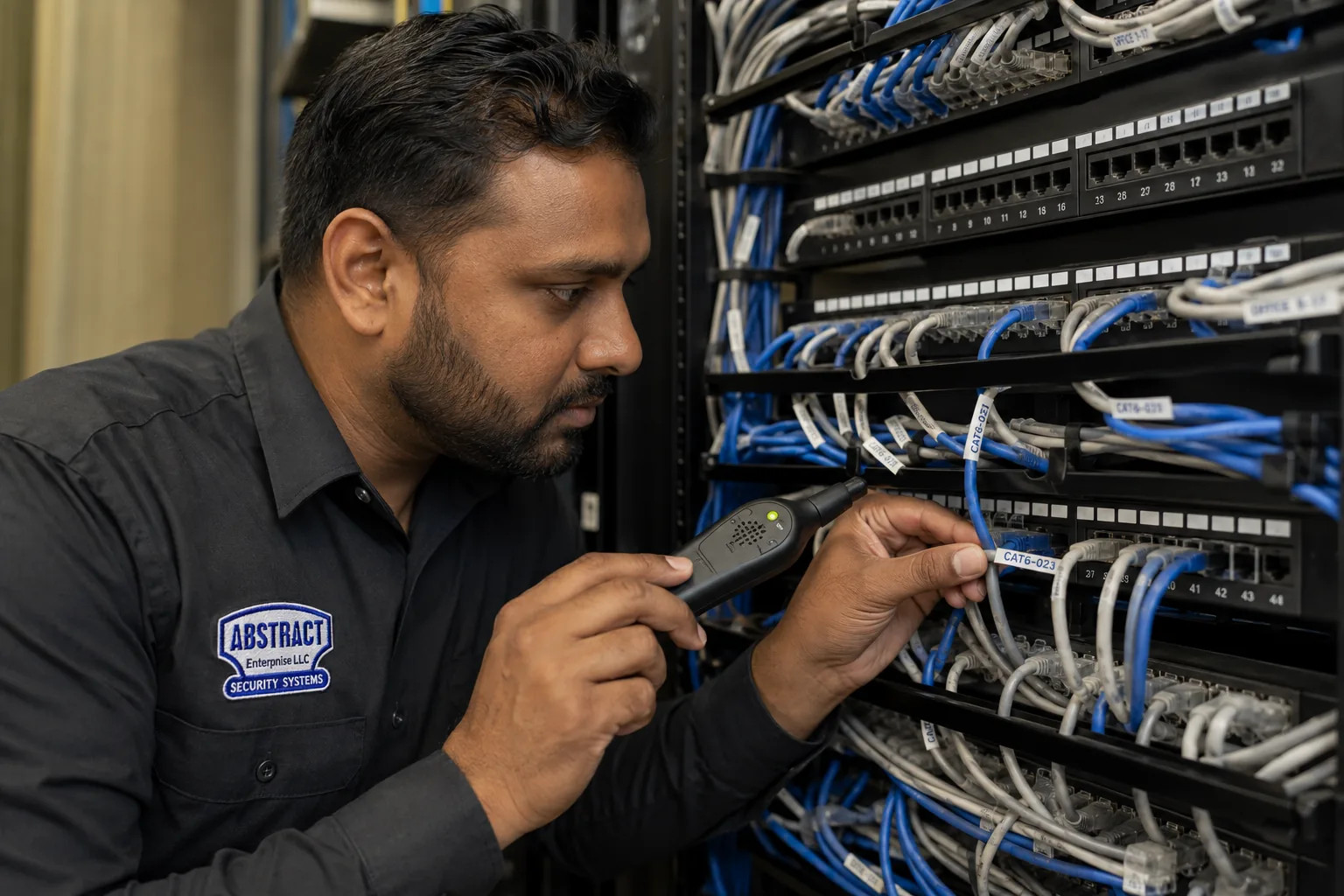
Diagnostics decide whether a single trip is enough. Certification testers with saved reports, tone generators and probes, and PoE measurement at the endpoint under genuine load all travel on every call, which is what makes it realistic to locate, repair and prove a fault in one visit rather than two.
Need Repair in Staten Island Today?
Same-day and next-morning coverage across the island. Visits are scoped to finish rather than to diagnose, so the adjacent drops get tested while the crew is already on site.
Everything about how we scope island work follows from the bridge.
The sequence itself is standard — locate the fault precisely, make the physical correction, then measure and report the headroom rather than filing it. What changes here is the scope around it. While a crew is on the property we test the neighbouring drops, check the entries on any other exterior run, and label what is unlabelled, because all of that is nearly free now and expensive as a separate visit later.
The correction specific to this borough is the entry detail. If a run failed because indoor cable was used outdoors, or because the penetration was drilled and never sealed, or because nothing was bonded at the wall, then a replacement through the same hole in the same specification fails on the same schedule. Changing the jacket, sleeving and sealing the entry and adding a drip loop takes very little time while somebody is already at the wall.
Full Scope
Full Scope of a Staten Island Network Cable Repair
Diagnostics
Fault location by measured distance on broken or shorted runs
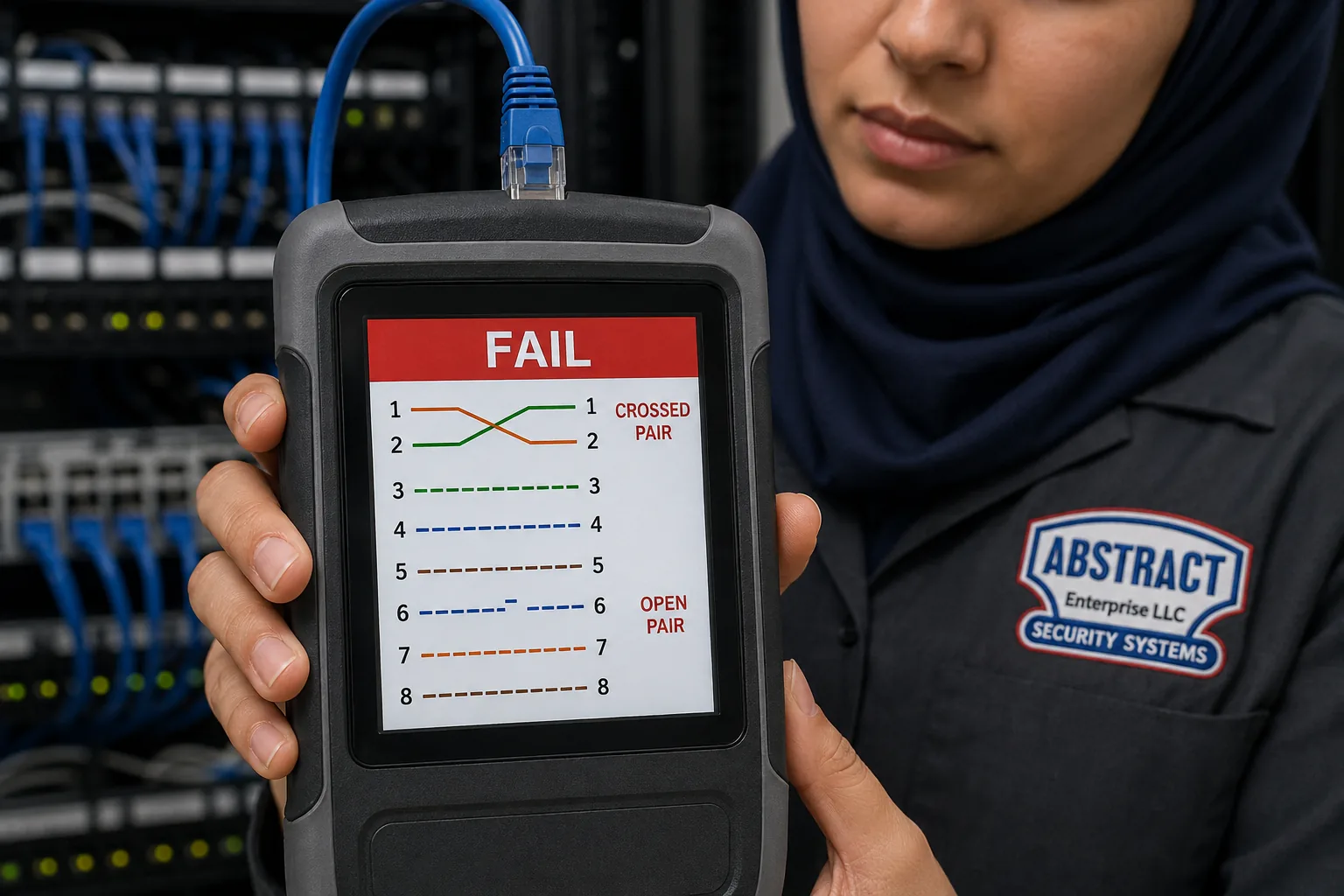
Wiremap faults: opens, shorts, reversals, split and crossed pairs
Measured length against the 90 m and 100 m limits
Insertion loss and crosstalk with headroom reported
Saved test results per repaired drop, with headroom
Both-end labelling and a closet legend
Site sketch showing exterior and buried routes measured from fixed points
Photo record of entries and concealed repairs
Written findings for an owner or IT provider
Site Logistics
Visits scoped to complete in one trip
Adjacent-drop testing included while on site
Certificate of insurance where the property requires it
Before-opening and after-close windows for retail and food service
Exterior work planned around weather and ground conditions
Coordination with your existing IT provider
Coverage Detail
Where We Work Across Staten Island
The North Shore holds the borough's oldest and densest commercial fabric. St. George around the ferry terminal, the courts and the civic buildings; Stapleton and Tompkinsville along Bay Street; Port Richmond along Richmond Avenue and Castleton; West Brighton and Clifton. Older masonry and converted stock, small tenancies, and the closest thing the island has to a walkable commercial district.
The West Shore is the industrial and logistics side: the West Shore Expressway corridor through Bloomfield, Travis, Chelsea and Charleston, the Teleport and Corporate Park of Staten Island office campus, and the warehousing and distribution premises around them. Large detached buildings on their own parcels, deep floorplates, yards, gates and long runs — the closest thing here to a New Jersey office-park problem, and the part of the borough where a single building can exceed the copper limit from one point.
The East and South Shores run down Hylan Boulevard through Grasmere, Dongan Hills, New Dorp, Oakwood, Great Kills, Eltingville, Annadale, Huguenot, Prince's Bay and Tottenville, with Richmond Avenue and the New Springville and Heartland Village retail concentration inland. Retail, medical and professional offices in freestanding buildings and small plazas, plus the flood-exposed low ground along the shoreline. Mid-Island covers Todt Hill, Emerson Hill, Bulls Head, Willowbrook and the College of Staten Island campus.
Who We Serve
Staten Island Industries We Repair Cabling For
Warehousing and Distribution
West Shore, Bloomfield, Charleston. Deep floorplates near the copper limit, yard and gate drops, and forklift damage at working height.
Office Campus and Corporate Park
Teleport and the West Shore office stock. Multiple buildings on a parcel, links between them, and the entry detail that decides whether those links last.
Medical and Dental Practices
Hylan Boulevard, New Dorp, Great Kills, Bulls Head. Imaging and practice systems with no tolerance for a marginal channel.
Retail and POS
Richmond Avenue, Hylan Boulevard, New Springville. Tills that cut out at peak and stockroom runs damaged during shelving work.
Restaurants and Food Service
Kitchen terminals in heat and grease, patio and exterior coverage, and repair windows outside service.
Auto, Marine and Trade Businesses
Service bays, yards, boat storage and exterior camera drops taking weather and mechanical abuse.
Professional Offices in Converted Houses
Forest, Victory, Amboy and the older corridors. No equipment room, cellar panels, and placement decisions that carry weight.
Schools, Civic and Community Facilities
St. George's civic cluster and the island's institutional stock, with layered infrastructure and documentation requirements.
Property Owners With Multiple Structures
Main building plus garage, annexe or trailer, linked by a duct nobody has looked inside since it was laid.
Real Questions
Fourteen Questions Staten Island Businesses Actually Ask
Drawn from the recurring themes in small-business, IT and Staten Island local discussion threads, grouped by the six question types that come up most.
Cost Questions
1. What does a repair cost out here?
$195 an hour against a three-hour minimum, so the opening block is $585. That block is deliberately scoped to finish the job: find the fault, fix it, certify it, and test the adjacent drops while we are on the property. A fresh run is priced from $175 per commercial Cat6 drop.
2. Is there a travel charge for the bridge?
No separate charge. What we do instead is scope the visit so it does not need a second one — adjacent-drop testing and labelling happen inside the block you are already paying for, because a return crossing costs both of us more than doing it now.
3. Why is the exterior run quoted higher than the indoor one?
Because it is a different job. Outdoor-rated or direct-burial cable, a sleeved and sealed penetration, a bond at the entry and a drip loop are all real materials and real time. They are also the difference between a run that lasts fifteen years and one you replace every few seasons.
Quality and Trust Questions
4. How do I know the repair will hold outdoors?
Ask what changed at the entry. If the answer is only that the cable was replaced, nothing has been fixed. A durable exterior repair names the jacket specification, the sleeve and seal, the bond and the drip loop, and comes back with a measurement to prove the channel.
5. Do I need a licensed contractor?
For anything past swapping a cord, yes. Cabling is low-voltage work with obligations on jacket rating, firestopping and bonding, and any property with insurance requirements will ask for a licence number. Ours is NYS Low-Voltage #12000287431.
6. Will you actually come out here for one drop?
Yes, and we would rather do that one drop properly with the neighbouring runs tested than be called back in six weeks. The three-hour block makes a single-fault visit economic for both sides.
DIY and Pro Questions
7. Can I run a cable out to the garage myself?
You can, and it is the most common self-inflicted fault on island properties. Indoor cable in a duct, an unsealed entry at both ends and no bonding produces a link that works beautifully for a year and then degrades permanently while everyone blames the equipment at the far end.
8. Is the tester from the hardware store useful?
It confirms the eight wires reach the right pins. It cannot report distance, signal loss, pair interference or headroom, which are exactly the measurements that matter on a long or wet run. It will pass a channel that is quietly failing.
9. Can we blow the water out of the conduit and reuse the cable?
Clearing the duct is worth doing. Reusing cable that has been submerged for years is not — the corrosion is at the terminations and inside the jacket, and it will not certify. Fix the duct, then pull cable rated for the conditions.
Technical Questions
10. The link to our annexe has got slowly worse over years. Why?
Look inside the duct. Buried conduit that was never drained or sealed fills with water, the cable sits in it, and the lower end corrodes. The decline is gradual, which is why it gets attributed to the carrier or to growing traffic rather than to a pipe full of water under the driveway.
11. Our gate camera fails whenever the weather turns. Cable or camera?
The entry, nearly always. Water tracking into an unsealed penetration, or an unrated jacket admitting it, changes what the run does electrically and the device restarts. If the camera has already been replaced once, stop replacing it and look at the wall.
12. Why does the drop at the far end of the warehouse behave differently from the front?
Distance. A deep West Shore building with one telecom point puts the far runs at or past the 100 metre channel limit, and those do not fail cleanly — they train, carry traffic, then degrade when the roof space warms up.
Landlord and Tenant Questions
13. We lease a unit in a plaza and the run to our sign is outside. Whose is it?
Usually the tenant's if it serves only your unit, but plaza leases vary and many are silent on exterior runs. We locate the fault, document where it sits and what caused it, and that evidence is what the parties actually negotiate from.
Complaint Questions
14. We had this fixed last year and it is back. What went wrong?
If it is an exterior run, almost certainly the entry was never corrected. Replacing cable through an unsealed, unbonded hole in the wrong specification reproduces the original fault exactly. The second visit should change the detail at the wall, not just the copper.
Answer The Public
Answer The Public: Staten Island Network Cable Questions
Who repairs network cable on Staten Island?
Licensed low-voltage contractors. Electricians handle conduit, coring, bonding and line voltage and generally pass the data ends on; IT firms own the network above the copper and rarely carry a certifier. A failing gate run on a West Shore lot is cabling work.
What causes cabling to fail on Staten Island properties?
Exterior runs made with indoor cable, penetrations that were never sleeved or sealed, entries with no bond, buried conduit holding water, flood corrosion on the East and South Shores, distance in deep West Shore buildings, and terminations executed without untwist discipline.
At what point is a run past repairing?
When it will not certify after both ends are redone, when the measured distance is out of spec, when it has been submerged, or when the specification was wrong for an outdoor route to begin with.
Where do faults sit on a detached commercial property?
At terminations first, then at every point the cable leaves or re-enters a structure — the wall penetration, the duct ends, the pole base — and at any route crossing where vehicles move.
How quickly can a Staten Island repair be scheduled?
Same day or next morning across the island. Visits are scoped to finish in one trip rather than split into a diagnostic call and a return, because a second crossing benefits nobody.
Reality Check
AI Overview Reality Check: What Search Results Miss About Staten Island Cabling
Search for network cable repair on Staten Island and you get a national cost average, lead-generation directories, and advice written for a tenancy inside somebody else's building. Most commercial property here is a building on its own land, which changes almost everything.
1. Published Guidance Assumes Your Cable Never Leaves the Building
Nearly all cabling content online is written for an office inside a larger structure, where the furthest a run travels is the far side of the floor. On a detached island property the run goes outside routinely: to a gate, a sign, a pole, a yard, a second building.
Once cable leaves conditioned space three details decide its life — a jacket rated for sun and water, a sleeved and sealed penetration, and a bond at the entry. None of them appear in general troubleshooting advice, and all three are commonly missing on runs somebody added in an afternoon.
The symptom is a device that fails repeatedly and tests perfectly on the bench. Owners replace the camera two or three times before anyone questions the cable feeding it.
2. The Buried Duct Is Invisible to Search Results and Common Here
A duct under a driveway or a lawn linking a main building to a garage, annexe or trailer is ordinary on island properties and absent from every published troubleshooting guide.
Conduit that was never drained or sealed at the ends fills with water and stays full. The cable inside is submerged for years, corroding at the lower end, and the link declines so gradually that it is blamed on the carrier or on growing demand.
It also changes the repair decision fundamentally. If the duct is holding water, replacing the cable inside it without addressing the duct simply restarts the clock.
3. Flood History Is Treated as Ancient and Behaves as Current
National content frames water damage as a recent event with visible consequences. On the East and South Shores and the low ground along the Arthur Kill, the relevant water may have been years ago.
Corrosion on contacts that were once submerged continues quietly long after everything has dried and been cleaned. Links degrade slowly, and by the time somebody investigates, nobody connects it to the flooding.
Anyone diagnosing a slow decline on a property with flood history should ask what was under water before looking at the switch. Re-terminating what was wet is cheap next to the weeks of investigation that usually precede it.
4. Cost Averages Ignore That Getting Here Is Part of the Job
Aggregated cost pages assume a technician can appear, look, leave and return. There is no subway to this borough and a bridge or a boat in the way.
That does not justify a travel surcharge; it justifies scoping. A visit that locates, repairs, certifies and tests the neighbouring drops in one block is worth far more than a cheaper call that produces a quote and a second appointment.
Those pages also merge installation with repair into one figure. Installation can be scoped before anyone sets off; repair cannot, because the fault has to be found first — which is why it carries an hourly rate with a floor.
5. The West Shore Is an Office-Park Problem in a Borough Nobody Files That Way
Search results treat the five boroughs as urban. The West Shore is warehousing and campus office on large parcels, closer in character to a New Jersey business park than to anything in Manhattan.
That brings the constraint nobody expects in New York City: distance. A deep building with one telecom point puts far runs at or past the hundred metre channel limit, and those links train, carry traffic, then degrade as the space warms.
The tell is a drop that trains at 100 Mbps while its neighbours reach gigabit, or one that works in the morning and stumbles by afternoon. Both are measurement questions, and both are missed by advice written for a small suite.
6. Lead Directories Sell Your Number Rather Than Checking Anyone's Kit
Angi, HomeAdvisor, Thumbtack and their equivalents resell a single enquiry to several firms, and whoever answers first is usually the highest bidder for the lead. Ratings sit on accounts spanning many unrelated trades.
How the categories are drawn is what breaks it. Running and terminating cable is filed under the same heading as configuring a router or fixing wireless, so a job that requires a certifier, a tone set and a punch tool goes to whoever answers first, tools or no tools.
Three questions clear it up: what certifier is on the van, do I get a saved result per drop, and what is your New York State low-voltage licence number.
7. Nobody Mentions the Drip Loop, and It Costs Nothing
The deliberate low bend in a cable before it enters a wall, so water runs off the bottom of the loop instead of following the jacket inside, is elementary trade practice and appears in no consumer-facing article.
Its absence is one of the most common findings on island exterior runs, and its consequence is water inside a wall cavity or a panel, showing up as a fault somewhere apparently unrelated.
Adding one costs a few inches of slack and a minute of thought. Not having one costs a wall, occasionally a switch, and always a return visit.
One Visit. Located, Fixed and Measured.
Certified testing on every repair. Licensed NYS low-voltage contractor. 4.7★ from 201 reviews.
Costs nothing and catches a real share of faults. Latches snap, plugs work loose, links start flapping.
Move to a different switch port
Yes
Sixty seconds and the switch is cleared or convicted.
Test the device on a known-good outlet
Yes
Links fine elsewhere and the fault is the original outlet or its run.
Walk the exterior route and look at the entries
Yes
Free and unusually productive here. Look for indoor-rated jacket outdoors, an unsealed hole and no drip loop.
Re-punch a keystone jack
Borderline
Possible with the right tool, but holding the twist to the contact is what decides whether it certifies. Neat is not the same as compliant.
Run cable to an outbuilding yourself
No
Wrong jacket in a wet duct with unsealed, unbonded entries at both ends. The most common self-inflicted fault on island properties.
Reuse cable pulled from a flooded duct
No
Corrosion at the terminations and inside the jacket. It will not certify, whatever it looks like on the reel.
Diagnose a slow multi-year decline
No
Needs measured loss and headroom. Consumer testers report none of it, and the cause is frequently water somebody forgot about.
Work in a panel that has been under water
No
Corroded contacts, uncertain grounding and hardware of unknown condition. This gets assessed, not poked.
Fifteen minutes and no invoice: the four rows above marked yes. Walking the exterior route is the standout on this island — the majority of what we find outdoors is visible from standing height if you know the three things to look for.
Alternatives
How a Licensed Cabling Contractor Compares Here
vs. Whoever Manages Your IT
Strong from the switch upward and usually frank that outdoor copper is not their trade. Cabling gets subcontracted, so the crew that crosses the bridge is a third party on a third party's schedule.
vs. Lead-Generation Platforms
A single enquiry resold to several firms, with speed of response reflecting lead spend rather than fit. Cable work sits beside PC support in the listings, and nobody there commits to a saved test result.
vs. Your Carrier's Technician
Accountable to the demarc and correct to say so. A clean circuit at that point with dead outlets beyond it puts the fault inside your property, past their remit.
vs. A Local Handyman
Perfectly capable with a faceplate or a cord, and often the fastest hands on the property. Exterior work is where it goes wrong, because the jacket specification, the seal, the bond and the drip loop are not obvious unless somebody has taught you them.
vs. A General Electrician
The right trade for conduit, coring, trenching and bonding, and frequently working alongside us on exterior routes. Data terminations are a separate craft with far tighter tolerances, which is why most electricians pass that part on.
Warning Signs
Five Signs the Cable Is the Problem on an Island Property
One outlet is dead and the rest are fine. Upstream faults fail in groups. A single dead port is that run and its terminations.
The fault tracks the weather. An exterior entry admitting water, or an unrated jacket. The rain is telling you where to look.
The link to the annexe or garage has declined over years. Almost always a buried duct holding water, corroding whichever end sits lower.
A device on a pole or gate has been replaced more than once. The equipment was never the fault. The run and its entry are.
The far end of a deep building behaves differently from the front. Distance. Measure the run before replacing anything else.
Community
Community Chatter: Recurring Themes From Public Forums
Paraphrased themes from public homeowner, small-business and IT discussion threads — not customer reviews of AESS.
Property-owner threads regularly end at the same conclusion: the link to the detached garage was failing because the conduit under the driveway had been full of water for years and nobody had ever opened it.
Discussions about outdoor cameras repeatedly describe replacing the same unit two or three times before discovering that indoor cable and an unsealed entry were responsible throughout.
Small-business threads consistently show surprise that labour rather than materials drives a cabling invoice. On repair work that is accurate, and on an island it is the reason a single well-scoped visit beats two cheap ones.
Support documentation from unrelated organisations converges on the same first three steps — known-good outlet, then cord, then a field technician — which usually means the sequence has survived contact with real faults.
Warehouse operators frequently describe drops that work near the office and fail at the back of the building, with distance the last explanation tried and the correct one.
Field Video
Watch: Field Diagnostics on a Staten Island Repair Call
Short-form field clips from our channel: youtube.com/@openeye0007 Embed slot reserved — drop the Short iframe here once the clip ID is set.
FAQ
Network Cable Repair Staten Island — Twelve Frequently Asked Questions
What does network cable repair cost on Staten Island?
+
The specialty service rate is $195 an hour with a three-hour minimum, putting the opening block at $585. That block covers locating the fault, repairing it, certifying it and testing the neighbouring drops while we are on the property. A run that must be pulled fresh starts at $175 per commercial Cat6 drop. There is no separate travel charge.
Can a damaged or corroded run be repaired, or does it need replacing?
+
Where the damage sits at one reachable point, a junction of the correct category made properly and proved on a certifier restores it. Replace when it still will not certify after both ends are redone, when the measured distance is out of spec, when it has been submerged, or when the specification was wrong for an outdoor route from the start.
The link to our outbuilding has slowly got worse. What is that?
+
Look inside the duct. Buried conduit that was never drained or sealed fills with water and stays full, the cable sits submerged, and the lower end corrodes. The decline is gradual, which is why it gets blamed on the carrier rather than on a pipe under the driveway.
Our gate camera fails whenever the weather turns. Cable or camera?
+
The entry, almost always. Water tracking into an unsealed penetration, or an unrated jacket letting it in, changes the run electrically and the device restarts. If the camera has already been replaced once, look at the wall instead of buying another one.
What makes an exterior run last?
+
Four things, and they are cheap while somebody is already at the wall: a jacket rated for sun and water, a sleeved and sealed penetration, a bond at the entry, and a drip loop so water runs off rather than following the cable inside. Miss any one and the run has a season attached to it.
Our building flooded years ago. Could that still be causing problems?
+
Yes. Corrosion on contacts that were submerged carries on quietly long after everything has dried, and links decline slowly enough that the flooding never comes up. Anything that was under water should be re-terminated rather than cleaned and left.
Why does the far end of our warehouse behave differently from the front?
+
Distance. Deep West Shore buildings with a single telecom point put the far runs at or past the 100 metre channel limit. Those links train and carry traffic, then degrade as the space warms — and the fix is a shorter path rather than a better jack.
My wall jack is completely dead. What is the most likely cause?
+
Start with the cord and its latch, then the closet position that was never terminated or was wired to the opposite standard, then a jack whose wires sit in the slots without ever having been driven home. Damage along the cable itself comes last.
Is there a charge for coming to the island?
+
No. Instead we scope the visit to finish in one trip, with adjacent-drop testing and labelling inside the block you are already paying for, because a second crossing costs both of us more than doing the work now.
Do you provide certified test reports?
+
Yes. Every repaired drop is tested and you receive the saved results including measured distance and headroom, both-end labelling, and a site sketch where exterior or buried routes are involved.
What cover comes with the work?
+
There is a twelve-month parts-only warranty on anything AESS supplies, set out in the service agreement. That warranty lapses if the installed work is modified or tampered with without written permission first.
Do you work off the island as well?
+
Yes — the NYC hub covers all five boroughs, the Long Island hub handles Nassau and Suffolk, and the Hudson Valley hub covers the six counties north of the city.
Service Areas
Staten Island Coverage
North Shore to Tottenville, West Shore to Hylan.
North Shore
St. George, Tompkinsville, Stapleton, Clifton, West Brighton, Port Richmond, Mariners Harbor.
West Shore and Teleport
Bloomfield, Travis, Chelsea, Charleston, the Teleport and Corporate Park, the West Shore Expressway corridor.
East and South Shores
Grasmere, Dongan Hills, New Dorp, Oakwood, Great Kills, Eltingville, Annadale, Huguenot, Prince's Bay, Tottenville.
Mid-Island
Todt Hill, Emerson Hill, Bulls Head, Willowbrook, New Springville, Heartland Village, Richmond Avenue.
Network Cable Repair NYC
Parent hub for this page and the rest of the five boroughs.
Applied only where ceiling space is used for return air
After-hours or weekend window
Premium applies
For buildings restricting low-voltage work to off-hours
Published starting rates for Staten Island. No travel surcharge; visits are scoped to complete in a single trip instead. Final pricing depends on access, route, cable specification and testing scope, and is confirmed in writing before work begins. Full terms — including 50% deposit, one-year parts-only warranty on AESS-supplied products, and the late-fee schedule — are set out in the service agreement. See structured cabling pricing for new-installation drop rates and Cat6 installation Staten Island for per-drop grade comparisons.
Cabling Problems Specific to Staten Island Properties
Indoor Cable on Outdoor Routes
The defining island fault. A jacket never intended for sunlight and water, feeding a gate, a pole, a sign or an outbuilding, degrading over two or three seasons while the device at the far end takes the blame.
Buried Conduit Holding Water
Ducts under driveways and lawns that were never drained or sealed at the ends. The cable sits submerged for years and corrodes at the lower end, producing a decline nobody connects to the ground.
Unsealed and Unbonded Penetrations
A hole drilled through the wall and forgotten. Unsealed it admits water that travels along the cable into the building; unbonded it delivers surge energy to a switch port during a storm.
Flood Corrosion on the East and South Shores
Properties with flood history carry corroded terminations long after the visible damage is dealt with, and the links decline slowly enough that the water never enters the conversation.
Distance in Deep West Shore Buildings
Warehouse and distribution premises with a single telecom point put far runs at or past the channel limit, producing degradation rather than clean failure.
Missing Drip Loops
Elementary trade practice, almost universally absent on runs added by non-specialists, and the direct cause of water appearing inside walls and panels that look nowhere near the weather.
Cross-sell note: on a detached property the camera, gate and intercom runs leave the building through the same wall as the data. When one has failed to weather or a wet duct, testing the camera drops and intercom runs on that route while the crew is on site avoids a second crossing.
From the Field
Field Notes
The first thing we do on an island property is walk the outside. Where the cable leaves the building tells you more in two minutes than an hour at the rack, and most of what fails here is visible from standing height.
Three things at every entry: what the jacket is rated for, whether the hole is sleeved and sealed, and whether anything is bonded. A run failing all three has been on borrowed time since it went in, and no amount of new copper through the same hole changes that.
Before quoting anything on a link to an outbuilding, find out whether the duct is holding water. It decides repair from replacement, and it is a five-minute check that saves an argument later.
On any property with flood history, ask what was under water and when. Corroded contacts from a flood years ago behave exactly like a slowly failing switch, and people spend weeks on the wrong hardware because nobody thought to mention the water.
Get In Touch
Request a Free Quote
Fill out the form below and we'll get back to you within the hour. Or call us directly at (347) 934-8335.
✅
We Got Your Request!
We'll call you back within the hour. If it's urgent, call us now at (347) 934-8335.
Emergency
Need Repair in Staten Island Right Now?
Network down, till offline, gate or pole camera dark. Same-day and next-morning coverage island-wide, scoped to finish in one trip.
Last reviewed: August 25, 2026 · Next scheduled review: November 2026 Changelog: Aug 2026 — page published. Detached-lot exterior runs established as the primary Staten Island thesis — jacket rating, sleeved and sealed penetrations, bonding and drip loops; buried duct water diagnosis added to scope and pricing; flood-corrosion assessment added; single-trip visit scoping documented in place of a travel surcharge; pricing aligned to the $195/hr specialty rate with a three-hour minimum; direct line (347) 934-8335 used throughout.
Network Cable Repair Staten Island — Licensed, Tested, Documented
NYS Low-Voltage Lic. #12000287431 · 4.7★ from 201 reviews · Serving New York City, Long Island and the Hudson Valley.