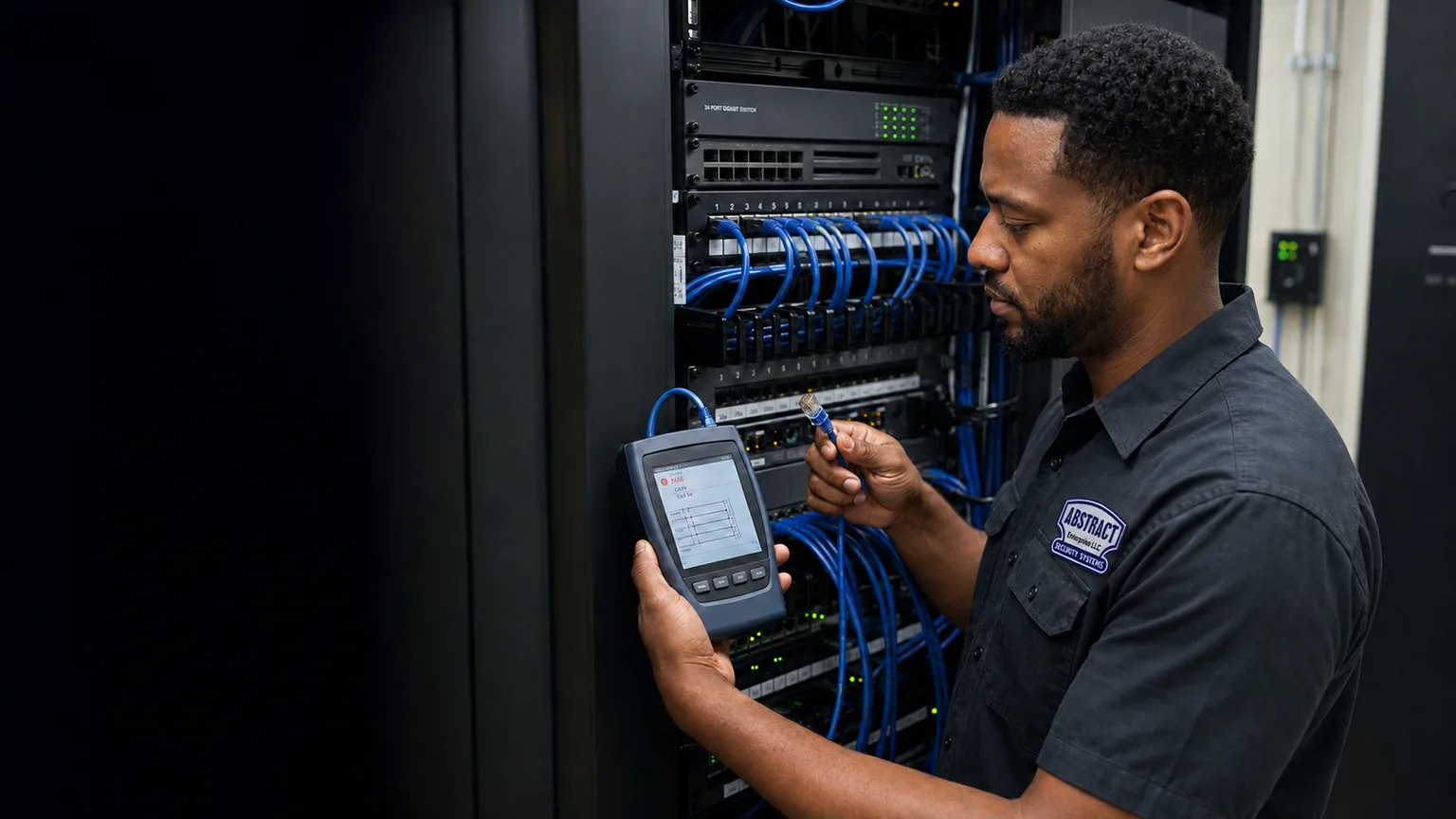
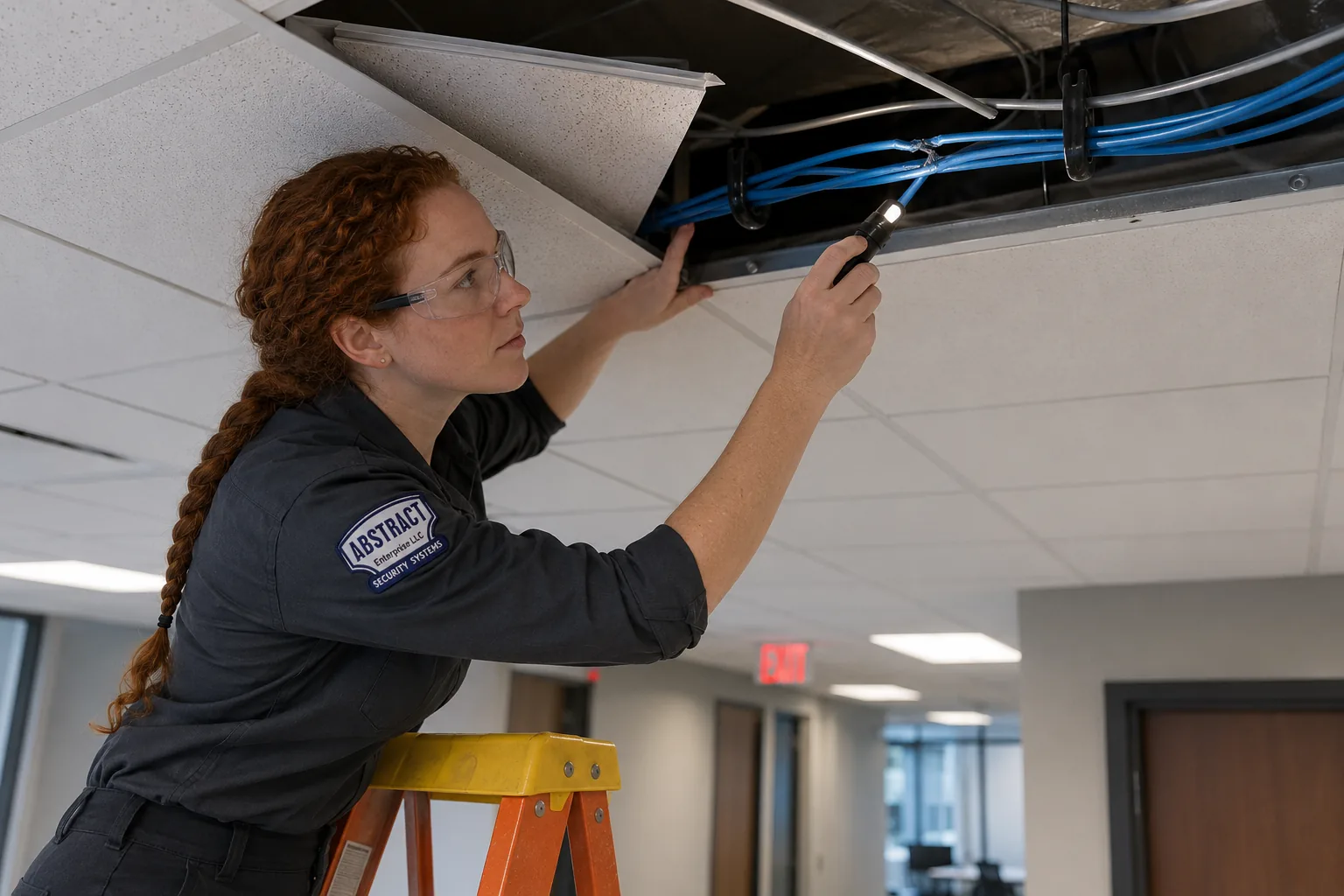
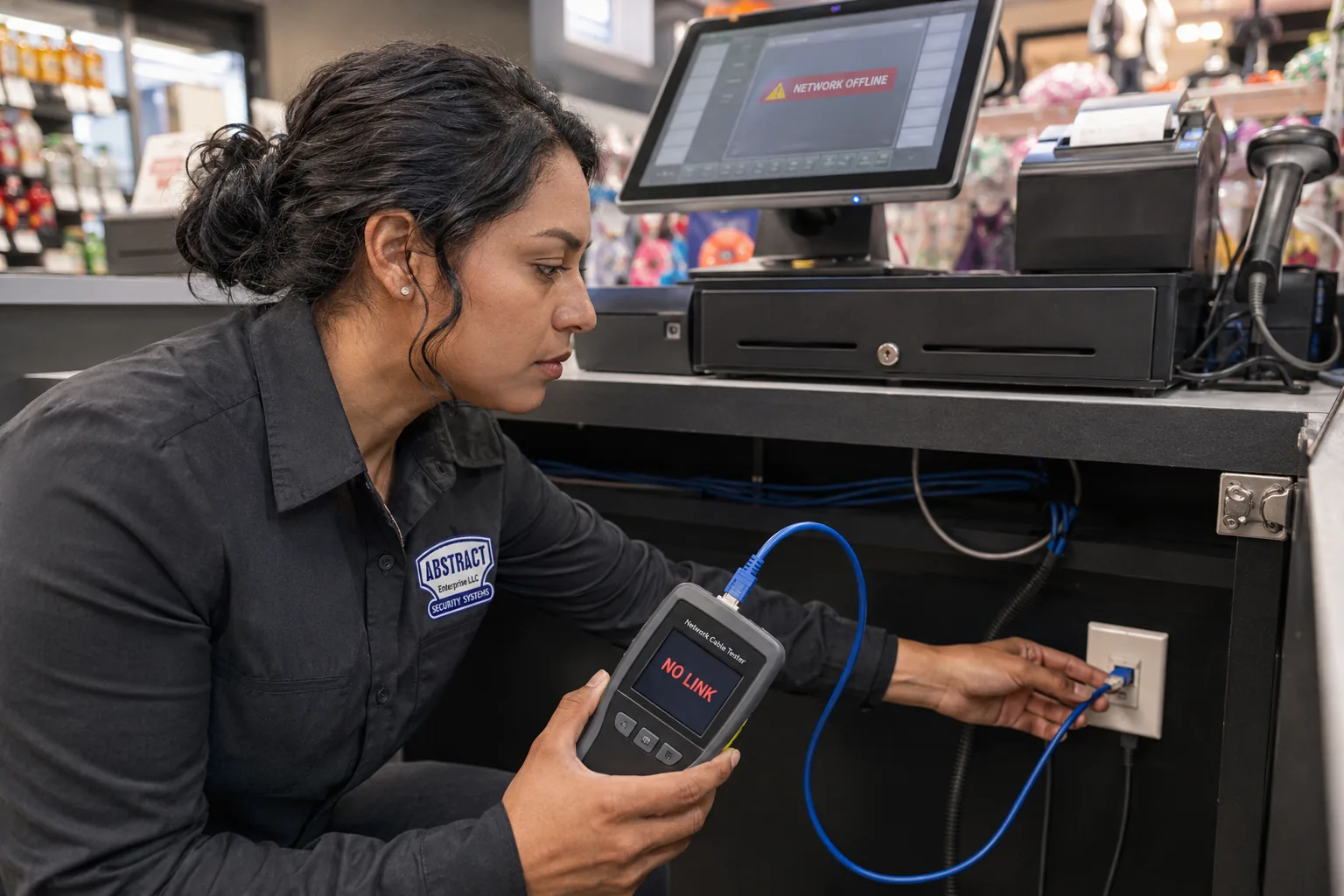
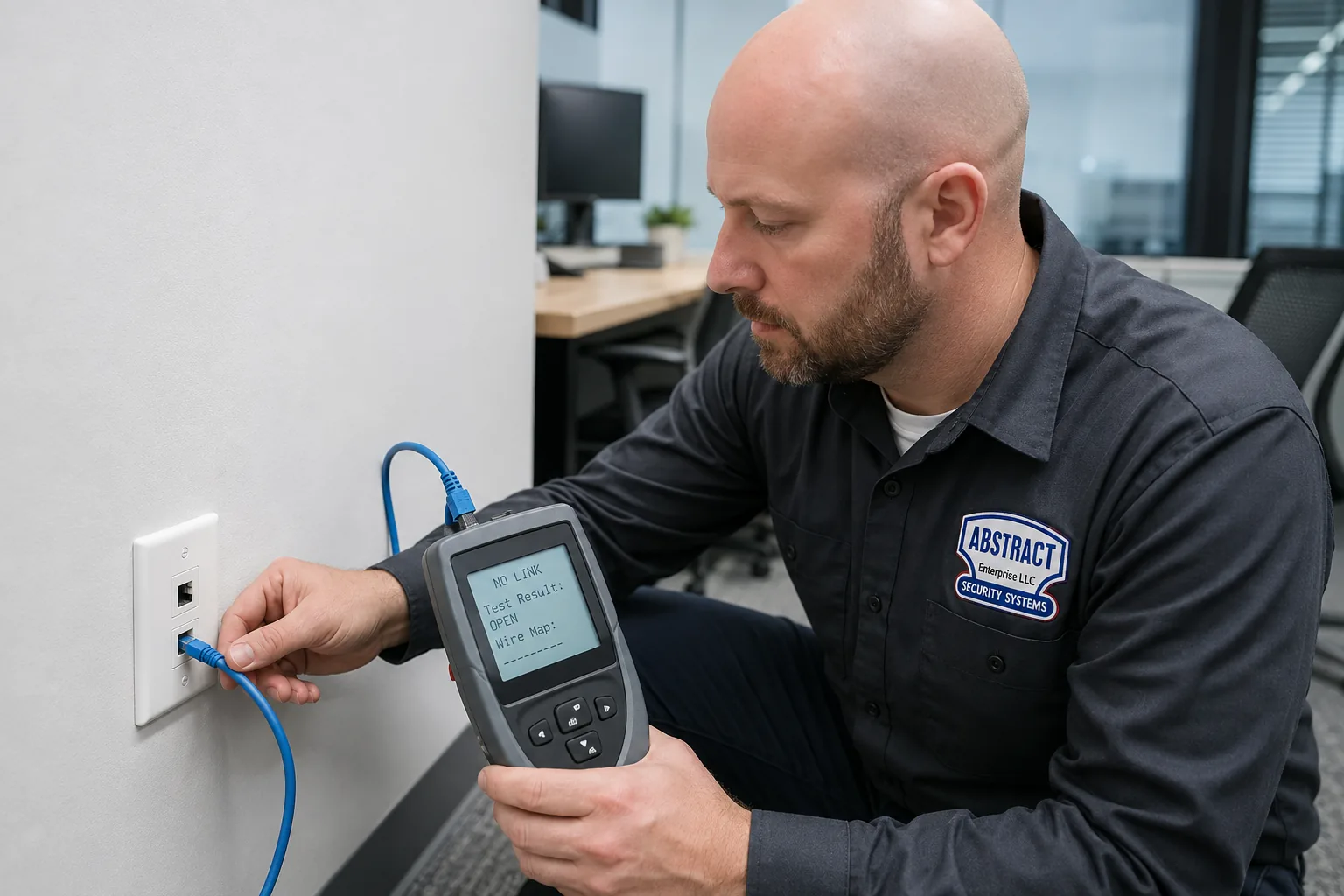
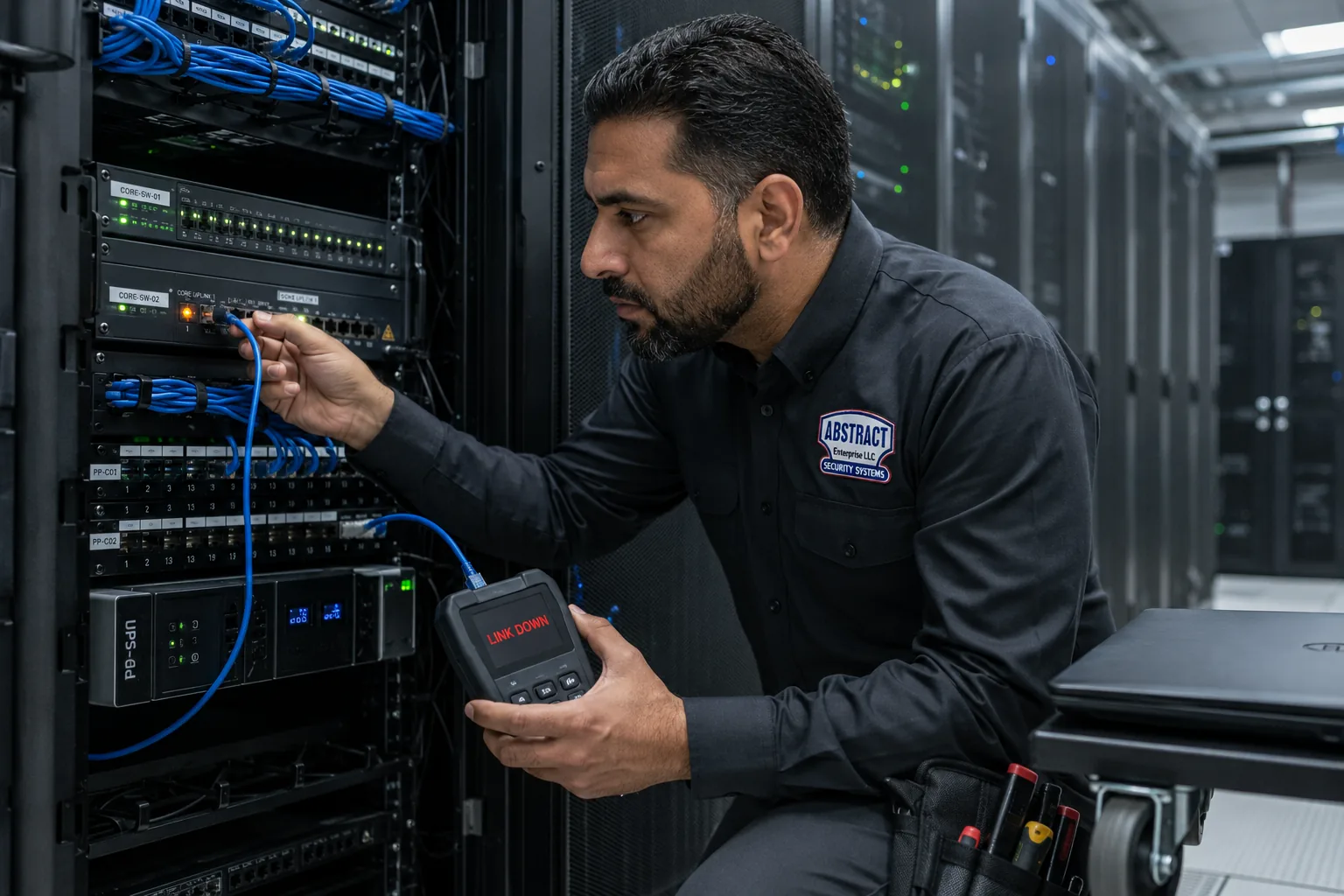
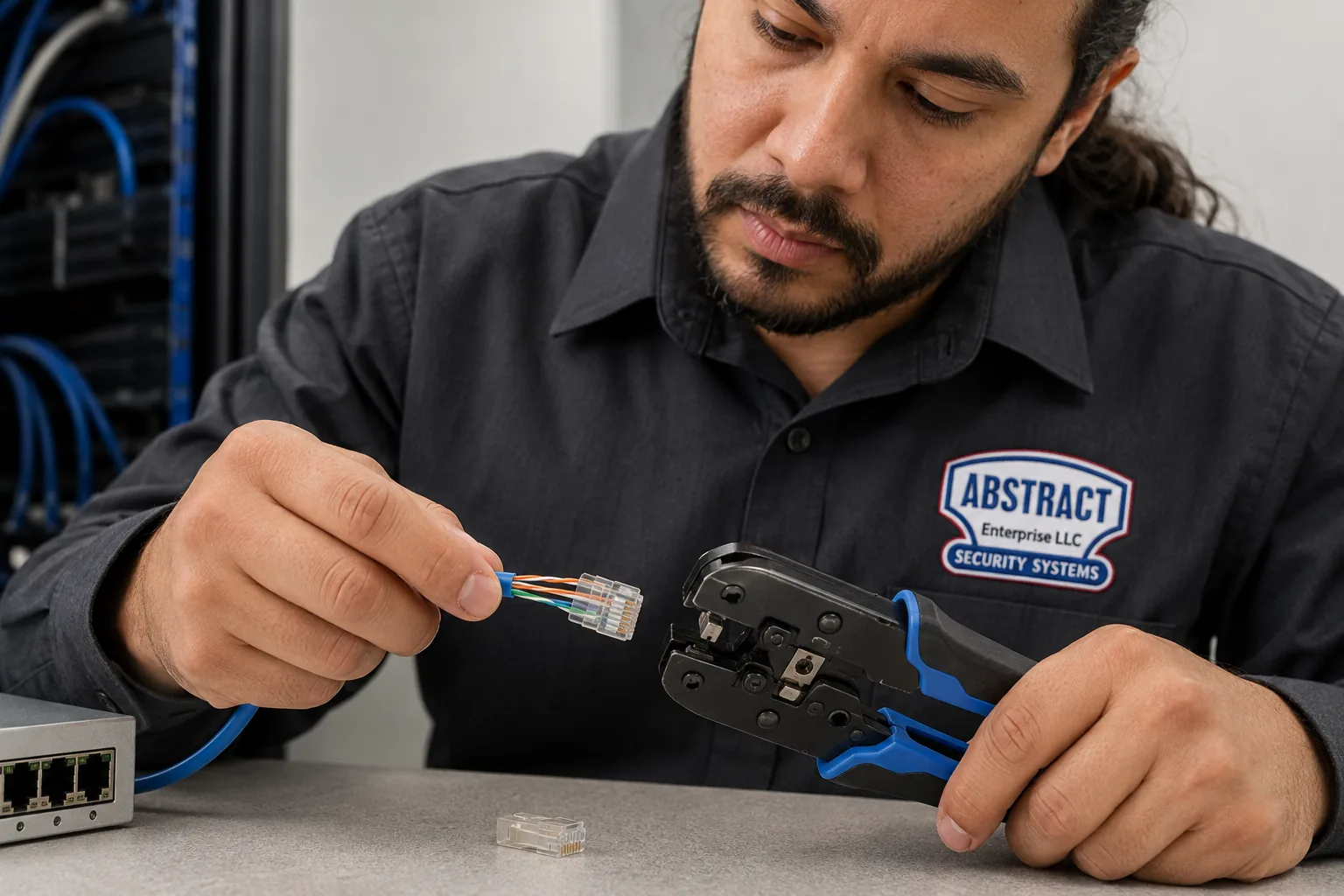
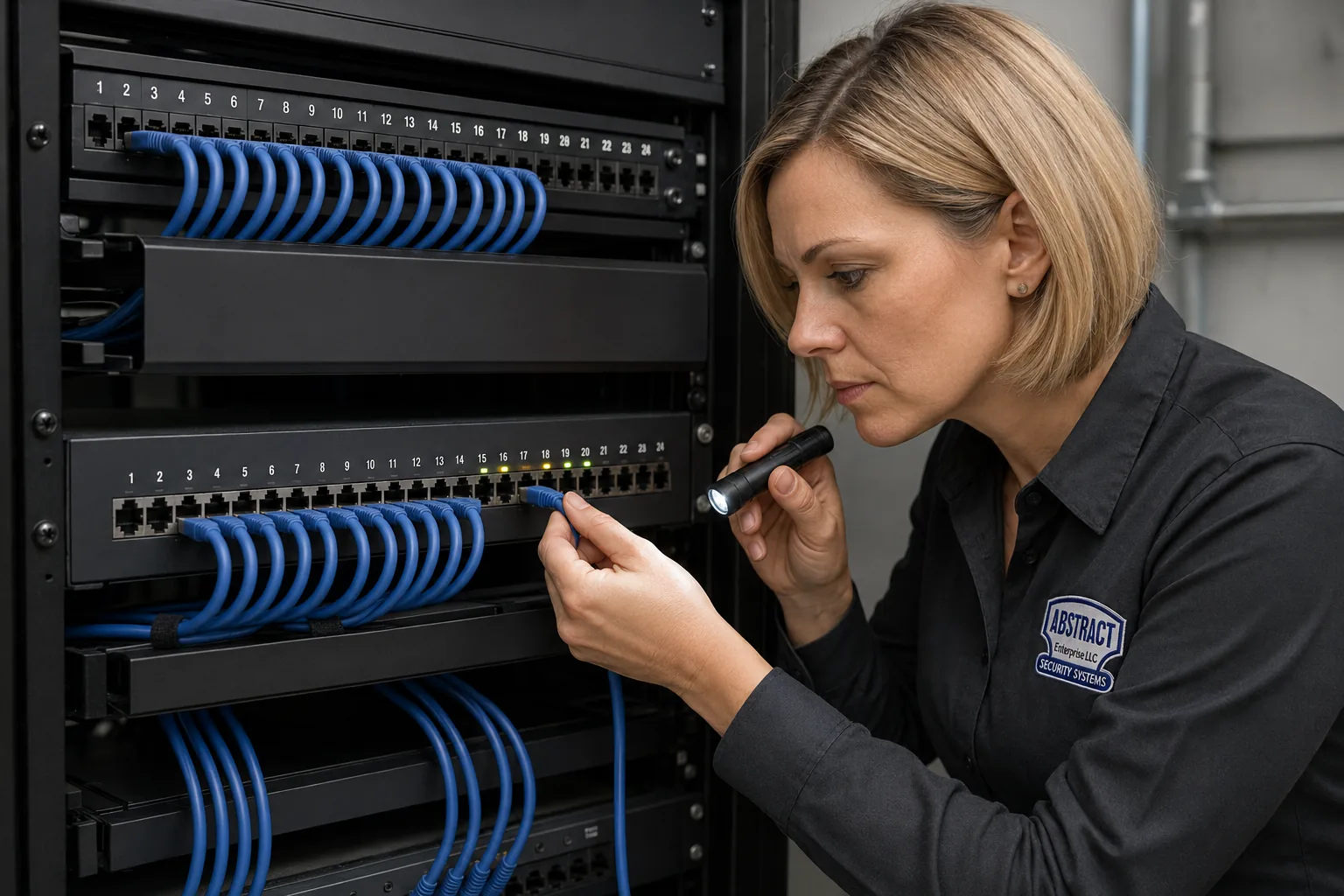
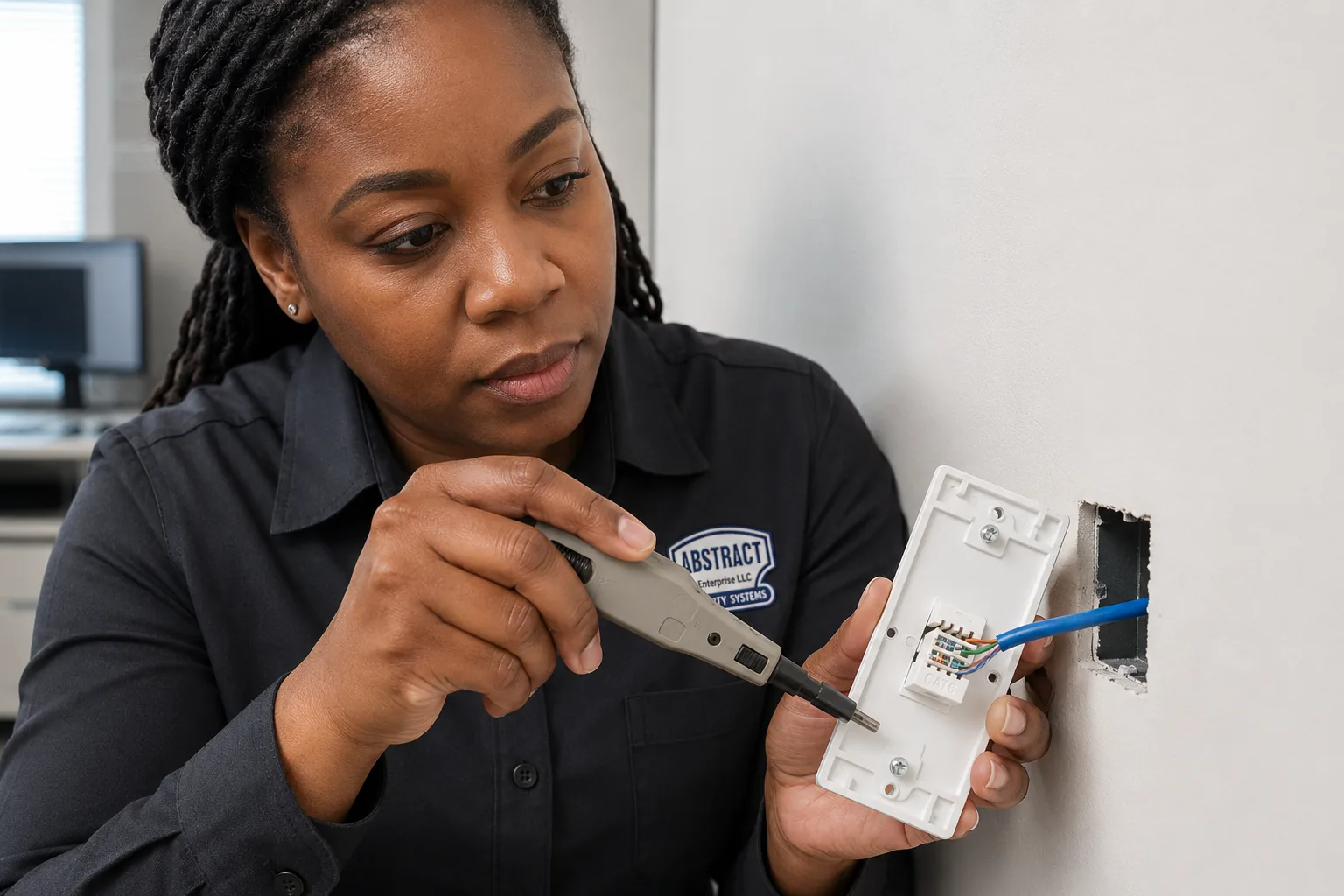
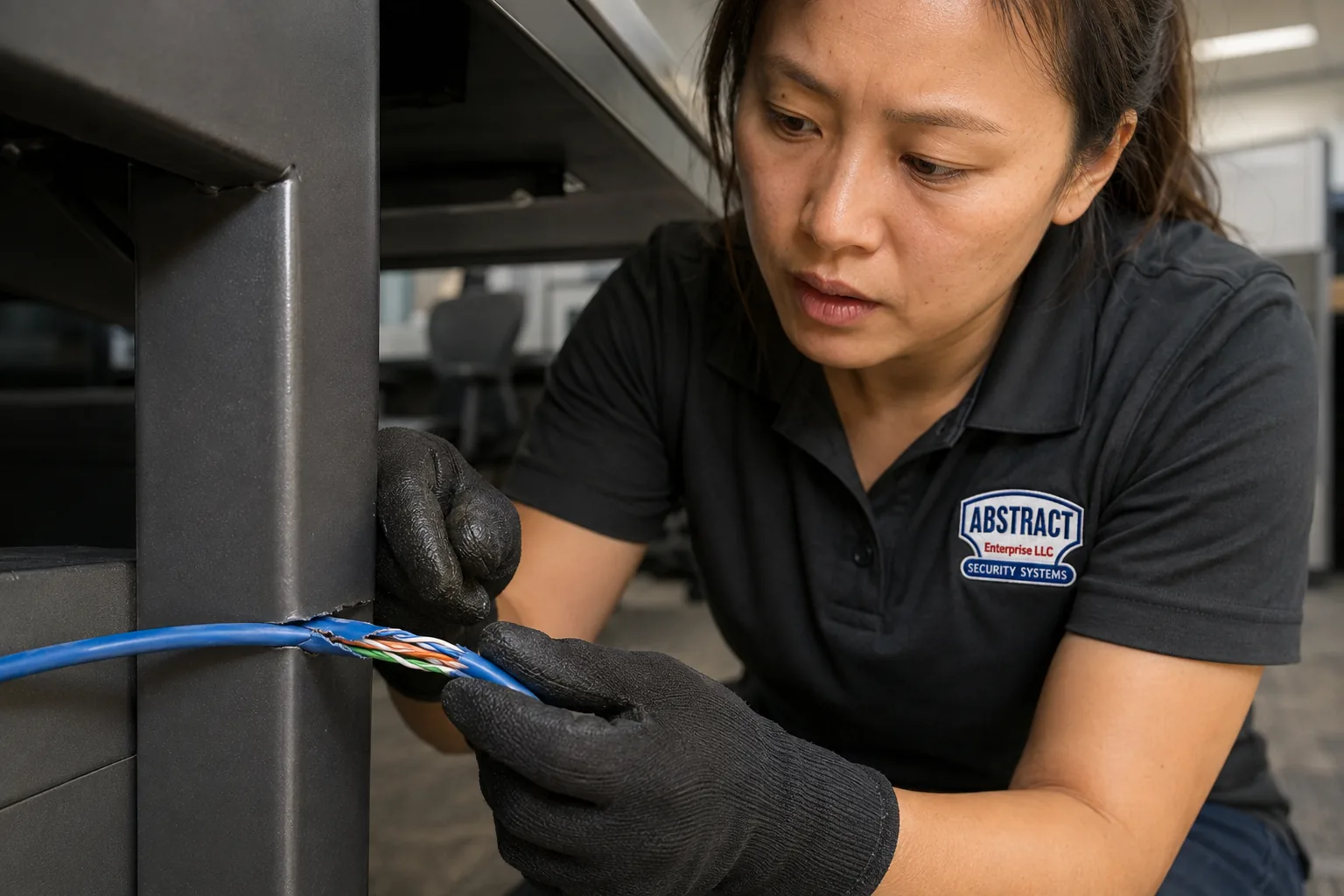
Fault location, retermination, network jack and patch panel repair, PoE troubleshooting and certified cable testing across Westchester County. Licensed NYS low-voltage contractor. Every repaired drop tested, and the closet left legible for whoever works on it next.
Ethernet, Cat6 and Data Jack Repair Across Westchester County
A great deal of Westchester's office stock was built for one occupier and is now shared by eight, and the cabling has never caught up. The county's corporate inventory — Purchase, Harrison, Rye Brook, Tarrytown, Elmsford, Armonk's periphery — went up between the late 1960s and the 1980s as single-tenant headquarters buildings. Those have been subdivided, re-let, subdivided again, and the infrastructure inside them was designed on assumptions that stopped being true decades ago. Abstract Enterprises Security Systems repairs Ethernet, Cat6 and data cabling across Westchester.
The consequences show up as ordinary complaints with unusual causes. A Tarrytown suite whose drops run back to a closet that now serves three tenancies. An Elmsford floor where the riser was sized for one company's telephone system. A White Plains tower suite carrying four generations of abandoned cable above the ceiling. A Yonkers building on Central Park Avenue where the equipment room is a converted store cupboard nobody has opened in years.
Repair is charged at our specialty service rate of $195/hr with a three-hour minimum ($585), with the diagnostic kit on the first visit — distance-to-fault, tone and probe, wiremap and performance testing. In a building shared by several tenancies, the tracing that identifies your runs is as valuable as the repair itself, and we label as we go so the next fault is a check rather than an investigation.
Network Down in Westchester?
Same-day and next-morning coverage county-wide. Multi-tenant buildings frequently restrict low-voltage work to arranged windows; tell us the building when you book and we will handle the access.
✔ NYS Lic. #12000287431✔ Certified wiremap & performance testing on every repair✔ 4.7★ from 201 reviews
Local Conditions
Why Re-Tenanted Buildings Break Differently
Start with the original design assumption, because everything downstream follows from it. A 1978 headquarters building was cabled for one organisation: one telecom room per floor, one riser plan, one set of pathways sized for that company's needs. Subdivide the floor into four suites and those assumptions fail quietly. The closet now serves multiple tenants who each need access to it, the riser carries services it was never planned for, and the pathway between suites was never intended to be crossed by anyone.
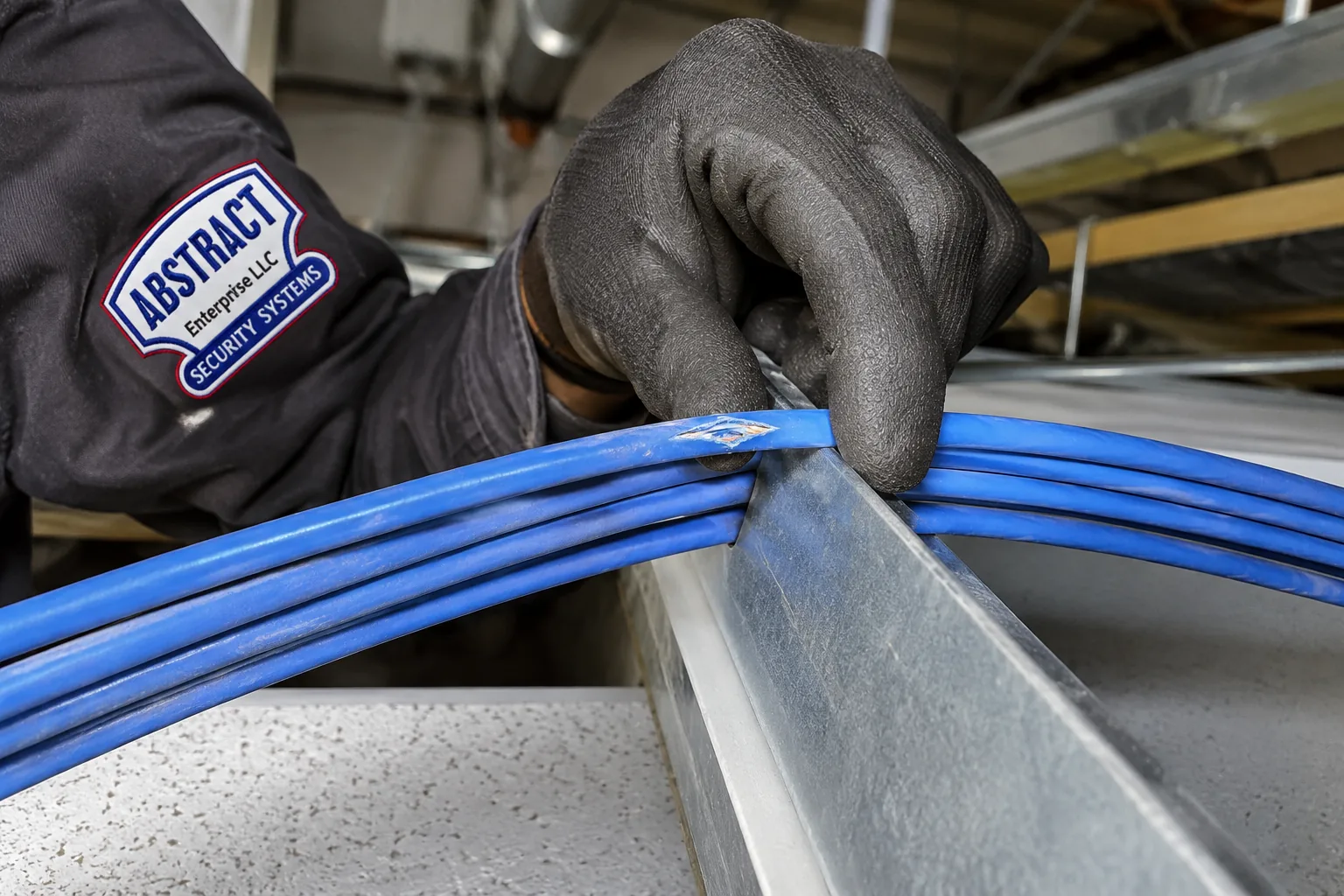
Second, accumulation. Every departing tenant leaves cable behind. Over four decades that produces ceilings holding four or five generations of run, most of it dead, some of it still live, none of it labelled, and all of it in the way. Tracing one run through that accumulation is the first hour of nearly every visit in this stock, and it is the reason two contractors can quote wildly different numbers for the same fault.
Third, shared closets and access. In a subdivided building the telecom room frequently serves several suites, and it is reached through a corridor door controlled by building management. Pulling an unidentified cord in there takes down a neighbour, and arranging access is part of the job rather than an afterthought. Multi-tenant buildings here also commonly restrict low-voltage work to arranged windows, which is a scheduling constraint worth knowing before the van leaves.
Fourth, the county's other half. Yonkers, Mount Vernon, New Rochelle and Peekskill hold older mixed commercial stock — storefront with offices above, converted industrial, prewar buildings on Central Park Avenue, South Broadway and Main Street. Those have no floor closet at all, cellar panels shared with the residential side, plaster walls and improvised routes. It is a completely different job from a Purchase campus and it sits fifteen minutes away.
Fifth, campus conversions. Several former single-occupier campuses in Tarrytown, Elmsford and along the I-287 corridor now hold many businesses across multiple buildings. Those inherit infrastructure planned as one estate, which produces links between buildings that made sense when one company owned everything and make considerably less sense now that four do.
What We Repair
What a Westchester Cable Repair Call Covers
We repair the physical layer, identify what is yours in a shared building, and leave the closet legible.
Shared Closet Tracing
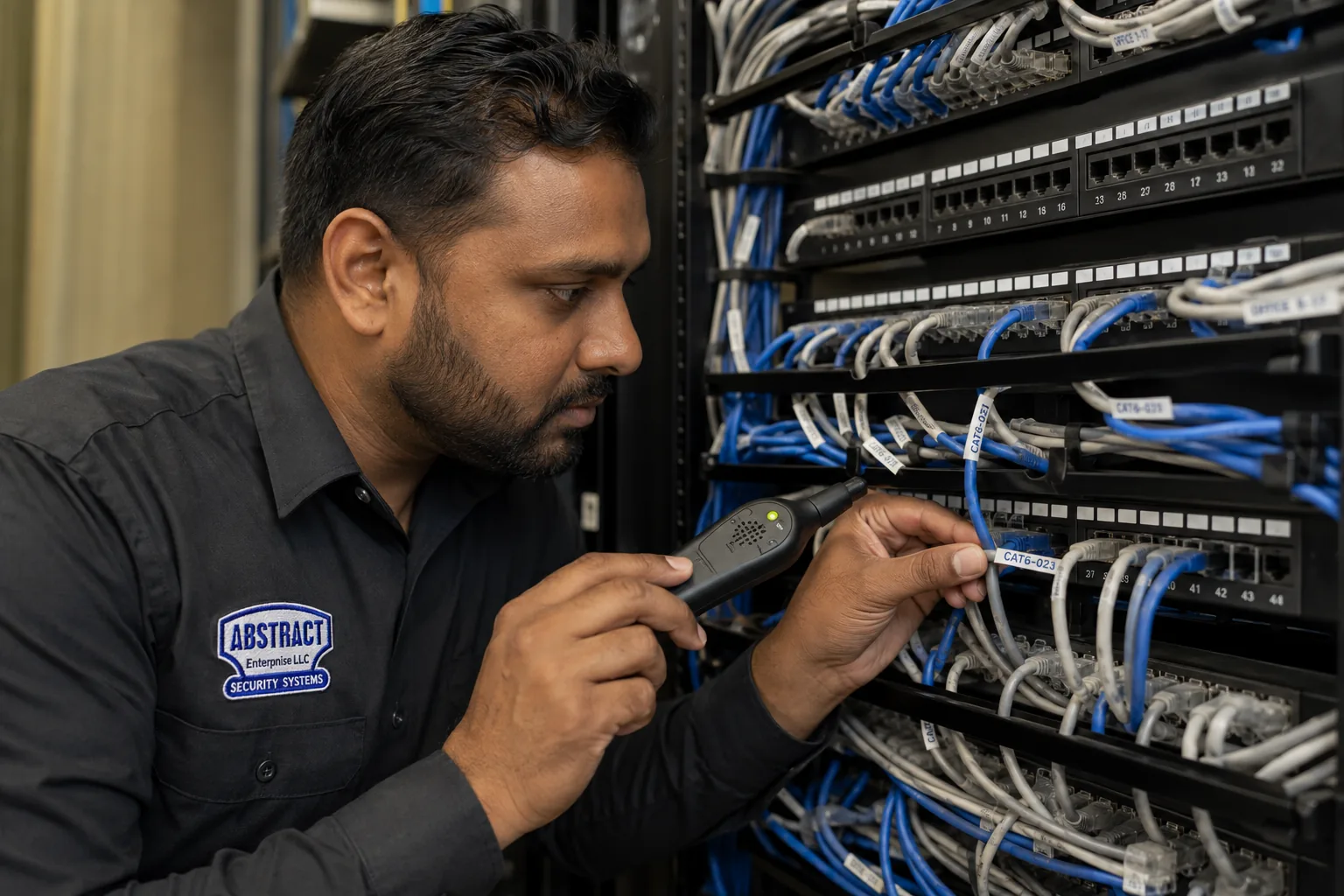
Identifying your runs inside a telecom room serving several tenancies, toning before touching anything, and labelling both ends so the next fault is a five-minute check.
Abandoned Cable Identification
Separating live runs from four decades of departed tenants' cable, so the closet describes the building as it is now rather than as it was.
Tenant-vs-Base-Building Isolation
Establishing whether the fault sits inside your demise or in base-building riser and pathway, documented in a form a managing agent will accept.
Ethernet Cable Repair
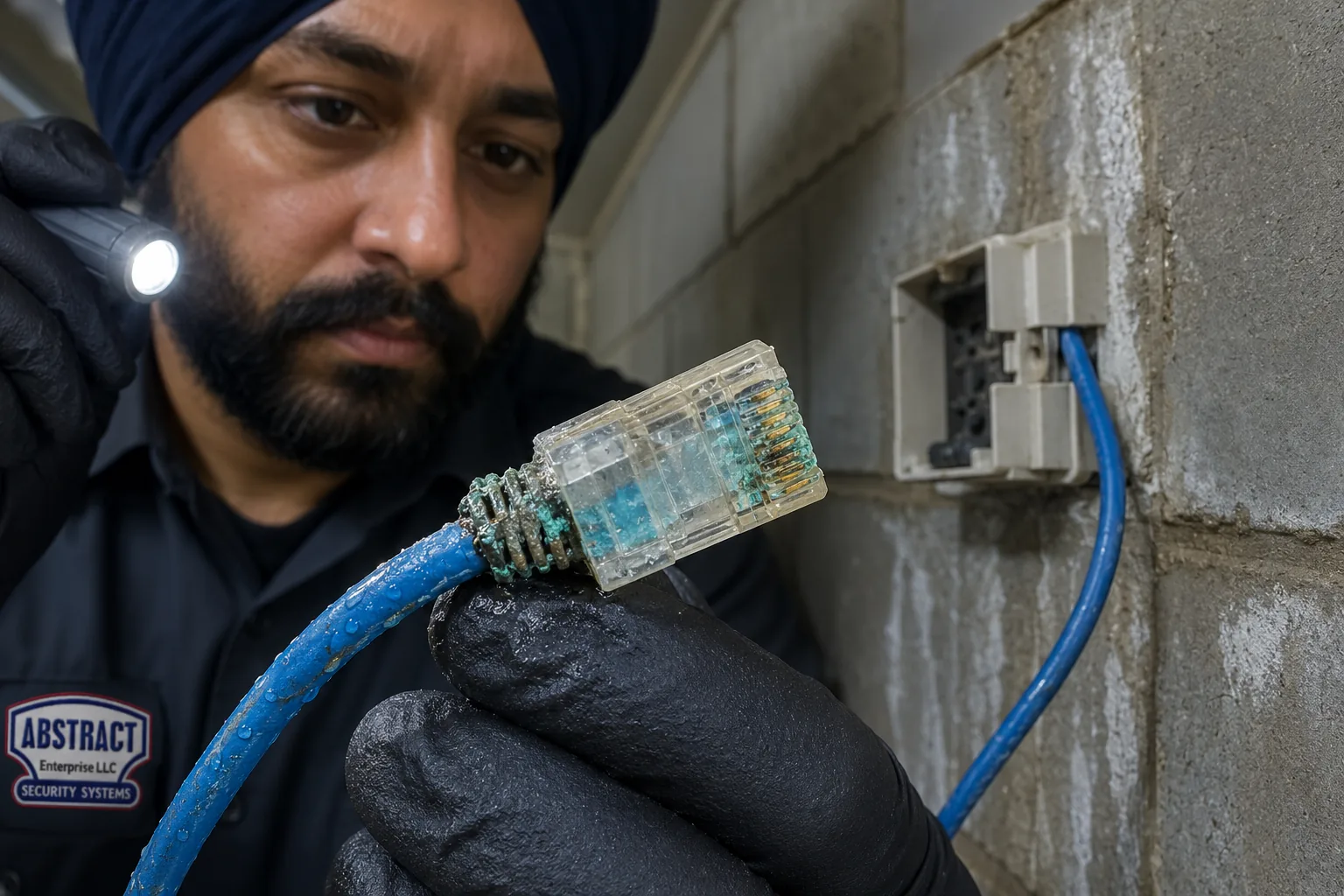
Severed, flattened, nipped or corroded cable brought back into service with a junction of the right grade, then measured to confirm it holds.
Cat6 and Cat6A Retermination
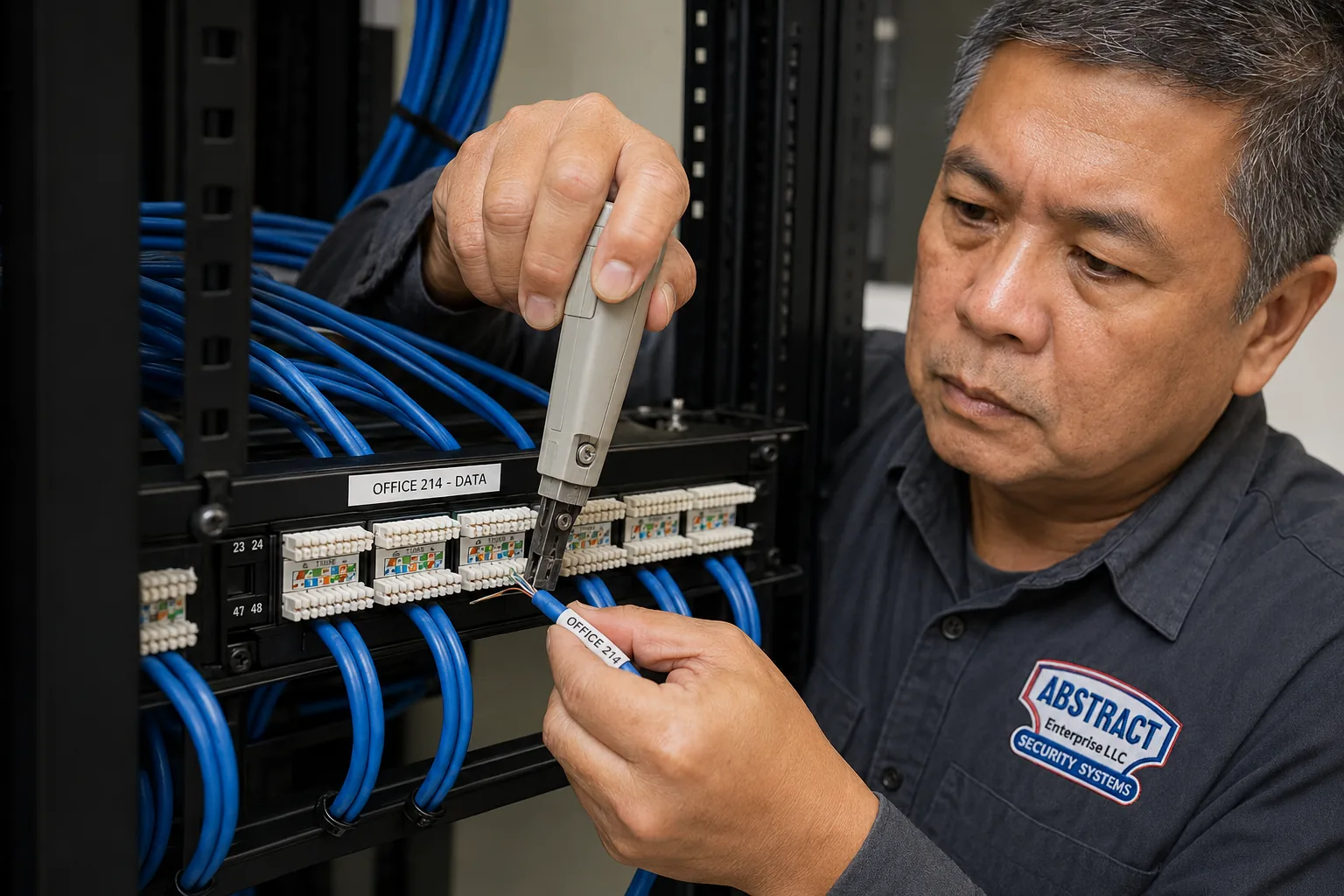
New terminations at outlet and panel to T568B, twist held to the contact block, so the link passes a certifier instead of just showing a light.
Network Jack and Panel Repair
Dead outlets, keystones seated but never punched through, and panel positions wired to the opposite standard by a previous occupier's contractor.
Closet Audit and Legend
Jack-to-port mapping, durable both-end labels and a printed legend for the door, which in a subdivided building is the single most valuable durable output.
Certified Testing
Each repaired run measured for wiremap, length and performance, and the report kept with the margin figure recorded.
PoE Circuit Troubleshooting
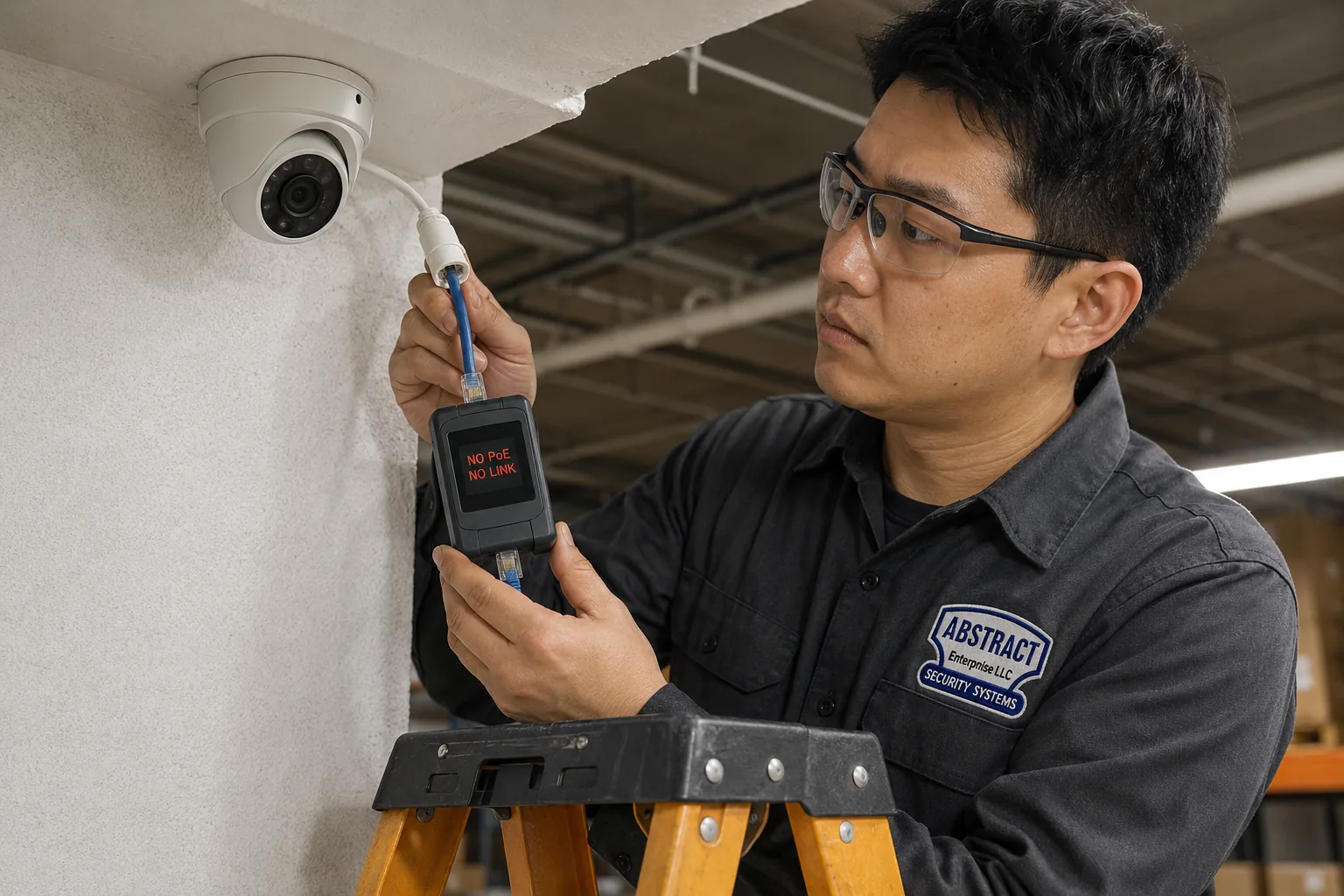
Hardware that powers up and immediately cycles. We meter the far end while the device is actually drawing to see what is arriving.
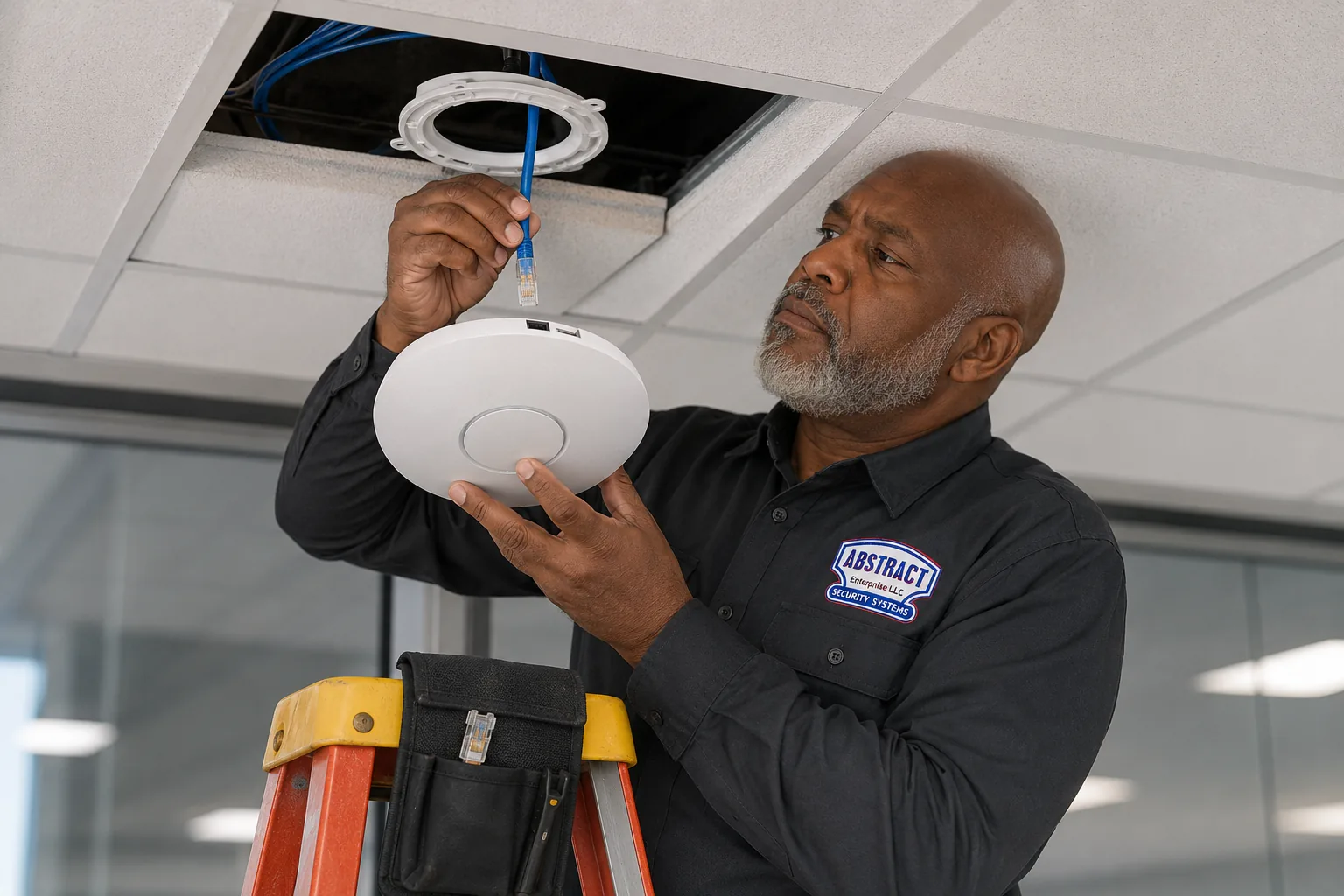
Commonly paired: in subdivided buildings the camera, reader and access point drops share the closet and the ceiling with the data runs. When one bundle has failed, testing the rest while access is arranged costs a fraction of a second visit — see camera repair and access control.
Plain English
Terms That Come Up in a Subdivided Building
Most of these describe who owns what, which in this county is the first thing to establish.
Term
What It Means in a Westchester Building
Demise
The boundary of your leased space. Distinct from the demarc — it is the line that decides whether a dead jack is your bill or the landlord's.
Base building
Infrastructure the landlord provides: pathway, riser and usually a point of presence on the floor. Faults there are not the tenant's.
Horizontal
The run from the floor closet out to an outlet. Tenant infrastructure in most Westchester leases, capped at 90 m.
Shared closet
A telecom room serving several suites, reached through a door building management controls. Toning precedes touching, always.
Abandoned cable
Runs left by departed tenants. Adds fire load, hides live runs, and makes tracing slower and therefore dearer.
Split pair
Every wire lands but two are paired with the wrong partners. The link settles at 100 Mbps and refuses to negotiate higher, which users describe as slowness.
Certification
A recorded measurement against the category standard with headroom noted, saved and printable.
Plenum (CMP)
The jacket rating required where a ceiling void handles return air, which describes most of the county's office ceilings.
Firestop
The rated seal at a penetration through a rated wall or floor. Frequently opened and never restored in buildings with long tenancy histories.
Legend
The printed map on the closet door tying every port to its outlet. The most valuable thing a visit leaves behind in a shared building.
Equipment
Hardware and Test Equipment on a Westchester Repair
We repair what the building has and replace with commercial-grade parts matched to the existing channel — Belden, CommScope, Panduit, Leviton, Hubbell, Ortronics, ICC, Berk-Tek and Superior Essex. In buildings with forty years of tenancy history, mixed-category channels are the norm rather than the exception, and matching the category properly is what stops a repair quietly derating a channel that was fine.
Where the active kit is Cisco, Meraki, Aruba, UniFi, Netgear, TP-Link, Luxul or Araknis, our part is finding the cable fault sitting underneath it — likewise behind powered cameras, radios, handsets, readers and screens. We do not configure any of it: no switches, no segmentation, no controllers, no firewall rules. We certify the link and pass the results to the network owner, which in this county is generally a regional IT firm.
The toner is the tool this county actually runs on. In a closet serving several tenancies with four decades of cable in it, identifying your run safely is most of the first hour, and doing it properly is the difference between a repair and an incident involving somebody else's business.
Need Repair in Westchester County Today?
Same-day and next-morning coverage county-wide. Multi-tenant buildings frequently restrict low-voltage work to arranged windows — tell us the building when you book and we will handle the access.
In a subdivided building the last step is the one that pays for itself.
Tracing comes first, because in a shared closet it is a safety step rather than a convenience: tone the run through from the outlet, confirm it, mark it. Then the correction — retermination, junction, jack or panel replacement, or a fresh run where the certifier says the cable is done. Then testing, with headroom reported rather than filed.
Then the legend. A printed map on the closet door tying each port to its outlet, with your runs identified and labelled at both ends, means every subsequent fault in that building is a check rather than an investigation. In a building shared by several tenants with forty years of accumulated cable, that document changes the cost of every future visit — ours or anybody else's.
Full Scope
Full Scope of a Westchester Network Cable Repair
Diagnostics
Tone-and-probe tracing through shared closets and layered cable
Tenant-versus-base-building fault isolation
Fault location by measured distance on broken or shorted runs
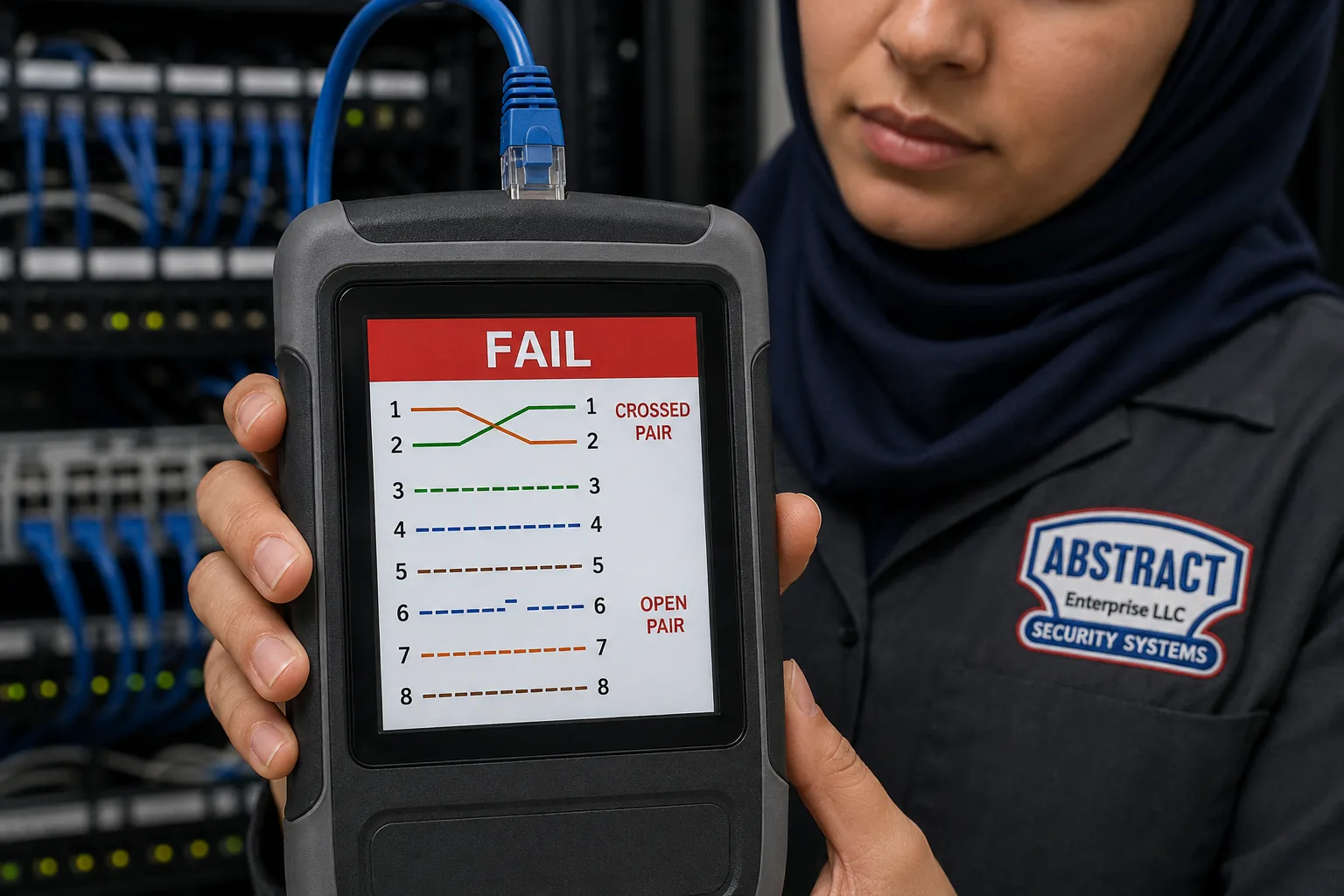
Wiremap faults: opens, shorts, reversals, split and crossed pairs
Measured length against the 90 m and 100 m limits
Insertion loss and crosstalk with headroom reported
PoE measurement at the endpoint under real draw
Switch-port versus cable-fault isolation
Physical Repair
Keystone and patch panel retermination
Category-appropriate junction repair on damaged runs
Full run replacement where certification fails
Abandoned cable identification and removal
Floor box and monument repair
Firestop restoration at penetrated rated assemblies
Saved test results per repaired drop, with headroom
Jack-to-port map and a printed legend for the closet door
Your runs identified and labelled at both ends
Written finding stating tenant or base-building responsibility
Photo record of concealed repairs before close-up
Site Logistics
Certificate of insurance to owner or managing agent
Arranged access windows in multi-tenant buildings
Coordination with building management for closet access
Plenum-rated material where the ceiling handles return air
Dust control and occupied-suite working
Coordination with your existing IT provider
Coverage Detail
Where We Work Across Westchester County
White Plains is the county seat and its densest commercial centre — office towers along Westchester Avenue, Bloomingdale Road, Main Street and Mamaroneck Avenue, the hospital and medical office cluster, and the courts and civic buildings. It behaves closest to a city market: floor closets, plenum ceilings, managing agents and arranged access windows.
The corporate corridor runs east and north from there through Harrison, Purchase, Rye Brook and Port Chester along the I-287 and Westchester Avenue spine, then west to Elmsford, Greenburgh, Tarrytown and Sleepy Hollow along Route 119 and the Saw Mill. This is the county's re-tenanted campus and office-park stock, much of it built as single-occupier headquarters and now shared. Armonk, Valhalla and Hawthorne sit north of it with medical, research and corporate space.
The river cities and the north are a different market. Yonkers along Central Park Avenue, South Broadway and the waterfront, Mount Vernon, New Rochelle and Pelham hold older mixed commercial stock — storefront with offices above, converted industrial, prewar buildings with cellar panels. North of the reservoirs, Mount Kisco, Bedford Hills, Katonah, Somers and Yorktown hold village commercial and medical practices in smaller buildings, with Peekskill and Cortlandt on the river at the county's northern edge.
Who We Serve
Westchester Industries We Repair Cabling For
Multi-Tenant Office Suites
Purchase, Harrison, Rye Brook, Tarrytown, Elmsford. Buildings designed for one occupier and now shared by several.
Corporate Campus Tenancies
Former single-occupier estates now let to multiple businesses, inheriting infrastructure planned as one system.
Medical and Clinical
White Plains, Valhalla, Mount Kisco and the county's hospital orbits. Uptime-sensitive and documentation-conscious.
Law, Finance and Professional Services
White Plains towers and village offices. Records obligations and a real appetite for a filed test report.
Retail Corridors
Central Park Avenue, Mamaroneck Avenue, Main Street White Plains, Route 119. Register lanes failing at peak.
River City Mixed Commercial
Yonkers, Mount Vernon, New Rochelle, Peekskill. Storefront with offices above, cellar panels and no floor closet.
Schools and Municipal Facilities
District, town and village buildings with layered infrastructure and break-window scheduling.
Restaurants and Hospitality
Kitchen terminals in heat and grease, and repair windows outside service hours.
Property Management Portfolios
Multiple buildings needing one labelling standard and consistent records across tenancies.
Drawn from the recurring themes in tenant, IT and Westchester local discussion threads, grouped by the six question types that come up most.
Cost Questions
1. What does a repair cost here?
$195 an hour with a three-hour minimum, so $585 for the opening block: tracing, locating the fault, repairing it, certifying it and documenting the result. A run that must be pulled fresh starts at $175 per commercial Cat6 drop.
2. Why did two contractors quote completely different numbers?
Almost always because one of them counted the tracing and the other did not. In a building with four decades of abandoned cable in the ceiling, identifying your run is the majority of the work, and a quote that ignores it is a quote that will be revised on site.
3. Is the labelling worth paying for?
In a shared building, more than the repair usually is. Once your runs are identified and marked at both ends with a legend on the closet door, every future fault becomes a short check rather than another hour of tracing — for us or for whoever comes next.
Quality and Trust Questions
4. How do I prove to the landlord this is base-building and not ours?
By certifying the tenant channel. If it passes from your outlet back to the floor closet and the problem is upstream in the riser, the report says so with the measurement behind it. Managing agents respond to that document in a way they do not respond to a phone call.
5. Do you carry insurance our building will accept?
Yes. We issue a certificate naming the owner and managing agent to whatever limits the building requires, before arrival rather than at the door. Send the building's requirements when you book.
6. Our building only allows low-voltage work in arranged windows. Is that a problem?
No, it is the normal arrangement in multi-tenant Westchester stock. Tell us the building when you book and we will handle the access and schedule into the window. The labour rate does not change.
DIY and Pro Questions
7. Can our office manager identify our runs in the shared closet?
Without a toner, only by guessing, and the cost of guessing lands on a neighbour. What genuinely helps is labelling your own outlets clearly at the room end — room name, position, date. It speeds up the tracing considerably when we arrive.
8. Is a cheap cable tester worth having?
For pin order, yes. It reports no distance, no loss and no margin, which are the measurements that matter on a channel that has been re-terminated by three different contractors over thirty years.
9. Can we pull the abandoned cable out ourselves to tidy up?
Not safely. In this building stock a good deal of what looks dead is live, and some of what looks live has not carried traffic since 2004. Identification comes before removal, and doing it the other way round is how a neighbour loses their phones.
Technical Questions
10. Our suite was fine and now three drops are dead with no obvious cause. What happened?
Check whether work was done for another tenancy recently. In a subdivided building, a fit-out two suites over routinely damages runs in the shared ceiling or the closet, and it presents exactly like this: several drops, no local cause, nothing changed on your side.
11. Why is one port at 100 Mbps when the rest reach gigabit?
One of the four pairs has failed or been miswired. Older signalling needs two pairs so the link trains happily; gigabit needs all four and either refuses or negotiates and falls straight back.
12. A PoE camera keeps rebooting. Cable or camera?
Often the run, especially on a longer path or on Cat5e carrying a modern PoE class. Draw rises when the illuminator engages, voltage at the device falls short, and it restarts. Measuring at the endpoint under load separates it from a switch budget limit.
Landlord and Tenant Questions
13. The closet serving our suite also serves two others. Who controls it?
Building management, in practice, even where the cabling inside is tenant-owned. Access is arranged rather than assumed, and that is one reason we ask for the building name at booking rather than at the front desk.
Complaint Questions
14. A previous contractor took down a neighbour's service while working on ours. How is that avoided?
By toning before touching. In a shared closet the only safe way to know which cord is yours is to inject a signal and follow it. Everything else is a guess with another business on the other end of it, and it is the most common piece of damage we are called in to undo.
Answer The Public
Answer The Public: Westchester Network Cable Questions
Who repairs network cable in Westchester County?
Licensed low-voltage contractors. Electricians handle conduit and line voltage and generally pass the data ends along; managed IT firms own the network above the copper and rarely carry a certifier. A dead drop in a subdivided Tarrytown suite is cabling work.
What causes cabling to fail in Westchester buildings?
Four decades of layered tenancy leaving unlabelled and abandoned cable, damage from work done for neighbouring suites, terminations executed by successive contractors to different standards, infrastructure designed for a single occupier now shared, and legacy Cat5e under modern PoE loads.
At what point is replacement the honest answer?
When it will not certify after both ends are redone, when measured length puts the channel out of spec, when there is damage in several places, or when the category has been compromised by a mismatched component somewhere in its history.
Where do faults sit in a subdivided building?
At terminations first, then in the shared closet where cable is crowded and disturbed by work for other tenants, and in the ceiling between suites where a neighbouring fit-out crossed a bundle nobody knew was there.
How quickly can a Westchester repair be scheduled?
Same day or next morning county-wide, subject to the building's access rules. Multi-tenant buildings commonly restrict low-voltage work to arranged windows, which is why we ask for the building name at booking.
Reality Check
AI Overview Reality Check: What Search Results Miss About Westchester Cabling
Search for network cable repair in Westchester County and you get a national cost average, lead-generation directories, and advice written as though your cabling were yours alone. In this county's office stock it frequently is not.
1. Published Advice Assumes One Building, One Occupier
Nearly all cabling guidance online is written for an organisation that controls its whole space. A large part of Westchester's office inventory was built as single-occupier headquarters between the late 1960s and the 1980s and has since been subdivided repeatedly.
That breaks the assumption in specific ways: the telecom closet serves several tenancies, access runs through a door building management controls, and the pathway between suites was never designed to be crossed by anybody.
The practical consequence is that identifying which run is yours is the first and largest part of the job, and no consumer-facing article mentions it at all.
2. Forty Years of Abandoned Cable Is Not in Any Cost Model
Every departing tenant leaves cable behind. Across four decades that produces ceilings holding several generations of run, mostly dead, some still live, none labelled.
Tracing through that accumulation is why two contractors can quote wildly different numbers for the same reported fault: one has counted the hour of toning and the other has not, and the second one revises the price on site.
It is also a fire-load and pathway problem in its own right, which is why identification and removal is worth scoping deliberately rather than doing incidentally.
3. Nothing Online Warns You About the Shared Closet
In a subdivided building the telecom room commonly serves several suites. Pulling an unidentified cord in there to see what goes dark is a technique some people genuinely use, and in this stock it takes down a neighbour's phones or payment terminal.
It is also the most frequent damage we are called in to undo. The correct approach is unglamorous: inject a signal, follow it, mark it, then work on it.
The durable output is the legend on the closet door. Once every port is mapped to an outlet, the next fault in that building costs a fraction of this one — whoever handles it.
4. The Lease Line Decides Who Pays and Search Results Never Mention It
General troubleshooting assumes one owner. In a Westchester tenancy there are at least two parties and a line between them, and which side the fault sits on determines the bill.
Base building typically supplies pathway, riser and a floor point of presence; the tenant owns everything from the closet inward. Tenants pay for landlord faults routinely, simply because nobody established which side the fault was on.
Certifying the tenant channel resolves it cheaply. If it passes and the problem is upstream, the report is the argument, and managing agents respond to a measurement in a way they do not respond to a complaint.
5. Cost Averages Assume You Can Get In Whenever You Like
Aggregated cost pages assume business-hours access to an empty space. Multi-tenant Westchester buildings commonly restrict low-voltage work to arranged windows and require a certificate of insurance naming the managing agent.
That is a scheduling discipline rather than a premium, and it needs to be known before the van leaves rather than discovered at the front desk.
Those pages also merge installation with repair. Installation can be scoped in advance; repair cannot, because the fault must be found first — hence an hourly rate with a floor rather than a per-drop price.
6. The County Is Two Markets and Search Treats It as One
Purchase, Harrison, Rye Brook, Tarrytown and Elmsford are subdivided corporate stock with floor closets and managing agents. Yonkers, Mount Vernon, New Rochelle and Peekskill are older mixed commercial: storefront with offices above, cellar panels, plaster walls and no closet at all.
Those are different jobs with different failure modes and different correct answers, and they sit fifteen minutes apart. A contractor who only knows one will be wrong in the other.
When briefing anybody, describe the building rather than the county: single-tenant or shared, floor closet or cellar panel, and who controls access.
7. Lead Directories Sell Your Number Rather Than Checking Anyone's Kit
Angi, HomeAdvisor, Thumbtack and their equivalents resell one enquiry to several firms, and whoever answers first is usually the highest bidder for the lead. Ratings attach to accounts spanning many trades.
The taxonomy is what does the damage. Cable work is bundled with router configuration and wireless help, so a job requiring a certifier, a tone set and a punch tool goes to whoever replies fastest — frequently somebody with none of those and no certificate of insurance your managing agent will accept.
Three questions settle it: what certifier is on the van, will I get a saved result per drop, and can you send a certificate naming my managing agent today.
Find Out Which Runs Are Actually Yours.
Certified testing on every repair. Licensed NYS low-voltage contractor. 4.7★ from 201 reviews.
Costs nothing, takes a moment, and settles a real proportion of reported faults.
Move to a different switch port
Yes
Sixty seconds to eliminate the switch as a suspect.
Test the device on a known-good outlet
Yes
If the machine behaves at another desk, the problem is the first outlet or the cable behind it.
Label your own outlets at the room end
Yes
Costs nothing and materially speeds up tracing later. Room name, position, date.
Re-punch a keystone jack
Borderline
Feasible if you own the tool. Whether it certifies comes down to how much twist survives to the contact, and in buildings running mixed-grade components there is rarely spare performance.
Pull cords in a shared closet to identify a run
No
Other tenants' live services are in there and the door is not yours. This is the most common damage we are called in to undo.
Remove abandoned cable to tidy up
No
A good deal of what looks dead is live and some of what looks live is not. Identification comes before removal, always.
Diagnose gigabit-only or intermittent failures
No
Requires measured loss and headroom, which consumer testers cannot produce.
Anything in a plenum ceiling or rated wall
No
Material rating and firestop obligations make it licensed work.
Fifteen minutes and no invoice: the four rows above marked yes. Labelling your own outlets is the standout — it costs nothing today and takes real time off every future visit.
Alternatives
How a Licensed Cabling Contractor Compares Here
vs. Your Managed IT Provider
Strong from the switch upward and usually straightforward about copper. The physical work is subcontracted, so the technician who arrives is not the firm you vetted and the schedule belongs to somebody else — awkward when the building only opens a window on Thursday evening.
vs. Lead-Generation Platforms
Your request is sold on to a handful of bidders, so how fast somebody rings back measures their advertising budget rather than their suitability. Neither an insurance certificate naming your agent nor a per-drop test report is part of what those listings promise.
vs. Your Carrier's Technician
Their duty stops at the demarcation point and they are right to say so. If the circuit measures clean there and outlets remain dead, the problem lives in the tenancy or the base building — either way outside what they cover.
vs. The Building's Preferred Vendor
Frequently competent and often the quickest route to base-building work. It gets awkward on tenant-side faults, because a vendor whose relationship is with the landlord is not the natural party to document a fault as the landlord's.
vs. A General Electrician
Exactly who you want for pathway, masonry work and anything energised. Terminating data cable is a different discipline with far less tolerance for error, and most electricians recognise that and subcontract it.
Warning Signs
Five Signs the Cable Is the Problem in a Westchester Suite
A single outlet is dead while its neighbours work. Anything shared fails in clusters. One isolated dead port means that cable or one of its two ends.
Several drops died at once with nothing changed on your side. Work done for a neighbouring tenancy, in the shared ceiling or the shared closet.
One port negotiates 100 Mbps while the ports either side reach 1000. A pair has been lost or crossed. No other fault produces that specific pattern.
The link drops when a door closes or the HVAC cycles. Mechanical or thermal sensitivity, meaning a marginal physical connection rather than a configuration problem.
Nobody can say which cord in the closet is yours. Not a fault yet, but the reason the next one will cost an hour more than it should.
Community
Community Chatter: Recurring Themes From Public Forums
Paraphrased themes from public homeowner, small-business and IT discussion threads — not customer reviews of AESS.
Tenant threads in subdivided office buildings repeatedly describe several drops dying at once with no local cause, traced later to a fit-out two suites away.
Discussions about older office parks frequently surface ceilings holding several generations of abandoned cable, with nobody able to say what is live without a toner.
Tenants regularly describe paying for a repair that turned out to be a base-building riser fault, discovered only after somebody finally certified the tenant channel and found it clean.
Support documentation from unrelated organisations converges on the same first three steps — known-good outlet, then cord, then a field technician — which usually indicates a sequence tested against real faults.
Threads about shared telecom rooms consistently warn against pulling cords to identify a run, usually written by somebody who learned it the expensive way.
Field Video
Watch: Field Diagnostics on a Westchester County Repair Call
Short-form field clips from our channel: youtube.com/@openeye0007 Embed slot reserved — drop the Short iframe here once the clip ID is set.
FAQ
Network Cable Repair Westchester County — Twelve Frequently Asked Questions
What does network cable repair cost in Westchester County?
+
The specialty service rate is $195 an hour with a three-hour minimum, so $585 covers the opening block: tracing, locating the fault, repairing it, certifying it and documenting the result. A run that must be pulled fresh starts at $175 per commercial Cat6 drop.
Our building is shared with several other tenants. Does that change anything?
+
It changes the first hour. The telecom closet serves several suites, nothing is labelled, and identifying your run safely takes a toner rather than a guess. It also changes access, since the closet door is usually controlled by building management rather than by you.
Why do two contractors quote such different numbers?
+
Usually because one counted the tracing and the other did not. In a building with four decades of abandoned cable above the ceiling, identifying your run is most of the work, and a quote that ignores it gets revised on site.
How do we prove a fault is the landlord's rather than ours?
+
By certifying the tenant channel. If it passes from your outlet back to the floor closet and the problem is upstream in base-building riser, the report says so with the measurement behind it. That document is what managing agents actually act on.
Several drops died at once and nothing changed on our side. What happened?
+
Check whether work was done for another tenancy recently. In a subdivided building a neighbouring fit-out routinely damages runs in the shared ceiling or closet, and it presents exactly this way: multiple drops, no local cause.
Is joining a damaged run an option, or is it always a re-pull?
+
One accessible point of damage can be joined with the right grade of junction, executed properly and verified on a certifier. Pull new cable instead when it fails after both terminations are redone, when the measured distance exceeds spec, or when some past component has already derated the link.
An outlet is completely dead. Where do you look first?
+
In descending order of likelihood: a cord whose clip has gone, a closet position left unterminated or done to the opposite standard, an outlet with conductors sitting in the slots and never driven home, and finally damage somewhere along the cable.
Our building restricts low-voltage work to arranged windows. Is that workable?
+
Yes, and it is the normal arrangement in multi-tenant Westchester stock. Tell us the building when you book, we will handle the certificate of insurance and the access, and the labour rate does not change.
Is the labelling worth paying for?
+
In a shared building it is frequently worth more than the repair. Once your runs are marked at both ends with a legend on the closet door, every future fault becomes a check rather than an investigation — for whoever handles it.
Do you provide certified test reports?
+
Yes. Every repaired drop is tested and you receive the saved result including measured length and headroom, both-end labelling, and a printed legend where the scope covers the closet.
How is the completed work warranted?
+
There is a twelve-month parts-only warranty on AESS-supplied products, set out in the service agreement. It lapses where installed work is modified or tampered with without prior written approval.
Applied only where ceiling space is used for return air
After-hours or weekend window
Premium applies
For buildings restricting low-voltage work to off-hours
Published starting rates for Westchester County. Final pricing depends on building access rules, pathway, material rating and testing scope, and is confirmed in writing before work begins. Arranged access windows in multi-tenant buildings carry no labour premium. Full terms — including 50% deposit, one-year parts-only warranty on AESS-supplied products, and the late-fee schedule — are set out in the service agreement. See structured cabling pricing for new-installation drop rates and Cat6 installation Westchester County for per-drop grade comparisons.
Cabling Problems Specific to Westchester Buildings
Infrastructure Designed for One Occupier, Now Shared
Single-tenant headquarters buildings subdivided repeatedly since the 1980s. The closet serves several suites, the riser carries services it was never planned for, and nobody owns the documentation.
Four Decades of Abandoned Cable
Every departed tenant left cable in the ceiling. Most of it is dead, some is live, none is labelled, and all of it slows tracing and adds fire load.
Damage From Neighbouring Fit-Outs
Work done for another tenancy routinely damages runs in a shared ceiling or closet. It presents as several drops failing at once with nothing changed locally.
Shared Closets With Controlled Access
The telecom room is reached through a door building management controls, and it holds other tenants' live services. Toning precedes touching, and access is arranged rather than assumed.
Mixed-Category Channels
Thirty years of contractors terminating to different standards with different components. A single mismatched keystone derates a whole channel, and in this stock it is common.
River-City Stock With No Closet At All
Yonkers, Mount Vernon, New Rochelle and Peekskill. Storefront with offices above, cellar panels shared with residential, plaster walls and improvised routes.
Cross-sell note: in shared buildings the camera, reader and access point runs sit in the same closet and ceiling as the data. When a bundle has been damaged by neighbouring work, testing the camera drops and access control runs alongside it costs a fraction of a second arranged visit.
From the Field
Field Notes
Ask for the building name at booking, not at the front desk. In this county the access rules, the insurance requirement and the window are frequently the difference between a three-hour visit and two of them.
In a shared closet the toner comes out before anything else. Somebody else's live service is in there, the door belongs to building management, and pulling a cord to see what goes dark is how a small job becomes an incident.
When several drops fail at once with nothing changed locally, ask what work has been done for other tenancies recently. In subdivided stock that question locates the cause faster than any amount of testing.
Leave the legend. In a building with four decades of cable in the ceiling, the printed map on the closet door is the thing that makes every subsequent visit cheaper — including the ones somebody else does.
Get In Touch
Request a Free Quote
Fill out the form below and we'll get back to you within the hour. Or call us directly at (914) 877-2578.
✅
We Got Your Request!
We'll call you back within the hour. If it's urgent, call us now at (914) 877-2578.
Emergency
Need Repair in Westchester County Right Now?
Network down, several drops dead, camera feeds lost, register offline. Same-day and next-morning county-wide, with arranged access handled for multi-tenant buildings.
Last reviewed: August 25, 2026 · Next scheduled review: November 2026 Changelog: Aug 2026 — page published. Re-tenanted single-occupier office stock established as the primary Westchester thesis — shared closets, forty years of abandoned cable, damage from neighbouring fit-outs, mixed-category channels; closet audit and legend added to scope and pricing; tenant-versus-base-building documentation added; arranged access windows documented; pricing aligned to the $195/hr specialty rate with a three-hour minimum; direct Westchester line (914) 877-2578 used throughout.
Network Cable Repair Westchester County — Licensed, Traced, Documented
NYS Low-Voltage Lic. #12000287431 · 4.7★ from 201 reviews · Serving New York City, Long Island and the Hudson Valley.