Ethernet · Cat6 · Data Jacks · Patch Panels · COI Before Arrival · After-Hours Windows
Fault location, retermination, network jack and patch panel repair, PoE troubleshooting and certified cable testing across Manhattan. Licensed NYS low-voltage contractor. Certificate of insurance issued to your managing agent before we badge in. Every repaired drop tested and documented.
Ethernet, Cat6 and Data Jack Repair Across Manhattan
Network cable repair in Manhattan is priced by access, not by copper. The cable in your wall costs a few dollars a run. What costs money is getting a licensed technician with a certification tester to the eleventh floor of a building that wants a certificate of insurance naming the managing agent, restricts low-voltage work to a freight elevator window after six, and has a floor of people sitting under the ceiling that needs opening. Abstract Enterprises Security Systems repairs Ethernet, Cat6 and data cabling across Manhattan — Midtown to the Battery, river to river.
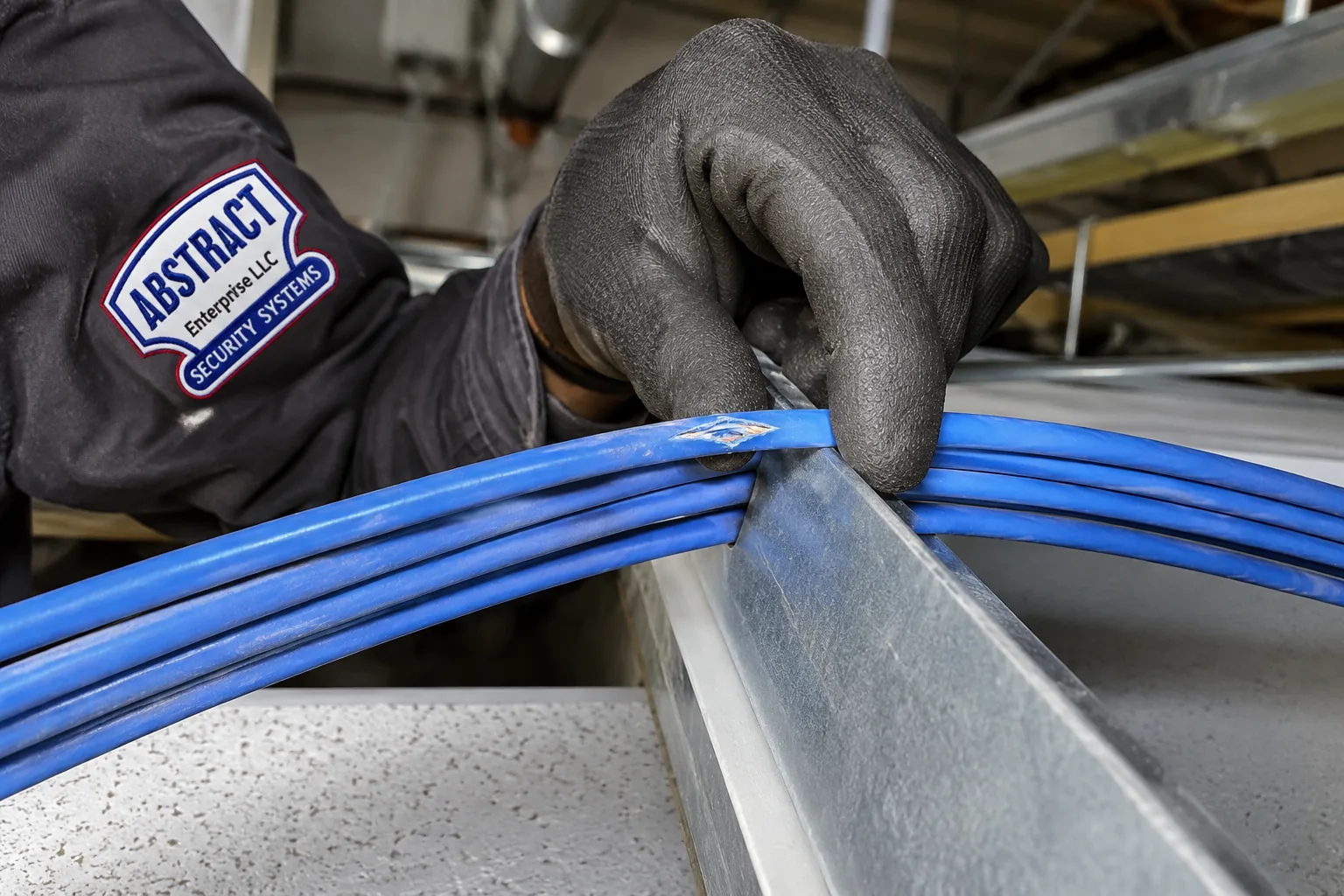
The symptom is usually ordinary. A conference room jack goes dead after a furniture move. A trading desk drops to 100 Mbps and nobody notices for a week. An IP camera on the freight landing boot-loops. A contractor renovating the suite next door puts a screw through a bundle above the shared corridor ceiling and takes out four drops on your side of the demising wall. All of it is routine work made expensive by the building around it.
Repair is billed at our specialty service rate of $195/hr with a three-hour minimum ($585). The diagnostic equipment comes on the first visit — distance-to-fault, tone and probe, wiremap and performance testing — because a second trip into a Class A building is not a small thing to arrange, and the whole point of bringing a tester is to avoid needing one.
Network Down in Manhattan?
Same-day dispatch where the building permits daytime access; next available freight window where it does not. Most single-fault repairs are located and restored inside the first three-hour block.
✔ NYS Lic. #12000287431✔ Certified wiremap & performance testing on every repair✔ 4.7★ from 201 reviews
Local Conditions
Why a Manhattan Repair Costs What It Costs
Start with the demarcation line, because it decides whose problem this is. In most Manhattan commercial leases the base building supplies pathway, riser and a point of presence on your floor; everything from the floor closet inward is yours. That single fact resolves a large share of the disputes we walk into. A dead jack in your suite is tenant infrastructure. A failed riser pair between floors is the landlord's. We test to establish which side the fault sits on and put it in writing, because that document is frequently worth more to a tenant than the repair itself.
Then the access economics. A great many buildings here restrict low-voltage work to after-hours freight windows, require a COI naming both the owner and the managing agent, and issue a badge that has to be arranged in advance. Some are union buildings with their own rules about who may touch what. None of that is unreasonable and all of it has to be scheduled rather than improvised, which is why a contractor who has never worked in this stock quotes a number that turns out not to include the evening.
Then the walls. Prewar Manhattan office and loft stock is plaster over wire lath on masonry, and it does not fish. There is frequently no cavity at all. Opening it produces dust, noise, a very fast complaint from the floor below, and a restoration cost that dwarfs the cabling. That pushes the correct repair toward a junction restoration in an accessible ceiling, or a surface raceway on a new route, far more often than the internet's default advice of pulling a new run.
Then the ceiling itself. Most Manhattan commercial suspended ceilings serve as HVAC return plenums, which means cable in that space must be plenum-rated CMP. Splicing riser-rated cable into a plenum run to save forty dollars creates a code exposure that surfaces during a fire inspection, an insurance review or a lease audit — long after whoever did it has gone.
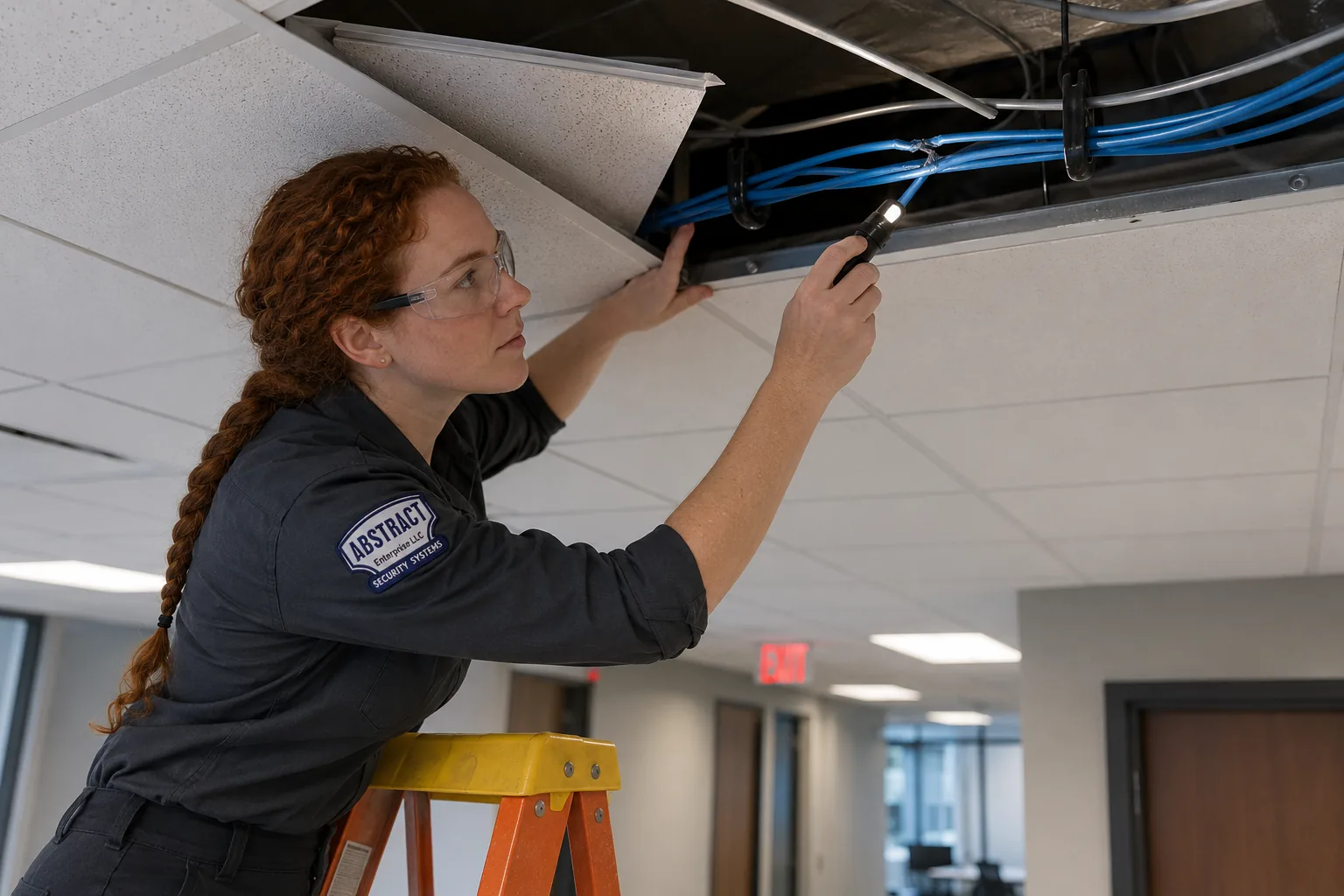
Finally, layered history. A Midtown suite that has changed tenants four times since 1998 has four generations of cabling above its ceiling, most of it abandoned, none of it labelled, and some of it still live. Tracing one run through that accumulation is the actual job. The repair, once the run is found, is often twenty minutes.
What We Repair
What a Manhattan Cable Repair Call Covers
We repair the physical layer and prove it with a saved test result.
Tenant-vs-Base-Building Fault Isolation
Establishing whether the fault sits inside your demise or in base-building riser and pathway, and documenting it in a form your managing agent will accept.
Cable Fault Location
Distance-to-fault measurement, tone-and-probe tracing through decades of abandoned cable, and physical location before anything is opened.
Ethernet Cable Repair
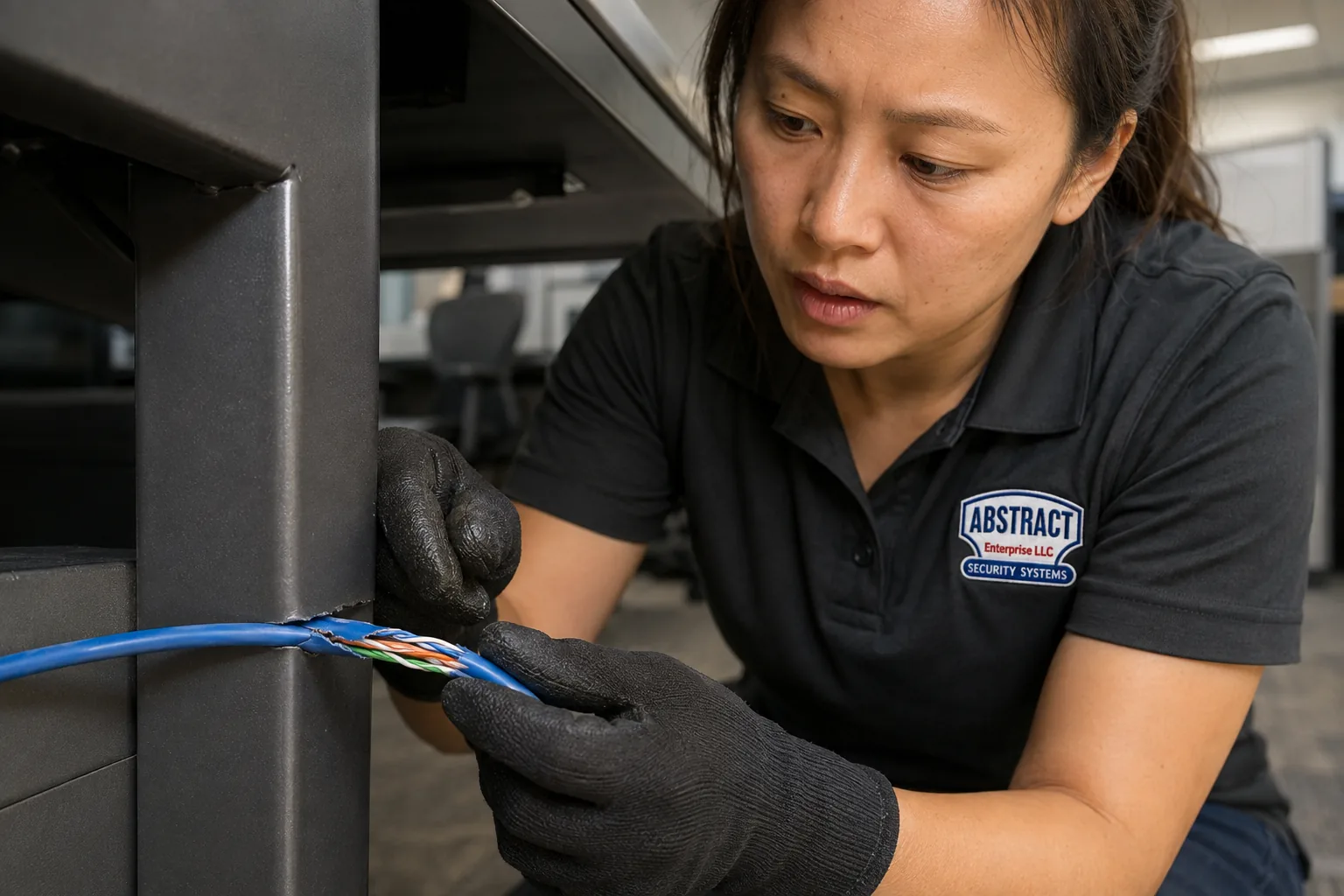
Cut, crushed, pinched or drilled runs restored with a category-appropriate junction in an accessible location, then re-tested to spec.
Cat6 and Cat6A Retermination
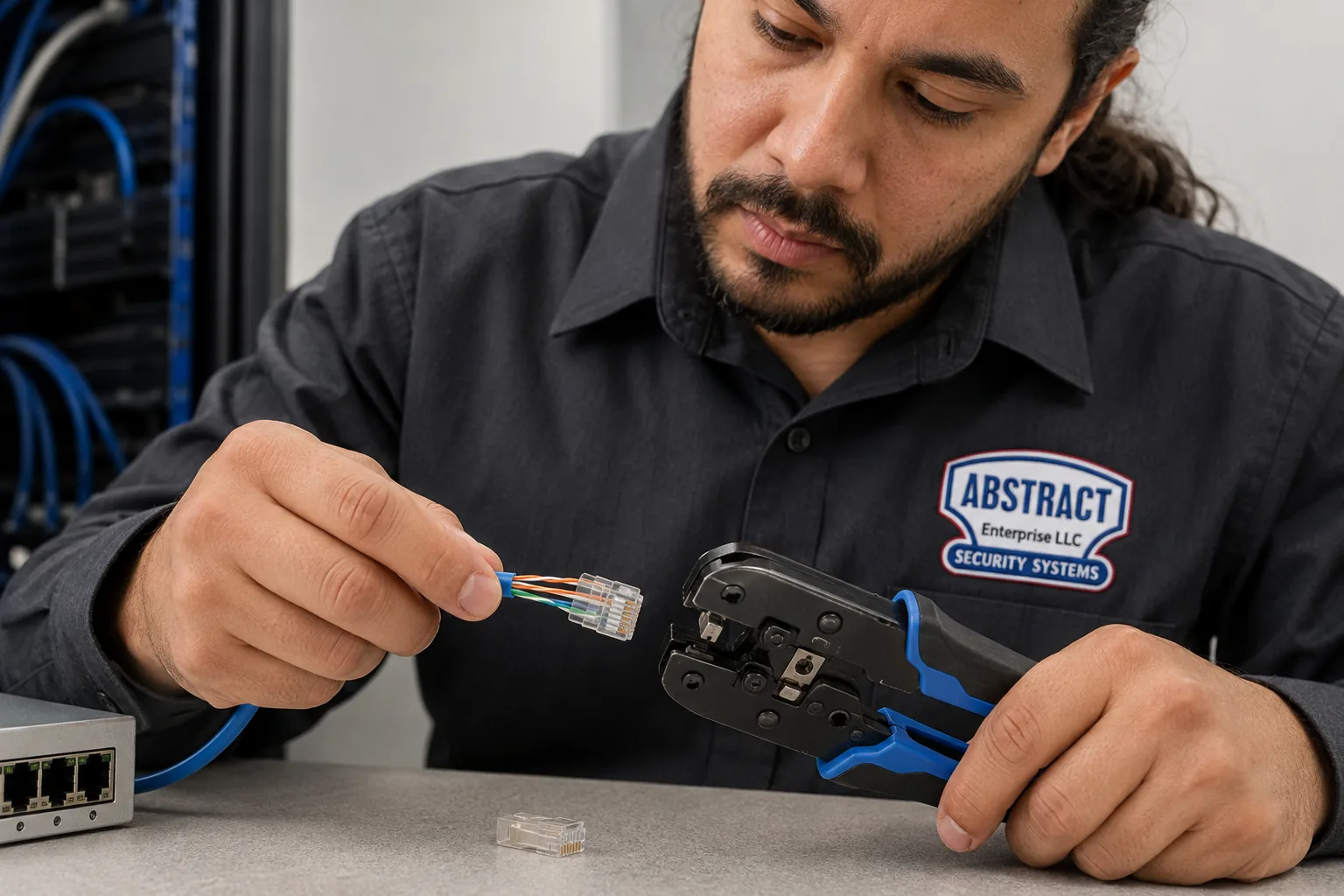
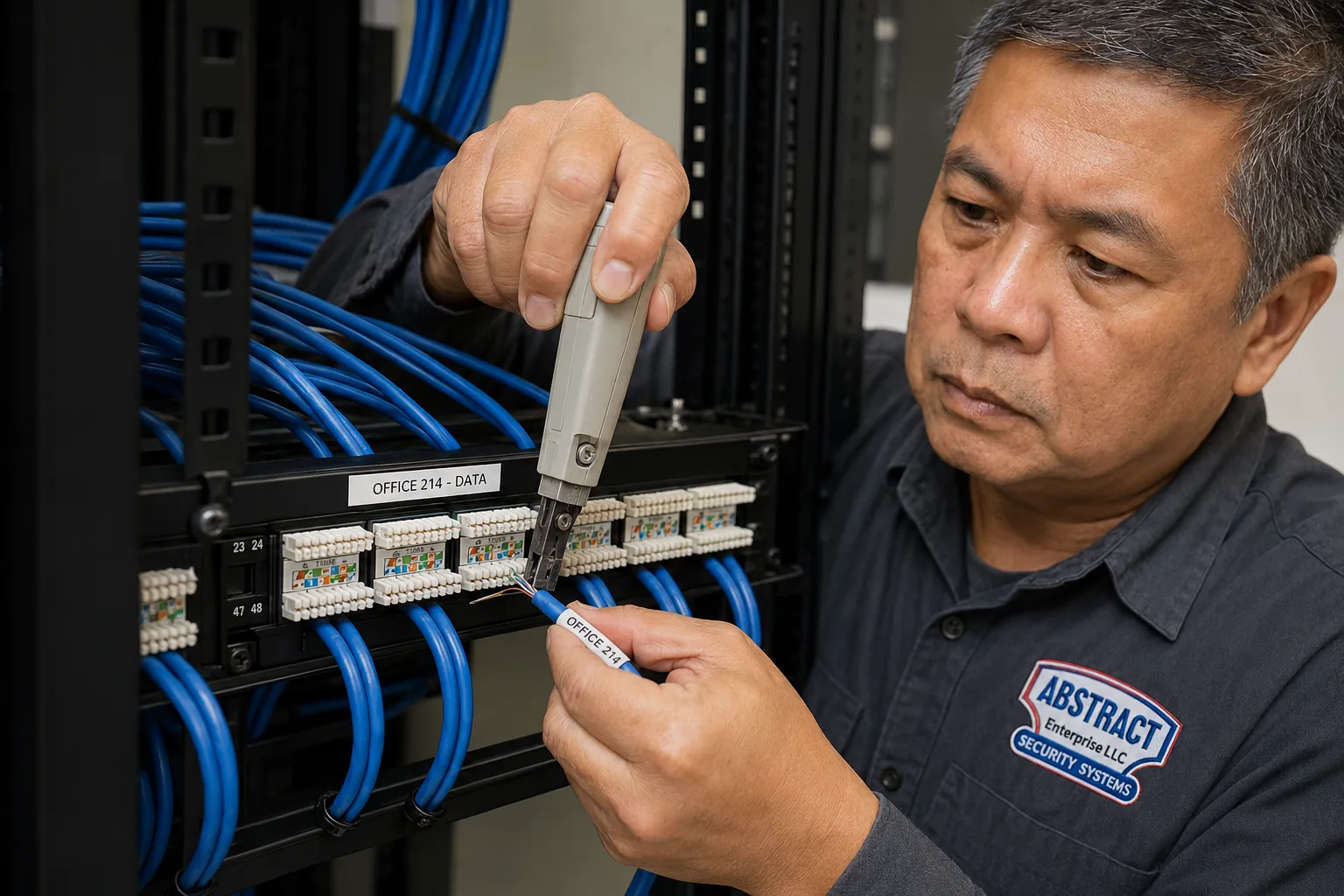
Re-punching keystones and panel ports to T568B with correct pair geometry and untwist discipline — the highest-yield fix in this building stock.
Network Jack Repair
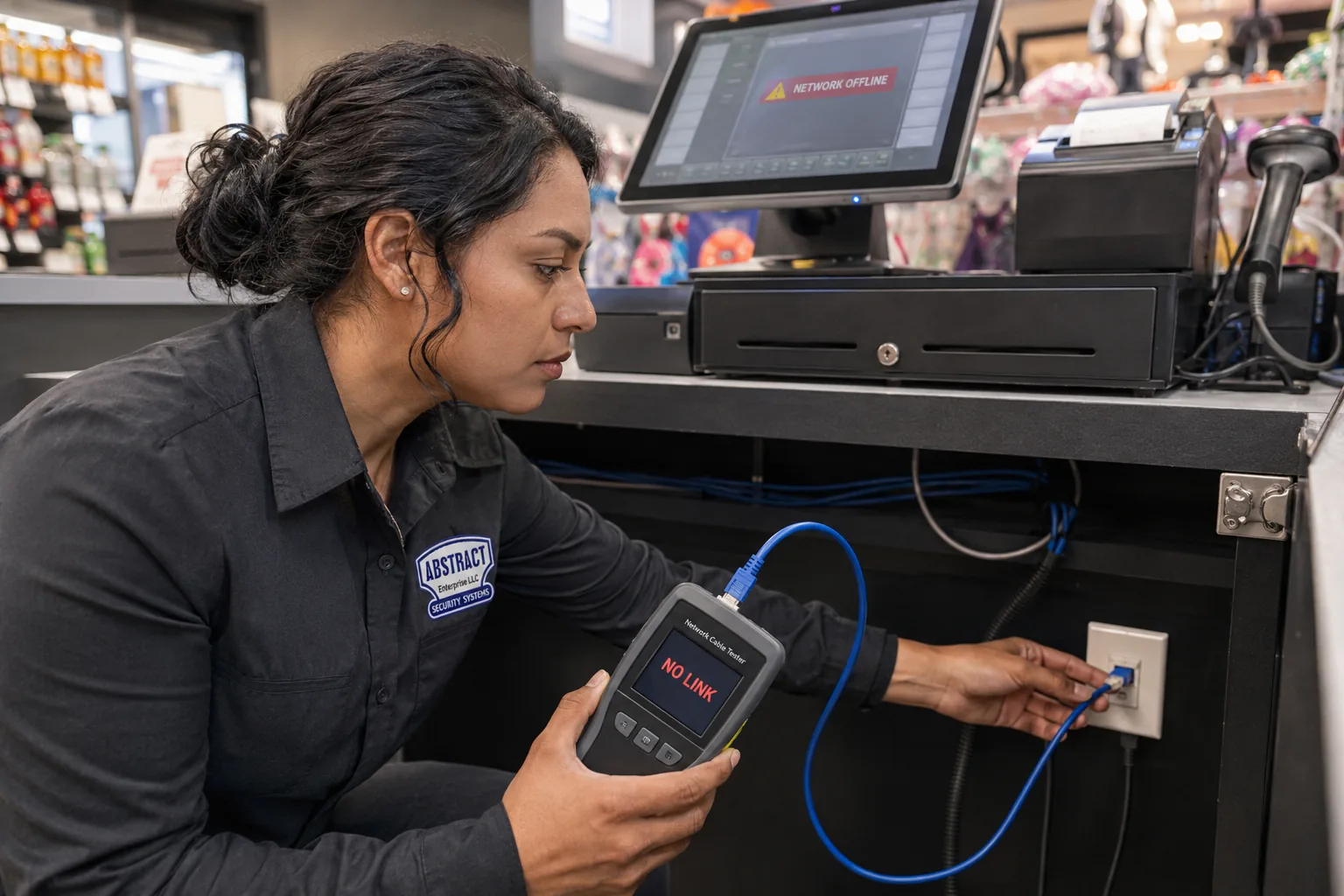
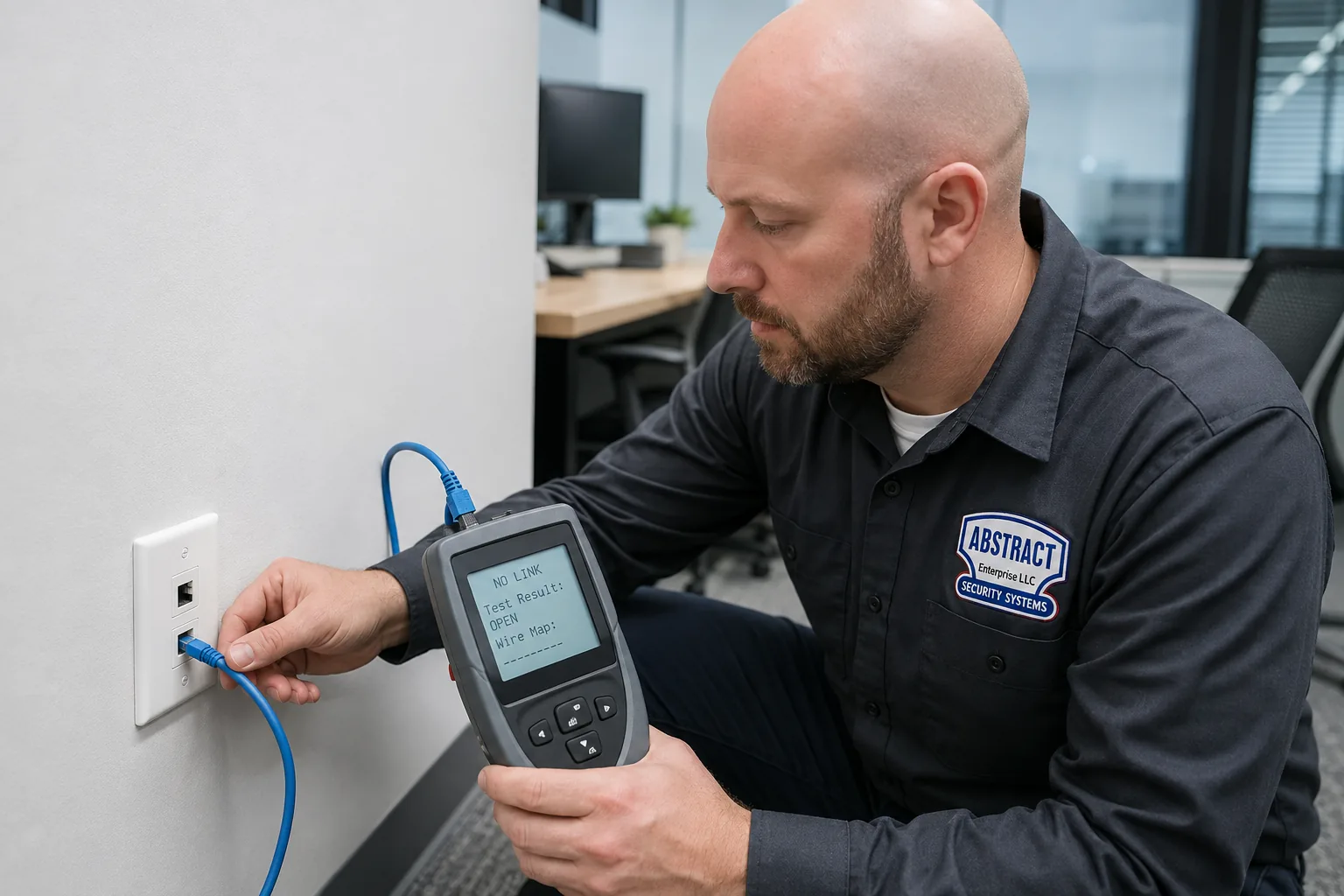
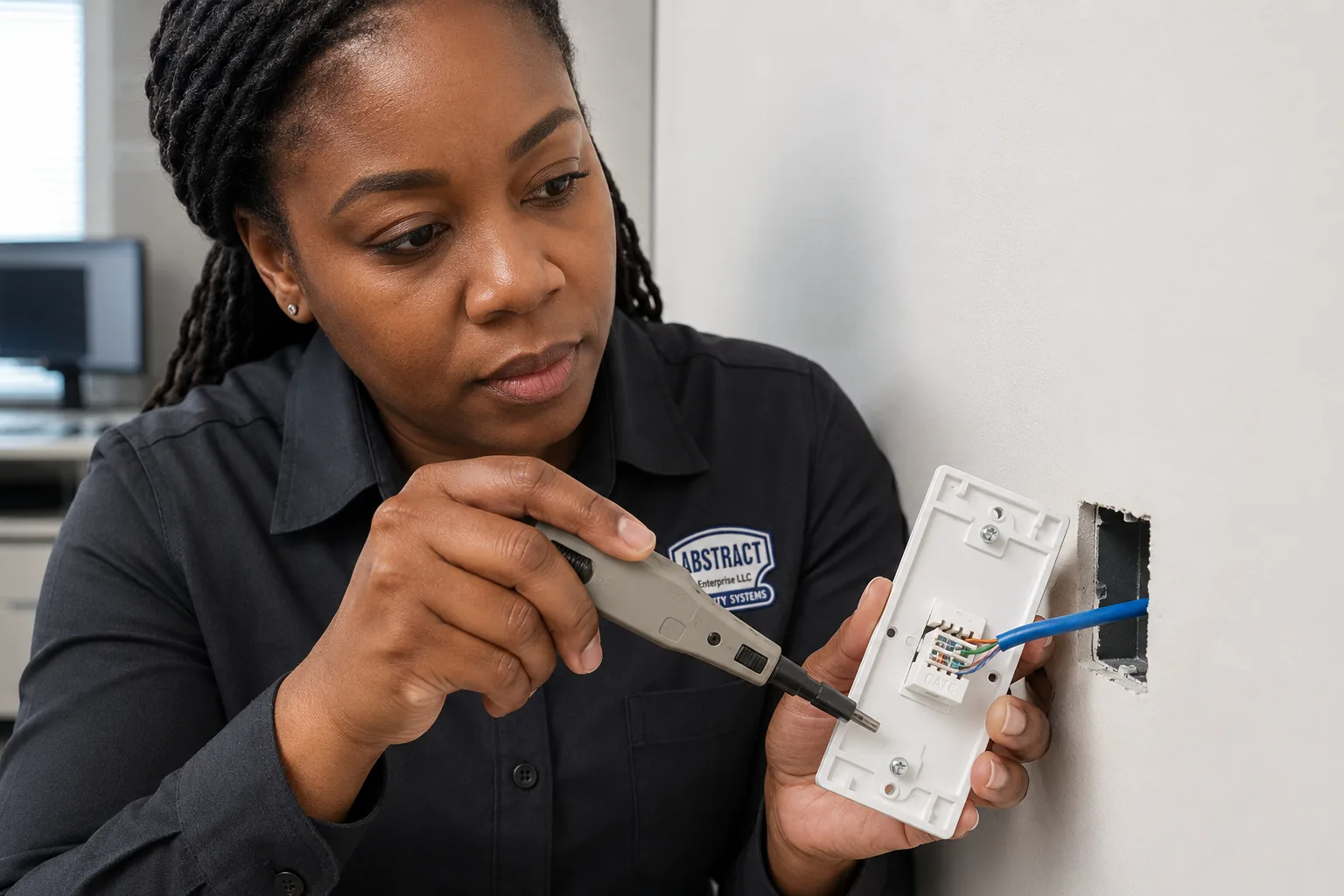
Dead outlets, loose keystones, cracked plates, floor boxes crushed under chair casters, and jacks never fully punched at build-out.
Patch Panel Repair
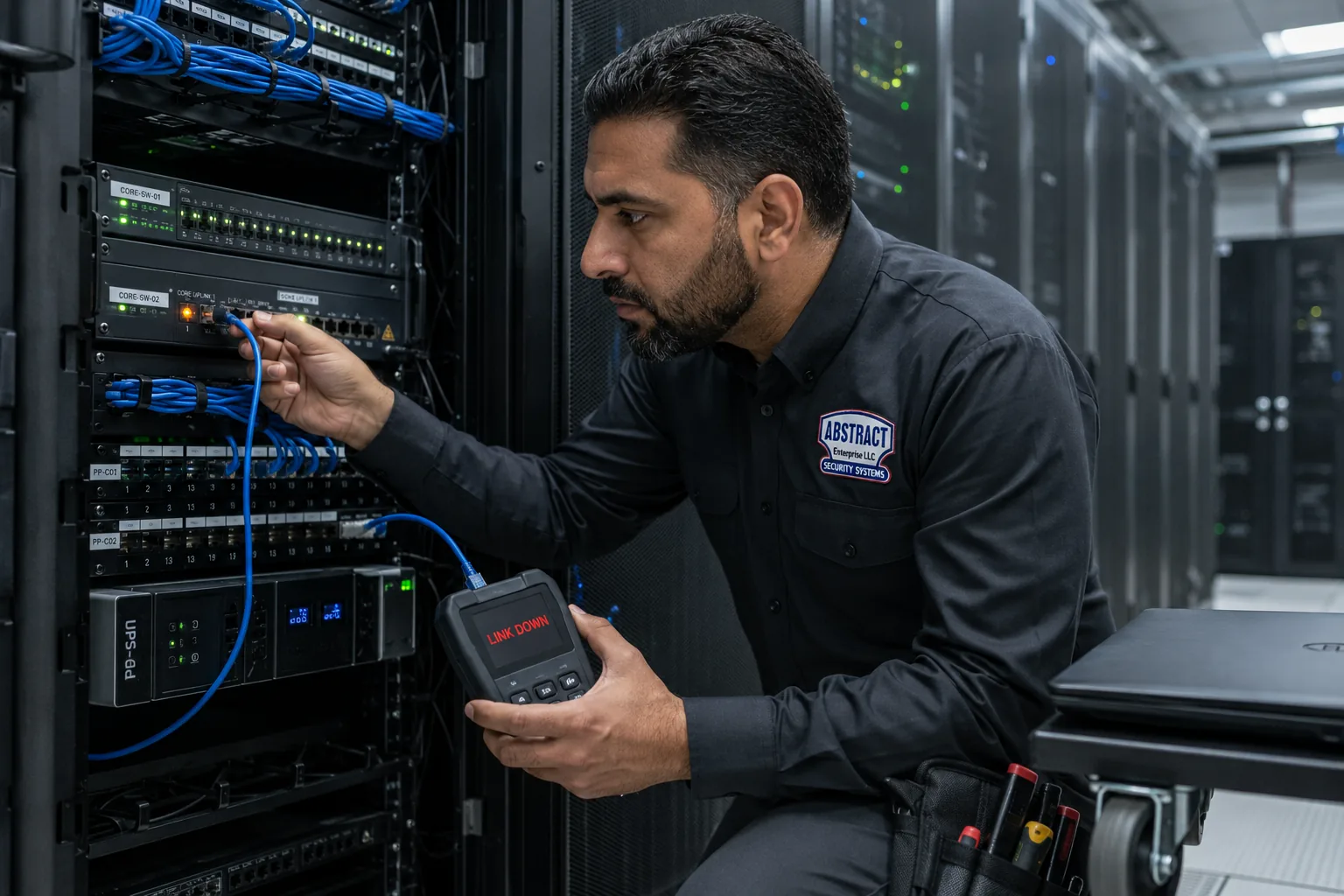
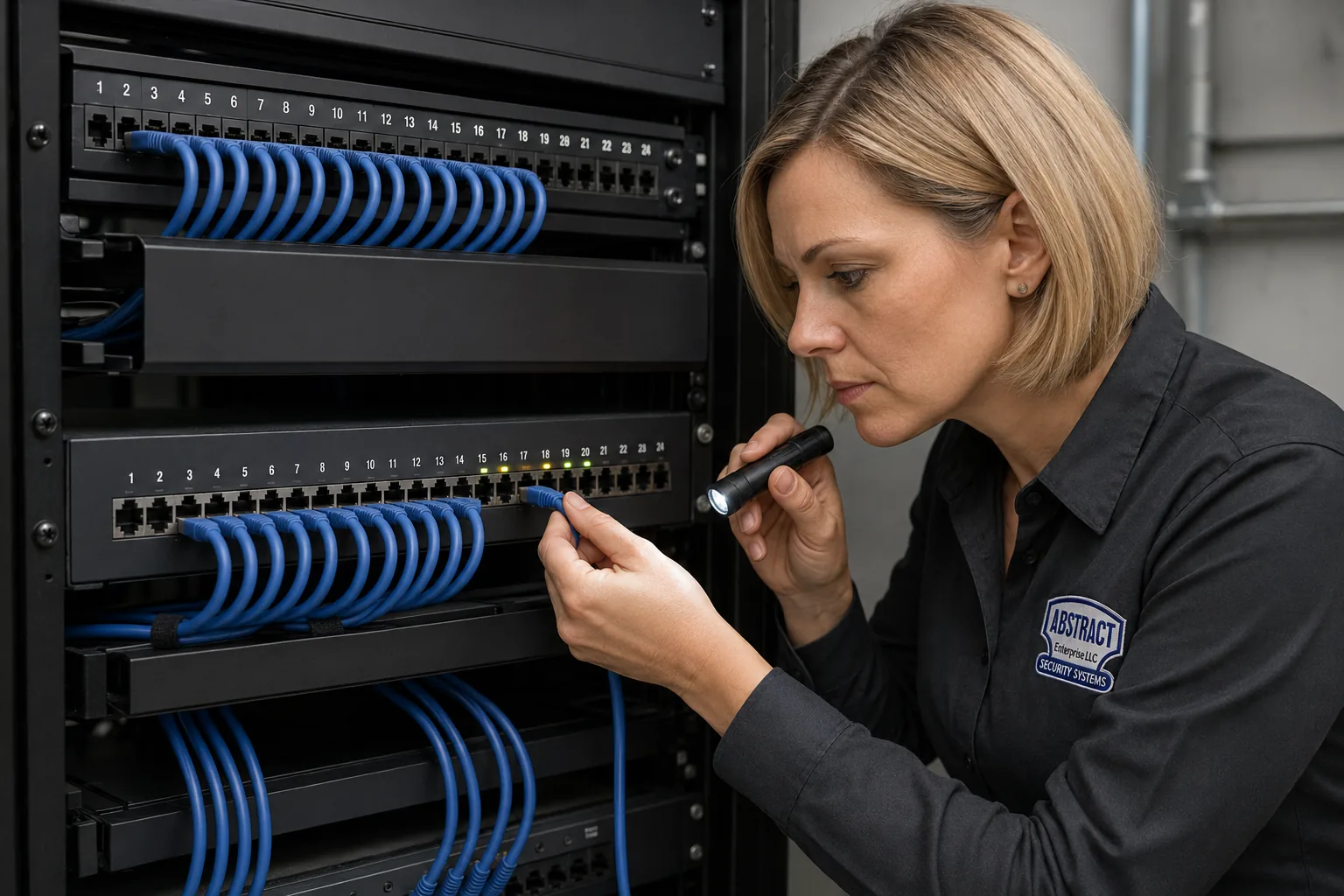
Port retermination, panel replacement, and correction of runs punched to one standard at the room end and the other in the closet.
Abandoned Cable Identification
Sorting live from dead above a ceiling that four tenants have contributed to, so the closet reflects the suite as it is now.
Certified Testing
Wiremap, length and performance verification with saved reports — the deliverable IT directors, landlords and auditors ask for by name.
PoE Circuit Troubleshooting
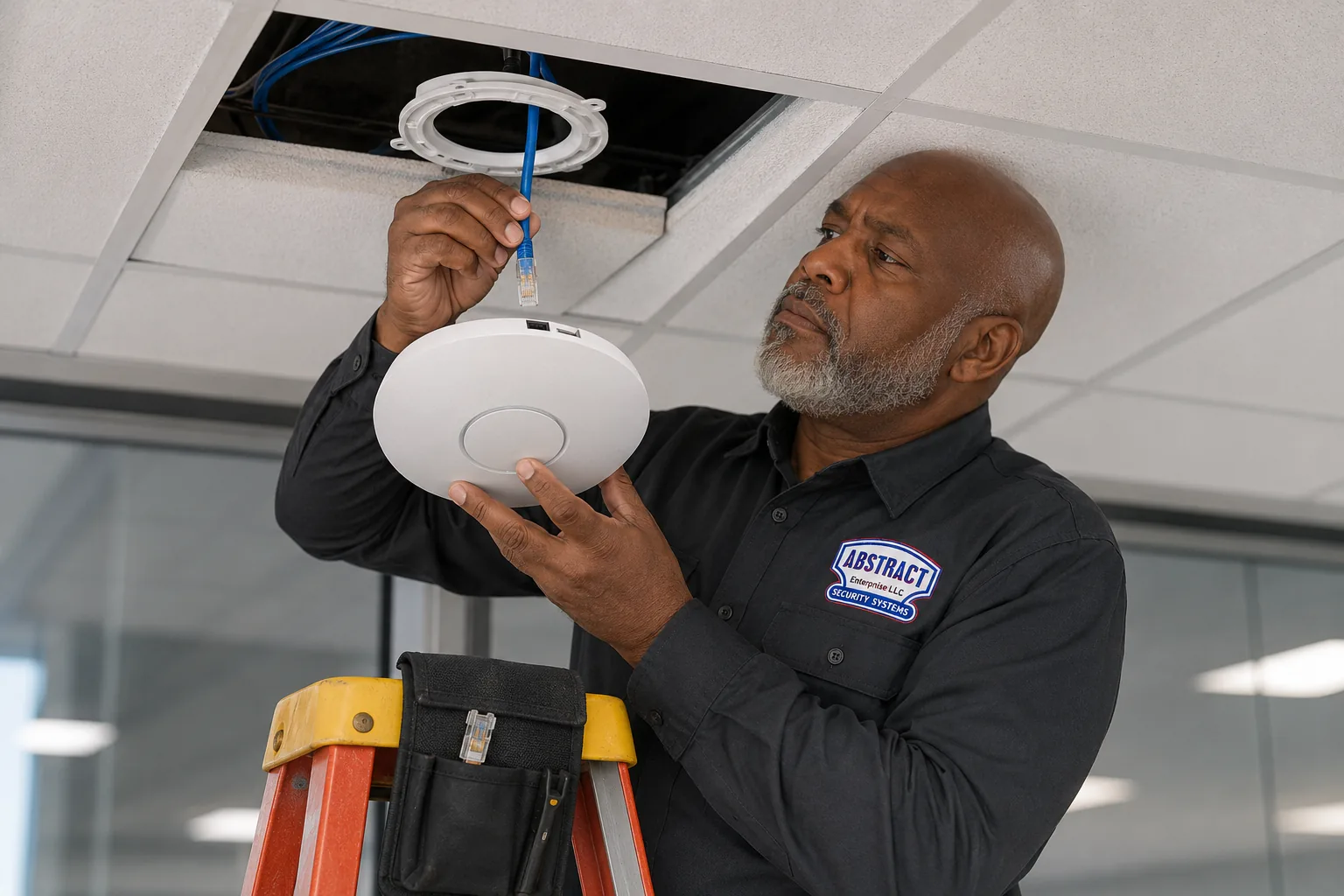
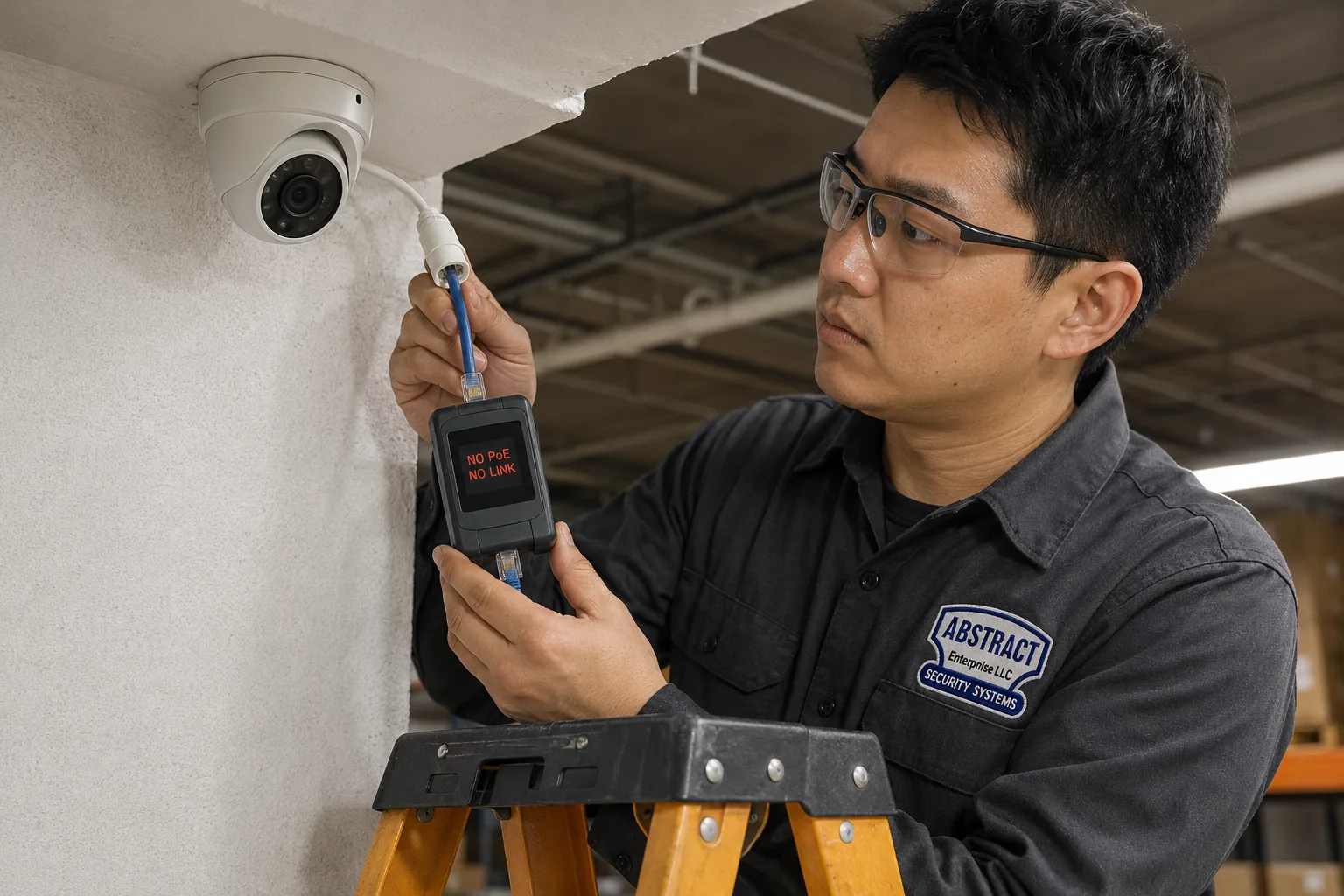
Cameras, access points and readers that boot then reset. Load testing at the endpoint separates cable-side voltage drop from switch power budget.
Commonly paired: the same ceiling bundle usually feeds camera and reader drops. When a ceiling is open for a data repair, testing the camera drops and access control runs alongside it costs a fraction of a second after-hours mobilisation.
Plain English
Terms That Appear on a Manhattan Cabling Quote
Most of the confusion on a tenant repair quote comes from four or five words.
Term
What It Means Inside a Manhattan Building
Demarcation point
Where the carrier's responsibility ends and yours begins. Distinct from the lease demise, which is where the landlord's infrastructure ends and the tenant's begins — and it is the second line that decides who pays for a dead jack.
Riser
The vertical cable path between floors, base-building infrastructure in almost every Manhattan lease. Faults here are the landlord's to resolve.
Horizontal
The run from your floor closet out to an outlet. Tenant infrastructure, capped at 90 m so the full channel stays inside 100 m.
Plenum (CMP)
Fire rating required for cable in a ceiling space used as an HVAC return — which describes most Manhattan commercial suspended ceilings.
Firestop
The rated seal at a penetration through a fire-rated wall or floor. Opening one and leaving it open is a live liability, and it is extremely common in suites where unlicensed labour has worked.
COI
Certificate of insurance naming the owner and managing agent. No COI, no badge, no work — and the requirements differ building to building.
Freight window
The block of time the building permits contractor material and access, frequently evenings only in occupied Class A stock.
Split pair
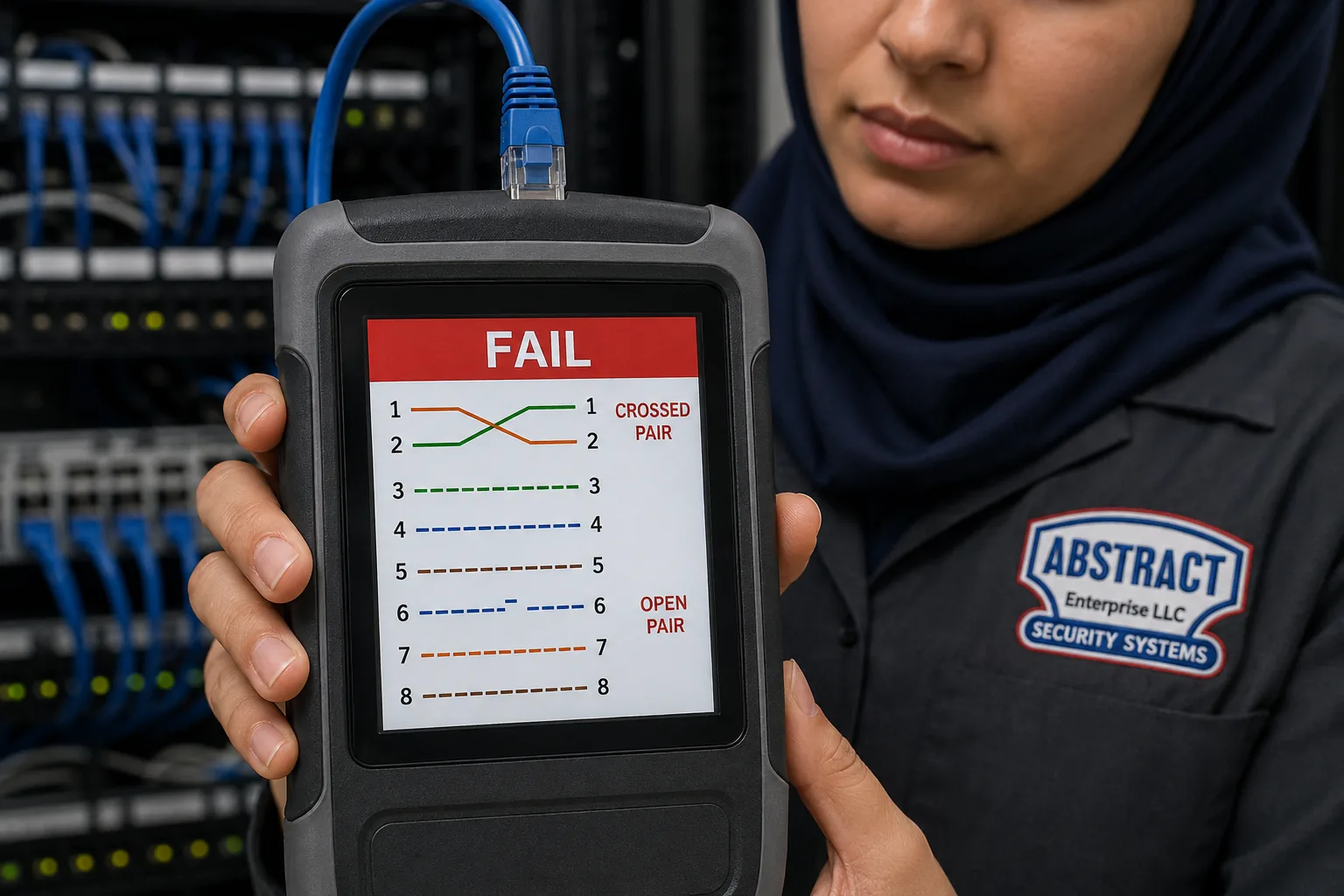
All eight conductors land correctly but the pairing is wrong. The port trains at 100 and refuses gigabit, which reads to the user as slowness rather than a fault.
Abandoned cable
Dead runs left above the ceiling by prior tenants. Adds fire load, obscures live runs, and makes tracing slower and therefore dearer.
Certification
Testing against category spec with saved, printable results including margin. Different from a continuity beep, which proves very little.
Equipment
Hardware and Test Equipment on a Manhattan Repair
We repair what the building already has and replace with commercial-grade components matched to the existing channel. On the passive side that means Belden, CommScope, Panduit, Leviton, Hubbell, Ortronics, ICC, Berk-Tek and Superior Essex. Category matching is not a preference: a Cat5e keystone dropped into a Cat6 channel derates the whole channel to Cat5e no matter what the cable in the wall is rated for, and mixed-category channels are ordinary in a suite that has been fitted out three times.
On the active side we isolate cable-side faults feeding Cisco, Meraki, Aruba, Ubiquiti UniFi, Netgear, TP-Link, Luxul and Araknis switching, and PoE endpoints including IP cameras, wireless access points, VoIP handsets, badge readers and displays. Our scope is the physical layer. We do not administer switches, VLANs, wireless controllers or firewalls — we certify the channel and hand the results to whoever does, which in Manhattan is usually an MSP or an in-house IT team.
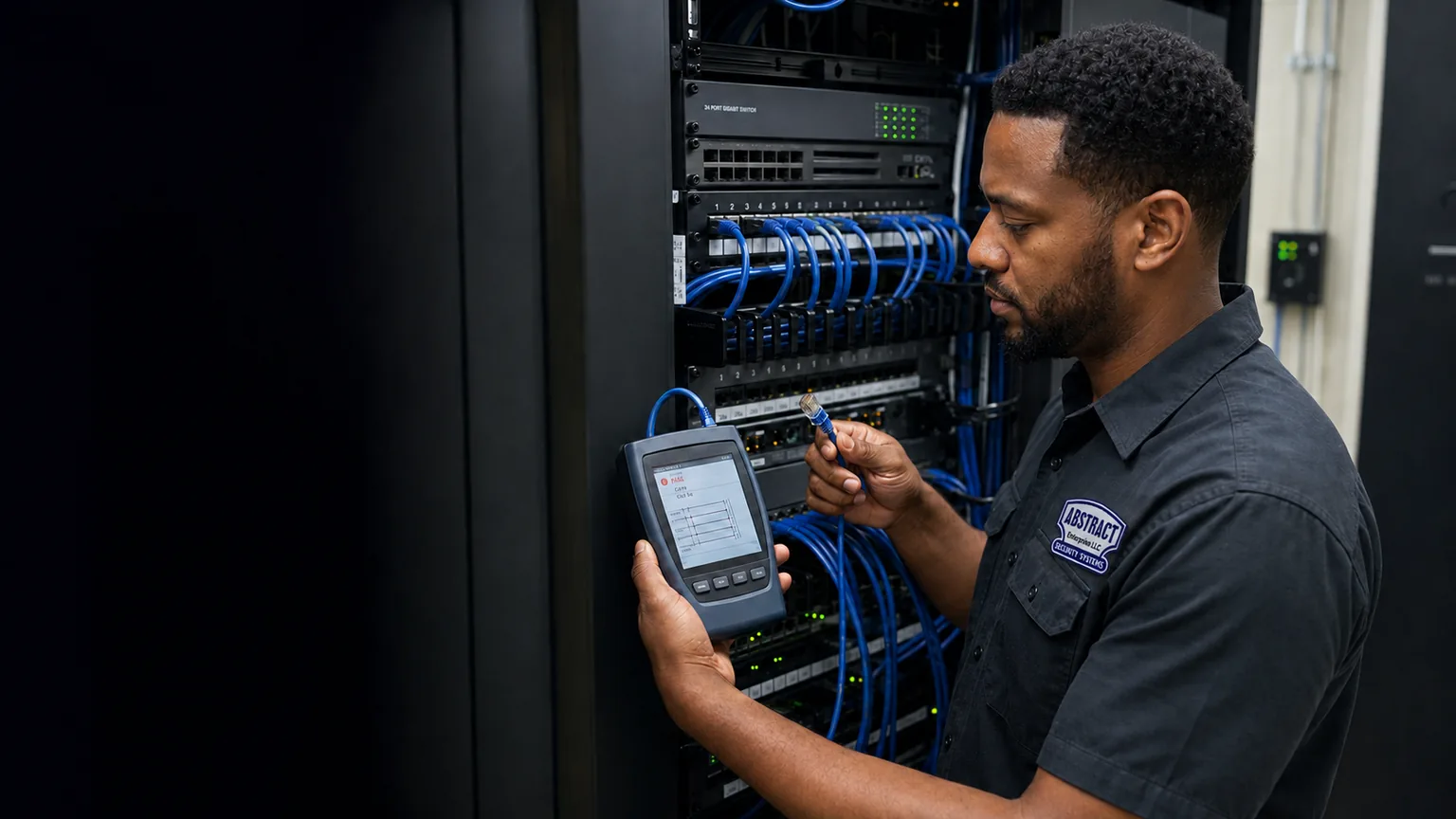
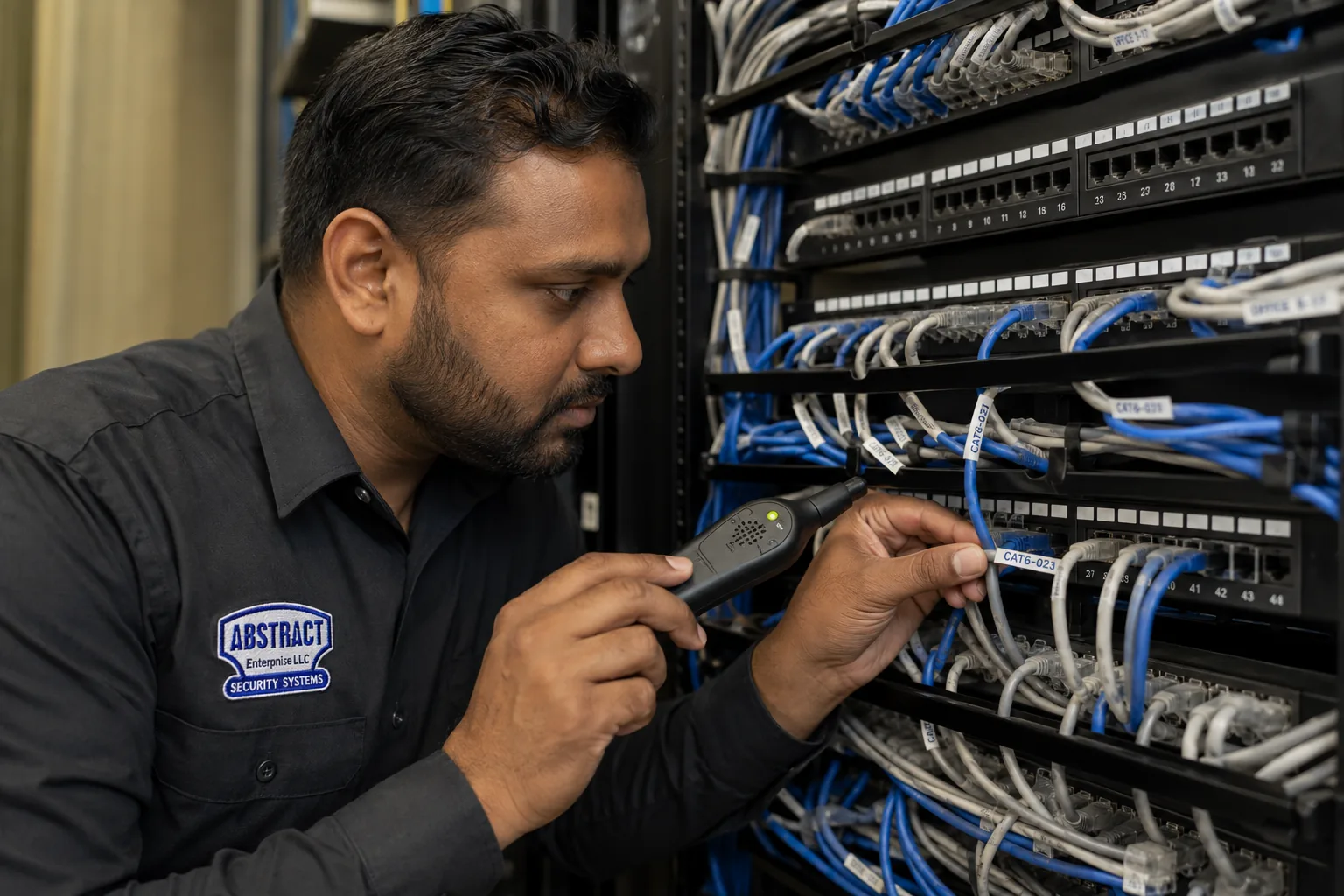
The gear decides whether the visit produces an answer. Certification testers with saved reports, tone generators and probes for tracing through unlabelled bundles, and PoE load verification at the endpoint travel on every call. In a suite with no documentation, the toner earns its keep in the first twenty minutes.
Need Repair in Manhattan Today?
Same-day where the building permits daytime access; next available freight window where it does not. COI issued to your managing agent before arrival, not after.
Isolate, Repair, Certify — and Establish Whose Fault It Is
On a Manhattan tenant repair there are four outputs, not three, and the fourth is a document.
Isolation comes first: which element of the channel, at what distance, on which pair, and on which side of the lease line. That ordering matters because the two cheapest elements — patch cord and termination — resolve a large share of complaints, and because a fault that turns out to sit in base-building riser is not a bill you should be paying. Then the physical correction. Then certification, with the margin figure reported to you rather than filed, because a channel that passes narrowly is a repeat call scheduled for next summer.
The fourth output is the written finding. Where the damage was, what caused it, what side of the demise it sits on, and what the test says. Tenants use it to recover cost from a neighbouring contractor. Managing agents use it to close a ticket. IT directors use it to stop re-opening the same investigation. It costs us nothing extra to produce and it is frequently the part of the visit that pays for itself.
Full Scope
Full Scope of a Manhattan Network Cable Repair
Diagnostics
Tenant-versus-base-building fault isolation
Distance-to-fault location on broken or shorted runs
Wiremap faults: opens, shorts, reversals, split and crossed pairs
Measured length against the 90 m and 100 m limits
Insertion loss and crosstalk testing with margin reporting
PoE voltage and load verification at the endpoint
Tone-and-probe tracing through abandoned cable
Switch-port versus cable-fault isolation
Physical Repair
Keystone jack replacement and re-punch
Patch panel port retermination and panel swap
Category-appropriate junction repair in accessible ceiling
Surface raceway route where the wall will not open
Full run replacement where certification fails
Floor box and monument repair
Firestop restoration at penetrated rated assemblies
Written finding stating tenant or base-building responsibility
Both-end durable labelling and closet legend
Photo record of concealed repairs before close-up
Report format suitable for a managing agent or IT director
Building Logistics
COI naming owner and managing agent, issued before arrival
After-hours and weekend freight windows arranged
Badge and access coordination with building staff
Plenum-rated material carried as standard
Dust control and occupied-suite working
Coordination with your MSP or in-house IT
Coverage Detail
Where We Work in Manhattan
Midtown carries the heaviest volume — the Sixth Avenue and Lexington corridors, the Plaza District, Grand Central and the blocks around it, the Garment District's converted loft floors, Times Square, Hell's Kitchen and Murray Hill. These are the buildings with the strictest access rules and the most layered cabling history, and they are where a COI and a freight booking matter as much as a punch-down tool.
Downtown runs from the Financial District around Broad, Water and Pine Streets through the Seaport, Tribeca and SoHo's cast-iron loft stock, Chinatown and the Lower East Side. FiDi mixes prewar towers with post-2000 residential conversions, and Tribeca and SoHo bring timber-and-brick lofts with exposed ceilings where cable is a visible element rather than something hidden. Chelsea, Flatiron, Union Square, the Meatpacking District and Hudson Yards sit between the two, mixing modern plates with converted industrial floors.
Uptown covers the Upper East and Upper West Sides — professional and medical office in prewar buildings, much of it converted from residential — then Morningside Heights, Harlem along 125th Street and Frederick Douglass Boulevard, Hamilton Heights, Washington Heights and Inwood. The building type shifts uptown toward smaller tenancies in older stock, where there is no floor closet and the equipment lives in whatever space the suite can spare.
Who We Serve
Manhattan Industries We Repair Cabling For
Professional Services and Finance
Suites where an hour of downtime is expensive and the certification report is a compliance artifact, not a nicety.
Law and Accounting
Prewar plaster, conference rooms with floor boxes, and documentation requirements that outlast the tenancy.
Medical and Dental
Practices in converted residential buildings, imaging equipment on marginal channels, and no tolerance for a link that fails intermittently.
Creative and Tech Lofts
SoHo, Tribeca and Chelsea. Exposed ceilings where a repair is visible, so the route gets designed rather than improvised.
Retail and Hospitality
POS lanes and back-of-house drops on Fifth, Madison, Broadway and the avenue corridors, with trading hours setting the schedule.
Restaurants and Bars
Kitchen-side terminals in heat and grease, plenum ceilings requiring CMP, and cable damaged during hood and duct work.
Coworking and Flex Space
High move-add-change volume, drops extended rather than re-pulled, and panels nobody has remapped since the last reconfiguration.
Building Management
Base-building systems, freight landings, lobby equipment and the cabling that ties them back to the main telecom room.
Nonprofits and Institutions
Older tenancies, layered infrastructure, and budgets that make repair-versus-replace clarity genuinely useful.
Real Questions
Fourteen Questions Manhattan Tenants Actually Ask
Drawn from the recurring themes in tenant, IT and Manhattan-local discussion threads, grouped by the six question types that come up most.
Cost Questions
1. Why is the minimum three hours for one dead jack?
Because the diagnostic labour is the job and the building is the overhead. Getting badged in, reaching the floor, locating one run inside an unlabelled bundle, correcting the termination and certifying it is real time whatever the visible symptom. $195/hr against a three-hour minimum puts the first block at $585, and inside it we test the adjacent drops in the same bundle — which is where the value lands, because bundles rarely fail alone.
2. Does after-hours work cost more?
The labour rate does not change. What changes is that an evening freight window has to be booked and staffed, and that carries a premium stated on the quote rather than buried in it. If your building permits daytime low-voltage work, say so when you book and the job is cheaper for both of us.
3. What does it cost if the run has to be replaced instead of repaired?
New commercial Cat6 drops start at $175 per drop, including cable, keystone, plate, panel punch-down, testing, both-end labelling and a patch cord. Where the pathway will not take a new pull, the honest answer is sometimes a surface raceway on a different route, which is quoted separately because it is visible work in a finished space.
Quality and Trust Questions
4. How do I prove to my landlord that this is base-building and not ours?
With a test result and a written finding. We certify the channel from your outlet back to your closet; if that passes and the fault is upstream in riser, the report says so with the measurement behind it. Managing agents respond to that document in a way they do not respond to a phone call.
5. Do you carry insurance my building will actually accept?
Yes. We issue a COI naming the owner and managing agent to whatever limits the building requires, before arrival rather than at the door. Send us the building's insurance requirements when you book and it goes out ahead of the visit.
6. Our MSP says it is the cable. The building says it is our equipment. Who is right?
That is exactly the argument physical-layer testing ends. A certification report either removes the cable from the suspect list or identifies the fault in it, with a measured distance. It is the cheapest way to stop two vendors pointing at each other on your time.
DIY and Pro Questions
7. Can our office manager just re-punch the jack?
Sometimes, with the right tool. The failure mode is untwist: a re-punch that looks tidy can leave too much pair untwisted at the contact and fail certification while still lighting a link light. If the drop matters, have it tested afterwards. If nobody is going to test it, the re-punch is a coin flip.
8. Is a $30 cable tester worth having in the office?
For pin order, yes — it will catch a miswired jack in thirty seconds and it is worth the drawer space. What it cannot see is length, insertion loss, crosstalk or return loss, and those are the failures behind gigabit and heat-related problems. A run that a cheap tester calls perfect can still be the reason your link drops every afternoon.
9. Can we run a cable across the ceiling ourselves to reach a new desk?
Not in a plenum ceiling, which is most of them here. Cable in a return-air space must be plenum-rated, penetrations through rated assemblies must be firestopped, and this is licensed low-voltage work in New York City. Beyond the code exposure, an unsupported run draped over a ceiling grid is a fault waiting to be found by the next person up there.
Technical Questions
10. Why does one drop link at 100 Mbps when everything else does gigabit?
A damaged or split pair. 100BASE-TX uses two pairs; 1000BASE-T uses all four. A run with one bad pair links happily at 100 and either refuses to negotiate gigabit or negotiates and drops. It is the most diagnostic free symptom available to you.
11. Our camera on the freight landing reboots every few minutes. Cable or camera?
Usually cable-side voltage drop, especially on a long run or on Cat5e carrying a PoE+ load. The device draws more current when the illuminator engages, voltage sags below its threshold, and it resets. Testing under load at the endpoint separates that from a switch power-budget limit or a failing camera.
12. The network got worse after we added Wi-Fi 6 access points. Why?
The new radios draw far more power than what they replaced, and in a tightly bundled run that heat raises insertion loss across the whole bundle. Marginal Cat5e that was fine for handsets starts erroring. The access points did not break the cable — they revealed cable that was already at the edge.
Landlord and Tenant Questions
13. Contractors renovating the suite next door killed three of our drops. Now what?
Extremely common here, and it is why we photograph and document. We locate and repair the damaged runs and record the fault location and test results, which is what you need if you intend to recover the cost from the other tenant's contractor or through the building. Do it while the ceiling is still open next door if you can.
Complaint Questions
14. The last company replaced the jack and the problem came back. Why?
Because the jack was a symptom. If the channel is damaged mid-run, over-length, or punched to a mismatched standard at the far end, a new keystone buys a few weeks. Testing after the repair is what catches it — a channel that passes with no margin is a repeat visit, and you should be told about it rather than left to discover it.
Answer The Public
Answer The Public: Manhattan Network Cable Questions
Who repairs network cable in Manhattan?
Licensed low-voltage contractors and structured cabling firms. Electricians handle conduit, pathway and line voltage and usually subcontract data terminations. MSPs own the network above the cable but rarely carry certification testers. For a dead outlet or a marginal channel in a Manhattan suite, the low-voltage trade is the correct call.
What causes cabling to fail in Manhattan buildings?
In rough order: terminations executed without untwist discipline, physical damage from other trades working above shared ceilings, legacy Cat5e carrying PoE loads it was never certified for, runs extended rather than replaced during fit-outs, and moisture in ground-level and cellar telecom rooms.
When should a run be replaced rather than repaired?
When it fails certification after the terminations are corrected, when there are multiple damage points, when measured length puts the channel out of spec, or when the space now needs multi-gig or high-power PoE the existing category cannot support.
Where do faults usually sit in a Manhattan suite?
At terminations first. Then at pathway transitions where cable leaves the ceiling and drops into a wall, at floor boxes under desks, at points where a run was extended, and inside crowded closets where cable is bent past its minimum radius.
How quickly can a Manhattan repair be scheduled?
Same day where the building allows daytime low-voltage work. Where it does not, the next available freight window — which is why we ask about building rules when you book rather than discovering them at the loading dock.
Reality Check
AI Overview Reality Check: What Search Results Miss About Manhattan Cabling
Search for network cable repair in Manhattan and you get a national cost average, a row of lead-generation directories, and troubleshooting advice written for a suburban office with open framing and no building rules. Here is where that guidance stops being useful.
1. The Cost Figures Exclude the Only Variable That Matters Here
Cost aggregators publish national averages for drops and service calls assembled from an enormous blend of residential and light-commercial work. Those figures describe an average of something, but not of a certified repair on the fourteenth floor of an occupied Midtown building.
What they exclude is access: the COI, the badge, the freight booking, the evening window, the union building's rules, and the dust control in a suite full of people. In this market those are not incidental — they are most of the difference between a cheap job and an expensive one, and they are entirely invisible in a national average.
They also collapse installation and repair into one number. Installation has known scope before dispatch. Repair does not, because the fault has to be found before it can be priced. Publishing one figure for both is how an honest hourly quote reads as expensive.
2. Nothing Online Explains the Lease Line, Which Decides Who Pays
General troubleshooting content assumes one owner of the whole building. In a Manhattan tenancy there are at least two parties and a line between them, and where the fault sits relative to that line determines who is billed.
Base building typically supplies pathway, riser and a floor point of presence; the tenant owns everything from the floor closet inward. A dead outlet in your conference room is almost always yours. A failed riser pair is almost always not. Tenants pay for landlord faults regularly, simply because nobody established which side the fault was on.
That is a documentation problem with a cheap fix. Certify the tenant channel; if it passes and the fault is upstream, the report is the argument. No search result will tell you to do this and it is frequently the highest-value part of the visit.
3. “Just Pull a New Cable” Is Written for Buildings Manhattan Does Not Have
Ask any AI assistant about a damaged run and the answer trends toward replacement, because most published content assumes drywall on studs with a fishable cavity.
Prewar Manhattan is plaster over wire lath on masonry, often with no cavity at all. Opening it means dust, noise, a complaint from the floor below, and a plaster-and-paint restoration that can exceed the entire cabling cost. In that stock a properly executed junction repair in an accessible ceiling, verified by certification, is the correct answer far more often than the internet suggests.
The inverse error appears too: results sometimes recommend couplers and splice kits where the cable is compromised along its length or where Cat5e simply cannot carry the new PoE load. The decision is made by the test result after terminations are corrected, not by a rule of thumb.
4. The Plenum and Firestop Layer Is Almost Entirely Absent Online
National cabling content mentions plenum in passing. In Manhattan it is a routine, enforceable condition of the work, because most commercial suspended ceilings here serve as HVAC returns.
A repair that splices non-plenum cable into a plenum run creates an exposure that surfaces during a fire inspection, an insurance review or a lease audit — long after the person who did it has gone. The same applies to firestopping: penetrations through rated walls and floors must be sealed with a rated assembly, and open penetrations left by unlicensed labour are ordinary in this building stock.
A licensed local contractor raises both at survey and prices the correct material in. A quote that mentions neither has priced a different building.
5. Search Results Conflate Cabling With IT Support
A large share of results for network repair queries are MSPs and break-fix computer shops answering a different question. Configuration problems are theirs. A dead outlet in the corner office is not.
It matters because troubleshooting has to cross that line. Slowness might be a port, a VLAN, the carrier or a miswired pair, and the only way to eliminate the cable with a number rather than an assertion is to measure it.
Our scope is deliberately narrow: we own the copper and hand a certified channel to whoever runs the network. That division resolves faults faster than two vendors guessing at each other's domain, which is the more common Manhattan outcome.
6. Lead Directories Sell Your Number Rather Than Vetting Capability
Angi, HomeAdvisor, Thumbtack and their equivalents operate a lead-sale model: your request goes to several companies at once and the fastest responder is generally whoever paid most for it. Ratings sit on profiles that may span multiple trades and technicians.
For cabling the category mixing is the specific failure. Router setup, Wi-Fi troubleshooting and physical cable repair share one heading, so a computer technician can legitimately answer a call that needs a certification tester, a toner and a punch-down tool — and cannot produce a COI for your managing agent.
Three questions filter it in one call: do you own a certification tester, will I receive saved results per drop, and can you send a COI naming my managing agent today.
7. “Near Me” Ranks Proximity, Not the Ability to Get Into Your Building
The local pack rewards physical distance to the searcher and profile signal strength. Neither correlates with whether a contractor can actually be standing in your suite this week.
What determines that: whether they can produce a COI to your building's limits, whether they have worked inside after-hours freight windows, whether they carry plenum material, whether they own certification-grade test gear, and whether they hold an active NYS low-voltage licence. None of it is visible in a map pin.
In a borough where access is the dominant cost, the contractor two miles further away who can be badged in tomorrow is worth more than the one around the corner who cannot.
Stop Paying for Somebody Else's Fault.
Certified testing on every repair. Licensed NYS low-voltage contractor. 4.7★ from 201 reviews.
No cost, thirty seconds, and it catches a surprising number of faults. The clip breaks, the plug eases back, contact goes intermittent.
Move to a different switch port
Yes
Rules out a failed or administratively disabled interface in under a minute.
Test the device on a known-good outlet
Yes
Cleanest way to separate endpoint, jack and cable with no tools at all.
Check the negotiated link speed
Yes
A drop training at 100 Mbps while neighbours reach 1000 points straight at a damaged pair.
Re-punch a keystone jack
Borderline
Doable with the right tool, but untwist discipline decides whether the channel still meets category spec. A tidy re-punch can still fail certification.
Open a plaster wall to chase a run
No
No cavity, heavy dust, restoration cost that exceeds the cabling, and a complaint from the floor below within the hour.
Run cable across a plenum ceiling
No
CMP rating and firestop obligations make this licensed work, and the exposure surfaces at inspection rather than immediately.
Diagnose gigabit-only or heat-related failures
No
You need a certifier. Signal loss and pair interference simply do not appear on anything you can buy in a hardware shop.
Trace a run through abandoned cable
No
Needs toning. Guessing in a ceiling four tenants have contributed to takes longer than measuring and does more damage.
The honest rule: the four rows marked yes take fifteen minutes and cost nothing. If the fault survives all four, it lives in the permanent cabling and the next step needs a tester and a badge.
Alternatives
How a Licensed Cabling Contractor Compares Here
vs. Your MSP or IT Provider
Strong above the physical layer and usually candid about it. Most subcontract cabling, which means the technician who arrives is not the firm you vetted and the schedule belongs to a third party — a real problem when the only access is Thursday evening.
vs. Lead-Generation Platforms
Your request is sold to several bidders at once. You get response volume rather than fit, and the category mixing means a computer technician may answer a cabling call. COIs and certification reports are not standard deliverables there.
vs. Your Carrier's Technician
Verizon, Spectrum and Altice are responsible to the demarcation point and will correctly say so. If the circuit tests clean at the demarc and your outlets are still dead, the fault is inside your infrastructure and outside their scope.
vs. The Building's Preferred Vendor
Frequently competent and sometimes the fastest route to base-building work. Where it goes wrong is on tenant-side faults, because a vendor whose relationship is with the landlord is not the natural party to document a fault as the landlord's.
vs. A General Electrician
Indispensable for conduit, pathway and line voltage, and the right trade when a repair needs a new penetration cored. Data terminations are a separate discipline with tighter tolerances, and most electricians sensibly subcontract them.
Warning Signs
Five Signs the Cable Is the Problem, Not the Network
One outlet is dead and the rest of the floor is fine. Anything upstream fails in groups. A solitary dead port is the run or one of its two ends, and nothing further afield.
The drop links at 100 Mbps while its neighbours reach 1000. Textbook damaged-pair signature and the most diagnostic symptom available to you for free.
The link drops when a door closes, someone leans on the wall, or the HVAC cycles. Mechanical or thermal sensitivity means a marginal physical connection, not a configuration problem.
PoE devices reboot on the permanent run but behave on a short test cable. The installed run is losing voltage or has a compromised pair; the bench cable proves the device itself is fine.
Trouble started right after trades worked above your ceiling. The single most reliable predictor of physical cable damage in occupied Manhattan buildings.
Community
Community Chatter: Recurring Themes From Public Forums
Paraphrased themes from public homeowner, small-business and IT discussion threads — not customer reviews of AESS.
Tenant threads repeatedly describe paying for a repair that turned out to sit in base-building riser, discovered only after somebody finally tested the tenant channel and found it clean.
Troubleshooting threads surface the same discovery constantly: two cables punched into one RJ45 jack by a prior contractor, producing a link that behaves erratically. It is a wiring error, not a hardware failure.
IT help-desk documentation across many organisations converges on the same triage order — known-good jack, then patch cable, then escalate to a field technician. The consistency reflects that the order works.
Enterprise troubleshooting guidance specifically flags intermittent connectivity in older buildings with legacy cabling as a wiring-quality issue rather than a configuration issue, which matches what we find in suites still running late-1990s Cat5e.
Cost threads show consistent surprise that labour rather than material drives the price. On repair work that is accurate, and in Manhattan the building access is a large share of the labour.
Field Video
Watch: Field Diagnostics on a Manhattan Repair Call
Short-form field clips from our channel: youtube.com/@openeye0007 Embed slot reserved — drop the Short iframe here once the clip ID is set.
The specialty service rate is $195 an hour against a three-hour minimum — $585 for the opening block, which pays for locating the fault, repairing it, certifying it and documenting it. A run needing full replacement is priced from $175 per commercial Cat6 drop. Evening freight windows appear as a named premium line, never buried in the rate.
Can a damaged Ethernet cable be repaired, or does it have to be replaced?
+
Where the harm is in one accessible place, a junction of the correct category, made properly and proved on a certifier, puts the run back into service. Replace when it still fails after both ends are redone, when the measured distance exceeds spec, or when there is damage in more than one location.
Will you issue a certificate of insurance to our building?
+
Yes, naming the owner and managing agent to whatever limits the building requires, issued before arrival rather than at the loading dock. Send the building's insurance requirements when you book.
Our building only allows low-voltage work after hours. Is that a problem?
+
No, it is the normal arrangement in occupied Class A stock and we schedule into the building's freight window. The labour rate is unchanged; an evening or weekend window carries a premium that appears as its own line rather than being folded into the hourly figure.
How do we prove a fault is the landlord's and not ours?
+
By certifying the tenant channel. If it passes from your outlet back to your floor closet and the problem is upstream in base-building riser, the report says so with the measurement behind it. That document is what managing agents actually respond to.
My wall jack is completely dead. What is the most likely cause?
+
Commonest first: a cord with a snapped clip, a closet position never terminated or wired to the opposite standard, a jack whose wires rest in the slots without being driven through, then damage along the run itself. Only the last of those needs a ceiling opened.
Why is our Ethernet slow or dropping when the Wi-Fi is fine?
+
Either one pair has failed and the port has fallen back to 100 Mbps, or the run is so close to its performance limit that frames are being retried. Measurement finds both; swapping hardware finds neither.
A PoE camera keeps rebooting. Is that the cable?
+
Often, particularly on longer runs or on Cat5e carrying higher PoE classes. Current draw rises when the illuminator engages, voltage sags below the operating threshold, and the device resets. Load testing at the endpoint separates this from a switch power-budget limit.
Do you provide certified test reports?
+
Yes. Every repaired drop is tested and you receive saved results including measured length and margin, both-end labelling, and where the scope includes the closet, a port map legend.
Can you sort out a ceiling four tenants have added cable to?
+
Yes, and in Manhattan it is one of the highest-return visits available. Tone each port through to its outlet, separate live runs from abandoned, label both ends and produce a printed legend for the closet door.
Is there a warranty on the repair?
+
Anything supplied by AESS carries twelve months, parts only, under the service agreement. Interfering with or altering installed work without written authorisation beforehand ends that cover.
Applied only where ceiling space is used for return air
After-hours or weekend window
Premium applies
For buildings restricting low-voltage work to off-hours
Published starting rates for Manhattan. Final pricing depends on building access, pathway, material rating and testing scope, and is confirmed in writing before work begins. Evening and weekend freight windows carry a stated premium rather than a hidden one. Full terms — including 50% deposit, one-year parts-only warranty on AESS-supplied products, and the late-fee schedule — are set out in the service agreement. See structured cabling pricing for new-installation drop rates and Cat6 installation Manhattan for per-drop grade comparisons.
Occupied buildings are permanently under renovation somewhere. Screws through bundles, runs cut during demolition, and cable relocated without documentation are the leading cause of sudden multi-drop failures in Midtown and downtown office space.
Plaster and Masonry With No Cavity
Prewar construction frequently offers no fishable path at all. Repairs shift toward junction restoration in an accessible ceiling or surface raceway on a new route, because the restoration cost of opening the wall exceeds the cabling several times over.
Plenum Ceilings and Non-Rated Cable
Most commercial suspended ceilings here handle return air. Non-plenum cable spliced into those runs by earlier work is common, invisible, and a code exposure that surfaces at the worst possible moment.
Four Tenancies of Abandoned Cable
A suite fitted out repeatedly since the late 1990s carries several generations of cable above the ceiling, most dead, none labelled, some still live. Tracing through it is the majority of the first hour.
Legacy Cat5e Under Modern PoE Load
Cabling put in for telephones and 100 Mbps data is now carrying cameras, radios and handsets. It seldom dies cleanly — it drifts into intermittent behaviour that swallows weeks of somebody's time before anyone suspects the copper.
Ground-Level and Cellar Telecom Rooms
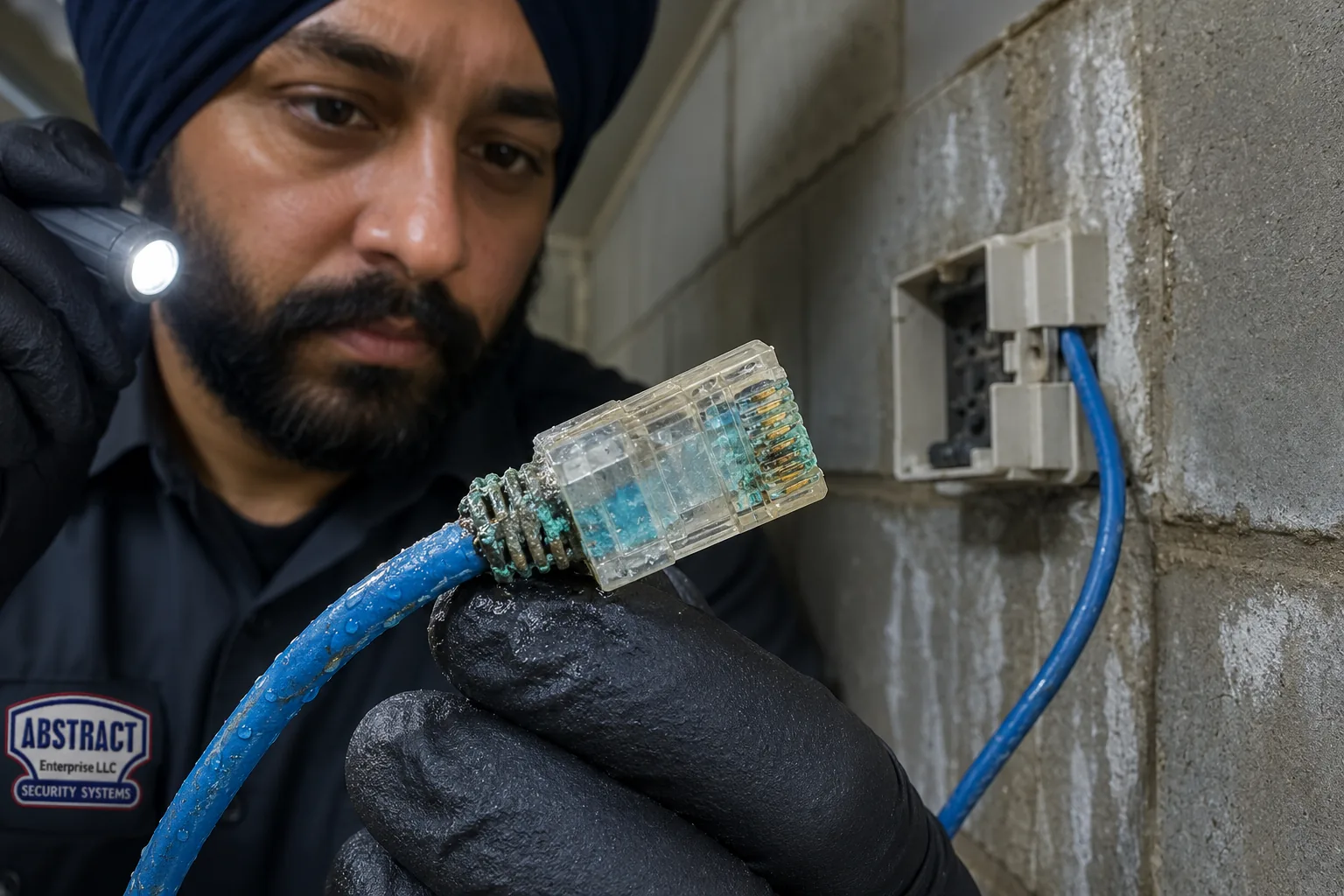
MPOE and building telecom spaces at or below street level take humidity and occasional water. Terminations corrode long before jackets do, producing slow degradation rather than a clean failure.
Cross-sell note: a suite showing any of the above almost always has camera and door-entry cabling on the same pathways. When a ceiling is open for a data repair, testing the camera drops and intercom runs in the same bundle costs a fraction of a second after-hours visit.
From the Field
Field Notes
The first question on a Manhattan call is not what is broken, it is what the building allows. Daytime or freight window, COI limits, badge process, who signs for access. Getting that in the booking is the difference between a three-hour visit and two trips.
Order of operations at the outlet never changes. Patch cord, then a known-good device on the same jack, then the same device on a known-good jack. Only then does the faceplate come off. The cord is free to rule out and it is the culprit more often than anyone expects.
Behind the plate the findings repeat: too much untwist at the punch-down, conductors seated but not driven through the contacts, one end punched to a different standard than the other, and cable kinked behind a jack forced into a shallow prewar box. All four survive a continuity beep.
Above the ceiling, look for whatever is newest. A recently added sprinkler head, a relocated diffuser, a new demising wall or a fresh lighting layout will usually be within a few feet of the damage. And in this borough, check the neighbouring suite's renovation schedule before you check anything else.
Get In Touch
Request a Free Quote
Fill out the form below and we'll get back to you within the hour. Or call us directly at (929) 560-0737.
✅
We Got Your Request!
We'll call you back within the hour. If it's urgent, call us now at (929) 560-0737.
Emergency
Need Repair in Manhattan Right Now?
Down network, dead POS lane, camera drops offline. Same-day where the building permits daytime access; next freight window where it does not. COI out ahead of arrival.
Last reviewed: August 25, 2026 · Next scheduled review: November 2026 Changelog: Aug 2026 — page published. Access economics and the tenant-versus-base-building lease line established as the primary Manhattan thesis; plenum and firestop guidance added; abandoned-cable tracing added to scope; pricing aligned to the $195/hr specialty rate with a three-hour minimum; direct Manhattan line (929) 560-0737 used throughout.