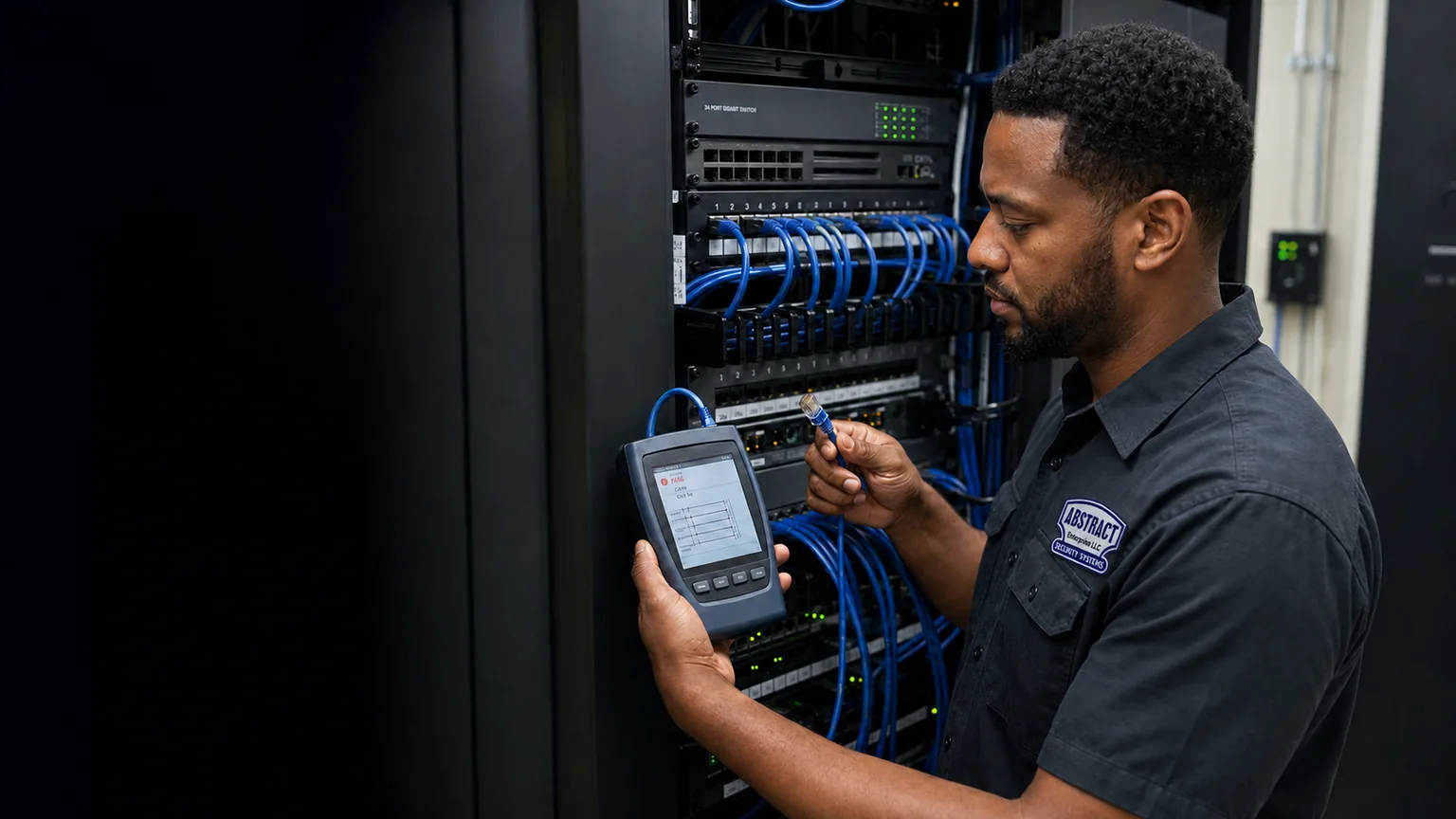
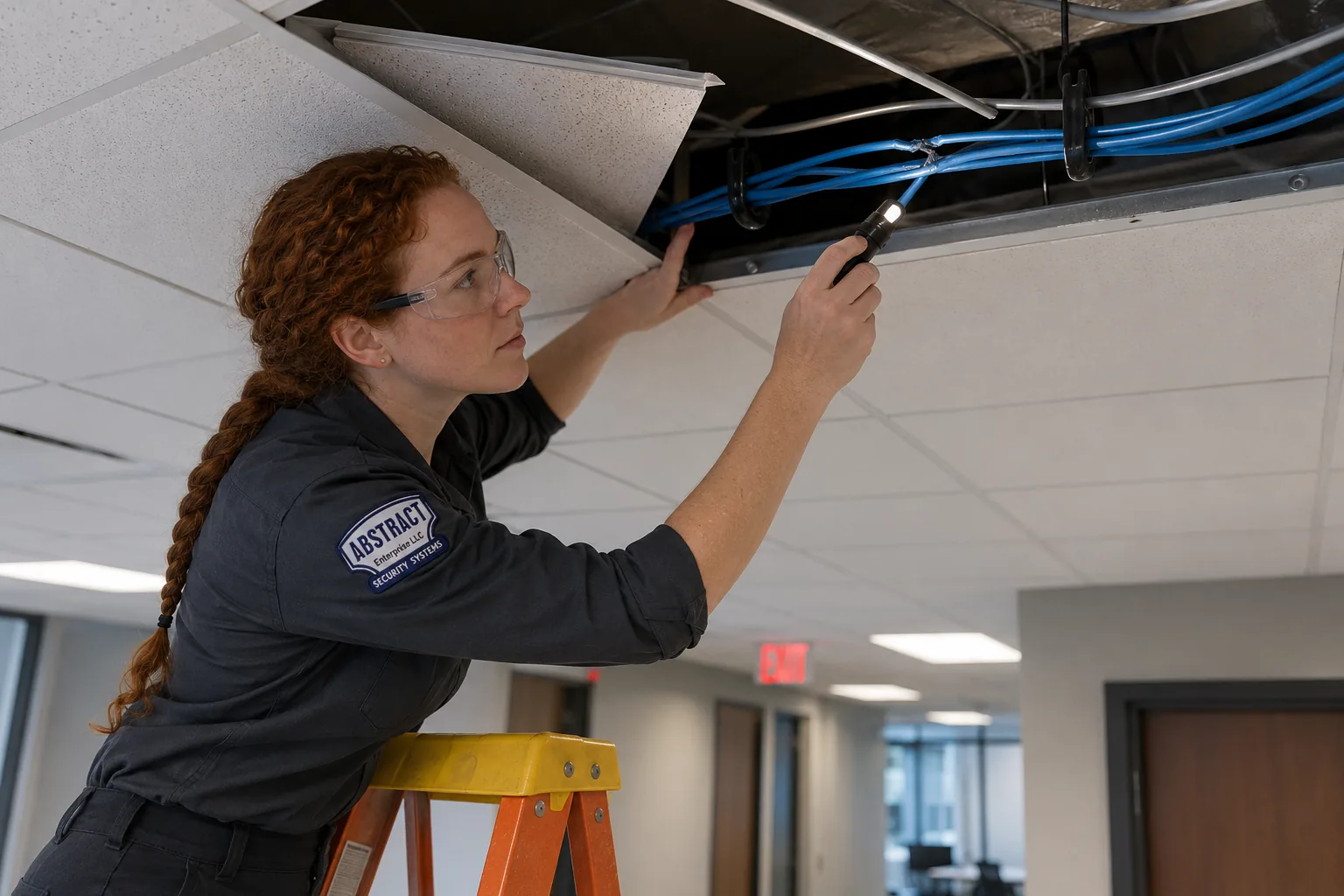
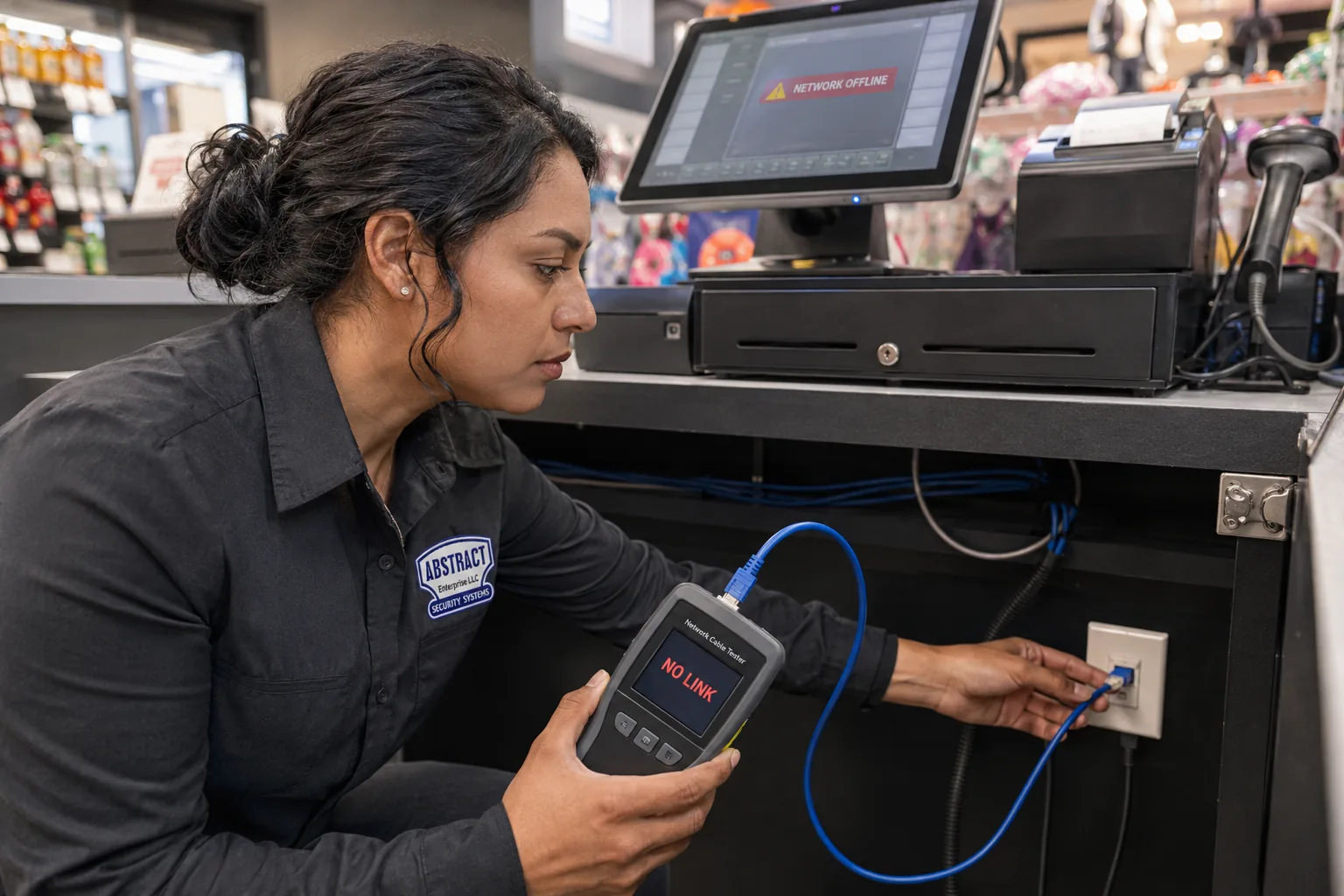
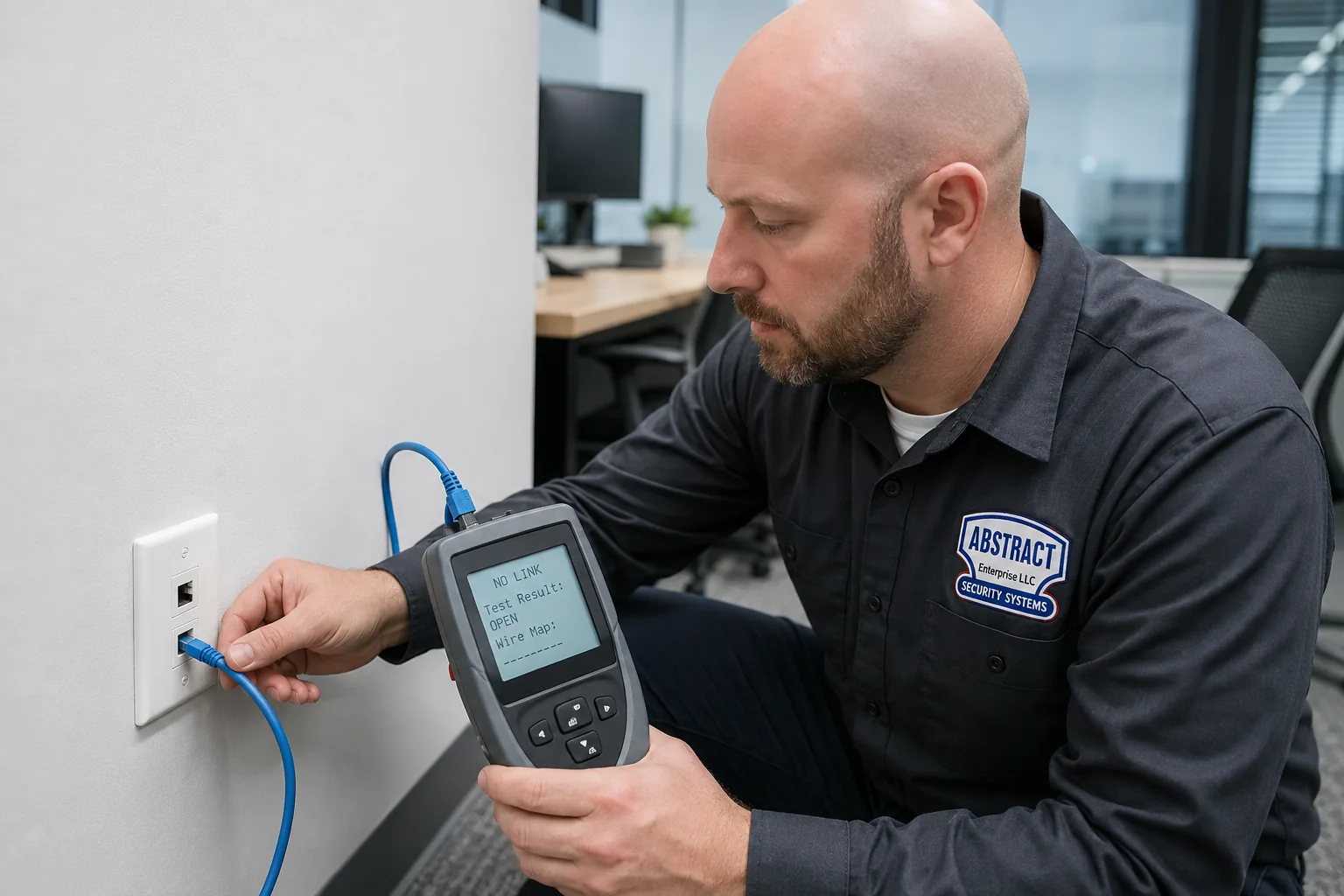
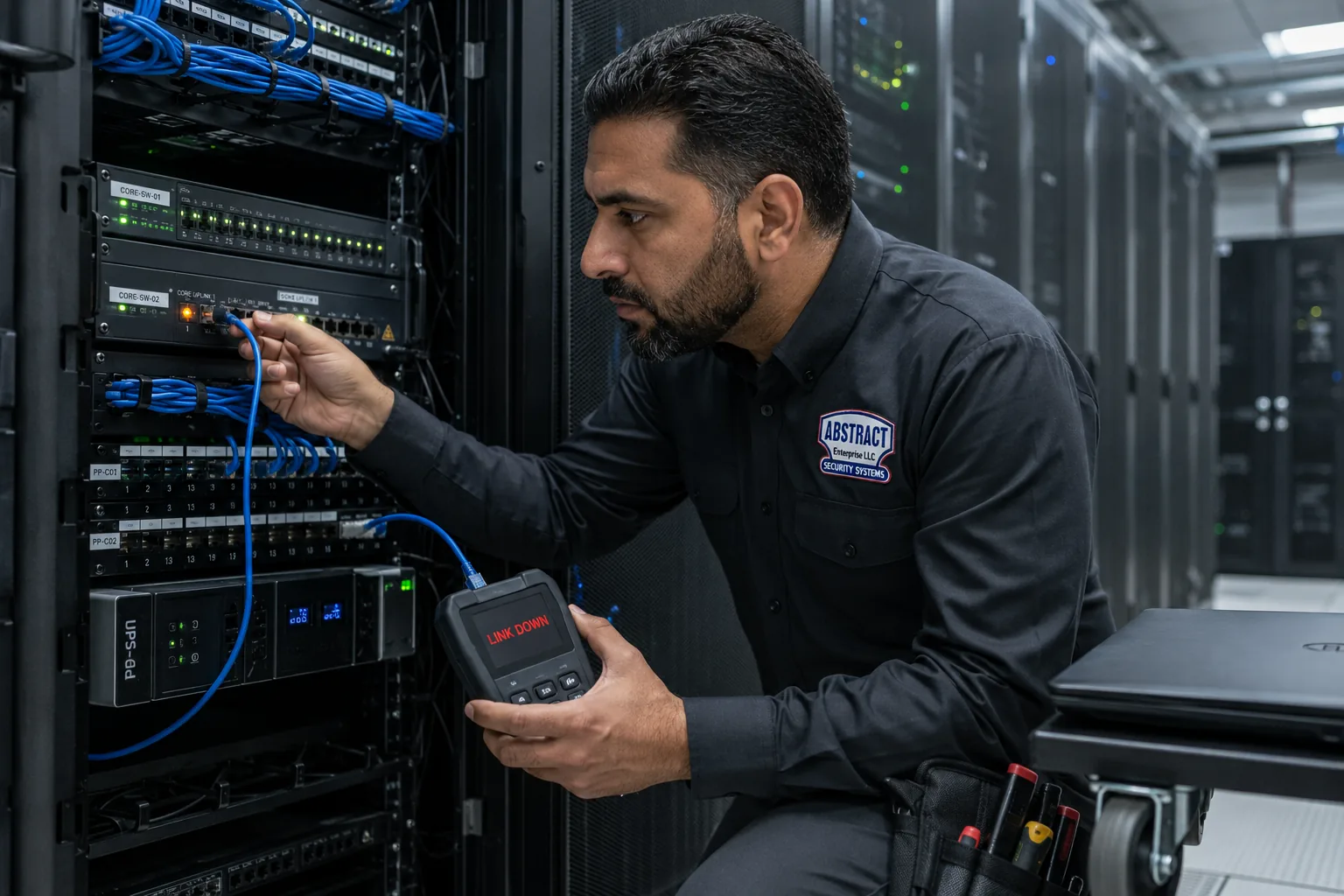
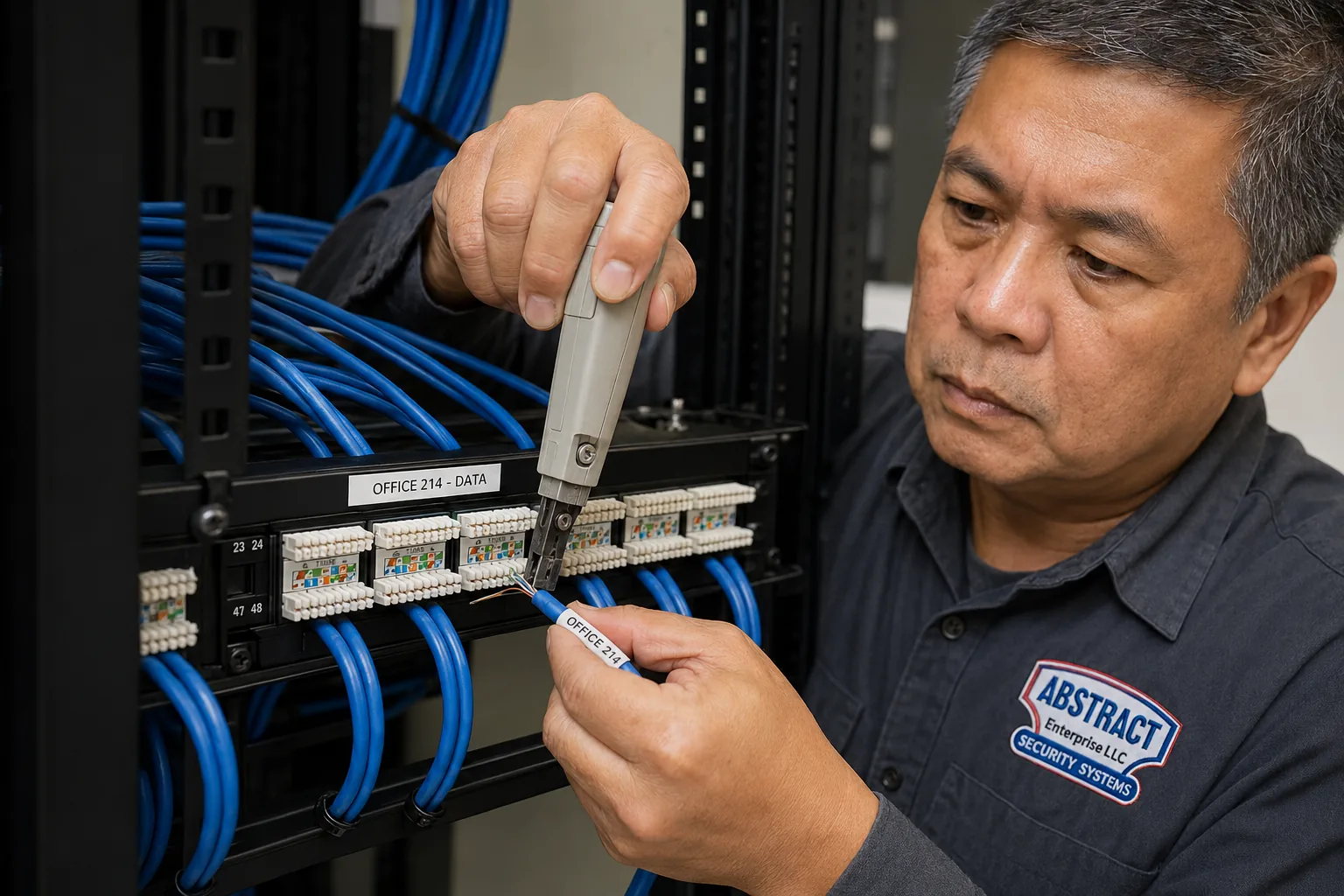
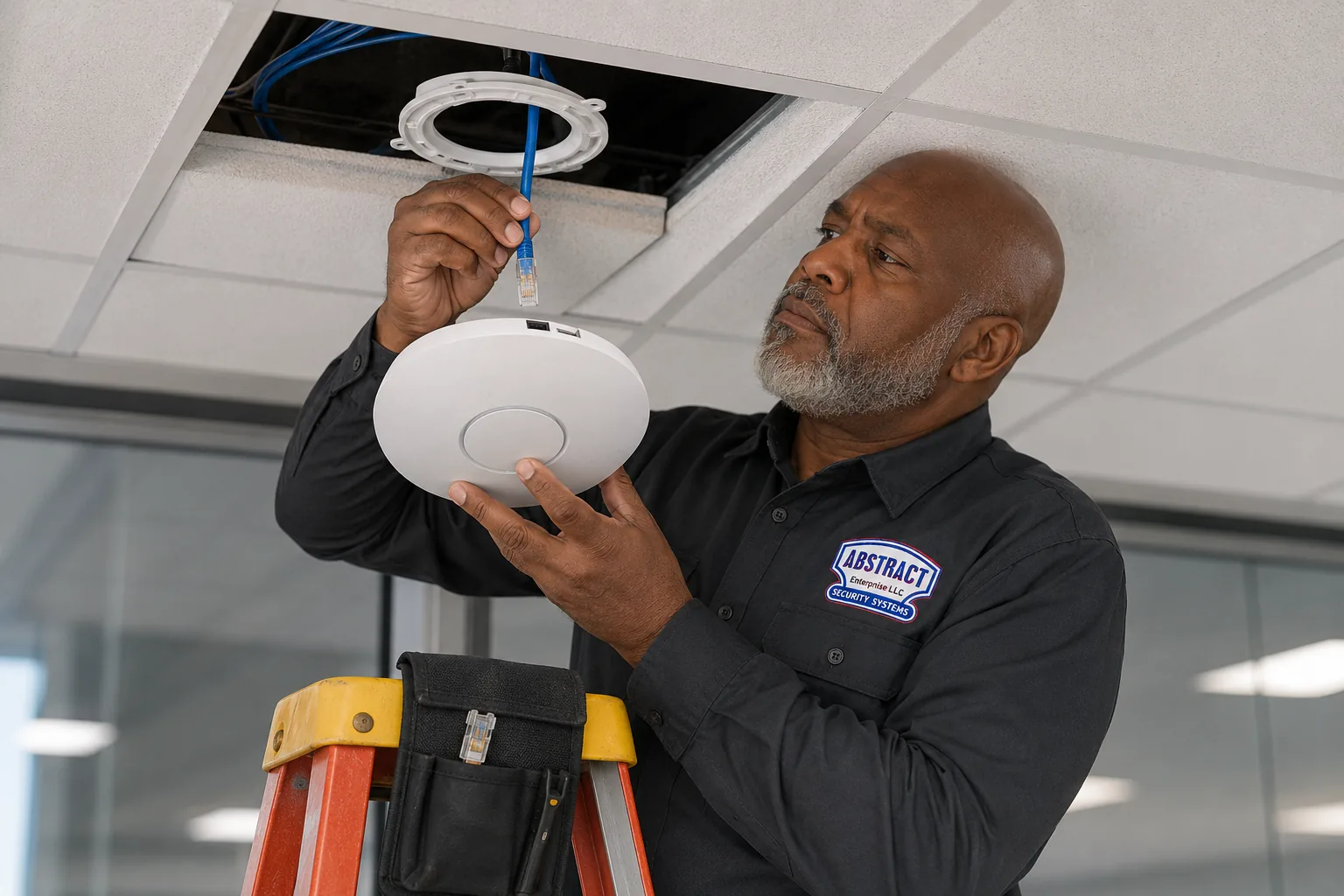
Fault location, retermination, network jack and patch panel repair, PoE troubleshooting and certified cable testing across the Bronx. Our Fordham Road office is in the borough. Every repaired drop tested and documented.
Ethernet, Cat6 and Data Jack Repair Across the Bronx
More Bronx cabling runs through hostile environments than in any other borough. Refrigerated rooms, wash-down food areas, truck yards, loading platforms, produce floors and open-air lots are ordinary workplaces here, and copper installed for an office does not survive them. Abstract Enterprises Security Systems repairs Ethernet, Cat6 and data cabling across the Bronx, working out of an office on Fordham Road rather than driving in from somewhere else.
The calls follow the work the borough does. A Hunts Point distributor whose scanner drops die at the cold-room door. A Bruckner Boulevard yard where the gate camera loses power every time it rains hard. A Mott Haven building whose cellar panel sat in six inches of water and nobody noticed until the links started drifting. A Grand Concourse professional suite in a 1930s building with no closet and no documentation. A Fordham Road retailer whose till cuts out on Saturday afternoons.
Repair runs at our specialty service rate of $195/hr with a three-hour minimum ($585), with the diagnostic kit on board from the first visit — distance-to-fault, tone and probe, wiremap and performance testing. In an operation that runs round the clock, an accurate first visit is worth far more than a cheap one that produces a quote and a return trip.
Network Down in the Bronx?
Same-day dispatch borough-wide from our Fordham Road office. For operations that never close we work the quiet end of the shift rather than asking you to stop. A single fault is normally traced and restored inside the opening three-hour block.
✔ NYS Lic. #12000287431✔ Certified wiremap & performance testing on every repair✔ 4.7★ from 201 reviews
Local Conditions
Why Bronx Cable Fails in Ways Office Cable Does Not
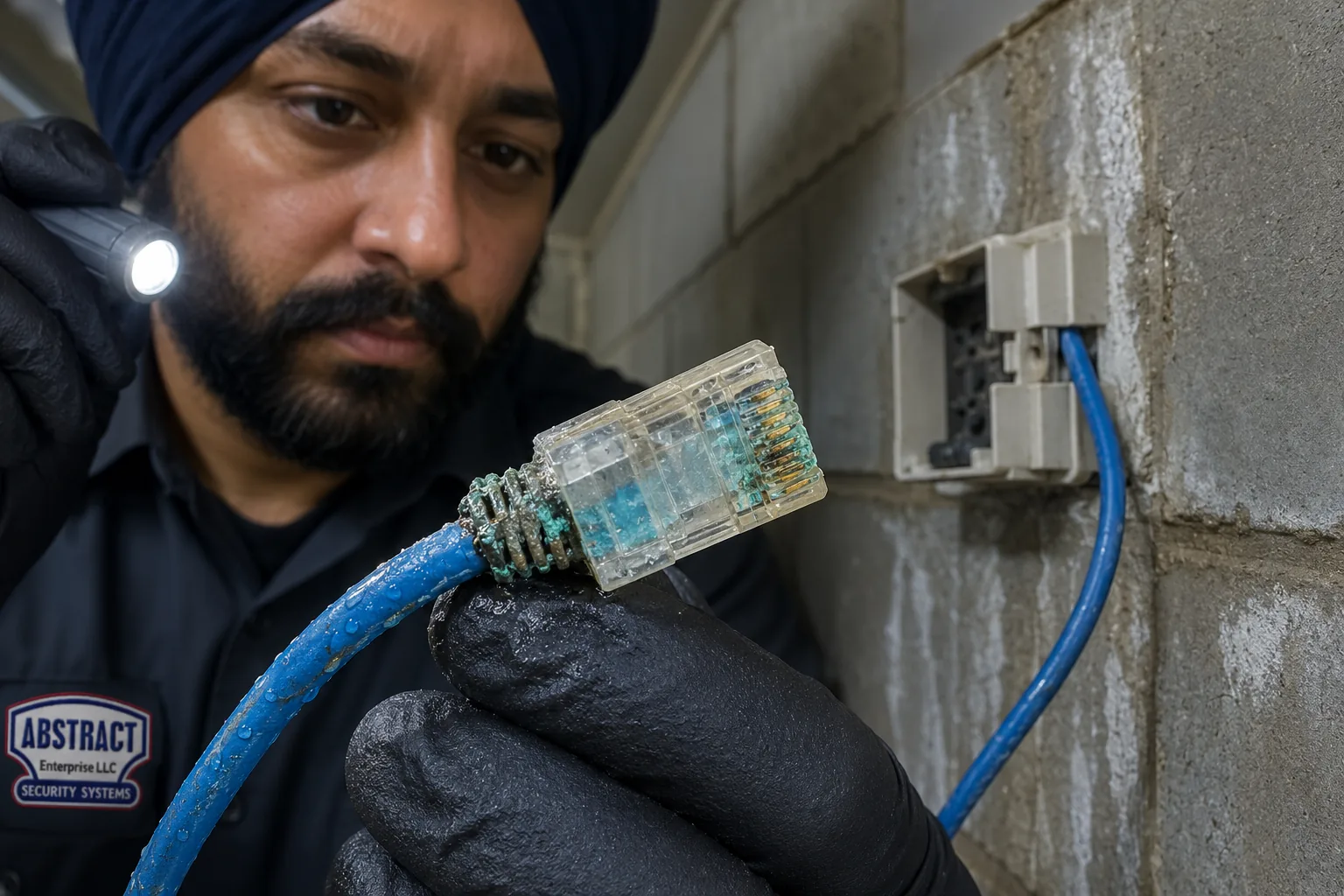
Start with temperature and moisture, because between them they account for most of what we repair here. Hunts Point alone holds one of the largest food distribution concentrations in the country, and its buildings contain cold rooms, freezer bays, produce floors that get hosed down and loading platforms open to the weather. Standard indoor cable put through a cold-room wall picks up condensation at the transition, wicks moisture along the jacket, and corrodes at the nearest termination. The link does not die; it drifts, which is why it is nearly always blamed on the carrier first.
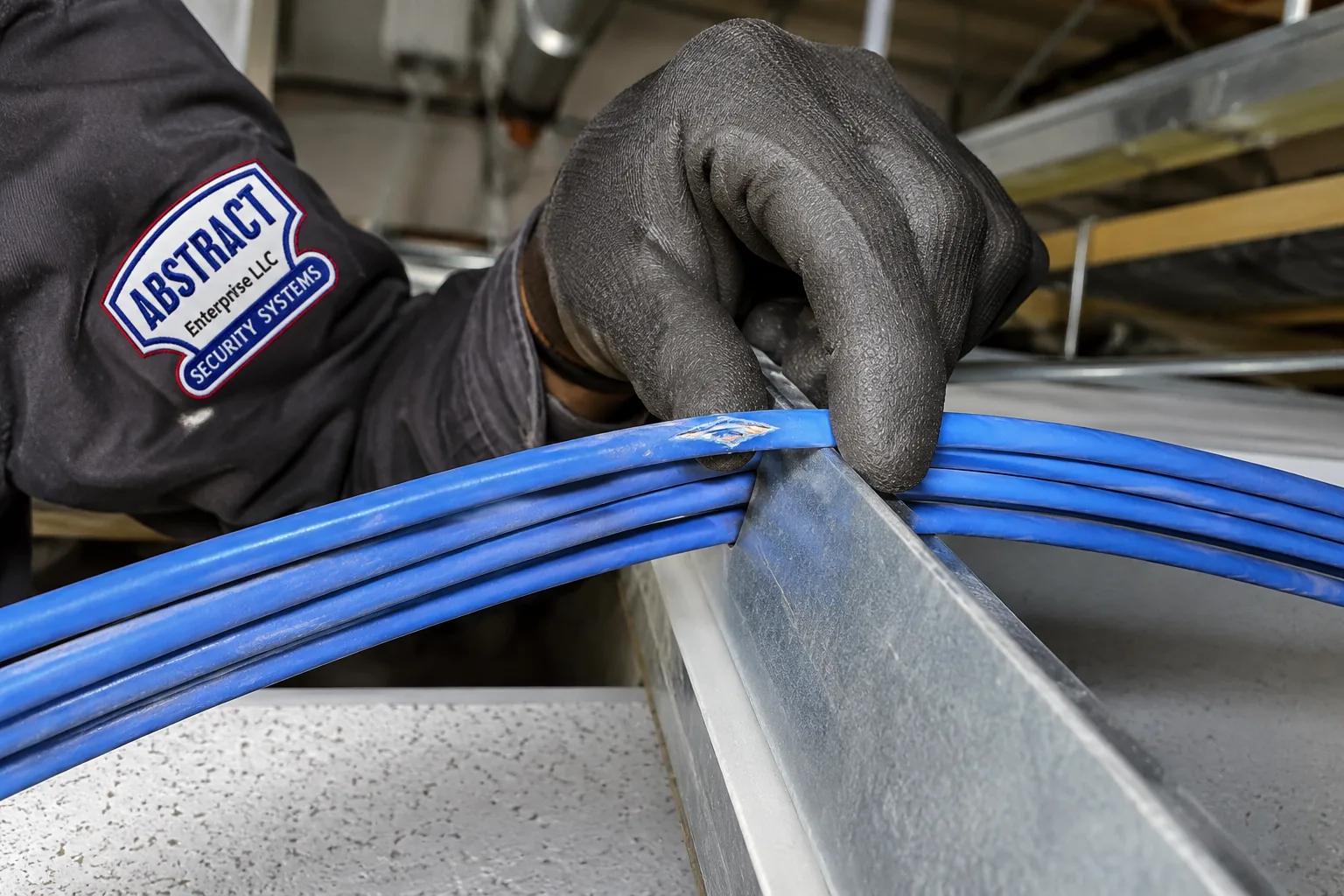
Second, the yard. A large share of Bronx commercial premises include an outdoor working area — truck parking, a scrap or materials yard, a gate, a weighbridge, a container. Cable reaching those points has to be rated for outdoors, entered through a sealed and bonded penetration, and protected where vehicles move. What we routinely find instead is indoor Cat5e stapled along a fence line, entering through a hole nobody sealed, feeding a camera that has been replaced three times because everyone assumed the camera was the problem.
Third, operations that never stop. Distribution, food, transport and healthcare do not have an after-hours window in the sense a Midtown office does — they have a quieter shift. That changes how a repair is planned rather than how it is performed: we work the low point of the cycle, isolate a zone at a time, and keep everything else running. A contractor who needs the building empty is a contractor who will never schedule this work.
Fourth, the residential-scale commercial stock. The Grand Concourse, Fordham Road, Third Avenue, Westchester Avenue and Southern Boulevard are lined with prewar buildings holding professional suites, clinics and retail above ground-floor shops. There is no floor closet. The equipment lives in a converted cupboard or a cellar corner, the panel is shared with the residential side of the building, and nothing has ever been labelled.
Fifth, cellars. The Bronx has a great deal of below-grade telecom space, and low-lying stretches near the Harlem and Bronx Rivers, Hunts Point and the Soundview waterfront take water. A panel that has been wet even once has terminations that will corrode for years afterward, and the resulting decline is slow enough that nobody connects it to the flood.
What We Repair
What a Bronx Cable Repair Call Covers
We repair the physical layer, harden it against the environment that broke it, and prove the result with a test.
Cold Room and Transition Repair
Runs crossing into refrigerated or freezer space, where condensation at the transition corrodes terminations and wicks moisture into the jacket. Repaired with rated cable, a sealed transition and a re-terminated end.
Yard and Exterior Run Repair
Gate, weighbridge, container and truck-parking drops. Outdoor-rated cable, sealed and bonded entries, and protection where vehicles or plant move.
Wash-Down Area Repair
Food-floor and processing runs exposed to hosing and cleaning chemicals. Enclosures and terminations that survive the routine rather than the average day.
Ethernet Cable Repair
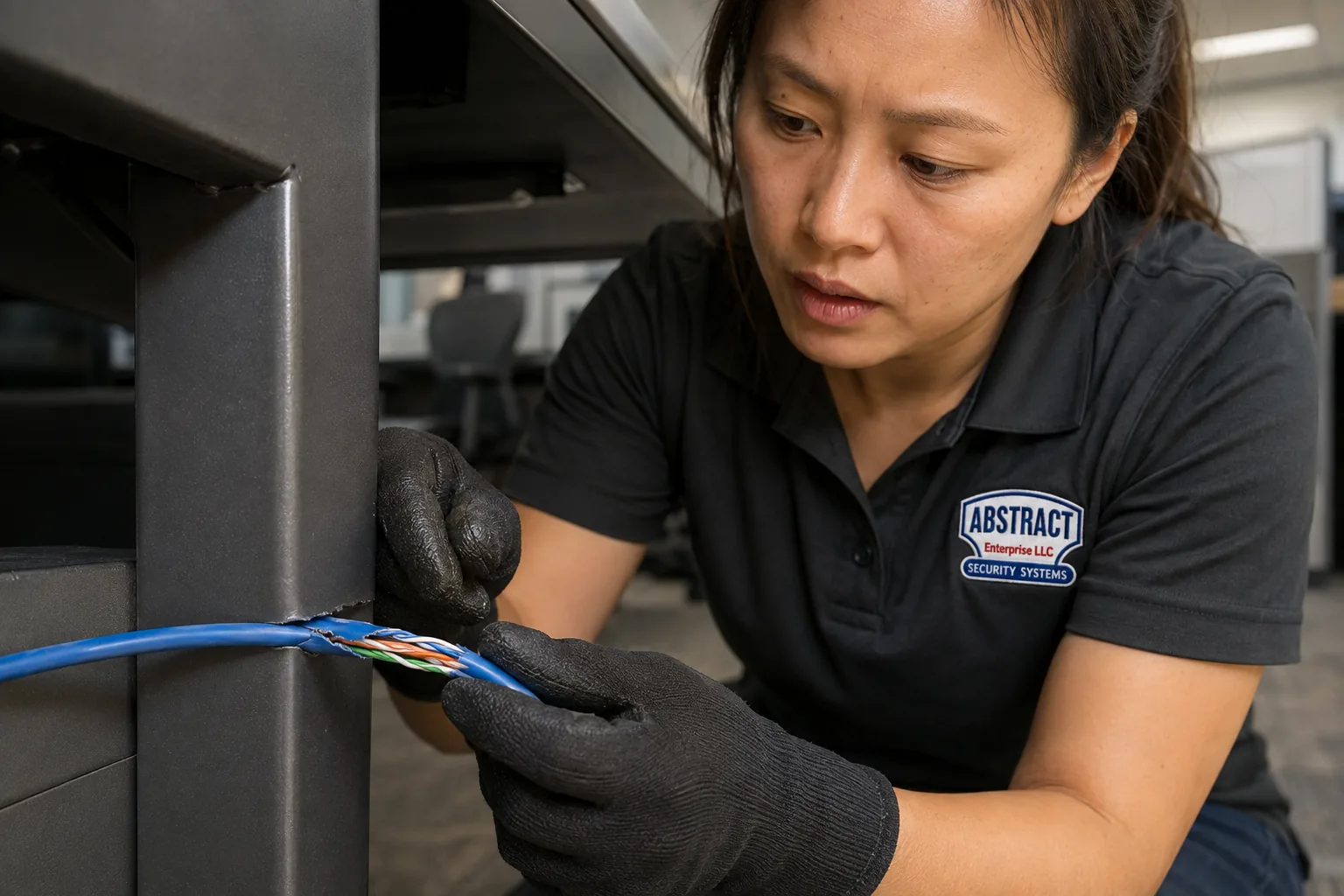
Cut, crushed, corroded or chewed runs restored with a category-appropriate junction and re-tested to spec.
Cat6 and Cat6A Retermination
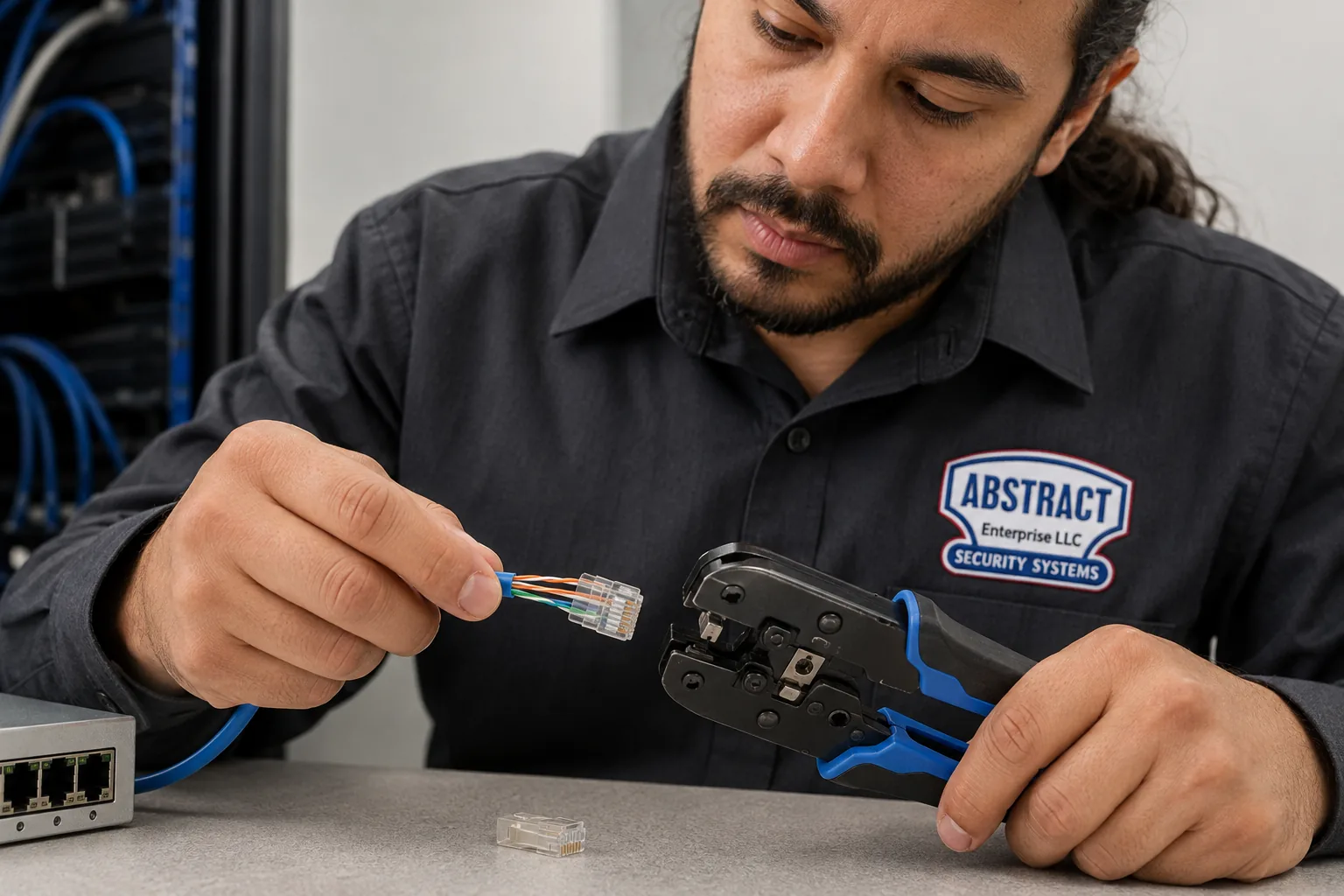
Both ends redone to T568B with the twist held to the contact, so the finished channel certifies rather than merely showing a link light.
Network Jack and Panel Repair
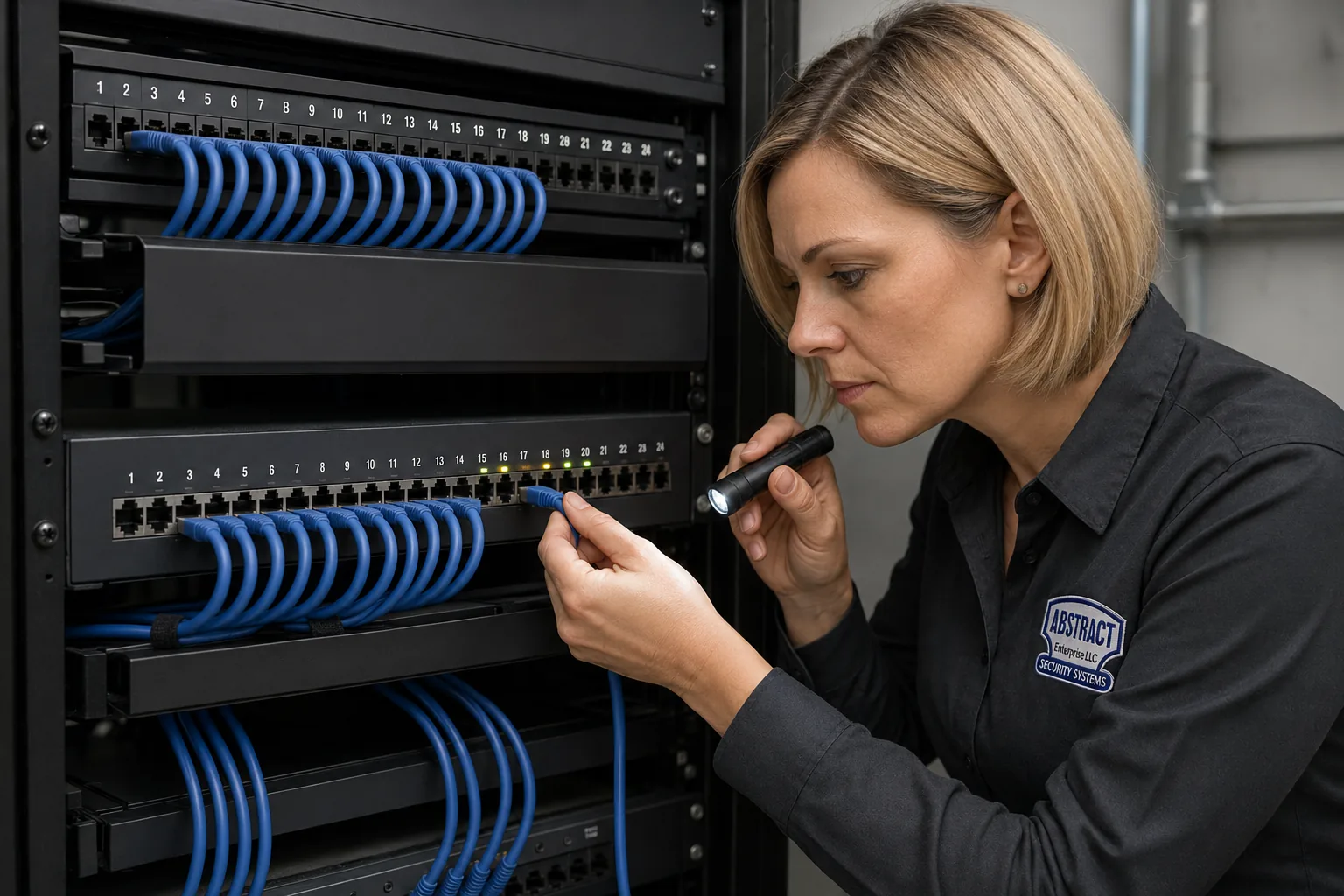
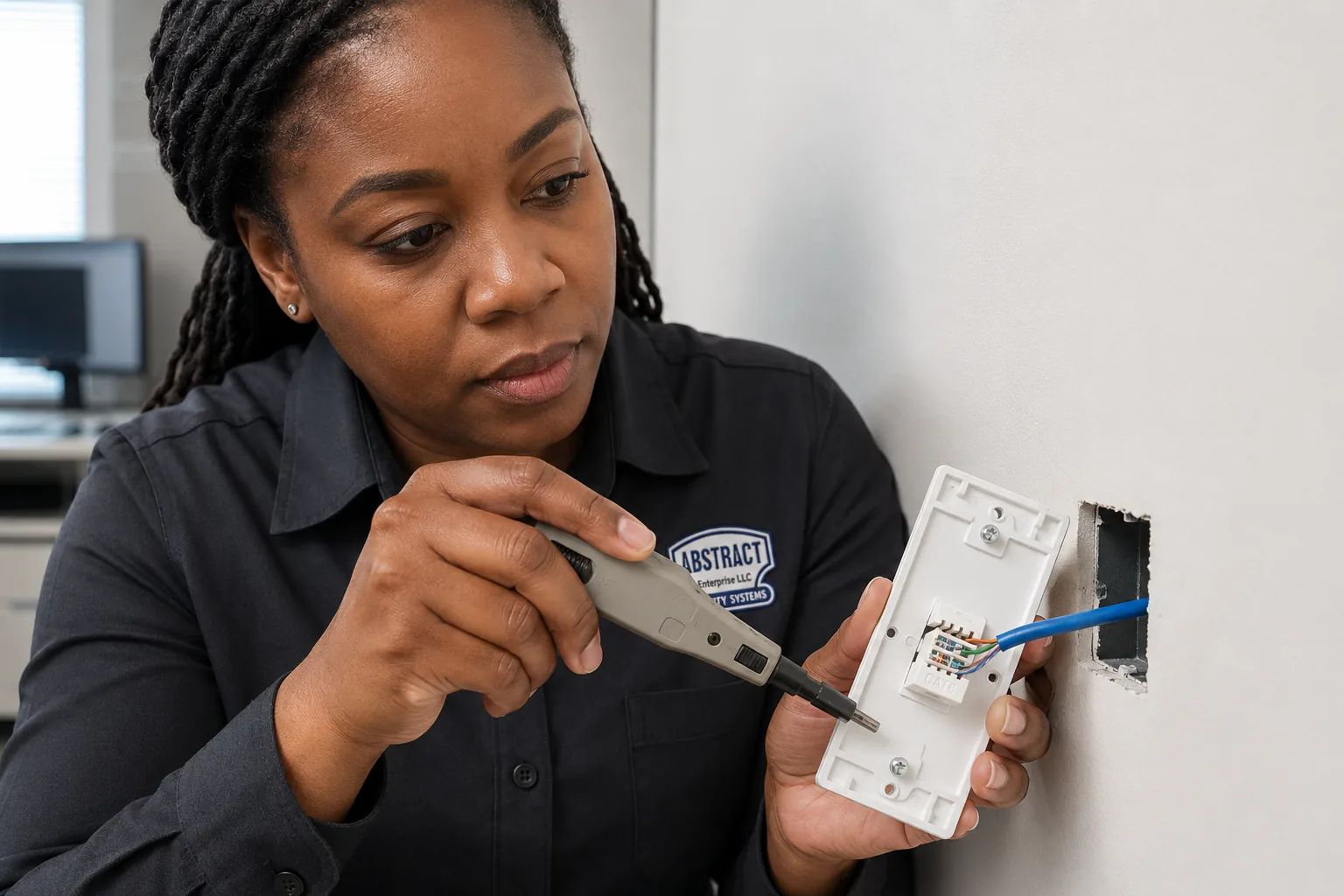
Dead outlets, keystones seated but never punched through, panel ports terminated to the opposite standard, and panels that have been wet.
Shared Cellar Panel Tracing
Identifying your runs inside a below-grade panel shared with a building's residential side, then labelling both ends.
Certified Testing
Wiremap, length and performance verification with saved reports including margin, so you know which drops are close to the edge.
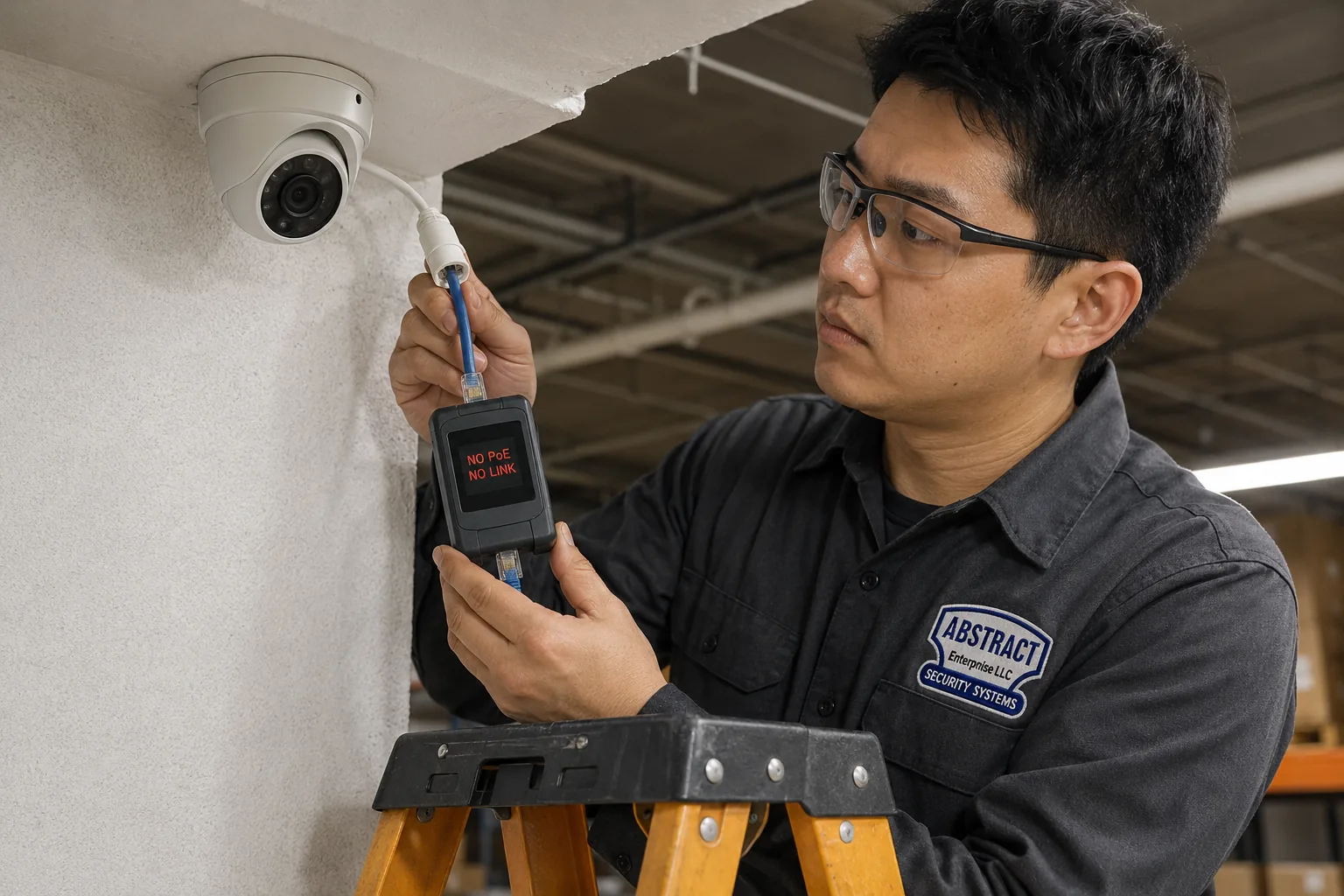
PoE Circuit Troubleshooting
Yard cameras and gate readers cycling whenever a heater or illuminator draws power. A meter goes on the device while it is running to settle it.
Commonly paired: yards, gates and loading platforms carry camera and reader drops on the same route as the data. If one run has failed to weather or vehicle damage, the rest of that route is worth testing while access is open — see camera repair and access control.
Plain English
Terms That Come Up on a Bronx Cabling Job
Three of these matter more here than anywhere else in the city: outdoor rating, bonding and the transition.
Term
What It Means on a Bronx Job
Outdoor-rated cable
Jacket built for sunlight, water and temperature swing. Indoor cable run to a gate or a yard camera will work for a season or two and then fail slowly and permanently.
Direct burial
Cable specified to sit in the ground, or ordinary cable inside conduit that is. Neither is what we usually find under a Bronx yard.
Bonding at entry
Tying the shield or the protection device to building ground where cable comes in from outside. Its absence is the reason exterior camera runs keep destroying switch ports.
Transition
The point where a run crosses from warm space into cold. Condensation forms here, which is why the failure is at the transition rather than in the middle of the freezer.
Wicking
Moisture travelling along the inside of a jacket from a wet point to a dry termination. It explains faults that appear metres away from the water.
Split pair
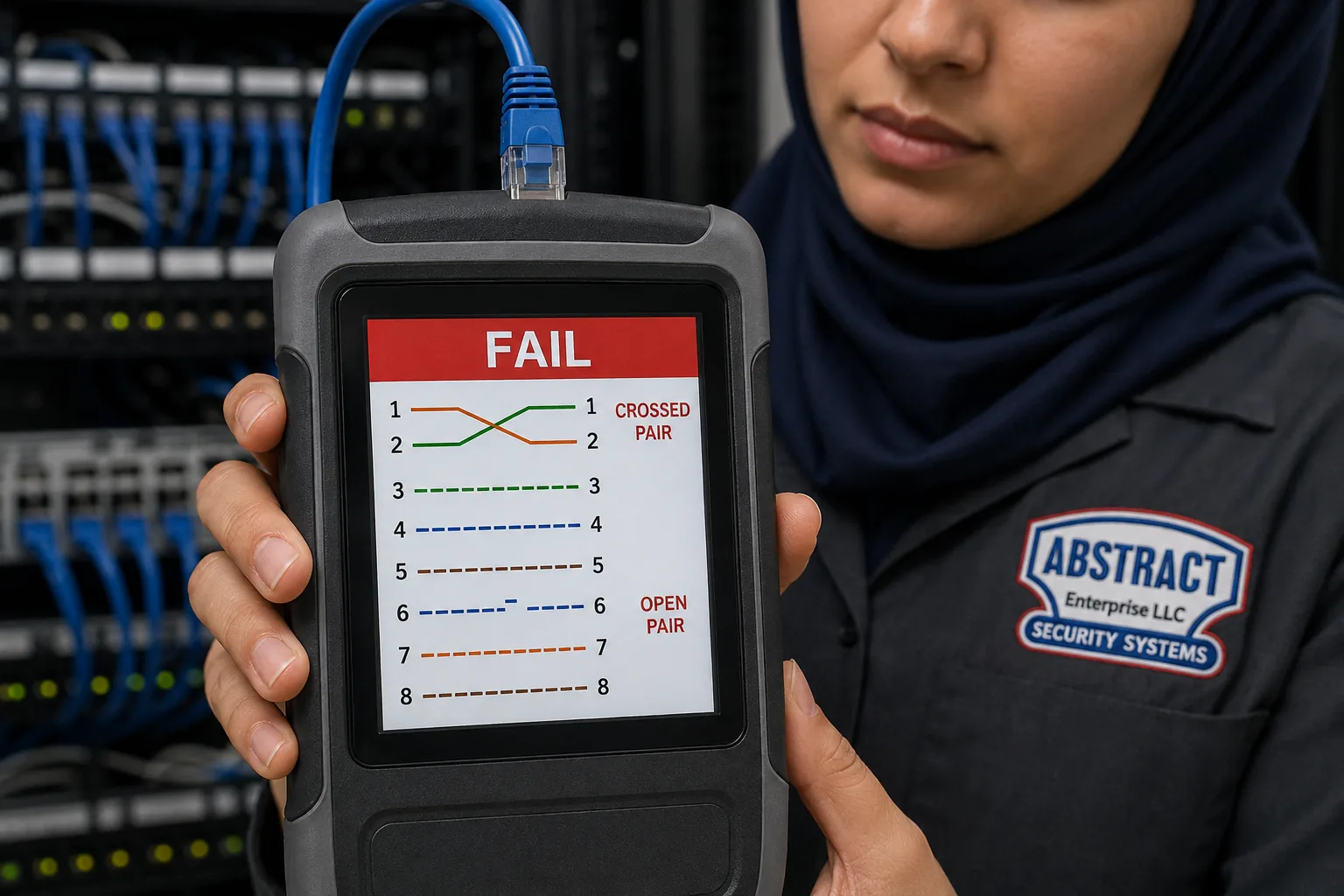
Every conductor connected, the pairing wrong. The port trains at 100 and will not do gigabit, so it is reported as slowness.
Certification
A recorded measurement against the category standard with the headroom noted. A tone and a beep is not this.
Insertion loss
Signal lost along the run. It climbs as temperature rises, which is why a marginal drop in an unconditioned space fails in August and passes in March.
Shared cellar panel
The below-grade panel serving both the commercial and residential sides of a building. Common on the Concourse and the avenue corridors.
Demarc
The limit of the carrier's obligation. Everything on the building side belongs to the owner or the tenant, and that is where we start.
Equipment
Hardware and Test Equipment on a Bronx Repair
We repair what is in the building and replace with commercial-grade parts matched to the existing channel — Belden, CommScope, Panduit, Leviton, Hubbell, Ortronics, ICC, Berk-Tek and Superior Essex on the passive side, with outdoor-rated cable, gel-filled or industrial jacks and sealed enclosures wherever a run leaves conditioned space. Category matching decides the result: put a Cat5e keystone on a Cat6 channel and the whole channel drops to Cat5e no matter what is in the wall.
On the equipment side we chase cable-side faults behind Cisco, Meraki, Aruba, Ubiquiti UniFi, Netgear, TP-Link, Luxul and Araknis switching, and behind PoE devices — yard and dock cameras, radios, handsets, badge readers, scales and time clocks. Configuration is not ours: no switch administration, no VLANs, no controllers, no firewall policy. We certify the channel and give the results to whoever runs the network.
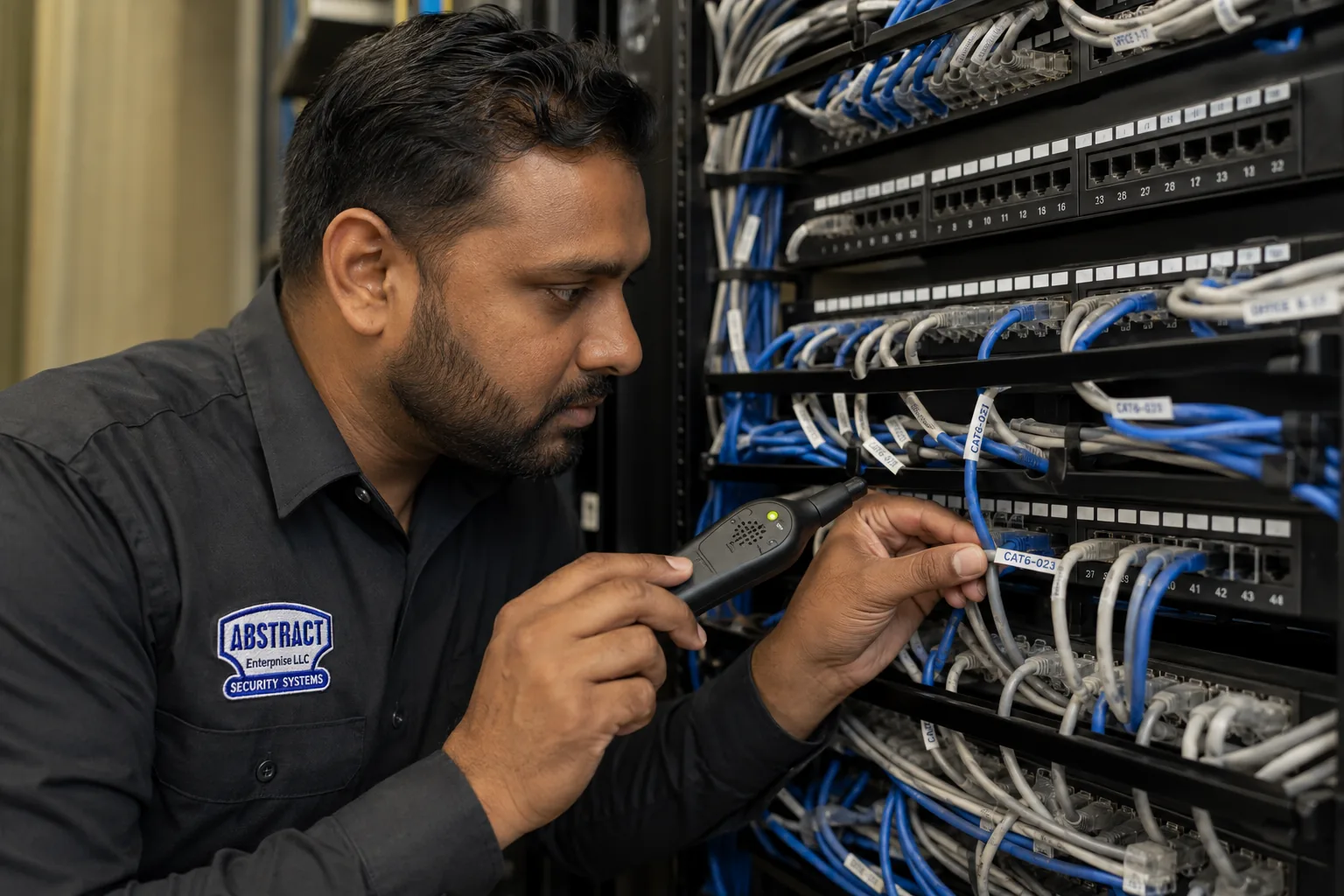
The diagnostics are what make a hostile-environment call solvable. Certification testers with saved reports, tone generators and probes for below-grade shared panels, and PoE measurement at the endpoint under genuine draw. On a yard run in the rain, measuring at the device is the only honest way to tell a cable fault from a failing camera.
Need Repair in the Bronx Today?
Same-day dispatch from Fordham Road. For round-the-clock operations we work the quiet end of the shift and isolate one zone at a time rather than asking you to stop.
In this borough a repair that ignores the environment is a repair with a season attached to it.
Locating comes first — which element, at what distance, on which pair, and on which side of a cold or wet transition. Then the physical work: retermination, junction, jack or panel replacement, or a fresh run where the certifier says the cable is finished. Then the measurement, with the headroom figure handed to you rather than filed, because a channel that only just passes in a space that swings thirty degrees is a call you will make again in July.
The step that belongs to the Bronx is hardening. If a run failed because indoor cable was taken into a freezer bay, or because an unsealed penetration let water into a yard entry, then replacing like with like guarantees the same failure. We change the cable specification, seal and bond the entry, and protect the route where plant moves. That conversation is short and every operations manager we have had it with has understood it immediately.
Full Scope
Full Scope of a Bronx Network Cable Repair
Diagnostics
Fault location by measured distance on broken or shorted runs
Wiremap faults: opens, shorts, reversals, split and crossed pairs
Measured length against the 90 m and 100 m limits
Insertion loss and crosstalk with headroom reported
Moisture and corrosion inspection at terminations and entries
PoE measurement at the endpoint under real draw
Tone-and-probe tracing in shared below-grade panels
Switch-port versus cable-fault isolation
Physical Repair
Keystone and patch panel retermination
Category-appropriate junction repair on damaged runs
Replacement with outdoor-rated or industrial cable where the route demands it
Saved test results per repaired drop, with headroom
Both-end labelling and a panel or closet legend
Photo record of entries, transitions and concealed repairs
Written findings for an owner, operations manager or IT provider
Identification of your runs inside a shared cellar panel
Site Logistics
Certificate of insurance where the site requires it
Quiet-shift and overnight working for 24-hour operations
Zone-at-a-time isolation so the rest of the site keeps trading
Coordination with dock and yard supervisors
Plenum-rated material where a ceiling handles return air
Coordination with your existing IT provider
Coverage Detail
Where We Work Across the Bronx
The south and the waterfront carry the industrial load. Hunts Point holds the food distribution market and the businesses around it, with Bruckner Boulevard, Oak Point and the Sheridan corridor feeding it. Mott Haven and Port Morris have converted industrial and light manufacturing alongside newer development on Bruckner and along the Harlem River. Melrose and Morrisania sit above them with retail and clinic space on Third Avenue and 149th Street.
The central spine runs the Grand Concourse from the Hub north through Highbridge, Mount Eden, Fordham and Norwood — prewar buildings with professional suites, medical practices and ground-floor retail. Fordham Road and Belmont form the borough's densest shopping corridor, with our own office at 460 East Fordham Road, and the institutional cluster of Fordham University, the Botanical Garden, the Zoo and the Montefiore and St. Barnabas campuses nearby. Kingsbridge, Riverdale, Marble Hill and Van Cortlandt sit to the west with professional and medical office in smaller buildings.
The east covers Soundview, Castle Hill, Parkchester, Westchester Square, Throggs Neck, Country Club, Pelham Bay, City Island and Co-op City. This is where you find auto and marine trades, yards, marinas, small industrial premises and neighbourhood retail on Westchester Avenue, East Tremont and City Island Avenue — plus real coastal exposure on the eastern shoreline.
Who We Serve
Bronx Industries We Repair Cabling For
Food Distribution and Cold Chain
Hunts Point and the surrounding trade. Cold-room transitions, wash-down floors, dock scanners and temperature monitoring that cannot be allowed to lapse.
Warehousing and Logistics
Bruckner, Oak Point, Port Morris. Long runs, forklift and racking damage, yard cameras and gate equipment.
Transport, Auto and Marine Trades
Throggs Neck, Hunts Point, City Island. Service bays, yards, weighbridges and exterior drops taking weather and mechanical abuse.
Medical and Clinical
The Montefiore, St. Barnabas and Jacobi orbits plus clinics along the Concourse and Fordham Road. Uptime-sensitive and documentation-conscious.
Retail Corridors
Fordham Road, Third Avenue, Westchester Avenue, East Tremont, 149th Street. Tills cutting out at peak and stockroom runs damaged during shelving work.
Restaurants and Food Service
Kitchen terminals in heat and grease, cable damaged during hood cleaning, and repair windows outside service.
Prewar Professional Suites
Concourse and avenue buildings with no closet, a cellar panel shared with the residential side, and nothing labelled.
Schools, Nonprofits and Community Facilities
Layered infrastructure, documentation requirements, and windows outside programme hours.
Apartment and Mixed-Use Buildings
Cellar and hallway panels feeding cameras, intercom controllers and readers, with runs damaged during renovation.
Real Questions
Fourteen Questions Bronx Operators Actually Ask
Drawn from the recurring themes in trade, IT and Bronx-local discussion threads, grouped by the six question types that come up most.
Cost Questions
1. What does a repair cost here?
The specialty service rate is $195 an hour with a three-hour minimum, so the opening block is $585. Inside it: finding the fault, fixing it, certifying it and writing it up. A run that has to be pulled fresh is priced from $175 per commercial Cat6 drop. Nothing is added for a call-out on top of that.
2. Why does the quote specify different cable than what is there now?
Because the cable that is there is the reason you are calling. Indoor-rated copper taken into a freezer bay or out to a gate will fail again on the same schedule. Swapping to a jacket built for the conditions costs a modest amount more per foot and it is the entire difference between a repair and an annual appointment.
3. Do overnight or weekend hours cost extra?
The labour rate does not move. On operations that never fully close we work the quiet part of the cycle by default rather than treating it as special, because that is simply when the work is possible.
Quality and Trust Questions
4. How do I show my operations manager the fix is sound?
With the measurement. Each repaired drop comes back with a saved result: pass or fail, distance, and how much headroom is left. A link light says a device negotiated once. A report with headroom on it tells you whether the drop survives the summer.
5. Do I need a licensed contractor for cabling?
For anything past a patch cord, yes. Cabling is low-voltage work carrying real obligations on jacket rating and firestopping, and any site with insurance requirements will want a licence number before a van is let through the gate. Ours is NYS Low-Voltage #12000287431.
6. Are you actually based in the Bronx?
Yes, at 460 East Fordham Road. That matters mainly for response — it is a short run to Hunts Point, the Concourse or Throggs Neck, which is why same-day slots are straightforward for us in this borough.
DIY and Pro Questions
7. Can we run a cable out to the yard camera ourselves?
Physically yes, and it is one of the most expensive shortcuts available. Indoor cable outdoors degrades in a season or two, an unsealed entry lets water follow the jacket inside, and an unbonded entry hands surge energy straight to a switch port. The camera then gets replaced repeatedly while the actual fault sits in the run.
8. Is the tester from the supply house any use?
For pin order, yes. Beyond that it reports nothing — no distance, no signal loss, no pair interference, no headroom. On a corroded or over-length run it will happily pass a channel that is failing in every way that matters.
9. Can we just dry out a panel that got wet?
Drying it is worth doing and it will not fix it. Once water has been in a termination, corrosion continues on the contacts long after the surface looks fine, and the decline is slow enough that nobody links it back to the flooding. Wet terminations get redone, not dried.
Technical Questions
10. Why does the fault sit at the cold-room door rather than inside it?
Because that is where the air changes temperature and condensation forms. Moisture collects at the transition, wicks along the jacket, and attacks the nearest termination. The freezer interior is often drier than the doorway, which is why the failure point surprises people.
11. A yard camera reboots whenever it rains hard. Cable or camera?
Almost always the entry. Water tracking into an unsealed penetration or an unrated jacket changes what the run does electrically, and the device restarts. Measuring voltage at the camera under load while it is wet settles it in minutes.
12. One port sits at 100 Mbps while everything else does gigabit. What is that?
A pair has failed or been miswired. The older signalling only needs two pairs so the link comes up cheerfully; gigabit needs all four and either refuses or negotiates and drops straight back. It is the clearest free diagnostic available to you.
Landlord and Tenant Questions
13. Our suite is on the Concourse and the panel is in the cellar with the building's own gear. Who owns what?
Usually the building owns the panel and the path to it and you own the run from there into your space, though small commercial leases here are often vague on the point. What is never vague is the physical evidence, so we locate the fault, document it, and let that settle the conversation.
Complaint Questions
14. We have replaced this same yard run twice. Why does it keep going?
Because the specification, not the cable, is what failed. If indoor-rated copper is being used outdoors, or the entry is unsealed, or nothing is bonded at the wall, every replacement inherits the original fault. The third visit should be a change of materials and entry detail, not another identical run.
Answer The Public
Answer The Public: Bronx Network Cable Questions
Who repairs network cable in the Bronx?
Licensed low-voltage contractors. Electricians cover conduit, pathway and line voltage and usually pass the data ends along; IT firms own the network above the copper and seldom carry a certifier. A dead run in a Hunts Point cold room is cabling work.
What causes cabling to fail in Bronx buildings?
Condensation and corrosion at cold-room transitions, weather and unsealed entries on yard runs, water in below-grade panels, mechanical damage from forklifts and vehicles, terminations executed without untwist discipline, and legacy Cat5e carrying modern PoE loads.
When should a run be replaced instead of repaired?
When it will not certify after both ends are redone, when it has been damaged in several places, when the measured distance is out of spec, or — the common one here — when the cable specification was wrong for the environment from the day it went in.
Where do faults sit in this borough?
At terminations first, then at every boundary: the cold-room doorway, the wall where cable leaves for the yard, the cellar panel that has been wet, and the point where a route crosses somewhere vehicles or pallets move.
How quickly can a Bronx repair be scheduled?
Same day across the borough from our Fordham Road office. For sites that run continuously we plan around the quiet part of the cycle rather than asking for a shutdown.
Reality Check
AI Overview Reality Check: What Search Results Miss About Bronx Cabling
Search for network cable repair in the Bronx and you get a national cost average, lead-generation directories, and troubleshooting advice written for a heated, dry office with a drop ceiling. A great deal of Bronx commercial space is none of those things.
1. Published Advice Assumes Conditioned Space and Most of This Borough Is Not
Almost every cabling article online is written from inside a climate-controlled office. Cold rooms, freezer bays, hosed-down production floors, open loading platforms and truck yards do not feature, and they are ordinary Bronx workplaces.
That omission matters because the failure mechanism changes completely. In an office, cable fails from bad terminations and physical damage. In a food or logistics building it fails from condensation at temperature boundaries, from moisture wicking along a jacket, and from corrosion that takes months to show.
The practical consequence is that generic troubleshooting sends people to the switch, the router and the carrier, while the actual fault sits at a doorway where warm air meets cold air.
2. Nothing Online Warns You About the Yard Entry
Where cable leaves a building for a gate, a weighbridge, a container or a camera on a pole, three things have to be right: an outdoor-rated jacket, a sealed penetration, and a bonded entry. Consumer-facing content mentions none of them.
Get any one wrong and the symptom is a device that fails repeatedly while testing fine on the bench. Sites replace the same camera three or four times before anybody suspects the run, because the equipment is the visible part and the cable is not.
It also produces damage beyond the cable itself. An unbonded exterior entry is a path for surge energy into a switch port, which is how a rainstorm turns into a hardware bill.
3. Cost Averages Assume a Building That Can Close
Aggregated cost pages blend residential and light-commercial work and quietly assume the job happens in business hours in an empty room.
A large share of Bronx commercial premises run continuously or close to it. The work has to be planned around the quiet part of a cycle, zone by zone, with the rest of the operation still running. That is a scheduling discipline rather than a premium, and it does not appear in any national figure.
Those pages also merge new installation with repair. Installation can be scoped before the van leaves; repair cannot, since the fault must be found first. That is why repair carries an hourly rate with a floor rather than a per-drop price.
4. “Water Damage” Is Treated as an Event Rather Than a Slow Process
National content frames moisture as a flood you would notice. In below-grade Bronx telecom space and in low-lying stretches near the rivers and the Sound, the usual pattern is far slower.
A panel gets wet once. It dries. Corrosion continues on the contacts for years, and the links degrade so gradually that the decline gets attributed to growing traffic, ageing equipment or the carrier — anything except the water somebody mopped up two winters ago.
The remedy is unglamorous and cheap by comparison: re-terminate what was wet, raise the equipment if the space allows it, and inspect on a schedule rather than waiting for a complaint.
5. Search Results Conflate Cabling With IT Support
A large share of results for network repair queries are managed IT providers and computer shops answering a different question. Configuration is theirs; a corroded termination behind a freezer door is not.
This matters because the diagnostic path crosses the line. A drop that misbehaves could be a port, a VLAN, the carrier or a wet pair, and only a physical-layer measurement removes the cable from the list with a number instead of an opinion.
We keep the remit narrow deliberately: the copper is ours and we hand over a certified channel to whoever administers the network. That division ends faults faster than two suppliers each pointing at the other.
6. Lead Directories Sell Your Number Rather Than Checking Anyone's Kit
Angi, HomeAdvisor, Thumbtack and their equivalents resell one enquiry to several firms at once, and the quickest response measures advertising spend rather than suitability. Ratings attach to accounts covering many unrelated trades.
For cabling the grouping is the specific failure. Physical cable work sits under the same heading as router setup and wireless help, so a job needing a certifier, a tone set and a punch tool can legitimately be answered by somebody carrying none of them.
Three questions settle it on the phone: what certifier is on the van, do I get a saved result per drop, and what is your New York State low-voltage licence number.
7. Nobody Online Mentions the Shared Cellar Panel
A great many Bronx commercial tenancies sit in prewar buildings where the telecom panel is below grade and shared with the residential side of the building, unlabelled and reached through a door somebody else controls.
That makes tracing a precaution rather than a convenience. Pulling an unidentified cord in that panel can take a neighbour's service down, and access has to be arranged with a superintendent or an owner rather than assumed.
The durable value in those buildings is not the repair, it is the labelling. Once your runs are identified and marked at both ends, every fault after that is a short check rather than another hour in a cellar.
Fix the Cable and the Conditions That Killed It.
Certified testing on every repair. Licensed NYS low-voltage contractor. 4.7★ from 201 reviews.
Nothing to lose and it catches more faults than people expect. The latch breaks, the plug eases out, contact goes intermittent.
Move to a different switch port
Yes
A minute of work that either clears the switch or convicts it.
Test the device on a known-good outlet
Yes
Works elsewhere and the fault is the original outlet or its run. No tools needed.
Check whether the fault tracks weather or the shift
Yes
Costs nothing and is genuinely diagnostic. Rain points at an entry, temperature at a transition, shift change at mechanical damage.
Re-punch a keystone jack
Borderline
The tool is affordable and the technique is not. Too much untwist at the contact and the channel fails a certifier while the link light stays on.
Run indoor cable out to a yard or gate
No
Wrong jacket, unsealed entry, nothing bonded. This is the most expensive shortcut in the borough and it damages equipment, not just cable.
Take a run through a cold-room wall
No
Condensation at the transition and a penetration that has to be sealed properly. Done casually it fails within a season and lets moisture into the room as well.
Diagnose slow decline after a wet panel
No
Corrosion progresses invisibly and consumer testers cannot see the loss it causes. Only a certifier shows what is actually left.
Pull cords in a shared cellar panel
No
Somebody else's live service is in there and the door is not yours. Tone first or do not touch it.
Fifteen minutes, no charge: the four rows above marked yes. The pattern question is the most valuable one — if the fault has a trigger, the trigger usually names the location.
Alternatives
How a Licensed Cabling Contractor Compares Here
vs. Your IT Provider
Capable from the switch upward and generally straight about copper not being their trade. The physical work gets subcontracted, so the van that arrives is a third party on a third party's schedule — awkward on a site that only opens a window at four in the morning.
vs. Lead-Generation Platforms
One enquiry resold to several firms, with response speed reflecting marketing spend. Cable work is listed beside computer support, and a saved test result is not something those listings undertake to provide.
vs. Your Carrier's Technician
Responsible as far as the demarc and correct to say so. Circuit clean at that point with drops still dead means the fault is in the building, which is where their remit ends.
vs. Your Own Maintenance Team
Genuinely useful for cords, faceplates and knowing where everything is. It breaks down at exterior entries and cold-room transitions, where the materials and the sealing detail matter more than the wiring, and at anything needing a measurement.
vs. A General Electrician
The right trade for conduit, coring, bonding and line voltage, and frequently needed alongside us on yard work. Data terminations are a separate craft with much finer tolerances, which is why most electricians hand that part on.
Warning Signs
Five Signs the Cable Is the Problem in a Bronx Building
One outlet is dead and everything else is fine. Faults upstream take down groups. A single dead port is that run and its two ends.
The fault appears when it rains. Water at an exterior entry or an unrated jacket. The weather is telling you exactly where to look.
A device near cold storage fails and the identical one elsewhere does not. Condensation at the temperature boundary, working on the nearest termination.
Links have declined gradually since the cellar took water. Corrosion on contacts that were wet, progressing quietly long after everything looked dry.
A camera has been replaced more than once in the same position. The camera was never the fault. The run feeding it is.
Community
Community Chatter: Recurring Themes From Public Forums
Paraphrased themes from public homeowner, small-business and IT discussion threads — not customer reviews of AESS.
Threads from warehouse and food-trade operators repeatedly land on the same discovery: an outdoor camera that kept dying had indoor cable feeding it through an unsealed hole, and the equipment was blameless the whole time.
Discussions about cold storage regularly note that the fault sits at the doorway rather than inside the chilled space, which surprises people until condensation is explained.
Operators in trade forums frequently query how little of a cabling invoice is materials. The answer holds: locating the fault is the work, and the cable barely registers against the hours.
Support documentation from unrelated organisations converges on the same opening moves — known-good outlet, then patch cord, then a field technician — which usually means a sequence has been tested against real faults.
Tenants in prewar mixed-use buildings often describe finding their run inside a shared cellar panel with nothing marked, and say the labelling turned out to be worth more than the repair that prompted it.
Field Video
Watch: Field Diagnostics on a the Bronx Repair Call
Short-form field clips from our channel: youtube.com/@openeye0007 Embed slot reserved — drop the Short iframe here once the clip ID is set.
The specialty service rate is $195 an hour against a three-hour minimum, so $585 covers the opening block — locating the fault, repairing it, certifying it and documenting the result. Where a run has to be pulled fresh, commercial Cat6 drops start at $175 each. Overnight and quiet-shift work carries no premium on the labour rate.
Can a corroded or damaged run be repaired, or does it need replacing?
+
If the damage is confined to a point you can reach, a junction of the right category made properly and proved on a certifier will restore it. Replace when it still will not certify after both ends are redone, when there is damage in several places, or when the cable specification was wrong for the environment to begin with.
Why do faults appear at the cold-room door rather than inside it?
+
Because that is where warm air meets cold and condensation forms. Moisture gathers at the transition, travels along the inside of the jacket, and attacks the nearest termination. The chilled space itself is frequently drier than the doorway.
Our yard camera keeps failing. Is it the camera?
+
Rarely, if it has already been replaced once. Look at the run: indoor-rated cable outdoors, a penetration nobody sealed, and no bonding at the wall. All three are common, all three produce a device that fails repeatedly while testing fine on the bench, and an unbonded entry also damages switch ports.
Our cellar flooded a while ago and things have been getting worse since. Related?
+
Almost certainly. Water in a panel leaves corrosion on the contacts that carries on working long after everything has dried, and the decline is gradual enough that people attribute it to traffic or equipment age. Anything that was wet should be re-terminated rather than dried out and left.
My wall jack is completely dead. What is the most likely cause?
+
Most common first: a cord with a broken latch, a panel position never terminated or wired to the opposite standard, a jack whose conductors rest in the slots without being punched through, then damage along the run.
One port runs at 100 Mbps while the rest do gigabit. Why?
+
One of the four pairs has failed or been miswired. Older signalling needs only two pairs so the link trains happily; gigabit needs all four and either refuses or negotiates and falls straight back.
Can you work without shutting the operation down?
+
Yes, and on continuous sites it is the normal arrangement. We work the quiet part of the cycle and isolate one zone at a time so the rest keeps running. It needs notice to staff the crew and to arrange access, but no premium on our rate.
Do you provide certified test reports?
+
Yes. Every repaired drop is tested and you receive the saved results including measured distance and headroom, both-end labelling, and where the scope covers the panel, a legend identifying your runs.
Are you based in the Bronx?
+
Yes, at 460 East Fordham Road. It shortens the drive to Hunts Point, the Concourse, Throggs Neck and the rest of the borough, which is why same-day slots are straightforward here.
What cover comes with the work?
+
Products supplied by AESS carry twelve months, parts only, under the service agreement. Altering or interfering with installed work without written authorisation beforehand ends that cover.
Applied only where ceiling space is used for return air
After-hours or weekend window
Premium applies
For buildings restricting low-voltage work to off-hours
Published starting rates for the Bronx. Final pricing depends on access, route, cable specification and testing scope, and is confirmed in writing before work begins. Quiet-shift and overnight scheduling carries no labour premium. Full terms — including 50% deposit, one-year parts-only warranty on AESS-supplied products, and the late-fee schedule — are set out in the service agreement. See structured cabling pricing for new-installation drop rates and Cat6 installation Bronx for per-drop grade comparisons.
Cold rooms, freezer bays and chilled storage. Moisture forms where warm air meets cold, wicks along the jacket and corrodes the nearest termination. The fault reliably sits at the doorway rather than in the cold.
Indoor Cable Used Outdoors
Yards, gates, weighbridges, containers and pole-mounted cameras fed by cable never intended to leave the building. It works for a season, then declines permanently.
Unsealed and Unbonded Entries
The penetration where a run comes in from outside. Unsealed, it admits water that tracks along the cable; unbonded, it hands surge energy to a switch port during weather.
Corrosion After a Wet Cellar
Below-grade panels in low-lying stretches near the rivers and the Sound. One flooding leaves contacts corroding for years, and the decline is slow enough to be blamed on anything else.
Wash-Down and Chemical Exposure
Food floors and processing areas cleaned with hoses and chemicals. Standard jacks and enclosures do not survive the routine, whatever they do on an average day.
Vehicle and Plant Damage
Forklifts, pallet trucks, delivery vehicles and racking. Runs crossing working routes at height get struck, and the damage is mechanical rather than electrical.
Cross-sell note: yards, docks and gates carry camera, reader and intercom runs on the same route as the data. When one has failed to weather or a vehicle strike, testing the camera drops and intercom runs on that route costs a fraction of returning for them later.
From the Field
Field Notes
On any Bronx call the first question is where the run goes rather than what it does. Through a chilled space, out to a yard, down to a cellar — each of those answers points at a different failure and a different fix before anything is opened.
At a temperature boundary, check the warm side first. That is where condensation collects and where the termination usually is, and it is counter-intuitive enough that plenty of people search the cold side for an hour.
On exterior work, the penetration tells you most of what you need. A hole with no sleeve, no seal and no bond has been letting water and surge in since the day it was drilled, and no amount of new cable through the same hole changes that.
In a shared cellar panel, tone before touching. The building's own services are usually in there alongside yours, the door belongs to somebody else, and the fastest way to turn a small job into an incident is to pull the wrong cord.
Get In Touch
Request a Free Quote
Fill out the form below and we'll get back to you within the hour. Or call us directly at (646) 490-0629.
✅
We Got Your Request!
We'll call you back within the hour. If it's urgent, call us now at (646) 490-0629.
Emergency
Need Repair in the Bronx Right Now?
Network out, dock scanners dead, yard cameras dark, till offline. Same-day from Fordham Road, and quiet-shift working for operations that never fully close.
Last reviewed: August 25, 2026 · Next scheduled review: November 2026 Changelog: Aug 2026 — page published. Hostile-environment failure — cold-room transitions, yard entries, wash-down areas and wet cellars — established as the primary Bronx thesis; sealed and bonded exterior entry added to scope and pricing; quiet-shift scheduling for continuous operations documented; pricing aligned to the $195/hr specialty rate with a three-hour minimum; direct Bronx line (646) 490-0629 used throughout.