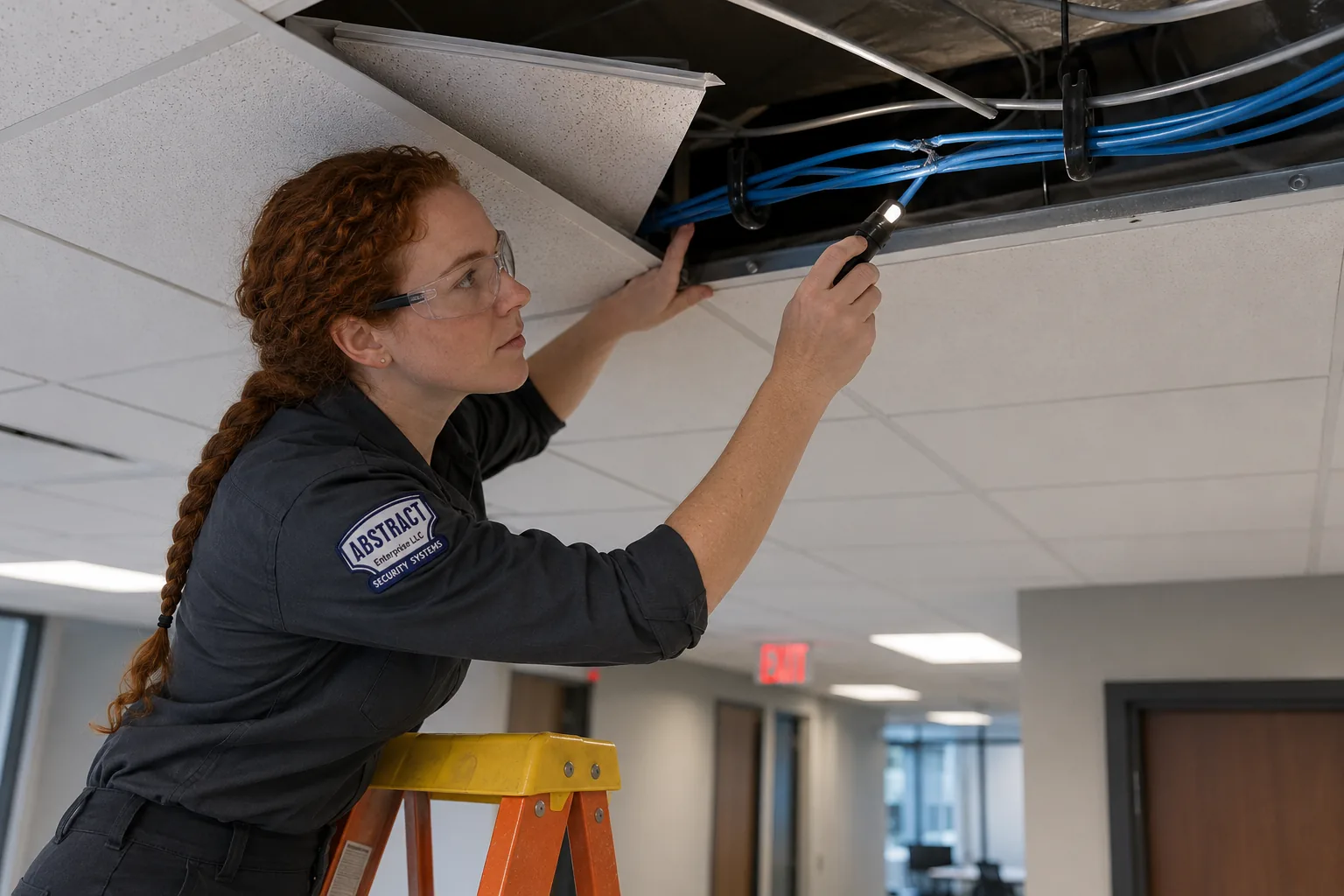
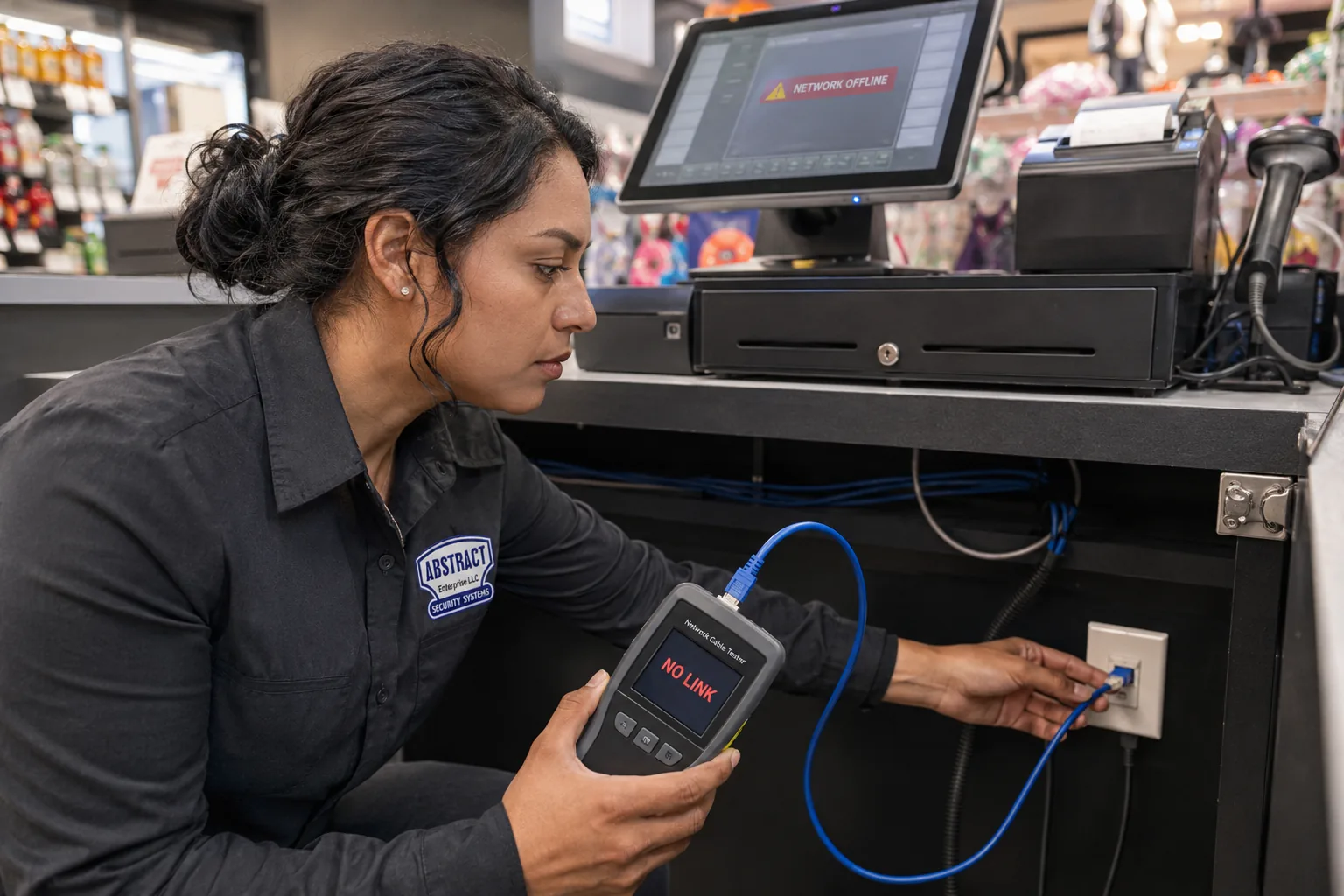
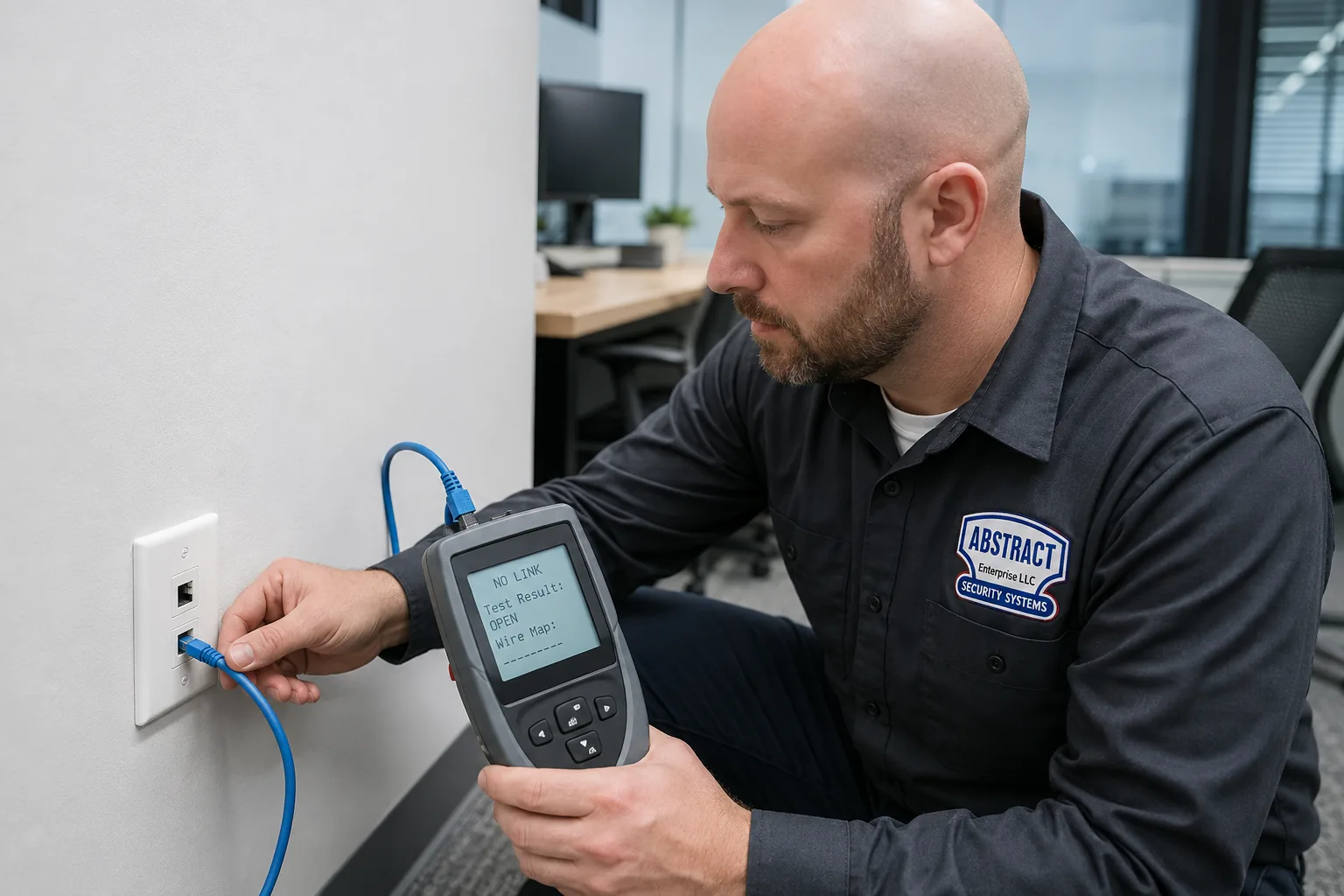
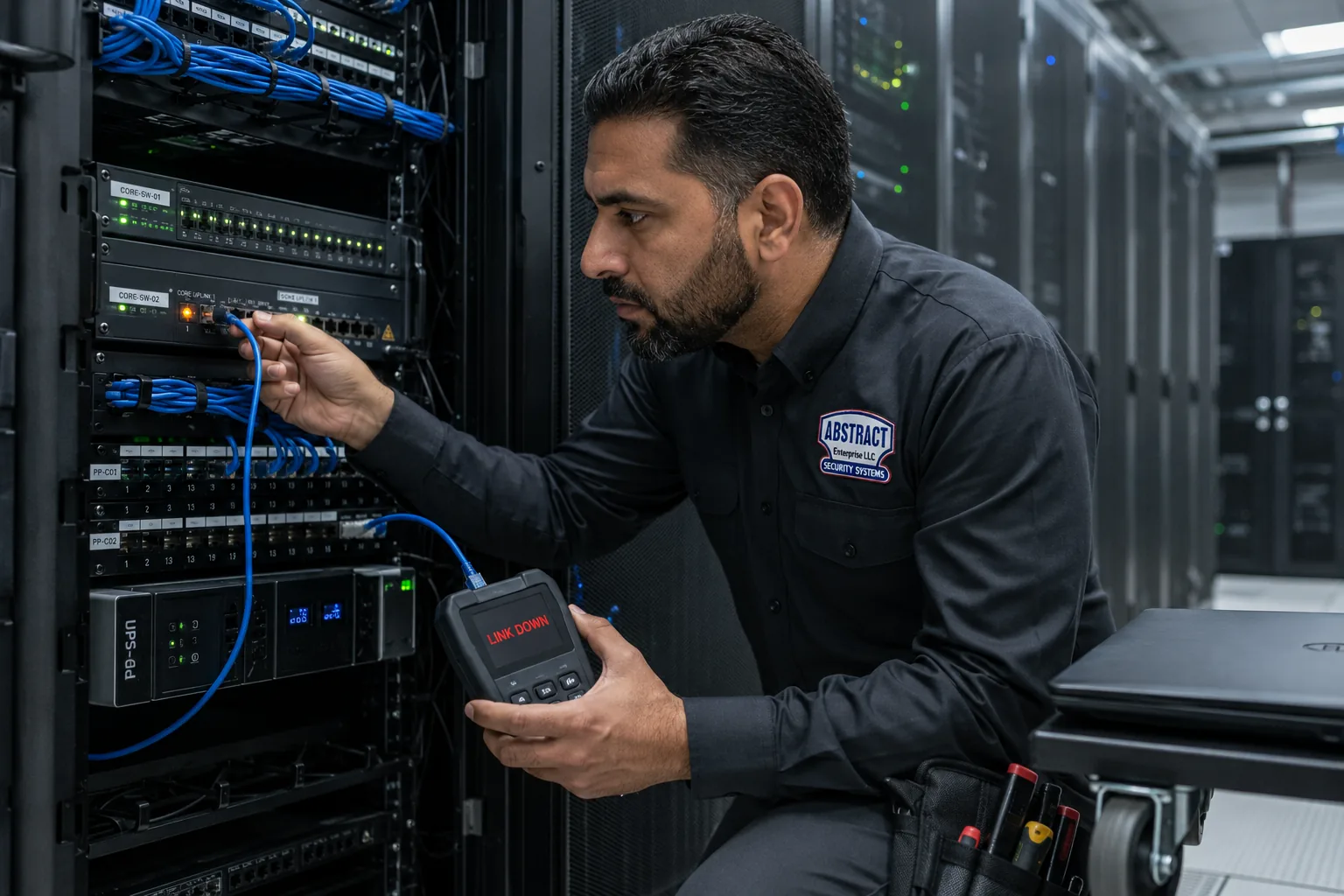
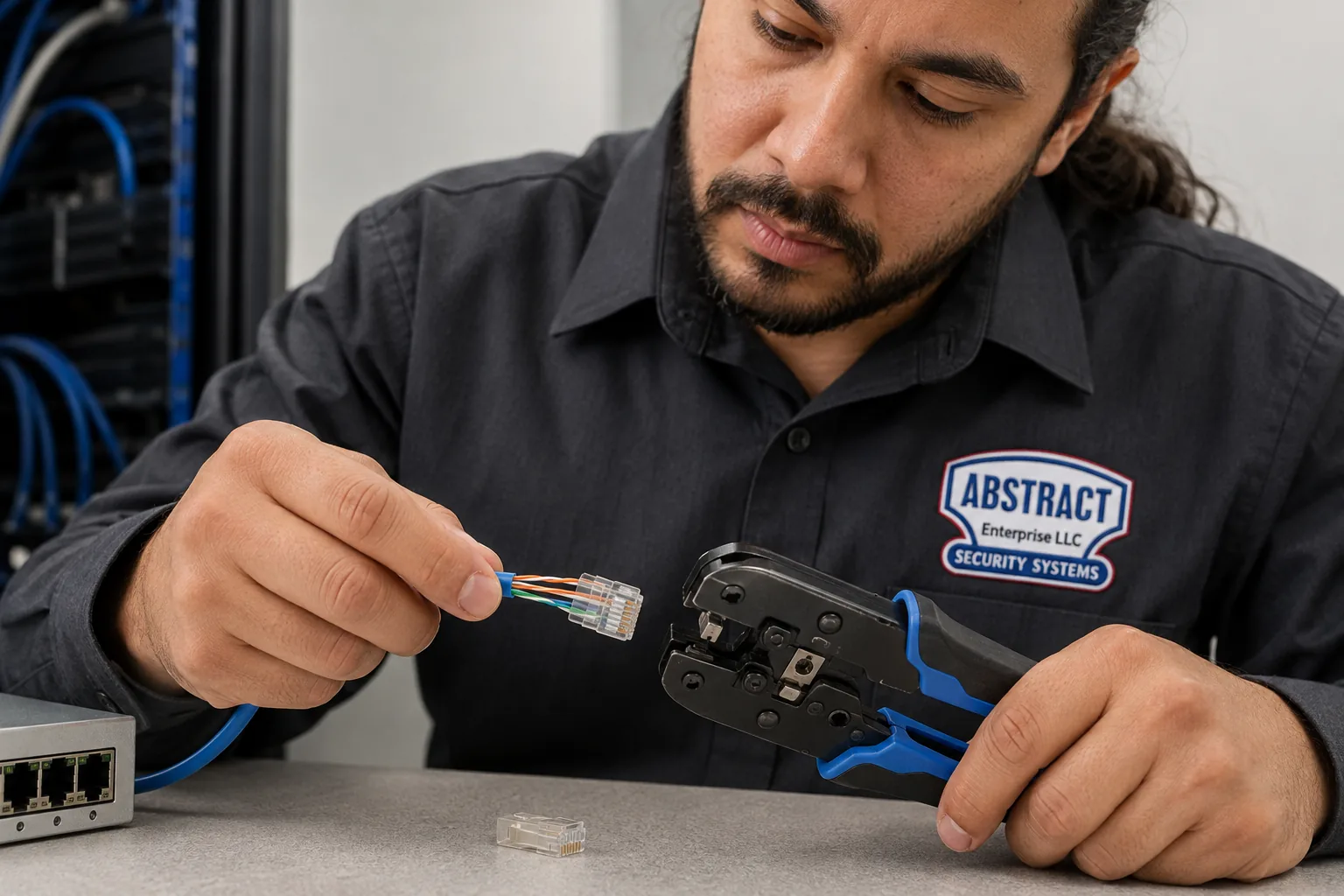
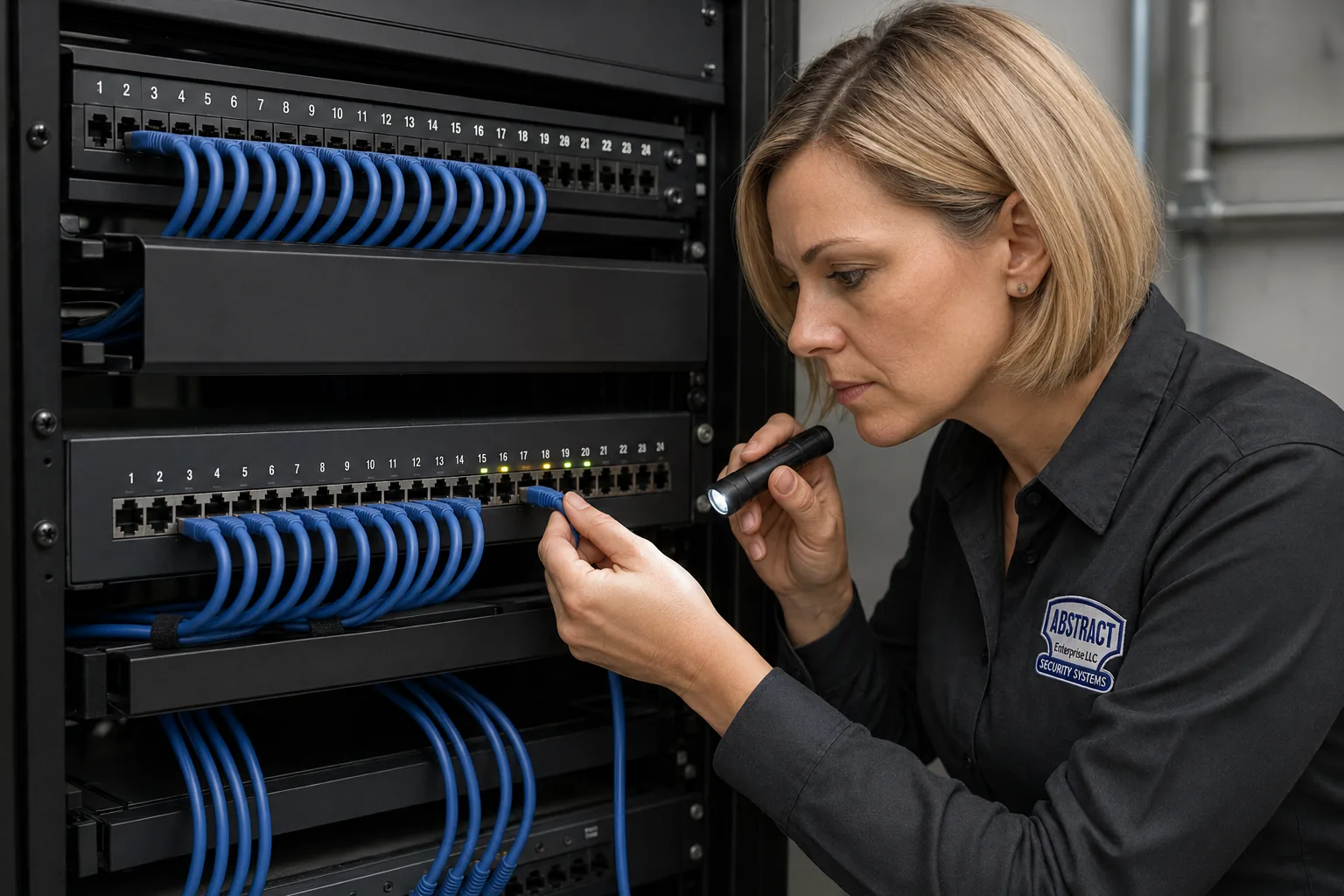
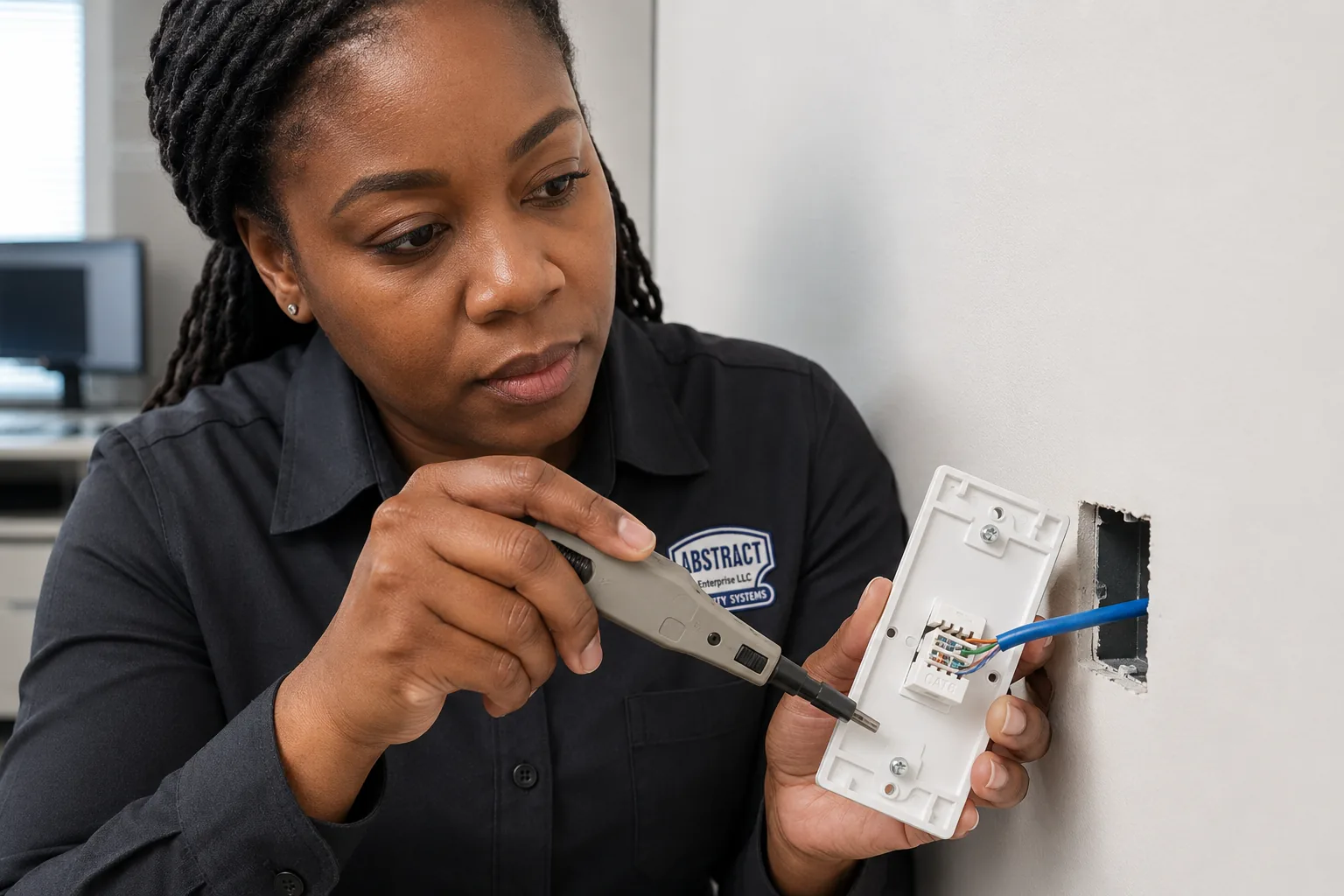
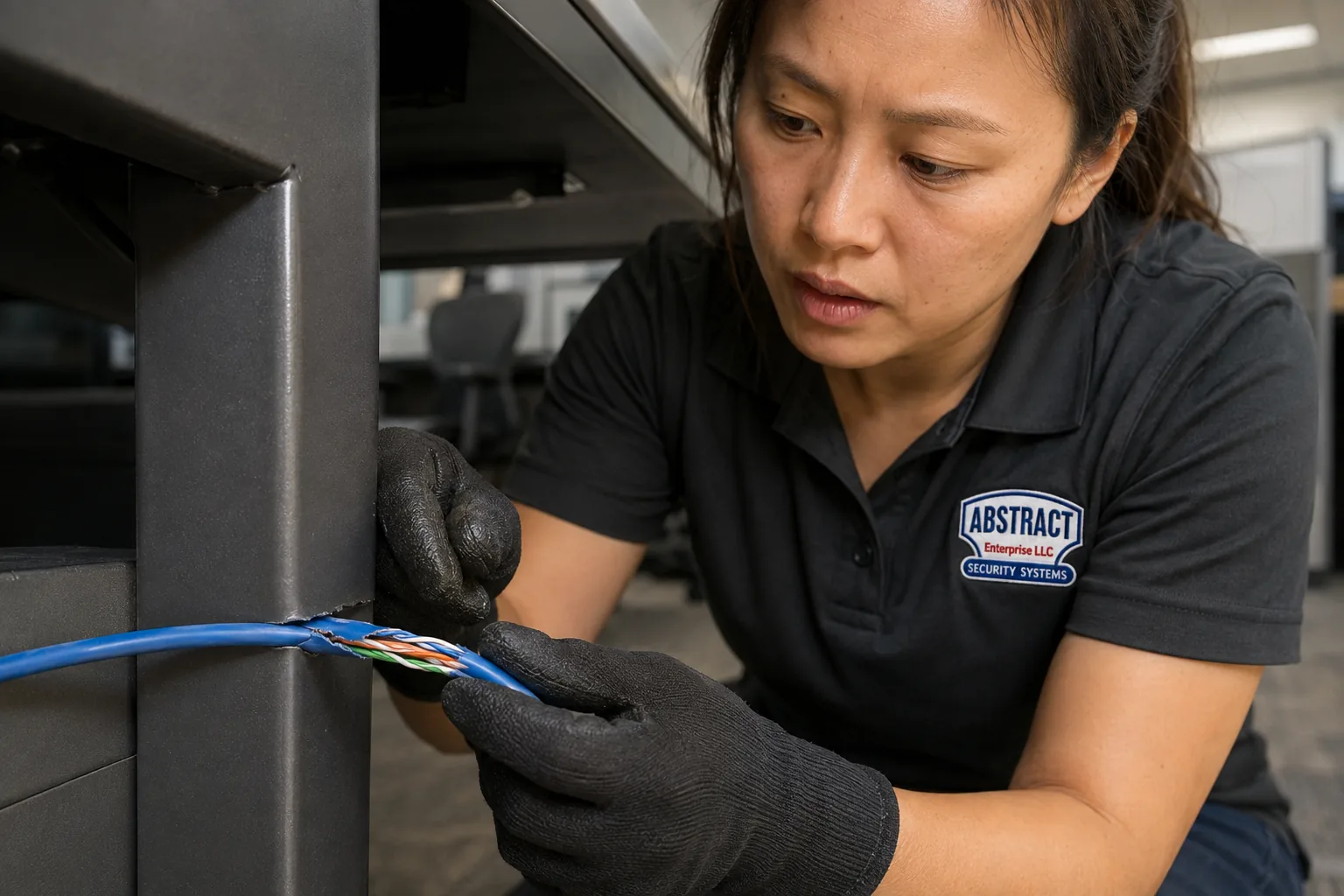
Fault location, retermination, network jack and patch panel repair, PoE troubleshooting and certified cable testing across Queens. Licensed NYS low-voltage contractor. Every repaired drop tested and documented, with the findings written for whoever runs your network.
Queens is not one commercial market and network cable repair here has to account for that. A Long Island City tower behaves like Midtown. A Maspeth industrial building behaves like a warehouse. A Flushing medical suite above a Main Street storefront behaves like nothing else in the city — small tenancies stacked over retail, shared risers, no floor closet and four businesses sharing a panel. Abstract Enterprises Security Systems repairs Ethernet, Cat6 and data cabling across the whole borough, and the diagnosis changes by neighbourhood more than by symptom.
The calls follow the building type. A Ridgewood print shop whose drops fail whenever the press runs. A Jackson Heights dental practice with imaging that stalls mid-transfer. An Astoria restaurant losing its POS lane at dinner service. A College Point distribution facility with scanner drops at the far end of a deep floorplate. A Jamaica office in a 1970s building where the riser is shared with six other tenants and nobody knows which pair is whose.
Repair is billed at our specialty service rate of $195/hr with a three-hour minimum ($585), with diagnostic equipment on the first visit — distance-to-fault, tone and probe, wiremap and performance testing. In a borough this spread out, a visit that locates and proves the fault the first time is worth considerably more than one that produces a quote for a second trip.
Network Down in Queens?
Same-day dispatch across the borough for down networks, dead POS lanes and failed camera drops. Most a single fault is usually found and put right inside that opening three-hour block.
✔ NYS Lic. #12000287431✔ Certified wiremap & performance testing on every repair✔ 4.7★ from 201 reviews
Local Conditions
Why Queens Needs a Different Approach in Every Neighbourhood
The borough runs four commercial economies at once and each one fails differently. Long Island City and the Court Square towers are modern office plates with floor closets, plenum ceilings, COI requirements and freight windows — Manhattan rules, Queens address. Maspeth, Ridgewood, Middle Village and College Point are industrial and flex: deep buildings, long runs near the channel limit, machinery, forklift damage and unconditioned ceiling space. Flushing, Jackson Heights, Elmhurst and Jamaica are dense storefront-and-upstairs commercial: small tenancies over retail, shared risers, hallway panels, no dedicated telecom room. Forest Hills, Bayside, Whitestone and the eastern neighbourhoods are professional and medical offices in smaller buildings, many converted from residential.
Second, the stacked-tenancy problem. In the dense corridors — Main Street in Flushing, Roosevelt Avenue, Jamaica Avenue, Steinway Street — a single building may hold a ground-floor retailer, a medical practice on two, a law office on three and a school on four, all sharing one riser and one panel that nobody owns in practice. Your run is in there, unlabelled, bundled with everyone else's. Tracing before touching is not caution, it is the only way to avoid taking down a neighbour's service.
Third, distance in the industrial belt. Buildings in Maspeth, Ridgewood and College Point have deep floorplates and one telecom point, which pushes horizontal runs toward the 100 m channel limit. Once a permanent link passes roughly 90 metres the channel is out of spec with patch cords added, and it behaves like a haunted circuit rather than a broken one — links, passes traffic, then falls over when the ceiling warms.
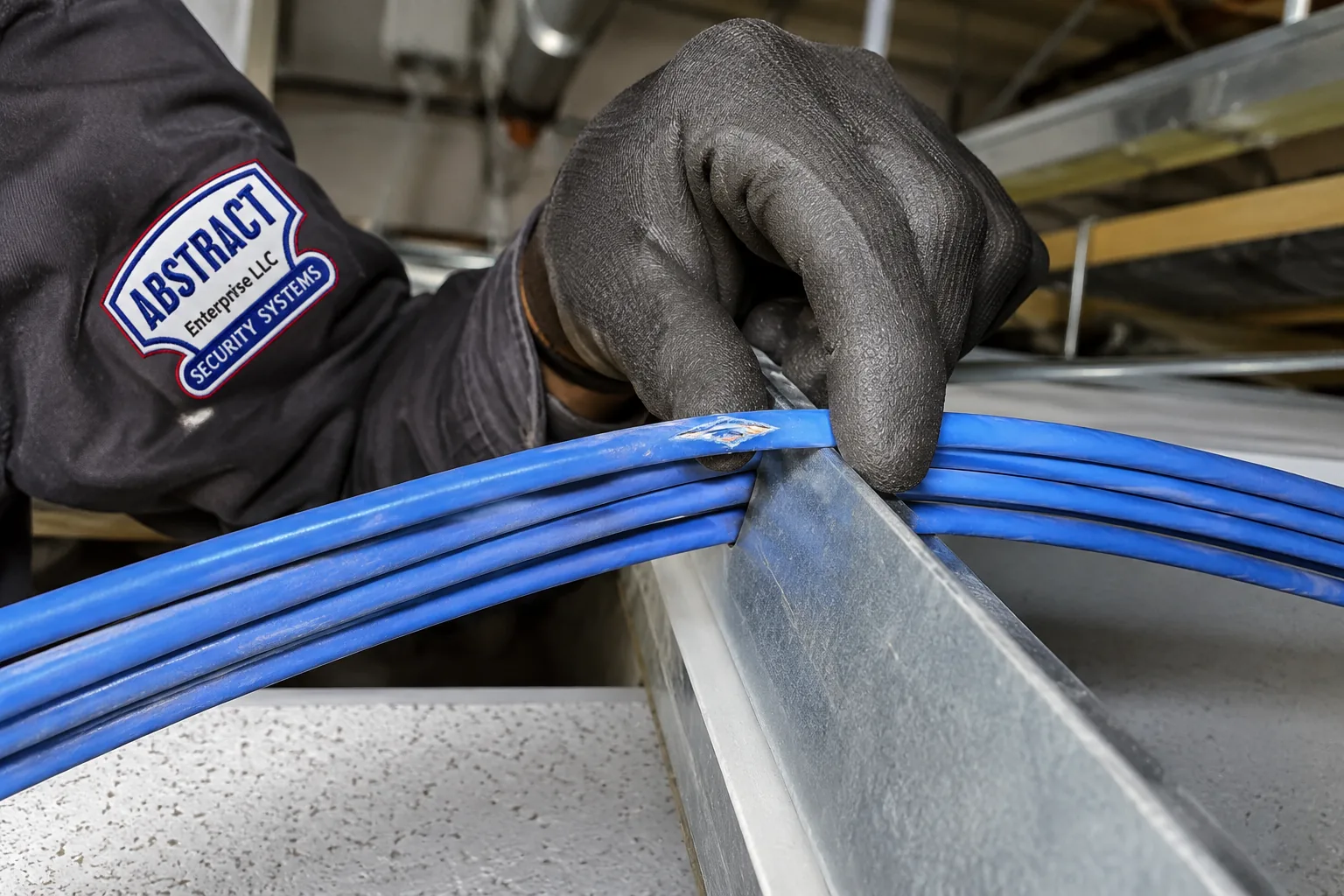
Fourth, mechanical environments. Print shops, food production, auto and metal work are ordinary Queens tenancies, and they bring vibration, heat, dust and machinery interference. Cable in those buildings takes physical abuse that an office run never sees, and the failures are mechanical: chafe at a strut, crush at a rack, a run following a machine that moves.
Fifth, scheduling around trade. A great deal of Queens commercial space is retail and food service where the repair window is before opening or after close rather than during the day. That is a planning constraint rather than a technical one, but it decides whether a visit is one trip or two.
What We Repair
What a Queens Cable Repair Call Covers
We repair the physical layer and prove it with a saved test result, whatever kind of building it is in.
Shared Riser and Panel Tracing
Identifying your runs inside a riser or panel serving several tenancies, and labelling them so the next fault is a check rather than an investigation.
Distance and Length Diagnostics
Measured cable length against the 100 m channel limit on deep industrial floorplates, with a repair-or-relocate recommendation where the run is simply too long.
Ethernet Cable Repair
Cut, crushed, chafed or moisture-damaged runs restored with a category-appropriate junction, then re-tested to spec.
Cat6 and Cat6A Retermination
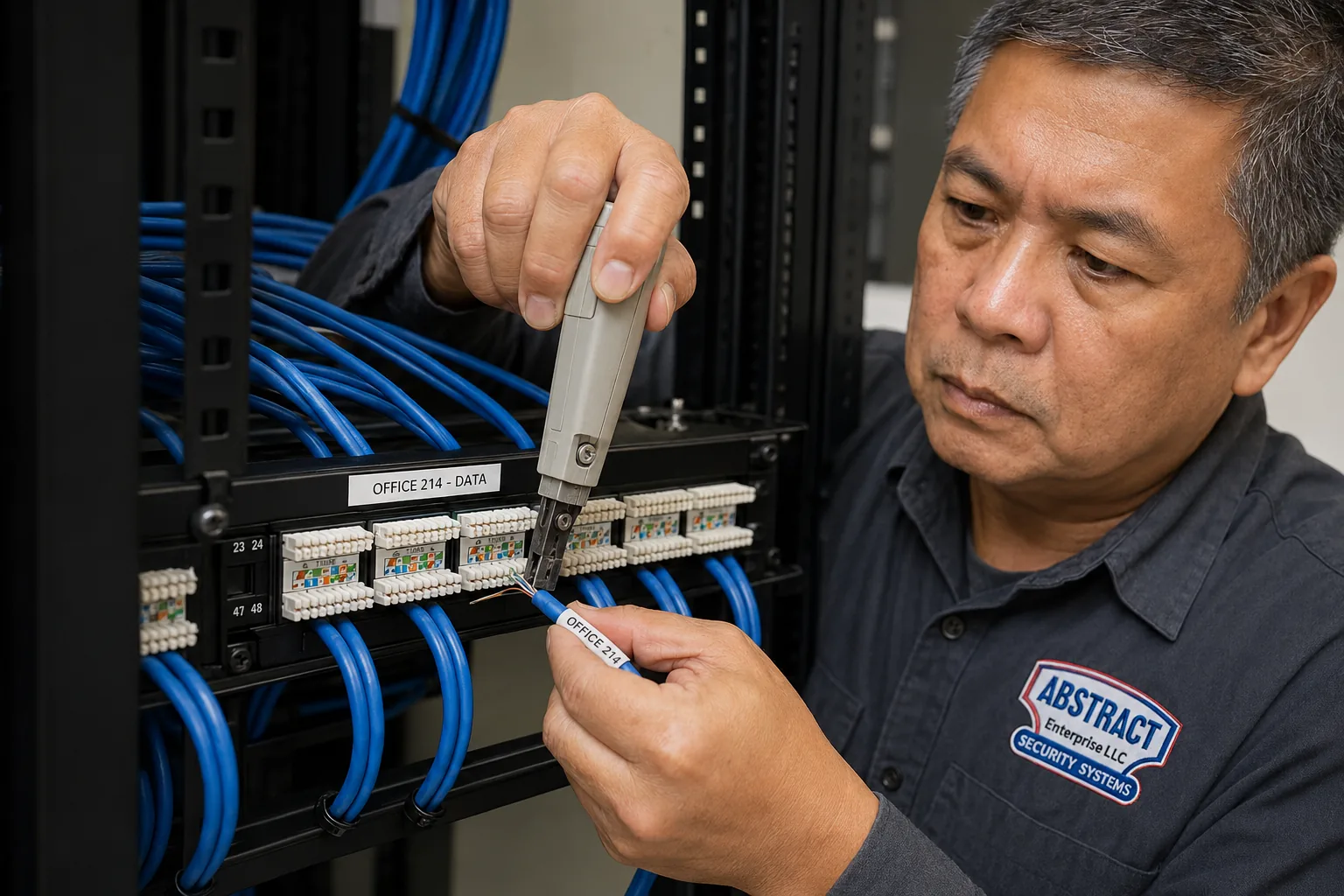
Both ends redone to T568B with the twist carried right to the contact, so the finished channel meets its category on a certifier rather than just showing a link light.
Network Jack Repair
Dead outlets, loose keystones, cracked plates, and jacks never fully punched at fit-out — the most common single fault across every Queens building type.
Patch Panel Repair
Port retermination, panel replacement, and correction of runs punched to one standard at the room end and the other at the panel.
Industrial Environment Repair
Runs damaged by vibration, heat, racking or machinery, with pathway correction so the replacement does not fail the same way.
Certified Testing
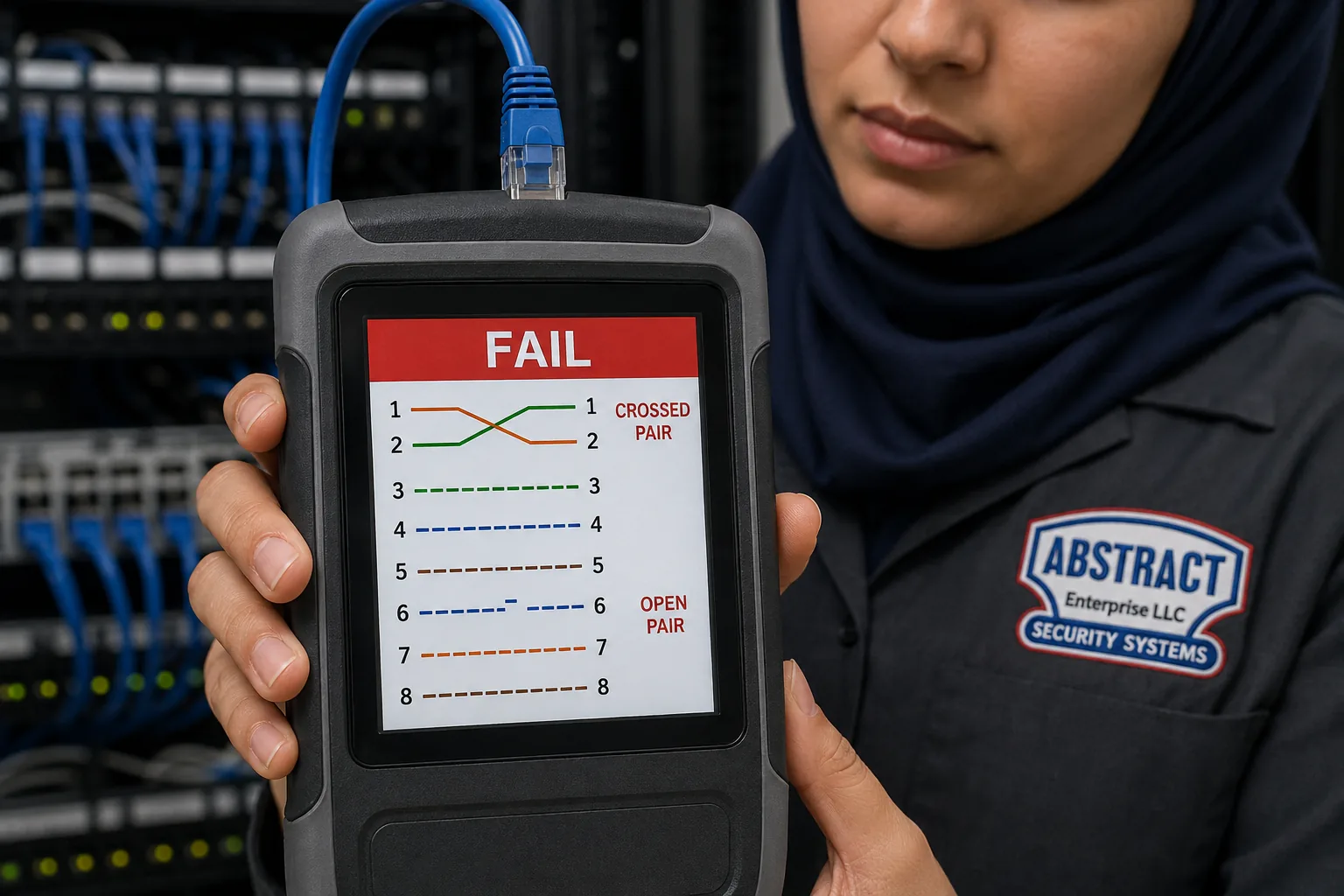
Wiremap, length and performance verification with saved reports including margin, so you know which drops are close to the edge.
PoE Circuit Troubleshooting
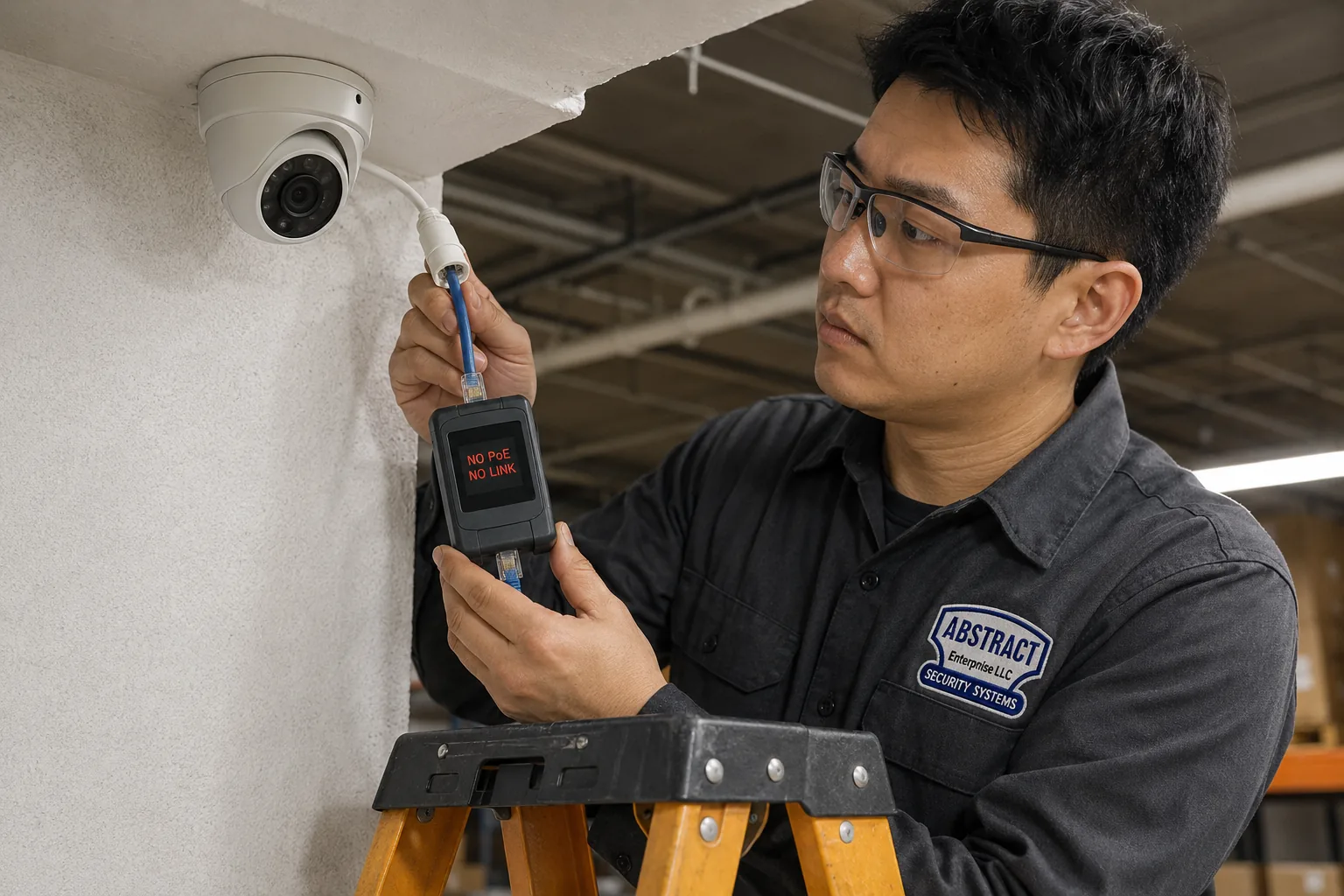
Hardware that starts, runs a minute, then drops. Measuring at the device under genuine load shows whether voltage is falling along the run or the switch has exhausted its power allowance.
Commonly paired: storefront and industrial buildings run camera and reader drops through the same pathways as data. If one run in a bundle failed, testing the rest while access is open costs a fraction of a return visit — see camera repair and access control.
Plain English
Terms That Come Up on a Queens Cabling Job
Two of these matter more here than anywhere else in the city: the shared riser and the channel limit.
Term
What It Means in Queens Commercial Space
Shared riser
The vertical path serving several tenancies in a stacked commercial building. Your run is in there with everyone else's, and it is why tracing precedes touching.
Channel
The complete end-to-end path including both patch cords, limited to 100 m. On a deep industrial floorplate this is the first thing to measure.
Permanent link
The fixed cable from panel port to outlet, excluding patch cords, capped at 90 m so the full channel stays inside 100 m.
Split pair
All eight wires reach both ends but the pairing is scrambled. Result: a solid 100 Mbps link that will not do gigabit, which everybody reports as slowness.
Insertion loss
Signal lost along the run. Rises with length and with temperature, which is why over-length runs in unconditioned industrial ceilings fail in the afternoon.
Certification
A recorded test against the category standard, with the headroom figure included. Not the same as a tone and a beep, which tells you almost nothing about performance.
Plenum (CMP)
The jacket specification required where a ceiling void carries return air. Common in Long Island City office floors and newer fit-outs, less so in the industrial belt.
Bend radius
The tightest curve a cable tolerates before performance degrades. Violated constantly in crowded shared panels.
Toner and probe
Signal injector and wand used to find one cable inside a bundle of forty. The defining tool of stacked-tenancy work.
Demarc
The boundary of the carrier's obligation. Everything on the building side of it belongs to the owner or the tenant, and that is where our work starts.
Equipment
Hardware and Test Equipment on a Queens Repair
We repair what is already installed and replace with commercial-grade components matched to the existing channel. Passive hardware typically means Belden, CommScope, Panduit, Leviton, Hubbell, Ortronics, ICC, Berk-Tek and Superior Essex. Category matching decides the outcome: a Cat5e keystone in a Cat6 channel derates the whole channel to Cat5e regardless of the cable in the wall, and mixed-category channels are ordinary in buildings that have been fitted out repeatedly by different tenants.
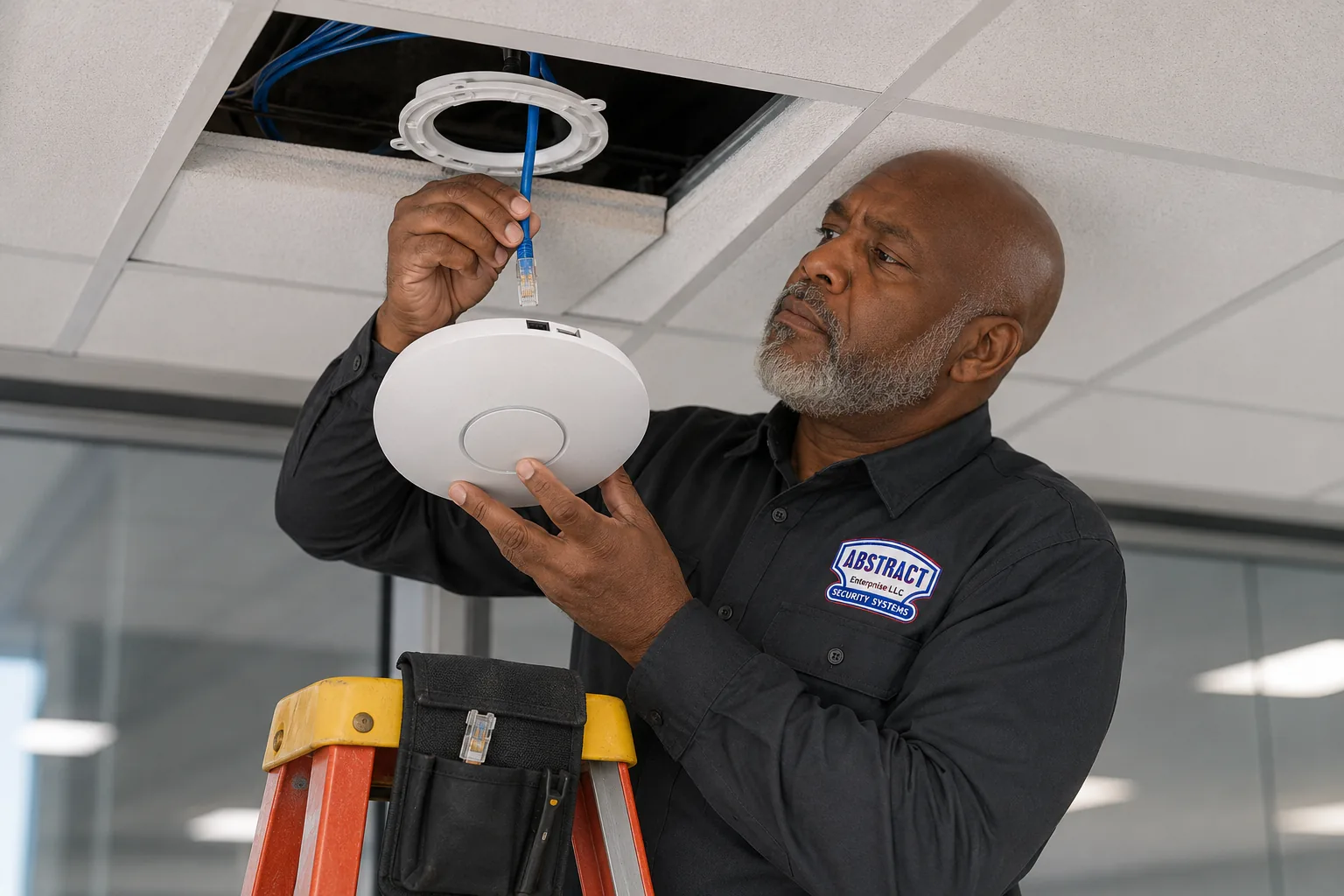
On the active side we isolate cable-side faults feeding Cisco, Meraki, Aruba, Ubiquiti UniFi, Netgear, TP-Link, Luxul and Araknis switching, and PoE endpoints including IP cameras, wireless access points, VoIP handsets, badge readers, time clocks and POS peripherals. Our scope is the physical layer. We do not administer switches, VLANs, wireless controllers or firewalls — we certify the channel and hand the results to whoever does.
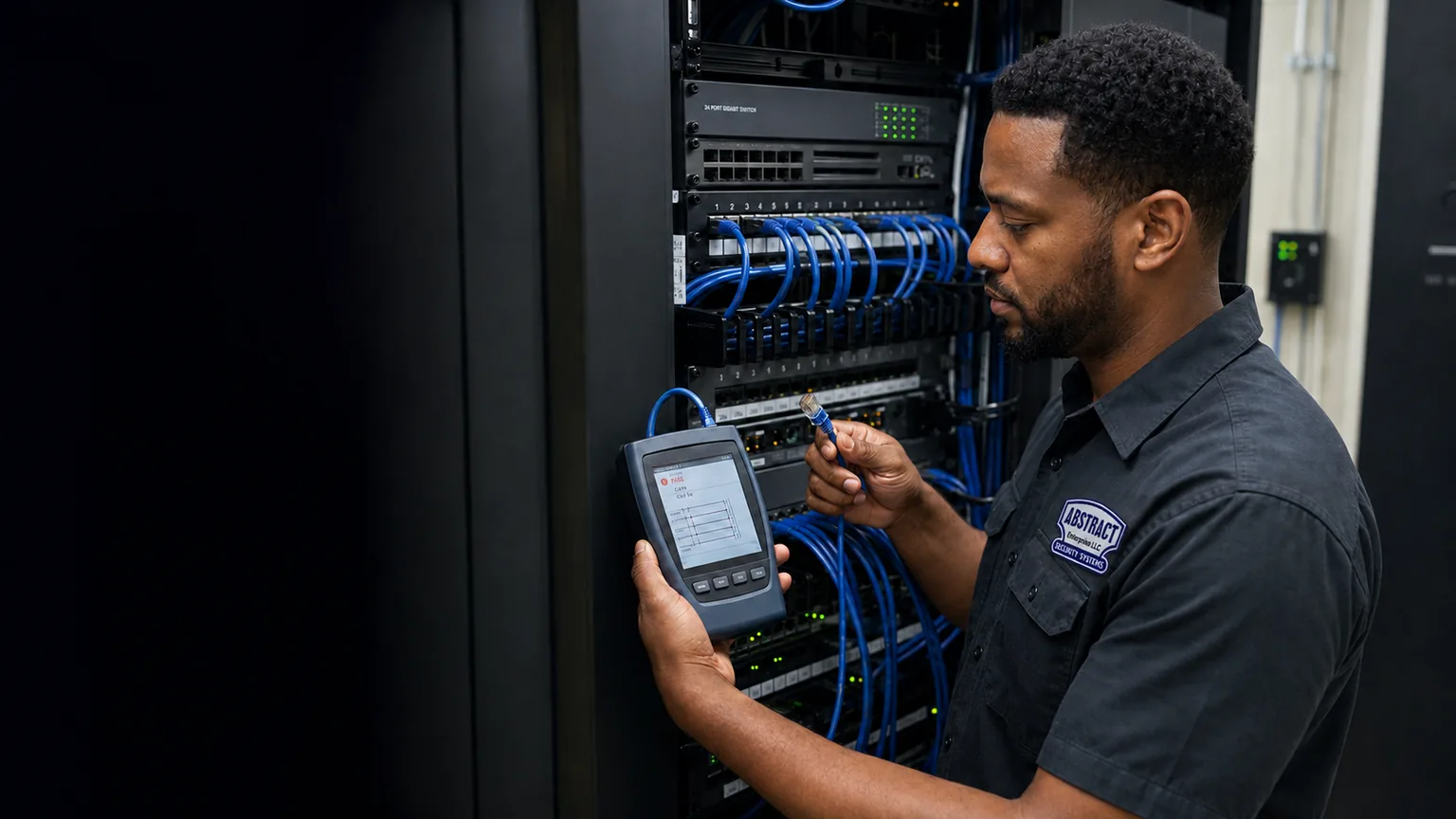
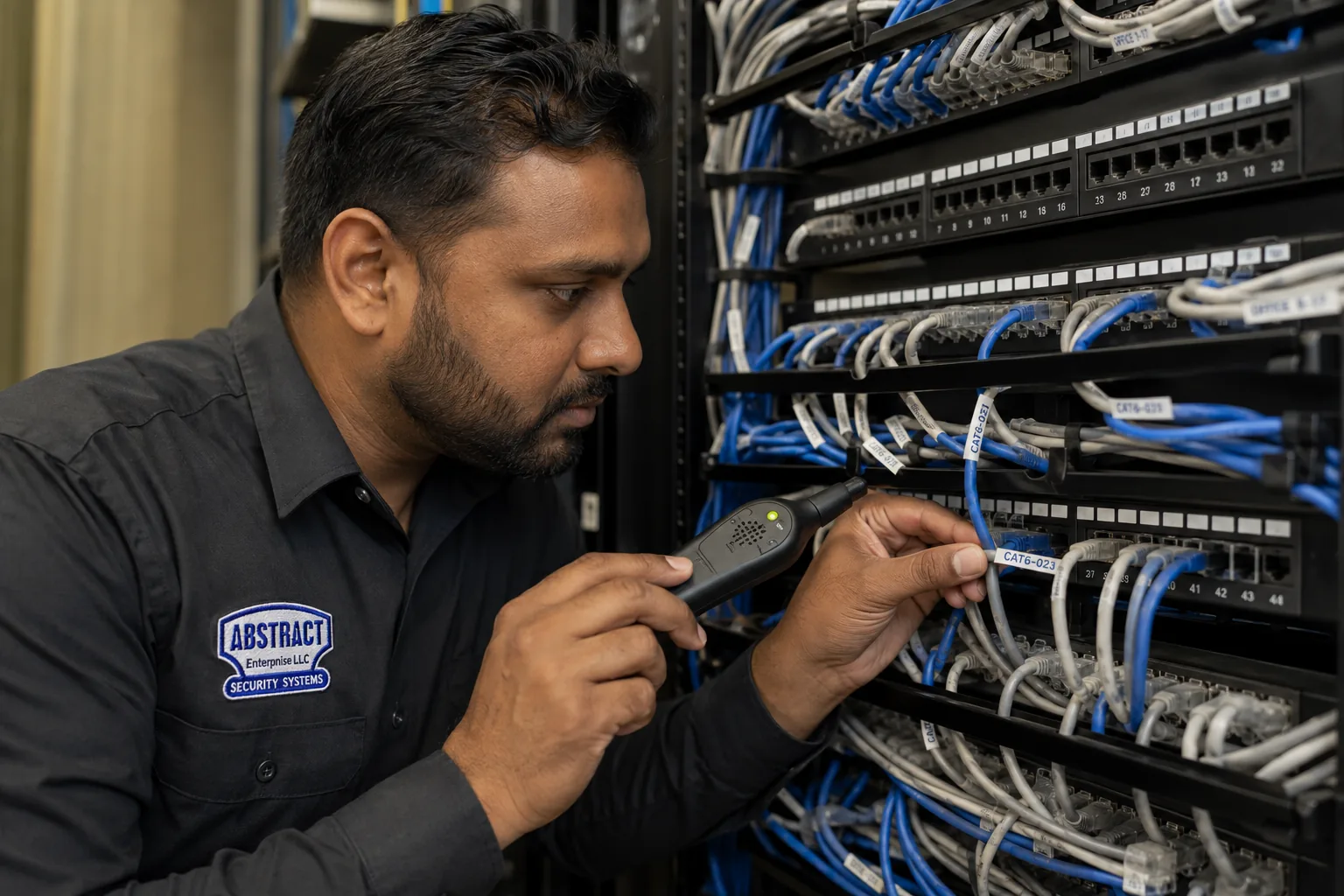
The gear is what makes a stacked-tenancy building tractable. Certification testers with saved reports, tone generators and probes for tracing through shared risers, and PoE load verification at the endpoint travel on every call. In a Flushing or Jamaica building with no documentation, the toner is most of the first hour.
Need Repair in Queens Today?
Same-day dispatch across the borough. For retail and food service we schedule before opening or after close so a repair does not cost you a service.
Trace, Repair, Certify — in That Order, for a Reason
In a building with a shared riser, the tracing step protects your neighbours as much as it serves you.
Tracing comes first because pulling the wrong cord in a panel serving four tenancies turns a one-drop repair into somebody else's outage. Tone the run through from the outlet to the panel, confirm it, mark it. Then the correction: retermination, junction, jack or panel replacement, or a new run where certification fails. Then testing, with the margin reported to you rather than filed.
The reason the order matters commercially is that the tracing work is reusable. Once your runs are identified and labelled at both ends, every future fault in that building is a five-minute check instead of an hour of investigation — and in a stacked building where you may be back for a different drop next year, that is the part of the visit that keeps paying.
Full Scope
Full Scope of a Queens Network Cable Repair
Diagnostics
Tone-and-probe tracing through shared risers and panels
Measured length against the 90 m and 100 m limits
Distance-to-fault location on broken or shorted runs
Wiremap faults: opens, shorts, reversals, split and crossed pairs
Insertion loss and crosstalk testing with margin reporting
PoE voltage and load verification at the endpoint
Interference and separation checks in machinery environments
Switch-port versus cable-fault isolation
Physical Repair
Keystone jack replacement and re-punch
Patch panel port retermination and panel swap
Category-appropriate junction repair on damaged runs
Full run replacement where certification fails
Re-route of over-length runs to a nearer pathway
Pathway correction in vibration and heat environments
Firestop restoration at penetrated rated assemblies
Both-end durable labelling in shared risers and panels
Panel or closet legend identifying your runs
Photo record of concealed repairs before close-up
Written findings for a landlord, managing agent or IT provider
Site Logistics
Certificate of insurance where the building requires it
Before-opening and after-close windows for retail and food service
Coordination with building management in stacked tenancies
Plenum-rated material where the ceiling handles return air
Working around production schedules in industrial space
Coordination with your existing IT provider
Coverage Detail
Where We Work Across Queens
The western corridor carries the densest and most varied demand. Long Island City and Court Square are modern office and mixed-use towers; Hunters Point and the waterfront add converted industrial. Astoria runs along Steinway Street, Broadway and 30th Avenue with dense storefront retail, food service and small professional tenancies. Sunnyside, Woodside and Ridgewood bridge into the industrial belt.
The industrial belt is Maspeth, Middle Village, Ridgewood's manufacturing blocks, Glendale, Long Island City's Dutch Kills, and College Point's business park. Deep buildings, long runs, freight traffic, machinery and unconditioned ceiling space. The central corridors — Jackson Heights along Roosevelt Avenue and 37th Avenue, Elmhurst, Corona, Rego Park and Forest Hills along Queens Boulevard and Austin Street — are stacked commercial: retail below, medical, legal and school tenancies above.
Flushing deserves its own line: Main Street, Roosevelt Avenue and the blocks around them hold some of the densest stacked commercial space in the city, with small tenancies, shared risers and panels serving many businesses at once. Then Jamaica around Jamaica Avenue, Sutphin Boulevard and the transit hub, with institutional, civic and office tenancies; Bayside, Whitestone, Douglaston and Fresh Meadows with professional and medical offices in smaller buildings; and the Rockaways, where coastal exposure attacks terminations the way it does on the South Shore.
Who We Serve
Queens Industries We Repair Cabling For
Medical and Dental Practices
Dense in Flushing, Jackson Heights, Forest Hills and Bayside. Imaging and practice management systems with no tolerance for a marginal channel.
Retail and POS
Main Street, Roosevelt Avenue, Steinway Street, Jamaica Avenue, Austin Street. Tills that cut out mid-sale, and stockroom runs cut or crushed when new shelving went in.
Restaurants and Food Service
Kitchen-side terminals in heat and grease, cable damaged during hood work, and repair windows outside service hours.
Light Manufacturing and Print
Maspeth, Ridgewood, Glendale. Vibration, heat, dust and machinery interference, with mechanical rather than electrical failures.
Warehouse and Distribution
College Point, Maspeth, Dutch Kills. Deep floorplates near the channel limit, forklift and racking strikes, scanner and access point drops.
Professional Offices
LIC towers and stacked tenancies over retail — two different jobs under one heading.
Schools and Community Facilities
Classroom drops, corridor access point uplinks, and repair windows outside programme hours.
Auto and Trade Businesses
Service bays, yards and exterior camera drops, with cable exposed to weather, oil and mechanical damage.
Apartment and Mixed-Use Buildings
Shared risers feeding cameras, intercom controllers and readers, with runs damaged during renovation.
Real Questions
Fourteen Questions Queens Businesses Actually Ask
Drawn from the recurring themes in small-business, IT and Queens-local discussion threads, grouped by the six question types that come up most.
Cost Questions
1. What does a repair cost here?
$195/hr against a three-hour minimum, so $585 for the first block. That covers tracing, the physical repair, certification testing and documentation. If a run must be replaced rather than repaired, new commercial Cat6 drops start at $175 per drop. There is no separate call-out fee stacked on top.
2. Why does tracing take so long in our building?
Because your run is inside a riser or panel shared with several other tenancies and nothing is labelled. Toning it through is the only safe way to identify it, and it is also the part of the visit with lasting value — once your runs are marked at both ends, the next fault is a quick check rather than another hour.
3. Can you come before we open?
Yes, and for retail and food service we prefer it. The rate is the same; what changes is that the repair does not cost you a service. Tell us your hours when you book and we will schedule around them.
Quality and Trust Questions
4. How do I know the repair actually holds?
Ask for the test result with margin. A certification report shows pass or fail, measured length and how close to the limit the channel is running. A link light proves a device negotiated once; a report tells you whether it will still be working in July.
5. Do I need a licensed contractor?
For anything past swapping a cord, yes. Cabling falls under low-voltage work, carries real obligations on jacket rating and firestopping, and in a stacked building the owner will want a licence number and a certificate before anyone touches the riser. Ours is NYS Low-Voltage #12000287431.
6. Our building has four other businesses on the riser. Will you disturb them?
That is precisely why we tone before touching anything. Pulling an unidentified cord in a shared panel is how a one-drop repair becomes somebody else's outage, and it is the single most common damage we are called in to undo after unlicensed work.
DIY and Pro Questions
7. Can I trace my own cable in the shared panel?
Without a toner, you are guessing, and the cost of guessing wrong lands on a neighbour. If you have access and want to help, label your own outlets clearly at the room end — that genuinely speeds up the tracing when we arrive.
8. The tester from the electrical supply house passes it. So why is it broken?
Those units verify that pin one reaches pin one and nothing beyond that. They report no distance, no signal loss, no pair interference. In a deep Maspeth or College Point building the distance is frequently the entire problem, and it is exactly the number a thirty-dollar tester cannot give you.
9. Can I extend a run with a coupler to reach a new position?
In a shallow storefront, sometimes. In a Maspeth or College Point building, rarely — those runs are often already close to the 100 m channel limit, and adding length plus a connection point pushes them out of spec. Measure before extending, or re-pull.
Technical Questions
10. One port negotiates 100 Mbps while every other one hits gigabit. What is that?
Because gigabit needs every pair and the older standard only needs two. Lose one pair and the port still trains at 100 quite cheerfully while refusing to go higher, or reaching gigabit and falling straight back. That asymmetry is the clearest free diagnostic on the page.
11. Our drops fail whenever the press runs. Is that interference?
Sometimes, but more often it is mechanical or power-related: vibration working a marginal termination loose, or cable routed too close to a motor feed. Either way it is a pathway and separation question, and the trigger tells us exactly where to look.
12. Our network gets worse every afternoon. What is that?
Usually insertion loss rising with temperature on a channel that has almost no margin. Common on long runs in unconditioned industrial ceiling space. Measured margin identifies which drops are at risk before the next hot spell rather than after it.
Landlord and Tenant Questions
13. Our office is above a restaurant and our cable runs through their ceiling. Who is responsible?
It depends on the lease, and in stacked Queens buildings the leases are frequently vague. What is not vague is the physical evidence: we locate the fault, document where it is and what caused it, and that report is what the parties actually negotiate from.
Complaint Questions
14. The last contractor took down our neighbour's phones while fixing our drop. How do we avoid that?
By hiring someone who tones before touching. In a shared panel the only way to know which cord is yours is to inject a signal and follow it. Everything else is a guess with somebody else's business on the other end of it.
Answer The Public
Answer The Public: Queens Network Cable Questions
Who repairs network cable in Queens?
The work sits with licensed low-voltage contractors. Electricians own conduit and line voltage and usually pass on the data ends; IT companies own the logical network and seldom carry a certifier. A dead run in a Flushing riser is a cabling job.
What causes cabling to fail in Queens buildings?
It depends which Queens. In stacked commercial: bad terminations and damage during other tenants' work. In industrial: vibration, heat, racking strikes and over-length runs. In LIC office plates: the same construction damage and legacy Cat5e problems as Manhattan. In the Rockaways: coastal corrosion at terminations.
At what point does a run stop being worth repairing?
When it fails certification after terminations are corrected, when measured length puts the channel out of spec, when there are multiple damage points, or when the environment will destroy a replacement in the same position unless the route changes.
Where do faults sit in a stacked commercial building?
At terminations first, then in the shared riser or panel where cable is crowded, bent past its minimum radius, or disturbed by work for another tenancy.
How quickly can a Queens repair be scheduled?
Same day across most of the borough. Retail and food service are scheduled before opening or after close so the repair does not cost a service.
Reality Check
AI Overview Reality Check: What Search Results Miss About Queens Cabling
Search for network cable repair in Queens and you get a national cost average, lead-generation directories, and advice written as though the borough were one kind of building. It is at least four.
1. Search Treats Queens as a Single Market and It Is Not
Every cost page and AI summary answers as though a borough is a building type. Queens runs modern office towers in Long Island City, industrial and flex in Maspeth and College Point, dense stacked commercial in Flushing and Jackson Heights, and small professional offices in Bayside and Forest Hills.
Those have different access rules, different pathway, different failure modes and different correct answers. A number that averages them describes none of them, and a contractor who only knows one will be wrong in the other three.
The useful brief is the building, not the borough: is there a floor closet or a shared riser, is the ceiling plenum or open, is there machinery, and who controls access.
2. Nothing Online Prepares You for the Shared Riser
General guidance assumes your cabling is yours. In the dense corridors here a single riser and panel may serve a retailer, two medical practices, a law office and a school, all unlabelled.
That makes tracing a safety step rather than a convenience. Pulling an unidentified cord to see what goes dark is a real technique some people use, and in this building stock it means taking down a neighbour's phones or payment terminal. We are called in to undo that more often than we would like.
It also makes labelling the most valuable durable output of the visit. Once your runs are identified and marked at both ends, every future fault in that building costs a fraction of the first one.
3. The 100 Metre Limit Is Trivia Online and Decisive in Maspeth
Published troubleshooting content mentions the channel limit once, as a specification note, because most of it is written from a small-office frame where no run gets close.
In the industrial belt here, deep buildings with one telecom point routinely produce runs at or past the limit. Those do not fail cleanly — they train, pass traffic, then degrade when the ceiling warms, which sends people to the switch, the router and the carrier before anybody measures the cable.
The tell is a drop that trains at 100 Mbps while its neighbours reach gigabit, or one that works in the morning and stumbles by mid-afternoon. Both point at margin, and margin is mostly length plus termination quality.
4. Cost Averages Exclude the Scheduling Reality
Aggregated cost pages publish national figures blended across residential and light-commercial work, and they assume the work happens during business hours.
A large share of Queens commercial tenancy is retail and food service where the only workable window is before opening or after close. That is not a premium service, it is the normal way the work happens here, and it should be in the plan rather than discovered at the door.
They also collapse installation and repair into one number. Installation has known scope before dispatch; repair does not, which is why it is billed hourly with a minimum rather than per drop.
5. Machinery Environments Are Absent From Generic Advice
Print shops, food production, metal and auto work are ordinary tenancies in Maspeth, Ridgewood and Glendale, and cable in those buildings takes abuse an office run never sees.
The failures are mechanical: vibration working a termination loose, chafe at a strut, crush at a rack, or a run following equipment that moves. Generic content frames cable failure as an electrical event and misses all of it.
It also affects separation. Cable routed too close to motor feeds and heavy power picks up problems that look like interference and are frequently just proximity. That is a pathway correction, not a cable replacement.
6. The Directories Are Selling Your Contact Details, Not Checking Anyone's Tools
Platforms of that kind resell one enquiry to several firms simultaneously, and whoever answers first is usually the one paying most per lead. The star ratings attach to accounts covering half a dozen unrelated trades.
The specific breakage is taxonomic. Physical cable work is filed alongside router setup and wireless support, so a request needing a certifier, a tone generator and a punch tool can quite legitimately be answered by somebody who owns none of them.
Three questions sort it out inside a minute: what certifier do you carry, will each drop come back with a saved result, and what is your New York State low-voltage licence number.
7. Coastal Exposure in the Rockaways Gets No Mention at All
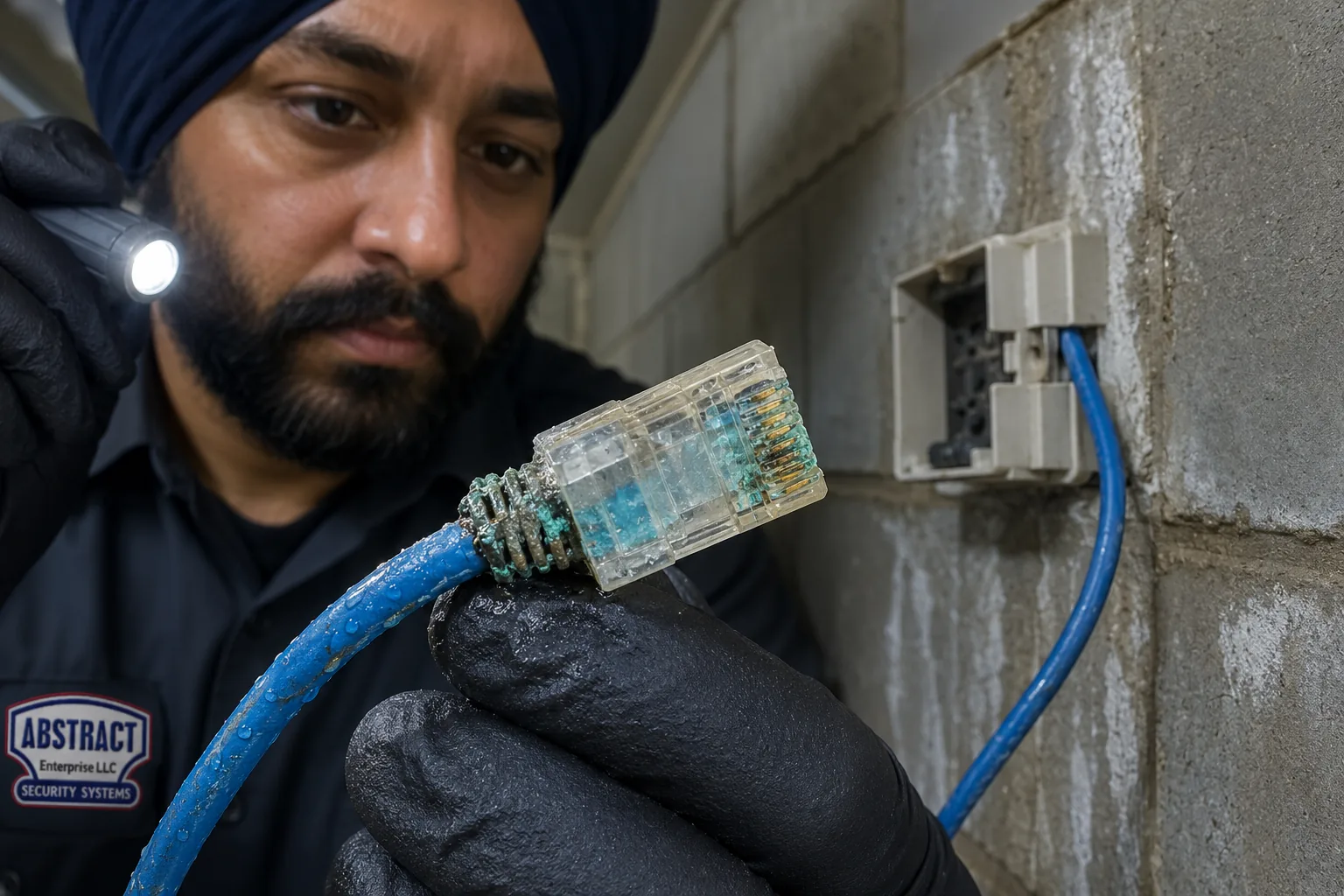
National content treats water damage as a flood event. On the peninsula the usual mechanism is slower: salt air and humidity reaching terminations in unconditioned space and corroding contacts across seasons.
The symptom is gradual degradation rather than a clean failure, and it is nearly always found at a connection point rather than mid-cable. Retermination fixes it; replacing the run without addressing the enclosure does not.
Properties there benefit from having terminations inspected on a schedule rather than only when something breaks — advice that appears in no search result and saves real money.
Get the Run Traced Before Anything Gets Pulled.
Certified testing on every repair. Licensed NYS low-voltage contractor. 4.7★ from 201 reviews.
The cheapest test there is. Cords fail at the latch, back out under their own weight, and produce a link that comes and goes.
Move to a different switch port
Yes
One minute and the switch is either cleared or convicted.
Test the device on a known-good outlet
Yes
Carry the machine to a working port. Links fine there and the original outlet or its run is the problem.
Label your own outlets at the room end
Yes
Costs nothing and genuinely speeds up tracing later. Room name, position, date.
Re-punch a keystone jack
Borderline
Anyone can seat conductors; holding the twist right up to the contact is the skill. Get it wrong and it looks perfect, lights up, and fails a certifier.
Pull cords in a shared riser panel to see what goes dark
No
This takes down other tenants. It is the single most common piece of damage we are called in to undo in stacked buildings.
Extend a run with a coupler in an industrial building
No
Those runs are frequently already near the 100 m channel limit. Adding length and a connection point pushes them out of spec permanently.
Diagnose gigabit-only or heat-related failures
No
Loss and crosstalk are numbers a hardware-store tester cannot produce, and they are the whole answer on a marginal run.
Route cable near motor feeds or heavy power
No
Separation requirements exist for a reason, and the resulting problems look like interference while actually being proximity.
Fifteen minutes, no invoice: the four rows above marked yes. The one line never to cross is yanking cords in a shared panel — in a stacked Queens building the other end of that cord belongs to a neighbour who is trading right now.
Alternatives
How a Licensed Cabling Contractor Compares Here
vs. Your IT Provider
Excellent from the switch upward and typically candid that copper is outside their remit. Because the physical work is subcontracted, the van that turns up is a third party working to a third party's diary — awkward when your only slot is six in the morning.
vs. Lead-Generation Platforms
The platform resells your enquiry to whoever bid highest, so speed of response measures marketing spend rather than suitability. Cable work sits in the same bucket as PC support, and saved test results are not something those listings promise.
vs. Your Carrier's Technician
The carrier owns the line to the demarc and nothing past it, which they will state plainly and correctly. Circuit good at that point, outlets dead beyond it, and the fault is inside your walls.
vs. The Building's Handyman or Super
Fine for a faceplate or a patch cord, and frequently the fastest route to riser access. Where it goes wrong is in the shared panel, where good intentions and no toner take down a neighbour.
vs. A General Electrician
Indispensable when a job needs conduit run, masonry cored or anything at line voltage. Data ends are a separate skill with much finer tolerances, and most electricians know it and pass that part along.
Warning Signs
Five Signs the Cable Is the Problem in a Queens Building
One outlet is dead and everything else works. Upstream faults take down groups. A lone dead port points at that run and its two ends, nothing else.
A port sits at 100 Mbps while the ones beside it reach 1000. One pair has failed or been miswired. Of everything you can notice without equipment, this is the most informative.
The fault appears when machinery runs. Vibration, heat or proximity to a motor feed. A pathway problem rather than a cable-quality problem.
It works in the morning and fails by mid-afternoon. Insertion loss rising with temperature on a channel with almost no margin, typical of long runs in unconditioned industrial ceilings.
Trouble started after work was done for another tenant in the building. Shared riser and ceiling work is the leading cause of sudden multi-drop failures in stacked commercial buildings.
Community
Community Chatter: Recurring Themes From Public Forums
Paraphrased themes from public homeowner, small-business and IT discussion threads — not customer reviews of AESS.
Threads from tenants in stacked commercial buildings repeatedly describe an outage caused by somebody pulling cords in a shared panel to identify a run — usually a well-meaning super or an unlicensed helper.
Warehouse and flex-space discussions regularly describe access points and workstations that work near the front of the building and fail at the back. The distance explanation is usually the last one tried and the correct one.
Owners in trade forums regularly query why so little of a cabling bill is parts. The answer holds up: locating the fault is the job, and the cable itself barely registers against the hours.
Internal support documents from unrelated organisations arrive at the same opening moves in the same order, which tends to happen when a procedure has survived contact with real faults.
Enterprise troubleshooting guidance specifically flags intermittent connectivity in older buildings with legacy cabling as a wiring-quality issue rather than a configuration issue, which matches what we find in buildings still running early-2000s Cat5e.
Field Video
Watch: Field Diagnostics on a Queens Repair Call
Short-form field clips from our channel: youtube.com/@openeye0007 Embed slot reserved — drop the Short iframe here once the clip ID is set.
We charge the specialty service rate of $195 an hour with three hours as the minimum, so $585 buys the first block. That block includes toning the run out, finding the fault, fixing it, certifying it and writing it up. Should the cable need pulling fresh, commercial Cat6 drops start at $175 apiece.
Is repairing a damaged Ethernet run possible, or does it always mean new cable?
+
If the harm is confined to one reachable point, a properly made junction of the right category and a certifier to prove it will bring the run back. Pull new cable instead when it still will not certify after both ends are redone, when the measured distance puts it beyond spec, or when it has been damaged in more than one place.
Our building has a shared riser with several other tenants. Is that a problem?
+
It is the normal condition in Flushing, Jackson Heights, Jamaica and the other dense corridors, and it is why we tone every run through before touching anything. Pulling an unidentified cord in a shared panel is how a one-drop repair becomes a neighbour's outage.
Can you work before we open or after we close?
+
Yes, and for retail and food service we prefer it. The labour rate is unchanged; scheduling around trading hours simply means the repair does not cost you a service.
Why do our drops fail at the back of the warehouse but not the front?
+
Almost always run length. Deep buildings in Maspeth, College Point and Dutch Kills have one telecom point, and the far runs sit at or past the 100 m channel limit. That produces links that train and then degrade rather than links that fail cleanly, and the fix is a shorter pathway rather than a better jack.
My wall jack is completely dead. What is the most likely cause?
+
Most common first: a cord whose clip has snapped, a panel position left unterminated or wired to the opposite standard, a jack with conductors resting in the slots rather than punched through, then damage partway along the cable.
The wireless is solid but the wired ports crawl and cut out. Why?
+
Typically one pair is faulty or miswired, pinning the link at 100 Mbps, or the run has so little headroom left that traffic is constantly being resent. You find both by measuring, not by swapping hardware.
A PoE camera keeps rebooting. Is that the cable?
+
Very often, especially where the run is long or leaves the building, or where older Cat5e is asked to carry a modern PoE class. Draw climbs the instant the night illuminator or a heater starts, the voltage arriving at the device falls short, and it reboots.
Our drops fail when the machinery runs. What causes that?
+
Usually vibration working a marginal termination loose, or cable routed too close to a motor feed. Both are pathway and separation questions rather than cable-quality questions, and the trigger tells us where to look.
Do you provide certified test reports?
+
Yes. Every repaired drop is tested and you receive saved results including measured length and margin, both-end labelling, and where the scope includes the panel, a legend identifying your runs.
What cover comes with the work?
+
Anything we supply carries twelve months of parts-only cover under the service agreement. Altering or interfering with the installed work without written permission first ends that cover.
Applied only where ceiling space is used for return air
After-hours or weekend window
Premium applies
For buildings restricting low-voltage work to off-hours
Published starting rates for Queens. Final pricing depends on access, pathway, material rating and testing scope, and is confirmed in writing before work begins. Before-opening and after-close scheduling carries no labour premium. Full terms — including 50% deposit, one-year parts-only warranty on AESS-supplied products, and the late-fee schedule — are set out in the service agreement. See structured cabling pricing for new-installation drop rates and Cat6 installation Queens for per-drop grade comparisons.
The defining Queens problem. A riser serving four or five tenancies with nothing marked, where identifying your run is the work before any repair begins — and where guessing costs a neighbour their phones or their payment terminal.
Over-Length Runs in Deep Industrial Buildings
Maspeth, College Point, Dutch Kills. One telecom point and a floorplate that radiates outward puts far runs at or past the channel limit, producing degradation rather than clean failure.
Vibration and Machinery Environments
Print, food production, metal and auto work. Vibration works marginal terminations loose over months, and cable routed near motor feeds picks up problems that look like interference.
Damage From Other Tenants' Work
In a stacked building, a fit-out two floors up routinely damages runs in the shared riser or the ceiling between. It presents as a sudden multi-drop failure with no local cause.
Heat in Unconditioned Ceiling Space
Industrial buildings without conditioned ceilings put channels through wide temperature ranges. Thin margin plus a hot afternoon equals a fault that disappears before anyone measures it.
Coastal Corrosion in the Rockaways
Salt air and humidity reaching terminations in unconditioned space, corroding contacts across seasons. Gradual degradation rather than a clean failure, and always found at a connection point.
Cross-sell note: in stacked and industrial buildings the camera, reader and access point drops share the riser and the ceiling with the data runs. When one bundle has failed, testing the camera drops and intercom runs alongside it costs a fraction of a separate visit.
From the Field
Field Notes
In a stacked building the toner comes out before anything else. Identify the run, mark it, then work on it. Pulling cords to see what goes dark is a technique that ends with somebody else's payment terminal offline and a conversation nobody wants.
In the industrial belt the tester comes out first instead. Measured length tells you within a minute whether you are fixing a termination or arguing with physics, and it changes what you tell the customer before any ceiling is opened.
Behind the plate the findings repeat everywhere in the borough: too much untwist at the punch-down, conductors seated but not driven through the contacts, one end punched to a different standard than the other, and cable kinked behind a jack forced into a shallow box.
When a fault has a trigger — the press starts, the freight door opens, the afternoon arrives — the trigger is the diagnosis. Vibration, movement and heat each point at a different part of the run, and following the trigger is faster than following the cable.
Get In Touch
Request a Free Quote
Fill out the form below and we'll get back to you within the hour. Or call us directly at (347) 434-6392.
✅
We Got Your Request!
We'll call you back within the hour. If it's urgent, call us now at (347) 434-6392.
Emergency
Need Repair in Queens Right Now?
Network out, till dead, cameras dark. Same-day across the borough, and for shops and kitchens we come in before you open or once you have closed.
Last reviewed: August 25, 2026 · Next scheduled review: November 2026 Changelog: Aug 2026 — page published. Four-market borough structure established as the primary Queens thesis; shared-riser tracing added to scope, pricing and field notes; industrial distance and vibration sections added; Rockaways coastal corrosion added; pricing aligned to the $195/hr specialty rate with a three-hour minimum; direct Queens line (347) 434-6392 used throughout.