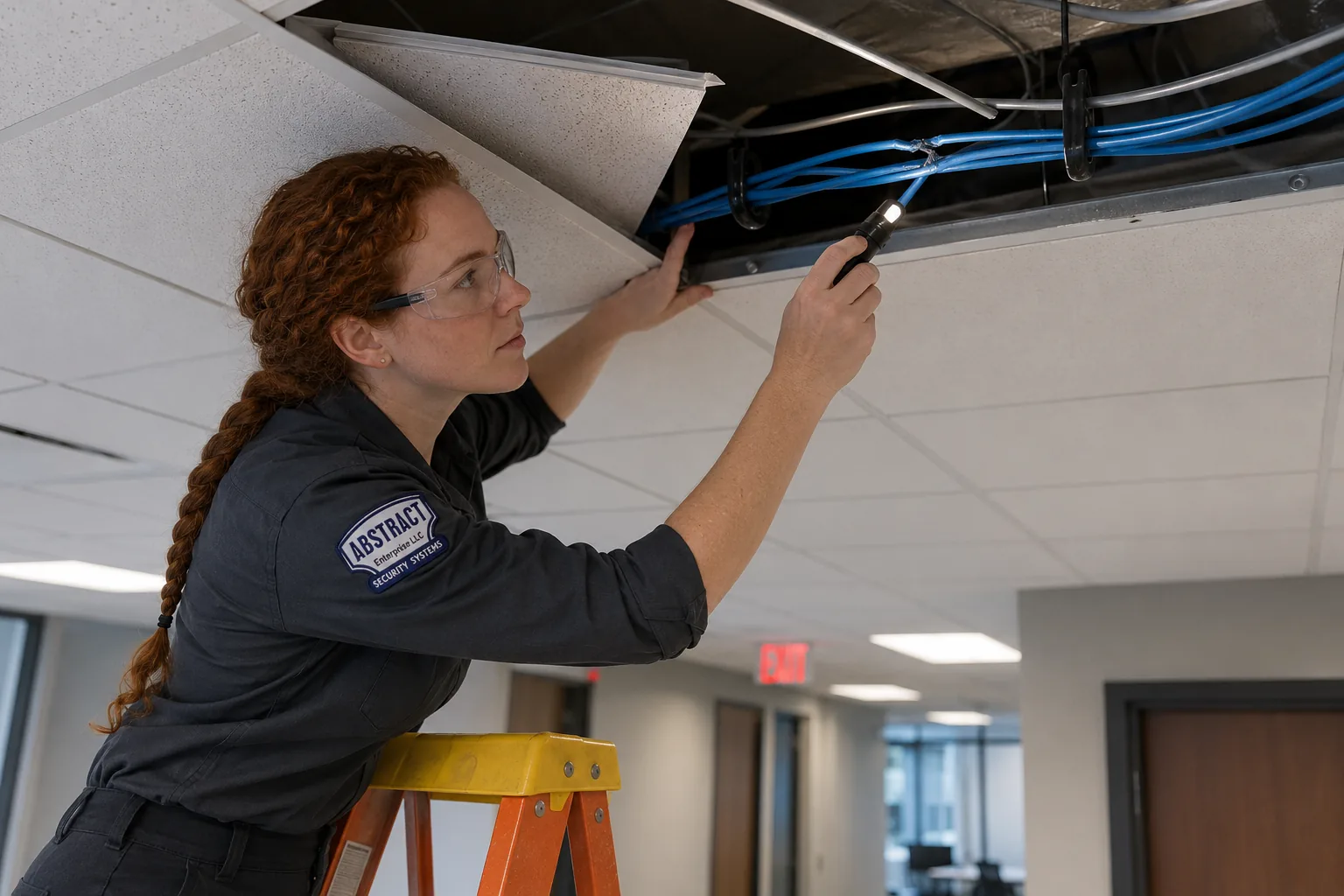
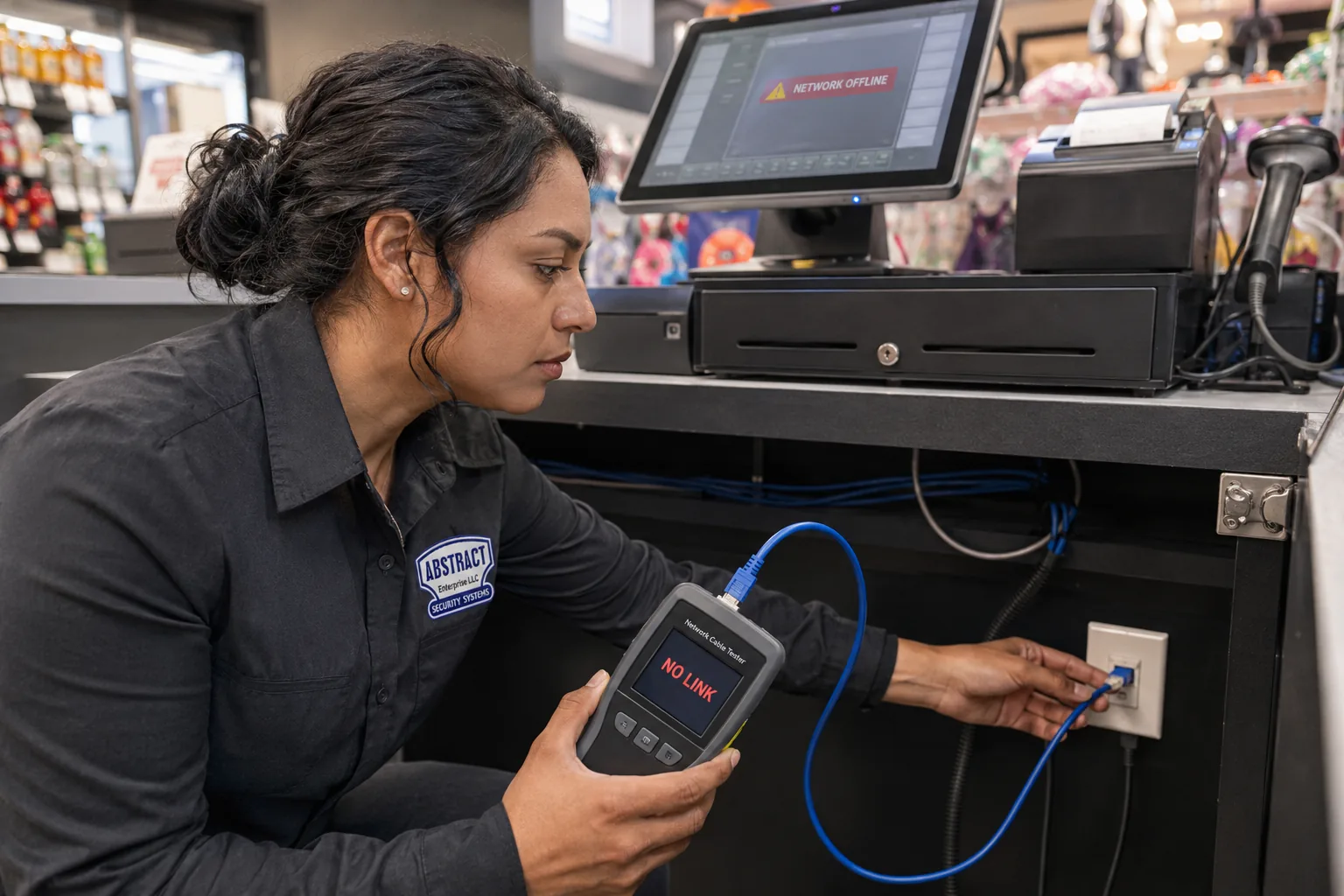
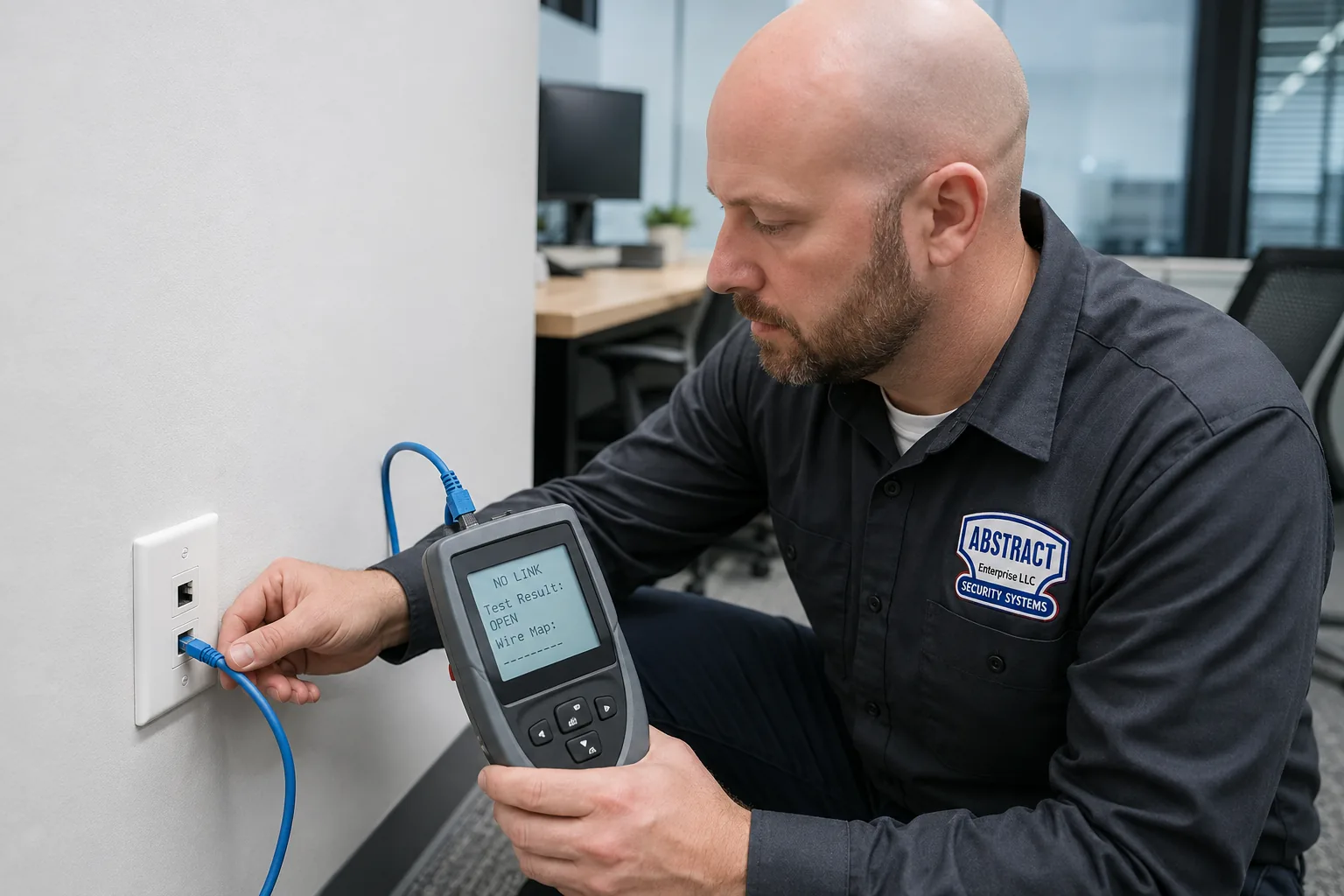
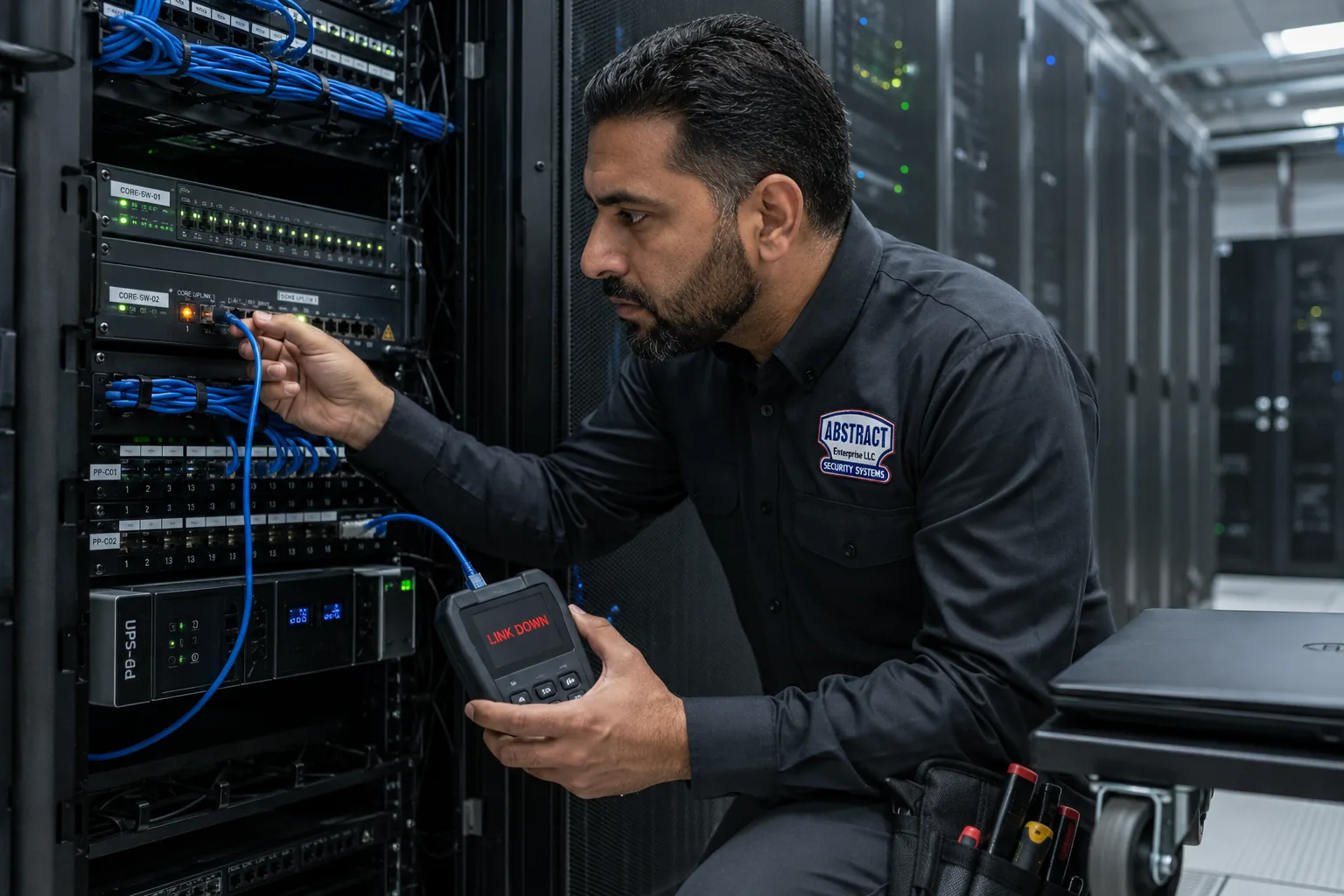
Ethernet · Cat6 · Data Jacks · Flex Bays & Office Parks · Certified Testing
Fault location, retermination, network jack and patch panel repair, PoE troubleshooting and certified cable testing across Suffolk County. Licensed NYS low-voltage contractor. Visits are scoped to finish rather than to diagnose, because this county is eighty-six miles long.
Ethernet, Cat6 and Data Jack Repair Across Suffolk County
The flex bay is the defining commercial unit of Suffolk County, and it is a building type with its own catalogue of cable faults. Front office, roll-up door at the back, mezzanine over part of it, one telecom point near the entrance and a floorplate that runs a long way from it. The Hauppauge Industrial Park alone holds hundreds of them, and Bohemia, Ronkonkoma, Islandia, Holbrook and Calverton hold hundreds more. Abstract Enterprises Security Systems repairs Ethernet, Cat6 and data cabling across Suffolk, west end to East End.
What goes wrong in those units is remarkably consistent. Tenants come and go every few years, each fit-out adds a layer, the office grows into the warehouse and drops get extended rather than re-pulled, the mezzanine gets wired by whoever was on site, and the rear of the bay — unheated, unconditioned, full of racking and moving equipment — eats cable that was specified for an office.
Our specialty service rate for repair is $195 an hour, three hours minimum, $585 for the opening block. In a county this long we scope the visit to finish: locate, repair, certify, and test the neighbouring drops while the crew is on site. Booking a diagnostic call and a separate return trip to Riverhead is a way of charging you twice for the same drive.
Network Down in Suffolk?
Same-day and next-morning coverage in the west and centre; planned windows further east. Every visit is scoped so the adjacent drops get tested while a crew is already on site.
✔ NYS Lic. #12000287431✔ Certified wiremap & performance testing on every repair✔ 4.7★ from 201 reviews
Local Conditions
Why the Suffolk Flex Bay Breaks Cable
Begin with the shape of the unit. A flex bay puts the telecom point at the front, near the entrance and the office, and then runs a hundred and fifty to two hundred and fifty feet back to the roll-up door. Everything at the rear — the shipping desk, the scanner position, the access point over the racking, the camera at the dock — sits at the far end of that distance. Add the vertical drop, the route around the mezzanine and two patch cords, and the channel budget disappears faster than anyone planning the fit-out expected.
Second, tenant churn. These units turn over on short leases, and each occupier reshapes the space: the office wall moves ten feet into the warehouse, a mezzanine goes in, a bench becomes a packing station. Cable follows those changes at the speed the tenant needs, which usually means an extension rather than a re-pull. The result is a unit whose cabling records — where they exist at all — describe a business that left in 2016.
Third, the rear environment. The back half of a flex bay is not an office. It is unheated or lightly heated, dusty, full of pallet racking, forklifts and a roll-up door that opens onto the weather several times a day. Insertion loss climbs with temperature in summer, the door end takes moisture in winter, and racking strikes and pallet contact do mechanical damage at exactly the height cable tends to be run.
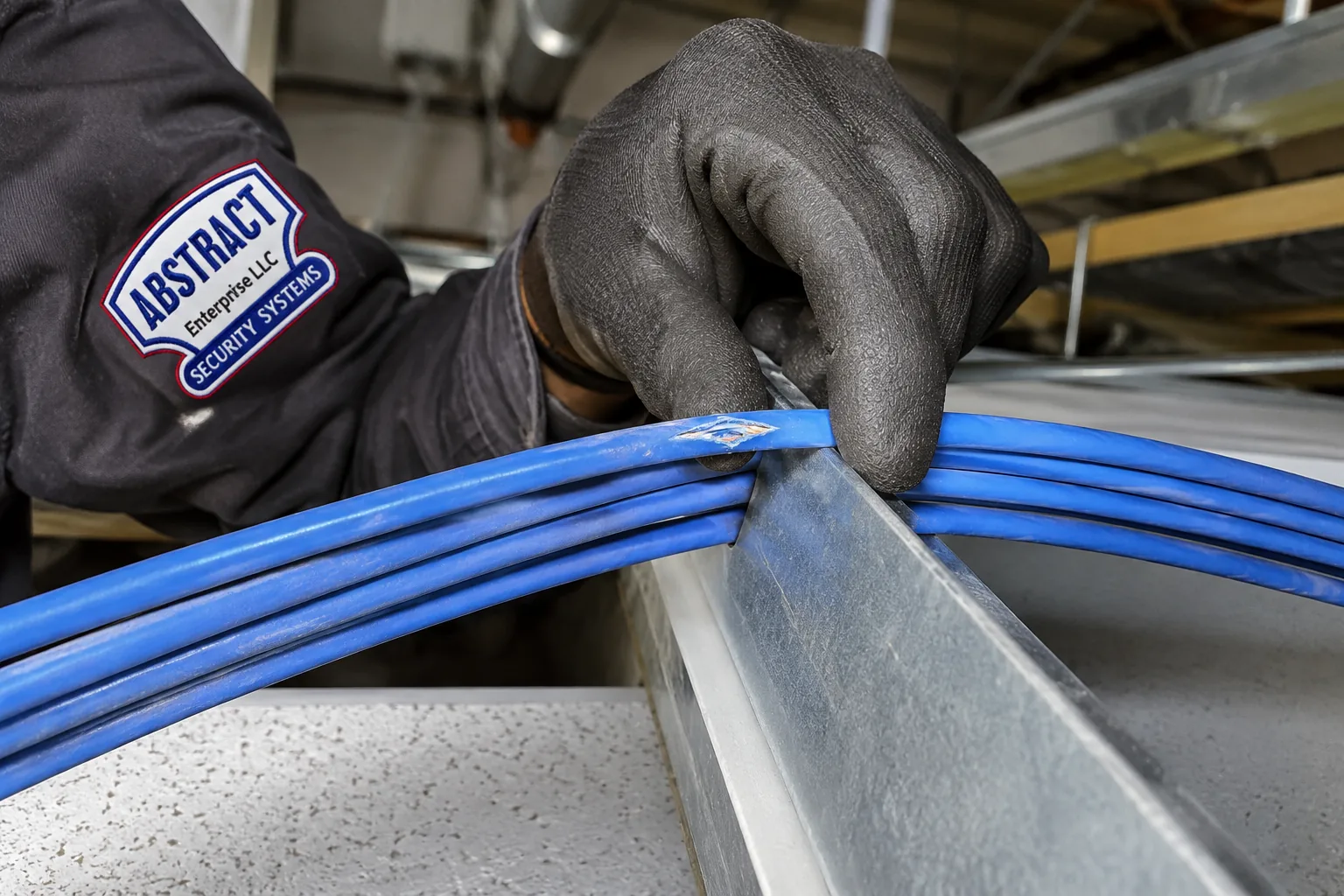
Fourth, the mezzanine. Almost every bay of any size has one, and almost every one has cable added after it was built — draped over the deck edge, run along a handrail, or fed up through a hole nobody grommeted. Those runs chafe at the edge and fail intermittently for years before they fail properly.
Fifth, the county's geography. Suffolk runs eighty-six miles and the difference between a Melville call and a Southampton call is most of a working day. That does not change how a repair is performed, but it changes what a sensible visit contains: adjacent-drop testing, closet mapping and labelling all belong inside the trip you are already paying for.
What We Repair
What a Suffolk Cable Repair Call Covers
We repair the physical layer, deal with the distance and the environment that caused it, and prove the result.
Flex Bay Distance Diagnosis
Measured length front to back including the vertical and the mezzanine route, against the 90 m and 100 m limits, with a repair-or-relocate answer rather than a guess.
Rear-of-Bay Environment Repair
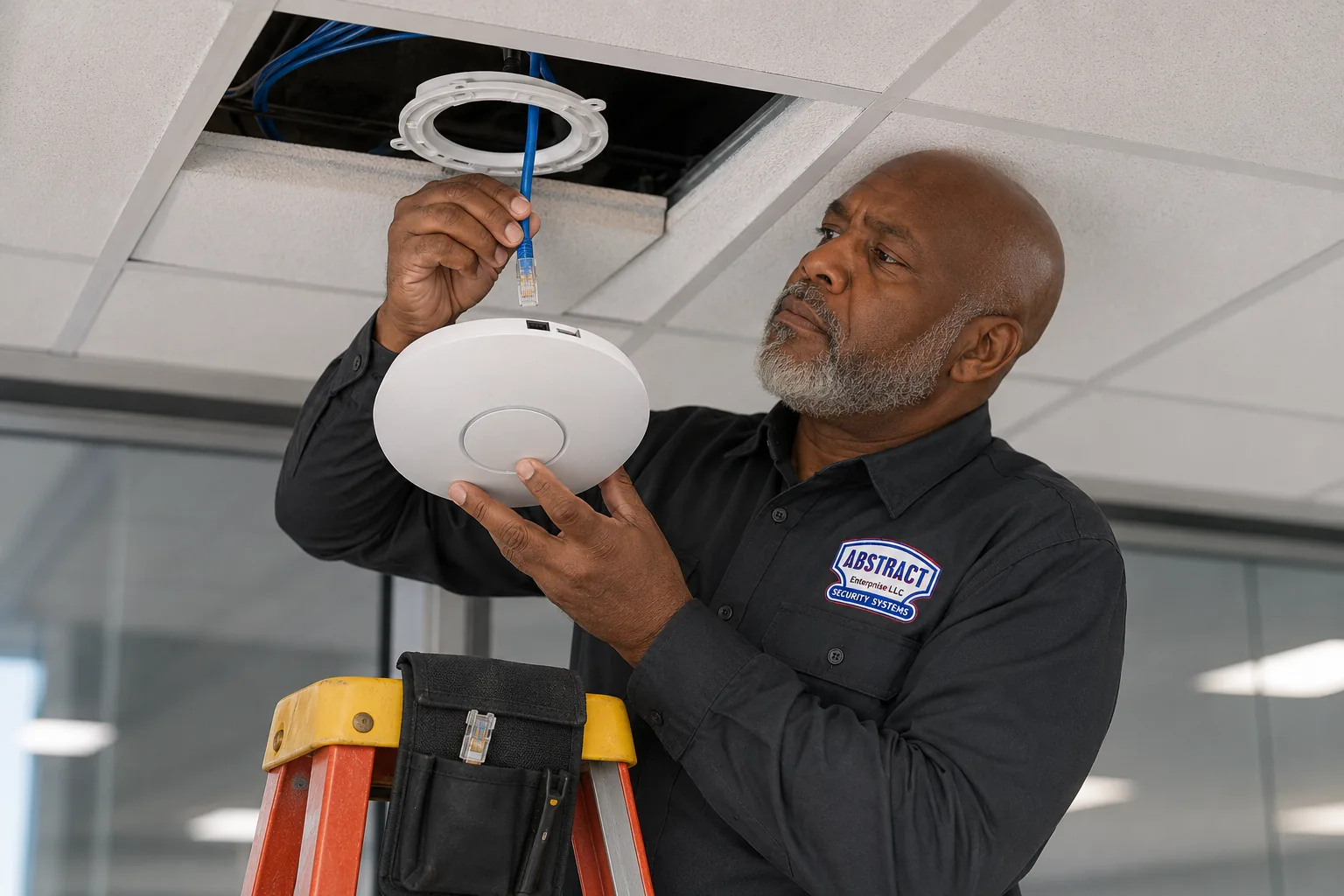
Runs at the dock and roll-up door end taking cold, damp, dust and mechanical contact. Repaired with cable and hardware suited to where they actually live.
Mezzanine Run Correction
Cable draped over deck edges, tied to handrails or fed through ungrommeted holes. Moved onto supports and protected where it chafes.
Extended-Run Correction
Drops lengthened during a fit-out and now out of spec. Measured first, then re-pulled where the arithmetic says the channel cannot be recovered.
Ethernet Cable Repair
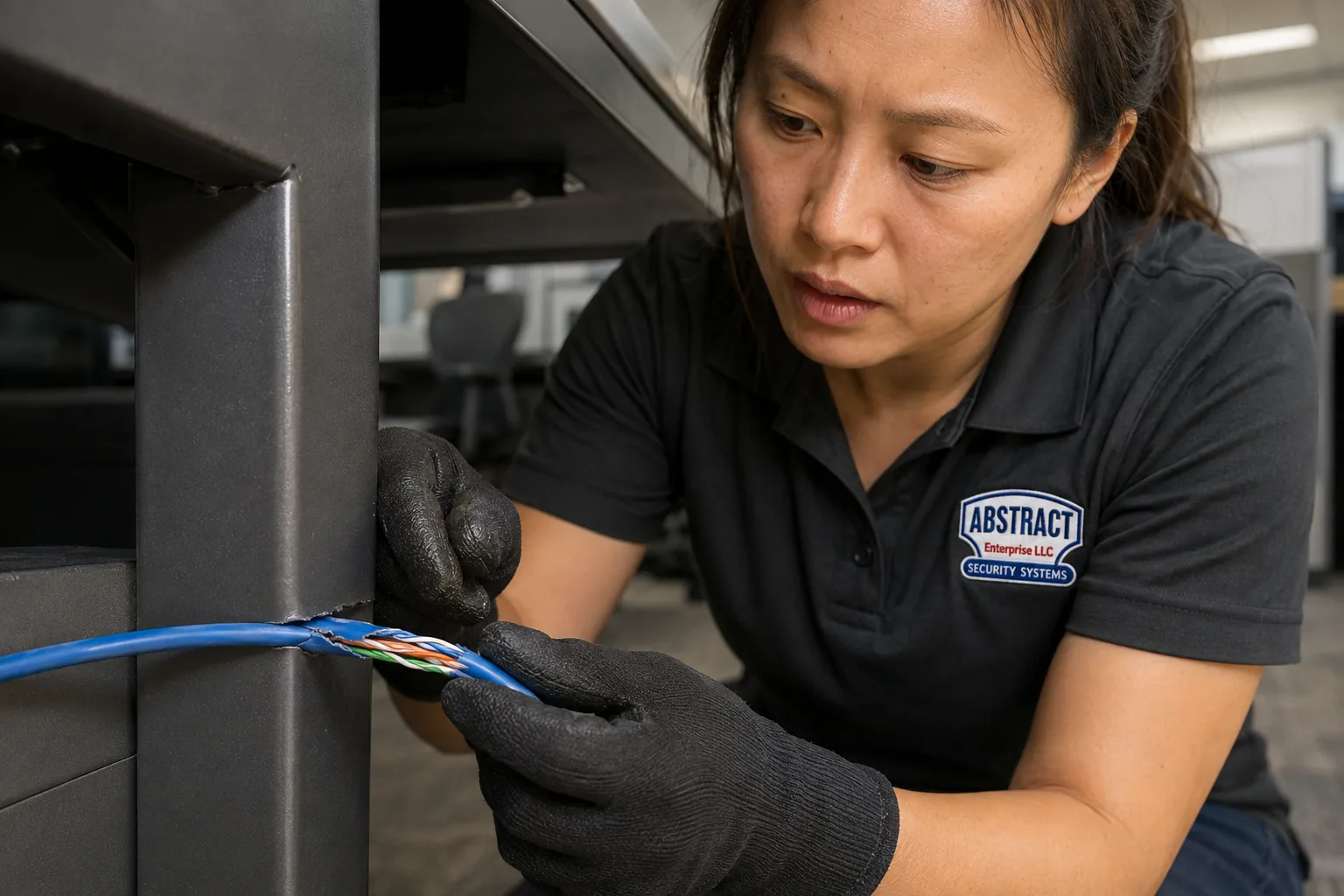
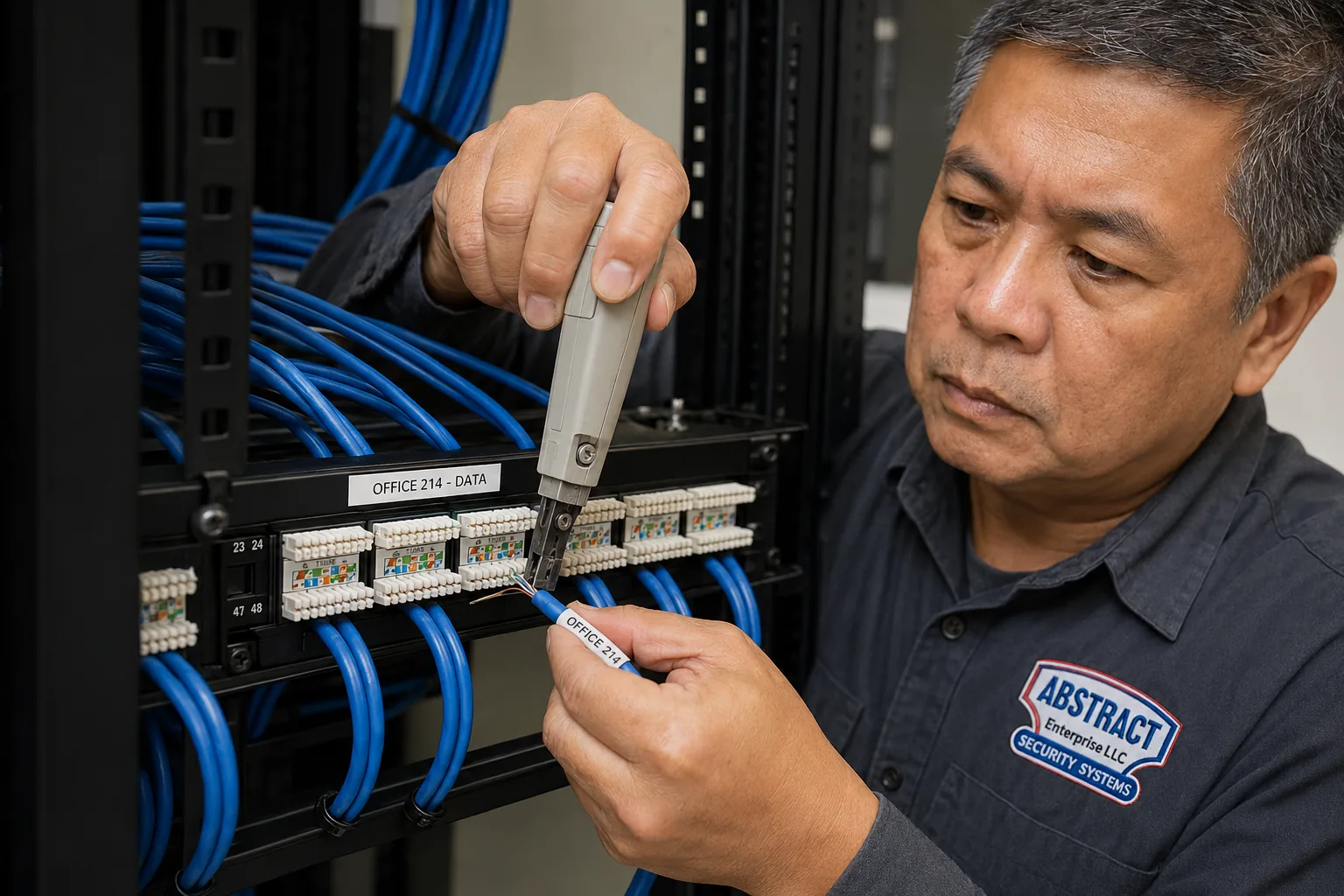
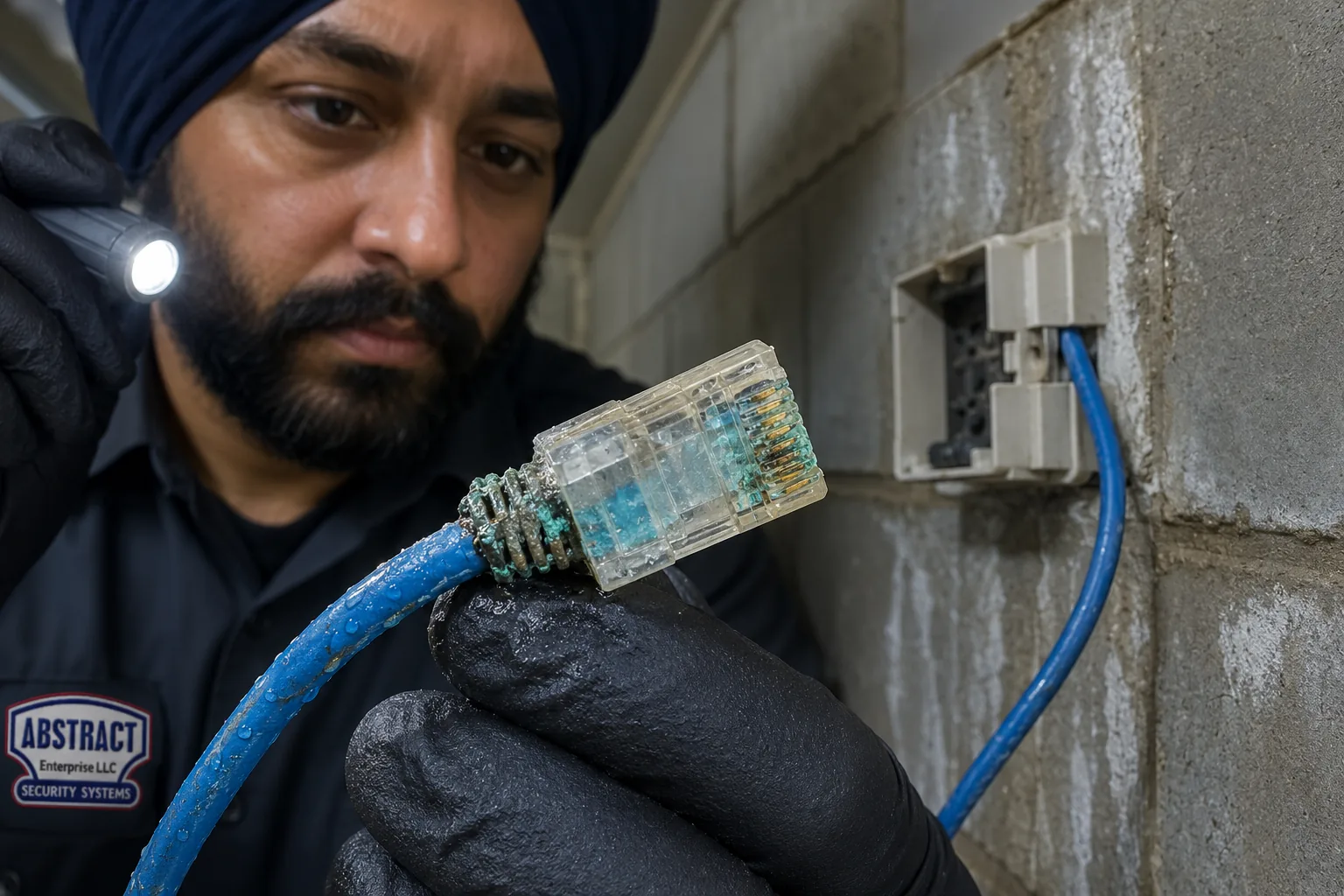
Runs that have been severed, flattened, worn through or attacked by damp, brought back with a junction rated for the category and then proved on a tester.
Cat6 and Cat6A Retermination
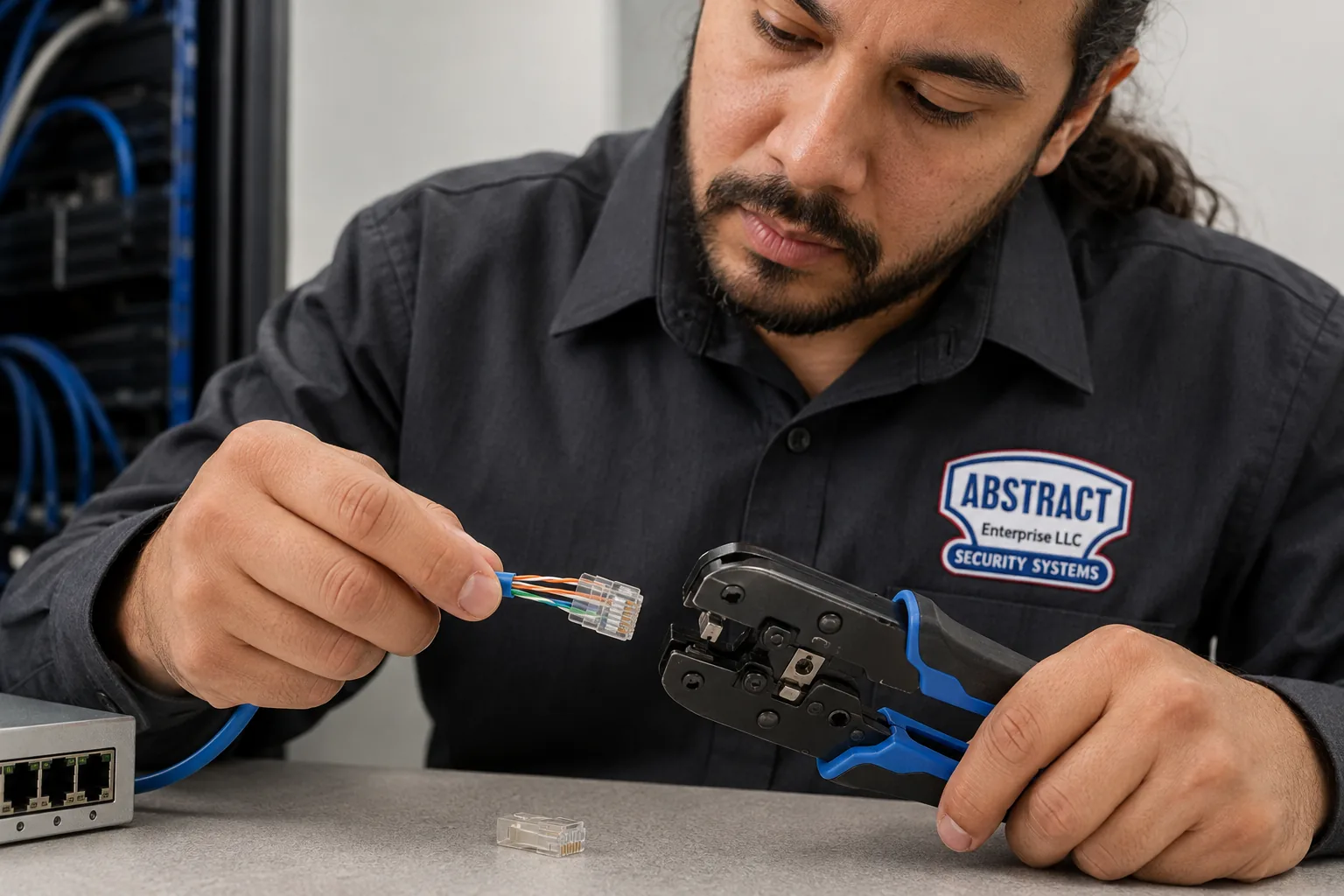
Fresh terminations at outlet and panel, wired T568B, with pair twist maintained right up to the IDC so the finished link meets its category on a certifier.
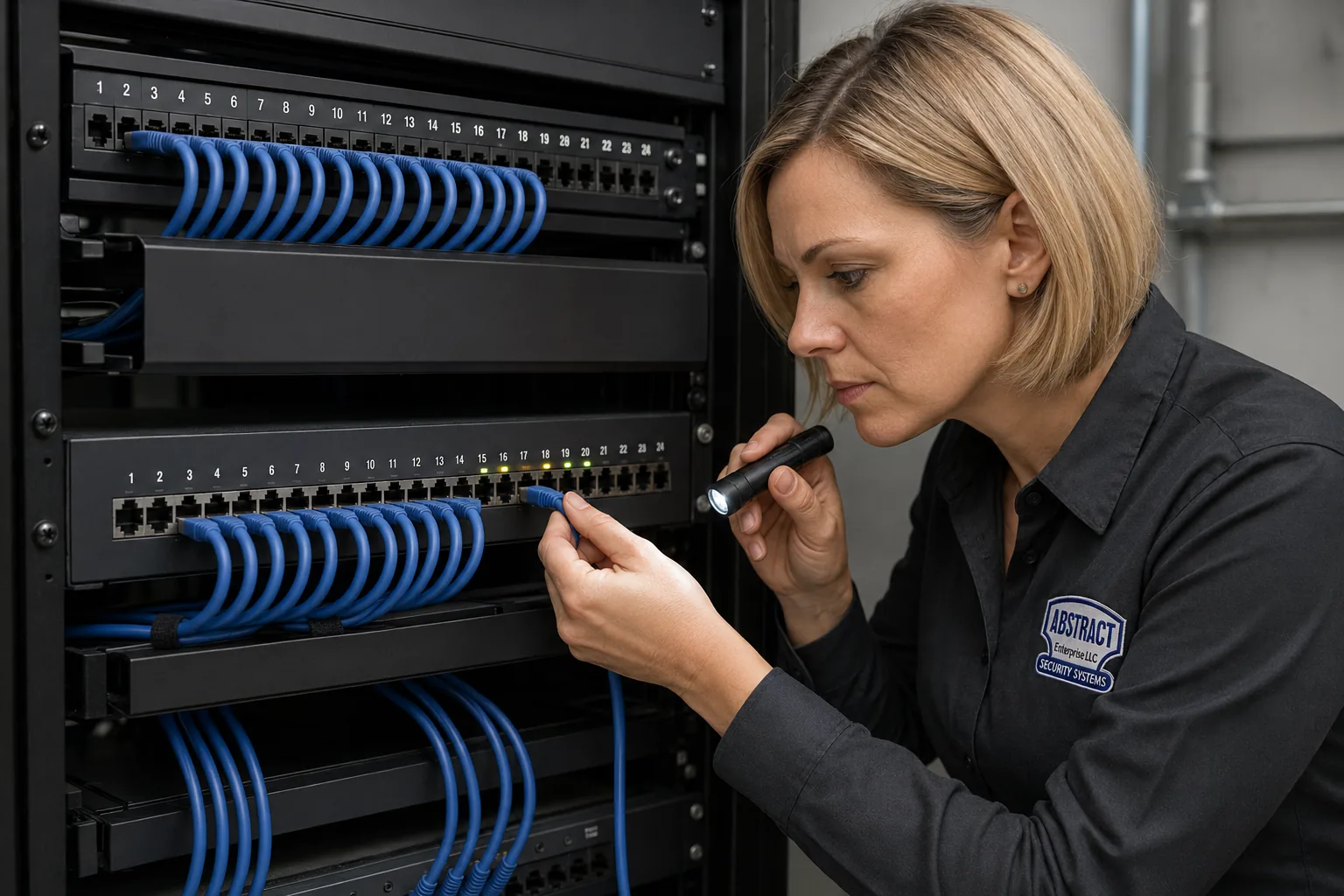
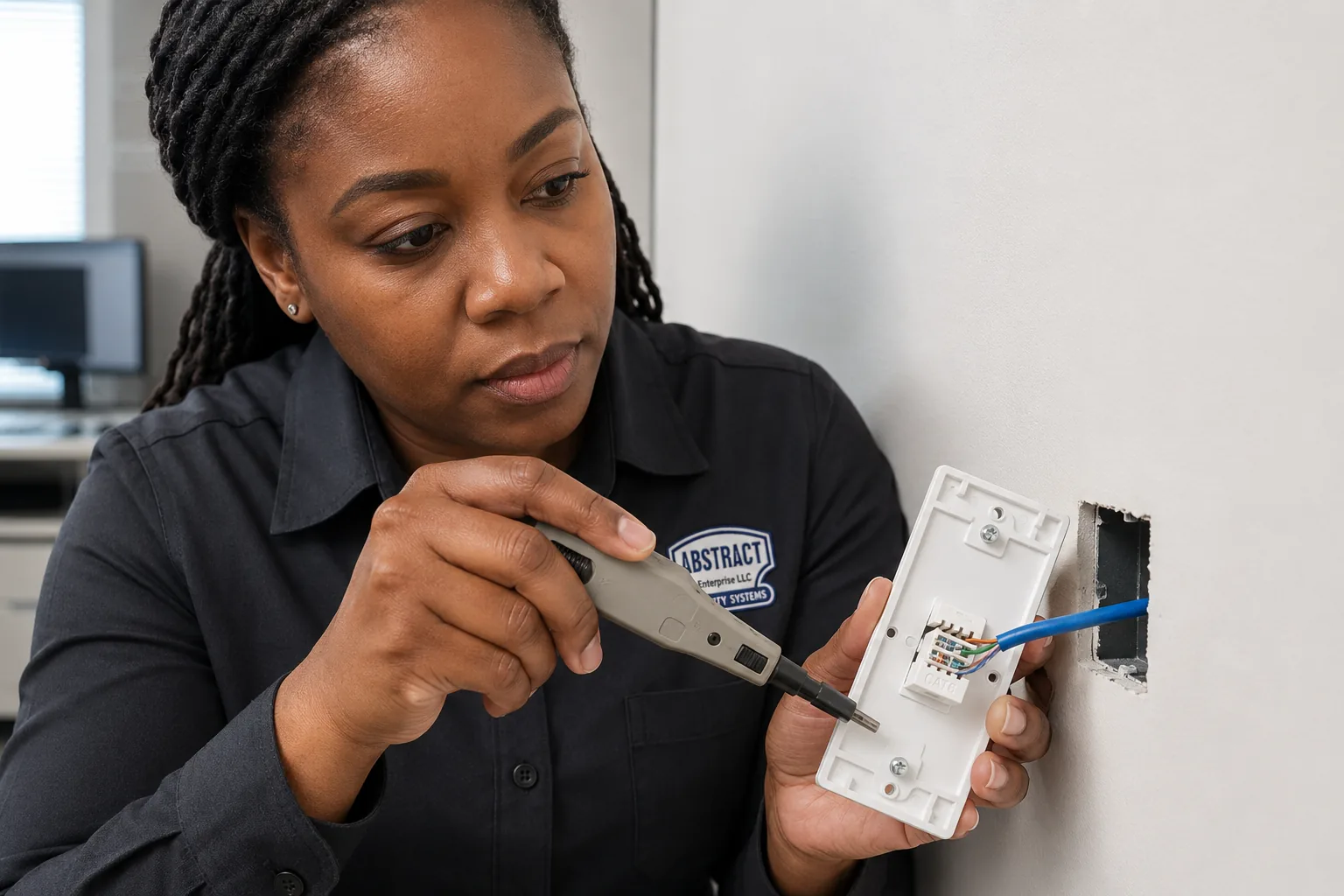
Network Jack and Panel Repair
Dead outlets, keystones seated but never punched through, and panel positions wired to the opposite standard by a previous tenant's contractor.
Closet Audit and Labelling
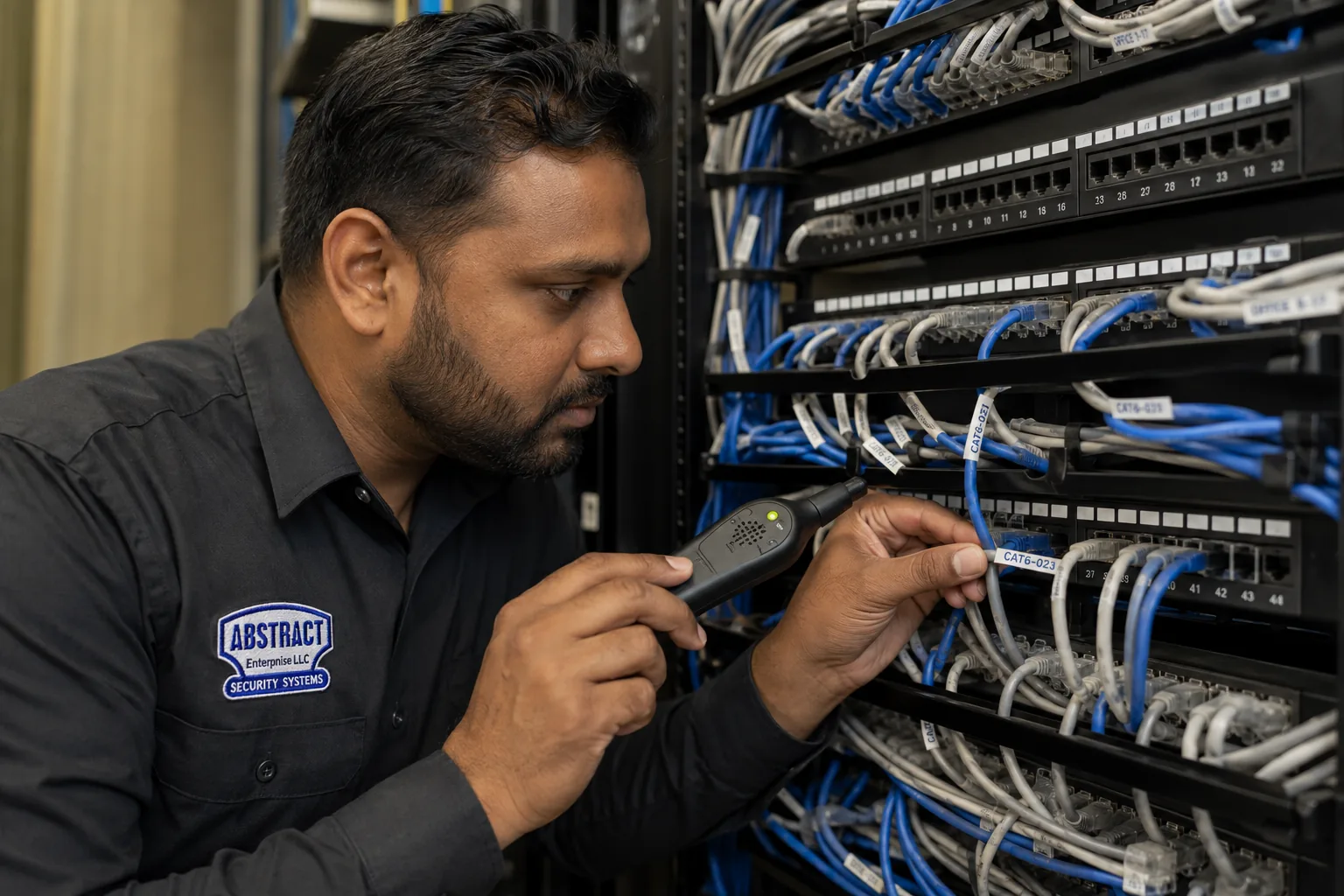
Sorting live runs from several tenancies of abandoned cable, mapping jack to port and labelling both ends so the unit's records describe the current occupier.
Certified Testing
Every repaired run measured for wiremap, length and performance, with the report saved and the remaining margin stated on it.
Commonly paired: the dock camera, the gate reader and the warehouse access point usually share a route with the data runs. If one has failed to distance or mechanical damage, testing the rest while the crew is on site avoids a second drive east — see camera repair and access control.
Plain English
Terms That Come Up on a Suffolk Job
Distance dominates this list, because in a flex bay it dominates everything.
Term
What It Means in a Suffolk Building
Flex bay
The county's standard commercial unit: front office, rear warehouse, roll-up door, usually a mezzanine, one telecom point near the front.
Channel
Outlet to switch port including both cords, with 100 m as the ceiling. In a long unit the fixed cable consumes nearly all of that before a single cord is plugged in.
Permanent link
Just the installed cable, panel to outlet, no cords counted. Capped at 90 m precisely so the full channel still fits under 100.
Vertical drop
The rise or fall between ceiling height and the outlet. Easy to forget when estimating length and frequently the metres that push a run over.
Coupler extension
A run lengthened to reach a new position. Adds a connection point and distance to a budget that was probably already tight.
Insertion loss
How much signal the run gives up end to end. It grows as the space heats, which explains a rear-bay drop that is fine in spring and unusable in a heatwave.
Chafe
Jacket wear where cable moves against a hard edge — the mezzanine deck being the classic Suffolk example.
Split pair
Eight wires terminated, paired incorrectly. It holds 100 Mbps quite happily and will not do gigabit, so it arrives as a complaint about speed.
Certification
A recorded measurement against the category standard with headroom noted. Distinct from a continuity beep.
Consolidation point
An engineered intermediate connection used in open-plan and warehouse fit-outs. Legitimate when designed, a fault source when improvised.
Equipment
Hardware and Test Equipment on a Suffolk Repair
We repair what is installed and replace with commercial-grade parts matched to the existing channel — Belden, CommScope, Panduit, Leviton, Hubbell, Ortronics, ICC, Berk-Tek and Superior Essex, with industrial-grade jacks, enclosures and supports where a run lives at the back of a bay rather than in the office. Category matching matters: a Cat5e keystone on a Cat6 channel derates the whole channel, and on a run already near the distance limit that is the difference between passing and not.
On the equipment side we chase cable faults behind Cisco, Meraki, Aruba, Ubiquiti UniFi, Netgear, TP-Link, Luxul and Araknis switching, and behind PoE devices — warehouse access points, dock and yard cameras, handsets, scanners, readers and time clocks. Configuration is outside our remit: no switch administration, no VLANs, no controllers, no firewall policy. The channel gets certified and the results go to whoever runs the network.
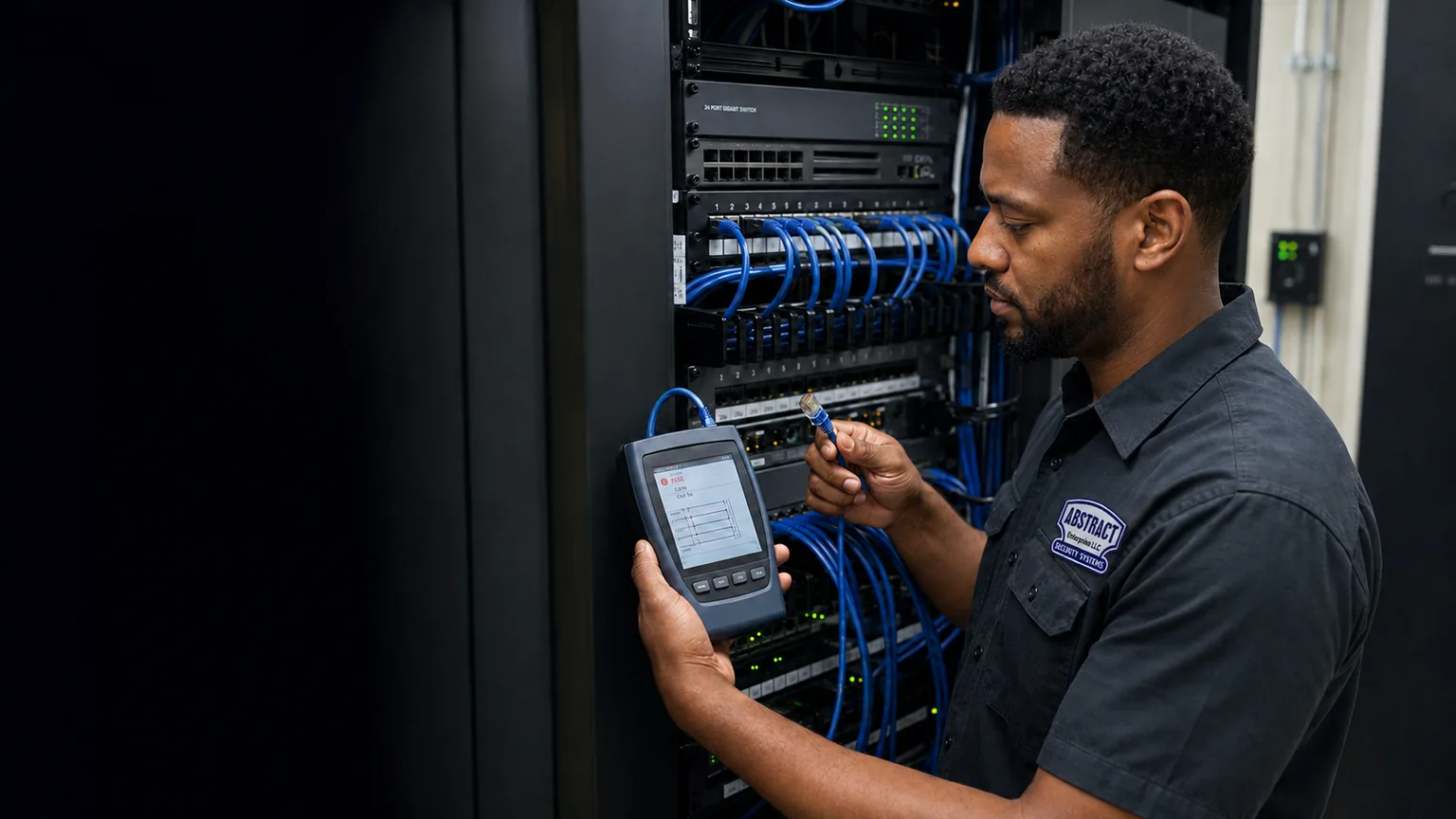
The certifier earns its place on the first measurement. In a flex bay the question is nearly always whether the run is too long, and a tester answers that in under a minute — before a ceiling is opened, before a jack is replaced, and before anybody spends an afternoon chasing a fault that is arithmetic rather than damage.
Need Repair in Suffolk County Today?
Same-day and next-morning coverage in the west and centre; planned windows for the East End. Visits are scoped so adjacent drops are tested while the crew is already on site.
In a flex bay the order is deliberately inverted from what most contractors do.
The first tool out is the tester, not the punch-down. Measured length answers the question that governs the whole job: is this a termination problem or a distance problem? If the permanent link is over ninety metres, no amount of re-terminating will produce a reliable channel and everything that follows should be about a shorter route or an intermediate device. Finding that out in the first minute saves the afternoon.
Then the physical work — retermination, junction, jack or panel replacement, mezzanine route correction, or a fresh run on a better path. Then certification with the headroom reported rather than filed, because in a rear bay that swings thirty degrees between seasons, a drop that passes by a whisker in April is next July's callout.
Full Scope
Full Scope of a Suffolk Network Cable Repair
Diagnostics
Measured length front to back including vertical and mezzanine routing
Comparison against the 90 m and 100 m limits before anything is opened
Fault location by measured distance on broken or shorted runs
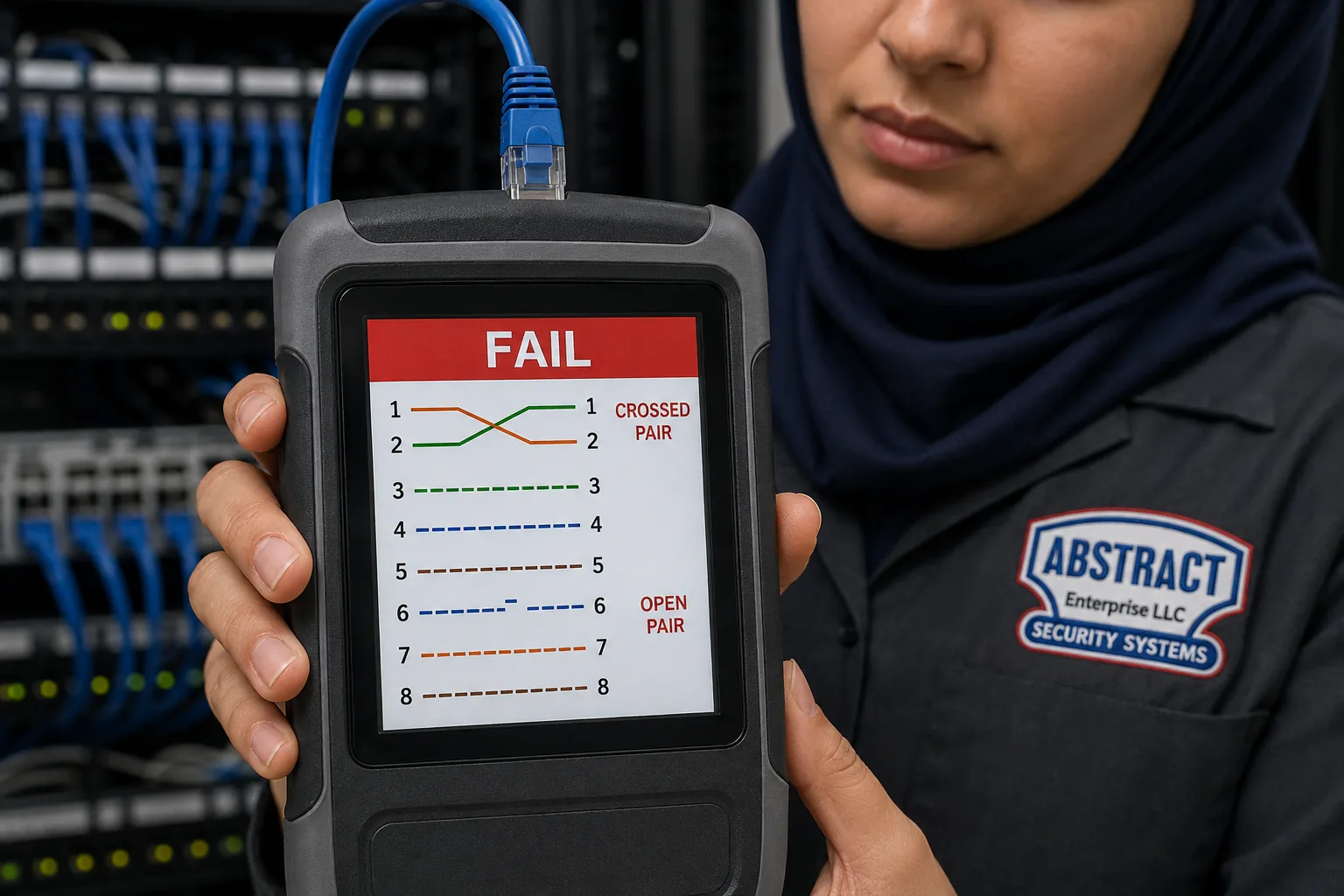
Wiremap faults: opens, shorts, reversals, split and crossed pairs
Insertion loss and crosstalk with headroom reported
Identification of coupler extensions added during past fit-outs
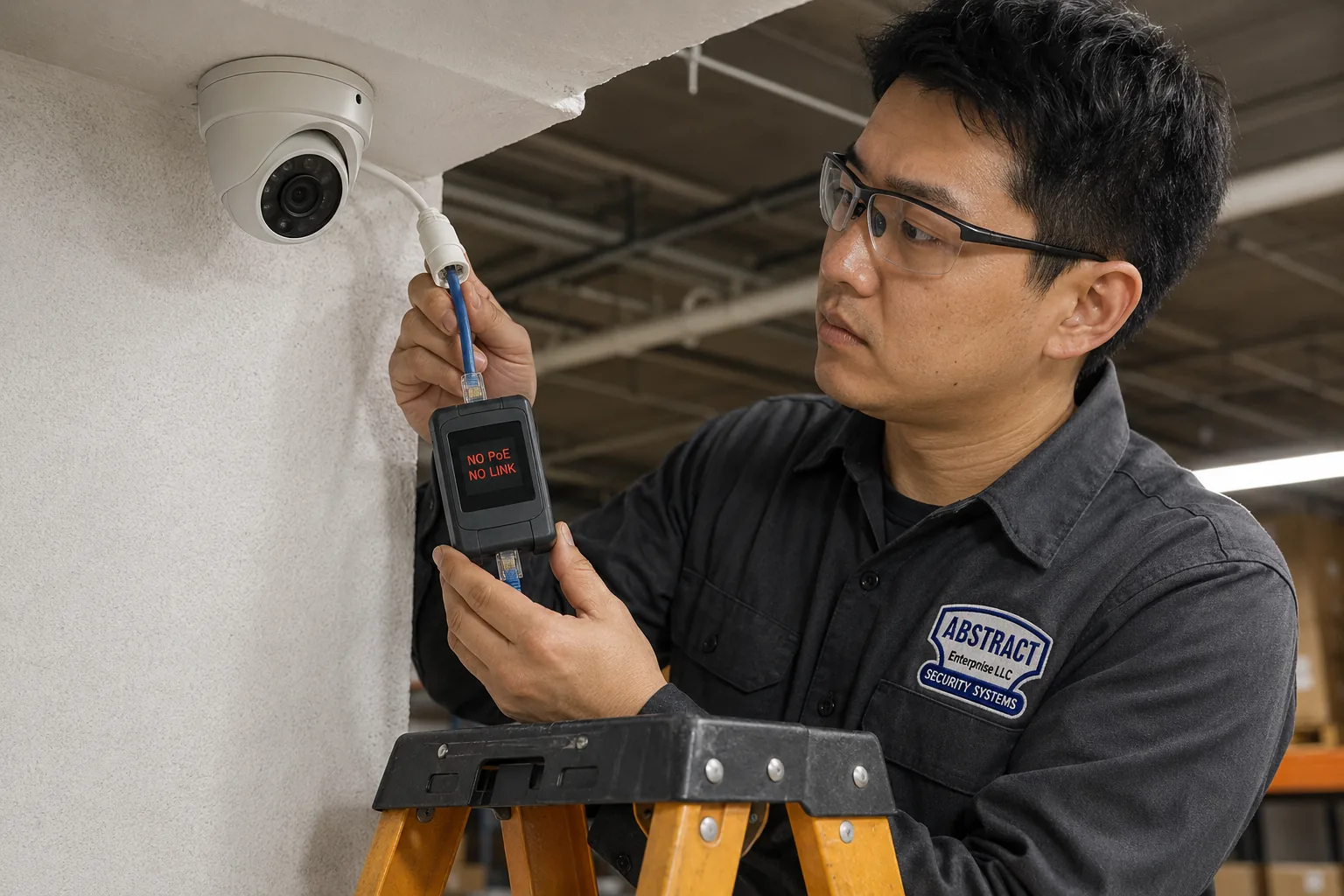
PoE measurement at the endpoint under real draw
Switch-port versus cable-fault isolation
Physical Repair
Keystone and patch panel retermination
Category-appropriate junction repair on damaged runs
Mezzanine route correction onto supports and off deck edges
Re-route of over-length runs to a shorter pathway
Full run replacement where certification fails
Industrial-grade jacks and enclosures at the rear of the bay
Protection where racking, pallets or forklifts move
Saved test results per repaired drop, with headroom and measured length
Both-end labelling and a closet legend describing the current occupier
Identification of live versus abandoned runs from prior tenancies
Photo record of concealed repairs before close-up
Written findings for a landlord, tenant or IT provider
Site Logistics
Visits scoped to complete in one trip
Adjacent-drop testing included while on site
Planned windows for East End and eastern Suffolk work
Working around shipping and receiving schedules
Certificate of insurance where the park or landlord requires it
Coordination with your existing IT provider
Coverage Detail
Where We Work Across Suffolk County
The Route 110 corridor is the county's office concentration — Melville, Huntington Station and Farmingdale, with large single-floor and two-floor plates, corporate tenancies and the densest professional demand west of Hauppauge. Huntington village, Cold Spring Harbor and Northport add smaller professional and retail tenancies in older stock.
The central industrial belt is where most of our flex-bay work happens. The Hauppauge Industrial Park sits at its heart, with Islandia, Ronkonkoma, Bohemia, Holbrook and Hauppauge's surrounding streets forming one of the largest concentrations of light industrial and flex space in the region. MacArthur Airport anchors the southern edge, and Smithtown, Commack, Nesconset and Hauppauge's retail corridors run along Jericho Turnpike and Veterans Memorial Highway. Stony Brook adds a research and medical footprint to the north.
The south shore and the East End stretch from Bay Shore, Islip, Sayville and Patchogue along Montauk Highway through Shirley, Mastic and Center Moriches, then Riverhead and Calverton at the fork, and out through Southampton, Bridgehampton, East Hampton, Sag Harbor and Greenport. Retail, hospitality, agricultural and marine businesses dominate east of Riverhead, with seasonal occupancy and long travel distances shaping how the work is planned.
Who We Serve
Suffolk Industries We Repair Cabling For
Flex and Light Industrial
Hauppauge, Islandia, Bohemia, Holbrook. Front office and rear warehouse in one unit, with the distance problem built into the floorplate.
Warehouse and Distribution
Deep buildings, dock and yard drops, forklift and racking damage, and access points over racking at the far end of a run.
Route 110 Corporate Offices
Melville, Huntington Station, Farmingdale. Large plates, multiple tenancies and infrastructure layered across occupiers.
Medical and Dental Practices
Stony Brook, Smithtown, Commack, Patchogue. Imaging and practice systems with no tolerance for a marginal channel.
Retail and POS
Jericho Turnpike, Veterans Memorial Highway, Montauk Highway and the village centres. Register lanes failing at peak.
Restaurants and Hospitality
Kitchen terminals in heat and grease, plus East End seasonal properties with outdoor and event coverage.
Marine and Waterfront Businesses
Marinas and boatyards from the Great South Bay to Greenport, with exterior runs and coastal exposure.
Agricultural and Winery Properties
North Fork and East End parcels with more than one structure and outdoor working areas.
Schools and Municipal Facilities
Town and village buildings, libraries and district properties with layered infrastructure and break-window scheduling.
Drawn from the recurring themes in trade, IT and Suffolk local discussion threads, grouped by the six question types that come up most.
Cost Questions
1. What does a repair cost out here?
$195 an hour with a three-hour minimum, so the opening block is $585. That block is scoped to finish: measure, locate, repair, certify, and test the adjacent drops while we are in the unit. A run that must be pulled fresh starts at $175 per commercial Cat6 drop.
2. Is there an extra charge for the East End?
No surcharge. What we do instead is plan eastern work into scheduled windows and scope it so it completes in one visit, because two drives to Southampton cost everybody more than doing the adjacent testing on the first.
3. Why does the quote say re-pull instead of repair?
Because the measurement said so. If the permanent link is over ninety metres, the channel is out of spec once patch cords are added and no termination work will make it reliable. Re-pulling on a shorter route is the only honest answer, and it is cheaper than repeated visits to a run that cannot pass.
Quality and Trust Questions
4. How do I know the fix will hold through the summer?
Ask for the headroom. A rear bay swings a long way between seasons, and a channel passing by a whisker in April is a July callout. The report shows how much margin is left, which is the only honest predictor available.
5. Do I need a licensed contractor?
Anything more involved than changing a cord, yes. Cabling is low-voltage work with obligations on jacket rating and firestopping, and most industrial parks and landlords here require licensure and insurance on file before access. Ours is NYS Low-Voltage #12000287431.
6. Our unit had three tenants before us. Does that matter?
It matters more than almost anything else. Each occupier left cable behind and moved walls, so the records describe a business that left years ago. The tracing and labelling we do is what makes the unit legible again, and it is the part tenants tell us afterwards was worth the visit.
DIY and Pro Questions
7. Can we run a cable to the new packing station ourselves?
Measure the distance first. In a deep bay the run to the back is frequently already close to the limit, and adding a coupler and twenty more feet takes it over permanently. If the measurement leaves room, the fastening and the route still matter — do not drape it over the mezzanine edge.
8. Is the tester from the supply house useful?
For pin order, yes. It reports no distance, which in this county is usually the actual answer. A run that is too long will pass a pin check every time and fail everything that matters.
9. Can we tie cable to the mezzanine handrail?
Please do not. The handrail moves, the deck edge is sharp, and the jacket wears through where it rubs. Cable belongs on supports at a consistent height, and correcting that route while somebody is already up there costs very little.
Technical Questions
10. Why do the drops at the back of the bay behave differently from the front?
Distance. The telecom point is at the front and the rear positions sit at the far end of a long horizontal run plus a vertical drop plus two patch cords. Those channels do not fail cleanly — they train, carry traffic, then degrade when the space warms.
11. Our warehouse access point drops out on hot afternoons. Cable or radio?
Usually the run. Insertion loss rises with temperature and the rear bay is unconditioned, so a channel with little margin drifts out of spec through the afternoon and recovers overnight. Measuring headroom identifies it before the next heatwave rather than after.
12. One port sits at 100 Mbps while the rest reach gigabit. What is that?
One of the four pairs has failed or been miswired. Older signalling needs only two pairs so the link trains happily; gigabit needs all four and either refuses or negotiates and falls straight back.
Landlord and Tenant Questions
13. We lease a bay in an industrial park. Who owns the cabling?
Typically the landlord provides the shell and a point of presence and the tenant owns the cabling inside the unit, but flex leases vary and many are silent on infrastructure left by previous tenants. We document what is live, what is abandoned and where the fault sits, which is what the parties actually negotiate from.
Complaint Questions
14. Somebody replaced this run twice and it still fails. Why?
Two possibilities and a certifier distinguishes them in a minute. Either the run is over-length, in which case new cable on the same route reproduces the fault exactly, or the route itself is destroying it — a mezzanine edge, a racking strike, a door end. Both need the path changed rather than the copper.
Answer The Public
Answer The Public: Suffolk Network Cable Questions
Who repairs network cable in Suffolk County?
Licensed low-voltage contractors. Electricians handle conduit and line voltage and generally pass the data ends on; IT firms own the network above the copper and rarely carry a certifier. A failing drop at the back of a Hauppauge bay is cabling work.
What causes cabling to fail in Suffolk buildings?
Run length in deep flex bays, coupler extensions added during fit-outs, chafe at mezzanine edges, mechanical damage from racking and forklifts, temperature swing in unconditioned rear space, and terminations executed without untwist discipline.
What makes a run not worth repairing?
When measured length puts the channel out of spec — the most common answer in this county — or when it will not certify after both ends are redone, when there is damage in several places, or when the route itself keeps destroying it.
Where do faults sit in a flex bay?
At terminations first, then at the mezzanine deck edge, at racking height where pallets and forklifts move, at the roll-up door end where weather gets in, and anywhere a previous tenant extended a run.
How quickly can a Suffolk repair be scheduled?
Same day or next morning in the west and centre; planned windows for the East End. Visits are scoped to finish in one trip rather than split into a diagnostic call and a return.
Reality Check
AI Overview Reality Check: What Search Results Miss About Suffolk Cabling
Search for network cable repair in Suffolk County and you get a national cost average, lead-generation directories, and troubleshooting written for a small office. The county's defining commercial unit is a two-hundred-foot flex bay, and almost nothing online is written for it.
1. Distance Is Trivia Online and the Governing Constraint Here
Published guidance mentions the hundred metre limit once, as a specification note, because most of it is written from a frame where no run gets close.
A flex bay puts the telecom point at the front and the working positions at the back. Add the horizontal run, the vertical drop, the route around a mezzanine and two patch cords, and the budget is spent well before the roll-up door.
Those channels do not fail cleanly. They train, carry traffic and then degrade as the space warms, which sends people to the switch, the access point and the carrier while nobody measures the cable. It is a thirty-second check that is almost never done first.
2. Nobody Writes About Tenant Churn and It Explains Half the Faults
Flex units turn over on short leases and each occupier reshapes the space: the office wall moves, a mezzanine appears, a bench becomes a packing station.
Cable follows at the speed the tenant needs, which means extensions rather than re-pulls. Each one spends part of a fixed channel budget, and after two the arithmetic is gone — producing a unit that behaves erratically for reasons buried in a fit-out nobody present remembers.
It also means the records, where they exist, describe a business that left years ago. Tracing and labelling is frequently the most durable thing a visit produces.
3. The Rear of the Bay Is Not an Office and Search Results Assume It Is
Generic advice assumes conditioned, clean, static space. The back half of a flex bay is unheated or lightly heated, dusty, full of racking and moving equipment, with a roll-up door opening to the weather several times a day.
Insertion loss rises with temperature in summer and the door end takes moisture in winter, so a marginal channel there has two seasonal ways to fail. Meanwhile racking strikes and pallet contact do mechanical damage at exactly the height cable tends to be run.
Office-grade jacks and enclosures put in that environment are a slow failure with a date on it, and no consumer-facing article says so.
4. The Mezzanine Fault Appears in No Troubleshooting Guide
Almost every bay of any size has a mezzanine, and almost every mezzanine has cable added after it was built — over the deck edge, tied to a handrail, or through a hole nobody grommeted.
Those runs chafe where they move against steel and fail intermittently for years before failing properly. The pattern is maddening because it is mechanical: it comes and goes with movement rather than with load.
It is also cheap to correct while somebody is already up there, and replacing the cable without changing the route reproduces it exactly.
5. Cost Averages Assume the Technician Is Nearby
Aggregated cost pages assume a contractor can appear, look, leave and return. Suffolk runs eighty-six miles, and Melville to Southampton is most of a working day.
That does not justify a surcharge; it justifies scoping. A visit that measures, repairs, certifies and tests the neighbouring drops in one block is worth considerably more than a cheaper call producing a quote and a second appointment.
Those pages also merge installation with repair into one figure. Installation can be scoped before anyone sets off; repair cannot, because the fault has to be found first.
6. Lead Directories Sell Your Number Rather Than Checking Anyone's Kit
Angi, HomeAdvisor, Thumbtack and their equivalents resell a single enquiry to several firms, and whoever answers first is usually the highest bidder. Ratings sit on accounts spanning many unrelated trades.
The categorisation is what breaks it. Pulling and terminating cable sits under the same label as configuring routers and fixing wireless, so a job wanting a certifier, a tone set and a punch tool reaches whoever replies first regardless of what is in their van.
Three questions clear it: what certifier is on the van, does the report include measured length, and what is your New York State low-voltage licence number.
7. Seasonal East End Work Has Its Own Rules and Gets No Mention
East of Riverhead a great deal of commercial property earns most of its year in a few months, which changes when work should happen rather than how.
The right time for anything planned is the quiet season, when the work costs nothing in trading. The wrong time is the week before opening, which is when most people discover the problem.
Nothing in national guidance reflects that, and it is the single most useful scheduling advice available to a hospitality or retail business out there.
Measure the Run Before Replacing Anything.
Certified testing on every repair. Licensed NYS low-voltage contractor. 4.7★ from 201 reviews.
Two minutes, no cost, and it resolves a fair number of calls before they become calls.
Move to a different switch port
Yes
Quickest way to take the switch out of the equation entirely.
Test the device on a known-good outlet
Yes
Working at the front of the unit and dead at the back is a distance signal, not a hardware one.
Pace out the distance to the failing outlet
Yes
Rough but useful. If it is a long way from the front of the unit, distance moves to the top of the list before anybody opens anything.
Re-punch a keystone jack
Borderline
The tool is inexpensive; the discipline is not. On a run already close to its distance limit there is no spare performance to absorb a loose termination.
Extend a run with a coupler to reach a new bench
No
Adds a connection point and distance to a budget that is usually already tight in a deep bay. This is the county's most common self-inflicted fault.
Tie cable to the mezzanine handrail
No
It moves, the edge is sharp, and the jacket wears through where it rubs. Supports at a consistent height cost almost nothing.
Diagnose a drop that fails only on hot afternoons
No
That is a margin measurement, and consumer testers cannot produce one.
Run office-grade hardware at the dock end
No
Cold, damp, dust and mechanical contact. It is a slow failure with a date on it.
Fifteen minutes and no invoice: the four rows above marked yes. The distance question is the one that matters here — if the failing outlet is at the back of a deep unit, say so when you call and we will bring the answer with us.
Alternatives
How a Licensed Cabling Contractor Compares Here
vs. Your IT Provider
Capable from the switch upward and generally candid that copper is not their trade. Cabling gets subcontracted, so the van that arrives is a third party on a third party's diary — a real problem when the site is an hour east.
vs. Lead-Generation Platforms
A single enquiry resold to several firms, with response speed reflecting lead spend rather than fit. Cable work sits beside computer support, and a report with measured length on it is not standard there.
vs. Your Carrier's Technician
They own the line to the demarcation point and nothing past it, which is a fair position. A circuit measuring clean there while outlets stay dead places the fault inside your unit.
vs. The Park's Handyman or the Landlord's Maintenance
Useful for cords, faceplates and access, and often the fastest hands on site. It goes wrong on distance and on fastening, because neither is obvious without a tester and some training.
vs. A General Electrician
The right trade for conduit, coring and line voltage, and genuinely needed when a shorter route requires a new penetration. Data terminations are a separate craft with much tighter tolerances.
Warning Signs
Five Signs the Cable Is the Problem in a Suffolk Bay
Drops at the back fail while the office drops are fine. Distance. Measure before replacing anything else.
A drop works in April and fails in July. Temperature and a channel with almost no margin, in a rear bay that is not conditioned.
The fault comes and goes with movement in the building. Chafe, usually at a mezzanine edge or where cable crosses something that shifts.
Trouble started after the office wall was moved. A drop extended rather than re-pulled, and a channel budget quietly spent.
One outlet holds 100 Mbps while the ones beside it manage 1000. A pair is broken or crossed. Nothing else produces that split, and it costs nothing to notice.
Community
Community Chatter: Recurring Themes From Public Forums
Paraphrased themes from public homeowner, small-business and IT discussion threads — not customer reviews of AESS.
Warehouse and flex-space threads repeatedly describe access points and workstations that work near the office and fail at the back of the unit, with distance the last explanation tried and the correct one.
Tenants in industrial parks frequently describe inheriting cabling from two or three previous occupiers, with no records and no way to tell live runs from abandoned ones.
Discussions about mezzanines regularly surface cable tied to handrails or draped over deck edges, failing intermittently for years before anybody connects the pattern to movement.
A steady theme in owner forums is puzzlement at how small the parts line is on a cabling bill. It is a fair reflection of the work, and across eighty-six miles it explains why one properly scoped visit beats a pair of cheap ones.
Help-desk procedures written independently by very different organisations open with the same three moves in the same order, which generally means the sequence has been proven against real faults rather than theorised.
Field Video
Watch: Field Diagnostics on a Suffolk County Repair Call
Short-form field clips from our channel: youtube.com/@openeye0007 Embed slot reserved — drop the Short iframe here once the clip ID is set.
FAQ
Network Cable Repair Suffolk County — Twelve Frequently Asked Questions
What does network cable repair cost in Suffolk County?
+
The specialty service rate is $195 an hour with a three-hour minimum, so $585 covers the opening block: measuring, locating the fault, repairing it, certifying it and testing the adjacent drops while we are in the unit. A run that must be pulled fresh starts at $175 per commercial Cat6 drop. There is no East End surcharge.
Why do drops at the back of our unit behave differently from the front?
+
Distance. The telecom point sits at the front and the rear positions are at the far end of a long horizontal run plus a vertical drop plus two patch cords. Those channels train and carry traffic, then degrade as the space warms — and the fix is a shorter route rather than a better jack.
Can a damaged run be joined, or does it have to come out?
+
A single accessible point of damage takes a properly made junction of matching grade, then a certifier to confirm it. Go to new cable when the measured distance already breaks spec, when it still fails after both terminations are redone, or when the route keeps eating whatever you put in it.
We extended a drop when the office wall moved. Could that be the cause?
+
Very likely. Each extension adds a connection point and distance to a fixed channel budget, and in a deep bay that budget is usually tight to begin with. Measuring the length settles it in under a minute.
Our warehouse access point drops out on hot afternoons. Is that the cable?
+
Usually. Insertion loss rises with temperature and the rear of a bay is not conditioned, so a channel with little margin drifts out of spec through the afternoon and recovers overnight. The headroom figure identifies it before the next heatwave.
What is wrong with running cable along the mezzanine handrail?
+
It moves and the deck edge is sharp, so the jacket wears through where it rubs. The result is an intermittent that follows movement rather than load and takes years to become an outright failure. Supports at a consistent height cost very little while somebody is already up there.
My wall jack is completely dead. What is the most likely cause?
+
Ranked by frequency: the cord whose clip has snapped, a closet position nobody ever terminated or one wired to the opposite standard, an outlet with conductors seated but never driven into the contacts, and last of all damage out along the cable.
Our unit had three tenants before us and nothing is labelled. Can you sort it out?
+
Yes, and in a flex bay it is often the highest-return part of the visit. We tone each run through to its outlet, separate live from abandoned, label both ends and produce a legend that describes your business rather than one that left in 2016.
Is there an extra charge for the East End?
+
No. Eastern work is planned into scheduled windows and scoped so it completes in one visit, because two drives to the Hamptons cost everybody more than doing the adjacent testing on the first.
Do you provide certified test reports?
+
Yes. Every repaired drop is tested and you receive the saved result including measured length and headroom, both-end labelling, and a closet legend where the scope covers it.
What cover comes with the work?
+
AESS-supplied products come with a twelve-month parts warranty under the service agreement. Modifying or tampering with the installed work without written approval first voids it.
Applied only where ceiling space is used for return air
After-hours or weekend window
Premium applies
For buildings restricting low-voltage work to off-hours
Published starting rates for Suffolk County. No East End surcharge; eastern work is planned into scheduled windows and scoped to complete in one visit instead. Final pricing depends on access, pathway, material rating and testing scope, and is confirmed in writing before work begins. Full terms — including 50% deposit, one-year parts-only warranty on AESS-supplied products, and the late-fee schedule — are set out in the service agreement. See structured cabling pricing for new-installation drop rates and Cat6 installation Suffolk County for per-drop grade comparisons.
The defining Suffolk fault. Telecom point at the front, working positions at the back, and a channel budget spent before the roll-up door. It produces degradation rather than clean failure, which is why it gets misdiagnosed for months.
Coupler Extensions From Past Fit-Outs
The office wall moves into the warehouse and a drop is lengthened rather than re-pulled. Each extension spends part of a fixed budget, and nobody present remembers the fit-out that did it.
Mezzanine Chafe
Cable over a deck edge, tied to a handrail or fed through an ungrommeted hole. Wears through where it moves and fails intermittently for years.
Unconditioned Rear-Bay Temperature Swing
The back half of a bay is not an office. Insertion loss rises through the summer and a marginal channel drifts out of spec on hot afternoons and recovers overnight.
Racking, Pallet and Forklift Damage
Mechanical contact at exactly the height cable tends to be run, plus roll-up door ends taking weather several times a day.
Layered Records From Previous Tenants
Three occupiers of abandoned cable in one unit with nothing labelled. Tracing is the work before the repair starts, and labelling is what stops it recurring.
Cross-sell note: dock cameras, gate readers and warehouse access points share routes and distance problems with the data runs. When one has failed, testing the camera drops and intercom runs on the same route avoids a second drive east.
From the Field
Field Notes
In a flex bay the tester comes out before the ladder. Measured length tells you within a minute whether this is a termination job or a physics job, and it changes what you say to the customer before anything is opened.
Ask when the office wall last moved. In these units that single question locates more coupler extensions than an hour of tracing, because the wall move and the extension always happened together.
Look at the mezzanine deck edge on every visit whether or not it is the reported fault. Cable rubbing on steel is the most common thing we find that nobody called about, and it is nearly free to correct while access is already up.
Scope the eastern jobs to finish. Adjacent-drop testing, tracing and labelling on the first trip cost a fraction of what a second drive to Riverhead or Southampton costs everybody.
Get In Touch
Request a Free Quote
Fill out the form below and we'll get back to you within the hour. Or call us directly at (631) 407-2884.
✅
We Got Your Request!
We'll call you back within the hour. If it's urgent, call us now at (631) 407-2884.
Emergency
Need Repair in Suffolk County Right Now?
Network down, dock scanners dead, warehouse access point offline, register out. Same-day and next-morning in the west and centre, planned windows further east.
Last reviewed: August 25, 2026 · Next scheduled review: November 2026 Changelog: Aug 2026 — page published. The flex bay established as the primary Suffolk thesis — front-to-back distance, tenant churn and coupler extensions, mezzanine chafe, unconditioned rear-bay temperature swing; measure-first sequencing documented; over-length re-route added to pricing; East End scheduling handled by planned windows rather than a surcharge; pricing aligned to the $195/hr specialty rate with a three-hour minimum; direct Suffolk line (631) 407-2884 used throughout.
Network Cable Repair Suffolk County — Licensed, Measured, Documented
NYS Low-Voltage Lic. #12000287431 · 4.7★ from 201 reviews · Serving New York City, Long Island and the Hudson Valley.