Commercial network installation across Suffolk County — the Melville office corridor and Huntington villages, the industrial parks at Hauppauge, Bohemia and Ronkonkoma, the central county through Patchogue, Bay Shore and Port Jefferson, and the East End from Riverhead out to Greenport and Montauk.
This county runs roughly eighty-six miles end to end, and the same business gets a materially different answer depending on where along that line it sits. The further east a property is, the harder the design leans on managed equipment, monitoring, spare capacity and on-site spares — because each of those turns a potential journey into a phone call.
Tell us the property and where in the county it is — we'll come back with a number.
This county runs roughly eighty-six miles end to end. The same business gets a materially different answer depending on where along that line it sits, and any honest scope starts by acknowledging it.
Quoted as their own lines rather than absorbed: rack hardware, panels, switching and firewalls where we supply them, conduit where the building requires it, firestop materials, coring, lift work in high-bay space, exterior and between-building runs, and the mileage allowance. Distance is a real cost on the East End and pretending otherwise only produces a change order later.
Worth asking any bidder here. How long does it take you to get to us, and what happens on a Friday afternoon in July? A contractor who has not thought about the drive has not thought about how you will be supported.
Hauppauge and Montauk are in the same county and nothing about supporting a network in one resembles supporting a network in the other.
At the western end, the industrial parks at Hauppauge, Melville and Bohemia sit minutes from the expressway. A fault is a short drive, a spare part is a detour, and a second visit next week is a minor inconvenience. Move sixty miles east and each of those becomes a scheduled expedition, made worse in summer when the roads to the forks are carrying visitors. The same fault costs a fraction of a day at one end of the county and most of a day at the other, and a design that ignores that is a design that will be expensive to live with.
The standards. Certification on every drop, supported pathway, firestopping at rated penetrations, proper labelling and a full handover package are identical in Riverhead and in Melville. Distance changes the logistics and the support design; it does not license a lower standard of work, and any bidder who treats an East End job as somewhere corners can be cut is telling you something useful.
The industrial parks at the county's western end hold one of the largest concentrations of light manufacturing, distribution and technology tenancies in the state, and they present a very consistent set of problems.
The building type is nearly uniform: a large single-story structure with an office front and production, assembly or warehouse behind, on a plate wide enough that the far corner sits beyond the reach of copper from any single room. Distance is the first design question, not the last. Where the plate exceeds what one room can serve, a second room goes in behind the office with fiber linking it back — settled before drop counting rather than discovered when a run fails certification.
The office front is a conventional environment: drywall, drop ceiling, ordinary coverage. The production or warehouse area behind it is not — high ceilings needing lift work, racking or machinery that absorbs and reflects, and an operations network that has a different tolerance for interruption than the office does. They get designed as two things that share a rack rather than as one thing stretched across a building.
Production equipment, test benches, scanners, labelling and anything driving a process belongs on its own segment, prioritised over the office and reachable from nowhere else. On a manufacturing tenancy this is the segment that costs money when it stops, and it should never be competing with a large download at the front of the building.
Production space is dustier, warmer and more electrically noisy than an office. Active equipment stays in a controlled room and cable runs out to it, rather than putting a switch on a shelf in the shop. Where a position genuinely has to live on the floor, it goes in a sealed enclosure with the cable entry sealed too, and that is a line item rather than an assumption.
Where along the county a property sits tells you both what it is made of and how it will be supported.
Hauppauge, Bohemia, Ronkonkoma, Holbrook and Islandia. Wide single-story plates with an office front and production behind, slab construction, high rear ceilings, and provider circuits entering wherever the utility found convenient. Second rooms and demarc extensions are routine rather than exceptional.
Melville and the Broad Hollow Road corridor. Multi-storey purpose-built office buildings with real telecom rooms, stacked closets and plenum ceilings, plus managing agents with exacting insurance and access requirements. Technically the most straightforward work in the county, with the administrative overhead of a city building.
Huntington village, Northport, Babylon, Sayville, Patchogue and Port Jefferson. Older masonry commercial with retail at street level and offices, practices and studios above. Party walls, plaster in the oldest stock, no dedicated equipment space, and pathway created rather than found.
The medical corridor at Stony Brook and West Islip, county facilities at Hauppauge and Riverhead, school districts across every town, and the colleges. Multiple buildings, mixed-vintage infrastructure, documented standards and procurement that treats certification and drawings as contract deliverables.
Riverhead, the North Fork through Southold and Greenport, and the South Fork out to Southampton, East Hampton and Montauk. Wineries, farms, inns, restaurants and village retail. Multi-structure properties, outdoor coverage across yards and event space, a season that dominates the year, and travel distances that shape the whole support arrangement.
The further a property sits from a technician, the more the wired design should be judged on how rarely it needs one.
Copper stops at a hundred metres as installed — up the wall, along the pathway, back down. On the wide plates common at both ends of this county, that decides the room count before anything else does. Each room serves a defined area with its own switching and its own protected power, and each links directly back to the main room rather than chaining through its neighbour, because a chain means a fault at the front takes everything behind it offline and a star costs nothing more in equipment.
Managed switching is the default across the county and non-negotiable east of Riverhead. It reports which port is down, which is saturating and which is delivering power, to somebody who is not in the building — and on a property ninety minutes away that capability is the difference between a phone call and a day. Monitoring on top of it means a failed link or an offline radio is frequently known and resolved before anybody on site notices.
A single router or firewall for the property, sited at the point the circuit terminates. On multi-structure sites — common on the East End and on larger industrial parcels — consolidating separate connections into one edge with the others as failover is usually the quickest saving available and it is what makes a segmentation plan enforceable across the whole property. A firewall that logs properly earns its cost where card data, regulated information or remote staff are involved.
Every room gets its own UPS, not just the main one. Suffolk sees weather-related interruptions across its whole length, and on the forks they last longer. Battery backup prevents the specific failure where power returns, equipment boots in the wrong order and nothing routes until somebody intervenes — which at the eastern end of the county means a drive to press buttons in the right sequence.
The segment list that suits a Hauppauge manufacturer and the one that suits a Southampton inn have almost nothing in common, and both are wrong for the other.
Leave a network flat and every attached device has a route to every other. What that means in practice depends entirely on what the building does — a production line sharing a network with the office is a throughput problem, while a public wireless network sharing one with a card terminal is an exposure problem. The segmentation plan follows the business rather than a template.
| Segment | Where it applies in Suffolk | Why it is fenced |
|---|---|---|
| Operations | Production equipment, test benches, scanners, labelling | The part that costs money when it stops — it competes with nothing |
| Payment and booking | Retail, restaurants, inns, tasting rooms | The revenue path, never sharing air with the public |
| Staff | Offices at both ends of the county | The working network, kept clear of floor and public traffic |
| Public and guest | Hospitality, visitor businesses, waiting areas | Isolation and a throughput ceiling, with no route inward |
| Exterior | Yards, event space, between-building radios | Physically reachable in a way nothing indoors is |
| Building services | HVAC, refrigeration monitoring, sensors, gate equipment | Long-lived, rarely updated, frequently controlling something costly |
A Bohemia manufacturer needs operations, staff and building services, and probably nothing else. A Greenport restaurant needs payment, staff and public separated three ways before anything is discussed. A winery with an events barn needs the exterior segment as well, because the radios covering the barn are hardware somebody can walk up to. Refrigeration monitoring deserves a mention on food and agricultural properties: it is often the oldest networked equipment on site and it controls stock that cannot be replaced.
A quick test for an industrial tenancy. If the shop floor slows down when the office runs a backup, the network is flat and the remedy is configuration rather than a larger circuit.
Wireless network installation in this county covers high-bay industrial coverage, village masonry, and outdoor event space — frequently within the same week.
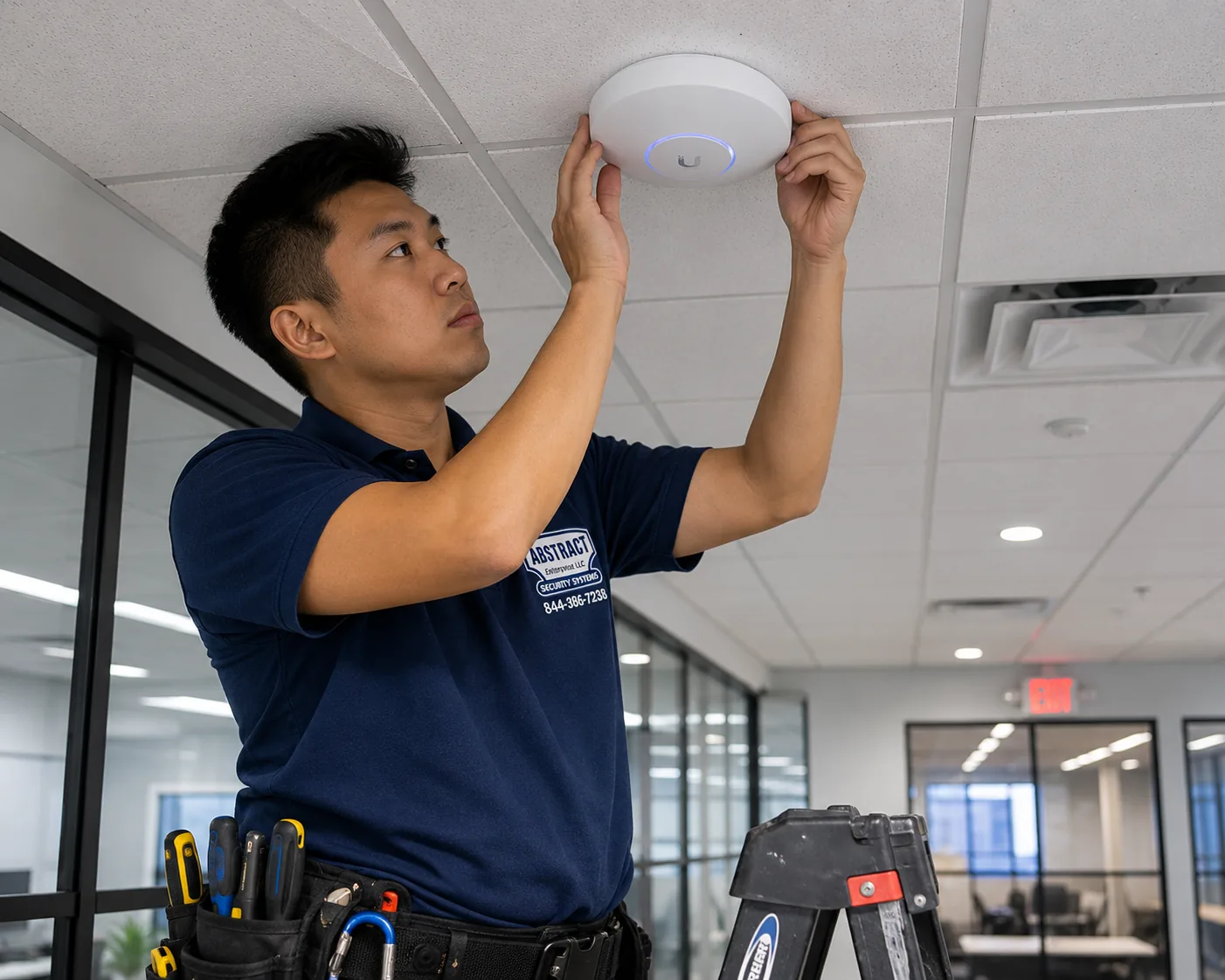
Behind the office front, mounting height changes the footprint dramatically and racking or machinery absorbs and reflects. Coverage follows the routes devices actually travel rather than the floor area, cells are kept deliberately modest so handhelds hand over cleanly instead of clinging to a distant radio, and the whole thing is verified by walking the space with a meter rather than reading a dashboard. Everything above fourteen feet needs a lift, which is an argument for getting the position and the cable grade right on the first visit.
Huntington, Northport, Babylon, Sayville, Patchogue and Port Jefferson hold older commercial buildings with masonry party walls and plaster over lath. Both stop radio between rooms in a way the floor area never suggests, and neither is visible from inside the room. Coverage is designed room by room and the count runs well above a floor-area calculation.
On a farm, a winery or an inn the busiest space is frequently not indoors. Exterior-rated radios, mounting that survives weather at the coast, cable rated for the run and a proper bond at every entry — quoted as its own work rather than folded into an indoor count. Salt air on the forks is not a marketing point; it shortens the life of anything specified for a sheltered inland position, and hardware gets chosen accordingly.
Congestion is the one variable in a WiFi installation here that mostly works in your favour. It is only an issue in the Melville office stack and in the denser village centres. Across most of the county a scan finds your own networks and perhaps a neighbour, which means a wireless complaint here usually has a tractable cause — count, placement or the building — rather than an unavoidable one.
| Space | Typical radio count | What drives it |
|---|---|---|
| Production or warehouse floor | 1 per 6,000–10,000 sq ft | Mounting height, racking, travel routes |
| Office front of a flex building | 2–3 | Conventional construction |
| Melville office floor, 6,000 sq ft | 3–4 plus a channel plan | Neighbouring tenancies in the same building |
| Village suite above retail | 2–3 | Masonry party walls and plaster |
| Inn, restaurant or tasting room at capacity | 2–3 | Device density rather than floor area |
| Yard, barn or event field | 1–3 exterior-rated | Ground to cover, weather, bonding at entry |
A survey is a measurement, and the further east a property sits the better the case for taking it — because the cost of getting the design wrong is a return journey rather than a return visit.
Modelling from a drawing and a description of the walls gives you a projection of coverage. On a conventional office front that is close enough to design against. An on-site survey puts a meter in the space and records real signal, real neighbours and how the specific structure in front of you behaves.
A conventional office floor in Melville or a straightforward office front under roughly 4,000 square feet does not need a paid survey to reach a defensible count, and we will say so rather than sell one. The fee is $450, credited to the project, and on industrial properties roaming validation along the routes handhelds actually travel is available for $250 more. The validation walk after installation is included on every job whatever you decide.
Power over Ethernet delivers data and power over a single cable to a radio, a handset or a powered device. It is also the failure that never announces itself as what it is.
A PoE switch carries one total wattage shared across every port, far below the sum of what all of them could draw. A 24-port switch quoting PoE+ throughout might hold a 370-watt budget; hang thirty-watt devices off it and the power is gone somewhere around the twelfth port.
| Standard | Per-port budget | Typical devices |
|---|---|---|
| PoE (802.3af) | 15.4W | Handsets, sensors, older radios |
| PoE+ (802.3at) | 30W | Modern radios, video handsets, powered displays |
| PoE++ (802.3bt) | 60–90W | Wi-Fi 6E and 7 radios, large displays, PoE lighting |
Two things make this bite harder in Suffolk than elsewhere. High-bay positions mean correcting an exhausted budget involves a lift and a crew rather than a quiet afternoon. And on an East End property it involves a drive of an hour or more each way before the lift is even set up. Reserve capacity bought at the outset is trivially cheap by comparison, and on a property that will add a position or two every year it will get used.
Exterior enclosures deserve separate arithmetic. A radio in a heated enclosure at a yard, a gate or a barn draws several times its indoor figure, and it draws most in the coldest weather when nobody is checking. The failure is quiet and selective — already-powered devices keep working while new ones are simply refused — so what surfaces is that last year's equipment is fine and this year's addition is dead.
Ask what the next two years add. On any property where a correction means a lift or a long drive, the switch bought with headroom is the one that never has to be revisited.
On a property an hour and a half from the nearest technician, the rack is not only equipment storage. It is the thing a member of staff will be standing in front of, on the phone, while somebody talks them through it.
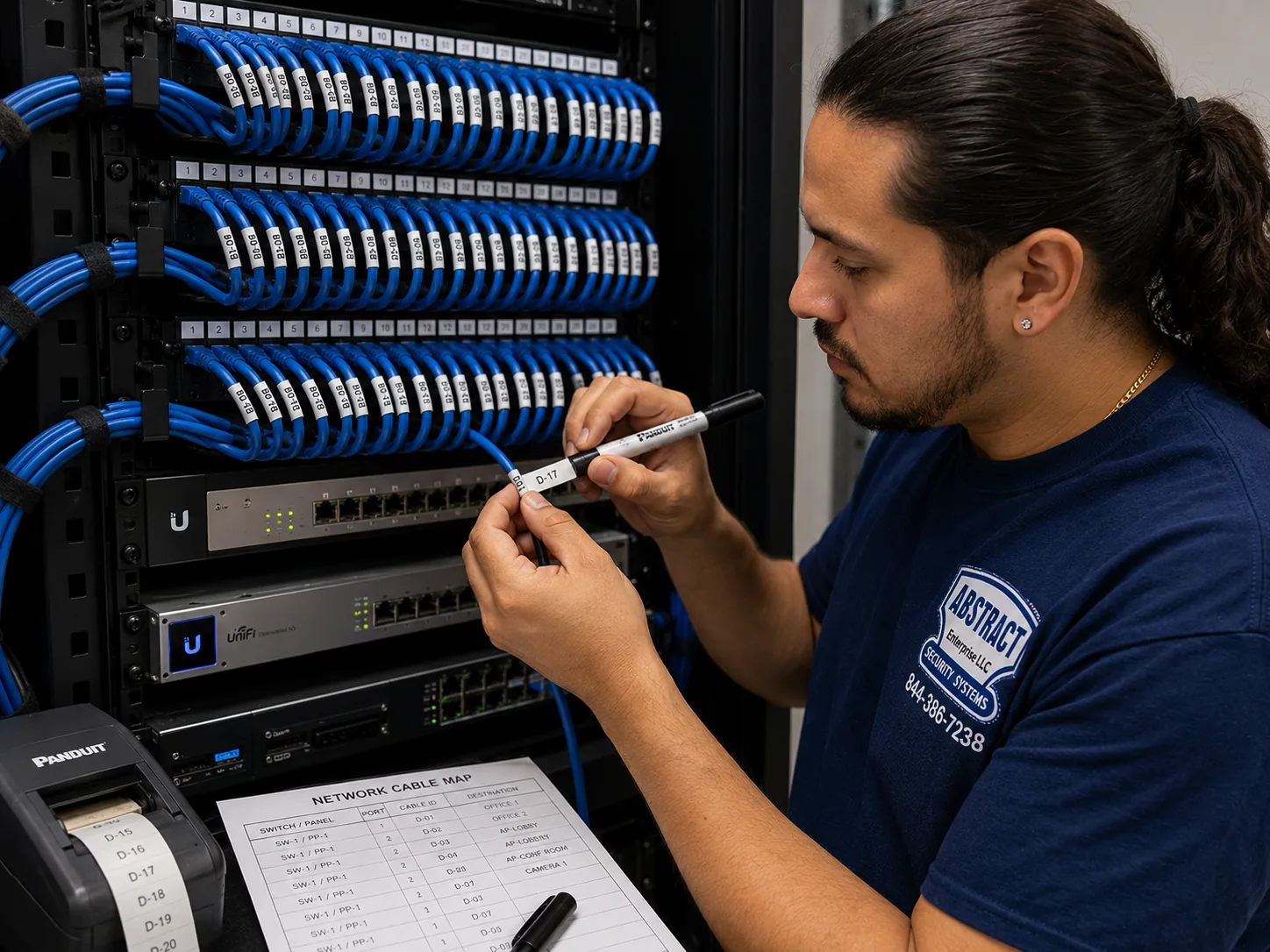
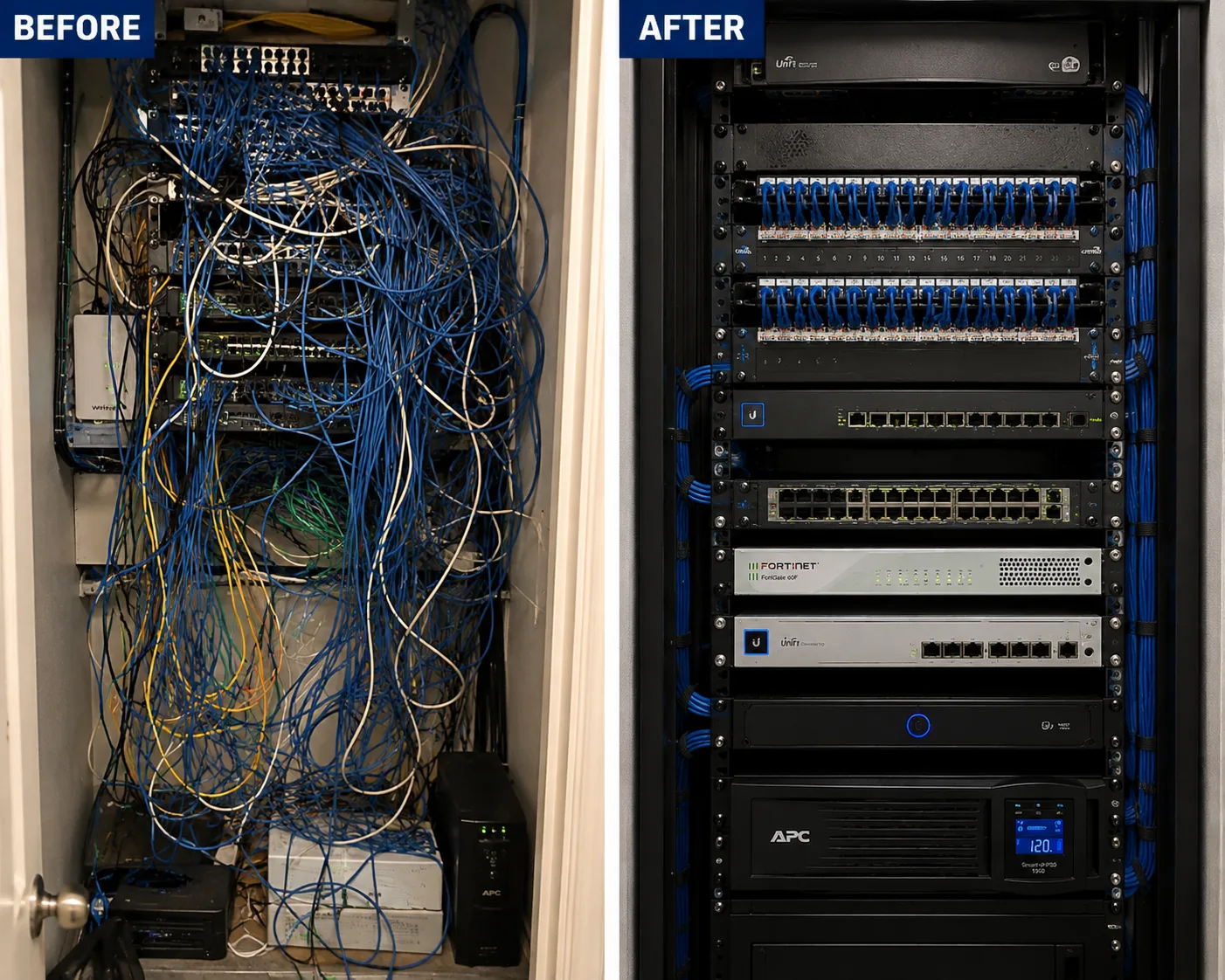
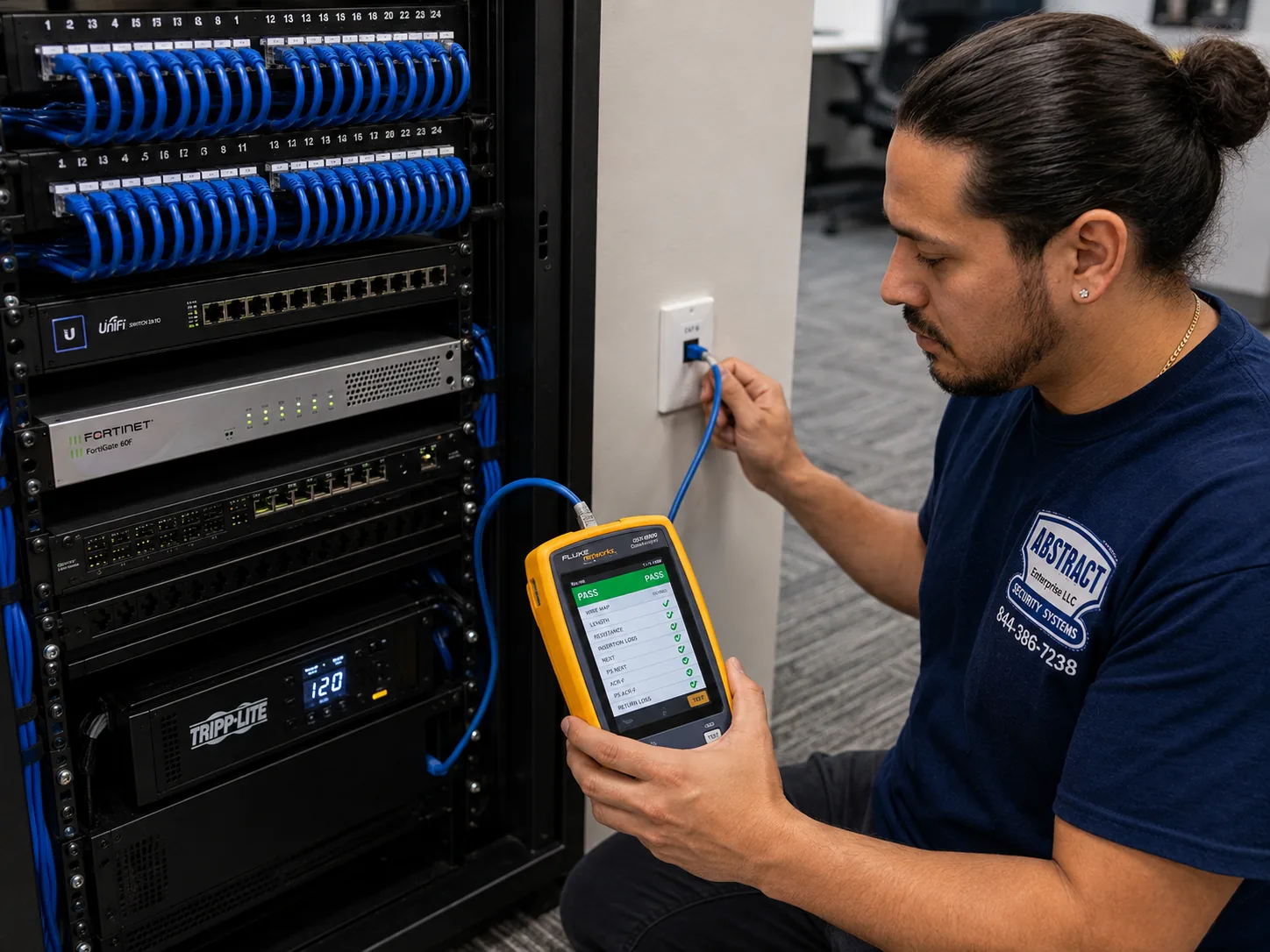
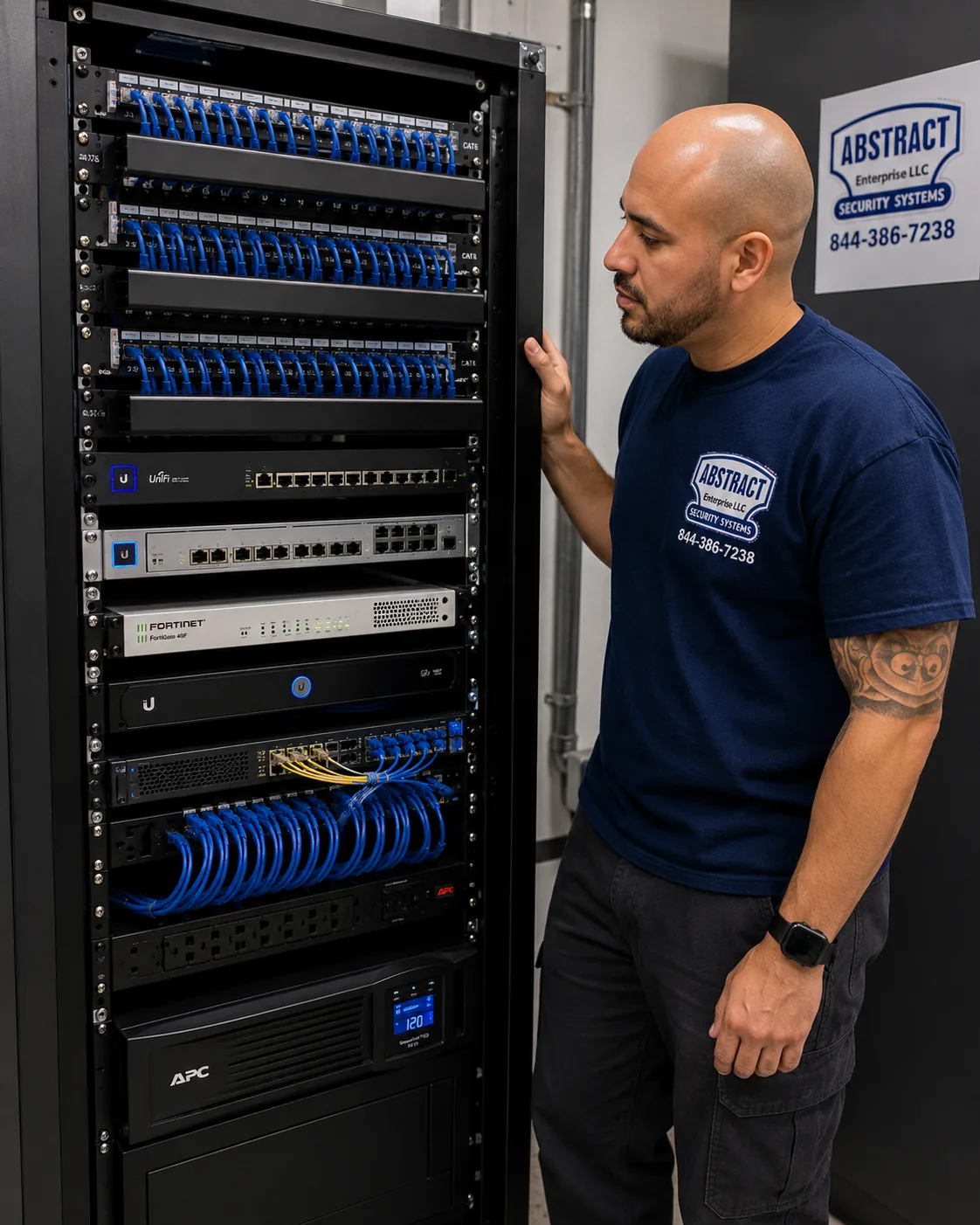
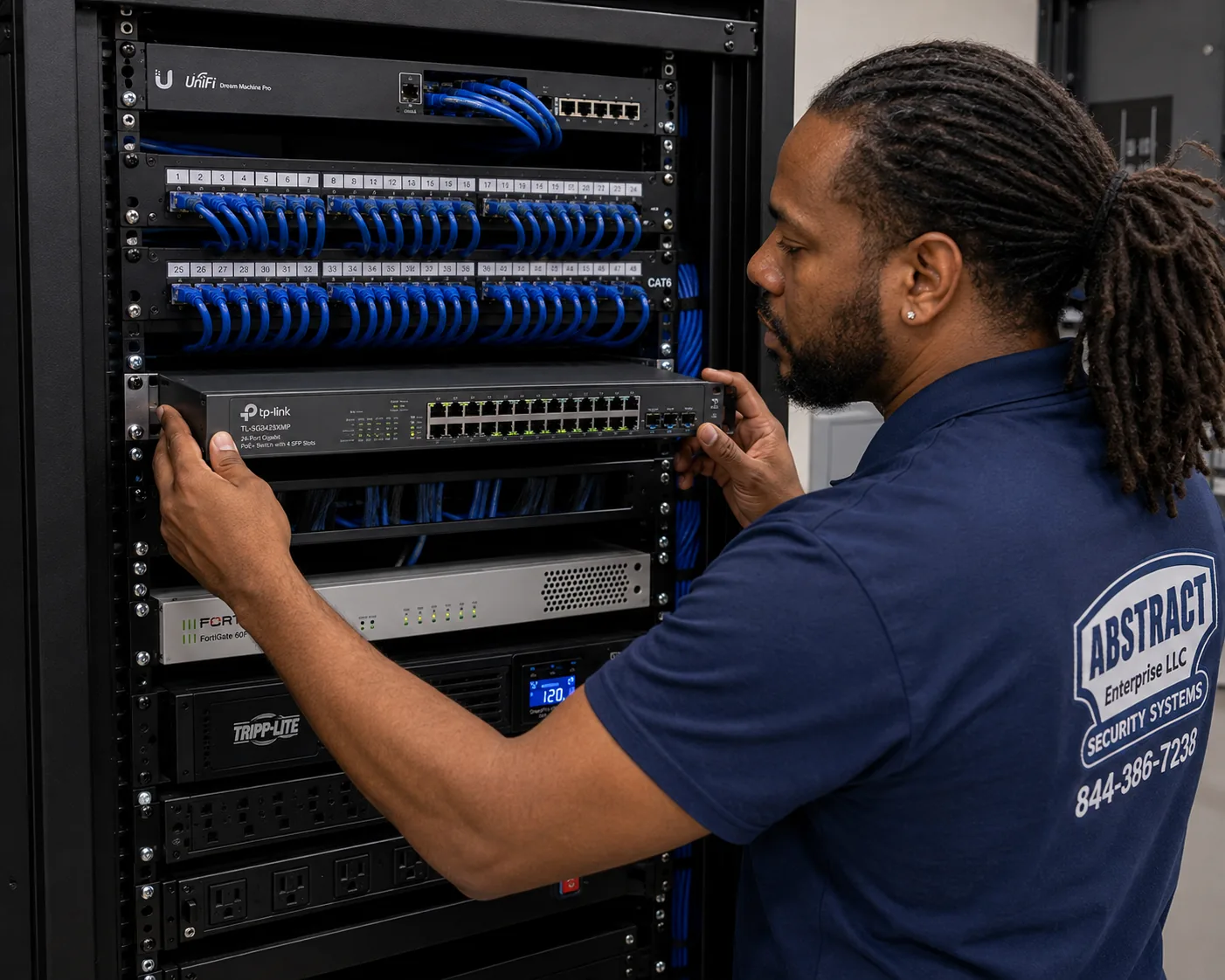
A good result is unremarkable to look at: panels above, switching below, short cords in consistent colours through managers, identified throughout, with air around it and space to grow. On an East End property it also means labels somebody can read aloud, a layout that matches the map exactly, and — where we have suggested them — the spare radio and spare switch sitting in the bottom of the frame with a note saying what they are for.
The space offered is often an interior closet with no supply air, a corner behind the shop, or an unheated outbuilding on a rural parcel. A sealed cabinet holding a switch delivering three hundred watts becomes an oven by August; the same corner in January can sit below the equipment's operating range. Both produce the intermittent faults that are worst to diagnose remotely, which is precisely the diagnosis a distant property depends on. Both are settled at design stage by choosing the space, venting the cabinet or specifying for the conditions.
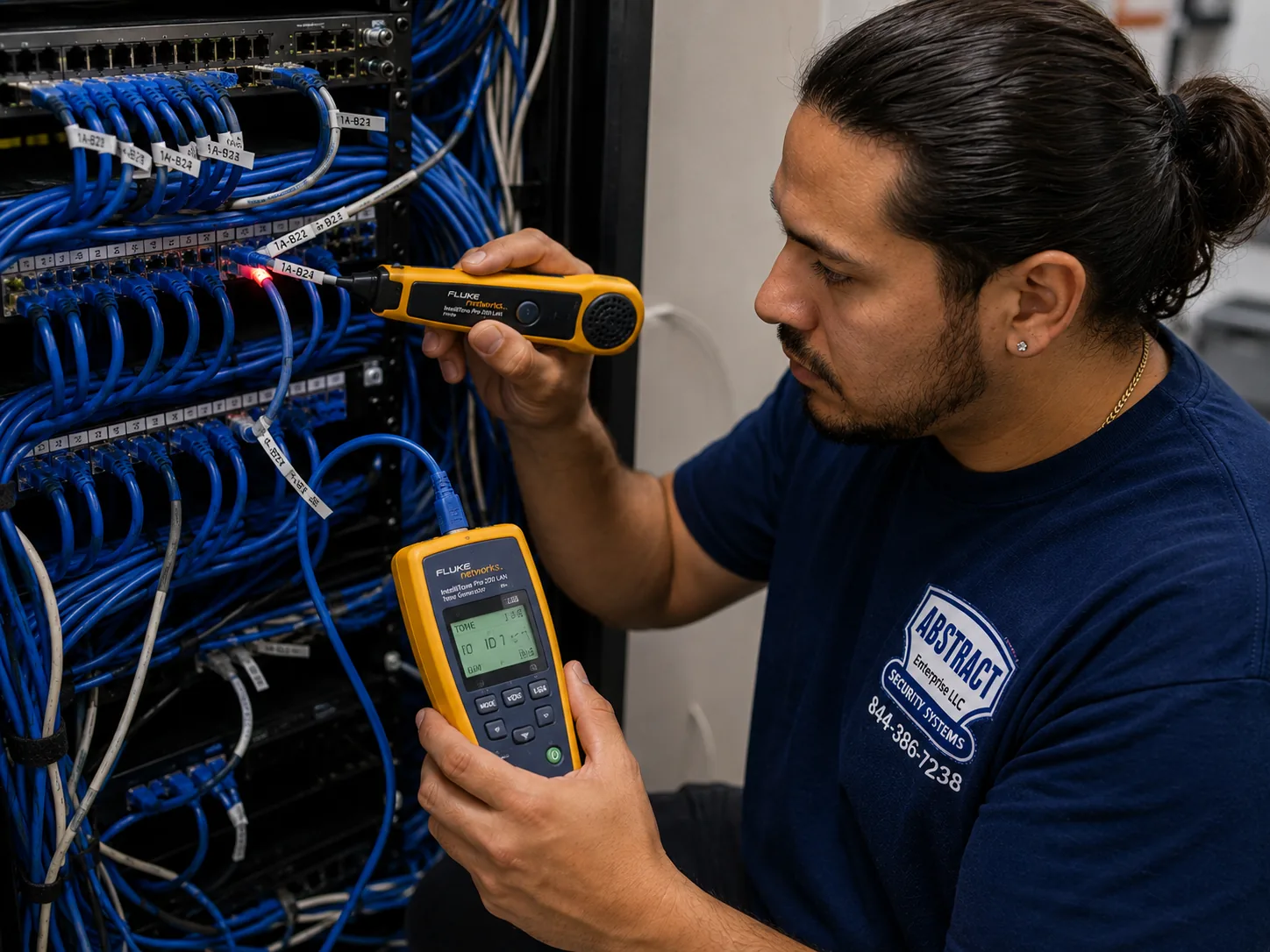
A good deal of the work here is a rack that grew over fifteen years, extended by whoever was available, with nothing recorded. We tone out every run, agree which are truly abandoned and strip them, re-route and re-terminate the remainder, then dress it, mark it and draw the map. On a property supported at a distance that day converts every future call from an investigation into a lookup, which is worth considerably more than it costs.
Every build carries a decision about what is already installed. In this county it usually also carries a run that leaves the building.
Wireless still needs a wire. Radios are fed by cable, workstations and floor positions take runs of their own, and everything lands back on a panel. The plant is therefore in scope whether or not new cable is pulled.
A lot of the cable already in the walls will do the job. Runs of Cat5e or better, landed on matching hardware, inside the distance limit and passing certification carry a modern gigabit network without difficulty, and age is not a finding on its own. Two checks matter particularly here: the measured length on wide industrial plates, where an original run may have been marginal from the day it went in, and jacket condition on anything that has ever been outside, since weather works slowly and invisibly and salt air works faster.
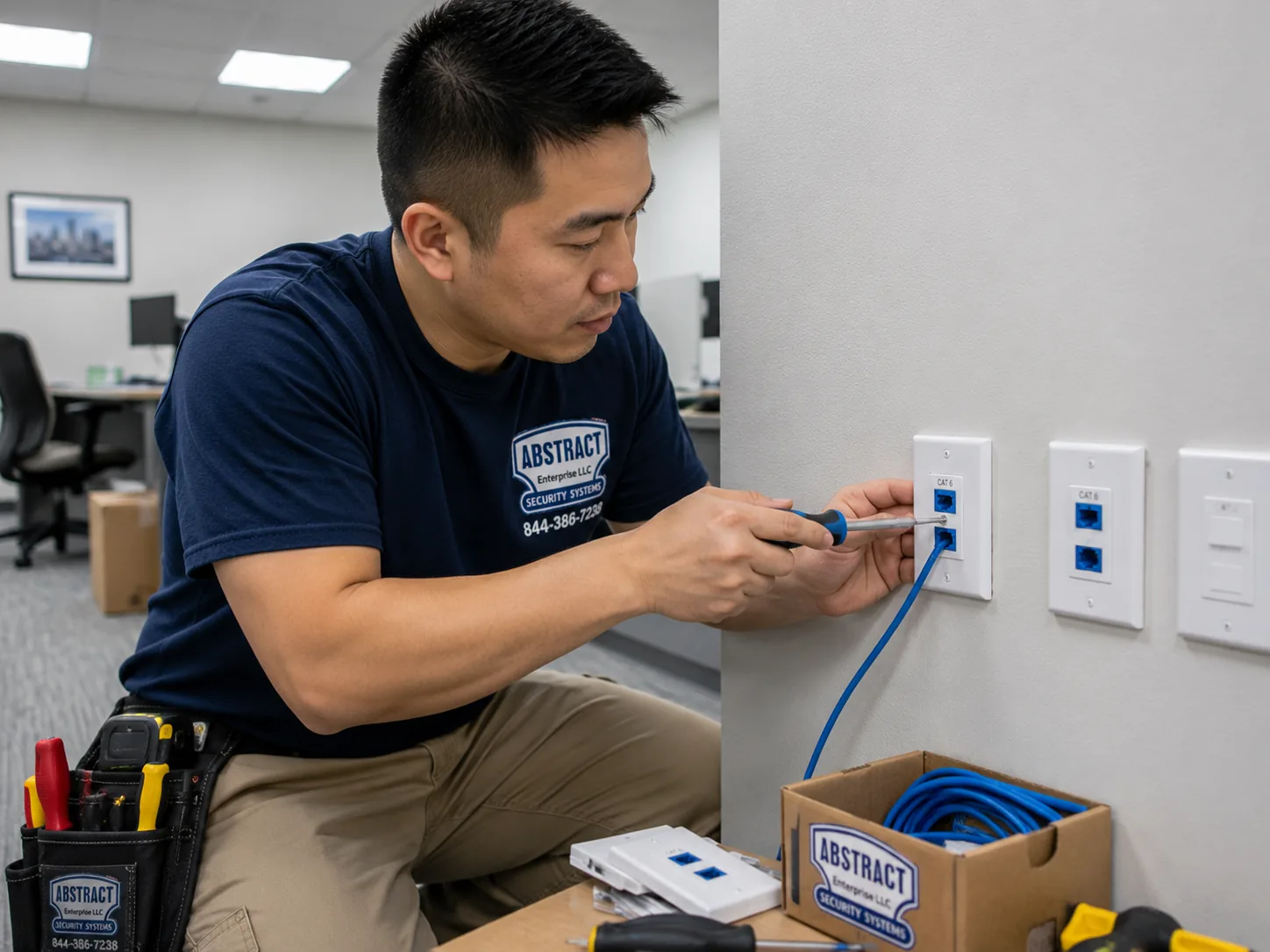
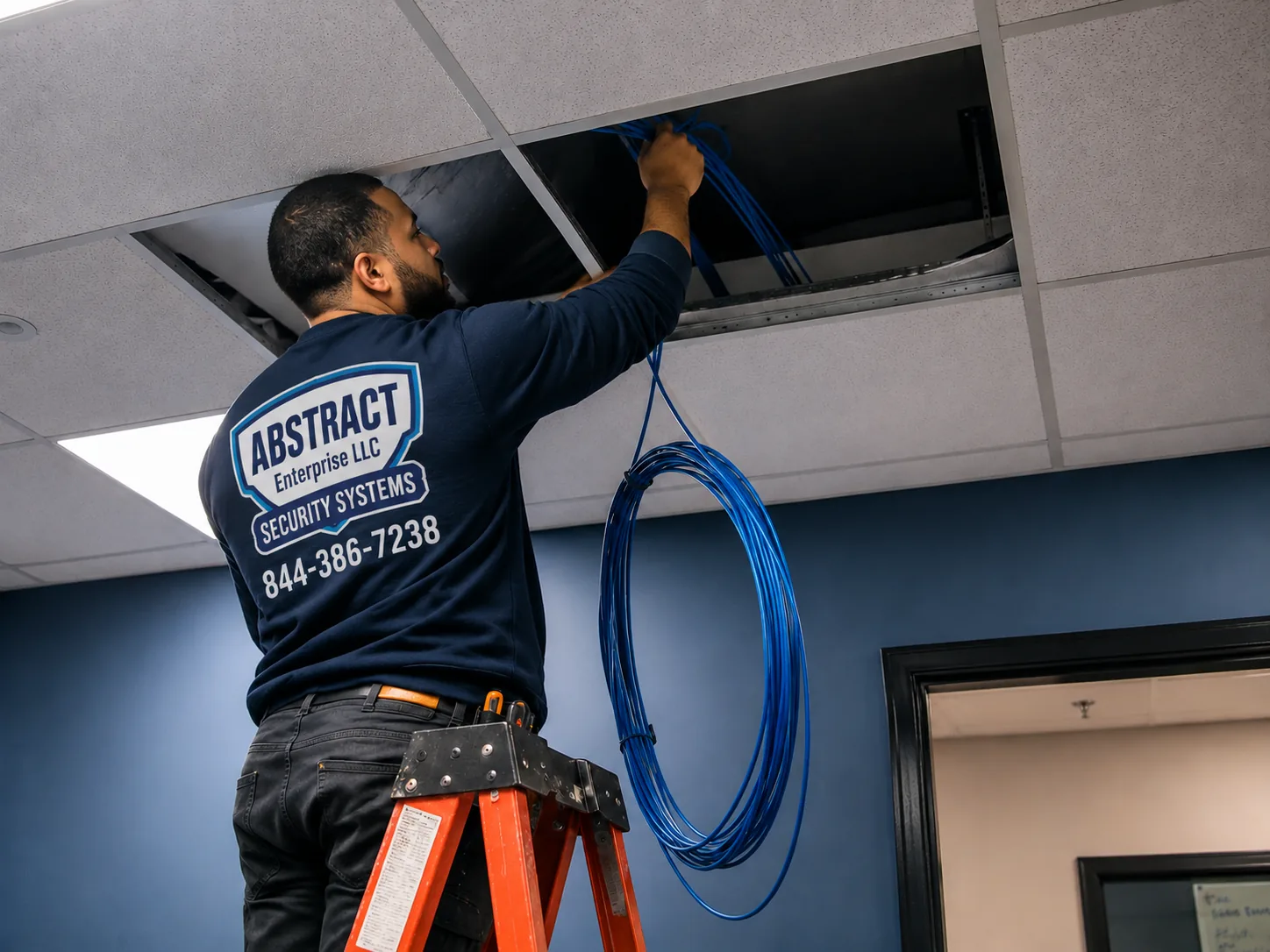
One rule set governs Ethernet installation on a network build, however many drops are involved: proper supports, a rating suited to the route, firestopping at rated penetrations, matched ends, identification and certification. Two ports at a workstation and one at each ceiling position is the working default, with spares pulled to the positions the next expansion is likely to want — cheap while a crew is on site, expensive as a return journey. The cabling pages carry the per-drop pricing and the comparison between grades.
Related: structured cabling installation in Suffolk County covers the whole plant. Cat6 installation Suffolk County covers grade and per-drop pricing.
On a property at the eastern end of the county, the records are the mechanism by which a fault gets solved without anybody driving. That raises the standard rather than lowering it.
Every project closes with the same set, written so it is usable both by a technician on a screen and by whoever is standing in the building.
The buried and exterior routes matter more here than almost anywhere. A run under a driveway, across a yard or between two buildings that nobody recorded is a run somebody eventually catches with a machine, and locating it afterwards on a rural parcel costs far more than documenting it did.
On credentials, plainly: there are contractors who keep admin access to their own work so that changing supplier means rebuilding from nothing. That is not how we operate, and at this distance it matters more than usual — a client who cannot get into their own equipment cannot even authorise somebody nearer to help. It is your network. You get the keys.
Suffolk takeovers arrive in two flavours: an industrial tenancy that expanded into the space next door, and an East End property that was wired once by whoever was available.
The versions recur. A manufacturer that took the adjoining unit and bridged the two with a long run nobody measured. A warehouse whose handhelds started dropping when the racking went up. An inn where extra guest rooms went in and nobody went back to the wireless design. A winery that connected an events barn with indoor cable. And an installer who did the original work and no longer comes out this far.
What is physically present in every area, what certifies, what runs outside and in what jacket, and what configuration is reachable. On industrial work we walk the routes handhelds actually travel if roaming is part of the complaint. The written assessment covers what is sound, what is failing, what is a hazard and what is merely unrecorded, and nothing changes until it has been read.
People run these together all the time, and the two carry wildly different price tags. On a property that expanded, the original plant is frequently fine and it is the equipment, the room count and the configuration that were outgrown. Certification answers which, and having that answer before anybody prices a rewire on a wide industrial plate repays the hour it takes.
Anything actively down is addressed first. Beyond that, work on distant properties is consolidated into consecutive full days rather than scattered visits, because travel time spent twice is money that could have bought hardware.
Where the plant is sound, the highest-value change is often replacing unmanaged hardware with managed, adding monitoring, and leaving on-site spares with a note. That is a modest project with a disproportionate effect on how the property is supported for the next decade.
A fair share of the calls we take about a slow network have a cause somewhere else entirely. When the drive is ninety minutes, working that out first is worth doing carefully.
Where the equipment is managed and monitored we can usually establish which of these applies from our own screen before asking anybody in the building to look at anything, and on a property at the eastern end of the county that capability is the entire argument of this page in one paragraph.
Published line items at our New York City labour rates, with the mileage allowance banded by how far east a property sits rather than averaged across the county. Switches, firewalls and radios are itemised separately on the quote or supplied by you.
| Item | Price |
|---|---|
| On-site assessment, room planning and support review | Free |
| Wireless site survey and heat map | $450 (credited to the project) |
| Roaming validation along handheld travel routes | $250 |
| Network design — addressing, VLAN scheme, room plan, as-built drawings | $350–$650 |
| Item | Price |
|---|---|
| Router / gateway install and configuration | $350 |
| Business firewall install with rule set | $450–$900 |
| Managed switch install and configuration — 24-port | $250 |
| Managed switch install and configuration — 48-port | $400 |
| Each additional switch in a stack | $175 |
| VLAN / segmentation configuration, per segment | $125 |
| Guest or public network with isolation and a throughput ceiling | $200 |
| Wi-Fi radio — mounted and tuned on an existing drop | $225 |
| Wi-Fi radio — including a new cable run | $300 |
| High-bay radio in production or warehouse space (lift work) | $375 |
| Exterior-rated radio — mounted, weatherproofed and bonded | $495 |
| Network rack or cabinet build — panels, managers, PDU, dressing | $650 |
| Second room behind the office, with fiber link back | from $2,400 |
| Sealed enclosure for a position on a production floor | from $275 |
| Rack cleanup, trace, re-route and re-identify | from $500 |
| Demarc extension to the rack position | from $350 |
| Documentation package — port map, site as-built, site note, credentials | $350 |
| Certification testing, per drop | $20 |
| Item | Price |
|---|---|
| Remote monitoring setup — link, device and power alerting | from $225 |
| On-site spares left in the rack — spare radio and spare small switch | At hardware cost |
| Spare run pulled to a likely future position, same visit | from $85 |
| Pre-cabled radio position, radio to follow later | from $135 |
| Site note printed and mounted at the rack | Included |
These matter more the further east a property sits, and they are absent from most quotes. On an East End site the spares line in particular converts a next-week visit into a fifteen-minute swap somebody on site can do while we watch remotely.
| Area | Mileage allowance |
|---|---|
| Western Suffolk — Melville, Huntington, Hauppauge, Bohemia, Ronkonkoma | $0 |
| Central Suffolk — Patchogue, Port Jefferson, Stony Brook, Shirley | $95 per crew day |
| East End — Riverhead, the North Fork and the South Fork | $145 per crew day |
Banded rather than averaged, because averaging would overcharge Melville to subsidise Montauk. Multi-day work is scheduled in consecutive full days, which keeps the allowance down and the crew productive.
| Package | Scope | From |
|---|---|---|
| Small office or practice | Up to 10 users, 12 drops, firewall, 24-port PoE switch, 2 radios, wall cabinet, VLANs, documentation | $4,900 |
| Corporate office floor | 25–50 users, switching, 4–6 radios, firewall, floor rack, full segmentation, certification, documentation | $12,500 |
| Industrial park flex building | Office front plus production, second room with fiber, high-bay wireless, operations segment, roaming validation | from $17,500 |
| East End multi-structure property | A room per structure, link between them, outdoor and event coverage, monitoring and on-site spares | from $19,500 |
Fault-finding and repair on an existing network is billed at $195 per hour with a three-hour minimum, plus the travel band for the property's location. Where equipment is managed and monitored we attempt to isolate the fault remotely first at no charge, and we will say honestly whether the drive is actually necessary. Same-day attendance in western Suffolk; next-day further east. Where an attendance turns into quoted work, those hours come off the price.
The range here runs from a two-room village office to a hundred-thousand-square-foot manufacturer, and no single manufacturer answers all of it. What matters most is remote manageability.
The common choice across most of the county, and practical on distant properties because indoor, high-bay and exterior units all share one controller. Capable radios, no per-unit licence, and an interface an owner can be talked through on the phone. What stands behind it is a user community rather than a support agreement.
Run from the cloud with strong remote tooling and a vendor behind it, licensed per device every year for as long as you own it — and the box stops when the licence does. The right answer for institutional and municipal work and for larger manufacturers who expect a support contract behind a network their production depends on.
Hardware from the cheaper end that does better than its price implies, with no yearly charge and remote management adequate for a village office or a small retail unit. A reasonable answer where the budget is tight but unmanaged equipment would be a false economy.
For an edge that has to inspect traffic, carry VPNs for staff working elsewhere and hold logs somebody may request. Pick Fortinet when vendor support behind the appliance is worth paying for, pfSense or Netgate when an open, subscription-free platform fits better.
Where a radio has to live on a yard, a barn or a coastal building, we specify equipment and enclosures built for it rather than putting indoor hardware in a box. On the forks that is not a refinement — salt air shortens the life of anything specified for a sheltered inland position, and replacing a position twice costs more than specifying it once.
Already purchased the gear, or working to an IT provider's chosen line? We fit and configure it. What we will say plainly is when something cannot do what is being asked — an unmanaged switch on a property ninety minutes away, a radio count that will not cover a production floor, or an indoor unit destined for an unheated outbuilding.
Unmanaged switching on any property east of the expressway junctions, which is the false economy we unwind most often. Radios turned to maximum power in the hope of covering a racked aisle, which causes exactly the roaming failures operators report. Separate internet connections for every structure on one parcel. Indoor hardware mounted outdoors under a soffit. And an upgraded circuit purchased against a fault that sits wholly between the handhelds and the rack.
They appear side by side in proposals and describe very different amounts of work.
| Term | What it covers | What it excludes |
|---|---|---|
| Cat6 installation | A single cable grade with everything attached to it — the runs, jacks, panels, terminations and the certification behind them. | Equipment, configuration, wireless design |
| Structured cabling | The physical build of a property — horizontal runs, backbone, rooms, fiber, pathway and certification. | Switch configuration, routing, firewall policy, VLAN work, radio tuning |
| Network installation | Everything that has to be true before traffic moves: design, addressing, switching, the edge, segmentation, coverage, records, and the plant supporting all of it. | Server administration, desktop support, software |
Distance sharpens the consequence of splitting them. When the cable and the configuration belong to two firms, every fault begins with the client deciding which one to call — and on a property ninety minutes from either of them, calling the wrong one costs a day rather than an hour. One contractor holding both layers means one number, one party accountable, and a much better chance the answer arrives without anybody driving out.
This is the Suffolk County page. Its regional parent is network installation Long Island, with network installation NYC as the citywide hub above it. The county to the west is covered on network installation Nassau County.
Headcount says little. What the building does, and how far it is from a technician, says most of it.
Hauppauge, Bohemia, Islandia. A second room behind the office because the plate exceeds copper's reach, high-bay radios placed for travel routes rather than floor area, an operations segment that competes with nothing, and active equipment kept out of the dust.
Ronkonkoma, Holbrook, Yaphank. Roaming designed around the aisles handhelds actually travel, validated by walking them with a meter, plus a lift for every position at height and a power budget sized before the season it fails in.
Real telecom rooms, stacked closets and plenum ceilings, with a channel plan because several tenancies share the building, and managing agents expecting insurance on file and coordinated access.
Huntington, Northport, Babylon, Sayville, Patchogue, Port Jefferson. Masonry party walls setting the radio count, payment wired and fenced from customer wireless, and no dedicated equipment space to work with.
Multiple buildings, mixed-vintage infrastructure, documented standards to build to, certification and drawings expected as deliverables, and scheduling around clinical hours, terms and public opening.
More than one structure on a parcel, outdoor and event coverage in weather-rated hardware, a season that cannot take disruption, monitoring and on-site spares, and work consolidated into consecutive full days.
Five stages, and the first accounts for the drive as well as the building.
The construction, the plate, how far the furthest position sits from each candidate room, where the circuit arrives, how many structures are in scope — and how long it takes anybody to reach the site, which decides how far the design leans on remote diagnosis and on-site spares.
Room count and placement, addressing, the VLAN scheme built for what the property actually does, switching sized with genuine reserve, radio positions for the construction present, monitoring, the equipment list, and a line-item price with the distance-support lines and the travel band shown separately.
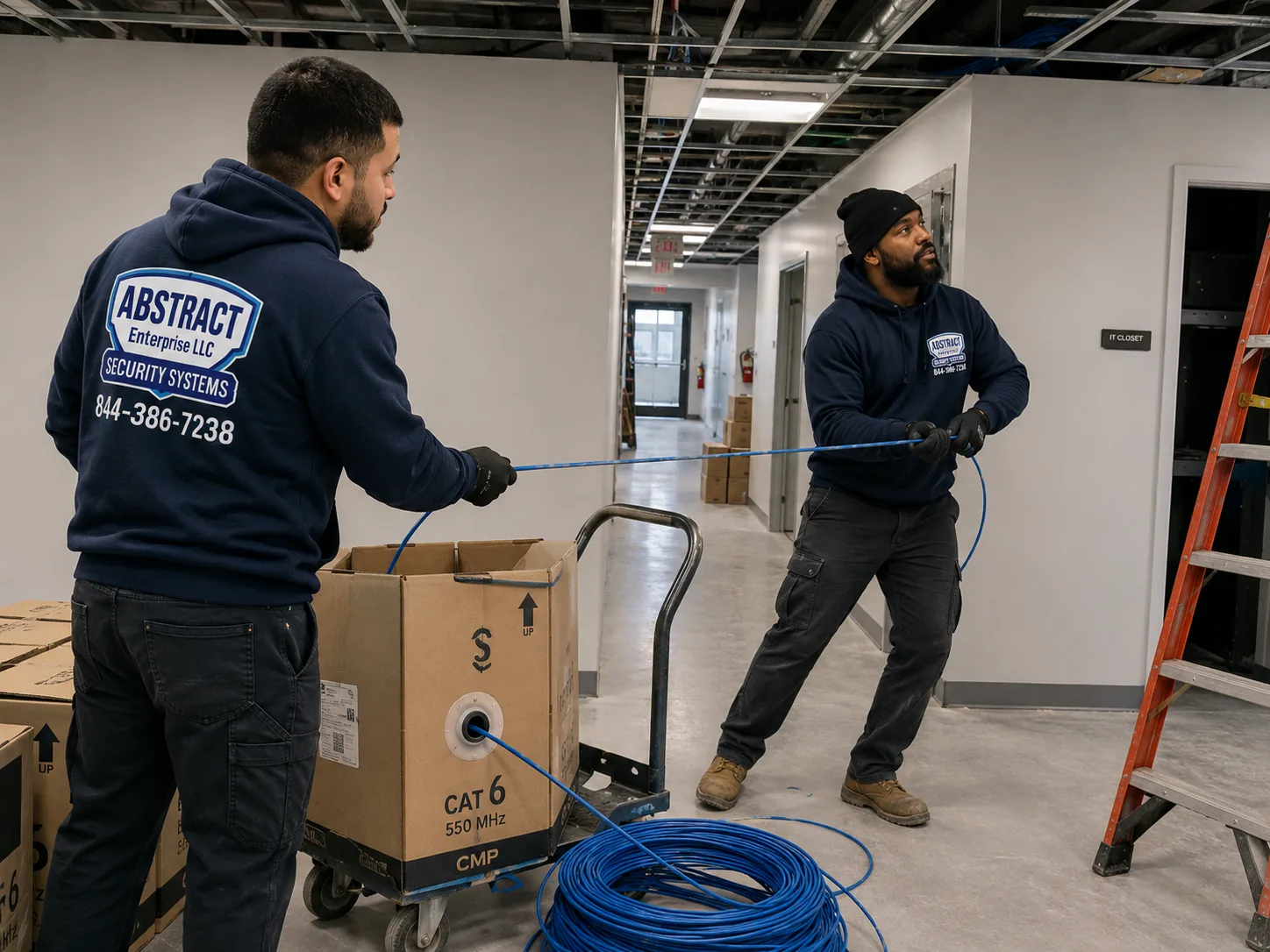
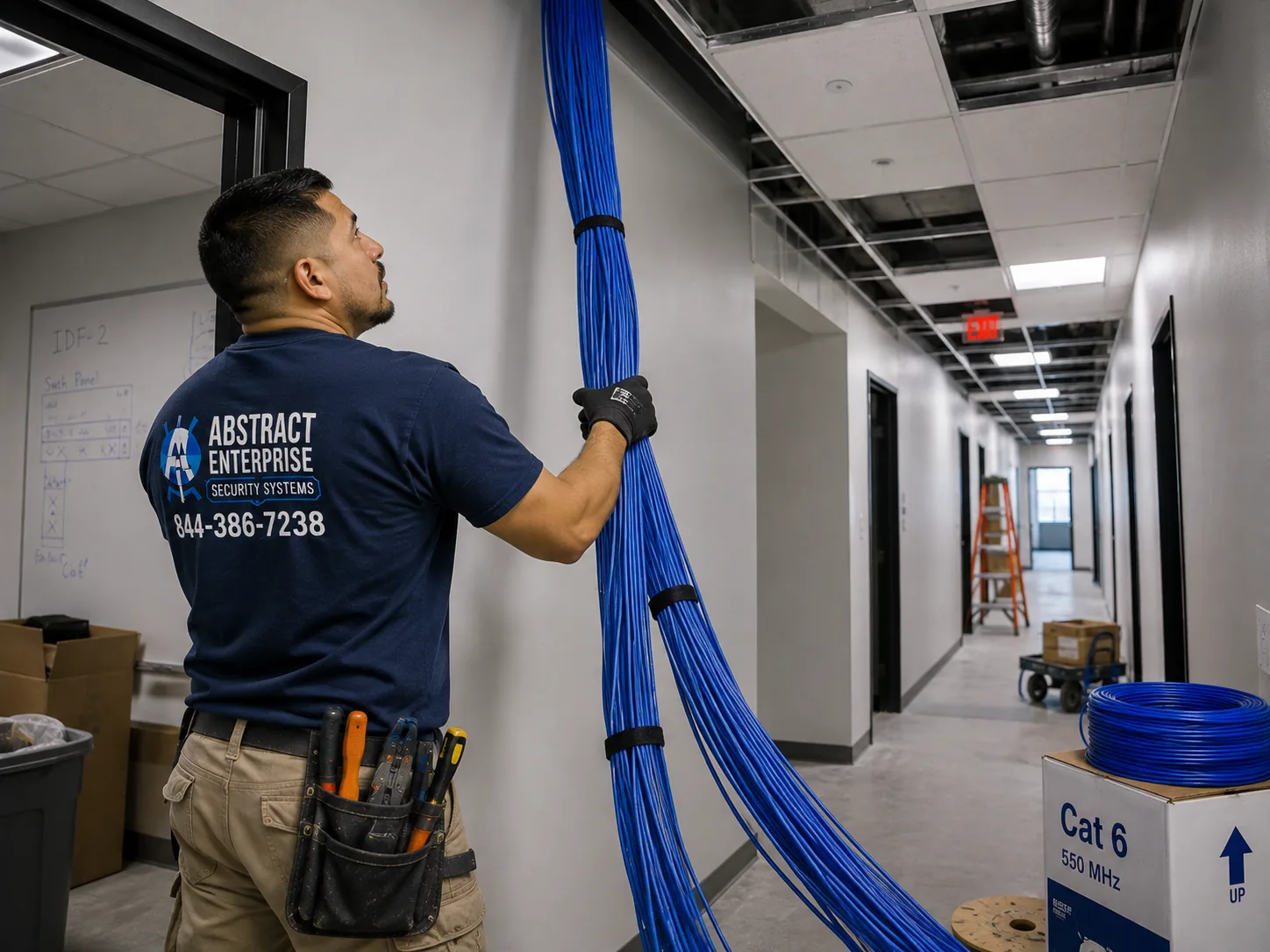
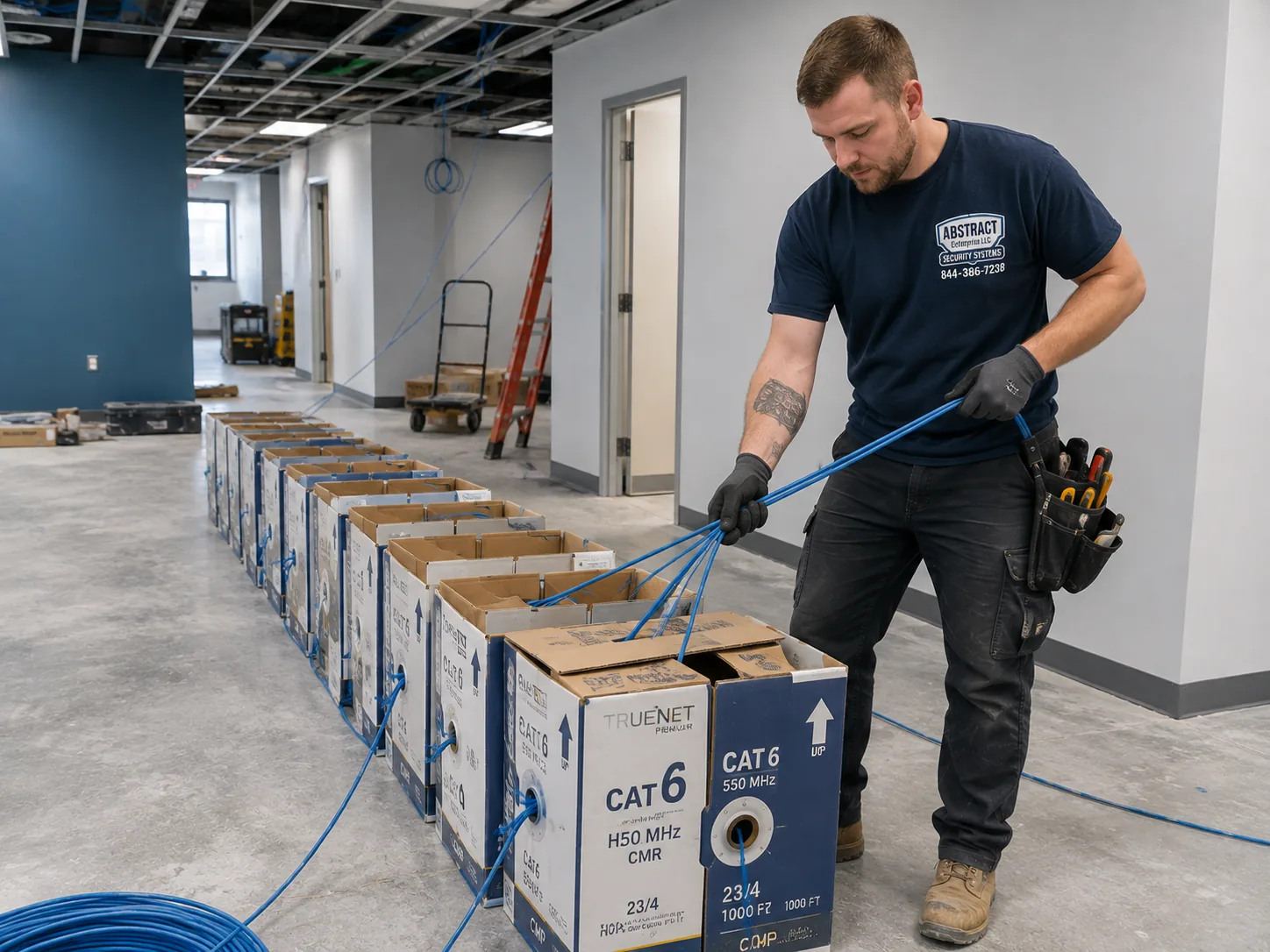
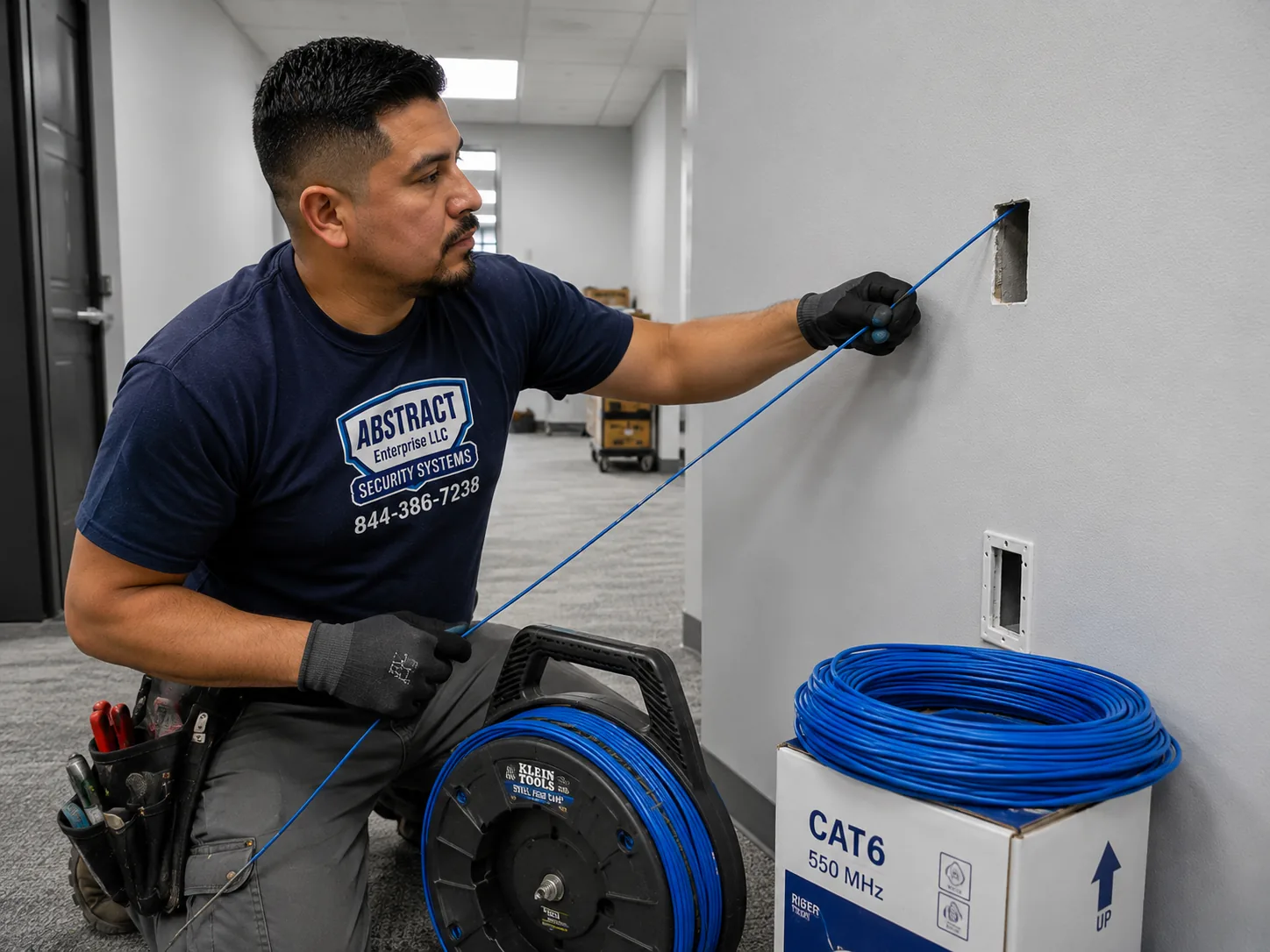
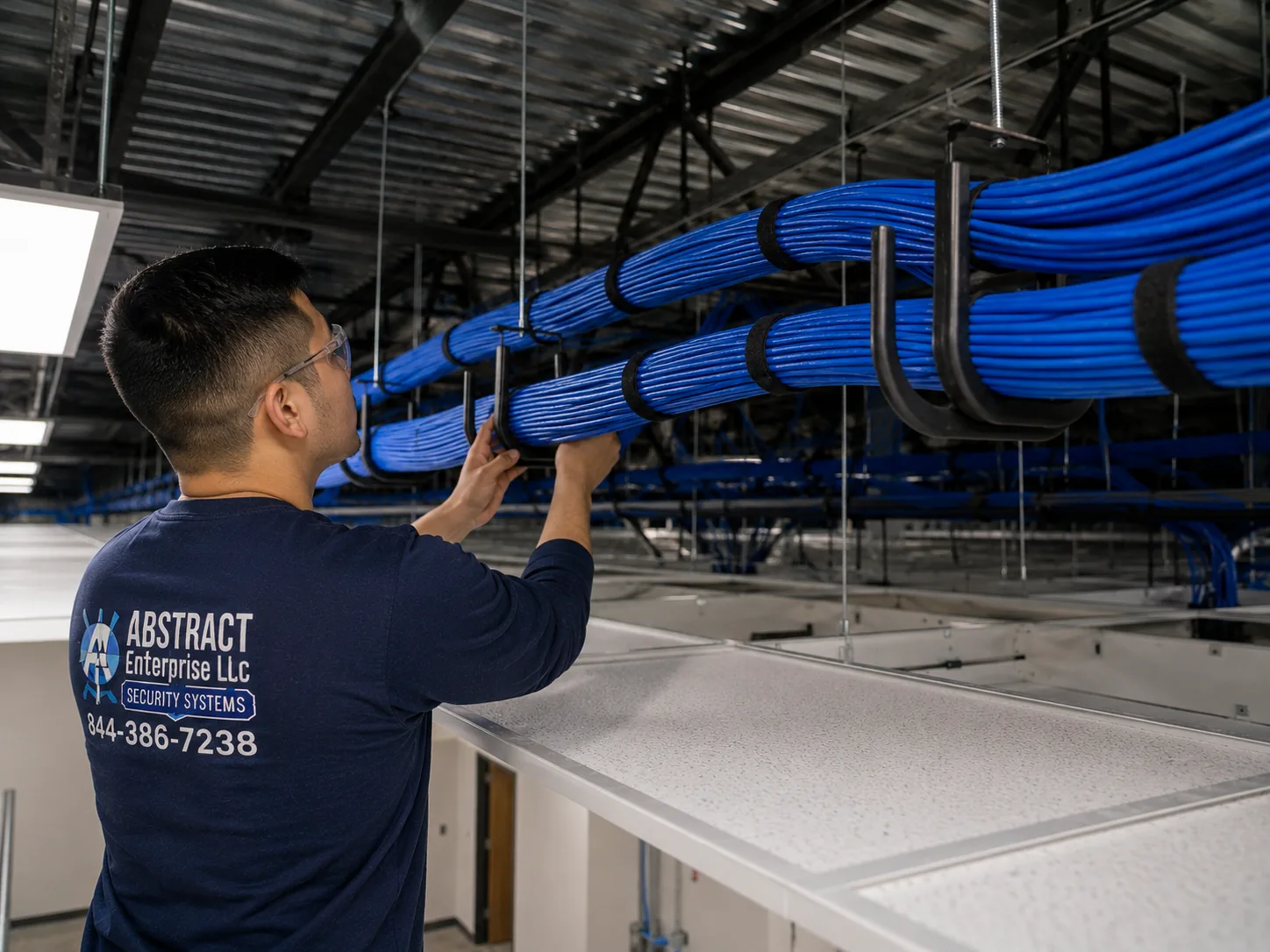
Links between rooms and between structures go in first, then cable out to each area on supported pathway rated for its route, firestopped at rated penetrations, with exterior entries sealed and bonded and buried routes recorded as they are laid. Multi-day work runs in consecutive full days rather than scattered visits.
A frame or cabinet per room, fitted with panels, managers, power and a UPS. Switches, the edge firewall and the radios go in, get configured and tuned, monitoring is turned on and verified, and the PoE budget is proven against genuine load including any exterior enclosure at its winter draw. Where we have recommended them, the on-site spares go in the frame with a note.
Certification across all drops and testing on the fiber links between rooms. A validation walk that follows the routes handhelds actually take on an industrial property, or covers every space indoors and out on a multi-structure one. Then the package — port map, site as-built with exterior routes measured from fixed points, addressing record, hardware inventory, credentials — plus the site note mounted at the rack and a walkthrough with whoever will be standing there.
Undertakings you can check once the property is running, rather than adjectives.
A small office or practice of up to ten users starts near $4,900 in labour and configuration, with switching, firewalls and radios quoted separately or supplied by you. A corporate office floor for twenty-five to fifty users starts near $12,500. An industrial park flex building starts near $17,500, covering an office front plus production, a second room with a fiber link back, high-bay wireless, an operations segment and roaming validation. An East End multi-structure property starts near $19,500. Travel is banded rather than averaged: nothing in western Suffolk, $95 per crew day in the centre of the county, and $145 per crew day on the East End — because averaging would overcharge Melville to subsidise Montauk.
The labour rates are identical; the travel band differs and it is stated on the quote rather than hidden in the hourly rate. What changes more than the price is the design. On a property ninety minutes out we lean harder on managed equipment, monitoring, spare capacity and on-site spares, because each of those converts a potential journey into a phone call. Those are published lines — monitoring from $225, spare runs from $85, spares at hardware cost — and on a distant property they pay for themselves faster than anything else on the quote. What does not change is the standard: certification on every drop, supported pathway, proper firestopping and a full handover package are the same in Riverhead as in Melville.
Because copper stops at a hundred metres as installed — up the wall, along the pathway, back down — and the wide single-story plates common in Hauppauge, Bohemia and the other industrial parks put the far corner beyond reach from any single position. Stretching a run past the limit is not a fix; it produces a link that certifies marginally or not at all and fails intermittently later. The answer is a second room behind the office serving its own zone, with its own switching and protected power, linked straight back to the main room over fiber rather than chained through anything. That is a $2,400 line and it is settled before drop counting rather than discovered when a run fails.
A walk that establishes both the building and how far it is from support, a design weighted toward remote diagnosis in proportion to that distance, room placement worked out from actual distances, the plant on supported pathway rated for its route with firestopping at rated penetrations, the rack or racks with panels and battery backup, managed switching and the edge firewall, the Wi-Fi installation designed for whatever the space actually is, monitoring configured and tested, certification on every drop, and a handover package including a site note written for whoever is standing at the rack.
Structured cabling is the physical build of a property: horizontal runs, backbone, rooms, fiber, pathway and certification. Network installation is everything that has to be true before traffic moves — design, addressing, switching, the edge, segmentation, coverage and records — plus the plant supporting it. Distance sharpens the consequence of splitting them. When cable and configuration belong to two firms, every fault starts with the client deciding which to call, and on a property ninety minutes from either of them, calling the wrong one costs a day rather than an hour.
Usually, and frequently without new hardware. That is roaming rather than coverage: a handheld travelling an aisle, past a dock door and back has to hand between radios cleanly, and a network built for maximum reach makes it harder, because the device clings to a distant radio long after a nearer one would serve it better. The remedy is overlapping cells at deliberately reduced transmit power rather than fewer, stronger radios. It is diagnosed by walking the routes the handhelds actually take with a meter, which is offered as a $250 addition to the survey rather than guessed at from a dashboard.
On a production or warehouse floor, roughly one radio per 6,000 to 10,000 square feet, adjusted for mounting height and how the racking runs. The office front of the same building is a separate calculation — two or three for a conventional layout. A Melville office floor of 6,000 square feet wants three or four plus a deliberate channel plan, because several tenancies share the building. Village suites above retail want two or three, since masonry party walls stop signal between rooms. Yards, barns and event fields need one to three exterior-rated units, counted in the plan rather than added afterwards.
On a working industrial tenancy, yes, and the argument that persuades is throughput rather than security. Production equipment, test benches, scanners and labelling are the part of the network that costs money when it stops, and they should compete with nothing. There is a simple test: if the shop floor slows down when the office runs a backup, the network is flat and the remedy is configuration rather than a bigger circuit. Building services deserve their own fence too — HVAC, refrigeration monitoring and gate equipment are often the oldest networked hardware on a site and rarely updated.
A small office is one to two days. A corporate office floor is three to five. An industrial flex building runs a week or more, driven by the second room, the lift work at height and the roaming validation rather than by crew size. East End multi-structure properties depend on the link between buildings — an aerial run is a day, an underground one is a different scale of project. We schedule multi-day work in consecutive full days rather than scattered half days, which keeps the travel allowance down and gets the property finished sooner.
A spare radio and a spare small switch left in your rack with a note saying what they are for. On a property at the eastern end of the county they turn a next-week visit into a fifteen-minute swap somebody on site can do while we watch remotely, and they cost only what the hardware costs. We suggest them east of Riverhead and on any property where a return journey is a substantial fraction of a working day. Closer to the expressway they are usually not worth the outlay, and we will say so.
Yes, and on the forks we will suggest it before you ask. Off-season work costs the same, disrupts nothing, and the roads themselves are quicker — travel time to the South Fork in July is a genuine cost to both sides. Where work has to happen during a season we stabilise what is failing and schedule the rest for afterwards rather than rebuilding a network during the weeks a hospitality or retail business earns its year. Evening and weekend labour carries no premium.
It earns its fee on any production or warehouse space, where racking, machinery and mounting height defeat prediction and the travel routes have to be walked; on any property east of Riverhead, where a wrong count is corrected at the cost of a day rather than an hour; in village masonry, where party walls decide the count; and on multi-structure properties with outdoor space in scope. For a Melville office floor or a straightforward office front under about 4,000 square feet we will tell you it is not needed rather than sell one. The fee is $450, credited to the project, and the post-installation validation walk is included on every job whichever way you go.
Past about eight people, yes, and on any property east of the expressway junctions it is not really a question. An unmanaged switch cannot segment traffic, cannot prioritise, cannot report which port is down or saturating or delivering power, and cannot be monitored — so when something degrades, nobody can establish from a screen whether it is one port, one zone or the circuit. On a site where answering that wrongly means a ninety-minute drive in each direction, remote visibility is worth far more than the price difference. It is the false economy we unwind most often in this county.
Ceiling and exterior positions get Cat6A in virtually all commercial work, chosen for the power it carries and the margin it leaves rather than for speed. Current Wi-Fi 6E and 7 units draw PoE++ under 802.3bt, and Cat6A's heavier conductors deliver that with less heat rise through a packed bundle. It also carries ten gigabit to the full hundred metres, and the radio gets replaced every five to seven years while the cable stays for fifteen — which on a high-bay position, reached by lift at the end of a long drive, is a cost worth designing out entirely. Desks, printers and general connectivity are properly served by Cat6, so a mixed plant is standard.
It is handled by licensed low-voltage contractors, by IT companies that subcontract the hands-on portion, and by cablers whose remit ends once the panel is terminated. Anyone shortlisting a network installer here should also ask how far the contractor travels and what happens on a Friday afternoon in July, because in a county running eighty-six miles end to end, how a property is supported afterwards matters as much as how it was built. We are the first kind and hold both layers: Abstract Enterprises Security Systems, NYS Low Voltage Electrical Contractor licence #12000287431, insured, working from Melville and Huntington through Hauppauge, Bohemia and Patchogue and out to Riverhead, Greenport, Southampton and Montauk. That covers the survey and support review, room planning by distance, design and addressing, cabling and pathway including exterior and between-building runs, switching, the edge firewall, VLAN segmentation, wireless design and roaming validation, monitoring, certification, documentation and credential handover, plus repair and takeover of networks a business has outgrown.
No permit is required for low-voltage cabling run indoors. Landlord approval, insurance on file and firestop documentation at rated penetrations are what actually apply. Trenching between structures brings in the town.
Yes — licence NYS Low Voltage Electrical Contractor #12000287431, carrying insurance, and certificates go to owners or managing agents whenever asked.
Yes, with the travel band stated on the quote rather than hidden in the rate, and with the design built so most faults never need a visit at all.
Because copper stops at a hundred metres as installed. On a wide single-story plate the far corner is simply out of reach from one position, and stretching a run is not a fix.
Usually, and often without new hardware. That is roaming and transmit levels rather than coverage, diagnosed by walking the routes with a meter.
A spare radio and a spare small switch left in your rack with a note. On a distant property it turns a next-week visit into a fifteen-minute swap we can talk somebody through.
Yes, and on the forks we will suggest it. Off-season work costs the same, disrupts nothing, and the roads are quicker.
$450, credited to the project, with roaming validation available for $250 more on industrial properties. The post-installation walk is included regardless.
The whole county, west to east. What changes is the building type, the travel band and how the property is supported afterwards.
Melville and the Broad Hollow Road corridor. Multi-storey purpose-built office buildings with real telecom rooms, stacked closets and plenum ceilings. Managing agents with exacting insurance and access requirements, and multi-tenant floors where a channel plan matters as much as coverage.
Huntington, Huntington Station and Northport. Village main-street commercial in older masonry alongside modern professional and medical suites, plus retail along Route 110 and New York Avenue. Two quite different design problems within a mile of each other.
Commack, Smithtown and Kings Park. Professional offices, medical practices and retail along Jericho Turnpike and Route 111, in a mix of purpose-built and converted stock.
Hauppauge and Islandia. The county's largest industrial park concentration — wide single-story plates with an office front and production or warehouse behind, on Motor Parkway, Marcus Boulevard and the surrounding grid. Second rooms and demarc extensions are routine here rather than exceptional.
Bohemia, Ronkonkoma and Holbrook. Light manufacturing, distribution and service tenancies around the airport and the Veterans Memorial Highway corridor. High rear ceilings, lift work, and roaming validation on most warehouse jobs.
Farmingdale's Suffolk edge and Deer Park. Industrial and flex buildings along the Route 110 and Long Island Avenue corridors.
Patchogue and Sayville. Village main-street commercial, hospitality and professional offices in older masonry stock, plus service commercial along Montauk Highway and Sunrise Highway.
Port Jefferson, Setauket and Stony Brook. Village retail and hospitality, medical and clinical suites around the hospital and university corridor, and institutional property with documented standards.
Bay Shore, West Islip and Islip. Medical, professional and retail commercial along Montauk Highway and the surrounding corridors, with the county's second medical concentration.
Shirley, Yaphank and the Brookhaven corridor. Industrial, distribution and service buildings near the expressway, plus county and institutional property.
Riverhead. County facilities, retail and service commercial along Route 58 and the main street, and the gateway to both forks. The point where the travel band and the support design both change.
The North Fork — Jamesport, Cutchogue, Southold and Greenport. Wineries, farm operations, inns, restaurants and village retail. Multi-structure parcels, outdoor and event coverage, and a season that dominates the year.
The South Fork — Southampton, Bridgehampton, East Hampton, Sag Harbor and Montauk. Hospitality, retail, professional offices and estate-scale properties. Coastal specification, multiple structures, and scheduling that has to respect both the season and the roads that come with it.
This page sits under network installation Long Island. The cable plant these networks run on is covered on structured cabling installation Suffolk County, and cable grade and per-drop pricing on Cat6 installation Suffolk County.
Tell us the property and where in the county it sits. We will walk it, work out how it should be supported, and come back with a line-item number.