Buried Links Between Buildings · Farm & Vineyard Runs · Estate and Rental-House Networks · Fusion Splicing · OTDR-Tested
In Suffolk the ground decides the job. Sand that slumps into a trench, a leaching pool where the straight line wanted to go, a row of vines, a strip of protected pine barrens, a canal lot that went under in 2012, a house that sits locked from Columbus Day to Memorial Day. We design private fiber around all of that — from a warehouse in Ronkonkoma to a barn on the North Fork — splice and test every strand ourselves, and leave a record that still makes sense the next time someone digs.
Reviewed and updated October 17, 2026 · Written by Anwar Timothy, NYS licence #12000287431

Got a rough sketch of the property? A phone photo of the survey, or even a satellite screenshot with the two buildings circled, gets a Suffolk fiber quote moving. Call the Suffolk line at (631) 407-2884 or use the 60-second form, and mention anything buried you already know about — the septic, the irrigation, the old cable nobody can explain.
Drive the Long Island Expressway from the Huntington line to its end at Riverhead and then keep going on Route 25 or 27, and you cross at least four different kinds of fiber job without ever leaving the county. Around Ronkonkoma, Islip and the airport there are new apartment blocks, warehouses and offices going up on cleared land. In the middle of the county the road runs through the Central Pine Barrens, where the rules about disturbing the ground are some of the strictest in the state. Past Riverhead the land opens into farm fields, nurseries and vineyards, with houses set far back from the road. Down on the South Shore, canal-front lots in Lindenhurst, Babylon and Amityville sit a few feet above the bay. Fiber is the right cable for all four. How it goes into the ground is completely different in each.
What those places share is distance. Suffolk properties are long. A farmhouse and its equipment barn, a winery's tasting room and its crush pad, an estate's main house and its pool house and guest cottage, a flex building and the storage yard behind it: the buildings that need to share one network routinely sit hundreds of feet apart, and sometimes much further. Ordinary network copper is specified to a hundred metres, and outdoors it also carries every surge and ground difference between two electrical services. A strand of glass ignores both. That is why most of what we install out here is buried, single-mode fiber running between buildings on the same parcel, rather than the riser backbones that dominate our city work.
The second reason is the provider map. In an older report in the Suffolk Times, a Verizon spokesperson answered calls for Fios on the East End with "It's a simple no," and said the company was not planning new build-outs there; the towns discussed were Riverhead and Southold, and a union representative quoted in the same piece said "having one provider in this area is not working out." Provider plans change — Brookhaven's town board approved a new fiber franchise in 2026 — but the lesson for an owner is constant. The wired provider you have today may not be the one you have in ten years, so the fiber on your side of the property line should be built to outlast any single carrier: landed in a sensible place, with spare strands, documented, and yours.
Water is the third. When the storm tide peaked on the evening of October 29, 2012, the National Weather Service's own impact table for Lindenhurst records that much of the area south of Montauk Highway, from Amityville through Babylon, sat under two to five feet of water. The same table logs moderate flooding of streets and driveways in that area several times since, in 2016, 2017 and 2018. On those lots the question is not whether the network electronics will get wet one day but where the splice points and switches can sit so that they don't. Most South Shore clients pair the fiber with a review of the whole Suffolk network installation, so that switches and battery backup move up and out of harm's way at the same time.

A landscaper's edger found the cable by the pool house, a tractor dragged a post across the run, or the cameras at the far barn simply went dark one morning. That is a repair, and we treat it separately from new work. We aim for same-day dispatch across the county; once a technician is on site, most single faults — a cut near the surface, a pigtail broken inside a wet enclosure, a converter that died in a summer heat wave — are found and fixed in one to two hours, then the strand is measured again before we leave. Call (631) 407-2884 and say "fiber repair," or see Suffolk network cable repair for copper faults.
Everything here is private, owner-side fiber. Your internet provider brings service to its box; we build the network that carries it across your land and between your buildings, and we prove each strand with a meter before calling it done.
Outdoor single-mode cable in conduit, trenched or bored between a main building and its neighbours on the same parcel — with tracer wire and warning tape so it can be found again, and a pull box wherever the route turns.
Fiber from the farmhouse office to the equipment barn, packing shed, greenhouse range, farm stand or tasting room, routed along field edges and headlands and set deep enough to stay clear of tillage and posts.
One backbone from the main house's equipment closet to the pool house, guest cottage, garage apartment and gate, so cameras, access points and controls on every building share one tidy, documented system.
Separate strands or separated networks for owner systems and guests, remote-reboot hardware for the months the house is empty, and enclosures that survive a closed-up summer house in August.
Links from the office end of a building to the far dock, to a second building across a shared lot, or to yard poles — for tenants in the parks around Ronkonkoma, Islip, Calverton, Westhampton and along Route 110.
Fiber from an office on high ground to buildings, gates and cameras near the water, with every splice and electronic box placed above the level the last storm reached.
Joining glass to glass with a fusion splicer: new connectors at both ends, a fresh joint where a backhoe or post-hole digger broke a buried run, or the ends of a cable someone laid years ago and never finished.
Tracer wire tied off in every pull box, GPS-tagged photos of the open trench, and an as-built sketch with depths — the record most buried cable on Long Island is missing.
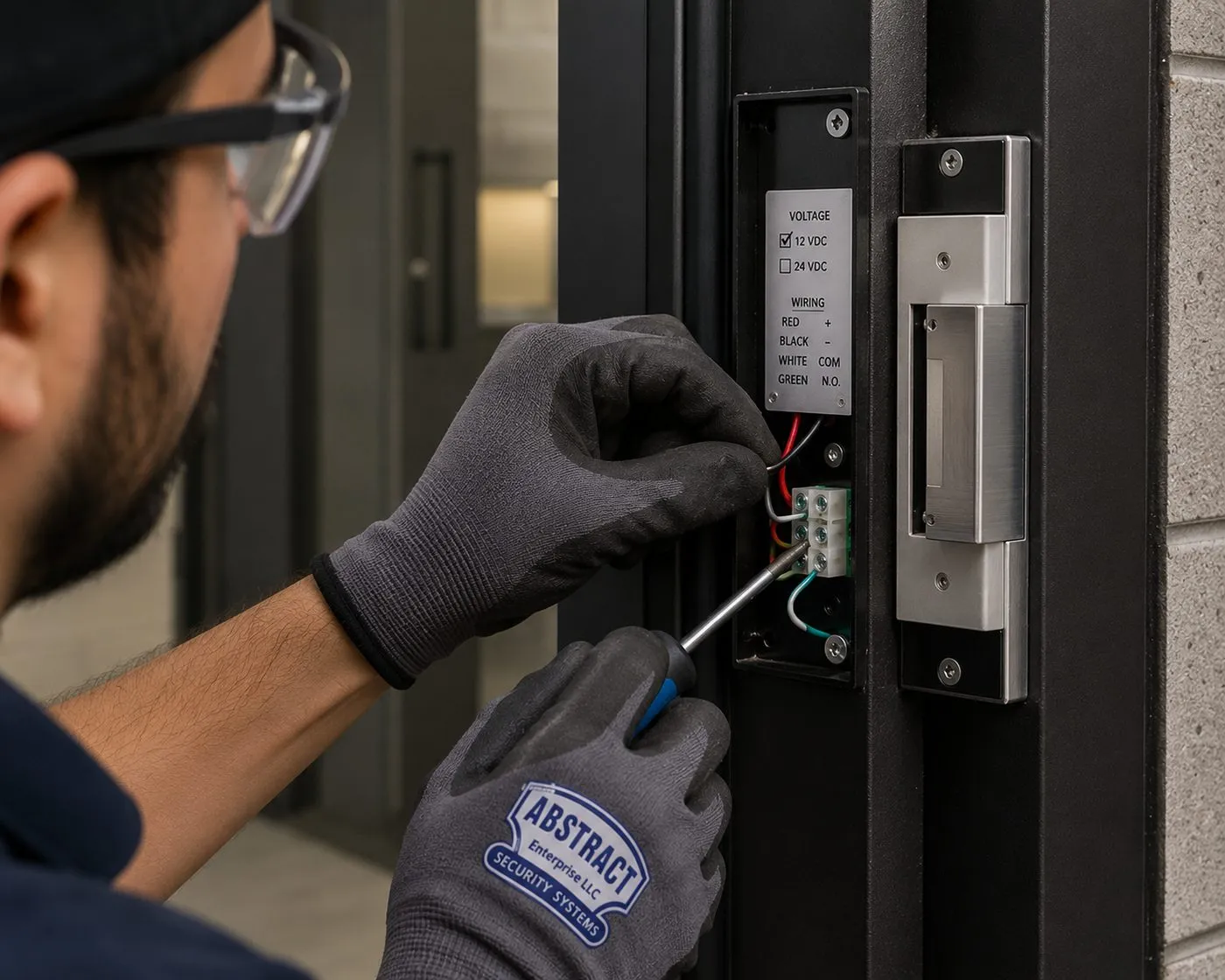
Each strand gets a measured loss figure from a calibrated source and meter; each outdoor run gets an OTDR trace; every connector face is scoped clean before it is plugged in.

Suffolk's buildings are mostly low, mostly wood or block, and mostly spread out. These are the six property types that make up nearly all of our county fiber work, and what each one asks of a route.
A house, an office in a converted outbuilding, metal equipment barns, a packing or crush building and often a retail stand or tasting room near the road. Distances run to hundreds of feet across cultivated ground, and the cable has to share that ground with tractors, posts, irrigation and drainage.
Cedar-shingle and clapboard houses on the South Fork, the North Fork and Shelter Island with detached garages, pool houses and guest cottages. Basements and crawlspaces are often shallow, finishes are expensive, and the owner may be in the city most of the year.
The post-war and later subdivisions of Huntington, Babylon, Islip, Smithtown and Brookhaven: one or two storeys, attic and crawlspace access, a detached garage or backyard studio. The fiber job is usually short and buried, with a septic system or cesspool somewhere along the way.
Block-and-steel buildings in industrial parks from Hauppauge and Bohemia to Calverton and Westhampton, with the office at one end and the dock or plant hundreds of feet away. Open bar-joist ceilings make the inside route easy; the far end is the distance problem.
College campuses in Selden, Brentwood and Riverhead, research sites in Upton and Stony Brook, school districts, fire districts and houses of worship with several buildings on one property. Each has a facilities office, its own standards and, often, existing duct banks of uncertain age.
South Shore canal homes and bayfront businesses from Amityville to Patchogue, marinas, boatyards and the barrier beach. Low ground, salt, wind and flood history dictate where anything electrical can go.
Farms and vineyards. We follow the edges of fields and the headlands where equipment turns rather than cutting across rows, keep the conduit deeper than any implement reaches, and avoid the lines where trellis posts are driven or replaced. Every change of direction gets a flush pull box the farmer can see and mow around. Inside metal barns the fiber ends in a sealed enclosure on an inside wall, away from wash-down areas.
Estates and second homes. The main house usually already has a mechanical room or closet where the provider lands; that becomes the hub. From there conduit leaves through a sealed sleeve below grade and runs to each outbuilding, coming up inside a utility space rather than on a finished facade. Inside the house we reuse attic and crawlspace paths, so no shingle or trim is disturbed.
Ranches, capes and suburban lots. Short runs, but crowded ground: a septic tank and leaching pools, a sprinkler system, a gas service, a buried oil tank or a dog fence. We locate and mark what we can before planning the line, then hand-dig across anything uncertain. The fiber usually enters the garage or basement and ends at a small wall enclosure beside the router.
Flex and industrial buildings. Inside, the cable rides on J-hooks or strut along the joists, stays clear of sprinkler mains and heaters, and drops at the far end in armoured cable where forklifts work. Between buildings on a shared lot we look for existing conduit first and test it before trusting it.
Campuses. We build to the institution's standard — strand counts, connector types, labelling schemes and enclosure brands — and coordinate shutdowns with its IT staff. Where an old duct bank exists we prove each duct with a mandrel before any cable goes in.
Waterfront lots. The entry may have to be low, but nothing else does. Splices, electronics and slack loops go up, cable through the flood-exposed zone stays continuous and sealed, and outdoor hardware is chosen for salt air.

Our Long Island fiber hub covers the established office corridors on Route 110 and in the Hauppauge park. This page looks further east and at what is being built now: new mixed-use and airport development, former defence land coming back into use, research campuses, and the small businesses of the East End.
Station Yards is planned for 1,450 homes, 360,000 square feet of office space and 195,000 square feet of retail on 53 acres beside Suffolk's busiest train station. In July 2026 the Town of Islip named Fly Long Island, an RXR and Avports venture, to develop a new MacArthur Airport terminal linked to that station. New tenant space here means fresh telecom rooms and short in-building backbones.
The Riverhead Planning Board has approved a preliminary plat dividing about 2,107 acres at the Enterprise Park at Calverton into eight lots, so that Calverton Aviation & Technology can buy 1,643 acres. Around 292 acres of the site are protected pine barrens. Large lots and long distances between buildings are what fiber on former industrial land looks like.
The Hampton Business District occupies 55 acres of county land at Francis S. Gabreski Airport under a 40-year lease, with ten buildings planned in 2016 — a 60,000-square-foot warehouse-style building, a 67,000-square-foot office and medical building, and more to come. Single-storey tenants with a dock at one end are a classic fiber link.
Brookhaven National Laboratory and Jefferson Lab are building the Electron-Ion Collider, a 2.4-mile-circumference machine estimated at $1.7 to $2.8 billion, mostly inside the existing RHIC tunnel. Contractors and suppliers working around a federal research site build to the host's rules on badging, safety and materials.
Main streets in Riverhead, Greenport, Southampton, Sag Harbor and East Hampton, plus restaurants, inns, farm stands and tasting rooms along Routes 25 and 27. Most are small, older buildings with a back office, a dining room and an outbuilding or two, and a summer peak that leaves no room for a network failure.
Babylon, Lindenhurst, Bay Shore, Patchogue and the bays to the east hold marinas, yacht clubs and boatyards whose offices, fuel docks, gates and cameras are spread along low waterfront ground. Distance and flood history together make fiber the safer cable.

Suffolk is governed town by town, and the towns are not alike. This is how our work usually breaks down across them. It is a guide to what we tend to find, not a promise about any one property.
| Town | What we are usually asked to connect | What tends to shape the route |
|---|---|---|
| Huntington | Home offices in detached garages, medical and professional offices, older estates on the North Shore | Hilly, wooded lots; long driveways; mature trees whose roots the trench has to respect |
| Babylon | Canal-front homes, marinas, light-industrial buildings near the Southern State and Route 109 | Flood history south of Montauk Highway; tight suburban lots full of other buried services |
| Islip | Warehouses and flex buildings, airport-area businesses, South Shore waterfront | Big single-storey floors; new construction near Ronkonkoma and MacArthur; bay-side flooding |
| Smithtown | Industrial-park tenants, professional offices, suburban homes | Short buried runs and long in-building pulls; park landlords with their own conduit |
| Brookhaven | Everything from Ronkonkoma apartments to Upton research sites, farms in the east of the town and South Shore lots | The largest town by far; Pine Barrens rules in its eastern half; campus standards in the research belt |
| Riverhead | Farms, vineyards, the Calverton industrial lands, downtown Riverhead businesses | Long runs across cultivated ground; Pine Barrens edges in the south of the town |
| Southold | Vineyards, farm stands, Greenport businesses, second homes on the North Fork and Fishers Island | Field and vineyard routing; seasonal occupancy; ferry logistics for Fishers Island |
| Southampton | Estates and rental houses, Westhampton business district, farms, village businesses | Large estates with many outbuildings; summer schedules; Pine Barrens in the west of the town |
| East Hampton | Second homes, guest cottages, Montauk hospitality, farms in Amagansett and Wainscott | Distances on large lots; empty-house months; salt air near the ocean and bays |
| Shelter Island | Homes and small businesses reached only by ferry | Ferry timing for crew and materials; small, careful jobs |
Two patterns run through the table. West of the Pine Barrens, Suffolk looks like a larger, looser Nassau: suburban lots and industrial parks where the cable is short but the ground is crowded. East of them, the county becomes agricultural and seasonal, and the cable gets long while the ground gets emptier and more protected. Most of the questions owners ask us, answered below, come from one side of that line or the other.
Standing in a field, a back yard or a boatyard, people ask us the same things again and again. We have grouped them by subject below and answered each one right under the heading; shorter questions about ferries, records and site walks sit in the FAQ further down.
Often yes, but it depends on which part of the Pine Barrens you are in and what the trench would disturb. The region covers roughly 105,000 acres across eastern Brookhaven, western Southampton and southern Riverhead and is split into a Core Preservation Area and a Compatible Growth Area. In the Core, the Commission's own guidance treats clearing or materially altering vegetation as development, and new development there needs a hardship waiver granted after a public hearing. That is a high bar, and a fiber trench through untouched pine and oak woodland in the Core is not something we would propose lightly.
In practice most owners in or near the Core already have cleared, developed ground around their buildings: a lawn, a driveway, a yard. A route that stays inside ground that is already cleared — along the driveway edge, under the lawn, beside an existing utility line — is a very different proposition from cutting a new path through the woods. Where the only short route crosses natural vegetation, we look at going around, at directional boring beneath roots rather than clearing above them, or at an aerial run on existing poles. We check the parcel against the Commission's maps at the proposal stage and tell you plainly if the route needs a conversation with the Commission or your town before anything is dug.
By choosing where it goes before choosing how deep. On a working farm or vineyard we route along headlands, farm roads, hedgerows and field edges, never diagonally across a cultivated block, and we stay out of the lines where trellis end-posts and anchors are driven or are likely to be replaced. The farmer knows where the tile drains, the irrigation mains and the old fence lines are better than any locator, so we walk the route with them and mark it with flags before the machine arrives.
Depth is then set by what works the soil. A cable that is perfectly safe at a modest depth under a lawn is not safe under a field that gets chisel-ploughed or subsoiled, so on cultivated land we go deeper, use conduit rather than direct-buried cable, and add warning tape well above it. A tracer wire runs alongside so the line can be located from the surface, and pull boxes sit at the edges of fields, flush with the ground, where equipment does not turn. The result is a route the next farm manager can see on paper and find with a locator in ten minutes.
Carefully, and usually around rather than across. Many Suffolk homes and businesses rely on on-site systems: a tank, one or more leaching pools or rings, and the pipes between them, sometimes with an older cesspool abandoned nearby. None of that is marked by an 811 request, because it is private. Before we commit to a line we ask for the property survey or any septic plans, look for the tank lids and pool covers, and probe or hand-dig where the records are unclear. The trench is routed to keep a clear distance from tanks, pools and their pipes, and from the well head and its line to the house where there is one.
Where the only sensible route has to cross a sanitary line or a water line, we cross it at a right angle, by hand, with the pipe exposed and protected, rather than letting a machine find it. If a leaching field occupies most of a back yard, the answer is often to change the entry point on the house so the fiber can leave from a side that is clear. Septic and well work has its own rules and licensed trades; our job is to stay out of their way and leave them exactly as we found them.
Both. Much of the county is sandy, well-drained ground, which is easy to dig and quick to backfill and drains rather than holding water around the conduit. The same quality makes trench walls unstable: dry sand runs back into a narrow trench as fast as it is cleared, and a deep trench in loose sand is not a safe place for a person to stand. That changes the method more than the price. We prefer narrow machine trenching or directional boring that keeps people out of the trench, set the conduit on a level bed, and compact backfill in layers so the lawn or driveway above does not sink the following spring.
Sand is also unforgiving of a poorly supported conduit, because voids beneath it close up unevenly and can put a bend in the pipe. A properly bedded conduit with gentle sweeps at the ends keeps the fiber inside well within its bend limits for decades. Where the ground turns to clay, stones or old fill, which happens on parts of the North Shore and on former industrial land, we adjust the equipment rather than the design.
They can. Rodents gnaw on cable jackets, and the risk is highest where cable sits shallow, where it enters a building through a gap they already use, and in barns, sheds and crawlspaces where they nest. Fiber carries no current, so a chewed strand will not start a fire, but it will take the link down. The cure is to give them nothing to bite: continuous conduit underground with sealed joints, sealed sleeves where the conduit enters each building, and the cable inside barns run in conduit or raceway rather than draped along a wall.
For runs that cannot be fully enclosed, such as a short section up a barn wall or along an old ditch, there are rodent-resistant cable constructions with armour or hard outer layers, and we specify them where the exposure justifies the cost. Pull boxes get tight lids. A link built this way rarely meets an animal; a link left loose in a hay barn usually does within a season.
Longer than almost any private property in the county. Single-mode fiber with standard optics carries a network link for kilometres, so the glass itself is never the limit on a farm, an estate or a business park. What sets the practical length of one continuous piece is the reel and the pull: outdoor cable comes on reels of finite length, and a pull through conduit is limited by tension and by the number of bends. On a very long route we plan intermediate pull boxes so the cable can be pulled in stages and figure-eighted at each box, without ever exceeding its tension rating.
That means a long Suffolk run usually has no splice at all between the two buildings, or one splice in a sealed closure where two reels meet, and no electronics in the middle. That is a real advantage over copper, which needs a powered switch every hundred metres or so — and a powered box in the middle of a field is exactly the thing that fails. We choose the strand count for the far end's future, not just today's camera, because once the trench is closed adding strands costs far more than including them.
The fiber itself needs nothing; it is the small electronics at each end that misbehave when no one is around. A media converter or switch in a pool house can lock up after a power blip, a breaker can trip in a winter storm, or a mouse can get into a cabinet left open. So for a seasonal property we design for the months of absence: equipment at both ends on a small battery backup, a power strip or switch that can be rebooted remotely from a phone, and a camera or sensor at the far building whose disappearance tells you immediately that the link is down.
We also keep the far-end equipment inside a closed, conditioned or at least sheltered space where possible, mount enclosures off the floor, and seal every conduit end against insects and rodents. Before the house closes for the season the caretaker can run a two-minute check we leave in writing; when it reopens, the same check confirms everything survived. If a link does go down mid-winter, the as-built record lets a technician find the problem without the owner travelling out.
Put the equipment where guests cannot reach it and make it recover by itself. In a rented house the weak points are never the fiber, which is buried and out of sight; they are the small boxes at each end that a guest can see, unplug to charge a phone, or power-cycle hoping to fix slow Wi-Fi. So at the pool house or cottage the media converter or switch goes into a locked wall cabinet or a closed utility closet, powered from an outlet that is not on a wall switch, with the fiber and patch cords dressed inside where they cannot be tugged.
Everything a guest legitimately needs — the Wi-Fi name and password, a working television — is delivered by access points and outlets fed from that locked cabinet, and the owner’s cameras, alarm and controls run on a separate network the guests never see. A small battery backup and a remotely switchable outlet let the owner or manager restart the far end from a phone between check-ins. Our Suffolk network installation team sets that up alongside the fiber, so that a Saturday changeover never needs a technician.
By keeping the cable continuous across the low ground and putting every connection point up high. On the South Shore the storm tide in 2012 put two to five feet of water over the land south of Montauk Highway in parts of Lindenhurst, Amityville and Babylon, and smaller events have reached driveways and docks since. A marina cannot raise its fuel dock or its boat sheds the way a homeowner can raise a house, so the design works around the water instead: the main network room stays in the office on the highest ground, and an outdoor cable runs in sealed conduit to each outlying point without a single splice or connector at ground level.
At the gate, the fuel dock and each shed the cable rises inside conduit to a sealed enclosure mounted well above the highest water the owners have seen, where it meets the converter or switch for the cameras, card readers and Wi-Fi out there. Fittings are stainless or coated for salt air, and a slack loop sits in each high enclosure so a damaged length can be cut out and re-spliced. We record loss and OTDR readings at handover; after the next flood a quick re-test against those numbers shows whether anything changed.
Potentially all three, which is why we check rather than guess. At county level, Chapter 563 of the Suffolk County Code licenses home improvement contractors in Article II and electricians in Article XI, and its definition of home improvement work expressly leaves out the electrical field. How a low-voltage fiber job on a particular house fits that framework is something we confirm before starting residential work. Our state credential is NYS low-voltage licence #12000287431.
Building and electrical permits are issued locally. Each town has its own building department, incorporated villages often run their own, and practice varies: the Town of Southampton, for example, has its own electrical e-permit portal, and the Village of Westhampton Beach's FAQ says a permit is needed for structural or electrical changes to a dwelling. We look up the rule for your address, file what is required, and build to pass inspection either way. Separately, New York 811 must be notified before any digging, and protected areas such as the Pine Barrens Core have rules of their own.
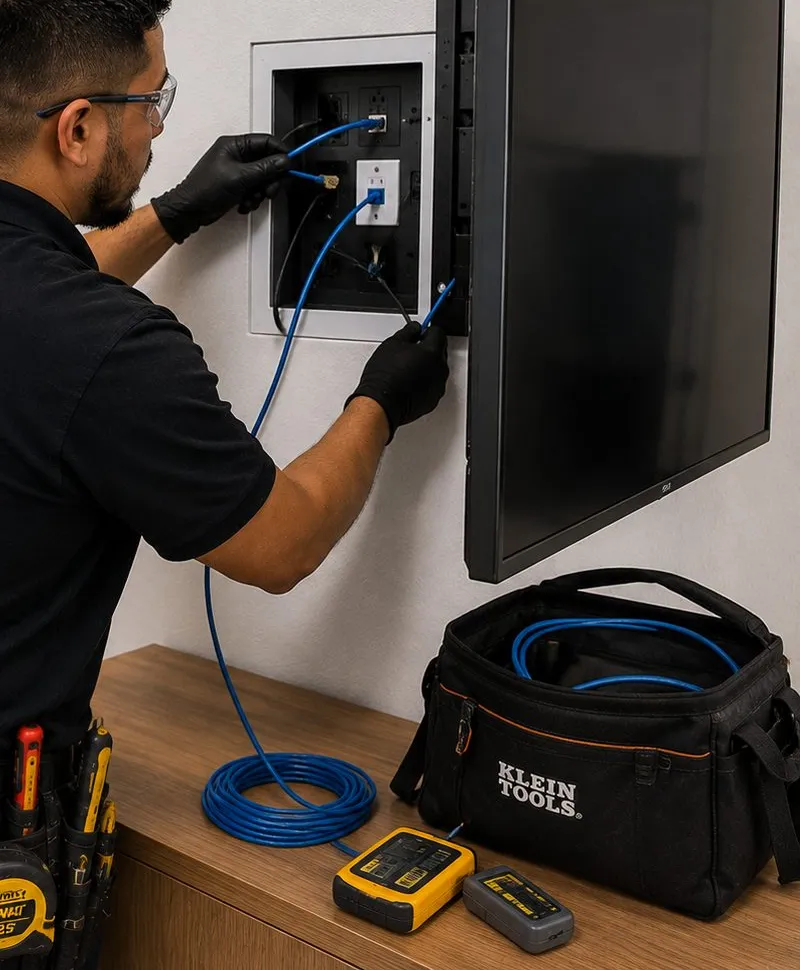
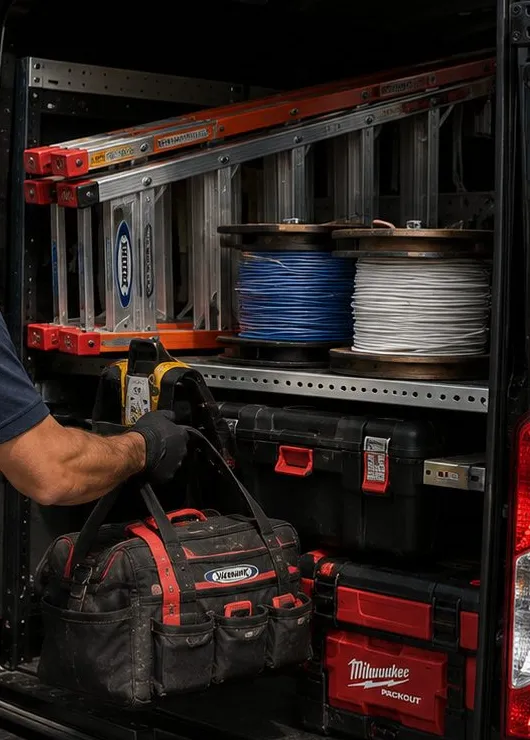
Suffolk work is mostly underground and outdoors, so the material list leans toward conduit, tough jackets and things that can be found again. This is what we specify most often in the county and why.
Gel- or water-blocked tubes inside a polyethylene jacket, made to live in wet conduit for decades. The standard cable for any run between buildings, from a backyard studio to a barn across a farm.
A jacket listed for both environments, so a single piece can leave a mechanical room, cross the yard and enter the far building without a transition splice at each wall.
Steel or hard-layer protection for sections that cannot sit in conduit: barn walls, crawlspaces, old ditches and anywhere animals or equipment are a threat.
Continuous high-density polyethylene duct, often with a pull line already inside, laid in a trench or pulled back through a bore, with long-radius sweeps where it rises into a building.
Flush boxes at turns and long-run pull points, a tracer conductor along the whole route so a locator can follow it, and bright tape above the conduit to warn the next shovel.
Gasketed wall boxes for pool houses, barns and garages, and buried or pedestal splice closures where two reels have to meet on a very long run.
LC panels in the main house's or office's rack, and compact wall boxes at the far end where there is no rack at all, both fed by fusion-spliced pigtails.
The electronics that turn light back into Ethernet at the far building — including temperature-hardened models for unheated barns, sheds and closed-up summer houses.
Small UPS units and app-controlled power outlets at both ends, so a seasonal or remote building can be rebooted from a phone after a storm.
| Job | Typical construction | Why it fits |
|---|---|---|
| House to detached garage, studio or pool house | Outdoor or indoor/outdoor single-mode, 6–12 strands, in buried HDPE conduit | Short and simple; spare strands for owner/guest separation and future cameras |
| Farmhouse to barns, packing shed or tasting room | Outdoor loose-tube single-mode, 12–24 strands, deep conduit with tracer | Long runs under worked ground; strands for every building that may be added later |
| Estate with several outbuildings | Star layout from the main house, a separate cable to each building | One building's fault never takes down the others; each run tested on its own |
| Flex building, office to dock | Armoured indoor single-mode or OM4 on J-hooks and strut | Survives forklifts and racking changes; matches optics in the existing switches |
| Bayfront or canal lot | Continuous outdoor cable in sealed conduit, splices above the flood line | Glass and plastic in the wet zone, connectors and electronics above it |
| Wooded or protected ground | Bored conduit beneath roots, or aerial cable on existing poles | Avoids clearing vegetation and keeps the surface undisturbed |

AI answers about fiber installation are stitched together from carrier marketing and national contractor cost guides, most of them written with city offices or new subdivisions in mind. Here are seven claims as those sources publish them, and what they miss on a Suffolk property. Angi, HomeAdvisor and Fixr returned no fiber-specific cost page in our searches, so the figures quoted below come from the contractor guides that did.
Carrier pages describe Fios as available across much of Long Island, and an AI summary will happily repeat that as if every address were covered. On the East End the history is different. In a Suffolk Times report, a Verizon spokesperson answered a campaign for Fios in eastern Suffolk with "It's a simple no," and the paper's account named Riverhead and Southold among the towns involved.
Plans change, and other providers have been building fiber on Long Island. But the claim confuses the provider's network with yours. Even where a fiber provider reaches the road, it brings service to one point on one building; the barn, the cottage, the dock and the far end of the warehouse are still on the owner's side of the line.
So the useful question for a Suffolk owner is not which provider is available, but whether the private network across the property is ready to carry whatever provider comes next. A properly documented owner backbone is the part of the system that survives a change of carrier.
One widely cited guide quotes a Fiber Broadband Association report giving a median of $18.00 per foot for underground construction, with an interquartile range of $11.50 to $25.00. Those are numbers for carriers building outside plant along public roads, with permits, traffic control and restoration of the street.
Private Suffolk jobs don't look like that. A short run across a back lawn in sand can be quick, while the same footage across a vineyard, through tree roots or around a leaching field takes much longer. The per-foot figure hides the things that actually decide the price: what the ground holds, what has to be avoided and what has to be put back.
That is why we price the fiber itself from published lines and quote the civil work separately once we have walked the route. You see what the glass costs and what the digging costs, and you can compare a trench, a bore and an aerial option side by side.
Another cost guide publishes those ranges for underground installation and calls them orientation ranges rather than quotes, which is honest. The trouble comes when AI drops the caveat and turns them into a budget.
In Suffolk, the choice between trenching and boring is rarely about the per-foot rate. It is about what sits on top: a finished lawn the owner wants untouched before a summer rental, a paver driveway, a stand of protected pines, a row of established vines. Boring costs more per foot and can still be the cheaper project once restoration is counted.
We show both methods where both are possible, with the restoration included, and let the owner choose with the whole picture in front of them.
Guides quote aerial installation on poles at roughly that range and add, correctly, that it needs attachment rights. On many Suffolk properties there are no private poles to attach to, and the utility poles along the road are not available for a homeowner's or tenant's private cable.
Where an owner does have their own poles — along a farm lane or a long private drive — aerial cable can be a good answer, especially where the ground beneath is protected or heavily planted. It is exposed to wind, falling limbs and ice, though, and Long Island's storms test that exposure regularly.
We treat aerial as one option among three, priced honestly, and recommend it where it truly fits rather than because it looks cheaper per foot.
A New York contractor's guide says small projects can take a day or two, and for a short run inside an office that is fair. Outdoors in Suffolk, the work on site may still be a day or two, but the calendar around it is longer.
There is the New York 811 notice and markout before any digging, the private-line locating, any town or village permit, and on farms and rental houses the window when the ground can be opened — between harvest and frost, or between the end of one rental season and the start of the next.
We give you a realistic start date at the proposal stage that includes those steps, and we plan the digging so that a lawn has time to recover before the season it matters most.
A New York cabling guide notes that a plenum rating adds 15 to 25 percent to cable cost, and AI answers often present plenum cable as a general requirement. Plenum rating matters where a ceiling or floor cavity is used as an air-return space inside a building.
Most Suffolk fiber runs are underground between buildings, where what matters is an outdoor or indoor/outdoor rating, water blocking and mechanical protection. Paying for a plenum jacket on a run that spends its life in a buried conduit buys nothing.
Inside commercial buildings we still use plenum or riser ratings exactly where the space calls for them. Everywhere else, the money goes into conduit, tracer wire and spare strands instead.
Older explanations describe single-mode fiber as carrier-grade and multimode as the sensible choice inside a business. Published comparisons show why that is outdated: single-mode OS2 carries 10 gigabit links for 10 kilometres and more, while OM3 and OM4 multimode reach a few hundred metres at 10G and less at higher speeds.
On a Suffolk farm or estate, a few hundred metres is not far, and the link may need to run faster in twenty years than it does today. Single-mode removes the distance question for the life of the cable.
We still use multimode where it makes sense — a short link inside a building whose switches already have multimode optics. For anything buried between buildings, single-mode is our default.
Mark the two buildings, the septic and anything else you know is buried. We'll walk the route with you, free, and price the trench, the bore and the aerial option side by side.
Which town, which buildings, and what is buried or growing in between? Send it here and expect a reply from our Suffolk crew the same business day — or ring (631) 407-2884.
Thanks — your note is with the people who plan Suffolk jobs; on a weekday you will hear back before closing time. Link already down? Use (631) 407-2884.
Eight stages from the first call to the handover file. On a farm or a rental house, stages three and four are timed around the season, so the ground is opened when it does the least harm.
A short call about the buildings, the distance and the season, plus any survey, septic plan or satellite screenshot you can send. We book the site walk around your calendar.
We walk from building to building with you or your caretaker, probing and flagging tanks, pools, irrigation, wells and old cable, and measure the real route.
An itemised proposal with the fiber from our published lines and the trench, bore or aerial options priced separately, with protected-ground and permit notes.
New York 811 notice, private-line locating, any town or village permit, and landlord, campus or association approvals completed before the ground is opened.
Trench or bore laid with bedded conduit, tracer wire and warning tape; sealed sleeves into each building; pull boxes at turns; trench photographed before backfill.
Cable pulled within its tension and bend limits, figure-eighted at intermediate boxes on long runs, with slack loops kept above any flood line.
Glass joined by fusion at both buildings, every connector looked at under magnification, a loss number recorded per strand and an OTDR trace kept for each buried run.
Lawn, field edges and paving restored, labels at both ends, equipment powered and checked, and an as-built map with depths and readings handed to the owner.

Six places that show where Suffolk's building is heading, and the kinds of sites we cable around them.
A $1.2 billion transit-oriented development on 53 acres beside the Ronkonkoma LIRR station, in the Town of Brookhaven near Exit 60 of the Long Island Expressway; 489 apartments were delivered in 2020 and 388 more in the second phase.
The Town of Islip's airport, where a new terminal developer was named in July 2026 with plans to link the terminal to the nearby Ronkonkoma train station.
About 2,107 acres in the Town of Riverhead, divided under a preliminary plat into eight lots, with a Grumman memorial and roughly 292 acres of protected pine barrens on the site.
Home to the Hampton Business District, 55 acres of county-owned land leased for 40 years, where Tate's Bake Shop took more than 37,000 square feet in the first building.
Host, with Jefferson Lab, of the Electron-Ion Collider project — a collider 2.4 miles around that will reuse most of the existing RHIC tunnel.
The oldest of Suffolk County Community College's three campuses, set on 156 wooded acres with more than 13,000 students; the others are the Grant Campus in Brentwood and the Eastern Campus in Riverhead.
We also serve Huntington, Northport, Commack, Deer Park, Lindenhurst, Babylon, Bay Shore, Islip, Sayville, Bohemia, Holbrook, Hauppauge, Smithtown, Port Jefferson, Selden, Medford, Patchogue, Shirley, Mastic, Riverhead, Mattituck, Cutchogue, Southold, Greenport, Orient, Westhampton, Hampton Bays, Southampton, Bridgehampton, Sag Harbor, East Hampton, Amagansett, Montauk and Shelter Island, as well as the neighbouring county covered on our Nassau County fiber optic installation page.

Suffolk carries a 1.20× area rate on our published fiber prices. These are the same Suffolk figures shown on our Long Island hub, built from the Brooklyn base used across our city pages. They cover the cable, splicing and testing; trenching, boring, poles and restoration depend entirely on your ground and are priced separately after the site walk.
| Item | Suffolk price | What it covers |
|---|---|---|
| Fiber termination on an existing cable | $42 per termination | One connector, fusion-spliced pigtail or mechanical |
| OTDR test | $48 per strand | Shows splice points, connectors and distance along each strand |
| Multimode fiber drop | $420 per drop | Short inside run, terminated and tested |
| Single-mode fiber drop | $480 per drop | Short inside run, terminated and tested |
| 12-strand OM4 backbone between rooms or floors | $5,400 – $8,400 | Fusion-spliced, panels or enclosures at both ends, loss-tested |
| 24-strand OS2 building-to-building link | $9,600 – $18,000+ | Single-mode, spliced at both buildings, OTDR on every strand; civil work extra |
| Second telecom room with fiber link | from $2,880 | A cabinet or small network room at the outlying building, linked home by fiber |
| Service and callback rate | $195/hr, 3-hr minimum ($585) | Repairs, troubleshooting and return visits — not the initial install |
For copper drops alongside the fiber, the Suffolk structured cabling price builder shows our county figures for Cat6 and related items.
National brand versus local contractor. If you were weighing ADT, Ring or SimpliSafe, note that their business is monitored alarms, video doorbells and cameras — burying glass across a farm or between estate buildings is outside it. The honest comparison is with a provider's installer, who stops at the provider's box, or a large integrator, who may subcontract the digging and the splicing to different firms. We are a licensed contractor that walks the property, owns the splicer and the OTDR, and answers for the whole run.
Typical Suffolk requests, priced from nothing but the table above. Once we have walked your land, the real counts and the digging replace these figures in a written proposal.
$960
Two single-mode fiber drops at $480 each, terminated and tested — for example, a pair from the house's equipment closet to a garage studio or pool house where conduit already exists. Enough for a small switch, an access point and a camera or two out there.
$5,400 – $8,400
A 12-strand OM4 backbone inside one Suffolk building — the office end of a flex building to its dock, or a farm office to the packing room under the same roof — with enclosures, splicing and loss results for every strand.
$9,600 – $18,000+
Twenty-four single-mode strands from the main house or office to a barn, cottage or second building on the same land, fused into sealed boxes at both ends with a trace for each strand. The digging, boring and turf work sit on a separate line after the walk.
Already have fiber in the ground that was never finished? Terminating and certifying a 12-strand cable at both ends — 24 terminations at $42 and 12 OTDR traces at $48 — comes to $1,584 before any missing enclosures.
Left over from a previous project — a reel in the barn, a carton of converters in the garage? Supply it and pay only for labour: $195 an hour, three hours minimum ($585), covering the pull, the splicing and the certification. The reel is light-tested on the tailgate first, since glass that turns out to be broken after the trench is closed and the turf relaid costs twice. Parts you supply are backed by their maker, not by our warranty.

Fiber lines from the table above, civil work quoted on its own after a free walk of the route. No surprises hidden in a per-foot number.
The Long Island Pine Barrens Protection Act was passed by the State Legislature in 1993, and the Central Pine Barrens it protects stretches across the middle of the county: the eastern part of Brookhaven, the western part of Southampton and the southern part of Riverhead. Homes, farms, businesses and institutions sit inside and beside it, and many of them need exactly the kind of link between buildings that fiber is best at. The difference is that the ground between those buildings may itself be protected.
Our approach starts on the map rather than with the machine. Before a route is drawn we check whether the parcel lies in the Core Preservation Area, the Compatible Growth Area or outside both, and we look at what is actually growing along the proposed line. A route that stays within a lawn, a driveway shoulder or an existing cleared utility strip disturbs nothing new. A route that would cut through native pine and oak is the one to redesign.
Three techniques do most of the work. The first is simply going the long way: following the edge of the cleared area, even if it adds a few hundred feet of cable, because extra fiber is cheap and disturbed habitat is not. The second is horizontal directional drilling, which carries a conduit beneath roots and ground cover from a small pit at each end, leaving the surface between almost untouched. The third, where the owner already has poles along a lane, is an aerial run that never touches the ground at all.
If a project truly cannot avoid disturbing vegetation in the Core, that is a matter for the Central Pine Barrens Commission and, usually, for the owner's own advisers, and we will say so before any money is spent. We would rather redesign a route than put a client in front of a hearing they did not need.
Suffolk is still a farming county. The State Comptroller's agriculture profile, as reported in the Shelter Island Reporter, counted 578 farms on 33,821 acres in 2022 — a small increase over 2017 at a time when New York as a whole lost farms — along with 79 wineries and the state's leading aquaculture sales. The county's Farmland Preservation Program, approved by referendum and begun in 1974, has preserved more than 11,000 acres, which means much of that land will stay farmland and its buildings will stay where they are.
Modern farms run on networks. A farm office needs the internet; so do the cameras on the equipment yard, the controllers in the greenhouses, the point-of-sale at the farm stand, the cooler alarms in the packing shed and, on a vineyard, the guest Wi-Fi in a tasting room that may be the business's main source of revenue. Those buildings are spread across the property for practical reasons, and they are almost always too far apart for copper.
The fiber pattern we use most is a star from the farm office or house: one cable to each outlying building, each with a few spare strands, so that a problem at the greenhouse never affects the stand. Routes follow farm roads and headlands, deep conduit runs under anything that gets worked, and pull boxes sit where nothing turns. Inside metal barns we mount enclosures high on interior walls, away from wash-down, fertiliser and fuel storage.
Timing matters as much as routing. We plan digging for the windows the farmer chooses — after a crop is off, before the ground freezes, or in the quiet weeks before planting — and we restore field edges and lanes so that equipment can use them the next morning. For the cameras and sensors at the far end, our Suffolk commercial camera team can install on the same visit, so the trench is opened once.
The East End has been growing fast. Between 2010 and 2020 the Town of East Hampton's population rose by about 32 percent and Shelter Island's by about 36 percent, according to Dan's Papers' reading of the census, while the county as a whole grew by about 2 percent. Many of those households, and many more that are counted elsewhere, run properties that are lived in for part of the year, rented for part of it, and looked after by a caretaker for the rest.
Those properties have three network needs that a year-round house does not. The first is reach: a main house, a pool house, a guest cottage, a garage apartment and a gate, often hundreds of feet apart, all expected to have flawless Wi-Fi and cameras. The second is separation: owners' systems and renters' devices should never share a network. The third is unattended reliability: something has to keep working, or at least report that it has stopped, from October to May.
Fiber answers the first by making distance irrelevant and the second by carrying separate networks on separate strands. The third is a matter of design at the ends — battery backup, remote power control, sealed and raised enclosures, equipment in conditioned spaces — and of leaving a clear, written handover that the caretaker can follow. We work through the property manager or caretaker when the owner is away, and we plan the noisy work for the weeks between rentals rather than in the middle of someone's holiday.
Inside the houses, we stay out of the finishes. Shingled and clapboard homes are expensive to patch, so fiber enters through the basement, crawlspace or garage and rises through closets and mechanical chases to the network cabinet. The same approach carries the camera and access-point cabling that our Suffolk residential camera installers add around the property.

Suffolk's South Shore is a line of canal neighbourhoods, marinas and bay-front business districts facing the Great South Bay and the bays to the east, with Fire Island beyond. It is the part of the county where a network is most likely to be underwater one day. The National Weather Service's impact record for Lindenhurst shows the storm tide on October 29, 2012 exceeding every previously documented high-water mark there, with much of the ground south of Montauk Highway under two to five feet of water. Across the bay, the Associated Press reported that twelve houses on Fire Island were swept out to sea and that the Fire Island National Seashore's superintendent estimated 80 percent of the remaining houses were damaged.
After a storm like that, the network has to be planned for the next one. Fiber suits that planning well because the cable itself is not harmed by water; what fails in a flood are connectors, splices, converters and power supplies. The design rule is therefore simple to state: keep everything except continuous cable above the water line you have seen.
On a canal home that means the provider's line, which often enters low, is extended in sealed conduit straight up to a network cabinet in the raised living space or an upper floor, with no splice below. On a marina, the office and its electronics sit on the highest ground on the property, and fiber runs out to the gates, fuel dock, boat sheds and cameras in sealed conduit, ending in enclosures mounted high on posts or walls. Outdoor hardware is chosen for salt air, and stainless or coated fittings replace bare steel.
We also record what was installed in a way that helps after the next storm: baseline loss and OTDR readings for every strand, photographs of each enclosure, and a map. When the water goes down, a short re-test tells you whether the network needs anything at all.
Buried private cable is far more likely to be cut by a shovel than worn out by weather or age, and the shovel usually belongs to someone who had no idea it was there: a pool contractor, a fence installer, a landscaper planting a hedge, a new owner's irrigation crew. Private lines do not appear on 811 markouts, so the only protection a buried fiber has is its own record and the means to find it.
Every buried run we install gets four things. A tracer conductor runs the full length and is brought up into every pull box, so a standard locator can follow it. Warning tape is laid in the trench above the conduit. The open trench is photographed at regular intervals with location data before it is closed. And an as-built sketch shows the route, depths, box locations and the building entries, with the test results attached.
That package belongs to the property, not to us. We give it to the owner, the property manager or the farm office in a form that can be kept with the deed papers and handed to the next contractor. When a pool company asks where it can dig, the answer is a page, not a guess.
Bring whatever you can find. Every item below saves time on the ground and removes a guess from the proposal.
The fiber is the road; these are the things that travel on it. Suffolk clients usually combine several of them into one site walk and one trench.
Routers, access points and locked-down owner networks set up at the house and at every outbuilding the fiber reaches.
Desk, TV and access-point outlets wired in copper from the fiber box in each building.
Certified Category 6 runs for desks, access points and cameras within copper's reach.
Speaker wire, thermostat and lighting-control runs and gate cabling, quoted together with the fiber so one crew handles it all.
Yard, barn, dock and marina cameras fed back to one recorder over the new link.
Gate and door readers on outlying buildings tied to one controller.
Talk-and-see panels for a farm gate, an estate drive or a shop door, answered from inside.
Fault finding on existing copper and mixed networks, including cable cut by a dig.
Display walls for lobbies, showrooms and monitoring rooms that need a fast feed.
What a Suffolk walk looks like from our side (our routine on every property, not an account of one customer)
On a Suffolk walk the first tool out is a probe, not a tape. Before anyone talks about cable, the installer looks for tank lids, pool covers, sprinkler heads, a well cap and the faint line in the grass where something was buried years ago, and marks them with flags. The straight line between two buildings is drawn last, and it is rarely straight.
The second habit is asking about the calendar. Who is living here in July, when does the harvest come off, when does the business close for the winter? The answer decides when the ground is opened, which matters more to the owner than almost anything else we do.
The third is asking where the water came. On the South Shore and around the bays, owners usually know exactly how high it reached, and that height decides where the first enclosure goes. Out east, people remember which outbuilding lost power in which storm; those are the buildings that get battery backup first.
Yes. Shelter Island and other ferry-served parts of the county are planned a little differently: crew, materials and any digging equipment are booked onto specific crossings, and we bring spares for everything so a missing part never means a second trip. We schedule those jobs as complete days rather than short visits.
Look at the end or the jacket print. Coax is round with a single copper centre and usually a screw-on connector; phone wire has small coloured copper pairs; fiber is often yellow, orange or aqua inside, is marked with terms such as single-mode, OS2 or OM4, and ends in small square or round connectors. If there is no visible end, a technician can identify it with a locator and a light source on the site walk.
We do, as part of the job. Turf is cut and set aside or reseeded, soil is compacted in layers so it does not settle, sprinkler lines crossed by the trench are repaired and tested, and plantings moved for the work are replanted. The proposal states exactly what restoration is included so there is no argument afterwards.
Yes. Research campuses, utilities and large industrial sites often require site-specific safety orientation, badging, escorts, approved materials and permits to dig. We complete whatever the host requires, build to its standards and keep to its working hours, and we price that time into the proposal rather than discovering it later.
Yes, with the right materials. The cable runs in conduit or is an indoor/outdoor rated type, the enclosure at the far end is sealed and mounted high and away from irrigation spray, and the switch sits in a ventilated box or an adjoining potting shed rather than in the growing space. Glass itself is unaffected by humidity; what fails in a greenhouse is unsealed connectors and electronics, so those are what we protect.
They should go with the property. The as-built map, test results and photographs we hand over are written for whoever owns the land next, not just for you, and we recommend keeping them with the deed and survey. If a new owner calls us, we can re-test the link against the original readings.
The fiber itself cannot: it carries light, so it neither picks up nor disturbs the fence signal. The trench is the risk, because the boundary wire is usually only a few inches down. We ask where the wire runs, cross it by hand, and if it is nicked we splice it and confirm the collar still responds before we leave.
No. The site walk is free anywhere in Suffolk, including the forks and Shelter Island. We group East End walks on the same day where we can, so it may be a few business days out, and you receive the written proposal afterwards with the fiber lines and the civil work priced separately.
This Suffolk page sits under our Long Island fiber optic installation hub, which explains campus and parking-lot links across both counties. Next door, fiber optic installation in Nassau County covers the denser western half of the island. Our city work is gathered on the New York City fiber hub, and the six counties north of the city are on the Hudson Valley fiber page. County pages that are not yet published link to the quote form; we already take fiber work in each of them.
Long Island fiber optic installation · Nassau County · Suffolk County (this page)
NYC fiber optic installation · Manhattan · Brooklyn · Queens · the Bronx · Staten Island
Hudson Valley fiber optic installation · Westchester · Rockland · Orange · Putnam · Dutchess · Ulster
Fiber is one trade among many for us; the rest — cameras, alarms, door entry — is mapped out on AESS home, and the people who will turn up at your gate are introduced on who we are.
If an outbuilding went silent overnight — no picture from the barn camera, no Wi-Fi in the guest cottage, a dead terminal at the farm stand — call (631) 407-2884 and tell us which building and when it went. We aim to dispatch the same day anywhere in Suffolk, and once on site a technician typically has a cut, a wet enclosure or a failed converter found and fixed within one to two hours, then re-tests the strand before leaving.
Abstract Enterprises Security Systems · 1282 Troy Ave, Brooklyn, NY 11203 · Suffolk line (631) 407-2884 · WhatsApp (718) 679-0359 via wa.me
NYS Low-Voltage Licence #12000287431 · 100% Licensed & Insured · Same-Day Estimates · Rated 4.7★ from 201 Google Reviews
Full terms — including 50% deposit, one-year parts-only warranty on AESS-supplied products, and the late-fee schedule — are set out in the service agreement. See our warranty page.
Page reviewed and updated October 17, 2026. Changelog: first publication of the Suffolk County fiber optic installation page.