Putnam is a county of detached houses on wooded hillsides, three-quarters of it draining into New York City's drinking-water reservoirs and almost all of it sitting on the old gneiss and granite of the Hudson Highlands. That landscape decides how a cable gets from one building to the next: around tree roots, over or through rock, under erosion rules written for the watershed, and past branches that come down every storm season. We plan, install, splice and test private fiber for Putnam homes, home offices, small businesses and civic buildings — and every link is handed over with test results and a drawing of where it runs.
Reviewed and updated October 17, 2026 · Written by Anwar Timothy, NYS licence #12000287431
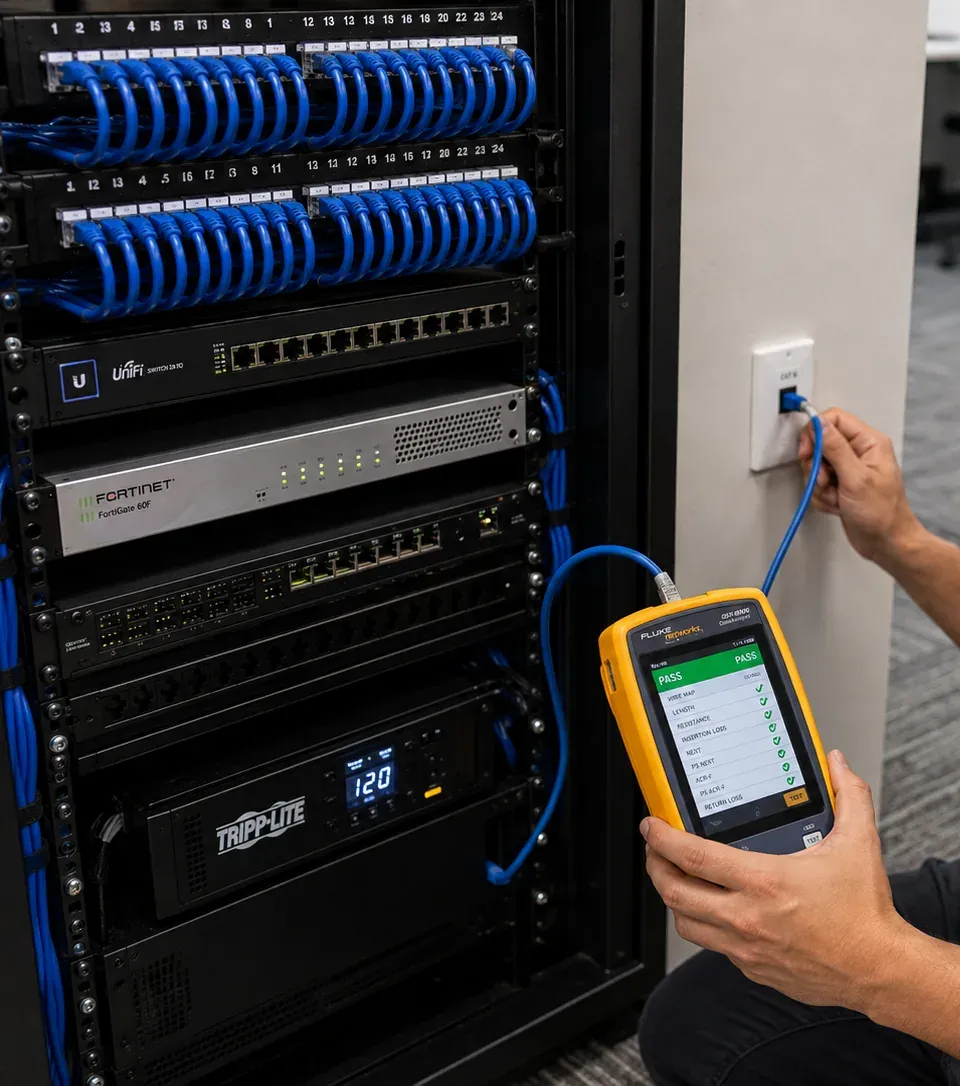
A technician holds a yellow cable certifier showing PASS; its patch cord runs to a wall outlet beside a rack holding patch panels, a switch, a firewall and a UPS reading 120.
Free Putnam Fiber Quote
Name the two buildings and what lies between them — a licensed installer calls back the same business day
✅
Request Sent!
We'll call you back the same business day.
25+
Years Experience
✓
Same-Day Estimates
100%
Licensed & Insured
4.7★
201 Google Reviews
A studio, garage or second building in Putnam that the Wi-Fi never quite reaches? Call (845) 640-3835 or send the 60-second form with a phone photo of the ground between the two buildings. The person who reads it installs fiber for a living.
Routes planned around tree roots, bedrock and the watershed's erosion rules before anyone digs
Glass fusion-spliced at both ends, each strand measured for loss, ports labelled and the route drawn to scale for you
Low-voltage work under New York State licence #12000287431; certificates of insurance issued on request
Why Putnam County Properties Need Fiber Optic Installation
Putnam County is small, green and steep, and almost every fiber job here is shaped by the ground before it is shaped by the network. The county covers a little over 240 square miles between the Hudson River and the Connecticut line, divided into six towns — Carmel, Kent, Patterson, Philipstown, Putnam Valley and Southeast — and three villages, Brewster, Cold Spring and Nelsonville. Its own hazard-mitigation plan describes a place where roughly two-thirds of the land is forest, where about three-quarters of the county lies inside the New York City water-supply watershed, and where more than nine-tenths of the land area belongs to the Hudson Highlands, a mass of gneiss, schist and granite that sits close under the topsoil. Those three facts — trees, reservoirs and rock — are what an installer meets the moment a cable has to leave one building and reach another.
The buildings themselves are mostly houses. The same county profile counts close to four in five housing units as single-family detached homes, and a great many of them sit on lots where the house is only one of several structures: a detached garage with a room above it, a studio or workshop behind the trees, a pool house, a converted barn, an in-law cottage. Since commuting patterns changed, more of those outbuildings have become workplaces. A home office over a garage on a wooded lot in Mahopac or Putnam Valley needs the same dependable link to the house router that a branch office needs to its server room, and the usual workarounds — a mesh Wi-Fi node in the window, a cable stapled along a fence, a line strung from the eaves to a tree — are exactly the things that fail in the first winter storm.
The second pattern is the small commercial and civic building. Putnam does not have a downtown of office towers; it has suburban office and medical buildings along Route 6, Route 22 and Route 312 in Southeast and Brewster, a county seat in Carmel with a courthouse completed in 1814, town halls and highway garages in every town, libraries, fire companies with apparatus bays separate from their meeting halls, and schools whose newer wings were added beside older buildings. These sites rarely need dozens of strands. They need two or three buildings joined on one network, a camera recorder that can see the far lot, and a path for a provider's circuit from the building where it lands to the building where it is used.
Then there is the paperwork, which is more local in Putnam than in most of the Hudson Valley. The county licenses electricians through its Department of Consumer Affairs, and its electricians' law defines a separate low-voltage/limited-data communications technician licence that names fiber optics explicitly, alongside computer networking, telecommunications, intercom, audio/video and video surveillance, for systems at 90 volts or less. Erosion and sediment control is triggered at a far smaller disturbance in the watershed than elsewhere in the state. And the reservoirs are surrounded by land the City of New York owns, which no private cable may cross without the City's permission. None of that is a reason not to install fiber. It is a reason to plan the route on paper before the first shovel goes in, which is how we work.
Putnam County facts that shape fiber work
About three-quarters: the share of Putnam County inside the New York City watershed, according to the county's own hazard-mitigation county profile.
More than nine-tenths: the share of the county's land in the Hudson Highlands, where the dominant outcrops are gneiss, schist and granite (same source).
67.9% then 66.9%: forest cover in the county profile's 2006 and 2011 land-cover data — two-thirds of the county under trees.
79.2%: the share of Putnam housing units that were single-family detached homes in 2012 American Community Survey data cited by the county (30,215 units).
Seven reservoirs, 38.5 billion gallons: Bog Brook, Croton Falls, Diverting, East Branch, Middle Branch, Boyds Corner and West Branch, whose capacities in the county profile add up to about that total.
75,093 lightning pulses and 35 thunder days: Putnam's 2020 totals in Earth Networks' New York lightning report — fewer than the large river counties, but over a county of only about 240 square miles.
18,525 customers: the number of NYSEG customers reported without power in Putnam County on March 5, 2018, in the Journal News's coverage of that month's nor'easter.
Taken together, the work in Putnam divides into three kinds of job, and the sections below follow them. Residential links between a house and the buildings around it, usually through woods and over rock. Small commercial and medical sites on the Route 6, 22 and 312 corridors, where a tenant or owner wants its own path rather than a shared closet. And public and civic buildings, where a historic main building is joined to a newer annex, a garage or a second site without disturbing either.
Most Putnam owners who run fiber to a far building put a camera or a gate on that link within a year. If that is on the list, our Putnam County commercial camera team and our access control installers in Putnam plan from the same drawing, so the strand count and the power at the far end are right the first time.
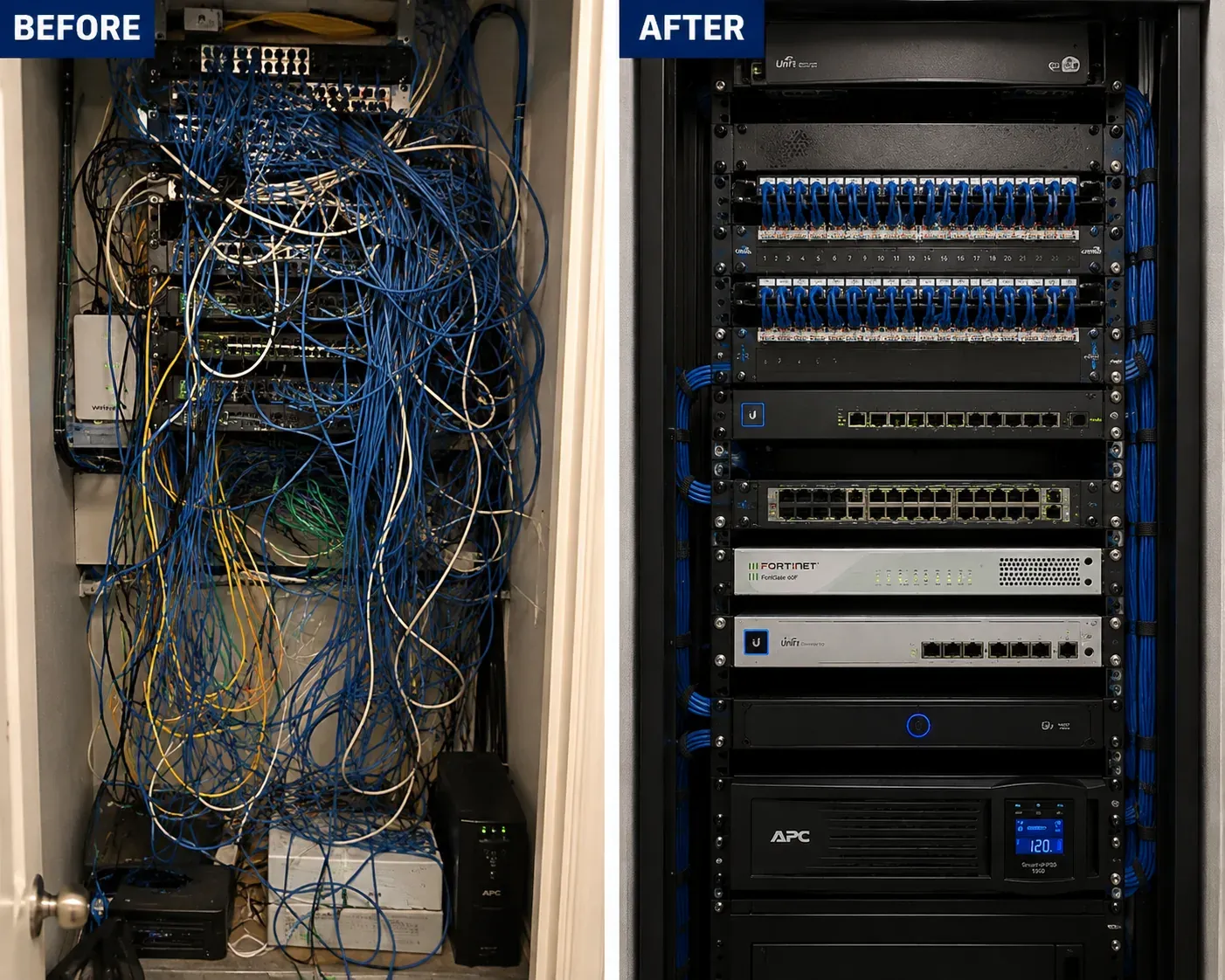
Left, a closet of loose blue, white and yellow cable hanging over its equipment; right, the same kind of space rebuilt as a rack with patch panels, switches, a firewall and a UPS.
Repair Capture
Putnam Fiber Link Cut or Dark?
A branch through the cable to the studio, a link cut by a fence installer's auger, an enclosure in a garage that took on water during the thaw — those are repairs, and they are scheduled as repairs. We send a technician the same day when the schedule allows, and most single-point fiber faults we can reach — a crushed jacket, a broken pigtail, a dirty or cracked connector, a wet splice case — are found and fixed in one to two hours on site. Call (845) 640-3835 and say it is a fiber repair, or use our Putnam County network cable repair service when the failed run is copper. If a copper line through the trees keeps failing, we can price the fiber replacement on the same visit.
What We Install
Fiber Optic Installation Services in Putnam County
In Putnam, most fiber jobs are short in strand count and long in route planning. Each service below can be priced alone or as one project, and each ends the same way: every strand tested, both ends labelled, and a record of where the cable went.
House-to-Studio and Garage Links
Fiber from the house network to a detached garage office, art studio, workshop, pool house or in-law cottage. We bring conduit across the lot by trench, bore or a protected surface run, land the cable in small enclosures at each end and leave a switch with a fiber port or a media converter ready to use.
Replacing Cable Strung Through Trees
Copper or fiber hung from the eaves to a tree and on to a garage is the most common thing we take down in Putnam. We replace it with buried or building-attached conduit so the next storm doesn't take the link with the branches.
Small-Office and Medical-Suite Fiber
Owner or tenant fiber in the low-rise office and medical buildings of Southeast, Brewster and Carmel — from the provider's entry to a suite, between floors, or between two buildings on one parcel.
Civic and Historic Building Links
Joining a town hall to its annex or highway garage, a library to an outbuilding, a firehouse's apparatus bay to its hall, or an old main building to a newer wing — routed so the historic fabric is left alone.
Conduit-Only Pathways
Where the fiber can wait but the ground is open now — during a driveway rebuild, a septic replacement or a new garage foundation — we place conduit with a pull rope, tracer wire and marked ends, so the cable can follow later without digging.
Provider Extensions
The internet company stops at a box on the side of the house. When the desk, the recorder or the guest suite is in another building, owner fiber picks up at that box and finishes the trip.
Fusion Splicing and Termination
Pigtails fusion-spliced into rack panels in a closet, or into sealed wall-mount enclosures in garages and outbuildings that freeze in January and sweat in July.
Testing and Closeout Records
Power-meter loss readings on every strand, OTDR traces on longer or spliced runs, labelled ports, photos and a measured route drawing — the file a later buyer, insurer or town building inspector will ask for.
Fiber for Cameras, Gates and Alarms
A camera at the far garage, a keypad on a studio door, a driveway gate at the bottom of the hill: the strand plan and the far-end power are sized for those devices before the trench closes.
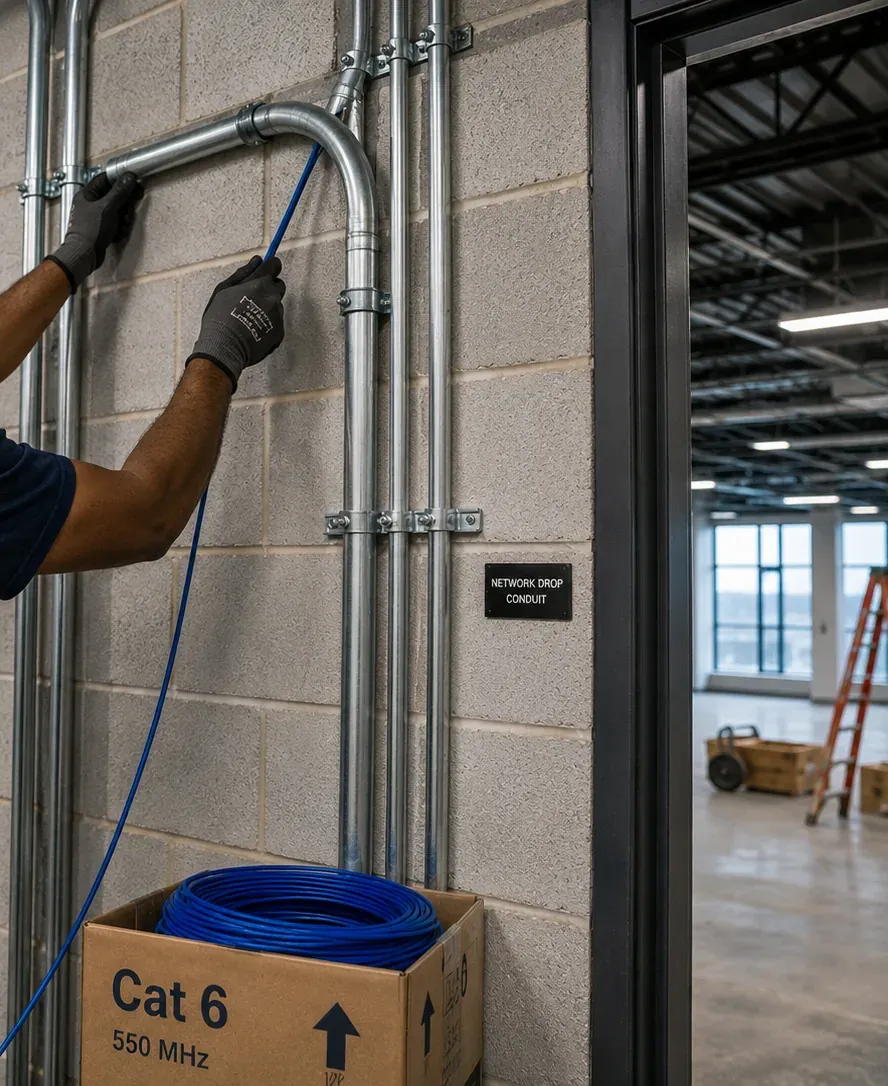
Gloved hands pull blue cable from a box into a long-radius bend in metal conduit on a concrete block wall marked “Network Drop Conduit”, with an open floor beyond the doorway.
Building Specialists
Fiber Optic Installation for Putnam County's Architecture
Putnam's building stock is mostly residential and mostly spread out, but it is not uniform. These are the building types we plan around most, and what each means for the cable.
Lake-Community Cottages and Year-Round Conversions
The lake communities around Lake Mahopac, Lake Carmel, Putnam Lake, Lake Peekskill and Lake Oscawana grew from small summer houses on small lots, many since winterised and enlarged. Lots are tight and often steep, roads are frequently private, and the garage may sit across a shared lane from the house.
Commuter Colonials and Split-Levels
Late-twentieth-century houses on one- to five-acre wooded lots throughout Carmel, Kent, Patterson and Putnam Valley, often with a detached garage added later. Frame walls and full basements make building entry easy; the lot between the buildings is the work.
Estates and Farmhouses
Older houses with carriage barns, cottages and stone walls, particularly in Philipstown and Patterson. Long driveways, outbuildings far from the main house and fieldstone foundations set the route.
Village Main-Street Buildings
Brick and frame mixed-use buildings in Brewster and Cold Spring, with shops below and apartments or offices above, where fiber goes up through closets and chases rather than across land.
Low-Rise Office and Medical Buildings
Two- and three-storey buildings on Route 6, Route 22 and Route 312, some with several tenants sharing one telephone room and one provider entrance.
Civic Campuses
Courthouses, town halls, highway garages, libraries, firehouses and schools — usually an older main building with additions and separate outbuildings, joined over the years with whatever cable was available.
Methods that change with the building
Frame houses with basements. The cable leaves the house through a sleeved core in the rim joist or the foundation above grade, sealed against insects and water, and runs to an enclosure on a dry basement wall near the router. Inside, a short patch cord joins the fiber to the network. It is the simplest entry we make and the one homeowners worry about most; the hole is about the size of a garden-hose fitting and is sealed both sides.
Slab-on-grade garages and studios. No basement means the conduit rises out of the ground against the outside wall in a protected sweep, enters at the height of the enclosure, and is sealed where it penetrates. We keep the entry on the side away from the roof drip line and the snow pile, because both decide how long the seal lasts.
Stone foundations and fieldstone walls. Older houses in Philipstown and Patterson often stand on rubble foundations that do not take a clean core. We look for an existing penetration — an old oil-fill line, a disused water service, a window well — or enter through the sill or the frame wall above the stone rather than drilling the foundation.
Village buildings. In Brewster and Cold Spring the route is vertical: from a cellar entrance up through closets or a chase to an office or apartment. We use indoor/outdoor or riser-rated cable as the building needs, firestop every floor penetration and keep the path inside the owner's own space unless the landlord agrees otherwise.
Civic and historic buildings. On a building that matters architecturally, the route goes where it can't be seen — through an existing basement penetration, behind a later addition, or underground to a non-historic wall — and the enclosure sits inside a utility room, not on the facade.
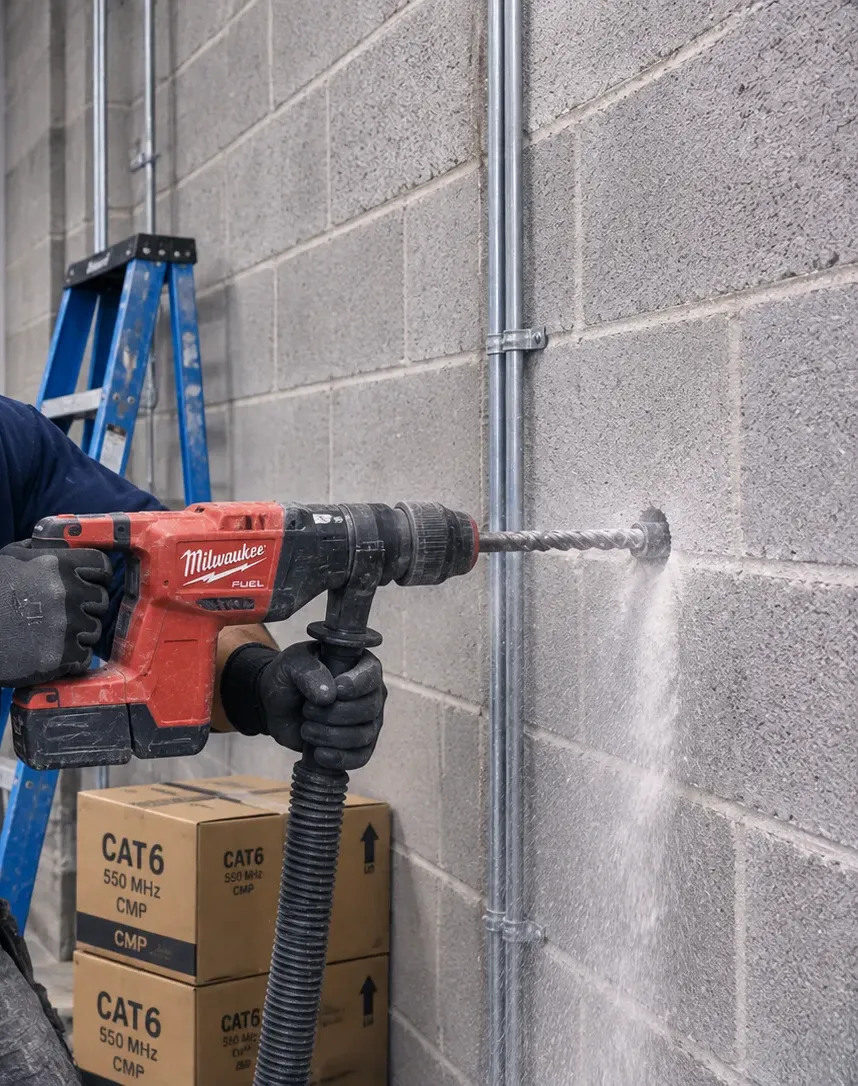
A cordless rotary hammer with a vacuum hose attached drills a long bit into a concrete block wall beside a vertical run of conduit; dust drifts from the hole.
Commercial Fiber
Business Fiber Optic Installation in Putnam County
Putnam's commercial fiber work happens along a handful of roads. The county profile counted 2,829 business establishments employing 20,519 people, with construction, retail and professional, scientific and technical services the largest groups — small firms, in other words, many of them in buildings of a few thousand square feet. These are the corridors where we work most.
Route 312 and Mount Ebo, Southeast
Office, medical and educational space near the I-84 and I-684 interchange and the Southeast Metro-North station, including a three-storey, 50,000-square-foot medical facility on Route 312 described in a Town of Southeast document. Multi-tenant buildings where a practice wants its own path from the provider's entrance.
Route 22 and Route 6, Brewster
Retail plazas, service businesses and offices from the Village of Brewster out along Routes 6 and 22, where a shop and its back-office, warehouse or second unit often sit in separate buildings on one parcel.
Route 6, Carmel and Mahopac
The county seat's government buildings, professional offices and plazas along Route 6 and around Lake Gleneida and Lake Mahopac — law and accounting offices, dentists, real-estate offices and banks with small server closets.
Stoneleigh Avenue, Carmel
The hospital campus at 670 Stoneleigh Avenue and the medical offices around it. Hospital IT governs its own backbone; our work is for neighbouring practices and for contractors who must meet the campus standard.
Route 9 and Main Street, Philipstown
Cold Spring's Main Street shops and offices, Garrison's institutions and the businesses along Route 9, where buildings are older, lots are hilly and the river-town historic character shapes every exterior change.
Route 52 and Route 311, Kent and Patterson
Farms, contractors' yards, equipment dealers and small industrial buildings, where an office, a shop and a storage building share one parcel and one internet line.
Compliance callouts for Putnam work
County licensing. Putnam County's electricians' law (Chapter 145) makes it unlawful to carry on the trade of a low-voltage/limited-data communications technician in the county without a licence or registration, and that licence's definition names fiber optics among the systems it covers. The county's Department of Consumer Affairs administers the licences and publishes a list of licensed low-voltage technicians. Ask any installer for their Putnam licence status before work starts.
Power at the far end. The same definition says low-voltage work begins at an outlet or connection previously installed by a person holding the proper electrical licence. In practice: the receptacle that powers the switch or converter in a garage or studio is an electrician's job, and we coordinate it.
Electrical permits. The county's Consumer Affairs page states that electrical permit applications for locations in the Towns of Carmel, Patterson and Putnam Valley are filed directly with those towns' building departments. Elsewhere in the county, ask the town building department which office handles the work at your address.
Watershed erosion control. A Town of Kent stormwater management plan states that construction activity disturbing one acre or more generally needs erosion and sediment control coverage, but that in the East of Hudson watershed the threshold is 5,000 square feet. A single fiber trench rarely approaches that; a trench that is part of a larger driveway, addition or site job may.
City-owned watershed land. The New York City Department of Environmental Protection issues land use permits for temporary use of City-owned water-supply lands for specific activities. A private cable route should be planned around DEP land, not across it, unless that permission is obtained first.
Dig notification. Central Hudson's safety guidance describes Dig Safely New York's 811 service: free, required by state law, and requested at least two and no more than ten days before digging, after which utilities and municipalities mark their lines. Private lines — wells, septic, propane, buried garage feeds — are not marked by 811 and are located separately.
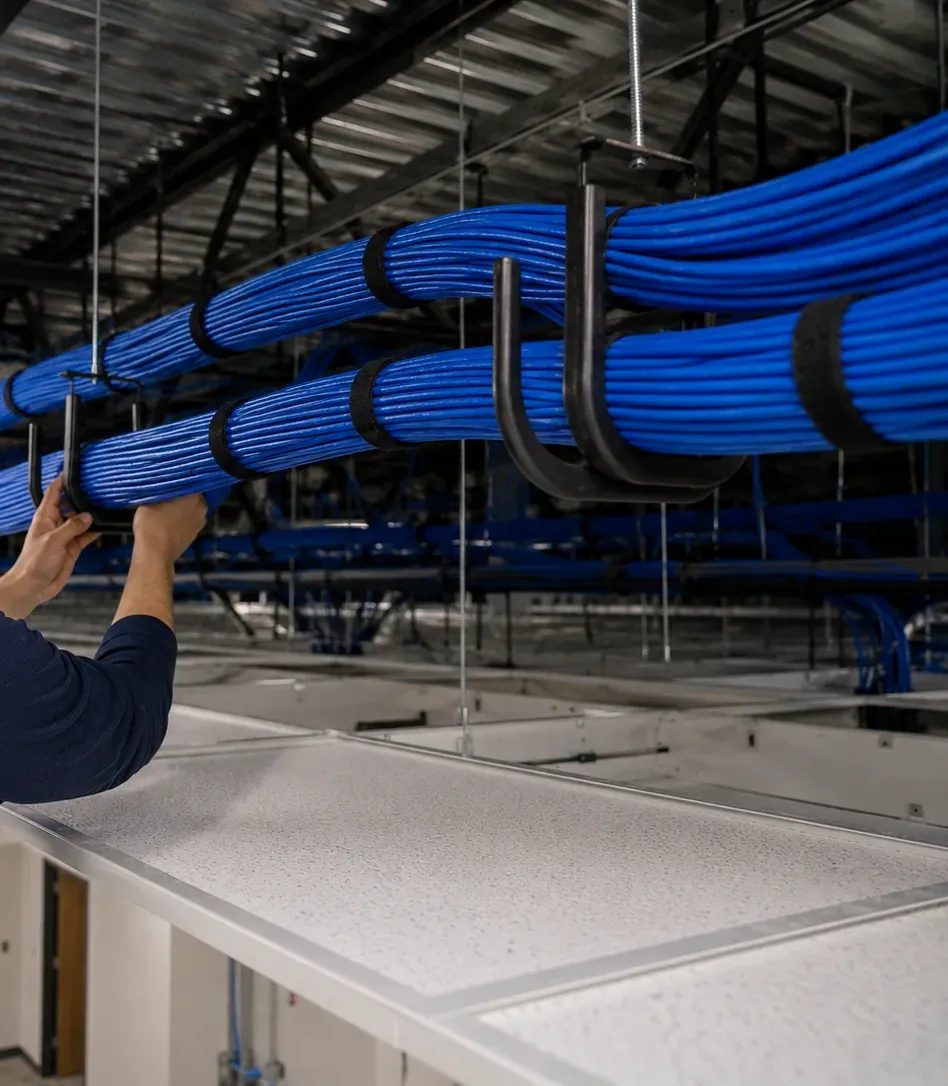
Two bundles of blue cable, strapped every few feet, sit in black J-hooks hung from rods above a drop-ceiling grid while a hand adjusts one hook.
Your Questions Answered
Fiber Optic Installation in Putnam County: Questions Answered
The questions and topics that come up on Putnam route walks, grouped by subject: county licensing, watershed ground, slopes and trees, shared lanes and home offices, small commercial and civic sites, and links that change hands with a house. Quicker one-line answers sit in the FAQ near the bottom of the page.
Licences, permits and who does what
How Putnam's county low-voltage licence works
This is one of the things that sets Putnam apart from many New York counties. The county's electricians' law, Chapter 145 of the county code, defines a low-voltage/limited-data communications technician as someone with at least 8,000 hours' experience who has passed the county examination and who installs, repairs, maintains or alters cabling for computer networking, telecommunications, cable television, intercom, audio/video, fiber optics, video surveillance and other systems at 90 volts or less and five amperes or less. The chapter says no one may carry on that trade in the county unless licensed or registered under it, and it lets a master electrician do the same work.
There are exemptions — a utility working on its own lines, and a telecommunications company working up to its own demarcation point, among others — which is why the provider's technician who installs the terminal on your house is not the person this rule is aimed at. The private cable from that terminal to your garage office is.
The practical step is simple. The county's Department of Consumer Affairs publishes a list of licensed low-voltage technicians on its website. Ask whoever quotes your job, including us, how they meet the county requirement for your address, and keep the answer with the proposal.
Where the cabling licence ends and the electrician's work begins
Fiber carries light, but the small switch or media converter at each end needs power, and Putnam's licence definition draws a clear line: low-voltage work begins at an outlet or connection previously installed by someone holding the proper electrical licence. The receptacle in the garage, studio or shed is therefore electrical work, not cabling work.
If the outbuilding already has a working outlet near where the enclosure will hang, nothing changes. If it doesn't — a common situation in older garages lit by one bulb on a pull chain — we mark the location on the drawing and coordinate with your electrician, or with one we work with, so the outlet is in before we arrive to light the link.
It is worth doing properly, because that outlet is also where a small UPS or surge protector plugs in. The fiber has removed the copper path between the two buildings' electrical systems; there is no point bringing a surge back in on a long extension cord.
Electrical permits: Carmel, Patterson and Putnam Valley file with the town
According to the county's Consumer Affairs page, electrical permit applications for locations in the Towns of Carmel, Patterson and Putnam Valley are filed directly with those towns' building departments. For addresses in Kent, Southeast, Philipstown and the villages, the town or village building department is still the first call, and it will say where the paperwork goes.
Most fiber jobs do not involve new electrical circuits at all, so the question usually arises only when an outbuilding needs a new receptacle or feed. When it does, the electrician pulls that permit; the cabling scope is listed on our proposal separately so the two are never confused.
Where a job is part of a larger project — a new garage, an addition, a commercial fit-out — the general contractor's building permit usually covers the site work, and our trench is shown on the same plan so the inspector sees one coherent drawing.
Building in the watershed
Our house is inside the New York City watershed — does a short fiber trench need a stormwater plan?
Usually not on its own, but the threshold is lower than most people expect. A Town of Kent stormwater management plan sets out that construction activity disturbing one acre or more generally needs erosion and sediment control coverage, and that in the East of Hudson watershed the threshold drops to 5,000 square feet. About three-quarters of Putnam is in that watershed.
A fiber trench is narrow. A run of 300 feet with a trench a foot wide disturbs around 300 square feet, well below 5,000. The figure that matters is the whole project: if the trench is being dug alongside a new driveway, a septic replacement or a garage foundation, the disturbance is counted together, and the larger job may already need a plan.
Either way, we treat watershed ground with care that costs little: spoil kept on the uphill side and off driveways, silt fence or straw wattles where a trench crosses a slope toward a stream or lake, open trench kept short and backfilled the same day, and disturbed ground seeded and mulched before we leave.
Our property backs onto reservoir land owned by New York City — can the cable cross it?
Not without the City's permission, and in almost every case the right answer is to route around it. The Department of Environmental Protection issues land use permits for temporary use of City-owned water-supply lands for specific activities; a private cable is a permanent installation on someone else's land, which is a different and much harder request.
Owners are sometimes surprised by where the boundary is. City land around Croton Falls, the Middle and East Branch reservoirs, Boyds Corner and West Branch often runs right to the edge of a back lawn, and old fences and stone walls are not always on the line. Before we design a route near a reservoir we look at the tax map and the survey, and keep the cable well inside your parcel.
If the only practical route crosses someone else's land — the City's, a neighbour's or an association's — we tell you at the walkthrough, before anything is priced around it.
Woods, slopes and the sky
The ground between our buildings slopes down toward a lake or a brook — what keeps a fresh fiber trench from washing out?
Mostly, keeping the trench short-lived and the slope covered. On Putnam's hillsides a summer downpour can turn an open trench into a channel within an hour, carrying soil toward the water below and undermining the conduit. We open only as much trench as can be laid and backfilled the same day, and we never leave spoil piled downhill of the cut.
On steeper sections the trench is cut across the slope in short runs rather than straight down it where the route allows, backfill is compacted in lifts, and the surface gets seed with straw or an erosion blanket before we leave. Silt fence or a straw wattle along the downhill edge catches what moves before the grass takes hold.
Where a slope is too steep or too close to the water for any trench, a bore under the bank or a protected conduit along a wall or retaining structure keeps the ground intact. Those choices are made on the walk, with the shoreline in view.
Protecting the big oaks and maples between the buildings
The approach is to stay out of the root zone wherever we can, and not to trench through it where we can't. Most of a tree's feeding roots are in the top foot or so of soil and spread well beyond the branches; an open trench close to the trunk severs them and can kill a mature tree slowly over several years.
The route is drawn to swing wide of the large trees, often following a driveway, a path or the line of an old stone wall where roots are already limited. Where a tree can't be avoided, a short directional bore under the root zone, or a carefully hand-dug section, replaces the machine trench.
Owners who care about a particular tree should say so at the walkthrough. Moving the route twenty feet costs very little on paper and a great deal once the roots are cut.
The only spot with a clear view of the sky for our satellite dish or wireless antenna is far from the house — can fiber bring that signal in?
Yes, and on wooded Putnam lots it is a common reason to install fiber at all. Where cable or fiber service hasn't reached a road, owners rely on satellite or fixed-wireless internet, and both need a clear line to the sky or to a tower. Under a full canopy that line may exist only at the edge of a field, on a garage roof or at the top of the lot.
The antenna or dish goes where the signal is good; its indoor unit or a small switch sits in a weatherproof enclosure or the nearest outbuilding; and fiber carries the connection to the house, however far that is. Because the link is glass, the antenna mast is not tied electrically to the house's network — useful for equipment mounted high and exposed.
If wired service arrives on the road later, the same fiber stays useful: the new terminal lands at the house, and the link to the outbuilding keeps doing its job.
Lake communities and home offices
Crossing a lake community's private lane
Permission usually comes from the association, sometimes from a neighbour, and only rarely from the town. Many of Putnam's lake communities were laid out with private roads owned or maintained by a property owners' association, and a garage on the other side of the lane means a trench or bore across land that is not yours alone.
We ask for the deed, the association's rules and the survey, and identify who owns the strip the cable must cross. A short written consent from the association or the adjoining owner, filed with your closeout records, protects you when the road is regraded or repaved and protects the next buyer of the house.
Where consent is slow or uncertain, we look for a route that stays on your own land, even if it is longer — or we bore under the lane so the surface is never touched, which makes the request much easier to grant.
A garage office that holds a video call
What it mostly needs is a wired connection instead of a wireless relay. A mesh node reaching through two exterior walls and fifty feet of trees will hold a web page but stutter on a video call, especially when foliage is wet. A single fiber pair from the house switch to a small switch in the office gives the office the same connection as a room in the house.
Plan the far end like a small workplace. A switch with a fiber port and a few copper ports for the desk, a printer and a wireless access point; a small UPS so the office stays up through a brief flicker; and enough strands in the cable, usually four or more, that a second link for cameras or a separate work network can be lit later.
If your employer requires the work computer to be on its own network, that separation is done in the switches at each end over the same fiber. It doesn't need another cable.
Offices, medical suites and civic buildings
A tenant's own path in a shared Route 312 building
With the landlord's consent, it usually can be done. Many low-rise buildings on Route 312, Route 22 and Route 6 bring every provider into one telephone room, then distribute to tenants over old copper or a shared switch. A medical, dental or financial tenant often wants its own path from that room to its suite, so its circuit and its equipment are not shared.
The work is a short owner-or-tenant fiber run, spliced into a small panel in the telephone room and an enclosure or rack in the suite, with the route through ceilings or chases the landlord approves. The lease or a letter should say who owns the cable when the tenancy ends.
Ask the provider where its circuit will terminate before we design the run; it saves moving the end later.
Can fiber join a historic main building to a newer annex without changing the old facade?
In most cases, yes. On a nineteenth-century courthouse, town hall, church or library, the old building almost always already has some way in — a basement utility penetration, an oil-fill or water service, a later addition at the back — and the fiber can follow it. Inside, the enclosure goes in a utility room or basement, never on the facade.
Between buildings, the conduit runs underground to the annex, rising on a wall of the newer building where an enclosure and a sealed penetration don't matter. Fiber is a good fit here precisely because it is small: a single cable with a dozen strands is narrower than a garden hose.
If the building is on a register or in a village historic district, we draw the route before any work so the owner can share it with whoever reviews exterior changes.
Buying, selling and inheriting a link
Buying a house with a link already in the yard
Before closing, check four things. First, ask for any paperwork — test results, a route drawing, the installer's name. Without a drawing, nobody knows where the cable is, and the first landscaper or fence installer will find it for you. Second, look at both ends: a sealed enclosure on a dry wall is a good sign; bare connectors on a floor, or a converter hanging from its own patch cord, is not.
Third, find out how it crosses the ground: in conduit, direct-buried, or strung through the trees. A cable in conduit can be replaced without digging; a cable laid straight in the soil often cannot. Fourth, check that it works with the equipment that stays with the house, because media converters and switches are often taken by the seller.
We can test an existing link before closing and give you a short written condition report, the same way an inspector reports on a roof.
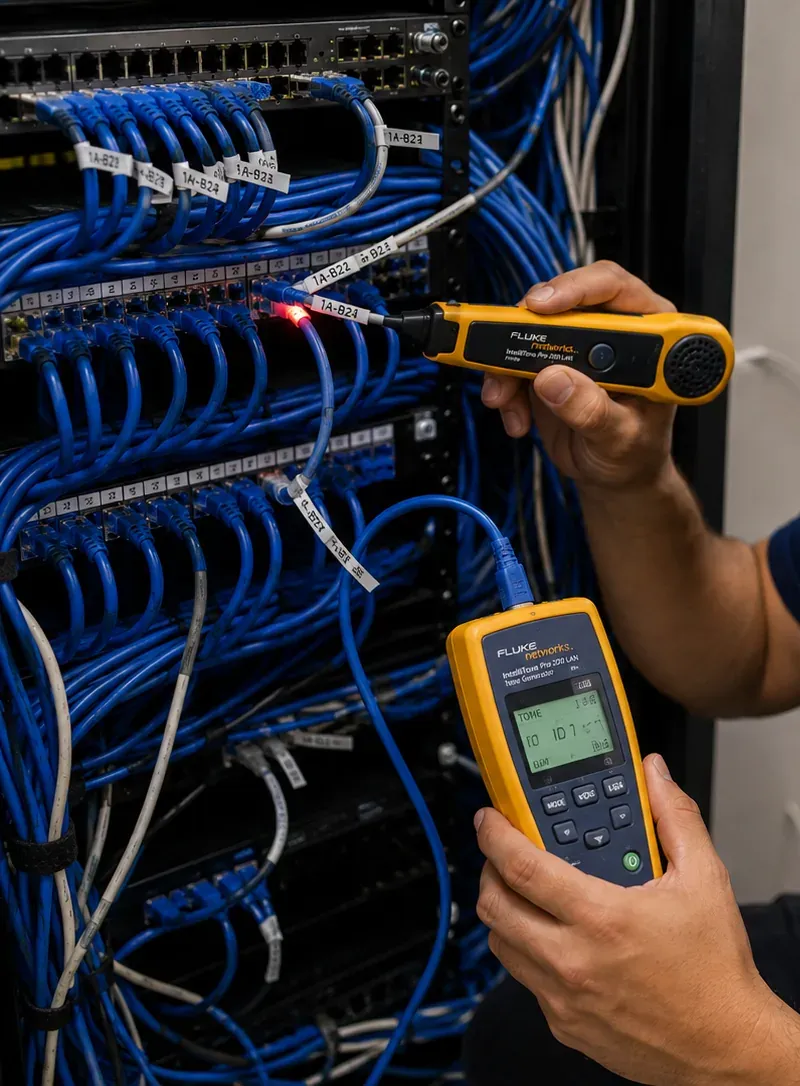
A yellow tone probe touches one port on a labelled patch panel while the other hand holds a tester connected to the same run; a red light shows the port being traced.
Equipment
Types of Fiber Optic Cabling We Install
Putnam jobs use a small set of products chosen for wet ground, cold garages and rodents in the woods. These are the ones we specify most, and where each belongs.
Indoor/Outdoor Tight-Buffered Cable
Listed for both environments, so a run can leave the house, cross the lot in conduit and enter the garage without a splice at either wall. Our usual choice for house-to-outbuilding links up to a few hundred feet.
All-Dielectric Loose-Tube Cable
Water-blocked outdoor cable with no metal in it, for longer underground runs between buildings with separate electrical services. Nothing in the cable can carry current from one building to the other.
Rodent-Resistant Jackets
Where cable must run outside conduit, or conduit ends are hard to seal, a jacket with a non-metallic rodent barrier resists chewing without adding metal to the link.
Single-Mode OS2
The default for anything between buildings. Inexpensive glass, any distance a property will ever need, and optics that will still be sold in twenty years.
Multimode OM4
Inside a single office or medical suite, where runs are short and the switches already have multimode optics, OM4 keeps the electronics simple.
HDPE Conduit and Innerduct
Smooth-wall polyethylene conduit in long continuous lengths for trenches and bores, with innerduct where a second cable may follow. Joints and bends are minimised so the pull stays gentle.
Tracer Wire and Warning Tape
A copper tracer laid with dielectric cable and brought to a test point at each end, plus marked tape above the conduit, so the route can be located and is announced before it is hit.
Wall-Mount Splice Enclosures
Gasketed enclosures with splice trays and adapter panels, sized for garages and basements, mounted high on a dry interior wall with the cable entering from below.
Switches with SFP Ports and Media Converters
A small managed switch with a fiber port where a building needs several devices; an industrial-rated media converter where only one is needed. Both on local power with surge protection.
Which cable, which job: a quick comparison
Situation in Putnam
Cable we usually choose
Why
House to garage or studio on the same electrical service, under 300 ft
Indoor/outdoor tight-buffered OS2 in conduit
No splice at the walls; simple termination; enough strands for cameras later
House to outbuilding with its own meter
All-dielectric loose-tube OS2 with tracer wire
Keeps the two grounding systems separate; locatable
Route along a stone wall or through woods where conduit ends are exposed
Rodent-resistant non-metallic jacket
Chew resistance without adding metal
Inside one office or suite
Multimode OM4, plenum or riser rated as the space needs
Matches typical office optics; short distances
Antenna or dish at the edge of the lot
Indoor/outdoor OS2 to an enclosure at the mast
Isolates an exposed mast from the house network
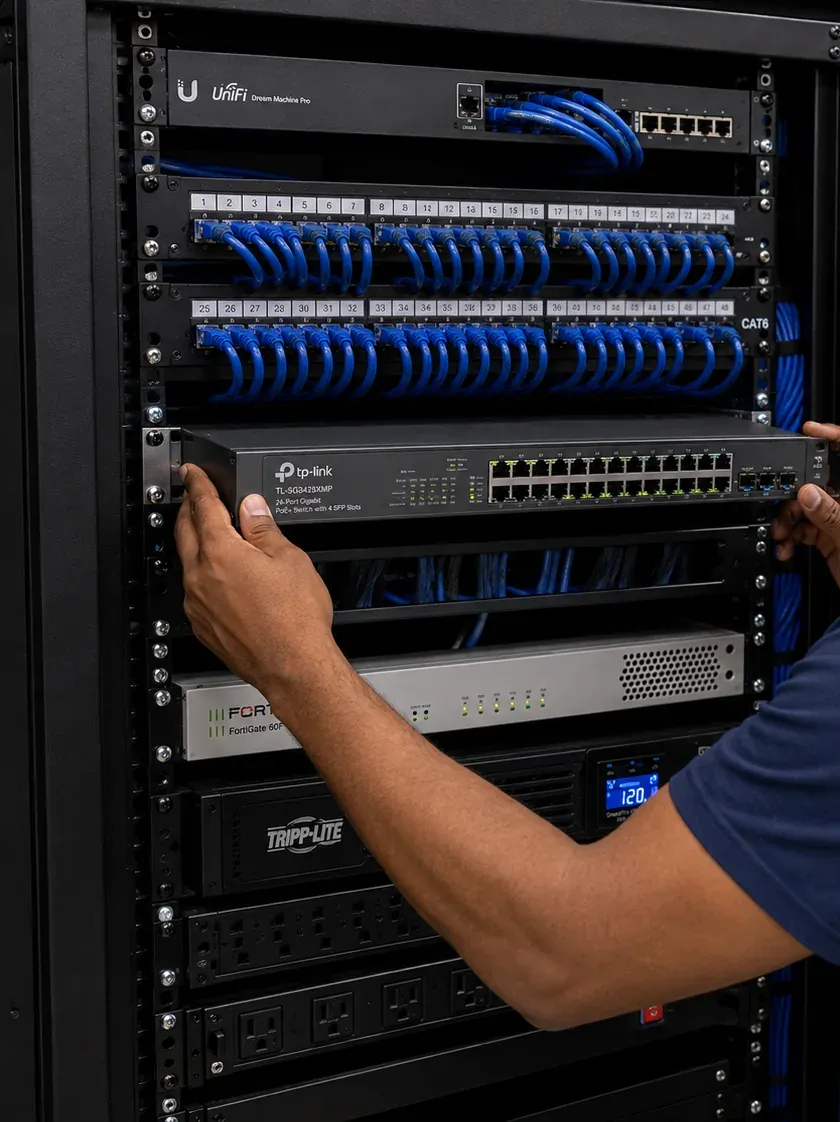
Two hands slide a 24-port PoE switch, labelled with four SFP slots, into a rack below two rows of blue patch cords, with a firewall and a UPS underneath.
AI Overview Reality Check
What AI Gets Wrong About Fiber Optic Installation in Putnam County
AI answers and provider-comparison sites are built from national averages and address databases. Here is how seven claims they repeat hold up on Putnam properties. Each claim is quoted from a published page, not from advice anyone gave you.
“New York has no statewide contractor licence, so anyone can run your network cable”
One contractor-licensing guide sums up New York as “Contractor License Requirements: None Statewide.” As a statement about Albany it is close enough; there is no state contractor licence for this work. As advice to a Putnam homeowner it misses the county level entirely.
Putnam County's electricians' law licenses low-voltage/limited-data communications technicians, requires 8,000 hours' experience and an examination, names fiber optics in the definition, and says nobody may carry on that trade in the county without being licensed or registered. Since 2019 the chapter has also required continuing education for new and renewed licences.
So the useful question is not “does New York require a licence” but “how does this installer meet Putnam's.” The county publishes its list of licensed low-voltage technicians; that list, not a national summary, is the place to check.
“The most widely available internet in Putnam Valley is fiber”
An internet-comparison site says the most widely available service in Putnam Valley is a fiber plan, while the same page lists satellite as covering the whole area and gives a 5G service at just over half. Another says Verizon's fiber covers about 40 percent of nearby Garrison. These numbers come from address databases and marketing coverage maps, and they disagree with one another.
Local reporting is more cautious. In May 2023 The Highlands Current reported that Optimum was installing fiber throughout Philipstown, while Verizon said it was “reviewing a FiOS build in Cold Spring but cannot commit to a timeframe.” On wooded Putnam roads, service can differ from one driveway to the next.
For a private link, none of this changes the work. Whatever service reaches the road lands at one building; the fiber we install carries it to the others. Check availability at your exact address with the provider, and plan the private link either way.
“Aerial fiber is cheaper, about $8–$12 per foot”
A cost guide puts aerial fiber on poles at roughly $8–$12 per foot and notes it needs attachment rights. On a commercial street lined with utility poles, that can be the cheapest way between two buildings.
On a Putnam lot the “poles” are usually trees and eaves, and that is the cheapest link to install and the most expensive to keep. The county profile puts two-thirds of the county under forest, and storms bring branches down: the Journal News reported 18,525 NYSEG customers without power in Putnam on March 5, 2018, after that month's nor'easter.
A cable strung through trees carries ice and branch load it was never rated for. We will put fiber on a building wall or a proper messenger where that is right; we won't tie it to a tree.
“Underground fiber trenching runs $15–$35 per foot”
The same cost guide gives $15–$35 per foot for trenching and $20–$30 per foot for boring, and the Fiber Broadband Association's 2025 figures, as summarised by another installer, put the median underground cost at $18.00 per foot. Those are averages for long outside-plant routes built by machine along roads.
A Putnam house-to-garage link is a few hundred feet, not a few miles, so per-foot averages tell you little. What moves the price is what sits under the topsoil: in the Highlands that is often rock, which a small trencher won't cut. Erosion control on watershed slopes and tree protection add time too.
Our prices are not per foot. They are the published AESS rates in the table below at Putnam's 1.45× area rate, with the pathway quoted after we have walked the ground and probed it.
“Expect $300 to $800 per fiber drop” — as if every fiber job were a desk drop
That range describes an office drop to a desk inside one building, and it is a fair national figure for that. It is quoted on comparison pages as if it priced any fiber job.
In Putnam our own published single-mode drop is $580 and our multimode drop $508 at the county rate, both inside that range. But a link from a house to a studio is not a drop. It is a short backbone: conduit across the land, a cable rated for outdoors, a splice enclosure at each end and a test record.
That is why our packages below start with the strands and the testing and price the outdoor pathway separately. Comparing a desk drop with a building link makes fiber look either too cheap or too dear.
“Fiber installation takes up to four hours”
Provider pages say an in-home fiber install “can take up to 4 hours.” That is true of a provider visit: the drop is already on the pole or in the ground, and the technician mounts a terminal and a router.
A private link is different. The route walk and the 811 request come first, and the dig notice alone is two to ten days. Trenching, boring and restoration may take a day or two; splicing, testing and lighting another half-day. If an outlet must be added at the far end, the electrician's visit fits in between.
Most Putnam residential links go from first walkthrough to working in two to four weeks, and the crew is on your property for only a few of those days.
“Call 811 and every buried line will be marked”
Dig-safe advice often reads as if one phone call clears the ground. Central Hudson's guidance is precise: the 811 request is free, required by state law, made at least two and no more than ten days ahead, and the utilities and municipalities mark their own lines.
That last clause matters on a Putnam property. The lines most likely to be hit between a house and a garage are private: the well line, the septic tank and leach field, a propane line, the buried feed to the garage itself, an invisible dog fence, irrigation. None of them is marked by a utility.
We file the 811 request, ask the owner what is buried, look for evidence of what they don't know about, and sweep the route with a locator before the trench is opened.
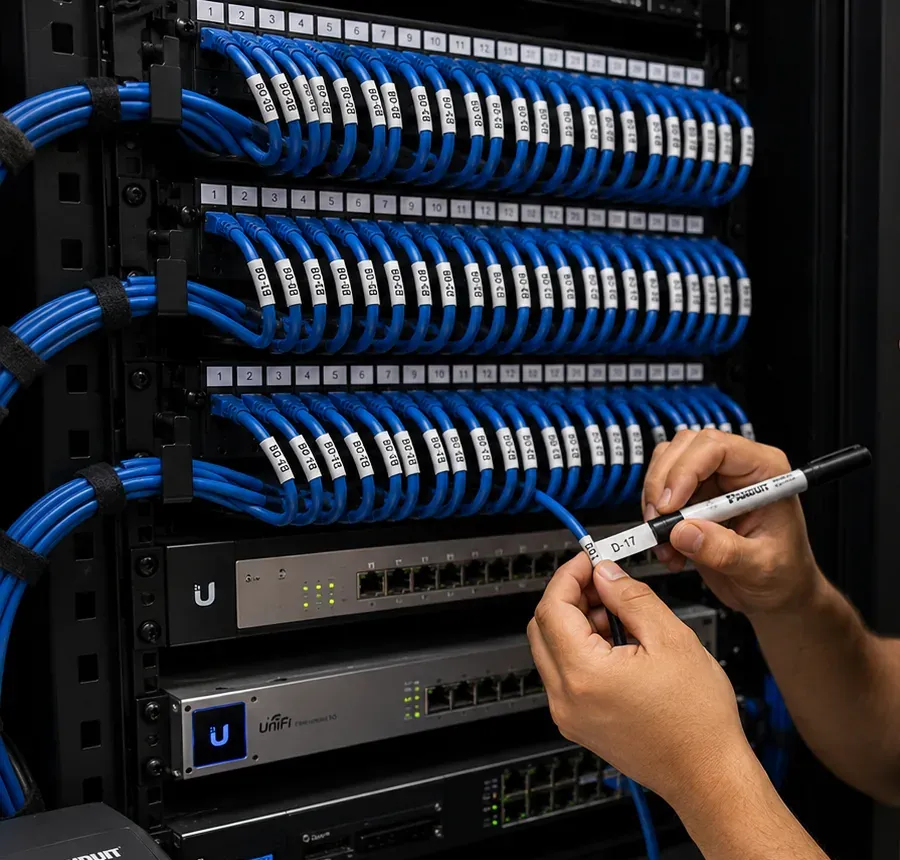
Fingers wrap a printed cable label around a blue patch cord, a marker in the other hand, in front of three panels whose cords are already numbered.
Have the Route Walked Before Anyone Digs
A snapshot of the yard between house and outbuilding is enough to begin. Back comes a plan for crossing it, the county and watershed rules that touch it, and a price at the 1.45× rate.
Tell us which buildings, roughly how far apart, and what lies between them — lawn, woods, driveway, rock or water. We reply within the business day, or call (845) 640-3835 now.
✅
We Got Your Request!
We'll call you back the same business day. If it's urgent, call us now at (845) 640-3835.
How It Works
Our Installation Process
Seven steps, the same for a garage office in Mahopac and a town-hall link in Carmel. In Putnam, the second step — boundaries and rules — is where the surprises are avoided.
1. Walk the lot and the buildings
We walk from the network location in one building to the equipment location in the other, measure the real route, and note trees, rock outcrops, slopes toward water, the driveway, and each building's outlet and electrical service.
2. Check the boundaries and the rules
Survey and tax map for property lines, reservoir land and shared roads; whether the route is in the watershed and part of a larger disturbance; who holds the county low-voltage licence for the job; whether an outlet needs an electrician.
3. Design and written proposal
Cable type and strand count, conduit and bore sections, building entries, enclosures and electronics, the erosion measures for the slope, and every line priced at Putnam's 1.45× rate.
4. Notify, locate and protect
The 811 request two to ten days ahead, a private-line sweep for wells, septic, propane and garage feeds, silt fence where needed, and trees flagged for root protection.
5. Build the pathway
Whichever mix of trenching, boring and wall-mounted pipe the walk called for, laid with gentle bends, a locating wire and marker tape; holes into each building sleeved and caulked; lawns re-sodded or seeded before the crew leaves.
6. Pull, splice and test
Cable pulled by its strength members with slack at each end, pigtails fusion-spliced in the enclosures, connectors inspected, and every strand measured with a power meter, with an OTDR trace on longer or spliced runs.
7. Light it and hand over the file
Electronics plugged into a UPS-backed outlet, a laptop at the far end proves the connection, ports get printed labels, and you receive the loss readings, the scaled drawing and photographs.
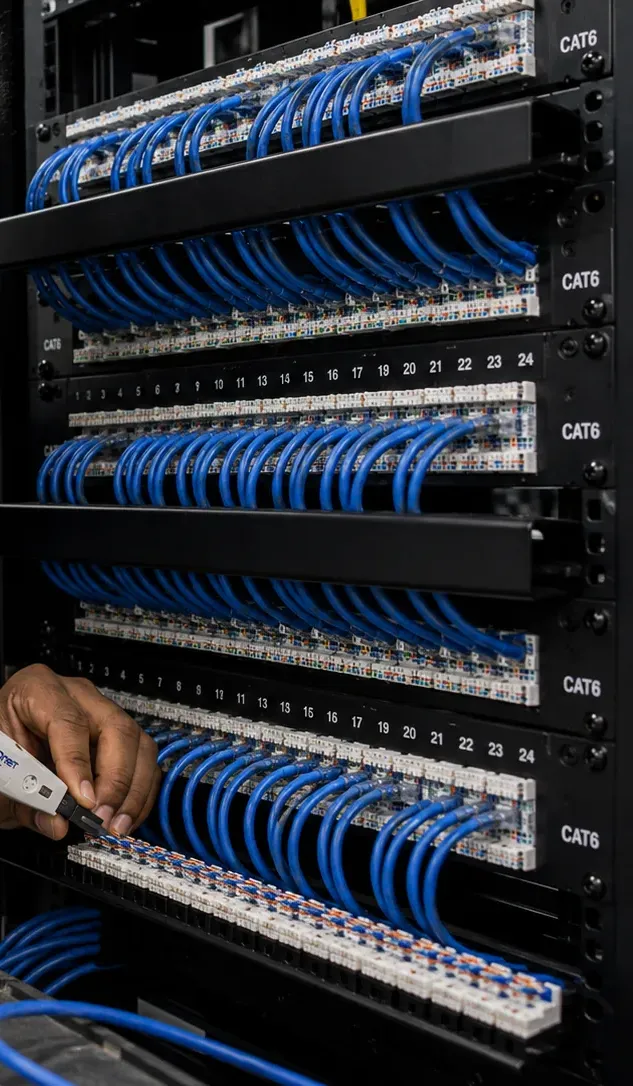
A hand-held punch-down tool seats a conductor at the back of a Cat6 patch panel; five more panels above it are already terminated and dressed.
Coverage Area
Fiber Optic Installation Near Putnam County's Landmarks
Six places Putnam residents use for directions, and the fiber work typical around each. They are orientation points, not a list of our clients or projects.
Putnam County Courthouse, Carmel
Completed in 1814 and renovated in 1847, the courthouse in the hamlet of Carmel is one of the oldest working courthouses in the state. Around it sit the county offices and the professional buildings of the county seat, where old and new buildings share one block.
Croton Falls Reservoir
The largest of Putnam's seven reservoirs at 14.2 billion gallons in the county profile, connected by channel to the Diverting Reservoir. Its shoreline of City-owned land sets the edge of many back lawns in Carmel and Southeast.
Tilly Foster Farm, Southeast
About 199 acres owned by Putnam County in the Town of Southeast, a former dairy and thoroughbred farm whose scattered barns and farm buildings are a textbook example of the distances fiber is chosen for.
Putnam Hospital, Stoneleigh Avenue
The county's hospital at 670 Stoneleigh Avenue in Carmel, now part of Northwell Health, with medical offices around it. Neighbouring practices are among the small commercial sites that need their own fiber paths.
Fahnestock State Park
Some 15,000 acres of state parkland across Putnam and Dutchess, reached by Route 301. The houses on its edges in Kent and Philipstown are about as wooded and rocky as Putnam lots get.
Brewster Metro-North Station
The Harlem Line station in the Village of Brewster, one of seven railroad stops the county lists across the Harlem and Hudson lines. The commuter homes it serves are where garage offices have multiplied.
We also cover Lake Mahopac and Mahopac Falls, Lake Carmel and Kent Cliffs, Patterson and Putnam Lake, Putnam Valley, Lake Peekskill and Oscawana, Cold Spring, Nelsonville and Garrison, and the Route 22 corridor into Southeast. North of the county line, our Dutchess County fiber optic installation page covers Beacon, Fishkill and Poughkeepsie; across the river, see fiber in Ulster County. For the rest of the valley, start at the Hudson Valley fiber optic installation hub.
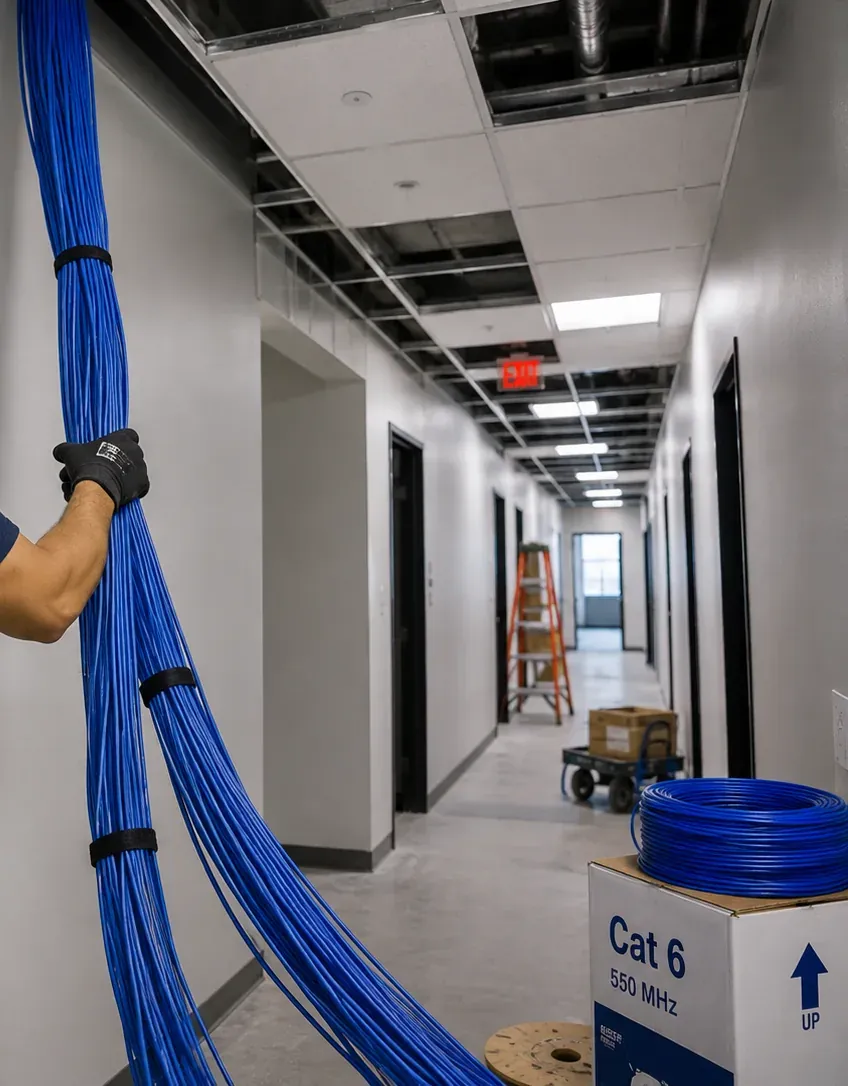
A gloved hand guides a tall bundle of blue cable up toward an open ceiling grid in a long corridor, with a reel box on the floor and a ladder further down the hall.
Pricing
Fiber Optic Installation Cost in Putnam County
Every Putnam price below is one of our standard published prices multiplied by Putnam's area rate of 1.45×, then rounded to the dollar. None is a new figure; the base column shows where each comes from.
Item
Base price (1.00×)
Putnam County (1.45×)
Termination on existing fiber, per connector
$35
$51
OTDR test, per strand
$40
$58
Multimode fiber drop
$350
$508
Single-mode fiber drop
$400
$580
12-strand OM4 backbone, floor to floor or room to room
$4,500 – $7,000
$6,525 – $10,150
24-strand OS2 building-to-building backbone
$8,000 – $15,000+
$11,600 – $21,750+
Second telecom room with fiber link
from $2,400
from $3,480
Service calls, troubleshooting and return visits are billed at $195/hr, 3-hr minimum ($585). That rate is the same in every county and is never applied to a new installation.
What moves a Putnam price within the range
What is under the topsoil. Loam and gravel trench quickly; Highlands rock near the surface means a bore, a rock saw, a shallower protected run or a surface conduit, each with its own cost.
Trees and restoration. Swinging the route around root zones, hand-digging near trunks and restoring lawn, beds and stone walls take time that open lawn doesn't.
Watershed slopes. Silt fence or wattles on slopes toward a stream, lake or reservoir, and same-day backfill and seeding.
Building entries. A frame rim joist is quick; a rubble stone foundation or a historic facade means finding another way in.
The far end. Whether there is already a working outlet, and what the far building will run: one converter, or a switch, access point, cameras and a UPS.
Reading the table: two worked examples
Finishing an abandoned run. A previous owner left a 12-strand cable coiled at both ends between the house and a studio. Terminating all 24 ends at $51 each comes to $1,224; tracing all 12 strands with an OTDR at $58 each comes to $696; together, $1,920 — the Starter package below. If both ends also need enclosures and the studio needs a switch, those are added as listed items, not folded into a vague total.
A new link between two buildings. Twenty-four single-mode strands from a town office to its annex, spliced and traced, falls in the $11,600 to $21,750+ range. Where usable conduit already exists, or the ground is open lawn, the job sits near the bottom; where the route needs a long bore under a parking area or a section over rock, it moves up, and the excavation line is shown separately so the owner can see exactly why.
Neither example uses a per-foot price. In our experience per-foot quotes on short private links hide the real variables — ground, entries and the far end — and those are what the walkthrough is for.
National brand versus a local fiber contractor
ADT, Ring and SimpliSafe sell alarm and camera systems and monitoring; none of them trenches a link from a house to a studio, fusion-splices it or hands you an OTDR trace. A provider's installer builds only as far as the terminal on your house. A general electrician can dig a trench and add the outlet, but usually doesn't splice or test glass. A local low-voltage contractor does the cable, the splicing, the testing and the drawing — and works alongside the electrician for the power. That combination is what a Putnam fiber job needs.
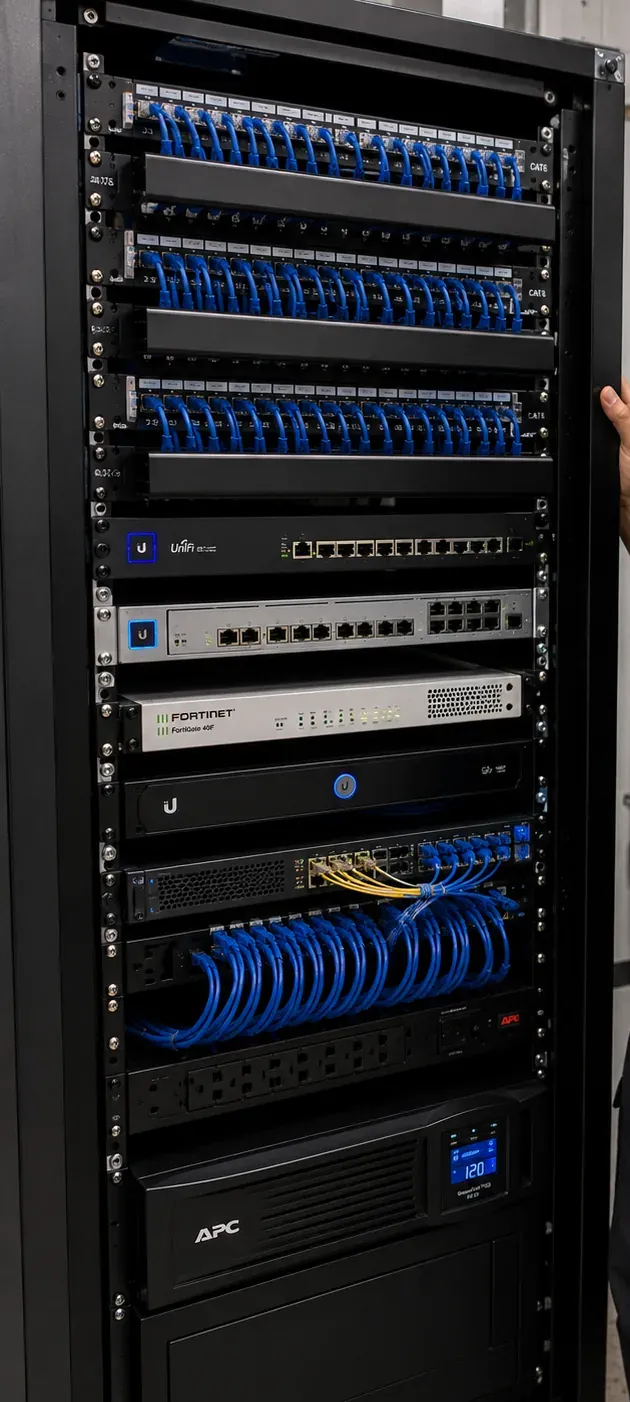
A finished rack: three patch panels with cable managers, two switches, a firewall, a short bundle of yellow patch cords into a switch, a power strip and a UPS at the base.
Shop Our Systems
Fiber Optic Installation Packages & Pricing
Most Putnam requests fit one of these three shapes. The dollar figures are assembled from the 1.45× column above and nothing else; ground work outside is priced separately once we have probed the route.
Starter — Finish the Fiber Someone Left
$1,920A 12-strand cable already runs between your house and outbuilding, or between two offices, but was never terminated or tested. We put connectors on all 24 ends at $51 each and trace all 12 strands with an OTDR at $58 each. Enclosures and electronics, if missing, are added at listed prices.
Standard — Backbone Inside One Building
$6,525 – $10,150A 12-strand OM4 backbone between two rooms or floors — a medical suite's exam wing to its server closet, a town hall's basement to its second floor — fusion-spliced into panels and loss-tested.
Premium — Building to Building
$11,600 – $21,750+Twenty-four single-mode strands joining two of your buildings, spliced into an enclosure in each and every strand traced with an OTDR. Excavation through rock, long bores and restoration beyond normal lawn are quoted separately after the walk.
Bring Your Own Equipment — Labour Only
Bought your own reel, enclosures or converters? Labour to place, splice and test them is billed at $195 per hour with a three-hour minimum ($585). Before your cable goes into the ground we test it on the spool, because a broken fiber found after the trench is backfilled is the costliest kind. A single-mode drop inside a building is $580 and a multimode drop $508 at the Putnam rate, if you need individual drops priced.
Price the Link Between Your Buildings
The route walk is free. Every number on the proposal traces back to the Putnam column of the table above.
Putnam is small enough to drive across in under an hour, and different enough from one town to the next that the same job is planned differently in each.
Carmel and Mahopac
The most populous town and the county seat. Lake-community lots around Lake Mahopac and Lake Gleneida sit beside larger wooded parcels toward Mahopac Falls, and Route 6 carries the offices, banks and plazas. Residential jobs here are often short garage and studio links on tight lots with neighbours close by; commercial jobs are suites and small buildings with a single provider entrance. Electrical permits for Carmel go to the town's building department, per the county's guidance.
Southeast and Brewster
The county's commercial gateway, where I-84 meets I-684 and Routes 6, 22 and 312 converge. Office, medical and educational buildings along Route 312 and Mount Ebo, the Village of Brewster's main street and train station, and Tilly Foster Farm's county-owned barns. Expect multi-tenant buildings, parcels with a shop and a warehouse, and reservoir edges at Croton Falls, Diverting, Bog Brook and East Branch.
Patterson
The northeast corner along Route 22 and Route 311, with the Patterson Metro-North stop, Putnam Lake and open farmland toward the Dutchess line. Long driveways, farm buildings and houses set well back from the road make the building-to-building distance longer than in the lake towns. Electrical permits go to Patterson's own building department.
Kent
Lake Carmel, Kent Cliffs and the hills toward Fahnestock. Some of the steepest and rockiest residential ground in the county, with the Boyds Corner and West Branch reservoirs close by. The Town of Kent's stormwater plan is the source for the 5,000-square-foot watershed threshold quoted on this page, and slopes toward water are where our erosion measures earn their keep.
Putnam Valley
The western interior: Lake Peekskill, Lake Oscawana, Roaring Brook and many small lake associations on private roads. Shared lanes between house and garage, small steep lots and heavy tree cover make association consent and root-zone routing the usual first questions. Electrical permits go to the town's building department.
Philipstown, Cold Spring, Nelsonville and Garrison
The river side of the county, along the Hudson Line stops at Cold Spring, Garrison, Manitou and Breakneck Ridge. Older houses on stone foundations, estates with carriage barns and cottages, the villages' historic main streets, and some of the hilliest lots in the county. Local reporting in 2023 described Optimum building fiber through Philipstown; where that service lands at a main house, the cottage, studio or barn still needs its own private link.
Reservoirs, Lakes & Rail
Seven Reservoirs, Dozens of Lakes and Two Rail Lines: Putnam's Map for Fiber
Three features of the county map explain where Putnam's fiber work concentrates and why it is planned the way it is. All three come from the county's own hazard-mitigation profile.
The reservoirs
Putnam holds seven New York City reservoirs: West Branch at about eight billion gallons, Croton Falls at 14.2 billion, East Branch at 5.2 billion, Bog Brook at 4.4 billion, Middle Branch at 4.1 billion, Boyds Corner at 1.7 billion and Diverting at 900 million. Together that is roughly 38.5 billion gallons of drinking water for the city, held behind dams in Carmel, Kent, Southeast and Patterson. For a homeowner, the reservoirs mean two things on a fiber job: the watershed's lower threshold for erosion control, and City-owned buffer land that often begins at the edge of a back lawn.
The lakes
The same profile lists well over a hundred lakes, ponds and dams across the county — Lake Mahopac, Lake Carmel, Lake Gleneida, Putnam Lake, Lake Peekskill, Oscawana Lake, Roaring Brook and many smaller ones. Around most of the larger lakes grew the communities of small lots and private lanes described above. Fiber work there is short in distance and long in coordination: neighbours close on every side, shared roads, steep banks running down to the water, and very little room to stage equipment.
The rail lines
Metro-North's Harlem Line crosses the east of the county, with stops at Brewster, Brewster North and Patterson in the profile's list, and the Hudson Line follows the river on the west, stopping at Cold Spring, Garrison, Breakneck Ridge and Manitou. Those seven stops are why so much of Putnam's housing is commuter housing, and why so many garages, studios and spare buildings have quietly become places where city jobs are done from home. A link that keeps that office working is now as ordinary a request as a new roof.
What this means for scheduling
Our Putnam scheduling therefore follows the paperwork: the 811 window, any association or landlord consent, the electrician's outlet visit and a dry forecast for trenches on slopes toward water. Once those line up, time on site is short.
Typical Designs
Five Typical Putnam Fiber Layouts, Drawn in Words
No two lots are alike, but most Putnam jobs fall into one of five layouts. These describe how each is usually built — typical designs, not accounts of particular customers.
1. The garage office on a wooded acre
A colonial with a detached two-car garage about 120 feet away, the room above converted to an office. The router sits in the basement. A four- or six-strand indoor/outdoor single-mode cable leaves the basement through a sealed sleeve in the rim joist, drops into conduit, swings around the big oak between the buildings and rises on the back wall of the garage. A small enclosure inside the garage stairwell, a switch with one fiber port and eight copper ports upstairs, a ceiling access point and a UPS complete it. The electrician adds a receptacle at the top of the stairs.
2. The lake cottage across the lane
A winterised lake house on a small lot, its garage and a guest room on the other side of an association-owned lane. Association consent comes first. A short bore passes under the lane so the road surface is never cut; conduit rises on each building; a single fiber pair carries the house network, and a second pair carries a separate network for guests. The whole route is under 80 feet, and most of the time on site is spent on the bore and the restoration of a tiny, steep front yard.
3. The medical suite in a shared building
A practice on the second floor of a Route 312 office building, its provider circuit landing in a ground-floor telephone room shared with other tenants. With the landlord's approval, a 12-strand OM4 or single-mode cable runs from a small wall-mount panel in the telephone room, up through an existing sleeve or a new firestopped one, above the corridor ceiling to a rack in the practice. The circuit, the practice's firewall and its own switch are now on its own glass, and the cable's ownership is written into the lease.
4. The town hall and its annex
A nineteenth-century main building and a later annex or highway garage across a parking area. The fiber leaves the old building through an existing basement penetration, runs underground in conduit with a pull box at the turn, and enters the annex through its utility room. Each end gets a rack-mount panel beside the network equipment; every strand is OTDR-traced; and the closeout package — results, drawing, photos — goes to the town clerk for the building file.
5. The farm or estate with several outbuildings
A house, a barn with an office, an equipment shed and a cottage, spread over several hundred feet in Patterson or Philipstown. A single trunk of 12 or 24 single-mode strands runs from the house to a central point — usually the barn — with shorter branches to the other buildings spliced in sealed enclosures. Every building gets its own pair from the house, so any one can be relit or repaired without touching the others. Where rock breaks the surface between the barn and the shed, that section runs in surface conduit along a stone wall.
If your property looks like one of these, the walkthrough will mostly confirm the details; if it doesn't, it will probably look like two of them joined together.
Route Planning
Getting a Cable Through Woods, Rock and Watershed Ground
The hardest part of a Putnam fiber job is rarely the fiber. It is choosing how the conduit crosses the land. These are the options we weigh, usually more than one on the same route.
Open trench where the ground allows
Across lawn and garden with a reasonable depth of soil, a narrow trench from a small machine is the quickest and least expensive way. We cut the sod, keep spoil on tarps, lay the conduit with tracer wire and warning tape, backfill and replace the sod the same day.
Directional bore under what shouldn't be disturbed
Under a paved or stone driveway, a patio, a stone wall, a mature tree's root zone or a shared lane, a short bore passes beneath without opening the surface. It costs more per foot than a trench, and often less overall once restoration is counted.
Surface conduit where rock comes up
Where Highlands rock breaks the surface, or lies inches below it across a whole section, a buried route may mean blasting nobody wants. A rigid or heavy-wall conduit fixed along a building, a retaining wall or the face of an outcrop, then buried again where soil returns, gets past it at a fraction of the cost.
Building-attached routes
Where a garage is attached to the house by a breezeway or sits close to it, the cable can follow the building in conduit at the eaves or along the foundation instead of crossing open ground at all.
Never through the trees
We don't lash fiber to trees. Wood moves, grows around anything tied to it and brings everything down in an ice storm. If an aerial route is the only option, it goes on a proper pole or a building with a support strand rated for the load.
Whatever the mix, each section is drawn with measurements from fixed points — house corners, the well head, a stone wall — so you, or the next owner, can find it.
Storm Season
Storms, Leaves and Outages: Why Putnam Links Are Built the Way They Are
Most of the links we replace in Putnam did not wear out. They were knocked out by weather the county gets every year. Understanding how that happens explains nearly every choice in our designs.
Branches and ice, not age
A cable hung from a house to a garage under trees carries whatever lands on it. A wet snowfall in October, before the leaves are down, loads every limb; an ice storm adds weight to the cable itself. The usual failure is not a clean break but a stretched or kinked cable that works intermittently for months. Buried or building-attached conduit takes the link out of that equation entirely.
Leaves and wireless bridges
Point-to-point wireless bridges are sold as the quick alternative to a trench, and across an open field they can work well. Under Putnam's canopy the path that was clear in March is full of wet leaves by June; signal strength drops in summer rain and recovers in winter, and the owner spends half the year resetting a radio. Fiber in the ground performs the same in every season.
Surges arriving on copper
Putnam's thunderstorm count is lower than the big river counties', but a copper cable between two buildings on separate electrical services is exposed every time one of them comes through. Fiber with no metal in it gives a surge nowhere to travel between buildings, so a strike near the garage stays at the garage.
Keeping the far end alive in an outage
The fiber itself needs no power, but the switch or converter at each end does. A small UPS at each end carries a link through brief interruptions and lets equipment shut down cleanly. For longer outages, the far building's circuit can be included in a standby generator's transfer switch, which is the electrician's scope; we tell you exactly how much load the network equipment adds so the generator is sized for it.
Built that way, a Putnam link tends to fail only when someone digs through it, and the tracer wire and route drawing make that much less likely.
Existing Links
Problems We Find in Links Someone Else Installed in Putnam
Plenty of Putnam calls are about a link that is already there and keeps dropping. The same handful of shortcuts turns up again and again; here is each one and the fix.
Cable through the branches. Indoor network cable stapled to a tree or strung across the yard. We take it down and put the replacement in conduit, underground or on the building.
A garden hose as conduit. Cable pushed through a hose and buried a few inches deep, where the hose fills with water and the first aerator or edger cuts it. We replace it with proper conduit at a sensible depth, with tracer wire.
Equipment on the garage floor. A media converter and its power brick sitting on concrete where meltwater runs under the door. We mount a sealed enclosure high on a dry wall and put the electronics on a shelf or in the enclosure.
Splices in an outdoor junction box. Connections made in a plastic box at the base of a tree or a post, which fill with condensation. We remove the mid-span joint and run continuous cable, or use a sealed splice closure in a proper handhole.
Rodent damage in crawlspaces and garages. Unprotected cable through a crawlspace, chewed where it passes a sill. We sleeve it, seal the openings and replace the damaged section.
Wireless bridges under trees. Radios that work in winter and fail every summer. We trench fiber and leave the bridge in place as a backup if you want one.
No drawing, no test record. We trace what can be traced, test every strand and draw the route so the next contractor knows where it is.
A failing copper run can be patched back into service by our network cable repair technicians in Putnam County, so the household or office is not offline while the glass replacement is drawn up and scheduled.
Public & Nonprofit Buildings
Fiber for Putnam Town Halls, Libraries, Fire Companies and Schools
Putnam's public buildings are small, old in parts and spread across their sites, which makes them natural fiber jobs. A town's offices, its justice court, its highway garage and its recreation building may share one parcel and one internet circuit; a library may have a historic main building and a newer children's wing; a volunteer fire company often keeps its apparatus bay, meeting hall and radio room in separate structures.
Why these sites outgrow copper and wireless
Over decades, each new building was connected with whatever was at hand: a telephone cable pulled through an old conduit, a copper run across the lot, a wireless bridge on the roof. The result is a network where the camera recorder can't see the far lot, the highway garage loses its connection whenever the bridge loses line of sight, and nobody knows which cable is which. One fiber trunk between the buildings, with each building on its own strands, replaces that patchwork with something staff can understand.
What public owners usually ask for
Clear documentation above all: per-strand test results, labelled panels and a route drawing that goes into the building file, so the next administration, the next IT vendor or the next contractor inherits a record rather than a mystery. Certificates of insurance naming the municipality or district. Work scheduled around court sessions, meetings, school hours and emergency calls. And a scope that separates the fiber from the electronics, so the cable can be funded from one budget line and the switches from another.
Historic fabric and public review
Several of the county's civic buildings, the 1814 courthouse in Carmel among them, are historic. Our routes use existing penetrations and below-grade entries wherever possible, keep enclosures inside utility rooms and leave exterior walls alone. Where a building is in a historic district or on a register, we supply the route drawing early so it can go to whoever reviews exterior changes, before any work is scheduled.
Budget-friendly phasing
Public and nonprofit owners rarely have the whole budget in one year. A common approach is to place conduit between buildings while another project has the ground open — a parking-lot repaving, a drainage job, a new generator pad — and pull and splice the fiber when the next budget allows. The conduit-only service above exists for exactly this, and the Putnam prices on this page apply to each phase.
Schools and districts generally have their own cabling standards and central IT staff; our role there is usually a defined scope, such as a link to a field house, bus garage or modular classroom, built and documented to the district's specification.
Before the Walkthrough
What Putnam Owners Should Have Ready Before We Visit
A Putnam route walk goes faster, and the proposal is more accurate, when a few papers and photos are at hand. None is required; each one saves a question later.
The survey or tax map. It shows property lines, easements and, near a reservoir, where City-owned land begins.
Association documents. In a lake community or on a private road, the rules and the name of whoever approves work in shared areas.
What is buried. Where the well, septic tank, leach field, propane tank and any buried electric to the outbuilding are, as best you know.
A photo of the far building's outlets. Whether there is a working receptacle near where equipment would go, and whether the building has its own meter.
What the far building will run. A desk, a printer, Wi-Fi, cameras, a gate, a phone. The list sets the strand count and the switch.
Any project already planned. A new driveway, septic work, an addition or a garage. Sharing the excavation can halve the pathway cost, and in the watershed it counts toward the same disturbance total.
Trees you care about. Point them out, and the route will avoid their roots.
For businesses and public buildings, add the name of the person who controls access to the telephone room, the provider's circuit details, and any specification your board, landlord or insurer applies to cabling. For remote estimates, photos of each building's exterior where the cable would enter and of the ground between them let us discuss a likely range before we drive out.
Field Notes
Field Notes From Putnam's Wooded Lots
Three habits from our Putnam route walks, written as general practice rather than the story of any single property
The first thing our crews do on a Putnam lot is push a steel probe into the ground every few yards along the line the owner has in mind. Highlands rock doesn't announce itself; a lawn that looks deep can have ledge at eight inches, and a few minutes with the probe decides between a trench, a bore and a surface run before anyone prices the wrong one.
The second is to look up and around. Which trees overhang the route, where the snow gets plowed, where the roof drips, where the ground slopes toward the lake or the brook. The enclosure on the garage goes on the dry side, the trench stays out of the plow's windrow, and the silt fence goes where the slope runs toward water.
The third is to ask about the paper: the survey, the association's rules, where the City's land begins, whether the garage has an outlet. Most of the delays on Putnam jobs come from a boundary or a missing receptacle that nobody mentioned until the crew arrived. Asking on the first visit costs a minute.
Complete Services
Every Fiber Optic Installation Service in Putnam County
Once the glass reaches the garage, the office or the annex, the rest of the system there is usually built by one of these teams, all working in Putnam.
A talk-and-see station at the gate post or the studio door, answered from a phone or a screen in the main house.
FAQ
Putnam County Fiber Optic Installation FAQ
Do you work in the river hamlets of Philipstown as well as the Route 6 towns?
+
Yes. We cover all six towns and three villages: Carmel and Mahopac, Southeast and Brewster, Patterson, Kent, Putnam Valley, and Philipstown with Cold Spring, Nelsonville and Garrison. Every Putnam address is priced at the same county rate of 1.45 times our base prices.
Will our private fiber interfere with the provider's own fiber terminal on the house?
+
No. The provider's terminal and router stay exactly as they are. Our fiber starts at your network, usually a port on the router or a switch beside it, and carries that connection to the other building. The two systems meet only through a patch cord you can unplug.
Can a fiber link cross a gravel driveway that gets plowed all winter?
+
Yes, if it is deep enough and protected. We bore under it or trench across it with conduit set below the depth a plow blade or a regrading could reach, sleeve it where it passes under the plow's windrow, and mark both edges of the driveway on the route drawing.
Will any trees have to be cut down or trimmed for the fiber route?
+
Rarely cut down. The route is drawn to avoid large trees, and where it passes close to one we bore or hand-dig rather than remove it. Low limbs over a building entry or an aerial section may need trimming, and we tell you which ones at the walk so your own tree service can do it if you prefer.
Can you install just the conduit now and pull the fiber later?
+
Yes. When the ground is already open for a driveway, septic or garage project, we place conduit with a pull rope, tracer wire and capped, labelled ends at each building. Pulling and splicing the fiber later then takes a day and no digging.
Can a fiber link serve a detached workshop full of power tools and sawdust?
+
Yes. The enclosure at the workshop end is sealed and mounted away from the dust and the bench, the switch or converter sits inside a closed cabinet or the enclosure itself, and the patch cords are kept short and out of walkways. Fiber is unaffected by the electrical noise of motors and compressors.
Can the trench be dug by hand where a lot is too steep for a machine?
+
Yes. Short, steep or tight sections — common on lake-community lots and Highlands hillsides — are dug by hand or with a small walk-behind trencher, and the slower pace is shown as its own line on the proposal so you can see what the slope costs.
Can fiber reach a gate or camera at the bottom of a long Putnam driveway?
+
Yes, and it is one of the better uses for it, because the gate controller and camera at the road are exposed and far from the house. Fiber carries their data; power at the gate comes from a local circuit or a solar kit, sized before the trench is closed.
Do we need the property line staked before you dig near it?
+
If the route runs within a few feet of a boundary, yes, we recommend it. A surveyor's stakes take the guesswork out of where your land ends, especially where an old stone wall or fence may not sit on the true line.
Is there anything to do to a fiber link before a big storm is forecast?
+
Very little, which is the point of fiber. Check that the UPS at each end is charged and that the far building's enclosure door is closed. If an aerial section exists on a building or a pole, look at it after the storm for fallen limbs resting on it.
Is there a distance below which fiber isn't worth it for an outbuilding?
+
For a building on the same electrical service a short walk away, a properly protected outdoor-rated copper cable can be the cheaper choice, and we will say so. Fiber earns its cost when the building has its own service, the run approaches 100 metres or the link must not be interrupted.
Can you photograph the open trench for our records before it is backfilled?
+
Yes. We photograph the conduit in the open trench at intervals, with a tape or a fixed landmark in frame, and include the photos with the route drawing and test results. They are the best evidence of depth and position anyone will ever have.
All Areas Served
Fiber Optic Installation Across New York
Our fiber pages are organised by region. Every county and borough below has its own fiber page.
Every service we offer is listed on the AESS home page; who we are and how we work is on our company page.
Branch Down on the Line to the Studio?
Storm-snapped line to the garage office, or an excavator through the trench to the barn? Call (845) 640-3835. We send a technician the same day when the schedule allows; a typical connector, pigtail or wet-enclosure fault takes one to two hours on site, and every repaired strand is measured again before we leave.
Fiber Optic Installation Putnam County — Licensed, Tested, Drawn
Abstract Enterprises Security Systems · 460 E Fordham Rd, Bronx, NY 10458 · Putnam County line (845) 640-3835 · WhatsApp (718) 679-0359 via wa.me
NYS Low-Voltage Licence #12000287431 · 100% Licensed & Insured · Same-Day Estimates · Rated 4.7★ from 201 Google Reviews
Full terms — including 50% deposit, one-year parts-only warranty on AESS-supplied products, and the late-fee schedule — are set out in the service agreement. See our warranty page.
Page reviewed and updated October 17, 2026. Changelog: first publication of the Putnam County fiber optic installation page.