A lot of Westchester's commercial buildings were wired for one company. Headquarters campuses off I-287, 1960s towers in downtown White Plains and corporate parks in Harrison and Tarrytown all had one owner, one telephone room and one IT department. Now those buildings are being split between several tenants, turned into apartments, or rebuilt as medical and storage space. The carrier fiber is usually already at the curb. The problem is inside: one old backbone has to be split cleanly among several owners, and each one needs its own labelled, tested handoff.
Reviewed and updated October 17, 2026 · Written by Anwar Timothy, NYS licence #12000287431
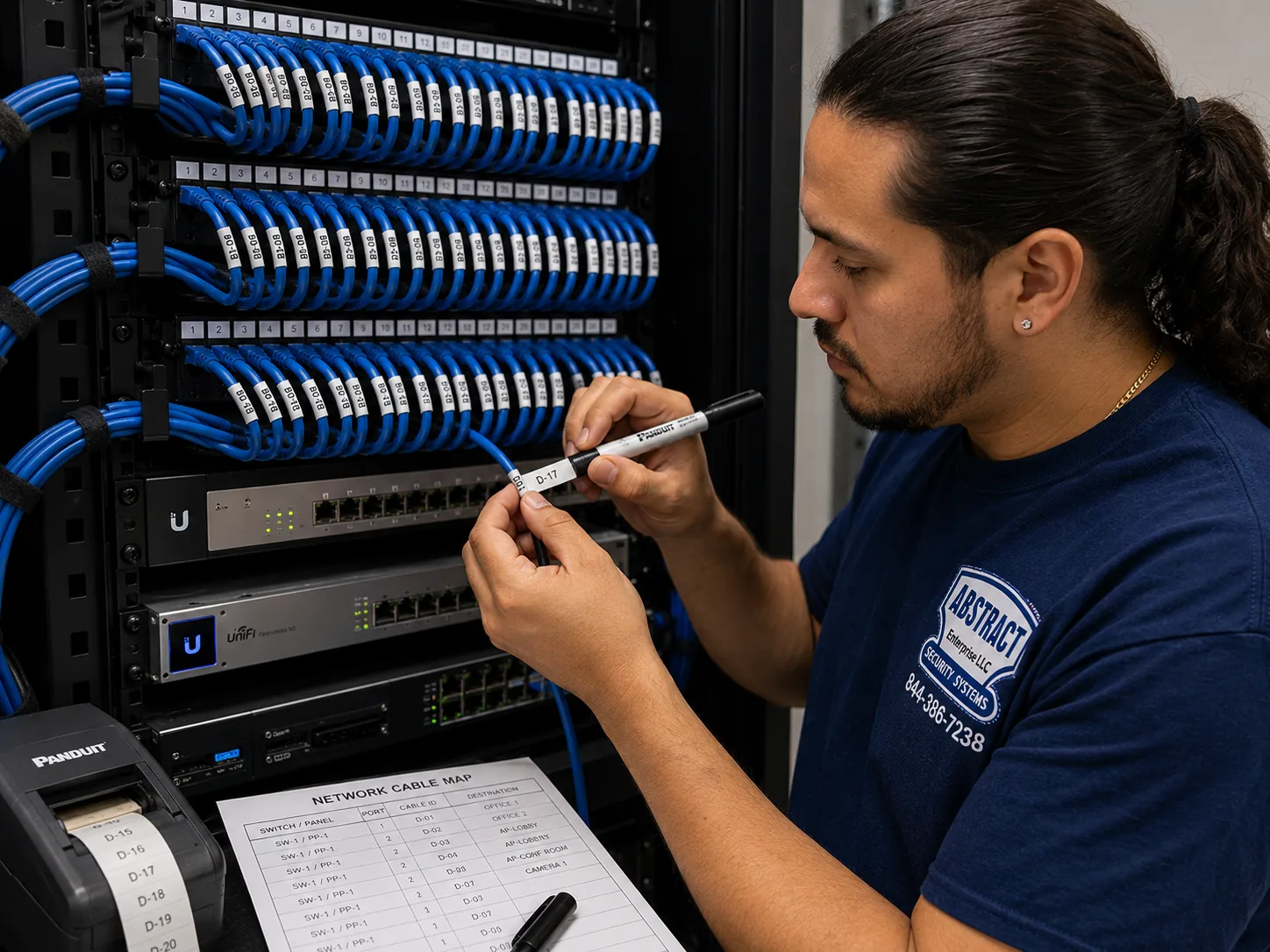
A technician fixes a printed label to a cord at a rack of labelled blue patch cables. A printed network cable map and a label printer sit on the shelf below.
Westchester Fiber Quote
Address, how many tenants or units, and where the carriers come in. A tech calls back the same business day.
✅
Request Sent!
A Westchester tech will call you back the same business day.
25+
Years Experience
✓
Same-Day Estimates
100%
Licensed & Insured
4.7★
201 Google Reviews
Taking over a building someone else wired? Call the Westchester line at (914) 877-2578 or send the 60-second form. Your request goes to a licensed installer who has traced inherited fiber in Westchester office parks and downtown towers. There's no call centre in between.
A strand-by-strand survey of what the last occupant left, before anyone quotes new cable
A separate, labelled and tested handoff for every tenant, unit block or owner
NYS licence #12000287431 · Westchester work run from our Bronx office on Fordham Road
Why Westchester Properties Need Fiber Optic Installation
Westchester isn't short of fiber. It has a lot of buildings whose fiber was designed for an occupant that has since left. For decades the county's commercial identity was the corporate campus: a single company on a landscaped lot along Westchester Avenue, Anderson Hill Road or the Saw Mill River Parkway, with one main telephone room, one data centre and a private backbone that went exactly where that company needed it. Downtown White Plains, Yonkers and New Rochelle added office towers built on the same idea, one or two large tenants per building. That model has been breaking up for years, and the wiring inside those buildings hasn't kept pace.
The vacancy numbers show the pressure. Lincoln Property Company's second-quarter 2026 report puts Westchester's overall office vacancy at 24.09 percent across an inventory of more than 22.6 million square feet. The submarket the report calls West I-287 sits at 30.34 percent, and East I-287, which takes in Purchase, has about two million square feet empty. Owners have answered in three ways. Some divide the building among smaller tenants. Some convert it to apartments, as Ginsburg Development did at 1 Martine in White Plains (Westchester Magazine called it the county's first major office-to-residential redevelopment) and as Toll Brothers did on former office sites at Corporate Park Drive in West Harrison. Some knock it down and start again. Each option leaves the existing fiber in a different state. It may be useful, it may be stranded, or it may be in the way.
Building splits and conversions are where we come in. When a building with one corporate occupant gets several tenants, the backbone has to be cut into separate pieces. Each tenant needs its own carrier handoff, its own path to its own rooms and its own strands that nobody else patches into. Conversions are more drastic: the office backbone that fed a handful of large floors has to be redesigned for dozens or hundreds of households. The downtowns add new construction on top of all this. New Rochelle's downtown overlay, adopted in late 2015, allows up to 6,370 housing units and 12 million square feet of new development, and every one of those towers needs a telecom room and a riser plan before its walls close.
What Westchester mostly doesn't lack is carrier fiber in the street. In 2001 the county's Department of Information Technology contracted Cablevision Lightpath to build a countywide fiber network called the Westchester Telecom Network. The Intelligent Community Forum describes it as more than 800 miles of fiber reaching every corner of the county and serving all of its schools, libraries and hospitals. Verizon and Optimum also run fiber to large parts of the county, and residents on r/Westchester compare the two in thread after thread. A building on a street with three fiber carriers can still be badly wired inside. That gap between the curb and the suite is the work we do.
Westchester facts that shape fiber work
24.09 percent: overall Westchester office vacancy in Lincoln Property Company's Q2 2026 report, with West I-287 at 30.34 percent and the White Plains CBD at 23.73 percent. A lot of buildings are being re-planned, and their fiber has to be re-planned with them.
48 municipalities: six cities, 19 towns and 23 villages, according to New York State and county sources. Building departments, insurance requirements and inspection habits vary from one to the next.
800+ miles: the reach of the Westchester Telecom Network that Lightpath built under a 2001 county contract. The county's DoIT annual report says the arrangement gave municipalities county-negotiated pricing for phone and data.
6,370 units: the housing ceiling in New Rochelle's downtown overlay. According to Pew's November 2024 review, only a sixth to a fifth of the approved housing had been completed and fully occupied by then, so much of it is still to be built.
245 apartments: what White Plains approved in 2017 for the former AT&T building at 440 Hamilton Avenue, a 12-storey 1960s office building at North Broadway, according to The Journal News.
14 feet: the depth of water some Mamaroneck neighbourhoods reported after the remnants of Hurricane Ida in September 2021, when ABC7 reported basements filling and water rising to first floors. Where the fiber enters a building matters in Westchester too.
On r/Westchester, one thread asked what residents thought of turning office buildings into rental housing. The thread's existence says something: conversions are ordinary local conversation here, not an industry topic. The people who own and manage those buildings are the ones calling us. They need to know whether the corporate-era fiber in the walls still has any value.
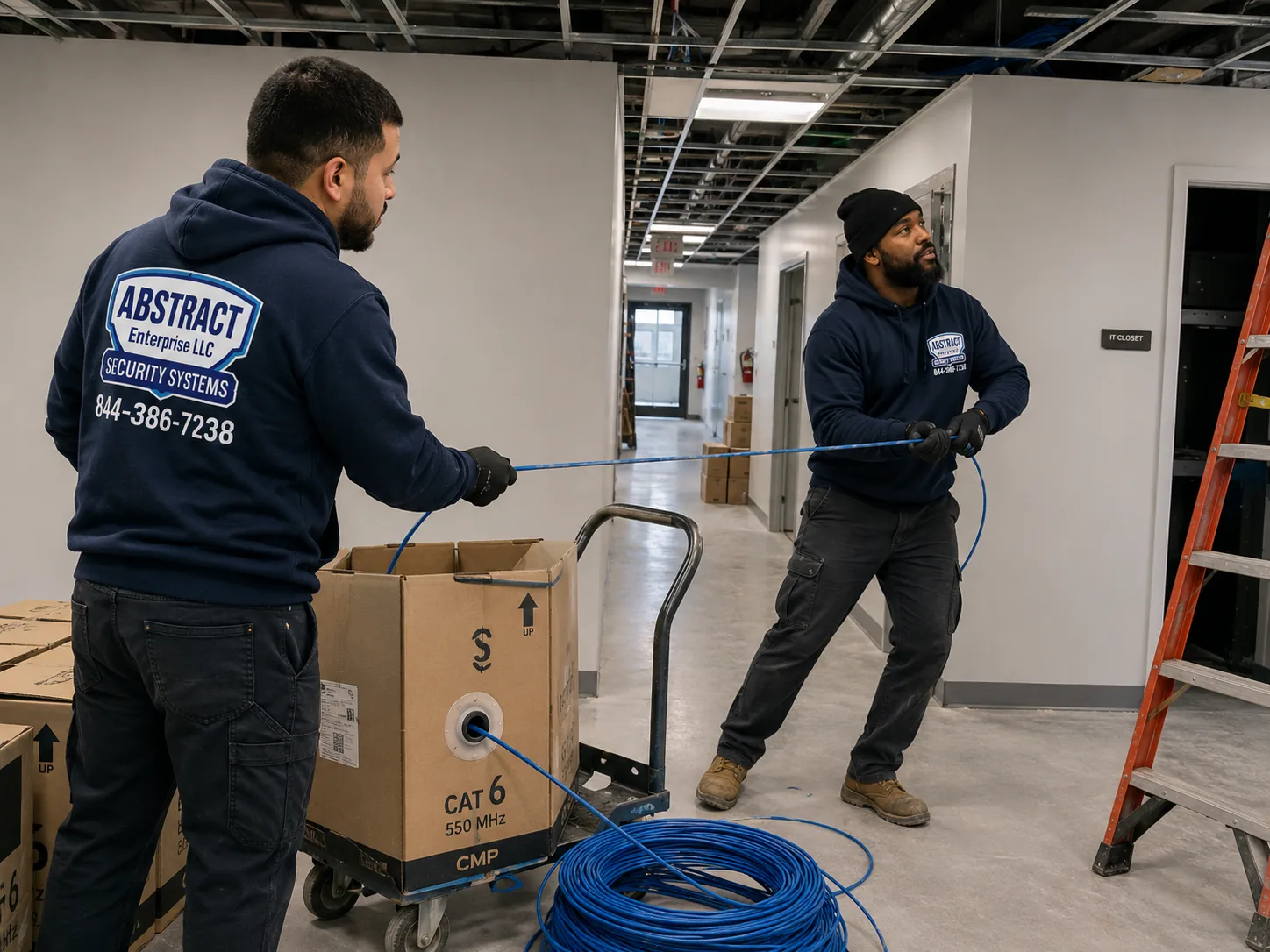
Two technicians pull a line down a long, unfinished corridor. The cable feeds from a box on a hand truck, an orange ladder stands in a doorway and the ceiling grid is still open.
Repair Capture
Fiber Link Dead in a Westchester Building?
Buildings in transition break links. A departing tenant takes a switch it shouldn't have, a demolition crew clears a floor without knowing what ran through it, or someone tidying the telecom room unplugs the wrong jumper. When a link that carried traffic last week has gone dark, treat it as a repair call rather than a new project. We dispatch the same day where we can. Most single-point fiber faults, such as a crushed jumper, a pigtail torn at the back of a panel or a connector mated dirty, are found and fixed within one to two hours once a tech is in the room. Call (914) 877-2578 and say "fiber repair". If copper is involved too, see our network cable repair service in Westchester County.
What We Install
Fiber Optic Installation Services in Westchester County
Most of our Westchester work involves dividing up, reusing or replacing fiber a building already has. We do install new backbones from scratch, but most calls start with a building someone else wired.
Single-Tenant to Multi-Tenant Splits
Dividing a former headquarters' backbone so each new tenant gets its own strands, its own enclosure and its own path from the carrier entrance. Shared strands are taken out of service, and every strand is labelled with its new owner.
Inherited Fiber Surveys
Before anything is reused, every strand is inspected and loss-tested, splices are located with an OTDR and the result is mapped. You find out what the last occupant left behind, what still works and what is dead.
Carrier Demarc Extensions
Lightpath, Verizon and Optimum usually hand off in a ground-floor or cellar room. We extend each carrier's circuit on owner or tenant fiber to the suite that bought it, labelled at both ends.
Conversion Backbones
For offices becoming apartments, a single-mode backbone from the main room to a distribution enclosure on each residential floor, sized for the unit count. It's planned before the new partitions and ceilings close.
New Downtown Towers
For the mixed-use buildings rising in New Rochelle, White Plains and Yonkers: the entrance conduit, main telecom room, riser fiber and floor enclosures, coordinated with the electrical contractor during construction.
Campus and Parcel Links
Fiber between buildings on a corporate campus, or a new link after a campus has been subdivided and the old duct now crosses a property line. We confirm who owns the duct before we price a new pull.
Data-Centre Decommissioning
When a corporate computer room is removed, we trace the fiber that converged on it. The live strands are rerouted to a new main room, and the dead runs come out back to their origin.
Splicing and Termination
New connectors on old glass: a corporate riser re-spliced into tenant trays, a campus cable joined where an excavator found it, or a run someone pulled years ago and never finished, completed and tested.
Certification and As-Builts
Insertion-loss results for every strand, OTDR traces on backbones, end-face inspection and a strand map showing which tenant owns which fibre. It's the document a buyer, lender or new manager will ask for.
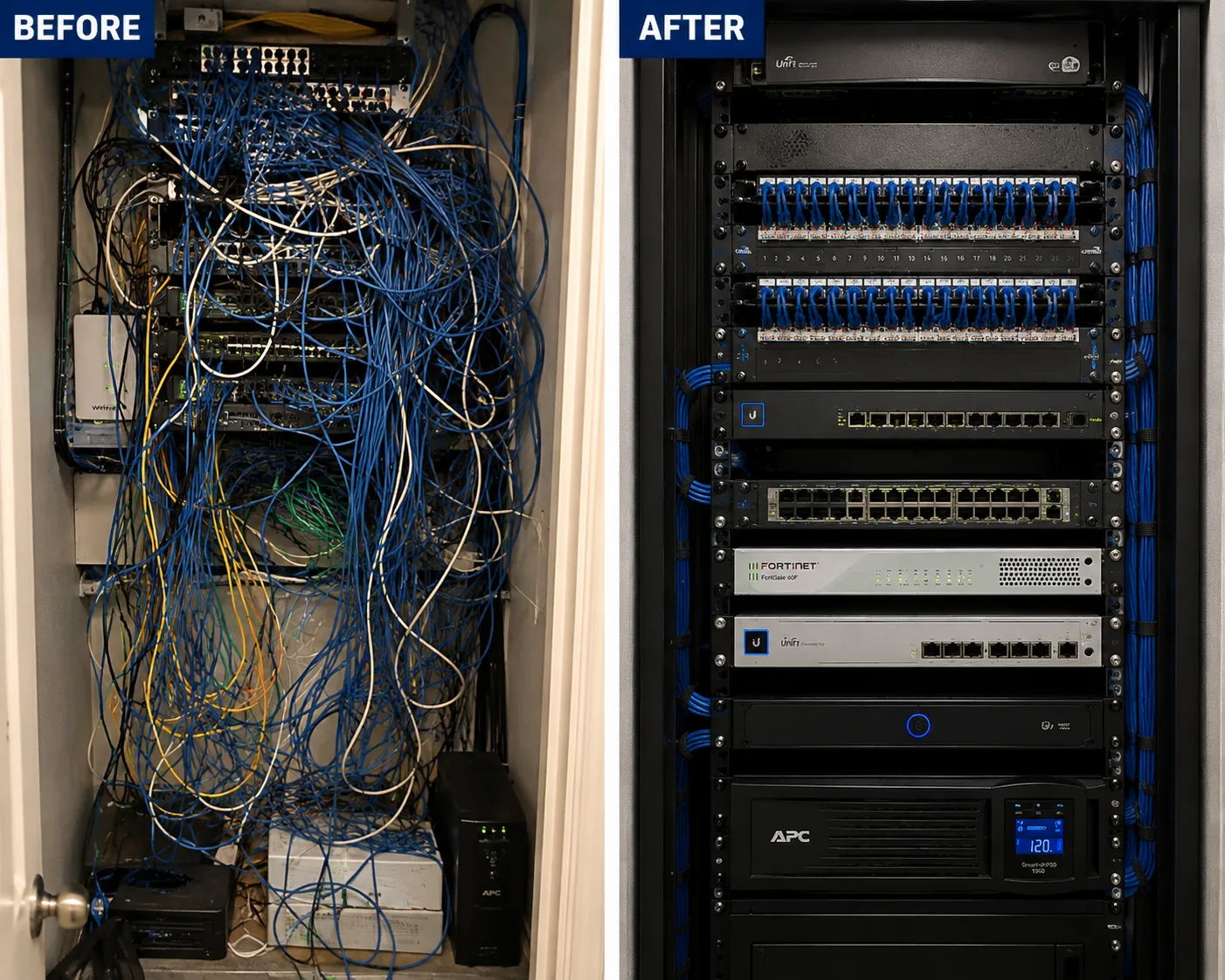
A side-by-side photo. On the left, a wall-mounted closet is buried in tangled blue, white and yellow cable. On the right, a dressed rack holds labelled patch panels, switches, a firewall and a UPS.
Building Specialists
Fiber Optic Installation for Westchester's Architecture
Westchester's commercial buildings fall into a few recognisable types. Each was wired with assumptions that no longer hold, so each needs something different from a fiber contractor.
Corporate Headquarters Campuses
Low, wide buildings of two to four storeys on large lots in Purchase, Harrison, Armonk, Rye Brook and along the Saw Mill River Parkway. Floor plates are big enough that copper from one closet won't reach the far corners. There's usually one oversized computer room, plus campus duct between buildings that the original owner installed and nobody has mapped since.
1960s–1980s Downtown Office Towers
Mid-rise towers in downtown White Plains along Hamilton Avenue, Main Street and Mamaroneck Avenue, and in Yonkers and New Rochelle. They have stacked closets and a single riser that was sized for telephone pairs. Many were planned around one or two major tenants and are now going multi-tenant or residential.
Office-to-Residential Conversions
Buildings like 1 Martine and 440 Hamilton Avenue in White Plains. The office backbone has to be replaced or re-purposed as a residential distribution system with a floor enclosure for every few dozen units. The corporate data-centre fiber is usually removed.
New Mixed-Use Towers
The transit-oriented buildings rising near the Metro-North stations in New Rochelle, White Plains and Yonkers. They have retail at the base, apartments above and sometimes offices or a hotel between. Each use needs its own path, and the retail tenants usually need theirs first.
Suburban Flex and Medical Buildings
One- and two-storey buildings on Route 9A, Central Park Avenue, Route 22 and Route 117, now taken by physician groups, labs, schools and storage operators. The work is usually a carrier extension and a short backbone, done to a fixed opening date.
Pre-War Village and City Buildings
Masonry commercial blocks and converted mansions in Port Chester, Mount Vernon, Peekskill, Ossining and the river villages. Walls are thick, drawings are rare and there's often no riser at all. Fiber follows existing chases, stair enclosures or an exterior route the owner approves.
Methods and materials, building by building
Campuses: OS2 single-mode between buildings in the existing duct once ownership is confirmed. Indoor/outdoor or armoured cable where it passes through mechanical spaces, and a second telecom room on wide floor plates instead of stretching copper past its limit.
Downtown towers: tenant backbones in innerduct inside the riser sleeves the building assigns, riser-rated (OFNR) or plenum-rated (OFNP) cable as the space requires, and a lockable enclosure for each tenant so no tenant patches another's strands.
Conversions: the corporate riser tested and either re-used as the residential trunk or pulled out, floor enclosures placed where the new corridors will actually be, and unit pathway fixed on the architect's plans while they are still being drawn.
New towers: entrance conduit sized for several carriers, a main telecom room with its own power, riser sleeves with spare capacity, and floor enclosures installed with the rough electrical so nothing has to be cut in later.
Flex and medical: armoured or conduit-protected runs through warehouse-style back areas, and a short, documented extension from the carrier's handoff to the tenant's equipment room.
Pre-war buildings: small-diameter cable to suit old chases, hand-drilled masonry penetrations sealed afterward, and no exterior route without the owner's sign-off and, where a village or city requires it, the right approval.
An old corporate building usually has more pathway than anyone remembers. Raised floors, abandoned conduit and oversized cable trays from the mainframe era can save a lot of money if someone takes the time to find them. Owners who open the building's pathways for fiber often plan the new tenants' entry intercoms at the same time. Our Westchester intercom installation team can work from the same survey.
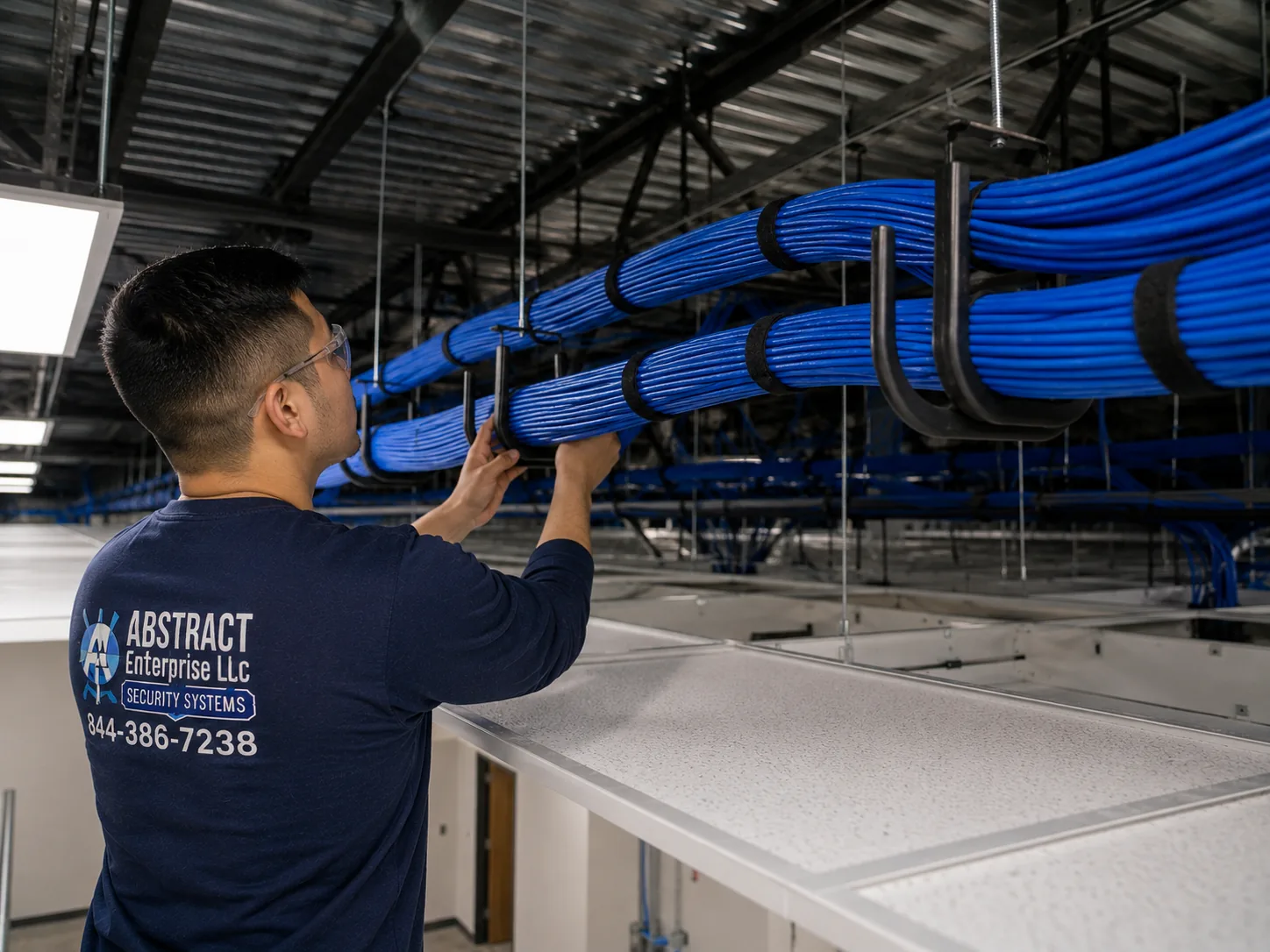
A technician reaches up to dress thick bundles of blue cable hanging from black J-hooks above an open ceiling grid. Metal deck and rows of hangers run off into the distance.
Commercial Fiber Optic Installation
Business Fiber Optic Installation in Westchester County
Brokers divide Westchester into office submarkets, and those boundaries line up surprisingly well with the kinds of fiber calls we get. The downtowns add a second map of their own.
The Platinum Mile and East I-287
Westchester Avenue through White Plains, Harrison and Purchase, with Manhattanville Road and Anderson Hill Road nearby. LPC's Q2 2026 report counts about two million vacant square feet in East I-287 and lists a 62,888-square-foot renewal by Central National at 3 Manhattanville Road in Purchase. Typical calls are campus splits, medical fit-outs and demarc extensions.
Downtown White Plains
The county seat's office core around Main Street, Hamilton Avenue and North Lexington Avenue, where the same report lists Jackson Lewis's new 45,868-square-foot lease at 1 North Lexington and Summit Health's 86,991-square-foot renewal at 210 Westchester Avenue. We see tenant backbones in older towers, conversions and new mixed-use buildings.
Elmsford, Tarrytown and the Saw Mill
Office parks along Route 119, the Saw Mill River Parkway and Route 9A in Greenburgh and Elmsford. LPC's West I-287 submarket carries the highest vacancy of the county's main office submarkets, 30.34 percent. Owners re-tenanting here want inherited fiber surveyed before they market the space.
New Rochelle's Downtown
The overlay district around the train station and Main Street, where towers like the 219-unit Highgarden Tower have opened. The work is new-build telecom rooms, risers, retail extensions and the paperwork developers need to hand over.
Yonkers
The county's largest city, with 211,569 residents in the 2020 census. It ranges from Getty Square and the waterfront to Central Park Avenue retail and Ridge Hill, the mixed-use centre between the Thruway and the Sprain Brook Parkway that opened in 2011. Older downtown blocks need pathway found; newer centres need tenant extensions.
Northern Westchester and the River Towns
Mount Kisco, Armonk, Bedford Hills, Yorktown and Somers in the north, and Ossining, Croton and Peekskill along the Hudson. Smaller office and medical buildings, schools and village halls, where one link between two buildings often does the job.
Compliance callouts for commercial fiber in Westchester
Cable listing: riser (OFNR) cable in vertical shafts, plenum (OFNP) cable in air-handling ceilings, and indoor/outdoor or outside-plant cable for runs between buildings. Many campus ceilings are return-air plenums, so we check each ceiling before choosing the jacket.
Firestopping: every rated wall and floor we pass through is sealed with a listed firestop system the same day and photographed. When a building changes use, the inspector often looks harder at penetrations left by earlier trades.
Local building departments: Westchester has 48 municipalities, each with its own building department. Low-voltage work that's part of a filed renovation follows that job's permit. We confirm with the owner or general contractor which office is involved before we start.
County licensing: Westchester's Department of Consumer Protection requires home improvement contractors to hold a county licence. On residential work we go over what applies to your scope before signing.
Outdoor work and digging: any new trench between buildings starts with a free 811 utility markout under New York's one-call system, at least two working days before digging.
ADA and egress: enclosures and raceway stay out of exit paths, stair doors and accessible routes. That matters most in conversions, where corridors are being reconfigured.
Re-Tenanting
Splitting One Company's Backbone Among Many Occupants
A building wired for one company and a building wired for six tenants are not the same building, even if the cable in the walls hasn't changed. This is the job we're asked to do most often in Westchester, so here is how it works.
Step one is finding out what's there. Corporate occupants usually leave fiber behind: riser cables between floors, links to a computer room, sometimes duct to other buildings on the campus. The as-builts are rarely handed over. Sometimes they never existed, sometimes they left with the IT department. We inspect every connector end-face, loss-test every strand and run OTDR traces on the long runs. That finds breaks, bad splices and the spots where someone coiled cable too tightly behind a panel. Then we draw it as a strand map. Until that map exists, nobody can honestly say whether the old fiber is an asset.
Step two is deciding who owns what. In a multi-tenant building, the backbone usually belongs to the landlord and each tenant is assigned strands. Some landlords prefer to let each tenant install its own riser cable in a sleeve the building designates. Either approach works. What doesn't work is the corporate habit of one shared panel that everyone patches into. We set up locked enclosures per tenant, or per floor with tenant-labelled trays, so a tenant's IT provider can only reach that tenant's strands.
Step three is the carrier entrance. A headquarters typically had one carrier room sized for one company's circuits. Several tenants means several carriers, or several circuits from the same one, all landing in the same room. We reorganise the entrance room into a meet-me panel: each carrier's handoff gets a labelled position, and owner fiber carries the circuit from there to the tenant's suite. Carriers can then install a circuit without hunting for a path, and a tenant moving out doesn't strand anyone else's service.
Step four is removing what's dead. Fiber that ran to a demolished computer room, or between floors that are now one tenant's space, gets removed back to its origin or clearly tagged as abandoned in place, whichever the owner prefers. Leaving it unlabelled is how the next contractor ends up cutting a live strand while clearing out what looked like junk.
Step five is handing over records. The landlord gets a building-wide strand map and test results. Each tenant gets its own section. A buyer or lender doing due diligence on the property gets a record of which fiber exists, who owns it and what condition it's in. In a county with this much office space changing hands and changing use, that file adds to the building's value.
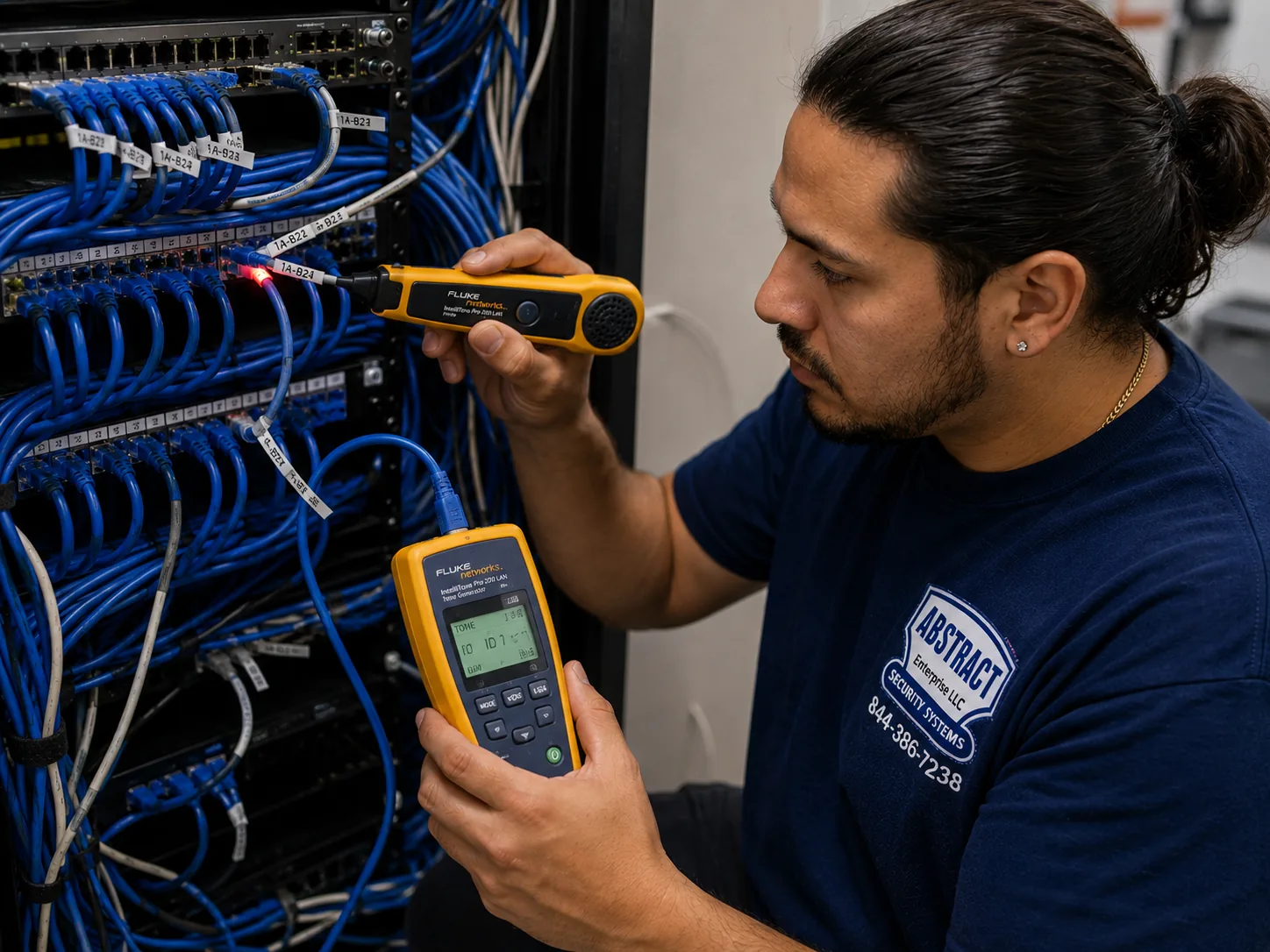
A technician holds a yellow tone probe against a dense patch panel of labelled blue cables, with a handheld tester in his other hand.
Your Questions Answered
Fiber Optic Installation in Westchester County: Questions Answered
These questions come from Westchester owners, property managers, developers and tenant IT leads, mostly while a building is changing hands or changing use. They're grouped by the decision behind them and answered straight away. Shorter questions about coverage, licensing and scheduling are in the FAQ further down.
Re-cutting a single-tenant building
We're re-letting a former corporate headquarters off I-287 floor by floor — should the landlord own the backbone, or should each tenant bring its own?
Start by deciding who will own the backbone, then decide how it's shared. The simplest model for a multi-tenant Westchester office building is a landlord-owned backbone: the existing riser and campus fiber, surveyed and repaired, terminates in the carrier entrance room and in a lockable enclosure on each floor. Each tenant is assigned specific strands. The landlord keeps the master strand map, and the tenant's IT provider only touches the tenant's trays. The other model, where each tenant pulls its own fiber in a sleeve the building assigns, suits buildings with spare riser space and tenants that want full control. It uses up pathway quickly, though.
In practice, most former headquarters can support the landlord model because the corporate occupant over-built the riser. A 24- or 48-strand backbone that served one company's floors can usually be re-terminated so each floor has dedicated strands to the entrance room, with spares left for a second carrier. We test it first. If a cable has broken strands or a crushed section, it's cheaper to replace that run than to build a sharing scheme around damaged glass.
Whichever model you choose, write it into the leases. Tenants should know which strands are theirs, who repairs them and what happens when they leave. We'll provide a one-page fiber exhibit for each tenant from the strand map.
The old corporate data centre in our building is being torn out — what happens to all the fiber that ran to it?
It all has to be traced before anything is cut. Corporate computer rooms are where fiber converged: riser cables from every floor, links to other buildings on the campus, carrier circuits extended from the entrance and sometimes fiber to a disaster-recovery room elsewhere on site. When demolition starts, the risk is that a crew cuts a bundle that still carries a live carrier circuit or a link another building depends on.
We trace each cable from the computer room to its far end, mark which are live, and reroute the live ones to the new main telecom room before demolition. Then the dead ones are cut back to their origin and removed, or tagged as abandoned if the owner wants them left. Often the most useful cable is the riser itself, and it can be re-spliced in a new enclosure on the same floor instead of going to a room that no longer exists.
Book this work before the demolition contractor arrives, not on the morning the walls come down. A day spent tracing can save a week of outages.
Can tenants on different floors of one Westchester office building share a building-owned fiber backbone without sharing a network?
Yes. Physically separate strands are separate networks. Light on one tenant's strand cannot reach another tenant's equipment unless someone patches the two together. Sharing a cable is no more of a security risk than sharing a riser. The risk is in how the termination points are managed: an open panel in a shared closet, where any tenant's contractor can move a jumper, is how networks get crossed.
We terminate each tenant's strands in its own lockable enclosure or in labelled trays behind a locked door, and we label both ends with the tenant's name and strand numbers. In the entrance room, each carrier circuit is patched to one tenant's strands and nothing else. The landlord holds the key to the shared positions. Tenants hold keys to their own.
Tenants that need more separation, such as medical groups, law firms or financial offices, can be given their own cable in the same pathway instead of strands in a shared one. It costs a little more and makes the separation obvious to anyone who audits it.
The departed company's telephone room is still full of its old equipment — can it become the entrance room for our new tenants' carriers?
Usually in the same room, organised differently. The entrance conduit and the room are rarely the limit. The limit is how the room is laid out. A corporate telephone room tends to be filled with equipment from the company that left: old phone systems, backboards full of copper blocks and a carrier rack or two. We clear what's dead, put up a meet-me panel where every carrier circuit lands in a labelled position, and carry each circuit to its tenant over owner fiber.
If the entrance conduit is full, or only one carrier can physically reach the building, a second entrance may be worth building. That involves the carrier and sometimes the municipality, so we price it separately and only recommend it when the tenant mix needs it. Many Westchester buildings already have two or three carriers available at the street. The Westchester Telecom Network alone, by the county's own account, reaches every corner of the county.
When the room is organised, a new tenant's circuit becomes a short patch rather than a project. That helps when you're marketing suites: you can tell a prospect their carrier can be live within days of signing.
Conversions and new construction
Should the office-era fiber in a building being converted to apartments be reused, re-terminated or stripped out?
Usually some of each, and the survey decides. The riser backbone between floors is the part most worth keeping: if it's single-mode and tests well, it can be re-terminated into residential floor enclosures for far less than a new pull. Multimode riser fiber is less useful in a residential building, because carriers serving apartments almost always hand off on single-mode. Horizontal office fiber to old computer rooms, trading floors or executive suites rarely matches the new apartment layout and usually comes out.
The decision should be made early, while the design team is still placing the new walls. Once the residential layout is fixed, we can show which existing pathways survive, where the new telecom closets go and how much of the old backbone fits. Conversions like 1 Martine and 440 Hamilton Avenue in White Plains turned office floors into hundreds of apartments, and in that kind of project the wiring decisions are cheapest before demolition and most expensive after drywall.
Whatever is removed should come out completely, back to its origin. A conversion is the one chance to clear decades of abandoned cable from the risers before residents move in and access becomes difficult.
Our office building is becoming self-storage — does it still need fiber, and where?
Less than an office, but more than owners expect. Office-to-storage conversions have been proposed in Westchester; Westfair reported one such plan for an office building at 504 White Plains Road. A storage building's network carries gate access, keypads, cameras on every floor, the rental office, and sometimes kiosks and smart locks. The loads are small, but the devices are spread across large floor plates and several storeys, often further from the main rack than copper can reliably reach.
The usual design is short: carrier service into the rental office, then a fiber backbone from there to a small enclosure and switch on each floor or each wing, with copper running from those switches to cameras and access hardware. If the old office riser is still in good condition, it usually covers most of what the new use needs.
Plan it with the security contractor. The cameras and access system decide where the floor switches go, and the switches decide where the fiber ends.
When should a developer building under New Rochelle's downtown overlay bring in a fiber contractor?
Before the electrical drawings are final, so during design and not at fit-out. New Rochelle's overlay was built to move projects quickly. Pew's review describes a single generic environmental review for the whole plan, so individual buildings that fit it face a much lighter assessment. A faster approval also means less time to correct a telecom design that was an afterthought. The decisions that matter, such as the size of the entrance conduit, where the main telecom room sits, whether it has dedicated power and cooling, and how much spare riser space there is, are all set in the drawings.
We can review the telecom pieces of the drawings, recommend conduit sizes and room layout for several carriers, and then install the riser fiber and floor enclosures alongside the rough electrical work. The retail spaces at the base of these towers usually need service before the apartments do, so we plan their path first.
At handover, the developer gets a tested backbone, a strand map and a room any carrier can serve. That makes it easier to bring in more than one provider later, which residents increasingly ask about.
Public buildings, medical tenants and site selection
Our village offices connect to the county's Westchester Telecom Network — who is responsible for the fiber after the county's handoff?
Generally the municipality, for everything inside its own buildings. The county network, built by Lightpath under the county's 2001 contract, brings service to a handoff point at each connected site. From that point on, the cable to other rooms, other floors and other buildings in a municipal complex belongs to the owner, which might be a village hall with a police desk in the basement, a highway garage across the lot, or a library or pool building next door. That's the part that tends to be undocumented, because it was added piece by piece over many budget cycles.
We survey that internal fiber, repair or replace what's failing and document it so the IT staff or managed provider can see the whole system. Where a new building or department needs connecting, we extend fiber from the existing handoff or the main room rather than ordering a second circuit.
If your municipality procures through specific contract vehicles or needs particular paperwork, tell us at the start. We'll provide itemised quotes, test results and closeout documents in whatever format the clerk or comptroller needs.
Our medical practice is moving into a suite in a Harrison or Purchase office park — what has to be in place before the clinical systems move?
Three things, in this order. First, the carrier circuit has to be delivered and extended to the practice's own equipment room, not left at a demarc in the building's cellar where nobody from the practice can reach it. Second, the backbone between the equipment room and any second room, such as an imaging suite, a lab or a second floor, has to be installed and tested so the network is complete before the move date. Third, every link needs labels and test results that the practice's IT vendor can work from on move weekend.
Office parks on the Platinum Mile and around Purchase are attracting medical tenants into buildings designed for corporate use. LPC's Q2 2026 report lists Summit Health's renewal of almost 87,000 square feet at 210 Westchester Avenue. Medical moves have little flexibility, because appointments are booked weeks ahead and the systems have to be working on day one. We set the fiber schedule backward from the opening date.
If the practice is splitting a building with other tenants, ask the landlord for strands of its own, terminated in a locked enclosure. It keeps the practice's network physically separate from its neighbours'.
We're choosing between a downtown White Plains tower and an I-287 campus building — how does fiber change the comparison?
It changes it more than the rent difference suggests. In a downtown tower, the main questions are vertical: is there riser space, which carriers already serve the building, and will the landlord let your backbone use its sleeves? On a campus, the main questions are horizontal: is the carrier entrance in your building or in another one on the lot, who owns the duct between them, and is the campus being divided among several owners, as some Platinum Mile sites have been?
Before you sign, ask each landlord for its riser or campus fiber records and the list of carriers on site. We can walk both buildings in one visit and tell you what fiber work each would need for your floor plan. That lets you compare the buildings with the build-out cost included, not just the rent.
Neither type is better in general. A well-documented campus building with fiber already to your door can be cheaper to occupy than a tower with a full riser. It's worth checking, though, because a new tenant in a building like this usually learns about the fiber after the lease is signed.
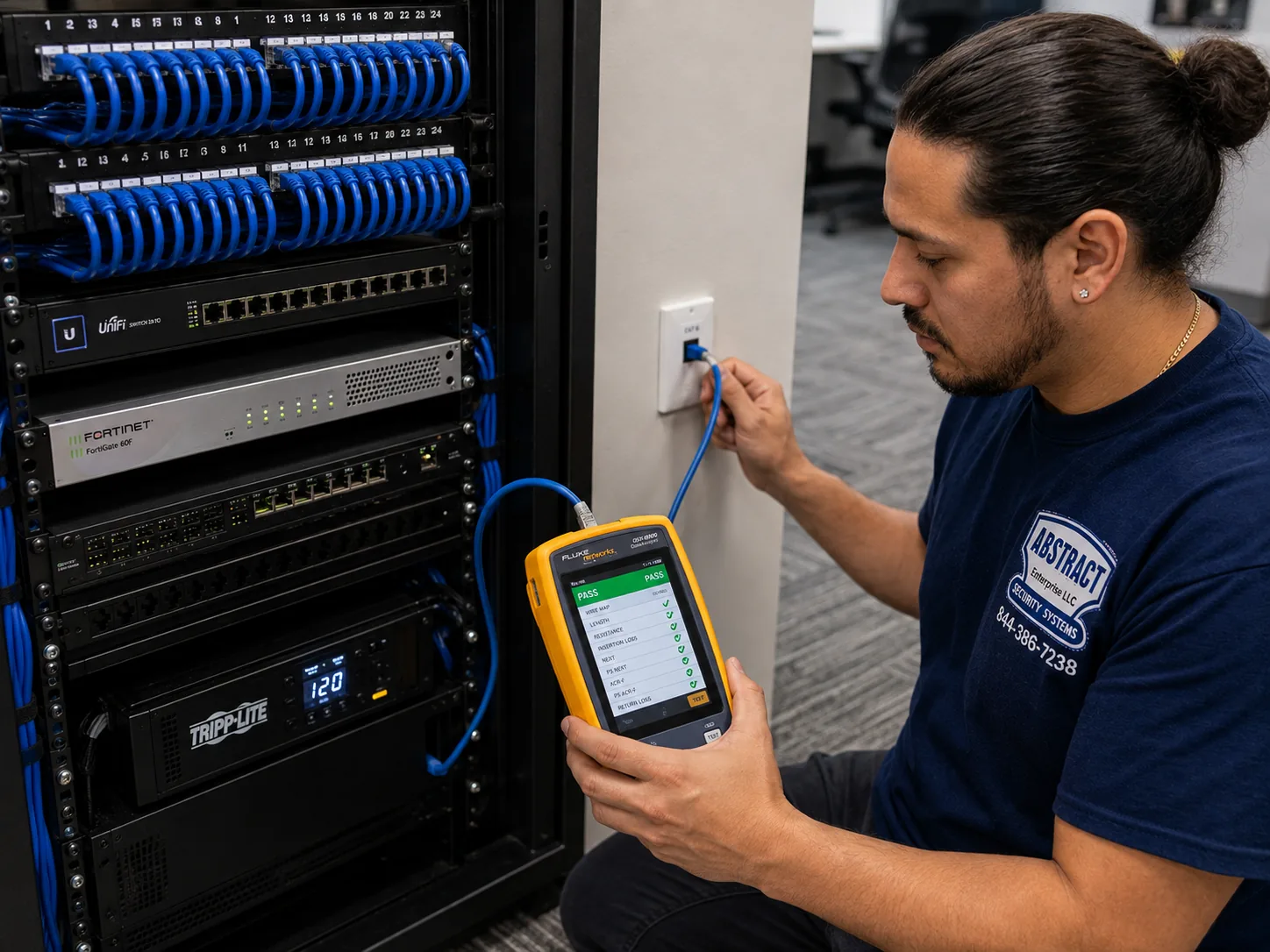
A technician kneels beside a rack, holding a yellow handheld tester with a green pass screen. Its cable runs to a wall jack, and labelled patch panels and switches fill the rack behind him.
Equipment
Types of Fiber Optic Cabling We Install
The parts list for a Westchester job depends mostly on whether we're re-using a corporate backbone, building one for several tenants or wiring a new tower. These components cover almost all of it.
OS2 Single-Mode Backbone
Our standard for anything several owners will share: riser backbones, entrance-room-to-suite links and campus links. Carriers hand off on single-mode, it reaches any distance in a Westchester building, and it will outlast the switches at both ends.
OM4 Multimode Links
Short in-building links where a tenant's equipment already uses multimode optics. It's also what many corporate occupants left behind, and it's worth re-terminating when it tests well.
Indoor/Outdoor Cable
For campus links that leave one building, run through duct and enter another. A single jacket rated for both, so no splice is needed at the building entrance.
Riser- and Plenum-Rated Cable
OFNR in vertical shafts and OFNP in air-handling ceilings, which are common in corporate campus buildings with return-air plenums above the ceiling tiles.
Armoured Fiber
Interlocking armour through parking-garage ceilings, loading areas, mechanical rooms and storage floors, wherever a cart, a forklift or a sprinkler fitter could damage the cable.
Lockable Tenant Enclosures
Wall- or rack-mount enclosures, one per tenant or per floor, labelled with the owner and strand map. These are what turn a shared backbone into separate networks.
Meet-Me Panels
Rack-mount patch and splice panels in the entrance room, where each carrier circuit lands in a labelled position and is patched to a single tenant.
LC, SC and MPO Connectors
LC duplex for most tenant links, SC where a carrier's handoff uses it, and MPO trunks where many strands terminate in a new main room or residential MDF.
Innerduct and Pathway
Innerduct inside shared sleeves and campus duct, so later pulls can't crush existing cable, plus J-hooks and raceway where a building's own pathway runs out.
Who owns the fiber after a building changes hands?
Model
Who owns the backbone
Typical Westchester building
What to watch
Single-tenant legacy
The former occupant, often never formally transferred
Headquarters campuses, 1980s office parks
Undocumented fiber and campus duct that may cross new property lines
Landlord backbone, tenant strands
The building owner; tenants are assigned strands
Re-tenanted offices, downtown towers
Locked termination points, and strand assignments written into leases
Tenant-owned risers
Each tenant, in sleeves the building assigns
Buildings with spare riser capacity and large tenants
Riser space running out, and removal obligations at lease end
Residential distribution
The building owner or condominium
Conversions and new mixed-use towers
Floor enclosures sized for unit counts, and access for several providers
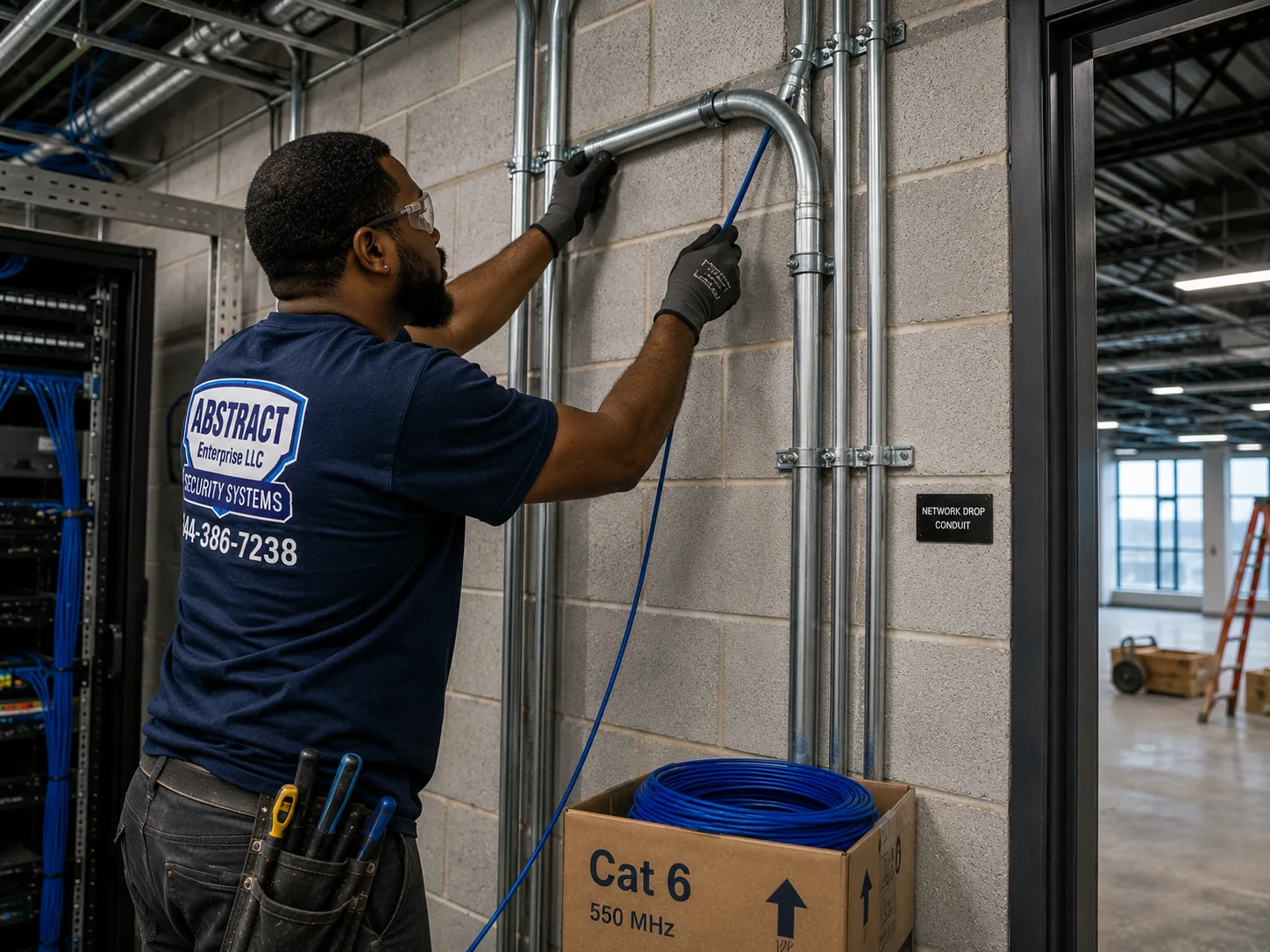
A technician guides blue cable into a run of EMT conduit fixed to a painted block wall next to an open rack. A box of cable sits at his feet, and a doorway opens onto a large unfinished floor.
AI Overview Reality Check
What AI Gets Wrong About Fiber Optic Installation in Westchester
Ask an AI assistant or a cost guide about fiber installation and you'll get confident general answers. Most of them are reasonable for a new building with one owner. Westchester's buildings mostly aren't new and often aren't single-owner any more. Here are claims that cost guides and contractor sites actually publish, and what they miss in this county. We couldn't capture Google's AI Overview, Angi, HomeAdvisor or Fixr pages directly, so the quotes below come from the guides those summaries draw on.
"Budget each fiber drop at a few hundred dollars, up to about $800"
One widely read national guide puts an installed office fiber drop at $300 to $800, roughly two to three times a Cat6 drop, and sizes a 100-to-200-drop job at $15,000 to $30,000. To its credit, it calls these orientation ranges, not quotes.
In a re-tenanted Westchester building, drops aren't really the unit of work. The cost is in the survey of inherited fiber, the re-termination into tenant enclosures, the reorganised entrance room and the removal of dead cable. A building can have plenty of usable fiber and still need several thousand dollars of work before any tenant can rely on it. Equally, a building with a good backbone may need very little new cable.
Our published Westchester drop prices are $438 multimode and $500 single-mode, for shorter terminated and tested runs. Re-tenanting work is quoted from the survey, with the reused, repaired and removed fiber shown on separate lines.
"Small projects can take a day or two"
A New York City contractor's fiber guide says small projects can take a day or two, with multi-floor projects taking longer. For the cable work itself, that's honest.
In Westchester, the schedule usually depends on things that have nothing to do with cable: when the outgoing occupant hands over the keys, when the demolition contractor clears the old computer room, when a carrier can deliver a circuit to the reorganised entrance room, and when the landlord, tenant and lender agree who owns what. The installation may take two days. The project around it can take two months.
We give two dates: when the fiber work can be done, and what has to happen first for that date to hold. That's more useful to a property manager than a single estimate.
"Copper stops working reliably beyond about 100 meters, so far-apart rooms call for fiber"
The same New York guide makes this point, and the 100-metre channel limit for copper Ethernet is real.
In Westchester it applies most to the wide floor plates of corporate campus buildings, where one closet can't reach the far side of the floor. But distance is usually not the main reason Westchester buildings need fiber. Ownership is. Once a building has several tenants, each needs its own link from the carrier entrance, and those links are best on fiber because they span floors, are shared in pathway and must stay separate.
Reading "you need fiber when distances exceed 100 metres" as the whole rule leads owners to think a compact building doesn't need any. A compact building with six tenants still needs six separate paths to the carriers.
"Single-mode cable now costs less than OM4, but its optics cost more"
A 2026 cost guide aimed at New York buyers points out that the price order of the glass has flipped, so single-mode cable is the cheaper of the two, even though a single-mode transceiver can still run 1.5 to 5 times the price of its multimode equivalent.
For a shared backbone, that trade-off is easy. Carriers hand off on single-mode, tenants change, and whatever optics the next tenant uses will be bought by that tenant. A landlord installing or replacing a backbone for several tenants should put in single-mode, and nearly always does.
Where a corporate occupant left a good multimode backbone, re-terminating it for tenants who use multimode optics can still make sense. We'll test it and show you both options rather than quietly replacing usable glass.
"OTDR testing is billed by the hour, about five percent of the job"
That New York guide prices OTDR acceptance work at $75 to $150 per hour, says nobody quotes it per strand, and tells readers to set aside roughly five percent of the installation for it.
We publish one: $50 per strand in Westchester, plus insertion-loss testing included on every link we install. For an inherited-fiber survey, a flat per-strand rate tells an owner in advance what it costs to learn whether the old backbone is worth keeping.
The OTDR matters more in Westchester than the guide suggests. On a backbone the previous occupant left, the trace is what shows the crushed section behind a panel, the splice that was never protected or the break where a demolition crew pulled a bundle.
"Underground fiber runs a median of about $18 per foot"
A contractor's cost article cites the Fiber Broadband Association's 2025 figures: a median of $18.00 per foot for underground construction and $8.00 for aerial.
Those are figures for outside-plant construction along roads. On a Westchester corporate campus, the first question isn't the cost per foot of new trenching. It's whether duct already exists between the buildings and who owns it now. Campuses on the Platinum Mile have been partly demolished and redeveloped, so duct laid by one owner can now run under another owner's land.
We locate existing duct and confirm ownership before pricing a new route. Reusing a duct you have rights to costs far less than building a new one, and building one across land you don't own creates a problem for whoever buys the building next.
"Westchester already has fiber everywhere"
This isn't one guide's claim. It's the conclusion people reach from real facts: a county fiber network that the Intelligent Community Forum describes as more than 800 miles long, Verizon and Optimum fiber across much of the county, and r/Westchester commenters noting Optimum fiber in towns such as Briarcliff Manor and Ossining.
All of that is fiber to the building, or to the curb. None of it reaches the tenant's suite on the fourth floor, the second building on the campus or the apartments on the twelfth floor of a converted office tower. That's owner-side wiring, and in many Westchester buildings it was designed for an occupant that left years ago.
When someone says the building "already has fiber", our first question is "to where?" The answer decides whether you need a carrier order, a short extension or a survey of what the last occupant left.
Inherited a Building? We'll Map What the Last Occupant Left.
Send the address, your tenant plan and any records you have. We'll tell you what fiber is there, what still works and what it would take to divide it.
Who owned the building before, how many tenants or units it will have, and what has to connect to what. An installer who works Westchester reads every request and answers the same business day. In a hurry? Call (914) 877-2578.
✅
Request Received
Thanks. Someone who works Westchester buildings will phone you before the end of the business day. For an outage, ring (914) 877-2578.
How It Works
Our Installation Process
Seven stages. On a Westchester re-tenanting job, the first two, finding out what's there and agreeing who owns it, decide everything that follows.
1. Survey what is already there
We walk the building with whoever still knows it, open every closet and enclosure, inspect and loss-test the existing strands, and trace the long runs with an OTDR.
2. Agree who owns what
A strand map and a short options paper let the owner, the tenants and any buyer or lender agree the ownership model before any cable is cut.
3. Scope, insurance and schedule
An itemised proposal, a certificate of insurance matching the owner's requirements, and a schedule built around move-out, demolition and opening dates.
4. Clear and prepare pathway
Live circuits confirmed and rerouted, dead cable removed or tagged, the entrance room reorganised, and innerduct, enclosures and any new pathway installed.
5. Install and seal
New glass laid in innerduct or hung on supports without exceeding its pulling force or bend radius, and each wall or floor opening closed with a listed firestop and photographed before we leave.
6. Terminate and prove
Strands joined to pigtails in the tray of the tenant that owns them, end-faces inspected through a scope, and a loss figure plus an OTDR trace kept for every strand on the backbone.
7. Hand over per owner
Labels at both ends, cutover in an agreed window, a building-wide strand map for the landlord and a separate section for each tenant.
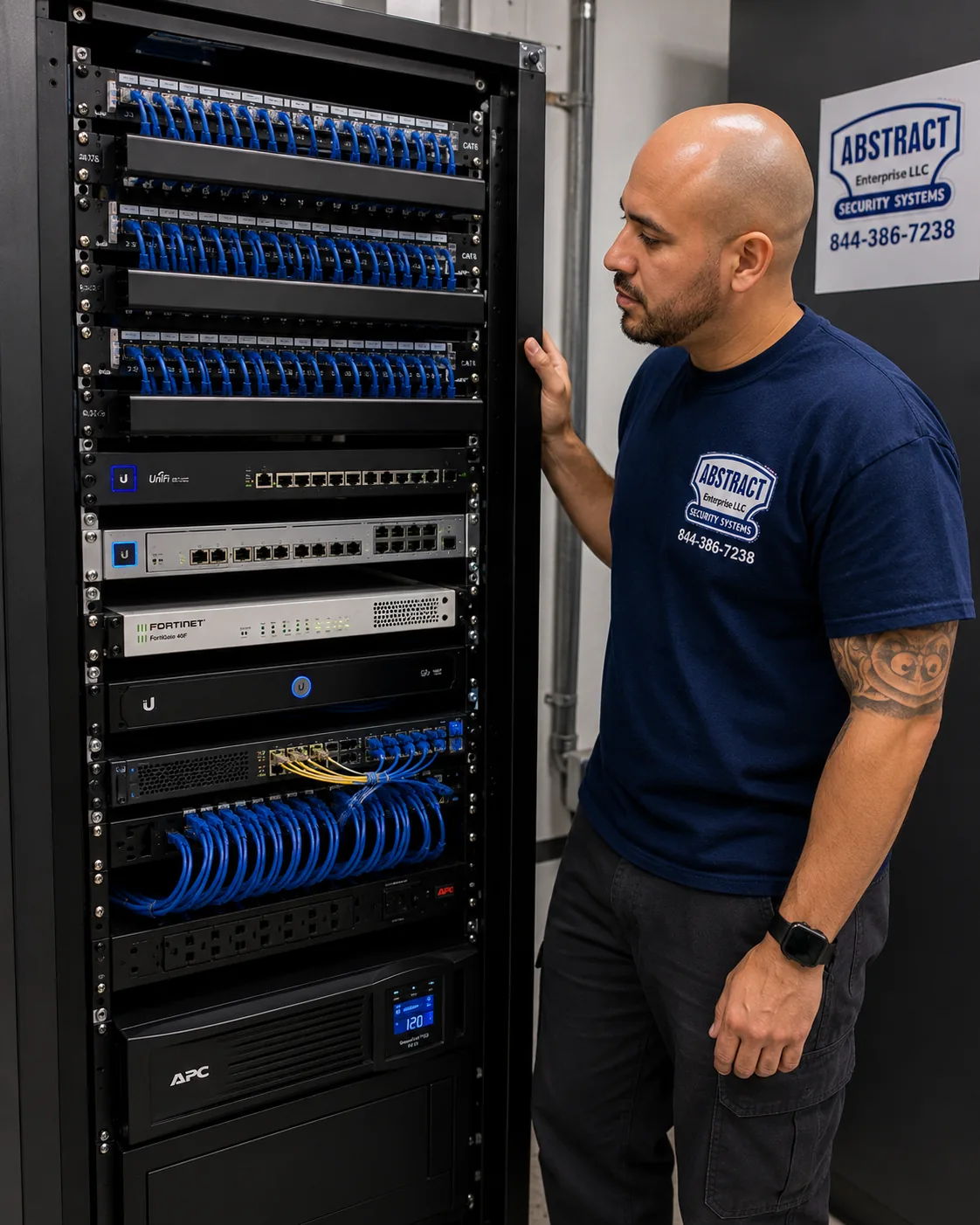
A technician rests a hand on a finished rack: labelled blue patch panels at the top, then switches and a firewall, a few yellow cords near the bottom and a UPS at the base.
Conversions
Turning an Office Backbone Into an Apartment Backbone, Floor by Floor
A conversion changes almost every assumption the original fiber was built on. An office floor might have had one tenant, one closet and a few dozen network ports. The same floor as apartments might hold twenty or thirty households, each expecting its own service from a provider it chooses. White Plains has been one of the county's test cases. Westchester Magazine described 1 Martine as the county's first major office-to-residential redevelopment, and the city approved 245 apartments for the former AT&T building at 440 Hamilton Avenue in 2017. Here is how the fiber design changes when an office becomes housing.
The entrance room grows up. An office building could manage with one or two carriers. A residential building with hundreds of units has to be ready for whichever providers residents and the owner choose, now and later. The entrance room needs space and panel positions for several carriers, its own power circuit, and a location that won't flood. If the old room is in a cellar that took water, a conversion is the moment to move the main equipment upstairs and leave only the entrance hardware below.
The riser becomes a distribution trunk. In an office building, the riser carried a few large tenant links. In a residential building, it feeds a distribution enclosure on every floor, or one for every wing on wide floor plates. Each enclosure fans out to the units around it. Single-mode is the standard because residential providers deliver on single-mode, and strand counts are planned from the unit count with spares for growth. If the existing office riser is single-mode and tests well, it can sometimes become this trunk. If it's multimode, it usually comes out.
Each unit needs a destination. The fiber or conduit from the floor enclosure ends at a small media panel or wall location in each apartment. Where that sits has to be agreed with the architect and electrical engineer while the unit layouts are being drawn, so it lands in a closet rather than in the middle of a living-room wall. Planning this late is the most common reason residential fiber in conversions ends up surface-mounted.
Common areas get their own network. Lobby intercoms, package rooms, fitness rooms, garage cameras and building management systems all need connectivity that belongs to the building, not to a resident's provider. We plan dedicated strands for these from the start, terminated in the main room, so building systems never depend on a resident's account.
Everything abandoned comes out. A conversion is the one time the risers and ceilings are fully open. Decades of telephone cable, old office Ethernet and dead fiber can be removed back to their origins, leaving clean pathway for the residential system and room for whatever comes next. Once residents move in, that opportunity is gone for a generation.
If you are early in a Westchester conversion, the most useful thing we can do is survey the existing fiber before the demolition drawings are finished. Knowing what is reusable changes what the demolition contractor is told to protect.
Campus Subdivision
When a Corporate Campus Is Split Into Separate Parcels
Some of Westchester's largest corporate sites no longer belong to one owner. Multifamily Executive reported in 2021 that a number of former office sites along the stretch of I-287 known as the Platinum Mile had been demolished and redeveloped, including the 421-unit Carraway community at 103 and 105 Corporate Park Drive in West Harrison. When a campus is divided, the fiber and duct the original owner installed between buildings don't respect the new property lines.
This creates a problem that rarely comes up anywhere else in the region. A duct bank laid by one company to connect its buildings may now run from one owner's building, under a second owner's parking lot, to a third owner's building. The fiber inside it may still be in use by one party, abandoned by another and unknown to the third. Nobody wants to discover this when an excavator finds the duct during a parking-lot rebuild.
Our approach starts with the paperwork, not the shovel. We ask the owner or their attorney for the survey and any easements recorded with the subdivision, then locate the duct on site from manholes, handholes and building entrances. We test any fiber inside it and trace where each cable goes. The result is a drawing that shows which duct crosses which parcel, what is in it and whether it's live.
From there the choices are straightforward. If an easement covers the duct and your fiber is in it, the duct can keep serving you, and we document it. If no easement exists, the owners can agree one, or you can build a new route on your own land, which we'll price as a separate option. If the old fiber is dead and nobody needs it, it can be cut back and capped at each building wall, so a future contractor doesn't mistake it for something live.
Any new digging on a Westchester campus starts with an 811 call so utilities mark their lines, and private lines such as old campus duct, site lighting feeds and irrigation are located separately, because the utilities don't mark what they don't own. This is one more reason the survey comes first.
Public Sector
Fiber for Westchester's Villages, Towns and Districts
Westchester's 48 municipalities, plus its school, library, fire and water districts, own a lot of small buildings that need to talk to each other. Village halls with a police desk, a court and a building department under one roof; highway garages across a yard; libraries next to community centres; firehouses a few blocks from the village offices. Many already connect to the county's network at a main site, as the Intelligent Community Forum's profile of the Westchester Telecom Network describes. The links between their own buildings were often added later, one budget at a time.
That incremental history leaves recognisable problems: a link to the highway garage on copper that fails every summer, a fiber run to the library that nobody has documented since the contractor who installed it left, an outdoor cable hung between buildings that was never meant to be permanent. We survey the existing links, fix what's failing and replace temporary runs with properly protected cable in conduit or on approved supports.
Public owners also need paperwork that private owners often don't: itemised quotes that match a purchase order, test results in a format the IT consultant can file, insurance certificates naming the municipality, and closeout documents ready for the clerk. We provide all of it as standard, and we schedule work around council meetings, court sessions and school calendars when the building is in use.
Coverage Area
Fiber Optic Installation Near Westchester's Landmarks
A handful of Westchester places sum up the county's fiber story: corporate land being reused, office towers becoming homes, downtowns rebuilt around the train, and institutions that have always needed links between buildings. We work in the blocks around all of them.
440 Hamilton Avenue, White Plains
The boxy 12-storey former AT&T office building at the corner of Hamilton Avenue and North Broadway, built in the 1960s and approved by the city in 2017 for conversion to 245 rental apartments.
1 Martine, White Plains
A former downtown office building now holding 188 loft-style apartments. Westchester Magazine described Ginsburg Development's project as the county's first major office-to-residential redevelopment.
Corporate Park Drive, West Harrison
Where Toll Brothers and J.P. Morgan Global Alternatives built Carraway, a 421-unit community at 103 and 105 Corporate Park Drive, on a stretch of the Platinum Mile where former office sites have been demolished and redeveloped.
Westchester County Airport
The county-owned 702-acre airport in North Castle, Harrison and Rye Brook, open since 1942, with a 6,549-foot main runway and a three-level terminal built in 1995. The state line runs along its eastern edge.
Purchase College, Anderson Hill Road
The only four-year SUNY campus in Westchester, on a 500-acre former estate at 735 Anderson Hill Road, designed by the architect Edward Larrabee Barnes, in the same corridor as several corporate campuses.
Downtown New Rochelle
The overlay district around the train station, zoned in late 2015 for up to 12 million square feet of development and 6,370 housing units, including the 219-unit affordable Highgarden Tower.
We also serve Yonkers from Getty Square to Ridge Hill and Central Park Avenue, Mount Vernon, Port Chester and Rye Brook, Scarsdale, Eastchester and Bronxville, Tarrytown, Sleepy Hollow and Elmsford, Valhalla and Hawthorne, Ossining, Croton-on-Hudson and Peekskill, Mount Kisco, Armonk, Bedford, Pound Ridge, Yorktown, Somers, Lewisboro and North Salem. Across the river and county lines we cover Rockland, Putnam and the Bronx.
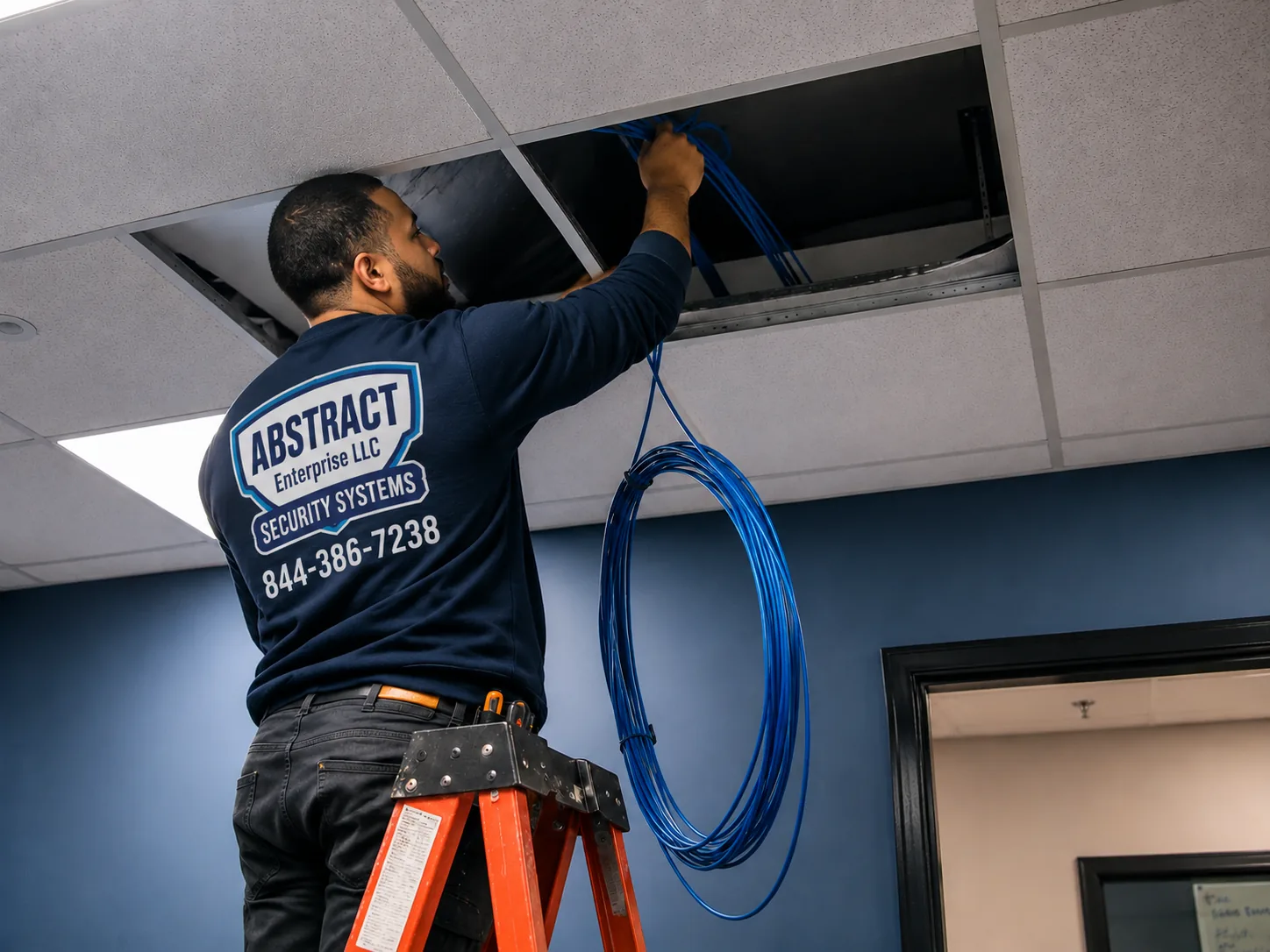
Standing on an orange stepladder, a technician pushes cable up into an open ceiling tile in an office with a blue accent wall. A loose coil hangs from his hand.
Pricing
Fiber Optic Installation Cost in Westchester County
Westchester fiber is quoted after a walkthrough, but the unit prices are published. Westchester carries our 1.25× area rate over the Brooklyn and Bronx base. That reflects travel time and the extra survey and coordination re-tenanting jobs usually involve. Every figure below is our base price multiplied by 1.25.
Item
Westchester price
What it covers
Fiber termination on an existing cable
$44 per termination
LC, SC, ST or MPO, fusion-spliced pigtail or mechanical connector, on cable you already own
OTDR test
$50 per strand
Trace and event table per strand, on top of loss testing; the core of an inherited-fiber survey
Multimode fiber drop
$438 per drop
Shorter horizontal run, terminated and tested
Single-mode fiber drop
$500 per drop
Shorter horizontal run, terminated and tested
12-strand OM4 floor-to-floor backbone
$5,625 – $8,750
Fusion-spliced, enclosures at both ends, firestopped, loss-tested
24-strand OS2 single-mode backbone or campus link
$10,000 – $18,750+
Single-mode with OTDR on every strand, for multi-tenant risers and building-to-building runs
Second telecom room with fiber link
from $3,000
A satellite closet for the far side of a wide campus floor, linked home on fiber
Service and callback rate
$195/hr, 3-hr minimum ($585)
Repairs, troubleshooting and return visits, not the initial install
Why we quote a survey first in Westchester
In a building nobody has documented, any fixed price for "fiber to each tenant" is a guess, and guesses get padded. We prefer to price the survey on its own, using the termination and OTDR rates above, and then quote the rest against what the survey actually found. Owners usually find this costs less in total: usable strands get re-terminated instead of replaced, dead cable is priced as removal rather than hidden in a contingency, and every tenant's share of the work is visible. If the survey shows the old backbone is sound, the next proposal can be short. If it shows the backbone is damaged or in the wrong place, you'll know before you have promised anything to a tenant.
What moves a Westchester fiber quote
What the last occupant left. A good backbone with records is the cheapest starting point. An undocumented one needs a survey first, and a damaged one needs sections replaced.
How many owners. Every additional tenant means another enclosure, another set of terminations and another handoff in the entrance room.
Removal. Dead cable to a demolished computer room or between merged floors adds labour, and conversions usually require it.
Pathway between buildings. Reusing campus duct you have rights to is inexpensive. A new route, or one across a subdivided parcel, is not.
Schedule constraints. Opening dates for medical practices and retail tenants, and building-occupancy dates for conversions, can require phased or after-hours work.
National brands versus a local contractor. ADT, Ring and SimpliSafe sell alarms and cameras, not private fiber, so they aren't really alternatives here. The realistic options are a carrier's construction crew, a national integrator or a licensed local contractor. Carriers build to their own handoff and stop, which in a re-tenanted building is exactly where the work begins. National integrators handle large rollouts well but often subcontract the field work. A local contractor with its own splicer, OTDR and experience of Westchester's office parks can survey this week, write the strand map itself and stay accountable afterward. One r/Westchester thread about hiring contractors describes a contractor who had "great reviews online" and turned into a six-month ordeal. That's a fair reminder to ask any bidder for test results from a recent job, not just a star rating.
Shop Our Systems
Fiber Optic Installation Packages & Pricing
Three sample jobs, one for each stage of re-tenanting: finding out what you have, connecting a first tenant, and building a backbone several tenants can share. Each total uses nothing but the unit prices in the table above; your proposal will reflect your own survey.
Starter — Survey and Certify What Was Left
$1,656
Proof of what an inherited 12-strand cable is worth. Both ends get new connectors (24 at $44), every strand gets an OTDR trace (12 at $50), and you receive a strand map and results file. If an end has no enclosure, one is added at cost.
Standard — One Tenant, Two Floors
$5,625 – $8,750
The first tenant in a re-let building takes two floors and wants them joined. A 12-strand OM4 cable goes up the route the landlord designates, with an enclosure at each end, every slab penetration sealed and a loss reading on each strand. The clearer the route, the lower in the range.
Premium — Multi-Tenant Backbone or Campus Link
$10,000 – $18,750+
A 24-strand OS2 single-mode backbone from the carrier entrance to tenant floors, or between two campus buildings, with OTDR on every strand. It's the base for splitting a building among several tenants.
Bring Your Own Equipment — Labour Only
Some Westchester owners and IT firms buy their own fiber and hardware. In that case we bill labour only, at $195 an hour with a three-hour minimum ($585), for the pull, splicing and testing. Owner-bought materials carry their manufacturer's warranty rather than ours, and we shoot each reel with a tester on delivery so a damaged spool is caught before it goes into a wall.
Re-Tenanting This Year? Get the Fiber Mapped First.
The walkthrough is free. You get an itemised proposal, a plan for dividing the backbone and a list of what to ask the outgoing occupant for.
The Westchester Telecom Network Ends at Your Front Wall
Westchester did something many counties only talk about: it used its own buying power to get a fiber network built. According to the Intelligent Community Forum's profile, the county government pooled the communications budgets of 43 local governments, a library system, major hospitals and dozens of school and water districts. Together they were worth $50 million over five years, which gave Cablevision Lightpath enough incentive to build the Westchester Telecom Network. The county's Department of Information Technology dates the contract to 2001. The same profile says more than 3,500 companies connected directly, along with more than half of the county's municipal agencies and all of its schools, libraries and hospitals.
That's why Westchester businesses rarely struggle to get a carrier to the building. Lightpath, Verizon and Optimum all have fiber in the county, and many commercial streets are served by more than one. Optimum said in November 2024 that its fiber network had passed more than 2.9 million homes across New York, New Jersey and Connecticut.
None of that changes what happens after the handoff. A carrier delivers a circuit to a demarcation point, usually a panel or small box in a ground-floor or cellar room, and that's where its responsibility ends. From there to the rooms where the circuit is used, the fiber belongs to the owner or tenant. In a building one company occupied for thirty years, that inside fiber was designed for that company's floor plan and that company's computer room. When the company leaves, the carrier fiber outside still works. The inside fiber may not go where anyone now needs it.
So when a Westchester owner says "we already have fiber", we ask which side of the demarc they mean. The carrier side is usually fine. The owner side is what we survey, divide, extend and document, and it's what a new tenant, a buyer or a lender will eventually ask about.
Storm and Flood
What Ida and Isaias Showed About Westchester Telecom Rooms
Westchester's two worst recent storms hit networks in different ways, and both are worth remembering when you decide where fiber enters a building and where the equipment sits.
Tropical Storm Isaias, in August 2020, was a wind event. ABC7 reported that Con Edison counted 260,000 customers without power across New York City and Westchester. Eight days later, The Journal News reported that Con Edison still had 1,357 customers in the dark. For networks, the lesson was power and overhead plant. Fiber itself carries no electricity and doesn't care about a power cut, but the switches and optics at each end do. A building whose carrier circuit survived still lost service if its telecom room had no backup power, and links that ran on overhead lines between buildings were exposed to falling trees.
The remnants of Hurricane Ida, in September 2021, were a water event. ABC7 reported up to 14 feet of water in parts of Mamaroneck, three deaths in Westchester County, cars abandoned in the roads and basements filling until water reached first floors. For networks, the lesson was the basement. Many Westchester buildings, old and new, put the carrier entrance and the main telecom room in the cellar because that's where the conduit comes in. Glass survives immersion better than copper, but enclosures, splice trays, patch cords, switches and power supplies don't, and neither do the records taped to the inside of a cabinet door.
The practical response is the same in most buildings. Keep the carrier entrance where the conduit arrives, but extend the circuits on fiber to a main room above the level that flooded. Raise enclosures off the floor in any room that has taken water. Put the main switch and its UPS somewhere a sump pump failure can't reach. Fiber is light and long-reaching, so moving the equipment up a floor or two costs little compared with replacing it after the next storm. In conversions, where the cellar is often being reallocated anyway, it's the right time to make that move.
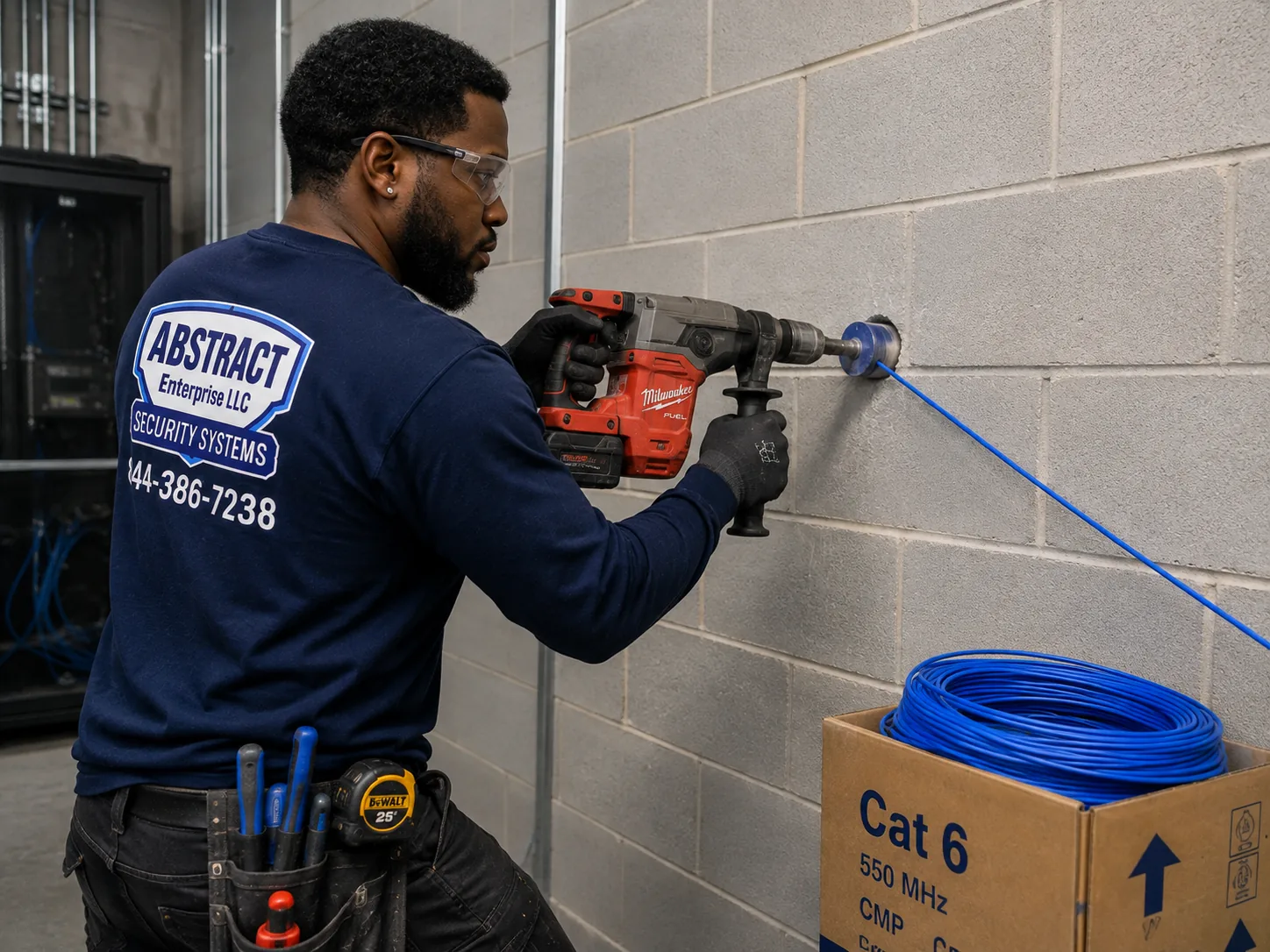
Wearing safety glasses and gloves, a technician drills into a painted concrete-block wall with a red rotary hammer. A blue cable already runs from the hole down to a box on the floor.
Office Market
Reading Westchester's Office Numbers Like a Fiber Contractor
Office reports are written for brokers, but they also show where Westchester's fiber work will be. Here is what the 2026 figures mean for the buildings behind them.
Vacancy is high and uneven. Lincoln Property Company's Q2 2026 report puts countywide vacancy at 24.09 percent. Its West I-287 submarket is at 30.34 percent, while the Southern submarket is at 8.44 percent. High-vacancy submarkets are where owners are re-tenanting, subdividing or converting, so they're where inherited fiber gets surveyed and divided. Low-vacancy areas are where existing tenants expand within buildings that are already well wired.
Tenants are still signing, often for medical and professional space. The same report lists renewals and new leases from tens of thousands of square feet up to almost 87,000, in buildings on Westchester Avenue, North Lexington Avenue, Hamilton Avenue and Manhattanville Road. Colliers reported positive net absorption of 48,861 square feet in the first quarter of 2026 and an availability rate of 20.7 percent, describing a "flight to quality". In fiber terms, quality usually means a building whose backbone is documented and whose carrier room is organised.
The inventory is large and mostly older. RM Friedland tracks about 26.4 million square feet of Class A and B office space in buildings of 50,000 square feet or more in Westchester. Much of it was built when a single company leased a whole building. Every one of those buildings that goes multi-tenant needs its backbone divided, and every one that's converted needs its backbone redesigned.
For an owner, the practical takeaway is to treat the fiber survey as part of preparing a building for market, alongside the roof report and the HVAC assessment. Tenants' IT teams increasingly ask what is in the walls before they commit, and a documented answer helps close the lease.
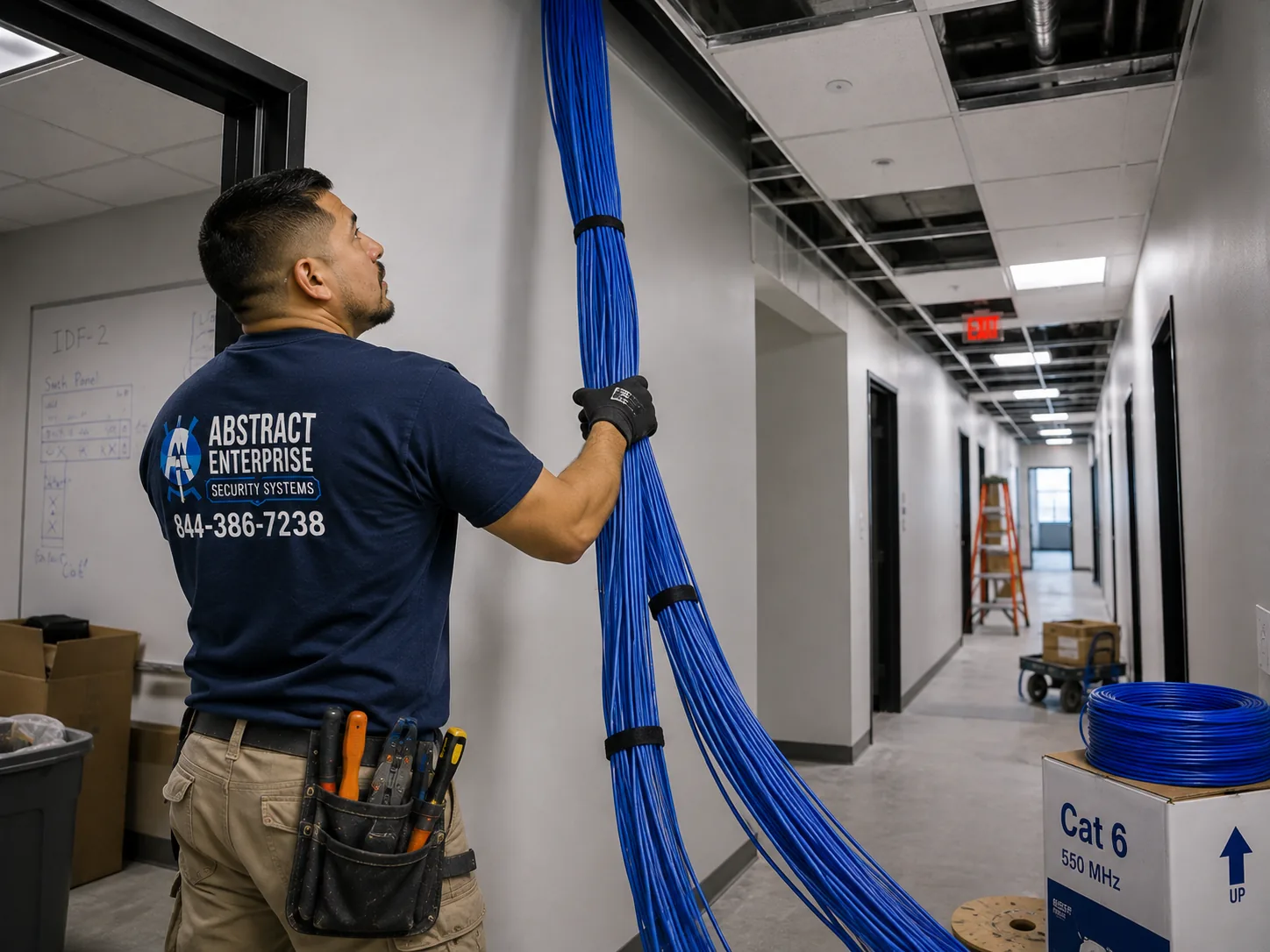
A technician lifts a long, strapped bundle of blue cable toward an open corridor ceiling. A box of cable, a cart and a ladder stand further down the unfinished hallway.
Before You Sign
Six Fiber Records to Request at a Westchester Closing or Lease-Up
Whether you're buying a building, taking over its management or leasing a floor, these are the documents that tell you what fiber is there. Ask for them early. They're far easier to get from an outgoing occupant than to recreate after it has left.
The strand map. Which cables run where, how many strands each has and which strands are in use. If none exists, that's the first thing to fix.
Test results. Loss and OTDR results from the original installation or any later work. Old results are still useful as a baseline to compare against today's.
The carrier list. Which carriers have circuits in the building, where each one hands off and which circuits are still live. Outgoing occupants sometimes forget to cancel theirs.
Campus duct records. For multi-building sites, where the duct runs between buildings and, after any subdivision, whose land it crosses.
Riser and room assignments. Which sleeves, closets and rooms are base-building, which belonged to the old tenant and which are free.
Removal obligations. Whether the outgoing occupant's lease required it to remove its cabling, and whether it did. That affects who pays to clear the risers.
Forward whatever you receive with your quote request. If there's nothing, that's useful to know too. We'll build the records from the survey, and you'll have them for the next transaction.
Tenant IT Checklist
A Walkthrough Checklist for an Incoming Tenant's IT Lead
Brokers show suites. IT leads have to live with what's behind the ceiling tiles. If you are the person responsible for your company's network and you're touring Westchester space, these are the things worth seeing for yourself before the lease is signed.
The carrier entrance room. Ask to see it. Count the carriers present, look for an organised panel or a tangle of old equipment, and check whether the room is in a basement that could flood.
Your path to that room. Ask how your suite would connect to the entrance: through landlord-owned strands, your own cable in an assigned sleeve, or a route nobody has thought about yet. The answer tells you who controls your connectivity.
The closet that would serve your floor. Is it shared with other tenants? Is there a locked enclosure for you? Is there power and room for a small rack?
Leftover cabling. Look above a few ceiling tiles near the closet. Bundles of old cable from the previous occupant mean somebody will have to remove them, and the lease should say who.
Documentation. Ask for the strand map and test results. A landlord who has them has usually maintained the rest of the building too.
Time to connect. Ask how long a carrier circuit has taken to deliver for the building's most recent tenant. In a well-organised building it's a patch; in a disorganised one it's a project.
If you would rather not do this alone, we can join the tour and give you a short written summary afterward, including a rough price for what the fiber would need. The Westchester rate for that kind of work is in the table above, and the survey itself is usually a small line on a large decision.
Complete Services
Every Fiber Optic Installation Service in Westchester County
When a Westchester building changes hands or changes use, the fiber is rarely the only system being re-planned. These are the services most often bundled into the same walkthrough.
Camera coverage for converted and new residential buildings, planned alongside the residential fiber.
Field Notes
Field Notes From Westchester Office Parks
Three habits our crews bring to any Westchester building they did not originally wire. These describe routine, not a specific client.
The first thing our installers look for in a former corporate building isn't the fiber. It's the person who still knows the building: a facilities manager kept on by the new owner, a building engineer, sometimes a security guard who has worked there for years. That person knows which closet the old IT team called "the hub", where the duct to the other building surfaces, and which room flooded when the sump failed. None of it is on paper, and all of it saves hours.
The second habit is to test before trusting a label. Corporate labels describe what a strand did for a company that's gone: "TRADING 3", "DR LINK", "EXEC FLR". We record what the label says, then test what the strand actually is, and only the test result goes on the new map.
The third is to leave the entrance room better organised than we found it, even if the job was only one tenant's link. In a building with several owners, a tidy, labelled entrance room protects every tenant, and it's what the next contractor will thank you for.
FAQ
Westchester County Fiber Optic Installation FAQ
Do you cover northern Westchester towns such as Somers, North Salem and Pound Ridge, or only the southern cities?
+
We cover the whole county, from Yonkers, Mount Vernon and the Sound Shore up through the river towns to Peekskill, and inland to Mount Kisco, Bedford, Yorktown, Somers, Lewisboro, North Salem and Pound Ridge. Northern jobs are usually smaller buildings and links between two buildings, and we schedule them the same way as work in White Plains.
When one tenant expands onto a neighbour's floor, can its strands in the shared backbone be reassigned?
+
Yes, and on a well-labelled backbone it is a short visit. We confirm the strands are free, move the patching in the entrance room and on the floor, retest them, and update the strand map and labels to show the new owner. The landlord should approve the change in writing so the map and the leases still agree.
Can fiber work start while the outgoing corporate tenant is still moving out?
+
Often, yes. The survey of the existing fiber can start as soon as we have access, and it is easier while the outgoing occupant's IT staff are still around to answer questions. Cutting, rerouting and removal wait until the circuits involved have been confirmed dead or moved, and we agree that sequence with both parties in writing.
Can you work in an older Yonkers or Mount Vernon building that has no drawings at all?
+
Yes. Many pre-war commercial buildings in the southern cities have no usable drawings. We trace existing chases, stairwells and old pipe routes on the walkthrough, sketch the route on our own floor plan and hand that sketch over at closeout, so the building has a record from then on.
Can fiber be run through the parking garage under an office or apartment building?
+
Usually, and it is often the most direct route between a building's entrance room and its other wings. Garage ceilings are exposed to vehicles, salt spray and water, so we use armoured cable or conduit, keep the run above the clearance height and away from drains, and seal every penetration back into the occupied floors.
How much notice do you need before a Westchester tenant's move-in date?
+
For a simple carrier extension or a short backbone, two to three weeks from approval is comfortable. Re-tenanting work that starts with a survey of inherited fiber needs longer, because the survey results decide the scope. Carrier circuit delivery runs on the carrier's own timetable, so order the circuit as soon as the lease is signed, even before our work is scheduled.
Can one tenant lease its spare strands to another tenant in the same building?
+
Physically, yes. A strand is just a strand, and we can patch a spare one from one tenant's enclosure to another's. Whether it is allowed is a lease question for the landlord and both tenants. We will make the connection, label it with both parties' names and record it on the strand map once they agree in writing.
Will you meet our broker and a prospective tenant at the building to answer fiber questions?
+
Yes, where our schedule allows. Prospective tenants' IT staff often ask about carriers, riser space and how their suite would connect, and an answer from the installer who surveyed the building carries more weight than a guess. Having the building's strand map ready makes that meeting short.
What happens if we find asbestos-containing material in the ceilings or risers of an older building?
+
We stop work in that area and ask for the owner's survey or abatement plan. Older Westchester office buildings sometimes have materials that must not be disturbed without the right testing and handling, so we route around them or wait for abatement rather than drilling or pulling through them.
Who do we call if a Westchester fiber link fails outside business hours?
+
Call our Westchester line at (914) 877-2578 and say it is a fiber outage. We dispatch the same day where we can. Repairs and callbacks after the initial installation are billed at our service rate of $195 per hour with a three-hour minimum.
Can you remove the old corporate cabling without disturbing the fiber we're keeping?
+
Yes. Before anything is cut we test and tag every cable that is staying, and we remove the rest working back from the far end toward its origin, so a live bundle is never cut by mistake. Where dead and live cables share a tray or sleeve, we separate them by hand rather than pulling the whole bundle.
Do you install fiber for a business run from a house in Westchester?
+
Yes. Typical jobs are a fiber link from where the carrier enters the house to an office above the garage or in a separate wing, or a short run tying a home office to a rack in the basement. We use indoor-rated or armoured cable as the route requires and test every strand, just as we would in an office building.
All Areas Served
Fiber Optic Installation Across the Hudson Valley and New York
Our fiber work covers sixteen New York areas, and Westchester's page sits under the Hudson Valley fiber optic installation hub. Where an area's own page is not published yet, its link opens the quote form; the crews already work there.
A tenant without a network can't wait for a proposal. Ring (914) 877-2578. and tell us which link and which building. Same-day dispatch where the schedule allows; once on site, the usual culprits, a bad patch cord, a dirty connector or a broken pigtail, typically take one to two hours to find and fix, and we retest the repaired strand before handing the room back.
Fiber Optic Installation Westchester County — Surveyed, Divided, Documented
Abstract Enterprises Security Systems · 460 E Fordham Rd, Bronx, NY 10458 · Direct Westchester number (914) 877-2578 · WhatsApp (718) 679-0359 via wa.me
NYS Low-Voltage Licence #12000287431 · 100% Licensed & Insured · Same-Day Estimates · Rated 4.7★ from 201 Google Reviews
Full terms — including 50% deposit, one-year parts-only warranty on AESS-supplied products, and the late-fee schedule — are set out in the service agreement. See our warranty page.
Page reviewed and updated October 17, 2026. Changelog: first publication of the Westchester County fiber optic installation page.