What are you looking for?
About Us Contact Us Careers Get a Free Quote (800) 486-0943
Pick a service
✅ Got Your Own System?
🎬 Home TheatreQuote 🎶 AV SoundQuote 🔑 Access ControlQuote
Now pick your area
Pick your area
Long Island
Hudson Valley
Services available
Pricing & Tools
Pick a service for pricing
🚪 Intercom Pricing 🔔 Buzzer Repair Pricing
Calculators
📹 Camera System Calculator 🚨 Alarm Calculator ⚡ Cabling Quote Builder ✅ Got Your Own System?
Select your area
Home › Fiber Optic Installation NYC › Manhattan
Licensed Low-Voltage Contractor · Greenpoint to Coney Island · Warehouses, Brownstones & New Builds

Fiber Optic
Installation in
Brooklyn

Warehouse & Campus Links · Building Backbones · Indoor/Outdoor Armored Fiber · Fusion Splicing · OTDR Certification

Brooklyn's fiber problems are wide rather than tall. A camera at the far end of a Sunset Park loading dock, a second building across a Red Hook yard, a four-storey brownstone with plaster walls, a new Gowanus rental that wants every provider in its telecom room — each one asks a different question of the glass. We install private, owner-side fiber across the borough from our East Flatbush office, splice and test every strand ourselves, and leave a record your next IT person can actually read.

Reviewed and updated October 16, 2026 · Written by Anwar Timothy, NYS licence #12000287431

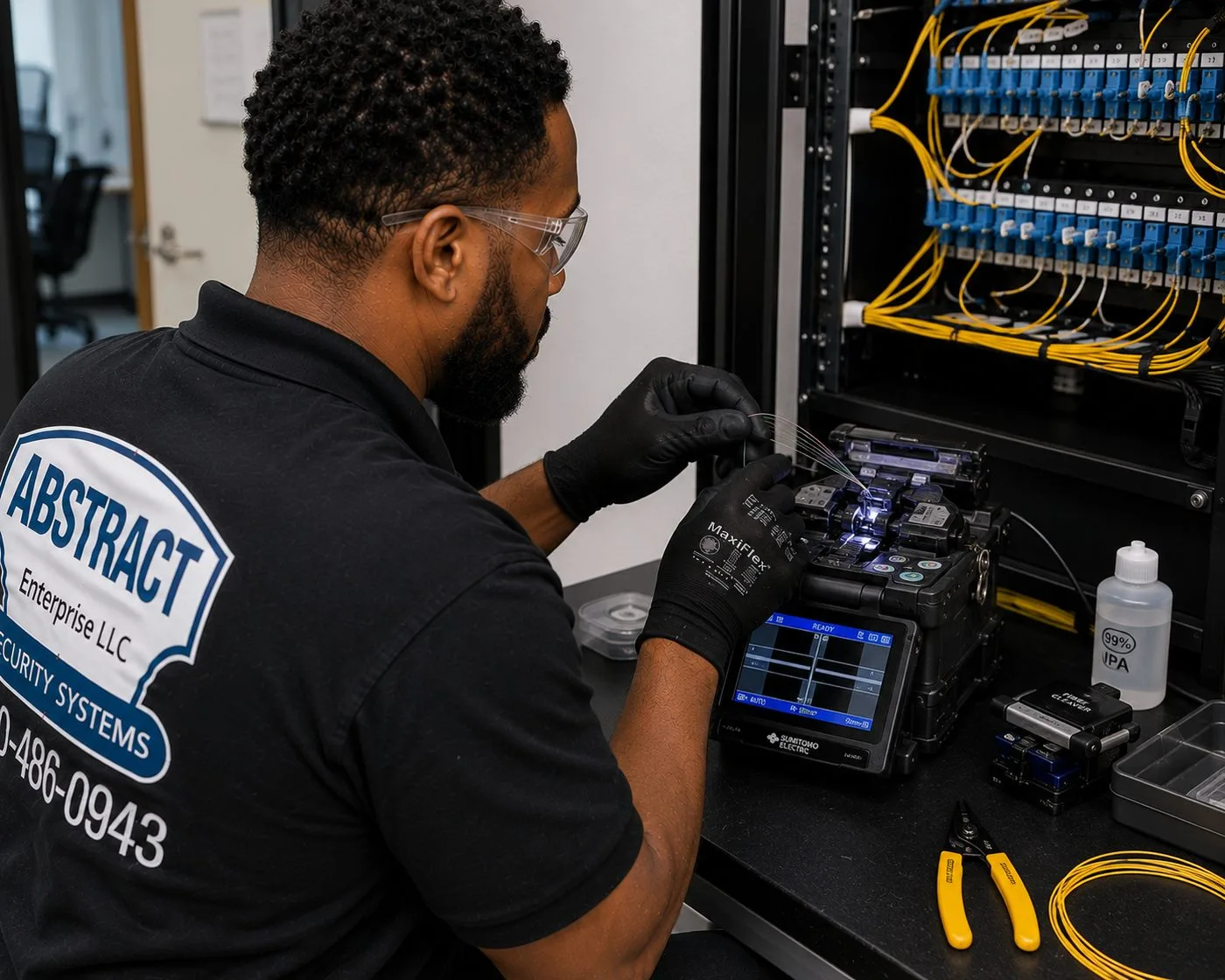
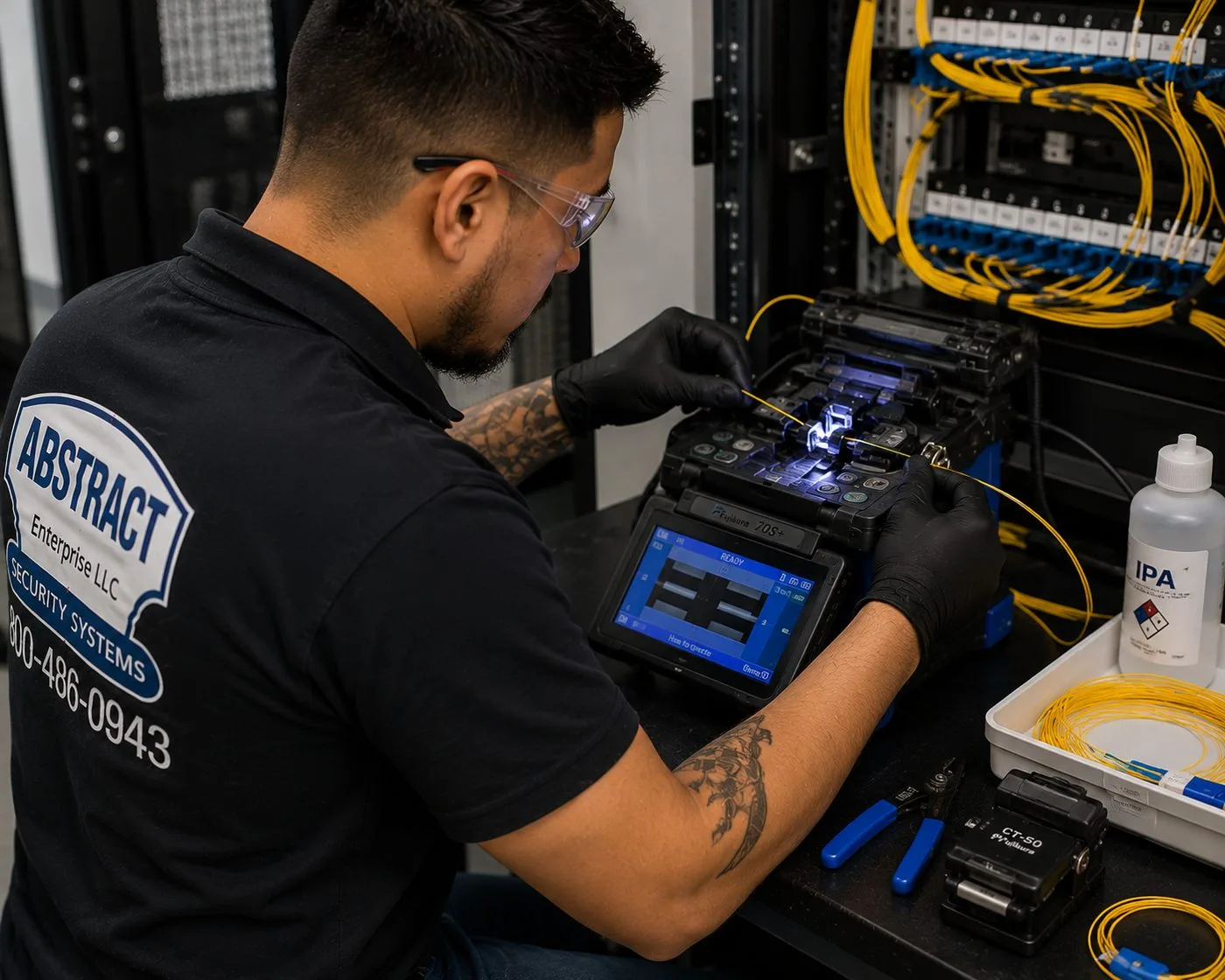
Technician operating a fusion splicer on a bench in front of a rack of yellow fiber jumpers during Brooklyn fiber optic installation
A technician in safety glasses and gloves works a fusion splicer on a bench beside an open rack strung with yellow fiber jumpers, a cleaning bottle and a coil of fiber at hand.
Brooklyn Fiber Quote
What sits at each end of the link — a Brooklyn tech calls back the same business day

✅
Request Sent!
A Brooklyn tech will call you back the same business day.
25+
Years Experience
✓
Same-Day Estimates
100%
Licensed & Insured
4.7★
201 Google Reviews

Know the two points you need joined? That is most of a Brooklyn fiber quote. Ring the Brooklyn line at (347) 934-8335 or fill in the 60-second form, and tell us what sits at each end — a rack, a camera, a second building, a carrier box in the cellar.

  • Free walkthrough, usually within a few business days anywhere in Kings County
  • Every strand spliced, scoped and loss-tested by our own crew, with results in writing
  • NYS licence #12000287431 · Brooklyn office at 1282 Troy Ave, East Flatbush
The Neighborhood

Why Brooklyn Properties Need Fiber Optic Installation

Ask Brooklyn residents how they ended up with the internet service they have and the answer is usually "the building." On the Fios forums a Brooklyn renter puts it plainly: even with fiber on every surrounding block, "the building still has to be setup." Another poster says the streets north, south, east and west of theirs all have Fios while their own does not. Those threads are about consumer service, but they describe the same fact that drives every commercial fiber job in the borough: the carrier's network stops at the property line, and everything on the owner's side — the cellar entry, the riser, the link to the back building — is the owner's problem to solve.

Brooklyn makes that problem unusually varied. This is a borough of nineteenth-century row houses, pre-war elevator apartment buildings, converted factories and waterfront terminals, plus a generation of new towers in Downtown Brooklyn and along the Williamsburg and Greenpoint waterfront. A building in Brooklyn Heights may have plaster walls a century and a half old; a warehouse in East Williamsburg may have a single network closet and a camera 400 feet away on the far wall; a business at the Brooklyn Navy Yard shares a campus with hundreds of other tenants and a landlord who controls every conduit. Fiber is the answer in each case, but the installation looks nothing alike.

Water is the other Brooklyn constant. When Sandy came ashore in October 2012, reporting from Red Hook described basements and cars flooded and water rising from the sewers, and the city's own post-storm report noted that the area of Brooklyn that flooded was more than twice the size of the mapped floodplain. Cellars along the Gowanus Canal, Red Hook, Coney Island and the Greenpoint waterfront are exactly where carriers like to land their service. Planning where fiber enters, where it is spliced and where the electronics live is a flood decision as much as a network one.

The good news is that Brooklyn already has more choice than most places. Independent providers now advertise service from Red Hook to the Navy Yard alongside the national carriers, and large campuses such as Industry City run their own meet-me rooms. What tenants and owners usually lack is not a provider but a path: a tested, documented piece of glass from wherever the provider arrives to wherever the network actually needs to be. That path is what we build. Most clients pair it with copper drops and cameras on the same visit, which is why the Brooklyn structured cabling team often walks the building with us.

Brooklyn by the numbers

  • 550+ businesses and 13,000+ jobs on the Brooklyn Navy Yard's 300-plus waterfront acres, according to the Yard's FY25 impact report — one landlord, hundreds of tenants, one shared conduit system.
  • 4 million square feet at the Brooklyn Army Terminal in Sunset Park, where floorplates run up to 200,000 square feet and suites start at 1,500 (NYCEDC and BAT leasing).
  • 32 million square feet of new development across 144 projects in Downtown Brooklyn since the 2004 rezoning, including 2.8 million square feet of new office space and more than 22,000 homes (Downtown Brooklyn Partnership, February 2026).
  • 42% of households in Borough Park–Kensington (Community District 12) had no broadband subscription in the City Council's analysis — the second-highest share in the city.
  • November 23, 2021: the City Council adopted the Gowanus Neighborhood Plan, which set off a wave of new residential construction around the canal.
  • 1965: Brooklyn Heights became New York City's first historic district, and its brownstone and brick row houses still set the rules for how cable may touch a facade.
Technician feeding cable into an EMT conduit sweep on a block wall beside a network rack in a Brooklyn building
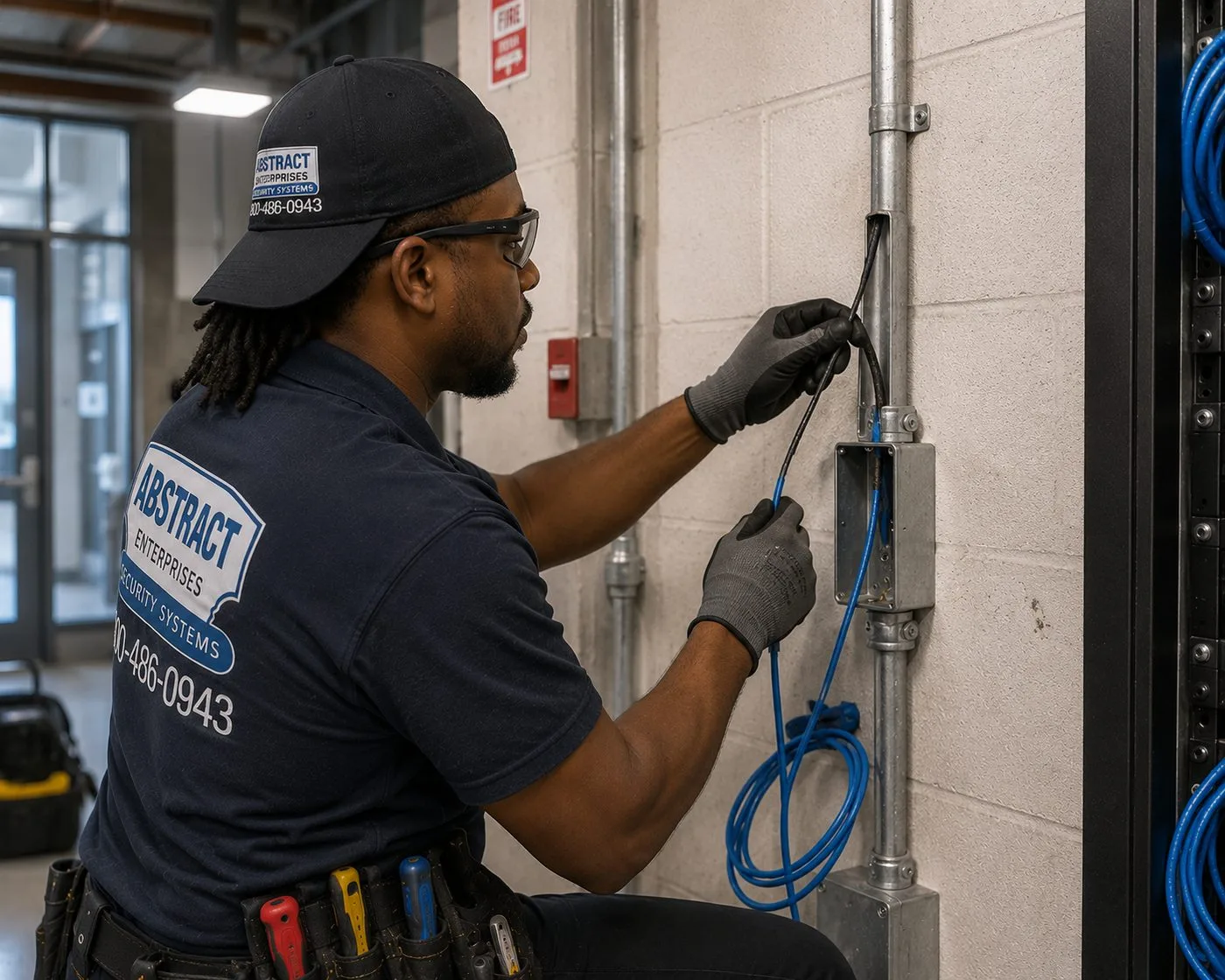
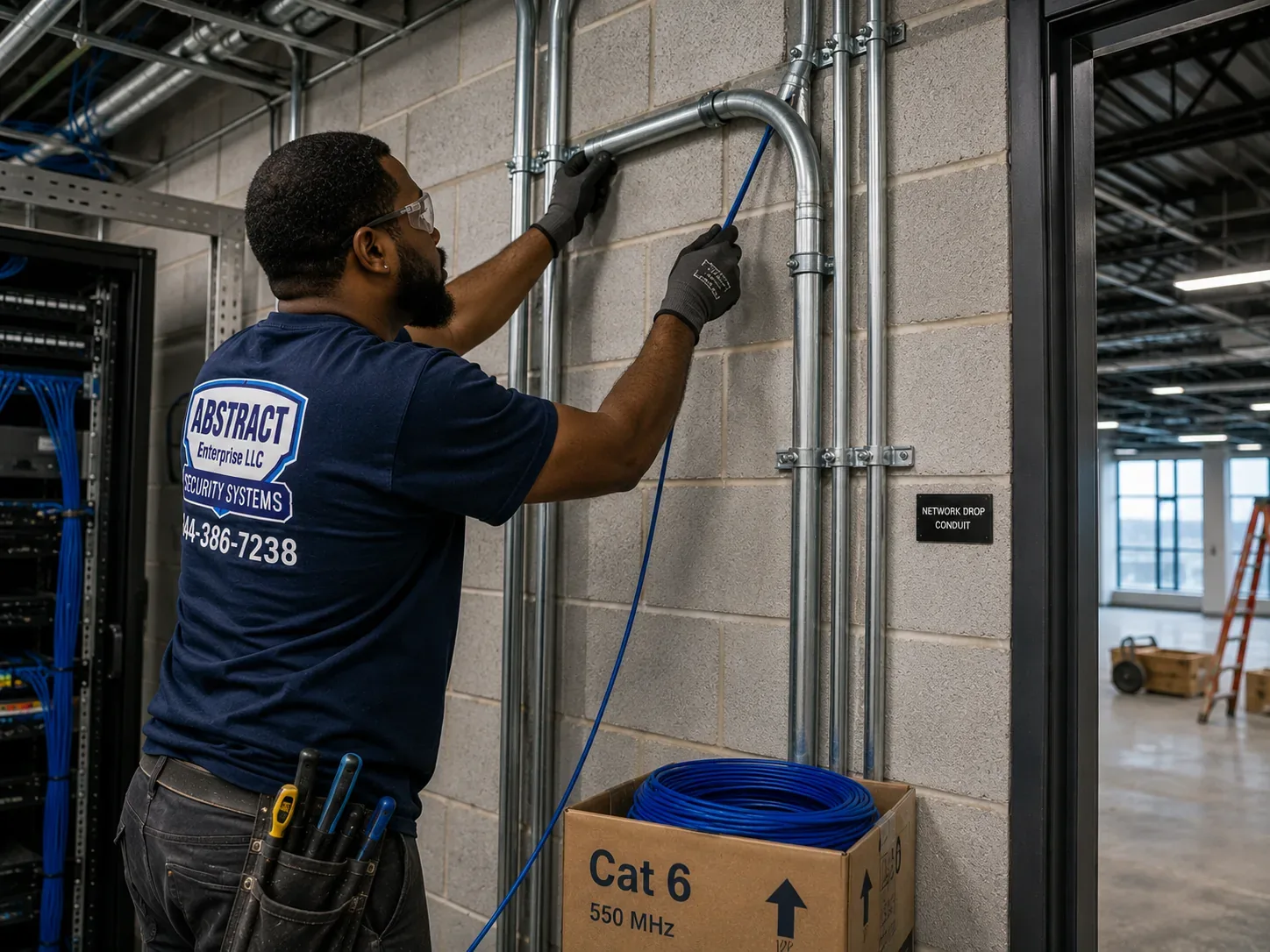
Gloved hands guide a blue cable into a bend of EMT conduit fixed to a painted block wall, with an open rack to the left and a cable box on the floor — the protected pathway a fiber or copper run follows out of a closet.
Repair Capture

Need a Fiber Repair in Brooklyn?

A forklift caught the cable at the dock door, a renovation crew cut through a run in the ceiling, or a link simply went dark after someone tidied the rack. Those are repairs, and they are handled separately from new installation. We dispatch the same day where we can, and most single faults — a crushed patch cord, a broken pigtail inside an enclosure, a dirty connector mated in a hurry — are found and fixed in one to two hours once a technician is on site. Call (347) 934-8335 and say "fiber repair," or read about our Brooklyn network cable repair service for copper faults.

What We Install

Fiber Optic Installation Services in Brooklyn

All of this is owner-side work. The provider brings service to its handoff; we carry it the rest of the way and prove each strand with a meter before we call it finished.

Long-Run Warehouse Links

When a camera, access point or remote rack sits beyond copper's reach on a deep warehouse floor in Sunset Park, Bushwick or East New York, a small fiber cable and a pair of media converters or switch optics close the gap without a second closet.

Building-to-Building Fiber

Armored indoor/outdoor cable between a front building and a rear one, a shop and its storage, or two structures on the same lot — in conduit, on a messenger wire or along an existing wall, depending on what the property allows.

Campus Tenant Connections

For businesses inside the Navy Yard, Industry City, the Army Terminal and other multi-building campuses: a link from the landlord's or provider's handoff to your suite, built inside the campus's own pathway rules.

Small-Building Backbones

Three- to six-storey walk-ups and mixed-use buildings: a single riser cable from the cellar to small enclosures on each floor, so any provider an owner approves can reach any apartment or office without a new hole.

New-Build Telecom Rooms

For new rental and condo buildings in Gowanus, Williamsburg, Downtown Brooklyn and beyond: a main room with space for several providers, a backbone to every floor, and test results ready before the certificate of occupancy push.

Yard and Lot Camera Feeds

Fiber to cameras on poles and fences across truck yards, parking lots and storage yards, where long copper runs outdoors pick up surges and ground differences that glass simply ignores.

Fusion Splicing and Termination

Pigtail splicing into wall-mount and rack enclosures, mid-span repairs after a cut, and finishing cable that was pulled during construction and never terminated.

Flood Recovery and Relocation

Replacing connectors and enclosures that sat in water, moving splice points and electronics up and out of cellars, and re-testing every strand afterwards.

Testing and Documentation

Light-source and power-meter loss results on every strand, OTDR traces on long and outdoor runs, connector end-face inspection, labels at both ends and a simple map.

Technician seating fiber in a fusion splicer next to a patch panel of yellow fiber cords for a Brooklyn fiber installation
A technician in a black polo and gloves loads fiber into a fusion splicer, with a rack panel of yellow fiber cords and blue copper patching behind him.
Building Specialists

Fiber Optic Installation for Brooklyn's Architecture

Brooklyn's building stock is the widest in the city. These are the six types we meet most often, and what each one means for a fiber route.

Brownstone and Brick Row Houses

Park Slope, Fort Greene, Bed-Stuy, Brooklyn Heights, Carroll Gardens, Crown Heights. Three to five storeys, a cellar or English basement, plaster on lath or brick, and often a single dumbwaiter shaft, chimney chase or closet stack that lines up floor to floor. Fiber is thin enough to follow those stacks without opening finished walls.

Pre-War Elevator Apartment Buildings

Ocean Parkway, Eastern Parkway, Flatbush, Bay Ridge and Prospect Lefferts Gardens. Six storeys of masonry around an elevator and a courtyard, with a super who knows which shaft has room. A single riser cable and small floor enclosures turn the whole building into one tidy distribution system.

Converted Industrial Lofts

DUMBO, Williamsburg, Greenpoint, Bushwick, Gowanus. Heavy timber or concrete frames, high open ceilings, exposed sprinkler mains and tenants who change every few years. Fiber runs exposed on strut or in raceway, so cable rating and neatness matter as much as reach.

Waterfront Terminals and Campuses

The Navy Yard, Industry City, Brooklyn Army Terminal, Red Hook's piers. Huge floorplates, many buildings, one landlord. Distances routinely exceed what copper can carry, and the landlord decides which conduit and which handoff you may use.

Downtown and Waterfront Towers

Flatbush Avenue, Willoughby Square, the Williamsburg and Greenpoint waterfront. Modern risers, dedicated telecom rooms and management that expects plenum and riser ratings, firestop documentation and certificates of insurance before anyone arrives.

Low-Rise Commercial and Mixed-Use

Fifth Avenue in Sunset Park, Flatbush Avenue, Kings Highway, Pitkin Avenue, Avenue U. Two or three storeys with a shop below and offices or apartments above, where the carrier lands in a shared cellar and every tenant needs a short, protected path up.

How the method changes with the building

Row houses. We look for a vertical path that already exists — an abandoned dumbwaiter, a closet stack, the gap beside a soil pipe — and use a small-diameter riser-rated cable that can make the turns without exceeding its bend radius. Where nothing lines up, a surface raceway painted to match the trim inside a closet is usually less disruptive than opening plaster. In a landmarked historic district we keep every route inside; exterior conduit on a protected facade needs Landmarks Preservation Commission review, and an interior route avoids that entirely.

Lofts and campuses. Open ceilings mean the cable is on display. We run it on strut or in a dedicated innerduct, keep it clear of sprinkler branch lines and hangers, and use armored cable wherever it passes a loading area or crosses a freight path. Long horizontal pulls are planned with pull points so tension stays inside the manufacturer's limit rather than relying on brute force from one end.

Towers and new builds. These are run to the building's book: riser-rated cable in shafts, plenum where the ceiling is an air return, every slab penetration firestopped with a listed system and photographed. The difference in Brooklyn is timing — on a new building we are often installing while other trades are still finishing, so enclosures are protected and labelled from the first day.

Mixed-use buildings. The shared cellar is the critical space. We give each tenant's fiber its own labelled sleeve or innerduct from the carrier's handoff, so a future plumber or another tenant's contractor can tell at a glance what not to move. Owners who are wiring the whole building usually add a Brooklyn low-voltage scope for intercom and cameras at the same time.

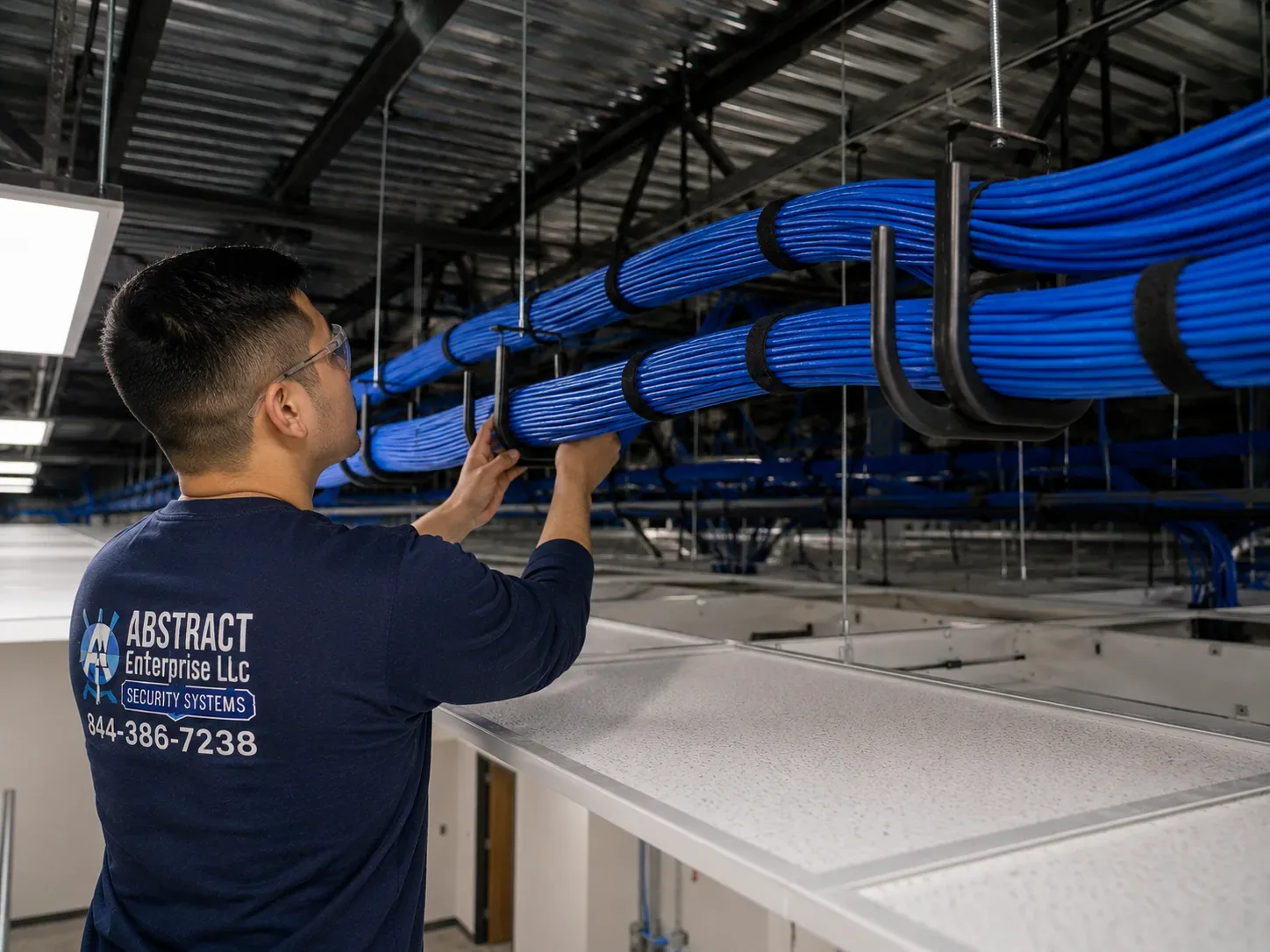
Technician dressing cable bundles onto J-hooks in an open ceiling for a Brooklyn cabling and fiber pathway
Thick bundles of blue cable hang in rows of J-hooks above an open grid ceiling while a technician sets the next bundle by hand — the kind of supported pathway fiber shares in lofts and offices.
Commercial Fiber Optic Installation

Business Fiber Optic Installation in Brooklyn

Brooklyn's commercial fiber work clusters in six places. Each has its own landlord culture, its own building type and its own reason for needing glass.

Brooklyn Navy Yard

More than 550 businesses on a 300-acre campus between Williamsburg and DUMBO: manufacturers, film and television production, design studios, and offices in newer buildings such as Dock 72 and Building 77. Tenant fiber here is about working inside the Yard's own pathways and handoff points, and about reaching shop floors that are far wider than a copper run.

Sunset Park Waterfront

Industry City's interconnected buildings and the Brooklyn Army Terminal's 4 million square feet hold makers, food producers, warehouses and offices. Industry City has its own meet-me room operated by DataVerge, and an independent provider advertises dozens of served addresses on the campus — so provider choice is good, and the work is the run from the handoff to your unit.

Downtown Brooklyn and MetroTech

The 2004 rezoning brought 2.8 million square feet of new office space across 19 properties, from 1 Willoughby Square to the office floors above Macy's on Fulton Street, alongside NYU Tandon and City Tech. Tower rules apply: riser requests, firestop records and after-hours windows.

DUMBO

Converted warehouses such as Empire Stores and the former Jehovah's Witnesses complex now known as Dumbo Heights house tech, media and design tenants who rewire with every lease. Exposed ceilings, heavy masonry and short tenancies reward fiber that is labelled and easy to re-terminate.

Williamsburg, Greenpoint and East Williamsburg

The 2005 waterfront rezoning turned former industrial blocks into towers and lofts, while the industrial business zone east of the BQE still holds warehouses, breweries and production spaces. Expect long single-storey floors on one block and twenty-storey residential risers on the next.

Neighbourhood Retail Corridors

Fifth Avenue in Sunset Park and Bay Ridge, Flatbush and Church Avenues, Kings Highway, Pitkin Avenue, Knickerbocker Avenue. Small chains, medical offices and banks in two- and three-storey buildings, where the job is often a single protected link from a shared cellar to an upstairs office or back room.

Compliance callouts for Brooklyn fiber

  • Cable rating follows the space. Riser-rated (OFNR) cable in vertical shafts, plenum-rated (OFNP) wherever the ceiling cavity is an air return, and outdoor or indoor/outdoor-rated cable for any section that leaves the building envelope.
  • Firestopping is not optional. Every new or reused penetration through a rated floor or wall is sealed with a listed firestop system and photographed. Unsealed penetrations are one of the most common items building inspectors and insurers flag.
  • DOB permits. Low-voltage cabling under 50 volts generally does not need a Department of Buildings work permit, but that never removes the landlord's alteration rules, the firestop requirement or campus approvals.
  • Street crossings are a different job. Fiber that has to leave the lot and cross a city street needs street-opening permits or an existing franchise conduit; we tell you at the walkthrough if a route would trigger that, and offer the in-building or private-lot alternatives.
  • Landmarks. In Brooklyn Heights, Park Slope, Fort Greene and the borough's other historic districts, anything fixed to the exterior of a protected building is Landmarks Preservation Commission territory. We design routes to stay inside wherever possible.
  • Accessibility. Enclosures and raceway in corridors and common areas are mounted so they do not reduce clear widths or create protruding objects along an accessible route.
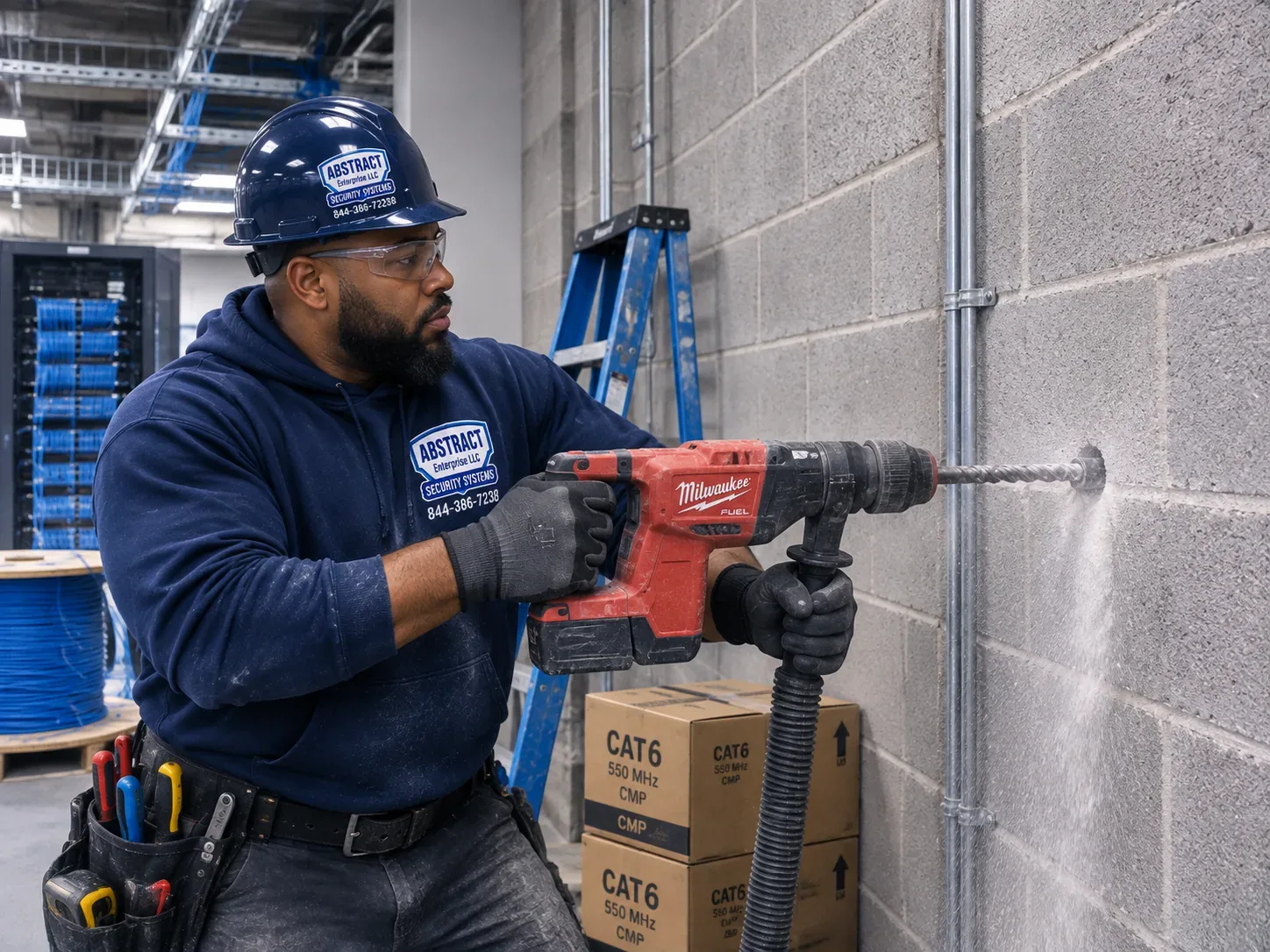
Technician in a hard hat drilling a concrete block wall with a hammer drill for a Brooklyn cable penetration
Wearing a hard hat, safety glasses and gloves, a technician drives a large hammer drill into a concrete block wall, with stacked cable boxes and a ladder behind him.
Campus Work

Working Inside Brooklyn's Industrial Campuses

A large share of Brooklyn's business fiber is installed on someone else's campus. The Navy Yard, Industry City, the Army Terminal and the smaller multi-building complexes around Gowanus and East Williamsburg all have the same basic arrangement: the landlord owns the buildings, the yards and the conduit between them; one or more providers have already brought service to a handoff point; and each tenant pays for whatever is needed between that handoff and their own space.

That arrangement changes the order of work. Before we price anything, we find out three things from the campus facilities team. First, where the provider's handoff physically is — a meet-me room, a building telecom room or a cabinet on the tenant's floor. Second, which conduit or cable tray between buildings tenants are allowed to use, and whether innerduct space has to be reserved. Third, the campus's own contractor rules: insurance requirements, escorts, permitted hours, loading-dock access and whether any core drilling needs separate approval.

With those answers the job is usually straightforward. Inside the tenant's building we run fiber on the campus's preferred pathway, terminate in a small enclosure in the suite and, if the handoff is in a different building, follow the approved inter-building conduit in armored cable. What slows campus jobs is not the cable but waiting for approvals that could have been requested on day one. We draft the submission for the facilities team at the same time as your proposal, so the two arrive together.

One more Brooklyn-specific point. Several campuses have more than one provider on site, and at least one independent provider advertises dedicated service that runs on its own network rather than the incumbent conduit other carriers share. If continuity matters to your operation, ask both providers where their cable enters the campus. Two providers using the same entry are not truly diverse; your owner-side fiber can be planned to keep the two paths apart all the way to your rack.

Industries

Fiber for Brooklyn's Makers, Studios and Food Producers

Brooklyn's economy is unusually physical. Much of the borough's commercial square footage is used to make, store, cook, film or ship something, and those businesses use networks differently from a Midtown office. These are the operations we wire most often and what fiber does for each.

Manufacturers and fabricators. The Navy Yard alone reports more than 550 businesses, many of them in advanced manufacturing. Their networks connect machine controllers, production terminals and cameras spread across large shop floors, often far from the office where the internet arrives. A fiber spine along the shop, with small switches in sealed enclosures near each cell, keeps every machine on the network without a dozen long copper runs crossing the floor.

Film, television and photo studios. Stages at the Navy Yard and in Greenpoint, Sunset Park and Bushwick move enormous media files between stages, edit suites and storage. Fiber between those rooms carries far more than copper and is not affected by the lighting and power gear that fills a working stage. Studios that rent space by the production value cable that can be re-patched quickly between shoots.

Food production and commercial kitchens. Brooklyn has a long list of bakeries, breweries, roasters and shared kitchens in industrial buildings. They need networks for ordering, label printing, temperature monitoring and cameras, in rooms that are wet, hot and washed down. Fiber with sealed enclosures outside the wash-down zone, and short copper runs inside it, survives that environment far better than patch panels mounted on a damp wall.

Warehouses and last-mile logistics. Sunset Park, Red Hook and East New York host distribution floors where scanners, wireless access points and dock cameras reach hundreds of feet from the office. A small fiber backbone to two or three points on the floor keeps every device within copper's limit and leaves spare strands for the next racking change.

Schools, clinics and houses of worship. Many Brooklyn institutions occupy a cluster of buildings — a main building, an annex, a rectory or a gym across the yard. Fiber between them lets one network, one phone system and one camera recorder serve the whole site.

Your Questions Answered

Fiber Optic Installation in Brooklyn: Questions Answered

These are the questions Brooklyn owners, tenants and facility managers put to us on walkthroughs, grouped by the kind of property behind them. Each answer comes straight after the question. Shorter questions about coverage, scheduling and small jobs are collected in the FAQ further down.

Brownstones, walk-ups and rented lofts

Can fiber reach the upper floors of a brownstone without opening the plaster walls?

Usually, yes. Most Brooklyn row houses already have a vertical void that runs most of the way up: an abandoned dumbwaiter shaft, a stack of closets, a disused chimney flue or the chase that carries the soil pipe. Fiber cable can be as small as a few millimetres across and is light enough to drop down those voids on a pull line, so the only openings are a small hole at the top and bottom of each run, normally inside a closet or cabinet. Plaster on wood lath is fragile, and we avoid fishing horizontally through it wherever there is another way.

Where no void lines up, the honest alternative is a slim surface raceway inside a closet or along a baseboard, painted to match. It is less elegant than a hidden run but far kinder to a nineteenth-century wall than cutting and patching. We show you both options on the walkthrough and price each one.

Can one fiber feed serve every apartment in a small Brooklyn walk-up we own?

Yes, and for a small landlord it is often the most useful upgrade a building can get. The usual design is a single multi-strand cable from the cellar, where providers arrive, up the building to a small enclosure on each floor or every other floor. From each enclosure, short runs reach the apartments. Any provider the owner approves can then use spare strands or the floor enclosures to connect a tenant, without drilling a new path through the building every time someone switches service.

What it does not do is make the owner an internet provider. The backbone is passive wiring; each tenant still buys service from a provider. The benefit is that the building is ready for whichever provider the tenant chooses, and the hallways stop collecting a new cable every time someone moves in.

What if our landlord won't allow new holes in a rented Brooklyn loft?

That is common in converted lofts, especially in buildings with exposed brick or timber the owner wants preserved. The first step is to look for penetrations that already exist: old conduit, abandoned pipe sleeves, the gap around a decommissioned riser, or the path the building's own cabling already uses. Fiber is small enough to share many of those openings, subject to the landlord's agreement and proper firestopping when we are done.

If there is no existing path, we draw up the smallest possible new opening, show exactly where it would go and how it would be sealed, and put that in writing for the landlord. A single core in a closet, documented and firestopped, is often approved where a vague request for "some holes" is refused. And where the answer is still no, a short wireless bridge or a route through a shared corridor can sometimes do the job instead.

Warehouses, yards and campuses

How far can a camera or access point sit from the network rack in a Brooklyn warehouse before fiber is needed?

The working limit for an Ethernet channel over copper is 100 metres, about 328 feet, and that includes the patch cords at both ends. In practice we plan to stay comfortably under it, because a cable that wanders around columns, up to the roof deck and back down again uses up length quickly. On a single-storey floor in Sunset Park or East New York, a camera on the far wall or an access point over the back racking can easily sit beyond that distance from the only network closet.

Beyond the copper limit, there are two options: build a second closet with power and a switch nearer the far end, or run fiber from the main rack to a small powered switch or media converter close to the devices. For a handful of devices the second option is almost always cheaper, and it leaves spare strands for whatever the far end of the building needs next.

How do you run fiber across an industrial campus where the landlord controls the conduit?

By asking first and pulling second. On campuses such as the Navy Yard, Industry City and the Army Terminal, the landlord decides which inter-building conduits and trays tenants may use, where innerduct can be added and where any new cable must be armored. We request that information from the facilities team before quoting, then design the route inside those rules: armored cable or innerduct in the approved conduit, splice enclosures only where the campus allows them, and labels that show your company's name and the cable's two ends.

If the only available conduit is full, the facilities team will usually know of an alternative path, or may plan new conduit for several tenants at once. Either way, the approval submission travels with your proposal so nobody is waiting on the other.

Can fiber enclosures live in an unheated warehouse or open loading dock?

The glass itself does not mind cold, damp or dust; the weak points are the connectors and the electronics. In unconditioned spaces we use sealed enclosures with gasketed doors and cable glands, keep the connector panel inside them, and mount everything above splash height and away from dock doors. Indoor/outdoor-rated cable is used for any section exposed to temperature swings or moisture.

The switches and media converters at the far end are a separate question. Many standard switches are rated only for heated rooms, so in a cold dock or mezzanine we specify industrial-temperature models in a ventilated enclosure, or bring the fiber back to a conditioned room and use copper only for the last short stretch.

Can a fiber link carry security cameras across a truck yard or parking lot?

Yes, and outdoors it is often the better choice even when the distance is short enough for copper. Long copper runs between a building and a pole on the far side of a yard connect two points that can sit at different electrical ground levels and pick up surges during storms. Glass carries no electricity, so it breaks that connection. A fiber run in conduit to a pole-mounted enclosure, with a small switch and local power for the cameras, keeps the building's network isolated from whatever happens out in the yard.

The cameras, recorder and power at the pole are part of the same design, and on most yard jobs our Brooklyn commercial camera team specifies them while we lay out the fiber.

Flood-prone cellars and the waterfront

Does fiber survive being underwater, and what has to be replaced after a flood?

The cable often does. Glass does not corrode, and properly rated cable with its jacket intact can come through a flood still working, which is one reason carriers replaced flood-damaged copper with fiber after Sandy. What usually fails is everything around it: connectors that took in silt and salt, splice enclosures that filled with water, patch panels, and the switches and power supplies they feed.

After a flood we clean and inspect every connector under a scope, replace any that will not clean up, open and dry or replace splice enclosures, and re-test every strand end to end so you have numbers rather than hope. That is also the moment to move splice points and electronics higher, so the next storm surge in Red Hook, Gowanus or Coney Island finds nothing in the cellar but cable in sealed conduit.

New buildings and multifamily owners

What does a new Brooklyn apartment building need in its telecom room so several providers can serve residents?

Space, a clean path in from the street and a backbone that does not belong to any one provider. In practice that means a main telecom room above the flood line with wall space for more than one provider's equipment, separate entry sleeves so a second or third provider can arrive without disturbing the first, and an owner-installed fiber backbone from that room to an enclosure on each floor. City housing guidance requires broadband in units of new construction and points out that new fiber service needs an accessible basement entry point, and federal rules bar exclusive access deals between owners and providers, so planning for several providers is both practical and expected.

Owners who build that way can negotiate with providers from a stronger position, because nobody has to build their own riser first. We install and certify the backbone, label it by floor and strand, and give the building a record the providers' engineers can work from.

Will a building-wide fiber backbone lower what our tenants pay for internet?

Not directly, and we would rather say so up front. Tenants' monthly bills are set by providers and plans, not by the building's wiring. What a backbone changes is choice and speed of connection: when the path from the cellar to each floor already exists, more providers can offer service in the building and a new tenant can be connected in days instead of waiting for construction. That competition and convenience is where any price benefit comes from.

For owners, the clearer benefit is control. A building-owned backbone means providers plug into your infrastructure on your terms, and old provider cable can be removed rather than left to pile up in the hallways.

Choosing the right link

Is a wireless point-to-point link a better choice than fiber between two buildings?

Sometimes. When two buildings sit on opposite sides of a public street, getting fiber across means a street-opening permit or space in an existing franchise conduit, and that can take far longer and cost far more than the cable. A licensed or unlicensed radio link with clear line of sight between rooftops or upper windows can be installed quickly and carries plenty of capacity for most small businesses.

Where both buildings are on the same lot, connected by a yard, an alley you control or a shared basement, fiber wins: it is not affected by weather, foliage, new construction blocking the line of sight or interference, and it lasts for decades. Many Brooklyn clients use both — fiber where they control the ground, radio across the street — and we will tell you which side of that line your site falls on.

Can fiber carry production video and audio between stages, not just office data?

Yes. Brooklyn's film and television stages, recording rooms and event spaces increasingly move camera, audio and control signals over IP networks, and fiber links between control rooms, stages and machine rooms give those signals the bandwidth and distance they need. The same cable also carries ordinary network traffic, so one installation can serve production and office alike.

What changes is the equipment at the ends. Broadcast and audio transport often uses specific optics, converters or tactical cable assemblies chosen by the production's engineer. We install and certify the permanent fiber and terminate it in the connector type they specify, and we coordinate with their vendor so the hardware matches the glass.
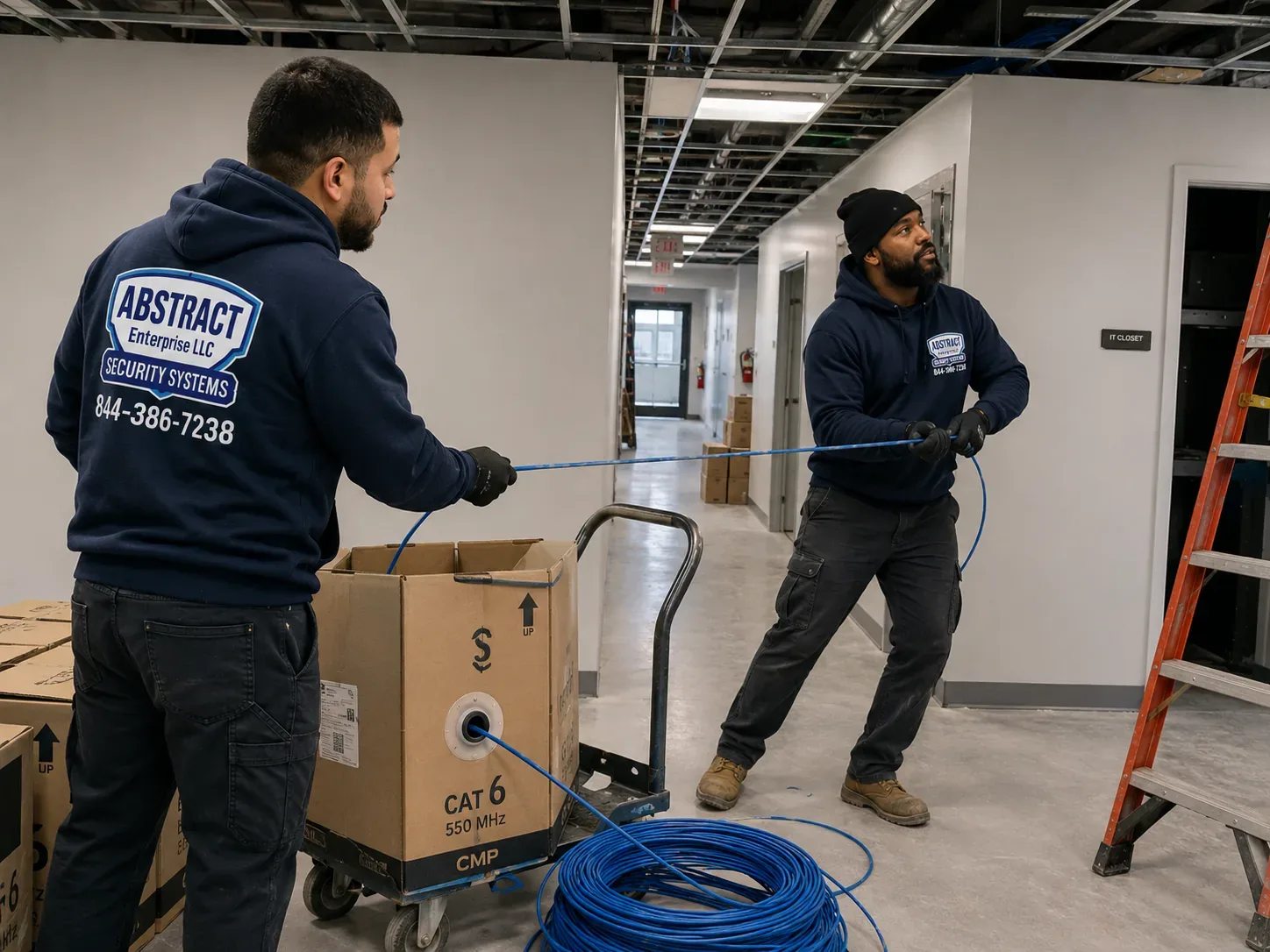
Two technicians pulling blue cable from a boxed reel down a corridor during a Brooklyn cabling fit-out
One technician feeds cable from a boxed reel on a hand truck while a second walks the line down an unfinished corridor, a ladder standing by the wall.
Equipment

Types of Fiber Optic Cabling We Install

Brooklyn work leans toward tough cable: more outdoor and armored runs, more unheated spaces and more long single-floor pulls than a typical office tower. This is the kit we specify most, and where each piece earns its place.

OS2 Single-Mode Fiber

The default for anything long or between buildings: yard links, campus connections and building backbones. Distance is effectively unlimited for a property, and the same strands will carry faster optics years from now.

OM4 Multimode Fiber

Sensible for short runs inside one building, such as a second rack across a loft floor, where lower-cost multimode optics already sit in the client's switches.

Armored Indoor/Outdoor Cable

Interlocking or corrugated armor over a cable rated for both environments. Our usual choice through warehouse floors, loading areas, shared cellars and any section that ducks outside between buildings.

Riser and Plenum Rated Cable

OFNR for vertical shafts in walk-ups and towers; OFNP where a ceiling cavity is used as an air return. A higher rating may always replace a lower one, never the other way round.

Wall-Mount and Sealed Enclosures

Small lockable boxes for floor-by-floor distribution in walk-ups, and gasketed enclosures with cable glands for docks, mezzanines and poles.

Rack Panels and Splice Trays

1U and 2U panels with LC adapters for the main rack, fed by factory pigtails fusion-spliced into trays, so every strand ends in a clean, replaceable connector.

Innerduct and Conduit

Orange or colored innerduct inside shared conduit on campuses, and EMT or rigid conduit where cable needs mechanical protection along a wall or out to a pole.

Media Converters and SFP Optics

The electronics that turn light back into Ethernet at the far end of a warehouse or yard, matched to the fiber type and to the switch, including industrial-temperature versions for cold spaces.

Test Equipment

Fusion splicer and cleaver, connector inspection scope, light source and power meter for every strand, and an OTDR for long, outdoor and campus runs.

Building backbone, campus link or yard run: choosing the cable

JobTypical cableWhy
Walk-up or mixed-use building, cellar to floorsSmall riser-rated single-mode, 12 strandsFits existing voids; spare strands for future providers and tenants
Second rack across a loft or office floorOM4 multimode or OS2, plenum where requiredShort distance; match the optics already in the switches
Far end of a warehouse floorArmored indoor/outdoor single-modeSurvives forklifts, racking changes and dust
Between two buildings on one lotArmored indoor/outdoor single-mode in conduitWeather, burial or wall mounting, no electrical connection between buildings
Campus handoff to tenant suiteWhatever the campus specifies, usually armored single-mode in innerductLandlord's pathway rules come first
Yard or lot camerasOutdoor single-mode to sealed pole enclosureIsolation from surges and ground differences
Technician testing a cable with a handheld tester and toner at a crowded patch panel in a Brooklyn network room
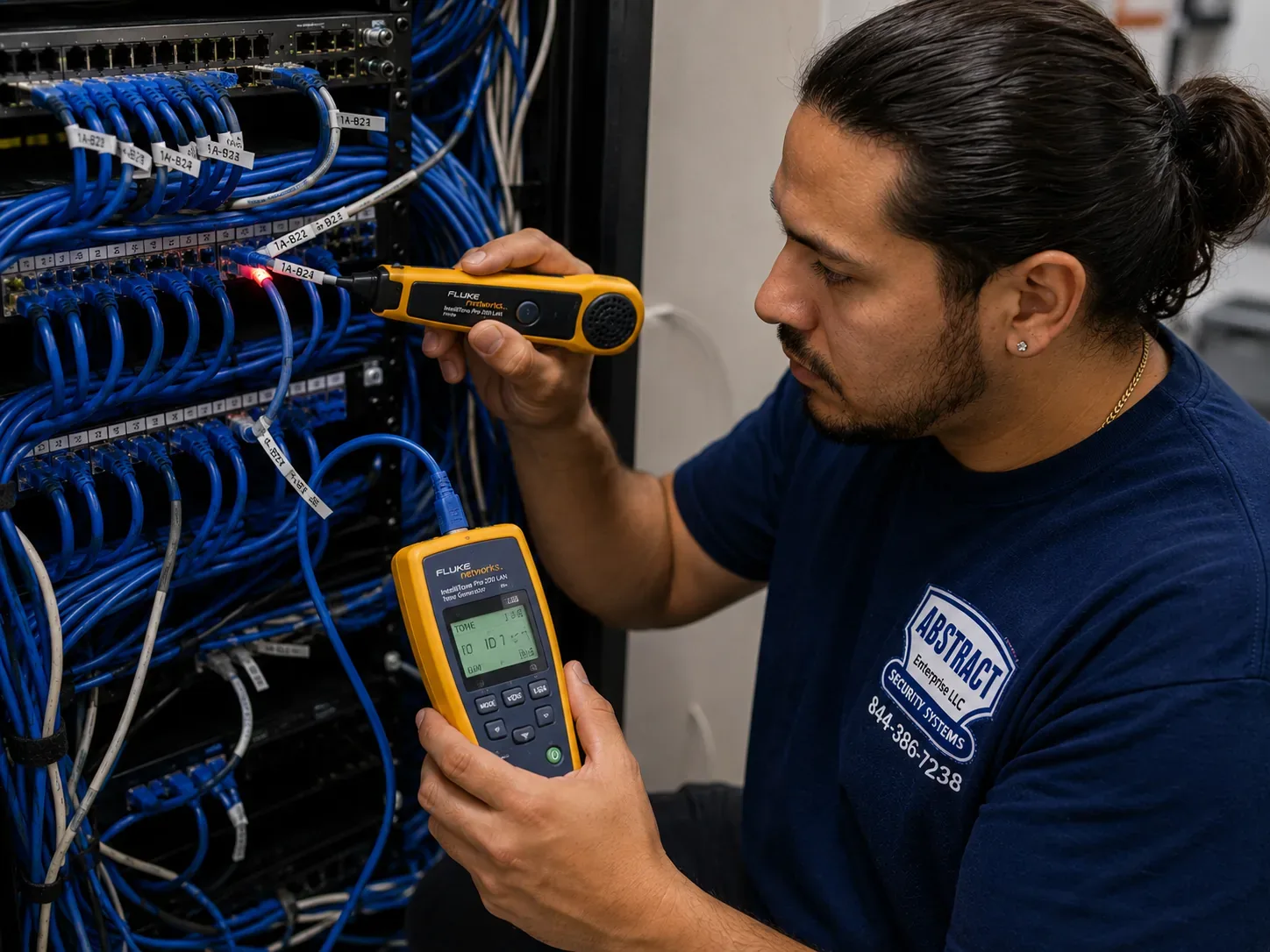
A technician holds a handheld tester in one hand and a tone probe in the other at a patch panel packed with blue cables — identifying what is live before anything new is connected.
AI Overview Reality Check

What AI Gets Wrong About Fiber Optic Installation in Brooklyn

AI answers and the contractor guides they summarise are written mostly with Manhattan offices in mind. Several of their claims are true as far as they go and still mislead a Brooklyn owner with a warehouse, a back building or a brownstone. Here are seven, quoted as published, with what the field actually looks like on this side of the river.

"Copper stops working reliably beyond about 100 meters"

A Midtown cabling firm's fiber guide, published in October 2026, says copper "stops working reliably beyond about 100 meters, so far-apart rooms or buildings call for fiber." The 100-metre figure is the standard channel limit for Ethernet over twisted pair, and the guidance is correct.

The trap is assuming a building is too small to hit it. Brooklyn warehouses are measured in hundreds of feet on a single floor, and the cable never travels in a straight line: it climbs to the roof deck, follows the racking, steps around columns and drops back down. A camera that is 250 feet from the closet as the crow flies can need well over 328 feet of cable to reach. We measure the real route on the walkthrough instead of guessing from a floor plan.

The reverse also happens. Not every long-looking run needs glass; a well-planned route sometimes keeps a device inside the copper limit for a fraction of the cost. The point is to measure, not to assume.

"Many New York projects pick single-mode for the backbone"

The same guide says many New York projects choose single-mode "because it covers any distance and any future speed." For backbones that is sound advice, and it is our default for anything between buildings or floors.

What gets lost is that Brooklyn has a lot of short in-building links where the deciding factor is not the cable but the switch. If a client's existing switches already hold multimode optics and the run is a loft floor away, OM4 can be the cheaper total answer today. The cable is rarely the expensive part; the optics at both ends are.

So we ask what is already in the rack before recommending a fiber type, and we often install both: single-mode for the link that leaves the building or goes up the riser, multimode for the short hop between two racks on the same floor.

"Small projects can take a day or two"

The guide estimates that small fiber projects take "a day or two, while multi-floor projects take longer." For the cable work on a single link, a day is realistic, and two technicians can usually pull, splice and test a short Brooklyn link in one visit.

On a campus, the calendar is set by approvals rather than labour. A tenant at the Navy Yard or Industry City may wait longer for the facilities team to confirm a conduit and issue access than the installation itself takes. Brownstone owners face the opposite problem: no approvals, but a house full of furniture and finished surfaces that need careful protection, which slows the pace.

Our timelines therefore have two parts: the time to get permission and access, which we start on day one, and the time on site, which is usually short.

"Underground fiber costs a median of $18 per foot"

A cabling firm's cost guide cites a Fiber Broadband Association report giving a median of $18.00 per foot for underground construction and $8.00 per foot for aerial. Those are outside-plant figures for networks built along streets and roads.

They say little about the most common Brooklyn outdoor job, which is a short run between two buildings on the same lot or across a yard. There, the cost is driven by whether usable conduit already exists, how much paving or concrete has to be opened, and how the cable enters each building — not by a per-foot average built from miles of street work.

A 60-foot link in existing conduit can be one of the least expensive jobs we do. The same 60 feet under a concrete truck yard with no conduit is a different project. We price the specific route.

"Any fiber that leaves the building in NYC needs a street-opening permit"

A New York cost guide states that "any fiber that leaves the building in NYC needs a street-opening permit." That is true when the route crosses or runs under a public street, and it is the main reason building-to-building links across a street are slow and costly.

It overstates the case for Brooklyn's many private yards, alleys and lots. Fiber between a front and rear building, or between two structures on one tax lot, never touches the public street and needs no street-opening permit, although any work on a landmarked facade still needs Landmarks review and any new penetration still needs firestopping and the owner's consent.

When a route truly does cross the street, we tell you, and we usually suggest a radio link instead.

"Fiber in air-handling spaces generally needs a plenum rating"

The Midtown guide notes that fiber "in air-handling spaces generally needs a plenum rating, riser shafts call for riser-rated cable." That matches the code's categories, and another New York guide says plenum rating adds 15 to 25 percent to cable cost.

In Brooklyn lofts and warehouses the question is often whether there is a plenum at all. An open-ceiling loft with ducted air has no air-return cavity for the cable to sit in, while an older office with lay-in tiles above a return-air ceiling does. The right rating depends on how that specific space moves its air, which we confirm on site.

Where in doubt we choose the higher rating, since plenum cable may always replace riser cable. But we do not charge every Brooklyn client for plenum cable by default.

"Links near elevators or heavy machinery can suffer errors"

The guide warns that links "near elevators, heavy machinery or dense power cabling can suffer errors that fiber avoids." Fiber is immune to electromagnetic interference, and that is a genuine advantage.

In a Brooklyn factory, though, interference is rarely the whole story. Machinery areas bring vibration, heat, oil mist and forklifts, and those damage cable physically long before interference becomes the problem. A fiber run that is immune to noise but crushed by a pallet jack is no improvement.

That is why our industrial routes use armored cable, keep enclosures away from traffic and put strain relief at every entry. The glass handles the interference; the installation has to handle the shop floor.

Tell Us What Sits at Each End. We'll Measure the Middle.

A rack and a camera, a front building and a back one, a cellar and five floors. Send the address and we will walk the real route, free.

Get In Touch

Request a Free Quote

Describe the property and the two ends of the link. A Brooklyn installer replies the same business day, or call (347) 934-8335.

✅

Request Received

A Brooklyn installer will call you back the same business day. If it can't wait, call (347) 934-8335.

How It Works

Our Installation Process

Six stages from first call to handover. On campuses and in towers, stage two runs in parallel with the proposal so approvals never hold up the start date.

1. Walk and measure the route

We walk from each end of the link to the other with the owner, super or facilities team, open ceilings and closets where needed, and measure the path the cable will really take.

2. Proposal and approvals together

An itemised proposal with cable type, strand count, route and test plan, plus any landlord or campus submission and insurance certificate the site requires, sent at the same time.

3. Protect and prepare the pathway

Floors and finishes covered, existing penetrations reused where allowed, any new holes cored and sleeved, conduit, innerduct or strut installed and enclosures mounted.

4. Pull and support the cable

Cable pulled within its tension and bend limits, supported along its length, armored or in conduit where it crosses traffic or leaves the building, and every penetration firestopped and photographed.

5. Splice, terminate and test

Glass is fused into enclosures at both ends; then the scope, the power meter and, on yard, campus and other long links, the OTDR each get their turn on every strand.

6. Label, cut over and hand over

Labels at both ends, cutover at a time that suits the business, and a results file with a simple route map for the owner and the next technician.

Technician labelling patch panel ports against a printed network cable map in a Brooklyn telecom room
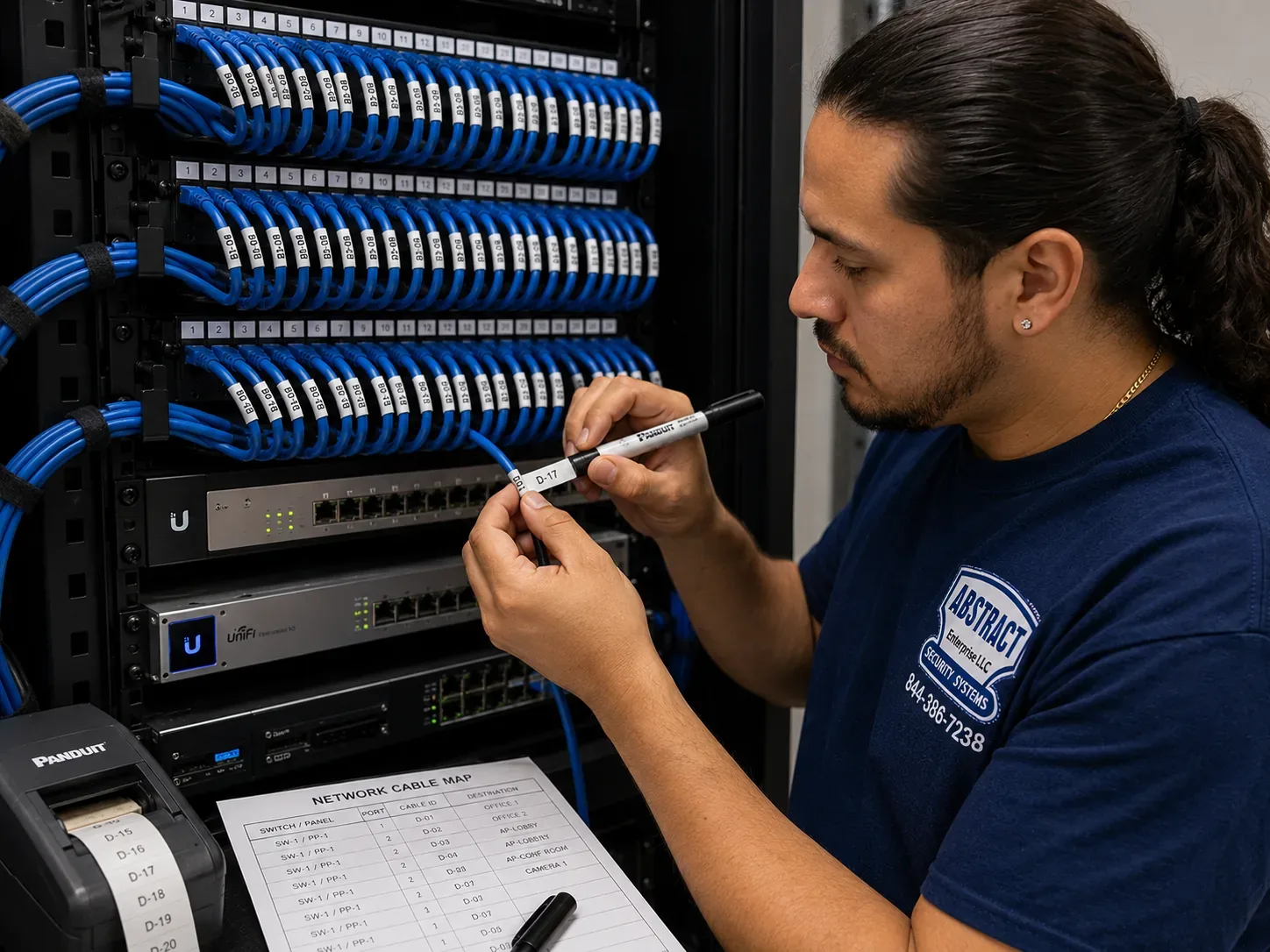
A technician writes on a port label in front of rows of patched panels, with a label printer and a printed network cable map on the shelf beside him.
Coverage Area

Fiber Optic Installation Near Brooklyn's Landmarks

Brooklyn's network history runs along its waterfront and through its downtown. These six places mark the building types we work in every week.

Brooklyn Navy Yard

More than 300 acres on Wallabout Bay, home to 550-plus businesses and over 13,000 jobs. Dock 72 was built on the site of a former drydock, and Building 77 holds a 60,000-square-foot public food hall on its ground floor.

Industry City, Sunset Park

Sixteen interconnected former industrial buildings with more than 550 companies after a $450 million modernisation, and a meet-me room where dozens of carriers interconnect for tenants on the campus.

Brooklyn Army Terminal

A 4-million-square-foot waterfront industrial campus in Sunset Park, where NYCEDC has committed up to $100 million to its BATWorks project and floorplates reach 200,000 square feet.

Abolitionist Place and 1 Willoughby Square

The 1.15-acre park that opened in Downtown Brooklyn in May 2024, framed by 1 Willoughby Square — the first new office tower built after the 2004 rezoning — and 141 Willoughby Street.

Brooklyn Heights Historic District

Designated on November 23, 1965 as the city's first historic district, with nineteenth-century brownstone and brick row houses where every fiber route stays indoors.

Gowanus Canal

Rezoned under the Gowanus Neighborhood Plan adopted in November 2021, with new residential buildings rising beside former industrial lots along a canal where flood resilience is part of every design.

We also serve Greenpoint, Williamsburg, Bushwick, Bedford-Stuyvesant, Crown Heights, Flatbush, East Flatbush, Canarsie, East New York, Brownsville, Bay Ridge, Dyker Heights, Bensonhurst, Borough Park, Midwood, Sheepshead Bay, Marine Park, Coney Island and Brighton Beach, and the neighbouring business districts of Long Island City, Lower Manhattan and Staten Island's North Shore.

Technician reviewing a finished network rack with patch panels, switches and a UPS in a Brooklyn equipment room
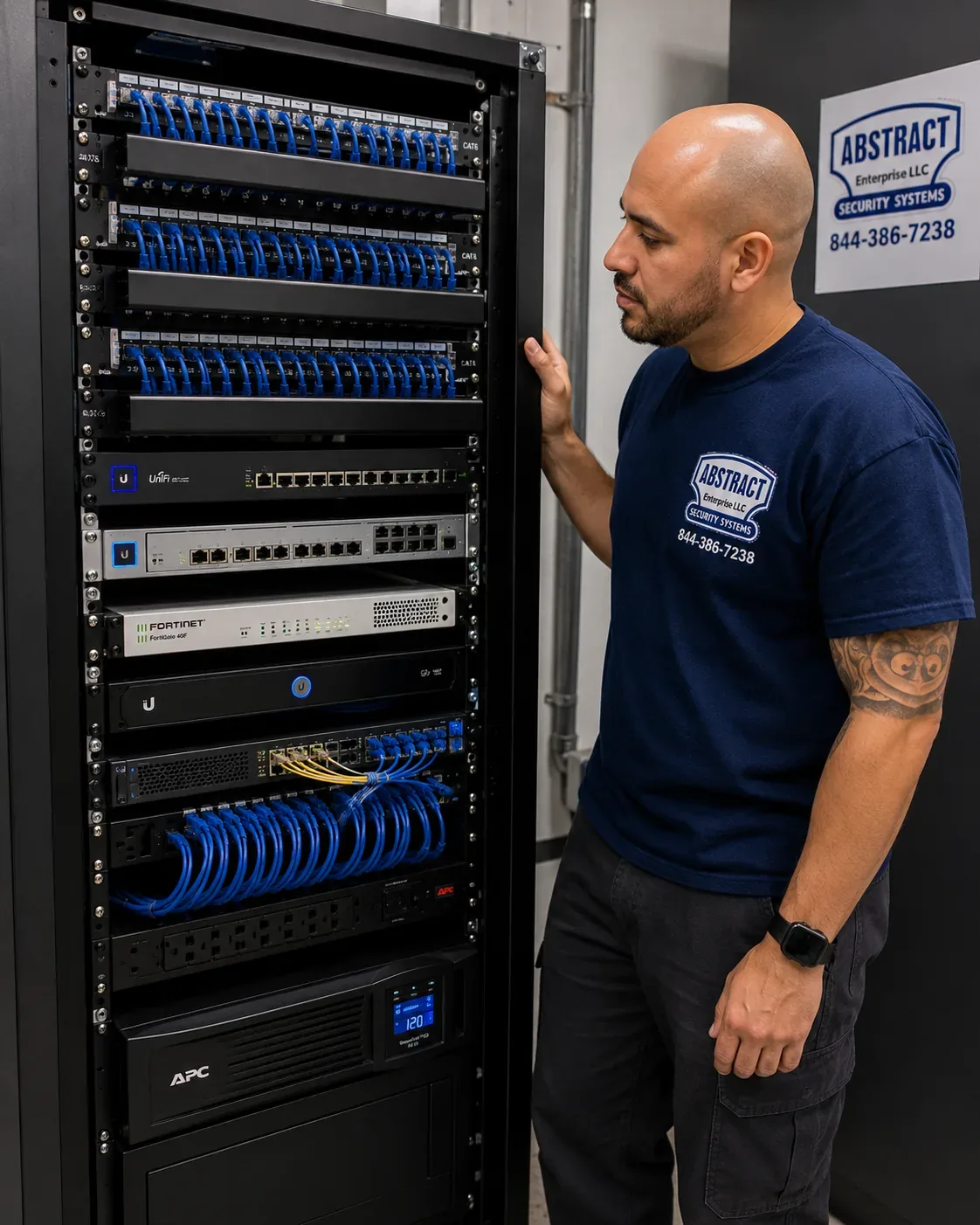
A technician stands beside a tall, neatly patched rack of panels and switches with a UPS at the base, the end point of a backbone once every strand is landed.
Pricing

Fiber Optic Installation Cost in Brooklyn

Brooklyn is our base rate (1.00×). Every other area is priced from these numbers. Drop prices match our Brooklyn structured cabling price builder; backbones and campus links are quoted after a walkthrough, using the published ranges below.

ItemBrooklyn priceWhat it covers
Fiber termination on an existing cable$35 per terminationLC, SC, ST or MPO, fusion-spliced pigtail or mechanical connector
OTDR test$40 per strandTrace and event table per strand, on top of loss testing
Multimode fiber drop$350 per dropShorter in-building run, terminated and tested
Single-mode fiber drop$400 per dropShorter in-building run, terminated and tested
12-strand OM4 floor-to-floor backbone$4,500 – $7,000Fusion-spliced, enclosures both ends, firestopped, loss-tested
24-strand OS2 single-mode backbone or building-to-building link$8,000 – $15,000+Single-mode with OTDR on every strand
Second telecom room with fiber linkfrom $2,400Room build-out and the fiber tie back to the main room
Service and callback rate$195/hr, 3-hr minimum ($585)Repairs, troubleshooting and return visits — not the initial install

What moves a Brooklyn fiber quote

  • Whether a path exists. Usable conduit between buildings, an empty sleeve or a dumbwaiter shaft makes a job quick. Opening concrete, coring masonry or building new conduit adds labour.
  • Outdoor and armored sections. Indoor/outdoor and armored cable costs more than plain indoor cable, and outdoor enclosures cost more than wall boxes.
  • Campus requirements. Escorts, permitted hours and specified materials on a managed campus can add time.
  • Strand count and testing. Each strand is a splice, a connector and a test result; single-mode links get OTDR on every strand.
  • Flood planning. Moving the main enclosure out of a cellar, or adding sealed conduit through a flood-prone space, is extra work worth doing once.

National brand versus local contractor. ADT, Ring and SimpliSafe sell alarms and cameras and do not install private fiber, so they are not really an option here. The realistic choices are the provider's own installers, who stop at their handoff; a national integrator, who may send a subcontracted crew; or a licensed Brooklyn contractor who owns a splicer and an OTDR. We are the last of those, and we put every number in writing.

Shop Our Systems

Fiber Optic Installation Packages & Pricing

Three worked examples for the Brooklyn jobs we quote most often, each built only from the price table above. Your proposal will show your route, your strand count and any campus or building requirements we already know about.

Starter — Reach the Far Wall

$800

Two single-mode fiber drops at $400 each from the main rack to the far end of a warehouse or loft floor, terminated and tested — enough to feed a small switch for cameras and access points beyond copper's reach.

Standard — Cellar to Every Floor

$4,500 – $7,000

A 12-strand OM4 backbone from the cellar or main room up a walk-up, mixed-use building or small office, with enclosures, firestopping and loss results for every strand. Where in the range you land depends mainly on the vertical path.

Premium — Building to Building

$8,000 – $15,000+

A 24-strand OS2 single-mode link between two buildings on a lot or campus, in armored cable or approved conduit, with an OTDR trace on every strand.

Bring Your Own Equipment — Labour Only

Some Brooklyn campuses specify their own cable, and some clients already own a reel or a box of enclosures from an earlier project. Hand us the materials and we bill labour alone at $195 an hour, three hours minimum ($585), for the pulling, splicing and certification. Anything you supply is covered by its manufacturer rather than by us, so before a single foot goes into the conduit we put a meter on the reel and confirm the glass is sound.

Before and after photos of a telecom closet rebuilt with organised panels for a Brooklyn cabling and fiber upgrade
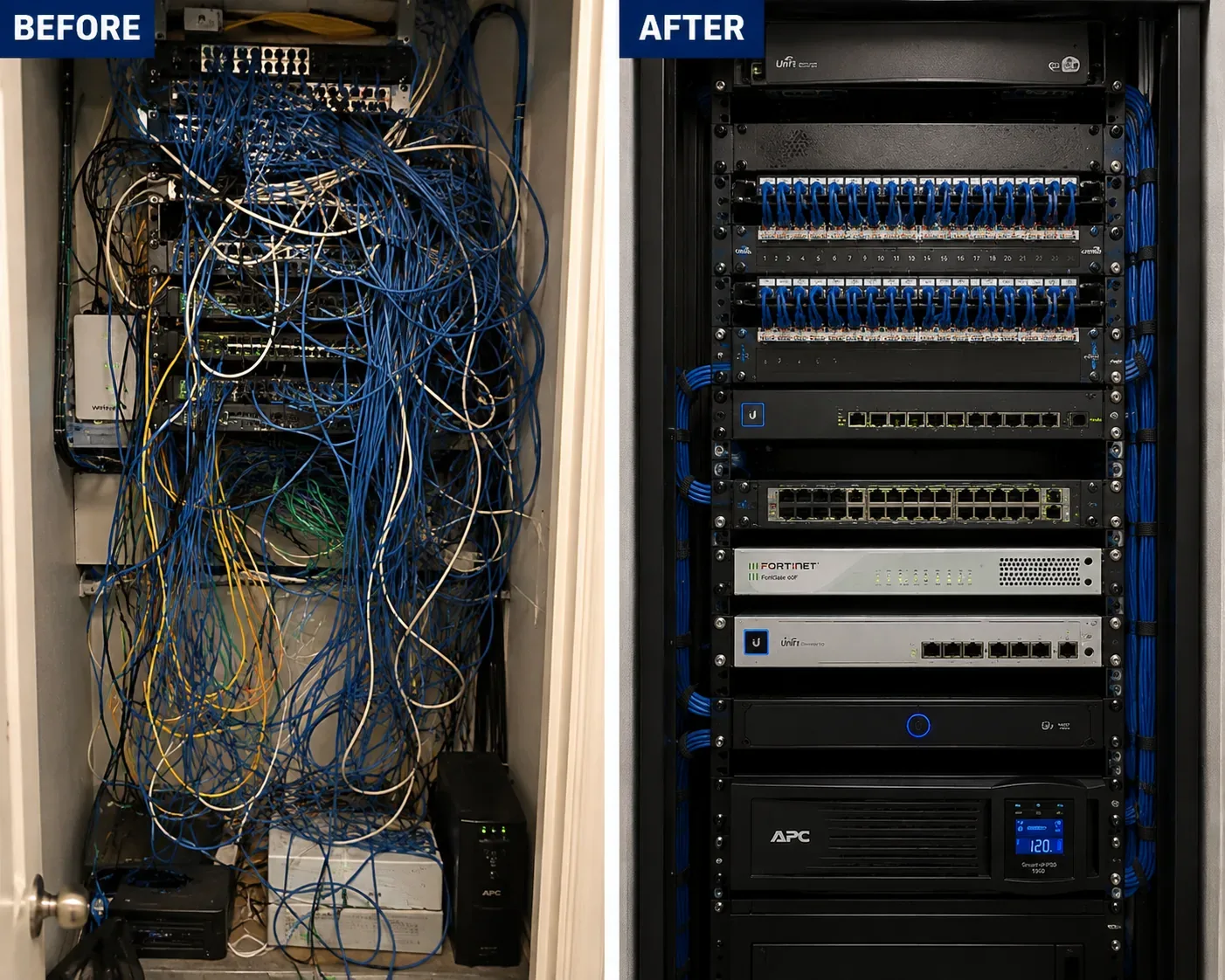
Left, a closet of tangled loose cable and old equipment; right, the same space rebuilt as an organised rack of panels, switches and a UPS.

Want the Route Measured Before You Commit?

The walkthrough is free and the proposal is itemised. Brooklyn prices are our base rate, published in the table above.

Across the Borough

How Fiber Jobs Change From Greenpoint to Coney Island

Brooklyn is big enough that a fiber job in one corner has little in common with one in another. This is how the work tends to break down by area.

North Brooklyn: Greenpoint, Williamsburg, Bushwick and East Williamsburg

Two worlds share these streets. Along the waterfront, the towers that followed the 2005 rezoning have modern telecom rooms and management companies with written contractor rules; the Greenpoint and Williamsburg community board added more new housing units in 2023 than any other in Brooklyn, according to local reporting. A few blocks inland, the industrial business zone still holds single-storey warehouses, breweries, studios and production spaces. Tower jobs are about paperwork and riser ratings; warehouse jobs are about distance, dust and forklifts. Bushwick's converted lofts sit between the two, usually with exposed ceilings and landlords careful about new holes.

Downtown Brooklyn, DUMBO and Brooklyn Heights

The densest commercial cluster in the borough. Downtown's office stock includes new towers around Abolitionist Place, the office floors above Macy's on Fulton Street and the MetroTech buildings, while private-sector employment there grew from about 62,000 jobs in 2010 to more than 86,000 in 2022, according to the Downtown Brooklyn Partnership. DUMBO's converted warehouses house tech and media tenants. Brooklyn Heights, next door, is landmarked row houses and pre-war apartment buildings, where the job is usually a quiet backbone for a small building or a home office.

The Navy Yard and Wallabout

A campus of its own, with the Yard's facilities team deciding pathways and access. Distances between buildings are long, and many tenants are manufacturers or production companies whose shop floors need network connections well away from any office. Plan for campus approvals from the outset.

Gowanus, Red Hook and Carroll Gardens

Flood country. The Gowanus rezoning has brought new apartment buildings beside the canal, Red Hook's waterfront holds warehouses and piers, and both areas flooded badly in 2012. Every design here starts with the question of where the entry, splice points and electronics can sit above the water. Carroll Gardens and Cobble Hill, slightly uphill, are brownstone neighbourhoods with very different needs.

Sunset Park, Bay Ridge and Dyker Heights

Sunset Park's waterfront is industrial on a huge scale, with Industry City and the Army Terminal; its Fifth and Eighth Avenue corridors are dense with small businesses in mixed-use buildings. Bay Ridge and Dyker Heights are mostly residential, with pre-war apartment buildings along Shore Road and Fourth Avenue and retail on Third and Fifth Avenues.

Central Brooklyn: Park Slope, Prospect Heights, Crown Heights, Bed-Stuy and Flatbush

The brownstone and pre-war apartment belt. Much of our work here is for small landlords, co-ops and condo boards who want one tidy backbone instead of decades of provider cable on the facade, and for medical offices, schools and houses of worship that have outgrown copper between their buildings. East Flatbush, where our Brooklyn office sits on Troy Avenue, is a short drive from all of it.

Southern and Eastern Brooklyn

Borough Park, Midwood, Bensonhurst, Sheepshead Bay, Marine Park, Canarsie, East New York and Brownsville mix low-rise housing with retail corridors, light industrial blocks and large institutions. Coney Island and Brighton Beach add another flood-zone waterfront. Borough Park–Kensington has one of the city's highest shares of households without a broadband subscription, a reminder that building wiring and provider choice still lag in parts of the borough.

Flood Planning

Planning Fiber for Brooklyn's Flood Zones

Sandy taught Brooklyn that the flood map is a minimum, not a maximum. The city's post-storm report found the area that actually flooded in Brooklyn was more than twice as large as the mapped floodplain. For anyone installing fiber in Red Hook, Gowanus, DUMBO, Williamsburg, Greenpoint, Sheepshead Bay, Gerritsen Beach or Coney Island, these are the rules we design by.

  • Accept that the entry will be low. Providers usually arrive through the cellar wall, and that is rarely negotiable. The cable through the cellar should be in sealed conduit or armored cable with no splices or connectors at that level.
  • Splice upstairs. The first enclosure, where the provider's cable meets the building's fiber, belongs on the ground floor or above wherever the building allows it.
  • Keep electronics high and on their own circuit. Switches, media converters and battery backup should sit in a room above the expected flood level, not on the cellar floor beside the water heater.
  • Leave slack in the right place. A service loop above the flood line lets a damaged section in the cellar be cut out and re-spliced without pulling a whole new cable.
  • Record a baseline. Loss and OTDR results taken at installation tell you, after any flood, whether a strand has changed — a measurement instead of a guess.
  • Coordinate with the building's own resilience work. New Gowanus and waterfront buildings often already raise mechanical rooms; the telecom room should follow them up.

None of this costs much when it is designed in from the start. Moving a main enclosure from the cellar to the first floor after a flood costs far more than putting it there in the first place.

Homes and Small Buildings

Fiber Inside Brooklyn Homes and Small Buildings

Not every Brooklyn fiber job is commercial. A growing number of calls come from owners of row houses and small apartment buildings, and from people who work from home on the top floor of a house whose provider arrives in the cellar.

For a single-family house or a two-family, the typical job is one fiber cable from the cellar, where the provider's equipment lands, to a small rack or cabinet on an upper floor. From there, copper and wireless serve the rooms. It solves the classic brownstone problem of a strong signal in the basement and a weak one three floors up, through thick masonry party walls and plaster.

For a three- to eight-unit building, the job grows into a small backbone: one cable up the building with an enclosure on each floor, so any tenant's provider can connect quickly. Owners of these buildings tend to be practical and budget-conscious; the design is simple, the cable is small and the work is often done in one or two days.

A home fiber run is also a good time to add the rest of the low-voltage work that tends to follow a renovation — a video intercom at the front door, a few cameras on the stoop and yard, or a wired access point on each floor. We can quote all of it together, or just the fiber.

Technician pulling cable out of a pull box on wall-mounted EMT conduit inside a Brooklyn commercial space
A technician in a cap and glasses draws blue cable from a pull box on vertical EMT conduit fixed to a light block wall, a coil of slack hanging below.
Before You Hire

A Checklist for Comparing Brooklyn Fiber Quotes

Fiber quotes are easy to compare on price and hard to compare on substance. These are the items worth checking line by line, whoever you hire.

  1. Measured route. The quote should be based on a walked and measured route, not a floor plan estimate. Ask for the measured length of each link.
  2. Cable type and rating named. Single-mode or multimode, strand count, and riser, plenum, indoor/outdoor or armored — written out, not "fiber cable."
  3. Termination method. Fusion-spliced factory pigtails or field connectors, and into what kind of enclosure at each end.
  4. Testing deliverables. Loss results for every strand at minimum; OTDR traces for long, outdoor and campus links; connector inspection.
  5. Penetrations and firestop. How many holes, where, and how they will be sealed and documented.
  6. Approvals. Who prepares the landlord or campus submission, and whether insurance certificates are included.
  7. Flood placement. In a waterfront or low-lying building, where the splice points and electronics will sit.
  8. Licence and insurance. A New York State low-voltage licence number you can check, and a certificate naming your landlord if required.

Our own proposals answer all eight in writing. If another quote leaves some of them blank, it is worth asking why before comparing totals.

Two more points are worth weighing on Brooklyn jobs specifically. First, ask how the contractor plans to work around your operation: a warehouse that ships every morning, a stage booked for a shoot or a brownstone with tenants upstairs needs a schedule built around it, not around the crew's convenience. Second, ask what happens at the far end. A fiber link is only useful when the switch, media converter or optic at each end is matched to it, powered and configured, so make sure someone owns that step — either the installer or your IT provider, named in writing.

Finally, compare like with like. A quote that includes a walkthrough, approvals, firestop, armored cable where needed and full test results will rarely be the lowest number on the table, but it is the one least likely to grow once work begins. When totals differ widely, the difference is almost always in what is left out.

Common Mistakes

Fiber Mistakes We Correct in Brooklyn Buildings

A fair share of our Brooklyn fiber work is fixing earlier installations. The same handful of problems turns up again and again, and every one of them is cheaper to avoid than to repair.

Indoor cable run outdoors. A plain indoor fiber cable strung between two buildings or along an exterior wall looks fine for a year or two. Then sunlight, freezing and moisture break down the jacket, water reaches the strands and loss creeps up until the link fails. Outdoor and indoor/outdoor-rated cable exists for exactly this reason.

Connectors left in the cellar. Patch panels and splice enclosures mounted low in a basement are the first casualties of a flood or a burst pipe. We regularly move them upstairs and replace the section of cable that sat in water.

Unprotected cable on the warehouse floor. Fiber laid along racking uprights or across a dock without armor or conduit gets crushed by pallet jacks and forklifts. The fix is armored cable or a protected pathway, and routing above vehicle height wherever possible.

Tight bends at the enclosure. Cable forced into a small wall box, or zip-tied hard against a rack, exceeds its minimum bend radius and loses light. It often still works, just with less margin than it should have, until a small additional strain pushes it over the edge.

No test results. Many links in Brooklyn buildings were never tested after installation, so when a problem appears there is nothing to compare against. We test what we find, record a baseline and label both ends, even when the job is only a repair.

Unlabelled strands. A twelve-strand cable with no record of which strands are used, and for what, is a guessing game for the next technician. Every strand we touch is labelled and listed in the handover file.

Open penetrations. Holes cored through floors and walls and never sealed are a fire-safety problem and a common inspection finding. When we reuse or add a penetration, we seal it with a listed firestop system and photograph it.

Plain English

Fiber Terms You Will See in a Brooklyn Proposal

Fiber proposals are full of abbreviations. These are the ones that appear in ours, explained in a sentence or two each.

  • OS2 / single-mode. Fiber with a very small core that carries light over long distances. Our default between buildings and up risers.
  • OM4 / multimode. Fiber with a larger core, suited to shorter runs inside a building and to lower-cost optics.
  • Strand. One glass fiber inside the cable. Most links use two strands, one in each direction; the rest are spares or serve other systems.
  • Armored cable. Fiber cable wrapped in a metal or heavy protective layer so it survives crushing, rodents and rough pathways.
  • OFNR / OFNP. Fire ratings for indoor fiber cable: riser rated for vertical shafts, plenum rated for air-handling spaces.
  • Pigtail and fusion splice. A short factory-made cable with a connector on one end, joined to the installed fiber by melting the two glass ends together with a splicer.
  • Enclosure or panel. The box or rack unit where strands end in connectors, protected and labelled.
  • Insertion loss test. A measurement of how much light is lost from one end of a strand to the other, compared with an allowed budget.
  • OTDR. An instrument that sends pulses down a strand and shows where along its length any loss or reflection occurs.
  • SFP / media converter. The small modules or boxes that change light back into an Ethernet connection at each end.
  • Handoff / demarcation. The point where the provider's responsibility ends and the owner's wiring begins.
  • Innerduct. A flexible tube pulled into a larger conduit so fiber has its own protected lane and future cables can follow.

If a line in any proposal, ours or another contractor's, is not clear, ask. A good installer can explain every item in plain terms.

The Walkthrough

What a Free Brooklyn Fiber Walkthrough Covers

Most of the value in a fiber job is decided on the first visit. A walkthrough at a Brooklyn property usually takes one to two hours, and by the end of it we can price the work with confidence. This is what we look at and why.

  • Both ends of every link. Where service arrives, where the main rack is or should be, and what the far end needs to power — a switch, a camera, a production room or a whole floor.
  • The real route. Measured with a wheel or tape along the path the cable will actually follow, including vertical climbs, detours around obstructions and slack for future moves.
  • Existing pathways. Conduit, sleeves, dumbwaiter shafts, trays and old penetrations that can be reused with the owner's agreement, and whether any of them are blocked or full.
  • Environment. Heat, cold, damp, dust, wash-down areas and vehicle traffic along the route, which decide whether cable is armored and which enclosures are sealed.
  • Flood exposure. In low-lying and waterfront buildings, the height of past flooding and where splice points and electronics can sit safely above it.
  • Rules and approvals. The landlord's or campus's contractor requirements, landmarked facades, insurance certificates and permitted working hours.
  • Power and equipment at the far end. Whether there is a circuit for a switch or media converter, and whether the client's existing switches can take fiber optics directly.

You receive an itemised proposal with the measured lengths, the cable and enclosure types, the test plan and any approval paperwork we will prepare. If we find that a device can stay on copper, or that a radio link would be the better answer, the proposal says so.

One Backbone, Many Systems

Putting Cameras, Doors and Intercoms on the Same Brooklyn Fiber

A fiber backbone is rarely installed for data alone. Once glass connects a cellar to every floor, or a front building to a back one, every other low-voltage system on the property can use it. That is where much of the long-term value of a Brooklyn fiber job comes from.

Cameras. A recorder in the main building can receive feeds from cameras in a rear building, across a yard or on every floor of a walk-up, using spare strands and small switches rather than separate long runs for each camera. Outdoor cameras in particular benefit from the electrical isolation glass provides.

Access control. Door controllers in several buildings or on several floors can report to one management server over the backbone, so a warehouse, its office and its yard gate are administered in one place.

Intercoms. Modern IP video intercoms in apartment buildings run over the network. A backbone to each floor gives them a dedicated, reliable path without competing with residents' internet service.

Building monitoring. Temperature, water-leak and power sensors in cellars and mechanical rooms — increasingly common in flood-prone buildings — can report over the same fiber to wherever the owner or super watches them.

We plan strand counts with these uses in mind. Twelve strands where four would do today costs little extra at installation and saves pulling a second cable later. Strands assigned to each system are recorded in the handover file so the next installer knows which are spoken for.

Complete Services

Every Fiber Optic Installation Service in Brooklyn

Fiber is usually one part of a larger Brooklyn project. These services most often share a proposal and a walkthrough with it.

Structured Cabling Installation Brooklyn

The copper that takes over where the fiber lands: desks, access points, phones and printers on each floor.

Cat6 Installation in Brooklyn

Category 6 and 6A runs inside the copper limit, certified and labelled to the same standard as the glass.

Network Installation Brooklyn

Switches, optics, firewalls and wireless that put a new fiber link to work.

Network Cable Repair Brooklyn

Fault finding and repair on existing copper and mixed networks.

Low-Voltage Installation Brooklyn

Data, intercom, cameras and audio planned as one scope for a building or campus.

Structured Cabling Pricing Brooklyn

The interactive Brooklyn price builder for copper and fiber drops and testing.

Commercial Camera Installation Brooklyn

Yard, dock and building cameras fed over fiber to one recorder.

Access Control Installation Brooklyn

Door readers across several buildings tied back to one controller over the same fiber.

Intercom Installation Brooklyn

IP video intercoms for walk-ups and apartment buildings that share the new backbone.

Field Notes

Field Notes From Brooklyn Warehouses and Walk-Ups

How our installers approach a Brooklyn walkthrough — standing practice, not one particular job

On a Brooklyn warehouse walkthrough the tape measure comes out before the clipboard. Our installers walk the actual route the cable would take — up to the deck, along the racking, around the columns — and write down the number, because the distance on paper is almost always shorter than the distance in steel. That one habit decides whether a device stays on copper or needs glass.

The second habit is asking where the water went last time. In a cellar on the waterfront, the super or owner usually knows exactly how high it came in 2012, and sometimes there is still a line on the wall. That height decides where the first enclosure goes.

The third is respecting the house. In a brownstone, drop cloths go down before tools come out, the route is agreed with the owner closet by closet, and plaster is treated as something that cannot be replaced like for like. Brooklyn owners notice, and they call back for the next floor.

FAQ

Brooklyn Fiber Optic Installation FAQ

Do you work in southern Brooklyn as well as the north — Bay Ridge, Bensonhurst, Sheepshead Bay and Coney Island?
+

Yes. We cover all of Kings County, from Greenpoint and Williamsburg down to Coney Island, Brighton Beach, Gerritsen Beach and Canarsie. Our Brooklyn office on Troy Avenue in East Flatbush sits near the middle of the borough, so southern and eastern neighbourhoods are as close to us as Downtown.

Where are your Brooklyn fiber jobs run from?
+

From our Brooklyn office at 1282 Troy Ave, Brooklyn, NY 11203, in East Flatbush. The installers who walk your site are the same people who pull, splice and test the cable; we do not hand Brooklyn work to an outside crew.

Do you install fiber in houses as well as businesses?
+

Yes. In Brooklyn row houses and two-family homes we often run one fiber cable from the cellar, where the provider's equipment lands, to a small cabinet on an upper floor, then serve the rooms with copper and wireless. It fixes the weak signal on upper floors without opening plaster walls.

Can you pull fiber through a conduit that already has a pull string in it?
+

Usually. If the conduit is continuous, has room and the pull string is sound, a fiber cable can often follow it in one pull. We test the conduit first by pulling a new line or mandrel, because a crushed or rusted section is far easier to find before the cable is inside it.

Can you fix a fiber cable that a renovation crew cut?
+

Yes. We locate the break, cut back to clean cable on both sides and either fusion-splice the two ends together in a protected enclosure or, if there is not enough slack, splice in a new section. Every repaired strand is re-tested end to end. Repairs are billed at $195 per hour with a three-hour minimum.

Will you deal directly with our campus or industrial landlord's facilities team?
+

Yes. On the Navy Yard, Industry City, the Army Terminal and other managed sites we contact the facilities team, confirm pathways, conduit and access rules, and prepare whatever submission they require, so you are not passing technical questions back and forth.

Can fiber be run up the outside of a building instead of inside?
+

Sometimes. On a warehouse or a non-landmarked building, outdoor-rated fiber in conduit along an exterior wall can be the simplest route between floors or to a rear building. In a historic district, anything fixed to a protected facade needs Landmarks Preservation Commission review, so we look for an interior route first.

Will you coordinate with the internet provider that serves our building?
+

Yes. We find out where the provider hands off service and what connector or equipment they expect, then terminate our fiber so their technician only has to connect to a labelled panel. We can meet the provider on site for the cutover if you prefer.

Can fiber go underground from a house to a rear garage, studio or back building?
+

Yes. On a private Brooklyn lot we run outdoor-rated or armored fiber in buried conduit across the yard, with a pull box where the route turns, and enter each building through a sealed sleeve. Because the route stays on your property, no street-opening permit is involved.

Is it safe to run fiber next to the electrical wiring in an old house?
+

Yes. Fiber carries light, not electricity, so it neither picks up interference from power wiring nor adds any electrical hazard. We still keep it in its own path, away from electrical boxes, and use riser- or plenum-rated cable as the space requires.

Do you work with schools, churches and community organisations on tight budgets?
+

Yes. Brooklyn schools, houses of worship and nonprofits often need a link between two buildings or floors and little else. We price the essential link first, show optional extras separately and can phase work across budget years without wasting what is installed first.

Do you do the splicing and testing yourselves?
+

Yes. Our own technicians fusion-splice, terminate and test every strand with our own splicer, inspection scope, power meter and OTDR. The results you receive are the readings we took on your cable, not a subcontractor's summary.

All Areas Served

Fiber Optic Installation Across New York City

Our fiber crews work across sixteen service areas, and this Brooklyn page sits under the New York City fiber optic installation hub. Across the river, fiber optic installation in Manhattan covers tower risers and landlord approvals. Queens, the Bronx, Staten Island, Long Island and the Hudson Valley pages are on their way; until they are published, their links lead to the quote form, and we already take fiber work in every one of those places.

For everything else we install, visit the Abstract Enterprises Security Systems home page or learn about Abstract Enterprises.

Brooklyn Fiber Link Down Today

Cameras offline at the far end of the warehouse, a back building cut off, an office floor with no internet: ring (347) 934-8335 and tell us which link dropped. Same-day dispatch is our aim across Brooklyn. Once on site, a technician usually has a damaged cord, dirty connector or broken pigtail found and fixed inside one to two hours, and we put a meter on the strand again before packing up.

Fiber Optic Installation Brooklyn — Measured, Spliced, Proven

Abstract Enterprises Security Systems · 1282 Troy Ave, Brooklyn, NY 11203 · Brooklyn line (347) 934-8335 · WhatsApp (718) 679-0359 via wa.me

NYS Low-Voltage Licence #12000287431 · 100% Licensed & Insured · Same-Day Estimates · Rated 4.7★ from 201 Google Reviews

Full terms — including 50% deposit, one-year parts-only warranty on AESS-supplied products, and the late-fee schedule — are set out in the service agreement. See our warranty page.

Page reviewed and updated October 16, 2026. Changelog: first publication of the Brooklyn fiber optic installation page.