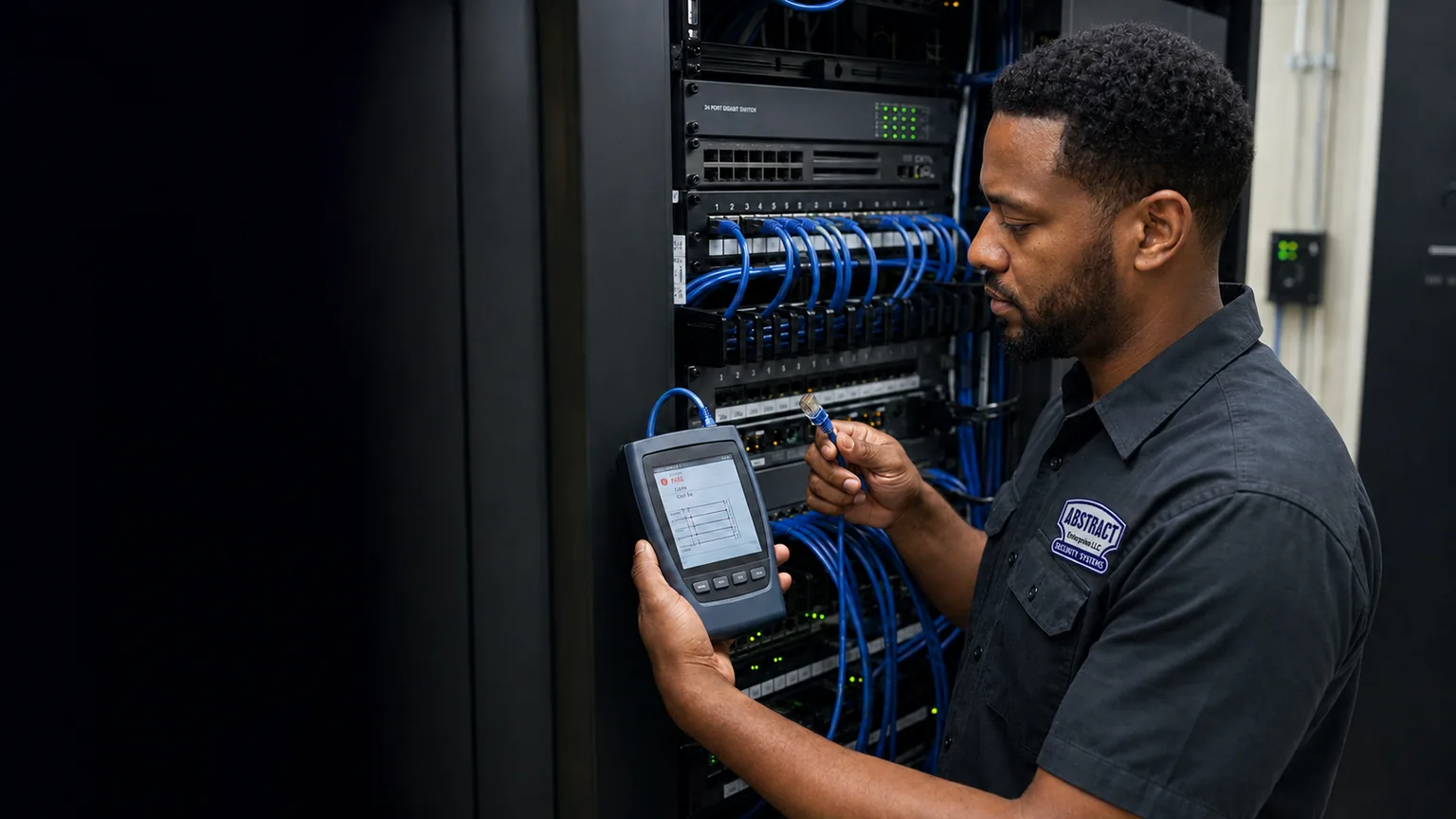
Fault location, retermination, network jack and patch panel repair, PoE troubleshooting and certified cable testing across Brooklyn. Licensed NYS low-voltage contractor, based on Troy Avenue. Every repaired drop tested and documented.
Ethernet, Cat6 and Data Jack Repair Across Brooklyn
Network cable repair in Brooklyn is a pathway problem. The borough's commercial stock is overwhelmingly converted — nineteenth-century warehouse, factory and loft buildings turned into offices, studios and light industry, plus mixed-use taxpayer buildings with commercial ground floors and apartments above. Almost none of it was designed to carry cable, which means the route is the hard part and the route is usually visible. Abstract Enterprises Security Systems repairs Ethernet, Cat6 and data cabling across Brooklyn, dispatched from our Troy Avenue base.
The calls reflect the building type. A DUMBO studio with a fourteen-foot exposed ceiling where a run was stapled to a timber joist and has finally chafed through. An Industry City tenant whose drops die every time the freight door opens. A Downtown Brooklyn suite in a modern tower behaving exactly like a Manhattan building. A Bay Ridge storefront where the POS lane drops mid-transaction and the cable runs through a cellar that takes water. Four different problems in one borough.
Repair is billed at our specialty service rate of $195/hr with a three-hour minimum ($585). Diagnostic equipment travels on the first visit — distance-to-fault, tone and probe, wiremap and performance testing — because in a building with no drop ceiling and no documentation, measuring is the only way to avoid opening things that did not need opening.
Network Down in Brooklyn?
Same-day dispatch across the borough. We are based on Troy Avenue in Flatbush, which makes Brooklyn our shortest drive. Most single-fault repairs are located and restored inside the first three-hour block.
✔ NYS Lic. #12000287431✔ Certified wiremap & performance testing on every repair✔ 4.7★ from 201 reviews
Local Conditions
Why Brooklyn Cabling Fails on Its Own Terms
The governing fact is that most Brooklyn commercial space is a conversion, and conversions have no concealed pathway. A 1910 factory floor in Sunset Park or Gowanus has timber joists, brick party walls, no cavity worth fishing and frequently no drop ceiling at all. Cable in that building is visible by necessity. That changes the repair: the route becomes a design decision with consistent heights, straight parallel runs and dressed bundles, because whatever we install is permanent and the tenant took the space for its character.
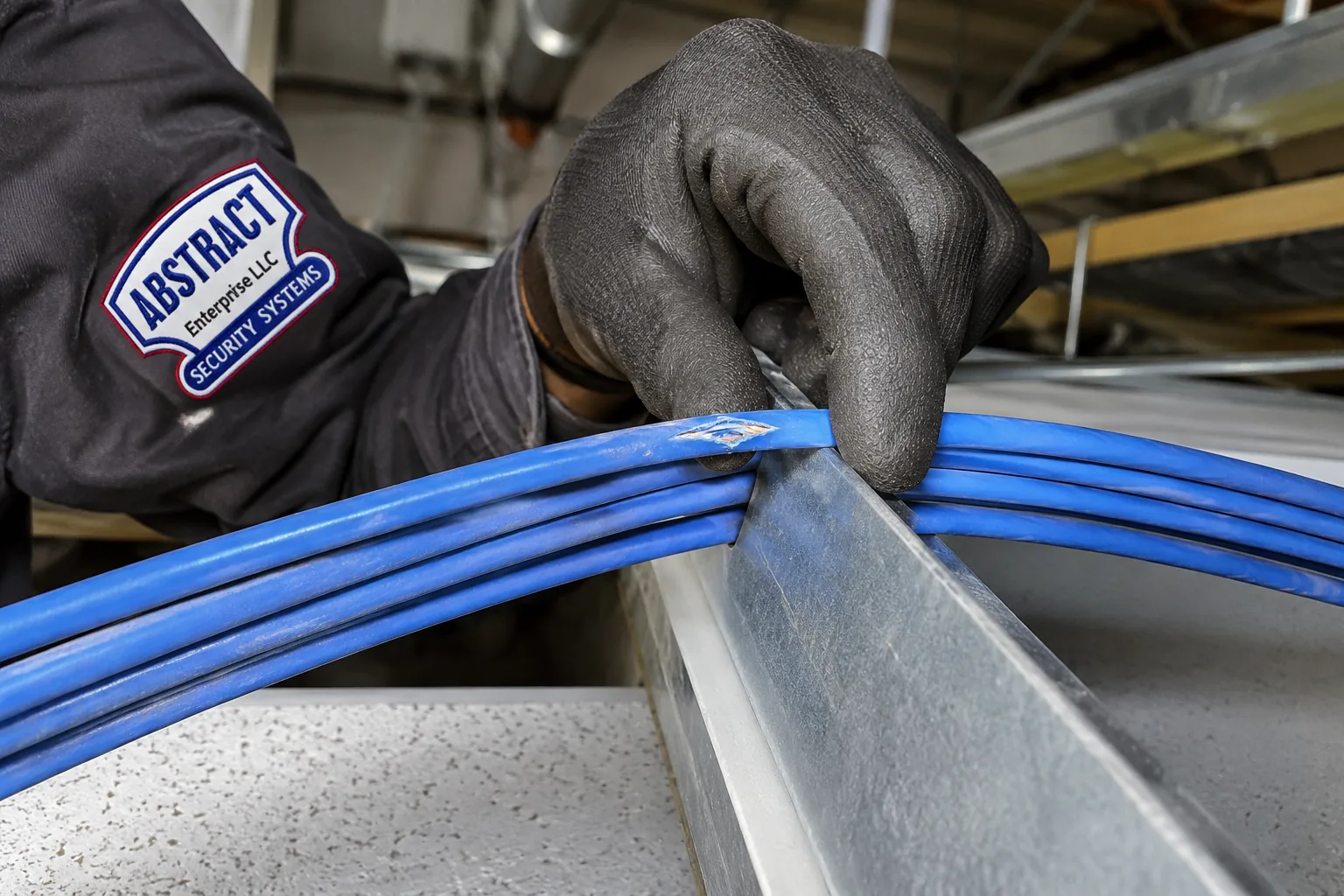
Second, the fastening problem. In buildings with exposed structure, earlier work is routinely stapled or nailed directly to timber, run across a sharp steel edge, or draped over a sprinkler line. Those are the failure points. A staple driven slightly too hard crushes a pair and produces a channel that certifies marginally on day one and fails two winters later. When we find a chafe or a crush in this stock, the pathway gets corrected too — otherwise the replacement run fails the same way in the same place.
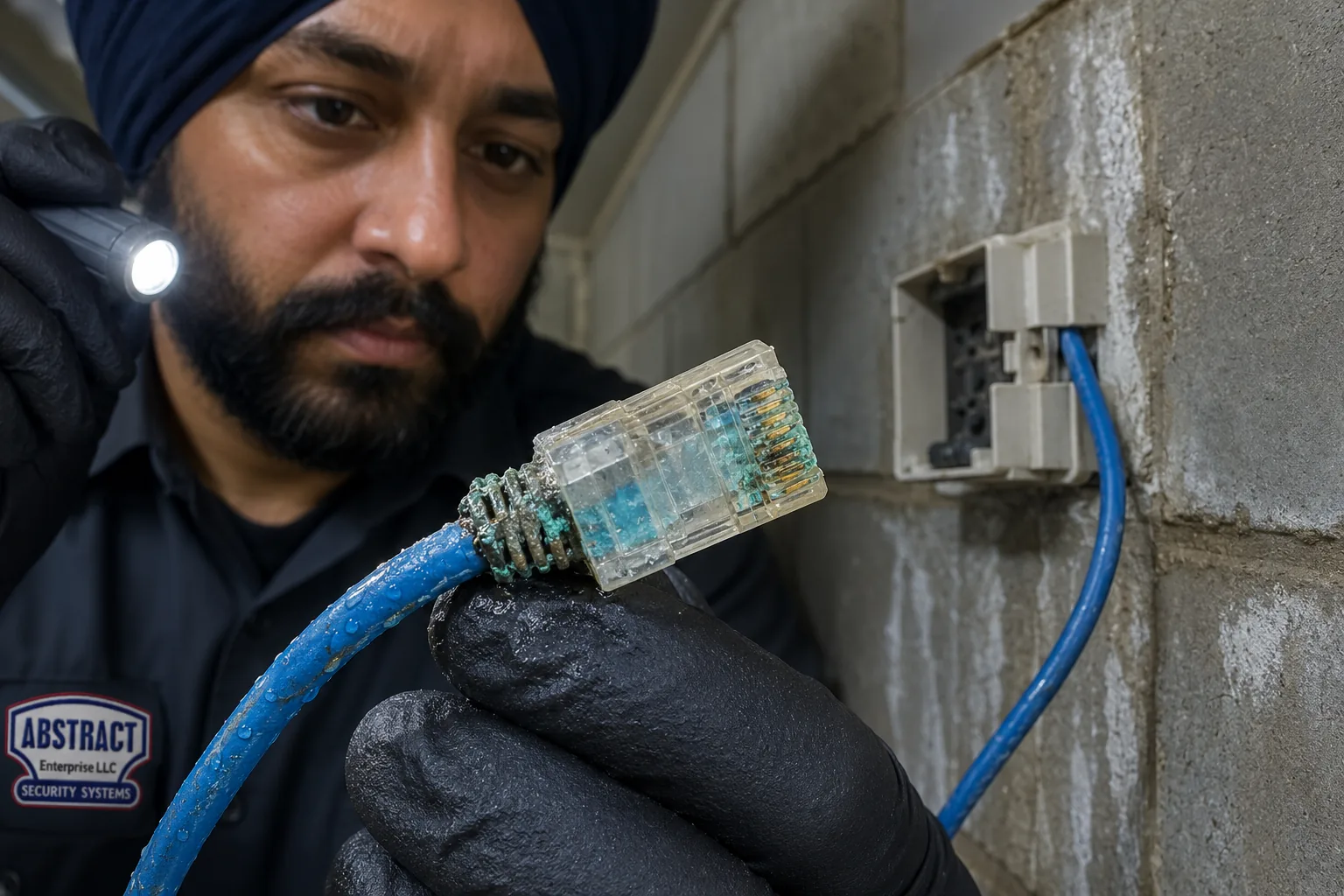
Third, moisture at the bottom of the building. Red Hook, Gowanus, the Navy Yard edge, Canarsie and the waterfront blocks in Sunset Park all sit low, and cellar-level telecom spaces take humidity and occasional water. Terminations corrode long before jackets do, so the presentation is gradual degradation rather than a clean failure — a link that gets worse across a season and gets blamed on the carrier.
Fourth, the mixed-use stack. A great deal of Brooklyn commercial tenancy is a ground-floor storefront with apartments above, where the ‘telecom room’ is a hallway panel shared with the residential side and the cable you need is bundled with somebody else's. Toning matters more here than anywhere except an unlabelled Manhattan closet, and coordination with a landlord who lives in the building is part of the job.
Fifth, Downtown Brooklyn is the exception that proves the rule. MetroTech and the towers around it behave like Midtown — floor closets, accessible plenum ceilings, COI requirements, freight windows. A contractor who only knows loft work will be caught out there, and one who only knows towers will be caught out in Bushwick.
What We Repair
What a Brooklyn Cable Repair Call Covers
We repair the physical layer, correct the pathway that caused the fault, and prove it with a test result.
Exposed-Pathway Fault Location
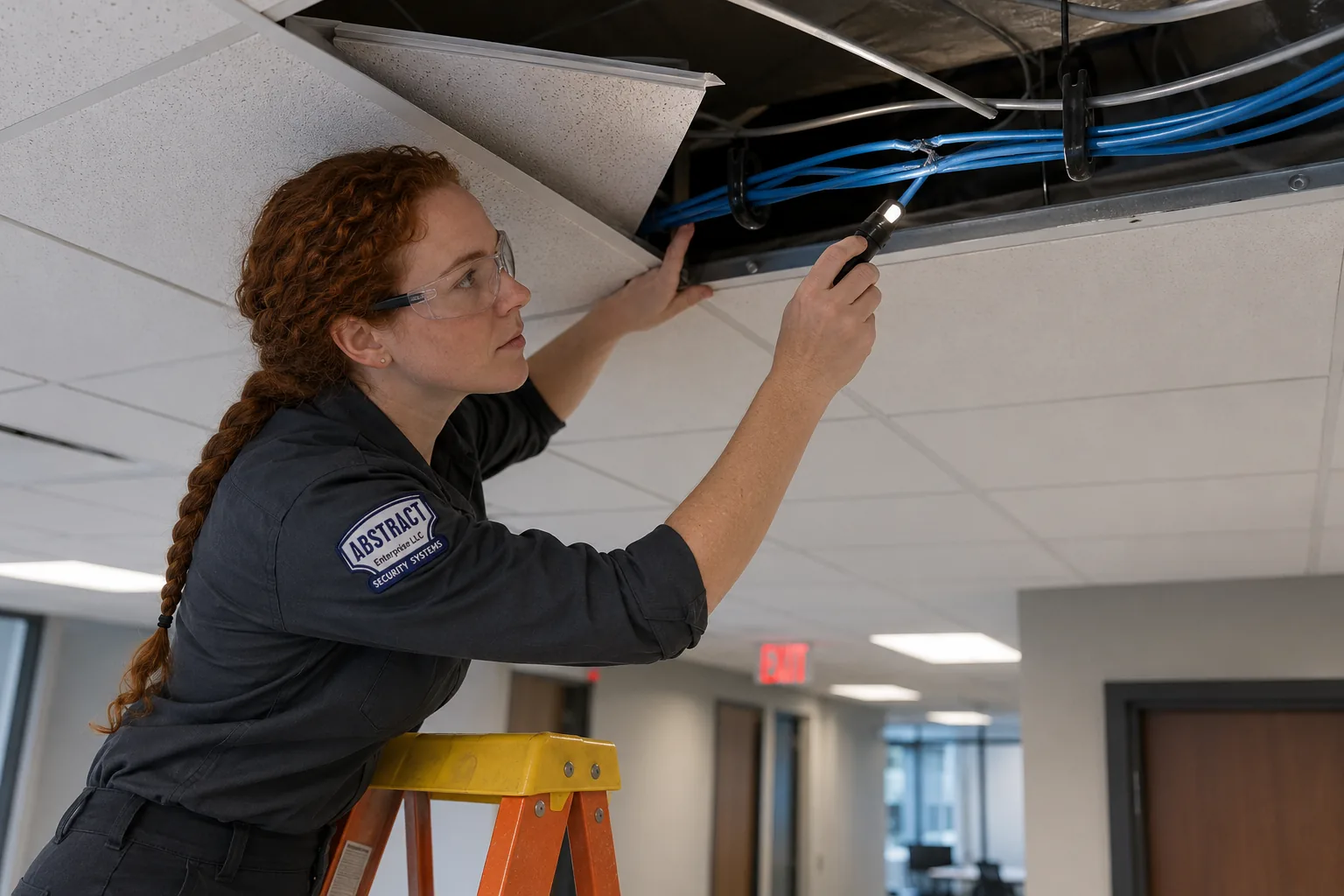
Tracing and inspecting runs in open-ceiling loft and warehouse space, where the fault is frequently visible once you know which run to follow.
Pathway Correction
Re-routing off sharp edges, heat sources and sprinkler lines onto proper supports at consistent height. Repairing the run without fixing the route guarantees a repeat.
Ethernet Cable Repair
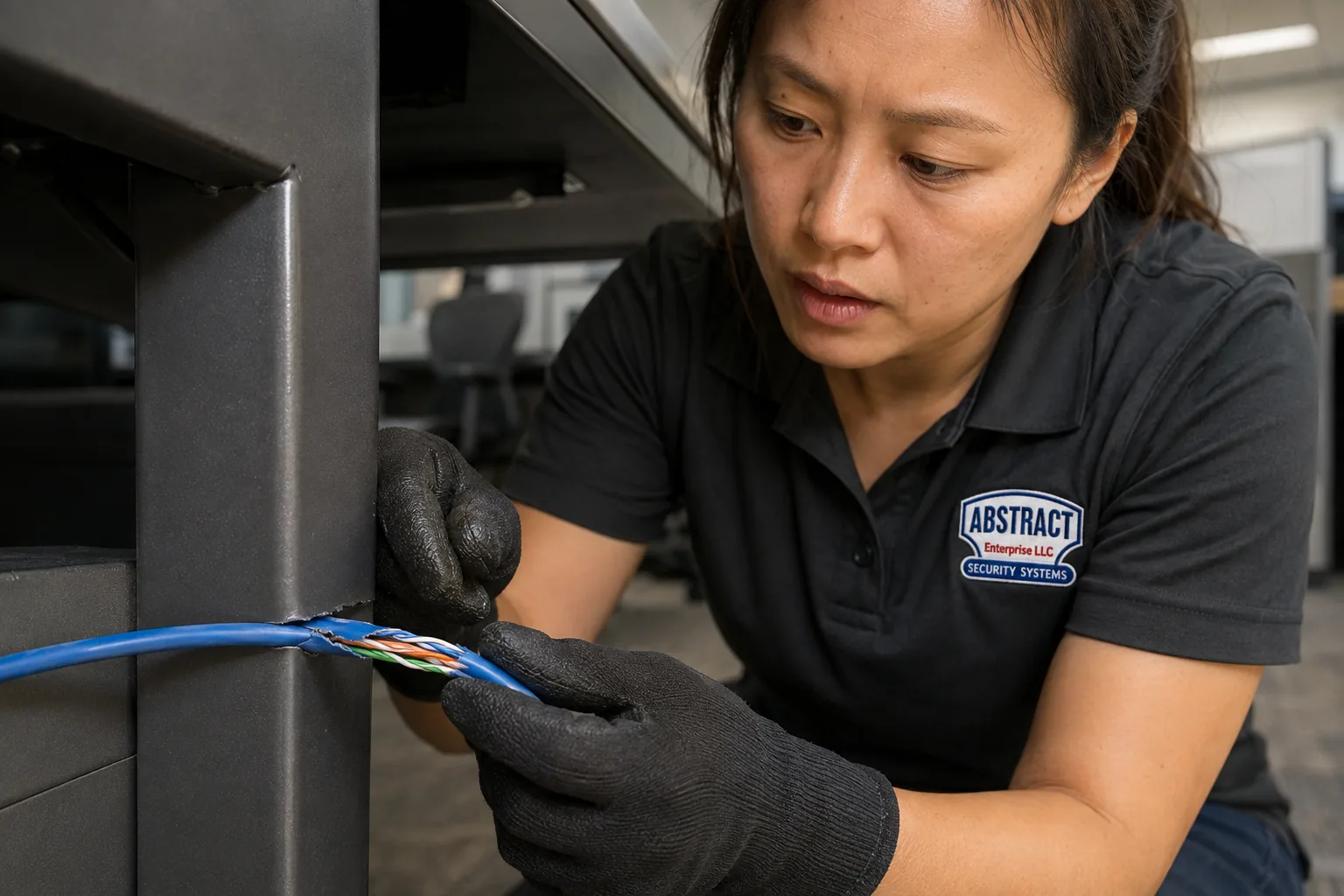
Chafed, crushed, stapled-through or moisture-damaged runs restored with a category-appropriate junction, then re-tested to spec.
Cat6 and Cat6A Retermination
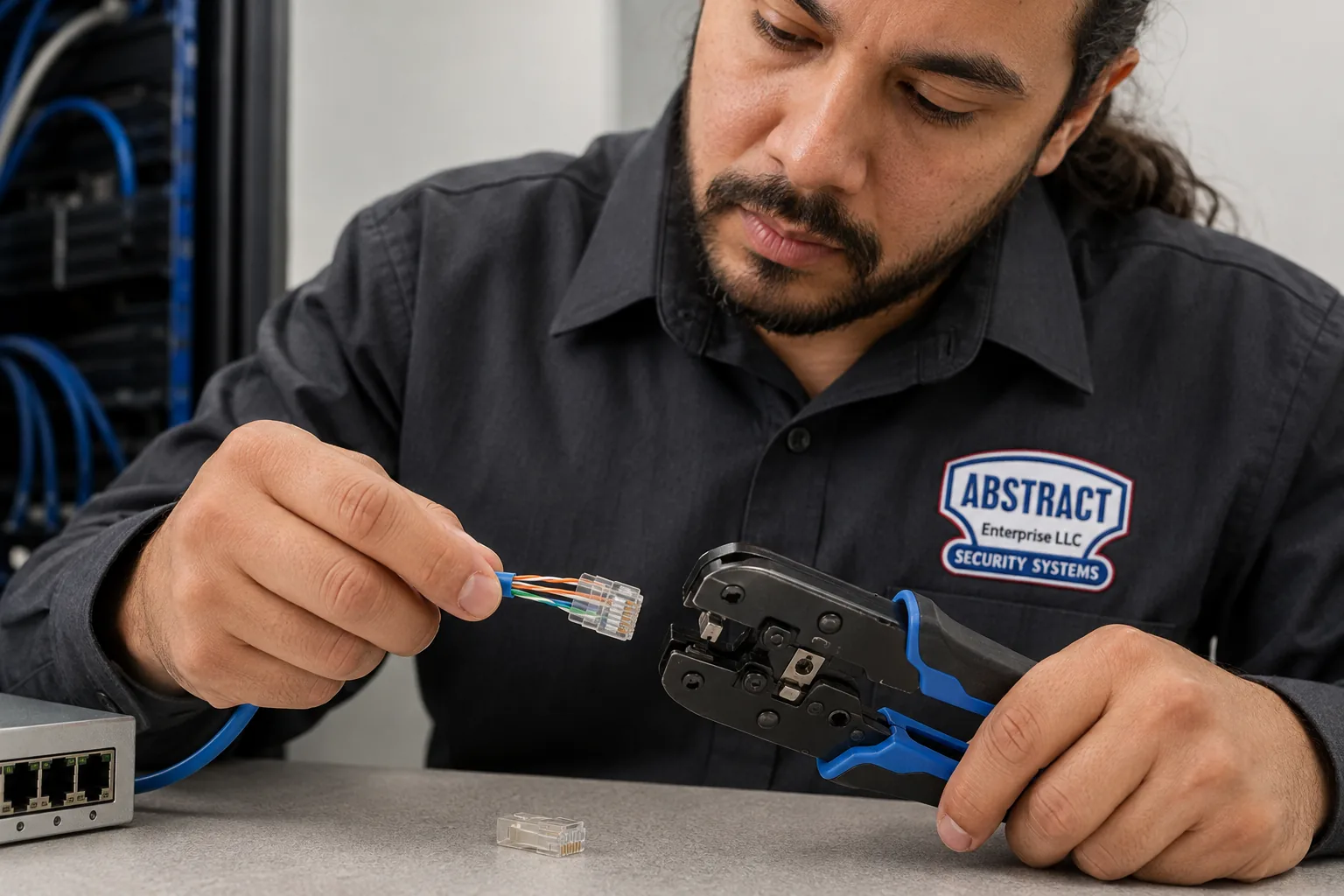
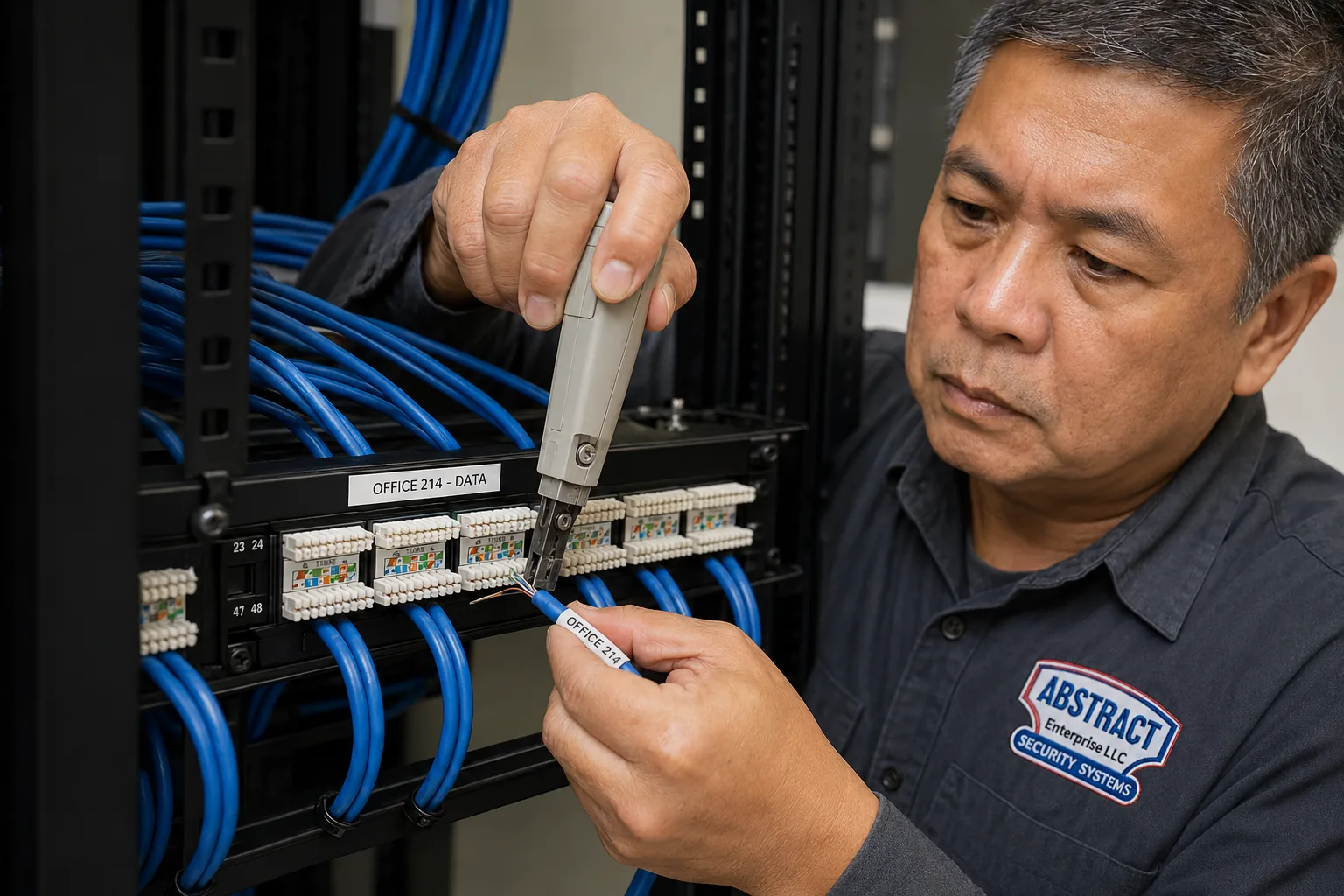
Fresh punch-downs at jack and panel, wired to T568B, with pair geometry held and untwist kept inside spec so the channel certifies rather than merely lights up.
Network Jack Repair
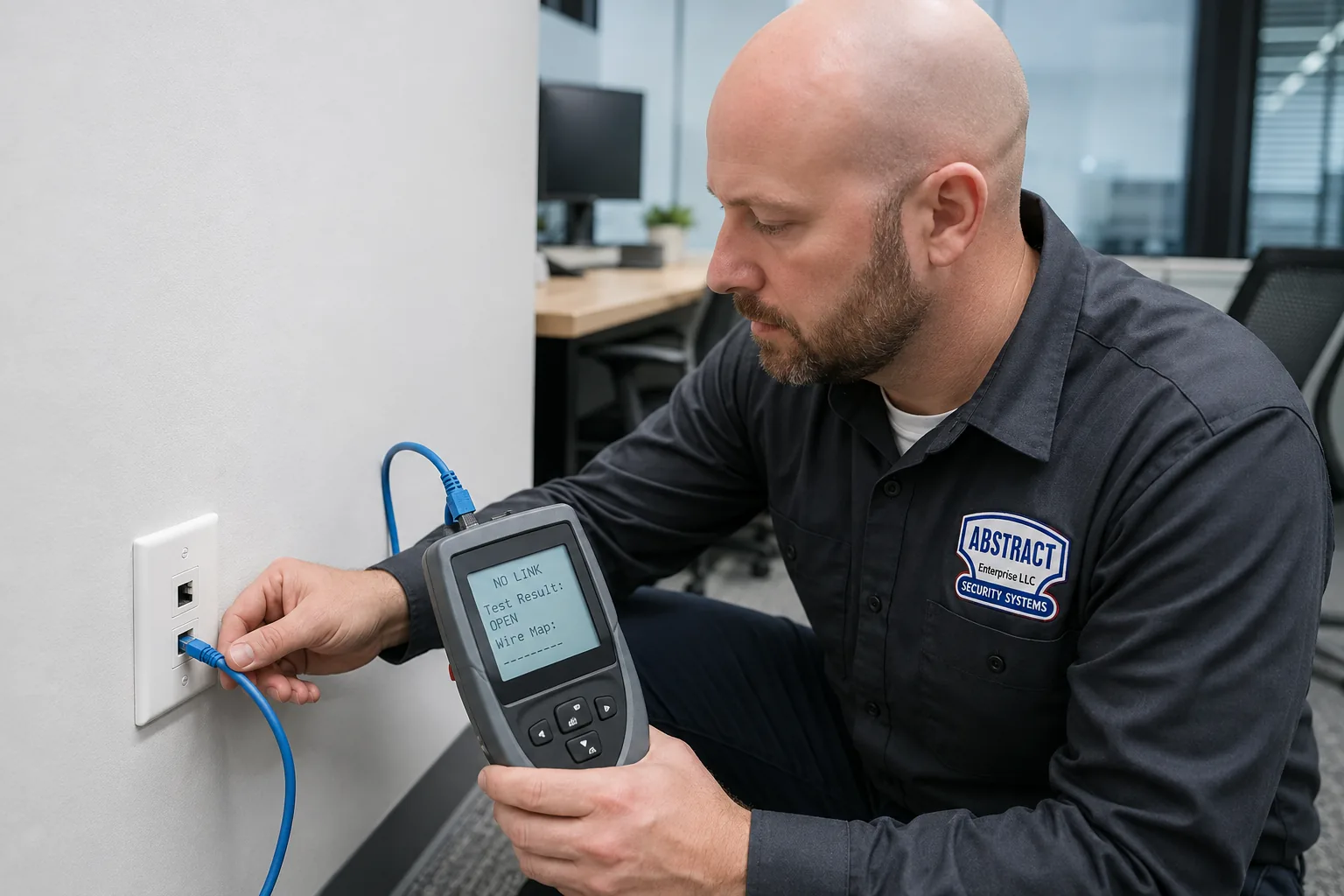
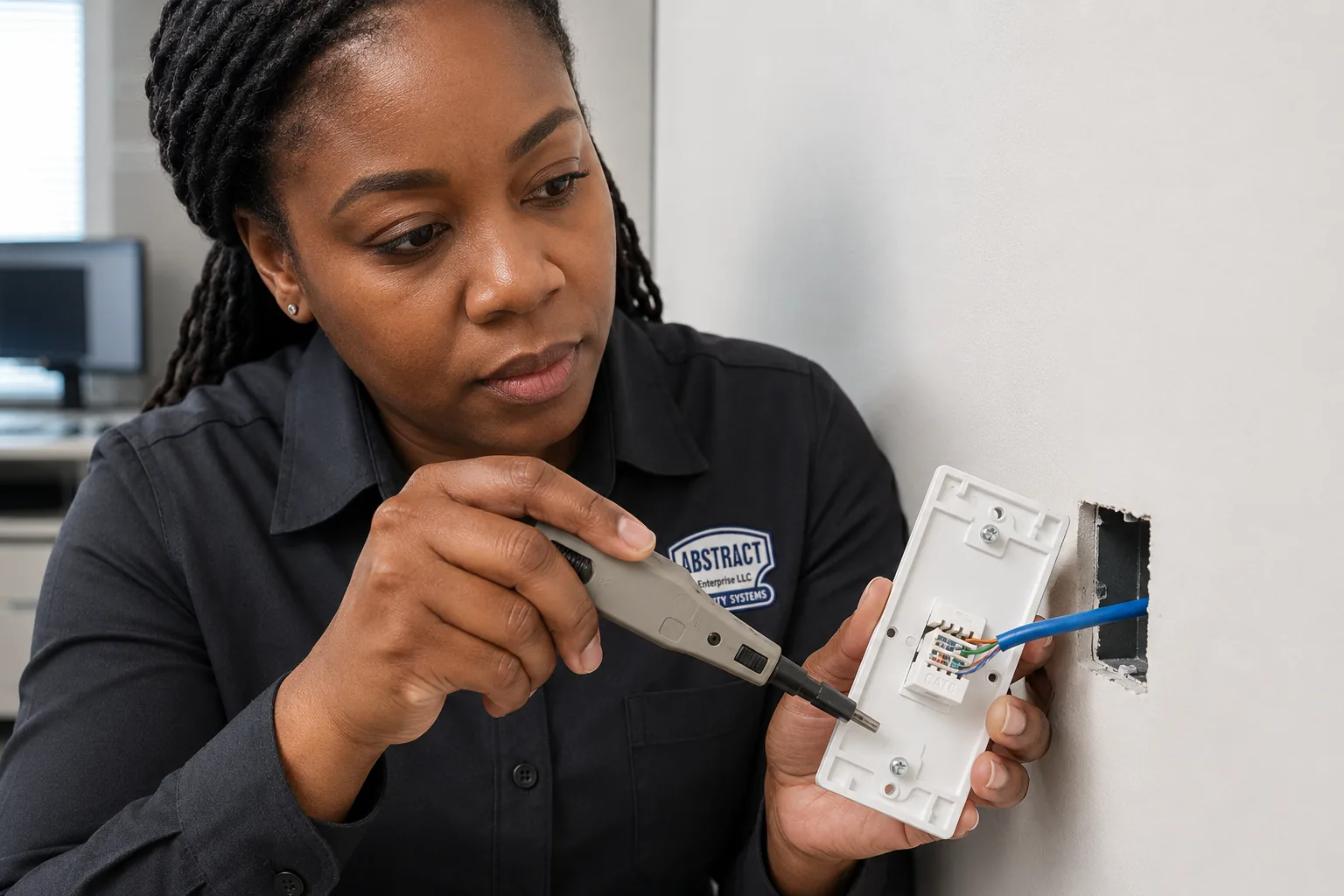
Dead outlets, loose keystones, surface-mount boxes pulled off brick, and jacks never fully punched at fit-out.
Patch Panel Repair
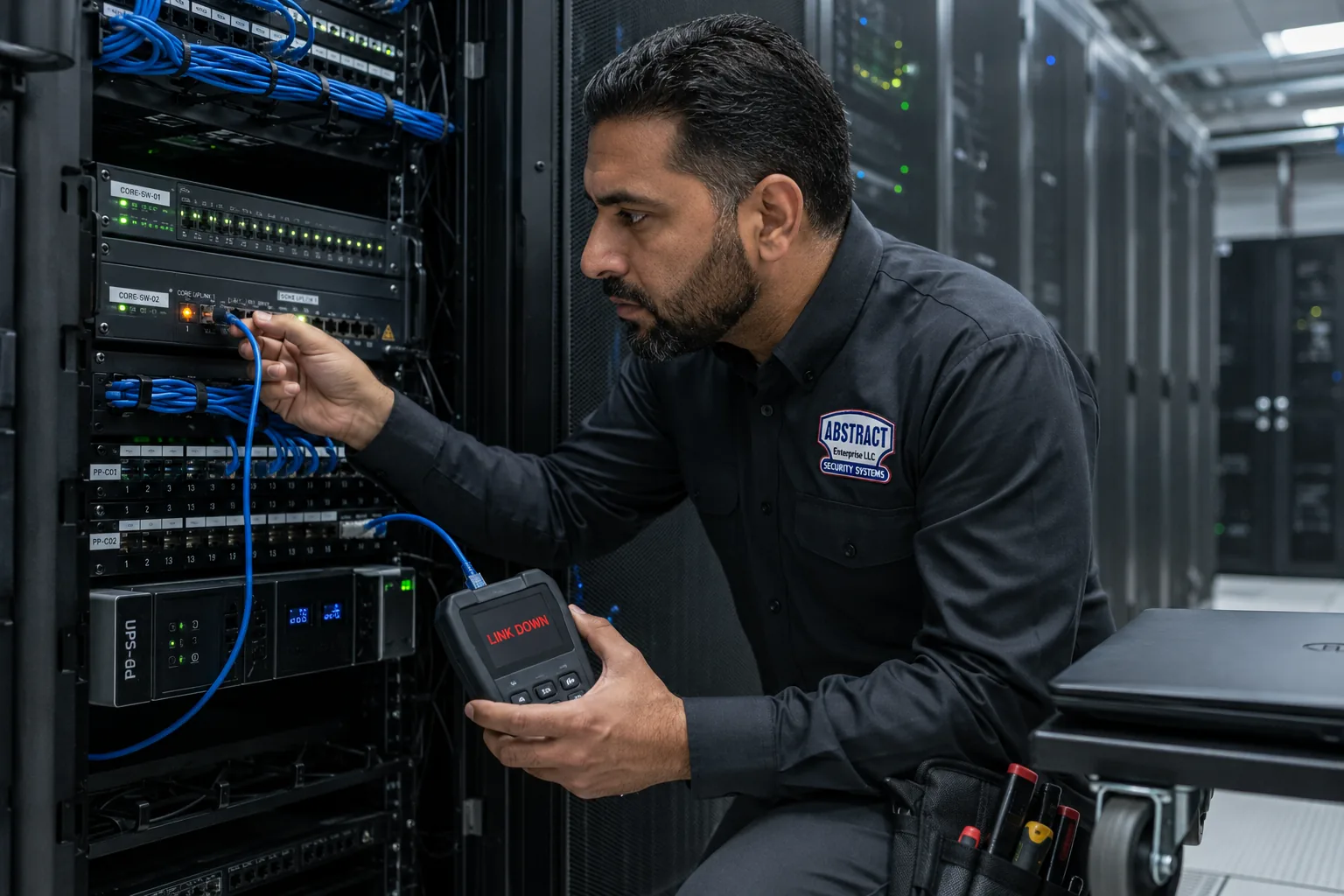
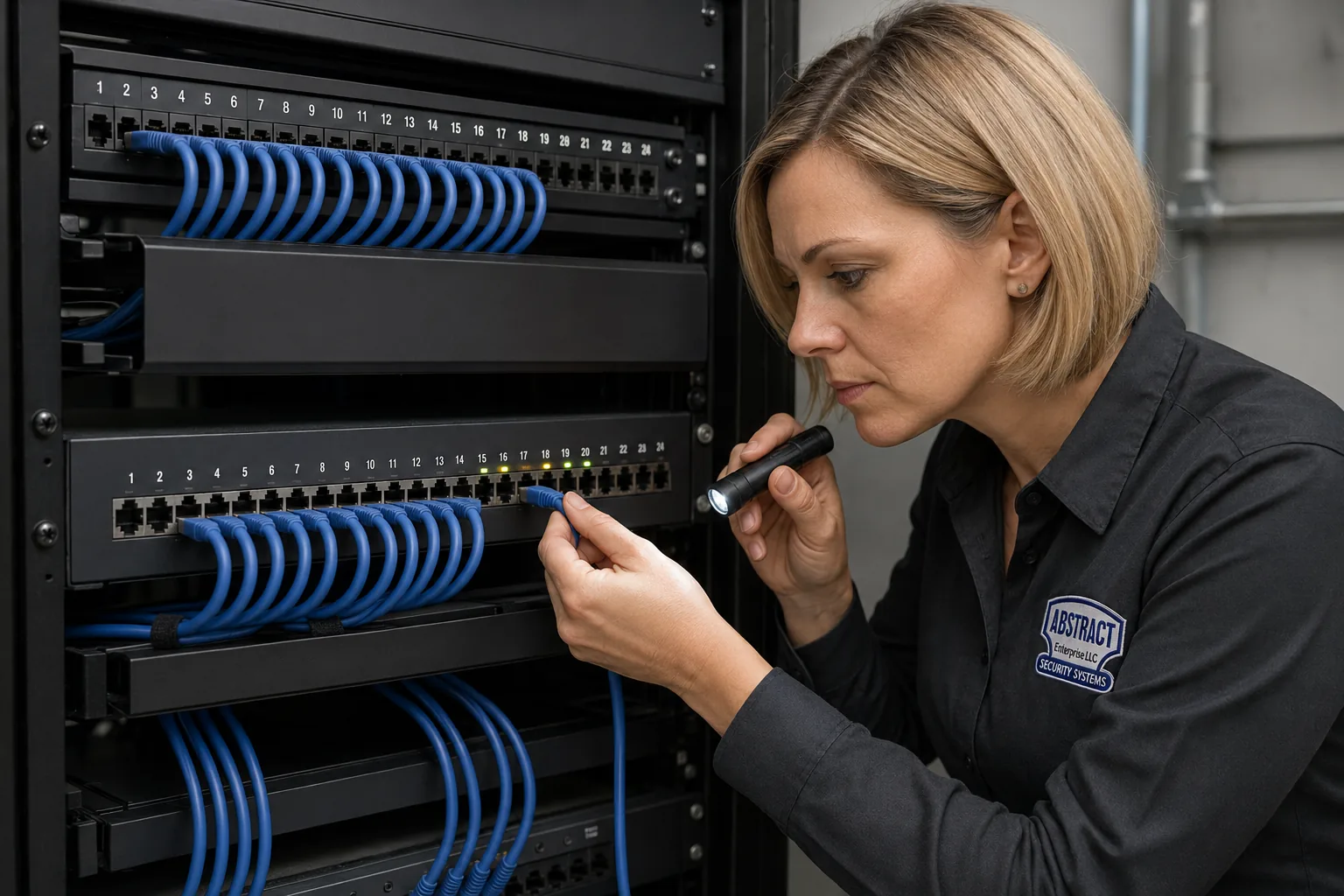
Failed positions re-terminated, tired panels swapped out, and the classic mismatch fixed where somebody wired T568A at the outlet and T568B back at the frame.
Shared-Panel Tracing
Identifying your runs inside a hallway panel serving several tenancies, and labelling them so the next fault takes minutes.
Certified Testing
Wiremap, length and performance verification with saved reports, including margin so you know which drops are close to the edge.
PoE Circuit Troubleshooting
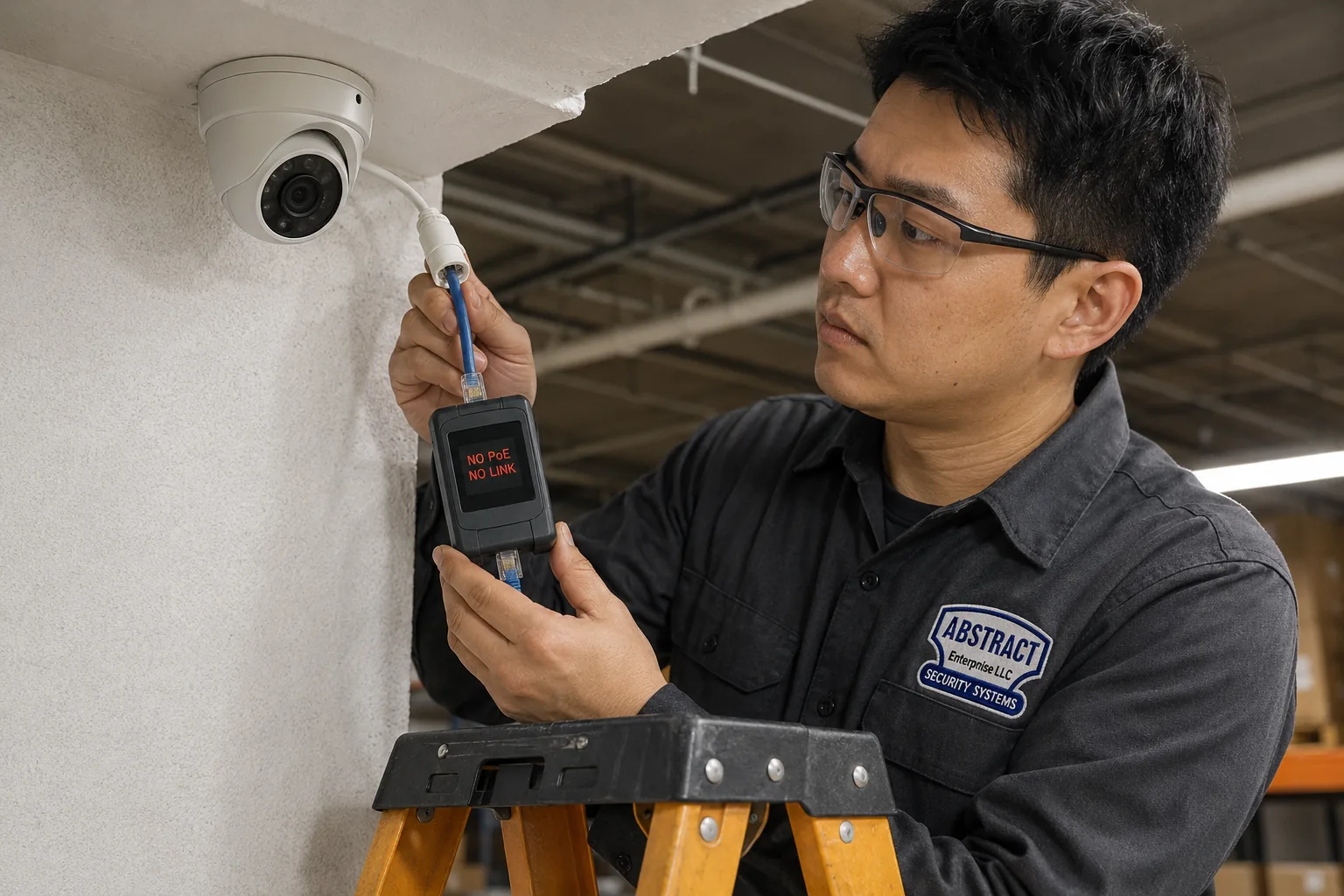
Devices that power up, run briefly, then restart. We measure voltage at the far end under real draw, which tells you whether the run is sagging or the switch has run out of budget.
Commonly paired: in open-ceiling buildings the camera and reader drops run on the same supports as the data. If one run in a bundle failed from chafe or crush, the rest of the bundle is worth testing while the ladder is up — see camera repair and access control.
Plain English
Terms That Come Up on a Brooklyn Cabling Job
Conversion buildings bring their own vocabulary, and most of it is about the route rather than the cable.
Term
What It Means in Brooklyn Building Stock
Pathway
The supported route cable travels. In an open-ceiling building it is visible, permanent and part of the interior, so it gets designed rather than improvised.
J-hook
The support that carries bundles at intervals along a ceiling. Cable resting on a sprinkler line or a conduit instead of on supports is a fault waiting to happen.
Bend radius
The tightest curve a cable tolerates before its electrical performance degrades. Violated constantly in crowded panels and at sharp structural corners.
Chafe
Jacket wear where cable moves against a hard edge. The classic exposed-structure failure, and it fails intermittently long before it fails completely.
Surface raceway
Visible trunking used where there is no cavity. The honest answer in a great deal of Brooklyn stock, and worth doing tidily because it stays.
Split pair
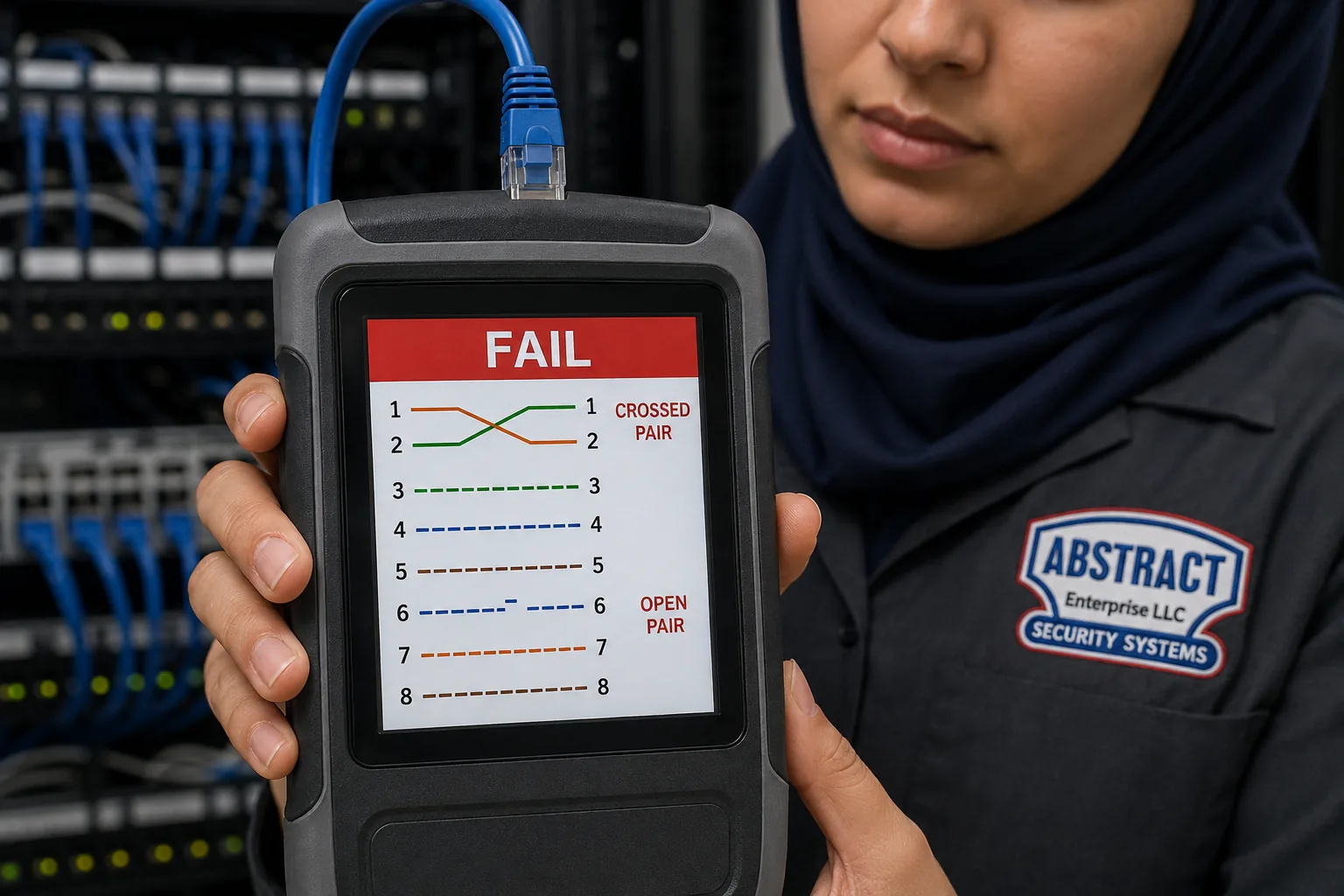
Every conductor is connected but paired incorrectly. The link comes up at 100 and refuses gigabit, which is why it reads as a speed complaint rather than a wiring fault.
Plenum (CMP)
The jacket rating fire code demands when a ceiling void moves return air. Relevant in the MetroTech towers and newer fit-outs; largely moot in an open-ceiling loft.
Certification
A measured pass against the category standard, saved and printable, with the margin recorded. A beeping continuity checker is not this and never was.
Shared panel
The hallway or cellar panel serving several tenancies in a mixed-use building. Your run is in there somewhere, usually unlabelled.
Demarc
Where the carrier's responsibility ends. Past it, the building's and the tenant's infrastructure begins, and so does our scope.
Equipment
Hardware and Test Equipment on a Brooklyn Repair
We repair what is already installed and replace with commercial-grade components matched to the existing channel. Passive hardware typically means Belden, CommScope, Panduit, Leviton, Hubbell, Ortronics, ICC, Berk-Tek and Superior Essex, with proper J-hooks, cable trays and surface raceway where the route is visible. Category matching is not optional: a Cat5e keystone in a Cat6 channel derates the whole channel regardless of what the cable is rated for.
On the equipment side we chase cable faults behind Cisco, Meraki, Aruba, Ubiquiti UniFi, Netgear, TP-Link, Luxul and Araknis switching, and behind PoE devices — cameras, radios, handsets, readers, displays. What we do not touch is configuration: no switch administration, no VLAN work, no controllers, no firewall policy. The channel gets certified and the results go to whoever runs the network.
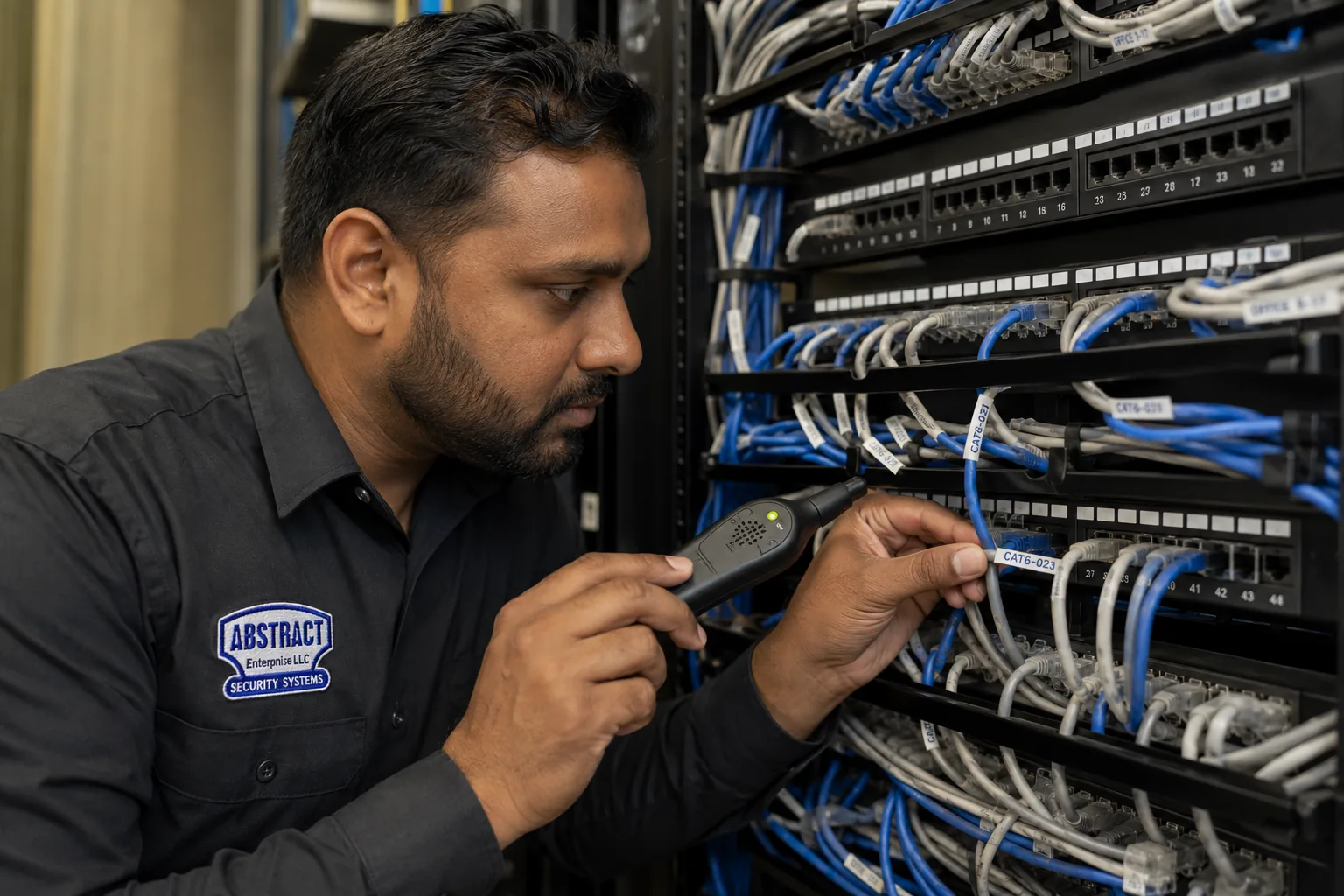
Diagnostics decide whether a visit produces an answer or an opinion: certification testers with saved reports, tone generators and probes for tracing through shared panels, and PoE load verification at the endpoint. In a building with no documentation the toner is the first tool out of the bag.
Need Repair in Brooklyn Today?
Same-day dispatch across the borough from our Troy Avenue base. Most single-fault repairs are located and restored inside the first three-hour block.
In conversion stock a repair that ignores the pathway is a repair with an expiry date.
Locating comes first: which element, at what distance, on which pair. In an open-ceiling building that is frequently faster than in a plenum ceiling, because once the run is identified you can see it. Then the correction — retermination, junction, jack or panel replacement, or a new run where certification fails. Then certification with the margin reported, because a channel that passes narrowly in a building with wide seasonal temperature swings is a call you will make again.
The step specific to this borough is the route. If a run failed because it was stapled to a joist, crossed a steel edge, or sat against a steam line, replacing the cable along the same path reproduces the fault with newer copper. We move it onto supports, at a consistent height, dressed — and because the work is visible in most of these buildings, tidy is not vanity, it is the deliverable.
Full Scope
Full Scope of a Brooklyn Network Cable Repair
Diagnostics
Visual and physical inspection of exposed runs
Distance-to-fault location on concealed or partially concealed runs
Wiremap faults: opens, shorts, reversals, split and crossed pairs
Measured length against the 90 m and 100 m limits
Insertion loss and crosstalk testing with margin reporting
PoE voltage and load verification at the endpoint
Tone-and-probe tracing through shared mixed-use panels
Switch-port versus cable-fault isolation
Physical Repair
Keystone jack replacement and re-punch
Patch panel port retermination and panel swap
Category-appropriate junction repair on damaged runs
Pathway correction: J-hooks, tray, raceway, off sharp edges
Full run replacement where certification fails
Surface-mount box and raceway repair on brick and timber
Firestop restoration at penetrated rated assemblies
Both-end durable labelling and closet or panel legend
Photo record of pathway corrections and concealed repairs
Written findings for a landlord or building owner
Identification of your runs inside a shared panel
Site Logistics
Certificate of insurance to owner or managing agent where required
Evening and weekend windows for retail and food service
Coordination with resident landlords in mixed-use buildings
Plenum-rated material where the ceiling handles return air
Dust control and occupied-space working
Coordination with your existing IT provider
Coverage Detail
Where We Work Across Brooklyn
Downtown and the waterfront carry the densest commercial demand. Downtown Brooklyn and MetroTech behave like Manhattan towers — floor closets, plenum ceilings, building access rules. DUMBO and the Brooklyn Navy Yard are the opposite: converted industrial with heavy timber, exposed brick, fourteen-foot ceilings and visible pathway. Brooklyn Heights, Cobble Hill, Boerum Hill and Carroll Gardens add small professional and medical tenancies in older buildings, many converted from residential.
The industrial spine runs from the Navy Yard south through Gowanus, Sunset Park and Industry City to Bay Ridge along Third and Fourth Avenues. Industry City alone is a campus of converted warehouse buildings with deep floorplates, long runs and freight traffic that damages cable at pallet height. Red Hook sits west of it with the same building type and more water. North Brooklyn — Williamsburg, Greenpoint, Bushwick and East Williamsburg — is loft conversion and light manufacturing, plus dense storefront retail along Bedford, Grand and Knickerbocker.
Central and south Brooklyn shift toward mixed-use taxpayer buildings on commercial strips: Flatbush Avenue, Church Avenue, Nostrand and Utica, Kings Highway, 86th Street in Bensonhurst, Fifth Avenue in Bay Ridge, Canarsie along Rockaway Parkway, and Brownsville and East New York along Pitkin and Broadway. Ground-floor commercial with apartments above, shared hallway panels, cellar telecom spaces and no floor closet. Our own office sits on Troy Avenue in this part of the borough.
Who We Serve
Brooklyn Industries We Repair Cabling For
Creative Studios and Production
DUMBO, Gowanus, Greenpoint. Exposed ceilings where a repair is visible, high bandwidth expectations, and pathway that is part of the interior.
Light Manufacturing and Maker Space
Industry City, Sunset Park, East Williamsburg. Long runs, machinery interference, and cable damaged at working height.
Warehouse and Distribution
Deep floorplates near the 100 m limit, forklift and racking strikes, and scanner and access point drops in high-interference space.
Retail and POS
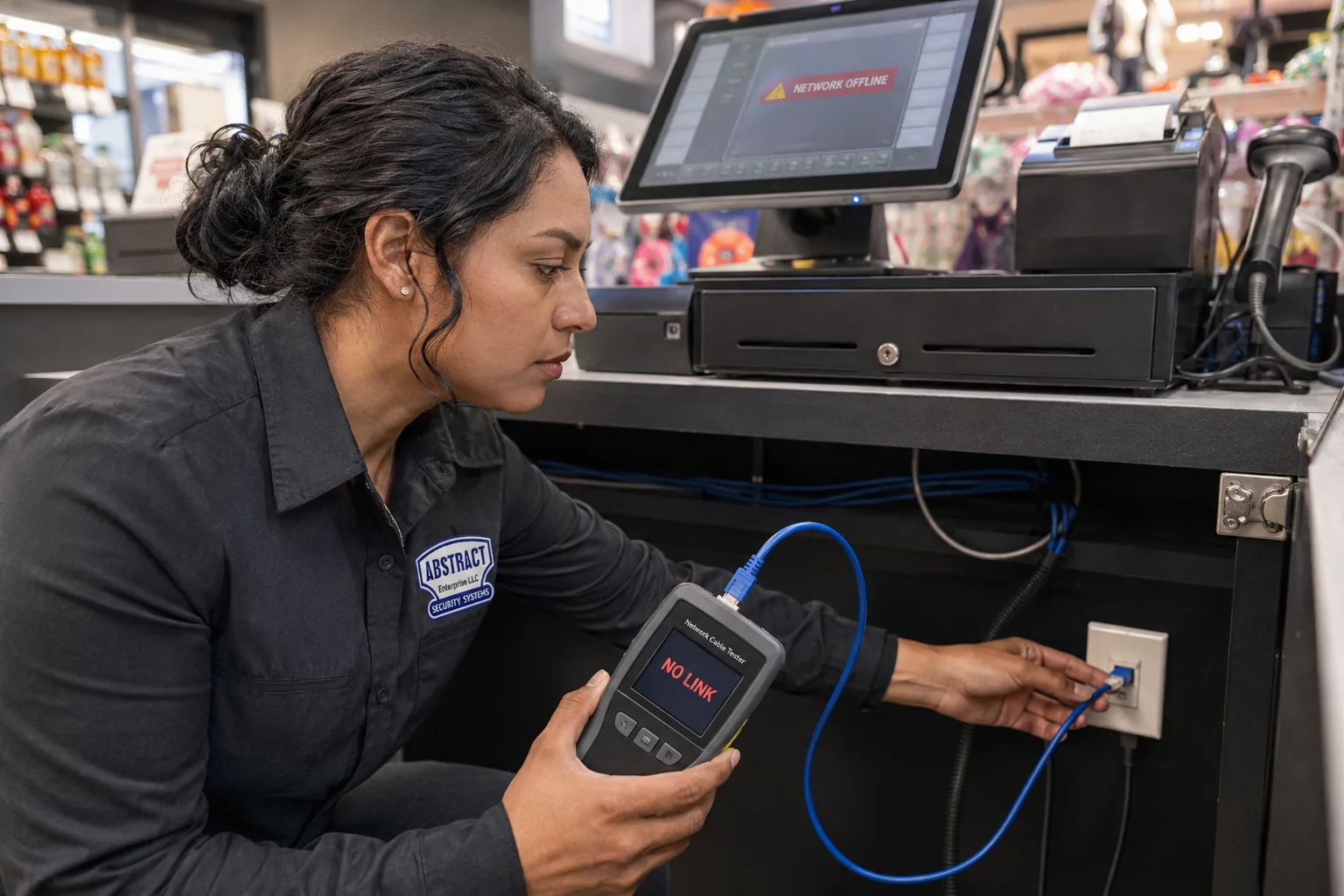
Avenue corridors across the borough. Register lanes dropping mid-transaction and back-office runs damaged during shelving work.
Restaurants and Bars
Kitchen-side terminals in heat and grease, cable damaged during hood cleaning, and plenum requirements in newer fit-outs.
Medical and Dental
Practices in converted residential buildings across Bay Ridge, Midwood, Park Slope and Flatbush, with low tolerance for a marginal channel.
Professional Offices
Downtown Brooklyn towers and small tenancies on commercial strips — two completely different jobs under one heading.
Apartment and Mixed-Use Buildings
Hallway panels feeding cameras, intercom controllers and readers, with runs damaged during renovation.
Schools, Nonprofits and Community Facilities
Layered infrastructure, documentation requirements, and repair windows that fall outside programme hours.
Drawn from the recurring themes in small-business, IT and Brooklyn-local discussion threads, grouped by the six question types that come up most.
Cost Questions
1. What does a repair cost if the cable is right there in the open?
The same rate — $195/hr against a three-hour minimum, $585 for the first block. Visible cable makes location faster, and that time goes into testing the adjacent runs and correcting the pathway rather than into the invoice. What it does not do is make a marginal channel acceptable; the tester still decides whether the repair holds.
2. Why does the quote include re-routing when only one cable broke?
Because the route is why it broke. A run that chafed against a steel edge or was stapled through will fail again in the same place if the replacement follows the same path. Moving it onto supports costs very little while the ladder is up and it is the difference between a repair and a recurring visit.
3. Is it cheaper because you are based in Brooklyn?
The rate is the same borough to borough. What is genuinely better is response — we dispatch from Troy Avenue, so Brooklyn is our shortest drive and same-day slots are easiest to fill here.
Quality and Trust Questions
4. The cable will be visible. Does that mean it will look bad?
Only if it is done badly. In an open-ceiling building the route is part of the interior, so it gets designed: consistent height, straight parallel runs, proper supports, dressed bundles, colour chosen deliberately. Clients who took these buildings for their character notice, and improvised routing in a room like that is permanent.
5. Do I need a licensed contractor for this?
Yes for anything beyond a patch cord. Data cabling is low-voltage work with real code obligations around plenum rating and firestopping at rated penetrations, and building owners generally require licensure and insurance for access. We hold NYS Low-Voltage Contractor Licence #12000287431.
6. Our landlord lives in the building and wants to be there. Is that a problem?
Not at all, and in mixed-use Brooklyn it is common. Where a run passes through shared hallway or cellar space we would rather coordinate with the owner than surprise them, and having them present usually speeds up access to the panel.
DIY and Pro Questions
7. Can I staple a cable to the joist myself?
Please do not. A staple driven slightly too hard crushes a pair and produces a channel that passes marginally now and fails in a year or two, intermittently, in a way nobody connects to the staple. Cable belongs on supports sized for it, not fastened through it.
8. My cheap tester says the cable is fine. Why is it still bad?
That device confirms the eight wires reach the right pins and stops there. Length, signal loss, pair-to-pair interference and reflections are all outside its ability, and they are precisely what breaks gigabit links. In a converted building that swings thirty degrees between seasons, headroom is the whole story and a pin checker cannot see it.
9. Can I just use a coupler to extend a run to a new bench?
It adds a connection point and length to a channel that may have little margin left. In a deep floorplate like Industry City or a Sunset Park warehouse, that is exactly where a run is already close to the limit. Re-pull, or add a properly engineered intermediate point.
Technical Questions
10. Why does one drop link at 100 Mbps when the rest do gigabit?
One of the four pairs is not doing its job. Older 100 Mbps signalling only needs two pairs, so the link comes up happily; gigabit needs all four and either never negotiates or negotiates and collapses. Nothing else produces this pattern, which makes it the most useful free clue you have.
11. Our drops die when the freight door opens. What is that?
Almost always mechanical. A run resting on a rolling door track, a conduit that moves, or a bundle pinched where the wall flexes. It is a pathway fault rather than a cable-quality fault, and it is one of the more satisfying ones to find because the trigger tells you where to look.
12. A PoE camera in the yard reboots constantly. Cable or camera?
Usually cable-side voltage drop, especially on a long exterior run or on Cat5e carrying PoE+. Current draw rises when the illuminator or heater engages, voltage sags below the operating threshold, and it resets. Testing under load at the endpoint separates that from a switch budget limit.
Landlord and Tenant Questions
13. Our unit is over a storefront and the panel is in the hallway. Who owns what?
Usually the building owns the panel and the pathway; you own the run from it into your space, though leases vary and small mixed-use leases are frequently vague. We identify which side of the line the fault sits on and document it, which is what settles the conversation with a resident landlord.
Complaint Questions
14. Somebody already replaced this cable and it failed again in the same spot. Why?
Because the pathway was not corrected. If the original run failed from chafe against an edge, a crush at a staple, or heat from a nearby line, the replacement run in the same position fails the same way. The second visit should cost you a route change, not just new copper.
Answer The Public
Answer The Public: Brooklyn Network Cable Questions
Who repairs network cable in Brooklyn?
This is low-voltage contractor territory. An electrician will run your conduit and pathway but hands the terminations on; an IT firm owns everything above the copper and rarely owns a certifier. A dead outlet in a Gowanus loft belongs to the cabling trade.
What causes cabling to fail in Brooklyn buildings?
In rough order: pathway faults in exposed-structure conversions — chafe, crush, staples, heat — then terminations executed without untwist discipline, moisture and corrosion in cellar telecom spaces, mechanical damage in warehouse and freight environments, and legacy Cat5e under modern PoE loads.
When does replacing beat repairing in a converted building?
When it fails certification after terminations are corrected, when there are multiple damage points, when measured length puts the channel out of spec, or when the existing route cannot be made safe — in which case the run moves rather than merely gets replaced.
Where do faults sit in a converted building?
At terminations first, then wherever the cable touches something hard, hot or moving: a steel edge, a joist it was stapled to, a sprinkler line it rests on, or a door track it crosses.
How quickly can a Brooklyn repair be scheduled?
Same day in most of the borough. We dispatch from Troy Avenue in Flatbush, so Brooklyn is our shortest drive and the easiest place for us to fill an urgent slot.
Reality Check
AI Overview Reality Check: What Search Results Miss About Brooklyn Cabling
Search for network cable repair in Brooklyn and you get a national cost average, a row of lead-generation directories, and troubleshooting advice written for a building with drywall, studs and a drop ceiling. Most Brooklyn commercial space has none of those.
1. The Advice Assumes a Cavity That Is Not There
Nearly all published cabling guidance assumes you can fish a wall or lift a ceiling tile. A converted factory floor in Gowanus, Sunset Park or Greenpoint has timber joists, brick party walls and an open ceiling.
That inverts the standard advice. There is no hidden route to pull a new run through, so the question is not how to conceal cable but how to route it well in the open — consistent height, proper supports, straight parallel runs, deliberate colour. A repair that ignores that produces a permanent eyesore in a space the tenant chose for its character.
It also changes diagnosis for the better: in an open-ceiling building the fault is often visible once the correct run is identified, which makes toning the expensive part and the repair itself quick.
2. Pathway Is the Cause and It Barely Appears in Search Results
General content treats cable failure as an electrical event. In this building stock it is usually mechanical: a jacket worn through against a steel edge, a pair crushed under a staple, a bundle resting on a hot line, or a run crossing something that moves.
Because the mechanism is mechanical, replacing the cable along the same route reproduces the fault. That single point is missing from almost every search result and it is the difference between one repair and an annual one.
The tell is repetition. A run that has failed twice in the same area has a route problem, not a cable problem, and the second quote should include moving it.
3. Cost Averages Do Not Know What Building You Are In
Aggregated cost pages publish national figures blended across residential and light-commercial work. They describe an average of something, but not of certified repair work in a converted warehouse with fourteen-foot ceilings and lift access.
They also collapse installation and repair into one number. Installation has known scope before dispatch; repair does not, because the fault must be found before it can be priced. That is why repair is billed hourly with a minimum rather than per drop.
And they exclude deliverables. Certification reports, labelling and a panel legend are what separate a repair you can evidence from one you take on faith — strip them out and any honest quote looks expensive.
4. Downtown Brooklyn Is Not the Same Job as Bushwick
Search results treat a borough as one market. Brooklyn is at least three: modern towers around MetroTech that behave like Midtown, converted industrial across the waterfront and northern neighbourhoods, and mixed-use taxpayer buildings on the avenue corridors.
Each has different access rules, different pathway, different failure modes and a different correct answer. A contractor who only knows one will be wrong in the other two, and a national cost average cannot represent any of them.
When you brief a contractor, describe the building rather than the borough: is the ceiling open, dropped or plenum; is there a floor closet or a hallway panel; who controls access.
5. Moisture Damage Is Framed as a Flood, Not a Season
National content treats water as an event. In low-lying Brooklyn — Red Hook, Gowanus, Canarsie, the Sunset Park waterfront — the usual mechanism is slower: humidity in a cellar telecom space corroding contacts across seasons.
The symptom is a link that degrades gradually rather than dying, and it is nearly always found at a connection point rather than mid-cable. Retermination fixes it; replacing the run without addressing the environment does not.
Buildings with cellar-level panels should have terminations inspected on a schedule rather than only when something breaks, and that recommendation appears in no search result we have seen.
6. Lead Directories Sell Your Number Rather Than Vetting Capability
Angi, HomeAdvisor, Thumbtack and their equivalents sell each request to several contractors at once; the fastest responder is generally whoever paid most for the lead. Ratings sit on profiles spanning many trades.
The damage is done by how the listings are grouped. Wireless help, router configuration and physical cable work all sit under one label, so somebody whose toolkit is a laptop can answer a job that needs a certifier, a tone set and a punch tool.
Ask three things on the phone and the field clears: is there a certifier on the van, do I get a saved result for each drop, and what is your New York State low-voltage licence number.
7. Nobody Online Mentions the Shared Panel
A large share of Brooklyn commercial tenancies sit in mixed-use buildings where the telecom panel is in a shared hallway or cellar and carries several tenants' runs, unlabelled.
That is a tracing problem before it is a repair problem, and it is also a coordination problem — access is controlled by an owner who may live upstairs. Neither appears in generic guidance and both affect how long the visit takes.
The high-value outcome in those buildings is not the repair itself but the labelling: once your runs are identified and marked at both ends, every future fault is a five-minute check instead of an hour of guessing.
Fix the Cable and the Route It Runs On.
Certified testing on every repair. Licensed NYS low-voltage contractor. 4.7★ from 201 reviews.
Costs nothing and resolves a real share of intermittent links. The locking tab snaps, the plug backs out a millimetre, and the link starts flapping.
Move to a different switch port
Yes
Thirty seconds of work that eliminates the switch from the picture entirely.
Test the device on a known-good outlet
Yes
If the same laptop works at the next desk, the fault is the original outlet or its run. No tools required.
Visually follow an exposed run end to end
Yes
In an open-ceiling building this is genuinely useful and free. Look where the cable touches anything hard, hot or moving.
Re-punch a keystone jack
Borderline
The tool is cheap; the technique is not. Leave too much pair untwisted at the contact and the channel drops out of spec while the link light stays on.
Staple or nail cable to structure
No
Crushed pairs from over-driven fasteners are one of the commonest faults we find in this borough, and they fail long after the person who installed them has gone.
Re-route a run yourself in a loft ceiling
No
Support spacing, bend radius, separation from line voltage and firestop obligations all apply, and the work is permanently visible.
Diagnose gigabit-only or seasonal failures
No
These live in measurements a consumer tester cannot take. Without a margin figure you are guessing at which drops survive the next cold snap.
Work in a shared hallway or cellar panel
No
Other tenants' live services are in there. Toning before touching is the whole discipline.
Worth your quarter hour: the four rows above marked yes. In an open-ceiling building the visual walk is the standout — spot where the cable presses against something it should not and you have very likely found the fault yourself.
Alternatives
How a Licensed Cabling Contractor Compares Here
vs. The Firm That Manages Your IT
Capable on the network side and generally upfront that copper is not their trade. The catch is that cabling gets farmed out, so the person on your ladder was never the firm you chose and their calendar is not yours.
vs. Lead-Generation Platforms
One enquiry, several buyers, and the quickest caller is whoever paid the most for it. Because the listing categories lump computer support in with cable work, the responder may own a screwdriver and no tester, and nobody there ships a test report as standard.
vs. Your Carrier's Technician
Their obligation stops at the demarc and they will tell you so, accurately. A clean circuit test at that point with dead outlets upstairs means the problem lives in the building, which is where their scope ends and ours starts.
vs. A General Electrician
The right trade for conduit, coring and anything carrying line voltage, and frequently needed on conversion work. Terminating data is a different craft with far tighter tolerances, which is why most electricians hand it off rather than guess at it.
vs. A Handyman or the Building's Super
Fine for a patch cord or a faceplate. Where it goes wrong is fastening and routing — the staple through the jacket and the run draped over a sprinkler line are almost always well-intentioned work by somebody without the training.
Warning Signs
Five Signs the Cable Is the Problem in a Brooklyn Building
One outlet is dead and everything else works. Whole-network causes fail in groups. When exactly one port is out, you are looking at that run or its terminations.
The drop links at 100 Mbps while its neighbours reach 1000. One pair is compromised. Nothing else produces that pattern, and noticing it costs you nothing.
The fault appears when a door, gate or freight lift is used. Mechanical. The run is touching something that moves, and the trigger tells you where to look.
You can see the cable resting on a pipe, an edge or a light fixture. That is the failure point, whether it has failed yet or not.
The link has degraded slowly across a season rather than dying. Corrosion at a termination, typically in a cellar or ground-level panel in the low-lying parts of the borough.
Community
Community Chatter: Recurring Themes From Public Forums
Paraphrased themes from public homeowner, small-business and IT discussion threads — not customer reviews of AESS.
Threads about loft and warehouse offices repeatedly describe cable failures traced to a staple, a sharp edge or a hot pipe — and note that the second failure happened only because the replacement followed the same route.
A recurring note in owner forums is shock at how little of a cabling invoice is materials. It is a fair reaction and an accurate invoice — finding the fault is the expense, the cable is pocket change.
Published help-desk runbooks from very different organisations land on an identical first three steps, which is usually a sign the sequence has been tested against reality rather than invented.
Enterprise troubleshooting guidance specifically flags intermittent connectivity in older buildings with legacy cabling as a wiring-quality issue rather than a configuration issue, which matches what we find in conversions still running early-2000s Cat5e.
Mixed-use tenants regularly describe discovering their run inside a shared hallway panel with no labelling, and note that having it marked was worth more than the repair that prompted it.
Field Video
Watch: Field Diagnostics on a Brooklyn Repair Call
Short-form field clips from our channel: youtube.com/@openeye0007 Embed slot reserved — drop the Short iframe here once the clip ID is set.
Our specialty service rate is $195 an hour against a three-hour minimum, putting the opening block at $585. Inside that: locating the fault, the repair itself, correcting the route where the route was the cause, certification testing and the paperwork. Where a run has to be pulled fresh instead, commercial Cat6 drops begin at $175 each.
Can a chafed or crushed run be saved, or does it need pulling out?
+
Repair works where the damage sits in one spot you can reach: a junction rated for the category, executed properly, then proved on a certifier. Replace instead when the run still fails after both ends are redone, when it has been hurt in several places, or when the route itself cannot be made safe.
Our ceiling is open and the cable will be visible. How do you handle that?
+
By designing the route rather than improvising it: consistent height, straight parallel runs, proper supports, dressed bundles and deliberate colour. In this building stock the pathway is part of the interior and whatever we install stays, so it is treated as visible work from the start.
Why did the same cable fail twice in the same place?
+
Because the pathway was not corrected. Chafe against an edge, a crush at a staple, or heat from a nearby line will destroy a replacement run in the same position. The correct second visit moves the route, not just the copper.
My wall jack is completely dead. What is the most likely cause?
+
Ranked by how often we find each: the patch cord with a snapped latch, the panel port that was never terminated or was done to the opposite standard, the jack whose wires sit in the slots without being driven home, and damage somewhere along the run.
Why does the wired connection crawl while the wireless behaves?
+
Either a pair is broken or miswired, holding the link at 100 Mbps, or the channel is running so close to its limit that packets are being retried. Neither is visible until somebody measures the run properly.
A PoE camera keeps rebooting. Is that the cable?
+
Frequently, and most of all on outdoor runs or on older Cat5e feeding a modern PoE class. The moment the illuminator or heater kicks in the draw jumps, the supply at the far end dips under what the unit needs, and it restarts.
Our panel is in a shared hallway. Can you still work on it?
+
Yes, and it is common in mixed-use Brooklyn. We tone before touching anything, because other tenants' live services are in there too, and we label your runs at both ends so the next fault is a quick check rather than an hour of guessing.
Do you provide certified test reports?
+
Yes. Every repaired drop is tested and you receive saved results including measured length and margin, both-end labelling, and where the scope includes the panel or closet, a port map legend.
How fast can you get here?
+
Usually same day. We dispatch from Troy Avenue in Flatbush, so Brooklyn is our shortest drive and the easiest borough for us to fill an urgent slot.
How is the work covered afterwards?
+
Products we supply are covered one year, parts only, under the service agreement. Cover is void if installed work is altered or interfered with without written authorisation first.
Applied only where ceiling space is used for return air
After-hours or weekend window
Premium applies
For buildings restricting low-voltage work to off-hours
Published starting rates for Brooklyn. Final pricing depends on access, pathway, material rating and testing scope, and is confirmed in writing before work begins. Full terms — including 50% deposit, one-year parts-only warranty on AESS-supplied products, and the late-fee schedule — are set out in the service agreement. See structured cabling pricing for new-installation drop rates and Cat6 installation Brooklyn for per-drop grade comparisons.
Staples and nails driven into the jacket are the signature fault of this building stock. A slightly over-driven fastener crushes a pair, the channel certifies marginally, and it fails two winters later in a way nobody connects to the staple.
Chafe Against Structure
Exposed steel, brick corners and joist edges wear jackets where cable moves even slightly. It fails intermittently long before it fails completely, which is why it gets misdiagnosed as a switch or carrier problem.
Heat From Adjacent Services
Runs resting against steam lines, hot-water piping or light fixtures in converted buildings. Insertion loss rises with temperature and the fault follows the heating season.
Cellar Moisture in Low-Lying Blocks
Red Hook, Gowanus, Canarsie and the Sunset Park waterfront. Ground-level and cellar telecom spaces take humidity; terminations corrode long before jackets do, producing slow degradation.
Shared Panels in Mixed-Use Buildings
Hallway and cellar panels serving several tenancies with no labelling. Tracing your run through somebody else's live services is the work before the repair starts.
Freight and Racking Damage
Industry City, Sunset Park and the Navy Yard. Forklift strikes, pallet racking contact at working height, and runs crossing rolling door tracks.
Cross-sell note: in these buildings the camera, reader and access point drops share the same supports as the data runs. When a bundle has failed from chafe or crush, testing the camera drops and intercom runs alongside it costs a fraction of a separate visit.
From the Field
Field Notes
In an open-ceiling building the first thing we do is walk the run with a light rather than reaching for a tester. Where the cable touches something hard, hot or moving is where it fails, and often you can see it from the floor.
Behind the plate the findings repeat: too much untwist at the punch-down, conductors seated but not driven through the contacts, one end punched to a different standard than the other, and a surface box pulled loose from brick with the cable taking the strain.
In a shared hallway panel, tone before you touch. Somebody else's live service is in there, and the fastest way to turn a one-drop repair into an emergency is to pull the wrong cord.
When a run has failed twice in the same place, stop replacing it and change the route. That conversation is short, the customer always understands it, and it is the difference between a repair and a subscription.
Get In Touch
Request a Free Quote
Fill out the form below and we'll get back to you within the hour. Or call us directly at (347) 934-8335.
✅
We Got Your Request!
We'll call you back within the hour. If it's urgent, call us now at (347) 934-8335.
Emergency
Need Repair in Brooklyn Right Now?
Whole network down, register offline, camera feeds lost. Dispatched the same day from our Troy Avenue base, anywhere in the borough.
Last reviewed: August 25, 2026 · Next scheduled review: November 2026 Changelog: Aug 2026 — page published. Conversion-stock pathway failure established as the primary Brooklyn thesis; fastening, chafe and heat mechanisms added; shared mixed-use panel tracing added to scope and pricing; cellar moisture section added; pricing aligned to the $195/hr specialty rate with a three-hour minimum; direct Brooklyn line (347) 934-8335 used throughout.