Fault location, measured length and margin diagnostics, retermination, network jack and patch panel repair, PoE troubleshooting and certified cable testing across Nassau and Suffolk. Licensed NYS low-voltage contractor. Every repaired drop is tested and documented.
Ethernet, Cat6 and Data Jack Repair Across Nassau and Suffolk
Network cable repair on Long Island is a distance problem before it is anything else. The Island's commercial building stock is wide and low — single-story slabs, two-story office parks, flex bays and warehouse shells — and that geometry pushes horizontal runs toward the far end of the 100-metre channel limit in a way that vertical city buildings almost never do. Abstract Enterprises Security Systems repairs Ethernet, Cat6 and data cabling across every Nassau and Suffolk business district, with certified testing on every drop.
The symptom pattern reflects the geometry. On the Island we get fewer calls about a screw through a bundle and more about links that come up, run, and then quietly degrade: a jack at the back corner of a Hauppauge flex bay that negotiates at 100 instead of 1000, a Melville suite where three drops on the west wall drop out every afternoon, an imaging workstation in a Mineola practice that stalls mid-transfer. Long horizontal runs are less forgiving of a mediocre termination than short ones, because there is no length margin left to absorb it.
Repair work is billed at our specialty service rate of $195/hr with a three-hour minimum ($585), and the diagnostic equipment comes on the first visit — distance-to-fault measurement, tone and probe, wiremap and performance testing. On a property where a single run may be 85 metres of cable through a ceiling grid you cannot see, guessing is expensive and measuring is cheap.
Network Down in Nassau or Suffolk?
Same-day and next-morning slots across Nassau and western Suffolk; scheduled windows further east. Most single-fault repairs are located and restored inside the first three-hour block.
✔ NYS Lic. #12000287431✔ Certified wiremap & performance testing on every repair✔ 4.7★ from 201 reviews
Local Conditions
Why Long Island Cabling Fails Differently Than City Cabling
The dominant variable on Long Island is run length, and it changes every other decision on the job. A 40,000-square-foot single-story building has one telecom room and a floorplate that radiates outward from it. The far desks are not two floors up, they are three hundred feet sideways. Once a permanent link passes roughly 90 metres of cable — before you add patch cords at both ends — the channel is out of spec, and it will behave like a haunted circuit rather than a broken one.
That is why so many Island repair calls present as performance complaints instead of outright failures. The link trains. The link passes traffic. Then the building's HVAC cycles, the cable in the ceiling warms, insertion loss climbs with temperature, and the marginal channel falls off the edge. IT sees a mid-afternoon pattern and reasonably suspects the switch, the DHCP lease or the ISP. It is the cable, and it has been the cable since the day the drop was pulled a hundred feet too long.
Building construction compounds it. Much of the Island's office and flex inventory is slab-on-grade with a suspended ceiling and metal stud partitions — easy to work in, which means it has been worked in repeatedly. Twenty years of tenant fit-outs leave abandoned cable above the tiles, runs rerouted around new demising walls, and drops that were extended rather than replaced when a department moved. Extended runs are the quiet killer: a coupler in the ceiling adds length and a connection point to a channel that had no margin to spare.
Suffolk adds a travel dimension that affects how repair work should be scoped rather than how it is performed. The county runs roughly a hundred miles east to west; Great Neck to Riverhead is not a neighbouring-town drive. A dispatch that makes sense as a quick look in Garden City is a half-day commitment in Southampton. The practical consequence is that Suffolk repair visits should be scoped to do more in one trip — test the adjacent drops, map the closet, label what is unlabelled — rather than booked as a series of single-symptom callbacks.
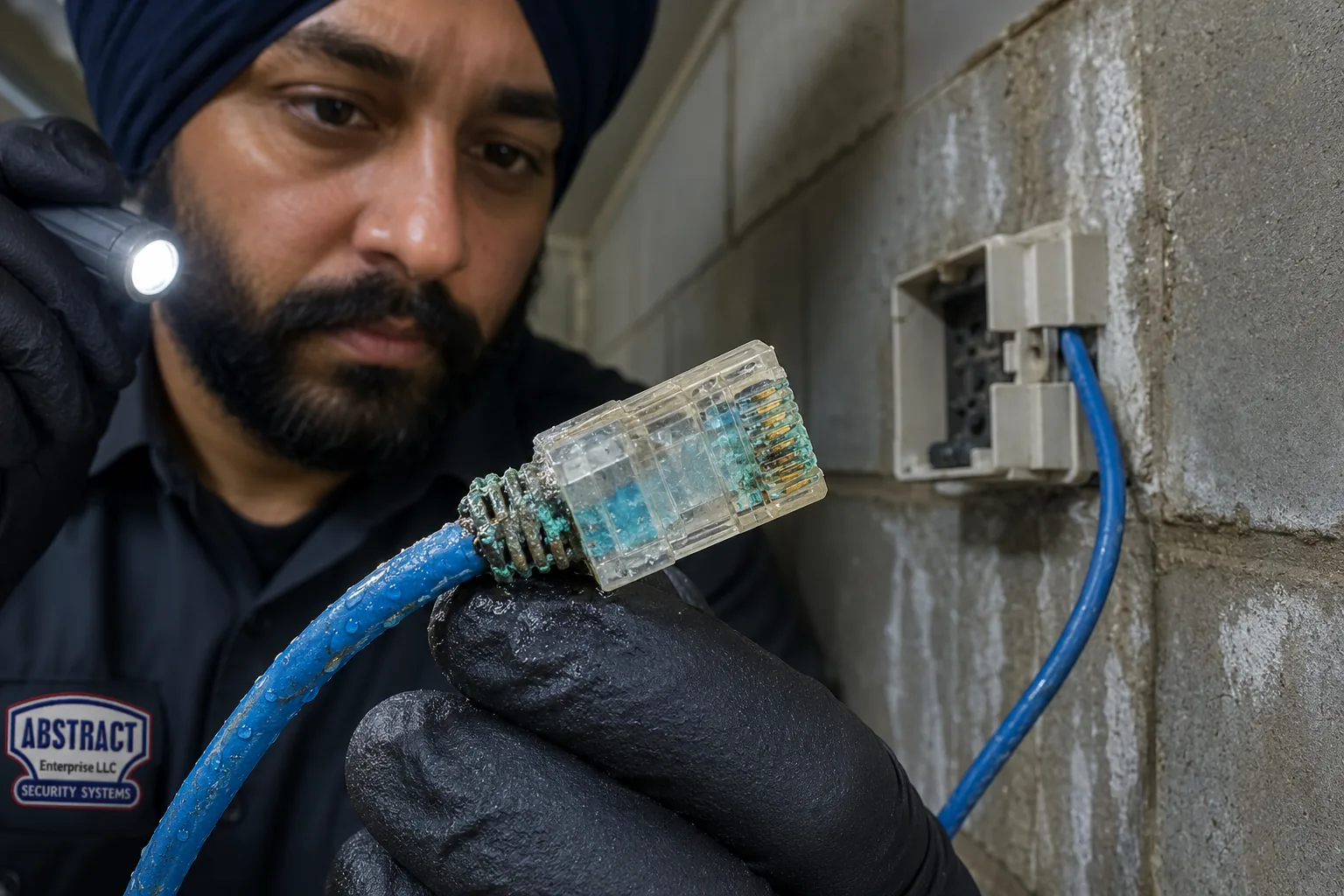
Finally, the Island has weather exposure that Manhattan does not. Ground-level MPOE rooms, exterior-wall closets, cable passing through unconditioned attic or roof space in flex buildings, and coastal humidity in the South Shore and East End all attack terminations before they attack cable jackets. Corroded contacts in a jack read as an intermittent long before anything looks visibly wrong.
What We Repair
Network Cable Repair Services Across Nassau and Suffolk
We repair the physical layer — cable, terminations, jacks, panels and pathways — and prove the repair with a test result.
Distance and Length Diagnostics
Measured cable length against the 100 m channel limit, distance-to-fault readings on broken runs, and a repair-or-relocate recommendation when a drop is simply too long for the room it serves.
Ethernet Cable Repair
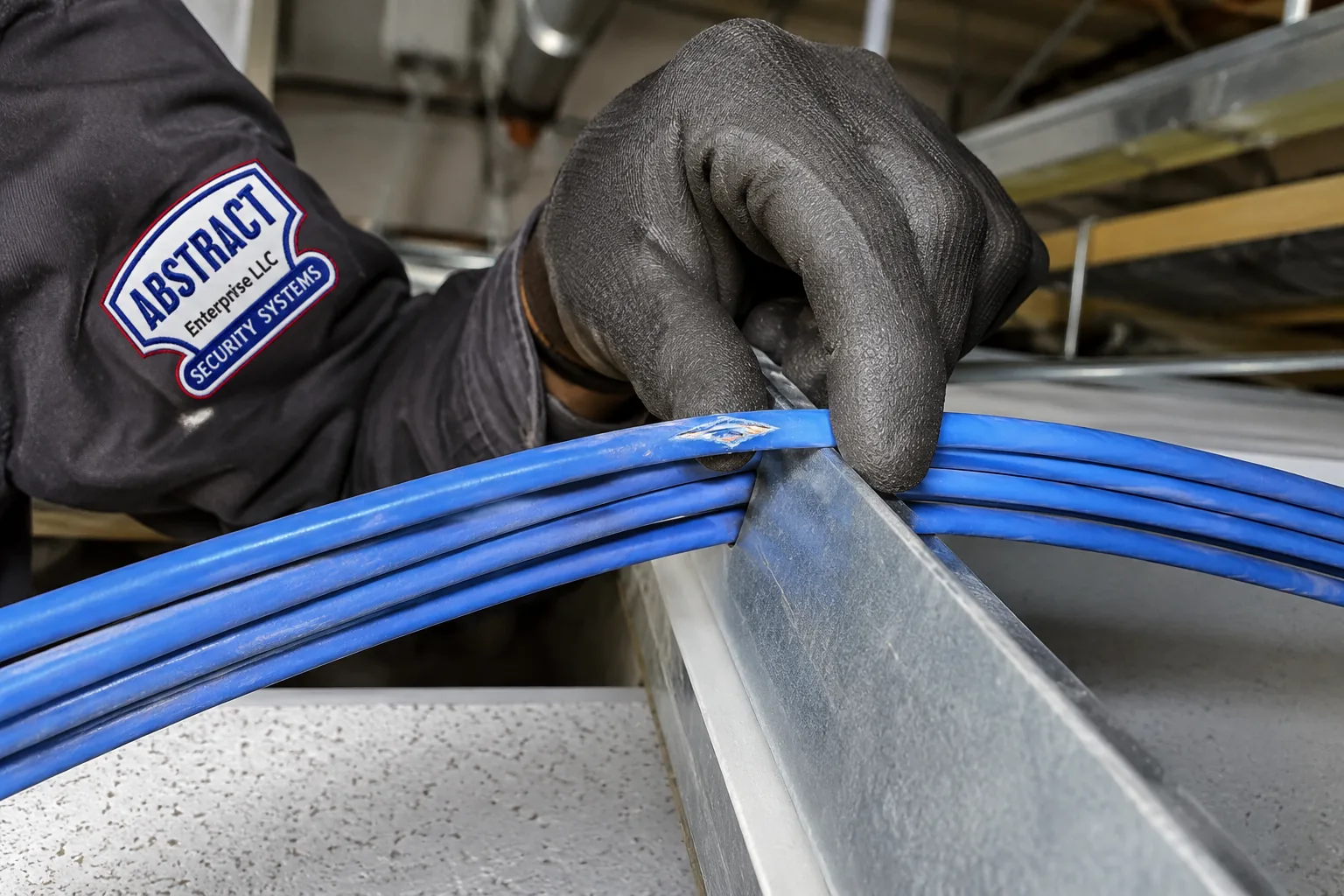
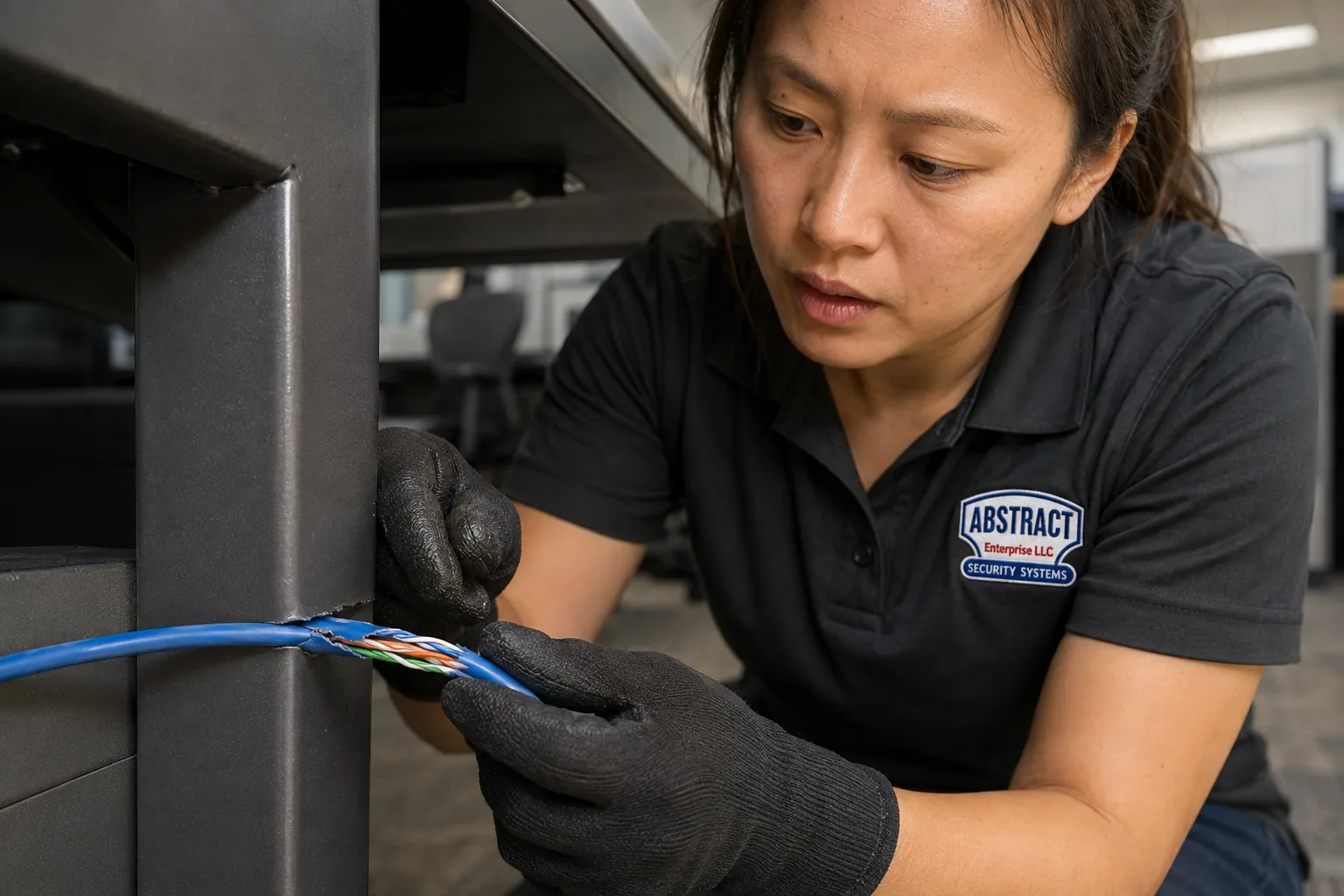
Cut, crushed, pinched or moisture-damaged runs restored with a category-appropriate junction, then re-tested. Splice-or-replace is decided by the test result, never by assumption.
Cat6 and Cat6A Retermination
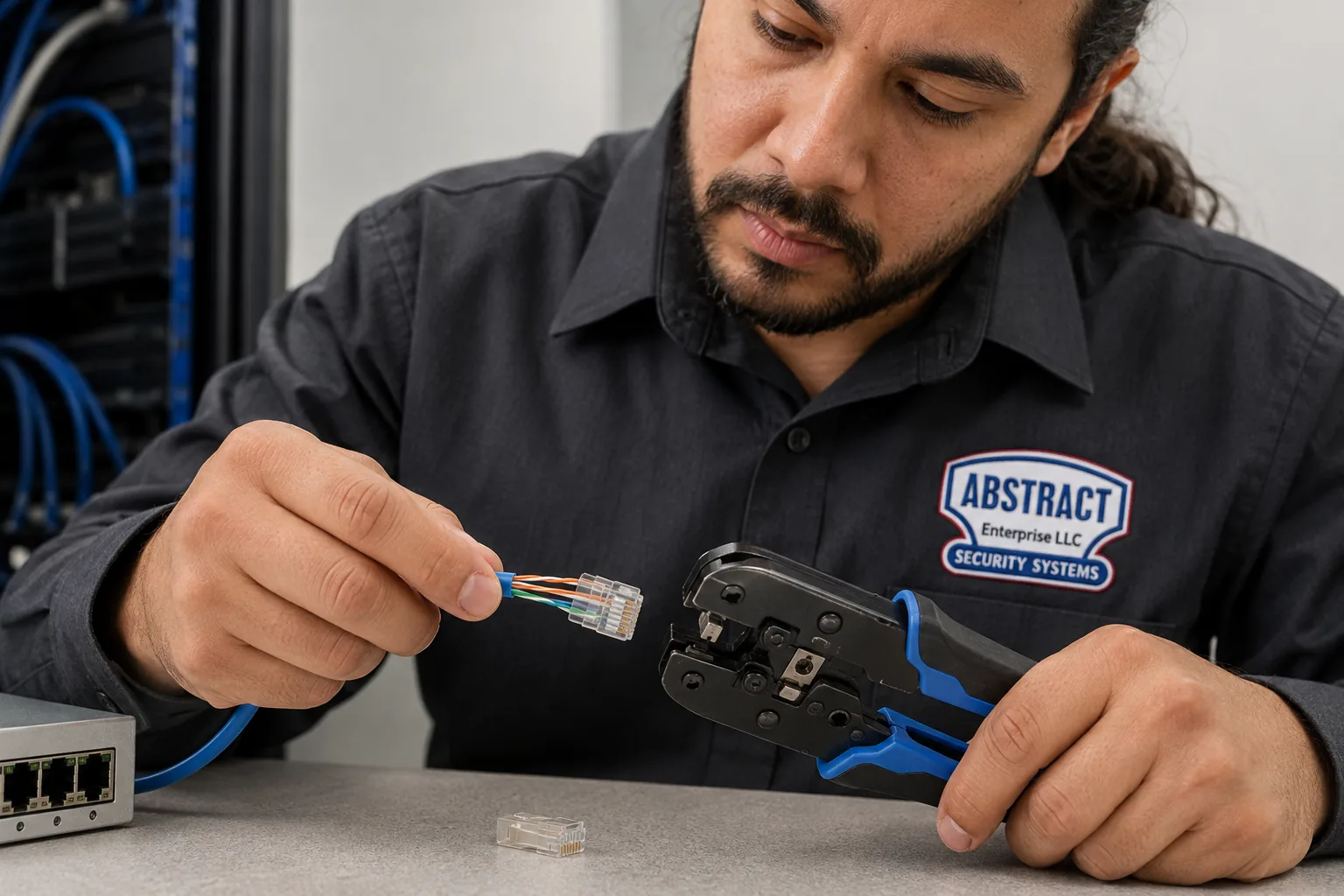
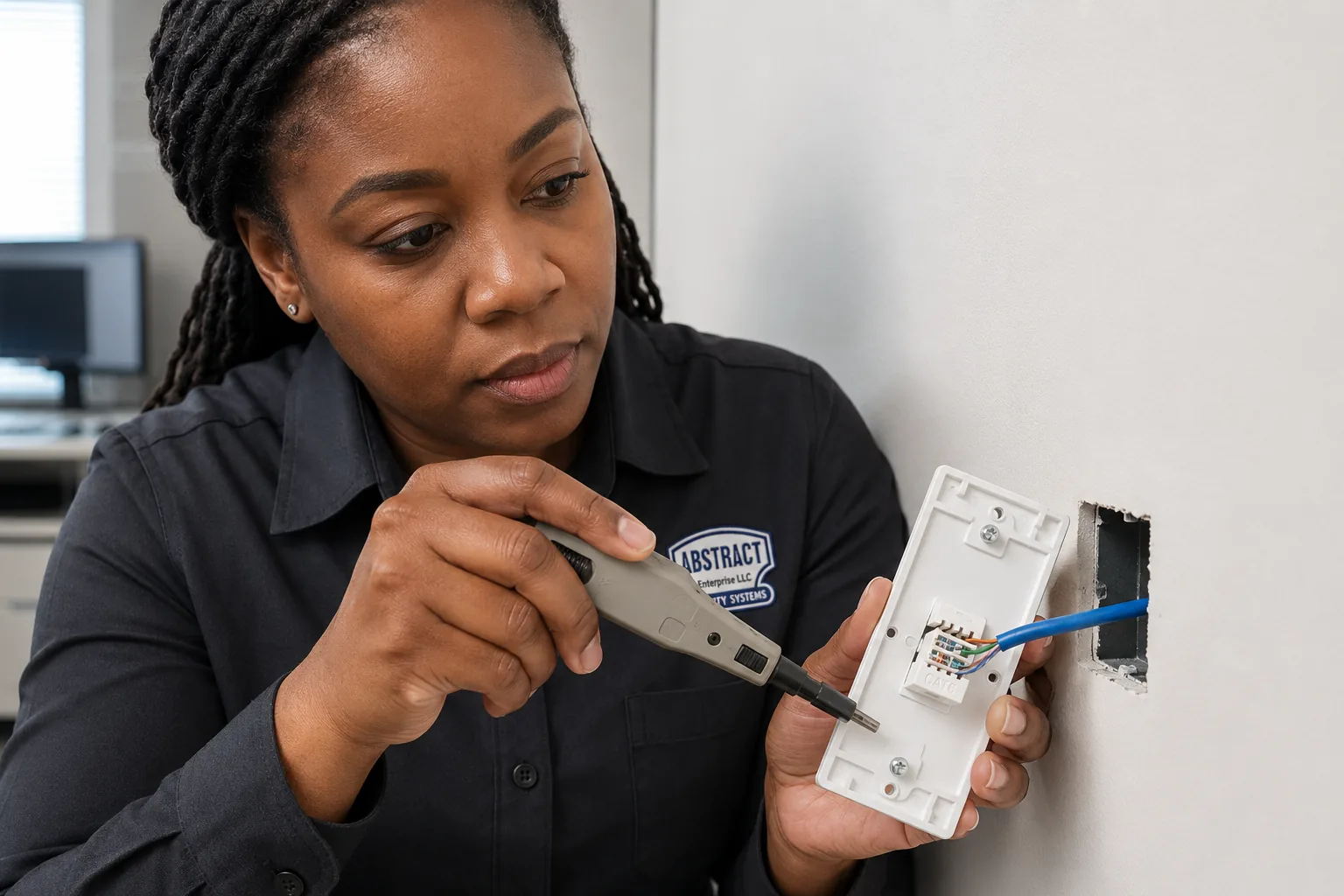
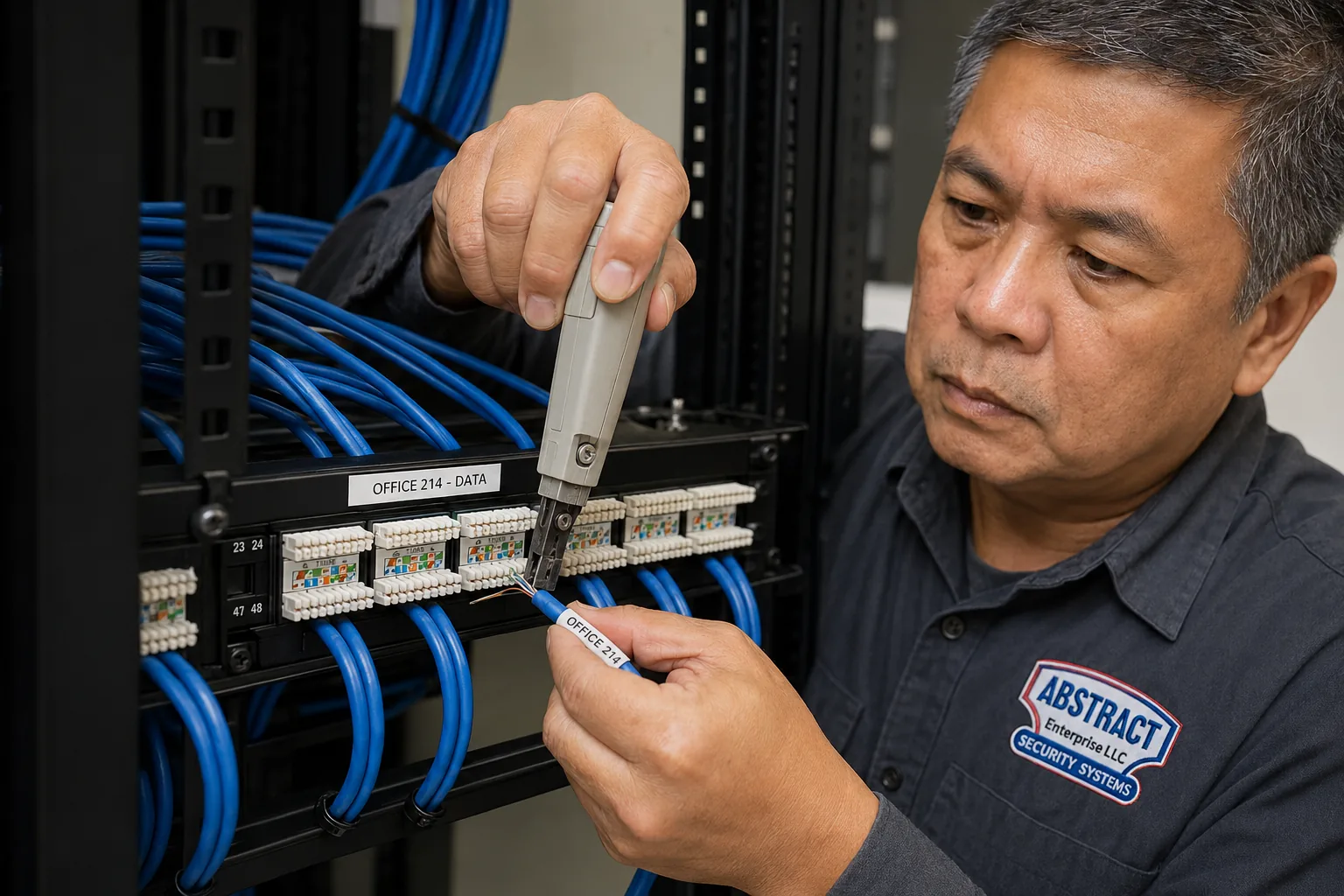
Re-punching keystone jacks and panel ports to T568B with correct pair geometry and untwist discipline — the single highest-yield fix on long Island runs where there is no length margin.
Network Jack Repair
Dead outlets, loose keystones, cracked plates, and jacks that were never fully punched at fit-out. Common in suites that have changed tenants three times.
Patch Panel Repair
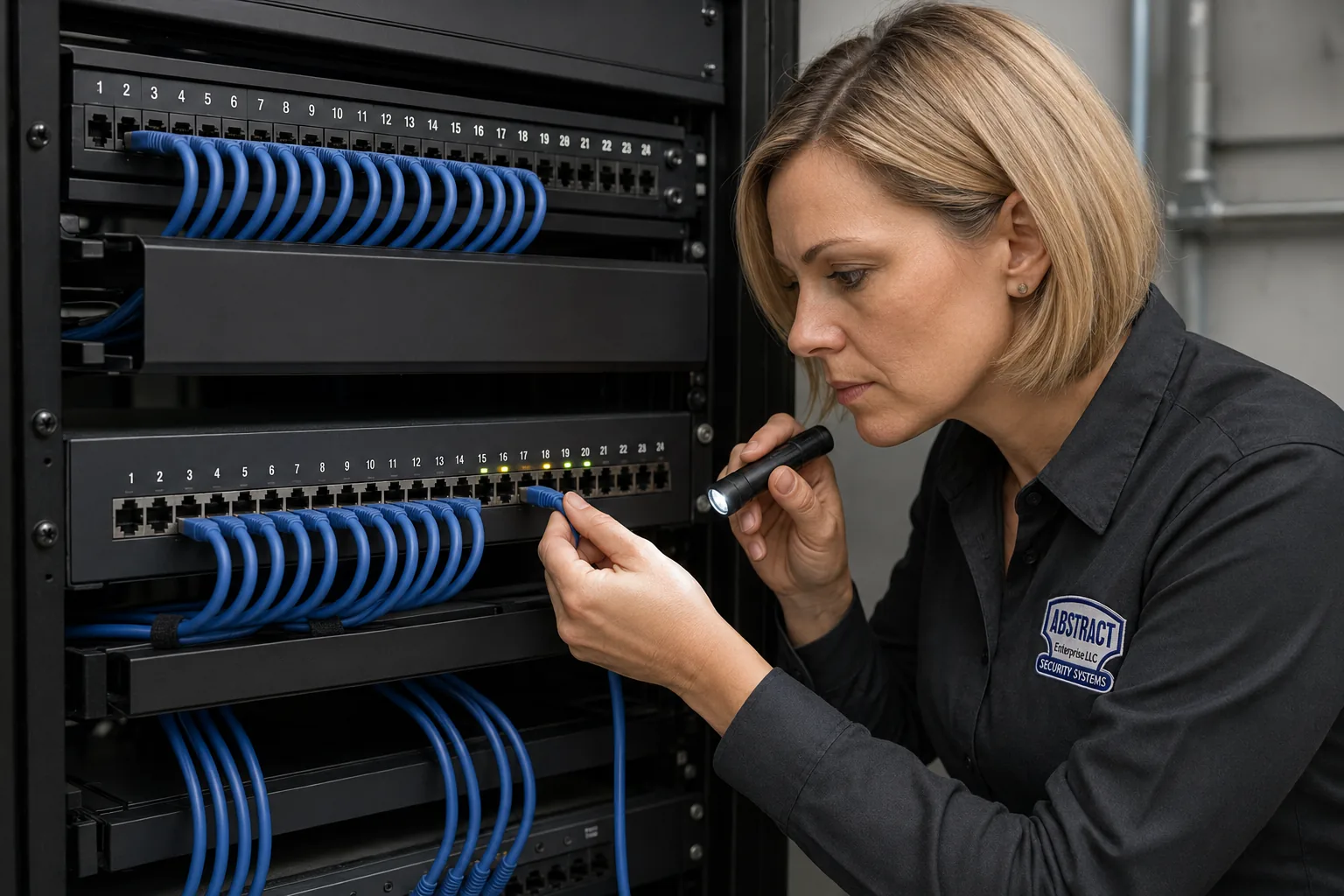
Port retermination, panel replacement, and correction of runs punched to one standard at the room end and the other at the closet.
Abandoned Cable Identification
Sorting live runs from decades of dead ones above the ceiling grid, so the closet reflects the building as it is now rather than as it was in 2004.
Certified Testing
Wiremap, length and performance verification with saved reports — the documentation medical practices, property managers and IT directors ask for.
PoE Circuit Troubleshooting
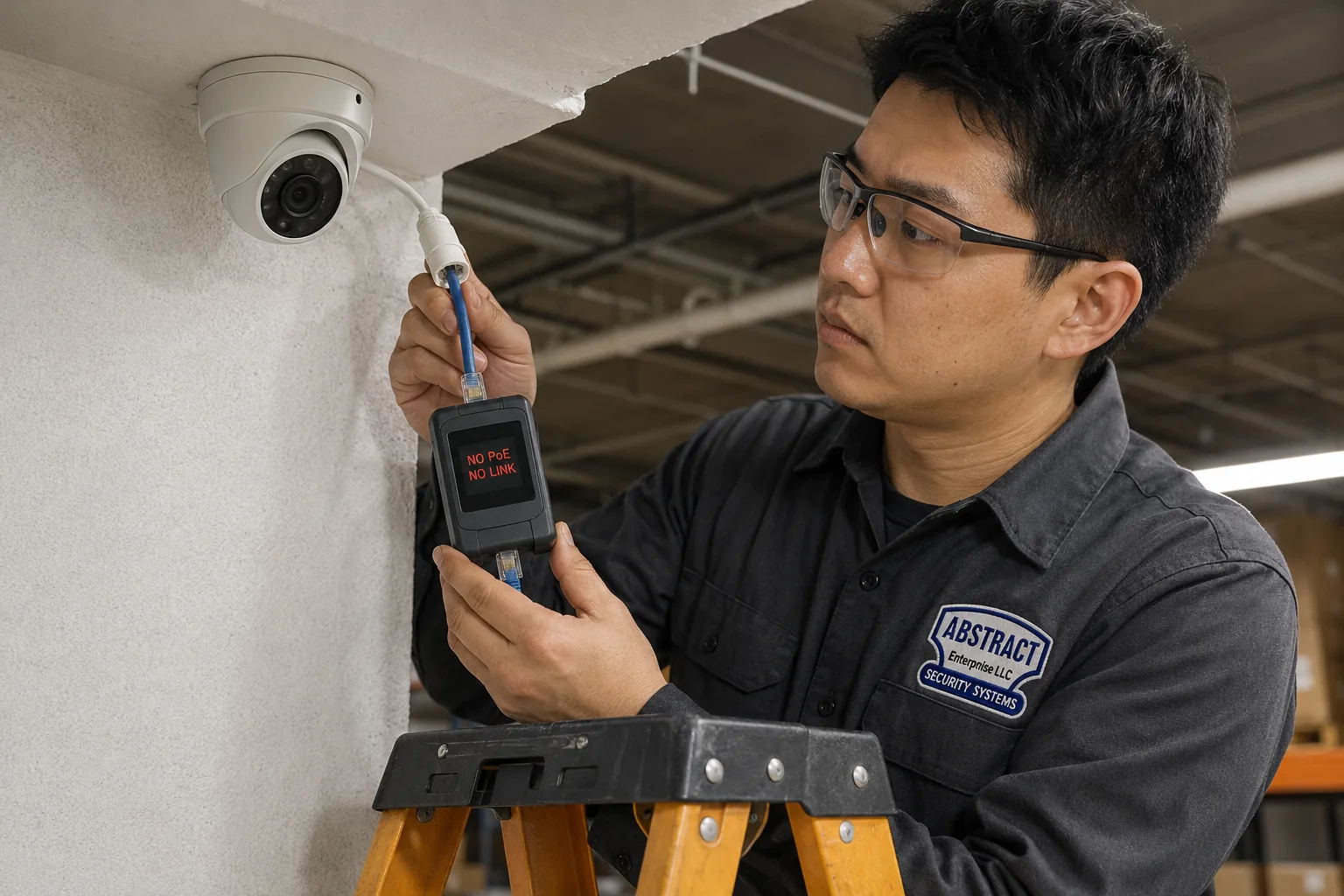
Endpoints that boot, run, then reset. On long Island runs this is usually cable-side voltage drop rather than a switch power-budget problem, and testing under load separates the two.
Closet Mapping and Labelling
Jack-to-port mapping, durable both-end labels and a printed legend. On a wide floorplate this converts a two-hour hunt into a two-minute check.
Commonly paired: flex and warehouse buildings across Nassau and Suffolk run camera, reader and access point drops through the same ceiling pathways. If one run in a bundle has failed, testing the rest while the ceiling is open costs a fraction of a second visit — see camera repair and access control.
Plain English
Cabling Terms You Will See on a Long Island Quote
These are the words that decide whether your quote is a repair or a rebuild.
Term
What It Means on a Long Island Repair Call
Channel
The complete end-to-end path including both patch cords. The 100 m limit is a channel limit — not a cable limit — which is why 95 m of horizontal cable plus two 3 m cords is already out of spec.
Permanent link
The fixed cable from panel port to wall jack, excluding patch cords. Capped at 90 m by design so the channel still fits inside 100 m.
Drop
One run from closet to one terminated outlet, including cable, jack, plate, panel punch-down, testing and labelling. Confirm whether a quoted drop means one jack or a two-jack plate.
Insertion loss
Signal strength lost along the run. Rises with length and with temperature — which is why over-length runs on the Island fail in the afternoon and pass in the morning.
NEXT / crosstalk
Signal bleeding between pairs, usually from excessive untwist at the termination. On a long run there is no margin left to absorb it.
Split pair
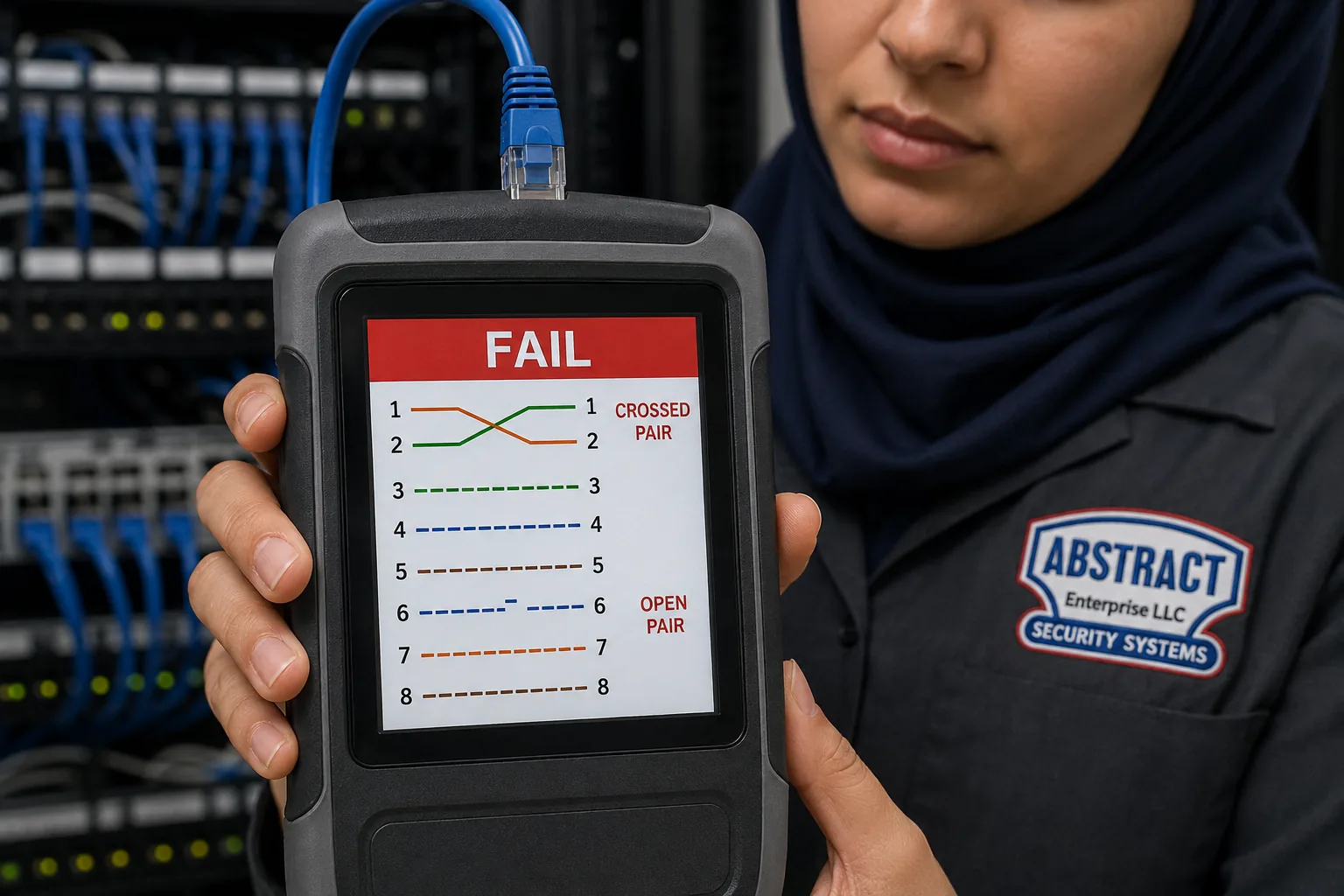
Continuity passes, pairs are wrong. Links at 100 Mbps, fails at gigabit. The most common single finding behind a slow-link complaint.
Certification
Testing against category spec with saved, printable results. Distinct from a continuity beep, which proves almost nothing.
Abandoned cable
Dead runs left above the ceiling from prior tenants. Adds fire load, obscures live runs, and makes tracing slower and therefore more expensive.
Consolidation point
An intermediate connection between closet and outlet, used in open-plan fit-outs. Legitimate when engineered, a fault source when improvised.
PoE class
How much power a device draws. Higher classes heat bundles, raise insertion loss and expose long marginal runs first.
Equipment
Cable, Hardware and Test Equipment We Work With
We repair what is already in the building and replace with commercial-grade components matched to the existing channel. On the passive side that typically means Belden, Panduit, CommScope, Leviton, Hubbell, Ortronics, ICC, Superior Essex and Berk-Tek. Category matching matters more than brand loyalty: dropping a Cat5e keystone into a Cat6 channel derates the entire channel to Cat5e regardless of what the cable in the wall is rated for, and on an already-long Island run that derate is the difference between a pass and a fail.
On the active side we isolate cable-side faults feeding Cisco, Meraki, Aruba, Ubiquiti UniFi, Netgear, TP-Link, Luxul and Araknis switching, and PoE endpoints including IP cameras, wireless access points, VoIP handsets, badge readers and time clocks. Our scope is the physical layer. We are not a managed IT provider and do not administer VLANs, firewalls, servers or wireless controllers — we test and certify the channel and hand clean results to whoever does.
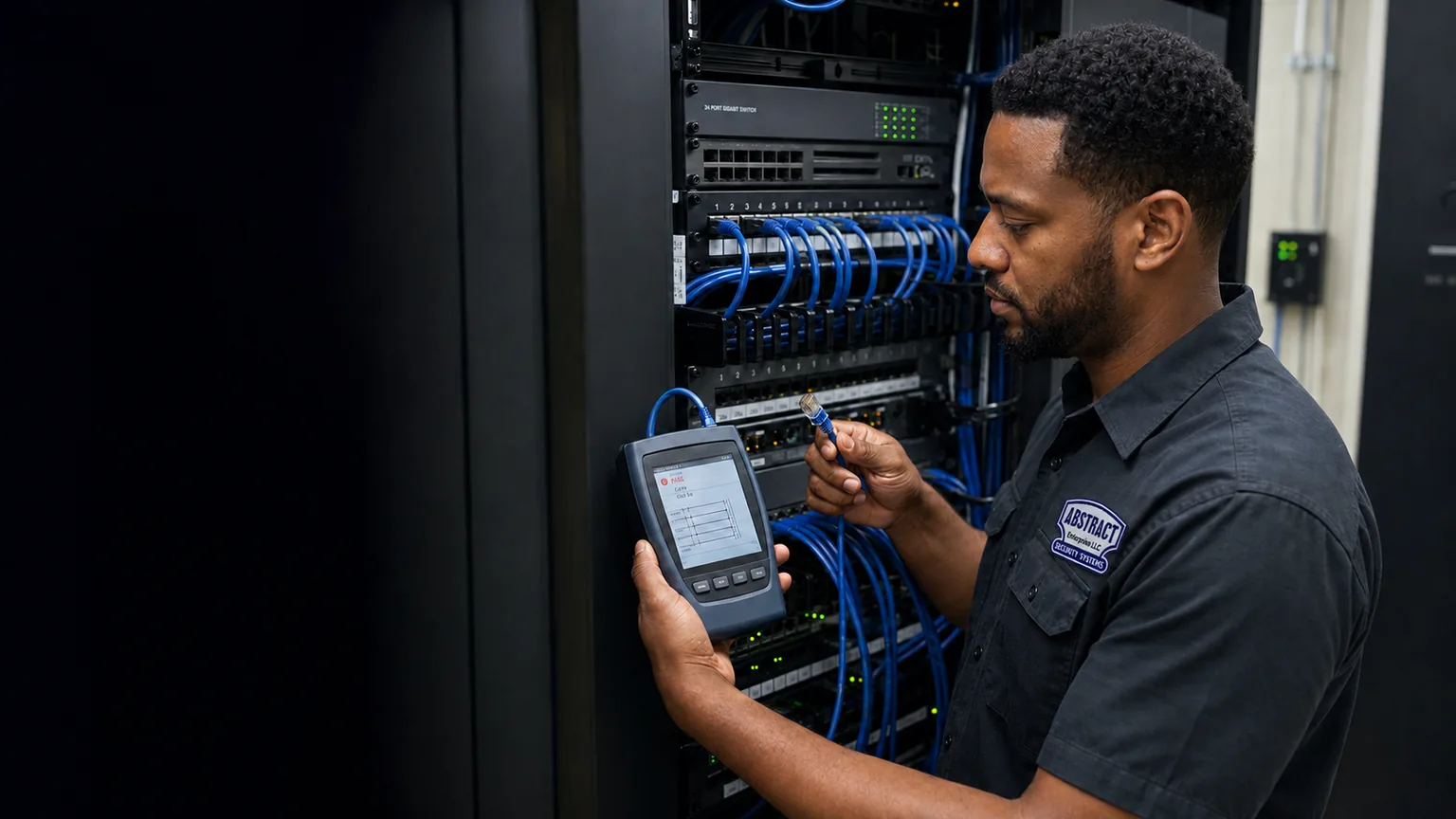
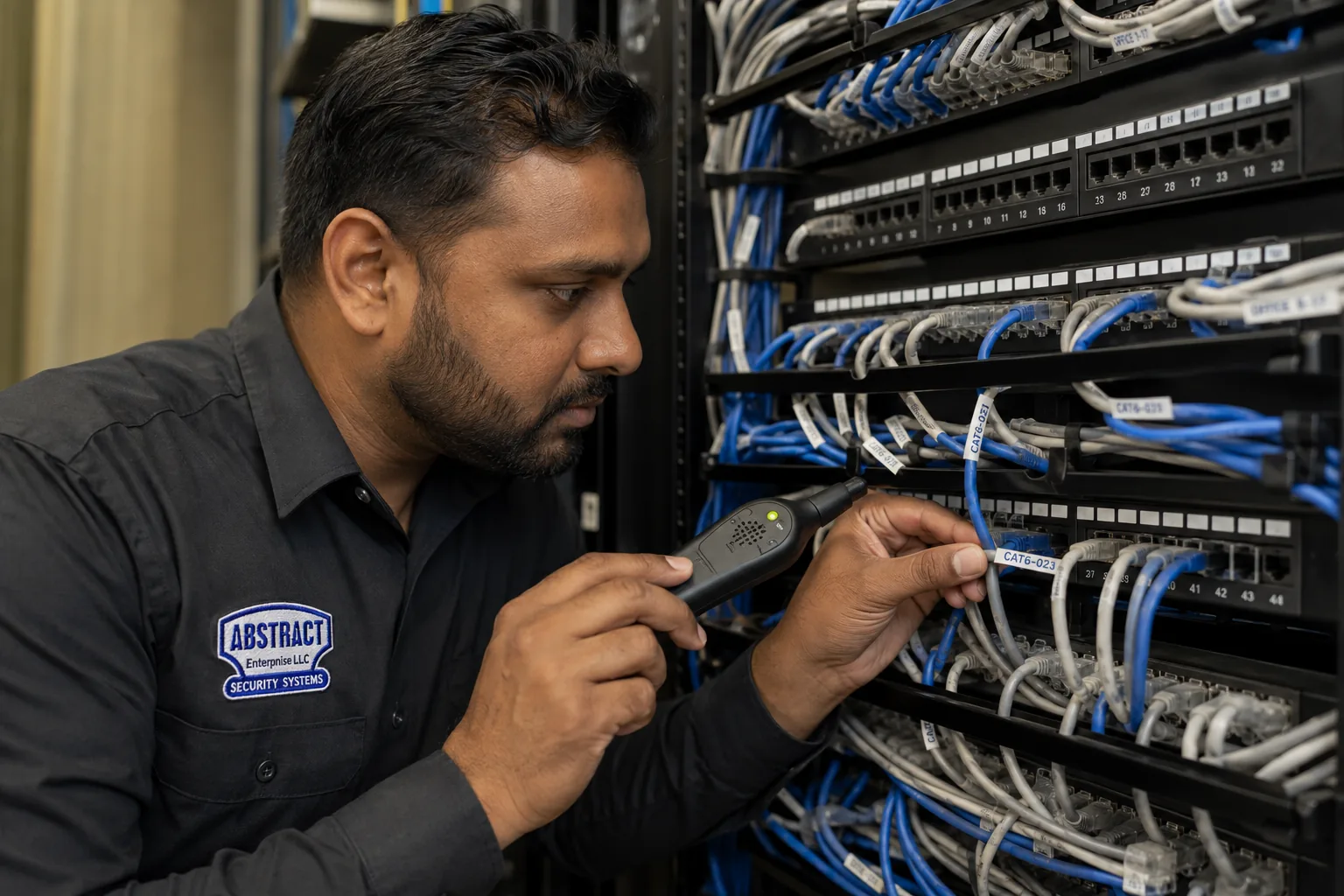
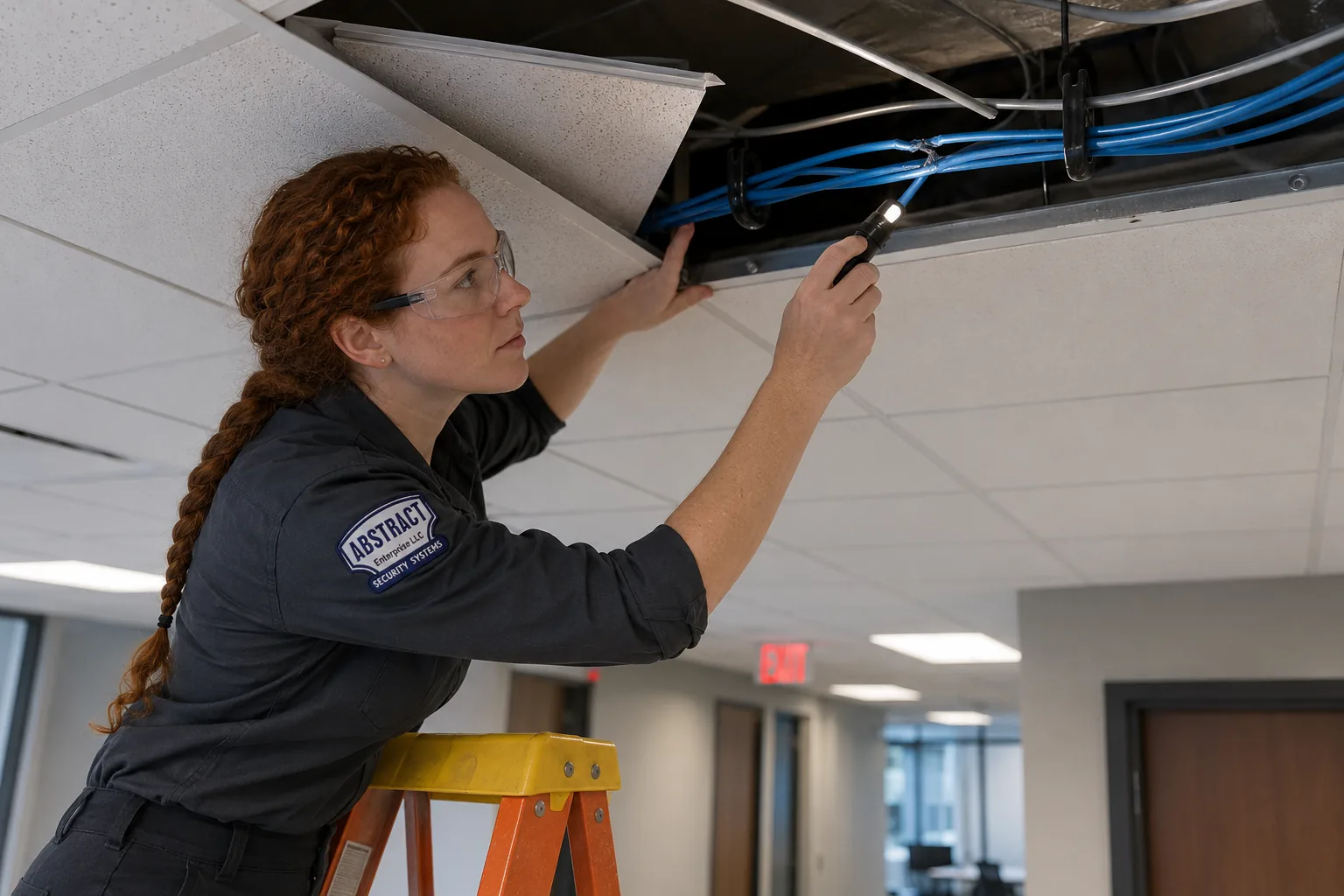
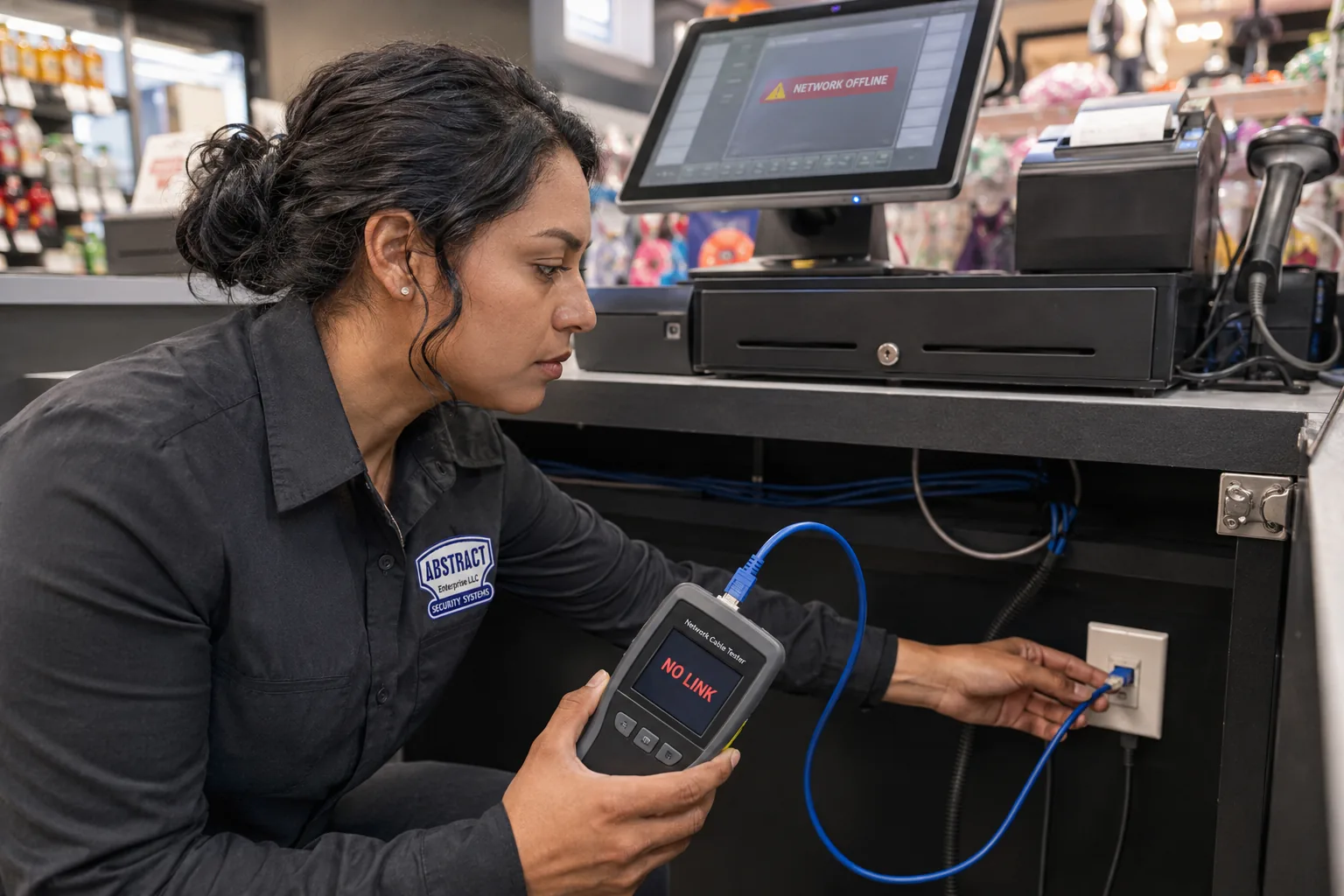
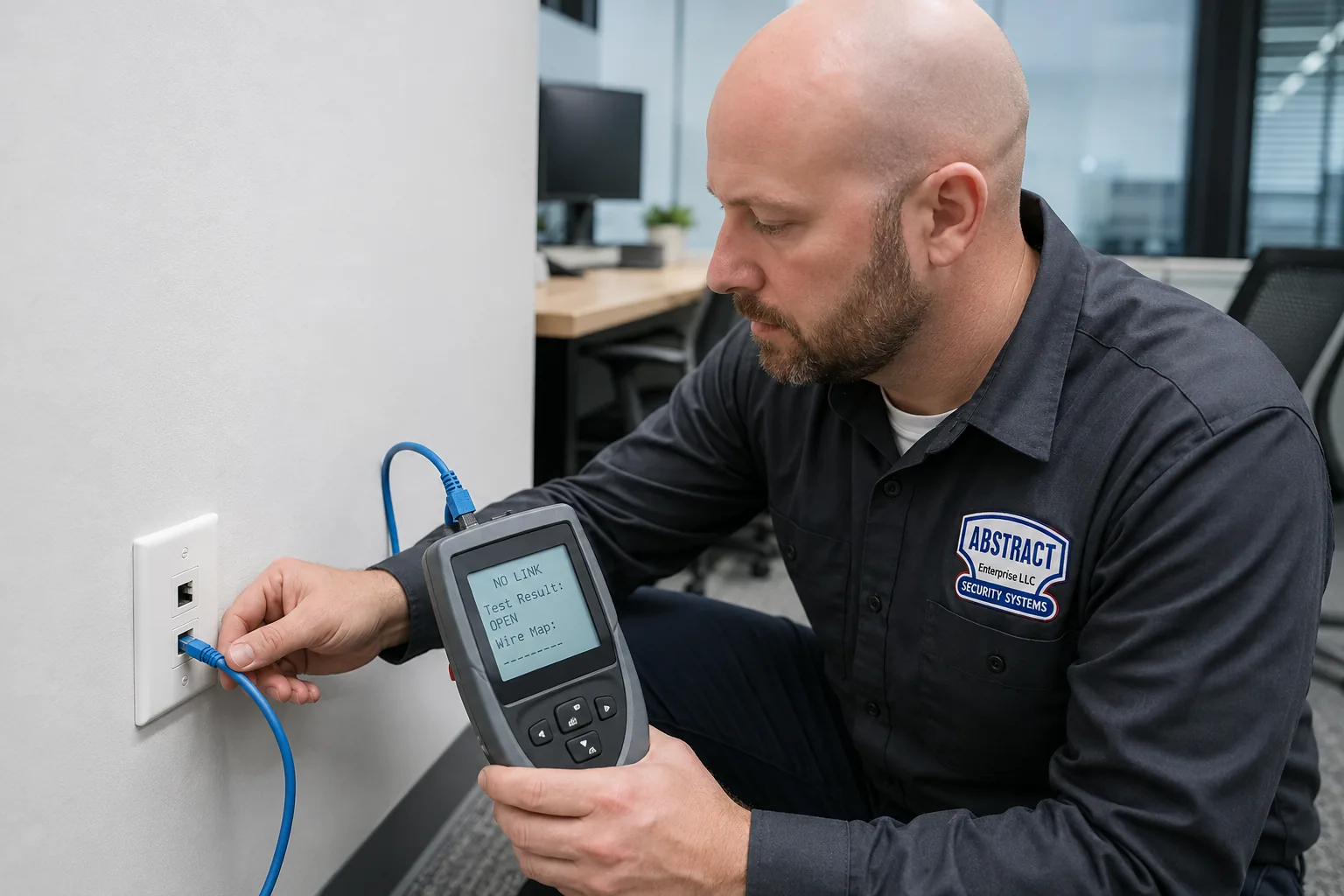
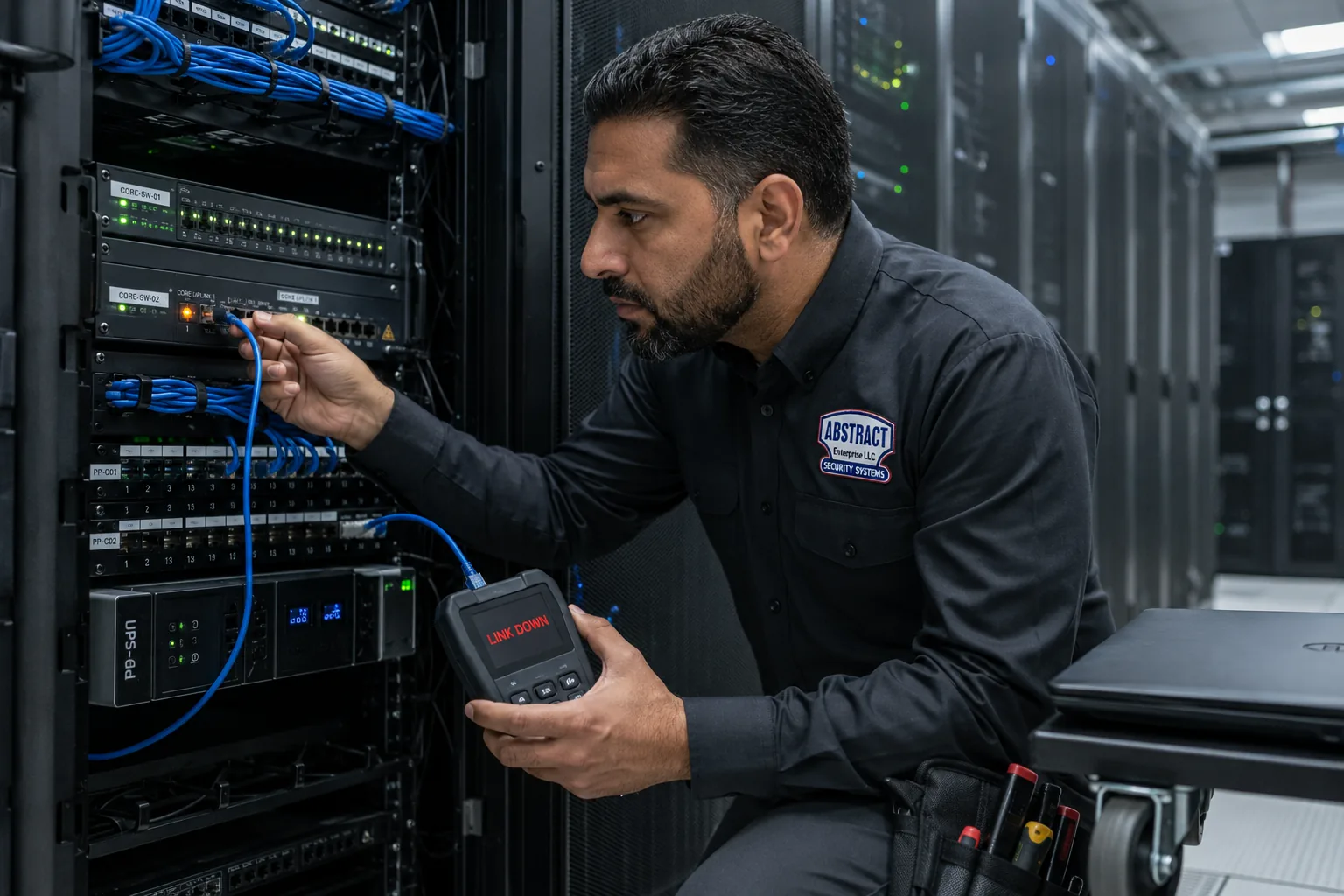
The diagnostic gear is what separates a repair from a guess: certification-grade testers with saved reports, tone generators and probes for tracing, and load verification at the endpoint for PoE complaints. On a wide floorplate with unlabelled runs, the toner earns its keep in the first twenty minutes.
Need Repair in Long Island Today?
Same-day and next-morning slots across Nassau and western Suffolk; scheduled windows for eastern Suffolk and the East End. Most single-fault repairs are located and restored inside the first three-hour block.
Isolate, Repair, Certify — Why All Three Have to Happen in One Visit
A repair that is not measured is a repair that comes back. Our sequence is fixed: isolate the fault to a specific element, repair that element, then verify the whole channel — and on Long Island the verification step carries more weight than it does in a short-run city building, because a correct repair on an over-length channel can still fail.
Isolation comes first. Before anything is re-punched we determine whether the problem lives in the horizontal cable, the wall jack, the panel port, the patch cord, the switch port or the endpoint. That order is not arbitrary; the cheapest two elements — patch cord and termination — resolve a large share of complaints, and there is no reason to open a ceiling before ruling them out.
Verification is what makes the difference visible. A tester tells you not just pass or fail, but by how much: a channel that passes with almost no margin is a channel that will fail again next summer when the ceiling warms. On an Island floorplate that reading is often the most valuable thing we hand over, because it turns a vague plan to rewire the building into a specific list of the eleven drops that are actually at risk.
Full Scope
Full Scope of a Long Island Network Cable Repair
Diagnostics
Measured length against the 90 m permanent-link and 100 m channel limits
Distance-to-fault location on broken or shorted runs
Wiremap faults: opens, shorts, reversals, split and crossed pairs
Insertion loss and crosstalk performance testing
Margin reporting — which drops passed narrowly
PoE voltage and load verification at the endpoint
Tone-and-probe tracing through abandoned cable
Switch-port versus cable-fault isolation
Physical Repair
Keystone jack replacement and re-punch
Patch panel port retermination and panel swap
Category-appropriate junction repair on damaged runs
Full run replacement where the cable fails certification
Re-routing of over-length runs to a nearer pathway
Faceplate, surface box and raceway repair
Rack re-dress, cable management and patch cord replacement
Firestop restoration at penetrated rated assemblies
Documentation
Saved test results per repaired drop, with margin
Both-end durable labelling
Closet legend and jack-to-port map
Photo record of concealed repairs before close-up
Written findings for property management or your IT vendor
Site Logistics
Certificate of insurance to landlord or managing agent
Evening and weekend windows for occupied medical and retail space
Multi-drop scoping on eastern Suffolk visits to reduce return trips
Plenum-rated material where ceiling space is used for return air
Coordination with your existing IT provider
Coverage Detail
Where We Work Across Nassau and Suffolk
Nassau County concentrates our repair volume in professional and medical space. The Mineola and Garden City corridor around Old Country Road and Franklin Avenue carries dense medical office and legal inventory; Lake Success and Great Neck hold corporate suites along Marcus Avenue and Northern Boulevard; Westbury, Carle Place and Uniondale bring retail and back-office space near the Roosevelt Field and RXR Plaza clusters. Add Hicksville, Plainview and Syosset along the Route 106/107 spine, Rockville Centre and Lynbrook on the South Shore, Massapequa and Bethpage further east, and Long Beach with its distinctly coastal moisture exposure.
Suffolk County is where the geometry gets extreme. The Route 110 corridor through Melville, Huntington Station and Farmingdale is the Island's densest office concentration, with large single-floor and two-floor plates where run length is the first thing we measure. The Hauppauge Industrial Park — one of the largest industrial parks in the country by tenant count — is flex and light-manufacturing space where a single tenant may occupy a bay two hundred feet deep. Then Islandia, Bohemia, Ronkonkoma and Holbrook near MacArthur Airport, Smithtown and Commack along Jericho Turnpike, Stony Brook's research and medical footprint, Patchogue and Bay Shore on the South Shore, Riverhead at the fork, and the East End through Southampton and East Hampton where seasonal occupancy drives its own service pattern.
Building type predicts the fault better than the town does. A Route 110 office tower behaves like a city building with accessible ceilings and a floor closet. A Hauppauge flex bay behaves like a warehouse with a mezzanine office and one long run to the back. A Mineola medical suite behaves like neither — short runs, high uptime sensitivity, and equipment that will not tolerate a marginal channel.
Who We Serve
Long Island Industries We Repair Cabling For
Medical and Dental Practices
Imaging workstations and practice management terminals that stall mid-transfer. Dense in the Mineola, Garden City, Lake Success and Stony Brook corridors, and the least tolerant of a marginal channel.
Route 110 Office Suites
Multi-tenant plates where drops have been extended and rerouted across successive fit-outs, leaving over-length runs nobody documented.
Hauppauge Flex and Light Industrial
Deep bays with a front office and a far-corner workstation. Distance, forklift damage and unconditioned ceiling space in one building.
Warehouse and Distribution
Scanner and access point drops in high-interference space, plus rack-strike damage at pallet height.
Retail and Restaurant
Register and kitchen terminals dropping mid-service. Grease, heat and unplanned equipment moves are the usual causes.
Schools and Districts
Classroom drops and corridor access point uplinks, with repair windows that realistically land in summer or over breaks.
Municipal and County Facilities
Town halls, libraries, courts and public works buildings with layered cabling history and documentation requirements.
Marinas, Clubs and Seasonal Properties
South Shore and East End sites where salt air and unconditioned space attack terminations first.
Property Management Portfolios
Multiple buildings needing one labelling standard, consistent test documentation and predictable response.
Real Questions
Fourteen Questions Long Island Businesses Actually Ask
Drawn from the recurring themes in small-business, IT and Long Island local discussion threads, grouped by the six question types that come up most.
Cost Questions
1. What does a network cable repair actually cost out here?
Repair is billed at $195/hr with a three-hour minimum, so $585 for the first block. That block covers fault location, the physical repair, certification testing and documentation — not a look-and-quote visit followed by a second trip. If a run turns out to need replacement rather than repair, new commercial Cat6 drops start at $175 per drop.
2. Why is a repair hourly when a new drop is priced per drop?
Because installation scope is known before the truck rolls and repair scope is not. Nobody can price finding a fault in an undocumented run above a forty-thousand-square-foot ceiling until they have found it. Hourly with a minimum is the honest structure; a flat repair price either overcharges the simple jobs or gets abandoned on the hard ones.
3. Does it cost more in Riverhead than in Garden City?
The rate is the same. What changes is how we scope the visit. On far-eastern Suffolk work we recommend bundling the reported fault with adjacent-drop testing and closet mapping in one trip, because the alternative is paying for travel time twice when the second symptom surfaces next month.
Quality and Trust Questions
4. How do I know the fault was actually fixed and not just reseated?
Ask for the test result with margin. A certification report shows pass or fail, measured length, and how close to the limit the channel is running. A link light proves a device negotiated once. If a contractor cannot produce saved test output, you have a hope rather than a repair.
5. Do I need a licensed contractor, or can my IT guy handle cabling?
Many IT providers are excellent at the network and honest about not owning cabling tools. Data cabling is licensed low-voltage work, and there are real code obligations around plenum-rated material and firestopping at rated penetrations. We hold NYS Low-Voltage Contractor License #12000287431 and carry insurance that landlords and managing agents will accept.
6. Our landlord says cabling inside the suite is ours. Is that right?
In most Long Island commercial leases, yes — base building provides pathway and often riser, and everything from the floor closet into the tenant space is tenant infrastructure. A fault in the base-building pathway is the landlord's. We identify which side of that line the fault sits on and document it, which is usually what ends the discussion.
DIY and Pro Questions
7. Can I extend a drop with a coupler to reach a new desk location?
You can, and on the Island it is one of the most damaging shortcuts available. A coupler adds a connection point and length to a channel that may already be near the limit. If the run was 88 metres before the extension, it is out of spec after it, and the link will behave erratically forever. Re-pull to the new location or add a properly engineered consolidation point.
8. My cheap tester says the cable is fine. Why is the connection still bad?
A continuity tester checks pin order and nothing else. It cannot measure length, insertion loss, crosstalk or return loss — and those are precisely the failures that produce gigabit problems on a run that looks perfect. On long runs the gap between what a $30 tester sees and what the channel is actually doing is at its widest.
9. Should I just crimp a plug on the end instead of replacing the jack?
No. Permanent horizontal cable is solid conductor and is designed to be punched into a jack or panel, not crimped into a plug. Crimped solid cable makes intermittent contact that passes a continuity check and fails under vibration, temperature swing or PoE load. It is the most common self-inflicted fault we find.
Technical Questions
10. How do I know if a run is simply too long?
Measure it. A certification tester reports cable length directly. If the permanent link exceeds roughly 90 metres, the channel is out of spec once patch cords are added, and no amount of retermination will make it reliable. The fix is a shorter pathway, a relocated outlet, or an intermediate active device — not a better jack.
11. Why does the network only misbehave in the afternoon?
Because insertion loss rises with temperature. A channel with almost no margin in the morning can slip below spec once the ceiling plenum warms through the day. It is one of the most reliable signatures of an over-length or marginal run, and it is very commonly misdiagnosed as a load or software problem.
12. My PoE camera reboots every few minutes. Cable or camera?
On a long run, usually cable. The device draws more current when illuminators or heaters engage, voltage sags below its operating threshold, and it resets. Testing voltage under load at the endpoint separates a cable-side drop from a switch power-budget limit or a failing device.
Landlord and Tenant Questions
13. We inherited a suite with cabling from three tenants ago. Where do we start?
With a closet audit rather than a rewire. Tone every port to its jack, identify what is live and what is abandoned, label both ends, and test what you intend to keep. On a typical Island suite that exercise reclaims more working drops than most owners expect and tells you exactly what actually needs replacing.
Complaint Questions
14. The last company replaced the jack and the problem came back in a month. Why?
Because the jack was a symptom. If the underlying channel is over-length, damaged mid-run, or terminated to a mismatched category at the far end, a new keystone buys you a few weeks. Testing after the repair is what catches this — a channel that passes with no margin is a repeat call waiting to happen, and it should be reported to you rather than quietly left alone.
Answer The Public
Answer The Public: Long Island Network Cable Questions
Who repairs network cable on Long Island?
Licensed low-voltage contractors and structured cabling companies. Electricians handle pathway and line voltage and frequently subcontract data terminations. Managed IT providers own the network above the cable but usually do not carry certification testers or punch-down tools. For a physical-layer fault in Nassau or Suffolk, the low-voltage trade is the correct call.
What makes cabling fail in Nassau and Suffolk buildings?
In rough order: terminations executed without untwist discipline, runs that exceed the channel limit after being extended, physical damage from tenant fit-outs and racking, moisture and corrosion in coastal and unconditioned spaces, and legacy Cat5e asked to carry PoE loads it was never certified for.
When should a run be replaced rather than repaired?
When it fails certification after terminations are corrected, when measured length puts the channel out of spec, when there are multiple damage points, or when the space now needs multi-gigabit or high-power PoE that the existing category cannot support.
Where do faults usually sit on a wide floorplate?
At the terminations first, then at pathway transitions — where cable leaves the ceiling and drops into a wall, at floor boxes under desks, at points where a run was extended, and inside crowded closets where cables are bent past their minimum radius.
How fast can a Long Island repair be scheduled?
Same-day and next-morning slots are typical across Nassau and western Suffolk. Eastern Suffolk and the East End are scheduled into planned windows, and we recommend scoping those visits to cover adjacent drops and closet documentation in the same trip.
Reality Check
AI Overview Reality Check: What Search Results Miss About Long Island Cabling
Search for network cable repair on Long Island and you get a national cost average, a row of lead-generation directories, and advice written for a suburban house with open joists. Here is where that picture parts company with the work.
1. The Cost Averages Assume a Job Nobody Out Here Is Actually Doing
Cost aggregators publish national figures for network drops and service calls built from an enormous blend of residential and light-commercial work. Those numbers are real averages of something — they are just not averages of a certified commercial repair in a Nassau medical suite or a Hauppauge flex bay.
The larger omission is that almost none of those figures separate installation from repair. Installation is per-unit work with known scope. Repair is diagnostic work whose scope is unknown until the fault is found. Publishing one number for both is how a legitimate hourly quote ends up looking expensive against an anchor that quietly excluded the diagnostic labour entirely.
They also exclude the deliverables that make a commercial repair worth buying: saved certification reports, labelling, and a closet legend. Strip those out and any quote looks high. Include them and the comparison becomes honest.
2. Length Is the Long Island Variable and It Barely Appears in Search Results
General cabling content mentions the 100 metre limit once, as trivia. On a wide single-story floorplate it is the governing constraint of the entire installation, and it is the first measurement we take on a performance complaint.
The reason it rarely surfaces online is that most published troubleshooting content is written from a residential or small-office frame where no run gets close to the limit. In that world, length is never the answer, so the advice skips to switches, drivers and routers — and readers on an Island floorplate follow it down a dead end.
The practical tell is a link that trains at 100 Mbps while its neighbours reach gigabit, or one that works in the morning and stumbles by mid-afternoon. Both point at margin, and margin is mostly a function of length plus termination quality.
3. Lead Directories Sell Your Number Rather Than Vetting a Contractor
Angi, HomeAdvisor, Thumbtack and their equivalents operate a lead-sale model: your request goes to several companies at once, and the fastest responder is generally the one who paid most for the lead. Star ratings attach to profiles that may aggregate many technicians and many trades.
For cabling this fails in a specific way. The platforms file the work under a broad computer-network heading that mixes router setup and Wi-Fi troubleshooting with physical cable repair. The person who arrives may be entirely capable of configuring your access point and entirely unequipped to certify a channel.
The filter is simple and takes one phone call: do you own a certification tester, will I receive saved results per drop, and can you produce a certificate of insurance for my landlord.
4. “Just Run a New Cable” Is Better Advice Here Than in the City, but Still Not Automatic
Suspended ceilings and stud partitions do make replacement genuinely easier on Long Island than in a prewar Manhattan building, and search results reflect that bias. It is often the right call.
It stops being the right call when the reason the original run failed is the pathway itself. Replacing an 88-metre run with another 88-metre run through the same route reproduces the fault with new cable. Where the distance is the problem, the answer is a different pathway, a relocated outlet, or an intermediate device — not more copper along the same line.
The decision is made by measurement. Test after terminations are corrected; if the channel still fails or passes with negligible margin, replace, and change the route while doing it.
5. Search Results Conflate Cabling With IT Support
A large share of results for network repair queries are managed IT providers and break-fix computer shops. They are answering a different question. Configuration problems are theirs; a dead outlet in the corner office is not.
This matters because the diagnostic path crosses the boundary. A slow link could be a switch port, a VLAN, an ISP circuit or a split pair, and only physical-layer testing removes the cable from the suspect list definitively.
Our scope is deliberately narrow: we own the copper and hand a certified channel to whoever runs the network. That division resolves problems faster than either party guessing at the other's domain.
6. Moisture and Coastal Exposure Are Missing From Generic Guidance
National content treats water damage as a flood event. On the South Shore, the East End and in ground-level MPOE rooms across the Island, the usual mechanism is slower: humidity and salt air reaching terminations in unconditioned space, corroding contacts over seasons.
The symptom is a link that degrades gradually rather than dying, and it is almost always found at a connection point rather than mid-cable. Retermination with attention to the enclosure and the pathway fixes it; replacing the run without addressing the environment does not.
Buildings with exterior-wall closets, attic pathways or seasonal shutdown cycles should have their terminations inspected on a schedule rather than only when something breaks.
7. Test Documentation Is Treated as Optional Online and as Mandatory by Everyone Who Matters
AI-generated guidance rarely emphasises certification reports. Meanwhile the people who commission this work — practice managers, IT directors, facilities staff, general contractors and landlords — routinely require them as a deliverable.
The reason is practical. A report converts an assurance into an artifact with a date, a drop identifier, a measured length and a margin figure. When a fault recurs, it tells you whether the channel was marginal at handoff. When a dispute arises about who damaged what, it is evidence.
It also preserves institutional memory. Tenants move, IT vendors rotate and building staff change. The labelled closet and the saved reports are what stop the next technician from repeating a tracing exercise somebody already paid for.
Stop Guessing. Get the Channel Measured.
Certified testing on every repair. Licensed NYS low-voltage contractor. 4.7★ from 201 reviews.
Free, fast, and a genuinely common cause. A broken locking tab lets the plug creep out of contact.
Move to a different switch port
Yes
Rules out a failed or administratively disabled port in about thirty seconds.
Test the same device on a known-good jack
Yes
The cleanest way to separate endpoint, jack and cable without any tools.
Check the negotiated link speed
Yes
A drop training at 100 Mbps while its neighbours reach 1000 points straight at a damaged or split pair.
Re-punch a keystone jack
Borderline
Possible with the right tool, but untwist discipline determines whether the channel still meets category spec. A tidy-looking re-punch can still fail certification — and on a long run there is no margin to absorb it.
Extend a run with a coupler
No
Adds length and a connection point to a channel that may already be near the limit. This is the single most common self-inflicted fault on Long Island floorplates.
Locate a break above a ceiling grid
No
Needs distance-to-fault measurement and toning. Opening tiles at random is slower and more destructive than measuring.
Diagnose gigabit-only or heat-related failures
No
Requires performance testing. Insertion loss and crosstalk are invisible to consumer testers.
Anything in a plenum ceiling or rated wall
No
Material rating and firestop obligations make this licensed work.
The honest rule: spend fifteen minutes on the four rows marked yes. If the fault survives all four, it lives in the permanent cabling and the next step needs measurement rather than another part.
Alternatives
How a Licensed Cabling Contractor Compares to the Alternatives
vs. Your Managed IT Provider
Strong on the network, usually honest about not owning the physical layer. Most subcontract cable work, which means the technician who arrives is not the one you vetted and the schedule belongs to somebody else. For a down drop, that is the difference between this afternoon and next week.
vs. Lead-Generation Platforms
Your request is sold to several bidders simultaneously. You get a volume of responses rather than a fit, and the category mixing means a computer technician may answer a cabling call. Certification reports and certificates of insurance are not standard deliverables there.
vs. Your ISP's Technician
Optimum, Verizon and their peers are responsible up to the demarcation point and will correctly tell you so. If the circuit tests clean at the demarc and your jacks are still dead, the fault is inside your infrastructure and outside their scope.
vs. A General Electrician
Essential for conduit, pathway and line voltage. Data terminations are a different discipline with tighter tolerances — untwist limits, bend radius, category matching — and many electricians sensibly subcontract them. Where a job needs both trades we coordinate rather than compete.
vs. In-House Facilities Staff
Good facilities teams handle patch cords, port swaps and simple jack replacement well. It breaks down at fault location and certification, because the test equipment is hard to justify for occasional use. The efficient split is obvious: they do the fast checks, we handle anything needing a measurement.
Warning Signs
Five Signs the Cable Is the Problem, Not the Network
One outlet is dead and the rest of the floor is fine. A router, firewall or circuit problem takes down everything. A single dead jack is a cabling or termination fault.
The link trains at 100 Mbps while neighbouring drops reach 1000. Classic damaged-pair or split-pair signature, and the single most diagnostic symptom available to you for free.
The problem follows the clock rather than the workload. Faults that appear each afternoon and clear each morning track ceiling temperature, which points at a channel running with no margin.
PoE devices reboot on the permanent run but behave on a short test cable. Voltage drop or a compromised pair over distance — extremely common at the far end of a wide floorplate.
Trouble started after a fit-out, a racking change or a ceiling job. Physical damage and re-routed runs are the leading cause of sudden multi-drop failures in occupied Island buildings.
Community
Community Chatter: Recurring Themes From Public Forums
Paraphrased themes from public homeowner, small-business and IT discussion threads — not customer reviews of AESS.
Troubleshooting threads repeatedly surface the same discovery: a run that was extended with a coupler years earlier, pushing the channel past the length limit and producing years of unexplained instability that nobody connected to the extension.
Small-business discussions consistently show owners surprised that labour rather than material drives cabling cost. That is accurate — on repair work the copper is a rounding error against the diagnostic time.
IT help-desk documentation across many organisations converges on the same triage order: known-good jack, then patch cable, then escalate to a field technician. The consistency reflects that the order genuinely works.
Enterprise troubleshooting guidance specifically flags intermittent connectivity in older buildings with legacy cabling as a wiring-quality issue rather than a configuration issue — which matches what we find in suites still running Cat5e from an early-2000s fit-out.
Threads about warehouse and flex-space networks regularly describe access points that work near the office and fail at the far end of the bay. The distance explanation is usually the last one tried and the correct one.
Field Video
Watch: Field Diagnostics on a Long Island Repair Call
Short-form field clips from our channel: youtube.com/@openeye0007 Embed slot reserved — drop the Short iframe here once the clip ID is set.
FAQ
Network Cable Repair Long Island — Twelve Frequently Asked Questions
What does network cable repair cost on Long Island?
+
Repair is billed at our specialty service rate of $195/hr with a three-hour minimum, so $585 for the first block. That covers fault location, the physical repair, certification testing and documentation. If a run must be replaced rather than repaired, new commercial Cat6 drops start at $175 per drop.
Can a damaged Ethernet cable be repaired, or does it have to be replaced?
+
It can be repaired when the damage is localised and accessible — a category-appropriate junction, executed properly and verified by testing, restores the channel. Replacement is correct when the run fails certification after terminations are corrected, when measured length puts the channel out of spec, or when there are multiple damage points.
My wall jack is completely dead. What is the most likely cause?
+
In order of frequency: a patch cord with a broken locking tab, a panel port that was never punched or was punched to the wrong standard, a keystone whose conductors were seated but not fully punched through the contacts, and physical damage mid-run. The first three are found without opening a ceiling.
Why is my Ethernet slow or dropping when the Wi-Fi is fine?
+
Usually a damaged or split pair forcing the link to negotiate at 100 Mbps, or a channel with so little margin that it produces retransmits. On Long Island floorplates, excessive run length is a frequent underlying cause and is confirmed by measuring the cable rather than replacing parts.
A PoE camera keeps rebooting. Is that the cable?
+
Often, particularly on long runs or on Cat5e carrying higher PoE classes. The device draws more current when illuminators engage, voltage sags below its threshold, and it resets. Testing voltage under load at the endpoint distinguishes a cable-side drop from a switch power-budget limit.
Do you provide certified test reports?
+
Yes. Every repaired drop is tested and you receive saved results including measured length and margin, both-end labelling, and — where the scope includes the closet — a port map legend.
How fast can you get to Nassau or Suffolk?
+
Same-day and next-morning slots are typical across Nassau and western Suffolk. Eastern Suffolk and the East End are scheduled into planned windows, and we recommend scoping those visits to cover adjacent drops in one trip.
Who repairs network cable in this region — an electrician or an IT company?
+
Neither, usually. Electricians handle pathway and line voltage; IT providers handle the network above the cable. Physical-layer repair and certification is licensed low-voltage work. We hold NYS Low-Voltage Contractor License #12000287431.
Our office is Cat5e. Do we have to upgrade?
+
Not automatically. Cat5e supports gigabit and remains adequate in many suites. Upgrade becomes the right answer when the space needs multi-gigabit, when higher-power PoE devices are added, or when the existing runs fail performance testing under the new load.
Can you sort out a closet nobody has documented?
+
Yes, and on a wide floorplate it is often the highest-return visit available. Tone every port to its jack, separate live runs from abandoned cable, label both ends, and produce a printed legend for the closet door.
Is there a warranty on the repair?
+
AESS-supplied products carry a one-year parts-only warranty under our service agreement. Tampering with or modifying installed work without prior written authorisation voids coverage.
Do you work outside Long Island?
+
Yes. All five boroughs through our NYC hub, and the six Hudson Valley counties through our Hudson Valley hub.
Service Areas
Long Island Coverage
Both counties, with dedicated county pages for scheduling and local detail.
Nassau County
Mineola, Garden City, Great Neck, Lake Success, Westbury, Hicksville, Plainview, Syosset, Rockville Centre, Long Beach, Massapequa, Bethpage.
Applied only where ceiling space is used for return air
Evening or weekend window
Premium applies
For occupied medical, retail and food-service space
Published starting rates for Nassau and Suffolk. Final pricing depends on access, pathway, material rating and testing scope, and is confirmed in writing before work begins. Full terms — including 50% deposit, one-year parts-only warranty on AESS-supplied products, and the late-fee schedule — are set out in the service agreement. See structured cabling pricing for new-installation drop rates.
Cabling Problems Specific to Long Island Buildings
Runs Extended Instead of Replaced
The signature Island fault. A department moves twenty metres, somebody adds a coupler in the ceiling rather than pulling new cable, and a channel that had no margin left goes out of spec. It produces years of intermittent behaviour that gets blamed on everything except the extension.
Over-Length Runs on Wide Floorplates
Single-story buildings put the far desk hundreds of feet from the only telecom room. Where the permanent link exceeds ninety metres, no termination quality will rescue it — the pathway has to change.
Layered Fit-Out History Above the Ceiling
Decades of tenant improvements leave abandoned cable, orphaned drops and re-routed runs above the grid. Tracing a live run through that accumulation is the actual work before any repair begins.
Coastal and Unconditioned-Space Corrosion
South Shore, East End and ground-level closets take humidity and salt air. Terminations corrode long before jackets do, producing gradual degradation rather than a clean failure.
Flex and Warehouse Mechanical Damage
Racking strikes, forklift contact at pallet height, and cable dressed across sharp strut edges. Damage is usually localised and repairable once it has been located.
Legacy Cat5e Under Modern PoE Load
Suites cabled in the early 2000s for voice and 100 Mbps are now feeding cameras, access points and handsets. The cable rarely fails outright; it degrades into intermittents that consume weeks of IT time.
Cross-sell note: buildings showing any of the above usually have camera and door-entry cabling on the same pathways. When a ceiling is open for a network repair, testing the camera drops and intercom runs in the same bundle costs a fraction of a separate visit later.
From the Field
Field Notes
On a wide floorplate the first tool out of the bag is the tester, not the punch-down. Measured length tells you within a minute whether you are fixing a termination or arguing with physics, and it changes what you say to the customer before any tile comes down.
Behind the plate, the recurring findings are consistent: excessive untwist at the punch-down, conductors seated but not driven fully through the contacts, a jack pushed into the box hard enough to kink the cable behind it, and one end punched to a different standard than the other. All four pass a continuity beep and none pass certification.
In the closet, the one we see most on the Island is a panel port that was never punched at all. The run exists, the outlet exists, and the closet end is coiled in the bundle — a fit-out that got value-engineered halfway through and never got finished.
Above the grid, look for whatever is newest in the space. A recently added demising wall, a relocated diffuser, a new sprinkler head or a fresh lighting layout will usually be within a few feet of the damage. And on any run that behaves worse in the afternoon than the morning, check length before you check anything else.
Get In Touch
Request a Free Quote
Fill out the form below and we'll get back to you within the hour. Or call us directly at (800) 486-0943.
✅
We Got Your Request!
We'll call you back within the hour. If it's urgent, call us now at (800) 486-0943.
Emergency
Need Repair in Long Island Right Now?
Down network, dead drops, POS terminals offline, camera feeds lost. Same-day and next-morning coverage across Nassau and western Suffolk; scheduled windows further east.
Last reviewed: August 25, 2026 · Next scheduled review: November 2026 Changelog: Aug 2026 — page published. Length and channel-margin diagnostics established as the primary Long Island thesis; coastal and unconditioned-space corrosion section added; eastern Suffolk visit-scoping guidance added; pricing aligned to the $195/hr specialty rate with a three-hour minimum.
Network Cable Repair Long Island — Licensed, Measured, Documented
NYS Low-Voltage Lic. #12000287431 · 4.7★ from 201 reviews · Serving New York City, Long Island and the Hudson Valley.