Door Buzzer Repair New York City, Same Day Service
Same-Day Service · All Brands · Wiring Repair · Panel Replacement · Door Release Repair · All 5 Boroughs
Professional door buzzer repair across all five NYC boroughs. Brooklyn, Manhattan, Queens, Bronx, and Staten Island. Most repairs completed in a single visit. Licensed and insured.
Component-level diagnosis. We isolate the failed part before quoting a replacement.
Certificates of insurance issued to owners, boards, and managing agents before work starts.
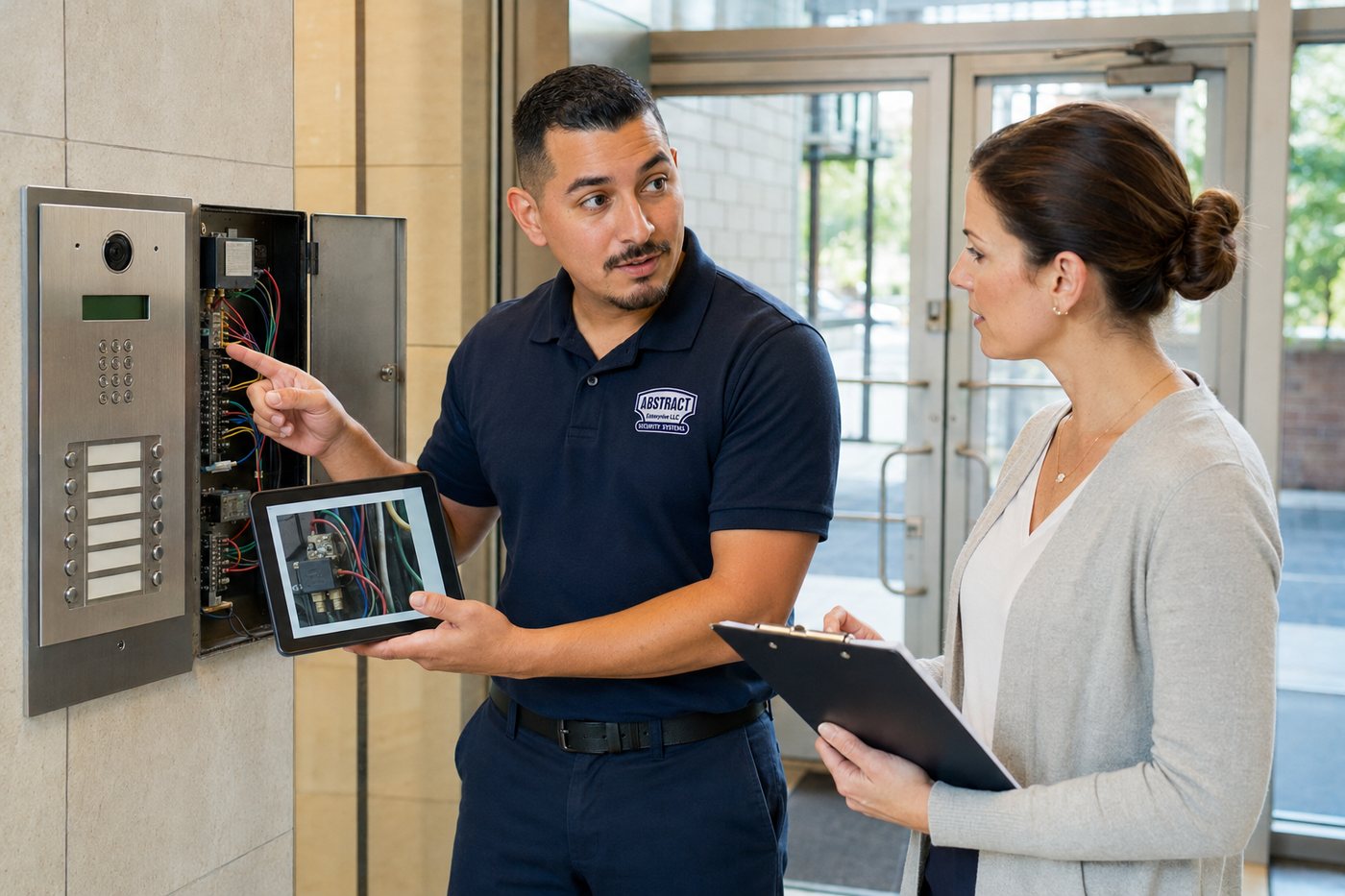
Licensed low-voltage service call at a multi-unit entrance.
Need Buzzer Repair in NYC Today?
If the buzzer rings but the door will not open, the fault is in the release path, not the intercom. That one distinction decides whether you are looking at a $250 part or a building-wide job. A dead entry door is an access and life-safety problem, not a maintenance ticket — tenants get locked out, deliveries stop, and the front door ends up propped, which defeats the system entirely.
Nearly every buzzer failure in a New York City building falls into one of three layers. The talk path carries the visitor's call from the lobby panel up the riser to your apartment. The release path carries your unlock signal back down to the door hardware. The mechanical layer is the door itself. They fail independently, and the single most useful question is whether you can hear the visitor at all.
If the buzzer rings and you can speak, the talk path is intact and the fault is downstream. If nothing rings, the fault is upstream. That single distinction narrows a whole-building mystery to a handful of components, and it is why a proper diagnostic beats a blind replacement quote.
Layer 1 — the talk path
Visitor presses your button, a signal travels the building riser to your handset, you hear a ring and answer. When this fails you get silence, one-way audio, or heavy static. In pre-war walk-ups the usual cause is a corroded pair in the riser; in post-war buildings it is more often a dead in-unit station or a failed amplifier in the basement cabinet. On telephone-entry systems in newer construction it is frequently just the wrong number programmed against the unit.
Lobby panel diagnostics — isolating the fault before any quote.
Layer 2 — the release path
You press release, your station signals an electric strike or magnetic lock at the entrance, and the door unlocks briefly. This is the layer that fails most often and it produces the complaint we hear constantly across all five boroughs: the buzzer sounds, the door stays shut. The signal is leaving the apartment and dying somewhere between the relay and the strike.
Layer 3 — the mechanical layer
The electronics can be perfect and the door still will not open. A door held under constant pressure by an over-tightened closer, a settled frame, or a dropped hinge binds the latch against the strike keeper so it physically cannot retract. No amount of intercom work fixes that.
The Buzzer Works But the Door Stays Locked
In a city building the release path is short — the strike sits a few feet from the panel — so voltage drop is rarely the culprit. Preload is. Vestibule doors in the boroughs get slammed thousands of times a day and the closer gets tightened every time somebody complains about latching.
Test it in ten seconds: hold the door with light finger pressure while someone triggers release. Opens under slack, jams under tension — the strike is fine, the frame is winning. In a pre-war building that has settled two inches since 1930 this is the default diagnosis, not the exception.
The second cause is duty cycle. A busy Manhattan or Brooklyn entrance can see three hundred releases a day. AC strike coils are rated for intermittent duty, and at that volume they cook. A strike that lasted twelve years in a six-unit walk-up may last three in a forty-unit building with a ground-floor commercial tenant.
The complaint we hear most: the buzzer sounds and the door stays shut.
Not sure whether yours is a part swap or a wiring job? The diagnostic answers that, and the fee applies either way.
No Sound, No Power, or a Buzzer That Will Not Stop
Whole-building silence in a city walk-up is nearly always the transformer, and city transformers work harder than suburban ones. More units, more calls, more heat, often mounted in an unventilated basement corner next to a boiler.
The failure is gradual, which is what makes it confusing. Output sags before it stops, so the super hears three separate complaints — weak buzz on four, dropped calls on six, a strike that releases some days — and concludes several things broke at once. One reading on the secondary explains all three.
Continuous buzzing has an added dimension in dense buildings: a stuck lobby button in a forty-unit entrance means one apartment gets a permanently energised circuit while the entrance may sit unlocked. In a building with commercial tenants below that is a genuine security exposure, not an annoyance.
Only One Apartment Is Dead
In a large building this is the most over-quoted fault in the trade. One line dead out of forty proves the panel, transformer, amplifier and every other riser pair are working. Nothing building-wide is wrong.
City buildings make it slightly harder to prove because riser access often means opening a closet ceiling or a plaster chase. We tone the pair from the basement junction to the unit rather than guessing, and in most pre-war stock the break is at a terminal block where somebody re-terminated during a renovation.
Boards and managing agents get told a single dead apartment justifies a building-wide replacement more often here than anywhere else we work. If you have that quote in hand, get a second diagnostic before signing.
Basement amplifier cabinet feeding the building riser.
What We Actually Replace
Buzzer repair is component work. Below is the hardware behind the terms you will see on an invoice, so you can read a quote and tell a genuine part swap from a padded one.
24V transformer
Low-voltage supply for the whole system. Fails gradually — weak buzz, dropped calls, then silence.
Door release relay
Switches power to the strike when you press release. Contacts weld shut or stop making altogether.
Electric strike
The powered keeper in the frame. Fail-secure locks on power loss; fail-safe unlocks.
Magnetic lock
Holds by electromagnet, always fail-safe. Needs alarm integration and a manual release to be compliant.
Riser wiring
The vertical pairs from the basement to each unit. Corrosion here causes static and dead lines.
Apartment station
The in-unit handset. Cord conductors, hookswitch and speaker all wear out.
Lobby panel
Buttons, directory, speaker and microphone at the entrance. Weather and vandalism take these first.
Request-to-exit
Interior release button or sensor. On a maglock this is life-safety hardware, not a convenience.
We service legacy analog hardware including Lee Dan, TekTone and Alpha Communications and keep common stations and transformers for those platforms on the truck. System-wide video, gate and driveway entry and brand-specific catalogs are covered on our intercom pages.
Is Your NYC Landlord or Co-op Board Required to Fix It?
Yes, and New York City gives this more enforcement teeth than anywhere else in the state.
New York State Multiple Dwelling Law requires buildings constructed or converted after 1968 with eight or more units to provide a two-way voice intercom linking the entrance to each apartment. On top of that, the New York City Housing Maintenance Code requires a functioning intercom in residential buildings so tenants can admit visitors without leaving the apartment. HPD classifies a non-working intercom as a Class B hazardous violation.
That classification matters. Class B violations carry civil penalties in the range of $250 to $500 per day until corrected, and the standard is continuous functionality — a system where some apartments work and others do not is still a violation. Buildings with fewer than three dwelling units fall under different rules, and buildings with a 24/7 doorman may be treated differently since a physical presence performs the same security function.
The escalation path is specific to the city. Notify management in writing and keep a copy. If nothing happens, file a complaint through 311 or directly with HPD, which sends an inspector; a confirmed condition triggers a correction notice. Beyond that, a tenant can begin an HP proceeding in Housing Court without a lawyer. Courts have treated intercoms as an essential service, so failure to maintain one breaches the warranty of habitability.
For co-ops and condos the building-wide system is the corporation's responsibility, not the shareholder's — lobby panels, risers, transformers, amplifiers and door hardware are shared infrastructure. We provide dated diagnostic reports naming the failed component, which boards use to authorise work and tenants use to show management was notified. General information, not legal advice.
Maglocks, Egress and Fire Code
If your entrance uses a magnetic lock rather than an electric strike, the rules change and they are life-safety rules, not conveniences. A compliant maglock installation needs fire alarm integration so the lock drops on alarm, a manual release device on the interior side, a fail-safe power configuration, and proper signage.
Free egress is non-negotiable: anyone inside must be able to leave without a key, a credential or a code. Any access-control arrangement that impedes interior egress violates fire code no matter how well it controls entry, and improperly locked exits are classified as immediately hazardous — a materially worse category than a dead buzzer, with vacate-order exposure.
This is the single most common thing we find wrong on buildings that had a maglock added by a general contractor rather than a licensed low-voltage contractor. If your building has one and you cannot point to the release device, get it looked at.
Electric strike service at the frame — the most common failure point.
What Buzzer Repair Costs in NYC
Our service call is $250 and includes on-site diagnosis: we identify the failed component and give you the repair number before parts work begins. Most single-fault repairs finish in that visit.
Service call + on-site diagnostic$250
Apartment station replacement$250 – $525
Door release relay or button$250 – $475
24V transformer replacement$325 – $650
Electric strike replacement + alignment$450 – $950
Lobby panel repair or faceplate$650 – $1,800
Riser pair repair / re-termination$850 – $2,400
Aggregator sites quote a national average with no idea whether your fault is a $250 button or a $2,400 riser. The number only means something after someone has looked at the panel.
Repair or Replace?
The economics in New York City turn on wall access, not on hardware. Parts are cheap; opening a plaster chase in an occupied pre-war building is not.
Repair while the riser is sound. Stations, transformers, relays and strikes are all bench-level swaps and there is no reason to touch a functioning riser to replace them.
Replace when the riser is the fault — and in the city that decision usually arrives with a renovation, not on its own. If the building is already opening walls for plumbing or electrical risers, that is the moment to run new intercom pair. Doing it as a standalone project doubles the cost for the same result.
Cloud and IP platforms are worth considering only at that same moment. A monthly subscription does not solve a broken $250 button, and no platform fixes a preloading door.
Relay bank service. Welded contacts leave the entrance unlocked.
Where We Work Across the Five Boroughs
Brooklyn
Brownstone rows in Park Slope, Fort Greene and Bedford-Stuyvesant with original riser wiring behind plaster; six-storey walk-ups through Sunset Park, Bensonhurst and Borough Park; large post-war co-op stock in Sheepshead Bay, Midwood and Canarsie. Coastal exposure matters in Coney Island, Brighton Beach, Sea Gate and Manhattan Beach, where outdoor panels corrode faster than the rest of the borough.
Manhattan
High-rise residential with telephone-entry and IP systems from Battery Park to Inwood; pre-war co-ops on the Upper East and Upper West Sides where riser access means opening plaster; brownstone rows in Harlem, Chelsea and the West Village; mixed-use buildings where a ground-floor storefront shares the entry with residential above. Board approval and building access windows drive scheduling more than distance does.
In-unit handset service. Cord conductors fatigue where they flex.
Queens
The widest range of stock in the city — Astoria and Long Island City walk-ups, Jackson Heights garden co-ops, Forest Hills and Rego Park mid-rise, and detached and semi-detached two- and three-family homes across Bayside, Fresh Meadows and Ozone Park. Two- and three-family conversions produce a specific failure pattern: a system originally wired for one bell, extended twice.
The Bronx
Dense pre-war along the Grand Concourse, Fordham and Tremont; large NYCHA and Mitchell-Lama developments; Co-op City with its own scale of building-wide infrastructure; and low-rise waterfront pockets in City Island, Country Club, Throggs Neck and Edgewater Park where salt air is a real factor.
Staten Island
Predominantly single- and two-family with garden-apartment and townhouse complexes in St. George, Stapleton and New Springville. Longer runs from entry to residence make voltage drop the recurring diagnosis rather than the exception, and shore-facing property in Great Kills, Tottenville and South Beach needs weather-rated hardware.
Maglock and power supply under test — life-safety hardware tied to egress.
Field Notes
The call that comes in as "the whole intercom is dead" is usually one of three things, and it is worth knowing which before anyone quotes a system.
First: a door that binds. In older buildings the closer gets tightened every time somebody complains the door does not latch, until the latch is jammed against the keeper hard enough that the strike cannot pivot. Residents hear the strike buzz, feel the door refuse, and conclude the intercom died. Nothing electrical is wrong. Loosening the closer and shimming the strike plate fixes it in twenty minutes.
Second: oxidised button contacts. Street-facing panels take weather year-round, and in the boroughs they take fumes and grit as well. Contacts under the buttons oxidise, resistance climbs, and the circuit reads open even though every conductor is intact. Cleaning contacts costs nothing to rule out and it is the first thing we try.
Third: a transformer on its way out rather than already gone. Output sags before it stops, so a building sees weak buzz, calls that ring once and drop, and strikes that release inconsistently — symptoms that look like several unrelated faults. One meter reading on the secondary explains all of them at once.
We check those three before proposing anything larger, because in this city they account for most of what gets sold as a system replacement.
Door Buzzer Repair NYC — Questions
How much does door buzzer repair cost in NYC?
Our service call is $250 with on-site diagnosis included. A station swap runs $250 to $525, a transformer $325 to $650, a strike with alignment $450 to $950. Lobby panel work in a high-traffic entrance runs higher than in a quiet walk-up because the panel takes more abuse. Riser repair in occupied pre-war stock is the expensive end at $850 to $2,400 because the cost is wall access, not parts.
Verifying the talk path with the resident before closing the call.
Why does my buzzer work but the door not open?
Preload, nine times out of ten in a city building. The closer has been tightened until the latch jams against the keeper and the strike physically cannot pivot. Hold the door slack and have someone trigger release — if it opens, no electronics are involved. The runner-up in dense buildings is a burned AC coil from duty cycle: a busy entrance can see three hundred releases a day.
Is my landlord or co-op board required to fix the buzzer in NYC?
Yes, and the city enforces it. State Multiple Dwelling Law covers post-1968 buildings with eight or more units, and the NYC Housing Maintenance Code requires a functioning intercom on top of that. HPD treats a dead intercom as a Class B hazardous violation with penalties in the $250 to $500 per day range. Notify management in writing, then file through 311 or HPD; beyond that a tenant can start an HP proceeding in Housing Court without a lawyer. General information, not legal advice.
Our building has a maglock. Is it legal?
Only if it has fire alarm integration so it drops on alarm, a manual release on the interior side, fail-safe power and correct signage. Free egress is non-negotiable — anyone inside must be able to leave without a key, code or credential. Improperly locked exits are classified immediately hazardous, a worse category than a dead buzzer, with vacate-order exposure. We find non-compliant maglocks most often where a general contractor installed one instead of a licensed low-voltage contractor.
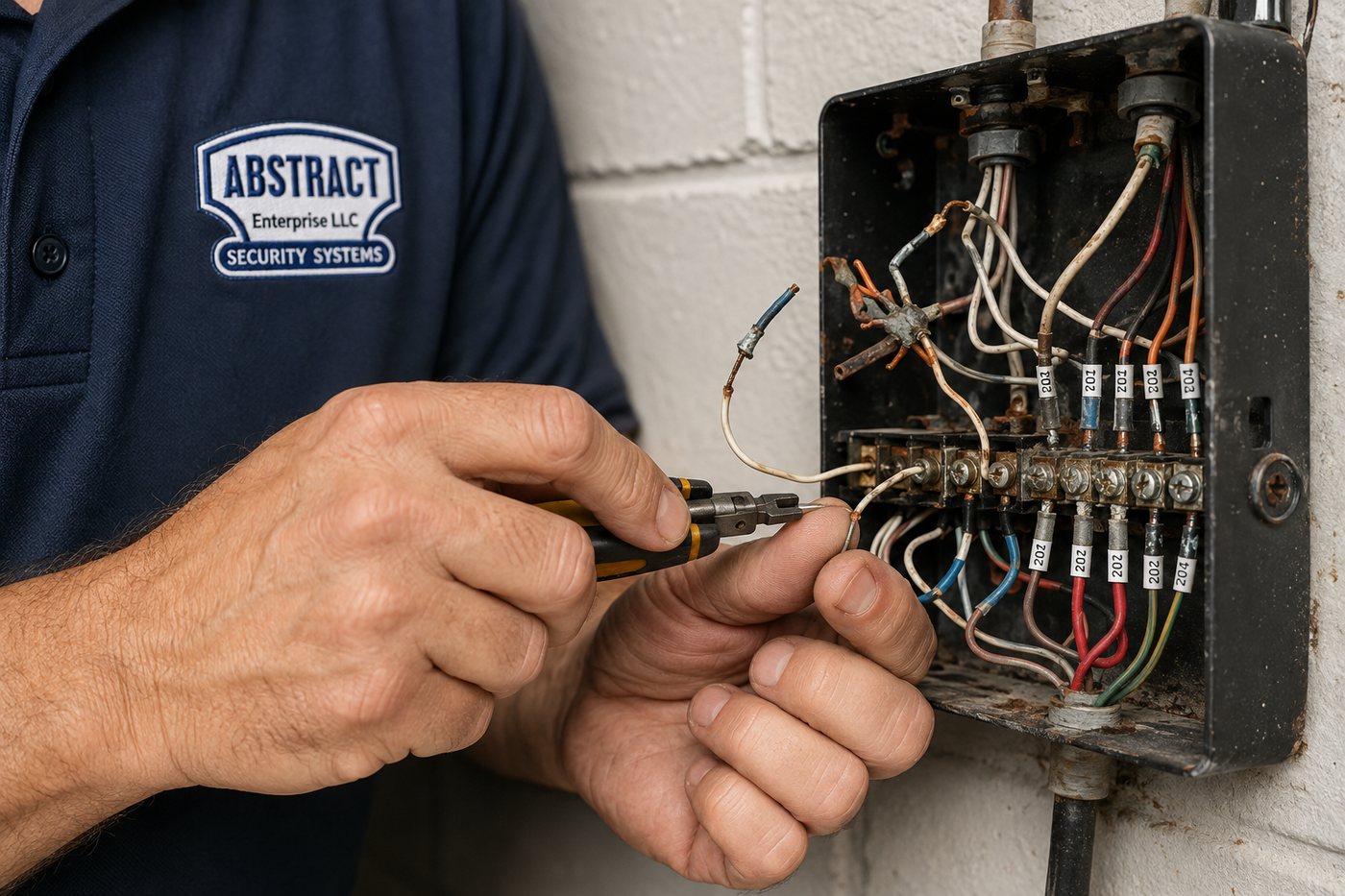
Corroded terminals — the usual cause of static and dead lines.
One apartment out of forty is dead. Do we need a new system?
No, and this is the most over-quoted fault in the trade. One dead line proves the panel, transformer, amplifier and every other pair are working. The fault is that unit's station, its terminals, or its pair. City buildings make it harder to prove because riser access often means opening a closet ceiling, so we tone the pair rather than guess.
Who pays in a co-op or condo?
The corporation or association. Lobby panels, risers, transformers, amplifiers and door hardware are shared building infrastructure, not shareholder property. The exception is damage a resident caused inside their own unit. Check the proprietary lease, but shareholders are rarely liable for shared entry equipment.
Why does the buzzer keep buzzing without stopping?
A stuck lobby button or a relay with welded contacts. In a forty-unit entrance this is more than an annoyance — a welded relay holding the strike open leaves the front door unlocked, and in a building with ground-floor commercial that is a real security exposure. Do not force a stuck button; disconnect the panel and call.
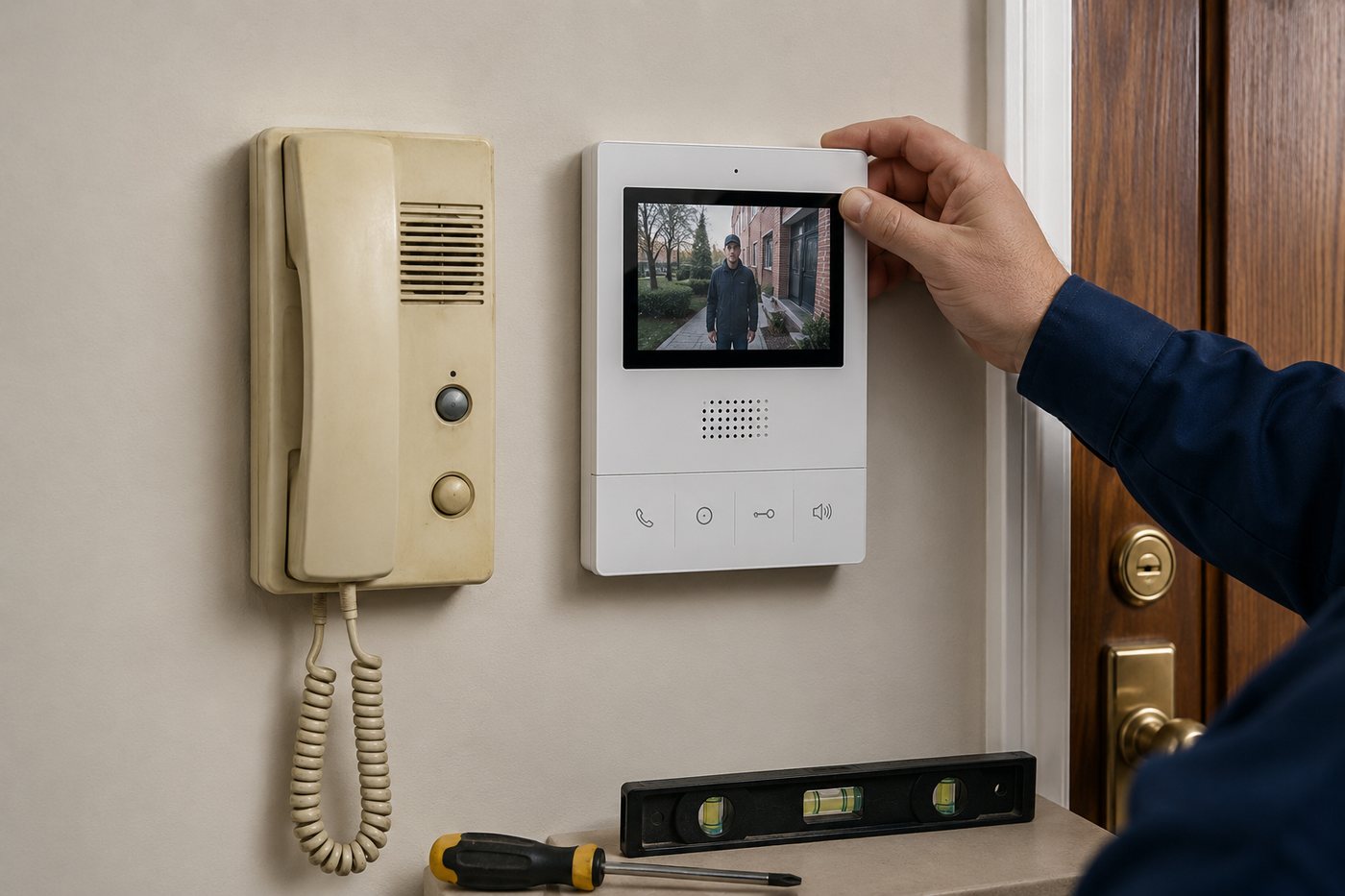
Audio station replaced with a video monitor on the existing pair.
What causes static or one-way audio in a pre-war building?
The riser, almost always. Pairs installed in the 1920s corrode at terminal blocks, insulation crumbles inside plaster chases, and splices made during past renovations work loose. One apartment with static is that unit's pair. A whole building crackling is the trunk or the amplifier.
Do you offer same-day buzzer repair in the five boroughs?
For most of the city, yes. Calls before 10 AM are normally handled the same day in Brooklyn, the Bronx and Manhattan, with Queens and Staten Island same or next day depending on where in the borough and what the schedule looks like.
The strike does not buzz. Is it dead?
Not necessarily. AC strikes hum audibly when energised; DC strikes are silent apart from a faint click. People replace perfectly good DC hardware on this assumption constantly. The current type has to be confirmed before anything gets ordered.
Can I fix an apartment buzzer myself?
Reseating a handset cord at the wall plate is fine, as is checking whether neighbours are affected. Opening the lobby panel or the basement cabinet is not — shorting two conductors there can take the whole building down, and in a forty-unit walk-up that becomes everyone's problem within the hour. Transformer, riser, strike and maglock work is licensed.
Do you work with managing agents and boards?
Yes. We issue certificates of insurance to owners, boards and managing agents before work starts, and provide dated diagnostic reports naming the failed component. Boards use those to authorise work; tenants use them to establish management was notified.
Reviewed and updated September 2026.
Get the Buzzer Fixed
Component-level diagnosis across New York City. We identify the failed part and quote the repair before touching anything — no system-replacement pitch on a $250 fault.