Same-Day Service · All Brands · Intercom Repair · Buzzer Repair · All Staten Island Neighborhoods
Professional door buzzer repair and intercom repair across all Staten Island neighborhoods. From Mott Haven walk-ups to Fordham apartment buildings to Riverdale co-ops — if your apartment buzzer is not working or your intercom system stopped working, we fix it same day. Most repairs completed in a single visit.
Component-level diagnosis. We isolate the failed part before quoting a replacement.
Certificates of insurance issued to owners, boards, and managing agents before work starts.
Directory panel service on a large multi-unit entrance.
Need Buzzer Repair in Staten Island Today?
Staten Island is the one borough where most buzzer calls are single-family doorbells rather than apartment intercoms, and the failure profile looks more like Long Island than like the rest of the city. A dead entry door is an access and life-safety problem, not a maintenance ticket — tenants get locked out, deliveries stop, and the front door ends up propped, which defeats the system entirely.
The three layers apply here as everywhere: the talk path to wherever you answer, the release path to the door hardware, and the mechanical layer of the door and frame. The difference is distance. On detached property the run from the entry to the answering point is many times what it is in a walk-up, which changes which faults are likely.
If the buzzer rings and you can speak, the talk path is intact and the fault is downstream. If nothing rings, the fault is upstream. That single distinction narrows a whole-building mystery to a handful of components, and it is why a proper diagnostic beats a blind replacement quote.
Layer 1 — the talk path
In townhouse and garden-apartment complexes this behaves like a small city building. In detached and semi-detached homes it is a doorbell transformer, a chime and a push button, frequently with a wireless or video unit added later on top of an unrepaired wired fault.
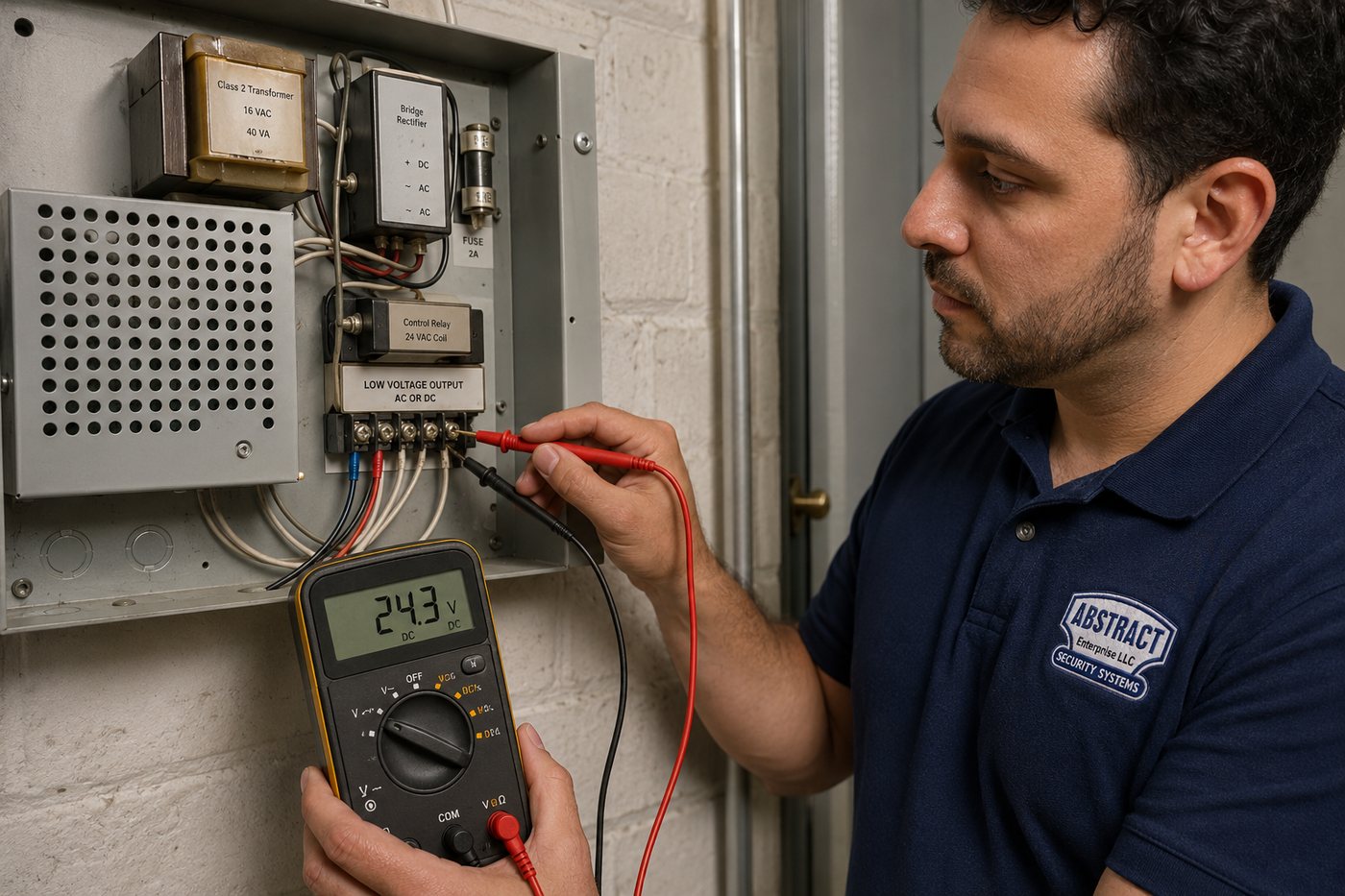
Transformer output measured under load. Below six volts means replace.
Layer 2 — the release path
Complexes and professional buildings use an electric strike at a shared entry. Longer conductor runs make voltage drop the leading cause of a strike that buzzes without releasing, and the reading has to be taken while the coil is energised.
Layer 3 — the mechanical layer
Exterior doors on detached homes move with humidity and frost far more than a masonry-framed entrance. A strike aligned in summer binds in winter, and shore-facing property adds salt to the equation.
The Buzzer Works But the Door Stays Locked
Staten Island runs the longest release paths in the city. A townhouse complex entry or a detached home with a gate puts real distance between the supply and the strike, and voltage drop becomes the leading diagnosis rather than the exception.
The tell is seasonal and load-dependent: reliable in summer, unreliable in January, worse as devices get added to the same supply. An idle meter reading looks perfect, which is why the measurement has to be taken while the coil is pulling.
Preload appears too, but for a different reason than in the city. Vinyl-clad and wood exterior doors swell and settle with humidity, so a strike aligned in July binds in February.
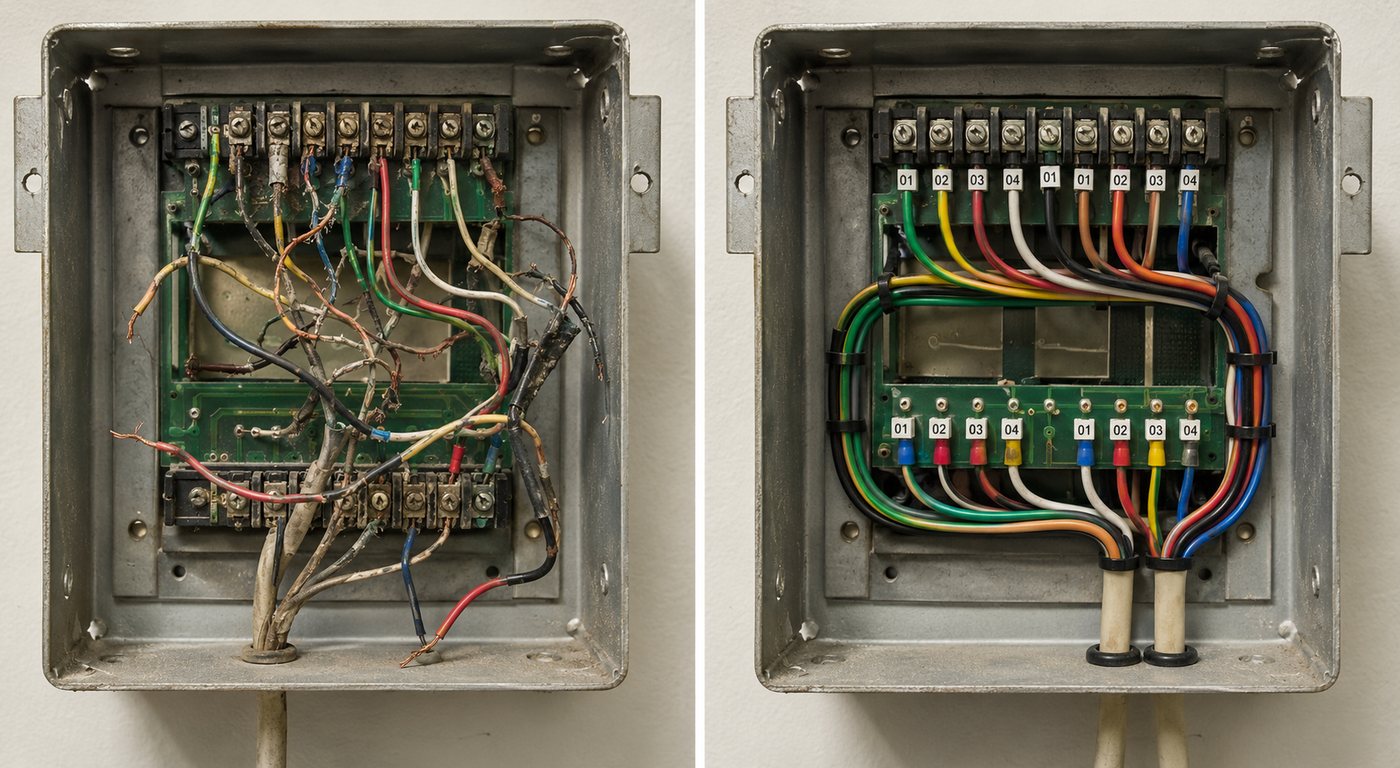
Junction box before and after re-termination and labelling.
Not sure whether yours is a part swap or a wiring job? The diagnostic answers that, and the fee applies either way.
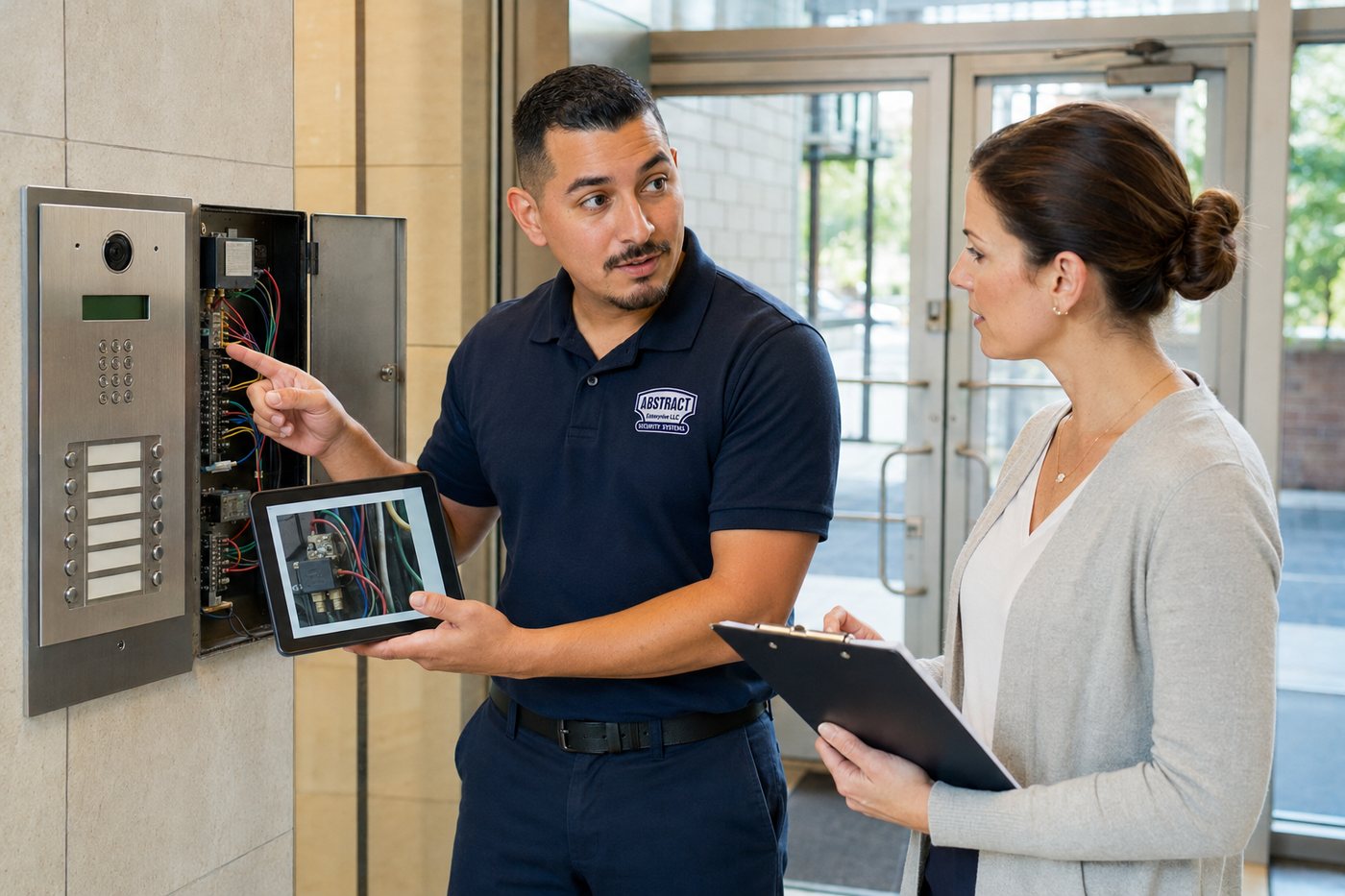
Walking an owner through the diagnostic findings on site.
No Sound, No Power, or a Buzzer That Will Not Stop
In detached housing, which is most of the borough, whole-system silence means the doorbell transformer, and it is usually somewhere nobody has looked in two decades — a basement joist, a garage ceiling, above a tile near the panel.
They die by degrees. The chime gets quieter, then intermittent, then stops. Under about six volts on the secondary and it is finished.
In townhouse and garden complexes the pattern shifts to the amplifier and the trunk, and continuous buzzing from a stuck exterior button is likelier because those panels sit exposed with no vestibule protecting them.
Only One Apartment Is Dead
In a garden or townhouse complex one dead unit out of twenty means the shared equipment is fine and the fault is on that circuit.
Staten Island complexes are generally faster to trace than city buildings because wiring runs through accessible attic or crawl space rather than sealed plaster, which usually keeps the repair inside one visit.
In a two-family house the same symptom has a different cause: the system was wired for one bell and extended for the second unit later. The added leg is where the fault sits.
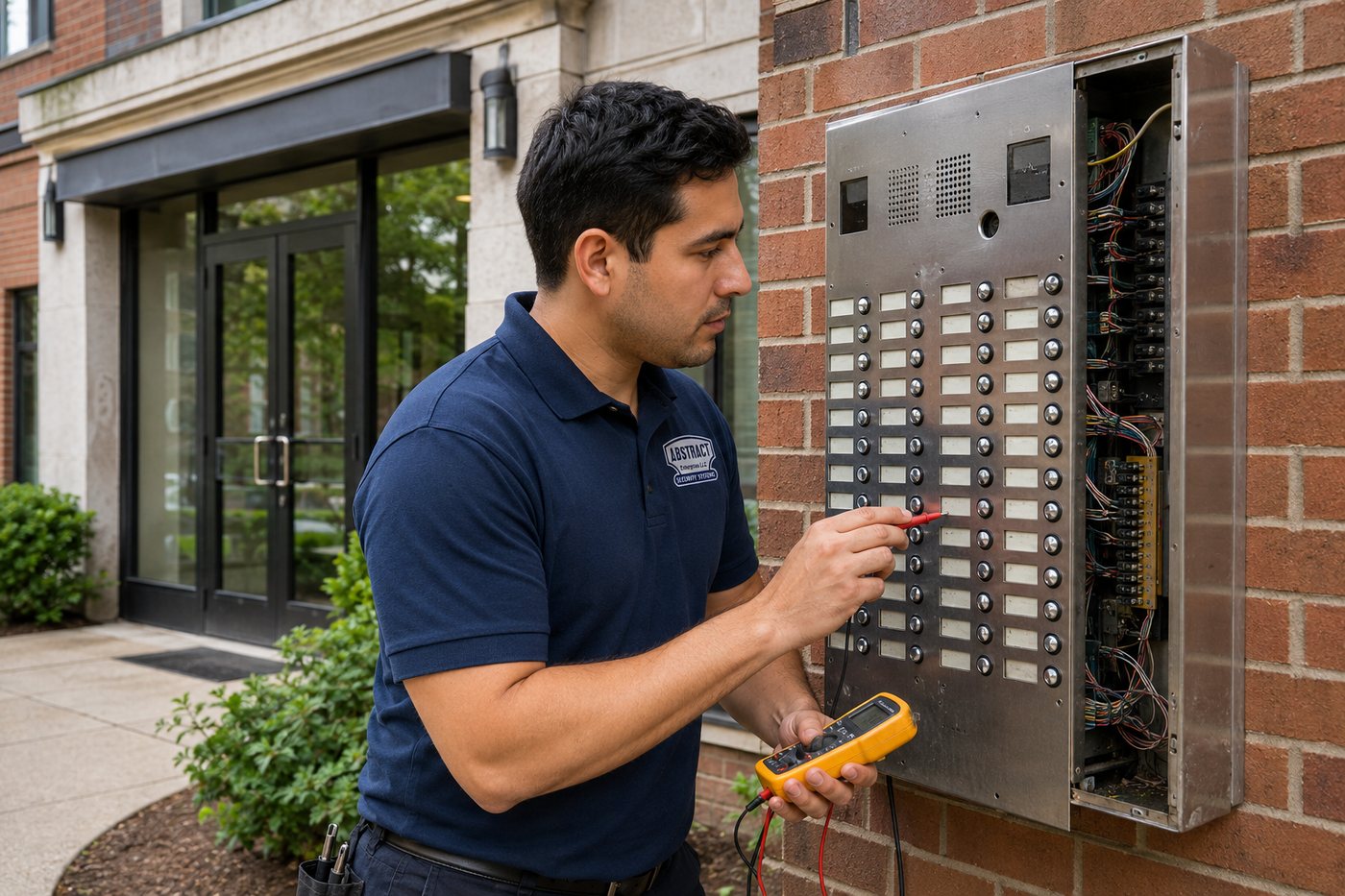
Entry panel service on a brick facade.
What We Actually Replace
Buzzer repair is component work. Below is the hardware behind the terms you will see on an invoice, so you can read a quote and tell a genuine part swap from a padded one.
24V transformer
Low-voltage supply for the whole system. Fails gradually — weak buzz, dropped calls, then silence.
Door release relay
Switches power to the strike when you press release. Contacts weld shut or stop making altogether.
Electric strike
The powered keeper in the frame. Fail-secure locks on power loss; fail-safe unlocks.
Magnetic lock
Holds by electromagnet, always fail-safe. Needs alarm integration and a manual release to be compliant.
Riser wiring
The vertical pairs from the basement to each unit. Corrosion here causes static and dead lines.
Apartment station
The in-unit handset. Cord conductors, hookswitch and speaker all wear out.
Lobby panel
Buttons, directory, speaker and microphone at the entrance. Weather and vandalism take these first.
Request-to-exit
Interior release button or sensor. On a maglock this is life-safety hardware, not a convenience.
We service legacy analog hardware including Lee Dan, TekTone and Alpha Communications and keep common stations and transformers for those platforms on the truck. System-wide video, gate and driveway entry and brand-specific catalogs are covered on our intercom pages.
Who Is Responsible on Staten Island?
It depends on the building, and Staten Island's housing mix means the answer varies more than in the other four boroughs.
State Multiple Dwelling Law covers buildings built or converted after 1968 with eight or more units, and the NYC Housing Maintenance Code requires a functioning intercom in residential buildings, with HPD treating failure as a Class B hazardous violation. That covers the garden-apartment and townhouse-complex stock in St. George, Stapleton, New Springville and Mariners Harbor.
Buildings with fewer than three dwelling units fall outside that framework, which takes in most of the borough. In an owner-occupied single- or two-family home the entry system is the owner's responsibility outright.
Where the requirement does apply, the route is the same as the rest of the city: written notice, then 311 or HPD, then an HP proceeding if needed. General information, not legal advice.
Salt Air, Long Runs and Seasonal Movement
Three environmental factors drive most repeat failures on Staten Island, and none of them are the intercom's fault.
Salt. Great Kills, Tottenville, South Beach, Midland Beach and the shorefront generally corrode standard outdoor panel and strike hardware faster than inland areas. Marine-grade enclosures and gel-filled splices at exposed junctions stop the cycle instead of restarting it.
Distance. Detached property puts real length between the entry and the answering point, and undersized conductors read fine at rest and collapse the moment a coil pulls. Where a driveway gate is involved the run can exceed a hundred feet.
Season. Frost heave and humidity move exterior frames through the year. A strike that has been reliable for three winters can start binding after a wet spring, and that reads as an electrical fault when it is not one.
Strike plate alignment — preload reads as an electrical fault and is not one.
What Buzzer Repair Costs in Staten Island
Our service call is $250 and includes on-site diagnosis: we identify the failed component and give you the repair number before parts work begins. Most single-fault repairs finish in that visit.
Service call + on-site diagnostic$250
Apartment station replacement$250 – $525
Door release relay or button$250 – $475
24V transformer replacement$325 – $650
Electric strike replacement + alignment$450 – $950
Lobby panel repair or faceplate$650 – $1,800
Riser pair repair / re-termination$850 – $2,400
Aggregator sites quote a national average with no idea whether your fault is a $250 button or a $2,400 riser. The number only means something after someone has looked at the panel.
Repair or Replace?
Access is easier here than in the city and the runs are longer, so the economics invert: wire costs more, labour to reach it costs less.
Repair when the fault is a component on a properly sized circuit. Transformers, chimes, buttons, stations and strikes are all straightforward.
Replace the conductor when it is undersized for the distance. No new intercom fixes a supply that collapses over a hundred and forty feet, and that is the specific failure on long-driveway property.
Untangling an added wireless unit is its own job. If a battery doorbell was installed because the wired system failed, the wired fault is still there and still worth diagnosing before anything else is bought.
Two-point verification: visitor at the panel, technician on the station.
Where We Work Across Staten Island
North Shore
St. George, Stapleton, Tompkinsville, New Brighton, West Brighton and Port Richmond. The borough's densest housing, including most of its garden-apartment and townhouse-complex stock and the multi-unit buildings most likely to fall under the eight-unit threshold.
Mid-Island
New Springville, Bulls Head, Willowbrook, Todt Hill, Emerson Hill and Grasmere. Predominantly detached and semi-detached, with townhouse developments and professional buildings along Richmond Avenue and the Victory Boulevard corridor.
Licensed low-voltage service call at a multi-unit entrance.
South Shore
Great Kills, Eltingville, Annadale, Huguenot, Prince's Bay and Tottenville. Larger lots, longer runs, more gated and long-driveway property, and coastal exposure through the shorefront communities.
East Shore
South Beach, Midland Beach, New Dorp and Oakwood. Heavy post-Sandy rebuild activity means newer wiring inside older-looking houses, which changes the diagnosis more often than people expect.
West Shore
Mariners Harbor, Arlington, Bloomfield and the industrial corridor. Commercial and light-industrial entries, warehouse door release and multi-tenant office buildings.
Lobby panel diagnostics — isolating the fault before any quote.
Field Notes
Three patterns cover most Staten Island work.
First: the transformer nobody has checked in twenty years. It sits on a basement joist or above a ceiling tile and dies gradually — quieter, then intermittent, then silent. Under about six volts on the secondary and it is finished.
Second: the wireless unit hiding a wired fault. A battery doorbell or camera unit gets added because the original stopped, the original fault never gets diagnosed, and now two systems half-work. We trace the wired circuit and usually find one break.
Third: preload after a wet season. Exterior doors swell and settle. The strike is fine and the frame moved. Hold the door slack and trigger the release before assuming anything electrical failed.
Door Buzzer Repair Staten Island — Questions
How much does door buzzer repair cost on Staten Island?
Service call $250 with diagnosis. Most single-family repairs finish at or near that — a transformer $325–$650, a button or chime at the low end. Complex and professional-building work runs higher: strike with alignment $450–$950, panel work $650–$1,800.
The complaint we hear most: the buzzer sounds and the door stays shut.
My doorbell just stopped completely.
Start at the transformer. On Staten Island it is usually on a basement joist, a garage ceiling, or above a tile near the panel, and it dies gradually rather than all at once. Under about six volts on the secondary and it is finished.
Someone added a wireless doorbell and now nothing is right.
Common here. The wired fault was never diagnosed, so now two systems half-work. We trace the original circuit and usually find one break.
Is my landlord required to fix it?
Depends on the building. State MDL and the NYC Housing Maintenance Code cover post-1968 buildings with eight or more units, which takes in the garden-apartment and townhouse stock in St. George, Stapleton and New Springville. Under three dwelling units falls outside that, which is most of the borough. General information, not legal advice.
Terminal testing behind a stainless lobby panel.
Does salt really shorten panel life?
Yes. Great Kills, Tottenville, South Beach, Midland Beach and the shorefront corrode standard outdoor hardware within roughly five to eight years. Marine-grade enclosures and gel-filled splices stop the cycle.
It works in summer and fails in winter.
Two causes, both physical. Cold makes coils draw harder so a marginal supply collapses, and frost moves the frame so the strike binds. Neither is an intercom fault.
We have a gate at the end of the driveway.
We handle those. The recurring issue is conductor size: a run over a hundred feet needs wire sized for the operator's inrush, not its holding current.
Basement amplifier cabinet feeding the building riser.
Our townhouse complex has one dead unit.
Shared equipment is fine and the fault is that circuit. Staten Island complexes usually give attic or crawl-space access, so it typically stays inside one visit.
Do you offer same-day service on Staten Island?
North Shore and Mid-Island are usually same day on calls before 10 AM. South Shore and the East Shore are same or next day depending on schedule.
Our house was rebuilt after Sandy.
Then the wiring may be much newer than the house looks, which changes the diagnosis. We check the vintage of the actual circuit rather than assuming from the building.
Can I replace the transformer myself?
No — the primary side is line voltage and that is licensed work. Safe to check: whether a button is physically stuck and whether an accessible chime has an obviously loose wire.
Do you handle commercial and warehouse entries?
Yes. The West Shore industrial corridor, multi-tenant offices along Victory Boulevard and Richmond Avenue, and warehouse door release are steady work.
Reviewed and updated September 2026.
Get the Buzzer Fixed
Component-level diagnosis across Staten Island. We identify the failed part and quote the repair before touching anything — no system-replacement pitch on a $250 fault.