Mineola · Garden City · Great Neck · Hicksville · Rockville Centre
Network Cable Repair Nassau County, NY
Ethernet · Cat6 · Data Jacks · Medical & Professional Suites · Certified Testing
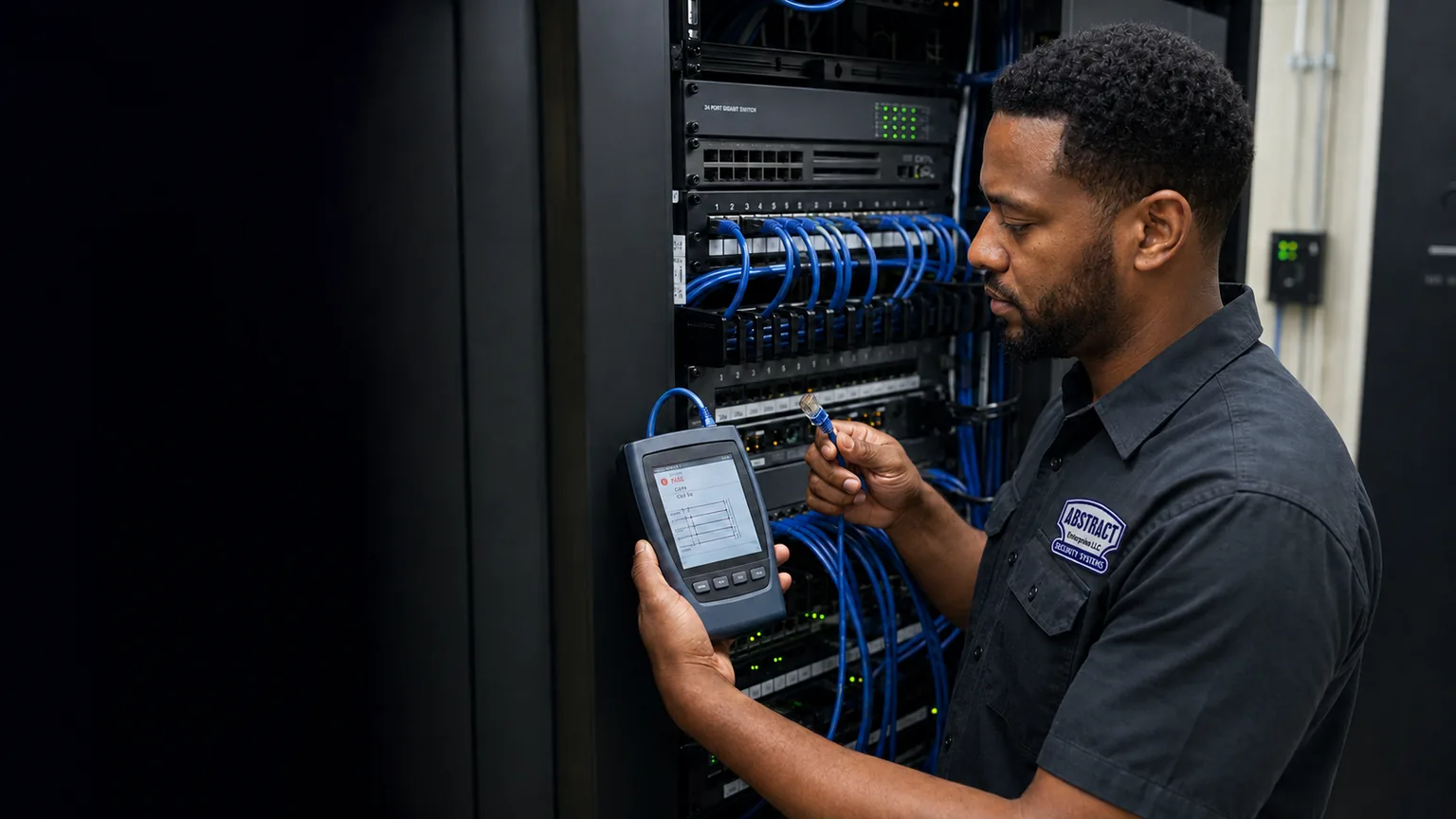
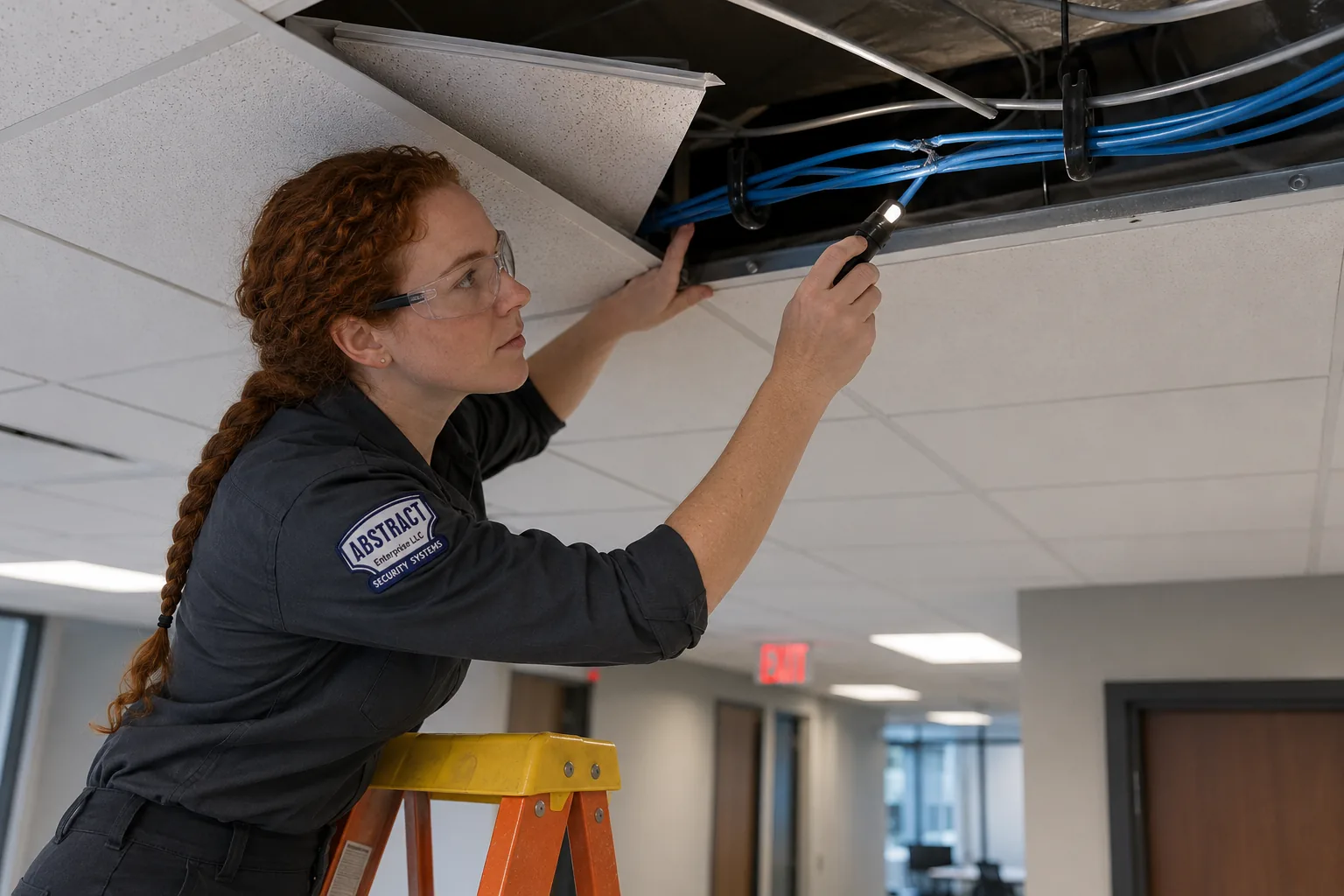
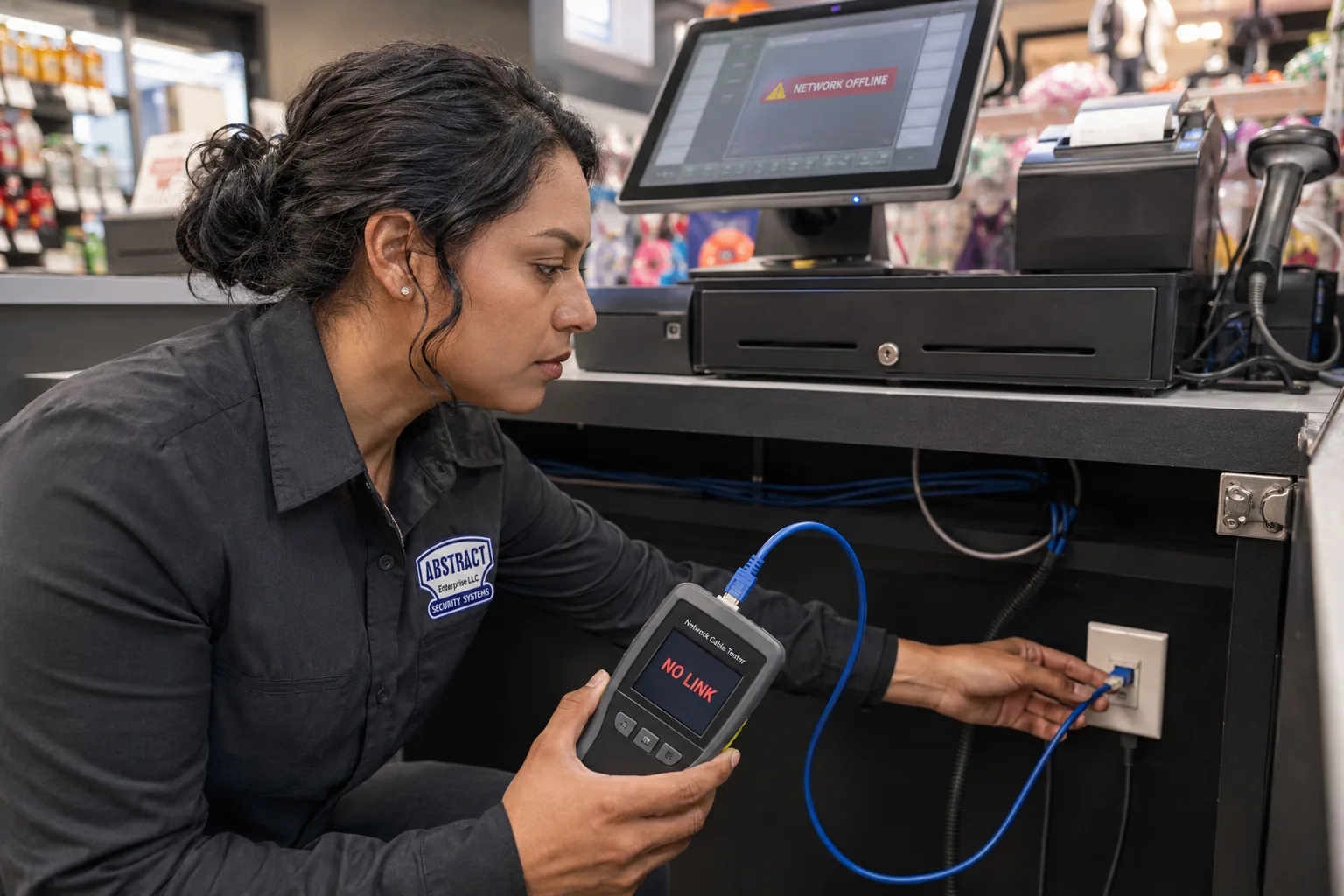
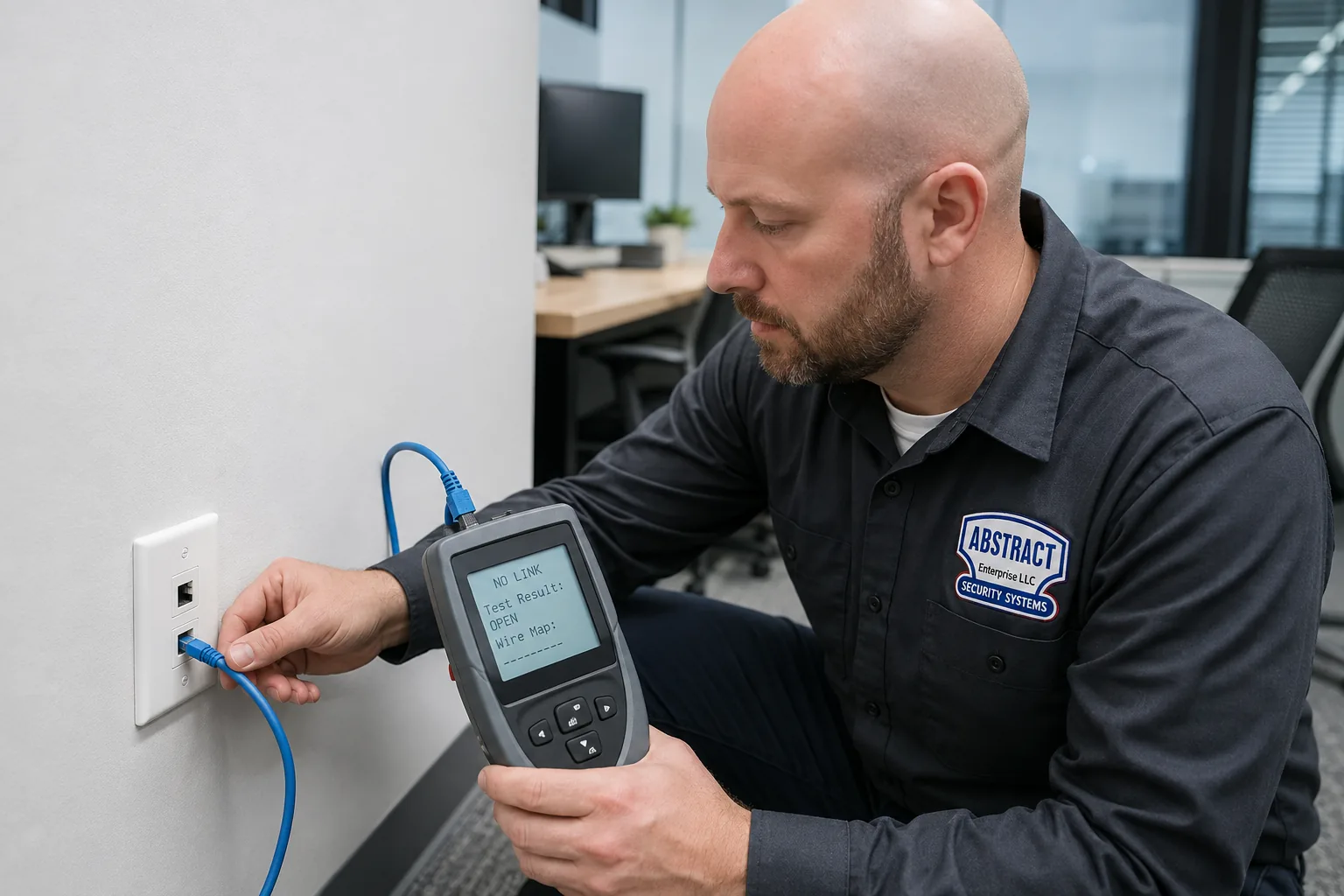
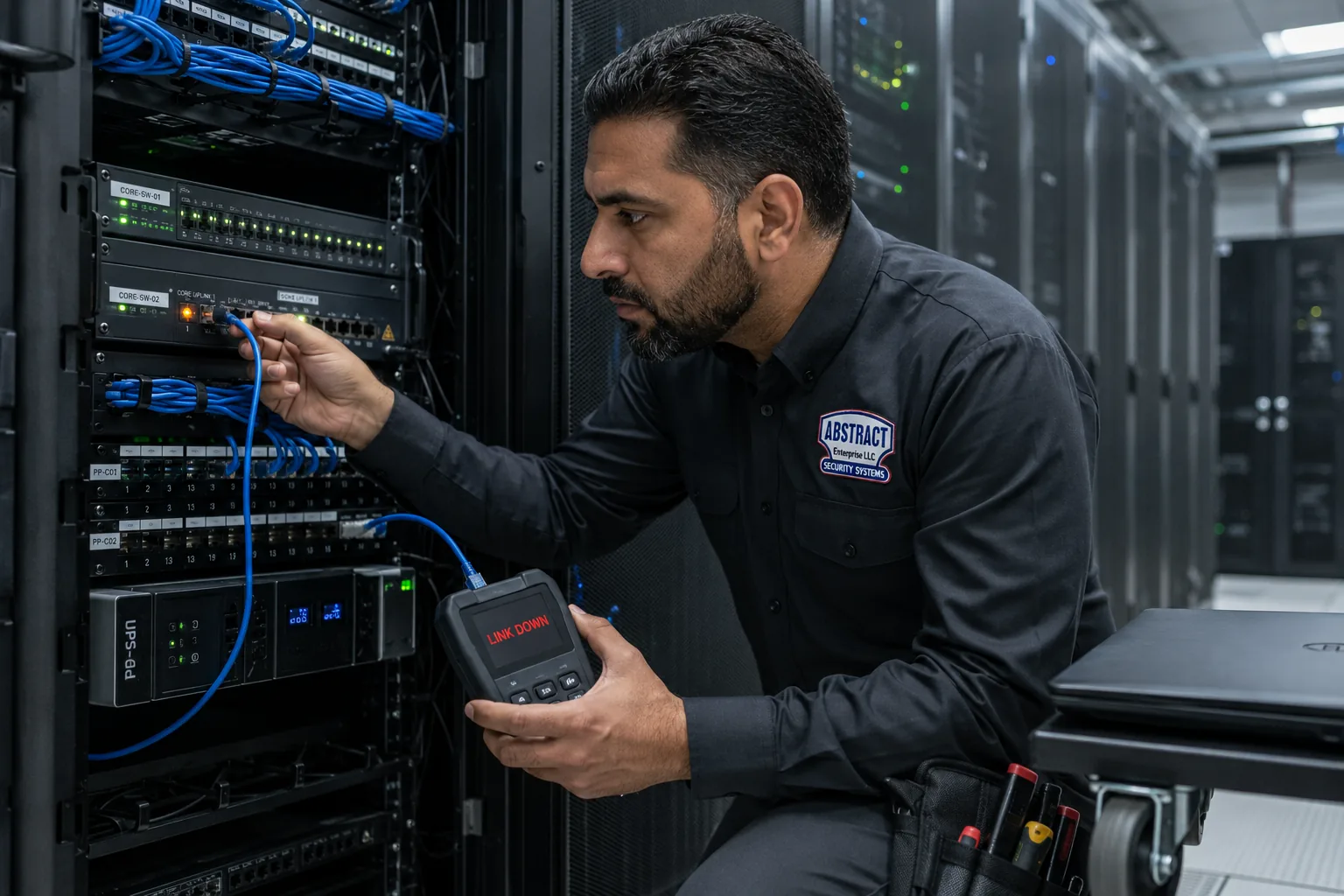
Fault location, retermination, network jack and patch panel repair, PoE troubleshooting and certified cable testing across Nassau County. Licensed NYS low-voltage contractor. Every repaired drop tested and the results handed over, because in this county somebody usually has to file them.
Ethernet, Cat6 and Data Jack Repair Across Nassau County
Nassau County is the most medically and professionally dense commercial market on Long Island, and the cabling reflects it. The suites we work in hold imaging equipment, practice management systems, case files and billing platforms — environments where an intermittent link is not an inconvenience but a stalled appointment and a documentation problem. Abstract Enterprises Security Systems repairs Ethernet, Cat6 and data cabling across Nassau, from Great Neck to Massapequa.
The building stock is the other half of the story. Most of it went up between the early 1950s and the late 1970s: two- and three-storey professional buildings, medical pavilions, village main-street offices converted from houses, and low-rise corporate space around Lake Success and Garden City. Those buildings have small telecom rooms, frequently no telecom room at all, and infrastructure that has been added to by every tenant since.
Repair is charged at our specialty service rate of $195/hr with a three-hour minimum ($585). The diagnostic kit travels on the first visit — distance-to-fault, tone and probe, wiremap and performance testing — and every repaired drop comes back with a saved result, because in a county this full of practices and professional firms, somebody downstream nearly always has to produce that document.
Network Down in Nassau?
Same-day and next-morning slots county-wide. For clinical space we work around patient hours rather than through them. A single fault is normally traced and put right inside the opening three-hour block.
✔ NYS Lic. #12000287431✔ Certified wiremap & performance testing on every repair✔ 4.7★ from 201 reviews
Local Conditions
Why Nassau Cabling Fails the Way It Does
Start with what the buildings were designed to hold. A 1962 medical pavilion in Mineola was built for telephones. The room now carrying a switch stack, a firewall, a UPS and a patch field was originally a closet for a telephone board, and in a great many of these buildings it has never been enlarged, ventilated or repowered. Heat in an undersized room produces the most maddening class of fault there is: intermittent, temperature-linked, worse in the afternoon, and impossible to reproduce when a technician finally arrives in the morning.
Second, equipment that will not tolerate a marginal channel. Imaging workstations, digital radiography, practice management platforms and diagnostic devices move large files and time out rather than degrade gracefully. A channel that passes certification with almost nothing in reserve will carry ordinary office traffic all day and stall a study transfer, which is why we report headroom rather than just pass or fail. On clinical work that number is the whole diagnosis.
Third, the churn. Professional suites here change hands and change shape constantly — a practice adds two operatories, a firm takes the unit next door, a department moves down the hall. Each of those events leaves a drop extended rather than re-pulled, a jack abandoned in place, or a run re-terminated by whoever was available. After four or five cycles the closet no longer describes the suite, and tracing is the first hour of any visit.
Fourth, converted residential stock. Village commercial along Franklin Avenue, Middle Neck Road, Merrick Road, Sunrise Highway and the main streets of Rockville Centre, Lynbrook, Great Neck and Port Washington is full of professional offices in buildings that were houses. Plaster over lath, no cavity worth fishing, no equipment room, cellar panels, and cable routed by somebody solving a problem in an afternoon twenty years ago.
Fifth, documentation expectation. Medical practices, law firms, accountants and schools operate under record-keeping regimes that make a test report a genuinely useful artifact rather than a nicety. We hand over saved results per drop as standard for exactly that reason, and it is frequently the part of the visit clients mention afterwards.
What We Repair
What a Nassau Cable Repair Call Covers
We repair the physical layer, measure what is left in reserve, and hand over the evidence.
Headroom Reporting on Clinical Channels
Not just pass or fail. How much margin a drop has left, so a practice knows which channels will stall an imaging transfer before it happens rather than afterwards.
Telecom Room Heat Assessment
Undersized closets carrying far more equipment than they were built for. We flag rooms we expect to cause intermittent faults and quote ventilation separately rather than installing into a problem.
Ethernet Cable Repair
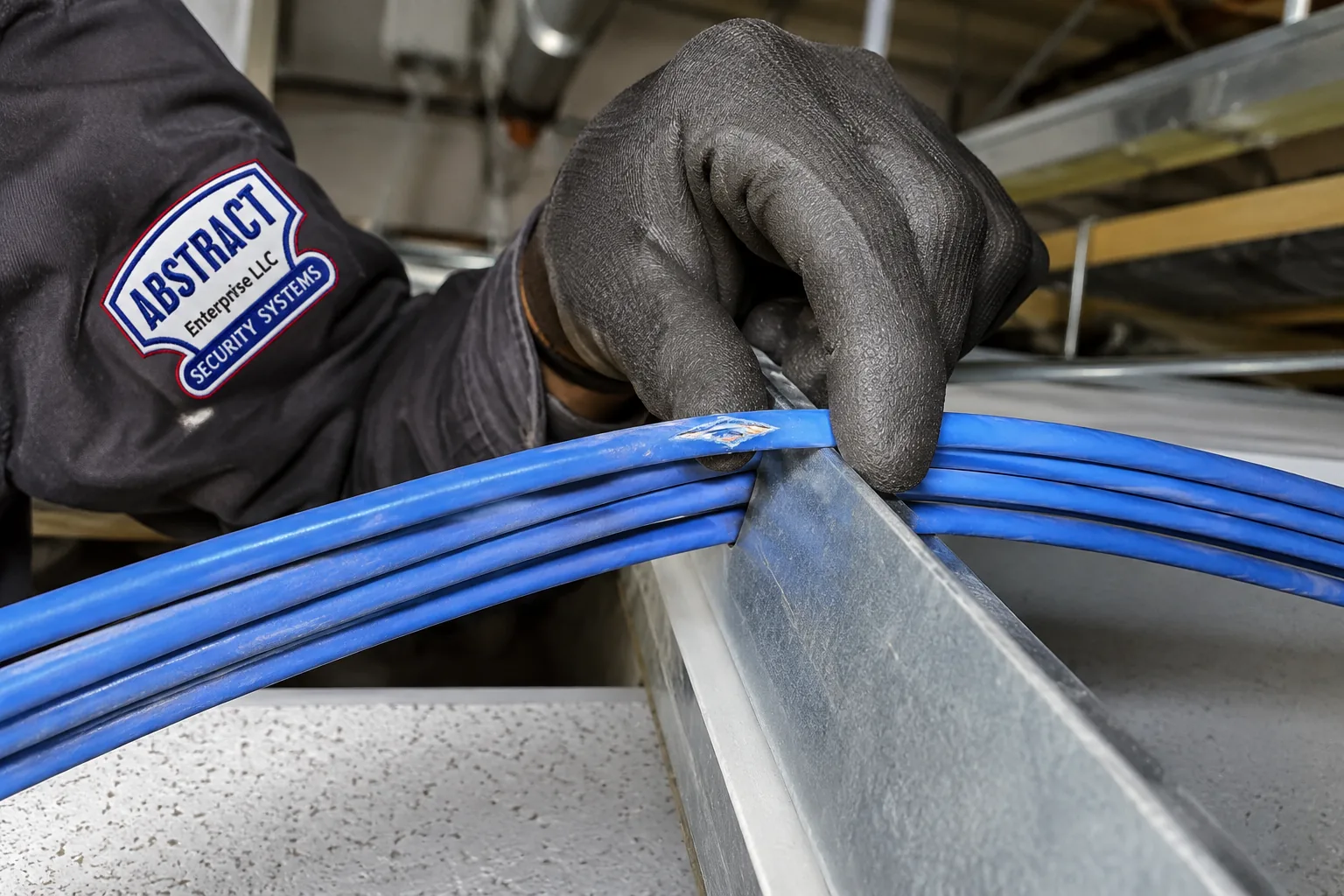
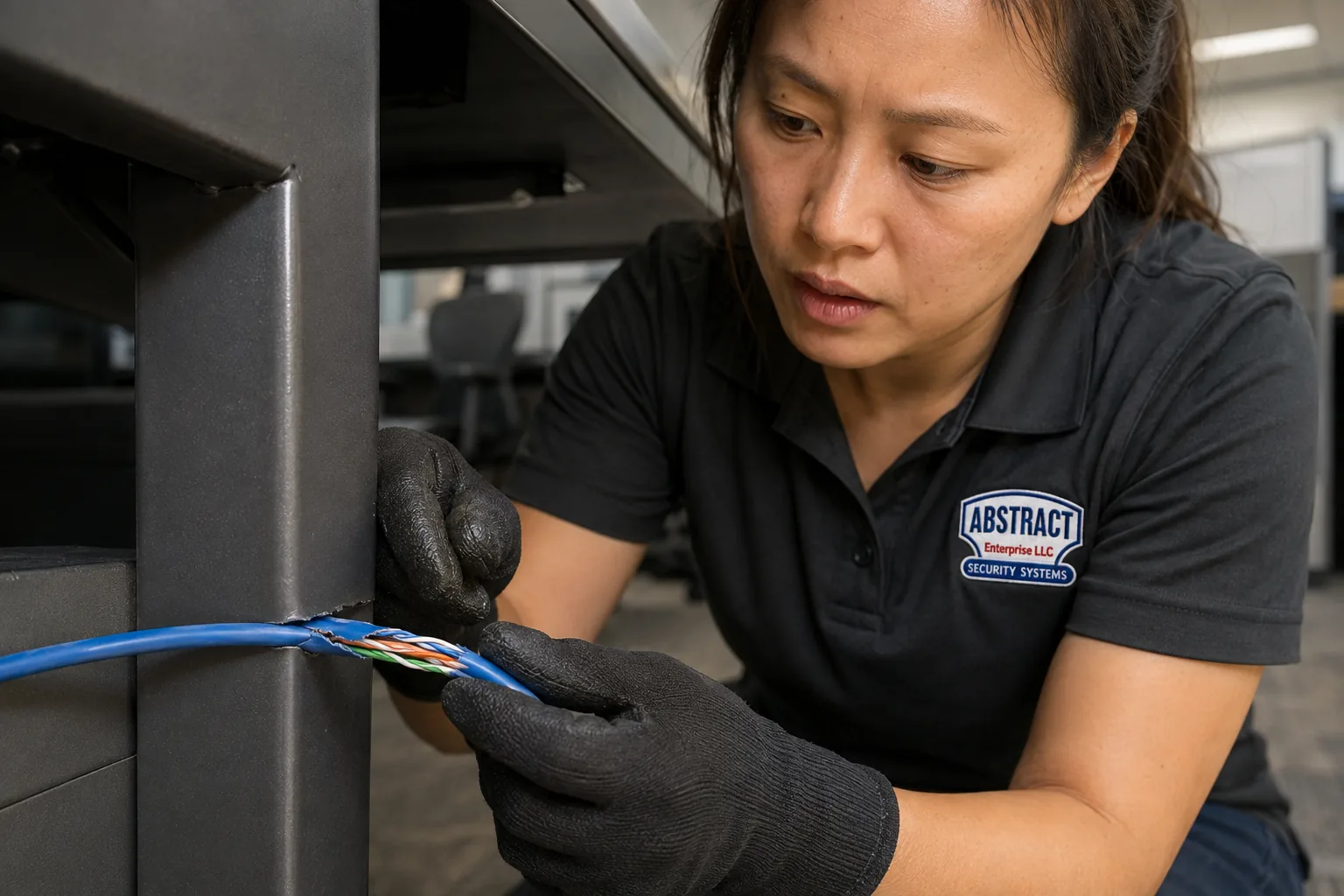
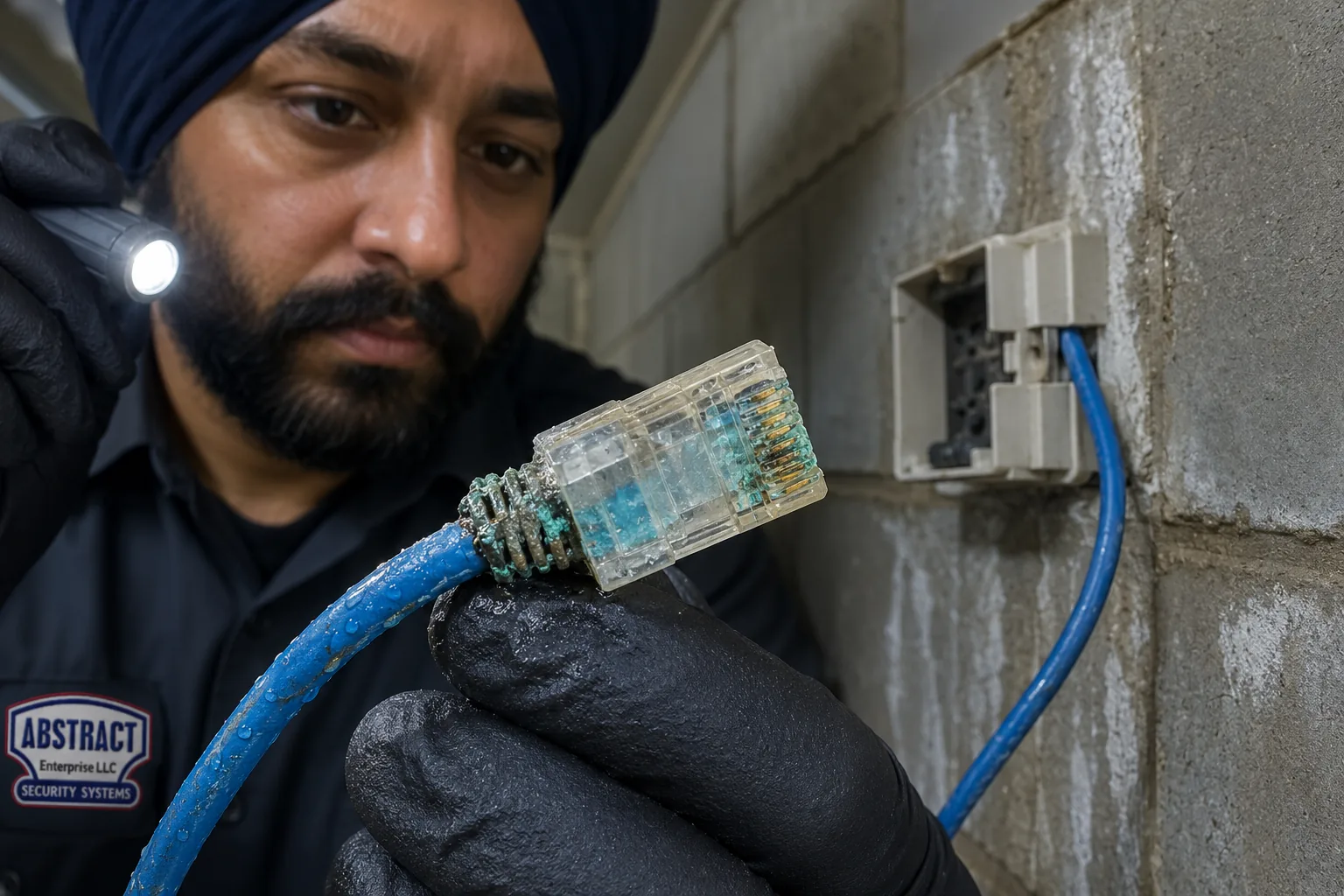
Cut, crushed, pinched or corroded runs restored with a category-appropriate junction and re-tested to spec.
Cat6 and Cat6A Retermination
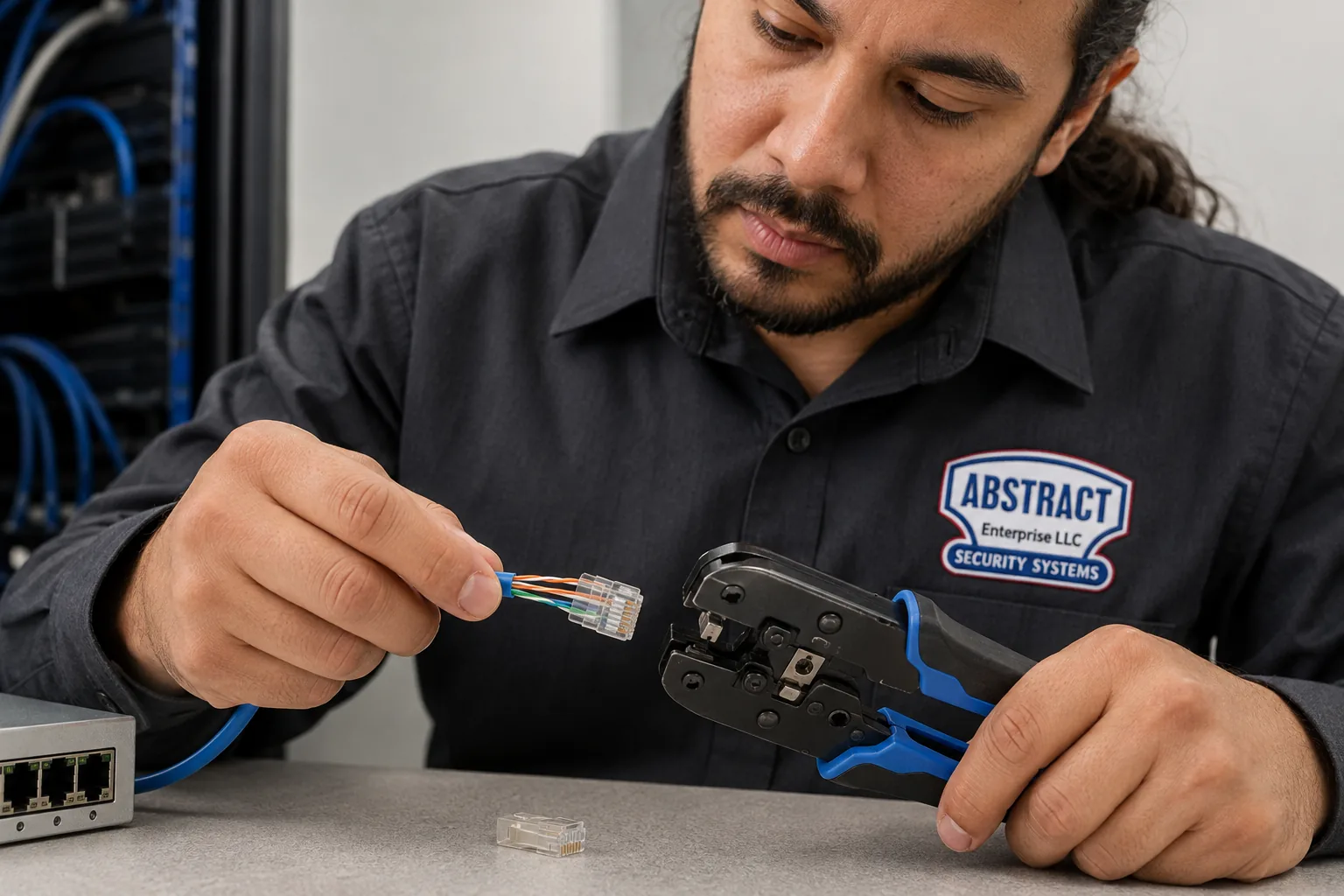
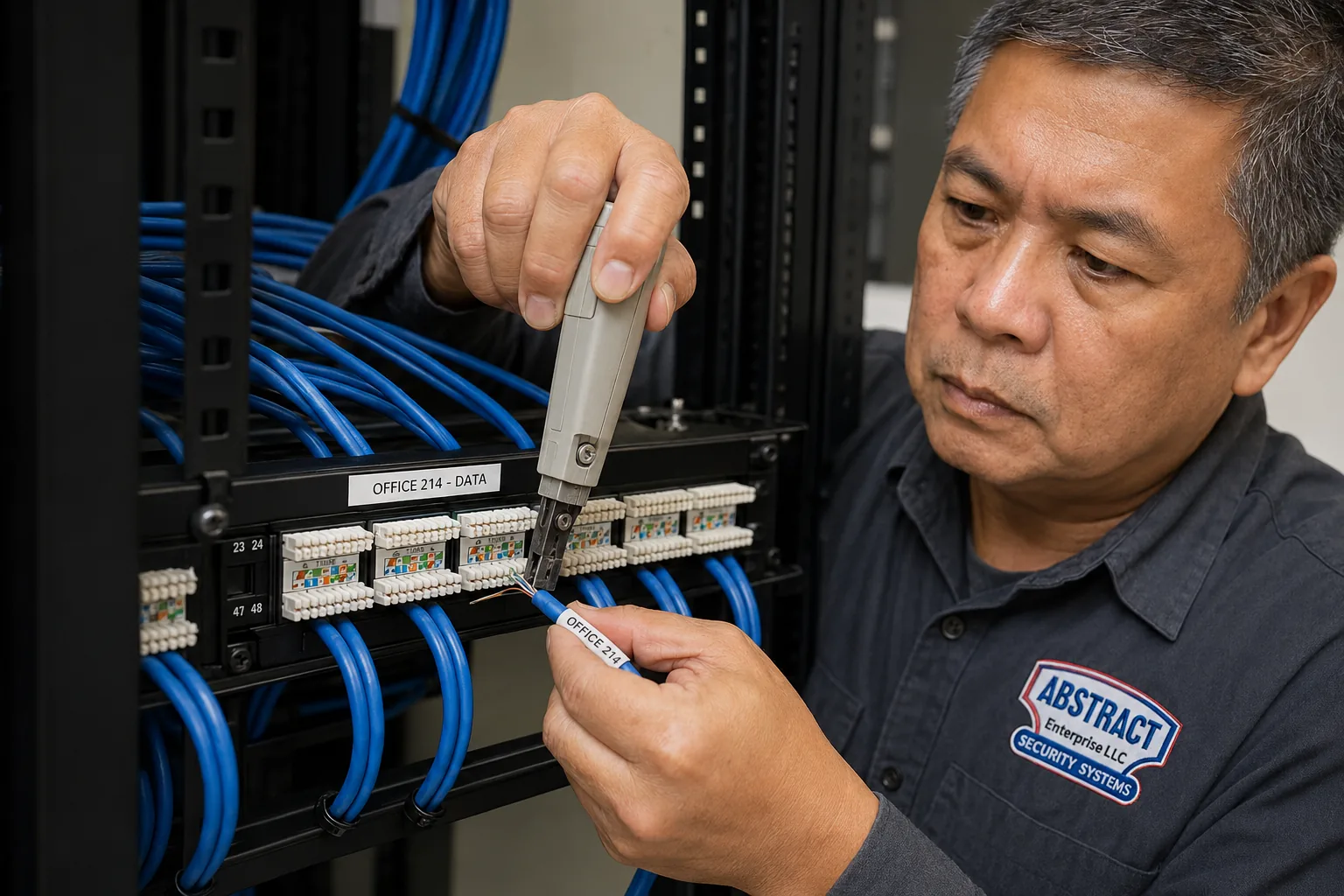
Both ends redone to T568B with the twist carried to the contact, so the channel certifies rather than merely lighting up.
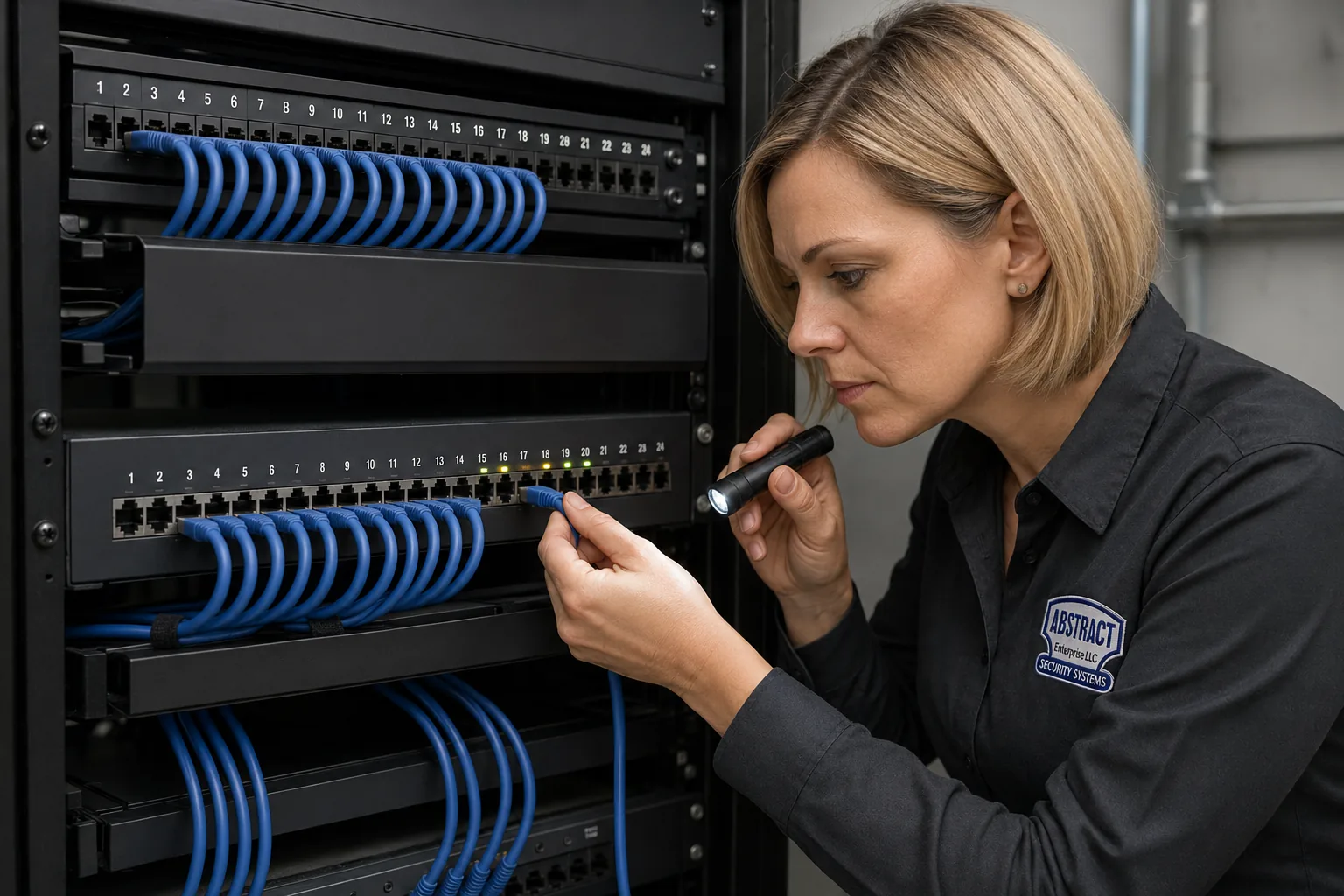
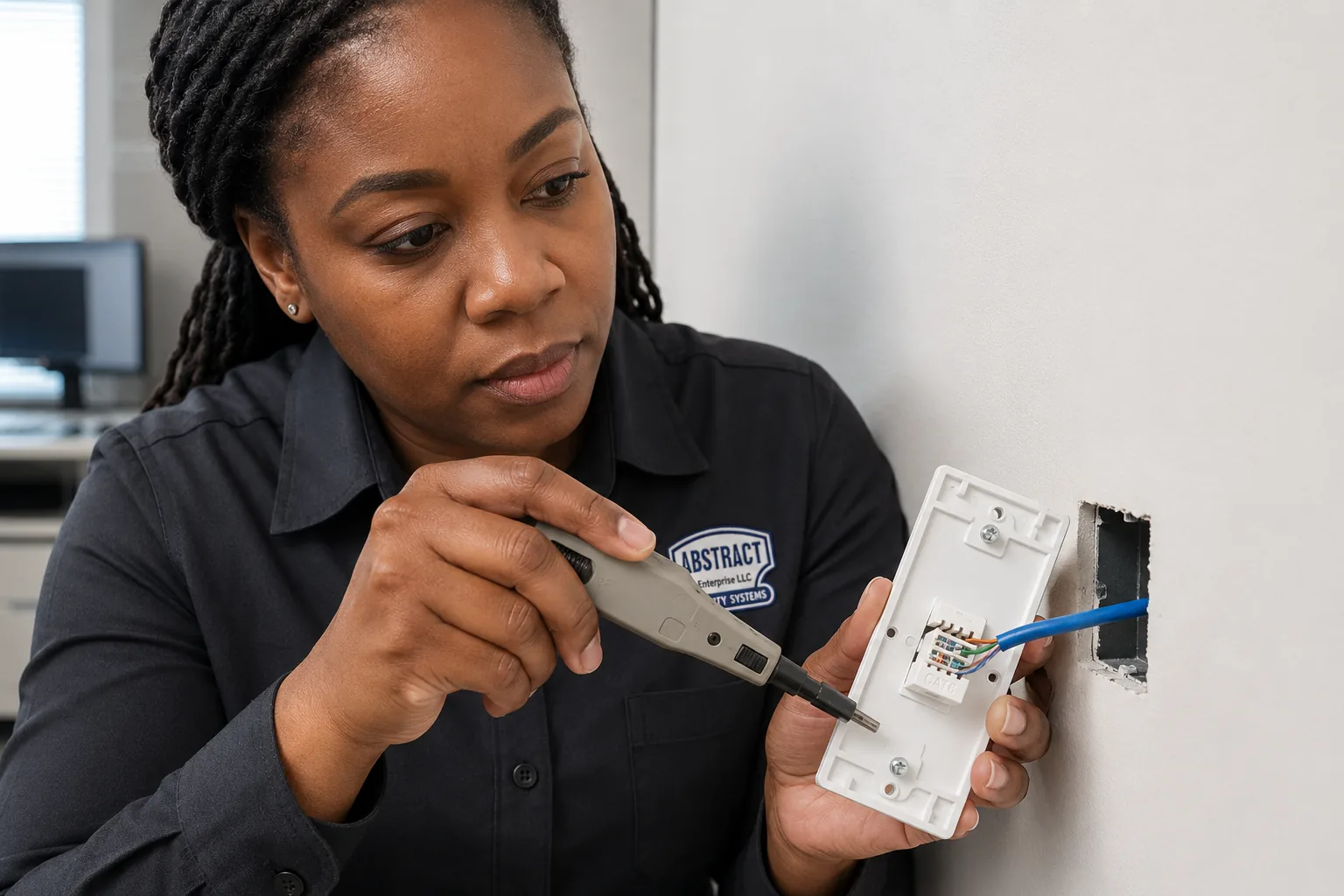
Network Jack and Panel Repair
Dead outlets, keystones seated but never punched through, panel positions wired to the opposite standard, and floor boxes crushed under casters.
Extended-Run Correction
Drops lengthened with a coupler during a fit-out and now out of spec. We measure first and re-pull where the arithmetic says the channel cannot be saved.
Closet Audit and Labelling
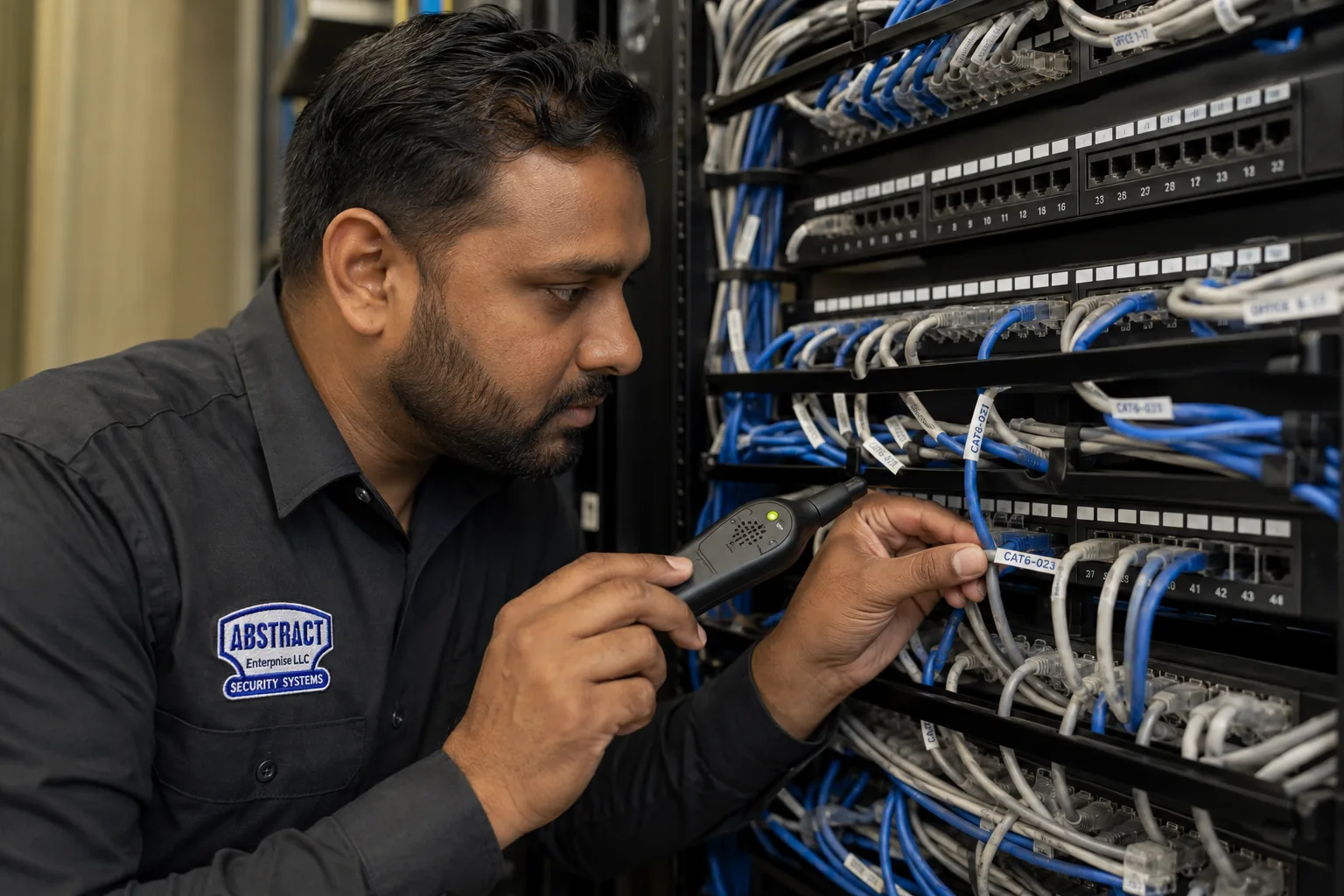
Sorting live runs from four tenancies of abandoned cable, mapping jack to port, labelling both ends and producing a legend for the door.
Certified Testing and Records
Wiremap, distance and performance verification with saved reports, formatted so a practice manager or firm administrator can file them.
PoE Circuit Troubleshooting
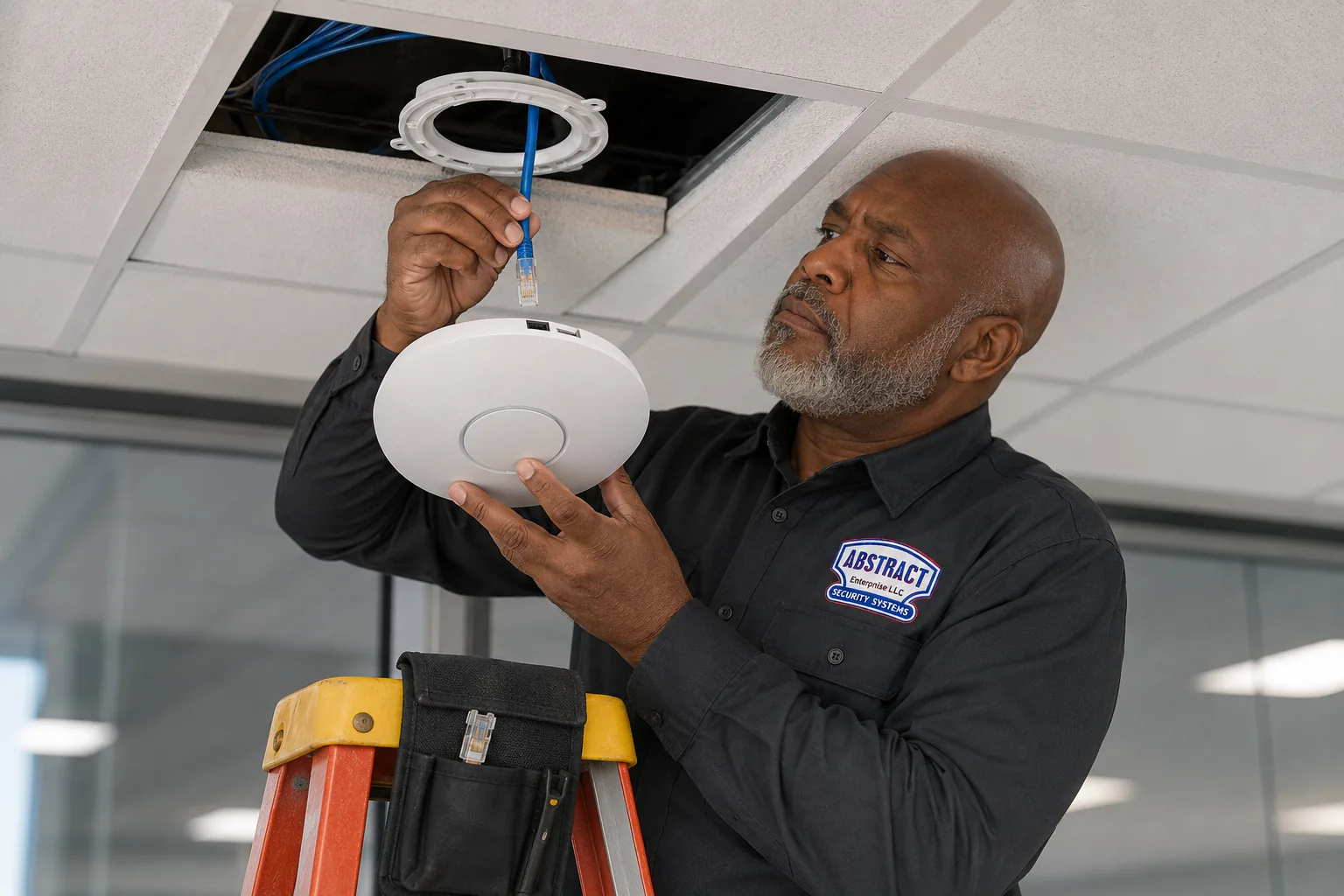
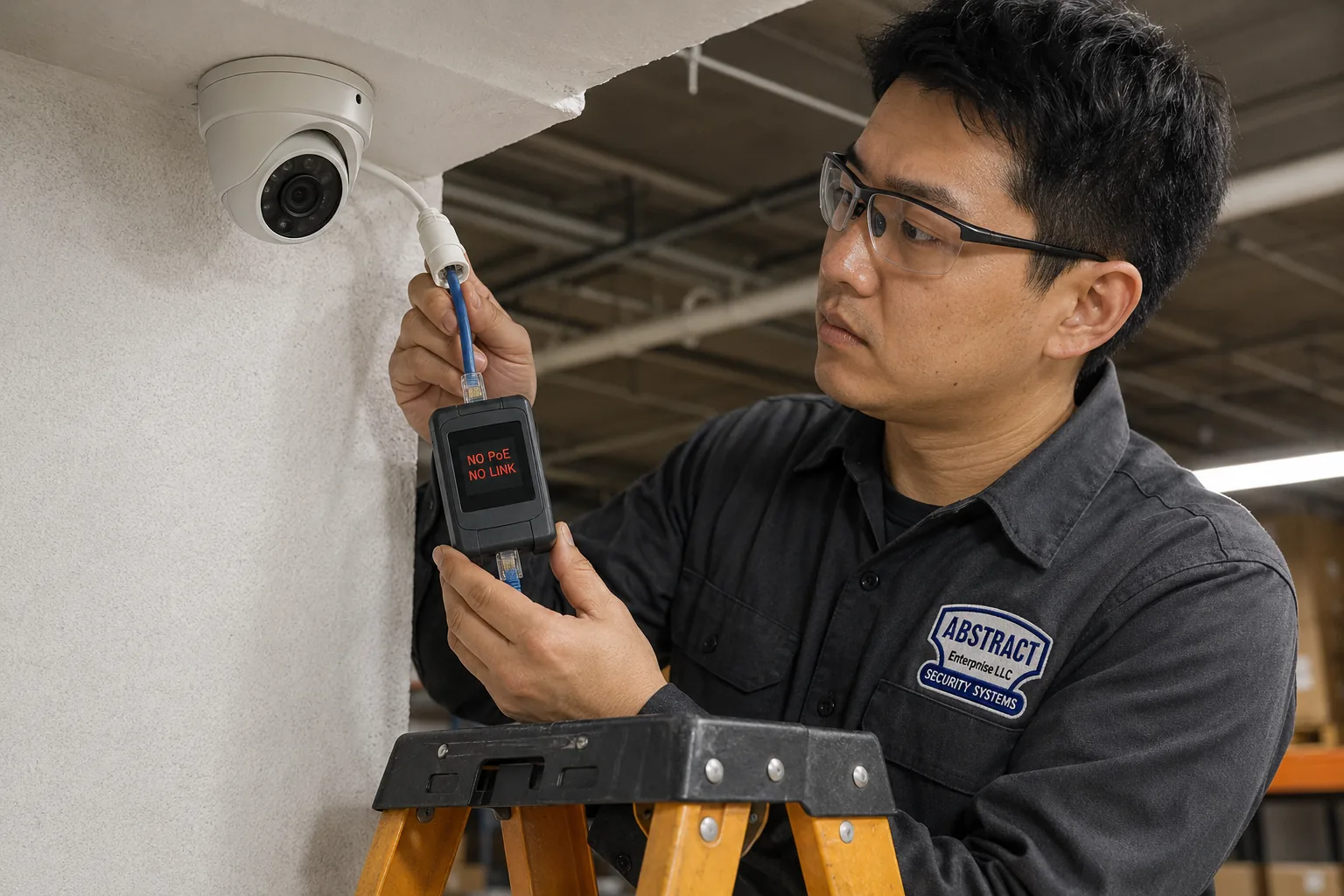
Cameras, readers and access points that boot and reset. Measured at the device under genuine draw.
Commonly paired: professional and medical suites run camera, reader and intercom drops through the same ceiling as the data. If one run in a bundle has failed, testing the rest while the tiles are out costs a fraction of a return visit — see camera repair and access control.
Plain English
Terms That Come Up on a Nassau Quote
The one that matters most here is headroom, because it is the difference between a drop that works and a drop that keeps working.
Term
What It Means in a Nassau Building
Headroom
How much performance a channel has in reserve above the minimum. A drop that passes by a whisker behaves fine in March and stalls an imaging transfer in August.
Certification
A recorded measurement against the category standard with the headroom noted, saved and printable. It is the artifact a practice manager can file.
Channel
The complete path including both patch cords, capped at 100 m. Extending a drop during a fit-out eats into that limit whether anyone measured or not.
Permanent link
The fixed cable from panel to outlet, excluding cords, limited to 90 m so the channel stays inside 100.
Insertion loss
Signal lost along the run, rising with temperature. It is why an undersized, unventilated telecom room produces faults that only appear in the afternoon.
Split pair
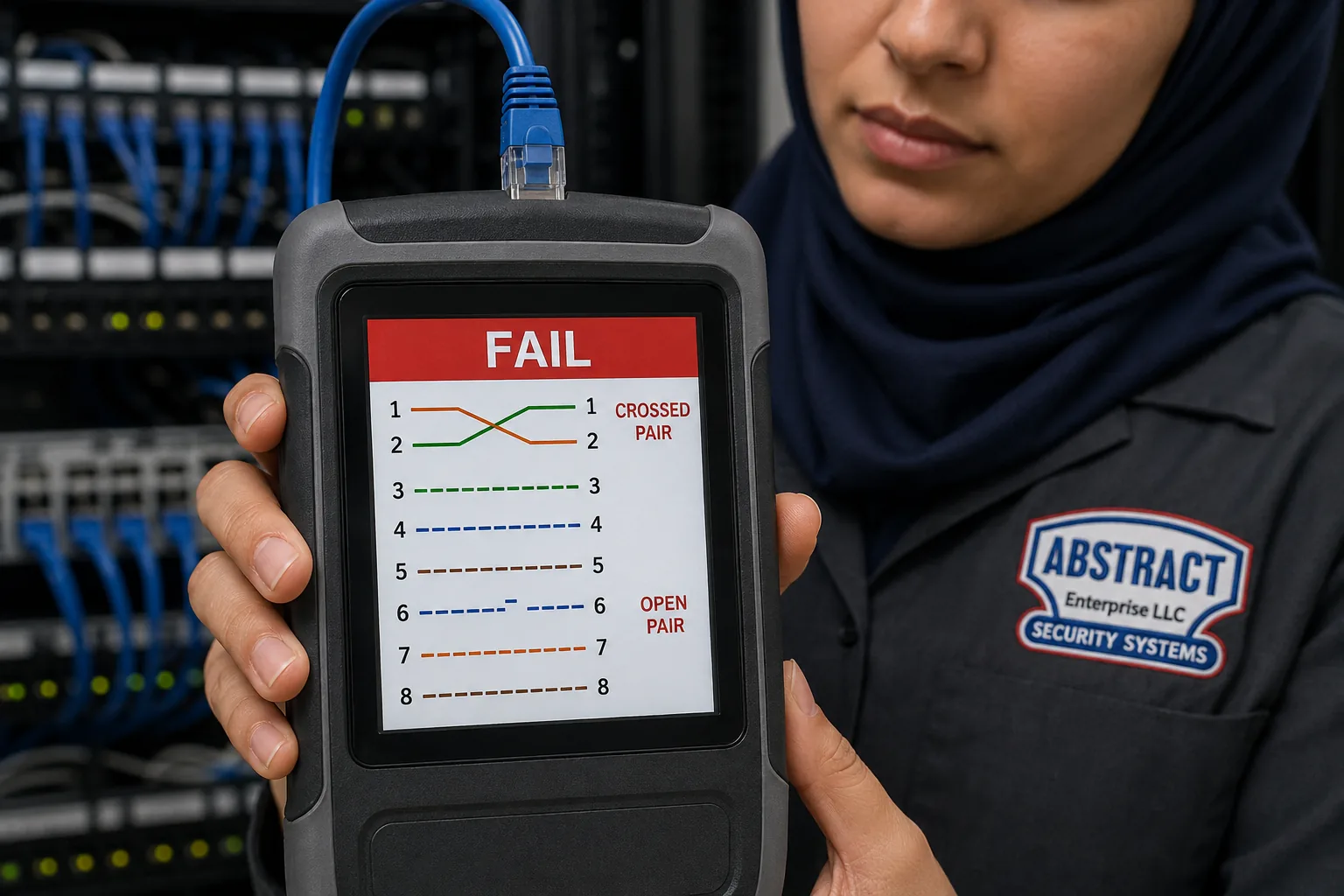
All conductors connected, the pairing wrong. Trains at 100 Mbps, refuses gigabit, gets reported as slowness.
Abandoned cable
Dead runs left by previous tenants. Adds fire load, hides live runs and makes tracing slower and therefore dearer.
Coupler extension
A joined run lengthened to reach a new position. Adds a connection point and distance to a channel that may have had little to spare.
Plenum (CMP)
The jacket rating required where a ceiling void handles return air. Applies in most of the county's newer commercial fit-outs.
Demarc
Where the carrier's obligation ends and the building's begins. Our scope starts on the building side of it.
Equipment
Hardware and Test Equipment on a Nassau Repair
We repair what is installed and replace with commercial-grade parts matched to the existing channel — Belden, CommScope, Panduit, Leviton, Hubbell, Ortronics, ICC, Berk-Tek and Superior Essex. Category matching decides the outcome, and it matters more in clinical space than anywhere: put a Cat5e keystone on a Cat6 channel and the whole channel derates, which is exactly the sort of quiet compromise that turns into a stalled study transfer two years later.
On the equipment side we chase cable faults behind Cisco, Meraki, Aruba, Ubiquiti UniFi, Netgear, TP-Link, Luxul and Araknis switching, and behind PoE devices — cameras, radios, handsets, readers and displays. Configuration is not our remit: no switch administration, no VLANs, no controllers, no firewall policy. The channel gets certified and the results go to whoever runs the network, which in Nassau is usually a local managed IT firm or a practice's own vendor.
The certifier is the tool that makes this county's work meaningful. Wiremap, distance and performance with the margin recorded and saved is what separates a repair somebody can file from a repair somebody has to trust, and on clinical channels the margin figure is frequently more useful than the pass itself.
Need Repair in Nassau County Today?
Same-day and next-morning slots county-wide. Clinical and professional suites are scheduled around patient and client hours, at no premium on the labour rate.
Locate, Repair, Then Report What Is Left in Reserve
On Nassau work the third step carries unusual weight, because the customer frequently has to hand it to somebody else.
Locating comes first — which element, at what distance, on which pair. Then the physical correction: retermination, junction, jack or panel replacement, or a fresh run where the certifier says the cable is finished. Neither of those is unusual.
What changes here is the third step. We report headroom, not just a pass. A practice with eleven drops wants to know which three are running close to the edge, because those are the ones that will stall a transfer in a warm month, and identifying them turns a vague plan to rewire the suite into a short, specific list. That report is also the document a practice manager files, an administrator forwards to an IT vendor, or an owner produces when a landlord asks what was done.
Full Scope
Full Scope of a Nassau Network Cable Repair
Diagnostics
Fault location by measured distance on broken or shorted runs
Wiremap faults: opens, shorts, reversals, split and crossed pairs
Measured length against the 90 m and 100 m limits
Insertion loss and crosstalk with headroom reported per drop
Identification of drops running close to the limit
Telecom room heat and ventilation assessment
PoE measurement at the endpoint under real draw
Switch-port versus cable-fault isolation
Physical Repair
Keystone and patch panel retermination
Category-appropriate junction repair on damaged runs
Removal of coupler extensions and re-pull where distance fails
Full run replacement where certification fails
Floor box and monument repair
Abandoned cable identification and removal
Firestop restoration at penetrated rated assemblies
Saved test results per repaired drop, with headroom
A short list of drops running close to the limit
Both-end labelling and a closet legend
Photo record of concealed repairs before close-up
Findings formatted for a practice manager or firm administrator
Site Logistics
Scheduling around patient and client hours at no labour premium
Certificate of insurance where the building requires it
Dust control and occupied-suite working
Plenum-rated material where the ceiling handles return air
Coordination with the practice's IT vendor
Evening and weekend windows on request
Coverage Detail
Where We Work Across Nassau County
The Mineola and Garden City core is the county's professional centre. Old Country Road, Franklin Avenue, Seventh Street and the blocks around the county courthouse and the hospital campus hold the densest concentration of medical and legal tenancy on Long Island, in buildings ranging from 1950s pavilions to modern medical office. Westbury, Carle Place and Uniondale extend it eastward along Old Country Road and toward the RXR Plaza and Nassau Coliseum area.
The North Shore runs from Great Neck and Kings Point through Manhasset, Port Washington, Roslyn and Lake Success, with corporate and professional space along Northern Boulevard, Middle Neck Road and Marcus Avenue. Then the central spine: Hicksville, Jericho, Syosset and Plainview along the Route 106 and 107 corridors and Jericho Turnpike, plus Bethpage and Farmingdale at the Suffolk line where the county starts to feel like the Route 110 corridor.
The South Shore covers Rockville Centre, Lynbrook, Valley Stream, Malverne, Baldwin, Freeport, Merrick, Bellmore, Wantagh and Massapequa along Sunrise Highway, Merrick Road and the village main streets — small professional and medical tenancies, retail, and a great deal of commercial space converted from residential. Long Beach sits on the barrier island with its own coastal exposure, and Elmont, Franklin Square and Floral Park anchor the western edge.
Who We Serve
Nassau Industries We Repair Cabling For
Medical and Dental Practices
Mineola, Garden City, Great Neck, Rockville Centre. Imaging, digital radiography and practice management with no tolerance for a marginal channel.
Ambulatory and Diagnostic Centres
Large file transfers that stall rather than slow, making headroom the number that actually matters.
Law and Accounting Firms
Document-heavy work, records obligations, and a strong appetite for a test report that can be filed.
Corporate and Professional Offices
Lake Success, Garden City, Jericho, Westbury. 1960s and 70s buildings with telecom rooms designed for telephones.
Village Main Street Commercial
Converted houses along Franklin, Middle Neck, Merrick and the village centres. No equipment room and plaster walls.
Retail and POS
Sunrise Highway, Old Country Road, the Roosevelt Field and Broadway Mall corridors. Register lanes failing at peak.
Restaurants and Food Service
Kitchen-side terminals in heat and grease, and repair windows outside service hours.
Schools and Institutions
Classroom drops, corridor uplinks, documentation expectations and repair windows in breaks.
Property Management
Multiple buildings needing one labelling standard and consistent test records.
Real Questions
Fourteen Questions Nassau Businesses Actually Ask
Drawn from the recurring themes in practice-management, IT and Nassau local discussion threads, grouped by the six question types that come up most.
Cost Questions
1. What does a repair cost in Nassau?
The specialty service rate is $195 an hour with a three-hour minimum, so $585 buys the opening block: locating the fault, repairing it, certifying it and handing over the results. A run that has to be pulled fresh starts at $175 per commercial Cat6 drop.
2. Why do you test drops that are not broken?
Because a suite rarely has one marginal channel. Inside the block we test the neighbours, which produces a short list of the drops running closest to the limit — and that list is what stops you rewiring eleven drops when three are the problem.
3. Do you charge more to work around patient hours?
No premium on the labour rate. Scheduling around clinical hours is simply how the work happens in this county, and it needs notice rather than money.
Quality and Trust Questions
4. Our practice manager needs something for the file. What do we get?
A saved result for each drop we touch: pass or fail, measured distance and headroom, tied to a labelled identifier. It is a document rather than an assurance, which is the point — it can be filed, forwarded to your IT vendor, or produced if a landlord asks.
5. Do I need a licensed contractor?
For anything past swapping a cord, yes. Cabling is low-voltage work with obligations on jacket rating and firestopping, and any medical or professional building with insurance requirements will want a licence number. Ours is NYS Low-Voltage #12000287431.
6. Our IT company says the cable is fine. Should I believe them?
If they have measured it, yes. If they have looked at a link light, that is not the same thing. A certifier reports distance, loss and margin; a link light reports that two devices agreed on something once. Those disagree more often than people expect.
DIY and Pro Questions
7. Can our office manager re-punch a jack?
With the right tool, sometimes. The technique is holding the twist right up to the contact, and getting that wrong produces a jack that looks perfect, lights up and fails a certifier. If the drop feeds anything clinical, have it tested afterwards.
8. Is the cable tester we bought any use?
For pin order, yes, and it is worth the drawer space. It reports no distance, no loss and no margin, which are precisely the measurements that matter on a channel feeding imaging equipment.
9. Can we extend a drop to reach a new operatory?
Measure first. A coupler adds a connection point and length to a channel that may already be close to the limit, and in a building where drops have been extended before, that arithmetic is frequently already spent. Re-pulling costs more today and less over the life of the suite.
Technical Questions
10. Why does our imaging transfer stall when everything else works?
Because ordinary office traffic tolerates a marginal channel and large file transfers do not. A drop with almost no headroom carries email and browsing all day, then fails a study transfer — and it will pass a basic test while doing it. The margin figure is what identifies it.
11. Our network is worse in the afternoon. Why?
Insertion loss rises with temperature, and in a small unventilated telecom room the equipment heats the space it sits in. A channel with little headroom drifts out of spec as the day warms and recovers overnight, which is why it never reproduces for the technician who arrives at nine.
12. One port sits at 100 Mbps while the others reach gigabit. What is that?
One of the four pairs has failed or been miswired. Older signalling needs only two pairs so the link trains happily; gigabit needs all four and either refuses or negotiates and drops straight back.
Landlord and Tenant Questions
13. We lease a suite in a medical building. Whose cabling is it?
Usually the landlord provides pathway and a point of presence and the tenant owns everything from there into the suite, though medical building leases vary widely. We test from your outlet back to your panel and document which side the fault sits on, which is what actually resolves it.
Complaint Questions
14. We had a drop fixed and it failed again in a few months. Why?
Almost always because it was repaired but never measured. A channel that passes with no margin behaves for a while and then does not, and nobody finds out until it fails again. If a repair does not come with a headroom figure, you have no way to know whether it was a fix or a postponement.
Answer The Public
Answer The Public: Nassau Network Cable Questions
Who repairs network cable in Nassau County?
Licensed low-voltage contractors. Electricians handle conduit and line voltage and generally pass the data ends along; managed IT firms own the network above the copper and rarely carry a certifier. A stalling imaging drop in a Mineola suite is cabling work.
What causes cabling to fail in Nassau buildings?
Terminations executed without untwist discipline, drops extended with couplers during fit-outs, heat in undersized telecom rooms designed for telephones, layered infrastructure after repeated tenancy changes, and legacy Cat5e carrying loads it was never certified for.
When should a run be replaced instead of repaired?
When it will not certify after both ends are redone, when measured distance puts the channel out of spec, when there is damage in several places, or when it passes with so little headroom that it is a scheduled future failure.
Where do faults sit in a Nassau professional suite?
At terminations first, then at the points where a drop was extended, in floor boxes under desks, and inside a telecom room that runs hot enough to push a marginal channel over the edge.
How quickly can a Nassau repair be scheduled?
Same day or next morning across the county, with clinical and professional suites scheduled around patient and client hours at no premium.
Reality Check
AI Overview Reality Check: What Search Results Miss About Nassau Cabling
Search for network cable repair in Nassau County and you get a national cost average, lead-generation directories, and troubleshooting written as though every link either works or does not. The failures that matter most here sit between those two states.
1. Pass and Fail Is the Wrong Frame for Clinical Space
Published guidance treats a cable test as binary. A certifier does not work that way — it reports how much margin a channel has above the minimum, and that number predicts behaviour far better than the pass does.
In a practice running imaging or diagnostics this is the whole game. A drop with almost no headroom carries email and browsing perfectly and stalls a large study transfer, which is exactly the pattern that gets misread as a server problem, a workstation problem or a vendor problem.
Ask any contractor whether the report will include margin. If the answer is that it passed, they are describing a threshold rather than a measurement, and you will be calling them again.
2. The Telecom Room Nobody Enlarged
Almost every online troubleshooting article assumes a proper equipment room. A great deal of Nassau commercial stock was built between the early 1950s and late 1970s, when the room in question held a telephone board.
It now holds a switch stack, a firewall, a UPS and a patch field, unventilated, behind a solid door. The equipment heats the space, insertion loss climbs with temperature, and a marginal channel drifts out of spec by mid-afternoon and recovers overnight.
That produces the least satisfying fault pattern in the trade: a complaint that never reproduces for the technician. It is also cheap to fix once identified, which is why we flag rooms we expect to cause it rather than installing into them quietly.
3. Nothing Online Mentions the Coupler Somebody Added in 2014
General advice assumes cabling is as installed. In a county where professional suites expand, contract and reconfigure constantly, a large share of drops have been lengthened at some point to reach a new position.
Every extension adds a connection point and distance to a channel with a fixed budget. Do it twice and the arithmetic is spent, and the resulting link behaves erratically for years without anybody connecting it to a fit-out nobody remembers.
Measuring length is a thirty-second check that resolves it, and it is almost never the first thing anybody does.
4. Cost Averages Assume a Building That Empties at Six
Aggregated cost pages blend residential and light-commercial work and assume normal business hours in a space nobody is using.
Clinical and professional suites do not work that way. The window is around patient and client hours, sometimes early, sometimes late, and always arranged rather than assumed. That is a scheduling discipline rather than a premium, and no national figure reflects it.
Those pages also merge installation with repair. Installation can be scoped before the van leaves; repair cannot, because the fault has to be found first — hence an hourly rate with a floor rather than a per-drop price.
5. Converted Houses Break the Standard Advice
Guidance written for drywall and studs assumes a fishable cavity. Village main-street commercial across Rockville Centre, Great Neck, Port Washington and Lynbrook is full of professional offices in former residences.
Plaster over lath, no cavity, no equipment room and cellar panels change the correct repair. A junction restoration in an accessible ceiling or a tidy surface route is frequently right where the internet would say pull new cable, because the plaster restoration costs more than the cabling.
It also changes where faults live. In these buildings the run has usually been routed by somebody solving a problem quickly, and it fails where it was solved.
6. Lead Directories Sell Your Number Rather Than Checking Anyone's Kit
Angi, HomeAdvisor, Thumbtack and their equivalents resell one enquiry to several firms, and whoever answers first is usually the highest bidder for the lead. Ratings attach to accounts spanning many trades.
For cabling the grouping is the specific failure. Physical cable work shares a heading with router setup and wireless support, so a request that needs a certifier, a tone set and a punch tool can be answered by somebody carrying none of them.
Three questions settle it: what certifier is on the van, will the report include margin, and what is your New York State low-voltage licence number.
7. Documentation Is Optional Online and Expected Here
AI-generated guidance rarely mentions test records. Meanwhile a large share of Nassau commercial tenants — practices, firms, schools — operate under record-keeping regimes where a dated artifact is genuinely useful.
A report converts an assurance into something a practice manager can file, an administrator can forward, and an owner can produce when asked. It also survives staff turnover, which in a professional suite is guaranteed.
It is worth asking for it in a format somebody non-technical can read. A wall of test output nobody can interpret is filed and never used.
Find Out Which Drops Are Actually at Risk.
Certified testing on every repair. Licensed NYS low-voltage contractor. 4.7★ from 201 reviews.
Free and quick, and it catches more faults than anyone expects. Latches snap and plugs ease out of contact.
Move to a different switch port
Yes
A minute of work that clears or convicts the switch.
Test the device on a known-good outlet
Yes
Links normally elsewhere and the fault is the original outlet or its run.
Note whether the trouble follows the clock
Yes
Costs nothing and is genuinely diagnostic. An afternoon pattern points at heat and a channel with no margin.
Re-punch a keystone jack
Borderline
Possible with the right tool. Holding the twist to the contact is what decides whether it certifies, and neat is not the same as compliant.
Extend a drop with a coupler
No
Adds a connection point and distance to a channel with a fixed budget. In a suite that has been reconfigured before, that budget is usually already spent.
Diagnose a drop that only fails on large transfers
No
That is a margin problem and margin is a measurement. Consumer testers cannot produce it.
Work in a hot, crowded telecom closet
No
Live services, no room to move and heat that has already made the channels marginal. This gets assessed rather than rummaged in.
Anything in a plenum ceiling
No
Material rating and firestop obligations make it licensed work.
Fifteen minutes and no invoice: the four rows above marked yes. The clock question is the most valuable one in this county — a fault that tracks the afternoon has already told you it is a margin problem.
Alternatives
How a Licensed Cabling Contractor Compares Here
vs. Your Managed IT Provider
Strong from the switch upward and usually straightforward about copper not being their trade. The physical work is subcontracted, so the technician who arrives is not the firm you vetted and the schedule belongs to somebody else.
vs. Lead-Generation Platforms
One enquiry resold to several firms, with response speed reflecting lead spend rather than fit. Cable work is listed beside computer support, and a report with margin on it is not something those listings undertake to provide.
vs. Your Carrier's Technician
Accountable to the demarc and correct to say so. A clean circuit there with drops still failing puts the fault inside the suite, past their remit.
vs. The Building's Preferred Vendor
Often competent and frequently the fastest route to base-building work. It gets awkward on tenant-side faults, because a vendor whose relationship is with the landlord is not the natural party to document a fault as the landlord's.
vs. A General Electrician
The right trade for conduit, coring and line voltage. Data terminations are a separate craft with far tighter tolerances, which is why most electricians hand that part on rather than guess at it.
Warning Signs
Five Signs the Cable Is the Problem in a Nassau Suite
One outlet is dead and the rest are fine. Upstream faults fail in groups. A single dead port is that run and its terminations.
Large transfers stall while ordinary traffic behaves. A channel with almost no margin. It will pass a basic test while doing it.
The trouble arrives in the afternoon and clears overnight. Heat in an undersized telecom room pushing a marginal channel over the edge.
A port trains at 100 Mbps while its neighbours reach 1000. One pair has failed or been miswired — the clearest free diagnostic you have.
The problem started after the suite was reconfigured. A drop extended rather than re-pulled, and a channel budget quietly spent.
Community
Community Chatter: Recurring Themes From Public Forums
Paraphrased themes from public homeowner, small-business and IT discussion threads — not customer reviews of AESS.
Practice-management threads regularly describe imaging transfers stalling while everything else behaves, with the cabling ruled out early because a basic test passed and nobody asked for the margin.
Discussions about older suburban office buildings frequently land on the same discovery: the equipment closet was designed for a telephone board and the heat inside it explains an afternoon fault pattern.
Small-business threads consistently show surprise that labour rather than materials drives a cabling invoice. On repair work that is accurate — finding the fault is the cost.
Support documentation from unrelated organisations converges on the same first three steps: known-good outlet, then cord, then a field technician, which usually indicates a sequence tested against real faults.
Tenants in converted-residential professional space often describe a run routed by whoever solved a problem years earlier, failing at exactly the point where the shortcut was taken.
Field Video
Watch: Field Diagnostics on a Nassau County Repair Call
Short-form field clips from our channel: youtube.com/@openeye0007 Embed slot reserved — drop the Short iframe here once the clip ID is set.
FAQ
Network Cable Repair Nassau County — Twelve Frequently Asked Questions
What does network cable repair cost in Nassau County?
+
The specialty service rate is $195 an hour against a three-hour minimum, so $585 covers the opening block — locating the fault, repairing it, certifying it and handing over saved results. A run that has to be pulled fresh starts at $175 per commercial Cat6 drop. Scheduling around patient or client hours carries no premium.
Our imaging transfers stall but email is fine. Is that the cabling?
+
Frequently, yes. Ordinary office traffic tolerates a channel with almost no margin; large file transfers do not. The drop will pass a basic test while behaving this way, which is why the headroom figure rather than the pass is what identifies it.
What is headroom and why do you report it?
+
It is how much performance a channel has in reserve above the minimum. A drop passing by a whisker works in March and stalls in August. Reporting it turns a vague plan to rewire a suite into a short list of the drops that are actually at risk.
Why does our network get worse in the afternoon?
+
Heat. Insertion loss rises with temperature, and a small unventilated telecom room is warmed by the equipment inside it. A channel with little margin drifts out of spec as the day goes on and recovers overnight, which is why it never reproduces for a morning appointment.
Can a damaged run be repaired, or does it need replacing?
+
Where the damage sits at one reachable point, a junction of the correct category made properly and proved on a certifier restores it. Replace when it still will not certify after both ends are redone, when measured distance is out of spec, or when it passes with so little margin that it is a future failure already scheduled.
My wall jack is completely dead. What is the most likely cause?
+
Most common first: a cord with a broken latch, a panel position never terminated or wired to the opposite standard, a jack whose conductors rest in the slots without being punched through, then damage along the run.
We extended a drop during a fit-out and it has never been right. Related?
+
Very likely. Every extension adds a connection point and distance to a channel with a fixed budget, and in a suite reconfigured more than once that budget is often already spent. Measuring the length settles it in under a minute.
Do you provide certified test reports?
+
Yes. Every repaired drop is tested and you receive the saved result including measured distance and headroom, both-end labelling, and a closet legend where the scope covers it — formatted so a practice manager or administrator can file it.
Can you work around patient hours?
+
Yes, and in this county it is the normal arrangement. Early, late or weekend windows are scheduled with notice and carry no premium on our labour rate.
Our building is from the 1960s and has no real equipment room. Is that a problem?
+
It is a common one. Where we consider a room likely to cause temperature-linked faults we say so in writing and quote ventilation separately rather than installing into it and leaving you with an intermittent nobody can reproduce.
What cover comes with the work?
+
Products supplied by AESS carry twelve months, parts only, under the service agreement. Altering or interfering with installed work without written authorisation beforehand ends that cover.
Applied only where ceiling space is used for return air
After-hours or weekend window
Premium applies
For buildings restricting low-voltage work to off-hours
Published starting rates for Nassau County. Final pricing depends on access, pathway, material rating and testing scope, and is confirmed in writing before work begins. Scheduling around patient or client hours carries no labour premium. Full terms — including 50% deposit, one-year parts-only warranty on AESS-supplied products, and the late-fee schedule — are set out in the service agreement. See structured cabling pricing for new-installation drop rates and Cat6 installation Nassau County for per-drop grade comparisons.
The defining Nassau fault. A drop meets the standard by a whisker, carries ordinary traffic all year, and stalls a large transfer on a warm afternoon. Invisible unless somebody reports margin.
Telecom Rooms Built for Telephones
1950s to 1970s professional buildings whose equipment closet was sized for a telephone board and now holds a switch stack and a UPS, unventilated and behind a solid door.
Drops Extended Rather Than Re-Pulled
Every practice expansion and departmental move leaves a coupler somewhere. Each one spends part of a fixed channel budget, and after two the arithmetic is gone.
Layered Tenancy in Professional Suites
Four or five occupancies of abandoned cable above one ceiling, none labelled, some still live. Tracing is the first hour of the visit.
Converted Residential Commercial Space
Village main-street offices in former houses. Plaster over lath, no cavity, no equipment room, cellar panels and routes improvised decades ago.
Coastal Exposure on the Barrier Island
Long Beach and the south shore edge. Humidity and salt air reaching terminations in unconditioned space, corroding contacts across seasons.
Cross-sell note: professional and clinical suites carry camera, reader and intercom runs in the same ceiling as the data. When one bundle has failed, testing the camera drops and intercom runs alongside it costs a fraction of a second visit.
From the Field
Field Notes
On a Nassau call the useful question is not what is broken but what the drop feeds. Imaging, a practice platform or a workstation each tolerate a different amount of marginal channel, and that tells you how hard to look before anything is opened.
When a complaint tracks the afternoon, put a hand on the telecom room door before doing anything else. A warm room and a marginal channel explain more faults in this county than every other cause combined.
Measure length early in any suite that has been reconfigured. Couplers hide well, nobody remembers the fit-out that added them, and thirty seconds with a certifier ends the guessing.
Hand the report over in a form somebody non-technical can read. Practice managers file it, administrators forward it, and it comes back out two years later when a landlord or an IT vendor asks what was done.
Get In Touch
Request a Free Quote
Fill out the form below and we'll get back to you within the hour. Or call us directly at (516) 346-5778.
✅
We Got Your Request!
We'll call you back within the hour. If it's urgent, call us now at (516) 346-5778.
Emergency
Need Repair in Nassau County Right Now?
Network down, drops dead, imaging stalling, register offline. Same-day and next-morning coverage county-wide, scheduled around patient and client hours.
Last reviewed: August 25, 2026 · Next scheduled review: November 2026 Changelog: Aug 2026 — page published. Channel headroom on clinical and professional drops established as the primary Nassau thesis; telecom room heat assessment added to scope; coupler-extension diagnosis added; suite-wide headroom survey added to pricing; pricing aligned to the $195/hr specialty rate with a three-hour minimum; direct Nassau line (516) 346-5778 used throughout.
Network Cable Repair Nassau County — Licensed, Measured, Documented
NYS Low-Voltage Lic. #12000287431 · 4.7★ from 201 reviews · Serving New York City, Long Island and the Hudson Valley.