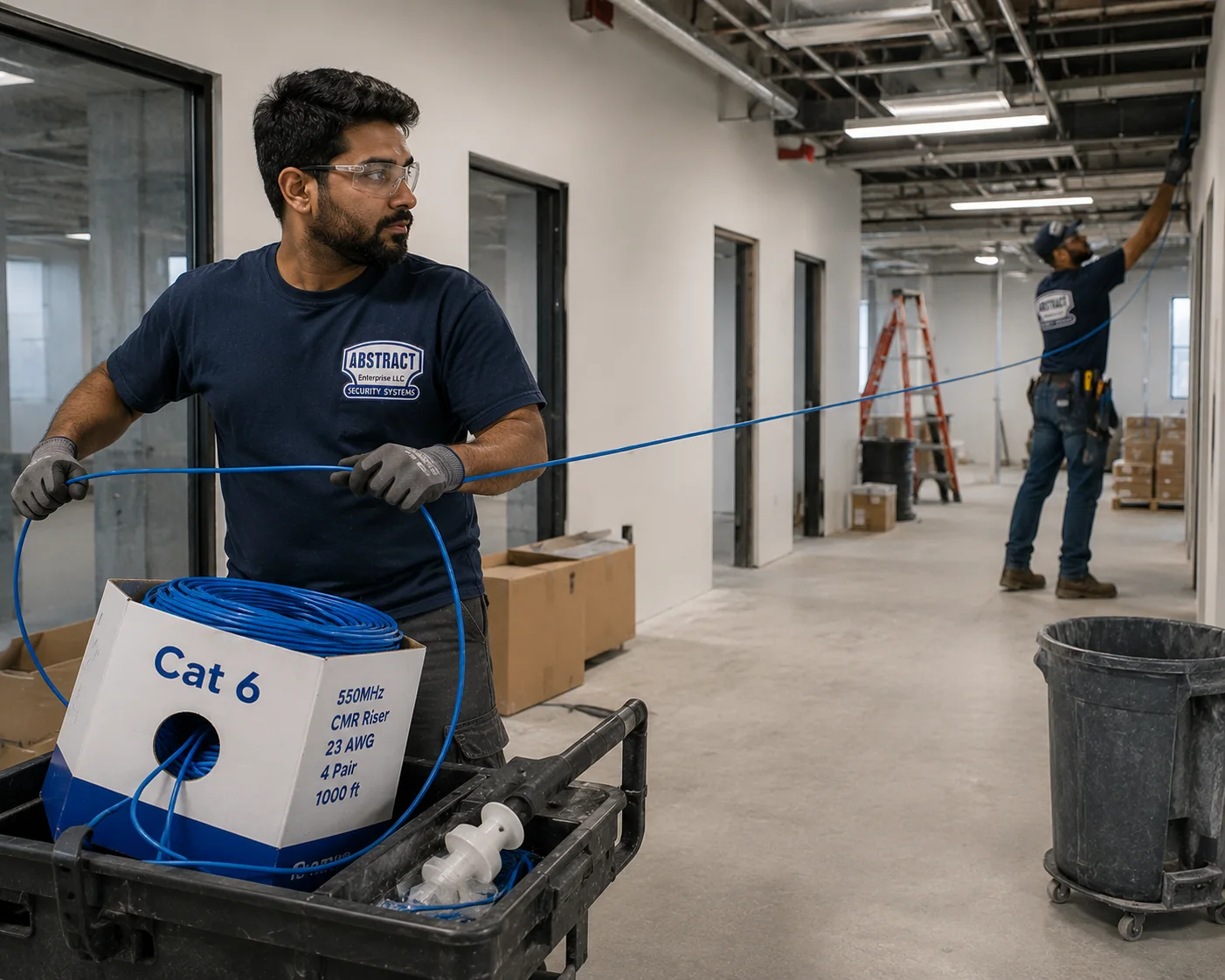
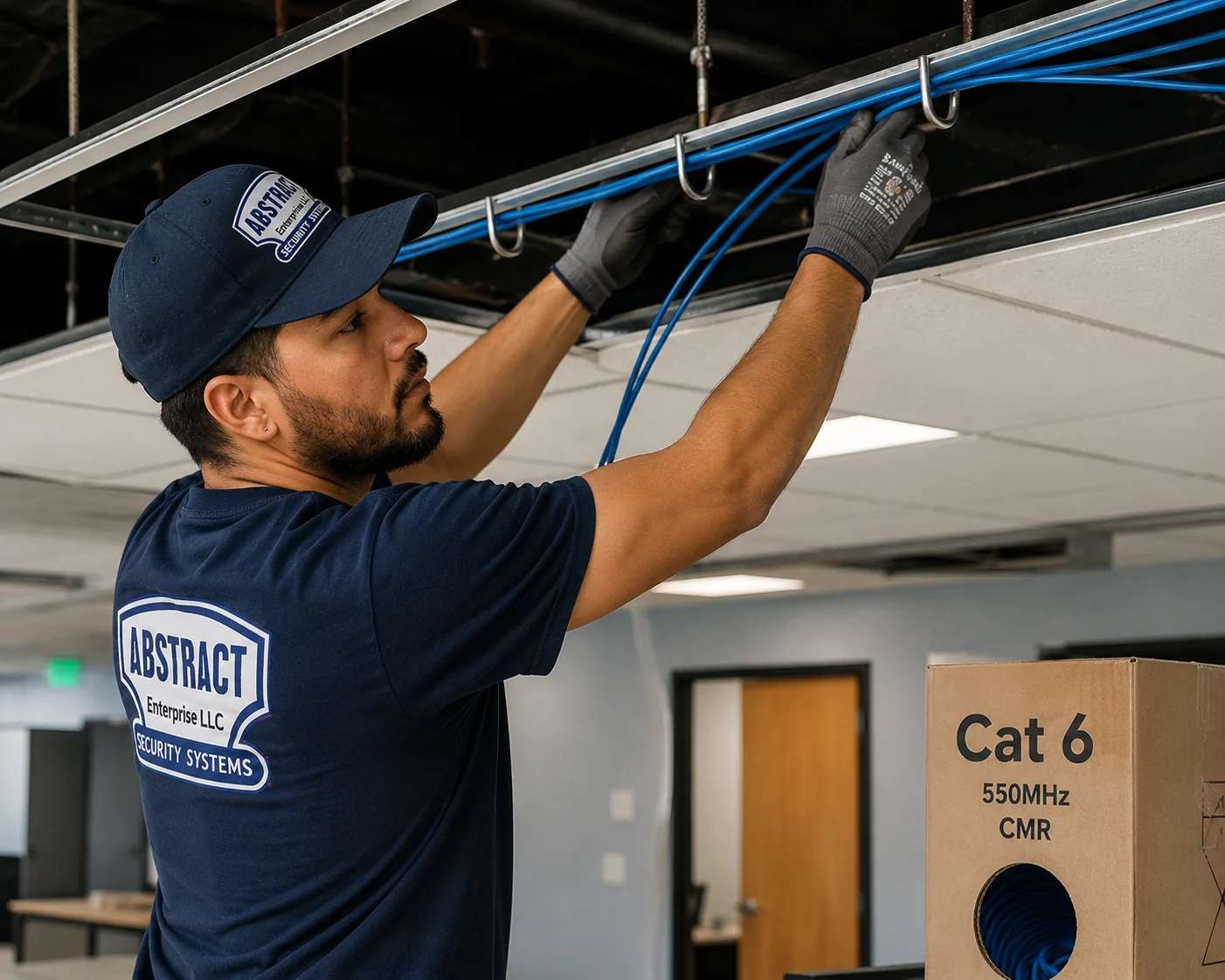
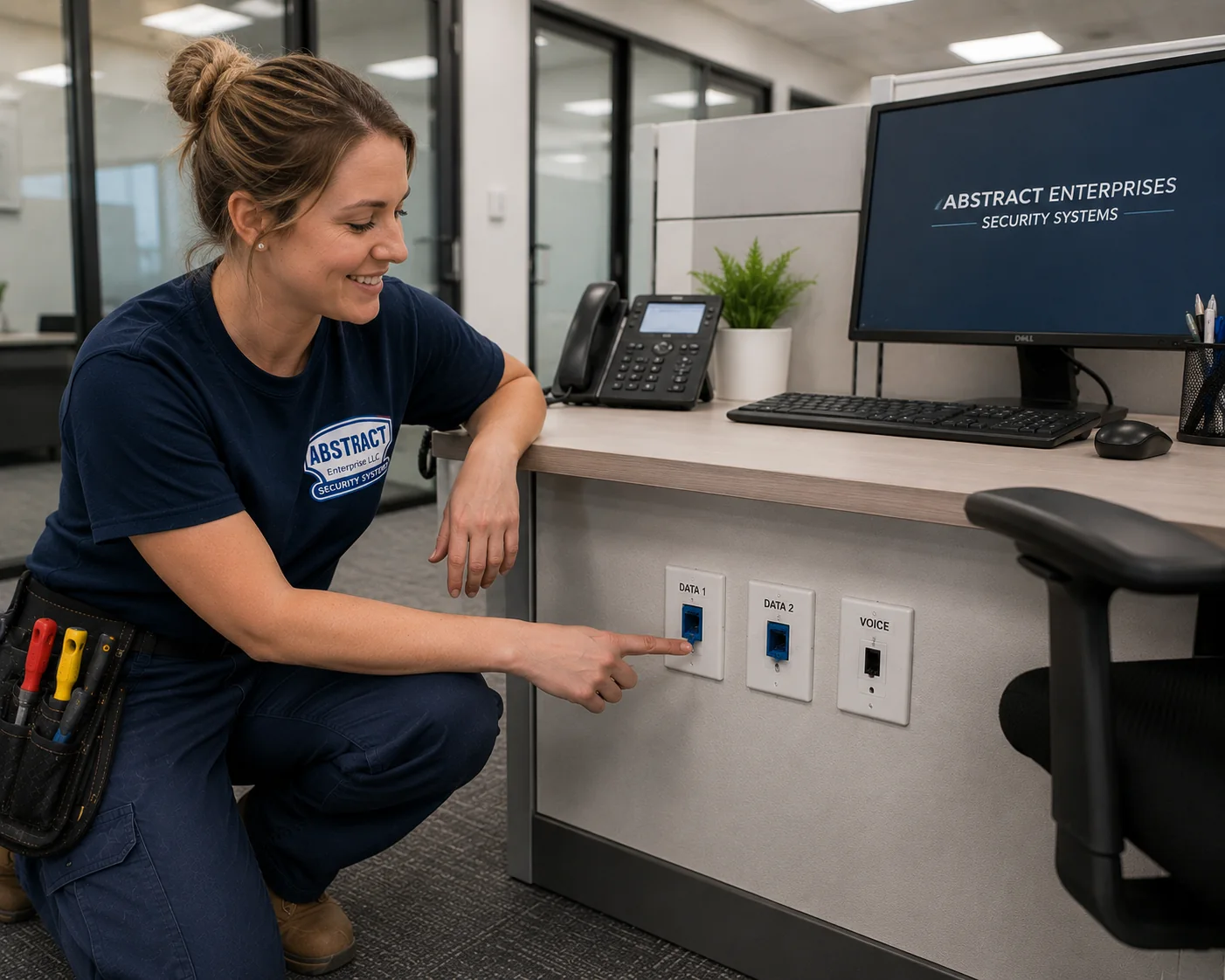
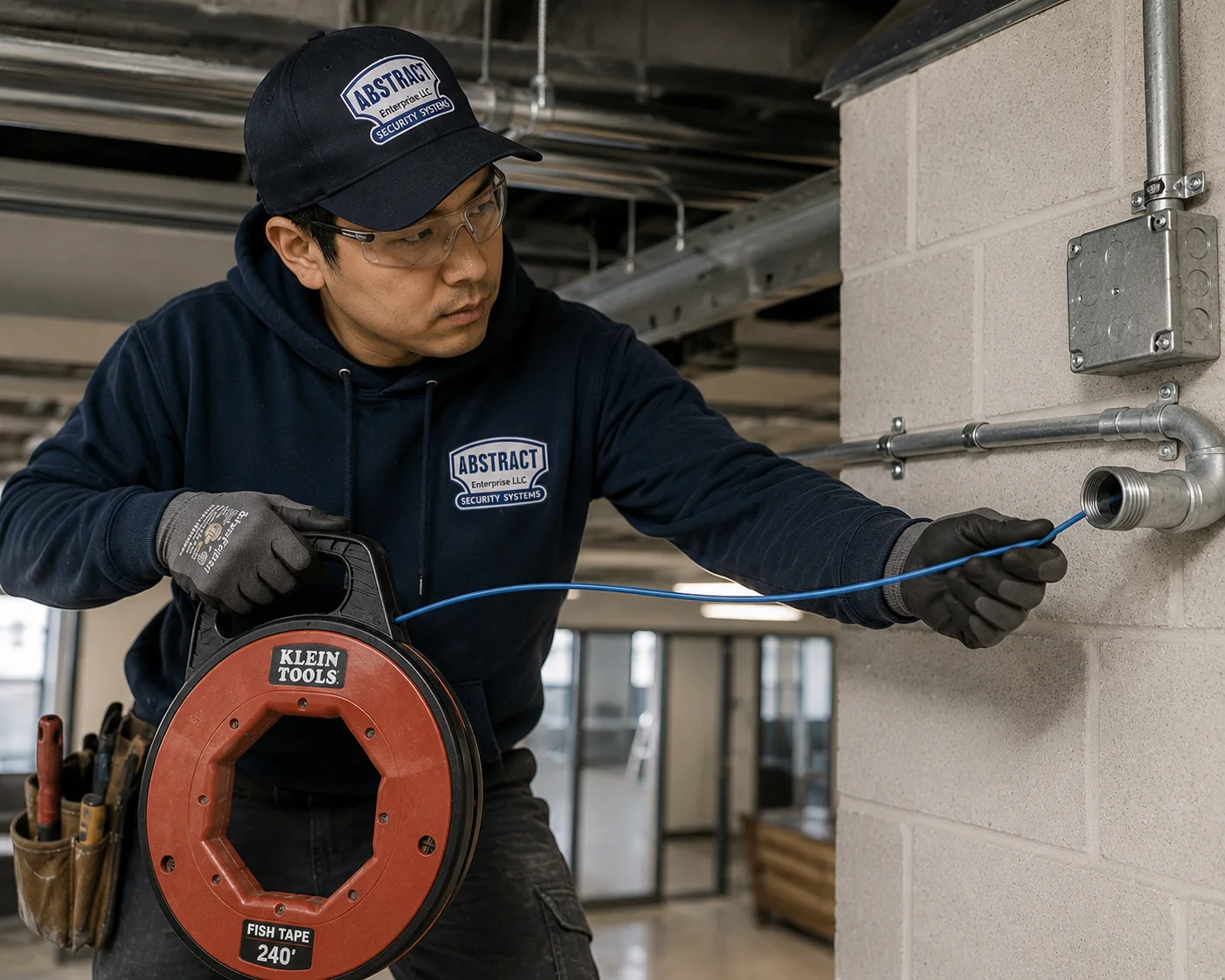
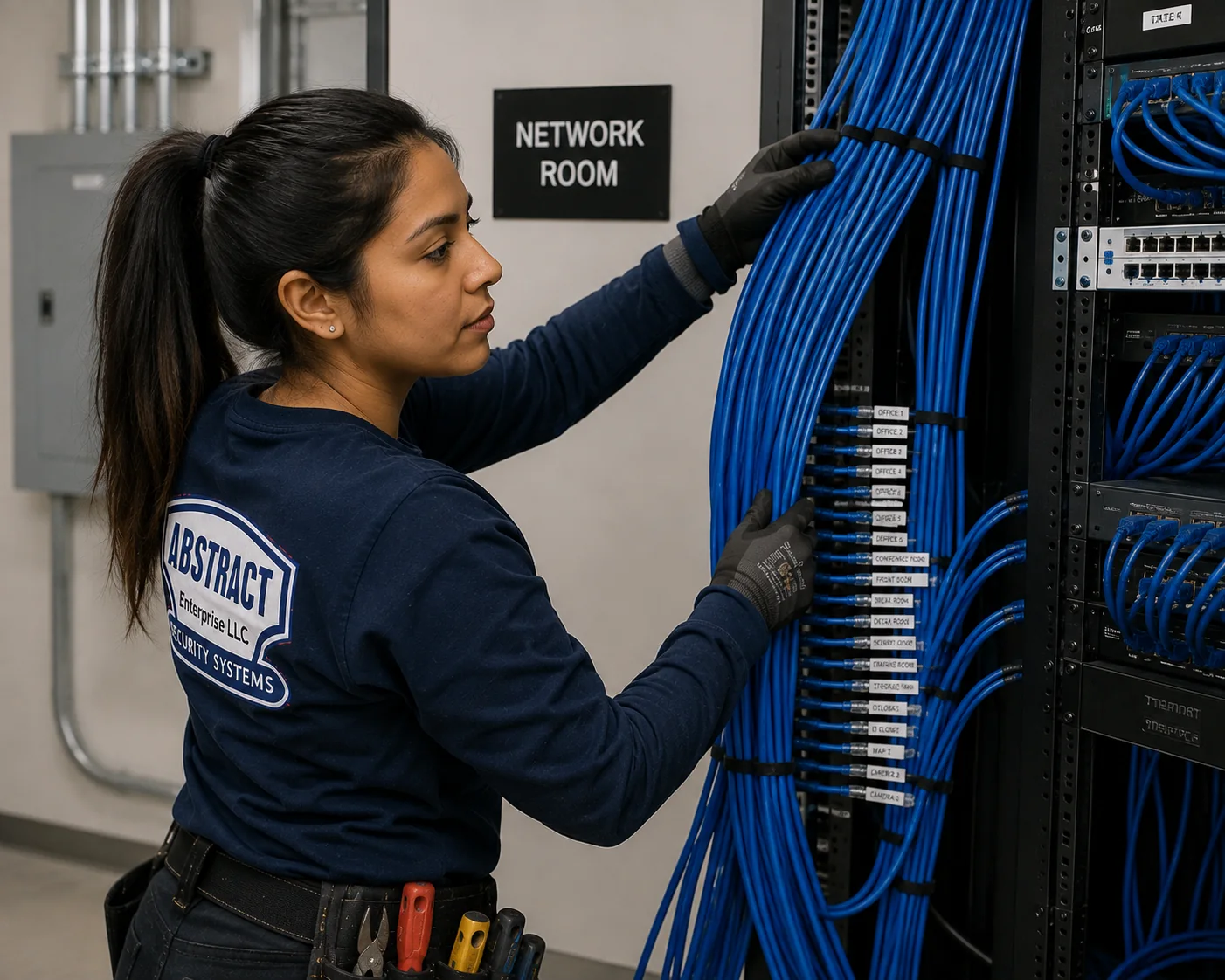
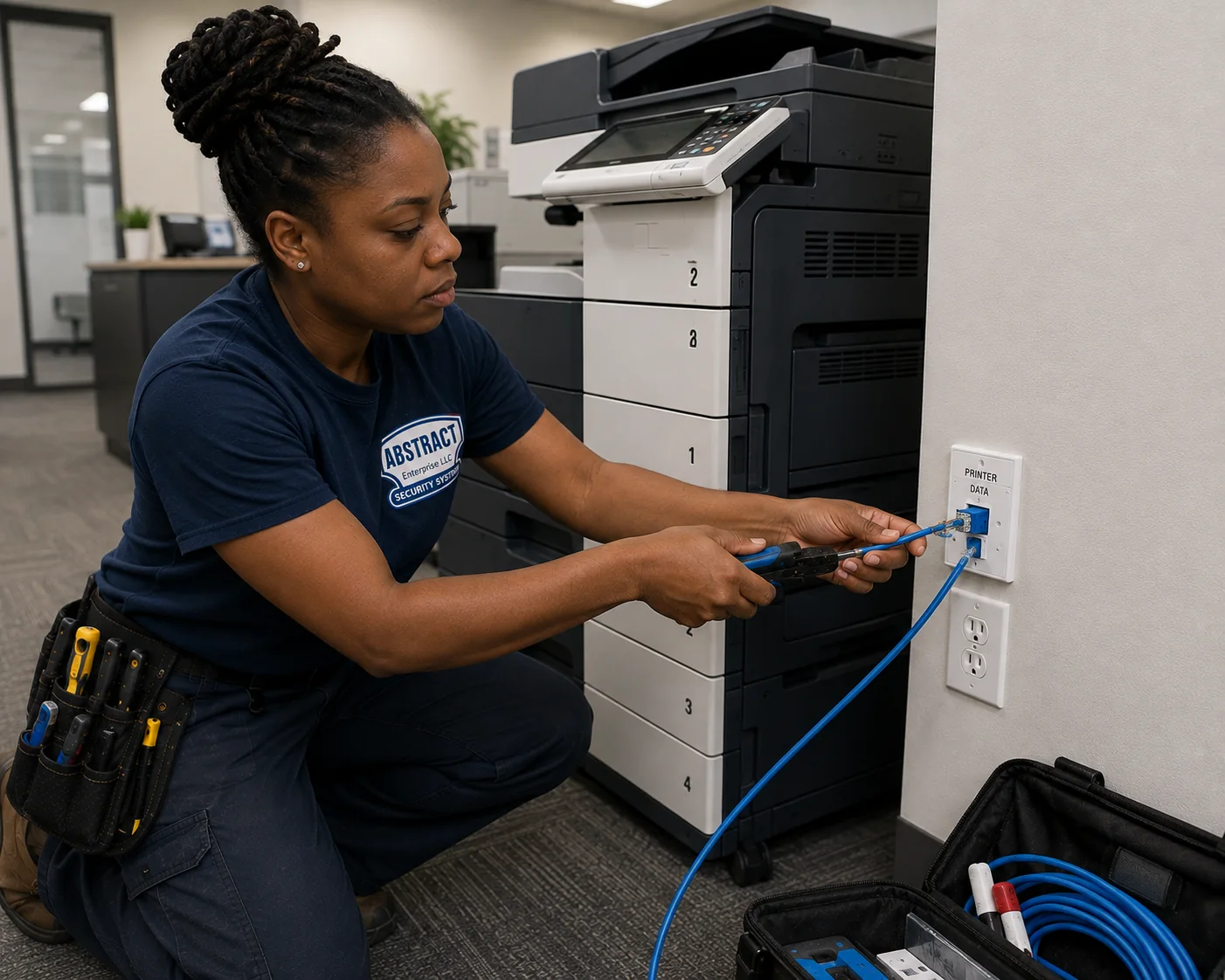
Cat6 installation for the Mineola and Garden City professional and medical corridor, suburban office parks, flex and light industrial buildings, retail, school districts and homes across Nassau County. Each run carried on proper supported pathway, terminated on components matched to category, tested, identified at both ends and handed over with a map of the panel.
Nassau has more incorporated villages than any county in the state, and the practical effect is that two buildings four minutes apart can answer to entirely different building departments. We establish which jurisdiction governs an address before scoping the work rather than discovering it with a crew already on site.
Tell us the building and rough drop count — we'll come back with a number.
Two contractors can price the same Garden City medical suite and mean entirely different things by the word "drop." Here is what it means on our estimates.
Each of these appears as its own line rather than hiding inside the drop rate: rack or wall cabinet, panels, management, cords, switches, conduit where a jurisdiction requires it, firestopping, core drilling, lift hire in high-bay space, permit fees where they apply, and out-of-hours work.
The Nassau question that separates bids. Ask each contractor which village or town the building sits in and what that authority requires for this scope. A bidder who has not checked has priced the cable and not the job, and the permit conversation will arrive later as a delay rather than a line item.
Nassau contains more incorporated villages than any other county in New York State. For a contractor, that is not trivia — it is the single most distinctive thing about working here.
Two office buildings four minutes apart can sit in different incorporated villages, each with its own building department, its own permit process, its own inspector and its own view on what a low-voltage scope requires. Add the three towns and two cities on top, plus county-level licensing through Consumer Affairs, and the honest answer to "what does this job need" changes depending on which side of a line the front door is on.
Long Island as a whole is defined by horizontal geometry — the ninety-metre limit becoming a design question on a wide slab. That is true in Nassau too, and it is covered on the regional page. What is specific to this county is jurisdictional rather than physical: the administrative work of establishing which authority governs a given address, and getting that settled before a crew is standing in a parking lot.
The second Nassau-specific factor is the sheer density of medical tenancy. The corridor that has grown up around the hospital campuses produces some of the highest drop-count-per-square-foot work we do anywhere, and it comes with scheduling constraints that no ordinary office imposes.
Built largely between the 1960s and the 1980s, slab-on-grade, suspended ceiling throughout, generous plenum above it, and usually one telecom room sized for a phone system rather than a network. Straightforward once the closet question is settled. The recurring surprise is what is already above the tile — decades of abandoned cable from previous tenants that has to be worked around or removed.
One of the densest medical office markets in the region, concentrated around the hospital campuses. High drop density, imaging equipment on wired connections, front-desk clusters, and increasingly cameras and access control on the same plant. The constraint is scheduling around patient hours and containment when ceilings open, not the cabling itself.
Office in the front, higher-bay space behind it, and two different cabling environments under one roof. The warehouse side means tray, lifts, long runs and separation from motor loads. Racking moves, so pathway gets designed with room to change rather than threaded tightly through today's layout.
Fewer drops, higher consequence. Registers belong on wired connections rather than shared wireless, back-of-house runs go into hot and greasy environments, and cameras cover entrances and tills. Front-of-house ceilings are finished and generally rule out visible pathway. Work happens overnight or before opening because the location trades the next day.
Nassau's school districts, village halls, libraries and fire districts make up a larger share of the commercial base than most people expect. Long masonry corridors that make closet placement a genuine question, fixed calendar windows that do not move, and closeout documentation that is written into the contract rather than offered.
Colonials, splits and ranches with accessible attics and basements, which makes them clean to wire with very little wall opening. Wireless dead spots in a detached house are a distance and construction problem rather than a router problem, and a wired access point on the upper floor fixes it permanently. Attic heat is the design factor that matters on powered runs.
The county's commercial density is concentrated along a handful of corridors, and the building stock changes noticeably from the western border eastward.
Mineola and Garden City carry the county's densest professional office concentration. The courts and county offices sit around Old Country Road, surrounded by law and accounting firms, and the medical corridor that has grown up around the hospital campuses in Mineola produces some of the highest drop-density work we do. Garden City's Franklin Avenue and Seventh Street run to professional office and retail in a mix of older and newer stock. Westbury along Old Country Road is retail, auto and small professional office, with the commercial development around the Roosevelt Field area anchoring the western end of the corridor.
Great Neck along Middle Neck Road and Lake Success at the county's western edge are professional offices and medical practices, frequently in buildings old enough that pathway is genuinely constrained. Manhasset and Port Washington run to retail and professional office along Northern Boulevard and Main Street. Uniondale around the Nassau Hub and the Coliseum site holds the county's tallest office buildings, which behave more like city work than suburban — one telecom riser, formal building management, freight and insurance requirements. Hempstead and the surrounding villages carry government, institutional and mixed commercial, with a substantial civic and educational presence.
Along the county's eastern boundary, the Route 110 corridor running toward Melville and Farmingdale forms the densest corporate office concentration on Long Island — campus buildings set back from the road, larger floor plates, real telecom rooms, building standards, and IT departments that ask about test results before they ask about price. It is also where the horizontal distance problem appears in its purest form, because a corporate campus building can be very wide. Inland, Hicksville and Plainview along the Route 106 and 107 corridors run to flex, light industrial and back-office space, and Syosset and Woodbury carry professional office and medical in low-rise stock.
Rockville Centre, Lynbrook and Valley Stream along Sunrise Highway and Merrick Road hold professional offices, medical practices and continuous retail. Freeport, Baldwin, Merrick and Bellmore run similar, with the marina and waterfront businesses along the south shore adding their own seasonal commercial layer. Long Beach is a distinct market — a barrier island city with its own commercial strip along Park Avenue and building conditions shaped by salt air and flood exposure, which matters for outdoor equipment and enclosure selection more than it does inland.
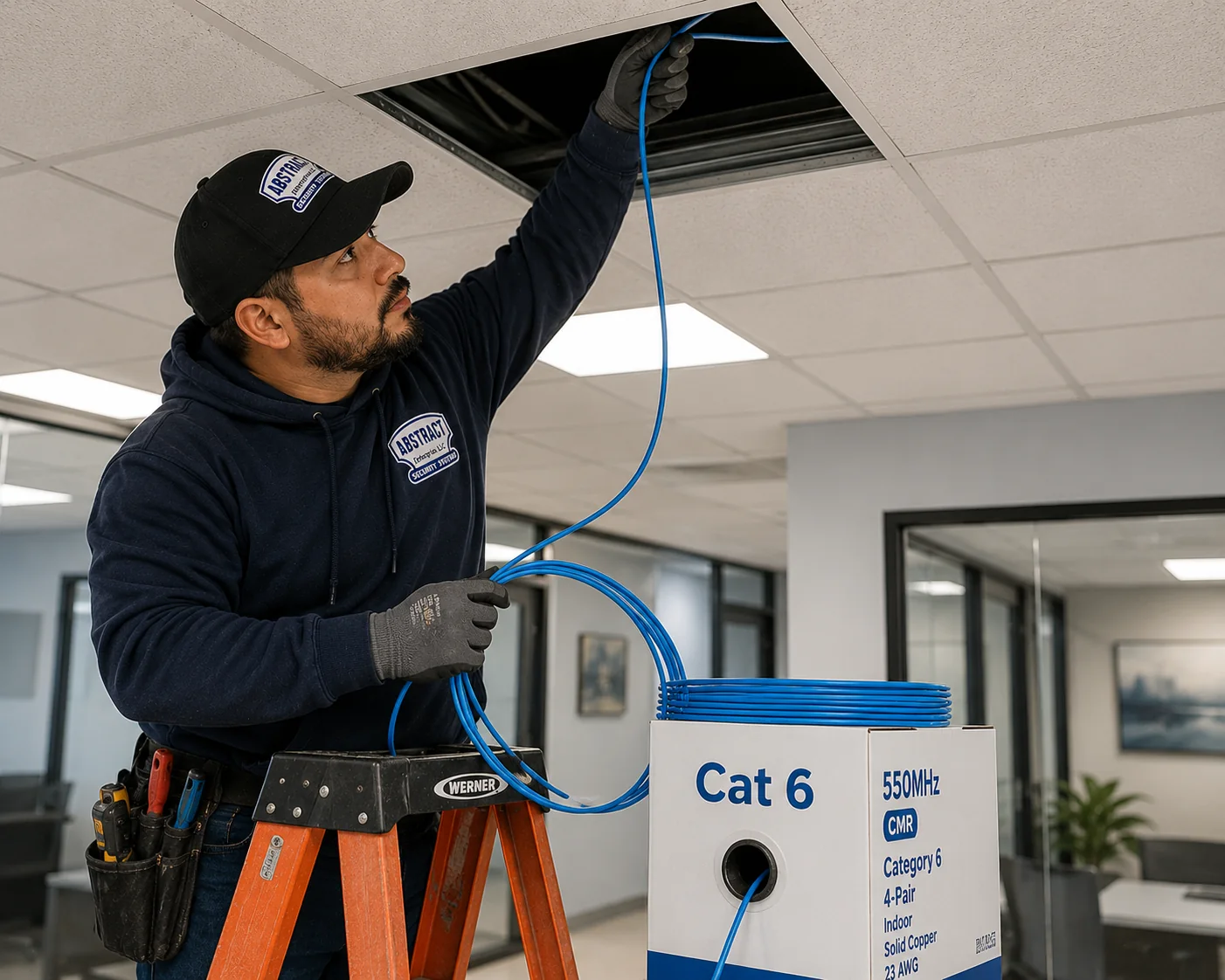
This is the part of a Long Island bid most likely to be answered vaguely, so here is the honest version.
New York State does not issue a single statewide electrical or low-voltage contractor licence. Licensing is handled county by county and, in many places, municipality by municipality — which is why the answer to "are you licensed" can genuinely differ depending on which side of a village line the building sits on.
Nassau administers contractor licensing through its Office of Consumer Affairs. On top of that, the county's cities, towns and its many incorporated villages each maintain their own requirements and their own permit processes. Nassau has an unusually large number of incorporated villages for its size, and that fragmentation is the practical complication: a contractor properly licensed at county level may still need something specific for the village a building happens to sit in.
What we tell clients to do. Ask every bidder, including us, which licence they hold and which authority issued it, and confirm the requirement for your specific scope with the county or the village before work is scoped. A bidder who will not give you a straight answer on that has already told you what you need to know. Separately, monitored alarm, camera and access control work is licensed at state level regardless of municipality, which is a different requirement from plain data cabling.
Whether a given cabling scope requires a permit or an inspection depends on the building, the scope, the pathway method and the authority having jurisdiction — which in Nassau usually means the village or town building department rather than the county. We establish what is actually required with the relevant office before work is scoped, rather than guessing in either direction.
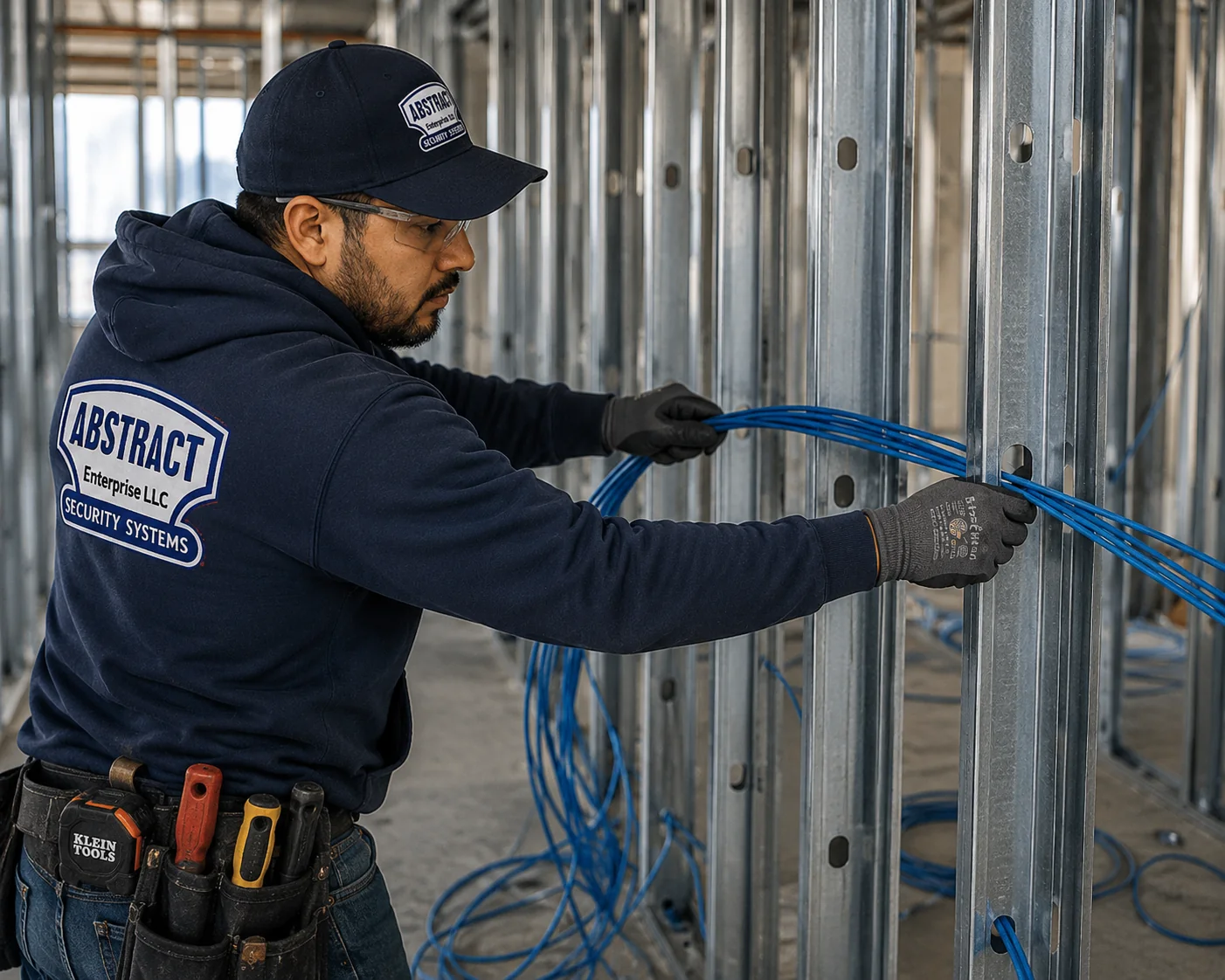
Far and away the least expensive way to do this. Cable is installed through open framing, lands at the closet, and waits coiled behind a set box at each outlet until the finishes are done; a short return visit terminates, tests and marks everything. We book ahead of the drywall crew because an open route is what holds the per-drop figure down. Miss the window by a week and identical cable becomes retrofit work at roughly three times the labour.
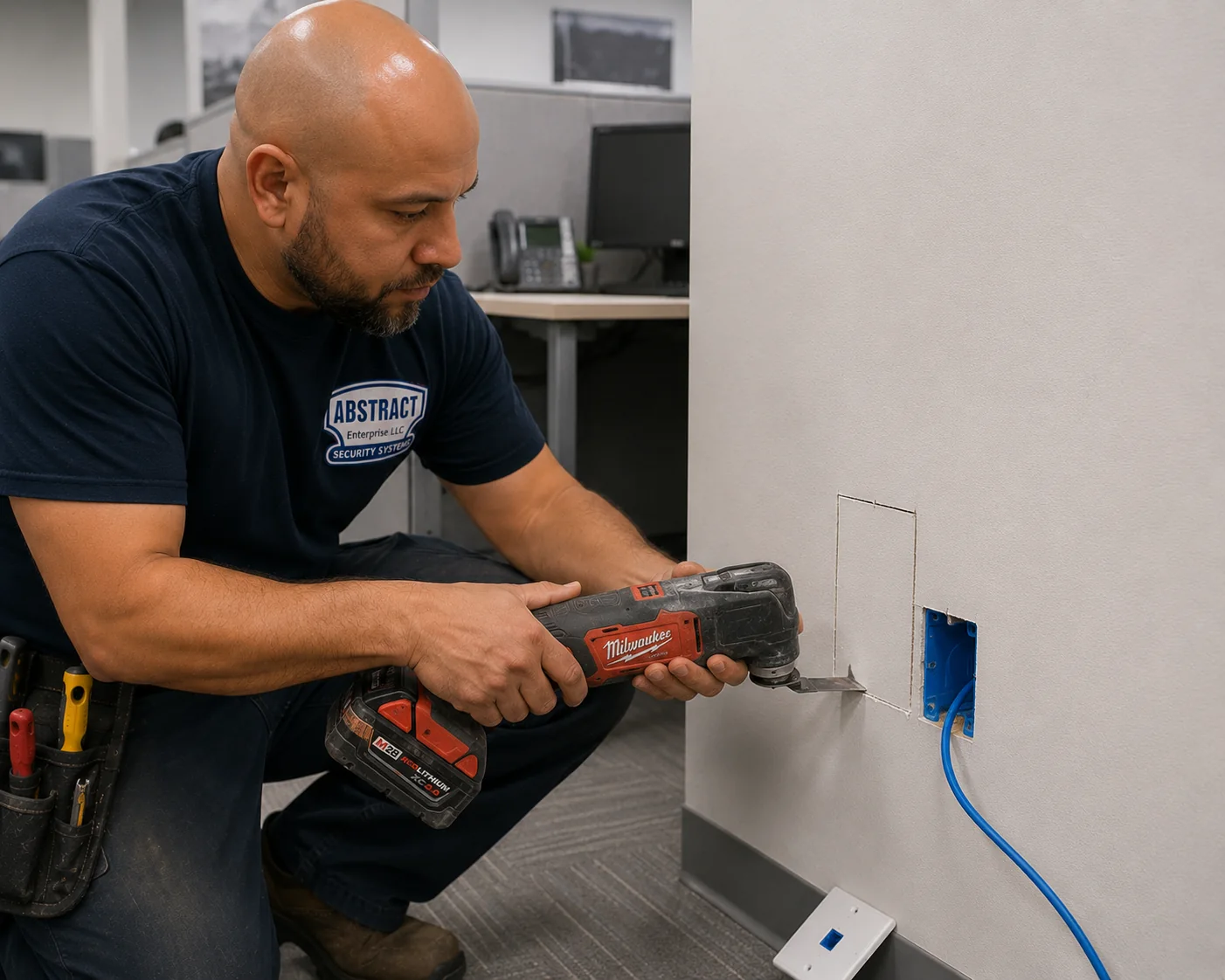
What most Nassau jobs actually are, and the conditions are usually kind. County office stock has accessible grid ceilings with genuine space above them, so new containment goes in and cable drops inside the partition to the outlet. Interior walls generally fish without a fight. What complicates it is the accumulated history overhead — dead cable from tenants three leases back, ductwork nobody drew, and blocking inside demising walls.
Staged room by room around the appointment book rather than by floor. Containment when a ceiling opens, tiles down and back within the same visit, and nothing left in a treatment room at the end of a shift. Where the disruption cannot be absorbed during clinic hours the work moves to evenings or weekends, and that premium is quoted openly rather than discovered.
Cable tray rather than J-hooks, lift work, and pathway routed so it survives the next racking change. Separation from large motor loads matters here in a way it does not in an office, and dock areas impose their own requirements on how cable and enclosures are protected.
Houses here wire cleanly. A colonial or a split can usually be done from the attic and the basement with barely any wall opened, which keeps the finished rooms intact. The factor that deserves respect is attic temperature, particularly where the run carries power. Older homes with plaster over lath, or a finished basement with no way in, take substantially longer — and that gets established at the site visit rather than mid-job.
Lighting up and performing are two separate assertions about a cable. Only the second one leaves a document behind.
Every drop is wiremap-tested before the ceiling closes. When the job requires full certification, we test permanent links with a Fluke DSX CableAnalyzer and deliver the pass/fail report with the closeout package.
A link light conceals the faults that matter. A split pair reads continuous on a simple check and degrades everything above it. A punch-down with an inch of conductor untwisted looks tidy and measures badly. A run that crept past ninety metres works today and fails a certification report. Permanent link testing covers panel through to outlet, the portion built into the fabric of the building. Channel testing adds the cords back and reports what the equipment on the end genuinely experiences.
Two Nassau conditions raise the stakes on testing. Medical space is the first: a fault found after a practice has reopened is not a ladder and ten minutes, it is a return visit negotiated around an appointment book. The second is the county's school districts, villages, libraries and fire districts, where certification reports are commonly written into the contract documents. A contractor who cannot produce them fails the submittal no matter how the cable behaves.
The line we do not cross: no ceiling closes ahead of testing. With the pathway open a bad termination is a few minutes of work. Sealed behind finished drywall in an operating medical suite, the same fault is a scheduling problem before it is a technical one.
Everything on a modern floor now shares one cable for both signal and supply — cameras, readers, radios, handsets and intercoms. That is a single pull instead of two trades at every device, and it puts the entire burden on one run of copper.
| Standard | Common name | Typically powers |
|---|---|---|
| 802.3af | PoE | Desk phones, basic fixed cameras, simple readers |
| 802.3at | PoE+ | Most current access points, PTZ and IR cameras, video intercoms |
| 802.3bt | PoE++ | High-power APs, heated outdoor domes, displays, higher-draw edge devices |
Current through a conductor makes heat. Heat trapped in a tight bundle cannot escape. Warmer copper resists more, so more voltage is lost along the way and less arrives where the device needs it. Solid conductor in a sensibly sized bundle has margin to give. A long CCA run buried in a fifty-cable bundle under a warm roof has already spent it.
Two Nassau conditions make this worse than average. An attic above a Nassau house or a small storefront gets far hotter than any conditioned commercial ceiling ever will. And on the south shore, salt air and flood exposure add a corrosion dimension to outdoor cameras, gate readers and their enclosures that inland sites do not face — which is a specification question at the walkthrough rather than a maintenance surprise two winters later.
Rates are published per drop so the maths can be done before anyone books a visit.
| Cable type | Per drop, runs to 100 ft |
|---|---|
| Cat5e | $254 |
| Cat6 | $296 |
| Cat6A | $424 |
| Coax / RG6 | $254 |
| Speaker wire | $211 |
| HDMI | $338 |
| Fiber — multimode | $593 |
| Fiber — singlemode | $677 |
Every figure above carries the cable, the faceplate and keystone, a termination at each end and the test once the run is complete. Ten percent comes off new construction quoted ahead of drywall. Past 100 feet we measure the route and price against it.
Itemised on their own lines: cabinet or floor rack, panels, management hardware, cords, switches, conduit where a jurisdiction demands it, firestopping, coring, lift hire on anything high-bay, toning and mapping of inherited unlabeled runs, and any out-of-hours premium.
Price it yourself in the cabling quote builder, or call and walk us through the space.
Cat6 belongs in almost every Nassau drop. Running at 250 MHz against Cat5e's 100 MHz gives it margin, and margin is what swallows a long route, a hot ceiling and a termination that was not perfect without the link stepping down. On new work the separation is $42 a drop. Cat6A justifies its $424 when full-distance ten gigabit is actually specified, when a drawing calls for it, and on the links tying telecom rooms together in a building that needs more than one.
A caution worth stating plainly: no category buys reach. Cat6A carries more bandwidth, not more metres, and the ninety-metre horizontal ceiling applies identically to both. Where a run will not reach, the answer is a second telecom room and a fiber link between them.
Where the space above the ceiling moves return air, the jacket has to be CMP. Vertical shafts between floors take CMR. What catches people out in Nassau is that a plenum ceiling and a ducted-return ceiling are indistinguishable standing underneath them, and the county has plenty of both. We establish which one it is during the site visit.
Unshielded pair is the correct specification in the overwhelming majority of buildings. A shield only works if it is bonded and grounded properly at the rack; left floating it behaves as an antenna and can measure worse than plain UTP. The cases where it earns its keep in this county are industrial — heavy motor loads, drives on production equipment, and routes forced to run alongside power for a distance.
Copper conductor on every horizontal run, no exceptions. CCA resists more, breaks where it is landed, and is the most common single explanation for a newly cabled network misbehaving once power is on it. Put it in an unconditioned Nassau attic and the callback is a matter of when.
The drop nobody installed is always the one that costs the most. The rest is arithmetic.
| Location | Drops | Why |
|---|---|---|
| Workstation | 2 | Computer plus phone, dock or future second device |
| Printer / copier | 1–2 | Shared devices get their own port |
| Wireless access point | 1 | Wired backhaul; more APs needed where demising walls are masonry |
| IP camera | 1 | PoE data and power on one run |
| Door reader | 1 | Where the access system is IP at the door |
| Exam room / operatory | 1–2 | Workstation plus imaging or chairside equipment |
| POS terminal | 1 | Card processing wired, not on shared Wi-Fi |
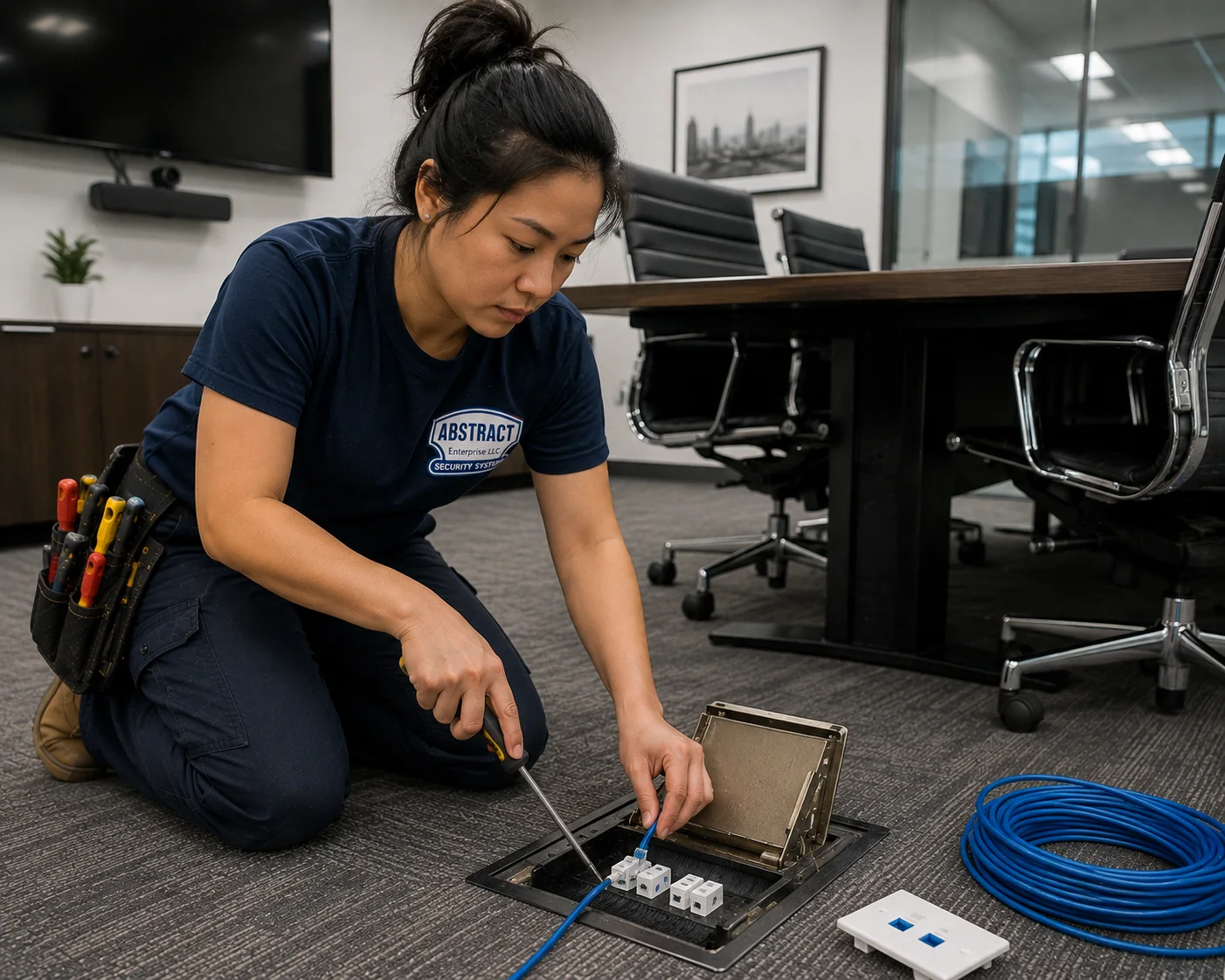
| Conference room | 3–4 | Display or codec, table or floor box, camera, spare |
| Classroom | 2–3 | Teacher station, display or projector, AP overhead |
You usually inherit this decision rather than make it. Telecom rooms in Nassau office stock were sited wherever there happened to be a spare door when the building carried a phone system and a few data runs — beside the electrical panel, tucked in a corner. Put that room in a corner of a wide slab and a meaningful share of the floor is sitting at or beyond the limit before anyone pulls anything.
When a second room is warranted we want somewhere that halves the floor plate cleanly, has power and airflow, and is not space the tenant intends to reclaim in eighteen months. Fiber ties the two together. That is more expensive on day one than assuming one room will stretch, and considerably cheaper than proving it will not.
Any time a ceiling is about to close we argue for a few extra runs, terminated and marked at the panel and left coiled above the tile or behind a blank plate. Twenty minutes and some cable. What it buys is that the next hire, camera, screen or reader becomes a patch cord rather than a scheduled visit. Four or five on a thirty-drop office is sensible.
Method commentary, not case studies. Recurring patterns behind the calls we get, described generally.
Identical fit-outs a few minutes apart, one needing a permit and an inspection and one not, because a municipal line runs between them.
Suburban office stock accumulates. Abandoned coax, dead phone cable, two generations of data congesting the pathway new work needs.
A drop that behaves faultlessly through spring and drops a powered device once the attic heats up. Temperature, distance and conductor compounding on each other.
Work planned by area rather than by appointment book, which collides with the clinic on day one. Room-by-room staging is the only version that works.
Outdoor cameras and gate readers specified as though they were inland. Corrosion arrives faster than anyone budgeted for.
Bundles strapped along a duct main because it was the handiest thing overhead. Constant proximity to mechanical plant, plus vibration.
Flex-building pathway threaded tightly through a rack layout that has since changed, leaving cable in the way of a forklift aisle.
Runs laid straight onto ceiling grid to save time. Non-compliant, and it leaves the network underfoot for everyone who works above that ceiling afterward.
A 5e keystone on Cat6 cable, chosen because it was within arm's reach. The channel drops a grade and the drop gets built a second time.
Cut precisely to length at both ends. The next termination change or outlet shift then means pulling a fresh run over six inches of shortfall.
Sound cable, sound terminations, nothing written down. From then on every change starts with a toner and an hour.
District and village projects where the documents called for certification and the closeout package arrived without it.
Beyond a handful of drops the permanent cable stops at a panel and everything after that happens on cords. Marginally more expensive once, and it repays itself the first time a desk moves or a port dies. The horizontal cable — the part that is genuinely expensive to disturb — gets terminated a single time and then left alone.
We terminate to TIA-568 on T568B unless the building already runs the other scheme. Identifiers and mapping follow TIA-606-style convention, which is what keeps the room legible years later. Category stays consistent across every component, because a 5e jack on Cat6 downgrades the entire channel and fails certification.
Panels get sized with room left over rather than filled exactly on handover day, and hardware is stacked panel, manager, switch, manager so cords travel predictable distances. Nassau flex buildings often put the network gear in a room already serving three other purposes, which turns enclosure selection and physical protection into an engineering question rather than a matter of taste.
Per-drop results, panel mapping, the naming convention in plain language, what cable and components went in, marked drawings where drawings exist, and photographs of anything about to be sealed up. On district, library and village work that package is contractual, and a submittal turning up short comes straight back regardless of how the cable was installed.
Roughly 43% more per drop for ten gigabit across a full-length run. Right between telecom rooms, into servers, and wherever the drawings insist. At a desk, a handset or a radio it is capacity nothing draws on — and it adds no reach whatsoever.
Legacy 5e passing a test is not a problem needing solving. For new permanent cable the difference is $42 a drop, and Cat6's margin is precisely what carries temperature, distance and power draw. Hard to defend 5e on anything you plan to keep.
They do separate jobs rather than compete. Copper reaches equipment and powers it; glass carries distance and ignores interference. The division in Nassau is clean: glass between telecom rooms or buildings, copper horizontal to everything that plugs in.
Wireless is something cable delivers, not an alternative to it. Each radio is a wired run with an antenna attached, and buildings that skimp on cabling end up with more radios, worse coverage and nowhere to go from there.
Unshielded almost everywhere. A shield has to be bonded and grounded to do anything, and it belongs where interference is genuine — production floors, rooms full of drives — rather than sprinkled about as insurance.
This is not a trade-off with two defensible ends. More resistance, conductors that snap where they land, collapse under power. Cheap by the box, expensive by the building.
Someone walks the building, opens a tile, finds the telecom room, and establishes both the route and which village or town governs the address. Drop positions marked, cable rating set, closet count settled, and the permit position confirmed before any figure exists.
Drop count at the published rate, hardware and permit costs listed separately, premium conditions stated rather than buried. A deposit with the balance on completion, and the terms printed rather than assumed.
Insurance across to the owner, access and hours agreed, lift booked where high-bay work applies, and the municipal permit filed and approved before a crew loads in. In this county that last step is the one that moves schedules.
Containment up, cable pulled, penetrations sealed back to rating, boxes set, and everything dressed into the telecom room with slack left at both ends.
Outlets landed, plates fitted, panel punched down and mounted, rack hardware and management installed, and each end marked at the moment it is made.
All of them, before anything is sealed. Anything failing gets put right while access remains and is then re-tested.
Results, mapping, naming, materials and marked drawings handed across. The room photographed, tile replaced, cores swept and materials taken away.
Because Nassau is carved into so many separate municipalities, it also contains an unusual number of separate public clients — districts, village halls, libraries and fire districts, each procuring independently. That work has its own rhythm: an academic or budget calendar that does not move, deliverables named in the documents, and closeout paperwork that is a contractual obligation rather than a courtesy. On summer school work the window is fixed, so ordering and sequencing matter more than they would on a private fit-out.
Not testimonials — the commitments that apply to every Cat6 job we take in Nassau.
Which village or town governs the address, and what it requires for this scope, confirmed before the work is scoped rather than after mobilisation.
Testing on all installed drops before anything is sealed, with permanent link certification wherever the project calls for it.
Results, panel mapping, naming and materials, produced in a form a district or village closeout package will actually accept.
Clinical space staged around the appointment book rather than the floor plan, with rooms returned to service at the end of each visit.
Solid copper on every horizontal run, components held to one category, and a jacket rating selected for the space the cable actually passes through.
Warranty terms set out below, and later moves or additions treated as continuing work rather than a fresh engagement.
The switch gets swapped, the firewall gets rebuilt and the carrier fields two calls before anybody opens a ceiling.
We begin at the panel, not the workstation. Find the run, test the permanent link, read the result. Passing takes the building's cable out of the picture and moves attention to a cord, a switch port or the device — genuinely useful information. Failing names the parameter at fault, which points at a termination before anything else. Redoing both ends clears most of them; where the cable itself took damage along the route, that run gets replaced.
A Cat6 data drop runs $296 inside 100 feet, covering the cable, the faceplate and keystone, a termination at each end and the test on the completed run. New construction quoted ahead of drywall comes off ten percent, and past 100 feet the route gets measured and priced on what it takes. The length question comes up far more often in Nassau than it does in the city, because commercial buildings here are wide rather than tall, so distances get confirmed with a tape measure before anything is priced.
Nassau handles contractor licensing through its Office of Consumer Affairs, and individual towns, cities and incorporated villages layer their own requirements on top — which is why the answer can change across a municipal boundary on the same road. New York State does not run a single statewide electrical or low-voltage contractor licence, so this is genuinely a local question. Ask every bidder, including us, which licence they hold and which authority issued it, and confirm the requirement for your specific scope with the county or the village before work is scoped.
Because the square footage is horizontal. A 60,000 square foot single-story office or flex building can easily put a far corner beyond 90 metres of installed cable from one centrally placed telecom room, once the run climbs into the ceiling, travels the pathway, goes around the rooftop unit and comes back down. The same floor area in a Manhattan tower is stacked over ten floors with a riser in the middle. In Nassau the answer is usually a second telecom room rather than a stretched run, and that belongs at design rather than at test.
Drop density is considerably higher than comparable office space, because nearly every room holds equipment: a workstation in each exam room or operatory, imaging that wants a wired connection, front-desk clusters, and increasingly cameras and access control on the same plant. Nassau has one of the densest medical office concentrations in the region, particularly around the hospital campuses. The genuinely hard part is almost never technical — it is scheduling around patient hours, containing dust when ceilings open, and agreeing with practice management which rooms can be down on which day.
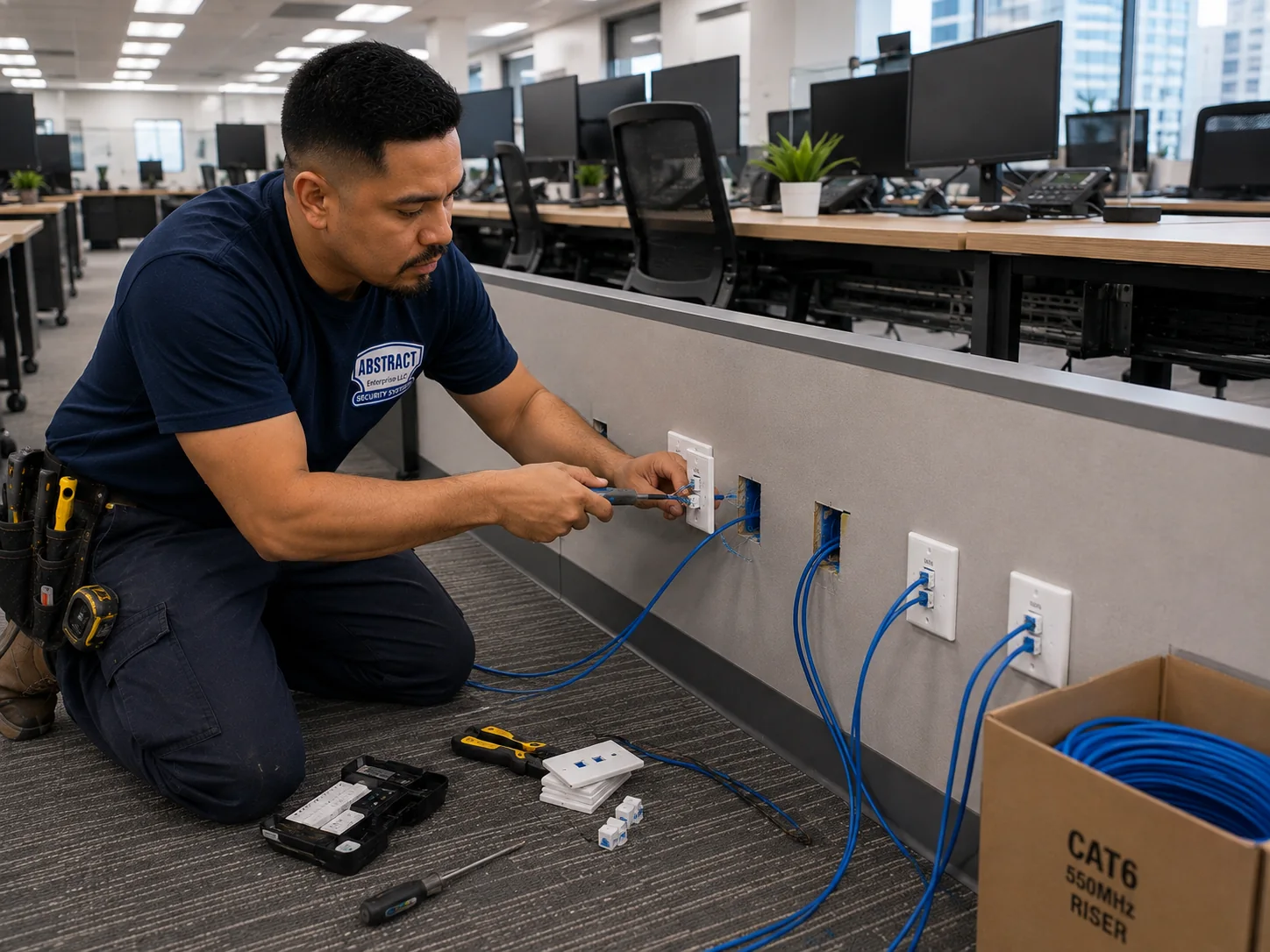
A visit that settles where the drops go and how cable reaches them; the pull on proper containment; a jack landed at the outlet and a port landed at the panel; plate and panel mounted; both ends marked; a test on every finished run; and a map connecting each panel port to its outlet. Racks, panels, management, switches, conduit, firestopping, lift hire, permit fees and out-of-hours work all appear as their own lines rather than disappearing into the drop rate.
Two at every seat, a port of its own for any shared printer, one behind each radio, camera and reader, one per register, one or two per exam room in clinical space, and three or four in any room with a screen. Two per seat reads as generous right up to the moment a handset, a docking station and a monitor hub all arrive at the same desk. The second port is close to free while somebody is already in the ceiling and becomes a booked visit once they are not.
It will, but not across a full-length run. The number generally cited is somewhere around 55 metres, and packing cables tightly together pulls it in further as alien crosstalk takes hold. Ten gigabit over a complete 100 metre channel is what Cat6A exists for. Given that nearly every drop in this county terminates at a workstation, a handset, a camera or a radio, Cat6 is both correct and the cheaper answer.
It is aluminium wire with copper plated over the outside. Cheaper by the box, and not the same product. Aluminium carries more resistance, which becomes serious the moment the pair is delivering power, and it fractures rather than flexes, so conductors give way at the punch-down and in the tight turn behind a faceplate. It will light a link LED and still leave a camera short. We run solid copper on every horizontal drop.
It depends on how the building moves air, not how tall it is. If the void above the ceiling is carrying return air then CMP applies, and a great many low-rise Nassau offices are built precisely that way. Others duct their returns, which changes the requirement entirely, and you cannot tell which is which standing underneath. We establish it on site with the building and the authority having jurisdiction rather than guessing from the vintage.
No amount of re-terminating changes a cable's category — the rating is a property of the cable itself, so an upgrade means new cable in the ceiling. What frequently survives is the route. County office buildings from the seventies through the nineties often have hook runs or conduit still perfectly serviceable, and following that existing path is where the budget is recovered. Where the previous installer stapled cable to structure or ran it loose through insulation, there is nothing to inherit.
Yes, and it is usually the best route available, since an attic reaches the top of nearly every interior wall in a colonial, split or ranch — which describes most housing in the county. Temperature is the caveat. An unconditioned attic in midsummer gets genuinely hot, loss climbs with temperature, and a drop carrying power is adding heat of its own on top. We keep those runs short and try not to bury them under deep insulation.
Yes, and a lot of Nassau work happens that way. Clinical space has to fit around appointments, shops have to open in the morning, and school buildings only free up on a fixed calendar. The county does have one advantage over the city: buildings are usually single-tenant or owner-occupied with their own doors and their own parking, so getting in is a conversation with one person rather than a managed process. Anything outside normal hours is priced on its own line.
Tell us the building, the rough drop count and the timeline — and the village or town it sits in, because that determines the permit position before it determines anything else.
🛡 Cat6 installation warranty. Abstract Enterprises Security Systems provides a three-year warranty on products supplied by AESS for normal wear and tear. It does not cover existing or customer wiring, customer-supplied equipment, lightning or other acts of God, power outages or surges, physical damage or unplugging, internet, router or phone changes, or camera readjustments requested after completion. After the warranty period, service is $195 per hour with a three-hour minimum ($585). Full terms: abstractenterprisessecuritysystems.com/warranty.
Call 516-346-5778
WhatsApp message us
NYS Low Voltage License #12000287431
4.7 / 201 Google Reviews
We'll follow up to arrange a walkthrough.