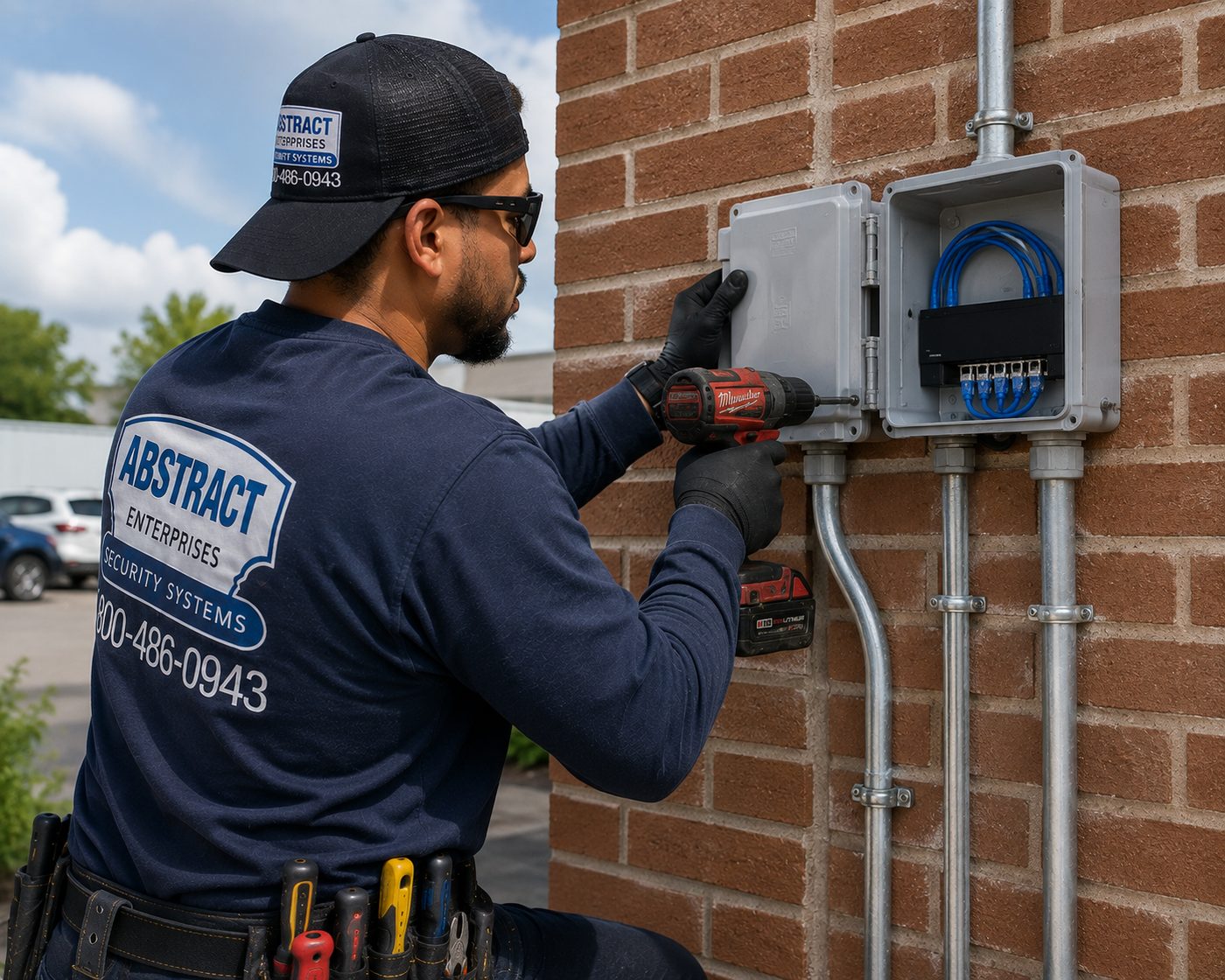
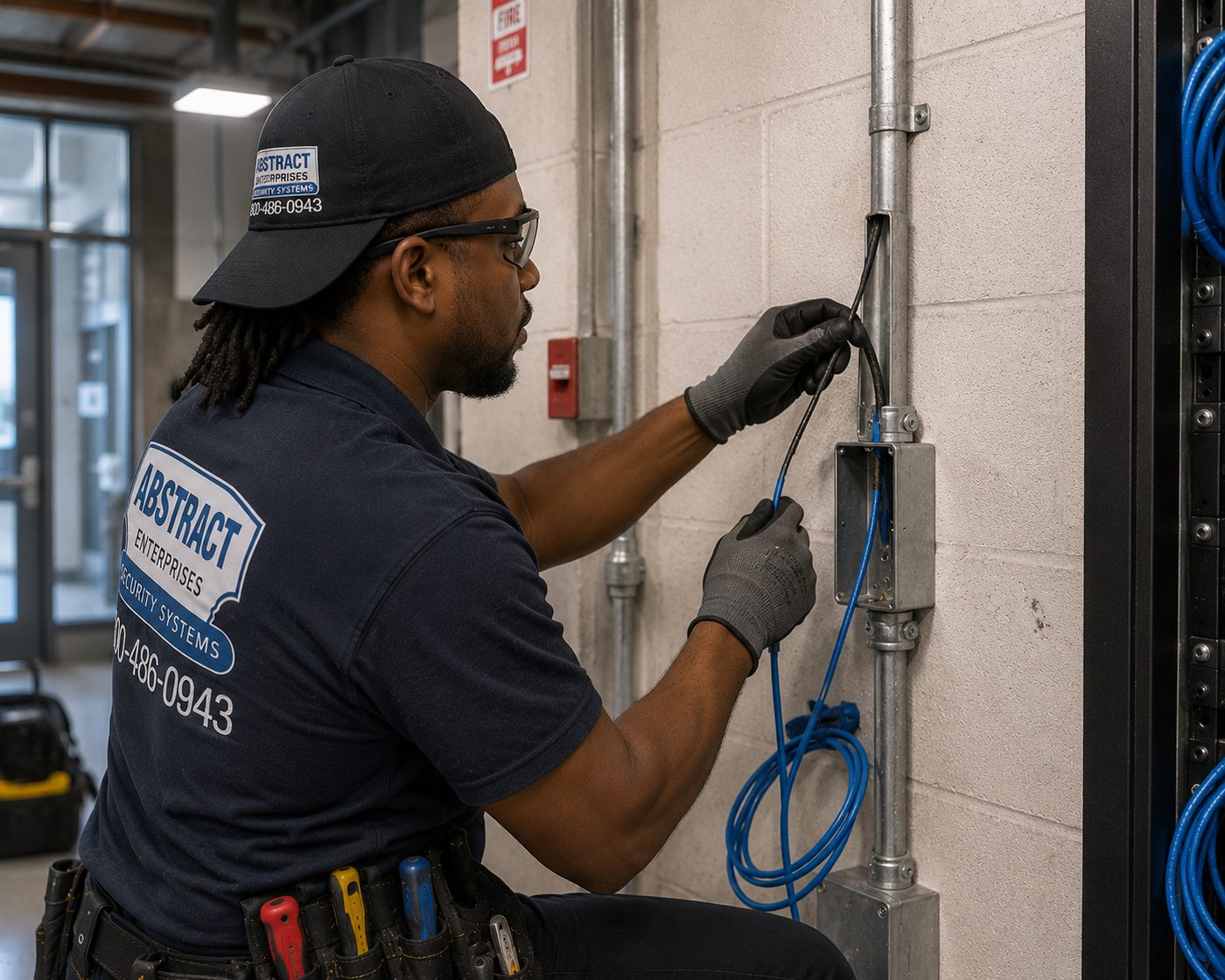
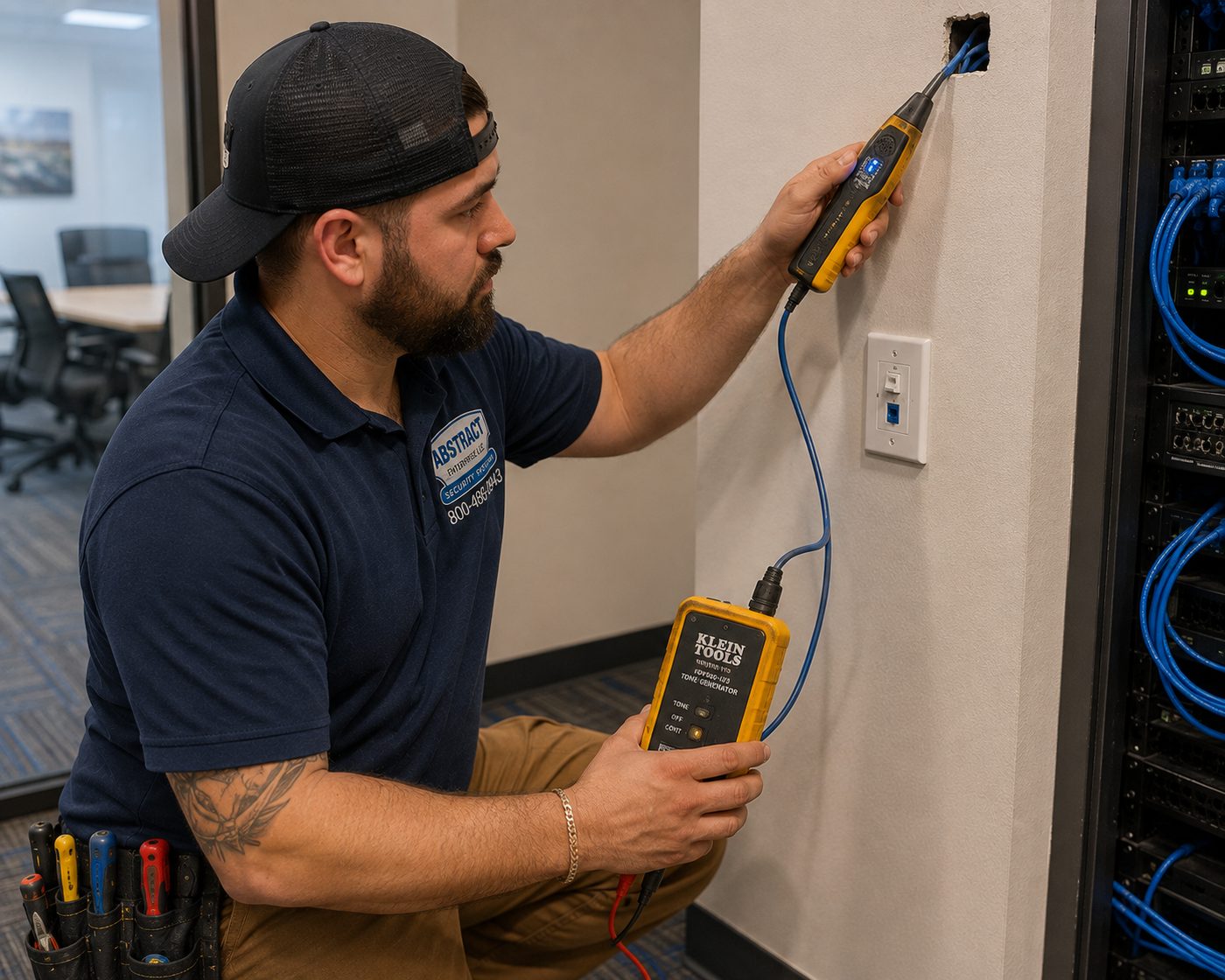
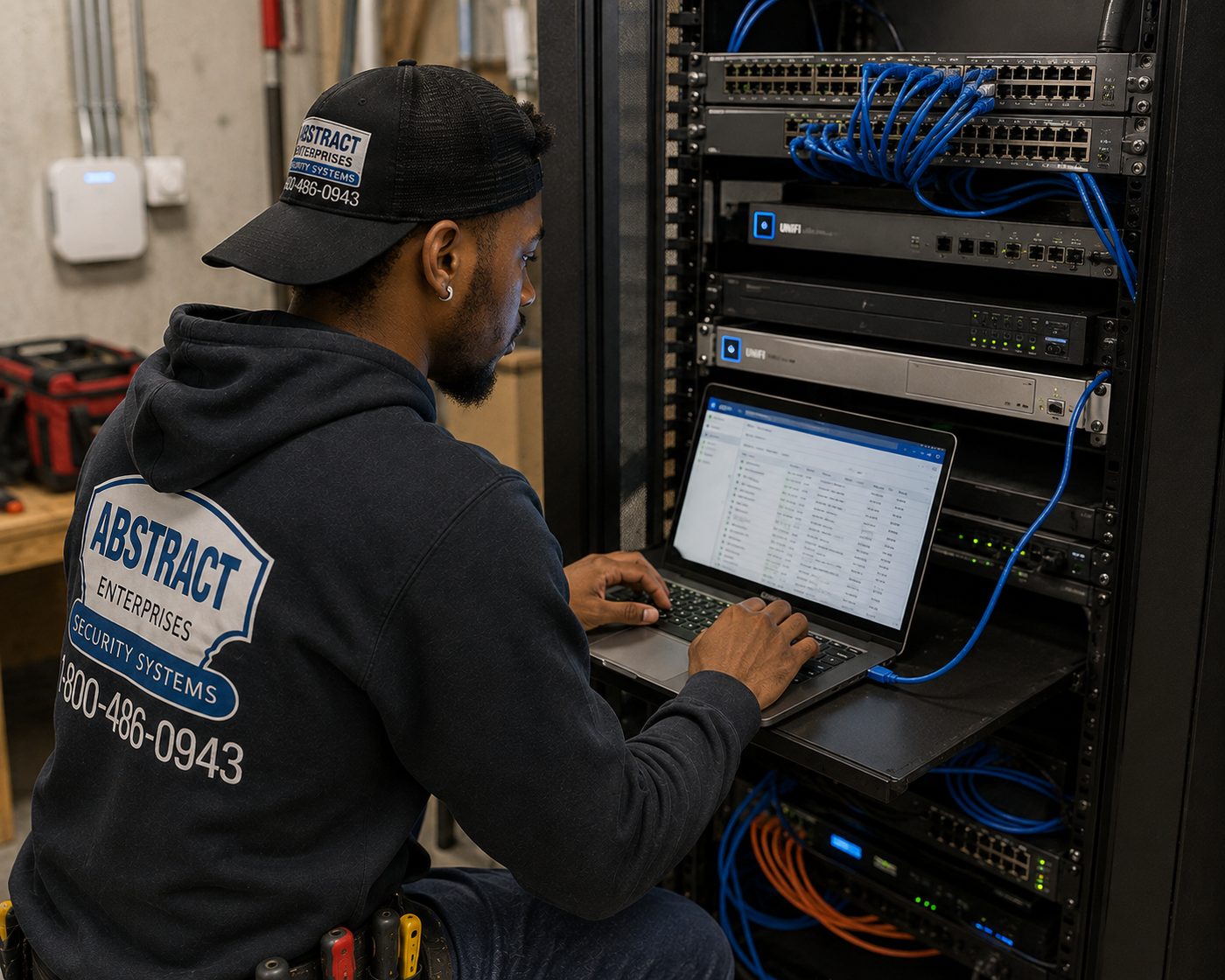
Structured cabling, camera and access control wiring, intercom and entry runs, fiber between buildings, MDF and IDF closets, certification and as-built documentation across Nassau County — installed by a NYS-licensed low-voltage contractor who checks your village before quoting, not after.
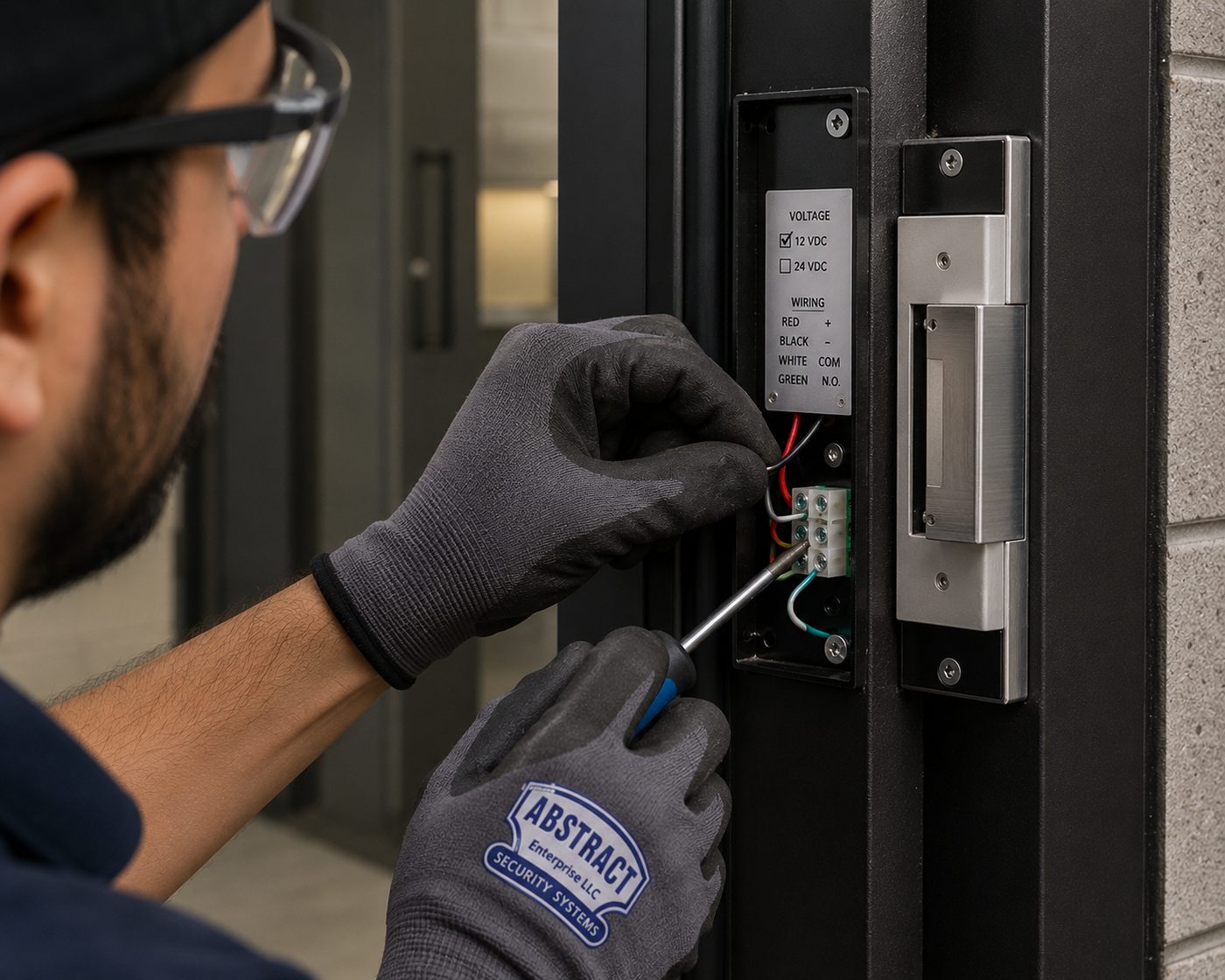
Low voltage installation in Nassau County: electric strike wiring landed at the door, part of one bundle back to the controller.
In Nassau County the Answer Depends on Which Village You Are Standing In
Nassau is the most fragmented jurisdiction we work in, and it is not close. The county contains two cities, three towns, sixty-four incorporated villages and more than sixty unincorporated hamlets, and the county’s own Industrial Development Agency states plainly that each of those local municipalities has established its own zoning and building codes. Nassau’s villages maintain independent building departments in most cases, so a property owner inside an incorporated village generally deals with the village for permits rather than with the town or the county.
That fragmentation reaches into electrical licensing as well. Trade sources describe the three towns — Hempstead, North Hempstead and Oyster Bay — each maintaining its own Examining Board of Electricians, with the City of Long Beach holding a separate licence, and many incorporated villages such as Freeport, Rockville Centre, Valley Stream and Lynbrook operating their own licences or registration requirements on top of the town. Some villages offer reciprocity with a parent town licence and some do not. There is no single Nassau County electrical licence to point at.
For low voltage specifically the practical position is that pure structured cabling frequently does not trigger a permit, but that is a village-by-village answer rather than a county one, and it can change once work involves opening walls or ceilings, penetrating rated assemblies, or anything connecting to a fire alarm panel. The three towns handle permits differently from one another, and several villages — Garden City, Great Neck and Manhasset among them — run their own permitting rather than going through the town at all.
So the first question on any Nassau enquiry is not what you want installed. It is which town or village the building sits in, because that determines what applies before anything technical does. Confirm the requirement with your municipality; we do the same before quoting.
The buildings themselves are a mix of low-rise professional and medical office, school district property, retail corridors, light industrial along the western edge and a large base of multifamily and mixed-use. Wide floorplates, on-site parking, straightforward daytime access — and long horizontal runs measured against a hard distance limit.
Abstract Enterprises Security Systems is a licensed low voltage contractor in Nassau County and a structured cabling contractor across the region, under NYS licence #12000287431. Every proposal follows a free on-site survey.
No monthly fees and a three-year warranty on equipment we install.
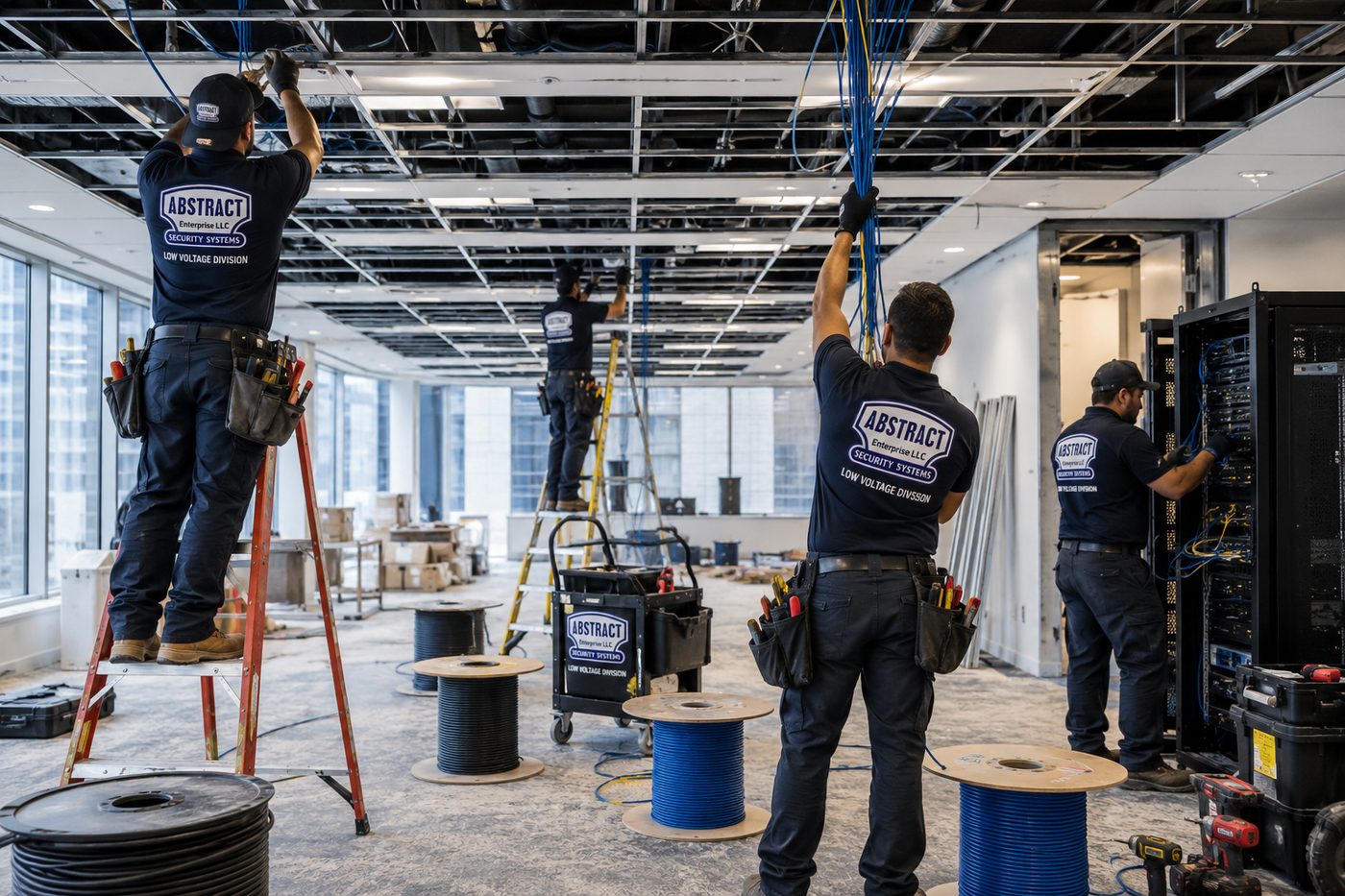
A full crew pulling and racking in one mobilisation on a Nassau job.
WHAT WE INSTALL
Commercial Low Voltage in Nassau County: Systems We Cable
Each of these gets scoped the same way here: which municipality, what the pathway takes, how far the run travels, and what documentation comes back to you.
Voice and Data Cabling
Commercial data cabling in Nassau County from workstation to closet — Cat6 and Cat6A, panel-terminated, wiremapped and labelled at both ends. Network cabling in Nassau County covers the same plant. Cat6 installation in Nassau County covers most suite and retail work, and office network cabling in Nassau County is the everyday version of it.
Wireless Access Point Drops
Ceiling and wall AP drops across wide low-rise floorplates, on cable rated for the PoE class the access point actually draws.
Camera Cabling
Home runs from each position back to the recorder or PoE switch, with distance and switch power budget confirmed first. Security camera installation in Nassau County is handled by the same crew.
Access Control Door Wiring
Access control installation in Nassau County shares the data plant’s pathway: reader-to-controller runs, lock power home runs, request-to-exit and door position pulled as one door bundle.
Fiber optic cabling in Nassau County is mostly horizontal — backbone across a school campus, medical park or office parcel between separate structures.
School and Institutional Cabling
Corridor and classroom work on an academic calendar, with the documentation standard set by the district rather than by a landlord.
AV, Paging and Signage
Conference room boxes, display and signage drops, and paging zones sharing the same ceiling route.
Server Rooms, Racks and Closets
Server room cabling in Nassau County starts with the rack: wall-mount and two-post builds, panel and switch mounting, management, UPS, grounding and re-dress.
Low voltage security systems in Nassau County share the same pathway as the data plant, so one company can handle cabling, cameras and access control on a single mobilization.
One team covers: surveillance cameras, access control readers, magnetic locks and electric strikes, video intercoms, intrusion alarms, paging systems, conference-room systems and digital signage — plus the cable pathways, riser cabling and backbone cabling that feed them, the equipment racks and network closets they land in, and the cable termination, cable certification, system commissioning and as-built documentation that close the job out. Low voltage services in Nassau County cover telecommunications wiring and building automation as one commercial low voltage installer scope rather than several.
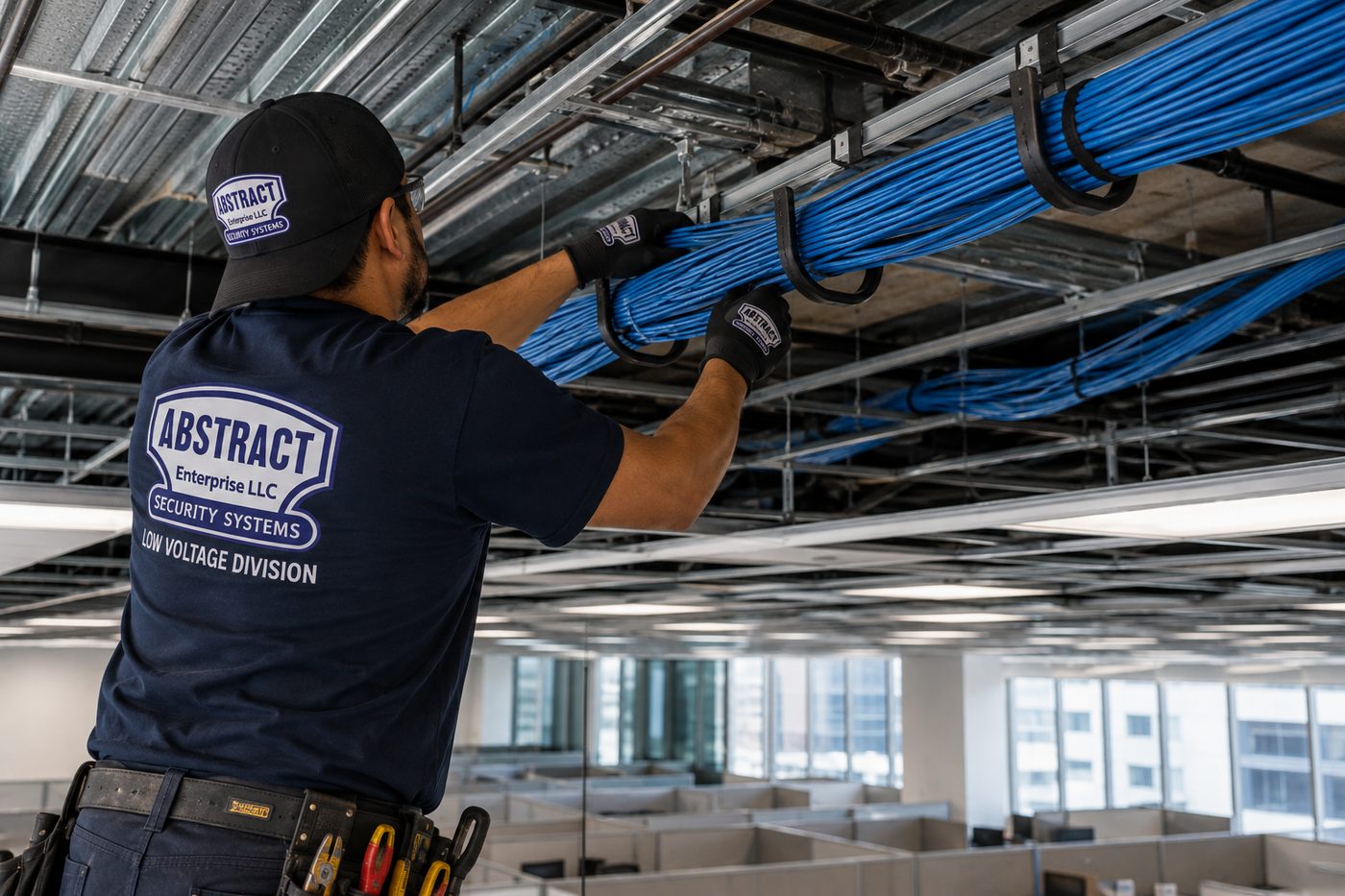
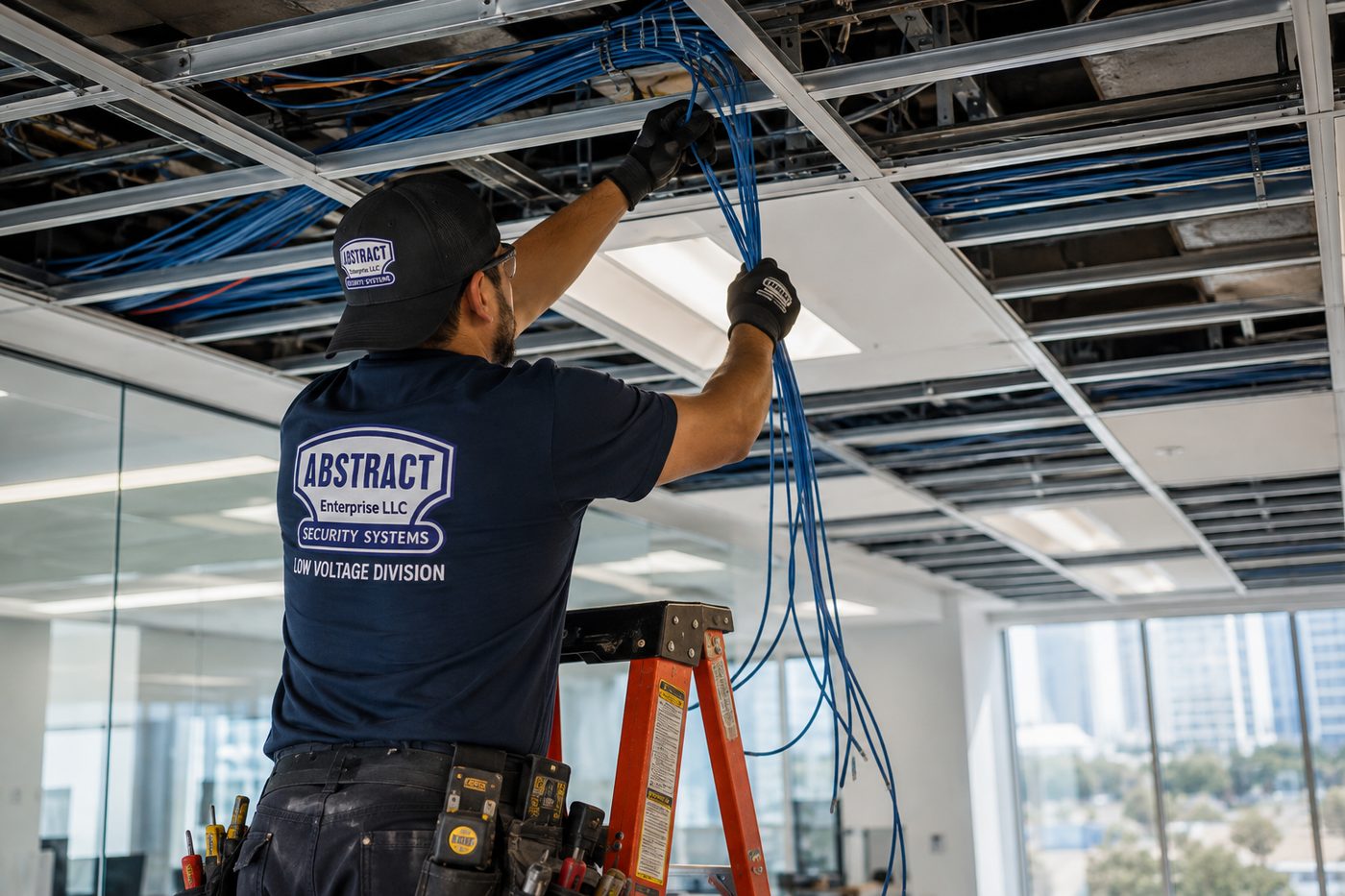
Supported pathway across a wide low-rise ceiling.
BUILDING SPECIALISTS
Cabling for the Way Nassau County Buildings Are Actually Built
Professional and medical office
Structured cabling in Garden City and data cabling in Mineola is the county’s signature commercial work — low-rise professional buildings, medical and dental suites, legal and financial offices clustered around Old Country Road, Franklin Avenue and Seventh Street. Network cabling in Garden City and structured cabling in Mineola follow the same pattern across that corridor. Accessible ceilings in most cases, straightforward daytime access, and a documentation expectation that has risen sharply as practices consolidate into groups.
School district property
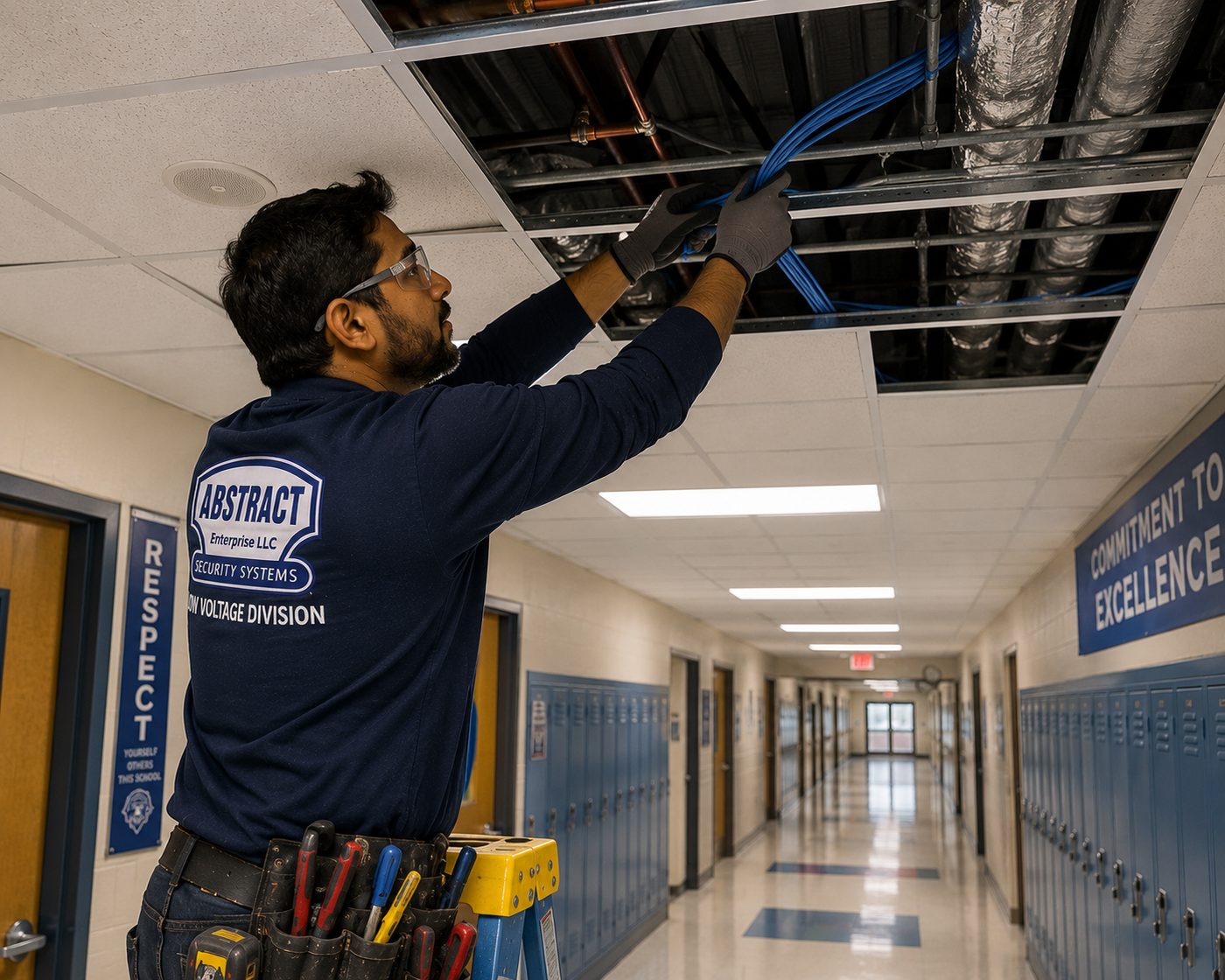
Nassau is dense with district buildings and they run on an academic calendar rather than a lease. Data cabling in Westbury, network cabling in Syosset and structured cabling in Uniondale and the surrounding districts happens in recess and summer windows, with structured cabling in Hicksville and comparable districts covering corridor and classroom runs, AP coverage that has to hold in a full room, and closeout documentation a district technology department can actually use.
Retail corridors and shopping centres
Network cabling on Hempstead Turnpike, Sunrise Highway, Jericho Turnpike and Northern Boulevard covers storefronts, restaurants and the professional space above them. Point-of-sale reliability first, back-of-house second, everything sequenced around trading hours.
Light industrial and distribution
The western and southern industrial pockets, plus the Route 110 corridor as it runs north toward the Suffolk line. High-bay cabling from a lift, tray pathway, dock runs, and cable rated for the environment rather than for a carpeted suite.
Multifamily, co-ops and mixed-use
A low voltage contractor in Long Beach or Freeport spends a good deal of time on riser work, and network cabling in Freeport carries the same pattern in occupied buildings, entry and intercom wiring at the vestibule, and common-area work scheduled around residents. Coastal properties along the South Shore carry their own considerations for anything mounted outside or below grade.
Village-owned and municipal buildings
With sixty-four incorporated villages plus two cities and three towns, municipal work here is unusually decentralised. Structured cabling in Rockville Centre or a low voltage contractor in Valley Stream working a village hall, library or public safety building runs on that village’s procurement and its own documentation standard, not a county one.
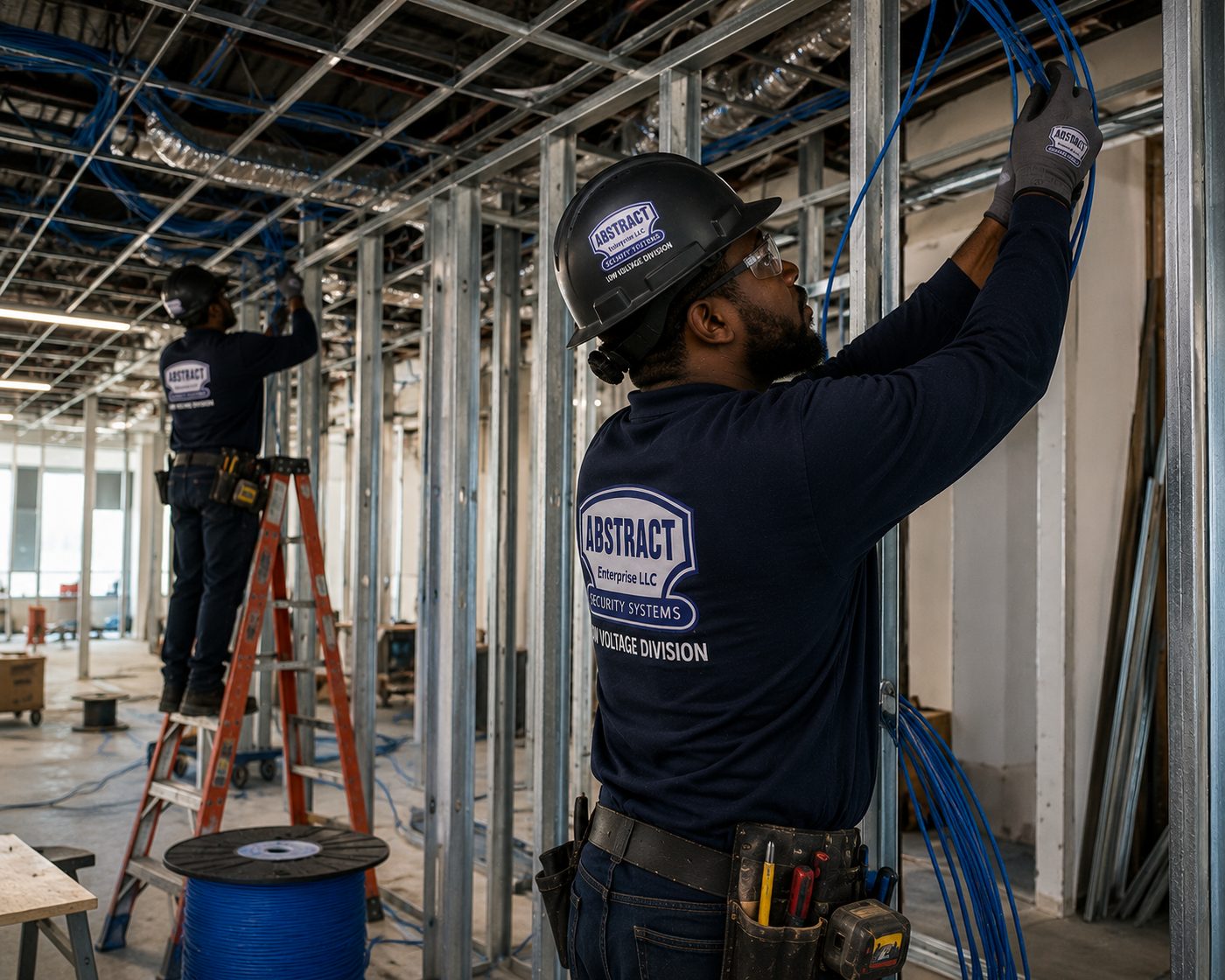
Cable pulled while the wall is still open, the cheapest cable on any job.
EQUIPMENT
Cable, Racks and Hardware We Standardize On
Solid copper only. Copper-clad aluminium marked as Cat6 runs hot under power and fails certification, and on a school or municipal job where a report has to be handed over, cable that will not certify is a problem you discover at the worst possible moment.
Cat6 Horizontal Cable
The working default for Nassau suite, retail and professional work. Dependable for gigabit and shorter 10G runs.
Cat6A Horizontal Cable
Cat6A installation carries 10 Gigabit to the full hundred-metre channel and handles higher PoE classes with less heat in a dense bundle. On the wide low-rise floorplates typical here, the distance headroom is usually the deciding factor.
Plenum, Riser and Shielded Jackets
Plenum CMP in air-handling ceilings, riser CMR in shafts, shielded where a run parallels heavy electrical. Code requirement rather than an upgrade tier, and one that a village inspector may look at.
Multimode and Single-Mode Fiber
Backbone between buildings on a campus or medical park, and any run past copper distance. Fiber carries no metal, avoiding the surge and ground-potential problems long copper suffers between separately fed structures.
Outdoor and Direct-Burial Cable
For runs crossing a parking area or lawn between buildings. Jacket rating and conduit decide whether the run survives, and spare capacity in the trench decides what the next addition costs.
Patch Panels, Racks and Management
Wall-mount frames where a tenancy has one closet, two-post racks where a building carries a proper main distribution frame. Panels, keystones, plates, management, UPS and grounding get specified closet by closet rather than assumed.
Support Hardware and Pathway
Hooks, tray, bridle rings, sleeves through rated assemblies and firestop at penetrations. Long pulls across an open ceiling want tray or closely spaced support.
Managed PoE Switches
Sized against the total the building will draw at once rather than the number of ports filled on day one. A classroom full of access points and a row of exterior cameras with heaters will find the ceiling of an undersized switch quickly.
Certification Testing
Wiremap and length on every drop as standard, with full TIA-568 certification on a Fluke DSX-class analyser wherever a district, a village or an insurer needs a report.
Equipment choices in Nassau County have moved steadily toward cloud platforms. Cloud access control with mobile credentials, touchless entry, smart intercoms, AI video analytics, license plate recognition and remote video monitoring all ride on the same structured cabling — Ethernet over Cat6 or Cat6A, with coaxial only where legacy plant survives. Smart building and IoT devices raise the PoE budget rather than the cable spec, and Wi-Fi 7 access points need Cat6A to be worth fitting.
Standard on Nassau County work: Cat6 cabling and Cat6A, fiber-optic cabling, Ethernet wiring and coaxial where legacy plant survives; network racks, MDF rooms and IDF closets; PoE infrastructure sized to the device count; audiovisual systems and integrated building systems where they share the pathway. As a low voltage systems integrator and low voltage wiring contractor we cover tenant buildouts, system takeover work and ongoing low voltage maintenance, including licensed low voltage installers for security wiring and structured wiring. To get a low voltage installation quote or a low voltage installation estimate, the survey is free.
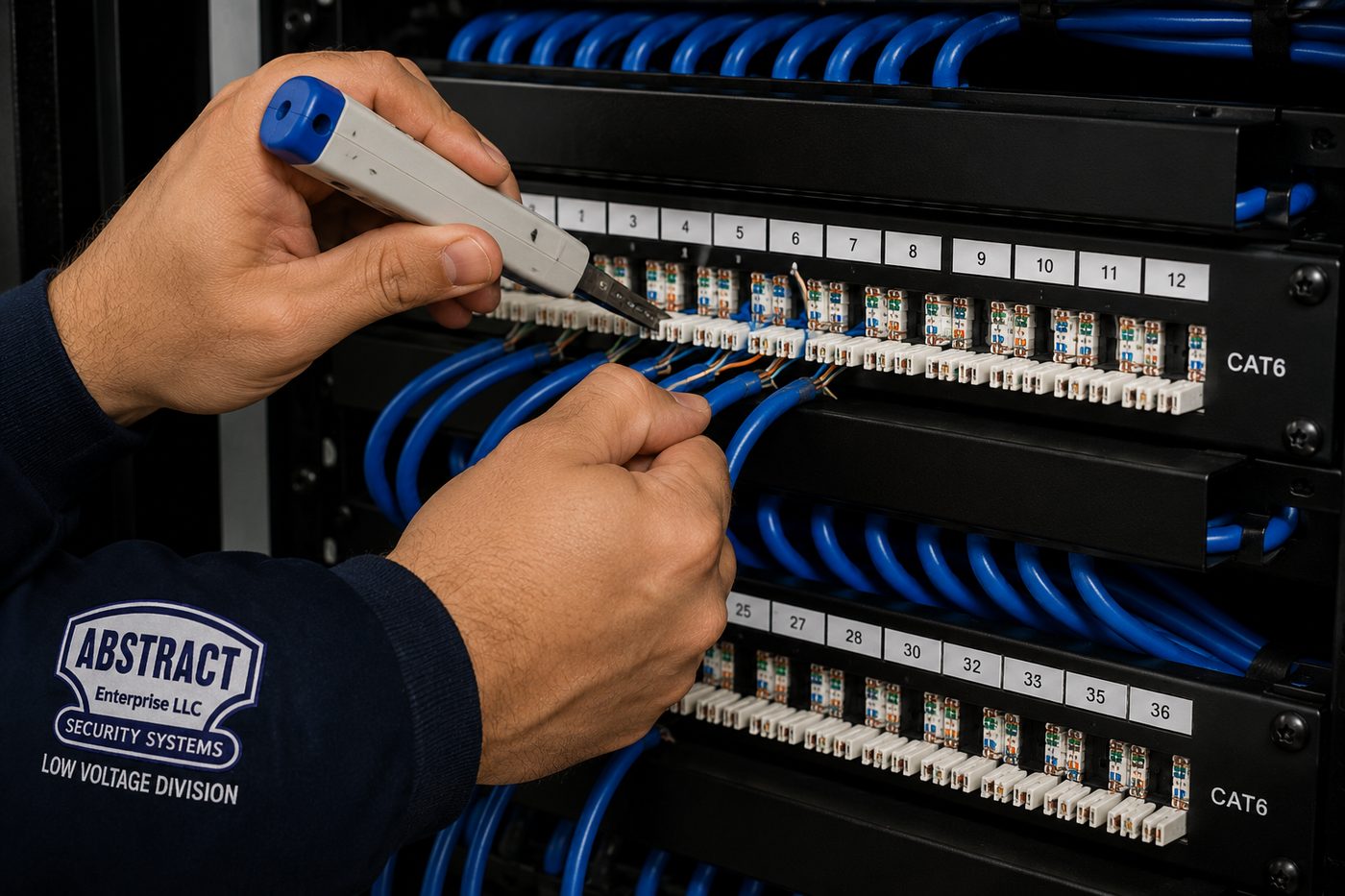
Horizontal cable punched to a numbered panel rather than direct to a switch.
TERMINOLOGY
Nassau County Low Voltage Terms, Translated
Most arguments over a cabling quote come from two parties using the same words differently. This is the vocabulary you need here, plus the jurisdictional terms that matter in a county with this many separate authorities.
Incorporated village. A municipality inside a town that runs its own government. Nassau has sixty-four of them, most with their own building department, and in many cases you deal with the village rather than the town for permits.
Unincorporated hamlet. An area with no village government, so the town’s building department and codes apply instead. Nassau has more than sixty.
Examining Board of Electricians. The body a town uses to licence electricians. Hempstead, North Hempstead and Oyster Bay each maintain their own, and a licence from one is not automatically a licence in another.
Reciprocity. Whether one municipality accepts another’s licence. Some Nassau villages accept the parent town licence and some do not, so it gets confirmed per job.
Drop. One run from closet to outlet, terminated both ends. Cabling is priced per drop, not per foot.
Home run. One cable from one device back to the closet with nothing shared along the way.
The hundred-metre channel. The end-to-end distance limit on a copper run, patch cords included. On a wide low-rise Nassau floorplate it decides how many closets a building needs.
MDF and IDF. Main distribution frame where service enters; intermediate frames serving other wings or buildings.
Patch panel. Where permanent cable ends and short patch cords take over, so switches change without re-terminating anything.
Punch-down. Seating each conductor into its contact. Done carelessly the drop works and never certifies clean.
Wiremap versus certification. A wiremap confirms every conductor is on the right pin. Certification measures length, crosstalk, return loss and delay against TIA-568 and prints a result per drop.
As-built. The closeout drawing and port map, and on district and municipal work usually a contract requirement rather than a courtesy.
A quick definition: low voltage installation in Nassau County: the design, installation, testing and documentation of limited-energy systems — also called extra-low-voltage or ELV systems, and sometimes electronic security systems or building technology systems. What a low voltage installer does is run and terminate the communications infrastructure a building needs, which is a different trade from line-voltage electrical wiring. The difference between Cat6 and Cat6A is bandwidth headroom and heat under PoE: Cat6A carries 10 Gigabit to the full channel where Cat6 does not.
A bundle brought down at a workstation position during fit-out.
COMMERCIAL LOW VOLTAGE
Where We Work Across Nassau County
The three towns
The county is physically divided among Hempstead, North Hempstead and Oyster Bay, plus the cities of Long Beach and Glen Cove. The Town of Hempstead contains twenty-two villages and thirty-seven hamlets; the Town of North Hempstead contains thirty incorporated villages and twenty unincorporated hamlets. A low voltage contractor in Hempstead, North Hempstead or Oyster Bay is working under three different sets of town-level arrangements before any village layer is added. Structured cabling in North Hempstead and data cabling in Oyster Bay proceed on entirely separate town requirements, and network cabling in Oyster Bay is no exception.
Mineola, Garden City and the county seat corridor
Structured cabling in Garden City and network cabling in Mineola cover the densest professional and medical concentration in the county, around Old Country Road, Franklin Avenue, Seventh Street and Stewart Avenue. Garden City is one of the villages that handles its own permitting rather than going through the town, which is exactly the kind of detail worth establishing on day one rather than day ten.
Great Neck, Manhasset and the North Shore
Data cabling in Great Neck and structured cabling in Manhasset along Northern Boulevard and Middle Neck Road serve professional suites, medical practices, retail and a substantial base of institutional property. Both are named among the villages running their own permits, and a low voltage contractor in Great Neck or network cabling in Manhasset works the highest concentration of separate village authorities in the county.
Hempstead, Westbury, Uniondale and the Nassau Hub
Network cabling in Westbury and structured cabling in Uniondale run through the county’s central commercial belt — Old Country Road, Hempstead Turnpike and the Nassau Hub area, with a mix of office, retail, institutional and school district property. Structured cabling in Hempstead itself covers village and municipal buildings alongside commercial tenancies, and data cabling in Uniondale extends across the Hub area.
Freeport, Rockville Centre, Valley Stream and the South Shore
A low voltage contractor in Freeport, Rockville Centre or Valley Stream, and structured cabling in Valley Stream in particular, means working in villages that trade sources list as maintaining their own licences or registration requirements on top of the town. Data cabling in Long Beach carries the same pattern plus a separate city licence, and coastal exposure matters for anything mounted outside.
Hicksville, Syosset and the eastern corridor
Network cabling in Hicksville and data cabling in Syosset along Broadway, Jericho Turnpike and the Route 110 corridor covers office, light industrial, retail and school district property as the county runs toward the Suffolk line, with structured cabling in Syosset serving the corporate and professional stock along it.
A ceiling tile out and a bundle brought through, which is most of what district work looks like.
INDUSTRIES
Who We Cable For in Nassau County
Medical and Dental Practices
Segregated closets, controlled access to infrastructure, tidy patient-facing spaces.
Professional Offices
Legal, financial and consulting suites where the closeout documentation matters as much as the install.
School Districts
Recess and summer windows, corridor and classroom cabling, district-set documentation standards.
Village and Municipal Buildings
Village halls, libraries and public safety facilities on village procurement rather than county.
High-bay runs from a lift, tray pathway, dock and gate wiring.
Multifamily and Co-Ops
Riser work, vestibules and common areas in occupied buildings.
Property Management
Portfolio standards across buildings that may sit in several different villages.
General Contractors
Low voltage as a subcontracted trade, with COI, schedule discipline and a closeout package.
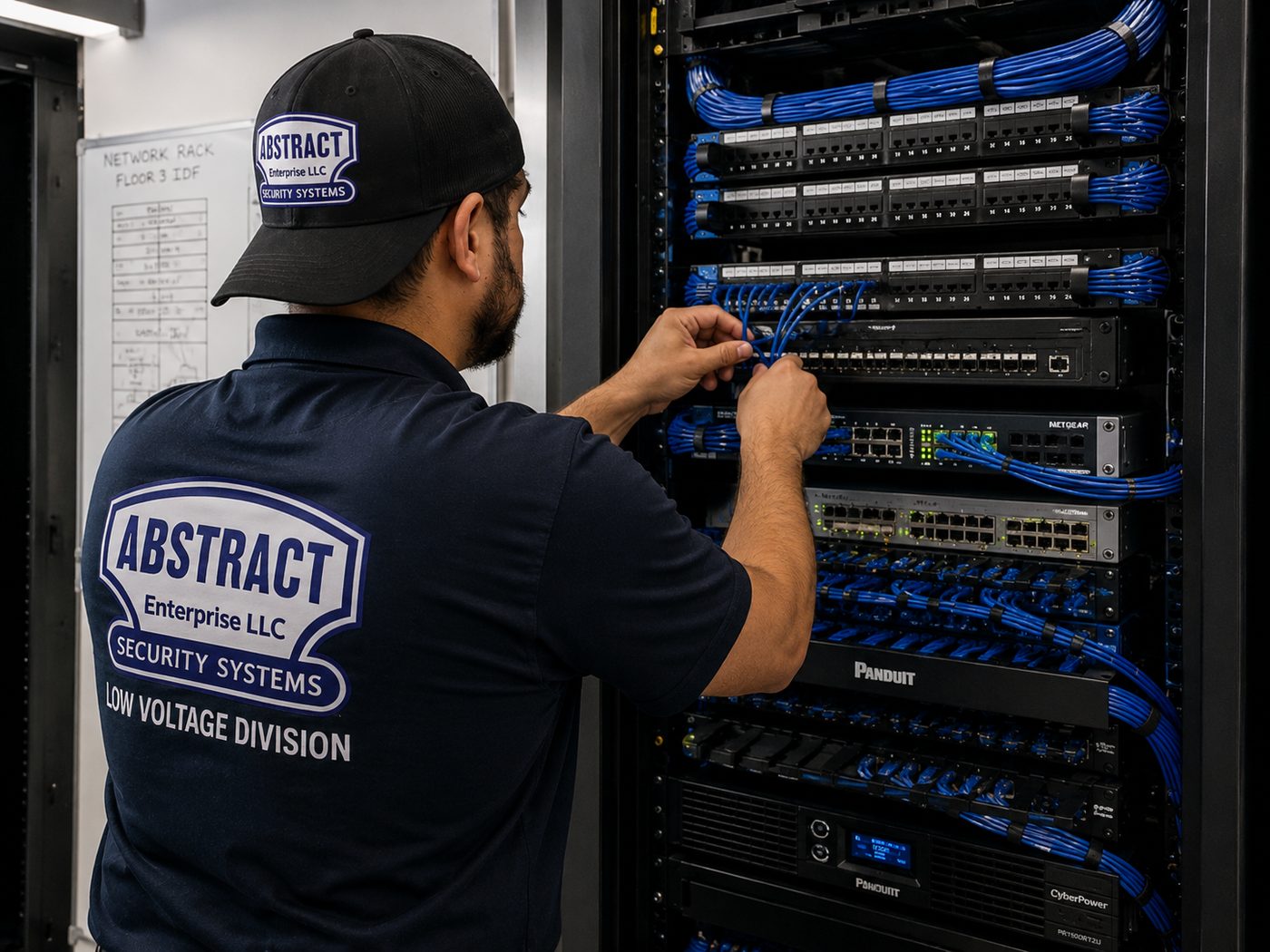
Patching in a floor IDF, with the rack map on the wall beside it.
HOW IT WORKS
How a Nassau County Low Voltage Project Runs
Establish the municipality first. Which town, which village, and whether that village runs its own building department. This governs everything downstream and takes one phone call.
Free on-site survey. Ceilings, closets, distances and existing pathway, plus whatever access arrangements the property has.
Distance and pathway plan. Runs measured against the hundred-metre limit, closet positions fixed, backbone route decided where more than one building is involved, firestopping identified.
Written scope and proposal. Drop count and locations, cable category and jacket rating per space, pathway method, closet and rack scope, testing level, labelling standard, documentation deliverable, the municipal position, and a written exclusions list.
Rough-in. Cable pulled on supported pathway with the correct jacket for each space, ideally before any ceiling or wall closes.
Termination. Keystones at the outlet, patch panel punch-down at the closet, rack dressed as it is built.
Testing. Wiremap and length on one hundred percent of drops, with full TIA-568 certification where a district, village or GC specifies it.
Labelling, as-built and closeout. Every cable labelled both ends, drawing and port map handed over, site left clean.
Start and completion timing turns on building conditions, equipment availability, access to the property, permitting where it applies, and how large the project is.
Every job starts with a free low voltage site survey and a written low voltage system design, and finishes with low voltage cable labeling, low voltage testing and documentation. When a drop dies, we handle urgent low voltage repair and emergency low voltage service the same way: low voltage troubleshooting first, then replace failed low voltage cabling or restore security system wiring rather than guessing. A low voltage technician in Nassau County carries the analyser to the first visit.
A rated exterior enclosure mounted and terminated, with conduit down to grade.
YOUR QUESTIONS ANSWERED
Low Voltage Installation in Nassau County: Your Questions Answered
Do I need a permit for low voltage work in Nassau County?
The low voltage permit question in Nassau County has no county-wide answer, and anybody who gives you one has skipped a step. Nassau contains two cities, three towns, sixty-four incorporated villages and more than sixty hamlets, and the county’s own Industrial Development Agency states that each of those municipalities has established its own zoning and building codes. In practice pure structured cabling frequently does not trigger a permit, but that shifts once work involves opening walls or ceilings, penetrating rated assemblies, or anything tied to a fire alarm panel. The reliable move is to identify the municipality and confirm with its building department. We do that before quoting rather than after.
Which low voltage license actually applies to my Nassau property?
The low voltage license question in Nassau County has no single answer, because there is no single Nassau County electrical licence. Trade sources describe the three towns — Hempstead, North Hempstead and Oyster Bay — each maintaining its own Examining Board of Electricians, with the City of Long Beach holding a separate licence, and a number of incorporated villages including Freeport, Rockville Centre, Valley Stream and Lynbrook operating their own licences or registration requirements. Some villages offer reciprocity with a parent town licence and some do not. Separately, security and fire alarm work is licensed at state level by the New York State Department of State regardless of municipality. Ask any bidder which specific jurisdictions they hold, not whether they are “licensed in Nassau.”
Our buildings are in three different villages. Does one contractor cover all three?
Sometimes, and it is worth checking rather than assuming. Because village requirements vary and reciprocity is inconsistent, a contractor cleared for one municipality is not automatically cleared for the next. For a portfolio owner this is a per-property question, not a per-county one, which is why we scope multi-site work building by building rather than quoting a blanket rate across a Nassau package.
Why does my village handle permits instead of the town?
Because incorporated villages in Nassau largely run their own building departments. Trade guidance specifically names Garden City, Great Neck and Manhasset among villages handling their own permitting rather than routing it through the town. If your property sits inside an incorporated village, the village is usually your point of contact; if it sits in an unincorporated hamlet, the town is.
How much does low voltage installation cost in Nassau County?
Structured cabling cost in Nassau County starts from published per-drop rates rather than a range. Cat6 installation cost in Nassau County begins at $175 for a data or voice drop, $250 for Cat6A, with a $500 minimum job. Independent industry guides put commercial Cat6 in a national band of roughly $125 to $400 per drop fully installed and tested, and note that labour rather than cable drives the number. What moves a Nassau figure is distance across a wide floorplate, whether ceilings are accessible, and whether the job crosses between buildings on a campus or medical park.
How far can a run go across a low-rise building?
One hundred metres end to end including patch cords, and on the wide single-storey floorplates common here that limit arrives sooner than people expect. It is the constraint that decides whether a building needs one closet or two, and that decision moves a budget more than the per-drop rate does. Measured on survey it costs nothing to resolve; discovered after termination it costs a second closet and a second set of terminations.
Can you work around a school district calendar?
Yes, and across Nassau it is routine. District work is scheduled into recess and summer windows, which is a hard calendar with no flexibility in it. Corridor and classroom cabling, AP coverage that holds in a full room, and a closeout package the district technology department can actually work from afterwards. The scheduling constraint is the real one here; the cabling is the straightforward part.
Our medical practice is consolidating three offices. What changes?
Usually the documentation standard and the closet. Independent practices often ran without an as-built and with a closet that grew organically. A group or health system typically expects certification records, a labelled port map and a rack that somebody else can work in. That is worth pricing deliberately rather than discovering at handover, and it is frequently the difference between two quotes on the same drop count.
We have several buildings on one parcel. How does that change the design?
It moves the centre of gravity to backbone. One building carries the main distribution frame, the others get intermediate frames, and fibre between them is the spine of the plant. Fibre rather than copper because it carries no metal, which sidesteps surge and ground-potential problems between structures on different electrical services. Where a route crosses open ground, conduit goes in with spare capacity, because reopening it costs what it cost the first time.
Is the cabling already in this building worth keeping?
Frequently, and it is worth establishing before anybody orders new material, because pathway is the expensive half of the plant. Certification comes first: carrying an untested run forward is how a new system inherits somebody else’s fault and then absorbs the blame. Anything that certifies clean and terminates where you need it stays, and the proposal names which runs those are.
Our electrician is licensed in this town. Can they do the data cabling?
Low voltage vs electrician in Nassau County is the comparison we field most often. An electrician is the right trade for line voltage and many will pull Cat6 competently. The question is whether they carry a certification analyser, work to TIA-568 rather than to power-wiring habit, and hand over a labelled port map and as-built. There is a local wrinkle too: because electrical licensing here is town and village specific, an electrician cleared for one municipality may not be cleared for the building you actually need work in.
If you are comparing several structured cabling companies rather than choosing a trade, ask any data cabling installers you shortlist for the same nine lines — drop count and locations, cable category and jacket rating per space, pathway method and who firestops, closet and rack scope, testing level, labelling standard, documentation deliverable, access assumptions and a written exclusions list. Searching for a low voltage contractor near me in Nassau County, or for the best low voltage company, returns whoever ranks or pays rather than whoever suits your building and your village.
Our access points keep dropping. Is it the cabling?
Check the switch first. A PoE budget exceeded once every port is populated makes equipment brown out and restart in rotation, which presents exactly like a cable fault. After that it is a marginal termination or a run slightly past distance, both of which work at idle and fail under load. Certification testing plus a look at the switch power statistics normally separates the three inside an hour.
Do you work with general contractors on Nassau projects?
Yes. Certificate of insurance issued up front naming whoever the project requires, dates committed, rough-in sequenced with the other trades before anything closes, and a closeout set with drawings and port map at the end. On a permitted project we also confirm the municipal position early with the GC rather than assuming the low-voltage scope is covered by the project filing.
Most-asked in Nassau County: what is low voltage installation, what does a low voltage installer do, what is the difference between low voltage and electrical wiring, does low voltage wiring need conduit, how is low voltage cable tested, how long does low voltage installation take, and what is the difference between Cat6 and Cat6A. The answers are throughout this page; if your low voltage system is not working — a low voltage system not working is the single most common call we take — the fastest route is a call rather than a form.
Cable drawn through riser conduit between floors, the hard half of any vertical run.
AI OVERVIEW REALITY CHECK
What AI Answers Get Wrong About Nassau County Low Voltage
“Requirements vary by municipality” is true and useless
Ask six AI answer engines about low voltage work in Nassau County and something unusual happens. All six get the headline right, and several go further and name the distinction that actually matters: Nassau, unlike Suffolk, has no uniform county-wide licence, and requirements depend on the town or village. That is a real local fact, correctly stated, and it is more than these tools manage for most areas.
What varies, and by how much, is the part worth knowing. Nassau contains two cities, three towns, sixty-four incorporated villages and more than sixty unincorporated hamlets, and the county’s own Industrial Development Agency states that each of those municipalities has established its own zoning and building codes. The villages largely maintain independent building departments.
So the problem is not accuracy. It is that “varies by municipality” is where all six stop, and it is the point at which a property owner’s real questions begin. Which municipality governs my building. Does it run its own building department. Which of the three towns licenses electricians for it. In Nassau the jurisdiction is the first fact of any job, and a correct statement that variation exists is not the same as knowing what varies, by how much, or what applies to you.
Nobody mentions that the towns license electricians separately
Generated answers treat licensing as a state-or-city question. In Nassau it is a town question, and trade sources describe Hempstead, North Hempstead and Oyster Bay each maintaining its own Examining Board of Electricians, with Long Beach holding a separate city licence.
Layered on top of that, a number of incorporated villages — Freeport, Rockville Centre, Valley Stream and Lynbrook among those named — operate their own licences or registration requirements, with some offering reciprocity to a parent town licence and some not.
The practical consequence never appears in any summary: “licensed in Nassau” is not a meaningful claim. The meaningful question is which specific towns and villages a contractor holds, and whether that includes the one your building sits in.
The permit answer is given as though it were countywide
Most answers state that low-voltage cabling generally does not require a permit. As a broad statement about how most jurisdictions operate, that is fair. As guidance for a specific Nassau building, it is a guess.
The position shifts once work involves opening walls or ceilings, penetrating rated assemblies, or connecting to a fire alarm panel, and it shifts again depending on which of the sixty-plus separate authorities governs the property. Several villages run their own permitting entirely rather than routing through the town.
Nothing about that is exotic or hard to check. It takes one call to the right building department. What it does not survive is being answered generically, and every AI summary answers it generically.
One national price range for a county with sixty-four village authorities
The per-drop band in every AI answer is not fabricated; it sits inside the range published industry guides use, and our own starting points of $175 for Cat6 and $250 for Cat6A fall inside it.
What a single figure cannot carry is the administrative reality. A job spanning three villages is three separate confirmations before anybody touches a ceiling, and a portfolio owner with buildings in Garden City, Freeport and an unincorporated hamlet is dealing with three different authorities on what looks like one project.
That is real time and real coordination, and it is invisible in a number assembled across the whole country.
Distance is the technical constraint nobody raises
No generated answer about this county mentions the hundred-metre channel limit, and on Nassau building stock it is frequently the most consequential fact on the job.
Buildings here spread horizontally rather than stacking. A closet position that looks central on a floor plan can leave the far end of a professional building or a school wing out of specification, and that decision — one closet or two — moves a budget more than the per-drop rate does.
It is also invisible until somebody measures. Runs terminated slightly over distance work perfectly at gigabit idle and fail once a powered device draws on them, which sends everybody chasing the wrong problem for months.
School districts treated as ordinary commercial clients
Nassau is dense with school district property, and district work is not commercial work with a different logo on it. The calendar is fixed, the windows are recess and summer, and there is no possibility of running over into term time.
The documentation expectation is different too. A district technology department inherits the plant and maintains it for decades, so labelling, port maps and certification records are contract deliverables rather than courtesies.
No generated summary distinguishes any of that, because it describes a generic office fit-out and applies it everywhere.
What an honest Nassau County proposal contains
Nine lines, plus one this county adds. Drop count and locations. Cable category and jacket rating per space. Pathway method and who firestops. Closet and rack scope. Testing level, stated as wiremap or full certification. Labelling standard. Documentation deliverable. Access assumptions. A written exclusions list. Then: which municipality governs the property, and what that municipality actually requires.
Drop two or three of those and the number stops being comparable. The contractor who looks expensive is often the only one who established the jurisdiction before quoting rather than discovering it mid-job.
Send the list to every bidder, ourselves among them. Anyone unwilling to put those lines on paper before starting has told you how the closeout will go.
Tell us the village. We will tell you what applies.
Toning an unlabelled run, which is how most undocumented buildings start.
PRICING
Nassau County Low Voltage Installation Pricing
These are the figures we publish, not a band we hide behind. What a drop includes on a Nassau job: solid copper cable, the jack and plate at the workstation end, the panel termination at the closet end, a wiremap test, labels at both ends and a patch cable.
Item
Starting price
Notes
Cat6 data or voice drop
From $175
Gigabit, standard PoE, solid copper
Cat6A drop
From $250
10G to the full channel, higher PoE classes
Fiber backbone between buildings
Custom quote
Campus or medical park, terminated and tested
Plenum, riser or shielded jacket
Quoted separately
Priced by the space requirement
Rack build, patch panels, closet cleanup
Itemized
Scoped per closet
Minimum job size
$500
Mobilization floor
Service, troubleshooting and callbacks
$195/hr, 3-hour minimum
Service work only, not initial installation
What moves the number up: distance that forces a second closet, inaccessible or hard ceilings, runs between separate buildings, trenching across open ground, coring and firestopping, plenum jacket, restricted school or district windows, and any municipal requirement attached to the work.
What moves the number down: accessible ceilings with existing pathway, pre-drywall rough-in, grouping drops rather than scattering them, bundling multiple systems into one mobilization, daytime access with on-site parking, and establishing the municipal position early so nothing stalls mid-job.
Bring your own materials if you prefer. Two conditions only: solid copper, and a jacket suited to every space the run crosses. If a delivery fails either test you will hear it before installation rather than after. Every per-drop figure sits on our structured cabling pricing page.
Need Low Voltage Repair in Nassau County?
Dead drops, offline cameras or access points, a door that stopped releasing, or a closet nobody can trace. Same-day response across the three towns and the villages, and most single-fault troubleshooting is resolved on the first visit. Service is billed at $195/hr with a three-hour minimum.
One closet, roughly five Cat6 drops, panel-terminated and tested. Suits a dental practice, a storefront on Hempstead Turnpike or a small professional suite. Arithmetic on the published $175 rate.
Standard
From $1,750 installed
Around ten drops with a wall-mount rack build, panel and closet dress-out. The common shape for a Mineola or Garden City professional suite. Arithmetic on the published $175 rate; Cat6A from $250.
Premium
From $5,250 installed
Twenty-one Cat6A drops or more, plus fibre between buildings, a full rack build and certification with drawings. Where most school district and campus work lands. Arithmetic on the published $250 rate.
Each figure above is the published rate times the drop count next to it — no hidden assumptions and no quote implied. Distance, ceiling access, backbone between buildings, trenching, coring, firestop, restricted district windows and certification all shift the real number, which comes out of the survey. The floor on any job is $500.
Already bought your cable and hardware? Ask about a bring-your-own-equipment (BYOE) install — labour-only pathway, pulling, termination, testing and labelling of materials you supply, provided the cable is solid copper and correctly jacket-rated for the space.
No lease, no subscription, nothing recurring — what goes in belongs to the building. Three years on anything we supply. Later visits and callbacks run at $195/hour against a three-hour minimum, which is $585.
Switch configuration at the rack, with PoE budget checked against the device count.
LOCAL PROBLEMS
Low Voltage Problems Specific to Nassau County
The wrong jurisdiction assumed. A job scoped against the town when the property sits in an incorporated village with its own building department, or the reverse. Costs a delay rather than money, but always at the worst point in the schedule.
A contractor cleared for one municipality, not the next. Licensing here is town and village specific, and reciprocity is inconsistent. It surfaces when a portfolio owner assumes one vendor covers everything.
Distance nobody measured. A closet placed where a room happened to be, and the far end of a wide low-rise floorplate past the hundred-metre channel.
District work squeezed into a recess window. An academic calendar has no give in it, and scope that was not surveyed properly turns into a district starting term with an unfinished network.
Consolidating practices inheriting undocumented plant. Three independent offices merging, none with an as-built, and a new group standard that expects certification records nobody has.
Campuses cabled building by building. Several structures on one parcel wired independently, no backbone, and a network that never behaves as one.
Growth past the switch’s power ceiling. A district adds access points a wing at a time, or a practice adds cameras, and eventually the combined draw exceeds what the switch can deliver. Everything starts cycling and the cabling gets blamed.
Coastal exposure on the South Shore. Anything mounted outside or below grade near the water needs rating chosen for the environment rather than for a carpeted suite.
A final Nassau County observation. Should low voltage wiring be installed in conduit? Only where the space or the code requires it — conduit pathways, cable trays and NEMA enclosures are specified per environment, not by default. Can existing low voltage wiring be reused? Frequently, once it certifies. Electrician vs low voltage installer, or security company vs low voltage contractor, comes down to the same test: who carries the analyser and hands over the documentation. We also fit AI security camera systems, touchless access control and license plate recognition where a site wants them, and schedule school-break, back-to-school and holiday work around the calendar that governs the building. To get a low voltage installation quote in a working day, ask for the free survey; we work as a low voltage security installer as well as a cabling contractor.
FIELD NOTES
Field Notes from Nassau County
Ask which village before anything else. It is the first question on every Nassau call, and it decides more than any technical detail that follows. Sixty-four incorporated villages means sixty-four possible answers, and guessing has never once been faster than asking.
Measure the far end. Wide low-rise buildings put the hundred-metre limit in play far sooner than people expect. The measuring wheel settles the closet count before anybody argues about it.
Book district work early and hold the date. Summer and recess windows fill months in advance, and a slipped start on a school job cannot be recovered by working late — the building simply becomes unavailable.
Leave documentation the client can hand to somebody else. Practices consolidate, districts change staff, villages change vendors. The as-built and port map are what survive all three.
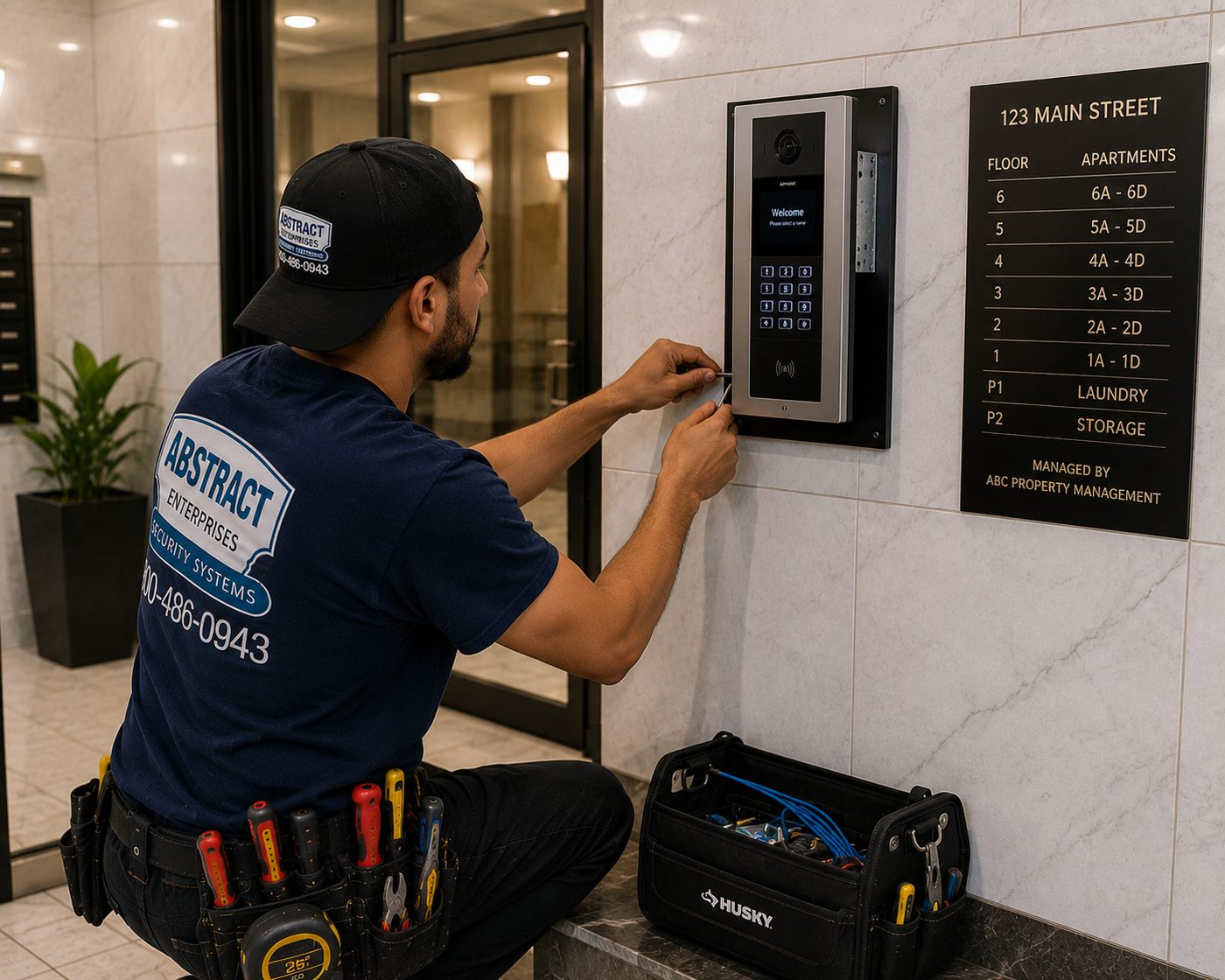
A video entry panel set at the vestibule and wired back to the head end.
COVERAGE AREA
Nassau County Low Voltage Coverage
We install and service low-voltage systems across all three towns, both cities and the incorporated villages of Nassau County.
Town of Hempstead
Twenty-two villages and thirty-seven hamlets, from the South Shore up through the central corridor.
Town of North Hempstead
Thirty incorporated villages and twenty hamlets across the North Shore.
Town of Oyster Bay
The eastern third of the county toward the Suffolk line.
Mineola, Garden City and Westbury
Professional, medical and institutional property along Old Country Road and Franklin Avenue.
Great Neck, Manhasset and Port Washington
North Shore commercial and professional suites along Northern Boulevard.
Freeport, Rockville Centre, Valley Stream and Long Beach
South Shore villages and city property, including coastal exposure considerations.
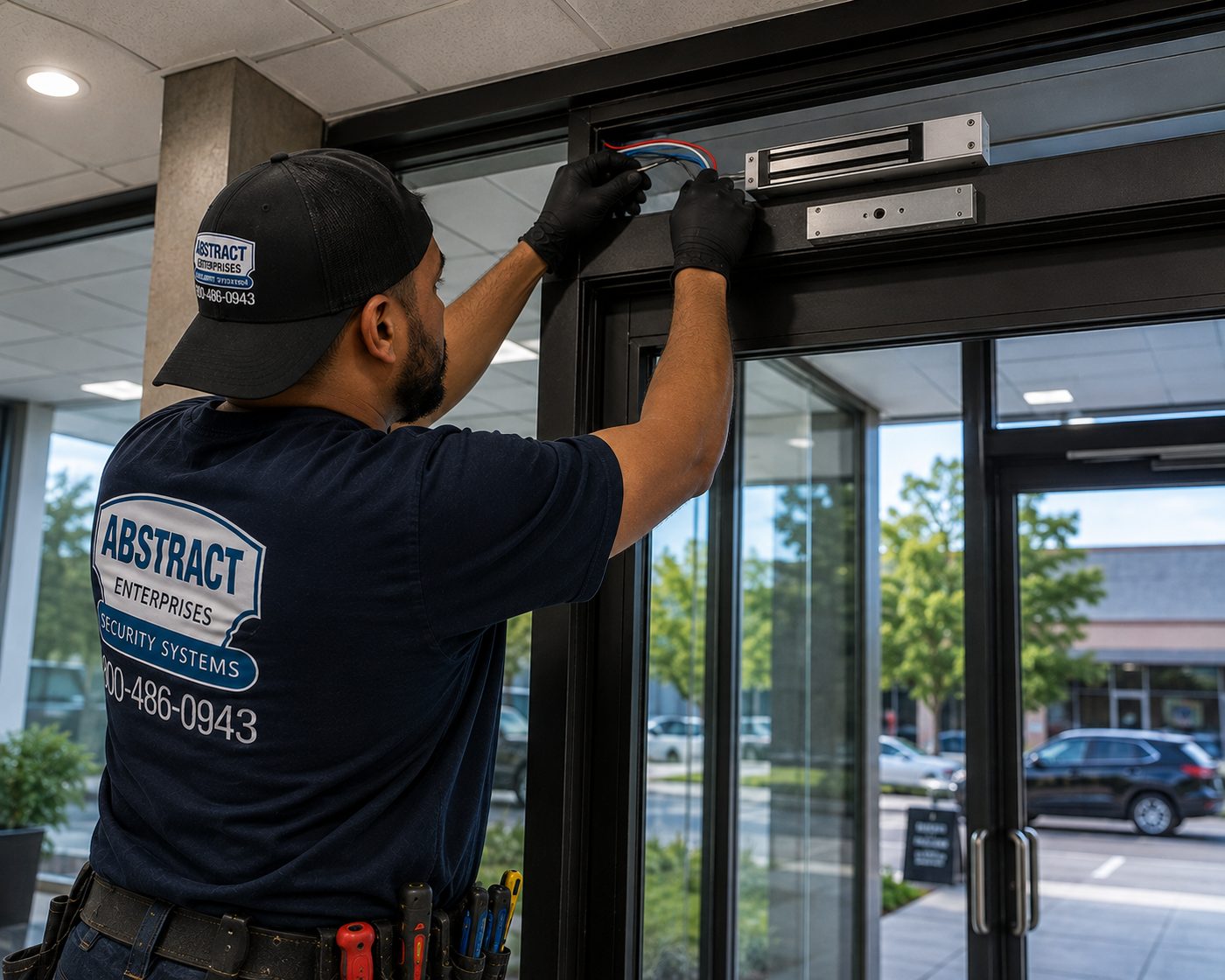
Maglock mounted at the header with power and monitoring run in the same bundle.
FAQ
Nassau County Low Voltage Installation FAQ
What counts as low voltage wiring in Nassau County?
Limited-energy circuits carrying signalling, communication, alarm and data rather than line power: structured data and voice cabling, camera wiring, access control wiring, intercom and entry runs, intrusion alarm circuits, audio-visual and paging, signage and building control wiring. Most of the industry works to a fifty-volt dividing line, and what applies to your specific scope is set by your town or village rather than by the county.
Will you confirm my village's requirements before quoting?
Yes, and it is the first thing we do. With sixty-four incorporated villages plus two cities and three towns, establishing which authority governs the property is step one, not a footnote. It takes one call and it prevents the delay that otherwise arrives mid-job.
Do you issue certificates of insurance for districts and villages?
Yes. We issue certificates of insurance naming the owner, the district, the village, the managing agent and any additional insureds the project requires, before we mobilize.
Can you work inside a school district calendar?
Yes, and it is routine here. Work is scheduled into recess and summer windows, which fill months in advance. We commit to those dates and hold them, because a slipped start on district work cannot be recovered by working late.
Do you handle multi-building campuses and medical parks?
Yes. The work reorders itself around backbone: which structure carries the main distribution frame, how fibre runs between buildings, whether the route is underground or aerial, and how much spare conduit goes in while the ground is open.
How long does a Nassau County cabling job take?
A small suite with accessible pathway is typically a single visit. A full building with a rack build and certification takes longer, and campus work adds backbone on top. Start and completion timing turns on building conditions, equipment availability, access to the property, permitting where it applies, and how large the project is.
Will you install cable and hardware we bought?
Yes, after two checks. It has to be solid copper, and the jacket has to suit every space the run crosses. Copper-clad aluminium is turned away at delivery rather than found at certification. Materials stay under the supplier’s warranty; our labour warranty is unaffected either way.
Do districts and villages require a test report?
Wiremap and length testing is performed on one hundred percent of drops as standard. Full TIA-568 certification with a Fluke DSX-class analyser, delivered as printed and digital records per drop, is available as a priced line and is normally specified on district, municipal and health system work.
What closeout documentation do we receive?
Both ends of every cable labelled against a scheme the port map matches, the as-built drawing, the port map, configuration notes and a digital closeout set. On district and municipal work this is usually a contract deliverable rather than a courtesy.
What do you charge to diagnose a system you did not install?
Service, troubleshooting and callback work on systems not originally installed by us is billed at $195 per hour with a three-hour minimum. That rate applies to service calls, not to initial installation projects, which are quoted by scope from a free survey.
What does the Nassau County warranty cover?
Abstract Enterprises Security Systems provides a three-year warranty on products supplied by us. There are no monthly fees on the systems we install.
Will you take on a system another contractor installed?
Yes, starting with an assessment rather than a quote: which runs certify, what the existing hardware can carry, whether cable already in place can be reused, and where the previous scope fell short. On an older Nassau building the pathway is frequently in better condition than the equipment hanging off it.
Still deciding? The survey is free and settles it.
Dead drops, offline devices, or a closet nobody documented. Most single-fault calls are diagnosed and resolved on the first visit, and we leave you with a labelled port map so the next call is faster. $195/hr with a three-hour minimum for service and callback work.
Request Your Free Nassau County Low Voltage Survey
Tell us the property, the town or village, and roughly how many drops. If you are not sure whether your village handles its own permitting, that is exactly the kind of thing we establish before quoting.
Abstract Enterprises Security Systems provides a three-year warranty on products supplied by us. Service, troubleshooting and callback work on systems not originally installed by us is billed at $195 per hour with a three-hour minimum; that rate applies to service calls rather than to initial installation projects. There are no monthly fees on the systems we install. Start and completion timing turns on building conditions, equipment availability, access to the property, permitting where it applies, and how large the project is.
Municipal structure figures on this page cite Nassau County and Nassau County IDA published sources. Licensing and permitting descriptions draw on trade and industry references and are provided for general information about how the county is organised; they are not legal advice and do not describe any specific municipality's current requirements. Confirm what applies to your building with your town or village building department.
ALL AREAS SERVED
Low Voltage Installation by Area
The full set of areas in this silo. Anywhere without its own low-voltage page is served on identical terms, and the link books a survey.
Reviewed and updated August 12, 2026 by Anwar Timothy of Abstract Enterprises Security Systems, NYS Low-Voltage Electrical Contractor License #12000287431. Changelog — Aug 2026: page published for Nassau County. · Aug 2026: municipal structure section written against Nassau County and Nassau County IDA published figures. · Aug 2026: town and village licensing guidance added for the three towns, two cities and sixty-four incorporated villages.