Structured cabling, camera and access control wiring, intercom and entry runs, fiber risers, MDF and IDF closets, certification and as-built documentation — installed by a NYS-licensed low-voltage contractor who works Manhattan buildings on their own terms: COI first, freight booked, after-hours where the building requires it.
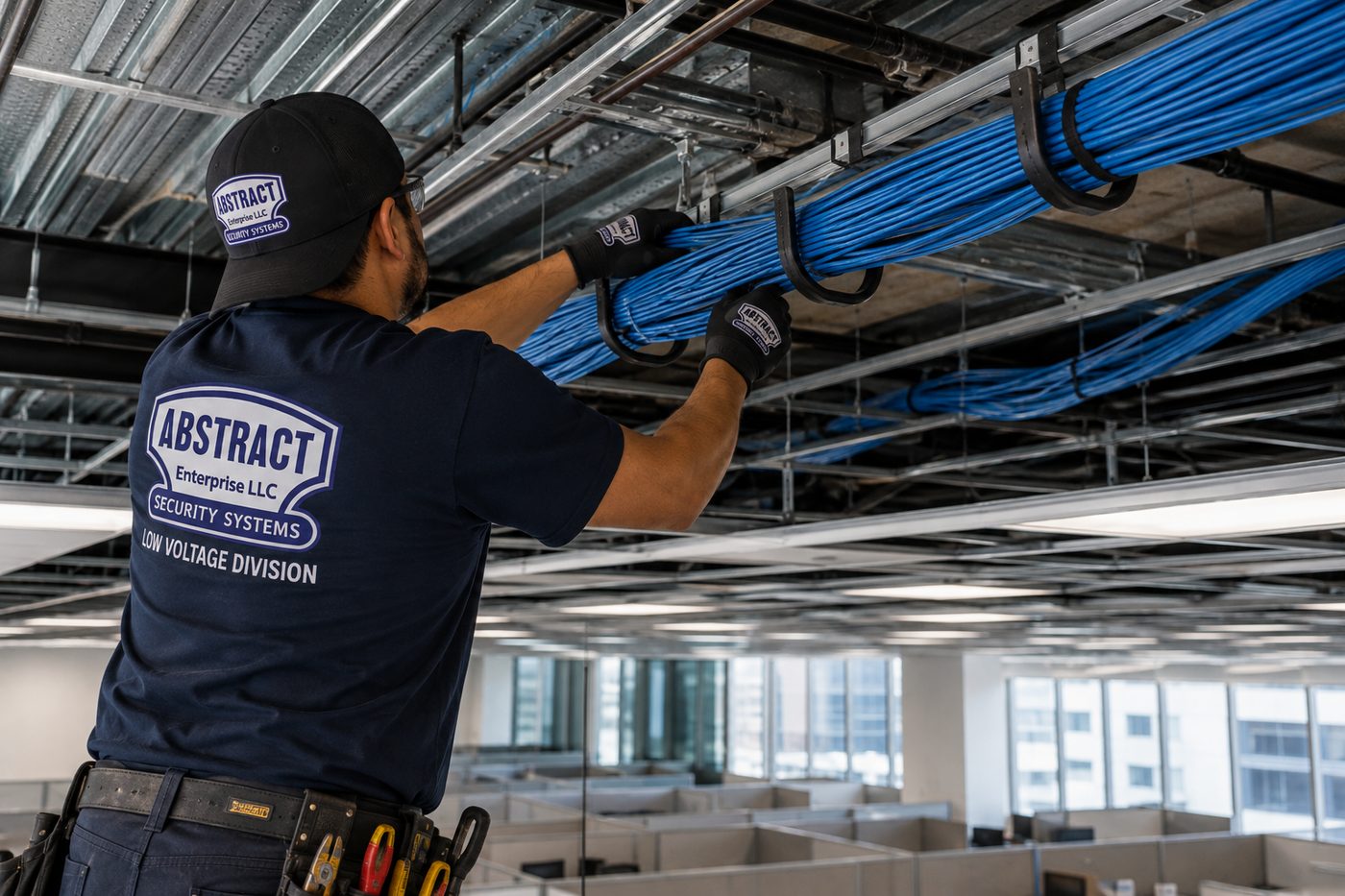
Low voltage installation in Manhattan: supported pathway built out across a tower floorplate before the workstations arrive.
Serving Manhattan from the Financial District to Harlem.
Reviewed and updated August 12, 2026.
Request a Free Manhattan Low Voltage Survey
THE NEIGHBORHOOD
In Manhattan the Building Decides the Schedule
Low voltage is the limited-energy wiring a building runs on: data and voice cabling, camera home runs, reader-to-controller wiring behind a controlled door, entry and intercom runs, alarm circuits, paging and AV, the fiber tying floors together, and the closets where all of it lands. New York City defines it formally in Administrative Code §28-101.5 as wiring designed to operate at less than 50 volts for signalling, communication, alarm and data transmission circuits.
What separates a Manhattan job from the same job anywhere else is that the technical work is rarely the hard part. Access is. A Class A tower will want a certificate of insurance naming the owner, the managing agent and sometimes the lender, with the exact entity language they specify, before anybody badges in. Freight elevators are booked in advance and released in windows you either use or lose. Plenty of buildings restrict cabling work to nights and weekends outright. Common corridors need masonite and corner guards. Union buildings add their own labour conditions on top.
None of that is unreasonable and none of it is negotiable. It just means a Manhattan cabling schedule is built backwards from the building’s rules rather than forwards from the drop count, and a contractor who has not done that before will discover it on mobilisation day at your expense.
The second Manhattan constant is what is already above the ceiling. Occupied commercial space here has typically been fitted out three or four times, and each round of cable was abandoned rather than removed. Before a clean run can go anywhere, a route often has to be found through decades of orphaned wire that nobody holds a drawing for. On conversion projects this becomes the job rather than a complication.
Abstract Enterprises Security Systems is a licensed low voltage contractor in Manhattan and a structured cabling contractor across NYC working Manhattan buildings from the Financial District to Harlem. Every proposal follows a free on-site survey.
No monthly fees and a three-year warranty on equipment we install.
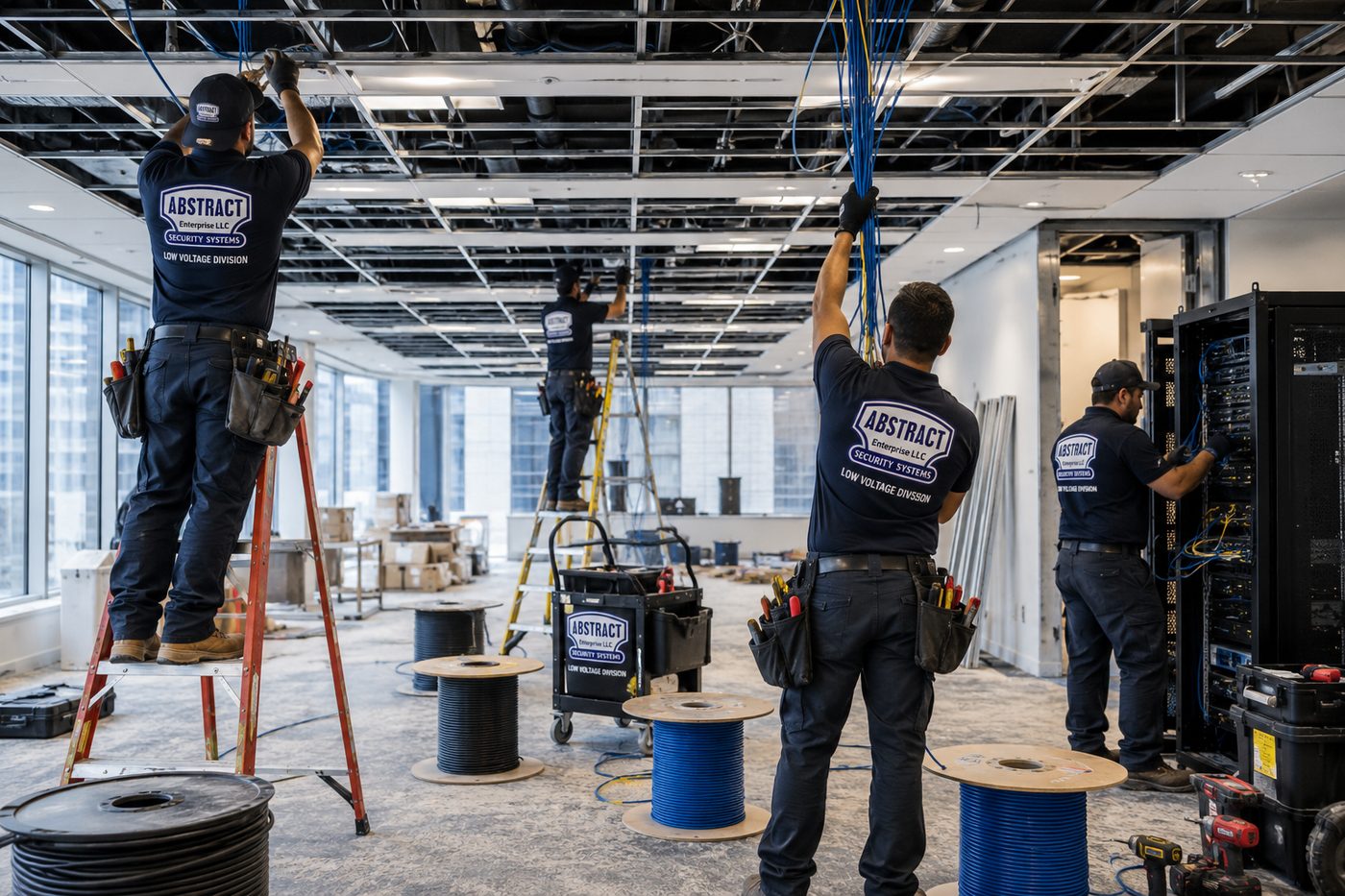
A full crew on an open-ceiling fit-out, pulling and racking in the same mobilisation.
WHAT WE INSTALL
Commercial Low Voltage in Manhattan: Systems We Cable
Each of these is scoped against the same three questions on a Manhattan job: what the pathway takes, what the building will let us do and when, and what documentation the managing agent expects at closeout.
Voice and Data Cabling
Commercial data cabling in Manhattan and network cabling in Manhattan run floor to closet, with office network cabling in Manhattan the everyday tenant version. Cat6 and Cat6A data cabling NYC tenants ask for most, run from workstation to closet, terminated on a patch panel, wiremapped and labelled both ends. Cat6 installation in Manhattan is routine work; Cat6A goes in where the lease horizon or device load justifies it.
Wireless Access Point Drops
Ceiling and wall AP drops placed for coverage through a floorplate broken up by cores, columns and glass demising walls, on cable rated for what the access point actually draws.
Camera Cabling
Home runs from each position back to the recorder or PoE switch, with distance and switch power budget confirmed before anything is drilled. Security camera installation in Manhattan is handled by the same crew.
Access Control Door Wiring
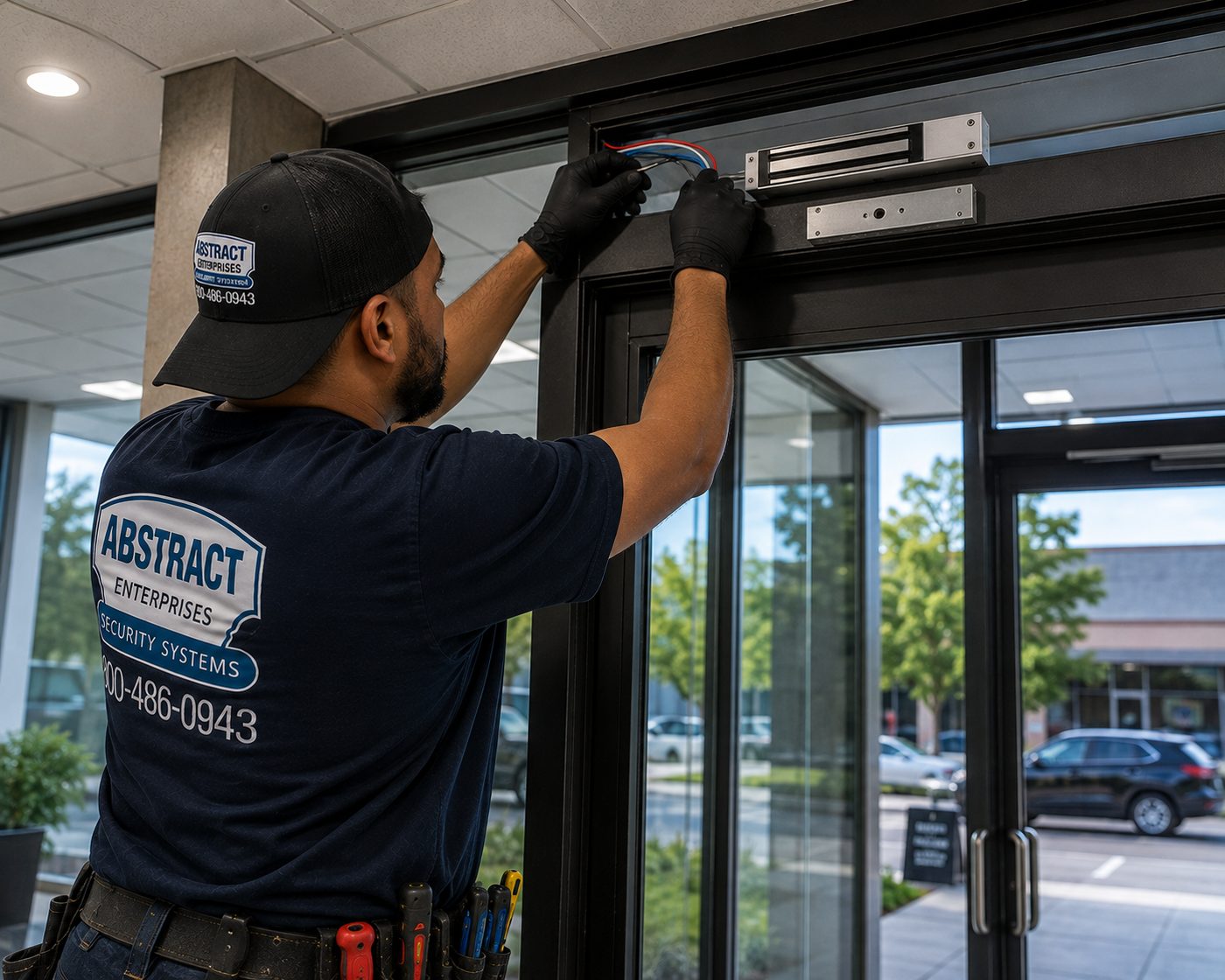
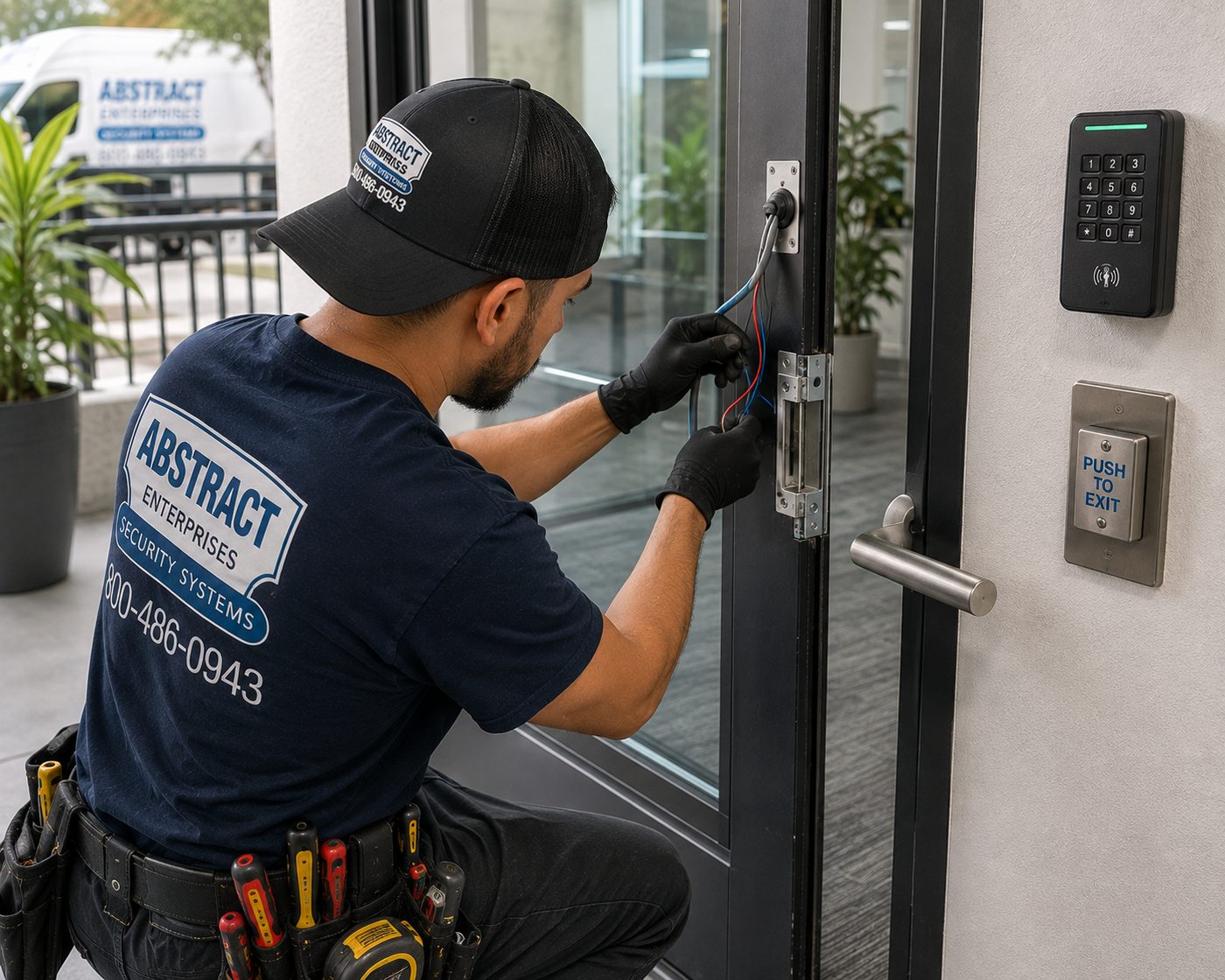
Access control installation in NYC shares the data plant’s pathway: reader-to-controller runs, lock power home runs, request-to-exit and door position wiring pulled as one bundle. See access control installation in Manhattan.
Scoped and priced as its own line rather than absorbed silently into a fit-out. On a floor that has turned over repeatedly this is frequently the work that has to happen before any new run can go in.
Fiber Risers
Fiber optic cabling in Manhattan is mostly vertical — backbone between floors and to the demarc, where copper distance is exceeded or where a run crosses electrical services. Riser penetrations generally need written landlord approval first.
AV, Paging and Signage
Conference room floor boxes, display and signage drops, paging zones and the extension pathways that carry video over twisted pair.
Closets, Racks and Re-Dress
Server room cabling in Manhattan starts here: two-post and wall-mount rack builds, patch panel and switch mounting, management, UPS, grounding, and full re-dress of shared telecom rooms that grew without a plan.
Most cabling packages we install pair with access control on the same mobilisation — one COI, one freight booking, one set of pathways.
One crew, one scope: surveillance cameras, access control readers, magnetic locks and electric strikes, video intercoms, intrusion alarms, paging systems, conference-room systems and digital signage — plus the cable pathways, riser cabling and backbone cabling that feed them, the equipment racks and network closets they land in, and the cable termination, cable certification, system commissioning and as-built documentation that close the job out. Low voltage services in Manhattan cover telecommunications wiring and building automation as one commercial low voltage installer scope rather than several.
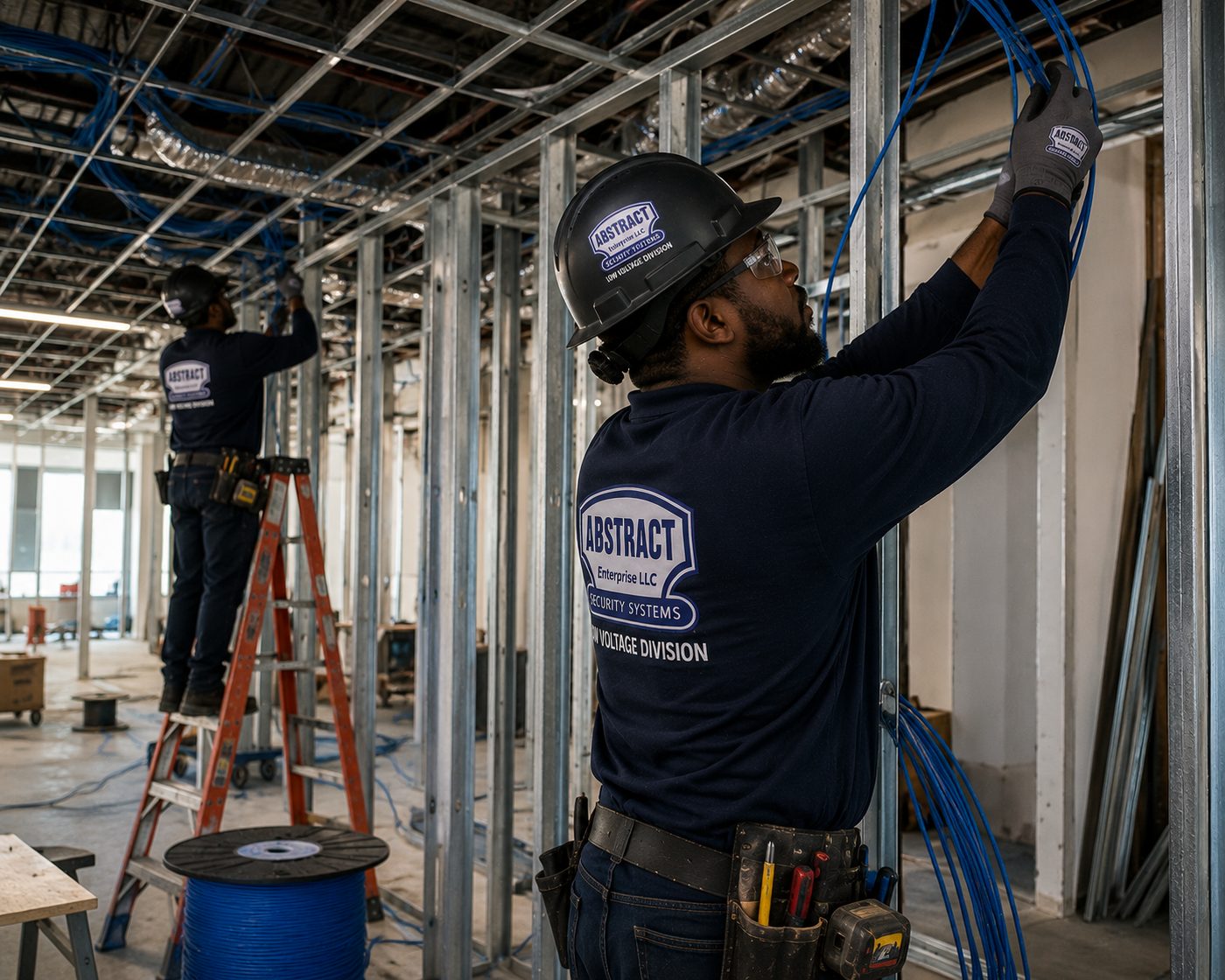
Cable pulled through framing while the walls are still open, the cheapest cable on any Manhattan job.
BUILDING SPECIALISTS
Cabling for the Way Manhattan Buildings Are Actually Built
Class A towers
The Hudson Yards and Penn District towers, the Park Avenue and Sixth Avenue stock, and the Third Avenue and Lexington Avenue corridors in Midtown East. Plenum ceilings, managing-agent standards, and an access regime that governs the whole schedule. Building management in this class routinely expects plenum-rated cable as a baseline, a stated pathway method, and test reports at closeout. Those expectations cost almost nothing to design for and a great deal to retrofit, which is the argument for having the low-voltage scope in the conversation at design stage rather than after the walls are framed.
Class B and older office stock
Where most of the interesting problems live — the Garment District blocks off West 36th to West 39th Street, the Flatiron and Union Square stretch of Broadway, and the older buildings along West 23rd Street and Tenth Avenue in Chelsea. Lower ceilings, tighter cores, telecom rooms shared across a full floor with no tenant separation, and pathway already occupied by whatever previous tenants left behind. The design question here is usually not how to run the cable but where there is still room to run it.
Office-to-residential conversions
An entire category of Manhattan project right now. Developers have been planning to start construction on roughly 9.5 million square feet of office-to-residential conversion this year, more than double the prior year’s conversion market, and the projects cluster Downtown and in Midtown. For low voltage the question is almost always inherited rather than new: what is above the ceiling, what can be reused, what has to come out, and who is paying to remove it. A floor leased four times has been cabled four times.
Pre-war lofts and landmarked interiors
Solid masonry, plaster over wire lath, no chase and frequently no accessible ceiling. Along Broome, Greene and Wooster Streets in the SoHo cast-iron blocks, around Franklin and Hudson Streets in Tribeca, and off Maiden Lane and Nassau Street in older Downtown lobbies the visually acceptable solution and the technically simple one are rarely the same solution, and surface raceway may not be permitted at all. These are pathway-first jobs where the routing gets agreed before anything is drilled.
Co-ops, condos and residential buildings
From Columbus Avenue and the Upper West Side up to 125th Street in Harlem: board approval on a schedule that is not the contractor’s, riser access in occupied buildings, and common-area work that has to look finished at the end of every shift rather than at the end of the job. Pre-war residential frequently has no vertical pathway designed for structured cabling at all, so getting from a basement demarc to an upper floor becomes a conversation about where a sleeve can go and what it is allowed to look like.
Retail, restaurants and ground-floor space
Point-of-sale reliability first, then back-of-house, then anything else. Work is sequenced around trading hours, and on a ground-floor unit under an occupied residential building the noise and access rules of the building above usually apply to you as well.
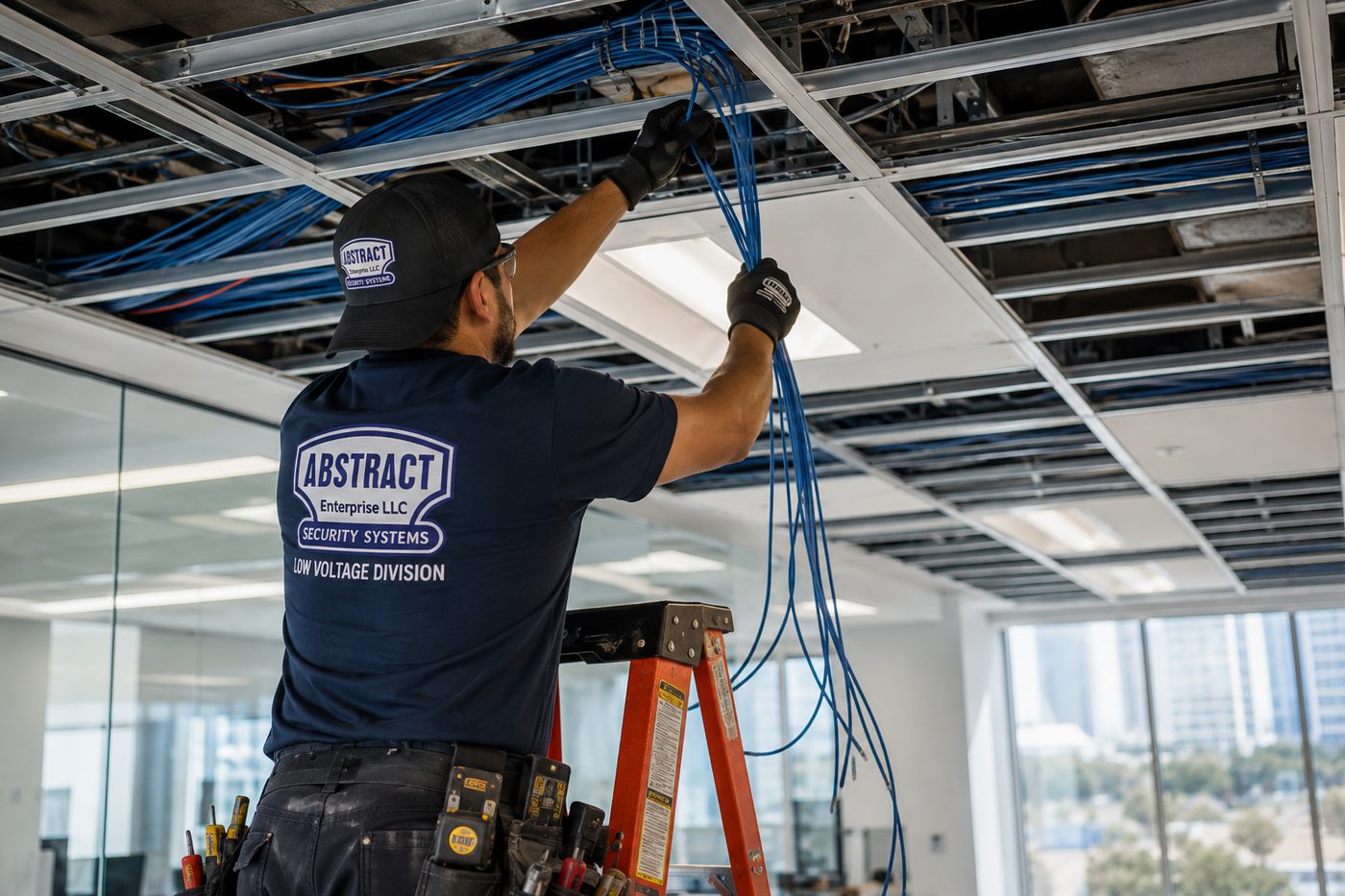
A bundle brought down through the grid at a workstation position.
EQUIPMENT
Cable, Racks and Hardware We Standardize On
Solid copper only. Copper-clad aluminium sold as Cat6 is the most common reason a plant that worked on day one starts dropping powered devices in year two, and it is why a system fails certification when a managing agent finally asks for a report. We do not install it at any price on any job.
Cat6 Horizontal Cable
The working default for Manhattan suite and floor work. Dependable for gigabit and for shorter 10G runs.
Cat6A Horizontal Cable
10 Gigabit to the full hundred-metre channel with less heat rise under higher PoE classes. On a long lease or a floor being wired once for a decade, the premium is trivial against pulling everything again.
Plenum-Rated CMP Cable
Required in air-handling ceilings, which in most modern Manhattan office buildings means the ceiling above your suite. Substituting riser cable into a plenum space is both a code problem and a lease problem.
Riser-Rated CMR and Shielded Cable
Riser jacket in vertical shafts between floors, shielded where a run parallels heavy electrical or passes a machine room.
Fiber for Risers and Demarc
Multimode and single-mode where copper distance is exceeded or a run crosses services. Carries no metal, which sidesteps ground-potential problems between floors fed differently.
Patch Panels, Racks and Management
Two-post frames where a floor carries a real MDF, wall-mount where a suite has one closet. Panels, keystones, plates, management, UPS and rack grounding specified per closet.
Support Hardware and Firestop
J-hooks, tray, bridle rings, sleeves through rated assemblies and firestop at every penetration. Rated wall and floor penetrations in a Manhattan tower get particular attention because the inspection eventually finds them.
Managed PoE Switches
Sized from real combined draw rather than populated port count. A switch chosen on device count is the one that starts cycling equipment once the floor fills up.
Certification Testing
Wiremap and length on every drop as standard, with full TIA-568 certification on a Fluke DSX-class analyser wherever a landlord, insurer or GC will ask for the report.
Most new work in Manhattan now lands on cloud-managed platforms. Cloud access control with mobile credentials, touchless entry, smart intercoms, AI video analytics, license plate recognition and remote video monitoring all ride on the same structured cabling — Ethernet over Cat6 or Cat6A, with coaxial only where legacy plant survives. Smart building and IoT devices raise the PoE budget rather than the cable spec, and Wi-Fi 7 access points need Cat6A to be worth fitting.
How we scope Manhattan work: Cat6 cabling and Cat6A, fiber-optic cabling, Ethernet wiring and coaxial where legacy plant survives; network racks, MDF rooms and IDF closets; PoE infrastructure sized to the device count; audiovisual systems and integrated building systems where they share the pathway. As a low voltage systems integrator and low voltage wiring contractor we cover tenant buildouts, system takeover work and ongoing low voltage maintenance, including licensed low voltage installers for security wiring and structured wiring. To get a low voltage installation quote or a low voltage installation estimate, the survey is free.
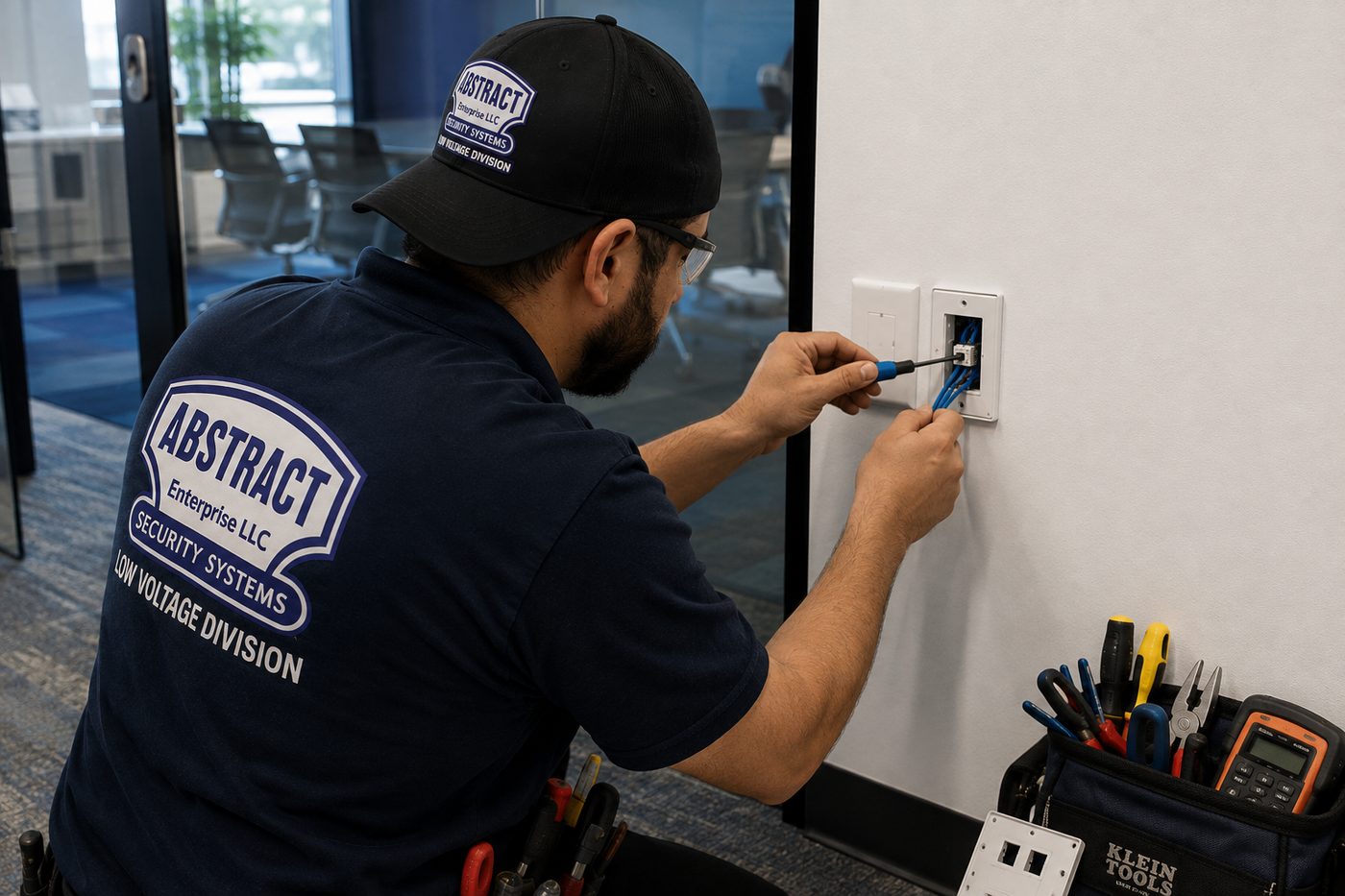
The user end of a drop, terminated and plated.
TERMINOLOGY
Manhattan Low Voltage Terms, Translated
Most arguments about a cabling invoice come down to two parties using the same words differently. This is the vocabulary you need to read a Manhattan proposal or a landlord’s cabling rider.
Drop. One run from the closet to one outlet, terminated both ends. Cabling is priced per drop.
Home run. A dedicated cable from one device to the closet with nothing shared. Standard for cameras, doors and access points.
COI. Certificate of insurance. In Manhattan this is the document that decides whether work happens at all, and buildings frequently specify the exact entity names to be listed as additional insureds.
Freight window. The block of time the building releases the service elevator to you. Booked in advance, and generally not extendable on the day.
Plenum (CMP) versus riser (CMR). Plenum jacket in air-handling spaces, riser in vertical shafts. Most Manhattan commercial leases put this in writing.
Cabling rider. The section of a commercial lease governing your cable — jacket rating, labelling intervals, routing plans and removal obligations at surrender.
Abandoned cable. Cable no longer connected to anything and not tagged for future use. The accessible portion is generally required to be removed rather than cut and left.
Surrender clause. The lease provision covering what you must take out when you leave. Frequently includes your cabling, and frequently ignored until move-out.
Tenant Delay. A defined term in many Manhattan leases. Cabling coordination is often named in it, which is why late low-voltage work can move a Commencement Date.
MDF and IDF. Main distribution frame where service enters; intermediate frames on other floors or wings.
Wiremap versus certification. A wiremap confirms pins, shorts and splits. Certification measures length, crosstalk, return loss and delay against TIA-568 and prints a pass or fail per drop.
As-built. The closeout drawing and port map. Frequently the thing a landlord asks for and nobody has.
The trade calls this low voltage installation in Manhattan: the design, installation, testing and documentation of limited-energy systems — also called extra-low-voltage or ELV systems, and sometimes electronic security systems or building technology systems. What a low voltage installer does is run and terminate the communications infrastructure a building needs, which is a different trade from line-voltage electrical wiring. The difference between Cat6 and Cat6A is bandwidth headroom and heat under PoE: Cat6A carries 10 Gigabit to the full channel where Cat6 does not.
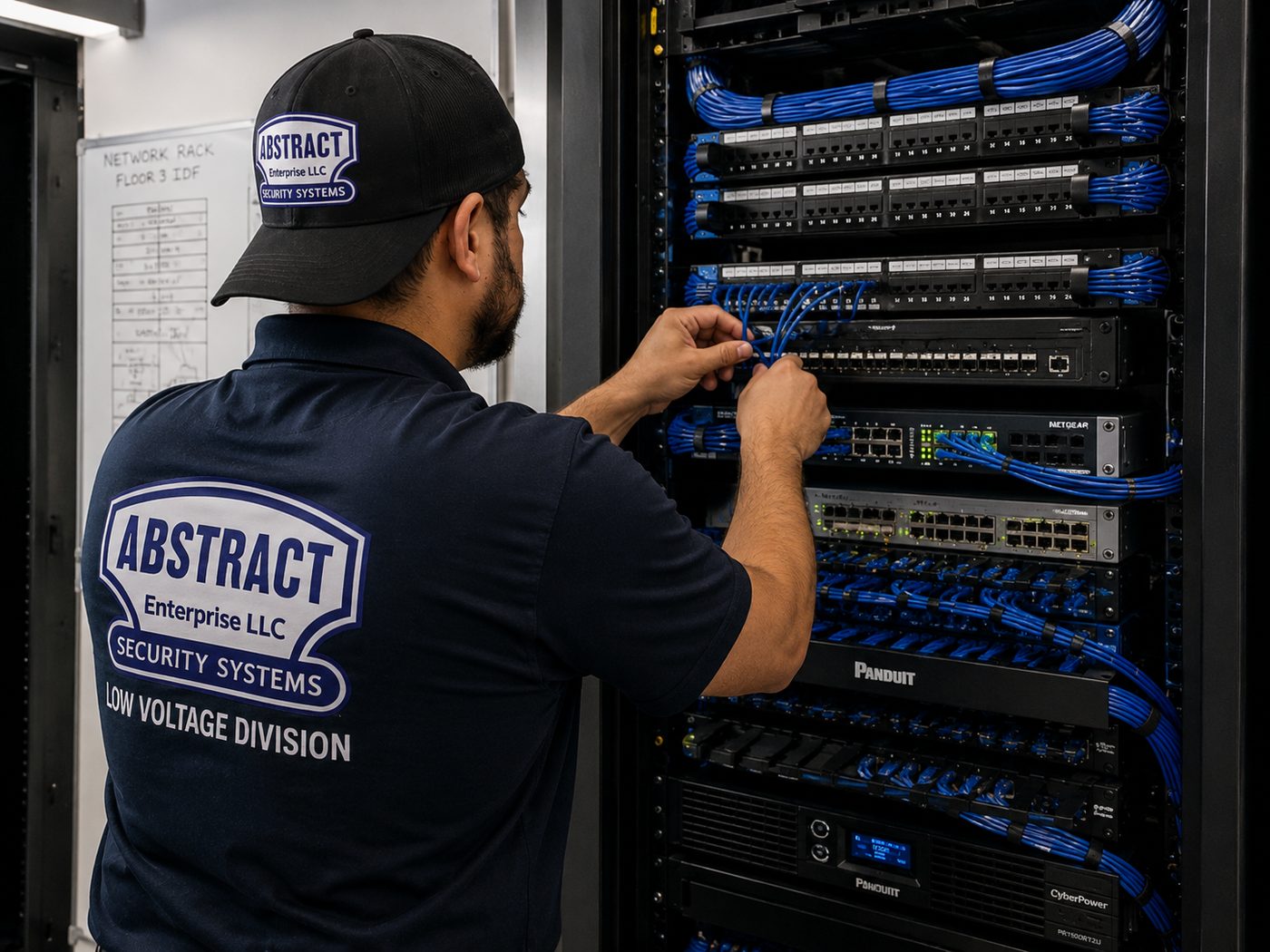
Patching in the floor IDF, with the rack map on the wall beside it.
COMMERCIAL LOW VOLTAGE
Where We Work Across Manhattan
Downtown and the Financial District
The centre of gravity for conversion work right now, with the largest cluster of office-to-residential projects in the city sitting below Chambers Street. The older tower stock around Water Street, Broad Street and Maiden Lane brings tight cores, shared telecom rooms and decades of accumulated cable, and conversion projects surface all of it at once. Tribeca adds landmarked and loft conditions on top.
Midtown and Midtown East
Class A tower work and dense tenant fit-outs along Third Avenue and Lexington, plus a meaningful share of the conversion pipeline. This is the part of Manhattan where the access regime is strictest: COI naming multiple entities, freight booked days ahead, and after-hours-only work as a matter of routine rather than exception. Park Avenue availability has been running near historic lows, which means a lot of the work here is refit within occupied buildings rather than empty-floor buildout.
Hudson Yards and the Penn District
Newer construction, newer building standards, and management that expects documentation as a matter of course. Hudson Yards has been effectively full, so the low-voltage work in this corridor tends to be tenant reconfiguration, technology refresh and adds rather than first fit-out.
Flatiron, Chelsea and the Garment District
Mixed stock and mixed conditions. Loft floorplates along Broadway and through the West Thirties, converted showroom and manufacturing space, and a tenant base that turns over faster than the towers. The recurring condition is a floor that has been fitted out repeatedly with no documentation surviving any of it.
SoHo and the cast-iron blocks
Broome, Grand and Greene and the surrounding streets. Beautiful buildings, landmarked exteriors and frequently protected interiors, and close to hostile to a clean pathway. Surface raceway is often the only technically simple answer and often the one that will not be approved, so routing is agreed on paper before anything is opened.
Uptown and Harlem
The 125th Street corridor and the professional, institutional and retail stock around it, plus a large base of pre-war residential. Work here is more mixed-use and more residential than the commercial corridors downtown, which changes the access question from managing agent to building super and co-op board.
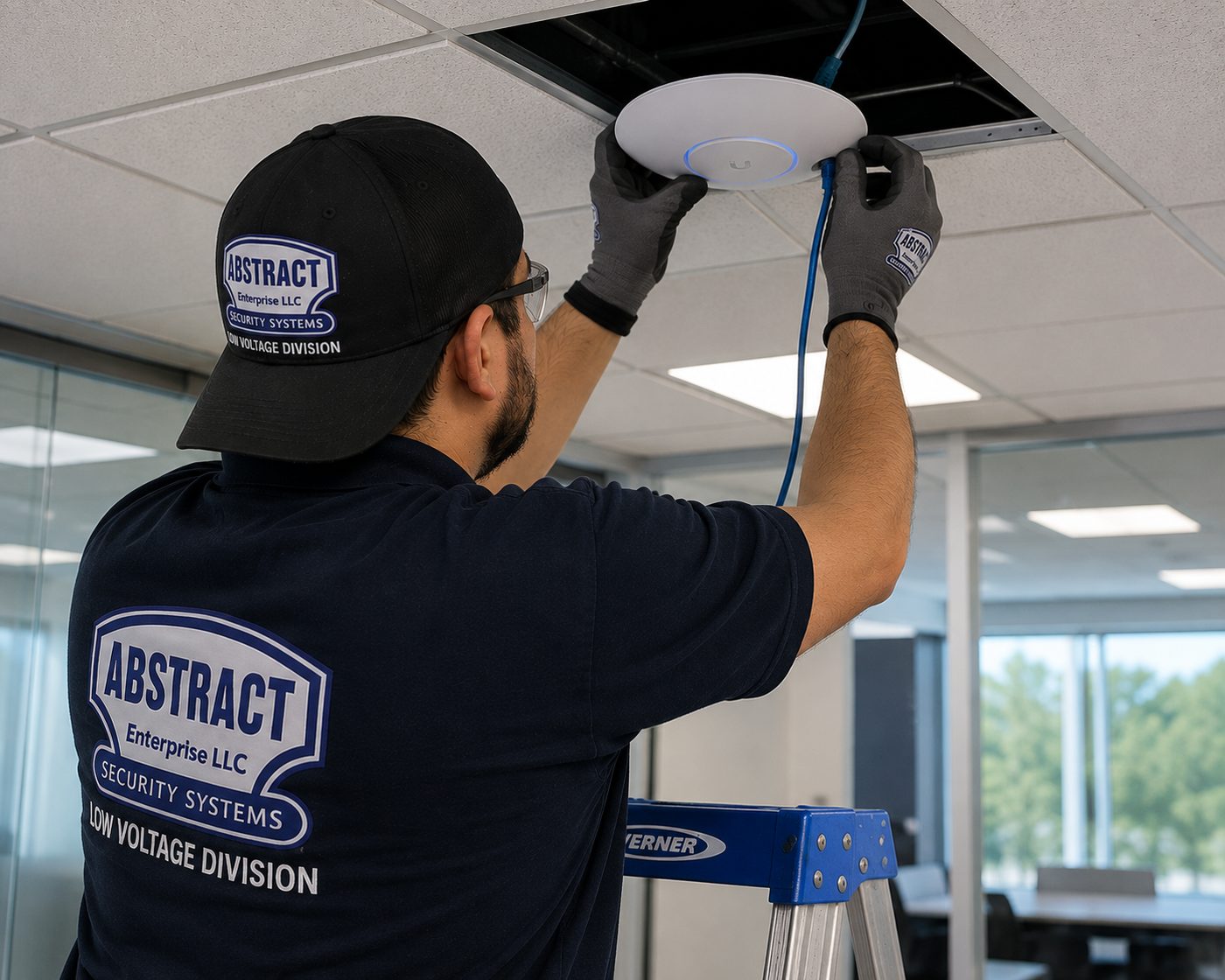
An access point on its own home run, placed for coverage rather than convenience.
INDUSTRIES
Who We Cable For in Manhattan
Tenant Fit-Outs
Cabling on a lease clock, coordinated with the GC, in before drywall closes.
Conversion Projects
Legacy plant assessment, abandoned cable removal and fresh distribution into converted floors.
Property Management
Portfolio standards so every building in the book is cabled and labelled the same way.
Co-ops and Condos
Riser work, lobbies and common areas in occupied buildings, on board-approved scopes.
Professional and Medical Suites
Segregated closets, controlled access to infrastructure, tidy client-facing space.
Retail and Restaurants
POS reliability and back-of-house coverage, sequenced around trading hours.
Nonprofits and Institutions
Documented work that survives an audit and a change of facilities staff.
Creative and Studio Space
Loft floorplates, exposed ceilings and pathway that has to stay invisible.
General Contractors
Low voltage as a subcontracted trade, with COI, schedule discipline and a closeout package.
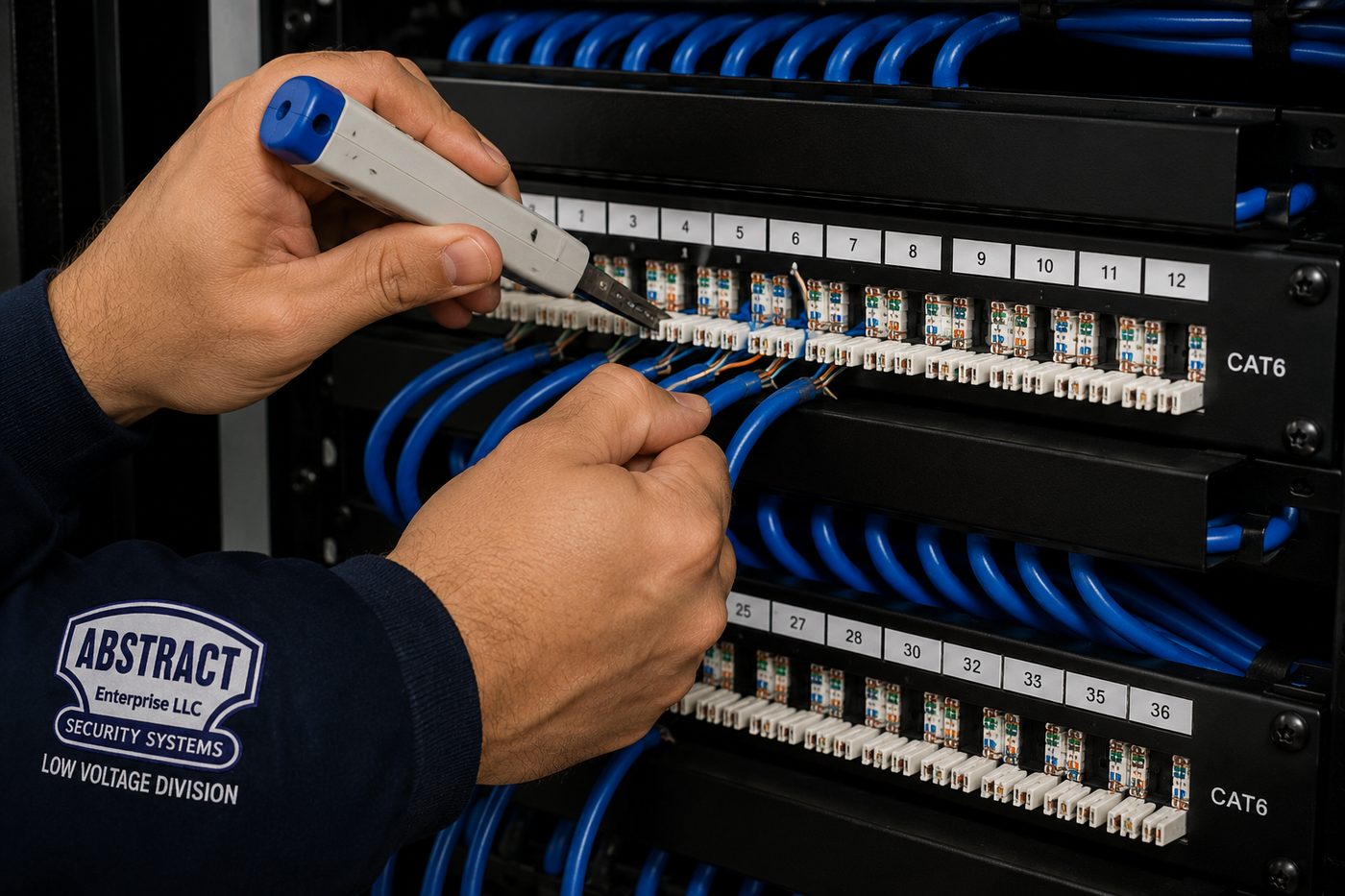
Horizontal cable punched to a numbered panel rather than direct to a switch.
HOW IT WORKS
How a Manhattan Low Voltage Project Runs
Free on-site survey. Ceiling opened, closets inspected, pathway assessed, and the building’s access rules confirmed — COI requirements and exact entity names, freight availability, permitted work hours, corridor protection.
COI issued and access secured. Certificates issued to the owner, managing agent and any additional insureds named, and freight windows booked before a date is committed to you.
Pathway plan. Routing, support method, penetrations and firestopping settled, plus any riser approval the landlord requires in writing.
Written scope and proposal. Drop count and locations, cable category and jacket rating per space, pathway method, closet and rack scope, testing level, labelling standard, documentation deliverable and a written exclusions list.
Rough-in. Cable pulled on supported pathway with the correct jacket for each space, ideally before drywall closes.
Termination. Keystones at the outlet, patch panel punch-down at the closet, rack dressed as it is built.
Testing. Wiremap and length on one hundred percent of drops, with full TIA-568 certification where specified.
Labelling and as-built. Every cable labelled both ends to a scheme matching the port map, then drawing, port map, configuration notes and digital closeout package handed over.
Start and completion timing turns on building conditions, equipment availability, access to the property, permitting where it applies, and how large the project is.
Every job starts with a free low voltage site survey and a written low voltage system design, and finishes with low voltage cable labeling, low voltage testing and documentation. If a system drops out, we handle urgent low voltage repair and emergency low voltage service the same way: low voltage troubleshooting first, then replace failed low voltage cabling or restore security system wiring rather than guessing. A low voltage technician in Manhattan carries the analyser to the first visit.
Maglock mounted at the header with power and monitoring run in the same bundle.
YOUR QUESTIONS ANSWERED
Low Voltage Installation in Manhattan: Your Questions Answered
My building wants a COI with exact entity names before anyone comes in. Can you produce that?
Yes, and it is the first thing we handle rather than the last. Manhattan managing agents commonly require certificates naming the owner, the managing agent and in some cases the lender as additional insureds, with the entity language written exactly as the building specifies. Send us the building’s insurance requirements sheet with your enquiry and we will confirm on the call whether anything on it is a problem, before a date gets committed to you.
The building only allows cabling work after hours and the freight books out days ahead. How does that affect the job?
It extends the calendar without changing the labour hours, and it needs to be priced honestly up front rather than discovered mid-project. A floor that would take three working days in an accessible daytime building may take a week and a half in windows. What we do about it is book the freight before committing a completion date to you, and stage the work so each window is fully used rather than half spent waiting on an elevator.
My lease says abandoned cable left behind is treated as a holdover. Can that be right?
It is common language and it is worth taking seriously. Many New York commercial leases require the tenant to remove their cabling at expiration or early termination, and provide that failure to do so is deemed a holdover, with the landlord entitled to remove it at the tenant’s sole cost. Holdover provisions typically carry penalty rent. Read your surrender clause when you start planning a fit-out rather than in the month you move, and keep the as-built — documented cable is far cheaper to remove than anonymous cable. Your lease and your counsel govern; this is general information about a common lease pattern.
The GC says our cabling is a Tenant Delay and the rent clock starts early. Is that a real thing?
Yes, and cabling is frequently named in the definition. Many Manhattan leases list coordination or installation of cabling by the tenant or the tenant’s contractors among the events constituting a Tenant Delay, which can accelerate the Commencement Date. In practice that turns “get the low-voltage sub in before drywall” from a scheduling preference into a financial one. The way to avoid it is to have the low-voltage scope named in the construction schedule from the start rather than added once the walls are framed.
Do I need a DOB permit for low voltage work in Manhattan?
The low voltage permit NYC question changed recently enough that older answers are unreliable. Usually not, and the rule changed recently enough that stale answers are circulating. Local Law 128 of 2024 took effect on 21 December 2025 alongside the 2025 New York City Electrical Code, adding Administrative Code §28-105.4.7, under which an electrical permit is not required for low-voltage work under 50 volts for signalling, communication, alarm and data circuits — provided the work is performed by a licensed master electrician, a special electrician, or a qualified person as the Electrical Code defines it. Wiring that connects to, forms part of or sits within a life safety system is carved out entirely and may only be performed by a licensed master or special electrician. Confirm your specific scope with DOB.
Is the NYC low voltage installer certification for the company or the person?
People search for a “DOB low voltage license” expecting a company credential, and that is the wrong mental model. The person. Administrative Code §27-3016.1 provides for certification of an individual determined by the commissioner to be competent to perform low voltage electrical work — over eighteen, of good moral character, with two years of satisfactory experience, and subject to a character and fitness investigation. It is a term certification, renewable, and subject to suspension or revocation. This gets stated wrongly a lot, including by AI answers, which tend to describe it as a business registration.
There is twenty years of abandoned cable above our ceiling. Do we have to remove it?
Generally the accessible portion, yes. Under the National Electrical Code the accessible portion of abandoned communications and Class 2 or 3 cable is required to be removed unless tagged for future use with a durable tag. Cable concealed in a raceway is not considered accessible. On a Manhattan retrofit or conversion this is rarely trivial — a plenum can hold several tenancies of unused cable — so we scope and price removal as its own line rather than absorbing it quietly into a fit-out. Cutting the ends and leaving the cable in place defeats the point of the rule.
How much does low voltage installation cost in Manhattan?
Structured cabling cost in Manhattan starts from published per-drop rates rather than a range. Our published starting points are $175 for a Cat6 data or voice drop and $250 for a Cat6A drop, with a $500 minimum job. Published national guides put commercial Cat6 in a band of roughly $125 to $400 per drop fully installed and tested, and note consistently that labour rather than cable drives it. What Manhattan adds on top is access: badging, freight windows, night work, corridor protection, and ceilings that may not open the way a floor plan suggests.
Why did one contractor quote $150 a drop and another $400 for the same floor?
Because they almost certainly scoped different work. Industry pricing discussion puts non-certified drops around $200 and certified drops closer to $400 to $450, and a certification analyser is a five-figure instrument that has to earn itself back. Put both proposals side by side and compare cable category, jacket rating, pathway method, support hardware, testing level, labelling standard, documentation deliverable and access assumptions. On a Manhattan job the access assumptions alone can account for the whole gap.
Can you work in a landmarked interior without surface raceway?
Frequently, though it depends entirely on the building and it is a routing problem rather than a hardware problem. The approach is to agree the route on paper first, use existing chases, columns and voids wherever they exist, and treat any visible pathway as something that needs sign-off before it is installed rather than after. Where a route genuinely cannot be concealed, we say so at survey rather than presenting a fait accompli.
Our telecom room is shared with three other tenants. Is that a problem?
It is normal in older Manhattan office stock and it is manageable, but it changes what good practice looks like. Anyone servicing one system is standing in front of everybody’s infrastructure, so labelling and tenant separation stop being tidiness and start being security. A clear scheme, a port map and a physically defined section for your equipment are worth more in a shared room than in a private closet.
Can existing cable in the building be reused?
Sometimes, and where it can it is worth keeping, because pathway is the expensive half of the plant. The right order is to certify what is there before designing around it. Reusing an untested legacy run is how a new system inherits an old fault and then spends six months being blamed on the new equipment. Where existing runs certify clean and land where you need them, we say so in the proposal rather than quoting a full replacement.
Should we hire an electrician or a low voltage contractor?
Low voltage versus electrician is the comparison we field most often. An electrician is the right trade for line voltage and plenty will pull Cat6 competently. The question is whether they carry a certification analyser, work to TIA-568 rather than power-wiring habit, and hand over a labelled port map and as-built. The failure we get called in to fix most often on Manhattan fit-outs is a coordination gap rather than a competence one: the electrician assumes the cabling sub has data, the cabling sub was never engaged, and the walls close empty.
Can one company handle the cabling, the cameras and the access control?
Yes, and in a Manhattan building it is usually the cheaper way to do it. The COI, the freight booking and the pathway are the expensive parts of any of these systems. Running the data, the camera home runs, the door bundles and the entry wiring in one mobilisation means one set of building approvals and one coherent closet rather than four crews each solving the same access problem separately.
Questions that come up most in Manhattan: what is low voltage installation, what does a low voltage installer do, what is the difference between low voltage and electrical wiring, does low voltage wiring need conduit, how is low voltage cable tested, how long does low voltage installation take, and what is the difference between Cat6 and Cat6A. The answers are throughout this page; if your low voltage system is not working — a low voltage system not working is the single most common call we take — the fastest route is a call rather than a form.
Strike, keypad and request-to-exit landed as one door bundle.
AI OVERVIEW REALITY CHECK
What AI Answers Get Wrong About Manhattan Low Voltage
The permit answer that changed in December 2025
Ask any AI answer engine whether low voltage work needs a permit in New York City and you will get some version of no, generally not, under fifty volts. That answer is broadly correct today. It was also being given confidently before the rule that makes it correct existed in its current form.
Local Law 128 of 2024 took effect on 21 December 2025 alongside the 2025 New York City Electrical Code, adding Administrative Code §28-105.4.7. The exemption it creates is conditional: it applies where the work is performed by a licensed master electrician, a special electrician, or a qualified person as the Electrical Code defines that term. And it carves out life safety systems entirely — wiring that connects to, forms part of or sits within one may only be performed by a licensed master or special electrician.
Neither the condition nor the carve-out survives summarisation. What you get instead is a flat statement that low voltage does not need a permit, which is the right shape and the wrong level of detail to make a decision on.
They all mention the certification. None says who actually holds it
Every AI answer about low voltage in New York City tells you the city has a Low Voltage Installer certification and that your contractor should hold it. That is correct as far as it goes, and it is more than most trade summaries manage.
What none of them says is whether that certification attaches to a company or to a person — and it is the person. Administrative Code §27-3016.1 provides for certification of an individual determined by the commissioner to be competent to perform low voltage electrical work, requires the applicant to be over eighteen and of good moral character with two years of satisfactory experience, and subjects every applicant to a character and fitness investigation. It is issued for a term, renewable, and subject to suspension or revocation.
The phrasing you get instead — “contractors should hold the appropriate certification” — reads like a box a firm ticks. It changes the question you ask. Instead of requesting a company certificate number, ask which of the people who will actually be on your floor hold the certification. No generated summary will prompt you to ask that, because none of them makes the distinction.
Nothing about how you actually get into the building
Every summary of Manhattan low voltage describes what gets installed. None describes what it takes to install it here, which is where the schedule and a good deal of the cost live.
A certificate of insurance naming the owner, the managing agent and sometimes the lender, with the exact entity language the building specifies. Freight elevators booked in advance and released in fixed windows. Work restricted to nights and weekends in a large share of buildings. Masonite and corner guards through common areas. Union labour conditions in some buildings. Building engineer sign-off before a rated penetration.
None of that appears in any AI answer about cabling in Manhattan, and all of it appears on a real Manhattan job. A contractor who has not planned for it will find out on mobilisation day, and the delay will be on your schedule rather than theirs.
The lease clauses nobody warns you about
Generated answers treat cabling as a construction question. In Manhattan it is frequently a lease question, and the lease is more expensive than the cable.
Many New York commercial leases require the tenant to remove cabling at expiration or early termination and provide that failure to do so is deemed a holdover, with the landlord entitled to remove it at the tenant’s sole cost. Holdover provisions typically carry penalty rent. Separately, many leases name coordination or installation of cabling by the tenant or the tenant’s contractors among the events constituting a Tenant Delay, which can accelerate the Commencement Date and start the rent clock early.
So the two most expensive cabling mistakes available to a Manhattan tenant are leaving cable behind and installing it late, and neither has anything to do with which category of cable you chose. No AI summary raises either. Your own lease and counsel govern.
They know Manhattan costs more. They cannot tell you what yours costs
Credit where it is due: every AI answer about Manhattan pricing quotes the same national per-drop band and then adds that Manhattan sits toward the upper end because of building access and labour rates. That is accurate, and it is a better answer than the same engines give for other regions.
It is also as far as the reasoning goes. “Higher end of the range because of access” is a direction, not a number, and the things that actually set your figure are specific: whether the building permits daytime work or restricts you to night windows, how many drops fit inside one freight booking, whether the ceiling opens the way the floor plan suggests, whether a rated penetration needs coring and firestopping, and whether twenty years of abandoned cable has to come out before anything new goes in.
Our published starting points are $175 for a Cat6 drop and $250 for Cat6A, with a $500 minimum, and those sit inside the band the summaries quote. The gap between a starting point and a quote is a survey where somebody has opened your ceiling and read your building’s insurance requirements sheet. No engine can do that, and none of them claims to.
Testing folded into one word, and pathway left out entirely
Summaries list testing as though it were a single deliverable. There are three tiers costing different amounts: a cable that lights up, a cable with a wiremap and length test, and a cable certified against TIA-568 with a printed pass or fail per drop. A split pair passes the first tier perfectly and degrades under load.
Pathway is worse — it is not mentioned at all, and in Manhattan it is the cost. Open ceiling with existing support hardware is one job. Sealed plaster over wire lath in a pre-war building with a landmarked corridor is a different one on identical footage, and the difference is a multiple rather than a margin.
On any job where a landlord, insurer or general contractor may ask for documentation, certification is the cheapest line on the proposal. Every published price range hides that choice inside one number.
What an honest Manhattan proposal contains
Ten lines. Drop count and locations. Cable category and jacket rating for each space. Pathway method and who firestops rated penetrations. Closet and rack scope. Testing level, stated as wiremap or full certification. Labelling standard. Documentation deliverable, meaning as-built and port map or nothing. Abandoned cable removal, in or out. Access assumptions, including permitted hours, freight and the COI requirements the building imposes. And a written exclusions list.
Drop three of those and the number stops being comparable to anything. The contractor who looks expensive is usually the one who priced the after-hours windows, the removal and the certification while the other bidder left all three out and let you find them later.
Put all ten to everyone bidding, us included. Anyone unwilling to commit them to paper before mobilising has told you what the end of the job will feel like.
Send us the building’s insurance requirements sheet. We will tell you what it actually takes.
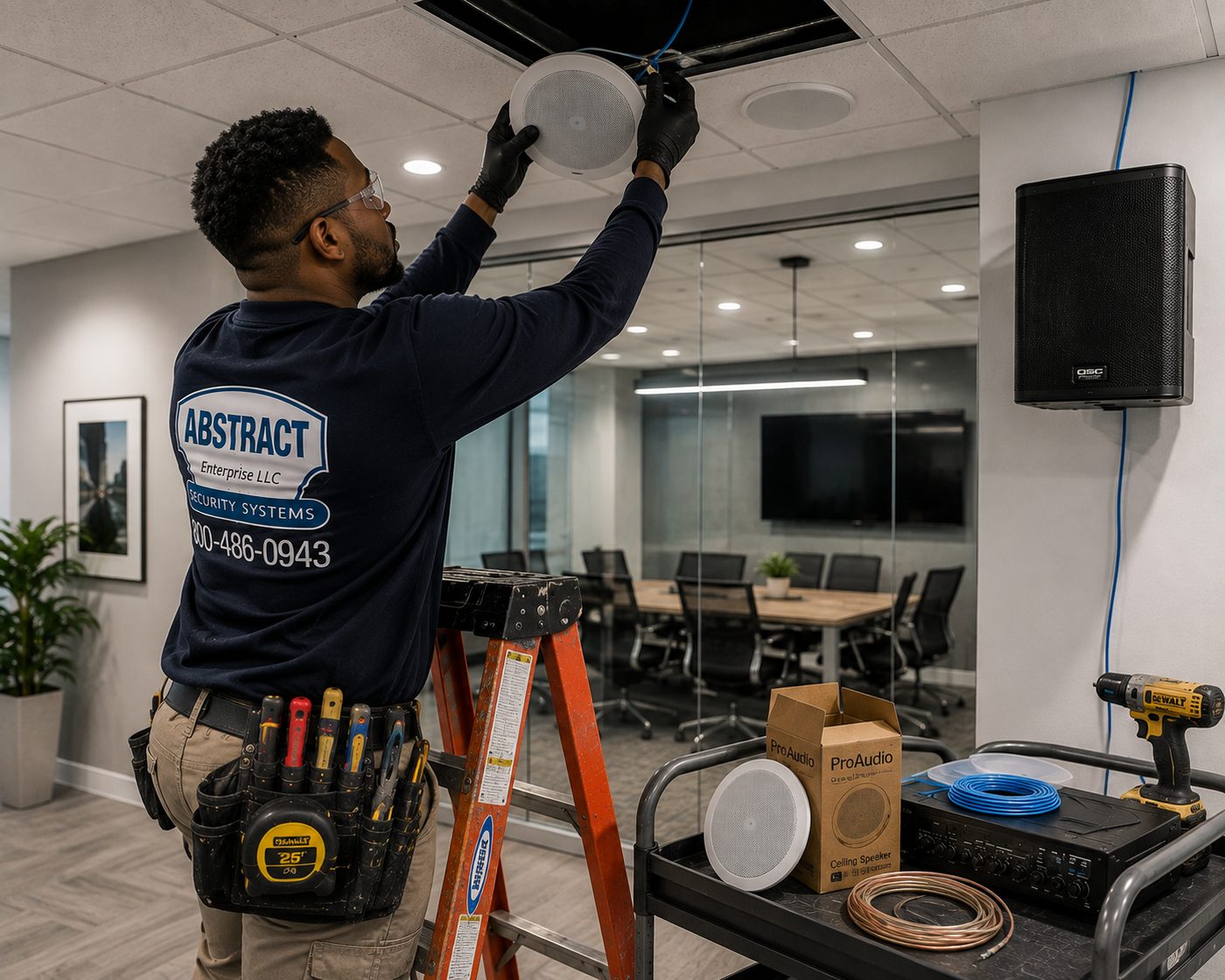
Ceiling speaker fitted and cabled back to the amplifier.
PRICING
Manhattan Low Voltage Installation Pricing
These are the figures we publish. What a drop includes: solid copper cable, the jack and plate at the workstation end, panel termination at the closet, a wiremap test, labels at both ends and a patch cable.
Item
Starting price
Notes
Cat6 data or voice drop
From $175
Gigabit, standard PoE, solid copper
Cat6A drop
From $250
10G to the full channel, higher PoE classes
Fiber riser between floors
Custom quote
Subject to landlord approval for penetrations
Plenum, riser or shielded jacket
Quoted separately
Priced by the space requirement
Abandoned cable removal
Scoped separately
Priced by volume and access, never absorbed silently
Rack build, patch panels, closet re-dress
Itemized
Scoped per closet
Minimum job size
$500
Mobilization floor
Service, troubleshooting and callbacks
$195/hr, 3-hour minimum
Service work only, not initial installation
Cat6 installation cost in Manhattan starts from the per-drop figures above, and low voltage security systems in Manhattan share the data plant’s pathway so a single mobilization covers cabling, cameras and access control.
What moves the number up in Manhattan: after-hours or weekend-only building access, freight windows that limit how much gets done per visit, sealed or landmarked ceilings with no existing pathway, coring and firestopping through rated assemblies, plenum jacket, riser penetrations needing landlord approval, corridor protection requirements, and abandoned cable that has to come out before anything goes in.
What moves it down: daytime access, open ceiling with existing pathway, pre-drywall rough-in, bundling multiple systems into one mobilisation, and grouping drops rather than scattering them across a floorplate.
Owner-supplied materials are fine by us on two conditions: solid copper, and the correct jacket for the space. We will say so directly if the delivery does not meet them. The complete per-drop breakdown is on our structured cabling pricing page.
Low voltage vs electrician in Manhattan is the question behind most of these enquiries. An electrician is the right trade for line voltage, and many will pull Cat6 competently. The practical test is whether they carry a certification analyser, work to TIA-568 rather than to power-wiring habit, and hand over a labelled port map and as-built.
If you are comparing several structured cabling companies in Manhattan rather than choosing a trade, ask any data cabling installers you shortlist for the same nine lines — drop count and locations, cable category and jacket rating per space, pathway method and who firestops, closet and rack scope, testing level, labelling standard, documentation deliverable, access assumptions and a written exclusions list. A structured cabling contractor who will not put those on paper has told you how the closeout will go. Searching for a low voltage contractor near me in Manhattan, or for the best low voltage company, returns whoever ranks or pays rather than whoever suits your building — so ask for the licensed low voltage contractor credential and check it.
Need Low Voltage Repair in Manhattan?
Dead drops, offline cameras or access points, a door that stopped releasing, a shared closet nobody can trace, or a bundle cut during unrelated construction. Same-day response where building access allows, and most single-fault troubleshooting is resolved on the first visit. Service and troubleshooting is billed at $195/hr with a three-hour minimum.
One closet, roughly five Cat6 drops, panel-terminated and tested. Suits a small professional suite or a single retail unit. Arithmetic on the published $175 rate.
Standard
From $1,750 installed
A typical Manhattan suite fit-out — around ten drops with a wall-mount rack, panel and closet dress-out. Arithmetic on the published $175 rate; Cat6A from $250.
Premium
From $5,250 installed
A full floor or multi-closet tenancy — twenty-one or more Cat6A drops, riser work, full rack build and TIA-568 certification with as-builts. Arithmetic on the published $250 rate.
Each figure is the published rate times the drop count next to it — no assumptions built in and no quote implied. Building access hours, freight limitations, pathway condition, jacket rating, coring and firestop, riser approvals, abandoned cable removal and certification all shift the real number, which comes out of the survey. The floor on any job is $500.
Already bought your cable and hardware? Ask about a bring-your-own-equipment (BYOE) install — labor-only pathway, pulling, termination, testing and labelling of materials you supply, provided the cable is solid copper and correctly jacket-rated.
Nothing is leased and nothing recurs — the installation belongs to the tenancy. Products we supply carry three years. Return visits and callbacks are $195/hour with a three-hour minimum, so $585.
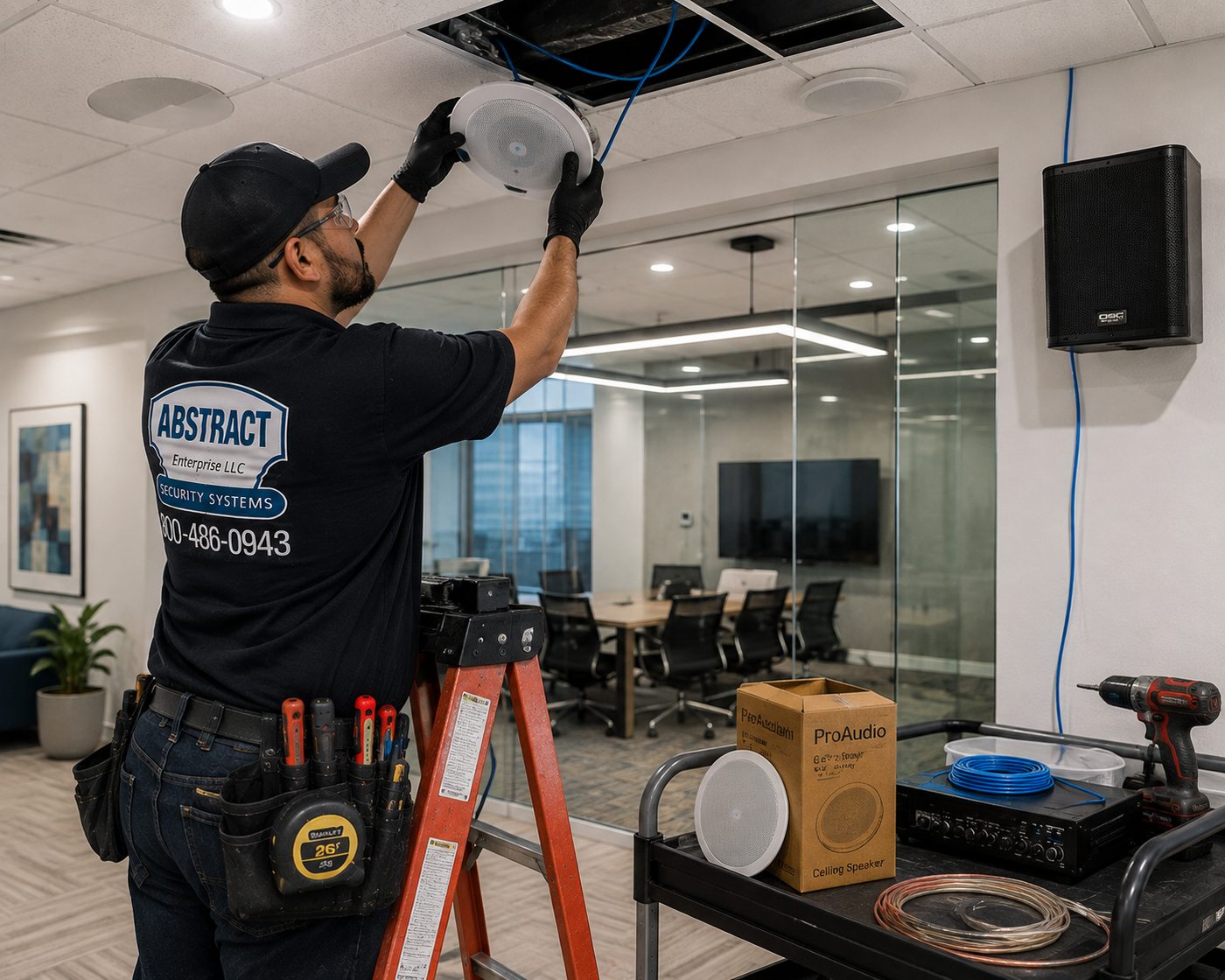
Overhead audio run above a conference area, sharing the data pathway.
LOCAL PROBLEMS
Low Voltage Problems Specific to Manhattan Buildings
Four tenancies of cable and no drawing for any of it. The default condition on an occupied Manhattan floor. The pathway you need is already full of runs nobody can identify, and tracing them costs more than the new work does.
Rated penetrations nobody firestopped. A sleeve through a rated wall left unsealed by a previous trade. It passes unnoticed until an inspection or an insurance review finds it, and then it is yours to fix.
Shared telecom rooms with no separation. A full-floor closet serving four tenants, where servicing one system means standing in front of everyone’s equipment.
Landmarked interiors and visible pathway. Where the technically simple route is the one that will not be approved, and the approval process is longer than the installation.
Riser penetrations without written approval. Most Manhattan landlords require prior written consent and frequently an approved-contractor list. Cutting first is an expensive way to learn that.
Devices added past what the switch can power. A camera count grows, combined draw crosses the budget, and equipment cycles. It presents as a cabling fault and gets misdiagnosed for months.
Cabling that missed the drywall window. The single most expensive scheduling error available, and on a lease with a Tenant Delay clause it can move your Commencement Date as well as your budget.
The building map that lives in one super’s head. An enormous amount of Manhattan building infrastructure was never documented. When that person retires, the building loses its map.
One more thing worth saying about Manhattan work. Should low voltage wiring be installed in conduit? Only where the space or the code requires it — conduit pathways, cable trays and NEMA enclosures are specified per environment, not by default. Can existing low voltage wiring be reused? Frequently, once it certifies. Electrician vs low voltage installer, or security company vs low voltage contractor, comes down to the same test: who carries the analyser and hands over the documentation. We also fit AI security camera systems, touchless access control and license plate recognition where a site wants them, and schedule school-break, back-to-school and holiday work around the calendar that governs the building. To get a low voltage installation quote in a working day, ask for the free survey; we work as a low voltage security installer as well as a cabling contractor.
FIELD NOTES
Field Notes from Manhattan Ceilings
The insurance sheet before the floor plan. On a Manhattan job the first document that matters is not the drawing, it is the building’s insurance requirements. We ask for it on the first call, because a COI that names the wrong entity is a wasted mobilisation and everybody’s afternoon.
Push up one ceiling tile. Ten seconds tells you more than twenty minutes of plans — whether there is tray, whether the last crew used hooks or laid bundles across the grid, whether anything is labelled, and roughly how many fit-outs the floor has been through.
Use the whole freight window. The difference between a crew that finishes on schedule in a restricted building and one that does not is almost never speed. It is staging: having every reel, tool and length cut before the window opens, so the window is spent pulling rather than fetching.
The hardest drop is never the longest. It is the one crossing a rated corridor wall, or landing in the one room the building will not let you core, or terminating behind millwork the GC already installed. We plan those first and let the easy runs fill in around them.
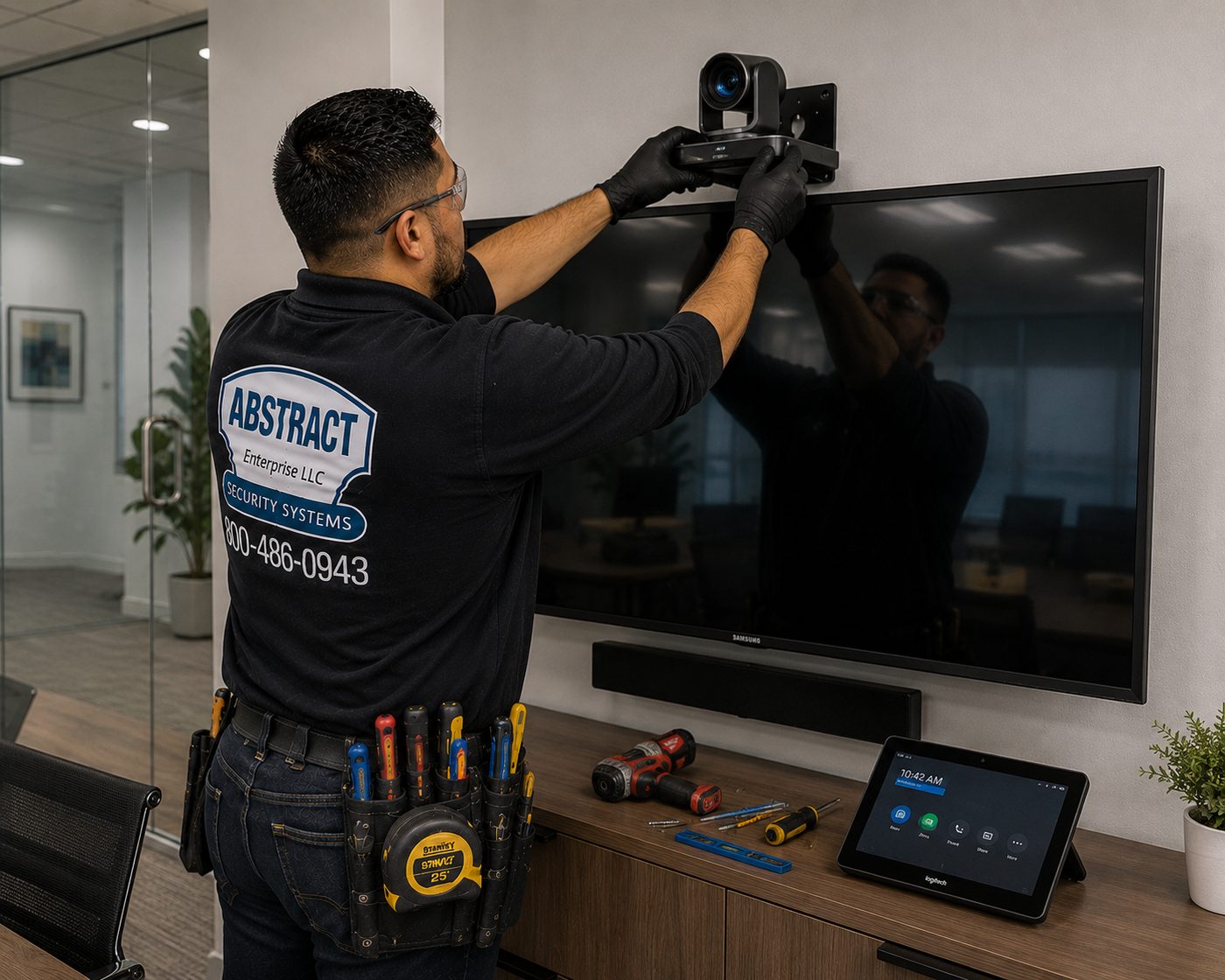
A PTZ conference camera mounted above the display and cabled in-wall.
COVERAGE AREA
Manhattan Low Voltage Coverage
We cover Manhattan end to end — the Financial District and Tribeca, SoHo and NoHo, Chelsea and the Flatiron corridor, the Garment District, Midtown and Midtown East, Hudson Yards and the Penn District, the Upper East and Upper West Sides, and the 125th Street corridor in Harlem.
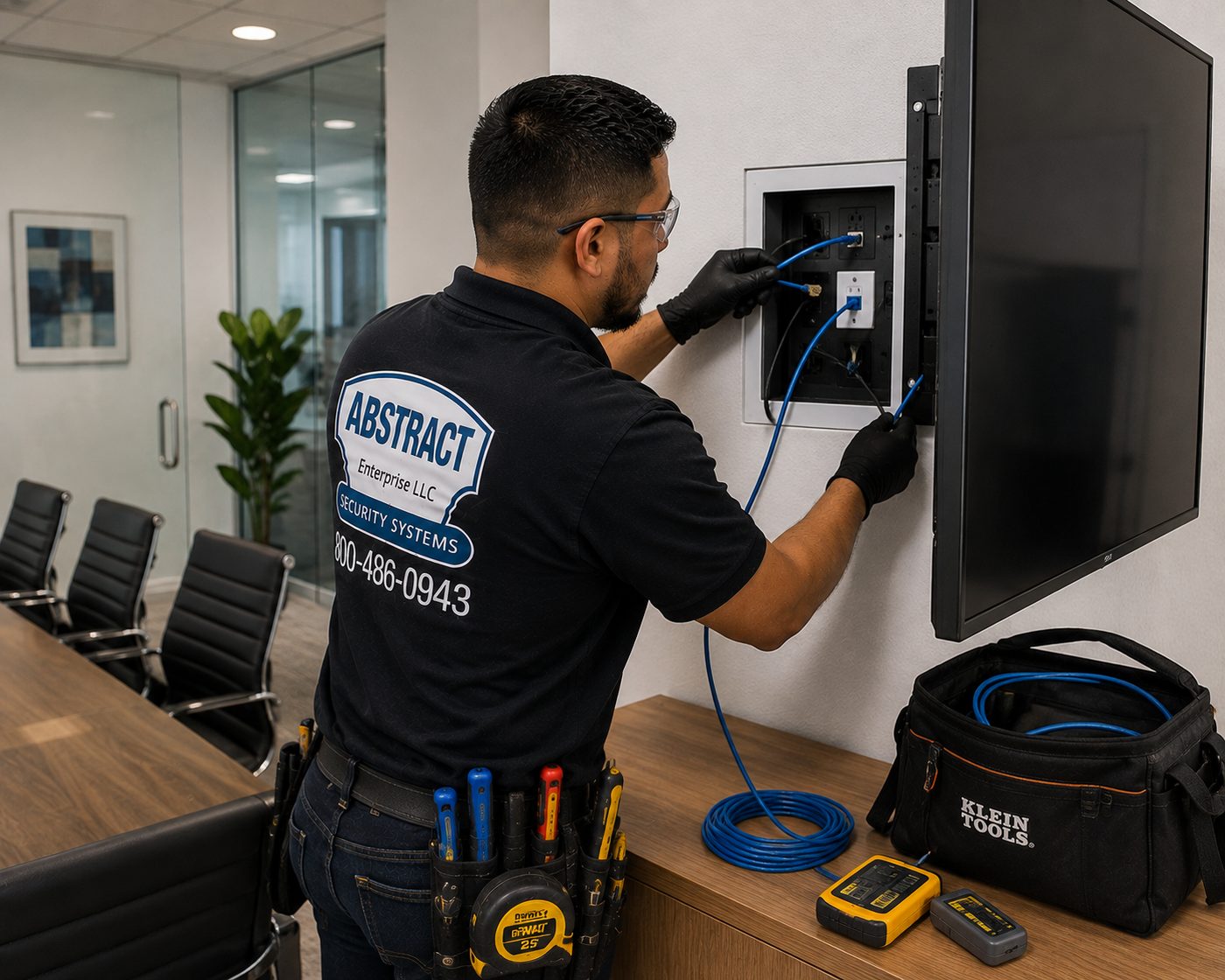
Recessed box behind the display so nothing is visible once it is hung.
FAQ
Manhattan Low Voltage Installation FAQ
What counts as low voltage wiring in a Manhattan building?
Administrative Code §28-101.5 defines it as electrical wiring designed to operate at less than 50 volts for signalling, communication, alarm and data transmission circuits. In practice that covers structured data and voice cabling, camera wiring, access control wiring, intercom and entry runs, intrusion alarm circuits, audio-visual and paging, signage and building control wiring.
How quickly can you turn around a COI for our managing agent?
Send us the building’s insurance requirements sheet with your enquiry and we will confirm on the call whether anything on it needs discussion. Certificates name the owner, the managing agent and any additional insureds the building specifies, and are issued before we mobilise rather than on the day.
Can you work nights and weekends in a restricted building?
Yes. A significant share of our Manhattan work happens on night and weekend building windows, and scheduling around freight availability is routine. Restricted access extends the calendar without changing the labour hours, and we price it that way up front rather than as a change order.
Will you work as the low voltage sub on a Manhattan fit-out?
Regularly. We come on as the low-voltage trade with the insurance certificate issued up front, freight coordinated, rough-in sequenced with the other trades before drywall, and a closeout set with as-built drawings and port map at the end.
How long does a Manhattan floor take?
A small suite with accessible pathway and daytime access is typically a short job. The same scope in a building restricted to night windows takes considerably longer in calendar terms without changing the labour hours. Start and completion timing turns on building conditions, equipment availability, access to the property, permitting where it applies, and how large the project is.
Do you handle riser work between floors?
Yes, with the caveat that riser penetrations in most Manhattan buildings require prior written landlord approval and sometimes an approved-contractor list. We identify that requirement at survey and get it in writing before anything is cut.
We already bought the cable. Will you install it?
We will, on two conditions: solid copper, and the correct jacket for wherever it runs. Copper-clad aluminium we decline, and we will tell you on the day if that is what turned up. Whoever sold you the materials warrants them; our labour warranty stands either way.
Is certification testing included, or is it a separate line?
Wiremap and length testing runs on one hundred percent of drops as standard. Full TIA-568 certification with a Fluke DSX-class analyser, delivered as printed and digital pass or fail records per drop, is a priced line and is worth taking on any job where a landlord, insurer or general contractor may ask for the report.
What paperwork comes with a completed Manhattan job?
Both ends of every cable labelled against a scheme the port map matches, the as-built, the port map, configuration notes and a digital closeout set. On a Manhattan tenancy that package is also what makes eventual cable removal cheap rather than exploratory.
What is the rate to diagnose a system installed by someone else?
Service, troubleshooting and callback work on systems not originally installed by us is billed at $195 per hour with a three-hour minimum. That rate applies to service calls, not to initial installation projects, which are quoted by scope from a free survey.
What does the Manhattan warranty cover?
Abstract Enterprises Security Systems provides a three-year warranty on products supplied by us. There are no monthly fees on the systems we install.
Can you take over a Manhattan job another contractor started?
Yes, starting with an assessment rather than a quote: which runs still certify, what the existing hardware can carry, whether the cable already in place can be reused, and where coverage genuinely falls short. On an older Manhattan floor the pathway is frequently in better condition than the equipment hanging off it.
Still deciding? The survey is free and settles it.
Dead drops, offline devices, a shared closet nobody can trace or a bundle cut by another trade. Most single-fault calls are diagnosed and resolved on the first visit, subject to building access. $195/hr with a three-hour minimum for service and callback work.
Tell us the building, the floor and roughly how many drops — and send the insurance requirements sheet if you have it. We will either scope it on the phone or come and open the ceiling. Both are free.
Abstract Enterprises Security Systems provides a three-year warranty on products supplied by us. Service, troubleshooting and callback work on systems not originally installed by us is billed at $195 per hour with a three-hour minimum; that rate applies to service calls rather than to initial installation projects. There are no monthly fees on the systems we install. Start and completion timing turns on building conditions, equipment availability, access to the property, permitting where it applies, and how large the project is.
Code and lease references on this page cite the New York City Administrative Code, the 2025 New York City Electrical Code and common commercial lease patterns as published by those sources. They are general information about how low-voltage work is classified and how cabling is commonly treated in commercial leases, not legal advice. Your own lease governs, and requirements for your specific building and scope should be confirmed with the Department of Buildings and your counsel.
ALL AREAS SERVED
Low Voltage Installation by Area
The full list of areas we cable. Areas without a dedicated low-voltage page yet are served the same way, and the link goes straight to a survey booking.
Reviewed and updated August 12, 2026 by Anwar Timothy of Abstract Enterprises Security Systems, NYS Low-Voltage Electrical Contractor License #12000287431. Changelog — Aug 2026: page published for Manhattan. · Aug 2026: permitting section written against Local Law 128 of 2024 and the 2025 NYC Electrical Code effective 21 December 2025. · Aug 2026: lease-clause guidance added covering cable removal at surrender and Tenant Delay provisions.