Structured cabling, camera and access control wiring, intercom and entry runs, fiber backbone, MDF and IDF closets, testing, labeling and as-built documentation across all five boroughs of New York City — installed by a NYS-licensed low-voltage contractor and scoped from a free on-site survey.
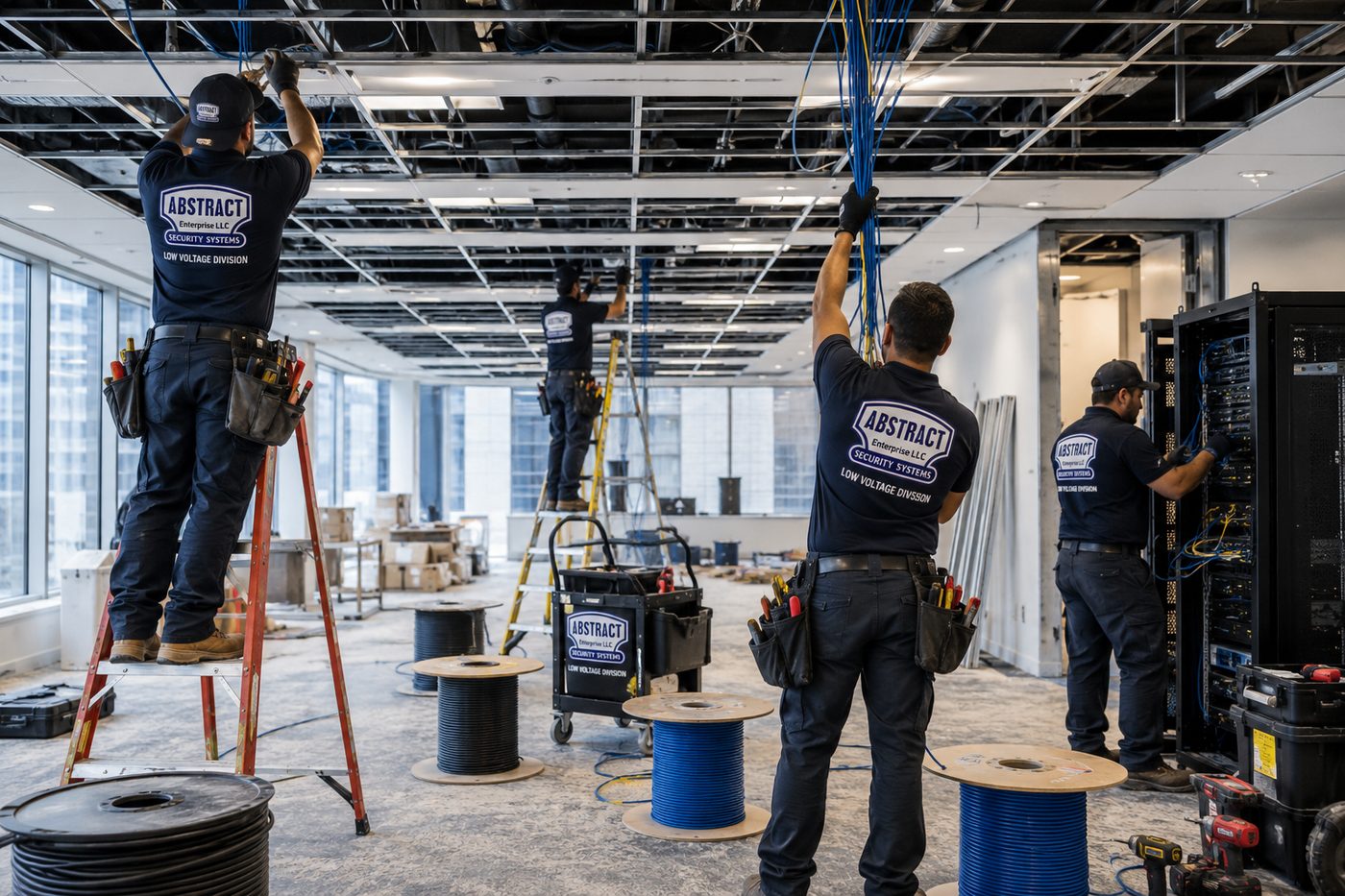
A four-technician crew pulling Cat6 above the open grid on a New York City office fit-out.
We install low-voltage systems across all five boroughs of New York City.
Reviewed and updated August 3, 2026.
Request a Free NYC Low Voltage Survey
THE NEIGHBORHOOD
Why Low Voltage Work in New York City Is Its Own Trade
Low voltage is the limited-energy wiring a building runs on: the data and voice cabling behind the network, the home runs feeding cameras and access points, the reader-to-controller wiring behind a controlled door, the entry and intercom runs at the vestibule, the alarm circuits, the speaker and paging pulls, the fiber that ties floors together, and the racks and closets where all of it lands. New York City puts a formal boundary around it. Administrative Code §28-101.5 defines low voltage electrical work as wiring designed to operate at less than 50 volts for signaling, communication, alarm and data transmission circuits — a definition that matters more than it used to, for reasons covered further down this page.
What makes the work different here is almost never the cable. It is access. A great deal of the city’s commercial and residential stock predates the idea of a network closet: solid masonry demising walls, plaster over wire lath, no chase, no accessible ceiling, no riser sleeve. A drop that takes twenty minutes in newer construction becomes a core, a raceway decision and a conversation with building management about who is permitted to penetrate what. In a landmarked interior, surface raceway may not be an option at all.
Building access is the second constraint, and it is scheduling rather than engineering. Class A and Class B buildings across Manhattan and the outer boroughs commonly restrict cabling work to nights and weekends, require a certificate of insurance naming the owner and managing agent before anyone badges in, and hand out freight elevator windows you either use or lose. Co-ops and condos add board approval. None of that appears in a national per-drop average, and all of it lands on the schedule.
Then there is what is already above the ceiling. Occupied commercial space in this city has typically been fitted out three or four times, and each round of cable was usually abandoned rather than removed. Before a clean run can go in, a route often has to be found through decades of orphaned wire that nobody holds a drawing for. Pricing that honestly at survey is the difference between a job that finishes on schedule and a change-order argument in week two.
Abstract Enterprises Security Systems is a licensed NYS low-voltage contractor working across the five boroughs from our Brooklyn office at 1282 Troy Ave. Every proposal follows a free on-site survey.
No monthly fees and a three-year warranty on equipment we install.
WHAT WE INSTALL
Low Voltage Systems We Cable Across New York City
Everything below is scoped the same way — pathway, cable, termination, test, label, document. Head-end equipment and devices are installed and commissioned in the same mobilization when they are in scope.
Voice and Data Cabling
Commercial data cabling in NYC and Cat6 installation in NYC cover the everyday work, with office network cabling in NYC the tenant-suite version of it. Cat5e, Cat6 and Cat6A horizontal cabling from the workstation back to the closet. Keystone and plate at the outlet, patch panel punch-down at the rack, wiremap on every run and labels at both ends.
Wireless Access Point Drops
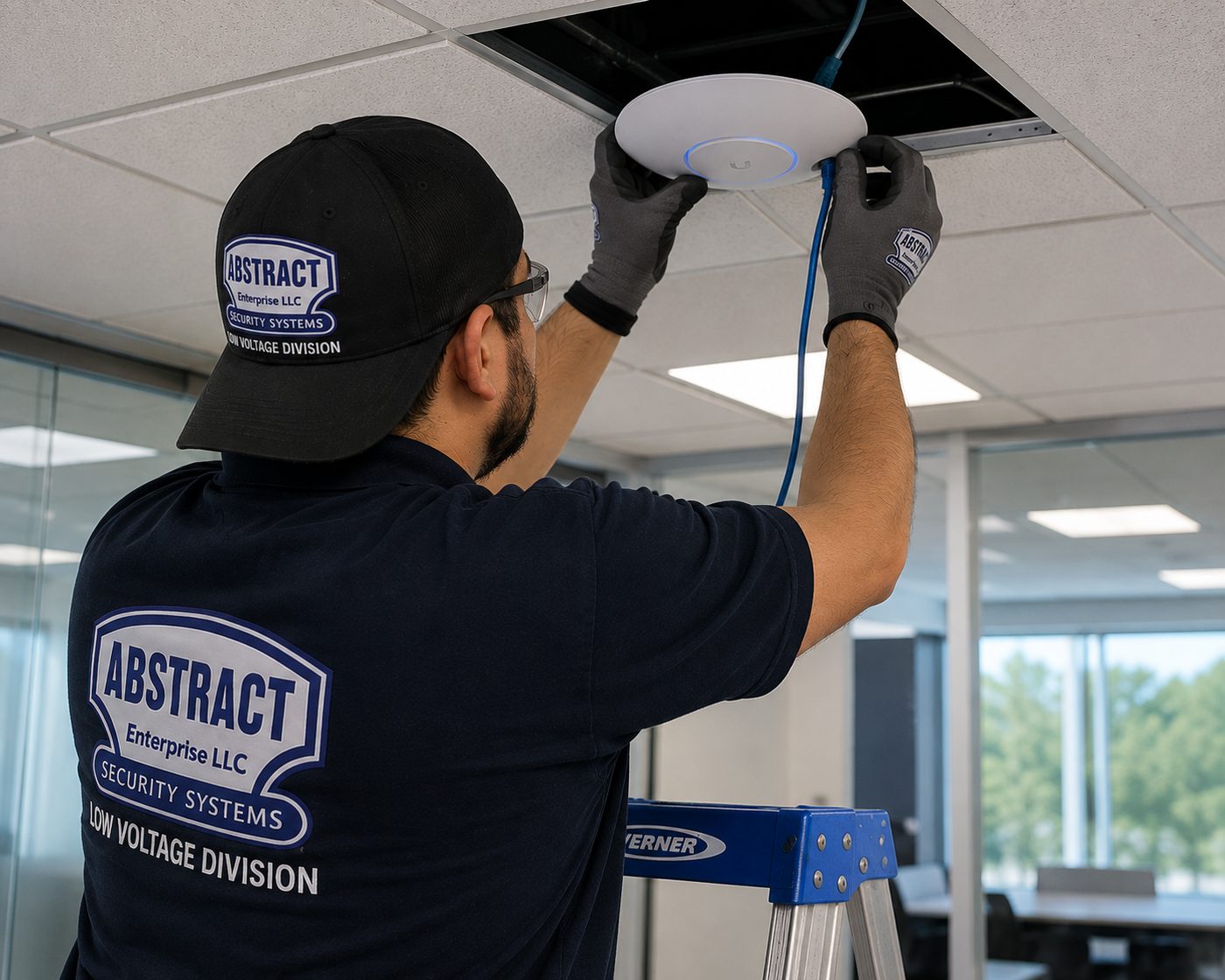
Ceiling and wall AP drops placed for coverage rather than for convenience, on cable rated for the PoE class the access point actually draws once the room is full.
Camera Cabling
Home runs from each camera position back to the recorder or PoE switch, with length, pathway and switch power budget confirmed before anything is drilled. Security camera installation in NYC is handled by the same crew.
Access Control Door Wiring
Reader-to-controller runs, lock power home runs, request-to-exit and door position wiring pulled as a single door bundle. See access control installation in NYC.
Intercom and Entry Wiring
Vestibule-to-unit and vestibule-to-suite entry runs, multifamily riser work and station cabling. See intercom installation in NYC.
Alarm and Detection Wiring
Device home runs for intrusion systems, pulled clean and kept separated from data pathways rather than bundled in with them.
AV, Paging and Signage
Speaker runs, paging zones, conference room floor boxes, display and signage drops, and the extension pathways that carry video over twisted pair.
Fiber Backbone
Multimode and single-mode backbone between floors, wings and buildings wherever copper distance limits are exceeded — terminated, spliced and tested.
Racks, Closets and Cleanups
Two-post and wall-mount rack builds, patch panel and switch mounting, vertical and horizontal management, UPS, grounding, and full re-dress of closets that grew without a plan.
Most cabling packages we install pair with access control on the same mobilization — one crew, one set of pathways, one closet.
Everything on one mobilization: surveillance cameras, access control readers, magnetic locks and electric strikes, video intercoms, intrusion alarms, paging systems, conference-room systems and digital signage — plus the cable pathways, riser cabling and backbone cabling that feed them, the equipment racks and network closets they land in, and the cable termination, cable certification, system commissioning and as-built documentation that close the job out. Low voltage services in NYC cover telecommunications wiring and building automation as one commercial low voltage installer scope rather than several.
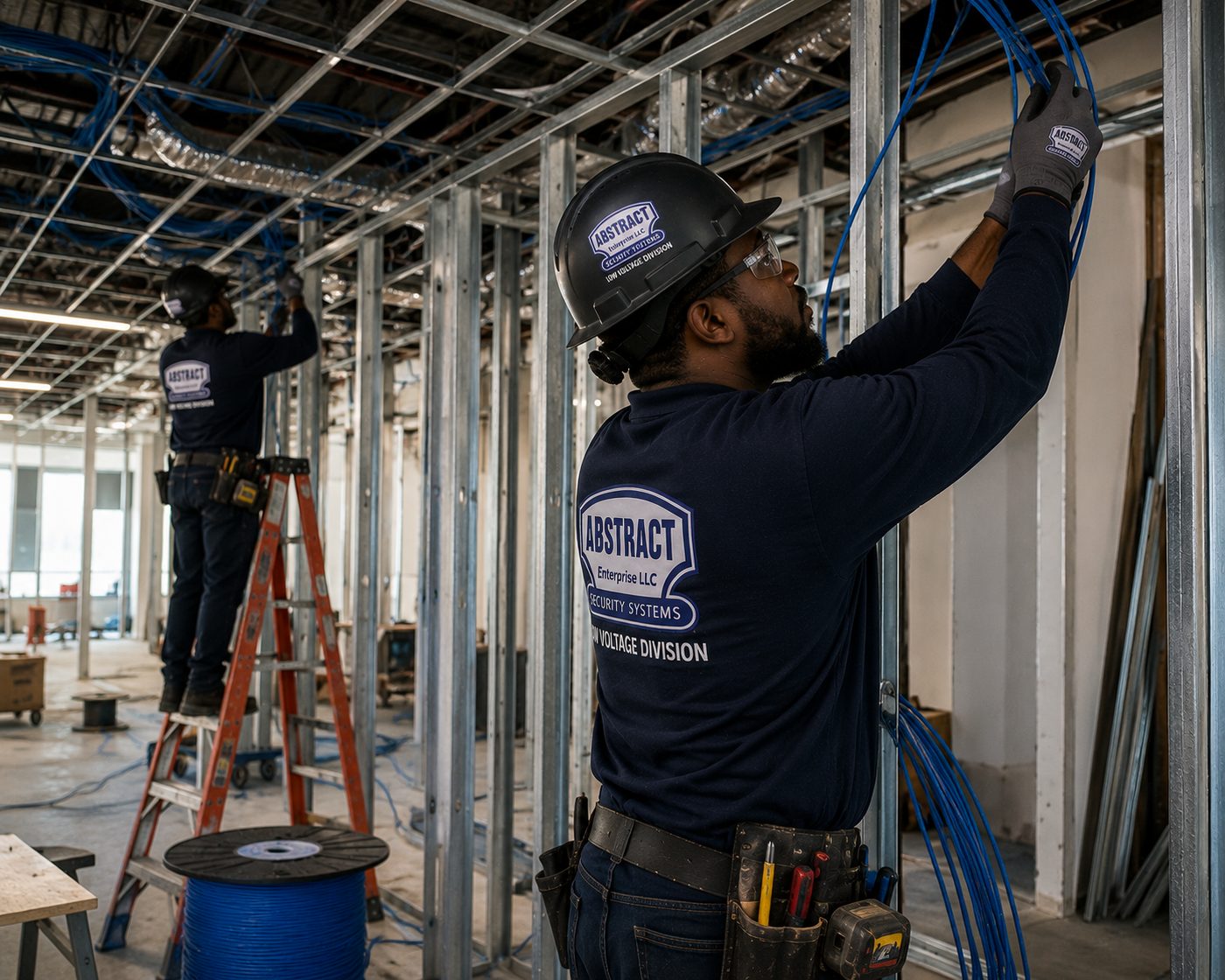
Cable pulled through metal-stud framing while the walls are still open, the cheapest cable on any New York job.
BUILDING SPECIALISTS
Cabling for the Way New York Buildings Are Actually Built
Pre-war masonry and loft conversions
Solid walls, no chase and frequently no accessible ceiling. The design question is pathway before it is anything else, and the honest answer is sometimes surface raceway, sometimes a core, and sometimes a route that adds fifty feet to avoid opening a wall the owner does not want opened. Where an interior is landmarked, the visually acceptable solution and the technically simple one are rarely the same solution.
Class A and Class B office towers
Plenum ceilings, managing-agent standards, COI before mobilization, and freight scheduled in blocks. Building management in this class of property routinely expects plenum-rated cable, a stated pathway method, and test reports at closeout. Those expectations are cheap to design for and expensive to retrofit, which is why the low-voltage scope belongs in the conversation at design stage rather than after the walls are framed.
Office-to-residential conversions
An entire category of New York project right now. These are old buildings receiving complicated surgery, and the low-voltage question is usually inherited rather than new: what is above the ceiling, what can be reused, what has to come out, and who is paying to remove it. Conversion work tends to surface abandoned cable in volume, because a floor that has been leased four times has been cabled four times.
Multifamily, co-op and condo
Riser access, common-area work in an occupied building, and board approval on a schedule that is not the contractor’s. Pre-war multifamily frequently has no vertical pathway for structured cabling at all, so getting from a basement demarc to an upper floor becomes a negotiation about where a sleeve can go and what it is allowed to look like.
Warehouse and light industrial
High-bay AP and camera cabling worked from a lift, dock and gate runs, and cable rated for an environment that is not a carpeted office. The advantage on this kind of property is that the operator usually owns the structure outright, so mounting permission is straightforward. The difficulty is that racking and plant move, and a run planned against a clear lane on survey day may be behind stacked material by the following week.
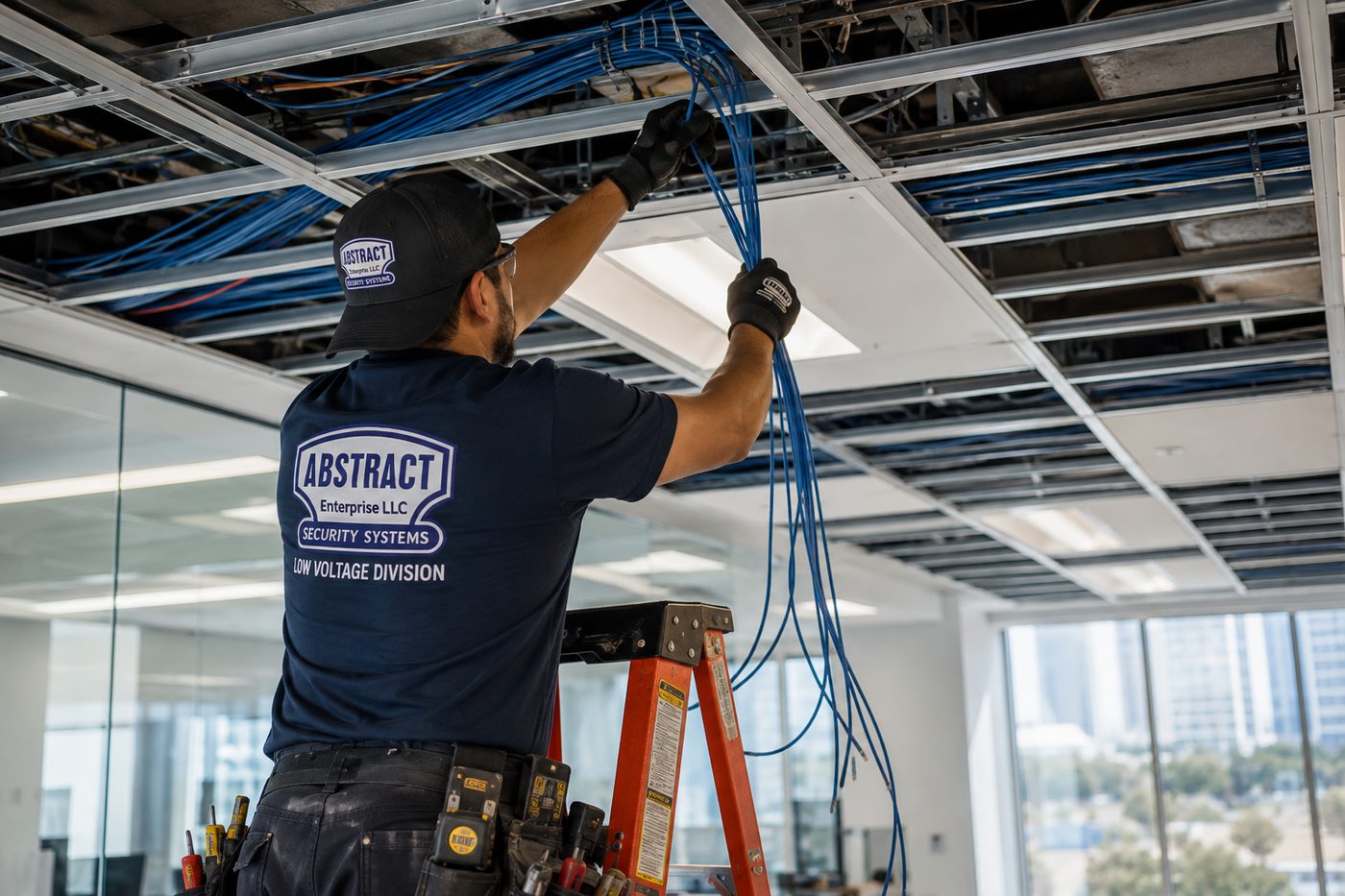
A bundle brought down through the grid at a workstation position.
EQUIPMENT
Cable, Racks and Hardware We Standardize On
Solid copper only. Copper-clad aluminum sold as Cat6 is the most common reason a system that worked on day one starts dropping powered devices in year two, and it is why a plant fails certification when a landlord or insurer finally asks for a report. We do not install it at any price on any job.
Cat6 Horizontal Cable
The baseline for a New York office drop. Dependable for gigabit and for shorter 10G runs, and the right choice on a smaller suite where nothing past the closet will ever need more.
Cat6A Horizontal Cable
Carries 10 Gigabit to the full hundred-metre channel and handles higher PoE classes with less heat rise in a dense bundle. The better buy on any commercial fit-out with a long lease horizon.
Plenum, Riser and Shielded Jackets
Plenum-rated CMP in air-handling ceilings, riser-rated CMR in vertical shafts, shielded where a run parallels heavy electrical or lives in a machine room. This is a code and lease requirement, not a quality tier.
Multimode and Single-Mode Fiber
Backbone between floors, wings and buildings where copper distance is exceeded, or where a run crosses environments fed from different electrical services and metallic cable would be a liability.
Patch Panels, Racks and Management
Two-post and wall-mount racks, patch panels, keystones and plates, vertical and horizontal management, UPS on anything you cannot afford to lose, and proper grounding at the rack.
Support Hardware and Pathway
J-hooks, cable tray, bridle rings, conduit sleeves through rated assemblies and firestop at penetrations. Cable resting on ceiling tile or hung from sprinkler pipe is not a supported installation.
Managed PoE Switches
Sized against real combined draw rather than port count. Devices with heaters, illuminators or motors pull far more than a fixed unit, and a switch chosen on device count starts dropping ports on the first cold night.
Field Enclosures
Sealed enclosures that let a cluster of devices share one uplink instead of several separate pathway runs, with rated entries, sound gaskets and honest thought about summer heat and winter cold-start.
Certification Testing
Wiremap and length testing on every drop as standard. Full TIA-568 certification with a Fluke DSX-class analyzer, delivered as printed and digital pass or fail per drop, wherever documentation is specified.
Increasingly the systems we cable in NYC are cloud-managed rather than local. Cloud access control with mobile credentials, touchless entry, smart intercoms, AI video analytics, license plate recognition and remote video monitoring all ride on the same structured cabling — Ethernet over Cat6 or Cat6A, with coaxial only where legacy plant survives. Smart building and IoT devices raise the PoE budget rather than the cable spec, and Wi-Fi 7 access points need Cat6A to be worth fitting.
Scope note for NYC: Cat6 cabling and Cat6A, fiber-optic cabling, Ethernet wiring and coaxial where legacy plant survives; network racks, MDF rooms and IDF closets; PoE infrastructure sized to the device count; audiovisual systems and integrated building systems where they share the pathway. As a low voltage systems integrator and low voltage wiring contractor we cover tenant buildouts, system takeover work and ongoing low voltage maintenance, including licensed low voltage installers for security wiring and structured wiring. To get a low voltage installation quote or a low voltage installation estimate, the survey is free.
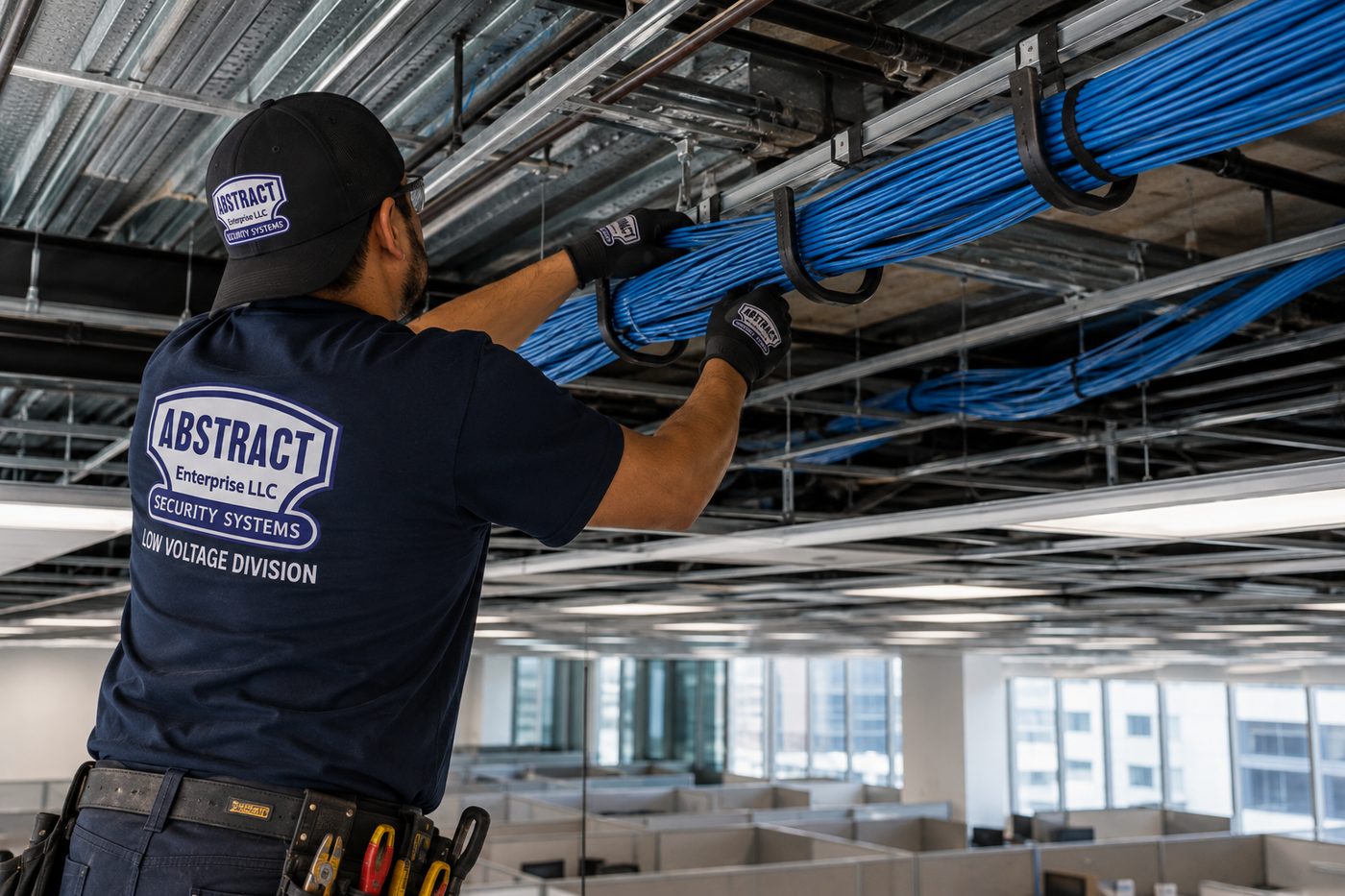
Supported pathway on J-hooks, never resting on tile or hung from pipe.
TERMINOLOGY
New York Low Voltage Terms, Translated
Most quote disputes in this trade come down to two parties using the same words differently. This is the vocabulary you need to read any NYC cabling proposal.
Drop. One cable run from the closet to one outlet position, terminated at both ends. Almost all cabling is priced per drop, not per foot.
Home run. A dedicated cable from a single device straight back to the closet with nothing daisy-chained in between. Standard for cameras, doors and access points.
MDF and IDF. Main distribution frame — the primary closet where service enters. Intermediate distribution frame — the satellite closets on other floors or wings. Both need dedicated power, adequate cooling and real rack space, which is easy to plan at design stage and costly to add later.
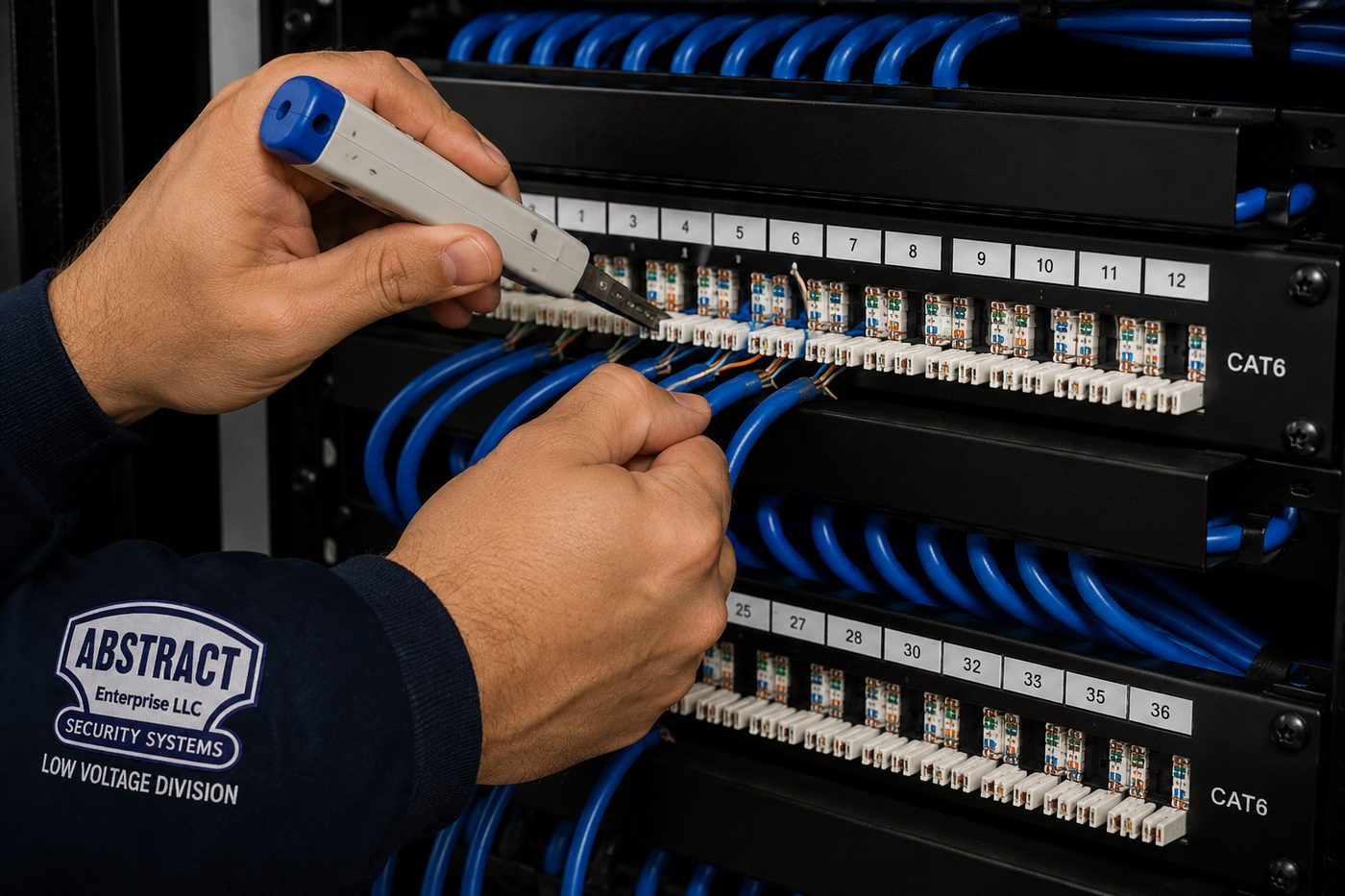
Patch panel. The punch-down block in the rack where horizontal cable terminates, so switches connect with short cords instead of permanent terminations.
Punch-down. Seating individual conductors into an insulation-displacement contact. The single most common source of a run that tests marginal rather than clean.
Plenum (CMP) versus riser (CMR). Plenum jacket belongs in air-handling spaces because it produces less smoke when it burns; riser belongs in vertical shafts between floors. Substituting down is one of the few cabling mistakes that creates genuine exposure.
PoE class and power budget. Every switch has a total power budget as well as a per-port class. Exceeding the total makes devices brown out and reboot in rotation, which looks exactly like a cable fault and gets misdiagnosed for months.
Wiremap versus certification. A wiremap confirms the pairs are on the right pins with no shorts or splits. Certification measures length, crosstalk, return loss, propagation delay and delay skew against TIA-568 and produces a printed pass or fail per drop.
J-hook and tray. Support hardware carrying bundles at required intervals, so cable is held rather than draped.
As-built. The closeout drawing and port map showing what was installed where, so the next person does not have to trace it by hand.
CCA. Copper-clad aluminum. Cheap cable marked as Cat6 that is not solid copper, runs hot under power and fails certification.
Low voltage electrical work. In New York City this is a defined term: wiring designed to operate at less than 50 volts for signaling, communication, alarm and data transmission circuits, per Administrative Code §28-101.5.
What people mean by low voltage installation in NYC: the design, installation, testing and documentation of limited-energy systems — also called extra-low-voltage or ELV systems, and sometimes electronic security systems or building technology systems. What a low voltage installer does is run and terminate the communications infrastructure a building needs, which is a different trade from line-voltage electrical wiring. The difference between Cat6 and Cat6A is bandwidth headroom and heat under PoE: Cat6A carries 10 Gigabit to the full channel where Cat6 does not.
An access point on its own home run, placed for coverage rather than convenience.
COMMERCIAL LOW VOLTAGE
Low Voltage Work Across the Five Boroughs
Manhattan
Manhattan is where New York’s conversion wave is concentrated. Developers plan to begin construction on roughly 9.5 million square feet of office-to-residential conversions during 2026 — more than twice the 2025 conversion market, according to Cushman & Wakefield data reported by Bisnow. The projects cluster Downtown and in Midtown, with work underway across the Financial District, Tribeca, NoHo, Midtown and Hell’s Kitchen. At the same time the trophy end of the market is tight, with Park Avenue availability near historic lows and Hudson Yards effectively full. For a low-voltage contractor that produces two distinct kinds of job on the same island: fresh cabling into converted floors that were last wired as offices, and dense tenant fit-out work in towers where nights, freight windows and certificates of insurance govern the schedule. Corridors we work regularly include Hudson Yards and the Penn District, Flatiron along Broadway, Midtown East on Third and Lexington, the Garment District blocks in the West Thirties, the Financial District around Water Street, Broad Street and Maiden Lane, the SoHo cast-iron blocks on Broome, Grand and Greene, the 125th Street corridor and Chelsea around West 23rd and Tenth Avenue.
Brooklyn
Brooklyn is home base — our office is at 1282 Troy Ave — and the borough’s low-voltage demand runs through its industrial campuses as much as its offices. The Brooklyn Navy Yard alone hosts hundreds of businesses employing thousands of people across roughly four million square feet of leasable industrial and office space, and BNYDC and NYCEDC have sought a design partner to redevelop the ninth floor of Building 303 for life-sciences and green-economy tenants. That is the shape of Brooklyn cabling work: converted industrial floorplates with high open ceilings, long horizontal distances that push toward Cat6A and fiber backbone, and tenants who need a documented closet rather than an improvised one. Beyond the Yard we work Industry City and Bush Terminal in Sunset Park, Downtown Brooklyn along Livingston, Jay and Court Streets, DUMBO around Water and Jay, Gowanus, the East Williamsburg industrial blocks off Meserole and Morgan Avenue, and the retail and multifamily corridors on Flatbush Avenue, Kings Highway, Utica Avenue and out to Rockaway Parkway in Canarsie.
Queens
Queens is the borough where the ground is moving fastest. The OneLIC Neighborhood Plan rezones a fifty-four-block stretch of the Long Island City waterfront, with an estimated fifteen thousand new apartments over a decade alongside roughly three and a half million square feet of new commercial, office and retail space. Hunters Point South continues to build out, including a nearly one-thousand-unit three-building proposal on 2nd Street with ground-floor retail. New residential and mixed-use construction at that density is a pre-wire market: cable goes in before drywall, which is the cheapest cable anyone ever buys, and the low-voltage sub who is in the schedule early does the work once instead of twice. We also work Astoria along Steinway Street, the Maspeth and Ridgewood industrial belt, Jamaica around Sutphin Boulevard and the 165th Street corridor, Flushing on Main Street and Roosevelt Avenue, and the office and cargo stock ringing JFK.
The Bronx
Bronx low-voltage work is weighted toward industrial and institutional property. The Hunts Point Produce Market is undergoing a redevelopment valued at roughly four hundred and five million dollars into an all-electric intermodal food distribution facility, with construction expected to begin in late 2026. Nearby, the Peninsula development on the former Spofford site pairs affordable housing with tens of thousands of square feet of light industrial and commercial space. Hunts Point and Longwood sit inside a designated Industrial Business Zone bounded by the East River, the Bronx River and the Bruckner Expressway, and the food-wholesale and manufacturing tenants there need cabling that survives dust, temperature swing and forklift traffic rather than cabling that looks tidy in a carpeted suite. We also work the Fordham Road corridor, the Grand Concourse, Mott Haven along Bruckner Boulevard, Port Morris and Riverdale around Johnson Avenue.
Staten Island
Staten Island work comes to us through its commercial corridors and its office and light-industrial parks rather than through tower fit-outs. The practical constraints are the ones that come with lower-rise, wider-footprint buildings: longer horizontal runs that need to be checked against distance limits before a design is fixed, more exterior pathway between structures on a single parcel, and more properties where a pole or an exterior enclosure is part of the answer. We cover the Teleport and Bloomfield corridor, Hylan Boulevard, Forest Avenue, St. George and Bay Street, and the Richmond Valley industrial blocks.
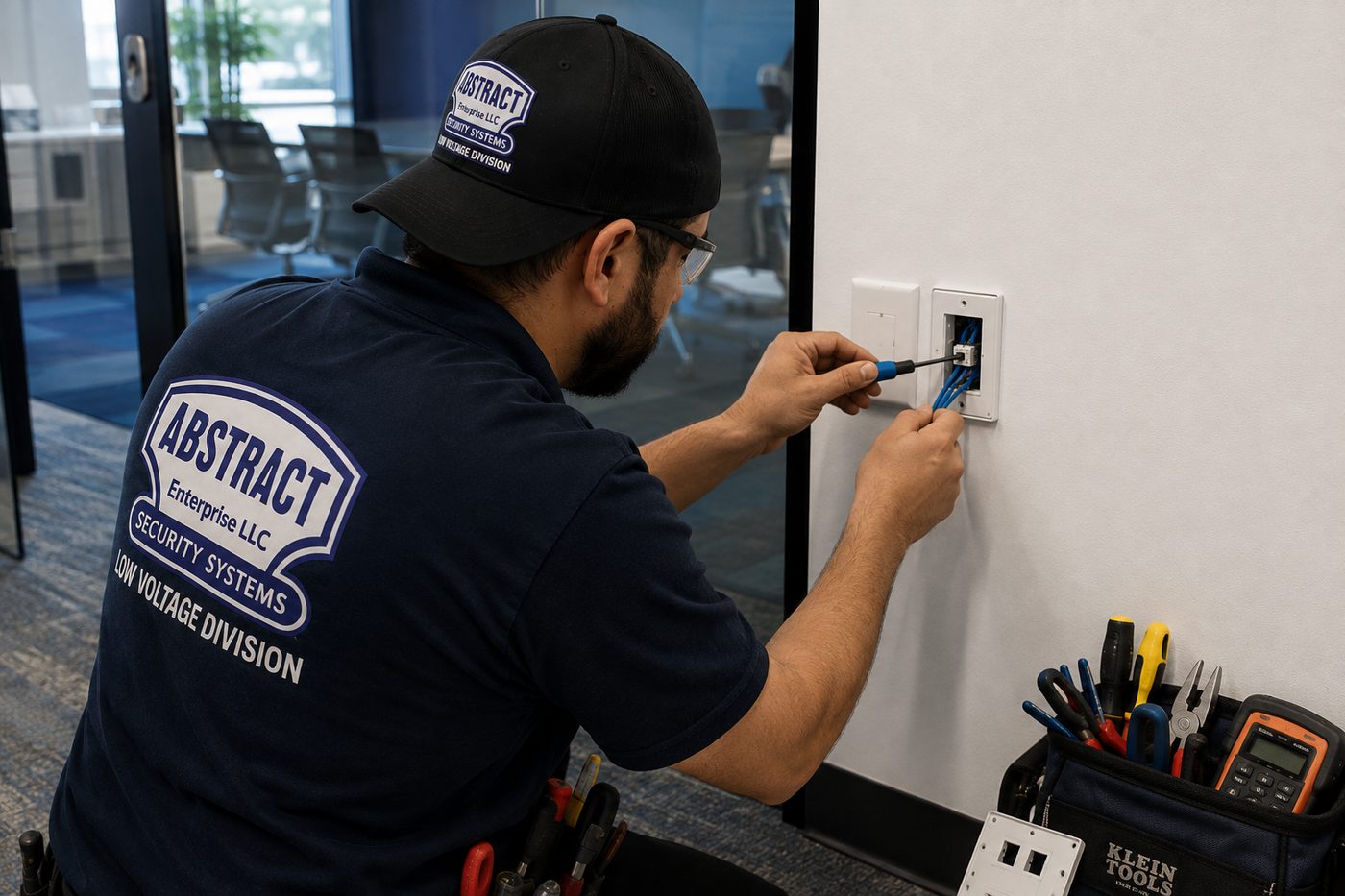
The user end of a drop, terminated and plated.
INDUSTRIES
Who We Cable For in New York City
Offices and Tenant Fit-Outs
Cabling on a lease clock, coordinated with the general contractor, in before drywall closes.
Office-to-Residential Conversions
Legacy plant assessment, abandoned cable removal and fresh distribution into converted floors.
Multifamily, Co-Ops and Condos
Riser work, common areas and vestibules in occupied buildings, on board-approved scopes.
Retail and Restaurants
Point-of-sale reliability, back-of-house coverage and work scheduled around trading hours.
Warehouse and Light Industrial
High-bay runs from a lift, dock and gate wiring, and cable rated for the environment it lives in.
Schools and Institutions
Summer and recess windows, clean documentation and work that survives an inspection.
Medical and Dental
Segregated closets, controlled access to network infrastructure and tidy patient-facing spaces.
Property Management
Portfolio standards, so every building in the book is cabled and labeled the same way.
General Contractors
Low voltage as a subcontracted trade, with COI, schedule discipline and a closeout package.
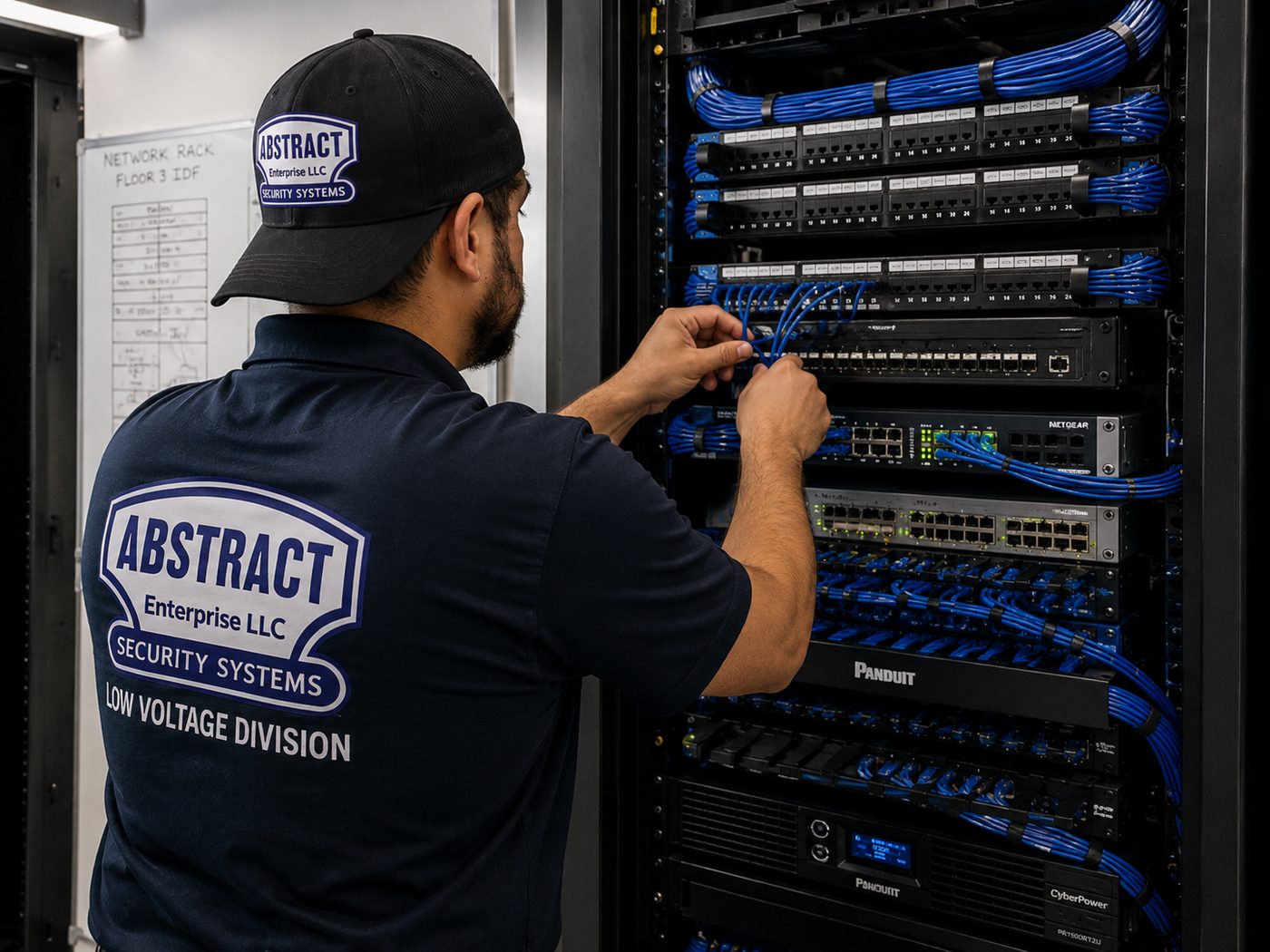
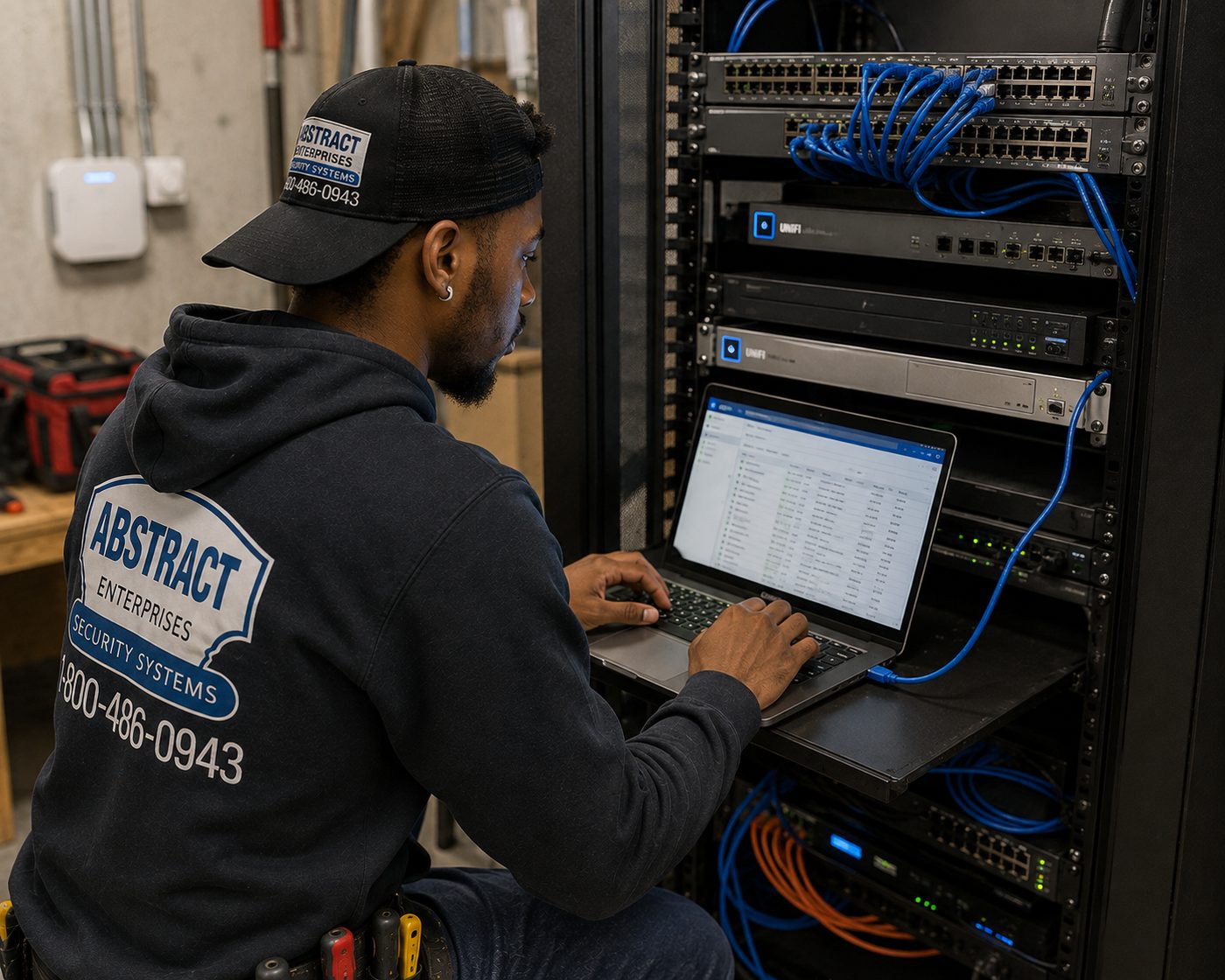
Patching in the floor IDF, with the rack map on the wall beside it.
HOW IT WORKS
How a New York City Low Voltage Project Runs
Free on-site survey. Ceilings, closets, risers and existing pathway are inspected, and building access rules, insurance requirements and freight availability are confirmed before anything is quoted.
Pathway plan. Routing, support method, penetrations and firestopping are settled first, because pathway is the cost, not cable.
Written scope and proposal. Drop count and locations, cable category and jacket rating per space, pathway method, closet and rack scope, testing level, labeling standard, documentation deliverable and a written exclusions list.
Rough-in. Cable pulled on supported pathway with the correct jacket for each space, ideally before drywall closes.
Termination. Keystones at the outlet, patch panel punch-down at the closet, rack dressed as it is built rather than afterwards.
Testing. Wiremap and length on one hundred percent of drops, with full TIA-568 certification where it is specified.
Labeling. Every cable labeled at both ends to a scheme that matches the port map.
As-built and closeout. Drawing, port map, configuration notes and digital closeout package handed over, site left clean.
Start and completion timing turns on building conditions, equipment availability, access to the property, permitting where it applies, and how large the project is.
Every job starts with a free low voltage site survey and a written low voltage system design, and finishes with low voltage cable labeling, low voltage testing and documentation. When something fails, we handle urgent low voltage repair and emergency low voltage service the same way: low voltage troubleshooting first, then replace failed low voltage cabling or restore security system wiring rather than guessing. A low voltage technician in NYC carries the analyser to the first visit.
Horizontal cable punched to a numbered panel rather than direct to a switch.
YOUR QUESTIONS ANSWERED
Low Voltage Installation in NYC: Your Questions Answered
Does low voltage work require a DOB permit in New York City?
The rules changed recently, so a stale answer is worse than no answer. Local Law 128 of 2024 took effect on 21 December 2025 alongside the 2025 New York City Electrical Code, and it added Administrative Code §28-105.4.7, under which an electrical permit is not required for low-voltage work under 50 volts for signaling, communication, alarm and data transmission circuits — provided the work is performed by a licensed master electrician, a special electrician, or a qualified person as the Electrical Code defines that term. That proviso is the part most summaries drop. There is also a hard carve-out: wiring that connects to, forms part of, or sits within a life safety system may only be performed by a licensed master or special electrician. We identify what applies to your specific scope during the survey and put it in writing, and we would rather you read the code section than take our paraphrase for it.
Do you need a license to install low voltage in New York State?
New York State does not issue a single statewide low-voltage contractor license the way some states do — requirements are set locally, and New York City sets its own through the Department of Buildings. That is not the same as saying licensing is optional. Abstract Enterprises holds NYS Low-Voltage Electrical Contractor License #12000287431 and carries commercial insurance, and in practice it is the license plus the certificate of insurance that gets a crew through the door of a managed New York building at all.
How much does low voltage installation cost per drop in NYC?
Abstract Enterprises published pricing starts at $175 for a Cat6 data or voice drop and $250 for a Cat6A drop, with a $500 minimum job. Independent industry guides put commercial Cat6 drops in a national band running from roughly $125 to $400 fully installed, terminated and tested, and they consistently note that labor rather than cable drives the number — the wire in a single drop is often around twenty-five dollars in materials. Those are national figures. What a New York building adds on top is access: badging, freight windows, night work, plaster ceilings and pavement or masonry that has to be opened and made good.
Why did one contractor quote $150 a drop and another $400 for the same office?
Because they almost certainly scoped different work. Industry pricing discussion among installers puts non-certified drops around the $200 mark and certified drops closer to $400 to $450, and the gap is real — a certification analyzer is a five-figure instrument that has to be earned back across jobs. Put both proposals side by side and compare seven lines: cable category, jacket rating, pathway method, support hardware, testing level, labeling standard and documentation deliverable. The difference usually explains itself immediately.
Is there a minimum job size for a New York low voltage contractor?
Ours is $500, and there has to be one. Getting a van, a technician, tools and materials into a New York City building — parking, loading, badging, freight — is a fixed cost that does not scale down with the work. One drop and eight drops carry nearly identical mobilization, which is also why bundling systems into a single visit lowers your effective per-drop cost so much.
Cat6 or Cat6A for a New York office in 2026?
Cat6A in most commercial cases. Cat6 will carry 10 Gigabit only to around fifty-five metres, while Cat6A carries it to the full hundred-metre channel, and Cat6A handles higher PoE classes with less heat accumulation in a dense bundle. For a home office or a small suite where nothing will ever need more than gigabit, Cat6 is genuinely fine. For a commercial fit-out, a Wi-Fi refresh or a long lease, the per-drop premium is trivial against pulling everything again in year six.
Does low voltage cable have to be in conduit in New York City?
Not universally. Correctly rated and correctly supported limited-energy cable is generally permitted in open ceiling and plenum spaces. Conduit becomes required in specific conditions — certain exposed locations, some rated assemblies, and any case where a building standard, an engineering specification or a lease rider calls for it. In practice many New York commercial leases and union-building specifications impose pathway requirements stricter than code, so the rider is worth reading before the job is scoped rather than after.
Do I have to remove the abandoned cable above my ceiling?
Generally yes, for the accessible portion. Under the National Electrical Code, the accessible portion of abandoned communications and Class 2 or Class 3 cable is required to be removed unless it is tagged for future use with a durable tag. Cable buried in a concealed raceway is not considered accessible and is not required to come out. This matters most on retrofit and conversion work, where a plenum can hold twenty years of accumulated cable, most of it unused. Cutting the ends rather than removing the cable leaves the material in place, which defeats the point of the rule.
Can existing cable be reused, or does everything have to be replaced?
Frequently it can, and the cable is the part worth keeping, because pathway is the expensive half of the plant. The correct sequence is to certify what is there first. Reusing an untested legacy run is how a new system inherits an old fault and then spends six months being blamed on the new equipment. Where existing runs certify clean and land where you need them, we keep them and say so in the proposal.
How do I know the cable was actually tested and not just plugged in?
Ask for the report before final payment. A device lighting up proves continuity and nothing more — a split pair, a marginal punch-down or a run past distance limits will all pass a casual check on day one and fail under load later. Certification produces a per-drop record of length, crosstalk, return loss and delay measured against TIA-568, with a printed pass or fail. If a contractor cannot produce that on request, they are not certifying, whatever the proposal says.
Should I hire an electrician or a low voltage contractor for data cabling?
An electrician is the right trade for line voltage, and many will happily pull Cat6 as well. The question is whether they carry a certification tester, work to TIA-568 rather than to power-wiring habit, and hand over a labeled port map and as-built. Some do. Many do not, because it is not their standards body and not their tooling. The failure we are called in to fix most often is a run pulled competently and terminated without a tester, where nobody finds the problem until powered devices start dropping.
My cameras and access points keep dropping offline — is it the cable or the switch?
Usually neither in the way people assume. The most common cause we find is a switch whose total PoE budget is exceeded once every port is populated, so devices brown out and reboot in rotation. Second is a marginal termination or a run past distance limits that works at idle and fails under power draw. Third is copper-clad aluminum heating up. Certification testing plus a look at the switch power budget settles the question in about an hour.
When should the low voltage contractor be brought into a fit-out?
At design stage, not at rough-in. Closet locations, dedicated power, cooling and rack space are straightforward to plan while drawings are still moving and expensive to retrofit once they are not. Being in the schedule early also means the cable goes in before drywall, which is the cheapest cable on the whole project. The most common failure on a general-contractor-run fit-out is not incompetence, it is a coordination gap — the electrician assumes the cabling sub has data, the cabling sub was never engaged, and the walls close empty.
Am I responsible for removing my cable when I vacate the space?
Very often yes. Cable removal at surrender is standard language in New York City commercial leases, and tenants who ignore it get billed for it at rates they never negotiated. Check the surrender clause when you start planning a fit-out rather than in the month you move, and keep the as-built — documented cable is dramatically cheaper to remove than anonymous cable.
Common questions we get in NYC: what is low voltage installation, what does a low voltage installer do, what is the difference between low voltage and electrical wiring, does low voltage wiring need conduit, how is low voltage cable tested, how long does low voltage installation take, and what is the difference between Cat6 and Cat6A. The answers are throughout this page; if your low voltage system is not working — a low voltage system not working is the single most common call we take — the fastest route is a call rather than a form.
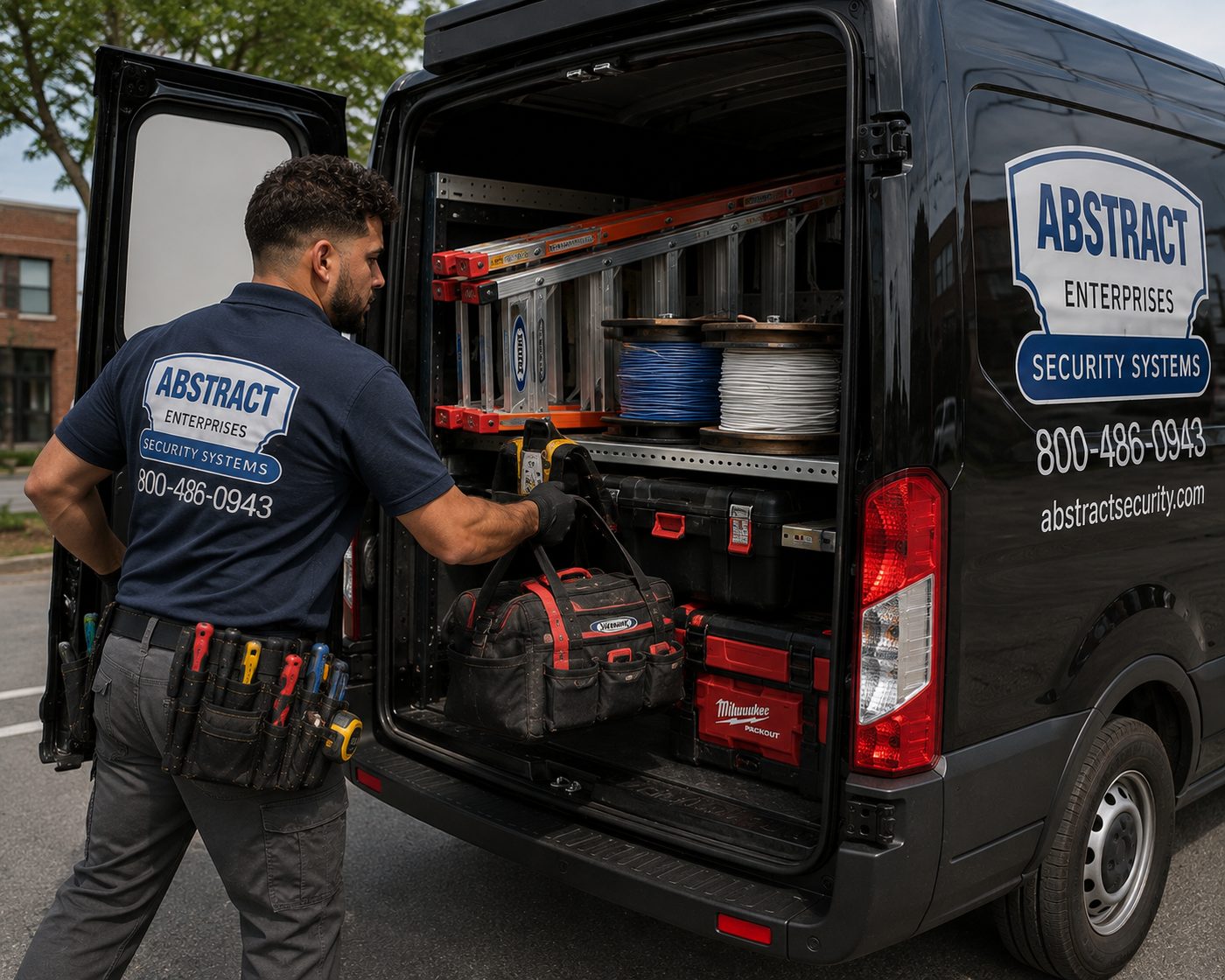
Loading out for the day: Cat6 spools, hand tools and test gear.
AI OVERVIEW REALITY CHECK
What AI Summaries and Cost Guides Get Wrong About NYC Low Voltage
The published per-drop range is a national number, not a New York number
Search for cabling costs and you will land on a range. Independent industry guides put commercial Cat6 at roughly $125 to $400 per drop fully installed and tested, with Cat6A adding something like $30 to $75 and multimode fiber running several times higher. Those figures are honestly reported and they are useful as an order of magnitude.
They are also averaged across the entire country, and the country contains a great deal of single-storey construction with drop ceilings, surface parking and daytime access. New York is not in the middle of that distribution. A crew that parks in Midtown, badges through security, waits for a freight window and works after six because the managing agent requires it is absorbing cost before a foot of cable moves.
Our published starting points are $175 for a Cat6 drop and $250 for Cat6A, with a $500 minimum job. Those are starting points for accessible work, not ceilings, and a survey is what turns them into a number for your building.
The directories that rank for this search are lead marketplaces
Search “low voltage contractor NYC” and much of page one is Yelp, BBB and Thumbtack category pages. Those platforms are paid when a lead is sold, not when a job goes well, so what ranks there is marketing spend rather than certification capability, insurance limits or willingness to produce an as-built.
The category composition is worth noticing too. The New York “low voltage” listings on those sites are populated largely by electricians, audio-visual installers and residential security companies rather than by structured-cabling contractors. That is not a criticism of any individual business, but it does mean the form you fill in is routing a commercial cabling enquiry into a pool selected for something else.
The practical consequence is a mismatch. A form that asks for a device count returns quotes based on a device count, when the count is the least consequential decision on a cabling project. Nobody on that form asks whether the ceiling opens, what the lease rider says about jacket rating, or who owns the wall you would need permission to mount on.
“No permit required” became true on 21 December 2025 — and it is still misleading
This is the claim most likely to be out of date wherever you read it. Local Law 128 of 2024 took effect on 21 December 2025 with the 2025 New York City Electrical Code, and Administrative Code §28-105.4.7 now provides that an electrical permit is not required for low-voltage work under 50 volts for signaling, communication, alarm and data circuits.
The exemption is conditional, and the condition is the part that gets dropped. It applies where the work is performed by a licensed master electrician, a special electrician, or a qualified person as defined in the Electrical Code. Separately, wiring that connects to, forms part of, or is located within a life safety system may only be performed by a licensed master or special electrician — no exemption at all.
So the honest version is narrower than the headline. Permit exemption is not license exemption, insurance exemption, or code exemption, and it has nothing whatsoever to do with whether a managing agent will admit an uninsured contractor to the building. Read the code section rather than anyone’s summary of it, including ours.
Every published range omits pathway, which is the actual cost driver
Ask an experienced installer what drives a New York quote and the answer is not cable, labor rate or connector count. When contractors discuss per-drop pricing among themselves, the questions that come back are always the same set: is it all in conduit or wiremold, are you dealing with a two-hundred-year-old New York building or newer construction, and did you include a pathway system.
That is the entire pricing model in three questions, and it is exactly what a national average flattens away. Open ceiling grid with existing support hardware is one job. Sealed plaster over wire lath with no chase is a fundamentally different one, and on identical footage the difference is routinely a multiple rather than a margin.
It is also why we survey before quoting anything past a handful of drops. A number written off a floor plan without a ceiling inspection is a guess, and guesses in this trade get corrected through change orders that arrive after you have committed to a schedule.
Testing is invisible in every published price
Cost guides quote a per-drop figure as though every drop is the same deliverable. There are really three tiers. A cable that lights up. A cable with a wiremap and length test confirming correct pin assignment, no shorts, no splits and no distance violation. And a cable certified against TIA-568 with an analyzer producing a per-drop pass or fail.
The gap is not academic. A split pair passes the first tier perfectly and degrades badly under load. A run at a hundred and five metres works at gigabit idle and collapses when a powered device draws on it. Marginal crosstalk shows up as a device that drops at the same time each day and gets blamed on the device for a year.
We include wiremap and length testing on every drop as standard and offer full certification as a priced line. On any job where a landlord, an insurer, a general contractor or a future buyer might ask for documentation, that line is the cheapest insurance on the proposal.
“Any electrician can do it” collapses on contact with a real building
The claim is not malicious, just imprecise. Electricians and low-voltage installers overlap heavily and work side by side on the same fit-outs constantly. Where they diverge is standards body and tooling: line voltage is measured against power-wiring requirements, structured cabling against TIA-568, verified with an instrument most trade vans do not carry.
The predictable failure is a coordination gap rather than a competence gap. On a general-contractor-run project the electrician assumes the cabling contractor has data, the cabling contractor was never brought on, and the walls close with nothing in them — or the cable is pulled well and terminated without a tester.
The fix is unglamorous and it works: name the low-voltage scope explicitly in the schedule, get it in before drywall, and require a test report at closeout. We work as a subcontracted trade on exactly that basis, and we would rather be in at rough than be the emergency call in month four.
What an honest New York low voltage proposal actually contains
Nine lines. Drop count and locations. Cable category and jacket rating for each space. Pathway method — existing, J-hook, tray, conduit, core — and who is responsible for firestopping. Closet and rack scope, including whether panels and switches are in. Testing level, stated explicitly as wiremap or full certification. Labeling standard. Documentation deliverable, meaning as-built and port map, or nothing. Access assumptions, including hours, freight and insurance requirements. And a written exclusions list.
If a proposal is missing more than two of those, the number on it is not comparable to any other number you have received. Most of what people experience as a contractor overcharging is really two proposals describing different jobs, where the cheaper one quietly excluded testing, documentation and pathway.
Ask for all nine from every bidder, including us. A contractor who will not put those in writing before starting is telling you something useful about how the closeout is going to go.
Get a real scope in writing, not a national average.
Published starting points, not estimates dressed up as ranges. Every drop includes solid copper cable, keystone and plate at the workstation, patch panel punch-down at the closet, wiremap testing, labels at both ends and a patch cable.
Item
NYC starting price
Notes
Cat6 data or voice drop
From $175
Gigabit, standard PoE, solid copper
Cat6A drop
From $250
10G to the full channel, higher PoE classes
Fiber backbone
Custom quote
Multimode or single-mode, terminated and tested
Plenum, riser or shielded jacket
Quoted separately
Priced by the space requirement
Rack build, patch panels, closet cleanup
Itemized
Scoped per closet
Minimum job size
$500
Mobilization floor
Service, troubleshooting and callbacks
$195/hr, 3-hour minimum
Service work only, not initial installation
Structured cabling cost in NYC and Cat6 installation cost in NYC both start from the per-drop figures above; low voltage security systems in NYC share the same pathway, and server room cabling in NYC is scoped per closet. Fiber optic cabling in NYC is quoted separately.
The low voltage license position in NYC sits with the state and the city rather than with a county board, unlike Westchester, Putnam or Suffolk further out.
What moves the number up: sealed ceilings with no existing pathway, coring and firestopping, conduit requirements, distance from the closet, multi-floor runs, plenum jacket, after-hours or weekend-only building access, lift requirements, and landlord-specified labeling or routing plans.
What moves the number down: open ceiling with existing pathway, pre-drywall rough-in, bundling multiple systems into one mobilization, grouping drops rather than scattering them, and daytime access.
Bring your own equipment if you prefer — Abstract Enterprises Security Systems installs owner-supplied cable and hardware provided it is solid copper and correctly jacket-rated for the space, and we will tell you plainly if what arrived is neither. Full per-drop figures and package detail are on our structured cabling pricing page.
Low voltage vs electrician in NYC is the question behind most of these enquiries. An electrician is the right trade for line voltage, and many will pull Cat6 competently. The practical test is whether they carry a certification analyser, work to TIA-568 rather than to power-wiring habit, and hand over a labelled port map and as-built.
If you are comparing several structured cabling companies in NYC rather than choosing a trade, ask any data cabling installers you shortlist for the same nine lines — drop count and locations, cable category and jacket rating per space, pathway method and who firestops, closet and rack scope, testing level, labelling standard, documentation deliverable, access assumptions and a written exclusions list. A structured cabling contractor who will not put those on paper has told you how the closeout will go. Searching for a low voltage contractor near me in NYC, or for the best low voltage company, returns whoever ranks or pays rather than whoever suits your building — so ask for the licensed low voltage contractor credential and check it.
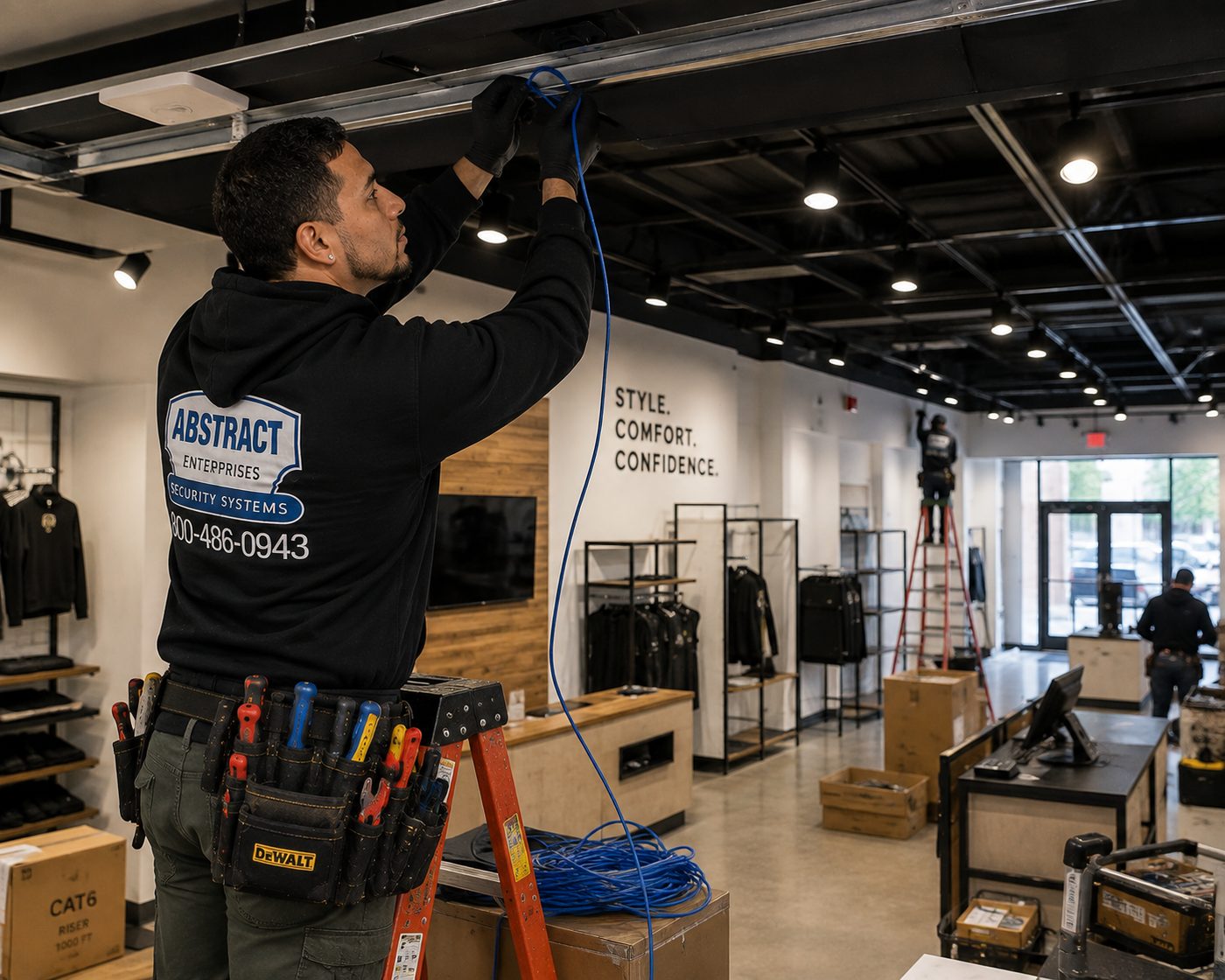
Cable pulled through an open retail ceiling during fit-out, before the space opens.
SHOP OUR SYSTEMS
Low Voltage Packages & Pricing in NYC
Starter
From $875 installed
A small suite or storefront — about five Cat6 drops back to one closet, terminated on a patch panel, wiremapped and labeled at both ends. Figured at the published $175 Cat6 rate.
Standard
From $1,750 installed
A typical office or tenant fit-out — around ten drops with a wall-mount rack build, patch panel and closet dress-out. Figured at the published $175 Cat6 rate; Cat6A from $250 per drop.
Premium
From $5,250 installed
A full floor or multi-closet property — twenty-one or more Cat6A drops, fiber backbone between floors, full rack build and TIA-568 certification with as-builts. Figured at the published $250 Cat6A rate.
These figures are the published per-drop rate multiplied by the drop count shown, nothing more. They are a starting frame, not a quote. Pathway condition, jacket rating, coring and firestopping, distance from the closet, after-hours building access and certification all move the number, and the exact figure is set by your free on-site survey. Minimum job size is $500.
Already bought your cable and hardware? Ask about a bring-your-own-equipment (BYOE) install — labor-only pathway, pulling, termination, testing and labeling of materials you supply, provided the cable is solid copper and correctly jacket-rated for the space.
You own the system outright with no monthly fees, and products supplied by us carry a three-year warranty. Post-install service visits and callbacks are billed at $195/hour with a three-hour minimum ($585).
Dead drops, offline cameras or access points, a door that stopped releasing, a closet nobody can trace, or cable cut during unrelated construction. Same-day response across the five boroughs, and most single-fault troubleshooting is resolved on the first visit. Service and troubleshooting is billed at $195/hr with a three-hour minimum.
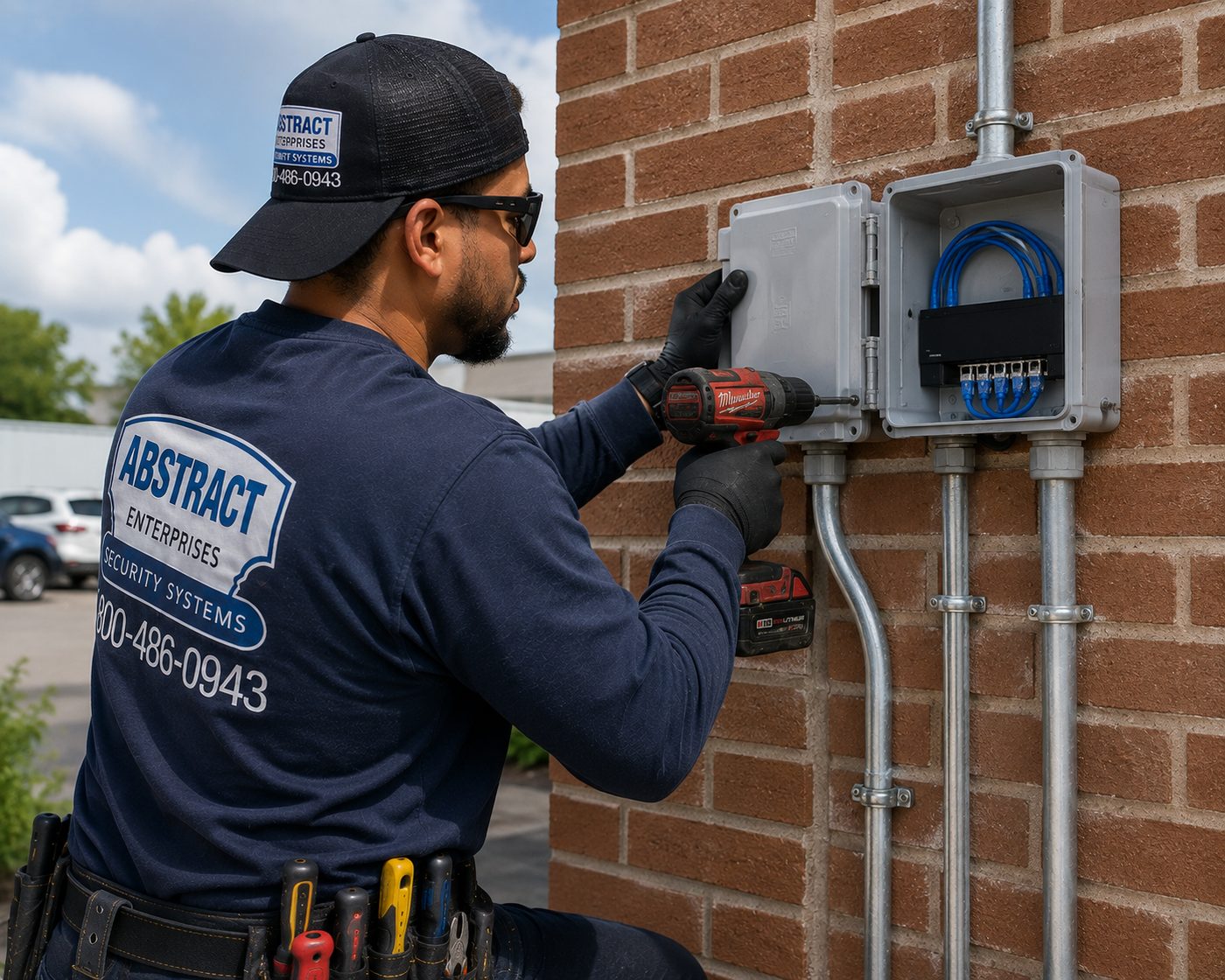
A rated exterior enclosure mounted and terminated, with conduit down to grade.
LOCAL PROBLEMS
Low Voltage Problems Specific to New York City Buildings
Abandoned cable stacked above the ceiling. Occupied commercial space here has typically been fitted out three or four times and almost nobody removed the old cable. It consumes the pathway you need, makes every future service call more expensive, and the accessible portion is required to come out rather than simply be cut.
No riser pathway in pre-war multifamily. Buildings put up before structured cabling existed have no vertical route for it, so getting from a basement demarc to an upper floor becomes a board conversation about where a sleeve can go.
Landmarked interiors that reject surface raceway. In older lobbies and protected interiors the acceptable solution and the easy solution are rarely the same one.
Shared closets with no tenant segregation. Multi-tenant floors frequently share one closet with no separation, so anyone servicing one system is standing in front of everybody’s infrastructure.
PoE budget exhaustion after an add-on. A switch sized for the original device count gets four more added, total draw crosses the budget, and devices reboot in rotation. The cable gets blamed for months.
Cable damaged during unrelated construction. Another trade cuts a bundle, nobody reports it, and the fault surfaces weeks later with no documentation to trace against.
Conversion floors with inherited plant. A floor being converted from office to residential carries four tenancies of cabling and no drawing for any of it.
The wiring map that lives in one person’s head. An enormous amount of New York building infrastructure was never documented. When that superintendent retires, the building loses its map.
A last practical note for NYC owners. Should low voltage wiring be installed in conduit? Only where the space or the code requires it — conduit pathways, cable trays and NEMA enclosures are specified per environment, not by default. Can existing low voltage wiring be reused? Frequently, once it certifies. Electrician vs low voltage installer, or security company vs low voltage contractor, comes down to the same test: who carries the analyser and hands over the documentation. We also fit AI security camera systems, touchless access control and license plate recognition where a site wants them, and schedule school-break, back-to-school and holiday work around the calendar that governs the building. To get a low voltage installation quote in a working day, ask for the free survey; we work as a low voltage security installer as well as a cabling contractor.
FIELD NOTES
Field Notes from New York Ceilings
The tile tells you first. Push up one ceiling tile in a Midtown suite and you learn more in ten seconds than twenty minutes of floor plans will give you — whether there is tray, whether the last crew used hooks or laid bundles across the grid, whether anything is labeled, and roughly how many fit-outs the floor has been through.
The hardest drop is never the longest one. It is the one crossing a rated corridor wall, or landing in the one room the building will not let you core, or terminating behind millwork the GC already installed. We plan the awkward runs first and let the easy ones fill in around them, because the awkward ones are the schedule.
Label everything, every time. Any technician who has traced an unlabeled bundle at eleven at night in a cold closet becomes permanently religious about labeling. It costs a few minutes per drop and saves hours a year for as long as the building stands.
Get in before the drywall. Every conversation about saving money on cabling has the same answer and nobody wants to hear it early enough. Open walls are cheap. Finished walls are not, and on a single added drop the minimum service call dominates the price no matter how short the run is.
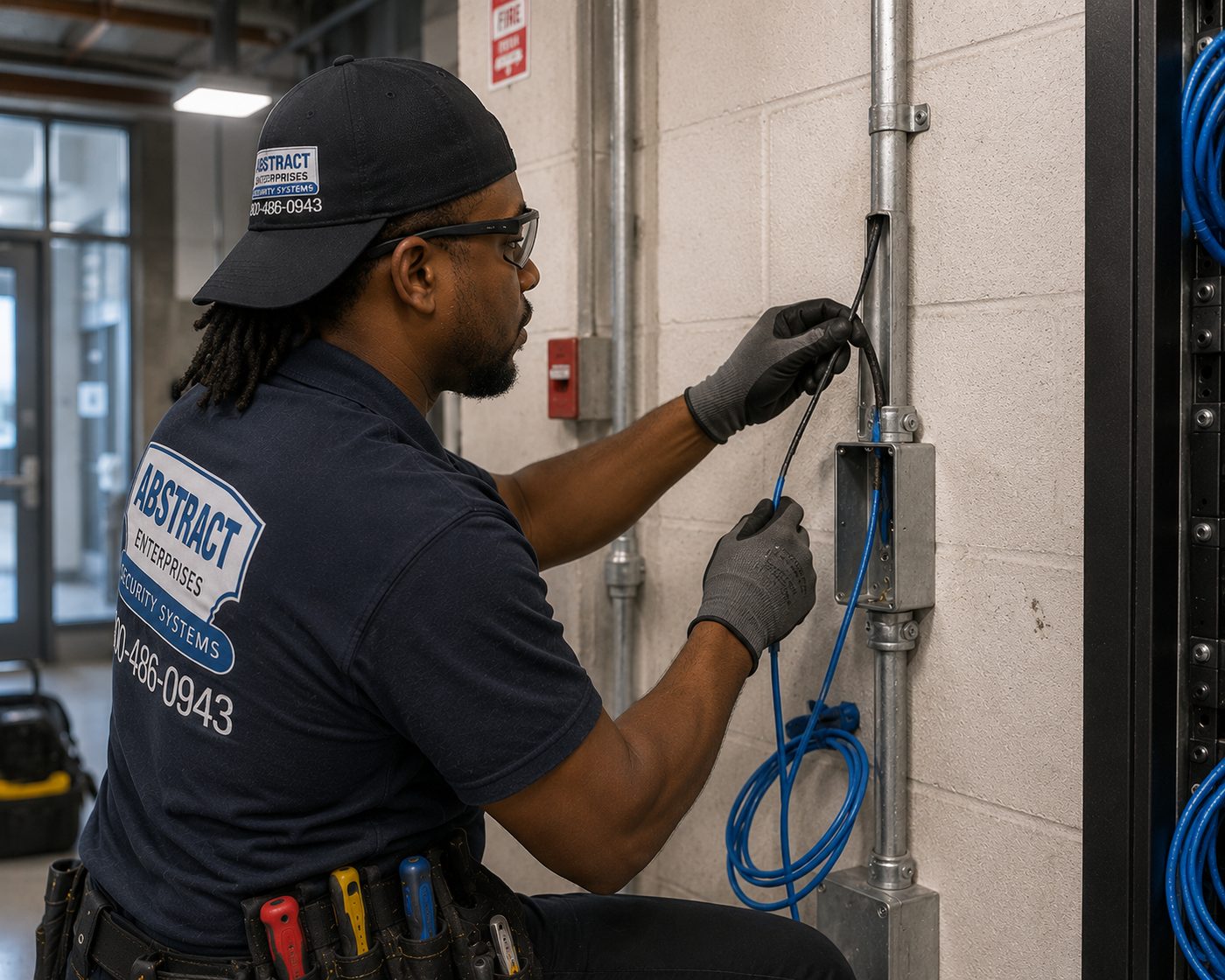
Cable drawn through riser conduit between floors, the hard half of any vertical run.
COVERAGE AREA
NYC Low Voltage Coverage
We install and service low-voltage systems across all five boroughs: Manhattan (New York County), Brooklyn (Kings County), Queens (Queens County), the Bronx (Bronx County) and Staten Island (Richmond County). Beyond the city we cover Long Island and the Hudson Valley through our regional pages.
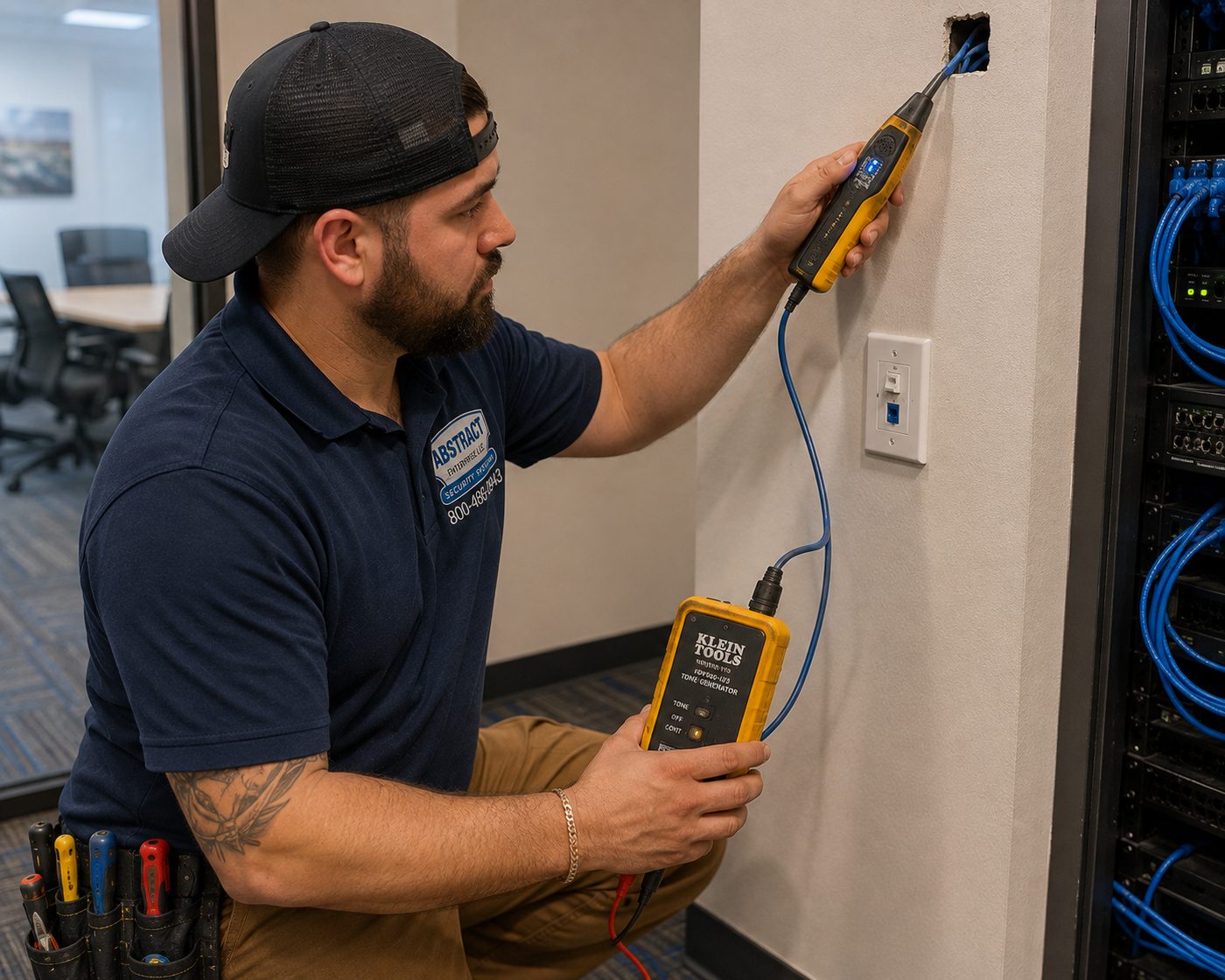
Toning an unlabelled run, which is how most undocumented buildings start.
FAQ
NYC Low Voltage Installation FAQ
What counts as low voltage wiring in New York City?
New York City defines it in Administrative Code §28-101.5 as electrical wiring designed to operate at less than 50 volts for signaling, communication, alarm and data transmission circuits. In practice that covers structured data and voice cabling, camera wiring, access control wiring, intercom and entry runs, intrusion alarm circuits, audio-visual and paging, digital signage and building control wiring.
What changed for low voltage permitting on 21 December 2025?
Local Law 128 of 2024 took effect alongside the 2025 New York City Electrical Code. It added Administrative Code §28-105.4.7, which provides that an electrical permit is not required for low-voltage work under 50 volts for signaling, communication, alarm and data circuits, where the work is performed by a licensed master electrician, a special electrician, or a qualified person as defined in the Electrical Code. Life safety system wiring is carved out and still requires a licensed master or special electrician.
Do you provide a certificate of insurance for building management?
Yes. We issue certificates of insurance naming the owner, the managing agent and any additional insureds your building requires, before we mobilize. In managed New York buildings this is usually what actually determines whether a crew can badge in on the day.
Can you work nights and weekends around building freight windows?
Yes. A significant share of our Manhattan and Downtown Brooklyn commercial work happens on night and weekend building windows, and scheduling around freight elevator availability is routine rather than exceptional. It extends the calendar without changing the labor hours.
Do you work as a subcontractor to general contractors?
Yes. We work as the low-voltage trade on fit-outs, renovations and conversions, with certificate of insurance, schedule commitments, rough-in coordination before drywall, and a closeout package including as-built drawings and a port map.
How long does an office cabling job take?
A small suite with accessible pathway is typically a single day. A full floor with a rack build and certification is usually several days. Buildings that restrict work to nights or weekends stretch the calendar without changing the labor hours. Start and completion timing turns on building conditions, equipment availability, access to the property, permitting where it applies, and how large the project is.
Do you install customer-supplied cable and hardware?
Yes, provided the cable is solid copper and correctly jacket-rated for the space it runs through. We will not install copper-clad aluminum, and we will say so plainly if that is what arrives. Materials warranty stays with the supplier; our labor warranty is unaffected.
Do you certify every drop?
Wiremap and length testing is performed on one hundred percent of drops as standard. Full TIA-568 certification with a Fluke DSX-class analyzer, delivered as printed and digital pass or fail records per drop, is available as a priced line and is recommended on any job with landlord, insurer or general contractor documentation requirements.
What documentation do I get at the end of the job?
Labels at both ends of every cable to a scheme that matches the port map, the as-built drawing, the port map itself, configuration notes and a digital closeout package. Whoever inherits the building — a new managing agent, a new IT provider, the next tenant — gets a documented system rather than a puzzle.
What is your rate for troubleshooting an existing system?
Service, troubleshooting and callback work on systems not originally installed by us is billed at $195 per hour with a three-hour minimum. That rate applies to service calls, not to initial installation projects, which are quoted by scope from a free survey.
What does the warranty cover?
Abstract Enterprises Security Systems provides a three-year warranty on products supplied by us. There are no monthly fees on the systems we install.
Do you handle repairs and takeovers of someone else's installation?
Yes, and it starts with an assessment rather than a quote: which runs still certify, what the existing hardware can realistically carry, whether the cable already in the ground can be reused, and where coverage genuinely falls short. On an older New York property the pathway is frequently in better condition than the equipment hanging off it.
Still deciding? The survey is free and settles it.
Same-day response across Manhattan, Brooklyn, Queens, the Bronx and Staten Island. Dead drops, offline devices, a closet nobody can trace or a bundle cut by another trade — most single-fault calls are diagnosed and resolved on the first visit. $195/hr with a three-hour minimum for service and callback work.
Tell us the building, the borough and roughly how many drops. We will either scope it on the phone or come and look at the ceiling — both are free, and neither commits you to anything.
Abstract Enterprises Security Systems provides a three-year warranty on products supplied by us. Service, troubleshooting and callback work on systems not originally installed by us is billed at $195 per hour with a three-hour minimum; that rate applies to service calls rather than to initial installation projects. There are no monthly fees on the systems we install. Start and completion timing turns on building conditions, equipment availability, access to the property, permitting where it applies, and how large the project is.
Regulatory references on this page cite the New York City Administrative Code and the 2025 New York City Electrical Code as published by the City of New York. They are provided for general information about how low-voltage work is classified and are not legal advice. Requirements for your specific building and scope should be confirmed with the Department of Buildings.
ALL AREAS SERVED
Low Voltage Installation by Area
Every area we cover for low-voltage and structured cabling work. An area without its own low-voltage page yet is still served directly — the coverage link books a survey.
Reviewed and updated August 3, 2026 by Anwar Timothy of Abstract Enterprises Security Systems, NYS Low-Voltage Electrical Contractor License #12000287431. Changelog — Aug 2026: page published for the NYC low-voltage hub. · Aug 2026: permitting section written against Local Law 128 of 2024 and the 2025 NYC Electrical Code effective 21 December 2025. · Aug 2026: Cat6A and PoE guidance reviewed for current commercial fit-out practice.