Structured cabling in Ulster County NY for adaptive-reuse buildings, campuses and small commercial — Cat6 and Cat6A, fiber between buildings, camera and access control wiring, certification and as-built documentation, installed by a NYS-licensed low-voltage contractor who surveys before drilling.
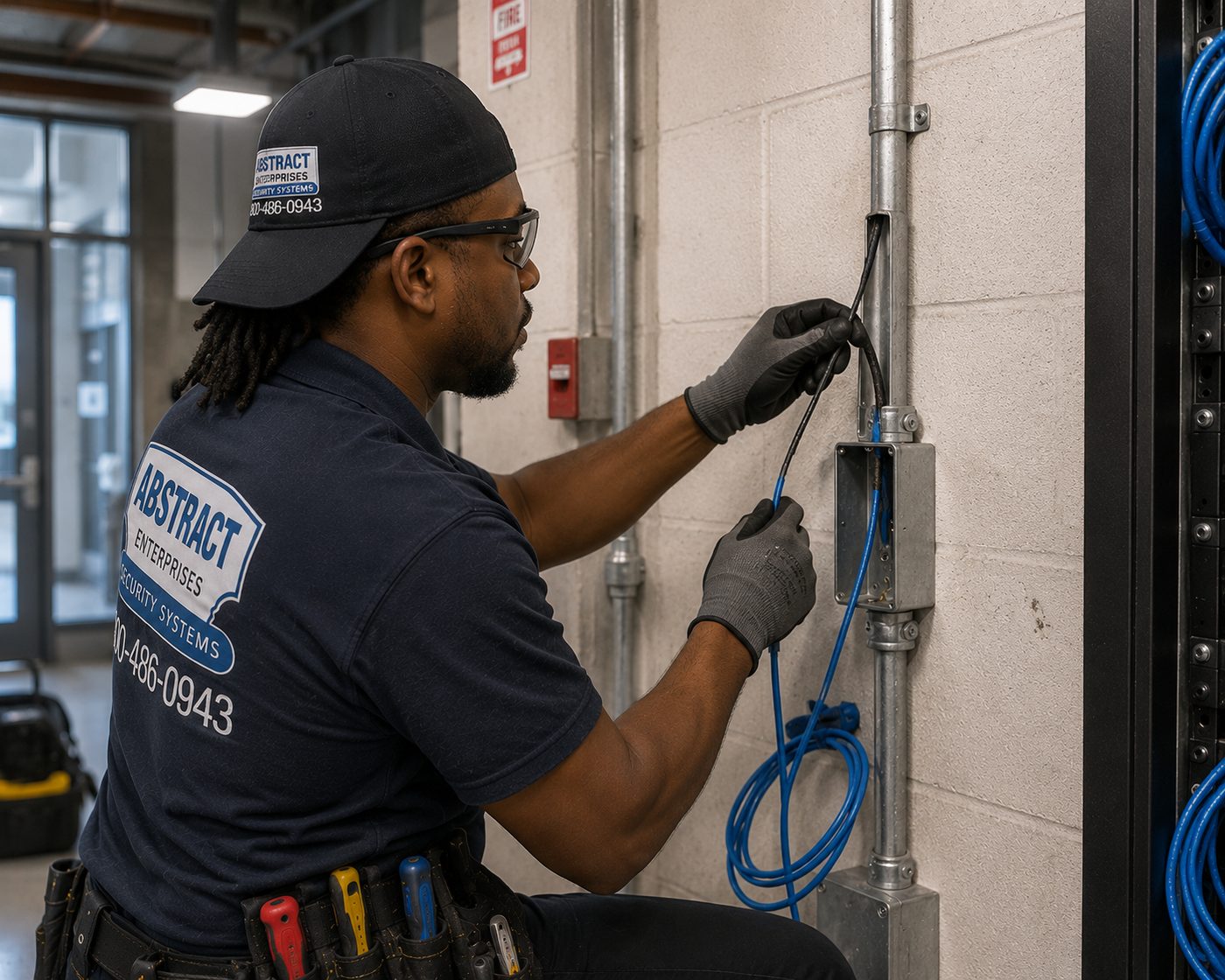
Low voltage installation in Ulster County NY: conduit work in an older building, where the route is planned before anything is opened.
In Ulster County NY the Building Usually Has a Past
Most commercial cabling in Ulster County NY happens inside a building that was built for something else. That is the defining condition here, and it changes the first step of the job from designing a route to finding out what is already in the wall.
The county’s largest commercial redevelopment makes the point. iPark 87, the former IBM Kingston manufacturing campus, covers about 200 acres with over one million square feet of existing buildings off I-87 Exit 19 in the Town of Ulster, with further warehouse, commercial and housing space planned. The Ulster BOCES Career and Technical Center has taken roughly 105,000 square feet there for around 1,200 students, and a 40,000 square foot Sustainable Ulster Workforce Innovation Center brings together the county, SUNY New Paltz, SUNY Ulster and BOCES. Archtop Fiber is headquartered on the campus.
The same site, under its former TechCity identity at 300 Enterprise Drive, is a 258-acre industrial park with a documented environmental history: improper asbestos abatement during 2015 and 2016 demolition released asbestos-containing material, and remediation has since run under EPA and NYSDOL oversight.
That is not a reason to avoid these buildings — they are the best commercial space in the county. It is a reason to work in them properly. In pre-1980 industrial and institutional stock, nothing gets cut, cored or penetrated until somebody knows what is in the assembly. On a live conversion that means coordinating with the owner’s survey and any abatement contractor rather than working around them, and it is a question we raise at survey rather than on the first morning.
Outside Kingston the commercial base is concentrated and thin. SUNY New Paltz and Mohonk Mountain House are the county’s two largest employers, together around 3,700 jobs; the greater Kingston area holds roughly 37 large employers accounting for close to 10,000 jobs, while the Ellenville area reports only three organisations employing 200 people or more. Health care, public administration, education, accommodation and food services and retail account for about 81 percent of the county’s top employers.
Kingston itself — New York’s first capital in 1777, settled in 1652 — carries a growing arts community and a downtown of nineteenth-century buildings now in commercial use. Woodstock, Saugerties, New Paltz, Rosendale and Highland follow the same pattern at village scale.
Abstract Enterprises Security Systems is a licensed low voltage contractor in Ulster County NY and a structured cabling contractor across the region, under NYS licence #12000287431. Every proposal follows a free on-site survey.
No monthly fees and a three-year warranty on equipment we install.
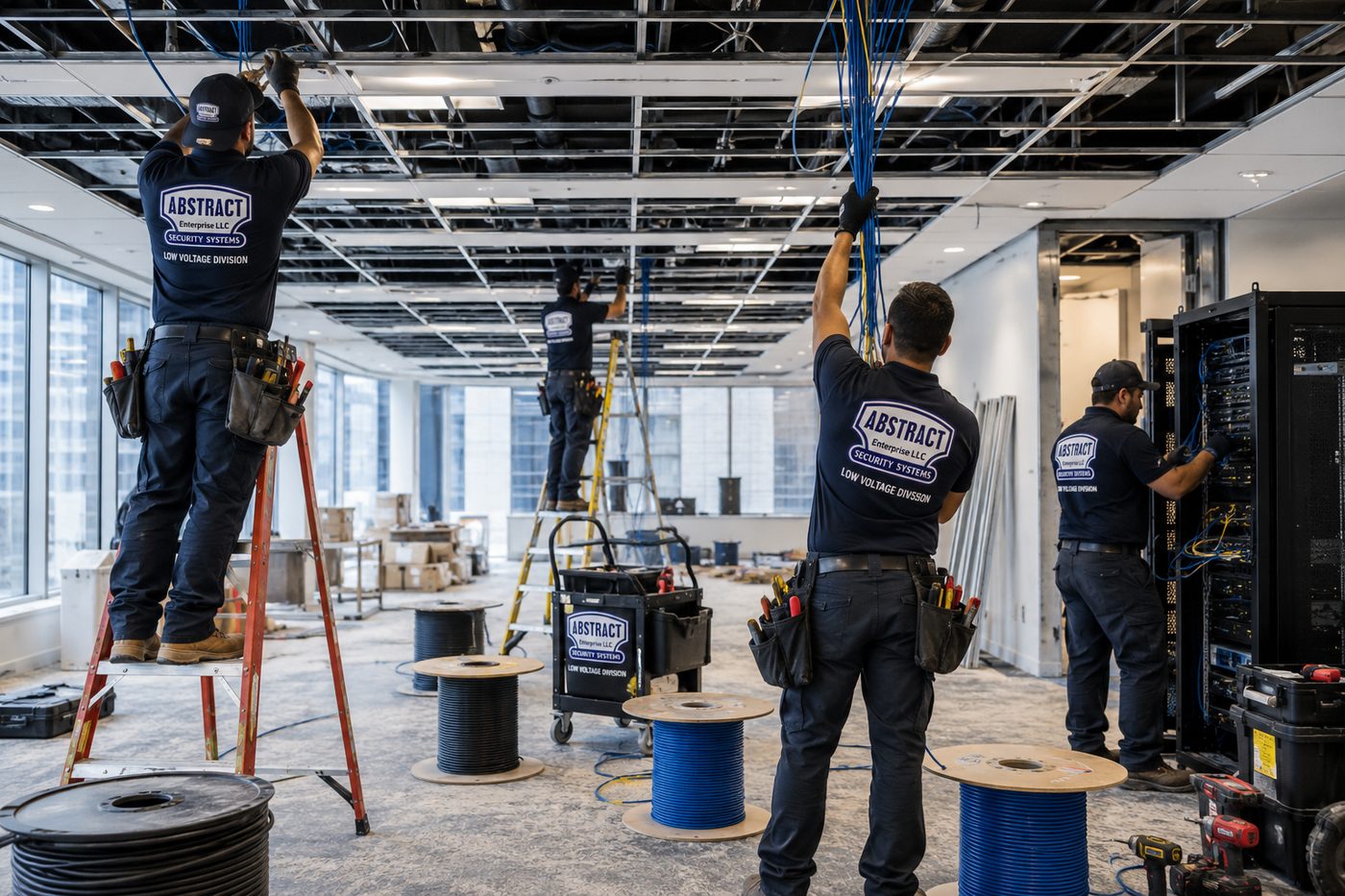
A full crew pulling and racking in one mobilisation on an Ulster job.
WHAT WE INSTALL
Commercial Low Voltage in Ulster County NY: Systems We Cable
Scoped against the two questions that govern work here: what is in the building already, and which licence and permit apply.
Adaptive Reuse Cabling
The county’s signature job. Routes planned around masonry, timber and unknown assemblies, with surface raceway and existing chases used in preference to new penetrations wherever it will look and perform acceptably.
Voice and Data Cabling
Commercial data cabling in Ulster County NY from workstation to closet, including VoIP handset drops — Cat6 cabling and Cat6A, with Cat5e only where existing plant is extended. Cat6 installation in Ulster County NY and office network cabling in Ulster County NY are the everyday versions.
Fiber Between Buildings
Fiber optic cabling in Ulster County NY and the fiber optic installation in Ulster County NY that goes with it link buildings on campus and industrial-park parcels.
Wireless Access Point Drops
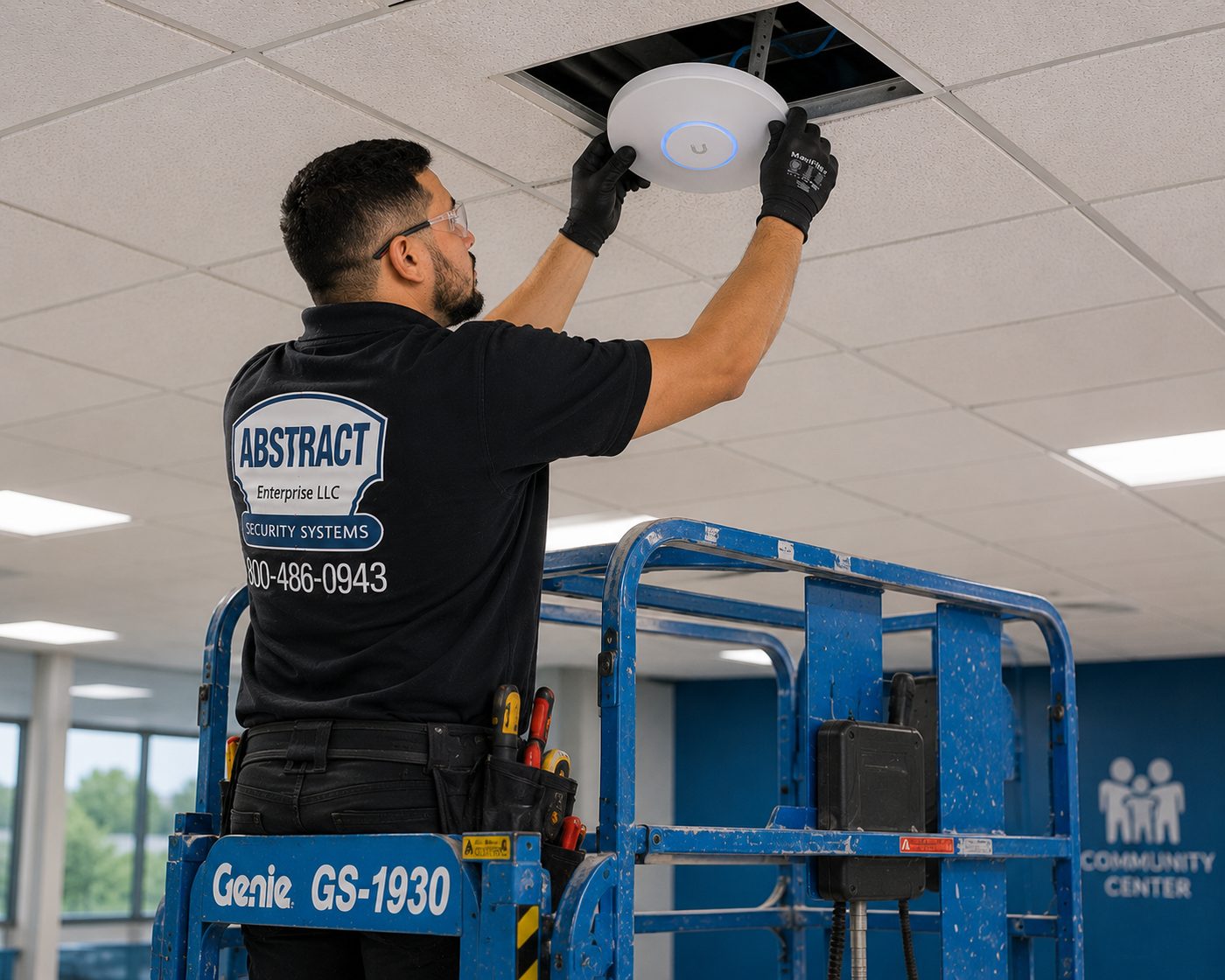
Wi-Fi infrastructure cabling — ceiling and wall AP drops on cable rated for the PoE class the device draws — and in thick-walled buildings, placed for what the structure will actually pass rather than what a drawing suggests.
Camera Cabling
Home runs from each position back to the recorder or PoE switch, with distance and switch power budget confirmed first. Security camera installation in Ulster County NY is handled by the same crew, including security camera installation in Kingston NY and the surrounding towns.
Access Control Door Wiring
Access control installation in Ulster County NY shares the data plant’s pathway: reader-to-controller runs, lock power home runs, request-to-exit and door position pulled as one door bundle.
Inns, resorts and food-service property where guest-facing space, back of house and trading hours all set different constraints.
Server Rooms, Racks and Closets
Server room cabling in Ulster County NY covers rack builds, patch panels, management, UPS and grounding — frequently in a room that was not designed to be one.
Low voltage security systems in Ulster County NY share the same pathway as the data plant, so one company can handle cabling, cameras and access control on a single mobilization.
Supported pathway placed where the structure allows rather than where a drawing suggested.
BUILDING SPECIALISTS
Cabling for the Way Ulster County NY Buildings Are Actually Built
Former industrial campuses in conversion
Structured cabling in Kingston and network cabling in the Town of Ulster cover the iPark 87 and Enterprise Drive parcels — roughly a million square feet of existing mid-century industrial buildings now taking educational, workforce, fiber and light-industrial tenants. Data cabling in Kingston on these sites means long internal distances, heavy structure, and coordination with survey and abatement work that may still be live elsewhere on the campus.
Nineteenth-century downtown and village commercial
A low voltage contractor in Kingston working the Stockade District, Midtown, the Rondout and Broadway deals with stone and brick, plaster, no accessible ceilings and no existing pathway. Network cabling in Kingston here is a route-planning exercise before it is a cabling one, and surface raceway is frequently the honest answer rather than a compromise.
Colleges and institutional
SUNY New Paltz is one of the county’s two largest employers. Structured cabling in New Paltz and data cabling in New Paltz cover campus and village property on semester calendars, with SUNY Ulster and BOCES facilities adding their own. Network cabling in New Paltz frequently runs to buildings of very different ages on the same parcel.
Hospitality, resort and tourism
Mohonk Mountain House is the other of the top two employers. Data cabling in New Paltz and structured cabling in Woodstock cover resort, inn, restaurant and gallery property, where guest areas, back of house and seasonal trading all constrain when work can happen. A low voltage contractor in Woodstock works small buildings on tight schedules.
Healthcare, municipal and public
Health care and public administration are among the county’s largest sectors. Network cabling in Kingston serves hospital and medical office property, and structured cabling in Ellenville and data cabling in Ellenville cover municipal, community and district buildings in an area with only a handful of large employers.
River towns, Rondout valley and the rural west
Data cabling in Saugerties, structured cabling in Saugerties, network cabling in Highland and low voltage wiring in Rosendale serve village commercial, food production and small industrial property along Route 9W, Route 32 and Route 213. A low voltage contractor in Marlborough or Wawarsing covers the southern and western towns along US-209, where drop counts are small and drives are long.
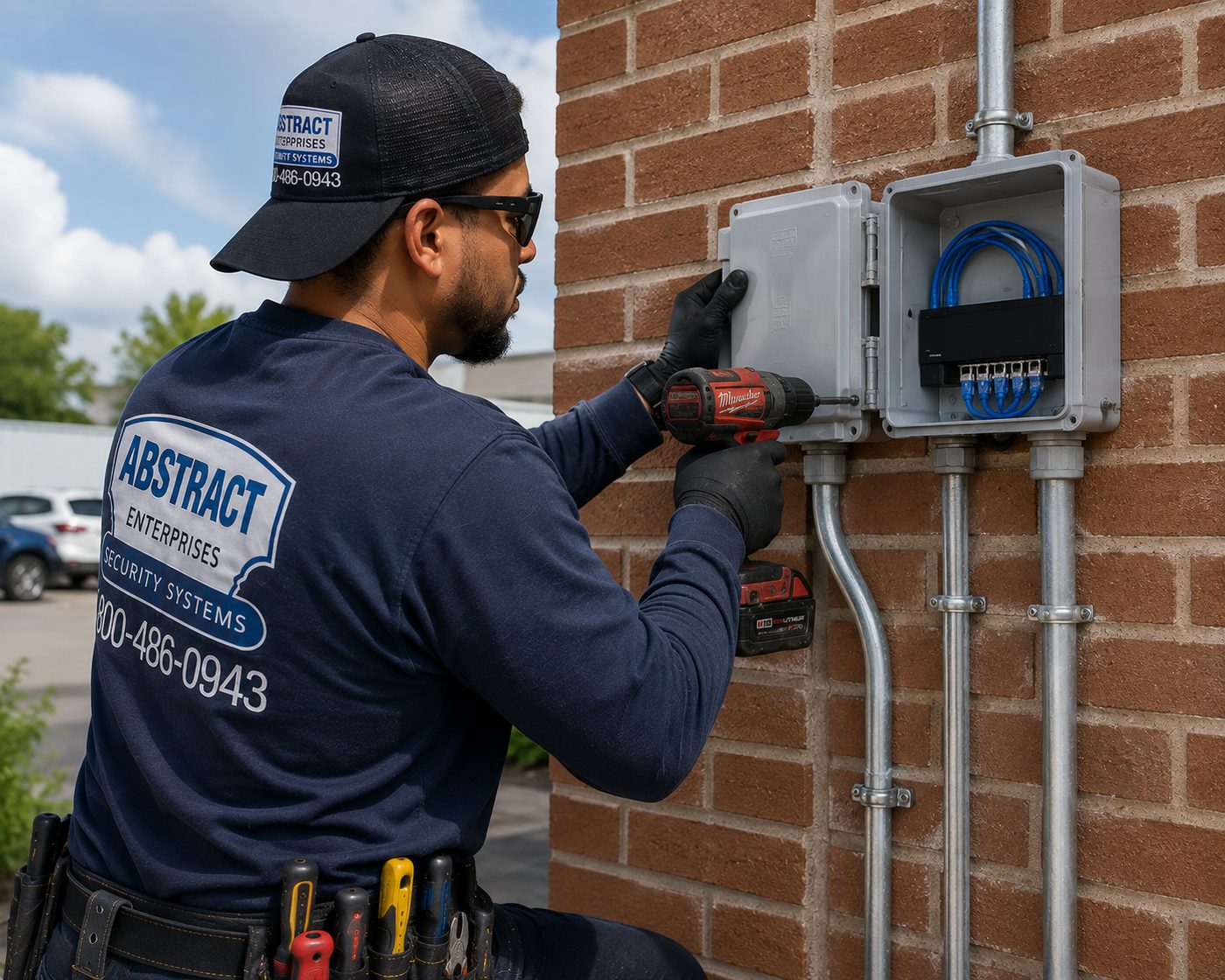
A rated exterior enclosure and conduit, for runs that leave the building.
EQUIPMENT
Cable, Racks and Hardware We Standardize On
Solid copper only. Copper-clad aluminium marked as Cat6 runs hot under power and fails certification — and in a converted building where every run was hard to place, a drop that will not certify is one you do not want to install twice.
Cat6 Horizontal Cable
The working default for Ulster suite, retail, hospitality and village commercial work. Dependable for gigabit and shorter 10G runs.
Cat6A Horizontal Cable
Cat6A installation carries 10 Gigabit to the full hundred-metre channel and handles higher PoE classes with less heat in a dense bundle. Worth specifying where a route was difficult enough that nobody wants to repeat it.
Surface Raceway and Existing Chases
In stone, brick and plaster buildings, a well-run surface raceway is frequently better than a concealed route that damages fabric. Chosen deliberately and finished properly rather than used as a fallback.
Plenum, Riser and Shielded Jackets
Plenum CMP in air-handling ceilings, riser CMR in shafts, shielded where a run parallels heavy electrical or industrial equipment. Code requirement rather than an upgrade tier.
Multimode and Single-Mode Fiber
Between buildings on campus and industrial-park parcels, and across the long internal distances a converted manufacturing building produces.
Outdoor and Direct-Burial Cable
For runs crossing a campus road, yard or parking area. Jacket rating and conduit decide whether the run survives, and spare capacity in the trench decides what the next addition costs.
Patch Panels, Racks and Management
Equipment racks, network racks, patch panels, keystones, plates, management, UPS and grounding — frequently fitted into a room that was never a telecom room.
Support Hardware and Pathway
J-hooks, cable trays, conduit pathways, bridle rings, sleeves through rated assemblies, NEMA enclosures outdoors, and firestop at every penetration.
Certification Testing
Wiremap and length on every drop as standard, with full TIA-568 certification on a Fluke DSX-class analyser producing printed and digital records per drop.
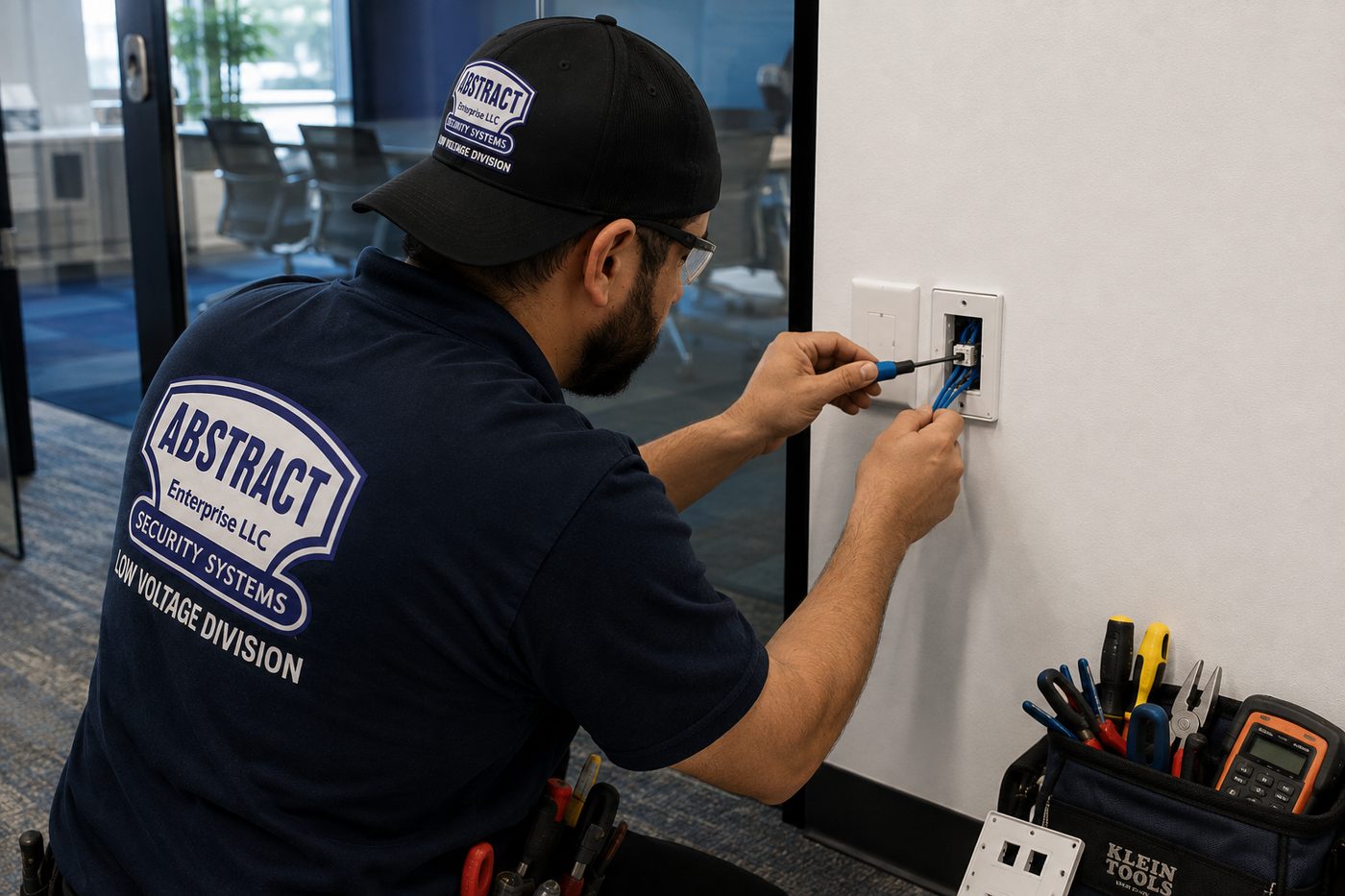
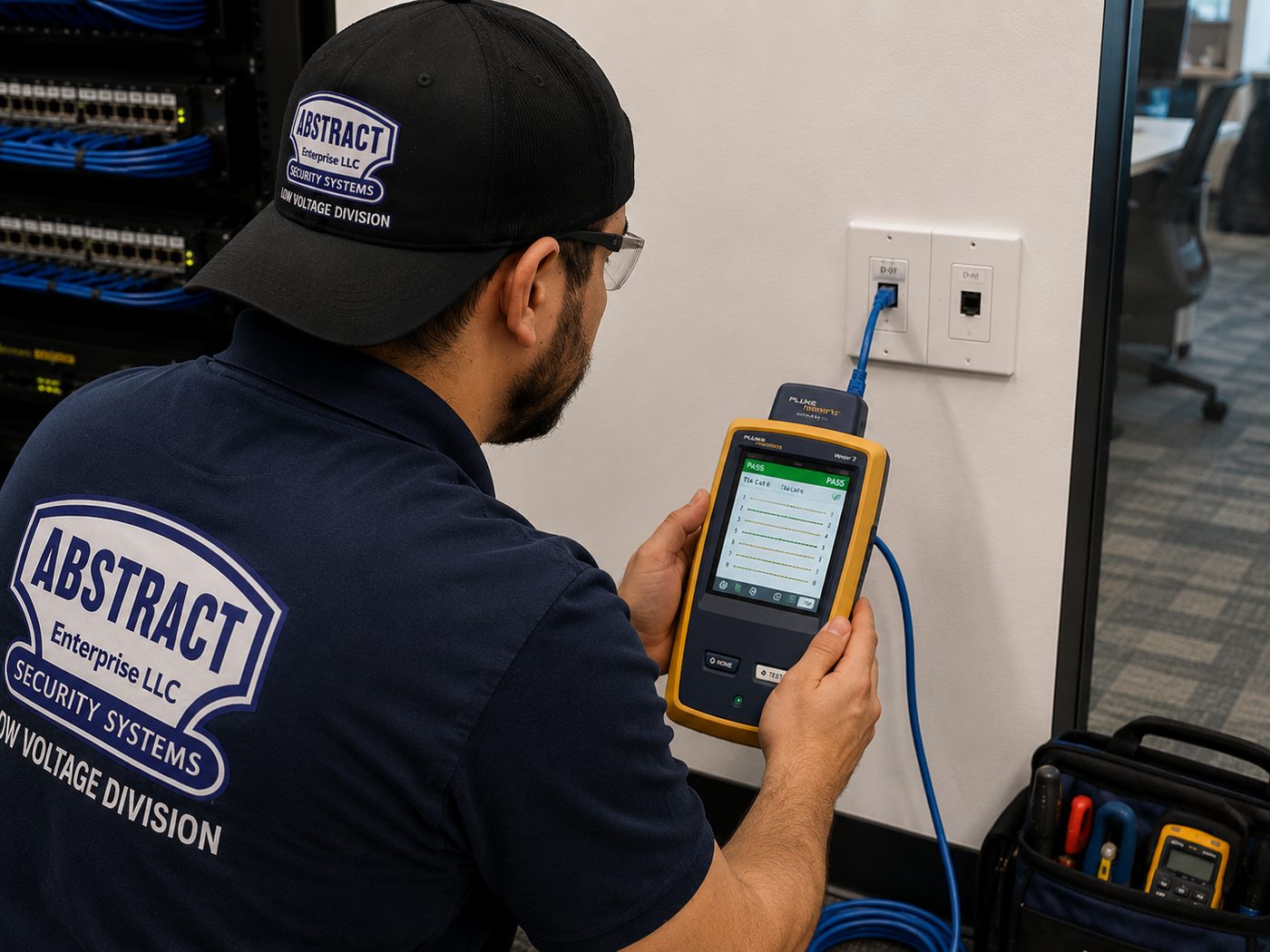
The user end of a drop, terminated and plated.
TERMINOLOGY
Ulster County NY Low Voltage Terms, Translated
Most disagreements over a cabling quote come from two parties using the same words differently. This is the vocabulary you need here, weighted toward conversion work and county licensing.
Adaptive reuse. A building converted from its original purpose. In cabling terms it means no existing pathway, unknown assemblies, and a route that has to be designed rather than followed.
Pre-penetration survey. Establishing what is inside a wall, floor or ceiling before cutting it. In pre-1980 industrial and institutional buildings this comes before the cable spec, not after.
Surface raceway. Trunking run on the face of a wall. On historic fabric it is frequently the correct answer rather than a compromise.
Drop. One run from closet to outlet, terminated both ends. Cabling is priced per drop, not per foot.
Home run. One cable from one device back to the closet with nothing shared along the way.
The hundred-metre channel. The end-to-end distance limit on a copper run, patch cords included — and in a converted manufacturing building it arrives faster than the floor plan suggests.
Electrical contractor licence. Under Chapter 185 of the Ulster County Code, the county operates an Electrical Licensing Board and requires a licence to conduct the business of an electrical contractor in the county.
MDF and IDF. Main distribution frame where service enters; intermediate frames serving other floors or buildings.
Patch panel. Where permanent cable ends and short patch cords take over, so switches change without re-terminating anything.
Wiremap versus certification. A wiremap answers whether every conductor is on the right pin. Cable certification measures length, crosstalk, return loss and delay against TIA-568 and issues a result per drop.
System commissioning. Proving the installed plant does what the design said before anyone signs for it.
As-built documentation. The closeout drawing and port map — worth more in a converted building than anywhere, because nothing about the route is guessable later.
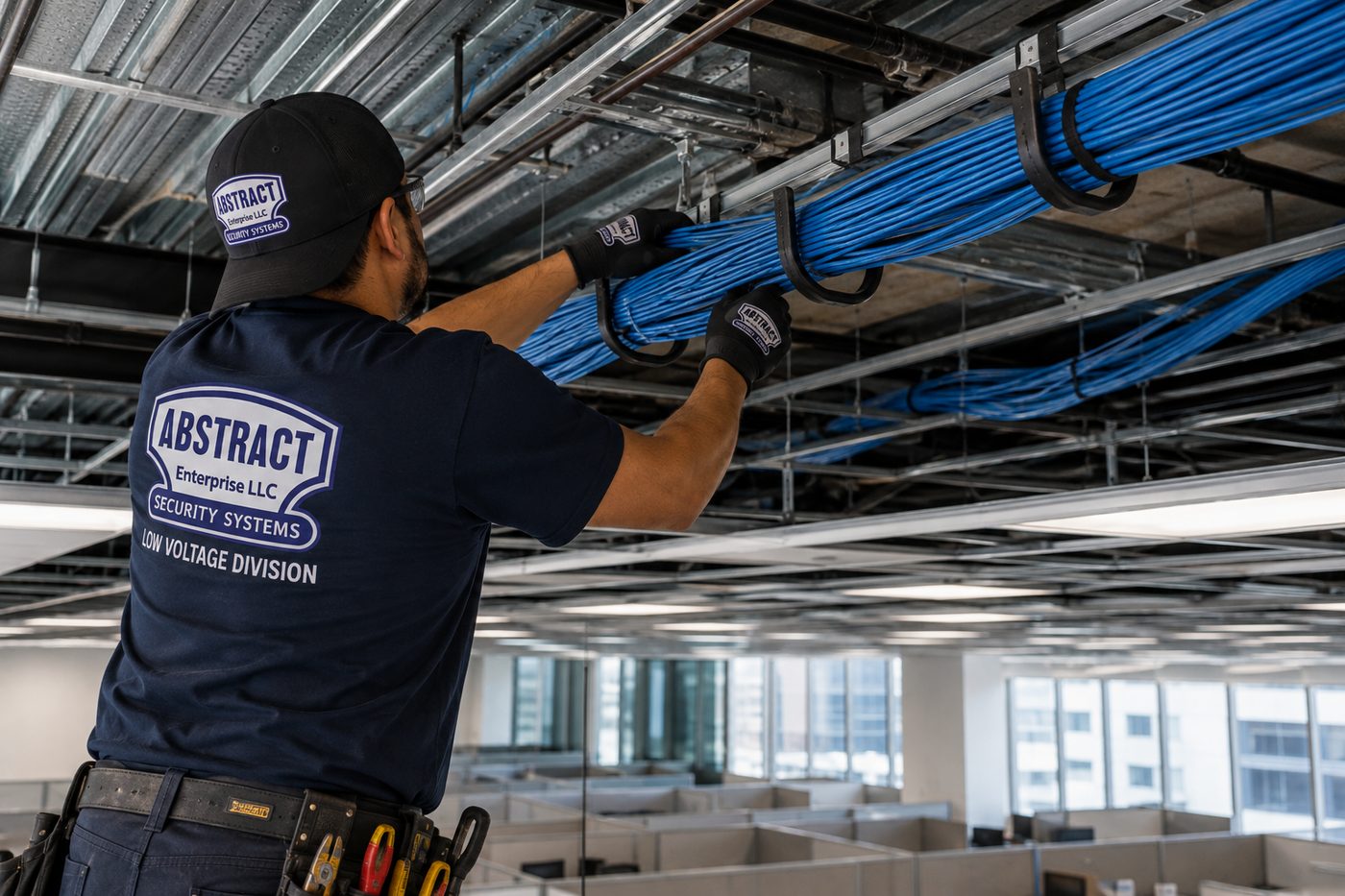
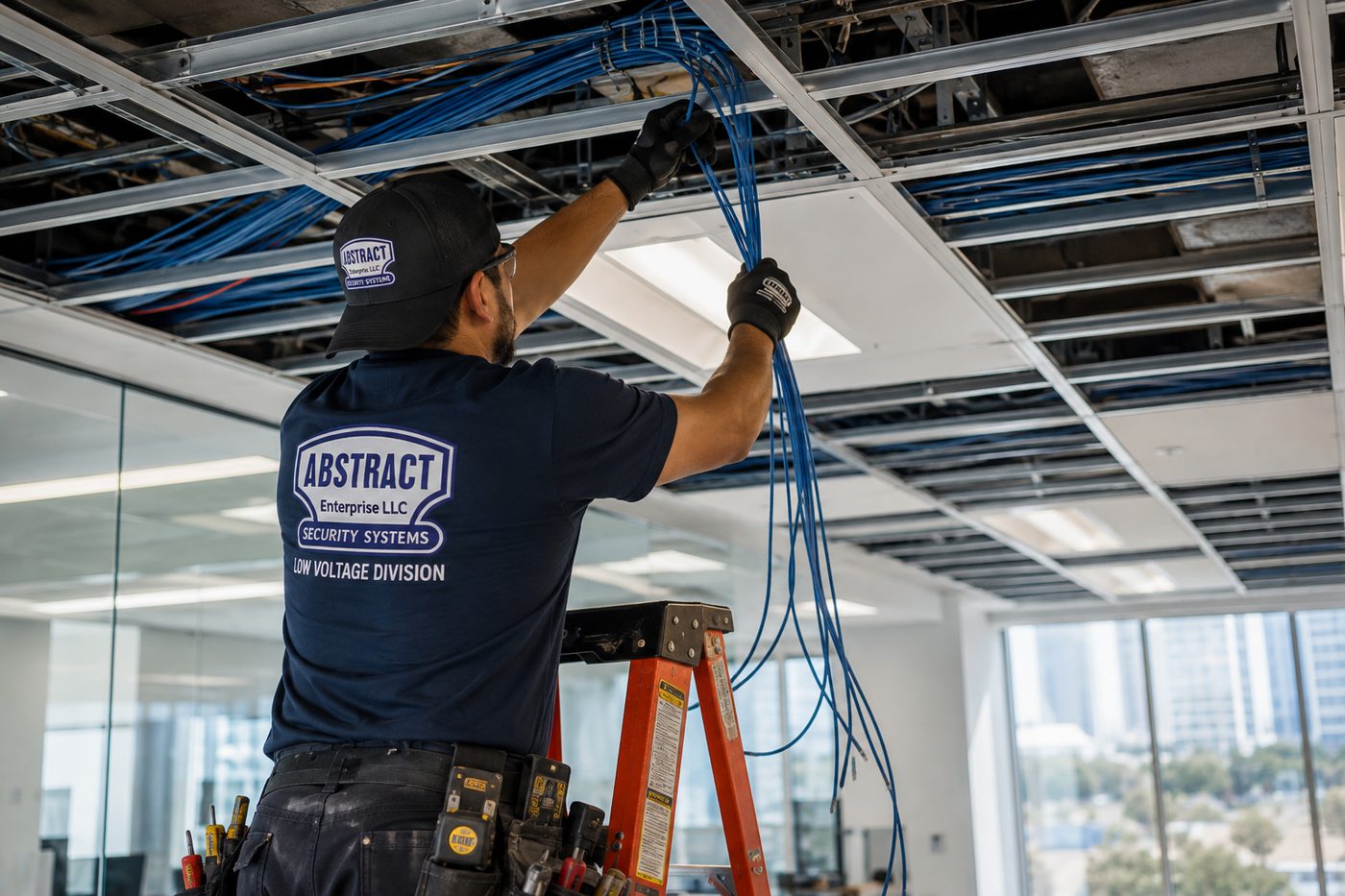
A bundle brought down at a workstation position during fit-out.
COMMERCIAL LOW VOLTAGE
Where We Work Across Ulster County NY
Kingston and the Town of Ulster
A low voltage installer in Kingston NY covers two building eras in the same working week. Structured cabling in the Town of Ulster and data cabling in the Town of Ulster cover the Enterprise Drive parcels, and structured cabling in Kingston covers the county’s commercial core — the Stockade District and Broadway downtown, the Route 9W retail corridor, hospital and medical office property, and the iPark 87 campus off I-87 Exit 19. Data cabling in Kingston and network cabling in Kingston span nineteenth-century masonry and mid-century industrial in the same working week, and a low voltage contractor in Kingston needs both approaches.
New Paltz and the Wallkill valley
Network cabling in New Paltz serves SUNY New Paltz, village commercial along Main Street and Route 299, and the Mohonk area. Structured cabling in New Paltz and data cabling in New Paltz cover institutional, hospitality and small professional property, with low voltage wiring in New Paltz frequently running through buildings of very different ages on one parcel.
Saugerties and the northern towns
Data cabling in Saugerties, structured cabling in Saugerties and low voltage wiring in Saugerties NY cover village commercial, food production and light industrial off Route 9W and Route 32. Network cabling in Saugerties runs to small buildings with long histories.
Woodstock, Hurley and Olive
A low voltage contractor in Woodstock works galleries, inns, restaurants and small studios, with structured cabling in Woodstock, network cabling in Woodstock and low voltage wiring in Woodstock NY scheduled around seasonal trading. Data cabling in Hurley, structured cabling in Hurley and network wiring in Hurley NY, plus network cabling in Olive and data cabling in Olive, serve the Route 28 corridor west toward the Catskills.
Highland, Marlborough and the river towns
Structured cabling in Highland and network cabling in Highland cover commercial property near the Mid-Hudson crossing, with data cabling in Esopus and a low voltage contractor in Esopus serving Port Ewen and the riverside hamlets along Route 9W, while data cabling in Marlborough and a low voltage contractor in Marlborough serve orchard, food and small commercial operations along Route 9W south.
Rosendale, Ellenville and the Rondout valley
Low voltage wiring in Rosendale, data cabling in Rosendale and structured cabling in Rosendale cover Main Street commercial in former cement-industry buildings. Network cabling in Ellenville, structured cabling in Ellenville, a low voltage contractor in Wawarsing and data cabling in Wawarsing work municipal, community and district property along US-209, where the commercial base is thin and drives are long — so we group sites geographically rather than pricing one visit at a time.
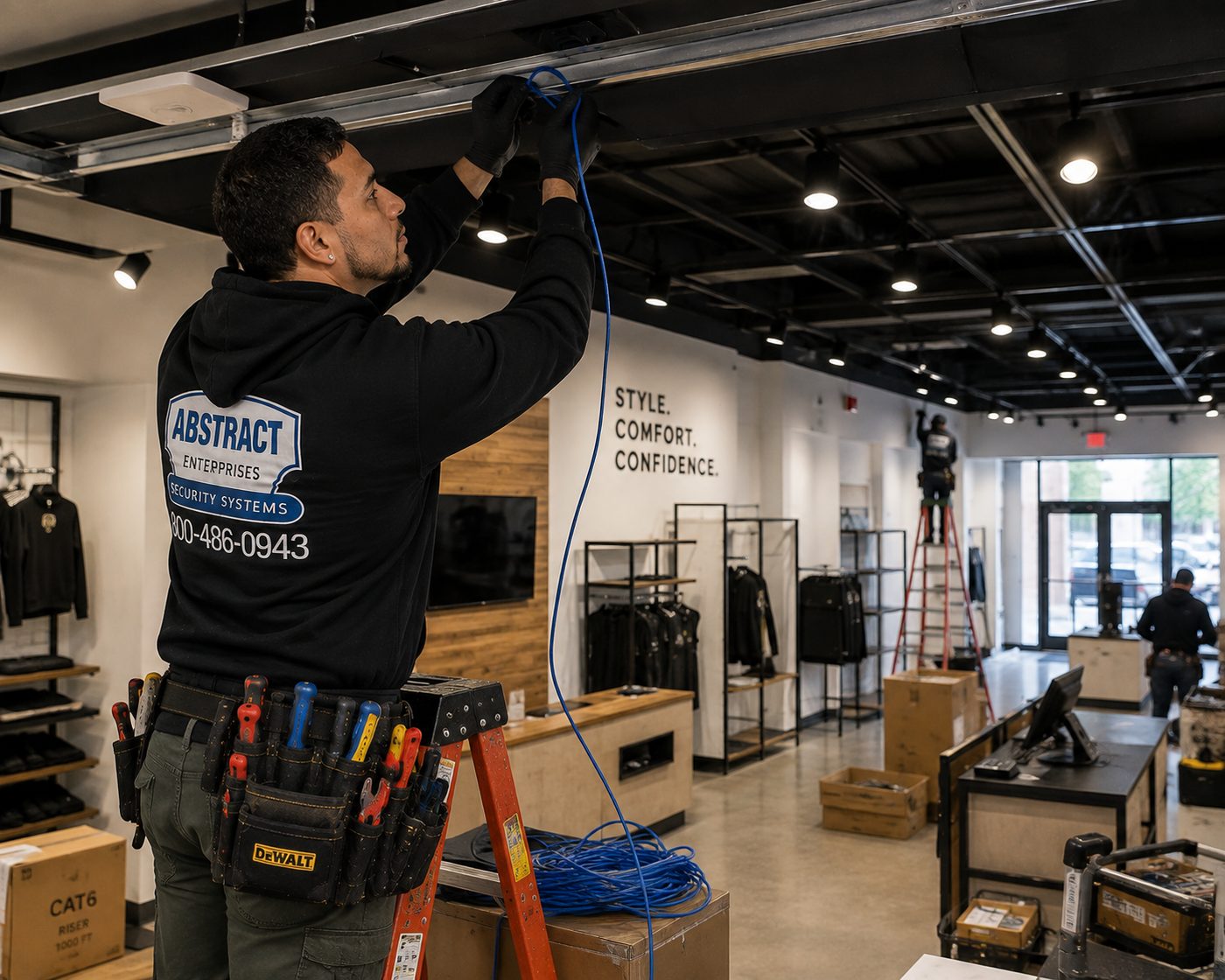
Cable pulled through an open retail ceiling before the unit opens.
INDUSTRIES
Who We Cable For in Ulster County NY
Adaptive Reuse Developers
Former industrial and institutional buildings taking new commercial tenants.
Colleges and Education
SUNY New Paltz, SUNY Ulster and BOCES facilities on semester and recess calendars.
Healthcare
Hospital and medical office property, with segregated closets and audit-grade records.
Hospitality and Resort
Inns, resorts and restaurants where guest areas and trading hours set the schedule.
Municipal and County
Procurement-grade documentation and coordination with facilities staff.
Village Retail and Galleries
Kingston, Woodstock, Saugerties and New Paltz small commercial.
Food Production and Agriculture
Packing, storage and processing buildings with environment-rated cable.
Light Industrial and Flex
Enterprise Drive and the Route 9W corridor, tray pathway and dock runs.
General Contractors
Low voltage as a subcontracted trade, with COI, schedule discipline and a closeout package.
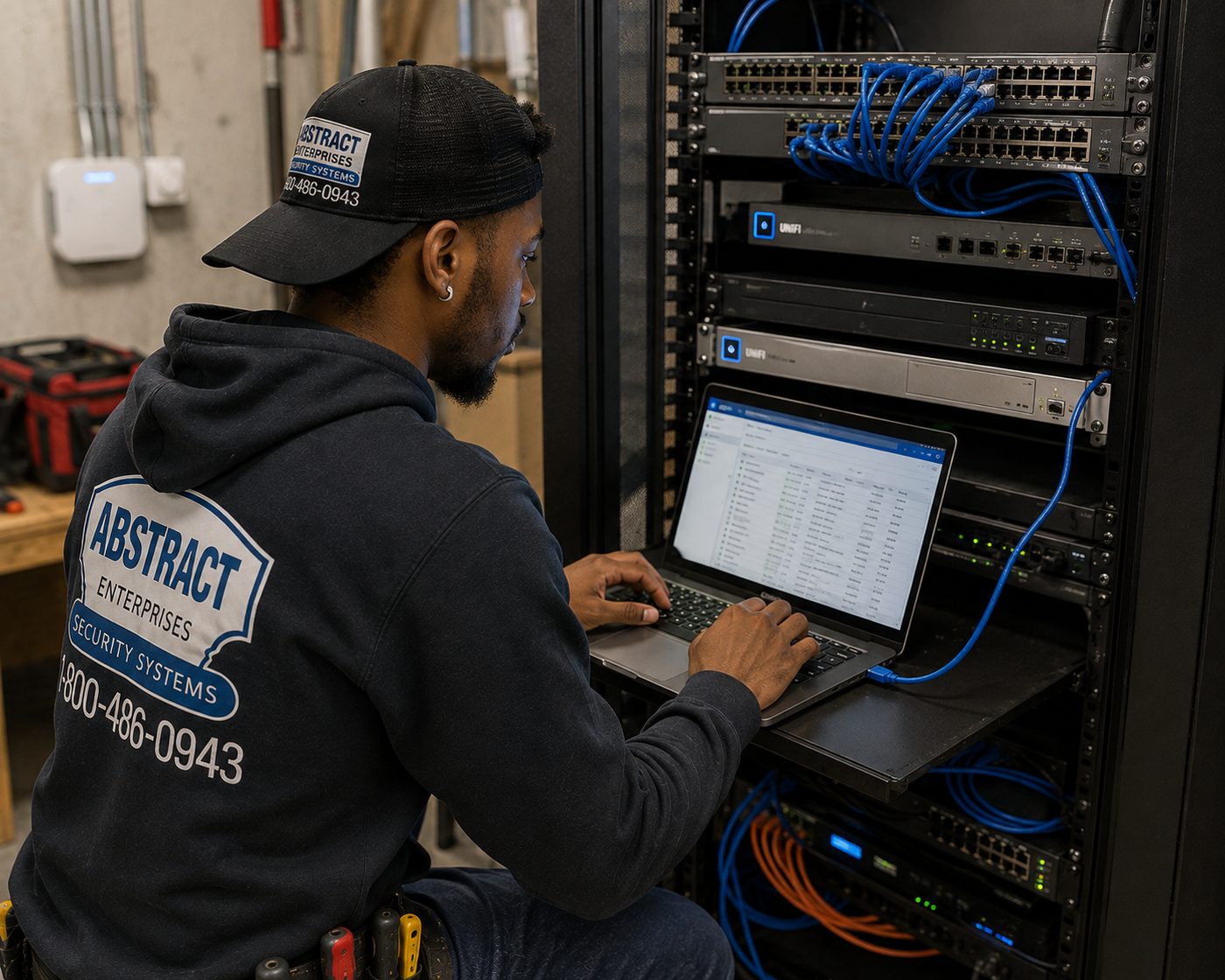
Switch configuration at the rack, frequently in a room that was never a telecom room.
HOW IT WORKS
How an Ulster County NY Low Voltage Project Runs
Establish the licence and permit position. Ulster operates a county Electrical Licensing Board under Chapter 185, and permits sit with your city, town or village. Both get confirmed before scoping.
Free on-site survey. Ceilings, closets, distances, existing pathway, access — and in older buildings, what is actually inside the assemblies we would otherwise cut.
Route design before cable spec. In a converted building the achievable route decides the design. Surface raceway, existing chases and non-destructive paths are considered first.
Written scope and proposal. Drop count and locations, cable category and jacket rating per space, pathway method, closet and rack scope, testing level, labelling standard, documentation deliverable, the municipal position and a written exclusions list.
Rough-in. Cable pulled on supported pathway with the correct jacket for each space, coordinated with any survey or abatement work rather than around it.
Termination. Keystones at the outlet, patch panel punch-down at the closet, rack dressed as it is built.
Testing and commissioning. Wiremap and length on one hundred percent of drops, with full TIA-568 certification where a client, district or general contractor specifies it.
Labelling, as-built and closeout. Every cable labelled both ends and a drawing showing the actual route — which in a converted building is the only way anyone finds it again.
Start and completion timing turns on building conditions, equipment availability, access to the property, permitting where it applies, and how large the project is.
A per-drop certification record, worth more on runs nobody wants to pull twice.
YOUR QUESTIONS ANSWERED
Low Voltage Installation in Ulster County NY: Your Questions Answered
Is a low voltage licence required in Ulster County NY?
The low voltage license question in Ulster County NY has a county-level answer, which surprises people who have been told the Hudson Valley leaves it to municipalities. which surprises people who have been told the Hudson Valley leaves it to municipalities. Chapter 185 of the Ulster County Code establishes an Electrical Licensing Board, and the code states that no person shall engage in, carry on or conduct the business of an electrical contractor within the County of Ulster unless he or she is licensed. The county’s licence categories are commonly described as centring on a Master Electrician credential for electrical contracting. Whether a particular low-voltage scope falls inside that requirement is a question for the Board rather than for a contractor’s website — and it is worth resisting the widely repeated shortcut that data cabling is simply “treated more leniently.” That may well be how it works in practice, but practice is not the same as a written answer, and the Board is the only party who can give you one. Ulster is one of several New York counties licensing at county level alongside Westchester, Putnam, Rockland and Suffolk. Confirm the current position for your work with Ulster County directly.
Do I also need a state licence for cameras or alarms?
For monitored alarm, camera and access control work, yes — that sits at state level regardless of county. It is commonly referred to as the NYS Department of State security and fire alarm installer licence, cited as Article 6-D, and it covers security and fire alarm systems rather than plain data cabling. The two are separate credentials with separate scopes, and a contractor may hold one without the other, which is worth asking about directly rather than assuming.
Is a permit needed on top of the county licence?
The low voltage permit position in Ulster County NY sits with your city, town or village rather than the county. Pure structured cabling frequently does not trigger an electrical permit; that changes once work involves opening walls or ceilings, penetrating rated assemblies, or anything tied to a fire alarm panel. On a conversion project there is usually a wider building permit already in place, and the low-voltage scope should be confirmed against it rather than assumed to be covered.
Our building is a conversion. What changes?
The order of work, mostly. In a purpose-built commercial building you design a route and pull it. In a converted mill, warehouse or nineteenth-century downtown building there is no existing pathway, the assemblies are unknown, and the achievable route decides the design rather than the other way round. That means more survey time up front and fewer surprises later, and it usually means surface raceway or existing chases carry more of the plant than they would in a modern building.
Should we be concerned about what is inside the walls?
You should establish it, which is different from being alarmed. Pre-1980 industrial and institutional buildings can contain materials that require specialist handling, and the county’s largest redevelopment site has a documented history of asbestos remediation under EPA and state oversight. Our position is simple and non-negotiable: we do not cut, core or penetrate anything in an older building until the owner has established what is in it. We are not an abatement contractor and we do not work around one — we coordinate with whoever holds that scope. If nobody has surveyed, that is the first conversation, and it is an owner responsibility rather than a cabling one.
How much does low voltage installation cost in Ulster County NY?
Structured cabling cost in Ulster County NY starts from published per-drop rates rather than a range. Cat6 installation cost in Ulster County NY begins at $175 for a data or voice drop, $250 for Cat6A, with a $500 minimum job. Independent industry guides put commercial Cat6 in a national band of roughly $125 to $400 per drop fully installed and tested, and note that labour rather than cable drives the number. In this county the biggest variable is the building itself — a run through open ceiling and a run through eighteen-inch stone are the same drop on paper and not in practice.
Why is a converted building more expensive to cable?
Because the pathway does not exist and has to be created, and because creating it is slower in masonry than in drywall. That is the honest answer. What we can control is not pretending otherwise: the survey identifies the difficult runs, the proposal prices them as difficult, and you can decide whether a device position is worth what it costs before anybody starts rather than receiving a variation afterwards.
Can you cover several sites in one trip?
Yes, and in this county it is worth asking for. Ulster is large and the commercial base is spread thin outside Kingston — the Ellenville area alone reports only a handful of organisations employing two hundred people or more. Grouping sites geographically into one mobilization is the single biggest saving available on a multi-site project, so tell us the full list at survey rather than one building at a time.
Can you work around a semester or seasonal calendar?
Yes. Campus work goes into recess and summer windows fixed months ahead. Hospitality and resort property runs the opposite way, with the quiet season being the working season. Both are predictable, and a realistic scope either fits inside the window or is deliberately split across two with a working system at the end of each.
Is the existing cabling worth keeping?
Often the pathway is, even where the copper is not — and in a converted building the pathway is worth disproportionately more, because it represents a route somebody already solved. Certify a representative sample before ordering anything. On a former industrial site we frequently find conduit and sleeves in good condition carrying cable that is decades past useful.
Can the electrician who works on our building run the data cable as well?
Low voltage vs electrician in Ulster County NY has a county-licensing dimension worth checking either way, since Chapter 185 governs electrical contracting business in the county. Beyond that the practical test is unchanged: does the contractor carry a certification analyser, work to TIA-568 rather than to power-wiring habit, and hand over a labelled port map and as-built. In a converted building there is one more — whether they will plan a route before they start drilling.
If you are comparing several structured cabling companies rather than choosing a trade, ask any data cabling installers you shortlist for the same nine lines — drop count and locations, cable category and jacket rating per space, pathway method and who firestops, closet and rack scope, testing level, labelling standard, documentation deliverable, access assumptions and a written exclusions list. Searching for a low voltage contractor near me in Ulster County NY, or for the best low voltage company, returns whoever ranks or pays rather than whoever suits your building.
Wireless coverage is poor in parts of our building. Is that the cabling?
In a masonry building, usually not. Thick stone and brick attenuate signal far more than drywall, so a coverage plan drawn on a floor plan can be wrong by a wide margin once it meets the actual structure. After that, check the switch — a PoE budget exceeded once every port is populated makes equipment restart in rotation. Cable faults and over-distance runs come third. A walk with a meter in the finished building settles it quickly.
Do you work with general contractors on Ulster projects?
Yes, and on conversion work it is most of what we do. Certificate of insurance issued up front naming whoever the project requires, dates committed and held, rough-in sequenced with the other trades and with any survey or abatement scope, and a closeout set with drawings and port map at the end.
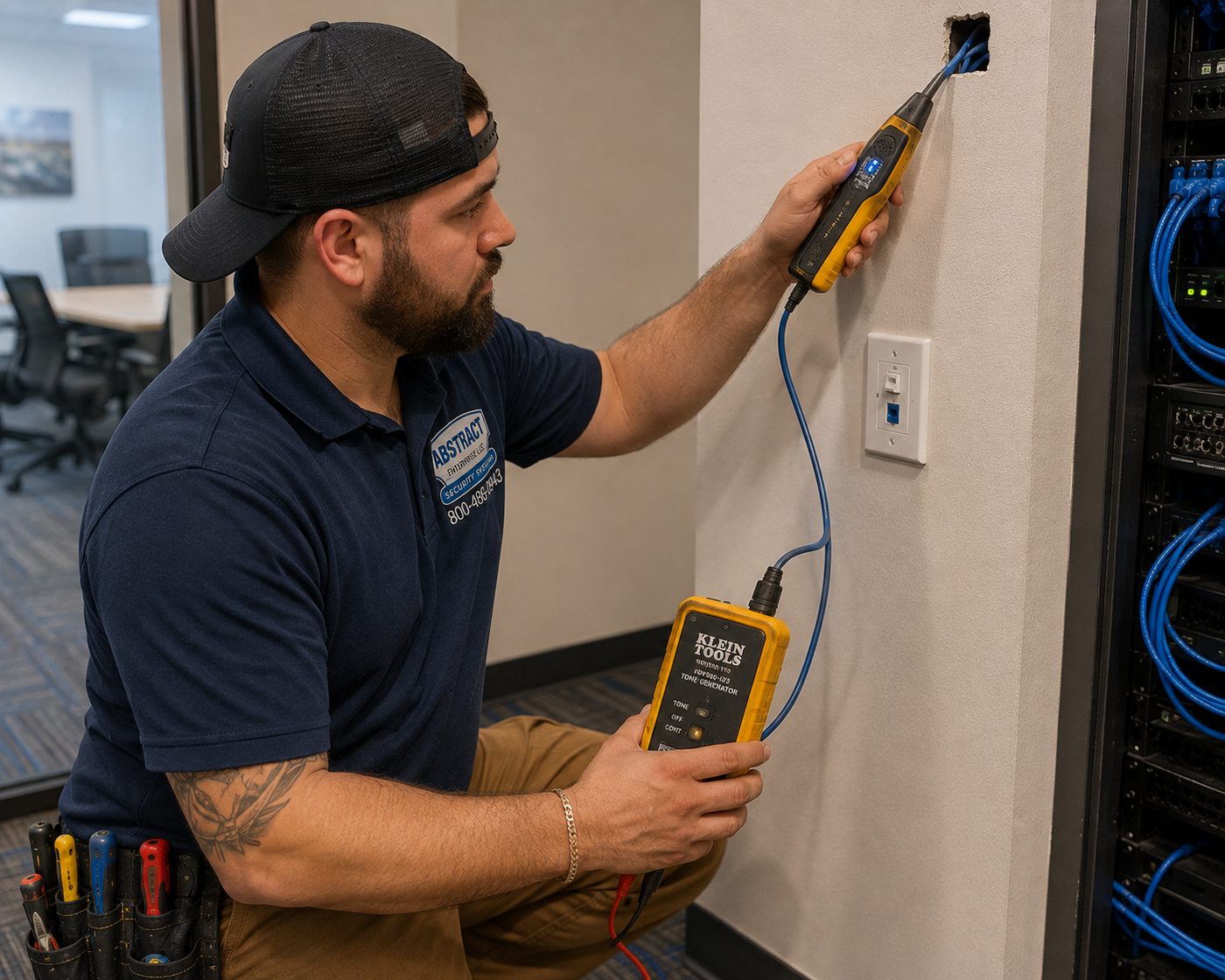
Toning an unlabelled run, which is how most converted buildings start.
AI OVERVIEW REALITY CHECK
What AI Answers Get Wrong About Ulster County NY Low Voltage
On licensing the AI answers are right — and then they add a shortcut
This section usually flags what generated answers miss. On Ulster licensing it has to start the other way. The major answer engines correctly report that Ulster County operates an Electrical Licensing Board and that a Master Electrician credential governs electrical contracting here. They are also right that security, access control and monitored alarm work brings in the state Article 6-D credential, and right that per-drop pricing is the sensible basis for a quote. That is accurate and locally specific.
What they then add is a sentence worth stopping on: that pure low-voltage data work is generally treated more leniently. It appears almost word for word across multiple engines. It may well describe how things work in practice — but it is an inference about enforcement rather than a statement of what the code says, and it is repeated with no source attached to it.
That combination is the trap. A reader who takes the accurate part on trust will take the shortcut on trust too, and the shortcut is the one that could cost them. The Board is the only party who can tell you in writing whether your specific scope falls inside the requirement, and a claim repeated identically across six engines with no citation is one claim with an echo rather than six confirmations.
Every price assumes a building with accessible ceilings
The per-drop band in a general answer describes cabling through suspended ceiling and drywall. That is most commercial buildings in most places.
It is not most commercial buildings here. Kingston’s downtown is nineteenth-century masonry, the largest redevelopment site is a former manufacturing plant of over a million square feet, and the village stock in Woodstock, Saugerties, Rosendale and New Paltz is older still. A run through open ceiling and a run through eighteen inches of stone are the same drop on paper and nothing alike in practice.
A national average cannot carry that difference, and a quote that does not distinguish between the two has not looked at the building.
What is inside the wall, and why nobody mentions it
No generated answer about cabling raises pre-penetration survey, and in a county whose commercial future runs through pre-1980 industrial conversion it is the most consequential omission on the list.
The former IBM Kingston site carries a documented history of asbestos remediation under EPA and New York State oversight following improper abatement during 2015 and 2016 demolition. That is public record rather than rumour, and it is a fact about how to sequence work rather than a reason to avoid the buildings, which remain the best commercial space in the county.
The rule that follows is simple: in an older building nothing gets cut or cored until the owner has established what is in the assembly. A cabling contractor is not an abatement contractor and should never behave like one.
Adaptive reuse described as ordinary fit-out
Generated answers describe designing a route and pulling it. In a conversion the sequence inverts — the achievable route determines the design, because there is no existing pathway and the assemblies are unknown until surveyed.
That changes the deliverable too. Surface raceway and existing chases frequently carry more of the plant than they would in a modern building, and presenting that as a compromise rather than as the correct answer misleads the owner about what good work looks like here.
It also makes documentation worth more than anywhere else in the region, because in a converted building nothing about the route is guessable later.
A county described as though it had one commercial centre
Employment here is unusually concentrated and unusually thin at the same time. SUNY New Paltz and Mohonk Mountain House together account for roughly 3,700 jobs; the greater Kingston area holds around 37 large employers and close to 10,000 jobs; the Ellenville area reports only three organisations employing 200 or more.
So the county is two anchors, one commercial city, and a very wide spread of small buildings. A general answer describing a normal commercial market gives no sense of that, and no sense of what it means for a multi-site project.
What it means practically is that grouping sites geographically is the largest single saving available here, and it is the kind of advice that only comes from knowing the map.
Masonry and wireless coverage
Coverage plans drawn on floor plans assume drywall. Thick stone and brick attenuate signal far more, so an access point layout that looks correct on paper can be materially wrong in the finished building.
The practical consequence is that poor coverage in a converted building is usually a placement and structure problem rather than a cabling problem, and chasing the cable first wastes weeks.
No general summary raises it, because it sits between cabling and radio behaviour rather than inside either.
What an honest Ulster County NY proposal contains
Nine lines, plus two this county adds. Drop count and locations. Cable category and jacket rating per space. Pathway method and who firestops. Closet and rack scope. Testing level, stated as wiremap or full certification. Labelling standard. Documentation deliverable. Access assumptions. A written exclusions list. Then: which licence the contractor holds for work in this county, and what happens before anything is cut in an older building.
Drop those last two and the number stops being comparable. The contractor who looks expensive is often the only one who priced the masonry runs and the survey sequence honestly.
Send the list to every bidder, ourselves among them. A contractor who will not put those lines on paper before starting has told you how the closeout will go.
Old building? We survey the route before we quote the drops.
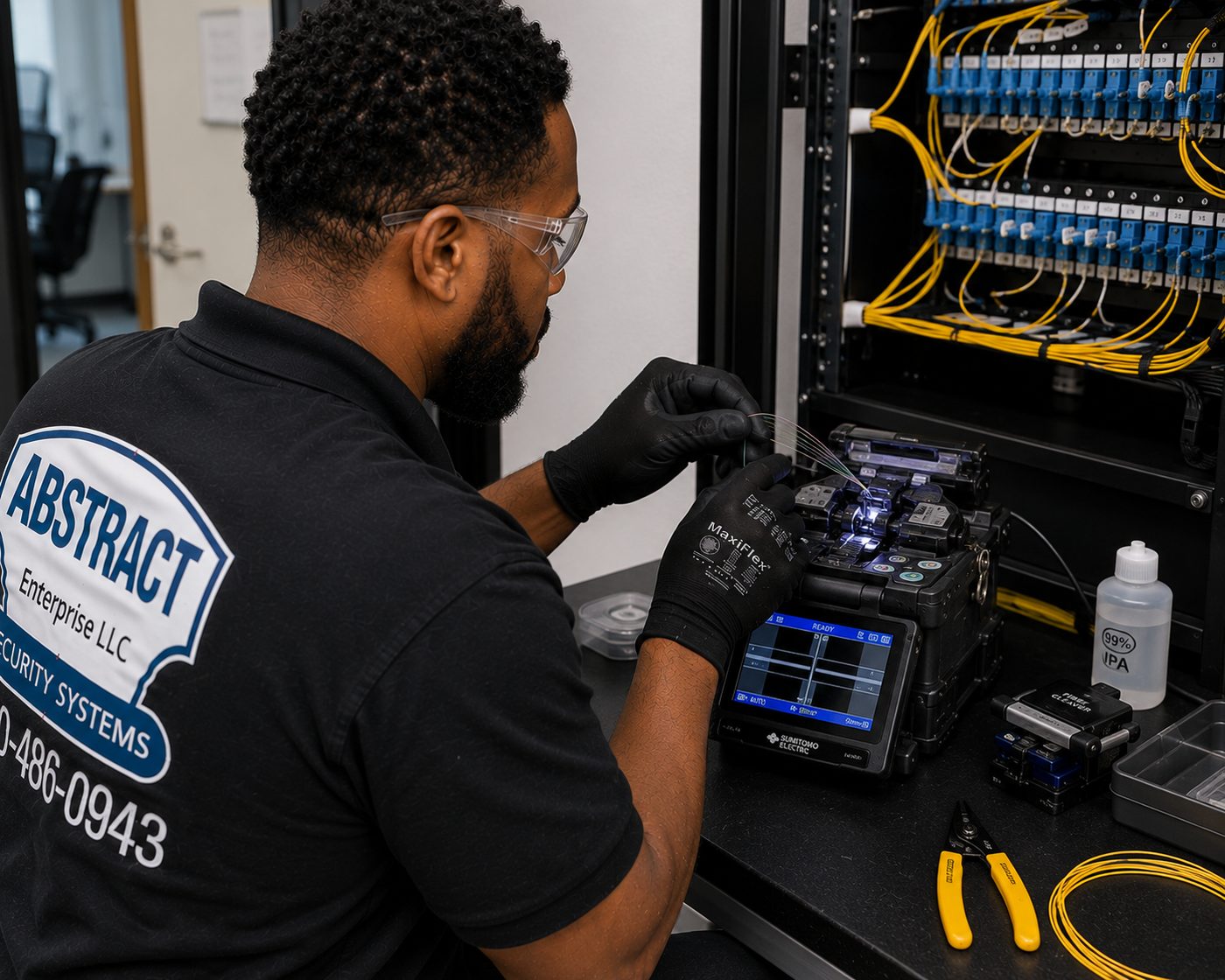
Preparing fibre for a run between buildings on a converted industrial parcel.
PRICING
Ulster County NY Low Voltage Installation Pricing
These are the figures we publish, not a band we hide behind. What a drop includes on an Ulster job: solid copper cable, the jack and plate at the workstation end, the panel termination at the closet end, a wiremap test, labels at both ends and a patch cable.
Item
Starting price
Notes
Cat6 data or voice drop
From $175
Gigabit, standard PoE, solid copper
Cat6A drop
From $250
10G to the full channel, higher PoE classes
Difficult-route drop (masonry, no pathway)
Quoted per run
Identified at survey, priced individually
Fiber between buildings
Custom quote
Terminated and tested both ends
Rack build, patch panels, closet cleanup
Itemized
Scoped per closet
Minimum job size
$500
Mobilization floor
Service, troubleshooting and callbacks
$195/hr, 3-hour minimum
Service work only, not initial installation
Structured cabling cost in Ulster County NY and Cat6 installation cost in Ulster County NY both start from the figures above; low voltage security systems in Ulster County NY share the same pathway, and server room cabling is scoped per closet.
What moves the number up: masonry and no existing pathway, coring through heavy structure, coordination with survey or abatement scope, isolated single-site visits in the western towns, campus distances in converted industrial buildings, plenum jacket, historic fabric constraints, and full certification with drawings.
Pre-wiring is the single biggest saving available. Cabling a building while the walls are open costs a fraction of retrofitting the same drops afterwards, and in this county the gap is wider than most because retrofit means masonry. If any construction or renovation is planned, the cabling scope belongs in that programme rather than after it.
What moves the number down: accessible ceilings and existing conduit, pre-drywall rough-in on new fit-out, accepting well-finished surface raceway where concealment would be destructive, grouping several sites into one trip, and bundling multiple systems into one mobilization.
Owner-supplied materials are welcome. Solid copper and a jacket rated for the space are the only two conditions, and we will say so before installation if a delivery does not meet them. Every per-drop figure sits on our structured cabling pricing page.
Need Low Voltage Repair in Ulster County NY?
Dead drops, offline cameras or access points, a door that stopped releasing, or a closet nobody documented. Urgent low voltage repair and emergency low voltage service across the county, and most single-fault low voltage troubleshooting is resolved on the first visit. Service is billed at $195/hr with a three-hour minimum.
Low Voltage Packages & Pricing in Ulster County NY
Starter
From $875 installed
One closet, roughly five Cat6 drops, panel-terminated and tested. Suits a Woodstock gallery, a New Paltz professional suite or a village storefront. Arithmetic on the published $175 rate.
Standard
From $1,750 installed
Around ten drops with a wall-mount rack build, panel and closet dress-out. The common shape for a Kingston or Saugerties office fit-out. Arithmetic on the published $175 rate; Cat6A from $250.
Premium
From $5,250 installed
Twenty-one Cat6A drops or more, plus fibre between buildings, a full rack build and certification with drawings. Where campus and conversion work lands. Arithmetic on the published $250 rate.
Each figure above is the published rate times the drop count next to it — no hidden assumptions and no quote implied. Masonry routes, coring, survey coordination, distance, firestop and certification all shift the real number, which comes out of the survey. The floor on any job is $500.
Already bought your cable and hardware? Ask about a bring-your-own-equipment (BYOE) install — labour-only pathway, pulling, termination, testing and labelling of materials you supply, provided the cable is solid copper and correctly jacket-rated for the space.
Nothing is leased and nothing recurs — the installation belongs to the property. Products we supply carry three years. Return visits and callbacks are $195/hour with a three-hour minimum, so $585.
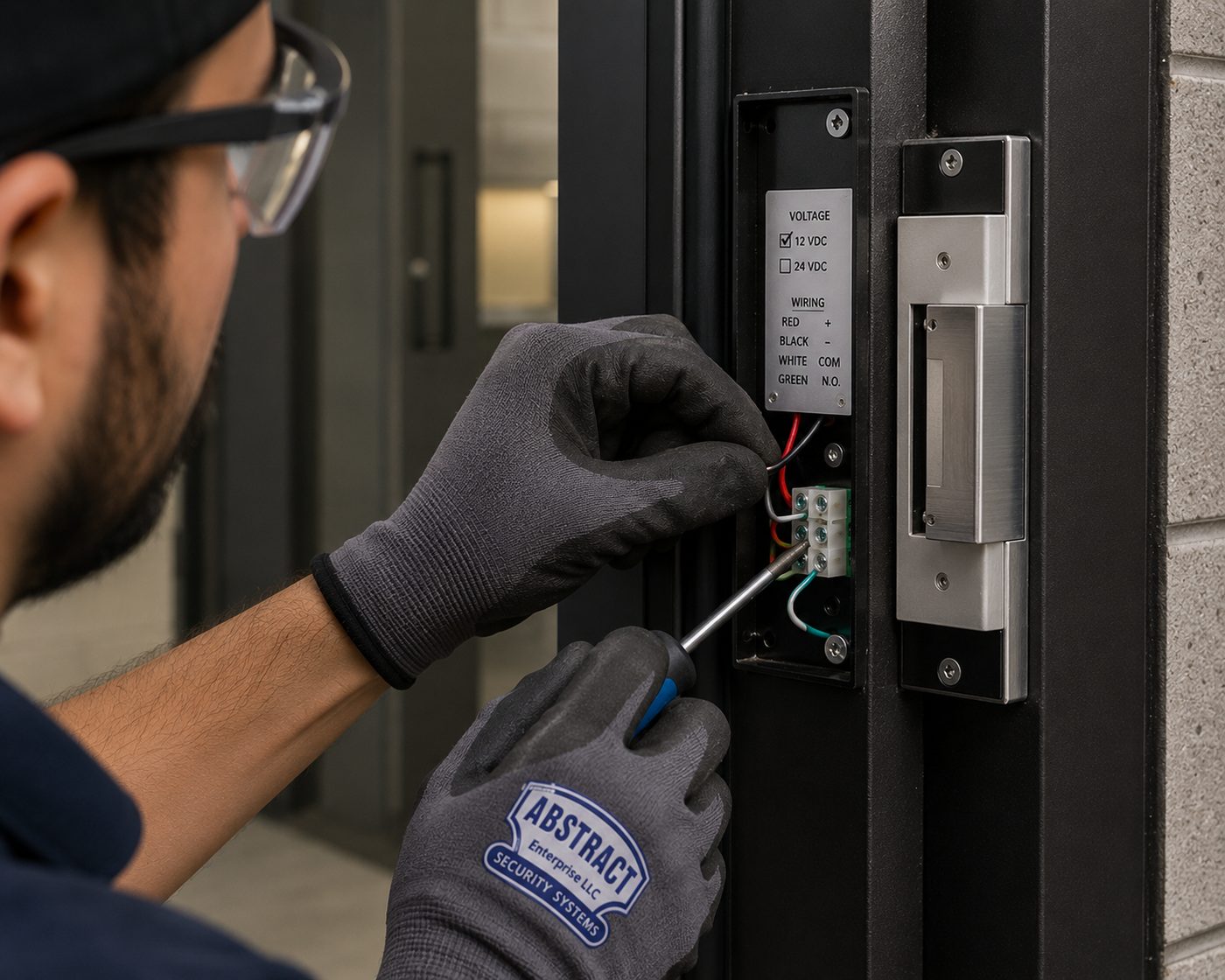
Strike wiring landed at the door, part of one bundle back to the controller.
LOCAL PROBLEMS
Low Voltage Problems Specific to Ulster County NY
A drill started before anybody surveyed. In a pre-1980 building that is the one mistake with consequences beyond the cabling, and it is entirely avoidable.
Masonry routes priced as drywall routes. Then re-quoted once the crew meets the wall, which is a conversation nobody enjoys having in week two.
Concealment insisted on where it damages fabric. A well-run surface raceway is frequently the better outcome, and it should be offered rather than treated as failure.
County licensing assumed away. Ulster runs a Board under Chapter 185, which contradicts the usual regional assumption.
Wireless laid out on a floor plan. Thick stone attenuates far more than drywall, and the plan meets the building only after the racking and furniture arrive.
Distance underestimated in converted industrial. A former manufacturing floorplate puts the hundred-metre limit in play sooner than the drawing suggests.
Single isolated visits to the western towns. Priced as though buildings were adjacent, then re-quoted once somebody works out the drive.
Undocumented routes. In a conversion, a run nobody drew is a run nobody will ever find.
FIELD NOTES
Field Notes from Ulster County NY
Ask what the building used to be. It is the fastest question that changes a quote, and in this county the answer is rarely “an office.”
Nothing gets cut until somebody knows what is in it. That is a rule rather than a preference, and it belongs to the owner’s survey rather than to us.
Offer the raceway honestly. On historic fabric it is frequently the right answer. Finished properly it looks deliberate; apologised for, it looks like a compromise.
Draw the route. In a converted building the as-built is worth more than anywhere else, because nobody will ever work it out from looking.
An access point placed for what masonry will actually pass rather than what a plan predicted.
COVERAGE AREA
Ulster County NY Low Voltage Coverage
We install and service low-voltage systems across Ulster County, from Saugerties south to Marlborough and west into the Rondout valley.
Kingston and Town of Ulster
Downtown masonry, the Route 9W corridor and the iPark 87 campus.
New Paltz
SUNY New Paltz, village commercial and the Mohonk area.
Saugerties and the north
Village commercial, food production and light industrial.
Woodstock, Hurley and Olive
Galleries, inns and the Route 28 corridor west.
Highland, Marlborough and Esopus
River-town commercial along Route 9W south.
Rosendale, Ellenville and Wawarsing
Rondout valley Main Street, municipal and district property along US-209.
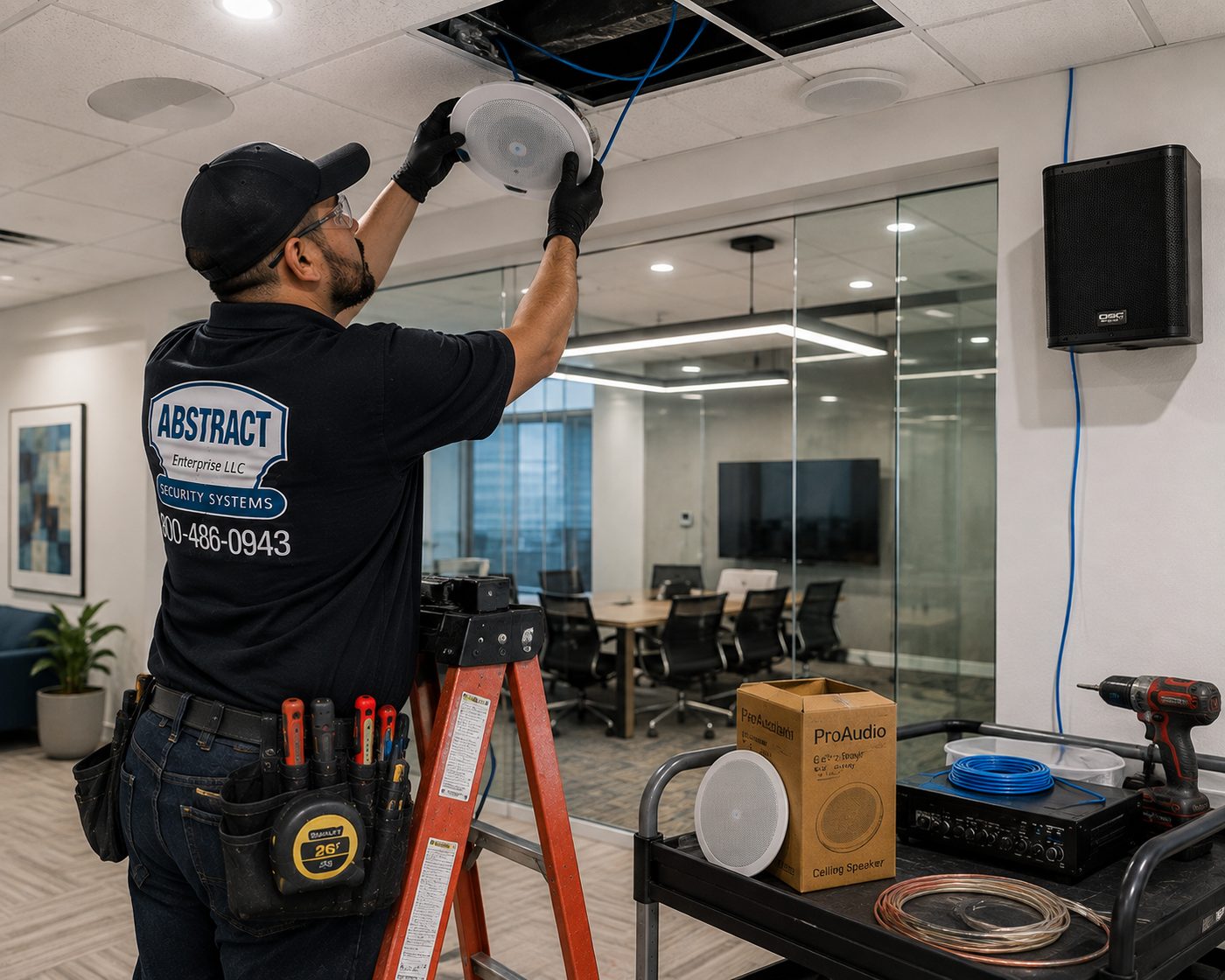
Overhead audio sharing the data pathway in an institutional building.
FAQ
Ulster County NY Low Voltage Installation FAQ
What counts as low voltage wiring in Ulster County NY?
Limited-energy circuits carrying signalling, communication, alarm and data rather than line power: structured data and voice cabling, camera wiring, access control wiring, intercom and entry runs, intrusion alarm circuits, audio-visual and paging, signage and building control wiring. Most of the industry works to a fifty-volt dividing line; what applies to your scope is set by the county Board and your municipality.
Does Ulster County license electrical contractors?
Yes. Chapter 185 of the Ulster County Code establishes an Electrical Licensing Board and requires a licence to conduct the business of an electrical contractor within the county. Whether a specific low-voltage scope falls inside that requirement is a question for the Board, and worth establishing before work is scoped.
Will you survey a building before quoting?
Always, and in this county it does more work than usual. In converted and pre-1980 buildings the survey establishes the achievable route, the difficult runs and whether the owner has determined what is inside the assemblies we would otherwise cut.
Do you handle asbestos or hazardous material?
No, and we would be the wrong contractor if we said otherwise. We are a cabling contractor. Where a building may contain materials requiring specialist handling, that is the owner's survey and an abatement contractor's scope. We coordinate with them and we do not cut or core until that position is established.
Can you cable a building without damaging historic fabric?
Usually, and it is worth saying that well-finished surface raceway is frequently the right answer rather than a fallback. We map existing chases, risers and service routes first, and we tell you where concealment would cost more in damage than it returns in appearance.
How long does an Ulster County cabling job take?
A small suite with accessible pathway is typically a single visit. Conversion work is measured by the difficulty of the routes rather than the drop count. Start and completion timing turns on building conditions, equipment availability, access to the property, permitting where it applies, and how large the project is.
We already have cable on site from the last phase. Will you use it?
Yes, after two checks. Solid copper, and a jacket suited to every space the run crosses. Copper-clad aluminium is turned away at delivery rather than found at certification. Materials stay under the supplier's warranty; our labour warranty is unaffected either way.
Is full certification worth it on a small conversion?
Wiremap and length testing is performed on one hundred percent of drops as standard. Full TIA-568 certification is a priced line, and on difficult routes it is worth more than usual — a marginal run in a masonry building is one nobody wants to re-pull, so knowing its condition on day one has real value.
What documentation do we receive?
Every cable labelled both ends against a scheme the port map matches, an as-built drawing showing the actual route taken, a port map per closet, configuration notes and a digital closeout set. In a converted building the route drawing is the most valuable item in the package.
Can you group several of our sites into one visit?
Yes, and in this county it is the largest saving available on a multi-site project. Outside Kingston the commercial base is spread thin, so tell us the full list at survey rather than one building at a time and we will schedule them geographically.
What does the Ulster County warranty cover?
Abstract Enterprises Security Systems provides a three-year warranty on products supplied by us. There are no monthly fees on the systems we install.
Can you take over plant another contractor installed?
Yes, starting with an assessment rather than a quote: which runs certify, what the existing hardware can carry, whether cable already in place can be reused, and where the previous scope fell short. On older county buildings the pathway is frequently in better condition than the cable inside it.
Still deciding? The survey is free and settles it.
Need Low Voltage Repair in Ulster County NY Today?
Dead drops, offline devices, or a telecom closet nobody documented. Most single-fault calls are settled on the first visit, and you keep a labelled port map afterwards so the next one is quicker. $195/hr with a three-hour minimum for service and callback work.
Request Your Free Ulster County NY Low Voltage Survey
Tell us the property, the municipality and roughly how many drops. If the building is a conversion or predates 1980, say so — it changes the sequence before anything else does.
Abstract Enterprises Security Systems provides a three-year warranty on products supplied by us. Service, troubleshooting and callback work on systems not originally installed by us is billed at $195 per hour with a three-hour minimum; that rate applies to service calls rather than to initial installation projects. There are no monthly fees on the systems we install. Start and completion timing turns on building conditions, equipment availability, access to the property, permitting where it applies, and how large the project is.
Licensing references cite Chapter 185 of the Ulster County Code and Ulster County published materials; employment and redevelopment figures cite Ulster County Transportation Council, Ulster County and EPA published sources. Environmental references describe the documented remediation history of a specific site and are included so that work is sequenced safely; they are not a statement about the condition of any other property. Nothing here is legal advice, and requirements change — confirm licensing with Ulster County, permitting with your municipality, and any survey or abatement obligation with a qualified specialist.
ALL AREAS SERVED
Low Voltage Installation by Area
Every area covered by this silo. All sixteen pages are live.
Reviewed and updated August 12, 2026 by Anwar Timothy of Abstract Enterprises Security Systems, NYS Low-Voltage Electrical Contractor License #12000287431. Changelog — Aug 2026: page published for Ulster County NY, completing the sixteen-page low voltage silo. · Aug 2026: licensing written against Chapter 185 of the Ulster County Code before drafting. · Aug 2026: redevelopment and employment figures written against Ulster County and EPA published sources.