Car Showrooms · Mall & Strip-Center Stores · Office-Park Lobbies · School Gyms · Homes
Video Wall Installation in Nassau County
Village or Town Permits Sorted · Licensed Electrician for Power · Landlord Packages Ready · Published Nassau Prices
Hanging four or nine panels in a straight line is the easy part. What makes a Nassau video wall go well is everything around it: knowing whether the address answers to one of the county’s sixty-four villages or to the town, whether the screen will count as a sign because it faces Old Country Road, whether a 1970s lobby wall can carry the load, whether the showroom glass will wash the picture out at four in the afternoon, and whether the job is a home improvement under county law. We design and install LCD and direct-view LED walls for showrooms, stores, office lobbies, school gyms, security desks and family rooms across Nassau, and we put those answers in writing before anything is ordered.
Reviewed and updated October 18, 2026: the State’s Nassau County municipal listing, the county home-improvement law and Consumer Affairs licensing pages, Town of North Hempstead and Town of Hempstead electrical licensing, the Planar installation profile for the Nassau County Police Department Intelligence Center, County Legislature grant notices, Census figures for the county and our published video wall prices at the Nassau rate · Anwar Timothy, NYS license #12000287431 · Nassau visits dispatched from our office on Troy Avenue in Brooklyn
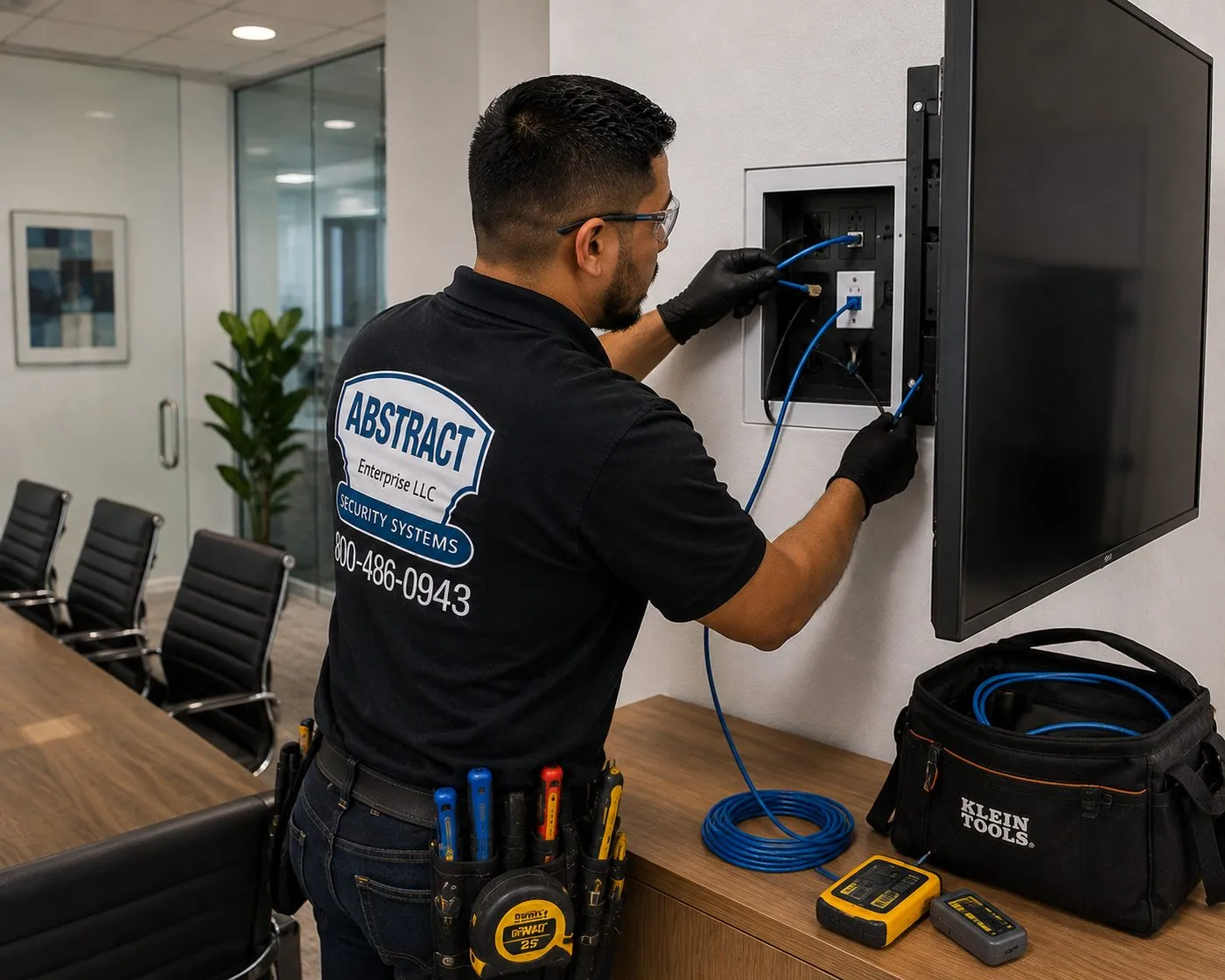
Reference photo: a technician in gloves pulls a blue data cable out of a recessed in-wall box set behind a large flat display on an extended arm mount. A cable tester and a tool bag sit on the credenza below. A recessed box like this is what lets a display, or a row of them, sit tight to the wall with the power and signal hidden behind it.
Nassau Video Wall Request
Village or hamlet, building type and the wall you have in mind — we call back the same business day
✅
Request Sent!
A technician will call you back about the Nassau wall the same business day.
25+
Years Experience
✓
Same-Day Estimates
100%
Licensed & Insured
4.7★
201 Google Reviews
Start with two photos. Stand across the room and photograph the wall you want to use, then photograph the ceiling above it, and text both to (516) 346-5778 with the village or hamlet. From those two pictures we can usually tell what the wall is built of, where the cable could come from, whether the light from the windows will be a problem, and whether the job needs a licensed electrician or a filing — before anyone books a site visit.
Photo review is free; a price in writing follows the site measure, from the published Nassau list
Drawings, product data and certificates of insurance prepared for landlords, districts and building departments
License #12000287431, issued by New York State to security and fire alarm installers under General Business Law §69-m; insurance that covers working in open stores, occupied offices and schools
The Neighborhood
Why Nassau County Properties Need Video Wall Installation
Nassau is a county of houses and of businesses spread along roads rather than stacked in towers. Census figures for 2024 count 1,392,438 residents and 480,668 homes, and 79 percent of those homes are single-unit structures; 81 percent are owner-occupied. The commercial life of the county runs along its corridors: department stores and specialty shops around Roosevelt Field on Old Country Road, car dealerships and shops along Northern Boulevard through Great Neck and Manhasset’s Miracle Mile, office buildings in Uniondale and Garden City, and schools, gyms and houses of worship in every village. That is where video walls go here: into glass showrooms, mall storefronts, office-park lobbies, school gymnasiums, security desks and finished basements, not into the high-rise lobbies that dominate a page about Manhattan.
The second thing that makes Nassau different is who is in charge. The State describes the county as two cities, three towns, sixty-four incorporated villages and more than sixty unincorporated hamlets. A hamlet such as Elmont, Uniondale or Hicksville is governed by its town; a village such as Garden City, Mineola or Floral Park typically has its own building department, its own forms and often its own rules about what a business may display in its window. A wall that needs no filing at all in one place can need a permit, an electrical inspection and a sign review a mile away. Nobody can give a single Nassau answer to “do I need a permit?”; the honest answer always starts with the address.
The third is the paperwork that follows the building type. A wall in a house of three families or fewer is home improvement under the county’s 1970 home-improvement law, which Consumer Affairs enforces with contractor licenses. A wall in a mall store goes through the landlord’s tenant criteria before the town or village sees anything. A wall in a school is scheduled around the district’s calendar and often paid for from a capital budget or a grant; in July 2026 the County Legislature approved a $66,350 grant toward a sound system and video wall for the Hempstead High School gym. A wall in a police or dispatch room is a working tool, as the 8-by-8 Planar wall in the Nassau County Police Department’s Intelligence Center shows.
Owners usually call us with one of three problems. A new showroom or store is opening and the brand wants a wall by a fixed date. A lobby or conference room has a tired array that nobody can get to switch inputs anymore. Or a family has finished a basement and wants something bigger than one television. Each starts the same way: what is the wall made of, where does the signal come from, who has to approve it, and what does it cost at the Nassau rate. This page answers those questions for Nassau specifically, and our Long Island video wall hub covers the island-wide picture.
Most Nassau owners who add a wall pair it with sound, because a showroom, gym or conference room wall without audio is only half a system. Our AV and sound installation in Nassau is planned with the wall, not after it.
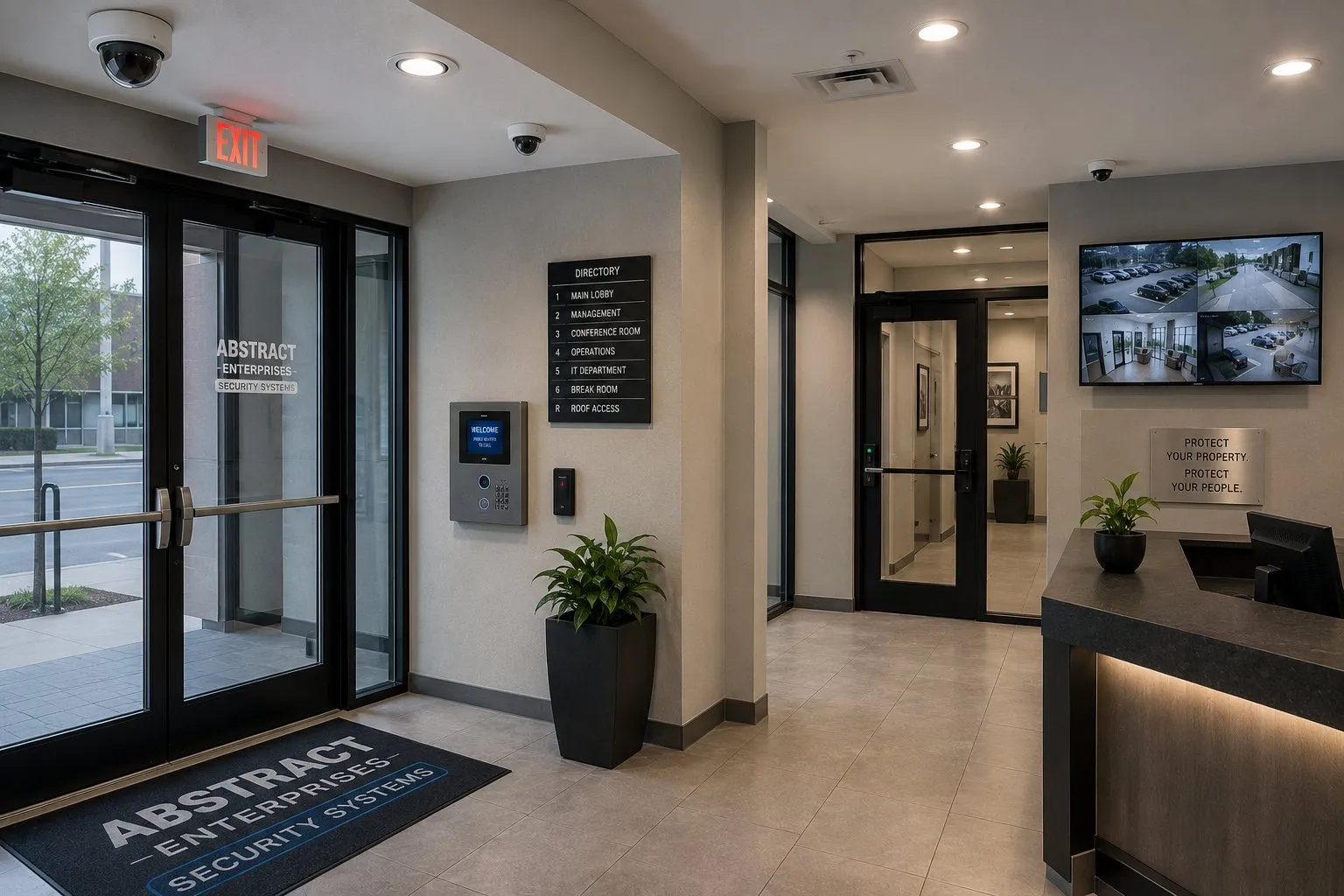
Reference photo: a bright office lobby with glass entry doors, two ceiling dome cameras, a wall-mounted entry panel and card reader, a directory board, and a wall display split into four camera views above the reception desk. A split-screen lobby display is often the first step before an owner commits to a full multi-panel wall.
Nassau facts that shape a video wall job
2 cities, 3 towns, 64 villages, 60-plus hamlets. Permits and sign rules come from the village, the city or, in hamlets, the town — not from the county (New York State county page; Nassau County building-and-zoning page).
79% single-unit homes, 81% owner-occupied. Residential walls are mostly in houses, where county home-improvement licensing applies (Census ACS 2024 one-year estimates via Census Reporter).
Home-improvement law since 1970. Local Law 6-1970, Chapter 21 of the Administrative Code, covers dwellings of up to three families; licenses run two years.
$66,350 for a school gym wall. Approved by the County Legislature on July 27, 2026 for Hempstead High School’s sound system and video wall.
An 8-by-8 LCD wall nearly 32 feet long. The Planar Clarity Matrix G3 wall at the Nassau County Police Department Intelligence Center, opened October 2021 on the Nassau Community College campus.
4,730 square feet of LED over center ice. UBS Arena at Belmont Park in Elmont chose Daktronics for 45 LED displays, with a centerhung of 12 displays at 5.9 mm pixel spacing.
Repair & Same-Day Help
Same-Day Video Wall Repair Across Nassau County
A panel that stays black, a wall that shows one input stretched across the wrong screens, a content player that stopped after a power cut, a controller nobody has the password for: call (516) 346-5778. We book the next open two-hour window, and most single faults — a failed power supply, a loose signal cable, a player that lost its schedule — are fixed within one to two hours of arrival. Repairs are billed at the published service rate of $195 an hour with a 3-hour minimum ($585).
A single dark screen in an otherwise working grid: we test that screen’s power and its input lead first; if the panel itself has died, a matched spare kept on site turns it into a same-visit swap.
The picture is split across the wrong panels: the controller or the panels’ own tiling settings were reset; remapping takes minutes once someone has the login.
The wall is on but shows nothing scheduled: the content player lost its schedule or its network after an outage; rebuilding the player and setting it to recover on its own stops it happening again.
One panel looks a different color: a replacement from another batch, or drifted settings; recalibration brings it close.
If the wall was installed by someone else, we can still help. The first visit identifies what is there, records model numbers and settings, and tells you which parts are worth keeping. Many Nassau walls only need their inputs remapped and their content player rebuilt, not new panels.
What We Install
Video Wall Installation Services in Nassau County
Eight kinds of job make up nearly all of our Nassau video wall work. Each card says what it is and where it fits; the price table further down gives the Nassau figures.
LCD video walls
Narrow-bezel commercial panels in 2x2, 3x3 or larger grids, with a mount that lets each panel be pulled forward for service. The default for lobbies, conference rooms and stores where viewers stand close.
Direct-view LED walls
Seamless LED cabinets at the pixel pitch the viewing distance needs. For showroom walls seen from across the floor, gyms, and anywhere the picture must have no lines through it.
Showroom and storefront walls
High-brightness panels or LED for walls near glass, with brightness set for the sun angle and a plan for whether the screen faces the street, which can make it a sign under local rules.
Security desk and operations walls
Camera feeds, maps and dashboards placed anywhere on the wall from presets, with power supplies and processing moved to the closet where possible. Built on the same idea as larger control rooms.
School and gym walls
High-mounted, guarded walls for gymnasiums and cafeterias, paired with sound and with controls simple enough for staff to switch between games, assemblies and community events.
Conference and boardroom walls
Walls that a laptop or video call can use without an AV technician in the room, with cabling to the table and the closet and ventilation planned for a small space.
Home video walls
Family-room and basement walls in Nassau houses, with the wall checked for block, concrete or wood studs, quiet players hidden away, and the county home-improvement license question answered up front.
Repairs, takeovers and upgrades
Service on walls from other installers: panel replacement, controller and player rebuilds, recalibration, and documentation so the next person is not starting from zero.
Many Nassau jobs combine two or three of these. A dealership may want a seamless LED wall facing the showroom floor, a 2x2 in the customer lounge and a camera wall at the service desk, all fed from one closet. A school may want a gym wall now and a lobby wall next year on the same content system. We design the first wall so the second one does not mean starting again: the same player platform, spare capacity in the closet, and logins the owner already controls.
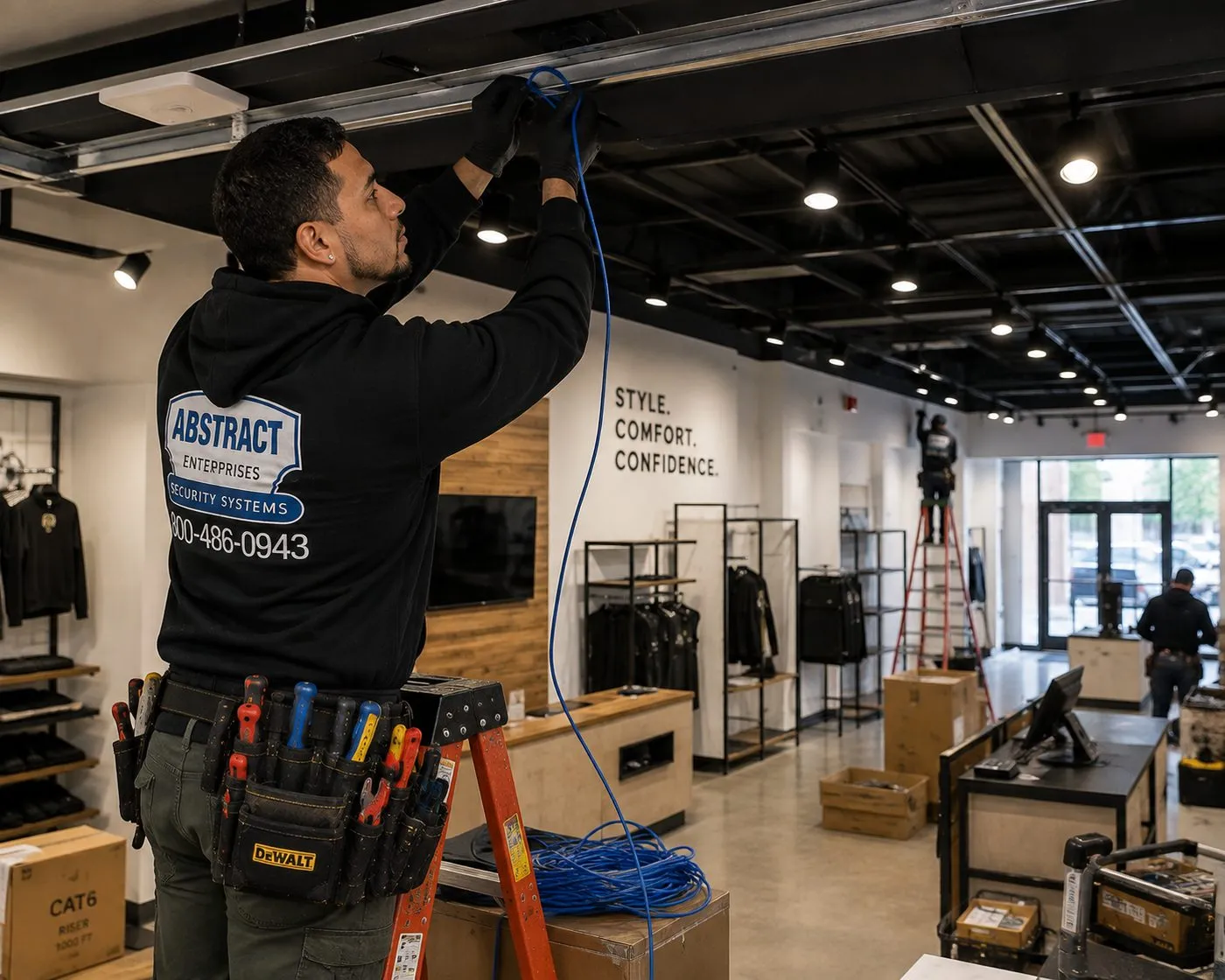
Reference photo: a technician on a step ladder pulls blue cable along the open, black-painted ceiling of a clothing store, with track lights overhead, garment racks and boxes on the floor, and a flat display hung on a wood-slat feature wall. Open retail ceilings make the cable route easy; the landlord’s rules usually decide where it may run.
Building Specialists
Video Wall Installation for Nassau County's Architecture
Nassau’s buildings are low and wide, and almost every video wall here goes onto one of six kinds of wall. Each one changes the mount, the cable route and who has to say yes.
Glass-front car showrooms
Tall glazing, polished floors and high ceilings. The issues are sunlight, reflections and reaching a high ceiling for cable, often from a lift. Walls go on the solid back or side walls, rarely on glass.
Mall and strip-center tenant spaces
Steel-stud demising walls and open or lay-in ceilings, all under a landlord’s alteration rules. The tenant’s space usually ends at the demising wall, so backing and cable routes have to stay inside it.
Office buildings and office parks
Lobbies with stone or panel cladding over steel studs, lay-in ceilings on the floors above, and a network closet per floor. Lobby walls sit on public paths, so depth and accessibility count.
Schools and gymnasiums
Concrete block walls, high open ceilings and hard use. Mounts go into block with the right anchors, high enough or guarded against balls, and cable runs in conduit where it is exposed.
Houses of worship
Sanctuaries with high walls, stained wood and stone, and congregations that dislike visible cables. Walls are placed for sightlines from the back pew and cable is routed to avoid historic finishes.
Single-family homes
Basements of poured concrete or block, upstairs walls of wood studs, and family rooms in Capes, ranches, split-levels and colonials. The wall type decides the mount and the anchors, and heat has to leave the room.
What each wall is made of, and what that means for the mount
Steel studs and drywall. This is the most common commercial wall in Nassau office buildings and tenant spaces. Drywall carries almost nothing on its own, and a steel stud is thin metal, so a heavy wall mount is fixed into blocking or a backing plate set between the studs, or into a frame that spreads the load across several studs. In a finished wall that means opening it, adding backing and patching; in a fit-out it means putting backing in before the drywall goes up, which is cheap if somebody remembers.
Concrete block. Schools, gyms, warehouses, the backs of many strip-center units and a good number of basements are block. Block holds well if the anchors go into solid sections or are designed for hollow cores; the wrong anchor in a hollow cell can pull out. We drill test holes, choose sleeve or adhesive anchors to suit, and keep away from mortar joints for the main fixings.
Poured concrete. Basement walls in many Nassau houses and the structure of some commercial buildings are poured concrete. It is strong but hard to run cable inside, so the usual answer is a furred-out wall or a recessed box set into a stud wall built in front of the concrete, with the cable coming from the ceiling.
Wood studs. Most upstairs walls in Nassau houses are wood studs at regular spacing. A video wall mount spans several studs, and the recessed box for power and signal goes between them. Older plaster on wood lath, found in some early houses, cracks if drilled carelessly, so we score and drill slowly.
Stone, tile and wood paneling. Lobbies and sanctuaries often have finishes that cannot be repaired invisibly. We fix through joints where possible, use a floor-standing frame where not, and agree any visible change with the owner in writing before drilling.
Nassau houses: where a home video wall usually goes
Most Nassau homes are single-family houses, and most home video walls end up in one of three places: a finished basement, a den or family room off the kitchen, or a converted garage or attic room. Basements are popular because the walls are long and the light is easy to control, but they are often poured concrete or block, and the ceiling is crowded with ducts and pipes. We check where the cable can come down, whether a furred wall is needed in front of the concrete, and how the room will be ventilated once a wall of panels is running for hours.
Upstairs, wood-stud walls make the mount simpler, but finished rooms mean patching and painting after the recessed box goes in. Houses with plaster walls need slower drilling. Split-level and raised-ranch layouts sometimes put the best wall on the far side of a staircase from the outlet, which is where an electrician’s new circuit or a relocated outlet comes in.
Because work on a house of up to three families is home improvement under county law, the homeowner should see the contractor’s county license details before signing, and the written contract should describe the work, the price and the payment schedule. We put the mount, the box positions and the equipment list on a simple drawing so the family knows exactly what will change in the room.
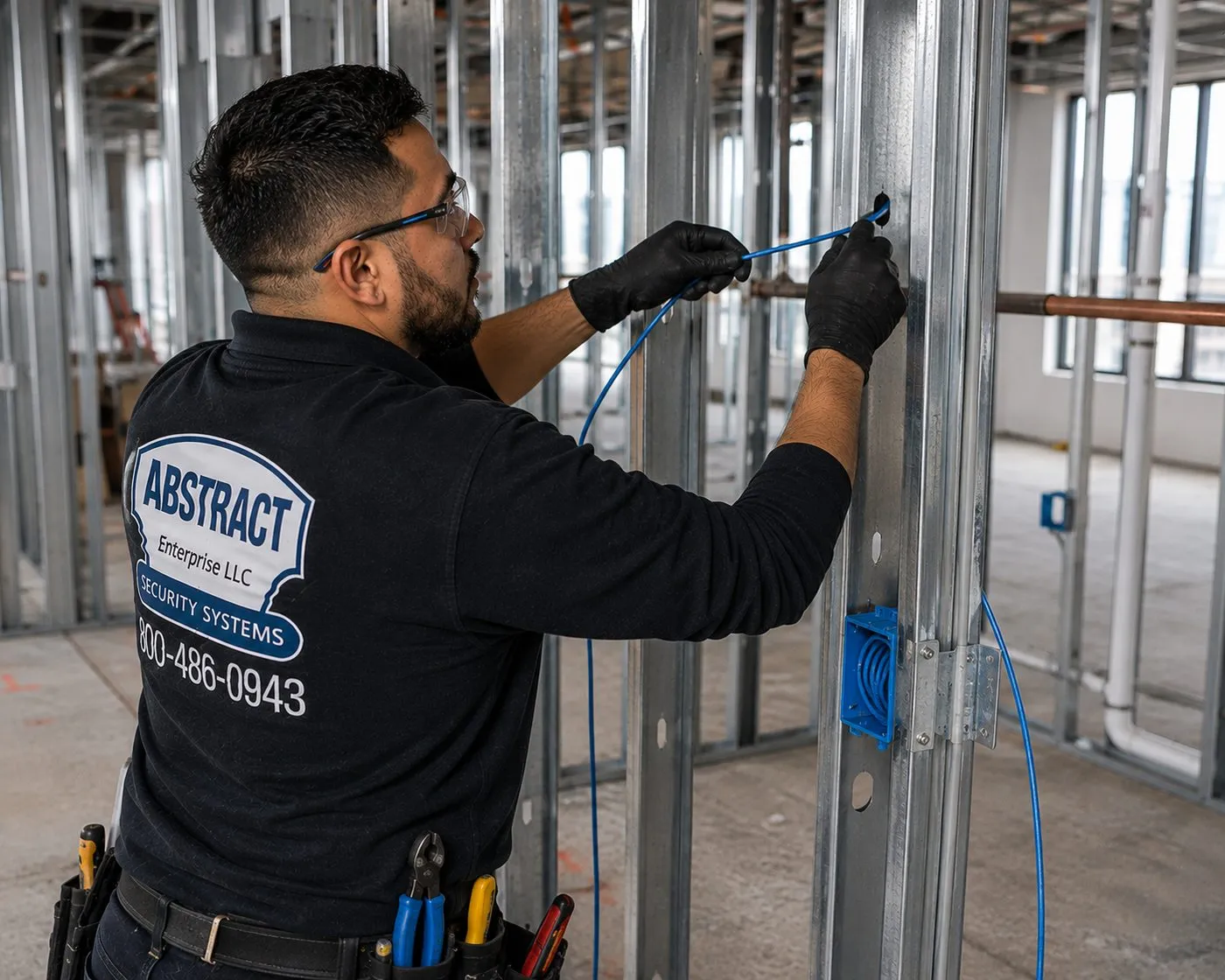
Reference photo: a technician feeds blue cable through a punched hole in a steel stud, next to a blue low-voltage mounting bracket fastened to the stud, in a framed room with tall windows. Rough-in at this stage is where the power and signal boxes for a display wall get placed at the right heights.
These are the corridors and districts where commercial video wall questions come up most in our research for this page. None of them is a project we are claiming; they show who operates where and what each place asks of a wall.
Old Country Road, Garden City and around Roosevelt Field
Roosevelt Field at 630 Old Country Road is the largest shopping mall on Long Island, with department-store anchors and more than two hundred specialty stores. Tenant walls here go through the center’s criteria first, and work is planned around mall hours.
Northern Boulevard through Great Neck and Manhasset
Car dealerships, auto lots and the shops of Manhasset’s Miracle Mile line this road. An auto lot at 195 Northern Boulevard, beside a luxury dealership, sold for $3.15 million in early 2026 — the kind of frontage where a showroom wall is part of the sale.
Uniondale, around the Coliseum and RXR Plaza
Office towers such as RXR Plaza and the Nassau Veterans Memorial Coliseum sit side by side here, near Hofstra University. Lobby walls, conference walls and event displays are the usual jobs.
Elmont and Belmont Park
UBS Arena brought arena-scale LED to Elmont, with a 4,730-square-foot centerhung. Restaurants, bars and businesses nearby compete for the same crowds with smaller multi-screen walls.
Mineola and the county seat
County offices, courts, law firms and the Consumer Affairs department that licenses home-improvement contractors are here. Conference and hearing-room displays and lobby information walls are typical.
Garden City and the Nassau Community College campus
The village is home to the college campus that holds the David S. Mack Center for Training and Intelligence, with its large police operations wall. Office buildings and schools nearby use smaller walls for lobbies and training rooms.
Beyond the corridors, two kinds of Nassau business ask about walls often. Houses of worship want lyrics, readings and live video large enough for the back rows, without a projector’s fan noise or a screen that washes out when the lights are up; the questions there are sightlines, cable routes that respect the building, and controls a volunteer can run on a Sunday morning. Bars and restaurants want several games at once, which is a routing question as much as a display one: a matrix that sends each source to any screen, and a layout staff can change from a tablet without climbing on a chair.
Compliance callouts for Nassau commercial walls
Local building and sign rules. The village, city or town where the business sits decides whether a filing is needed and whether a display visible from the street is a sign. There is no county-wide sign code to rely on. We ask the right office in writing when it matters and keep the answer with the job file.
Electrical work by a licensed electrician. New circuits, outlets and disconnects are done by an electrician licensed for that municipality and inspected where required. Electric signs, including LED signs, fall under their own article of the National Electrical Code, and inspectors look for listed equipment.
Accessibility. Under the 2010 ADA Standards, wall-mounted objects whose leading edge is between 27 and 80 inches above the floor may project no more than 4 inches into a circulation path. Lobby, corridor and store walls are designed to that limit or recessed.
Old equipment. Since January 1, 2015, New York State has banned putting covered electronic equipment in the trash. Old screens taken down for a new wall go to a recycler or a manufacturer’s take-back program, which is free for most small businesses, nonprofits and schools.
Insurance and landlord sign-off. Malls, office buildings and districts all ask for a certificate of insurance naming them before work starts, and most ask for drawings and hours. We prepare both with the design so they do not hold up the date.
A Nassau store or showroom opening checklist
Address and jurisdiction. Village, city or town — looked up before the design is final.
Which way the wall faces. Into the store, or out to the road; the second may make it a sign.
The landlord’s criteria. Drawings, product data, insurance certificate and allowed hours for work and deliveries.
Power. A licensed electrician for the municipality, the circuit sized for the wall, and the inspection booked if one is needed.
Network. A data drop at the wall and a port in the closet, or a cellular or Wi-Fi plan for the content player.
Content. Canvas size and seam positions sent to the designer, and opening-day files tested on the wall a few days early.
Handover. Logins in the business’s name, a power-cut test, and a contact for service.
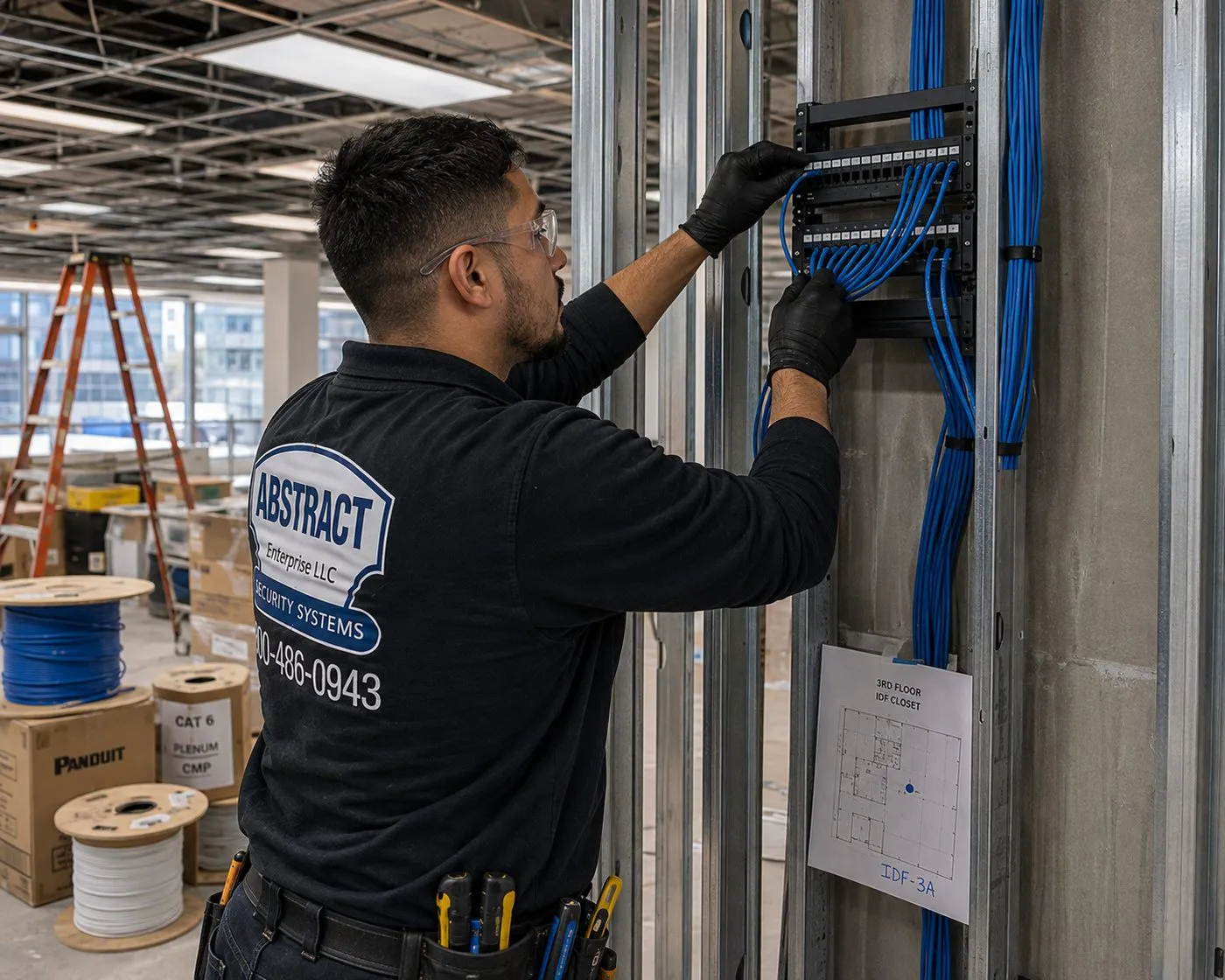
Reference photo: on an open office floor under construction, a technician dresses a bundle of blue cables into a small wall-mounted patch panel fixed between steel studs, with boxes and reels of cable and a ladder behind him. Fit-outs in Nassau office parks often give one chance like this to put the display cabling in before the drywall closes.
Video Wall Installation in Nassau County: Questions Answered
Below, the Nassau questions are sorted by the decision each one feeds: who approves the wall, how a store or showroom uses it, how offices, gyms and control rooms differ, and how to live with it for years. The answers lean on this county’s own governments, buildings and records.
Villages, Towns and Who Signs Off
Most of what makes a Nassau job different happens before the first panel is unboxed. These are the questions owners and managers ask once they realise the county is many governments, not one.
How do I find out whether my building answers to a village or to the town?
Start with the tax bill or the property record: it names the town and, if there is one, the incorporated village. Nassau County is made up of two cities, three towns and sixty-four incorporated villages, with more than sixty unincorporated hamlets in between, according to the State’s county page. A hamlet such as Uniondale, Elmont or Hicksville has no building department of its own; work there goes to the Town of Hempstead or the Town of Oyster Bay. A village such as Garden City, Mineola or Great Neck Plaza typically runs its own building department with its own forms and inspectors.
For a video wall the answer matters because two different offices can be involved: the building department for any structural or electrical work, and, if the screen is visible from the street, whoever enforces the sign rules. Glen Cove and Long Beach are cities and are separate again. The county’s own building-and-zoning page simply lists the local offices and sends you to them, which tells you everything about where the decisions are made.
We ask for the address before we quote and look up the jurisdiction ourselves. If the job needs a filing, the written proposal says which office and who files it, so the owner is not discovering it the week the panels arrive.
Does Nassau County itself issue a permit for a video wall?
Generally not. The county’s building-and-zoning page does not issue building permits for local projects; it lists the city, town and village offices and sends people to them. Building, electrical and sign questions for a wall are answered by whichever of those offices covers the address.
Where the county does come in is licensing. Its Department of Consumer Affairs licenses home-improvement contractors under Chapter 21 of the Administrative Code, which matters when the wall goes into a house. County agencies are also customers in their own right, as the police department’s Intelligence Center wall shows, but that is a buyer’s role, not a permitting one.
So the useful first call is never “the county.” It is the village, city or town office for the address, and, for a home, a check of the contractor’s county license.
Is a living-room video wall covered by Nassau’s home-improvement license law?
Very likely, yes. Nassau’s home-improvement law, Local Law 6 of 1970 in Chapter 21 of the county Administrative Code, defines home improvement as repair, remodeling, alteration or addition to a building used as a private residence for not more than three families, and the county’s Consumer Affairs department licenses contractors who do that work. Cutting into a wall, adding backing and building a recessed box in a family room is exactly that kind of work.
The same law exempts people licensed under another law, such as electricians, when they work only within their own trade, and it does not reach commercial buildings at all. So a showroom wall in Westbury is outside it, while a basement wall in Massapequa is inside it. Licenses issued under the law run for two years.
Our advice to a homeowner is simple: ask any installer, us included, for the license number the county issued, and look it up on the county’s license search before you sign. Our NYS license #12000287431 covers security and fire alarm installation statewide; it is not a substitute for the county’s home-improvement license on residential work.
Our building has four apartments — does the county home-improvement law still apply?
Not by its own definition. Nassau’s Local Law 6 of 1970 defines home improvement as work on a building used as a private residence for not more than three families, plus related work on the land next to it. A one-, two- or three-family house is inside that line; a four-unit building is outside it, much as a store or office is.
That does not make a four-unit job unregulated. The village, city or town building rules still apply, any electrical work still goes to a licensed electrician, and the owner will usually want the same written scope and insurance as on any commercial job.
For a two-family house where the owner lives upstairs and wants a wall in the downstairs unit’s den, the county law does apply. When in doubt, count the dwelling units on the property record before choosing who to hire.
Showrooms, Storefronts and Mall Tenants
Retail and automotive walls are where most Nassau video walls end up, and each comes with a landlord, a sun angle and a sales floor that cannot close for long.
Which wall in a glass-fronted showroom should carry the screens?
Usually a solid back or side wall that never takes direct sun, and only then is brightness chosen for it. Car showrooms such as the dealerships along Northern Boulevard in Great Neck are built around big windows, and a standard indoor LCD panel that looks bright in a conference room washes out when direct sun lands on it. The options are a high-brightness panel rated for window-facing use, direct-view LED, which is far brighter, or moving the wall to a side that never takes direct sun.
We visit at the hour that matters: late afternoon on a west-facing wall, morning on an east-facing one. We check where the reflections land, because a glossy panel facing the glass can show the parking lot better than the content. Matte-finish panels and a slight tilt can fix reflections; nothing but brightness fixes direct sun.
Brighter panels draw more power and run warmer, so the decision feeds straight into the electrical and ventilation plan. That is why we settle it at the site measure, not after the order.
Do the cables above our drop ceiling need a special rating?
Often, yes. In many Nassau offices, schools and stores the space above the lay-in ceiling also carries return air to the heating and cooling system. Cable run through an air space like that has to carry the plenum rating the electrical code requires, which burns with less smoke than ordinary cable.
We check the ceiling at the site measure: whether it is a return-air plenum, where the existing cable trays and hangers are, and where the light fixtures and sprinkler pipes run. Wall cable is hung on its own supports, never laid on the tiles, and labeled at both ends so the next person can follow it.
The price table already assumes the right cable. If a building’s own rules ask for conduit instead, that is quoted as its own line.
How do we keep a showroom wall from looking dated when the models change every year?
Treat the wall as a channel, not a poster. The hardware lasts for years; what dates it is content that was made once for the opening and never changed. A showroom wall works best with a few templates that the sales or marketing team can update themselves: new model photos, a monthly offer, a service-department message, an event night.
We set the content player up with those templates and a simple schedule, and we show the person who will update it how to swap images and change the order without calling anyone. Manufacturer brand guidelines often supply approved video and photography; we size the wall’s canvas so those files fit without awkward cropping across the seams.
Once a year it is worth a short service visit to recalibrate brightness and color, clean the panels and update the player. A wall that is bright, even and showing this month’s cars looks new long after the install.
When does a storefront need direct-view LED instead of tiled LCD panels?
When the wall faces sun, needs to be seen from far away, or has to be truly seamless. Tiled LCD panels are sharp and affordable, but every panel has a thin border, and those lines run through the picture. Direct-view LED has no borders and is much brighter, but it costs more per square foot and its fineness depends on pixel pitch, the spacing between LEDs: the closer viewers stand, the finer the pitch has to be.
For a store where customers stand a few feet away and the wall faces into the shop, LCD usually wins on cost and sharpness. For a showroom wall seen from the road, a large wall over a sales floor, or a design that cannot tolerate lines across faces and logos, LED is the better tool. Our Nassau price table shows both, so the comparison is in dollars, not adjectives.
One more check: the wall behind LED has to be flat and strong, and the cabinets need service access from the front or the back. We confirm which before the order.
Office Parks, School Gyms and Operations Rooms
The other half of Nassau’s walls go into lobbies, gyms and rooms where people watch screens for a living. Each has a different failure to design around.
Does a high showroom or gym wall need a scissor lift on site?
Often, yes. Showroom ceilings and school gyms are usually too high for a step ladder to reach the cable route safely, and a wall whose top edge sits well above head height has to be aligned from a stable platform. A small electric scissor lift fits through a standard double door on most commercial sites.
We include the lift in the quote when the site measure shows one is needed, and we check the floor first: polished showroom tile and gym floors need protection under the wheels, and some floors have load limits the facilities office will want to see.
In stores and offices with lay-in ceilings at normal height, ladders are usually enough, which keeps the cost down. The quote says which access equipment the job assumes.
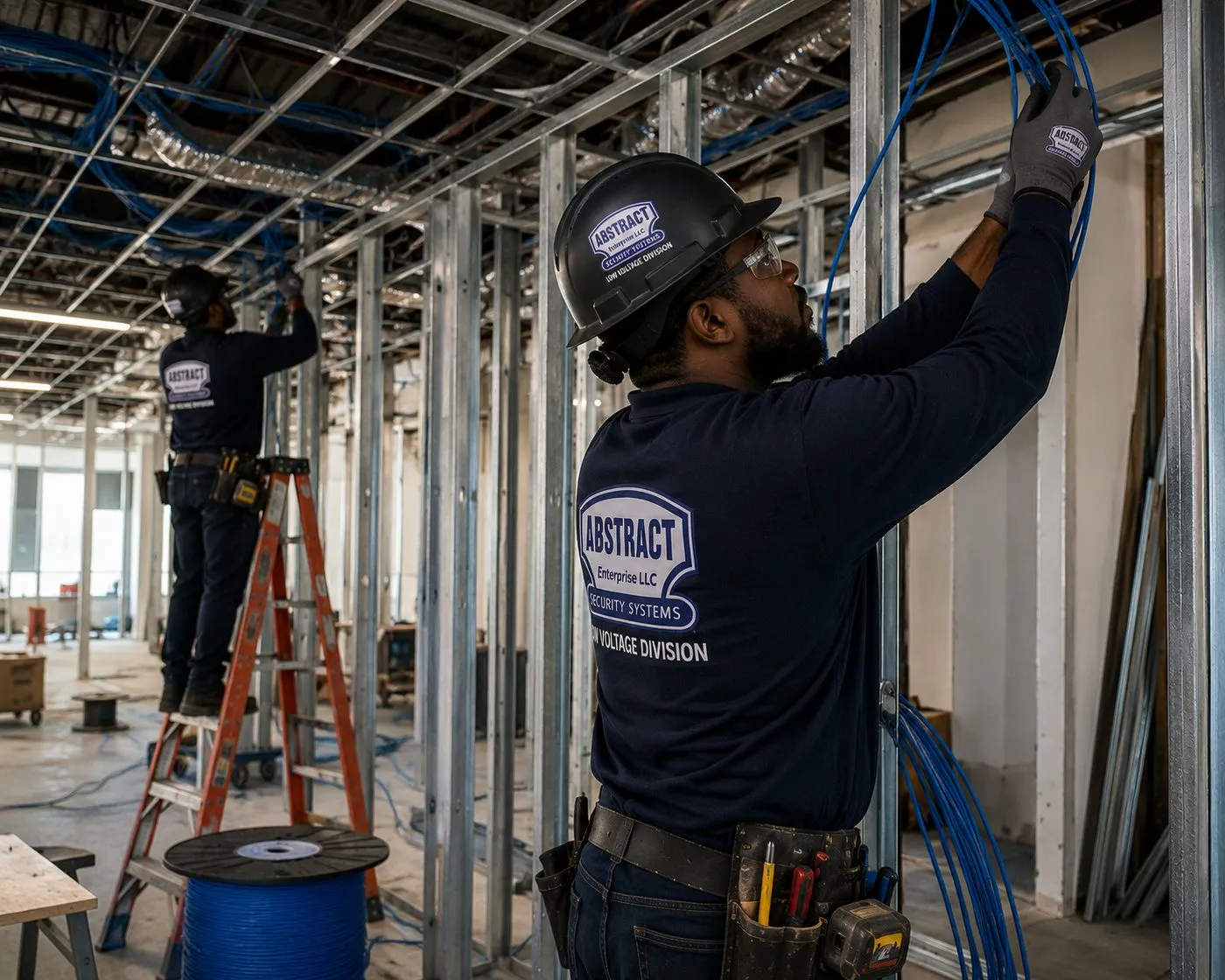
Reference photo: two technicians in an open, steel-framed floor under an exposed ceiling; the nearer one, in a hard hat, pulls blue cable down through the studs while the other works from a ladder, with a reel of cable on the floor. Backing for a heavy display wall belongs in the framing at this stage too.
What does a school gymnasium wall need that a lobby wall does not?
Protection, height and sound. A gym wall takes balls, so it is mounted high, behind a guard, or both, and the mount has to stay rigid when something hits it. It is seen from bleachers across the floor, so it is usually larger and coarser than a lobby wall, and it is almost always paired with a sound system, because a picture without audible commentary in a gym is half a system.
Nassau districts are buying these. In July 2026 the County Legislature approved a $66,350 community revitalization grant toward a new sound system and video wall for the Hempstead High School gymnasium, and the superintendent described the space as one for athletic programs, events and community gatherings. That mix — games, assemblies, graduations, community nights — is exactly why the control has to be simple enough for a coach or custodian to switch inputs without calling anyone.
Scheduling is the other difference. School work happens around the calendar: holidays, summer and weekends, with access through the district’s facilities office. We plan the rough-in for one break and the panels for another if that is what the calendar allows.
Can the conference-room wall work with Teams or Zoom without an AV technician in the room?
Yes, if the wall is designed as a meeting room rather than a display. That means a camera placed where it sees the table rather than the back of people’s heads, microphones that pick up the far end of the table, speakers that do not echo off glass partitions, and one way to connect a laptop or start a call that works the same every time.
On a video wall the extra question is where the call appears. A layout that puts the remote participants across the middle of the wall, with shared content to one side, keeps faces away from the seams. Controllers and some meeting-room systems can switch to that layout automatically when a call starts.
We test it with the people who will use it: a call from the room, a laptop shared, the far end asked whether they can hear the person at the end of the table. A conference wall that needs a technician to start a meeting will not be used.
How is an operations-room wall different from a wall built for advertising?
An operations wall is a tool that people use all day, so reliability, layout flexibility and heat matter more than brightness. Nassau has a well-documented example: the Nassau County Police Department’s Intelligence Center, opened in October 2021 in the David S. Mack Center for Training and Intelligence on the Nassau Community College campus, is built around a Planar LCD video wall in an 8-by-8 layout nearly 32 feet long and 18 feet high, integrated by a Long Island AV firm. Its users describe splitting the wall between daily work and an active case, and switching between one large image and many small ones.
Two design choices in that project apply to any security desk or dispatch room: the processing lets operators place any source anywhere on the wall from preset layouts, and the panels’ power supplies were moved to a rack room, taking heat, noise and electrical outlets away from the wall itself. A small office will not build anything that size, but the same thinking — presets, remote power, sources mapped to roles — works on a 2-by-2.
An advertising wall, by contrast, plays scheduled content for people walking past. It needs a content player and a schedule more than a switching controller. Knowing which one you are buying keeps money out of the wrong box.
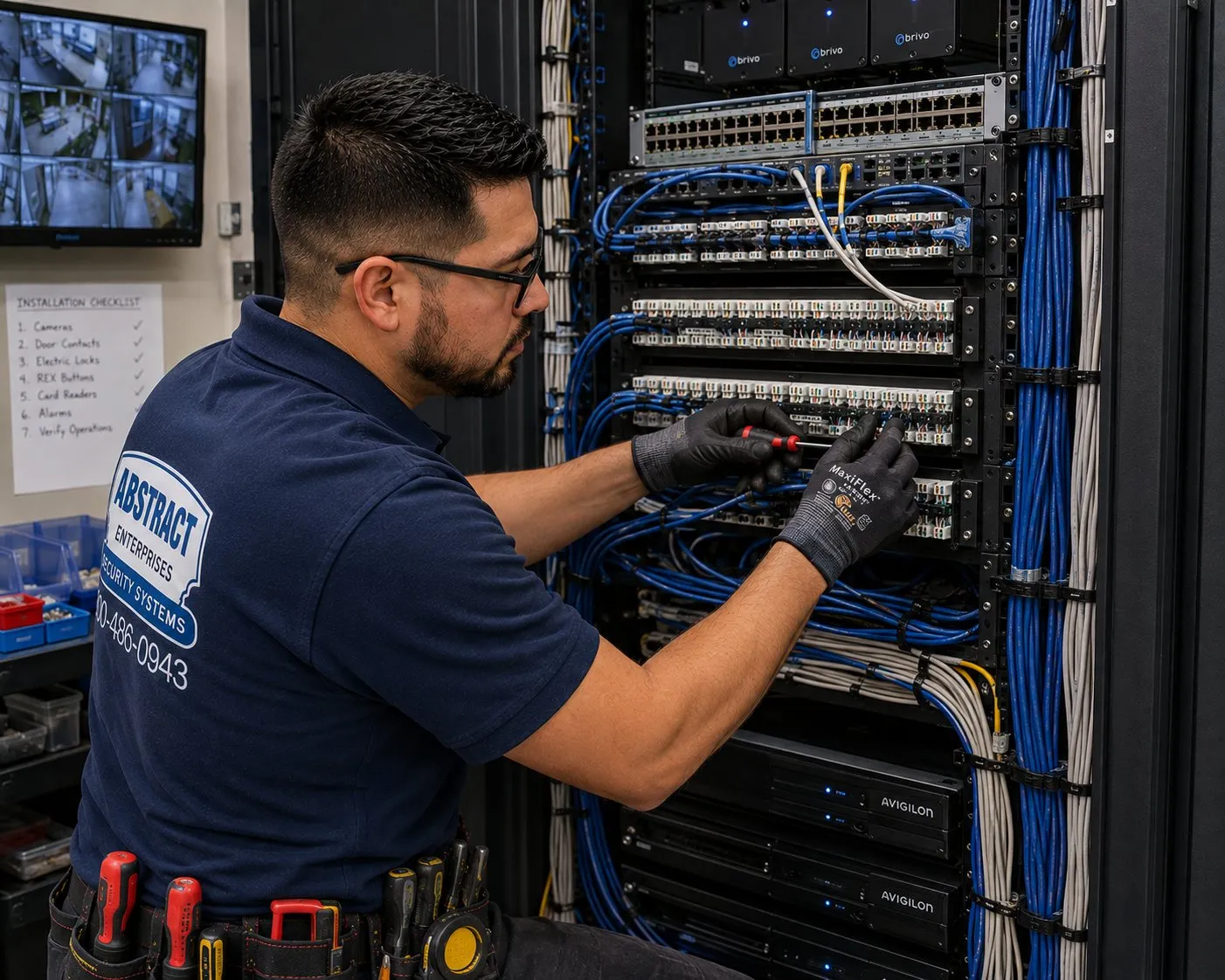
Reference photo: a technician works on dense rows of patch panels in a tall equipment rack with recorders at the bottom, while a monitor on the wall to the left shows a grid of camera views. Security desks in Nassau offices and schools often grow from one monitor like this into a multi-panel wall fed from the same rack.
Running It Year After Year
A wall is bought once and lived with for years. These are the questions that decide whether it still looks right in year five.
Can head office schedule what plays on walls at several Nassau locations?
Yes. Content-management platforms such as the ones on our price list let a marketing team publish to many players from one account: a playlist for every store, a different one for the Garden City location, an override when a promotion ends early. Each wall keeps its own player on site, so a slow connection at one store does not stop the others.
We set the accounts up in the company’s name, not ours, and give each location a role so the store manager can change the local screen without touching the others. Annual software fees for these platforms are listed separately in our price table because they are paid to the software company.
Before rollout we test one store for a week. Problems with screen resolution, video formats or overnight updates show up on one wall more cheaply than on six.
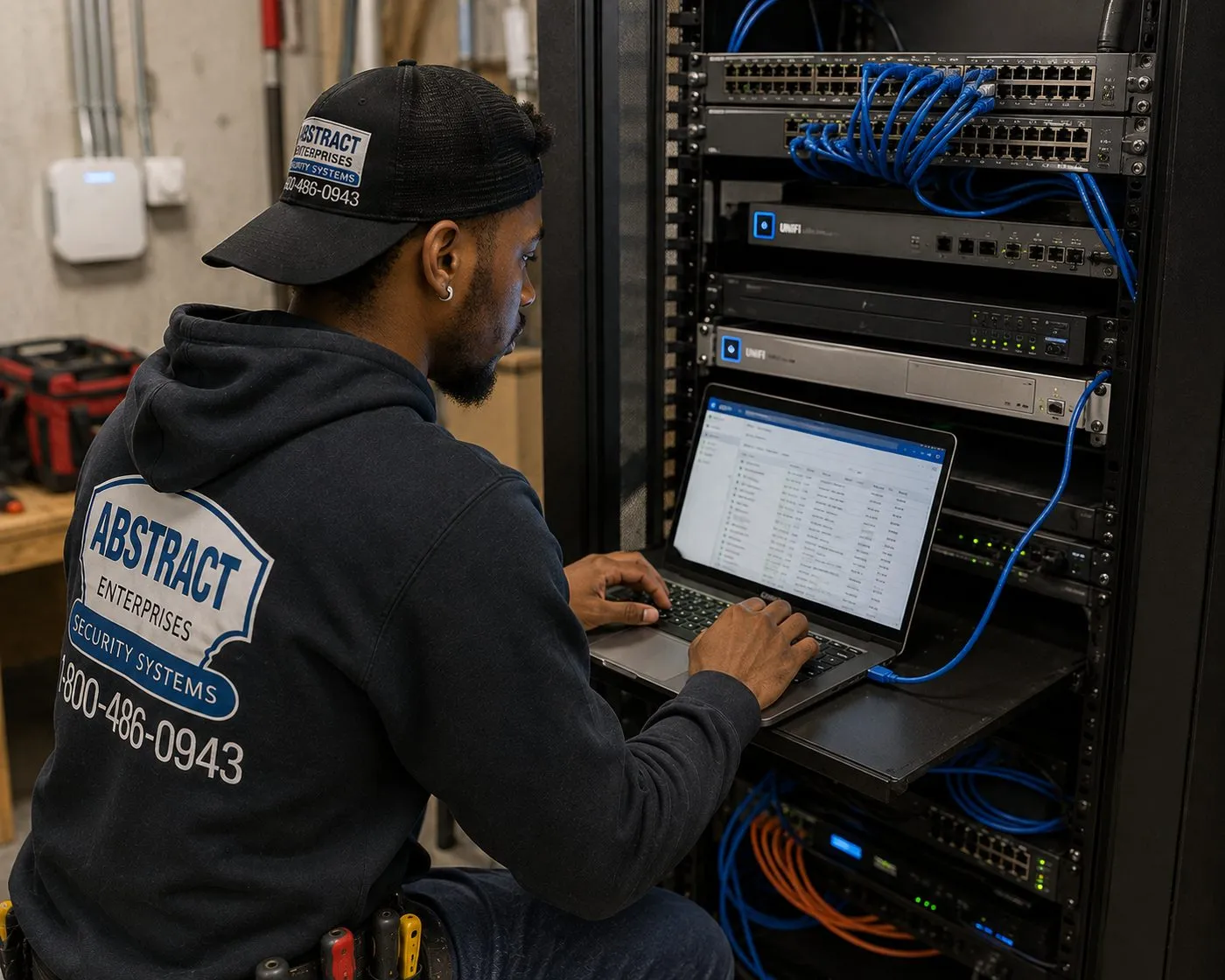
Reference photo: a technician seated at an open equipment rack types on a laptop set on a pull-out shelf, below rack-mounted switches with blue patch cords. Networked video-wall players and controllers are set up this way — addresses, schedules and firmware — before the wall is handed over.
Can a Nassau school district put a County Legislature grant toward a gym video wall?
It has happened. In July 2026 the Nassau County Legislature unanimously passed a $66,350 Community Revitalization Project grant, secured by the district’s legislator, for the Hempstead Union Free School District to put toward the purchase and installation of a new sound system and video wall for the Hempstead High School gymnasium.
How a district applies, and whether a project qualifies, is between the district, its legislator and the county. What an installer can do is supply what the paperwork needs: an itemised quote that separates the wall, the sound system and the labor, product data, and a realistic schedule around the school calendar.
Grant-funded projects also tend to need the quote to match what was approved. We keep the scope stable once the figure goes into an application and price any later changes separately.
Why does a Nassau wall cost more than the same wall in Queens but less than in Suffolk?
Because each area page applies a published area factor to the same Brooklyn base list. Nassau’s factor is 1.15; Queens is 1.05 and Suffolk 1.20. The factor reflects travel time, parking and the cost of working in each area, and it is applied to the installed ranges in the table.
In practice a 2x2 LCD wall that starts at $12,000 on the base list starts at $13,800 in Nassau, about $12,600 in Queens and $14,400 in Suffolk. Annual software fees are not multiplied, and the service rate of $195 an hour with a 3-hour minimum is the same everywhere.
If a business straddles the line, say a Floral Park store and a Queens Village office, each wall is priced for where it is installed, not where the company is billed.
Can one crew handle the wall, the cameras and the door readers in a Nassau showroom?
Yes, and it usually saves time. A showroom or office that is getting a wall often needs new cable runs anyway, and the same ceiling route can carry camera and door-reader cable. One crew means one schedule with the landlord, one set of drawings and one insurance certificate.
We are licensed in New York State as a security and fire alarm installer, and our Nassau pages for commercial cameras, access control and structured cabling cover that work. The wall, the cameras and the doors stay separate systems with separate logins; they just share the pathway and the closet.
If a business already has a camera or access vendor it likes, we coordinate with them instead, and leave a pull string or spare cable for their runs.
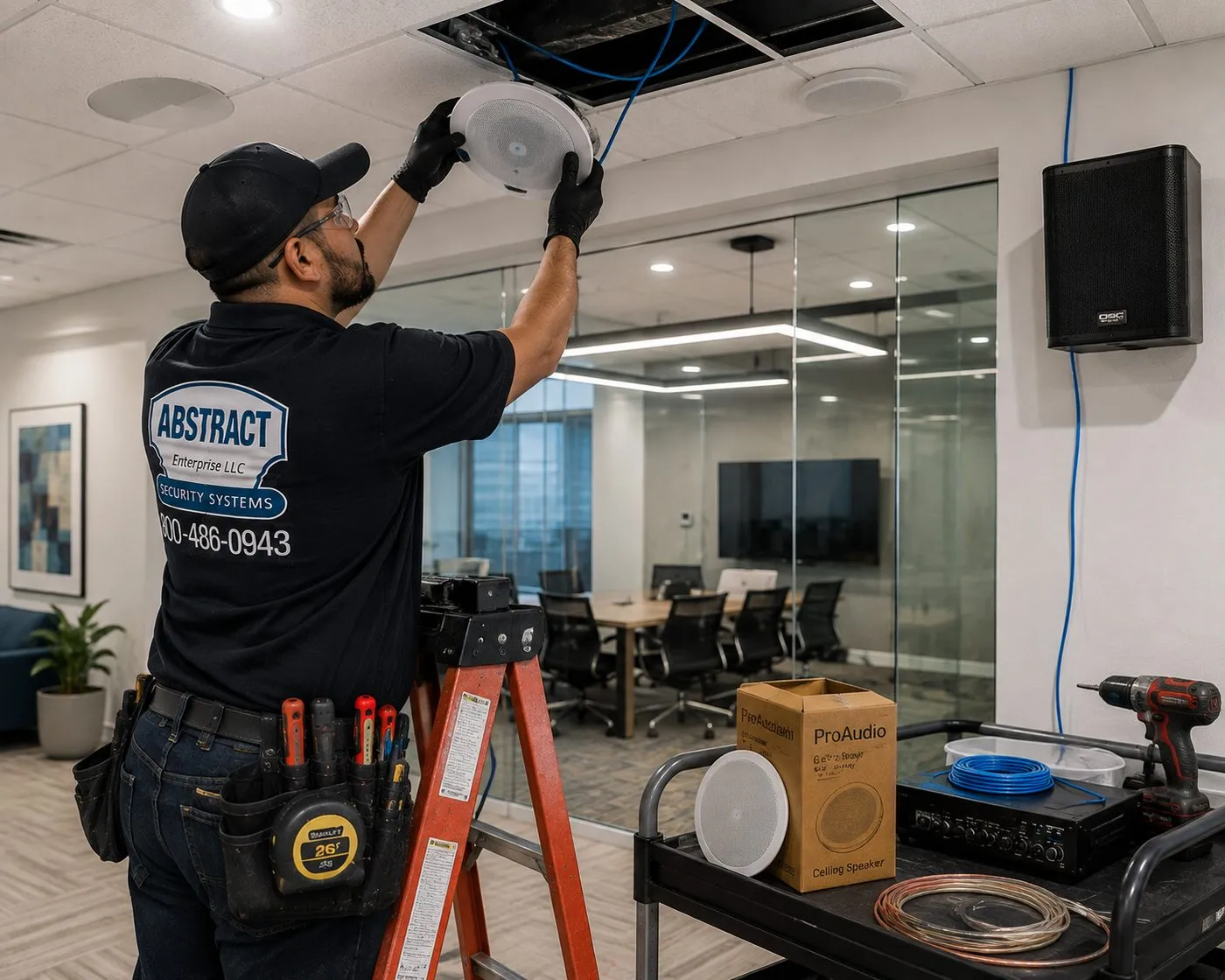
Reference photo: a technician on a ladder lifts a round ceiling speaker into an opened ceiling tile, with a cart of speaker boxes and wire below and a wall-mounted speaker nearby; behind him a glass-walled conference room has a flat display on its far wall. Sound is usually planned with the wall, not after it.
Equipment
Types of Video Wall Installation We Install
The equipment list for a Nassau wall is decided by three things: how far away people stand, how much daylight hits the wall, and whether the wall shows scheduled content or live sources. Everything below is matched to those answers, not to a catalog page.
Narrow-bezel LCD video-wall panels
Commercial 55-inch panels built for tiling and long hours, with thin borders and loop-through inputs. The basis of most lobby, conference and store walls.
High-brightness window panels
LCD panels rated for brighter output, for walls that take daylight through showroom or storefront glass.
Direct-view LED cabinets
Seamless LED in pixel pitches from coarse outdoor to fine indoor, chosen by how close viewers stand. Needs a flat, strong wall or frame and front or rear service access.
Pop-out and floor-supported mounts
Mounts that let each panel be pulled forward for service, and frames that carry a heavy wall to the floor when the wall itself cannot.
Video wall controllers
Processors that treat the wall as one canvas, place several sources in windows and recall layouts from presets — the heart of a security or operations wall.
Content players and software
Players such as BrightSign and platforms such as MagicInfo, Scala or Carousel that schedule content, keep a local copy and recover by themselves after a power cut.
HDMI matrices and network distribution
Matrices that route many sources to many screens, and video-over-network encoders and decoders where the source is far from the wall.
Recessed boxes, cable and power positions
In-wall boxes behind the panels for power and signal, Cat6 back to the closet, and outlets placed by a licensed electrician where the mount needs them.
Sizing a Nassau wall: distance, height and the picture itself
The right wall starts from the people looking at it. In a reception area where visitors stand a few steps away, a 2x2 of 55-inch panels fills the view and every detail is sharp; the same wall at the back of a gym or across a showroom floor looks small. Measure from where the nearest regular viewer stands and from where the farthest one sits, and size the wall for the far viewer while choosing a pixel pitch or panel resolution that still looks clean to the near one. The finer the LED pitch, the closer people can stand before they see individual dots, and the higher the price per square foot.
Height matters as much as size. A wall hung too high in a conference room gives everyone a sore neck; a wall hung too low in a store disappears behind shoppers and displays. In lobbies we usually keep the bottom edge above the heads of people standing in front of it and the center near the eye line of someone walking in; in gyms the bottom edge goes above the reach of a bounced ball; in homes it sits where a seated viewer looks slightly up, not sharply.
Finally, design the content for the wall, not for a single TV. A 2x2 of full-HD panels is a 3840 by 2160 canvas with lines through it at the center; text that crosses a seam is harder to read, and faces split by a bezel look odd. We send the owner’s designer the exact canvas size and the seam positions before the first file is made, so the opening-day content fits the wall it plays on.
Video wall terms, in plain English
Bezel. The frame around each LCD panel. Two bezels meet at every seam; “narrow-bezel” panels keep that line thin, but it never disappears.
Pixel pitch. On an LED wall, the distance between the centers of neighboring LEDs, in millimeters. Smaller pitch means a finer picture at close range and a higher price.
Brightness (nits). How bright a panel can get. A conference room needs far less than a wall facing showroom glass; too much indoors wastes power and tires the eyes.
Controller or processor. The box that treats the wall as one screen, places several sources on it and recalls layouts from presets.
Content player. A small computer that plays scheduled content from a local copy, managed through software from anywhere.
Calibration. Matching brightness and color from panel to panel so the wall reads as one picture instead of a checkerboard.
Pop-out mount. A mount that lets each panel be pulled forward for service without taking the wall apart.
Remote power supply. A design, used in larger LCD walls, that moves the panels’ power supplies to an equipment room, taking heat and noise away from the wall.
Online kit, national AV chain or local installer?
An online kit gets panels and a mount to your door for the lowest price, and that is all it does. Somebody still has to find out what the wall is made of, add backing, run cable from the closet, bring in an electrician, align the panels and set up the player. Kits are a good fit for people who already have that somebody.
A national AV chain brings standard designs and purchasing scale, which suits a brand rolling out the same wall to dozens of stores. The local questions — this village’s sign rules, this landlord’s hours, this lobby wall — still have to be answered on the ground, often by a subcontractor.
A local installer should be able to answer those local questions before quoting, show a license and insurance, put the price in writing from a published list, and come back next month when a panel goes dark. That is the standard we hold ourselves to on Nassau walls; whoever you hire, ask for the same.
AI Overview Reality Check
What AI Gets Wrong About Video Wall Installation in Nassau County
Search assistants and cost sites give quick answers about video walls. Some are fine; some are wrong in ways that cost Nassau owners money. Google’s AI Overview itself could not be captured from our research tools for this edition, so the claims below come from cost guides and forums we could read, and from the questions customers bring to us.
“A video wall costs $5,000 to $15,000”
Some online answers give a single range like this for any video wall. It is roughly the price of the panels in a small grid, bought online, before anything else happens. It leaves out the mount, the controller or player, the cable from the closet, the electrician’s circuit, calibration and labor.
Industry cost guides published in 2026 put installed LED walls at very different numbers, from around $9,500 for an entry-level indoor wall to more than $200,000 for premium fine-pitch systems, and quote installed LED at hundreds to thousands of dollars per square foot depending on pitch. Those spreads are real; a single small range is not.
Our published Nassau figures start at $13,800 for an installed 2x2 LCD wall and climb with size and technology. Electrical and structural work are priced separately because they depend on the building, and we say so in writing.
“Any installer can hang a video wall — it’s just TV mounting”
A single television is one heavy object on one mount. A video wall is several panels that must line up to within a millimeter or two, sit flat as one surface, share a controller or player, and match in color. A crooked panel or a gap is visible from across the room.
The mount is different too: video-wall mounts let each panel slide forward for service without taking the wall apart, and the whole assembly has to reach studs, blocking or a frame that carries several hundred pounds in total. Professionals on AV forums describe quoting LED walls per tile or per crew-day for exactly this reason.
For a single screen in a Nassau home or conference room, our TV installation in Nassau page is the right one. For a grid, the planning on this page is what makes it look like one picture.
“You don’t need a permit for a TV on the wall”
For a single TV on a wall in a house, that is usually true. For a commercial wall it can be wrong in Nassau, where sixty-four villages, three towns and two cities each enforce their own building and sign rules. A screen that faces the street may be a sign; a new circuit needs an electrician and, often, an inspection.
The AI answers we tested treat Nassau as a single place, or answer for a different state. None mentioned that a hamlet answers to its town while a village answers to itself.
The safe approach is to look up the jurisdiction from the address and ask the right office before ordering. That is part of our design step, and the proposal names the office.
“LED is always better than LCD”
LED has no seams and goes far brighter, and for a showroom wall seen from the road it often is the better choice. But fine-pitch LED that looks sharp at conversation distance costs much more per square foot than LCD, and coarse LED looks grainy up close.
For a reception area or conference room where people stand a few feet away and the light is controlled, tiled LCD is usually sharper for the money. The seams are the trade-off, and narrow-bezel panels keep them thin.
Our price table puts both side by side at Nassau prices, which makes the choice a budget conversation instead of a technology argument.
“Consumer TVs work fine as a video wall”
Consumer TVs are cheaper per inch, and the advice to use them shows up often. In a grid, though, their thick, uneven borders break the picture, their colors differ from set to set, and most are not rated for twelve or more hours a day.
Commercial video-wall panels are built for tiling, carry signal from one panel to the next, and can be calibrated to match. They also come with commercial warranties that cover business use.
There are places where separate TVs make sense — a menu board, a row of sports screens with gaps between them — and we will say so. A seamless wall is not one of them.
“A video wall is plug and play”
Panels power up out of the box, but a wall is not finished until the inputs are mapped to the right panels, the content player starts the right playlist after a power cut, the brightness is set for the room, and someone other than the installer can log in.
The most common service calls we see are not hardware failures. They are walls whose schedule disappeared after an outage, whose controller password left with a former employee, or whose content was designed at the wrong resolution.
Our handover includes a power-cut test with the owner watching and logins created in the owner’s name. That is where most walls either become reliable or become a problem.
“National averages apply to Nassau”
Cost guides average jobs from across the country. Nassau labor rates, landlord requirements in large centers, electrician licensing by municipality and the cost of working after store hours do not show up in a national average.
Our Nassau prices are our Brooklyn base list multiplied by the published Nassau area factor of 1.15, rounded, and they are the same prices you will see in the quote. There is no separate travel surcharge for Nassau.
When a guide’s number and ours differ, ask what each one includes. Ours lists panels, mounting, controller, basic content setup, calibration and labor, and names what is separate.
Talk to a Technician Before You Sign the Lease Rider
Phone us while the landlord’s alteration package is still a draft. In one short conversation we can say whether the wall you are picturing suits the room, the daylight and the budget, or whether a smaller grid would do the job better, and that saves redrawing the package later.
For a Nassau video wall quote, tell us the village or hamlet, the kind of building, the wall size you have in mind and which way it faces, and who approves the work. A written price comes back after the site measure; to talk first, call (516) 346-5778.
✅
We Got Your Request!
Thanks — your Nassau wall details are in. Expect a call from a technician today; anything urgent, ring (516) 346-5778 now.
How It Works
Our Installation Process
A small four-panel waiting-room wall and a full showroom LED wall follow the identical seven-step order. In Nassau, the sign-offs and whatever sits behind the drywall set the pace, so those come first.
1. Photos and a call
You text a few photos (wall, ceiling, panel box); we call back to settle the jurisdiction, whether you own or lease, and whose signature an alteration needs.
2. Site measure
We measure the wall, check what is behind it, find the closet the signal will come from and look at the light falling on the wall at the hour that matters.
3. Written design and price
Panel layout, mount, controller and player, prices from the published Nassau list, and a note on which permits or landlord sign-offs the job needs.
4. Approvals and order
The owner or landlord signs off; a licensed electrician files for and installs the circuit where needed; panels are ordered after the deposit.
5. Rough-in and backing
Backing or mount structure fixed to the wall, low-voltage boxes and cable from the closet, and power positions confirmed before any panel arrives.
6. Panels, alignment and calibration
Mount assembled and leveled, panels hung and aligned edge to edge, then brightness and color matched across the wall.
7. Content and handover
Player scheduled, logins in the owner’s name, a power-cut test, and a one-page sheet on who to call and how content gets changed.
Before we price, we also find out who controls the electrical panel, who holds the keys to the network closet and who can say yes to a hole in the lobby wall. In a mall it is the center’s operations office; in an office park, the property manager; in a school, the facilities director; in a house, the owner. Writing those names on the first page of the job file saves more time than any tool in the van.
On the calendar, a 2x2 or 3x3 LCD wall is usually one or two working days on site once backing and power are in place; an LED wall takes longer because the frame and cabinets are aligned piece by piece. The longer part is often before the visit: landlord review, a sign or electrical filing, and panel delivery. We give a dated schedule with the proposal and say which steps depend on someone else.
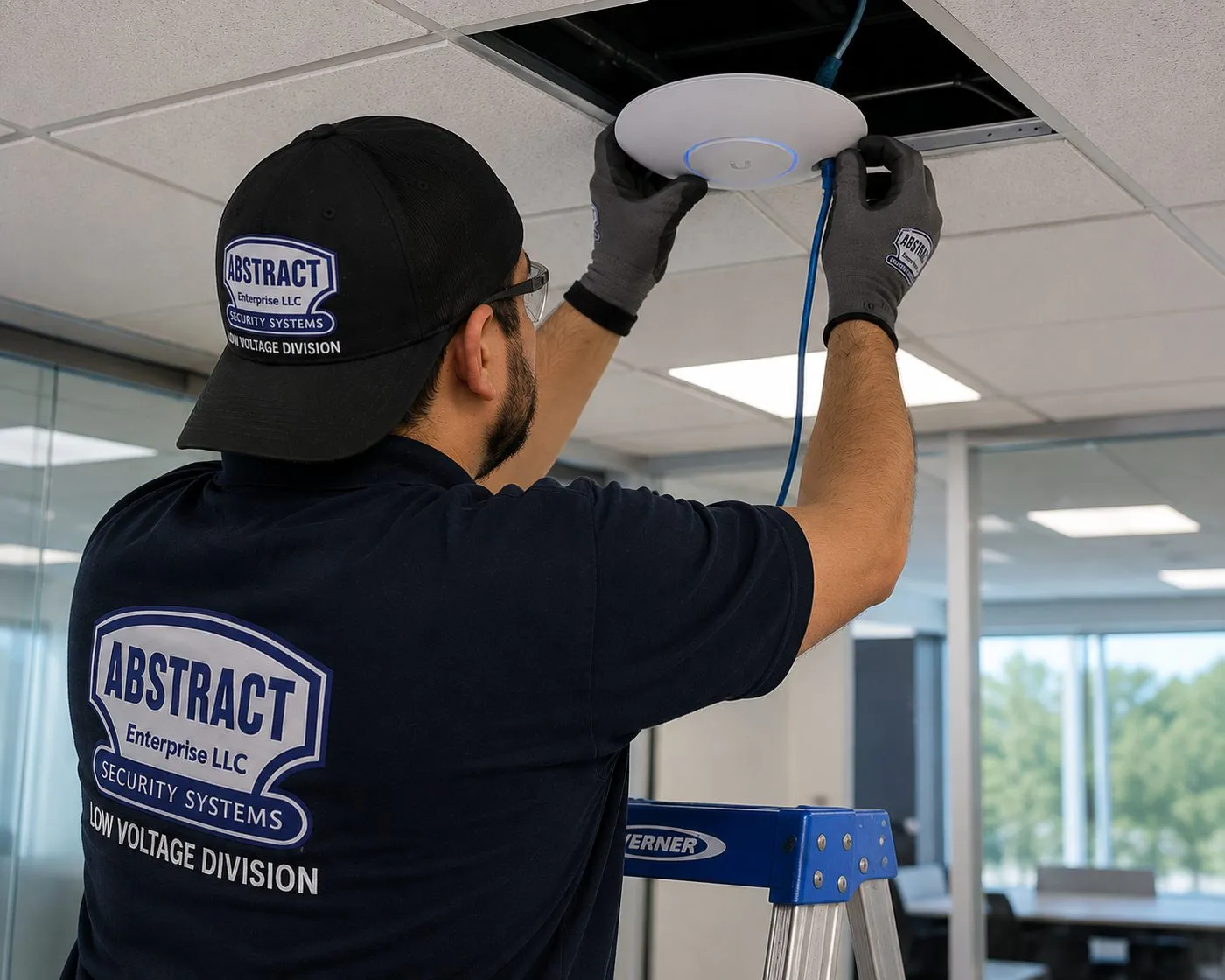
Reference photo: seen from behind, a technician on a ladder holds a round white ceiling device just below a lifted acoustic tile, with a blue cable dropping through the opening in an office with glass partitions. Most Nassau office-park and school ceilings are lay-in grids like this, which is how signal reaches a wall from the network closet.
Coverage Area
Video Wall Installation Near Nassau County's Landmarks
Nassau-wide service, from the Queens line to the Suffolk border. The six spots below turned up again and again while we researched this page, and each says something different about big screens in this county. Read them as reference points; none is listed as an AESS job.
Roosevelt Field, Old Country Road
The largest mall on Long Island. Tenant walls here go through the center’s alteration rules and are installed around shopping hours.
UBS Arena at Belmont Park, Elmont
Arena-scale LED: 45 Daktronics displays and a 4,730-square-foot centerhung. A reminder of how far LED scales, and of why pixel pitch follows viewing distance.
David S. Mack Center, Nassau Community College
Home of the police Intelligence Center and its 8-by-8 LCD operations wall, nearly 32 feet long, built for switching layouts all day.
Hempstead High School
Where the County Legislature approved $66,350 in July 2026 toward a gymnasium sound system and video wall for games, events and community gatherings.
Northern Boulevard, Great Neck and Manhasset
Dealerships, auto lots and the Miracle Mile shops, where showroom glass and afternoon sun shape every wall.
Hofstra University, Hempstead
A campus with athletics video boards — its soccer stadium added a full-color LED board in 2023 — and learning spaces fitted with wall-mounted displays.
Uniondale is worth watching too. The Nassau Hub development plan, which the County Legislature approved in December 2018, described turning nearly 70 acres of parking lots around the Nassau Veterans Memorial Coliseum into a walkable mixed-use district with offices, housing, entertainment and retail. Whatever is eventually built there will bring new lobbies, venues and storefronts, and new walls with them.
We also serve Valley Stream, Lynbrook, Rockville Centre, Freeport, Baldwin, Oceanside, Long Beach, Levittown, Hicksville, Westbury, Carle Place, Mineola, Floral Park, New Hyde Park, Port Washington, Roslyn, Glen Cove, Oyster Bay, Syosset, Plainview, Bethpage, Massapequa and Farmingdale, and our neighbors in Queens and Suffolk County.
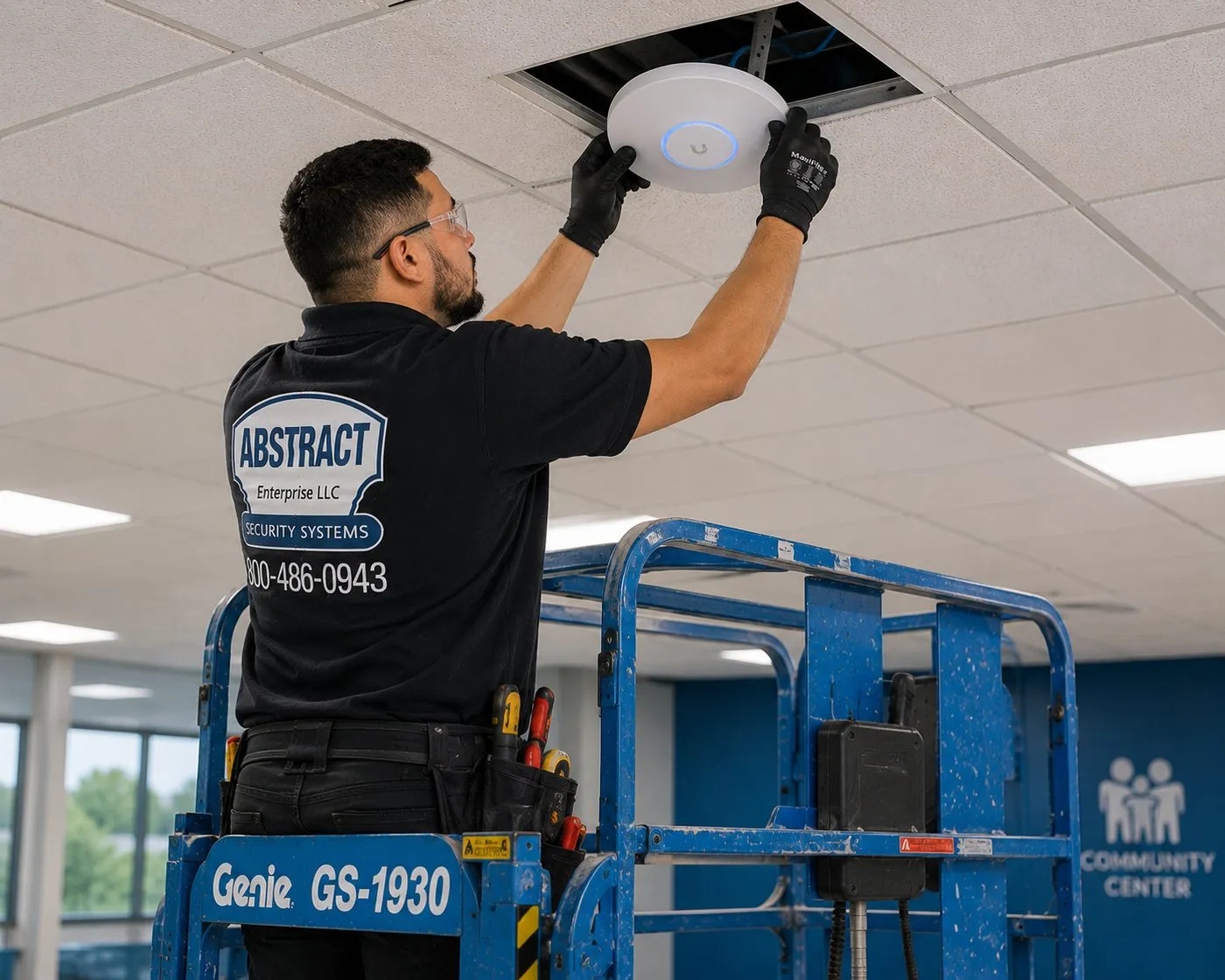
Reference photo: a technician stands in the basket of a blue scissor lift, fitting a round device into a high suspended-ceiling grid in a large, bright room with a blue feature wall. Showrooms, gyms and big-box stores need this kind of access for the cable runs above a wall.
Pricing
Video Wall Installation Cost in Nassau County
These are our published video wall ranges at the Nassau rate: the Brooklyn base list multiplied by the Nassau area factor of 1.15 and rounded. Each installed range includes the panels, the mount, the controller or player, basic content setup, calibration and labor. Electrical work by a licensed electrician, structural work beyond a standard mount, and ongoing maintenance are separate, because they depend on the building. Sales tax is added where it applies.
Configuration or item
Nassau price
Typical use
2x2 LCD wall (four 55-inch panels)
$13,800–$20,700
Reception area, conference room, small showroom or restaurant
3x3 LCD wall (nine 55-inch panels)
$27,600–$43,700
Office-park lobby, larger showroom, school lobby
4x4 LCD wall (sixteen 55-inch panels)
$48,300–$74,750
Multi-game sports bar wall, large lobby, operations room
2.5 mm direct-view LED (about 110-inch equivalent)
$40,250–$63,250
Showroom or gym wall seen from a distance
1.9 mm direct-view LED (about 138-inch equivalent)
$63,250–$97,750
Corporate lobby, sanctuary, flagship store
1.5 mm direct-view LED (about 165-inch equivalent)
$97,750–$161,000
Close-viewing premium lobby or boardroom
Outdoor LED, per square meter
$5,175–$9,775
Exterior-facing displays, subject to local sign approval
Video wall controller add-on
$2,875–$17,250
Multi-source switching, camera windows, presets
16x16 HDMI matrix
$5,175–$13,800
Routing many sources (games, cameras, PCs) to many screens
Mounting structure or custom frame
$1,725–$10,350
Floor-supported frames, backing, odd walls
Content-management software, per year
$1,200–$5,000/yr
BrightSign, MagicInfo, Scala, Carousel; paid to the software company
Maintenance contract, per year
$2,760–$17,250/yr
Scheduled inspection, calibration and priority response
Service or repair visit
$195 an hour, 3-hour minimum ($585)
Diagnosis, takeovers of other installers’ walls, repairs
What raises a Nassau price. A wall that needs backing or a floor-supported frame. A long cable run from a network closet on another floor or across a big showroom. Work that must happen after store hours or between school terms. A wall facing sun, which calls for brighter panels. A landlord or building department that needs drawings and inspections. Finishes such as stone or wood paneling that must be preserved.
What lowers it. A fit-out where backing and boxes go in before the drywall. An outlet already in the right place. A network closet close to the wall. A clear decision on whether the wall faces in or out. Content that is ready on day one.
What a written quote from us lists, line by line
Every Nassau video wall quote is itemised the same way, so it can be compared with anyone else’s. The panels or LED cabinets, with model numbers and quantity. The mount or frame, and any backing. The controller, player or matrix. Cable and boxes from the wall to the closet. Calibration and content setup. Labor. Then, as separate lines, anything that depends on the building: the electrician’s circuit, structural work, after-hours scheduling, a landlord’s or village’s filing, removal and recycling of old screens, and annual software or maintenance if wanted.
If a competing quote is a single number, ask which of those lines it includes. Most price surprises on video walls come from the lines that were not on the first page.
How the Nassau figures are worked out
Our video wall list is set at a base rate for Brooklyn, and each area page applies a published area factor. For Nassau the factor is 1.15, so a 2x2 LCD wall that starts at $12,000 on the base list starts at $13,800 here, and a 1.9 mm LED wall that starts at $55,000 starts at $63,250. Annual content-software fees are shown unchanged because they are paid to the software company, not to us. The service rate of $195 an hour with a 3-hour minimum is the same everywhere.
For a single display instead of a wall, our Nassau TV mounting prices page lists per-screen prices, and anything with several screens is quoted in writing.
Get a Written Nassau Price for Your Wall
Tell us where the building is, what it is, and roughly how wide the wall should be. After the measure you get a figure on paper from the Nassau list, and any electrician, framing or overnight work appears as a line of its own rather than inside one total.
Three starting points, each priced at the bottom of its published Nassau range. The final figure follows the site measure.
Showroom Starter — from $13,800
Four commercial 55-inch video-wall panels on a pop-out mount, a content player or controller, basic content setup, calibration and labor. Suits a reception area, conference room, small showroom or restaurant, where viewers stand close and the light is controlled.
Lobby Standard — from $27,600
Nine 55-inch panels in a 3x3 grid on a pop-out mount, with a controller that can split the wall into windows, content scheduling and calibration. Sized for office-park lobbies, school lobbies and larger showrooms.
Seamless LED — from $63,250
A 1.9 mm direct-view LED wall of about 138 inches, with processor, mounting structure on a suitable wall, calibration and labor. For walls that must have no seams or must stay bright near glass.
Already bought the panels? Labor-only work
We install customer-supplied video-wall panels, mounts and players. There is no published labor-only figure for video walls, so it is quoted after the site visit, once we have seen the wall and the equipment. Two cautions: check that the panels are actual video-wall panels from one production batch, and check that the mount matches the panel model. We tell you what is missing before the visit, not during it.
Complete Services
Every Video Wall Installation Service in Nassau County
Most Nassau offices and schools that add a security-desk wall pair it with new cameras or a recorder upgrade, so the wall shows a clean picture from day one.
Field Notes
Field Notes: Ask Which Government Before You Ask Which Panel
The first question we ask on a Nassau video wall call is not about panels. It is the address, because in this county the address tells you who else has a say. A Garden City storefront answers to the village. A shop a few blocks away in an unincorporated hamlet answers to the Town of Hempstead. A showroom in Great Neck Plaza answers to that village, and one outside it to North Hempstead. Each office has its own forms and its own view of a screen in a window.
So the design step starts with a short call or email to the right office, describing the wall, which way it faces and what the electrician will add, and the reply goes in the job file. Sometimes the answer is that nothing needs filing. Sometimes it is a sign review, an electrical inspection, or both. Either way, the owner knows before the panels are ordered, and the landlord’s package says the same thing as the building department’s file.
It sounds like paperwork. It is the difference between a wall that opens with the store and one that sits in boxes while somebody finds out.
FAQ
Nassau County Video Wall Installation FAQ
Is there a travel charge to reach the North Shore or the South Shore of Nassau?
+
No. Our published Nassau pricing has no travel surcharge anywhere in the county, from Bayville and Sands Point to Atlantic Beach and Floral Park, and the parking line we add to Manhattan jobs does not apply here. The quote shows the wall, the mount, the controller and the labor at the Nassau rate; the only other fees are the ones written in our policies, such as the return-trip fee if a crew arrives and cannot start.
Can the work be done after closing so a store or showroom opens on time?
+
Usually, yes, but it is agreed in writing first. Our standard arrival windows run from 8 AM to 8 PM, seven days a week. A wall that has to go up after a store closes, or between the last service appointment and the next morning at a dealership, is scheduled as an out-of-hours job and priced as such in the quote, so nobody finds the overtime on the invoice. Noisy work such as drilling into block is planned for the hours the landlord allows.
Do you work in Glen Cove and Long Beach, which are cities rather than towns?
+
Yes. Glen Cove and Long Beach are the county’s two cities, and they sit outside the three towns, so their own city offices handle building and electrical questions rather than Hempstead, North Hempstead or Oyster Bay. Long Beach’s commercial strips and Glen Cove’s downtown get the same design, drawings and published Nassau prices as anywhere else in the county; the only difference is which office we ask before ordering, and the proposal names it.
Can you price a wall from drawings while our Nassau space is still being built out?
+
Yes, and it is the cheapest time to plan one. From the architect’s or landlord’s drawings we can give a budget figure from the published Nassau list and mark where backing, recessed boxes, power and data need to go before the drywall closes. The firm written price follows a site measure once the framing is up, because the actual stud positions and ceiling heights decide the mount. Backing added at framing costs a fraction of opening a finished wall later.
Can a home video wall go above a fireplace?
+
Usually we advise against it, and we explain why before anyone drills. Heat and soot rise off a working fireplace onto whatever hangs above it, and electronics last longer away from both; a wall that high also has everyone looking sharply upward from the sofa. If the fireplace is the only wall, we check the temperature at the mantel with the fire lit, keep the panels well above any heat, and look at a side wall first. Gas inserts and decorative fireplaces are a different case and are judged on the spot.
Can you take over a wall that another integrator installed?
+
Yes. We start with a service visit at the published rate of $195 an hour with a 3-hour minimum ($585): we identify the panels, controller and player, check firmware and inputs, recover or reset the logins where the owner can prove ownership, and write down what works and what does not. After that you have a written list of repairs or upgrades, each priced, and a record of the system that the next person can read.
Do we need to be on site for the whole installation?
+
No. We need someone at the start to confirm the wall position, the route through the ceiling and access to the electrical panel and network closet, and at the end for the handover, when the owner’s administrator logs in and the wall is accepted. In between, a store manager, custodian or property manager who can open doors is enough. For work after hours we agree in advance who lets the crew in and who locks up.
Can you give a rough price over the phone before anyone measures the wall?
+
A range, yes. Tell us the panel grid or LED size you have in mind and the kind of building, and we can read you the published Nassau range for that configuration, from $13,800 for a 2x2 LCD wall upward. What we will not do is turn that into a firm number before the site measure, because the wall behind the finish, the distance to the closet and any electrician’s work change the total.
What is the payment schedule for a Nassau video wall job?
+
A deposit secures the panels and the date, and the balance is due when the wall is working and accepted. The written agreement sets out each step, and nothing is ordered before the deposit clears because commercial panels are usually bought for the specific job. Full terms — including 50% deposit, one-year parts-only warranty on AESS-supplied products, and the late-fee schedule — are set out in the service agreement.
What happens to the old displays we take down?
+
They cannot go in the dumpster. New York State has banned the disposal of covered electronic equipment in the trash since January 1, 2015, and manufacturers must run free recycling programs for households, smaller businesses, nonprofits, schools and government offices; larger companies may be charged. We can stack and label the old screens for a recycler, or bring them to a collection program, and note which route was used for your records.
All Areas Served
Video Wall Installation Across New York City, Long Island and the Hudson Valley
Up one level is our Long Island video wall installation hub. Every other area below has its own page, researched separately, because a Bronx catering hall, a Putnam town hall and a Nassau showroom raise different questions.
We read each of the following in October 2026 while writing this page. The county facts, rules and figures above come from them; the prices come from our own video wall list with the Nassau factor applied.
New York State, Nassau County page on ny.gov (two cities, three towns, 64 incorporated villages, more than 60 hamlets); Nassau County, Building and Zoning Permits page; Nassau County IDA municipal list
U.S. Census Bureau, American Community Survey 2024 one-year estimates for Nassau County, via Census Reporter (population, housing units, units in structure, tenure)
Nassau County Administrative Code, Chapter 21, Local Law 6-1970 (home improvement licensing), county archive copy; Nassau County Consumer Affairs licensing pages and FAQ “Who must be licensed?”
Town of North Hempstead Code, Chapter 2, Article IV, Electrical Standards (eCode360); Town of Hempstead Building Department page (electrician licensing)
Nassau County Legislature news release, “Legislator Davis Secures $66K for Hempstead HS Gym Renovations,” July 27, 2026
Planar, installation profile, “Large Clarity Matrix Video Wall Supports Intelligence-Led Policing,” Nassau County Police Department, David S. Mack Center for Training and Intelligence
Daktronics news release, “UBS Arena Selects Daktronics to Install 45 HDR Capable LED Displays”; UBS Arena FAQ page
Roosevelt Field: Wikipedia article and Nassau County Tourism listing (630 Old Country Road, Garden City)
Long Island Press, “Great Neck auto lot sold for $3.15M,” February 17, 2026; Nassau Hub project site (BSE Global and RXR, Legislature approval December 17, 2018)
Hofstra Athletics, “Hofstra Athletics Unveils Major Fall Facility Upgrades,” August 29, 2023
2010 ADA Standards §307 on protruding objects, as explained in the U.S. Access Board’s guide (Chapter 3)
NYS Department of Environmental Conservation, electronic waste recycling and disposal ban pages (Electronic Equipment Recycling and Reuse Act)
Cost guides read for the reality check: SV Solutions, American LED Wall and CrownTV LED wall cost pages (2026); r/CommercialAV thread on quoting LED wall installation (opinions)
Our own published prices: Brooklyn video wall price list and the §9 area multiplier for Nassau (1.15); Nassau TV mounting price page (travel and arrival windows); standard service rate
Google’s People Also Ask, related searches and AI Overview, Answer the Public, Bing and DuckDuckGo suggestions, Reddit discussion of Nassau video walls and Yelp reviews could not be retrieved from our research tools for this edition; nothing on the page is drawn from them.
Wall Dark Before Opening? Call the Nassau Line
A blank panel, a scrambled layout, a content player that stopped after a storm, or a grand opening next week that needs a wall — phone (516) 346-5778. We book the next open two-hour window, and most single faults are fixed within one to two hours of arrival.
Nassau Video Wall Installation From a Licensed, Insured Team
Call or text the Nassau video wall line, (516) 346-5778, or send wall photos on WhatsApp · crews leave from the Abstract Enterprises Security Systems office at 1282 Troy Ave, Brooklyn, NY 11203
Landlords, districts and property managers get our insurance certificate before the first visit · prices in writing once the wall is measured · 4.7★ from 201 Google reviews · New York State license #12000287431
Full terms — including 50% deposit, one-year parts-only warranty on AESS-supplied products, and the late-fee schedule — are set out in the service agreement. See our warranty page.
Last full revision October 18, 2026. What changed: this Nassau video wall page was rewritten from new research on the county’s municipal structure, home-improvement and electrician licensing, sign and accessibility rules, school and police video wall projects, its retail and showroom corridors and Census housing figures, with prices taken from the published video wall list at the Nassau rate and the standard service rate.