Old Walls Respected · Reversible Frames · Sign Law Checked First · Electrician Licensed in Ulster
In Ulster County the building usually has the last word. Kingston’s Senate House began as a Dutch stone house in 1676; its Stockade, Rondout, Chestnut Street and Fair Street historic districts send any change visible from the street to a landmarks commission; the city’s code bans electronic message and LED display signs in those districts outright; and Woodstock’s sign law prohibits all internally lighted signs. The rooms people want screens in are a 1927 movie palace on Broadway, a Victorian castle hotel above New Paltz, steel kiln sheds on the Hudson, a former IBM campus and barns that predate electricity. Add a county Electrical Licensing Law whose definition of electrical work names data and communication wiring, and a Central Hudson grid that lost power to 7,640 Ulster customers in one July 2026 storm. We plan Ulster video walls for all of that: inward-facing where the street rules say so, on frames that leave old fabric intact, with power from an Ulster-licensed electrician.
Reviewed and updated October 18, 2026: City of Kingston Code chapter 405 (sign, electronic-sign and landmark rules), Town of Woodstock Code chapter 260, Ulster County Code chapter 185 (Electrical Licensing Law), Census QuickFacts, Central Hudson’s outage summary and Daily Freeman storm reporting, Ulster County’s Emergency Communications Center page, Friends of Historic Kingston, Bardavon, Bearsville Theater, Mohonk and Hutton Brickyards histories · Anwar Timothy, NYS license #12000287431 · Ulster visits dispatched from our office on East Fordham Road in the Bronx
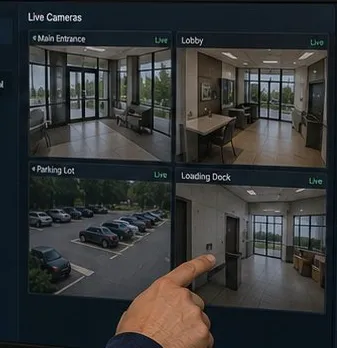
Photo from the AESS image library, cropped to the screen: one monitor split into four live camera views, with a hand pointing at the loading-dock view. It is not an Ulster job and not a video wall; it shows the multi-source layout many Ulster lobbies and back offices ask a wall to carry.
Ulster Video Wall Request
Town or city, the building and its age — we call back the same business day
✅
Request Sent!
A technician will call you back about the Ulster building the same business day.
25+
Years Experience
✓
Same-Day Estimates
100%
Licensed & Insured
4.7★
201 Google Reviews
Send the address first, then the photos. Text (845) 640-3835 the street address, a photo of the wall from across the room, a close-up of its surface (plaster, brick, stone, wood or drywall) and a photo of the building from the street. The address tells us which government’s rules apply and whether the property sits in a historic district; the close-up tells us how the wall can be fixed; the street photo tells us whether a screen near the windows will be read as a sign. With those four pictures we can usually say, before any visit, whether the room wants a tiled LCD wall, direct-view LED or a single large display, and what approvals to start on.
Prices come from the Ulster County table lower on this page, and the written figure reaches you on the day you ask for it
No travel or mileage line added for Ulster addresses, the same policy as our other Ulster display work
Our low-voltage work is carried out under NYS license #12000287431 (General Business Law §69-m, security and fire alarm installers); power for the wall comes from an electrician who holds an Ulster County Master Electrician license
The Neighborhood
Why Ulster County Properties Need Video Wall Installation
Ulster is a big, thinly settled county with an unusually old and unusually regulated building stock. The Census Bureau counts 183,330 residents in its July 2025 estimate, spread over 1,124 square miles of land at about 162 people per square mile in 2020, and 87,657 housing units. It has one city, Kingston, the county seat, and a run of towns and villages from the Hudson River to the high Catskills and the Shawangunk Ridge: New Paltz with its SUNY campus, Woodstock and Saugerties, Rosendale, Marbletown and Stone Ridge, Wawarsing and Ellenville. Its economy leans on visitors and on the rooms that serve them. In 2022 the county’s accommodation and food services businesses recorded $663.5 million in sales, and it counted 5,065 employer establishments in 2023. Those are the rooms where a video wall is asked for here: a theatre lobby, a gallery, a taproom, an inn’s event barn, a resort meeting room, a campus classroom, a training floor in a converted factory.
What sets Ulster apart from its neighbours is how much of that building stock is historic, and how firmly it is protected. Kingston’s Senate House, on Fair Street, began as a single-story Dutch stone house in 1676, and the city has four historic districts researched and sponsored by the Friends of Historic Kingston: the Stockade (1969), Rondout-West Strand (1979), Chestnut Street (1985) and Fair Street (1988), all on the National Register and all designated locally. Since 1969 a seven-member Historic Landmarks Preservation Commission has reviewed changes to the exterior of properties in those districts. Under the city’s code, any material change in the appearance of a landmark or a district property — including its light fixtures and signs, where visible from a public street or alley — needs a certificate of appropriateness first, and any type of sign in the Stockade District goes to the commission before a permit is issued. A few miles south, Historic Huguenot Street in New Paltz is a ten-acre National Historic Landmark District with seven stone houses from the early eighteenth century. A video wall in buildings like these is rarely a matter of finding studs.
The sign rules are the second Ulster particularity, and they bear directly on screens. Kingston’s form-based code, amended in November 2024, prohibits electronic signs in its historic districts and in several residential and neighbourhood zones, and where it allows them it limits them to one per building, at least 500 feet from the next, showing a static message for at least five minutes, changing in a second or less, no brighter than 0.3 foot-candle above ambient at the nearest property line, with an automatic dimmer and a default to a black screen if the sign fails. Window signs are capped at 25 percent of a shop window. Woodstock’s zoning goes further in its own way: it lists directly illuminated signs, unless specifically permitted, and all internally lighted signs among the signs it prohibits. A bright screen hung just inside a storefront window in either place can turn an interior decision into a sign question, and we check that before anyone buys a panel.
Then come power and licensing. Central Hudson serves 93,190 customers in Ulster County, according to its outage summary, and after severe thunderstorms pounded the region overnight into Sunday, July 5, 2026, the utility’s website showed 7,640 Ulster customers still without power at 5:51 p.m. the next day, among 36,709 across its territory. Ulster also has its own Electrical Licensing Law, adopted by the county legislature in May 2019 and last amended in October 2025. It defines electrical work as wiring and equipment for light, heat, cooling and power and also for “signaling, communication, alarm or data transmission,” and it says no one may carry on business as an electrical contractor in the county unless licensed under it or employed and supervised by someone who is. The Town of New Paltz tells contractors that an Ulster County Master Electrician license is required to obtain building permits for electrical work. A video wall touches both: its power circuits, and the data and control cabling that feed it. That is why an Ulster wall starts with an address check, an approvals list and a named electrician, and only then a screen size.
Ulster facts behind a video wall job
183,330 residents and 87,657 housing units on 1,124 square miles of land; 69.9% of homes owner-occupied, median value $352,500 (Census QuickFacts, V2025 and ACS 2020–2024)
Four Kingston historic districts — Stockade, Rondout-West Strand, Chestnut Street and Fair Street — reviewed by a seven-member landmarks commission created in 1969
Electronic signs prohibited in Kingston’s historic districts; elsewhere limited to one per building, a five-minute static hold and 0.3 foot-candle above ambient
All internally lighted signs on the prohibited list in the Town of Woodstock’s zoning law
93,190 Central Hudson customers in Ulster; 7,640 still out the evening after the July 2026 storms
“Signaling, communication, alarm or data transmission” named in the definition of electrical work in Ulster County’s Electrical Licensing Law (Chapter 185, 2019)
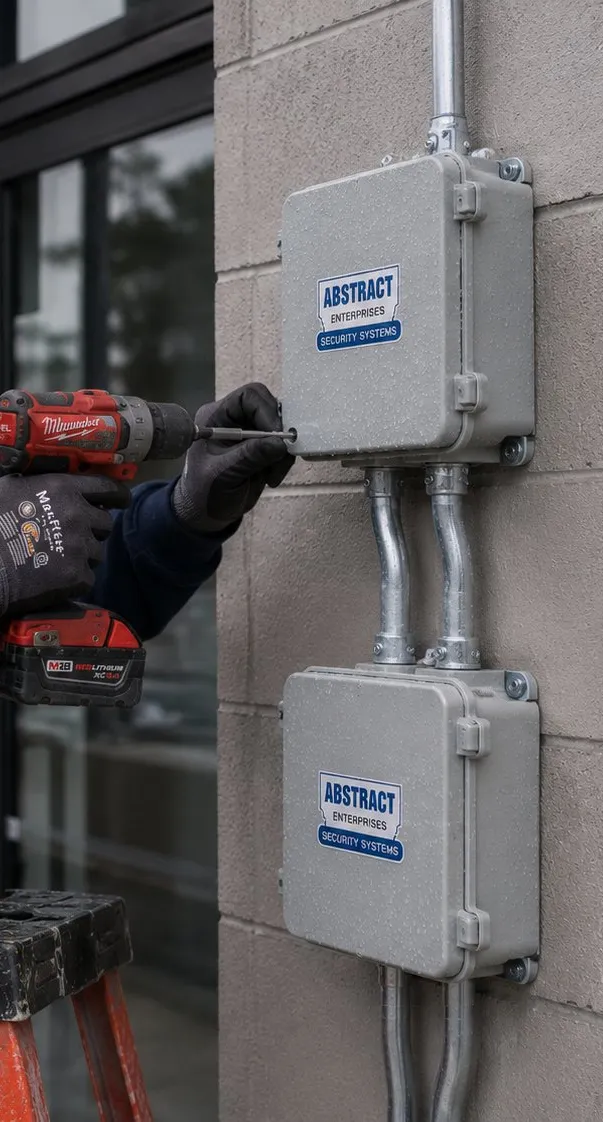
Photo from the AESS image library, cropped: two grey weatherproof boxes linked by metal conduit on the outside of a block wall, as a gloved hand drives a fixing into the upper box. Every cable entry through the masonry of an older Ulster building is planned and agreed before the first hole is made.
Repair & Same-Day Help
Same-Day Video Wall Repair in Ulster County
A lobby wall stuck on a blue “no signal” screen an hour before doors open, one tile gone dark in a gallery, a window display that started flashing when it should hold a still image, or a whole wall that stayed black after the power came back — call or text (845) 640-3835 with a photo of the wall and a photo of whatever box sits behind or beside it. A good share of Ulster calls are settled on the phone: a source left on the wrong input, a media player that did not restart after an outage, a schedule that switched the wall off, a brightness setting that was changed by hand and never put back. When a visit is needed, we book the next open window and most single faults are fixed within one to two hours of arrival.
A single screen black while its neighbours play: in most cases a failed power board or a loose or damaged signal hop between tiles; with a matched spare in the building, the swap happens on the first visit
Street-facing screen suddenly animating or too bright at night: a lost setting on the player or the dimmer; we restore the static hold and the light-sensor curve the local code expects
Nothing on any screen since the storm: a surge protector that did its job and tripped, or equipment that powered up in the wrong order; both are cleared on site and the start-up sequence is then fixed so it recovers unaided
Picture breaking up on one side of a long building: frequently a damaged or overlong run between the equipment room and the wall, which we test end to end
Ulster repair visits are charged at our standard rate of $195 an hour with a three-hour minimum ($585); Kingston and Ellenville pay the same.
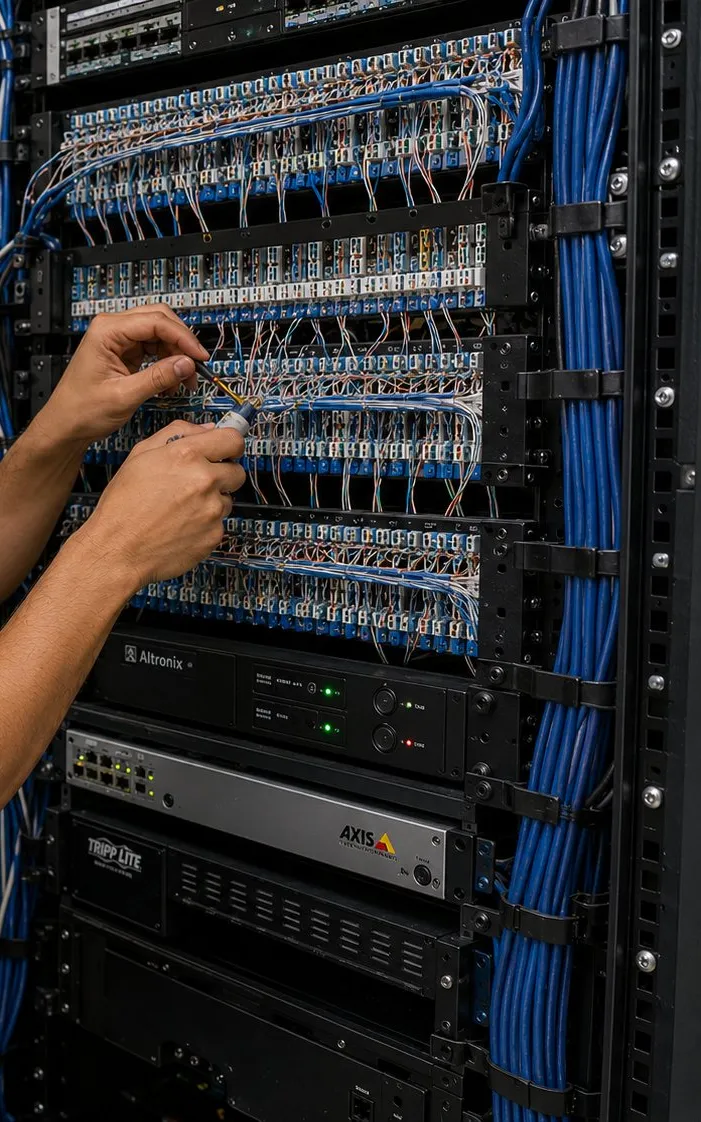
Photo from the AESS image library, cropped: hands terminate cables on densely patched rack panels, with a power supply and switches below. A display wall fed over network cable is only as dependable as the terminations at this end, so long Ulster runs are certified, not just checked for a light.
What We Install
Video Wall Installation Services in Ulster County
Each service is planned around two Ulster questions before any screen is chosen: what will this building let us fix to it, and will anything on the screen be seen from the street.
Walls inside historic and landmarked buildings
Tiled LCD or direct-view LED walls for rooms in Kingston’s districts, New Paltz’s stone-house neighbourhood and older village centres, on freestanding or lightly anchored frames, with cable in removable raceway and a written removal plan.
Theatre and music-venue lobbies
Lobby walls that carry the season, the night’s set times and sponsor credits, run from the box office, with a separate program for show nights and dark nights, and a layout that does not compete with the building’s own decoration.
Stage and backdrop LED
Direct-view LED for stages and event floors, set on ground-supported or rolling frames so it can be placed, moved and stored without touching historic walls, and fed from the venue’s own production switcher where it has one.
Gallery and studio display walls
Screens calibrated for artwork and moving-image work rather than for advertising, with careful colour matching, controlled brightness and a quiet, flush frame that leaves the art as the subject.
Inn, resort and event-venue walls
Meeting-room and event walls for hotels, inns and barns, sized for presentations and toasts, with inputs at the lectern and the bar, and sound planned with the room rather than left to the screens’ speakers.
Campus, training and conference rooms
Walls for classrooms, training floors and conference rooms in campus buildings and converted industrial space, wired back to an equipment room that may be far away across a large floor plate.
Street-visible displays that follow the sign code
Window and facade-adjacent screens planned against the local sign law: static holds, transition limits, automatic dimming and fail-to-black behaviour set in the player and checked with a light meter.
Repairs, tile swaps and takeovers
Matching a replacement tile to an older wall, replacing a failed controller or player, and taking over walls another installer put in, starting with a full inventory and a power-off test.
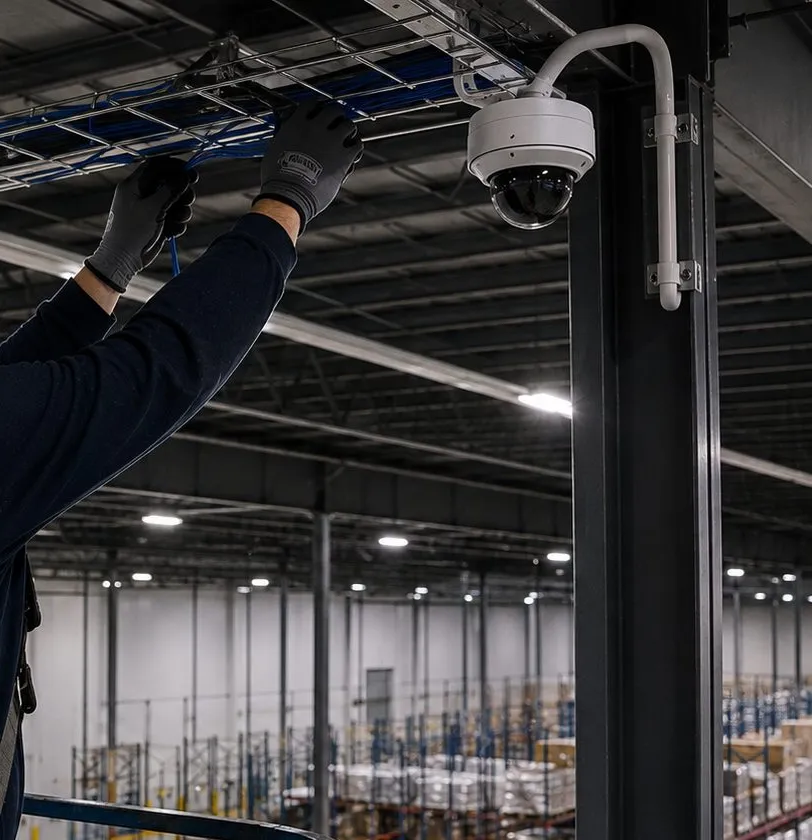
Photo from the AESS image library, cropped: gloved hands reach into a wire cable tray high above a warehouse floor, next to a dome camera on a bracket. Former factory floors, like the big industrial buildings in the Town of Ulster, put the equipment room a long way from the wall.
Building Specialists
Video Wall Installation for Ulster County’s Architecture
Ulster’s buildings span more than three centuries, and each era answers the mounting question differently. These are the types we meet most, with the approach each one usually needs.
Dutch and Huguenot stone houses
Rubble-stone and later stone walls, thick and irregular, often with plaster on the inside face, found in Kingston’s Stockade and along Huguenot Street in New Paltz. Fixing into the stone face is usually the wrong answer; mortar joints, a floor-supported frame or an independent stud wall in front of the stone are the usual ones.
Nineteenth-century brick commercial rows
Brick party walls with plaster, tin ceilings and storefront windows, typical of the Rondout waterfront and older main streets. Plaster-on-brick takes sleeve anchors into sound brick with care; window-adjacent screens trigger the sign questions above.
Early twentieth-century theatres and halls
Big volumes with ornamental plaster, balconies and proscenium openings, like Kingston’s 1927 Broadway Theatre, now the Ulster Performing Arts Center. Screens go where the decoration is not, and stage LED stands on its own frame.
Industrial sheds and factory floors
Steel kiln sheds on the riverfront, former manufacturing buildings and the large floor plates of the old IBM campus in the Town of Ulster. Strong structure, long distances, high ceilings and, in open-sided sheds, weather and dust at the screens.
Victorian resort buildings
Large wood-framed and masonry hotels with period interiors, where the guest experience depends on the interior looking as it always has. Displays tend to be temporary or concealed, and every penetration is agreed with the owner.
Barns, Catskill houses and modern builds
Post-and-beam barns turned into event spaces, wood-framed houses and newer steel-stud and block buildings on campuses and commercial strips. The newer the building, the more conventional the mount; the older the timber, the more it has to be inspected first.
Materials and methods by wall type
Rubble or coursed stone: no anchors into the stone face of a protected wall; where fixing is allowed, anchors go into sound mortar joints after the mortar is checked; otherwise a floor-supported frame with soft pads against the wall, or a separate framed wall standing just in front of the stone.
Old brick with plaster: the plaster is opened only at fixing points, anchors set into whole bricks rather than the joints when the mortar is soft, and cable kept in surface raceway rather than chased into the plaster.
Ornamental plaster and lath: no recessed boxes; fixings found from behind where an attic or back-of-house space allows; displays placed on plain surfaces rather than decorated ones.
Heavy timber: sound members identified, through-bolted plates or clamps where drilling is acceptable, and a freestanding frame where the timber is decorative or fragile.
Steel structure: beam clamps and unistrut rather than welding or drilling where possible, and a check that the structure is not already carrying more than it was meant to.
Block, concrete and steel studs: conventional rails, sleeve anchors in solid block cores, and backing across several studs, because one steel stud will not carry a tiled wall.
Load matters as much as material. Four commercial 55-inch LCD panels with their rails come to a few hundred pounds hanging on one plane, and an LED wall of similar area is often heavier still, carried by its own frame rather than by brackets. The survey ends with a fixing plan named for the actual wall, and that plan is part of every written proposal.
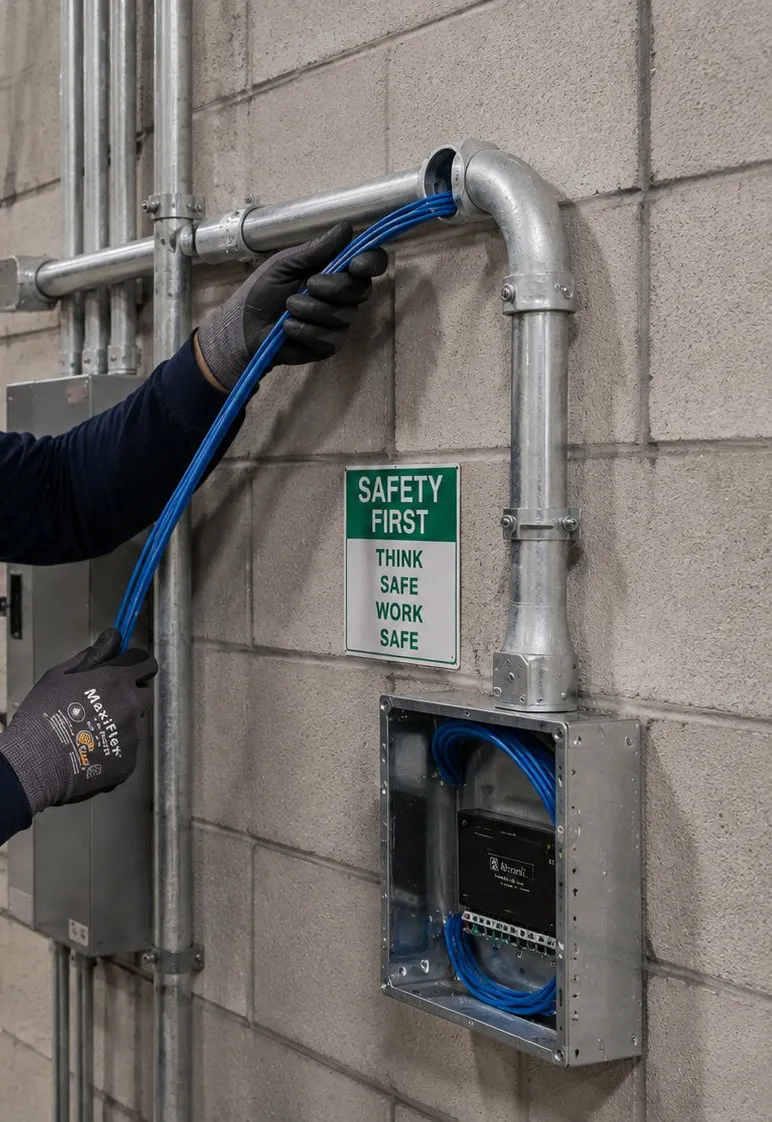
Photo from the AESS image library, cropped: a technician feeds blue cable into a rigid conduit elbow that runs down a block wall into an open junction box. Where an old wall cannot be opened, cable travels on the surface in conduit or raceway that can be painted and later removed.
Commercial Video Walls
Business Video Wall Installation in Ulster County
Ulster’s commercial addresses fall into a handful of places, each with its own building type and its own rule book. These are the ones we plan for most often.
Uptown Kingston and the Stockade
Shops, restaurants and offices inside the Stockade Historic District, the oldest part of the city, where any sign goes to the Historic Landmarks Preservation Commission before a permit and electronic signs are not allowed. Screens here face inward, away from the windows, and are framed so they come out cleanly.
The Rondout and West Strand
The waterfront district along Rondout Creek, with its row of nineteenth-century commercial buildings on the West Strand. Brick and plaster walls, river light through big windows, and the same district review as the Stockade for anything visible from the street.
Midtown Kingston and Broadway
The Ulster Performing Arts Center at 601 Broadway, opened as the Broadway Theatre on June 9, 1927, and the commercial blocks around it. Outside the historic districts, Kingston’s code allows electronic signs in some zones under strict limits, so the first step is to confirm the zone.
Enterprise Drive and iPark 87, Town of Ulster
The former IBM complex: about 200 acres with more than a million square feet of buildings on both sides of Enterprise Drive. Ulster BOCES, county offices and SUNY New Paltz and SUNY Ulster were reported in 2024 as planning to occupy about 140,000 square feet for career and technical education and workforce programs. Large floor plates, long cable runs and training rooms.
New Paltz: Main Street, the campus and Paradies Lane
A college town with the SUNY New Paltz campus, Historic Huguenot Street and a busy main street. The county’s new 16,350-square-foot Emergency Communications Center is under construction on Paradies Lane, with completion expected in 2027. Campus digital signage there is managed centrally and can be switched remotely to emergency messages.
Woodstock, Bearsville and Saugerties
Galleries, studios, restaurants and the Bearsville Theater at 291 Tinker Street, part of the Bearsville Campus and run since 2024 by Dayglo Presents. Woodstock’s sign law prohibits internally lighted signs, which shapes any screen near a window. Saugerties has 8,894 Central Hudson customers in the town and 2,296 in the village.
Ellenville and the Route 209 corridor
The village centre of the Town of Wawarsing, home to Shadowland Stages’ MainStage at 157 Canal Street, with Route 209 running north toward Kerhonkson, Accord and Stone Ridge. Theatre, retail and hospitality rooms in older buildings, a long drive from the river towns.
The Kingston riverfront
Hutton Brickyards, on the Hudson in Kingston, turned a brick works into an event destination around three steel-frame kiln sheds that were first put up in 1928 at a Haverstraw brickyard and moved to the site in the 1940s. Open structures like these need screens and controllers chosen for weather, temperature and dust.
Compliance callouts for Ulster display work
Kingston historic districts and landmarks: a certificate of appropriateness is required for material changes visible from a public street or alley, including signs and light fixtures; any sign in the Stockade District goes to the commission before a permit; electronic signs are prohibited in historic districts.
Kingston outside the districts: electronic signs only in listed zones, facade-mounted, one per building, 500 feet apart, static for at least five minutes, transitions of one second or less, 0.3 foot-candle above ambient at the property line, automatic dimming and fail-to-black; window signs no more than 25% of a window and two per window.
Woodstock: directly illuminated signs unless specifically permitted, and all internally lighted signs, are on the prohibited list; illuminated devices must use constant-intensity light with nothing flashing or moving.
Other towns and villages: each writes its own zoning and sign chapter, so we read the one that applies to the address rather than assume Kingston’s or Woodstock’s.
Electrical work: Ulster County’s Electrical Licensing Law covers power wiring and names signaling, communication and data transmission in its definition; new circuits are done by an Ulster-licensed master electrician and inspected where a building permit is required.
Accessibility: in public spaces, a wall-mounted display whose lower edge is between 27 and 80 inches above the floor may not stick out more than 4 inches into a circulation path under the 2010 ADA Standards (section 307.2), which favours recessed or very slim mounts in corridors and lobbies.
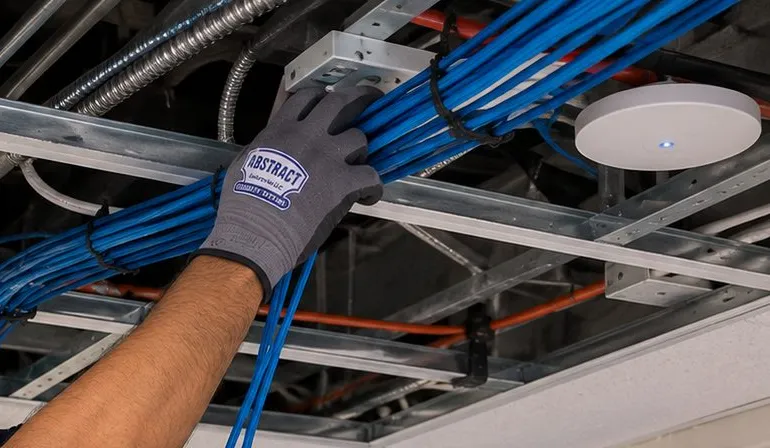
Photo from the AESS image library, cropped: a gloved hand guides a thick bundle of blue cable over open ceiling grid beside a round ceiling device. Newer Ulster buildings with drop ceilings make the cable path easy; most of the county’s older rooms do not have one.
Your Questions Answered
Video Wall Installation in Ulster County: Questions Answered
These are the questions Ulster owners, venue managers and tenants bring to a first call. Most of them are about the building and the rules around it rather than the screens. Each is answered once, here.
Kingston’s Historic Districts and Landmarks
Who has to sign off before a screen goes into a Stockade District storefront?
Usually the Historic Landmarks Preservation Commission, if the screen will be seen from the street, and it is safer to assume so until the city says otherwise. Kingston’s code requires a certificate of appropriateness from the Historic Landmarks Preservation Commission before anyone makes a material change in the appearance of a district property, and it names signs and light fixtures among the elements that count when they are visible from a public street or alley. Separately, any type of sign within the Stockade District goes to the commission for approval before a sign permit is issued. A bright, moving screen set just behind the glass is seen from the sidewalk exactly as a sign would be. The code also caps window signs at 25 percent of a shop window and two per window.
Our practice in the Stockade and the other districts is simple: if the screen will face the street, the owner asks the city before we order anything, using the drawings and photographs we prepare. If the owner would rather avoid the question, we move the wall to a side or back wall where it serves customers inside and is not seen from the street, which is where most Uptown displays end up working best anyway.
Kingston bans electronic signs in its historic districts — does that reach a video wall in our back room or lobby?
The prohibition is written about signs, and Kingston’s code deals with signs as things seen from outside: window signs, wall signs, projecting signs, freestanding signs. A wall of screens at the back of a restaurant, in an interior lobby or in a meeting room that is not visible from the street is an interior fit-out, not a sign, and the electronic-sign ban is not the rule that governs it. What can still apply inside a landmark is the commission’s interest in any interior the city has designated, and the ordinary building and electrical permits for new circuits.
The grey zone is the screen that is inside but faces glass: a display on the back wall of a narrow shop that is plainly visible from the sidewalk through the front window, or a lobby wall visible through a glass door. We treat those as possibly street-visible, show the owner how it will look from outside at night, and leave the final word to the city.
Outside the historic districts, what does Kingston allow for a digital sign facing the street?
More, but with tight limits. The current code permits electronic signs in some mixed-use and main-street zones, mounted to the building facade rather than freestanding, one per building and at least 500 feet from the next. A panelized electronic sign is limited to nine square feet, and on a larger sign no more than half the area may be electronic. The message must be static, with no movement or illusion of movement; each message or picture must stay up at least five minutes, except time-and-temperature; and a change must happen in one second or less, all at once.
The technical rules are the ones installers most often get wrong. The sign may not exceed 0.3 foot-candle above ambient light measured at the nearest property line; it must have an ambient light monitor that dims it automatically, with certification to the city that it has been preset to those levels; and it must revert to a black screen if it malfunctions. We build those behaviours into the player and the display settings, and we take a light-meter reading at the property line at dusk so the owner has a number to show if the city asks.
What does a landmarks commission application need to show when a display will be seen from the street?
Kingston’s code lists it. The application must give the location of the building and photographs of it, the exterior features to be changed, a perspective or rendering if the commission asks for one, and, where the change includes signs or lettering, all dimensions and colours, the materials and the method of illumination, with the location shown on the building. For a screen, the method of illumination is the screen itself, so we describe its brightness, its dimming and its content rules in plain terms.
We provide the owner with photographs, a measured drawing of the screen in place, a mock-up photo taken from the sidewalk, the panel’s specification and our proposed settings. A certificate of appropriateness is in addition to any building permit, not instead of it, so we also note what the electrician will file.
Woodstock and the Town Sign Laws
Woodstock bans internally lighted signs — where in a gallery can moving images go instead?
Inside the room, facing the visitors, not the street. The Town of Woodstock’s zoning law puts directly illuminated signs, unless specifically permitted, and all internally lighted signs on its list of prohibited signs, and it requires any illuminated sign or lighting device to use light of constant intensity, with nothing flashing, intermittent, rotating or moving. A screen in a window showing a looping promotion is very hard to square with that list.
What galleries and shops in Woodstock do instead is keep moving images for the inside of the room: a wall facing the visitors once they are through the door, set back far enough from the glass that it does not read from the street, or a screen showing an artist’s moving-image work as part of an exhibition rather than as advertising. If an owner wants something visible from outside, the right first step is a conversation with the town’s building and zoning office, not a purchase.
Our business is in New Paltz, Saugerties or another town — whose sign rules apply to a screen?
The town or village where the property sits, and sometimes both: villages in Ulster have their own governments and codes inside the towns that surround them, so a business on a village main street may answer to the village code rather than the town’s. Kingston’s and Woodstock’s rules described on this page do not carry over to New Paltz, Saugerties, Rosendale or Ellenville. Each writes its own sign chapter, and the definitions of a sign, a window sign and illumination differ from one code to the next.
Stone, Brick, Timber and Steel
Can a video wall be fixed to a seventeenth- or eighteenth-century stone wall at all?
Sometimes, but it is often not the best idea. Early stone walls in Kingston and New Paltz are thick, irregular and built with lime mortar; the face of the stone may be sound while the joints are soft, and an anchor in the wrong place can crack a stone that cannot be replaced. Where an owner and, if relevant, the landmarks commission agree to fixings, we drill only into sound mortar joints, use anchors suited to soft masonry, and keep the number of fixings to the minimum the load needs.
More often we avoid the stone. A freestanding or floor-supported frame can stand a few inches in front of the wall and carry the screens, touching the stone only through padded stand-offs for stability. In a room where the stone is the attraction, a slim framed wall built in front of one section gives a conventional mounting surface and can be removed without trace.
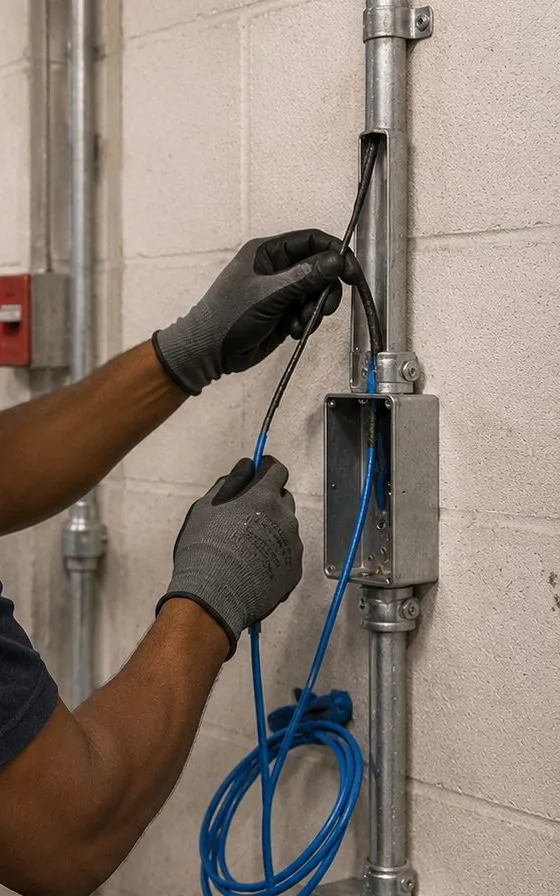
Photo from the AESS image library, cropped: two gloved hands pull cable from a metal box fixed to exposed conduit on a painted block wall, with spare cable coiled below. Surface conduit is the usual answer in buildings where nothing may be chased into the wall.
What carries the screens when the owner will not allow a single hole?
A frame that stands on the floor. For LCD walls this is a steel stand with a rear spine that holds the mounting rails, sized for the screens’ weight and weighted or braced so it cannot tip. For direct-view LED, it is a ground-stack frame on which the LED cabinets are bolted together, with outriggers or a rear brace. Both can be finished in black or painted, and both leave the room exactly as it was when they leave.
Floor-supported frames need a floor that can take the load at a few points; old timber floors are checked for span and condition, and we spread the load with a plate where needed. They also need a way to stop the frame being knocked over, which in public rooms usually means a light tie-back to a single agreed point.
Our venue is an open-sided shed or barn — can the screens stay up between events?
Only if they are chosen and protected for it. Indoor commercial LCD panels are specified for indoor conditions; LG’s 55VM5J-H video-wall panel, for example, lists an operating range of 0 to 40 degrees Celsius and 10 to 80 percent humidity. An unheated, open-sided structure on the Hudson or a barn in the hills will go beyond that in winter and on damp summer nights, and it lets in dust and insects that clog vents.
The choices are to build a sealed, climate-controlled enclosure for the screens and their controller, to use outdoor-rated LED designed for the weather, or to treat the screens as removable: mounted on rolling or quick-release frames and stored in a heated room between events. For seasonal venues, the last option is often the cheapest over the life of the wall, and we design the mounts for a two-person changeover.
How do cables reach a wall in a building with no ceiling void and walls that cannot be opened?
Along the surface, under the floor, or from behind. In a stone or plaster building with no drop ceiling, the routes are: surface raceway or conduit painted to match and run along a baseboard or a corner; a path up from a basement or crawl space through a single small hole in the floor beside the wall; or a path from an attic or a back-of-house room on the other side of a partition. Each one is agreed with the owner before we start.
To keep the number of runs small, we usually put the controller and media player in an equipment space and send the picture to the wall over one or two cables, using HDBaseT over category cable or fibre for long distances. One neat raceway carrying two cables is far easier to approve than a bundle.
Theatres, Galleries and Hospitality
Can an LED wall be rolled onto a historic stage instead of fixed to it?
Yes, and in a listed theatre it usually should be. Direct-view LED can be built on a ground-supported frame with locking casters, positioned for a show and rolled to the wings or a scene dock afterwards, with its power and signal brought in through the venue’s existing stage connections. Nothing is fixed to the proscenium or to decorative plaster, and the stage floor is protected with plates under the casters.
The practical limits are weight, width and the route off stage. We measure the doors, the wing space and the floor before choosing cabinet sizes, and we plan the wall so it can be split into sections that pass through the narrowest opening. For venues like Kingston’s Ulster Performing Arts Center, listed on the National Register since 1979, a mobile wall also keeps the room flexible for the many kinds of shows it hosts.
Can a theatre lobby wall run the season trailer and then show a delayed-start notice from the box office?
Yes. The wall plays a scheduled loop from its media player and holds a short list of ready-made messages, such as a delayed start, a sold-out show or a weather notice, that box-office staff can call up from a tablet or a simple button panel without touching the content system. When the message is cleared, the loop resumes where it left off.
Can screens show artwork or moving-image pieces without looking like a television?
Yes, and it is mostly a matter of calibration and framing. Out of the box, commercial displays are tuned to be bright and vivid for signage. For art, we calibrate the screens to a known colour standard, lower the brightness to suit the gallery’s light, match every tile so the seams do not show colour steps, and turn off on-screen menus and logos.
The frame matters as much. A flush, matte surround, a recessed shadow-line, hidden cables and a player that starts the work automatically at opening make the screen read as part of the installation. For artists’ works, we agree the file formats and playback settings with the artist or gallery before the opening, and test the piece on the actual screens.
What does the wall look like when it is switched off in a heritage interior?
Like a large black rectangle, which is why it deserves thought. In a period room, an off screen can be the most conspicuous thing in it. The options are to size the wall to the room rather than to the maximum the wall will hold, to set it within a painted surround or panelling so it reads as part of the joinery, to place it on a wall that is already dark or plain, or to show a still image in an idle state that suits the room.
For rooms where screens must disappear completely, a motorised cabinet, a screen that lowers into furniture or a removable frame stored between events are all possible. Each costs more than a fixed wall, and we price them separately so the owner can choose.
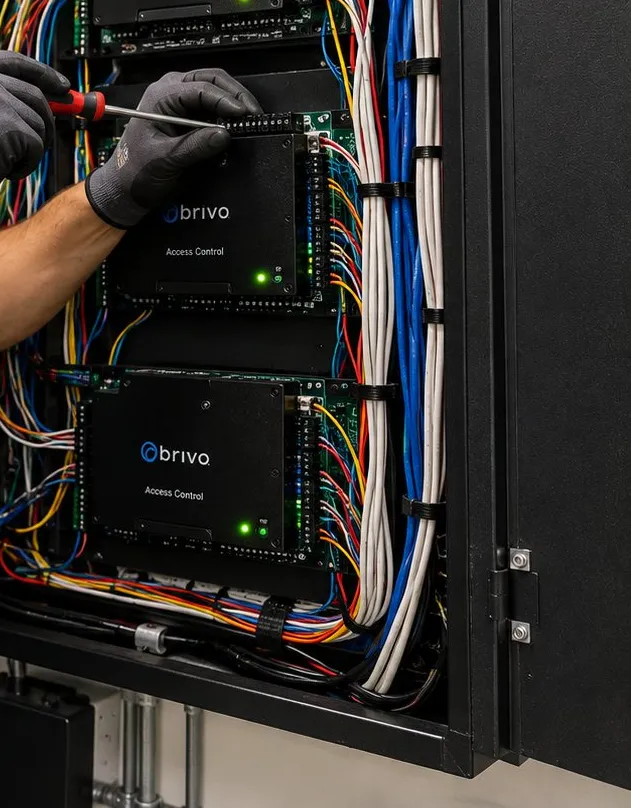
Photo from the AESS image library, cropped: gloved hands tighten a terminal on one of two door-controller boards in an open wiring cabinet dressed with coloured cable. Venue walls are often tied into the same back-of-house cabinets as doors and cameras, so the wiring is labelled and kept apart.
Can a resort meeting room wall be cleared away for a weekend event and back up on Monday?
Yes, if the system is designed as two parts: fixed infrastructure and movable screens. The cabling, power, controller and connection plate stay in the wall; the screens hang on a quick-release frame or stand on a rolling base that two people can move and re-dock. Re-docking uses labelled, keyed connectors, so the wall returns in the right order without a technician.
Historic resorts like Mohonk Mountain House, a Victorian castle hotel above New Paltz whose history begins with a ten-room inn bought in 1869, show why this matters: rooms are expected to look as they always have for weddings and gatherings, and the technology has to make way. We test the change-over with the staff who will do it.
Campuses, Training Floors and Big Buildings
A training room at iPark 87 is being fitted out on a bare factory floor — what should go in before the ceiling closes?
Everything that would be hard to add later. Before the ceiling and the partition walls close, we want the blocking or backing in the wall where the screens will go, a recessed box behind the wall for power and signal, a conduit or open path from that box up to the ceiling and back to the equipment room, power circuits from the electrician sized for the wall and the controller, and data runs to wherever lecterns, cameras and microphones will be.
The old IBM complex has more than a million square feet of buildings across about 200 acres, so distance is a real factor: an equipment room at the other end of a floor may be beyond the reach of a simple HDMI extender. We plan the signal path with HDBaseT or fibre and certify every run before the walls are painted.
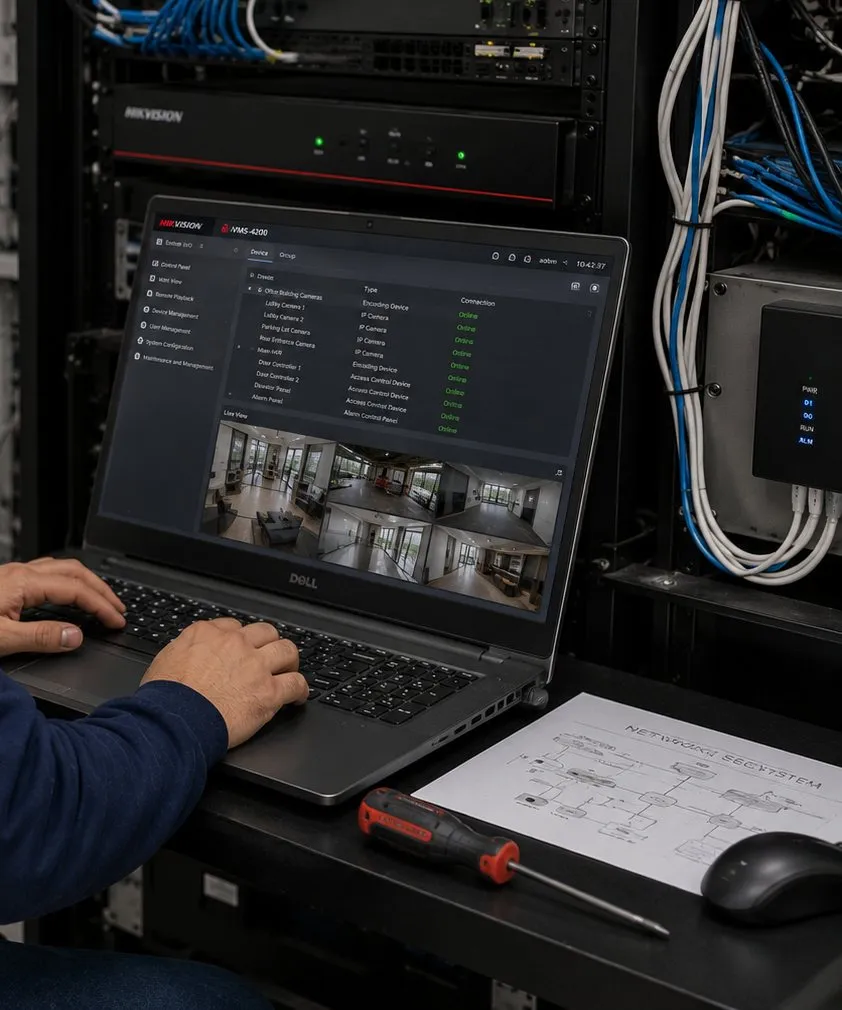
Photo from the AESS image library, cropped: a laptop on a rack shelf runs camera-management software showing a grid of views, under a recorder and a patched switch. Layouts, schedules and sign-mode limits for an Ulster wall are set the same way and written down at handover.
How far can the controller be from the wall in a long converted factory or campus building?
It depends on the cable, not the building. Direct HDMI cable is reliable only for short distances, HDBaseT over good category cable reaches about 100 metres, and fibre or a video-over-IP system can go much further. In large former industrial buildings and campus blocks, the controller is often in a central IT room, and the question becomes which of those methods suits the distance, the number of sources and the budget.
Licensing and Power in Ulster
Ulster’s Electrical Licensing Law mentions data transmission — what does that mean for a video wall job?
It means the licensing question in Ulster reaches further than many installers expect. Chapter 185 of the county code, the Ulster County Electrical Licensing Law, defines electrical work to include wiring and equipment used for “signaling, communication, alarm or data transmission,” as well as for light, heat, cooling and power. It requires anyone carrying on business as an electrical contractor in the county to be licensed under it, or employed and supervised by someone who is, and its list of exemptions does not include a general exemption for low-voltage work.
On our Ulster jobs, the electrical work for a wall — new circuits, outlets and anything connected to the building’s power — is done by an electrician holding an Ulster County Master Electrician license, under the building permit where one is required. For the data, signal and control cabling, we confirm with the local building department how it applies the county’s definition before the job starts, and we organise the work to match its answer. This is not legal advice; the county’s Electrical Licensing Board and the local building department are the authorities.
Is unplugging the only real protection from lightning for a wall in an exposed hilltop venue?
No, but it is the most certain one. For a valuable wall in an exposed building, unplugging during a nearby lightning storm beats any device, yet it should not be the only protection, and it should be easy. We put the controller, player and network switch on surge protection and battery backup, place a surge device on the wall’s own circuit where the electrician agrees, and give the wall one clearly labelled switch or breaker that staff can use to take it off line.
The July 2026 storms that left thousands of Ulster customers in the dark overnight are a reminder that the bigger risk is often the return of power, not its loss. The wall is set to come back on its own in the right order, and we test that with staff before we leave.
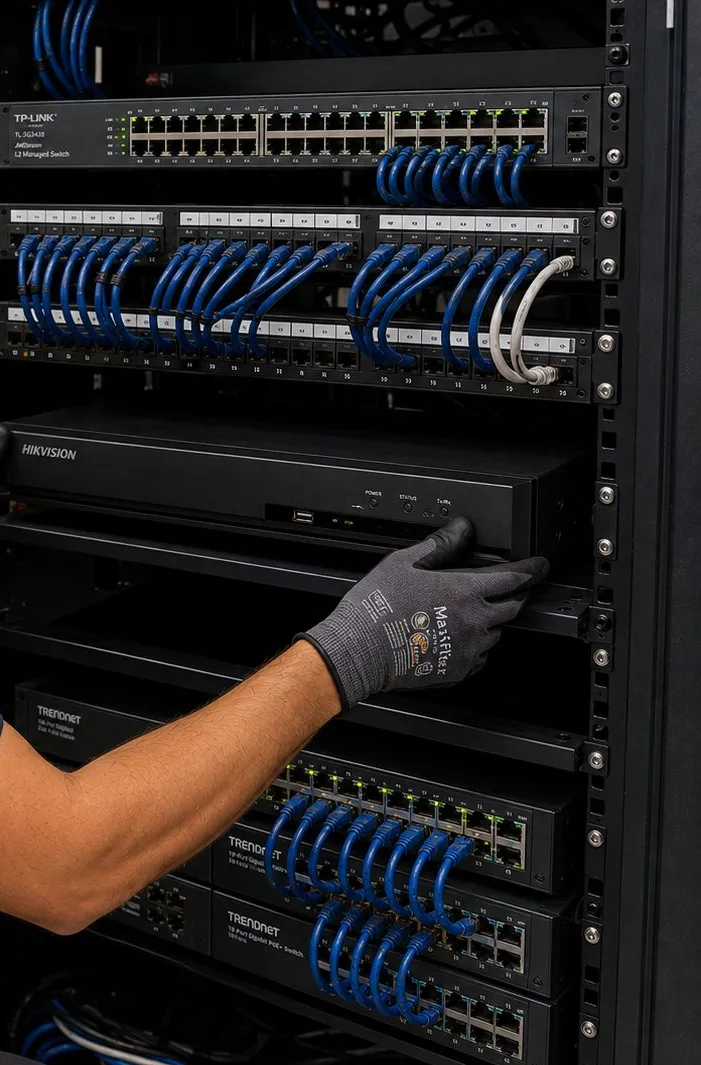
Photo from the AESS image library, cropped: a gloved hand seats a black recorder in a rack between switches patched with blue cords. A wall’s controller and media player belong in a rack like this, on surge protection and battery backup, rather than behind the screens.
Equipment
Types of Video Wall Installation We Install
The hardware is the same family of products used anywhere. What changes in Ulster is which item suits a protected room, a seasonal venue or a street-facing window.
Narrow-bezel LCD panels
Commercial 55-inch panels built for long operating hours and tiling, with thin seams between screens. Samsung’s and LG’s video-wall lines range from about 3.5 mm down to under 1 mm bezel-to-bezel. The usual choice for meeting rooms, lobbies and multi-source layouts.
Direct-view LED cabinets
Seamless walls built from LED cabinets and modules, priced by area and pixel pitch. Suited to stages, large halls and rooms where seams would distract. Typically fan-cooled, with the processor in a rack nearby.
Floor-supported and mobile frames
Steel stands, ground-stack frames and rolling bases that carry screens without fixing to the wall, for historic interiors, theatres and venues that clear rooms for events.
Pop-out and service mounts
Rail-based mounts that let one screen be pulled forward for service without removing its neighbours, chosen for depth where a slim profile matters in a corridor or lobby.
Controllers and processors
Devices that split one picture across many screens or arrange many sources on one wall, with saved layouts recalled from a button panel or schedule.
Media players and sign-mode settings
Players that store content locally and run schedules, configured for static holds, transition limits and fail-to-black behaviour where a screen is subject to a sign code.
Light sensors and dimming
Ambient light sensors that adjust brightness automatically, needed by code for some street-facing electronic signs in Kingston and useful in any room with changing daylight.
Signal transport
HDBaseT extenders over category cable, fibre links and video-over-IP systems for the long distances found in factory buildings, campuses and resorts.
Surge protection and battery backup
Protection for the controller, player and switch, and a sensible restart sequence, for buildings on long rural lines and in storm-exposed spots.
Enclosures for semi-outdoor spaces
Sealed, ventilated or climate-controlled housings where screens must live in sheds, porches or barns, and outdoor-rated LED where they must face the weather.
LCD or LED for an Ulster room
Situation
Usually better
Why
Meeting room, office or campus classroom
Tiled LCD or one large display
Sharp text at short distances, lower cost, quiet operation.
Theatre stage or large hall
Direct-view LED on a mobile frame
Seamless picture viewed from far back; can be moved off stage.
Gallery or museum room
Calibrated LCD, or fine-pitch LED for large works
Accurate colour and controlled brightness matter more than size.
Historic parlour or resort room
Smaller LCD wall or a single display, removable
Keeps the room’s character; easy to clear for events.
Open shed or barn venue
Outdoor-rated LED, or screens stored between events
Indoor panels are specified for indoor temperatures and humidity.
Window-facing display
Check the sign code first
In Kingston’s districts and in Woodstock, the rule may decide before the technology does.
Viewing distance. Planar’s rule of thumb is that pixel pitch in millimetres multiplied by ten gives an approximate viewing distance in feet, so a 2.5 mm wall looks best from about 25 feet. Christie and Barco publish different rules, which is a sign that the number is a starting point, not an answer. In a theatre the back of the balcony decides; in a gallery the visitor who walks up close decides. We show sample pitches with the real content before a choice is made.
Duty cycle. Samsung notes that consumer televisions are designed for perhaps eight hours a day and that their warranty is invalidated by commercial use, while most commercial displays carry longer warranties. A gallery screen running every opening hour, or a lobby wall on from morning to midnight, belongs on commercial panels rated for the hours it will actually run.
Brightness in old rooms. Ulster’s older buildings tend to have deep window reveals, low winter sun off the river or the snow, and interiors lit by warm bulbs in the evening. A screen set bright enough for a February afternoon looks harsh at a candle-lit dinner two hours later. We set two or three brightness levels tied to the time of day or to a light sensor, check them at the survey hours, and leave the venue a simple way to override them for an event.
Spares for a seasonal business. A venue that does most of its trade between May and October cannot wait weeks for a replacement tile in July. For walls in seasonal businesses we price one matched spare panel, or a small stock of LED modules, with the wall, stored in a heated room on site and recorded on the handover sheet with its serial number and position.
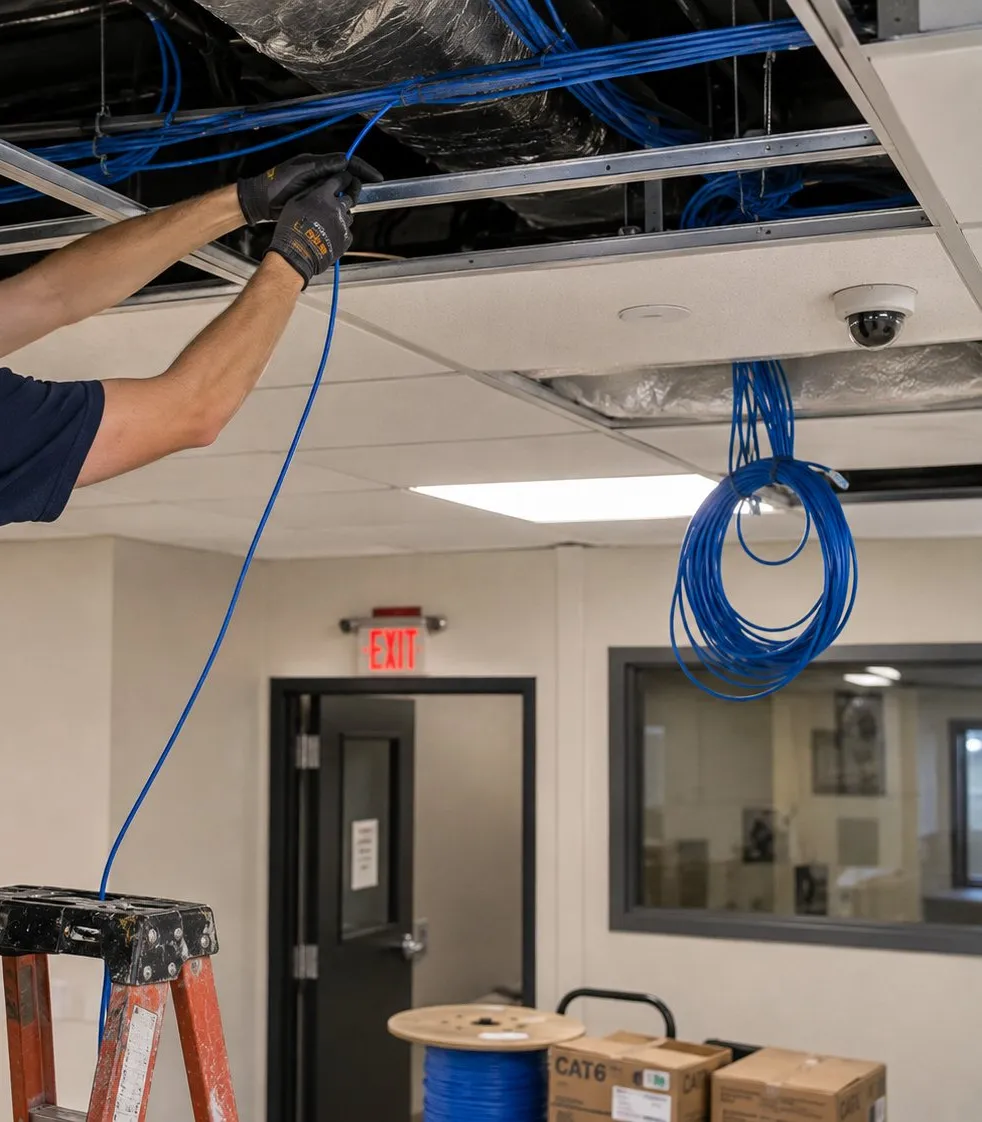
Photo from the AESS image library, cropped: blue cable is pulled from an open ceiling grid toward a ladder while a spare coil hangs above a doorway, with boxed cable on the floor. Rough-in like this happens before any screen arrives on site.
AI Overview Reality Check
What AI Gets Wrong About Video Wall Installation in Ulster County
Our research tools for this edition had no access to Google’s generated summaries or its question boxes, so we did not guess at them. Instead this section takes seven claims that appear in widely read cost guides, manufacturer notes and forums — the material AI summaries and aggregator sites such as Angi, HomeAdvisor and Fixr tend to repeat — and tests them against what Ulster’s own codes and buildings show.
“A digital screen is just another sign”
Generic advice treats a screen in a window as an ordinary sign that needs, at most, a sign permit. In Kingston’s historic districts, electronic signs are prohibited outright, and any sign in the Stockade District needs landmarks commission approval before a permit. In Woodstock, internally lighted signs are prohibited.
Outside the districts, Kingston allows electronic signs only in some zones and only with a five-minute static hold, quick transitions, automatic dimming to 0.3 foot-candle above ambient and a fail-to-black default. That is a long way from a looping advertisement.
So the Ulster version of this claim is: a digital screen visible from the street is a sign with its own, stricter rules, and in some places it is not allowed at all. The check takes an hour and should come before the purchase.
“Low-voltage wiring needs no local licence”
Many national guides say that display and data cabling is low-voltage work that no local electrical licence covers. Ulster County’s Electrical Licensing Law defines electrical work to include signaling, communication, alarm and data transmission, and requires anyone in business as an electrical contractor in the county to be licensed under it or supervised by someone who is.
How each building department applies that definition to data and signal cabling is a question for that department, and we ask it before the job. What is not in doubt is that new circuits for a wall need an Ulster-licensed master electrician.
“Any solid wall will take a video wall mount”
The general rule is to find studs or solid masonry and fix the mount. In a county where houses and commercial rows date from the seventeenth to nineteenth centuries, solid masonry can mean rubble stone set in soft lime mortar, and the wall itself can be the protected feature.
Fixing into the face of an early stone wall can crack stones that cannot be replaced and can need a certificate of appropriateness where it changes a landmark’s appearance. The better answers are often floor-supported frames, fixings only in sound joints, or a removable framed wall in front of the stone.
The mounting plan for an Ulster room is drawn for its actual wall, and in older buildings that usually means the frame carries the weight, not the wall.
“An entry-level indoor wall starts around $9,500”
SV Solutions’ 2026 guide gives a range from about $9,500 for an entry-level indoor LED wall to more than $200,000 for premium MicroLED. A figure at the bottom of a national range describes equipment in a simple room.
Our published Ulster prices start at $18,360 for an installed 2x2 commercial LCD wall, because they include mounting, controller where listed, setup, calibration and labour, and because Ulster jobs carry costs a national figure leaves out: frames for walls that cannot be drilled, surface raceway, approvals drawings and long cable runs.
“A kit price is the price of the wall”
CrownTV’s cost guide is clear that online LED kit prices cover hardware only, with structure, power circuits, installation and calibration on top. AI summaries tend to keep the kit price and drop the caveat.
In Ulster the items left out are often the largest ones: a freestanding frame for a stone room, an enclosure for a barn, an electrician’s new circuit, or a box-office control panel. Our table shows mounting and fabrication as its own line for that reason.
“Pixel pitch times ten gives the viewing distance in feet”
This is Planar’s rule of thumb, and it is a useful one. Christie suggests about one metre of minimum viewing distance for each millimetre of pitch, and Barco a different ratio again, so the rules do not agree.
In Ulster’s theatres and halls, the seats run from the front row to a balcony; in galleries, visitors walk right up to the screen. A single number cannot cover both, and it says nothing about the content: a fine line of text needs a finer pitch than a moving landscape.
“Consumer TVs are fine if they are only on for a few hours”
Forum posts and quick guides often say a consumer television is fine for light use. Samsung itself says consumer TVs are designed for perhaps eight hours a day and that their warranty is invalidated by commercial use, and integrators on Reddit’s r/CommercialAV point out that consumer sets rely on convection cooling that works only in landscape.
An Ulster venue that is quiet midweek may be on for twelve hours on a festival weekend; a lobby wall may run from morning to close every day of the season. Commercial panels are built and warranted for those hours and for tiling.
Where a consumer set really is the right answer, for a small room used occasionally, we say so and install it as a single display rather than a wall.
Planning a Screen for an Old or Landmarked Ulster Building?
A short call before you buy anything can settle the two questions that decide most Ulster jobs: what the building will let us fix to it, and whether the screen will be treated as a sign.
For an Ulster County video wall quote, give us the address or at least the city, town or village, the building and its approximate age, whether it is in a historic district, the wall material and width, and any date the wall must be ready by. A written price comes back the same business day; to talk first, call (845) 640-3835.
✅
We Got Your Request!
Thank you. Your note about the building is with a technician, who will ring you back during today’s business hours. Anything urgent can go straight to (845) 640-3835.
How It Works
Our Installation Process
Seven steps, in this order because Ulster jobs are usually decided by the address and the building before the screens. Approvals, where needed, run alongside steps three and four so nothing is ordered until they are settled.
1. Address, district and approvals check
From the address we confirm whether the property is in the City of Kingston, a town or a village, whether it sits in a historic district or is a landmark, and who must approve the work: a landmarks commission, a planning board, a landlord or a venue owner.
2. Survey with a scanner and a light meter
We measure the wall and the viewing distance, scan for studs, rebar or rubble stone, read the light at the hours the room is used, and trace the route from the wall to the nearest equipment space and panel.
3. Full-size mock-up and an approvals package
The outline of the screens goes on the wall at real size. Where a commission or board must review the work, we prepare photographs, dimensions, the mounting method and a removal plan for the owner to file.
4. Written proposal from the Ulster table
Screens, frame, controller, cable path and calibration priced from the published Ulster County figures, with the licensed electrician’s work, spares and any approvals time shown as their own lines.
5. Rough-in with the Ulster-licensed electrician
Power is added by an electrician licensed under the county’s Electrical Licensing Law; data, signal and control cable is run, labelled and certified; the frame or rail is fixed in the way the survey agreed.
6. Hang, align and calibrate
Screens are hung and their seams aligned, colour and brightness are matched tile to tile, and any street-visible display is set to the static-hold, dimming and fail-to-black behaviour its local code requires.
7. Power-off test and handover
With the person who will run the wall watching, we cut power, restore it and confirm the wall returns to the right layout on its own; then we hand over a one-page guide, the passwords and the drawings.
Coverage Area
Video Wall Installation Near Ulster County’s Landmarks
Kingston, every town and every village in Ulster is inside our service area. The six landmarks below were chosen because each one represents a building type this page is about, from a 1676 stone house to a former IBM plant.
Senate House, Fair Street, Kingston
A Dutch stone house first built as a single story in 1676, now a state historic site in the Stockade area — the kind of fabric that sets the rules for every display nearby.
Ulster Performing Arts Center, 601 Broadway, Kingston
Opened as the Broadway Theatre on June 9, 1927, designed by Douglas P. Hall, listed on the National Register in 1979 and today seating 1,510.
Historic Huguenot Street, New Paltz
A ten-acre National Historic Landmark District with seven stone houses dating to the early eighteenth century, at the heart of the original 1678 settlement.
Bearsville Theater, 291 Tinker Street, Woodstock
A 500-capacity music venue built for Albert Grossman’s Bearsville community and run since 2024 by Dayglo Presents, at the centre of the Bearsville Campus.
Hutton Brickyards, Kingston riverfront
A former brick works turned event destination, built around three steel-frame kiln sheds first erected in 1928 in Haverstraw and moved to Kingston in the 1940s.
iPark 87, Enterprise Drive, Town of Ulster
The former IBM complex: about 200 acres and more than a million square feet of buildings, where Ulster BOCES and partners have planned career and workforce space.
We also serve Saugerties, Rosendale, Marbletown and Stone Ridge, Hurley, Esopus and Port Ewen, Lloyd and Highland, Marlborough, Plattekill, Gardiner, Shawangunk, Rochester and Accord, Kerhonkson, Olive, Ellenville and the rest of Wawarsing, Shandaken and the Catskill hamlets, and the neighbouring counties of Dutchess and Orange County.
Town by Town
How an Ulster Video Wall Job Changes From Place to Place
The same 2x2 wall is a different job in each part of the county, because the building, the rules and the power change. This is the short version we work from.
Place
Typical rooms
First thing we check
Kingston: Stockade and Uptown
Restaurants, shops, offices in old stone and brick
District status and whether any screen is visible from the street; electronic signs are not allowed in the districts.
Kingston: Rondout
Waterfront restaurants, galleries, event rooms
Same district review; river light on the screens; brick and plaster walls.
Kingston: Midtown and Broadway
Theatre lobby, offices, arts spaces
The zone under the form-based code, since electronic-sign rules differ by zone outside the districts.
Town of Ulster
Training rooms, offices, retail on large sites
Distance from the equipment room and whether ceilings are open for cabling.
New Paltz
Campus-adjacent offices, restaurants, inns, stone houses
Village or town code; an Ulster master electrician for any permit-related electrical work, as the town notes.
Woodstock and Bearsville
Galleries, studios, venues, restaurants
The town’s prohibition on internally lighted signs, for anything near a window.
Saugerties
Village shops, restaurants, event spaces
Village or town code, and the building’s age and wall type.
Ellenville and Route 209
Theatre, retail, hospitality
Travel scheduling for multi-day work, and the condition of older wiring.
Catskill and Shawangunk resort areas
Hotel meeting rooms, barns, wedding venues
Whether screens must clear away between events, and power reliability at the end of long lines.
Central Hudson’s outage summary lists its customers by municipality: 12,764 in the City of Kingston, 5,743 in Lloyd, 4,589 in Esopus, 3,521 in the Town of New Paltz and 2,437 in the village, 2,246 in Ellenville, among 93,190 in the county. Those numbers are a reminder that in much of the county a wall is on the same rural distribution system as everything else, and that restart behaviour after an outage belongs in the design.
Approvals Timeline
Three Ulster Paths From First Call to Finished Wall
Most of the time on an Ulster job is spent before installation, and how much depends almost entirely on where the building is and which way the screens face. These are the three paths we see most often, written as the order of events rather than a promise of dates, because commission and board calendars are set by those bodies, not by us.
Path one: an inward-facing wall in an ordinary building. A meeting room, a training floor or the back wall of a restaurant outside any historic district, with nothing visible from the street. The order is photos and address, survey, written proposal, rough-in with the electrician (who files any electrical permit the work needs), then hanging and calibration. Approvals are limited to the owner, the landlord and the building department’s electrical permit. This is the shortest path, and the one we steer clients toward when the room allows it.
Path two: anything visible from the street in Kingston’s historic districts or on a landmark. Here the certificate of appropriateness comes before any order. The owner files with the Historic Landmarks Preservation Commission, using the photographs, drawings, mock-up photo and specification we prepare; the commission reviews it; and only once there is an answer do we confirm the equipment. Because electronic signs are not permitted in the districts, the realistic outcome for a street-facing screen is usually a redesign that turns it inward, and we often suggest doing that from the start to save a cycle of review.
Path three: a street-facing electronic sign outside the districts. In the Kingston zones that allow electronic signs, the work follows the sign permit process with the code’s design standards built in: facade mounting, size and spacing limits, a five-minute static hold, transitions under a second, an ambient light monitor with automatic dimming certified to the city, and a black-screen default. Elsewhere in the county the local sign chapter decides, and in Woodstock the prohibition on internally lighted signs usually settles the question early.
Whichever path applies, nothing is ordered until it is clear, and the proposal shows which path we expect and why. If the answer changes along the way — a commission asks for a smaller screen, a code officer reads a window display differently — the design changes before the money does.
Pricing
Video Wall Installation Cost in Ulster County
The installed prices below are our Brooklyn base video wall prices multiplied by the Ulster County area factor of 1.53, rounded to the nearest dollar. They include panels, mounting, controller where listed, basic content setup, calibration and labour. They exclude the licensed electrician’s circuits and permit, approvals work beyond preparing drawings, enclosures for outdoor or unheated spaces, and maintenance unless chosen. The controller and content-software lines are shown at the same published figures used across the silo, because they are equipment and third-party software rather than local labour. Spare panels, sign-mode light sensors, mobile stage frames and enclosures are quoted after the site visit, because they depend on the exact model and room.
Configuration
Ulster installed price
Typical Ulster use
2x2 LCD (55" panels)
$18,360 – $27,540
Gallery back wall, restaurant, small meeting room
3x3 LCD (55" panels)
$36,720 – $58,140
Theatre lobby, training room, resort meeting room
4x4 LCD (55" panels)
$64,260 – $99,450
Large training floor or operations room
2.5mm dvLED (110" equivalent)
$53,550 – $84,150
Event barn, hall, stage backdrop
1.9mm dvLED (138" equivalent)
$84,150 – $130,050
Closer viewing in a venue or gallery
1.5mm dvLED (165" equivalent)
$130,050 – $214,200
Premium close-viewing installations
Outdoor LED (per sq m)
$6,885 – $13,005
Weather-exposed venues, open sheds
Video wall controller add-on
$2,500 – $15,000
Multi-source layouts and saved presets
Mounting structure / custom fabrication
$2,295 – $13,770
Floor-supported frames, stone and timber rooms
Content management system (annual)
$1,200 – $5,000/yr
Scheduling, remote updates, message templates
Maintenance contract (annual)
$3,672 – $13,770/yr
Inspections, calibration, priority response
Service or repair visit
$195 an hour, 3-hour minimum ($585)
Tile, controller, input or restart faults
What raises an Ulster price. A wall that cannot be drilled, so the screens need a floor-supported or freestanding frame. A room in a historic district where drawings, a sidewalk mock-up and a meeting with the commission are part of the job. Cable that has to travel on the surface around a stone room or through a basement. A semi-outdoor venue that needs enclosures or outdoor LED. A controller in an equipment room far across a factory floor. A new circuit from the electrician.
What brings it down. Newer construction with drywall on studs or plain block, and an outlet and a data point already nearby. An address outside the historic districts and screens that face into the room. Spare space in an existing rack that is already on battery backup. Being able to close the room for a couple of days. Sometimes the cheapest answer is no wall at all but one large display, and when that is true we tell you.
Three things get you a figure in writing: where the building is, what the wall is made of, and what can be seen of it from outside. The quote lists screens, frame, electrician and approvals separately, all from the Ulster table.
A 2x2 wall of 55-inch commercial LCD panels ($18,360 – $27,540 installed) for galleries, restaurants and meeting rooms, with a local media player and simple controls. Add the fabrication line ($2,295 – $13,770) where the screens must stand on their own frame instead of the wall.
Venue Lobby Wall — from $36,720
A 3x3 wall of 55-inch panels ($36,720 – $58,140 installed) for theatre lobbies, training rooms and resort meeting rooms, with message templates the box office or front desk can call up. Add the controller line ($2,500 – $15,000) for multi-source layouts.
Stage and Hall LED — from $53,550
A 2.5mm direct-view LED wall with a 110-inch-equivalent picture ($53,550 – $84,150 installed) for stages, halls and event barns, on a frame chosen with the venue for fixed, rolling or stored use.
Already bought the screens? Labour-only work
Screens, mounts or a controller you already own can be installed by us. Where it applies, labour on owner-supplied equipment follows our install-your-own pricing page where it applies, or quoted after the survey for video-wall work. Two cautions for Ulster buyers: a screen bought before the sign question is settled may not be usable in the window it was bought for, and consumer televisions rarely tile cleanly or carry commercial warranty terms. Send the model numbers and the address before the visit and we will tell you what to expect.
Complete Services
Every Video Wall Installation Service in Ulster County
Most Ulster venues that add a wall pair it with sound and with the cabling back to an equipment room, and most galleries and inns pair it with cameras for the same rooms — so the screens, the sound and the network are planned once, with one set of drawings for the owner or the commission.
Field Notes
Field Notes: Tape on the Wall, a Photo From the Sidewalk
Two habits shape every Ulster job we plan, whatever its size. The first is the full-size mock-up. Before a bracket or a frame is ordered, the outline of every screen goes on the wall in painter’s tape, with the seams marked, and we look at it from where people will actually be: the back of a theatre lobby, the door of a gallery, the far end of a resort meeting room. In old rooms, this is usually where the wall gets smaller, moves away from a window or a fireplace, or comes off the wall altogether onto a frame.
The second is the photo from the sidewalk. If there is any chance a screen will be seen from outside, we stand in the street at dusk and photograph the mock-up, or a temporary screen at the proposed brightness, through the window. In Kingston’s districts and in Woodstock, that one picture tells the owner more about the sign question than any description, and it is the picture a commission or a code officer will want to see.
A third habit follows from the county’s licensing law. On the first visit we ask who the electrician will be, and if the owner does not have one, we bring in an electrician who holds an Ulster County Master Electrician license. The electrician sees the mock-up, the circuit is agreed at the wall rather than on a drawing, and the permit, where one is needed, is filed by the person whose license it rests on. It saves the most common late surprise on an Ulster job: a finished frame with no power where the screens need it.
Neither step takes long. Both go into the written proposal, so the owner can see what was checked before money is committed.
FAQ
Ulster County Video Wall Installation FAQ
Can a wall be taken down later without leaving marks on old plaster, brick or stone?
+
Mostly, yes, if removal is planned on day one. We favour fixings that go into mortar joints rather than the face of old brick or stone, freestanding or floor-supported frames where the owner wants no holes at all, and surface raceway that can be unscrewed. Before we start we photograph the wall and record every fixing point on the drawing, so that whoever removes the wall years from now knows exactly what was done and what needs patching. A frame that touches the wall only at a few protected points leaves almost nothing behind.
Do you prepare drawings a landmarks commission or planning board can review?
+
Yes. For a display that will be visible from the street, or any work inside a designated landmark, we prepare a simple package for the owner to file: photographs of the building and the wall, the screen dimensions, the mounting method, where cables run, how the screen is lit and dimmed, and how it would be removed. Kingston’s code asks for dimensions, colours, materials and the method of illumination when a change includes signs or lettering, so we write to that list. We do not file on the owner’s behalf unless asked to attend.
Our stone building eats Wi-Fi. How does new content reach the wall?
+
By cable, wherever we can. Thick masonry walls weaken wireless signals, so we run a wired network connection to the media player, or put the player beside the building’s router and send the picture to the wall over HDBaseT or fibre. Content is stored on the player, so the wall keeps playing even if the connection drops; the cable only matters for sending new content. Where a cable cannot be run without damaging the fabric, a wireless bridge between two rooms with a clear line can work, and we test it before relying on it.
Can a screen go into a wedding or event room without showing up in every photograph?
+
Yes, with placement and settings. Event photographers shoot toward the couple, the stage or the head table, so a screen on that wall will be in many frames, and a bright one will pull the camera’s exposure. We place screens on side walls or behind the guests where the room allows, set a dim, neutral idle image for the ceremony and speeches, and give the venue a one-touch blackout so the wall can go fully dark when the photographer asks. A screen that is off or showing a still in the room’s colours largely disappears in pictures.
Will you work alongside the venue’s own lighting and sound company?
+
Yes, and on show-related work we prefer to meet them before we design anything. Their lighting rig decides where glare will land on the screens, their console may need a feed from the wall’s controller or a feed into it, and their power plan may already use the circuit we were going to ask for. We agree on who owns each cable, connector and setting, and we label the hand-off points so that on a show day there is no argument about whose box a fault is in.
Can a wall be fixed to the posts and beams of a converted barn?
+
Often, but the timber has to be judged first. Old hand-hewn posts and beams can be strong yet split, twisted or notched, and some owners do not want them drilled at all. We look for sound members, use through-bolted plates or clamps where drilling is acceptable, and use a freestanding frame tied lightly to the structure where it is not. We also check what the wall would sit in front of, because a barn’s gaps and doors let in dust, insects and cold that matter to screens.
Can the screen frames be finished to sit with old woodwork?
+
Yes. The screens themselves are black glass and metal, but the frame, trim and any enclosure around them can be built or painted to suit the room: a painted wood surround in a parlour, a dark metal frame in an industrial space, or a recessed shadow-line so the screens read as a panel rather than a box on the wall. We show a sample finish against the real woodwork before ordering, because the same black looks different under candle-coloured bulbs and under daylight.
Can the lobby screens show a live picture from the stage camera?
+
Yes. A camera at the back of the house, or a feed from the venue’s own production switcher, can be sent to the lobby wall through an encoder or an HDBaseT link, so late arrivals and bar staff can see the stage. Expect a short delay compared with the room, and agree with the performers or their management whether a live picture is allowed, since some touring contracts restrict it. We add a switch so staff can turn the feed off, and the wall falls back to its normal loop when they do.
Can you reuse the wiring from our old projector?
+
Sometimes. A projector’s ceiling run usually carries one video cable, power and perhaps a network cable to a point the wall will not use, so the cable rarely ends up in the right place. What it often gives us is a proven path: an existing sleeve through a wall or a chase between floors that saves opening an old surface again. We test the old cables before deciding; if they certify for the signal the wall needs, they are reused, and if not, they become the pull string for new ones.
Can the wall pull in posts from our website or social media automatically?
+
Usually, yes. Most digital-signage software can show a web page, a calendar feed or a social-media feed in one zone of the wall and refresh it on a schedule, so the events listed on your website appear on the lobby screens without anyone retyping them. The limits are the platforms’ own rules and what your feeds actually publish. We test the feed on the real screens for legibility, set the player to keep the last good version if the feed fails, and give staff a way to hide it on nights it would be out of place.
All Areas Served
Video Wall Installation Across New York City, Long Island and the Hudson Valley
Ulster is one of six counties covered by our Hudson Valley video wall hub. The pages for the other counties, for Long Island and for the five boroughs are each researched separately, with their own codes and their own price factors.
We checked each of these sources in October 2026, and each local figure or rule above can be traced to at least one of them. Prices are the exception: they are ours, built from the Brooklyn base list and the Ulster factor.
Census Bureau QuickFacts for Ulster County (V2025 population and housing-unit estimates; 2020 land area and density; ACS 2020–2024 owner occupancy and home value; 2023 employer establishments; 2022 accommodation and food services sales)
City of Kingston Code, chapter 405, Article 8, Administration and Enforcement (sign approval in the Stockade District and landmark overlay districts; certificate of appropriateness; application contents), amended November 2024
City of Kingston Code, chapter 405, Article 4, General Standards (window signs; electronic signs: permitted zones, prohibition in historic districts, size, spacing, static display, five-minute hold, one-second transitions, 0.3 foot-candle limit, automatic dimming, fail-to-black)
Friends of Historic Kingston, “Preservation: The FHK Story” (Historic Landmarks Preservation Commission, 1969; the four historic districts and their dates; landmarked buildings)
Town of Woodstock Code, chapter 260, Article V, Supplementary Regulations (prohibited signs, including directly illuminated and all internally lighted signs; constant-intensity lighting)
Ulster County Code, chapter 185, Electrical Licensing Law (definition of electrical work; licensing requirement; exemptions; adopted May 21, 2019, amended through October 21, 2025); Ulster County Electrical Licensing Board page; Town of New Paltz Building Department notice on Ulster County Master Electrician licenses
Central Hudson, Outage Summary (customers served by county and municipality); Daily Freeman, “More than 35,000 Central Hudson customers remain without power after storms hit region,” July 5, 2026
Ulster County, Emergency Communications Center page (16,350 sq ft, Paradies Lane, New Paltz, completion expected 2027); SUNY New Paltz emergency FAQ (campus digital signage can be remotely activated for emergency messages)
Hudson Valley One, “iPark 87 attracts an unexpected new kind of tenant,” January 31, 2024; iPark 87 site (200 acres, over one million square feet); Ulster County news release on iPark 87 West, February 27, 2026
Bardavon Presents, UPAC History (Broadway Theatre opened June 9, 1927; architect Douglas P. Hall; National Register 1979; seating 1,510)
Bearsville Theater, About page (291 Tinker Street; Albert Grossman; Dayglo Presents from April 2024); Billboard on the 500-capacity venue
Mohonk Mountain House history pages (1869 purchase of a ten-room inn; Victorian castle resort)
Hutton Brickyards history page and HV-Rob, Hudson Valley Ruins (kiln sheds erected 1928 in Haverstraw, moved in the 1940s)
Historic Huguenot Street (ten-acre National Historic Landmark District; seven stone houses; 1678 settlement); Hudson River Valley National Heritage Area, Senate House State Historic Site (stone house of 1676)
Manufacturer and industry sources: LG 55VM5J-H specification sheet; Samsung Insights, October 21, 2024; Planar, Christie and Barco pixel-pitch guidance; SV Solutions and CrownTV cost guides; Reddit r/CommercialAV; U.S. Access Board, 2010 ADA Standards section 307
Not used, because our tools could not reach them: Google’s question boxes, related searches and AI summaries, Answer the Public, Bing and DuckDuckGo suggestions, and Yelp review text. A search for Ulster-specific Reddit threads about video walls found none.
Screen Dark Before Doors Open? Call the Ulster Line
A blank lobby wall before a show, a gallery tile gone dark, a window display that will not hold still, or a wall that did not come back after a storm — phone or text (845) 640-3835. We book the next open window, and most single faults are fixed within one to two hours of arrival.
Ulster County Video Walls From a Licensed, Insured Team
Ulster jobs are run from the Abstract Enterprises Security Systems office at 460 E Fordham Rd, Bronx, NY 10458. Call or text the Ulster number, (845) 640-3835, or send pictures of the wall and the street front through WhatsApp.
Google reviewers give us 4.7★ over 201 reviews. NYS license #12000287431. Estimates are written up on the day of the request, and insurance certificates go to the owner, the operator or the venue ahead of our first visit.
Full terms — including 50% deposit, one-year parts-only warranty on AESS-supplied products, and the late-fee schedule — are set out in the service agreement. See our warranty page.
Last full revision October 18, 2026. What changed: this Ulster County video wall page was rewritten from new research on Kingston’s historic-district and electronic-sign rules, Woodstock’s sign law, the county’s Electrical Licensing Law, Central Hudson outage reporting, Census figures and the histories of the county’s theatres, resorts and industrial sites. Prices now follow our Brooklyn base table with the Ulster area factor of 1.53; the standard service rate is unchanged.