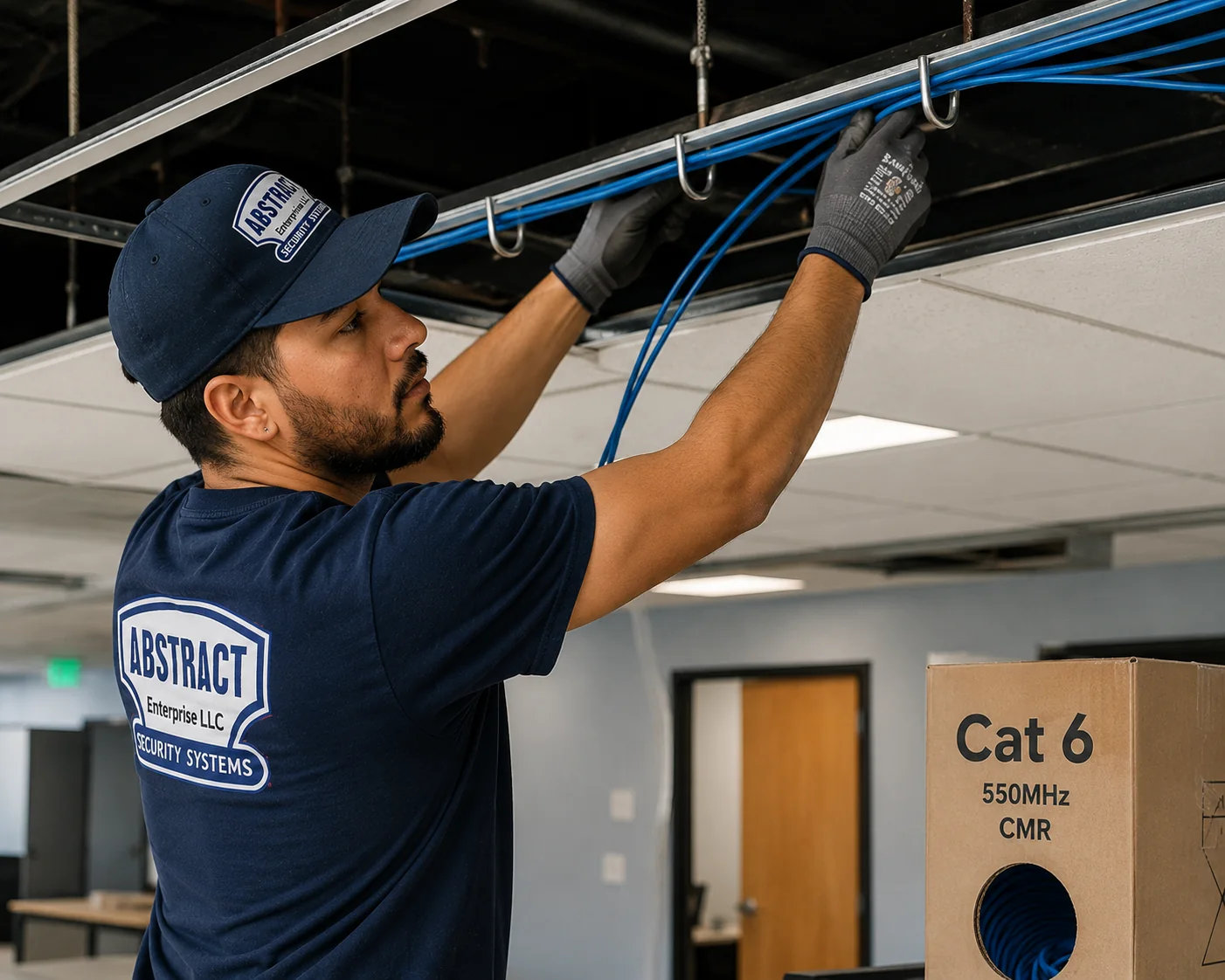
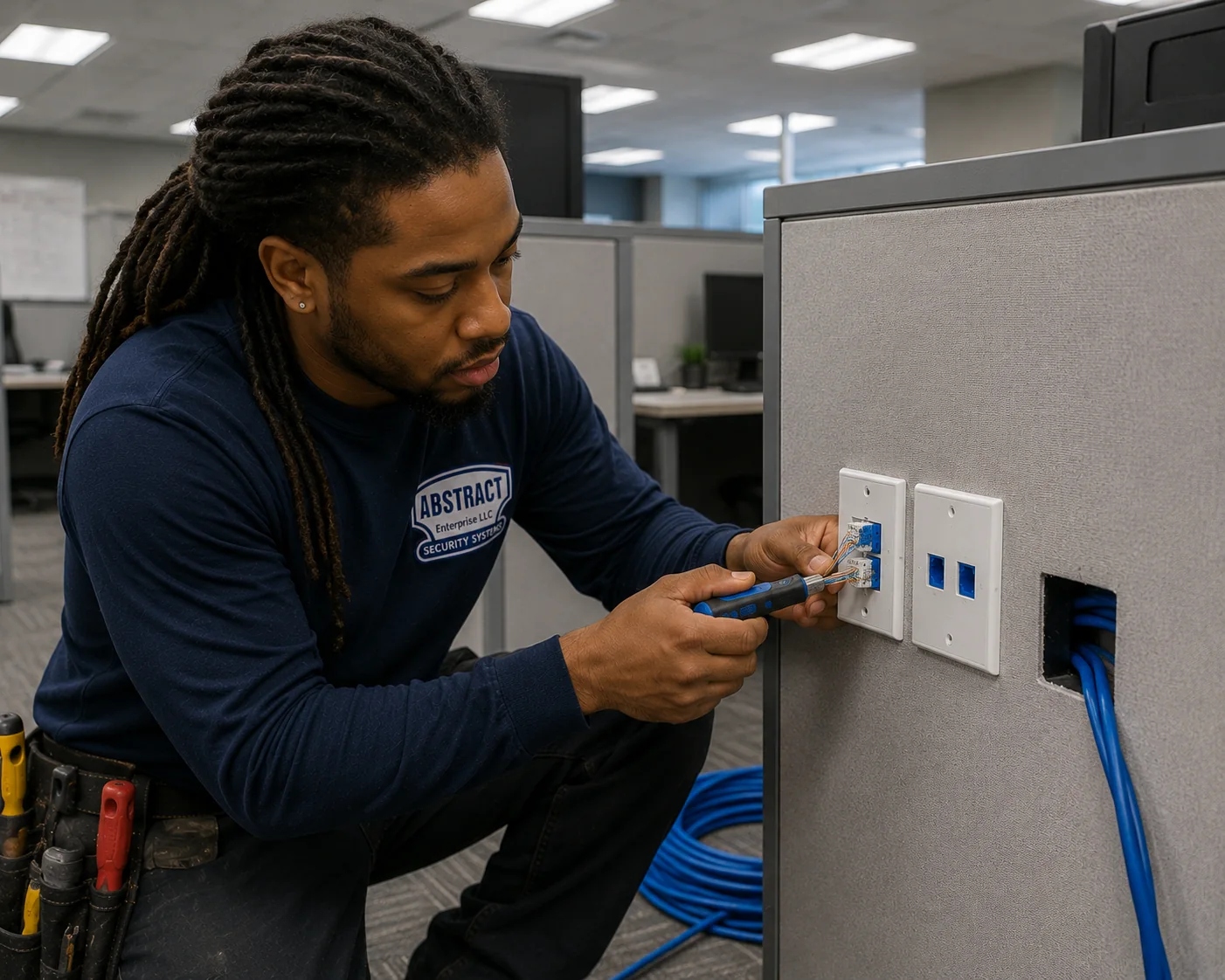
Cat6 installation for Kingston’s Stockade District and Rondout waterfront, the Route 9W and Ulster Avenue corridor, New Paltz campus and village commercial, Saugerties and Woodstock, agricultural and winery property, and homes across the county.
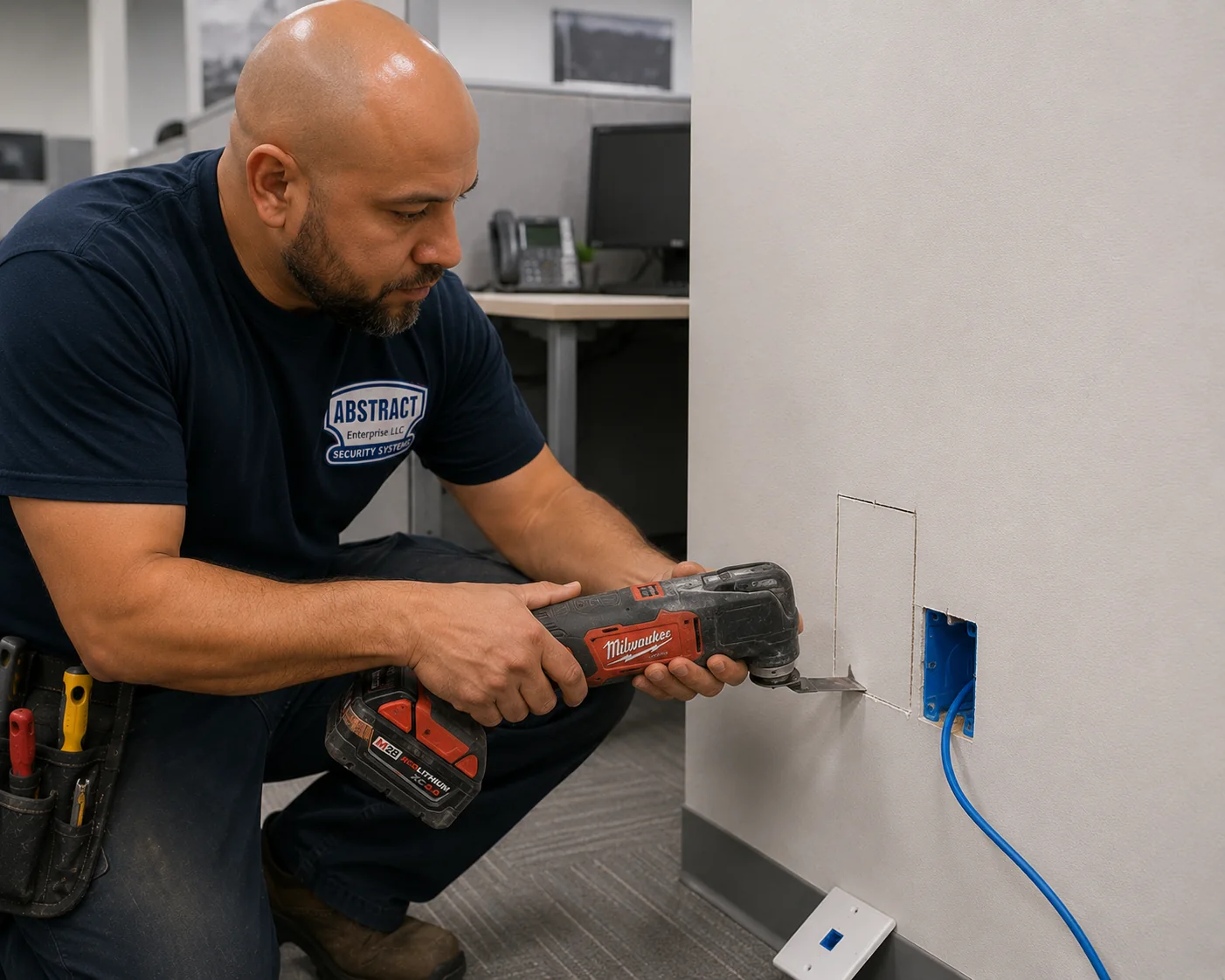
Most buildings here have no cavity to run cable through. Stone and brick with nothing inside them, plaster over lath, tin ceilings, exposed structure kept deliberately. That single condition reorganises the whole job — containment becomes the method rather than the fallback, and where it runs is a design decision made before anything touches a wall.
Tell us the building and rough drop count — we'll come back with a number.
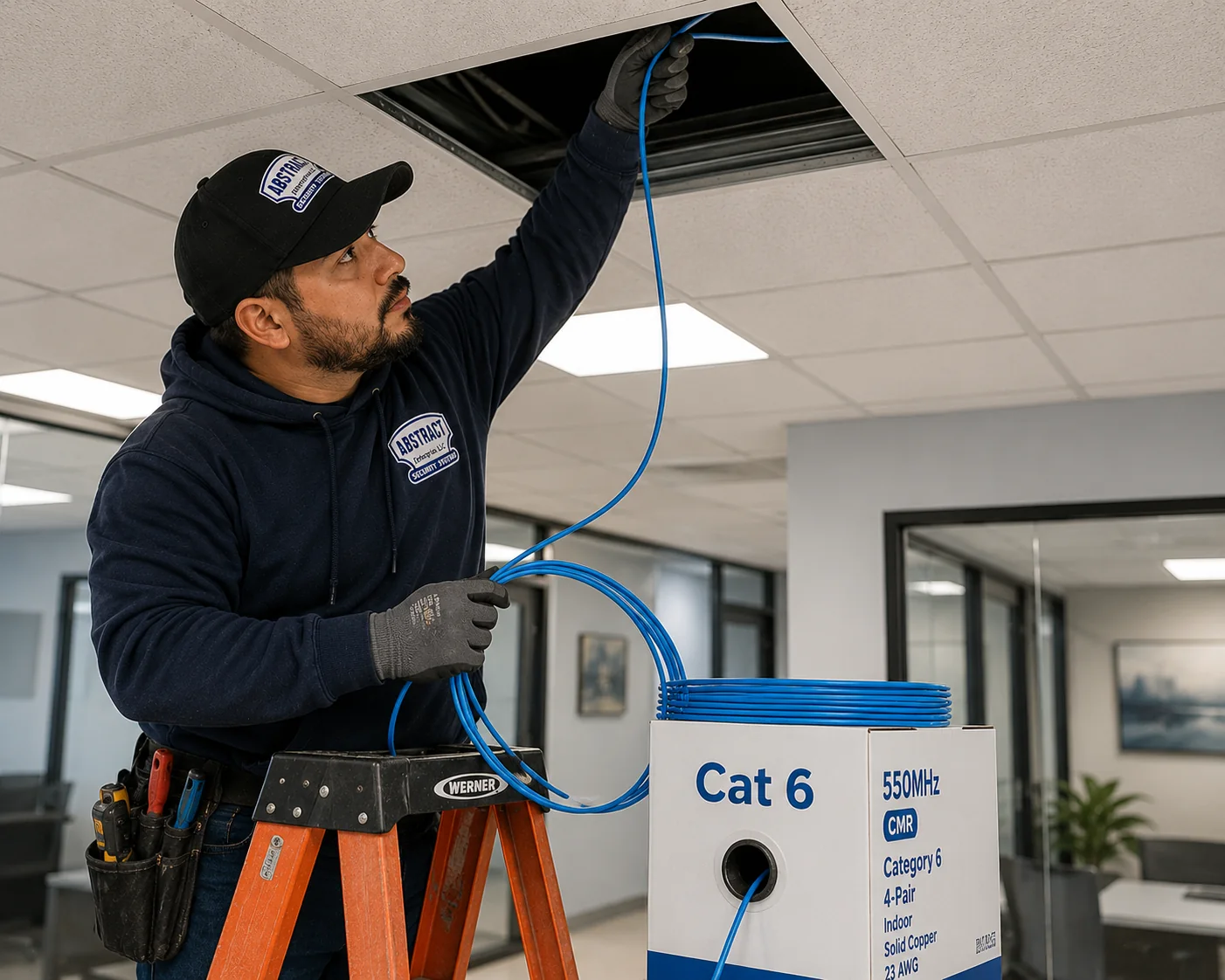
Kingston's Stockade District is one of the oldest commercial streetscapes in New York State. That is a fair summary of what cabling in this county involves.
Brick and stone walls with nothing inside them. Plaster over lath where a partition exists at all. Pressed tin ceilings, timber decking, and exposed structure that the tenant keeps deliberately because it is why they took the space. In building after building here, the first question — can this wall be fished — has the same answer, and it is no.
That single fact reorganises the whole job. Containment stops being a fallback and becomes the primary method. Where it runs is a design decision made with whoever owns the aesthetic, because it will be visible. The panel position frequently has to be created rather than found. And the estimate depends entirely on somebody having stood in the room, because nothing about a nineteenth-century building can be inferred from its square footage.
A large county with its commercial weight in Kingston, a college town, and a scatter of village centres across a lot of ground.
The county's commercial centre and three distinct markets inside one city. The Uptown Stockade District is nineteenth-century masonry carrying restaurants, professional offices, galleries and retail — the hardest buildings in the county to cable and some of the most interesting. Midtown holds municipal and institutional buildings, the hospital, and older commercial along Broadway. The Rondout waterfront down at the creek runs to hospitality, restaurants and converted industrial stock. Out along Route 9W and the Ulster Avenue corridor the character shifts entirely into conventional retail, plazas, auto and medical suites in modern buildings that cable the easy way.
The campus and the commercial strip serving it along Main Street and Route 299. Restaurants, retail, professional offices and student-facing businesses, much of it in older stock sharing Kingston's masonry constraints. Campus work brings its own conventions and closeout requirements. The surrounding commercial runs on a calendar set by term dates, which affects when work can realistically happen.
Saugerties village has a historic Main Street with restaurants, galleries and small professional offices in older buildings, plus commercial along Route 9W and light industrial toward the Thruway interchange. Woodstock to the west is small commercial, hospitality and studio work in a village that trades heavily on season. Rosendale and Marlborough add village centres and agricultural property.
Ellenville, Wawarsing and the towns running out toward the Catskills are smaller commercial, municipal buildings and hospitality serving the tourism economy, spread thinly across long distances. Highland and the river towns south of Kingston carry commercial along Route 9W and agricultural and winery property behind it. Out here sites are far apart, drop counts are modest, and travel time is a genuine component of the estimate — which we put on the quote rather than hiding in the rate.
In a building where the method is containment rather than fishing, a vague scope is where a reasonable-looking price falls apart.
Separate lines rather than folded into the drop rate: cabinet or rack, panel, management, cords, switch, conduit, surface containment and its trim, firestopping, coring through masonry, lift hire, weather-rated cable and housings for anything leaving the building, tracing of existing cable, and out-of-hours work.
The question that separates bids here. Ask each contractor what they will do where the wall turns out to be solid. One who has probed it can tell you. One who has not has quoted a fish that is not going to happen, and the difference between fishing and planned containment is not a small line.
Stone and brick with nothing inside the walls, tin and plaster ceilings, and tenants who want the structure visible. Restaurants, offices, galleries and retail. Containment planned as a finish element, existing conduit hunted for, and historic review where it applies. The most demanding work in the county and the most satisfying when it goes well.
Conventional modern stock — retail plazas, medical suites, offices and auto businesses with accessible grid ceilings and real space above them. The easiest cabling in the county and the closest thing here to suburban work anywhere else. Straightforward until you find what a previous tenant left above the tile.
Multi-building properties with in-house conventions, existing infrastructure and closeout requirements written into the documents. Panel per building, fiber between them, and existing underground duct surveyed before anyone suggests trenching. Calendar-driven work with windows that do not move.
Waterfront and industrial stock repurposed for hospitality, studios, offices and residential. High exposed ceilings, heavy structure, lift work, and cable that is part of what people see. Closer in method to the Stockade than to anything on the 9W corridor despite being modern in use.
Spread across the western and southern towns. Outbuildings, barns, tasting rooms and detached structures, which means runs leaving conditioned space and needing weather-rated cable and housings. Small drop counts, long distances between sites, and a season that dictates when work can happen.
Most wire well from a basement and attic with minimal opening, and attic heat is the design factor on anything carrying power. Older farmhouses and converted seasonal properties are the exception — plaster over lath, no consistent path between floors, and additions built across a century with no thought to routing.
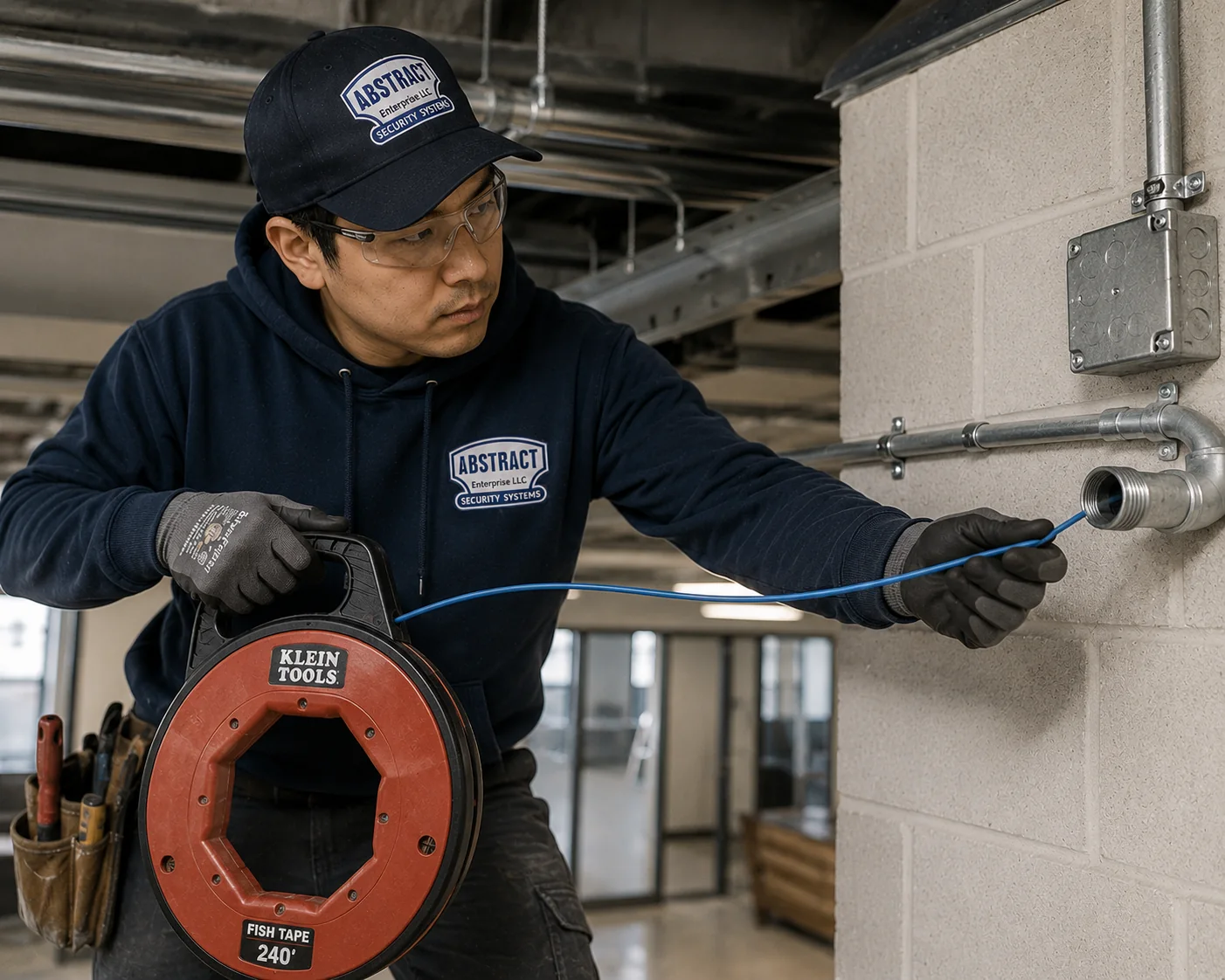
The defining method here. Where a wall is solid — and it usually is — surface containment routed deliberately along structural lines is the professional answer rather than the lesser one. Colour matched where it matters, proper corners and terminations, and the layout agreed with the owner before anything is fixed. Pushing a rod through an old wall until something gives creates openings someone then has to fill, repaint and account for.
Many of these buildings were wired at some point over the past century, and where that conduit has capacity, a pull string and a sane bend count, reusing it is the cheapest route available. Worth ten minutes of looking before anyone commits to a containment layout.
On the 9W and Ulster Avenue corridor this is the norm and it is straightforward. Grid with space above it, partitions that fish cleanly, pathway that installs without argument. The complications are inherited rather than structural.
Rondout conversions and industrial stock have no ceiling to hide in. Tray or conduit routed along structural lines, dropped to outlets in a planned way, and lift work throughout. Cable is part of the finished room, so the layout gets designed rather than improvised.
Barns, tasting rooms, detached offices and outbuildings mean runs leaving conditioned space. Those need a jacket rated for weather and a housing rated for the same, and they are usually the longest drops on the job — which puts them closest to the limit while frequently carrying a powered device.
Cat6 belongs in nearly every drop here. The margin it holds over Cat5e — 250 MHz against 100 MHz — carries a warm ceiling, a crowded bundle and a slightly imperfect termination without the link stepping down, and on new work the gap is $47 a drop. Cat6A earns its $477 where ten gigabit at full distance is genuinely specified, on an uplink, or into a server. It buys no reach whatsoever, so it never solves a distance problem — and in a county with long rural runs, that is worth stating plainly.
Plenum-rated where the ceiling cavity is used to move return air, riser-rated in any vertical shaft, general purpose everywhere else. Historic buildings are the ones that catch people out, because how a nineteenth-century structure was later fitted with mechanical services rarely matches what its age would suggest. Settled on site.
Unshielded is correct in nearly every building here. A shield does nothing unless bonded and grounded properly at the rack; left floating it behaves as an aerial and measures worse than plain UTP. The genuine cases are few — a production floor with real motor loads, or a long parallel beside power that cannot be avoided in an old building.
Copper on every horizontal run. The second question this county asks constantly is what happens outdoors. A run to a barn, a tasting room, a detached office or a yard camera needs cable and a housing chosen for weather. Office-grade cable in that position fails on a schedule, and the failure almost always gets blamed on the device at the end of it.
Working and performing are two different claims about a cable, and only the second one produces a document.
Every drop is wiremap-tested before the ceiling closes. When the job requires full certification, we test permanent links with a Fluke DSX CableAnalyzer and deliver the pass/fail report with the closeout package.
A link light hides what matters — a split pair reading continuous while degrading everything above it, an inch of conductor untwisted at the punch-down, damage taken somewhere along the run. The permanent link test looks only at the portion permanently installed in the fabric. A channel test adds the cords and reports what the equipment on the end genuinely sees.
In this county the cost of getting it wrong is specific. When a run went in on surface containment, correcting it afterward means taking down trim in a finished room that somebody chose the colour of — in a restaurant, a gallery or a shop that is trading. On a rural job it means driving back out. Neither is a ladder and ten minutes, which is exactly why nothing gets covered until it has been verified.
No exceptions: no trim goes on, no tile goes back and no tray gets capped before every run has been tested. Minutes with access open, or a return visit and a finished room disturbed, for exactly the same fault.
Per-drop figures are published here so you can size the job yourself before anyone comes out.
| Cable type | Per drop, runs to 100 ft |
|---|---|
| Cat5e | $286 |
| Cat6 | $333 |
| Cat6A | $477 |
| Coax / RG6 | $286 |
| Speaker wire | $238 |
| HDMI | $381 |
| Fiber — multimode | $667 |
| Fiber — singlemode | $761 |
Each rate carries cable, plate and keystone, a termination at either end, and the test. Ten percent off new construction priced before drywall. Past 100 feet the run is measured as installed and priced from that — which on rural property happens more often than anywhere else we work.
Priced separately: cabinet or rack, panel, management, cords, switch, conduit, surface containment and trim, firestopping, coring through masonry, lift hire, weather-rated cable and housings for outdoor runs, tracing and mapping of existing cable, and evening, weekend or pre-season premiums.
Run your own figures in the cabling quote builder, or call and describe the building.
| Location | Drops | Reason |
|---|---|---|
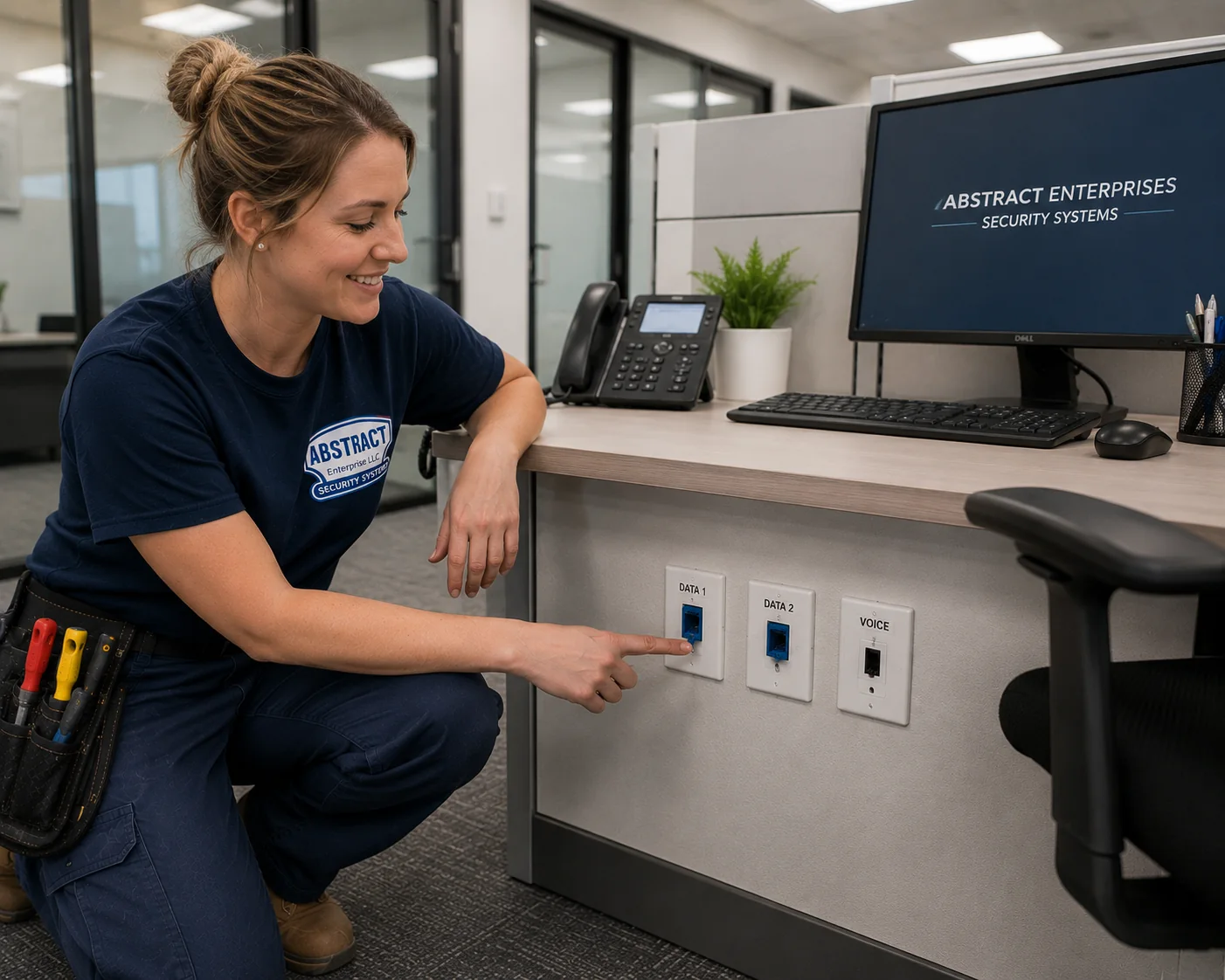
| Workstation | 2 | Computer plus handset, dock or whatever arrives next |
| Shared printer | 1 | Its own port rather than borrowing from a desk |
| Wireless radio | 1 | Wired backhaul; stone and brick force much tighter spacing |
| Camera | 1 | Traffic and power on one run |
| Door reader | 1 | Where entry control is IP at the door |
| Register / POS | 1 | Card processing wired rather than sharing the radio |
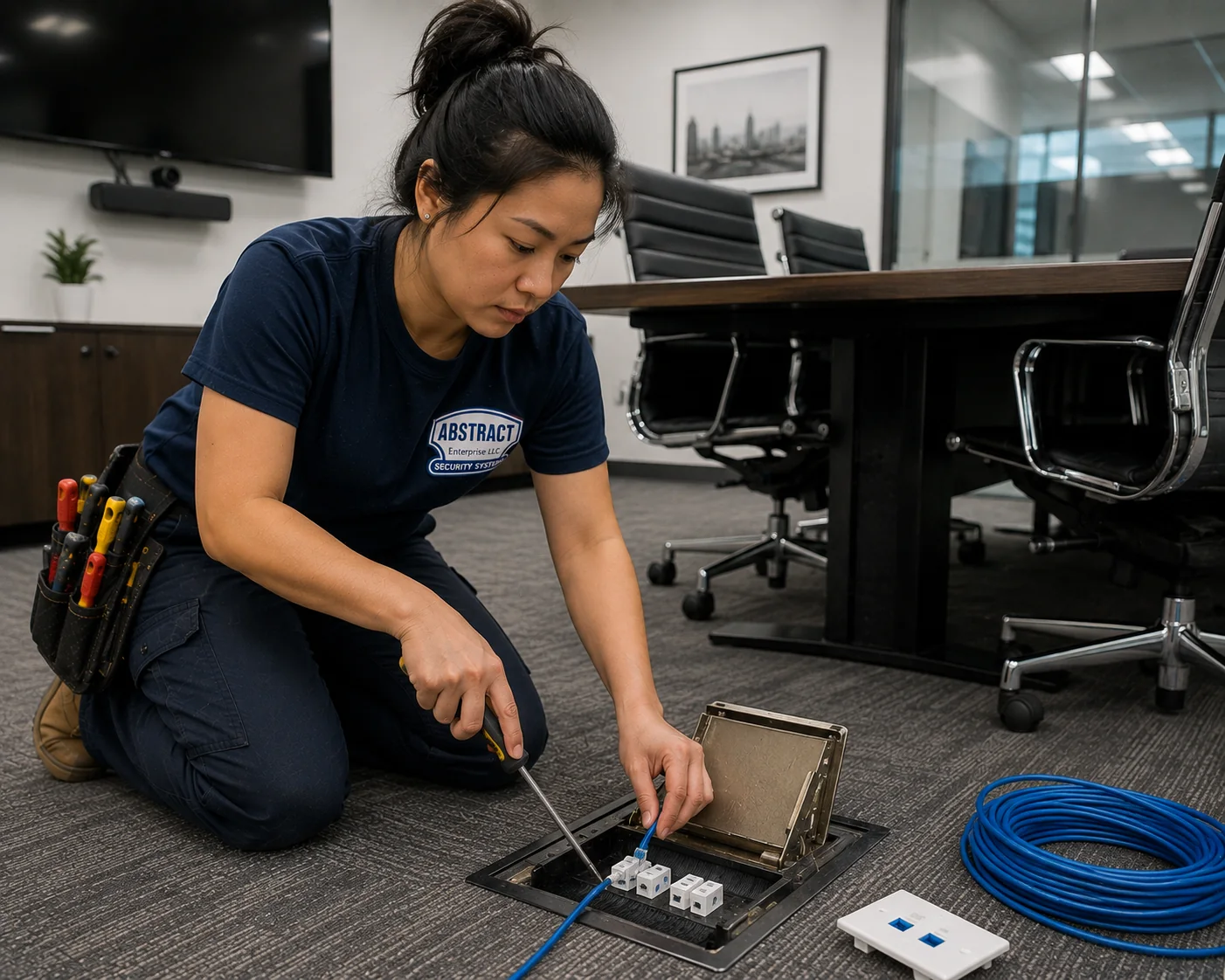
| Meeting room | 3–4 | Screen or codec, table or floor box, camera and a spare |
| Tasting room / bar | 2–3 | Registers, a display and a radio in a hard-surfaced room |
| Outbuilding | 1–2 | Weather-rated, and usually the longest run on the job |
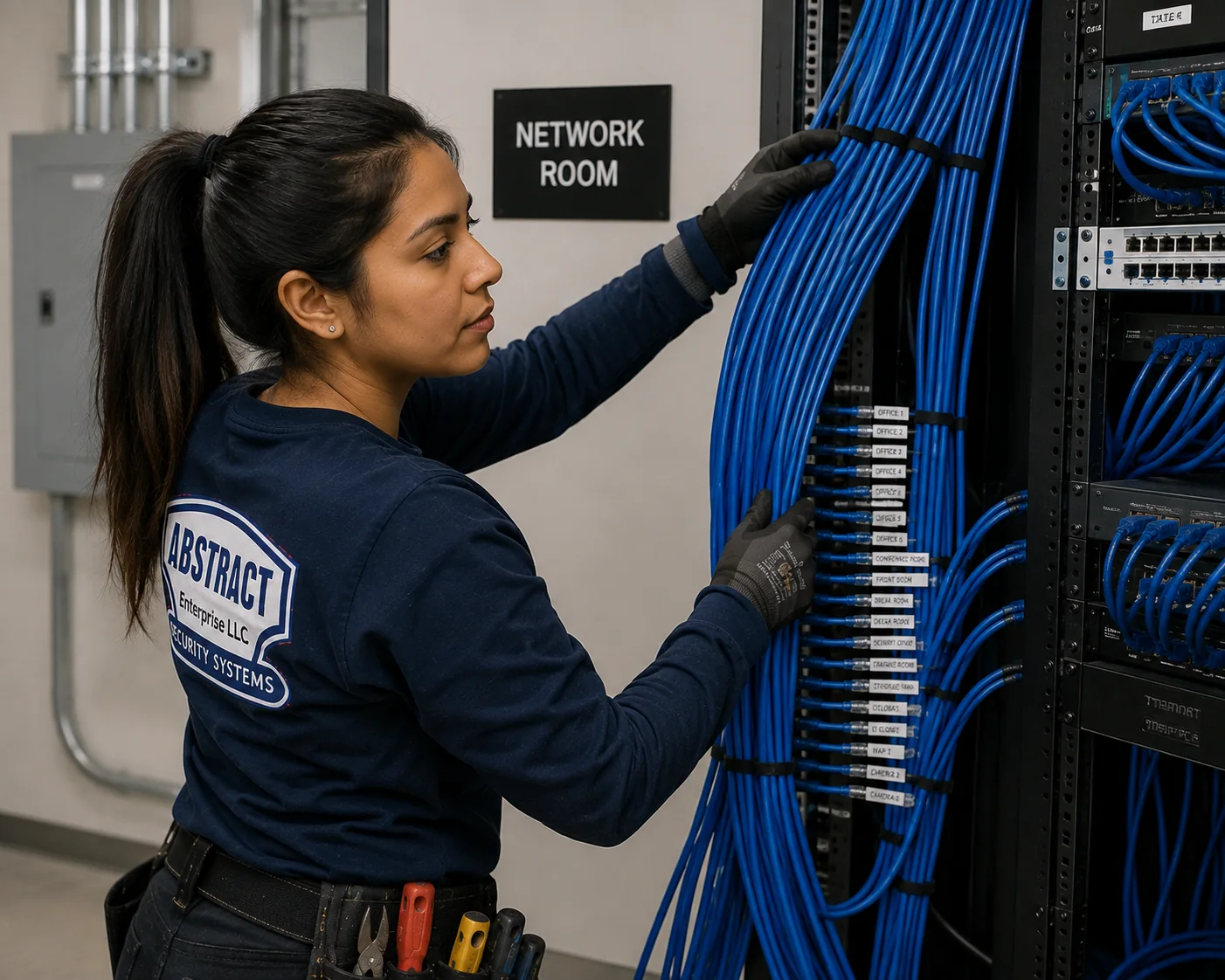
In a historic building this frequently has to be created. What we look for is somewhere central enough to keep runs short, with power, some ventilation, a door that locks, and a location the tenant will not want back. In a building where every run is going to be visible containment, keeping the panel central is worth more than usual — every metre saved is a metre of trunking nobody has to look at.
Landed at the panel and identified, then either coiled above the tile or finished behind a blank plate. On a twenty-drop job, three is proportionate. In this county they earn their keep twice over: adding a run later means either disturbing finished containment in a room that is trading, or driving back out to a rural site for a single cable.
Beyond a handful of drops the fixed cable stops at a panel and every connection after that is a cord. Slightly dearer once, repaid the first time anything changes, and the cable built into the building never has to be touched again — which in a masonry building is worth considerably more than the panel costs.
Built to TIA-568, terminated T568B unless the site already runs A throughout. Naming and mapping follow TIA-606-style convention. Category stays uniform across the whole channel, because a single 5e jack sitting on Cat6 drags the rating down and the link will not pass certification.
Panel rooms in older Ulster buildings are frequently improvised — a cupboard, a back corner, occasionally a basement that takes damp through the year. Enclosure choice, ventilation and physical protection matter more in those spaces than in a purpose-built closet, and they get raised at the walkthrough rather than worked around quietly afterward.
Results per run, the port-to-outlet map, the naming convention in plain language, a materials schedule, marked drawings where drawings exist, and photographs of every route before trim goes on. That last item earns its place here: once containment is closed, photographs are the only record of what is inside it.
A share of what we do here is not new work at all. Buildings where things function, roughly, but nobody can describe what connects to what — unlabeled runs, a panel named for a tenant two leases ago, cable of unknown vintage. Tracing, mapping and writing it up is a job in its own right, and in a small business with no IT support it frequently returns more than new cable would.
A building's cameras, readers, radios, handsets and intercoms now take traffic and power from the same pair. One pull, and no electrician following behind.
| Standard | Name | Usually powers |
|---|---|---|
| 802.3af | PoE | Handsets, basic fixed cameras, simple readers |
| 802.3at | PoE+ | Current radios, pan-tilt and infrared cameras, video intercoms |
| 802.3bt | PoE++ | High-power radios, heated outdoor domes, displays, heavier edge devices |
Current on a conductor makes heat, a packed bundle traps it, and heat drives resistance up — so less arrives at the far end than left the switch. Copper in a sensible bundle absorbs it. CCA over any real distance has no margin left to give.
Ulster's version of this is distance rather than density. The bundles here are small, but the runs are frequently the longest we install anywhere — out to a barn, across a property to a tasting room, up a driveway to a camera. Those drops sit closest to the ninety-metre limit while drawing at the top of the power range, in weather, at the end of a route nobody wants to revisit. It is precisely where a saving on the reel shows itself first.
Method commentary rather than case studies. Patterns we see repeatedly.
Stone or brick priced as though it were drywall. Discovered by pushing a rod, and the change order is already written.
In a room whose whole appeal is the old structure, containment installed without a layout is the first thing every customer notices.
A containment layout designed from scratch in a building that already had usable conduit in the wall from a previous fit-out.
Standard jacket run out to an outbuilding or a tasting room. The elements degrade it slowly and the equipment takes the blame.
Coverage planned as though the walls were partitions. In stone it collapses two rooms out and nobody suspects the building.
Equipment put where there was room rather than where conditions suited it. Nothing fails on day one, which is the trouble.
A facade or designated interior discovered to need sign-off after the schedule was agreed, moving a delay rather than avoiding it.
Hospitality and tourism-facing commercial booked too close to opening, when lead time alone eats the window.
Bundles laid onto grid because it was quicker. Against code, and underfoot for every trade that follows.
A 5e keystone landed on Cat6 for no better reason than proximity. The channel drops a grade and the run gets built twice.
Trimmed exactly to length. Half a foot of missing slack turns the next re-termination into a fresh pull.
Containment closed and finished with nothing verified. Correcting it now means taking apart a room that is trading.
Not really a choice in most Ulster buildings. Where the wall is solid, planned containment is the method. Routed along structural lines and trimmed properly it disappears; run carelessly it is the first thing anyone sees.
About 43% more a drop for full-distance ten gigabit. Sensible into a server or between panels. Behind a handset or a radio it is capacity nobody will use, and critically it adds no reach on the long rural runs where reach is the actual constraint.
Legacy 5e that still passes certification is fine where it sits. On new cable the gap is $47 a drop and Cat6's margin covers heat, bundle density and power draw. Hard to defend 5e on anything permanent.
Once a cable steps outside, this is no longer a judgement call. Barn, tasting room, detached office or driveway camera all need cable and housings chosen for the conditions.
In a building where every run will be visible trunking, a central panel position saves trunking as well as cable. Worth more here than the room it occupies.
Only one is genuinely cable. More resistance, conductors that fracture where landed, failure under power — and on the long runs this county produces, it shows up faster.
Someone stands in the building, probes the walls, checks for existing conduit, finds or chooses the panel position, and works out the containment route. On a historic property this also establishes whether review applies before anything is agreed.
Quantity at the published rate, containment and hardware each on their own line, travel stated openly on rural work rather than buried, and any premium condition named. Deposit up front, balance at completion.
Insurance to the owner, access and hours agreed, licence and permit position confirmed with the municipality, any historic sign-off resolved, and materials ordered before the crew travels.
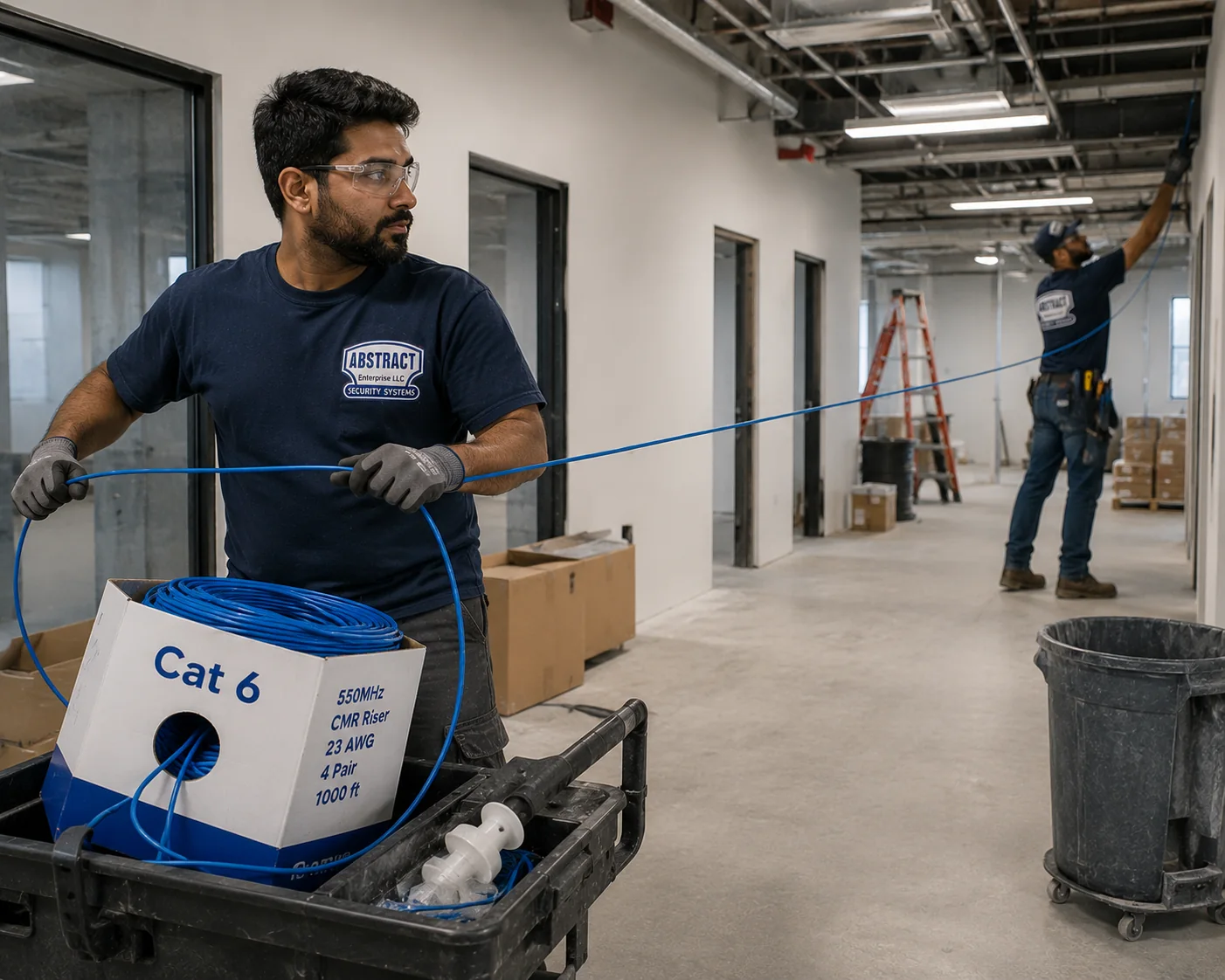
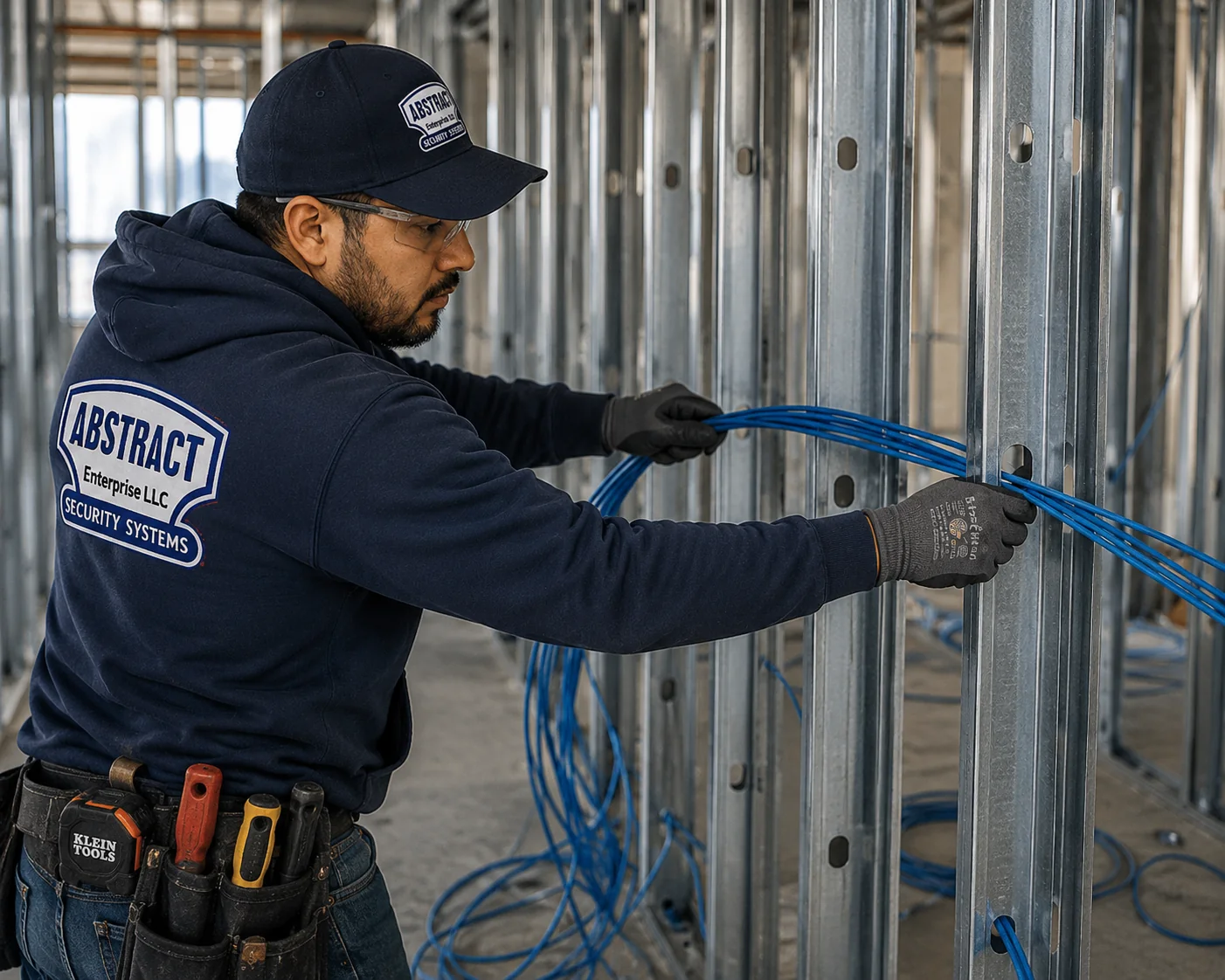
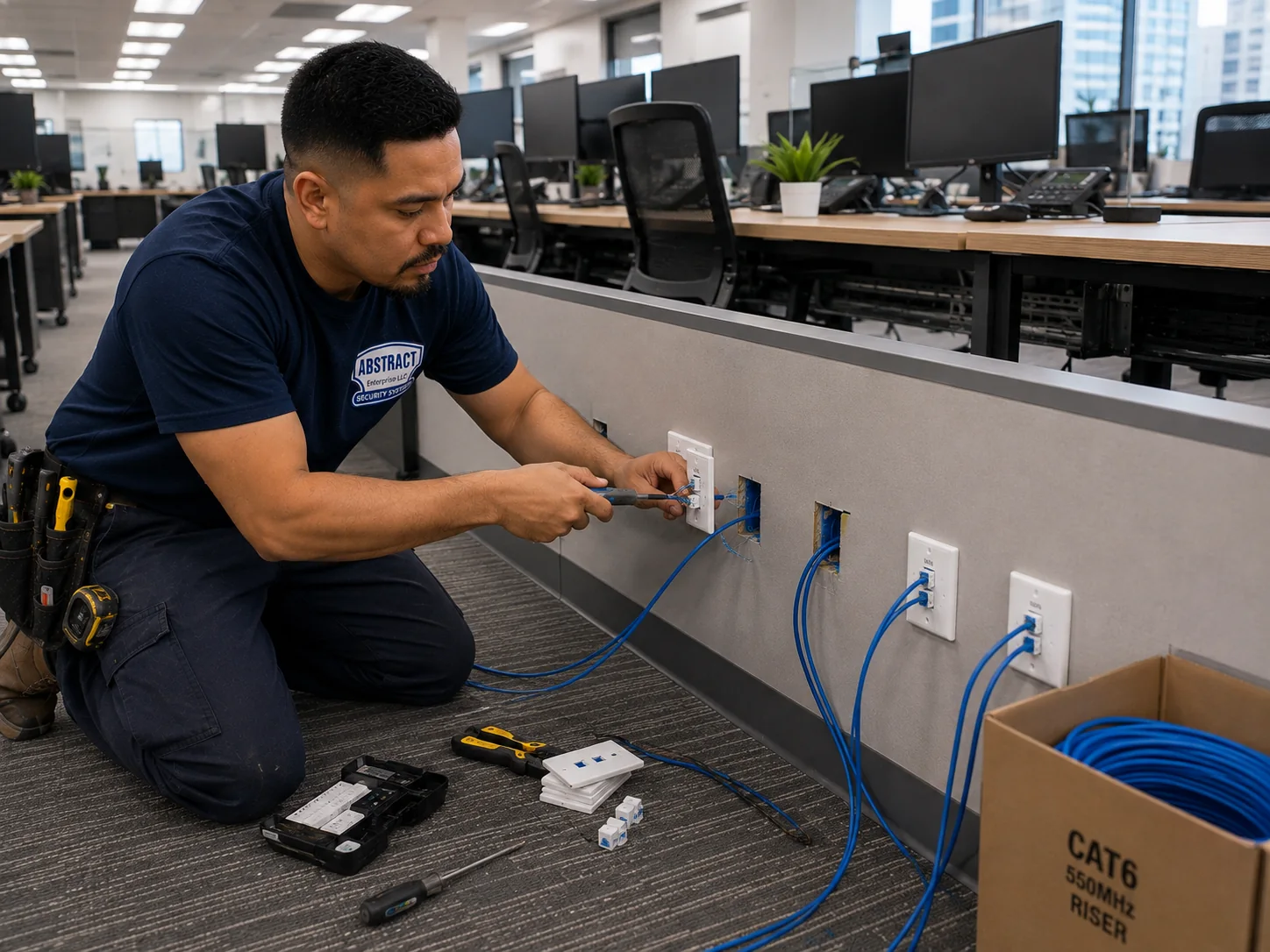
Containment and pathway up, cable pulled, penetrations firestopped, boxes mounted, cable dressed back to the panel with slack at both ends.
Outlets landed, plates fitted, panel punched down, hardware mounted, every end marked as it is made — and containment trim left off until testing is done.
All of them, before anything is closed or covered. Failures corrected while access remains, then verified again.
Results, mapping, naming, materials and photographs of every route before trim went on. Site cleared and the room left presentable.
A share of Ulster work comes through general contractors on fit-outs and restorations. We hold your sequence, provide insurance and paperwork in your format, agree containment routing with you and the owner before anything is fixed to a wall, and hand back documentation that drops into your closeout. On a restoration that coordination matters more than on a new build, because the surfaces are the reason the project exists.
Not testimonials — the commitments that apply to every Ulster job.
Whether a partition can be fished is established by testing it, so the method on the quote is the method on site.
Routing agreed with whoever owns the room before anything is fixed to a surface people are going to look at.
Each run verified before trim goes on or tile goes back, certified to permanent link where the job calls for it.
Any run leaving conditioned space gets cable and housings selected for the conditions rather than an office specification.
On rural work, mobilisation appears on the quote as its own line rather than hidden inside an inflated drop rate.
The warranty is printed below, and anything you add later is picked up as continuing work.
The switch gets swapped, the router reconfigured and the carrier called twice before anyone suspects the cable.
We start at the panel rather than the desk. Identify the run, test the permanent link, take the result at face value. If it passes, the permanent cable is exonerated and attention moves to a patch cord, a switch port or the hardware. A failure tells you which parameter went, and nine times in ten that trail ends at a termination before it reaches damage or distance. Redoing both ends clears most of them — and on a rural site, knowing that before driving out is worth the call.
Cat6 is $333 a drop on runs inside 100 feet, holding the cable, the plate and keystone, terminations at both ends and the test on the finished run. New construction quoted before drywall comes off ten percent, and past 100 feet we measure the route as installed. Ulster is the furthest county we cover and we say so at the estimate — on a job out past New Paltz or up toward Saugerties, mobilisation is a real component rather than something to bury in the drop rate.
Because Kingston, Saugerties, Rosendale and the smaller village centres carry an unusually deep stock of nineteenth-century masonry — the Stockade District alone is one of the oldest continuously commercial streetscapes in the state. Those buildings hold restaurants, professional offices, galleries, retail and increasingly residential above, and they share a set of conditions: brick or stone with no wall cavity, plaster over lath where there is any partition at all, pressed tin ceilings, and exposed structure that tenants deliberately keep. Fishing is usually off the table before we start.
Yes, and Ulster has several. The practical effect is that what may be altered, penetrated or left visible can require review beyond the building department, and that review takes time nobody budgets for. We raise it at the walkthrough rather than discovering it. Where a facade or a designated interior is involved, containment routing becomes a conversation with the owner and sometimes with a commission before anything goes up.
More is left to individual towns, villages and the City of Kingston here than in the counties that run centralised licensing. That means the requirement genuinely changes across municipal boundaries, and the right answer depends on where the building sits. Ask any bidder which licence they carry and which authority issued it, then confirm with your own municipality before the job is scoped. Monitored alarm, camera and access control work sits under a separate state-level requirement that plain data cabling does not.
A walkthrough that fixes drop positions and the route, the pull on supported pathway, a keystone at the outlet and a panel port at the closet, plate and panel mounted, both ends marked, a test on every finished run, and a map tying each port to the outlet it serves. Racks, panels, management, cords, switches, conduit, containment, firestopping, lift hire and out-of-hours work are separate lines.
Two at each seat, a port of its own for any shared printer, one behind each radio, camera and reader, one per register, and three or four wherever a screen lives. In masonry buildings add radios — coverage dies at a stone wall in a way it never does in drywall, so the radio count runs above what the square footage suggests, and each one is another drop.
Across a shortened distance, yes — around 55 metres is the number usually quoted, and a densely packed bundle pulls it in further. A full hundred-metre ten gigabit channel is Cat6A rather than Cat6. For the desks, handsets, cameras and radios that make up almost every drop in this county, Cat6 is the correct specification and the sensible spend.
Copper-clad aluminium wraps an aluminium core in a copper skin. Cheaper on the reel and not the same cable. Aluminium resists more, which matters the moment a device is drawing power down the pair, and it is brittle enough to fracture at the punch-down. It shows a link light and still fails the equipment on the end. Every run we install is copper.
Where the void above the ceiling handles return air, plenum jacket applies; vertical shafts between floors take riser. Converted and historic buildings are exactly the ones that catch people out here, because how a nineteenth-century building was later fitted with mechanical services rarely matches what its age suggests. Settled on site with the building and the authority having jurisdiction rather than assumed.
Not by re-terminating it — category is a property of the cable, so an upgrade means new cable. The route is sometimes reusable. Where the old 5e sits in conduit or on a serviceable hook run, the replacement follows it and the saving is real. In older buildings, where cable was often run loose when the space was first occupied, there is usually nothing worth keeping.
Yes. New Paltz carries the campus itself plus the commercial strip serving it along Main Street and Route 299 — restaurants, retail, professional offices and student-adjacent businesses, much of it in older stock with the same masonry constraints as Kingston. Campus and institutional work brings its own conventions and closeout requirements, and the surrounding commercial runs on a calendar shaped by term dates rather than a conventional business year.
Yes. Restaurants and retail in the village centres cannot absorb a crew during service, medical practices schedule around patients, and school and campus work runs to fixed breaks. Ulster adds a seasonal layer too — a good deal of hospitality and tourism-facing commercial needs work finished before a season rather than by a date. Out-of-hours premiums are quoted as their own line.
Tell us about the building, roughly how many drops you need, and when. Wall construction matters most here — drywall, plaster over lath or solid masonry — so tell us what you know.
🛡 Cat6 installation warranty. Abstract Enterprises Security Systems provides a three-year warranty on products supplied by AESS for normal wear and tear. It does not cover existing or customer wiring, customer-supplied equipment, lightning or other acts of God, power outages or surges, physical damage or unplugging, internet, router or phone changes, or camera readjustments requested after completion. After the warranty period, service is $195 per hour with a three-hour minimum ($585). Full terms: abstractenterprisessecuritysystems.com/warranty.
Call 845-640-3835
WhatsApp message us
NYS Low Voltage License #12000287431
4.7 / 201 Google Reviews
We'll follow up to arrange a walkthrough.