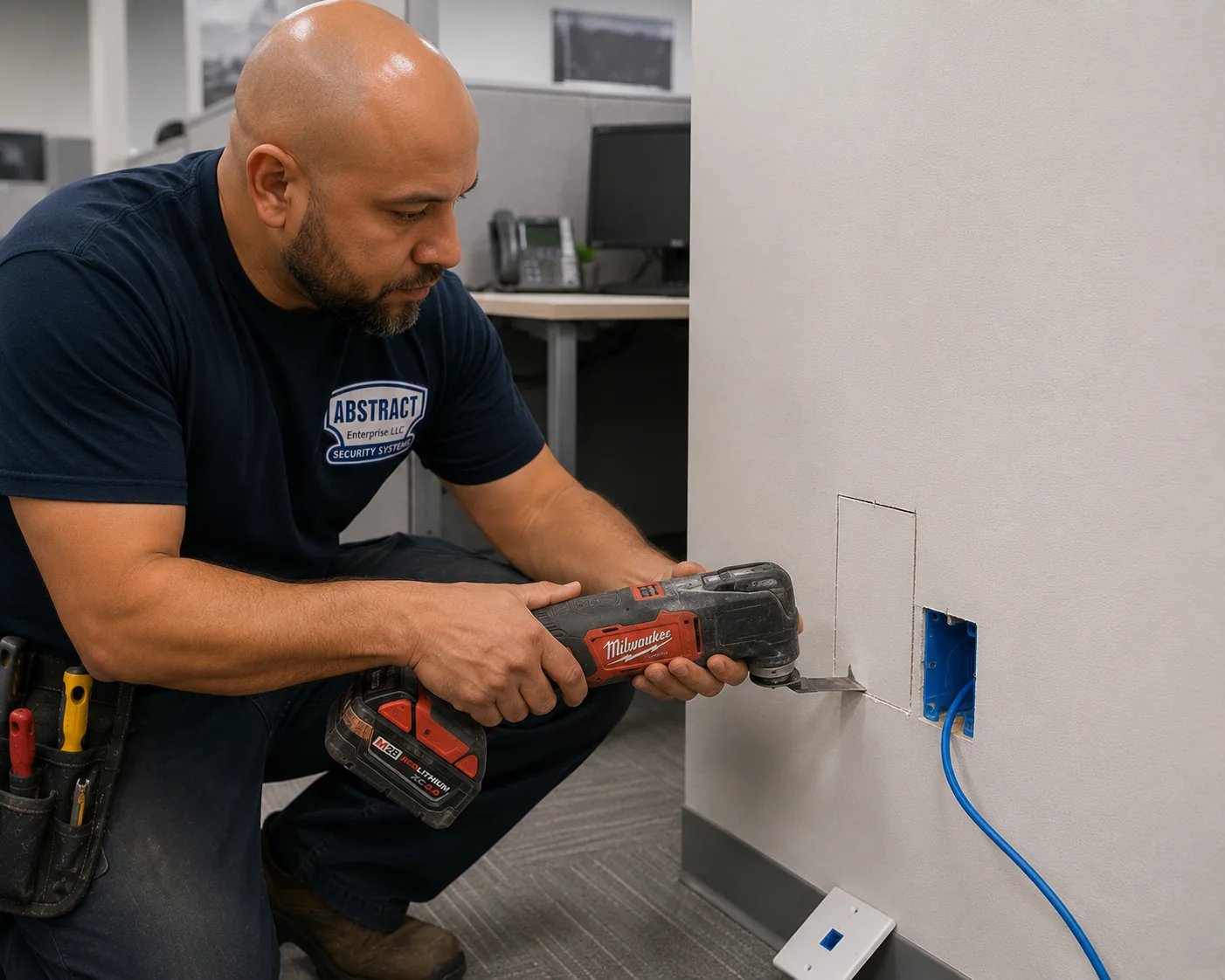
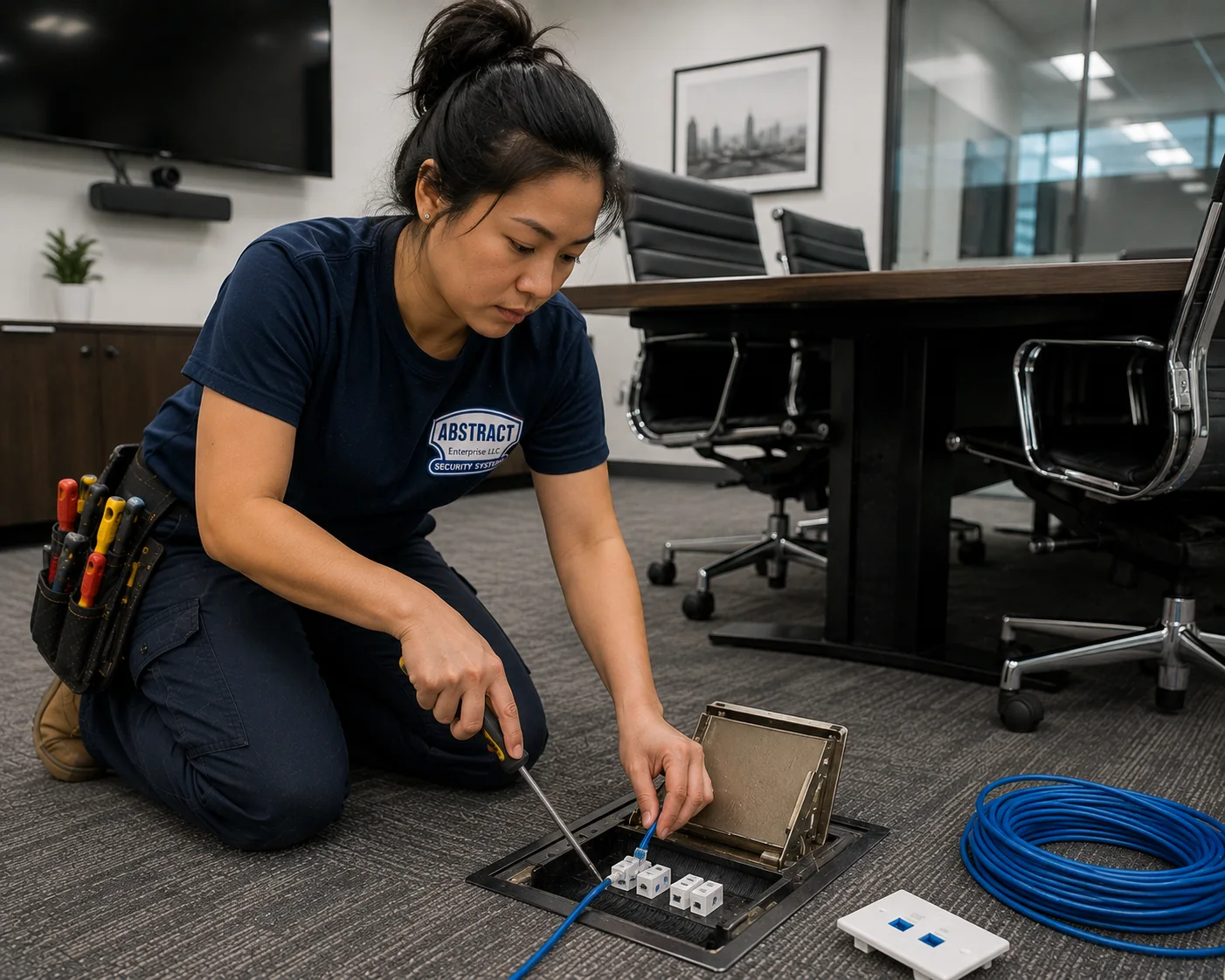
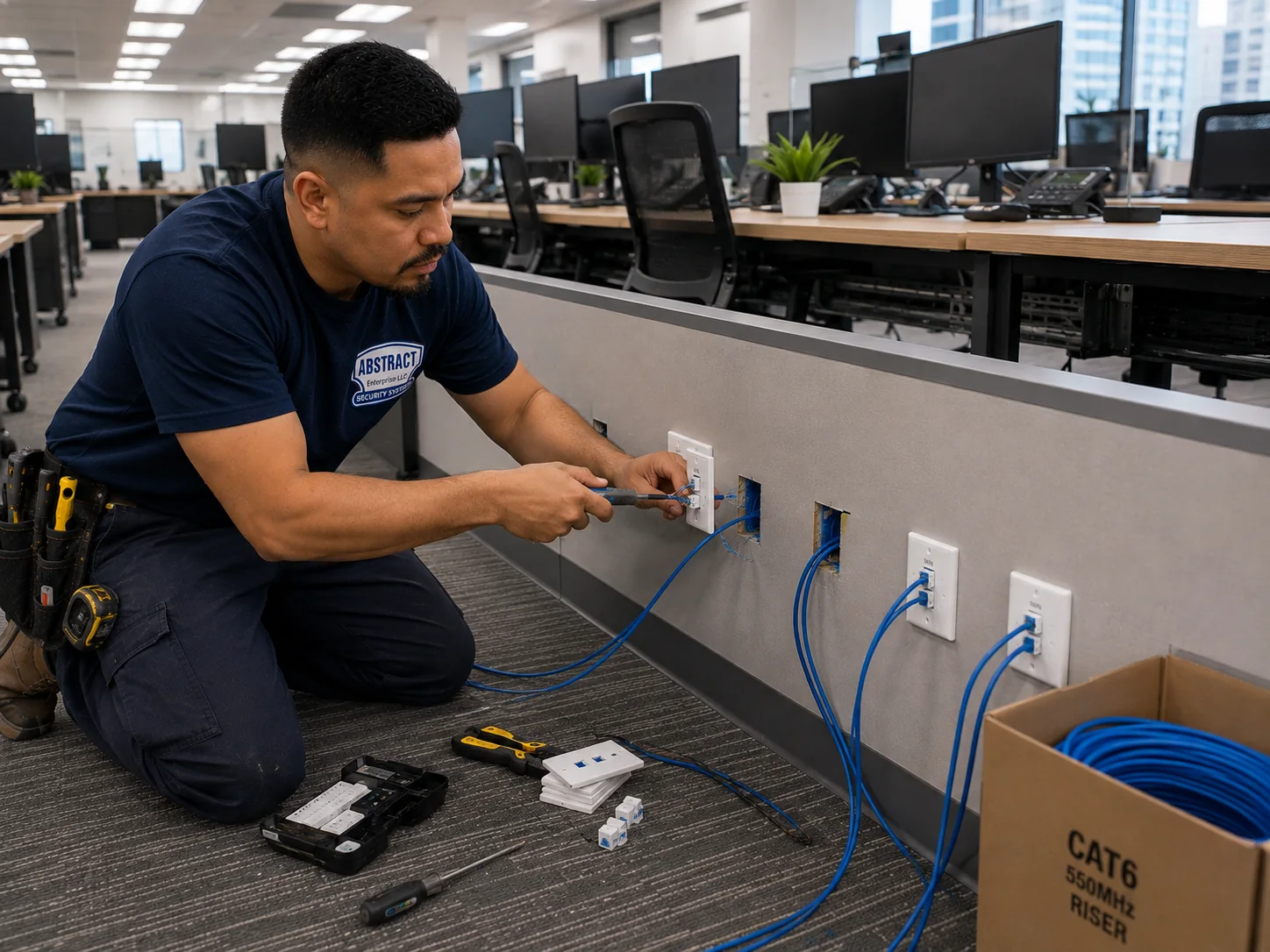
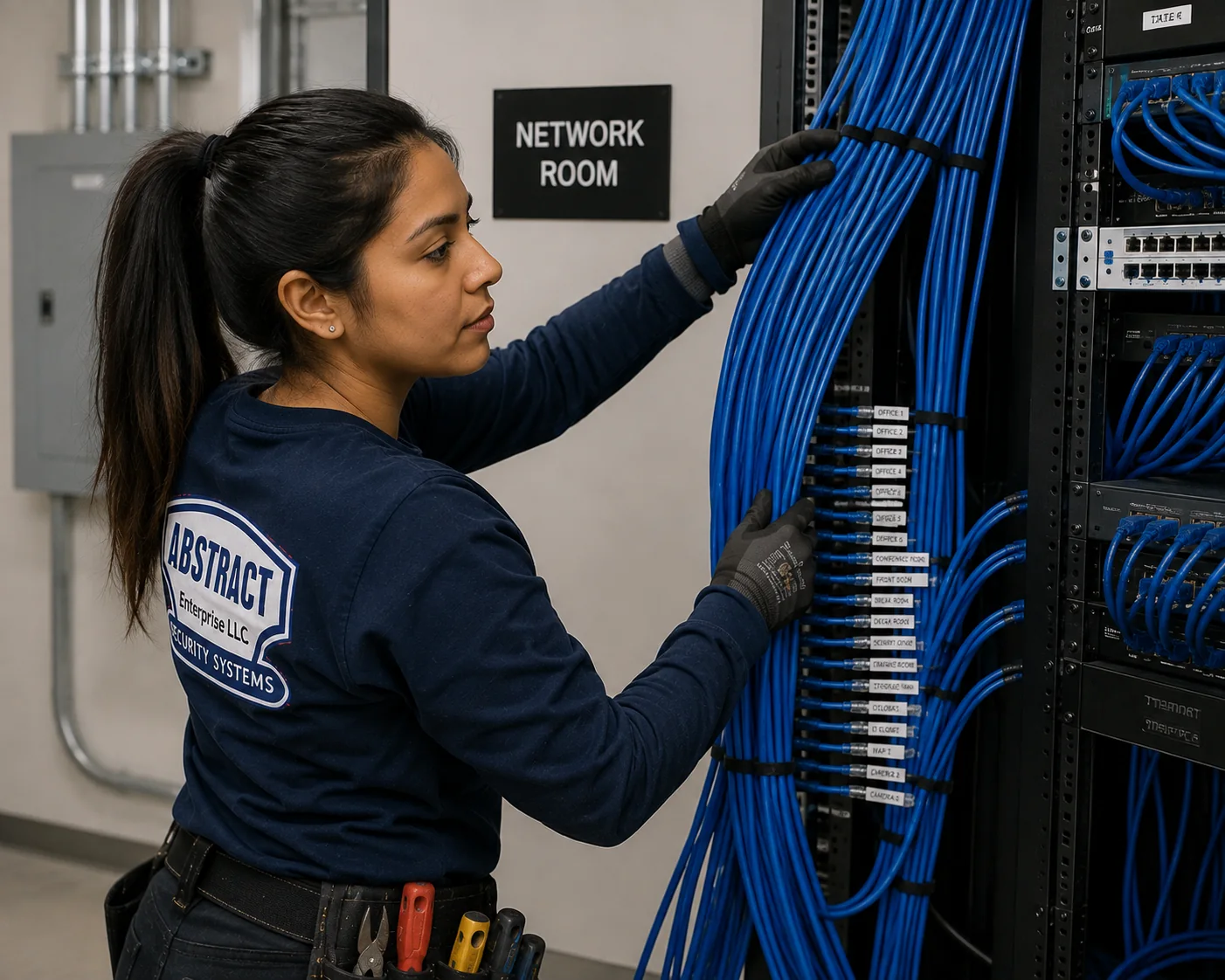
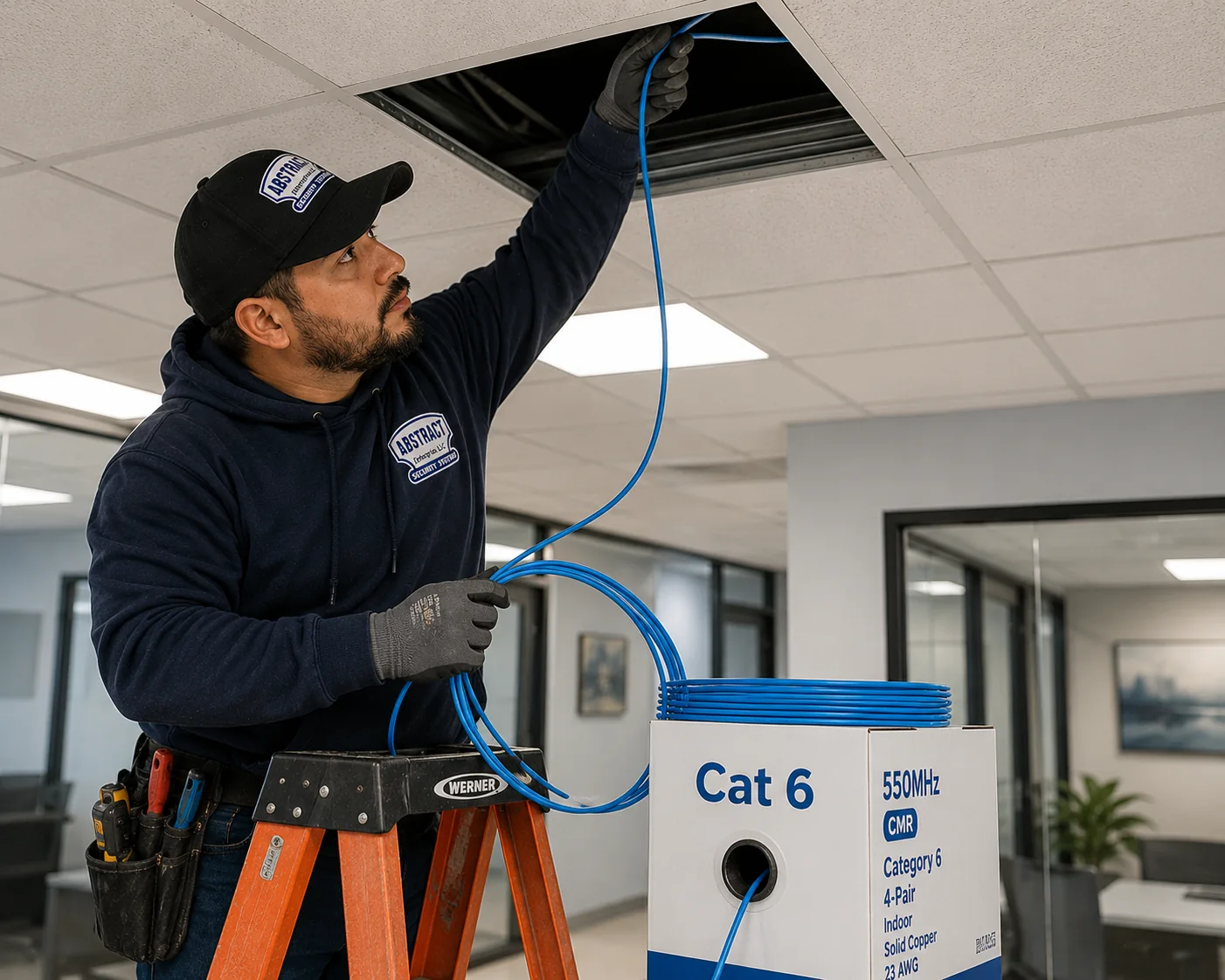
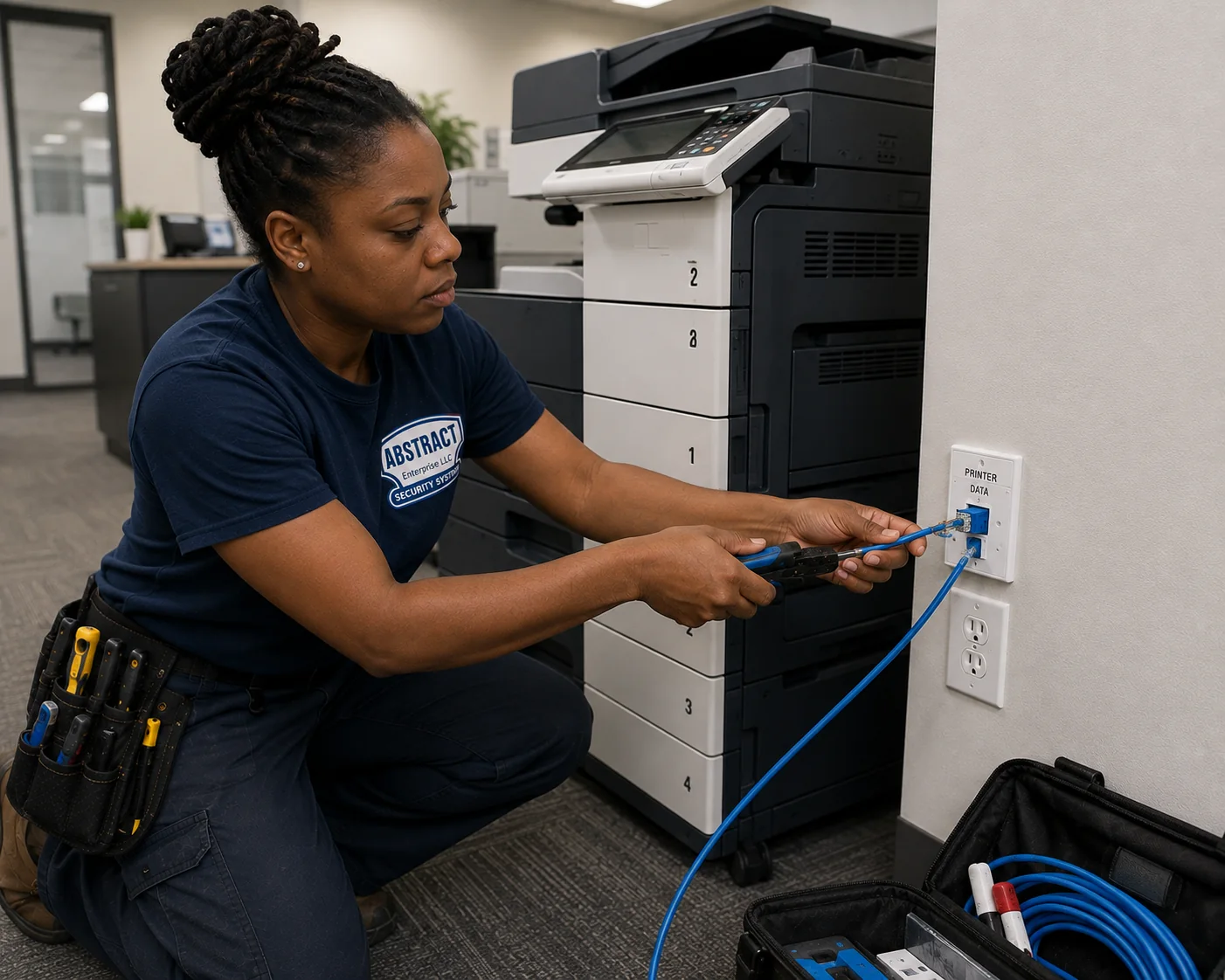
Cat6 installation for the distribution and logistics belt around the I-84 and I-87 interchanges, the Route 17K commercial corridor, Newburgh’s historic downtown, the Middletown medical corridor, Goshen government buildings, retail and homes. Each run supported the whole way, terminated on matched components, tested, marked at both ends and documented before we leave.
More of this county is under construction than anywhere else we work, and that changes the economics. Cable installed before drywall costs roughly a third of the same cable installed after it — so on an Orange County job, when you call matters nearly as much as who you call.
Tell us the building and rough drop count — we'll come back with a number.
Two bids on the same Montgomery distribution building can mean entirely different things by the word "drop." Here is what it means on ours.
Itemised as their own lines rather than folded into a per-drop figure: cabinet or floor rack, panels, management hardware, cords, switches, conduit where required, surface containment in masonry, firestopping, coring, lift hire on high-bay work, fiber between telecom rooms, mapping of inherited cable, and any out-of-hours premium.
The Orange County question. On a new building, ask each bidder when they need to be on site. A price that assumes access after drywall is a retrofit price wearing a new-construction label, and the difference between the two is roughly three times the labour on identical cable.
Most markets in our footprint are retrofit markets. Orange County is not, and that changes both the method and the economics.
The interchanges where I-84 and I-87 meet, together with the corridors running toward Stewart International Airport, have absorbed a large volume of distribution and logistics construction over the past decade. Add commercial development along Route 17K and Route 300, medical expansion around Middletown, and steady residential growth, and a meaningful share of the work here happens in buildings that do not have walls yet.
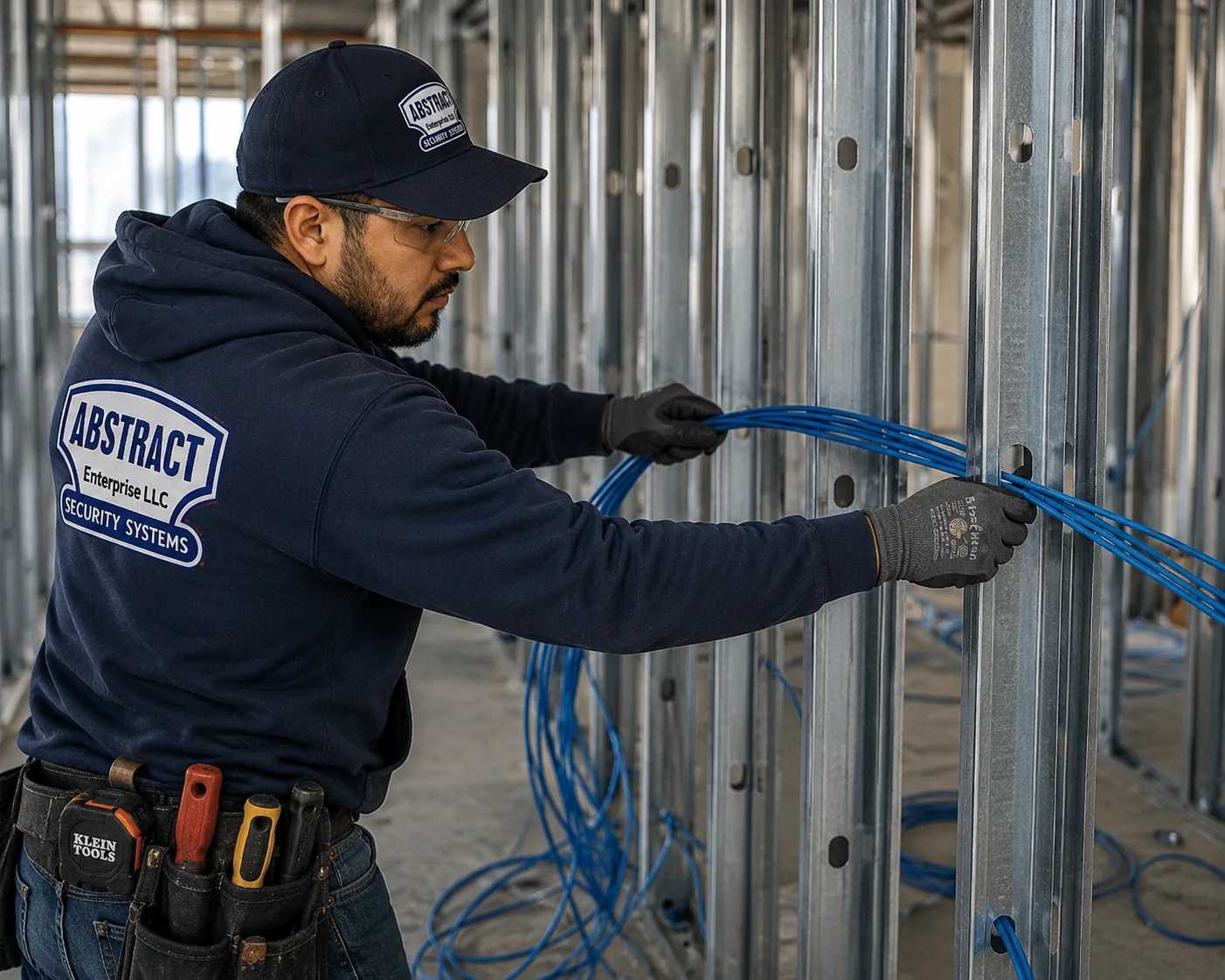
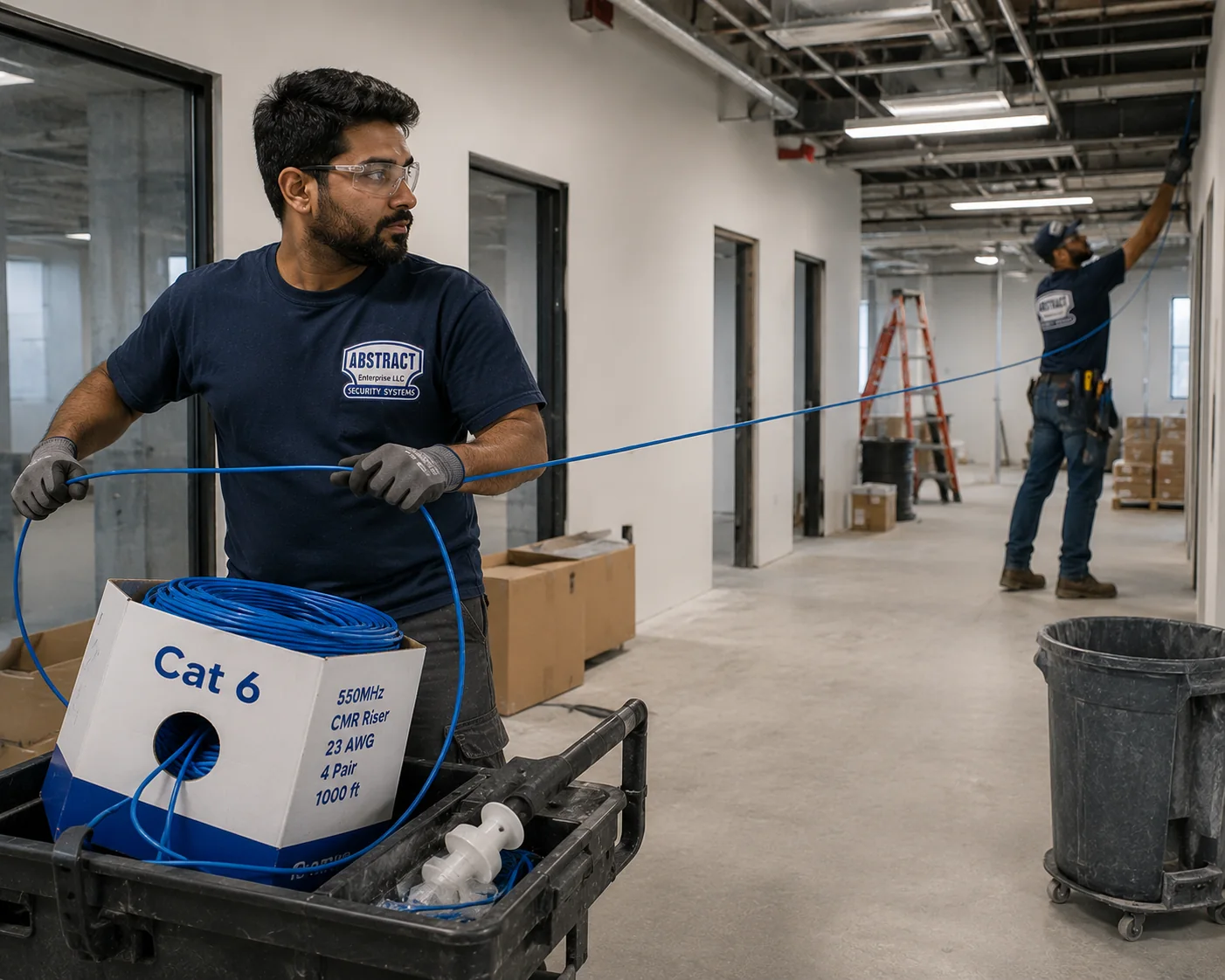
That is the best situation cabling ever gets. Open structure, no fishing, no patching, no working around an occupied tenant, and ten percent off the drop price for pricing before drywall. The catch is that the window is short and it closes permanently. Between framing and drywall there are usually a couple of weeks, and a contractor who is called at punch list instead is quoting a retrofit on a brand-new building — roughly three times the labour for exactly the same cable.
The second consequence is scale. A distribution envelope is not a floor plate, it is a field with a roof on it, and no single telecom room reaches the corners. Room count and fiber between rooms are the design, decided from drawings and a site walk rather than discovered when the first run tests long.
The county's signature building type and the reason a lot of contractors come here. Very large envelopes, cable tray, lift work throughout, long horizontal runs, and pathway that has to survive racking being reconfigured and dock traffic underneath it. Multiple telecom rooms joined on fiber, because a single room cannot reach the far corners of a building that size.
Along Route 17K, Route 300 and the Stewart corridor. Conventional buildings, accessible ceilings, adequate telecom space — and, crucially, frequently available at pre-wire stage. The easiest cabling in our coverage when the timing works, and ordinary retrofit when it does not.
Newburgh's waterfront and downtown, along with Goshen, Warwick and Montgomery village centres. Nineteenth-century masonry, no wall cavity, often no ceiling void, exposed structure where a tenant wants it visible. Containment planned as a finish detail, existing conduit where any survives, and historic district review where it applies.
The Crystal Run area and surrounding practices carry the county's medical concentration. High drop density — a workstation in every exam room, imaging equipment on its own wired connection, front desk clusters, cameras and readers on the same plant — with scheduling built around patient hours and containment when ceilings are opened.
Goshen carries county government and courts, and the county's school district and municipal inventory is substantial. Fixed calendar windows on school work, specified deliverables, submittal requirements, and closeout documentation written into the contract rather than offered as a courtesy.
The Woodbury and Central Valley retail cluster, plus highway commercial along the main corridors. Storefront and inline work, registers that belong on wired connections, back-of-house runs into hot and greasy environments, and a finished customer-facing ceiling that usually rules out visible pathway. Work happens outside trading hours because the store opens the next day.
A large county with its commercial weight concentrated along the interstates, the Route 17K corridor and a handful of historic centres.
Newburgh is effectively two markets. The historic waterfront and downtown along lower Broadway and the river carry nineteenth-century masonry buildings, many being repurposed for restaurants, offices, studios and residential — work that needs containment rather than fishing. Out along Route 17K and Route 300 the character changes completely into modern commercial: retail, offices, medical suites and light industrial in buildings from the past few decades, with steady new construction alongside.
The area around Stewart International Airport in New Windsor, together with Montgomery, Maybrook and the I-84 and I-87 interchanges, holds the county's distribution and logistics concentration. Large-footprint warehouse and fulfilment buildings, much of it recent construction, where the work is tray, lifts, multiple telecom rooms and fiber between them. Facility access requirements at some sites need arranging in advance rather than at the gate.
Middletown carries the county's medical concentration around the Crystal Run corridor along with retail and commercial along Route 211. Goshen, the county seat, holds government buildings, courts, professional offices and a historic village centre where the older stock needs different methods from the modern commercial around it. Chester and the surrounding hamlets add light industrial and commercial serving both.
Woodbury and Central Valley hold the retail cluster around the outlet centre plus highway commercial along Route 32 and Route 17. Harriman and Monroe run to mixed commercial and substantial residential. Warwick in the southwest is a historic village centre surrounded by agricultural land, with wineries, farm businesses and small commercial spread across long distances — the part of the county where travel time genuinely enters the estimate. Port Jervis at the western tip is smaller commercial and municipal work at the end of a real drive.
New York has no single statewide licence for electrical or low-voltage contracting, and Orange leaves more to the municipality than its neighbours do.
The county administers contractor licensing through its Consumer Affairs and Weights and Measures office in Goshen, which publishes licence requirements along with the list of electrical inspectors it recognises. Beyond that, permits and inspection are generally a town, village or city matter, and each has its own building department with its own process.
The practical effect is that the answer to "what is required here" can change as you cross a municipal boundary on the same road — which, in a county this size with this many towns and villages, happens more than you would expect. A contractor working across Orange regularly should be able to tell you which authority governs your particular site and what they require, without hedging.
What we suggest. Ask every bidder, us included, which licence they hold and which authority issued it, then confirm the requirement for your scope with your own town, village or city before the job is scoped. Note separately that monitored alarm, camera and access control work is licensed at state level regardless of municipality, which is a different requirement from plain data cabling.
On new-build work the cabling scope usually sits inside a wider permit already held by the general contractor, and our part is coordinating with that rather than filing separately. On retrofit and standalone work, whether a permit or an inspection applies depends on the building, the scope, the pathway method and the authority having jurisdiction. We establish what is actually required with the relevant office before work is scoped rather than guessing in either direction.
More of the work here happens this way than anywhere else we cover, and it is by a wide margin the cheapest. Cable is installed with the structure still open, run back to the closet, and left coiled behind a mounted box at each outlet until the finishes crew is done; we return briefly to terminate, test and mark. The booking goes in ahead of the drywall contractor, because an open route is precisely what keeps the per-drop figure low, and the ten percent reduction attaches to work priced at that point.
Tray rather than hooks, lift work throughout, and long horizontal runs across an envelope no single telecom room can serve. Room count and fiber between rooms are settled from the drawings and a site walk. Pathway gets planned with room for racking to change, because it will, and routed clear of dock and forklift traffic.
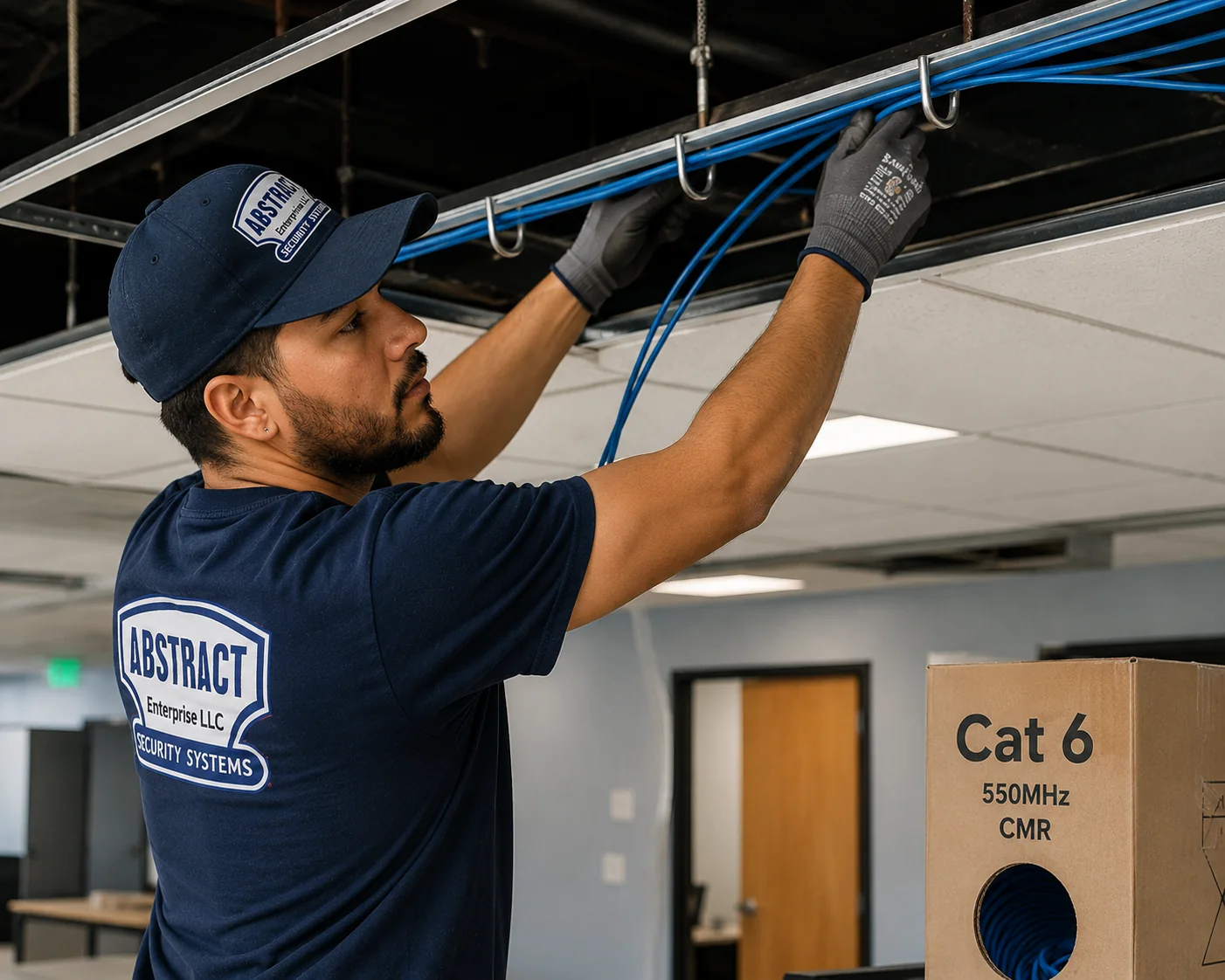
Cable above the tenant ceiling on new pathway, dropping at partitions, staged so the space is usable at the end of each shift. In retail and medical that means working outside trading or patient hours; in a distribution facility running around the clock it means fitting into whatever gap the operation allows rather than a conventional evening.
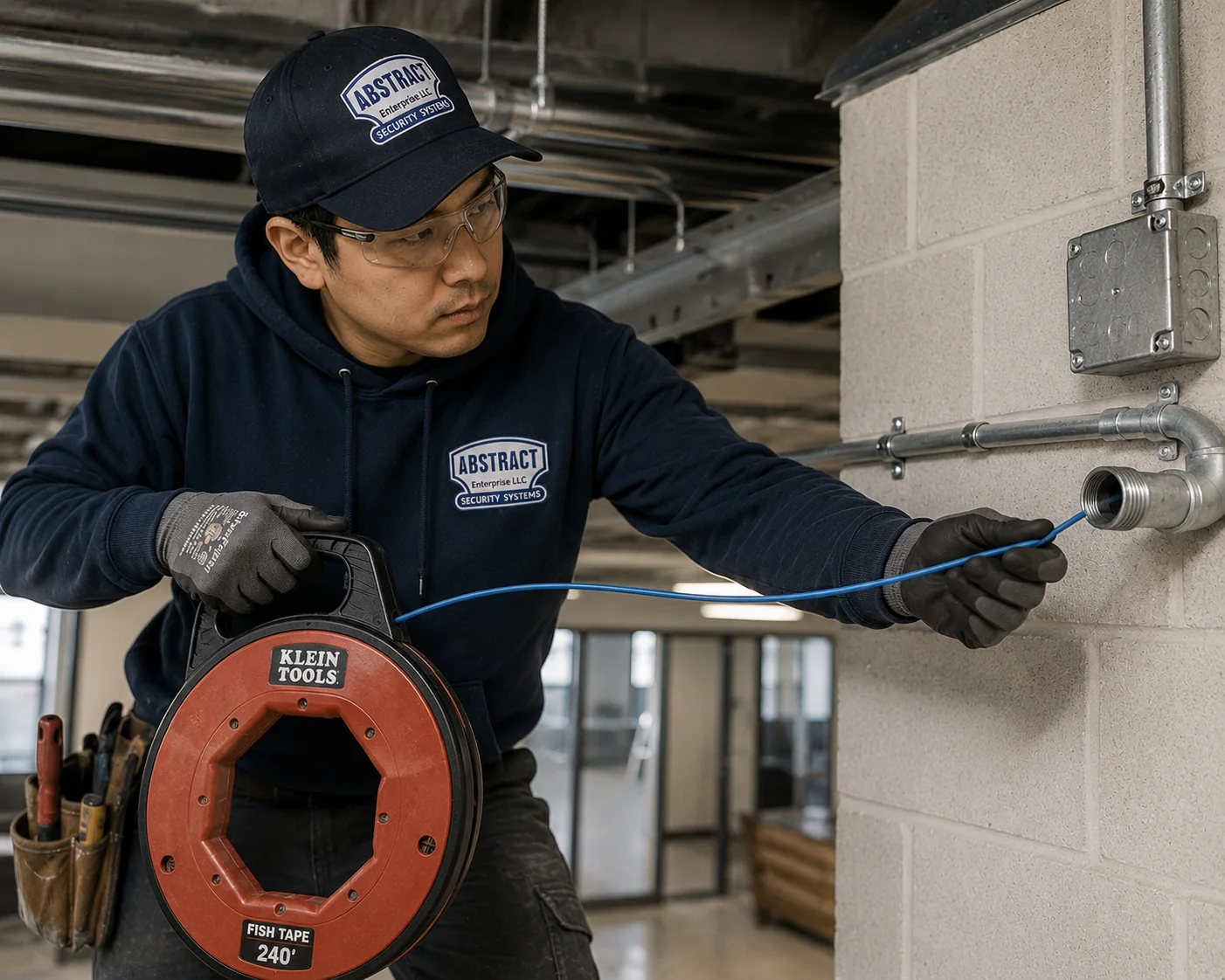
In Newburgh, Goshen, Warwick and the older village cores there is frequently no cavity to fish and no ceiling void to hide in. The honest methods are existing conduit where any survives, surface containment routed deliberately along structural lines, and building a telecom position where none existed. Pushing a rod through an old wall until something gives creates openings someone then has to fill, repaint and account for.
Most houses here wire well from basement and attic with minimal wall opening, with attic heat respected as a design input on powered runs. Farm and agricultural properties add outbuildings, long outdoor runs and unconditioned spaces, all of which change the jacket and the enclosure rather than the method.
Working and performing are separate claims about a cable, and only the second one leaves a document behind.
Every drop is wiremap-tested before the ceiling closes. When the job requires full certification, we test permanent links with a Fluke DSX CableAnalyzer and deliver the pass/fail report with the closeout package.
A link light hides the faults that matter: a split pair reading continuous while degrading everything above it, a punch-down with an inch of conductor untwisted, a run that quietly went past ninety metres, a nick taken along the route. A permanent link test measures only what is built into the building, panel to outlet. Channel testing puts the cords back and reports what the equipment genuinely sees.
On new construction this discipline is easier and more valuable at once. Easier because access is open and a fault is minutes to fix. More valuable because on a large-envelope building the length parameter is doing real work — runs that are theoretically fine and 96 metres in practice are exactly the ones a big footprint produces, and catching them before the ceiling grid goes in is the difference between a correction and a redesign.
The rule that never bends: nothing closes until every run has been tested. On an occupied building that saves a demolition conversation. On a new build it saves the general contractor a sequencing problem, which is worth more to them than the cable.
Today a building's cameras, door readers, radios, handsets and intercoms all draw their power down the same pair that carries their traffic. A single pull, and no electrician trailing behind you to every device.
| Standard | Common name | Typically powers |
|---|---|---|
| 802.3af | PoE | Desk phones, basic fixed cameras, simple readers |
| 802.3at | PoE+ | Most current access points, PTZ and IR cameras, video intercoms |
| 802.3bt | PoE++ | High-power APs, heated outdoor domes, displays, higher-draw edge devices |
Current on a conductor produces heat, heat trapped inside a dense bundle cannot escape, and heat drives resistance up — more voltage lost along the run, less power arriving at the device. Copper conductor in a sensibly sized bundle absorbs it. CCA stretched out in a heavy bundle has nothing left in reserve.
Distribution buildings press on this harder than most. Cameras and radios sit at height under a roof that gets genuinely hot in summer, at the end of the longest runs on the site, inside the largest bundles. Add yard and dock coverage outdoors, where heated domes draw at the top of the range and the run to reach them is longer still. Switch power budgets get sized against everything running simultaneously rather than a spreadsheet average, and that gets flagged at design rather than at commissioning.
Published per drop so the numbers can be run before a site visit is booked.
| Cable type | Per drop, runs to 100 ft |
|---|---|
| Cat5e | $276 |
| Cat6 | $321 |
| Cat6A | $459 |
| Coax / RG6 | $276 |
| Speaker wire | $229 |
| HDMI | $367 |
| Fiber — multimode | $642 |
| Fiber — singlemode | $733 |
Every figure carries the cable, the plate and keystone, terminations at each end and the completed-run test. New construction quoted before drywall comes down ten percent — which, given how much of this county is new-build, applies more often here than anywhere else we work. Past 100 feet we measure the run as it was actually installed and price from that.
Quoted separately: cabinet or floor rack, panels, cable management, cords, switches, conduit where required, surface containment in masonry, firestopping, coring, lift hire on high-bay work, fiber between telecom rooms, environment-rated cable for outdoor and agricultural runs, mapping of inherited cable, and evening, weekend or overnight premiums.
Run the numbers yourself in the cabling quote builder, or call and describe the building.
Cat6 belongs in almost every Orange County drop. The 250 MHz margin over Cat5e's 100 MHz carries a warm warehouse ceiling, a crowded bundle and a slightly imperfect termination without the link stepping down, and on new work the difference is $45 a drop. Cat6A earns its $459 where full-distance ten gigabit is genuinely specified, on uplinks and server links, and between telecom rooms in a large-envelope building. It buys no reach at all, so it never answers a distance problem — that is what another room and a fiber link are for.
CMP where the ceiling void moves return air, CMR climbing between floors, CM anywhere neither applies. Even in recent construction the arrangement is not always obvious from below, so it is settled on site with the building and the authority having jurisdiction rather than inferred from the building's age.
UTP is what belongs in nearly every building we walk into. Shielded cable needs proper bonding and grounding at the rack to function at all; an ungrounded shield behaves as an antenna and can measure worse than plain UTP. It earns its place on distribution and manufacturing floors with conveyor drives and significant motor loads, and where a long parallel beside power is genuinely unavoidable.
Copper conductor on every horizontal run. Beyond that, Orange County asks an environmental question more often than most: runs to yard cameras, dock equipment, farm outbuildings and unconditioned agricultural structures need a jacket and an enclosure chosen for those conditions rather than an office specification and optimism.
| Location | Drops | Why |
|---|---|---|
| Workstation | 2 | Computer plus handset, dock or a future second device |
| Printer / copier | 1–2 | Shared devices get their own port |
| Wireless access point | 1 | Wired backhaul; large envelopes need many radios, not stronger ones |
| IP camera | 1 | Data and power on a single run |
| Door reader | 1 | Where the access system is IP at the door |
| Dock position | 1–2 | Scanner, camera and door control at each bay |
| Exam room | 1–2 | Workstation plus imaging or chairside equipment |
| Conference room | 3–4 | Display or codec, table or floor box, camera, spare |
| Register / POS | 1 | Card processing wired rather than on shared wireless |
On a warehouse or distribution envelope this is the first design question rather than a detail. A single room cannot serve the corners of a very large footprint, so the answer is several rooms placed to split the building sensibly, each with power and ventilation, joined on fiber. Getting that right from the drawings costs nothing; getting it wrong means discovering at test that a whole zone sits past the limit.
Terminated and identified at the panel, then left coiled in the ceiling or capped behind a blank. On new construction the case is overwhelming — while the structure is open, an extra drop is cable and a few minutes, and once the building is finished it is a scheduled visit with a lift. Six or eight spares on a large new build is cheap insurance rather than an upsell.
Method commentary, not case studies. Recurring patterns, described generally.
A brand-new building cabled as a retrofit because nobody rang until finishes were on. Same cable, roughly three times the labour, and the discount gone.
A distribution building designed around a single telecom room, with whole zones sitting past the limit once the runs are actually measured.
Fulfilment floors get rearranged constantly. Tray routed snugly around one rack arrangement finds itself hanging above a traffic aisle after the next change.
Standard jacket run to a dock camera or a farm outbuilding. UV and moisture do the rest on their own timetable.
Surface raceway in a Newburgh storefront installed wherever the cable happened to land. In a room where people can see it, the shortcut is obvious.
Access points and cameras up in a warehouse roof at the end of long runs, with a switch budget sized on paper rather than for everything drawing at once.
Spares cut from the scope to save a few hundred dollars during construction, then added back a year later at several times the cost with a lift.
A 5e keystone landed on Cat6 because it was in reach. The channel drops a grade and the drop gets built a second time.
Cable dropped onto grid and tile because it was faster. Against code, and underfoot for every trade that follows.
Cable trimmed exactly to length. Half a foot short and the next re-termination costs an entirely new pull.
Sound cable, sound terminations, nothing written down. From then on every change starts with a toner and an hour.
Ceiling grid in and finishes on with no test run. Whatever went wrong is now sealed behind a finished surface at height.
Beyond a few drops the fixed cable ends at a panel and every connection after it is made with a cord. Slightly more on day one, repaid the first time a desk moves or a port dies, and the horizontal cable is terminated once and never disturbed again. On a distribution building that argument is stronger still, because touching a horizontal run at height means a lift and a shutdown window.
Everything is built to TIA-568, terminated T568B, unless the site is already running A throughout. Identifiers and mapping follow TIA-606-style convention, which is what keeps a room legible years later. One category runs through every part, because a 5e keystone on Cat6 pulls the entire channel down a grade and will not certify.
In large-footprint buildings the telecom rooms deserve real attention. They are frequently placed in whatever corner the layout left over, sometimes unconditioned, occasionally inside the warehouse envelope itself where dust and temperature are genuine factors. Enclosure choice, ventilation and physical protection are engineering considerations in those rooms rather than aesthetic ones, and they get raised from the drawings rather than discovered at rack-mounting.
Results for each run, the port-to-outlet mapping, the naming convention written so a non-cabling reader can use it, a materials schedule, drawings marked as built, and photographs of every route before it disappears. On new construction those photographs matter more than usual, because the next contractor into that ceiling will be pricing an unknown otherwise.
A share of the calls we take are not new installations at all. They are buildings where the plant works, roughly, but nobody can describe it — unlabeled runs, a panel labeled for a layout two tenants ago, cable of unknown vintage. Tracing, mapping, marking and writing up an existing plant is work in its own right, and on a building that otherwise functions it often delivers more than any amount of new cable.
The single largest cost lever in this county. Identical cable in the same building costs roughly three times as much once drywall is on, and the ten percent pre-drywall discount disappears with it. Timing beats every other decision on the list.
Roughly 43% more per drop, buying ten gigabit across the full run. Justified between telecom rooms, into servers, and where a drawing calls it out. At a desk or behind a radio it buys headroom nothing draws on, and no extra distance.
Existing 5e that certifies clean is not worth tearing out. For new permanent cable the difference is $45 a drop, and Cat6's margin covers heat, bundle density and power draw. Hard to defend 5e on anything you intend to keep.
On a large envelope this is not a preference. A single telecom room cannot reach the corners, and the answer is several placed to split the building, joined on fiber, decided from the drawings.
Yards, docks, outbuildings and agricultural structures are not places for office cable. Jacket and enclosure get chosen for the conditions, and that is specification rather than an upgrade.
One of these is cable and the other is a compromise pretending to be. It resists more, the conductors break at the punch-down, and it folds the moment power is on it. A little saved on the box, and the building settles the difference later.
Someone walks the building or the drawings, establishes where the telecom rooms sit, marks drop positions, and works out the route. On a large envelope this settles room count and fiber between rooms before any figure exists.
Quantity at the published rate, every piece of hardware and containment on its own line, any premium condition named rather than buried, and the pre-drywall reduction applied wherever the schedule earns it. Deposit up front, balance at completion.
Insurance to the general contractor or owner, sequence agreed with the GC, access and hours confirmed, lift arranged, site credentialing sorted where a facility requires it, and licensing and permit position confirmed with the municipality.
Pathway and containment installed, cable pulled while structure is open, penetrations firestopped, boxes set, cable dressed into the telecom rooms with service loop.
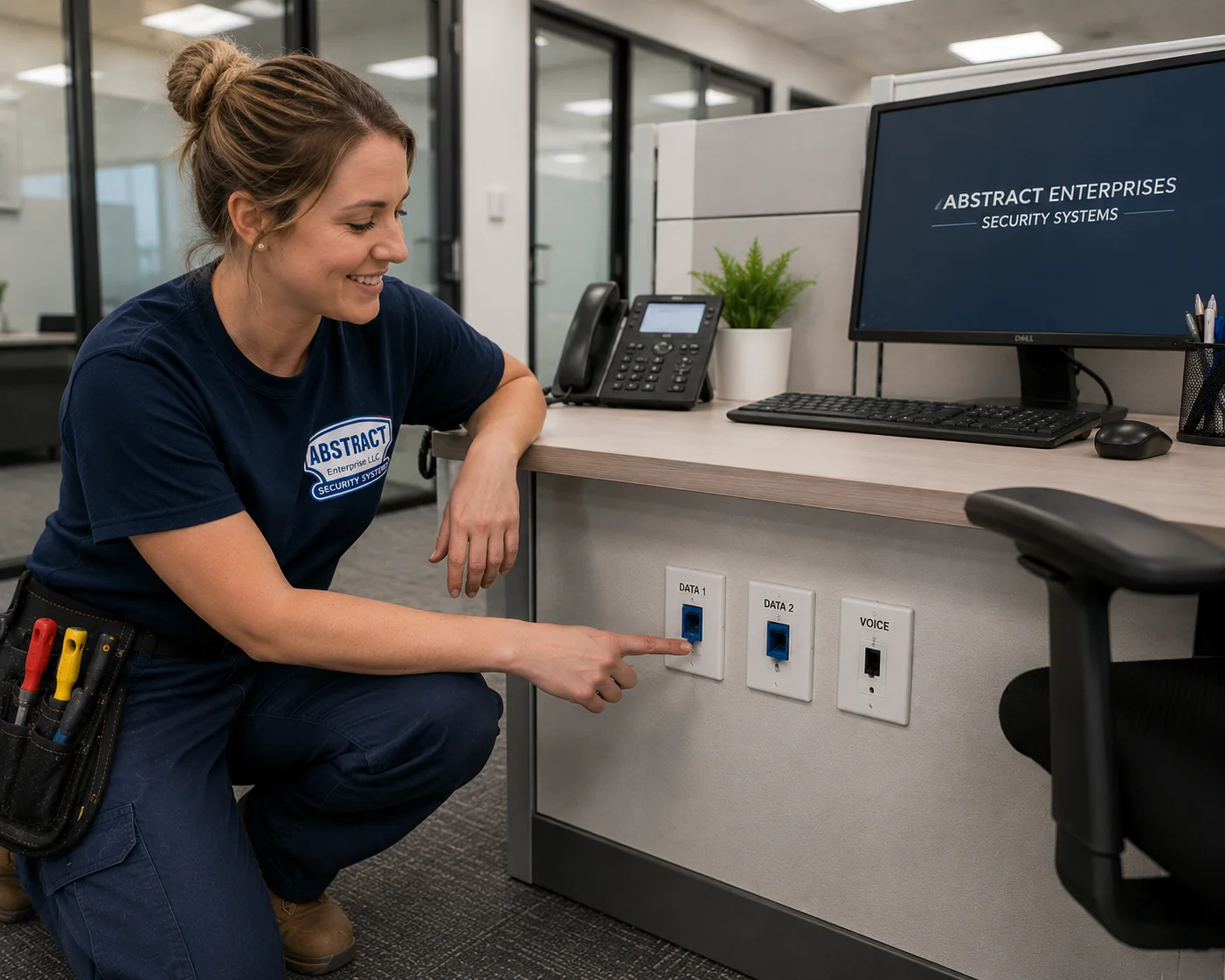
Outlets landed after finishes, plates fitted, panels punched down, rack hardware mounted, every end marked as it is made.
Every drop, before ceilings close. Failures corrected while access is open, then re-tested. Results recorded per run.
Results, mapping, naming convention, materials and marked drawings delivered into the GC's package. Concealed routes photographed first, then the site cleared.
More of our Orange County work arrives through general contractors than through end clients, which is what you would expect in a new-build market. We fit your sequence rather than asking you to fit ours, supply insurance and submittals in whatever format you use, agree ceiling and containment space with mechanical and electrical up front instead of competing for it on site, attend coordination meetings where they exist, and hand back closeout paperwork that slots into your package. Taking on a data package you would rather not carry in-house is normal work for us.
Not testimonials — the commitments that apply to every Cat6 job we take in Orange County.
On new construction we work to your schedule and get in ahead of drywall, because that is where the saving actually is.
On a large envelope, telecom room count and placement come from the drawings and a site walk rather than from an assumption that one will do.
Each run gets tested before the building closes over it, and certified to permanent link on any project that calls for it.
Results, mapping, naming convention and materials list delivered in a format a GC closeout submittal will accept.
Copper throughout, matched components, and jacket and housing ratings selected for the conditions the run will actually live in.
The warranty is set out below, and any later move or addition is picked up as continuing work.
The switch gets swapped, the firewall reconfigured and the carrier called twice before anyone looks at the cabling.
Diagnosis begins at the panel rather than the workstation. Identify the run, test the permanent link, and take the reading at face value. A pass clears the building's cable and points at a cord, a switch port or the hardware. A failure names the parameter at fault, which points at a termination first, physical damage second and length third. Redoing both ends resolves the bulk of them.
A Cat6 drop is $321 inside 100 feet, covering the cable, the faceplate and jack, terminations at both ends and the test on the completed run. Work quoted ahead of drywall on new construction comes off ten percent, and beyond 100 feet we measure the installed route and price against it. Orange sits at the western edge of our coverage, and the rate reflects that — the trade-off is that a great deal of work here is new-build, where the pre-drywall discount and the open pathway together make it the least expensive cabling in our whole footprint.
Because more of the work here is new construction than anywhere else we cover. The distribution and logistics build-out around the I-84 and I-87 interchanges, plus commercial development along Route 17K and toward Stewart, means we are frequently working in buildings that do not have walls yet. That is the best possible situation for cabling — open structure, no fishing, no patching, ten percent off — but the window between framing and drywall is short and it does not reopen. Calling at framing rather than at punch list is worth real money.
Yes, and it is a substantial share of what Orange County asks for. That work is cable tray rather than J-hooks, lift work throughout, long horizontal runs, and pathway routed clear of racking and dock traffic. On buildings of that footprint the telecom room question dominates the design — a single room will not reach the corners of a very large envelope, so the answer is multiple rooms joined on fiber, decided at design rather than discovered at testing.
Orange administers contractor licensing through its Consumer Affairs and Weights and Measures office in Goshen, which publishes its requirements along with the list of recognised electrical inspectors. Permits and inspection are generally handled at town, village or city level, which means the requirement can change as you cross a municipal line on the same road. Ask every bidder which licence they hold and which authority issued it, then confirm against your own jurisdiction before the job is scoped. Monitored alarm, camera and access control work carries a separate state-level requirement regardless of municipality.
A site visit that settles drop positions and the route, the pull on properly supported pathway, a jack terminated at the outlet and a panel port in the telecom room, plate and panel mounted, identifiers printed at both ends, a test on every completed run, and a map tying each panel port to its outlet. Racks, panels, management hardware, cords, switches, conduit, firestopping, lift hire and out-of-hours premiums appear as their own lines rather than inside the drop price.
Two at every seat, a dedicated port for each shared printer, one behind every access point, camera and reader, one per register, and three or four in any room with a display. In a new building the argument for spares is stronger than anywhere, because adding a drop while the structure is open costs almost nothing and adding it once the ceiling is closed costs a scheduled visit.
Over a reduced reach, yes — the figure usually quoted is around 55 metres, and it shrinks inside a tightly packed bundle where alien crosstalk starts to matter. A full hundred-metre ten gigabit channel is a Cat6A specification. For desks, handsets, cameras and radios, which is what almost every drop here feeds, Cat6 is correct and the sensible spend.
Copper-clad aluminium is aluminium conductor plated with copper. Cheaper by the reel, not equivalent. Aluminium resists more, which matters enormously once power is on the pair, and it is brittle, so conductors break where they are landed and in the turn behind a plate. It will show a link and still starve a camera in a warehouse ceiling in July. Every horizontal run we install is copper.
Where cable passes through a space handling return air, plenum jacket applies; vertical shafts between floors take riser jacket. New commercial construction in Orange County varies in how return air is handled, and the arrangement is not always obvious from below even in a building only a few years old. We settle it on site against the building and the authority having jurisdiction rather than assuming.
There is no termination that converts one category into another; the rating belongs to the cable, so upgrading means new cable. The route is what can sometimes be reused. Buildings from the 1990s and 2000s often have hook runs or conduit still serviceable enough for the replacement to follow, and that reuse is where the budget is recovered. Cable run loose or stapled to structure leaves nothing behind worth keeping.
Yes, and they are a different discipline from the new-build work. Newburgh's waterfront and downtown, along with the older village centres in Goshen, Warwick and Montgomery, run to nineteenth-century masonry with no wall cavity and frequently no ceiling void. The workable methods are existing conduit where any exists, surface containment planned deliberately as a finish detail, and creating a telecom position where none was ever intended. In a designated historic area, what can be changed or left visible may need sign-off beyond the building department.
Yes. Occupied offices, medical practices working around patients, retail that has to open on time, and school districts with fixed summer breaks all push work outside business hours. Distribution facilities add their own version — many run around the clock, so cabling has to fit into whatever gap exists rather than a conventional evening. Out-of-hours premiums are quoted as their own line.
Send us the building, an approximate quantity and where you are in the schedule. If it is new construction, tell us where you are in the schedule — before drywall is worth ten percent and a great deal of labour.
🛡 Cat6 installation warranty. Abstract Enterprises Security Systems provides a three-year warranty on products supplied by AESS for normal wear and tear. It does not cover existing or customer wiring, customer-supplied equipment, lightning or other acts of God, power outages or surges, physical damage or unplugging, internet, router or phone changes, or camera readjustments requested after completion. After the warranty period, service is $195 per hour with a three-hour minimum ($585). Full terms: abstractenterprisessecuritysystems.com/warranty.
Call 845-640-3835
WhatsApp message us
NYS Low Voltage License #12000287431
4.7 / 201 Google Reviews
We'll follow up to arrange a walkthrough.