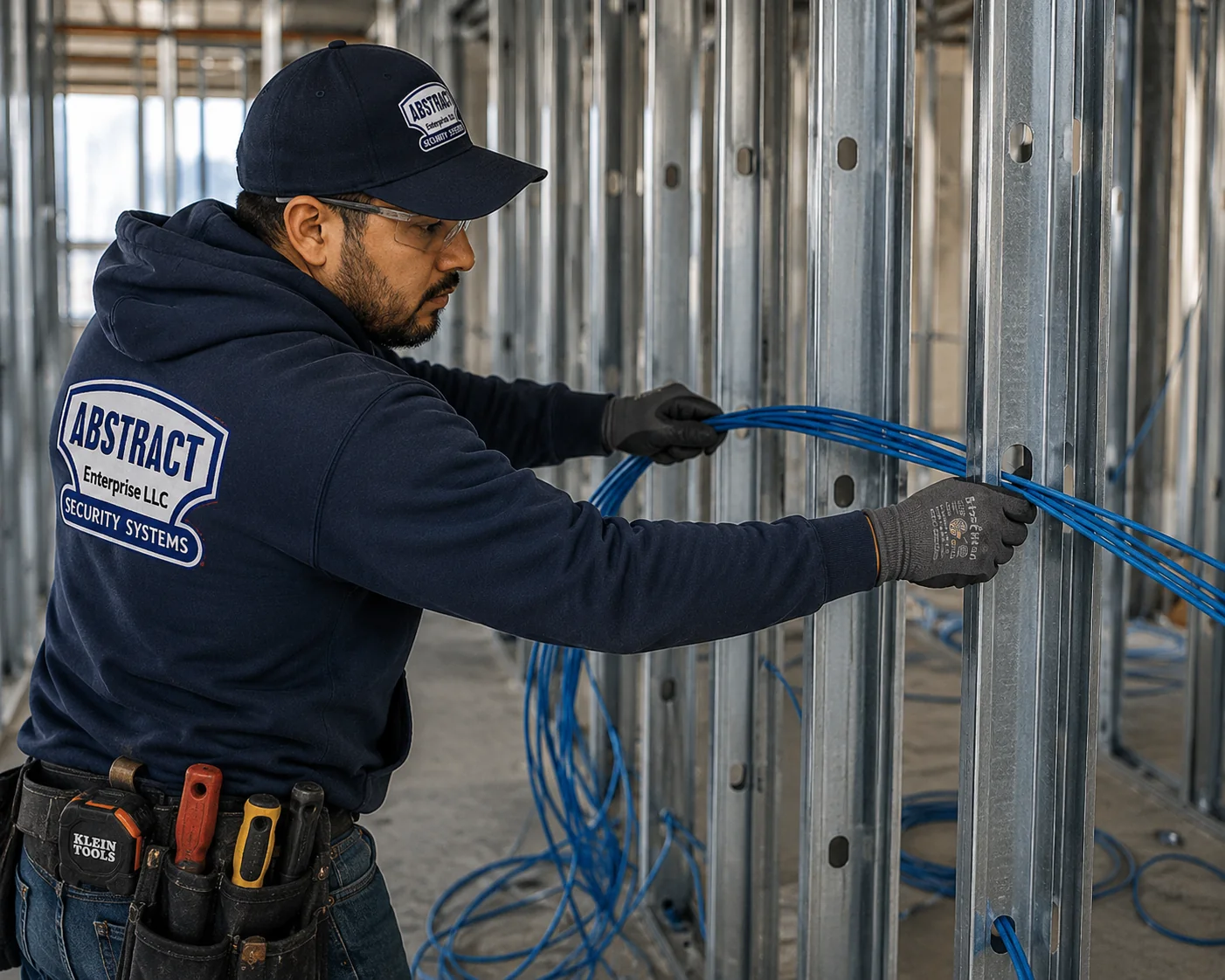
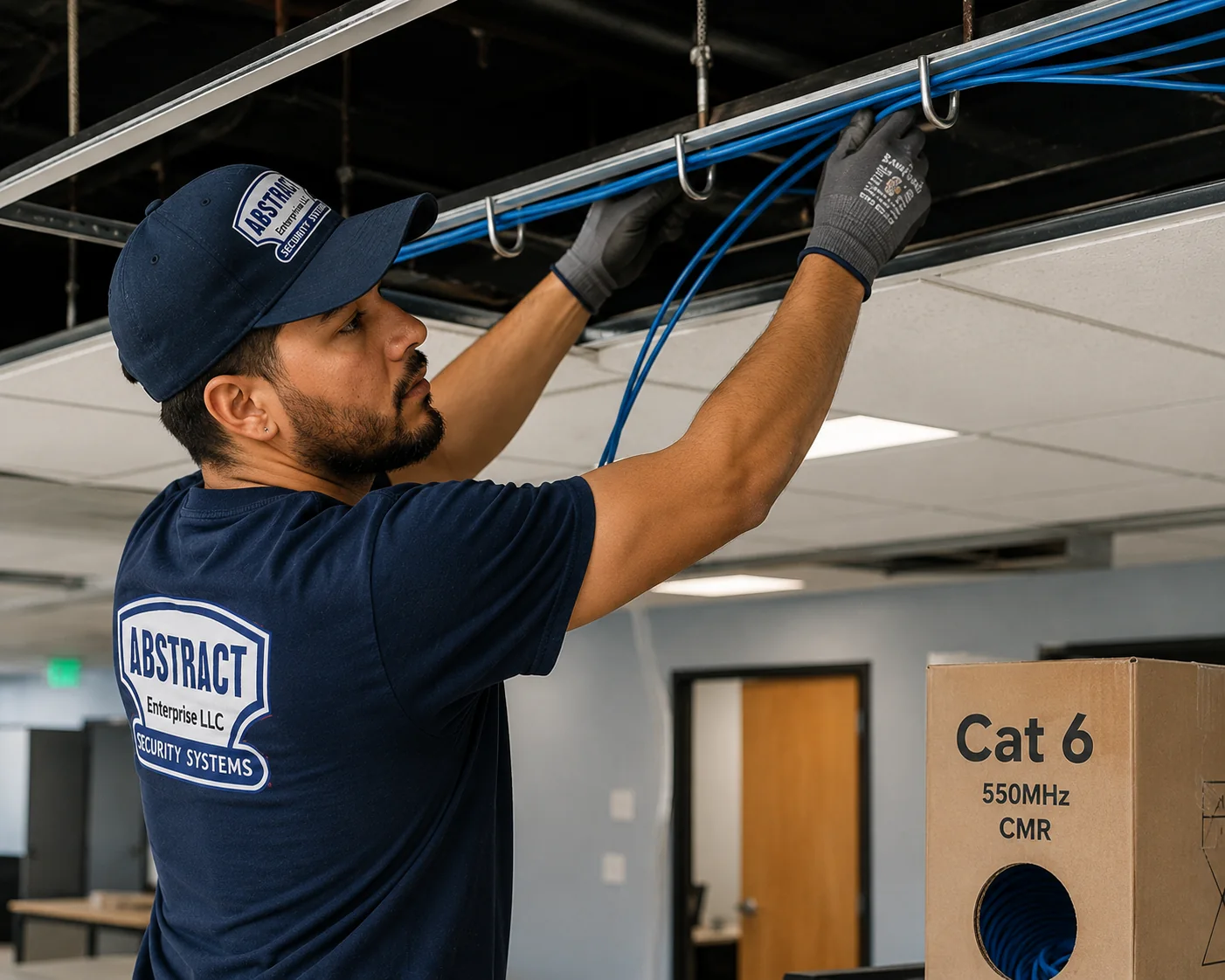
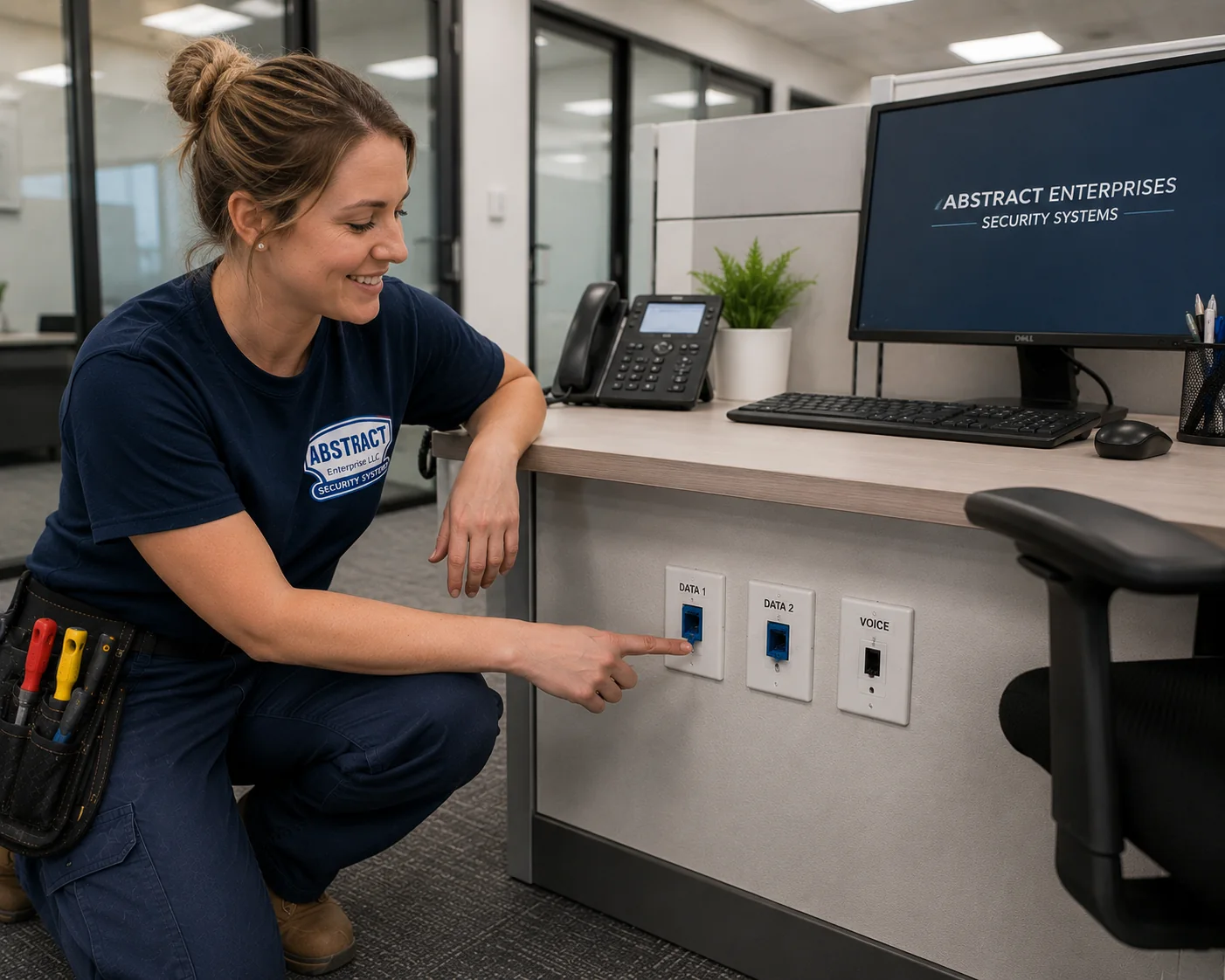
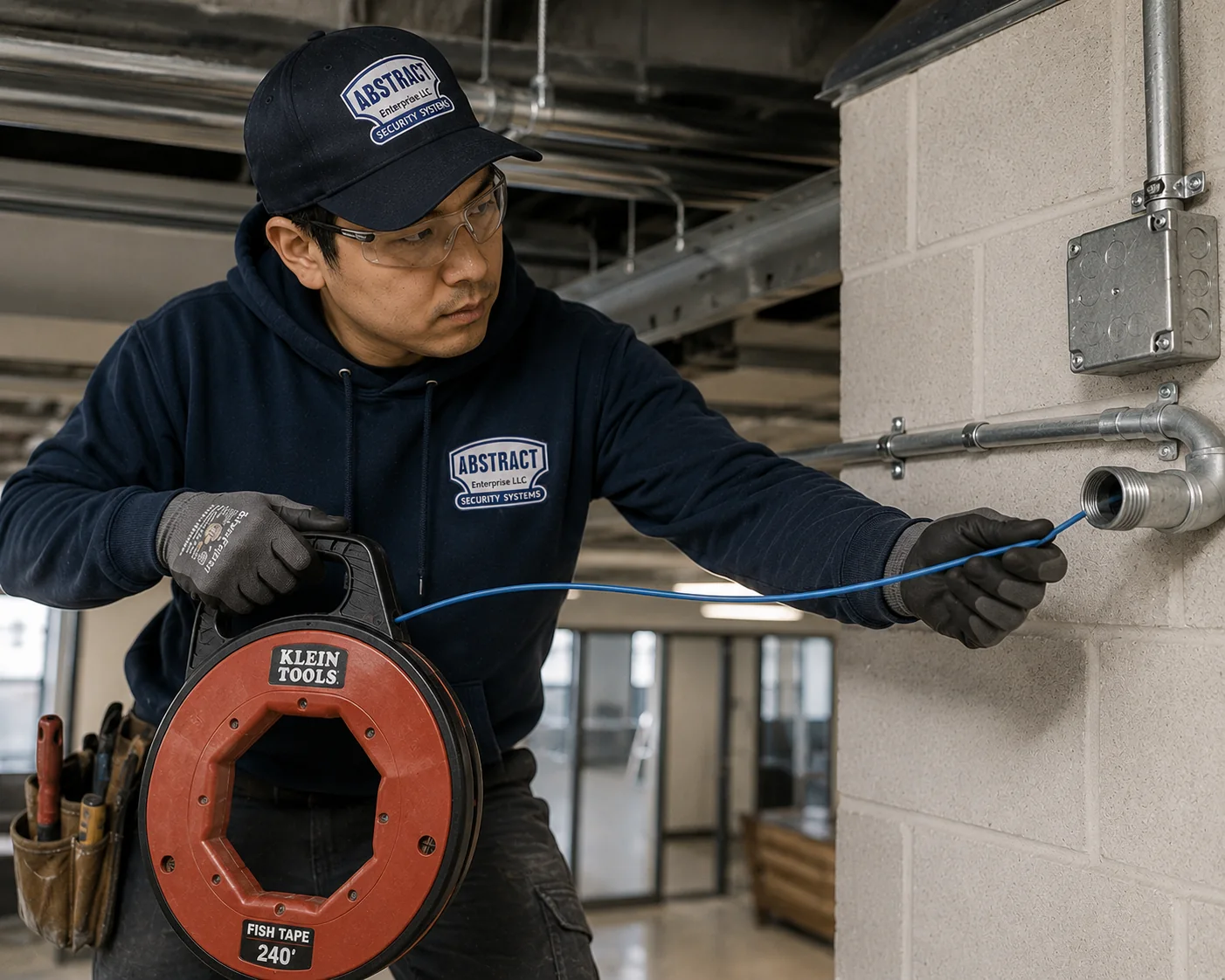
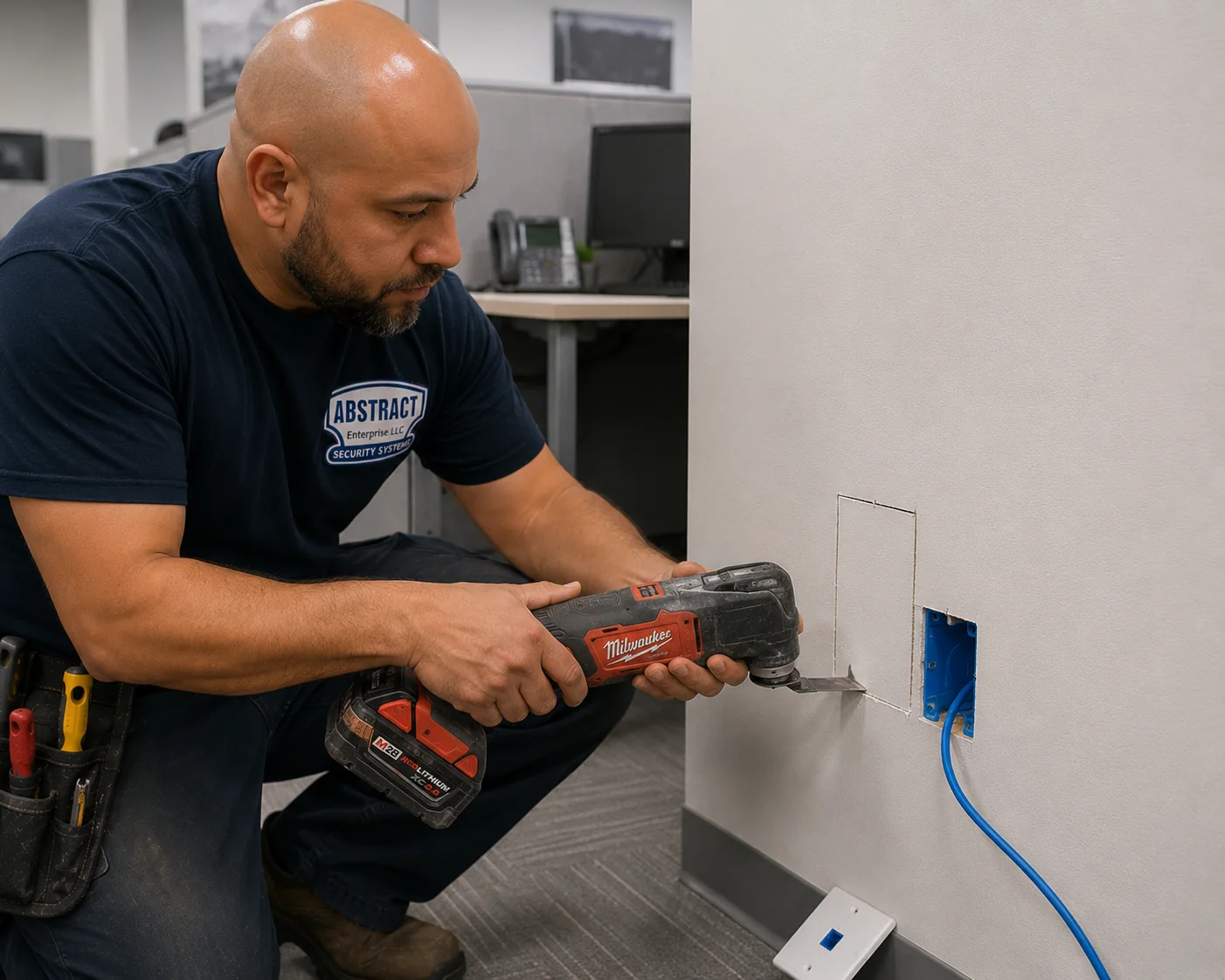
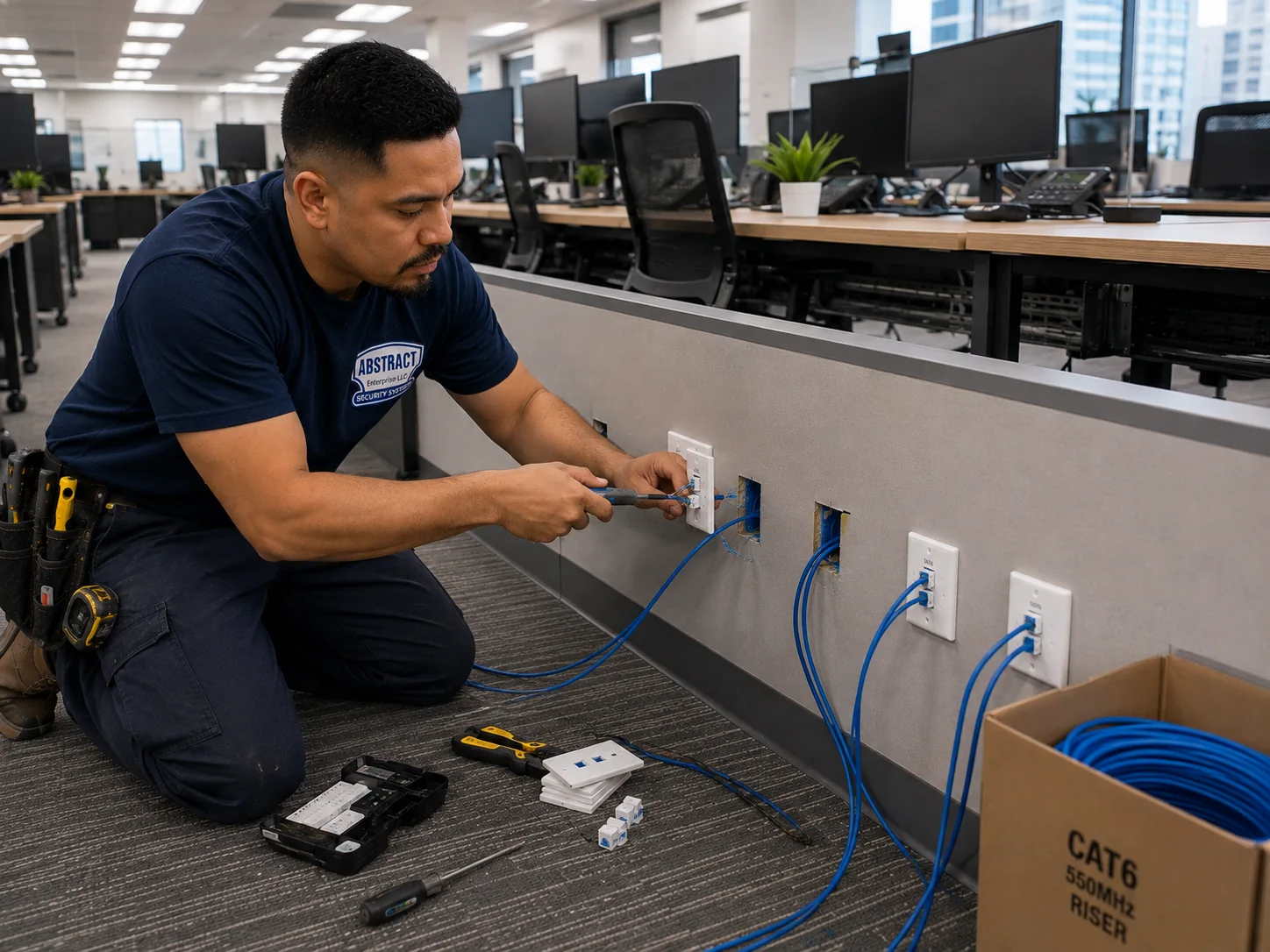
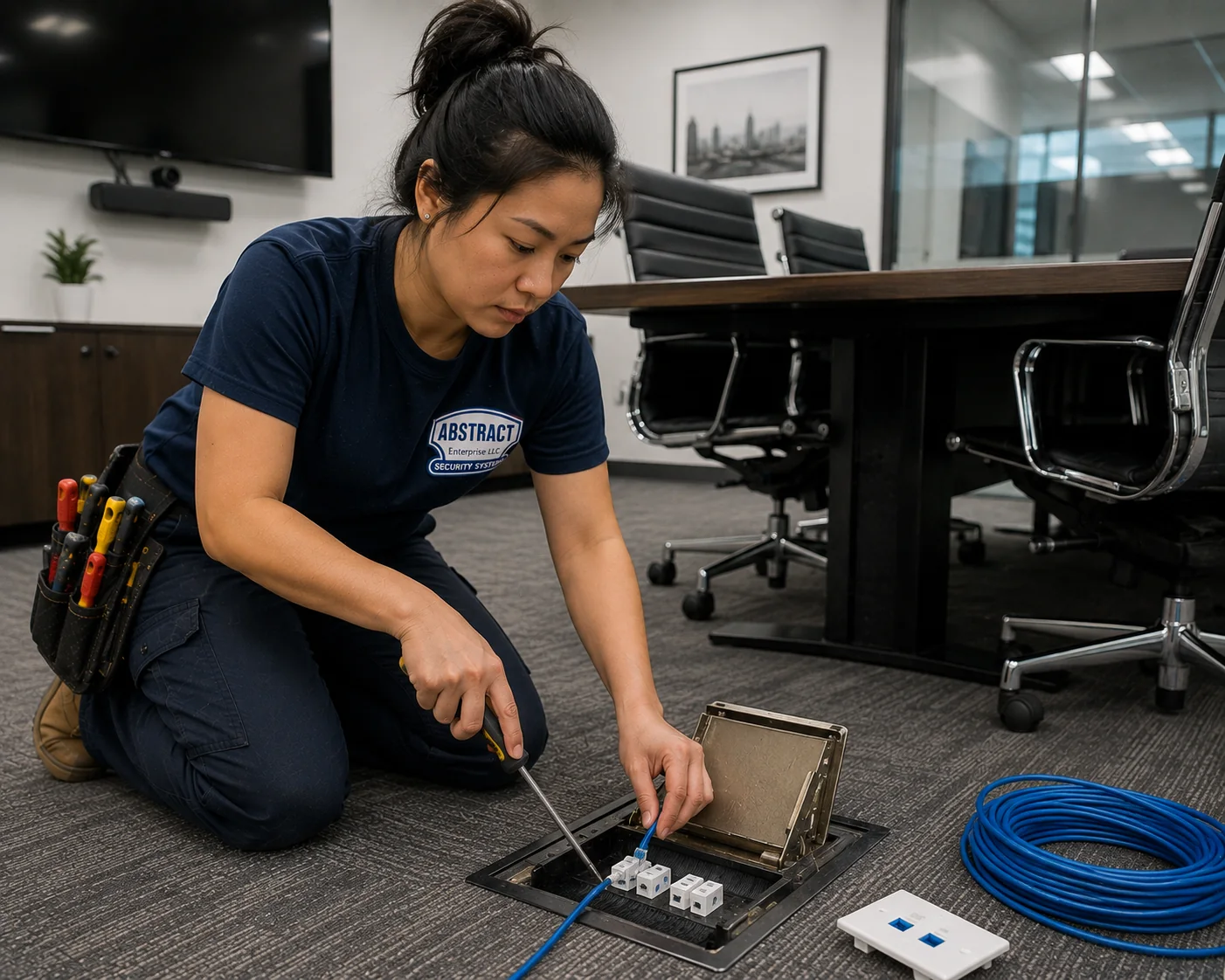
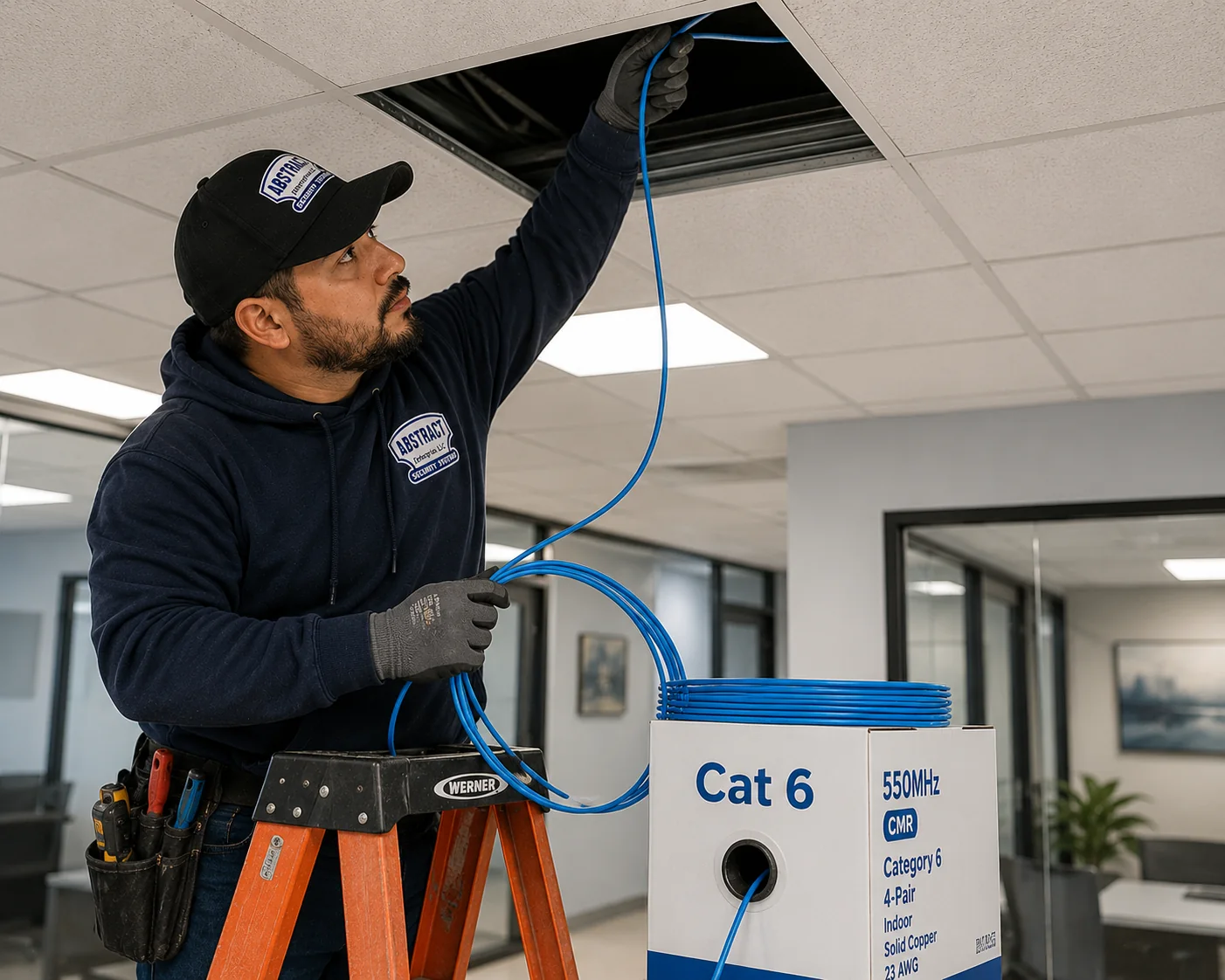
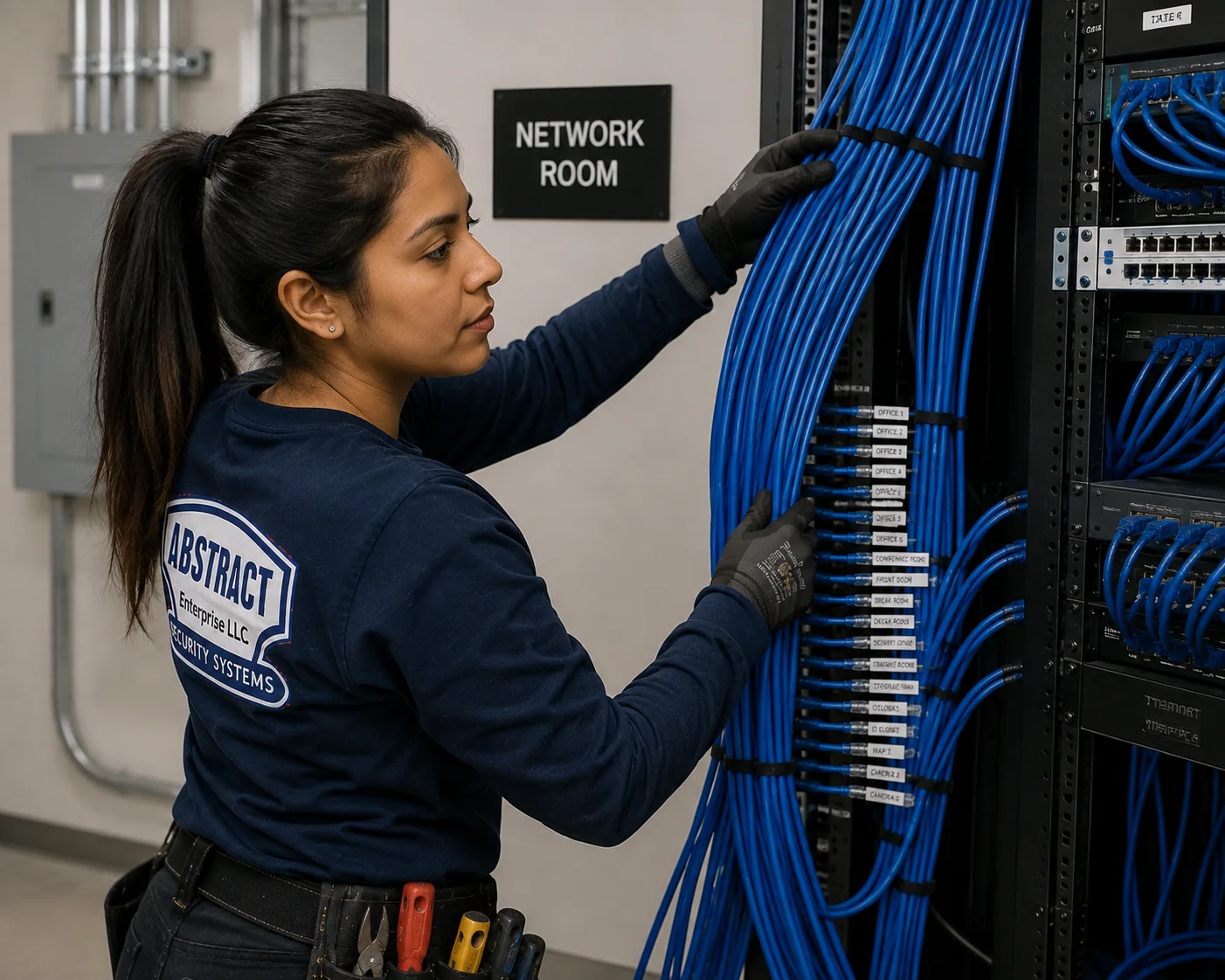
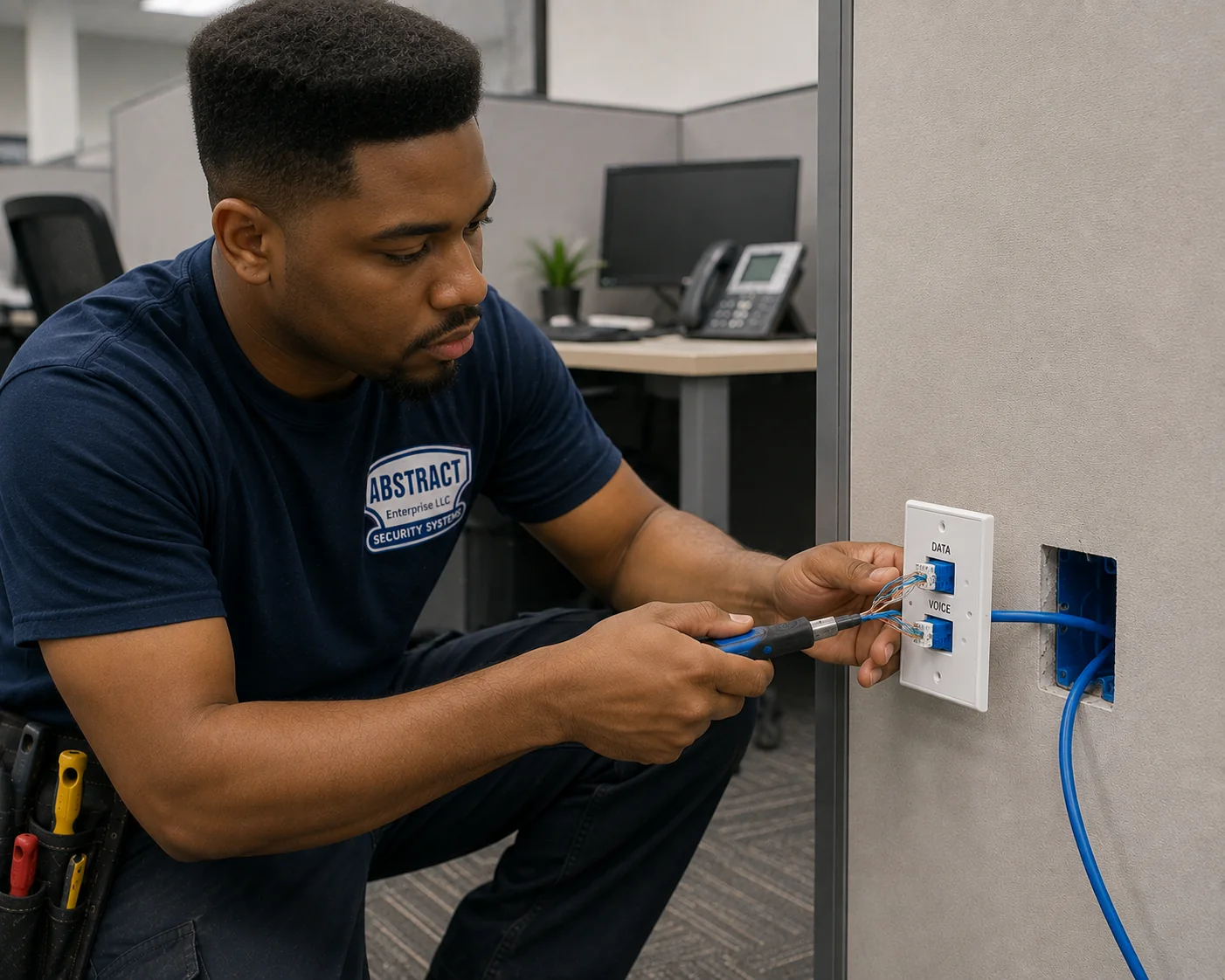
Cat6 installation for White Plains office towers, the I-287 corporate corridor, Yonkers and New Rochelle commercial, river-town conversions, hospital and school campuses and municipal buildings across Westchester County. Each run supported the whole way, terminated on matched components, tested, marked at both ends and documented on a panel map.
Westchester is the transition zone. Its southern cities run on city logic — masonry, older risers, building management. Its corporate corridor runs on campus logic, where distance across a wide floor plate and how the buildings link to each other decide the design. A contractor here needs both playbooks.
Tell us the site and rough drop count — we'll come back with a number.
Two contractors can price the same Purchase campus building and mean entirely different things by the word "drop." Here is what it means on ours.
Priced as separate lines rather than folded into the per-drop figure: rack or wall cabinet, patch panels, cable management, patch cords, switches, conduit where required, firestop materials, core drilling, lift hire, fiber backbone between buildings or closets, and evening or weekend premiums.
The Westchester question worth asking. On any site with more than one building, ask each bidder how the buildings are being linked. A bid that runs copper between structures has not thought about distance or about grounding, and both will surface later.
Westchester is the transition zone. Its southern cities behave like the boroughs; its corporate corridor behaves like nowhere in the five boroughs at all.
Down at the Bronx line, Yonkers, Mount Vernon and New Rochelle run on city logic — dense, older, masonry, mixed-use, with the fishing problems and the building-management processes that come with that. White Plains sits in the middle: a genuine central business district with office towers, managing agents, freight scheduling and insurance requirements that would be familiar to anyone who has worked in Midtown.
Then the county opens out. The I-287 corridor running east through Harrison, Purchase and Rye Brook is corporate campus territory — low-rise buildings on landscaped sites, generous floor plates, real telecom rooms, and frequently several buildings under one owner. North and west of that, the county turns into towns and villages with municipal, school, medical and small professional work, and river-town commercial in converted industrial stock.
The practical consequence is that a Westchester contractor needs both playbooks. The building-management discipline that a White Plains tower demands is wasted effort on a Purchase campus, where the constraint is instead distance across a wide floor plate and how the buildings link to each other.
The county's only real central business district. Floor telecom rooms, accessible grid ceilings, short runs — technically the most predictable cabling in the county. The constraints are administrative: certificate of insurance to the managing agent, freight elevator reservations, permitted working hours, and management sign-off on penetrations. Handled during mobilisation, or it costs a day.
The I-287 corridor and the county's business parks. Low-rise buildings on landscaped sites, wide floor plates where distance becomes the design question, and frequently several buildings under one owner linked by underground pathway. IT departments here ask for test results and a port map before they ask about price, which is a good sign rather than an obstacle.
Yonkers, Peekskill, Tarrytown, Sleepy Hollow and the other river communities carry nineteenth and early twentieth century masonry now repurposed as offices, studios, restaurants and residential. Load-bearing brick with no cavity, exposed structure, and historic-district review governing what can be seen. Cable is a finish detail, planned with the architect.
The county carries a heavy healthcare load, concentrated around the major hospital and medical college campuses and spread through medical office buildings countywide. Multi-building sites with their own IT standards, high drop density, infection-control requirements when ceilings open, and scheduling built around clinical hours rather than around the trade.
Westchester's many school districts, village halls, libraries and fire districts make up a larger share of the commercial base than most people expect. Long masonry corridors that make closet placement a genuine question, fixed calendar windows that do not move, and closeout documentation written into the contract rather than offered as a courtesy.
Elmsford, Greenburgh and the Saw Mill River Road corridor hold the county's flex concentration — office at the front, higher-bay space behind, and two different cabling environments under one roof. Tray, lifts and separation from motor loads on the warehouse side, ordinary office conditions at the front.
The county changes character sharply from the Bronx line northward, and the work changes with it.
White Plains is the county's central business district — office towers around Main Street and Mamaroneck Avenue with building management, freight scheduling and insurance requirements, alongside newer mixed-use development and the retail core. Running east from it, the I-287 corridor through Harrison, Purchase and Rye Brook is the county's corporate spine, with campus buildings set back on landscaped sites. Those are large floor plates with real telecom rooms and, frequently, several buildings under a single owner linked by underground pathway. Elmsford and Greenburgh along Saw Mill River Road hold the flex and light industrial concentration.
Yonkers runs the full range — the downtown and waterfront around Getty Square, the industrial south end, and the retail and office development at Ridge Hill and along Central Park Avenue. It is the county's largest city and its building stock is closer to the Bronx than to the rest of Westchester, which means masonry, older risers and city-style access. New Rochelle's downtown around Main Street and North Avenue has seen substantial transit-oriented tower construction, which is new-construction pre-wire work sitting next to century-old commercial stock. Mount Vernon carries older commercial and industrial buildings, and Port Chester runs to mixed commercial in similar stock.
Tarrytown, Sleepy Hollow, Irvington, Dobbs Ferry and Hastings hold converted industrial and historic downtown commercial along the Hudson, much of it now offices, studios and restaurants in masonry buildings where cable is visible by definition. Further north, Peekskill's downtown carries similar stock. Valhalla and Hawthorne hold the medical and academic complex around the hospital and medical college campuses — multi-building sites with their own IT standards. Armonk, Mount Kisco, Bedford and Katonah run to corporate, medical and professional offices in a mix of older and newer low-rise buildings, with the county's northern towns adding municipal, school district and fire district work across a wider geography where travel time between sites becomes a real scheduling factor.
Rye, Mamaroneck, Larchmont and Scarsdale carry professional offices, medical practices and retail along Boston Post Road and the village centres, with substantial residential behind them. Building stock skews older and frequently sits in historic or design-review districts, so surface containment and visible pathway are subject to more scrutiny than they would be inland. Coastal exposure also matters for outdoor cameras and enclosures along the shoreline, which is a specification question at the walkthrough rather than a maintenance surprise later.
There is no one statewide licence for electrical or low-voltage contracting in New York. Westchester handles it more cleanly than most, which is worth understanding.
Westchester licenses electricians at county level through its Department of Consumer Protection. There is an examination process, and the county explicitly encourages consumers to ask to see a contractor's licence card. Permits are issued separately by the local building department in each city, town or village, and municipal building codes commonly state that electrical work must be performed by a Westchester County licensed contractor.
There is also a limited licence class covering low voltage, alarm and signal work, audio and sound systems and telephone interconnect, bounded by voltage and current limits. That is precisely the category most data cabling scopes sit near, which is why the honest answer to "do you need a licence for this" is that it depends on the specific scope rather than on the trade name.
Our advice to clients. Put the question to every contractor bidding, ourselves included: which licence, issued by whom, and does it cover this scope. Then verify the answer with the county or the local building department before the work is scoped. Anyone who deflects has told you something worth knowing. Note separately that monitored alarm, camera and access control work carries a state-level licence requirement independent of any municipality, which is a different matter from plain data cabling.
Whether a permit or inspection applies turns on the building, the scope, how the pathway is installed and which authority has jurisdiction — in Westchester that is the city, town or village building department rather than the county itself. We establish the answer before installation instead of assuming it either way.
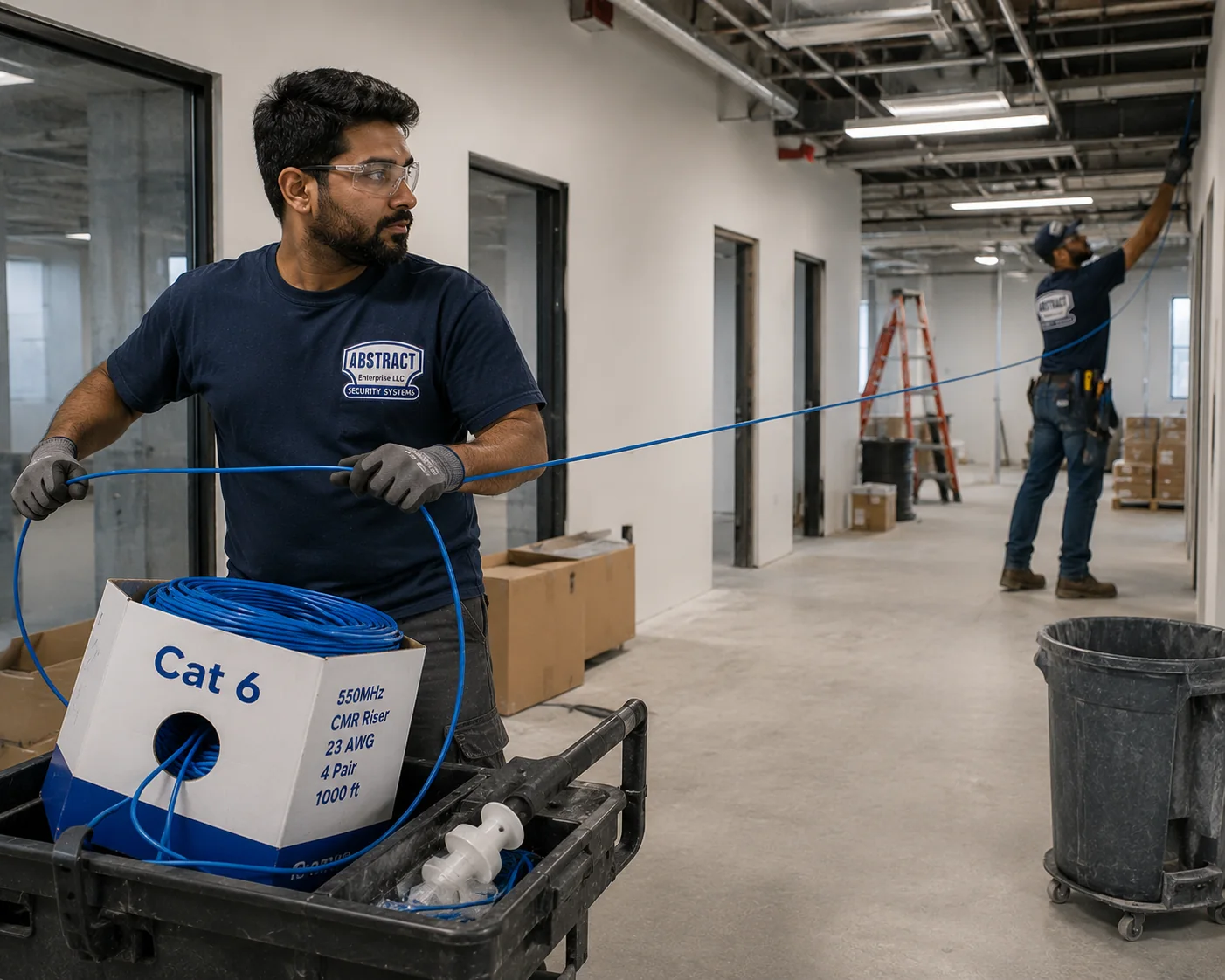
Cable is installed through open framing, terminated at the closet, and left coiled behind a set box at each outlet until the finishes are complete; a brief second visit lands the jacks, tests and marks them. We schedule ahead of the drywall crew because open route is precisely what keeps the drop rate low. Between New Rochelle and White Plains there is enough construction underway that this phase is genuinely available — provided the call comes at framing rather than at punch list.
Every building carries its own telecom room and its own horizontal copper, with fiber tying them together. Copper between structures is off the table on two counts: the distance, and the grounding trouble that follows from two buildings on separate electrical services. Underground routes between buildings form their own scope, and on an established campus there is usually existing duct bank worth surveying before anyone puts a trencher in the ground.
Cable above the tenant ceiling on fresh containment, dropping inside partitions, worked zone by zone. Tile comes down and goes back within the same shift and nothing hangs over a desk overnight. In the White Plains towers the building itself usually decides this happens after hours, whatever the tenant would prefer.
Solid brick with nothing to fish through, timber decking overhead, and exposed ceilings where any cable is visible by definition. That leaves three routes: surface containment planned as part of the finish, conduit following structural lines, or whatever existing conduit the building already holds. Inside a historic district, what may be penetrated or seen can require review — a scheduling consideration as much as a technical one.
Sequenced around clinic hours or the school calendar rather than around our own convenience. Dust control whenever a ceiling opens, agreed stop times, and closeout paperwork assembled as a submittal from the start. School windows do not move, so ordering and sequencing decide the outcome more than they would on a private fit-out.
A cable that carries traffic and a cable that meets specification are two different statements. Only one of them can be put on paper.
Every drop is wiremap-tested before the ceiling closes. When the job requires full certification, we test permanent links with a Fluke DSX CableAnalyzer and deliver the pass/fail report with the closeout package.
Four faults hide behind a healthy link LED. A split pair passes continuity and quietly undermines everything above it. A termination with an inch of untwisted conductor looks neat and measures poorly. A route that crept beyond ninety metres carries traffic today and fails a report tomorrow. And a nick taken during the pull shows up as loss rather than as a break. Permanent link testing measures the section built into the structure, panel to outlet. Channel testing reintroduces the cords and reports what the hardware actually experiences.
Westchester's public and institutional clients treat documentation as part of the deliverable, not a favour. Districts, hospitals, colleges and village buildings name certification reports in their closeout requirements, and a contractor unable to produce them fails review whatever the workmanship looked like. On that kind of project it is worth establishing exactly what each bidder hands over before you compare the totals.
Non-negotiable: testing happens before anything is sealed. A bad termination found with the tile still down costs a few minutes. Found behind a finished wall, the same fault becomes a demolition line item.
Across a modern site the cameras, readers, radios, handsets and intercoms all take signal and supply from one cable. That removes a second trade at every device and concentrates the whole load onto a single run of copper.
| Standard | Common name | Typically powers |
|---|---|---|
| 802.3af | PoE | Desk phones, basic fixed cameras, simple readers |
| 802.3at | PoE+ | Most current access points, PTZ and IR cameras, video intercoms |
| 802.3bt | PoE++ | High-power APs, heated outdoor domes, displays, higher-draw edge devices |
Current makes heat, a packed bundle traps it, and warm copper resists more — so voltage is lost along the way and the device at the end receives less than the switch sent. Solid conductor in a reasonably sized bundle has room to absorb that. A long CCA run in a crowded bundle under a warm roof does not.
Two things about this county sharpen the problem. Campus and municipal sites push a great many devices outdoors — lots, perimeters, playing fields, service yards — and heated domes draw at the top of the range while sitting at the end of the longest runs on the property. Meanwhile the converted mills and industrial buildings contain large volumes that are barely conditioned, swinging far wider in temperature than any office ceiling, which moves both the cable specification and the switch budget.
Rates are published per drop, so the maths can be done before a site visit is booked.
| Cable type | Per drop, runs to 100 ft |
|---|---|
| Cat5e | $265 |
| Cat6 | $309 |
| Cat6A | $441 |
| Coax / RG6 | $265 |
| Speaker wire | $220 |
| HDMI | $352 |
| Fiber — multimode | $618 |
| Fiber — singlemode | $705 |
Every figure includes the cable itself, the plate and keystone, terminations at each end and the completed-run test. Ten percent comes off new construction quoted before drywall. Beyond 100 feet we measure the route as installed and price it on that.
Quoted separately: rack or wall cabinet, patch panels, cable management, patch cords, switches, conduit where required, firestop materials, core drilling, lift hire, underground or between-building pathway, toning and mapping of existing unlabeled cable, and evening or weekend premiums.
Work the numbers in the cabling quote builder, or call and describe the property.
Cat6 is where almost every Westchester drop should land. Operating at 250 MHz against Cat5e's 100 MHz leaves margin, and margin is what carries a long route, a warm plenum and a termination that was merely good rather than perfect. On new work the separation is $44 a drop. Cat6A is worth its $441 where a drawing specifies full-distance ten gigabit, on uplinks, and on the links joining telecom rooms. What it does not buy is distance — the ninety-metre ceiling is identical, and a reach problem is solved with a second room and glass between them.
Plenum jacket through return-air space, riser jacket up the shafts, general purpose where neither applies. Westchester spans enough construction eras that a 1980s pavilion and a converted mill handle air in completely different ways, so we settle it on site with the building and the authority having jurisdiction rather than reading it off the building's age.
Unshielded pair is correct in nearly every building we enter. A shield does nothing unless it is bonded and grounded properly at the rack, and a floating one acts as an antenna and can measure worse than plain UTP. The situations that justify it here are manufacturing floors with drives and heavy motor loads, and the occasional older building where a run has no choice but to travel beside power for a stretch.
Solid copper throughout. Copper-clad aluminium carries more resistance, snaps where it is landed, and gives out once power is on the pair. Cheap at the wholesaler, expensive across the building.
| Location | Drops | Why |
|---|---|---|
| Workstation | 2 | Computer plus phone, dock or future second device |
| Printer / copier | 1–2 | Shared devices get their own port |
| Wireless access point | 1 | Wired backhaul; masonry buildings need more APs, closer together |
| IP camera | 1 | PoE data and power on one run |
| Door reader | 1 | Where the access system is IP at the door |
| Classroom | 2–3 | Teacher station, display or projector, AP overhead |
| Exam room | 1–2 | Workstation plus imaging or chairside equipment |
| Conference room | 3–4 | Display or codec, table or floor box, camera, spare |
| Outdoor device | 1 | Perimeter cameras, gate and lot readers on campus property |
Placement matters more than size. A modest room near the centre of a floor plate beats a generous room in a corner every time, and in this county a great many existing telecom rooms were positioned for convenience decades ago when the building carried a phone system. When a second telecom room is justified, the pair are joined on fiber. On campus sites the same logic applies between buildings rather than within one.
On any job where a ceiling is closing, we push for a handful of spare drops terminated and labeled at the panel and left coiled above the tile or landed in a blank plate. The cost is cable and twenty minutes. The value is that the next change becomes a patch cord instead of a project — and on a campus property spread across several buildings, that difference is a morning rather than an afternoon.
Method commentary, not case studies. Recurring patterns, described generally.
On campus sites, an old copper link between structures that works until it does not. Reach rules it out and bonding between separate services finishes the argument; glass is the correct answer.
Office park stock accumulates. Abandoned coax, dead phone cable and two generations of data congesting the pathway new work needs.
In converted masonry buildings, containment installed without planning the layout. It reads as exactly what it is; treated as a finish detail it disappears.
Placed decades ago beside the electrical room because that is where space was left over, now guaranteeing that part of the floor sits near the limit.
In White Plains towers, COI wording or named parties not matching what the managing agent requires. Costs a day, entirely avoidable at mobilisation.
Institutional and municipal projects that specified test reports in the documents and received none, discovered at closeout.
Perimeter cameras and gate readers on campus property chosen without regard to weather or power class, replaced within two winters.
Bundles dropped onto grid and tile because it was faster. Against code, and it puts the network underfoot for every trade that follows.
A 5e keystone on Cat6 cable, chosen because it was within arm's reach. The channel drops a grade and the drop gets built a second time.
Cable trimmed exactly to length at both ends. The next re-termination costs an entire new run over half a foot of cable.
Sound cable, sound terminations, nothing written down. From then on every change starts with a toner and an hour.
Tile back up and finishes on with no test run. The fault is now shut inside a finished wall or ceiling.
Past a handful of drops the permanent cable terminates at a panel and everything after that is cords. A little more expensive on day one, repaid the first time a desk relocates or a port fails, because the horizontal cable is terminated once and never disturbed again. Landing plugs straight onto permanent cable is fine in a house and a false economy in any commercial building.
Terminations follow TIA-568 to T568B unless the building already runs A. Identifiers and mapping follow TIA-606-style convention so the room remains readable long after handover. Category holds across every component in the chain, because a 5e jack anywhere on a Cat6 run drops the channel to 5e and fails certification.
Westchester telecom rooms rarely exist for that purpose alone. In older office stock the switch shares a room with the electrical panel and the alarm; in a converted mill it may sit somewhere barely heated. That makes enclosure selection, airflow and physical protection engineering decisions rather than presentation ones, and we raise them during the site visit instead of discovering them on install day.
Results for every run, panel mapping, the naming convention written in plain language, cable and component schedule, marked drawings where drawings exist, and photographs of routes about to be concealed. On public and institutional work none of that is optional — a submittal missing it comes back, and anyone weighing bids on that kind of job should establish upfront what each contractor actually delivers.
Around 43% more per drop, and what you get is ten gigabit over a complete run. Justified between telecom rooms, into a server, and wherever the drawings insist on it. Behind a desk or a radio it is bandwidth nothing will ever call for, and it adds no reach at all.
There is no preference to express here. Across a campus, glass is the only correct answer: distance eliminates copper on all but the shortest hops, and two buildings on separate services bring grounding problems that fiber simply does not have.
Legacy 5e that passes testing is not a problem to solve. On anything new the difference is $44 a drop, and Cat6's extra margin is exactly what handles temperature, distance and power draw. There is no case for 5e on permanent cable.
Radio is a service that cable delivers. Behind every access point is a wired run, and masonry buildings force tighter spacing between them — so wireless coverage increases the cable count rather than reducing it.
Converted masonry frequently has no cavity at all, which makes surface containment the method rather than a concession. Routed deliberately along structural lines and treated as part of the finish, it goes unnoticed. Put up casually, it is the first thing every visitor looks at.
Not a compromise — a fault. More resistance, conductors that break where terminated, failure once power is applied. Inexpensive per box and costly per building.
Someone walks every building on the property, opens a tile, locates the telecom room and traces the actual route. Positions marked, rating chosen, room count agreed and the cost drivers identified before any figure is written.
Drop count at the published rate, hardware listed on its own lines, premium conditions named rather than buried. Deposit up front, balance on completion, terms printed on the document.
Certificate of insurance across to the managing agent in their wording, access and permitted hours agreed, lift booked where required, county licence and the municipal permit position settled, and submittals delivered before anybody loads in.
Containment installed, cable pulled, every penetration sealed back to rating, boxes set, and cable dressed into the room with slack retained.
Outlets landed, plates mounted, panel punched down, rack hardware installed, and every end marked as it is made rather than reconstructed later.
All of them, ahead of anything being sealed. Failures put right while the route is still reachable, then re-tested, with results recorded run by run.
Results, mapping, naming, materials schedule and marked drawings handed across. The room photographed and the site left clean.
Districts, municipalities, libraries, fire districts and hospitals account for more of Westchester's commercial base than they do nearer the city, and that work keeps its own time. Calendars that will not shift, deliverables named in the documents, submittal procedures, and closeout paperwork carrying contractual weight. Summer school work is the sharpest example — the window is fixed, so procurement lead time and sequencing decide whether the job lands.
Not testimonials — the commitments that apply to every Cat6 job we take in Westchester.
On a campus every building gets its own walkthrough rather than an estimate inferred from the first one. They are seldom the same job twice.
Testing on every installed drop ahead of anything being sealed, certified to permanent link wherever the project demands it.
Results, mapping, naming and materials schedule, produced in a format an institutional submittal will genuinely accept.
County licensing and the municipal permit question resolved before the work is scoped, not assumed and corrected later.
Structures joined with fiber rather than copper, and grounding handled as part of the design instead of a problem discovered afterward.
Warranty terms printed below, and subsequent moves or additions treated as continuing work.
The cabling gets examined last, after the switch has been swapped, the router rebuilt and the carrier called twice.
Work starts in the telecom room rather than under the desk. Identify the run, apply a permanent link test, read the outcome. A pass removes the building's cable from consideration and redirects attention to a cord, a port or the equipment. A failure names the specific parameter, which points at a termination first, physical damage second and length third. Redoing both ends resolves most of them.
A Cat6 data drop runs $309 inside 100 feet, carrying the cable, the faceplate and keystone, a termination at each end and the test on the finished run. New construction quoted ahead of drywall comes off ten percent, and past 100 feet the route gets measured and priced on what it takes. On campus properties with more than one building we price the buildings separately rather than averaging, because a 1980s office pavilion and a converted mill on the same site are not the same job.
Westchester licenses electricians at county level through its Department of Consumer Protection, with an examination process and a licence card that consumers are explicitly encouraged to ask to see. Permits are issued by the local building department in each city, town or village, and municipal codes commonly require that electrical work be performed by a Westchester County licensed contractor. There is also a limited licence class covering low voltage, alarm and signal work, audio and sound systems and telephone interconnect, bounded by voltage and current limits — which is the category most data cabling scopes sit near. Whether a given scope falls inside those requirements is worth putting to the county directly rather than accepting any contractor's summary, ours included.
Each building gets its own telecom room and its own horizontal copper, and the buildings link with fiber backbone. Copper does not run between buildings — the ninety-metre limit rules it out on all but the shortest links, and running copper between structures on separate electrical services introduces grounding problems that fiber avoids entirely. Westchester has a high proportion of multi-building corporate, medical, educational and municipal properties, so this comes up on a large share of jobs here.
Yes, and it is a recurring job in this county. Yonkers, New Rochelle, Peekskill, Port Chester and the older parts of White Plains all have early twentieth century commercial and industrial buildings now carrying offices, studios and residential. The conditions are heavy masonry with no wall cavities, exposed structure with nowhere to hide cable, and frequently a historic-district review governing what can be seen or penetrated. Cable becomes a finish detail in those buildings, and routing gets planned with the architect rather than decided on site.
A site visit that establishes drop positions and the route, the pull on supported pathway, a keystone terminated at the outlet and a panel port at the telecom room, plate and panel mounted, identifiers printed at both ends, a test on each completed run, and a map tying every port to its outlet. Racks, panels, cable management, switches, conduit, firestopping, lift hire, fiber backbone between buildings and out-of-hours work are their own lines rather than folded into the per-drop figure.
White Plains is the closest thing the county has to city conditions. Office towers around Main Street and Mamaroneck Avenue come with building management, freight elevator scheduling, certificate of insurance requirements and defined working hours, in a way that a low-rise building on the I-287 corridor does not. The cabling itself is straightforward — floor telecom rooms, accessible ceilings, short runs — and the schedule is governed by the building's process rather than by the work. That gets handled during mobilisation, not on the first morning.
A pair at each desk, a dedicated port for any shared printer, one behind every access point, camera and door reader, two or three per classroom in school work, one to two per exam room in medical, and three or four wherever a display lives. The pair per desk looks generous until a handset, a dock and a monitor hub turn up. Adding the second port while a crew is already overhead costs very little.
Over a shortened reach — the figure usually quoted sits near 55 metres, and it shrinks inside a dense bundle where alien crosstalk begins to matter. It is not a full 100 metre ten gigabit channel; that is a Cat6A specification. For workstations, handsets, cameras and access points, Cat6 is the correct and economical choice.
Copper-clad aluminium is aluminium conductor with a thin copper plating. Lower box price, not equivalent cable. Aluminium resists more, which becomes a real problem once power is riding the pair, and it is brittle, so conductors break at the punch-down and inside the tight bend behind a plate. It will show a link light and still fail under a camera's power draw. Every horizontal run we install is solid copper.
Where cable runs through a space handling return air, plenum-rated cable marked CMP applies; riser cable marked CMR belongs in vertical shafts between floors. Westchester's building stock spans several eras and the arrangement varies considerably between a 1980s office pavilion and a converted industrial building. It is confirmed at the walkthrough against the building and the authority having jurisdiction — which here means the city, town or village building department.
No termination converts one category into another; the rating belongs to the cable, so an upgrade means pulling new. The reusable asset is the route. Westchester office buildings from the 1980s and 1990s frequently have serviceable J-hook runs or conduit the new Cat6 can follow, and that reuse is where the saving lives. Where the old cable was stapled to structure or run without any pathway, the new cable needs a new route.
Yes. Tenanted offices, practices scheduling around patients, shops that must open on time and districts working to an immovable summer calendar all drive this work into evenings and weekends. In White Plains towers the building itself frequently restricts noisy or corridor-obstructing work to evenings regardless of what the tenant prefers. The out-of-hours premium is quoted as its own line rather than absorbed.
Tell us the site, the rough drop count and the timeline. If more than one building is in scope, mention it — that reshapes the design well before it touches the price.
🛡 Cat6 installation warranty. Abstract Enterprises Security Systems provides a three-year warranty on products supplied by AESS for normal wear and tear. It does not cover existing or customer wiring, customer-supplied equipment, lightning or other acts of God, power outages or surges, physical damage or unplugging, internet, router or phone changes, or camera readjustments requested after completion. After the warranty period, service is $195 per hour with a three-hour minimum ($585). Full terms: abstractenterprisessecuritysystems.com/warranty.
Call 914-877-2578
WhatsApp message us
NYS Low Voltage License #12000287431
4.7 / 201 Google Reviews
We'll follow up to arrange a walkthrough.