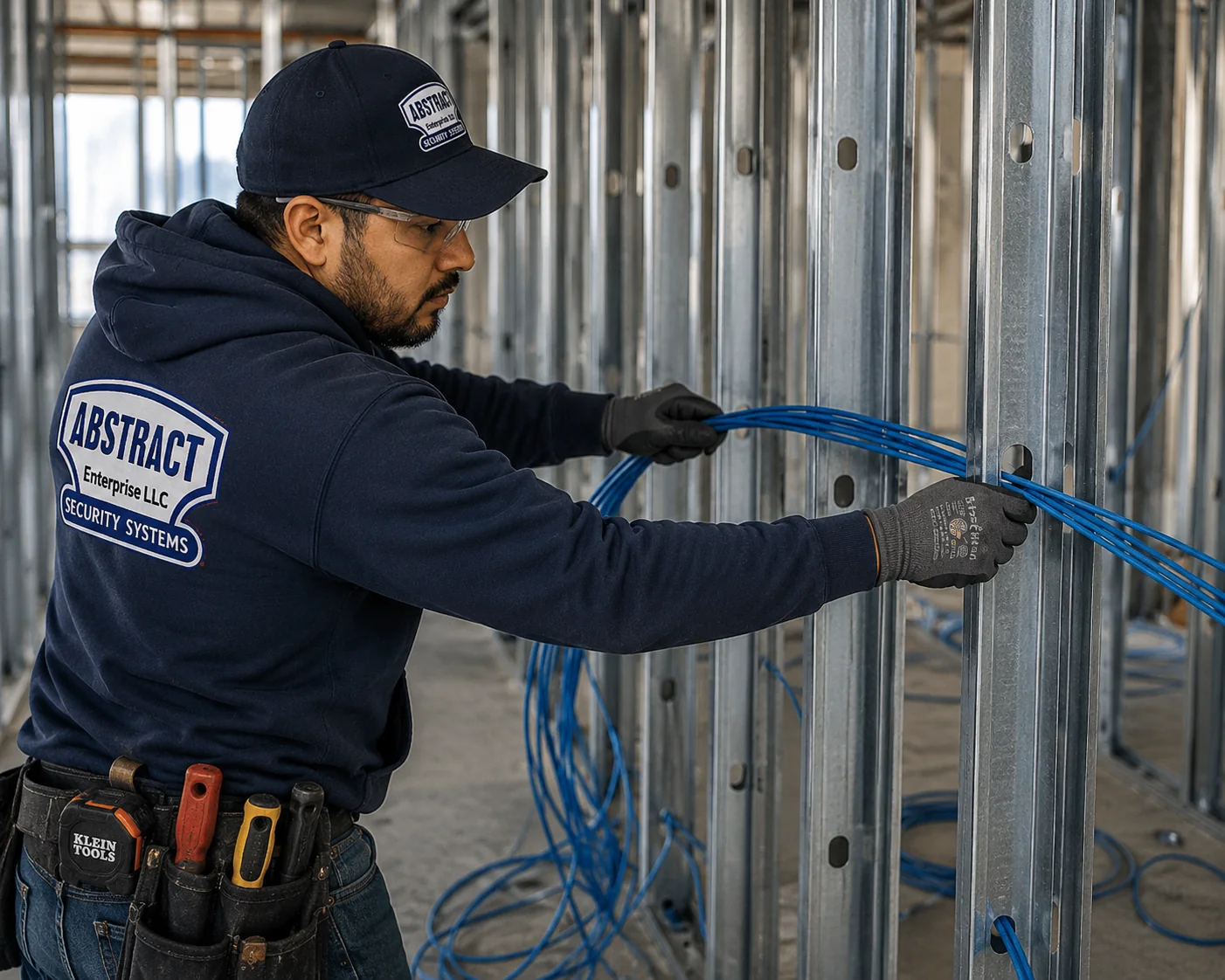
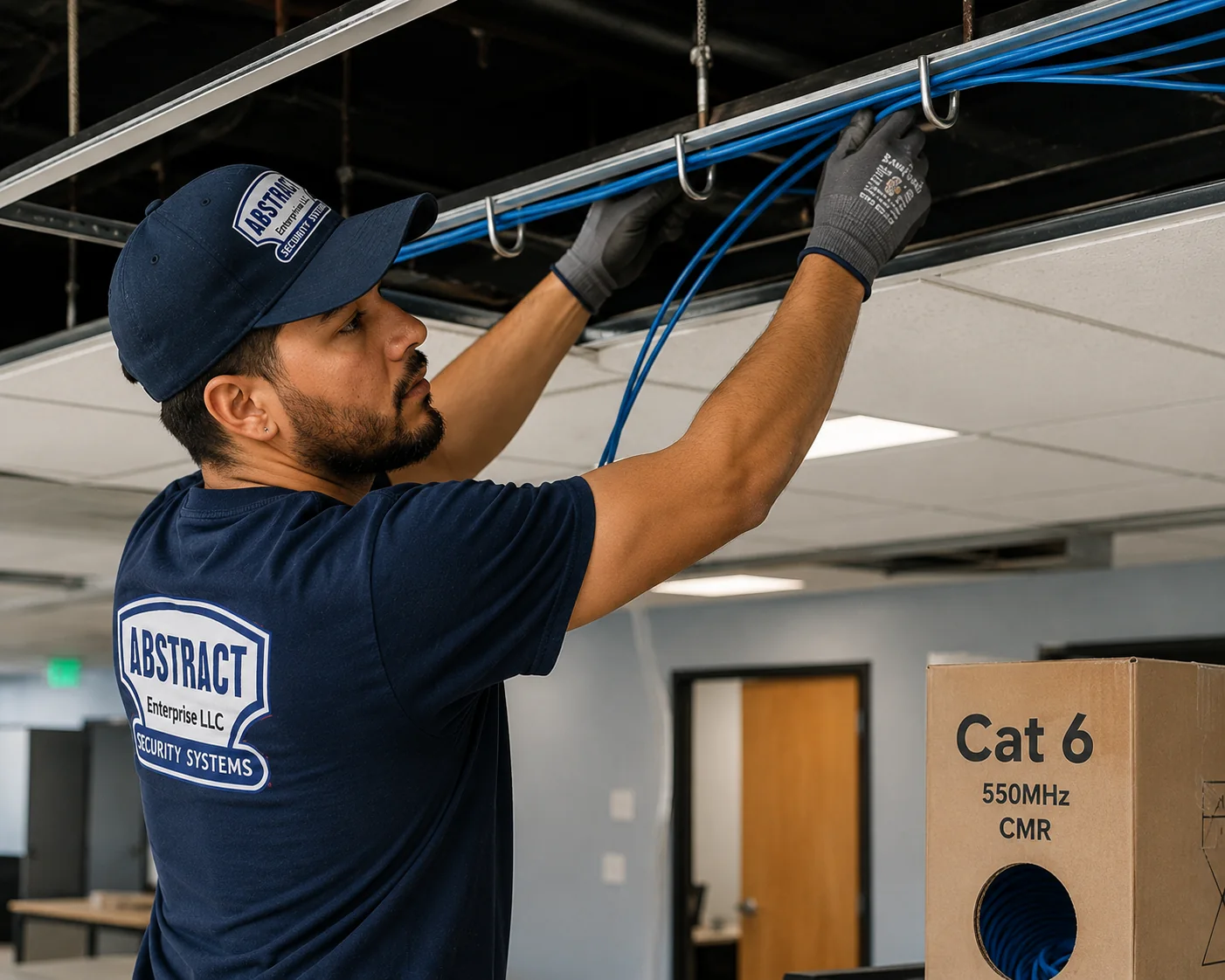
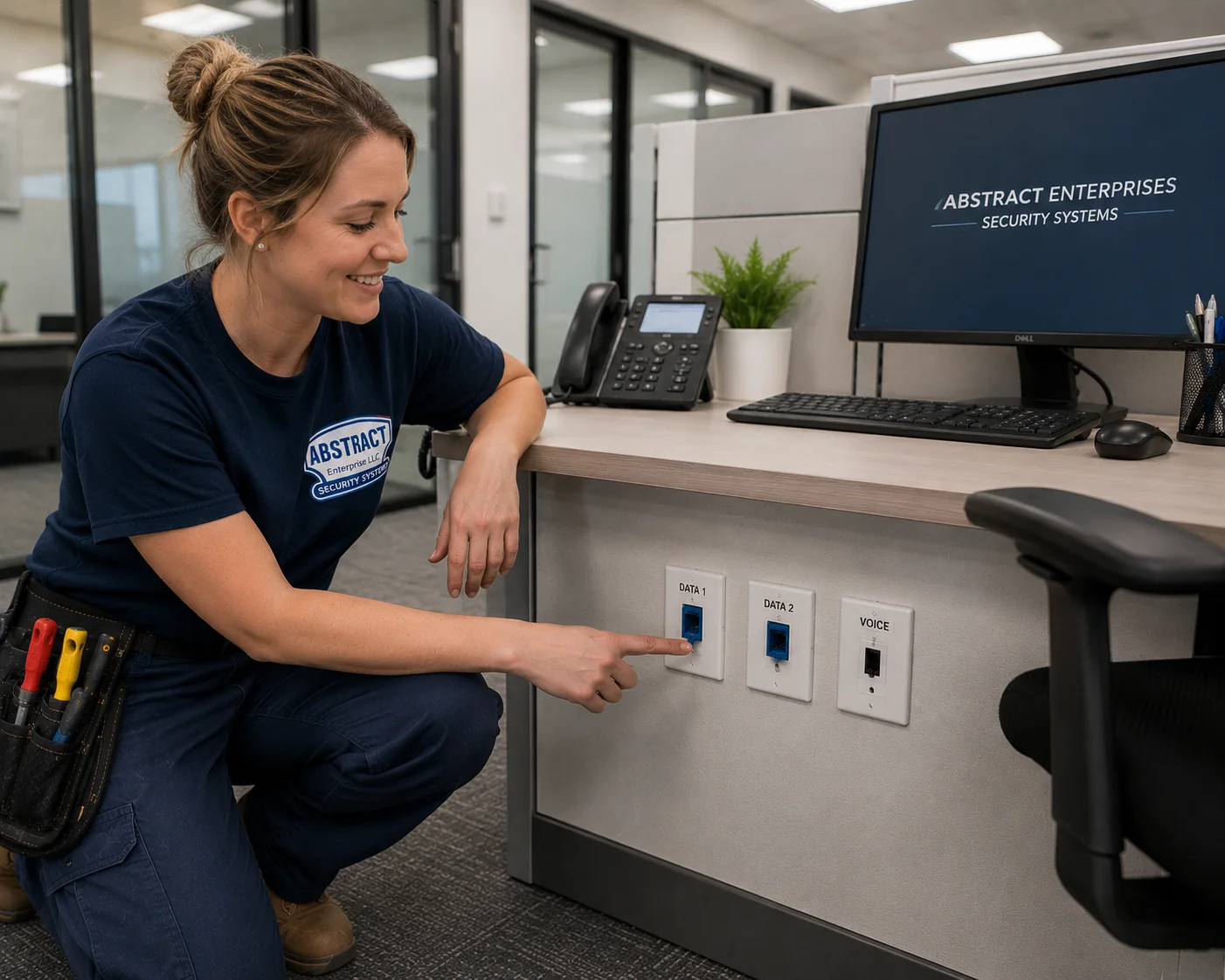
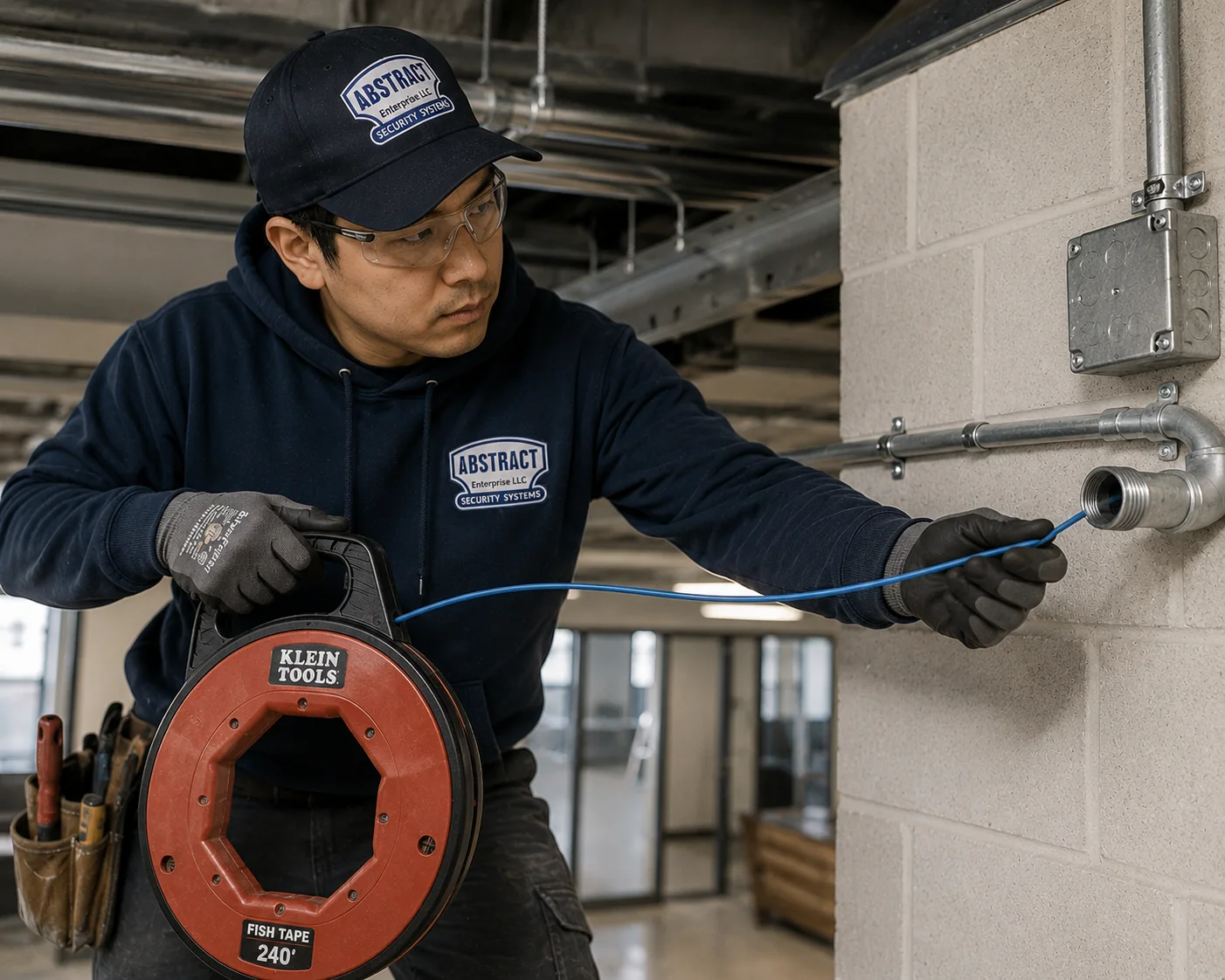
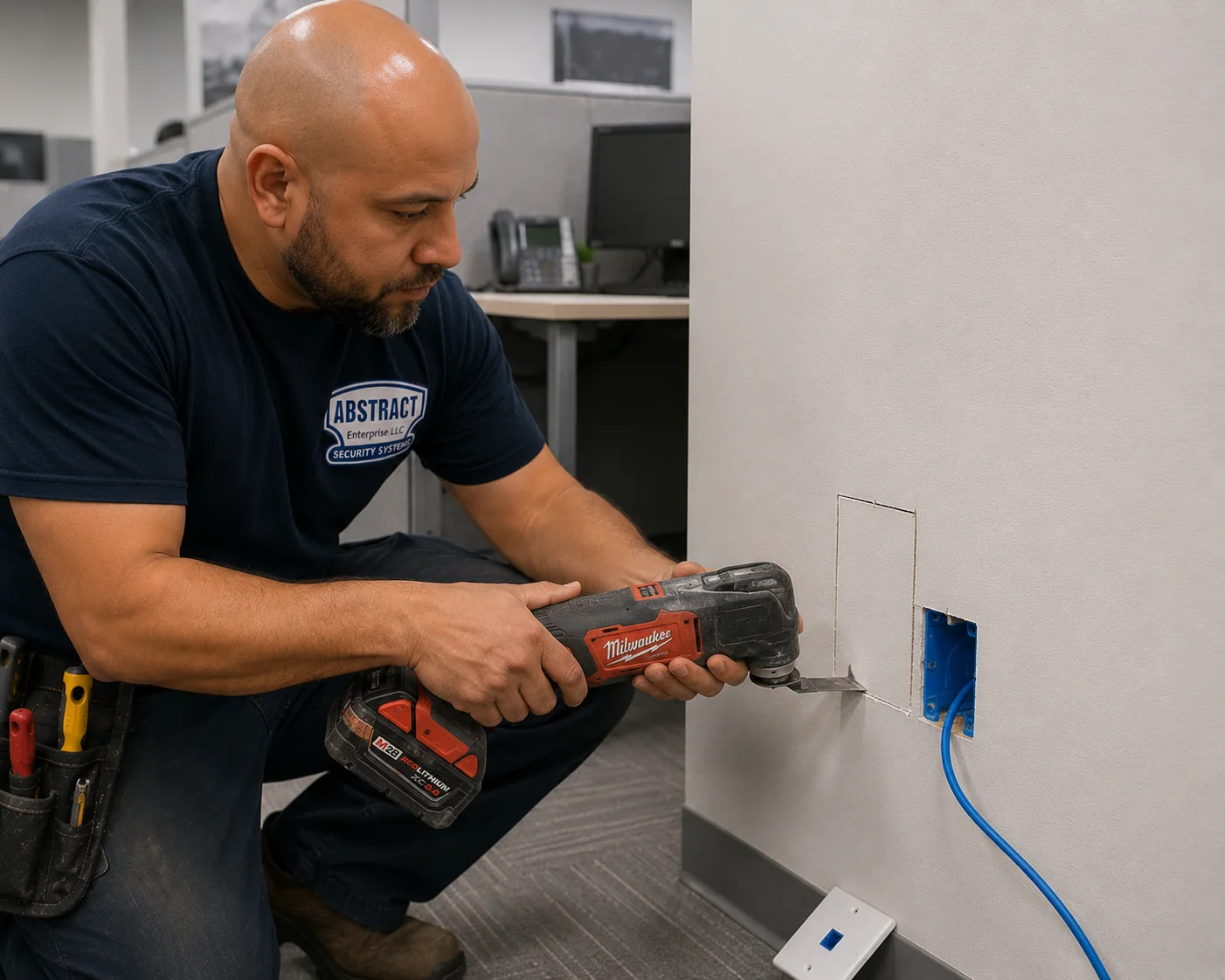
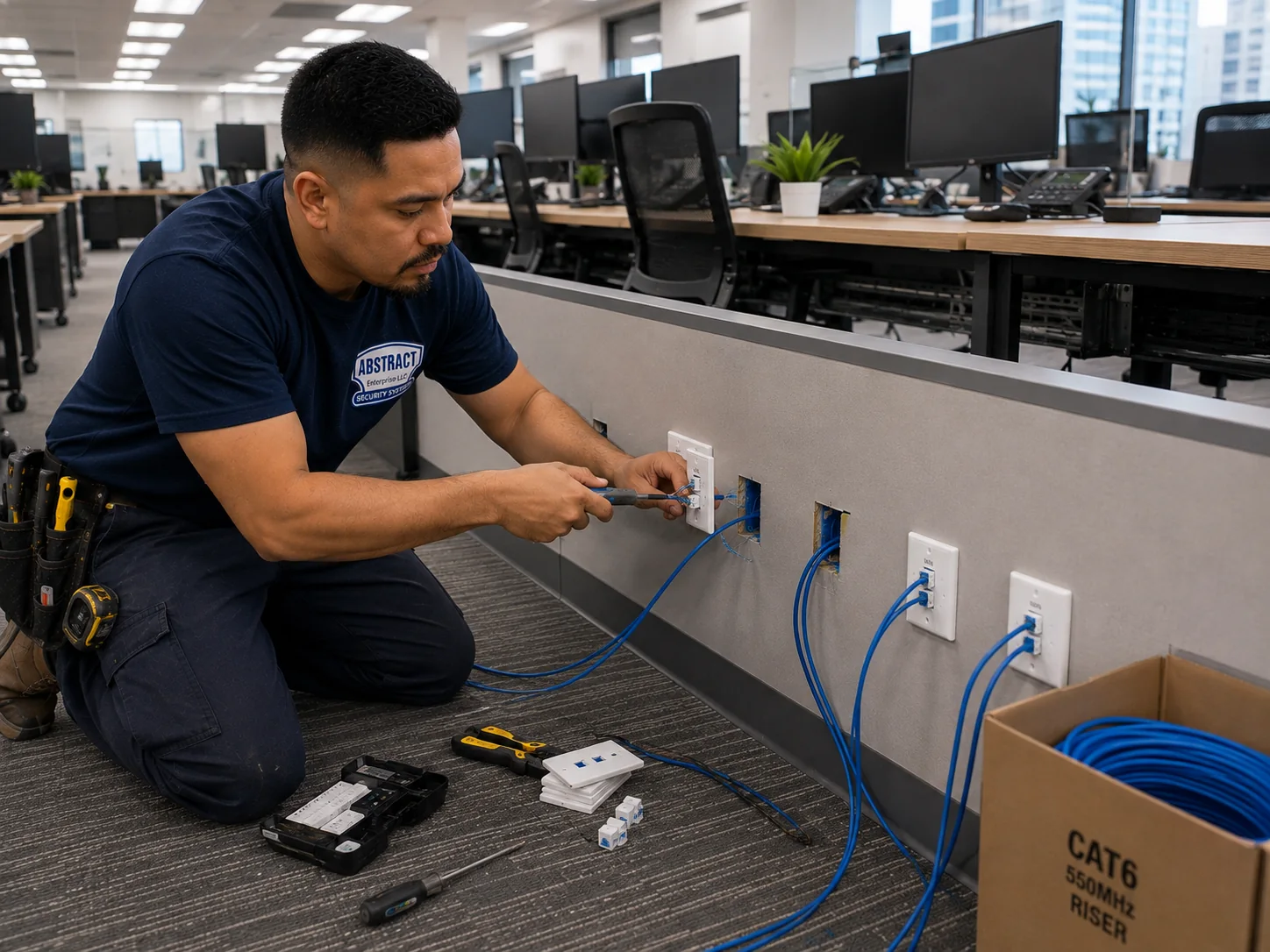
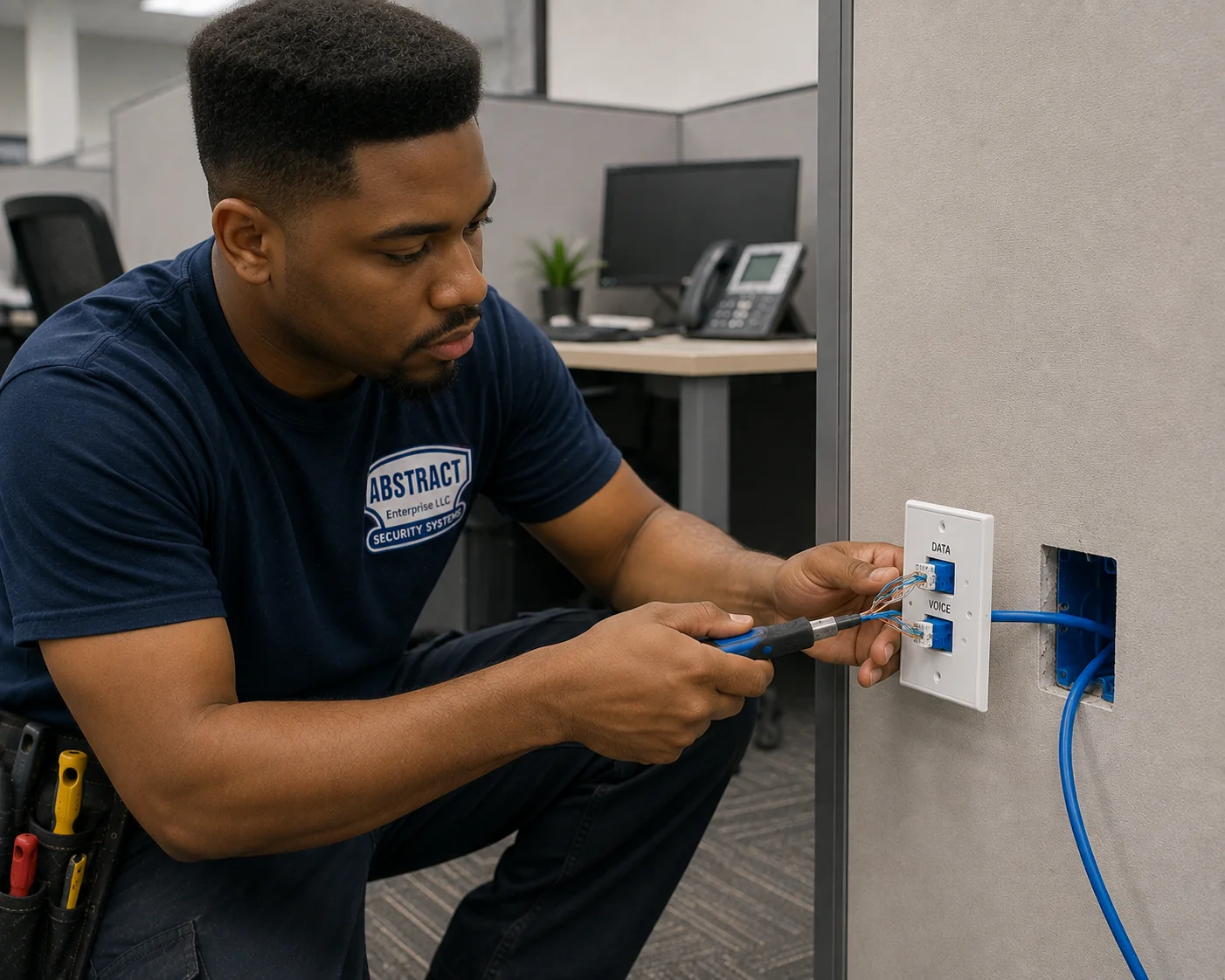
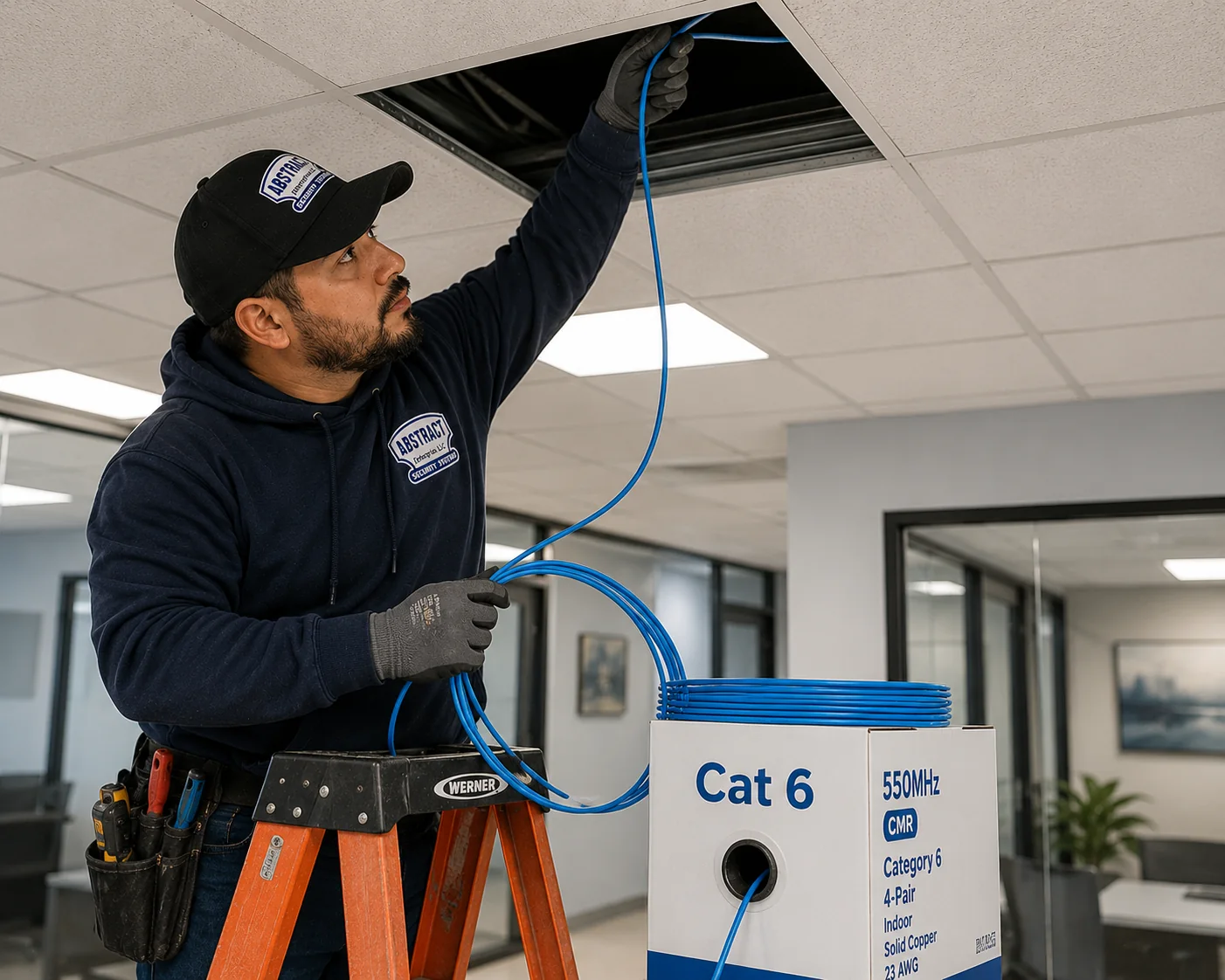
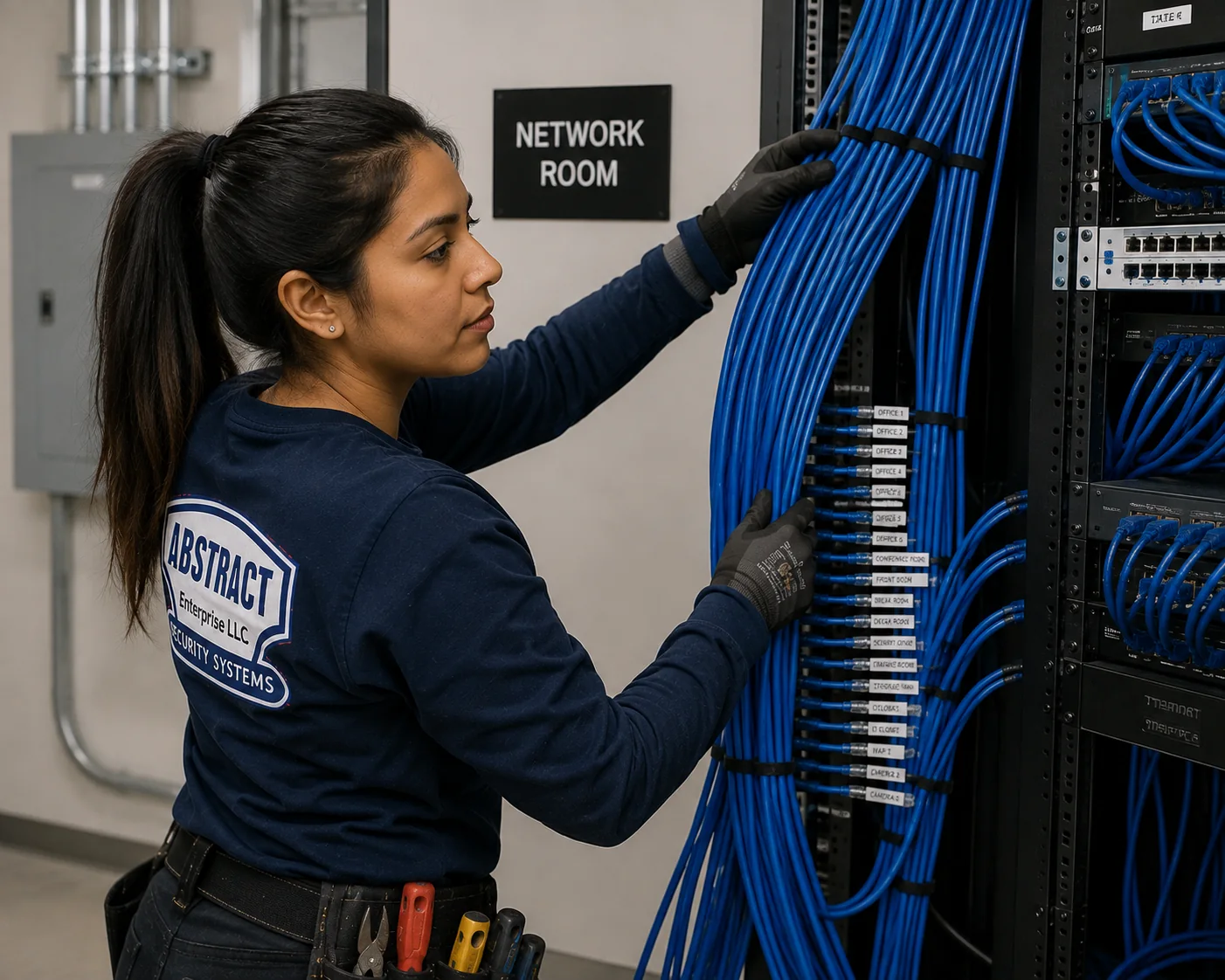
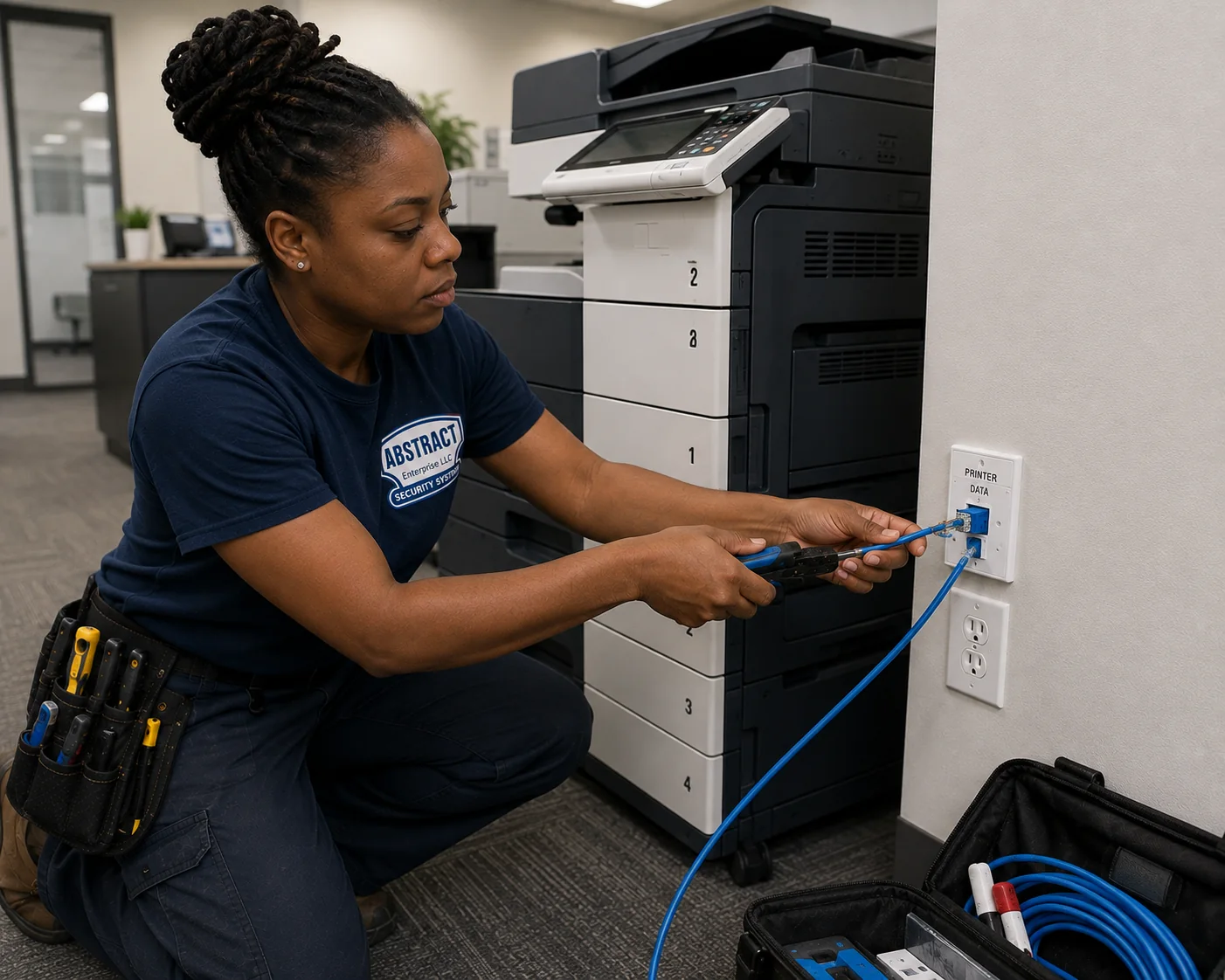
Cat6 installation for Fordham Road commercial, Grand Concourse pre-war offices, Hunts Point food distribution, Bruckner corridor conversions, hospital and school campuses, storefronts and apartment buildings across the Bronx. Each run supported the whole way, terminated on matched components, tested, marked at both ends and documented on a panel map before we leave.
Most of this borough was built long before anyone imagined cameras, readers and forty wireless devices drawing power over the same cable. Solid masonry with no wall cavity, plaster over lath, risers full of a century of abandoned wire — that gap between the building and the network it now has to carry is what shapes every job here.
Tell us the building and rough drop count — we'll come back with a number.
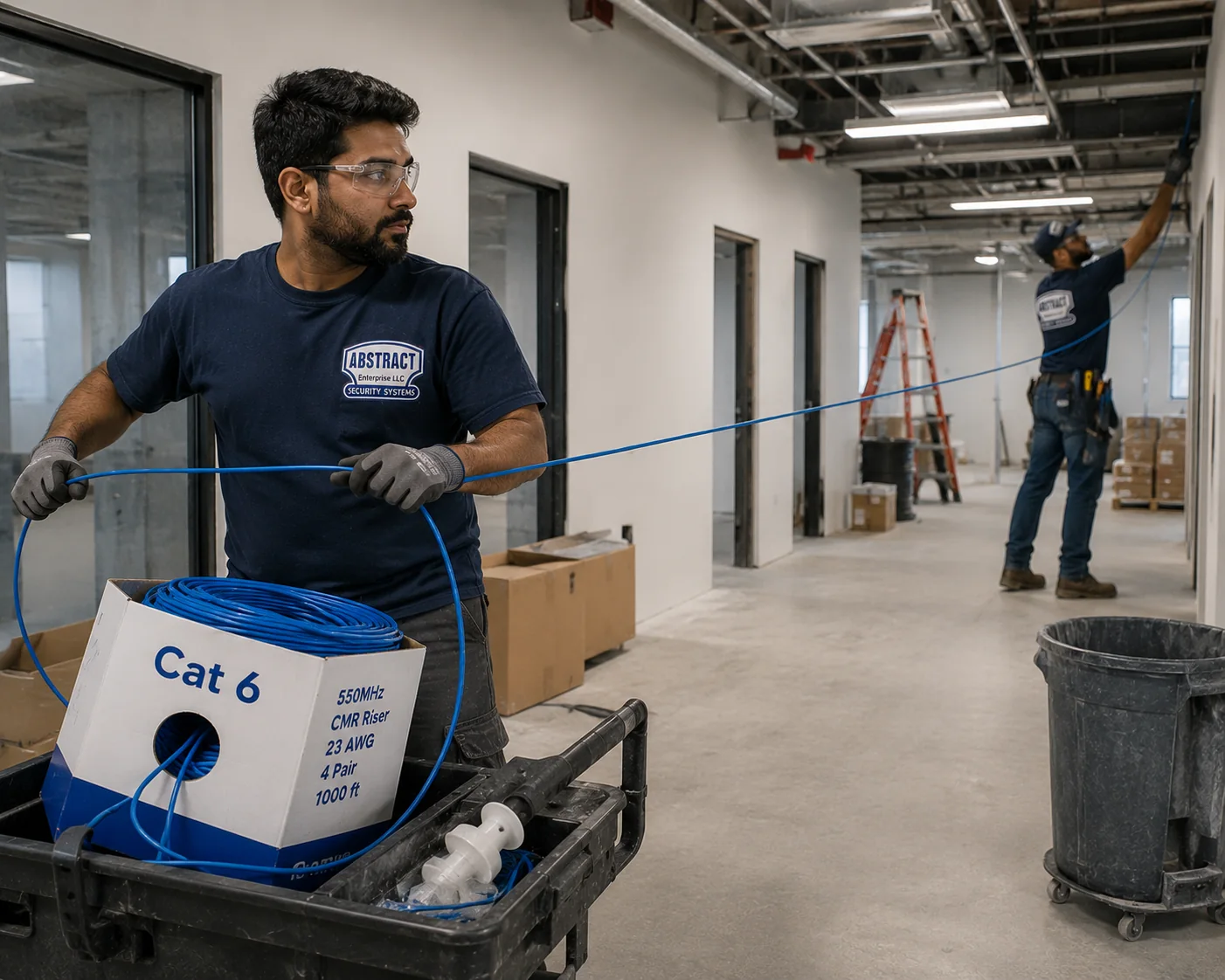
Two bids on the same Grand Concourse floor can mean completely different things by the word "drop." Here is what it means on ours.
Priced as their own lines rather than folded into the per-drop figure: rack or wall cabinet, patch panels, cable management, patch cords, switches, conduit where required, firestop materials, core drilling, dead cable removal, environmental-rated enclosures where the space demands them, and evening or weekend premiums.
Worth asking in the Bronx specifically. Ask each bidder what they intend to do where the wall is masonry. A bid that has assumed every partition can be fished has priced a building it has not probed, and the difference between fishing and raceway is not a small line item.
Most Bronx commercial and residential stock was built long before anyone imagined a camera, a card reader and forty wireless devices drawing power over the same cable. That gap is what shapes the work here.
A great deal of this borough is solid masonry from the 1920s and 1930s — brick and block party walls with no cavity, plaster over wire lath rather than drywall, fire blocking mid-wall, and telecom shafts that have absorbed a century of successive technologies. Those buildings are structurally excellent and they are unforgiving to fish. The wall you want to run inside frequently has no inside.
Layered on top is a demanding set of end uses. Hunts Point runs one of the largest food distribution complexes in the country, which means cold rooms, freezer space and wash-down areas rather than office ceilings. The borough carries a heavy hospital, university and school load, where documentation is contractual. The retail corridors trade hard through the day and cannot close. And the multifamily stock is enormous, which makes common-area and riser work a constant.
Solid masonry, plaster over lath, generous proportions and no wall cavities worth speaking of. Offices, medical suites, professional practices and institutional tenants in buildings approaching a century old. Fishing is frequently impossible, so the method becomes ceiling-and-drop, existing conduit where the building has it, or planned raceway. Slower per drop than modern construction, and there is no honest way to know how much slower without opening something.
Refrigerated rooms, freezer spaces, wash-down areas, loading docks and forklift traffic. Cable and enclosures have to be specified for condensation, temperature cycling and pressure washing rather than for an office. Penetrations through insulated panel need sealing correctly. Pathway has to survive equipment moving underneath it. This is the most environmentally demanding cabling in the five boroughs.
Mott Haven and Port Morris along Bruckner Boulevard hold former manufacturing and warehouse buildings now carrying studios, offices, food production and creative tenancies. Exposed structure, brick, high ceilings, and cable that will be visible. Lift work and planned tray routing rather than anything concealed — closer in method to DUMBO than to the Concourse.
Fordham Road is among the busiest retail corridors in the city, joined by Third Avenue, Westchester Avenue, White Plains Road, Southern Boulevard and Riverdale Avenue. Ground-floor commercial under apartments. Fewer drops, tight windows, POS terminals that belong on wired connections, and a finished customer-facing ceiling that usually rules out visible pathway. The work happens outside trading hours because the shop opens the next day.
The borough carries a heavy institutional load — major hospital campuses, university and college sites, and a very large school building stock. Multi-building properties with their own IT standards, long masonry corridors that make closet placement a genuine question, fixed calendar windows on school work, infection-control requirements on medical, and closeout documentation that is a contract deliverable.
One of the largest multifamily concentrations in the city. The work splits between common areas — lobby, entry, camera and intercom infrastructure, riser capacity between floors — and in-unit cabling, which is a separate conversation with a separate approving party. Management or board approval governs almost everything, and riser space is usually contested.
Our Bronx office is on East Fordham Road, which puts us in the middle of the borough's busiest commercial corridor and within short travel of most of it.
The Fordham Road corridor — East and West Fordham Road through to Kingsbridge Road — is one of the highest-traffic retail strips in New York, with ground-floor commercial beneath apartments and upper-floor offices, medical practices and professional suites. Cabling here is storefront and upper-floor work scheduled around trading hours. The university campuses nearby add institutional work with their own standards, and Belmont and Arthur Avenue carry dense small commercial and food businesses in older masonry. Bedford Park, Norwood and Kingsbridge run to mixed-use commercial with substantial apartment stock behind them.
Mott Haven and Port Morris along Bruckner Boulevard, Third Avenue and the numbered streets are the borough's conversion district — former manufacturing and warehouse buildings turning into offices, studios, food production and residential. Exposed structure and visible cable, closer in method to a Brooklyn loft than to anything else in the borough. Melrose and Morrisania carry mixed-use commercial and a heavy institutional and social service presence, and the Grand Concourse running north through the borough holds pre-war offices, medical buildings and civic tenants.
Hunts Point is a category of its own. The food distribution complex and the surrounding warehouses, cold storage and processing facilities need cabling that survives refrigeration, wash-down and constant pallet traffic, with specification driven by environment rather than aesthetics. Around it, Port Morris, Longwood and the Bruckner industrial blocks carry distribution, fabrication and light manufacturing where tray, lifts and separation from motor loads are standard.
Riverdale along Riverdale Avenue and Johnson Avenue is largely residential — apartment buildings, co-ops and detached houses — with professional and medical offices along the commercial spine and several private school campuses. Pelham Parkway, Morris Park and Westchester Square hold a substantial medical concentration around the hospital campuses there, in a mix of pre-war and post-war stock. Throggs Neck, Country Club and City Island run to detached housing and small commercial, and Co-op City is a very large planned multifamily community with its own commercial centre and its own building-management process. Along the eastern corridors, Westchester Avenue, White Plains Road and Boston Road carry continuous mixed-use commercial serving the residential blocks behind them.
The least expensive version by a wide margin, and the one worth chasing in a borough where retrofit is otherwise hard. Cable goes in while the framing is still open, lands at the closet, and sits coiled behind a set box at every outlet until finishes are done. A short second visit terminates, tests and labels. Pre-wire is booked ahead of the drywall crew because open pathway is what keeps the per-drop figure down.
The defining Bronx method. Where the wall has a usable cavity, cable runs the ceiling and drops at a partition. Where it does not — brick party wall, plaster over lath, fire blocking mid-cavity — the honest answers are existing conduit if the building has capacity and a reasonable bend count, or surface raceway routed carefully as a finish detail. Forcing a fish in an old wall makes holes that then need patching, painting and explaining, which is a worse outcome than well-installed containment.
Refrigerated and freezer rooms, processing floors and wash-down areas need cable rated for the conditions, enclosures rated for the conditions, and penetrations through insulated panel sealed properly. Condensation and temperature cycling do to ordinary cable what a summer ceiling does to a marginal PoE run, only faster. Specified at walkthrough, not adapted afterward.
Getting between floors in a multifamily or multi-tenant building is its own scope. It needs management or board approval, an assessment of what already occupies the shaft, and frequently removal of dead cable before anything new fits. Any hole made through a rated assembly is restored to that rating using a listed firestop system.
Retail work is staged so the sales floor is clear and usable when the shop opens. Back-of-house first where possible, ladder work in the customer area confined to the quiet window, and a defined stop time. The premium for working evenings or early mornings is quoted openly rather than absorbed.
"It works" and "it performs" are separate claims, and only the second one leaves evidence.
Every drop is wiremap-tested before the ceiling closes. When the job requires full certification, we test permanent links with a Fluke DSX CableAnalyzer and deliver the pass/fail report with the closeout package.
A link light conceals the faults that matter: a split pair reading continuous while degrading everything above it, a punch-down with an inch of conductor untwisted, damage picked up somewhere along the route. A permanent link test covers what is built into the fabric of the building, panel through to outlet. A channel test puts the cords back in and reports what the device on the end genuinely sees.
The Bronx gives this extra weight for a practical reason. In a masonry building where the run went in through raceway or reused conduit, correcting a fault afterward is not a ladder and ten minutes — it is undoing containment or re-pulling a conduit that was difficult the first time. And on the borough's large institutional base, certification reports are frequently a contract deliverable rather than a courtesy, so a contractor who cannot produce them fails the submittal regardless of how the cable performs.
The rule that never bends: nothing closes and no containment gets capped until every drop has been tested. Minutes with access open, or a demolition conversation afterward, for exactly the same fault.
A modern building runs its cameras, door readers, wireless access points, desk phones and intercoms over the same cable that carries their data. One pull, no electrician at every device.
| Standard | Common name | Typically powers |
|---|---|---|
| 802.3af | PoE | Desk phones, basic fixed cameras, simple readers |
| 802.3at | PoE+ | Most current access points, PTZ and IR cameras, video intercoms |
| 802.3bt | PoE++ | High-power APs, heated outdoor domes, displays, higher-draw edge devices |
Power on a conductor makes heat, heat inside a tight bundle has nowhere to go, and heat raises resistance — more voltage lost along the run, less power arriving. Solid copper in a sensibly sized bundle absorbs it. A long CCA run in a large bundle has no margin left.
Two Bronx conditions bear on this. Wireless coverage in masonry buildings is a construction problem before it is a radio problem — brick party walls and plaster over lath attenuate hard, so good coverage needs more access points at tighter spacing, each one another powered drop in a bundle. And outdoor and semi-outdoor devices are common across the borough's industrial, institutional and multifamily properties: yard cameras, dock coverage, entry readers and heated domes sit at the top of the power range and frequently at the end of the longest runs on the job.
Published per drop, so the arithmetic can be done before a site visit is booked.
| Cable type | Per drop, runs to 100 ft |
|---|---|
| Cat5e | $233 |
| Cat6 | $272 |
| Cat6A | $388 |
| Coax / RG6 | $233 |
| Speaker wire | $194 |
| HDMI | $310 |
| Fiber — multimode | $543 |
| Fiber — singlemode | $620 |
Every figure carries the cable, the plate and keystone, terminations at each end and the completed-run test. New construction quoted before drywall comes down ten percent. Beyond 100 feet the route gets measured and priced on what it actually takes.
Quoted separately: rack or wall cabinet, patch panels, cable management, patch cords, switches, conduit where required, surface raceway where a wall cannot be opened, firestop materials, core drilling, environmental-rated cable and enclosures in cold or wash-down space, dead cable removal from congested risers, toning and mapping of existing unlabeled cable, and evening or weekend premiums.
Run your own numbers in the cabling quote builder, or call and walk us through the space.
Cat6 is what belongs in almost every Bronx drop. The 250 MHz margin over Cat5e's 100 MHz carries a warm ceiling, a crowded bundle and an imperfect termination without the link stepping down, and on new work the difference is $39 a drop. Cat6A earns its $388 where full-distance ten gigabit is genuinely specified, on uplinks and server links, and between telecom rooms in a building large enough to need two. It does not extend the ninety-metre limit and never fixes a distance problem.
Plenum jacket where air returns through the space, riser jacket in the shafts, general purpose elsewhere. Older Bronx buildings vary considerably in how they handle return air, and a repurposed space is often not what it appears from below. Confirmed at walkthrough against the building and the authority having jurisdiction rather than assumed from the building's age.
Unshielded pair is the right specification in the overwhelming majority of buildings. Shielded cable requires proper bonding and grounding at the rack to function at all; an ungrounded shield behaves as an antenna and can measure worse than plain UTP. The genuine cases here are industrial: processing and distribution floors with large motor loads, refrigeration plant, and unavoidable parallels beside power in older buildings.
Solid copper in every horizontal run. Beyond that, the Bronx adds an environmental question most boroughs do not: cable and enclosures going into refrigerated, freezer or wash-down space need rating for those conditions rather than an office specification and optimism. CCA in any of those environments is a callback with a date on it.
| Location | Drops | Why |
|---|---|---|
| Workstation | 2 | Computer plus phone, dock or future second device |
| Printer / copier | 1–2 | Shared devices get their own port |
| Wireless access point | 1 | Wired backhaul; masonry demands noticeably tighter spacing |
| IP camera | 1 | PoE data and power on one run |
| Door reader | 1 | Where the access system is IP at the door |
| POS terminal | 1 | Card processing wired, not on shared Wi-Fi |
| Exam room | 1–2 | Workstation plus imaging or chairside equipment |
| Lobby / entry | 2–3 | Intercom, camera, reader on multifamily and institutional entries |
| Dock / cold room | varies | Scanners, cameras and monitoring, on environment-rated cable |
In a pre-war building the telecom room is inherited and usually was not designed to be one. The questions worth answering before install are whether it has adequate power, whether anything ventilates it, whether the space allocated is enough for the panel and management the job needs, and whether the riser serving it has capacity left. All four are cheaper to answer at walkthrough than at rack-mounting.
Landed and marked at the panel, then left coiled above the tile or parked behind a blank plate. Spares earn more here than in easier buildings, because in masonry the marginal cost of one more drop while the route is open is small and the cost of establishing a new route later is not. On a thirty-drop job, four or five is proportionate.
Method commentary, not case studies. Recurring patterns, described generally.
A pre-war wall quoted as a straightforward drop, with plaster over lath and blocking mid-cavity. Discovered by pushing a rod, not by reading a plan.
Decades of abandoned telephone and coax occupying the capacity new work needs. Removal becomes a prerequisite rather than an optional extra.
Standard cable and a standard enclosure installed into refrigerated or wash-down space. Condensation and cycling do the rest, usually within a year.
Surface containment put up wherever the cable happened to land. In a finished commercial space it reads as exactly what it is.
Access points positioned as though the interior walls were drywall. Coverage dies two rooms from the radio and nobody suspects the building.
On distribution and food floors, containment routed around one equipment layout and left exposed after the next reconfiguration.
Ladder work in a customer area during business hours. Slower, more disruptive and more expensive than doing it before opening.
Bundles dropped onto grid and tile because it was faster. Against code, and it puts the network directly underfoot for every trade that follows.
A 5e keystone on Cat6 cable, chosen because it was within arm's reach. The channel drops a grade and the drop gets built a second time.
Cable trimmed exactly to length at both ends. The next termination change means pulling fresh cable, and in masonry that means establishing the route again.
Sound cable, sound terminations, and nothing written down. From then on every single change starts with a toner and an hour.
Institutional and public projects that required test reports in the documents and received none, discovered at closeout.
Past a handful of drops the horizontal cable stops at a panel and everything downstream happens on cords. That costs slightly more on day one and returns it the first time a desk moves or a port dies, because the permanent cable is never disturbed again. In masonry the argument is stronger than anywhere: the run that was hard to install once should be installed once.
We work to TIA-568 and terminate T568B, unless the building is already standardised the other way. Identifiers and mapping follow TIA-606-style convention, which is what keeps the room legible long after we have gone. Every component holds the same category, since dropping a 5e jack onto Cat6 downgrades the whole channel and fails certification outright.
Telecom rooms in older Bronx buildings frequently were not designed to hold network equipment. They are often shared with the electrical panel, the alarm and whatever else needed a lockable door, sometimes unventilated, occasionally in a basement with a damp problem. Enclosure choice, ventilation and physical protection are genuine engineering considerations in those rooms rather than aesthetic preferences, and they get raised at walkthrough rather than worked around later.
Per-drop results, the panel mapping, an identifier scheme spelled out in plain language, what cable and components went in, marked-up drawings where drawings exist, and photographs of anything about to be concealed. Across the borough's hospitals, colleges and school buildings that package is written into the contract, and a submittal that turns up short gets sent back no matter how well the cable was installed.
Roughly 43% more per drop, and what it buys is ten gigabit across the full run. That is money well spent closet to closet, into a server, or wherever the drawings demand it. At a desk or behind a radio it purchases headroom nothing touches — and not one extra metre of reach.
Legacy 5e that passes a test can stay. For new permanent cable the difference is $39 a drop, and Cat6's margin carries heat, bundle density and power draw. Hard to justify 5e on anything you intend to keep.
In masonry and plaster, forcing a fish creates holes needing patching, painting and explaining. Raceway planned as a finish detail is frequently the more professional answer here, not the lesser one.
Wireless is something cable provides. Brick and plaster eat signal, so decent coverage means more radios at closer spacing — and that pushes the cable count up, not down.
In cold rooms, freezers and wash-down areas this is not an upgrade, it is the specification. Office cable in those spaces fails on a schedule.
There is no legitimate case for the second one. Higher resistance, conductors that snap where they are landed, and collapse under load. Bargain cable in the hardest environment in the city is a scheduled callback.
Someone stands in the building, opens a tile, probes a wall, finds the telecom room and assesses the riser. Drop positions marked, cable rating and environmental requirements determined, pathway method settled, and trading or operating hours established before a number exists.
Drop count at the published rate, hardware and containment itemised, premium conditions stated openly. Deposit with balance on completion, terms on the document.
Insurance to the owner, managing agent or board, access and hours confirmed, approvals for riser and common-area work resolved, and any dead cable removal agreed before the crew loads in.
Pathway and containment installed, cable pulled, penetrations firestopped, boxes set, cable dressed into the telecom room with service loop.
Outlets landed, plates fitted, the panel punched down, rack hardware mounted, and every end marked at the moment it is made rather than afterward.
Every drop, before anything closes or containment is capped. Failures corrected while access is still available, then re-tested.
Everything handed across: per-drop results, mapping, naming, materials and marked drawings. Concealed routes photographed first, then the site cleared.
Hospitals, colleges, schools and civic buildings make up a larger share of the commercial base here than in most boroughs, and that work runs to its own rhythm: fixed calendar windows, specified deliverables, submittal requirements, and closeout documentation that is contractual rather than optional. Summer school work in particular does not move, so material lead time and sequencing carry more weight than they would on a private fit-out.
Not testimonials — the commitments that apply to every Cat6 job we take in the Bronx.
Whether a partition can be fished is established by testing it before pricing, so the method in the proposal is the method on site.
Every installed run tested before anything closes or containment is capped, certified to permanent link where the project specifies it.
Results, mapping, naming convention and bill of materials delivered in a format an institutional closeout package will actually accept.
Cold, freezer and wash-down spaces get cable and enclosures rated for the conditions rather than an office specification.
Retail and operating floors left clear and usable at opening, with out-of-hours premiums quoted openly rather than absorbed.
The warranty is spelled out below, and future moves or additions are handled as ongoing work rather than a cold start.
By the time anyone opens a ceiling, the switch has been swapped, the firewall reconfigured and the carrier called twice.
Diagnosis begins at the panel, not the workstation. Locate the run, put a permanent link test on it, read what comes back. Passing clears the building's cable and moves attention to a cord, a switch port or the hardware itself — which is worth knowing before anybody starts opening containment in a masonry wall. A failure identifies the parameter at fault, and that usually points at a termination before it points at anything else, with physical damage second and length third. Redoing both ends resolves the bulk of them.
Cat6 runs $272 a drop inside 100 feet. That figure carries the cable itself, the faceplate and jack, a termination at each end and the test once the run is finished. Anything quoted ahead of drywall on new construction comes off ten percent, and beyond 100 feet we measure the route and price against it. Working out of Fordham Road keeps travel short across most of the borough; the rate sits at the same step above our Brooklyn base that applies across the outer boroughs.
Because so much of the borough's commercial and residential stock is solid masonry from the 1920s and 1930s, and it does not behave like modern construction. Party walls and demising walls are often brick or block with no cavity at all, interior partitions are plaster over wire lath rather than drywall, and older buildings frequently have fire blocking mid-wall that stops a fish rod dead. Fishing is often ruled out entirely, which means the honest options are running the ceiling and dropping at a partition, reusing existing conduit where the building has it, or surface raceway planned as a finish detail. Which applies is a walkthrough finding, not a phone estimate.
Yes, and it is a distinct discipline. Hunts Point and the surrounding food businesses put cable into refrigerated rooms, freezer spaces and wash-down areas, and each imposes its own requirements. Condensation, temperature cycling and pressure washing all attack cable and enclosures that were specified for a dry office. Pathway has to survive forklift and pallet traffic, penetrations through insulated panel need sealing correctly, and equipment enclosures need rating for the environment. This gets specified at the walkthrough rather than adapted on the fly.
Usually, by working outside trading hours. Retail along Fordham Road, Third Avenue, Westchester Avenue and the borough's other commercial strips is busy through the day and generally cannot absorb disruption, so cabling happens before opening or after closing. Work is staged so the sales floor is clear and usable at the start of each trading day, back-of-house runs are done first where possible, and anything requiring a ladder in the customer area is scheduled for the quiet window. The out-of-hours premium is quoted as its own line rather than hidden.
A site visit that establishes drop positions and how cable travels to them, the pull on supported pathway, a keystone terminated at the outlet and a panel port at the telecom room, plate and panel mounted, identifiers printed at both ends, a test on each completed run, and a map tying every panel port to its outlet. Racks, panels, cable management, switches, conduit, firestopping, lift hire and out-of-hours premiums are itemised separately rather than folded into the drop price.
A pair per seat, its own port for any shared printer, one for every radio, camera and reader, one per register, and three or four wherever a screen lives. What pushes Bronx counts above comparable floor area elsewhere is the wireless: brick partitions kill signal, so radios have to sit closer to the people using them, and every extra radio is another cable.
Over a shortened reach — the figure usually cited sits near 55 metres, and it shrinks further inside a dense bundle where alien crosstalk bites. It is not a full 100 metre ten gigabit channel; full-distance ten gigabit is a Cat6A specification. For workstations, handsets, cameras and access points, which is what almost every drop in the borough feeds, Cat6 is the right call and the economical one.
Copper-clad aluminium is aluminium conductor with copper plated over it. The box price is lower and the cable is not equivalent. Aluminium resists more, which becomes a real problem the moment power is riding the pair, and it snaps rather than bends, so conductors break at the punch-down and inside the tight turn behind a plate. It will show a link light and still starve a camera. Our horizontal runs are solid copper throughout.
Return-air spaces take CMP; vertical shafts between floors take CMR. The catch in this borough is that older buildings handle return air in a dozen different ways, and a repurposed floor rarely announces which one it uses from underneath. We settle it on site with the building and the authority having jurisdiction rather than inferring it from the year the place went up.
Sometimes, and sometimes only after dead cable comes out first. Older Bronx commercial and multifamily buildings have accumulated decades of abandoned telephone, coax and early data in their shafts, and it occupies the capacity new work needs. Removal is a scope item in its own right, unused accessible cable is a recognised code concern rather than just clutter, and the decision usually sits with the owner or managing agent rather than the tenant — so it is worth raising at walkthrough rather than discovering mid-pull.
There is no termination that converts one category into another; the rating belongs to the cable, so upgrading means new cable. The reusable asset is the route. Where the old 5e sits in conduit or on a tidy hook run with capacity, the replacement follows the same path — and in a masonry building where establishing a new route is the expensive part, that reuse is worth more than it would be elsewhere.
Regularly. The Bronx has a very large multifamily and institutional base — apartment buildings, hospitals and clinics, colleges and schools, community and social service organisations. Common-area work, lobby and entry infrastructure, and riser capacity between floors are the recurring scopes, and board or management approval governs nearly all of it. On institutional projects, test documentation and as-builts are frequently specified in the contract documents rather than offered, which is worth confirming with every bidder before comparing totals.
Tell us the building, the rough drop count and the timeline. Wall construction matters most here — drywall, plaster over lath or solid masonry — so mention what you know.
🛡 Cat6 installation warranty. Abstract Enterprises Security Systems provides a three-year warranty on products supplied by AESS for normal wear and tear. It does not cover existing or customer wiring, customer-supplied equipment, lightning or other acts of God, power outages or surges, physical damage or unplugging, internet, router or phone changes, or camera readjustments requested after completion. After the warranty period, service is $195 per hour with a three-hour minimum ($585). Full terms: abstractenterprisessecuritysystems.com/warranty.
Call 646-490-0629
WhatsApp message us
NYS Low Voltage License #12000287431
4.7 / 201 Google Reviews
We'll follow up to arrange a walkthrough.