What are you looking for?
About Us Contact Us Careers Get a Free Quote 347-434-6392
Pick a service
✅ Got Your Own System?
🎬 Home TheatreQuote 🎶 AV SoundQuote 🔑 Access ControlQuote
Now pick your area
Pick your area
Long Island
Hudson Valley
Services available
Pricing & Tools
Pick a service for pricing
🚪 Intercom Pricing 🔔 Buzzer Repair Pricing
Calculators
📹 Camera System Calculator 🚨 Alarm Calculator ⚡ Cabling Quote Builder ✅ Got Your Own System?
Select your area
Queens, New York

Cat6 Installation Queens

Cat6 cable installation · data drops · patch panel termination · warehouse & logistics tray · shared riser work · testing & labeling

Cat6 installation for Long Island City towers, Flushing mixed-use, Jamaica institutional buildings, the Maspeth and Ridgewood industrial belt, the JFK logistics corridor and the borough’s enormous stock of houses. Every run on supported pathway, terminated on category-matched components, tested, identified at both ends and handed over with a panel map.

Queens has no single downtown. It has a dozen commercial centres spread across 109 square miles, each with its own building stock and its own era — which means the right question is never what cabling costs in Queens, but what is above the ceiling in this specific building and whether there is a closet.

4.7 / 201 Google Reviews NYS Low Voltage #12000287431 Licensed & Insured Cat6 drops from $272

Get a Cat6 Quote

Tell us the building and rough drop count — we'll come back with a number.

Or call 347-434-6392

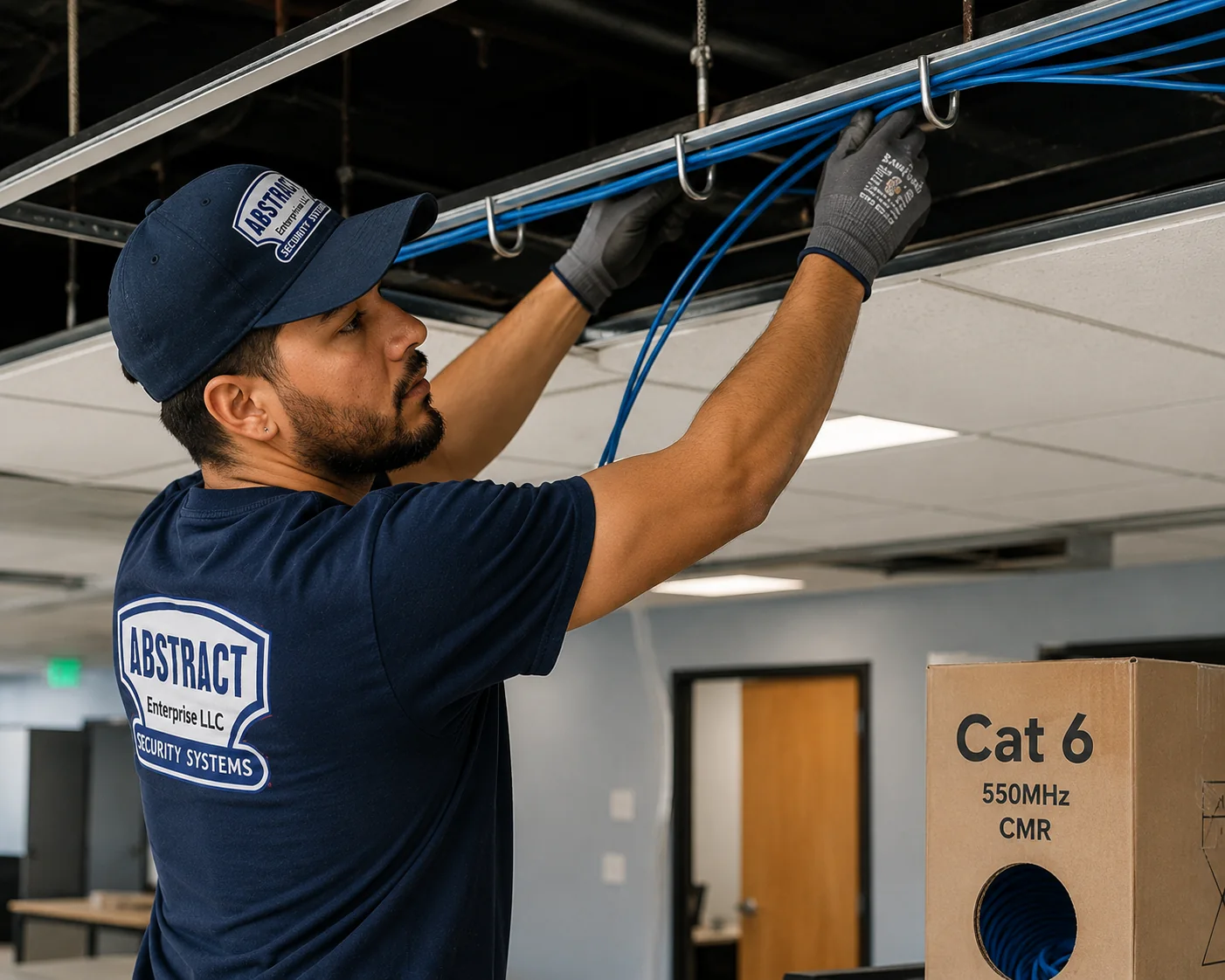
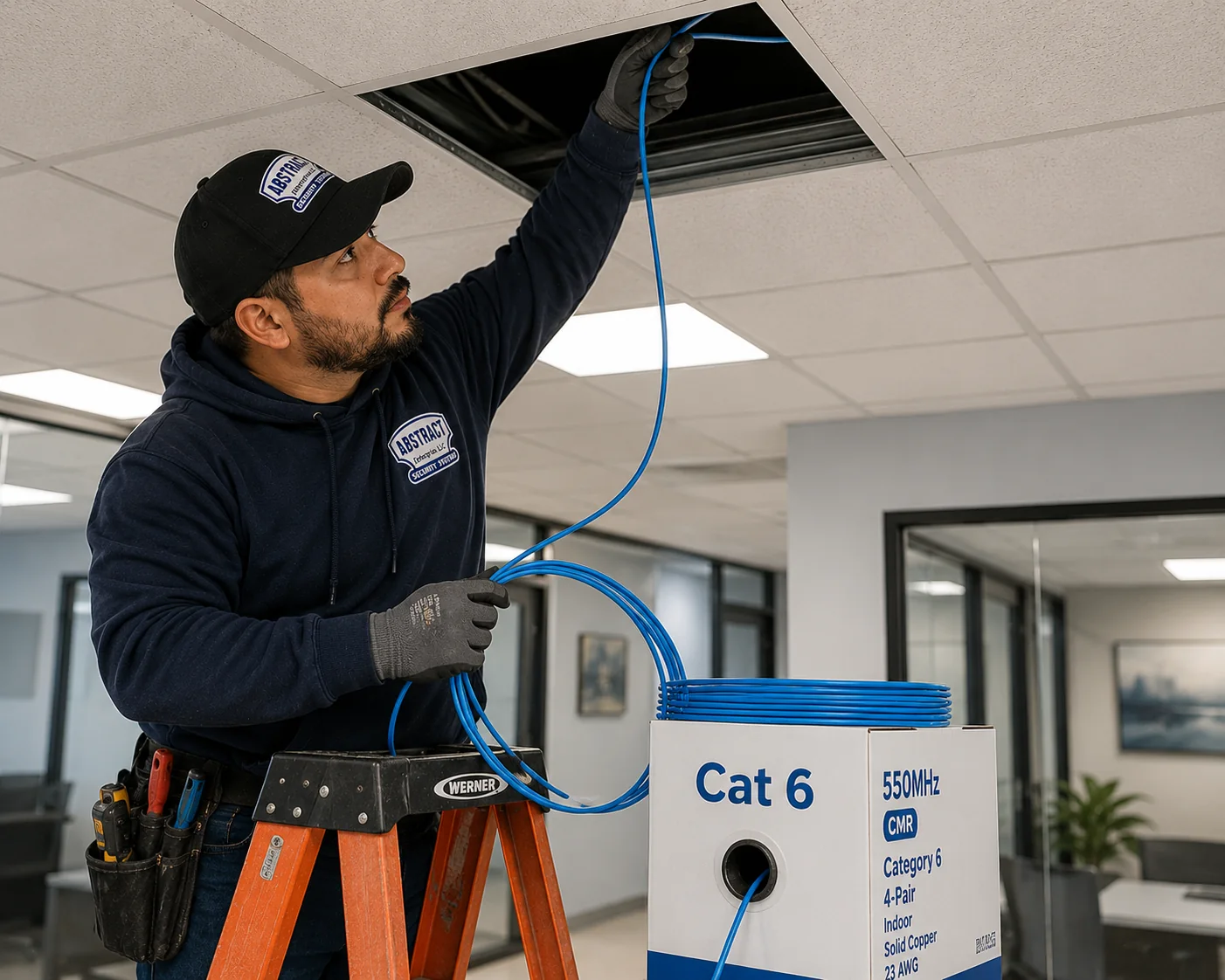
Cat6 installation Queens technician pulling cable through an open ceiling tile beside a Cat 6 CMR box
Cat6 installation Queens — solid copper Cat 6, 550MHz CMR riser, 23 AWG, fed through an open tile on a commercial floor.
Scope

What a Cat6 installation from us includes

Two bids on the same Long Island City floor can mean entirely different things by the word "drop." Here is what it means on ours.

  • A site visit before a number. Someone stands in the space, opens a tile, finds the telecom room, and establishes how cable travels between them.
  • The pull. Cable carried on supported pathway, off grid and tile, clear of sprinkler and lighting, away from sustained parallels beside power.
  • Both ends terminated properly. Keystone in the outlet plate, panel port at the closet, components matched to category throughout, worked to TIA-568 on T568B unless the building runs A.
  • A test on each completed run, every one rather than a sample, while access is still open.
  • Identifiers at both ends and a panel map the next person can follow.
  • The space left workable at the end of each shift.

Priced as separate lines rather than folded into the per-drop figure: rack or wall cabinet, patch panels, cable management, patch cords, switches, conduit where required, firestop materials, core drilling, lift hire, dead cable removal, and evening or weekend premiums.

Worth asking in Queens specifically. On a mixed-use or multi-tenant building, ask each bidder who they have spoken to about the riser and the shared telecom space. A bid that assumes free access to a shared shaft has priced a building it has not seen.

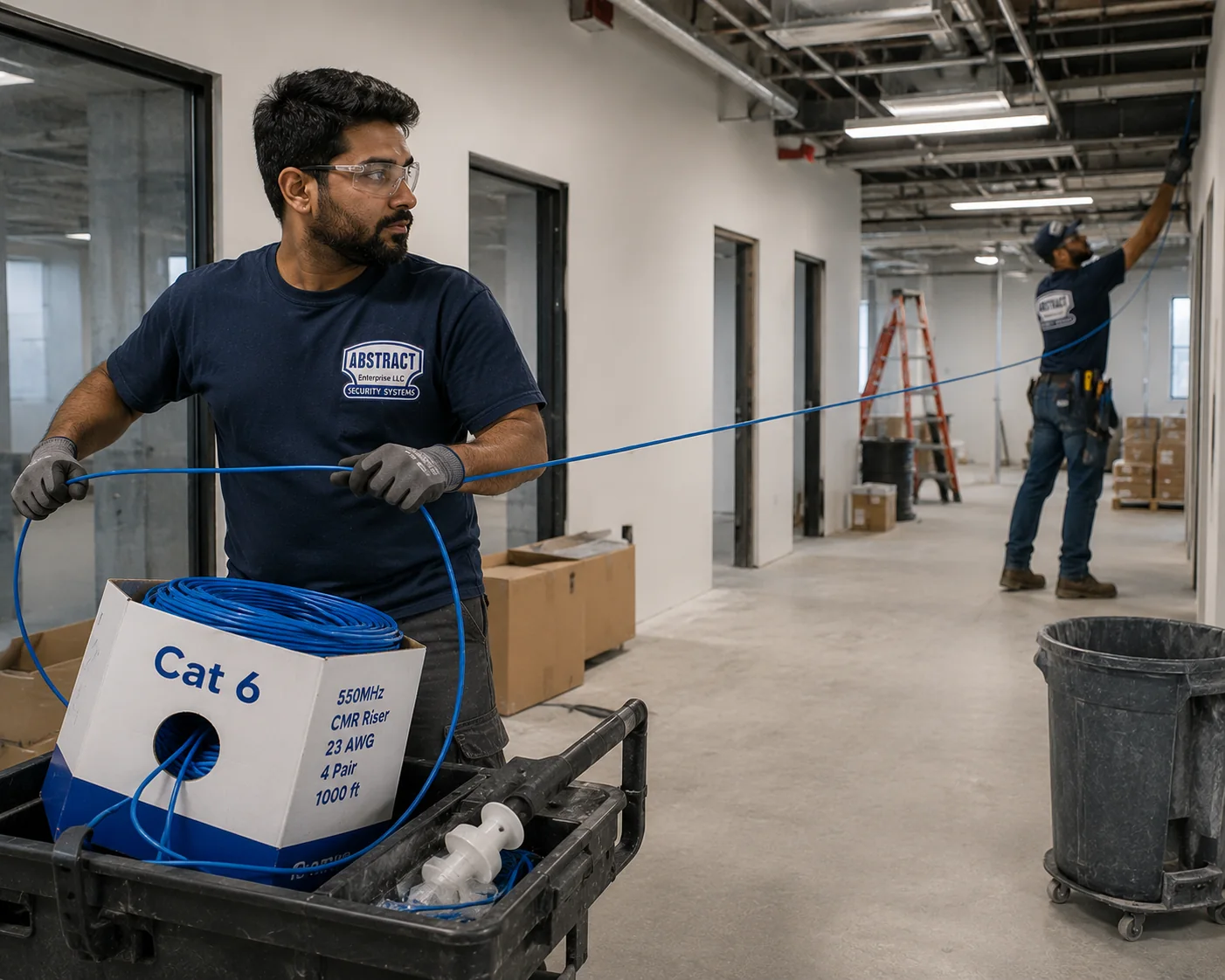
Cat6 cable installation Queens two-technician corridor pull off a cable box on a cart
Cat6 cable installation Queens — a corridor pull staged so the bundle stays supported and off the floor.
The defining constraint

Queens is a dozen commercial centres, not one

Most boroughs have a downtown. Queens has Long Island City, Flushing, Jamaica, Astoria, Forest Hills, Ridgewood, Maspeth and the airport corridors — and they have almost nothing in common.

That dispersion is the thing that shapes this work. A contractor covering Queens is not covering a district, they are covering 109 square miles containing new glass towers, century-old manufacturing lofts, dense mixed-use commercial strips, institutional campuses, air cargo warehousing and the largest stock of one and two-family housing in the city. The distance from Long Island City to Far Rockaway is roughly the distance from Midtown to White Plains.

Two consequences follow. Travel and staging are a real component of a Queens job in a way they are not in Manhattan, which is reflected in the rate. And the building you are in matters more than the borough you are in — the right question is never "what does cabling cost in Queens," it is "what is above the ceiling in this specific building, and is there a closet."

What this changes in practice

  • One walkthrough per site, not per borough. Nothing about a Flushing job predicts a Maspeth job.
  • Shared infrastructure is common. Multi-tenant and mixed-use buildings mean shared risers and shared telecom space, which means coordination before mobilisation.
  • Scheduling is geographic. Work gets grouped so a crew stays productive in one part of the borough rather than crossing it twice in a day.
  • Residential is a real segment here. Detached and two-family houses cable differently from anything commercial, and they are everywhere east of the Van Wyck.
Cat6 installer Queens laying a cable bundle into J-hooks above a commercial ceiling
Cat6 installer Queens — supported pathway at regular intervals rather than cable resting on grid.
Building stock

Five Queens buildings, five different jobs

Tower

Long Island City commercial towers

New and recent construction around Queens Plaza, Jackson Avenue and Court Square. Floor telecom rooms, accessible grid ceilings, short runs, building management with insurance and freight requirements, sometimes a published standard. The most predictable cabling in the borough and the closest thing Queens has to Manhattan conditions — including the administrative process that comes with it.

Loft

Converted manufacturing

Long Island City's older blocks, Ridgewood and parts of Astoria hold manufacturing buildings now carrying studios, workshops, food production and creative tenancies. Concrete or timber, high exposed ceilings, brick with no cavity, and cable that will be visible. Lift work and planned tray routing rather than anything hidden.

Mixed-use

Commercial over retail

The dominant commercial form along Main Street, Roosevelt Avenue, Steinway Street, Queens Boulevard, Jamaica Avenue and Northern Boulevard. Offices, clinics, dental practices and professional suites above ground-floor shops. Shared risers, a telecom space serving several tenants, and scheduling built around not disrupting the businesses below.

Industrial

Manufacturing, logistics and air cargo

Maspeth, Ridgewood's industrial edge, College Point, and the Rockaway Boulevard and North Conduit corridors serving JFK. Cable tray, lift work, long runs, separation from motor loads, and pathway that survives racking changes and dock traffic. Facility access requirements near the airport frequently need arranging in advance.

Institutional

Government, medical and education

Jamaica around Sutphin Boulevard and 165th Street carries courts, agencies and civic buildings. Add the hospital campuses, the college and university sites, and the borough's very large school building stock. Long masonry corridors that make closet placement a genuine question, fixed calendar windows, and documentation that is a contract deliverable rather than a courtesy.

Residential

One and two-family houses

More of this than any other borough — detached, semi-detached and attached houses across Bayside, Fresh Meadows, Whitestone, Howard Beach, Ozone Park, Richmond Hill, Queens Village and the Rockaways. Accessible basements and often attics make these clean to wire with very little wall opening. Attic heat is the design factor that matters on powered runs.

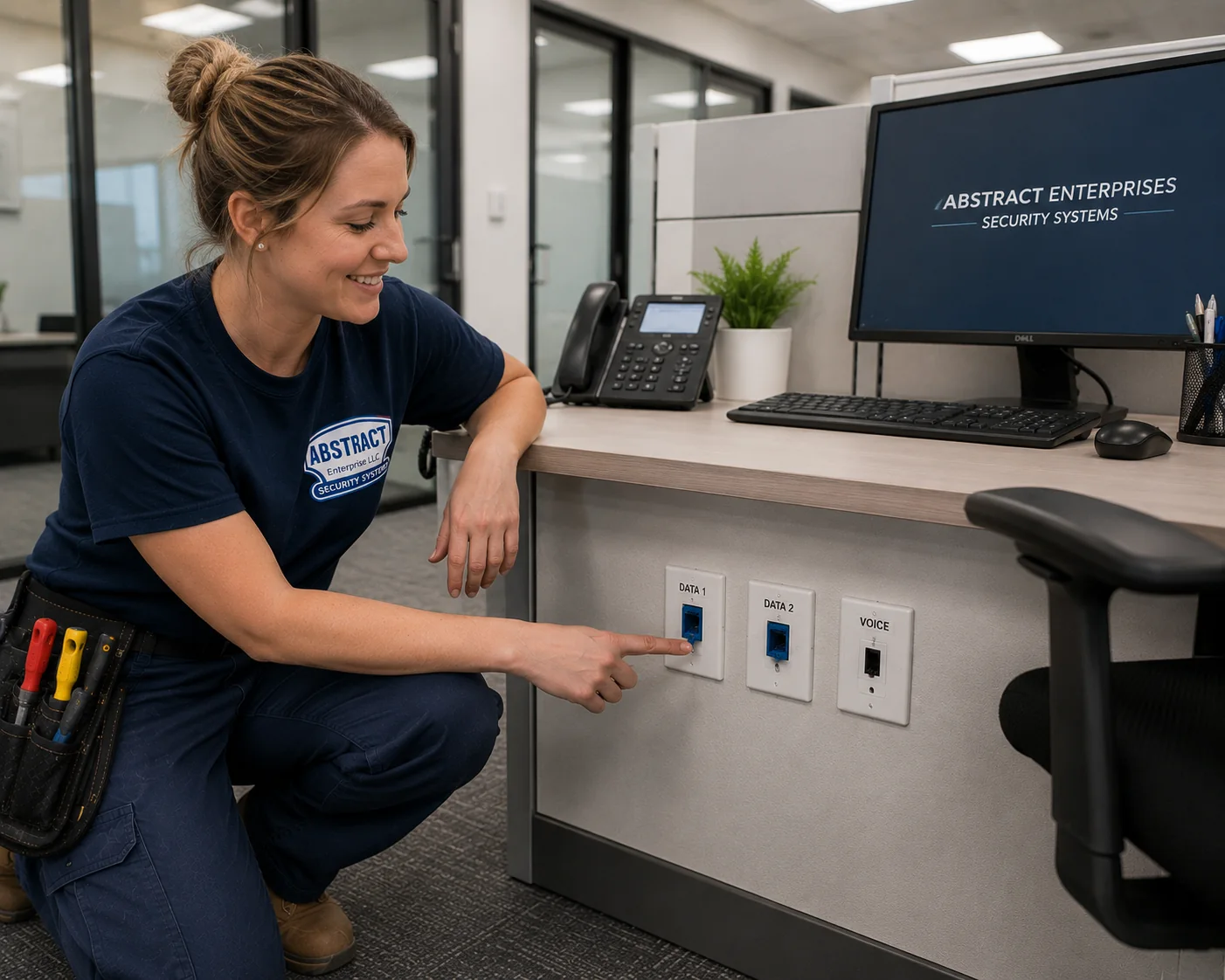
Cat6 data drop installation Queens finished data and voice outlets at an office workstation
Cat6 data drop installation Queens — two data ports and a voice port at one desk, finished and labeled.
Coverage

Where we install Cat6 in Queens

The borough's commercial centres sit far apart and behave differently. Here is what the work looks like in each.

Long Island City and Astoria

Long Island City around Queens Plaza, Jackson Avenue and Court Square is the borough's fastest-changing commercial market and the one most like Manhattan to work in — new towers with floor telecom rooms, building management, freight scheduling and insurance requirements. Alongside them sit older manufacturing buildings converted to studios, workshops and offices, where the ceiling is exposed and nothing can be fished. Which of the two you are in changes the entire method, and they are frequently on the same block. Astoria along Steinway Street, Broadway and Ditmars runs to retail, medical, dental and small professional offices in older mixed-use stock, with the film and production facilities near Kaufman adding a different kind of technical requirement.

Flushing and the northeast

Flushing around Main Street, Roosevelt Avenue and Northern Boulevard is among the densest commercial areas in the city — mixed-use towers with retail below and offices, clinics and professional suites above, plus newer mixed-use development around the downtown core. Riser access and shared telecom space matter more here than ceiling height, and after-hours work is common because the ground floor trades late. College Point and Whitestone carry light industrial and commercial along the waterfront and 20th Avenue, and Bayside and Fresh Meadows along Bell Boulevard and Union Turnpike run to professional and medical offices with substantial detached housing behind them.

Jamaica and the JFK corridor

Jamaica around Sutphin Boulevard, 165th Street and Jamaica Avenue is the borough's institutional and government centre — courts, agencies, transit facilities and civic buildings, alongside a major retail corridor. Further south, the Rockaway Boulevard and North Conduit corridors toward JFK hold air cargo, freight forwarding and logistics facilities where the work is warehouse cabling and where access credentialing is a scheduling factor. Richmond Hill, Ozone Park and Howard Beach run to mixed-use commercial strips over predominantly residential blocks.

Central Queens and the industrial belt

Forest Hills and Rego Park along Queens Boulevard and Austin Street carry professional offices, medical practices and retail in a mix of pre-war and post-war stock. Maspeth, Ridgewood's industrial blocks and Middle Village form the borough's working manufacturing belt — genuinely industrial buildings with production, distribution and food businesses, where tray, lifts and separation from motor loads are standard rather than exceptional. Elmhurst, Corona, Jackson Heights and Woodside are dense mixed-use with heavy retail and medical along Roosevelt Avenue, 82nd Street and Broadway. Further east, Queens Village, Bellerose, St. Albans and the Rockaways are largely residential, with commercial concentrated on the avenues serving them.
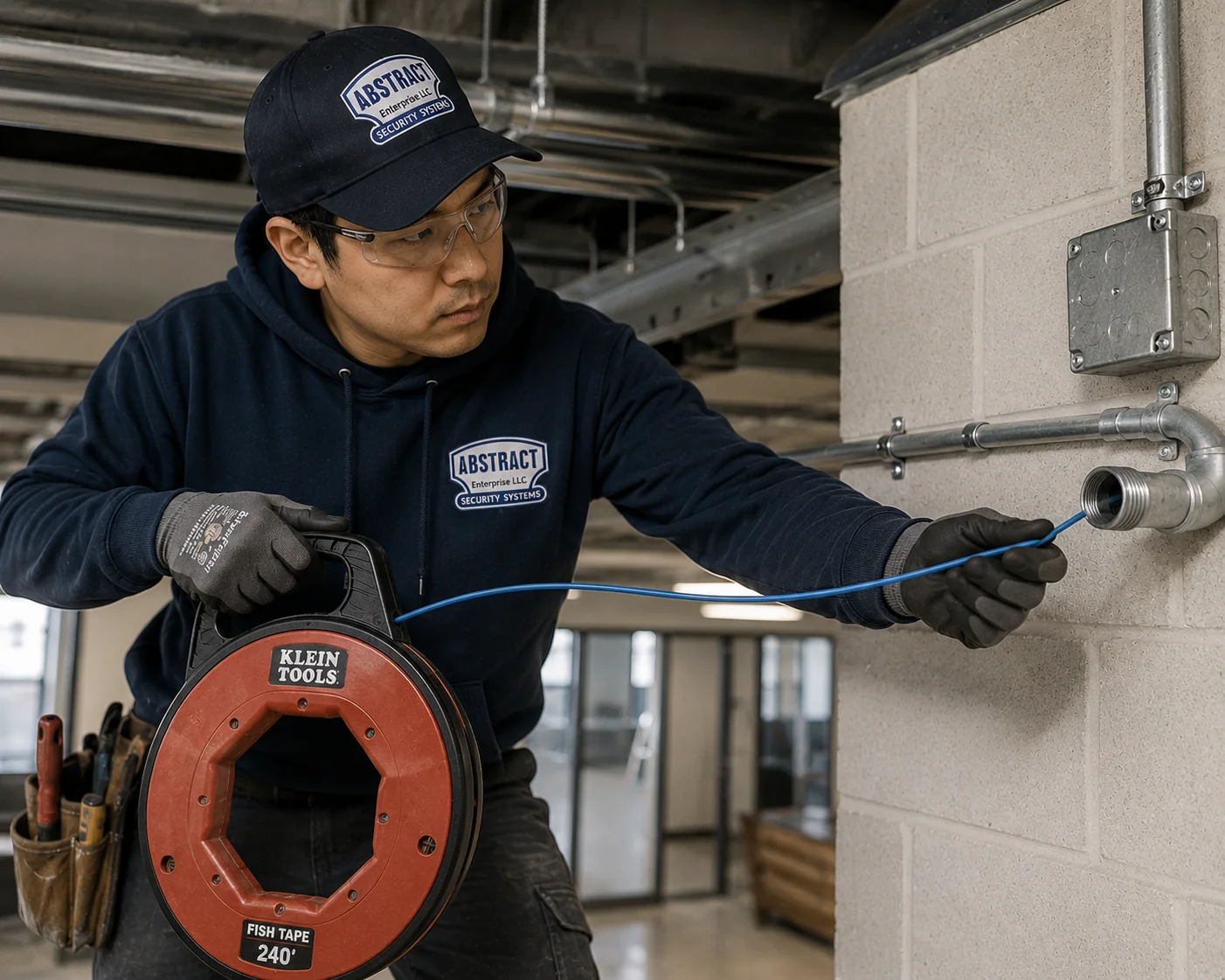
Cat6 wiring Queens technician feeding cable into existing conduit on a block wall with a fish tape
Cat6 wiring Queens — reusing existing conduit in a block-wall industrial building.
Method

How the cable gets in

  1. Fit-out, before the walls close

    The least expensive version by a wide margin. Cable runs through open studs, terminates at the closet, and waits coiled at each outlet with the box set; a short trim visit after finishes terminates, tests and labels. Pre-wire is booked ahead of the drywall crew, because an open pathway is exactly what holds the per-drop figure down. Long Island City's construction pipeline means a lot of Queens work is available in this phase if the call comes at framing rather than at punch list.

  2. Occupied floor retrofit

    Cable above the tenant ceiling on new pathway, dropping at partitions, staged zone by zone. Tiles down and back within the shift, nothing left over a desk overnight. In mixed-use buildings this also means coordinating with whatever is operating below, because noise and corridor obstruction travel.

  3. Shared riser and multi-tenant work

    Getting between floors in a building where the shaft serves several tenants is its own scope. It needs management approval, it needs the existing occupancy of the riser assessed, and in older buildings it frequently needs dead cable removed before anything new fits. Penetrations get firestopped back to the rating of the assembly with a listed system.

  4. Warehouse, logistics and high-bay

    Cable tray rather than hooks, lift work throughout, long horizontal runs, and separation from large motor loads. Pathway is planned with room for racking to change, because it will. Near the airport, add facility access arrangements to the mobilisation list rather than the morning of.

  5. Houses — basement, attic, crawl space

    Queens houses wire well. Most have an accessible basement and often an attic, so runs travel out of sight horizontally and come up inside partitions with minimal opening. Attic heat is respected as a design input on powered runs rather than ignored. Older houses with plaster over lath or finished basements without access take considerably longer, and that surfaces at the walkthrough.

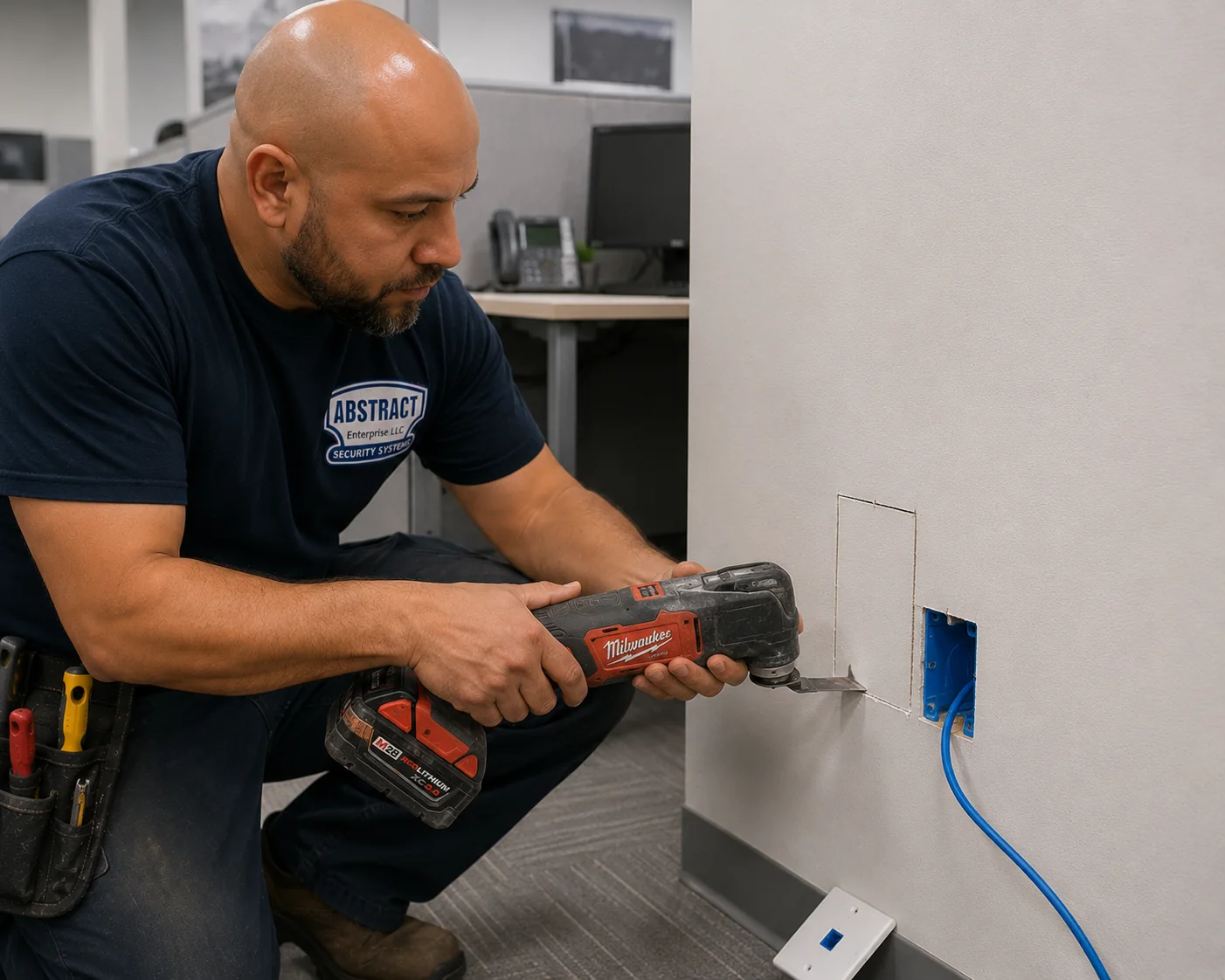
Cat6 retrofit installation Queens technician cutting a drywall opening for an old-work box
Cat6 retrofit installation Queens — cutting in an old-work box after the cable is fished.
Testing

Tested while access is still open

Working and performing are two different claims about a cable. Only one of them can be evidenced on paper.

Every drop is wiremap-tested before the ceiling closes. When the job requires full certification, we test permanent links with a Fluke DSX CableAnalyzer and deliver the pass/fail report with the closeout package.

What a link light will not show you: a split pair that reads continuous and degrades everything above it, a punch-down with an inch of conductor untwisted, a run that quietly exceeded ninety metres, a nick taken along the route. Permanent link testing measures the fixed portion, panel to outlet. Channel testing adds the cords back and measures what the equipment sees.

On institutional and public work in Queens — schools, agencies, transit and healthcare — test documentation is frequently specified in the contract documents rather than offered as a courtesy. A contractor who cannot produce certification reports fails the submittal regardless of how the cable performs. Worth confirming what each bidder actually delivers at closeout before comparing totals on that kind of project.

The rule that never bends: nothing closes until every drop has been tested. A bad termination caught with the tile still out is minutes of work. The same fault behind a finished surface is a return visit and, in high space, a lift.

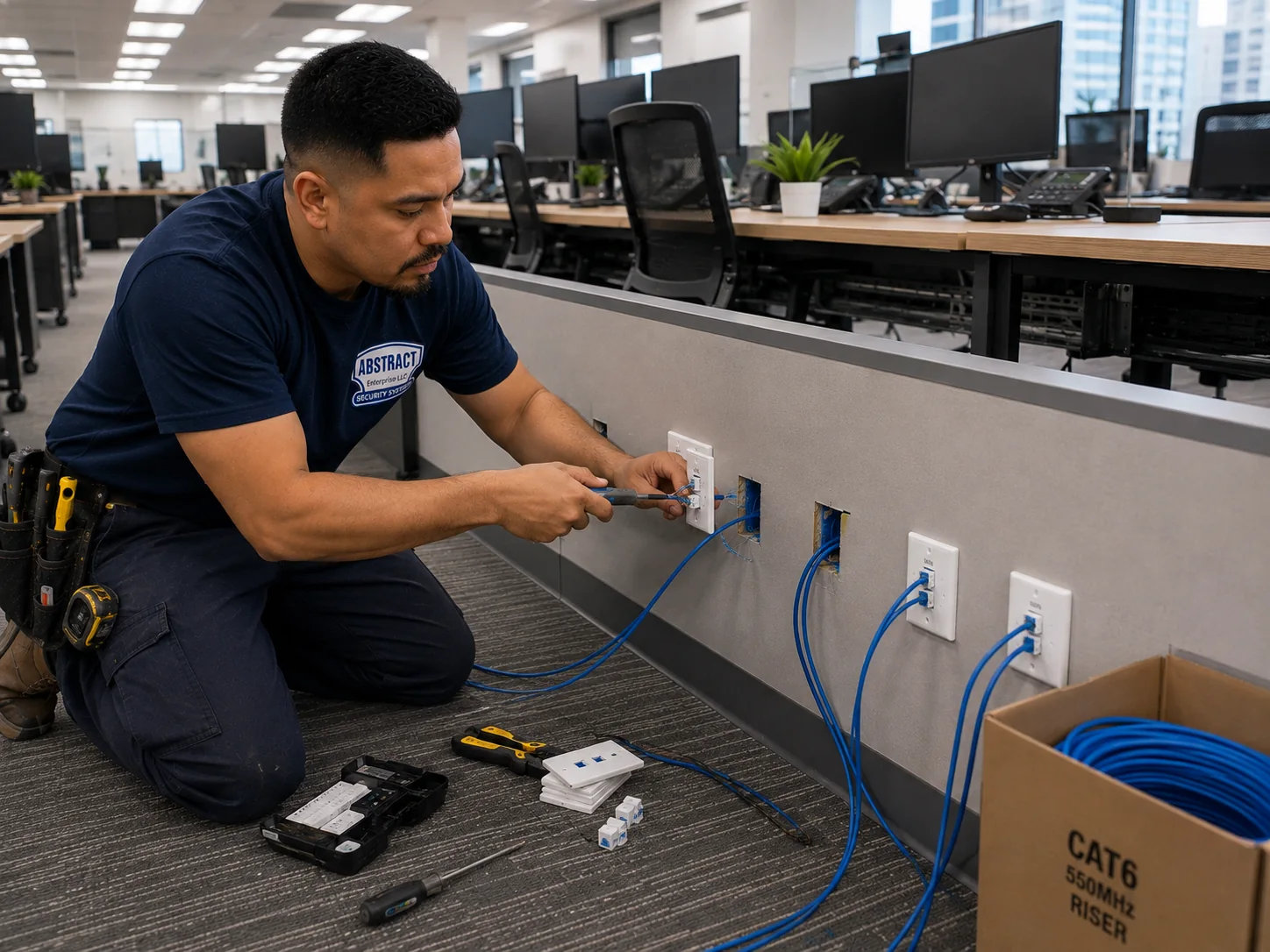
Office Cat6 installation Queens technician terminating a run of outlets along a desk bank
Office Cat6 installation Queens — a bench run terminated drop by drop, each tested as it is finished.
Power over Ethernet

PoE and what it demands from the cable

A modern floor runs its cameras, door readers, wireless access points, desk phones and intercoms over the same cable that carries their data. One pull, no electrician at every device.

StandardCommon nameTypically powers
802.3afPoEDesk phones, basic fixed cameras, simple readers
802.3atPoE+Most current access points, PTZ and IR cameras, video intercoms
802.3btPoE++High-power APs, heated outdoor domes, displays, higher-draw edge devices

Power on a conductor generates heat, heat inside a tight bundle cannot escape, and heat raises resistance — more voltage lost along the run, less power arriving at the device. Solid copper in a sensibly sized bundle absorbs it. A long CCA run in a large bundle has nothing left in reserve.

Queens supplies two versions of this problem. Warehouse and logistics buildings put cameras and access points at height under a summer roof, combining long runs with real ambient temperature. And in houses, attic runs reach temperatures no commercial ceiling sees — a drop that behaves perfectly in April can drop a powered device in August. Both argue for solid copper, disciplined bundle sizes, and a switch whose PoE budget reflects every device running at once rather than a spreadsheet average.

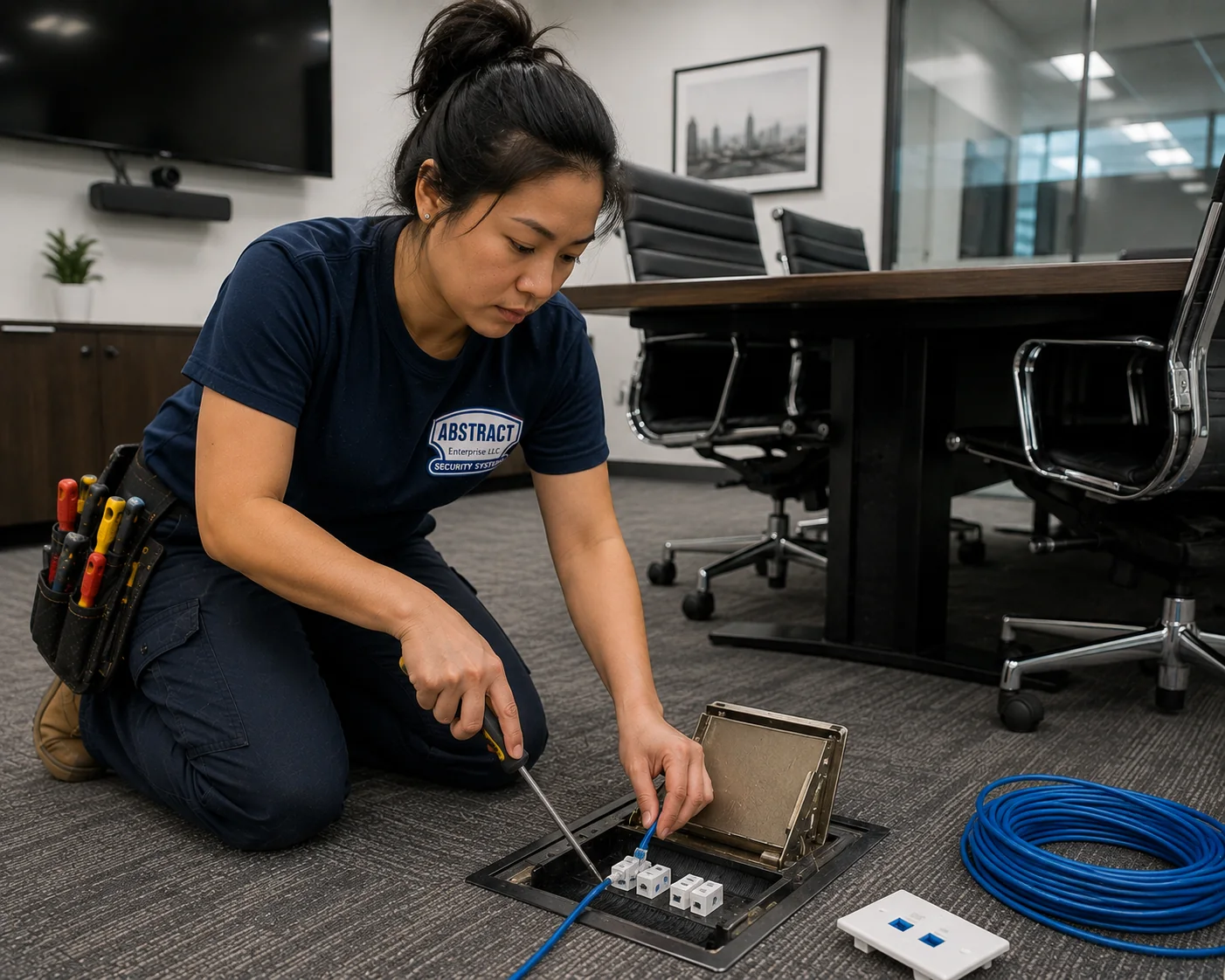
Cat6 floor box installation Queens technician landing keystone jacks in a conference room floor box
Cat6 floor box installation Queens — jacks landed in a floor box beneath a meeting table.
Pricing

What Cat6 installation costs in Queens

Published per drop, so the arithmetic can be done before a site visit is booked.

Cable typePer drop, runs to 100 ft
Cat5e$233
Cat6$272
Cat6A$388
Coax / RG6$233
Speaker wire$194
HDMI$310
Fiber — multimode$543
Fiber — singlemode$620

Every figure carries the cable, the plate and keystone, terminations at each end and the completed-run test. New construction quoted before drywall comes down ten percent. Past 100 feet the run is measured and priced against the actual pathway.

Quoted separately: rack or wall cabinet, patch panels, cable management, patch cords, switches, conduit where required, firestop materials, core drilling, lift hire, facility access arrangements where a site requires them, toning and mapping of existing unlabeled cable, and evening or weekend premiums.

For a configurable estimate, use the cabling quote builder, or call and describe the building.

Specification

Choosing the cable

Category

Cat6 is the correct default for nearly every drop in the borough. Its 250 MHz margin against Cat5e's 100 MHz carries a warm ceiling, a crowded bundle and an imperfect termination without the link stepping down, and on new work the difference is $39 a drop. Cat6A earns its $388 where full-distance ten gigabit is genuinely specified, on uplinks and server links, and between telecom rooms. It does not extend the ninety-metre limit, so it is never the fix for distance.

Fire rating

CMP through return-air spaces, CMR in vertical shafts, CM where neither applies. In mixed-use and converted buildings the arrangement is frequently not obvious from below, so it is confirmed at walkthrough against the building and the authority having jurisdiction rather than assumed from the building type.

Shielded or unshielded

UTP is standard and correct almost everywhere. Shielded cable needs proper bonding and grounding at the rack to do anything at all; an ungrounded shield behaves as an antenna and can measure worse than plain UTP. The honest cases in Queens are the manufacturing floors in Maspeth and Ridgewood — real motor loads, variable frequency drives on production equipment, and unavoidable parallels beside power.

Conductor

Solid copper in every horizontal run. CCA has higher resistance, breaks at terminations and gives out under power. In an attic or a warehouse ceiling it is close to a guaranteed callback.

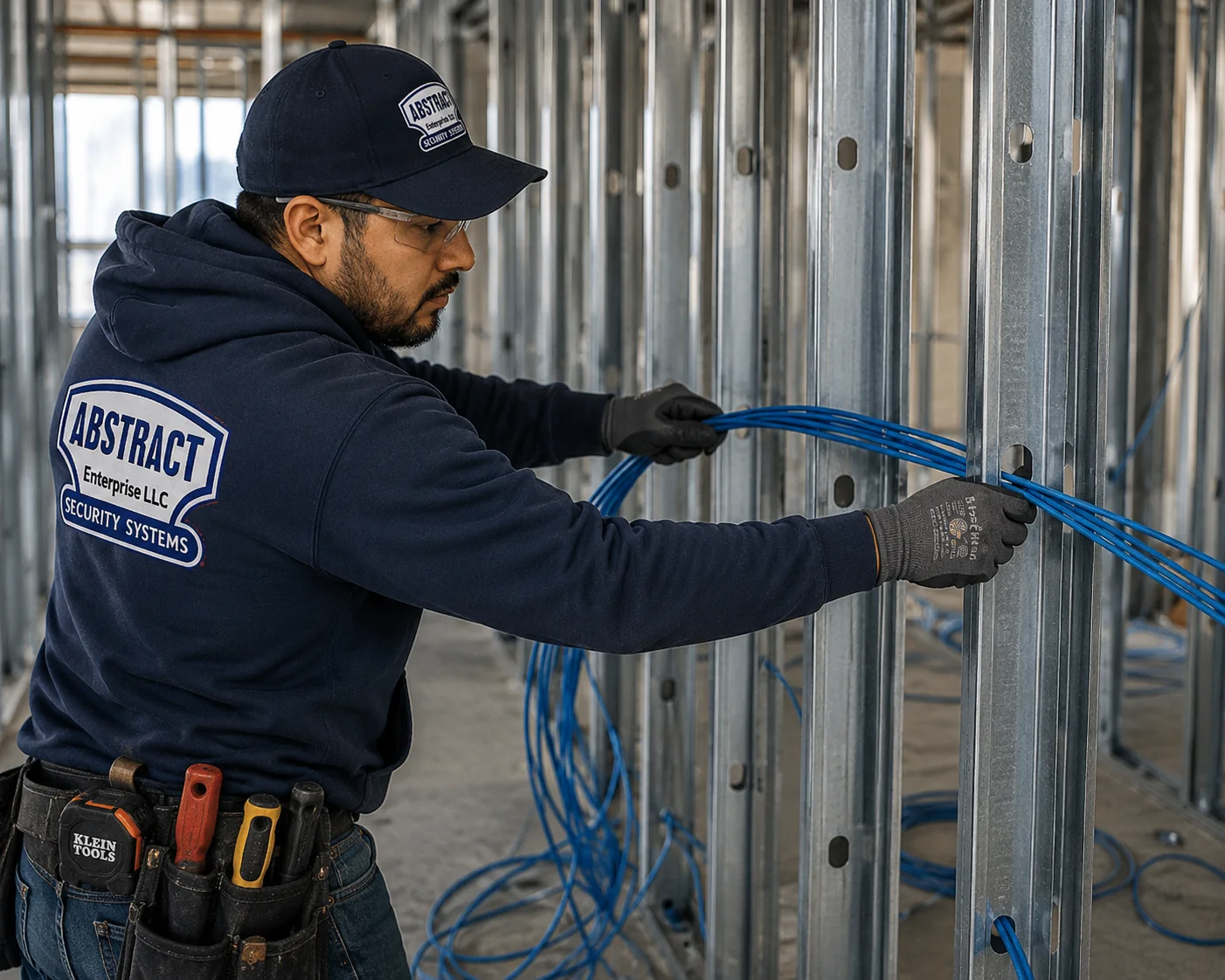
Commercial Cat6 installation Queens cable roughed through metal studs before drywall
Commercial Cat6 installation Queens — rough-in during a tenant build-out, before drywall closes.
Design

Drop count, closets and spares

LocationDropsWhy
Workstation2Computer plus phone, dock or future second device
Printer / copier1–2Shared devices get their own port
Wireless access point1Wired backhaul; masonry and mixed-use partitions need tighter spacing
IP camera1PoE data and power on one run
Door reader1Where the access system is IP at the door
POS terminal1Card processing wired, not on shared Wi-Fi
Exam room / operatory1–2Workstation plus imaging or chairside equipment
Conference room3–4Display or codec, table or floor box, camera, spare
Warehouse floorvariesScanners, APs, cameras and time clocks, planned around racking

Where the closet goes

In a tower it is the floor telecom room and the question is whether your allocated space is adequate. In a mixed-use building it may be shared, which makes identifiable, well-dressed and clearly labeled cable a practical requirement rather than a nicety. In a converted or industrial building it may not exist yet, and locating it — central, powered, ventilated, lockable, and somewhere the tenant will not want back as usable space — becomes part of the design.

Spares

Landed and marked at the panel, then coiled above the tile or parked behind a blank plate. Four or five on a thirty-drop office is about right. The value shows the first time a hire lands mid-quarter or a camera goes in: a patch cord instead of a project, and in high-bay space, no lift.

From the field

What we keep finding in Queens buildings

Method commentary, not case studies. Recurring patterns, described generally.

01 · A shared riser with no room left

Multi-tenant buildings accumulate. Decades of telephone, coax and early data from previous occupants occupying the capacity new work needs.

02 · Cable crossing another tenant's ceiling

Runs installed through space that is not the tenant's, without approval. Fine until someone else renovates and pulls it out.

03 · The attic drop that fails in August

A house or small commercial run that works perfectly in spring and drops a powered device by midsummer. Heat, length and conductor compounding.

04 · Warehouse tray built around old racking

Pathway threaded tightly through one rack layout, hanging over a forklift lane after the next reconfiguration.

05 · Cabling scheduled without site access

Near the airport especially, a crew arriving without credentialing arranged. A lost day nobody priced.

06 · Data run past the machine

On working manufacturing floors, the most convenient route is often straight along the largest motor load in the building.

07 · APs placed for the ceiling, not the people

Access points where the tile lifted easiest rather than over the desks. Corridors covered beautifully, complaints from the workstations.

08 · Bundles resting on the grid

Cable laid straight onto ceiling grid and tile. Quick, non-compliant, and under the boots of every trade that opens that ceiling.

09 · Mismatched components

5e jacks landed onto Cat6 because the box was already on the van. The channel grades down and every affected drop is done twice.

10 · Zero slack

Cable trimmed exactly to length. The next termination change or outlet relocation then means pulling fresh cable over six inches of shortfall.

11 · A room nobody can read

Cable that works, terminations that are sound, no record of what lands where. Every change then needs a tech with a tone generator.

12 · Closed before tested

Tile back up and finishes on with no test run. Whatever went wrong is now sealed behind a finished surface.

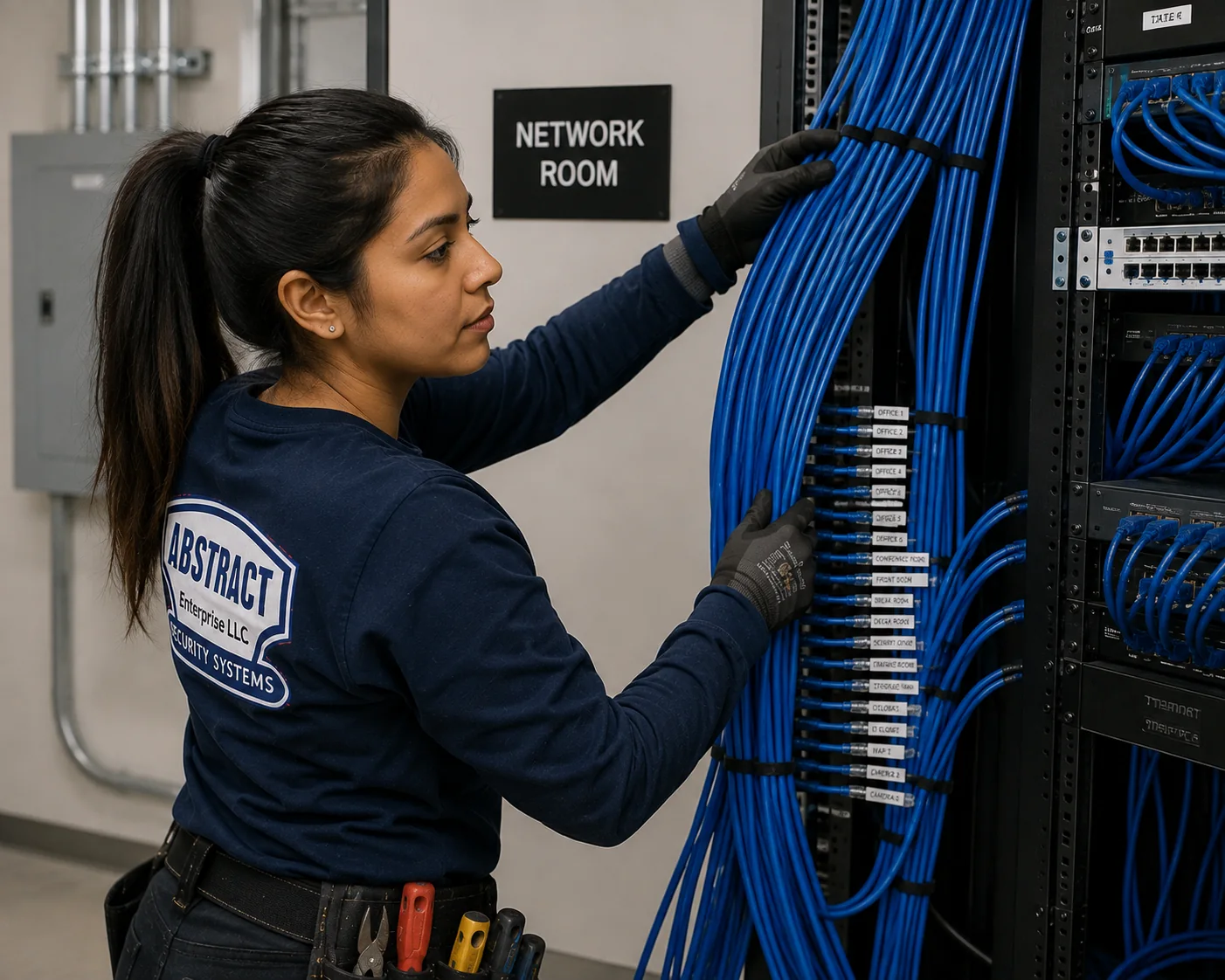
Cat6 patch panel installation Queens technician dressing a labeled bundle into a network room rack
Cat6 patch panel installation Queens — every port labeled to its room before anything is patched.
Termination

Where every run ends up

Once you are past a few drops, the permanent cable stops at a panel and every connection after that is a cord. Slightly more up front, and it pays back the first time a desk moves or a port dies: swap a cord, reassign in two minutes, and the horizontal cable never gets touched again. Direct termination onto plugs is reasonable in a house and a false economy in a commercial building.

Termination follows TIA-568, T568B unless the building's existing standard says otherwise. Identifiers and mapping follow TIA-606-style convention, which is what keeps a room readable years down the line. Components match category end to end, because 5e jacks on Cat6 cable produce a 5e channel and a certification failure.

Shared telecom rooms bring their own discipline, and Queens has a lot of them. On a multi-tenant floor your cable has to be identifiable as yours, dressed within your own allocated space, and labeled to a scheme the managing agent will accept. Spreading into someone else's rack space is how a tenant ends up in a conversation with building management rather than with their IT provider.

The closeout package

Results for every drop, a panel map, the identifier scheme written plainly, cable rating and component list, as-built markups where drawings exist, and photographs of concealed pathway before it closed. On institutional and public work this package is contractual rather than optional, and a submittal arriving without it gets rejected.

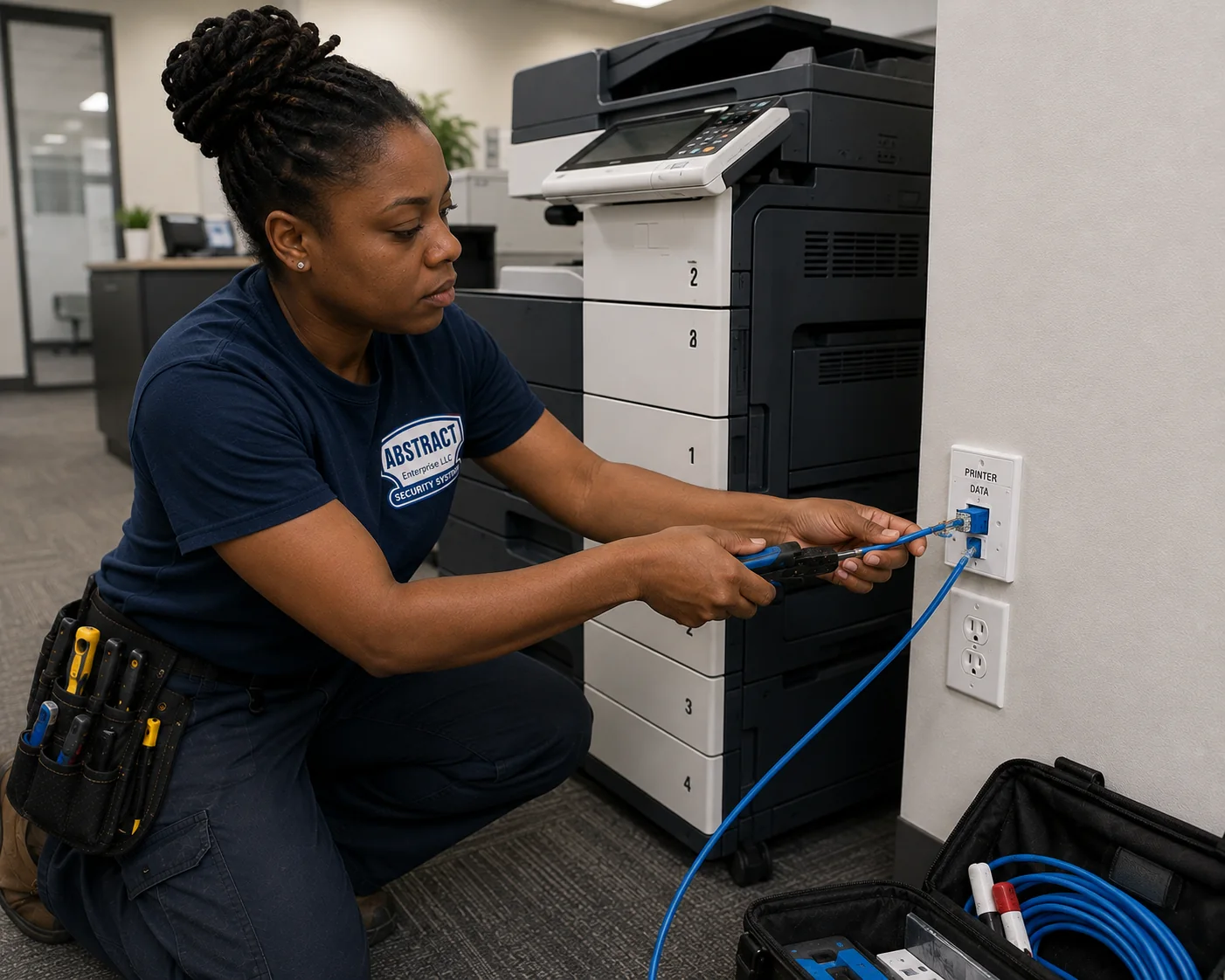
Office Cat6 installation Queens technician terminating a labeled printer data jack beside a copier
Office Cat6 installation Queens — a dedicated labeled drop for a shared multifunction copier.
Decisions

Where the money is worth spending

Cat6 vs Cat6A

About 43% more per drop, and the return is ten gigabit over the whole run. Justified between telecom rooms, into servers, and anywhere the drawings specify it. Behind a desk, a handset or a radio it is capacity nobody will ever draw on — and it adds no distance at all.

Cat5e vs Cat6

Legacy 5e that passes a test is not a problem to solve. For new permanent cable the difference is $39 a drop, and Cat6's margin is what covers heat, bundle density and power draw. Choosing 5e today is hard to defend.

Copper vs fiber

Separate jobs. Copper reaches the equipment and carries its power; glass carries distance and shrugs off interference. In Queens fiber's role is between telecom rooms in large single-story industrial buildings and up the riser in multi-tenant ones.

Cat6 vs Wi-Fi

Wireless is something cable provides rather than an alternative to it. Older mixed-use partitions push radios closer together, and every extra radio adds a cable rather than removing one.

Tray vs J-hooks

Hooks suit a grid ceiling. In warehouse and high-bay space tray carries the weight, accepts additions later, and survives the equipment moving underneath it.

Solid copper vs CCA

Only one of these is real cable. CCA carries more resistance, fractures where it lands, and folds under load. A small saving on the box, repaid many times over by the building.

How the job runs

From walkthrough to closeout

  1. Walkthrough and scope

    Someone stands in the building, opens a tile, finds the telecom room and the riser, marks drop positions, and establishes what the building and the tenancy require. Cable rating and pathway method determined here, along with whether the work can happen in business hours.

  2. Proposal

    Drop count at the published rate, hardware itemised, premium conditions stated openly. Deposit with balance on completion, terms on the document.

  3. Mobilisation

    Insurance to the owner or managing agent, access and hours confirmed, lift arranged where needed, facility credentialing sorted where a site requires it, and approvals resolved before the crew loads in.

  4. Rough-in

    Pathway installed, cable pulled, penetrations firestopped, boxes set, cable dressed into the telecom room with service loop. Staged by zone on occupied floors.

  5. Trim and termination

    Outlets landed, faceplates fitted, panel punched down, rack hardware installed, and each end marked as it is made rather than reconstructed later.

  6. Test

    Every drop, before anything closes. Failures corrected while access is still available, then re-tested.

  7. Closeout

    Per-drop results, mapping, naming convention, materials and marked drawings handed across. Concealed routes photographed beforehand, then the site cleared.

Working as a subcontractor

A significant share of Queens work arrives through general contractors and electrical contractors on fit-outs. We work to your sequence and schedule, provide insurance and submittals in your format, coordinate ceiling and tray space with mechanical and electrical rather than competing for it, and deliver closeout documentation that drops into your package. Covering a data scope you would rather not staff yourself is routine work for us.

Our standard

What you can hold us to

Not testimonials — the commitments that apply to every Cat6 job we take in Queens.

Every site walked

Nothing about one Queens building predicts another, so each site is surveyed rather than estimated from the last one that sounded similar.

Nothing untested

Every installed run tested before anything closes, certified to permanent link where the project specifies it.

Records handed over

Results, panel map, identifier scheme and materials list at completion, in a form a closeout submittal will accept.

Shared space respected

In multi-tenant buildings, cable dressed and labeled within your own allocated space, to a scheme the managing agent will accept.

Specification held

Copper conductor on every horizontal run, category consistent across all components, and a jacket rating that matches where the cable genuinely travels.

Reachable later

Warranty set out below, and subsequent moves or additions treated as ongoing work rather than a fresh engagement.

Diagnosis

Signs the cable is the problem

The switch gets replaced, the router gets reconfigured and the carrier gets called twice before anyone looks at the cabling.

  • A port sitting at 100 megabits. Gigabit needs all four pairs good. Lose one to damage or a bad punch-down and the link quietly steps down where nobody is looking.
  • Powered devices cycling. A camera restarting in the small hours, an access point shedding clients at peak, a reader that stops answering in hot weather. Delivered power falling short, decided by conductor, distance and bundle temperature.
  • Trouble that follows the calendar. Performance that degrades in summer points at cable in an attic or a warehouse ceiling rather than at software.
  • One zone always worse. When complaints cluster by location rather than by user, the common factor is the bundle or the pathway serving that area.
  • The timing points somewhere else. Cable sitting on grid gets abused by everyone working above the ceiling. A fault appearing days after mechanical work is damage until proven otherwise.

Diagnosis begins at the panel, not the workstation. Locate the run, put a permanent link test across it, read what comes back. A pass clears the building's cable and moves attention to a cord, a switch port or the hardware. A fail names the failing parameter, which leads to a termination first, damage second, length third. Re-terminating both ends clears the majority.

FAQ

Cat6 questions we get in Queens

A Cat6 data drop is $272 on runs up to 100 feet, covering the cable, the plate and keystone jack, terminations at both ends and the test on the completed run. New construction quoted before drywall closes comes down ten percent, and runs past 100 feet are measured and priced against the pathway. Queens sits a step above our Brooklyn base rate, which reflects travel and staging across a borough that is geographically the largest in the city — a job in Far Rockaway and a job in Long Island City are an hour apart.

Because Queens has no single downtown. Manhattan concentrates its commercial space in a few districts; Queens spreads it across a dozen unconnected centres, each with its own building stock and its own era. Long Island City has new towers. Flushing has dense mixed-use with retail below and offices above. Jamaica has institutional and government buildings. Maspeth and Ridgewood are working manufacturing. Astoria is small professional and medical offices in older stock. The cabling conditions in those five places have almost nothing in common, so what a drop costs depends far more on which centre you are in than on how many you order.

Yes. The Rockaway Boulevard and North Conduit corridors around the airport are logistics, freight forwarding, customs brokerage and air cargo handling, and that work is warehouse cabling rather than office cabling: cable tray, lift work, long horizontal runs, and pathway planned around racking and dock traffic. Access requirements at some facilities are stricter than typical commercial buildings, including credentialing that needs arranging in advance rather than on the morning. We factor that into scheduling rather than discovering it at the gate.

Yes, and it is one of the most common Queens jobs — an office, clinic or professional practice on an upper floor above ground-floor retail along Main Street, Roosevelt Avenue, Steinway Street or Queens Boulevard. The complications are shared: risers used by several tenants, a telecom space that may serve the whole building, and work that has to be scheduled so it does not disrupt the businesses below. Getting the managing agent involved early matters more here than in a single-tenant building.

A site visit that fixes drop positions and the route, the pull on supported pathway, a keystone terminated at the outlet and a panel port at the telecom room, plate and panel mounted, identifiers printed on both ends, a test on each completed run, and a map tying every panel port to its outlet. Racks, panels, cable management, switches, conduit, firestopping, lift hire and out-of-hours premiums are their own lines, never absorbed into the per-drop figure.

Two at each desk, a dedicated port for every shared printer, one behind each access point, camera and door reader, one per POS terminal, and three or four in any room with a display. The pair per desk looks generous until a handset, a dock and a monitor hub arrive. Adding the second port costs little while a crew is already overhead and costs a return visit six months later.

Over a shortened reach — the figure usually quoted is around 55 metres, and it shrinks inside a tightly bundled run where alien crosstalk starts to matter. It is not a full 100 metre ten gigabit channel; that is a Cat6A specification. For workstations, handsets, cameras and access points, which is what nearly every Queens drop feeds, Cat6 is the correct and economical choice.

Copper-clad aluminium is aluminium conductor under a thin copper plating. Cheaper by the box, not equivalent cable. Aluminium resists more, which matters enormously once power is on the pair, and it is brittle, so conductors fracture at the punch-down and in the bend behind a wall plate. It will pass a light-is-on check and still starve a camera. Every horizontal run we install is solid copper.

Cable moving through a return-air space needs a CMP jacket; anything climbing a shaft between floors needs CMR. Queens complicates the call because purpose-built offices, converted factories and mixed-use blocks all sit side by side, and none of them advertises how the air moves when you look up at the tile. It is confirmed at the walkthrough against the building and the authority having jurisdiction rather than assumed.

No termination converts one category into another — the rating belongs to the cable, so upgrading means pulling new. The reusable asset is the route. Where the existing 5e sits in conduit or on a tidy hook run with capacity to spare, the replacement follows the same path, and that is where the saving is. Where the old cable was run loose or stapled to structure, there is nothing worth keeping.

Yes. Medical practices working around patient hours, retail that has to open the next morning, restaurants, and buildings with formal management that restrict noisy work to evenings all push the schedule outside business hours. Queens has a large number of owner-occupied and small multi-tenant buildings, which usually makes access a conversation with one person rather than a management process. The out-of-hours premium is quoted as its own line.

Regularly. Queens has more one and two-family housing than any other borough, and those houses cable well — most have an accessible basement and often an attic, so runs travel horizontally out of sight and come up inside partitions with minimal wall opening. Attic heat is the one design factor to respect, particularly on runs carrying PoE. Wireless dead spots in a detached house are usually a distance and construction problem that a wired access point on the upper floor solves permanently.

Related work

What usually lands on the end of a drop

Warranty

Get a Cat6 quote

Tell us the building, the rough drop count and the timeline. Whether it is single-tenant or shares a riser with others matters here, so mention it.

🛡 Cat6 installation warranty. Abstract Enterprises Security Systems provides a three-year warranty on products supplied by AESS for normal wear and tear. It does not cover existing or customer wiring, customer-supplied equipment, lightning or other acts of God, power outages or surges, physical damage or unplugging, internet, router or phone changes, or camera readjustments requested after completion. After the warranty period, service is $195 per hour with a three-hour minimum ($585). Full terms: abstractenterprisessecuritysystems.com/warranty.

Call 347-434-6392
WhatsApp message us
NYS Low Voltage License #12000287431
4.7 / 201 Google Reviews

Request a Cat6 Estimate

We'll follow up to arrange a walkthrough.

Or call 347-434-6392