Stone Houses · Rondout Brick · Knotty-Pine Cabins · Converted Barns · Guest-Proof Rental Setups
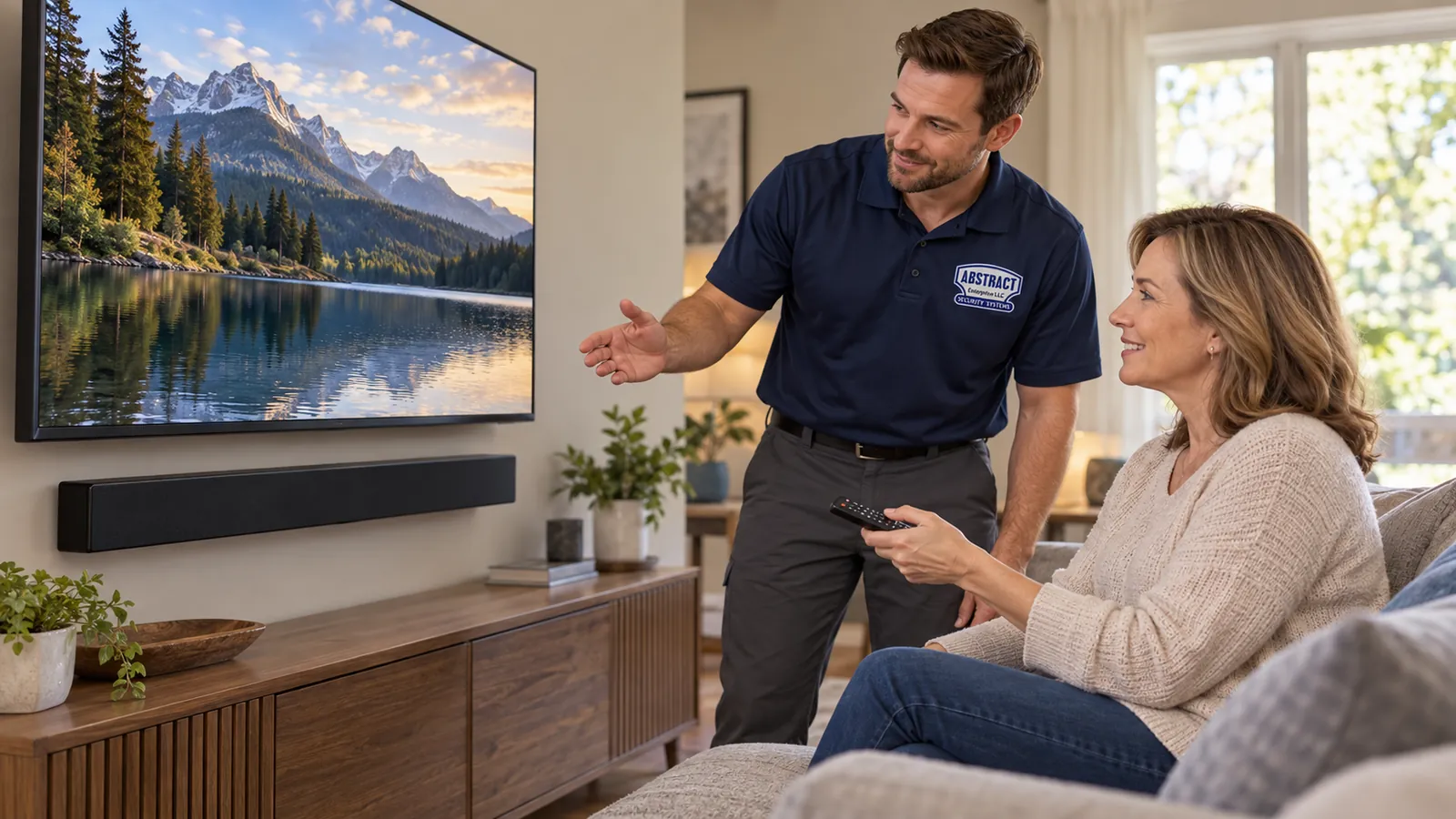
A lot of Ulster County televisions are watched by somebody other than the owner: weekend guests in a Shandaken cabin, renters in a Saugerties Victorian, family who drive up from the city twice a month. So a soundbar here has to be mounted properly on walls that are rarely plain drywall — fieldstone, canal-era brick, pine boards, barn posts — and it also has to keep working for people who never met the installer. We plan both halves: the fixing that suits the wall, and a setup simple enough that a guest with one remote gets sound on the first try.
Reviewed and updated October 17, 2026 · Written by Anwar Timothy, NYS licence #12000287431 · Hudson Valley line (845) 640-3835

Bought the bar, but the weekend house is two hours away? Phone (845) 640-3835 or use the short form. Requests are answered by a licensed technician, not a call centre, and the figure you get is added up from the Ulster County lines published lower on this page; there is no mileage charge to add to it.
Ulster County is a place where the person who bought the soundbar is often not the person who will press play. The county comptroller counted 2,013 active short-term rentals in 2024, up from 942 in 2015, and found that by May 2025 they made up 3.28 percent of every housing unit in the county — above the 2 percent ceiling the county's own Housing Smart Communities Initiative recommends. In the Town of Shandaken the share is close to one home in ten. Add the weekend houses owned by people who live in the city, the long-term rentals around SUNY New Paltz and in Kingston, and the family homes where grown children come back for holidays, and you get a county full of televisions that strangers, guests and relatives have to figure out without help.
That changes what a good soundbar installation means here. In an owner-occupied apartment the job ends when the bar is level and the TV remote controls it. In an Ulster cabin that is listed for rent, the job also has to survive check-in at 9 PM on a Friday, a guest who presses the input button four times, a power cut on a windy night and an owner who is three hours away in Brooklyn. Ulster's comptroller found that 36 percent of short-term-rental owners use a mailing address outside the county, with New York City the most common. When the owner is that far away, a soundbar that falls back to the wrong input is not a small annoyance; it is a review, a refund request or a long drive.
Then there are the walls. Ulster's housing is old in several different ways at once. Stacker's reading of Census data ranks Ulster among New York's counties with the oldest homes, with 25.3 percent — 21,829 houses — built in 1939 or earlier. In Uptown Kingston that means the colonial stone houses of the Stockade District, where John and Crown Streets are described by Friends of Historic Kingston as the only intersection in the country with 18th-century stone houses on all four corners. Down by the Rondout it means brick row houses from the canal era. Around New Paltz, Hurley and Marbletown it means thick stone walls laid by Dutch and Huguenot families. In Saugerties and along Kingston's older streets it means Victorians with plaster on wood lath. West along Route 28, past the Ashokan Reservoir toward Phoenicia and Pine Hill, it means log homes, knotty-pine cabins and timber-framed barns turned into living rooms. Very little of that takes a soundbar bracket the way a modern drywall wall does.
Weather and wiring complete the picture. Central Hudson serves 93,209 customers in Ulster County, and during the nor'easter at the end of September 2026 the Daily Freeman reported more than 14,000 of them without power at the peak. Internet service is uneven, too: the county says all 1,293 of its remaining unserved locations will get fiber under the federal BEAD program, with Verizon building it, which tells you how many homes are still waiting. On the r/catskills forum, owners compare satellite, cable and fixed-wireless service, and one describes a house that came with a satellite plan that was "incredibly slow". A soundbar that relies on Wi-Fi for its app, its updates or its music streaming needs that context planned in, not discovered after the installer has left.
So an Ulster County soundbar job is planned around three questions before anything is drilled. What is the wall made of, and what does the bracket bite into? Who will be using this TV, and how much do they know about it? And what happens when the power, the internet or the owner is away? The rest of this page answers those questions for the houses, cabins, barns, apartments and businesses we see between Saugerties and Ellenville, and between the Hudson at Highland and the high peaks beyond Big Indian.
Put together, those numbers describe the typical call from this county: an older or unusual wall, a TV that more than one household uses, internet that is good enough but not generous, and an owner who wants the setup to work in their absence. That is the job this page is written around.
Most Ulster owners who call about a soundbar are also hanging the TV, so the two are normally booked as one visit. Our TV installation team in Ulster County works from the same menu, and owners who want more than a bar — rear speakers, a receiver, music in the kitchen or on the porch — usually move on to AV and sound installation in Ulster County. Rental hosts who are already adding a soundbar often add a doorbell camera for the rental on the same trip, so check-ins can be seen from the city.

Storms knock the link between TV and bar loose more often than anything else up here. If a renter texts to say the picture is fine and the speakers are dead, if the TV remote has stopped reaching the bar since the last outage, if speech now trails the actors' mouths, or if a bracket on a board wall has begun to lean, treat it as a repair rather than a new job. Repairs go into the earliest free 2-hour slot, and the usual handshake, settings and lip-sync faults take a technician one to two hours to put right. Ring (845) 640-3835, mention it is an existing soundbar, and our TV and soundbar service policies explain how setup-only visits are billed.
Every Ulster County soundbar job is assembled from the services below, and each one has a published price. They are listed roughly in the order an absentee owner tends to think about them: first get the sound working, then make it tidy, then make it something a guest cannot break.
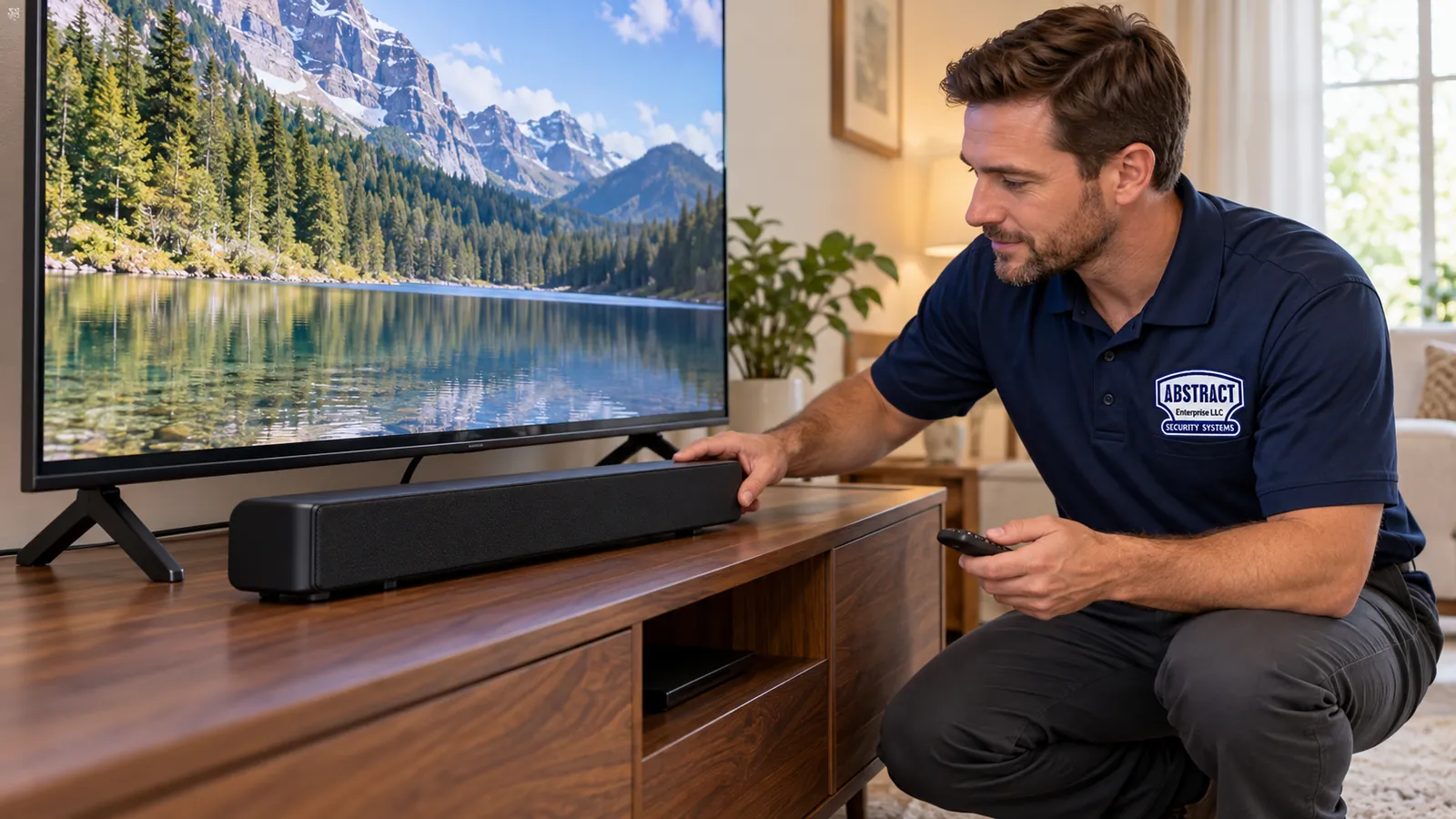
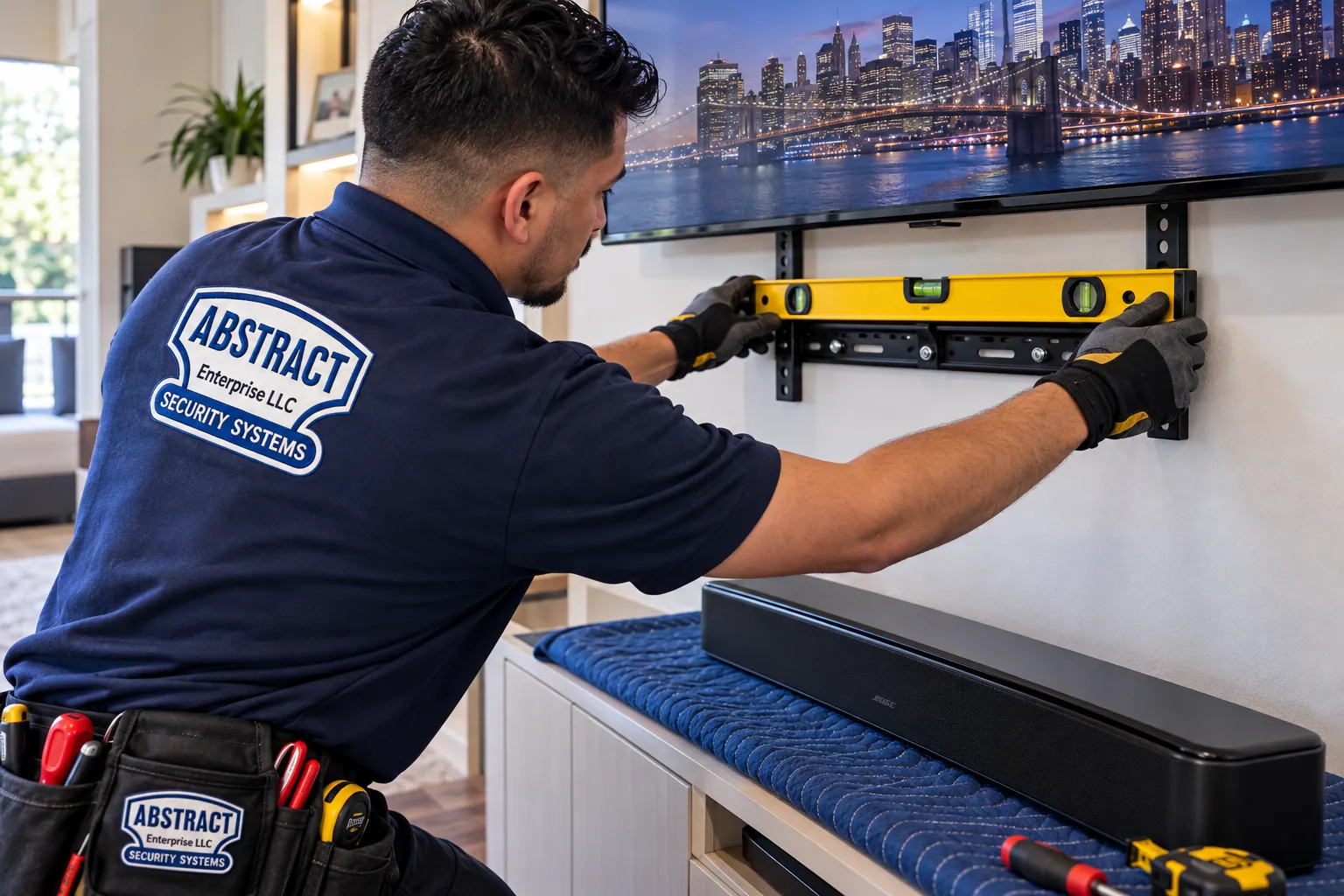
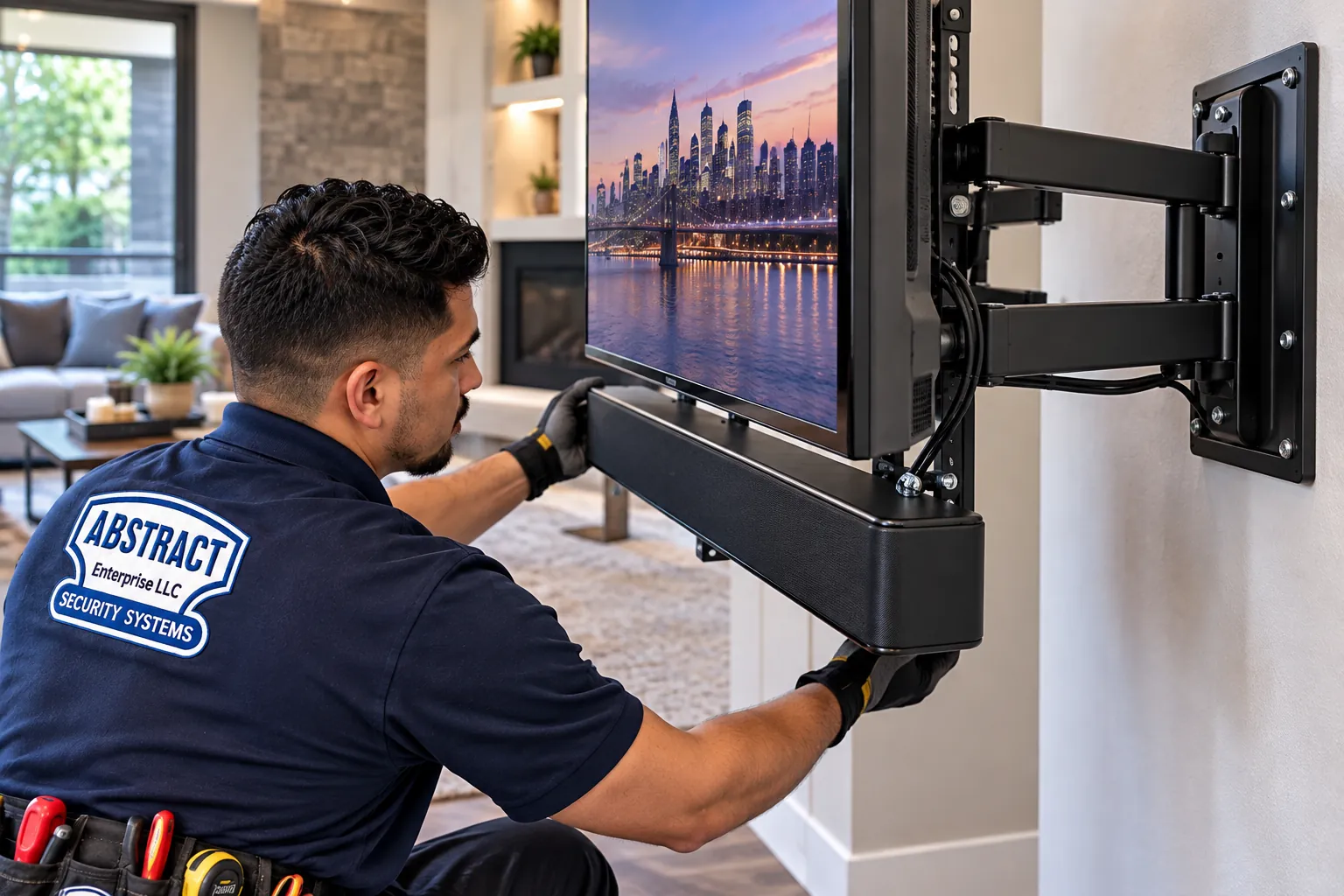
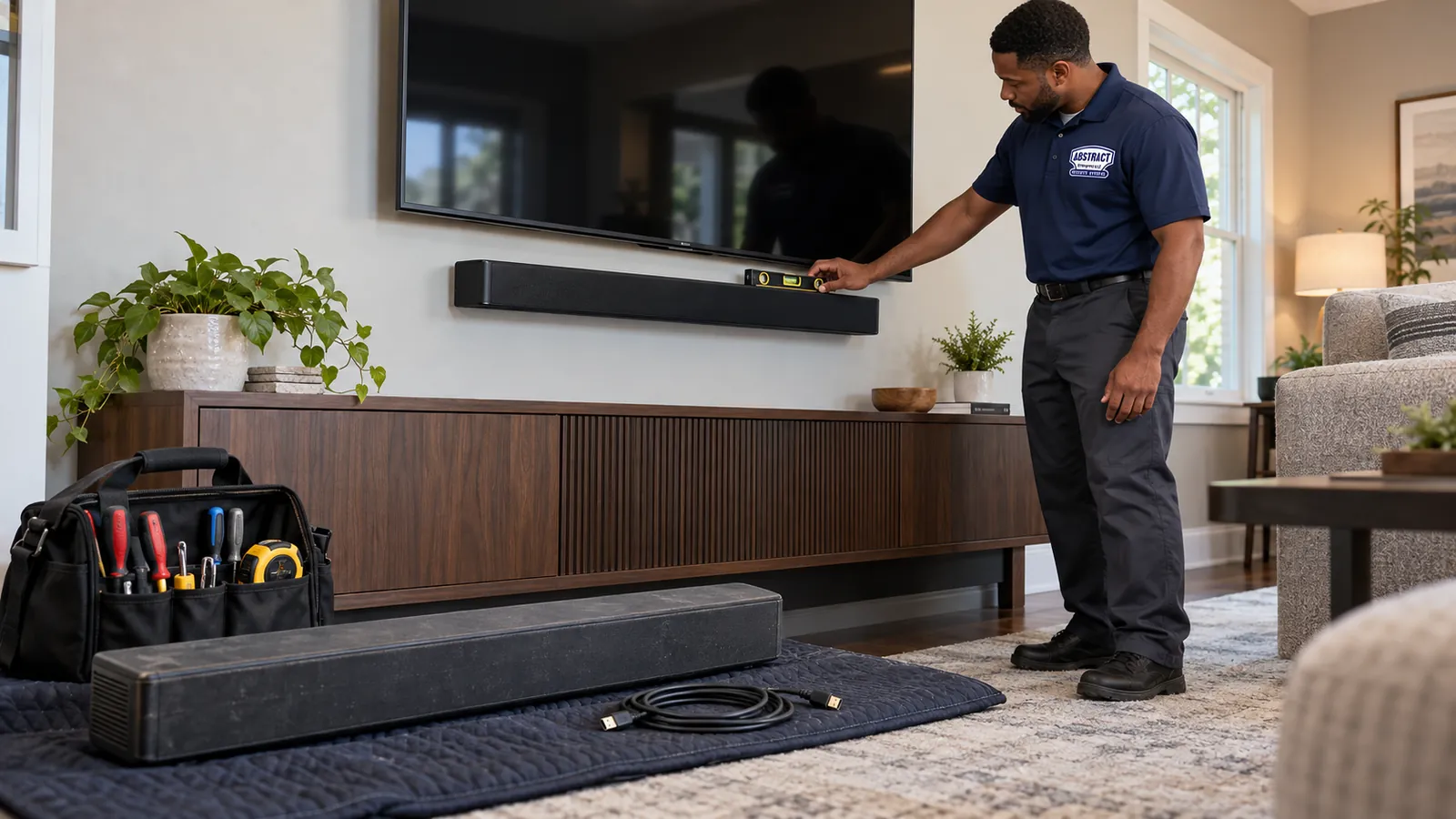
The bar centred under the screen on a bracket fixed for the wall in front of us — drywall, plaster, brick, fieldstone or boards — then connected to the TV's HDMI eARC or ARC port so the TV remote runs the volume. This is the core $129 line, with the wall-type surcharge added only where the wall calls for it.
A Sanus soundbar bracket ($84.99) clamps the bar to the TV's own mount, so the two move together on a full-motion arm or a pull-down fireplace mount. In stone and log rooms it can mean one set of holes in the wall instead of two.
For rentals where the owner wants nothing drilled yet, or for a TV that lives on a stand: the bar set on the furniture, wired, configured and tidied for $79. It is also the honest answer when the wall is a feature you do not want to touch.
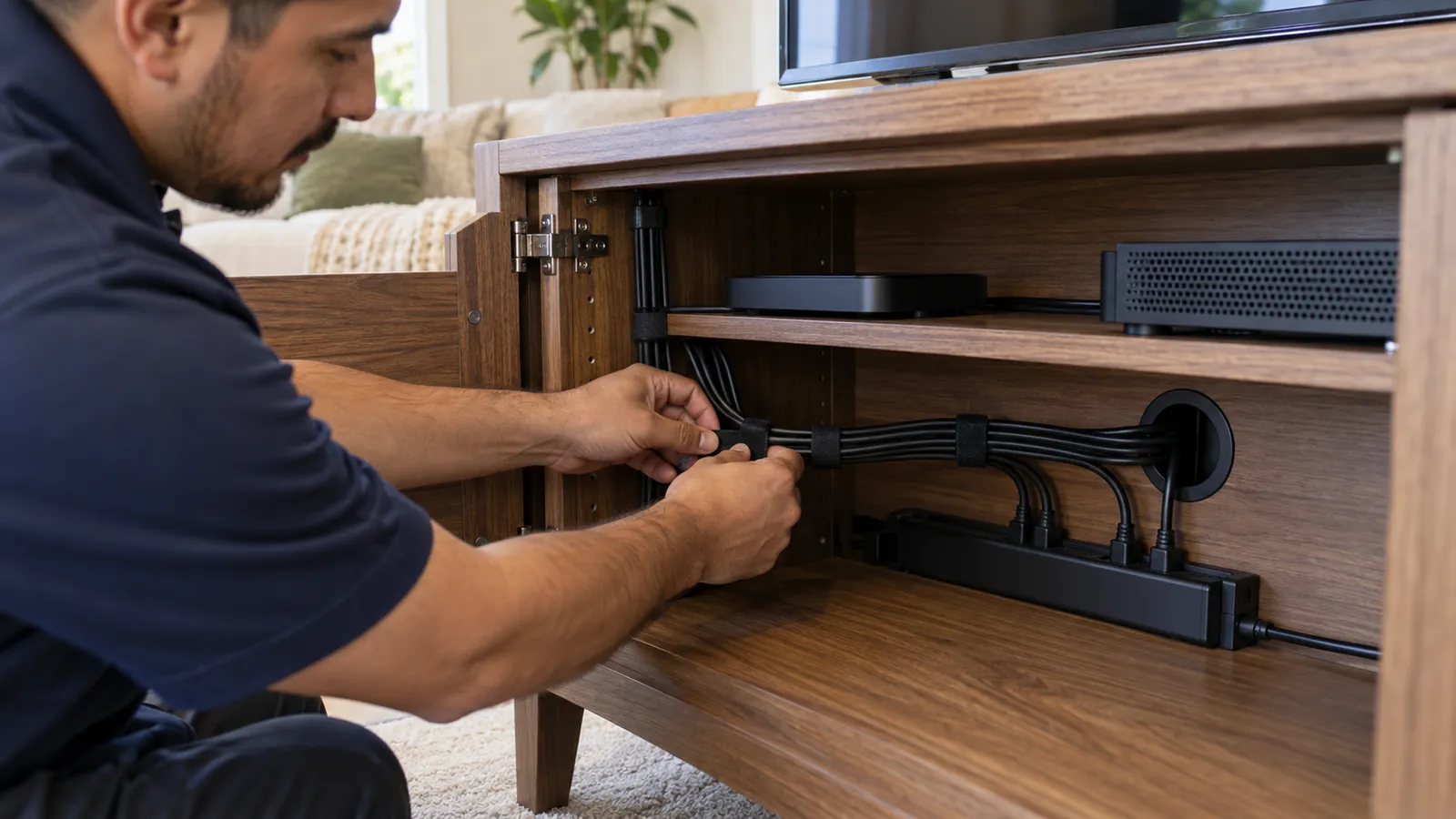
Fieldstone, brick, log and board walls do not hide wires. A paintable cord cover ($59) or a short cable run to a cabinet ($99) keeps power and HDMI out of sight; in a hollow framed wall we can fit a code-compliant in-wall power and cable kit ($169).
Auto-power through HDMI-CEC, the TV set to wake on the right input, the bar's volume ceiling and dialogue mode chosen, Bluetooth pairing locked down where the model allows, and a one-page guide written for guests. Priced from the standard lines; most of it is careful setup rather than extra hardware.
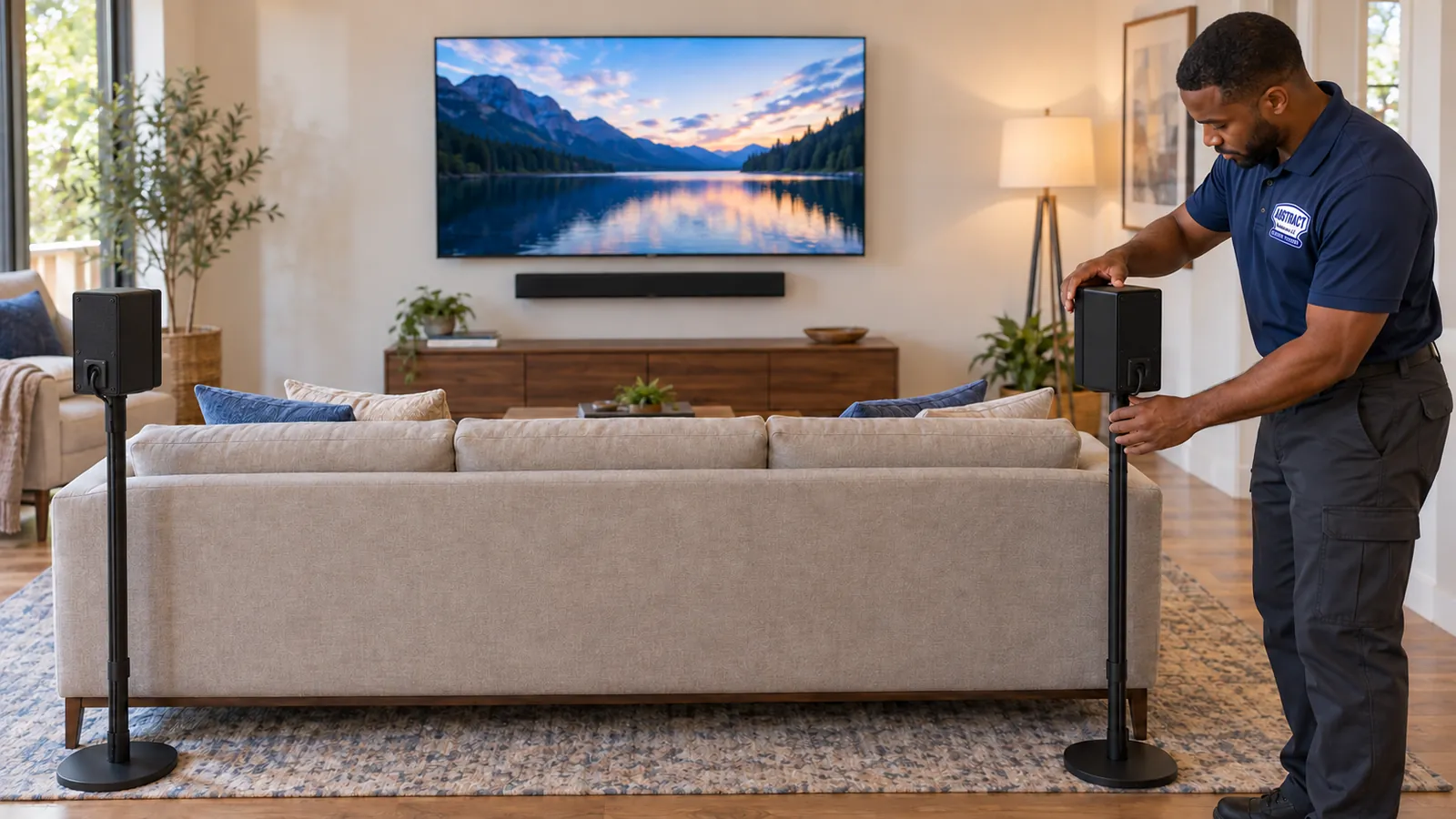
Wireless subs and surrounds still need outlets. We pair them, place them where they work in timber and stone rooms, and set levels that suit the room rather than the showroom. A full home-theater hookup is a $350 line.
Sonos setup on your network and in the app ($125), a streaming stick or box signed in and tested ($49), and a universal remote programmed so guests have one handset ($99).
Bars under the screens in a Kingston taproom, a New Paltz café or a Catskills inn's common room, with volume limits, tidy cable runs and a certificate of insurance for the landlord at no charge.
Sound lost after a TV swap or a power cut, eARC handshake problems, lip-sync drift and remotes that stopped controlling the bar. Billed as an Ulster setup-only visit when nothing is mounted.
Every service is carried out by licensed, insured low-voltage technicians who drive up from our Bronx office. We do not subcontract the visit to an app-booked handyman, and we do not add a travel or mileage line to an Ulster County booking — the published county prices already account for the drive.

No two Ulster valleys were built the same way, and the TV wall tells you which era you are in within a minute. These are the building types we meet most often, from the Hudson shore to the high Catskills, and what each one asks of a soundbar installation.
Uptown Kingston's Stockade District, Hurley, Marbletown, Stone Ridge and the stone houses of New Paltz. Walls of field or quarried stone, often two feet thick, frequently plastered inside, with deep window reveals that leave little straight wall for a TV. Anchors go into sound stone faces, never into the plaster skin or the mortar joint.
The 1850s-era brick rows down by Kingston's waterfront, built when the Delaware and Hudson Canal made Rondout a coal port. Solid brick party walls and exterior walls, sometimes exposed inside after renovation; sleeve or wedge anchors set in the brick itself, not the mortar.
Saugerties, Kingston's older avenues, Rosendale and Highland. Plaster over wood lath, irregular stud spacing and decades of repairs layered on top of one another. A plywood backer ($85) across two studs often gives the bar a centred, solid fixing.
Along Route 28 through Boiceville, Phoenicia, Mount Tremper, Shandaken and Pine Hill, and up the side roads to Big Indian and Oliverea. Knotty-pine board walls, full-log walls, wood stoves and bluestone hearths. The bracket goes into solid timber, and every cable route is planned on the surface.
Post-and-beam barns in Gardiner, Accord, Kerhonkson and the Rondout Valley, reborn as living rooms and event spaces. Exposed posts, board infill and high ceilings; the bar is fixed to a post or a framed TV wall built for the purpose, and the sub is placed for a room that is mostly air.
Midtown Kingston, the 9W corridor, New Paltz near the college and Lake Katrine. Drywall on wood or metal studs, association rules about drilling, and lots of shared walls. Straightforward fixings, with attention to neighbours and to the building's paperwork.
Stone. We locate a solid face of stone large enough to take the anchor with margin all round, mark the bracket to suit it and drill with a hammer drill and masonry bit, slowly, to avoid spalling the face. Where the stone is plastered over, we find the stone behind the plaster before we commit to a hole. Bluestone deserves a particular word: it is a layered sandstone, quarried by the thousands of tons in the 1800s — Opus 40's history says at least 10,000 Ulster County people made a living from the bluestone trade by 1898 — and it can split along its bedding planes if an anchor is set too close to an edge. On bluestone hearths and veneers we keep anchors well back from edges and joints, and we tell you before drilling if a piece looks thin or loose. Brick and stone carry the published $65 surcharge.
Brick. In the Rondout and in Kingston's older blocks, brick walls are usually sound but the mortar between them may be soft lime mortar more than a century old. Anchors go in the brick, not the joint. Exposed brick that has been sandblasted or repointed is often harder than it looks, and the hole is drilled in stages. We vacuum as we go, because brick dust travels.
Plaster on lath. Victorian plaster sits on wood strips nailed to studs that were rarely laid out at modern spacing. We find framing with a magnet or a small pilot hole, never trust plaster alone to carry a bar and its bracket, and use a painted plywood backer when the studs and the TV's centre line do not agree. Old plaster can crack whatever care is taken; you hear that from us before the drill comes out, and the decision stays yours.
Pine boards and logs. Tongue-and-groove pine is thin, and it is often nailed to strapping with an air gap behind, so a short screw holds nothing. We find the framing or strapping behind the boards and fix into that, or we use a longer fixing into a solid log. Full-log walls are a different case: logs keep drying and settling for years — InterNACHI's log-home guidance puts early settling at about three-quarters of an inch per foot of wall height — so we keep the bar's bracket on one log course where possible rather than bridging two.
Barns and timber frames. A barn post is the strongest fixing in the room and also the most visible, so we talk through appearance first. Often the cleanest answer is a TV-attached bracket on a full-motion mount fixed to a post, or a framed media wall built by your carpenter with blocking where the TV and bar will go. Cables run along beams in matching raceway or drop inside a hollow post cover.
Drywall and metal studs. Newer Kingston and New Paltz apartments, and the additions on many older houses, are ordinary framed walls. These are the only walls in the county where wires can routinely be hidden inside with the $169 in-wall kit. Metal studs add $30 for fixings rated for steel framing.
Most Ulster owners who have us fix a bar to a stone or log wall also want a better picture of what happens at the house while they are away, and pair the visit with wireless camera installation in Ulster County so the rental can be checked between guests.


Ulster's businesses run on visitors, students and locals in roughly equal measure, and their TVs do different jobs from a living room's. A taproom TV shows the game with the sound low until the last two minutes. An inn's common room needs a TV that the overnight guest can turn on but cannot blast. A café near the college wants a bar that is audible at the counter and not on the patio. These are the corridors where we do that work.
About eight blocks of shops, restaurants and offices inside the line of the 1658 Dutch stockade, many in stone or brick buildings with landlords who expect insurance certificates. Small dining rooms where one well-placed bar does more than three loud ones.
Broadway links Uptown with the Rondout, and the city's bars and breweries are spread along and around it. Keegan Ales, a Kingston craft brewery with a taproom and live music, is the kind of room where a soundbar sits under a screen that has to compete with a busy bar.
The brick district at the mouth of the Rondout Creek, which New York Almanack says reached its peak in 1870 when millions of tons of canal coal passed through. Masonry walls, seasonal crowds and outdoor seating that changes how loud an indoor bar should be.
SUNY New Paltz reports 6,197 undergraduates and 1,036 graduate students, and the town's restaurants, bars and rental landlords serve them. Student-rental landlords ask for bars that survive a year of tenants; venues ask for volume limits.
The river towns south of the Mid-Hudson Bridge, where farm businesses, event barns and restaurants sit along the highway. High-ceilinged rooms where a soundbar's role is background sound near a counter, not filling the whole space.
Inns, motels, lodges and rentals from Kingston west into the Catskills along 28, and south-west through Stone Ridge, Kerhonkson and Ellenville along 209. Many TVs, many guests, and owners who want one standard setup in every room.
Ulster restaurant and inn owners who are adding soundbars are often also looking at the rest of the building's low-voltage systems; low-voltage installation in Ulster County covers data runs, ceiling speakers and the wiring a busy room needs.

These are the questions Ulster owners, hosts and renters put to us that the rest of the silo does not already answer. They are grouped by the situation they come from, and each answer starts with the short version.
On a network of its own where the router allows it, and never on a network whose password changes between guests without the bar being updated. Most Wi-Fi soundbars only need the network for their app, music streaming and software updates; the TV sound itself travels over the HDMI cable. If the bar shares the guest network and the host changes that password every stay, the bar quietly drops off and its app stops working, which is when guests start messaging.
Many routers can run a separate owner or device network alongside the guest network. We put the bar, any Sonos speakers and the streaming box on that, so guests can use the Wi-Fi without being able to see or regroup the speakers. Where the router has no second network, we leave the bar on HDMI only and turn off features that depend on the app, so nothing breaks when the password rotates.
One page, three steps, and a photo. Guests read a TV page under poor light at night, so the guide should show the single remote they need, say which button turns everything on, and say what to do if there is picture but no sound — usually pressing the TV's power button off and on, because that re-runs the HDMI handshake between TV and bar.
We write that page for you at the end of a rental setup, based on how we actually configured the system, and we tape a small label to the back of the bar showing which cable goes in which port. Shandaken's licensing rules expect a host or manager to respond to an emergency within 30 minutes; a TV with no sound is not an emergency, but a clear guide keeps it from becoming a 10 PM phone call that feels like one.
Usually not, as long as they use the HDMI input we leave free for them. Trouble starts when a guest unplugs the soundbar's own cable from the TV's eARC or ARC socket to make room for a stick; the TV then plays through its speakers, the bar goes silent and the next guest reports it broken.
So on a rental we leave one TV input visibly free and labelled for guest devices, mark the soundbar's HDMI cable and socket so nobody mistakes it for a spare, and mention the free input in the house guide. Where the TV has only one or two HDMI inputs, a powered streaming device of your own on the second input leaves guests less reason to unplug anything.
Usually, yes. Wi-Fi soundbars such as Sonos are tied to the account that set them up, and a bar still linked to a previous owner's account cannot be added to yours in the app until it is released. The seller can remove it from their system; if that is not possible, a factory reset clears it so it can be set up as new.
We do the reset and the fresh setup on your network as part of a Sonos setup ($125) or, for other brands, within an Ulster setup-only visit, and check that the TV still controls the bar afterwards. Ask the seller for the remotes and any rear speakers or sub that belong to the system before closing — they are easy to leave behind in a move.
By planning the route around the timber rather than through it. Most barn conversions leave posts, beams and board walls exposed, so there is nowhere to hide a cable inside. The tidy options are: bring the sources to the TV so only one power cable drops to an outlet; run the cables along the underside of a beam or the edge of a post in raceway that matches the wood; or have your carpenter frame a shallow media wall with a chase inside it.
If the barn is mid-renovation, the third option is by far the best and costs us nothing extra to plan — we can tell your carpenter where blocking and a cable chase should go before the boards are hung. If it is finished, a TV-attached soundbar bracket keeps the bar and screen as one unit and leaves just one cable bundle to manage.
They can, if both bars show up under the same Bluetooth or casting name. A guest who picks “Soundbar” from a list of two may end up playing music in an empty bedroom and decide the living-room bar is broken.
We rename each bar after its room in its app and, where the model allows, switch off Bluetooth discovery on the one guests do not need for music. The guest guide then says which name belongs to which room, so nobody has to guess.
It is worth taking seriously, though it is rarely dramatic. Industry guidance on humidity and electronics notes that very dry air, below about 30 percent relative humidity, encourages static discharge, and a stove-heated cabin in January can get that dry. The usual victim is not the bar's speakers but a port: someone touches an HDMI or USB connector after shuffling across a rug.
We route cables so connectors sit tucked behind the TV rather than within easy reach, and suggest touching something metal before plugging guest devices in. A humidifier helps the room, the woodwork and the people as much as the electronics.
Make the TV's own remote the only one that matters. With HDMI-CEC set up, the TV remote turns the bar on and off and changes its volume, so a missing soundbar remote stops being a problem. Keep the bar's own remote in the owner's closet for settings, not on the coffee table.
For TVs whose remotes also go missing, a programmed universal remote ($99) makes a sensible spare, and most TVs and bars also have buttons or an app to fall back on. The guest guide says which remote to use, and the spare goes where your cleaner can find it.
Yes, with one decision made up front: which system the TV sends sound to by default. Plenty of owners keep a proper stereo, or a pair of studio monitors, for music, and add a soundbar for films and TV rather than replacing what they already like.
The cleanest arrangements are either an A/V receiver that drives the stereo speakers and takes over from the bar ($129 receiver line), or keeping the bar as the TV's default and connecting the stereo to the TV's optical or headphone output for when you want it. We set it so the switch is one menu change or one input button, write that down for you, and make sure the two systems never play at once.
Tell us when you book, and we plan around it. Arrival windows are two hours wide, between 8 AM and 8 PM, seven days a week, and you can move a booking free of charge up to 24 hours ahead — which is usually enough notice to see a storm coming.
If a technician arrives and cannot reach the house, or there is no access when they get there, the published $150 return-trip fee applies, the same as anywhere else. A photo of the driveway and a note on where to park when you book helps us bring the right vehicle and footwear, and a caretaker or neighbour with a key and a shovel saves everybody a second trip.

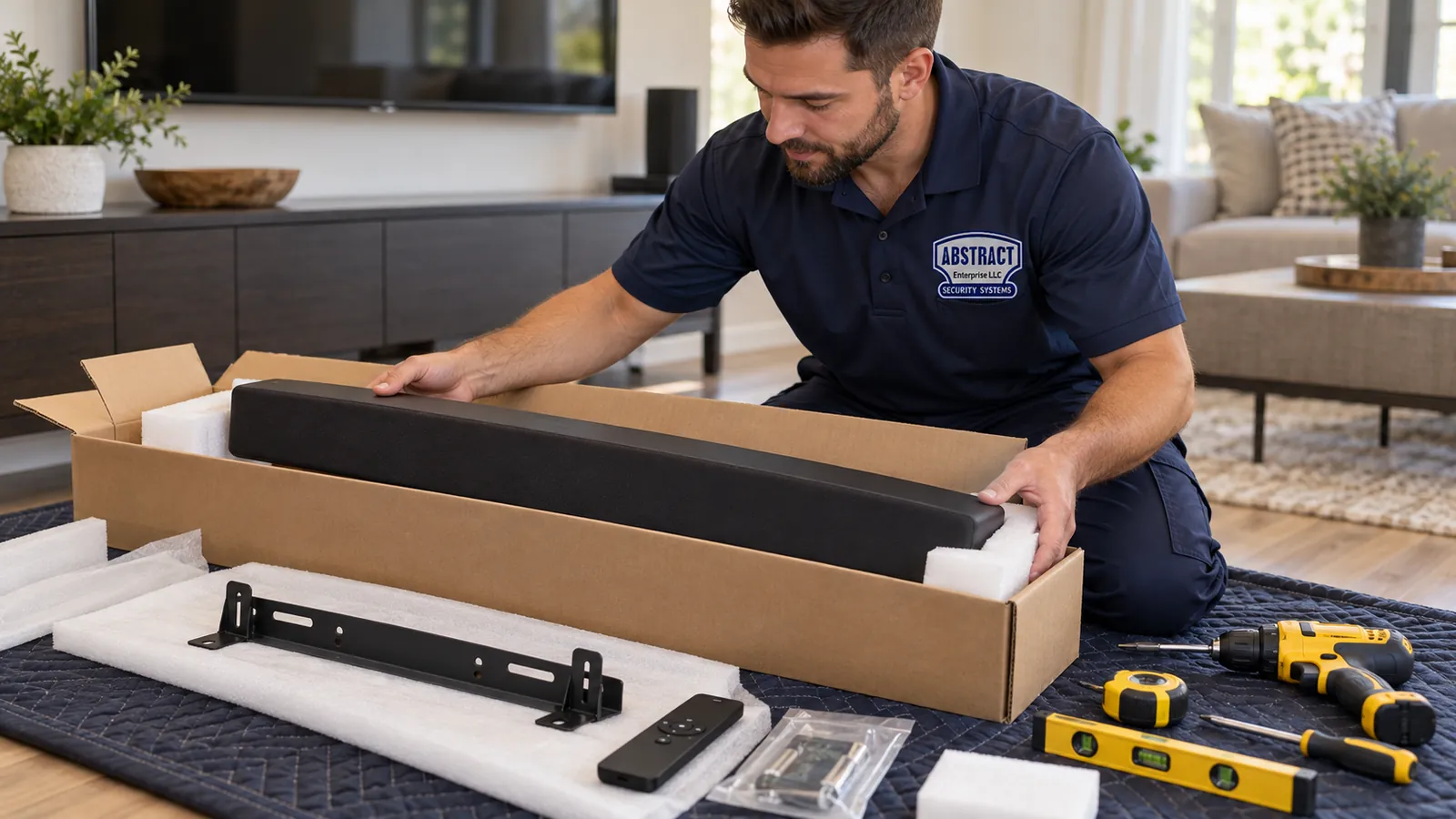
We install the bar you choose, or help you choose one; the brand matters less than how it fits the room and who will be using it. These are the categories we fit across Ulster, with the situations where each one earns its place.
Bars around two feet wide, such as the Sonos Beam (Gen 2), which Sonos lists at 25.63 inches and 6.35 lb with HDMI eARC. Right for cabin bedrooms, small rental living rooms and TVs under 55 inches.
Flagships like the Sonos Arc Ultra (46.38 inches wide, 13.01 lb per Sonos) or Samsung's HW-Q990 series. Sonos recommends at least 4 inches between bar and TV and a foot of clearance at each end; up-firing channels need a flat ceiling, which many cabins and barns do not have.
Systems whose rear speakers are wireless for audio but, as Samsung's own specifications note for the Q990 series, each need an AC outlet. In timber rooms, placement of those outlets often decides the layout.
Bars like the Sonos Ray connect by optical rather than HDMI. Useful for older TVs in guest rooms, though they need a programmed universal remote ($99) if guests are to manage with one handset.
The wall bracket that came in the box, model-specific mounts sold separately, and the Sanus soundbar bracket we supply at $84.99, which can hang a bar from the TV's own mount.
Paintable cord covers for stone, brick and boards; matching raceway on beams; and the code-compliant in-wall power and cable kit for framed walls.
Roku, Apple TV, Fire TV and Google TV devices ($49 setup), and Sonos systems ($125 setup). Where Wi-Fi does not reach the TV, our structured cabling crew in Ulster County can run a wired connection.
Programmed universal remotes and careful HDMI-CEC setup, so the TV's own remote powers and adjusts the bar. In rentals, this matters more than any audio feature.
| Connection | What it carries | When we use it in Ulster homes |
|---|---|---|
| HDMI eARC | Full-bandwidth sound including lossless Dolby TrueHD and Atmos; the TV remote controls the bar | Newer TVs in main living rooms and rentals |
| HDMI ARC | Compressed surround (Dolby Digital, Dolby Digital Plus, which can carry Atmos); remote control via CEC | Most TVs from the last decade, including many in second homes |
| Optical | Stereo and compressed surround; no remote control of the bar | Older guest-room and cabin TVs |
| Bluetooth | Music from a phone; not recommended for TV sound because of delay | Kept locked or switched off in rentals where the bar allows it |

Search summaries and chatbots answer soundbar questions from national cost guides and manufacturer marketing. Those sources are not wrong, but they are written for a drywall house with good broadband. Here is where they part company with an Ulster County house.
HomeWyse's national calculator puts the cost to install a soundbar at roughly $58.43 to $231 per bar, and AI summaries repeat that range freely. As a national average for a bar going onto drywall in a suburban living room, it is a reasonable starting point.
In Ulster the range hides the question that decides the price: the wall. A bar on drywall over wood studs carries no surcharge with us; the same bar on a fieldstone wall in Hurley or on Rondout brick adds $65, on plaster $45, and on a block wall $75. A national average cannot know which of those you have.
That is why our prices are itemised rather than averaged. The wall-mount line is $129, the bracket $84.99 if you need ours, and the surcharge appears only when the wall calls for it. You can add the lines yourself before you call.
Angi's cost guide lists concealed wiring — power and HDMI run inside the wall — at $75 to $300, and AI answers often present that as a standard upgrade available in any home.
Inside a hollow, framed wall that is broadly true; our in-wall power and cable kit is $169. But a stone house wall is solid, a log wall is solid, a barn's board wall has nothing behind it, and Victorian plaster on lath is often blocked by fire stops and old framing. In a large share of Ulster's older homes, hidden wiring is simply not available without cutting the wall.
We tell you on the first call which category your wall is likely in, and on site we confirm it before promising anything. On solid walls the tidy answers are a paintable cord cover ($59), a cable run to a cabinet ($99) or a TV-attached bracket that keeps everything in one place.
Manufacturers and AI summaries describe Wi-Fi soundbars as self-maintaining: they join the network, update overnight and stream from any service. Netflix's own guidance says 4K streaming needs 15 Mbps or more, and those summaries assume that kind of bandwidth is just there.
In parts of the Catskills it is not. Ulster County's own count of 1,293 unserved locations, and owners on r/catskills describing frequent outages and a satellite plan they called "incredibly slow", show how uneven connections still are. A bar that cannot reach its update server can sit for months on old software, and a bar whose app depends on the network becomes hard to manage remotely.
We set up the bar so its core job — TV sound over HDMI — never depends on the internet, and treat app features and streaming as a bonus where the connection supports them. Where it matters, we connect the bar or streaming box by cable rather than Wi-Fi.
Design summaries love the over-fireplace TV, and Angi lists fireplace or masonry mounting at $100 to $300 as an add-on, as if heat were only a pricing question.
Many Ulster houses do not have a fireplace; they have a wood stove, and a stove radiates heat into the room and up the wall in a way a closed fireplace insert may not. Stove-supply guides based on NFPA 211 put unlisted stoves 36 inches from combustible walls, which gives a sense of how far serious heat travels. Electronics above or beside a working stove are a poor bet, whatever the room looks like in photos.
We look at where the stove is, how it is used and what is above it before suggesting the TV wall. Where a fireplace is the right spot, the published Ulster add-ons apply: $130 for placement above a fireplace and $160 for a pull-down mount, with the bar on a TV-attached bracket so it comes down with the screen.
Marketing and AI summaries describe up-firing Atmos drivers as a way to get height effects from a single bar, in any room, with no ceiling speakers.
Dolby's own setup guidance says the ceiling should be flat, not angled or vaulted, and between 7.5 and 14 feet high for reflected height effects to work. A-frame cabins, cathedral ceilings in barn conversions and the sloped ceilings of attic bedrooms are exactly the rooms where up-firing channels bounce sound somewhere other than the listener.
We will still install an Atmos bar in those rooms if you want one — the dialogue clarity and width of a flagship bar are worth having on their own — but we will set your expectations honestly and switch off height processing if it makes the room sound worse.
DIY summaries tend to treat any wooden wall as easy: find the wood, drive the screws, done.
Full-log walls behave differently because they keep shrinking as they dry. InterNACHI's log-home guidance says a log wall may lose about three-quarters of an inch per foot of wall height during its first years of settling. A bracket or a cable channel fixed rigidly across two courses, or tied to a framed partition that does not settle at the same rate, can be pulled out of line.
So in log rooms we keep the bracket on a single course where we can, leave slack in any cable crossing between log and framed walls, and avoid tying the bar to anything that will move differently. In older, fully settled log homes the concern is smaller, and we say so.
Thumbtack's national data puts TV wall mounting at $121 to $234, and AI tools often bundle that figure with a soundbar as if both came together in one national price.
Our published Ulster County TV mounting base is $254.99 for a 32- to 55-inch screen on drywall, with larger sizes at $284.99 (up to 65 inches), $314.99 (75) and $354.99 (85), and nothing added for the drive. The soundbar is then its own line: $129 on the wall or $79 on a console.
That means a drywall TV and soundbar together start at $383.99 here, and you can see every line before booking. A national average looks cheaper; an itemised local price is the one you will actually pay.
Send the town, a photo of the TV wall and the bar's model, and say who uses the TV. You get back a fixed price, a mounting method for that wall and a plan for guests.
Give us the four facts that decide an Ulster job — the model of bar, the TV it goes under, what the wall is made of and who will be watching — and we will send an itemised figure the same working day, whether the house is a Hurley stone house or a Pine Hill cabin. To talk it through instead, ring (845) 640-3835.
Got it. A technician will look at the details and come back to you, on the same day when it is a weekday. In a hurry? Phone (845) 640-3835.
Seven steps, whether it is a compact bar on a console in a New Paltz apartment or a TV, bar and sub on a fieldstone wall in a house nobody lives in full-time. The second and seventh steps are the ones Ulster owners care about most.
Name the hamlet, send one wide photo of the TV wall, list the bar and TV models and say whose TV it is — yours, your guests', a tenant's. We reply with an itemised figure taken from the Ulster lines on this page.
Pick a 2-hour window, tell us who will let us in — you, a caretaker, a property manager or a lockbox — and note anything about the road or the driveway we should know.
On arrival the technician confirms the wall: a magnet and a pilot hole tell us whether it is plaster on lath, pine over strapping, log, brick or stone. The fixing is chosen after that, not before.
You or your stand-in confirm the bar's height, its centre line under the TV and the cable route, with the wood stove, windows and furniture in mind.
Bracket fixed and levelled, bar mounted, HDMI eARC or ARC connected, HDMI-CEC switched on so the TV remote runs the bar, and cables run in a cover, raceway or wall as agreed.
Subwoofer placed and levelled for the room, dialogue and night modes chosen, and for rentals the guest network, input behaviour and volume limits set.
Dust cleaned up, packaging handled as you asked, the system demonstrated to whoever is there, and a short written note of how it is set up — including a one-page guest guide for rentals.

In Ulster, a landmark is a useful shorthand for the walls nearby. Tell us your house is a few minutes from one of these and we already have a fair idea of what the technician will find behind the TV.
Laid out inside the wooden stockade the Dutch built in 1658, and home to the corner of John and Crown Streets, which Friends of Historic Kingston calls the only U.S. intersection with 18th-century stone houses on all four corners. Thick stone walls, plaster interiors, deep window reveals.
A ten-acre National Historic Landmark District at the heart of the 1678 New Paltz settlement, with seven historic stone houses among some 30 buildings. The stone-house tradition it preserves runs through the farmhouses of the Wallkill Valley around it.
The waterfront village that grew up when the Delaware and Hudson Canal opened in 1828 to haul coal 108 miles from the Pennsylvania mines, according to Friends of Historic Kingston. Brick rows and 19th-century commercial buildings.
Sculptor Harvey Fite's monumental work, begun in 1939 in an abandoned bluestone quarry at the foot of Overlook Mountain. A reminder that bluestone is everywhere in north-county hearths, steps and walls.
The Victorian castle resort founded in 1869 by Albert Smiley above Lake Mohonk on the Shawangunk Ridge, with 259 guest rooms and suites. The ridge country around it mixes older farmhouses with newer homes built for the view.
The 11.5-mile Ashokan Rail Trail runs along the reservoir between West Hurley and Boiceville, beside Route 28. Beyond it the cabins, lodges and rentals of Phoenicia, Shandaken and Pine Hill begin.
We also serve Kingston's Uptown, Midtown and Rondout neighbourhoods, Port Ewen, Esopus, Lake Katrine, Ulster Park, Saugerties and Malden, Woodstock, Bearsville, West Hurley, Hurley, Stone Ridge, Marbletown, High Falls, Rosendale, Tillson, New Paltz, Gardiner, Highland, Milton, Marlboro, Plattekill, Wallkill, Accord, Kerhonkson, Ellenville, Napanoch, Shokan, Boiceville, Mount Tremper, Phoenicia, Shandaken, Big Indian, Oliverea and Pine Hill — and the Saugerties Lighthouse, an 1869 landmark that now runs as a two-bedroom bed and breakfast, is a fair marker for our northern river edge. Neighbouring counties are covered from the same crews; see the Hudson Valley links below.
| Area | Typical wall behind the TV | Usual soundbar approach |
|---|---|---|
| Uptown Kingston and Hurley | Plaster over stone, deep reveals | TV-attached bracket; anchors into sound stone; cord cover |
| Rondout and Port Ewen | Brick, sometimes exposed; plaster on lath upstairs | Anchors in brick, not mortar; sub off shared walls |
| Midtown Kingston and Lake Katrine | Drywall in apartments and newer houses | In-wall kit where the owner agrees; standard bracket |
| New Paltz and Gardiner | Mix of stone farmhouses, student rentals and newer builds | Landlord OK first in rentals; stone method in farmhouses |
| Saugerties and Woodstock | Victorian plaster, bluestone hearths, artists' studios | Backer board on irregular framing; anchors kept off bluestone edges |
| Route 28: Boiceville to Pine Hill | Pine paneling, logs, wood stoves | Fix to strapping or a single log course; surface raceway |
| Rondout Valley: Stone Ridge to Ellenville | Barns, farmhouses, ranches along Route 209 | Post or media-wall fixing in barns; ordinary bracket in ranches |
| Highland, Milton and Marlboro | Older river-town houses and newer suburban homes | Plaster or drywall method; long cable runs to cabinets |

Nothing on an Ulster soundbar invoice is a surprise, because every line is printed here first. Pick the items that describe your job and total them. Soundbar and accessory charges do not change from one Hudson Valley county to the next. What is specific to Ulster is the TV-mounting base, the TV-on-stand price and the hourly setup-only rate, all shown below. There is no travel or mileage line on an Ulster booking. If something you did not select turns up on site — stone behind the plaster, say — you hear the extra amount before any work starts, and you decide.
| Line item | Ulster price | What it covers |
|---|---|---|
| Soundbar placed on a console or stand | $79 | Positioned, connected to the TV, configured and tidied — nothing drilled |
| Soundbar wall-mounted under the TV | $129 | Bracket fixed for your wall type, bar centred and levelled, connected and tested |
| Sanus soundbar bracket | $84.99 | Our stocked bracket; it can clamp the bar to the TV's own mount |
| Paintable cord cover | $59 | Surface channel from bar or TV to the outlet — the usual answer on stone, brick, boards and logs |
| In-wall concealment | $169 | Code-compliant in-wall power and cable kit; framed hollow walls only |
| Cable run to a cabinet or other spot | $99 | Up to 25 feet, for sources kept away from the TV |
| Sonos setup | $125 | Sonos bar or system on your network and in the app |
| A/V receiver | $129 | Receiver connected and configured with TV and speakers |
| Universal remote | $99 | One programmed handset for TV, bar and source boxes |
| Streaming device setup | $49 | Roku, Apple TV, Fire TV or similar, signed in and tested |
| Full home theater | $350 | Bar or receiver, sub and surrounds connected and calibrated |
| Condition | Price | Where you meet it in Ulster |
|---|---|---|
| Drywall on wood studs | $0 | Newer homes, additions and most apartments |
| Metal studs | +$30 | Some commercial fit-outs and newer apartment buildings |
| Plaster | +$45 | Victorians in Saugerties, Kingston, Rosendale and Highland |
| Brick or stone | +$65 | Stockade and Hurley stone houses, Rondout brick, bluestone hearths |
| Concrete or cinder block | +$75 | Basements, garages and block-built commercial rooms |
| Tile or marble | +$95 | Feature walls and some fireplace surrounds |
| Plywood backer board | $85 | Pine paneling, irregular old framing, soft plaster |
| High mount (above about 8 ft) | $75 | Barns and cathedral-ceiling great rooms |
| Walk-up, 3rd floor or higher, no elevator | $40 | Upper floors of older Kingston and New Paltz buildings |
| Box removal | $25 | We take the packaging away |
| Certificate of insurance | Free | Landlords, condo and homeowner associations, commercial managers |
If the TV goes up at the same visit, the Ulster County TV-mounting base for a 32- to 55-inch screen on drywall is $254.99, rising to $284.99 up to 65 inches, $314.99 up to 75 and $354.99 up to 85. Placement above a fireplace adds $130 and a pull-down fireplace mount $160. A TV set up on its stand without wall mounting is $168.99. When nothing needs mounting — reconnecting a bar after a power cut, sorting eARC, re-joining a bar to a new router — Ulster visits are billed as setup-only: $275 for the first hour, then 30-minute blocks. Specialty work outside this menu, such as tracing a fault in existing building wiring, is quoted at our $195-an-hour specialty rate with a three-hour minimum ($585); it does not apply to a standard soundbar install.
Big-box and app-based installers versus a local licensed installer. National services publish flat menus written for drywall and broadband. In Ulster, the parts those menus leave out are the parts that decide the job: fieldstone and log walls, the drive into the mountains, rental setups for strangers, and a written certificate of insurance for an association or a commercial landlord. A licensed installer with a wall-by-wall price list quotes the real job and is still answerable afterwards. Our full Ulster TV menu is on the Ulster County TV mounting price list.
Three bundles cover the Ulster jobs we are asked for most. The arithmetic is printed on each one, so you can swap a line in or out; wall, height and stair charges from the tables still apply.
Bar placed on the console ($79) plus a programmed universal remote ($99): one handset, nothing drilled, inputs and volume set for guests. The usual first step for a new listing or a TV that lives on furniture.
Wall mount ($129), Sanus bracket ($84.99) and the brick-or-stone surcharge ($65). Written for the Stockade, Hurley and Rondout walls; on drywall the same package is $213.99.
Wall mount ($129), Sanus bracket ($84.99), Sonos setup on the house network ($125) and a paintable cord cover on a solid wall ($59). Pine or log walls that need a backer add $85.
Supplying your own mount? Our charge is the $129 wall-mount line plus whatever the wall adds, with no bracket line at all. The bracket has to be rated for the weight and shape of your bar, and any warranty on it comes from its maker. Should it look unsuited to a log course or a stone face, we will show you why before a hole is drilled, and the Sanus bracket stays available as a fallback.
Worked examples, from the lines above. A bar on a bluestone chimney wall with our bracket and a cord cover: $129 + $84.99 + $65 + $59 = $337.99. A 55-inch TV and a soundbar on new drywall in a Kingston apartment: $254.99 + $129 = $383.99. A bar placed on the stand in a New Paltz rental, with a streaming stick signed in: $79 + $49 = $128.
Town, wall photo, bar model. Three things, and the reply is a line-by-line total you can check against this page.
A rental TV is used by dozens of people a year, none of whom read the manual. Ulster County's rental rules are set town by town, and the comptroller counted sixteen municipalities with some form of regulation in 2025, but every set of rules assumes the same thing: the host is responsible for what happens in the unit. Here is how we set a soundbar up so it stays out of that list of responsibilities.
| Rule or fact | Where it comes from | What it means for the TV and bar |
|---|---|---|
| Short-term rentals must register with the county | Ulster County, referenced in town rental laws including Woodstock's and Shandaken's | The rental is a business; treat the AV setup like equipment, with a written record of how it is configured |
| Owner or manager responds to an emergency within 30 minutes, on site within an hour | Town of Shandaken short-term-rental licensing page | A clear guest guide and a self-recovering setup avoid turning small problems into calls |
| Non-owner-occupied rentals capped at 180 days and 26 weekends a year | Town of Woodstock Local Law No. 1 of 2019 | Long gaps between stays; the bar must come back to life cleanly after weeks unused |
| Full permits capped at 1 percent of housing units | City of Kingston short-term-rental fact sheet | Permitted units are valuable; owners expect a setup that matches the listing photos |
| Counties may create a county-wide rental registry | New York State, Chapter 99 of the Laws of 2025 | Expect more formal oversight over time, not less |
One remote, one button. We switch on HDMI-CEC so the TV's power button wakes the bar and the TV's volume buttons drive it. Where a cable box, satellite receiver or streaming stick has its own remote, we either program a universal remote or hide the extras in a drawer with a note, so guests are not juggling three handsets.
A known starting point. Many TVs can be set to open on a chosen input or on the streaming home screen rather than the last input used. We set that, and we set the bar's default sound mode so that whatever the previous guest did, dialogue is clear when the next one switches on.
Limits where the hardware allows. Some bars and TVs allow a maximum volume or an auto-volume setting; some let you lock Bluetooth pairing. We use what your models offer and tell you honestly where they offer nothing, rather than promising controls that do not exist.
Privacy between stays. If the bar has a built-in voice assistant or the streaming box is signed in to a personal account, a guest can see or change things they should not. We set up streaming on accounts you choose for the rental, and we can switch off the bar's microphone in its settings where the model has one.
A written record. At the end of a rental setup you get a short note of what was installed, how it is connected and which settings were changed, plus the one-page guest guide. If you use a property manager or cleaner, they get the same note, which saves a call to you when something looks unplugged.
Ulster weather reaches indoors more than people expect. A house that is heated to 50 degrees between weekends, a cabin that sits damp through a wet spring, a nor'easter that takes the power for a day: none of these will ruin a soundbar on their own, but each one is worth planning for.
Power cuts and restarts. When the power drops and returns, TVs and soundbars do not always find each other again; the HDMI handshake that links them can need a fresh start. That is the most common reason for a "no sound" message after a storm. The September 2026 nor'easter left more than 14,000 Ulster County Central Hudson customers without power at its peak, according to the Daily Freeman, and in July 2026 storms the paper reported nearly 50,000 customers across the Central Hudson area in the dark. We show you, your caretaker and your guide-writer the one-minute restart routine that fixes most cases: TV off at the wall, bar off at the wall, bar on first, then TV.
Cold and damp. Electronics prefer the conditions people do. Industry guidance on humidity and electronics puts the comfortable range at roughly 40 to 60 percent relative humidity and warns that condensation risk rises when warm, moist air meets cold surfaces. For a cabin that is closed up between visits, the practical advice is simple: keep some heat on, let the room warm up before switching the TV and bar on after a cold spell, and avoid mounting the bar on an uninsulated exterior wall that sweats in spring if another wall will do.
Wood heat. A wood stove is the heart of many Ulster living rooms in winter. Keep the bar, the sub and their cables out of the stove's heat path, keep cables away from stovepipes entirely, and never run a cord cover along a wall that gets hot to the touch.
Internet that comes and goes. When the connection drops, the TV sound over HDMI keeps working; app features and streaming do not. We set the bar so the parts that matter work offline, and if fiber arrives on your road under the county's BEAD buildout, a short setup-only visit can re-join every device to the new router at once.
Ulster owners who want the network itself to be more reliable before winter often book network installation in Ulster County alongside the soundbar, so the streaming box and the bar are wired rather than relying on a router two floors away.

The best bar for a room in this county is decided as much by the walls, the ceiling and the users as by the spec sheet. We install whatever you choose, but if you have not bought yet, these are the pairings that tend to work, room by room.
| Room | What usually works | What to watch |
|---|---|---|
| Stone-house parlour with deep window reveals | A compact or mid-size bar on a TV-attached bracket, so one set of anchors carries both | Little straight wall; plaster over stone; keep the bar clear of the window splay |
| Catskill cabin living room with pine walls | A mid-size bar with a modest wireless sub, set low and away from corners | Boomy bass in small timber rooms; mice and floor-level cables; wood-stove heat |
| Sleeping loft or attic bedroom | A compact bar, no sub, night mode on, display dimmed | Sound travels down the open stair; sloped ceilings defeat up-firing channels |
| Barn great room or timber-frame addition | A full-width bar with a sub, or a receiver and separate speakers if the room is very large | High ceilings and hard surfaces; few walls to fix to; long cable runs |
| Rondout or Uptown brick apartment | A full-width bar on the wall under the TV, with the sub on a pad | Shared brick walls with neighbours; walk-up stairs; landlord's written OK |
| Rental living room in any town | Whatever bar the TV remote controls fully over HDMI-CEC, plus a universal remote if needed | Guests changing inputs; Bluetooth pairing; Wi-Fi passwords that rotate |
Width. A bar roughly as wide as the TV, or a little narrower, looks deliberate. A bar much wider than the TV can work on a console, but on the wall it overhangs and draws the eye. In stone parlours and cabin corners, measure the clear wall first: a 46-inch flagship needs more than 46 inches, because Sonos, for one, asks for a foot of space at each end of the Arc Ultra.
Subwoofer or not. In a small cabin or a brick apartment with neighbours, a well-designed bar without a separate sub is often the better buy; it sounds fuller than people expect and causes fewer complaints. In a barn or a large great room, a sub adds the weight that a bar alone cannot. If you are not sure, buy a bar that can add a sub later, and decide after a few weekends of listening.
Wi-Fi features. If the house has dependable internet, streaming bars and multi-room systems are a pleasure. If it does not, prioritise a bar that does everything important over HDMI and treat Wi-Fi features as extras. That is especially true in hill-town rentals, where the next guest may not know the network password and should not need it.
Guests first. For a rental, the most valuable feature is the one nobody notices: the TV's own remote turning the bar on, off, up and down. Check that your TV and bar support HDMI-CEC together before buying, or ask us to check; it saves more host messages than any audio feature.
Older TVs. Many second homes inherit an older TV from the main house. If it has only an optical audio output, an optical-capable bar plus a programmed universal remote ($99) is the honest answer, and it works well for dialogue and everyday viewing.
Not every Ulster rental is a weekend listing. Census figures put Ulster's owner-occupied rate at 69.9 percent for 2020–2024, which leaves roughly three households in ten renting — students and staff around SUNY New Paltz, young families in Kingston's older two-family houses, and tenants in the apartments above shops in the village centres. For them, a soundbar is an ordinary household purchase, and the questions are about permission and leaving the wall in good shape.
For tenants. If the lease says nothing about fixtures, ask the landlord anyway and keep the answer in writing; an email is enough. Where the answer is no, or not yet, a bar on the console or a TV-attached bracket on a TV that already hangs on the wall adds no new holes at all. When you move out, the bracket comes down with the TV, and the landlord has nothing new to patch.
For landlords. An owner who installs the TV and soundbar as part of a furnished unit controls where the holes go, what anchors are used and how the cables are dressed, rather than inheriting a tenant's improvised version. We fix to framing or masonry properly, leave a note of what is on the wall, and issue a certificate of insurance at no charge if your insurer or association wants one. In a multi-unit house, it is worth asking us to keep subwoofers off shared floors and party walls from the start.
For both. Patching and painting are not part of our trade, so when a bar comes down at the end of a tenancy, the holes are left clean for a painter or the landlord's handyman. Removing an old bracket someone else left on the wall is a published $45 line, and taking down an old TV is $85.
A few minutes of preparation make an Ulster appointment shorter, especially when the owner is not going to be there.
Other Ulster County services from the same crews — useful when the TV wall is only the start of the project.
The television itself, hung on the same wall and route as the bar — on stone, brick, boards, logs or drywall.
Every Ulster TV line in one place: screen sizes, mounts, walls and extras.
When a barn or great room needs more than one bar can give: receivers, separate speakers and audio in several rooms.
Scenes, schedules and remote control for second homes, so the house is ready before you arrive.
Routers, access points and wired runs that keep streaming soundbars connected through thick walls.
A wired connection to the TV wall for streaming boxes and Ethernet-capable bars.
Return trips, rescheduling and setup-only billing, in plain words.
Have a project that crosses several trades? Send one description and get one combined estimate.
How our technicians size up a wall in this county, written as general guidance — no client's home is being described.
Knock first. A hollow knock on a smooth wall is drywall or plaster with a cavity; a dull, dead knock is stone, brick or a log; a lively, slightly drummy knock on boards usually means paneling over strapping with air behind. That first knock decides which bit comes out of the case.
Look along the wall from one end with light behind you. Stone houses that were plastered long ago show their waves, and so do old pine boards. A long soundbar will show those waves too, so shims are planned before the bracket goes up, not after.
Find the heat and the cold. Note where the stove is and where its warmth rises, feel the outside wall for chill and damp, and keep the bar away from both. On bluestone or brick, pick a solid face well back from any edge or joint and drill one pilot hole where the bracket will cover it; read the dust before committing. Then think about the next person to use the TV, who may never have seen it before, and set it up for them.
Every local figure above is taken from a published source, listed here so you can check it. Prices come from our own published Ulster County menu.
Yes. Send us the TV's model number and the bar you are considering, and we will check the connections (HDMI eARC, ARC or only optical), the width against the TV, and whether the bar's height will block the bottom of the screen or the TV's remote sensor. If a different model would suit the room or the guests better, we will say so.
Some can. Certain TVs and soundbars from the same maker can link over Wi-Fi or Bluetooth, and nearly every TV can pair with a Bluetooth speaker. Wireless links can add delay or drop out, so on most installs we use HDMI eARC or ARC, and use a wireless link only where a cable truly cannot reach.
Usually not, but occasionally an update resets a sound mode or a TV setting. We write down the key settings we chose, such as the TV's audio output, CEC and the bar's dialogue mode, so you or a caretaker can put them back in a minute if an update changes something.
On most models, yes. Many bars let you dim or switch off the status light and the front display in their settings or app, and some TVs let you turn off their own standby light. We set those for bedrooms and sleeping lofts and tell you where the setting lives.
No separate minimum. A bar placed on a console is the $79 line and a bar mounted on the wall is $129, plus any wall surcharge, and that is the bill. The three-hour minimum on our $195 specialty rate applies only to specialty work outside the menu, not to a standard soundbar install.
Yes, and we recommend it for any house that is not lived in full time. We label each cable at both ends with what it connects to, and the written note we leave describes which TV port the bar uses, so a caretaker or cleaner can put a pulled cable back without a call.
Many hosts choose to. If the bar has a microphone and a voice assistant signed in to your account, guests can use it and may see personal information. We can sign the assistant out or switch off the microphone where the model allows it, and list in the guest guide what is and is not enabled.
Yes. Tell us before the visit, and the written note we leave will list the soundbar, sub, rear speakers and remotes by model and serial number as printed on the equipment. Hosts often keep it with their insurance and inventory records.
You are on the Ulster County page. The valley-wide picture is on our Hudson Valley soundbar installation hub, and the counties around Ulster each have their own page or quote route below, served by the same crews.
Abstract Enterprises soundbar installation in the Hudson Valley · Dutchess County soundbar installation · soundbar installation in Putnam County · Westchester · Rockland · Orange
Soundbar installation across NYC · the Bronx · Brooklyn · Manhattan · Queens · Staten Island
Long Island soundbar installation · Nassau County · Suffolk County
Security work at the same property — cameras for an empty house, an alarm, an intercom — is listed in our directory of every AESS service. New to us? Begin at the Abstract Enterprises Security Systems home page or read how the company started.
Silent bar on the first night of a booking, a sub that lost its pairing in the last storm, a sagging bracket on knotty pine? Phone (845) 640-3835. The earliest free 2-hour window is yours, and a typical fault is put right within one to two hours on site.
Abstract Enterprises Security Systems · 460 E Fordham Rd, Bronx, NY 10458 · Hudson Valley line (845) 640-3835 · WhatsApp (718) 679-0359 via wa.me
NYS Low-Voltage Licence #12000287431 · 100% Licensed & Insured · Same-Day Estimates · Rated 4.7★ from 201 Google Reviews
Brackets and parts carry their manufacturer's warranty. Full terms — including 50% deposit, one-year parts-only warranty on AESS-supplied products, and the late-fee schedule — are set out in the service agreement. See our warranty page.
Page reviewed and updated October 17, 2026. Changelog: first publication of the Ulster County soundbar installation page, written around stone, brick, pine and log walls, rental and second-home setups, and weather and internet in the hill towns.