NYS-Licensed Installers · Suffolk County · Family Homes, Rentals, Farmhouses
Soundbar Installation in Suffolk County
Under-TV Brackets · Rental-Ready Setups · Split-Level Dens · Farmhouse Walls · Porch Bars · One Remote
From Huntington family rooms to Southampton rentals and Southold farmhouses, we mount the soundbar on the right anchor, route the cables out of sight, connect it by HDMI so the TV remote runs it, and set it up for whoever will actually use it: the family every night, a new tenant every two weeks, or a caretaker in the off-season. One price list from Amityville to Orient Point.
Reviewed and updated October 17, 2026 · Written by Anwar Timothy, NYS license #12000287431
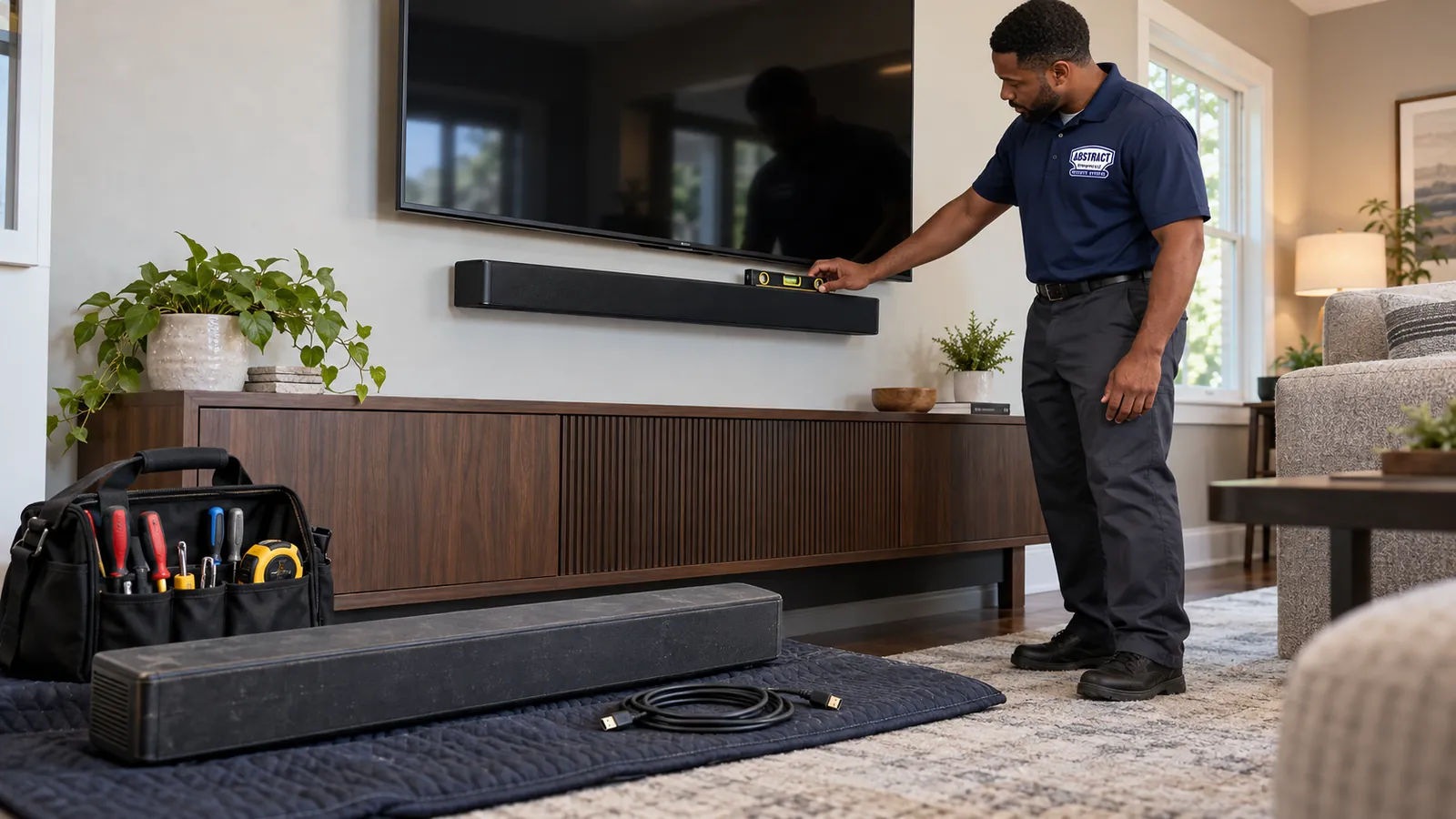
Level on the bar, tools on a blanket: the soundbar sits a few inches under the TV and is checked for level before the room is handed back.
Get a Free Suffolk Soundbar Quote
Your hamlet and the gear you own — a technician phones back before close of business
✅
Request Sent!
We'll call you back the same business day.
25+
Years Experience
✓
Same-Day Estimates
100%
Licensed & Insured
4.7★
201 Google Reviews
Guests arriving Friday and the bar is still boxed? Phone (631) 407-2884 or use the 60-second form: hamlet, TV, soundbar. Whoever reads it is a technician, and you get the total before choosing a window.
One published price list across all of Suffolk, no East End surcharge
Why Suffolk County Homes Need Soundbar Installation
Suffolk is not one market for a soundbar; it is three, strung out along more than a hundred miles of road. At the western end, in Babylon, Huntington, Islip and Smithtown, the job is a year-round family house where someone wants to hear the evening news without subtitles. In the middle, across Brookhaven, it is the split-level den, the high ranch and a growing number of new apartments near the train. Out east, past the canal and across the forks, it is a house that may be lived in for ten weekends a year, rented for a fortnight at a time, or run as a tasting room that fills on Saturdays. The bar itself might be identical in all three. Everything around it is not.
That is the idea this page is built on. A soundbar that sits under a TV in Commack gets used every night by the same four people, who learn its remote and forgive its quirks. The same bar in a Southampton rental is used by a different household every two weeks, none of whom has ever seen it before, and the owner is a two-hour drive away when it stops talking to the TV. A third copy in a Southold farmhouse plugs into a wall that may still have two-slot outlets and a stud layout nobody has drawn since the house was framed. The installation has to suit how the room is lived in, not just how it is built.
Distance matters too. Suffolk covers about 911 square miles of land, according to the Census Bureau, and reaching the far end means a long run out Sunrise Highway and Montauk Highway or along Route 25 to the North Fork. Some installers based in the city say plainly on their own pages that a travel fee may apply in the Hamptons. We price soundbar work the same from the Nassau line to Orient Point, and we plan the visit so it finishes in one trip, because a second trip to the forks is a day lost for everybody.
Then there is the weather and the grid. When Tropical Storm Isaias crossed Long Island in August 2020, RiverheadLOCAL reported that more than 420,000 PSEG Long Island customers lost power, more than 2,600 of them in Riverhead alone. Outages like that are why we ask where the bar, the sub and the TV draw power from, and whether anything in the chain can take a surge. In older East End and North Fork houses that question leads straight to the outlets themselves.
You do not need a home-cinema designer for any of this. You need someone who knows Suffolk houses, has brackets, in-wall kits, cord covers and stainless fasteners on the van, sets things up so a stranger can work them, and says plainly when the job has crossed into an electrician's territory. That is the service we run across the county.
Suffolk facts that change how a soundbar goes in
911.17 square miles of land and 1,546,090 residents: the Census Bureau's QuickFacts figures for Suffolk County (population estimate for July 1, 2025). One price list has to cover all of it.
14 days: the minimum rental stay under the Southampton Town Code, according to the town's rental-permit FAQ; anything shorter is a transient rental. Every two weeks, a new household meets your soundbar.
Nearly half: the share of Southampton Town houses counted as vacant in the 2010 Census, as 27east reported, the seasonal second-home pattern showing up in the data.
420,000+ customers: PSEG Long Island customers left without power by Tropical Storm Isaias in August 2020, per RiverheadLOCAL; more than 2,600 in Riverhead.
About 1,300 companies: located in Hauppauge Industrial Park, according to the Regional Plan Association, many with training rooms and break rooms where a display needs a voice.
82 wineries: on Long Island according to Discover Long Island, most of their tasting rooms on the North Fork along Route 25 and Route 48.
53 acres: the size of the Station Yards development beside the Ronkonkoma LIRR station, being built in phases with hundreds of new apartments, per Newsday, a new kind of Suffolk living room with steel-stud walls and a lease.
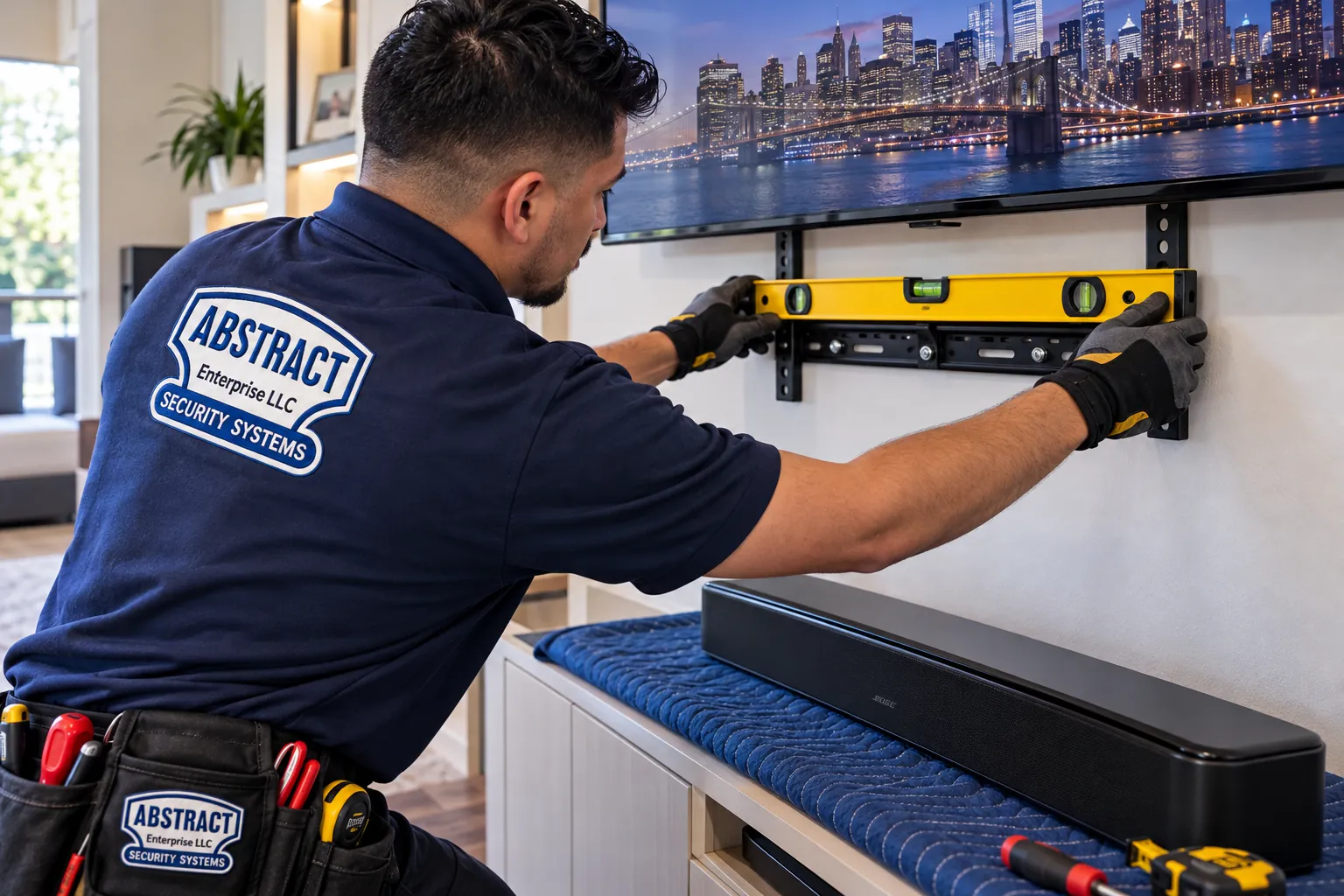
A gloved technician holds a yellow level across a black soundbar bracket fixed under the TV, while the bar waits on a blue moving blanket on the console.
Repair Capture
Soundbar Acting Up in Suffolk County?
Silent since the TV downloaded an update? Sub blinking since the last outage? Rear speakers cutting out at random? None of that needs a new install. The cause is nearly always an HDMI handshake, a TV sound setting, a changed router or a lost wireless link, and with a technician in the room most are put right within one to two hours. In Suffolk we book them as a setup-only visit, $250 for the first hour and then 30-minute blocks. Same-day when a two-hour window is open. Call (631) 407-2884 and say the soundbar has stopped working.
What We Install
Soundbar Installation Services in Suffolk County
No bundles hiding costs: every service is its own priced line, and a Suffolk quote is the handful of lines the room calls for. One technician mounts, routes, connects and tunes, then shows you or your caretaker how it works.
Bar on a Bracket Under the TV
The bar fixed to the wall directly beneath the screen, squared to the TV rather than the floor and centred on the picture. $129 for the work, and $84.99 more if you need our Sanus soundbar bracket.
Bar Set on a Console or Ledge
For a TV on a stand, a built-in ledge or a deep mantel: positioned at the front edge, connected and configured for $79, with no holes. Popular in rentals where the owner limits drilling.
Rental-Ready Setup
A bar wired by HDMI so the TV remote runs the volume, inputs labelled, and a universal remote programmed for $99 so guests have one control. Built for houses that change hands every fortnight.
Wires Inside the Wall
Nothing dangling between screen and bar: a listed kit links a recessed inlet near the floor to a recessed outlet behind the TV, fed from the receptacle you already have, with HDMI travelling alongside. $169 per TV on a framed wall.
Subwoofer and Surround Pairing
Wireless subs and rears linked to the bar and positioned around the seating, either from the original box or added later as Sonos surrounds. $125, finished with a check from each seat.
Streaming and App Setup
Each streaming device connected and routed through the bar for $49, plus the soundbar maker's app linked to your Wi-Fi so updates and music streaming work.
Cable Runs to a Closet or Cabinet
Antenna boxes, cable boxes and receivers often end up in a closet, a hall cabinet or a built-in on the far wall. We carry the HDMI there, up to 25 feet, for $99, through the wall cavity or the basement below whenever the house allows.
Receivers and Passive Speakers
Some rooms outgrow any bar. We connect an A/V receiver and set up its speakers for $129, or configure a whole theatre, meaning screen, receiver, sources and remote, for $350.
Porch and Pool-House Bars
Weather-rated bars for covered porches, solid-roofed pergolas and pool-house overhangs, powered from an in-use weatherproof outlet that is already there, and set to respect East End outdoor-sound limits.
New-Construction Planning
Advice for owners building in central and eastern Suffolk on where blocking, a recessed box and a conduit should go before drywall, so the bar and TV finish cleanly later.
Office and Training Rooms
Training rooms, lobbies and break rooms in Hauppauge, Melville and Ronkonkoma, where a bar under the display makes calls and videos intelligible; landlord insurance certificates at no charge.
Bars, Restaurants and Tasting Rooms
Soundbars for game-day screens on village main streets and along Route 25, planned so each screen's sound stays in its section of the room.
Soundbar Installation for Suffolk County's Architecture
The house type decides where the bar can go, how the cable travels and what holds the bracket. These are the six we meet most often between Huntington and the forks.
Brookhaven Split-Levels and High Ranches
Selden, Centereach, Coram, Medford and Holbrook are full of them. The lower den is half below grade, often with wood paneling nailed to furring strips on a block foundation wall, and the upper living room may have a sloped ceiling. The den is usually the better TV room; the wall behind the paneling decides the anchor.
West Suffolk Capes and Ranches
Lindenhurst, West Babylon, Bay Shore and Islip streets of compact post-war houses, many with an upstairs dormer bedroom under sloped knee walls. Living rooms are modest, so a mid-size bar fills them, and drywall over wood studs makes the bracket simple.
North Shore Colonials
In Huntington, Northport, Smithtown and St. James the TV usually lands in the family room behind the kitchen, on or beside a brick chimney, with a full basement below that makes cable runs to a cabinet straightforward. Height is the decision that matters.
North Fork Farmhouses
From Mattituck to Orient, older timber-framed houses, some with beadboard wainscot, wide-plank walls, irregular framing and outlets that predate grounding. We test the outlet before anything is plugged in.
East End Second Homes and Rentals
Shingle-style and newer houses from Westhampton to Montauk, frequently rented under town rental permits and often empty midweek. The priority is a system a stranger can use and a caretaker can reset.
New Construction and Transit-Village Apartments
Subdivisions in Manorville, Riverhead and Mount Sinai, and the new apartment blocks at Station Yards in Ronkonkoma. Steel studs in many apartments, and in houses a chance to plan the wall before it is closed.
How each wall is handled
Paneling over furring on block. Common in Brookhaven split-level dens. A stud finder reads the furring strips as studs, so we confirm with a magnet and a small test hole hidden behind where the bar will sit. When block sits behind, the bracket anchors through to the masonry and the $75 concrete or cinder-block rate applies; the paneling alone never carries the load.
Beadboard and wide-plank walls. Found in farmhouses and in renovated East End cottages. The boards are attractive and thin, and their grooves hide nail lines. We locate the framing behind, drive into it, and route cable so it drops behind a piece of furniture or follows a corner board instead of crossing the boards in plain view.
Drywall over wood studs. The everyday wall in west Suffolk capes and in most newer houses. No surcharge, lag screws into two studs, and an in-wall kit that fits a standard stud bay. If the studs don't line up with the centre of the TV, the bracket's slots take up the difference rather than drywall anchors.
Brick and stone. North Shore fireplace walls and some East End hearths. Sleeve anchors into solid masonry, never a mortar joint, at a $65 surcharge, and cable that goes around the chimney rather than through it.
Steel studs. Many newer apartments and almost every office suite. Lag screws have nothing to grip, so we use steel-rated toggles through the stud face, at a $30 surcharge, and for anything heavy add an $85 plywood backer across two studs.
Tile. Kitchen and pool-house walls with porcelain or glass tile. Diamond bits, no hammer action, and a $95 surcharge; even careful drilling can crack tile, and we say so before starting.
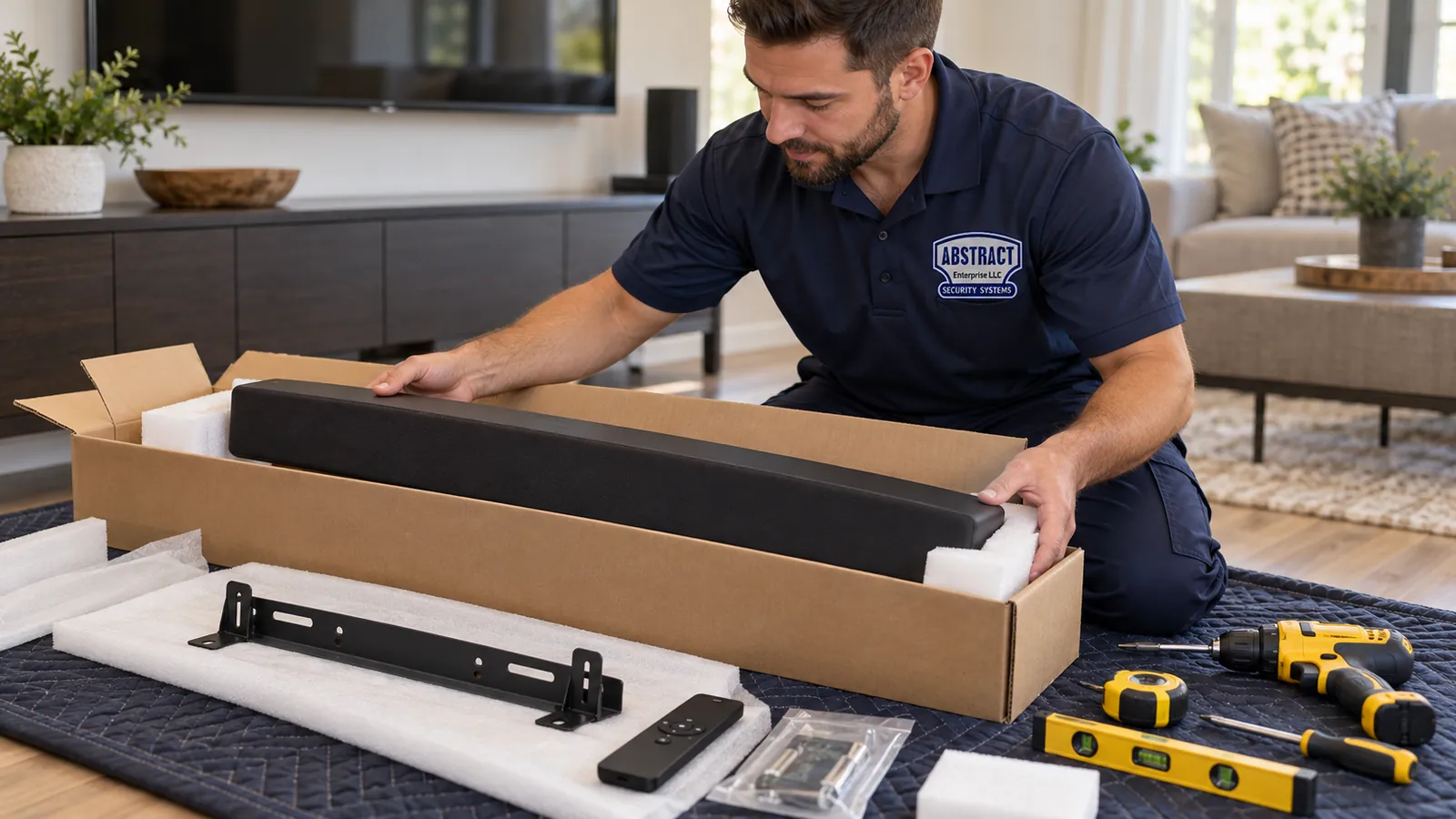
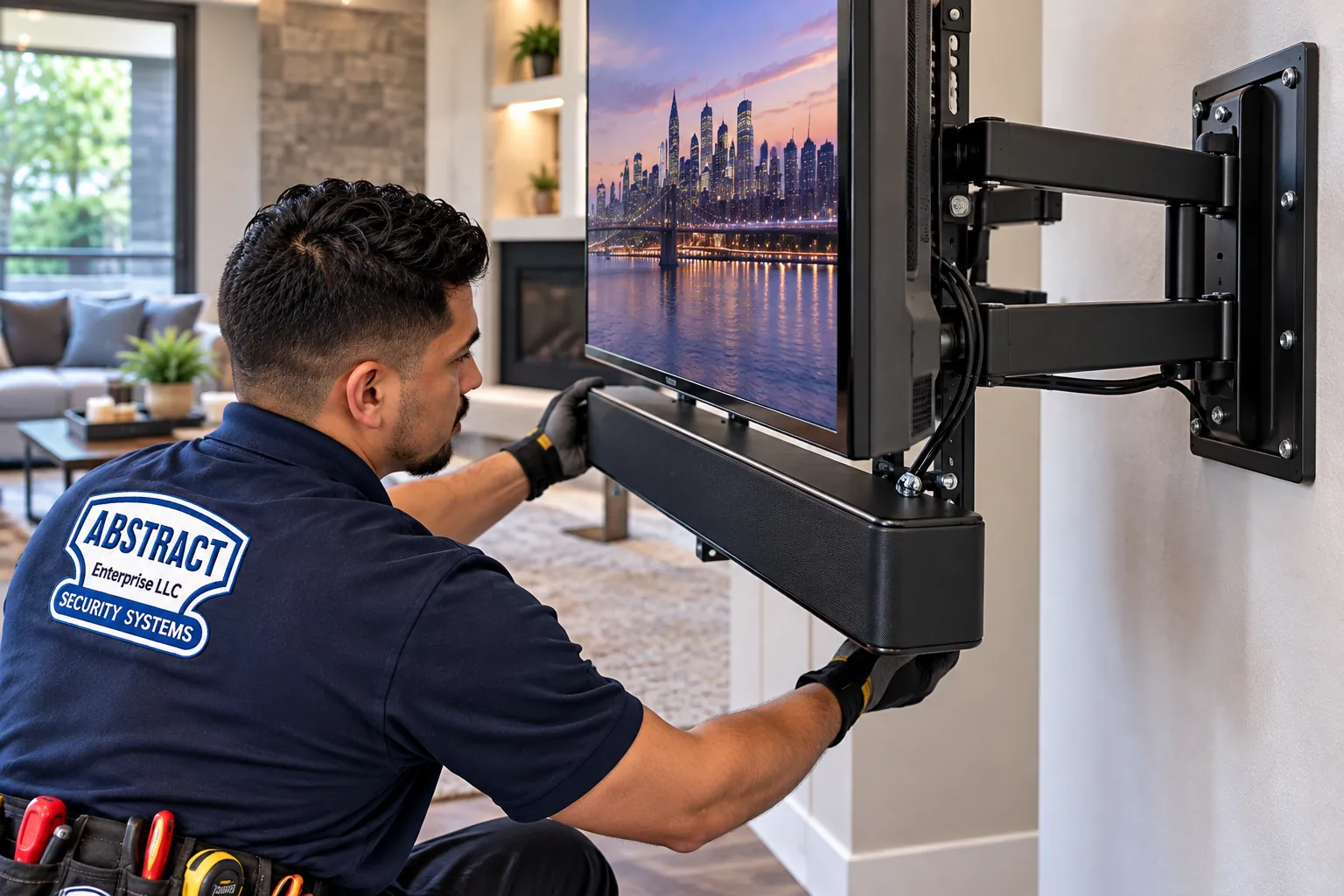
Everything out of the box and checked before drilling: bar, bracket, remote, the hardware bag and the drill, tape measure and level.A gloved technician fits a soundbar to the underside of a TV hung on a full-motion articulating arm, so the bar moves with the screen.
Many Suffolk owners pair a soundbar visit with a camera or a video doorbell for the house they leave empty midweek. One crew handles both; see our low-voltage installation in Suffolk County for the full list.
Commercial Soundbar Installation
Business Soundbar Installation in Suffolk County
Suffolk business work clusters in three kinds of place: village main streets, office parks and the wine roads of the North Fork. Built-in display speakers lose to a lunch crowd and fade before the back row of a training room. A bar for each featured screen, or a bar plus ceiling speakers, carries. These are the settings that call us most.
Hauppauge Industrial Park
About 1,300 companies, per the Regional Plan Association, from manufacturers to professional offices. Training rooms, lobbies and break rooms on steel-stud partitions, where a bar under the display makes video calls intelligible.
Route 110, Melville and Farmingdale
Broadhollow Road office buildings and their conference suites. Rooms are glassy and hard-surfaced, so a bar with dialogue enhancement placed right at the screen beats turning up the display.
Main Street, Bay Shore
Restaurants and bars that Newsday has held up as part of a revived South Shore downtown. Game-day screens over the bar want sound that stays at the bar and doesn't swamp the dining room.
Route 25 and Route 48, North Fork
Tasting rooms, brewery bars and restaurants from Riverhead through Cutchogue to Greenport. Seasonal staff need one switch that turns screen and sound on together.
Main Street and New York Avenue, Huntington
A dense village of restaurants and late bars, many in older buildings with brick or plaster walls that need the right anchor and a careful cable route.
Station Yards, Ronkonkoma
A phased development of apartments, retail and offices beside the LIRR station. Leasing offices, gyms and shared lounges each get screens, and each screen needs to be heard.
Compliance callouts for Suffolk businesses
Outdoor sound on the East End. Southampton Town's noise chapter (Chapter 235) treats amplified sound on the exterior of a premises as noise pollution except under listed exemptions, and its commercial limits measured at the lot line are 70 dBA from 7 a.m. to 7 p.m. and 55 dBA overnight. A deck or patio bar at a restaurant is set up with those numbers in mind.
Electrical work belongs to licensed electricians. Suffolk County licenses master electricians through Consumer Affairs under Article XI of the County Code. We don't add or move outlets; if a screen needs new power, a licensed electrician installs it first.
Waiting rooms and corridors. The 2010 ADA Standards (section 307.2) cap how far a wall-mounted object may stick out into a walkway at 4 inches whenever its front edge sits anywhere from 27 to 80 inches up. A bar under a TV in a narrow hall is planned around that limit.
Paperwork for landlords. Office-park and plaza owners tend to want our insurance certificate on file before the first screw goes in; we issue it at no charge.
Air-return ceilings. If the cavity over a drop ceiling moves return air, any cable laid there has to be plenum-listed, and that is the cable we carry.
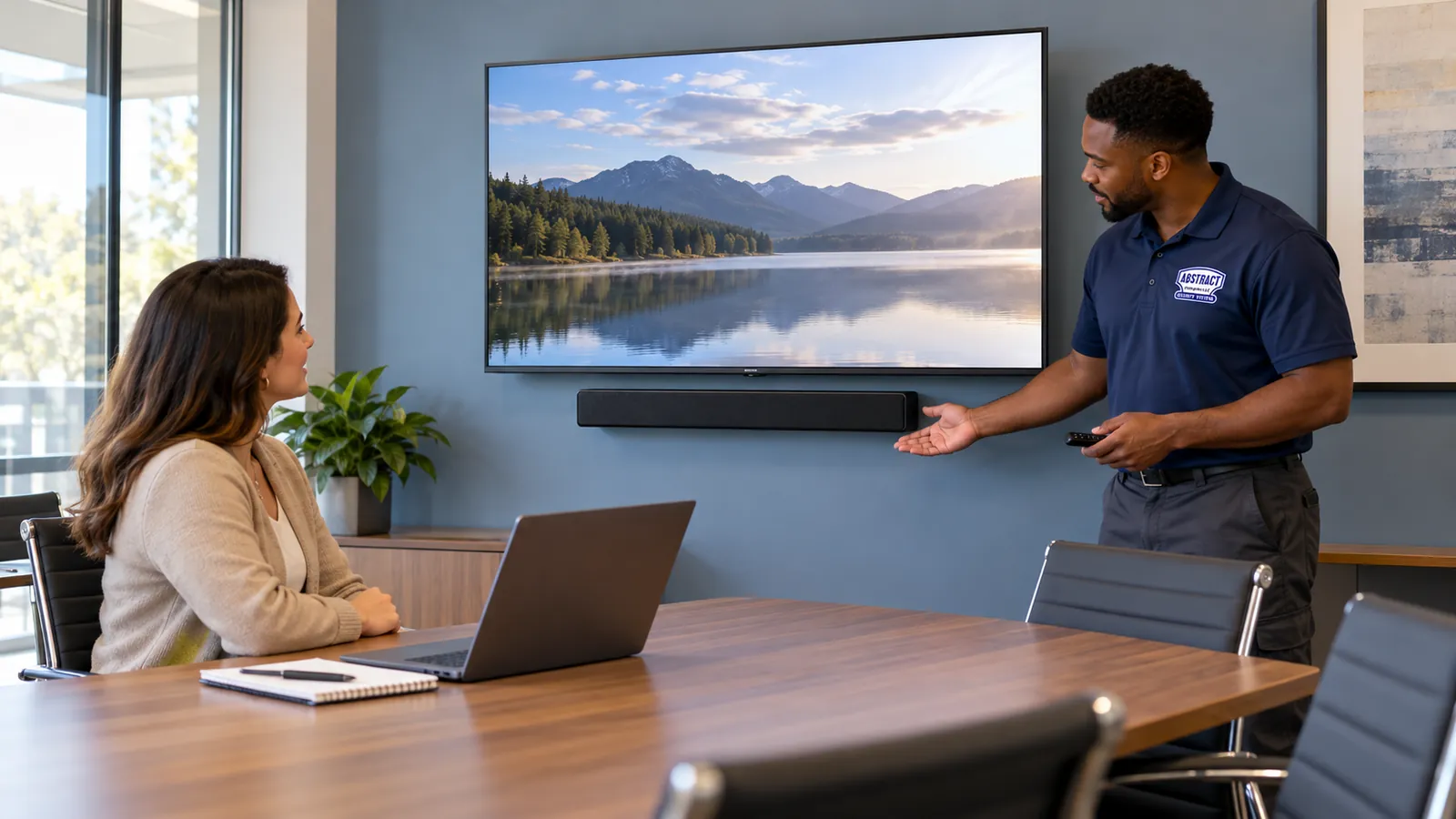
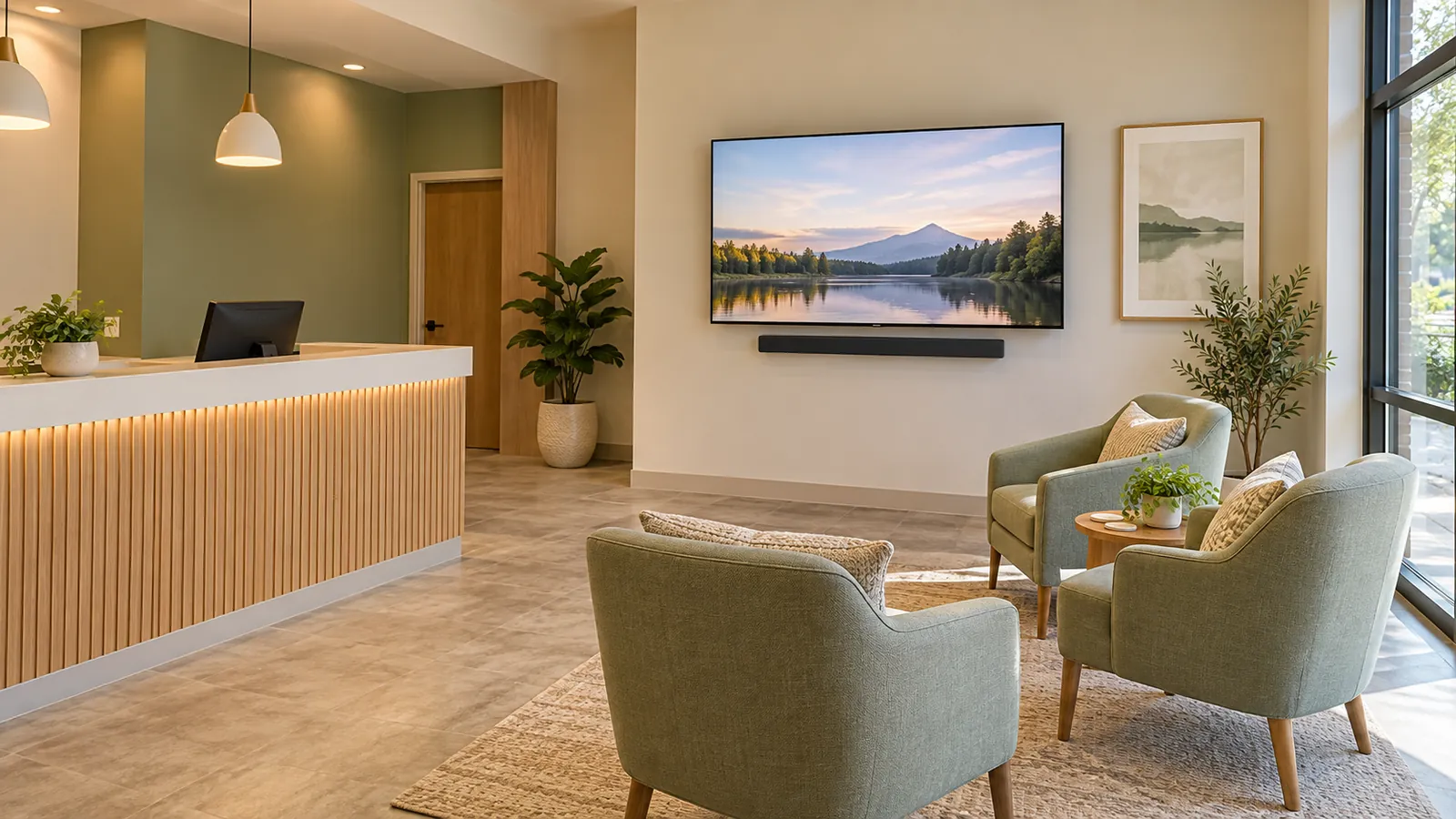
Office handover: the bar sits centred under the display and the technician walks the person at the table through it, remote in hand.A reception area with a wall-mounted TV and a slim soundbar mounted directly under it, facing a group of green armchairs beside the front desk.
Before we talk brackets, it helps to know which of the three Suffolks your room belongs to. The difference is not money or taste. It is who uses the system, how often, and who fixes it when something changes.
The year-round house: west and mid-Suffolk
From Amityville and Huntington Station across to Ronkonkoma, Centereach and Patchogue, most soundbars live in a house where the same family watches every night. These owners care most about dialogue, about one remote, and about the sub not shaking the bedroom over the den. They will learn a menu if they have to. The installation is about finding the right wall, routing the cable out of sight, and setting speech enhancement and night mode so nobody fights over the volume.
Many of these houses are split-levels and high ranches built in the decades after the war, with the family room a half-flight down. Others are compact capes with an upstairs dormer. In both, the useful question is which room is really the TV room, and whether the bar should serve daily news upstairs or Friday films downstairs. Often the answer is a simple bar in one and a fuller system in the other.
The part-time house: the East End and the shore
In the Hamptons, on the barrier beaches and in many North Fork villages, the owner may be in the house a fraction of the year. Some rent it out: Southampton Town requires a rental permit, renewed every two years, and sets a 14-day minimum stay, and East Hampton runs a rental registry. Every new tenant arrives without the manual, and every one of them is a chance for the TV's audio output to be switched back to its own speakers.
These installs are designed for strangers. Inputs are labelled, a single remote replaces four, the bar is connected by HDMI so the TV remote controls its volume, and the owner gets a short written note for the house book. Caretakers and property managers are part of the plan, because they are the ones who let us in and the ones who will be asked to "make the sound work" in August.
The working room: offices, bars and tasting rooms
Hauppauge training rooms, Melville conference suites, Bay Shore bars and Route 25 tasting rooms share one need: staff who change shifts must be able to turn the screen and sound on in the morning without calling anyone. That means fewer settings, power that comes on together, and bars that recover on their own after a power blip.
Outdoors, the East End adds a rule that the rest of the county rarely thinks about: amplified sound on the exterior of a building is regulated by town noise codes, and in Southampton the overnight residential limit at the lot line is 50 dBA. A soundbar on a porch is a different conversation in Sagaponack than it is in Smithtown.
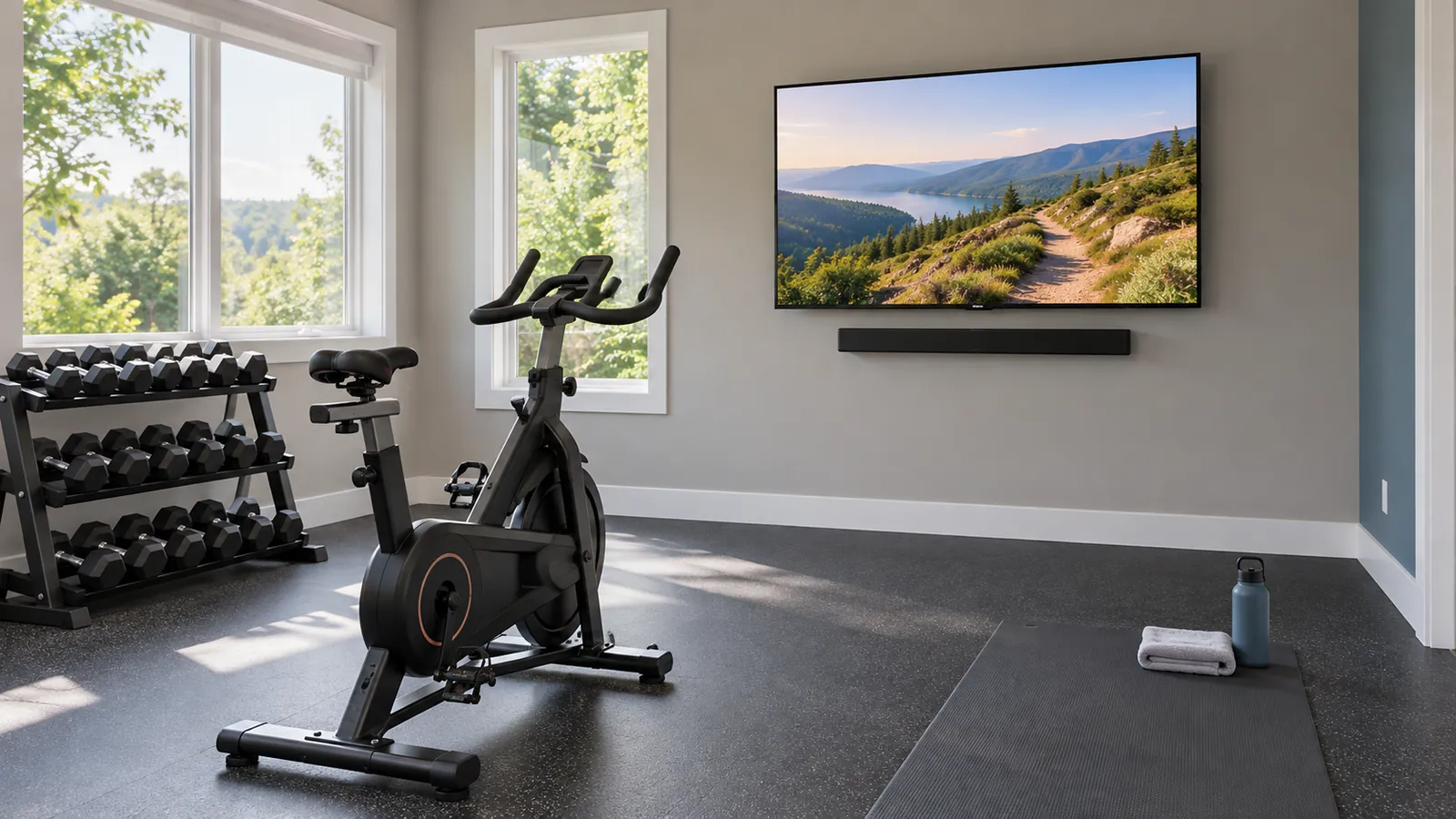
Workout room: the TV and bar are mounted on the wall opposite the bike, so nothing sits on the floor where weights and a mat go.
Your Questions Answered
Soundbar Installation in Suffolk County: Questions Answered
Below, grouped by the kind of house or room, are the questions that come up once a Suffolk owner, tenant, caretaker or office manager starts planning. Booking, price and policy questions sit in the FAQ near the end.
Summer rentals and part-time houses
Our Hamptons house rents by the fortnight — how do we stop tenants from unpairing or resetting the soundbar?
You make the system hard to break and easy to put back. The most common failure in rental houses is not a broken bar; it is a guest pressing the TV's sound-output setting, plugging a laptop into the wrong HDMI port, or pairing a phone by Bluetooth and leaving the bar stuck on that input. With a new household arriving every two weeks under Southampton's 14-day minimum, those small changes add up over a season.
Our rental setup connects the bar by HDMI to the TV's ARC or eARC port, so the TV remote controls volume and the bar wakes with the TV. We label the ports guests may use, tuck the others behind the screen, program one universal remote ($99) and leave a one-page card for the house book with the two buttons that bring sound back. Short-term-rental hosts on Reddit report guests changing TV settings and recommend knowing your TV's reset procedure; we write that procedure on the card too. Where the soundbar app allows it, we also turn off features guests don't need, so there is less to change.
Can the soundbar be checked or fixed while we are in the city and the house is empty?
Partly. Most current Wi-Fi soundbars report their status to the maker's app, and an owner signed into that app can often see whether the bar is online, run updates and adjust settings from anywhere. What an app can't do is re-seat an HDMI cable, power-cycle a subwoofer that lost its link, or switch a TV's audio output back from internal speakers. Those still need hands in the room.
So we set up the remote side and the local side. The bar is signed into your account on the house Wi-Fi, updates are left automatic, and the router's name and password are written on the house card. Then a caretaker gets a five-minute walkthrough: which plug to pull, which button to press, and which TV setting to check. If that doesn't sort it out, a setup-only visit at $250 for the first hour covers the rest.
Who has to be at the house for the installation if we live outside the county?
Nobody from the family, as long as someone can open the door and the gear is on site. Caretakers, house managers, a neighbour with a key or a lockbox code all work. We confirm access the day before, arrive inside the booked two-hour window, and send photos of the finished wall and the settings when we leave.
Two things have to be ready: the soundbar and TV must already be in the house, and the wall must be clear. If we arrive and can't get in, or the bar is still in a delivery van, the $150 return-trip fee applies, so it is worth checking deliveries before the appointment. Changing the date is free with 24 hours' notice, which helps when your own plans move.
Is a soundbar on the patio of a Southampton rental allowed under the town noise code at night?
Carefully, and with the volume down. Southampton Town's noise chapter, Chapter 235, treats amplifiers and speakers used on the exterior of a dwelling as noise pollution except under listed exemptions, and one exemption covers amplified sound, including small outdoor speakers, between 7 a.m. and 7 p.m. when it stays within the town's noise standard. That standard, measured at the lot line, is 65 dBA during the day and 50 dBA from 7 p.m. to 7 a.m. for residential property. The code also treats a sound device that is plainly audible 50 feet away as interference.
Practically, that means the patio bar is aimed at the seating and away from the property line, the subwoofer stays indoors or off, and the night-mode or volume limit is set before the first tenant arrives. Other East End towns and villages have their own noise rules, so we suggest owners read their local code; we set the system up to make compliance easy, but we can't give legal advice.
Year-round houses mid-island
Why does the stud finder show studs every 16 inches on the paneled wall of our Brookhaven split-level den?
Because it is finding furring strips, not studs. In many split-level and high-ranch dens the lower walls are concrete block or poured foundation with furring strips nailed on and quarter-inch paneling over them. A stud finder sees the strips and reports studs every sixteen inches, which is how a lot of bars end up hanging on a strip of pine nailed to masonry.
We check with a magnet and a small test hole behind where the bar will sit. If it is block, the bracket anchors through the paneling and furring into solid masonry, at the $75 concrete rate, and the screws are sized so the paneling isn't crushed. If the wall turns out to be framed, there is no surcharge. Cable in these dens usually runs down inside the furring cavity to the outlet or along the baseboard in a cover, because block can't be fished.
Our cape has the TV in an upstairs dormer room with sloped knee walls — where does the soundbar go?
On the gable-end wall if there is one, or on furniture if there isn't. Knee walls in cape dormers are short, often four feet or less before the ceiling slopes in, and a TV and bar on that wall end up below eye level or tilted back under the slope. Up-firing drivers aimed at a sloped ceiling also send the height effects toward the side of the room rather than over the bed.
The gable wall is usually full height and framed with studs, so a bracket goes up easily and a slim bar fits under the TV. If the gable has a window, a bar on a low dresser under a stand-mounted TV is the honest answer, at $79. Bedrooms under a roof are also near the attic, which sometimes makes it possible to drop a cable from above to a lower outlet.
The sofa in our sunroom backs onto a wall of windows — where do the rear speakers go?
Not on the glass, and not on the sills. Four-season rooms added to the backs of ranches and capes often have glass on three sides, so the usual rule of rears on the wall behind the seats has nothing to hang on. Sound fired straight at a window bounces back harshly, and sun through the glass heats anything sitting on the sill.
The practical choices are small stands placed just beside and slightly behind the sofa, with their power cords dropping to a floor outlet or a short run along the knee wall, or rears on the solid house wall to either side, aimed toward the seating. Either way they still need power, so we look for outlets before the speakers arrive. Pairing and placing them is $125, and we run the bar's room calibration with the blinds in their usual position, because open and closed blinds sound different.
Older North Fork and village houses
Beadboard wainscot covers the lower wall — how does the soundbar cable get down to the outlet?
Behind the boards when we can, along a corner or trim line when we can't. Beadboard is often nailed over old plaster or sheathing, with little cavity behind it, and its grooves make any cut obvious. A Suffolk split-level owner recently asked on r/AskElectricians for the code-compliant way to run TV power behind beadboard, which is the same puzzle in a different house.
For power, an in-wall kit uses a listed cable between two recessed plates, fed from the existing receptacle, so nothing improvised goes in the wall. For HDMI and the bar's power, we look for a stud bay above the wainscot cap that drops straight to the outlet. If the wall is solid, a small paintable raceway along the corner board or the cap rail, painted to match, is $59 and far neater than cord crossing the boards.
Wi-Fi, streaming and TV sources
The router is two floors away from the TV in our big shingle-style house — should the soundbar be wired to the network instead?
Often yes, or at least the TV wall needs better coverage; a new soundbar rarely fixes it. Big East End houses often put the router in a basement utility room or a far closet, with several walls, a floor and sometimes a fireplace between it and the family room. The bar plays TV sound over HDMI regardless, but streaming music, voice control, app control and updates all need a steady Wi-Fi link.
We check the signal at the TV before mounting. If it is weak, the options are a wired network cable to the bar or to a nearby access point, or a mesh system placed properly. Our network team handles wired drops and ceiling access points; for a seasonal house, a wired link also survives the router being swapped over the winter better than a remembered Wi-Fi password does.
We cut the cable and use an antenna plus streaming — does that change how the soundbar is hooked up?
A little, and it is usually simpler. With an antenna feeding the TV's own tuner and the streaming apps built into the TV or on a stick, every source runs through the TV, and the bar gets everything over one HDMI ARC or eARC cable. Suffolk residents on r/longisland report mixed antenna reception, with one owner saying attic antennas pulled in little beyond one network and a roof antenna was needed for the rest.
If you use a separate antenna box or a DVR, we connect it to the TV rather than the bar, so its sound still reaches the bar through the TV. We set the TV's audio format to pass through rather than convert to stereo, and check volume control from the TV remote on the antenna channels and on each app. Streaming-stick setup is $49 each.
Bars, offices and tasting rooms
Our Hauppauge training room runs video calls from a laptop — can a soundbar serve as the room speaker?
For playback, yes; for the microphone side, check before you buy. A soundbar connected to the display makes the far end of a call far easier to hear across a training room, and on a display with ARC or eARC it plays whatever the laptop sends over HDMI. Most home soundbars, though, are not designed as conference microphones, and some have none at all.
So we pair the bar for sound out with a dedicated room microphone or conference device for sound in, and set the laptop to send audio to the display. On steel-stud office partitions the bracket goes in with steel-rated toggles, at the $30 metal-stud rate, and the bar stays within the 4-inch ADA protrusion limit if the room doubles as a walkway.
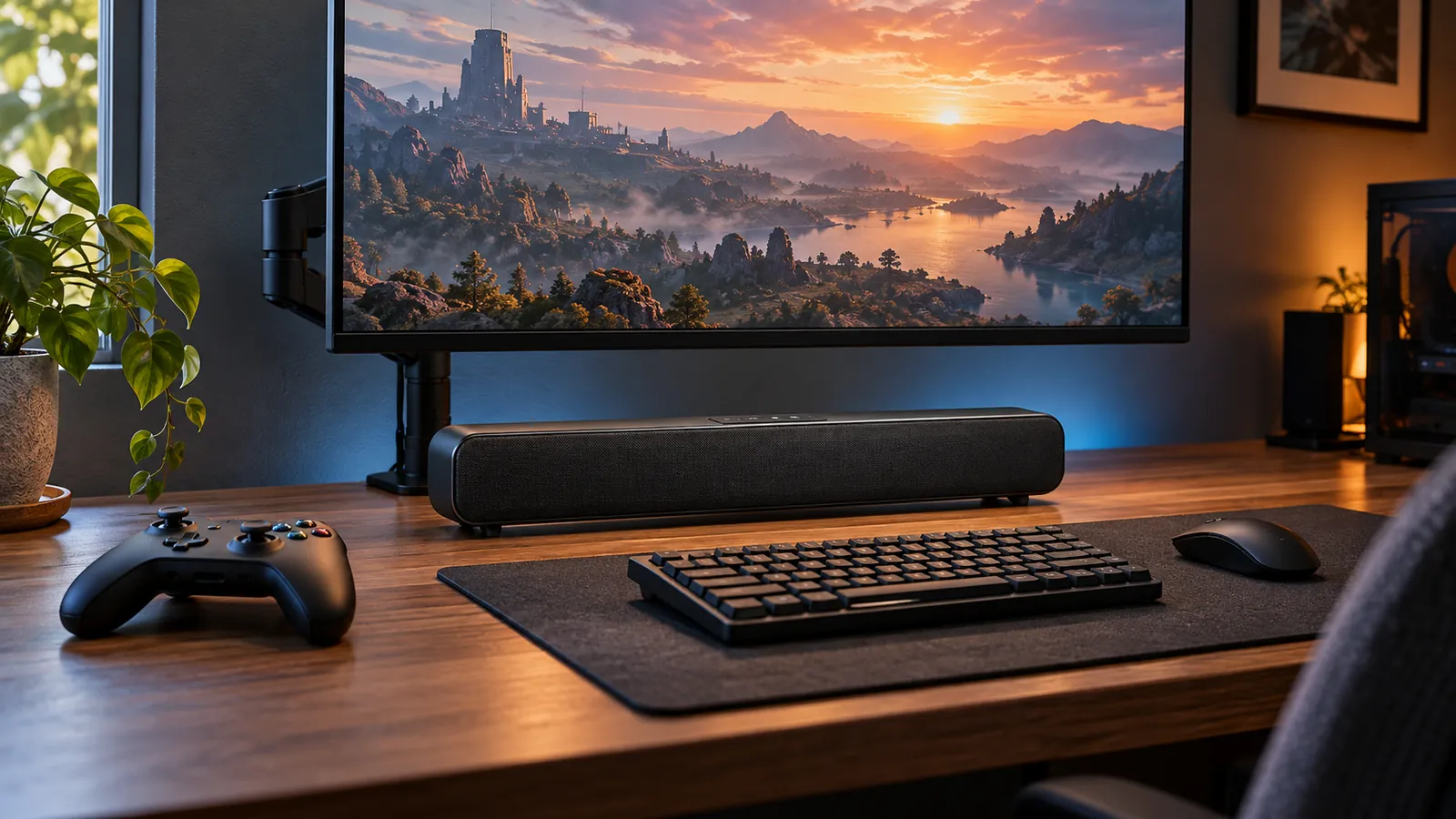
A compact soundbar on a wooden desk under a monitor on an articulating arm, with a keyboard, mouse and game controller in front of it.
Equipment
Types of Soundbar Systems We Install
Brand matters less than fit. We fit all the major makes and steer you by the room and by who will use it. Specifications quoted come from the makers or large retailers, and model lines change yearly, so check before you buy.
Compact Bars for Dens and Bedrooms
Small bars such as the Sonos Beam (Gen 2), about 25.6 inches wide and 6.35 lb by Sonos's own guide, or the Sonos Ray, which connects by optical rather than HDMI. Right for a cape bedroom, a split-level den or a rental cottage.
Full-Size Atmos Bars
Height channels in a single cabinet. Sonos's own setup guide for the Arc Ultra asks for 4 inches or more below the TV and roughly a foot free at each end, which rules out many tight niches between built-ins.
Bar, Sub and Rear Systems
Packaged systems with a wireless subwoofer and two rear speakers that each need an outlet. The best fit for a year-round family room or a basement media room with the seating in the middle.
Outdoor-Rated Bars
Bars built for covered outdoor spaces, used on porches and in pool houses. Even rated models go under a roof and out of direct sun, and on the East End they play within town noise limits.
TV-Attached and Wall Brackets
A wall bracket under the screen suits most rooms; a clamp that hangs the bar from a swinging TV arm keeps the two together when the screen turns. Our Sanus soundbar bracket is $84.99, or we use the one packed with your bar.
In-Wall Power and Cable Kits
Listed kits with a recessed plate behind the TV and another near the floor, fed from the existing outlet. $169 on framed walls; not for block, brick or solid plaster-on-masonry.
Universal Remotes
One remote for TV, bar, antenna or cable box and streamer, programmed for $99. For rental houses we pick a model with clear buttons and few menus.
Receivers and Passive Speakers
Separate speakers driven by a receiver, for a room used mostly for films or for anyone who already owns good speakers. Priced in the services list above.
Wired Network to the TV Wall
A network cable to the bar or a nearby access point, run by our network team, for big houses where Wi-Fi at the TV is unreliable.
Connections, and why the port matters
HDMI eARC carries full-quality audio, including lossless Atmos, from every source the TV sees to the bar, and lets the TV remote run the volume; it must be the port labelled eARC, with the TV set to pass audio through. HDMI ARC on older TVs carries compressed surround, including the Atmos most streaming apps use. Optical works with older sets and with bars like the Ray, but carries no Atmos and no volume control from the TV remote. On a Frame-style TV with a separate box, every one of these lives on the box, not the screen. We test each source you actually use, including antenna channels, before we leave.
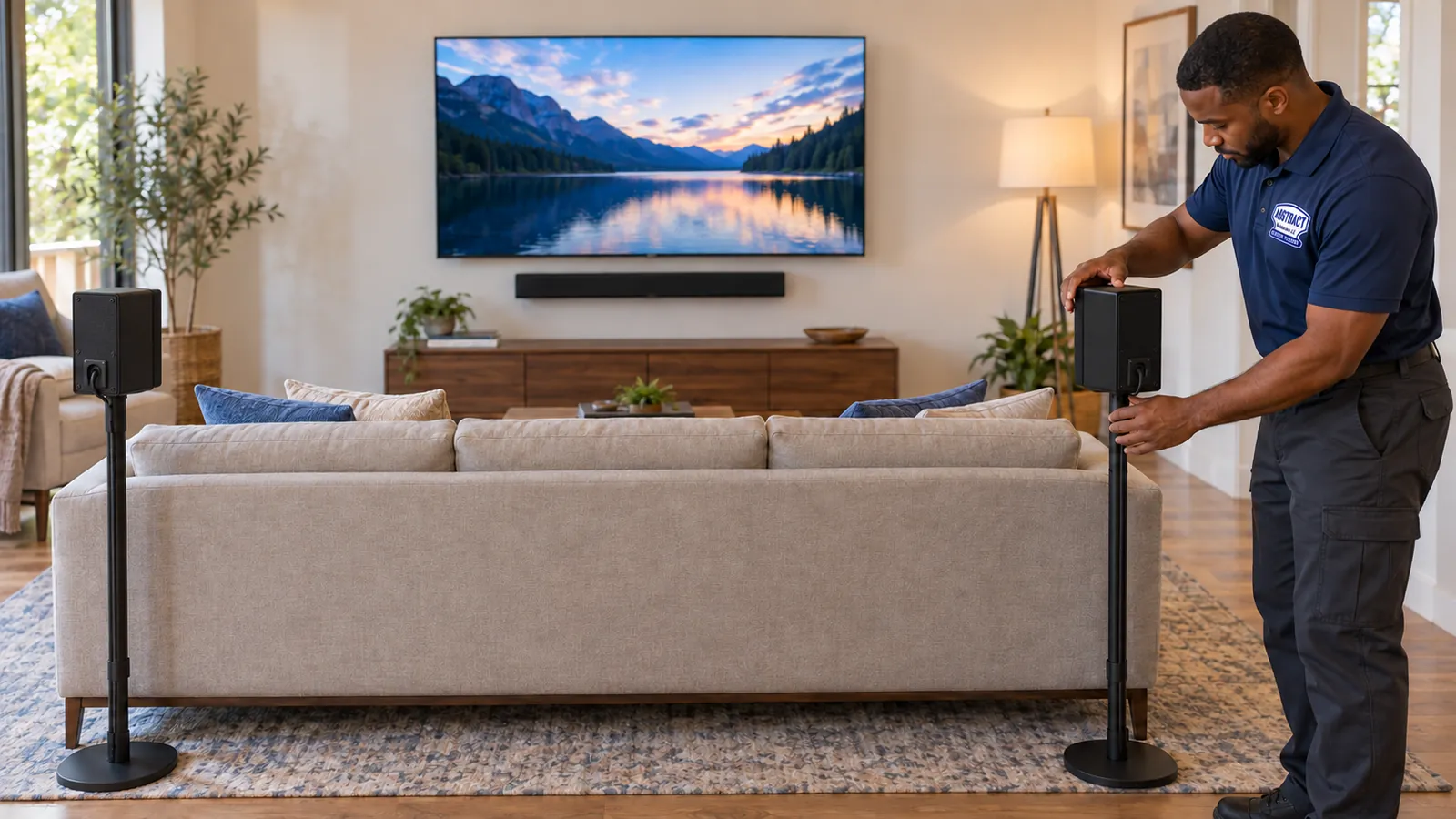
Rear surrounds on stands either side of the sofa, the soundbar under the TV on the far wall: the speaker is turned toward the seats before calibration.
AI Overview Reality Check
What AI Gets Wrong About Soundbar Installation in Suffolk County
Google's AI Overview was not reachable when this page was researched, so nothing below pretends to quote it. The seven claims are ones that cost guides and everyday advice really do publish, which is where AI summaries pick them up, each set against what we find in Suffolk houses.
"Soundbar installation costs about $58 to $231"
Homewyse puts the national average cost to install a soundbar at roughly $58 to $231, and summaries pick that range up as if it applied everywhere. As a description of labour for a bar on a drywall wall somewhere average, it is not unreasonable.
It leaves out the things that move a Suffolk price. Our wall-mounted bar is $129 and the bar placed on a console is $79, but a brick hearth adds $65, a block den wall $75 and a cable run to a cabinet $99. On the East End there is no travel surcharge with us, while some city-based installers note that a travel fee may apply in the Hamptons.
So compare totals, not headlines. Ask whether the figure includes the bracket, the wall surcharge, the concealment and the trip, and add up our published lines for the same job.
"A soundbar install is the same anywhere on Long Island"
AI answers tend to treat Long Island as one suburb. Suffolk alone spans more than 900 square miles of land, from dense west-end streets to farm roads beyond Riverhead and the dunes past Southampton.
The house changes along the way: block-walled split-level dens in Brookhaven, dormer bedrooms in west Suffolk capes, beadboard and older outlets on the North Fork, and rental houses out east that a different family uses every two weeks.
The bar may be the same model in all of them, but the anchor, the cable route, the power and the setup for strangers are not. That is why we ask for a photo and the house type before we quote.
"Optical is just as good as HDMI for a soundbar"
For plain stereo or basic surround from the TV, an optical cable does work, and it is what older sets and a few compact bars, such as the Sonos Ray, rely on. That is why the claim keeps circulating.
What optical cannot do is carry the formats newer streaming apps use for height effects, or send the TV remote's volume and power commands to the bar. In a rental house that second point matters most: guests end up with two remotes and a bar that stays on when the TV goes off.
So we connect by HDMI ARC or eARC whenever both the TV and the bar have it, and keep optical for older sets. If the TV has neither, we say so before you buy the bar.
"Wireless soundbars don't need Wi-Fi to work"
True for TV sound: a bar connected by HDMI plays whatever the TV sends without any network at all. That is why many installers never check the Wi-Fi.
But almost everything else a modern bar does depends on it: music streaming, voice assistants, app control, room calibration and, importantly, firmware updates that fix bugs with specific TVs. In big houses with the router two floors away, those features fail in ways owners blame on the bar.
We check the signal at the TV before mounting and recommend a wired connection or a better-placed access point where it is weak, especially in seasonal houses where nobody is around to notice a failed update.
"Any surge protector will protect the system"
A surge protector that is plugged into an ungrounded two-slot outlet through an adapter can light up and look busy while offering much less than its label suggests. Its main job is to divert surge energy to ground, and there is no ground to divert to.
Older farmhouses and cottages on the North Fork and East End still have ungrounded outlets, and the area has seen large outages, such as the more than 420,000 PSEG Long Island customers who lost power in Tropical Storm Isaias.
We test the outlet first. If it is ungrounded, the fix is a licensed electrician, and we say so rather than plugging a premium bar into a hopeful power strip.
"Outdoor speakers are fine as long as the neighbours don't complain"
Plenty of summaries treat outdoor sound as a matter of good manners. On the East End it is also written law. Southampton Town's noise chapter regulates amplified sound on the exterior of buildings, with lot-line limits of 65 dBA by day and 50 dBA overnight for homes.
The exemption for small outdoor speakers runs from 7 a.m. to 7 p.m., and only within the town's noise standard. A bar on a pool-house porch playing a film at 10 p.m. is a different matter.
We aim outdoor bars at the seating, keep subwoofers inside, and set volume limits where the bar supports them. Owners renting their houses should put the rules in the house book too.
"Set it up once and it will keep working"
In a house lived in every day, that is mostly true. Somebody notices when the bar stops waking with the TV, and fixes it the same evening.
In a rental or second home, nobody notices until the next guest does. TV updates can reset the sound output, a guest can pair a phone and leave the bar on Bluetooth, and a router replaced over the winter strands every Wi-Fi device in the house.
That is why our Suffolk rental setups end with a house-book card, a caretaker walkthrough and a single remote. A setup-only visit at $250 for the first hour is there for the rest, and booking it the week before a season starts beats a call from a tenant in July.
Built for Whoever Uses the Room
Year-round family, weekend owner or fortnightly tenants: tell us who watches, and we plan the bar around them and price it before booking.
Year-round home, weekend place or rental? Say which, add the models, and expect an answer the same business day. Rather speak to someone? Ring (631) 407-2884.
✅
We Got Your Request!
We'll call you back the same business day. If it's urgent, call us now at (631) 407-2884.
How It Works
Our Installation Process
Six steps for every Suffolk job, from a bar on a dresser in Lindenhurst to a rental house in Montauk. Most single-room jobs finish in one visit.
1. Describe the house and the room
Send the hamlet, the models, a picture of the wall and a word on how the house is used: every night, some weekends or rented out. The total comes back before anything is scheduled.
2. Pick a two-hour window and arrange access
Any two-hour window from 8 AM to 8 PM, seven days. For second homes, tell us who will open the door; moving the date is free with 24 hours' notice.
3. Test the wall and the outlet
On arrival we find the framing or masonry behind paneling, beadboard or drywall, and check that the outlet the bar will use is grounded and working.
4. Mount, route and label
Anchors set, bar aligned to the bottom edge of the screen, every cable hidden by the method you chose, and guest-facing ports marked.
5. Connect, tune and lock down
HDMI ARC or eARC set, sub and rears paired, speech enhancement and night mode set, outdoor volume limited where the bar allows, and one remote programmed if ordered.
6. Walkthrough and house card
You, or your caretaker, hear speech, music and a live channel through the finished system; the house-book card goes in the drawer and the cartons leave with us if you like.
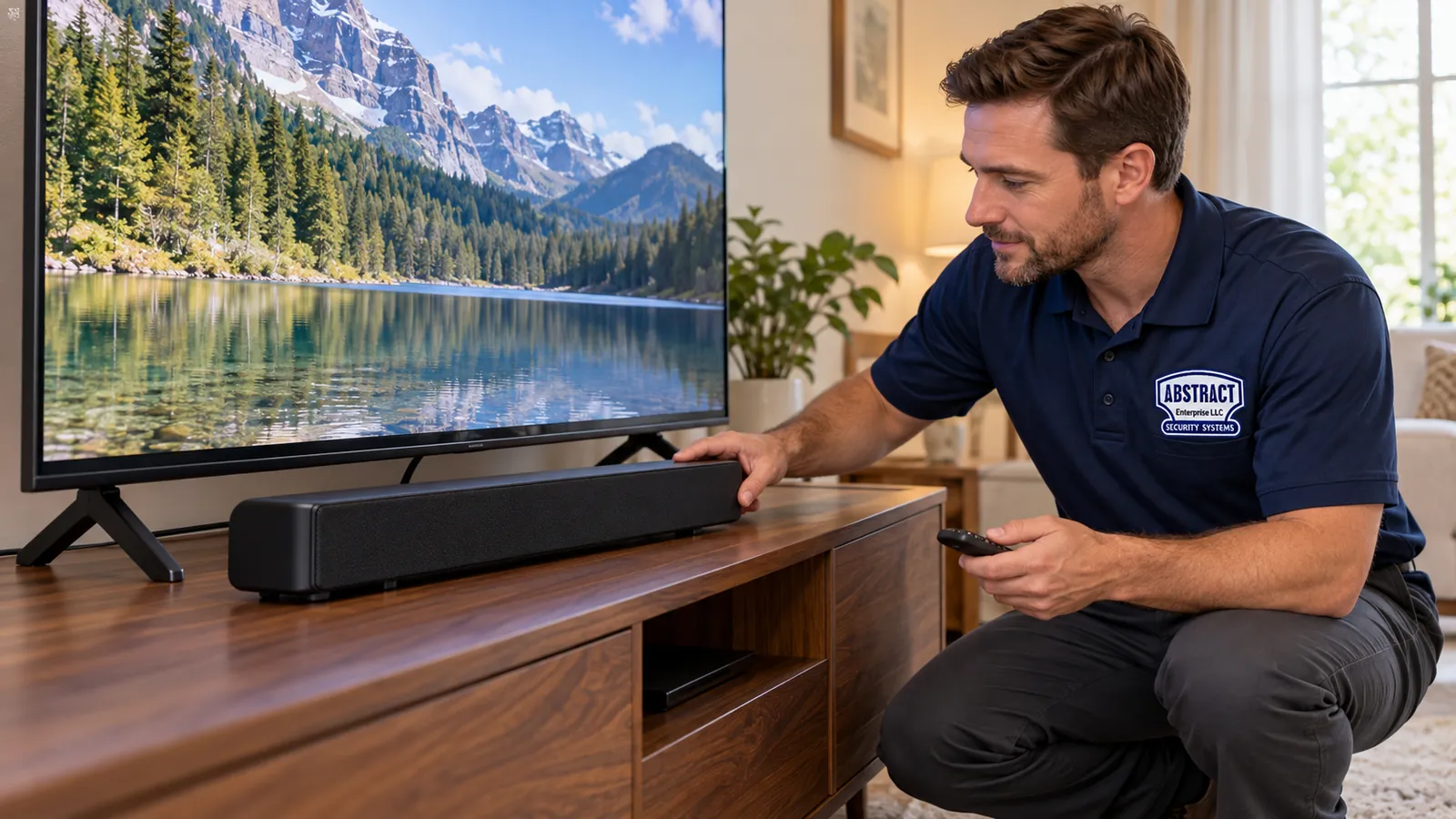
Crouched at a wooden media console, a technician positions a soundbar in front of a TV on its feet, holding the remote in his other hand.
Coverage Area
Soundbar Installation Near Suffolk County's Landmarks
Ask someone in Suffolk where they live and the answer is often a landmark. Here are six, from the North Shore to the tip of the North Fork, each surrounded by homes and businesses we work in.
Heckscher Park, Huntington
Eighteen acres at Prime Avenue and Route 25A, given by August and Nannie Heckscher and owned by the town since 1954, home to the Heckscher Museum of Art and the Chapin Rainbow Stage, where the Summer Arts Festival has run since 1966.
Vanderbilt Museum, Centerport
William K. Vanderbilt II's 43-acre Eagle's Nest estate, with a Gold Coast mansion, museum and a 147-seat planetarium. The North Shore colonials and village houses around it are where brick fireplaces meet family rooms.
Fire Island Lighthouse, Fire Island National Seashore
The 168-foot tower completed in 1858, seen across the Great South Bay from Babylon, West Islip and Bay Shore, where decks and porches face the water.
The Big Duck, Flanders
A 20-foot ferrocement duck built in 1931 by a duck farmer as a shop, listed on the National Register of Historic Places, on the road between Riverhead and the Hamptons.
The Old House, Cutchogue
Believed to date from about 1649 and a National Historic Landmark since 1962, described as one of the finest surviving examples of 17th-century architecture in the country, amid North Fork farm and wine country.
Horton Point Lighthouse, Southold
Commissioned in 1790 under George Washington but not built until 1857, and listed on the national and state registers, near Southold's farmhouses and village streets.
We also serve Amityville, Lindenhurst, Deer Park, Commack, Kings Park, Hauppauge, Ronkonkoma, Holbrook, Sayville, Patchogue, Port Jefferson, Mount Sinai, Wading River, Riverhead, Mattituck, Greenport, Westhampton Beach, Hampton Bays, Sag Harbor, East Hampton and Montauk. For the rest of the region, see Long Island soundbar installation and soundbar installation in Nassau County.
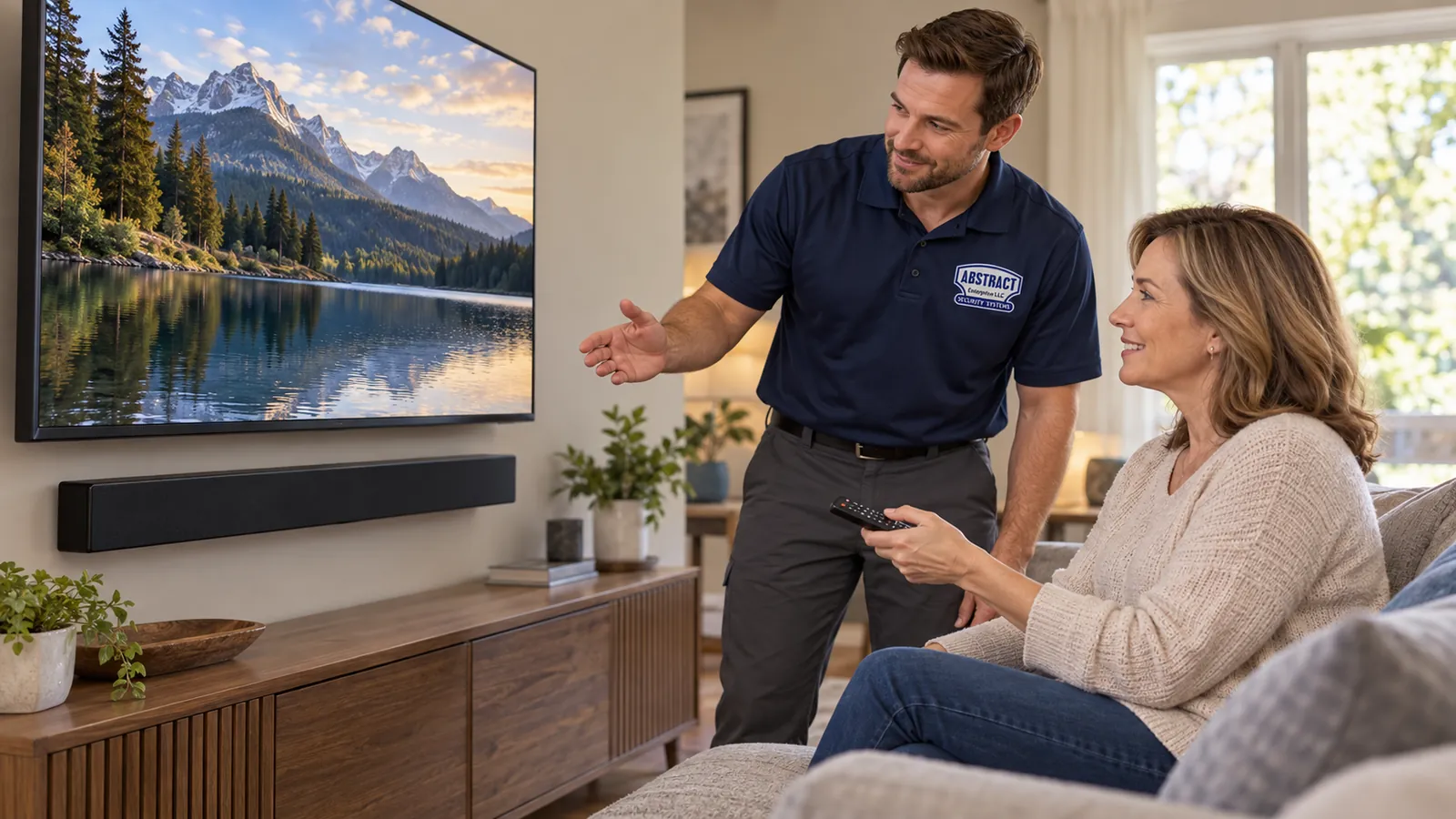
Before we leave: the person who will use the system holds the remote and runs the inputs and volume while the technician explains each button.
Pricing
Soundbar Installation Cost in Suffolk County
Suffolk soundbar work is priced by published line items, and the soundbar lines are the same in Huntington, Hampton Bays and Orient. There is no mileage or East End surcharge on top. Your total is the lines your room needs, added up and confirmed before booking.
Line item
Price
What it covers
Soundbar on a console, dresser or ledge
$79
Positioned at the front edge, connected, TV audio output set, volume control checked
Soundbar on a bracket under the TV
$129
Bracket fixed into framing or masonry, bar squared to the screen, connected and set up
Sanus soundbar bracket
$84.99
Only if your bar didn't come with one
In-wall power and cable kit
$169
Listed kit fed from the existing outlet, flush plates behind the TV and near the floor
Paintable cord cover
$59
Surface raceway for block, brick, beadboard or walls that stay closed
Cable run up to 25 ft
$99
To a cabinet, closet or One Connect box across the room
Sonos or wireless surround setup
$125
Sub and rear speakers paired, placed and checked from the seats
Universal remote programming
$99
One remote for TV, bar, antenna or cable box and streamer
Streaming device setup
$49 each
Connected and routed through the bar
A/V receiver and speakers
$129
Receiver connected and speakers set up
Full home theatre setup
$350
TV, audio, sources and remote configured together
Wall, height and access adds
Condition
Add
Where we see it in Suffolk
Drywall on wood studs
$0
West Suffolk capes, most newer houses
Metal studs
+$30
Offices, many new apartments
Plaster
+$45
Older village houses
Brick or stone
+$65
North Shore fireplaces, some East End hearths
Concrete or cinder block
+$75
Split-level and high-ranch dens behind paneling
Tile or marble
+$95
Kitchens, pool-house bars
Plywood backer board
$85
Irregular farmhouse framing, heavy loads on steel studs
High mount, above about 8 ft
$75
Great rooms in newer subdivisions
Walk-up, third floor or higher
$40
Upper floors of older village buildings
Box removal
$25
Anywhere you'd rather not deal with packaging
Certificate of insurance
Free
Offices, plazas, condo and HOA boards
Visits, policies and terms
Setup-only visit: $250 for the first hour in Suffolk, then 30-minute blocks, for repairs, re-pairing and seasonal reconnection.
TV mounting with the bar: the Suffolk TV mounting base is $229.99 for a 32–55″ set on framed drywall; size, wall and placement adds are on the price list.
Return trip: $150 if we arrive in your window and can't start because of access, missing equipment or missing approvals.
Rescheduling: free with 24 hours' notice.
Outside our scope: outlets, circuits and grounding, which in Suffolk are a licensed electrician's work, and any patching or painting of old holes.
Full terms — including 50% deposit, one-year parts-only warranty on AESS-supplied products, and the late-fee schedule — are set out in the service agreement. Our TV and AV installation policies cover arrival windows, return trips and what is included.
Big names, local hands. Retail chains and booking apps pass the work to whichever independent contractor is free that day, who may be meeting a block-backed den or an ungrounded farmhouse outlet for the first time. Alarm brands such as ADT, Ring and SimpliSafe do not install audio at all, so they are not an alternative here. What a licensed local low-voltage company adds is the right hardware on the van, one price for the forks and the west end alike, and a phone number that reaches the people who did the work.
Worked Examples
What Common Suffolk Soundbar Jobs Add Up To
These are real combinations of our published Suffolk lines, not packages with hidden extras. Each assumes the wall noted; add the wall surcharge if yours differs.
Bar plus cable run to a cabinet holding the One Connect box
$129 + $99 cable run
$228
Spring reconnection of a seasonal system
Setup-only first hour
$250
Over a North Shore brick fireplace, the TV adds $130 for the placement over the firebox and $65 for the masonry, on top of the size price; the bar beneath is the usual $129. Everything about the TV itself, including sizes up to 100 inches, is on our Suffolk County TV mounting prices page.
There is a practical reason to book screen and bar together: we set the TV first, check it with a level, then mark the bar's holes off the bottom edge of the screen. Measured that way, the bar follows the picture even when the floor, the mantel or the window trim is out of true, which in older Suffolk houses it often is.
Shop Our Systems
Soundbar Installation Packages & Pricing
Most Suffolk bookings land on one of these three bundles. Each is simply our listed prices summed; a masonry, plaster or tile wall adds its own line.
Starter — Placed and Simplified
$178
Bar placed on the console or dresser and connected ($79) plus a universal remote programmed for TV, bar and sources ($99). No drilling, one remote, ideal for a guest cottage or a den with a TV on a stand.
Standard — Rental-Ready Wall Mount
$312.99
Bar on a Sanus bracket under the TV ($129 + $84.99) with a universal remote ($99): $312.99. Ports labelled, volume on the TV remote, house-book card left behind.
Premium — Hidden Wires and Surround
$507.99
Bar on a Sanus bracket ($129 + $84.99), in-wall power and cable kit ($169) and sub and rear speakers paired and placed ($125): $507.99 on framed drywall.
Bring Your Own Equipment — Labour Only
Bracket already in hand? Whether it came packed with the bar or you bought a rated one separately, labour alone is $129. We confirm its rating against the bar's weight first, and any warranty on customer-supplied hardware stays with its maker.
Want the screen hung too? Start from $229.99, the Suffolk TV base, and add any size or wall lines. Each streaming stick is $49, and a fully configured basement theatre is $350.
One Price List, Amityville to Orient Point
Text us a picture of the TV wall and the box the soundbar came in, and we send back a total you can book against, without anyone driving out first.
A rental soundbar has one job: work for people who have never seen it, without a phone call to the owner. Southampton Town requires a two-year rental permit and a safety inspection, and East Hampton keeps a rental registry; neither says anything about soundbars, but both mean the house is run as a business, and the AV should be too.
HDMI, not optical. An HDMI ARC or eARC connection lets the TV remote control the volume and wakes the bar with the TV. Optical leaves guests juggling two remotes.
One remote on the coffee table. A universal remote ($99) set up for TV, bar and the streaming device, with the others in a drawer marked for the owner.
Labelled inputs. A small label on the port guests may use for a laptop or console, so they don't unplug the bar to find a free one.
Bluetooth handled. Many bars switch to Bluetooth when a phone pairs and stay there. We show where the "TV" input button is and note it on the house card.
Volume and night settings. Night mode on, and where the bar supports a maximum volume, a sensible cap, which helps with neighbours and with town noise rules outdoors.
Accounts separated. Streaming apps signed into a guest profile or left for guests to sign into, so tenants don't use the owner's accounts; signing out is the tenant's job, and the house card says so.
Wi-Fi details written down. The network name and password on the house card for the caretaker, because a replaced router is the commonest reason a system won't reconnect.
A reset routine. The two or three steps that put everything back: TV sound output to the bar, bar input to TV, power-cycle the sub. Written once, used every changeover.
Vacation-rental software guides, such as OwnerRez's smart-TV advice, make the same point: label remotes or give guests only the most useful one. We build that into the install rather than leaving it to a laminated sign. Property managers handling several houses can book them as a batch, with access arranged through their office.
The Suffolk Year
A Seasonal Calendar for Soundbars Out East and Up-Island
In much of Suffolk the calendar decides when sound systems get installed, used and forgotten. Planning around it saves money and a lost weekend.
March and April: plan and install
The quietest time to get work done on the East End and the North Fork. Houses are empty, caretakers have time, and two-hour windows are easy to find. If you are adding a porch bar, rear speakers or wiring inside a wall, this is when to do it, so the first May weekend is spent using the system rather than waiting for it.
May and June: open and test
Before the first arrivals, switch on in order, bar then sub then rears, and give the app time to install whatever updates piled up over the winter. Check that the TV is still sending sound to the bar, because TV updates over the winter sometimes return the output to the internal speakers. A setup-only visit booked the week before opening is cheaper than one booked in a hurry on a July Saturday.
July and August: keep it simple
The busiest weeks for rentals, tasting rooms and beach traffic, and the hardest time to get anyone out east on short notice. The rental setup earns its keep here: one remote, a house card and a caretaker who knows the reset routine. Outdoors, remember the evening cut-off in Southampton's noise chapter.
September and October: football and wiring
Year-round households up-island turn their attention back to the family room for the football season, and offices plan training rooms for the year. A good time for in-wall concealment and for adding a sub to a bar that sounded fine in summer with the windows open.
November to February: close down and protect
For seasonal houses, unplug the bar, sub and rears, and bring any porch or pool-house bar indoors if the house won't be heated. Note anything that needs fixing so it can be booked for March. For year-round homes, winter storms are the reason to know whether the TV wall's outlet is grounded and whether the equipment is on genuine surge protection.
Power and Storms
Keeping a Suffolk Soundbar Safe Through Outages
Suffolk gets the full force of coastal storms, and audio equipment is part of what a long outage and a ragged restoration can damage. After Tropical Storm Isaias in August 2020, more than 420,000 PSEG Long Island customers were without power. Most soundbars survive outages without trouble, but the moment power returns is when surges and brownouts do their harm.
Grounded outlet first. A surge protector's work depends on a ground. In houses with two-slot outlets, the protection starts with an electrician, not a power strip.
Everything on one protected strip. The TV, bar and subwoofer share HDMI and so share a surge path; protecting one and not the others leaves the HDMI ports exposed.
Unplug before a forecast hit on an empty house. For second homes, a caretaker pulling plugs before a big storm costs nothing.
Generators and transfer switches. Whole-house generators are electrician territory; we only ask that the TV wall's circuit is one you expect to have power, so the bar and TV come back together.
After power returns. If the bar wakes but the sub or rears don't, power-cycle them in order: bar, then sub, then rears. If the TV forgot its audio setting, set the output back to the receiver or soundbar.
If a storm leaves the system half-working, a setup-only visit at $250 for the first hour usually restores it. If something has genuinely failed, the bar goes back to the retailer or maker under its own warranty, and we reinstall the replacement.
Complete Services
Every Soundbar Installation Service in Suffolk County
Suffolk customers rarely stop at the bar. These are the related jobs we are most often asked to add while the van is in the driveway.
Several jobs in one house? List them together and the written total covers the lot.
Field Notes
Field Notes From Suffolk Living Rooms and Rentals
What happens at the door of a Suffolk job: our standing practice, described in general rather than as any one customer's story
The first question at a Suffolk door is not about the wall. It is who uses the room. A year-round family gets a bar tuned for dialogue and a sub set low enough for the bedroom above. A rental gets labels, one remote and a card for the house book. An office gets power that comes on with the display. The same bar ends up set up three different ways.
The second is what is really behind the surface. Paneling, beadboard and wide boards all look solid and are not what holds a bracket, so we find the framing or the block and confirm it with a hidden test hole before we commit. In older houses we put a tester in the outlet before anything is plugged in, because a missing ground changes what we tell you about protection.
The third is who will be there next time. If it is a caretaker, we walk them through the reset steps while we are still in the room. If it is a tenant, the house card has to do that job alone, so we write it plainly and leave it where they will look.
Room by Room
Choosing the Room and the Bar in a Suffolk House
Most Suffolk houses offer two or three places a TV could go, and the soundbar sounds very different in each. This is how we talk owners through the choice before anything is drilled.
The lower den in a split-level or high ranch
Low ceilings, partly below grade, often carpeted and usually the quietest room in the house for late films. Bass behaves well here because the room is enclosed, and up-firing drivers have a flat ceiling at a sensible height to reflect from; Dolby's speaker guide asks for a flat ceiling between 7.5 and 14 feet. The trade-off is the wall: block behind paneling, which sets the anchor and the price. If the household watches films together, this is usually where a sub and rears belong.
The upper living room with a sloped ceiling
The same houses often have a living room upstairs with a cathedral or sloped ceiling and a big front window. Height effects scatter under a slope, and the window bounces dialogue around the room. A bar with a good centre channel and speech enhancement, kept close under the screen, does more here than an expensive Atmos model. Curtains help as much as any setting.
Sunrooms and four-season rooms
Common additions on the backs of Suffolk ranches and capes, and pleasant places to watch a game. Acoustically they are glass boxes: bright, echoey and warm in the afternoon sun. Mount the TV and bar on the house wall rather than a glass wall, keep electronics out of direct sun, and expect to use the bar's dialogue mode. A rug and soft furniture make a noticeable difference.
Great rooms in newer subdivisions
Two-storey family rooms in newer houses in Mount Sinai, Manorville and Riverhead have the opposite problem from the den: too much air. A full-size bar with a sub keeps the sound from feeling thin, and rear speakers near the sofa bring the effects down to where people sit. If the TV is high over a fireplace, keep the bar right under the screen and use a tilting TV mount rather than pushing the bar down to a console.
Guest cottages and pool houses
Small rooms used by visitors, often damp between uses and sometimes closed for months. A compact bar placed on furniture, $79, with one remote, is usually all they need. If the room is effectively outdoors, use an outdoor-rated bar under cover and an in-use weatherproof outlet, and unplug it for the winter.
Bedrooms
Cape dormers, primary suites and kids' rooms want quiet clarity rather than impact. A small bar with night mode, no subwoofer or a sub set low, and the volume on the TV remote is the right fit. Where the bedroom is above the family room, we turn the family-room sub down too, because bass travels through floors far more than voices do.
Finished attics and bonus rooms over garages
Popular in colonials and newer houses as playrooms or media rooms. They run hot in summer, have knee walls and sloped ceilings like a cape dormer, and are often on a different Wi-Fi floor from the router. We mount on the full-height end wall, check the signal for streaming, and keep the bar and sub away from the warmest corners.
Access and Approvals
Working With Caretakers, Property Managers and Associations
A good share of Suffolk soundbar jobs happen with the owner somewhere else. That works smoothly when everyone knows their part before the appointment.
Caretakers and house managers
We need three things from a caretaker: a time to open the house inside the two-hour window, confirmation that the TV and soundbar have been delivered and are in the room, and someone we can reach by phone if a decision comes up, such as a wall that turns out to be block rather than drywall. We price any change before doing it and get the owner's approval through the caretaker or directly. At the end we walk the caretaker through the reset routine and leave the house card.
Property managers with several houses
Managers running a group of rentals can send one list with the address, models and wall photos for each house. We price each house from the same lines, arrange consecutive windows where the route allows, and leave the same style of house card in each so cleaners and turnover staff learn one routine. Repeat visits, such as spring reconnections, can be booked as a batch too.
Condo boards and homeowners' associations
Suffolk has many townhouse and 55-and-over communities. Interior soundbar work rarely needs board approval, but anything on an exterior wall or a shared patio may, and some associations ask contractors for a certificate of insurance before work starts. Ask the board first; if it wants our certificate, tell us at booking and we send it free. Shared walls between units are also a reason to keep subwoofers modest and off the party wall.
Tenants in new apartments
Renters at Station Yards and other new Suffolk buildings should check the lease before drilling. If drilling is not allowed, a bar placed on the media console ($79) and a TV on its stand avoid holes entirely. If it is allowed, steel studs take steel-rated toggles at the $30 rate, and the bracket goes where the landlord agrees.
For Busy Venues
Making Bar and Tasting-Room Sound Easy for Seasonal Staff
Across the North Fork and the South Shore, summer staff change every year and nobody has time for a manual. These are the choices that keep a venue's screens and sound simple.
One featured screen with sound. Choose which TV carries audio and leave the rest captioned; staff then only ever adjust one bar.
Power that comes on together. Screens and bars on circuits or strips that switch on with the room, so opening up is one step.
Bars that remember their input. We set each bar to return to the TV input after power returns and disable Bluetooth pairing where customers might grab it.
Volume within reason. Where the bar supports a maximum volume, we set one that suits the room, and for outdoor sections on the East End, one that respects the town's evening limits.
A labelled remote that lives in one place. One remote per featured screen, labelled with the screen it controls and kept behind the bar.
A one-page sheet. How to turn everything on, switch the game, fix "no sound" and who to call, printed and taped inside the cabinet door.
For a room with several screens and background music, our AV team can quote ceiling speakers alongside the bars. Every soundbar we fit in a venue is priced from the same $129 line, plus the bracket and any wall surcharge, and certificates of insurance for landlords are free.
Comparing Quotes
Five Questions to Ask Before Booking Anyone in Suffolk
Soundbar quotes in Suffolk can look similar and end very differently. Whoever you hire, these five questions bring the real total out before the appointment.
Is there a travel or East End charge? Some installers price by distance from their base. Ask for it in writing, especially for the forks and the South Fork.
Is the bracket included, and is it rated for this bar? A low labour price without the bracket, or with a bracket not made for your bar's width and weight, is not a complete quote.
What happens if the wall is block, brick or tile? Paneled dens and farmhouse walls hide surprises. A fair quote states the surcharge before the technician arrives.
Who handles the power? An offer to put a new outlet behind the screen is an offer of electrical work, and in Suffolk that is for a licensed electrician, not an AV installer.
What happens after the install? Ask what a return visit costs if the sound stops in July, and how quickly someone can come.
Our answers are on this page: no travel charge, the bracket and every surcharge listed, no electrical work, and a $250 first-hour setup-only rate for anything that goes wrong later.
Town by Town
Suffolk's Ten Towns and What Each Means for a Soundbar Job
Suffolk is divided into ten towns, with Riverhead as the county seat, according to the State of New York's county page. Incorporated villages inside them set some of their own rules, so it helps to know which one a house sits in. The village names below come from the state and county listings; the right-hand column is what we typically plan for there.
Town
Incorporated villages
What usually shapes the soundbar job
Babylon
Amityville, Babylon, Lindenhurst
Post-war capes and ranches on drywall over studs; Deer Park Avenue and Babylon village bars.
Brookhaven
Belle Terre, Bellport, Lake Grove, Old Field, Patchogue, Poquott, Port Jefferson, Shoreham
Split-level and high-ranch dens behind paneling, Station Yards apartments, Patchogue and Port Jefferson main streets.
East Hampton
East Hampton, Sag Harbor (shared with Southampton)
Second homes and registered rentals; caretaker access and guest-proof setups.
Huntington
Asharoken, Huntington Bay, Lloyd Harbor, Northport
Colonials with brick fireplaces and full basements; Route 110 offices; Huntington village restaurants.
Islip
Brightwaters, Islandia, Ocean Beach, Saltaire
South Shore capes and bay-facing decks; Bay Shore Main Street; part of the Hauppauge industrial area.
Riverhead
none (county seat)
Newer subdivisions and the start of North Fork wine country along Route 25.
Shelter Island
Dering Harbor
Island houses reached by ferry, many used seasonally; one-trip planning matters most here.
Smithtown
Head of the Harbor, Nissequogue, Village of the Branch
North Shore colonials and family rooms; offices near Hauppauge.
Southampton
North Haven, Quogue, Sagaponack, Southampton, Westhampton Beach, West Hampton Dunes
Rental permits, a 14-day minimum stay and the Chapter 235 outdoor-sound rules.
Southold
Greenport
Older farmhouses, beadboard and two-slot outlets; tasting rooms on Route 25 and Route 48.
The same state page notes that Suffolk is surrounded by water on three sides, with about 980 miles of coastline, which is why salt air, bay-facing decks and storm outages come up in so many of our conversations here. Hamlets such as Commack, Selden, Centereach, Hauppauge, Mattituck and Montauk are not villages; they follow their town's rules directly.
FAQ
Suffolk County Soundbar Installation FAQ
Is there a mileage or travel charge to the East End or the North Fork?
+
No. Our soundbar prices are the same from the Nassau line to Montauk and Orient Point, and we do not add mileage or a Hamptons surcharge. A bar on a bracket is $129 in Babylon and $129 in Sag Harbor. The only things that change a total are the lines the room needs, such as a bracket, concealment or a wall surcharge.
What does the Suffolk setup-only rate cover when a soundbar stops working?
+
The setup-only visit is $250 for the first hour in Suffolk, then billed in 30-minute blocks. It covers diagnosing and fixing a bar that lost sound, re-pairing a subwoofer or rear speakers, reconnecting the system to a new router, resetting HDMI ARC or eARC after a TV change, and programming a remote. Mounting or new wiring is priced separately.
Can you mount a soundbar on cedar shingle or other exterior siding under a porch roof?
+
Yes, as long as the bar is outdoor-rated and the porch is covered. We never fasten into the shingles or vinyl alone; the bracket goes through to the framing or onto a backer fixed to it, with corrosion-resistant hardware. The bar plugs into an existing in-use weatherproof outlet; if there is none, an electrician adds one first.
Can you replace an old soundbar with a new one on the same wall?
+
Yes. We take the old bar down, check whether its bracket suits the new bar, and either reuse it or fit the new one, then connect and set up the replacement at the usual $129 wall-mount price. Old bracket holes that the new bar does not cover are left for you or your painter, since patching is not part of our work.
Do you install soundbars for a TV in a garage gym or workshop?
+
Yes. Garages are often unheated, dusty and on block or bare-stud walls, so we check the wall and the outlet first and keep the bar away from direct heaters and doors. A bar on a shelf is $79 and one on a bracket is $129, plus the block surcharge of $75 if the wall is masonry.
Can a soundbar go on a kitchen wall with a tile backsplash?
+
Yes, with care. Tile is drilled with diamond bits and no hammer action, and the bracket anchors into the framing or masonry behind it. The tile surcharge is $95. Even careful drilling can crack tile or marble, and booking the job means you accept that risk, so we always show you the hole positions first.
All Areas Served
Soundbar Installation in Every Region We Serve
Suffolk is one branch of our Long Island soundbar installation hub. The links below lead to the other counties and boroughs we cover, all served by the same licensed technicians and the same published price lines.
If the picture plays but the bar stays dark, or the volume keys have stopped doing anything, phone (631) 407-2884. We come the same day when a two-hour slot is free, and faults like these are usually fixed in one to two hours on site.
Soundbar Installation Suffolk County — Licensed, Insured, One Price List
Abstract Enterprises Security Systems · 1282 Troy Ave, Brooklyn, NY 11203 · (631) 407-2884 · WhatsApp (718) 679-0359 via wa.me
NYS Low-Voltage License #12000287431 · 100% Licensed & Insured · Same-Day Estimates · Rated 4.7★ from 201 Google Reviews
Last reviewed October 17, 2026. Changelog: first version, written for Suffolk year-round houses, East End rentals, North Fork farmhouses and county businesses.