Pre-Wire Advice While the Walls Are Open · Under-TV Mounts · In-Wall Kits to Code · Setups Built to Survive the Next Move
Orange County keeps filling up. New townhomes rise in Tuxedo and Central Valley, families arrive from the city on the Port Jervis Line, and Army households at West Point pack up every few years. Most soundbars we hang here go into a house that is either brand new to its owners or about to be left behind. So we plan the job around your timeline as much as your wall: what to ask the builder before the drywall goes up, which walls a townhome lets you open, what on-post housing allows, and how to set the bar up so it comes down cleanly and reconnects in minutes at the next address.
Reviewed and updated October 17, 2026 · Author: Anwar Timothy, owner · NYS license #12000287431 · Orange County line (845) 640-3835

Closing soon, just moved in, or packing for the next posting? Ring the Orange County line, (845) 640-3835, or use the quick form. Tell us where the house is in its life and we will tell you whether the soundbar should go up now, wait for the drywall, or stay on the console until the move is over — with a written, itemized price either way.
Orange County is a place people move to, and a soundbar job here usually starts with a move. USAFacts, working from Census Bureau estimates, reports that the county's population grew by about 2,600 people between 2024 and 2025, rose 11.1 percent over the decade to 2025, and has increased in 23 of the 25 years since 2000. Census Reporter's profile of the American Community Survey counts 411,767 residents and 152,422 housing units, about two-thirds of them owner-occupied and 69 percent single-unit buildings. That is a county of houses, a lot of them recently bought, and every one of them needs its TV wall sorted out by somebody.
Much of that growth is new construction. In Tuxedo, Lennar and Related Companies have broken ground on Tuxedo Reserve, a community of more than 1,600 homes on about 1,200 acres between Harriman State Park and Sterling Forest, formerly planned as Tuxedo Farms. A 2022 Times Herald-Record report on the revised plan put the mix at 755 townhouses, 411 apartments and 269 single-family houses, and Lennar's listings now show three-storey townhome plans at West Terrace and smaller homes at Upland Park. NewHomeSource lists other active communities across the county: Palisades Ridge at Woodbury Junction in Central Valley, Blackburne Homes in Campbell Hall, Ridgebury Estates in Slate Hill and Grandview Estates in New Hampton. New drywall, new framing and a builder who is still on site change what a soundbar install can be — if you ask early enough.
The people moving in are often coming from somewhere denser. The Port Jervis Line carries commuters from Port Jervis, Otisville, Middletown, Campbell Hall, Salisbury Mills, Harriman and Tuxedo towards Hoboken and New York, and Census Reporter puts the county's mean travel time to work at 35.3 minutes. A household that ran a compact bar in a city apartment arrives with the same bar, a bigger room, a basement that may become a media room, and very little time on weekdays to work any of it out. The equipment usually survives the trip. The setup rarely does: subwoofers lose their pairing, the Wi-Fi network has a new name, and the HDMI port that worked on the old TV is not the one marked eARC on the new one.
Then there are the households that move on a schedule. The United States Military Academy sits at West Point, Stewart Air National Guard Base shares the airfield at Stewart International Airport, and Army families rent off-post in Highland Falls, Fort Montgomery, Cornwall and New Windsor or live in on-post homes run by West Point Family Homes, managed by Balfour Beatty Communities. The community guidelines published for that on-post housing ask residents to use only small nails or J-hooks for hanging items and to get written approval through a Request for Alterations before attaching fixtures. A poster on r/army preparing a move to West Point summed up the mood: "I have heard there are all kinds of rules and traditions." Soundbar plans in those homes start with the rules, not the bracket.
None of this replaces the older Orange County that still sits underneath. Newburgh's East End Historic District alone covers 445 acres and 2,217 buildings, much of it two- and three-storey brick Italianate row houses, and Middletown, Port Jervis, Goshen and Warwick all have their own nineteenth-century cores. Many of those houses are now two-family homes with an owner downstairs and a tenant up. But even there the question we are asked most is a moving question: a new owner, a new tenant, a new TV, and a soundbar that has to fit in with all three.
Put together, those numbers describe a county where the soundbar job is shaped less by any one wall than by timing. Catch a house while the builder still has the studs exposed and the cables can disappear for good. Catch a family halfway through a three-year posting and the right answer may be a bar that never touches the wall. Catch a buyer in their first month and the most useful thing we do may be getting everything they brought from the old place talking to each other again.
Most Orange County households booking a soundbar are hanging a new TV above it on the same visit, so the two are usually priced together through our TV installation service in Orange County. Families finishing a basement often go further with AESS audio and sound installation in Orange County, and a new house that needs a wired network point behind the TV is a job for our structured cabling team.

A bar that stopped talking to its subwoofer when it changed houses, a TV remote that no longer turns the volume up, a soundbar that drops off the new Wi-Fi every evening, or a bracket that came loose when the movers took it off the wall — those are repair calls, and we book them as such. We offer the next open two-hour window, and most connection and pairing faults are fixed within one to two hours on site. Call (845) 640-3835 and say it is a repair; our TV and soundbar service policies explain how setup-only time is billed.
Every Orange County job is assembled from the services below, each with its own published price. Whichever ones you choose, the visit finishes the same way: bar level and centred under the screen, cables hidden or dressed, the TV remote controlling the volume, the network connection confirmed, and a listening check from your own seat.
A walk of the framed house, or a look at the builder's plans, to mark where the TV, the bar, the box behind the screen and any future surround speakers will go — so the builder's electrician and low-voltage crew can leave the right things in the wall.
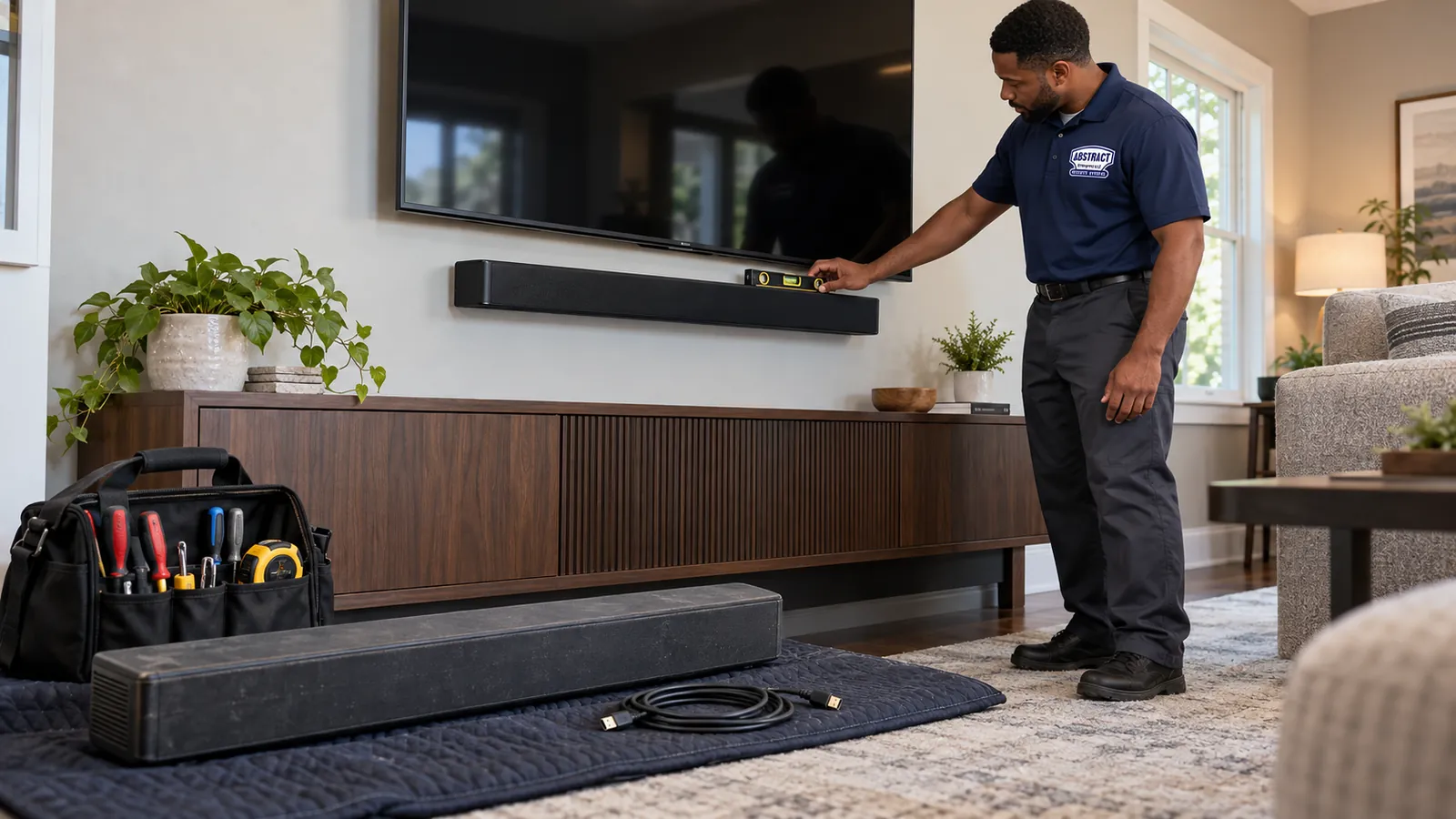
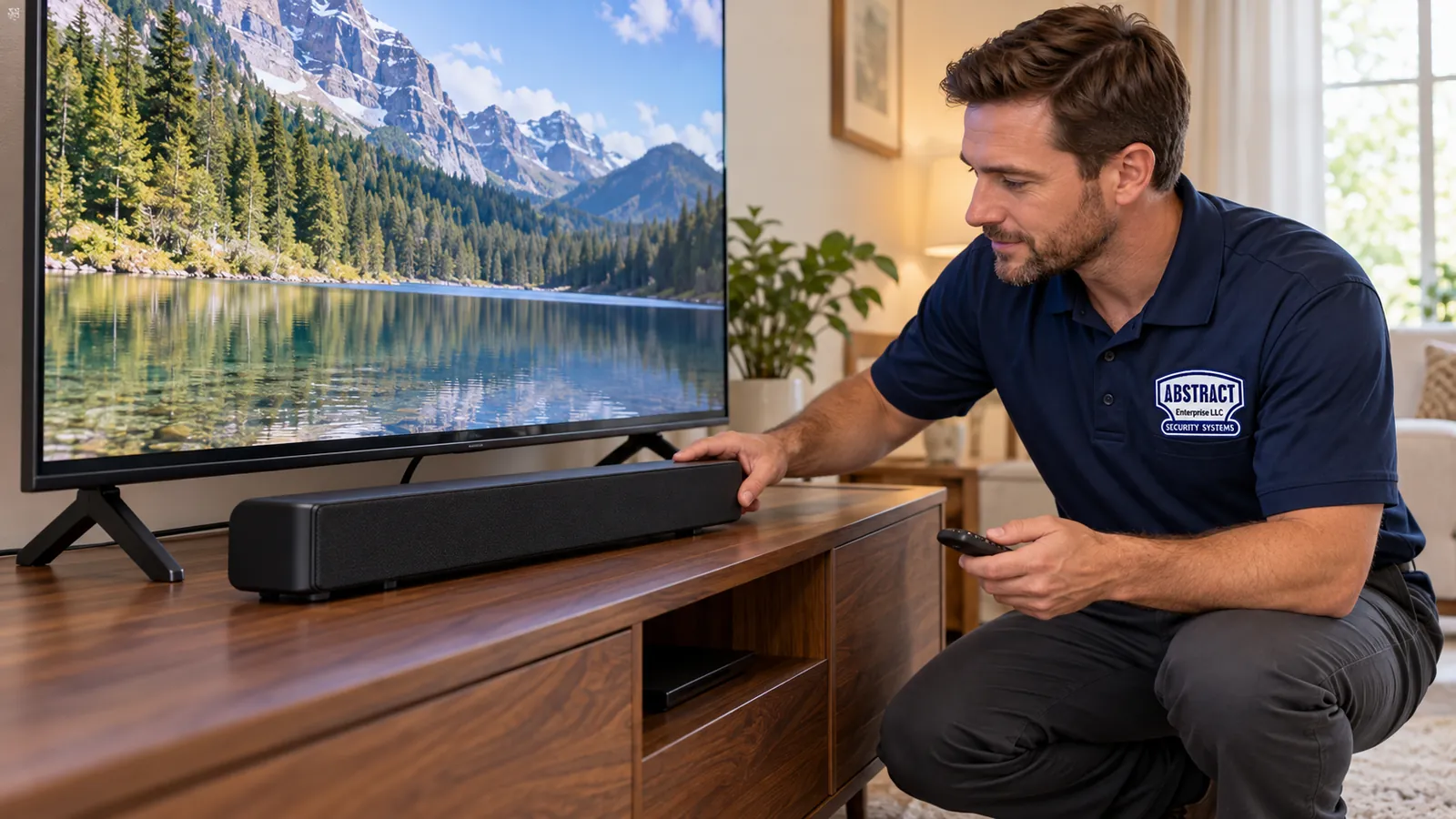
The bar on its bracket just below the screen, fixed into studs, a plywood backer, block or masonry depending on what the wall turns out to be, and checked from the sofa before we pack up.
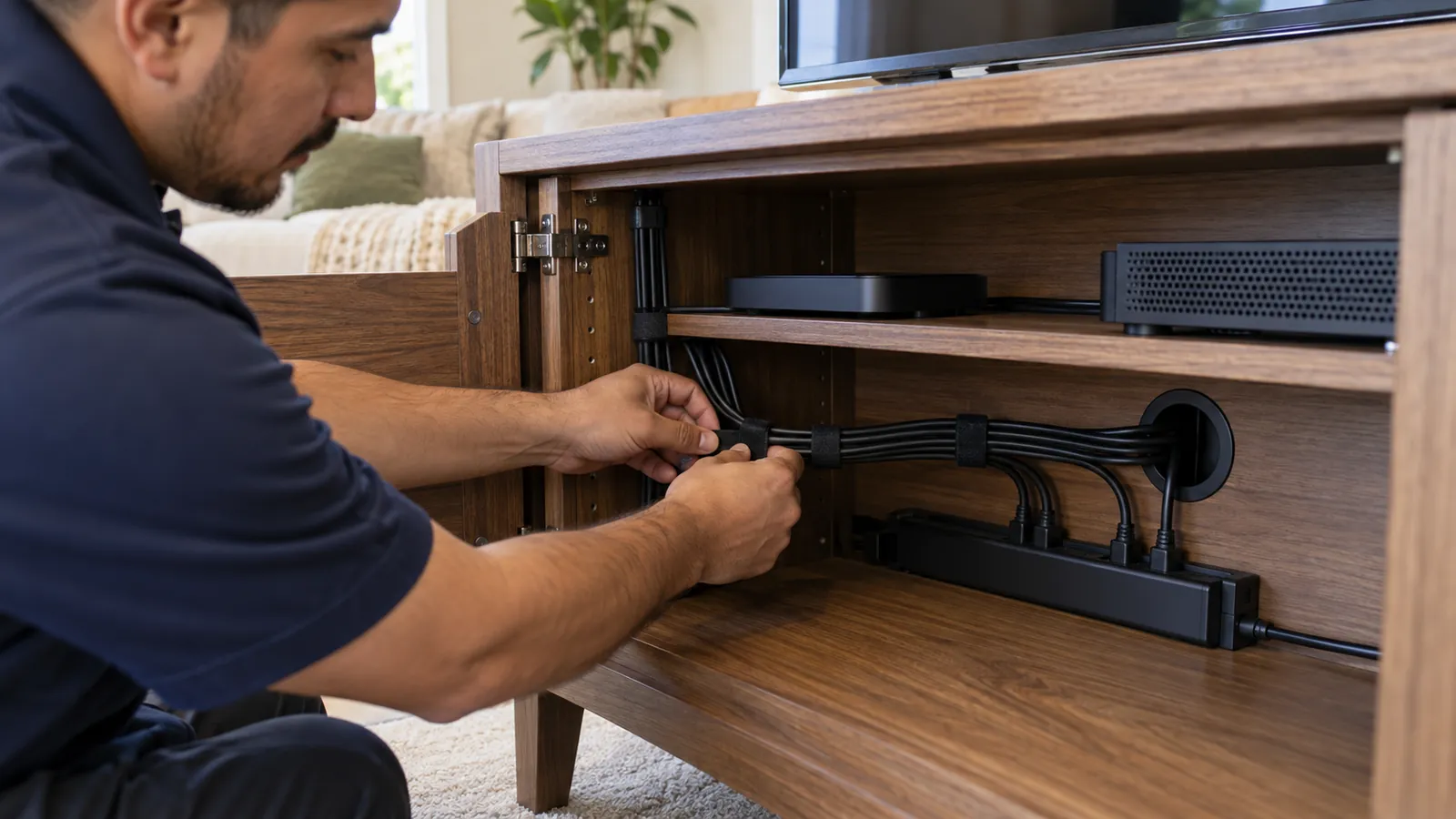
A code-compliant recessed kit behind the TV, fed from an outlet that is already there, with HDMI and power for the bar dropped inside a hollow interior wall. Ideal in new drywall, where the cavity is clean and empty.
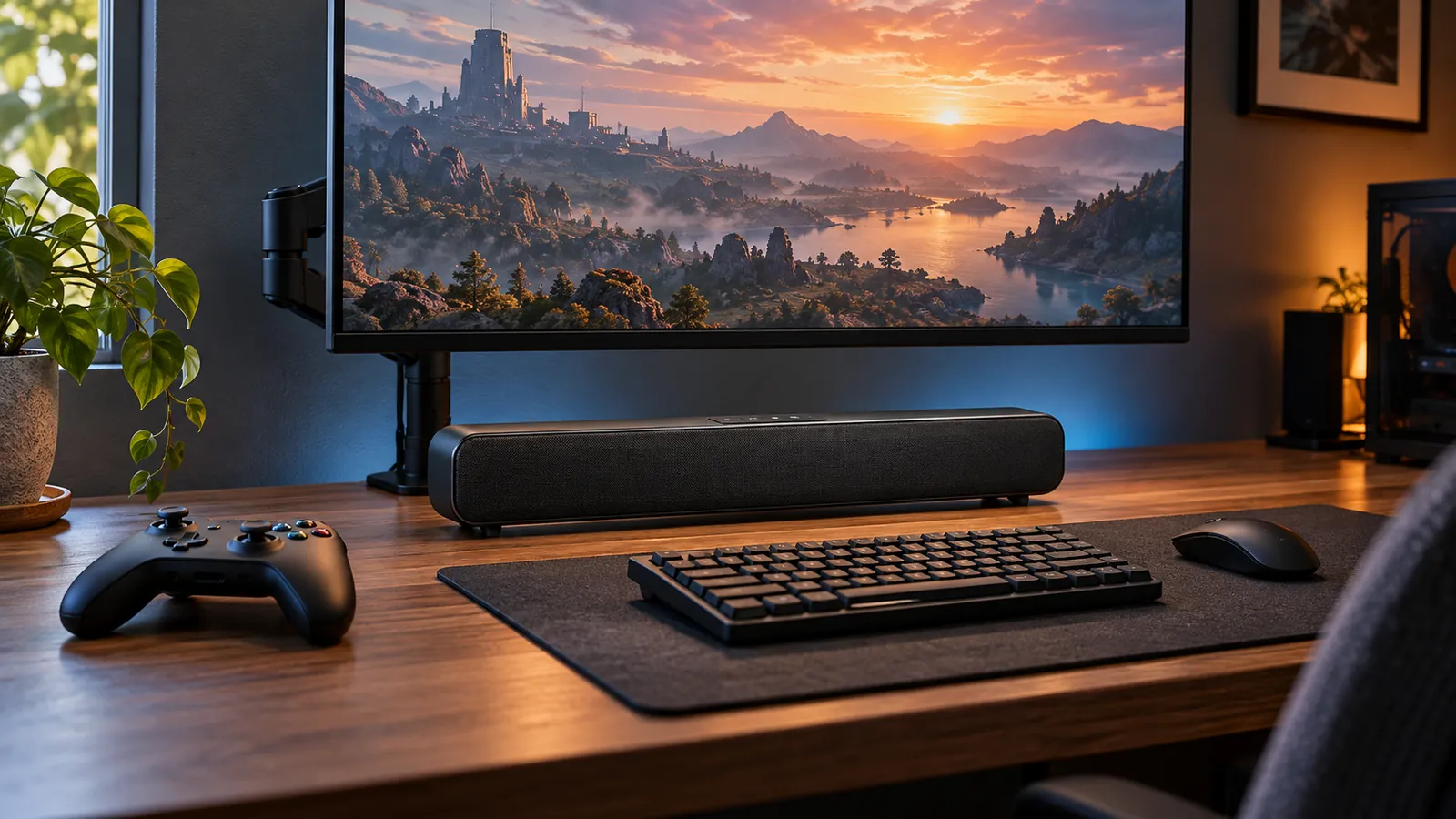
No holes at all: the bar on the media unit, clear of the TV's sensor, connected, tuned and tied off — the answer when the lease or the housing office says no to anything heavier than a J-hook.
Screen and bar planned together, with the bar's height and the TV's height set as one decision, one arrival window and one bill. The usual Orange County request in a house that has just closed.
Bracket and bar removed before the movers come, hardware bagged and labelled, and the same system rehung and reconnected at the new address once the boxes are unpacked.
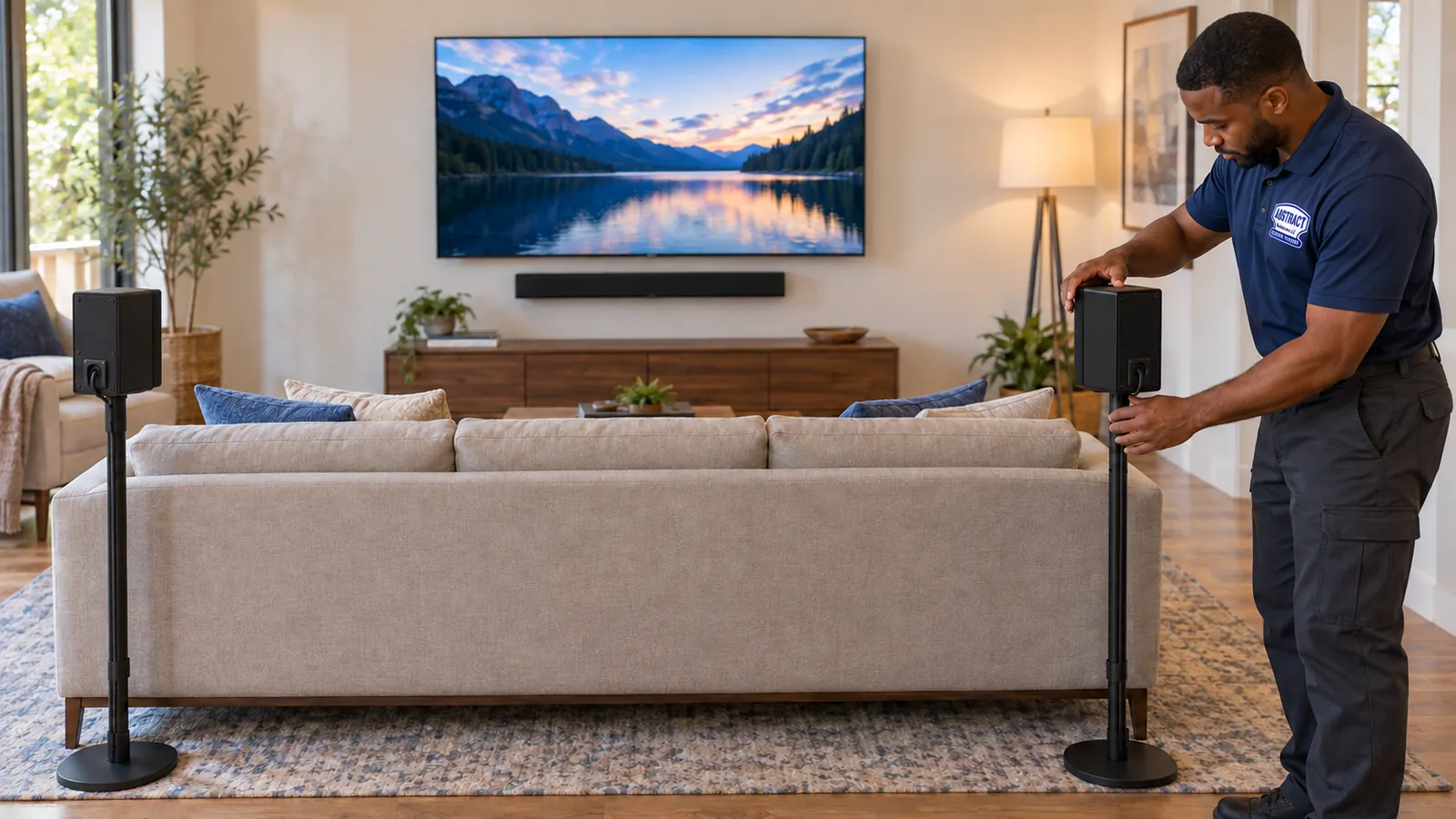
Subwoofers, rear speakers and Wi-Fi bars reintroduced to each other and to a new router; eARC, HDMI-CEC and lip-sync set up again on a new TV; firmware updated.
Using the structured-wiring panel and network jacks many builders install, so a smart bar gets a wired connection rather than relying on a router two floors away.
Bars under screens in distribution-centre break rooms, Goshen and Middletown offices and waterfront dining rooms, with volume and remote control arranged for staff.

Orange County's housing splits roughly by decade: houses still being finished, houses from the last few building booms, and the older river and railroad towns. These are the building types we plan for, and what each means for the bracket and the cable.
Open studs, a builder with a schedule, and the one chance to put conduit, a recessed box and speaker wire exactly where you want them. The cheapest moment in a house's life to hide a soundbar's cables.
Three-storey plans like those at Tuxedo Reserve's West Terrace and similar attached homes elsewhere. The wall shared with the neighbour is a fire-separation assembly, so wiring and boxes belong on the interior walls instead.
Drywall on wood studs, builder-placed outlets, often a gas fireplace with stone veneer and a basement that will be finished later. Easy to anchor into; the decisions are about where, not how.
Colonials and split designs across Monroe, Chester, Blooming Grove, Montgomery and the Town of Wallkill, often on their second or third owner. Insulated outside walls, the occasional surprise in the cavity, and older coax runs that can sometimes be reused as pull strings.
Off-post houses and apartments in Highland Falls, Fort Montgomery, Cornwall and New Windsor, plus on-post homes with written rules. Permission first, then the least-invasive mount that does the job.
Brick and frame houses in Newburgh, Middletown and Port Jervis split into an owner's unit and a rental. Two sets of expectations, two TVs, and a floor between them that carries bass.
Older homes in Goshen, Warwick, Florida, Walden and Washingtonville with plaster, settled floors and outlets that were never placed with a wall-mounted TV in mind.
Garden and mid-rise rental communities in Middletown, New Windsor and the new mixed-use buildings planned for Tuxedo Reserve's town centre. Lease rules and management approval come first.
Owners in new Orange County houses often pair the soundbar with wiring elsewhere in the house, such as a home network installation in Orange County so the TV wall, the office and the bedrooms all have a wired point, or home automation in Orange County that brings the TV, lights and shades onto one remote.


Commercial soundbar work in Orange County follows its economy: distribution and logistics along the interstates, retail around the big shopping destinations, county and legal offices in Goshen, and restaurants in the river and village downtowns. These are the corridors those requests come from.
Distribution centres and warehouses around Stewart and the interstate in the Towns of Newburgh, New Windsor and Montgomery; the Times Herald-Record reported a 565,320-square-foot warehouse proposed on 69 acres off 17K in 2018. Break-room and dispatch-office screens, concrete and steel-stud walls, and a lot of background noise.
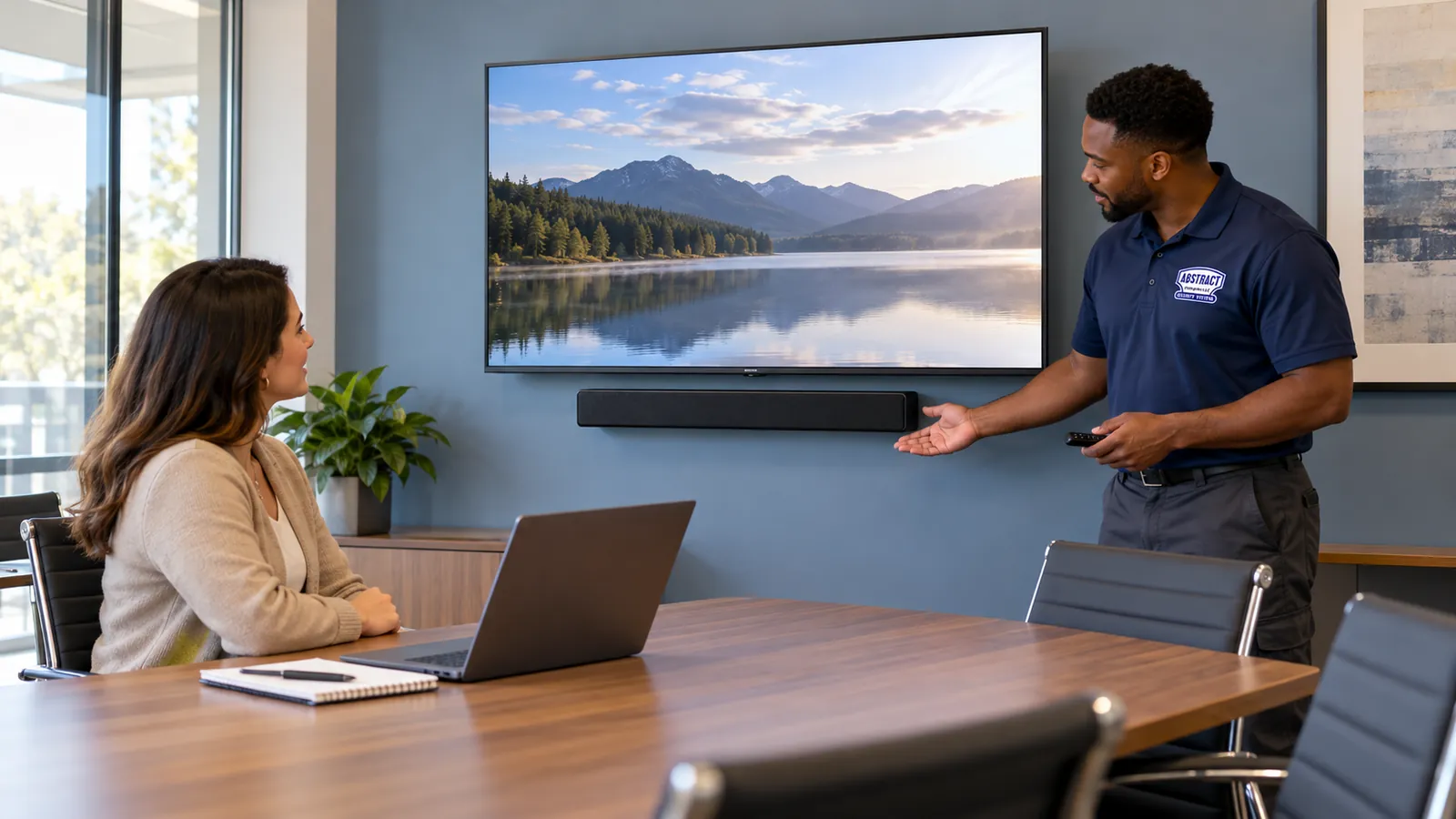
The county seat, with the Orange County Government Center at 255 Main Street and law, title and professional offices around it. Conference-room and waiting-room screens where clear speech at a low level matters more than bass.
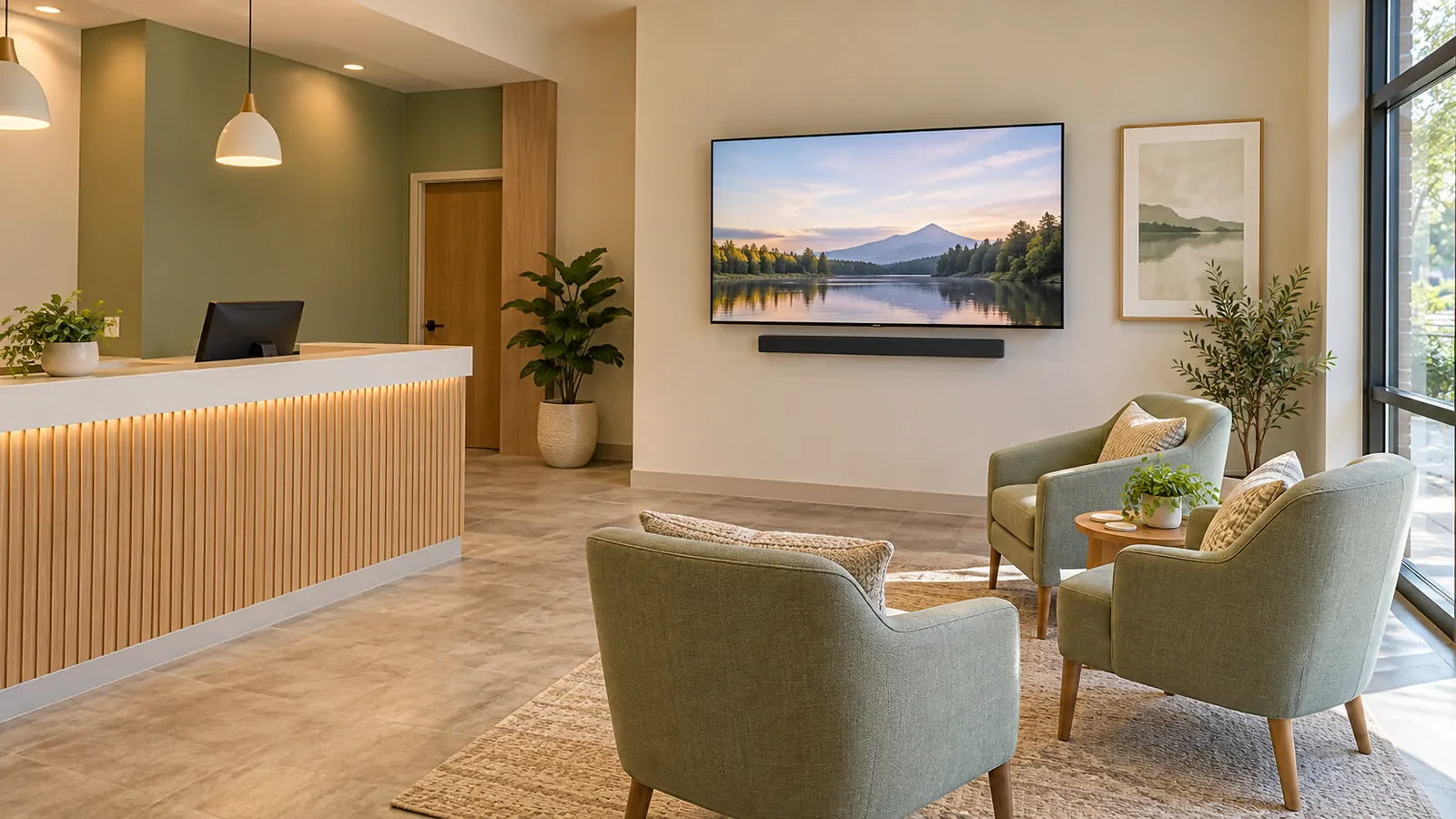
Shopping centres and services around the Galleria at Crystal Run, which opened in 1992, and along Route 211 East. Waiting-area TVs, gyms and restaurants with steel-stud walls and drop ceilings.
Around Woodbury Common Premium Outlets, an outlet centre of about 220 stores off Route 32 near Thruway Exit 16. Restaurants, hotels and service businesses that run screens all day for visitors.
Restaurants along Front Street facing the Hudson, and the brick storefronts of Newburgh, Middletown and Port Jervis. Older masonry walls, tall ceilings and patios that bring weather into the conversation.
Taverns, cafes and small offices in village downtowns that fill with weekend visitors. Small rooms where one modest bar under a single screen is enough and anything louder bothers the next table.

These are the questions Orange County households and businesses ask before booking, grouped around the moments they come up: while the house is being built, when someone is moving in or out, in the rooms people here actually use, and at work. Prices and coverage are in the FAQ further down.
Three things, agreed in writing with the builder before insulation and drywall. First, solid wood blocking between the studs at the height where the TV bracket and the bar's bracket will land, so both can be fixed anywhere along the wall rather than only where a stud happens to fall. Second, a recessed power and low-voltage box behind where the screen will hang, fed by the builder's electrician, with a matching box low on the same wall or in the media cabinet. Third, a smooth conduit of at least 1½ inches running between those two boxes, so HDMI and any future cable can be pulled or replaced later without opening the wall.
If you think you may add rear speakers or a subwoofer later, ask for speaker wire to be left coiled in a box near each future position, and an outlet where a wireless sub or rear speakers would sit. Builders in fast-moving subdivisions work to a schedule, so the request has to reach the site supervisor before the inspection that precedes insulation. Send us the floor plan and we will mark the positions for you to hand over; the box, the conduit and anything electrical inside the wall stay the builder's work at that stage.
Often, yes. Many new houses come with a structured-wiring enclosure in the basement or a utility closet, with network and coaxial cables running to jacks in the main rooms. If one of those jacks is on the TV wall, a smart soundbar with an Ethernet port can be wired straight to the router through the panel, which is far steadier than Wi-Fi from a router installed two floors down. We check what each run is, label it at the panel if the builder didn't, and patch the TV-wall jack to the router.
What the panel can't do is carry HDMI from a cabinet to the TV, or power to the bar; those need the conduit and in-wall kit described above. And not every panel is complete: we sometimes find runs that were never terminated or labelled. Testing each one takes a few minutes and saves guessing later. If the panel needs more work than a soundbar visit should cover, our network cable repair crew in Orange County can finish it.
Generally not, and we won't try. The wall between two townhomes is a fire separation. The International Residential Code that New York's Residential Code is built on requires townhouse units to be separated either by two one-hour fire-resistance-rated walls or by a common two-hour wall, and it limits how electrical boxes may penetrate that wall's surface. Cutting a recessed box or fishing cable through it can compromise the rating, and in an HOA community it may also break the association's rules about common elements.
So in a townhome we put the TV and the bar on an interior wall wherever the layout allows, and run concealed wiring there. If the only sensible TV wall is the shared one, the bar can still be surface-mounted after we confirm with the builder or HOA what the wall is built from, with cables dressed in a paintable cord cover instead of inside the wall. A shared wall also carries sound to the neighbours, which is one more reason to keep the subwoofer off it.
Usually, with care. Most new-build fireplace walls are faced with manufactured stone veneer: relatively thin pieces set in a mortar bed over a framed chase or a backer, not solid masonry. A bracket needs to bite into something sound behind the veneer, so we drill through the stone and its mortar into the framing or backer, choose a fixing long enough to reach it, and keep holes in the mortar joints where the pattern allows so they are less visible if the bar is ever moved.
Before drilling we look for the fireplace manufacturer's clearance label and the location of the gas line and venting, because those dictate where the bar must not go. Stone carries our $65 brick-and-stone line on top of the $129 wall mount. If the veneer is loose or hollow when tapped, we stop and suggest mounting the bar to the TV bracket instead, which avoids fixing into the stone at all.
Sometimes, but it is harder than an interior wall. Exterior walls are packed with insulation, and newer houses may have spray foam, fire-blocking or horizontal bracing in the cavity, any of which can stop a cable halfway. Cutting and patching an exterior wall also risks the vapour barrier. We test the route with a small inspection hole behind where the TV will cover it before committing to an in-wall kit.
When the cavity is clear, the $169 in-wall kit works as it would on any wall. When it isn't, the alternatives are a paintable cord cover at $59, or taking the cable down into a basement or crawl space and back up inside the media cabinet, which is often possible in Orange County's many houses with unfinished basements. We'll tell you which applies before quoting the concealment line.
Only with written approval. The community guidelines published for West Point Family Homes say residents should use only small nails or J-hooks to hang items, that attaching fixtures requires prior approval, and that alterations of any kind go through a Request for Alterations form to Community Management, which may require you to restore the home to its original condition. A soundbar bracket screwed into the wall is exactly the kind of thing that needs that form.
If approval comes through, bring us the approval and any conditions and we will mount to them. If it doesn't, the bar goes on the TV stand: connected to eARC, CEC switched on, cables tied out of sight, and the subwoofer placed for the room. It sounds the same, packs faster when orders arrive, and leaves nothing on the wall for the move-out inspection to find.
Yes, and in a county with so many military and relocating households we plan for it on request. The simplest approach is to hang the bar from a TV-attached bracket rather than its own wall bracket, so the bar comes down with the screen. We also keep cable runs short and visible rather than buried in the wall, use cord covers that peel off cleanly, and photograph every connection so the setup can be rebuilt at the next house.
When the move is close, a take-down visit removes the bar and its bracket, bags and labels the hardware, and leaves the screw holes ready for filling; removing an old bracket is $45 on our list, and patching is left to you or your landlord. If the next house is also in Orange County, the rehang is booked like any other install. If it's far away, the labelled bag and the photos make it straightforward for whoever installs it there.
Because almost everything that made it work was tied to the old house. A Wi-Fi soundbar remembers the old network's name and password; a wireless subwoofer and rear speakers are paired to the bar and sometimes lose that pairing when everything is unplugged and moved; and the new TV may have its eARC port in a different place, with HDMI-CEC switched off from the factory. Unboxed in a new room, the system looks dead even though nothing is broken.
The fix is to re-introduce each piece in order: bar to network through its app, sub and surrounds re-paired to the bar, HDMI into the TV port labelled eARC or ARC, CEC switched on in the TV menu, and lip-sync checked. We do that on a setup-only visit, which is $250 for the first hour in Orange County and then 30-minute blocks. Most households are back to normal inside that first hour, and we leave a note of the settings for the next time you move.
Yes, as long as you, the owner, are the one booking or approving it. We treat the tenant's unit the way any landlord would want: confirm with you which wall may be drilled, whether you want concealed wiring that stays with the building or surface cables that leave with the tenant, and who keeps the bracket at the end of the lease. In older Newburgh two-families, the TV wall in the upper unit is often plaster on lath or plaster on brick, priced at $45 or $65.
Two-family houses also put one household's floor over the other's ceiling. We place the upstairs subwoofer off the floor joists' mid-span and away from the wall above the downstairs bedroom, and set the bass level with that in mind. If you'd like the same visit to cover a bar in your own unit, both are priced from the same list and done in one arrival window.
Mostly it changes what happens outside, not at the TV. The community guidelines for West Point Family Homes allow satellite dishes no wider than one metre, but only with prior approval from the Community Management Office and a Satellite Dish Addendum to the lease; the dish has to stand on its own pole in the back or side yard, not on the roof, gutters or any part of the house, and it must come down before move-out. The guidelines also say a satellite system may not be connected into the home's own cable television wiring.
That last rule decides the indoor layout. The satellite receiver sits beside the TV and plugs into one of its HDMI inputs; the soundbar connects to the TV's eARC or ARC port as usual, and HDMI-CEC lets the TV remote run the bar's volume whichever source is playing. We set up the receiver, TV and bar indoors on a console, with nothing fixed to the walls unless your Request for Alterations has been approved. The dish, its pole and its cable run are the satellite provider's work under your addendum, not ours.
Short-term rental rules vary sharply around Goshen. The Chronicle reported that the Town of Goshen board voted unanimously to ban short-term rentals, citing noise, parking, trash and septic issues, while Airbnb's own guidance for the Village of Goshen describes a permit and registration system limited to single-family homes in certain residential zones, with notice to the village before each stay. Check which side of that line your property is on before you plan for guests.
Where hosting is allowed, the aim is a system guests can't break. We set the bar to come on with the TV through HDMI-CEC so the TV remote is the only one guests need, hide the bar's own remote, cap the maximum volume in the app where the model allows it, and remove the bar from any account guests could join. A short laminated card beside the TV with three steps saves most of the messages you would otherwise get at night.
For a break room with a door that closes, usually yes. A mid-size bar with a dedicated centre channel and a speech mode keeps announcements and the news intelligible over ventilation noise without being turned up to a level that carries into the office next door. In an open mezzanine or a lunch area on the warehouse floor, a soundbar is the wrong tool: the space is too large and too loud, and ceiling or wall speakers driven by an amplifier do the job properly.
Break-room walls along the interstate corridors are commonly steel studs or concrete block, priced at $30 and $75 respectively. We cap the volume, keep the remote with the supervisor, and mount the bar and screen so nothing protrudes into a walkway beyond the ADA limit. If the room is also where safety briefings are given, tell us; we'll set the bar for speech rather than for the big game.
A few minutes with this list, at the right point in your move, avoids most of the problems we see on Orange County soundbar visits. Pick the part that matches where you are; the answers go straight into the quote.
If something on the list can't be answered yet — a builder who hasn't replied, an HOA that meets next month — book anyway and tell us. We'll quote both versions so the price on the day matches the house you actually have.
New construction comes with its own language, and some of it decides what can happen to your TV wall. These are the terms that come up most, in plain English.
Got a phrase from a builder's options sheet or an association handbook that this list doesn't explain? Paste it into your quote request and we'll translate it, and say plainly whether it changes anything about where the bar can go.
Bring whatever bar you chose, or the one that came with you from the last house; the brand rarely changes the job. What changes it is size, how the bar connects, and whether it will need to travel again. Here is how the common types play out in Orange County homes.
Short bars such as the Sonos Ray, which connects by optical rather than HDMI. Right for bedrooms, home offices and the smaller TVs families carry from house to house.
The default for a first family room in a new house. Sonos publishes the Beam (Gen 2) at 6.35 lb and 25.63 inches long, light enough for almost any fixing, with an eARC connection and an app that makes re-pairing after a move simple.
Long bars with up-firing drivers, such as the Sonos Arc Ultra at 46.38 inches and 13.01 lb per Sonos. Best under a large screen in a room with a flat ceiling of normal height.
Popular in basements and family rooms. The sub needs an outlet where it will sit, and it is the piece most likely to lose its pairing after a move.
Most bars ship with a slim bracket designed for them, and we use it whenever the wall agrees. Where it doesn't, a Sanus bracket from us takes its place; either way the screws or anchors are picked after we know whether stud, block or stone is behind the surface.
The bar hangs from the TV or its mount, so it moves and comes down with the screen. Sanus lists its universal soundbar mount for most bars up to 20 lb. The natural choice for households that move often.
Listed kits that bring power from an existing outlet to a recessed box behind the TV and carry HDMI inside the wall. Cleanest in new drywall with an empty cavity.
Patch cables, a small switch at the panel and, where needed, a mesh node, so a smart bar can sit on a wired link instead of a long Wi-Fi hop.
| Connection | When it fits | Watch for |
|---|---|---|
| HDMI eARC | Current TVs paired with current bars; full-quality sound and single-remote volume | Only one HDMI input on the TV is usually labelled for it — after a move, check you used that one |
| HDMI ARC | A TV a few generations old; fine for most viewing, with Atmos limited to the lossy Dolby Digital Plus version | A reset or a move often turns CEC off in the TV menu |
| Optical | Optical-only bars like the Ray, or an older set with no ARC port at all | Volume control usually needs the bar to learn the TV remote's signal |
| Ethernet through the media panel | A builder-wired jack on the TV wall and a bar that has a LAN socket | Some panel runs are never punched down or labelled; test before relying on it |
| Wi-Fi only | Bars with no Ethernet port | Router position matters; basement routers struggle to reach upstairs bars |
National brands versus an Orange County installer. Big-box technology services and app-based handyman platforms sell flat soundbar menus that suit a finished drywall wall in a house nobody is about to leave. They are not set up to sit down with a builder's floor plan, read an HOA's rules on separation walls, work around an on-post Request for Alterations, or come back to reconnect the system at the next house. A licensed local installer with a published price list, a direct Orange County line and a New York low-voltage licence quotes the house you are actually in, at the stage it's actually at.

With so much of the county's housing going up now, the most useful thing we can tell a buyer is when each soundbar decision has to be made. Miss a stage and the option doesn't disappear, but it gets more expensive or more visible. This is the order we suggest.
If you're reading this after closing, nothing is lost. Drywall on wood studs is the easiest wall we work on, and an in-wall kit or a cable run to the cabinet covers most of what pre-wire would have done. It just costs a little more and means one more visit with the drill. For houses still at the plan stage, send us the drawings; marking the TV wall and listing what to ask the builder for is part of quoting the eventual install.
Google's AI Overview couldn't be captured in our build environment, so this section tests the claims that cost-guide and lead-generation pages publish for this part of New York — Homeyou, Thumbtack and Angi among them — and the setup advice AI summaries tend to repeat. Each is reasonable somewhere. Each needs adjusting for an Orange County house at a particular point in its life.
That range comes from Homeyou's West Point cost page, which also quotes a typical spread of $206 to $962. It is an average built to cover many different jobs: brackets, wiring, the occasional electrician and sometimes drywall repair, all folded into one figure. As a warning that the job can cost more than a bracket, it is fair.
For a soundbar it overshoots badly. Our published price to hang a bar under a TV in Orange County is $129, plus $84.99 if you need a Sanus bracket from us. Even with a new 55-inch TV mounted at the county's $229.99 base, a bar on our bracket and the $169 in-wall kit, the whole visit comes to $612.98 — and there is no travel charge on top, whether you are in Highland Falls or Port Jervis.
The lesson isn't that averages are dishonest. It's that they hide the lines that matter. A quote that names each one — mount, bracket, wall, concealment — lets you see why a stone fireplace costs more than new drywall, and lets you drop what you don't need.
Marketplace pages for Middletown show sample prices such as $119 for a mount and $139 with wires concealed in the wall. Those are examples posted by individual providers, usually for a small TV on plain drywall, and they rarely say what the concealment actually consists of.
The question to ask is how the power gets behind the screen. A TV or soundbar power cord is not rated to run inside a wall, so a proper job uses a listed in-wall kit that feeds a recessed box from the outlet already below it. Our kit is $169, on top of the mount, and it is the only way we conceal power. HDMI and network cable can share the same route.
In a brand-new house there is a better option still: have the builder's electrician fit the recessed box and conduit before drywall. Then the soundbar visit only has to connect what is already in the wall, and nobody cuts into finished paint.
New drywall on wood studs is easy to drill, and that's why the summaries treat new construction as the simple case. The mounting really is simple. What isn't simple is that the builder placed outlets for a TV on a stand, put one stud where you need two, and may have faced the fireplace in stone veneer.
We regularly find new houses where the only outlet on the TV wall sits at skirting height, centred on a fireplace, with no box behind where the screen will go. That is fixable with a $169 in-wall kit if the cavity is open, or a $59 cord cover if it isn't, but it would have cost almost nothing to get right before the drywall went up.
So the honest version is: a new house is the easiest place to install a soundbar if you planned for it while it was being built, and an ordinary one if you didn't. Send us the plans early and we'll tell you what to ask for.
General advice for renters treats drilling as a deposit question: put the bracket up, fill the holes at the end, and nobody will notice. For a private rental with a relaxed landlord, that sometimes works.
In Orange County a significant number of renters live under written rules that don't work that way. West Point's on-post community guidelines limit residents to small nails or J-hooks, require approval for attaching fixtures, and may require restoration to the original condition. Off-post leases near the academy and Stewart often have their own clauses, and two-family owners in the cities have firm views about their walls.
So we ask before we drill, not after. If permission comes in writing, we mount. If not, a console setup or a TV-attached bracket gives the same sound with nothing to repair, which is the better result for a household that will move again in a couple of years anyway.
Angi's surround-sound cost guide gives that range, with an average of about $794. It reflects what a receiver-and-speakers system with in-wall or in-ceiling wiring tends to cost nationally, and many families finishing a basement in Orange County are weighing exactly that choice.
A soundbar is a different and usually smaller job. With our list, a bar on the wall with our bracket is $213.99, and adding the in-wall kit makes it $382.99. Pairing a matching sub and rear speakers on the same visit is setup work, and the parts themselves come from the bar's maker. For many basements that is all the sound the room needs.
Where it isn't — a dedicated theatre room, or a basement big enough to swallow a soundbar — the time to decide is before the ceiling is closed, because in-ceiling speaker wire is cheap at framing and expensive afterwards. Our Orange County AV and sound installers quote the full-system route when it is the right one.
Hanging a soundbar is light work, and plenty of handy homeowners do it themselves. AI summaries often stretch that into a general claim that credentials don't matter for any part of the job.
Two parts of the job are regulated here. Orange County's Electrical Licensing Law requires a county-issued licence to work as an electrician in the county, so a new or moved outlet behind the TV is a licensed electrician's job, not a soundbar installer's. And New York's home improvement rules, as summarised in Orange County's own consumer guide, expect a written, signed contract for home improvement work over $500, naming the contractor and any licence number, describing the work and the materials, and setting out payments.
We work within both. We never add or extend outlets; the in-wall kit runs from the one you have. And every quote is written and itemized, carrying our New York low-voltage licence number, #12000287431, so you know exactly who did what.
Smart bars are good at remembering things, and setup guides often suggest that unplugging and plugging back in is all a move requires. In the same house, after a power cut, that is usually true.
After a move it rarely is. The bar remembers a Wi-Fi network that no longer exists, the subwoofer and surrounds may have lost their pairing in transit, a new TV may put eARC on a different HDMI port, and HDMI-CEC is often switched off on a TV that has just been set up. Each piece works; they just don't know about each other.
Re-pairing everything in the right order takes a technician less than an hour in most cases, billed as a setup-only visit at $250 for the first hour in Orange County. If you'd rather do it yourself, start with the bar's app on the new network, then the sub and surrounds, then the TV's HDMI and CEC settings, and only then the remote.
Send the floor plan, a photo of the TV wall or the bar's model. We send back an Orange County price with no travel line, and a note of anything the builder should leave in the wall.
A few details get you an exact number: which bar and TV, which town, what the wall seems to be, and whether a builder, HOA, landlord or housing office is involved. The reply is itemized from the price list below. Prefer a conversation? The Orange County line is (845) 640-3835.
Your request is in. We price it line by line from the list on this page and come back to you the same working day. For anything urgent, phone (845) 640-3835.
Seven steps for every Orange County soundbar, from a pre-wire conversation in a framed townhome to a console setup in an on-post rental. The first two decide whether the job happens now, later, or in two stages.
Text or email the bar and TV models, your town, a photo of the TV wall with the outlet in view, and whether the house is being built, newly bought, rented, on-post or about to be left. Back comes an itemized Orange County quote with no travel line.
For a build in progress we mark blocking, box and conduit positions for the builder. For an HOA, landlord or West Point housing we send a free insurance certificate and wait for written permission before anything is drilled.
Arrival windows run 8 AM to 8 PM every day, so commuters can book an evening or a weekend. Moving the date costs nothing with 24 hours’ notice.
The technician confirms whether the wall is new drywall, stone veneer, plaster, brick, block or a townhome separation wall, checks the fireplace label and gas line where there is one, and agrees the bar height with you from the seating.
Fixings land in timber, builder blocking, an $85 backer or masonry, depending on the wall; once the bar sits level, its leads disappear into the listed in-wall kit, a painted channel, or a drop behind the media cabinet.
One HDMI lead goes to the TV input labelled for audio return, CEC is enabled, the bar joins your network by Wi-Fi or a media-panel jack, and any sub or surrounds are re-linked and set down where the room and the floor beneath suit them.
We test dialogue, lip-sync and bass from your seat, photograph every connection for your next move, clear up, and show you the settings you will actually use.

Six Orange County landmarks, chosen because each stands for a kind of household or building we install soundbars for. We are not claiming work at any of these places; they are reference points for the homes and businesses around them.
The Army's academy on the Hudson, with on-post family housing run under published community guidelines and off-post rentals in Highland Falls, Fort Montgomery and Cornwall. The reason this page talks so much about permission and moves.
A public and military airport in the Towns of Newburgh and New Windsor, home to the New York Air National Guard's 105th Airlift Wing and run by the Port Authority, with the warehouse corridors of 17K and Route 300 around it.
A Lennar and Related Companies community of more than 1,600 homes on about 1,200 acres between Harriman State Park and Sterling Forest, with a planned town centre. The county's biggest single source of new walls.
A theme park of about 150 acres that opened on May 20, 2021, about 60 miles northwest of New York City. Family neighbourhoods in Goshen and Chester surround it, along with the short-term rental questions it raises.
An outlet centre of about 220 stores off Route 32 near Thruway Exit 16, opened in 1985. Restaurants and service businesses nearby run screens all day, and new homes are going up a short drive away.
445 acres and 2,217 buildings, largely brick Italianate row houses of two and three storeys, including Washington's Headquarters State Historic Site. The older, two-family end of Orange County's housing.
We also cover every town, village and hamlet in between — Newburgh, New Windsor, Vails Gate, Cornwall, Cornwall-on-Hudson, Salisbury Mills, Highland Falls, Fort Montgomery, Monroe, Harriman, Highland Mills, Central Valley, Tuxedo, Greenwood Lake, Warwick, Florida, Chester, Sugar Loaf, Goshen, Campbell Hall, Washingtonville, Blooming Grove, Montgomery, Walden, Maybrook, Middletown, Slate Hill, New Hampton, Otisville, Port Jervis and the rest. Our other Hudson Valley counties are covered on the Hudson Valley soundbar installation hub.

Orange County prices are published, itemized and agreed before we arrive, and there is no travel line. Pick the lines that match your job and add them up; that is the bill. If the wall turns out different from what was booked — stone where you expected drywall, say — you see the corrected price before any extra work starts.
| Soundbar line | Orange County price | What it covers |
|---|---|---|
| Soundbar wall-mounted under the TV | $129 | We work out the wall first, then fix, level and listen-test the bar beneath the screen |
| Soundbar placed on a console or stand | $79 | No drilling: the bar sits on your furniture below the screen, wired up and tuned — what most on-post and short-lease households choose |
| Sanus soundbar bracket | $84.99 | Supplied by us for a bar sold bracket-less, or to hang the bar off the TV mount |
| In-wall concealment | $169 | A listed kit carries power up from the receptacle already on that wall to a box behind the screen; needs an open cavity |
| Paintable cord cover | $59 | Surface channel for block, stone, separation walls and blocked cavities |
| Cable run, up to 25 ft | $99 | To a media cabinet, a projector position or a switch at the panel |
| Sonos setup | $125 | Sonos bar, sub, surrounds, app and grouping |
| A/V receiver | $129 | Receiver connected and configured |
| Universal remote | $99 | Programmed for the TV, bar and sources |
| Streaming device setup | $49 | Apple TV, Roku, Fire TV or similar |
| Full home theater | $350 | Multi-component system setup |
| Travel to any Orange County address | $0 | No travel, parking or fuel charge, Newburgh to Port Jervis |
| Condition | Price |
|---|---|
| Drywall on wood studs (most new builds) | $0 |
| Drywall on metal studs | +$30 |
| Plaster | +$45 |
| Brick, stone or stone veneer | +$65 |
| Concrete or cinder block | +$75 |
| Tile or marble | +$95 |
| Plywood backer board | $85 |
| High mount, above about 8 ft | $75 |
| No elevator, 3rd floor or above | $40 |
| Remove an old bracket | $45 |
| Box removal | $25 |
| Insurance paperwork your association, owner or housing office asks for | Free |
| Typical Orange County job | Lines | Total |
|---|---|---|
| Bar on the console in an on-post or rental home | $79 | $79 |
| Bar wall-mounted on new drywall, our bracket | $129 + $84.99 | $213.99 |
| Bar on new drywall, our bracket, in-wall kit | $129 + $84.99 + $169 | $382.99 |
| Bar into stone veneer around a gas fireplace, our bracket | $129 + $84.99 + $65 | $278.99 |
| Bar on plaster-on-brick in a Newburgh two-family, own bracket, cord cover | $129 + $65 + $59 | $253 |
| Bar on a block basement wall, own bracket, cord cover | $129 + $75 + $59 | $263 |
| New 55-inch TV plus bar, our bracket, in-wall kit | $229.99 + $129 + $84.99 + $169 | $612.98 |
When nothing goes on a wall — reconnecting a bar after a move, re-pairing a sub, putting the bar on the media panel, fixing eARC or lip-sync on a new TV — we bill by time: $250 for the first hour in Orange County, then 30-minute blocks. If a TV is being mounted on the same visit, our Orange County base of $229.99 for a 32-inch to 55-inch screen on wood-stud drywall applies, with $30 more for a 56-inch to 65-inch set and $130 for placement above a fireplace, and the soundbar lines go on top.
Three bundles cover nearly every household we quote in the county, from the family that will move again next summer to the owner who wants nothing visible. The sums are printed on each card; wall surcharges join only when the survey finds stone, block or plaster.
$79
Soundbar placed on the console, connected to eARC or ARC, CEC switched on, network checked, cables tied off. The right package for on-post homes, short leases and anyone expecting orders within a year.
$213.99
Wall mount ($129) plus a Sanus bracket from our van ($84.99) makes $213.99 — the figure for builder drywall over timber studs. A veneered chimney breast would add $65, older plaster $45, a block basement wall $75.
$382.99
$129 to hang the bar + $84.99 bracket + $169 for the listed in-wall power and cable kit = $382.99. For hollow interior walls in houses you own; not for separation walls or on-post homes.
Arriving with a bracket from the last house, or the one in the bar's box? Then the bill is our labor alone: $129 to put the bar up on timber-stud drywall, plus a wall line if the surface calls for one. Your bracket must be rated for the bar's weight and is covered by its own maker's warranty, not ours. If it doesn't suit the wall, you hear before any drilling, with our Sanus bracket as the alternative.
Three things start a quote: your town, the bar you own, and a snapshot of the TV wall. Tuxedo or Port Jervis, the number carries no mileage line.
From the Hudson to the Delaware, Orange County covers river cities, commuter towns, farm villages and lake communities. The bar and bracket don't change from one to the next; the house, the household and the rules around them do.
The City of Newburgh brings the East End's brick row houses and two-family homes, where plaster sits on lath or directly on brick and one household lives above another. Outside the city, the Towns of Newburgh and New Windsor add post-war and newer subdivisions, apartment communities and the warehouse and airport corridors around Stewart. Expect landlord approvals in the city, new drywall in the towns, and break-room work along 17K and Route 300.
The river towns nearest West Point, with many off-post rentals for Army families and on-post housing just inside the gates. Written permission, console and TV-attached options, and take-down visits timed to moving dates are the rule here, with the Salisbury Mills–Cornwall station serving commuters on the Port Jervis Line.
The southern commuter belt along Route 17 and the Thruway, home to Harriman station — the busiest on the Port Jervis Line — and to Woodbury Common. Newer communities such as Palisades Ridge at Woodbury Junction sit alongside older subdivisions, so we see both pre-wire conversations and second-owner houses with insulated outside walls and builder-placed outlets.
Tuxedo Reserve's townhomes and houses are changing the southern end of the county fast, with separation walls and HOA rules to respect. Greenwood Lake's year-round and seasonal houses and Warwick's village and farm properties bring older framing, paneling and long cable runs. Warwick's Railroad Avenue and Main Street add small restaurant and tavern requests.
Family subdivisions around LEGOLAND and the county seat, with gas fireplaces faced in stone veneer and finished basements becoming media rooms. Goshen's village houses and Main Street offices bring plaster and conference rooms, and the town-and-village difference in short-term rental rules matters to hosts.
Middletown's older city streets, the shopping and services around the Galleria and Route 211, and growing subdivisions in the Town of Wallkill and Montgomery, served by the Middletown/Town of Wallkill and Campbell Hall stations. Two-family homes in the city, new drywall in the towns, and commercial screens on Route 211.
The far western end of the county, on the Delaware, where the Port Jervis Line ends and the railroad-era city meets rural roads and newer houses around Slate Hill and New Hampton. Older city housing with plaster, and longer drives for us — which is exactly why there is no travel line on our Orange County price list.

In a county where people move often, the best bar is frequently the one that will still suit the next house. If you haven't bought yet, this is how we would match a bar and a mount to the rooms we see most. It is guidance from installing, not a product endorsement; any mainstream brand in the right class will do.
| Room | Bar class | Subwoofer? | Usual mount |
|---|---|---|---|
| Builder-new detached house, main family room | Mid-size or flagship | Optional; place it before the furniture locks in | Wall bracket on drywall, in-wall kit |
| Living room in a three-storey townhome | Mid-size | Optional, never against the shared wall | Interior wall, or TV-attached bracket |
| Finished basement with a projector | Mid-size or flagship under the screen | Usually yes, set after the room is furnished | Shelf or bracket under the screen |
| On-post or short-lease rental | Compact or mid-size | Optional | Console, nothing drilled |
| Upper unit of a two-family house | Mid-size | Possible, near a bearing wall rather than mid-floor | Wall bracket on plaster or brick |
| Bedroom or home office | Compact | No | Dresser, desk or TV-attached bracket |
| Short-term rental living room | Mid-size with simple controls | Optional, volume capped | Wall bracket; bar remote hidden |
| Warehouse break room | Mid-size with speech mode | No | Wall bracket on steel stud or block |
Three rules of thumb hold across the table. A bar about as wide as the screen, or slightly narrower, keeps sound anchored to the picture. Up-firing height effects need a flat ceiling of ordinary height above the bar, so they suit a standard family room better than a basement with ducts and soffits overhead. And for households likely to move within a few years, a bar that can hang from the TV's own mount is the one that travels best.
Keep the box and the receipt until the install is done. If the bar arrives damaged, or its ports don't suit the new TV, returning it before it is on the wall is far easier — and for families who move, the original box is still the safest way to carry a bar to the next house.
A soundbar visit in a newly bought Orange County house is often the first of several: the TV goes up, the network gets wired, and the basement plans grow. These Orange County services work from the same price list and the same insurance certificate.
The screen goes up first; we set its height with the bar's gap already allowed for, on whatever the county's houses throw at us.
Every county TV line in one place: size tiers, fireplace and wall adds, and the brackets we stock.
When a finished basement deserves a receiver, a projector and speakers in the ceiling instead of a single bar.
Network runs to the TV wall and media panel, for new houses and offices.
Cameras, door entry, data and audio cabling: the county-wide low-voltage service this soundbar page is one branch of.
TV, soundbar, lights and shades brought onto one app or remote in a new house.
Mesh and wired networks that reach the upstairs bar from a basement router.
The small print on booking slots, when a $150 return trip is charged, how to move a date for free, and how setup time is billed.
The order of questions our crew works through at an Orange County front door — a habit we follow on every job, not a write-up of one
The first question at the door isn't about the wall. It's about the house: how long you've had it, whether a builder or an HOA still has a say, and whether anyone expects to move in the next couple of years. The answers decide whether we drill at all, and how permanent the job should be.
In a new house, the next look is at the outlet. If it sits low and centred on a fireplace, the technician checks the cavity behind the TV position for blocking, insulation and anything the builder ran through it before suggesting an in-wall kit. Around a fireplace, the clearance label and the gas line come before the stone. In a townhome, we ask which wall is shared before anything else.
In a house that has just been moved into, the network gets checked before the bracket goes up, because the most common call-back after a move isn't a loose mount. It's a subwoofer that has gone quiet, or a bar that can't find a router that now lives in the basement.
Mounting a 32-inch to 55-inch TV on wood-stud drywall is $229.99 in Orange County. Hanging the soundbar under it is $129, our Sanus soundbar bracket is $84.99 and the in-wall power and cable kit is $169, which makes $612.98 for the visit. There is no travel charge on top. Stone veneer around a fireplace would add $65, and a 56-inch to 65-inch screen adds $30.
No. Every Orange County address is priced from the same list, with no travel, parking or fuel line, whether the job is in Newburgh, Tuxedo, Warwick or Port Jervis. The only visit charge that can appear is the $150 return-trip fee if we arrive and cannot start, and moving your appointment with 24 hours of notice costs nothing.
Yes. Every quote is itemized in writing before the visit, with our name, address, phone and New York low-voltage licence number, a description of the work and the parts, and the price of each line. Orange County’s consumer guide explains that home improvement contracts over $500 must be written and signed, and our service agreement sets out deposit, warranty and payment terms for every job, whatever its size.
Yes. Break rooms and dispatch offices along Route 17K and Route 300, professional offices in Goshen and Middletown, and restaurants and shops in the downtowns are priced from the same list, with steel-stud and block wall lines where they apply. We cap volumes, keep remotes with staff, and keep screens and bars within the ADA protrusion limit.
Orange County’s Newburgh and New Hampton transfer stations accept televisions for $10 each, with no size limit, and take a list of other electronics free, including cables, DVD players and digital music players. Their list does not name soundbars, so call ahead before taking one. We remove packaging for $25 if you want the boxes gone.
We mount the bar on studs, blocking or masonry rather than on drywall anchors, so it can take a tug, and we tie its cables into a cord cover or the wall so there is nothing to grab. Where little ones can reach, hanging the bar from the TV’s own bracket keeps it higher and out of hand. We also check that no cable loops hang below the screen.
After the electrician has finished, and after any inspection the job needs. Orange County requires a county-issued licence to work as an electrician, and its licensing law says that where a building permit is required, the electrical work must be inspected by a certified electrical inspector. Book us once the new outlet is live and any inspection has passed; if the TV is going up on the same day, tell us where the new box sits so the bracket and bar line up with it.
Often the bracket in the box is the best choice, because it was designed for that bar and keeps the right gap for any rear ports. We use our Sanus bracket when the bar came without one, when the boxed bracket does not suit your wall, or when you want the bar to hang from the TV mount instead. We confirm fit and weight rating before anything is drilled.
You are on the Orange County page, one level below our Hudson Valley soundbar hub, which covers all six counties north of the city. Our New York City and Long Island hubs serve the rest of the region. Where a county or borough page hasn't been published yet, its link goes to the quote form for now.
Go up a level to Hudson Valley soundbar installation for the regional picture. Until their own pages publish, these neighbours route to the quote form: Westchester · Rockland · Putnam · Dutchess · Ulster
Our New York City soundbar hub leads to the borough pages, starting with Manhattan soundbar installation. Other boroughs: Brooklyn · Queens · the Bronx · Staten Island
Long Island soundbar installation — Nassau and Suffolk counties.
For everything else we install, see all Abstract Enterprises services or read about Abstract Enterprises Security Systems.

From a Tuxedo townhome to a Port Jervis two-family, if the bar has lost its sub, its Wi-Fi, its lip-sync or its grip on the wall, the Orange County line is (845) 640-3835. Tell us the town and the symptom; the next free two-hour window is yours, and most faults like these take one to two hours to put right on site.
Abstract Enterprises Security Systems · 460 E Fordham Rd, Bronx, NY 10458 · Orange County line (845) 640-3835 · WhatsApp (718) 679-0359 via wa.me
NYS Low-Voltage License #12000287431 · 100% Licensed & Insured · Same-Day Estimates · Rated 4.7★ from 201 Google Reviews
Brackets and parts carry their manufacturer's warranty. Full terms — including 50% deposit, one-year parts-only warranty on AESS-supplied products, and the late-fee schedule — are set out in the service agreement. See our warranty page.
Page reviewed and updated October 17, 2026. Changelog: first published October 2026, covering pre-wire timing for new builds, townhome separation walls, rental and on-post rules, Orange County licensing notes and a no-travel-charge price list.