A soundbar in Dutchess County usually goes into one of three kinds of room: the paneled lower level of a 1960s or 1970s raised ranch built for the IBM boom in Wappinger, LaGrange or East Fishkill; the high-ceilinged parlor of a Victorian on Poughkeepsie's South Side; or the drywall living room of an apartment that went up in Beacon in the last decade. Each one hides something different behind the TV. We work out what that is before the drill comes out, choose the bracket and fixings to suit, route the cable where the house allows, wire the bar to the TV's eARC or ARC port so one remote runs everything, and price every step from a published Dutchess menu.
Reviewed and updated October 17, 2026 · Written by Anwar Timothy, NYS licence #12000287431 · Dutchess County line (845) 640-3835
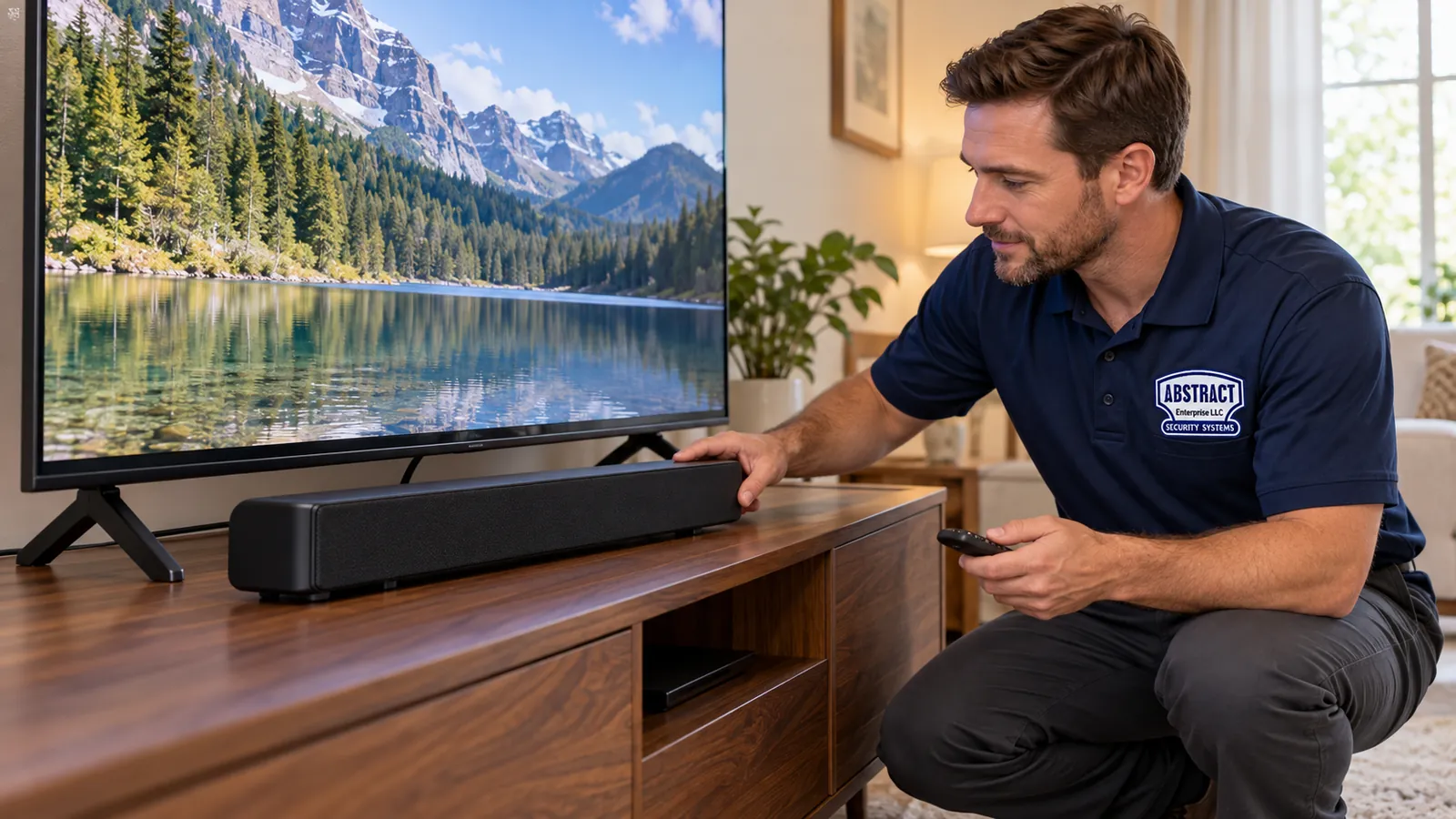
Crouched at a wooden media console, a technician positions a soundbar in front of a TV on its feet, holding the remote in his other hand.
Dutchess County Soundbar Quote
Town, house type and soundbar model — a written price comes back the same business day
✅
Request Sent!
A Dutchess County installer will call you back the same business day.
25+
Years Experience
✓
Same-Day Estimates
100%
Licensed & Insured
4.7★
201 Google Reviews
New soundbar still in its box in Fishkill, Hyde Park or Red Hook? Ring the Dutchess line on (845) 640-3835 or use the 60-second form. A licensed installer reads every request, and the reply is a written figure built line by line from the price menu further down this page — not a range, and not a guess.
We ask what the TV wall is covered in — paneling, plaster, drywall, brick — before booking, so the right fixings come in the van
No mileage line for the drive up the Taconic or out Route 44; the county price is the price
NYS licence #12000287431 · 2-hour arrival windows, 8 AM–8 PM, every day of the week
Why Dutchess County Homes Need Soundbar Installation
Dutchess County's houses were built in three bursts, and the burst your house came from decides most of what happens on a soundbar visit. The oldest layer sits along the river: the brick and frame streets of the City of Poughkeepsie, the old mill town that became Beacon, the village centers of Rhinebeck, Fishkill and Wappingers Falls. The middle layer arrived with IBM. The Wappingers Historical Society describes how, with the population boom of the 1950s and 1960s, Wappinger took in a new wave of settlers, most of them employed by IBM in Poughkeepsie and East Fishkill, and how much of the town's farmland became suburban neighborhoods. The newest layer is the apartment buildings that have gone up around Beacon's Main Street and Fishkill Creek and on infill sites in Poughkeepsie.
Each of those layers puts something different behind the television. In a river-town Victorian it is usually plaster over wood lath, a deep baseboard, a picture rail and a chair rail, and a wall that is rarely flat across the width of a long soundbar. In an IBM-era raised ranch or split-level it is very often wood paneling in the lower-level family room, a soffit boxing in the ductwork along one wall, and a TV wall that happens to be an outside wall full of insulation. In a new Beacon apartment it is drywall on studs, a lease, and a management office that wants to know who is drilling. None of these walls is difficult. They are just different, and a fixing that suits one of them is the wrong fixing for the next.
That matters more than it first appears, because a soundbar is unusually unforgiving of a poor mount. It is long and narrow, so a quarter-inch of droop at one end shows against the straight bottom edge of the TV. It sits low enough to be knocked by a vacuum, a dog's tail or a toddler. It is often pulled on by its own cables when someone moves the cable box. And the bracket that comes in the box usually ships with a handful of plastic plugs meant for plain drywall over studs, which is precisely what a lot of Dutchess living rooms do not have.
Then there is the room itself. The IBM-boom houses were designed around a family room, often half a level down, often with a low ceiling and a long wall of built-in shelving. The Victorians have tall ceilings and hard plaster that make dialogue sound bright and echoey. Many Beacon and Poughkeepsie apartments are open-plan, with the TV wall shared by the kitchen. A soundbar placed by guesswork in any of those rooms ends up either too quiet to follow a conversation or loud enough to fill the house.
The last thing that makes Dutchess different is distance. The county runs from the Putnam line below Beacon to Columbia County above Red Hook and Pine Plains, and from the Hudson across to Connecticut at Pawling and Amenia. We publish one Dutchess County price and send the same crew to Millerton as to the City of Poughkeepsie, booked into the same 2-hour windows.
Dutchess County figures behind a soundbar job
300,708 residents and 124,843 housing units: the U.S. Census Bureau's QuickFacts estimates for July 1, 2025, with 2.40 persons per household (2020–2024). Spread across a county that size, the typical TV wall belongs to a house rather than an apartment block.
69.2 percent owner-occupied: the county's owner-occupied housing rate for 2020–2024 (QuickFacts). Most callers can say yes to in-wall wiring on the spot; the renters among them, mostly in Poughkeepsie and Beacon, need a landlord's OK first.
Median year built 1971: Stacker's September 2025 analysis of Census Bureau data puts the median Dutchess home in 1971, with 18.0 percent (about 22,056 homes) built in 1939 or earlier. Paneling, plaster and pre-war wiring are everyday finds, not exceptions.
30,700 to 13,800: the Los Angeles Times reported in September 1993 that IBM's local head count, after peaking at 30,700 in 1985, had fallen to 13,800. The subdivisions built for that workforce in Wappinger, LaGrange, East Fishkill, Hyde Park and the Town of Poughkeepsie are now sixty years old and on their second or third owners.
Nearly 800 new homes in Beacon since 2012: The Highlands Current reported in May 2023 that nearly 800 apartments and other housing units had been built in Beacon since 2012, with more than 300 then still under construction at Edgewater and 248 Tioronda Ave.
21.1 percent aged 65 and over: QuickFacts again. Clear dialogue, one simple remote and a bar that turns on with the TV matter as much here as Dolby Atmos does.
Median owner-occupied home value $400,600: QuickFacts, 2020–2024. Owners investing in a house at that price usually want the wiring out of sight and the plaster or paneling left undamaged.
Together those figures sketch the usual Dutchess call: an owner, a house half a century old or more, and a room its builder never planned around a flat screen.
A new soundbar in Dutchess often arrives in the same delivery as a new TV, and planning both together means one height plan and one set of holes. Our TV installation crew for Dutchess County works from the same menu, and when a bar is not enough — a wired surround system, a receiver, ceiling speakers in a finished basement — the AV and sound installation team in Dutchess County designs the full system.
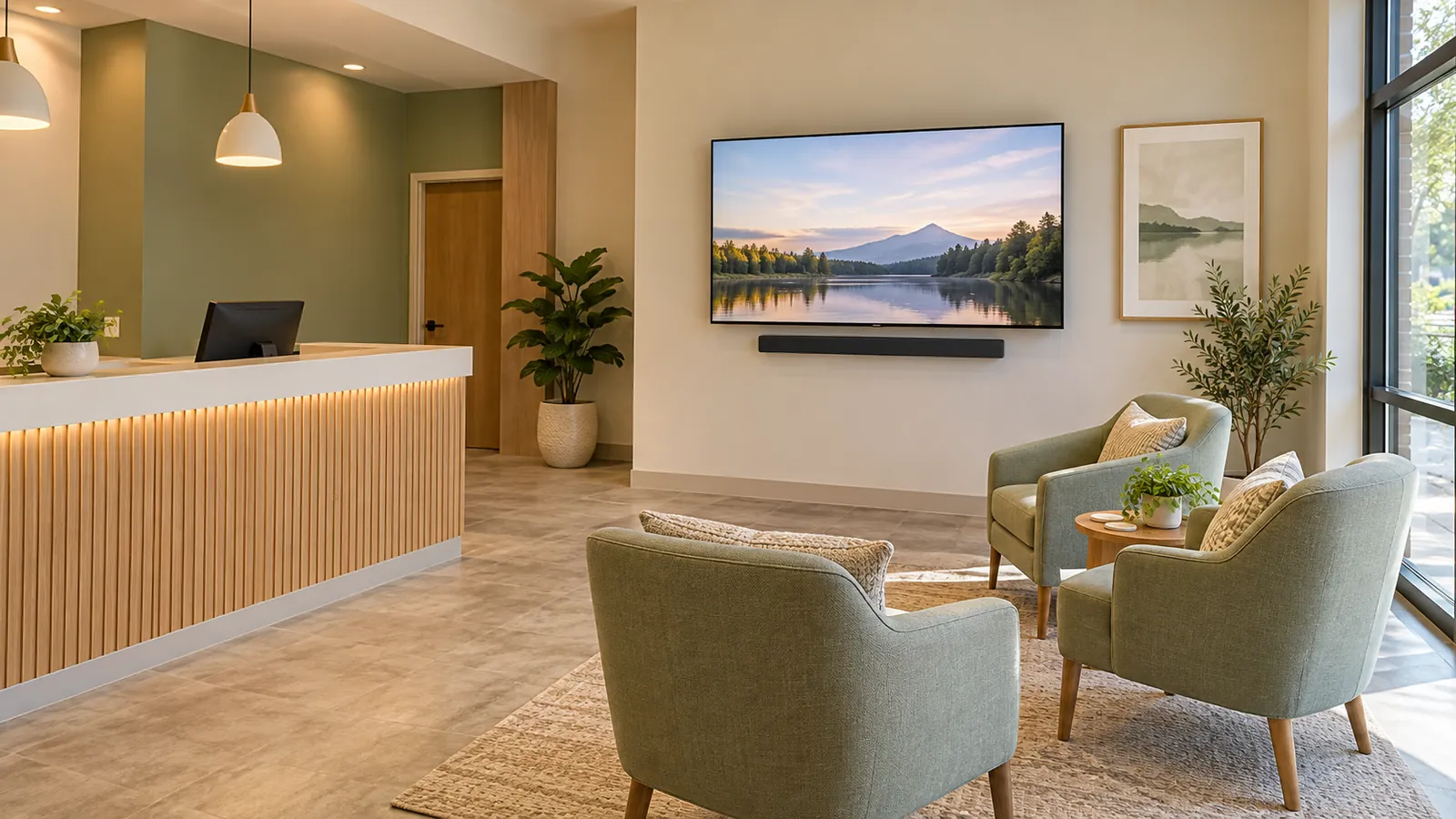
Lobby setup: one wall TV, one slim bar tight beneath it, and seating arranged so the sound reaches the chairs rather than the desk.
Repair Capture
Soundbar Silent in Dutchess County
When the power comes back after a Central Hudson outage and the sub no longer pairs, when a TV update leaves the bar mute, when the TV remote has stopped reaching the volume, when speech trails the picture, or when a bracket has started to lift away from the paneling, we treat it as a repair visit rather than a new install. We book them into the next open 2-hour window, and most connection and settings faults are fixed within one to two hours of the technician arriving. Call the Dutchess line on (845) 640-3835 and say it is a soundbar repair; our TV and soundbar service policies explain how setup-only time is billed.
What We Install
Soundbar Installation Services in Dutchess County
Pick from the list below; most Dutchess bookings use three or four of these, each carrying its own menu price. The order follows the decisions a household usually makes: position first, then the fixing, then the cable finish, then the setup.
Wall Mount Under the TV
The bar on its own bracket a few inches beneath the screen, centered and level, fixed into whatever the wall really is: wood studs behind paneling, lath behind plaster, steel studs in a newer apartment, or masonry in a basement.
TV and Bar on One Visit
When the TV is going up too, we set its height and the bar's height together, plan a single cable route and drill once. This is how most raised-ranch family rooms and new Beacon apartments are done.
Bar on the Console or Shelf
The soundbar placed on the media cabinet, a floating shelf or the TV stand, connected and tuned, sited so it does not block the TV's remote sensor. The answer for renters, dorm-age households and anyone who would rather not drill.
Bar Hung From the TV Mount
No new wall holes: the bar is carried on the TV's own mount or its rear fixing points, and it travels with the screen whenever a full-motion arm is pulled out.
Paintable Cord Cover
A slim channel from the bar down to the outlet or the cabinet, painted to match. The usual finish where the wall cannot be opened, and where trim, paneling grooves or an outside wall make in-wall routing a poor idea.
In-Wall Concealment
A recessed outlet behind the screen, fed from the outlet below through a code-compliant kit, with HDMI alongside it in the same empty stud bay. Nothing shows between TV and bar; it suits owners with drywall-on-stud rooms.
Cable Run to a Cabinet
A longer run, up to 25 feet, to the cabinet or closet where the cable box, game console or receiver lives — common in split-levels where the equipment sits on a different wall from the TV.
eARC, CEC and Lip-Sync Setup
We find the TV's eARC or ARC socket, run HDMI from it, enable CEC so the TV remote also wakes and adjusts the bar, match speech to lips, install firmware, and make the bar the TV's default output.
Subwoofer and Rear Speakers
Pairing a wireless sub and rears, placing them where there is power, and setting levels for the room: a low basement family room needs very different settings from a two-storey Victorian parlor.
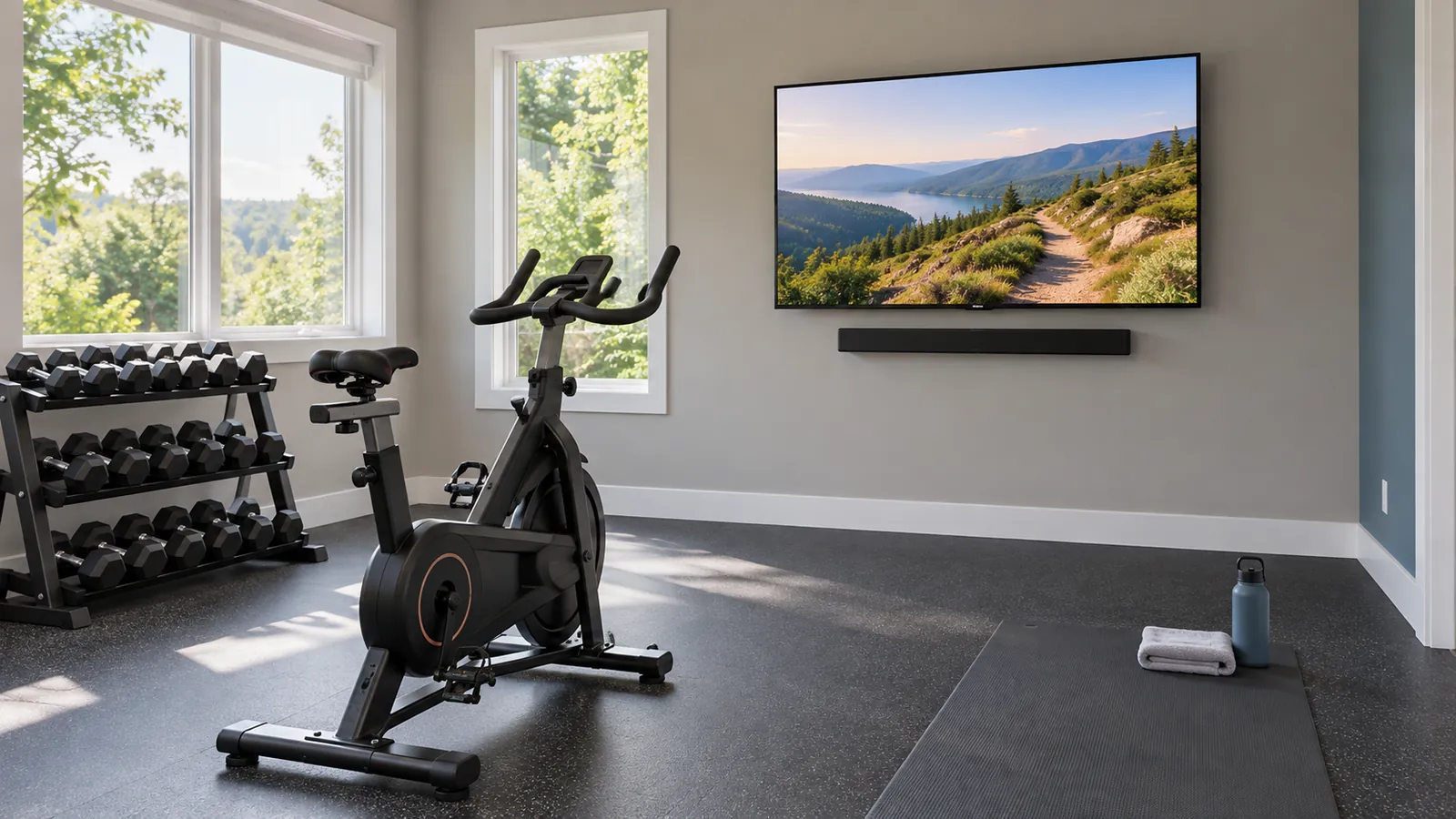
A home gym with a spin bike, a dumbbell rack and a mat, facing a wall-mounted TV with a soundbar fixed to the wall beneath it.
Building Specialists
Soundbar Installation for Dutchess County's Architecture
These are the house and building types our installers meet most often between Beacon and the Columbia County line, and what each tends to ask of a soundbar job. They are generalizations from the work, not a survey; your own house will tell us the rest when we see a photo.
IBM-Era Raised Ranches
Split-entry houses from the 1960s and 1970s in Wappinger, LaGrange, East Fishkill, Hyde Park and the Town of Poughkeepsie. The upstairs living room is usually drywall; the lower-level family room, where the big TV tends to live, is often finished in wood paneling with a soffit along one wall.
Split-Levels and Colonials
Three- and four-level splits and center-hall colonials from the same decades. The TV wall is frequently an outside wall, the cable box often sits in a cabinet on another wall, and outlets were placed for table lamps rather than for a TV, a soundbar and a subwoofer.
River-Town Victorians
Houses on Poughkeepsie's South Side and around its Academy Street and Union Street historic districts, and older streets in Beacon and Wappingers Falls. Plaster on lath, tall ceilings, deep baseboards, chair rails and walls that bow; renters as often as owners.
Village Houses and Country Places
Older houses and farmhouses around Rhinebeck, Red Hook, Millbrook, Pine Plains and Amenia, plus second homes and permitted short-term rentals. Walls range from plaster to modern drywall in an addition, and the owner may be in the city on the day we visit.
New Apartment Buildings
Newer rental and condo buildings around Beacon's Main Street and Fishkill Creek and in Poughkeepsie. Drywall on wood or light-gauge steel studs, sound-rated walls between units, and a lease or house rules that say who must approve wall fixings.
Manufactured Homes
Single- and double-section homes in the county's mobile home parks, which the Dutchess County Department of Behavioral & Community Health regulates under the county sanitary code. Thin interior panels, studs that may be spaced wider than a site-built house, and park rules on alterations.
Campus-Area Rentals
Houses and apartments let to students and staff around Vassar in Arlington, around Marist on the North Road side of Poughkeepsie, and near Bard in Annandale-on-Hudson. Short tenancies, shared living rooms and landlords who care a great deal about holes.
Fixings and methods, wall by wall
Wood paneling over studs. The tongue-and-groove or sheet paneling in a 1960s or 1970s family room is usually nailed to wood studs, sometimes over a layer of drywall, sometimes straight onto the framing or onto furring strips over a block foundation wall. The paneling itself will not hold a screw for long. We find the framing behind it, put the bracket screws into wood, and line the bracket up with the paneling's vertical grooves so the screw heads are hidden. If the wall turns out to be furring over concrete block, the fixing becomes a masonry anchor through the strip into the block.
Plaster on wood lath. Common in Poughkeepsie and Beacon houses built before the war. A soundbar is light compared with a TV, but it is knocked and pulled more than a TV is, so we do not trust a screw in lath alone. Where the bracket lines up with a stud, we use the stud; where it does not, a toggle sized for the bracket goes through the plaster so the load spreads behind it. We drill slowly, without hammer action, and tape the surface first to limit chipping. Old plaster can still crack, and you hear that from us before the first hole.
Drywall on wood studs. The upstairs living room of most raised ranches, every newer addition and most recent apartments. Lag screws into two studs where the bracket allows; rated hollow-wall anchors where the bar's position falls between studs. This is also the only wall where in-wall concealment is straightforward, as long as the cavity has no fire blocking or insulation in the way.
Light-gauge steel studs. Found in some newer apartment buildings and commercial fit-outs along Route 9. Wood screws spin out of steel, so we use fasteners made for metal studs, or toggles through the board between studs, and we check the wall for a sound-rated assembly before going near it.
Outside walls with insulation. In many split-levels and colonials the TV ends up on the exterior wall because that is where the windows are not. Bracket fixing is no different from any other stud wall. Cabling is: the cavity is packed with insulation and may carry a vapor barrier on the warm side, so we usually avoid in-wall routing there and use a painted channel or a run along the base to an interior wall instead.
Concrete block and stone in lower levels. Where a raised-ranch family room has a bare block wall, or an older house has a fieldstone or brick basement, the bracket goes into masonry with a hammer drill and masonry anchors set in the block or stone rather than the mortar joint. There is no cavity to hide cable in, so the finish is a painted surface channel.
Manufactured-home panels. Interior walls in many manufactured homes are thin finished panels on studs that can be spaced farther apart than in a site-built house. We locate the studs before planning the bar's position, keep the bracket's screws in framing, and keep the bar light; a long flagship soundbar is not the right choice for a thin panel wall.
Identifying the wall behind a Dutchess TV
Wall
Knock
Pilot hole shows
Fixing
Cable finish
Menu line
Paneling on studs
Hollow between studs
Wood shavings
Screws into studs
Channel or cabinet run
$0
Paneling on furring over block
Dull everywhere
Thin wood, then grey grit
Masonry anchor through strip
Channel
+$75
Plaster on lath
Solid, slightly ringing
White powder, then wood
Stud or toggle
Channel; in-wall if bay is clear
+$45
Drywall on wood studs
Hollow, springy
Paper and gypsum
Lag screws or rated anchors
In-wall kit possible
$0
Drywall on steel studs
Hollow, metallic at studs
Gypsum, then steel
Metal-stud fasteners or toggles
In-wall if not rated assembly
+$30
Fieldstone or brick
Dead solid
Red or grey grit
Masonry anchors
Channel
+$65
Manufactured-home panel
Thin, flexes
Thin board, often a void
Studs, backer or TV-attached
Channel
$0 or backer $85
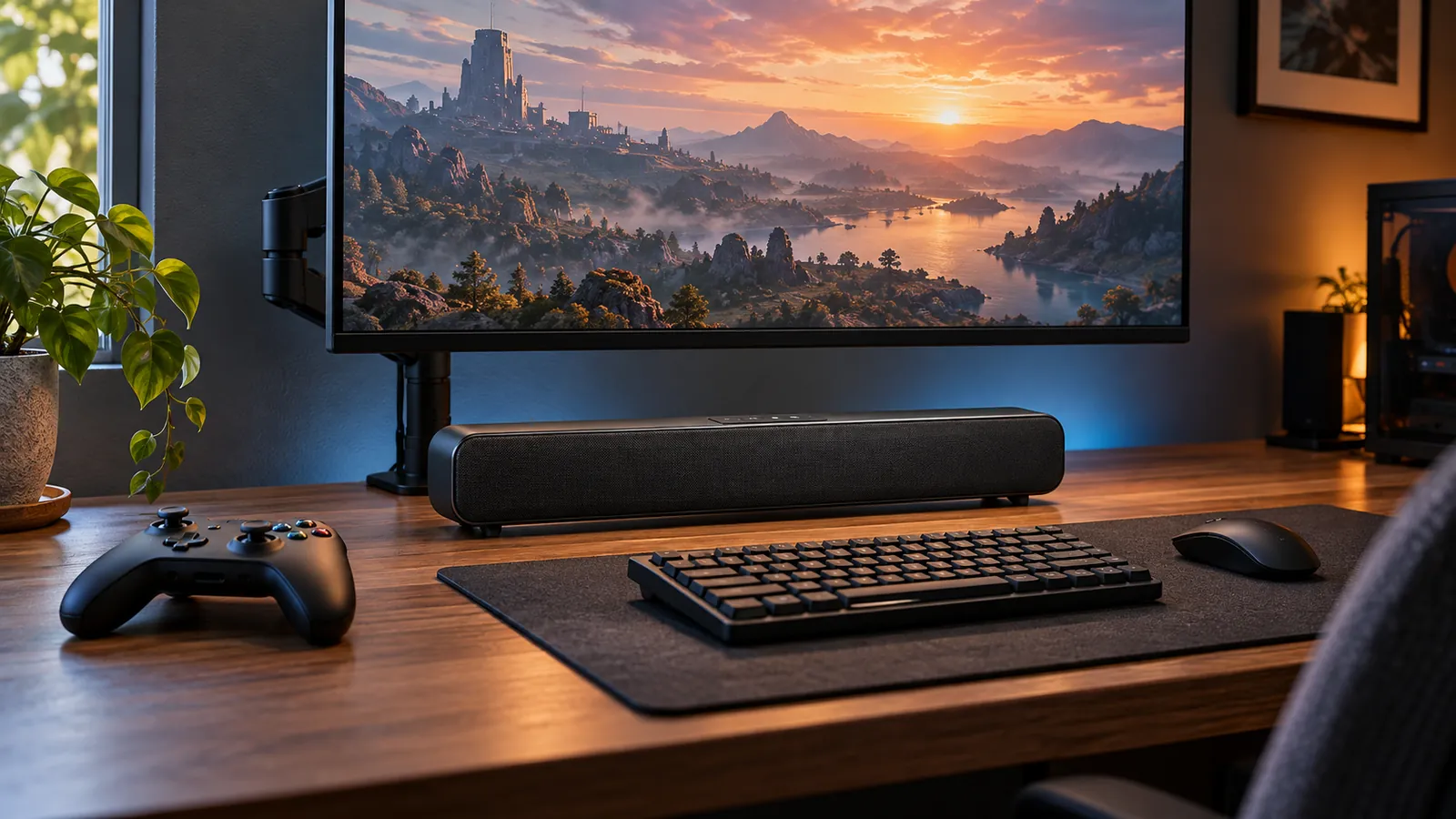
Desk-scale audio: a short bar under an arm-mounted monitor, a smaller job than a living-room wall but planned the same way around cables and power.
Businesses in Dutchess use soundbars where a TV has to be understood but a full audio system would be overkill: a bar's game-night screen, a waiting room, a hotel breakfast area, a gallery's video piece, a parish hall. These are the corridors where we do most of that work, and what the bar has to do in each.
Route 9 from Poughkeepsie to Fishkill
A trade publication describes Route 9 as the primary commercial and retail spine of the mid-Hudson region, and around the I-84 interchange in Fishkill it is lined with plazas and national hotel chains. Further north, the Poughkeepsie Galleria has anchored the corridor since it opened in August 1987. Restaurants, gyms and hotel lobbies run screens all day.
Main Street, Beacon
Galleries, restaurants, cafes and shops between the Metro-North end of town and the foot of Mount Beacon. Spaces are often narrow and tall, with exposed brick, and owners want the sound present but the speaker invisible.
Raymond Avenue, Arlington
The business strip across from Vassar's gates, which Vassar's own visitor page lists as a dining district, with restaurants and bars at addresses from 8 to 60 Raymond Avenue. Screens for games and events, and a student crowd that will find any loose remote.
Downtown Poughkeepsie
Market Street and Main Street around the Bardavon, the county offices and the waterfront. Offices, bars and restaurants in older buildings where the wall behind a TV can be anything from brick to steel stud.
Rhinebeck Village
Inns, restaurants and shops around the crossroads of Route 9 and Market Street, including the Beekman Arms, which says it has operated continuously since 1766. Historic interiors, guest rooms and private dining rooms where a soundbar has to blend in.
Medical and Professional Offices
Practices around Vassar Brothers Medical Center in Poughkeepsie and along Route 9 and Route 52 in Fishkill. Wall TVs with captions running and the sound low, mounted where people do not walk into them, with every cable out of sight for a clean finish.
Compliance notes for Dutchess County businesses
Licensing works differently here than in the counties to the south. Westchester requires home improvement contractors to hold a county licence, and Rockland requires a Home Improvement License under Chapter 286 of its county law. In Dutchess, the guidance the county's Office for the Aging circulated in May 2026, quoting the New York Department of State, is that New York State does not license home improvement contractors and that residents should check with their town, city or village. AESS works under NYS low-voltage licence #12000287431 and carries insurance either way.
Bars that jut into a hallway. A soundbar on a wall people walk past is a protruding object under §307.2 of the 2010 ADA Standards: anything whose leading edge sits between 27 and 80 inches off the floor may project no more than 4 inches into the route. A bar plus its bracket usually exceeds that, so in a Poughkeepsie waiting room or a narrow Beacon storefront we raise it above 80 inches, recess it, or move it to a wall nobody passes.
Outlets are electricians' work. Running a soundbar's low-voltage cable is our trade; adding or moving a power outlet is not. If the only outlet is across the room, the options are a longer surface channel or a licensed electrician first.
Insurance certificates for landlords. Commercial leases along Route 9 and in Beacon commonly require contractors to be insured with the owner named. Give us the names and a certificate of insurance goes out at no charge.
The right jacket inside walls and ceilings. Any HDMI or speaker lead we bury in a wall needs an in-wall rating, and one crossing an air-handling ceiling needs a plenum rating. The patch lead packed in the soundbar carton has neither, so it stays outside the wall, between bar and TV.
Short-term rental permits are the owner's paperwork. In the Town of Rhinebeck, Local Law 2 of 2025 requires a permit for any rental of 30 consecutive days or fewer and a named contact who answers the code office within 24 hours. Nothing about a soundbar affects that permit, but owners of permitted rentals often want installs and repairs timed around guest stays, and we schedule accordingly.
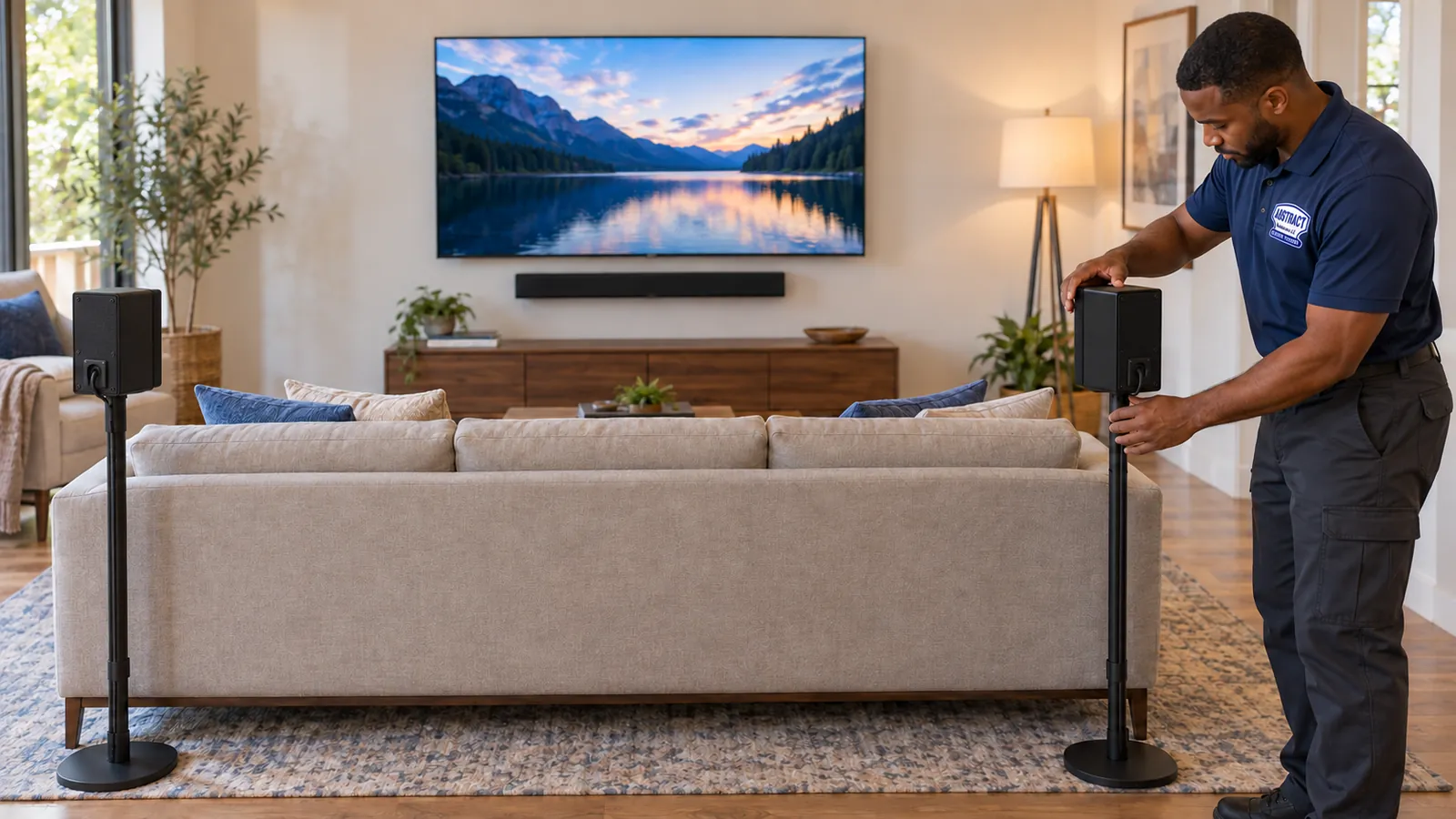
A technician adjusts one of two rear speakers on floor stands behind the sofa, with the wall-mounted TV and soundbar across the room.
Business owners who call us about a TV and bar frequently mention a camera that drops offline or a sluggish office network in the same breath.AESS low-voltage installation in Dutchess County takes those on in the same visit, under the same state licence.
Your Questions Answered
Soundbar Installation in Dutchess County: Questions Answered
These are the questions Dutchess callers put to us before they book, grouped by the kind of home they come from: the houses built in the IBM years, the older river-town houses, the households built around a campus or a rental, and the homes and businesses that do not fit any template. Prices, add-ons and practical odds and ends are in the FAQ further down. Nothing here is legal advice; where a lease, park rule or permit is involved, the document itself has the final word.
Houses from the IBM years
The lower level of our Wappingers raised ranch is finished in 1970s wood paneling — can the soundbar bracket go straight onto it?
Onto it, yes; into it, no. Paneling from that era is a thin decorative skin, and a screw driven only into the paneling will hold for a while and then work loose as the bar gets bumped. What matters is what the paneling is fastened to. In most raised-ranch lower levels it is nailed to wood studs or to furring strips, and the bracket screws go through the paneling into that framing. We find it with a scanner and a fine pilot hole hidden behind where the bracket will sit, and we line the bracket up with the paneling's vertical grooves so the screw heads disappear into the shadow line.
The thing to watch for is the outside wall of a lower level. In many split-entry houses the family room's back wall is the concrete-block foundation, with furring strips fixed to the block and the paneling nailed to the strips. A strip is too shallow for a lag screw, so on that wall the fixing is a masonry anchor through the strip into the block itself, which is priced on our menu as a concrete-block wall. The front face of the paneling looks identical either way, which is why we test before we decide.
Paneling is also easy to scar and hard to patch invisibly, so we drill through painter's tape, size holes to the fixing and avoid trial-and-error holes. If you are planning to paint or remove the paneling in the next year or two, tell us; it may make sense to wait or to hang the bar from the TV mount instead, so nothing new goes into the wall you are about to change.
A ductwork soffit runs along the top of our LaGrange basement's TV wall — how do the TV and soundbar fit under it?
By measuring from the bottom of the soffit down, not from the floor up. Finished lower levels often have a boxed-in duct or beam along one wall, and if the TV is centered on the wall as though the soffit were not there, the screen ends up uncomfortably high or hard against the box. We start with the seated eye height at the couch, set the TV so its center is close to that, and then check there is still clearance above the screen for the mount's lift-off and below it for the bar and its spacing from the TV.
The soundbar is the part that usually decides it. Sonos's own guide for the Arc Ultra, for example, asks for at least 4 inches between bar and TV and about a foot of clear space at each end. In a low room that pushes the bar quite close to the console or the floor, which is fine acoustically — a bar near ear height when you are seated sounds best — as long as nobody's knees or the vacuum cleaner will hit it. If the numbers do not work, a TV-attached bracket lets the bar sit tight under the screen and saves an inch or two.
Do not fix anything into the soffit itself. It is usually light framing and drywall around a duct, and a screw that finds the duct will leak air or rattle. If the room really needs a center channel or speakers higher up, that becomes a different conversation about in-ceiling speakers in the rest of the ceiling.
The last owner left speaker wire poking out of our East Fishkill family-room wall — is any of it useful to a soundbar?
Possibly, but not in the way most people hope. A soundbar does not take speaker wire: it gets its audio over HDMI or an optical lead from the TV, and its wireless subwoofer and rear speakers each need a power outlet, not a wire from the bar. So old speaker wire cannot be plugged into the soundbar itself, and it does not save you running anything.
Where it can still earn its keep is if you decide that a bar is not enough. Wire left by a previous owner usually means someone once ran a receiver with surround speakers, and if those runs are intact they can feed a receiver-based system again — the setup our A/V receiver line on the price menu covers. Before relying on it we trace where each end goes and test it, because wire that has sat in a wall for decades is often cut, stapled through or connected to nothing at the far end.
The other useful find is an abandoned low-voltage cable that can be used as a pull string to get a new HDMI or data cable through the same path. If the old wire is unused and in the way, we can tuck it back into the wall behind a blank plate so the TV wall looks finished; we do not pull it out of closed walls.
Will the paneling in our Hyde Park family room buzz when the soundbar and subwoofer play loud?
It can, and it is one of the more common complaints we hear from paneled rooms. Thin sheet paneling nailed to studs or furring is a large, light panel, and at certain bass notes it vibrates like a drum skin; loose nails, a gap behind the sheet or a bracket screwed only into the paneling make it worse. You hear it as a buzz or rattle that comes and goes with particular scenes rather than as a fault in the bar itself.
The fixes start at the bracket. Screws go through the paneling into framing, so the bar is held by the stud rather than by the panel, and thin felt or rubber pads between bar and bracket stop the bar itself chattering against the wall. The subwoofer comes out of the corner and away from the paneled wall, and its level is set from the couch. Some bars help too: B&H's listing for the Sonos Arc Ultra wall mount notes that the bar detects when it is wall-mounted and adjusts its EQ for that position.
If one sheet still buzzes, it is usually a loose panel, and a few finish nails into the stud behind it settle it — something the homeowner or a carpenter can do, since panel repair is not on our menu.
Before we leave: the person who will use the system holds the remote and runs the inputs and volume while the technician explains each button.
Older river-town houses
Our Poughkeepsie apartment still has its picture rail — could the soundbar hang from it on hooks instead of going into the plaster?
We don't recommend it, even though it is a natural thought in a rental where drilling plaster is discouraged. Picture-rail hooks and cords were made to let a framed picture hang flat against the wall by its own weight. A soundbar is different: it has to sit tight and level a few inches under the TV, it has cables pulling on it from the back, and it gets nudged every time someone dusts or reaches for the TV. On cords or hooks it swings, tilts forward, and puts its whole weight on a narrow wooden molding that may be a century old and held up by nails into lath.
The rail also sits far too high. In most Victorian rooms it runs a foot or more below a ten- or eleven-foot ceiling, so a bar hung from it would be several feet above the screen and well over the heads of anyone sitting down, which is exactly where a soundbar sounds worst. Dialogue is clearest when the bar sits close under the picture at roughly seated ear height.
The no-drill options that do work in a plaster-walled rental are a TV-attached bracket that hangs the bar from a TV mount the landlord has already approved, or the bar on the console or a sturdy shelf under a TV on a stand. If the landlord will allow a few holes, a bracket fixed into the studs or with toggles through the plaster is a small, patchable repair at the end of the lease, and we describe it in writing so you can ask.
Our gallery on Main Street in Beacon wants sound for a video piece but no visible speaker — can a soundbar be hidden?
It can be made very discreet, but a soundbar cannot be sealed away completely without losing what it is for. Its drivers fire forward and, on some models, sideways and upward, so it needs an open path toward the audience. The usual gallery approaches are to mount it directly under the screen with a finish that matches the wall, to recess it into a shallow niche or plinth with an acoustically open front, or to put it on a low pedestal in front of the projection wall where it reads as part of the installation.
The other things a gallery needs are reliability and lock-down. We set the bar to come on with the display, fix the volume at a level the artist approves, and hide or disable the remote so visitors cannot change it. For a looping piece, the playback device and display schedule matter as much as the bar, and we can set those up as part of the same visit.
Where the piece needs sound that follows the image across a large room, or where nothing at all may show, a pair of small wall or ceiling speakers driven by a compact amplifier is often the better tool, and we will say so rather than force a bar into the job.
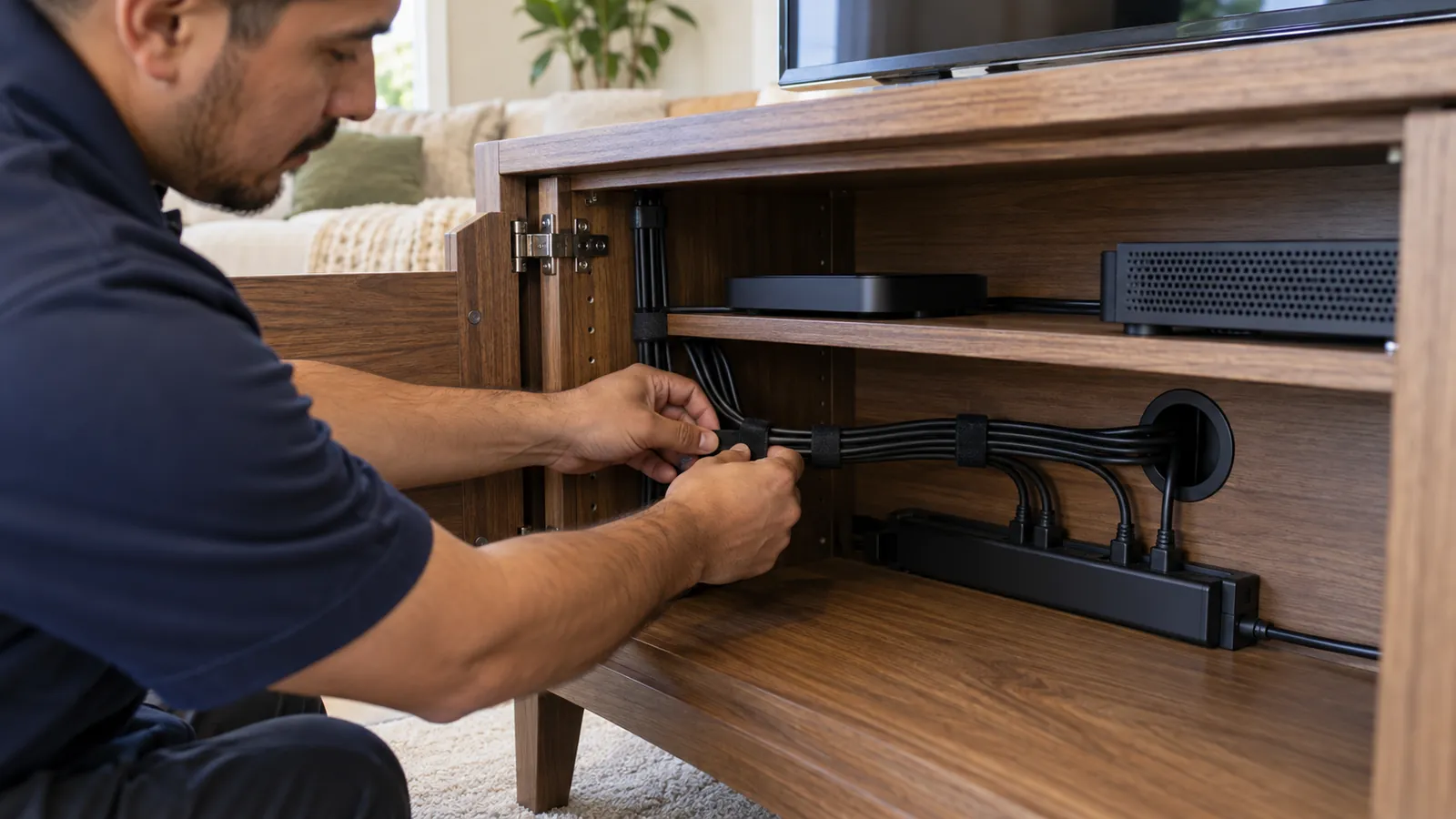
Inside a wooden media cabinet, a technician bundles black cables with hook-and-loop straps and routes them through a grommet to a power strip.
Campus, rental and country households
Can a soundbar be wall-mounted in a Vassar or Marist dorm room?
Not on the college's walls. Vassar's Office of Residential Life says that tape, hooks, putty, nails, small tacks, push pins and glue are not to be used for hanging decorations, because they severely damage walls and may mean repainting the whole room at the student's expense. Marist publishes its own housing rules and FAQs, which students should check. A screwed-on soundbar bracket is plainly outside rules like Vassar's, so we do not mount soundbars on residence-hall walls at any college.
What works instead is a small bar placed on the desk or dresser under the TV, connected to the TV's HDMI ARC or optical socket, with the volume set for a shared hall. Compact bars suit dorm rooms far better than flagship models with separate subwoofers, which are the part neighbors complain about. Students can set that up themselves; no visit needed.
Off-campus houses and apartments around Arlington and North Road are different: there the landlord decides. With the landlord's written permission we mount bars in student rentals, and when permission is not given we place and connect the bar on furniture instead.
Our bedroom TV rises out of a lift cabinet at the foot of the bed in our Millbrook house — where does the soundbar go?
Not on the TV. A lift cabinet raises and lowers the screen through a slot in the top, and anything attached to the TV has to pass through that slot and clear the mechanism every time. A TV-attached bracket that is fine on a wall mount can jam a lift or scrape the opening, so we do not hang the bar from a TV on a lift.
The bar works best fixed to the cabinet itself. The usual options are on the cabinet top in front of the lid opening, if the lid's travel leaves room, or inside the cabinet behind a fabric or slotted front panel facing the bed, so the sound has an open path to the listener. Compact bars suit both, and a bedroom rarely needs a separate subwoofer. Power and HDMI are run with a loose service loop so the cables follow the TV up and down without being pulled tight.
We set the TV to output to the bar every time it rises, switch on CEC so the lift-mounted TV's remote also controls the bar, and check volume at pillow height. Any cabinet carpentry, such as cutting a speaker opening, is for the cabinet maker; we place, connect and set up the bar.
Our place outside Rhinebeck is a permitted short-term rental — if the soundbar fails mid-stay, how fast can it be sorted before the next check-in?
Call or text as soon as the guest reports it, with the bar and TV model, and we book the next open 2-hour window, offering same-day where one is free. Many "no sound" reports from rentals are settings rather than faults: the TV has been switched back to its own speakers, an input has changed, or the bar is on Bluetooth to a guest's phone. Those can often be talked through with your on-site contact by phone before anyone drives out.
The Town of Rhinebeck's short-term rental law already requires owners to name a contact who answers the code office within 24 hours, so most permitted hosts have someone local. Having that person able to let a technician in during a turnover window is what makes a fast fix possible.
If the bar itself has died rather than a setting, the fastest route back to sound before the next arrival is usually to switch the TV to its own speakers for one stay, then reconnect a replacement or repaired bar as a setup-only visit. Keep the receipt and model number with your rental paperwork; manufacturer warranty claims move faster when the details are ready.
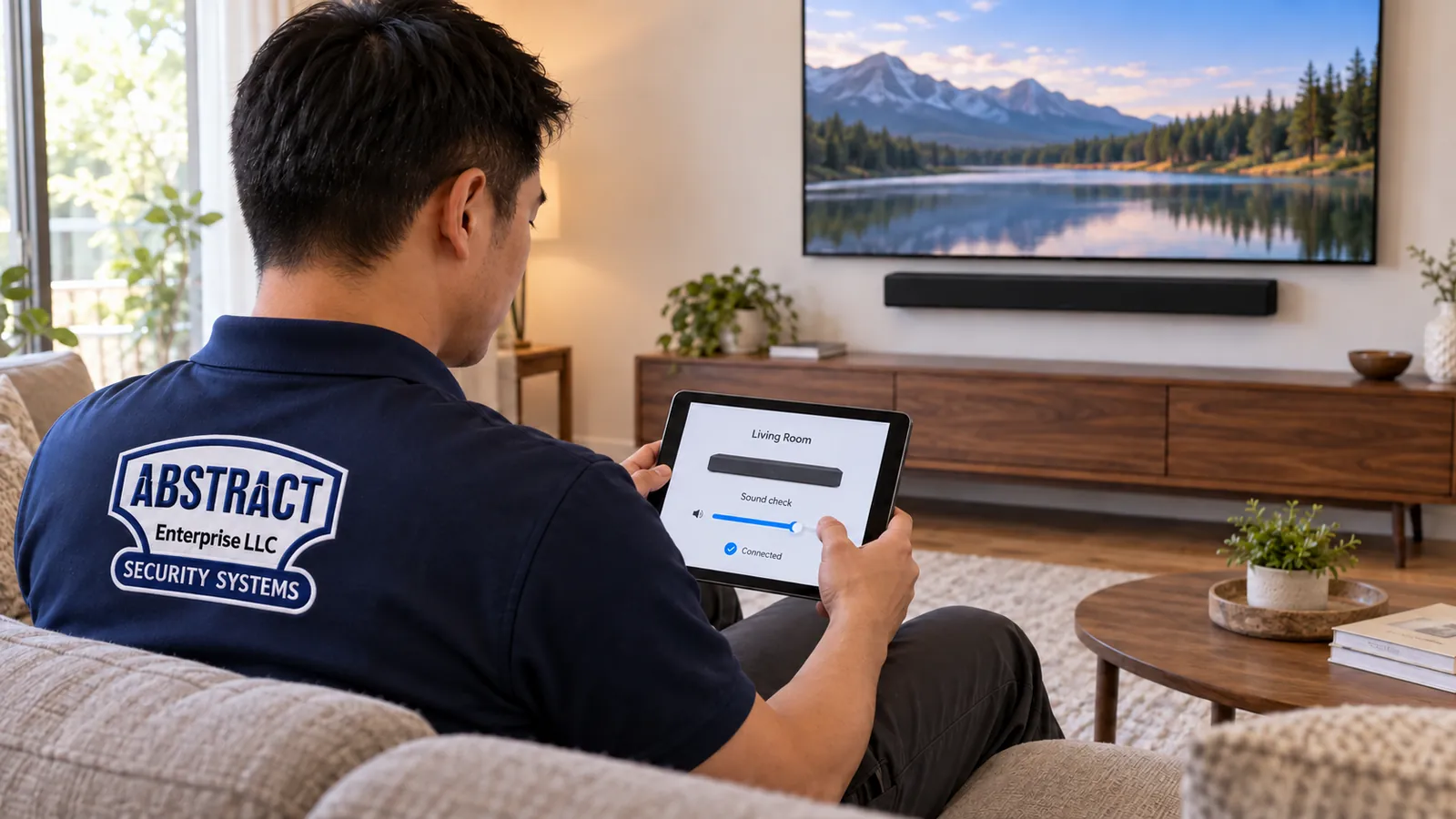
The check is done from the seat people actually use: tablet in hand, sound-check slider on screen, bar and TV on the wall ahead.
Homes that don't fit the usual template
Can a soundbar be mounted on the thin walls of a manufactured home in one of the county's parks?
Usually yes, provided the bracket goes into framing and the bar is a sensible size. Interior walls in manufactured homes are often thin finished panels, and the studs behind them can be spaced wider apart than in a site-built house — one thread on Reddit's manufactured-home forum asks how to mount a TV on a wall with studs spaced at 24 inches. A screw in the panel alone will not hold a soundbar that gets bumped, and hollow-wall anchors designed for half-inch drywall do not grip thin panels well.
So we locate the studs first and plan the bar's position around them. If two studs fall within the bracket's width, it goes straight into them. If not, a TV-attached bracket that hangs the bar from a TV already fixed to the framing is often the neatest answer, or a small horizontal backer fixed across two studs. Compact and mid-size bars are the right choice here; very long, heavy flagship bars put more leverage on a thin wall than it was built for.
Check your park's rules too. Some communities have rules about alterations, and if you rent the home rather than own it, the owner's permission comes first. We are happy to describe the fixing in writing for whoever needs to approve it.
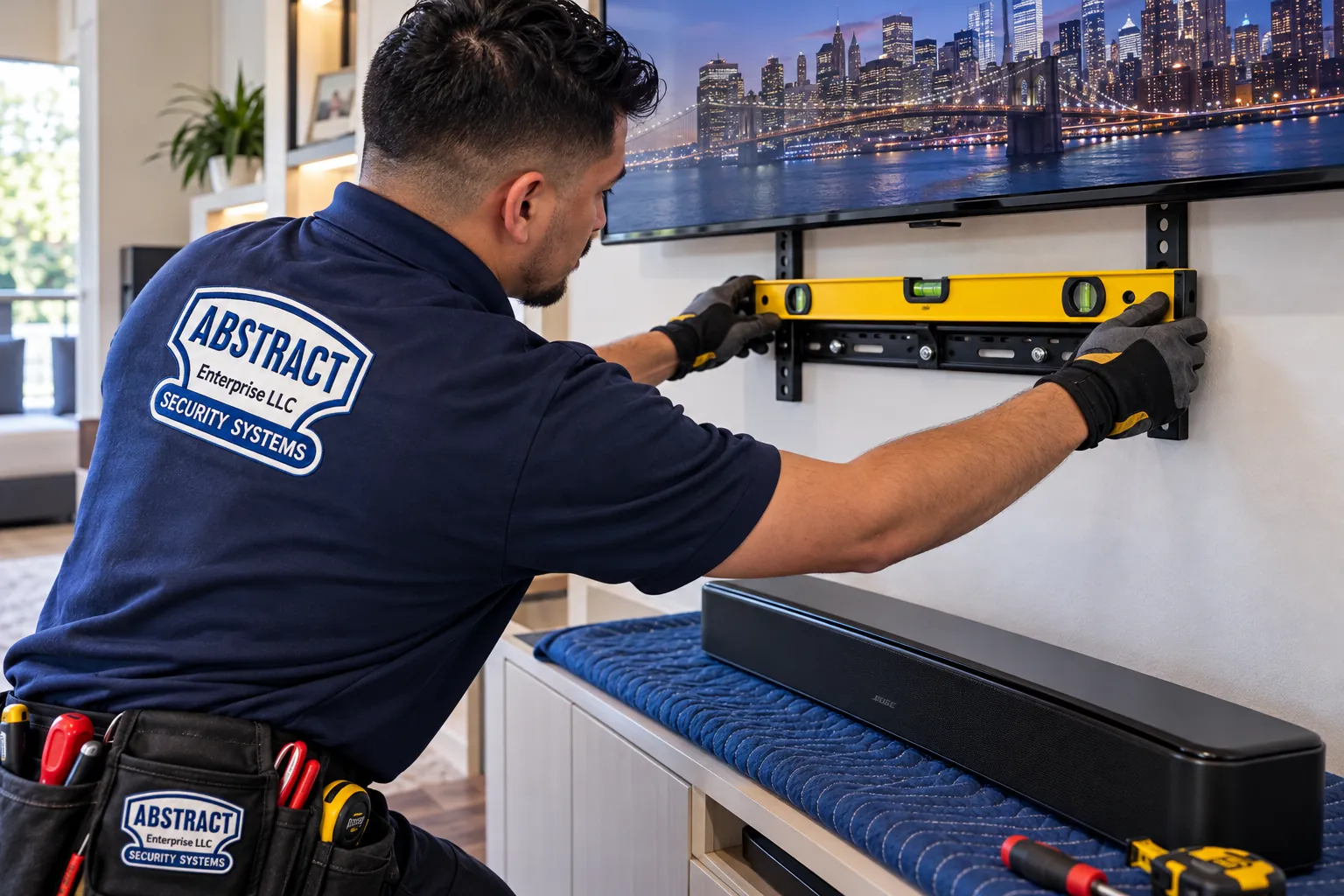
A gloved technician holds a yellow level across a black soundbar bracket fixed under the TV, while the bar waits on a blue moving blanket on the console.
Equipment
Types of Soundbars and Mounts We Install
We install the bar you have chosen, from any mainstream brand, and we will tell you honestly if it suits the wall and the room. These are the categories we fit most often in Dutchess homes and businesses, with the published specifications that affect how they mount.
Compact Bars
Short, light bars for bedrooms, dorm-age households, kitchens and small family rooms. Sonos's Ray, for instance, is about 56 cm wide and under 2 kg and connects by optical rather than HDMI. Easy on thin walls and paneling; limited bass without a sub.
Mid-Size HDMI Bars
The everyday choice under a 50- to 65-inch TV. Sonos lists the Beam (Gen 2) at 25.63 inches wide and 6.35 lb with HDMI eARC. Enough for clear dialogue in most raised-ranch family rooms and apartment living rooms.
Flagship Atmos Bars
Long bars with up-firing drivers. Sonos gives the Arc Ultra as 46.38 inches wide and 13.01 lb, and asks for 4 inches below the TV and about a foot clear at each end. Samsung's HW-Q990D bar is listed by Crutchfield at 48.56 inches and 17 lb. Best on solid walls with flat ceilings.
Bar, Sub and Rear Speaker Sets
Systems with a wireless subwoofer and wireless rears. "Wireless" means no signal cable; Crutchfield notes each Q990D rear must still plug into an AC outlet, and its subwoofer weighs 25.8 lb. Outlet positions decide where rears can go.
TV-Matched Bars
Bars designed to pair with the same brand's TV. Samsung, for example, describes Q-Symphony as playing sound from the soundbar and the TV's own speakers at the same time on supported models. We set these features up when your TV and bar both support them.
Wall Brackets
Universal and model-specific soundbar brackets. Sanus describes its universal SASB1 as holding most soundbars up to 20 lb with adjustable depth. We supply a Sanus soundbar bracket, or fit the one that came with your bar if it is rated for it.
TV-Attached Brackets
Clamps that carry the bar on the TV itself, so it moves when a full-motion arm swings and needs no wall holes. Sanus's WSSATM1 for the Sonos Arc fits most 50- to 90-inch sets, per Sanus; its WSSBM1 instructions say it mounts only below the screen.
Cable Concealment
Paintable surface channels for paneling, plaster, masonry and outside walls; code-compliant in-wall power and cable kits for clear interior stud bays; and longer HDMI runs to a cabinet up to 25 feet away.
Control and Sources
Universal remotes for households with a cable box, a streamer and a console; streaming device setup; A/V receivers when the system outgrows a bar; and Sonos setup and grouping for homes with speakers in several rooms.
Three ways Dutchess households get a bar on the wall
What matters in Dutchess
Big-box install menu
App-booked handyman
AESS
Price published before booking
Flat items, often split into setup and mounting
Varies by provider
Full Dutchess menu on this page, line by line
Wall types beyond drywall
Typically priced for standard walls
Depends on the individual
Paneling, plaster, block, stone and metal studs priced as separate lines
Licence
Retailer's own arrangements
Varies; Dutchess has no county licence
NYS low-voltage licence #12000287431, insured
Hiding or extending the cables
Sometimes offered
Varies
$99 run to a cabinet, $169 in-wall kit, $59 painted channel
TV, network and cameras on one visit
Separate services
Rarely
Same licensed team covers TV, cabling, Wi-Fi and security
A bar on a stand in a drywall apartment is a simple job for anyone careful; the differences show up on the walls Dutchess has plenty of.
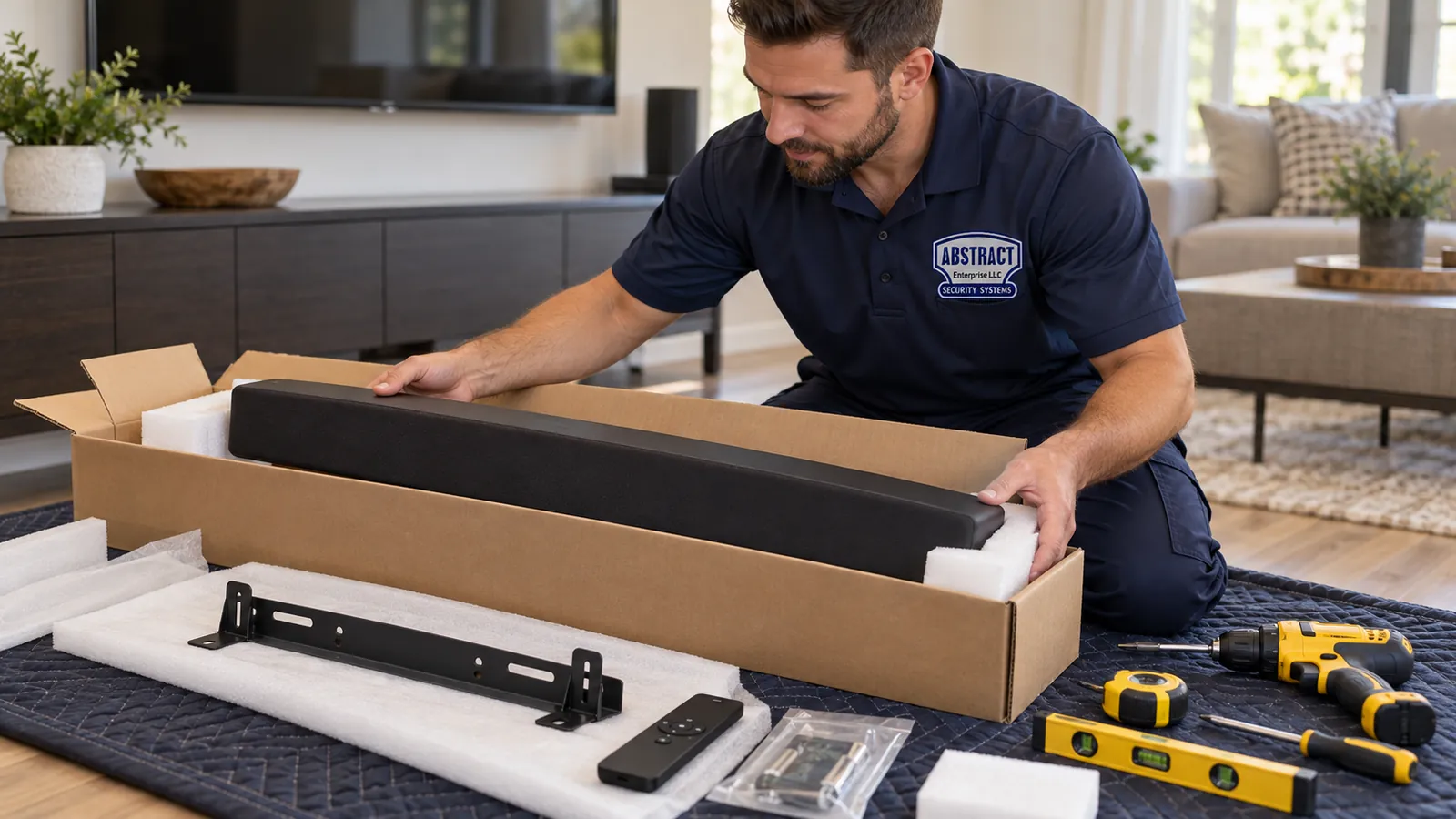
Everything out of the box and checked before drilling: bar, bracket, remote, the hardware bag and the drill, tape measure and level.
AI Overview Reality Check
What AI Gets Wrong About Soundbar Installation in Dutchess County
Source note: we were unable to load Google's AI Overview while researching Dutchess, so these seven headings come instead from published cost guides, booking sites and installer blogs. Those are the lines answer engines tend to echo; beneath each one is the Dutchess reality that the national version leaves out.
"The national average for TV mounting is $100 to $130"
That range appears on Thumbtack's own page listing TV wall-mount installers in Poughkeepsie, presented as a national average. A national average blends every market in the country, every wall type and every job size, so it says very little about any one Dutchess house. It also says nothing about the soundbar, which is a separate line almost everywhere.
Our Dutchess TV-mounting base is $254.99 for a 32- to 55-inch screen on a fixed or tilting bracket into wood studs behind drywall. The soundbar is then added on top: $129 to wall-mount it, $84.99 if you need our Sanus bracket. Those soundbar lines are the same in every county we serve; what changes across counties is the TV base and the hourly rate for setup-only visits.
The useful comparison is not with a national number but with a written quote for your own wall, that includes everything the job needs. That is what we send.
"A TV wall mount with wires hidden inside the wall is about $139"
The same Thumbtack page lists that as an example price. It assumes there is a clear hollow wall to hide the wires in, and in a large share of Dutchess living rooms there isn't. Paneling over furring on a block foundation wall, insulated exterior walls in split-levels and colonials, and plaster with fire blocking in older houses all make "inside the wall" either impractical or a poor idea.
Where the wall is a clear interior stud bay, our in-wall concealment is $169 with a code-compliant in-wall power and cable kit, which provides a proper recessed outlet behind the TV fed from your existing one rather than an extension cord pushed through the wall. Where the wall is not suitable, the finish is a $59 painted channel, and we tell you which before booking.
So the better question is not "what does hidden wiring cost?" but "can my particular wall take it?" A photo of the wall and the outlet answers that.
"Mount the soundbar 4 to 6 inches below the TV"
Installer blogs repeat this as a rule, and it is a reasonable starting point. Manufacturers are more specific to their own products: Sonos, for example, asks for at least 4 inches between the Arc Ultra and the TV and about a foot of clearance at each end, and Dolby advises placing the bar close to the screen at about seated ear level.
In a Dutchess room the real constraints are usually elsewhere. A soffit in a lower-level family room limits how high the TV can go, which squeezes the space below. A chair rail in a Victorian parlor may sit exactly where the bar wants to be. A built-in cabinet under the TV in a 1970s family room sets a hard floor.
So we treat 4 to 6 inches as the default and then adjust for the room, the bar's own manual and the people watching. The goal is a bar that sits close to the screen, clears every obstacle, and points at the ears of whoever uses the couch most.
"Installing a soundbar costs $58 to $231"
HomeWyse publishes a national estimate of roughly that range per soundbar. It is not a bad description of the labor in an easy job, and our $79 placed and $129 wall-mounted lines fall inside it. Where the range misleads is in what it leaves out.
It does not include a bracket if the bar did not come with one, the wall surcharge for plaster, block or stone, the cord cover or in-wall kit, a cable run to the cabinet across the room, or a second visit if the first one could not start. Those are the lines that decide the final bill on a Dutchess job, which is why our menu lists every one of them separately.
If you are comparing quotes, line them up against each other item by item: bracket, wall type, cable finish, setup, and what happens if something unexpected is found. A low headline number with everything else extra is not a low price.
"Your installer must hold a county home improvement licence"
That is true in some neighboring counties. Westchester's consumer protection department says county law requires home improvement contractors to be licensed, and Rockland requires a Home Improvement License under Chapter 286. People who move up from those counties often expect the same rule here.
Dutchess is different. The guidance the county's Office for the Aging circulated in May 2026, from the New York Department of State, says New York State does not license home improvement contractors and tells residents to check with their town, city or village about licensing and permits, and to make sure the contractor has proper licensure and insurance.
For a soundbar, the relevant credentials are a low-voltage licence and insurance. AESS holds NYS licence #12000287431, carries insurance, and sends a certificate of insurance to anyone who asks, free. Electrical work — a new outlet — stays with a licensed electrician.
"Wireless soundbar systems mean no more cables"
Wireless refers to the signal between the bar and its subwoofer or rear speakers. It does not mean the parts need no power. Crutchfield's listing for Samsung's HW-Q990D, for example, notes that each rear speaker must be plugged into an AC outlet, and the subwoofer needs power too.
That is where Dutchess houses from the 1960s and 1970s bite. Outlets in those family rooms were placed for lamps along the walls, not behind the couch where rear speakers want to be. In older Victorians there may be only one or two outlets in the room. A rear speaker 12 feet from the nearest outlet means a visible cord, a channel along the baseboard, or an electrician.
We plan rear speakers around the outlets you already have and show you the trade-off before anything is placed, so the system you pay for is the one you will actually be happy to leave set up.
"Any soundbar ships with the hardware it needs to hang"
The fixings that ship with most soundbar brackets are intended for plain drywall over wood studs, and some installer blogs point out that in-box hardware often will not suit the wall in older buildings. In Dutchess, plenty of TV walls are something else: thin paneling, plaster on lath, block behind furring, stone in a basement or a thin manufactured-home panel.
Plastic plugs in plaster crumble; short screws in paneling never reach the stud; drywall anchors in a thin panel pull straight through. None of these fail on day one. They fail a few months later, after the bar has been bumped and tugged by its cables a few dozen times.
We choose fixings after a pilot hole tells us what the wall is, and the price for the wall type is on our menu, so you know in advance what the right fixing will cost.
Paneling, Plaster or Drywall — Get the Dutchess Price in Writing
One photo of the TV wall tells us whether it is paneling, plaster or drywall. Add your town and the bar model and the reply names the fixing, the cable finish and the total.
Whether the TV hangs in a Wappingers family room, a Poughkeepsie parlor, a Beacon apartment or a farmhouse outside Millbrook, four details let us price it: town, soundbar model, TV model and the wall material. The written figure follows the same business day. Prefer to talk? Call (845) 640-3835.
✅
Request Received
Got it. A Hudson Valley installer is looking at your Dutchess job now, and on a business day the written price follows today. Urgent? Ring (845) 640-3835.
How It Works
Our Installation Process
Seven steps, whether it is a compact bar on a console in a Beacon apartment or a TV, bar and hidden wiring in a LaGrange family room. Step two is where most Dutchess jobs are won or lost: knowing the wall before the van leaves.
1. Send the town, the wall and the bar
Tell us where in Dutchess you are and which soundbar and TV you own, and attach photos of the TV wall, its outlet and the media cabinet. We reply with a written figure assembled from the county menu.
2. We read the wall from your photo
We tell you what we think is behind the TV (paneling on studs, furring on block, plaster, an insulated outside wall), which fixing and cable finish we would use, and whether a landlord or park needs to agree first.
3. Book a 2-hour window
Arrival windows run from 8 AM to 8 PM every day, with same-day offered when one is open. Moving the booking is free up to 24 hours ahead. For second homes, tell us who will let us in.
4. Find the framing and the eye line
A fine pilot hole where the bracket will hide it confirms the wall. Then the TV and bar height is set with you from seated eye level, checked against any soffit, chair rail or cabinet.
5. Mount, level and route the cables
Screws go into framing, or into anchors chosen for that wall; the bar is trued against the TV's lower edge; cables then follow the agreed route, whether a painted channel, an empty interior bay or a run to the cabinet.
6. Connect and set up the sound
HDMI eARC or ARC connected, CEC switched on so the TV remote runs the bar, TV set to send sound to the bar every time, lip-sync checked, firmware updated, and any sub and rear speakers paired and levelled.
7. Walkthrough and clean-up
Dialogue and night modes shown, the remote explained to whoever uses the TV most, drill dust vacuumed and, if booked, the packaging taken away.
Coverage Area
Soundbar Installation Near Dutchess County's Landmarks
Six places most Dutchess callers can place themselves against. Name the nearest and our installer can picture the neighborhood, the likely house age and the route there.
Vassar College, Arlington
Founded in 1861 by the Poughkeepsie brewer Matthew Vassar, the college sits on a campus of more than 1,000 acres with over 100 buildings and a designated arboretum. Around it, Arlington mixes faculty houses, student rentals and the Raymond Avenue business strip.
Bardavon 1869 Opera House
At 35 Market Street in downtown Poughkeepsie, the Bardavon describes itself as the oldest continuously operating theater in New York State, and it is listed on the National Register of Historic Places. The blocks around it hold some of the city's oldest commercial and residential buildings.
Vanderbilt Mansion, Hyde Park
Frederick Vanderbilt's 54-room house, built between 1896 and 1899, stands in a National Historic Site of 211 acres above the river. The Route 9 corridor through Hyde Park around it is lined with post-war neighborhoods of ranches and splits.
FDR Presidential Library, Hyde Park
Built under Franklin Roosevelt's personal direction in 1939–1940 and dedicated on June 30, 1941, it was the first presidential library in the United States. It sits beside the Roosevelt home on the Hyde Park estate.
Culinary Institute of America
The CIA opened its Hyde Park campus in 1972 in the former St. Andrew-on-Hudson Jesuit novitiate, now Roth Hall. Its restaurants draw visitors up Route 9, and the houses either side of the campus are among the many we reach from the same road.
Mount Beacon Incline
The Otis-engineered incline railway opened on Memorial Day 1902 and carried millions of passengers up Mount Beacon before closing in 1978, according to The Highlands Current. The east end of Main Street sits at its foot, among older houses and the newer buildings toward Fishkill Creek.
We also serve the City of Poughkeepsie and the Town of Poughkeepsie, Arlington, Spackenkill, Beacon, Fishkill, Wappingers Falls and the Town of Wappinger, Hopewell Junction and East Fishkill, LaGrange and LaGrangeville, Pleasant Valley, Hyde Park, Staatsburg, Rhinebeck and Rhinecliff, Red Hook, Tivoli and Annandale-on-Hudson, Millbrook, Washington, Stanford, Pine Plains, Amenia, Millerton, Dover Plains, Pawling, Beekman, Union Vale and Clinton Corners — and, from the same Hudson Valley crews, Putnam, Ulster, Orange, Westchester and Rockland.
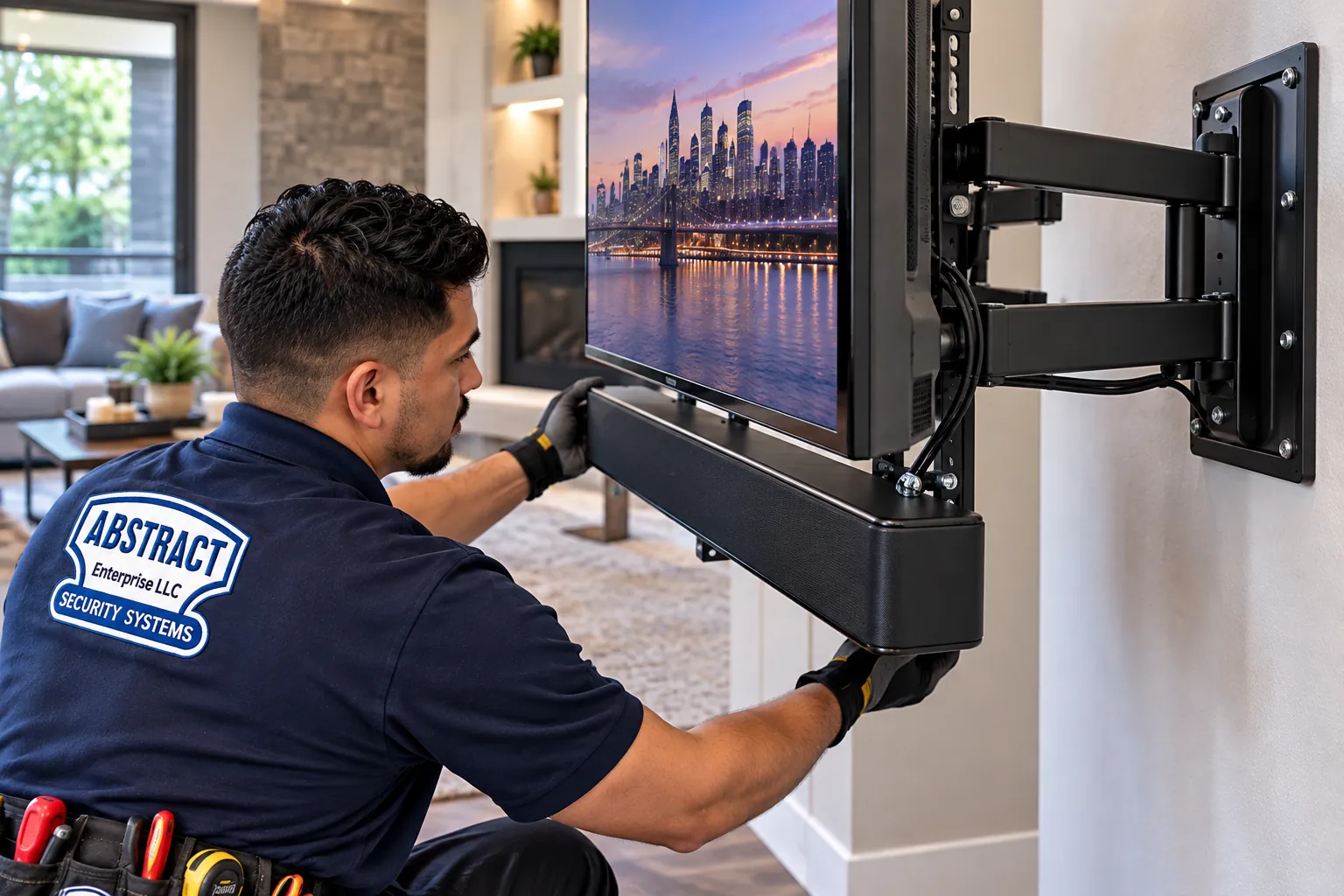
A gloved technician fits a soundbar to the underside of a TV hung on a full-motion articulating arm, so the bar moves with the screen.
Pricing
Soundbar Installation Cost in Dutchess County
Every Dutchess soundbar figure below is a fixed menu line, and your invoice is simply the lines your wall and room call for. The soundbar lines below are the same in every county we serve. What is specific to Dutchess is the TV-mounting base, the TV-on-stand price and the hourly rate for setup-only visits, all shown separately. If something you did not select turns up on site, you get the price before any extra work starts.
Line item
Dutchess price
What it covers
Soundbar placed on a console, stand or shelf
$79
No holes: the bar goes on your cabinet or shelf, is cabled to the TV and tuned for the room
Soundbar wall-mounted
$129
Fixings chosen after a pilot hole, bar squared to the TV's bottom edge, then wired and sound-checked
Sanus soundbar bracket
$84.99
Supplied by us when the box has no usable bracket; also clamps a bar beneath a TV mount
Paintable cord cover
$59
Slim channel from the bar to the outlet or cabinet, ready to paint
In-wall concealment
$169
Kit with a recessed outlet behind the TV fed from your existing one; interior walls with an empty bay only
HDMI and signal run to a cabinet or closet (up to 25 ft)
$99
For equipment on another wall, common in split-levels
Sonos setup
$125
Sonos system, app, rooms and grouping
A/V receiver
$129
Receiver connected and configured
Universal remote
$99
Programmed to replace the separate TV, bar and box remotes on the coffee table
Streaming device setup
$49
Roku, Apple TV, Fire TV or similar
Full home theater
$350
Multi-component system setup
Wall and access lines
Condition
Add
Where we meet it in Dutchess
Drywall or paneling over wood studs
$0
Raised-ranch living rooms, additions, new apartments
Metal studs
+$30
Some newer apartments and commercial fit-outs
Plaster
+$45
Poughkeepsie and Beacon houses built before the war
Brick or stone
+$65
Fieldstone and brick in older basements and chimney walls
Concrete or cinder block
+$75
Raised-ranch foundation walls behind furring and paneling
Tile or marble
+$95
Tiled feature walls and bathrooms
Plywood backer board
$85
A plywood plate spanning studs that miss the bracket holes
High mount (above about 8 ft)
$75
Bars over tall Victorian doorways or in great rooms
Stairs only, third floor and up
$40
Upper floors of older Poughkeepsie and Beacon buildings
Box removal
$25
We take the packaging away
Take down old TV / remove old bracket
$85 / $45
When the bar goes under a replacement TV
Haul away and recycle old TV
$79
Old set taken away
Certificate of insurance
Free
For landlords, management offices and businesses
Dutchess County base rates
Service
Dutchess price
Notes
TV mounting base (32–55 in, fixed or tilt, wood studs)
$254.99
Size, mount and wall lines added as published
TV on a stand, no wall mount
$168.99
Unboxed, placed and connected
Setup-only visit
$275 first hour
Then 30-minute blocks; for setup, eARC and no-sound faults
Return trip if we cannot start
$150
Bar or bracket missing, no access, approvals missing
Travel within Dutchess County
No charge
Same price in Beacon, Pine Plains or Pawling
The same soundbar job across the Hudson Valley
County
Bar wall-mounted + Sanus bracket
TV base (32–55 in)
Setup-only first hour
TV on a stand
Westchester
$213.99
$219.99
$235
$144.99
Rockland
$213.99
$219.99
$235
$144.99
Orange
$213.99
$229.99
$250
$152.99
Putnam
$213.99
$229.99
$250
$152.99
Dutchess
$213.99
$254.99
$275
$168.99
Ulster
$213.99
$254.99
$275
$168.99
The first column never moves: a bar on the wall with our bracket is $213.99 in every county. Everything that does move is tied to the TV or to hourly time on site.
In every price: finding the framing, mounting and levelling the bar, connecting it to the TV and up to two existing devices, tidying the cables behind the TV, switching on CEC so one remote works, and cleaning up the dust.
Not included: new or moved electrical outlets, which are electricians' work; patching and painting holes; moving heavy furniture; picture calibration.
Fragile surfaces: old plaster, tile, marble and thin paneling can crack or split however carefully they are drilled. We point out the risk first and you decide.
Rescheduling: free with 24 hours' notice; inside 24 hours the $150 return-trip fee applies.
Brackets and parts carry their manufacturer's warranty; customer-supplied brackets must be rated for the bar.
Why Dutchess differs from the counties to the south. The soundbar lines do not change between counties. What changes is the TV base and the hourly setup rate: Dutchess and Ulster share the highest base on our Hudson Valley menu, $254.99, against $219.99 in Westchester and Rockland and $229.99 in Orange and Putnam. Our Abstract Enterprises TV mounting prices for Dutchess County page shows the full TV table by screen size and mount type.
Add Up Your Dutchess Soundbar Price
Pick the lines that fit, or send a photo and let us do it. Either way, the figure you get is the figure on the invoice.
Most Dutchess bookings fall into one of three shapes. Each card shows how its total is built from the published lines; any wall, height or access line from the tables above is added on top.
Starter — Bar Under an Existing TV
$213.99
The TV is already on the wall. We hang the soundbar beneath it ($129) on a Sanus soundbar bracket ($84.99), connect it to the eARC or ARC port, switch on CEC and tidy the cables. On paneling over studs nothing is added; on plaster add $45, on block behind paneling add $75.
Standard — TV and Soundbar Together
$468.98
A 32- to 55-inch TV mounted at the Dutchess base ($254.99), the soundbar wall-mounted below it ($129) on a Sanus bracket ($84.99), with height and cable route planned once. Larger screens and full-motion mounts add their published lines. The usual raised-ranch family-room job.
Premium — TV, Bar and Hidden Wiring
$637.98
Everything in Standard plus in-wall concealment with a code-compliant power and cable kit ($169), so no cable shows between the TV, the bar and the cabinet. Offered on clear interior stud walls, which in Dutchess usually means an upstairs living room, an addition or a newer apartment.
Bring Your Own Equipment — Labor Only
Supplying the hardware yourself? Then the job is $129 of labor plus whatever wall line applies, and the bracket — boxed with the bar or bought separately — has to be rated for that bar, with its maker's warranty standing behind it rather than ours. If we find the bracket is wrong for the wall or the bar — a drywall-only bracket on thin paneling, say — we tell you before drilling and offer the Sanus bracket instead.
Worked examples, priced only from the lines above. A bar on the plaster wall of a Poughkeepsie Victorian, on our bracket, with a painted channel down to the cabinet: $129 + $84.99 + $45 + $59 = $317.99. A bar on the paneled block wall of a raised-ranch lower level with our bracket: $129 + $84.99 + $75 = $288.99. A bar placed on the console in a Beacon rental where drilling is not allowed: $79. A setup-only visit to reconnect a bar to a new TV: $275 for the first hour.
Town by Town
What We Find Behind the TV, Town by Town
Dutchess is one county but not one housing market. This is the quick version of what our installers expect to meet in each part of it, before they have seen your photo. It describes typical conditions, not any particular house.
City of Poughkeepsie
The county seat has the densest concentration of older housing in Dutchess: the brick and frame streets of the South Side, the Academy Street Historic District listed on the National Register in 1982, and the Union Street Historic District listed in December 1971, with its Federal and Victorian-era houses. Expect plaster on lath, tall rooms, two-family houses with an owner downstairs and a tenant upstairs, walk-up apartments above Main Street storefronts, and newer infill buildings near the waterfront. Permission and plaster are the two questions to answer first.
Town of Poughkeepsie, Arlington and Spackenkill
The town that wraps around the city is mostly post-war: the neighborhoods that grew up around IBM's Poughkeepsie site, the student and faculty housing of Arlington beside Vassar, and the Route 9 commercial strip running south past the Galleria. Raised ranches, splits and colonials dominate, with drywall upstairs and paneling or block downstairs. Marist's campus sits on North Road by the river, and its students and staff add to the local rental market.
Beacon
A former factory city at the foot of Mount Beacon that has grown fast: The Highlands Current counted nearly 800 new housing units between 2012 and 2023, including the Edgewater complex, cut back to 246 units under the city's steep-slope rules, and 248 Tioronda Avenue, reduced to 64 apartments in the creekside zone. That means a lot of drywall-on-stud apartments with leases and management offices, alongside older houses with plaster and brick, and Main Street galleries and restaurants with high ceilings.
Fishkill and the Village of Fishkill
Route 9 and Route 52 meet I-84 here, and the commercial corridor around the interchange is lined with plazas and hotels. Behind it are subdivisions from the 1960s onward, condominium communities and the older houses of the village itself. Hotel rooms, conference rooms and breakfast areas can all call for a soundbar rather than a full audio system.
Wappingers Falls and the Town of Wappinger
The town the Wappingers Historical Society describes as transformed by the IBM-era population boom, with farmland turned into suburban neighborhoods, and the older village around the falls. Raised ranches with paneled lower levels are a familiar soundbar job here, along with splits whose equipment sits in a cabinet on the far wall.
East Fishkill, Hopewell Junction and LaGrange
East of the Taconic and along Route 82 and Route 55, the subdivisions are a little newer and the houses a little larger: colonials, contemporaries and finished basements with soffits and drop ceilings. Outside walls as TV walls, long cable runs to equipment closets and basement media rooms are typical.
Hyde Park and Staatsburg
North of Poughkeepsie on Route 9, past the Roosevelt and Vanderbilt sites and the Culinary Institute. Post-war ranches and splits along the side roads, older houses near the river, and a growing number of renovated houses with open-plan living rooms where the TV wall is also the kitchen wall.
Rhinebeck, Red Hook and Tivoli
Village centers with historic interiors, country houses and farmhouses on the roads between them, Bard College at Annandale-on-Hudson, and second homes and permitted short-term rentals whose owners may be elsewhere on the day. Plaster, older wiring and few outlets are common; so are owners who want installs timed around guests.
Millbrook, Pine Plains, Amenia and Millerton
The quieter northern and eastern towns, reached by the Taconic and Route 44, with village houses, country places and converted outbuildings. Jobs here tend to be larger rooms, longer cable runs and households where the city apartment and the country house both need setting up the same way.
Room Sound
How Dutchess Rooms Change the Way a Soundbar Sounds
The same bar can sound muffled in one Dutchess house and harsh in the next, and the room is almost always the reason. We set every bar for the room it is in rather than leaving the factory preset, and these are the three room shapes we tune for most often.
The low lower-level family room. Seven-and-a-bit-foot ceilings, carpet on a slab and paneled walls absorb treble and pile up bass, particularly in corners. A subwoofer pushed into the corner beside the TV can make every explosion boom while dialogue sounds dull. We usually bring the sub out of the corner, turn its level down from the default, raise the bar's center or voice setting slightly, and check from the couch rather than from the TV.
The tall Victorian parlor. Ten-foot ceilings, plaster walls, wood floors and big sash windows reflect sound around the room, so speech can arrive at the listener several times over and blur. Here the useful moves are keeping the bar close under the screen and aimed at ear height, turning off the widest virtual-surround modes, and using rugs, curtains and upholstered furniture you already own to soak up some of the reflections. Up-firing drivers that rely on bouncing sound off the ceiling are less effective when that ceiling is very high or ornamented.
The open-plan apartment or renovated ranch. When the TV wall is also the kitchen wall, the bar has to reach a sofa in one direction while not flooding the kitchen in the other. Narrower bars aimed straight at the seating, a moderate sub level and dialogue enhancement switched on do more here than raw power. Night or late-evening modes, which compress the difference between loud and quiet passages, help when someone is cooking or a child is asleep down the hall.
Whichever room you have, the final check is the same: we play speech, music and a film scene, stand where you sit, and adjust until voices are clear at a volume you would actually use.
Before the Visit
Getting a Dutchess Room Ready for the Installer
A few minutes of preparation saves most of the delays we see on Dutchess appointments.
Knock on the wall. A hollow, slightly springy sound is usually drywall or paneling over studs; a dead, solid sound is usually plaster, block or stone. Tell us which when you book.
Find the outlet and the boxes. Note where the nearest working outlet is, and where the cable box, streamer and any console live. If they are on another wall, that decides the cable route.
Have the bar, its bracket and any sub or rears on site. Boxed is fine. A missing part is the most common reason a visit cannot start.
Clear the space in front of the TV wall. Move fragile things off the console and give the technician about six feet of working room.
Renters: get the OK in writing. A text or email from the landlord naming the soundbar and the number of fixings is enough for most.
Second-home and rental owners: arrange access. If you will be in the city on the day, tell us who will let us in and how to reach them.
If you are not sure about any of these, send a photo of the TV wall and another of the outlet and cabinet. That is usually enough for us to plan the whole visit.
Complete Services
Every Soundbar Installation Service in Dutchess County
Other AESS pages for Dutchess households whose plans go beyond a single bar under the screen.
One form for a mixed job — TV, bar, Wi-Fi and cameras — priced together in writing.
Field Notes
Field Notes: Reading a Paneled Family Room Before Drilling
General installer guidance for the kind of room we meet most in Dutchess; it describes our working method, not a particular customer's house.
Start by standing in the doorway and working out which wall is outside. In a split-entry house the lower-level back wall is very often the foundation, and that tells you before you touch it that the paneling may be on furring over block rather than on studs. Knock along the wall at bracket height; a run of identical dull knocks with no hollow spaces between is a warning.
Look up next. Find the soffit, the drop-ceiling grid or the beam, and measure from its underside, not from the floor. Then sit on the couch and look at where your eyes land on the wall; that, not the middle of the wall, is where the TV's center wants to be.
Before any bracket hole, drill one fine pilot hole where the bracket will cover it. Wood shavings mean a stud or furring strip; grey dust and a hard stop mean block; nothing at all means a void. Choose the fixing after that hole. Finally, follow the cables: find the outlet, the cable box and the router, and decide the cable route before mounting anything, because on paneling and outside walls the route is what limits the layout.
FAQ
Dutchess County Soundbar Installation FAQ
Why does a TV-and-soundbar booking cost more in Dutchess than in Westchester?
+
Only the TV part changes. The soundbar lines are the same everywhere we work: $79 placed, $129 wall-mounted, $84.99 for a Sanus bracket. The Dutchess TV-mounting base is $254.99, against $219.99 in Westchester and Rockland, and a Dutchess setup-only hour is $275. A soundbar under a TV that is already on the wall costs the same in Beacon as in White Plains.
Can guests give toasts through the soundbar with a microphone at our barn or event room?
+
Usually not. Most soundbars have no microphone input, and connecting a microphone over Bluetooth adds a delay that makes speakers hear themselves echo. For toasts and announcements the right tool is a powered speaker or small PA with its own microphone input. We can set the soundbar up for the slideshow or video, and tell you where the two should sit so they don't compete.
Do you put soundbars in church halls and parish rooms?
+
Yes. Halls usually need a bar fixed high enough to clear stacked chairs and tables, a cord cover rated for a busy room, the TV set to output to the bar every time, and a volume level volunteers cannot push too far. If the room is long, we will tell you honestly whether a bar can reach the back rows or whether wall speakers would serve the congregation better.
Will my Samsung TV's own speakers keep working alongside a Samsung soundbar?
+
On supported pairs, yes. Samsung describes its Q-Symphony feature as playing sound through the soundbar and the TV's speakers at the same time. We switch it on during setup where your TV and bar both support it, and compare it with the bar alone so you can choose. Other brands have their own versions, and we set those up the same way.
I hung the soundbar myself — can you check it and finish the setup?
+
Yes. We book it as a setup-only visit at the Dutchess rate of $275 for the first hour. The technician checks what the bracket is fixed into, tells you plainly if it should be refixed, and then does the connection work: eARC or ARC, CEC, lip-sync and firmware. If refixing is needed, you get that price from our menu before any work starts.
Can the soundbar sit on a floating shelf instead of its own bracket?
+
It can, if the shelf is fixed into framing and deep enough for the bar's feet. Check that the shelf lip does not block the front drivers, and leave clear space above any up-firing drivers. A shelf also gives cables somewhere to hide behind. Placing and connecting the bar on your shelf is our $79 placed line; shelves themselves are not on our menu, so ask before buying one.
Is a wall-mounted soundbar safer than one on the stand with a toddler in the house?
+
Generally, yes. A bar on a low stand is at grabbing height and its cables make an easy handle. On the wall, fixed into framing with the cables in a channel or inside the wall, there is little for small hands to pull. Mount the TV securely too, and keep the subwoofer where it cannot be climbed on or pushed over.
Our dog chews cables — how are the soundbar wires protected?
+
Keep them off the floor and out of reach. A painted channel from the bar down to the cabinet, or in-wall concealment where the wall allows it, removes the cable from the dog's level altogether. Where a cable must cross to a subwoofer or rear speaker, we route it along the baseboard in a cover. Rear speakers are best placed near outlets so there is little cable to protect.
Can the soundbar be installed on the same visit as cameras or network work?
+
Yes, and it often saves a trip. Our Dutchess crews also install security cameras, Wi-Fi and data cabling under the same NYS licence. Tell us everything when you request the quote, and we price each part from its own menu and schedule one visit or two consecutive windows, depending on the size of the job.
All Areas Served
Soundbar Installation Across the Hudson Valley and New York
Comparing Dutchess with its neighbors? Wall types and county prices from Westchester to Ulster are set side by side on the Hudson Valley soundbar installation hub. Where a county or borough has no page yet, its link opens the quote form instead.
Silence after a storm, a TV swap that broke the remote link, or a bracket creeping off old paneling or plaster: ring (845) 640-3835. We book the next open 2-hour window, and most connection and settings faults are fixed within one to two hours of the technician arriving.
Soundbar Installation Dutchess County — Licensed, Insured, Priced in Writing
Abstract Enterprises Security Systems · 460 E Fordham Rd, Bronx, NY 10458 · Dutchess County line (845) 640-3835 · WhatsApp (718) 679-0359 via wa.me
NYS Low-Voltage Licence #12000287431 · 100% Licensed & Insured · Same-Day Estimates · Rated 4.7★ from 201 Google Reviews
Brackets and parts carry their manufacturer's warranty. Full terms — including 50% deposit, one-year parts-only warranty on AESS-supplied products, and the late-fee schedule — are set out in the service agreement. See our warranty page.
Page reviewed and updated October 17, 2026. Changelog: first publication of the Dutchess County soundbar installation page, written around the county's three housing eras — river-town Victorians, IBM-era raised ranches and splits, and new Beacon and Poughkeepsie apartments — with a town-by-town guide and published Dutchess pricing.