Under-TV Wall Mounts · Retrofit Wiring in Older Walls · Two-Family & Apartment Setups · Multi-Room Systems · Repairs
Most Nassau houses were built around 1955 and have been rebuilt from the inside ever since: dormers added, porches closed in, basements turned into apartments, whole houses lifted after Sandy. We fit soundbars into those walls as they really are today — finding what the last three renovations left behind, routing power and HDMI without guesswork, and setting up eARC, subs and remotes so the whole family can hear the dialogue.
Reviewed and updated October 17, 2026 · Written by Anwar Timothy, NYS licence #12000287431
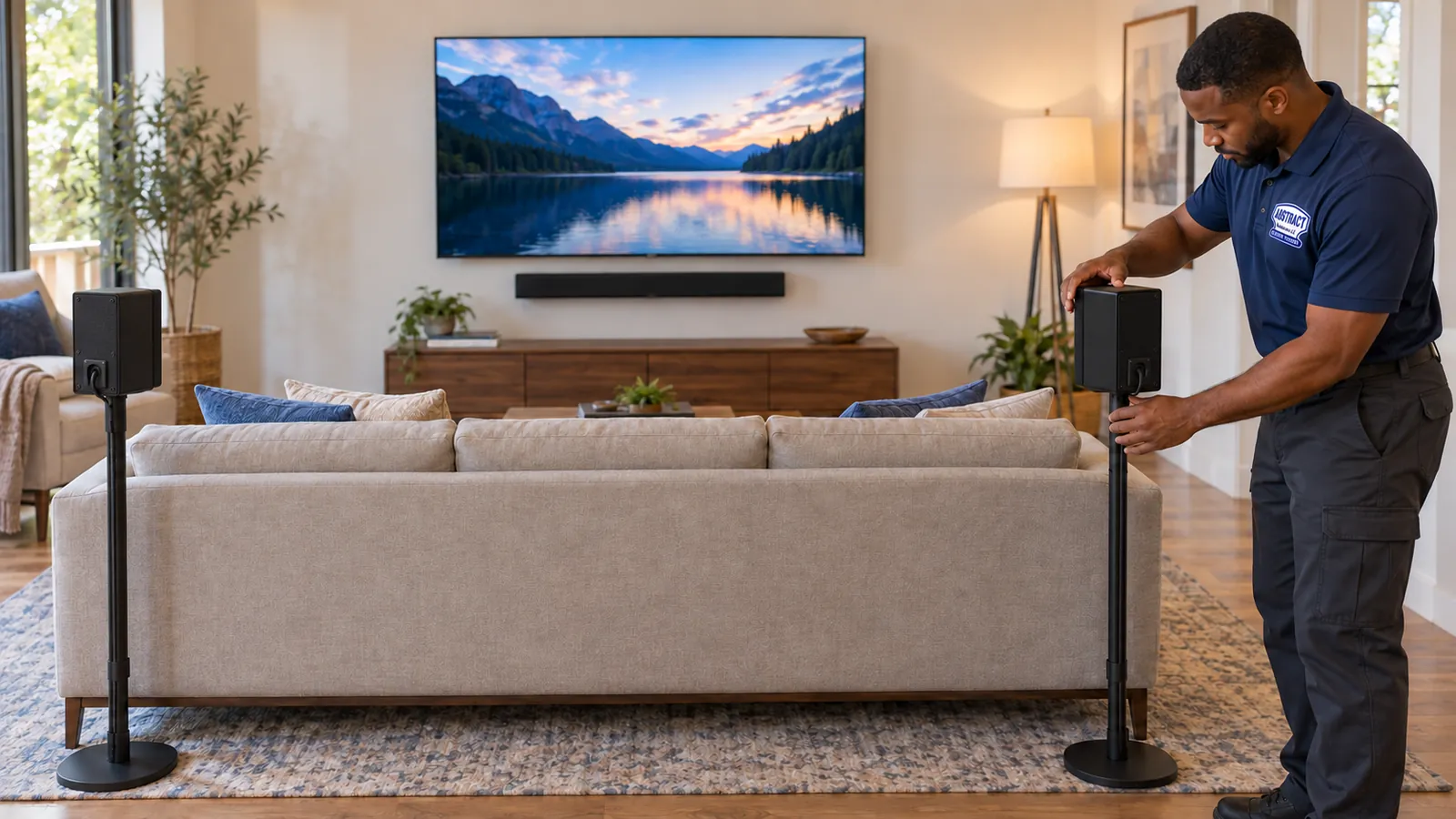
A technician adjusts one of two rear speakers on floor stands behind the sofa, with the wall-mounted TV and soundbar across the room.
Price Your Nassau Soundbar
Soundbar model, TV size and your town — a technician replies the same business day
✅
Request Received
A technician will call you back the same business day.
25+
Years Experience
✓
Same-Day Estimates
100%
Licensed & Insured
4.7★
201 Google Reviews
New soundbar still in the box? Ring the Nassau line at (516) 346-5778 or send the short form with your town, the TV size and the soundbar model. You get a price built from published line items before anyone drives over.
No parking or travel surcharge anywhere in the county, from Floral Park to Bayville
Pick a two-hour slot any day of the week, from the first at 8 AM to the last ending at 8 PM
Boards, HOAs and landlords get our COI at no charge · NYS licence #12000287431
Why Nassau County Homes Need Soundbar Installation
Nassau had built-in TV before most of America had TV at all. The 1950 Levitt houses came with a twelve-and-a-half-inch Admiral television built into the staircase, according to the New York Heritage archive's catalogue of the 1950 House of Levittown. Seventy-five years on, the people living in those houses, and in the hundreds of thousands of houses built around them, are trying to hang a 65- or 75-inch screen and a soundbar on walls that were never planned for either. That mismatch, a modern home-theatre product meeting a mid-century house that has been altered many times, is the real story of soundbar work in this county.
The numbers explain why. Census-based figures compiled by Point2Homes put the median construction year of Nassau's homes at 1955. A third of the county's housing, about 162,000 homes, went up in the 1950s alone, and fewer than one home in thirteen has been built since 2000. Nassau didn't replace its houses; it kept them and rebuilt them from the inside. Capes got dormers and second floors. Ranches lost a wall to open the kitchen. Back porches became family rooms. Basements became playrooms, offices and, in the Town of Hempstead, legal apartments. Each change moved studs, buried outlets and left at least one wall that is now hollow in some places and solid in others.
So the TV wall in a Nassau house is rarely what it looks like. It may be the old exterior wall, with sheathing and insulation inside, now facing a family room. It may be a knee wall in a dormered attic bedroom. It may be a closed-up doorway with no stud where the bracket wants to go, or a cinder-block foundation wall in a basement unit, or a paneled library wall in an Old Westbury house that nobody wants to cut. Getting a soundbar centred under the screen, level with it, and connected by a cable nobody can see depends on knowing which of those walls you are standing in front of.
Then there is who lives where. Nassau is not only single-family houses. Great Neck has more than 100 co-ops and condos in 1.4 square miles, according to CooperatorNews. Long Beach has oceanfront buildings and whole streets of houses that were lifted after Sandy, when FEMA found 860 Long Beach homes substantially damaged. Mineola and Hicksville are adding apartments beside their LIRR stations, and two-family houses in Hempstead, Elmont and Valley Stream hold two households under one roof. A soundbar's bass travels through all of those, and in a two-family or a co-op the people below are neighbours you will see in the driveway or the lobby every day.
And the county itself is a patchwork. Nassau has two cities, three towns and 64 incorporated villages, each village with its own building department and its own way of handling paperwork. A soundbar and its low-voltage cabling don't usually need a permit, but the moment a plan involves a new outlet, it becomes an electrician's job with village or town paperwork attached. Knowing where that line sits is part of doing the job right here.
That is what we bring to a Nassau soundbar job: an installer who expects the wall to be complicated, carries the anchors, backer boards, cord covers and in-wall kits to deal with it, stops at the edge of electrical work, and prices every step before the drill comes out.
Nassau facts that change how a soundbar goes in
1955: median year Nassau's homes were built, with 33.9% built between 1950 and 1959 and only about 7.3% since 2000 (Point2Homes, from Census data) — most soundbars here go into walls that have outlived several renovations.
12½-inch Admiral: the TV set built into the staircase of the 1950 Levitt models, alongside a carport (New York Heritage digital collection); the Hofstra University Library's Levittown exhibit notes the houses sat on concrete slabs with embedded heating pipes instead of basements.
2 cities, 3 towns, 64 villages: Nassau's municipal structure (NY.gov county page; Nassau County IDA), which is why the answer to "who do I call about a permit" changes from one street to the next.
More than 100 co-ops and condos in 1.4 square miles: CooperatorNews's description of Great Neck, with more than 60 condos in Great Neck Plaza alone — shared walls, boards and building rules.
860 homes: Long Beach houses FEMA found substantially damaged after Sandy, which had to be raised or demolished, according to the city's building commissioner as reported by the Long Beach Herald — living rooms that now sit a full storey above the street.
Town by town: legal basement apartments are permitted with permits in the Town of Hempstead, while Oyster Bay and North Hempstead do not allow new ones (News 12 Long Island, August 2026) — tenants, landlords and two households sharing one structure.
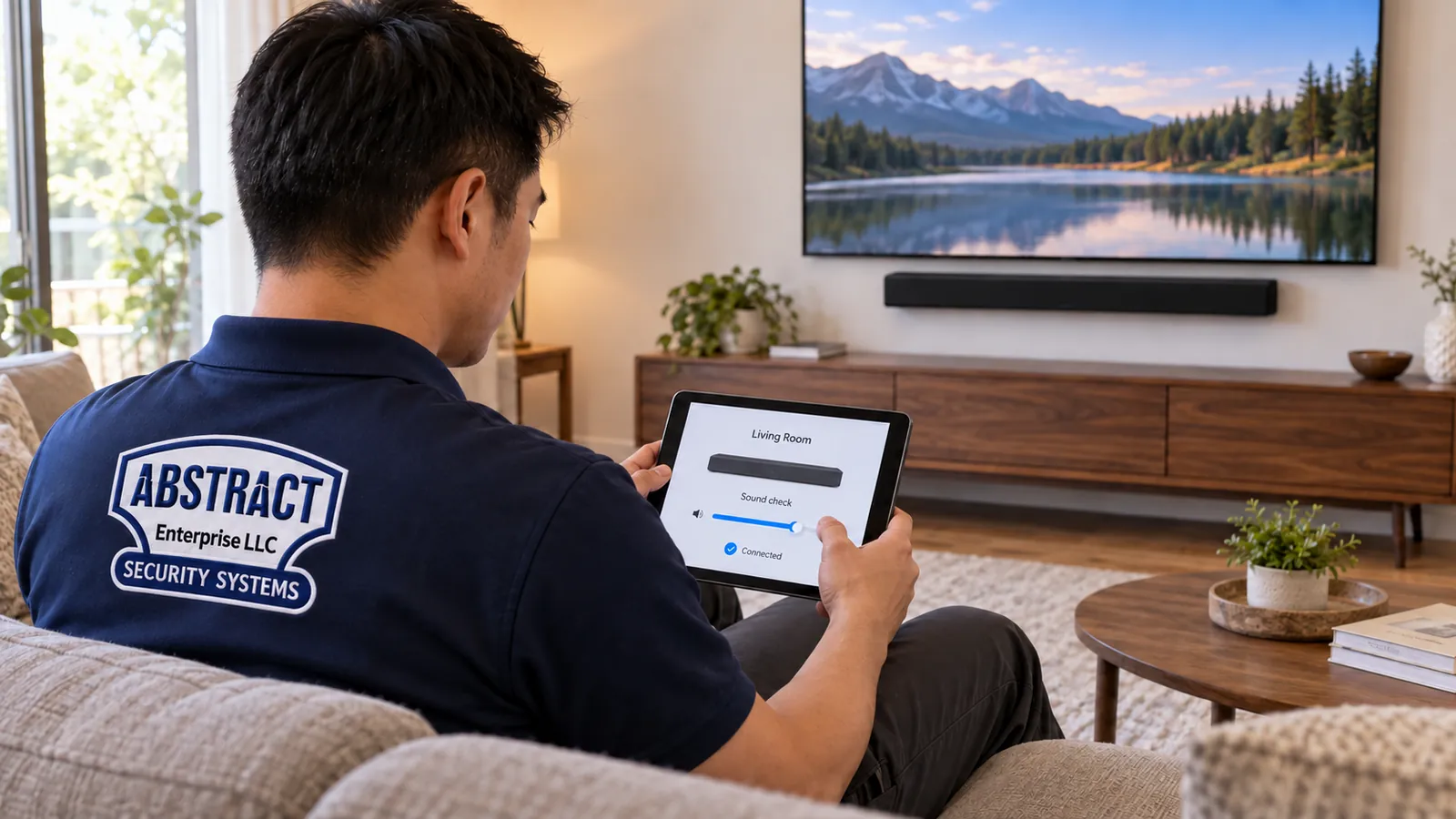
The check is done from the seat people actually use: tablet in hand, sound-check slider on screen, bar and TV on the wall ahead.
Repair Capture
Need a Soundbar Fixed in Nassau County Today?
Sound that cuts out when the cable box changes channel, a subwoofer that blinks and won't link, rear speakers that went silent after a router swap, or a TV remote that no longer touches the volume — these are repairs, not new installations. Nearly all of them trace back to an HDMI port, a TV audio setting or a wireless pairing, and most are put right in one to two hours once a technician is in the room. In Nassau they are booked as a setup-only visit: $225 flat for the first hour, then 30-minute blocks. Same-day when a two-hour window is free. Call (516) 346-5778 and tell us what the soundbar is doing.
What We Install
Soundbar Installation Services in Nassau County
Each service below is a published line item, and a typical Nassau job is two or three of them added together. We supply the hardware you need, open only the walls that need opening, connect and tune the system, and show you how it works before we pack up.
Under-TV Wall Mounting
The soundbar centred on the screen and squared to its bottom edge rather than to a ceiling that may have settled since 1952. $129 for the labour, with a Sanus soundbar bracket at $84.99 if your bar arrived without one.
Console and Stand Setups
For a TV that stays on furniture, which suits renters, co-op owners waiting on board approval, and anyone who isn't ready to drill: the bar placed, connected and set up for $79. A TV placed on its stand and set up is $137.99 in Nassau.
Retrofit Wiring in Older Walls
Power and HDMI hidden inside the wall with a code-compliant in-wall kit fed from the outlet already below the TV: $169. Before cutting, we find out whether the stud bay is open, blocked by fire blocking or packed with old insulation.
Surface Routing Where Walls Can't Open
A paintable cord cover at $59 for cinder-block foundation walls, plaster you'd rather not cut, paneled rooms and rented units. Painted to the wall, it all but disappears.
TV and Soundbar in One Visit
The screen hung first, from $209.99 in Nassau for a 32″–55″ set on drywall over wood studs, then the bar measured from the screen so the gap is even end to end.
Subwoofers and Surrounds
Any sub and rears in the carton, or added later, linked and positioned for $125 — with an ear to whoever sleeps above or below as well as to the couch.
Soundbars in Several Rooms
Family room, primary bedroom, finished basement and a home office, each priced as its own line so you can see where the money goes, and set up to share one network and one app.
Cable Runs to Equipment
Boxes that live away from the screen — in a hall closet, a built-in or across the room — are reached with one run of up to 25 feet for $99, by whichever route the house offers.
Receivers and Older Speakers
Plenty of Nassau basements still have a receiver and passive speakers from an earlier home theatre. Connecting a receiver and its speakers is $129; a full system configured together is $350.
Remotes and Streaming
One remote for the TV, soundbar and cable box, programmed for $99, and streaming-device setup at $49 each, so the grandparents visiting from Florida can work the TV too.
Repairs and Reconnections
Soundbars that lost their eARC handshake, subs that dropped their pairing, systems that stopped working after a new router or TV. Setup-only visits are $225 for the first hour in Nassau.
Business Soundbars
Waiting rooms on Jericho Turnpike, bars in Rockville Centre and Long Beach, showrooms on Northern Boulevard and conference rooms in Lake Success, with certificates of insurance issued free.
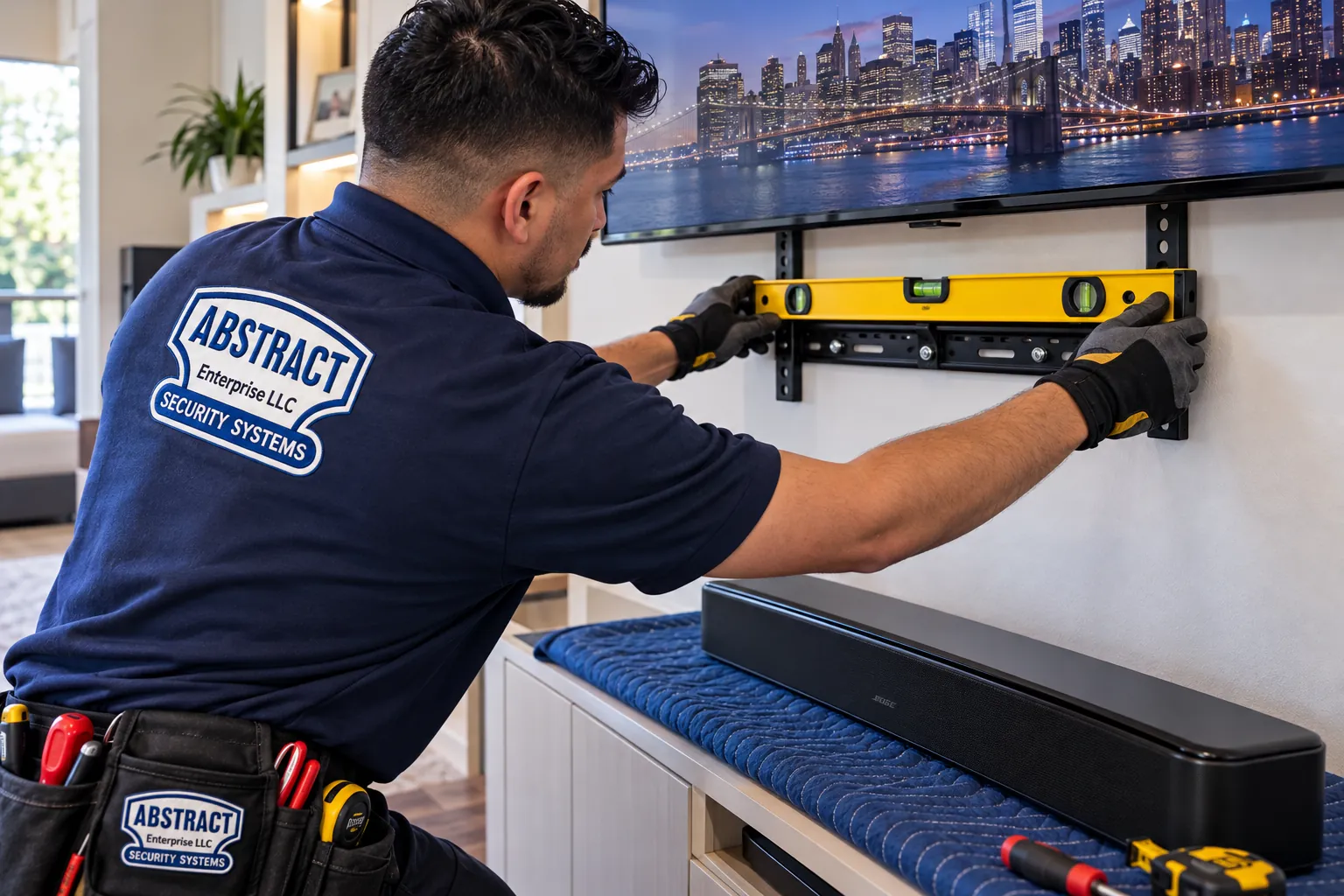
A gloved technician holds a yellow level across a black soundbar bracket fixed under the TV, while the bar waits on a blue moving blanket on the console.
Soundbar Installation for Nassau County's Architecture
In Nassau, the age of the house matters less than what has been done to it since. These are the building types we meet most, described by the alterations that decide where a soundbar can go and how its cables get there.
Levitt Capes with Dormers
Built on concrete slabs from 1947, then raised, dormered and extended by generations of owners. Downstairs walls are often re-sheathed; upstairs, attic bedrooms have knee walls and sloped ceilings. The slab rules out floor routes, so cable travels in the wall, through the attic, or in a painted cover.
Post-War Ranches and Splits
Wantagh, Seaford, Massapequa and Plainview ranches, plus split-levels a decade younger. Many have had a wall removed to open the kitchen, so studs aren't where the original plan put them, and the TV often faces a long picture window that bounces sound straight back.
Village Tudors and Colonials
Garden City, which A.T. Stewart began laying out in 1869, Rockville Centre, Malverne and Sea Cliff have older homes with plaster on wood lath, deep trim and built-ins. Plaster carries a $45 surcharge for the slower drilling it needs, and we route through existing chases where we can.
Gold Coast Estates
Old Westbury, Brookville, Muttontown, Lattingtown and Sands Point: large houses, some built in the era of Westbury House (completed 1906), with paneled libraries, plaster ceilings and several TV rooms. Work is planned around original millwork, and multi-room systems need a proper network.
Raised Barrier-Island Houses
Long Beach houses lifted after Sandy, and other raised homes along the South Shore, with the living space a flight or more above grade and an enclosure underneath. Gear is carried up exterior stairs, and nothing electronic belongs in the space below the lowest floor.
Two-Families, Co-ops and New Apartments
Two-family houses in Hempstead, Elmont, Valley Stream and Hicksville; co-ops in Great Neck Plaza and Long Beach; new rental buildings near the Mineola and Hicksville stations. Shared walls and floors decide where the TV goes, and owners or boards decide whether anything is drilled.
What the walls are made of, and how we handle each
Former exterior walls. When a family room was added off the back of a Cape or ranch, the old outside wall usually became an inside wall without being rebuilt. Behind the new drywall there may still be sheathing boards, old insulation and the original siding nails. A scanner finds the studs; a small inspection hole tells us whether an in-wall kit can drop through the bay or whether sheathing and blocking mean a cover is the honest answer. Either way, the bracket lags into framing, not into sheathing alone.
Knee walls and sloped ceilings. Dormered attic rooms in Capes have short walls and sloped ceilings. A short wall can carry a TV and bar if the screen isn't too large, and the bar sits under the screen as usual; a bar with up-firing drivers gains little under a slope, so we usually set its height channels low. Behind a knee wall is often unfinished attic space, which can make cable routing easier than anywhere else in the house.
Patched openings. Closed-up doorways and windows are common where houses have been rearranged. The patch may have a header but no studs, or studs at odd spacing. We map it before drilling, and where the framing doesn't line up with the bracket, a plywood backer board ($85) fixed to the studs on either side carries the load across.
Cinder-block and poured foundation walls. Basement playrooms and apartments often have one wall of block or concrete. Those take masonry anchors set into solid material, with a $75 surcharge, and cables run in a painted cover because a block wall can't be fished. Damp basements also get a word of advice: electronics and power strips belong off the floor.
Plaster, paneling and millwork. Older village houses and estates have plaster on lath that cracks under careless drilling, and paneled rooms where a single misplaced hole is visible for good. Plaster gets scored, slow drilling and anchors into the framing behind. In paneled rooms we look first for existing openings, the back of a bookcase or a closet behind the wall, so that cable travels where nobody looks.
Concrete in apartment buildings. Oceanfront and mid-rise buildings in Long Beach and Great Neck Plaza often have concrete or block walls between units. Masonry anchors and the $75 concrete rate apply, cables go in a cover, and we keep the bar and any sub off the shared wall where we can.
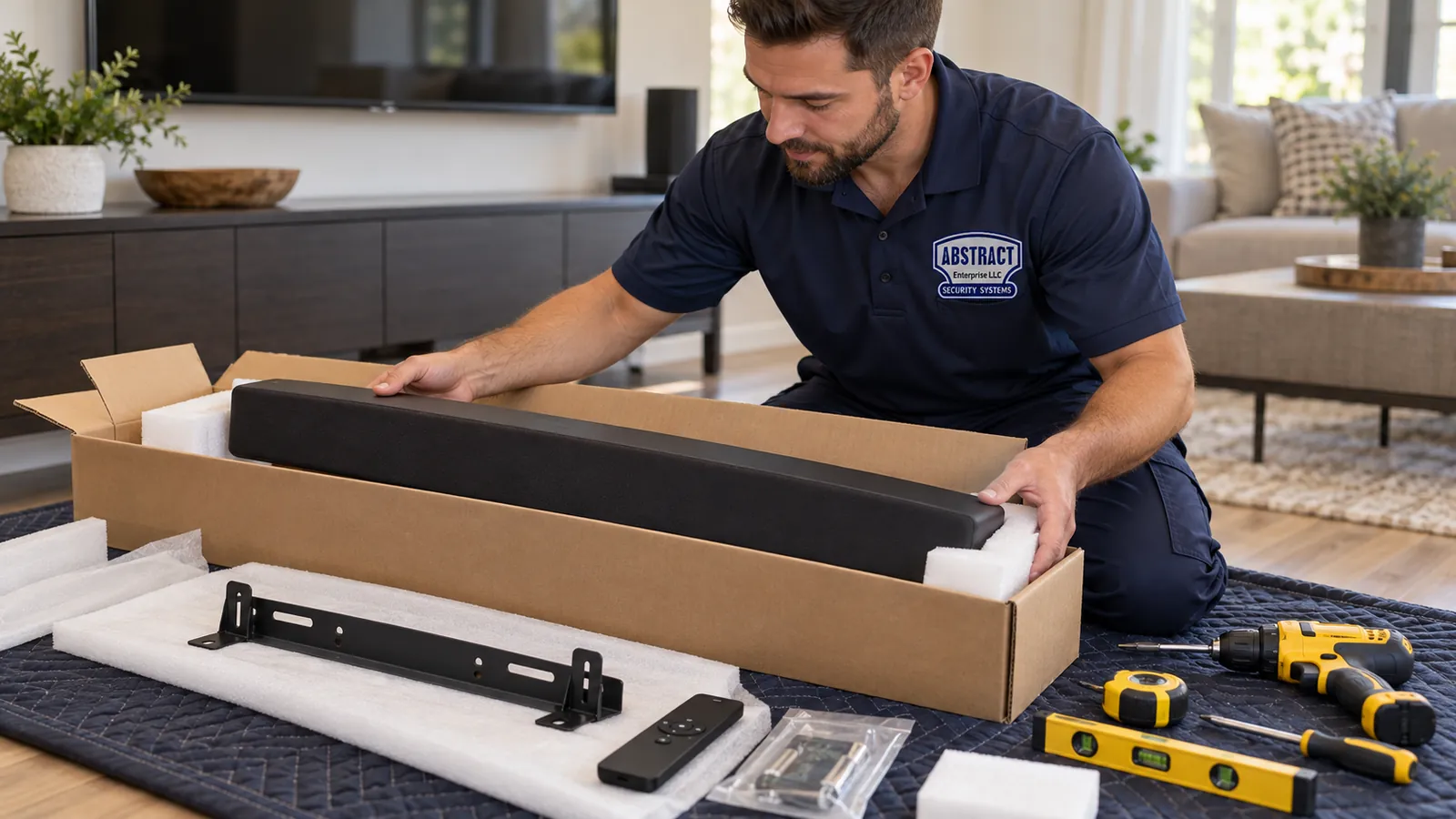
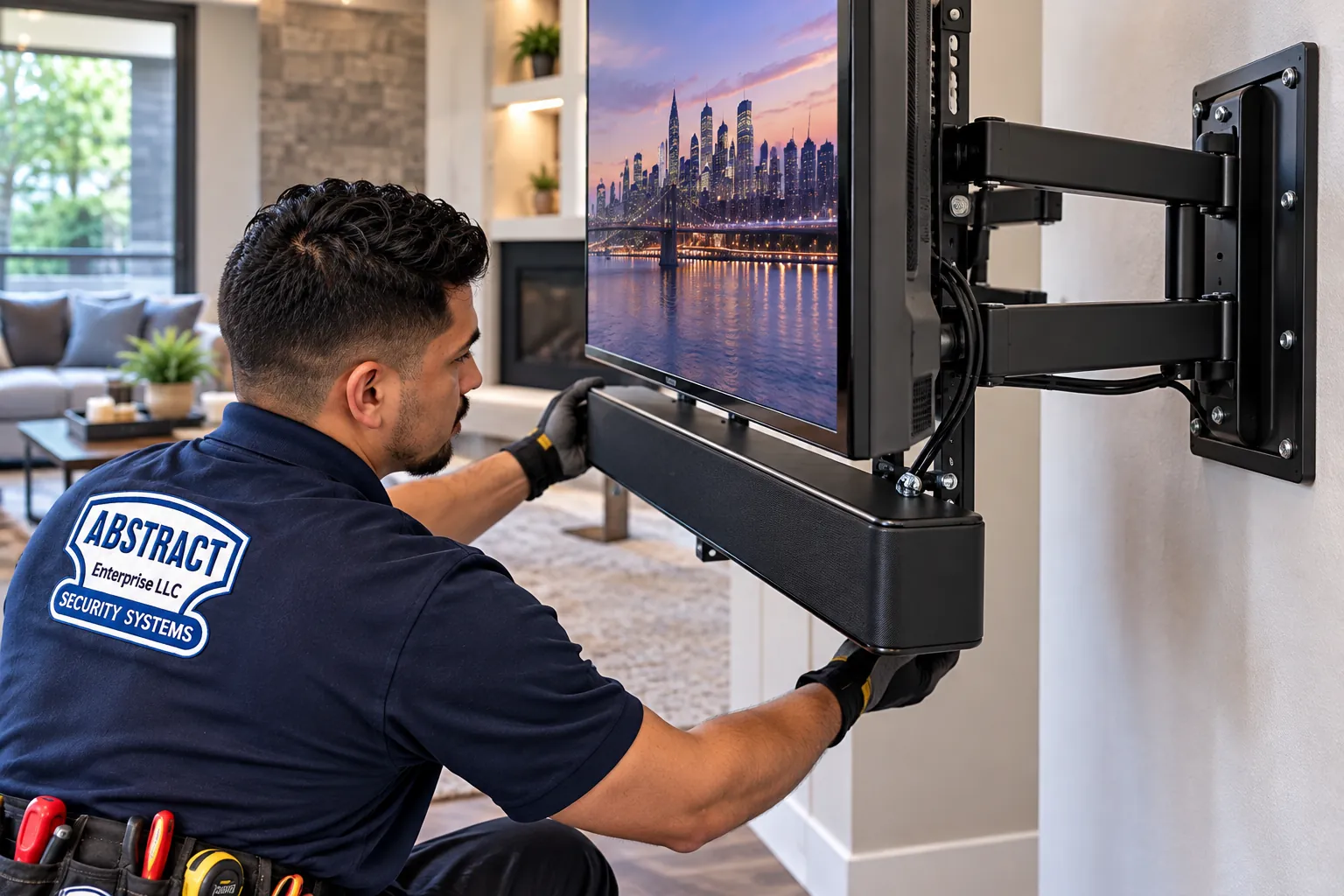
Everything out of the box and checked before drilling: bar, bracket, remote, the hardware bag and the drill, tape measure and level.A gloved technician fits a soundbar to the underside of a TV hung on a full-motion articulating arm, so the bar moves with the screen.
A lot of Nassau families add a video doorbell or a camera on the driveway while we're already in the house. We price them on the same visit; our low-voltage installation services in Nassau County page lists everything one crew can handle.
Commercial Soundbar Installation
Business Soundbar Installation in Nassau County
Commercial soundbar work in Nassau follows the county's main roads and its village downtowns. A display's built-in speakers can't carry a sports broadcast over a full bar or a patient briefing across a waiting room. A soundbar under each screen, sometimes with ceiling speakers for background music, can. These are the corridors where those jobs come from.
Northern Boulevard, Manhasset
The stretch known as the Miracle Mile, anchored by Americana Manhasset, an open-air centre of roughly 220,000 square feet that opened in 1956. Showrooms and boutiques use a screen and a discreet bar for product video at a volume that doesn't fill the shop.
Jericho Turnpike, Mineola to Syosset
Route 25 carries medical and dental offices, dealerships and diners across the middle of the county. Waiting-room TVs need clear speech at low volume, mounted so nothing sticks out into the walkway.
Marcus Avenue, Lake Success
Large office buildings where Northwell Health is among the tenants, full of conference and training rooms. A soundbar under the display lifts far-end voices on video calls well above what the display's own speakers manage.
Downtown Rockville Centre
Restaurants and bars around Sunrise Highway and North Park Avenue that fill up on game nights. Screens usually hang over back bars on brick or plaster, and each needs sound aimed at its own section of the room.
Merrick Road and West Beech Street
Merrick Road runs from Freeport through Merrick, Wantagh and Seaford to Massapequa, lined with restaurants and bars; in Long Beach's West End, cocktail bars and pubs line West Beech Street. Salt air near the water means stainless hardware for anything mounted outside.
Broadway, Hicksville
A downtown around the LIRR station that the Long Island Press reported in December 2024 was set to receive $6.2 million for revitalization. New storefronts and lobbies bring menu screens and lobby displays that need sound.
Compliance callouts for commercial soundbar work in Nassau
Protruding objects in public spaces. Section 307.2 of the 2010 ADA Standards allows wall-mounted objects with leading edges between 27 and 80 inches above the floor to protrude no more than 4 inches into a circulation path. In a medical waiting room on Jericho Turnpike, a soundbar under a low TV can break that rule, so we mount the pair above 80 inches or out of the walkway.
Electrical work belongs to licensed electricians. Village building departments expect electrical permits from licensed electricians; Garden City's own permit application, for example, lists permit applications from a licensed plumber, electrician or mechanical contractor among its requirements. We don't add or move outlets; we install the AV around the power an electrician provides.
Proof of insurance. Expect the property owner of a strip centre or medical building to want a COI naming them before work begins. We send it free, in their wording.
County licensing. Nassau's Office of Consumer Affairs licenses home improvement contractors, and the county notes that all licensed home improvement contractors must be fingerprinted. Low-voltage work carries its own state licence; ours is NYS #12000287431.
Air-handling ceilings. Some office ceilings double as the return path for the heating and cooling system; any cable laid there has to carry a plenum listing, and that is what we pull.
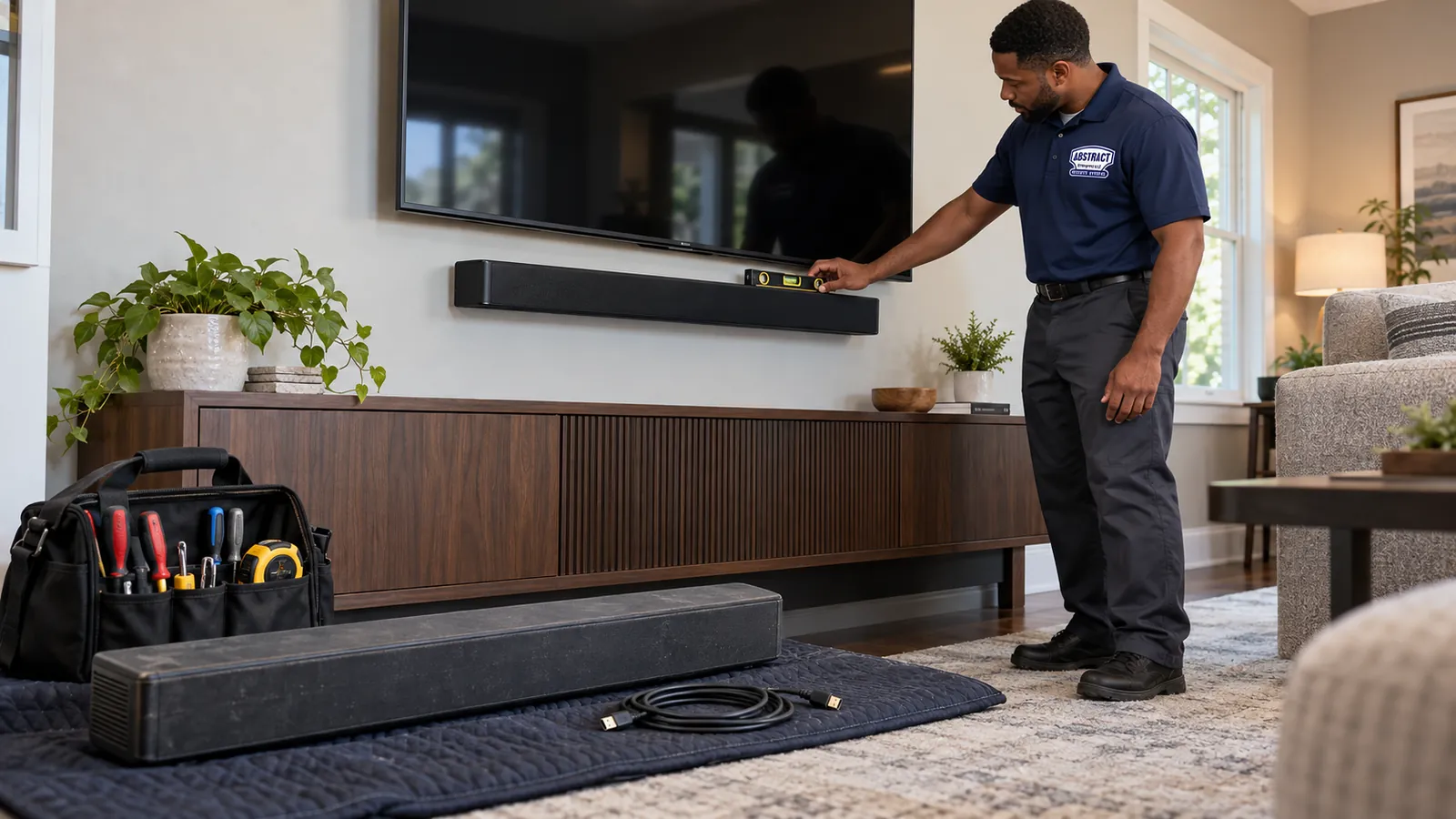
Level on the bar, tools on a blanket: the soundbar sits a few inches under the TV and is checked for level before the room is handed back.
From a Built-In Admiral to a Soundbar Under the Screen
The 1950 Levitt house treated the television as part of the building. The New York Heritage catalogue of the 1950 House of Levittown records a twelve-and-a-half-inch Admiral set built into the staircase, and the Hofstra University Library's Levittown exhibit describes how the 1950 and 1951 models kept the 1949 design but added new features, including that built-in television. It was a selling point: buy the house, and the TV came with it, already in the wall.
Very few of those sets survive in place, but the idea has come back in a different form. Today's Nassau homeowner wants the screen flat on the wall, the sound under it, and no wires showing, which is the same goal the Levitts had, achieved with very different equipment. What has changed is the wall. The original houses sat on slabs with heating pipes inside them, and the walls were simple. Decades of additions, dormers, new kitchens and opened-up floor plans have made them anything but.
That history is a useful way to think about any Nassau install. The question is never only "where does the soundbar go?" It is "what has happened to this wall since it was built?" A family room addition from the 1970s, a kitchen opened up in the 1990s, a basement finished in the 2000s: each leaves a trace that a scanner, a small inspection opening and some experience can read. Reading it first is what keeps a one-visit job from becoming two.
Your Questions Answered
Soundbar Installation in Nassau County: Questions Answered
These are the questions Nassau households ask once they are standing in front of their own wall. They are grouped by the situation behind them; short questions about prices, policies and coverage are in the FAQ further down.
Walls that have been rebuilt more than once
The TV wall in our expanded Cape used to be the outside of the house — what changes when we mount on it?
Mostly what's inside it. When an addition went on the back of a Cape or ranch, the old exterior wall was usually left standing and covered with new drywall on the family-room side. Inside the stud bays there may still be the original board sheathing, old insulation and, at the floor and ceiling, fire blocking or a doubled top plate from the old roof line. None of that stops a soundbar going up, because the bracket screws into the studs, which are still there and usually at regular spacing.
What it changes is the hidden-wire plan. A code-compliant in-wall kit needs to drop through the bay from the TV position to the outlet below, and sheathing or blocking can be in the way. We open a small inspection hole behind where the TV will hang, look, and then tell you whether the $169 in-wall kit will go or whether a $59 paintable cover along the wall is the realistic route. You decide before we cut anything further.
A forced-air register or a baseboard radiator sits right under the TV — is that a problem for the soundbar?
It can be, so it gets checked before anything goes up. A lot of Nassau houses heat with hot-water baseboard or have a supply register low on the living-room wall, and the TV wall is often the only wall long enough to hold it. Warm air rising from a radiator or register washes straight over a soundbar mounted just above it, and a bar sitting on a console in front of a register can block the heat to the room as well.
Usually the fix is placement. Mounting the bar under the screen but a little higher, with the TV raised slightly to keep the spacing even, keeps it out of the warmest air; a deflector on a register sends the airflow out into the room rather than up the wall. We take a quick temperature reading at the bar's position with the heat running, and we never rest a bar or a sub directly on a radiator cover.
A doorway on the TV wall was closed up years ago — can the bracket go over that patch?
It can, but not by trusting the patch. A closed-up opening often has a header across the top and a few short studs, or sometimes only drywall screwed to whatever was handy. A soundbar is light, but it sits directly under a TV, and the bracket needs real framing. We scan the area, find where the framing actually runs, and mark it before drilling.
If the studs fall where the bracket needs them, nothing extra is required. If they don't, a plywood backer board ($85) fixed to the solid studs on either side of the old opening spans the gap and gives both the TV mount and the soundbar bracket something solid to hold. Painted to match, it reads as part of the wall.
The wall behind the TV backs onto the attached garage — can the cables go through it?
Sometimes, and carefully. Many Nassau ranches and high ranches have an attached garage, and the wall between garage and house is a fire separation. Any hole through it has to be kept small and sealed afterwards with fire-rated sealant so the separation still works. We don't run cables through that wall casually, and we never leave an open hole between a garage and a living space.
Often there is a better path anyway: along the garage side of the wall to a point where the cable can enter an interior stud bay, or up into the attic and down. A cable run of up to 25 feet is $99. If the only sensible route would weaken the fire separation, we tell you and use a paintable cover inside the room instead.
Our ranch faces a long picture window across from the TV — why does the sound seem harsh, and what helps?
Glass is one of the most reflective surfaces in a room. In the classic Nassau ranch, the living room has a wide picture window on the street side and the TV on the wall facing it, so everything the soundbar plays bounces straight off the glass and comes back to the couch a fraction of a second later. That reflection blurs speech and makes treble sound sharp, especially in a room with hard floors.
The cheapest fixes are soft ones: lined curtains or heavy blinds that can close over the window at night, and a rug between the TV and the seating. On the equipment side, the soundbar's room calibration and dialogue setting help, and a bar aimed squarely at the seats rather than angled toward the glass does better. We run the calibration with the curtains in the position you normally keep them.
Two-families, basement units and apartment buildings
I rent a basement apartment in a house — can a soundbar be mounted on the foundation wall?
Physically, yes: block and poured-concrete foundation walls hold masonry anchors very well, at a $75 surcharge for concrete or cinder block. The real question comes first: it's the owner's wall, so we ask for the owner's written OK before drilling. That protects your deposit and keeps the job within your lease. Basement units are permitted, with permits, in the Town of Hempstead, and an owner who has gone through that process usually has clear rules about alterations.
If drilling is off the table, a soundbar on the TV stand needs no holes and costs $79 to set up. If it is allowed, cables on a foundation wall run in a painted cover, because block can't be fished. And since the household upstairs is directly above, we set the sub low and show you the night mode before we leave.
Our Long Beach oceanfront apartment has concrete walls and ceilings — how does the cable get from the TV to the cabinet?
Not inside the structure. Concrete and block in oceanfront and mid-rise buildings can't be fished the way a stud wall can, and coring through slabs or bearing walls isn't something a building permits for a TV. So the route is on the surface: a slim paintable cord cover from the TV down to the cabinet, painted to the wall, or along the top of the baseboard where it hardly shows. The cover is $59, and a run up to 25 feet is $99.
Often the simplest answer is to bring the equipment to the TV. If the cable box and console sit on a console directly below the screen, the only visible cable is a short drop, and the soundbar connects with a single HDMI lead. Anchors go into the concrete at the $75 rate, and we keep the bar off any wall shared with the neighbouring unit.
Raised houses on the South Shore
Our Long Beach house was lifted after Sandy — does the extra flight of stairs change the job?
A little, mainly in logistics. In a raised house the living room may be a full storey or more above the driveway, reached by an exterior stair. Large TVs and soundbar packages go up by hand, and a big screen may need two people, which we plan for when we book. Inside, the work is the same as any other house: find the framing, mount, route, connect.
Two details are specific to raised houses. Their framing is often newer and more regular than the rest of Nassau's stock, which makes mounting straightforward. And their wiring often runs differently from an older house, so we check where outlets and data cables actually come up before planning any hidden run. Hardware on decks and porches facing the ocean or the bay gets stainless fasteners.
Can a TV and soundbar go in the enclosed area under a raised house?
We advise against it. Under National Flood Insurance Program rules, an enclosure below the lowest floor of an elevated building is meant primarily for parking, building access or limited storage, and it has flood openings so water can pass through. It is exactly the space designed to flood, and a TV, a soundbar and their power strips have no place in it.
If you want a screen outdoors, a covered deck at living level is a much better spot, with an outdoor-rated bar under the roof and power from an existing protected outlet. If you are unsure what your elevation certificate or local floodplain rules allow below the house, check with the city or village building department before you put anything there.
Estates and larger North Shore homes
How do you add a soundbar in a paneled library or a room with original millwork?
By drilling as little as possible and in places nobody will see. In a paneled room the first step is to look for a route that already exists: the back of a built-in bookcase, a closet or service space behind the TV wall, or the floor of a room above with access to the bay. Cable can often reach the TV position without a single new hole in the face of the paneling.
The soundbar itself can attach to the TV mount with a bracket rather than to the wall, which avoids a second set of holes, or sit on a console in front. Where something must be fixed to old woodwork or plaster, we drill slowly, use the framing behind, and agree the exact position with you before starting. Plaster carries the $45 surcharge; there is no extra charge for patience.
Can soundbars in four different rooms play the same music at once when we have people over?
Usually, if they come from the same family. Systems designed for multiroom use, Sonos being the best-known example, let you group bars and speakers in the app so the family room, kitchen, basement and deck play the same playlist, then split them again when the party ends. Mixing brands makes it harder: some combinations can share music through a common streaming feature, others can't group at all.
So it is worth deciding before buying the second and third bars. Tell us which rooms you want to link and what you already own, and we will tell you what will group cleanly. Each room is priced as its own line, and we check that the Wi-Fi in every room is strong enough for grouped playback before we leave. Where it isn't, our Nassau County network installation team can add coverage.
Can a household member's hearing aids get the TV sound while everyone else hears the soundbar?
Often, but it depends on the TV and the hearing aids. Many modern hearing aids can stream audio by Bluetooth, and some TVs can send sound to a Bluetooth device and to the soundbar at the same time; others switch one off when the other connects. We check what your TV's audio menu actually supports rather than promising a feature that isn't there.
Where simultaneous output isn't possible, a manufacturer's TV streamer accessory for the hearing aids, connected to the TV separately, is the usual answer. Meanwhile the soundbar's speech or dialogue enhancement setting helps everyone in the room. We set it up and show the household how to switch it on.
Converted rooms and inherited wiring
Our back porch was closed in and became the TV room — what's different about a soundbar there?
Closed-in porches and sunrooms are common in Nassau houses, and they make popular TV rooms. They differ from the rest of the house in three ways. Walls are often mostly glass, with short framed sections between windows, so the TV and bar may have to go on the one solid wall or on a narrow pier. Insulation is often lighter, so the room gets hotter in summer and colder in winter than the living room. And the original porch floor may slope slightly toward the yard.
We find the framing in the solid sections first, because a converted porch wall may have been built with less framing than an original interior wall; a backer board ($85) solves it where it is thin. A bar mounted out of direct afternoon sun lasts longer, and the TV is levelled to itself rather than to a sloping floor or ceiling. If the room has no outlet where the TV will go, an electrician adds one before our visit.
The previous owners left speaker wire coming out of the walls and ceiling — can we use it with a new soundbar system?
Possibly. Many Nassau basements and family rooms were pre-wired for surround sound when a receiver and five speakers were the standard home theatre. A typical soundbar with wireless rear speakers doesn't use speaker wire at all, but the same wire works perfectly if you choose a receiver and passive speakers instead, or a soundbar that accepts wired surrounds.
The catch is knowing where each wire goes and whether it is still intact. We trace each run, label it and test it before anyone buys speakers for it. If the wire is good, connecting a receiver and speakers is $129. If it's damaged or leads nowhere, we tell you and work with what you have.
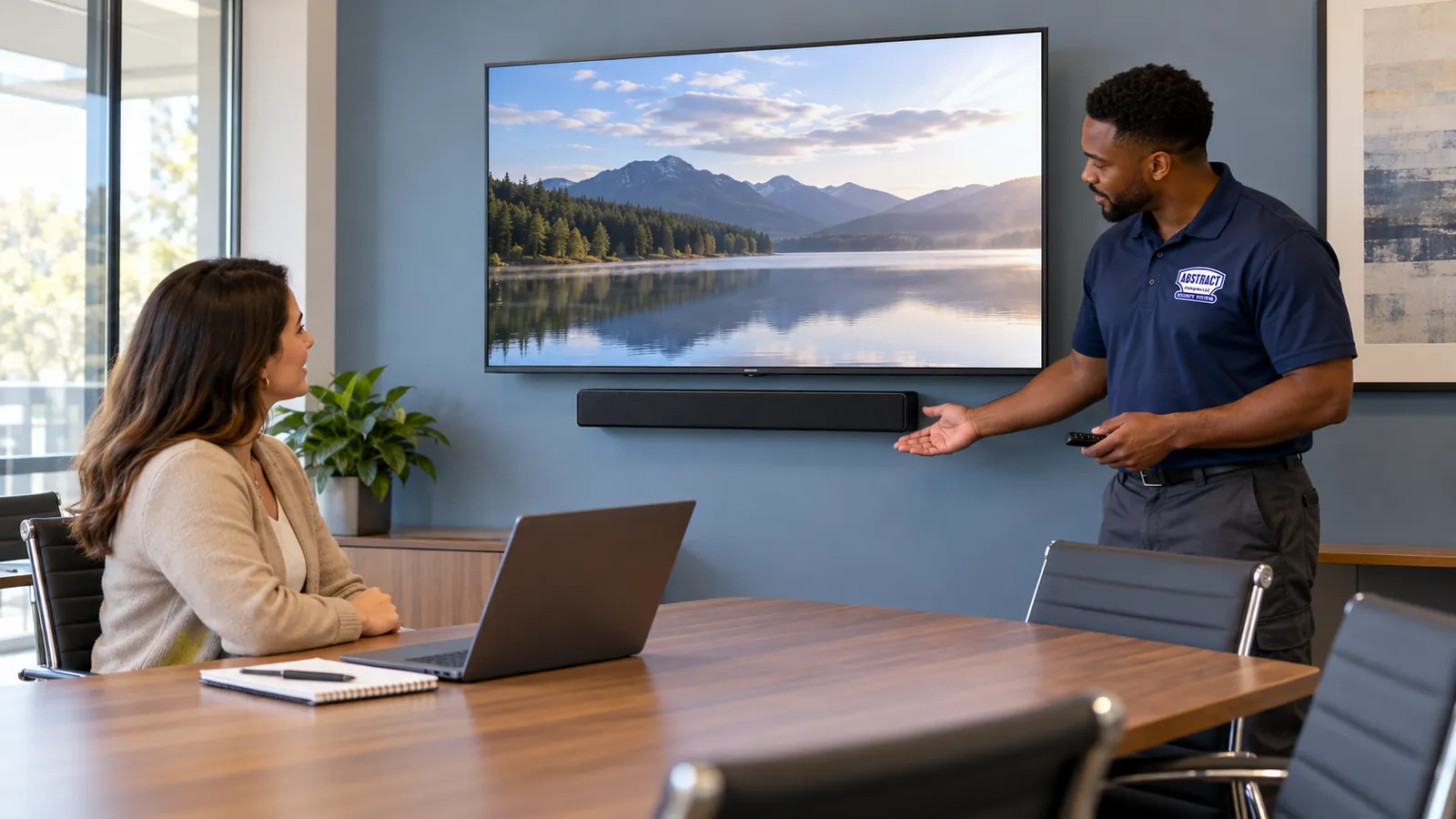
In a conference room, a technician gestures to the soundbar mounted under the wall display while a woman at the table, laptop open, follows along.
Equipment
Types of Soundbar Systems We Install
We install every major brand, and the right one depends as much on the house as on the budget. The figures below are manufacturers' or major retailers' published specifications; ranges change every year, so check the current model before you buy. We will tell you plainly if a bar you are considering doesn't suit your room.
Compact Bars for Capes and Bedrooms
Small bars suit the 12-by-19-foot living rooms of Levitt-era houses and dormer bedrooms. Sonos lists the Beam (Gen 2) at 25.63 inches wide and 6.35 lb, with HDMI eARC; the Sonos Ray is smaller still and connects by optical rather than HDMI. Both can add a sub and rears later.
Full-Width Atmos Bars
For a 65-inch or larger screen in a family room with a flat ceiling. Sonos lists the Arc Ultra at 46.38 inches wide, 2.95 inches high and 13.01 lb. Its own guide asks for at least 4 inches between bar and TV and a foot of clearance at each end, which matters on a narrow wall between two windows.
Bar, Sub and Rear-Speaker Packages
Systems such as Samsung's HW-Q990D: per Crutchfield, a 48.56-inch, 17 lb bar, a wireless sub of 25.8 lb, and two rear speakers that each plug into an outlet. Best for open-plan ranches and basement playrooms, if the rear outlets exist.
Outdoor-Rated Bars
For a covered deck on a raised house or a pool patio. Samsung's Terrace soundbar spec sheet lists an IP55 rating against dust and rain, a 48-inch width, 14.8 lb and an included wall-mount kit. It still belongs under a roof, out of the afternoon sun.
Wall and TV-Attached Brackets
Wall brackets below the screen, brand-specific mounts, and brackets that clamp to the TV mount so the bar follows an articulating arm. Sanus lists its universal soundbar mount for most bars up to 20 lb. We supply a Sanus soundbar bracket at $84.99.
In-Wall Power and Cable Kits
A listed kit that lets the TV and bar draw power behind the wall from the receptacle below, with a second plate for the HDMI lead. $169 per screen where the cavity is open.
Wireless Subs and Surrounds
Sonos Sub and Era speakers, and matched rears from Samsung, LG, Bose and others, set up for $125. Most need only power and a reliable Wi-Fi signal where they sit.
Receivers and Passive Speakers
If the walls already hide speaker wire, or you simply prefer separate speakers, we wire up the receiver and speakers for $129, or configure the whole cabinet and remote as a $350 theatre setup.
Universal Remotes
A single handset programmed for $99 for every box in the cabinet, although a correctly configured HDMI link often makes the TV's own remote enough.
Soundbar, receiver or ceiling speakers: an honest comparison
Option
Best for
Trade-off
Compact soundbar
Small living rooms, bedrooms, dormer rooms, apartments with neighbours close by
Limited bass without a sub; little true surround
Full-width bar with sub and rears
Family rooms, open-plan ranches, basement playrooms
Rears and sub each need an outlet nearby
Receiver with passive speakers
Houses already pre-wired for speakers; dedicated media rooms
More boxes, more cables, more settings
In-ceiling speakers
Kitchens and great rooms where sound must reach several zones
Ceiling work; best planned during a renovation
Matching the bar's width to the screen
A soundbar looks right, and images line up with voices, when it is no wider than the screen above it. The screen widths below are calculated from the diagonal of a standard 16:9 TV; the bar widths are the published figures quoted above.
TV size (diagonal)
Approximate screen width
Bars that sit within it
Typical Nassau room
43″
about 37.5 in
Compact bars such as the Beam (Gen 2), 25.63 in
Dormer bedroom, home office
55″
about 47.9 in
Compact bars; full-width bars such as the Arc Ultra, 46.38 in, only just fit
Front living room in a Cape or ranch
65″
about 56.7 in
Full-width bars, including the HW-Q990D at 48.56 in
Family room addition, basement
75″ and up
about 65.4 in or more
Any full-width bar, with room to spare at each end
Large family rooms and North Shore media rooms
Remember the manufacturer's end clearances too. On a narrow wall between two windows, a 65-inch screen may fit while a full-width bar's required space at each end does not, and a compact bar is the better choice.
Connections, in order of preference. HDMI eARC is the best link when both TV and bar have it: it carries full-quality audio from every source on the TV and lets the TV remote control the bar's volume. HDMI ARC, on older TVs, carries compressed surround, including Atmos inside Dolby Digital Plus from many streaming apps. Optical works almost everywhere but carries no Atmos and no volume control. We test every source you use — cable box, streaming stick, console, the TV's own apps — because a connection that works for one and fails for another isn't finished.
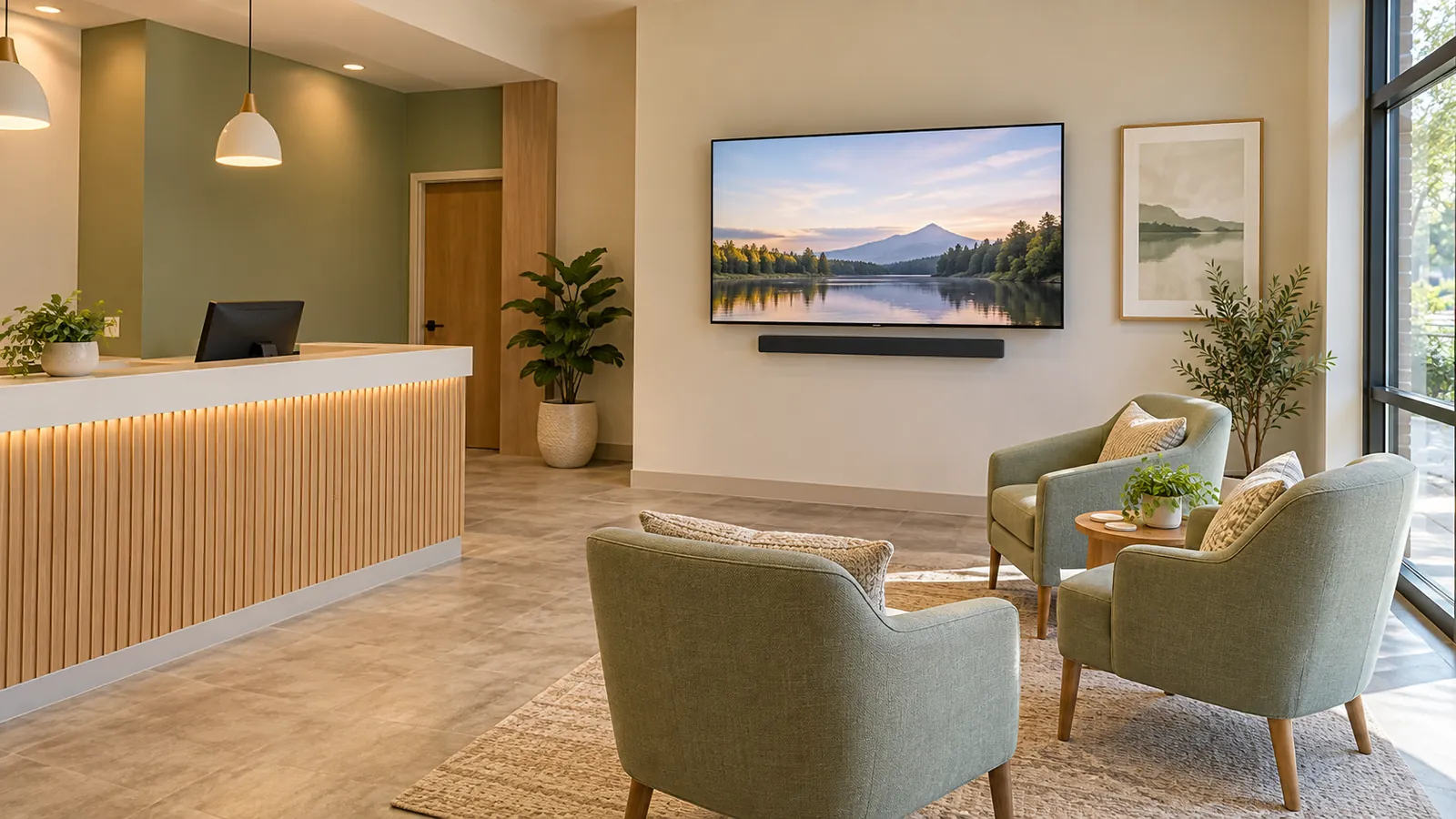
Lobby setup: one wall TV, one slim bar tight beneath it, and seating arranged so the sound reaches the chairs rather than the desk.
AI Overview Reality Check
What AI Gets Wrong About Soundbar Installation in Nassau County
Google's AI Overview couldn't be read from our research environment, so we haven't put words in its mouth. Instead, we took claims that cost guides, marketplaces and product pages actually publish — the material AI summaries are built from — and checked each against what happens on soundbar jobs in Nassau houses.
"Installing a soundbar costs about $58 to $231"
Homewyse's estimator puts the national average for installing a soundbar at $58.43 to $231 per soundbar. As a range for the basic job it is reasonable, and our own published prices for the bar alone sit inside it: $79 on a console, $129 wall-mounted.
What a national figure can't show is what a Nassau wall adds. A bar going onto a former exterior wall with blocking in the bay, a cinder-block basement wall or a plaster wall in a Garden City colonial changes the job, and our surcharges for those walls are published in advance: $45 for plaster, $75 for concrete or block.
So use the range as a sanity check, then price your own wall. A photo of it, sent with the soundbar model, gets you an exact number rather than a national average.
"TV mounting in Hempstead starts at $45 per hour"
That is what TaskRabbit's Hempstead TV-mounting page says, adding that rates vary from Tasker to Tasker. An hourly marketplace rate is real, but it isn't a price for the job, and it says nothing about who brings the bracket, the in-wall kit or the masonry anchors.
Hourly pricing also rewards discovering problems on site. In a house that has been renovated three times, the problems are often there to be discovered: blocking where the cable should drop, a patched doorway where the bracket should go. A per-item price agreed in advance puts that risk on the installer, not on you.
Our line items are fixed and published. If something unselected turns up on the day, you get its published price before any work on it starts.
"A TV wall mount with wires hidden inside the wall costs $139"
Thumbtack's Massapequa Park page lists exactly that example, alongside a national TV-mounting average of $100 to $130 and $179 to $249 for an over-fireplace mount with hidden wires. Angi, nationally, puts concealed wiring alone at $75 to $300.
The gap between those numbers is the method. Running power for a TV inside a wall has to be done with a code-compliant in-wall power kit or by an electrician; an extension cord stuffed through the drywall is a fire risk, whatever it costs. Our in-wall concealment is a single line at $169 using such a kit, fed from the outlet already on the wall.
When comparing quotes, ask how the power gets behind the TV. If the answer is vague, so is the safety.
"Drywall anchors are fine because a soundbar is light"
Some bars are light. Others aren't: Crutchfield lists Samsung's HW-Q990D bar at 17 lb, and Sanus rates its universal soundbar mount for most bars up to 20 lb. A bar that weighs as much as a small TV, sitting below a TV that may be bumped by children, a vacuum or a cleaning cloth, deserves the same care.
Hollow-wall anchors also behave differently in Nassau's mixed walls. In plaster they can crumble the keys behind; in an old patch they may sit in drywall with nothing behind it at all. Studs, backer boards and masonry anchors in solid material are what keep a bar level for years.
We anchor every soundbar bracket into framing or masonry, and where neither lines up, we add an $85 plywood backer rather than gamble on anchors.
"Mount the soundbar tight against the bottom of the TV"
It looks tidy and it's a common recommendation, but the manufacturers are more specific. Sonos's own Arc Ultra guide says to keep at least 4 inches between the soundbar and the TV, and to keep both ends at least a foot from a wall or obstruction.
The reasons are acoustic and practical: drivers that fire upward or sideways need room, and a bar jammed under the screen can block the TV's infrared sensor so the remote stops working. In narrow Nassau living rooms where the TV sits between two windows or beside a built-in, those end clearances decide which bar fits.
We follow the manufacturer's spacing for your model, measured from the screen, and test the remote before tightening anything.
"You need eARC to get Dolby Atmos"
Not quite. Technical explainers such as AWOL Vision's distinguish the two: older ARC carries Dolby Atmos inside compressed Dolby Digital Plus, which is how most streaming apps deliver it, while eARC is needed for the lossless formats — Dolby TrueHD Atmos and DTS-HD Master Audio — that come from discs and some players.
That matters because many Nassau households have a TV that is a few years old and a brand-new soundbar. If you stream, ARC may already give you Atmos; if you collect 4K discs, you'll want eARC. The most common failure we see isn't the standard at all: it's the bar plugged into an ordinary HDMI port instead of the one labelled ARC or eARC.
We check the TV's ports and audio settings before recommending anything, and only suggest new equipment when the existing pair genuinely can't do what you want.
"Putting up a soundbar never involves a permit"
For the soundbar and its low-voltage cables, that is generally right. The trouble is the advice that often comes with it: "just add an outlet behind the TV." A new outlet is electrical work, and in Nassau that means a licensed electrician and whatever paperwork your town, city or one of the county's 64 villages requires.
Village forms make the split clear. Garden City's building permit application lists permit applications from licensed electricians among its requirements, separate from the village's own minor permits for fences, driveways and similar work.
Our rule is simple: we don't add or move outlets. The in-wall kit carries power from the outlet already there, and when the room genuinely needs new power, an electrician does it first.
Your Wall Has a History. We'll Work With It.
A picture of the wall plus the model number is all we need to say where the bar belongs, how its cables will travel and the exact price.
Describe the house, the room and what you bought, and a technician answers the same business day. Prefer to talk? The Nassau number is (516) 346-5778.
✅
Thanks — Request Received
Expect a call from a technician the same business day. If it can't wait, the Nassau line is (516) 346-5778.
How It Works
Our Installation Process
The same six stages apply to a small bar in a Bethpage bedroom and to a four-room system in Muttontown; a single room is normally done in one trip.
1. Describe the house and the wall
Tell us the town, what kind of house it is, the screen size, the soundbar and, ideally, send a picture of the wall. The itemised total comes back before you pick a slot.
2. Sort out permission first
If a board, HOA or landlord must approve the work, we send a free certificate of insurance in their wording, and you book once the approval is in hand.
3. Read the wall
On arrival we scan for studs, pipes and wiring, find out whether the wall is an old exterior wall, a patch, plaster or block, and confirm where the outlet is.
4. Mount and route
Fixings go into studs, backer or solid masonry; the bar lines up with the middle and bottom edge of the screen; wiring follows the route you approved.
5. Connect and tune
We choose the best link the TV offers, pair any sub and rears, switch the TV to external audio, calibrate if the bar can, and try every box you watch through.
6. Hand-over
We play speech, music and a film scene from the main seat, show you dialogue and night settings, and take the packaging if you want it gone.
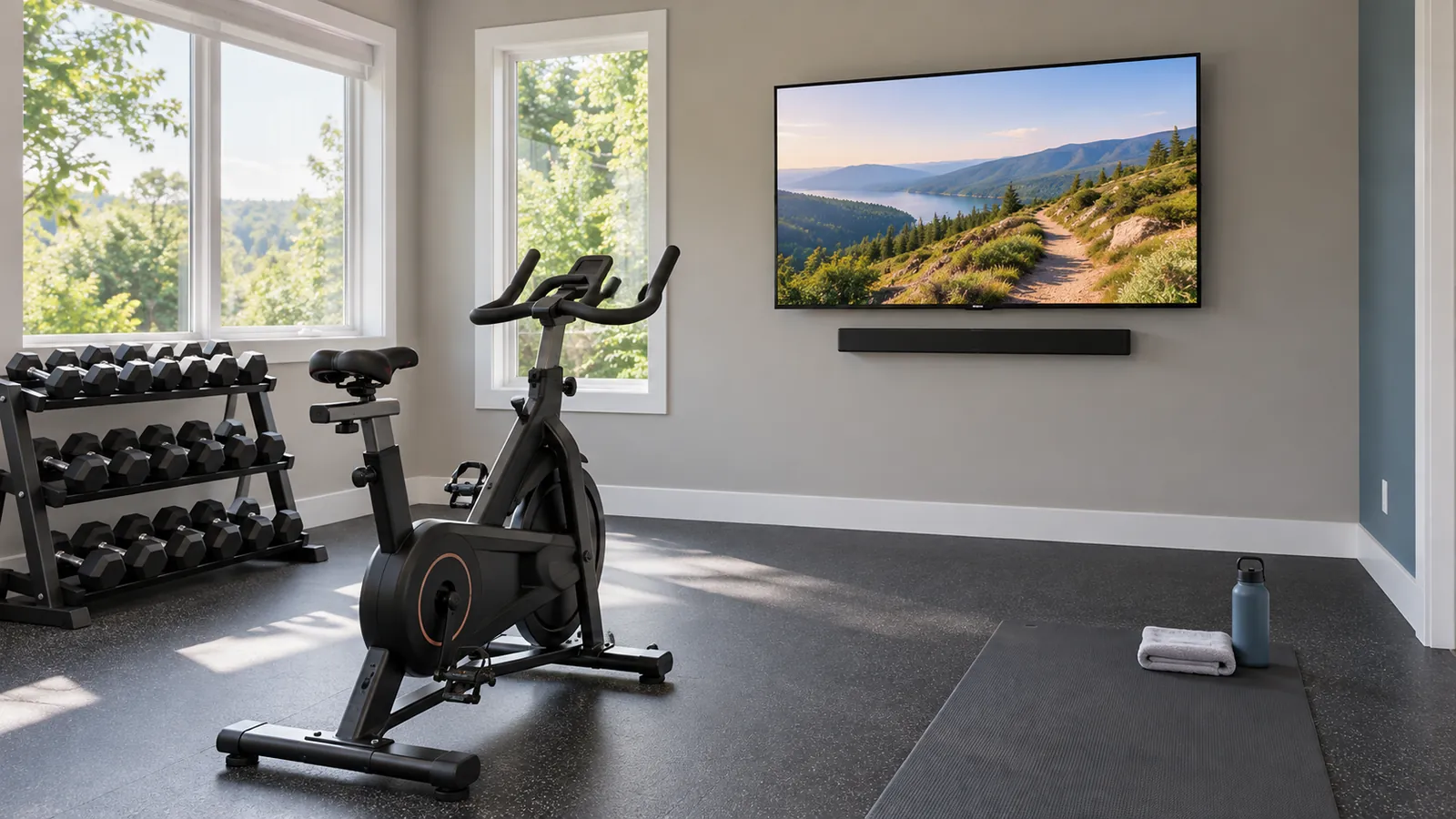
A home gym with a spin bike, a dumbbell rack and a mat, facing a wall-mounted TV with a soundbar fixed to the wall beneath it.
Coverage Area
Soundbar Installation Near Nassau County's Landmarks
Nassau residents give directions by these places. We install soundbars in the homes and businesses around every one of them, from the Queens line to the Suffolk border.
Eisenhower Park, East Meadow
At 930 acres, larger than Central Park, with three public 18-hole golf courses and the Harry Chapin Lakeside Theatre. Around it are the ranches and Capes of East Meadow, Westbury and Levittown, where dormers and family-room additions shape most TV walls.
Nassau Coliseum, Uniondale
Opened in 1972 at 1255 Hempstead Turnpike on part of the old Mitchel Field, renovated and reopened in 2017, and now home to the Long Island Nets. Uniondale and Hempstead around it include many two-family houses, where the owner's permission comes before the drill.
Cradle of Aviation Museum, Garden City
Long Island's air and space museum, with more than 75 aircraft and spacecraft on land that was once Mitchel Air Force Base. A short drive away are Garden City's older plaster-walled homes and the village's own building department.
Americana Manhasset, Northern Boulevard
The open-air centre that opened in 1956 and anchors Manhasset's Miracle Mile. North Shore homes in Manhasset, Plandome and Roslyn often want soundbars in several rooms at once.
Old Westbury Gardens, Old Westbury
Westbury House, completed in 1906 for the Phipps family, is one of the few intact Gold Coast country houses open to visitors. The estates around it in Old Westbury, Brookville and Muttontown bring paneled rooms and long network runs.
Long Beach Boardwalk, Long Beach
The 2.2-mile boardwalk destroyed by Sandy was rebuilt within about a year at a cost of $42 million, CBS New York reported. Behind it are the raised houses and oceanfront apartment buildings of the City by the Sea.
We also serve Hempstead, Freeport, Baldwin, Oceanside, Valley Stream, Elmont, Franklin Square, Lynbrook, Rockville Centre, Malverne, Mineola, Westbury, Hicksville, Bethpage, Plainview, Syosset, Jericho, Great Neck, Port Washington, Glen Cove, Sea Cliff, Oyster Bay, Bayville, Massapequa, Seaford, Wantagh, Bellmore, Merrick, Island Park and the Five Towns. The same crews and published prices cover every incorporated village and unincorporated hamlet in the county.
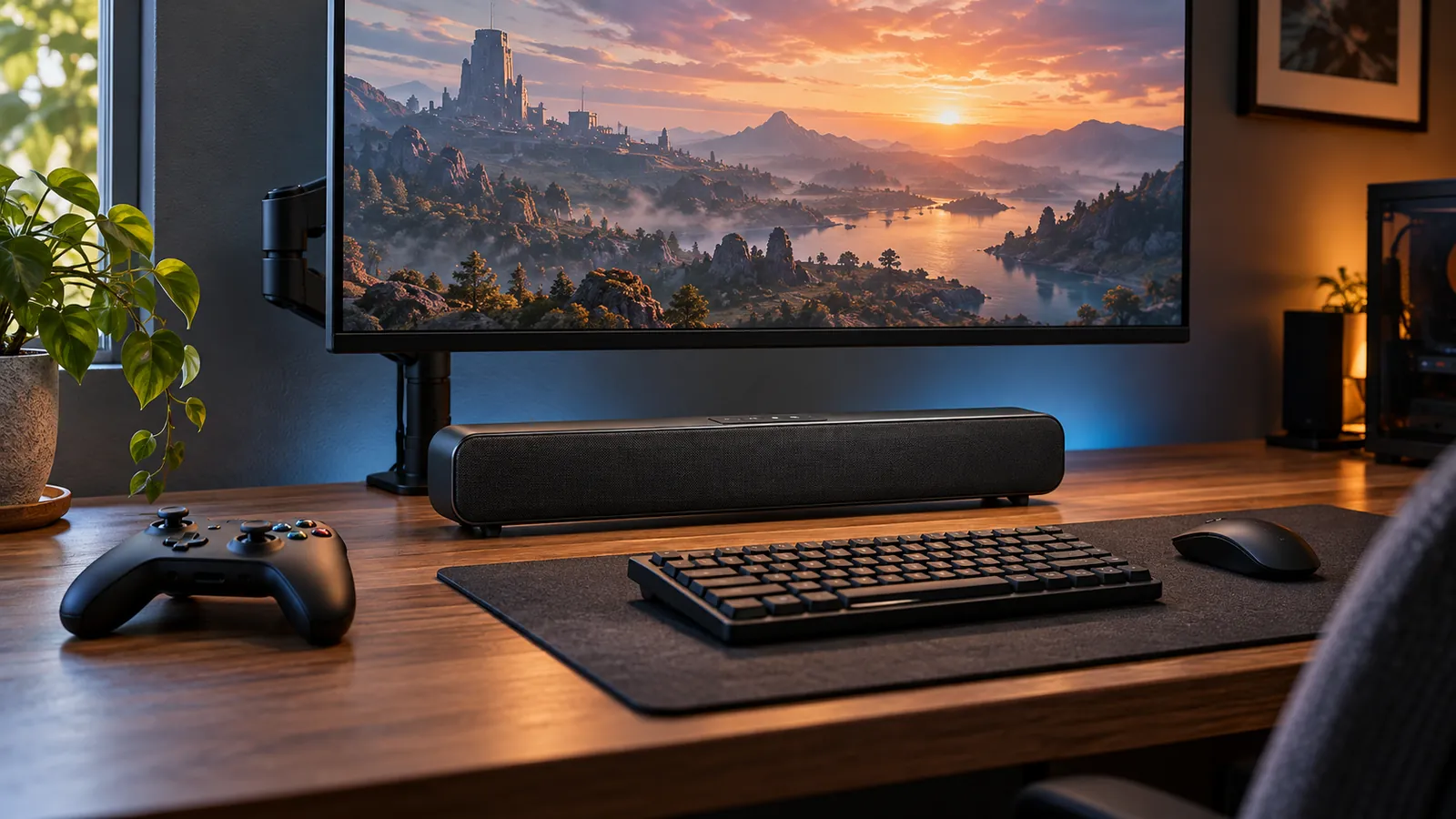
Desk-scale audio: a short bar under an arm-mounted monitor, a smaller job than a living-room wall but planned the same way around cables and power.
Pricing
Soundbar Installation Cost in Nassau County
Every number below is a published AESS line item. A Nassau quote is those lines added together for your room; there is no "starting from" that grows on the day, and no parking or travel surcharge anywhere in the county.
Line item
Price
What you get
Soundbar on console, stand or dresser
$79
No drilling: bar positioned at the front edge, linked to the TV, TV switched to external audio, volume tested on your remote
Soundbar wall-mounted under the TV
$129
Hung on studs or masonry under the screen, aligned to it, then linked and tuned
Sanus soundbar bracket
$84.99
Add only for bars sold without a mount
In-wall concealment
$169
Power and HDMI behind the drywall, using a listed in-wall kit powered by the outlet you already have
Paintable cord cover
$59
For block, plaster, paneling or rented walls
Cable run to a cabinet or closet
$99
One cable path of 25 feet or less to wherever the boxes live: stud bay, joists below or attic above
Sonos or wireless surround setup
$125
Sub and rear speakers paired, placed and calibrated
A/V receiver and speakers
$129
Receiver connected, existing or new passive speakers set up
Full home theatre setup
$350
TV, audio, sources and remote configured together
Universal remote programming
$99
One remote for every device in the system
Streaming device setup
$49 each
Connected and routed through the bar
Setup-only visit (Nassau)
$225 first hour
Repairs, reconnections and settings; then 30-minute blocks
Wall, access and removal add-ons
Condition or extra
Price
Drywall on wood studs
$0
Metal studs
+$30
Plaster
+$45
Brick or stone
+$65
Concrete or cinder block
+$75
Tile or marble
+$95
Plywood backer board
$85
High mount (above about 8 ft)
$75
Walk-up, third floor or higher, no elevator
$40
Take down old TV
$85
Remove old bracket
$45
Haul away and recycle old TV
$79
Box and packaging removal
$25
Certificate of insurance
Free
Nassau-specific numbers
Three prices are set by county. If the screen needs hanging too, that starts at $209.99 in Nassau for a 32″–55″ set on a fixed or tilting bracket over drywall and wood studs. Placing a TV on its stand and setting it up is $137.99. A setup-only visit is $225 for the first hour. The soundbar lines, brackets, concealment and wall surcharges are the same flat amounts across our service area.
What's included and what isn't
Included: finding the framing, mounting and levelling, connecting the bar to the TV, pairing the sub and rears that shipped with it, tidying cables behind the TV, and a play-through with you.
Left to others: anything electrical, including new or relocated receptacles; plaster and paint touch-ups; shifting pianos, wall units and other heavy furniture.
If we can't begin: a second trip is $150 when the screen or bar isn't on site or board approval is still pending as we arrive.
Rescheduling: free with 24 hours' notice.
National brands versus a local installer. Big-box stores and app marketplaces route installs to whichever independent installer is free that day. ADT, Ring and SimpliSafe sell security systems, not audio installation, so they aren't really part of this comparison. A licensed local low-voltage contractor who knows Nassau's housing stock arrives with the backer boards, masonry anchors and in-wall kits these walls call for, and answers to you directly.
Worked Examples
What Common Nassau Soundbar Jobs Add Up To
These are typical combinations, each built only from the published lines above. They are examples, not packages; your room may need fewer lines or a different surcharge.
Situation
Lines
Total
Bar on the dresser in a dormer bedroom
$79
$79
Bar under an existing TV in a ranch, Sanus bracket, wires in a painted cover
$129 + $84.99 + $59
$272.99
Bar under a TV on a former exterior wall, own bracket, wires in the wall
$129 + $169
$298
Bar on a cinder-block basement wall, Sanus bracket, cord cover
$129 + $75 + $84.99 + $59
$347.99
Bar over a patched doorway, backer board, Sanus bracket
$129 + $85 + $84.99
$298.99
Bar in a Garden City plaster living room, Sanus bracket, cable run to a built-in
$129 + $45 + $84.99 + $99
$357.99
TV hung and bar wall-mounted, Sanus bracket, wires in the wall
$209.99 + $129 + $84.99 + $169
$592.98
TV on its stand with a bar in front
$137.99 + $79
$216.99
Add wireless sub and rears to any of the above
+ $125
—
If the old TV is coming down first, add $85 to take it down, $45 to remove its bracket and $79 to haul it away for recycling. A bigger screen changes the TV line, not the soundbar lines: the full size and mount list is on the Nassau TV mounting price page.
Shop Our Systems
Soundbar Installation Packages & Pricing
Most Nassau orders resemble one of these. Each total is just published lines added up, with a surcharge only where the wall demands it.
Starter — No-Drill Setup
$216.99
TV placed on its stand and set up ($137.99) plus the soundbar placed in front and connected ($79). Ideal for renters, co-op owners waiting on approval and anyone in a basement unit. No holes in anyone's wall.
Standard — Bar on the Wall, Wires Covered
$272.99
Wall-mounted soundbar ($129), Sanus soundbar bracket ($84.99) and a paintable cord cover ($59) under an existing TV. The right answer when the wall is block, plaster or a former exterior wall that can't be fished.
Premium — TV and Bar, Nothing Showing
$592.98
TV mounted from the Nassau base of $209.99, soundbar wall-mounted ($129) on a Sanus bracket ($84.99), with power and HDMI hidden by the in-wall kit ($169). One visit, one alignment, no visible cords.
Bring Your Own Equipment — Labour Only
If your soundbar came with a bracket, or you've bought a rated one, we mount it at the $129 labour price and skip the bracket line. We check that the bracket is rated for your bar's weight before it goes on the wall. Customer-supplied hardware carries its own manufacturer's warranty rather than ours.
Adding a sub and rears to any package is $125. A finished basement where everything should be configured together is the $350 full home theatre setup. Several rooms are priced room by room.
A Photo and a Model Number Is Enough
No site visit needed to quote. Text or upload a photo of the wall and tell us the soundbar, and the price comes back line by line.
Working Within Nassau's Patchwork of Villages and Boards
Nassau's government is layered, and so is the paperwork around home projects. The county is made up of two cities, Glen Cove and Long Beach, and three towns, Hempstead, North Hempstead and Oyster Bay. Inside those towns sit 64 incorporated villages, from Garden City and Rockville Centre to tiny Saddle Rock and Cove Neck, plus more than 60 unincorporated hamlets such as Levittown, Uniondale and Hicksville that are governed directly by their town.
For a soundbar, most of that never comes up. Mounting a bar and running low-voltage cable is not the kind of work that village building departments issue permits for. What changes the picture is anything that touches the house's electrical system. A new outlet behind the TV, a circuit for a basement media room or an outdoor receptacle on a deck is electrical work, done by a licensed electrician under the electrical rules and paperwork of the village, town or city where the house sits.
The second layer is private. Co-ops and condos in Great Neck Plaza, Long Beach and the larger villages have their own rules about contractors, hours and drilling into shared walls. Homeowners' associations in newer developments may have rules about what can be mounted outside. Landlords in two-family houses and basement units have their own say. In every case we send a free certificate of insurance written to whatever wording the board, manager or landlord asks for.
The third layer is licensing. Nassau's Office of Consumer Affairs licenses home improvement contractors and requires them to be fingerprinted. Low-voltage work is covered by a state licence; ours is NYS #12000287431, and we expect to be asked for it.
Before booking: check whether your building, HOA or landlord needs to approve the work, and ask what the certificate of insurance should say.
If new power is needed: book a licensed electrician first; we schedule the soundbar once the outlet is in.
On the day: have any written approval to hand, so the job isn't held up and no return-trip fee applies.
Shared Walls and Shared Floors
Soundbars in Two-Families, Co-ops and Apartments
A big share of Nassau lives above, below or beside someone else. Two-family houses line the streets of Hempstead, Elmont, Valley Stream and Hicksville. Basement units are permitted, with permits, in the Town of Hempstead. Great Neck has more than a hundred co-ops and condos, Long Beach has oceanfront buildings, and new rental buildings are rising near the LIRR in Mineola, where Long Island Business News reported in 2023 that an eight-storey, 119-apartment building across from the station was advancing. A soundbar in any of these homes has an audience you didn't invite.
The physics is simple. Mid and high frequencies are easily stopped by a wall or a floor. Bass isn't: it travels through structure, especially when a subwoofer sits on a hard floor or a bar's bracket is screwed into a shared wall. So the planning starts with location. A TV wall that is internal to your unit is better than a party wall. A sub on a rug, away from walls and on isolation feet, is better than one in a corner on a tiled floor. In a two-family, the upstairs household's sub sits directly over the downstairs living room unless it's placed with care.
Then the settings. Most soundbars have a night mode that compresses loud passages and a dialogue setting that lifts speech, which together let the volume come down without losing the words. Many also let you turn the sub's level down independently. We set these up during the hand-over and show everyone in the household where they are.
Finally, permission. In a rented unit the walls are the owner's, so we ask for the owner's written OK before drilling. In a co-op or condo, the board or managing agent may need to approve the work and see a certificate of insurance. If approval is slow, the no-drill starter setup gets the sound working now, and the bar can go on the wall later.
Barrier Island and Bay Shore
A Checklist for Soundbars in Raised South Shore Houses
Sandy reshaped the South Shore's housing. The Long Beach Herald reported that FEMA carried out 2,755 post-storm inspections in Long Beach and found 860 homes substantially damaged, which had to be raised or demolished, with the city's building commissioner estimating that raising a house cost homeowners around $75,000 on average. Many of those houses now have their living space well above the street.
Keep electronics on the living floor. The enclosure under an elevated house is meant for parking, access and limited storage, with flood openings so water can pass through. It is not a place for a TV, a soundbar or a power strip.
Plan the carry. Exterior stairs and landings decide whether a large TV needs two people. Tell us the screen size and the stair layout when booking.
Use stainless outside. Brackets and screws on an ocean- or bay-facing deck rust quickly in salt air. Outdoor hardware gets stainless fasteners.
Choose outdoor-rated gear for decks. An indoor soundbar on an open deck won't last. Outdoor-rated bars still go under a roof and away from strong afternoon sun.
Power from a protected outlet only. Outdoor TVs and bars plug into an existing weather-protected outlet. If there isn't one, an electrician adds it first.
Check where wiring comes up. Raised and rebuilt houses often have newer, differently routed wiring than older Nassau houses; we confirm outlet and data locations before planning a hidden run.
Unplug before a storm. When a coastal storm is forecast, unplugging the TV, bar and sub is the cheapest protection there is.
Before You Call
Six Things to Find Out About Your Wall First
Answering these before you phone, and snapping one picture, lets us give a firm number in a single conversation.
Was the room ever added on or opened up? If the TV wall used to be an outside wall, or a wall was removed nearby, say so. It changes the hidden-wire plan, not the price of the bar.
Is there a closed-up door or window in the wall? Look for a slightly uneven patch, or ask the previous owner's paperwork. That is where a backer board may be needed.
What material are you looking at? A light tap tells a lot. Hollow between solid spots means drywall on studs; a flat, dense thud suggests plaster; a hard click is block or concrete.
Which receptacle will feed it? One sitting low on the TV wall is ideal for a hidden kit; if the closest is across the room, or still the old two-slot type, an electrician may need to visit first.
What's on the other side? A garage, a neighbour's apartment, a bedroom, an attic or a closet each change the route and the settings.
Who needs to say yes? Your board, HOA or landlord. Get the approval and the certificate wording before booking.
Room sound in Nassau houses
The rooms here have their own habits. Post-war living rooms are compact, so a mid-size bar fills them easily and a big sub can overwhelm them. Ranches with a long picture window opposite the TV reflect sound straight back; curtains and a rug do more for dialogue than any setting. Opened-up ranches leak sound into the kitchen, so a sub and rears placed around the seating keep it where it's wanted. Basement rooms have low ceilings and hard floors that make bass boomy. We run the bar's room calibration with the furniture where it will stay, because calibration in an empty room is wrong as soon as the sectional arrives.
Room by Room
Where Soundbars Earn Their Place in a Nassau House
Not every room needs the same system, and Nassau houses tend to have a familiar set of rooms. This is how we usually match the equipment to each of them, so the budget goes where it is heard.
The front living room. In Capes and ranches this is often the smallest room with the biggest window. A compact or mid-size bar under the screen, with speech enhancement switched on, usually does more than a large system that the room can't contain.
The family room addition. Larger, newer and often open to the kitchen. This is where a full-width bar with a sub, and rears placed around the sectional, makes the most difference. It is also the room most likely to have the old exterior wall behind the TV.
The dormer or upstairs bedroom. Knee walls, sloped ceilings and someone asleep next door. A compact bar on a dresser or under a modest screen, with night mode set, is plenty.
The finished basement. Kids, games and films. Hard floors and low ceilings make bass boom, so the sub is placed by ear and measurement rather than by convenience, and cables run above the drop ceiling where there is one.
The home office. Since commuting changed, many Nassau households have a dedicated office with a screen for calls. A small bar under the display makes voices on calls far clearer than laptop or monitor speakers.
The deck or porch. For raised houses and pool patios: an outdoor-rated bar under the roof, stainless hardware and power from a protected outlet that an electrician has already installed.
Several rooms at once are simply the sum of each room's lines. Many households start with the family room and add a bedroom or basement later.
Second Opinions
Fixing Soundbar Installs That Didn't Quite Work
A fair number of calls come from households whose bar is already on the wall but doesn't behave. Here is what usually turns out to be wrong, and the remedy.
The bar is in the wrong HDMI port. Sound drops when inputs change, or the TV remote can't set the volume. Moving one cable to the ARC or eARC port and changing two settings fixes it.
The bracket is in drywall anchors over a patch. The bar sags at one end. We re-anchor into framing, adding a backer board if the framing doesn't line up.
The bar blocks the TV's remote sensor. Mounted too close beneath the screen, it stops the remote working. Respacing it to the manufacturer's clearance solves it.
An extension cord was pushed through the wall. That isn't a safe way to power a TV. We replace it with a code-compliant in-wall kit, or a cover if the wall can't take one.
The sub is booming into the apartment below. Moving it off the floor's hard spot, onto isolation feet, and lowering its level with night mode set usually ends the complaints.
Surrounds that go silent mid-film. Nine times in ten the culprit is either poor Wi-Fi where the speaker sits or a receptacle that someone turns off at the light switch by the door.
Settings and pairing faults fall under the Nassau setup-only rate, $225 for the first hour. Taking a bar down and hanging it again properly is charged as a new wall mount, $129.
Complete Services
Every Soundbar Installation Service in Nassau County
Few Nassau jobs stop at the bar. These are the related services households tend to add while the technician is already on site.
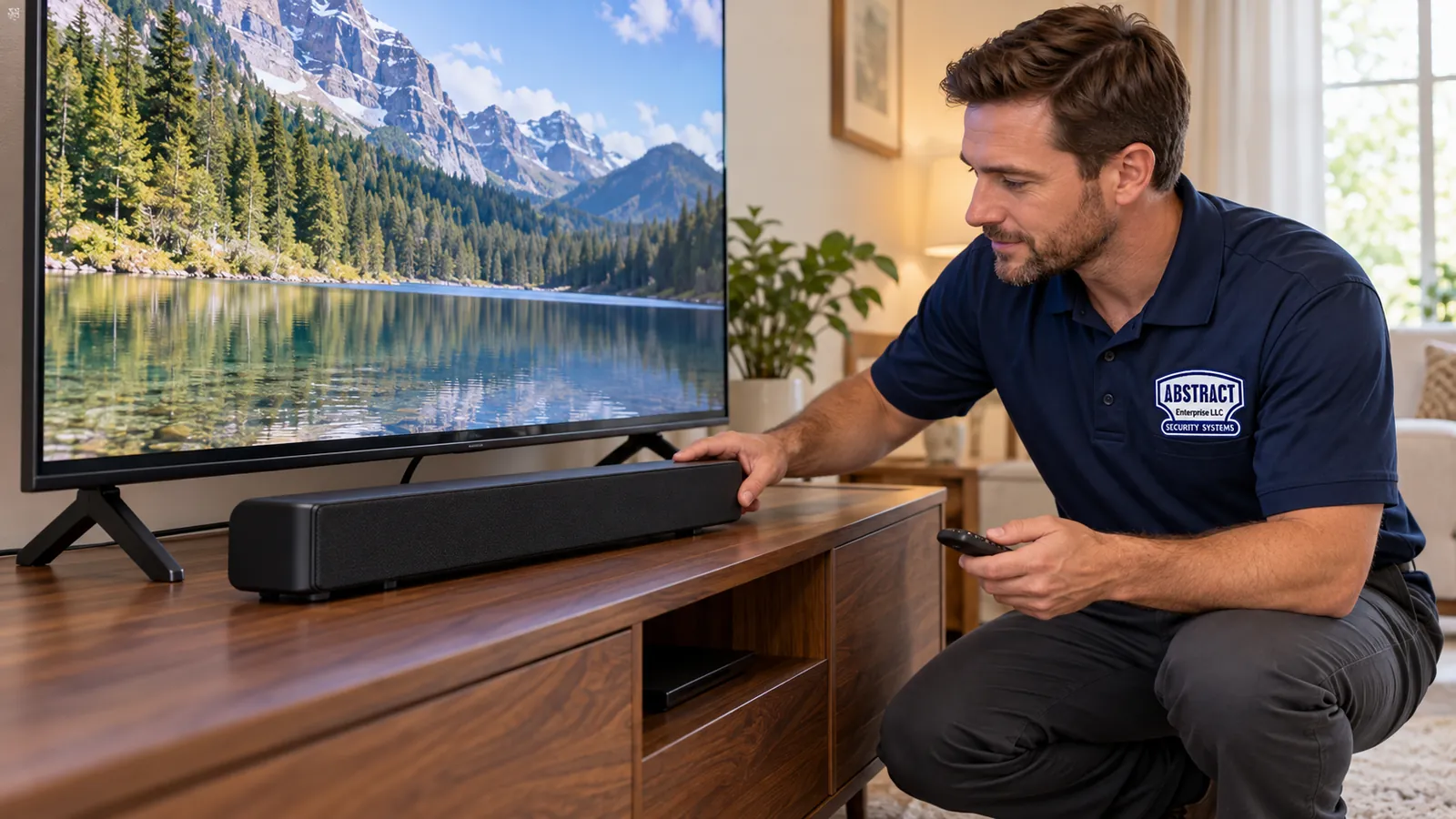
Crouched at a wooden media console, a technician positions a soundbar in front of a TV on its feet, holding the remote in his other hand.
Field Notes
Field Notes From Nassau Living Rooms
Reading a renovated wall: the routine on every Nassau visit (describes our usual practice, not one particular household)
The first question on a Nassau job is "what happened here?" We look at the room the way an inspector would: a ceiling line that steps down where an addition starts, a strip of floor that changes direction, a window that sits oddly high, a light switch on the wrong side of a door. Each is a clue that the wall behind the TV may not be the wall in the original plans.
Then the scanner, run the full width of the TV position, not just where the bracket will land. Studs that stop part-way down, a run of solid readings where there should be a cavity, or nothing at all over a stretch where there should be framing tell us where the old openings, the blocking and the sheathing are. If the reading is unclear, a small hole behind where the TV will hang settles it, and nobody will ever see it.
Two habits round it off. We photograph the inside of any wall we open before the kit or plate closes it, so the household has a record of what is behind the TV for the next renovation. And we note the soundbar model, bracket and connection settings on the job record, which makes a later repair visit or a second room quicker for everyone. Neither costs anything, and both reflect the same idea: in a county where most houses have been changed many times, the next person to open the wall should know what they will find.
Only then do we decide the route for the cables and confirm the price with the household. If the in-wall kit won't drop through, we say so before cutting, and offer the cover. Reading the wall first is the difference between one visit and two.
FAQ
Nassau County Soundbar Installation FAQ
What would a Levittown or Garden City household pay for a wall-mounted soundbar with the wires hidden?
+
On drywall over wood studs, it is $129 to wall-mount the bar, $84.99 for a Sanus soundbar bracket if the bar didn't come with one, and $169 for a code-compliant in-wall power and cable kit: $382.99 in total. A Garden City plaster wall adds $45. If the wall can't be fished, a paintable cord cover at $59 replaces the in-wall kit.
We're moving within Nassau — can you take the soundbar down at the old house and put it up at the new one?
+
Yes, as two jobs. At the old house we take the bar and its bracket down, and removing a bracket is $45; at the new house the bar goes back up at the $129 wall-mount price, with the wall surcharge for whatever the new wall turns out to be. Moving the gear between houses is up to you, and we pack nothing ourselves.
Can you come the same day an electrician adds the outlet behind the TV?
+
Yes, as long as the electrician has finished before our two-hour window starts. Book the electrician first, confirm their finish time, then book us for a later window that day. If the outlet isn't in when we arrive and we can't start, the $150 return-trip fee applies, so a little slack between the two visits is worth it.
Our TV is mounted across a corner — where does the soundbar go?
+
Directly under the screen, on the TV mount rather than the wall, because a corner leaves no flat wall below the TV for a bracket. A bracket that attaches to the TV mount keeps the bar centred as the screen angles out. If the TV sits on a corner cabinet instead, the bar goes on the cabinet's front edge for $79.
Do you work in the incorporated villages as well as the unincorporated hamlets?
+
Yes, everywhere in the county: both cities, all three towns, all 64 villages and every hamlet. Prices don't change between them. What can change is the paperwork around electrical work and building rules, which is why we stay on the low-voltage side and leave new outlets to licensed electricians.
Will you take the old TV away when the new one goes up?
+
Yes. Taking down the old TV is $85, removing its old bracket is $45, and hauling the set away for recycling is $79. Taking away the new TV and soundbar boxes and foam is $25. Tell us when booking so we bring the right vehicle space.
Can a turntable or an old stereo be connected to a new soundbar?
+
Often. It depends on the inputs the soundbar has: some take an analogue or optical input, many accept Bluetooth, and a turntable needs a phono preamp unless it has one built in. If the bar has no suitable input, an A/V receiver is the better hub, and connecting one with its speakers is $129. We check the model before you buy any adapters.
Does the certificate of insurance our co-op or HOA wants cost extra?
+
No. Certificates of insurance are free. Send us the exact wording the board, managing agent or HOA asks for, including any additional insured names, and we issue it before the appointment so nothing holds up the job.
How high must a TV and soundbar go in a waiting room to stay clear of the ADA projection rule?
+
Under section 307.2 of the 2010 ADA Standards, a wall-mounted object whose leading edge is between 27 and 80 inches above the floor may stick out no more than 4 inches into a circulation path. A TV with a soundbar under it usually projects more than that, so in a waiting room we put the bottom of the bar above 80 inches or place the pair outside the walkway.
Does doing several rooms in one visit cost less per room?
+
Each room is priced from the same published lines, so the per-room price doesn't change. What you save is a second appointment: there is no visit charge on top of the lines, and doing two or three rooms together means one arrival window instead of several.
All Areas Served
Soundbar Installation Across Long Island and New York
You are on the Nassau County page. Our Long Island soundbar installation hub covers both counties together, and the same service runs across New York City and the Hudson Valley.
If the soundbar went quiet after a TV update, the sub won't pair, or the rears dropped off the network, call (516) 346-5778. Same-day when a two-hour window is open, and most eARC, settings and pairing faults are fixed in one to two hours once we are in the room.
Soundbar Installation Nassau County — Licensed, Insured, Priced in Advance
Abstract Enterprises Security Systems · 1282 Troy Ave, Brooklyn, NY 11203 · Nassau line (516) 346-5778 · WhatsApp (718) 679-0359 via wa.me
NYS Low-Voltage Licence #12000287431 · 100% Licensed & Insured · Same-Day Estimates · Rated 4.7★ from 201 Google Reviews
Full terms — including 50% deposit, one-year parts-only warranty on AESS-supplied products, and the late-fee schedule — are set out in the service agreement. See our warranty page.
Reviewed and updated October 17, 2026. Changelog: first edition, covering renovated Capes, raised homes, co-ops and Nassau businesses.