Wall Mount Under the TV · TV-Attached Brackets · Hidden Wiring · HDMI eARC Setup · Neighbour-Friendly Bass
Soundbars put up properly in New York apartments: anchored into plaster, brick or concrete without cracking the wall, wired so nothing dangles, set up on the right HDMI port so the TV remote runs it, and tuned so the bass stays in your living room instead of your downstairs neighbour's bedroom. We bring the certificate of insurance your building wants, book around the freight elevator, and work in 2-hour arrival windows from 8 AM to 8 PM, seven days a week.
Reviewed and updated October 17, 2026 · Written by Anwar Timothy, NYS licence #12000287431

Want the soundbar up this week? Call (800) 486-0943 or send the 60-second form. A licensed installer reads every request and replies with a written price built from the menu on this page.
A soundbar is the easiest audio upgrade you can buy and one of the trickiest to put up well in a New York apartment. In a suburban house the job is a stud finder, two screws and a cable tucked behind a cabinet. Here the wall behind the TV might be hundred-year-old plaster on wood lath, a brick wall shared with the building next door, poured concrete in a post-war tower, or a metal-stud partition that a renovation added last year. The person downstairs is a few feet below your subwoofer. The building has a managing agent who wants paperwork before anyone drills, and the only way up may be five flights of stairs or a freight elevator that runs on its own timetable.
Those conditions are why so many soundbars in the city end up sitting on a console with a cable hanging down the wall, or bolted up with the plastic anchors from the box and slowly sagging out of a plaster wall. The bar itself is rarely the problem. Most current models — Sonos, Samsung, LG, Sony, Bose, Vizio and the rest — sound good when they are placed close to the screen, connected on the right port and set up for the room. What goes wrong is everything around the bar: an anchor that is wrong for the wall, a bracket that leaves the bar blocking the TV's infrared sensor, an HDMI cable in the wrong socket so the TV remote stops controlling the volume, or a subwoofer parked in a corner on a wooden floor where it shakes the ceiling of the apartment below.
Noise is the part New Yorkers worry about most, and with reason. Residents post to Reddit's r/AskNYC about bass "coming through the floor fairly regularly since we moved in", and the standard advice in those threads is to call 311. In a thread asking for neighbour-friendly soundbars, the practical answer was that bass frequencies travel easily, so either skip the subwoofer or choose one you can turn down. That matches what we see in practice: the soundbar's dialogue and mid-range stay mostly inside your walls, while low bass travels through floors, joists and shared structure. A good installation in this city is as much about where the subwoofer sits, what it sits on and how it is set as it is about the bracket.
The paperwork is the other city-specific layer. Co-op and condo buildings usually have house rules or an alteration agreement that covers contractors, and on r/AskNYC the plain advice to someone renovating a co-op was that it is standard for co-ops to insist on a certificate of insurance before any work is done. A soundbar on two screws is not a renovation, but the managing agent, the doorman and the superintendent still want to know who is coming, when, and whether they are insured. We issue that certificate free, name the building and its agent on it, and send it before the appointment so the front desk has it waiting.
Renters have a different set of limits. Many leases restrict holes in walls or require the apartment to be returned in its original condition, and nobody wants to lose a deposit over a cable channel. For tenants we lean toward console placement, brackets that hang the bar from the TV mount rather than the wall, and paintable cord covers instead of in-wall work, and we tell you plainly which of those choices leaves the fewest marks to fill when you move out.
Put together, those figures describe the job. Most New York soundbars are installed in older multi-family buildings, onto walls that need the right anchor, in apartments where sound carries to people who can and do complain. Getting it right means choosing the mounting method for the wall, keeping the bar close to the screen so dialogue lines up with the picture, and setting the bass for an apartment rather than a detached house.
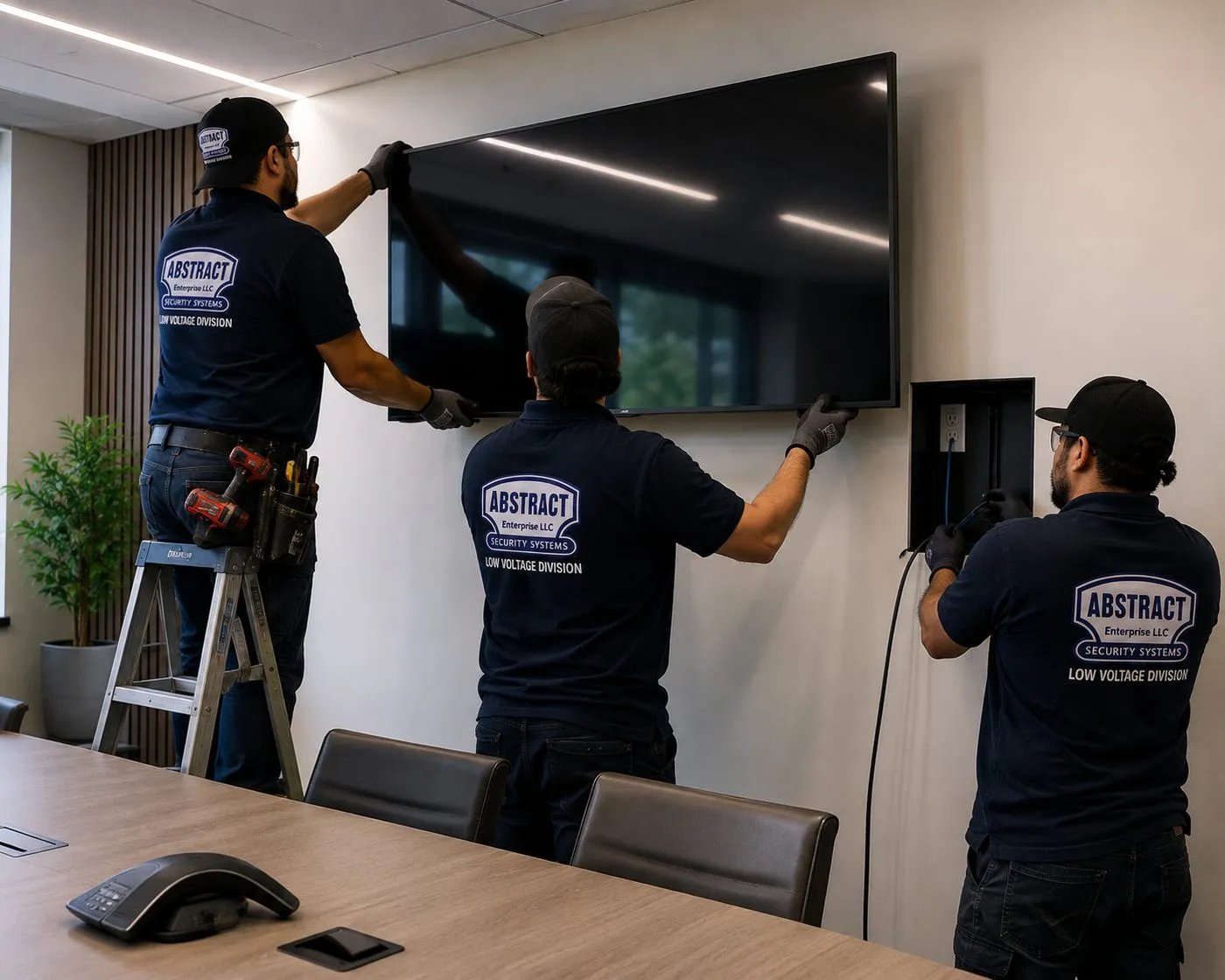
Most New Yorkers who call about a soundbar are also mounting or re-mounting the TV above it, so the two are usually done in one visit. Our TV installation team in NYC works from the same price list, and if you want more than a bar — rear speakers, a receiver or ceiling speakers — Abstract Enterprises' AV and sound installers cover the full system.

No sound after a TV update, the TV remote no longer changes the volume, voices out of sync with lips, a bar that drops out every few minutes, or a bracket pulling away from the wall — those are service calls, not new installs. We book them in the next open 2-hour window where we can, and most connection and setup faults are sorted in one to two hours once a tech is on site. Call (800) 486-0943 and say it is a soundbar problem, or see our TV and soundbar service policies for how setup-only visits are billed.
Every soundbar job we do in the five boroughs is one of the services below, or a combination of them. Each has a published price, and each finishes the same way: the bar level and centred, the cables dressed or hidden, the TV remote controlling the volume, and a quick listen with you at the couch before we pack up.
The most common request in New York apartments. The bar goes on its bracket a short distance below the screen, centred and level, anchored with fixings chosen for the wall we actually find — toggles in plaster, sleeve anchors in brick, concrete anchors in a slab-era tower.
For renters and anyone who doesn't want holes: we place the bar on the media console, connect it to the TV, set it so it doesn't block the TV's sensor, and dress the cables behind the furniture. Often the right answer in a rental.
A bracket that clamps the bar to the TV mount instead of the wall, so the bar moves with a full-motion arm and the wall gets no extra holes. Sanus makes models for this, including one designed for the Sonos Arc.
Mounting a new TV and the soundbar under it together, so spacing, height and cable route are planned once. Common when people move into a new apartment or upgrade both at the same time.
Power and HDMI hidden inside the wall using a code-compliant in-wall power and cable kit, where the wall can be opened and the building allows it — usually owners in co-ops and condos rather than renters.
A slim surface channel from the bar down to the outlet, painted to match the wall. The renter's answer to dangling wires, and the practical one on brick and concrete where in-wall work isn't possible.
Connecting the bar to the TV's eARC or ARC port, switching on HDMI-CEC so one remote runs everything, fixing lip-sync, and updating the bar's firmware and app on your Wi-Fi.
Pairing wireless subwoofers and surrounds, finding the spot where the bass is even at the couch but not in the floor, and setting levels for an apartment rather than a house.
Taking the bar and bracket down at the old place, filling nothing we didn't make, and reinstalling it at the new one on the right anchors for a wall that is probably completely different.

The soundbar is the same in every building. The wall, the floor and the rules are not. These are the building types we install in most across the five boroughs and what each one asks of a soundbar job.
Plaster on wood or metal lath, often with masonry behind it, high ceilings and solid floors. The plaster cracks if it is drilled carelessly and the old lath doesn't hold a screw on its own, so fixings go through to something solid or spread the load behind the plaster. Doormen, superintendents and a managing agent are the norm.
Party walls of brick shared with the next house, plaster finishes and floors of wood joists. The TV wall is often the party wall. Brick holds well with the right sleeve anchors, but bass travels into the next house and the floors below more easily than people expect.
Four to six storeys with no elevator, narrow stairs, small rooms and walls that have been patched many times. Planning the visit to carry everything in one trip matters, and so does a mounting method that tolerates uneven plaster.
Concrete floor slabs, block or concrete walls, and lower ceilings. Concrete makes a very strong fixing once drilled, but it needs a hammer drill, takes more time and creates dust we contain. Sound between floors is better than in wood-joist buildings but not immune to bass.
Metal-stud partitions with gypsum board, sometimes with resilient channel for sound. Metal studs need the right fasteners, not wood screws, and the manufacturer's in-box hardware often assumes wood. Owners here are the most likely to want in-wall wiring.
Common in Queens and parts of the Bronx: brick buildings around shared courtyards, plaster walls and a board with its own contractor rules. Jobs here are mostly wall mounts under an existing TV with surface cord covers.
Plaster on wood lath. We find the studs or furring behind the plaster before drilling and use them where the bracket lines up. Where it doesn't, we use spring or snap toggles sized for the bracket so the load spreads behind the plaster rather than relying on the lath. Holes are started slowly with a sharp masonry bit and no hammer action, which is what keeps plaster from cracking around the hole. A soundbar is light compared with a TV, but a bar bumped while cleaning will still loosen a weak anchor over time.
Plaster over brick or block. Common on exterior and party walls in pre-war buildings. We drill through the plaster into the masonry and set sleeve or screw anchors in the brick, keeping holes in the brick itself rather than in the mortar joint where possible. This is one of the strongest fixings in the city once done.
Exposed brick. Loft and brownstone living rooms often have it. Fixings go into brick with anchors rated for masonry, and the cable route is surface-only because there is no cavity to hide wire in, so a painted or brick-toned cord cover is the usual finish.
Concrete and cinder block. Hammer drill, concrete anchors, and dust extraction or a vacuum held at the bit. Concrete walls take longer and carry a surcharge on our price list for that reason. They are also where in-wall concealment is generally impossible.
Metal studs and gypsum board. We locate the studs and use fasteners made for light-gauge steel, or toggles in the board where the bracket doesn't line up with a stud. Wood screws into metal studs strip; that is the most common failure we find on bars someone else installed in new buildings.
Tile and stone. Rare behind a soundbar but it happens in media walls and in some lobbies and offices. Tile is drilled with diamond or carbide tile bits at low speed, and there is always some risk of cracking a tile, which we explain before we start.


Many owners doing a soundbar in a renovated unit also have us run network cable to the TV wall at the same time, so the bar, the TV and the streaming box are wired rather than relying on Wi-Fi. Our structured cabling installation in NYC is often scoped on the same visit.
Soundbars are not only for living rooms. In the city they are the simplest way to make a conference-room display, a waiting-room TV or a bar's game-day screen intelligible without installing a full sound system. These are the commercial settings we work in most and what each tends to need.
Conference rooms where a large display handles video calls and the built-in TV speakers can't carry voices to the far end of the table. A soundbar under the display, on eARC, fixes that for a fraction of the cost of ceiling audio.
Smaller offices and co-working suites in converted and new buildings, often with metal-stud partitions and glass walls. Mounting into board and steel, with cables run through the wall or in tidy raceway.
From Bedford Avenue in Williamsburg to Main Street in Flushing and Arthur Avenue in the Bronx, screens over bars and dining rooms need audio people can hear at a table without filling the street. A soundbar per screen, or a bar feeding a small zone, is common.
A wall TV with captions and low-level sound. Bars here are set for clarity at modest volume, mounted clear of walkways, with cables fully concealed for a clean, cleanable finish.
Small storefronts along every borough's commercial strips, where a TV and soundbar run all day. Durable mounting, tamper-resistant brackets and a remote that staff can't lose.
Residential towers with lounges, screening rooms and gyms. The managing agent or the board decides, the work is scheduled around residents, and the audio is kept within the room's walls.


Many businesses that add soundbars to their screens also want the cameras and the network behind them upgraded. Our low-voltage installation services in NYC cover audio, data and security under one licence.
These are the questions New Yorkers ask before booking a soundbar install, grouped by what they are really trying to work out: whether the building will allow it, whether the wall will hold it, whether the neighbours will hear it, and how it fits a rental or a small room. Price, warranty and scheduling questions are in the FAQ further down.
Usually not as a formal alteration, but check your house rules before booking. Alteration agreements in New York co-ops and condos are written for renovations — moving walls, plumbing, electrical — and a soundbar on a bracket with a few anchors normally falls below that line. What most buildings do require for any contractor visit, however small, is notice to the managing agent or the front desk, a certificate of insurance on file, and work inside set hours. Some boards also have rules about drilling into particular walls, especially exterior or party walls, or about running anything on the outside of a wall.
The quick way to find out is to ask the managing agent or the superintendent one question: "Do you need anything from a contractor who is mounting a soundbar and running cables?" If the answer involves an alteration agreement, in-wall wiring is usually what triggers it, and we can switch to a cord cover or a TV-attached bracket to keep the job below that threshold. If the work does need approval, we provide the scope, the insurance and the method so the board has what it needs.
Most Manhattan and Brooklyn managing agents ask for a certificate showing general liability and workers' compensation, with the building's owner and the managing agent named as additional insureds, often with specific wording they supply. Many give you a sample certificate or a PDF of their contractor requirements. Some also want the building's exact legal name, which is not always the name on the awning, and limits that meet their minimums.
Send us whatever the building sends you, or just the managing agent's email, and we issue the certificate free, usually the same day. We send it to the agent directly and copy you, and we bring a copy to the appointment, because the most common reason a soundbar install in this city starts late is a doorman who hasn't seen the COI.
It changes when we book it, not what it costs. Many elevator buildings require contractors to use the service elevator and to arrive within a window, typically weekday business hours, and some don't allow contractor work at weekends at all. We ask about this when you book and pick a 2-hour arrival window that sits inside the building's hours, with enough time left to finish before the elevator or the work window closes.
A soundbar visit is short, so the building's hours rarely cause a problem. Where they would — a Saturday you wanted but the building forbids — we tell you before booking rather than turning up to be sent away. If we do arrive and can't start because the building refuses access, that is the situation our $150 return-trip fee covers, which is exactly why we check first.
Yes, if the plaster is drilled the right way and the fixing doesn't rely on the lath. Pre-war plaster cracks when it is hammer-drilled, when a dull bit wanders, or when a screw is driven into lath that splits. We locate the studs or masonry behind the plaster first, drill with a sharp bit and no hammer action, and either fix through to the stud or use toggles that spread the load behind the plaster. Soundbars are light, so the load itself is modest; the risk is in the drilling.
Plaster that is already loose, bulging or cracked behind the TV is a different case. We check it by tapping and pressing around the mounting area before drilling. If it is coming away from the lath, we tell you and suggest either a TV-attached bracket or a console placement until the wall is repaired, because no anchor can hold in plaster that isn't attached to anything. Plaster walls carry a $45 surcharge on our price list for the extra care involved.
For holding the bracket, no; brick is one of the most secure walls to mount on once it is drilled with a masonry bit and fitted with sleeve or screw anchors. The considerations are different. A party wall is shared with the next building or apartment, so some buildings restrict drilling into it, and bass from a subwoofer against that wall travels into the neighbour's space more easily than from an interior partition.
On party walls we keep the subwoofer off the wall and away from the corner, mount the bar with masonry anchors, and run cables in a surface cover because there is no cavity behind brick. Brick and stone carry a $65 surcharge on our price list. If the building has a rule about party-wall drilling, a TV-attached bracket keeps the bar off the wall completely.
With a hammer drill, carbide bits and concrete anchors, and with a vacuum held at the hole to keep dust out of the apartment. Many post-war towers and Mitchell-Lama complexes in the city have poured-concrete or concrete-block walls, sometimes with a thin skim of plaster. They make an excellent fixing once drilled, but drilling takes longer and is louder, which is why concrete and cinder block carry a $75 surcharge and why we schedule within the building's quiet-work hours.
Concrete also decides the cable route. You can't fish a wire through a solid wall, so the choice is a surface cord cover painted to match, or routing the cable down behind the TV to the console. We show you both before drilling so you choose the finish, not us.
It can, and in New York it is the most common complaint a soundbar causes. The bar on its own mostly plays dialogue and mid-range sound that walls and floors block reasonably well. The subwoofer produces low frequencies that pass through floors, joists and shared structure, which is why the person below hears thumping long after the voices have disappeared. City residents filed hundreds of thousands of residential noise complaints with 311 last year, and loud music made up the largest share.
The answer is setup rather than doing without. We place the sub where it gives even bass at the couch at a lower level, set it on an isolation pad or a rug rather than bare wood, turn the sub level down against the bar during setup, and turn on the bar's night or dialogue mode so you can use it late at low volume. Many soundbars can also be used without the subwoofer altogether, and for some apartments that is the honest recommendation.
Out of the corners, off bare floorboards and away from shared walls. Corners boost bass and push more of it into the structure; a floor of wood joists acts like a drum skin under a subwoofer sitting directly on it. In most New York living rooms the best spot is along the front wall near the TV, a little out from the corner, on a dense rug or an isolation platform, with the port or driver facing into the room.
We test a few positions with you on the day, sitting where you actually watch, and settle on the one that gives the most even bass at the lowest sub level. If the room has a wall shared with a neighbour, we keep the sub on the opposite side of the room where that's practical.
Yes, in the sense that it covers sound from your apartment that reaches someone else's. The city's 311 guidance lists loud music, parties and television among the neighbour-noise complaints it takes, and the Noise Code sets limits between 10 PM and 7 AM measured inside the property receiving the sound. In practice, enforcement on residential neighbour noise is slow, and the real consequences in an apartment building are usually a letter from the managing agent or a lease or house-rule issue rather than a fine.
Many leases and co-op house rules add quiet hours of their own. The setup we do — sub off the floor and corners, sensible levels, night mode on the remote — is aimed at keeping you well within those rules without making movies sound thin. This is general information, not legal advice; your lease and house rules are what apply to you.
Without cutting anything. The usual renter's setup is a paintable cord cover: a slim channel stuck or screwed to the wall that runs from the soundbar down to the outlet or console, painted the wall colour so it disappears at normal viewing distance. On our price list it is $59. Where the TV and bar sit on a console, cables go behind the furniture and are tied off so nothing shows from the room.
A third option is a TV-attached bracket for the soundbar, so the bar hangs from the TV mount and its cables follow the TV's cables behind the screen. That keeps the number of wall holes to whatever the TV needed. In-wall concealment, at $169 with a code-compliant in-wall power and cable kit, is for owners or tenants whose landlord has agreed in writing.
That depends on your lease and your landlord, not on us, so read the lease's clause on alterations and wall holes before booking, or ask the landlord directly. Many New York leases treat small anchor holes as normal wear; others require walls to be restored. A soundbar bracket usually needs two to four holes, smaller than those a TV mount needs.
If holes are a concern, we steer the job toward console placement or a TV-attached bracket. Our price does not include patching or painting, so if you will need holes filled at move-out, a painter or handyman does that at the end of the lease. We are happy to tell you exactly where and how many holes a given option needs before you decide.
Usually not, but the size of the bar should match the room and the TV. In a small New York living room, where the couch might be eight or nine feet from the screen, a compact bar often sounds more even than a large one and is far easier on the neighbours. A bar roughly the width of the TV, or a little narrower, looks right and keeps sound centred on the picture.
The bigger risk in small rooms is the subwoofer and the surround effects. A large sub in a room of 150 square feet can overwhelm it, and up-firing height effects depend on a flat ceiling at a sensible height. We set up the bar for the room you have, and if you are still choosing, we will tell you plainly where a compact model will serve you as well as a flagship.
Thin TVs have small speakers, often firing downwards or backwards, and modern film and TV mixes put a lot of dynamic range between quiet speech and loud effects. The result is the familiar routine of turning up the volume for voices and down again for explosions, which in an apartment means the neighbours hear the explosions. A soundbar with a dedicated centre channel and a dialogue or speech-enhancement mode is one of the most effective fixes.
Placement matters as much as the bar. A bar at roughly seated ear height, close beneath the screen and not tucked behind a console lip, sends speech straight at the couch. During setup we turn on speech enhancement and night mode where the bar has them, and test with a dialogue-heavy scene so you hear the difference before we leave.
As close beneath the screen as the bar's height and the TV's sensors allow, usually a gap of an inch or two. Dolby's own guidance is that the bar and the TV should be as close together as practical and that below the screen is usually best, and Yamaha suggests aiming for roughly seated ear height. In a small room, where you sit close, a bar far below the TV makes voices seem to come from the floor.
We check that the bar doesn't cover the TV's infrared receiver or its stand, that the front of the bar isn't blocked by a console edge, and that any up-firing drivers have open space above them. Then we set the TV's height and the bar's together, so the picture is at eye level and the sound is just beneath it.
Yes. Walk-ups are a big share of the city's apartments, and we plan visits to them so everything comes up in one trip: the bracket, anchors for whatever wall we might find, a drill, a vacuum and the cables. For walk-ups on the third floor and above with no elevator there is a $40 charge on our price list, because carrying a TV, a soundbar and tools up five flights takes real time.
If you are having the soundbar delivered, ask the retailer whether delivery goes to your door or stops at the building entrance, and let us know. We can carry a boxed bar up with us, and we will take the empty box away for $25 if you don't want it in your apartment.
Manhattan street parking for a work van is rarely available near the door, so our Manhattan TV-mounting price is $244.99 plus a flat $150 parking charge, which covers a garage or lot near your building. If your soundbar goes up on the same visit as the TV, it rides on that one charge. Whatever applies to your visit is shown on the written quote before you book, never added on the day.
For setup-only visits in Manhattan — reconnecting a bar, fixing eARC, pairing a sub — the hourly rate is $265 for the first hour and then 30-minute blocks, which reflects the same travel and parking reality. In the other boroughs parking is usually manageable, and the rates are lower.
Soundbar boxes and settings menus are full of abbreviations. These are the ones that matter for an installation, explained without the marketing.
| Term | What it means for your setup |
|---|---|
| HDMI ARC | Audio Return Channel: one HDMI cable carries sound from the TV to the soundbar, and the TV remote can control the bar's volume. Carries compressed surround, including Dolby Atmos inside Dolby Digital Plus. |
| HDMI eARC | Enhanced ARC: much more bandwidth, so lossless formats such as Dolby TrueHD and DTS-HD Master Audio pass through. Usually only one HDMI port on the TV supports it, labelled eARC. |
| HDMI-CEC | The setting that lets devices control each other over HDMI — the reason one remote can turn on the TV and soundbar together. TV brands give it their own names. |
| Optical (Toslink) | A digital audio cable used when a TV or bar has no ARC. Works for stereo and compressed surround, but the TV remote usually won't control the bar's volume without extra setup. |
| Dolby Atmos | A surround format that adds height. Soundbars create it with up-firing drivers bounced off the ceiling or with processing; results depend on the room and ceiling. |
| Channels (3.1, 5.1.2) | The first number is main speaker channels, the second the subwoofer, the third height channels. A 3.1 bar has left, centre and right plus a sub. |
| Centre channel | The part of the bar that carries most dialogue. A bar with a dedicated centre makes speech easier to follow. |
| Night mode | Compresses the gap between quiet and loud sounds so you can hear voices at low volume — useful after 10 PM in an apartment. |
| Speech or dialogue enhancement | Raises the frequencies of the human voice relative to music and effects. |
| Lip-sync / AV delay | A setting that shifts audio timing to match the picture when voices arrive early or late. |
| Isolation pad | A dense platform under a subwoofer that cuts the vibration passed into the floor. |
| TV-attached bracket | A soundbar bracket that fixes to the TV mount or the TV's VESA holes instead of the wall, so the bar moves with the TV. |
| In-wall power and cable kit | A code-compliant kit with a recessed inlet behind the TV and a recessed outlet lower down, linked inside the wall, so the TV and bar's power runs inside the wall legally. |
| Cord cover | A surface raceway that hides cables on the wall face; paintable to match. |
If a quote from anyone — us included — uses a term that isn't on this list, ask what it means for your room. A clear answer is a good sign.
We install whatever soundbar you have bought, and we will advise on what to buy if you haven't. These are the categories we handle most in New York apartments, with real examples and the specifics that matter for mounting.
Small bars for small rooms and smaller TVs. The Sonos Ray is about 56 cm wide and under 2 kg, and connects by optical rather than HDMI. Compact bars are easy on plaster walls and on neighbours, and often the right choice in a studio.
The Sonos Beam (Gen 2) weighs about 6.35 lb and connects by HDMI eARC, as do comparable Samsung, LG, Sony and Bose models. A good match for 50- to 65-inch TVs in typical New York living rooms.
Long bars with up-firing drivers. The Sonos Arc Ultra is about 46 inches wide and about 5.9 kg. Bars this size need a solid fixing and a TV wide enough to sit over them without looking odd.
Most bars ship with a basic bracket; others need one bought separately. The Sanus universal soundbar mount (SASB1) attaches to the back or bottom of most bars up to 20 lb and adjusts for depth. A Sanus soundbar bracket supplied by us is $84.99.
Brackets that hang the bar from the TV or its mount. Sanus's WSSATM1, designed with Sonos for the Arc, attaches to most 50- to 90-inch TVs and other brands' mounts, with depth adjustment so the bar clears the screen.
Wireless subs paired to the bar, plus isolation pads or platforms to cut vibration into the floor. In apartments the pad often matters more than the sub's size.
Wireless rears paired to the bar, on stands, shelves or small wall brackets. They need power at the back of the room, which in older apartments is often the deciding factor.
Code-compliant recessed kits that let power and HDMI run inside the wall from behind the TV to near the floor. Used where the wall has a cavity and the building allows it.
Certified high-speed HDMI cables for eARC, optical cables for older TVs, universal remotes and streaming devices set up so the whole system runs from one remote.
| Connection | What it carries | TV remote controls bar? | Best New York use |
|---|---|---|---|
| HDMI eARC | Lossless surround and Atmos, including TrueHD | Yes, with CEC on | Newer TVs with Atmos bars; disc players and game consoles |
| HDMI ARC | Compressed surround, Atmos inside Dolby Digital Plus | Yes, with CEC on | Most TVs from the last decade; streaming apps |
| Optical | Stereo and compressed 5.1 | Usually needs remote learning or setup | Older TVs, compact bars such as the Sonos Ray |
| Bluetooth | Compressed stereo, with some delay | No | Music from a phone; not recommended for TV |
Specifications are from the manufacturers and published reviews as of this update. Models change, so we confirm the bar's ports, weight and bracket before the visit, which also tells us which anchors to bring.

A note on method first: Google's AI Overview wasn't viewable from the tools used to research this page, so none of the quotes below are presented as its words. Each heading is a claim that a real cost calculator, retailer menu, manufacturer guide or forum thread publishes, and that answer engines tend to pass on. Under each one is what changes once the soundbar is going into an apartment in one of the five boroughs.
That range comes from Homewyse's national calculator, which in September 2026 estimated the average cost to install a soundbar starting at $58.43 to $231 per bar. It is a reasonable national figure, and it is the kind of number a summary will quote as the answer.
A national average assumes an average wall. In New York the wall behind the TV is more often plaster, brick or concrete than wood-stud drywall, and each takes different tools and time. Add a fifth-floor walk-up, a building that wants a certificate of insurance, or a Manhattan parking garage, and the same job costs a different amount.
That is why we publish the parts instead of a range: $79 to place a bar, $129 to wall-mount it, $84.99 for a Sanus bracket, and a fixed surcharge per wall type. You can add up your own job before we arrive.
Thumbtack's data puts the national average for TV wall mounting at $121 to $234, and cost guides often treat the soundbar as a minor extra on top. Big-box service menus also list soundbar setup and soundbar mounting as separate flat items, which reinforces the idea that it is a quick add-on.
Sometimes it is. But the soundbar is where most of the problems surface after the TV is up: the wrong HDMI port, CEC switched off, a bar that covers the TV's remote sensor, lip-sync drift, a sub that rattles the floor. Treating it as an afterthought is why so many people end up controlling the TV and the bar with two remotes.
We price the soundbar as its own line, and we don't leave until the TV remote turns the bar on and controls its volume, and dialogue sounds right from the couch.
Setup guides and some installers' blogs tell readers the in-box hardware will do, while others warn that it won't hold in city walls. Manufacturers' own manuals, such as Yamaha's and Denon's, carry precautions about checking that the wall can bear the bar and using fixings suited to it.
The bracket is usually fine; the anchors are the issue. Plastic plugs are made for solid material and grip poorly in old plaster; wood screws strip in metal studs; brick and concrete need masonry anchors. A bar that looks secure on day one can loosen within months from vibration and the occasional bump.
We use the manufacturer's bracket where it is suitable and our own fixings chosen for the wall, which is what the wall-type surcharges on our price list pay for.
A very common claim, and only partly true. Standard ARC can carry Dolby Atmos inside a compressed Dolby Digital Plus stream, which is how most streaming services deliver it. eARC is needed for lossless Atmos in Dolby TrueHD, which comes from 4K Blu-ray discs and some players and consoles.
The practical consequence is that people buy new TVs or cables they don't need, or assume their Atmos bar is faulty when the real problem is the TV's eARC setting, the wrong HDMI port or HDMI-CEC switched off. Usually only one port on the TV supports eARC, and it is not always the first one.
We check the TV's ports and settings, connect the bar to the right one, and confirm on screen which format is actually playing, so you know what you are hearing.
Some quick-answer summaries reduce placement to "below the TV." Dolby's guidance is more precise: the bar and screen as close together as practical, the bar ideally near seated ear height, and placement off-centre, too high or too low making sound seem to come from somewhere other than the picture. Yamaha suggests aiming close to 42.5 inches off the floor.
In small New York living rooms, where you sit close and the TV is often mounted high to clear a radiator or a window, the gap between the screen and the bar becomes obvious. A bar left on a low console under a high TV puts voices at knee height.
We set the TV and bar heights together, around your actual seating, and if a radiator or a window forces the TV up, we explain the trade-off before drilling.
Product reviews and forums often treat the subwoofer as the upgrade that makes a soundbar worthwhile, and in a house it often is. In an apartment the advice on r/AskNYC is the opposite: bass travels easily, so skip the sub or choose one you can turn down.
City rules treat bass as its own problem. The Noise Code guide sets a separate bass-weighted limit for commercial music, because people feel low frequencies through structure. A large sub on bare floorboards in a pre-war building can be heard three floors away while sounding only moderate in the room.
We set the sub for the room and the building: placement off the floor and out of corners, a lower crossover level, and night mode on the remote, so the bass is felt on the couch rather than in the ceiling below.
Gig-platform listings and DIY videos make soundbar installation look like a quick job, and in a house with a wood-stud wall and an outlet right behind the TV it can be. That is the scenario most short answers describe.
In New York the minutes go elsewhere: getting past the front desk with the right certificate of insurance, the freight elevator, the walk-up stairs, finding something solid behind old plaster, drilling concrete quietly, routing cable where there is no cavity, and sorting out HDMI and remote settings that the TV maker hides in sub-menus.
The question to ask any installer, us included, is what happens if the wall turns out to be plaster or brick and the building wants paperwork. A clear, priced answer before the visit is the sign of someone who has done this in the city before.
Tell us the soundbar, the TV and the wall. We will tell you the method, the price and what the building needs from us.
Doorman building, walk-up or brownstone floor-through — give us the bar, the TV and the wall and a written price comes back the same business day. Prefer to talk? Dial (800) 486-0943.
We'll call you back the same business day. If it's urgent, call us now at (800) 486-0943.
Six steps, whether it is a compact bar on a console in a Bronx rental or an Atmos bar and subwoofer under a new TV in a Manhattan co-op.
You send the soundbar and TV models, a photo of the wall and the building type. We reply with a written price built from our published menu, including any wall surcharge, walk-up or parking line.
We issue the certificate of insurance your managing agent asks for, free, and confirm freight-elevator or contractor hours so the appointment fits the building's rules.
You choose a 2-hour arrival window between 8 AM and 8 PM, any day of the week. Same-day is possible when a window is open. Rescheduling is free with 24 hours' notice.
On arrival we confirm the wall type, find studs or masonry, check plaster condition and agree the bar's height and centre line with you before any drilling.
Bracket fixed with anchors for that wall, bar mounted and levelled, cables concealed in the method you chose, and the bar connected to the TV's eARC or ARC port with HDMI-CEC enabled.
Subwoofer placed and levelled, dialogue and night modes set, lip-sync checked, the TV remote tested on volume and power, dust cleaned up, and a quick walkthrough of the settings with you.

New York's housing tells you a lot about a soundbar job before we see the apartment. These six places show the range of buildings we install in across the five boroughs.
About 11,250 apartments in post-war brick towers along the East River side of Manhattan's East Side. Masonry walls, a large management office with its own contractor rules, and neighbours above, below and beside every living room.
A Mitchell-Lama cooperative completed in 1971 with 15,372 units in 35 high-rise buildings and seven townhouse clusters. Concrete construction, a cooperative with its own procedures, and a lot of TVs on block walls.
Apartment buildings mostly built between 1916 and 1941, from neo-Renaissance to the Concourse's well-known Art Deco. Plaster over masonry, high ceilings and solid pre-war floors.
Where the Queensboro Corporation built its Garden Apartments in 1917 and coined the term. Brick buildings around shared gardens, plaster walls and co-op boards with their own house rules.
Designated in 1973 and extended in 2016, with brownstone and brick row houses, many divided into apartments. Party walls of brick, wood-joist floors and bass that carries between units.
The North Shore neighbourhood around the ferry terminal and Empire Outlets, with older houses alongside mid-rise and high-rise apartment buildings, a short ferry ride from Lower Manhattan.
We also serve Harlem, Washington Heights, the Upper West and Upper East Sides, Astoria, Flushing, Forest Hills, Bay Ridge, Bushwick, Crown Heights, Flatbush, Riverdale, Parkchester, Tottenville and every neighbourhood between them, plus Nassau and Suffolk counties and the six Hudson Valley counties from Westchester to Ulster.

Our soundbar prices are published and fixed. You add up the lines that apply to your job, and that is what you pay. If something unexpected turns up on site, the price is given to you before any extra work is done.
| Item | Price | What it covers |
|---|---|---|
| Soundbar placed on console or stand | $79 | Placed, connected to the TV, set up and tested |
| Soundbar wall-mounted under the TV | $129 | Bracket fixed, bar mounted, levelled, connected and tested |
| Sanus soundbar bracket | $84.99 | Bracket supplied by us when the bar has none or yours won't suit |
| In-wall concealment | $169 | Code-compliant in-wall power and cable kit, cables inside the wall |
| Paintable cord cover | $59 | Surface raceway from bar to outlet or console |
| Cable run to a cabinet or other spot | $99 | Up to 25 ft |
| Sonos setup | $125 | Sonos system, app and grouping |
| A/V receiver | $129 | Receiver connected and configured |
| Universal remote | $99 | Programmed for TV, bar and sources |
| Streaming device setup | $49 | Roku, Apple TV, Fire TV or similar |
| Full home theater | $350 | Multi-component system setup |
| Condition | Price |
|---|---|
| Drywall on wood studs | $0 |
| Metal studs | +$30 |
| Plaster | +$45 |
| Brick or stone | +$65 |
| Concrete or cinder block | +$75 |
| Tile or marble | +$95 |
| Plywood backer board | $85 |
| High mount (above about 8 ft) | $75 |
| Walk-up, 3rd floor and above, no elevator | $40 |
| Box removal | $25 |
| Certificate of insurance for your building | Free |
When nothing needs mounting — reconnecting a bar after a new TV, fixing eARC or a remote, pairing a sub — we bill by the hour: the first hour flat, then 30-minute blocks. If you are also mounting a TV, the TV base price applies by borough.
| Borough | Setup-only, first hour | TV mounting base |
|---|---|---|
| Brooklyn | $195 | $179.99 |
| Queens | $195 | $179.99 |
| The Bronx | $225 | $209.99 |
| Staten Island | $225 | $209.99 |
| Manhattan | $265 | $244.99 + flat $150 parking |
National brands versus a local licensed installer. Big-box retailers and gig platforms publish flat menu prices that work well for wood-stud walls in houses. The difference in New York is in what the menu doesn't cover: plaster, brick and concrete, walk-ups, building insurance requirements and Manhattan parking. A local installer with a published wall-by-wall price list and a low-voltage licence can quote the real job, not the average one, and answer to you directly afterwards.
Most New York soundbar quotes land on one of these three. The arithmetic is shown on each card so you can check it; plaster, brick, concrete, walk-up stairs and other conditions from the add-on table go on top.
$79
Soundbar placed on the console or stand ($79), connected to the TV's eARC or ARC port, HDMI-CEC set so the TV remote controls it, cables dressed behind the furniture. The no-holes option for renters.
$213.99
Soundbar wall-mounted under the TV ($129) + Sanus soundbar bracket ($84.99) = $213.99. Fixings chosen for your wall; on plaster add $45, on brick $65, on concrete $75.
$382.99
Soundbar wall-mounted ($129) + Sanus soundbar bracket ($84.99) + in-wall concealment with a code-compliant in-wall power and cable kit ($169) = $382.99. For walls with a cavity and buildings that allow it.
Already have a rated bracket — the one in the soundbar box or one you bought? Then it is the labour-only wall-mount price: $129, plus any wall surcharge. Customer-supplied brackets must be rated for the bar, and they carry their manufacturer's warranty rather than ours. If we find the supplied bracket isn't suitable, we tell you before drilling and offer the Sanus bracket instead.
Send a photo of the wall and the bar's model. You get a written price built from the lines on this page.
A soundbar in Riverdale and one in Red Hook use the same bracket. The buildings around them are what change the job. As each borough gets its own page, the detail will live there; here is the overview.
Manhattan soundbar work is governed by buildings more than walls. Doorman and elevator buildings expect a certificate of insurance before the visit, contractor hours and the service elevator, and some co-op boards want notice of any drilling. Walls range from pre-war plaster over brick on the Upper West Side and in Washington Heights to concrete in post-war towers and metal studs in new condos. Living rooms are often small, so compact and mid-size bars are common, and parking means the TV-mounting price carries a flat $150 parking charge that is shown on the quote.
Brooklyn has the widest spread of living rooms: brownstone floors through and parlour levels with brick party walls, pre-war elevator buildings along Ocean Parkway and Eastern Parkway, walk-ups in Bushwick and Sunset Park, and new towers in Downtown Brooklyn and along the waterfront. Brownstones bring the bass question to the fore, because wood-joist floors carry low frequencies to the apartment below. Brooklyn also filed more 311 complaints than any other borough last year, which says something about how close neighbours live.
Queens mixes the garden apartments and co-ops of Jackson Heights, Forest Hills and Kew Gardens with the high-rises of Long Island City and the two-family houses that fill much of the borough. Co-op jobs usually involve a board's house rules and a COI; two-family houses are closer to suburban work, often with a tenant on the other floor. Plaster and brick are common in the older co-ops, drywall in the houses.
The Bronx brings large pre-war apartment buildings along the Grand Concourse, post-war complexes such as Parkchester and Co-op City, and houses in Riverdale, Throgs Neck and City Island. Concrete and block walls are common in the larger complexes, and plaster over masonry along the Concourse. Noise is a live issue: the Wakefield ZIP code logged more 311 calls than any other neighbourhood in the city in 2025, nearly all about noise, so subwoofer setup gets particular care here.
Staten Island soundbar jobs are mostly in houses — detached, semi-detached and two-family — with drywall over wood studs and space for a subwoofer that doesn't sit over someone's bedroom. The North Shore around St. George adds apartment buildings with the same paperwork and neighbour questions as the rest of the city. Parking is easier, and setup-only visits are billed at the Staten Island rate.
Most soundbar complaints in New York buildings are about bass, not volume. These are the steps we take on every apartment install to keep the low end in the room it belongs to.
None of this makes a soundbar silent to neighbours, and nothing will if it is played loudly late at night. It does mean that at normal listening levels, the people below you hear far less than they would from a sub on bare boards in a corner, which is where most complaints begin.
A little preparation makes the visit faster. Have the soundbar, its bracket and any subwoofer or rear speakers in the apartment and still boxed if you like. Clear the area in front of the TV wall. Know where the nearest outlet is and whether you rent or own. If your building needs a certificate of insurance, send us the managing agent's details when you book. And if you have a preference for where the subwoofer goes, tell us — it is your living room, and we will advise rather than decide.
In New York the right way to install a soundbar depends on two things before it depends on the bar: whether you own or rent, and what the wall is made of. This table is how we narrow it down on the phone, before anyone comes out.
| Your situation | Usual mounting choice | Usual cable finish |
|---|---|---|
| Renter, lease limits holes | Console placement, or a TV-attached bracket on the existing TV mount | Behind the furniture, or following the TV's cables |
| Renter, landlord allows small holes | Wall mount under the TV on anchors for the wall | Paintable cord cover |
| Co-op or condo owner, drywall or metal studs | Wall mount under the TV | In-wall concealment with a code-compliant kit |
| Owner, pre-war plaster on lath | Wall mount into studs or with toggles behind the plaster | In-wall where a cavity exists and the plaster is sound; otherwise cord cover |
| Any tenure, brick or concrete wall | Wall mount on masonry or concrete anchors | Cord cover — there is no cavity to hide wire in |
| Full-motion TV arm | TV-attached bracket so the bar moves with the screen | Cables bundled along the arm |
Two details catch people out. The first is the outlet. Many New York living rooms have a single outlet near the floor, sometimes on a different wall from the TV, and older buildings may have few outlets at all. Our in-wall kit carries power inside the wall to an existing outlet below, but we do not add or move outlets, so if the nearest outlet is across the room, the choice is a longer cord cover or an electrician first.
The second is the radiator. Steam radiators sit under windows and on TV walls in a great many pre-war apartments, and a soundbar mounted directly above one gets hot air and dust blown through it all winter. Where we can, we keep the bar and the TV off the radiator's wall, or at least offset from it, and we mention it before drilling if there is no other wall to use.
If you are about to buy a soundbar and haven't yet, check two things on the product page before you order: the ports, so you know whether it connects by HDMI eARC, ARC or only optical, and whether a wall bracket is in the box. Those two answers tell us what to bring and keep your price exactly where it was quoted.
People rarely call us about only a soundbar. A new apartment, a new TV or a renovated room usually means a few of these city services get booked into the same visit.
The TV above the bar, mounted on the right anchors for plaster, brick or concrete, with height and spacing planned together.
The full published price list for TV mounting, brackets, wall surcharges and add-ons by borough.
When a soundbar isn't enough: surround systems, receivers, ceiling speakers and multi-room audio.
Every low-voltage system under one licence: audio, data, security, intercom and access.
Network cable to the TV wall, so the bar, TV and streamer are wired rather than relying on Wi-Fi.
How appointments, return trips, rescheduling and setup-only visits work.
Cameras, alarms, intercoms, access control, networking and more across New York.
One form for any combination of the services above.

How our installers approach a soundbar wall in an older building — working practice, not a single job
Before anything is marked on the wall, our installers knock on it. A hollow, papery sound with a stud every so often is drywall. A dense, slightly ringing sound is plaster, and a dull thud that doesn't change is usually masonry or concrete behind it. If the plaster sounds hollow in patches, it may have come away from the lath, and we press gently around the mounting area to find out before drilling.
The second check is what is already in the wall. Old buildings have pipes, abandoned wiring and gas lines in places no drawing shows, and radiators often have risers running up the same wall as the TV. We scan where we plan to drill and keep holes away from the line directly above and below outlets and switches.
The third is the floor. Before placing a subwoofer we look at what is underneath: bare boards, carpet, concrete. That tells us more about how far the bass will travel than the sub's specification sheet does.
Placing a soundbar on a console is $79 and wall-mounting it under the TV is $129. A Sanus soundbar bracket is $84.99 if you need one, in-wall concealment is $169 and a paintable cord cover is $59. Wall surcharges run from $0 for drywall on wood studs to $95 for tile or marble, and a walk-up above the second floor adds $40.
You buy the soundbar from the retailer you prefer, and we install it. We supply the Sanus bracket, cord covers, in-wall kits and cables if you need them. If you haven't chosen a bar yet, tell us the room and TV and we will suggest what size and type will suit.
Yes, with a TV-attached bracket. The bar clamps to the TV or its mount, moves with a full-motion arm and adds no holes to the wall. It suits most mid-size and large TVs; we check the TV's mount and the bar's weight before recommending one.
No. Adding or moving an outlet is electrical work for a licensed electrician. What we can do is install a code-compliant in-wall power and cable kit, which carries the TV and bar's power inside the wall to an existing outlet below without new electrical wiring.
Patching and painting are not included in our price. If you are replacing an old bracket, we remove it and leave the holes clean for a painter or handyman to fill. We can tell you in advance where the new holes will go so they can be done at the same time.
Moving the appointment costs nothing if you tell us at least 24 hours ahead; we offer the next open 2-hour windows that also fit your building's contractor hours. Changes made with less than 24 hours' notice keep the $150 return-trip fee.
Brackets and parts carry their manufacturer's warranty. Full terms — including 50% deposit, one-year parts-only warranty on AESS-supplied products, and the late-fee schedule — are set out in the service agreement.
Usually the TV remote can run the soundbar once HDMI-CEC is set up, which we do on every install. If you also want the cable box and a streamer on the same remote, a programmed universal remote is $99.
From 8 AM to 8 PM, seven days a week, in 2-hour arrival windows. Same-day appointments are possible when a 2-hour window is open, and we fit the window to your building's contractor hours.
Yes. The same crews cover Nassau and Suffolk counties on Long Island and Westchester, Rockland, Orange, Putnam, Dutchess and Ulster counties in the Hudson Valley, each with its own regional page.
You are on the five-borough page. Separate pages for Manhattan, Brooklyn, Queens, the Bronx and Staten Island are on the way; for now each borough link below opens our quote form, and the installers who would serve it are already working there. The two suburban regions each have a hub of their own.
Manhattan soundbar installation · Brooklyn · Queens · the Bronx · Staten Island
Soundbar installation on Long Island — Nassau and Suffolk counties.
Hudson Valley soundbar installation — Westchester, Rockland, Orange, Putnam, Dutchess and Ulster.
Back to the Abstract Enterprises Security Systems home page for every service we offer, or read about our company.
If the soundbar went silent after a TV update, the remote stopped controlling it or the bracket is coming loose, call (800) 486-0943. We book the next open 2-hour window, and most connection and setup faults are fixed in one to two hours once we are on site.
Abstract Enterprises Security Systems · 1282 Troy Ave, Brooklyn, NY 11203 · (800) 486-0943 · WhatsApp (718) 679-0359 via wa.me
NYS Low-Voltage Licence #12000287431 · 100% Licensed & Insured · Same-Day Estimates · Rated 4.7★ from 201 Google Reviews
Brackets and parts carry their manufacturer's warranty. Full terms — including 50% deposit, one-year parts-only warranty on AESS-supplied products, and the late-fee schedule — are set out in the service agreement. See our warranty page.
Page reviewed and updated October 17, 2026. Changelog: first publication of the New York City soundbar installation hub.