Wall-Mounted Under the TV · Over-Fireplace & Mantel · Subwoofer & Rear Speakers · Dolby Atmos Setup · Hidden Wiring
Soundbars installed the way Long Island houses are actually built: under TVs on brick and stone chimney breasts, in open great rooms that swallow sound, in finished basements and high-ranch dens, and on covered patios a short drive from the bay. We mount and level the bar, hide or route the cables, pair the sub and rear speakers, set up eARC and calibration, and leave you with one remote that works.
Reviewed and updated October 17, 2026 · Written by Anwar Timothy, NYS licence #12000287431
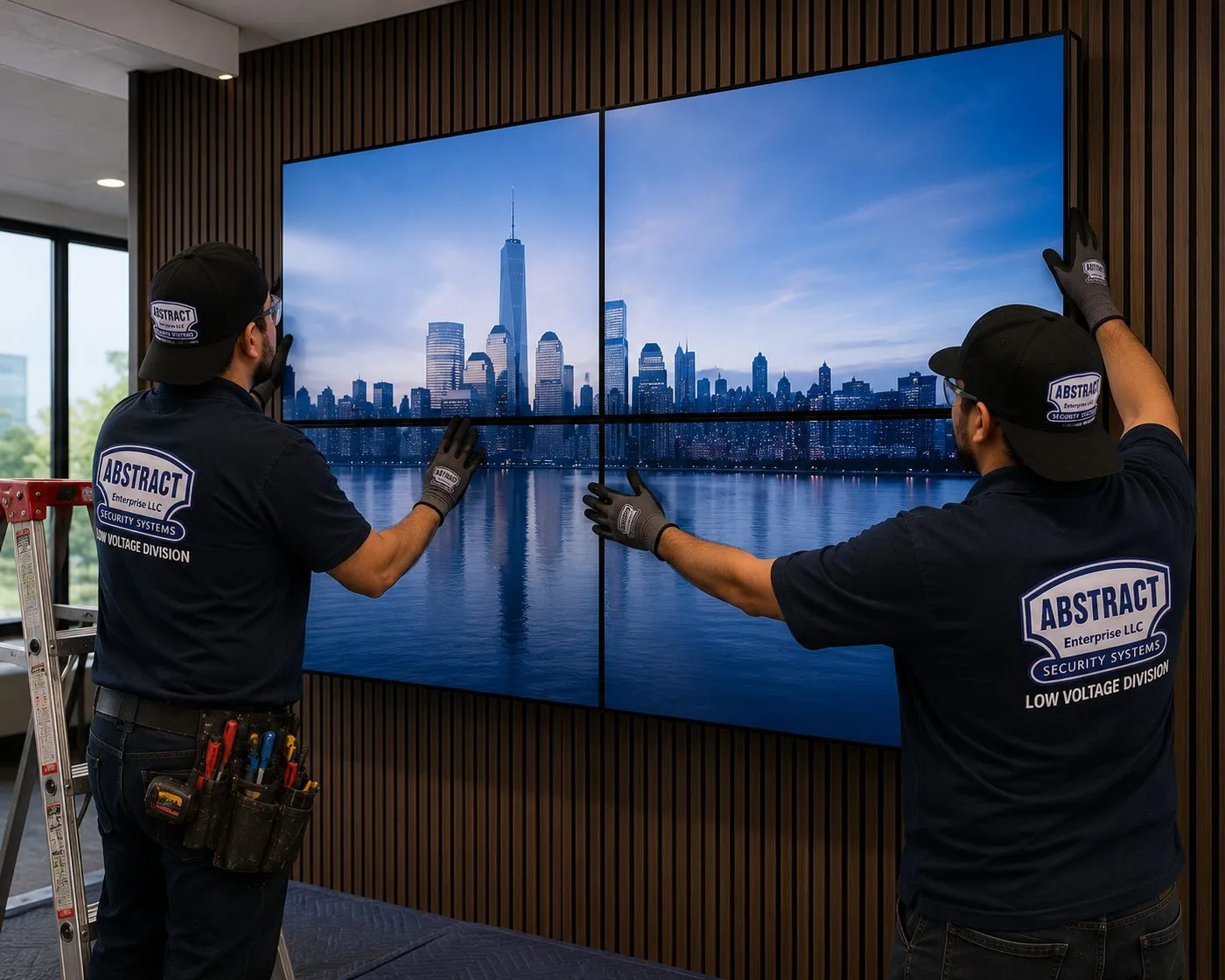
Two technicians in gloves square up a four-panel display on a slatted wood feature wall, with a step ladder beside them. The screens show a stock city image. Getting a screen dead level is the first half of a soundbar job; the bar is aligned to it afterwards.
Get a Free Soundbar Quote
TV size, soundbar model and wall type — we call back the same business day
✅
Request Sent!
We'll call you back the same business day.
25+
Years Experience
✓
Same-Day Estimates
100%
Licensed & Insured
4.7★
201 Google Reviews
Got a new soundbar in the box and a game this weekend? Call (800) 486-0943 or send the 60-second form with the TV size and the soundbar model. A technician, not a call centre, reads every request and confirms the price before booking.
Published line-item prices, the same in Nassau and Suffolk
Two-hour arrival windows, 8 AM–8 PM, seven days a week
NYS licence #12000287431 · certificates of insurance issued free
Long Island is a place of houses, and houses are where soundbars earn their keep. More than four out of five homes in both counties are owner-occupied, according to the Census Bureau, and most of them are single-family houses with a family room, a basement or a den, and often a fireplace that the TV ended up above. Flat-panel TVs have very little room for speakers, so dialogue that was clear on an old tube set now gets lost under music and effects. A soundbar fixes that, but only if it is placed, connected and tuned for the room it is in.
The rooms here make that harder than the showroom suggests. The post-war houses that filled Nassau and western Suffolk, Capes and ranches in Levittown, high ranches and splits a decade later, are compact, low-ceilinged and frequently expanded. Many were later opened up, so the living room now runs straight into the kitchen. Newer colonials and the custom homes on the North Shore and the East End go the other way, with two-storey great rooms, cathedral ceilings and tall stone fireplaces. A bar that sounds full in a twelve-by-nineteen-foot Levittown living room can sound small in a vaulted great room, and the up-firing drivers that make Dolby Atmos work under a flat eight-foot ceiling have little to bounce off under a sloped one.
The TV wall itself is usually the first problem. On Long Island it is very often a chimney breast of brick or stone, which means masonry anchors, no cable route inside, and a mantel that has to be worked around. Or it is an exterior wall with insulation and fire blocking, or an interior wall over a slab with nowhere for a cable to go. People call us after buying a good soundbar, putting it on the console, and finding that it sits a metre below the picture, the TV remote doesn't control it, and the cables hang down the chimney.
Then there is everything outside the living room. Finished basements are the second TV room in a large share of Long Island houses, with concrete floors, drop ceilings and bedrooms overhead. Patios, decks and pool houses get TVs and soundbars every spring, and near the South Shore bays and on the East End the air carries salt and moisture that chews through ordinary hardware. And in the summer towns, a lot of systems sit unused for months between seasons.
None of this calls for a custom home-theatre contractor. It calls for an installer who knows these houses, carries the brackets, cord covers and in-wall kits on the van, knows when to stop and call an electrician, and prices each item up front. That is what we do across Nassau and Suffolk.
Long Island facts that shape a soundbar install
81.9% and 82.2%: owner-occupied housing rates in Nassau and Suffolk counties for 2020–2024 (U.S. Census Bureau QuickFacts) — homeowners who can open a wall, route through a basement and mount on masonry.
1,064,368 housing units: 480,591 in Nassau and 583,777 in Suffolk as of July 1, 2025 (Census QuickFacts), for a combined population of almost 2.95 million.
17,447 houses: built by Levitt & Sons in and around Levittown between 1947 and 1951, on concrete slabs, with the ranch models heated by hot-water radiant pipes in the floor — which is why we never route cable through a Levittown floor.
2.99 and 2.93 people per household: Nassau and Suffolk averages (Census QuickFacts), the families who argue over the volume and the dialogue.
63 percent: share of houses in the Town of East Hampton owned by second-home owners, according to a 2017 study for the town reported by The East Hampton Star — systems that sit idle for months and must work the first warm weekend.
$684,700 and $578,400: median value of owner-occupied homes in Nassau and Suffolk (Census QuickFacts, 2020–2024) — houses whose owners care how the wall looks when the job is done.
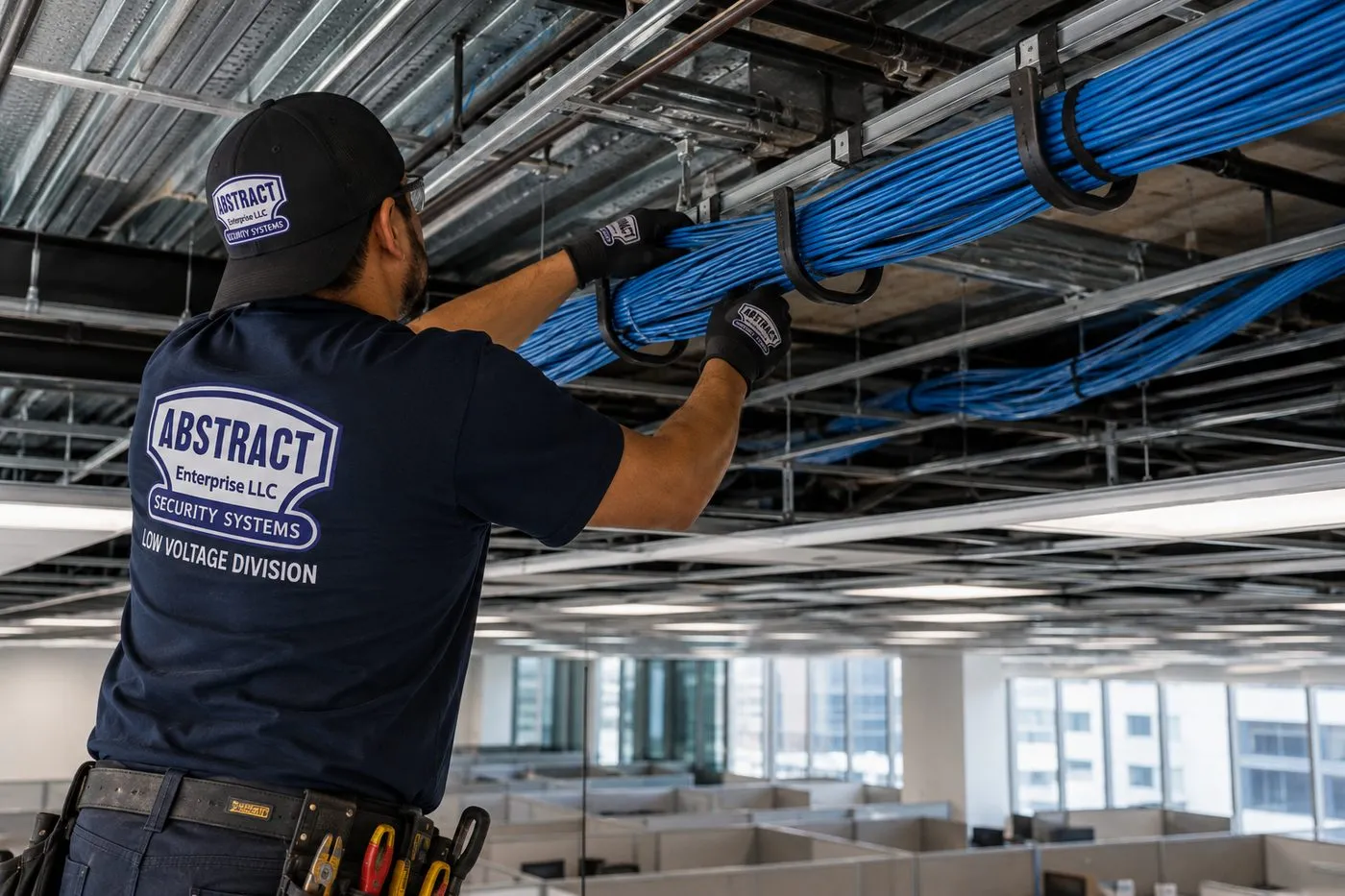
A technician seats a bundle of blue cable in J-hooks under an open ceiling grid. In a Long Island basement the same idea, supported cable rather than wire stapled loose to joists, carries HDMI and speaker wire from the TV wall to the equipment.
Repair Capture
Soundbar Gone Quiet on Long Island?
A bar that drops out when the TV switches inputs, a sub that stopped pairing, a remote that no longer controls the volume, or no sound at all after a TV update — those are not new installations. Most of them come down to the HDMI eARC handshake, a TV audio setting or a wireless pairing, and once a technician is in the room most are sorted in one to two hours. We book them as a setup-only visit: first hour flat at $225 in Nassau or $250 in Suffolk, then 30-minute blocks. Same-day when a two-hour window is open. Call (800) 486-0943 and say it's a soundbar problem.
What We Install
Soundbar Installation Services on Long Island
Every job on this list is priced as a line item, and most homes combine two or three of them. We bring the hardware, do the mounting and the routing, connect and tune the system, and walk you through it before we leave.
Wall-Mounted Under the TV
The bar on a bracket directly below the screen, levelled to the TV and centred on it, so voices come from the picture. $129 in labour, plus $84.99 for a Sanus soundbar bracket if the bar didn't ship with one.
Console or Mantel Placement
For a TV on a stand, or a mantel that sits just under an over-fireplace screen: positioned at the front edge, connected and set up for $79. No drilling, which renters and anyone with a stone mantel appreciate.
Over-Fireplace Systems
Bars under TVs on brick, stone and tile chimney breasts, with a heat check before anything goes up, masonry anchors, and a cable route that doesn't pretend the chimney is hollow.
Hidden In-Wall Wiring
A code-compliant in-wall power and cable kit that carries power from the existing outlet below and runs HDMI inside the wall, with flush plates at both ends. $169 per TV location on framed walls.
Subwoofers and Rear Speakers
Pairing and placing the wireless sub and surrounds that came with your system, or adding Sonos or other wireless surrounds later. $125 for Sonos or wireless surround setup, with a placement test from every seat.
Dolby Atmos Setup
Getting Atmos to actually play: eARC on the right HDMI port, the TV sending the right format, the bar's height channels and room calibration set for your ceiling, and a test clip to prove it.
Basement Media Rooms
Full home-theatre setup for a finished basement: TV, bar or receiver, sub, surrounds, streaming device and remote, configured together for $350, with wiring through the joists where the ceiling allows.
Receivers and Passive Speakers
For those who outgrew a bar: connecting an A/V receiver and its speakers for $129, so the TV, consoles and streaming devices all route through one box.
Patio and Pool-House Bars
Outdoor-rated soundbars under covered patios, pergolas and pool-house eaves, on stainless hardware, powered from an existing protected outlet and kept out of the afternoon sun.
Cable Runs to a Cabinet
When the cable box, game console or receiver lives in a built-in or across the room: a cable run of up to 25 feet for $99, through the wall, floor or basement ceiling where it can go.
Remotes and Streaming
Universal remote programming for $99 and streaming-device setup for $49 each, so the household isn't juggling four remotes to watch the news.
Bars in Bars and Restaurants
Soundbars for the TV walls of Long Island bars, restaurants, waiting rooms and offices, with certificates of insurance issued free for landlords and property managers.
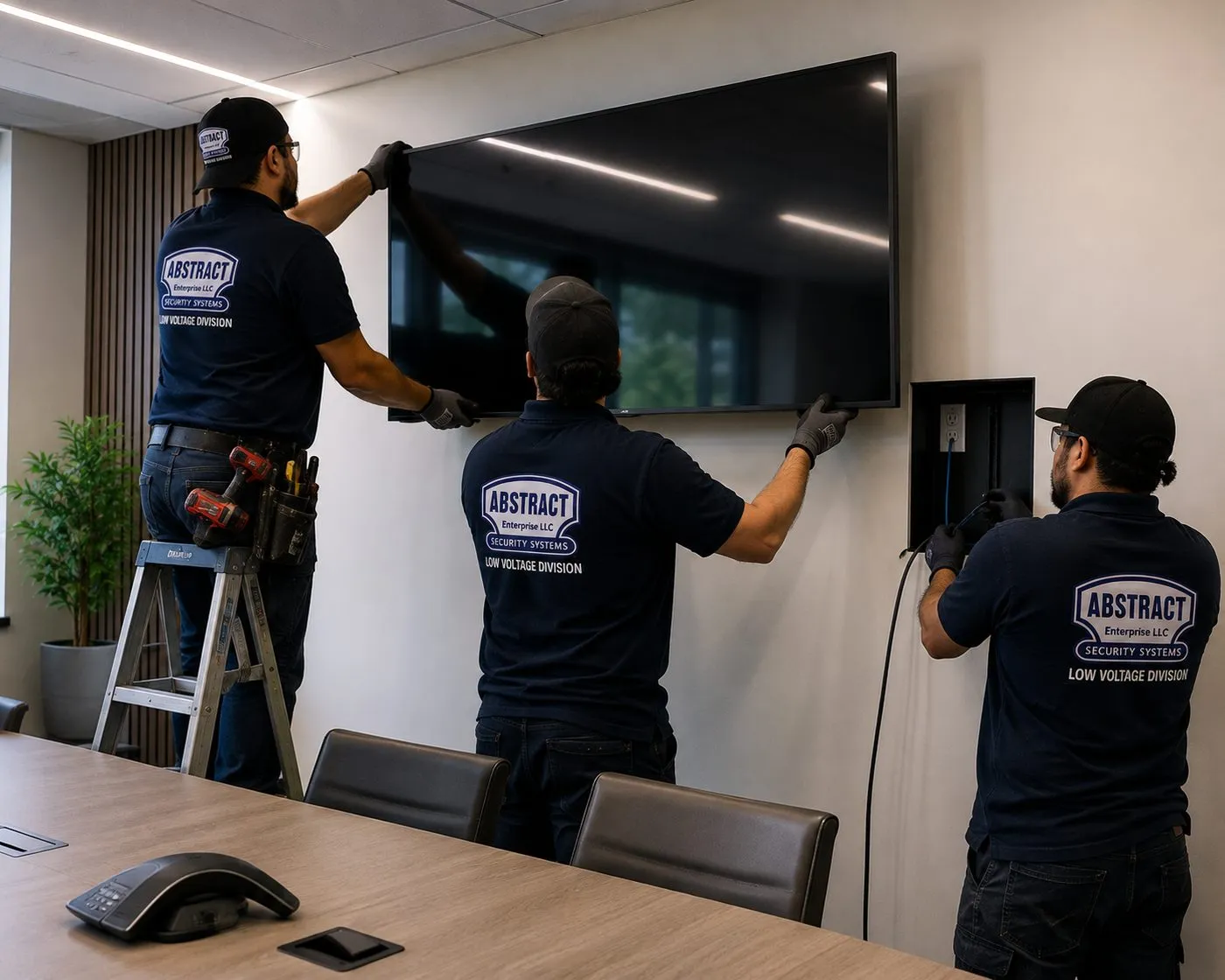
Three technicians work together: two lift a flat-panel display onto its wall mount while the third feeds cable into a recessed box with an outlet. A recessed box behind the screen is what lets a TV and soundbar sit tight to the wall.
Soundbar Installation for Long Island's Architecture
The same soundbar goes in very differently in a slab-floored Cape, a high ranch and a cathedral-ceilinged colonial. These are the house types we see most across Nassau and Suffolk, and what each one means for where the bar goes and how the wires get there.
Levittown-Era Capes and Ranches
Compact post-war houses on concrete slabs, many with radiant heat in the floor and an attic that was once unfinished. The floor is off-limits for cable, so routes run inside the wall, through the attic over interior walls, or in a paintable cover. Living rooms are small enough that a mid-size bar fills them.
High Ranches and Split-Levels
A split entry with the main living space upstairs and a den or family room on the lower level, partly below grade, often beside the garage. The lower den is usually the better movie room; the upper living room may have a vaulted ceiling and a picture window that challenge any bar.
Centre-Hall Colonials
Two storeys, a family room off the kitchen with a fireplace, and a full basement underneath. The basement makes cable routing straightforward; the fireplace makes the TV height the main decision, and the open kitchen makes a subwoofer worth having.
New Construction and Great Rooms
Two-storey family rooms, cathedral and vaulted ceilings, wide openings to the kitchen and stairs. Up-firing Atmos drivers have nothing flat to reflect from, so height effects come from rear speakers or in-ceiling speakers instead, and the bar is chosen for width and dialogue.
North Shore Older Homes
Pre-war houses with plaster walls, deep window trim and fireplaces with original surrounds. Plaster carries a $45 surcharge for the slower, careful drilling it needs, and routing often follows existing chases rather than new holes in old walls.
South Shore and East End Shore Houses
Bay-front and ocean-side houses, many raised, with porches, outdoor showers and rooms left open all summer. Stainless hardware, outdoor-rated bars where the room is effectively outside, and a plan for the months the house is closed.
Methods and materials by wall and house type
Drywall on wood studs. The most common Long Island TV wall and the simplest: the bracket lags into studs, no surcharge applies, and the in-wall kit drops cleanly into a stud bay. We find the studs, check for pipes and wiring with a scanner before drilling, and keep the bar centred on the TV even when the studs are off-centre by using the bracket's adjustment rather than toggles in drywall.
Brick, stone and block chimney breasts. Masonry gets sleeve anchors set into solid brick or stone, never into a mortar joint, and a $65 surcharge for brick or stone ($75 for concrete or cinder block). Tile over masonry is $95 because the tile must be drilled with diamond bits to avoid cracking. Cables travel up the side wall or in a cover, never through the chimney.
Plaster. Older North Shore and village houses still have plaster on lath. It cracks if drilled carelessly, so we score, drill slowly and anchor into the framing behind. The surcharge is $45. Where the TV is heavy or the studs don't line up, a plywood backer board ($85) spreads the load and gives the soundbar bracket something solid too.
Basement ceilings and slabs. In a finished basement with a drop ceiling, cable runs above the tiles on supports, not lying on them. With a drywall ceiling, small access holes at the joists let us fish across. Basement floors are slabs, so floor routes are out; the cabinet and the TV either share a wall or are connected overhead.
Shore houses and outdoor rooms. Stainless fasteners throughout, 316 grade where hardware is exposed to salt air, drip loops on every cable so water runs off before it reaches a connection, and power only from an existing protected outdoor outlet. A new outdoor circuit is electrician's work.
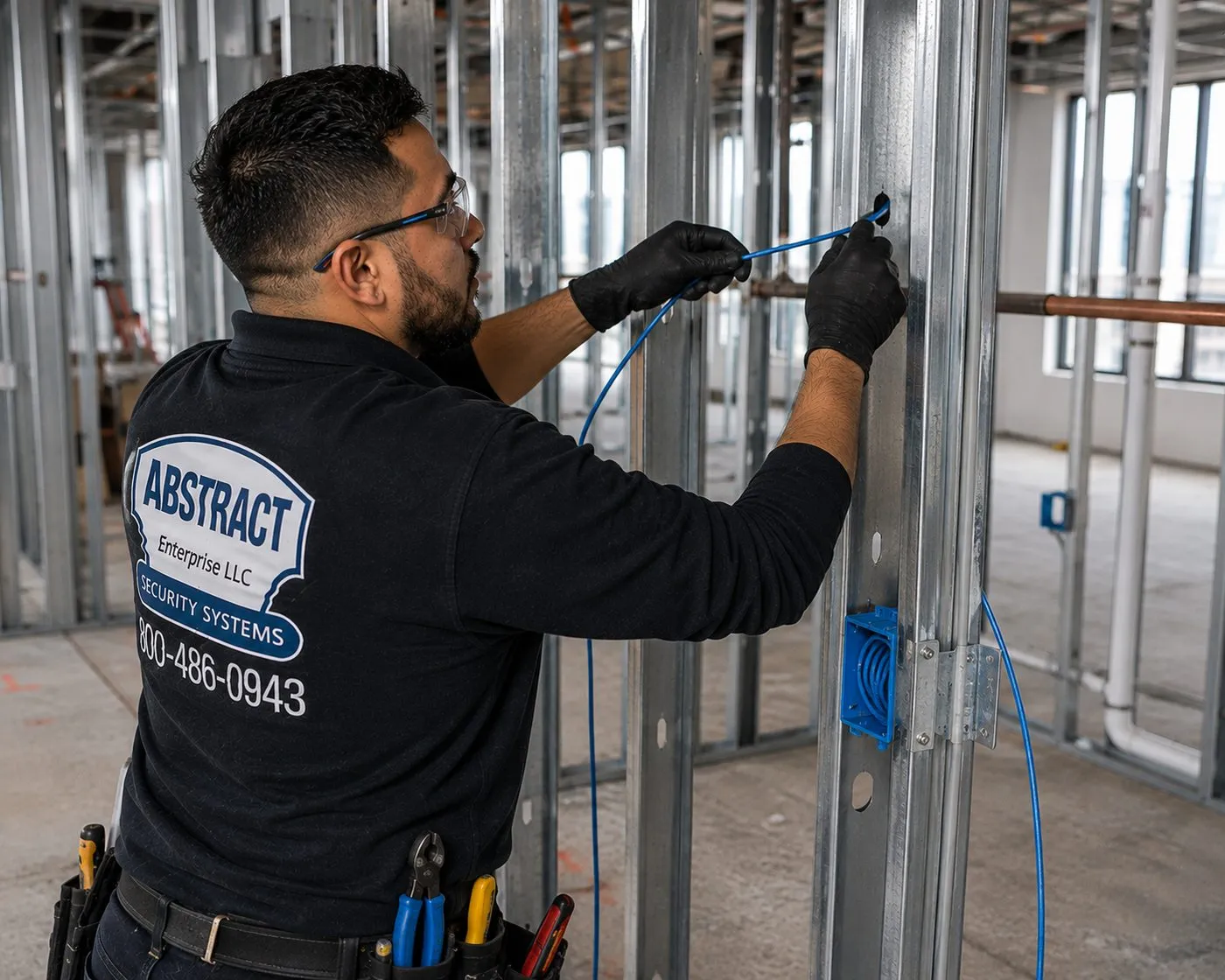
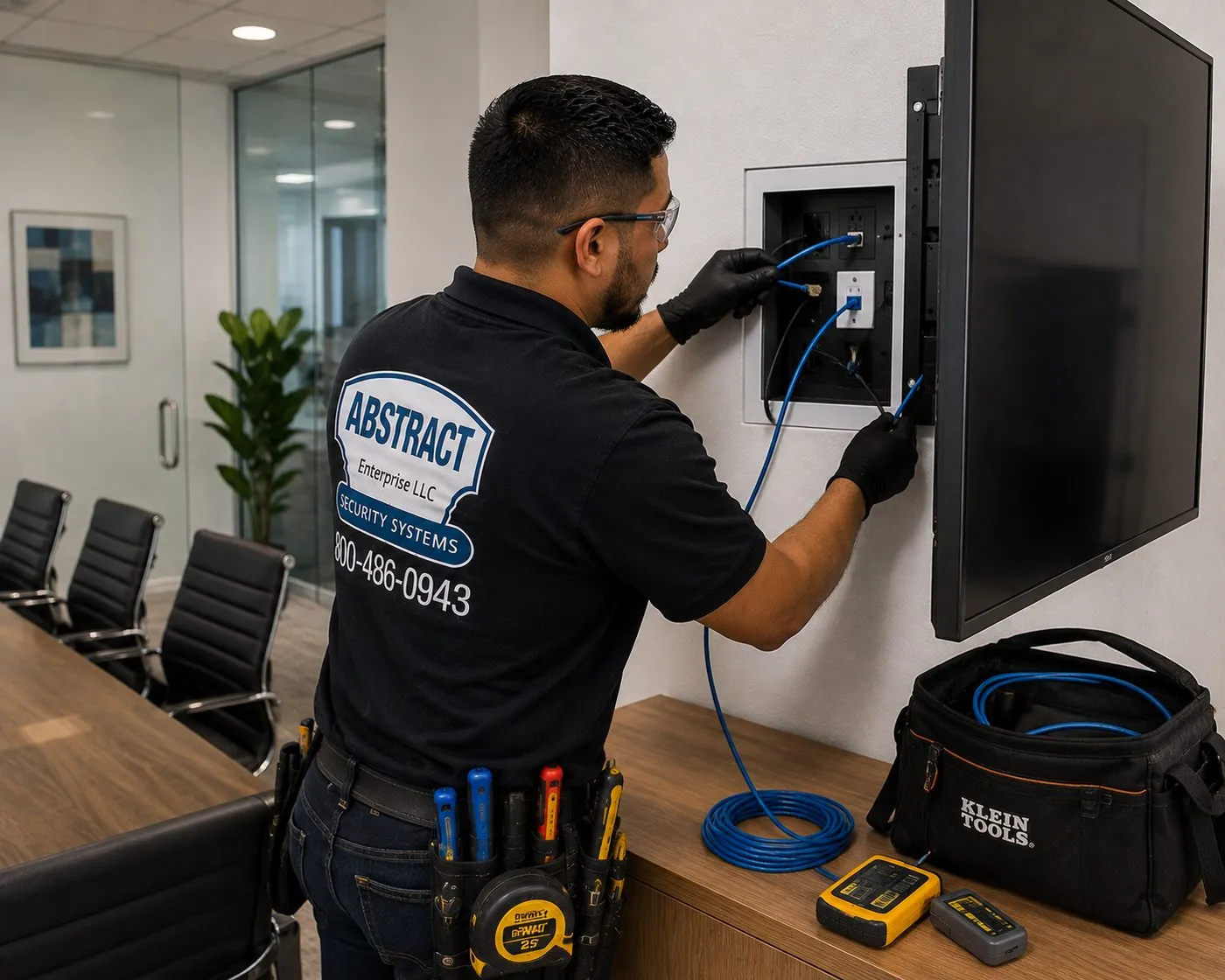
A technician feeds blue cable through a punched stud beside a blue low-voltage box. This is open framing; in a finished Long Island family room the same pull happens through a small opening behind where the TV will hang.A technician plugs patch cables into a recessed media box beside a wall-mounted display, with cable testers and a tool bag on the credenza below. Testing every run before the wall is closed is cheaper than opening it again.
Many Long Island households doing a soundbar also add cameras or a video doorbell while a technician is in the house. We price those on the same visit; see our low-voltage installation services across Long Island for everything a single crew can handle.
Commercial Soundbar Installation
Business Soundbar Installation on Long Island
On Long Island, commercial soundbar work means bars, restaurants, offices and waiting rooms along the main roads and village downtowns. A TV with built-in speakers can't cut through a dinner crowd; a soundbar under each screen, or a bar for the main TV plus ceiling speakers for the room, does. These are the corridors where we do it most.
Hempstead Turnpike
From Elmont, where UBS Arena opened at 2400 Hempstead Turnpike in 2021 as the Islanders' home, east through Franklin Square, West Hempstead, Uniondale and East Meadow. Sports bars and restaurants along it fill up on game nights, and every TV needs audio that reaches its section of the room.
Huntington Village
Restaurants and bars along New York Avenue, Main Street and Wall Street, around the Paramount at 370 New York Avenue, which hosts about 200 events a year. Dining rooms with TVs at the bar want sound that stays at the bar.
Patchogue Main Street
A walkable downtown of restaurants and bars, several with live bands and DJs in the evening, near the ferries to Davis Park and Watch Hill. TV audio has to coexist with live music, which usually means zoned sound rather than one loud bar.
North Fork: Riverhead to Greenport
Restaurants and ale houses in Riverhead, Mattituck and Greenport advertise their TVs for big games — ten screens at some, four at others, according to a northforker roundup. Seasonal crowds mean systems that are easy for staff to switch on.
Old Country Road and Roosevelt Field
The retail strip around Roosevelt Field in East Garden City, the largest mall on Long Island with 243 stores. Showrooms, salons and waiting areas use a TV and a bar for demos and background content.
Route 110 Office Corridor
The Broadhollow Road office parks in Melville and Farmingdale. Conference and training rooms need dialogue that carries to the back row of a video call, which a soundbar under the display does better than the display's own speakers.
Compliance callouts for commercial soundbar work on Long Island
Certificates of insurance. Landlords and property managers in plazas and office parks usually require one before a contractor can work; ours are issued free.
Protruding objects. Under the 2010 ADA Standards, wall-mounted objects with a leading edge between 27 and 80 inches above the floor may protrude no more than 4 inches into a circulation path. A soundbar under a TV in a corridor or waiting area is planned so it doesn't become a hazard for someone using a cane.
Electrical work stays with electricians. New outlets and circuits in a commercial space are done by a licensed electrician and inspected; we install the AV around them.
Commercial work and county licensing. Nassau County's home improvement license applies to remodeling residential homes, and the county says contractors who work only on commercial buildings don't need it — but the landlord's own contractor rules still apply.
Cable listing. Cable above a drop ceiling used as an air return must be plenum-rated; we use the correct listing for the space.
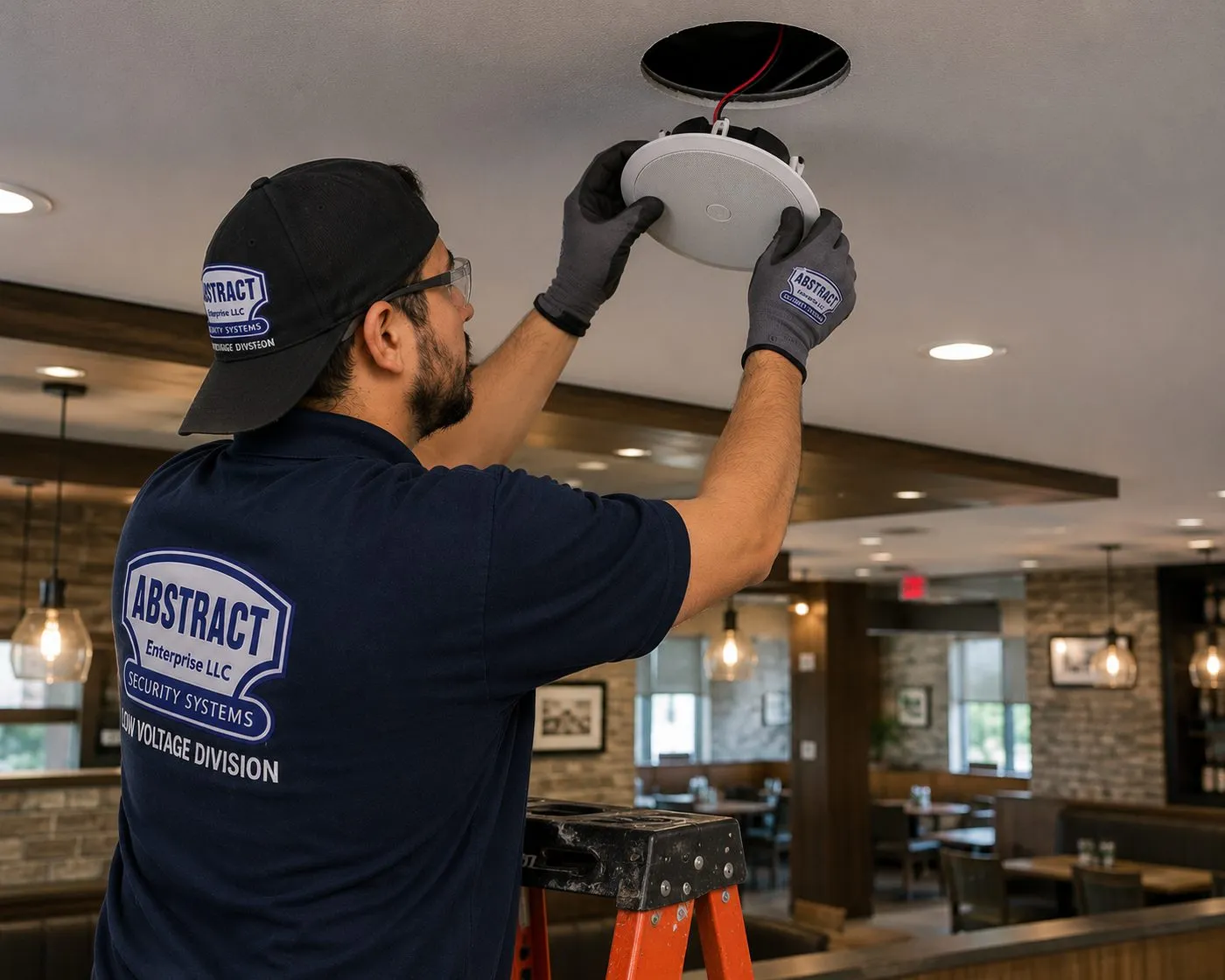
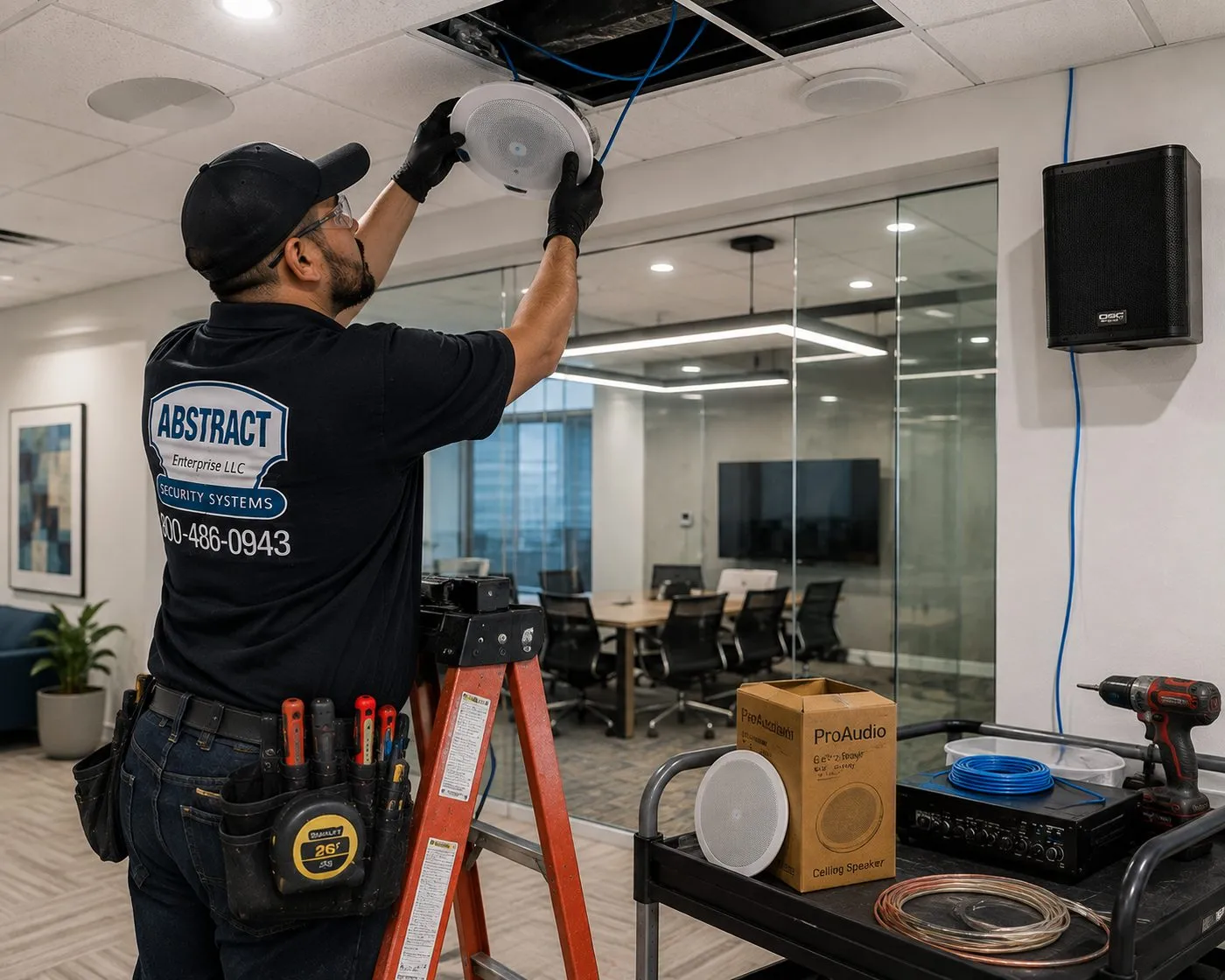
A technician pushes a white ceiling speaker into its cut-out above a restaurant dining room with stone-veneer walls, booths and pendant lights. For a bar's TV wall, a soundbar handles the game; ceiling speakers carry background music to the tables.A technician fits a ceiling speaker while a cabinet speaker hangs on the wall to the right and a glass-walled meeting room with a screen sits behind. Commercial rooms often need distributed speakers rather than a single bar.
Signs a Long Island Room Has Outgrown the TV's Speakers
Nobody calls us wanting a soundbar for its own sake. They want to hear the words again. These are the situations that most often lead a Long Island household to a soundbar, and what a properly installed one changes.
Subtitles on for everything. Thin modern TVs aim their small speakers down or backward, and in a room with hard floors and a big window, dialogue blurs. A bar's dedicated centre channel and speech enhancement put the voices back in front.
The volume war. Turning it up for the dialogue and down for the action scenes is a sign of too little dynamic control. A bar with night mode and a subwoofer handling the low end keeps loud moments in proportion.
A new TV over the fireplace that sounds worse than the old one on the stand. Moving a TV above a mantel moves its speakers too, high and pointed at the ceiling. A bar under the screen, or on the mantel, brings the sound back down to the seats.
A finished basement that sounds like a cave. Concrete, drywall and a low ceiling make TV speakers boomy and harsh at once. A bar with room calibration, and a sub placed for even bass, tames it.
Game day in a great room. When a room opens into the kitchen and half the family is cooking, the TV's own speakers can't reach the couch. A bar with a sub and rears closes the sound around the seating area.
Too many remotes. A soundbar on HDMI eARC lets the TV remote control the volume, and that alone simplifies life for anyone who isn't the person who set it up.
A patio TV nobody can hear over the pool pump. An outdoor-rated bar under the eave does what the TV's speakers can't, without a full outdoor speaker system.
If one of these sounds familiar, a photo of the wall and the model numbers are enough for a price. If the honest answer is a pair of ceiling speakers or a receiver rather than a bar, we'll say so.
Your Questions Answered
Soundbar Installation on Long Island: Questions Answered
These are the questions Long Island homeowners ask once the soundbar is out of the box and the room is in front of them. They are grouped by the decision behind them; quick questions about price, scheduling and policies are in the FAQ further down.
Great rooms, open plans and high ceilings
In a two-storey great room, what are the realistic ways to get overhead sound?
There are three, and the bar's own up-firing drivers are the weakest of them in that room. Polk Audio's Atmos guide says up-firing speakers work best with flat, rigid, reflective ceilings between 7.5 and 12 feet, and a ceiling eighteen feet up is far outside that. So the useful height effects have to come from somewhere closer to the people on the couch.
Option one is a soundbar system whose rear speakers carry their own up-firing drivers, such as Samsung's Q990 series, which puts height sound just behind the seats where the ceiling over the sofa is often a lower, flat soffit or a balcony. Option two is in-ceiling speakers mounted in any flat section of ceiling over the seating, connected through a receiver. Option three is to accept a strong front stage and good dialogue, turn the bar's height level down, and spend the money on a subwoofer instead. We'll show you what the room supports before you buy.
Our family room opens straight into the kitchen — can one soundbar carry sound across all of it?
A good bar fills the seating area. It won't fill the kitchen at the same level without being too loud on the couch, and that is the honest limit of one box at one end of a long room. In the open-plan layouts common in Long Island colonials and newer builds, sound escapes into the kitchen and up the stairwell instead of bouncing back to the listener, so bars that sounded big in the store can seem thin at home.
Three things help. First, a dedicated subwoofer, which lets the bar stop straining for bass and keeps dialogue clear at a lower volume. Second, rear speakers placed behind the seating rather than in the kitchen, so the sound field closes around the people watching. Third, if the kitchen needs its own sound, a separate speaker grouped with the bar in the manufacturer's app, which is how Sonos and similar systems are designed to work. We'll tell you which of the three your room actually needs.
With the TV mounted high on a two-storey great-room wall, where does the soundbar belong?
As low as the TV allows, and never so far below the screen that voices seem to come from the floor. When a great-room TV is mounted high, often because of a fireplace, built-ins or a window line, the instinct is to put the bar on a console far below. That separates the picture from the voices. Mounting the bar directly under the TV keeps them together, and tilting the TV slightly down does more for the viewing angle than dropping the bar.
Above roughly eight feet our high-mount charge of $75 applies, because it takes taller ladders and two people to do safely. Before anything is drilled we hold the bar at the proposed height so you can hear and see it from the couch. That two-minute test settles more arguments than any rule of thumb.
Fireplace walls and mantels
Should the soundbar sit on the mantel shelf or on the wall directly under an over-fireplace TV?
If the mantel is deep enough and sits close below the screen, the shelf is a perfectly good place, and it avoids extra holes in the chimney. The bar needs to sit right at the front edge so the mantel itself doesn't block the drivers, and if it has up-firing drivers they need a clear path to the ceiling, which a TV hanging just above can block.
When the TV is mounted well above the mantel, a bar on the shelf ends up a foot or more below the picture, and the mantel lip can throw the sound downward. In that case a bracket under the TV is better. We'll look at the gap between mantel and screen and recommend one or the other; the console price of $79 applies when the bar sits on the mantel, and $129 when it is wall-mounted.
Can the cable box and game console stay in the built-ins beside the fireplace?
Usually, and it is the tidiest way to live with an over-fireplace TV: nothing on the mantel but the bar, and every box hidden in the cabinet. The catch is the path between them. The chimney itself can't carry cable, so the HDMI has to travel through the framed wall beside it, down into the basement and back up, or along the trim in a paintable cover. A cable run of up to 25 feet is $99; a paintable cord cover is $59.
The second catch is the remote. Cabinet doors block the infrared signal most cable boxes use, so either the doors stay open, the box is controlled through HDMI-CEC from the TV remote, or a universal remote that works by radio rather than infrared is programmed for the whole system, which is $99. We test every source from the couch with the doors closed before we leave.
Does a gas insert below the TV put the soundbar at risk from heat?
It can. Bob Vila's guide puts a gas fireplace at 20,000 to 35,000 BTUs per hour and recommends mounting a TV above one only where the temperature doesn't go over 100°F. The soundbar sits closer to the fire than the TV, so it sees more of that heat. A deep mantel helps by deflecting the rising air away from the wall.
The test is simple: tape a thermometer where the bar will go, run the fire for a few hours and read it. We do a quicker reading on the day, and we'll tell you if we think the spot is too hot. Some manufacturers also decline warranty claims for heat damage, which is one more reason to check before mounting rather than after.
Subwoofers, rear speakers and finished basements
Where does the subwoofer work best in a finished-basement media room?
Usually at the front of the room, near the TV wall, and not squeezed into a corner behind the bar unless that's where it measures best. Basement rooms on Long Island tend to be long and low, with a concrete floor and often a drop ceiling. Bass builds up in corners and can boom, and a drop ceiling lets some of it escape upward into the house.
Most wireless subs that come with soundbars only need a power outlet, so we try two or three positions with you, run the bar's room calibration if it has one, and leave it where the bass is even from every seat rather than loudest from one. If the room is above a bedroom or office, a lower sub level and a night mode setting are worth more than any placement trick.
Do "wireless" rear speakers still need outlets behind the sectional?
Yes. Wireless means no speaker wire from the bar, not no power. Crutchfield's listing for Samsung's HW-Q990D says each rear speaker must be plugged into an AC outlet, and the subwoofer needs one too. The same is true of Sonos rear speakers and most other systems.
In a lot of family rooms the sectional floats in the middle of the room and the nearest outlets are on the walls behind it. Options are a short, tidy run along the baseboard to the wall outlet, stands that let the cord drop straight down, or, where the room is over a basement, power from an existing outlet routed through the floor by an electrician. Pairing the Sonos or other wireless surround set is $125.
Can wire be routed through the attic or the basement instead of across the floor?
Often, and it is one of the advantages of a single-family house. A full basement with an unfinished ceiling makes it simple to drop a cable through the floor plate behind the TV and come up behind a cabinet or a seating area. A ranch or Cape with attic access can sometimes do the same from above for a TV on an interior wall.
Each route is checked before it is promised. Exterior walls are insulated and often have fire blocking, finished basement ceilings may need a few access holes, and radiant or hot-water heat lines in the floor rule some routes out. A cable run of up to 25 feet is $99; longer or more complex runs are quoted after we look.
Long Island house types
Our house is a Levittown-era Cape on a concrete slab — how does the HDMI get from the TV to the cabinet?
Not through the floor. Levittown's houses were built on concrete slabs, and the ranch models were heated by hot-water radiant pipes in the slab, so drilling the floor is out. That leaves the walls, the attic over an interior wall, or the surface.
If the TV and the cabinet are on the same wall, an in-wall kit or a cable run inside that stud bay usually solves it. If they are on different walls, the attic over the room can work for an interior wall, and a paintable cord cover along the baseboard is the fallback. Many of these houses have been expanded and re-framed over seventy years, so we open nothing until we have found what is behind the wall.
In a high ranch, is the lower-level den or the upstairs living room the better home for the soundbar?
It depends on which room you actually watch in. In a high ranch the upper floor holds the main living space and the lower level, partly below grade, is often the den or family room next to the garage. The lower room usually wins for movies: lower ceilings suit up-firing drivers better than a cathedral living room, and bass is less likely to bother anyone sleeping.
The upstairs living room often has a vaulted ceiling and a picture window opposite the TV wall, which is harder acoustically. If the TV is upstairs for daily use and the den is for movies, a simple bar upstairs and a fuller system with a sub and rears downstairs is a common and sensible split.
Patios, pool houses and the shore
Is an indoor soundbar safe on a covered patio or in a pool house?
Not for long. Indoor soundbars are not built for damp air, condensation or driven rain. Outdoor-rated models exist: Samsung's Terrace soundbar spec sheet lists an IP55 rating against dust and rain and includes a wall-mount kit. Even an outdoor-rated bar should sit under cover and out of direct afternoon sun, because heat is the other enemy.
In a pool house that is closed up and humid for days at a time, treat it as outdoors. We mount with stainless hardware, keep connections inside a covered box, and route power from an existing protected outdoor outlet. A new outdoor outlet is electrician's work.
Does salt air on the South Shore or the East End shorten a soundbar's life?
Indoors, with the windows closed and the air conditioning on, a soundbar is fine. The damage shows up where salt air reaches hardware directly: screened porches, pool houses, garages and rooms left open all summer. Industry guidance on coastal electronics notes that salt corrodes hinges, fasteners and seams long before it reaches the electronics inside.
So the bracket and screws are the first things to fail, not the bar. For rooms near the water we use stainless fasteners, and where hardware is exposed we prefer 316 stainless, which resists chloride better than the common 304 grade. If the rest of the house is shut for the season, unplugging the bar and sub avoids storm-surge damage too.
What should happen to the system when a summer house is closed for the winter?
Second homes are a big part of the East End: a 2017 study for the Town of East Hampton found that 63 percent of its houses belonged to second-home owners. Those systems sit unused for months, then are expected to work on the first warm weekend.
Before closing, unplug the bar, sub and rear speakers, and if the house is not heated, leave them indoors rather than on a porch. In spring, plug in the bar first, then the sub and rears, and let the app check for updates before anyone tries to watch. If the TV was replaced or the Wi-Fi changed over the winter, a setup-only visit, billed at our Suffolk hourly rate of $250 for the first hour, is usually enough to reconnect everything.
Permits and paperwork on Long Island
Does the town or village need to issue a permit before a soundbar goes on the wall?
For mounting a soundbar and running low-voltage cable, generally no. What does trigger paperwork is electrical work. On Long Island, towns and villages rely on approved private electrical inspection agencies: the Town of Brookhaven publishes a list of nine, and the Village of New Hyde Park lists six underwriters the electrician or owner calls to obtain an electrical certificate.
That is why we don't add or move outlets. If the room needs new power, a licensed electrician does it and arranges the inspection, and we install the TV and bar around it. Our in-wall kit carries power from an existing outlet without opening the electrical system, which is why it doesn't need an inspection of its own.
Which Long Island licences should a homeowner check before letting an installer drill?
Ask about two things. Nassau County's Office of Consumer Affairs licenses contractors who do remodeling on residential homes, and Suffolk County's Consumer Affairs licensing division runs its own home improvement license with an online search. In June 2025 the Suffolk District Attorney charged an unlicensed contractor accused of handing a customer a forged town building permit, and urged homeowners to check licensing before signing.
Low-voltage work is a separate credential. Abstract Enterprises holds NYS Low-Voltage License #12000287431, and we carry insurance and issue certificates of insurance free when a homeowners' association, landlord or business asks for one. Ask any installer for their license numbers and check them on the county sites; a legitimate contractor will expect the question.
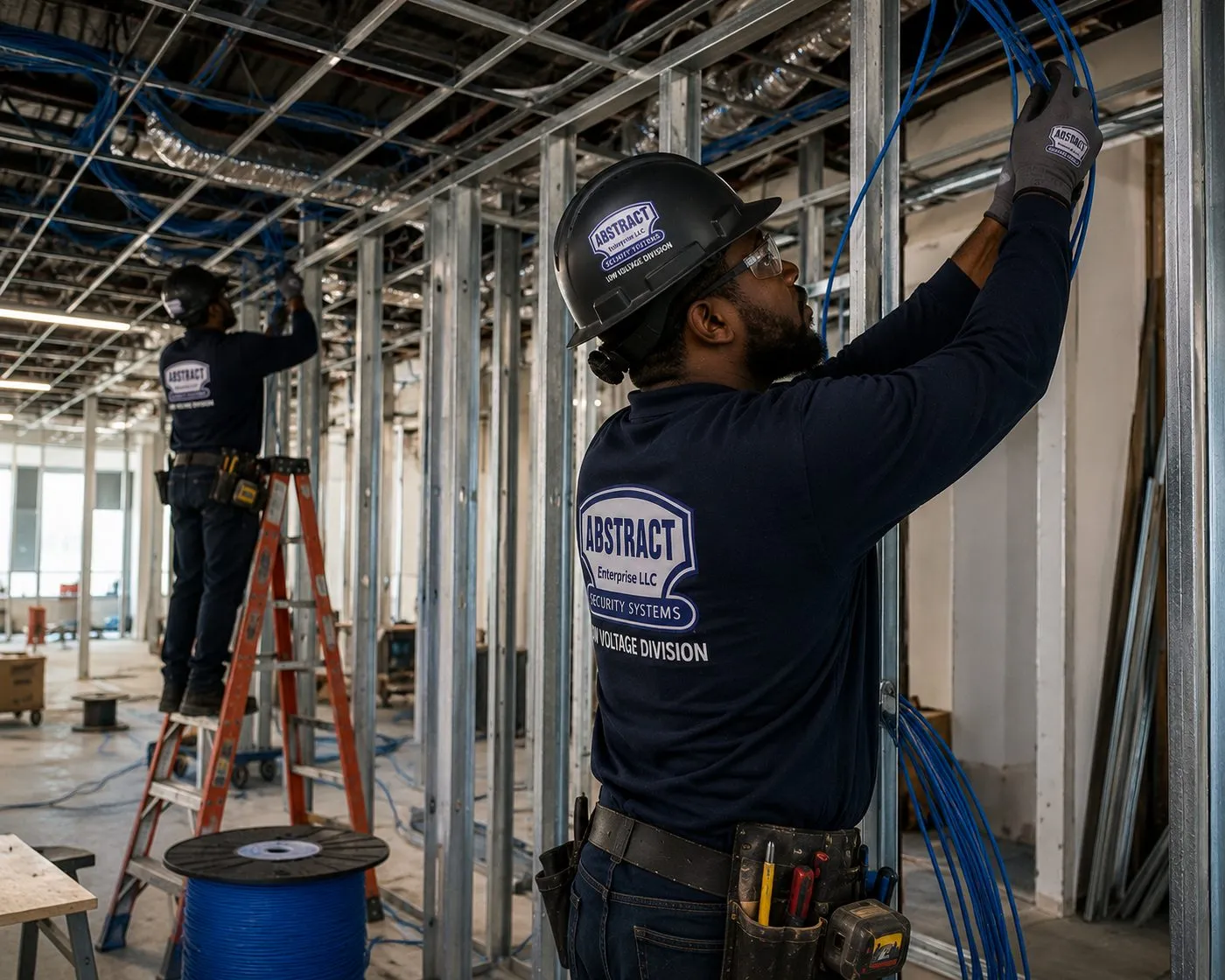
Two technicians in hard hats pull bundles of cable through open metal framing, one on a ladder at the ceiling and one at the studs, with a reel of cable on the floor. If a basement is being finished, this is the moment to run speaker wire.
Equipment
Types of Soundbar Systems We Install
We install every major brand, and we'll tell you honestly when the system you're considering doesn't suit the room. Specifications below are the manufacturers' or major retailers' published figures; check the current model before buying, because soundbar ranges change every year.
All-in-One Atmos Bars
One box with up-firing drivers and built-in bass. Sonos markets the Arc Ultra as a 9.1.4 experience from 14 drivers; RTINGS lists it as 5.1.2 channels on its own. Best under a flat ceiling in a room up to living-room size. Sonos's own Arc Ultra wall mount is 29 inches wide and the bar adjusts its EQ once it detects it is wall-mounted.
Bar, Sub and Rear Speaker Systems
Complete packages such as Samsung's HW-Q990D, an 11.1.4 system: a bar about 48.5 inches wide and 17 lb, a wireless sub of 25.8 lb, and two rear speakers that each need an outlet. The right choice for open-plan great rooms and basement media rooms.
Compact Bars
Smaller bars such as the Sonos Beam (Gen 2), a 5.0-channel bar by RTINGS's count, or the Sonos Ray. Right for a Cape's living room, a bedroom or a den, and easy to expand with a sub and rears later.
Outdoor-Rated Bars
Built for covered outdoor spaces. Samsung's Terrace soundbar is rated IP55 against dust and rain, measures about 48 inches wide, weighs 14.8 lb and includes a wall-mount kit. Still installed under cover and away from direct sun.
Brackets and TV-Attached Mounts
Wall brackets that hold the bar under the TV, bar-specific mounts from Sonos and others, and brackets that clamp to the TV mount so bar and screen move together on an articulating arm. We supply the Sanus soundbar bracket at $84.99.
In-Wall Power and Cable Kits
Code-compliant kits that bring power from the existing outlet below to the TV location inside the wall, with a pass-through for HDMI and the soundbar's power. $169, the cleanest finish on a framed wall.
Wireless Surround Speakers
Sonos Era 100 and Era 300 pairs, the Sonos Sub, and other brands' matched rears and subs. Set up and placed for $125, with calibration from the main seat.
A/V Receivers and Passive Speakers
For basement theatres and anyone who wants separate speakers: receiver connection and speaker setup for $129, or a full home-theatre configuration for $350.
Universal Remotes
One remote for TV, bar, cable box and streamer, programmed for $99. Many homes don't need one once HDMI-CEC is set up correctly; we'll tell you which you are.
Connections that decide whether it works
HDMI eARC is the connection to use whenever both TV and bar have it. It carries lossless and Atmos audio from every app and device on the TV to the bar, and it lets the TV remote control the bar's volume. It has to be on the TV's eARC-labelled port, with the TV's audio output set to pass the signal through, and many failed installs are simply the wrong port. HDMI ARC on older TVs carries compressed surround, including Atmos in Dolby Digital Plus from streaming apps. Optical works when HDMI won't, but it carries no Atmos and no volume control. HDMI in on the bar, where it has one, is useful for a game console when latency matters.
We test every input you use — cable box, streaming device, console, the TV's own apps — before we leave, because an eARC setup that works for Netflix and fails for the cable box is still a failed setup.
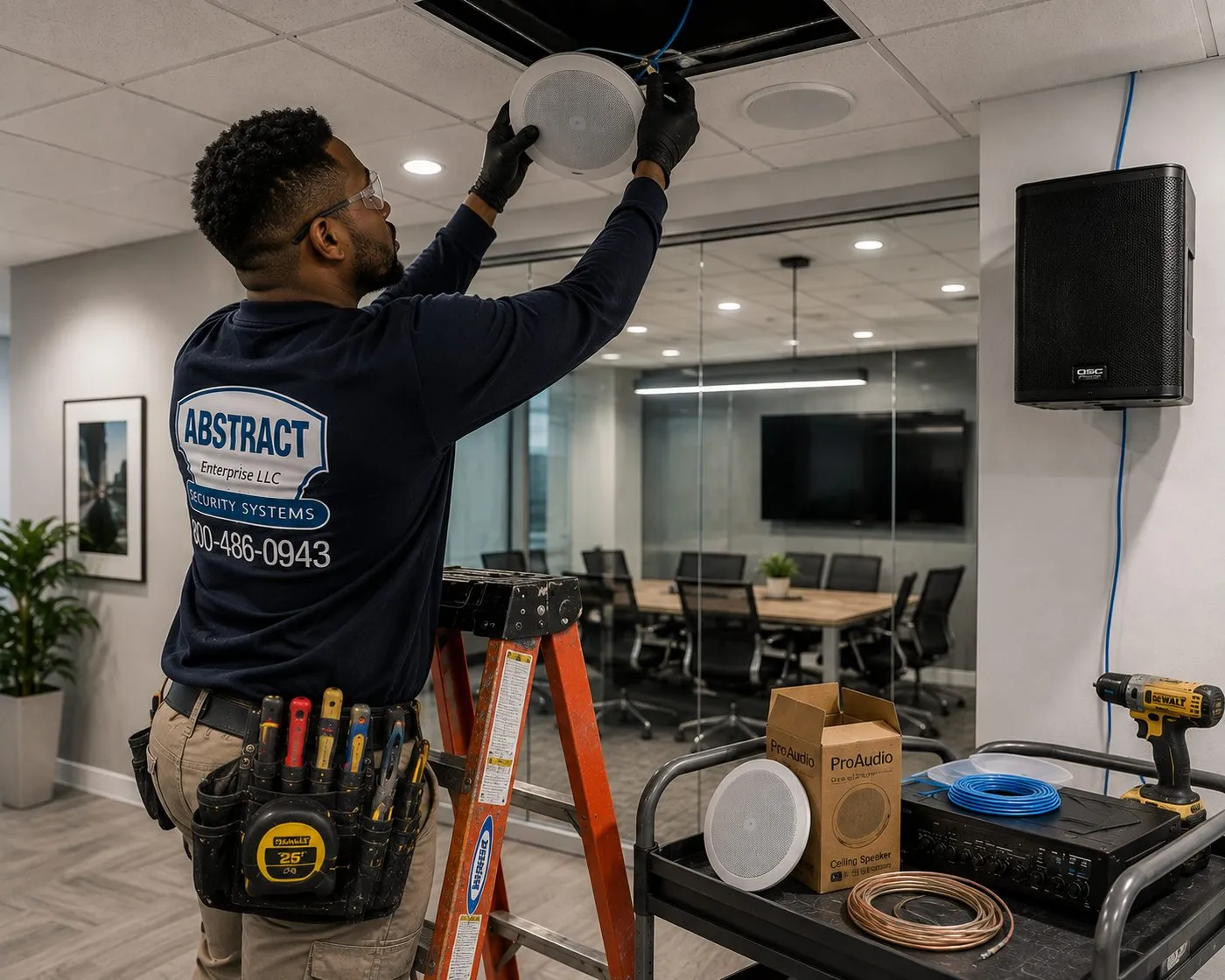
A technician on an orange ladder fits a round ceiling speaker into a tile ceiling. On the cart: an amplifier, a coil of speaker wire, blue cable and a boxed ceiling speaker. Some rooms are better served by in-ceiling speakers than by a bar alone.
Plain-English Glossary
Soundbar Terms You Will See on a Box or a Quote
Channel count (5.1.2, 9.1.4, 11.1.4). The first number is the speakers around you at ear level, the second the subwoofer channels, the third the height channels. Marketing numbers sometimes count virtual channels; reviewers such as RTINGS list the channels a bar actually produces on its own.
Up-firing driver. A speaker angled upward to bounce sound off the ceiling for Atmos height effects. Works best with flat, reflective ceilings roughly 7.5 to 12 feet high.
eARC. Enhanced Audio Return Channel: the HDMI connection that sends full-quality audio, including Atmos, from the TV to the bar and lets one remote control both.
ARC. The older version of the same connection. Carries compressed surround, including Atmos from many streaming apps, but not lossless formats from a disc player.
HDMI-CEC. The control signal on HDMI that lets the TV remote turn the bar on and change its volume. Brand names include Anynet+ on Samsung and Simplink on LG.
Optical (Toslink). A light-based audio cable. Reliable, but no Atmos and no volume control from the TV remote.
Room calibration. A feature that plays test tones, listens through a microphone in the bar or your phone, and adjusts the sound to the room. Sonos calls it Trueplay; Samsung's version is SpaceFit Sound.
Speech or voice enhancement. A setting that lifts the frequencies of the human voice. The most useful single setting for anyone who struggles with dialogue.
Night mode. Compresses loud passages so late-night viewing doesn't wake the house.
IP rating. Ingress Protection: two digits for dust and water resistance. IP55, as on Samsung's Terrace bar, means protection from dust and from water jets, which is why outdoor bars still go under cover.
In-wall power kit. A code-compliant kit that carries power from an existing outlet low on the wall to a recessed plate behind the TV, without adding an outlet to the house's electrical system.
Backer board. A plywood panel fixed to the framing to give a bracket solid material across a span where studs don't line up.
AI Overview Reality Check
What AI Gets Wrong About Soundbar Installation on Long Island
We could not read Google's AI Overview from our research environment, so we haven't invented its wording. What follows takes the claims that national cost guides and marketplaces actually publish, the figures AI summaries tend to repeat, and checks them against how soundbar jobs go in Long Island houses.
"Professional TV mounting costs $153 to $353"
That is Angi's 2026 national range, and Thumbtack quotes a national average of $117 to $227. Both are reasonable as national midpoints, and both describe the TV rather than the soundbar.
On Long Island our TV mounting starts at $209.99 in Nassau and $229.99 in Suffolk, and the soundbar is a separate, published line: $129 wall-mounted, $79 placed on a console. A family-room job that combines a TV, a bar and hidden wiring is therefore assembled from parts you can see, not a single number that may or may not include the bar.
When comparing quotes, ask whether the soundbar is included, whether the bracket is, and whether concealment is. A low headline often leaves out two of the three.
"A soundbar mount adds $30 to $100"
Angi lists a soundbar mount add-on at $30 to $100 and the bracket itself in the same range. That is a fair price for the hardware.
It is not the labour. Mounting a bar properly means centring it on the TV, levelling it to the screen rather than to the floor, anchoring it into studs or masonry, routing its power and HDMI cable, and then setting up eARC, the sub and the remote. That is why our bracket ($84.99) and our labour ($129) are listed separately.
If your bar came with a bracket, you don't need to buy ours; we'll mount with yours at the labour price.
"Fireplace mounting adds $100 to $300"
Angi's fireplace range is real, and on Long Island fireplaces are one of the most common TV walls we see. The range bundles together very different walls.
A drywall-faced chimney chase in a newer house is no harder than any other wall. Brick or stone carries a $65 surcharge with us, tile over masonry $95, and a TV above about eight feet a $75 high-mount charge. What actually makes fireplace jobs expensive is cable routing, because the chimney can't be used.
And the price doesn't answer the more important question, which is whether the spot is too hot. We check that first.
"Any Dolby Atmos soundbar gives you overhead sound"
Product pages and summaries often present up-firing drivers as working in any room. The speaker makers' own guides are more careful: Polk says up-firing speakers work best with flat, reflective ceilings between 7.5 and 12 feet, and Arendal says the ceiling should not be angled or vaulted.
Long Island has plenty of rooms that fail that test: cathedral living rooms in high ranches and two-storey great rooms in newer colonials. In those rooms the bar still plays Atmos content, but the height effect is weak or misplaced.
The fix is to put height effects closer to the listener, with rear speakers that have their own up-firing drivers or in-ceiling speakers, or to choose a bar for dialogue and width and not pay for height channels you won't hear.
"Wireless surround speakers mean no wires"
Wireless surround is genuinely easier: no speaker wire across the room. But "wireless" refers to the audio signal, not to power.
Crutchfield's listing for Samsung's HW-Q990D states that each rear speaker must be plugged into an AC outlet, and the subwoofer needs one too. In a family room where the sectional floats in the middle, that means planning a power route before the speakers arrive.
We plan that with you: baseboard routing, stands with cords that drop straight down, or an outlet added by an electrician if the room really needs one.
"Permits are only required for electrical work"
Angi's summary is close to right for soundbars: mounting and low-voltage cable generally need no permit, while electrical work does. On Long Island the details are local.
Towns and villages here use approved private electrical inspection agencies; the Town of Brookhaven lists nine and the Village of New Hyde Park six. Separately, Nassau County licenses contractors who remodel residential homes, and Suffolk runs its own home improvement license with an online search.
The practical rule: an installer who offers to "just add an outlet" behind the TV is offering electrical work. We don't. Our in-wall kit uses the existing outlet, and new outlets go to a licensed electrician.
"Mounting over a fireplace is fine if you have a mantel"
A mantel helps; Bob Vila's guide notes that the farther it projects, the more heat it deflects. It doesn't make every fireplace safe.
The same guide puts gas fireplaces at 20,000 to 35,000 BTUs per hour and advises mounting only where the temperature stays at or below 100°F, tested with a thermometer after several hours of running the fire. The soundbar sits below the TV, closer to the heat.
Some manufacturers decline warranty claims for heat damage. A reading takes a few minutes, and we take it before drilling.
Sound Placed for the Room, Not the Showroom
Send the TV size, the soundbar model and a photo of the wall. We'll tell you where it should go and exactly what it costs.
Tell us the room, the TV and the soundbar. We reply the same business day, or call us at (800) 486-0943.
✅
We Got Your Request!
We'll call you back the same business day. If it's urgent, call us now at (800) 486-0943.
How It Works
Our Installation Process
Six steps, whether it's a single bar on a console in Massapequa or a full basement system in Smithtown. Most single-room jobs are finished in one visit.
1. Tell us the room
Call, text or use the form with the TV size, the soundbar model, the wall type and a photo of the wall if you can. We confirm the line items and price before booking.
2. Book a two-hour window
Choose any two-hour slot from 8 AM to 8 PM, seven days; moving it costs nothing with a day's warning.
3. Check the wall and the heat
On arrival we find the studs or the masonry, check where the existing outlet is, and on a fireplace wall take a temperature reading where the TV and bar will sit.
4. Mount and route
The bracket goes up, the bar is levelled to the TV, and cables are concealed in the wall, in a paintable cover, or routed to the cabinet, as quoted.
5. Connect and tune
HDMI eARC or optical connection, sub and rear speakers paired, TV audio output set, room calibration run where the soundbar offers it, and the remote checked.
6. Walk-through and clean-up
We play dialogue, music and an Atmos clip with you, show you the settings that matter, and take the boxes if you want them gone.
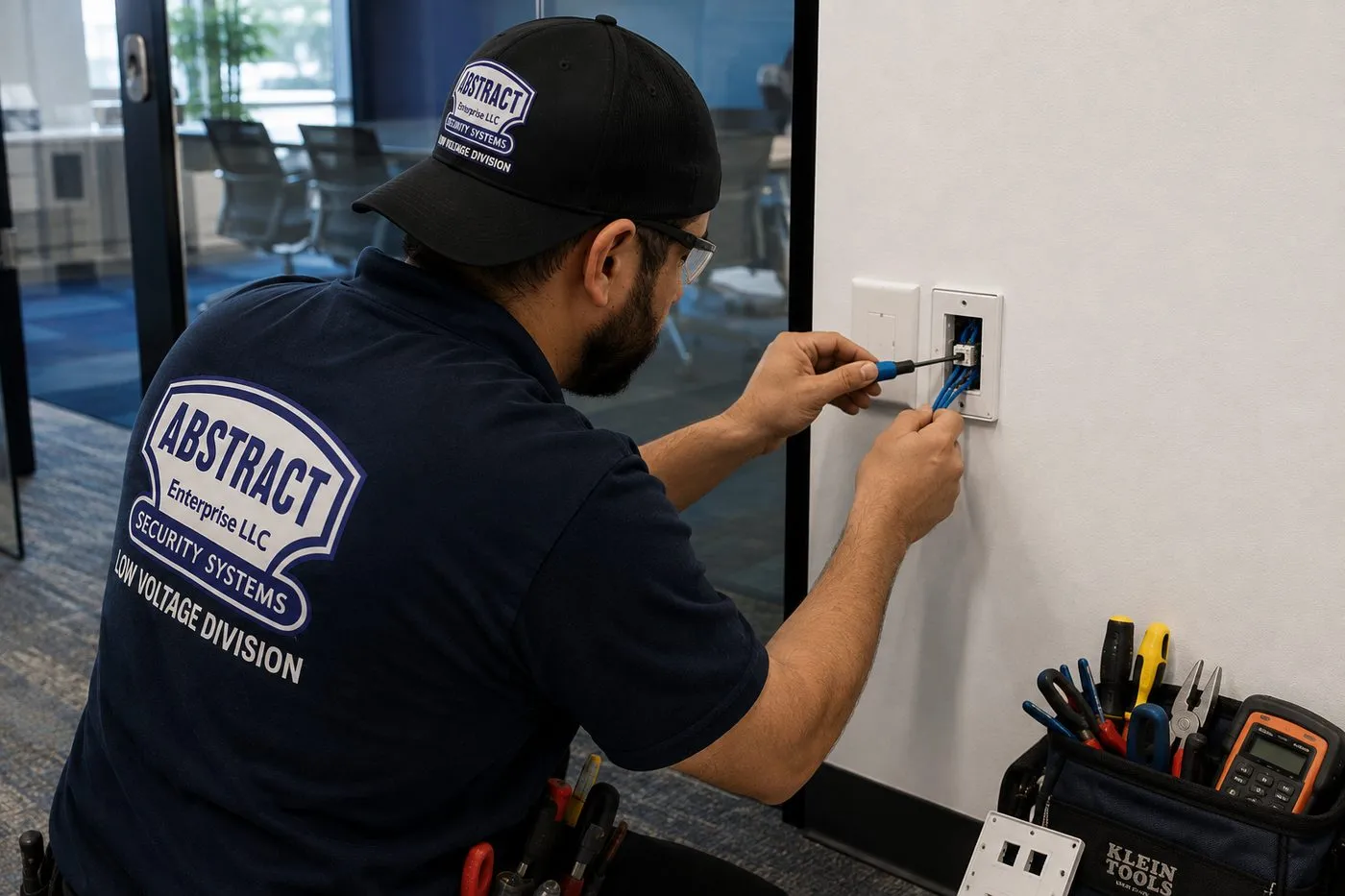
Kneeling at a wall plate, a technician seats blue cables into a jack with a screwdriver, with a meter and tool bag on the floor. Where a run ends behind a cabinet, a plate like this is neater than cable poking through a hole.
Coverage Area
Soundbar Installation Near Long Island's Landmarks
From the city line to Montauk, these are the places most Long Islanders use to say where they live. We install soundbars in the homes and businesses around every one of them.
UBS Arena, Elmont
Opened in November 2021 at 2400 Hempstead Turnpike as the home of the New York Islanders, seating about 17,250 for hockey and up to 19,000 for concerts. Fans who watch the away games at home want the arena in the living room.
Roosevelt Field, East Garden City
Long Island's largest mall, opened in 1956 on the airfield where Charles Lindbergh began his 1927 flight to Paris, with 243 stores along Old Country Road and the homes of Garden City, Westbury and Carle Place around it.
Levittown, Town of Hempstead
The post-war community of 17,447 houses built between 1947 and 1951, many since expanded with dormers, second floors and family rooms. Slab floors and radiant heat shape every cable route.
Jones Beach State Park, Wantagh
Opened in 1929 with 6.5 miles of ocean beach and the 15,200-seat Northwell Health at Jones Beach Theater. The South Shore communities behind it, from Seaford to Massapequa, are full of patios, decks and pool houses.
Stony Brook University, Brookhaven
Founded in 1957 and now enrolling more than 27,000 students in the hamlet of Stony Brook. The North Shore villages around it, from Port Jefferson to Setauket and St. James, mix older homes with newer colonials.
Montauk Point Light, Montauk
Authorised under George Washington in 1792 and built in 1796 at the eastern tip of Long Island. The East End between here and the Shinnecock Canal is second-home country, with summer houses that need systems ready for the season.
We also serve Hempstead, Freeport, Long Beach, Valley Stream, Hicksville, Syosset, Great Neck, Port Washington, Oyster Bay, Huntington, Babylon, Islip, Bay Shore, Smithtown, Brookhaven, Riverhead, Southampton and the North Fork, and every community between them. Same crews and prices across Nassau and Suffolk, and we cover soundbar installation in NYC and the Hudson Valley soundbar installation service too.
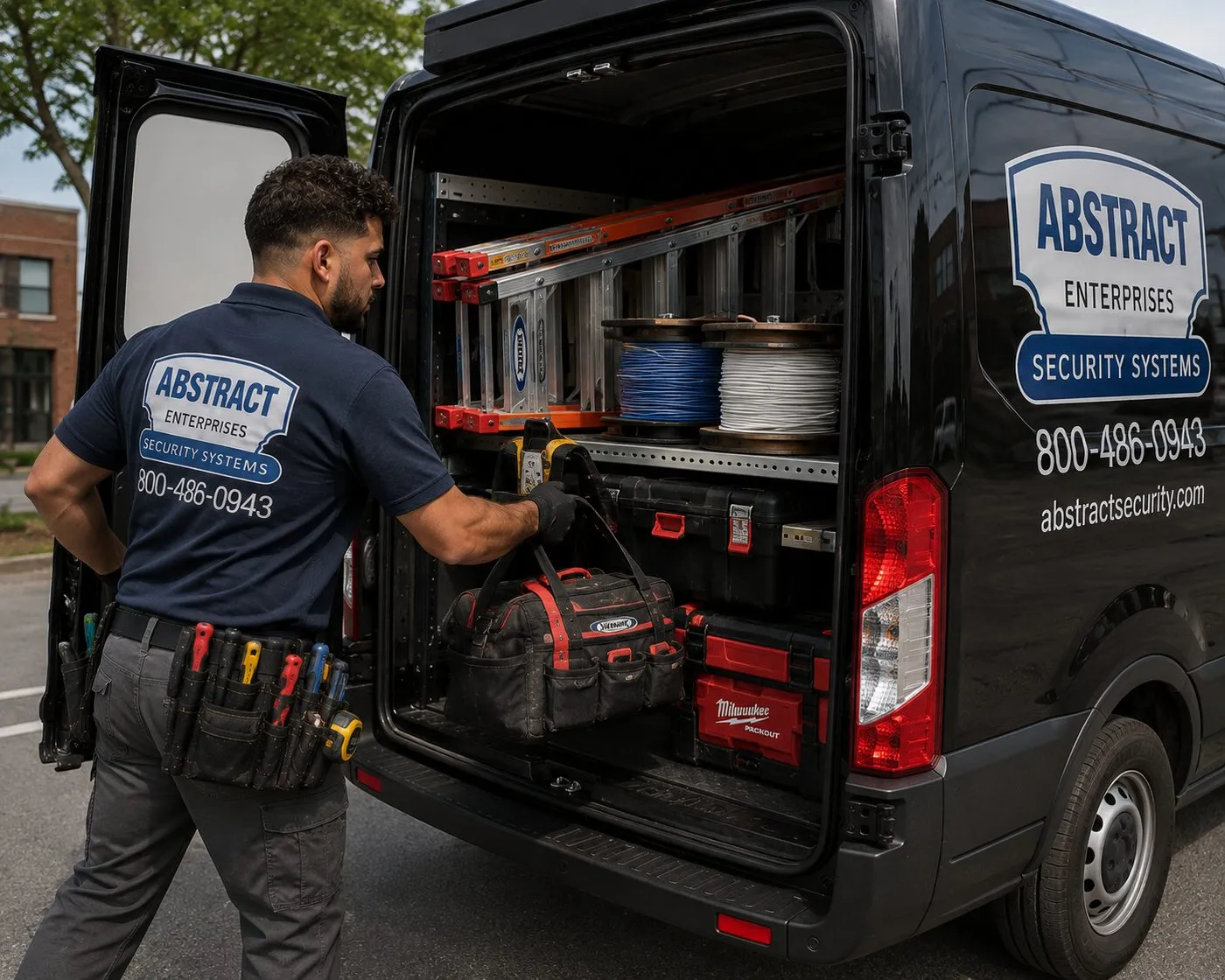
A technician lifts a tool bag out of a branded van fitted with shelving, ladders, cable reels and tool cases. Our vans carry brackets, cord covers and in-wall kits so most Long Island jobs finish in one visit.
Pricing
Soundbar Installation Cost on Long Island
Every price below is a published line item, and soundbar add-ons are the same in Nassau and Suffolk. Your quote is built by adding the lines your room needs; nothing is hidden in a "starting from".
Item
Price
What it covers
Soundbar placed on console, stand or mantel
$79
Positioned, connected by HDMI eARC or optical, TV audio set, remote checked
Soundbar wall-mounted under the TV
$129
Bracket mounted, bar centred and levelled to the TV, connected and set up
Sanus soundbar bracket (if needed)
$84.99
Supplied by us; skip it if your bar came with a bracket
In-wall concealment
$169
Code-compliant in-wall power and cable kit from the existing outlet
Paintable cord cover
$59
Surface raceway for masonry or walls that can't be opened
Cable run to a cabinet or other spot
$99
Up to 25 feet, through wall, floor or basement ceiling where possible
Sonos or wireless surround setup
$125
Sub and rear speakers paired, placed and calibrated
A/V receiver and speakers
$129
Receiver connected, speakers set up and levelled
Full home theatre setup
$350
TV, audio, sources and remote configured together
Universal remote programming
$99
One remote for TV, bar, cable box and streamer
Streaming device setup
$49 each
Connected, signed in where you provide logins, routed through the bar
Wall and access surcharges
Condition
Price
Drywall on wood studs
$0
Metal studs
+$30
Plaster
+$45
Brick or stone
+$65
Concrete or cinder block
+$75
Tile or marble
+$95
Plywood backer board
$85
High mount (above about 8 ft)
$75
Walk-up, third floor or higher, no elevator
$40
Box removal
$25
Certificate of insurance
Free
Where Nassau and Suffolk differ
Only two numbers change between the counties. If we also hang the TV, the TV mounting base is $209.99 in Nassau and $229.99 in Suffolk. And a setup-only visit, for a soundbar that stopped working or a system that needs reconnecting, is $225 for the first hour in Nassau and $250 in Suffolk, then billed in 30-minute blocks.
What the price includes, and what it doesn't
Included: every quoted line covers the hardware fitting, a bar squared to the screen, the TV-to-bar connection, any sub and rears that shipped in the same box, and a play-through with you at the end.
Not included: electrical work of any kind (no new or moved outlets — that is for an electrician), and patching or painting.
Return trip: $150 if we arrive in your window and can't start.
Rescheduling: free with 24 hours' notice.
National brand versus a local installer. Big-box stores and app marketplaces sell installation through networks of independent installers, and the person who arrives may never have seen a Long Island chimney breast. ADT, Ring and SimpliSafe sell security systems, not audio installation, so they aren't really part of this comparison. A local licensed low-voltage contractor carries the masonry anchors, in-wall kits and stainless hardware these houses need, and answers to you directly if something isn't right.
TV and Soundbar Together
Pricing a TV and Soundbar in One Visit, County by County
Most Long Island jobs put the TV and the bar up together, and the arithmetic is the same published lines added up. The only county difference is the TV mounting base. These examples assume drywall over wood studs; add the wall surcharge if yours is plaster, brick, stone, block or tile.
Combination
Nassau
Suffolk
TV mounted + soundbar on the console below
$209.99 + $79 = $288.99
$229.99 + $79 = $308.99
TV mounted + soundbar wall-mounted, bar's own bracket
$209.99 + $129 = $338.99
$229.99 + $129 = $358.99
TV mounted + soundbar wall-mounted + Sanus bracket
$209.99 + $129 + $84.99 = $423.98
$229.99 + $129 + $84.99 = $443.98
The same, with power and HDMI hidden in the wall
$423.98 + $169 = $592.98
$443.98 + $169 = $612.98
Add wireless sub and rear speakers setup
+ $125
+ $125
Over a brick or stone fireplace, add $65 for the masonry. If the TV goes above about eight feet, as it often does over a tall mantel in a great room, add the $75 high-mount charge. A cable run to a built-in cabinet beside the fireplace is $99. Everything else — the TV mount itself, the size of the TV and the type of bracket — is on the full Long Island TV mounting price list.
Hanging the TV and the bar in the same visit is also the best way to get them aligned. The bar's bracket goes up after the TV is level, measured from the screen, so the gap between them is even from end to end and the bar sits centred on the picture rather than on the wall.
Shop Our Systems
Soundbar Installation Packages & Pricing
Three common starting points, each built only by adding the published line items above. Wall surcharges are added if your wall needs them.
Starter — Console or Mantel
$79
Soundbar placed on the console, stand or mantel and connected: $79. eARC or optical set up, the TV's audio output changed, included sub paired, and the TV remote controlling the volume. No drilling.
Standard — Wall-Mounted Under the TV
$213.99
Wall-mounted soundbar $129 + Sanus soundbar bracket $84.99 = $213.99. Bar centred and levelled to the screen on drywall over studs, connected and set up. Cables run behind the TV.
Premium — Wall-Mounted, Wires Hidden
$382.99
$129 for the wall-mounted bar, plus $84.99 for the Sanus bracket, plus $169 for in-wall concealment: $382.99 in total. With the kit's flush plates top and bottom, no cord shows between the screen and the bar.
Bring Your Own Equipment — Labour Only
Bought a rated soundbar bracket already, or did one come in the box? We mount with your customer-supplied bracket for the labour-only price of $129. Customer-supplied hardware carries its manufacturer's warranty rather than ours, and we check that the bracket is rated for your bar's weight before it goes on the wall.
Adding a TV on the same visit? Add the TV mounting base for your county ($209.99 Nassau, $229.99 Suffolk). Adding wireless rears and a sub? Add $125. A basement theatre with everything configured together? The full home theatre setup is $350.
Ready to Price Your Room?
A photo of the wall and the soundbar model is usually enough for an exact price. No visit needed to quote.
Nassau County. Denser, older and more uniform. The western half is dominated by post-war housing — Levittown and the Capes and ranches around it, the high ranches of the 1960s, and the colonials of the North Shore villages. Living rooms are smaller, fireplaces are usually brick, and many houses have been expanded with family rooms off the back, so the TV wall is often the old exterior wall with insulation inside. Basements are common outside the slab-built neighbourhoods. Driving distances are short, so same-day windows open up more often, and setup-only visits are $225 for the first hour.
Western and central Suffolk. From Babylon and Huntington east to Smithtown, Islip and Brookhaven, the housing is newer on average and the rooms are bigger. This is where the two-storey great rooms, cathedral ceilings and stone fireplaces are, and where a bar alone often isn't enough: these are the jobs that add a subwoofer and rear speakers. Finished basements are the norm in colonials, and media rooms are common. Setup-only visits are $250 for the first hour.
The North Fork and the East End. Farmhouses, shingle-style houses, newer custom homes and a large share of second homes. Systems here are often installed in spring for the season, sit idle through the winter, and must work again the next year. Shore houses need stainless hardware and outdoor-rated bars on porches and in pool houses. Same-day service is offered only when a two-hour window is open, so booking a little ahead gives the most choice of times.
The South Shore barrier and bay communities. Long Beach, the Five Towns' bay side, Freeport, Massapequa and the Great South Bay shoreline: houses that are often raised, with salt air and humidity that shorten the life of exposed hardware. Indoors, ordinary bars are fine; outdoors and in rooms left open, we plan for corrosion from day one.
Patios, Decks and Pool Houses
Outdoor Soundbar Planning for Long Island Summers
Outdoor TVs are a spring ritual on Long Island, and the sound is usually the afterthought. A TV's built-in speakers disappear outdoors, where there are no walls to reflect them and a pool filter, a breeze and a dozen conversations to compete with. An outdoor-rated soundbar under the screen is the simplest fix, and it needs the same planning as the TV.
Cover first. Even an IP55 bar belongs under a roof, a pergola with a solid cover or a deep eave. Rain is only part of it; summer afternoon sun on a west-facing wall heats electronics far beyond what an indoor room ever sees.
Power from a protected outlet. The bar and TV plug into an existing weather-protected outdoor outlet with an in-use cover. If there isn't one where the TV is going, an electrician adds it before we arrive; we route cables from it neatly and with drip loops.
Stainless hardware. Within reach of salt air, ordinary plated screws rust and stain the siding within a season or two. We use stainless fasteners and, where hardware is fully exposed, 316 grade.
Mounting surfaces. Cedar shingle, vinyl and fibre-cement siding all need to be mounted through to the framing or a backer, not to the siding alone. Brick and stone patio walls take masonry anchors and carry the $65 surcharge.
Signal. Wi-Fi often weakens outside the house. If the bar streams music or pairs with outdoor speakers, we check the signal at the patio before mounting and tell you if an extender or a wired connection is needed.
Neighbours. Sound carries across quarter-acre lots on summer evenings. Aim the bar toward the seating and away from the property line, and keep the sub, if any, close to the house wall.
Pool houses closed up and humid between uses should be treated as outdoors, with outdoor-rated equipment and the same stainless hardware. For whole-yard sound beyond a single TV, our Long Island audio team designs outdoor speaker systems with buried or rock speakers, which suit a large garden better than a louder bar.
Basements and Summer Houses
Planning a Basement Media Room or a Seasonal System
Basement media rooms
The finished basement is where a lot of Long Island families actually watch films, and it rewards a little planning before the drywall goes up. If the basement is still open framing, that is the moment to run speaker wire to where rear speakers will go, a cable from the TV wall to wherever the equipment will live, and a network cable to the TV location. Wire pulled through open joists costs a fraction of wire fished through a finished ceiling later.
Basement rooms are long, low and hard-surfaced. Put the TV on a short wall so the seating faces down the length of the room, keep the main seat away from the back wall where bass piles up, and use a rug over the slab. A drop ceiling is fine for up-firing drivers if the tiles are a hard, reflective type; soft acoustic tiles absorb the overhead effect, which is exactly what Polk's Atmos guide warns about. If there are bedrooms directly above, a sub on isolation feet and a sensible night-mode habit matter more than any equipment choice.
Basements also run damp in summer. Electronics are happier with a dehumidifier running, and power strips and the sub belong off the floor in a room that has ever had water in it.
Summer houses on the East End and the shore
Closing in the fall. Unplug the soundbar, sub and rear speakers rather than leaving them on standby through the winter storms. Bring any patio or pool-house bar indoors if the house won't be heated. Note the Wi-Fi name and password, because a router replaced over the winter is the most common reason a system won't reconnect in spring.
Opening in the spring. Plug in the bar first, then the sub and rears, and let the manufacturer's app finish any updates before the first weekend guests arrive. Check that the TV is still sending audio to the bar; TV updates sometimes reset the audio output to the internal speakers. Test an outdoor bar's mounting hardware for rust before re-hanging it.
When it won't come back. A setup-only visit, $250 for the first hour in Suffolk, reconnects the system to a new router, re-pairs the sub and rears, and resets eARC after a TV replacement. Booking it for the week before you arrive avoids spending the first warm weekend on the phone with support.
Before You Call
A Short Planning Checklist for Long Island Homeowners
Five minutes with this list will get you an exact price on the first call and save a return trip.
The soundbar model and what came in the box. Many bars include a wall bracket; if yours did, you don't need ours. Note whether a sub and rear speakers came with it.
The TV model and its HDMI ports. Look for the port labelled eARC or ARC. If the TV is more than about eight years old, it may only have optical, which limits the formats the bar can play.
The wall. Knock on it. Drywall sounds hollow between studs; plaster sounds dull and solid; brick, stone and tile are obvious. A photo is even better.
Where the outlet is. An outlet directly below the TV makes in-wall concealment straightforward. If there is no outlet anywhere on that wall, an electrician may need to add one first.
What's below the room. A basement with an open ceiling makes routing to a cabinet easy. A slab, as in Levittown and many other post-war houses, rules floor routes out.
The ceiling. Flat and under about 12 feet suits up-firing Atmos drivers. Vaulted, cathedral or two-storey ceilings point toward rear speakers or in-ceiling speakers for height.
Where the cable box and game console live. Next to the TV, in a cabinet across the room, or in a closet? That decides whether you need a cable run.
Who else is in the house. Bedrooms over a basement media room or next to the family room change how we set the sub and night mode.
Room sound in plain terms
Soundbars are tuned for an average room, and Long Island rooms are rarely average. Hard surfaces — tile floors, big windows, stone fireplaces — make dialogue harsh and echoey; a rug and curtains do more for clarity than any setting. Open plans let sound escape, which is why the same bar sounds quieter at home than in the store. Low basement ceilings help up-firing drivers but can make bass boomy. Most current bars include a room calibration that listens through a microphone or a phone and adjusts; we run it with the furniture in place, because a calibration done in an empty room is wrong as soon as the sofa arrives.
Two settings matter more than any other. Speech or dialogue enhancement lifts voices without raising everything else, and it is the first thing to try if you are turning the volume up for the words and down for the explosions. Night mode compresses the loudest moments so a late film doesn't wake the house. We show you both before we leave.
Fixing Earlier Installs
Common Problems With Soundbars Someone Else Installed
A good share of our soundbar calls on Long Island are for systems that are already on the wall. These are the faults we find most often, and each one is usually a short fix.
Bar on the wrong HDMI port. Plugged into an ordinary HDMI input instead of the eARC port, so sound comes and goes or the TV remote can't control the volume. Moving one cable and changing two settings fixes it.
Bar not level with the TV. Levelled to the floor or the mantel instead of to the screen, so the eye catches the angle every evening. We re-level to the TV.
Bracket in drywall anchors. A bar hung on plastic anchors in drywall alone, sagging at one end. We re-anchor into studs or masonry.
Cables taped down the chimney. HDMI and power cords running down the brick in plain sight. A paintable cover or a route through the side wall puts them away.
Sub in the worst corner. Bass that booms in one seat and vanishes in another. Trying two or three positions and running room calibration evens it out.
Rear speakers that drop out. Usually a weak Wi-Fi signal or an outlet controlled by a wall switch. We find which and fix it.
Atmos that never plays. The TV set to convert everything to stereo, or the streaming device sending the wrong format. A few settings in the right order bring it back.
Most of these are handled on a setup-only visit, $225 for the first hour in Nassau and $250 in Suffolk; re-mounting a bar on the wall is quoted at the $129 wall-mount price.
Complete Services
Every Soundbar Installation Service on Long Island
A soundbar is usually one part of a bigger room. These are the Long Island services that most often appear on the same visit.
Send the details for any service and get a written price the same business day.
Field Notes
Field Notes From Long Island Family Rooms
Mantel, chimney breast and soundbar: the checklist our technicians run on Long Island hearth walls (general practice, no single customer)
Before a drill comes out on a fireplace wall, the first thing we do is sit on the couch. Where the TV ends up above a mantel decides almost everything else: how high the bar goes, whether the mantel shelf can hold it, whether its up-firing drivers have a clear path, and whether the household will be looking up at the screen all evening. Holding the bar against the wall at two or three heights and listening from the main seat takes two minutes and avoids a second set of holes in the brick.
The second thing is the heat. A reading at the spot where the bar will sit, with the fire on if the household uses it, tells us whether the plan is sensible. If the spot is too warm, it is better to say so before mounting than to explain later why a warranty claim was refused.
The third is the cable route, which on a chimney breast is never through the chimney. We look at the side walls, the basement below and the cabinet across the room, and pick the route that leaves nothing hanging. If none of them works, a paintable cover painted to match the trim is the honest answer, and we say so up front.
FAQ
Long Island Soundbar Installation FAQ
What does a Long Island soundbar install cost, start to finish?
+
A soundbar placed on your console or stand and connected is $79. Wall-mounted under the TV it is $129 in labour, plus $84.99 if we supply the Sanus soundbar bracket. Hiding the cables inside the wall with a code-compliant in-wall power and cable kit adds $169, so a fully concealed wall-mounted bar comes to $382.99 on drywall over wood studs. Masonry, plaster or tile surcharges apply only if the wall needs them.
Will I know the full price before the technician arrives?
+
Yes. Send the TV size, the soundbar model, the wall type and ideally a photo, and we add up the published line items and confirm the total before booking. The only things that can change it on the day are conditions nobody could see, such as a wall that turns out to be masonry behind the drywall, and we explain any change before doing the work.
Do you cover the whole of Suffolk, out to Montauk and the North Fork?
+
Yes. We install across both counties, from the Queens line in Nassau to Montauk and Orient. Appointments run in two-hour arrival windows from 8 AM to 8 PM, seven days a week. Same-day service depends on a two-hour window being open, so for the far East End, booking a few days ahead gives you the widest choice of times.
What exactly is included when you install a soundbar?
+
Mounting or placing the soundbar, levelling it to the TV, connecting it to the TV by HDMI eARC or optical, pairing a wireless subwoofer or rear speakers if they came with the system, setting the TV to send audio to the bar and checking that the TV remote controls the volume. Concealment, extra speakers and remote programming are separate line items, and electrical work is not included.
Can you add a soundbar under a TV someone else already mounted?
+
Yes. We check that the existing TV mount is level, secure and anchored properly before hanging anything below it, then mount the bar to the wall or to a bracket that attaches to the TV mount. If the TV mount itself looks unsafe, we tell you and price a remount at the TV mounting base for your county.
How long does a typical soundbar job take?
+
A bar placed on a console and connected is a short visit. Wall-mounting and setting up a bar usually fits comfortably inside a single appointment, and in-wall concealment, masonry walls, or adding a subwoofer and rear speakers each add time. If a job needs more than one visit, we tell you when we quote it.
What happens if the job can't be started when the technician arrives?
+
If we arrive in your window and cannot start, for example because the TV or soundbar is not on site or the wall is not accessible, there is a $150 return-trip fee to come back. It is not charged when the delay is on our side.
What should I have ready before the technician arrives?
+
The TV and soundbar on site, the area in front of the TV wall cleared of furniture and breakables, your Wi-Fi name and password, and the login for any soundbar or streaming app you want set up. If the bar came with a bracket, keep it with the box.
Do I need to buy an HDMI cable before you come?
+
Usually not. Most soundbars include an HDMI cable in the box; Samsung lists an ultra-high-speed HDMI cable among the HW-Q990D's accessories, for example. If the run from the TV to the bar or to a cabinet needs a longer or in-wall-rated cable, we tell you when we quote.
Does the soundbar price change between Nassau and Suffolk?
+
No. The soundbar line items, the bracket, concealment and wall surcharges are the same in both counties. What differs is the TV mounting base if we hang the TV too, $209.99 in Nassau and $229.99 in Suffolk, and the setup-only hourly rate, $225 in Nassau and $250 in Suffolk.
What if the soundbar itself turns out to be faulty?
+
We power the bar up and test it before mounting, so a dead unit is found before it is on the wall. A faulty soundbar is a matter for the retailer or the manufacturer's warranty; brackets and kits carry their manufacturer's warranty too. Full terms — including 50% deposit, one-year parts-only warranty on AESS-supplied products, and the late-fee schedule — are set out in the service agreement.
All Areas Served
Soundbar Installation Across Long Island and New York
This is the Long Island hub for our soundbar installation service. Dedicated pages for Nassau and Suffolk counties are being added; until each one is live, its link goes to our quote form, and the same crews cover both counties today.
Lost audio after a firmware push, a subwoofer that won't re-link, or volume keys that do nothing? Ring (800) 486-0943. Same-day when a two-hour window is open; most eARC, settings and pairing faults are fixed in one to two hours once we are in the room.
Soundbar Installation Long Island — Licensed, Insured, Priced Up Front
Abstract Enterprises Security Systems · 1282 Troy Ave, Brooklyn, NY 11203 · (800) 486-0943 · WhatsApp (718) 679-0359 via wa.me
NYS Low-Voltage Licence #12000287431 · 100% Licensed & Insured · Same-Day Estimates · Rated 4.7★ from 201 Google Reviews
Full terms — including 50% deposit, one-year parts-only warranty on AESS-supplied products, and the late-fee schedule — are set out in the service agreement. See our warranty page.
Reviewed and updated October 17, 2026. Changelog: new page — soundbar mounting for Nassau and Suffolk homes and businesses.