Lake Success to Riverhead · Office parks, showrooms, bars, campuses
Most video walls on the island are the first one the building has ever had. There is no AV department down the hall, the wall behind the screens is steel stud or block, the outlets belong to a licensed electrician, and the nearest service van may be an hour away. We plan the wall around those facts: the right panel for how close people really stand, a surface proven to carry the load, power arranged before the crates arrive, and health checks we can run from Brooklyn before anyone drives east.
Panel specifications, licensing rules, sign rules and local facts on this page were checked against the sources listed at the bottom. Reviewed and updated October 18, 2026.
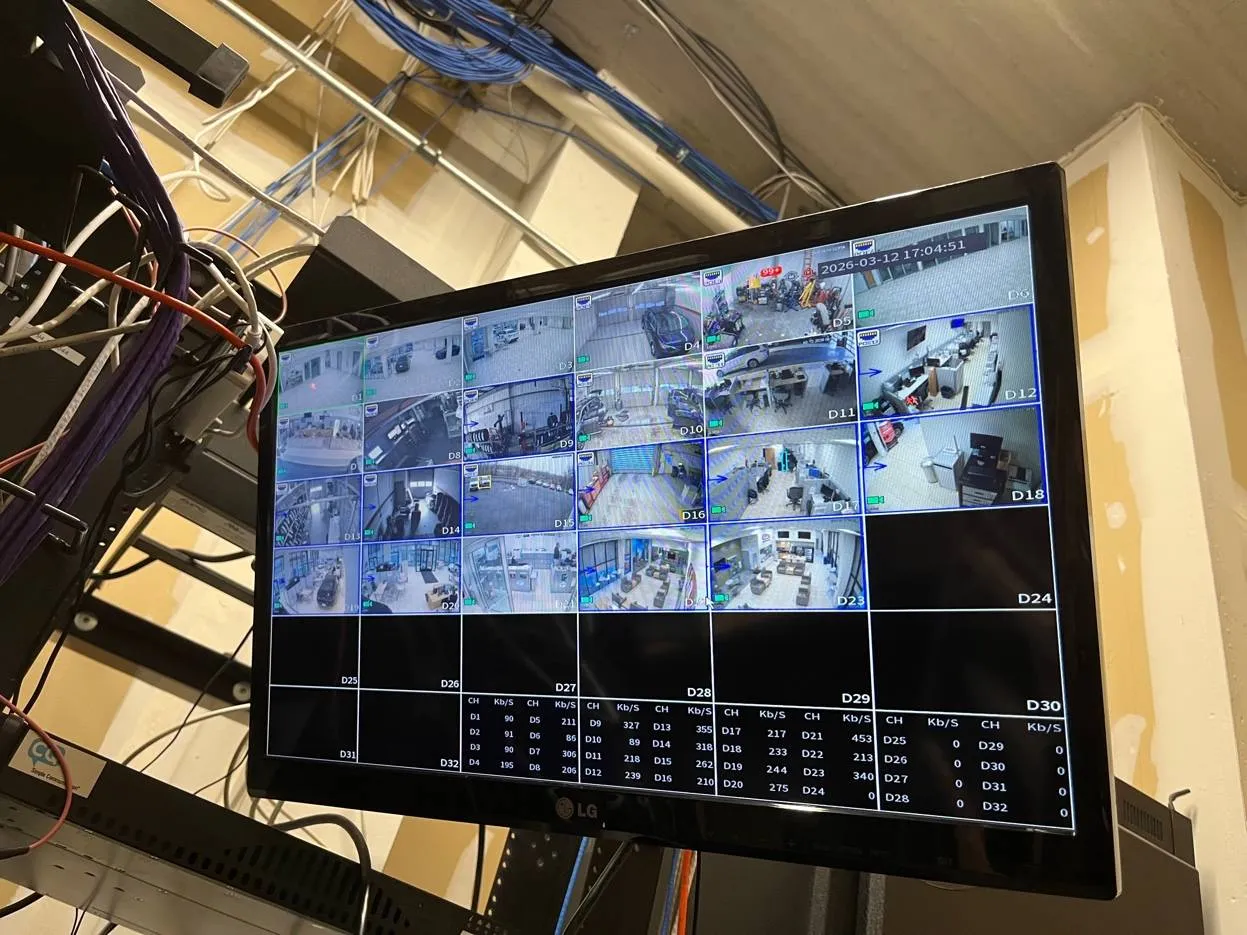
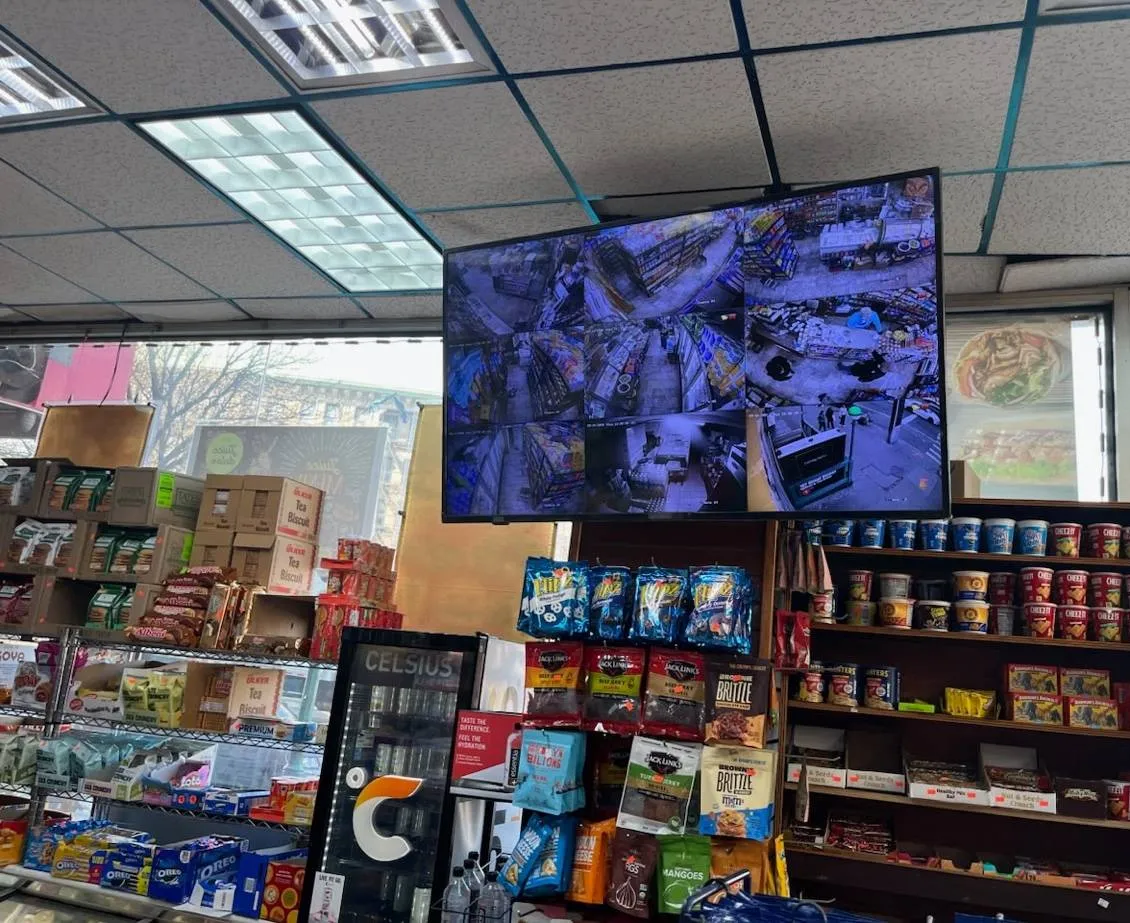
Real AESS job photo from another site, not a Long Island video wall: one LG monitor carrying 32 sources at once. Owners who outgrow a screen like this are often the ones who ask about a wall.
Long Island Video Wall Request
Town, room, rough wall size and what it should show
✅
Request Sent!
A scheduler will call you to ask about the room, the wall and the people who will watch it.
25+
Years Experience
✓
Same-Day Estimates
100%
Licensed & Insured
4.7★
201 Google Reviews
Three numbers make the first call useful: the width of the wall you have in mind, the distance from it to the nearest place someone stands or sits, and whether there is an outlet within a few feet of it today. Phone (800) 486-0943 with those and the town, and we can usually tell you on the call whether LCD tiles or LED fit the room and roughly what it will cost.
Estimates are free; a written quote follows the site survey.
Walls we did not install, panels bought online and kits sitting in a back room are all fine to call about.
NYS licensed low-voltage contractor, license #12000287431; line-voltage work is coordinated with your licensed electrician.
Why Long Island Properties Need Video Wall Installation
A video wall is a set of displays, either thin-bezel LCD panels or cabinets of direct-view LED, hung and wired so that a single picture, or several arranged pictures, spans all of them. In Manhattan the people who buy one usually have a facilities manager, a building engineer and an AV consultant, and the wall goes into a tower that has hosted dozens of them. On Long Island the buyer is more often the owner of a dealership on Jericho Turnpike, the office manager of a firm in a Melville office park, the operations lead of a distributor in Hauppauge, or the volunteer who runs the screens at a church. They know what they want the wall to do. They have not usually been asked what the wall behind it is made of, how far back the front row sits, or which electrician will put a circuit there.
Those questions decide whether a wall looks right for ten years or starts to annoy everyone within one. Island buildings spread out rather than up. Office parks along Route 110 and in the Hauppauge park are mostly one- to four-story buildings with steel-stud and drywall partitions over slab, drop ceilings and rooftop air handling; showrooms and stores have long glass fronts that throw daylight straight at the screens; older downtowns in Mineola, Huntington or Patchogue mix block and plaster with newer fit-outs. None of that is a problem if it is known before the panels are ordered. It becomes one when a heavy array goes on a partition that was framed for a whiteboard, or a 500-nit LCD wall faces a south window and washes out every afternoon.
The second island difference is that power and permits are local. In Suffolk County, line-voltage connections belong to the holder of a Suffolk County master electrician’s license, while low-voltage cabling for audio and video has its own restricted license category. In Nassau, the towns of Hempstead, North Hempstead and Oyster Bay each run their own board of electrical examiners. A wall that faces the street through a window can also fall under a town’s sign rules: the Town of Islip, for example, attaches lifetime conditions to electronic message signs, including a 45-second minimum hold on each message and automatic night dimming. We plan the low-voltage side, tell you exactly what the electrician needs to provide, and check the sign question before a single panel faces a window.
The third difference is distance. From our base on Troy Avenue in Brooklyn, Garden City is a short run and Riverhead is a long one, and a wall in Yaphank or Stony Brook cannot wait for a technician to drive out every time a panel loses its input. So every island wall we install is set up to report on itself where the panels allow it: status alerts, network monitoring and a remote view of what the processor is sending, so that most problems are diagnosed before anyone gets in a van, and the van that does go out carries the right part.
The island facts we plan around
The biggest employers are suburban campuses. Northwell Health, based in Lake Success and New Hyde Park, describes itself as New York State’s largest private employer with more than 104,000 employees, spread across hospitals and outpatient sites in both counties rather than one tower.
One industrial park holds one job in twenty. The Regional Plan Association counts about 1,300 companies and more than 55,000 employees in the Hauppauge Industrial Park, just over two square miles that account for roughly one in twenty Long Island jobs.
Walls already run the island’s public-safety work. The Suffolk Crime Analysis Center at police headquarters in Yaphank uses a video wall to display footage from countywide cameras, as part of the state’s network of crime analysis centers.
Campuses build them on modest budgets. Stony Brook University put a 6′6″ × 12′ video wall in the Frey Hall lobby over a winter break, reporting a budget under $40,000 with its own electricians, carpenters and painters doing the physical work.
Newsrooms and offices use several sizes at once. Newsday’s Melville headquarters was fitted with a Planar 3×5 wall in the newsroom, an 8×10 wall in its auditorium and a 2×2 in reception, according to the furniture and AV firm that did the fit-out.
One utility, a lot of meters. PSEG Long Island serves more than 1.2 million customers across the island and the Rockaways, so storm restoration is something every wall here has to ride through.
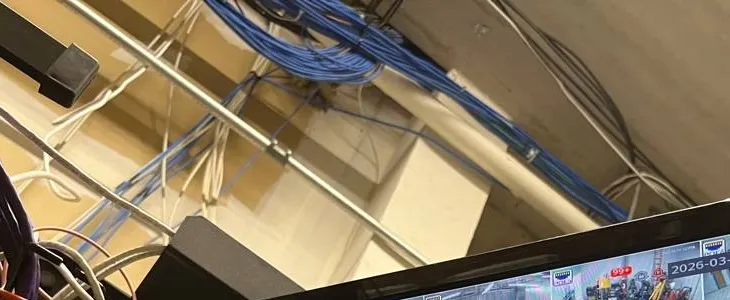
Real AESS job photo from another site, not a Long Island video wall: cable arriving from the ceiling above a display, the kind of route we plan before any wall mount goes up.
Wall Gone Dark Before Opening? Same-Day Video Wall Repair Across the Island
The repair call we get most often is not a broken wall. It is a wall where one tile shows “no signal”, one has gone pink, or the whole picture is stretched across the wrong number of panels after a power cut. Most of those are settings, cables or a processor that came up before the displays did, and many can be fixed the same day. Call (800) 486-0943 with a photo of the wall and a photo of the back of the processor or the first panel in the chain, and we will tell you whether it needs a visit. Repair visits are $195 an hour with a three-hour minimum ($585).
The pattern of the fault tells us where to look. A single dark tile in a daisy-chained LCD wall points at that panel or the cable feeding it; every tile after a certain point going dark points at the link between two panels; a wall that shows the right picture but in the wrong layout points at the processor or the tile settings, not the hardware.
What the wall is telling you
What you see
Most likely cause
Safe first step
One tile says “no signal”, the rest are fine
Loose or failed input cable to that panel, or the panel switched to another input
Check the input with the remote or the panel’s own buttons; do not unplug anything else
Every tile after one panel is black
Break in a daisy chain: a failed cable or a panel that stopped passing the signal on
Note which tile is the last good one and photograph its back
Picture is right but spread across the wrong panels
Tile or ID settings lost after a power cut or firmware update
Leave it; the settings are restored from our saved configuration
One panel is pinker, greener or dimmer than its neighbours
Colour or brightness drift, a reset panel, or a replacement from a different batch
Photograph it in normal lighting; recalibration is usually on site
Fine yesterday, nothing at all this morning
Processor or media player did not restart, or the circuit tripped
Check the breaker and the processor’s power light before anything else
A faint outline of a logo stays on screen
Image retention from a static element left on too long
Run moving content for a few hours; call if it does not fade
Four things to do before we arrive
Do not factory-reset the panels. A reset clears tile position, colour and ID settings, and turns a one-hour fix into a recalibration.
Write down what changed. A storm, a new IT contractor, a cleaner unplugging a strip, a firmware prompt someone accepted: each points at a different cause.
Find the processor or player. It may be in a closet, a rack or behind a panel. A photo of its front lights saves time.
Keep spares where we can find them. If a spare panel or cable was left with the wall, tell us where it is.
Two Counties
Nassau and Suffolk: One Island, Two Ways of Getting a Wall Built
Nassau is the closer, denser county. Its walls go into Class A offices around Lake Success, Garden City and Uniondale, car showrooms on Jericho and Hempstead turnpikes and Northern Boulevard, medical offices, and small downtown shops. Electrical work is licensed town by town, so the electrician who wires the circuit behind a wall in Hicksville answers to Oyster Bay’s board, and the one in Freeport to Hempstead’s. Homeowners who want a wall in a basement or a game room deal with Nassau’s Office of Consumer Affairs, which licenses home improvement businesses.
Suffolk is larger and more spread out. Its walls are more often in operations rooms, warehouses and plants in the Hauppauge park, along Route 110 and around MacArthur Airport, in Stony Brook’s campus and hospital buildings, and in restaurants and venues from Smithtown to Riverhead. Electrical licensing is county-wide: Suffolk’s Department of Consumer Affairs issues master and restricted electrical licenses, and its rules give the master electrician the line-voltage connection while a restricted category covers audio, video and data cabling under 90 volts. Distance matters more here, so remote monitoring and spare parts on site matter more too.
Each county has its own page with its own price list, local details and direct line. Read video wall installation in Nassau County for the town-by-town picture west of the county line, and Suffolk County video wall installation for Huntington to the East End. This hub covers what is the same across both and how to choose.
Nassau in one line
Shorter drives, denser offices and showrooms, electricians licensed by the town, home walls under the county’s home improvement license.
Suffolk in one line
Longer drives, more operations rooms and industrial buildings, one county electrical license, remote monitoring treated as essential.
Both counties
One utility, the same ADA protrusion limit in public corridors, the same panel makers, and the same rule: prove the wall and the circuit before the panels arrive.
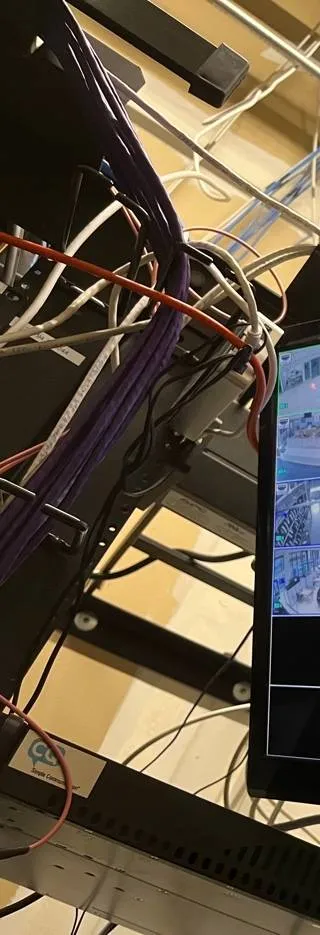
Real AESS job photo from another site, not a Long Island video wall: patch cables down the side of a rack next to a monitor. Processors and players for a wall usually live in a rack like this.
What We Install
Video Wall Installation Services on Long Island
Nine kinds of work cover almost every island request. Most jobs combine three or four of them; a showroom wall, for example, is usually a new LCD array, a media player, a mount that pops out for service and a short training session for the sales manager.
LCD tile walls
2×2 to 4×4 arrays of 46- or 55-inch commercial panels with thin bezels, the usual choice for offices, showrooms and bars where the budget matters and viewers stand back.
Direct-view LED walls
Cabinets of LED modules with no seams, chosen by pixel pitch for the nearest viewer, for lobbies, auditoriums and spaces where the wall has to be bigger than any group of panels.
All-in-one LED displays
Factory-built LED screens such as 136-inch units with the processor inside, which arrive closer to plug-and-play than a cabinet wall and suit conference rooms and boardrooms.
Operations and monitoring walls
Walls that show cameras, dashboards, maps and feeds side by side for dispatch desks, warehouse floors, plant offices and security rooms, driven by a processor that keeps each source in its own window.
Replacing rows of TVs
Converting a strip of mismatched consumer TVs into a proper wall, or rearranging them into a layout that a matrix switch can feed, for bars and restaurants that outgrew their first setup.
Mounting structure and backing
Pop-out video wall mounts on rails, plywood or steel backing added inside stud walls, and floor-supported frames where a wall cannot carry the load.
Cabling, processors and players
Video, network and control cabling, HDBaseT extenders, processors and media players, set up so the wall comes back on its own after a power cut.
Calibration and recalibration
Matching colour and brightness across panels at install, and again when a panel is replaced or the room lighting changes.
Repairs and walls we did not install
Dead tiles, broken chains, lost layouts, panels that drifted, and walls bought online that never quite worked, priced at the service rate.
Every wall ends with a written handover: panel models and serial numbers, the layout and ID map, the processor settings, network addresses, passwords, the circuit numbers the electrician used and a list of spares. When something goes wrong in year four, that sheet is the difference between a phone fix and a day of detective work.
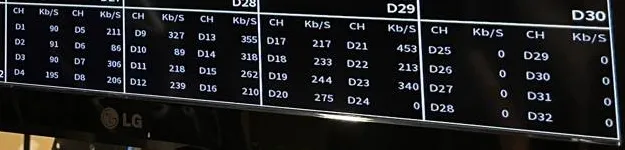
Real AESS job photo from another site, not a Long Island video wall: a per-channel bitrate readout. Every live source on a wall needs bandwidth and a path to the processor, which is why we map sources before quoting.
Building Specialists
Video Wall Installation for Long Island’s Architecture
The panels are the same everywhere. The building behind them is not, and on the island it usually falls into one of six types.
Office-park buildings
One- to four-story offices in Melville, Hauppauge, Lake Success and Islandia with steel-stud partitions, drop ceilings and rooftop air. The question is always what is inside the partition.
Showrooms and big-box retail
Dealerships and stores on the turnpikes with long glass fronts, high ceilings and sales floors that change layout. Glare and sightlines from the door decide the panel.
Flex and industrial buildings
Concrete-block or tilt-up walls, open web joists and warehouse floors in the Hauppauge park, Bohemia and Ronkonkoma, where a wall often hangs over a work area and dust is part of the spec.
Downtown storefronts
Older two- and three-story buildings in village centers with plaster, brick and party walls shared with the shop next door, and windows onto the sidewalk.
Campuses and hospitals
Institutional buildings with their own facilities teams, standards and inspectors, where the wall has to fit a public corridor and pass the owner’s own review.
Homes
Finished basements, game rooms and home offices in houses with wood framing, where the issue is usually finding solid framing and a clean cable route.
How the method changes from one building to the next
In an office-park building we open a small inspection hole or use the drawings to find the studs, their gauge and their spacing, then decide whether the mount can bolt through to blocking or whether we add plywood or steel backing inside the wall. A 55-inch commercial LCD panel weighs around 19 kilograms on its own, and a 3×3 array of them, before the mount, is well over 170 kilograms spread across one patch of wall. Light-gauge studs framed for drywall and a whiteboard are not automatically ready for that, and the answer is not to guess.
In a showroom we start at the front door and the windows. We stand where a customer walks in, at the time of day the sun is worst, and decide how bright the panels need to be and whether the wall should face away from the glass. A 500-nit LCD that looks perfect at night can lose its colour against a sunlit window; brighter panels exist, cost more and draw more power, and sometimes the better answer is to move the wall eight feet.
In a flex or industrial building the wall is usually block, which carries weight well but needs the right anchors and a cable route that does not leave conduit running across a painted surface. We check for dust and temperature, because commercial panels have operating limits — LG lists 0 to 40 °C and 10 to 80 percent humidity for its 55VM5J — and an unheated loading area or a plant floor may sit outside them for part of the year.
In storefronts, campuses and hospitals the rules of the building come first: shared walls need the neighbour or landlord to agree, public corridors need the wall to stay within the ADA protrusion limit, and institutional owners usually want drawings and cut sheets before work starts. In homes we look for joists and studs, a path for cables to the equipment, and an outlet that does not hang off a shared circuit with the freezer.
Real AESS job photo from another site, not a Long Island video wall: a single display hung from a drop ceiling over a shop floor, with light from the front windows behind the shelves.
Commercial Video Walls
Business Video Wall Installation on Long Island
Island businesses buy walls for six main reasons, and each one clusters along a familiar road.
Route 110, Melville to Farmingdale
Corporate offices and headquarters along Broadhollow Road, including Newsday’s Melville building with walls in its newsroom, auditorium and reception. Lobby, boardroom and training-room walls.
Hauppauge Industrial Park
About 1,300 companies, from distributors to manufacturers, where walls show production status, shipping queues and camera views to people working the floor.
Uniondale and East Garden City
The two 15-story RXR Plaza office towers, the Nassau Coliseum and the Roosevelt Field area, with offices, a planned 90,000 sq ft medical building and hospitality spaces that use walls for wayfinding and events.
Lake Success and New Hyde Park
Northwell Health’s base and a ring of medical and professional offices, where waiting rooms and education spaces need walls that are quiet, accessible and easy to update.
Jericho Turnpike and Route 347
Dealerships, big-box stores and plazas from Jericho to Smith Haven Mall in Lake Grove, where glass fronts and long sightlines shape every display decision.
Route 58, Riverhead
Restaurants, bars and stores near the county seat, including a Riverhead grill that has promoted its 21-foot video wall for fundraisers and events.
What each kind of island business asks the wall to do
Dealerships and showrooms want the wall to sell while the salesperson is busy: model videos, offers and inventory, readable from the door and from the desk. The design problem is daylight through the front glass and customers who walk right up to the wall, so brightness and seam position matter more than raw size. A media player with a schedule usually beats a processor here, because the content is one loop rather than several live feeds.
Operations rooms, warehouses and plant offices want several live sources at once: camera views, a shipping or production dashboard, a weather radar, sometimes a video call. That calls for a processor or multiviewer, a network path for every source, and panels rated for long hours. The people watching sit at desks within a few metres, so we keep critical numbers inside single panels and size text for the back row rather than the front.
Medical and professional offices want calm information: wayfinding, education loops, a welcome screen, sometimes a queue. The wall has to be quiet, accessible and easy for front-desk staff to update without calling anyone. These spaces are where the ADA corridor limit and caption placement come up most, and where a single large display is often the better recommendation.
Bars and restaurants want many games at once and the ability to put one big game across everything on a Sunday. That is a matrix switch problem as much as a display problem, and it is where people most often try to reuse consumer TVs. We plan the switching first, then decide whether the wall is true video wall panels or well-aligned separate screens.
Churches, schools and community spaces want lyrics, slides, announcements and live video, usually run by volunteers or teachers with a laptop. Simplicity wins: one obvious input, a clear on and off, and a layout that cannot be accidentally scrambled. We label the inputs, lock the settings that should not change and leave a laminated one-page guide beside the controls.
Rules island businesses should keep in view
Line voltage belongs to the electrician. In Suffolk, direct line-voltage and branch-circuit connections are reserved to a Suffolk County master electrician; in Nassau, the town where the building sits licenses electricians. We provide the load, location and outlet type; your electrician provides and certifies the circuit.
Low-voltage work has its own license. Our NYS license (#12000287431) covers the low-voltage installation; Suffolk’s rules also describe a restricted category for audio, video and data cabling under 90 volts.
Public corridors limit how far a wall sticks out. Under the 2010 ADA Standards, a wall-mounted object whose leading edge is between 27 and 80 inches above the floor may protrude no more than 4 inches into a circulation path.
Window-facing walls can be signs. Islip’s sign permit sets lifetime conditions on electronic message signs: 45-second minimum hold, static messages, sub-second transitions and automatic night dimming, with an inspection and electrical certificate before the sign is added to the certificate of occupancy. Other towns have their own versions.
Home walls are home improvement work. Nassau’s Office of Consumer Affairs licenses home improvement businesses, and Suffolk’s Department of Consumer Affairs issues home improvement licenses; a wall in a house falls under those rules.
Leased spaces need written consent. Most leases treat fastening to walls and adding circuits as alterations that need the landlord’s approval.
Power comes back hard after storms. With one utility for the whole island, a restoration after a storm brings every building back at once; surge protection and a controlled restart order are part of the design, not an afterthought.
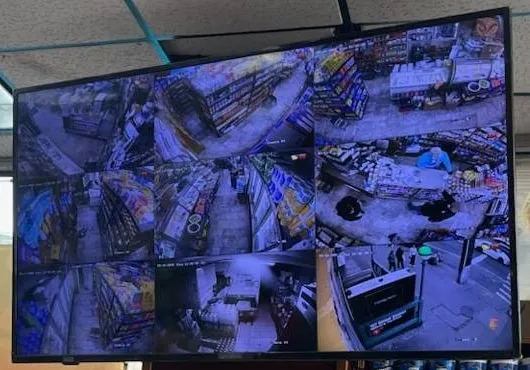
Real AESS job photo from another site, not a Long Island video wall: one screen split twelve ways. A processor-driven wall does the same thing across several panels, with each source in its own window.
Your Questions Answered
Video Wall Installation on Long Island: Questions Answered
These are the questions island owners and office managers actually raise before they commit, grouped by the decision they belong to. Questions about price are answered in the pricing section further down.
Picking the Display
Our reception area is only about 12 feet deep — will the lines between LCD panels bother people standing that close?
At 12 feet, people will see the seams on any LCD wall; the question is whether they will notice them. Samsung’s narrowest video wall panels quote 0.88 millimetres bezel-to-bezel, and its more common models 1.74 or 3.5 millimetres. Samsung also notes that the dark gap between the lit areas is a little wider than the bezel figure: its VM55B-E panel lists 1.74 millimetres bezel-to-bezel but 2.49 millimetres from active area to active area. On a logo, a video or a dashboard, a 2.5-millimetre line at 12 feet reads as a thin grid and most people stop seeing it within a week. On a spreadsheet or a line of small text that crosses a seam, it can cut a word in half.
So in a shallow reception we design the content to the grid, keeping text inside single panels, or we move to direct-view LED, which has no seams at all. For LED, the pitch has to suit the distance: Planar’s own table puts the average comfortable viewing distance for a 1.5-millimetre wall at 8 feet 6 inches, which is why fine-pitch LED is the usual answer for a reception that deep. It costs more, and we will show you both on paper before you choose.
Is a 2×2 of commercial panels really better than one 98-inch display?
Not always. A single large display has no seams, one input, one power cord and one thing to fail, and for a conference room where the content is a video call or a presentation it is usually the better buy. A 2×2 array of 55-inch panels is roughly a 110-inch picture with a cross through it; it wins when you need more size than single displays offer at your budget, when you want four separate sources at once, or when the wall will grow later.
We ask what the wall will show most of the day. If the answer is one full-screen thing, we often recommend the single display and save you the money. If it is several things at once, or a size a single screen cannot reach without moving into LED, the array makes sense. Either way you get the comparison in writing.
Our only way in is a standard door and a stairway — does that rule out a big wall?
Rarely. A wall is built from pieces, and the pieces are what has to get in. A 55-inch commercial panel ships in a carton roughly 1.4 metres long and weighs under 30 kilograms packed, which two people carry up most stairs. LED cabinets are smaller still and assemble into any size on site. What a narrow route does rule out is a factory-built all-in-one LED screen or a single huge display, which arrive as one large crate.
Before ordering we measure the route — doors, turns on the stair, the elevator if there is one, the ceiling height where the wall goes — and pick the product to fit. On older downtown buildings with a tight stair, that measurement has more than once decided between LCD and LED.
The Wall Behind It
Our offices are metal studs and drywall — what has to happen before a video wall mount goes up?
We find out what the studs are and what is between them. Light-gauge steel studs at 16 or 24 inches carry drywall and shelves well, but an array of panels hangs its whole weight off a narrow band of wall and pulls outward when a panel is popped out for service. The usual fix is backing: plywood or steel strapping fastened across several studs inside the wall, so the mount bolts into something continuous. In an occupied office we do that through a slot that is patched and painted afterwards, or from the back if the other side is a closet.
If the partition is not tied to the deck above, or is too thin, the alternative is a floor-supported frame that stands just in front of the wall and carries the panels itself. Either way the decision is made before the panels are ordered, and you know whether a painter or a patch is part of the job.
Can the wall go on a partition we share with the tenant next door?
Sometimes, with care and permission. A demising wall between two tenants is usually the landlord’s, often has fire-rated construction, and has a neighbour on the other side who will hear drilling and feel any through-bolts. We need the landlord’s written consent, we avoid penetrating a rated assembly without the right firestopping, and we do not run fasteners through to the other side.
When a shared wall is the only wall that works, a floor-supported frame or backing fixed only on your side usually solves it. When the shared wall is also thin and noisy, we may suggest a different wall, because panels with fans and a processor humming on a party wall are a complaint waiting to happen.
How far will the finished wall stick out into a corridor, and why does that matter?
It matters because of people who use a cane to find their way. The 2010 ADA Standards limit wall-mounted objects whose bottom edge sits between 27 and 80 inches above the floor to 4 inches of projection into a circulation path. A video wall panel is about 70 millimetres deep before the mount, and a pop-out mount adds more: Chief’s ConnexSys landscape mount can be set between 4 and 7.4 inches from the wall. In a lobby where the wall is set back from where people walk, that is fine. In a corridor or a narrow waiting room, a wall whose lower edge is below 80 inches can easily exceed the limit.
The answers are to recess the wall, raise its bottom edge, set the mount at its shallowest depth, or put a detectable element below it, such as a low ledge or planter within cane range. We draw the depth on the plan so you and your architect can see it.
Power, Heat and Permits
Who is allowed to wire the outlets behind the wall — and is it different in Suffolk and in a Nassau town?
A licensed electrician does the line-voltage work in both counties; what differs is who licenses them. Suffolk County’s rules reserve direct line-voltage and branch-circuit connections to the holder of a Suffolk County master electrician’s license, and separately describe a restricted license for cabling under 90 volts for networking, cable TV, fibre, audio, video and home theatre. In Nassau, electricians are licensed by the town: Hempstead, North Hempstead and Oyster Bay each keep an examining board, and an electrician licensed in one is not automatically licensed in another.
We hold the NYS low-voltage license (#12000287431) and do the low-voltage side: mounts, panels, video, data and control. We give your electrician a one-page sheet with the outlet positions, the load, and whether the processor needs its own circuit, and we do not hang panels until the outlets are in. If you have no electrician, we can introduce you to one licensed for your town.
Does the room need extra cooling once the wall and its processor are running?
In a small room, often yes. Nearly every watt a wall draws ends up as heat. LG lists its 55-inch 55VM5J video wall panel at 546 BTU per hour typical and 648 at maximum, so a 3×3 of them gives off roughly 4,900 BTU per hour in normal use, about what a small window air conditioner is built to remove. LG’s 136-inch all-in-one LED screen lists 2,218 BTU per hour on average and 4,436 at maximum. Add a processor and a media player and a closed conference room warms noticeably by afternoon.
We give you the heat figure for your exact wall so your HVAC contractor can check the room. In open lobbies it rarely matters. In a small boardroom, a converted office or a closet holding the processor rack, it can mean a dedicated return, a thermostat move or a ventilated cabinet.
If the wall faces the street through our window, does the town treat it as a sign?
It can. Town sign codes are written about what the public sees, not where the screen is mounted. Islip, for example, treats electronic message centers as a sign type with conditions for the life of the sign: each message held at least 45 seconds, no animation beyond the transition, transitions under a second, and night brightness kept under 0.3 foot-candles above ambient at 60 feet, enforced with an automatic dimming photocell. The permit also calls for an inspection and electrical certificate.
Other towns and villages write their own rules. Before we aim a wall at a window we check the code for your address, and if it is a sign we either set the content and dimming to comply and help with the permit, or turn the wall so it faces the room instead.
Driving the Picture
Do we need a separate computer to drive the wall, or can the panels handle it themselves?
For one picture stretched across the wall, the panels can often do it themselves. Many commercial video wall panels have a built-in tiling mode and a daisy-chain output: Samsung lists video wall daisy chaining up to 10×10 on its VMB series, and LG lists tile mode up to 15×15 on the 55VM5J. One source goes into the first panel, passes along the chain, and each panel shows its share.
You need a processor when you want several sources in different windows, layouts that change through the day, or a picture larger than the panels’ own scaling handles well. A processor is a dedicated computer, usually rack-mounted, with one output per panel. It costs more and adds a box to maintain, so we only specify one when the content calls for it.
Can one wall show the cameras, a news channel and a sales dashboard at the same time?
Yes, with a processor or a multiviewer in front of the wall. This is the most common request from operations rooms and showroom managers on the island, and it is exactly how public-safety and campus walls work: the Suffolk Crime Analysis Center in Yaphank uses its wall to display countywide camera footage, and Stony Brook’s campus monitoring room was reported running a 3×2 wall of 55-inch NEC displays with visualisation software.
The practical limits are inputs and network. Each source needs a path to the processor — HDMI over a short run, HDBaseT or network streaming over a longer one — and camera feeds need the recorder or video management system to allow them out. We map every source before quoting so the wall does not arrive with nowhere to plug in the news.
How do we stop a logo or a ticker from leaving a ghost on the panels?
Keep static elements moving or changing. LCD panels can hold a faint image of something left in one place for many hours, and the risk rises with brightness and heat. Manufacturers build in countermeasures such as pixel shift, which moves the picture by a few pixels from time to time, and screen-refresh routines that run when the wall is idle.
On the content side, we avoid a fixed logo in one corner all day, rotate dashboards with a slow shift, and schedule the wall to sleep after closing. If a ghost appears anyway, running moving content for a few hours usually clears it; if it does not, that is a warranty conversation with the panel maker, and our handover sheet has the serial numbers ready.
Distance and Support
What can you check from Brooklyn before anyone drives out east?
More than most owners expect, if the wall was set up for it. Commercial panels such as LG’s 55VM5J support network monitoring (SNMP), status emails and a “no signal” fallback image; processors and media players usually have a web page or remote management. With your IT person’s agreement, we connect those to a monitoring path at install so a panel that overheats, loses its input or drops off the network can raise an alert.
When you call, we can then see which panel is complaining, what it is receiving and whether the processor is running, and either fix it remotely or send a technician with the right part. For a wall in Riverhead or Yaphank that can be the difference between one trip and two.
Our building loses power in storms — what protects the wall when service comes back?
Surge protection and a sensible restart order. When power returns after a storm, it can come back with spikes and may drop again in the first minutes. We put the panels and processor behind proper surge protection, put the processor and network switch on a small battery unit so they ride through flickers, and set the panels to come on in a known state rather than whatever input they last saw.
We also save the wall’s full configuration — tile map, IDs, colour settings, processor layouts — so if a long outage does scramble anything, it is restored in minutes rather than rebuilt by eye. It is worth asking your electrician whether the circuit is on any load-shedding or generator scheme, because a wall that bounces on and off a generator transfer is a wall that loses settings.
Owning the Wall
Can we use the TVs we already bought?
You can, but think twice for anything that runs all day. Samsung’s own business guidance says consumer TVs are designed for perhaps eight hours a day, that turning them to portrait can make them fail because their cooling is not designed for it, and that a consumer TV’s warranty is invalidated if it is used commercially. Their bezels are also much wider, and two TVs of the same model bought months apart often do not match in colour.
For a home game room or a bar that runs the TVs a few hours a night as separate screens, reusing them is reasonable, and we can mount and align them well. For a lobby, an operations room or anything meant to look like one picture, commercial video wall panels are cheaper over their life, and we will show you the difference before you decide.
Who keeps the passwords, content files and drawings when the job is done?
You do. Everything is handed over in writing: admin passwords for the panels, processor and player; the network addresses; the tile and ID map; the saved configuration file; the as-built drawing with mount and backing positions; the electrician’s circuit numbers; and any content we made or loaded. We keep a copy only if you ask us to support the wall.
This matters most on the island, where the person who bought the wall often moves on before the wall does. A new office manager with the handover sheet can call any competent installer, including us, and be back in business quickly.
Real AESS job photo from another site, not a Long Island video wall: the wide, glossy bezel of an ordinary monitor. Video wall panels shrink this border to a millimetre or two and use a matte finish against glare.
Equipment
Types of Video Wall Equipment We Install
A wall is six kinds of equipment working together. We choose each one for the room rather than from a favourite catalogue, and every choice is written into the quote with its model number.
Commercial LCD video wall panels
46- and 55-inch panels built for 24/7 use, landscape or portrait, with bezels from 0.44 to 3.5 mm per side or pair. Samsung, LG and other makers publish brightness, depth, weight and heat for each.
Direct-view LED cabinets
Modules on cabinets that tile without seams. Pixel pitch, brightness and the processor that drives them are chosen together, and spare modules are bought with the wall.
All-in-one LED screens
Factory-assembled LED displays in fixed sizes, such as LG’s 136-inch 1.56 mm unit, with the processor built in. Faster to install, limited to the sizes made.
Video wall mounts and frames
Rail-based mounts that let each panel be pushed in and popped out for service, adjustable for alignment, plus floor-supported frames where the wall cannot carry the load.
Processors, players and switches
Video wall processors for multi-window layouts, media players for signage, matrix switches for bars, and HDBaseT extenders for long runs to the equipment closet.
Power protection and monitoring
Surge protection, small battery units for the processor and network, and network monitoring so the wall can report its own faults.
LCD tiles or direct-view LED: the island comparison
Question
LCD video wall panels
Direct-view LED
Seams
Thin lines between panels, from about 0.9 to 3.5 mm bezel-to-bezel
None when calibrated
Typical brightness
500 or 700 nits on mainstream video wall models
Indoor products commonly from about 500 nits upward; set by model
Closest comfortable viewing
Fine close up; the seams are the limit, not the pixels
Depends on pitch: about 8½ ft for 1.5 mm, about 14 ft for 2.5 mm on Planar’s table
Heat and power
LG 55-inch panel: 160 W, 546 BTU/h typical
LG 136-inch all-in-one: 650 W, 2,218 BTU/h average
Getting it into the room
Panels in cartons about 1.4 m long
Cabinets are small; all-in-ones arrive as one big crate
Lobbies, auditoriums, close-view receptions, anywhere seams are unacceptable
Pixel pitch and the nearest viewer
For LED, the pitch is the distance between pixel centres in millimetres. Planar publishes two distances for each pitch: the “visual acuity” distance where a person with 20/20 vision stops seeing individual pixels, and an average comfortable distance about half of that.
Pixel pitch
Average comfortable distance (Planar)
Visual acuity distance (Planar)
Island room it suits
1.5 mm
8 ft 6 in
16 ft 11 in
Shallow reception, boardroom
2.0 mm
11 ft 3 in
22 ft 7 in
Office lobby, training room
2.5 mm
14 ft 1 in
28 ft 2 in
Showroom back wall, larger lobby
3.0 mm
16 ft 11 in
33 ft 10 in
Auditorium, bar seen from across the room
Who installs and services a wall: national options compared
Company
What they sell
Will they install or service a video wall?
ADT
Monitored alarm and camera systems
Their service is built around their own security equipment, not display walls
Ring
Doorbells and cameras on a cloud subscription
No; Ring sells cameras, not displays
SimpliSafe
Self-installed alarm kits
No; their products are a closed alarm system
Online LED kit sellers
Cabinets, a sending card and a frame
Hardware only; structure, power, install and calibration are left to you
AESS
Licensed low-voltage installation across Nassau and Suffolk
Yes, including walls bought elsewhere, with remote monitoring and written handover
One more piece of equipment advice: buy a spare. Integrators on the CommercialAV forum put it bluntly — a single panel can always be replaced, “it’s just up to the end users’ tolerance for how different the panel will look.” A spare panel or a box of spare LED modules bought with the wall comes from the same production run and is kept in the same room, so when one fails years later, the replacement matches.
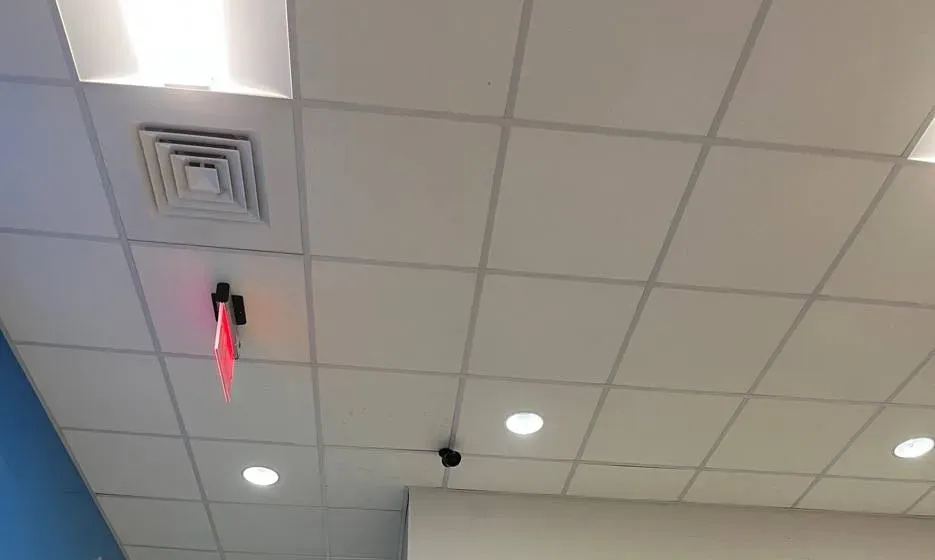
Real AESS job photo from another site, not a Long Island video wall: a typical office-park drop ceiling. Above it is where cable routes, air returns and the heat from a wall all have to be planned.
AI Overview Reality Check
What AI Gets Wrong About Video Wall Installation on Long Island
Our research environment could not open Google’s AI Overview directly, so this section checks the claims made by the cost guides, rules of thumb and forum answers that rank for the same searches and feed those summaries. Each heading is a claim you will meet when you research a wall; the paragraphs under it are what we see on island jobs.
“A video wall costs about $500 to $2,500 per square foot”
Per-square-foot figures are the most quoted numbers online. One LED wall guide says most installed walls run about $500 to $2,500 per square foot; another breaks it down by pitch and puts fine-pitch LED at $1,500 to $2,500. Those figures describe direct-view LED only, and they say nothing about LCD tile walls, which are priced per panel and often cost far less for the same area.
They also average away the island-specific costs that decide a real quote: whether the partition needs backing, whether the electrician has to bring a new circuit from a panel at the far end of a flex building, whether a sign permit is needed, and how far the van drives. Two walls of the same size in Lake Success and in Riverhead can differ in total cost for reasons that have nothing to do with the screen.
Use per-square-foot numbers to sanity-check an LED quote, not to budget. Our pricing section below gives island ranges for complete LCD and LED configurations, in two columns for Nassau and Suffolk, and every quote lists the wall, the mount, the processor and the labour separately.
“You can buy a complete LED wall online for about $11,000”
You can buy the cabinets for that. One guide that lists those kits is candid that a 10×5-foot P2.9 package at roughly $11,000 to $15,000 is hardware only: event-grade cabinets, a basic sending card and a simple frame. Structural work, power circuits, installation and calibration are not in the box.
On the island, those missing items are exactly where the risk is. A kit frame designed to stand on a stage floor is not a wall mount, a sending card is not a multi-window processor, and cabinets bought without spare modules from the same batch are hard to match two years later.
We will install equipment you bought, and sometimes a kit is the right answer for a bar or a church on a tight budget. We just quote the structure, power coordination, calibration and spares honestly so you can compare the real totals.
“Pick pixel pitch with the ten-times rule”
Planar’s rule is pixel pitch times ten equals the approximate viewing distance in feet. Christie says allow about one metre of minimum viewing distance per millimetre of pitch, which is about 3.3 feet. Barco divides the optimal viewing distance in metres by two. Those three rules give quite different answers for the same room, and summaries usually quote one of them as if it were the only one.
They differ because they answer different questions: the closest anyone should stand, the distance where pixels disappear, and the distance that looks best. In an island showroom the nearest viewer may be a customer at the sales desk ten feet away while most people see the wall from the door forty feet back.
We measure the actual distances in your room — nearest seat, typical position, the door — and show you which pitches meet each one on Planar’s published table, then let budget decide between them.
“Thin-bezel LCD walls are seamless”
Marketing copy uses “seamless” loosely. Samsung’s narrowest panels quote a 0.88-millimetre bezel-to-bezel figure, and its own datasheet adds that the gap between active areas “may vary depending on the model and actual installation environment.” On one model the bezel figure is 1.74 millimetres and the active-area gap 2.49.
That is impressively thin, and from across a showroom it disappears. From a reception desk or a conference table it does not, and text that crosses a seam is harder to read. Alignment matters too: a mount that lets one panel sit a millimetre proud of its neighbour makes the seam catch the light.
If you need truly seamless, the answer is LED. If you choose LCD, we design content to the grid and align every panel with the mount’s micro-adjustments before handover.
“Any handyman who mounts TVs can hang a video wall”
Forum advice on the island tends to treat screens as a DIY job; a Long Island Reddit thread on TV mounting recommends a $40 kit, a stud finder and a drill. For one TV in a living room, that is fair advice.
A video wall is different in three ways. The weight is concentrated and pulls outward when panels pop out, so the wall needs checking or backing. The panels must align within a millimetre or so to look like one picture. And in a business, the outlets behind it are line-voltage work for a licensed electrician, while a wall facing a corridor has to respect the ADA 4-inch limit.
A handyman may do fine work on single screens. For a wall, ask who will check the partition, who will provide the circuit, and who will calibrate the panels, and get those answers in writing.
“Video walls are for arenas and big corporations”
The island’s best-known displays are huge: UBS Arena at Belmont Park installed 45 LED displays, with a centre-hung of 12 displays totalling 4,730 square feet. That is the image many people have of a video wall, and it makes a small business assume it is out of reach.
Most island walls are far smaller. Newsday’s Melville reception uses a 2×2, Stony Brook’s Frey Hall lobby wall is 6′6″ by 12′ and was reported at under $40,000 with in-house trades, and a Riverhead grill promotes a 21-foot wall for local fundraisers.
A 2×2 of 55-inch commercial panels is a realistic project for a dealership, a medical office or a bar. The pricing below starts there.
“Once it is installed, a video wall looks after itself”
The panels are built for continuous use, and that is often read as maintenance-free. Integrator forums are full of the opposite: panels drifting to different colours, a wall that needs a configuration file flashed back after a fault, and owners hunting for a replacement for a discontinued model.
Walls drift because panels age at slightly different rates, because one gets replaced, or because someone presses the wrong button on the remote. Settings get lost after power events. Fans and filters gather dust, especially in flex buildings.
An island wall should have a saved configuration, a spare, remote monitoring where the panels support it, and a yearly check. The maintenance contract rates are in the pricing table so you can decide whether you want us or your own staff to do it.
Measure the Room Before You Choose the Panels
Tell us the wall width, the nearest viewer and what is behind the drywall, and we will tell you whether LCD or LED fits and what the electrician needs to do.
A video wall is easier to price than most people expect once we know the room. Fill in what you can; a scheduler will call to book the survey. Prefer to talk? Call (800) 486-0943.
✅
We Got Your Request!
Received. A scheduler will call you to arrange the survey. Need us sooner? Call (800) 486-0943 now.
How It Works
Our Installation Process
Every island wall goes through the same seven steps. The order matters: the wall and the power are proven before the panels are ordered, and nothing is handed over until it has survived a power cut.
1. Room, wall and viewers
We stand where people will watch from, measure the nearest and farthest viewer, check the light from windows and fixtures, and photograph the wall, the ceiling and the route to the equipment.
2. Open the wall, plan the power
We find the studs or block, decide on backing or a frame, and write the electrician a one-page sheet with outlet positions, load and any dedicated circuit.
3. Choose the panels on paper
You get LCD and LED options with model numbers, seam or pitch, brightness, heat and weight, so the choice is made against the room, not a brochure.
4. Approvals before orders
Landlord consent, sign rules for window-facing walls and any owner standards are settled before anything is ordered, so nothing waits in a crate.
5. Build the structure
Backing or frame first, then the mount, levelled and set at the agreed depth, then cable and the processor or player in the rack.
6. Hang, align and calibrate
Panels go up, are aligned with the mount’s adjustments, set with their IDs and tile positions, and matched for colour and brightness.
7. Pull the breaker, then hand over
We cut the power and restore it; the wall must come back on its own in the right layout. Then you get the handover sheet, passwords and saved configuration.
What helps before the survey
Photos of the wall and both sides of it. The face where the wall will go, the room behind it, and the ceiling above. A shared wall or a closet behind it changes the plan.
Floor plans or the fit-out drawings. Office-park buildings often have partition types and stud gauges on the original drawings, which can save opening the wall.
A list of what the wall should show. One loop, a few live sources, cameras, a dashboard, TV channels. The list decides whether a processor is needed.
The name of your electrician and IT contact. We send each of them a short specification so their part is ready when ours is.
Lease or building rules. If the landlord or owner has an alterations process or AV standards, we read them before quoting rather than after.
Your hours. If the install has to happen before opening or after closing, we schedule and price for it from the start.
None of this is required to get a price, but each item answered in advance usually removes a question from the survey and a line of contingency from the quote. Owners who send photos of both sides of the wall and the ceiling above it often get a firm figure after a single visit rather than a range.
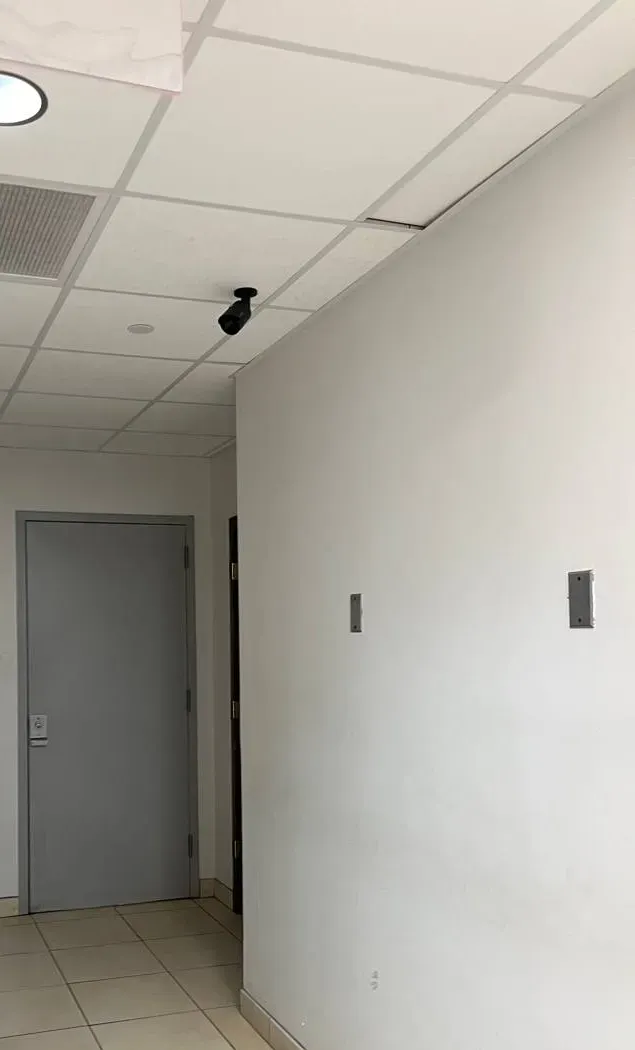
Real AESS job photo from another site, not a Long Island video wall: a plain corridor wall. In a space like this the ADA 4-inch protrusion limit decides how a wall can be mounted.
Coverage Area
Video Wall Installation Near Long Island’s Landmarks
Six places that show, between them, how the island already uses video walls and where the next ones are likely to go.
Newsday, Melville
On the Route 110 corridor, the newspaper’s headquarters was fitted with walls in three sizes: 3×5 in the newsroom, 8×10 in the auditorium and 2×2 in reception.
Hauppauge Industrial Park
About 1,300 companies and 55,000 workers on just over two square miles, the island’s densest concentration of operations rooms and plant offices.
Suffolk Crime Analysis Center, Yaphank
At Suffolk police headquarters, a video wall displays footage from cameras across the county as part of the state’s crime analysis network.
Frey Hall, Stony Brook University
A 6′6″ by 12′ lobby wall installed over a winter break, showing campus highlights, student work and live feeds.
Nassau Coliseum, Uniondale
The renovated arena’s VIP club was planned with two bars and a large video wall, a few minutes from the RXR Plaza towers and Roosevelt Field.
UBS Arena, Elmont
The Belmont Park arena’s 45 LED displays, including a 4,730-square-foot centre-hung, set the island’s high-water mark for scale.
We also serve Great Neck, Manhasset, Port Washington, Mineola, Garden City, Westbury, Hicksville, Syosset, Massapequa, Freeport, Valley Stream, Huntington, Commack, Smithtown, Islandia, Bohemia, Ronkonkoma, Bay Shore, Patchogue, Medford, Port Jefferson, Riverhead and the forks, with the same licensed crews and the same written handover.
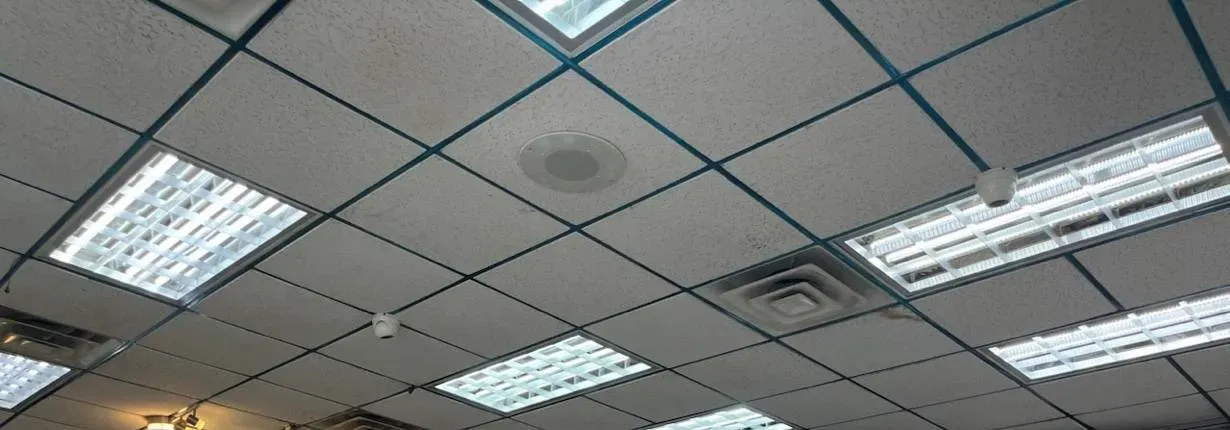
Real AESS job photo from another site, not a Long Island video wall: a store ceiling with bright light panels. Overhead lighting and front glass both affect how bright a wall needs to be.
Pricing
Video Wall Installation Cost on Long Island
Island prices follow our published Brooklyn base with the county multipliers in our rate schedule: Nassau 1.15 and Suffolk 1.20. Configuration prices include the panels or LED, a standard mount, basic setup and calibration, and installation labour. They exclude the electrician’s circuits, structural backing beyond a standard stud wall, permits and ongoing support, which are quoted separately after the survey.
Configuration or item
Nassau
Suffolk
Typical island use
2×2 LCD wall, 55-inch panels
$13,800–$20,700
$14,400–$21,600
Reception, conference room, showroom feature
3×3 LCD wall, 55-inch panels
$27,600–$43,700
$28,800–$45,600
Office lobby, operations room, bar back wall
4×4 LCD wall, 55-inch panels
$48,300–$74,750
$50,400–$78,000
Large lobby, 16-source sports or monitoring wall
2.5 mm direct-view LED (110-inch class)
$40,250–$63,250
$42,000–$66,000
Showroom back wall, training room
1.9 mm direct-view LED (138-inch class)
$63,250–$97,750
$66,000–$102,000
Corporate lobby, auditorium
1.5 mm direct-view LED (165-inch class)
$97,750–$161,000
$102,000–$168,000
Close-view reception, boardroom
Outdoor LED, per square metre
$5,175–$9,775
$5,400–$10,200
Patios and exterior faces, subject to sign rules
Video wall processor (add-on)
$2,875–$17,250
$3,000–$18,000
Multi-window layouts, several live sources
16×16 HDMI matrix
$5,175–$13,800
$5,400–$14,400
Bars routing many games to many screens
Mounting structure or custom frame
$1,725–$10,350
$1,800–$10,800
Backing, floor-supported frames, block walls
Content management system, per year
$1,380–$5,750
$1,440–$6,000
Scheduled signage content
Maintenance contract, per year
$2,760–$10,350
$2,880–$10,800
Yearly check, recalibration, priority response
Repair or service visit
$195 an hour, 3-hour minimum ($585)
Dead tiles, lost layouts, walls we did not install
The service rate is the same in both counties and is not charged on top of a new installation. Electrical work is billed by your electrician; we give them the specification so their quote is accurate first time.
What moves an island price up or down
What is inside the wall. A partition that needs backing adds carpentry and patching; block or a solid wall with blocking already in place does not.
The distance to the equipment. A processor in the same room is simple; one in a closet at the other end of a flex building needs extenders and a longer cable route.
Glare and brightness. Walls facing glass may need 700-nit panels or a different position, which changes the panel line.
Number of sources. One picture across the wall needs no processor; four live sources at once do.
Permits and approvals. A window-facing wall that counts as a sign, or a landlord who wants drawings, adds paperwork and sometimes time.
Access and hours. Stairs, tight doors or work that has to happen after a store closes affect labour.
If cameras are part of the plan, the camera calculator gives a first figure for those, and our Long Island network installation page covers the switches and cabling a monitoring wall depends on. The written quote always applies over any table.
Get a Written Island Price Before Anything Is Ordered
Most walls can be priced after one visit: we measure the room, open the wall if needed, and send the quote with every model number listed.
Three starting points at island rates. Each range spans the Nassau price at its low end and the Suffolk price at its high end; your quote states the county figure.
Starter Wall
$13,800–$21,600. A 2×2 of 55-inch commercial LCD panels on a pop-out mount, one source stretched across the wall or four in quarters, set up to restart cleanly after a power cut.
Standard Wall
$27,600–$45,600. A 3×3 of 55-inch panels for a lobby or operations room, with the alignment, calibration and handover sheet a nine-panel wall needs. Add a processor for multi-window layouts.
Premium LED Wall
$63,250–$102,000. 1.9 mm direct-view LED in the 138-inch class, seamless and calibrated, with spare modules from the same batch and remote monitoring set up.
Already bought the equipment? Labour-only installation
If you bought panels, an LED kit or a processor yourself, we can install it. Because supplied equipment varies so much, labour-only work is quoted after the survey rather than from a table; repairs and adjustments to supplied walls are at the $195 an hour service rate with a three-hour minimum. We check the model numbers first so you know whether the panels will tile, whether the mount suits them, and whether anything is missing before we arrive.
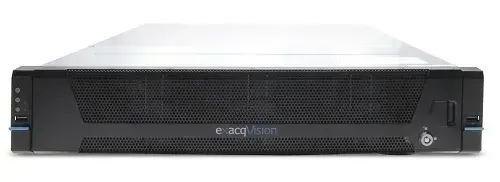
Manufacturer product photo of an exacqVision rack server, shown for size only: video wall processors are commonly rack-mounted computers of this shape.
Complete Services
Every Video Wall Installation Service on Long Island
A wall depends on the cabling, power and systems around it. These are the island services that most often go with one.
The habit we push on every island survey is simple: before anyone opens a panel carton, stand where the people who will look at the wall actually stand, at the time of day they stand there. Not the middle of the room on a cloudy morning — the sales desk at three in the afternoon with the sun on the front glass, the back of the bar on a game night, the corridor where people walk past rather than stop. You learn more in five minutes there than from any drawing. You find out whether the seams will cross the text people need to read, whether the window will wash out a 500-nit panel, whether the lower edge will sit in someone’s path, and whether the nearest outlet is where the wall wants to be. Then go and knock on the wall. Steel studs, block and plaster all sound different, and that sound decides whether the next step is a mount or a sheet of backing. None of this costs anything, and it is the cheapest way we know to avoid a second visit. These notes are part of the survey checklist our technicians work from, written up by the AESS team.
FAQ
Long Island Video Wall Installation FAQ
Can a video wall be mounted in portrait, with the panels standing tall?
+
Yes, if the panels are made for it. Commercial video wall panels such as Samsung’s VMB series and LG’s 55VM5J list both landscape and portrait operation, and portrait walls suit tall lobbies, stair landings and narrow showroom piers. Consumer TVs are a different matter; Samsung warns that turning them on end can make them fail because their cooling is designed for landscape. Portrait walls also need a portrait mount and content made in a tall format, so we plan both at the survey.
Is there a size below which you would tell us not to build a wall?
+
Usually below 2×2. If the space only takes two panels side by side, or the content is one video call or presentation, a single large display normally looks better and costs less, with no seam across the middle. We say so at the survey. A wall starts to make sense when you need more size than one display offers at your budget, several sources at once, or a layout that will grow.
Do you install video walls in homes — a basement media room or a game room?
+
Yes. Home walls are usually a 2×2 or a row of displays in a basement, game room or home office, and the work is mostly finding solid framing, a clean cable route to the equipment and an outlet that is not shared with a freezer or a space heater. In a house the job counts as home improvement work, which Nassau and Suffolk each license through their consumer affairs offices, and we treat it with the same written quote and handover as a business wall.
We bought an LED wall kit online — will you install equipment we supplied?
+
Yes. Send us the model numbers and the packing list first. We check that the cabinets, sending card or processor and frame belong together, whether spare modules are included, and whether the frame is meant for a wall or a stage floor. Labour for supplied equipment is quoted after the survey, and repairs or adjustments to it are at the $195 an hour service rate with a three-hour minimum. If something is missing, you will know before the install day.
What does the site survey involve, and does it cost anything?
+
The estimate is free. At the survey we measure the wall and the viewing distances, check the light, find out what is behind the drywall, look at the route to the equipment closet and the nearest power, and ask what the wall needs to show. You then get a written quote listing every model number, the mount and any backing, the processor if needed, and a separate sheet for your electrician.
How do you protect finished floors, ceilings and furniture during the work?
+
We cover floors along the carry route and under the wall, move or wrap furniture near the work, use dust collection when we cut into drywall, and keep ceiling tiles we lift clean and in order. Panels stay in their cartons until the mount is ready, so they are never leaned against finished walls. At the end the area is vacuumed and any patching is ready for paint, or painted if that was in the quote.
Can the wall brighten and dim itself as daylight changes?
+
Many commercial panels and LED processors support automatic brightness from an ambient light sensor or a schedule, and we set it up where the hardware allows. It is worth doing in island showrooms with big glass fronts, where a wall needs full brightness at mid-afternoon and much less after dark. For any wall that can be seen from the street, dimming may also be a sign-code requirement; Islip, for example, requires automatic night dimming on electronic message signs.
Can the wall show captions so people can follow it with the sound off?
+
Yes. Most walls in lobbies, waiting rooms and bars run with the sound off or low, so captions matter for everyone, not only people who are hard of hearing. Broadcast TV feeds usually carry closed captions that the receiver or processor can display, and signage content can be made with text built in. We check where the captions will land, because a caption line that crosses an LCD seam is hard to read, and position the source so it sits inside a row of panels.
We lease our space — do we need the landlord’s sign-off first?
+
Almost always. Most commercial leases treat fastening heavy equipment to walls, opening partitions and adding circuits as alterations that need written consent, and many landlords ask for drawings, a certificate of insurance and the electrician’s details. We prepare a short package with the wall location, mount and backing details, weight and power needs, which usually gets an answer quickly. Starting work without consent risks being asked to remove the wall.
Can the wall switch itself on at opening and off at closing?
+
Yes. Commercial panels and media players have built-in schedules, and processors can be set to wake and sleep the wall on a timetable, with a different plan for weekends or holidays. Running the wall only during opening hours saves power, cuts the heat in the room and reduces the risk of image retention. We set the schedule at handover and show whoever manages the wall how to change it.
All Areas Served
Video Wall Installation Across Long Island, New York City and the Hudson Valley
You are on the island-wide overview. For county-level detail and direct lines, go to the county pages; for walls elsewhere, the city and Hudson Valley hubs lead to every borough and county page.
Tile Dark or Picture Scrambled? Get on Today’s Island Schedule
One panel showing “no signal”, the layout stretched wrong after a storm, a colour that no longer matches: send a photo of the wall and the processor and call (800) 486-0943. Many faults are fixed remotely or in a single visit, and the scheduler offers the first free slot in Nassau or Suffolk.
Lake Success to Riverhead, One Licensed Low-Voltage Team
Across both counties it is the same number, (800) 486-0943. Photos of the room, the wall and any equipment you already have can go by WhatsApp. Abstract Enterprises Security Systems · 1282 Troy Ave, Brooklyn, NY 11203 · NYS licensed low-voltage contractor #12000287431.
Our Google rating stands at 4.7★ across 201 Google Reviews. Full terms — including 50% deposit, one-year parts-only warranty on AESS-supplied products, and the late-fee schedule — are set out in the service agreement.
What you receive in writing: the quote with every model number, the electrician’s specification sheet, the as-built drawing, and the handover sheet with passwords, layouts and spares. The warranty page explains how a claim works; panel makers’ own warranties are passed to you with the serial numbers.
Page reviewed and updated October 18, 2026. Changes in this version: rebuilt from scratch around island buildings, licensing and service distance; prices restated from the Brooklyn base with Nassau and Suffolk multipliers; local sources added.