Hauppauge & Route 110 Offices · Campuses & Labs · Riverhead & Main Street Retail · East End Homes
Video Wall Installation in Suffolk County
Built for the Duty Cycle · Ten Towns’ Rules Checked · County-Licensed Power Partners · Published Suffolk Prices
Suffolk is one county that behaves like three different markets. In the west it is office parks and factories — the Route 110 corridor and the Hauppauge park with roughly 1,300 companies — where a wall runs every working hour and has to sit on a business network. In the middle it is campuses, labs and public buildings around Stony Brook, Upton and Yaphank. Out east it is shops, restaurants and houses that fill up in summer and stand quiet in winter, under town sign codes written to keep villages looking like villages. We design and install LCD and direct-view LED walls for all three, and we start every Suffolk job by asking which of the three the wall belongs to, because that decides the panel, the mount, the power, the rules and the service plan.
Reviewed and updated October 18, 2026: Suffolk County Code Chapter 563 Article XI and the Department of Labor, Licensing & Consumer Affairs rules for restricted electricians, the Town of Southampton sign article, the East Hampton housing market assessment, LIPA’s Tropical Storm Isaias report, Census figures for the county, Stony Brook University’s Frey Hall project report, Long Island Business News on MacArthur Airport and RiverheadLOCAL on the Tanger zoning hearing, plus our published video wall prices at the Suffolk rate · Anwar Timothy, NYS license #12000287431 · Suffolk visits dispatched from our office on Troy Avenue in Brooklyn
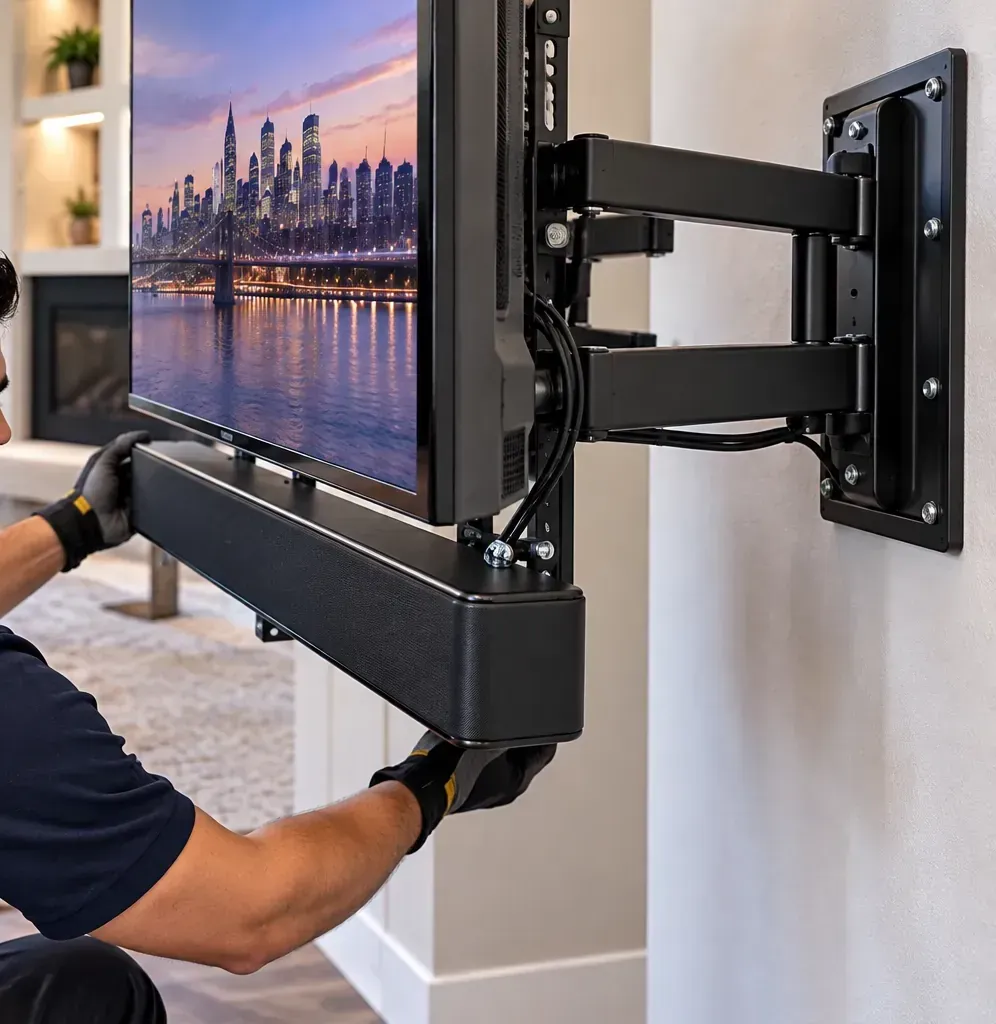
Reference photo: a technician in gloves holds a large flat display on a black articulating wall arm, with a bar speaker clamped below the screen. A video wall uses rigid pop-out mounts rather than swing arms, but the same rule applies: the load goes into solid structure, never into drywall alone.
Suffolk Video Wall Request
Town or hamlet, what the room is for and the hours the wall must run — we call back the same business day
✅
Request Sent!
A technician will call you back about the Suffolk wall the same business day.
25+
Years Experience
✓
Same-Day Estimates
100%
Licensed & Insured
4.7★
201 Google Reviews
Tell us the hours first. Before the size, before the brand, text (631) 407-2884 with three facts: the town or hamlet, how many hours a day the wall will be on, and how many months a year the building is in use. A Hauppauge production wall that runs two shifts, a Stony Brook lobby that runs during term and a Sag Harbor living room that runs from Memorial Day to Labor Day need different panels and different service plans, even when all three are four 55-inch screens in a square.
A first conversation and a photo review cost nothing; the written price follows a site measure and comes from the published Suffolk list
The licensed electrician for the circuit is lined up before panels are ordered, and the town or village is identified before anything goes near a shop window
New York State security and fire alarm installer license #12000287431 (General Business Law §69-m), with a certificate of insurance on file for your landlord, campus or manager before we arrive
The Neighborhood
Why Suffolk County Properties Need Video Wall Installation
Suffolk is the easternmost county in New York State and it is divided into ten towns: Babylon, Brookhaven, East Hampton, Huntington, Islip, Riverhead, Shelter Island, Smithtown, Southampton and Southold, with Riverhead as the county seat. It covers a little more than 900 square miles of land, and roughly 1.5 million people live in about 583,000 homes. Census figures put the share of single-unit structures at 86 percent and owner occupancy at 83 percent, with a median home value of $626,300. Those numbers describe a county of houses and low commercial buildings, not towers — which is exactly why a video wall here is rarely bought by a company with an AV department and almost always bought by an owner who will live with it.
What surprises people from the city is how different one end of the county is from the other. At the western end, the Long Island Innovation Park at Hauppauge alone holds about 1,300 companies and more than 55,000 jobs on a little over two square miles, according to the Regional Plan Association — roughly one Long Island job in twenty. Along the Route 110 corridor through Melville and East Farmingdale the walls are corporate: Newsday’s Melville headquarters, for example, was fitted with Planar video walls in three areas, including an eight-by-ten array in its auditorium, according to the integrator’s published portfolio. In those buildings a wall is switched on with the lights and runs as long as the business does, often next to machinery or on a network the IT department guards closely.
The middle of the county is institutional. Stony Brook University put up a video wall six feet six inches by twelve feet in the lobby of Frey Hall over a winter break, using its own campus electricians, carpenters and painters for the physical work and its media engineering team to assemble and tune it, on a budget its news office put at under $40,000. Brookhaven National Laboratory in Upton has about 3,000 staff. The county police’s Crime Analysis Center in Yaphank is described by the department as having a video wall fed by countywide cameras. In July 2026 the Town of Islip’s selection committee picked a joint venture to build a new terminal at Long Island MacArthur Airport with a connection to the Ronkonkoma rail station, pending town board approval. These are buildings with facilities staff, purchasing rules and their own trades — which changes how a wall project is split up.
The East End runs on the calendar. In the East Hampton study area, 20,952 of 44,227 housing units — 47 percent — were counted as seasonal, recreational or occasional-use homes in 2023, according to a market assessment published by the Town of East Hampton, which also notes the summer population could add as many as 50,000 people on top of the year-round 54,081. A wall in one of those houses may sit unwatched for seven months and then be expected to work perfectly for a houseful of guests. On the commercial side, the Town of Southampton’s sign article treats anything placed within four feet of the inside of a shop window and visible from outside as a window sign, and does not allow window signs to be illuminated except in narrow cases. A bright screen in a Main Street window that would pass unnoticed in a mall can be a code problem in a hamlet.
Over all three sits the same electrical grid and the same weather. When Tropical Storm Isaias crossed Long Island on August 4, 2020, LIPA’s 30-day report counted about 645,000 customer outages and eight days to full restoration. And over all three sits a licensing system that is unusual: Suffolk County licenses master and restricted electricians itself, through the Department of Labor, Licensing & Consumer Affairs, but the county article says it does not apply in a town or village that already regulates that licensing by its own law. Put those together and the Suffolk question is never just “how big a wall?” It is “how many hours, how many months, on which network, behind which window, powered by whom, and serviced how far from the nearest crew?” Most Suffolk owners who add a security-desk or lobby wall also pair it with security camera installation in Suffolk County, so the wall has a clean, current picture to show.
Suffolk in numbers that change a video wall plan
Ten towns, from Babylon on the Nassau line to East Hampton and Southold at the forks, with Riverhead the county seat (State of New York county page)
About 583,000 housing units, 86 percent single-unit and 83 percent owner-occupied; median value $626,300 (Census Bureau and Census Reporter)
About 1,300 companies and 55,000+ jobs in the Hauppauge industrial park on about two square miles (Regional Plan Association)
47 percent of East Hampton study-area homes counted as seasonal, recreational or occasional use in 2023 (Town of East Hampton market assessment)
Four feet: the distance inside a Southampton shop window within which a visible display is treated as a window sign (Southampton Town Code ch. 330, art. XXII)
About 645,000 customer outages and eight days to full restoration after Tropical Storm Isaias in August 2020 (LIPA 30-day report)
Under $40,000: Stony Brook University’s reported budget for its 6′6″ × 12′ Frey Hall lobby wall, with campus trades doing the physical install (SBU News, February 2025)
Three Suffolks, three specifications
The same four-panel wall gets specified differently depending on which part of the county it serves. This is how the starting assumptions usually differ before the site measure refines them.
Lobbies, data rooms, operations rooms, lecture spaces
Media rooms, great rooms, restaurants, boutiques
Hours of use
One or two shifts, often every weekday
Term time or the working day; some rooms around the clock
Heavy from late spring to early fall, little or none in winter
Panel rating
Continuous-duty panels
Continuous-duty for operations; extended-hours elsewhere
Extended-hours panels, chosen for glare and humidity range
Biggest physical risk
Dust, heat, impact from equipment
Crowds at class change, strict building standards
Damp, unheated months, storm surges on long cable runs
Network
Company IT, segmented plant network
Institutional IT with its own rules
Home or property-manager network with a guest segment
Who approves
Plant or facilities manager, IT, landlord
Facilities office, purchasing, sometimes a board
Owner or manager; town or village if near a window
Service plan
Maintenance contract, spare on site
In-house first line, our second line
Spring start-up visit, caretaker checklist
None of these columns is a rule. A Hauppauge company may want a wall in an owner’s summer house; a Montauk hotel may run its lobby wall all year. The point of the table is the question behind it: the hours, the season, the network and the approvals are set first, and the hardware follows.
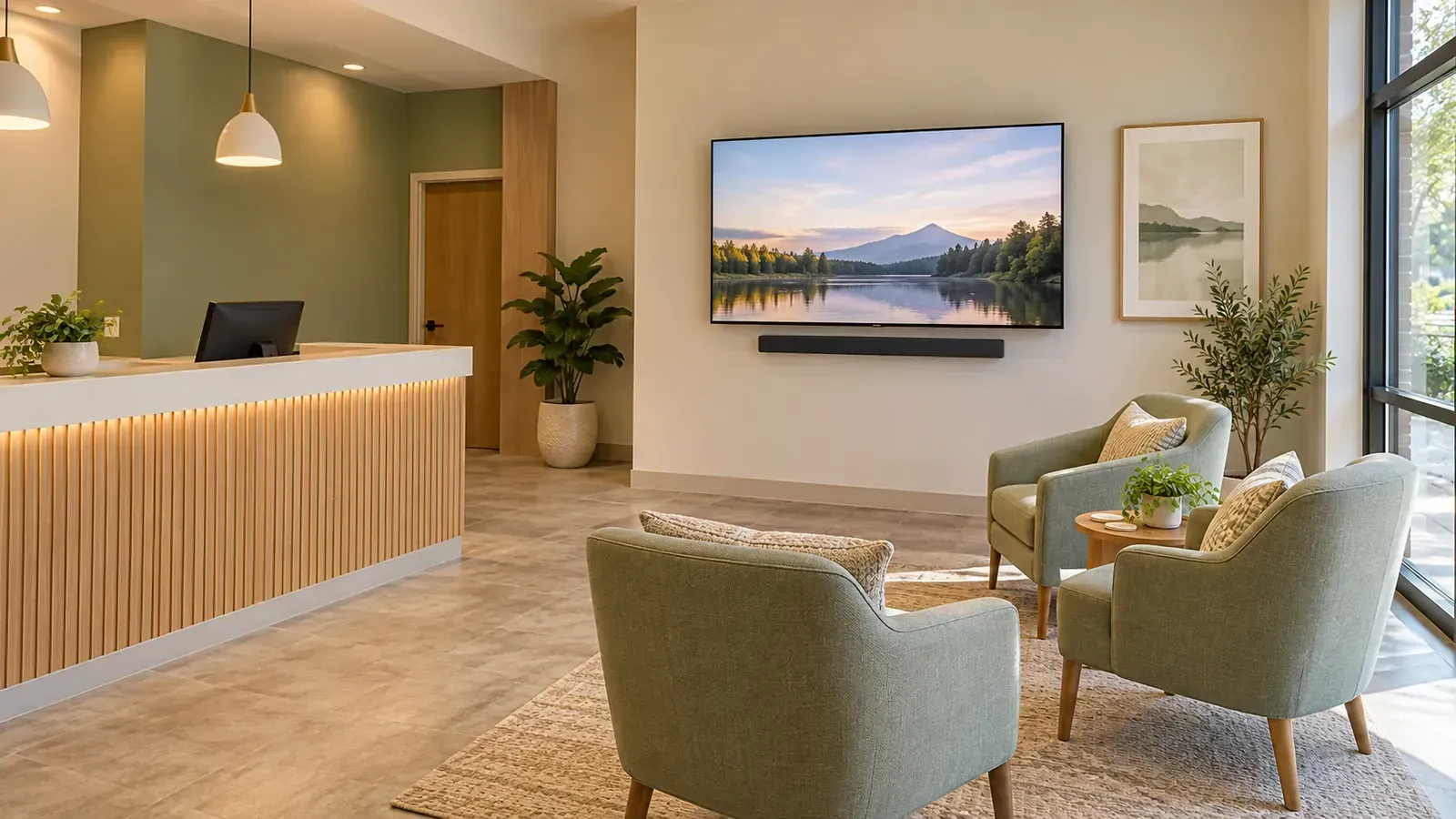
Reference photo: a reception lounge with a curved front desk, two armchairs and a single wall-mounted display with a slim speaker beneath it. This is the kind of room a 2x2 wall often replaces a single screen in, where visitors sit within a few feet.
Need a Repair?
Same-Day Video Wall Repair Across Suffolk County
A wall that goes wrong in Suffolk usually goes wrong at a bad time: the morning of a plant tour in Hauppauge, an open house on a campus, the Friday a summer house fills up. Call (631) 407-2884 with what the screen is showing — a black tile, a picture shifted across two panels, “no signal” everywhere, colors that no longer match — and a photo if you can. Many faults are a source, a cable or a setting, and we can often narrow them down by phone before anyone drives. When a visit is needed we book the next open two-hour window, and most single faults are fixed within one to two hours of arrival.
Because Suffolk is long, the crew comes with the parts the description points to rather than discovering the problem first and driving back for them. That is why we ask for the panel model from its rear label and a picture of the controller or player. Service and repair visits are billed at the published rate of $195 an hour with a three-hour minimum ($585); that rate is not applied to new installations, which are priced from the table further down this page.
A few checks are worth doing before you call, because they often solve the problem or at least shorten the visit. Look at whether the whole wall is dark or only some tiles, since a whole-wall fault usually points to the source, the controller or the circuit, while a single dark tile points to that panel or its power supply. Check that the controller or player shows a light and that the breaker for the wall’s circuit has not tripped, especially after a storm or after a cooler or compressor nearby has cycled. Note whether the problem began after a power cut, a network change or a software update. And if your building has an IT department or a property manager, tell us who they are, because the fix sometimes sits on their side of the line and an introduction at the start saves a second trip from one end of the county to the other.
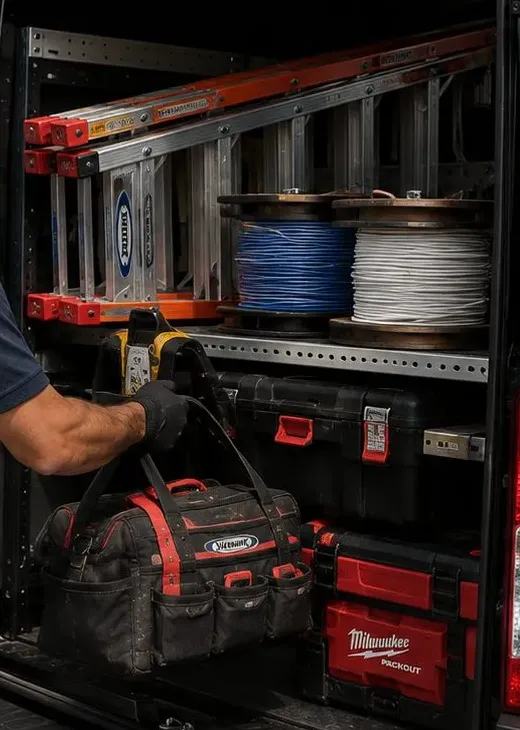
Reference photo: the back of a service van with ladders racked overhead, reels of blue and white cable on a shelf and stacked tool cases below. On a long county like Suffolk, the crew carries the parts the fault description points to.
What We Install
Video Wall Installation Services in Suffolk County
Each service below is a piece of one project. Most Suffolk jobs use four or five of them; a few use only one, such as a controller swap on an older wall. The descriptions say where in the county each one tends to come up.
🖥️
Narrow-bezel LCD walls
Grids of commercial 46- and 55-inch video-wall panels, from a 2×2 in a reception area to a 4×4 in a training room. The workhorse for Route 110 and Hauppauge offices, where people stand within a few feet and the room light is controlled.
🟦
Direct-view LED walls
Seamless LED cabinets chosen by pixel pitch for the actual viewing distance. Suited to big lobbies, showrooms off Route 58, auditoriums and any wall where a seam line through a face or a logo is not acceptable.
📊
Production and data walls
Walls that show machine status, order counts, quality charts or lab instruments, fed from systems that live on a protected network. Common in the Hauppauge park and around research buildings, and designed with the IT department from the first meeting.
🏛️
Split-scope campus projects
Where a campus or public employer uses its own electricians and carpenters, we supply, configure and commission the display system and hand drawings to the in-house trades — the arrangement Stony Brook used for its Frey Hall wall.
🏖️
Seasonal-house walls
Media-room and great-room walls for East End and North Shore homes that are closed part of the year, built so they come back to life cleanly in spring and can be handed to guests without handing over the house network.
🍻
Bar and restaurant walls
Multi-game walls and menu walls for Main Street bars and restaurants in places like Patchogue, Bay Shore and Huntington village, with audio zoning and power planned around the coolers and the kitchen line.
🎛️
Controllers, players and matrices
The equipment that decides what appears where: video-wall processors, content players, HDMI or IP matrices, and control-system integration with Crestron or similar where the building already has one.
🔧
Repairs and takeovers
Dark tiles, failed power supplies, lost logins and walls whose installer has moved on. We document what is there, fix what can be fixed and give you a written list of the rest, at the published service rate.
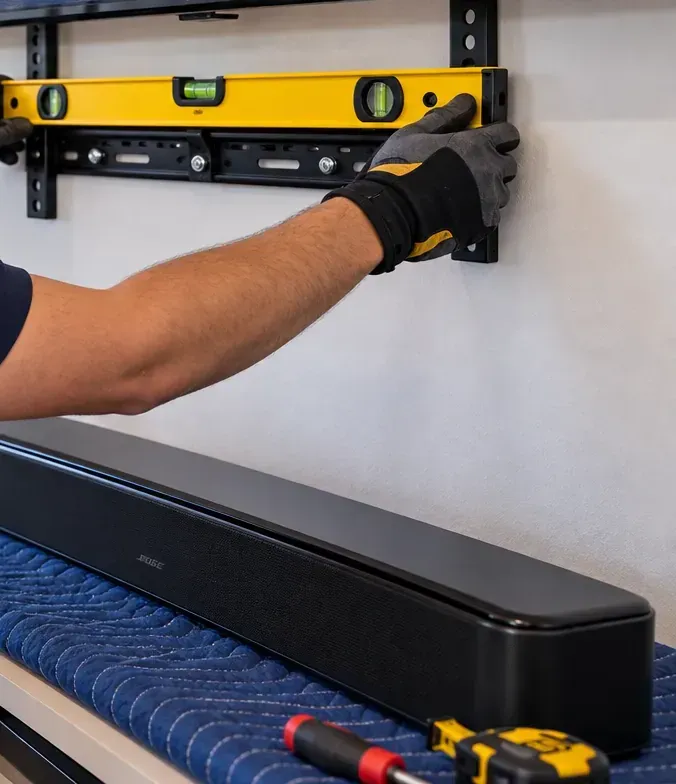
Reference photo: a yellow spirit level rests on a black wall bracket while a gloved hand steadies it, with a speaker and screwdriver on a quilted mat below. Video-wall mounts are leveled the same way, rail by rail, before the first panel goes up.
Building Specialists
Video Wall Installation for Suffolk County’s Architecture
Suffolk’s buildings are mostly low, mostly suburban and mostly younger than the city’s, but they are not uniform. The cards below are the building types we plan for most often, with what each one does to a video wall.
Flex and light-industrial buildings
The one- and two-story buildings of the Hauppauge park and the Route 110 corridor: block or tilt-up exterior walls, a finished office strip at the front and an open floor behind. The office wall is usually steel stud; the production side is block, steel columns or a demising partition, with dust, heat and forklift traffic to design around.
Suburban office buildings
Three- to six-story office buildings in Melville, Hauppauge and Islip with drop ceilings, raised plenums and glass-fronted conference rooms. Walls go on steel-stud partitions that need backing, and cable runs to an IDF closet on the same floor.
Campus and lab buildings
University, hospital and laboratory buildings with their own facilities departments, their own standards for mounting and cable, and lobbies that are crowded at class changes. The wall must survive heavy foot traffic and fit a purchasing process.
Main Street storefronts
Older two- and three-story commercial buildings along the downtowns of Patchogue, Bay Shore, Babylon, Northport and Riverhead: plaster or masonry party walls, deep narrow floor plates, storefront glass at one end and limited depth for anything hung on the wall.
Retail centers and outlets
Big-box and outlet buildings along Route 58 in Riverhead and around Smith Haven: high open ceilings, metal deck, long viewing distances and landlords with their own tenant-work rules. Walls here are often LED because people see them from far away.
East End houses
Shingled houses, barns turned into living space and new construction in the Hamptons and on the North Fork: wood framing, high ceilings, lots of glass and rooms that may be unheated for months. Media walls here are built around the season as much as around the sofa.
What each building type changes in the build
Flex buildings. On the office side we open the partition or add surface backing so the mount bolts into something solid across several studs; a video-wall mount carries the weight of every panel at the top rail, not just one screen’s worth. On the production side we look for the wall that is out of the forklift lanes, check the temperature in summer, and plan filtered or enclosed equipment for the controller and players rather than putting them on an open shelf where dust settles. Cable runs from the plant-side network switch are planned with the IT staff before we drill.
Suburban offices. The common traps are a partition with no backing, a plenum ceiling that needs plenum-rated cable, and a conference room whose glass wall puts sunlight straight onto the screens in the afternoon. We measure the light at the time of day the room is used, specify backing before the drywall goes up when the space is still being built, and keep the run to the closet inside the length the signal type allows.
Campus and lab buildings. These owners usually have written standards: approved mount types, cable colors, labeling, where equipment may live and who may touch the electrical panel. We work to those standards and write our part of the scope so in-house trades and outside contractors know exactly where one stops and the other starts.
Main Street storefronts. Plaster on masonry needs different anchors from drywall, and an old party wall may carry the neighbor’s chimney flue or plumbing. Depth is often the limit, so we favor slim pop-out mounts and keep the wall’s projection small. If the screen will be near the front window we check the town sign code before deciding where it goes.
Retail centers. High ceilings mean lifts, and landlords usually want certificates of insurance, drawings and a schedule before tenant work starts. Long viewing distances make direct-view LED attractive; we size the pixel pitch to where shoppers actually stand rather than to the closest possible viewer.
East End houses. Wood framing is forgiving to mount on, but tall walls, vaulted ceilings and big window walls change where a screen can go without glare. Rooms that sit unheated have to stay inside the panel maker’s storage and operating range, and the house network often belongs to a property manager. We plan the wall, the player and the network together so a caretaker can check it without calling us.
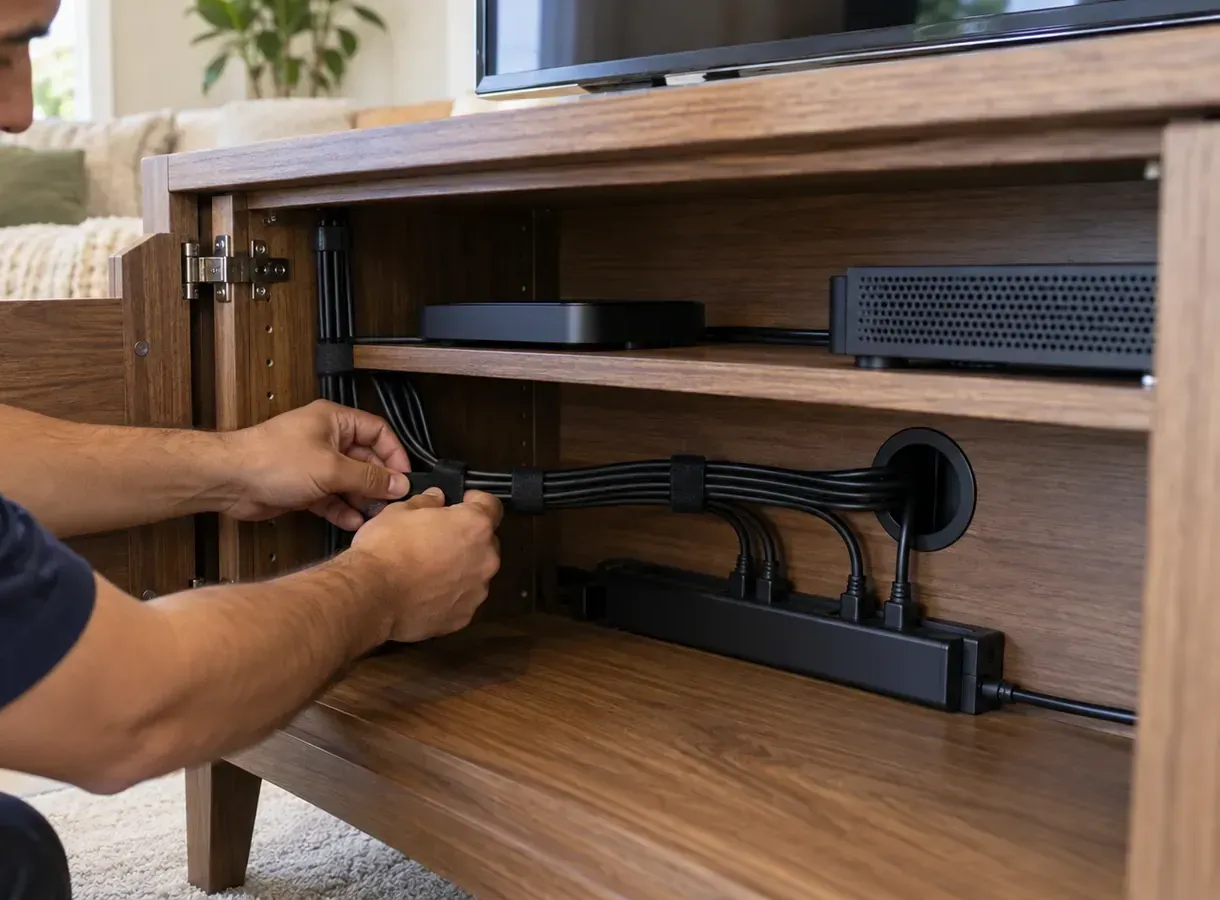
Reference photo: hands bundle and strap cables to a power strip inside an open wooden cabinet, with two small media devices on the shelf above and a cable grommet in the back panel. Players and controllers kept in a closed, ventilated cabinet stay clear of dust.
Commercial Video Wall Installation
Business Video Wall Installation in Suffolk County
Suffolk’s commercial walls cluster along a handful of corridors. Each one below is a real place with a different kind of building and a different reason to want a wall.
Route 110: Melville and East Farmingdale
Headquarters offices, media companies and professional firms. Walls go in lobbies, boardrooms, auditoriums and newsrooms; Newsday’s Melville building has video walls in three areas. Expect IT-managed networks, after-hours work rules and a facilities manager who wants drawings.
Hauppauge: the Innovation Park
About 1,300 companies, many of them manufacturers, distributors and engineering firms. Walls show production dashboards, shipping status, safety messages and visitor welcomes, often on both the office and the plant side of the same building.
Stony Brook, Upton and Yaphank
The university and its hospital, Brookhaven National Laboratory and the county’s government campus. Walls here serve lobbies, operations rooms and data-heavy work, inside organizations with in-house trades and formal purchasing.
Ronkonkoma and Islip
Offices and hotels around MacArthur Airport and the Ronkonkoma rail hub, where the Town of Islip is pursuing a new terminal with a rail connection. Walls for arrivals information, lobbies and meeting rooms, often running long hours.
Riverhead: Route 58 and Tanger
The county seat’s retail strip and the Tanger outlet center, which advertises more than 130 brands. In January 2024 the town board heard a proposal to allow more kinds of businesses there, including restaurants and furniture showrooms. Large stores, long sightlines and landlord rules.
South Shore and North Shore downtowns
Patchogue, Bay Shore, Babylon, Huntington and Northport: bars, restaurants, theaters and shops in older buildings. The Patchogue Theatre’s own dining guide lists sports bars such as Arooga’s and the Tap Room among its neighbors — the kind of room that wants a multi-game wall.
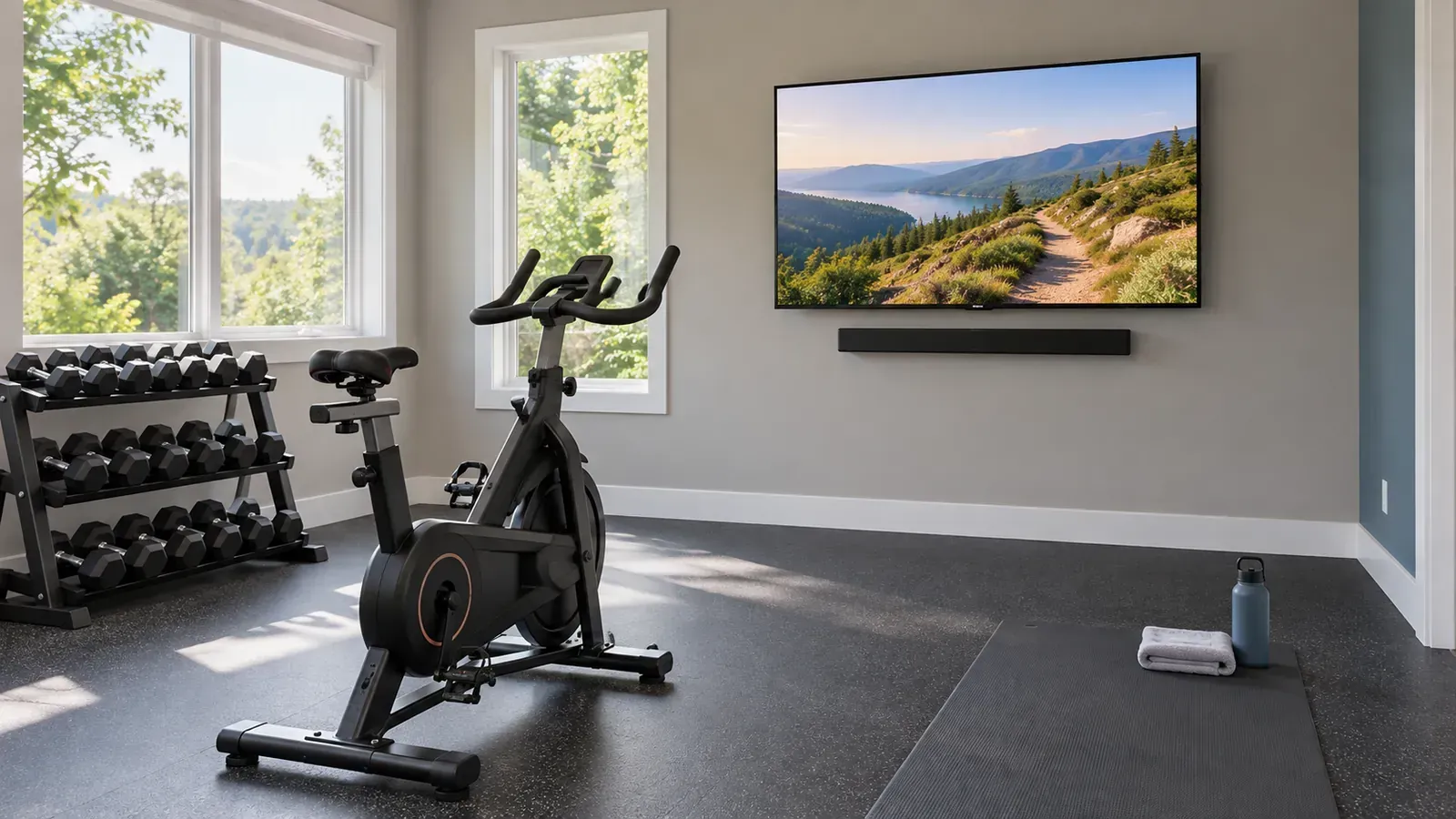
Reference photo: a bright fitness room with an exercise bike, a dumbbell rack and one wall-mounted display above a slim speaker, with large windows on the left. Rooms with big windows need the screen placed and specified for glare.
Rules that apply to Suffolk business walls
Electrical licensing. Suffolk County Code chapter 563, article XI, makes it unlawful to carry on a regulated trade in the county without a county license, and the Department of Labor, Licensing & Consumer Affairs issues master and restricted electrical licenses. Its rules reserve direct line-voltage connections to a panel, disconnect or junction box for the holder of a master electrician’s license. The same article does not apply in a town or village that regulates the licensing by its own law, so the address decides whose license counts.
Low-voltage cabling. The county’s rules for restricted licensees describe a “communications cabling systems” category covering cabling of 90 volts or less for networking, telecommunications, cable TV, fiber optics, audio and video systems and home theater systems. A video wall’s signal and control cabling falls in that description; its power circuit does not.
Signs. Each town writes its own sign chapter. Southampton’s treats displays within four feet of a window as window signs, limits internally lit interior signs visible from the street to Highway Business districts and ten square feet per business, and requires permitted illuminated signs to be off by 11 p.m. or closing, whichever is later. The Town of Islip’s sign permit requires electronic message signs to hold each message at least 45 seconds and to dim automatically at night.
Accessibility. Corridors and lobbies are where projection matters: section 307.2 of the 2010 ADA Standards caps anything hung with its lower edge in the 27-to-80-inch band at 4 inches of protrusion into the path of travel, and a pop-out video-wall mount plus panel can exceed that, so the wall is recessed, raised or placed out of the walkway.
Old screens. TVs and monitors removed to make room for the wall are covered electronic equipment under New York’s disposal ban, in force since the start of 2015, so they leave the building for a recycler or a manufacturer’s collection program rather than the dumpster.
This is general information from public sources, not legal advice; the building department or licensing office for your address has the final word.
Town by Town
Ten Towns, Ten Different Starting Points
Every Suffolk address sits in one of the ten towns, and many also sit in an incorporated village with its own building department and code. Here is what each town tends to bring to a video wall project, west to east.
Babylon. The town on the Nassau line, with the village of Babylon’s downtown, Lindenhurst and Amityville on the South Shore and the southern stretch of the Route 110 corridor through East Farmingdale. Expect Main Street restaurants and bars in older buildings, light-industrial buildings along the corridor, and incorporated villages that run their own building departments.
Huntington. Melville’s office parks, where Newsday’s headquarters carries video walls in its newsroom, auditorium and reception, plus the village-scale downtowns of Huntington and Northport. Corporate lobbies and boardrooms on the corridor; restaurants, galleries and shops in the downtowns, where a screen in the window can raise sign questions.
Islip. Part of the Hauppauge industrial park, Long Island MacArthur Airport and the Ronkonkoma area, and South Shore downtowns such as Bay Shore. The town’s sign permit sets rules for electronic message signs, including a 45-second minimum hold for each message and automatic dimming at night, so a screen meant to be read from the road is designed to those limits from the start.
Smithtown. The other part of the Hauppauge park, along with Smithtown’s own business districts and Commack’s retail. Manufacturers and distributors with plant floors, plus the professional offices and medical practices that serve them.
Brookhaven. The town takes in Stony Brook University and its hospital, Brookhaven National Laboratory at Upton, the county government campus and police headquarters at Yaphank, the village of Patchogue with its theater and Main Street, Port Jefferson’s harbor village, and the Smith Haven retail area at Lake Grove. Almost every kind of wall on this page turns up somewhere in Brookhaven.
Riverhead. The county seat, its Route 58 retail corridor and the Tanger outlet center, and the gateway to both forks. Large-format stores with high ceilings and long sightlines, restaurants that host events, and a town board that is actively debating what kinds of business the outlet center may hold.
Southold. The North Fork from Laurel to Orient, with Greenport’s village and harbor. Small hospitality businesses, seasonal homes and shops, many in older wood-frame buildings where the wall, the wiring path and the room’s windows need careful planning.
Shelter Island. An island town reached by ferry from both forks, almost entirely residential. Any job here is planned around ferry timing and carries spares on the first trip, because a forgotten part is a much longer round trip than anywhere else in the county.
Southampton. From Westhampton to Bridgehampton and Sag Harbor’s western side, with incorporated villages such as Southampton Village. The town’s sign article is detailed about illumination and window signs, and the town has publicized enforcement of lighted-sign and window-sign violations in Hampton Bays. Shops plan screen placement around it; homes plan around the season.
East Hampton. East Hampton, Amagansett, Springs and Montauk, where the town’s own market study counts nearly half of homes in its study area as seasonal or occasional use. Media rooms and great rooms in houses that may be closed for months, and restaurants and shops that run flat out for a summer.
Your Questions Answered
Video Wall Installation in Suffolk County: Questions Answered
The questions below are grouped by the part of the county they come from, because a plant manager in Hauppauge, a facilities director in Stony Brook and a homeowner in Amagansett ask different things. Each answer is meant to be usable on its own.
West Suffolk: Plants, Office Parks and Headquarters
In the industrial and office belt from Melville to Hauppauge, the wall is a working tool. The questions are about environment, networks and how the wall fits a company’s systems.
Our Hauppauge plant floor has dust, vibration and forklifts — what changes for a wall out there?
Three things: where it hangs, what protects it, and where its electronics live. We put a production wall on a structural wall or a dedicated steel frame outside the forklift lanes and above the height a pallet or mast could reach, and, where a truck could still strike it, we add a guard rail or bollard at floor level rather than relying on the panels to survive. Panels go on a rigid mount fixed to block or steel, not to a light partition that moves when a dock door slams.
Dust is the slow killer. Commercial panels draw air through their vents, and fine dust from cutting, packaging or powder coating builds up on boards and fans. We look at what is in the air, keep the wall away from the worst sources, and put the controller, players and switch in a closed, ventilated cabinet or back in the office side rather than on an open shelf. The cleaning schedule goes on the handover sheet.
Heat matters too. Many manufacturers rate commercial panels to run up to about 40°C (104°F) — LG’s 55VM5J sheet, for example, lists 0 to 40°C and 10 to 80 percent humidity — and a mezzanine-height wall in an unair-conditioned building can get close to that in July. We check the summer temperature where the wall will hang before we choose it.
Can a production-floor wall show machine counts without opening the factory network to the internet?
Yes, and that is how it should be built. The usual arrangement is a player or small computer that sits on the plant network, reads the dashboard your production or quality system already publishes, and sends only a picture to the wall. Nothing on the wall needs to reach the internet, and nothing outside needs to reach the plant network. If you also want marketing content or a news feed on part of the wall, that comes through a second player on a separate network segment and the controller places the two side by side.
We write this down for your IT staff before we install: which device sits on which network, which ports it uses, who owns the login, and how firmware updates are handled. Most manufacturers in the park have a person or an outside firm responsible for the network, and they decide; our job is to make a wall that fits their rules rather than asking for exceptions.
Should our lobby wall and our boardroom wall share one controller, or be built as two systems?
In most Route 110 and Hauppauge headquarters we recommend two independent systems that share a content library. A lobby wall runs all day with scheduled content; a boardroom wall is switched between laptops, video calls and presentations on demand. If both hang off one controller, a problem or a reboot in one room takes down the other, and a presenter can accidentally push the wrong picture to the lobby.
What they can share is the content-management account, so marketing loads a welcome slide once and it appears where it should, and the same make of panel, so one stock of spares covers both. Where a building needs one operator to see every screen — a security office, for instance — we add monitoring, not a single point of failure.
Will a 3×3 of 1080p panels show the fine detail in research plots and engineering drawings?
Only if the source is built for it. Nine 1080p panels add up to 5760 by 3240 pixels, which is plenty for fine charts — but many video-wall controllers and most laptops send a single 1080p or 4K picture and stretch it across the grid. Stretched, a thin plot line or six-point label becomes soft or blocky. For data-heavy rooms near Stony Brook or Upton we specify a processor or workstation that drives the wall at its full native resolution, or lets each source occupy its own window at native size.
Bezels matter more for drawings than for video. A thin line crossing a 1.7-millimeter seam is still readable; a value printed on the seam is not. We help lay out templates so axes and labels avoid the seams, or recommend direct-view LED for rooms where the content is mostly detailed graphics viewed from a fair distance.
Our own facilities crew handles power and carpentry — can you supply and commission only the display side?
Yes. That split is common with universities, hospitals, laboratories and larger manufacturers, and Stony Brook’s Frey Hall wall was built that way, with campus trades doing the physical installation and the university’s media engineering team assembling and tuning the system. In a split job we provide the panel layout, mount drawings with fixing points and weights, power and data locations, heat output and the controller design; your crew builds backing and circuits; we hang, align, calibrate and commission.
The written scope lists every handoff — who supplies backing, who pulls which cable, who terminates what, and what has to be ready on the day panels arrive — so the schedule does not slip because one side assumed the other was doing a task. Our price covers only our part, from the published Suffolk list.
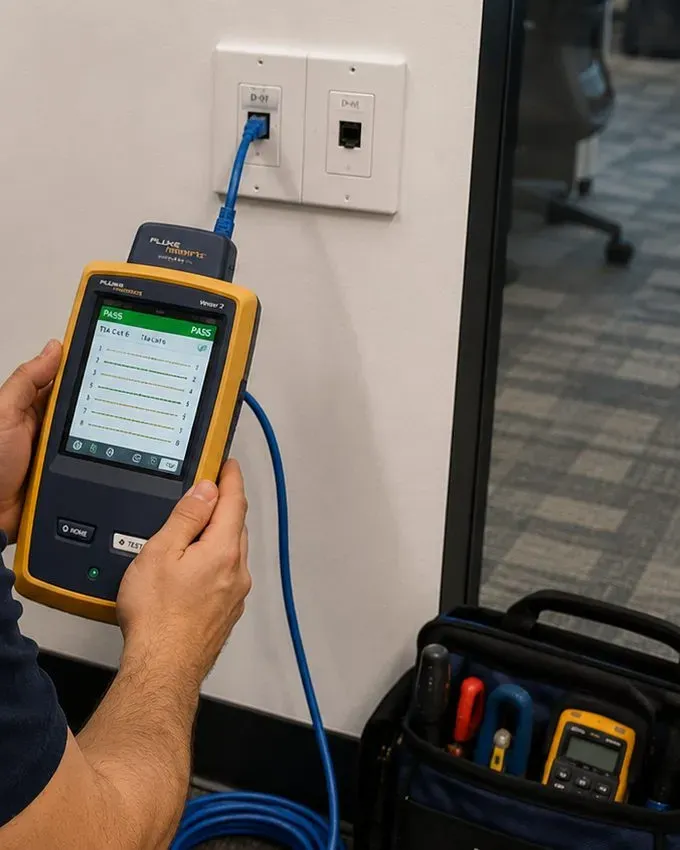
Reference photo: hands hold a yellow handheld cable certifier with a green pass screen, its blue patch cord plugged into a wall data jack, with a tool bag and meter on the floor. Data runs to a wall's player or controller are tested before the panels go up.
Campuses, Labs and Public Budgets
In the institutional middle of the county, the questions are about value and fit with organizations that already know how to build.
Is under $40,000 a realistic budget for a lobby wall the size of Stony Brook’s Frey Hall wall?
It was realistic for Stony Brook because the university supplied its own electricians, carpenters, painters, engineering team and content, and researched components carefully. That figure, from the university’s news office, is the cost of equipment and some outside work to an organization that did much of the labor itself. A business buying the same size of wall complete — panels, mount, controller, power, backing, installation and calibration — should expect more.
For scale, a 6′6″ by 12′ wall is roughly the size of a 3×3 grid of 55-inch panels, and our published Suffolk range for a 3×3 LCD wall installed is $28,800 to $45,600. Where your own staff do the backing and circuits, the display-side price falls toward the lower end. The honest way to compare is line by line: what the number includes, and who does each task.
Will our facilities department’s mounting and cabling standards slow the job down?
Not if we see them first. Campus, hospital and laboratory owners often specify approved mount makers, cable jacket colors, labeling formats, where equipment may sit and how drawings must be delivered. Read before the design, those rules simply shape it. Discovered on installation day, they cause rework. We ask for the standards at the first meeting, design to them, and mark on the drawings any place where a video-wall product has no listed equivalent so your staff can approve an exception in advance.
East End: Seasonal Houses, Shops and Summer Crowds
From Westhampton to Montauk and out to Orient, many buildings live by the season. These questions come from owners, managers and shopkeepers there.
Does the four-foot rule in Southampton’s sign code change where a screen can sit inside our shop?
It can. Southampton’s sign article defines a window sign as anything on a window or glass door, or placed inside within four feet of it, that can be seen from outside. Window signs may not be illuminated except in a narrowly limited case, and internally lit interior signs visible from the street are allowed only in Highway Business districts, up to ten square feet per business. A bright video display facing the window from two feet back can therefore be treated as an illuminated window sign.
The practical answer is usually to place the wall deeper in the store, on a side wall, or facing inward so it serves customers who are already inside. We check the zoning district and the code for the specific village or hamlet — incorporated villages such as Southampton Village and Sag Harbor have their own codes — and show the placement on a floor plan before you buy. This is not legal advice; the town or village building department decides.
Do displays inside a Southampton business have to go dark at 11 p.m.?
Signs the town permits as illuminated must be extinguished by 11 p.m. or when the business closes, whichever is later, under the same article. A screen that counts as a sign — because it is visible from the street and carries advertising or branding — falls under that rule; a wall deep inside a restaurant showing a game to diners is a different case. Either way, we set the wall’s schedule to match your hours and the code: off at close, or, for a window-visible display, off by the town’s deadline, with the schedule written into the handover so a new manager does not undo it.
Can the wall be started and tested before we open the house in spring, so it works on the first weekend?
Yes, and for a house that has been closed all winter it is worth doing. We arrange access with your caretaker or property manager, power the system up in stages, let the panels reach room temperature before full brightness, update firmware while there is time to fix any problem, check every input and the player, and test the remote or control app. If something has failed, there are weeks to get a part rather than hours.
Book the visit for a weekday in April or May, when crews are freer and the house is quiet. The visit is billed at the published service rate of $195 an hour with a three-hour minimum ($585), and it is usually combined with checking anything else on the network that sat idle all winter.
Can summer guests cast from their phones to the wall without joining our home network?
Yes. The cleanest arrangement is a guest network that reaches the wall’s casting device but nothing else in the house — no cameras, no locks, no owner’s computers. Guests connect to the guest Wi-Fi, see the wall as a cast target, and that is all they see. The house network, the property manager’s logins and the wall’s administrator account stay separate.
We set this up together with whoever manages the house network, or with our own network team if no one does, and we leave a one-page card by the wall that tells guests how to cast and what to do if the picture disappears. Changing the guest password between rentals takes a minute and does not touch the wall’s settings.
Our beach house is humid and gets sandy in summer — does that shorten a wall’s life indoors?
It can, if the panels are pushed outside their rated range. Commercial panels list an operating humidity range on their data sheets — 10 to 80 percent for LG’s 55VM5J, for example — and a house that is closed and unconditioned in late summer can exceed that, especially near the ocean. Condensation on cold electronics is the real risk, typically when a cold, damp house is opened and the system is switched straight on.
The fixes are ordinary: keep the house dehumidified when it is shut, let the room warm and dry before powering the wall, keep sand and spray out of the equipment cabinet, and clean the panel vents once a season. We pick the equipment location with that in mind and put the rated ranges on the handover sheet.
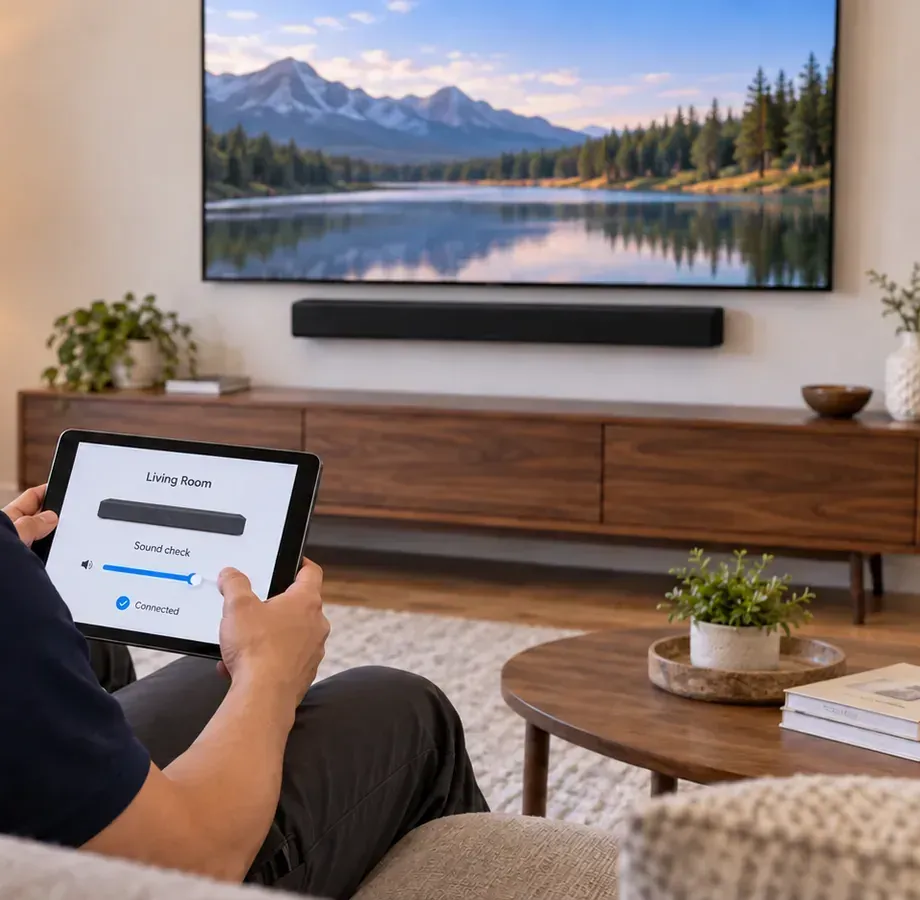
Reference photo: a person on a sofa holds a tablet showing a control app, facing a wall-mounted display, a slim speaker and a long media console. Handover includes testing the controls a household or guest will actually use.
Route 58 Stores and Main Street Rooms
Riverhead’s big stores and the bars and theaters of the South Shore downtowns raise questions about sightlines, old walls and live events.
How high should the wall sit when shoppers see it from across a large store floor?
High enough to clear the tops of fixtures and people’s heads from the far side of the floor, low enough that someone standing near it is not craning their neck. In a big-box or outlet store with racks around five feet tall, that usually means the bottom edge of the wall somewhere above head height, with the most important content — the price, the logo, the call to action — in the upper part of the image where it can be seen over the racks.
We check it on site rather than guess: from the entrance, from the far aisle and from the checkout, with a tape or a laser marking the proposed top and bottom edges. The pixel pitch then follows from the nearest and farthest places people will stand, and the mount height decides whether the job needs a lift. In a landlord-controlled center we put the height and fixing method on the drawing the landlord approves.
Can a wall go on the plaster and brick walls of an older Main Street building?
Usually, yes. Many downtown buildings in Patchogue, Bay Shore, Babylon and Northport have plaster over brick or block on their party walls, which is strong once you get past the plaster. We locate the masonry, use sleeve or wedge anchors sized for the mount, and avoid the mortar joints. Where a wall is plaster on wood lath over old studs, we find the framing or add a backing board that spreads the load.
The two things that can stop a wall are hidden services and depth. Old party walls sometimes carry a flue, a gas pipe or a neighbor’s plumbing, so we scan before drilling. And narrow rooms leave little depth, so we favor slim mounts and run cable through the wall or in a surface raceway painted to match rather than leaving it hanging.
Our venue hosts live music and comedy — can the wall show a camera feed of the stage for the back of the room?
Yes. A camera at the back or side of the room feeds the controller, and the wall shows the stage live — full screen for a show, or in a window beside the bar menu or sponsor slides. The things to plan are delay and lighting. Any processing adds a small delay between the stage and the screen, which audiences notice in music if it is long, so we keep the chain short and choose equipment for low latency. Stage lighting changes fast and a camera set for daylight will blow out under spots, so the camera is chosen and set for the room’s lighting.
If the venue also streams, the same camera can feed both, but we keep the house wall and the stream as separate outputs so a problem with one does not take down the other. Performers’ and promoters’ rules on recording are yours to check; showing a live feed inside the room is not the same as recording it.
Can the wall share a circuit with the bar coolers and kitchen equipment?
It should not. Compressors in coolers, ice machines and kitchen equipment draw a surge when they start, and on a shared circuit that can cause flicker, resets or a tripped breaker in the middle of a game. A wall of nine panels plus a controller is a steady load of its own. We ask for a dedicated circuit for the wall and its equipment, sized from the panel data sheets, installed by a licensed electrician — in most of Suffolk that means a county master electrician, or a town- or village-licensed one where that town or village licenses its own.
We give the electrician the load figures, the outlet positions behind the wall and the location of the equipment cabinet. On the same visit we usually recommend surge protection at the wall’s outlet and battery backup for the controller and player, so the wall rides through the brief dips that compressors and storms cause.
Power, Storms and Whose License Counts
Two Suffolk realities sit under every wall: a long, exposed grid, and an electrical licensing system that depends on the address.
Is a lightning or surge strike through the cable line a real risk for a wall in a waterfront house?
It is a risk worth designing for. Surges do not only come in on the power line; they can come in on a cable TV feed, a long Ethernet run from an outbuilding or a satellite line, and they travel along whatever is connected. A wall connected to all of those is exposed on several paths at once. Waterfront and open-field houses on the forks are more exposed to storms than a house in a dense neighborhood, and Isaias showed how hard Long Island’s grid can be hit.
The defenses are grounding and protection on every path: whole-house protection, which an electrician installs at the panel; a protective device at the wall’s outlet; grounded coax entry; and protection or fiber on any long data run between buildings. We cover the low-voltage side and tell your electrician exactly what we need on the power side. None of this makes a direct strike harmless, but it greatly reduces the damage from the nearby strikes and grid switching that are far more common.
Our village licenses its own electricians — does the county license still matter there?
Possibly not. Suffolk County’s electrician and plumber licensing article says it does not apply within a town or village that has enacted its own law regulating that licensing, or in a second-class town that has opted out by local law. In those places the town or village license is the one the building department expects to see; elsewhere it is the county license.
Because this is decided address by address, we ask the building department that will inspect the work which license it requires, and we make sure the electrician on your job holds that one. The low-voltage side of a video wall — signal, network and control cabling — is a different trade from the power circuit, and the same question is asked for it.
How can we confirm that an installer’s electrical or other license is current in Suffolk?
Ask for the license number and the issuing office, then check it with that office. For county licenses that is Suffolk’s Department of Labor, Licensing & Consumer Affairs, which issues master and restricted electrical licenses, home improvement licenses and sign hanger licenses among others; licenses are issued for two years and renewals require continuing education. For a town or village license, ask the building department. Also ask for a certificate of insurance naming you or your landlord.
Our own license, #12000287431, was issued by New York State to security and fire alarm installers, and it is printed on this page, our proposals and our invoices. Where your job needs a county or local electrician for the power circuit, the proposal names that contractor so you can check them too.
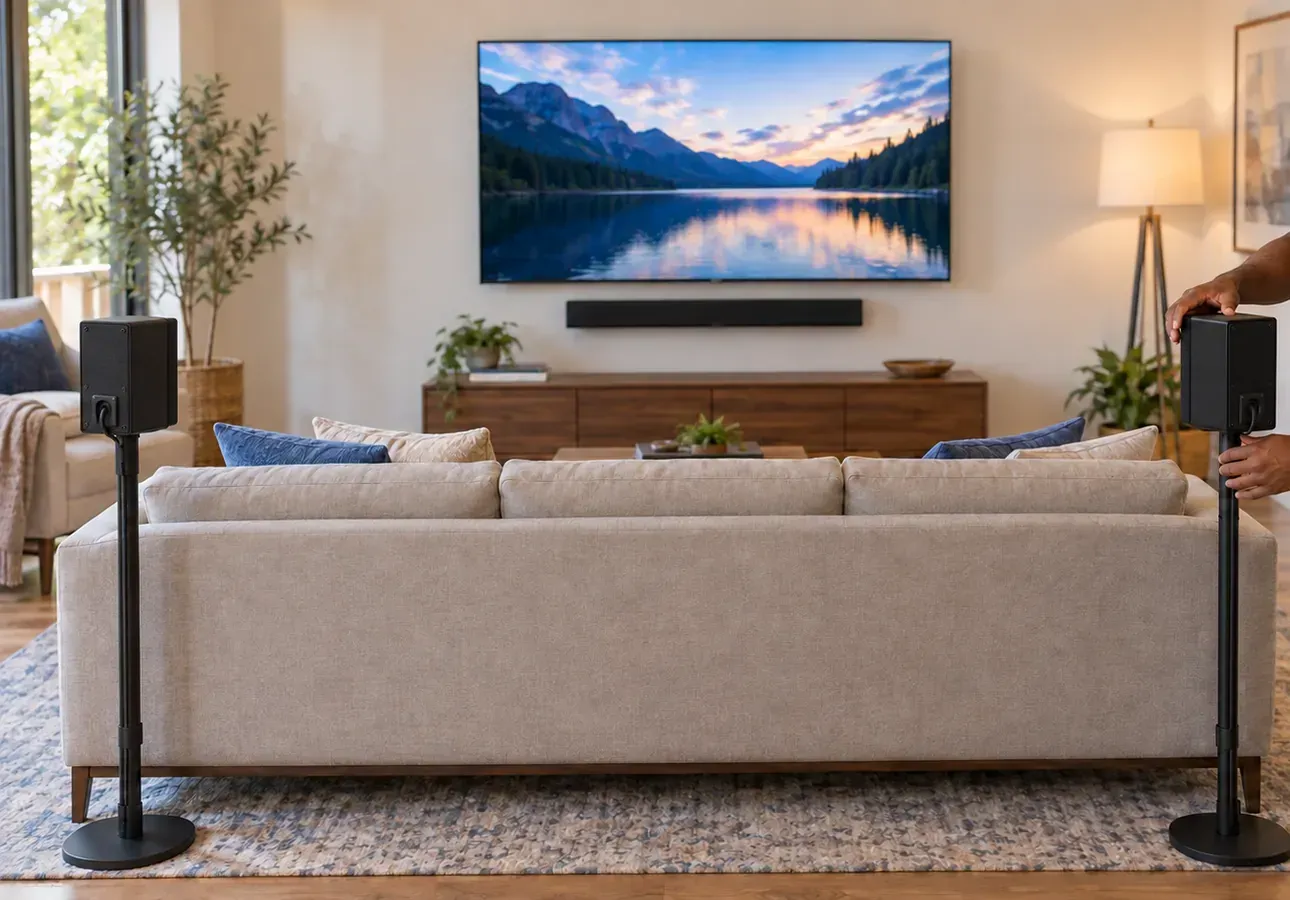
Reference photo: a living room with a long sofa, two speakers on floor stands behind it, and a wall-mounted display above a slim speaker and low console. Media rooms in seasonal houses are planned around the sound and the windows as much as the screen.
Not seeing your question? Call (631) 407-2884, or read the shorter answers in the FAQ further down. For the general planning questions every Long Island owner asks — viewing distance, mounting, cooling — see our Long Island video wall installation hub.
Equipment
Types of Video Wall Installation We Install
Equipment is chosen after the hours, the room and the viewing distance are known, not before. These are the categories we work with in Suffolk and where each one earns its place.
24/7-rated LCD video-wall panels
Commercial 46- and 55-inch panels built for continuous operation, with bezel-to-bezel gaps from under one millimeter to a few millimeters. The right choice for production walls, operations rooms and any wall that never switches off.
Extended-hours LCD panels
Panels rated for long business days rather than round-the-clock use. Sensible for a boardroom or a seasonal house, where the wall runs for some hours a day and sits idle the rest.
Fine-pitch direct-view LED
LED cabinets from about 1.5 to 2.5 millimeters pixel pitch for seamless lobby, showroom and auditorium walls viewed from a few meters back or more.
All-in-one LED displays
Factory-built LED screens of around 130 to 165 inches with the processor inside — a simpler alternative to a custom LED wall for a boardroom or a large home theater.
Video-wall processors
Hardware that places several sources anywhere on the wall at native resolution: production dashboards beside camera views, or a presenter’s laptop beside a video call.
Content players and CMS
Small players that run scheduled content from a cloud or on-premises content-management system; the right one depends on the network rules of the building.
Pop-out and rail mounts
Rail-based mounts that let each panel be pulled forward for service and adjusted in fine steps so seams line up; depth is chosen against ADA and room limits.
Protection and backup
Surge protection at the outlet, battery backup for the controller, player and switch, and remote monitoring so a dark wall is noticed before a customer points it out.
Which kind of display for which Suffolk room
Room
Typical choice
Why
Hauppauge production floor
24/7 LCD panels, enclosed electronics
Long hours, dust and heat; content is mostly charts and numbers
Route 110 lobby
Fine-pitch LED or narrow-bezel LCD
Visitors stand back; brand content dislikes seams
Lab or university data room
Narrow-bezel LCD driven at native resolution
Fine detail and text read from close up
Route 58 store
LED, higher brightness
Long sightlines, bright retail lighting
Main Street bar
LCD grid with matrix switching
Several games at once, close viewing, budget
East End media room
Extended-hours LCD or all-in-one LED
Seasonal use, guest-friendly control, glare from big windows
Two rules of thumb that hold almost everywhere: buy the panels for the wall from one production batch and keep at least one matched spare in the building, and buy displays made for commercial use. Samsung itself notes that consumer TVs are designed for perhaps eight hours a day and that using one commercially can invalidate its warranty.
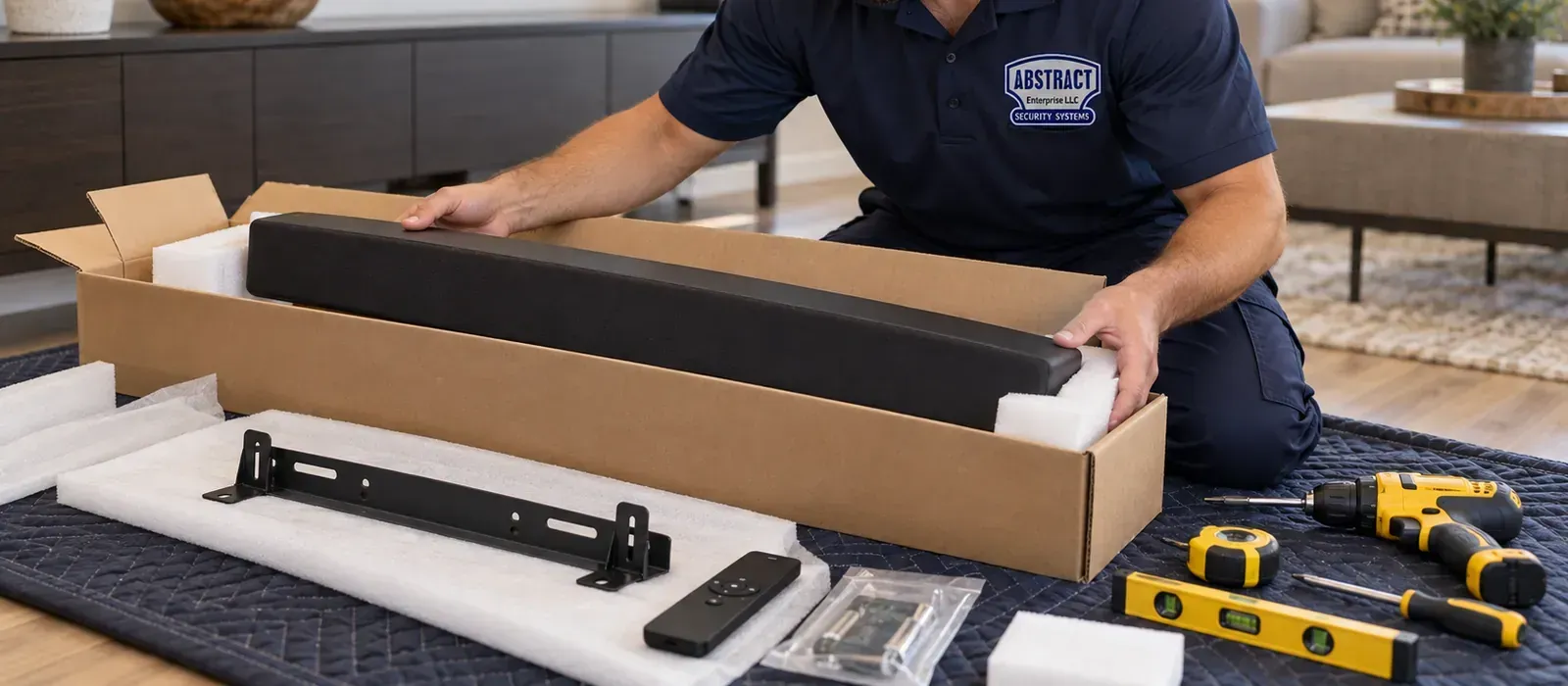
Reference photo: a technician lifts a long piece of equipment out of its packaging beside a black wall bracket, a remote, a yellow level and a cordless drill laid out on a protective mat. Hardware is checked against the drawing before anything is drilled.
AI Overview Reality Check
What AI Gets Wrong About Video Wall Installation in Suffolk County
We could not open Google’s AI Overview from our research environment, so instead we tested the claims made by the cost guides, vendor blogs and forum threads that rank for the same searches and that AI summaries tend to repeat. Each claim below is quoted or summarized from a named source, then checked against what a Suffolk installation actually involves.
“Just multiply the square footage by an LED rate”
American LED Wall’s guide says most installed walls run about $500 to $2,500 a square foot, and SV Solutions puts the range at roughly $9,500 for an entry-level indoor wall to more than $200,000 for premium MicroLED. Those ranges are not wrong; they are just too wide to plan with, because the square foot hides the things that change a Suffolk price most.
Two walls of the same size can differ by tens of thousands of dollars because one goes on a finished office partition near the closet and the other on a block wall in a plant 200 feet from the network switch, with a lift, a guard rail and an enclosed equipment cabinet. A seasonal house adds a spring start-up; a Southampton shop adds a sign-code check that may move the wall.
Our answer is to publish a range per configuration at the Suffolk rate, and then price the specific building after a site measure, with every line written out.
“Order an LED kit online for $11,000 and save”
Crown TV’s cost guide prices a 10-by-5-foot P2.9 kit at about $11,000 to $15,000 and is clear that this is hardware only. What the summary drops is everything else the guide lists: structure, power circuits, installation and calibration.
In Suffolk the “everything else” includes a licensed electrician for the dedicated circuit, a mount that suits the wall behind, a processor and player, and time to calibrate the cabinets so they match. A 2.9-millimeter pitch is also a poor choice for a boardroom or a media room where people sit within a few feet; by Planar’s rule of thumb of about ten feet of viewing distance per millimeter of pitch, it suits a viewer nearer 29 feet away.
We will install equipment you bought; we will also tell you before you buy whether it fits the room.
“Mounting is a small part of the job”
An installer in a r/CommercialAV pricing thread said the mounting structure alone for a large wall could run $20,000. For a four-panel wall on good backing it is a fraction of that, but the point stands: the structure is a design decision, not an afterthought.
Suffolk buildings make it more so. Plant walls need rigid fixing and protection from traffic; old Main Street walls need masonry anchors and a scan for flues; East End houses with tall glass walls leave few places to hang anything. Our published Suffolk range for mounting structures and custom framing is $1,800 to $10,800 for exactly that reason.
The structure is also what makes service easy or hard for the next ten years, so we choose pop-out mounts wherever depth and accessibility rules allow.
“Any good 4K TV will do the job”
Forum answers often suggest lining up consumer TVs. Samsung’s own business blog says consumer TVs are designed for perhaps eight hours a day and that commercial use can void the warranty; integrators on r/CommercialAV add that consumer cooling is designed for landscape use.
In a Hauppauge plant running two shifts or a lobby on all day, that is a wall that will age fast and that no one will repair under warranty. In a summer house used for a few hours a day, the case for consumer screens is stronger — but a grid of TVs still has wide bezels and no proper video-wall processing.
We match the duty rating to the hours: 24/7 panels where the wall never sleeps, extended-hours panels where it does.
“Use the pixel-pitch rule and you are done”
Rules of thumb disagree. Planar suggests pitch times ten for viewing distance in feet; Christie suggests a meter per millimeter; Barco suggests the optimal distance in meters divided by two. Applied to the same room they give different answers.
The right pitch also depends on the content. A Route 58 store wall showing a bold sale message can use a coarser pitch than a research room showing six-point labels on a plot, even at the same distance.
We stand where viewers will stand, look at the actual content, and if the budget allows, view sample cabinets before ordering.
“You don’t need a license to install AV in New York”
Some contractor guides say New York has no statewide contractor license, which is true as far as it goes. It is misleading in Suffolk, which licenses master and restricted electricians at county level and whose rules reserve line-voltage connections to a master electrician — except in towns and villages that license electricians themselves.
The county’s rules for restricted licensees name “audio and video systems” and “home theater systems” inside a communications-cabling category, so even the low-voltage side of the work is not unregulated. And a screen that faces a shop window can bring the town’s sign code into play.
Before work starts, we confirm which licenses the inspecting office expects for your address and make sure the people on your job hold them.
“Long Island is one market, so one Long Island price fits”
Online price lists often quote a single Long Island figure. In practice Suffolk’s buildings, distances and seasons differ from Nassau’s, and our own published multiplier for Suffolk is 1.20 against the Brooklyn base, compared with 1.15 for Nassau.
Within Suffolk we do not add a separate East End line: the Suffolk rate in the table below applies from Babylon to Montauk. What does change a price is the building, the access and the scope.
If someone quotes you a Long Island wall without asking the town, the hours of use and what is behind the wall, the number is a guess.
Ask a Technician Before You Order Panels
A ten-minute call about the hours, the room and the town saves the most expensive mistake in video walls: buying the wrong display. Call (631) 407-2884 or send the form below.
For a Suffolk video wall quote, tell us the town or hamlet, what the room is used for, how many hours a day and months a year the wall will run, and who signs off on the work. A written price follows the site measure; to talk first, call (631) 407-2884.
✅
We Got Your Request!
Received. A Suffolk technician will phone you back today to go over the hours, the room and the town; if the wall is down right now, call (631) 407-2884 now.
How It Works
Our Installation Process
The same seven steps apply to a four-panel reception wall and a full LED lobby. In Suffolk the first two steps carry the most weight, because the hours, the season, the network and the town decide most of what follows.
1. Hours, town and photos
You send photos of the wall and the ceiling with the town or hamlet and how many hours and months the wall will run; we call back to confirm the scope and who signs off.
2. Site measure
We measure the wall, scan behind it, find the network closet or switch, check the light at the hour that matters and note temperature, dust or humidity in the room.
3. Written design and price
Panel layout, duty rating, mount, controller and player, network plan, prices from the published Suffolk list, and the licenses or approvals the address needs.
4. Approvals and circuit
Sign-off from whoever controls the building, a dedicated circuit from an electrician licensed for that address, and the deposit that releases the panel order.
5. Backing and rough-in
Blocking, plates or steel framing go in first; then recessed boxes, cable from the switch or closet, surge devices and the equipment cabinet, all finished before the panels are delivered.
6. Panels and calibration
Rails squared to the laser line, each panel hung and nudged until the seams close up, then every tile tuned so whites and blacks match from corner to corner.
7. Handover
Schedule and content loaded, logins issued in the owner's name, a power-off restart test, and a one-page sheet for staff, caretakers or guests.
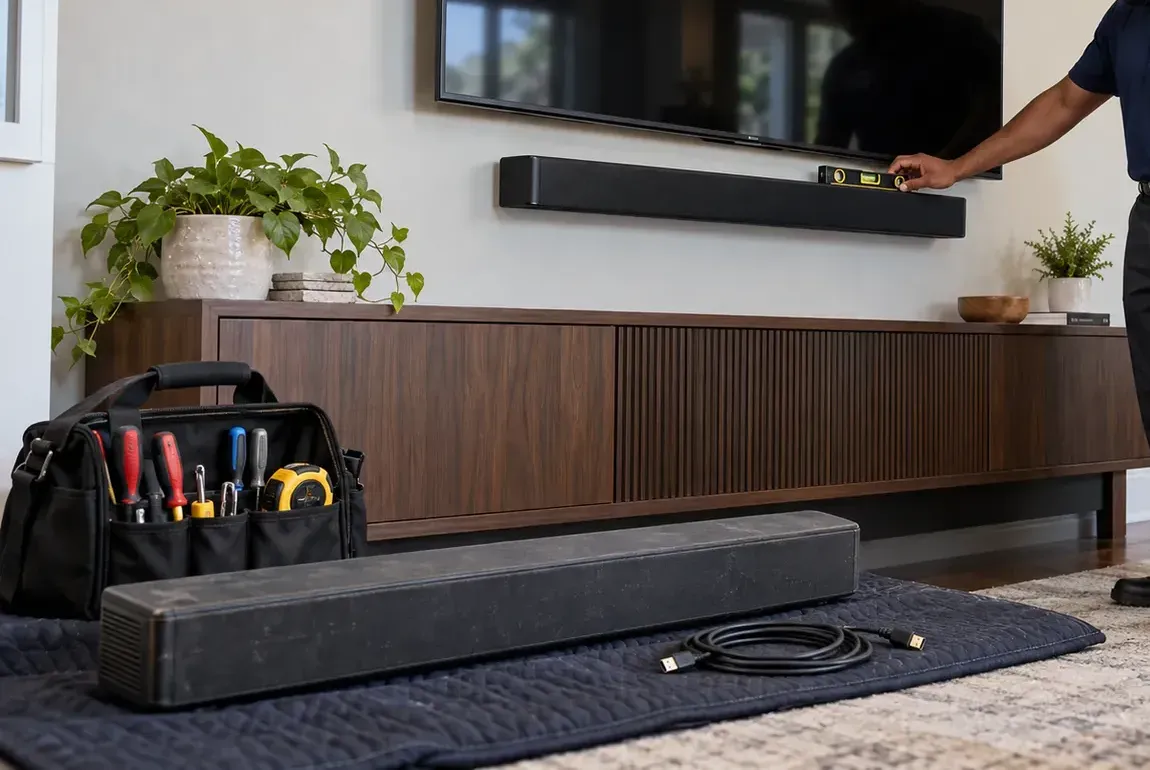
Reference photo: a hand rests a small level on a speaker mounted under a wall display, while a tool bag and a second speaker with a coiled cable sit on a protective mat on the floor. Floors and furniture are covered before work starts.
Coverage Area
Video Wall Installation Near Suffolk County’s Landmarks
Six places that show the range of rooms we plan walls for in Suffolk. None of them is a customer of ours; they are landmarks that anchor the parts of the county we cover.
Long Island Innovation Park at Hauppauge
The park the Regional Plan Association counts at about 1,300 companies and 55,000-plus employees. Walls for plant floors, shipping offices and visitor lobbies, in the Towns of Islip and Smithtown.
Route 110, Melville
Corporate offices along the corridor, including Newsday’s headquarters with its newsroom, auditorium and reception video walls. Boardrooms, lobbies and training rooms in the Town of Huntington.
Stony Brook University
Home of the Frey Hall lobby wall, 6′6″ by 12′, and of a large hospital. Split-scope projects with in-house trades, and data-heavy rooms for research groups.
Yaphank county campus
Suffolk County Police headquarters, where the department describes its Crime Analysis Center as having a video wall that displays countywide camera footage. Operations-room work for public agencies.
MacArthur Airport and Ronkonkoma
The airport in the Town of Islip and the rail hub beside it, where the town is pursuing a new terminal with a direct rail connection. Hotels, offices and transport businesses around it.
Riverhead: Route 58 and Tanger
The county seat’s retail corridor and outlet center, with more than 130 brands, and a 2016 Patch post describing a 21-foot video wall at a Riverhead grill used for events. Large stores, restaurants and the gateway to both forks.
We also serve Brookhaven National Laboratory’s neighbors in Upton, Shirley and Ridge; the downtowns of Patchogue, Bay Shore, Babylon, Huntington, Northport and Port Jefferson; Smithtown, Commack and Lake Grove; and the East End from Westhampton Beach, Southampton and Sag Harbor to East Hampton, Montauk, Shelter Island, Greenport and Orient. Nassau jobs are covered on our Nassau County video wall page.
Pricing
Video Wall Installation Cost in Suffolk County
These are our published video wall ranges at the Suffolk rate. They start from the same base list used for Brooklyn and apply the Suffolk area multiplier of 1.20. Third-party software fees and the controller add-on are shown at the same figures as on every other area page, because they do not change with the county. The range for your wall narrows to a written figure after the site measure.
Operations room, training room, multi-game sports bar
2.5 mm direct-view LED (about 110″)
$42,000 – $66,000
Store wall seen from a distance, function room
1.9 mm direct-view LED (about 138″)
$66,000 – $102,000
Headquarters lobby, auditorium, large showroom
1.5 mm direct-view LED (about 165″)
$102,000 – $168,000
Executive boardroom, premium media room
Outdoor LED (per square meter)
$5,400 – $10,200
Patio, pool house, outdoor event space
Video wall controller add-on
$2,500 – $15,000
Several sources on the wall at once
16×16 HDMI matrix
$5,400 – $14,400
Routing many games or sources to many screens
Mounting structure / custom framing
$1,800 – $10,800
Block and masonry walls, guarded plant walls, tall walls
Content management system (annual)
$1,200 – $5,000/yr
Third-party software such as BrightSign, MagicInfo, Scala, Carousel
Maintenance contract (annual)
$2,880 – $10,800/yr
Scheduled inspections, cleaning, firmware and priority response
Service or repair visit
$195/hr, 3-hour minimum ($585)
Repairs, takeovers, spring start-ups — not applied to new installs
What moves a Suffolk price inside its range
The wall behind the finish. Backed drywall near the closet sits at the bottom of a range; block, masonry, tall walls and plant walls that need guarding move it up.
The hours. 24/7-rated panels cost more than extended-hours panels of the same size, and a wall that never switches off should have them.
Distance to the network. A long run to a plant-side switch, or between buildings, may need fiber or extenders rather than a simple cable.
Who does what. Where your own electricians and carpenters handle power and backing, our part shrinks; where we coordinate a licensed electrician, the circuit appears as its own line.
Access. Lifts for high retail and plant walls, after-hours work in occupied offices, and caretaker access at seasonal houses are planned and priced in writing, never added later.
Full terms — including 50% deposit, one-year parts-only warranty on AESS-supplied products, and the late-fee schedule — are set out in the service agreement.
Get a Written Suffolk Price for Your Wall
Send the town, the room and the hours, and we will tell you which line of the table fits and what the site measure needs to confirm. Call (631) 407-2884.
Most Suffolk projects begin from one of these three builds. The figure on each card is the floor of its Suffolk range; the site measure sets where in the range your wall lands.
Boardroom Four — from $14,400
A square of four 55-inch commercial panels hung on pop-out rails, driven by one player or controller, set up, color-matched and installed. Right for reception desks, boardrooms, Main Street bars and media rooms, where the audience is only a few steps away.
Lobby Nine — from $28,800
A 3×3 block of 55-inch panels with a processor able to carve the wall into separate windows, a content schedule and full color matching. The usual pick for office-park and campus lobbies, production dashboards and training rooms.
Seamless LED — from $66,000
Roughly 138 inches of seamless 1.9 mm LED cabinets, including the sending processor, the steel structure where the wall allows it, cabinet-to-cabinet color calibration and the crew. Chosen for headquarters lobbies, auditoriums and big stores where a seam line or window glare would ruin the image.
Bringing your own panels? Labor-only installation
We install customer-supplied panels, mounts and players, including equipment bought through a campus or corporate purchasing contract. There is no published labor-only figure for video walls, so it is quoted after the site visit, once we have seen the wall and the equipment. Before you order, send us the model numbers: we check that the panels are true video-wall models from one batch, that the mount fits them, and that the controller can drive the grid at full resolution.
Complete Services
Every Video Wall Installation Service in Suffolk County
Most East End homeowners who add a media wall also want home automation in Suffolk County, so lights, shades and the wall can be checked from the city while the house is closed.
Field Notes
Field Notes: Ask How Many Hours Before You Ask How Many Panels
The most useful question on a Suffolk video wall job is not about size or brand. It is how many hours a day the wall will be on, and how many months a year anyone will be there to watch it. The answer sorts the county into its three parts almost by itself.
A plant or headquarters wall that runs two shifts, every working day, needs panels rated for continuous use, electronics kept out of the dust, and a network design that the IT department signs. A campus or public wall runs through the term or the business day and has staff who can do half the work. A seasonal house or shop runs hard for a summer and then sits; it needs a spring start-up, a guest-proof way to use it, and a code check if it is anywhere near a window.
So our first visit always ends with the hours written at the top of the design sheet, next to the town or village that will inspect the work and the electrician who will provide the circuit. Every later decision — the panel, the mount, the controller, the maintenance plan and the price — is checked against those three lines.
FAQ
Suffolk County Video Wall Installation FAQ
Can a video wall go on a wall that backs onto a walk-in cooler or freezer?
+
We avoid it where we can, and when we cannot, we build for it. The far side of a cooler wall is cold, and the room side can be cooler and damper than the rest of the space, which is the wrong combination for electronics that need steady temperature and dry air. If that wall is the only choice, we stand the mount off the surface so air moves behind the panels, check the surface temperature and humidity before ordering, and keep the controller and player in a warmer part of the building. Often a side wall or a ceiling-hung frame turns out to be the better answer.
Can the panels or the frame around the wall match our interior finishes?
+
Commercial video-wall panels almost always come in black, and their thin bezels are not offered in custom colors. What can be matched is everything around them: a finished surround or trim built by your millworker or ours, a painted or fabric-wrapped frame, or a recess that lets the wall sit flush with the surrounding surface. We provide the exact outer dimensions, the service clearances and the ventilation the trim must leave open, so the finish looks built-in without trapping heat or blocking access to the pop-out mounts.
Can a video wall be mounted on a curved or angled wall?
+
An LCD wall can follow a gentle facet, with panels set at small angles to each other on a mount that allows it, but it cannot truly curve; the seams open up at the front as the angle increases. Direct-view LED is the better choice for a curve, because many LED cabinets are designed to lock together at set angles to make a smooth arc. Either way, a curved or angled wall needs a custom structure and careful measurement, and we price it from the mounting-structure line of the Suffolk table after the site measure.
How long should commercial video-wall panels last before they need replacing?
+
It depends mostly on hours, heat and duty rating rather than on age alone. A panel rated for continuous use, kept inside its temperature range and cleaned, will usually last much longer in a lobby than the same panel in a hot, dusty room or a consumer TV pushed beyond its design. The manufacturer's data sheet and warranty terms tell you what it was built for. We plan on panel models staying available for a reasonable time, keep a matched spare with the wall, and suggest a replacement budget based on how many hours your wall actually runs.
Does a heavy wall need drawings stamped by an engineer?
+
Most video walls on sound walls with proper backing do not, because the mount maker publishes load ratings and fixing details that cover them. Large LED walls, walls on unusual structures, hung or free-standing frames, and some landlord or campus rules can require a professional engineer's review. When that is the case, we supply the panel and mount weights, fixing points and drawings to your engineer or the landlord's, and build to the stamped design. If the building department or landlord asks for it, we tell you before the price is final.
Can the wall play sound, or do we need separate speakers?
+
Most video-wall panels have no useful built-in speakers, and a wall of several panels needs one sound source, not nine. Sound comes from separate speakers: a soundbar or a pair of wall speakers for a boardroom or media room, ceiling speakers for a lobby or store, and zoned audio for a bar that shows several games but plays only one. The controller or a small amplifier sends the right audio to the right zone. We plan speakers with the wall so the sound seems to come from the picture.
Can visitors touch the wall to explore content?
+
Yes, with a touch overlay or a touch-capable panel model. Overlays are frames fitted over the front of the wall that detect touch across the whole surface and connect to a computer running the interactive content. They suit museum-style lobbies, campus displays and sales centers. They change the mount, since the wall must sit at a height people can reach and the overlay adds depth at the front, and the software has to be written for touch. We include the overlay and the computer in the design and price, and the content developer handles the application.
Can the wall be built into cabinetry or a millwork wall our carpenter is making?
+
Yes, and it is a good way to get a clean finish, as long as the cabinet is designed for electronics. The opening needs exact dimensions with clearance for alignment and service, a mount fixed to structure rather than to cabinet panels, ventilation in and out so heat does not build up, and access to the controller and power from behind or below. We give your carpenter a dimensioned drawing and the heat load before the cabinet is built, and check the opening before panels arrive.
Can you put a video wall in a sales office or temporary building on a construction site?
+
Yes. Sales centers for new developments and project offices often use a wall to show plans, renderings and progress photos. The things to check are whether the trailer or temporary wall can carry the load, how stable the power is on site, and whether the wall will be moved to the permanent building later. We often use a free-standing frame in these spaces so the wall can be taken down and reinstalled in the finished building, and we price the move as a separate line when it happens.
Can our existing Crestron or Control4 system run the wall?
+
Usually, yes. Many commercial video-wall panels and controllers accept network or serial control commands, and some advertise built-in support for control systems such as Crestron. The control programmer adds the wall to your existing touch panels, so one button can turn it on, pick a source or change a layout. We supply the device details and control documentation to your programmer, or work with our own team if you have none, and test every command at handover.
All Areas Served
Video Wall Installation Across New York City, Long Island and the Hudson Valley
This page sits under our Long Island video wall installation hub. Each area below has its own page written from its own research, because a Hauppauge plant, a Queens food hall and a Putnam town hall do not need the same advice.
Every local fact on this page comes from a source we opened while writing it. Where a source could not be reached from our research environment, we left the claim out rather than guess.
County structure: State of New York, Suffolk County page (ten towns, Riverhead county seat).
Housing and population: U.S. Census Bureau QuickFacts for Suffolk County (housing units, July 1, 2025) and Census Reporter’s county profile (occupancy, owner occupancy, single-unit share, median value); land area as reported from Census data.
East End seasonal housing: Town of East Hampton, Route 114 affordable housing market assessment (interim draft, March 2026), 2023 figures for the East Hampton study area.
Southampton sign rules: Town of Southampton Code chapter 330, article XXII, Signs (window-sign definition, illumination limits, 11 p.m. display time).
Islip sign rules: Town of Islip sign permit application, electronic message center requirements.
Licensing: Suffolk County Code chapter 563, article XI (Electricians and Plumbers); Suffolk County Department of Labor, Licensing & Consumer Affairs code of rules for restricted licensed electricians and its list of license types.
Storms and the grid: LIPA, Tropical Storm Isaias 30-day report (September 2020); PSEG Long Island customer figures.
Hauppauge: Regional Plan Association, Hauppauge Industrial Park economic opportunity analysis; HIA-LI for the park’s current name.
Melville: Waldner’s published portfolio entry for Newsday’s headquarters AV and video walls.
Stony Brook: SBU News, “Transformed Spaces: Frey Hall Video Wall Inspires Students,” February 20, 2025.
Upton and Yaphank: Brookhaven National Laboratory “About” page; Suffolk County Police SHIELD initiatives page on the Crime Analysis Center.
MacArthur Airport: Long Island Business News, David Winzelberg, July 17, 2026.
Riverhead: Tanger Riverhead visitor information; RiverheadLOCAL, Alek Lewis, January 19, 2024; Patch Long Island community post on a Riverhead grill’s 21-foot video wall (June 2016).
Patchogue: Patchogue Theatre for the Performing Arts, “Where to eat.”
Equipment and standards: LG 55VM5J-H specification sheet; Samsung Insights on consumer TVs in commercial use (October 2024); Planar, Christie and Barco pixel-pitch guidance; 2010 ADA Standards section 307.2; New York State DEC electronic waste rules.
Cost claims tested: American LED Wall, SV Solutions and Crown TV cost guides; r/CommercialAV threads on video wall pricing and consumer TVs.
Not reachable from our build environment: Google People Also Ask, related searches, AI Overview, Answer the Public, Bing and DuckDuckGo suggestions and Yelp review text. Suffolk-specific Reddit threads about video walls were not found.
Wall Down Before a Big Day? Call the Suffolk Line
A dark tile before a plant tour, a lobby wall stuck on one input, a summer-house screen that will not wake up, or an opening next week that needs a wall — phone (631) 407-2884. We book the next open two-hour window, and most single faults are fixed within one to two hours of arrival.
Suffolk Video Wall Installation From a Licensed, Insured Team
Suffolk jobs are booked on (631) 407-2884 by phone or text; pictures of the room can go by WhatsApp. Abstract Enterprises Security Systems dispatches every Suffolk crew from 1282 Troy Ave, Brooklyn, NY 11203, with the parts list prepared before the van leaves
Rated 4.7★ across 201 Google reviews · licensed by New York State under #12000287431 · insurance paperwork goes to the building before the crew does · every price in writing once the wall is measured
Full terms — including 50% deposit, one-year parts-only warranty on AESS-supplied products, and the late-fee schedule — are set out in the service agreement. See our warranty page.
Last full revision October 18, 2026. What changed: this Suffolk video wall page was rewritten from new research on the county’s towns and housing, its electrician licensing article and the carve-out for towns and villages that license their own, Southampton’s and Islip’s sign rules, East End seasonal housing, the Isaias outage record, and the county’s office parks, campuses, labs and retail corridors, with prices taken from the published video wall list at the Suffolk rate and the standard service rate.