Dispatch Rooms · Town Halls · Schools · Libraries · Churches · Media Rooms
Video Wall Installation in Putnam County
Sized to the Room · One Tile Swapped, Not the Wall · Restarts Itself After an Outage · Chapter 145 Aware
In March 2026 Putnam County moved about $10,000 to replace two broken monitors on the video wall at its 911 center in Carmel. That small budget line says more about video walls in this county than any glossy lobby photo. Putnam’s walls are modest and they are public: a dispatch floor, a legislature trying to stream from a room built for trials, a town board on YouTube every week, a new school cafetorium, eight busy libraries, churches and a good number of family media rooms. They are run by dispatchers, clerks, librarians and volunteers rather than AV departments, on a grid that has gone dark town by town. We design Putnam walls around that: the right size for the room, a spare tile on the shelf, a controller on battery backup that brings the picture back by itself, and cabling done under the county’s own licensing law.
Reviewed and updated October 18, 2026: Putnam County Bureau of Emergency Services, Legislature minutes and meeting reports, Putnam County Code Chapter 145, the Consumer Affairs licensing page, Census QuickFacts, the Putnam County Libraries Association 2025 report, Mahopac and Brewster school capital-project pages and NYSEG outage reporting · Anwar Timothy, NYS license #12000287431 · Putnam visits dispatched from our office on East Fordham Road in the Bronx
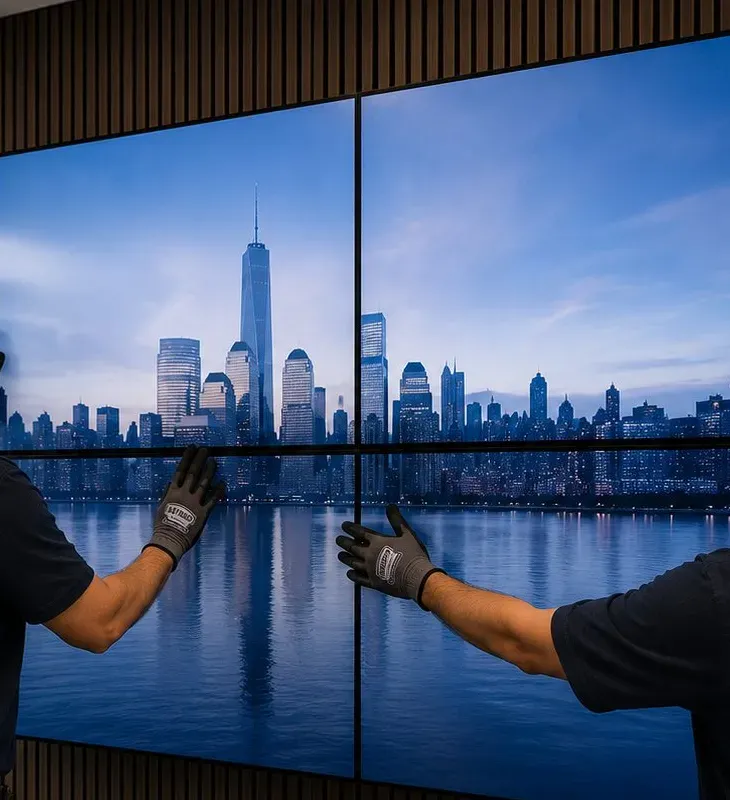
AESS job photo: a technician in grey work gloves presses the joint where four narrow-bezel panels meet, checking that the seams sit flush. The test image is a skyline at dusk; the wall behind is dark wood slats. Seam alignment is the step that decides whether a small Putnam wall looks like one picture or four televisions.
Putnam Video Wall Request
Town, building type and the room — we call back the same business day
✅
Request Sent!
A technician will call you back about the Putnam room the same business day.
25+
Years Experience
✓
Same-Day Estimates
100%
Licensed & Insured
4.7★
201 Google Reviews
Start with three photos. Text (845) 640-3835 a picture of the wall where the screens would go, one of the room from the back row, and one of the nearest electrical panel or equipment closet, with the town or hamlet. From those we can usually say whether the room wants a 2x2 LCD wall, a single large display or direct-view LED, whether the wall can carry it, and what the licensed electrician will need to add — before anyone books a survey.
A written quote the same day you ask, from the published Putnam price table further down this page
Certificates of insurance issued to the town, district, library board or congregation before the visit
New York State licensed under the security and fire alarm installer law (General Business Law §69-m), license #12000287431; electrical circuits handled by a Putnam-licensed electrician
The Neighborhood
Why Putnam County Properties Need Video Wall Installation
Putnam is a county of about 99,000 people — the Census Bureau’s July 2025 estimate is 99,028 — living in 38,713 homes, 83.8 percent of them owner-occupied. It has no downtown office towers, no arena and no convention hall. What it does have is a dense layer of public rooms that serve those households: a county 911 center that is the only public-safety answering point for the whole county, a legislature, the halls of six towns and three villages, school districts with auditoriums and cafeterias, eight public libraries, firehouses that double as training and meeting halls, and churches in every hamlet. Those are the rooms where a video wall earns its keep here, along with the basements and great rooms of the larger houses. The median owner-occupied home is valued at $471,300, and families who build a media room in Carmel, Garrison or Patterson often want more picture than a single television can give.
The county’s own records show what these rooms need. The Bureau of Emergency Services at 112 Old Route 6 in Carmel runs the Enhanced 911 system and opens the Emergency Operations Center, where, in the Bureau’s words, representatives of state agencies, emergency services, police, highway departments and utilities gather to make assessments and help the County Executive decide what to do. Its 911 center coordinates 8 police agencies, 7 EMS agencies and 13 fire departments, and answered 114,246 emergency calls in 2022. In March 2026 legislators were briefed on transfers to replace two broken monitors on the 911 center’s video wall, at roughly $10,000, and to upgrade equipment at the sheriff’s backup 911 center. A wall in a room like that is not a decoration. When one tile fails, the job is to put the same picture back on the same wall quickly, and that is decided years earlier by which panel was bought and whether a spare exists.
Public meetings tell a similar story. In July 2021 the county’s IT director told a legislative committee that the Historic Courthouse’s sound system had been designed for court proceedings rather than meetings, that any work there had to respect its historic status and be approved by the Office of Court Administration, and that the quotes for the courthouse were $10,000 for video and $11,000 for audio. The same minutes record that the Town of Carmel had invested about $180,000 in its own livestream system, with six cameras and a contracted operator. In May 2026 the legislature was still debating phased audio-visual fixes after repeated complaints about meeting sound and livestream quality. Today the Town of Carmel streams its board meetings from Town Hall at 60 McAlpin Avenue in Mahopac to YouTube, and the county posts its legislative sessions there too. Any display wall in rooms like these has to work with the cameras and microphones, not fight them.
Then there is the power. When Tropical Storm Isaias came through on August 4, 2020, NYSEG reported at 10:15 the next morning that 34,150 of its 38,693 Putnam customers were still without power — 12,717 in Carmel alone — and Central Hudson had 3,621 of its 5,160 Putnam customers out, most of them in Philipstown and Cold Spring. A display wall, its controller and its media player all have to come back on their own when the lights do, in the right order, showing the right thing, without a volunteer climbing behind the screens. And under Putnam County’s Electrical Licensing Law, Chapter 145 of the county code, the work itself is regulated: the county’s licence for low-voltage and limited-data communications technicians names audio/video cabling alongside networking, intercom and video surveillance. That is the local rule book a Putnam wall is built under.
Putnam facts behind a video wall job
99,028 residents and 38,713 homes, 83.8% owner-occupied, median home value $471,300 (Census QuickFacts, V2025 and ACS 2020–2024)
One 911 center for the county: the sole public-safety answering point, coordinating 8 police agencies, 7 EMS agencies and 13 fire departments; 114,246 emergency calls answered in 2022
About $10,000 moved in March 2026 to replace two broken monitors on the 911 center’s video wall
About $180,000: what the Town of Carmel had put into its six-camera meeting livestream system, as reported to a county committee in July 2021
34,150 of 38,693 NYSEG customers in Putnam still without power the morning after Isaias in August 2020
151,786 visits and 1,839 programs at the Mahopac Public Library alone in 2025, the busiest of the county’s eight libraries
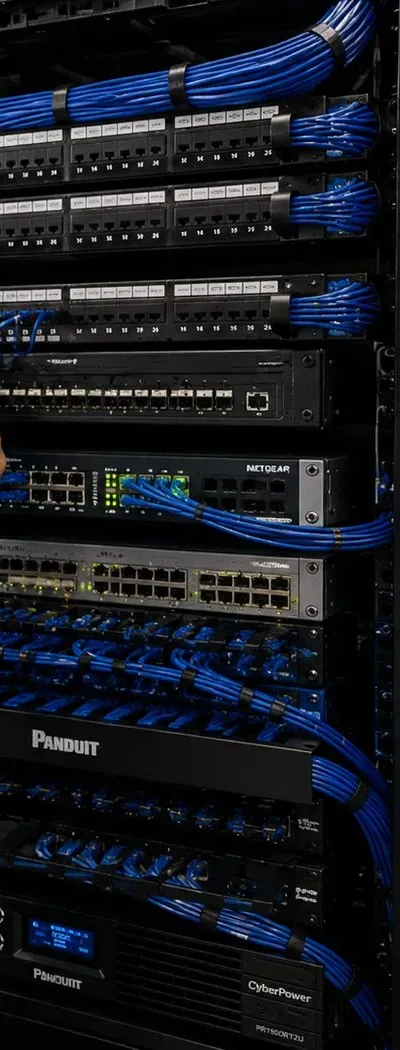
AESS job photo: a full-height rack of patch panels and switches dressed with blue patch cords, with battery backup units at the bottom of the rack. In Putnam, where whole towns lose power in a storm, the controller and media player for a wall belong on a unit like these.
Repair & Same-Day Help
Same-Day Video Wall Repair in Putnam County
A dark tile before a board meeting, a wall that shows “no signal” after a storm, a controller that lost its layout, or a projector that died the week of a school concert — call or text (845) 640-3835. Send a photo of the wall and of the control panel or input screen. Many Putnam calls end on the phone: a media player that did not restart after a power blip, an input left on the wrong source, a schedule that turned the wall off. When a visit is needed we book the next open window and most single faults are fixed within one to two hours of arrival.
One tile dark, the rest fine: usually that panel’s power supply or its signal link; a spare from your shelf goes in the same day
Whole wall dark after an outage: often the controller or player waiting for a button press; we set it to power on by itself
Colours drifting between tiles: a recalibration, not a replacement
Wall flickers when a generator takes over: a power-quality problem for the electrician and the battery backup, which we diagnose with them
Service visits are $195 an hour with a three-hour minimum ($585), the same rate across our service area.
What We Install
Video Wall Installation Services in Putnam County
Every service below is planned for the person who will run the wall on an ordinary Tuesday, not for the day of the install. In Putnam that person is a dispatcher, a clerk, a librarian, a custodian, a volunteer or a parent.
Dispatch and EOC display walls
Tiled LCD walls for 911 floors, emergency operations rooms and fire district command rooms: multiple sources on one surface, panels chosen for long duty cycles, a documented spare, and a controller on battery backup.
Meeting-room walls for streamed boards
Displays that the audience and the livestream can both read, placed so the cameras see faces rather than glare, with the presentation and any caption feed routed to the stream as well as the wall.
School cafetoriums and auditoriums
Walls that serve lunch menus and announcements by day and concerts and assemblies by night, with simple scheduling and a lockable control panel the custodian or AV club can run.
Library program and community rooms
A wall or a single large display for talks, film nights and classes, with laptop and streaming inputs at the lectern and a one-button start that any staff member can use.
Houses of worship
Lyrics, readings and live video for sanctuaries and fellowship halls, mounted to respect old plaster and woodwork, with scheduled power-on before services so nobody has to arrive early to start it.
Home media rooms and great rooms
Multi-panel or direct-view LED walls for basements and great rooms, planned with the seating distance, the window light and the room’s audio, and set up so the family runs it from one remote.
Retail and office displays on the Route 6 and Route 22 corridors
Menu boards, showroom walls and office reception displays for small businesses, with content that staff change from a phone or laptop.
Replacement tiles, controllers and projector swaps
Matching a new tile to an older wall, replacing a failed controller or media player, and replacing a tired projector with displays that need no lamps and no darkened room.
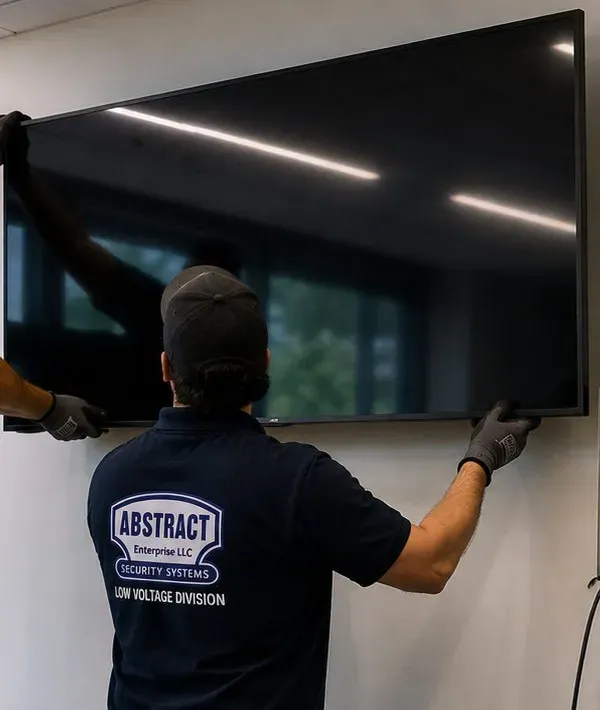
AESS job photo: seen from behind, a technician in an Abstract low-voltage division shirt and gloves raises a large flat panel onto its wall bracket in a room lit by long strip lights. Single screens and tiled walls both start with a bracket fixed to something that can carry the weight.
Building Specialists
Video Wall Installation for Putnam County’s Architecture
Putnam’s public rooms were built across two centuries. The wall a display hangs on decides the mounting, the cable path and sometimes whether a fixed wall is possible at all.
Public-safety buildings
Purpose-built rooms with block walls, raised or sealed floors and equipment rooms nearby. The wall goes on a rail anchored into masonry, the controller into the existing rack, and nothing interrupts dispatch: we work a section at a time and hand each screen back before taking the next.
Historic halls and the courthouse
Plaster on lath, tall windows, decorative trim and, in the Historic Courthouse, approvals beyond the county’s own. Displays go on freestanding or floor-supported frames where fixing to the wall is not allowed, with cables in removable raceway rather than chased into old plaster.
School buildings from several eras
Block-walled classrooms and gyms, newer steel-framed additions like Brewster’s 13,400-square-foot cafetorium, and auditoriums such as Mahopac High School’s, where the district’s capital plan includes lighting and audio upgrades. Mounting, conduit and power differ wing to wing, and work is scheduled around the school calendar.
Library buildings
Older reading rooms beside newer additions and lower-level program rooms. Quiet matters: fans and switches go out of the room, and installs happen before opening or on closed days.
Churches and parish halls
High ceilings, stone or plaster, stained glass light and wooden trim. Sightlines from the back pews decide height and size; the mount is reversible where the building’s history calls for it.
Houses: split-levels, colonials and newer builds
Most of Putnam’s homes are detached houses on wooded lots. Basement media rooms have concrete on one side and framing on the other; great rooms have big windows. Each needs its own mounting and light plan.
Materials and methods by building type
Block and poured concrete (firehouses, schools, basements): sleeve anchors into solid block cores, surface conduit or raceway for cable, and recessed boxes only where the core allows them.
Steel studs (newer additions and offices): backing plates or a horizontal rail spanning several studs, because one stud will not carry a tiled wall’s weight on its own.
Wood frame (houses, parish halls): blocking added behind drywall during rough-in, or a rail lagged across studs; we find every stud before marking a hole.
Plaster on lath (older halls and churches): no recessed boxes in the plaster; cable in painted raceway or through the floor below; a floor-supported frame when the wall itself is the protected part.
Stone and brick (older churches and village buildings): anchors into the mortar joints or the masonry units as the wall allows, and a freestanding frame when the owner prefers no holes at all.
Weight drives these choices. A 2x2 wall of 55-inch commercial panels, with its mounts, weighs a few hundred pounds hung on a single plane; a direct-view LED wall of the same size can weigh more. The mounting plan, with the fixings named for the actual wall, is part of every written proposal.
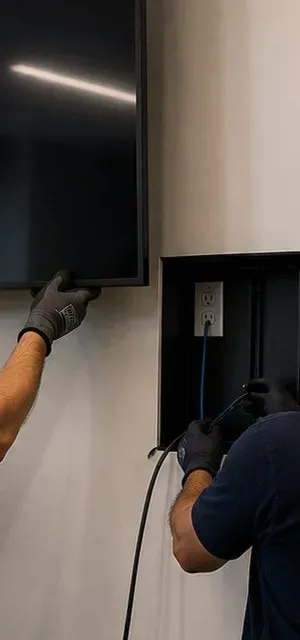
AESS job photo, cropped: a recessed box with an outlet and a data cable sits in the wall behind the edge of a mounted screen while a technician finishes the connection. Recessed boxes keep plugs and cables from pushing a flush wall away from the surface.
Commercial Video Walls
Business Video Wall Installation in Putnam County
Putnam’s commercial life runs along a handful of state routes rather than in a business district. These are the corridors our Putnam display calls come from, and the kind of building on each.
Route 6 through Mahopac and Carmel
The county’s busiest commercial strip: shopping centres, restaurants, banks and offices, plus the Mahopac Fire Department at 741 Route 6. Menu boards, reception walls and training-room displays.
Carmel hamlet and the county campus
County offices, the Historic Courthouse and the Bureau of Emergency Services on Old Route 6. Dispatch, emergency-operations and meeting-room displays, with public-sector approvals.
Route 22 and Main Street, Brewster and Southeast
Village storefronts, the Metro-North terminus and offices in the Brewster area, with the Brewster school district’s new building work nearby. Retail displays and office walls.
Route 52 and Route 301, Kent and Lake Carmel
Neighbourhood businesses around Lake Carmel and Kent Lakes, firehouses such as Lake Carmel on Route 52, and the Kent Public Library, busy with 74,219 visits in 2025.
Route 311 and Route 22, Patterson
Small commercial centres, town offices and the Patterson Library, with lake communities around Putnam Lake to the east.
Route 9 and Main Street, Philipstown and Cold Spring
Village shops and restaurants on Main Street, the Butterfield and Desmond-Fish libraries, and firehouses in Cold Spring, Garrison and North Highlands. Displays here are usually indoors and discreet.
Compliance callouts for Putnam display work
Putnam County Code Chapter 145. The county licenses low-voltage/limited-data communications technicians for cabling systems including “audio/video” and “video surveillance” that operate at 90 volts or less and five amperes, where the work starts at an outlet or connection a licensed electrician installed. The chapter says no one may carry on that trade in the county unless licensed or registered under it. Ask any installer, including us, how they meet it, and check the county’s published list of licensed low-voltage technicians.
New circuits are electrician’s work. The county licenses master electricians separately, and Consumer Affairs notes that electrical permit applications in the Towns of Carmel, Patterson and Putnam Valley are filed directly with those towns’ building departments. We write the electrician’s scope into our proposal as its own line.
Home improvement registration. Putnam Consumer Affairs runs a mandatory registration programme so that contractors working on residential properties are insured, bonded and covered by workers’ compensation. A home media-room job falls under it.
Accessible routes. A display hung beside a corridor or walkway in a public building must not become a protruding hazard; the 2010 ADA Standards limit objects whose leading edge is between 27 and 80 inches above the floor to a 4-inch projection into circulation paths. We place walls out of the path or recess them.
Historic rooms. Work inside the Historic Courthouse needs the Office of Court Administration’s approval as well as the county’s, according to the county’s own minutes; other historic buildings have their own review boards for exterior changes.
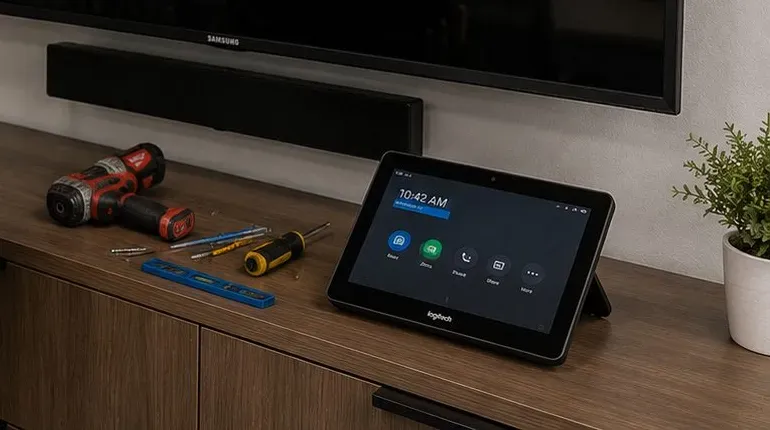
AESS job photo: a tabletop touch panel displaying a clock and a row of room buttons sits on a wood console under a wall-mounted screen and soundbar, with a drill and screwdrivers nearby. One clearly labelled panel is how volunteers and front-desk staff run a wall without training.
Your Questions Answered
Video Wall Installation in Putnam County: Questions Answered
These are the questions Putnam agencies, schools, congregations and homeowners raise when a wall is being planned. Each is answered here once.
Rooms That Cannot Go Dark: Dispatch, Emergency Operations and Public Safety
If the original monitor model is discontinued, how do you make a replacement tile match the rest of the wall?
First we look for the same model through the manufacturer’s service channel and distributors, because commercial video-wall panels are often supported for years after they leave the catalogue. If it truly is gone, we pick the current model with the same outside dimensions and bezel width, check that it fits the existing mount, and calibrate brightness and colour on the new tile and its neighbours together. On an older wall the honest answer is sometimes to replace a whole row so the mismatch sits at an edge rather than in the middle. We show the options and prices before ordering anything.
That is why our proposals for public-safety walls name the panel model, its published end-of-life information where the maker provides it, and a recommended number of spares bought at the same time from the same production run.
How many spare tiles should a public agency buy with the wall, and where should they be kept?
For a wall of four to nine panels we usually recommend one spare panel; for larger walls, roughly one per ten, plus a spare media player or controller card if the design depends on one. Spares should be stored in their original boxes, indoors, in a heated and dry room in the same building, labelled with the wall they belong to and the date they were bought. A spare kept in a garage or a cold storage container is a spare you may not be able to use.
We record the serial numbers of the installed panels and the spares on the handover sheet, so that a replacement next year goes in as a like-for-like swap.
Can one wall show the dispatch map and a training slide deck side by side in a fire district classroom?
Yes. A video-wall controller or processor can split the wall into windows from different sources: a computer showing a map, a laptop with a presentation, a camera feed, a news channel. Layouts are saved as presets, so an instructor picks “training” or “incident” from a panel instead of rearranging windows by hand. The limit is the number of inputs the controller has, which we size to the sources you list at the survey plus one or two spare.
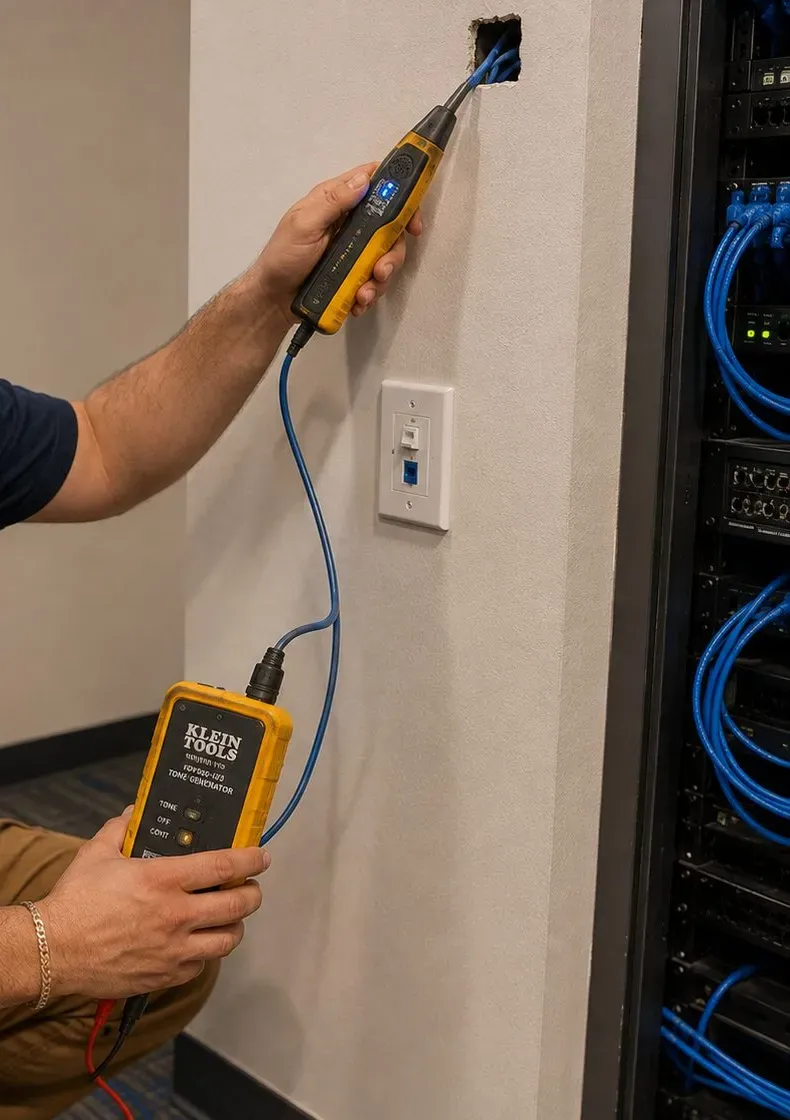
AESS job photo: a yellow tone generator and probe trace a blue cable where it leaves a hole in the wall beside an equipment rack. In older Putnam town halls and churches we trace what is already in the wall before deciding whether to reuse it.
Streamed Meetings in Town Halls and Historic Rooms
Our board meets in a room built for court proceedings. Can displays go in without changing the historic interior?
Usually, yes, by not attaching anything to the parts of the room that matter. Displays can stand on floor-supported frames or mobile stands that can be wheeled aside, cables can run in removable raceway along existing trim lines or under the floor, and the electronics can sit in a cabinet in an adjoining office. In the Putnam Historic Courthouse the county’s own minutes note that work needs Office of Court Administration approval and must respect the building’s historic status, so the drawings we prepare for such a room are written to be submitted for review.
Will a wall of screens behind the board spoil the livestream picture?
It can, if it is planned without the cameras. A bright wall behind the dais makes cameras darken faces, and fine screen patterns can shimmer on video. The fix is placement and settings: put displays on the side walls facing the audience rather than behind the speakers, or lower the wall’s brightness during meetings; aim cameras so screens are out of frame or only at the edge; and send the presentation to the stream directly, so remote viewers see the slides crisp rather than filmed off a screen. We test with the room’s actual cameras before handover.
Can the screens in the room show exactly what remote viewers see on YouTube?
Yes. The cleanest arrangement is a small switcher or encoder that takes the presenter’s laptop, the meeting cameras and any caption feed, and sends one programme both to the room displays and to the streaming platform. Then residents in the room and residents at home see the same slide at the same time. Where a town already has an operator-run system, like the six-camera arrangement the Town of Carmel described to the county in 2021, we connect the new displays to it rather than replacing it.
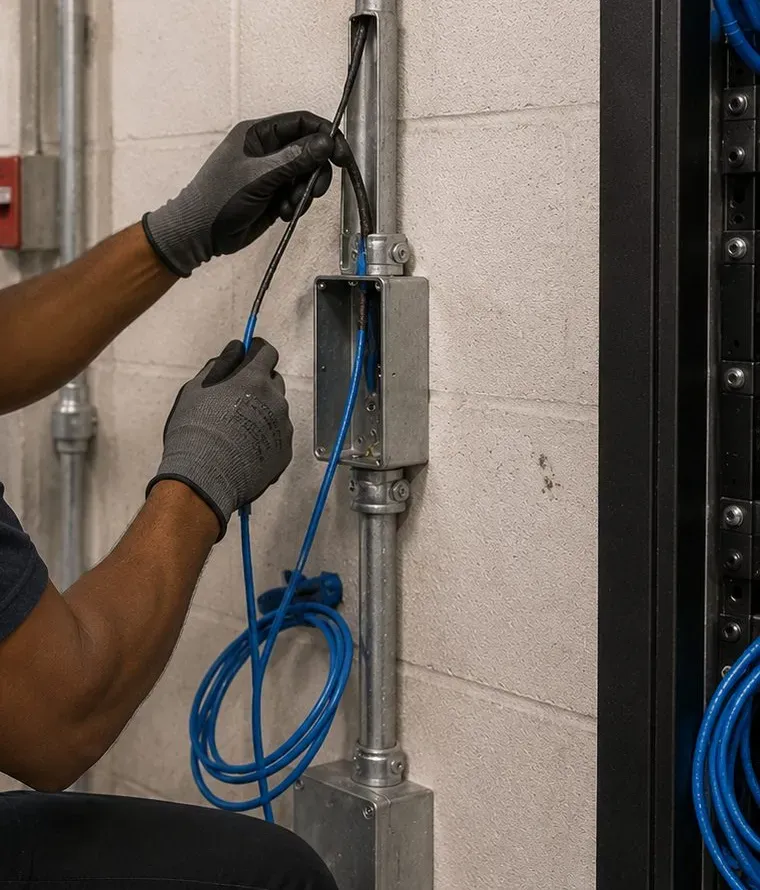
AESS job photo: a technician draws blue cable out of a steel conduit box fixed to a painted concrete-block wall, with a coil of cable below. Block-walled school and firehouse rooms often get their display cabling in surface conduit like this.
Schools, Libraries and Congregations
Can a cafetorium wall be a lunch-menu board by day and an auditorium screen at night?
Yes, and that is the right use for a room like Brewster’s new cafetorium, which the district describes as a space for a full grade at lunch or an audience for performances. A scheduled media player shows menus and announcements during school hours, and a wall plate at the stage edge takes a laptop or the auditorium camera for evening events. A locked control panel with three or four labelled buttons keeps students from changing it, and the schedule returns the wall to the daytime content on its own the next morning.
Can library staff with no AV training change what the program-room wall shows?
They should be able to, or the wall will sit unused. We set up a short list of sources — the lectern laptop input, a wireless presentation receiver, the library’s own media player and a streaming stick for film nights — and put them on a single labelled panel. Content for the player is changed by dragging files into a shared folder or a web page. Training is twenty minutes with whoever runs programmes, and a laminated card stays by the panel. With Putnam’s eight libraries running between 467 and 1,839 programmes each in 2025, the wall has to be something any staff member can start at 6:55 p.m.
Can the sanctuary wall switch itself on before Sunday service and off afterwards?
Yes. Commercial displays and controllers accept schedules, so the wall can wake at 8:30 a.m. on Sundays with the welcome slide, switch to the presentation computer when it is turned on, and power down after the last service. Holy days and special services are added to the schedule from a laptop. Scheduling also protects the panels, which last longer when they are not left on all week by accident.
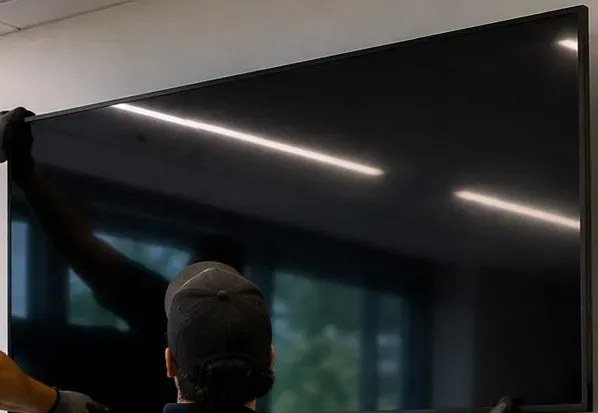
AESS job photo: a technician in a cap guides a large display up to its mount; reflections of the room’s strip lights run across the dark screen. Reflections like these are what a library or town-hall wall has to be planned around before the first bracket goes up.
Power, Storms and Restart
What should the wall do when the power drops for two seconds and comes back?
Nothing visible, ideally. Short dips and flickers are common on long overhead lines, and they are what most often leaves a wall dark: the screens come back but the media player or controller does not, or comes back on the wrong input. We put the player, controller and network switch on a battery backup so they ride through short dips, and we set every display to return to its last state and input when power is restored. Then we test it by switching the circuit off and on while you watch.
Is a battery backup worth it for the screens themselves, or only for the controller?
For most Putnam walls, back up the brains and protect the screens. A battery unit sized to carry a whole tiled wall for any length of time is large and expensive, while one sized for the controller, player and switch is small and inexpensive. The screens get surge protection and a clean restart setting. The exception is a dispatch or emergency-operations room, where the building’s generator and the agency’s own power plan decide what stays lit, and we fit the wall into that plan with the agency’s electrician.
Our building switches to a generator during outages. Will the wall survive the changeover?
It should, if the generator and transfer switch are healthy and the electronics have a battery bridge. The moment of transfer causes a brief interruption; without a battery unit, controllers and media players restart, which is the most common cause of a “no signal” wall after an outage. Some generators also produce less stable power than the utility; electronics on a battery backup with conditioning are shielded from that. If a wall flickers whenever the generator runs, we ask the electrician to check the generator’s output while we test the display side.
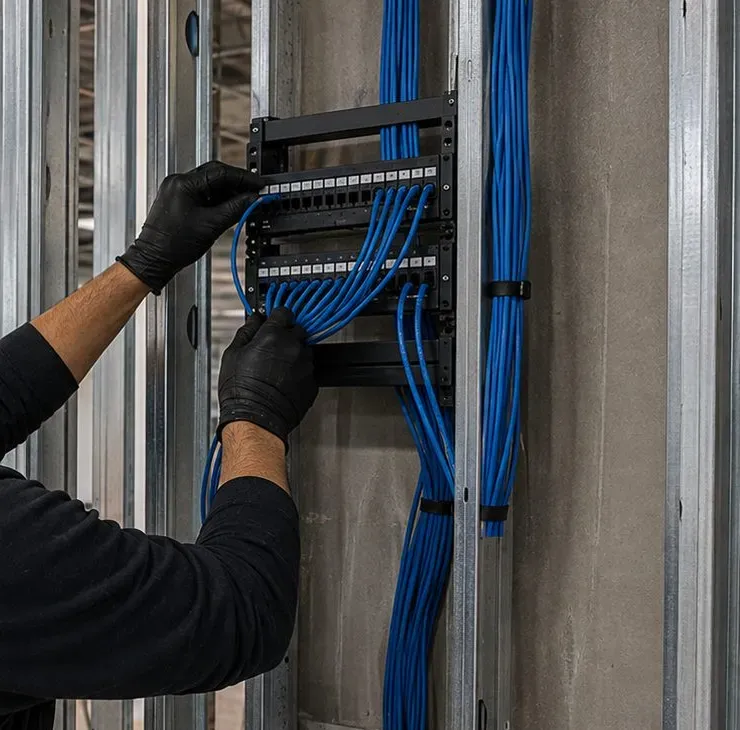
AESS job photo: blue cables dressed down a metal-stud wall into a small wall-mounted patch panel, with a technician seating the terminations. A display wall in a school or library usually gets its own labelled ports on a panel like this.
Licensing and Who Does What in Putnam
Does Putnam County require a licence to install video wall cabling?
Putnam regulates it at county level. Chapter 145 of the county code defines a low-voltage/limited-data communications technician as someone who installs or maintains cabling systems for networking, telecommunications, cable television, intercom, audio/video, fiber optics and video surveillance operating at 90 volts or less and five amperes, starting from an outlet or connection installed by a licensed electrician, and it says no one may carry on that trade in the county unless licensed or registered. A master electrician may also do that work. The county publishes its lists of licensed master electricians and low-voltage technicians on the Consumer Affairs page.
Our New York State licence is #12000287431, and we are glad to show how we meet the county’s requirements on any Putnam job; check the county list for any installer you hire.
Who installs the new outlet for the wall, and who files for the electrical permit?
A Putnam-licensed electrician installs the circuit and outlets; we install everything that plugs into them and the low-voltage cabling between. The county’s Consumer Affairs page says electrical permit applications for locations in the Towns of Carmel, Patterson and Putnam Valley are filed directly with those towns’ building departments; the electrician knows the routine in the other towns and villages. We give the electrician the wall’s power draw, the box locations and heights, and the schedule, so the rough-in happens once.
Running the Wall Day to Day
Who should hold the administrator login for the wall’s content system in a town or district office?
The organisation, not a person and not the installer. We create the administrator account under a shared office address the town, district or library controls, give day-to-day staff their own accounts with permission only to change content, and hand the administrator password over at the end of the job for the client to change. When a clerk or librarian moves on, the account is disabled and the wall keeps running. If the client asks us to keep emergency access, that is written down; by default we do not.
The same goes for the controller’s web page and the media player: every login is recorded on the handover sheet, and default passwords are changed before we leave.
Can a lobby wall in a public building carry storm and closure notices?
Yes. A notice zone can be added to the layout, or the whole wall can switch to a notice slide that staff publish from a phone or laptop. Residents can sign up for county messages through Putnam Alert, which the county links from its website, and for state messages through NY-Alert; a lobby wall is a good place to repeat what those services send: closures, warming and cooling locations, road conditions. Keep the wording identical to the official message and keep the official source on the slide, so the wall never contradicts the county.
For buildings that open as warm or cool places for the public — the county’s libraries describe offering cool spaces in summer and warm spaces in winter — we make sure the wall and its player are on the circuits the building keeps alive.
How do volunteers get their slides onto the wall without plugging in a laptop each time?
Through a shared folder or a web dashboard tied to the media player. A fire company, a parent association or a church office drops images or short videos into the folder, and the player picks them up on its next check and adds them to the rotation. Items can carry start and end dates so last month’s fundraiser does not linger. For live presentations, a wireless presentation receiver lets a guest speaker share a laptop screen with one click, while the wall’s own schedule stays untouched.
Where should displays go so wheelchair users and people in the front row can see them comfortably?
Not too high and not too close. In a meeting room or library hall the front row and the wheelchair spaces are usually nearest the wall, so a wall hung high for the back rows forces them to look sharply upward for an hour. We set the height from the actual seating plan, leave wheelchair positions where the screen is in a natural line of sight, and in long rooms add a second, smaller display partway back rather than raising the main wall. Cables and floor boxes are kept out of the accessible route to the front.
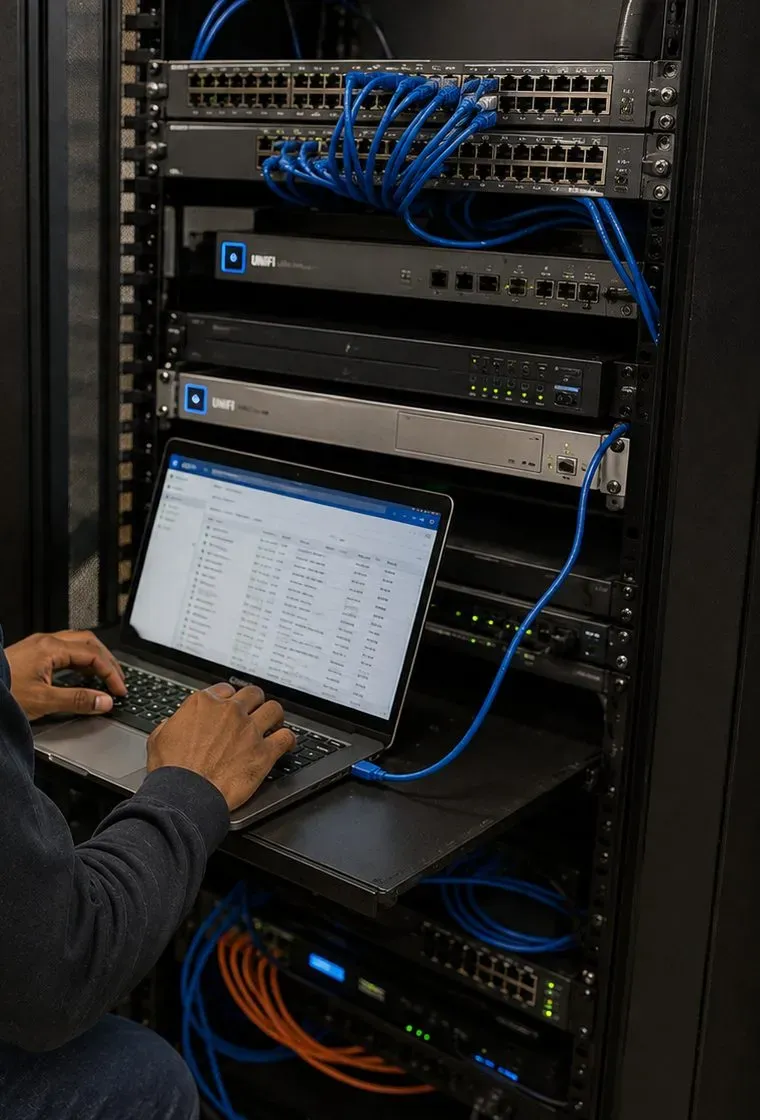
AESS job photo: a laptop on a pull-out rack shelf shows a configuration page while blue and orange patch cords connect the switches above and below. Networked walls and media players get their addresses, schedules and restart settings from a screen like this before handover.
Homes: Media Rooms and Lake Houses
Is a video wall sensible for a basement media room, or is one large TV better?
For most basements, one large display is better: no seams, lower cost, simpler control. A tiled LCD wall makes sense when the room needs several pictures at once — four games on a Sunday, a gaming setup beside a film — and a direct-view LED wall when the owner wants a seamless picture larger than any television sold, and has the budget for it. We walk through the room’s seating distance, ceiling height and window light, and recommend the simplest system that does what the family will actually use.
Can a wall in a seasonal lake house be left unpowered and unheated all winter?
Check the panels’ storage-temperature rating first; it is published on the manufacturer’s specification sheet and differs from model to model. If the house drops below that rating in January, keep the room heated to a minimum or choose panels rated for it. Condensation is the other risk: when a cold house is opened and heated quickly, let the screens warm up with the room for several hours before switching them on. We leave these steps on the handover sheet for owners who close up for the season.
Before the Survey
What to Gather Before a Putnam Survey
A survey takes an hour or two. It goes faster, and the proposal is more accurate, when a few things are ready. None of them requires technical knowledge.
How the room is used. A typical week: meetings, classes, services, events, and who runs them. A wall for a weekly board meeting and a wall for a dispatch floor are different purchases.
What has to be on screen. Laptops, a building computer, cameras, a streaming feed, cable TV, a media player with announcements. List them, including the ones you might add next year.
Who approves. A town board resolution, a district’s facilities office, a library board, a parish council, a co-owner. We write the proposal for that reader.
Any drawings. Floor plans or old renovation drawings help locate studs, conduit and electrical panels in older public buildings.
The electrician. If the building has an electrician it trusts, their name and number. If not, we work with a Putnam-licensed electrician who knows the town’s permit routine.
Deadlines. A meeting, a school opening, a holiday service or a grant spending date. We plan backward from it, including lead time for panels and any approvals.
If the room is in a historic building or a court building, tell us at the start. The drawings for a removable or floor-supported installation are different from a standard wall mount, and the approving body will want to see them before work is scheduled.
For homes, the useful details are simpler: where people sit, which windows face the wall, what the family watches, and where the internet router and the electrical panel are. Photos of those, sent ahead, often save a second visit.
Equipment
Types of Video Wall Installation We Install
We are not tied to one display brand. Panels and controllers are chosen for the room, the duty cycle, parts availability and the warranty support available in the region, and we show the alternatives in writing.
Narrow-bezel LCD video-wall panels
Commercial 46- to 55-inch panels with thin borders, built for long daily hours and tiled in grids. The usual choice for dispatch, meeting and school walls, where several sources share one surface.
Direct-view LED
Seamless walls built from LED cabinets, specified by pixel pitch. For large rooms, sanctuaries and premium media rooms where a seam-free picture is the point.
Large single displays
Commercial 75- to 98-inch displays for library rooms and smaller halls where one picture is enough and a tiled wall would be more than the room needs.
Video-wall controllers and processors
Hardware that splits, scales and arranges sources across tiles, with saved layouts for different uses of the room.
Media players and scheduling
Small players that store content and run it on a calendar, keep playing when the internet drops, and restart on their own after an outage.
Mounts, rails and frames
Pop-out and push-in video-wall mounts for service access, continuous rails across studs or masonry, and floor-supported frames for rooms where the wall cannot be fixed to.
Signal transport
HDBaseT over category cable, fiber for long runs between rooms or buildings, and wall plates at lecterns and stages.
Room control
A single labelled touch panel or keypad that starts the room, picks the source and shuts down, so nobody needs a stack of remotes.
Battery backup and surge protection
Rack or cabinet units that carry the controller, player and switch through dips and short outages, and surge protection for the screens.
Meeting cameras and audio tie-ins
Cameras, encoders and connections to the room’s microphones so the wall, the room and the livestream show the same thing.
AESS job photo, cropped: gloved hands steady the top edge of a large, switched-off display as it is set on its mount, with ceiling strip lights reflected in the black glass.
Sizing
How Big Should a Putnam Room’s Wall Be?
Most rooms we survey in Putnam are smaller than the photographs in display catalogues, and the right wall is the smallest one that does the job. Three measurements decide it: how far the back row sits from the wall, how much text has to be read from there, and how many different things must be on screen at the same time. Size follows from those, not the other way round.
Putnam room
What usually fits
What decides it
Library program or community room (40–80 seats)
One large display or a 2x2 LCD wall
Readable slides from the back row matter more than size; glare from windows decides placement.
Town or village board meeting room
Two side-wall displays or a 2x2 wall facing the public
Placed for the audience and kept out of, or at the edge of, the meeting cameras’ frame.
Dispatch, EOC or fire district training room
3x3 or larger LCD wall with a controller
Several sources at once: maps, feeds, news, presentations, in saved layouts.
School cafetorium or auditorium
Direct-view LED or a large LCD wall at the stage
Bright enough for a lit room at lunch, controllable for evening events.
Sanctuary or parish hall
Direct-view LED or paired large displays
Sightlines from the back pews and the building’s fabric decide the mount.
Home media room or great room
One large display, or LED for a seamless large picture
Seating distance, window light and how many pictures the family actually watches at once.
Viewing distance and text. Slides in a library room or a board meeting are mostly text: agendas, budgets, maps, captions. The test we use at the survey is simple and visible: we put a typical slide on a laptop or a temporary display at the proposed size and ask someone to read it from the last seat. If they cannot, the wall is too small or the content must change. If they can read it comfortably from halfway, the wall may be bigger than needed.
One picture or many. A single large display shows one thing well. A tiled LCD wall exists to show several things at once, or one picture larger than any single display, at the cost of thin seams between tiles. Direct-view LED removes the seams but is priced by area and pixel pitch. A Putnam meeting room that only ever shows one presentation is often better served by two matched displays on the side walls than by a tiled wall behind the board.
Pixel pitch for LED. Pitch is the distance between LED pixels; finer pitch is sharper up close and costs more. Our Putnam table lists 3.9mm, 2.5mm, 1.9mm and 1.5mm options. A sanctuary or cafetorium viewed from well back rarely needs the finest pitch; a media room with a sofa close to the wall may. We show the same content on sample pitches before anyone chooses.
LCD or LED over the years. The two technologies age differently, which matters to a board planning a ten-year asset. A tiled LCD wall is a set of separate displays: when one fails, it is swapped as a unit, and the swap is quick if a matching spare exists. A direct-view LED wall is built from cabinets and small modules: a failed module is replaced from a stock of spares, but modules from a later production run may need recalibration to match. Either way, the spares plan is written into the proposal, and the maintenance line in our Putnam table covers periodic calibration so tiles that drift are brought back in line before anyone notices.
Brightness and the room. A library room with blinds and a church with stained glass need very different brightness. Too bright is a problem as well as too dim: a wall turned up for a sunny afternoon is tiring in an evening meeting and makes cameras struggle. Commercial panels can follow a brightness schedule or a light sensor, and we set both at the survey hour and at the evening hour the room is used most.
Height. In rooms where people sit, the bottom of the wall usually sits just above head height of the seated audience in front, so the back rows see over the front. In standing rooms, such as lobbies, it goes higher. In every public building we check that the mount does not project into a walkway.
AI Overview Reality Check
What AI Gets Wrong About Video Wall Installation in Putnam County
We could not view Google’s AI Overview, People Also Ask or related searches from our research tools for this edition. What follows tests seven claims that appear in widely read cost guides and forums — the material AI summaries and aggregator sites like Angi, HomeAdvisor and Fixr tend to repeat — against what Putnam’s own records show.
“Most installed walls run about $500 to $2,500 per square foot”
That benchmark comes from an LED-wall price guide, and it describes direct-view LED priced by area. It is a fair way to price a sanctuary-sized LED wall. It is the wrong frame for most Putnam projects, which are tiled LCD walls priced per panel, plus mounting, controller and labour.
A 2x2 wall of 55-inch LCD panels in our Putnam table runs $11,000 to $16,500 installed. Divided by its area, that number means little; what matters is the panel count, the controller and the wall it hangs on.
Ask any quote, ours included, to state which kind of wall it prices, and to break panels, mounting, processing, power coordination and labour into separate lines.
“A 10-by-5-foot P2.9 LED kit costs $11,000 to $15,000 online”
One display company’s 2026 guide lists online LED kits at roughly that price and points out, correctly, that they are hardware only: event-grade cabinets, a basic sending card and a simple frame.
What the kit leaves out is what a Putnam room needs most: a mount designed for that wall, a circuit run by a licensed electrician, calibration so the cabinets match, and someone who will come back when a module fails.
A kit can be the right answer for a portable event screen. For a dispatch room or a church wall that has to work every week, the missing lines are the expensive part.
“Installation adds 15 to 30 percent on top of hardware”
Several guides use a percentage like this. In a Putnam public room the cost that percentage misses is coordination: the meeting cameras, the livestream, the historic-room approvals, the school calendar, the electrician’s circuit.
The county’s own figures make the point. In 2021 the IT director’s quotes for the Historic Courthouse were $10,000 for video and $11,000 for audio, separate from any displays, and Carmel’s livestream system had cost about $180,000.
We price those items as their own lines, so a board can see what the wall costs and what the room around it costs.
“Any TV will do for a video wall”
Forum threads in the commercial AV community answer this one bluntly: consumer televisions may not fail at once, but used as a wall they can burn in, lose colour and brightness, and show wide seams; commercial displays are rated for far longer daily operation.
We agree for public rooms. A 911 floor or a library that runs its wall all day needs panels rated for that duty and sold with commercial warranty terms. The county’s own 2026 replacement shows that tiles do fail in service.
In a home media room used a few evenings a week, a single good consumer television is often the better buy than a cheap tiled wall.
“The wall can range from $15,000 to $200,000”
A commercial AV installer on Reddit gave roughly that range, adding that mounting structure alone could run tens of thousands on some jobs. It is honest for large corporate and venue walls.
Putnam’s scale is usually smaller. Replacing two failed tiles on the county’s 911 wall was budgeted at about $10,000, and our Putnam table starts at $11,000 for a complete 2x2 wall.
The useful question is not the range but which line items your room actually needs, and that takes a survey.
“New York has no statewide contractor licence, so anyone can install it”
It is true that New York does not license most trades statewide; one contractor-licensing guide is headlined exactly that. But Putnam licenses at county level.
Chapter 145 of the Putnam County Code requires a licence or registration for low-voltage/limited-data communications work, and names audio/video cabling among the systems covered. New circuits are master-electrician work, also licensed by the county.
So in Putnam the right question is not “does the state license this?” but “is this installer on the county’s list, or working with someone who is?”
“Keep voltage within ±5 percent and the wall will be fine”
An LED price guide lists stable voltage, within five percent, as an installation must. Good advice, but it assumes the power is there. In Putnam the bigger risk is the power disappearing: Isaias left 34,150 of NYSEG’s 38,693 Putnam customers without power the next morning.
What protects a Putnam wall is a battery backup on the controller, player and switch, surge protection on the screens, and displays set to restore themselves.
Every Putnam handover includes a power-off test: we cut the circuit, restore it, and watch the wall come back to the right picture without anyone touching it.
Planning a Wall for a Board, District or Congregation?
A ten-minute call before the item goes on the agenda saves a second round of questions. We will tell you what the room needs, what it does not, and what the electrician and any approving body will ask.
For a Putnam County video wall quote, tell us the town or hamlet, the room and how it is used, how wide the wall is and how far back the audience sits, and who approves the work. A written price comes back the same business day; to talk first, call (845) 640-3835.
✅
We Got Your Request!
Received. A technician is reading your Putnam room details and will phone you today. If it cannot wait, the Putnam line is (845) 640-3835.
How It Works
Our Installation Process
Seven steps, the same for a 2x2 library wall and a dispatch floor. The order exists because public rooms in Putnam answer to boards, districts and schedules, and because the electrician’s work and ours have to meet in the same box.
1. Photos, room use and a call
Pictures of the wall, the room from the audience side, the electrical panel and any rack, plus a call about who uses the room, when, and who has to approve the work.
2. Site survey at the hour the room is used
Measure the wall and the viewing distance, check light from the windows, find the studs or masonry, trace existing cable and see where the controller and battery backup can live.
3. Written proposal with options
Screen count and size from the published Putnam price table, a drawing of the layout, the electrician’s scope written as its own line, spares, and certificates of insurance.
4. Rough-in
Recessed power and data boxes, cable paths labelled at both ends, and blocking or a rail for the mount — coordinated with the licensed electrician’s circuit.
5. Mount, hang and align
Rails levelled, screens hung and seams aligned, then the controller, media player and battery backup installed and tested.
6. Calibrate and program
Colour and brightness matched across tiles, inputs and schedules set, auto-power-on after an outage confirmed, and the control panel labelled in plain words.
7. Handover to staff
The person who will run the wall turns it on, changes content and restarts it with us watching, and keeps a one-page guide and the spare-tile record.
Coverage Area
Video Wall Installation Near Putnam County’s Landmarks
We work across all six towns and three villages. These are places that came up in our research for this page, each showing a different kind of Putnam room where displays matter.
Bureau of Emergency Services, 112 Old Route 6, Carmel
Home of the county’s 911 center and Emergency Operations Center; the wall whose two failed monitors the county replaced in 2026.
Historic Putnam County Courthouse, Carmel
Where the legislature meets in a room designed for court proceedings, and where audio-visual changes need court-system approval.
Carmel Town Hall, 60 McAlpin Avenue, Mahopac
Town board meetings streamed live to YouTube from a multi-camera system the town described to the county in 2021.
Mahopac Public Library, Mahopac
The county’s busiest library in 2025, with 151,786 visits and 1,839 programmes.
C.V. Starr Intermediate School, Brewster
Site of the Brewster district’s 13,400-square-foot cafetorium addition, scheduled for completion in late fall 2026 or early winter 2027.
Julia L. Butterfield Memorial Library, Cold Spring
55,034 visits and 1,096 programmes in 2025, and the Philipstown library at the river end of the county.
We also serve Mahopac Falls, Lake Carmel, Kent Lakes, Putnam Lake, Lake Peekskill, Garrison, Nelsonville, Continental Village and Southeast, and the neighbouring counties of Westchester and Dutchess.
Town by Town
Video Walls Across Putnam’s Six Towns and Three Villages
Carmel and Mahopac
The county seat and the largest town: county offices, the Historic Courthouse and the Bureau of Emergency Services in Carmel hamlet, Town Hall and the Route 6 commercial strip in Mahopac. It was also the hardest hit after Isaias, with 12,717 NYSEG customers out the next morning. Walls here are as likely to be in a public-safety building or a streamed meeting room as in a shop or a house, and electrical permits in the Town of Carmel go to its own building department.
Southeast and the Village of Brewster
Main Street storefronts, the Metro-North terminus and the Brewster school district, which voters approved a capital project for in March 2023 that includes the new C.V. Starr cafetorium and a high school field house. Southeast had 5,220 NYSEG customers out after Isaias, Brewster village 818. The Brewster Public Library logged 42,075 visits and 900 programmes in 2025.
Kent
Lake Carmel and Kent Lakes neighbourhoods, the Kent Public Library — 74,219 visits and 901 programmes in 2025 — and the Kent and Lake Carmel fire departments on Route 301 and Route 52. Kent had 5,815 NYSEG customers without power the morning after Isaias, so restart behaviour matters here as much as anywhere.
Patterson
Town offices, the Patterson Library (35,510 visits in 2025) and the Patterson and Putnam Lake fire departments. Electrical permit applications for Patterson are filed with the town’s building department, according to the county. After Isaias, 4,422 NYSEG customers were out in the town.
Putnam Valley
Lake Oscawana and Lake Peekskill communities, Oregon Corners and the Putnam Valley Free Library, which had 70,856 visits in 2025. Putnam Valley also files electrical permits with its own building department. NYSEG had 5,088 customers out here after Isaias.
Philipstown, Cold Spring, Nelsonville and Garrison
The river towns, served mostly by Central Hudson rather than NYSEG: after Isaias, Central Hudson reported 2,475 customers out in Philipstown, 992 in Cold Spring and 154 in Nelsonville. Philipstown posts its board agendas, minutes and meeting video on the town website. The Butterfield library in Cold Spring and the Desmond-Fish library in Garrison (47,927 visits in 2025) run busy programme calendars; display work in these villages is mostly indoors and kept discreet.
Storm Season
A Storm Plan for a Putnam Video Wall
Putnam’s storms arrive with warning more often than not, which gives a facilities manager, a pastor or a homeowner a day to prepare the wall. This is the short plan we leave with every Putnam installation.
Before the storm
Check the battery backup’s status light and press its self-test if it has one; a battery that failed quietly protects nothing.
Confirm the media player has the content it needs stored locally, in case the internet goes down with the power.
In buildings that will open as warming or cooling spaces, put the closure and shelter slide in the schedule ready to publish.
At a lake or seasonal house, decide whether to shut the wall down and unplug it until the storm passes.
During an outage
Leave the screens off if the battery unit is carrying only the controller and player; that is what it was sized for.
If the building runs on a generator, expect a brief restart of anything not on battery when power transfers.
Do not reset or reconfigure the controller during flickers; wait until power is steady.
When power returns
Watch the wall come back. If every screen wakes on the right picture, nothing more is needed.
If one tile stays dark, power-cycle that tile alone at its outlet or breaker before anything else.
If the whole wall shows “no signal”, check that the player or controller restarted; the label on the rack says which button to press.
If anything still looks wrong, send a photo to (845) 640-3835; most post-storm faults are settings, not hardware.
Storm damage from a surge can reach a wall through the power line or through a long data cable from another building. Surge protection on both, installed at the start, is cheaper than the panels it protects.
Pricing
Video Wall Installation Cost in Putnam County
Every range below is our published Putnam County video wall price, unchanged from our existing Putnam price list. Installed prices include panels, mounting, controller where listed, basic content setup, calibration and labour. They exclude the electrician’s circuit and permit, structural work beyond the listed fabrication line, and ongoing maintenance unless chosen. Spare panels, meeting cameras, streaming encoders and battery backup units are quoted after the site visit, because they depend on the exact model and room.
Configuration
Putnam installed price
Typical Putnam use
2x2 LCD (55" panels)
$11,000 – $16,500
Library program room, small meeting room, office reception
3x3 LCD (55" panels)
$22,000 – $35,000
Larger meeting room, dispatch or training room
4x4 LCD (55" panels)
$38,000 – $58,000
Large public-safety or operations room
2.5mm dvLED (110" equivalent)
$32,000 – $50,000
Sanctuary, cafetorium stage, large media room
1.9mm dvLED (138" equivalent)
$50,000 – $78,000
Closer viewing in a sanctuary or hall
1.5mm dvLED (165" equivalent)
$78,000 – $130,000
Premium close-viewing installations
3.9mm dvLED (large main wall)
$43,000 – $90,000
Large halls viewed from a distance
Outdoor LED with weather hardware (per sq m)
$4,500 – $8,500
Outdoor signs and events
Video wall controller add-on
$2,500 – $15,000
Multi-source switching, saved layouts, IP distribution
Coordination only; the electrician’s work is billed separately
Service or repair visit
$195 an hour, 3-hour minimum ($585)
Tile, controller or restart faults
What raises a Putnam price. Plaster, stone or a historic room where nothing may be fixed to the wall, so a floor-supported frame is needed. A dispatch or operations room that must stay working during the install, so the job is done in sections. Long cable runs to a controller in another room. Approvals from a second body, such as the court system. A new circuit or sub-panel. Glare from large windows that calls for a brighter panel.
What lowers it. A plain framed or block wall with power and data already nearby. An existing rack with room and a battery backup. A room that can be closed for two days. A single large display where the room does not really need a tiled wall — we will say so.
Send the town, the room, the wall width and how far back people sit, and we send back a written figure from the published Putnam table with the electrician’s work and any spares shown as their own lines.
A 2x2 wall of 55-inch commercial LCD panels ($11,000 – $16,500 installed) on a single rail, with a lectern input, a media player for scheduled content and a one-button control panel. For library rooms, small town meeting rooms and offices.
Operations Wall — from $22,000
A 3x3 wall of 55-inch panels ($22,000 – $35,000 installed) for dispatch, training or larger meeting rooms. Add the controller line ($2,500 – $15,000) for multi-source layouts; spares and battery backup quoted after the survey.
Seamless Hall Wall — from $32,000
A 2.5mm direct-view LED wall with a 110-inch-equivalent picture ($32,000 – $50,000 installed) for sanctuaries, cafetorium stages and large media rooms, with scheduled power-on and a restart-tested controller.
Already bought the screens? Labour-only work
We install customer-supplied displays, mounts and controllers. Labour for owner-supplied equipment is priced on our install-your-own pricing page where it applies, or quoted after the survey for video-wall work. Two cautions: consumer televisions bought for a wall rarely tile cleanly or carry commercial warranty terms, and mixing panel models makes calibration harder. Send the model numbers before the visit and we will tell you what to expect.
Complete Services
Every Video Wall Installation Service in Putnam County
Most Putnam meeting rooms that add a display wall pair it with better microphones and a streaming camera, and most schools pair it with the cabling and network work for the new wing — so the wall, the sound and the stream are planned once.
Field Notes
Field Notes: The Spare Tile and the Power-Off Test
Two things end every Putnam wall job, whatever its size. The first is the spare. If the client bought one, it goes on a shelf in a heated room in the same building, in its box, with a label naming the wall, the position it fits, the date and the serial number, and the same details go on the handover sheet. The county’s own budget transfer for two broken 911 monitors in 2026 is the reason we insist on it: a tile will fail one day, and the cost of that day depends on whether its twin is already in the building.
The second is the power-off test. With the person who will run the wall standing beside us, we switch off the circuit feeding the wall and its equipment, wait, and switch it back on. The screens should wake, the controller should restore its layout and the player should resume its schedule, with no one touching a remote. If anything does not come back, we fix the setting and test again. In a county where a single storm can leave most of a town without power, a wall that cannot recover by itself is only half installed.
Neither step takes more than half an hour. Both are written into the proposal so that a board or district can see them before it votes.
FAQ
Putnam County Video Wall Installation FAQ
Can we see a full-size layout on the wall before anything is drilled?
+
Yes. Before a bracket goes up we tape the outline of every screen on the wall at real size, with the bezel lines marked, and stand where the audience will sit. In a town meeting room we also check the outline through the meeting camera, and in a library program room from the back row. Moving tape costs nothing; moving a mounting rail costs a day. Most layout changes happen at this step, usually lowering the wall or shifting it away from a window.
Will the wall’s fans be audible during a quiet library program?
+
It depends on the hardware, which is why we ask about quiet rooms at the survey. Many commercial LCD video-wall panels are cooled without fans, so the screens themselves are close to silent. Direct-view LED walls and their processors usually do have fans, and a media player or switch in the same room can hum. In a reading room or a sanctuary we put the rack-mounted gear in a closet or a ventilated cabinet on the other side of the wall and run the signal through, so the only thing in the room is the picture.
Can we start with four screens and add more later?
+
Yes, if the first wall is planned for it. That means choosing a panel model that is likely to stay available, a mounting rail longer than the first four screens need, a controller with spare outputs, and power and data boxes already roughed in for the next column. Even then, panels bought years apart can differ slightly in colour, so we calibrate the old and new screens together when the wall grows. If expansion is likely, we tell you what to buy now to keep it possible.
Does the wall need the internet to keep showing content?
+
No. A wall driven by a local media player or a computer in the room keeps playing what is stored on it when the internet drops, and Putnam’s rural lines do drop. Internet only matters for updating content remotely, pulling live web dashboards or streaming. We set the player to fall back to stored content when a live source fails, so a lost connection shows the last schedule rather than an error screen.
Do you remove the old projector, screen and ceiling mount?
+
Yes. When a wall replaces a projector we take down the projector, its ceiling mount and the pull-down or fixed screen, cap and label any cable we leave in the ceiling, and patch the mounting holes enough to paint. Old projectors and screens leave with us unless the owner wants to keep them; a school or town may have its own surplus or disposal procedure, and we follow it.
Can the wall show live captions during a public meeting?
+
It can display them, but the captions have to come from somewhere. If the meeting is streamed through a platform that produces automatic captions, or a captioning service is booked, the caption feed can be placed on one zone of the wall while the presentation fills the rest. We set up the zone and the routing; the choice of captioning service and its accuracy belong to the board or district. We point this out early, because a caption zone changes how much of the wall is left for slides.
Can you work from a municipal purchase order or a school bid specification?
+
Yes. Towns, fire districts, libraries and school districts in Putnam buy through purchase orders, bids and board resolutions, and we quote to the line items a specification asks for. Where a specification names a brand or model, we price it as written and can list an equivalent separately. We send insurance certificates and our NYS license number with the proposal, and we can attend a pre-bid walkthrough if the district holds one.
What should staff check on the wall each month?
+
Five minutes is enough. Turn the wall on from the control panel and confirm every screen wakes; look for a tile that is darker, tinted or late to start; check that the scheduled content changed when it should have; glance at the battery backup’s status light; and dust the vents on any rack gear. Anything odd gets a photo sent to us. A tile that is starting to fail usually shows it weeks before it goes dark.
Who answers if the wall goes dark the evening before a meeting?
+
Call or text the Putnam line, (845) 640-3835. A photo of the wall and the control panel usually tells us whether it is a power or input problem that staff can fix on the phone in a few minutes, or a visit. Visits are billed at the service rate of $195 an hour with a three-hour minimum ($585). Agencies with a maintenance plan get priority scheduling written into it.
Will a wall work in a room with big windows facing a lake?
+
Yes, with planning. Lake and river light in Putnam comes in low and bright in winter and reflects off water, so a wall opposite a window can wash out at certain hours. The answers are placement first — side walls rather than the wall facing the glass — then a brighter panel model, a matte or anti-glare surface, and shades on the worst windows. We visit at the time of day the room is used, or ask for photos taken then.
All Areas Served
Video Wall Installation Across New York City, Long Island and the Hudson Valley
This page sits under the Hudson Valley video wall installation hub. Each borough, Long Island and Hudson Valley page is written for its own rooms, rules and prices.
Every number and rule on this page traces to one of these sources, checked in October 2026. Prices come from our own published Putnam County video wall list.
U.S. Census Bureau, QuickFacts, Putnam County, New York (population estimate July 1, 2025; housing units; owner-occupied rate and median value, ACS 2020–2024)
Putnam County Bureau of Emergency Services web page (112 Old Route 6, Carmel; 911 Communications Center as the county’s sole PSAP; 8 police, 7 EMS and 13 fire agencies; 114,246 calls in 2022; Emergency Operations Center; fire department addresses)
Citizen Portal summary of Putnam County legislative proceedings, “Putnam County moves funds to replace 911 video-wall screens and improve backup dispatch capacity,” March 10, 2026
Putnam County Legislature, Rules, Enactments & Intergovernmental Relations Committee minutes, July 20, 2021 (Historic Courthouse audio and video quotes; Office of Court Administration approval; Town of Carmel livestream system)
Citizen Portal summary, “Legislature debates phased audio-visual upgrades and procedural fixes after repeated complaints about meeting audio,” May 18, 2026; Putnam County Legislature meeting video page
Town of Carmel Agenda Center and YouTube channel (Town Board meetings at Carmel Town Hall, 60 McAlpin Ave., Mahopac); Town of Philipstown agendas, minutes and video page
Putnam County Code, Chapter 145, Electricians (definition of low-voltage/limited-data communications technician; licensing requirement)
Putnam County Department of Consumer Affairs page (Electrical Board licence categories; lists of licensed master electricians and low-voltage technicians as of August 11, 2026; electrical permit filing in Carmel, Patterson and Putnam Valley; home-improvement contractor registration)
Daily Voice, “Isaias New Update: These Putnam County Communities Most Affected By Power Outages,” August 5, 2020
Putnam County Libraries Association, Annual Report 2025 (visits and programmes by library)
Mahopac Central School District capital project page (high school auditorium lighting and audio upgrades); Brewster Central School District, Brewster Vision Capital Project pages (C.V. Starr cafetorium, 13,400 sq ft; completion schedule)
American LED Wall, “LED Video Wall Cost in 2026”; CrownTV, “LED Video Wall Cost and Price 2026”; SZ Radiant, “2025 LED Video Wall Cost Guide” (claims tested in the reality check)
Reddit r/CommercialAV threads on video wall pricing and on consumer TVs in commercial walls (installer opinions, quoted as opinions)
U.S. Access Board, 2010 ADA Standards for Accessible Design, section 307 (protruding objects)
Google’s People Also Ask, related searches and AI Overview, Answer the Public, Bing and DuckDuckGo suggestions and Yelp reviews could not be retrieved from our research tools for this edition; nothing on the page is drawn from them.
Wall Dark Before a Meeting or Service? Call the Putnam Line
A dark tile, a wall stuck on “no signal” after a storm, a controller that forgot its layout, or a projector that gave out the week of an event — phone or text (845) 640-3835. We book the next open window, and most single faults are fixed within one to two hours of arrival.
Putnam County Video Walls From a Licensed, Insured Team
Abstract Enterprises Security Systems · Bronx office at 460 E Fordham Rd, NY 10458 · Putnam line (845) 640-3835 for calls and texts · photos of your room welcome on WhatsApp
Rated 4.7★ across 201 Google reviews · NYS license #12000287431 · written estimates the day you ask · certificates of insurance sent to towns, districts and boards before the visit
Full terms — including 50% deposit, one-year parts-only warranty on AESS-supplied products, and the late-fee schedule — are set out in the service agreement. See our warranty page.
Last full revision October 18, 2026. What changed: this Putnam County video wall page was rewritten from new research on the county’s 911 and emergency-operations rooms, its legislature’s and towns’ meeting audio-visual records, Chapter 145 licensing, library and school building projects, Census housing figures and storm outage reporting, with prices carried over unchanged from the published Putnam video wall list and the standard service rate.