Licensed Low-Voltage Contractor · Carmel · Mahopac · Brewster · Patterson · Kent · Putnam Valley · Cold Spring · Garrison
Cat6 Repair in Putnam County
Dead Jacks · Intermittent Drops · PoE Camera Faults · Torn Aerial Runs · Re-Termination · Certified Retest
In Putnam the cable is cheap and the route is expensive. A new run to the garage may have to cross Highlands bedrock, a lake buffer or a finished lake-house ceiling; a new run on Cold Spring’s Main Street may have to stay invisible from the street. So we repair before we replace: a certification-grade tester puts the fault at a distance along the run, we open the wall, box or trench at that one spot, fix the damaged length or the bad termination, and prove the whole link to its category before we leave. Replacement is the answer only when the numbers say the run cannot be saved — and then we pick the route that fights the ground and the rules least.
Reviewed and updated October 17, 2026 · Written by Anwar Timothy, NYS licence #12000287431
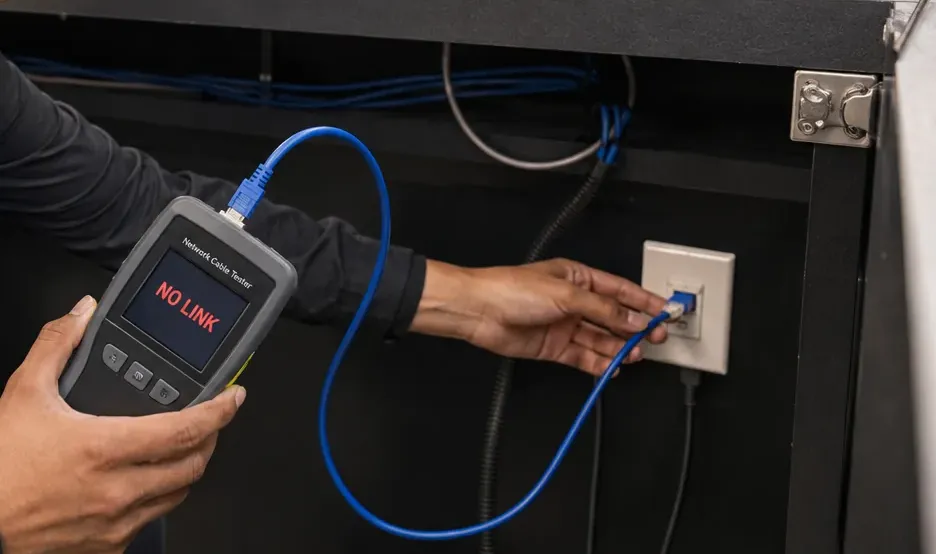
One hand holds a grey handheld tester whose screen reads NO LINK while the other seats a blue patch cord in a beige single-port wall plate inside a black counter cabinet, with a bundle of blue cable running along the top of the cabinet.
Putnam County Cat6 Repair Quote
Say which jacks or devices fail and where the run goes — we reply the same business day
✅
Request Sent!
We'll get back to you the same business day.
25+
Years Experience
✓
Same-Day Estimates
100%
Licensed & Insured
4.7★
201 Google Reviews
One jack dead in the den, or the camera over the garage gone dark? Ring our Putnam line, (845) 640-3835, or send the 60-second form. A licensed technician reads it, asks where the cable goes and what changed before it failed, and tells you whether it sounds like a termination, a damaged length or something upstream of the cable — before anyone drives up the Taconic.
Fault located by distance first, so we open one spot instead of a whole wall, ceiling or lawn
Repair before replacement, with the test result that justifies either one
NYS licence #12000287431 · fully insured · prices from our published Putnam rates, confirmed in writing
Why Putnam County Properties Need Cat6 Repair Before Replacement
Ask anyone who has tried to bury a cable in Putnam County how it went, and you will hear about rock. The county sits on the Hudson Highlands, which the New York State Museum’s bedrock map of Putnam and Westchester describes as a Precambrian complex of gneisses, migmatite, marble, granite and granodiorite. Soil over it is often thin. When NYSEG hardened two circuits in the Town of Carmel in 2021, WAMC reported that the crews needed rock drilling just to set the new poles. A homeowner who wants a fresh Cat6 run from the house to a detached garage, a studio or a dock runs into the same ground, and that changes the arithmetic of every network cable fault on the property: the cable costs little, the route costs a great deal.
Water is the second constraint. Putnam is threaded with the reservoirs and controlled lakes of New York City’s Croton system — West Branch, Boyds Corner, Middle Branch, Croton Falls, East Branch, Bog Brook and Diverting are all named in the state’s watershed rules, and the West Branch Reservoir alone straddles the Towns of Kent and Carmel and holds about 8 billion gallons, according to the city’s Department of Environmental Protection. Around them sit private lakes such as Lake Mahopac, Lake Carmel and Lake Oscawana, ringed by houses. Town wetland ordinances regulate the ground near all of that water. The Town of Carmel’s permit application, for instance, says the town protects wetlands of one-eighth of an acre and larger plus a 100-foot buffer around each, and that construction or other activity inside that buffer needs a wetland permit. A replacement trench to a boathouse is exactly the kind of activity that question is written for.
Then there are the walls. Putnam’s houses are mostly post-war but not new: Stacker’s 2025 ranking of New York counties by housing age, drawn from Census data, puts the county’s median year built at 1968, with 17.9 percent of homes — 6,857 of them — built in 1939 or earlier. Many of those older homes are lake cottages that were winterized and finished long after the original wiring went in, or nineteenth-century buildings in Cold Spring, Nelsonville and Garrison where plaster, trim and exterior appearance matter. In the Village of Cold Spring, the Historic District Review Board reviews exterior changes visible from the street, and its design standards list utilities among the exterior features it looks at. A cable fix there has to be planned around what the street can see.
Weather finishes the picture. Putnam is wooded, hilly and served largely by overhead lines, and its storms are remembered by road name. On May 15, 2018, a line of thunderstorms with reports of tornado-like winds in Carmel left 28,459 NYSEG customers and 4,698 Central Hudson customers without power in the county, Patch reported that night. In July 2023 more than eight inches of rain tore into bridges, dams, roads and at least 130 homes in Philipstown and western Putnam, according to The Highlands Current. And on July 29, 2026, the Town of Putnam Valley declared a state of emergency over flash flooding and road and bridge closures, restricting travel on Cimarron, Horton Hollow, Canopus Hollow and Tinker Hill roads among others. Fallen limbs pull down cable strung between buildings; water finds the box where a run enters a foundation; a power return knocks a marginal PoE link over the edge.
Put rock, water rules, finished walls and weather together and you get a county where the cheapest Cat6 repair is the one that keeps the existing cable. That is the thesis of this page. A good technician in Putnam does not guess at a failing link and pull a new one; he measures it, finds the exact metre that failed, repairs the termination or the short damaged length, and proves the whole channel still meets Category 6. Only when the test says the run is damaged along its length, too long, wet through, the wrong cable for where it lies or simply not genuine Cat6 does the conversation move to replacement — and then the question becomes which route avoids the rock, the buffer and the historic façade.
Putnam County facts behind the way we repair Cat6
Precambrian bedrock: gneisses, migmatite, marble, granite and granodiorite make up the Hudson Highlands, per the New York State Museum’s bedrock geology map of parts of Putnam and Westchester. NYSEG needed rock drilling to set poles on Horsepound Road and Stebbins Road in Carmel in 2021 (WAMC). Digging a new cable trench here is a project, not an afternoon.
8 billion gallons: the capacity of the West Branch Reservoir in Kent and Carmel, in service since 1895 and connected to Lake Gleneida, one of the three controlled lakes in the city’s supply, according to NYC DEP. State watershed rules prohibit new impervious surfaces within 100 feet of a watercourse or wetland and 300 feet of a reservoir or controlled lake.
100-foot buffer: regulated around every Town of Carmel wetland of an eighth of an acre or more, including lakes, ponds and streams, per the town’s wetland permit application.
1968: Putnam’s median year built, with 6,857 homes (17.9 percent) dating from 1939 or earlier, per Stacker’s September 2025 analysis of Census data. Old enough that the first network cable in many houses was retrofitted, not planned.
83.8 percent: share of Putnam housing units occupied by their owners in 2024, according to Data USA. Most of the Cat6 we repair here belongs to the person paying for the repair, which is why we explain the choice between repair and replacement in plain terms.
75,093 lightning pulses and 35 thunder days: recorded over Putnam in 2020 in Earth Networks’ New York lightning report — lower than Orange or Dutchess, but enough to put surge damage on the list for any run that leaves a building.
28,459 NYSEG customers: without power in Putnam on the night of May 15, 2018, plus 4,698 Central Hudson customers, per Patch. Storms here are wind-and-tree events first.
8+ inches of rain and 130 homes: the July 2023 flooding in Philipstown and western Putnam reported by The Highlands Current, followed in July 2026 by the Putnam Valley flash-flood emergency declared by the town supervisor.
The practical consequence is a different first visit. Where an installer in a city office might simply re-pull a failing drop through an open ceiling, a Putnam repair starts with the question “where exactly is the damage, and can we reach it without digging, cutting plaster or touching the buffer?” More often than people expect, the answer is yes: the fault sits at a jack, a punch-down, a crimped plug at a camera, a box on the outside wall, or one bruised metre behind a baseboard.
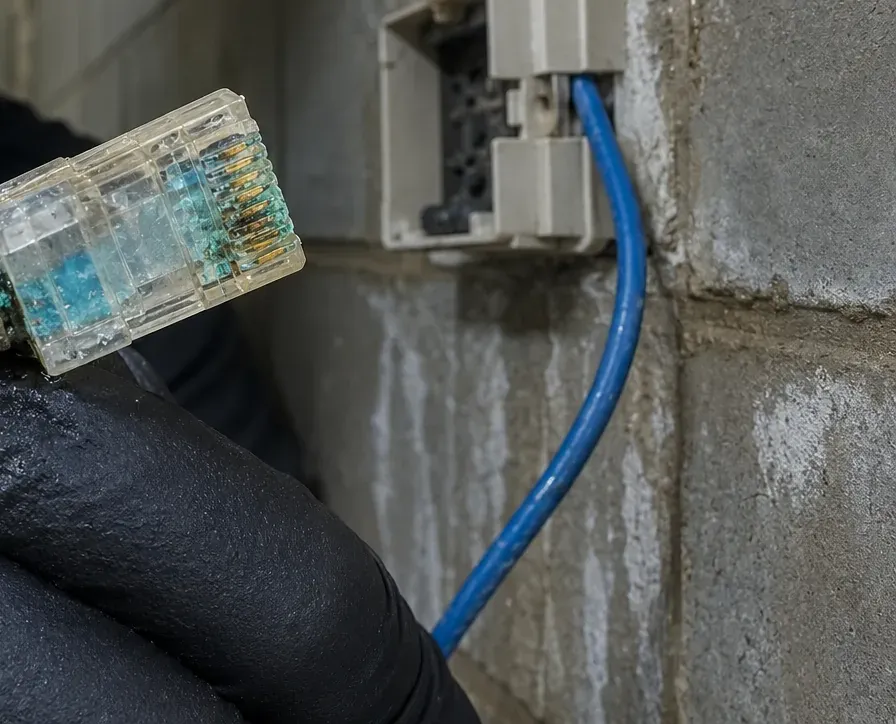
A gloved hand holds a clear RJ45 plug whose gold contacts and housing are stained green-blue with corrosion; behind it, a blue cable drops from an open beige surface box mounted on a water-streaked concrete block wall.
Repair Capture
Dead Cat6 Jack Somewhere Between Cold Spring and Brewster?
A home-office jack in Mahopac that stopped linking on Monday, a dome camera over a Patterson barn door that will not power, a Brewster shop’s card terminal that drops at lunch, a Garrison studio that went offline when a limb came down — those are service calls, not projects. Tell us what failed, where the cable runs and what happened just before. We book the next open 2-hour window and arrive with the parts the description points to: Cat6 and Cat6A keystones, plugs and boots, outdoor-rated connectors and cable, junction hardware for an in-line repair, and a tester that certifies to category and reports distance to a fault. A single bad termination or a damaged cord is usually found and fixed in one to two hours on site. Repair time is $195 an hour with a three-hour minimum ($585), the rate on our network cable repair page for Putnam. Call (845) 640-3835 and say it is a Cat6 fault.
What We Repair
Cat6 Repair Services in Putnam County
These are the repairs Putnam homeowners, small offices, shops and lake-property owners ask us for most. Each ends the same way: the link is tested against the limit for its category, the saved result is yours, and you are told in plain language what failed and why.
Fault Location by Distance
Time-domain readings on a certification-grade tester show how far along the run a short, open, split pair or impedance bump sits, so the wall, ceiling or ground is opened at one point only — the core of repair-first work on finished and rocky properties.
Jack and Keystone Re-Termination
Dead and intermittent wall jacks cut back to clean cable and remade on matched Cat6 or Cat6A hardware, pair twist carried to the contacts, faceplates matched where the old style is still made.
In-Line Repair of a Damaged Length
Where a screw, nail, staple or crush has damaged one accessible spot, the bad section is cut out and joined with a category-rated junction in a box that stays accessible, then the whole link is certified — or the test tells us a full replacement is needed.
Torn and Sagging Aerial Runs
Cable strung between a house and a garage or barn and pulled down by a limb: replaced on a proper support wire or moved to a protected route, with drip loops and sealed entries at both buildings.
PoE Camera and Access-Point Links
Cameras that will not power, reboot under infrared at night or drop video; ceiling access points that fall back to wireless backhaul. Cable resistance, terminations and outdoor plugs separated from switch and power-budget problems.
Water and Corrosion Damage
Runs that sat in a flooded basement, a wet foundation box or a leaking soffit tested, corroded plugs and jacks replaced, and the damaged length judged by measurement rather than by appearance.
Patch Panel and Switch-End Repair
Loose or half-seated punch-downs, wrong-standard panel ports and tired patch cords in a basement corner, utility closet or office wall cabinet re-terminated and labelled.
Replacement Runs When Repair Fails
When testing proves a run cannot be saved, a replacement on the least disruptive route — existing conduit, the original path, surface raceway or a new pull — priced from our published per-drop figure.
Certification After Every Repair
Wire map, length, insertion loss, crosstalk and return loss against the Category 6 or 6A limit, saved with the date, so the next time something changes you have a baseline to compare against.
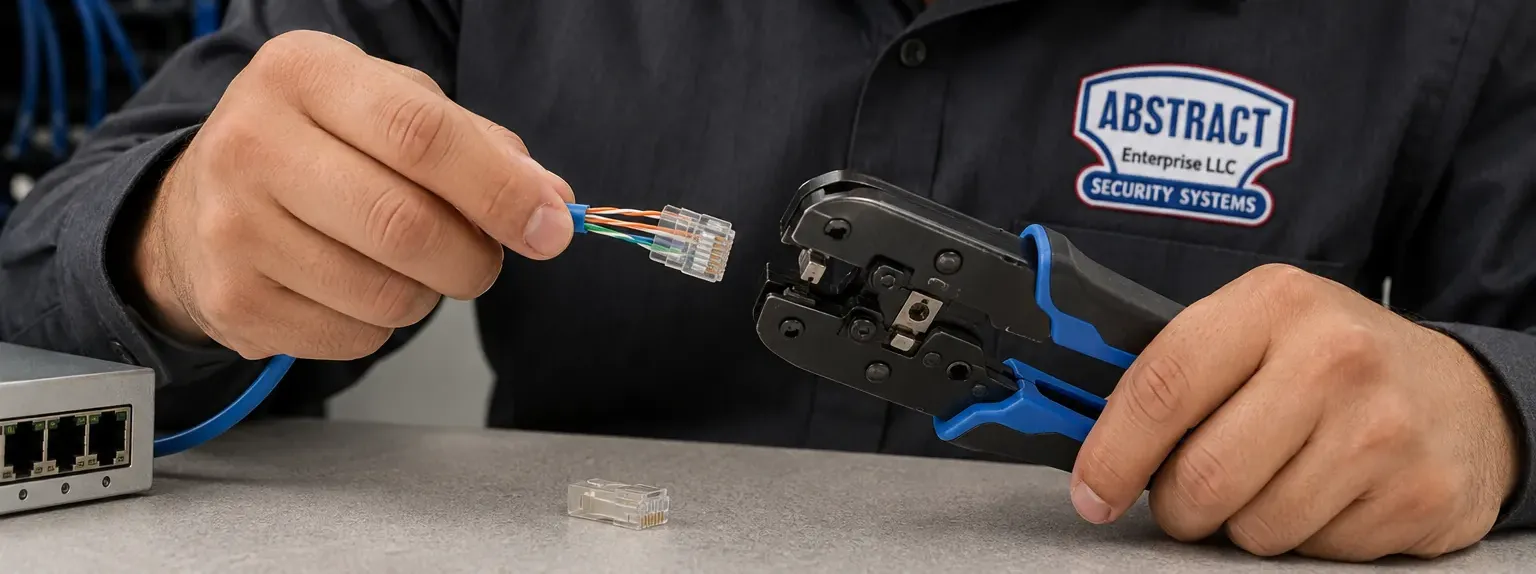
One hand holds the end of a blue cable with its coloured pairs fanned into a clear RJ45 plug, the other grips a black and blue crimping tool, with a spare plug on the counter and a small network switch at the left edge.
Building Specialists
Cat6 Repair for Putnam County’s Architecture
Putnam’s building stock is small-scale and varied: few towers, no mega-warehouses, but a wide spread of house types and village buildings, each of which hides cable in its own way. Where the cable runs decides how a repair is reached.
Converted Lake Cottages
Around Lake Mahopac, Lake Carmel, Lake Oscawana and the smaller lake communities, summer cottages became year-round homes in stages. Network cable added along the way runs through additions, under porches, behind new insulation and across rooms that were once outside walls.
Post-War Ranches, Raised Ranches and Colonials
The county’s median house dates from 1968. Cat6 in these was usually retrofitted — fished down from an attic or up from an unfinished basement, stapled along joists, and terminated by whoever did the renovation.
Village Buildings in Cold Spring and Nelsonville
Nineteenth-century frame and masonry buildings with plaster walls, shared party walls and storefronts on Main Street, many in the Cold Spring Historic District, where exterior work visible from the street is reviewed.
Estates and Outbuildings in Garrison and Philipstown
Large wooded parcels with a main house, guest cottage, studio, garage or barn, often a long way apart, linked by runs that are buried, strung overhead or laid in pipe at some point in the past.
Main Streets and Hamlet Centres
Brewster village, Carmel along Gleneida Avenue, Mahopac along Route 6: mixed commercial buildings with offices above shops, basements below and decades of tenant-installed cabling.
Plazas and Professional Offices
Single-storey and two-storey commercial buildings along Route 6, Route 22, Route 52 and Route 312 — practices, retail, restaurants and trade offices with a wall cabinet in a back room and drops through a drop ceiling.
How the repair is reached in each
Lake cottages. The first job is mapping how the house grew. A jack in what is now a living room may be fed by cable that runs through a former exterior wall, under a porch that was enclosed later, or through a crawlspace that floods in spring. We test from the jack, read the distance to the fault and compare it with where the additions are; nine times out of ten that tells us which part of the house to look in. Cable that has spent years in a damp crawlspace or under a porch deck is often sound inside a chalky, stiff jacket; the test, not the look, decides whether it stays.
Post-war houses. Basements and attics make these the easiest Putnam houses to repair. Most faults are at terminations made with the wrong tool, staples driven through the jacket, or cable crushed when a basement was finished and a soffit built around it. We reach the damage from the unfinished side wherever possible, and when the run is boxed into a finished soffit we open a small access panel rather than a long slot.
Village buildings. Plaster, wood trim and party walls mean the original cable route was improvised: along baseboards, behind door casings, through closets and up old chases. Repairs here favour the existing route and the existing openings. Where a new path is unavoidable we use closets, cellars and attics first and keep anything that would show from the street off the façade, because in the Cold Spring Historic District that is what the Review Board looks at.
Estates and outbuildings. Runs between buildings are where Putnam’s rock, trees and water converge. We test from the main house, find out whether the fault is at an end, at an entry or out in the ground or the air, and only then decide whether the fix is a new termination, a new entry, a repaired length or a different kind of link altogether.
Main streets and plazas. Tenant cabling in older commercial buildings is layered: abandoned runs from previous occupants, extensions with couplers, and panels nobody has labelled. We identify which cable is live before cutting anything, repair the failing link, and remove abandoned lengths that are accessible.
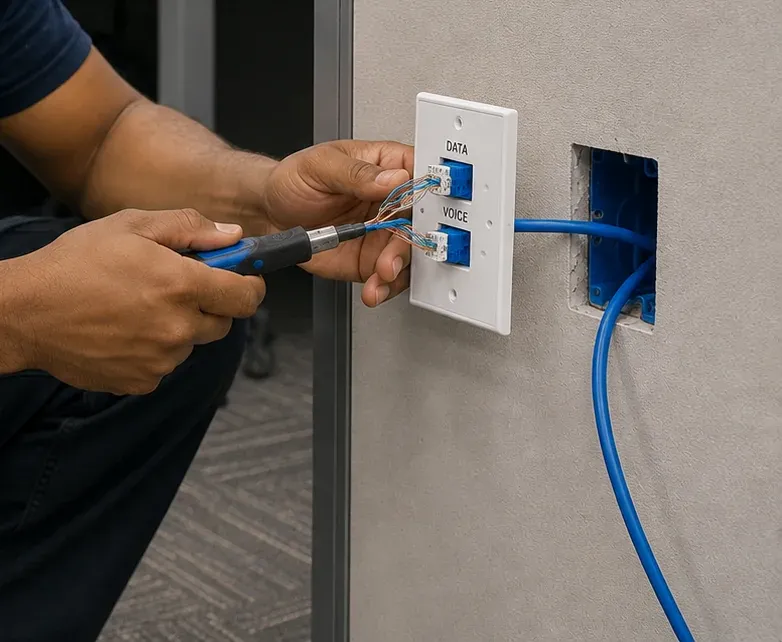
A technician’s forearms reach to a white two-port wall plate labelled Data and Voice, pressing conductors into the back of one blue keystone with a blue-handled tool, while blue cable loops out of an open box cut into the grey wall beside it.
Commercial Cat6 Repair
Business Cat6 Repair in Putnam County
Putnam’s businesses are small, and that shapes what a Cat6 fault costs them. A single dead link at a reception desk, a card terminal or a camera can stop an office or a shop with five people in it. There is rarely an IT department on site; the person who calls is usually the owner, the office manager or an outside IT provider who looks after the network remotely. These are the corridors we cover and the kinds of businesses on them.
Route 6 through Mahopac and Carmel
The county’s main commercial spine: plazas, restaurants, medical and dental practices, banks and service businesses in one- and two-storey buildings. Typical faults are tired drop-ceiling runs, re-used jacks from a previous tenant and card terminals on a cord that has been rolled over by a chair for years.
Gleneida Avenue and the county seat, Carmel
Law offices, title companies, insurance agencies and other professional tenants cluster near the historic courthouse and county offices, often in converted houses with cabling routed through closets and basements.
Brewster village, Route 22 and the I-84 interchange
Main Street storefronts near the Harlem Line station, plus contractors’ yards, light industrial units and retail around the interchange in Southeast. Expect yard cameras, outbuildings and offices above shops.
Main Street, Cold Spring
Restaurants, galleries, shops and offices in nineteenth-century buildings, many within the Cold Spring Historic District. Kitchen and point-of-sale cabling, basements and strict limits on what can show from the street.
Route 52 and Route 311 in Kent and Lake Carmel
Neighbourhood retail, service businesses and offices serving the lake communities, many in small buildings with a single wall cabinet and drops that have been added piecemeal.
Route 311 and Route 22 in Patterson
Farms, home-based businesses and trade premises spread over larger parcels, with runs to barns, shops and gates that combine indoor and outdoor problems.
Rules that can shape a Putnam Cat6 repair
Most Cat6 repairs touch none of the following. Re-terminating a jack, replacing a cord or repairing a length inside a wall is ordinary maintenance. The rules start to matter when a repair turns into a new route outdoors or a visible change to a building, and we flag that before it happens rather than after.
Cold Spring Historic District Review Board
The village’s design standards say the Board reviews any change to exterior architectural features visible from the street, listing utilities among them, and exempt regular maintenance that does not change appearance and work not visible from the street. We keep repair work inside or out of view, and tell you before anything would need a Certificate of Appropriateness.
Town wetland buffers
The Town of Carmel regulates a 100-foot buffer around wetlands of an eighth of an acre or more, including lakes, ponds and streams, and requires a wetland permit for construction or other activity inside it. The Town of Kent’s building-permit guidance flags projects within 100 feet of wetlands, ponds, streams and watercourses. A trench to a dock or boathouse is the case to check.
NYC watershed regulations
State rules for the city’s watershed prohibit new impervious surfaces within 100 feet of a watercourse or wetland and 300 feet of a reservoir, reservoir stem or controlled lake, and require stormwater plans for larger land disturbance. A cable trench is not an impervious surface, but a repair that grows into new paving or a structure near the water is a different conversation.
Call before you dig
Any excavation for a replacement run goes through the 811 utility-locate process first, with the notice period the system requires. In Highlands ground that is shallow over rock, knowing where the electric, water and septic lines run is not optional.
Entry protection for runs between buildings
The National Electrical Code requires a listed primary protector as close as practicable to the point where a communications cable exposed to lightning enters a building. Where a repaired run leaves one structure for another, we look at how it enters each.
Abandoned cable
The Code also requires accessible portions of abandoned communications cable to be removed. When a repair replaces a length or a run, we take out the old one wherever it can be reached, unless you want it tagged for future use.
These summaries are written for property owners and are not legal advice. Your town building department, the village, or NYC DEP gives the binding answer for a specific address.
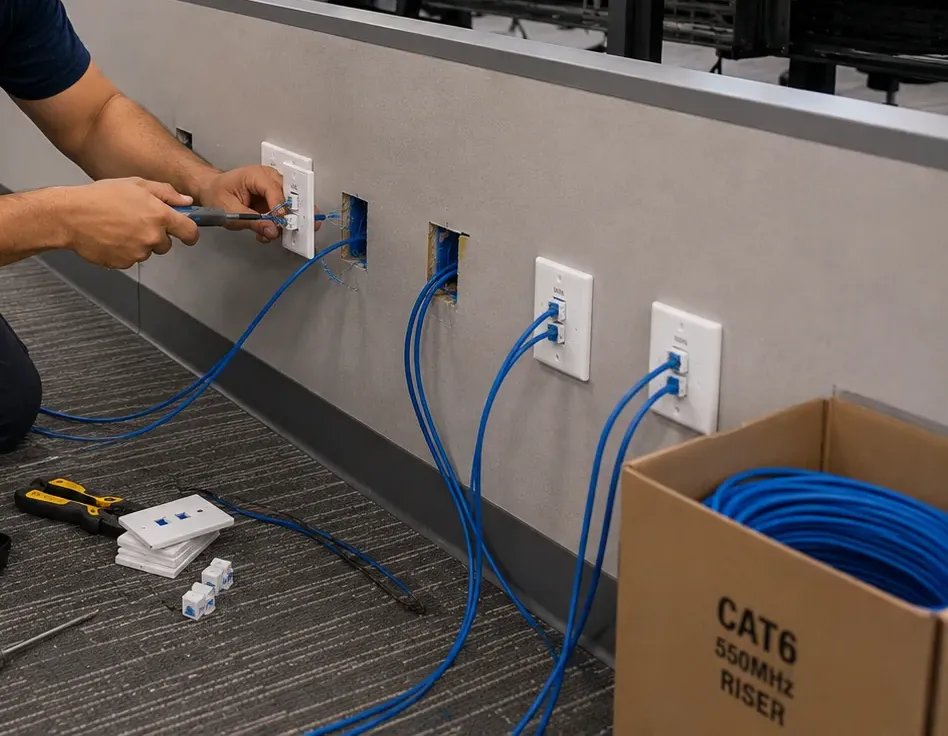
A technician’s arms reach across a grey partition to rework the first of four white wall plates; blue cables hang from two open boxes, spare plates and keystones lie on the striped carpet, and an open carton marked CAT6 550MHz RISER sits in the corner.
Your Questions Answered
Cat6 Repair in Putnam County: Questions Answered
These are the questions Putnam owners actually put to us about failing Cat6, grouped by what is going on around the cable. Each answer is the short version of what we would tell you on the phone.
Rock, water and the ground between buildings
If trenching a new Cat6 run across our Putnam Valley lot means cutting through ledge, what are the alternatives to digging?
There are usually four, and we test the old run before choosing between them. First, the existing run may not need replacing at all: if the tester puts the fault at the garage end, at the entry into the house or at one bruised spot near the surface, we repair that and certify the link. Second, if the old cable lies in a pipe, a new cable can often be pulled through the same pipe using the old one as the pull line, which avoids opening the ground except at the ends. Third, a run can follow the surface — along a foundation, a retaining wall or a fence line — in outdoor-rated conduit fixed above grade, which is often the practical answer where soil over rock is only inches deep. Fourth, where the two buildings are far apart or on separate electric services, a fiber link or a point-to-point wireless bridge can replace the copper entirely; we will say plainly when that is the better route and refer the fiber side to our installation team.
What we avoid is the reflex of trenching a new copper run beside a failed one without knowing why the first one failed. In ledge country the second trench costs more than the first, and if the cause was a bad entry or water in the far box, the new cable fails the same way.
Does replacing a Cat6 run near Lake Mahopac or another lake in the Town of Carmel need a wetland permit?
A repair that stays at the terminations or inside the buildings does not disturb the ground and is not what the wetland ordinance is aimed at. A new trench is different. The Town of Carmel’s wetland permit application says the town protects wetlands of an eighth of an acre and larger and regulates a 100-foot buffer around each, asks whether any construction or disturbance will happen within 100 feet of a wetland “including lakes, ponds, streams”, and requires a permit if it will. A run from a house to a dock or boathouse on a lakefront lot will often fall inside that distance.
So on a lakefront property we first try to keep the fix out of the ground: repair at the ends, re-use an existing pipe, or run along a structure. If a new trench inside the buffer is still the right answer, we tell you before any work is scheduled so the permit question can be settled with the town, and we plan the route to disturb as little as possible.
We are close to the West Branch Reservoir in Kent — do the city’s watershed rules limit how a damaged Cat6 run can be replaced?
Mostly through the town, rather than directly. The New York City watershed regulations target things like new impervious surfaces — prohibited within 100 feet of a watercourse or wetland and 300 feet of a reservoir, reservoir stem or controlled lake — and stormwater plans for larger clearing and grading. A narrow cable trench that is backfilled is not an impervious surface. But the Town of Kent’s building-permit guidance separately flags projects within 100 feet of wetlands, ponds, streams and watercourses and larger soil disturbance, so a replacement trench near water is something to confirm with the town building department first.
In practice, most failed runs near the reservoirs are repaired without new excavation at all. Where excavation is unavoidable, we keep it short, hand-dug where we can, and away from the water side of the property.
Trees, wind and the power that comes back
A falling limb tore down the Cat6 we had strung between the house and the garage — should the aerial run be repaired or put underground?
It depends on how it was hung and what the ground looks like. Cable strung on its own between two buildings — no support wire, no drip loops, the jacket carrying its own weight — was always going to fail; splicing it back together and re-hanging it the same way only resets the clock. If an overhead route is still the sensible one, the repair is a proper span: a steel support wire tensioned between solid points on each building, outdoor-rated cable lashed or clipped to it, drip loops before each entry, and sealed, protected entries at both ends. That keeps the weight off the copper and lets the span move in wind without pulling on the terminations.
If the span crosses under trees that drop limbs every winter, or the garage has power of its own, underground or a different kind of link may be worth the extra cost. On rocky ground a surface route along a fence or wall is sometimes the middle option. We test the remaining cable at both buildings first: a run that was torn down often has a damaged entry or a cracked plug at the far end as well.
Our standby generator takes over during Putnam outages — why do the PoE cameras drop when it does, and is the Cat6 to blame?
Usually the drop at the moment of transfer is not the cable. When power switches from the utility to the generator there is a brief interruption, and a PoE switch without battery backup restarts — taking every camera it powers with it. The cameras then take a minute or two to boot and reconnect, which looks like a network failure. A small battery backup on the switch and recorder normally removes that symptom completely.
The cable becomes the suspect when only some cameras fail to come back, or come back and then keep rebooting. Those are often the longest runs or the ones with a poor termination: they were working with very little margin, and the inrush of every camera starting at once is enough to tip them over. We test those links under load, re-terminate or repair what is marginal, and tell you whether the PoE budget of the switch is part of the problem.
Lake houses, renovations and finished walls
Our cottage on Lake Carmel was winterized with spray-foam insulation, and the Cat6 inside the walls has failed — can it still be repaired?
Often, yes — at the ends. Spray foam locks cable in place, so it cannot be pulled out and a new one cannot be pulled in along the same path. But most failures in foamed walls are not in the middle of the wall; they are at the jacks, where the cable was cut short, kinked or stressed when the foam was trimmed flush, or at the point where the cable leaves the foamed bay into an attic or basement. The tester tells us how far from the jack the fault sits. If it is within the first few inches, we cut back and re-terminate; if it is at the attic or basement end, we repair it there.
When the damage is genuinely mid-wall in a foamed bay, the honest options are to abandon that run and bring a new one to the room by another path — a closet, an interior wall without foam, a baseboard raceway — or to open the wall at one point and make an in-line repair inside an accessible box. We price both before anything is cut.
A drywall screw or trim nail went through a Cat6 run during our renovation — how do you find the damaged spot without opening every wall?
By distance. A screw through a cable usually shorts or opens one or two conductors, and a certification tester shows how many feet from the jack that fault lies. We measure from both ends where we can, which narrows the location further, and compare it with where the new drywall, trim or cabinets went. That usually points to one stud bay. A small inspection opening at that spot confirms it.
The fix is then either an in-line repair at that point, made with a category-rated junction in a box that stays accessible behind a blank plate, or a new run if the damaged spot cannot be reached and left serviceable. Either way the whole link is certified afterwards. If the renovation contractor is responsible, the saved test result and photos of the damage are the clearest record you can give them.
Where the Cat6 passes from our attached garage into the house in Mahopac, the hole was never sealed — does the repair have to fix that?
It should. The wall between an attached garage and the living space is there to keep fire and car fumes out of the house, and a cable hole left open, or stuffed with fibreglass, defeats it. Garage penetrations are also where Cat6 gets damaged: the edge of a hole cut in drywall or block chafes the jacket every time the garage door shakes the wall, and the cable is often pulled tight across the opening.
When we repair a run that crosses that wall, we test it, repair or replace the damaged length, sleeve the penetration so the cable is not resting on a raw edge, and seal it with a fire-rated sealant suited to the wall. It adds minutes to the visit and removes a fault that would otherwise come back.
Since an EV charger went into our Patterson garage, the Cat6 link out there keeps dropping — can the new circuit cause that?
Rarely by itself. Twisted-pair cable is good at rejecting interference, and a properly installed charger circuit running alongside a Cat6 run for a short distance does not normally break a link. What we find far more often is that the installation disturbed the cable: it was moved to make room for a new conduit, crushed under a clamp, stapled through, or cut and rejoined behind the charger.
We test the run and read where the fault sits. If it is at the spot where the charger work happened, we repair that length and re-route the Cat6 so it keeps its distance from the new power wiring. If the link only fails while the car is charging and the cable tests clean, we look at shared grounding and the equipment at each end, and tell you whether your electrician needs to look at the charger side.
Village buildings and Putnam businesses
Does a Cat6 repair on a Main Street building in Cold Spring need approval from the Historic District Review Board?
Usually not, if nothing changes on the outside. The village’s design standards say the Board reviews changes to exterior architectural features visible from the street — including utilities — and that regular maintenance which does not alter appearance, and work not visible from the street, are not subject to review. Re-terminating jacks, repairing cable inside the building and replacing a run through cellars and interior walls fall on that side of the line.
Where a repair would add something to a street-facing wall — new conduit, a box, a visible cable, an exterior camera — we stop and tell you, so that the change can be redesigned to stay out of sight or taken to the village for a Certificate of Appropriateness before anyone fixes anything to the building.
Our Carmel office is a converted house, and some of its jacks turn out to be wired with telephone-grade cable rather than Cat6 — can those be repaired?
No — they can only be replaced. Many of the professional offices near the county seat are former houses, and their cabling grew with each owner: telephone wire to some rooms, Cat5e to others, Cat6 to the latest addition, all ending on jacks that look the same. A jack labelled Cat6 on cable that is not Cat6 will never certify, however carefully it is terminated.
We identify what is actually in the wall from the jacket printing and the test results, repair the genuine Cat6 runs that have failed, and give you a list of the runs that need replacing, with a price for each. Where a room needs only one reliable connection, re-using the route of the old cable as a pull path often keeps the replacement simple.
The Cat6 to the kitchen printer and card terminal in our Cold Spring restaurant keeps failing — what about a kitchen kills network cable?
Heat, grease, water and people. Cable behind a line runs near hot equipment; cords to printers hang where they are splashed, wiped with degreaser and caught by carts; jacks are mounted low on walls that are hosed down. Over months, plugs corrode, jackets harden and cords are crushed under equipment that gets moved for cleaning.
The repair is partly the cable and partly where it lives. We test the permanent link from the panel to the kitchen jack, replace damaged cords with shorter ones routed out of harm’s way, move jacks higher or into a covered box where we can, and use cable and cords suited to the location. On a busy Main Street restaurant we schedule around service, typically before opening.
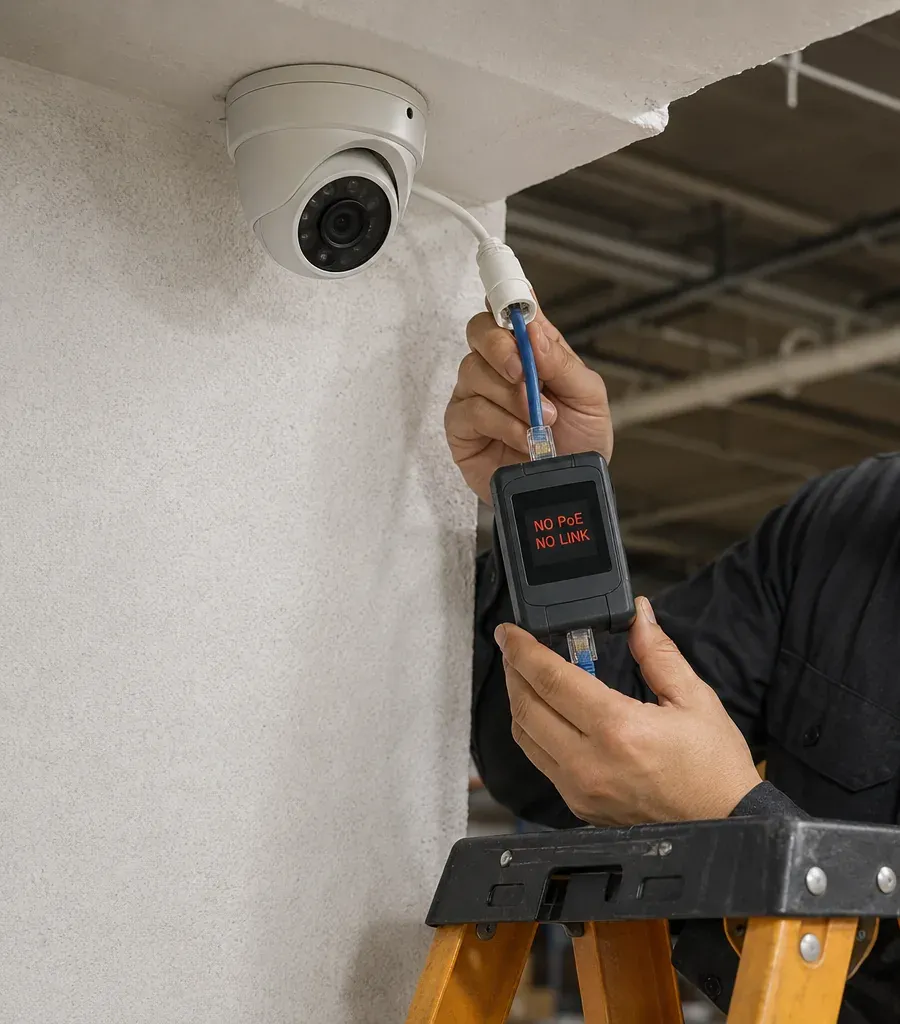
Under a white dome camera fixed below a concrete beam, a technician’s hands hold a small black inline tester whose screen reads NO PoE and NO LINK, with blue cable plugged into both ends and the top of a yellow stepladder below.
Equipment
Test Gear and Parts We Bring to a Putnam Cat6 Repair
Repair-first work depends on two things: measuring precisely enough to open only one spot, and carrying enough of the right parts to finish once it is open. On a county of long driveways and winding roads, a missing keystone means a second trip.
Certification-Grade Cable Tester
Tests permanent links and channels against Category 6 and 6A limits — wire map, length, insertion loss, near-end crosstalk, return loss — and shows faults by distance along the run, which is what lets us find a screw hole or a crush point behind finished walls.
Inline PoE and Link Tester
Sits between a camera or access point and its cable to show whether power is arriving, at what class, and whether a link is negotiated, separating a cable fault from a switch or budget problem at the device end.
Tone Generator and Probe
Traces an unlabelled run through a basement, a panel or a bundle of abandoned cable, so we know which cable is live before anything is cut.
Matched Cat6 and Cat6A Hardware
Keystones, panel modules, shielded and unshielded plugs with load bars, boots and faceplates in common colours, so a repair matches the category and, where possible, the look of what is already installed.
In-Line Repair Hardware
Category-rated junction blocks and surface or flush boxes for joining a damaged run at an accessible point, and blank plates to keep that point serviceable behind a finished wall.
Outdoor Materials
Outdoor-rated and direct-burial Cat6, sealed connectors and enclosures, UV-resistant conduit and fittings, support wire and clips for overhead spans, and entry sealant for foundations and siding.
Inspection Tools
A small inspection camera and lights for looking into a stud bay, a soffit or a pipe through a hole the size of a jack box before deciding where to open.
Fish Tapes, Rods and Pull Lines
For pulling replacement cable through existing conduit or along the old path, using the failed cable as the pull line wherever it is free to move.
Labels and Records
Durable labels for both ends of every repaired link and saved test results with the date, so the next fault on the property starts from known facts.
Repair in place or re-route: how a Putnam fault is decided
What the test shows
Most likely cause here
What we usually do
Open or short within a few feet of the jack
Poor termination, cable cut short, kinked behind the box, foam trimmed against it
Cut back and re-terminate; certify
Fault at a measured distance inside a wall
Screw, nail or staple from a renovation; crushed behind a soffit
Inspection opening at that spot; in-line repair in an accessible box, or a new run if it cannot stay serviceable
Fault at or near the far building
Water at an unsealed entry, corroded plug, cracked jacket at a drip point
Repair the end, seal and protect the entry; replace only the damaged outdoor length
Faults scattered along an outdoor run
Indoor cable used outdoors, UV and freeze damage, chewing
Replace with outdoor-rated cable on the least disruptive route
Length over the limit
Run extended with couplers, routed the long way round a lot
Shorten the route, move the switch, or change the link type
Passes wire map, fails performance
Mismatched parts, untwisted pairs, wrong cable, water in the jacket
Re-terminate on matched parts; replace if the cable itself fails
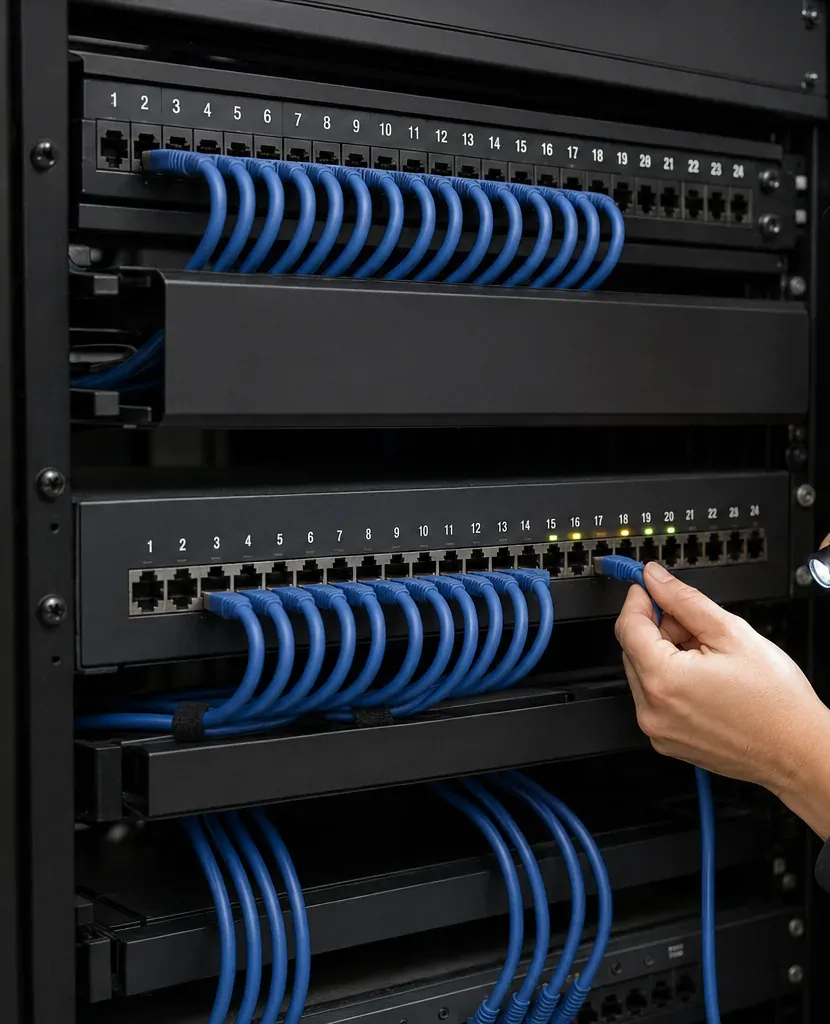
In a black rack, rows of blue patch cords loop from a numbered 24-port patch panel and a switch below it; amber and green lights glow above ports 15 to 20 while a hand presses a cord into one port and a flashlight shines in from the right edge.
AI Overview Reality Check
What AI Gets Wrong About Cat6 Repair in Putnam County
Search summaries and generic how-to pages answer Cat6 questions as if every house sat on easy soil in a suburb with buried utilities. We could not view Google’s AI Overview from our build environment, so the claims below are ones commonly published in cost guides, forums and how-to articles, each corrected with what we see on Putnam properties.
“If a Cat6 run fails, just pull a new one”
Pulling new cable is the default advice because, in an open office ceiling, it is quick. Online cost guides price Cat6 by the drop, and the implication is that a failed drop is simply replaced with another. Fixr’s January 2025 guide, for example, puts a new Cat6 drop at $125 to $250 including materials and labour across the United States.
In Putnam the price of a new drop is dominated by the route. A run that has to cross Highlands bedrock, pass inside a lake buffer, go behind spray foam or avoid a historic façade can cost several times the cable. Our own Putnam installation rate for a Cat6 drop to 100 feet is $321, and that covers an ordinary interior route, not a trench through ledge.
So the first step is not a new pull; it is a measurement. If the tester says the fault is at a termination or one accessible spot, repairing it keeps the existing route, which is the most expensive part of the link and the part you already own.
“Ethernet cable cannot be spliced”
Forum answers often say that a damaged Ethernet cable must always be replaced end to end. As a rule for hidden, taped or twisted joins, that is right: a joint buried in a wall with no access and no test is a future fault.
But category-rated junction hardware exists, and an in-line repair made with it, in a box that stays accessible, can carry a link that certifies to Category 6. Whether it does is not a matter of opinion; the tester decides. What does not work is a join made with couplers, electrical tape or crimp connectors meant for power.
On a Putnam property where the alternative is opening a finished wall end to end or trenching through rock, a properly made and certified in-line repair is often the sensible engineering answer. Where it would not pass, or could not stay accessible, we say so and replace.
“Outdoor Cat6 just needs an outdoor-rated jacket”
Many how-to pages treat outdoor Cat6 as a jacket problem: buy outdoor cable, run it, done. The jacket matters, but most outdoor failures we repair are at the ends and in between: a plug with no seal, an entry with no drip loop, a span hung with no support wire, a run tied to a tree that has grown and moved.
In a wooded county the overhead span between a house and a garage takes ice, wind and falling limbs every winter. A cable carrying its own weight stretches and eventually tears at its weakest termination, whatever the jacket is rated for.
So an outdoor repair here includes the support, the entries and the protection, not only the cable. That is also where the National Electrical Code’s requirement for a protector near the entry of a lightning-exposed run comes in.
“A cheap continuity tester tells you if the cable is fine”
Inexpensive testers that blink each of the eight wires are widely recommended for checking a run. They confirm that wires are connected end to end in the right order, and that is useful.
They do not measure length, loss, crosstalk or return loss, and they do not show where along the run a problem sits. A run with a split pair, water in the jacket or a crushed section can pass a blink test and still fail to hold a gigabit link. A screw that has nicked a conductor without shorting it can pass too.
For repair-first work, the distance reading is the whole point: it is what lets us open one spot in a finished wall instead of guessing. That needs a certification-grade tester.
“Any electrician or handyman can fix network cable”
Homeowner forums often suggest calling whoever is already working on the house. For changing a faceplate or a cord, that can be fine.
Repairing a Cat6 link so that it still meets its category is different work: terminating with the twist kept to the contacts, matching parts to the cable, testing against the standard and interpreting the result. Electricians are the right trade for power, generators, panels and grounding, and on some Putnam repairs we want one alongside us. Most do not carry a certifier for data cable.
The question to ask any bidder is simple: which tester will you use, will I get a saved result for each repaired link, and what is your New York State low-voltage licence number. Ours is #12000287431.
“Wi-Fi mesh makes Cat6 repair unnecessary”
A common answer to a dead wall jack is to skip the cable and add a mesh node. In a small open house that can be reasonable.
Putnam houses are often long, multi-level, built into slopes and spread across additions, with stone, foil-faced insulation or a garage between the router and the room that needs the connection. Mesh nodes relaying wirelessly through that lose much of their throughput; the same systems are designed to use wired backhaul where it exists. Cameras, access points and home offices that depend on stable links still need the cable.
So mesh is a reason to repair Cat6, not a replacement for it: the wired backhaul is what makes the mesh work.
“Cable faults after a storm are always lightning”
After a storm, published advice tends to go straight to surge damage. Surges do happen, and Putnam recorded 75,093 lightning pulses in 2020 according to Earth Networks’ state report.
But in this county wind and trees cause as much damage as lightning. On May 15, 2018, the outages that hit 28,459 NYSEG customers in Putnam came with reports of tornado-like winds in Carmel. Limbs pull down aerial cable, flex entries and crack plugs; flooding like Putnam Valley’s in July 2026 puts water into foundation entries and basement panels.
The repair depends on which happened, and the test pattern usually shows it: surge tends to take out ports and devices at both ends of an exposed run, while mechanical and water damage shows up as a fault at a particular distance. We test before assuming either.
Find the Fault Before Anyone Picks Up a Shovel
Tell us which links fail and where they run. We will tell you whether it sounds like an end, a damaged length or something that is not the cable at all — and what the first visit would cover.
House, lake cottage, village shop, office or outbuilding — describe the failing links and where the cable runs, and a written answer comes back the same business day. Prefer to talk? Call (845) 640-3835.
✅
We Got Your Request!
A technician will reply the same business day. For a link that is down right now, call (845) 640-3835.
How It Works
Our Cat6 Repair Process
Six steps, built around measuring before opening anything — whether the fault is one jack in a Mahopac den or a torn span to a Garrison studio.
1. Describe what failed and where it runs
You tell us which jacks or devices fail, what the cable passes through — walls, attic, basement, outdoors, underground, overhead — and what happened just before. Photos of the panel, the switch and any outdoor entry help us judge the likely cause.
2. Load for the likely fix
We confirm access to every building and room on the run, then load matching Cat6 or Cat6A parts, in-line repair hardware, outdoor materials and replacement cable for the most probable outcomes so the visit can finish.
3. Measure the fault by distance
Each failing link is tested against its category from the most accessible end, and from both ends where possible. The reading places the fault at a termination, an entry or a measured distance along the run.
4. Agree repair or replacement
For each link you get the finding and the options: re-terminate, repair the damaged length, fix the entry or replace the run, with any permit or route question flagged. Nothing beyond the agreed work starts without your approval.
5. Open once and repair
We open only the spot the measurement points to, repair on matched hardware, seal and support anything outdoors, and remove abandoned lengths that can be reached.
6. Certify, label and record
Every repaired link is tested again to its category and labelled at both ends. You receive the saved results, photos of any concealed repair and a short plain-language note of what was found.
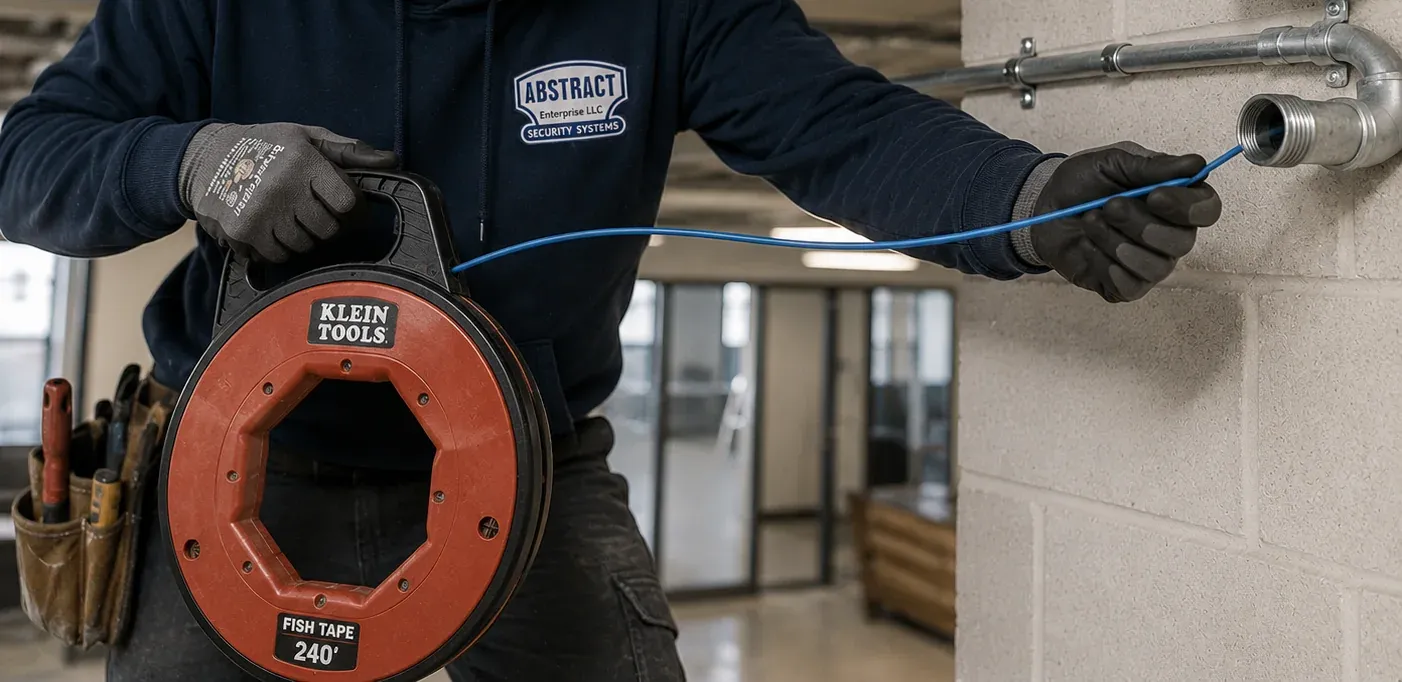
A technician in a navy hoodie and work gloves holds a red Klein Tools fish tape reel marked 240 feet in one hand and guides a blue line into the open end of a steel conduit elbow fixed to a painted block wall with the other.
Coverage Area
Cat6 Repair Near Putnam County’s Landmarks
These six places sum up the ground, water and buildings Putnam’s cable has to live with. Each is a reference point for the properties around it, not a claim of work inside it.
Historic Putnam County Courthouse, Carmel
Built in 1814 and renovated in 1847, on Gleneida Avenue by Lake Gleneida, and described by lohud as one of the oldest courthouses in New York. The professional offices around the county seat sit in many converted older buildings.
West Branch Reservoir, Kent and Carmel
Formed by damming the West Branch of the Croton River, in service since 1895 and holding about 8 billion gallons, per NYC DEP, with a 20-square-mile drainage basin across the two towns. A reminder of how much of Putnam sits close to protected water.
Cold Spring Historic District
Listed on the National Register in 1982, covering about 691 acres and more than 200 buildings along and around Main Street, Fair Street and Paulding Avenue, per its Wikipedia entry. Exterior changes visible from the street go to the village’s Review Board.
Boscobel, Garrison
The historic house that was taken apart in the 1950s and reassembled about 15 miles upriver on its present site above the Hudson. A picture of the estate landscape of Philipstown, where buildings sit far apart on wooded ground.
Tilly Foster Farm, Southeast
About 199 acres in the Town of Southeast, first a dairy farm and later a horse-breeding farm, bought by Putnam County in 2002, per the county’s 2022 overview. Barns and outbuildings on long runs are a familiar Putnam pattern.
Fahnestock State Park
A 15,000-acre park covering land in Putnam and Dutchess, with its office at 1498 Route 301, per New York State Parks. Much of central Putnam’s housing sits on wooded lots at the edge of land like this, under the trees that bring down lines in storms.
We also repair Cat6 in Carmel Hamlet, Mahopac, Mahopac Falls, Lake Carmel, Kent Lakes, Brewster, Southeast, Sears Corners, Patterson, Putnam Lake, Putnam Valley, Lake Peekskill, Oscawana, Cold Spring, Nelsonville, Garrison, Continental Village and the rest of Philipstown — and over the county lines into northern Westchester and southern Dutchess.
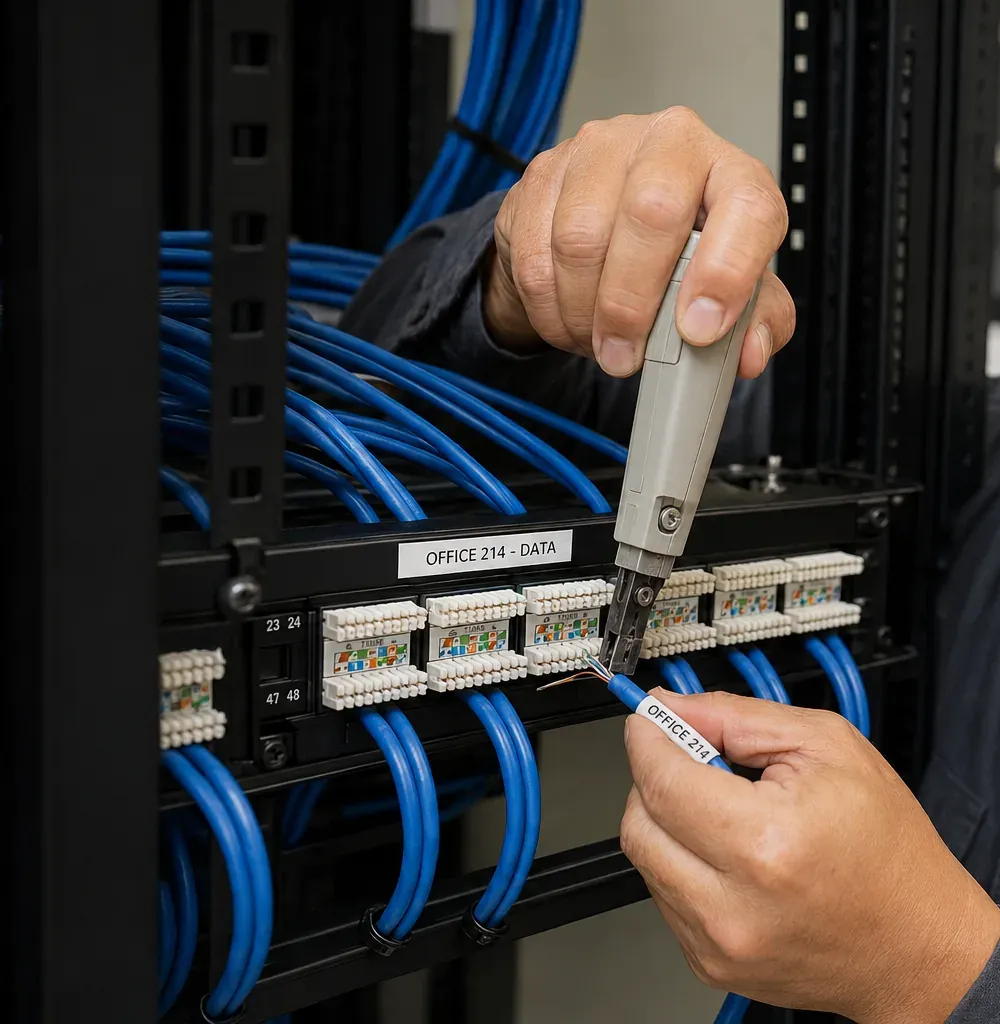
One hand presses a grey punch-down tool into a white termination block on a black patch panel labelled OFFICE 214 - DATA, while the other holds a blue cable wearing a white OFFICE 214 tag, with bundles of blue cable above and below.
Pricing
Cat6 Repair Cost in Putnam County
Every figure below is one we already publish for Putnam County, and the table says where. Work that depends on what testing finds — a new route, an excavation, a permit — is priced in writing before it starts. Repair time and replacement cable are separate lines, so you can see which one you are paying for.
Item
Price
Scope and source
Technician time on site: test, locate faults, re-terminate, repair damaged lengths, certify
$195/hr, 3-hour minimum ($585)
The specialty repair rate on our Putnam County network cable repair page; the block is spent on as many links as can be repaired
Additional time beyond the minimum
$195/hr
Billed in hourly increments, as published on the same page
Replacement Cat6 run where a link cannot be saved
From $175 per drop
The Putnam repair figure, covering cable, keystone jack, wall plate, panel punch-down, testing, both-end labelling and a patch cord
New Cat6 drop to 100 ft (installation pricing, for comparison)
$321 per drop
From the Putnam Cat6 installation price table, which lists $276 for Cat5e and $459 for Cat6A on the same terms
Battery backup fitted or corrected
Quoted per position
Where equipment restarting after an interruption, not the cable, is the real fault
Closet audit, mapping and labelling
Quoted by port count
Jack-to-port map, live and abandoned cable identified, durable labels and legend
After-hours or weekend window
Premium applies
For businesses that need work outside trading hours, as on our Putnam repair pricing
Outdoor route, overhead span, excavation or work near a wetland buffer
Quoted after testing and a site look
Depends on ground, distance, rock, structures and any permit the town requires
What the three-hour block buys on a Putnam visit
The minimum pays for a technician on site with the full test kit. On a typical house or small office it covers testing every link you are worried about, locating each fault, re-terminating jacks and panel ports, an in-line repair or an outdoor end, and certifying the result. Our published Putnam repair pricing carries no travel surcharge; we keep drive time sensible by asking the right questions before the visit so the van arrives with the parts the job needs. If testing shows a run that has to be replaced, rerouted or dug, you get a written price for that before any cable is pulled or ground is opened.
Why there is no per-mile or per-foot repair price
Two Cat6 faults that look the same on the phone can be very different on site: one is a jack cut short behind the plate, the other is a crush three metres inside a foamed wall. A flat per-repair price would either overcharge the first or underprice the second. Hourly repair time, with replacement runs priced separately, means you pay for the work the measurement shows.
What moves a Putnam Cat6 repair bill
Where the fault sits: at a jack, panel or plug it is quick; inside a finished, foamed or plaster wall it needs careful access; in the ground or overhead it may need a new route.
What caused it: one bad termination is one fix; a renovation, a storm or a flood can touch several runs at once.
Whether the run leaves the building: outdoor ends, support wire, entries and protection add parts and time.
The ground and the rules: rock, lake buffers and historic-district limits steer the choice of route if a run has to be replaced.
The cable itself: genuine solid-copper Cat6 suited to where it lies can be repaired; indoor cable used outdoors and patch cable used as a permanent run generally cannot.
About national price figures. Fixr’s January 2025 guide lists $125–$250 for a new Cat6 drop including materials and $45–$75 an hour for installer labour across the United States. Those describe new work on easy routes; they are not our prices, and they do not include finding a fault behind a finished Putnam wall or replacing a run across rock.
Full terms — including 50% deposit, one-year parts-only warranty on AESS-supplied products, and the late-fee schedule — are set out in the service agreement.
Shop Our Systems
Cat6 Repair Packages & Pricing
Most Putnam Cat6 repairs fit one of these three. Each is built only from figures we already publish.
Starter — One Link Back
$585
Three hours on site at $195 an hour. Suits one dead jack, one camera that will not power or one link to a garage: we test it, find the fault by distance, repair the termination or the damaged spot and certify the result. Time left in the block goes on any other suspect links you point us to.
Standard — House or Office Sweep
$195/hr after the first 3 hours
For a property where a renovation, a storm or a flood has touched several runs: every suspect link tested, faults located, jacks and panel ports re-terminated, in-line repairs made where they will certify, outdoor ends sealed, and a full set of saved results handed over.
Premium — Repair Plus Replacement Runs
Repair time + from $175 per run
Where testing proves some runs cannot be saved: repair time for everything that can be, replacement runs from $175 per drop on the least disruptive route, abandoned lengths removed where reachable, and an updated port map. Outdoor routes and excavation are quoted per run after a site look.
Bring Your Own Parts — Labour Only
Have keystones, faceplates in your house style, outdoor connectors or a spool left from the original job? We can use them, billed as repair time only, as long as they suit the link: Cat6A parts on Cat6A runs, solid-copper cable for permanent links, outdoor-rated cable for anything outside. Everything installed is certified either way. Parts you supply carry their maker’s warranty rather than ours, and if they cannot produce a passing link we tell you before the work is finished.
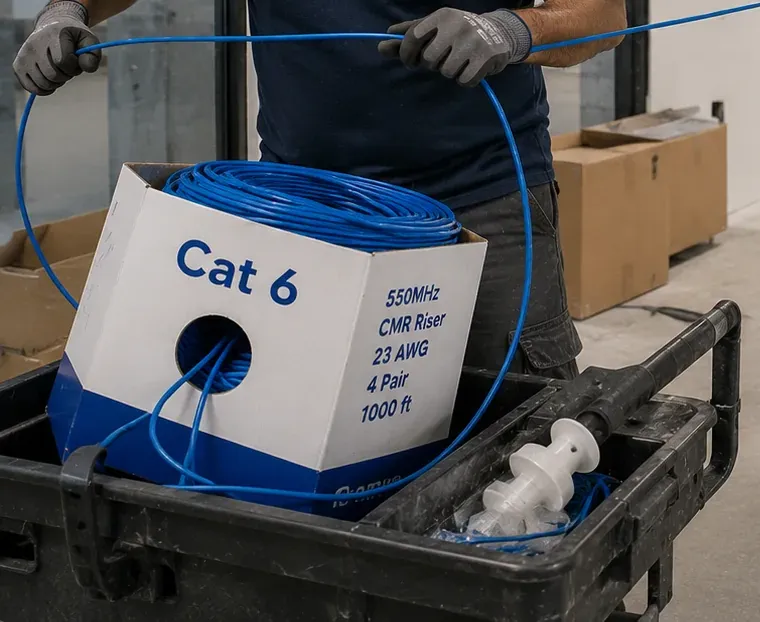
Two gloved hands draw a blue cable in a loop from a white carton printed Cat 6, 550MHz, CMR Riser, 23 AWG, 4 Pair, 1000 ft, which sits in a black utility cart beside cardboard boxes on a concrete floor.
Keep the Run You Already Paid to Bury
Send a photo of the panel or switch and a note of where the failing cable goes. We will tell you what the test is likely to show and what a first visit would cost.
Putnam is small enough to cross in under an hour, but its towns are built differently, and the faults follow the buildings.
Carmel and Mahopac
The most populous part of the county mixes the Route 6 commercial strip, the county seat around Gleneida Avenue and dense lake neighbourhoods around Lake Mahopac. Houses here are mostly post-war, so the typical fault is a retrofitted run: a jack terminated by a previous owner, a cable stapled tight in a basement, a home-office link damaged when a basement was finished. Lakefront lots add runs to docks and boathouses inside the town’s regulated wetland buffer, which is why we try hardest here to repair at the ends rather than dig.
Kent and Lake Carmel
Kent wraps around Lake Carmel and reaches up to the reservoirs, including Boyds Corner and part of West Branch. Many houses began as seasonal cottages and grew into year-round homes, so cable runs through additions, enclosed porches and crawlspaces that flood in spring. Steep, narrow roads and lots carved out of rock make replacement routes harder than in most of the county.
Southeast and Brewster
Brewster village has a compact Main Street of older commercial buildings near the Harlem Line station, while the rest of Southeast mixes newer subdivisions, the trade and light-industrial premises around the I-84 and Route 22 interchange, and farms such as Tilly Foster. Faults here run from basement panels in village buildings to yard cameras and gate links at contractors’ premises.
Patterson
Patterson is the most rural of the eastern towns: larger parcels, farms, horse properties and home-based businesses, with houses set well back from the road. Runs to barns, workshops and gates are common, and they combine every outdoor problem — long distances, wet entries, chewing and overhead spans through trees.
Putnam Valley
Hilly and wooded, with Lake Oscawana, Lake Peekskill and many smaller lake communities, Putnam Valley has some of the county’s steepest private roads and shallowest soil over rock. It was also the town that declared the July 2026 flash-flood emergency. Repairs here lean heavily on fault location by distance, re-using existing pipe and surface routes, and on fixing water at foundation entries.
Philipstown, Cold Spring, Nelsonville and Garrison
The river towns hold the county’s oldest buildings: Cold Spring’s Main Street and the historic district, Nelsonville’s village houses, and Garrison’s estates, studios and outbuildings on large wooded parcels. Plaster walls, trim, street-facing façades and long runs between buildings make this the part of Putnam where repair-first matters most, and where July 2023’s flooding did the most damage to roads around Old Albany Post Road, Indian Brook Road and Upper and Lower Station Roads.
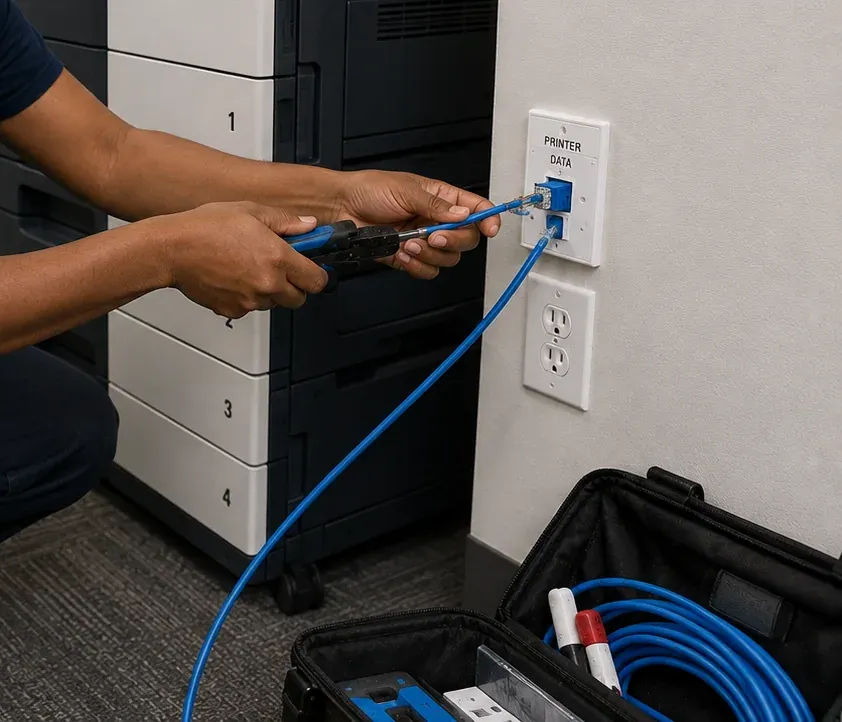
Beside a tall office copier with numbered paper drawers, a technician’s hands work a blue cable into a jack on a white wall plate labelled PRINTER DATA above a power outlet, while an open black tool bag with coiled blue cable sits on the carpet below.
Through the Year
The Putnam Cat6 Year: When Links Fail and Why
Calls about failing Cat6 in Putnam follow the seasons more closely than they do in the city, because so much of the county’s cable touches the outdoors, the ground or a building that is not always lived in.
Season
What tends to fail
What to check
Winter storms and ice
Overhead spans between buildings, cable on exterior walls, plugs at cameras under eaves
Support wire, drip loops and entries; anything a limb could reach
Spring thaw
Crawlspace and basement runs, foundation entries, panels in low corners
Water at entries, corroded plugs and punch-downs, cable lying on wet ground
Spring and early summer reopening
Lake houses and seasonal buildings opened after months closed
Every link tested before guests or tenants arrive, not after
Summer storms
Switch ports and devices on runs that leave the building; links after a power return
Pattern of failures: devices at both ends or one distance on the run
Late summer flash floods
Basement panels, foundation entries, buried pipe that fills
Test before reusing anything that was under water
Autumn renovation season
Runs damaged by screws, nails, staples and new soffits
Test every jack in a renovated room before walls are closed and painted
The last row is the easiest to prevent. If you are renovating, ask whoever is closing the walls to leave the Cat6 alone, and have the links tested before the drywall goes up. A ten-minute test then is cheaper than finding a screw through a cable after the painters have left.
Lake and Second Homes
Opening a Putnam Lake House: A Cat6 Checklist
Owners who use a Putnam lake house part of the year, or rent it out, find their Cat6 problems the day they arrive. A short routine at opening time catches most of them while there is still time to book a repair before the first weekend.
Power up in order. Provider equipment first, then the router, then the switch, then access points and cameras. Wait for each to settle. Many “dead” links on opening day are equipment that started in the wrong order.
Walk every jack. Plug a laptop into each wall jack you rely on and note which ones link, at what speed, and which do not. A link at 100 Mbps instead of 1 Gbps usually means a damaged pair.
Look at the outdoor ends. Check cameras, the dock or boathouse link and anything on the garage. Cracked plugs, sagging cable and water stains under boxes are worth a photo.
Check the basement or crawlspace. Look for water marks near the panel and where cables enter the foundation. Do not unplug or handle anything that is wet.
Write down what failed. A list of jacks and devices, with photos, lets us bring the right parts and often finish in one visit.
Ask about a closing test. If a link failed last season and was patched, a certification test at closing time gives you a baseline to compare against when you reopen.
If you are not at the house, a caretaker or neighbour can do most of this. We can work with them on site, and send you the results.
Plain Terms
Words You Will Hear on a Putnam Cat6 Repair
We write findings for owners, not engineers, but a few terms come up on almost every visit. Here is what they mean on a Putnam property.
Term
What it means here
Permanent link
The fixed cable from the wall jack to the panel, the part inside your walls, ceilings or ground. Repair-first work is about keeping this.
Channel
The permanent link plus the patch cords at each end. A bad cord can make a good permanent link look faulty.
Distance to fault
The tester’s reading of how far along the cable a short, open or impedance change sits. It decides where we open a wall or a box.
Re-termination
Cutting a cable back to clean copper and fitting a new jack, panel connection or plug. The most common repair.
In-line repair
Joining a cable at a damaged point with category-rated hardware in a box that stays accessible, then certifying the whole link.
Split pair
Wires connected end to end but paired wrongly. Passes a cheap tester, often holds only 100 Mbps.
Insertion loss
Signal lost along the cable. Rises with length, heat and water in the jacket.
Return loss
Signal reflected back by kinks, crush points and poor connections. A common result of renovation damage.
Support wire
A steel wire tensioned between two buildings that carries an overhead cable’s weight, so the cable itself is not stretched by wind and ice.
Drip loop
A downward loop in a cable just before it enters a building, so water runs off the bottom instead of into the wall.
Wetland buffer
The regulated area around a wetland, lake, pond or stream; 100 feet in the Town of Carmel’s ordinance. A new trench inside it may need a town permit.
Certificate of Appropriateness
Cold Spring’s approval for changes to exterior features visible from the street in the historic district.
Before You Call
Five Checks a Putnam Owner Can Make in Ten Minutes
None of these needs tools, and each one either solves the problem or makes the repair visit shorter.
Swap the patch cord at both ends. Cords get crushed under desks and chairs and pulled by vacuum cleaners. A known-good cord rules them out in a minute.
Try another device on the same jack. If a laptop links where the camera or printer would not, the device or its settings may be the problem, not the cable.
Move the cord to a different switch port. If the link comes back, the switch port is suspect; if not, the cable or jack is more likely.
Note whether one thing failed or everything did. Everything at once points to power, the router or the provider; one jack or one camera points to that run.
Think about what changed. A storm, a renovation, a provider visit, a new appliance plugged into the same outlet, a cleaner moving furniture. The last change before a failure is the best clue we get.
What not to do: do not open a panel or a jack that has been wet, do not join a damaged cable with tape or electrical connectors, and do not re-hang a torn overhead span without a support wire. Each of those creates a harder repair later.
Field Notes
Field Notes on Repairing Instead of Replacing
How we approach a failed run on a rocky, wooded Putnam lot — general practice, not one particular call
We start with the end we can stand next to. Most failed links on a Putnam property have at least one end in a basement, a closet or a garage, and that is where we connect the tester. Before anything else we read the distance to the fault and compare it with the length of the run. If the fault is within a metre of either end, the ground, the wall and the lake buffer never come into it: we cut back, re-terminate and certify.
If the fault is out on the run, we ask what is at that distance. A foundation wall. A tree the span passes under. The corner where a porch was enclosed. The place where the renovation crew hung new cabinets. A measured distance plus a walk around the property usually points to one spot, and we open that spot and nothing else.
Only when the test shows damage spread along the cable, or the cable is simply wrong for where it lies, do we talk about replacement — and then we start with the route that is already there: the old pipe, the old path, the surface of a wall. A new trench through Highlands rock is the last option, not the first. Before we leave, every repaired link is certified and the result goes on file, so that the next time a storm comes through you have a number to compare against.
Complete Services
Every Cat6 Repair Service in Putnam County
A failing Cat6 link in Putnam often brings a camera, a gate, a switch or a new drop into the same conversation. These are the related services we provide across the county.
Can you repair the Cat6 at a short-term rental in Cold Spring or Philipstown between guest stays?
+
Yes. Tell us the gap between bookings and we plan the visit to fit inside it, with the parts loaded in advance so the work finishes the same day. Rentals see more cord and jack damage than owner-occupied houses, so we usually replace worn patch cords, secure loose plates and label the jacks guests are meant to use while we are there. The certified results let you show a later guest or a property manager that the wired connection was working when you handed it over.
Our caretaker looks after the lake house while we are away — can the technician meet them instead of us?
+
Yes, and it is common in Putnam’s lake communities. We agree the scope and the price with you in writing first, then work with the caretaker for access. Anything that would change the scope or the price is brought back to you before it is done, and the test results and photos come to you directly, so you see the same information the caretaker does.
Can you repair Cat6 that runs down to a dock or boathouse on Lake Mahopac?
+
Yes. Dock and boathouse links fail at the ends more than in the middle: a plug or jack exposed to spray and sun, a cable flexing where a floating section meets a fixed one, or water at the entry into the boathouse. We test from the house, repair the failing end with outdoor-rated parts in a sealed enclosure, add a drip loop and strain relief where the cable moves, and only replace the run if the test shows damage along its length. If a replacement would mean a new trench near the shoreline, we raise the town wetland-permit question before scheduling it.
Will you protect the plaster and woodwork when repairing Cat6 inside an older Garrison or Cold Spring house?
+
Yes. We locate the fault by distance before opening anything, so in most cases the only opening is the existing jack box or a closet wall. Floors and furniture are covered, dust is controlled at the opening, and original trim is removed and refitted rather than cut. Where a wall must be opened, we tell you the size and place first; patching and painting are left neat and flat, ready for your painter or plasterer to finish to match.
We run a business from a home office in Patterson — can a failed link get a temporary fix the same day while the proper repair is planned?
+
Often, yes. If the permanent repair needs a wall opened, an outdoor route or parts that have to be ordered, we can usually restore service the same day with a tested temporary connection — a protected surface cable from the router to the office, or a spare pair of jacks re-patched at the panel. It is labelled as temporary, and the permanent repair is scheduled and priced in writing so the temporary fix does not quietly become permanent.
Our house is up a steep private road in Putnam Valley — can a technician still get there in winter?
+
Usually. Tell us when you book if the road is steep, unpaved, gated or not plowed by the town, and we schedule for daylight and for after the road has been cleared. If conditions on the day make the drive unsafe, we call ahead and rebook rather than risk the vehicle, and if the fault can be narrowed down by phone first we do that so the eventual visit is as short as possible.
If the problem turns out to involve the electrical side — a generator inlet, a panel or a surge device — do you bring in an electrician?
+
We tell you, and we can coordinate with your electrician or recommend that you bring one in. Our work is the low-voltage cabling and its protection; we do not alter power wiring, panels, generator connections or bonding to the electrical service. Where a Cat6 repair depends on that work — for example a protector that needs a proper ground connection at a building entry — we explain exactly what the electrician needs to provide so both trades finish in as few visits as possible.
Will you photograph a repair that ends up hidden inside a wall or ceiling, so a future owner or contractor can find it?
+
Yes. Any in-line repair or junction box behind a finished surface is photographed before it is closed, with its position measured from a fixed point such as a corner or a window, and the photos go into the record with the test results. In a Putnam house that may be sold or renovated again, that record saves the next person from having to rediscover where the repair is.
We commute on Metro-North from Brewster — can a Cat6 repair be booked for a Saturday or an early morning?
+
Yes. We book appointments from 8 a.m. to 8 p.m., seven days a week, subject to availability, so a commuter household can usually find a window before work, in the evening or at the weekend. Business premises that need work outside trading hours are priced with the after-hours premium shown on our Putnam repair pricing; a homeowner choosing a Saturday slot is simply booked into it.
Our builder used shielded Cat6 — does that change how a repair is done?
+
Yes. Shielded cable has to be repaired with shielded jacks and plugs, and the shield has to be carried through every termination and connected at the panel end as the system was designed; mixing unshielded parts into a shielded link, or leaving a shield unconnected, can make performance worse rather than better. We confirm what kind of cable and hardware is installed before we start, bring matching shielded parts, and certify the repaired link the same way.
All Areas Served
Cat6 Repair Across Putnam, the Hudson Valley and Beyond
This is the Putnam County page of our Cat6 repair service. It sits under the Hudson Valley Cat6 repair hub, alongside pages for neighbouring counties and the city and island hubs.
Lake House or Garage Link Dark Since Last Weekend?
If a jack, a camera, the dock link or the run to the garage dropped off the network, call (845) 640-3835. We book the next open 2-hour window, bring the parts the symptom points to, and most termination and plug faults are found and fixed in one to two hours on site.
Cat6 Repair Putnam County — Licensed, Insured, Certified to Category
Abstract Enterprises Security Systems · 460 E Fordham Rd, Bronx, NY 10458 · Putnam County line (845) 640-3835 · Message us on WhatsApp
NYS Low-Voltage Licence #12000287431 · 100% Licensed & Insured · Same-Day Estimates · Rated 4.7★ from 201 Google Reviews
Customer-supplied parts are covered by their maker, not by AESS. Our warranty page and the service agreement hold the full terms.
Code, permit and regulation references on this page are short summaries for property owners in Putnam County; they are not legal or engineering advice. Page reviewed and updated October 17, 2026. Changelog: first publication of the Putnam County Cat6 repair page.