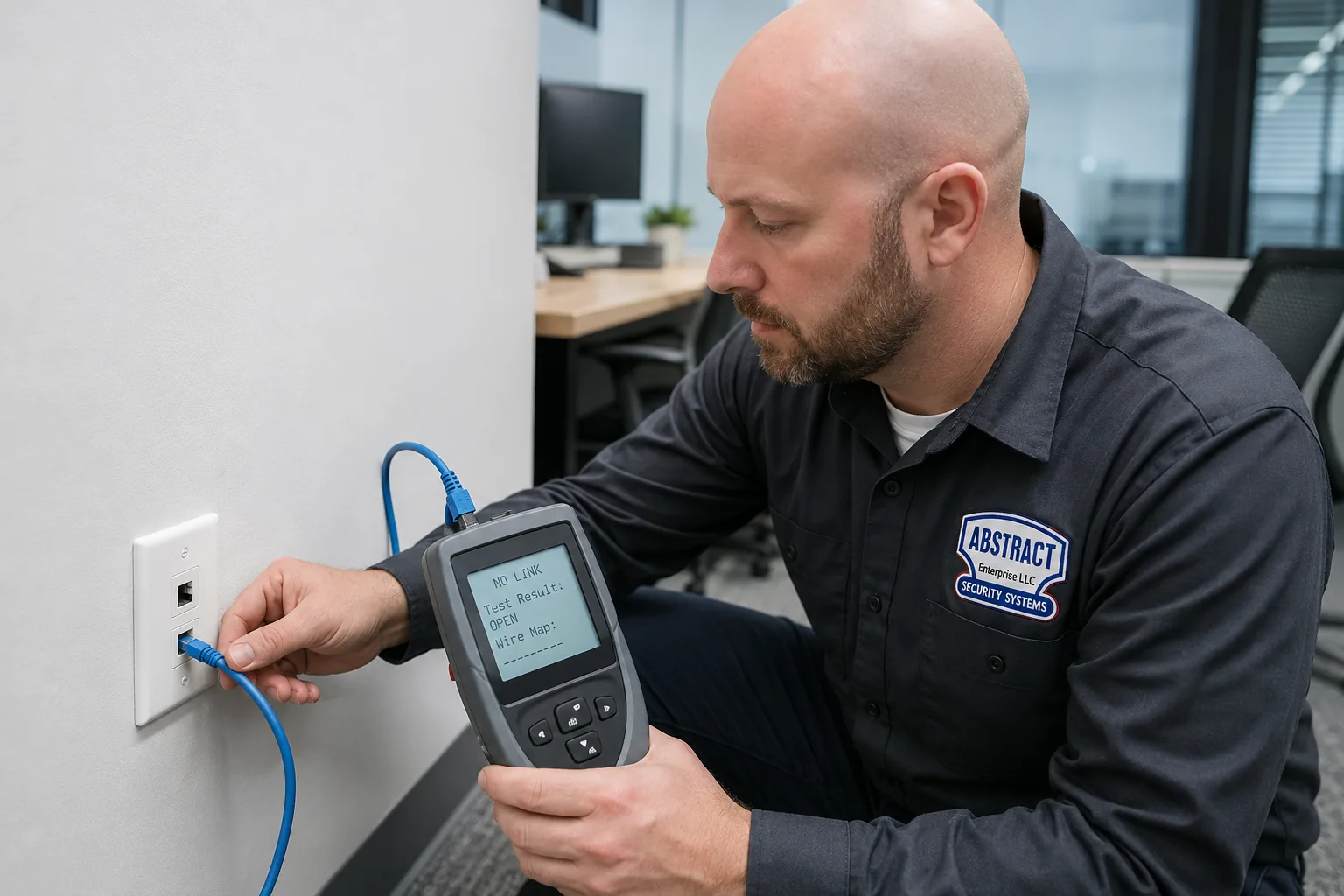
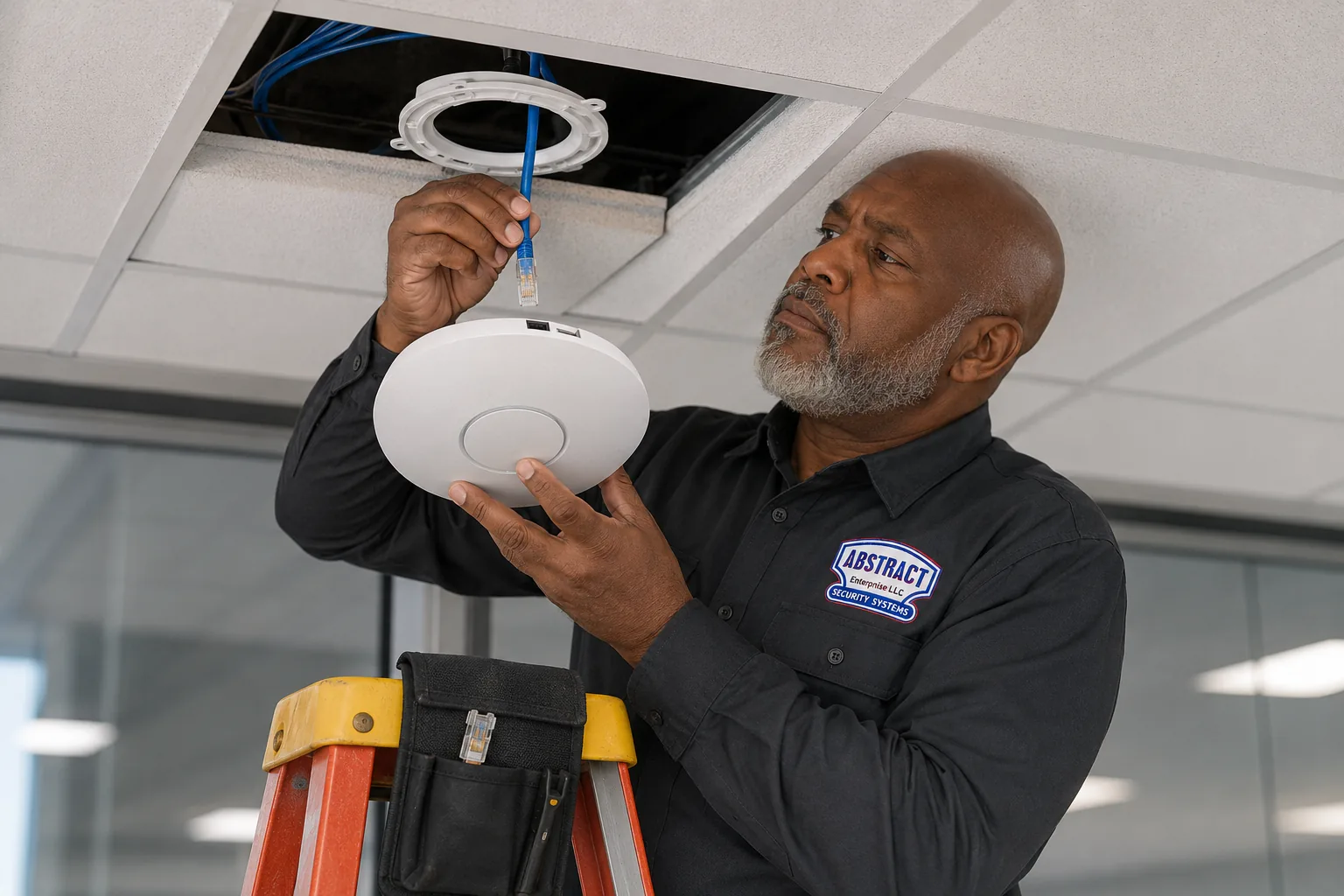
Inherited Runs · Raised Floors & Poke-Throughs · Power Poles · Shielded Cat6A · Conference AV Links · Storefront Vaults
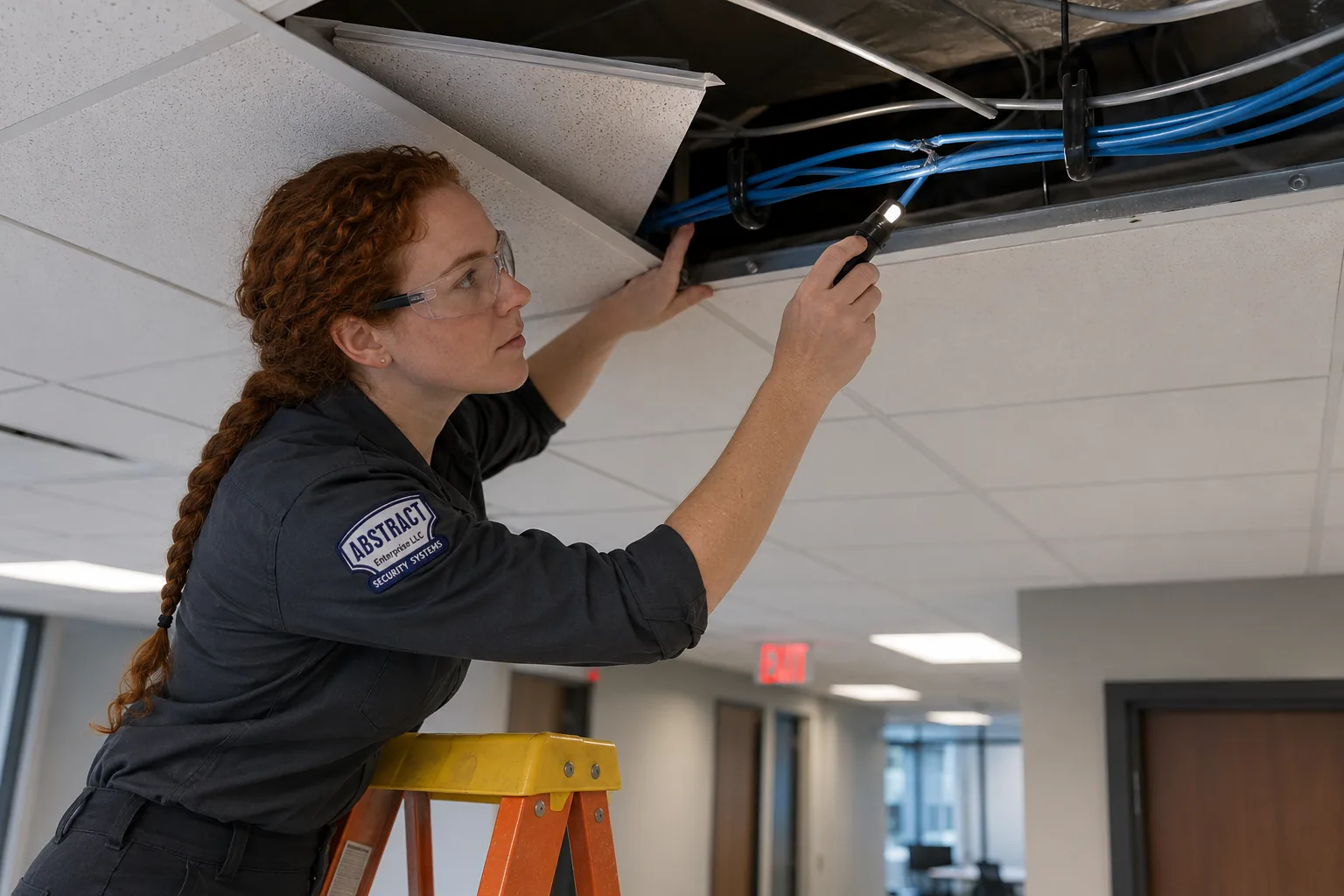
Almost nobody in Manhattan is repairing Cat6 they put in themselves. The links on your floor were most likely pulled by a landlord's pre-built crew, the tenant before you, an IT vendor long since replaced or the developer who turned the building from offices into apartments — and the building only gives anyone a few hours to touch them. We read the failing links before the visit, arrive with the parts that match what is actually installed, and finish the repair, the retest and the labels inside the window your building allows.
Reviewed and updated October 17, 2026 · Written by Anwar Timothy, NYS licence #12000287431 · Manhattan direct line (929) 560-0737

Got a window booked and a list of dead desks? Ring the Manhattan line, (929) 560-0737, or send the 60-second form. Tell us the hours your building has given you and we plan the visit backwards from them: what to test first, which parts to bring, and what to leave for a second window if the list is longer than the time.
On a typical Manhattan floor, the person who calls about a failing Cat6 link has never seen the cable they are calling about. They signed a lease on a pre-built suite, took over a sublet, bought into a co-op whose sponsor wired the apartments, or moved into a residential tower that was an office building three years ago. The Cat6 was pulled by someone else, to someone else's drawings, for someone else's furniture. When a run stops performing, the repair starts with a question the rest of the country rarely has to ask: what exactly is in this ceiling, and who put it there?
That matters because Manhattan's office stock is enormous and mostly old. The city Comptroller's May 2024 spotlight on the office market, using CoStar data, counted roughly 594 million square feet of office space in Manhattan — about 82 percent of the city's total — with nearly 173 million square feet of it rated Class B and another 59 million Class C. Space like that turns over tenants many times in its life, and each tenant leaves a layer of cabling behind. Some of it is live. Some of it is abandoned. Some of it is live but connected to a patch panel that was relabelled twice and documented never.
Age does not mean neglect, either. A Manhattan office broker reviewing 401 fully leased buildings in late 2025 noted that the median one was built in 1931 and renovated in 2011 — pre-war bones with modern systems. In cabling terms, that means Cat6 from a fairly recent fit-out threaded through a structure that was never designed for it: through slabs that were cored for it, under raised floors that were added for trading desks, up power poles because the core walls cannot be opened, and around steel and masonry that bends cable harder than it should be bent. The link may be ten years old; the obstacles it lives with are nearly a century old.
Then there is the clock. Manhattan buildings decide when contractors may work, which elevator they ride and which ceilings they may open. A co-op's alteration or decoration agreement can carry penalties for working outside authorised hours. An office tower may confine ceiling work to evenings. A retail landlord on Broadway may want the shop floor clear before opening. Every one of those rules turns a repair into a fixed-length job: whatever is not finished when the window closes waits for the next one, and the desk, the camera or the conference room stays dark in between.
So a Manhattan Cat6 repair has a different shape. It is less about finding a path for new cable and more about identifying inherited plant quickly, matching it exactly, and proving the result before the building wants everyone out. The work that saves the most money happens before anyone arrives: reading the symptoms, looking at photos of the panel and the jack, finding out whether the original installer used shielded Cat6A or ordinary Cat6, and deciding which links are worth repairing in this window and which should be replaced in a planned one.
Taken together, those facts describe a borough where most Cat6 is somebody else's work, sits inside an older structure than its age suggests, and has to be repaired on a schedule the building sets. That is the job this page describes: diagnose before the window, repair inside it, prove it before leaving, and leave a record the next person can use.
A failing Cat6 link is often the first sign that a whole floor has drifted out of anyone's records. When the problem turns out to be wider than Category 6 — an old Cat5e segment, a tired switch, mixed plant from three fit-outs — our Manhattan network cable repair technicians pick it up, and when the honest answer is new cable rather than repair, the AESS Cat6 installation team in Manhattan prices the new drops.

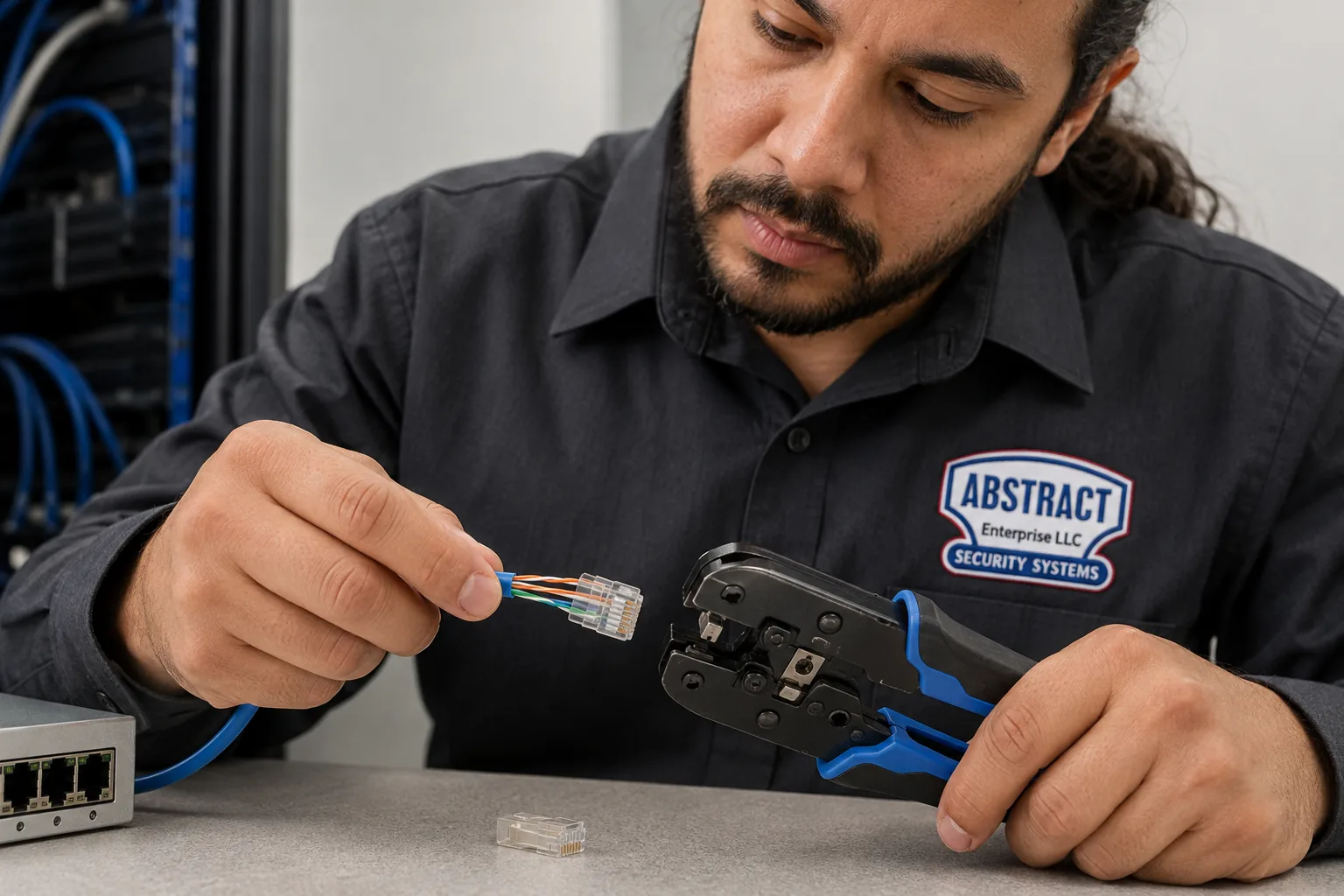
A trader's second screen has no network, a law firm's reception desk cannot print, a SoHo shop's register went offline before the doors opened, or the display in the boardroom keeps going blank halfway through a call. Those are repair calls and we book them as such: the next open 2-hour arrival window that fits inside your building's contractor hours, with a certification tester, a toner, Cat6 and Cat6A keystones, shielded and unshielded panel modules, factory-made cords and cable on the van. Single-link faults at a jack, a cord or a panel port are usually found and fixed in one to two hours once we are on the floor. Repair time is $195 an hour with a three-hour minimum ($585), the rate published on our Manhattan network cable repair page. Call (929) 560-0737 and tell us the building and the window.
These are the repairs Manhattan floors actually need, named after the places the cable lives rather than the parts it uses. Each one finishes with the repaired link tested against its own category limit, the result saved, both ends labelled and a plain-English note of what was wrong.
For suites taken over from a previous tenant or delivered pre-built: every link tested, live and dead runs separated, faults repaired and a port map produced where none existed, so the floor you inherited becomes a floor you can maintain.
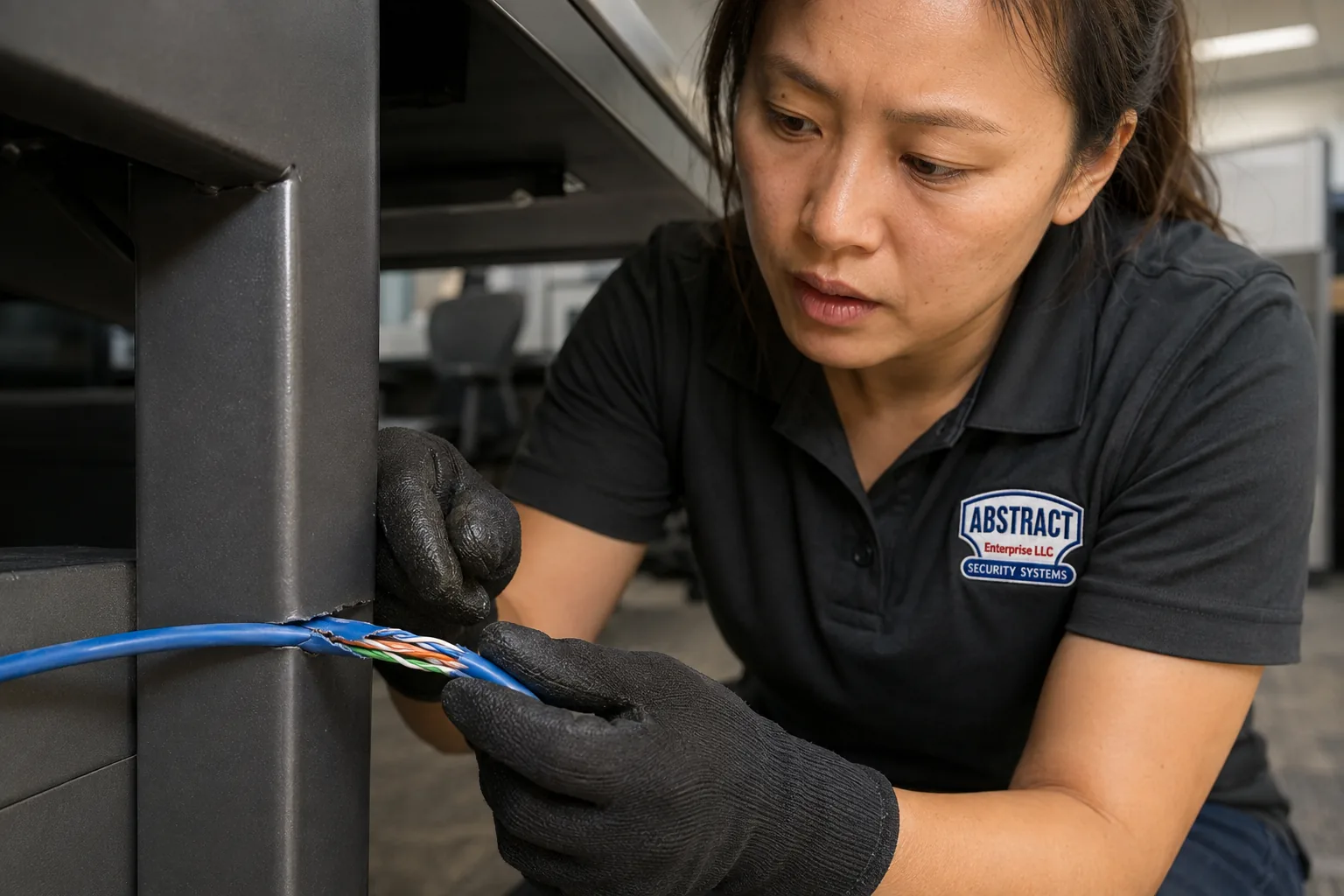
Desk links that drop down power poles or through furniture raceways fail at the pole top, the furniture jack and the cord. We test each section separately and repair the one that failed instead of re-pulling to the closet.
Cable under access floors on former trading floors and in data rooms gets pinched by pedestals and tile edges. We locate the fault by distance first, then lift only the tiles over it and restore the floor as we found it.
Links that rise through a cored slab to a floor box in an open office are repaired with the fire-rated fitting respected: opened only by someone who can restore it, reported if it was already compromised.
Newer towers and some financial and media fit-outs use shielded cable. We repair it with shielded keystones and modules, keep the shield continuous through every termination and check the bond at the panel.
Displays, codecs and room systems fed by video-over-Cat6 extenders are far less forgiving than a laptop. We test those runs for what the extender needs, not just for a link light, and remove the joints that cause blanking.
Open-plan floors often route groups of desks through a box above the ceiling. When a whole cluster fails at once, we start there, re-terminate or replace the connector block and retest every link it serves.
Point-of-sale, camera and access-point links that pass through damp cellars and under-sidewalk vaults in SoHo, Tribeca and the older retail streets are repaired with the corrosion cut out and the route moved off wet surfaces where possible.
When a critical desk cannot wait for the next window, we move it to a tested spare run tonight, tag the faulty one, and repair it properly when the building allows ceiling access.

Manhattan is not one building type, and the Cat6 in each one fails in its own way. These are the structures we work in most below and above 59th Street, and what each means when a link stops performing.
The 1920s and 1930s towers of Midtown and the Financial District, renovated inside. Cat6 from the latest fit-out runs through cores and slabs cut decades ago, so tight bends at old sleeves and crowded chases are where links fail first.
Sixth Avenue, Park Avenue and the Plaza District slabs of the 1950s to 1980s: long floor plates, hung ceilings, raised floors on former dealing floors, poke-throughs to open-plan desks. Distance and other trades' work in the ceiling are the usual enemies.
Hudson Yards and Manhattan West buildings opened from 2016 onward. Plant is newer and better documented, but shielded cable, dense PoE bundles and high-spec AV mean repairs must match the original system exactly.
SoHo, Tribeca, NoHo and the Ladies' Mile district: open floors, exposed beams, brick party walls and cellars under the sidewalk. Cable is often surface-run or clipped to structure, which exposes it to knocks, damp and heat.
Former office buildings now carved into apartments, from the Financial District to Midtown. Unit cabling was usually installed by the developer, sometimes reusing or abandoning the office plant, and the fault is often at a point no tenant can see.
Doorman buildings on the Upper East and Upper West Sides, and pre-war co-ops throughout. Apartment Cat6 was put in by owners or sponsors; any work in common space goes through the managing agent and the house rules.
Practices along the Upper East Side medical corridor, university buildings in Morningside Heights and Manhattanville, and cultural institutions. Links are critical, schedules are tight, and repairs are planned around patients, classes or performances.
Pre-war towers: protect the sleeve. When a run fails where it passes through an old core or sleeve, the temptation is to pull harder on a new one. In a sleeve already packed with dead cable that only damages the neighbours. We test the neighbouring live links first, remove abandoned cable from the sleeve where it is accessible, and only then route the replacement, firestopping the opening again afterwards.
Post-war and glass towers: treat the floor as a system. Long floors mean runs closer to the 90-metre permanent-link limit, so a damaged run is not always replaced by the same path. We measure every replacement before pulling it and test the finished channel with the cords that will actually be used, because a few extra metres of furniture cord can push a marginal link over.
New towers: match, do not mix. A shielded Cat6A link repaired with an unshielded keystone is no longer a shielded link, and a link repaired with a different manufacturer's module may void a system warranty the building cares about. We photograph and identify the installed hardware before ordering anything, and bring the same family of parts.
Lofts and landmarked buildings: keep it inside and reversible. We repair along the existing route wherever possible, avoid new penetrations in historic fabric, use the cellar or ceiling rather than the facade, and choose fixings that can be removed without trace. Interior work that needs no Buildings permit and does not affect the exterior normally needs no Landmarks permit either, but we confirm the building's own rules first.
Conversions: find the boundary. In a converted building, a resident's link usually passes through a unit panel, a riser and a building telecom room owned by the condominium or the landlord. We test from the unit outward, identify where the fault sits relative to that boundary, and tell you plainly whether the fix is inside the apartment or in building space.
Co-ops and condos: paperwork first, then plaster. Inside an apartment, the shareholder or owner decides; in hallways, risers and basements, the building does. We send the insurance certificate and a written scope to the managing agent, follow the house rules on hours and protection, and keep repairs inside the apartment wherever the fault allows it.
Medical and academic: repair in sequence. Exam rooms, labs and lecture halls cannot all go offline at once. We test and repair room by room, confirm each one is back before moving to the next, and leave nothing half-terminated at the end of a session.
Most Manhattan buildings that need Cat6 repaired also need their camera and door systems looked at. When a run that failed also feeds a camera, see our security camera repair service for Manhattan; when the work is in a lobby or vestibule, the AESS Manhattan intercom team often handles the door side in the same visit.

Manhattan's business districts each leave their own signature on the cabling. These six corridors account for most of the commercial Cat6 we are asked to repair, and the kind of fault we expect differs in each.
Rockefeller Center alone is 19 commercial buildings on 22 acres between 48th and 51st Streets, the original 14 built from 1931. Around it, Sixth, Madison and Park Avenue towers house law, finance and media floors that have been re-fitted many times. Expect layered ceilings, power-pole desks and conference rooms full of AV links.
Older trading floors with raised access floors, post-war slabs on Water and Broad Streets, and a growing number of office buildings converted to apartments, led by 25 Water Street. Repairs here split between under-floor runs in offices and unit-to-riser links in residential conversions.
The SoHo-Cast Iron Historic District covers about 26 blocks and nearly 500 buildings. Storefronts on Broadway, Greene and Mercer run point-of-sale and camera links through cellars and the vaults under the sidewalk, and loft offices upstairs surface-run Cat6 along beams and columns.
The Ladies' Mile Historic District, designated in 1989, holds about 440 mostly store and loft buildings between roughly 15th and 24th Streets. Showrooms, agencies and tech tenants on open loft floors mean long exposed runs, frequent re-arrangement and cables pinched by furniture.
A 28-acre development over the West Side Rail Yard, its first tower opened in 2016 and Phase 1 in March 2019, with Manhattan West beside it. Newer plant, but dense PoE, shielded cable and strict building procedures. Repairs must match exactly and be documented to the landlord's standard.
Columbia's 17-acre Manhattanville campus above West 125th Street, the retail and office corridor along 125th, medical and community facilities in Washington Heights, and mixed-use buildings in Inwood with cellar telecom rooms. Water in the cellar and older mixed cabling are the common threads.
Street-level businesses are the most time-pressed Cat6 repairs in the borough. A register, a kitchen display or a camera link that fails at ten in the morning on Broadway or Madison Avenue costs sales by the hour, and the cable is often in the worst place to reach: behind a fixed counter, under a display platform, or down in a cellar shared with the building's boiler and storage.
The faults follow the use. Counter jacks are kicked, mopped and pulled by cords stretched to a moved terminal. Cellar runs pick up damp from vaults and sidewalk leaks. Showroom links are re-routed every time the floor is re-merchandised. Kitchen-side terminations sit in heat and grease. Each one leaves a recognisable result on the tester, and most are repaired at a termination or a cord rather than by a new run.
We book these early, before opening, wherever the landlord allows it, and we repair in order of what keeps the doors open: payment first, then cameras and back-office links. If a run genuinely needs replacing, a temporary tested spare or a short protected cord keeps the register working until the replacement can be done after closing.

These are the questions that come from Manhattan floors specifically: from office managers in Midtown towers, residents of converted buildings downtown, shop owners in SoHo, AV managers with a dead boardroom and building engineers who have one evening to give us. They are grouped by where the cable lives. General symptoms and test results are covered on our five-borough page; pricing and practical arrangements are in the FAQ further down.
Because the cable in a conversion has usually lived two lives. When an office building becomes apartments, the developer may reuse parts of the old horizontal plant, abandon some of it in the ceilings and install new unit wiring that meets a building telecom room on each floor or in the cellar. A jack in the bedroom can therefore be fed by a fresh run that ends at a unit panel in a closet, which in turn depends on a riser cable shared by the whole line of apartments.
The faults we find follow those joints: a unit panel that was never patched, a keystone punched in a hurry during the final weeks of fit-out, a run nicked when the drywall went up, or a jack that looks like data but is wired to the coaxial or telephone system. At 25 Water Street, for example, about 1,300 apartments were created in a building that opened in 1969 as offices — conversions at that scale are finished against deadlines, and small termination errors are the common result.
We test from the jack to the unit panel first, then from the unit panel toward the building room, so we can tell you whether the fault is in your apartment, where you or your landlord arrange the repair, or in building space, where the managing agent has to authorise it. Most are a single termination inside the unit and are fixed in one visit.
Power poles are common in Manhattan open offices because the floor is concrete, the core walls are far away and the ceiling is the only place cable can travel. Each pole carries data cable from the ceiling down to the desk cluster, and that cable takes three hard turns: over the edge of the ceiling opening, inside the pole, and out into the furniture raceway. None of those were meant to move.
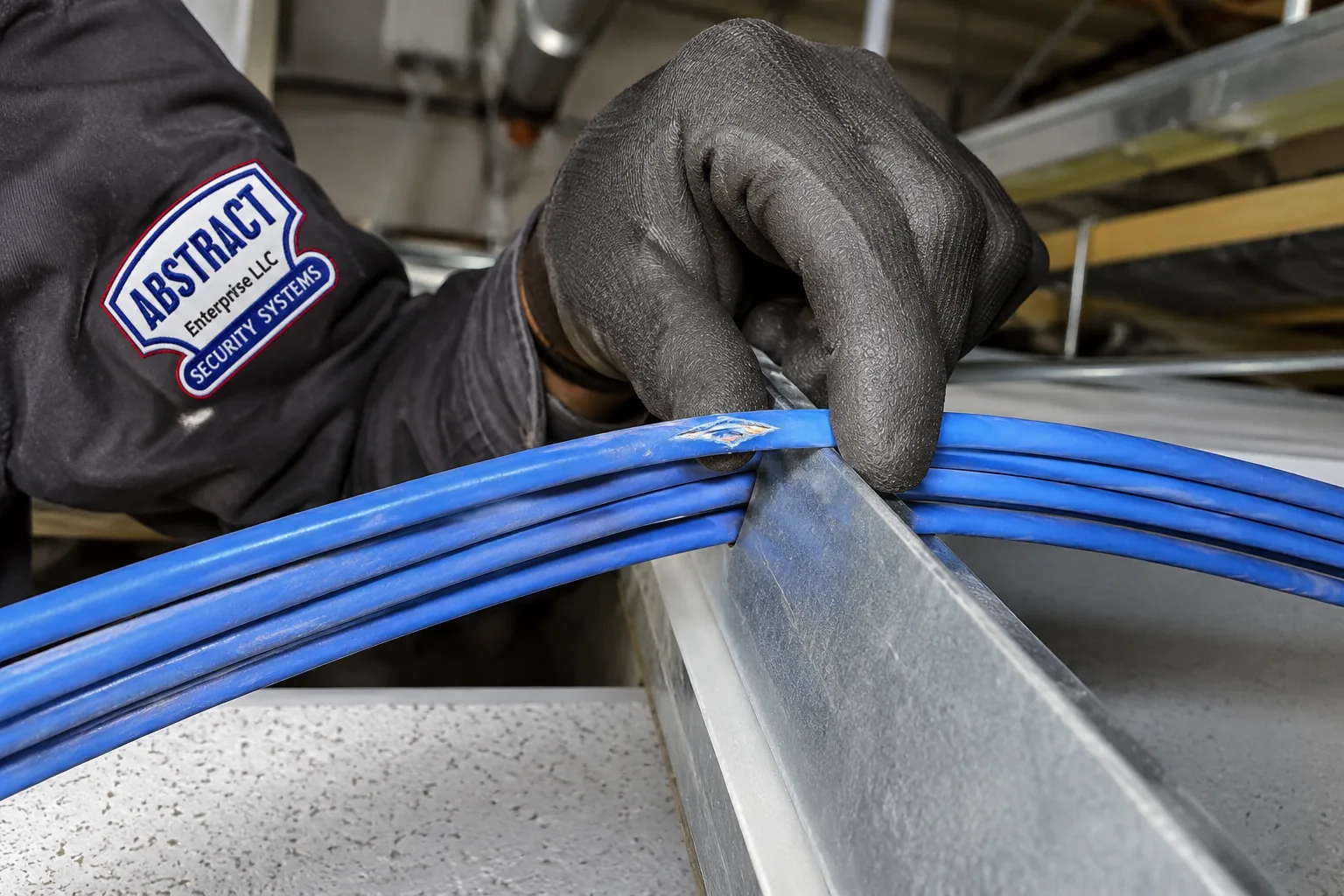
When desks are re-arranged, the pole is usually tilted or walked a few feet, which drags the cable over the ceiling grid, kinks it inside the pole or pulls a jack half out of its housing. Links may still light, but they start failing crosstalk or return loss at the point of the bend, and the tester shows the fault at a predictable distance from the desk. Field-made cords inside furniture make it worse.
The repair is normally local. We test from the panel to the desk, find whether the fault is at the pole head, inside the pole or at the furniture jack, and repair that section. If the poles have to move again, we leave service loops above the ceiling so the next move does not reopen the same damage.
Glass-fronted rooms are everywhere on renovated Manhattan floors, and they are awkward for cable because there is no stud wall to drop it through. Installers usually bring the run down inside a narrow solid wall section at the end of the glass, inside the mullion or a frame channel, under the carpet in a flat channel, or up through a floor box. Which one was used is rarely on any drawing.
Each path has its weak point. Runs squeezed into frame channels get crushed when the glass panels are adjusted. Flat under-carpet channels are walked over and rolled across. Floor boxes collect water from cleaning. Runs inside the narrow wall at the end of the glass are bent hard at the bottom where they turn into the box. The tester tells us how far from the panel the fault sits, which usually identifies the path before anything is opened.
Once we know the route, we reach it from the ceiling or the floor box rather than from the glass, repair or replace the damaged section, and leave the room looking as it did. If the path itself is the problem — a frame channel too small for the cable — we tell you and suggest a better one for when the room is next refitted.
Usually, yes. Raised floors are still found on former trading floors in the Financial District and Midtown and in many server and communications rooms. Cable under them is damaged in a few characteristic places: where a tile edge or pedestal pinches it, where a heavy desk or cabinet sits on a tile above it, and where it rises through a grommet to the desk.
Because a certification tester reports where along the run a crosstalk or reflection fault sits, we can measure from the desk and lift only the tiles over that point. Before anything is lifted, we check with the building or your facilities team which tiles carry equipment and whether the floor is also an air plenum, because that affects both the cable we use and how the tiles have to go back.
The damaged section is then repaired or the run replaced in the same space, the cable is dressed so it no longer sits under a pedestal or tile edge, and the tiles go back in their original positions. The rest of the floor is never touched.
A poke-through is a fitting set into a hole cored in the concrete slab, so cable from the ceiling of the floor below can reach a floor box under a desk. In many Manhattan towers these fittings are fire-rated assemblies: they keep the slab's fire separation intact while letting cable pass. A Cat6 run that fails where it enters the fitting has often been crushed by a furniture leg or by the fitting's own cover.
Replacing that run means working from the ceiling below, which belongs to whoever leases the floor below, so access has to be arranged through the building first. Once there, we remove the damaged cable through the fitting without enlarging the opening, pull the replacement, terminate it in the floor box and make sure the fitting's fire-rated parts are back in place as designed.
If we find a fitting that was already compromised — missing intumescent parts, stuffed with extra cable, or an open hole with no fitting at all — we photograph it and tell the building. Restoring a firestop is the building's or its firestopping contractor's call; leaving it unreported is not an option for us.
Yes. Shielded Cat6A (often labelled F/UTP or S/FTP) is more common in newer Manhattan towers and in some financial and broadcast fit-outs, where installers chose it for alien-crosstalk margin. The shield only works as a continuous path from the outlet, through the cable and the panel, to the bonded rack. One vendor's guidance on shielded systems puts it bluntly: most shielded-cable failures are system failures, with shield continuity broken at patching or racks not bonded.
A repair that uses an unshielded keystone, strips the foil back too far, or fails to make the drain wire contact the connector leaves a shield that is open at one point. The link may still pass traffic, but the shield can then pick up and carry noise rather than block it, and the link is no longer the system the building paid for.
We repair shielded links with shielded parts from the same family as the originals, terminate the foil and drain as the manufacturer specifies, check the panel's bond to the rack and the rack's bond to the building's telecommunications ground, and certify the link with a shield test enabled.
Many SoHo and Tribeca buildings have cellar space that extends under the sidewalk. The SoHo Broadway Initiative describes the vault lights set into those sidewalks, invented by Thaddeus Hyatt in the 1850s to light the basements below, and notes that many were neglected and corroded, or filled in with concrete or replaced with steel plate. Signs reading HOLLOW SIDEWALK or VAULTED SIDEWALK still mark the buildings that have them.
Those vaults are damp, cold in winter and sometimes wet after storms, and they are where a storefront's register, camera or access-point cables often travel between the cellar telecom board and the shop floor. Cat6 run along a vault wall or ceiling absorbs moisture at every termination, and plugs and jacks there corrode until links fail return loss and then stop working altogether.
We test the run to find the failing section, cut the corrosion back to dry cable, replace the terminations with fresh ones placed above any wet surface, and where possible re-route the cable away from the vault wall or into a sealed raceway. If water is actively coming in, we tell the landlord; no cabling repair outlasts a leak.
Because video sent over twisted pair (the HDBaseT-type extenders found in most Manhattan boardrooms) asks far more of a cable than ordinary Ethernet does. AV manufacturers' cabling guides are consistent on the point: one says cabling is the most common cause of HDBaseT signal problems and insists on solid-core cable; another warns that stranded cable dramatically reduces signal quality and distance; a third limits the channel to no more than two patch cables.
Conference-room runs in re-fitted offices break those rules more often than not. The run ends at a keystone under the table, a stranded cord continues through a floor box, a coupler joins it to another cord behind the display, and the original installer may have terminated it for data, not for video. Everything passes a simple continuity check, yet the display drops out every few minutes.
We certify the run end to end, remove couplers and unnecessary patch points, replace stranded or field-made cords with solid factory-made ones of the right category, and re-terminate any end that fails. Where the room's AV contractor still maintains the system, we coordinate with them so the extender settings and the cable are checked together.
Often, yes, and in Manhattan it is frequently the sensible choice. Many floors have spare runs left by earlier fit-outs or dual jacks where only one port is used. If the building will not allow ceiling work until the weekend, a tested spare can carry the desk in the meantime.
We test the spare to its category limit before trusting it, re-patch the desk to it at the panel and the outlet, and confirm the device negotiates at full speed. The faulty run is tagged at both ends as out of service, so nobody re-patches back onto it by mistake, and the port map records the temporary arrangement.
The permanent repair is then booked into the next window the building allows. The temporary patch is not left in place forever: spares are part of the floor's capacity, and a desk living on an untracked spare is exactly the kind of inherited mystery the next tenant would have to unpick.
A written fault report they can act on. Within your suite we test, locate and repair as normal. If testing shows the fault lies beyond it — on a riser cable or in the building room — we stop at that boundary, write up exactly what the test shows and where, and pass it to the building's vendor through you or the managing agent, so they arrive knowing what to fix instead of starting the diagnosis again.
The boundary itself comes from the lease. Some Manhattan landlords restrict riser and telecom-room work to a building-approved contractor, while leaving cabling inside a tenant's demised space to the tenant's own licensed and insured contractor. The lease and the building's rules say where that line falls, and the managing agent can confirm it in writing.
The result is one link repaired by two contractors without either one working outside their permission. It takes coordination, but it avoids the worse outcome: a repair done in the wrong space and a building that refuses to let anyone back in.
Because they share a connection. Open-plan floors are often cabled to a consolidation point: a box above the ceiling or in a column where a bundle of runs from the telecom room meets shorter cables to the desks. Industry standards allow one such point in a link and, as trade guidance on zone cabling notes, place it at least 15 metres from the telecom room. It makes re-arranging desks easier — and it puts a dozen links through one set of terminations.
When those terminations are disturbed by other trades working in the ceiling, by heat, or by someone re-punching them during a move, several links fail at once and the symptoms look like a switch problem. Testing shows each failing link with a fault at the same distance from the panel, which points straight at the box.
We open the consolidation point, inspect and re-terminate the affected positions with matching hardware, replace the connector block if it is damaged, and certify every link that runs through it, not only the ones that were reported. The box is labelled with what it serves so the next technician finds it in minutes.
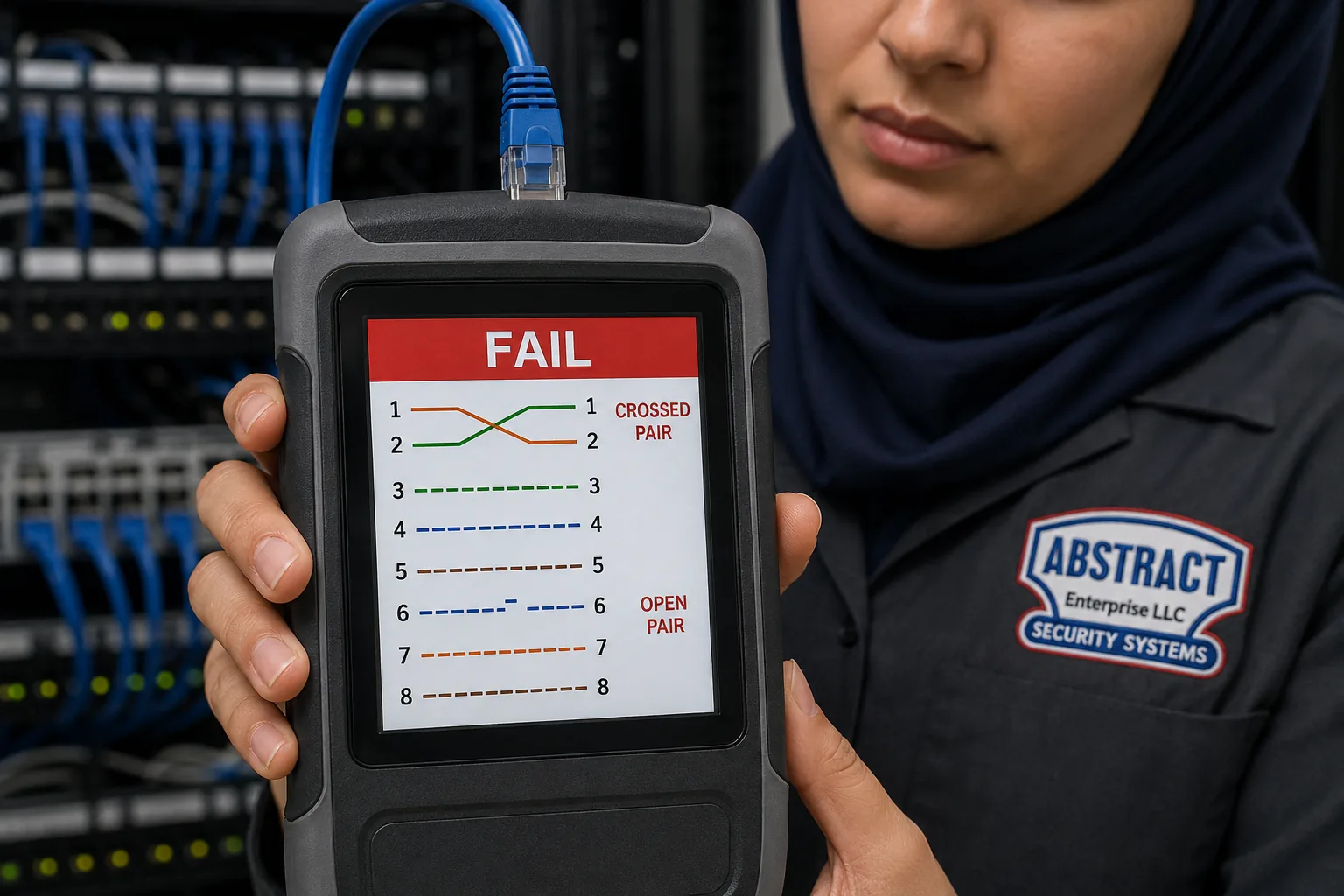
In a building that gives you four hours, the van is the workshop. Everything below comes up the freight elevator on every Manhattan repair, because a second trip for a missing part can mean waiting days for the next window.
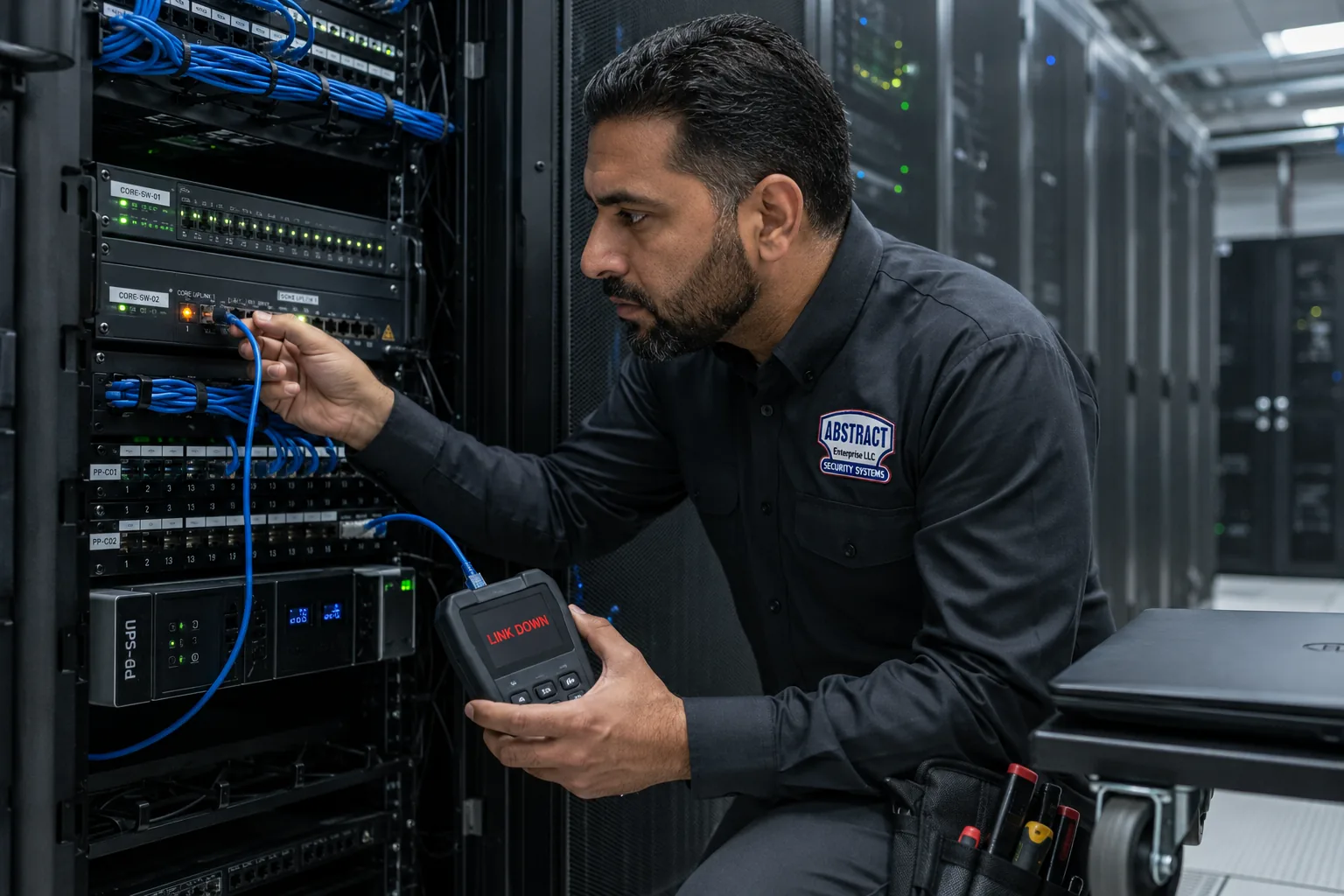
Tests each link against the TIA limit for its category and reports where along the cable a crosstalk or reflection fault sits. That one reading decides which tiles, floor panels or poles we open, and which we leave alone.
For shielded Cat6A, the tester checks shield continuity as well as the pairs, so a repair that broke the shield is caught before we leave rather than when the noise problems start.
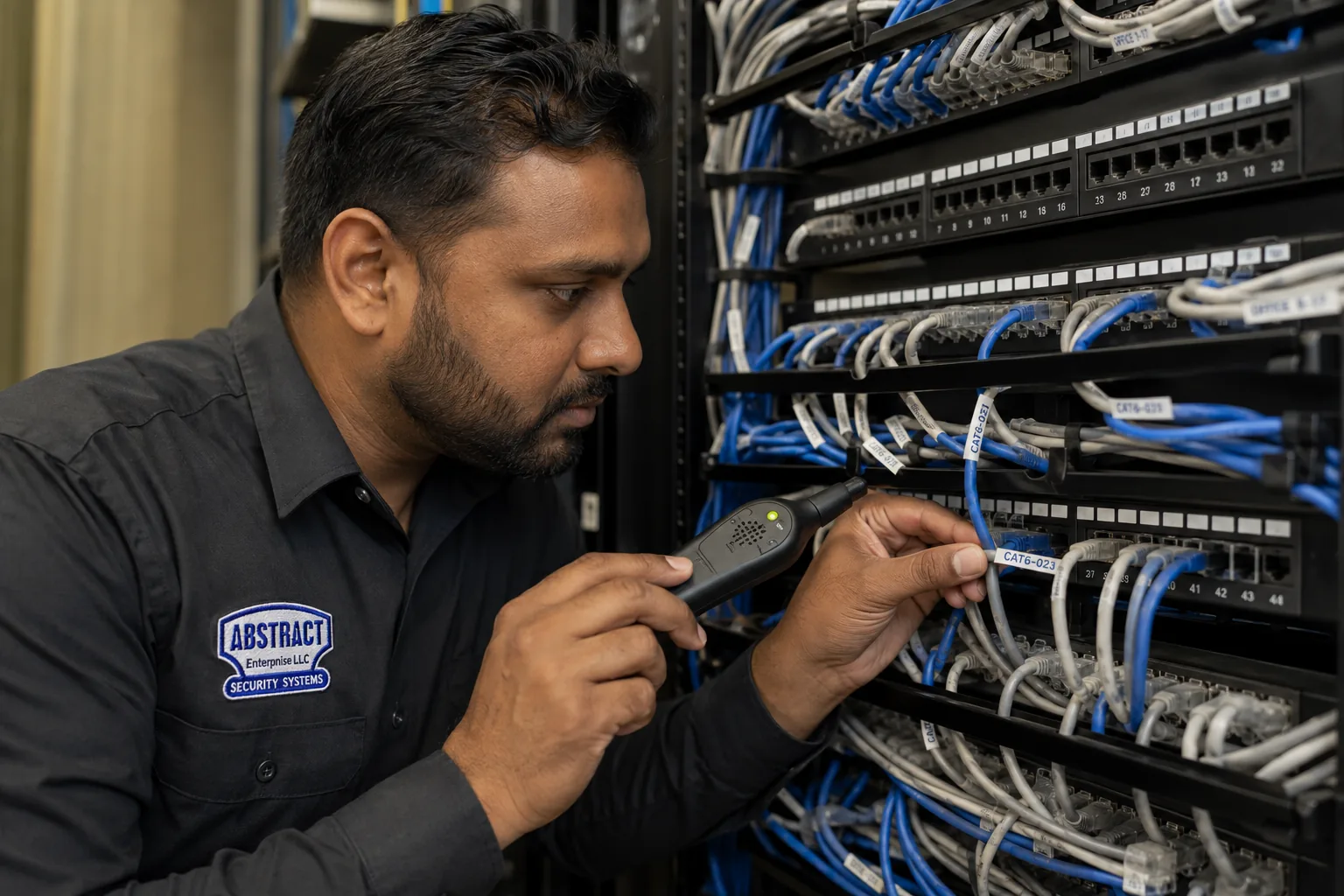
Finds which inherited cable in a crowded panel, tray or furniture raceway belongs to which desk, without unplugging live links in an occupied office.
Cat6 and Cat6A, shielded and unshielded, in the common manufacturer families found on Manhattan floors. If you can tell us the brand on the panel, we bring the same one.
Correct-category cords in several lengths, including slim and short cords for crowded panels and furniture, to replace the field-made and stranded cords that cause so many AV and desk faults.
Solid-copper Cat6 and Cat6A in the ratings Manhattan ceilings and risers require, so a replacement run is legal for the space it passes through.
Raised-floor tile lifters, ceiling tile handling gear and floor-box tools, so access panels come out and go back without chipping, scratching or misaligning a finished floor.
Drop cloths, floor protection for elevator and corridor runs, and vacuum gear — most co-op and tower house rules require them, and a building that sees its corridors left clean lets you back in.
Printed labels for both ends and a port-map template we fill in on site, because on an inherited floor the documentation is often the most valuable thing we leave.
| What you need on a Manhattan floor | Marketplace-booked handyman or general tech service | Licensed local cabling contractor |
|---|---|---|
| Legal to do the work | Varies; data wiring in the city must be done by a licensed electrician or qualified person | State low-voltage licence #12000287431 held by the owner; insurance certificate issued to the building before day one |
| Test that proves the link meets Cat6 | Usually a continuity tester: eight lights, nothing more | Certification tester, results saved and handed over |
| Finding the fault without opening everything | Opens the obvious ceiling tile and hopes | Measures distance to the fault, opens only that point |
| Matching inherited and shielded systems | Generic parts from a store | Same category, same shielding, same parts family |
| Working to a building's window and house rules | Unfamiliar with freight bookings and co-op rules | Plans the visit around the window; protection and clean-up included |
National brands that sell alarm and camera systems — ADT, Ring, SimpliSafe and the like — are built around their own devices and often around Wi-Fi. They are not set up to diagnose a building's horizontal Cat6. When the failing link feeds one of their cameras, the cable is still a cabling repair, and it is the part of the system we fix.

How this section was put together: our research tools could not load Google's AI Overview for these searches, so the headings below are not its words. Each one is a claim that cost guides, marketplaces such as Angi and HomeAdvisor, retailers and forums publish often enough that answer engines repeat it. Underneath is what changes when the cable is Category 6 and the building is in Manhattan.
The appeal is obvious: a jack is a small plastic part, and plenty of general contractors own a punch-down tool. Marketplace listings routinely bundle Ethernet repair with picture hanging and TV mounting, and answer engines echo that framing.
New York City sets a different bar. Section 28-105.4.7 of the Administrative Code lets data and communication wiring below 50 volts be repaired without an electrical permit only when the work is done by a licensed master electrician, special electrician or qualified person as the electrical code defines it. A building's managing agent will also want to see a licence and an insurance certificate naming the building before anyone opens a ceiling.
The bigger gap is proof. Re-punching a Cat6 jack so the port lights is easy; re-punching it so the link still meets Category 6 is not, because Cat6 tolerates very little untwist. Without a certification tester, nobody can tell you whether the jack they just fixed is a Cat6 link or just a working one.
This is repeated in many general renter guides, and it is true for some things: the building's own risers, telecom rooms and base-building systems are usually the landlord's.
Inside a Manhattan commercial suite it can be the reverse. Depending on the lease, cabling a tenant installed, or accepted as part of a pre-built suite, may be the tenant's to maintain, and the lease may also say what happens to it at the end of the term. In co-ops and condos, the building's documents and house rules set the line between what is inside the apartment and what is common space.
The practical answer is that the lease, the house rules and the managing agent decide, and the cable itself decides where the fault is. We test to show which side of the boundary the failure sits, which is the evidence both parties need. We do not guess about who pays.
SoHo, Tribeca, the Ladies' Mile and dozens of other districts are designated, and owners often assume that any work inside needs the Landmarks Preservation Commission's approval. Answer engines tend to repeat that caution without the detail.
The Commission's own guidance is more specific. Ordinary repairs and maintenance need no permit, and interior work needs one only when it requires a Department of Buildings permit, affects the exterior, or takes place in a designated interior landmark. Repairing a Cat6 run along its existing interior route generally meets none of those tests.
What a landmarked building does need is care: no new holes in the facade, no surface cable on historic interiors where it can be avoided, reversible fixings, and the building's own rules followed. Those are good practice anywhere, and in a cast-iron loft they are the difference between a welcome contractor and a banned one.
For a modest apartment with light use, mesh systems help, and retailers market them hard as the alternative to running cable. Answer engines repeat the pitch.
Manhattan apartments are hard on radio. A Brick Underground piece on New York Wi-Fi quoted a technician noting that the city's walls are full of piping, plumbing, cement and brick, and identified running Ethernet as the most effective fix. Mesh nodes themselves often perform best when they are linked back by cable.
So in-wall Cat6 that already exists is worth keeping working. In many co-ops and conversions it is the only practical way to reach a back bedroom or a home office, and repairing a single termination is far cheaper and less disruptive than any new run through pre-war plaster or concrete.
Shielded Cat6A is often recommended online as an upgrade for any noisy environment, and answer engines suggest swapping in shielded cable or shielded jacks during a repair.
Shielding only works as a continuous, bonded system. Mixing a shielded jack onto unshielded cable, or a shielded cable into an unshielded panel that is not bonded, gives you a shield connected at one end or neither, which does not deliver the benefit and can create its own problems.
The right repair matches what the link already is. If a floor is unshielded and noise is a real problem, the answer is a planned shielded system, not a shielded patch on one run. If the floor is shielded, every repair must keep it so.
Extender kits for sending HDMI over twisted pair are sold as plug-and-play, and product listings tend to say any Cat6 cable will do. Answer engines pass that on.
The manufacturers' own installer guidance is stricter: solid-core cable, rated wall plates and patch panels, few patch points, and shielded Cat6A for 4K at full distance. A run that passes as an Ethernet link can still be marginal for video, which is why boardroom displays blank out on cable that “tests fine”.
For Manhattan conference rooms, the repair is therefore a certification against the full category limit plus removing couplers and stranded cords from the path. It is often a modest job, but it has to be done to the video system's standard, not the laptop's.
Cost guides publish national per-drop numbers — Fixr's January 2025 guide, for example, gives $125 to $250 per Cat6 drop and $45 to $75 an hour for labour — and marketplaces encourage comparing quotes on that basis.
Those are national figures for new drops in ordinary buildings. A Manhattan repair is mostly diagnosis on inherited plant, inside a window, with protection and paperwork the building insists on. A low per-drop quote that does not include certification, building paperwork or working in the window you have is not comparable.
Compare what each quote proves at the end: saved certification results per link, labels at both ends, abandoned cable removed where accessible, and the building's paperwork handled. That is where the real difference between quotes lies.
Tell us the building, the window and the links that are failing. We will tell you what can be done in that window and what it will cost.
Send the building type, the links that are failing and the hours you are allowed; we reply in writing before the end of the business day. Prefer to talk? Call the Manhattan line, (929) 560-0737.
Our Manhattan desk has your details and will be in touch today. For a link that is down right now, ring (929) 560-0737.
Seven steps, arranged so that the building's window is spent repairing rather than searching — whether the job is one dead jack in a Tribeca loft or a cluster of desks on a Sixth Avenue floor.
You send the symptoms, a photo of the patch panel and of one failing jack, and any old test report. From those we identify the category, the shielding, the parts family and the most likely fault before anyone travels.
The managing agent gets our insurance certificate and a one-page scope; once the hours, the elevator booking and the spaces we may open are confirmed, a 2-hour arrival slot is fixed inside that window.
On arrival, each reported link and its neighbours are certified from the panel. Faults are placed at a termination, a cord, a consolidation point or a distance along the cable before any tile is lifted.
You get the findings and a short plan: what we can finish today, what needs a second window, and any interim re-patch to keep a critical desk running. Nothing outside it starts without your yes.
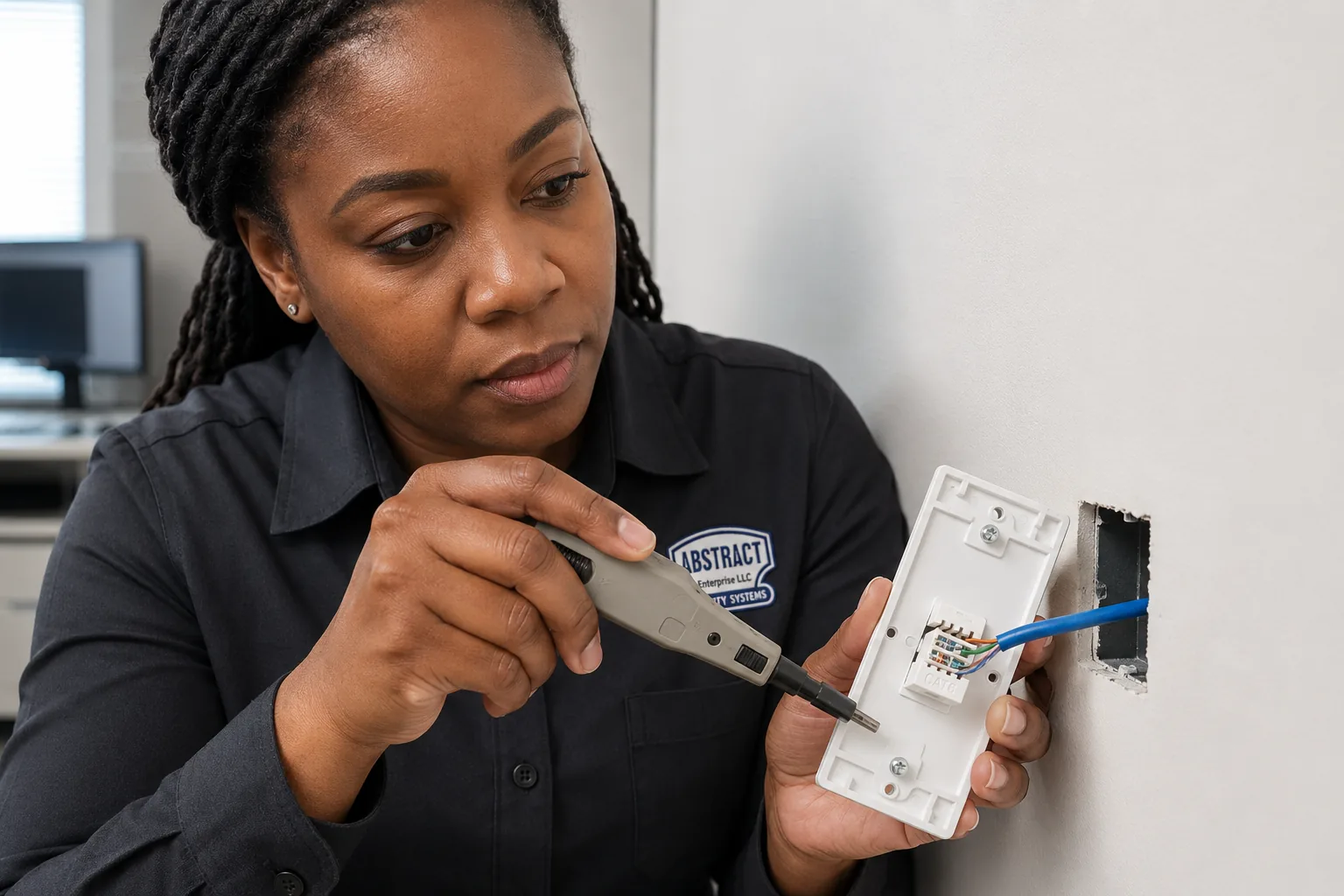
Terminations are cut back and remade on the same category, shielding and parts family; damaged sections are repaired or replaced with listed solid-copper cable; firestops and floor or ceiling panels go back as found.
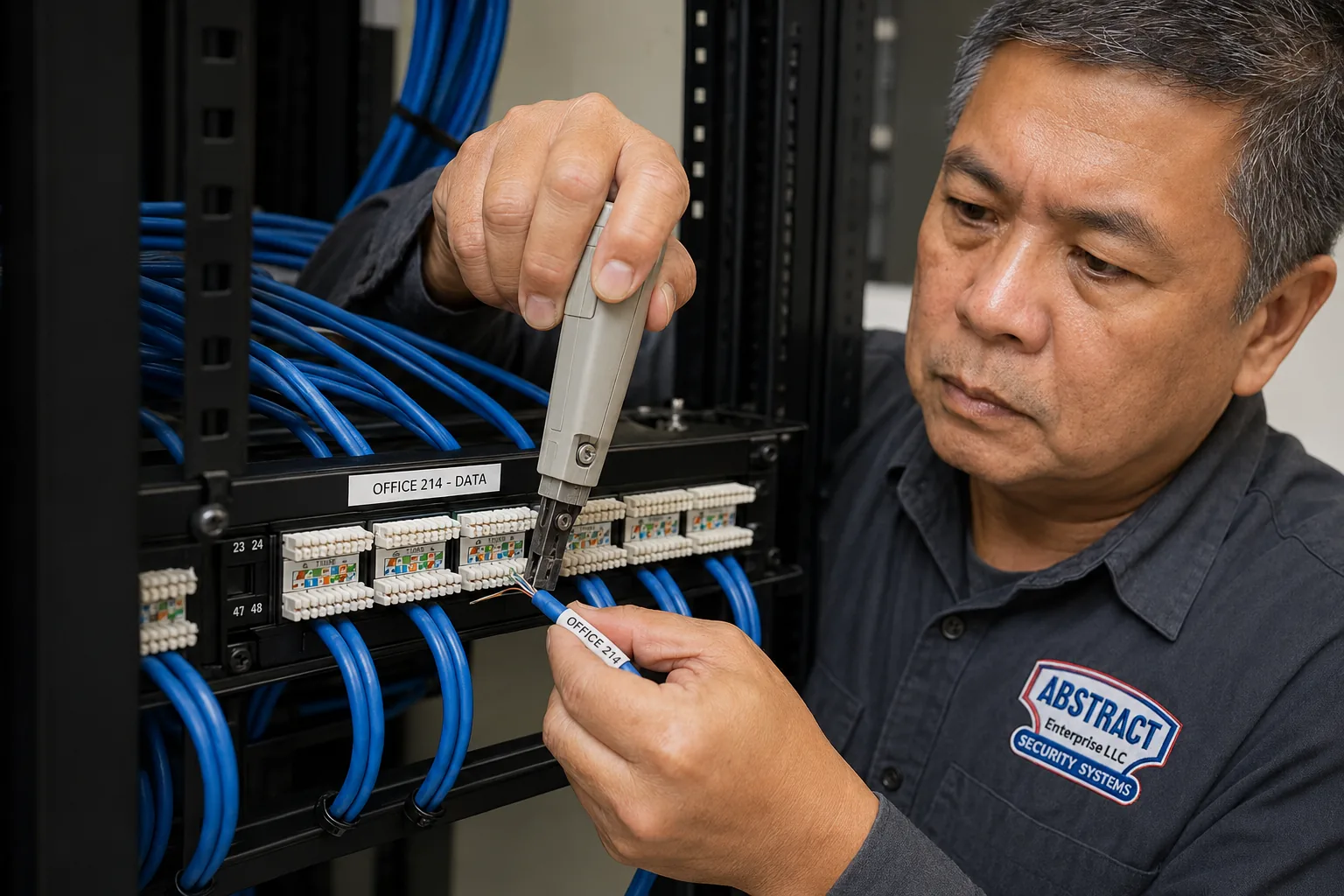
Each link we touched is re-certified and tagged at the panel and the outlet, then entered on a port map — frequently the first map the floor has had since the last tenant moved out.
Protection comes up, corridors and elevators are cleaned, abandoned lengths we removed go with us, and the results and a short note go to you and, if you wish, to the managing agent.

Six Manhattan places that sum up the borough's building stock and the cabling it carries. They are reference points for the neighbourhoods around them, not claims that we have worked inside them.
Nineteen commercial buildings on 22 acres between 48th and 51st Streets; the 14 Art Deco originals were built from 1931 and the core finished by 1939. A shorthand for Midtown's re-fitted pre-war and post-war office floors.
Built in 1969 as 4 New York Plaza and used as offices until 2022, now converted into about 1,300 apartments, the largest office-to-residential conversion in the country. The landmark for downtown's conversion wave.
Designated in 1973: about 26 blocks and nearly 500 buildings, many with cast-iron facades, store floors below lofts, and cellars that run out under vaulted sidewalks.
Designated in May 1989: about 440 buildings on 28 blocks from roughly 15th to 24th Street, between Park Avenue South and west of Sixth Avenue — the old department-store and loft buildings of Flatiron and Union Square.
A 28-acre development over the West Side Rail Yard. 10 Hudson Yards opened in 2016 and Phase 1 in March 2019, with Manhattan West alongside — the newest generation of Manhattan office plant.
Columbia University's 17-acre Manhattanville campus along Broadway above West 125th Street, dedicated in October 2016 — a marker for Upper Manhattan's mix of institutional, retail and older residential buildings.
We also repair Cat6 in Battery Park City, Tribeca, Chinatown, the Lower East Side, the East Village, Greenwich Village, NoHo, Chelsea, the Meatpacking District, NoMad, Murray Hill, Kips Bay, the Garment District, Times Square, Turtle Bay, the Plaza District, Lenox Hill, Yorkville, Lincoln Square, the Upper West Side, Morningside Heights, Central and East Harlem, Hamilton Heights, Washington Heights and Inwood, and on Roosevelt Island. Nearby, our Cat6 repair pages for the five boroughs and Brooklyn cover the rest of the city.

Every figure below is one we already publish for Manhattan, and each is labelled with where it comes from. Anything that depends on the building — long re-routes, core drilling, firestopping or work outside normal contractor hours — is quoted in writing after testing, never guessed in advance.
| Item | Price | Scope and source |
|---|---|---|
| Repair labour on Cat6 or Cat6A links (test, locate, remake terminations, swap cords, re-certify) | $195/hr, 3-hour minimum ($585) | Same hourly rate we publish for network cable repair in Manhattan; covers every link we can finish within the hours booked |
| Full replacement of a Cat6 run that testing shows cannot be saved | From $175 per drop | Starting figure from our Manhattan network cable repair page; includes the cable, a jack and plate, the panel termination, a test, labels at each end and a cord |
| For comparison only: a brand-new Cat6 drop of 100 ft or less | $296 per drop | From the Manhattan Cat6 installation price list, which shows $254 for Cat5e and $424 for Cat6A |
| Evening or weekend freight-elevator windows | Named premium line, quoted in advance | As our Manhattan network cable repair page states, the premium appears as its own line rather than inside the rate |
| Long re-routes, slab or wall coring, firestopping, raised-floor work over large areas | Quoted after testing | Set by the route, the house rules and how long the window is |
Our pricing guidance applies a Manhattan factor to borough work, and the Manhattan figures above are the ones already published on our live Manhattan pages, so we use them exactly rather than stacking a second adjustment on top. Where a Manhattan job genuinely costs more, it is because of the building: the window, the elevator, the protection and the paperwork. Those show up as named lines in a written quote, not as a hidden uplift on the hourly rate.
Building check-in and protection take the first part, then certification of the reported links and their neighbours, fault location, re-termination or cord replacement, and a final certification of every repaired link. On an inherited floor where one installer made the same mistake across a panel, several links are often repaired within the same block. If runs need replacing, you receive a price for them before any cable is pulled, and they can be booked into the next window.
If you have seen lower numbers online, they are probably national averages for new work: Fixr's guide (updated January 2025) quotes $125–$250 a drop and $45–$75 an hour. Those describe fresh installs in typical American buildings, not repairs on an occupied Manhattan floor, and they are not our prices.
Full terms — including 50% deposit, one-year parts-only warranty on AESS-supplied products, and the late-fee schedule — are set out in the service agreement.
Three ways Manhattan clients usually book Cat6 repair, all built only from our published Manhattan figures.
$585
Three hours booked at $195 each. Bring us one broken thing — a desk, a boardroom display, a register, an access point — and it is traced, fixed wherever the fault sits and re-certified with labels; whatever time is left is spent on the next items on your list.
$195/hr after the first 3 hours
For a suite taken over from a previous tenant or delivered pre-built: every link certified, dead and live runs separated, faults repaired and a port map produced. Time is estimated in writing after the first round of testing and scheduled across as many windows as the building allows.
Repair time + from $175 per run
For floors where some cable is beyond saving: hourly repair on the links that can be rescued, new runs from $175 each for the ones that cannot, old lengths pulled out where reachable, penetrations sealed again and the map brought up to date.
Fit-out contractors in Manhattan often leave behind a carton of spare jacks or a part-reel of the original cable. Hand them over and we will use them, billed as repair time only, as long as they match the link: shielded parts on shielded runs, Cat6A on Cat6A, solid-copper cable for permanent links and factory-made cords. We certify the result either way. Parts you supply carry their maker's warranty, not ours, and if they cannot produce a passing link we say so before installing them.

Send a photo of the panel, a photo of a failing jack and the hours you have. We will tell you what can be finished in them and what it will cost.
The installer leaves fingerprints, and they tell us what to bring and where to look. Before a Manhattan repair we try to work out which of these the failing Cat6 came from, because each one fails in a recognisable way and calls for a different first step.
| Who probably installed it | Tell-tale signs | Where it usually fails | Our first step |
|---|---|---|---|
| Landlord's pre-built crew | Identical white plates everywhere, one panel brand, generic labels like “D-101”, cords supplied with the suite | Terminations rushed at the end of the build-out; cords bundled too tightly | Certify a sample of links across the floor to see whether the problem is one jack or a pattern |
| The previous tenant's contractor | Two or three generations of labels, dead runs alongside live ones, a panel bigger than the floor needs | Runs cut or abandoned when furniture was removed; live links patched to the wrong ports | Tone and test to separate live from abandoned before touching anything |
| An IT vendor adding links over time | Mixed cable colours and brands, surface raceway to odd places, keystones of several makes | Additions punched with whatever was in the van; stranded cable used as permanent runs | Identify the cable type at each end and replace any non-solid or non-category part |
| An AV integrator | Runs ending under tables, at displays and in ceiling projector mounts; extender boxes | Couplers, stranded cords and terminations made for video rather than data | Certify to the full category limit and remove extra patch points |
| A conversion developer | Unit panels in apartment closets, new jacks in old office slabs, building telecom rooms per floor | Unit panels never patched, drywall nicks, riser links between unit and building room | Test from the jack to the unit panel, then onward, and report which side of the boundary the fault is on |
| A camera or access-control installer | Runs from the closet straight to ceilings and doors, often PoE, sometimes outdoor-rated cable inside | Field-made plugs at the device end; overloaded PoE bundles | Test with the device disconnected, then check the switch port's power budget |
Few floors come from only one of these. A typical Midtown suite might have a landlord's base fit-out, a decade of IT additions and a boardroom wired by an AV firm. That is why the first hour of a Manhattan repair is spent testing, not re-punching: the test results show which installer's work is failing, and that usually explains why.
Residential buildings have their own version of the same puzzle. In a co-op, the Cat6 in one apartment may have been installed by the current owner, the previous owner, or a renovation contractor working under an alteration agreement years ago, while the hallway and riser cable belongs to the building. In a converted tower, the developer's unit wiring, the condominium's telecom rooms and whatever survives from the office era all meet within a few metres of each other. We test each segment separately so that the result tells you not only what failed but whose cable it is, which is exactly what a managing agent asks before approving any further work.
Two habits make inherited plant easier for whoever comes next. Keep the last certification report somewhere other than the previous IT company's laptop, and keep the port map with the building's records as well as your own. Both are the first things we ask for, and the floors that have them are the floors we repair fastest.

Manhattan suites change hands constantly, and the cabling changes hands with them. The cheapest time to deal with inherited Cat6 is at a turnover, when the floor is empty, ceilings can be opened without disturbing anyone and the building expects contractors. These are the moments we suggest testing, and what each one protects you from.
| Stage | What to test or record | Why it pays off later |
|---|---|---|
| Before you sign or accept a pre-built suite | A sample of links from each panel certified; photos of the panel, the telecom room and a few jacks | Shows whether the floor's cabling is sound, patchy or a pattern of bad terminations while there is still time to raise it |
| Empty floor, before furniture arrives | Every link you plan to use certified; dead and abandoned runs identified; a port map produced | Repairs are fastest when no desks, no staff and no network are in the way |
| After the furniture installer leaves | Power-pole and furniture-fed links re-tested; cords checked for category and condition | Furniture installation is when poles get tilted, cords get pinched and jacks get pulled from housings |
| After the AV contractor finishes | Conference-room and display runs certified end to end with the cords actually in use | Catches couplers and stranded cords before the first board meeting rather than during it |
| Once a year, or before a switch upgrade | A sample of critical links re-certified; the port map updated | Margins shrink as ceilings are reopened by other trades; a quick check finds weak links before they fail |
| Before you hand the space back | Whatever the lease asks for; a record of what you leave and its condition | Gives the next tenant, the landlord and your own records an honest picture of the floor |
None of this has to be elaborate. On a typical suite, a morning on an empty floor with a certification tester produces a list of the links that need attention and a port map, and most of the repairs can be done on the same visit. What it saves is the far more expensive version of the same work: tracing a mystery fault under a desk that someone is trying to use, during a two-hour evening window, with the person who installed the cable long gone.
Turnover also matters for residents. In co-ops, condos and converted buildings, the moment between owners or tenants is when an apartment's jacks can be tested without moving anyone's furniture. If a unit's in-wall Cat6 is going to be relied on for a home office, testing it while the rooms are empty is a small cost against the disruption of opening a finished wall later.
Whatever the stage, ask for the results in a form you can keep: saved certification files rather than a screenshot, a port map that matches the labels on the panel, and a note of anything left abandoned. Those three items are what turn an inherited floor into a documented one, and they are what the next contractor will ask you for first.
Most Manhattan buildings decide when, where and how long anyone can work. A co-op's house rules, a tower's contractor procedures or a retail landlord's opening hours turn every repair into a fixed slot. This is how we make sure the slot is enough.
Protection goes down first. Then every reported link is certified and the faults located. Within the first part of the window you get a short summary: what we can finish today and what we cannot. Repairs follow in order of importance, so if the window runs short, the most critical links are already back. Each repaired link is certified before we move on. Ten minutes before the end of the window we stop starting new work, so that nothing is left half-terminated when the building closes the job.
You receive the saved certification results for every link we touched, the port map as we left it, and a short note of what was found and done, including anything we noticed in building space — an open firestop, a wet vault, an overfilled sleeve — that the managing agent should know about. Links that need replacement are priced, and if they need another window we suggest the shortest one that would do.
If the building closes the window before everything on your list is done, nothing is left exposed: open terminations are finished or capped, tiles and panels go back, and any link we could not reach is tagged and noted rather than left in an unknown state. The follow-up visit then starts exactly where the first one stopped, with the results already in hand.

A failing Cat6 link on a Manhattan floor is rarely the only thing that needs attention. These Manhattan services often join the same visit.
Older Cat5e, mixed plant and the switch-or-cable question.
Fresh drops priced per run when repair stops making sense.
Closets, panels and riser backbones planned properly.
Glass links for distances copper cannot cover.
Switching and Wi-Fi set up on top of the cable.
One licensed crew for every sub-50-volt system.
Boardroom screens, speakers and room systems.
Door readers and panels wired back to the closet.
List everything on one request.
Habits our crew follows on every Manhattan call — general practice rather than the story of one site
We ask who installed it before we ask what is wrong with it. The answer changes the parts on the van and the first test we run. A landlord pre-built floor gets sampled across the panel; a floor with three generations of labels gets traced before anything is unplugged; a boardroom gets tested for what the video extender needs.
We treat the window as the budget. Testing happens first because it is the only way to know what fits. Critical links get repaired first because windows end early more often than they run late. Nothing is left half-done at the end, even if that means stopping a little before the building asks us to.
We match before we mend. On a Manhattan floor it is common to find two or three keystone brands in one panel and a shielded run sitting among unshielded ones. Before a single termination is cut, we photograph what is there and pick parts from the same family, because a repair that quietly changes the system is a fault waiting for the next tenant.
We respect the building's people. The super, the engineer and the doorman know where the old cable really goes and which ceiling hides the sprinkler main. Ten minutes with them at the start of a window often saves an hour of searching, and a building that sees its staff treated well tends to approve the next visit quickly.
We leave the building better documented than we found it. Labels on both ends, a port map, saved results, and a note about anything in building space that someone else should look at. In Manhattan, the next person to touch this cable will probably be a stranger too, and the record is how we make their job shorter.
Yes, with the main tenant's agreement. In Manhattan sublets and shared offices, the patch panel and switch usually sit in a closet the prime tenant or operator controls, so we ask you to arrange access and a contact on their side before the visit. We test from your desks back to their panel, repair what is inside your space, and if the fault is at their end we hand them the test result rather than working on their equipment without permission.
We bring ladders suited to the tall ceilings common in SoHo, Tribeca and Flatiron lofts and in many lobbies, and we ask for the ceiling height when you book so the right one comes up the elevator. Where a run is out of reach of a ladder, or the building requires a lift with operator, we say so before the visit and price it as its own line. We also check whether the elevator can carry it, because a lift that cannot get onto the floor is no help to anyone.
Yes, and that is the best moment to do it. Open ceilings and bare walls make repairs quick, while the same work after the finishes go in means cutting into new surfaces. We coordinate with the general contractor's schedule and site rules, test the existing Cat6 that is meant to survive the renovation, repair or replace what the other trades damaged, and certify it before the ceiling grid is filled. Ask the general contractor to tell us when the ceilings are due to close, so testing happens with time left to fix what it finds.
Yes. We repair Cat6 from the Battery to Inwood, including the 125th Street corridor, Manhattanville, Hamilton Heights, Washington Heights and Inwood, on the same terms and through the same Manhattan line as Midtown and downtown work. Uptown jobs tend to involve mixed-use buildings and cellar telecom rooms, so tell us if the closet is below ground; after the September 2025 water main break on Dyckman Street we ask about water in the cellar as a matter of routine.
Yes, and we prefer it. Many Manhattan buildings require the engineer or super to open telecom rooms, ceilings above common corridors or the floor below, and they usually know where older cable really runs. We check in with them on arrival, show them what we are opening and why, and show them the result before we leave. If the building wants its engineer present throughout, tell us when you book so we schedule the visit around their hours as well as yours.
Yes. Lobby desks, package rooms and concierge stations in Manhattan doorman buildings depend on a handful of links that are often decades older than the furniture they serve, and they cannot be offline for long. We test and repair those links during the hours the board or managing agent sets, keep the lobby tidy and passable while we work, and coordinate with the building's other vendors where the link feeds their equipment.
Yes, if they agree to it before the work starts. We invoice whoever books and authorises the repair. If testing shows that a fault lies in building-owned cable and the landlord or managing agent wants us to repair it, they can authorise and pay for that part separately, and we split the work and the paperwork accordingly. We do not decide who is responsible; we document where the fault is so the parties can.
Yes. Once we have your symptoms and photos, we write a short scope: the links to be tested, the spaces we may need to open, the hours requested, the protection we will use, and how we will leave the space. Managing agents often approve small repairs faster when they can see exactly what will happen and for how long, and it gives the super or building engineer the information they need to prepare.
This is our Manhattan Cat6 repair page. It sits under the New York City Cat6 repair hub, which covers all five boroughs, and alongside our other live Cat6 repair pages.
Hub: NYC Cat6 repair. Borough pages: Manhattan, which you are reading, and Brooklyn Cat6 repair.
Nassau and Suffolk are served from our Long Island Cat6 repair page. Other borough pages: Queens, the Bronx and Staten Island. Long Island and the Hudson Valley: Nassau, Suffolk, Westchester, Rockland, Orange, Putnam, Dutchess and Ulster.
The six counties up the river have their own Hudson Valley Cat6 repair page.
For mixed Ethernet faults, see Manhattan network cable repair; for new runs, Manhattan Cat6 installation.
Everything else we do is listed from the AESS home page, and the people behind it are introduced on our about page.
If a desk, a boardroom, a register or an apartment jack has stopped working and the building has given you a slot to fix it, call (929) 560-0737. Send a photo of the panel and the hours you have, and we will plan the visit to finish inside them.
Abstract Enterprises Security Systems · 460 E Fordham Rd, Bronx, NY 10458 · Manhattan line (929) 560-0737 · WhatsApp (718) 679-0359 via wa.me
NYS Low-Voltage Licence #12000287431 · 100% Licensed & Insured · Same-Day Estimates · Rated 4.7★ from 201 Google Reviews
Jacks, cords or cable you hand us remain under their own maker's terms; what AESS itself stands behind is described on our warranty page.
Mentions of the Administrative Code, the electrical code, Landmarks guidance and co-op rules are plain-language summaries to help you plan a repair; check the source or ask your building before relying on them. Page reviewed and updated October 17, 2026. Changelog: first publication of the Manhattan Cat6 repair page.