Long Island cabling rarely fails because somebody else's rules got in the way. It fails because of where it lives: in a ranch-house attic that bakes every July, across a one-storey flex building so wide the run is longer than Category 6 allows, out to a pool house, a gate camera or a detached office through weather the cable was never rated for. We measure what the link is actually doing, work out whether the copper, the termination or the environment is to blame, and leave a link that tests to its category again — from the Queens line to Montauk.
Reviewed and updated October 17, 2026 · Written by Anwar Timothy, NYS licence #12000287431
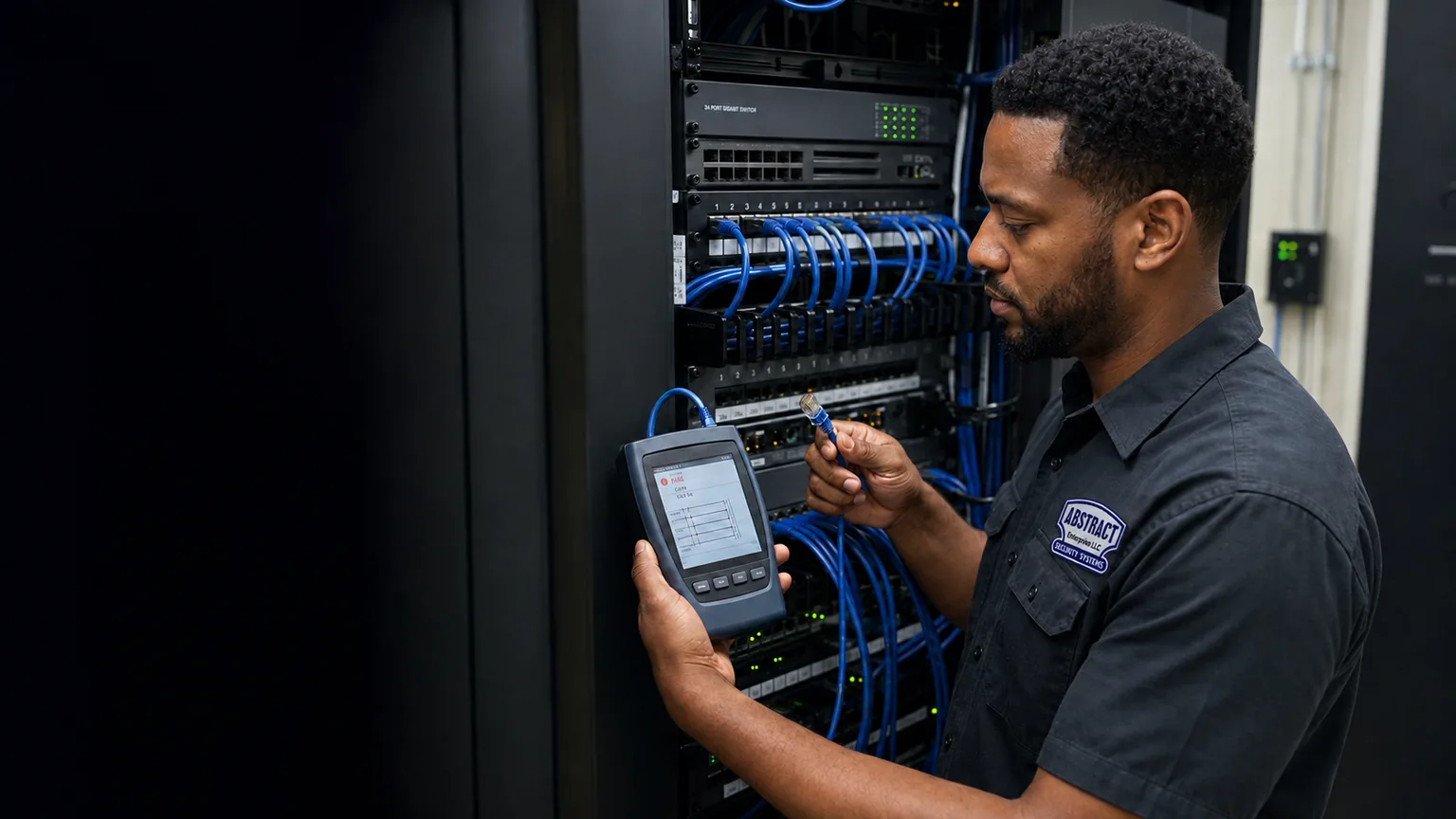
A technician in a dark work shirt stands at an equipment rack full of looped blue patch cords, holding a handheld tester with a lit screen in one hand and the end of a cord in the other.
Long Island Cat6 Repair Quote
Say which links fail and where they run — a technician replies the same business day
✅
Request Sent!
A technician will call you back the same business day.
25+
Years Experience
✓
Same-Day Estimates
100%
Licensed & Insured
4.7★
201 Google Reviews
A camera on the far side of the lot, a warehouse scanner that drops every afternoon, or a home office that lost its wired link after the last storm? Call (800) 486-0943 or send the 60-second form. A licensed technician reads it and tells you, before anything is booked, whether it sounds like heat, length, weather, a termination or not cabling at all.
Length, temperature and pathway checked alongside the usual crosstalk and return-loss readings
Outdoor and between-building runs inspected for entry protection, not just for continuity
Licensed in New York State (#12000287431) and insured, with a single toll-free number whichever county you are in
Why Long Island Properties Need Cat6 Repair Built Around Heat, Distance and Weather
Long Island grew outward, not upward, and its cabling did the same. The office park off the Expressway is two storeys and a football field long. The industrial building in Hauppauge or along Route 110 is a single storey with offices at the front and racking out to a loading dock at the back. The house in Levittown, Hicksville or Massapequa sits on a slab with the only open space above the ceiling. When Cat6 was added to buildings like these, it went where there was room: across a long ceiling, through a hot attic, along an exterior wall or underground to another building. Each of those places attacks a Cat6 link in a different way, and none of them look like the cramped risers and plaster chases that cause trouble in the city.
The first enemy is temperature. Copper loses more signal as it warms, and a Category 6 link's length budget is set at a room temperature of 20 °C. The standards bodies publish how much shorter an unscreened run has to be as the space around it heats up: Fluke Networks, quoting ISO/IEC 11801, gives a derating of 0.4 percent per degree from 20 to 40 °C and 0.6 percent per degree from 40 to 60 °C. An attic over a south-facing ranch, or the space under a flat steel roof in a flex building, can reach the upper end of that range in summer. A run that certified comfortably when it was installed in March can be over its loss limit by August, and the symptom — a link that drops or falls back to a lower speed only in hot weather — sends people looking for a fault that is not there.
The second is distance. A horizontal Cat6 link is designed around 90 metres of permanent cable plus cords, and on a wide floorplate the far corner of the warehouse, the last office in a long wing or the parking-lot camera is often closer to that limit than anyone measured. Over-length runs pass a cheap tester, work at first, and then become the first links to fail when heat or a little damage takes away the margin. No amount of re-terminating fixes length. The repair is a shorter route, a closer switch or, between buildings, a change of medium.
The third is the weather, and Long Island has documented plenty of it. Superstorm Sandy brought voluntary evacuations of Nassau’s South Shore surge area south of Sunrise Highway and $150 million in damage to the city of Long Beach; Tropical Storm Isaias left almost half of PSEG Long Island's 1.1 million customers without power at its peak in August 2020; and on August 18–19, 2024, record rainfall brought the first flash flood emergency ever declared for Suffolk County, with more than 2,000 residents and business owners reporting flood damage. Outdoor runs to cameras, gates and outbuildings take lightning-induced surges and water. Terminations in garages, sheds and pool houses corrode. A link that survives the storm may still be degraded, and it is the slow decline afterwards that brings most of these calls.
The fourth is how the cable got there. A great deal of Long Island Cat6 was run by whoever was on site — the alarm installer, the camera vendor, a previous owner with a staple gun — rather than by a cabling contractor, and the installation practices show it: cable stapled flat to joists, field-crimped plugs on solid conductors, unsupported spans laid on ceiling tiles, outdoor runs with no entry protection, and copper-clad aluminium bought by the box because it was cheaper. Repairing Cat6 here means checking the installation, not just the cable, because the same practice that ruined one link usually ruined the others it was installed alongside.
Long Island facts that shape a Cat6 repair
17,447 homes: built in Levittown between 1947 and 1951, ranch houses on concrete slabs with an expandable attic, according to Keri Murray Architecture — the slab-and-attic pattern that puts so much Nassau residential Cat6 above the ceiling.
0.4 to 0.6 percent per °C: the reduction in maximum unscreened horizontal cable length above 20 °C, as quoted by Fluke Networks from ISO/IEC 11801 — the reason attic and roof-deck runs fail seasonally.
1,350 businesses: in the Hauppauge Industrial Park, now the Long Island Innovation Park at Hauppauge, generating $13.4 billion in annual revenue across about eleven square miles, per a 2017 update published by Campolo, Middleton & McCormick — a concentration of single-storey flex and industrial buildings with long horizontal runs.
August 18–19, 2024: record rainfall described by New York State as a 1-in-1,000-year event for the impacted area, which caused the first-ever flash flood emergency for Suffolk County and flood damage for more than 2,000 residents and business owners.
Almost half of 1.1 million: PSEG Long Island customers in the dark at the peak of Tropical Storm Isaias in August 2020, as ABC7 reported — the kind of storm that brings down lines and sends surges into outdoor low-voltage runs.
Two cities, three towns and 64 villages in Nassau; ten towns in Suffolk: the municipal structure published by New York State, which is why licensing and permit questions on Long Island have to be answered address by address.
Taken together, the picture is a region where Cat6 is easier to reach than in the city but far harder on the cable once it is installed. That shifts the repair decision. In a one-storey building with an open ceiling, re-pulling a damaged run is often practical; the more important question is whether the new run would fail for the same reason the old one did. A repair that ignores the heat, the length or the weather is a repair that comes back next summer.
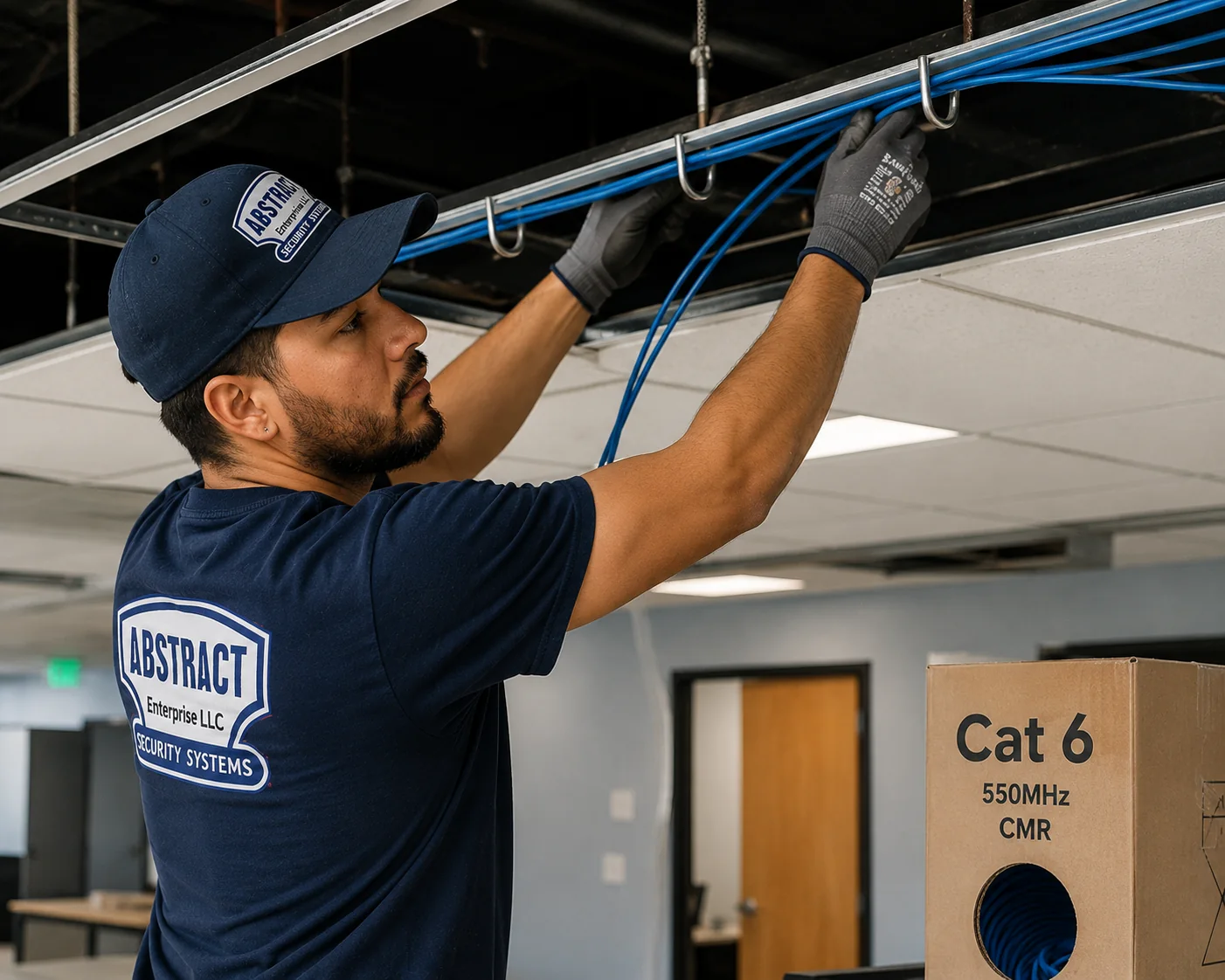
A technician in a cap and gloves reaches overhead to lay several blue cables into a row of metal J-hooks hanging above an open ceiling grid; a carton printed Cat 6, 550MHz, CMR stands on the floor beside him.
Repair Capture
Cat6 Link Dead in Nassau or Suffolk This Morning?
A register that cannot reach the card processor, a dock scanner that went offline at the start of a shift, a gate camera that stopped recording after an overnight storm, a doctor's front desk with no network — those are service calls and we book them that way, in the next open 2-hour arrival window. The van carries a certification tester, a toner, Cat6 and Cat6A keystones and panel modules, factory-made cords, outdoor-rated cable and entry protection hardware, because on Long Island the fault is as likely to be at a building entrance as at a desk. Most single-link faults at a termination or a cord are found and fixed in one to two hours once a technician is on site. Repair time is $195 an hour with a three-hour minimum ($585), the same specialty rate published on our Long Island network cable repair page. Call (800) 486-0943 and say it is a Cat6 fault, or see our Long Island security camera repair page if the camera itself is the suspect.
What We Repair
Cat6 Repair Services on Long Island
These are the repairs Long Island buildings actually need, most of them shaped by heat, distance or the outdoors. Every one finishes with the link retested against its own category limit and a plain-language note of what failed and why.
Seasonal and Heat-Related Failures
Links that pass in cool weather and fail in summer. We measure insertion loss and margin, look at where the run crosses an attic or roof deck, and reroute the hot section or replace the run where the margin is gone.
Over-Length Run Correction
When the tester shows a run beyond the 90-metre permanent-link limit, we plan a shorter path, a closer switch location or a fiber hop, then rebuild the link so it certifies with margin rather than barely.
Outdoor and Between-Building Links
Runs to pool houses, detached garages, gate posts, parking-lot poles and second buildings: cable rating, conduit, drip loops, building-entry protection and the corroded terminations that outdoor runs collect.
Storm, Surge and Lightning Recovery
After a storm we test every link that leaves the building, check the switch ports and PoE injectors those links reach, and replace what the surge degraded rather than only what stopped outright.
Flood and Water Damage
Garages, crawlspaces, ground-floor closets and basement offices that took water: wet terminations are replaced, jackets inspected for wicking, and every affected link certified so you know what can stay.
Attic-Run Rescue in Houses
Cat6 stapled tight to joists, crushed under insulation or chewed in the eaves. We locate the damage by distance, decide whether the run can be freed and supported, and re-terminate or replace it.
Jack, Keystone and Panel Re-Termination
The everyday repair: cut back to clean cable and remake the termination on matched Cat6 or Cat6A hardware, keeping the pair twist to the contacts so the link passes crosstalk again.
PoE Links to Distant Devices
Cameras and access points at the edge of a lot or the far end of a warehouse, where length, heat and resistance combine to starve the device. We measure the delivered power, not just whether the light is on.
Certification for Sale, Lease or Insurance
Testing a building's Cat6 before a sale or a lease handover, or documenting storm and flood damage, with saved results for every link and a written summary of what failed.
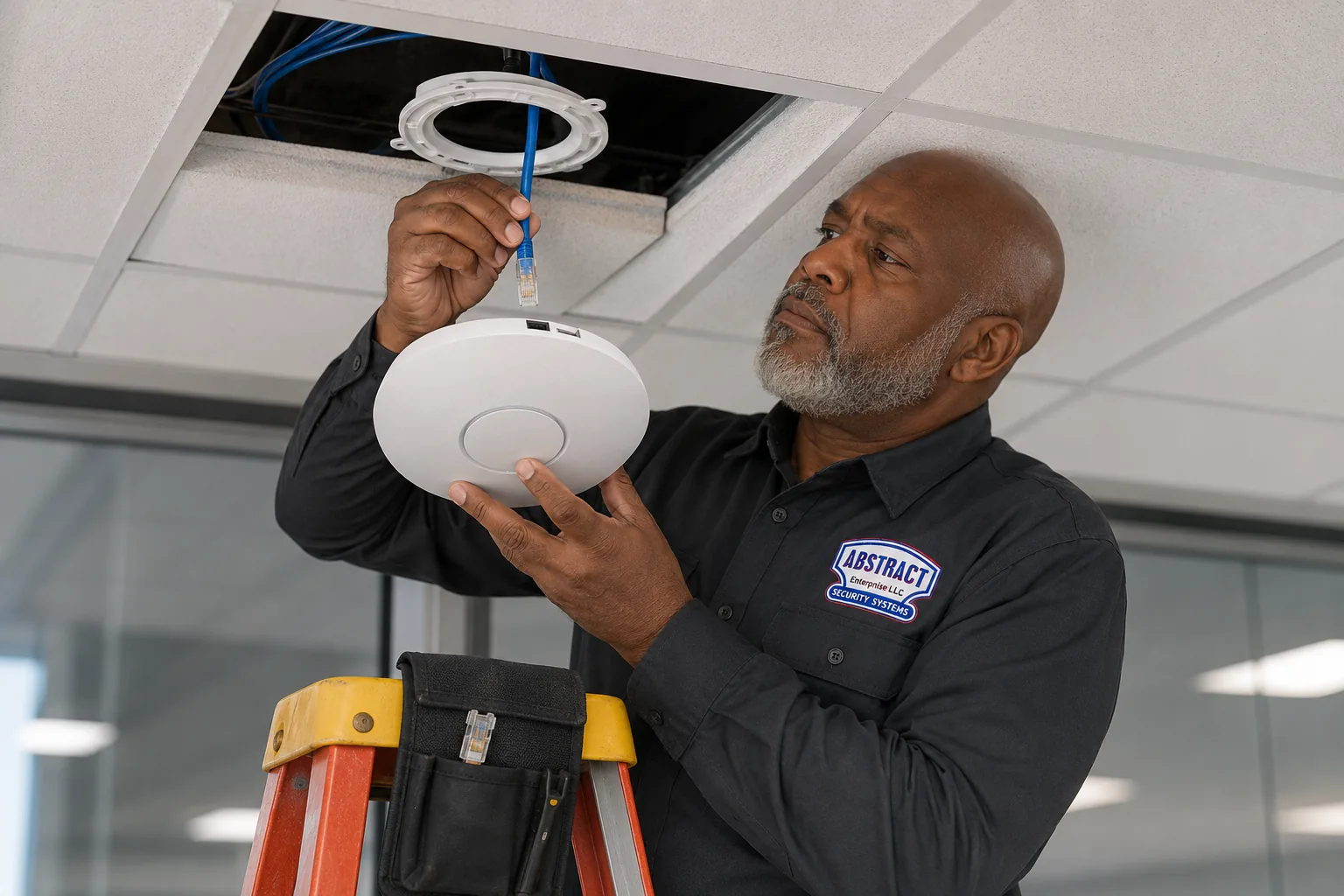
A technician on an orange stepladder lifts a round white wireless access point toward an open ceiling tile, where a blue cable with a plug on its end hangs down through a white mounting bracket.
Building Specialists
Cat6 Repair for Long Island's Architecture
On Long Island the building type predicts the fault more reliably than the age of the cable does. These are the structures we repair Cat6 in most often between Nassau's western edge and the East End, and the failure each one tends to produce.
Post-War Slab Ranches and Capes
Levittown-pattern houses with no basement, where Cat6 runs through the attic and drops down interior walls. Heat, insulation crush and staples are the usual causes, and repair access is good once the attic hatch is open.
Split-Levels and Colonials With Basements
Runs that cross a finished basement ceiling and climb through closets. Faults collect where the cable passes a joist bundle or a heating duct, and where a later renovation closed a ceiling over it.
Single-Storey Flex and Industrial Buildings
Offices at the front, warehouse behind, one closet near the office end. The longest runs reach the dock and the racking, often near the length limit, and pass under a steel roof that turns hot in summer.
Suburban Office Parks
Two- and three-storey buildings with long wings, hung ceilings and a closet per floor. Runs to the end of a wing are long; links between buildings on the same campus are often copper that should have been fiber.
Strip Retail and Pad Sites
Point-of-sale, cameras and back-office links in tenant spaces along the main commercial roads, often installed by the register or camera vendor. Field-crimped plugs and runs laid on ceiling tiles are what we usually find.
Medical and Dental Offices
Converted houses and purpose-built professional buildings with exam rooms, imaging and phones on Cat6. Repairs are scheduled around patient hours and every link touched is certified before the practice reopens.
Waterfront and Marina Businesses
Restaurants, yacht clubs and marinas on the North and South Shores, where salt air and spray reach terminations on decks, docks and exterior walls, and where flood exposure is part of the location.
Seasonal East End Properties
Shops, wineries, rentals and second homes that sit closed or unheated for months. Condensation, rodents and temperature swings work on terminations over the winter, and the failures appear at reopening.
Six things we look at on a Long Island run before deciding how to fix it
Where does the run pass, and how hot does it get there? We note every section that crosses an attic, a roof deck or a ceiling under a flat roof. A link with plenty of insertion-loss margin will survive that heat; one that certified by a hair will not. Where a repair leaves a link with thin margin in a hot space, we tell you, and we suggest rerouting that section below the insulation or through a cooler space rather than replacing like for like.
How long is it really? The tester measures the electrical length, which on a wide building is often longer than the floorplan suggests because the cable climbed up, wandered across the ceiling and came back down. If a link is past the 90-metre permanent-link limit, we say so before quoting any re-termination, because a fresh jack on a run that is too long is money spent on the wrong fix.
Does any part of it leave the building? A run that goes outside, even for a few feet to a camera on the soffit, needs cable rated for that exposure, a drip loop, sealed penetrations and, where the run is exposed to lightning or power contact as it enters, a listed primary protector. The National Electrical Code places that protector as close as practicable to the point where the cable enters the building (section 800.90(B), as summarised in Mike Holt's study material). Outdoor runs without one are the links we most often find damaged after a storm, together with the switch ports at their far end.
How was it fixed in place? Staples driven flat through the jacket, cable ties cinched until the jacket dimples, and runs lying across the tops of ceiling tiles all change the geometry of the pairs. On a tester those show as return-loss or crosstalk faults at a distance along the run. Freeing and properly supporting the cable sometimes recovers the link; where the jacket is cut or flattened, the section has to be replaced.
Is it actually Cat6? A good deal of the cable bought by the box for home and small-business installs on Long Island is copper-clad aluminium printed with a Cat6 rating. We check the conductor at the termination before planning any repair. If the core is silver, the run is replaced: it cannot certify and it handles heat and Power over Ethernet poorly, which are exactly the conditions Long Island runs face.
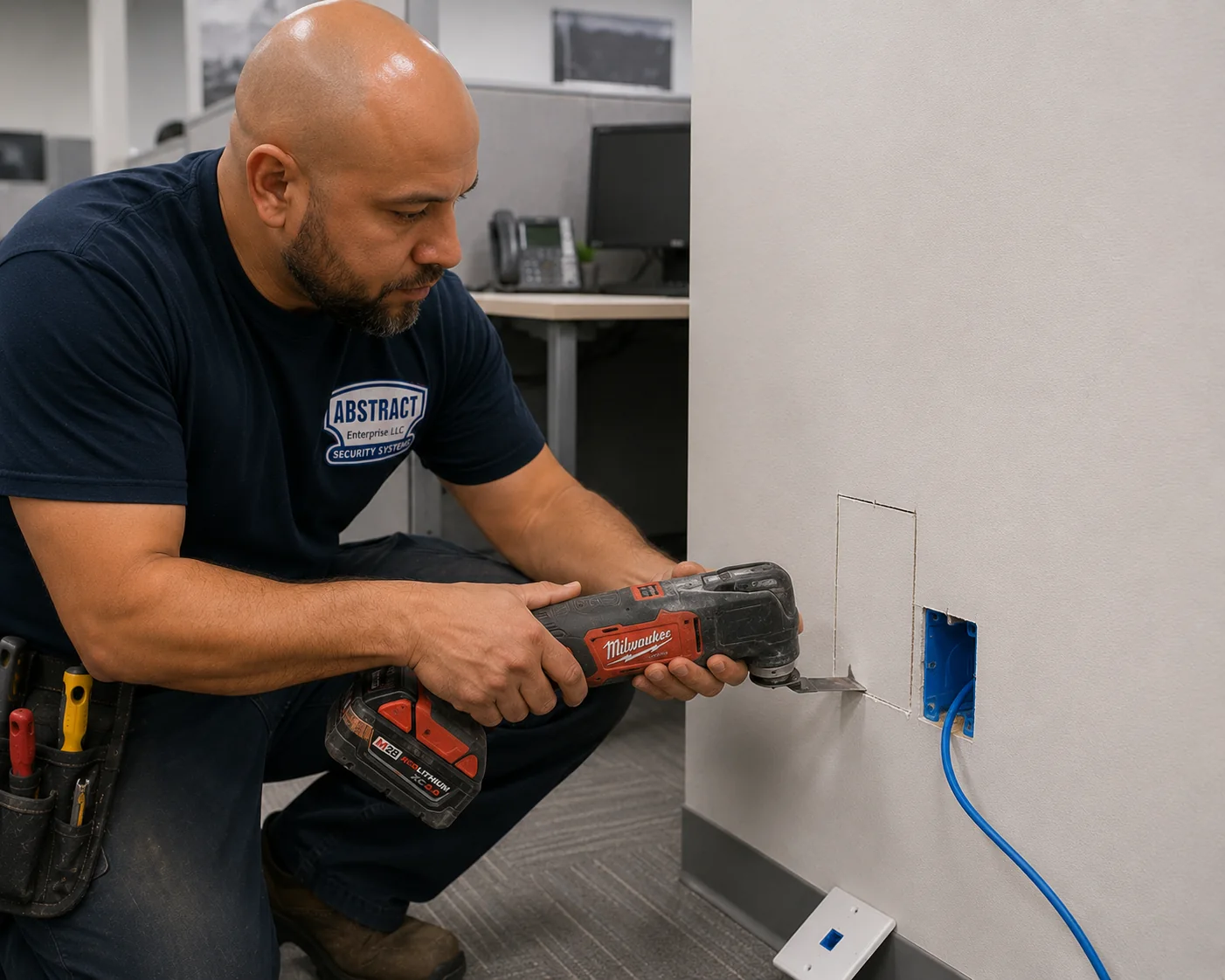
A kneeling technician uses a cordless oscillating multi-tool to cut a rectangular outline in a drywall wall next to a blue electrical box; a blue cable runs from the box to the floor, where a white wall plate lies on the carpet.
Commercial Cat6 Repair
Business Cat6 Repair on Long Island
Long Island's business districts are corridors and parks rather than neighbourhoods, and each one leaves its own mark on the cabling inside it. The places below are named for the kind of building and the kind of Cat6 failure they tend to produce, not as a list of our jobs.
Long Island Innovation Park at Hauppauge
The former Hauppauge Industrial Park, renamed in 2019 and described in a 2017 update as home to some 1,350 businesses and about 55,000 workers. Its single-storey industrial and flex buildings produce the classic Long Island fault: long runs to the back of the building under a hot roof.
Route 110 Corridor, Farmingdale to Melville
A belt of warehouse, flex, R&D and office buildings through Farmingdale, Melville and Huntington Station, with Long Island Expressway access. Office buildings such as the 149,000-square-foot Melville Corporate Center I at 105 Maxess Road sit beside light-industrial space, so repairs range from hung-ceiling offices to dock-door scanners.
Old Country Road and Roosevelt Field
Roosevelt Field, in the East Garden City section of Uniondale, is the largest shopping mall on Long Island, with 243 stores and about 2.37 million square feet of leasable area on the former airfield Lindbergh flew from. Retail tenants along the corridor depend on point-of-sale and camera links that vendors installed and nobody documented.
Uniondale and the Meadowbrook Parkway
Office towers such as RXR Plaza, beside the Meadowbrook Parkway with access to the LIE and the Northern and Southern State Parkways. Multi-storey offices here behave more like city buildings: managed closets, hung ceilings and long horizontal runs per floor.
Ronkonkoma and MacArthur Airport
The area between Long Island MacArthur Airport and the Ronkonkoma LIRR station, where Suffolk County is seeking a master developer for 48 acres within a broader 179-acre redevelopment area. Commercial and light-industrial properties near an airport and a rail station tend to have runs out to docks, yards and gates.
The Stony Brook Research Belt
Stony Brook University's 213 buildings on 1,454 acres and its research park, with Brookhaven National Laboratory's 5,265-acre site further east at Upton. Around them sit labs, medical offices and technical firms whose links carry instruments and imaging, where a degraded run matters more than a dead one.
Licensing and compliance callouts for Long Island Cat6 repairs
Suffolk County licensing. Article XI of Chapter 563 of the Suffolk County Code makes it unlawful to carry on a business regulated by the article without a licence from the county, and it provides a restricted licence for a limited area within a regulated trade. The same article says it does not apply in a town or village that has enacted its own licensing legislation, or in a town of the second class that opts out by local law. In practice, which rule applies depends on the address, and we confirm it before work starts.
Nassau County consumer affairs. Nassau's Office of Consumer Affairs licenses home improvement contractors for residential work and requires every licensed home improvement contractor to be fingerprinted. Homeowners can verify a contractor through that office. Commercial work falls under the rules of the city, town or village where the building is.
Entry protection on outdoor runs. Communications cable entering a building from outside where it is exposed to lightning or power contact calls for a listed primary protector close to the entry point under NEC section 800.90. A repair that reconnects an outdoor run without one leaves the next storm a path into your switch.
Abandoned cable. When a run is replaced rather than repaired, the accessible portion of the old communications cable comes out, as the National Electrical Code requires, unless it is tagged for future use.
Local permits. Building and electrical permits on Long Island are issued by the town, village or city, not by one regional office. Most Cat6 repairs need none, but new exterior penetrations, trenching or work on a rated wall can, and we check the municipality before quoting that work.
Business owners whose failing links feed door hardware or readers often fold that into the same visit; our access control installation team on Long Island handles the controllers and readers once the cabling is sound.
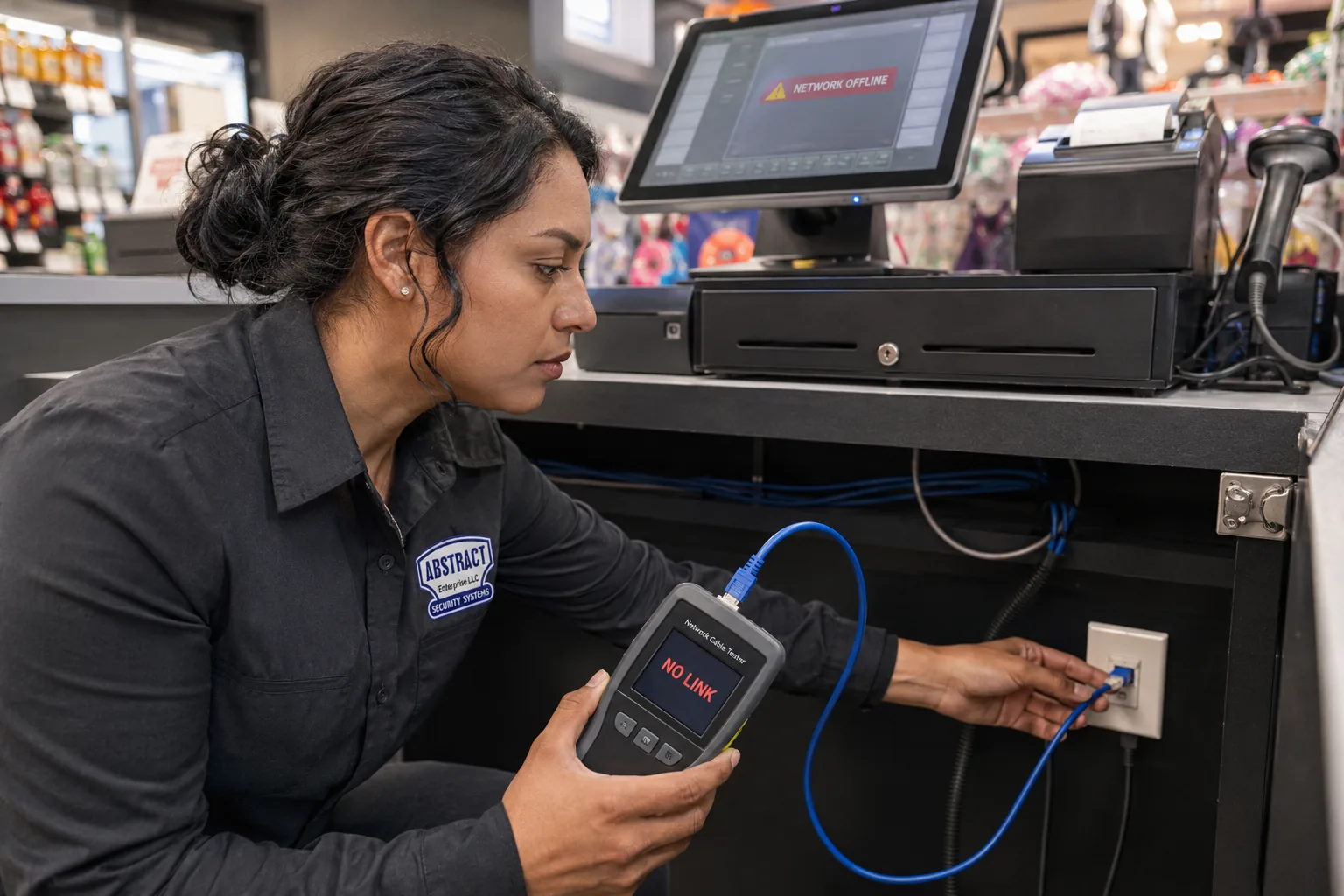
A technician crouches behind a shop counter holding a handheld tester whose screen reads NO LINK, with its blue patch cord plugged into a wall jack below the counter; above her a point-of-sale screen shows a network offline warning next to a receipt printer and cash drawer.
Your Questions Answered
Cat6 Repair on Long Island: Questions Answered
These are the questions homeowners, facility managers, practice managers and IT providers in Nassau and Suffolk ask once a Cat6 link has started to misbehave. They are grouped by what is attacking the cable: heat and distance, storms and water, the house or building around it, and devices at the far end of long runs. Scheduling and smaller practical points are in the FAQ further down.
Heat, length and the wide floorplate
Why would a Cat6 run in a Long Island attic pass certification in March and fail it in July?
Because the cable's loss changes with temperature and the test you had in March was done in a cool attic. Insertion loss is the amount of signal a link loses end to end, and it rises as copper warms. The length limits in the cabling standards assume about 20 °C; Fluke Networks, quoting ISO/IEC 11801, gives the reduction in maximum unscreened horizontal length as 0.4 percent per degree from 20 to 40 °C and 0.6 percent per degree from 40 to 60 °C. On a summer afternoon under an asphalt roof, the space a run crosses can sit well into that upper band, so a run that had only a small margin in spring has none left.
The fix depends on how much of the run is in the heat and how long the run is. If the hot section is short, we often reroute it lower in the attic, under the insulation or down an interior wall, which recovers the margin without replacing the link. If the run is long and most of it crosses the hot space, it is replaced on a cooler path. Either way, we test with the tester's temperature in mind and tell you what margin the repaired link has, so you know whether it will hold through next summer.
The tester says a warehouse run is 104 metres. What are the options short of moving the switch?
There are three, and re-terminating is not one of them. The permanent part of a Cat6 link is designed around 90 metres, with cords bringing the channel to 100, so a 104-metre run is out of category however neatly it is finished. The first option is a shorter route: runs on wide buildings often wander, climbing to a high tray, crossing the long way and coming back, and a direct path along the racking or the dock wall can lose the extra metres. The second is a small switch or a PoE extender closer to the far end, fed from the closet, which turns one over-length link into two short ones. The third, where the far end is a cluster of devices or another building, is a fiber run to a switch at that end.
Which one makes sense depends on what the link feeds and how many devices are out there. A single scanner or camera at the far wall usually ends up on a re-routed run or an extender; a whole office or a dock with several devices justifies a switch. We price the reroute per run, as our Long Island network cable repair page does, and we confirm the new length on the tester before anything is called finished.
Why do the links at the far end of a long Long Island office wing fail first?
Because they are the ones with the least to spare. On a long, low office building the closet is usually in the middle or at one end, and the runs to the far offices are the longest on the floor. Long runs start with less insertion-loss margin, they cross more ceiling where other trades work, and they are the most likely to have been pulled around obstacles at a tight bend. When anything else goes wrong — a hot summer, a crushed section, a poor termination at the jack — those links cross the limit while the shorter ones still pass.
When we see a pattern like this, we test the whole wing rather than the one link that was reported, sort the results by length and margin, and repair from the worst up. Sometimes the right answer is a second closet or a small switch halfway along the wing, which shortens every long run at once and does more for the building than a dozen individual re-terminations.
Storms, lightning and water
After a nor'easter there is water in the box where our Cat6 enters the detached garage. What needs fixing?
Three things, in order: the way water is getting in, the termination it has reached, and any length of cable that has been sitting wet. Wind-driven rain in a coastal storm finds every unsealed hole, and a Cat6 run that enters a garage through a drilled opening with no sleeve, sealant or drip loop lets water run along the jacket straight into the nearest box. Once the contacts in that box have been wet, they begin to corrode, and the link usually keeps working for a while before it turns intermittent.
We open the box, dry and inspect it, and test the run disconnected so the cable is judged on its own. Corroded keystones or plugs are cut back to clean copper and replaced; if the jacket has wicked water some distance, that section is replaced too. Then we fix the entry: a proper sleeve, a downward drip loop outside so water falls away before it reaches the hole, sealant rated for the job and, where the run is exposed as it comes in, a listed primary protector. Without the entry repair the same box will be wet again after the next storm.
Can you document flood-damaged Cat6 for an insurance claim after a storm like August 2024's?
Yes. After the August 18–19, 2024 storm, New York State recorded flood damage for more than 2,000 residents and business owners in Suffolk, and many of the claims that follow an event like that include cabling that was underwater or soaked. What an adjuster needs is evidence: which links were affected, how they test now, and what has to be replaced. A certification tester produces saved results for each link, and those results, with photographs of corroded terminations and a written scope, make a far stronger record than a statement that the network stopped working.
We test every link that ran through the flooded space, not only the ones that failed outright, because wet cable can pass on the day and decline over the following weeks as moisture wicks along the jacket and corrodes the contacts. The report separates links that failed, links that passed with reduced margin and links that are clean, and we leave the replacement decision for the reduced-margin links with you and your adjuster. We do not assess insurance coverage; we document the cabling.
How does salt air near the South Shore and the harbours affect Cat6 terminations?
Slowly, and almost always at the ends rather than in the middle. Cat6 cable inside a sound jacket tolerates a coastal environment well, but the exposed contacts in a keystone, a plug or a camera connection do not. Salt-laden air and spray deposit on contacts at outdoor and semi-outdoor terminations — on decks, docks, boathouses, exterior walls and unheated garages — and corrosion builds until the connection becomes intermittent and then fails. On a tester that usually shows as rising resistance and poor return loss right at the termination.
The repair is a fresh termination cut back to clean copper, but the lasting fix is to stop exposing the contacts. Where possible we move the termination indoors or into a sealed enclosure, use weatherproof connections at outdoor devices, add drip loops so water runs off before it reaches the connector, and seal the building penetration. On waterfront sites we also recommend a yearly test of the outdoor links, because a corroding termination is easy to replace before it fails and inconvenient after.
Landscapers trenched for a sprinkler system and now the pool-house link is dead. Can a buried Cat6 run be repaired?
Usually, if the damage is in one place and the rest of the run is sound. Irrigation lines, landscape lighting, fence posts and new plantings all go in at roughly the depth a casually buried Cat6 run sits, and a spade or a trencher blade cuts or crushes it cleanly. Because the damage happened at one moment, at one spot, a certification tester can normally place it by distance from either end, which tells us where to dig instead of guessing along the whole route.
Once the damaged point is exposed, the choice depends on what the run is and what it feeds. A short outdoor-rated run in conduit can often be repaired with a properly sealed, rated connection in a buried or above-grade enclosure and tested as a complete link. A run that was buried bare, or that was indoor cable to begin with, is better replaced in conduit, deep enough and marked so the next landscaping job does not find it the same way. Where the yard is due for more work, we suggest waiting until the trenching is finished before the final run goes in.
The house or building around the cable
Our ranch is on a slab with no basement. How is a failed Cat6 run reached for repair?
From above, almost always. In slab-built ranches and capes, Cat6 usually runs across the attic and drops down interior walls to the jacks, so the path back to the closet or router is reachable through the attic hatch. We first test the run to find where the fault is: at the jack, at the far end, or at a distance along the run that tells us roughly where in the attic to look. That spares you an afternoon of us crawling over insulation looking for a staple.
If the fault is in the attic section, we free and repair or replace that section from the attic. If it is inside the wall drop, we pull a new length down the same bay using the old cable as a pull line where it is still intact, or fish a new one where it is not. Exterior walls are harder because of insulation and fire blocking, and there we may suggest moving the jack a few feet to an interior wall instead. Each option is explained before we start, with what it involves in the attic and in the room below.
Can Cat6 that a previous owner stapled to the attic joists be saved?
Sometimes, and the tester tells us which runs. A staple driven flat across a Cat6 jacket compresses the pairs underneath it, and a run fastened that way every couple of feet has a series of small deformations along its length. Some runs survive with enough margin to pass; others fail return loss or crosstalk at distances that line up exactly with the staples. Where the staples were driven hard enough to cut the jacket, the pairs underneath are often nicked as well.
For runs that still pass, we pull the staples and resupport the cable loosely with proper hangers or wide straps, then retest; removing the pressure often improves the reading. For runs that fail at the staple points, we replace the section or the run, routed and supported so it will not happen again. If the cable is not solid copper, or not genuinely Cat6, it is replaced regardless, because no amount of careful support will make it certify.
A seasonal East End shop sat closed all winter. Why do some Cat6 links fail when it reopens?
Because an unheated building does things to terminations that an occupied one does not. Through a winter of temperature swings, moisture condenses on cold contacts and in wall boxes on exterior walls; rodents looking for shelter nest in ceilings and chew whatever is there; and equipment that sat unpowered for months sometimes does not come back cleanly. When the shop reopens in spring, the links that cross exterior walls, unheated storage rooms or the attic are the ones that fail, often intermittently at first.
The most efficient approach for a seasonal property is to test before opening rather than after: a pre-season visit that certifies every link, replaces corroded terminations and finds the chewed runs while there is still time before the first busy weekend. If a link has failed already, we treat it like any other repair, but we also check the others on the same wall or in the same ceiling, because a winter rarely damages only one.
Why do links between two buildings on a Long Island office or school campus keep failing?
Because copper between buildings is exposed to everything the inside of a building is protected from. Campus links often began as a convenient Cat6 run buried in a shallow trench or strung along a walkway canopy, and they face ground moisture, heat, frost, surge and the occasional shovel. They also tend to be long. Many of them were never rated for direct burial or outdoor use, and many lack entry protection at one or both ends.
We test the link, look at how it is routed and how it enters each building, and give you a straight answer on whether repairing it is worthwhile. For a short link in sound conduit, replacing the cable with outdoor-rated Cat6 and adding proper entry protection is often enough. For a long or exposed link, or one that has failed more than once, fiber between the buildings is the durable answer, and our fiber optic installation service on Long Island handles that side.
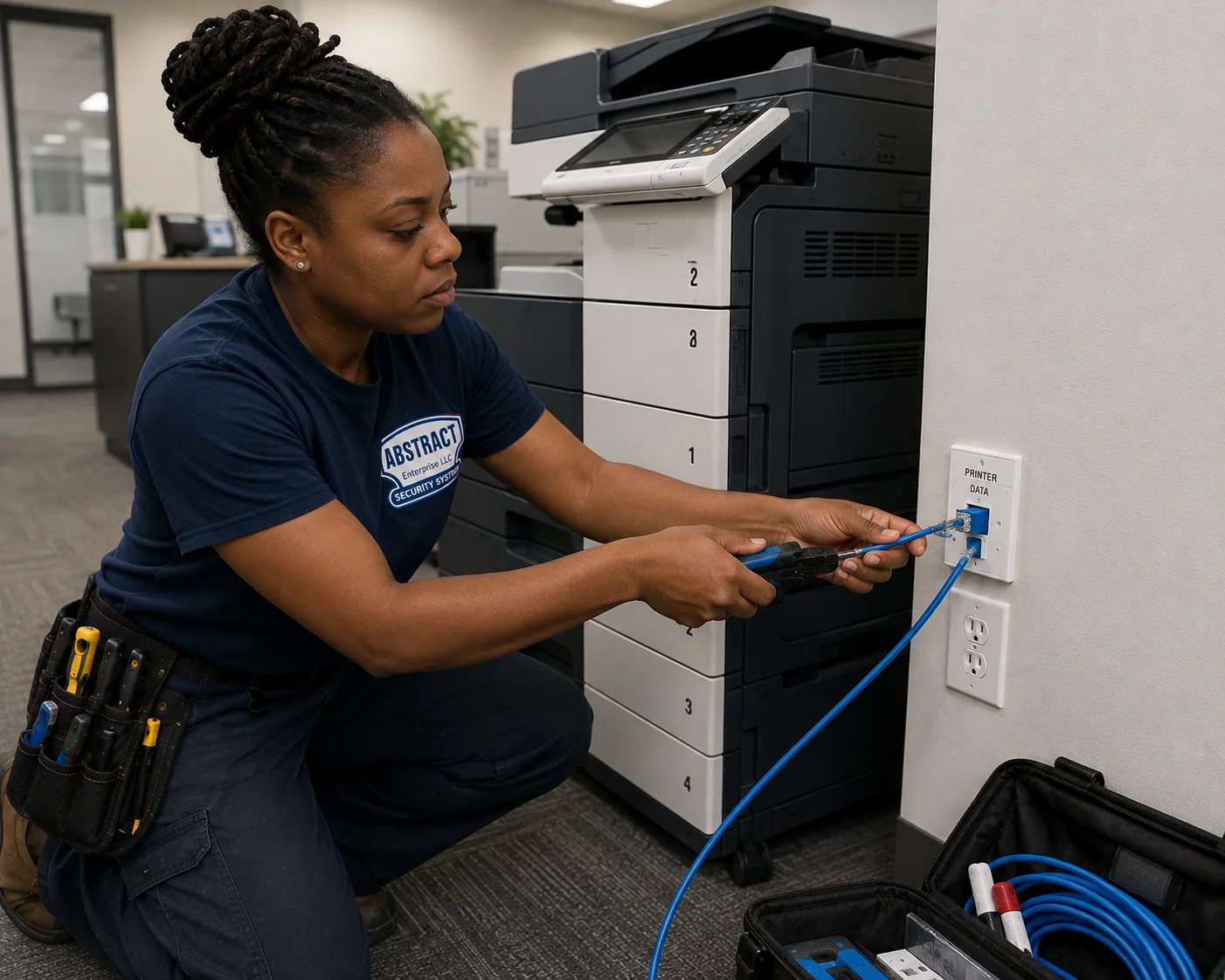
A technician kneels beside a large multi-drawer office copier and plugs a blue patch cord into a single-port wall jack labelled Printer Data, above a power outlet; an open tool case with coiled blue cable sits on the floor.
Devices at the end of a long run
A parking-lot camera at the end of a long run powers up but drops video. Is the run too long for PoE?
It may be too long, too warm, too resistive, or all three. Power over Ethernet loses voltage along the cable, and the loss rises with length, with temperature and with the resistance of the conductors. A camera that boots, then loses its stream when its heater or infrared illuminators draw more power, is a classic sign that the voltage reaching it is marginal. Copper-clad aluminium cable makes this much worse, and so does a corroded outdoor termination that adds resistance at the worst possible point.
We measure the run's length and resistance, check the power class the switch is delivering and what the camera actually receives, and inspect the outdoor termination. A corroded connector or non-copper cable is replaced. If the run is simply too long for the device's power draw, the options are a PoE extender partway along, a switch closer to the lot, or moving the camera's power source. We tell you which before buying anything.
Our dock scanners lose their connection only when the bay doors are open. Is that cabling?
Often it is, though not always in the way people expect. Runs to dock-door devices are among the longest in a flex or distribution building and frequently pass close to the doors themselves, where cold or hot air rushes in, where the overhead door mechanism moves, and where forklifts brush past conduit. A link that is near its loss limit, a cable flexed every time the door rises, or a termination in a box beside the door that sees condensation each time the outside air comes in can all produce failures tied to door movement.
We test the run with the door closed and open, inspect where it passes the door track and the motor, and look at the termination closest to the opening. Moving the run away from the moving parts, replacing a fatigued section and relocating the termination to a protected spot usually solves it. If the scanner is wireless and the complaint is really about the access point by the door, we check that link and its access point instead.
Equipment
Test Gear and Parts on Every Long Island Cat6 Repair
On Long Island the van has to carry for the outdoors as well as the closet. Alongside the certification tester and the termination hardware, these are the categories we bring because the faults here so often involve heat, distance and weather.
Certification Tester With Length and Temperature Context
Measures the link against its category limit and reports length, insertion loss and margin, so a heat-related or over-length failure is identified as such rather than mistaken for a bad termination.
Distance-to-Fault Readings
Reflection and crosstalk plots that place a fault by distance, which on a long ceiling or a big attic decides where we open up and where we leave things alone.
PoE Load Tester
Checks the power class and the voltage actually delivered at the far end of a run under load, the measurement that explains cameras and access points that boot and then drop.
Outdoor-Rated and Direct-Burial Cat6
For runs that leave the building, cable rated for sunlight, moisture and burial where required, so a repaired outdoor link does not fail again in the same way.
Listed Primary Protectors and Bonding Hardware
Entry protection for runs that come in from outside, bonded to the building's grounding, the part most often missing on outdoor links damaged in storms.
Sealed Enclosures, Boots and Drip-Loop Supports
To move terminations out of the weather and keep water off connectors at cameras, gates and outbuildings, especially near salt water.
Matched Cat6 and Cat6A Keystones and Modules
For re-termination at jacks and panels, matched to the cable category and to the panel's manufacturer where it is part of a system.
Hangers, Wide Straps and J-Hooks
To take attic and ceiling runs off staples, tiles and joists and support them properly, which sometimes recovers a link without replacing it.
Fish Tapes, Rods and Pull Line
For dropping replacement lengths down wall bays in slab houses and pulling through existing conduit on campus and outdoor links.
Why the outdoor kit matters. Many Long Island repairs end at a building entrance, a soffit or a gate post. A crew that carries only a continuity tester and a bag of plugs can make an outdoor link light up again; it cannot tell you whether it will survive the next storm, and it cannot fit the entry protection that keeps the surge out of the switch. A licensed local cabling contractor is answerable for both.
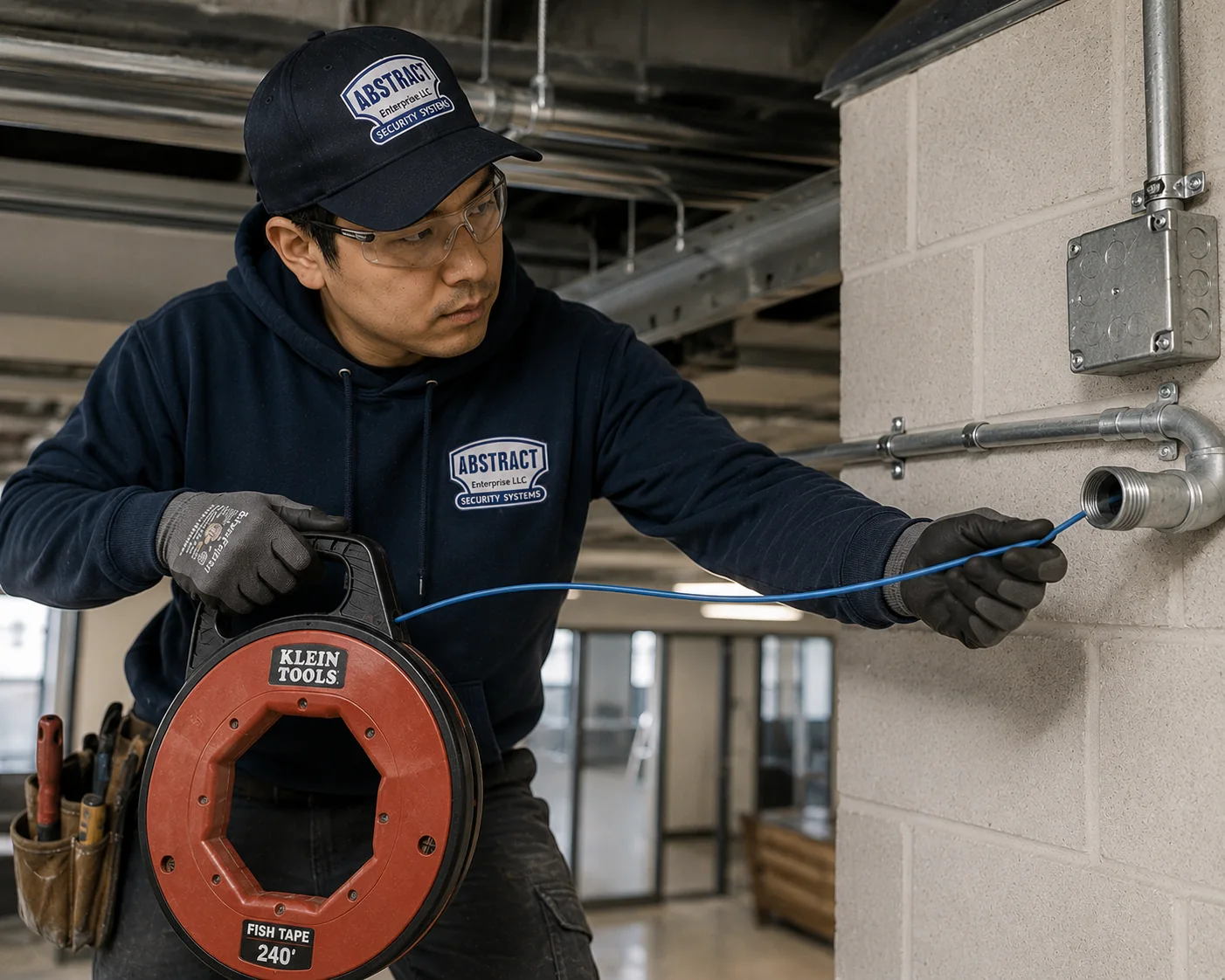
A technician in a cap, safety glasses and gloves holds a red fish tape reel marked 240 feet and feeds a blue cable into the open end of a metal conduit fixed to a painted block wall, with a junction box mounted above.
AI Overview Reality Check
What AI Gets Wrong About Cat6 Repair on Long Island
Method note: Google's AI Overview could not be opened from the tools used to research this page, so none of the claims below are presented as its exact wording. They are statements that how-to sites, retailers, cost guides such as Angi, HomeAdvisor and Fixr, and general answer engines commonly make about Ethernet cable. Under each is what changes for Category 6 in Nassau and Suffolk buildings.
“Cat6 is rated to 75 °C, so an attic is no problem”
Cable jackets carry a temperature rating, and many Cat6 jackets are rated well above any attic. That rating is about the jacket staying safe and intact. It says nothing about whether the link still meets its performance limits at that temperature.
Signal loss in copper rises with heat. The standards account for it by shortening the allowable length as temperature climbs — 0.4 to 0.6 percent per degree above 20 °C for unscreened cable, as Fluke Networks quotes from ISO/IEC 11801. A safe jacket can surround a link that has run out of margin.
So an attic run that is long, or that certified with little to spare, can fail every summer while being perfectly safe. We measure the margin and reroute the hot section when it is too thin.
“A whole-home mesh system means you don't need to fix the wired runs”
Mesh Wi-Fi is often recommended as the alternative to running or repairing Ethernet in a suburban house, and for phones and laptops it frequently works well.
The devices Long Island homes and small businesses most often hang on Cat6 — PoE cameras, access points, doorbells, gate readers and the backhaul between mesh nodes themselves — need the wire, and many of them need power over it. A mesh system that relies on a failed wired backhaul quietly falls back to wireless hops and loses much of its speed.
Fixing the run that feeds the far node or the camera is usually cheaper than adding hardware to work around it, and it removes the reason the network was slow in the first place.
“Any electrician can repair network cable”
Answer engines often send people to an electrician for anything inside a wall, and many electricians do excellent low-voltage work.
The question for a Cat6 repair is not who may run cable but who can prove the result. That takes a certification tester and the habit of terminating to category tolerances. On Long Island it also takes knowing which licensing applies where — Suffolk's Chapter 563 regime, the towns and villages that license on their own, and Nassau's home improvement licensing for residential work.
Ask any contractor, electrician or not, whether they will certify the repaired link and leave you the saved result. That one question sorts the field quickly.
“Cheap outdoor Ethernet cable is fine for a camera run”
Retail listings sell inexpensive “outdoor” Cat6 in long boxes, and plenty of camera installs on Long Island used it.
Some of that cable is copper-clad aluminium, which adds resistance that makes PoE cameras at the end of long runs brown out, and which fractures where it is terminated. Some is rated for sunlight but not for burial, and some is buried without conduit where frost and moisture work on it.
When we repair an outdoor run, we check the conductor and the rating first. A run of the wrong cable gets replaced with solid-copper cable rated for where it actually is, because re-terminating it only resets the clock.
“A surge protector on the router protects the whole network”
Plug-in surge strips are widely recommended as storm protection, and they do help with surges arriving on the power line.
They do nothing for a surge arriving on an outdoor Ethernet run. That energy enters through the cable to the gate, the pole camera or the detached garage and goes straight to the switch port it connects to. The National Electrical Code addresses that path separately, with a listed primary protector near where the cable enters the building.
After storms we regularly find outdoor links with no entry protection at all and a row of damaged ports at the far end. Adding the protector, bonded properly, is part of repairing those links.
“Re-pulling a cable in a one-storey building is quick and cheap”
Compared with a city riser, it often is, and cost guides that quote low per-drop figures for new installation reinforce the idea that replacing is always easy.
The catch on Long Island is that the new run inherits the old run's problem unless the path changes. A replacement that follows the same hot roof deck, the same over-length route or the same unprotected exterior path will fail for the same reason, just later.
Before re-pulling, we identify why the run failed. Sometimes the right fix is a different route or a closer switch, and sometimes it turns out the cable was fine and only the termination needed remaking.
“If it still works after a flood, it's fine”
After a storm, general advice focuses on safety and on whether things turn back on, which is sensible as far as it goes.
Wet Cat6 often keeps working for days or weeks. Moisture that got into terminations and wicked along the jacket corrodes contacts gradually, and the link degrades until it drops. Suffolk's August 2024 flooding and the South Shore's history with Sandy are reminders that water reaches ground-floor closets, garages and crawlspaces here.
Testing every link that was in the water, soon after the event, is how you find the ones that will fail later. It also produces the record an insurer may ask for.
Find Out Whether It Is the Cable, the Heat or the Weather
Tell us the town, the building, which links fail and when. A technician will tell you what the most likely cause is and how a visit is billed before anything is booked.
From a Bethpage cape to a distribution building off the Expressway, the form reaches a technician, not a call centre. Say what fails and when, and you get a written reply the same business day. Rather talk it through? Dial (800) 486-0943.
✅
We Got Your Request!
A technician will call you back the same business day. If it's urgent, call us now at (800) 486-0943.
How It Works
Our Long Island Cat6 Repair Process
Six steps, whether the job is one dead jack in a Massapequa home office or a dock full of failing runs in a Hauppauge flex building.
1. Pattern call
We ask when the failures happen — hot afternoons, after rain, after a storm, when a door opens — which links are affected and where they run. The pattern usually points to heat, length, weather or a termination before anyone travels.
2. Visit planned for the site
We book a 2-hour arrival window, confirm attic, roof or yard access, check which town or village rules apply to the address, and bring outdoor cable and entry protection if any run leaves the building.
3. Measure length, loss and margin
Each affected link is certified from both ends. We record length, insertion loss and margin along with crosstalk and return loss, and note where the run crosses hot or exposed space.
4. Cause and fix agreed
Link by link, we explain what went wrong and the remedy we propose — a fresh termination, new supports, a cooler route, a shorter path, entry protection, rated cable or fiber. You approve the list; work outside it waits for your go-ahead.
5. Repair the link and its environment
Terminations are remade on matched hardware, damaged sections replaced with solid-copper cable rated for where it runs, outdoor entries sealed and protected, and accessible abandoned cable removed.
6. Certify, label and report the margin
We certify each link again after the work and label both ends. Your copy of the results shows the margin on every link, with the weak ones flagged so you know which may struggle in the next heatwave or storm.
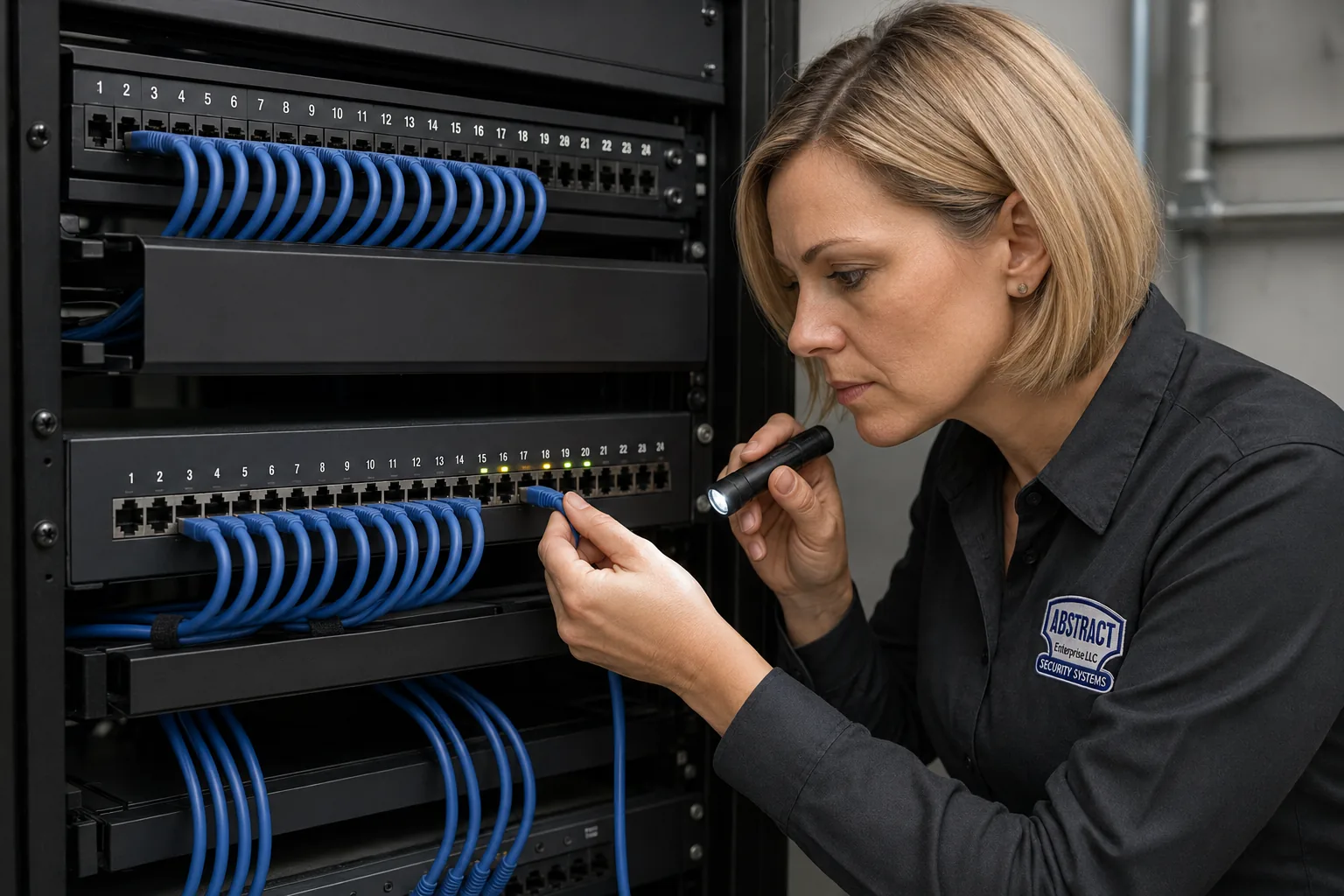
A technician leans close to a rack-mounted panel numbered 1 to 24, shining a small black flashlight on the ports while holding one blue patch cord at its socket; rows of looped blue cords fill the rack above and below.
Coverage Area
Cat6 Repair Near Long Island's Landmarks
These six places describe Long Island's building stock better than any brochure: the slab houses, the industrial parks, the mall corridor, the campuses and the research sites. They are reference points for the buildings around them, not claims of work inside them.
Levittown, Town of Hempstead
17,447 houses built between 1947 and 1951 on concrete slabs, the template for much of Nassau's post-war housing. Ethernet here lives in attics and interior wall drops, which shapes every residential repair.
Long Island Innovation Park at Hauppauge
The renamed Hauppauge Industrial Park, about two-thirds of which falls under a Town of Smithtown overlay. Single-storey industrial and flex buildings with the region's longest horizontal runs.
Roosevelt Field, East Garden City
Long Island's largest shopping mall, developed after 1951 on the former airfield where Charles Lindbergh began his transatlantic flight, and the anchor of the Old Country Road retail corridor.
Hofstra University, Hempstead
About 117 buildings on 244 acres in the Uniondale section of Hempstead, part of it south of Hempstead Turnpike — a campus where links between buildings are as much a cabling question as links inside them.
Stony Brook University, Brookhaven
213 buildings over 1,454 acres with a research and development park to the south, part of the North Shore that took the August 2024 flooding.
Brookhaven National Laboratory, Upton
Established in 1947 at the former Camp Upton on a 5,265-acre site, the eastern anchor of Suffolk's research and technical employers.
We also repair Cat6 in Great Neck, Manhasset, Port Washington, Mineola, Garden City, Westbury, Hicksville, Plainview, Syosset, Oyster Bay, Freeport, Valley Stream, Long Beach, Massapequa, Huntington, Commack, Smithtown, Islandia, Ronkonkoma, Bay Shore, Islip, Patchogue, Medford, Riverhead, Southampton, East Hampton, Montauk, Southold and Greenport, and the hamlets between them, plus the five boroughs and the Hudson Valley.
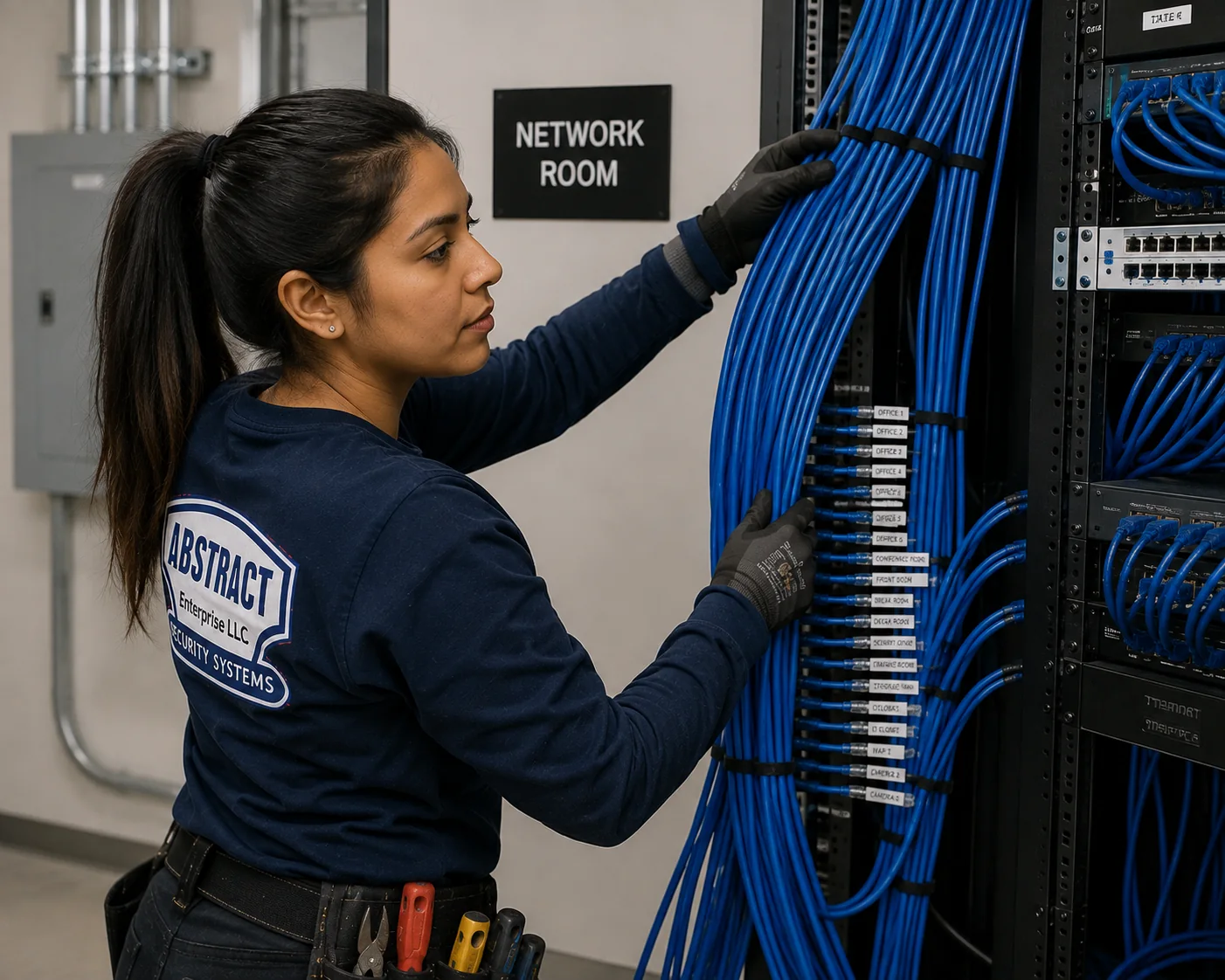
A technician in gloves guides a thick bundle of blue cables, each carrying a numbered white label, down the side of a black rack; a sign reading NETWORK ROOM hangs on the wall behind her beside an electrical panel and conduit.
Pricing
Cat6 Repair Cost on Long Island
Every figure below is one we already publish on a Long Island page, and each line says which page. A Cat6 repair has two parts that cost very differently: the technician's time to find and fix faults, and any cable or protection that has to be replaced. They are listed separately on the invoice.
Item
Price
Scope and source
Technician time on Cat6 or Cat6A — certifying, locating the fault, remaking terminations, freeing and supporting runs, final certification
$195/hr, 3-hour minimum ($585)
The specialty rate printed on our Long Island, Nassau and Suffolk network cable repair pages; hours past the first three are billed as used
Fresh Cat6 run when the existing one is beyond repair
From $175 per drop
Figure from our Long Island network cable repair table; the drop price there includes the cable, jack, plate, punch-down at the panel, testing, labels at both ends and a patch cord
Over-length run re-route
Quoted per run
Listed on the same page: a new pathway or relocated outlet where distance rather than damage is the fault
Plenum (CMP) material where ceiling space is a return-air plenum
Added per drop
Listed on the same page; applied only where the ceiling is used for return air
Evening or weekend window
Premium applies
Listed on the same page, for occupied medical, retail and food-service space
For comparison only: a brand-new Cat6 drop on runs up to 100 ft
$296 per drop
Long Island Cat6 installation page; the same table shows $254 for Cat5e and $424 for Cat6A
Outdoor entry protection, trenching, conduit, fiber between buildings
Quoted after testing and walkthrough
Depends on distance, ground conditions and the municipality's requirements
What the $585 opening block usually buys in Nassau or Suffolk
The minimum is a block of a technician's time with the test gear, not a fee for one fix. On a residential call it typically covers certifying the failing links, getting into the attic to locate a fault, freeing or re-terminating the affected runs and retesting. On a commercial call it covers testing a group of links, sorting them by length and margin, remaking failed terminations and identifying any runs that need rerouting or replacement. Runs that need replacing are priced before any cable is pulled.
What moves a Long Island Cat6 repair bill
Whether the cause is the link or its environment: a bad termination is quick; a run that fails because of heat, length or exposure needs rerouting or replacement on a better path.
Access: an open attic or a single-storey drop ceiling is quick to work in; finished basements, exterior walls with insulation and closed ceilings take longer.
Outdoor work: entry protection, sealing and outdoor-rated cable add parts and time, and trenching or conduit is quoted separately.
What was bought by the box: runs of copper-clad aluminium, or indoor cable that ended up outside, get swapped out rather than fixed; real solid-copper Cat6 is worth repairing.
Timing: evening or weekend windows for occupied medical, retail and food-service spaces carry the premium noted on our pricing table.
A note on regional pricing. The repair rate and the replacement-drop figure above are published at the same level across our Nassau, Suffolk and New York City cabling pages, and we keep them identical here rather than introduce a second set of numbers. The installation drop prices on our Long Island Cat6 installation page are higher than the New York City figures, and we quote those as published.
Full terms — including 50% deposit, one-year parts-only warranty on AESS-supplied products, and the late-fee schedule — are set out in the service agreement.
Shop Our Systems
Cat6 Repair Packages & Pricing
Three ways a Long Island job usually shapes up, from a single bad link to a building that needs rerouting. No number here is new; each comes from a page we already publish.
Starter — One Failing Link
$585
The three-hour minimum at $195 an hour. One desk, camera, access point or home-office link certified from both ends, the cause found — termination, heat, staple damage or a corroded outdoor connection — repaired, and the link certified again. Spare time in the block goes to other links you want checked.
Standard — Building or Wing Survey and Repair
$195/hr after the first 3 hours
For a flex building, an office wing or a whole house: every link certified, results sorted by length and margin, failed terminations remade, attic and ceiling runs resupported, and a written list of links that need rerouting or replacing. Time is estimated in writing after the first round of tests.
Premium — Repair Plus Rerouted or Replacement Runs
Repair time + from $175 per run
For buildings where some runs are beyond saving or are on the wrong path altogether. Hourly repair covers the links that can be recovered; new runs start at $175 per drop; re-routes for over-length links are priced one by one; reachable dead cable is pulled out; the port map is brought up to date.
Bring Your Own Parts — Labour Only
Have the original installer's spare keystones, a replacement panel, or outdoor cable already bought for the job? We can use them and bill repair time only, provided they suit the link: matching category, solid-copper conductors, and outdoor or burial rating where the run goes outside. Parts you supply carry their own manufacturer's warranty rather than ours, and if they cannot produce a passing link we tell you before we install them.
Get Through Next Summer Without the Same Failures
A heat-season failure that is repaired the same way it was installed comes straight back. Tell us which links struggled this year and we will plan the fix around the cause, with the cost set out before the visit.
How Cat6 Failures Differ Between Nassau and Suffolk
The two counties share an island and very little else when it comes to cabling. Nassau is denser, older and more residential; Suffolk is wider, more industrial in its western half and more seasonal at its eastern end. County Cat6 repair pages are on the way; until they are live, each county link below opens our quote form.
New York State describes Nassau as two cities, three towns and 64 incorporated villages over about 453 square miles, and the density shows in the work. Residential repairs dominate: slab ranches and capes in the Levittown and Hicksville pattern with attic runs, colonials and split-levels on the North Shore with finished basements, and home offices added to all of them. Commercially, the repairs cluster along Old Country Road and in the Uniondale and Garden City offices, plus the retail strips and medical offices that line the main roads. The South Shore adds flood and salt exposure. For general Ethernet faults in the county, see our network cable repair page for Nassau County.
Suffolk is ten towns across about 2,373 square miles, and its repairs are shaped by distance. Western Suffolk holds the Hauppauge park and the Route 110 corridor, where single-storey industrial and flex buildings produce over-length and roof-heat failures. Central Suffolk adds distribution and commercial buildings around Ronkonkoma and MacArthur, and the Stony Brook research belt. The East End brings seasonal businesses, wineries and second homes, with winter-idle failures and long outdoor runs to outbuildings. Suffolk's Chapter 563 licensing and its town-and-village carve-out make the address matter. See also our Suffolk County network cable repair service.
Decision Guide
When It Fails Tells You Why: A Long Island Symptom Guide
On Long Island the timing of a failure is often the best clue to its cause. This is the table we work from on the first phone call. It does not replace the tester, but it tells us what to bring and where to look first.
When the link fails
Most likely cause
What we check and do
Hot afternoons, July and August, fine in winter
Insertion-loss margin lost to heat in an attic or under a roof deck; often a long run
Measure margin and length; reroute the hot section lower or replace the run on a cooler path
After heavy rain
Water at an unsealed entry, a wet outdoor termination or a leaking roof over the run
Inspect entries and outdoor connections; replace corroded terminations; seal and add drip loops
After a thunderstorm, suddenly and completely
Surge on an outdoor run damaging the switch port, injector or device
Test the cable disconnected, then the ports; add a listed primary protector at the entry
At spring reopening after a closed winter
Condensation corrosion, rodent damage or unheated-space stress on terminations
Certify every link; replace corroded hardware; locate chewed sections by distance
When a bay door or gate opens
Cable flexing near moving parts, a marginal long run, or condensation at a door-side box
Move the run away from the mechanism; relocate the termination; check length
At night, on cameras only
PoE power draw rising when infrared or heaters switch on, at the end of a long or resistive run
Measure delivered power under load; check conductor type; extender or closer switch if length is the limit
Ever since a renovation or a new roof
Crushed, stapled or cut cable, or a run moved into a hotter or longer path
Locate the fault by distance; replace the damaged section; reroute if the path changed
Always, but only at the far end of the building
Longer than Category 6 allows — past 90 metres of permanent cable
Shorter route, a switch nearer the far end, or fiber to a remote switch
One check sits outside the table: whether the cable is what it says it is. Copper-clad aluminium, indoor cable buried outdoors and stranded patch cable used as permanent runs all fail in ways that look like the patterns above, and none of them can be repaired into compliance. We check the conductor before we commit to any repair plan.
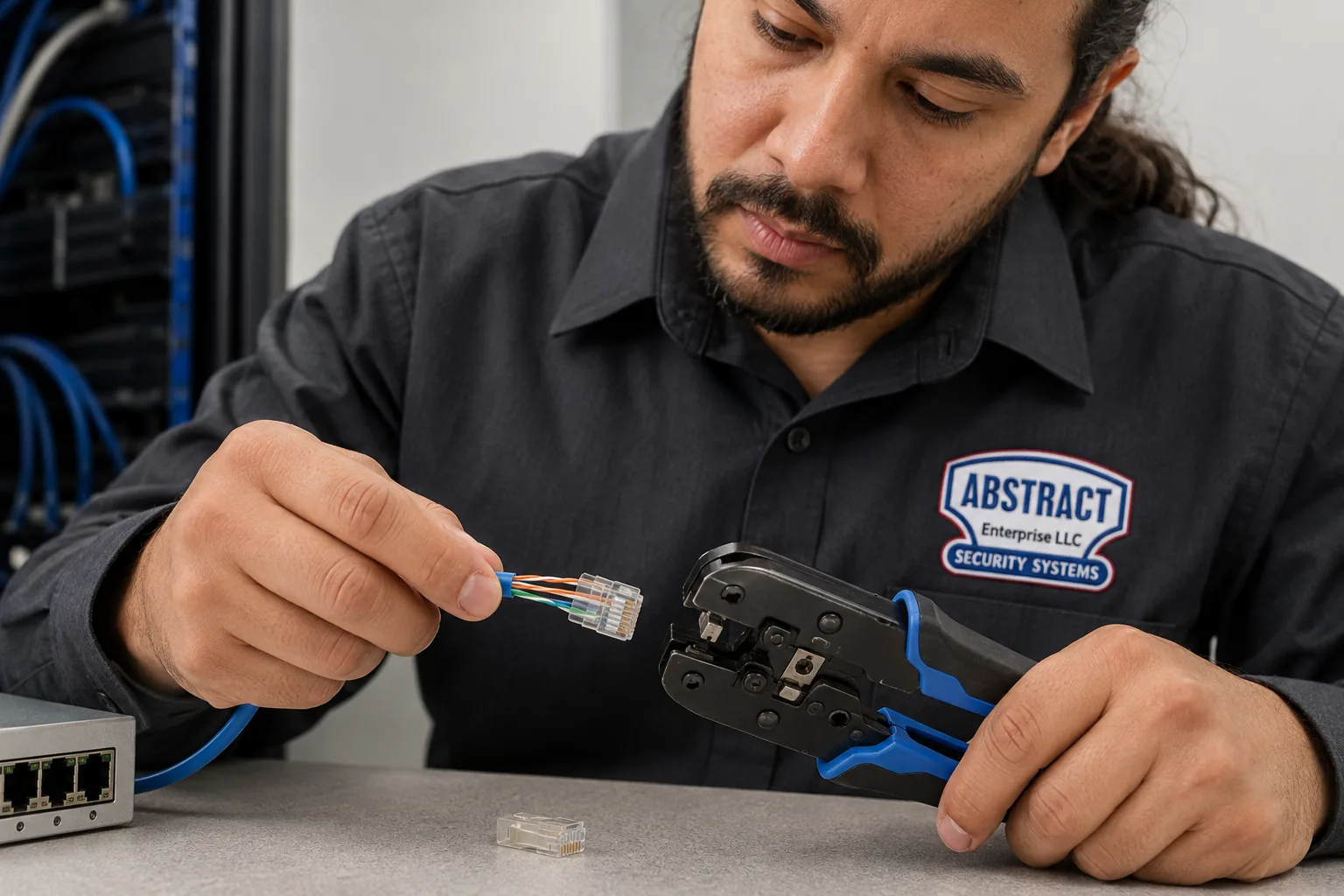
A technician seated at a work surface holds a blue cable with its coloured conductors pushed into a clear RJ45 plug, a crimp tool with blue handles in his other hand and a spare plug on the table; a small network switch sits at the left edge of the frame.
Before You Call
What to Note Before a Long Island Cat6 Repair Visit
A few minutes of observation saves a lot of testing time on site. These are the things we ask about on the phone. None of them involve opening anything up, and each one narrows down where the fault is likely to be.
The calendar and the clock. Write down when failures happen: time of day, hot or cool weather, after rain, after a storm, after a power cut. On Long Island the pattern often names the cause.
Which runs leave the building. List any link that goes to a garage, pool house, shed, gate, pole or another building, and whether it is buried, on a wall or overhead.
Which runs cross the attic or the roof space. In houses, note which rooms are fed from above. In flex buildings, note which links reach the warehouse side.
Recent work. A new roof, new insulation, a renovation, HVAC work or a new ceiling are all common starting points for damage.
The equipment at both ends. Swap patch cords for known-good ones and try a different switch port. If the fault moves with the device, the cabling may be fine.
Access. Where the attic hatch is, whether ceilings are lift-out tiles, and whether a ladder can reach outdoor devices safely.
Old paperwork. Any test reports, drawings or the name of the original installer, even if incomplete.
Two things we ask people not to do: re-punch Cat6 jacks themselves, which rarely leaves a link within its crosstalk limits even when the light comes back, and climb to outdoor devices or across attic joists without proper footing. We would rather spend an extra hour than have someone hurt.
Seasonal Care
A Year of Cat6 on Long Island: When to Test What
Because so many Long Island failures follow the seasons, a little timing goes a long way. This is the schedule we suggest to property managers and business owners who would rather find weak links before they fail.
Season
What to test
Why then
Late spring
Attic and roof-deck runs, long runs to the far end of wide buildings
Find links with thin margin before summer heat removes the rest
Before reopening a seasonal site
Every link in buildings that were closed or unheated over winter
Catch corrosion and rodent damage before the first busy weekend
After any major storm
All outdoor and between-building links, and the switch ports they reach
Surges and water damage often degrade links without killing them
Early autumn
Outdoor terminations near salt water, gate and pole cameras
Replace corroding connections before winter weather and long nights increase camera power draw
Before a sale, a lease or a new tenant
The whole building
Saved results show what the next occupant is inheriting
None of this is compulsory, and many buildings never need it. It earns its keep where the network carries cameras, point-of-sale or medical systems, where runs are long or outdoors, or where the building has failed in the same way more than once.
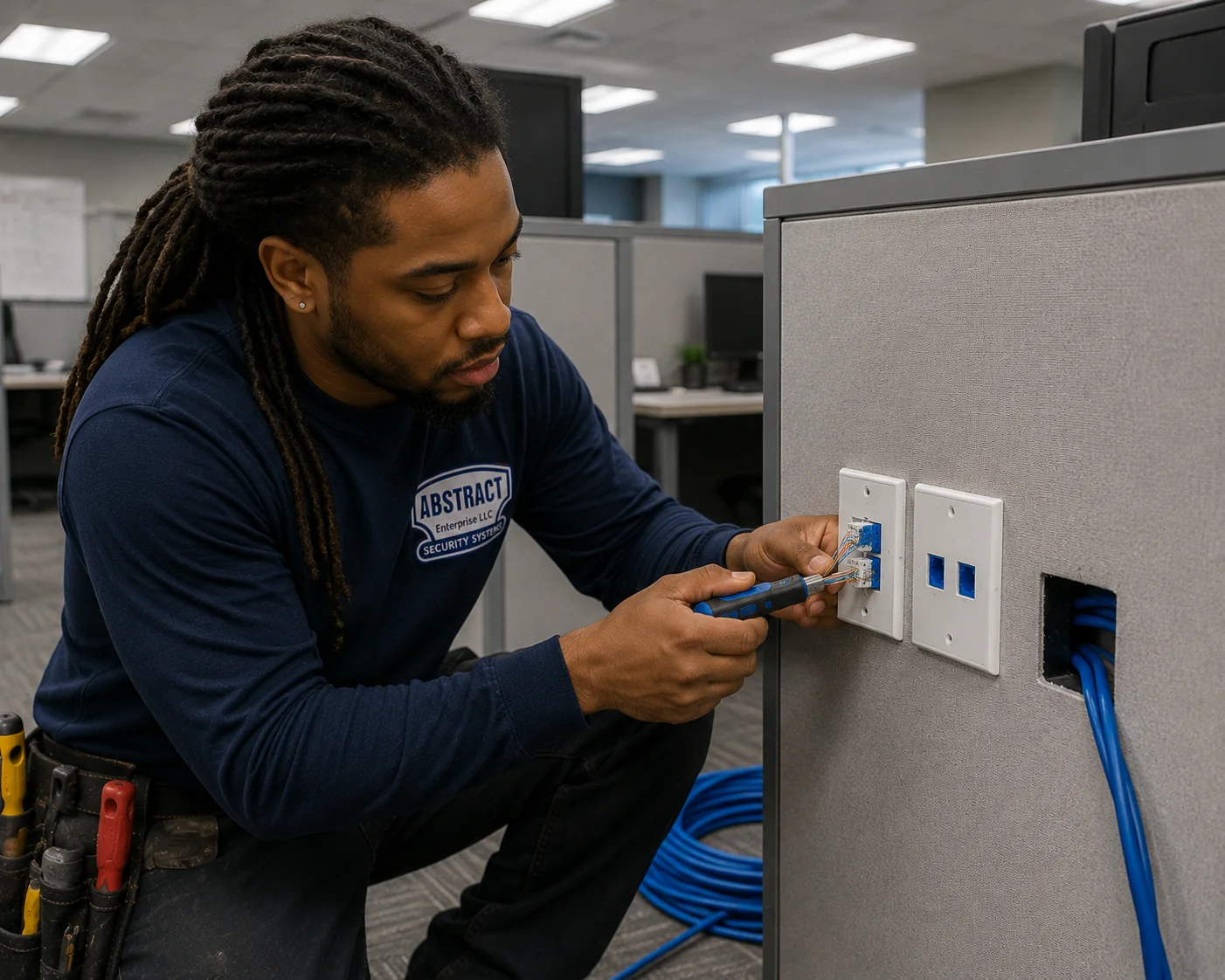
A kneeling technician with long locs presses a blue-handled punch-down tool onto a keystone in a white wall plate on a grey cubicle panel; beside it is a second plate with two blue keystones and an opening where a blue cable comes out.
Complete Services
Every Cat6 Repair Service on Long Island
A failed Cat6 link on Long Island often turns up alongside one of these. Each link below goes to the Long Island page for that service.
Field Notes on Failing Cat6 Across Nassau and Suffolk
Habits our crews keep on Nassau and Suffolk calls, described as method rather than as an account of any one site
We ask about the weather before we ask about the cable. A link that only fails on hot afternoons, or only after rain, has already told us half of what we need to know, and it changes what goes on the van.
We read the length before anything else on the test result. On wide buildings and long attic runs, the length line explains more failures than any crosstalk plot, and it is the one that rules out re-terminating as a fix.
We walk every run that leaves the building. The entry hole, the outdoor termination, the drip loop or lack of one, whether there is a protector at the entry — outdoor links fail at the boundary, and the boundary is where we look first.
We check the conductor before we plan. Silver at the core means the run is replaced, however tidy the rest of it is.
And we hand back the margin, not just a pass. A link that passes by a hair in October may not pass in July. Telling you which links are thin is part of the repair.
FAQ
Long Island Cat6 Repair FAQ
Is there a travel charge to repair Cat6 on the North Fork or the South Fork?
+
No separate travel charge. As on our Suffolk pages, East End visits are handled by booking a planned window rather than adding a surcharge, so a repair in Southold, Riverhead or East Hampton is billed at the same $195 an hour with a three-hour minimum as one in Nassau. Same-day calls at the far end of the island depend on which technicians are free, and we tell you the honest next window when you call.
Can you test the Cat6 in a Long Island house before we close on it?
+
Yes, with the seller's permission for access. We certify every jack in the house, note any runs that fail or pass with thin margin, check how outdoor runs to cameras or outbuildings enter the building, and give you saved results with a short written summary. It will not tell you about the internet service to the street, but it tells you whether the wiring inside is sound or needs repair.
Can you work in a Long Island school, library or house of worship during a summer or holiday break?
+
Yes, and those breaks are usually the best time, because classrooms, meeting rooms and offices can be opened up without disturbing anyone. We work with the facilities manager or business office, provide insurance certificates in the form they require, and schedule testing and repairs building by building so each one is handed back certified before people return.
Can a Cat6 repair at a medical or dental office in Nassau or Suffolk be done before patients arrive?
+
Yes. We can book an early-morning, evening or weekend window so exam rooms, imaging and front-desk links are tested and repaired while the practice is closed. Out-of-hours windows for occupied medical space carry the premium shown on our Long Island network cable repair pricing table, and we confirm the total in writing before the visit.
Can you repair Cat6 inside a mall or shopping-centre tenant space on Long Island?
+
Yes. Shopping centres usually have their own contractor rules, so we send the insurance certificate to centre management in the wording they ask for, book within their permitted hours, and keep our work inside your tenant space and the paths management approves. If a failing run passes through common areas or another tenant's ceiling, we tell you and the centre before touching it.
We are having the attic re-insulated. Should the Cat6 up there be checked first?
+
It is a good idea. Blown-in insulation buries cable that was easy to reach, insulation crews walk the joists where runs are fastened, and a run that ends up under a deep layer of insulation is harder to repair later. Testing and resupporting the attic runs before the work, and marking where they cross, makes them easier to protect and to find again if one ever fails.
Can surge protection be added to an outdoor Cat6 run that has not failed yet?
+
Yes. A listed primary protector can be fitted where an existing outdoor run enters the building and bonded to the building's grounding, without replacing the cable, provided the run has enough slack at the entry. We test the run at the same time, so you know whether the cable itself is worth protecting or is already due for replacement.
We are turning a Long Island garage into an office. Can the Cat6 already out there be reused?
+
Often, once it has been tested. Garage runs are frequently indoor cable on an unheated, damp wall, terminated in a box that has seen years of condensation, so we certify each run, replace corroded terminations and check the conductor type. Runs that pass with good margin can be kept and moved into proper wall plates as the walls are finished; runs that fail are replaced before the drywall goes up.
Can a homeowners' association or condo complex on Long Island book one visit for several units?
+
Yes. Booking the units together usually makes better use of the three-hour minimum, because the technician moves from one unit to the next without a second trip. We need the board or managing agent to arrange access and tell us which links belong to the association and which to the owners, and we report the results unit by unit so each owner sees their own.
Can you work with our remote IT provider during a Long Island repair visit?
+
Yes. Many Long Island offices are looked after by an IT company that is not on site. We can call them from the closet while we test, confirm which switch ports and VLANs the repaired links should land on, and send them the saved test results and the updated port map afterwards, so they do not have to visit to check our work.
All Areas Served
Cat6 Repair Across Long Island and New York
You are on the Long Island Cat6 repair page, covering Nassau and Suffolk. The New York City hub covers the five boroughs and the Hudson Valley hub covers the six counties north of the city. County pages for Nassau and Suffolk are on the way; until they are live, those links open our quote form.
Cat6 Failing Somewhere Between the Queens Line and Montauk?
If a link fails in the heat, stopped after a storm, or never reached the far end of the building properly, call (800) 486-0943. We book the next open 2-hour window, and most termination and cord faults are fixed in one to two hours once we are on site.
Cat6 Repair Long Island — Licensed, Insured, Certified to Category
Abstract Enterprises Security Systems · 1282 Troy Ave, Brooklyn, NY 11203 · serving Nassau and Suffolk counties · (800) 486-0943 · WhatsApp (718) 679-0359 via wa.me
NYS Low-Voltage Licence #12000287431 · 100% Licensed & Insured · Same-Day Estimates · Rated 4.7★ from 201 Google Reviews
Parts you supply carry their manufacturer's warranty. See our warranty page and the service agreement for full terms.
The guidance on this page describes Cat6 failure and repair as we see it in Long Island buildings. What it says about county codes, the National Electrical Code and cabling standards are summaries, not legal or engineering advice; licensing and permit requirements vary by town, village and city. Page reviewed and updated October 17, 2026. Changelog: first publication of the Long Island Cat6 repair hub.