A Cat6 link is rated for a level of performance, not just for carrying a signal. When one of yours stops delivering it — a desk that trains at 100 Mbps, a camera that reboots after dark, a link that fails NEXT on the tester the IT company brought in — we find where along the run the fault sits, decide whether a fresh termination will cure it or whether the copper itself is spent, and hand back a link that tests to its category again. Work is done to the building's rules: managing-agent paperwork, contractor hours and riser access arranged before we arrive.
Reviewed and updated October 17, 2026 · Written by Anwar Timothy, NYS licence #12000287431
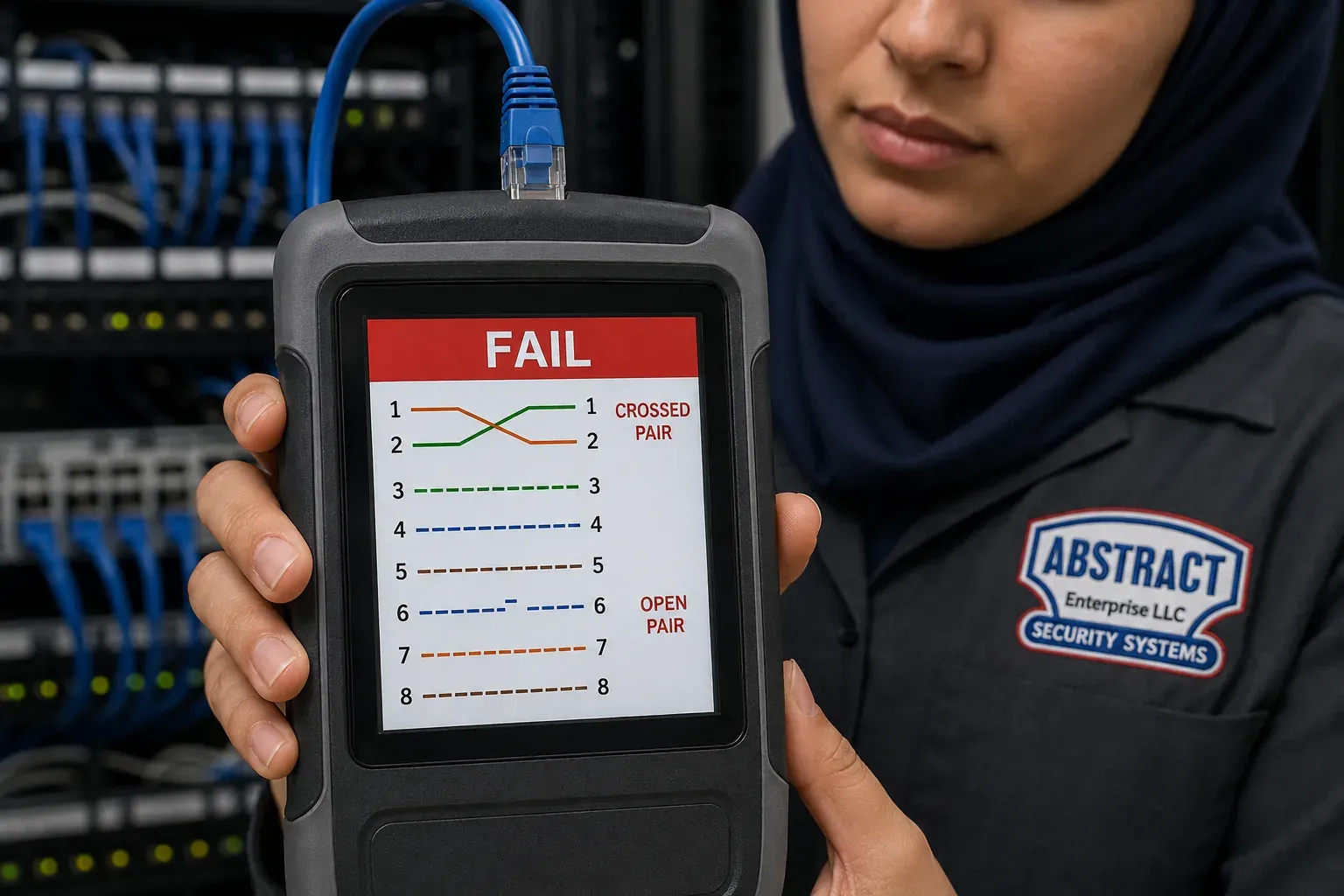
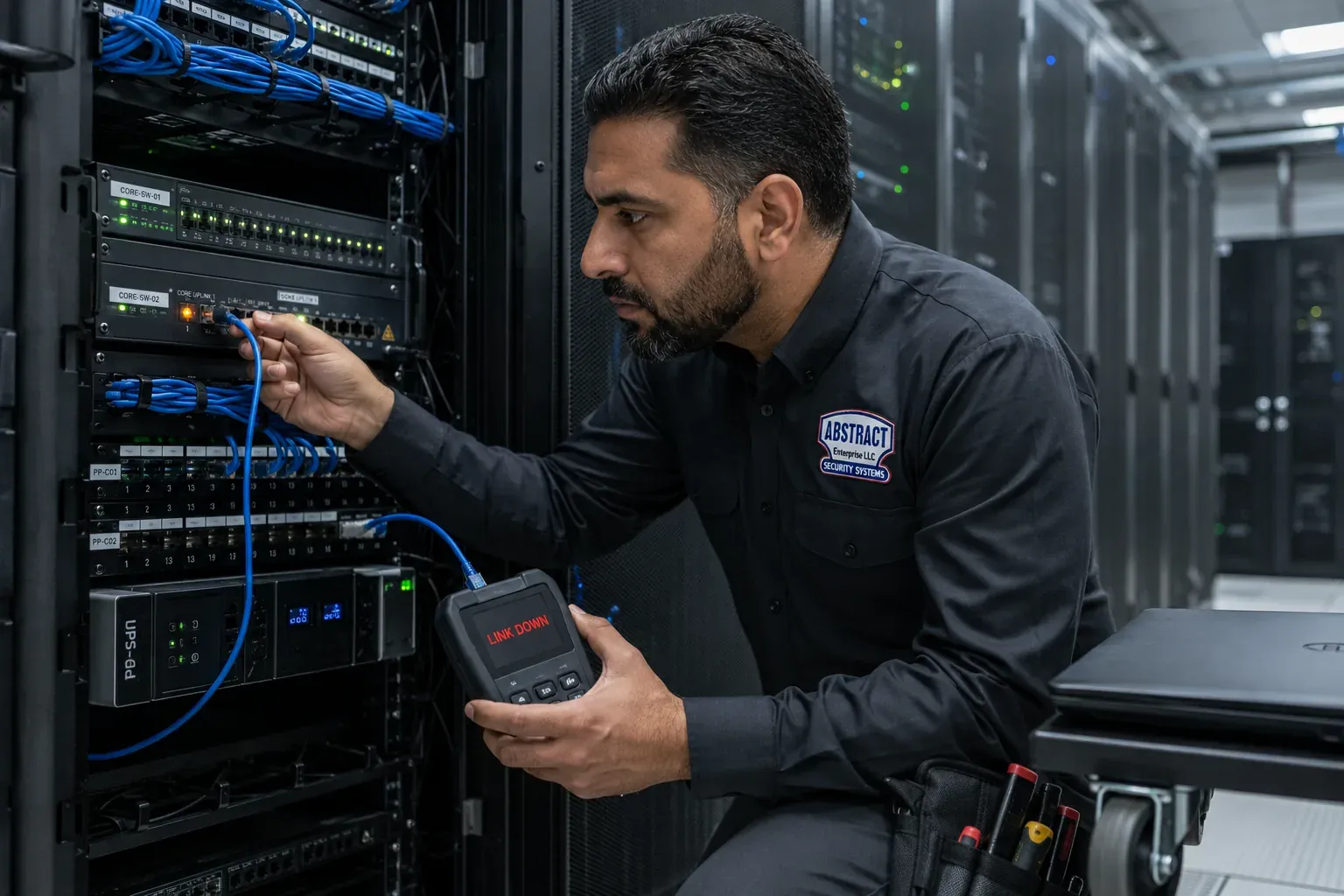
A technician holds a handheld cable tester in front of a rack of blue patch cords; the screen reads FAIL, with pins 1 and 2 drawn crossed and pin 6 marked as an open pair.
Get a Free Cat6 Repair Quote
Tell us what the link is doing and where it runs — we call back the same business day
✅
Request Sent!
We'll call you back the same business day.
25+
Years Experience
✓
Same-Day Estimates
100%
Licensed & Insured
4.7★
201 Google Reviews
One link misbehaving, or a whole floor that failed someone's tester? Call (800) 486-0943 or use the 60-second form. A licensed technician reads every request and tells you, before a visit is booked, whether the symptom sounds like a termination, a cord, a damaged cable or something that is not cabling at all.
Faults located by distance along the run, so walls and ceilings are opened only where the damage actually is
Every repaired link retested against its own category limit, Cat6 or Cat6A, and the result left with you
NYS licence #12000287431 · insured · paperwork sent to your managing agent before we arrive
Why New York City Buildings Need Cat6 Repair, Not Just a New Cable
In most of the country, a failing Ethernet run is cheap to replace: pull a new one through an open attic or an unfinished basement and move on. In New York City, the path that cable took is often the most valuable thing about it. It may have been fished through eighty-year-old plaster, threaded up a riser shared with three other tenants, carried across a hung ceiling on a floor somebody else now leases, or sleeved through a masonry wall that nobody wants to core again. That changes the economics completely. Before anyone starts talking about a re-pull, the useful question is how much of the existing Cat6 is still good, and whether a precise repair at the right point brings the whole link back to category.
Cat6 makes that question sharper than older cable did. A Category 6 link is only Category 6 if every part of the channel — the solid-copper cable, the keystone or panel port at each end, the way the pairs were kept twisted up to the contacts, and the patch cords that finish it — still meets the standard together. A run can carry traffic and light the switch port while failing that standard by a wide margin. That is why so many New York offices live with links that “work” but negotiate down to 100 Mbps, drop when the elevator motor next to the closet starts, or hold a PoE camera up all day and lose it every evening when the infrared comes on.
The buildings themselves supply the damage. Older stock has tight chases, sharp turns at the top of a riser and conduit packed long past its fill. Hung ceilings get opened by HVAC crews, sprinkler fitters and electricians who rest a ladder, a duct or a box of tiles on whatever is lying across the grid. Cellar network closets in mixed-use buildings take water from burst pipes and storms. Converted lofts and former industrial floors carry decades of abandoned cable alongside the live runs, so the run you need is buried in a tray of ones nobody can name. Each of those leaves a fingerprint on a tester, and reading that fingerprint is most of the job.
There is also a lot of cable in this city labelled Cat6 that never really was. Copper-clad aluminium sold in Cat6-printed jackets, stranded patch cable punched into keystones, Cat5e cords plugged into Cat6 jacks, and female couplers used to “extend” a run that came up short all turn up regularly. None of those can be made to certify, and some of them overheat or fracture under PoE. Part of a proper repair is identifying which of your links are genuine Cat6 that has been damaged, and which were never going to meet the category in the first place.
Finally, New York repairs happen inside other people's rules. A managing agent may want a certificate of insurance before the visit and only allow contractors between set hours. A co-op board may treat the riser as common space. A tenant two floors up may own the ceiling your run crosses. Since December 21, 2025 the city's own electrical code has been built on the 2020 edition of the National Electrical Code, and the code's rule that accessible abandoned communications cable be removed still applies when a run is replaced. A Cat6 repair that ignores the building is a repair that has to be done twice.
New York City facts that shape a Cat6 repair
54 percent: share of the city's housing units in buildings put up before 1947, per the Rent Guidelines Board's 2025 Housing Supply Report — the masonry and plaster stock where re-pulling a run is slow and disruptive.
3.7 million: housing units counted in the 2023 New York City Housing and Vacancy Survey, according to HPD's testimony — overwhelmingly in multi-family buildings with shared risers and managed common space.
December 21, 2025: the date the current New York City Electrical Code, the city's amendments to the 2020 National Electrical Code, took full effect, per the Department of Buildings.
37 to 55 metres: the Cat6 channel length over which 10GBASE-T is expected to work, depending on the alien-crosstalk environment, under TIA's TSB-155-A guidance as summarised by ICC. Beyond that, 10G on Cat6 is not a repair problem but a cable-category limit.
24 cables: the bundle size TIA's TSB-184-A guideline limits PoE bundles to, according to Belden, because heat from powered pairs can push cable beyond its rated temperature — relevant to every dense camera and access-point tray in a city ceiling.
September 2, 2021: the day the Department of Buildings issued its warnings after the remnants of Hurricane Ida flooded basements across the city, noting that floodwater damages building wiring — the event behind many of the corroded cellar-closet terminations we still find.
Put together, those facts describe a city where cable is hard to replace, easy to damage and frequently not what its jacket says it is. That is the case for repairing Cat6 properly: test it, locate the fault, fix only what is broken, prove the result, and re-pull only where the copper cannot be saved.
Most of the offices that call about a failing Cat6 link are also overdue for a look at the rest of the closet. Our network cable repair team in NYC handles the wider Ethernet faults — switches, older Cat5e, cords and labelling — and the Abstract Enterprises Cat6 installation crews take over when a floor needs new drops rather than repaired ones.
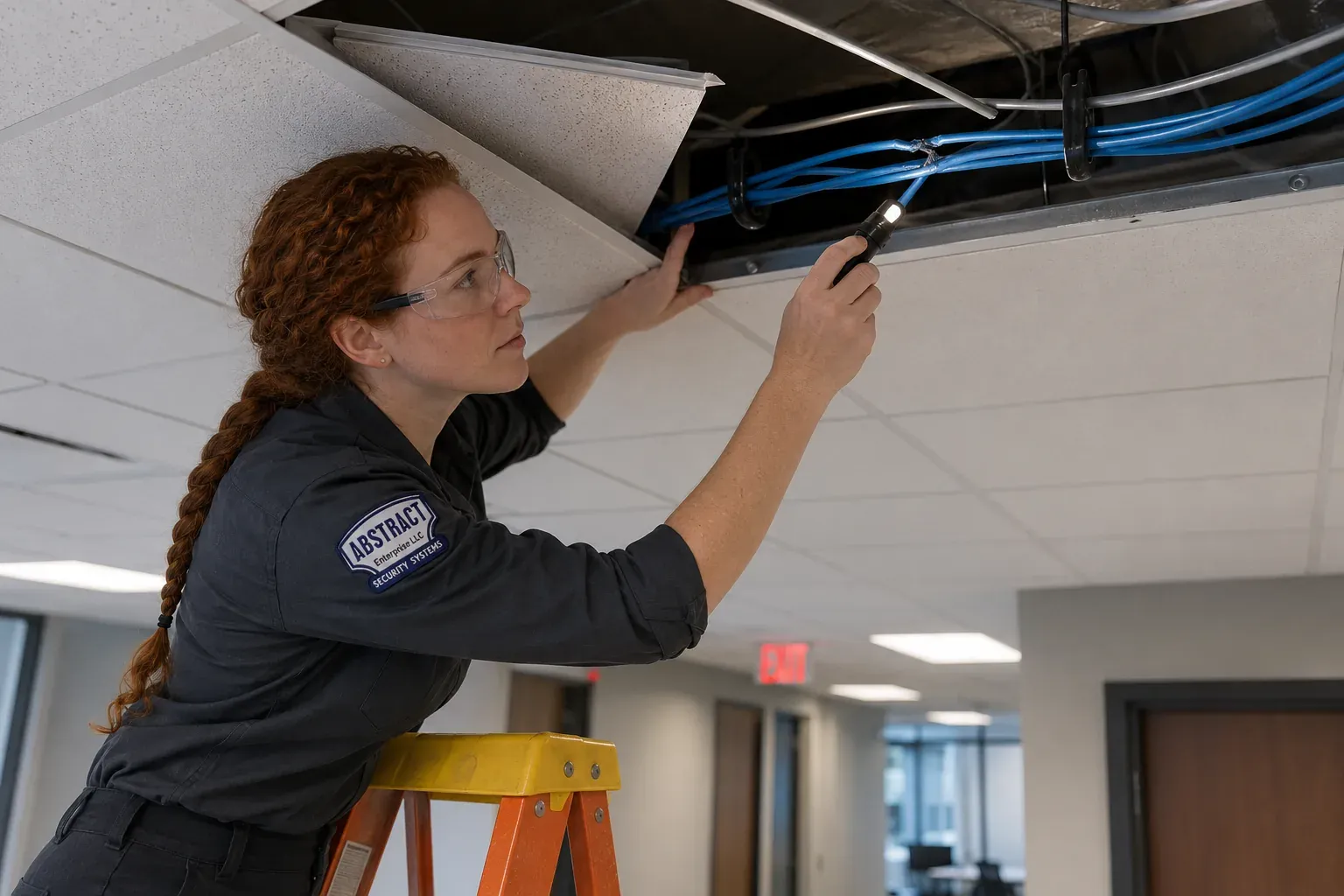
A technician in safety glasses stands on a yellow stepladder, pushes up a ceiling tile and shines a small flashlight along bundles of blue cable resting in the ceiling space above an office corridor with an exit sign.
Repair Capture
Cat6 Link Down in New York City Right Now?
A reception desk with no network, a point-of-sale terminal that went offline mid-service, a camera that dropped off the recorder, or a link that has started flapping every few minutes — those are service calls, and we treat them that way. We book the next open 2-hour window we have and come with a certification tester, a toner, Cat6 and Cat6A keystones, panel modules and cable on the van. Most single-link faults at a termination or a cord are found and fixed in one to two hours once a technician is standing at the closet. Repair time is billed at $195 an hour with a three-hour minimum ($585), the same rate published across our network cable repair pages. Call (800) 486-0943 and say it is a Cat6 fault, or read our Manhattan network cable repair page if the trouble is on an older or mixed-category system.
What We Repair
Cat6 Repair Services in NYC
Every Cat6 repair we do in the five boroughs is one of these, or a combination of them. Each one ends the same way: the link is retested against the limit for its category, the result is saved, and you are told in plain words what was wrong and what was done.
Fault Location on Failing Runs
Time-domain testing places a crosstalk or reflection fault at a distance along the cable, so we can tell a bad jack at the desk from a crush point twenty metres into the ceiling before anything is opened.
Keystone and Wall-Jack Re-Termination
Cut back to clean cable, re-terminate on a fresh Cat6 or Cat6A keystone with the pair twists carried to the contacts, and retest. The most common cure for NEXT failures at the work-area end.
Patch Panel Port and Module Repair
Re-punching a single panel port, replacing a damaged modular panel insert, or rebuilding a run of ports where a previous installer untwisted every pair by an inch.
Damaged-Section Replacement
Where a run is crushed, kinked, chewed or cut at one reachable point and the rest of it tests clean, we decide with you whether a rated in-line repair or a replacement of that run is the honest answer for its category.
Full Run Re-Pull
When the cable itself is spent — mid-span damage, water in the jacket, copper-clad aluminium, or a run longer than the category allows — we pull a new one along the best available path and remove what the code says has to come out.
Certification and Recertification
Testing failed links against TIA permanent-link or channel limits after repair, or retesting a whole floor when a tenant, an IT company or a landlord needs proof the plant is still Category 6.
PoE Fault Repair on Cat6
Cameras, access points, phones and door readers that reboot, brown out or refuse to power: we separate a weak pair or a bad termination from a power-budget or heat problem at the switch.
Tracing, Toning and Identification
Finding which panel port feeds which jack when labels are missing or wrong, and identifying a run hidden in a tray of abandoned cable before anything is cut.
Water and Corrosion Recovery
Closets and ceilings that took water: we test for the slow decline that wet terminations cause, replace corroded hardware and decide which runs can stay.
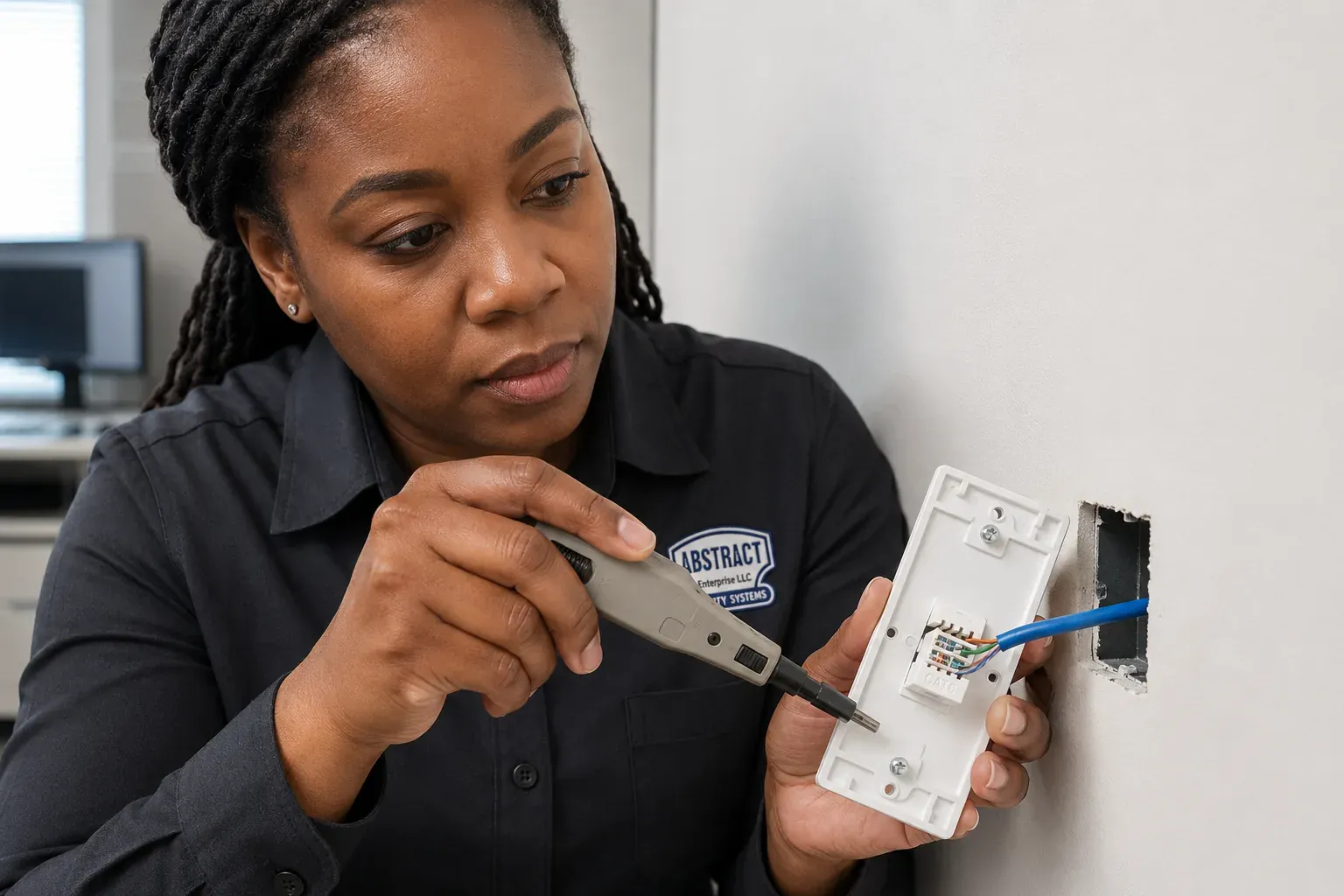
A technician holds a white single-port wall plate away from its rectangular drywall opening and seats the coloured conductors of a blue cable into the keystone with a grey punch-down tool.
Building Specialists
Cat6 Repair for New York City's Architecture
Where a Cat6 run was installed decides how it fails and how hard it is to reach. These are the building types we work in most across the five boroughs and what each means when a link stops performing.
Pre-War Masonry Office Buildings
Runs dropped through old chases and fished behind plaster, often with tight bends where they turn out of the wall. Bend-radius damage at the box is common, and a re-pull may mean opening finished walls, so locating the fault exactly matters most here.
Post-War Towers With Hung Ceilings
Long horizontal runs over drop ceilings, frequently laid straight on the grid rather than supported. Every other trade works in the same space, so crush points, over-tight ties and cable pinned under ducts are the typical faults.
Converted Lofts and Industrial Floors
Exposed ceilings, trays shared by several generations of tenants and long distances back to a single closet. Abandoned cable, missing labels and runs at or past the length limit for their category are what we usually find.
Carrier-Dense and Data-Heavy Buildings
Packed trays, crowded patch fields and strict access rules. Repairs are scheduled into permitted windows, and the risk is disturbing a neighbour's live circuit while working on yours, so we trace before we touch.
Mixed-Use Buildings With Cellar Closets
Shops below, offices or apartments above, and the network closet in the cellar beside the boiler or the water meter. Moisture, heat and rodent damage show up here first.
Co-ops and Condos Run by a Managing Agent
Owner offices, building systems and resident amenities wired through common risers. The repair itself may be simple; the approvals, insurance certificate and contractor hours come first.
Medical and Professional Suites
Practices on lower floors of residential and office buildings with exam rooms, imaging and phones on Cat6. Downtime is costly, so we fix around patient hours and retest every link we touch.
Warehouses and Cold-Storage Sites
Long runs across open floors to scanners, cameras and access points, with cable crossing from heated offices into cold rooms. Condensation at those transitions corrodes terminations long before the cable fails.
Cable and termination specifics we check on every New York repair
Is it really Cat6? The jacket print is the start, not the answer. We look at the conductors at the termination: solid copper is uniformly copper-coloured through the cut, while copper-clad aluminium shows silver at the core. We also check for stranded patch cable used as a permanent run and for Cat5e cords and couplers in a Cat6 channel. A vendor guide we reviewed puts the resistance of copper-clad aluminium at roughly 58 percent above copper and notes that TIA-568 calls for solid copper conductors, which is why such a run cannot certify no matter how well it is terminated.
How much untwist is at each end? Fluke Networks' own guidance on crosstalk failures says that in many cases excessive crosstalk comes from poorly twisted terminations, and that even 13 millimetres of untwist does not guarantee a pass. Cat6 is less forgiving than Cat5e here. When a link fails near-end crosstalk at the end closest to the tester, the first suspect is how the pairs were opened at that jack or port.
Where is the damage along the run? A reflection at the near end points at the cord or the jack; one at the far end points at the remote termination; one in the middle of the run points at the cable itself — a kink, a crush or water. That one reading decides whether you are paying for a termination or a re-pull.
How long is it, and how hot does it run? Insertion loss rises with length and with temperature. A run that was within the 90-metre permanent-link limit when it was installed in a cool ceiling can fail in a ceiling that now holds a dense PoE bundle or sits under a roof in August.
What is the cable rated for where it runs? Riser and plenum spaces call for cable listed for them. When a repair turns into a replacement, the new run is chosen for the space it crosses, not for the price of the reel.
Owners who bring a failing floor back to category often want the backbone checked at the same time. Our structured cabling installation service in NYC covers closets, risers and new panels when the repair list grows into a rebuild.
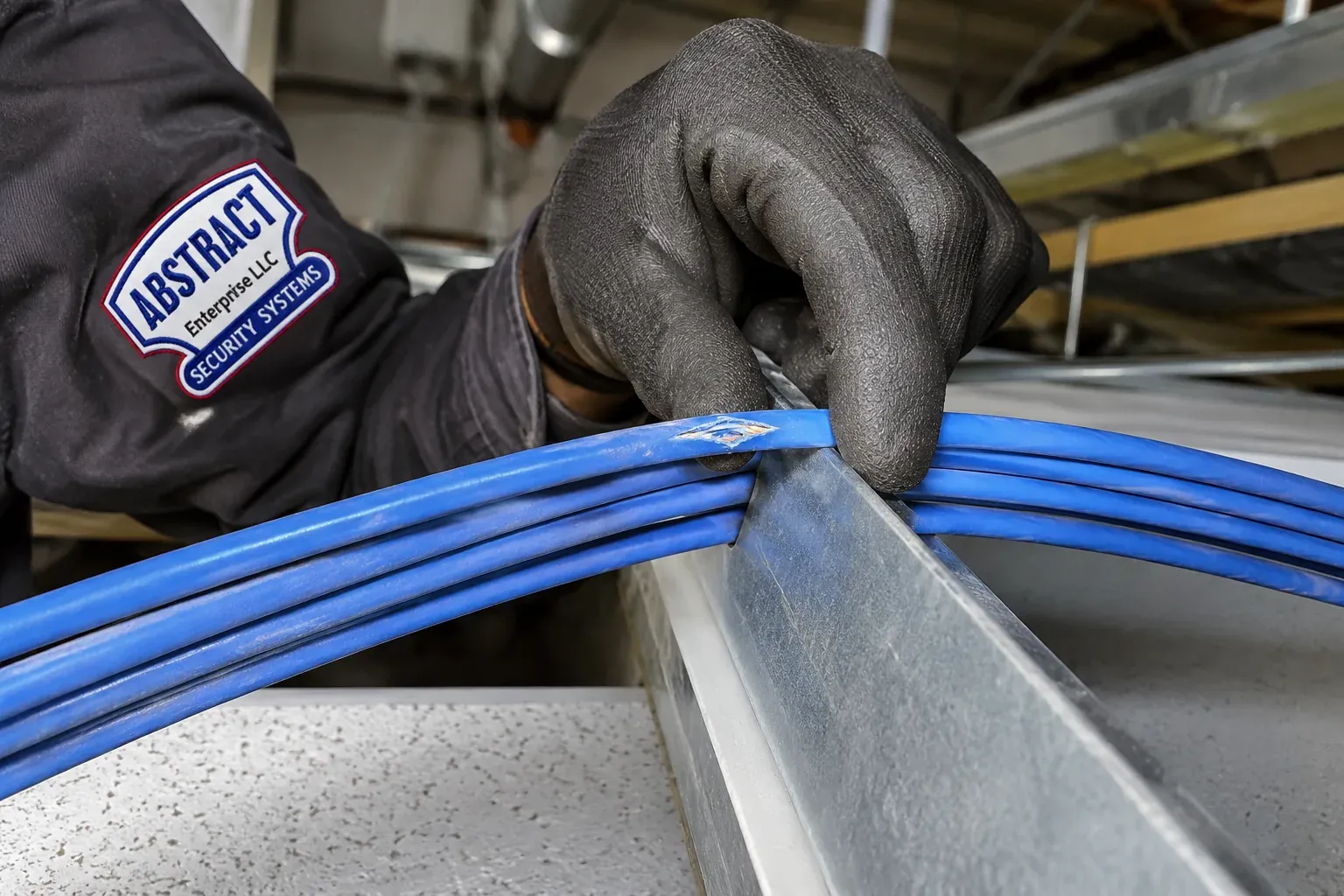
Close-up of a gloved hand in a sleeve with an Abstract Enterprises patch lifting several blue cables off the edge of a galvanised metal channel above ceiling tiles; one jacket is torn where it rested on the metal.
Commercial Cat6 Repair
Business Cat6 Repair in NYC
Most of the Cat6 we repair carries a business: desks, phones, cameras, card readers, registers and wireless access points. The districts below are real places with very different cable problems. They are named for the kind of building and the kind of fault each tends to produce, not as a list of jobs.
Hudson Square and Tribeca, Manhattan
Home to 60 Hudson Street, built 1928–1930 as Western Union's headquarters and an AT&T telecommunications hub since the 1980s. Buildings around a carrier hotel attract tenants with dense patch fields and strict access windows; the fault is often in a crowded panel, not the cable.
Brooklyn Navy Yard
About 300 acres of former shipyard buildings, described by Bisnow in 2014 as home to some 330 manufacturing businesses and roughly 7,000 workers. Industrial spaces mean long runs, exposed trays, machinery vibration and forklifts — the conditions that crush and abrade cable.
Industry City, Sunset Park
Sixteen buildings on 35 acres with more than 650 businesses, according to the Brooklyn Eagle in April 2025. Former warehouses subdivided many times over leave trays of unlabeled cable from earlier tenants, which is where tracing and identification earn their keep.
Long Island City, Queens
A neighbourhood of warehouse-to-office conversions, like the two-storey building at 11-20 46th Road that plans published in 2016 took to four storeys of offices. Runs added during conversions often borrow old pathways that were never designed for Cat6 bend radius.
Hunts Point, the Bronx
The 329-acre Food Distribution Center, where the Cooperative Meat Market alone runs six refrigerated and freezer buildings with about a million square feet of cold space. Cable crossing from offices into cold rooms condenses, corrodes and fails at the transition.
The Teleport, Staten Island
A 100-acre business park developed in the mid-1980s by the city and the Port Authority, with five buildings totalling about 700,000 square feet. Office and medical tenants in buildings of that age often sit on cabling that has been extended and re-patched for decades.
Compliance callouts for business Cat6 repairs
Abandoned cable. The National Electrical Code requires the accessible portions of abandoned communications cable to be removed (section 800.25 in the edition EC&M discussed), unless the cable is tagged for future use. When a Cat6 run is replaced rather than repaired, the old run's accessible length comes out with it.
The city's electrical code. New York City enforces its own amendments to the 2020 National Electrical Code, fully in effect since December 21, 2025. Cable listed for the space it crosses — riser or plenum where required — is part of a compliant repair.
Penetrations and firestopping. A re-pull through a rated floor or wall must leave the penetration sealed to the rating it had. Where an outdoor run enters a building, our published figure for an entry made good, sealed and bonded, starts at $185 per penetration.
Building paperwork. Managing agents in office and residential buildings commonly require a certificate of insurance and set contractor hours and freight-elevator rules. We send the insurance certificate before the visit and book inside those hours.
When the failing links feed cameras or door hardware, the device side is often worth a look in the same visit; our security camera repair service in NYC picks up where the cable ends.
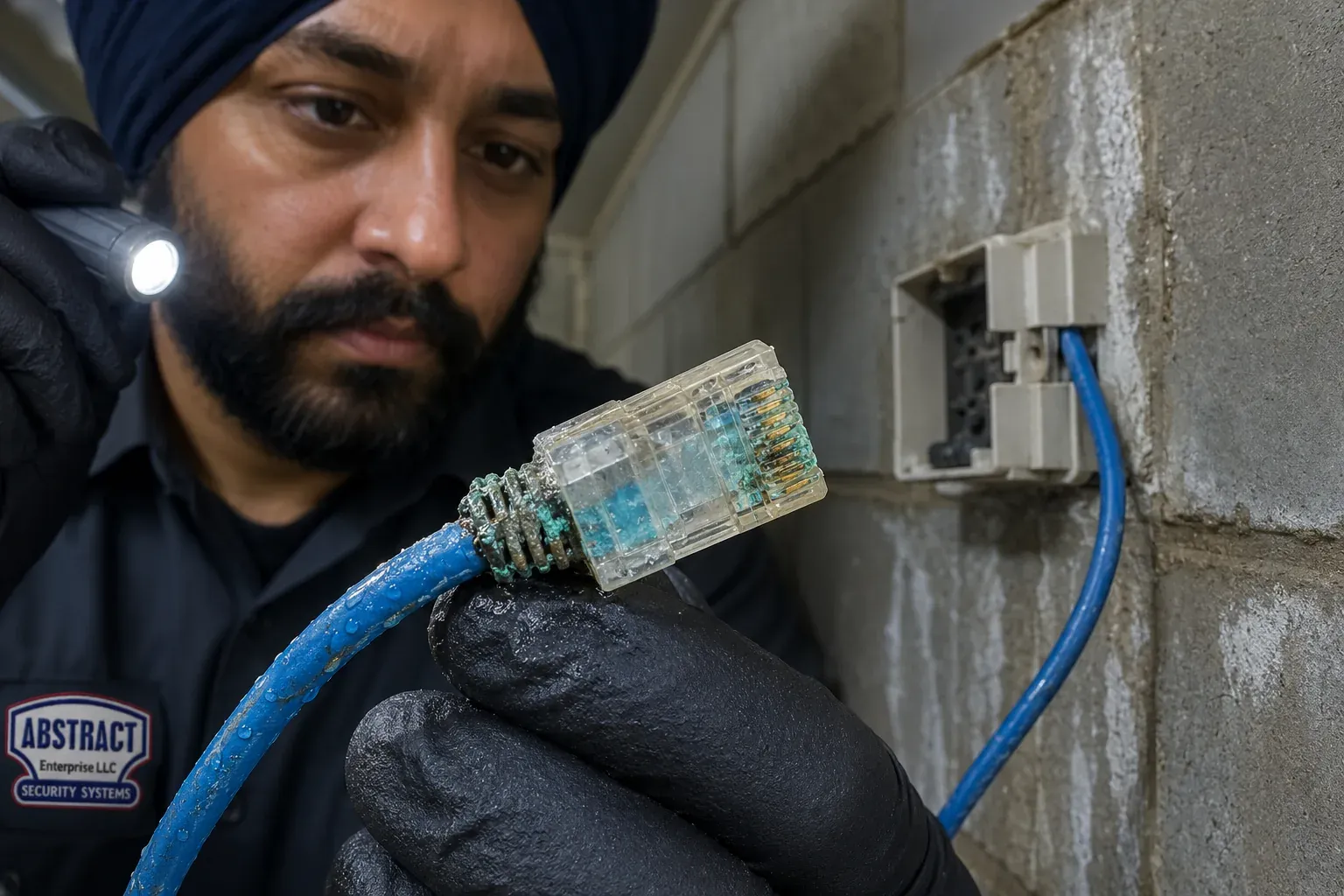
A technician lights a clear RJ45 plug with a flashlight; green-blue corrosion coats the crimp and the cable jacket behind it, and an open surface box hangs from a stained cinder-block wall.
Your Questions Answered
Cat6 Repair in NYC: Questions Answered
These are the questions office managers, IT providers, building superintendents and business owners ask us once a Cat6 link has started misbehaving. They are grouped by the stage of the problem: what the symptom means, what a failed test is telling you, whether to re-terminate or re-pull, Power over Ethernet, the difference Cat6A makes, and the building itself. Scheduling, pricing details and smaller practical points are in the FAQ further down.
Reading the symptoms
Why does a Cat6 jack show a link light but only connect at 100 Mbps?
Because 100 Mbps Ethernet needs only two of the four pairs in the cable and gigabit needs all four. When one of the pairs used only by gigabit — the blue pair on pins 4 and 5 or the brown pair on pins 7 and 8 — is open, damaged or terminated wrongly, the two devices still find each other on the pairs that work and quietly agree on the slower speed. The link light comes on, the computer says “connected”, and nobody notices until a large file transfer or a video call crawls.
On a tester this usually shows as an open or a short on one of those pins, or as a split pair, where every conductor is connected but two wires from different pairs have been swapped so that the twist no longer protects them. A split pair passes a simple continuity check and fails crosstalk badly. The fix is almost always at a termination: the keystone at the desk, the panel port in the closet, or a field-made plug on a patch cord. We test from both ends, find the end with the fault, cut back to undamaged cable and re-terminate, then confirm the port trains at gigabit and the link passes its category limit rather than simply showing a light.
Why would a Cat6 run that worked for years start dropping out intermittently?
Because something changed around it. Intermittent faults on a cable that used to be fine almost always have a trigger, and the trigger usually names the location. Drops that line up with rain point at a wet entry, a leaking ceiling or a cellar closet. Drops that follow the weather getting hot point at a run that was close to its insertion-loss limit and now crosses a warmer ceiling. Drops that start after renovation work point at a crush, a kink or a staple. Drops that happen when a chair rolls or a desk is bumped point at a cord, a plug or a jack that has been loaded sideways for years.
Before you call, spend five minutes noting when it happens. Then swap the patch cord at both ends and move the device to a different switch port; that alone clears a surprising number of cases. If it persists, a certification tester can often catch the fault even between drop-outs, because damage that causes intermittent loss of link nearly always shows as poor return loss or crosstalk margin at a particular distance. We locate that point and repair it there instead of guessing.
How do I know whether the problem is the patch cord, the jack or the cable in the wall?
Split the link into its parts and test each one. The permanent link is the cable in the wall plus the jack at the desk and the panel port in the closet; the channel adds the two patch cords. A certification tester measures the permanent link with special test leads, so if the permanent link passes and the user still has trouble, the cords or the equipment are the suspects. If the permanent link fails, the tester's time-domain reading places the fault at a distance: within the first metre or so means the near-end jack or port, at the full length means the far end, and somewhere in between means the cable.
You can do part of this yourself. Replace both patch cords with known-good, factory-made Cat6 cords and plug the device into a jack you know works. If the problem stays with the device, it is not your cabling. If it stays with the original jack, the fault is in that jack, its run or its panel port, and that is where a technician should start.
When the tester says FAIL
What does it mean when a Cat6 link fails NEXT on a certification test?
NEXT is near-end crosstalk: signal from one pair leaking into another at the same end of the cable. Cat6 controls it with tight pair twists, a separator in the cable and connectors designed to keep the pairs balanced right up to the contacts. Fluke Networks' troubleshooting guidance names poorly twisted terminations as the cause in many cases, along with split pairs, lower-category patch cords and female couplers, which Fluke says should not be used in a data installation at all. It also notes that a test set to a higher category than the cable was ever built for will produce a NEXT failure that no repair can fix.
So the first questions are: was the test set to the right limit, and which end failed? Because NEXT is measured at both ends, a failure is attributed to one of them, and that end's jack or panel port is re-terminated with the pairs kept twisted as close to the contacts as the connector allows. If NEXT fails from both ends, or the time-domain plot shows crosstalk spread along the run, the cable itself may be crushed or of a lower grade than its jacket claims, and re-terminating will not help.
Our run fails return loss but passes wire map — what does that point to?
It means every conductor is connected to the right pin but the cable is reflecting signal back toward the transmitter, which happens wherever its impedance changes. A passing wire map only proves the physical connections are in the right order; it says nothing about whether the run can carry gigabit or 10G cleanly. Return loss fails come from kinks and bends tighter than the cable's minimum radius, cable ties cinched until they dent the jacket, cable pulled harder than its rated tension, water inside the jacket, badly seated or poorly crimped connectors, and occasionally defective cable from the factory.
The time-domain reflectometry function on a certification tester shows where the reflection is. A reflection right at the tester points at the test cord, the patch cord or the near-end jack. One at the far end points at the remote termination. One part-way along means the cable has been damaged at that distance. The first two are termination or cord repairs; the third needs a decision about the cable itself.
If a link passes at the panel but fails at the desk, which end gets re-terminated?
The end the tester blames, which is not always the end you are standing at. Certification testers measure crosstalk from both ends at once and attribute each failure to the end where it occurred, so a link that “fails at the desk” may actually be failing because of the panel port, with the result simply displayed on the handset you happened to be holding. We read the result for both ends and the time-domain plot before cutting anything.
In practice the work-area end fails more often: wall jacks get pulled out to be moved, keystones get pushed into boxes with the cable folded hard behind them, and furniture moves load the cord and the jack sideways. But patch panels in older closets regularly have ports where every pair was untwisted far too far, especially on panels punched quickly during a fit-out. When we find one bad port terminated that way, we check its neighbours, because the same hands usually did the whole row.
Re-terminate or re-pull
When is re-terminating a failed Cat6 run pointless and a re-pull the only fix?
When the fault is in the copper rather than at the ends. Re-terminating replaces the last few centimetres of each end and the hardware they land on. It cures untwist, split pairs, damaged keystones, worn panel ports and bad plugs. It cannot cure a crush or kink in the middle of the run, water that has wicked along the jacket, a run longer than the 90-metre permanent-link limit, cable that was stranded patch cord all along, or copper-clad aluminium that cannot meet the standard. Re-terminating those just spends money proving the cable is bad.
The tester tells us which situation we are in. If the fault sits at an end and the rest of the run is clean, we re-terminate. If the reflection or crosstalk is mid-span, if insertion loss fails because the run is too long, or if the cable is not solid copper, a re-pull is the honest answer, and we say so before you pay for termination work that will not hold. On a repair visit we usually find a mix: most failing links on a floor are termination faults, and a few have real cable damage.
Can a single damaged section of Cat6 be spliced, or does the whole run come out?
It depends on what the link has to do. Twisting or crimping conductors together is not a Cat6 repair, and couplers joining two plugged cords are a known source of crosstalk failures. What does exist is purpose-made in-line hardware: a rated splice or a consolidation-point style connection where the cable is terminated into proper connectors on both sides of the damage. A link with one such connection can still be tested as a channel and may pass, especially when the run is short and the damage is at a reachable point.
Whether that is acceptable is a judgement about the link's job. For a general office desk where the alternative is opening a finished plaster wall, a rated in-line repair that tests clean can be a sound, documented fix. For a link that has to carry 10G, a camera on high PoE in a hot ceiling, or a run in a tenant space where a building standard calls for continuous cable, we recommend replacing the run. Either way you get the test result for what is actually installed, so the choice is visible later.
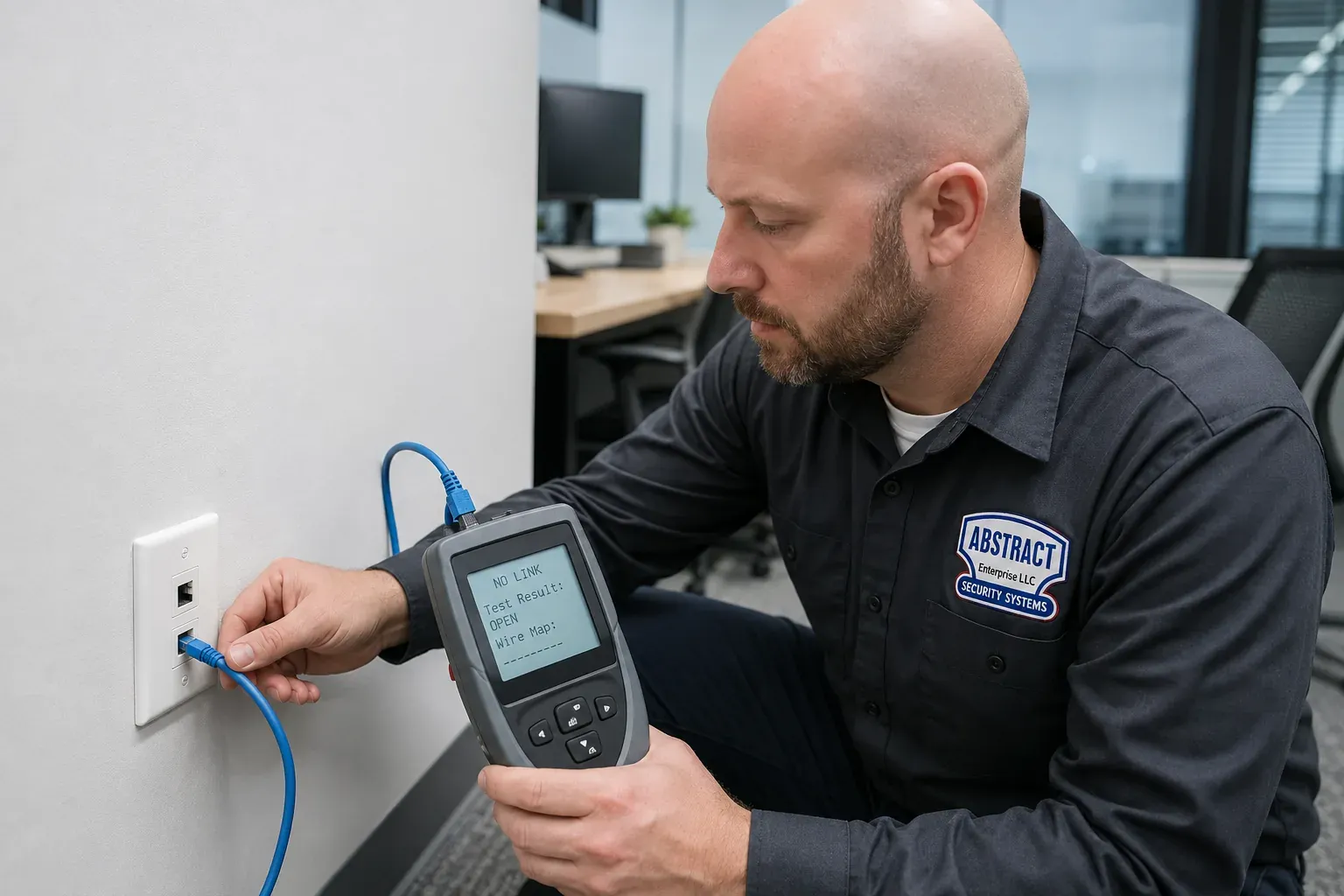
A kneeling technician holds a grey handheld tester whose screen reads No Link, Test Result Open and Wire Map, its blue cord plugged into the lower port of a white wall plate in an office.
Power over Ethernet on Cat6
Why does a PoE camera on Cat6 keep rebooting at night?
Because night is when it draws the most power. Many cameras switch on infrared illuminators, heaters or wipers after dark, and the extra current exposes any weakness in the cable path. A termination with a poorly seated conductor, a corroded plug or a pair with higher resistance than its neighbours can carry daytime load and then drop the voltage at the camera below what it needs once the illuminators come on. The camera browns out, reboots, and the cycle repeats. A vendor guide on the subject gives the example directly: a camera rebooting when its IR switches on.
Copper-clad aluminium makes this much worse, because its resistance is far higher than copper's, but we see the same pattern on genuine Cat6 with one bad termination. We test the run for resistance imbalance between pairs as well as for its category limits, check the switch port's power budget and the camera's class, and look at the plug at the camera end, which is often a field-made connector exposed to the weather. Repairing the termination or replacing the outdoor end usually ends the reboots; a run that is CCA needs replacing.
Can one bad Cat6 run take a PoE switch port down with it?
It can make a port look dead even when the switch is fine. Most PoE switches check the far end before applying power and will refuse or shut off power on a port that sees a short, a crossed pair or an abnormal load, then log it as a fault or simply leave the port unpowered. A run with a nicked jacket shorting two conductors to each other, or a pair crossed during a hurried re-termination, can trigger that protection repeatedly. Exterior runs that enter a building without proper bonding are a separate hazard and can damage switch hardware during storms.
So when a PoE port appears to have failed, we test the cable before anyone replaces the switch. If the cable is the problem, the port usually returns to normal once the fault is repaired and the port is reset. If the cable tests clean and the port still will not deliver power, the problem is in the switch or its power budget, and we tell you that plainly rather than replacing cable that does not need it.
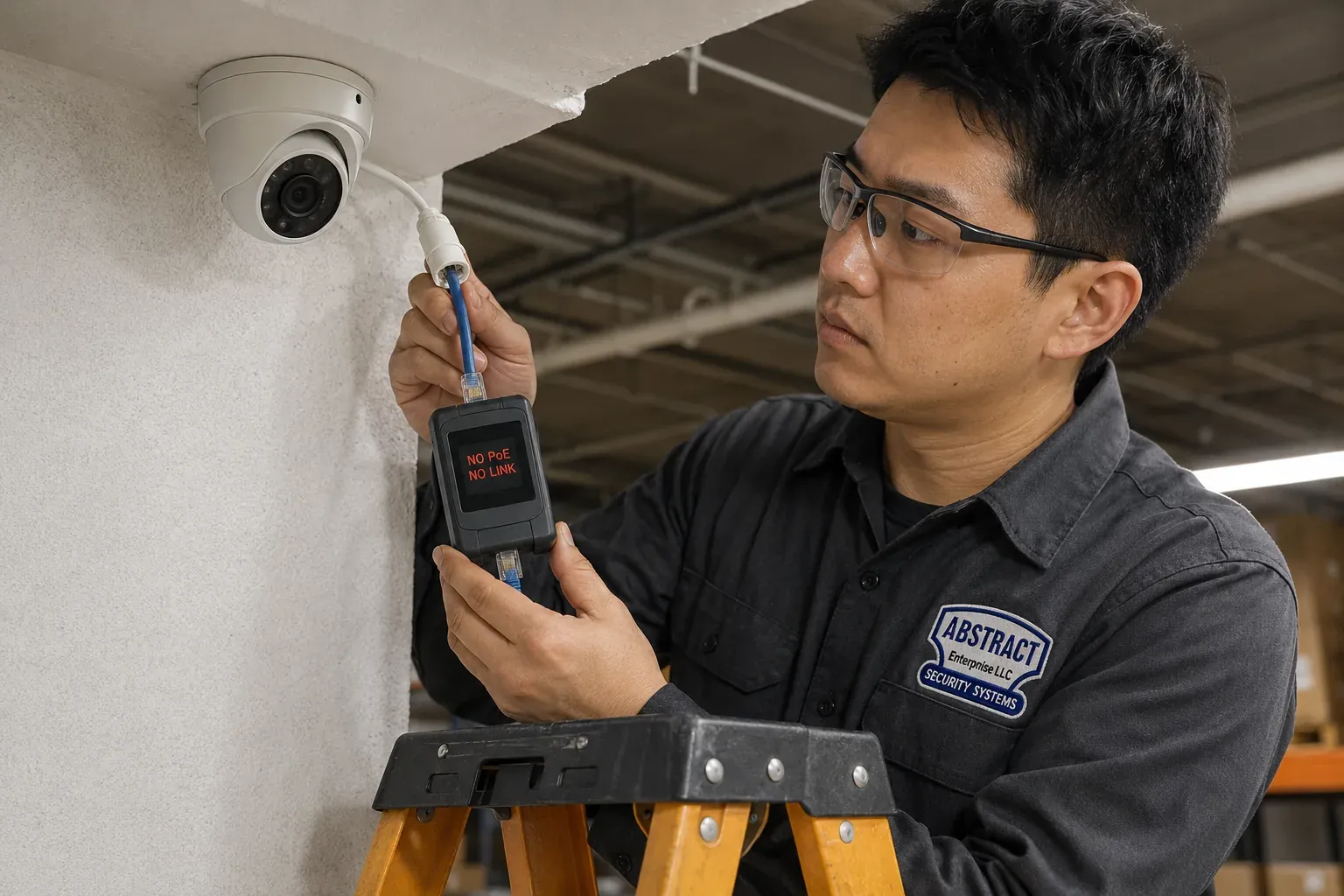
A technician in safety glasses on a wooden stepladder holds a small tester reading No PoE and No Link, connected to the cable coming from a white dome camera mounted under a ceiling in a warehouse with shelving behind.
Cat6 versus Cat6A
Should a damaged Cat6A run be repaired with Cat6 parts?
No. A link is only as good as its weakest component, so a Cat6A run terminated on a Cat6 keystone, punched into a Cat6 panel port or finished with a Cat6 patch cord becomes a Cat6 link at best. That may be invisible on a desk that only ever runs at gigabit, but it defeats the reason the building paid for Cat6A: 10GBASE-T at full distance and headroom for high-power PoE. Cat6A connectors are also built for the larger cable, and forcing the thicker cable into a Cat6 keystone tends to disturb the pairs and fail crosstalk anyway.
We carry Cat6A keystones and panel modules alongside Cat6 parts for exactly this reason, and we test repaired Cat6A links against Cat6A limits, not the easier Cat6 ones. Cat6A also asks for a little more care in the repair itself: a larger bend radius, keeping the cable's shape at the termination, and not crushing the bundle with ties. If a Cat6A panel uses a particular manufacturer's modules, we match them so the panel stays one system.
Our Cat6 links at 10G but throws errors — is the cable the problem?
Possibly, but it may simply be the cable's category. 10GBASE-T was designed for Cat6A over 100 metres. TIA's guidance for running it on installed Cat6, TSB-155-A, expects it to work up to 37 metres and between 37 and 55 metres depending on the alien-crosstalk environment — how much neighbouring cables in the same bundle interfere. A Cat6 link that is 70 metres long and bundled tightly with other busy links is outside what Cat6 was ever expected to do at 10G, and no repair turns it into Cat6A.
What we can do is measure. We check the length, test the link to Cat6 limits and look at whether errors line up with traffic on neighbouring cables. If the link is short enough and still erroring, a termination or cord problem is likely, and that is repairable. If it is long and crowded, the realistic choices are to run that port at a lower speed, move the device closer to a switch, or replace that run with Cat6A. Our Cat6 installation team in Manhattan prices Cat6A runs when that is the answer.
How can I tell if the “Cat6” in my walls is actually copper-clad aluminum?
Look at a cut end, and look at how it behaves. Copper-clad aluminium has a thin copper skin over an aluminium core; when you cut or scrape a conductor, the centre shows silver rather than copper all the way through. It is lighter than solid copper cable of the same size, it is stiffer and work-hardens, and it tends to break at punch-down contacts or where it flexes behind a jack. Jacket printing can be misleading, so the conductor tells you more than the label does. The vendor guide we reviewed puts its resistance about 58 percent higher than copper and points out that TIA-568 specifies solid copper, so a CCA run cannot form part of a certified channel.
Signs that point us to check: links that fail resistance tests, PoE devices that brown out, conductors that snap during re-termination, and cable bought in bulk online at a surprisingly low price. When we find CCA, we test how many runs on the floor share it, because it is rarely just one. Those runs are candidates for replacement rather than repair.
The building around the cable
Who has to approve a Cat6 repair that goes through a riser or a neighbour's ceiling?
Usually the building, and sometimes the neighbour. In an office or residential building with a managing agent, risers, corridors and the ceilings over common areas belong to the building, so work in them goes through management, typically with a certificate of insurance and set contractor hours. Where your run crosses the ceiling of space leased to another tenant, you need their access as well, and in a co-op or condo the board's rules on work in common areas apply. Repairs entirely inside your own space, at your own jack and your own panel, rarely need anything beyond the normal contractor paperwork.
This is another reason we locate faults before we promise anything. If the time-domain reading puts the damage inside your suite, the repair stays there. If it puts it in the riser or over a neighbour, we tell you what access is needed, send management the insurance certificate and a short description of the work, and schedule inside the hours they allow.
Can you trace a Cat6 run that disappears into a pre-war wall without opening plaster?
Usually, yes, at least far enough to know where it goes. A tone generator on the cable and an inductive probe will follow it through plaster and lath to the point where it turns or meets another box, and a time-domain reading gives the distance to a fault so we know which stretch to look at. Many pre-war runs follow a predictable path: up an old chase, along a picture rail or baseboard, through a closet. Between the two methods we can usually say where the problem is to within a short section of wall.
Where the fault is inside a wall that cannot be reached any other way, we discuss the options before cutting: a small, neat access opening at the fault, abandoning that stretch and re-routing on a surface raceway, or a new run along a different path. In heavy masonry or ornamental plaster, a different path is often the least disruptive route back to a working link.
A cellar network closet took on water — can the Cat6 dry out and be reused?
Some of it can. Cable whose jacket stayed intact and whose ends stayed dry may test perfectly well once the closet is dry. The problems are terminations that sat in water, which corrode, and cable whose jacket was opened or submerged at an end, which can wick moisture along its length. Corrosion progresses slowly, so a link that passes the week after a flood can fail months later. After the remnants of Hurricane Ida flooded basements across the city in September 2021, the Department of Buildings warned that floodwater damages building wiring and that power should never be switched while standing in water. Safety first: make sure power to the closet has been dealt with by the right trade before anyone handles equipment.
Once the space is safe and dry, we test every affected link, replace terminations and patch cords that sat in water, cut back any cable end that shows corrosion, and retest. Runs that still fail return loss or insertion loss after that likely have moisture in them, and those get replaced. We also look at why the water reached the closet, because the same cellar will flood again.
Equipment
Tools and Parts We Use on Cat6 Repairs
A Cat6 repair is only as good as the instrument that proves it. These are the categories of test gear and hardware that come on every repair visit, and what each one is for.
Certification Tester
Measures a link against the TIA limits for its category — wire map, length, insertion loss, NEXT, return loss and the related parameters — and saves the result. The only instrument that can say a repaired link is Cat6 again.
Time-Domain Fault Location
The tester's crosstalk and reflection plots show a fault by its distance along the run, which is how we choose between a re-termination and opening a ceiling at the right spot.
Qualification and Link Testers
Quick checks of whether a port will negotiate gigabit, whether PoE is present and at what class, and which switch port a cable reaches. Useful for triage; not a substitute for certification.
Tone Generator and Inductive Probe
Finds one cable among hundreds in a tray or a patch field, and follows a run through plaster and ceiling space without cutting anything.
Cat6 and Cat6A Keystones
Matched to the cable category and, where a panel or plate is part of a manufacturer's system, to that manufacturer, so the repaired link stays one consistent channel.
Panel Modules and Punch-Down Tools
Replacement inserts for modular patch panels and impact tools for 110-style ports, used with the cable jacket kept as close to the contact as the hardware allows.
Factory-Made Patch Cords
Tested Cat6 and Cat6A cords in several lengths. Field-crimped cords are a common source of failures, so we replace them rather than re-crimp them.
Solid-Copper Riser and Plenum Cable
For the runs that need replacing, cable listed for the space it will cross, so a repair never leaves a code problem behind.
Labels and Port Maps
Both-end labels on every link we touch and an updated port map, so the next fault takes minutes to trace rather than an afternoon.
Why test gear matters more than brand names. Big-box tech services and general handymen tend to carry a continuity tester that shows eight lights in order. That catches a broken or miswired conductor and nothing else: not crosstalk, not return loss, not a run that is too long, not a split pair. A licensed local cabling contractor brings the instrument that measures the category, and answers to you and to your building afterwards.
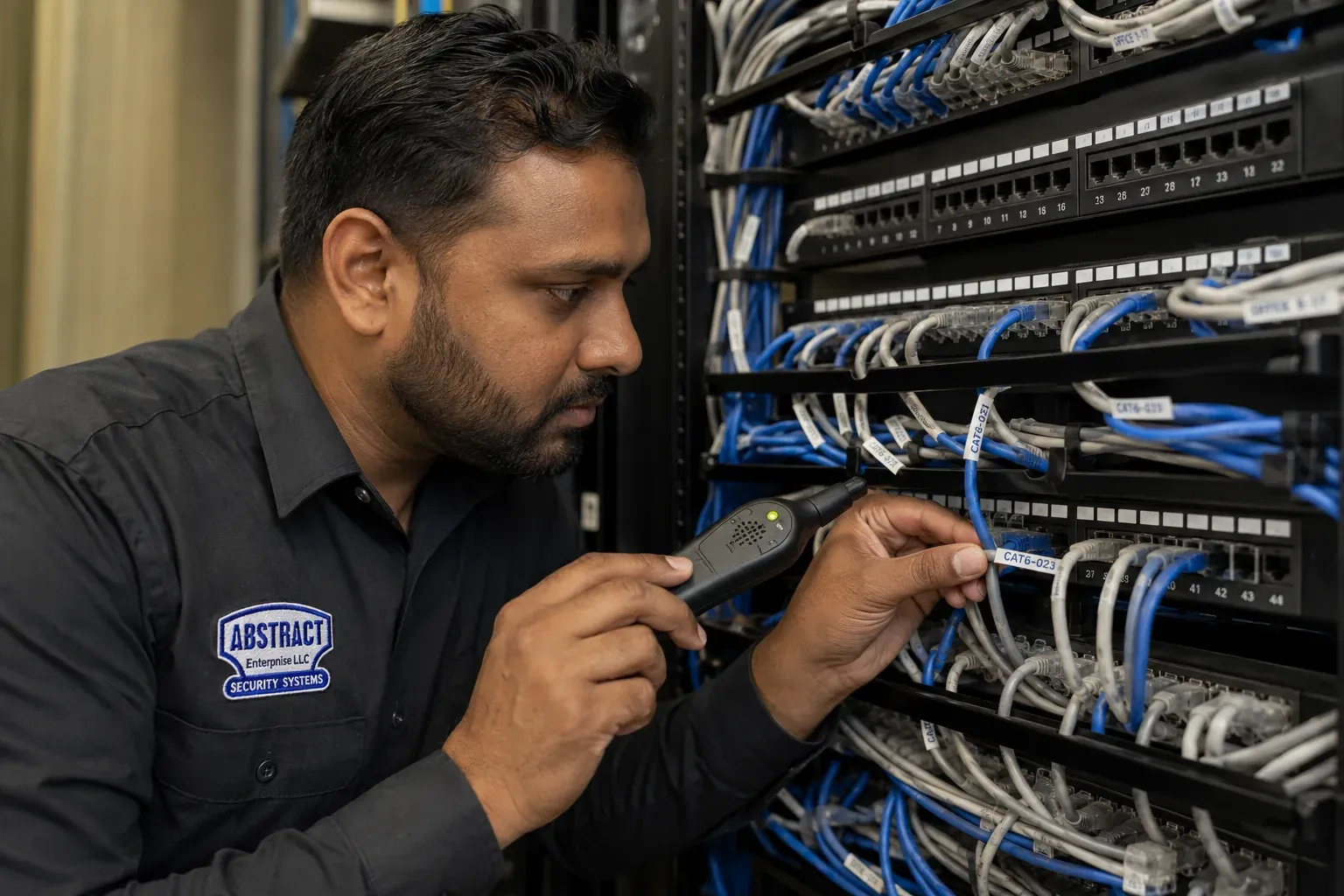
A technician holds a black inductive probe against one of several labelled blue and white patch cords crossing a dense patch panel; labels on the cords read CAT6 followed by port numbers.
AI Overview Reality Check
What AI Gets Wrong About Cat6 Repair in NYC
A note on method: Google's AI Overview could not be viewed from the tools used to research this page, so nothing below is presented as its exact words. Each heading is a claim that cost guides, retailers and general how-to pages publish and that answer engines tend to repeat. Under each is what changes when the cable is Category 6 and the building is in New York City.
“Cat6 costs $125 to $250 a drop, so a repair should cost less”
Fixr's national guide, updated in January 2025, puts a Cat6 drop at $125 to $250 including materials and labour, and installation labour at $45 to $75 an hour. For a new run through an open space in an average American house, that is a reasonable national benchmark.
It is not a repair benchmark, and it is not a New York one. A repair visit is mostly diagnosis: finding which of forty links fail, where along each run the fault sits, and whether the copper can be saved. That work is the same whether the fix turns out to be one keystone or a re-pull, and in this city it happens inside managed buildings with paperwork, contractor hours and old walls.
That is why our repair time is billed at a published $195 an hour with a three-hour minimum, and why a run that genuinely has to be replaced is priced separately from the diagnosis, starting at $175 per drop on our network cable repair pages.
“If the tester shows all eight lights, the cable is fine”
Inexpensive continuity testers are what most how-to guides recommend, and they do one thing well: they show whether each conductor reaches the right pin. That is a wire map, and a pass on it is necessary but nowhere near sufficient.
The study material for the industry's own installer certifications says it plainly: a passing wire map confirms the physical connections but not high-speed capability. A split pair shows eight lights in order. So does a run that is crushed, too long, or full of untwist at both ends.
For Cat6, the question is whether the link meets the category's crosstalk, return-loss and insertion-loss limits. Only a certification-grade tester answers it, and that is the instrument we repair to.
“Just re-crimp the end”
Re-crimping a plug is the standard advice for a bad Ethernet connection, and for a patch cord on a desk it sometimes works. It is the wrong fix for most Cat6 permanent links, which should end in a keystone or panel port, not a plug on solid cable.
Field-made plugs on Cat6 are a frequent cause of failed crosstalk and return loss, because getting eight conductors into a plug while keeping the pairs twisted to within millimetres is hard to do consistently. Plugs crimped onto solid conductors meant for punch-down hardware also loosen over time.
Our approach is to replace field-made cords with factory-made ones and to terminate permanent runs on jacks. Where a plug genuinely belongs on the end of a run, at a camera for example, we use a connector made for that cable and test the result.
“A damaged Ethernet cable can be fixed with a coupler”
Couplers are sold everywhere as the quick way to join two cables or extend one that came up short, and they will usually pass a light-up tester.
Fluke Networks' troubleshooting guidance names female couplers as a high source of crosstalk and says they should not be used in a data installation. A coupler hidden above a ceiling tile is one of the classic reasons a Cat6 link fails certification years after it was installed.
If a run is short or damaged at one point, the proper choices are a rated in-line repair terminated into real connectors and tested as a channel, or a replacement run. We remove couplers when we find them and tell you which links they were on.
“Cat6 supports 10 Gigabit, so slow 10G means bad cable”
Product listings for Cat6 often say it supports 10G and stop there. It can, but only over a limited distance. TIA's TSB-155-A guidance on installed Cat6 expects 10GBASE-T up to 37 metres and between 37 and 55 metres depending on the alien-crosstalk environment.
A long Cat6 run in a crowded bundle that errors at 10G may be working exactly as its category allows. Re-terminating it will not help, and calling it a repair would be selling you something that cannot work.
We measure the length and the margins first. Short links that error get repaired. Long ones get an honest recommendation: run that port at a lower speed, move the device, or replace the run with Cat6A.
“PoE works on any Cat6 cable”
Power over Ethernet is often described as working on anything Cat5e or better. For a single phone on a short run, that is close enough to true.
Dense bundles of powered cable heat up, and TIA's TSB-184-A guideline — which supports up to 100 watts over four pairs — limits bundle sizes to 24 cables and recommends Cat6A or better for new PoE installations, according to Belden. Copper-clad aluminium “Cat6” adds far more resistance and heat. One poor termination can be enough to make a high-draw device brown out.
So when a PoE device on Cat6 misbehaves, we look at the run's resistance, the termination at each end, the bundle it sits in and the switch's power budget together, rather than assuming that because the jacket says Cat6 the cable must be fine.
“Old cable can just be left in the ceiling”
General advice on replacing network cable rarely mentions what happens to the cable being replaced, and in practice ceilings across the city are full of runs nobody removed.
The National Electrical Code requires the accessible portions of abandoned communications cable to be removed, unless the cable is tagged for future use, and New York City enforces its own version of the 2020 code. Abandoned cable also adds fire load in ceilings and makes the next fault far harder to trace.
When we replace a Cat6 run, we remove the accessible length of the old one or, where you want it kept, tag it as spare and record it on the port map.
A Cat6 Link That Tests to Category Again
Tell us how many links are affected, what they feed and what the tester or the user is seeing. We will tell you what a visit will cover and how the repair is billed.
Office, shop, loft, medical suite or managed building — describe the failing links and a written answer comes back the same business day. Prefer to talk? Dial (800) 486-0943.
✅
We Got Your Request!
We'll call you back the same business day. If it's urgent, call us now at (800) 486-0943.
How It Works
Our Cat6 Repair Process
Six steps, whether it is one dead jack at a Flatiron reception desk or a failed floor in a Long Island City conversion.
1. Symptom triage by phone
You tell us which links misbehave, what they feed, when it happens and whether anyone has tested them. We ask for any existing test reports and a photo of the patch panel, and tell you what the fault most likely is.
2. Building access arranged
We send the certificate of insurance to the managing agent, confirm contractor hours, freight and riser access, and book a 2-hour arrival window inside them.
3. Test and locate
Each affected link is tested against its category limit from both ends. Time-domain readings place every fault at the near end, the far end or a distance along the cable.
4. Repair plan you approve
For each link you get the finding and the fix: re-terminate, replace a cord, rated in-line repair or re-pull. Nothing beyond the agreed work is started without your yes.
5. Repair with matched parts
Terminations are cut back to clean cable and remade on Cat6 or Cat6A hardware matching the link; damaged runs are repaired or replaced with listed solid-copper cable, and abandoned lengths removed.
6. Retest, label and hand over
Every repaired link is certified again, labelled at both ends and added to the port map. You receive the saved results and a short note of what was found and done.
A technician in a server room reaches into a rack to seat a blue cable in a switch port while holding a handheld tester whose screen shows Link Down in red, with rows of patched equipment above.
Coverage Area
Cat6 Repair Near NYC's Landmarks
These six places say more about where New York's cabling lives, and how it ages, than any product brochure. Each is a reference point for the building stock around it, not a claim of work inside it.
32 Avenue of the Americas, Tribeca
The former AT&T Long Lines Building, 27 floors, built in phases from 1911 with final work in 1929–1932 and still one of the city's telecommunications hubs. The surrounding blocks are full of offices whose cabling has been re-patched through several generations of tenants.
111 Eighth Avenue, Chelsea
Completed in 1932 as the Port Authority's freight terminal and bought by Google in 2010. A landmark for the converted industrial floors of West Chelsea, where long horizontal runs and exposed ceilings are the norm.
Industry City, Sunset Park
Sixteen former warehouse buildings on 35 acres with more than 650 businesses. Spaces subdivided over and over leave the kind of mixed, unlabeled cabling that makes tracing the first step of any repair.
Co-op City, the Bronx
A Mitchell-Lama cooperative of 15,372 apartments in 35 high-rise buildings and seven townhouse clusters — concrete construction, long corridors and a management structure that governs any work in common space.
Park Slope Historic District, Brooklyn
Designated in 1973 and extended in 2016: brownstones and row houses, many now home offices and small practices, where Ethernet runs were fished through plaster and old chases and re-pulling means opening historic walls.
The Teleport, Staten Island
The 100-acre office park the city and the Port Authority developed in the mid-1980s for satellite and fiber-connected businesses, now home to office and medical tenants in buildings of that era.
We also repair Cat6 in Midtown, the Financial District, Hudson Yards, Flatiron, SoHo, Harlem, Washington Heights, Downtown Brooklyn, DUMBO, Williamsburg, Bushwick, Red Hook, Bay Ridge, Long Island City, Astoria, Flushing, Jamaica, Forest Hills, the South Bronx, Fordham, Riverdale, St. George, New Dorp and Tottenville, and every neighbourhood between them, plus Nassau and Suffolk counties and the six Hudson Valley counties from Westchester to Ulster.
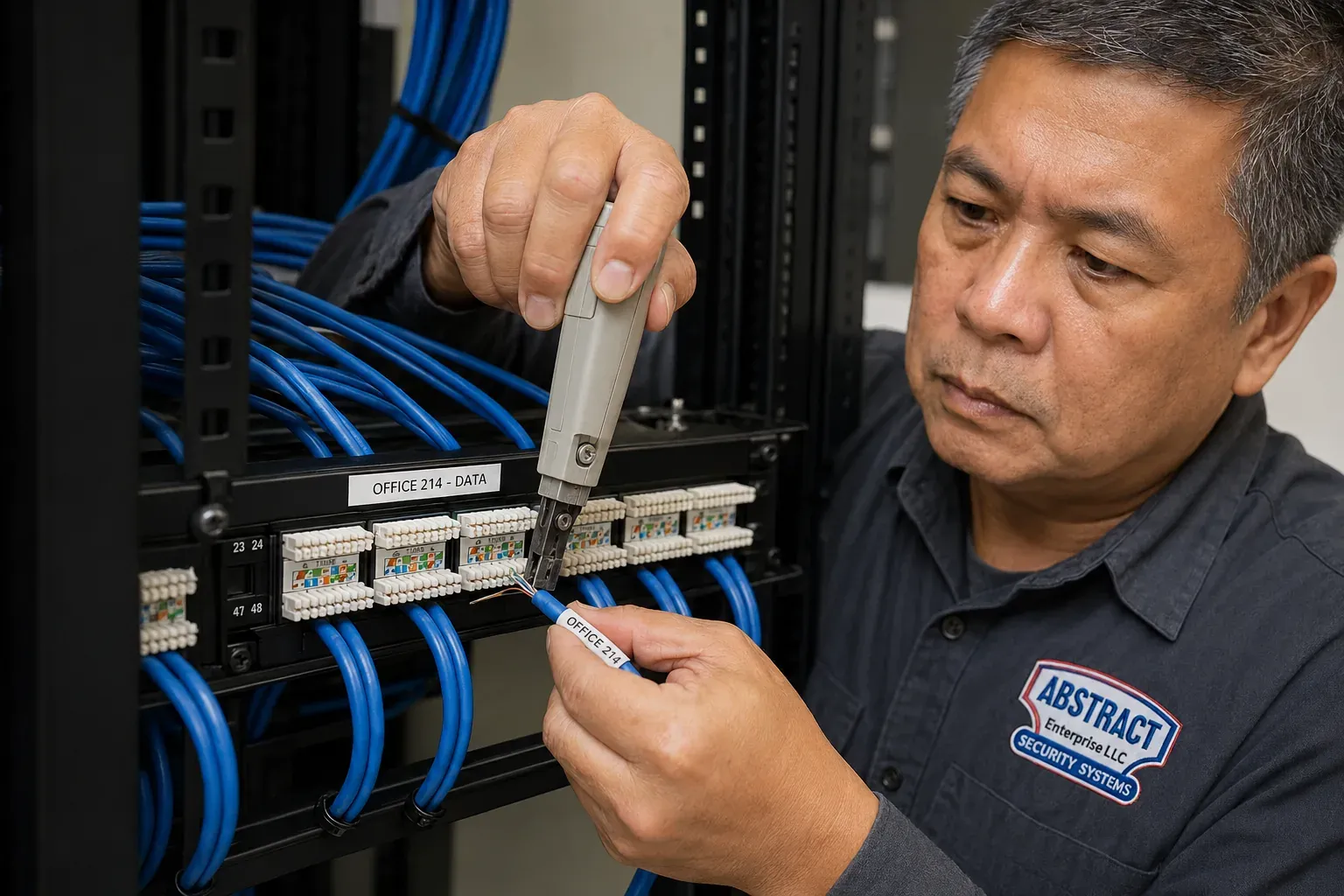
A technician presses a grey punch-down tool onto a port in a black rack-mounted patch panel labelled Office 214 – Data, holding a blue cable with a printed Office 214 label in his other hand.
Pricing
Cat6 Repair Cost in NYC
We publish the figures we have actually priced, name the page each one comes from, and say plainly where a job is quoted after testing instead. A Cat6 repair has two parts that cost very differently: the time it takes to find and fix faults, and any cable that genuinely has to be replaced. We keep them separate on the invoice so you can see which you are paying for.
Item
Price
Scope and source
Cat6 or Cat6A repair time — testing, fault location, re-termination, cords, retest
$195/hr, 3-hour minimum ($585)
Our published specialty service rate, as on our network cable repair pages; covers as many links as can be repaired in the time
Replacement Cat6 run where the cable cannot be saved
From $175 per drop
Published on our network cable repair pages for a run pulled fresh: cable, keystone, plate, panel punch-down, testing, both-end labelling and patch cord
New Cat6 drop, runs up to 100 ft (installation pricing, for comparison)
$272 per drop
Published on our Cat6 installation page; Cat5e $233 and Cat6A $388 per drop on the same table
Outdoor run entry made good, sealed and bonded
From $185 per penetration
Published on our Bronx network cable repair page, for runs entering from a yard, gate or roof
Runs over 100 ft, core drilling, firestopping, after-hours work
Quoted after testing and walkthrough
Depends on path, access and the building's rules
How the three-hour block is usually spent
The minimum is not a charge for one fix; it is a block of a technician's time with the test gear. On a typical repair visit it covers testing the affected links from both ends, locating each fault, re-terminating the jacks and panel ports at fault, swapping suspect cords and certifying the result. Where several links on one floor have the same termination problem, they are usually all done inside the block. If the testing shows that runs need replacing, you get a price for those runs before any cable is pulled.
The replacement-run figure across the boroughs
Our network cable repair pages publish the replacement-run starting figure at $175 per drop in every borough, including Manhattan, and we keep it the same here rather than create a second set of numbers. Runs over 100 feet, through risers, or needing core drilling and firestopping are measured and quoted on site, and that is where building type and borough genuinely change the price.
What moves a Cat6 repair bill
Where the faults are: termination faults at jacks and panels are quick; mid-span damage means opening ceilings or walls, or a re-pull.
How many links share the problem: a panel punched badly by one installer often means a whole row of re-terminations, done efficiently in one visit.
The cable itself: genuine solid-copper Cat6 can be repaired; copper-clad aluminium and stranded cable used as permanent runs cannot be made to certify.
Category: Cat6A parts cost more than Cat6 and Cat6A terminations take more care.
Building logistics: contractor hours, freight elevators, riser access and the paperwork a managing agent requires.
National cost guides for comparison. Fixr's national guide, updated January 2025, puts a Cat6 drop at $125–$250 including materials and labour and labour at $45–$75 an hour. That is national third-party data for new installation, not an AESS price and not a repair rate.
Full terms — including 50% deposit, one-year parts-only warranty on AESS-supplied products, and the late-fee schedule — are set out in the service agreement.
Shop Our Systems
Cat6 Repair Packages & Pricing
Most New York Cat6 repairs fall into one of these three. All use only the figures published on our own pages.
Starter — Single-Link Repair
$585
The three-hour minimum at $195 an hour. One failing desk, camera or access point link tested from both ends, the fault located, the jack, panel port or cord at fault replaced or re-terminated, and the link certified again. Time left in the block goes to neighbouring links you want checked.
Standard — Floor Repair and Recertification
$195/hr after the first 3 hours
For a floor that failed someone's test or a panel with a row of bad ports: every link tested, faults grouped by cause, terminations remade on matched Cat6 or Cat6A hardware, cords replaced and a full set of saved results handed over. Time is estimated in writing after the first round of testing.
Premium — Repair Plus Replacement Runs
Repair time + from $175 per run
Where testing finds runs that cannot be saved: repair time for everything that can, plus replacement runs from $175 per drop, abandoned lengths removed where accessible, labels and an updated port map.
Bring Your Own Parts — Labour Only
Already have a box of keystones, a replacement panel or cable from the original installation? We can use them, billed as repair time only, provided they match the category of the link: Cat6A parts on Cat6A runs, solid-copper cable for permanent links, factory-made cords. We test what we install either way. Customer-supplied parts carry their manufacturer's warranty rather than ours, and if the parts cannot produce a passing link we tell you before the work is done, not after.
Ready to Get the Floor Passing Again?
Send the test report if you have one, or a photo of the patch panel and a list of the problem desks. We will tell you what the faults most likely are and what a visit will cost.
A failed keystone is the same failure in Midtown and in Mott Haven. What changes is the building around it, how the run was installed, and what it takes to reach the damage. Dedicated borough pages are on the way; until then each borough link below opens our quote form.
Manhattan repairs are governed by access more than distance. Office towers and loft buildings set contractor hours, freight-elevator bookings and certificate-of-insurance wording, and many repairs happen in the early morning or evening to stay inside them. Ceilings in older office stock carry several generations of cable, so the run that has failed is often buried among abandoned ones. Carrier-dense blocks around Tribeca and Hudson Square mean crowded patch fields where tracing comes before touching anything. Our existing network cable repair page for Manhattan covers mixed and older cabling there.
Brooklyn splits between industrial campuses — the Navy Yard, Industry City, the converted warehouses of Bushwick and Gowanus — and brownstone and row-house blocks full of home offices and small practices. On the campuses, long runs, vibration and exposed trays produce crushed and abraded cable; in the brownstones, runs fished through plaster and old chases fail at the tight bends where they turn out of the wall. See also our Brooklyn network cable repair service.
Queens brings Long Island City's warehouse-to-office conversions, where Cat6 often follows pathways never designed for it, along with retail and restaurant strips in Astoria, Flushing and Jamaica where point-of-sale and camera links run through basements and behind counters. Kitchen heat, grease and mop water are regular causes of failing terminations at the counter end. Our Queens network cable repair page covers the wider Ethernet side.
The Bronx combines the Hunts Point distribution centre, where cold rooms and loading docks are hard on cable, with large residential complexes and the commercial avenues of Fordham and the Hub. Cellar closets in mixed-use buildings are common here, and so is the water and corrosion damage that comes with them. For outdoor runs to yards and gates, our Bronx network cable repair page publishes the sealed-and-bonded entry figure; see network cable repair in the Bronx.
Staten Island repairs lean toward office parks like the Teleport, medical offices, and small businesses in converted houses and strip buildings, plus home offices in one- and two-family houses. Runs here are more often in accessible basements and attics than in managed risers, which makes re-pulls more practical than in Manhattan. Our Staten Island network cable repair page covers general Ethernet faults on the island.
Decision Guide
Re-Terminate, Replace the Cord or Re-Pull: Reading the Test Result
The most expensive mistake in Cat6 repair is doing the wrong fix well. Re-terminating a run that has a crush in the middle wastes the termination. Re-pulling a run that only had a bad keystone wastes the pull. This is how we turn a certification result into a decision, link by link, before any work starts.
What the tester shows
Most likely cause
What we do
NEXT fail attributed to one end, cable clean along its length
Untwist, split pair or damaged jack at that end
Cut back and re-terminate that end on matched hardware; retest
Return loss fail with the reflection at the tester
Patch cord, test cord or near-end jack
Replace the cord with a factory-made one; re-terminate the jack if it persists
Return loss or NEXT fault at a distance part-way along the run
Crush, kink, over-tight tie, staple or water in the jacket
Open at that point if reachable; rated in-line repair or replacement run, depending on the link's job
Insertion loss fail, length over the 90-metre permanent-link limit
Run too long for the category
Shorter route, closer switch or a replacement run; re-termination cannot fix length
Insertion loss fail, length within limits
Heat in the pathway, stranded or undersized conductors, or CCA
Check the cable type and the pathway; replace non-compliant cable
Wire map: open or short on one conductor
Conductor not seated, cut at the termination, or broken in the cable
Re-terminate; if the open persists, locate the break by distance
Wire map: split pair
Conductors from different pairs swapped at both ends
Re-terminate both ends to the correct colour code
Wire map: crossed or reversed pair at one end only
Mixed T568A and T568B, or a slip during termination
Re-terminate the wrong end to match the other
Passes permanent link, fails as a channel
Patch cords or a coupler in the channel
Replace cords, remove couplers, retest the channel
Two further checks sit outside the table. First, is the test limit right? A Cat6 run tested against Cat6A limits will fail and should not be “repaired” into passing. Second, is the cable what it claims? If the conductors are copper-clad aluminium or the run is stranded patch cable, no termination will make it certify, and the decision is a replacement whatever the plot shows.
The study material for the industry's installer certifications draws the same lines: re-terminate for faults at a termination point, replace the patch cord for near-end reflections caused by the cord, replace the whole run for mid-span damage such as a kink, and re-route or add a switch for excess length. The value of a repair contractor is applying that discipline to every link, rather than defaulting to whichever fix the crew happens to prefer.
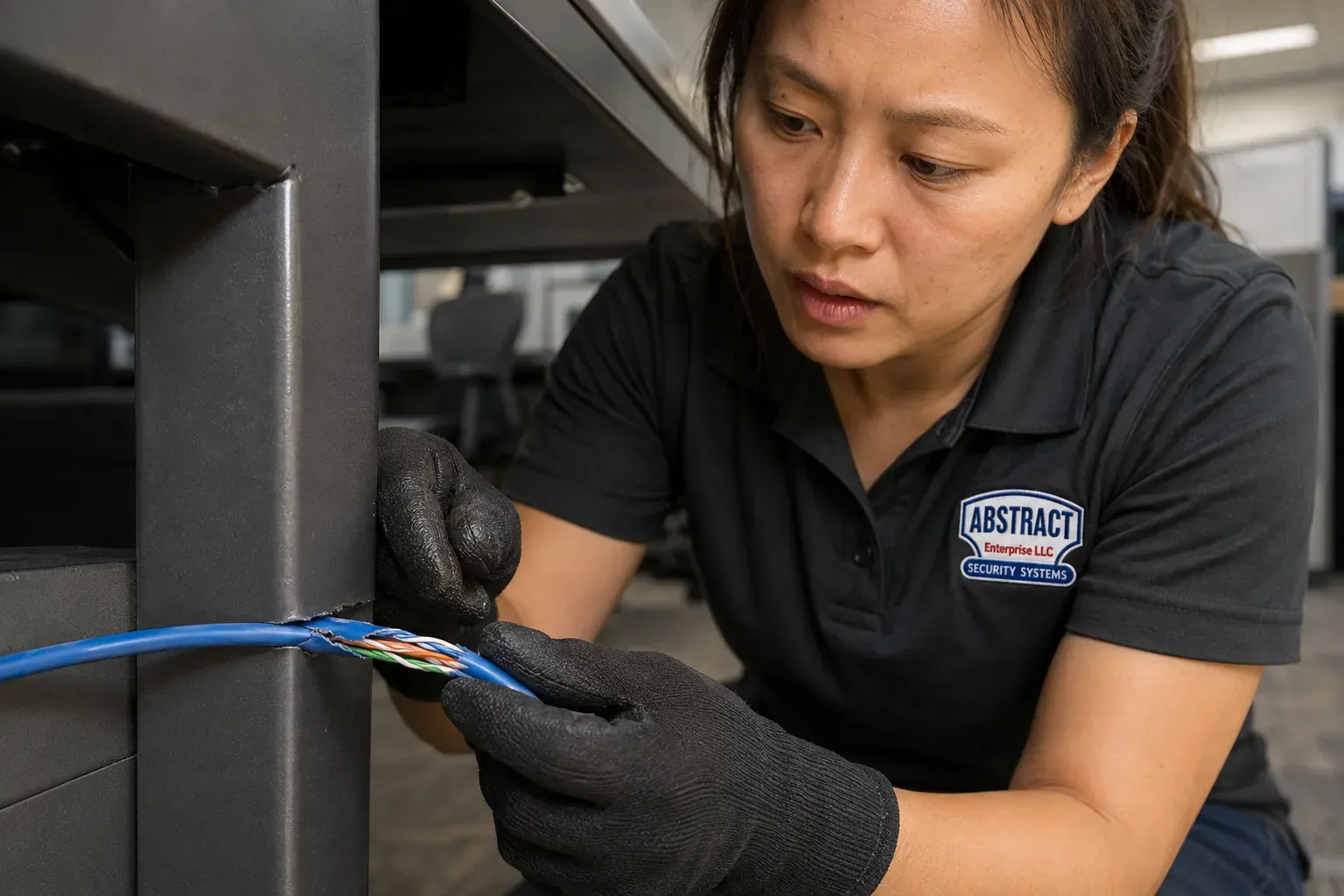
A kneeling technician in black gloves holds a blue cable where its jacket has split open beside the edge of a dark metal desk frame, the twisted orange, green and blue pairs visible through the tear.
Before You Call
Five-Minute Checks for a Misbehaving Cat6 Link
Some Cat6 “faults” never needed a technician. These are the checks we walk callers through on the phone. Each one either clears the problem or tells us where to start, and none of them risks making the cabling worse.
Check
Safe to do yourself?
What it tells us
Swap both patch cords for factory-made Cat6 cords
Yes
Cords with broken latches, field-made plugs or lower-category ratings cause a large share of complaints. If the fault goes away, it was the cord.
Plug the device into a jack you know works
Yes
If the problem follows the device, it is not your cabling. If it stays with the original jack, the run or its ports are suspect.
Move the closet end to a different switch port
Yes, if you know which cord is which
Separates a failing switch port from a failing cable.
Check the negotiated speed on the computer
Yes
100 Mbps on a gigabit device points straight at a fault on the blue or brown pair.
Note when it fails
Yes
Rain, heat, night-time PoE load or furniture being moved each point to a different place.
Re-punch a jack yourself
Not recommended
Cat6 tolerates very little untwist. A re-punch that lights the port can still fail the category badly.
Add a coupler to extend a short run
No
Couplers are a known source of crosstalk failures in data installations.
Open the shared riser or a neighbour's ceiling
No
It is the building's or another tenant's space, and other people's live circuits run there.
If the checks marked yes did not clear it, note what you tried and what changed. That history saves time at the start of the visit, and sometimes it is enough for us to bring the right part for a one-trip fix.
Test Reports
What a Cat6 Certification Report Should Tell You
When a repaired link is handed back, the report is the proof. Tenants leaving a space, IT companies taking over a network and landlords re-letting a floor increasingly ask for one. This is what a useful report contains, and what to question when one arrives.
The limit it was tested to. Cat6 permanent link, Cat6A permanent link, or a channel limit. A Cat6 run reported against a Cat5e limit has not been proven Cat6.
A result for every parameter, not just pass or fail. Wire map, length, propagation delay and delay skew, insertion loss, NEXT, return loss and the related crosstalk measurements, each with its margin.
The margin. A link that passes by a fraction of a decibel will be the first to fail in a hot ceiling or after the next renovation. Margins tell you which links to watch.
Both ends identified. The panel port and the outlet label, so the report matches the port map and the next technician can find the link.
The date and the instrument. Results from an instrument that was out of calibration, or from years before a renovation, prove little about the cable today.
What a report cannot do is make a non-compliant link compliant. If a report shows a pass but the conductors turn out to be copper-clad aluminium, or the run includes a coupler above a tile, the report is describing a link that should not be relied on. We say so if we find it, and we note it on the repair record.
One form for any combination of the services above.
Field Notes
Field Notes on Failing Cat6 in New York
How our technicians approach a failing Cat6 link — working practice, not a single job
We test before we look. It is tempting to open the ceiling where the cable obviously sags, or to re-punch the jack that looks untidy, but the tester has usually already decided where the fault is. A reading that puts the problem at the far end saves an hour of searching a ceiling that is fine.
Then we look at the termination that failed, before cutting it off. How much jacket was stripped, how far the pairs were untwisted, whether the conductors were seated fully, whether the cable was folded hard behind the keystone. The way one port was done is usually the way the whole panel was done, and it tells us whether to expect one failure or twenty.
We cut a conductor and look at the core. Silver in the middle ends the conversation about repairing that run.
Last, we leave every link we touched labelled at both ends and on the port map, with the saved result. The next fault in that building should take ten minutes, not a morning.
FAQ
NYC Cat6 Repair FAQ
Is the three-hour minimum charged even if the Cat6 fix takes twenty minutes?
+
Yes, the first visit is billed as a three-hour block at $195 an hour, $585 in total, because travel, building check-in and full testing take most of that time on their own. Any time left after the original fault is fixed is yours: we use it to test and repair other links you want checked, so most customers hand us a short list of suspect desks before we arrive.
Can you recertify a whole floor of Cat6 rather than just the failed links?
+
Yes. Many tenants ask for this when they take over or hand back a space, or when an IT provider wants a baseline before a switch upgrade. We test every link on the floor against its category limit, repair the failures, and hand over one set of saved results with the margins, so you know which links are healthy and which are only just passing.
Can you repair Cat6 that another contractor installed?
+
Yes, most of the Cat6 we repair was installed by someone else. We test it as we find it, match the existing keystones and panel modules where the original system is still available, and tell you if what is installed cannot meet Category 6, for example because the cable is copper-clad aluminium. Any manufacturer system warranty the original installer registered is between you and them, so check it before we start work on that plant.
Will re-terminating change which switch port each desk lands on?
+
No. A repaired link is re-terminated on the same outlet position and the same panel port it used before, so the patching in the closet does not change and the port map stays valid. If a panel port itself is damaged beyond repair and a link has to move to a spare port, we label it, update the map and tell your IT contact before we leave.
Do you carry Cat6A parts on the van as well as Cat6?
+
Yes. We carry Cat6A keystones, panel modules and factory-made cords alongside Cat6 parts, and we test repaired Cat6A links against Cat6A limits. If your panel uses a particular manufacturer's modules, tell us the brand when you book so we bring matching parts and the panel stays one consistent system.
How long does it take to re-terminate a full 24-port Cat6 patch panel?
+
It depends far more on the closet than on the port count: how much slack each cable has, whether the panel can be lowered or swung out, and how the cables are dressed behind it. A tidy panel with service loops goes quickly; a packed one with cables pulled tight means careful work to avoid shortening runs. We look at the panel and test it first, then give you a time estimate in writing before starting.
What happens to the old cable when a Cat6 run is re-pulled?
+
We remove the accessible length of it, as the electrical code requires for abandoned communications cable, unless you ask us to keep it as a spare. Spare runs are tagged at both ends and recorded on the port map so nobody mistakes them for live links later. Sections sealed inside walls or slabs that cannot be reached without demolition are noted on the repair record.
Can a Cat6 run be rerouted around a new wall instead of re-pulled end to end?
+
Often, yes. When a renovation has boxed in or damaged one section of a run, we can sometimes reach the good cable on both sides and reroute the affected stretch with a rated in-line connection, then test the whole link. Whether that is suitable depends on the link's length, its category and what it carries; for 10G or high-power PoE links we usually recommend a continuous replacement run instead.
Do you fix Cat6 runs that feed Wi-Fi access points in the ceiling?
+
Yes, and they are among the most common PoE repairs we do. Access point runs end in the ceiling, where they get crushed by other trades, terminated on field-made plugs, and bundled with other powered cables that raise their temperature. We test the run, repair or replace the termination at the access point end, check the switch port's power and leave the link certified.
Can you repair a Cat6 run between two buildings on the same lot?
+
We can, but an outdoor copper link needs cable rated for the conditions and a proper entry at each building, because unprotected copper between structures is a common cause of damaged switch ports. Where a run enters a building without a seal or bond, our published figure for making that entry good, sealed and bonded, starts at $185 per penetration. For longer or exposed links between buildings we may recommend fiber instead.
All Areas Served
Cat6 Repair Across New York
You are on the five-borough Cat6 repair page. Separate Cat6 repair pages for Manhattan, Brooklyn, Queens, the Bronx and Staten Island are on the way, along with hubs for Long Island and the Hudson Valley; for now each of those links opens our quote form, and the technicians who would serve them already work there. For general Ethernet faults or new cabling, our network cable repair and Cat6 installation pages for New York City are live now.
If a desk has dropped to 100 Mbps, a camera keeps rebooting or a tester has just failed half a panel, call (800) 486-0943. We book the next open 2-hour window, and most termination and cord faults are found and fixed in one to two hours once we are at the closet.
Cat6 Repair NYC — Licensed, Insured, Tested to Category
Abstract Enterprises Security Systems · 1282 Troy Ave, Brooklyn, NY 11203 · (800) 486-0943 · WhatsApp (718) 679-0359 via wa.me
NYS Low-Voltage Licence #12000287431 · 100% Licensed & Insured · Same-Day Estimates · Rated 4.7★ from 201 Google Reviews
Parts you supply carry their manufacturer's warranty. See our warranty page and the service agreement for full terms.
This page explains how Cat6 links fail and how they are repaired in New York City buildings; references to codes and standards are summaries, not legal or engineering advice. Page reviewed and updated October 17, 2026. Changelog: first publication of the New York City Cat6 repair hub.