North of the city line, Cat6 usually fails from the outside in. A thunderstorm finds the run that leaves the building for the barn or the gate. A winter freezes water in the conduit to the shed. Mice settle into the ceiling of an outbuilding. A 1980s office park changes tenants for the third time and nobody knows which panel port feeds which desk. We test the link to its category, find where the damage actually is, repair it for the conditions it lives in, and plan the visit so it finishes in one trip — because in this region the next trip can be an hour’s drive.
Reviewed and updated October 17, 2026 · Written by Anwar Timothy, NYS licence #12000287431
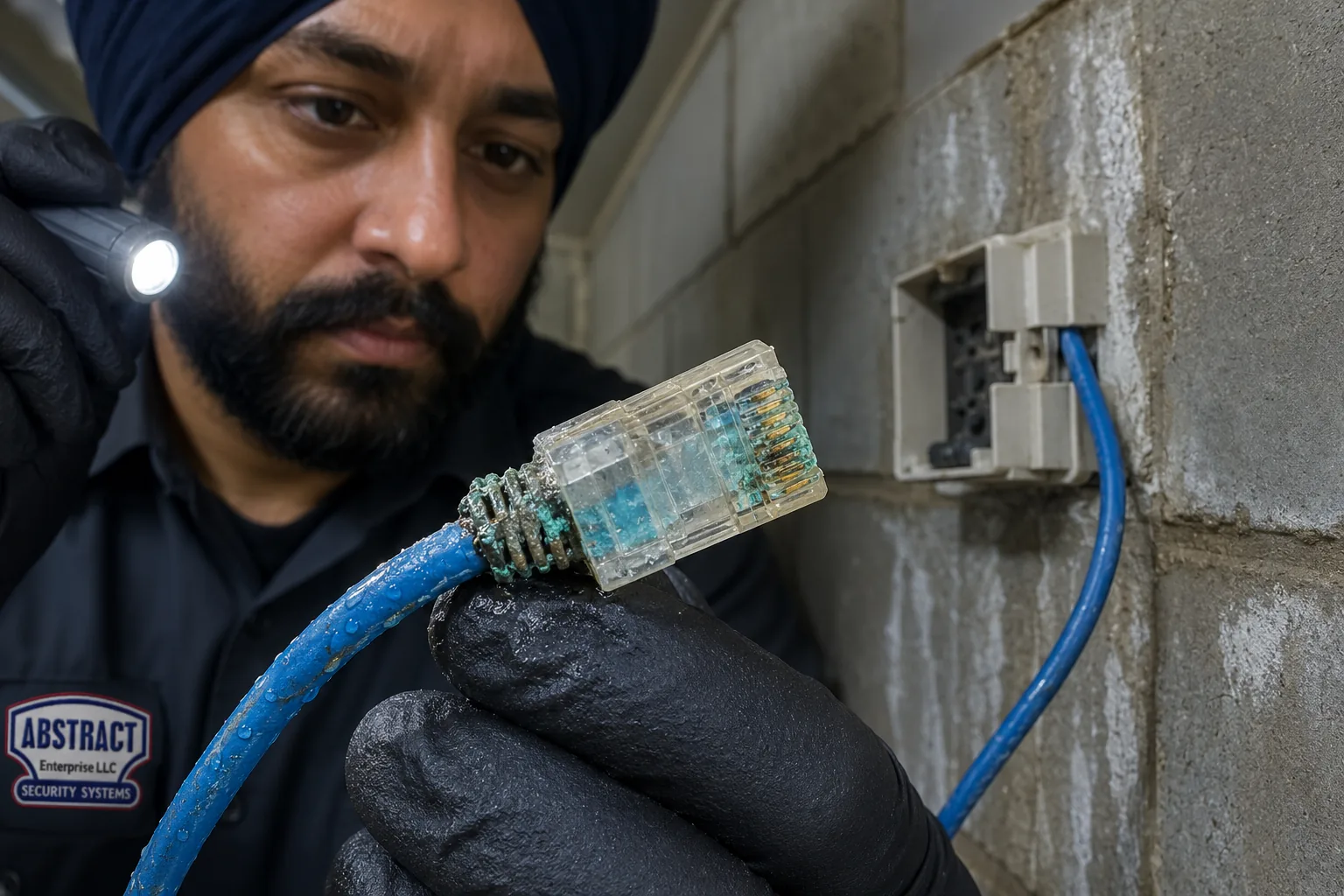
A technician in a dark turban and work shirt holds a clear RJ45 plug up to a small light; green-blue corrosion coats the crimp and the jacket behind it, and a surface box hangs open on a water-stained block wall.
Hudson Valley Cat6 Repair Quote
Tell us which links fail and which buildings they run between — we reply the same business day
✅
Request Sent!
We'll get back to you the same business day.
25+
Years Experience
✓
Same-Day Estimates
100%
Licensed & Insured
4.7★
201 Google Reviews
A camera at the far barn went dark, or half a warehouse failed a tester? Call (800) 486-0943 or send the 60-second form. A licensed technician reads each request, asks the two or three questions that narrow the fault down, and tells you what is likely before a visit is booked — so the van arrives with the right parts.
Faults placed by distance along the run, so we dig, open or climb only where the damage is
Outdoor ends, entries and protection repaired for weather, not just for the tester
NYS licence #12000287431 · fully insured · published rates, confirmed in writing before the visit
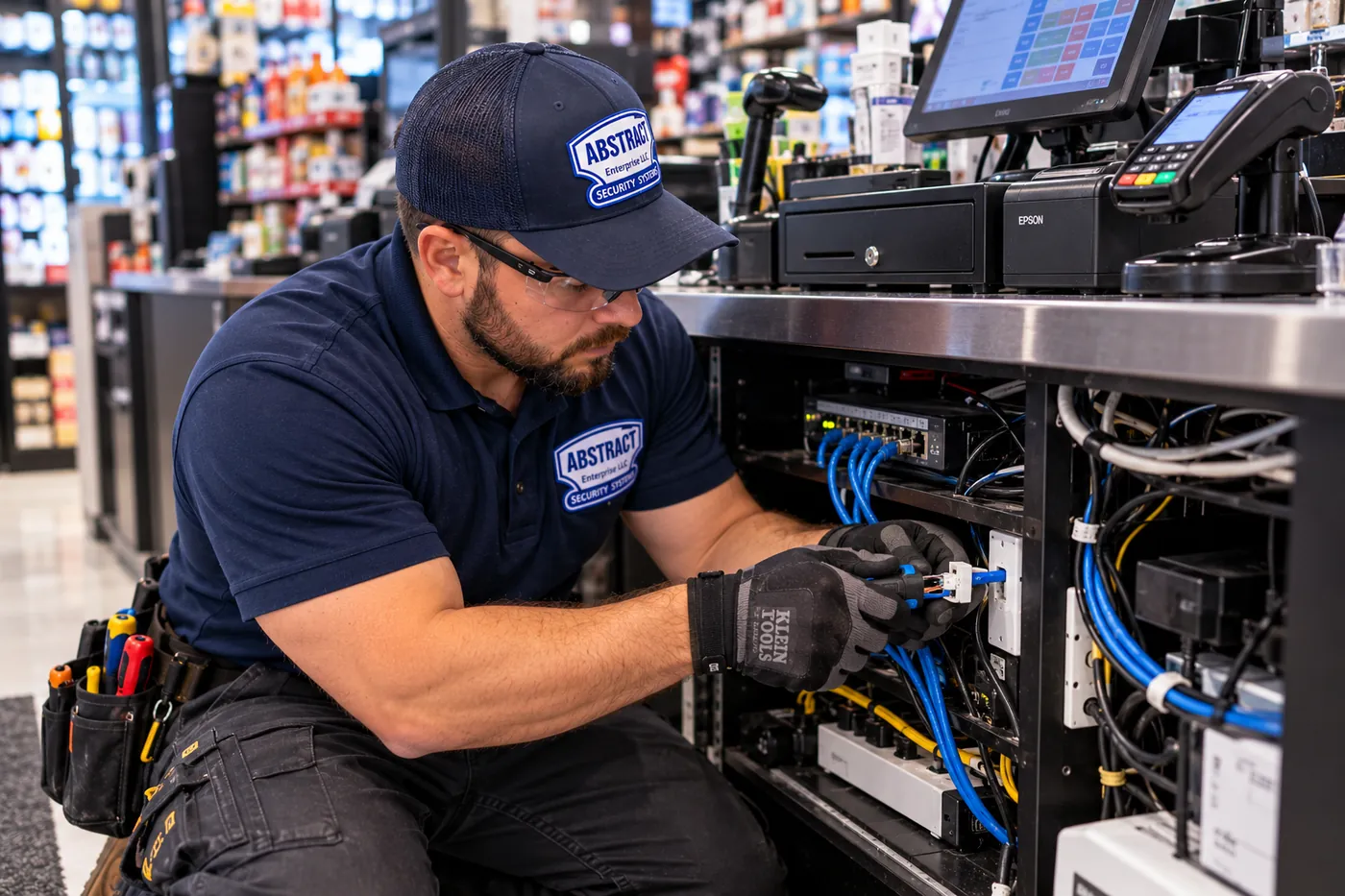
Register and card-reader cabling under a checkout counter, repaired so the POS stays online.
The Neighborhood
Why Hudson Valley Properties Need Cat6 Repair That Accounts for Weather, Distance and Age
Inside a city building, Cat6 lives in a climate-controlled box. Across Westchester, Rockland, Orange, Putnam, Dutchess and Ulster, a lot of it does not. It runs from the main house to the detached garage, from the office to the pole camera at the edge of the lot, from the farmhouse to the barn, from the school’s main building to the portable classroom, from a distribution warehouse’s office to the guard shack at the truck gate. Every one of those runs crosses a boundary that indoor cable was never designed for — a change of temperature, a change of building, a change of electrical ground, or a stretch of open air and soil. That is where the region’s Cat6 faults concentrate, and it is why the repair has to start by asking what the cable has been through, not only what the tester says.
Weather is the first reason. The Hudson Valley gets real thunderstorm seasons, and a strike nearby does not have to hit a building to wreck its network. Voltage induced on a long copper run between two structures arrives at the switch as a surge, and the casualties are usually the switch ports, the PoE camera at the far end, and the terminations in between. Winter brings the opposite problem: unheated outbuildings, crawlspaces and garages cycle through freezing and thawing, buried conduit fills with water that freezes, and cable that was fine in October develops a fault by February. Summer attics in older farmhouses and the high ceilings of steel warehouses push the other way, raising cable temperature and with it the loss on long runs.
Distance is the second. Valley sites spread out. A Cat6 link that runs the full length of a warehouse, or up a hill to a well house, is often close to the 100-metre channel limit before anything goes wrong, so a small amount of damage or heat is enough to tip it into failure. The same distances shape the repair itself: a technician who drives an hour to a site in northern Dutchess or western Ulster should not be driving back for a part. Planning what to bring from a phone description and a few photos is part of doing Cat6 repair properly in this region.
Age is the third. Much of the region’s commercial plant was installed in waves: the corporate campuses and office parks along I-287 and Route 9 from the 1970s and 1980s, re-cabled with Cat5e and then Cat6 as tenants came and went; the former IBM sites in Kingston and Poughkeepsie; the brick and stone buildings of Kingston’s Stockade and Newburgh’s East End, now offices, practices and apartments; and, with construction starting in 2020 and continuing since, the large distribution buildings along I-84 and Route 17K. Each wave left its own kind of Cat6 — good cable badly terminated, cable that was never genuine Cat6, runs extended with couplers, and closets nobody has labelled since the last tenant left.
Finally, animals. Mice, squirrels and other rodents get into barns, sheds, pool houses, attics and drop ceilings across the region, and cable jackets are easy chewing. Damage is often hidden, partial and spread along a run, which makes it a poor fit for guesswork and a good fit for fault location by distance. Put those five pressures together and you get the valley’s version of a Cat6 repair: test it, locate it, fix it for the conditions it actually lives in, protect the parts that leave the building, and leave a record you can compare against after the next storm.
Hudson Valley facts behind the faults we repair
275,059 lightning pulses: detected over Orange County in 2020, the most of any county in New York, with Ulster (182,760), Westchester (168,634) and Dutchess (166,641) close behind, according to Earth Networks’ 2020 New York lightning report. Pulses are not strikes, but the ranking shows where surge damage to outdoor copper is most likely.
More than 35,000 customers: reported outages to Central Hudson in northeastern Orange, Dutchess and Ulster counties after the June 27, 2024 line of thunderstorms with winds near 60 mph, the Times Union reported; combined outages with Orange and Rockland Utilities reached about 60,000. Power restored after a storm is a common moment for marginal Cat6 links and switch ports to fail.
14 feet of water: reported in some Mamaroneck neighbourhoods when the remnants of Ida flooded Westchester on September 1–2, 2021, with water filling basements and reaching first floors, according to ABC7. Basement closets and lower-level offices still turn up corroded terminations from that night.
37 years old: the age of Westchester’s newest office building, according to Howard Properties’ May 2026 market note, which put the county’s office vacancy at 19.9 percent after the former IBM facility and the 1970s “700 series” buildings on I-287 left the statistics. Old buildings that change tenants accumulate generations of cable.
200 acres and over a million square feet: the iPark 87 campus on Enterprise Drive in the Town of Ulster, the former IBM Kingston manufacturing site that the county took through foreclosure in 2019, now home on its East Campus to the Ulster BOCES Career and Technical Center and Archtop Fiber, per Spectrum News in February 2026.
2,217 buildings on 445 acres: in Newburgh’s East End Historic District, added to the National Register in 1985 and dominated by two- and three-storey brick townhouses, per its Wikipedia entry — one of the largest concentrations of 19th-century masonry the region’s cabling has to pass through.
620 and 486 farms: counted in Dutchess and Ulster counties in the USDA’s 2022 Census of Agriculture, averaging 161 and 150 acres. Farms mean barns, sheds and long runs between buildings — the classic setting for chewed, frozen and surge-damaged Cat6.
The practical result is that a Hudson Valley Cat6 repair is often two jobs: fixing the link that failed, and removing the reason it failed so the same run is not the first casualty next season. That might mean a protector at the entry of a run that leaves the building, a drip loop and a sealed connector at a pole camera, conduit through a barn ceiling, or a cable rated for the space where an indoor one was used outdoors.
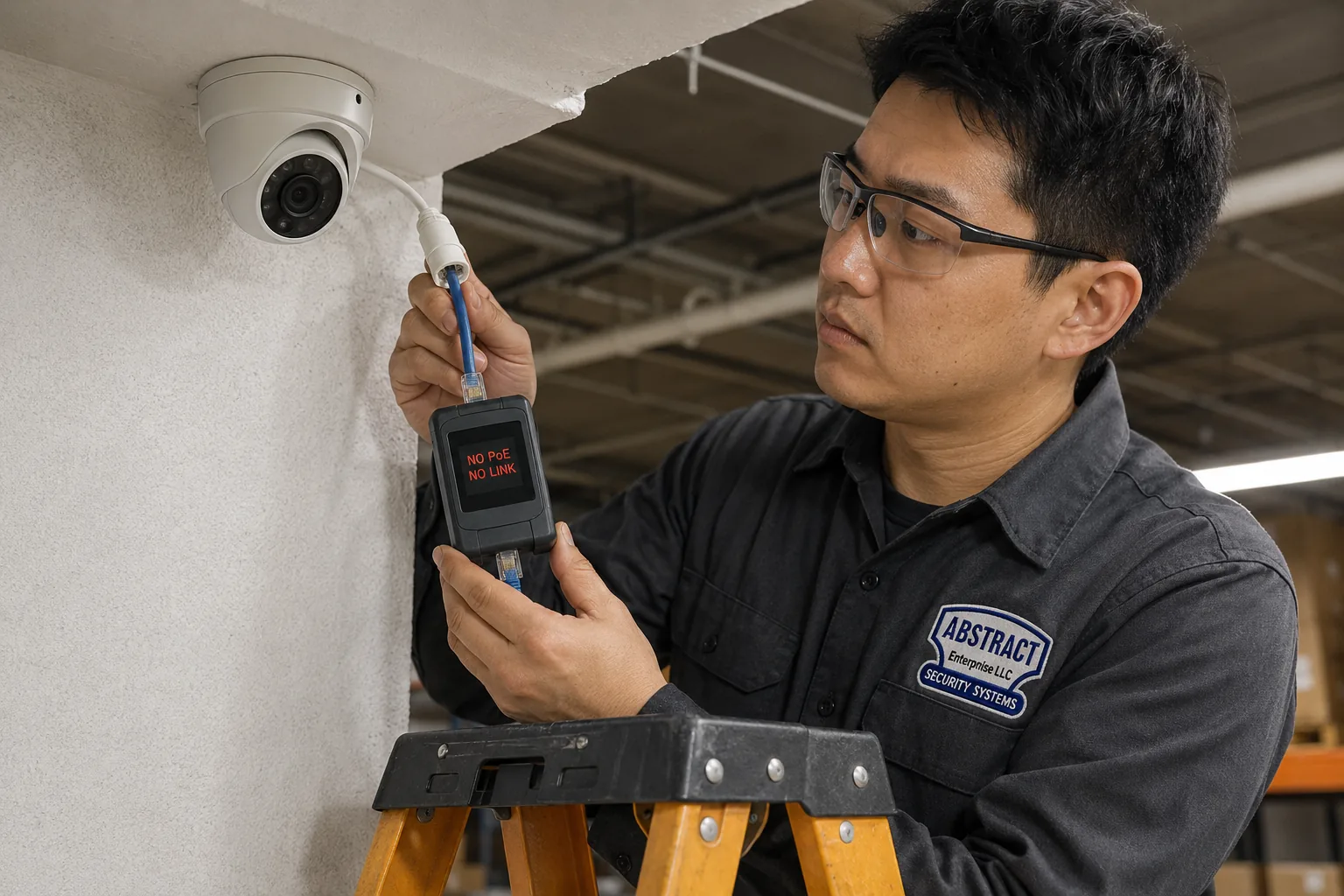
A technician in safety glasses stands on a wooden stepladder in a warehouse aisle, holding a small handheld tester wired to the cable that feeds a white dome camera mounted under the ceiling.
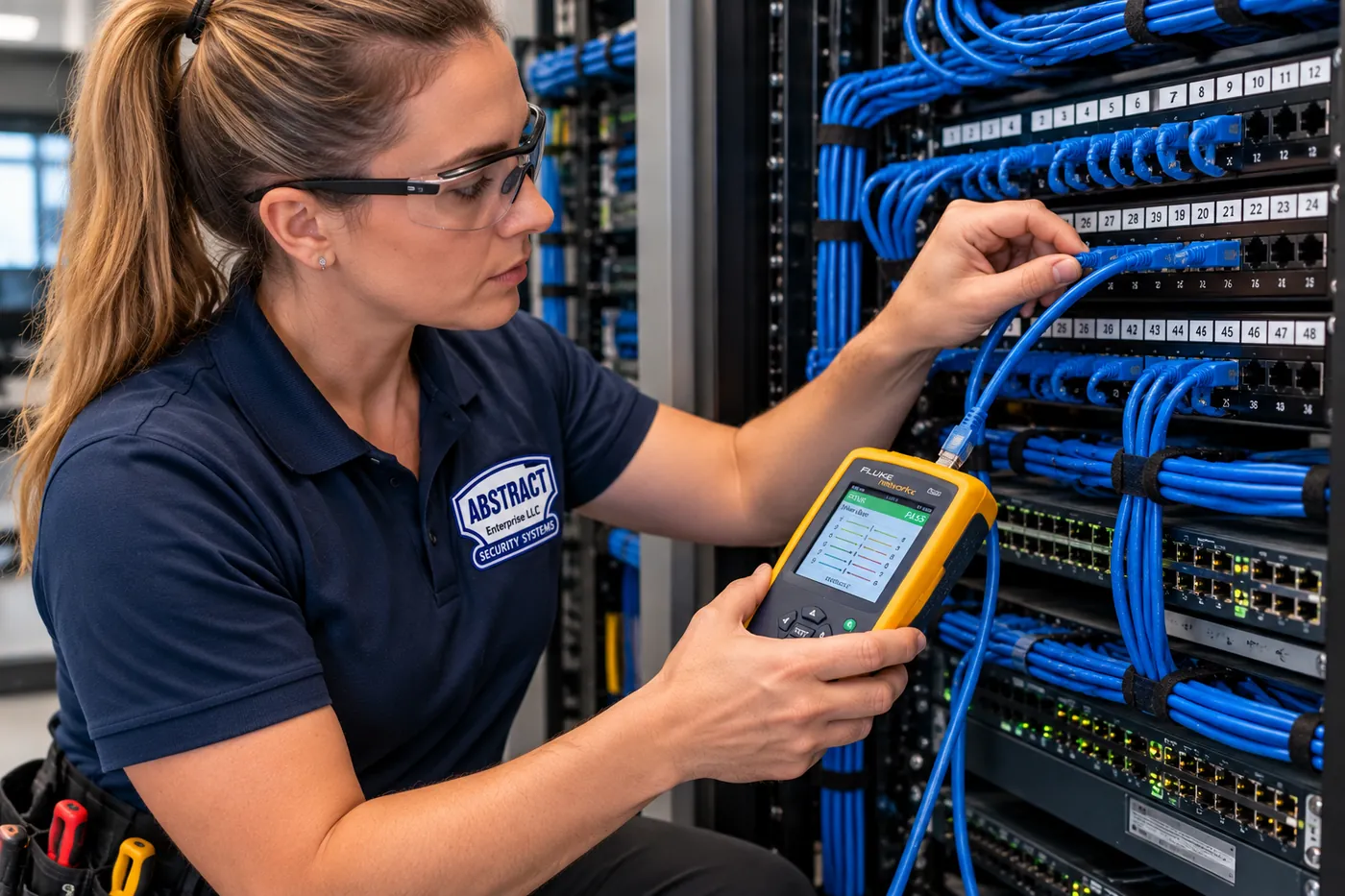
Testing port by port on a numbered panel, so the repair is matched to the right desk or device.
Repair Capture
A Hudson Valley Cat6 Link Down Since the Storm?
A yard camera that went dark during last night’s thunderstorm, an office that lost half its desks when the power came back, a gate keypad that stopped answering after the first hard freeze, a point-of-sale terminal in a farm store that drops every afternoon — those are service calls. Tell us what failed and when, send a photo of the switch if you can, and we book the next available 2-hour window with the parts the symptom points to already on the van: Cat6 and Cat6A keystones, outdoor-rated connectors, replacement cable for indoor and outdoor runs, data-line protectors and a certification tester. A single fault at a termination, a cord or an outdoor plug is usually found and fixed in one to two hours once the technician is on site. Repair time is $195 an hour with a three-hour minimum ($585), the rate published on our Hudson Valley network cable repair pages. Call (800) 486-0943 and say it is a Cat6 fault.
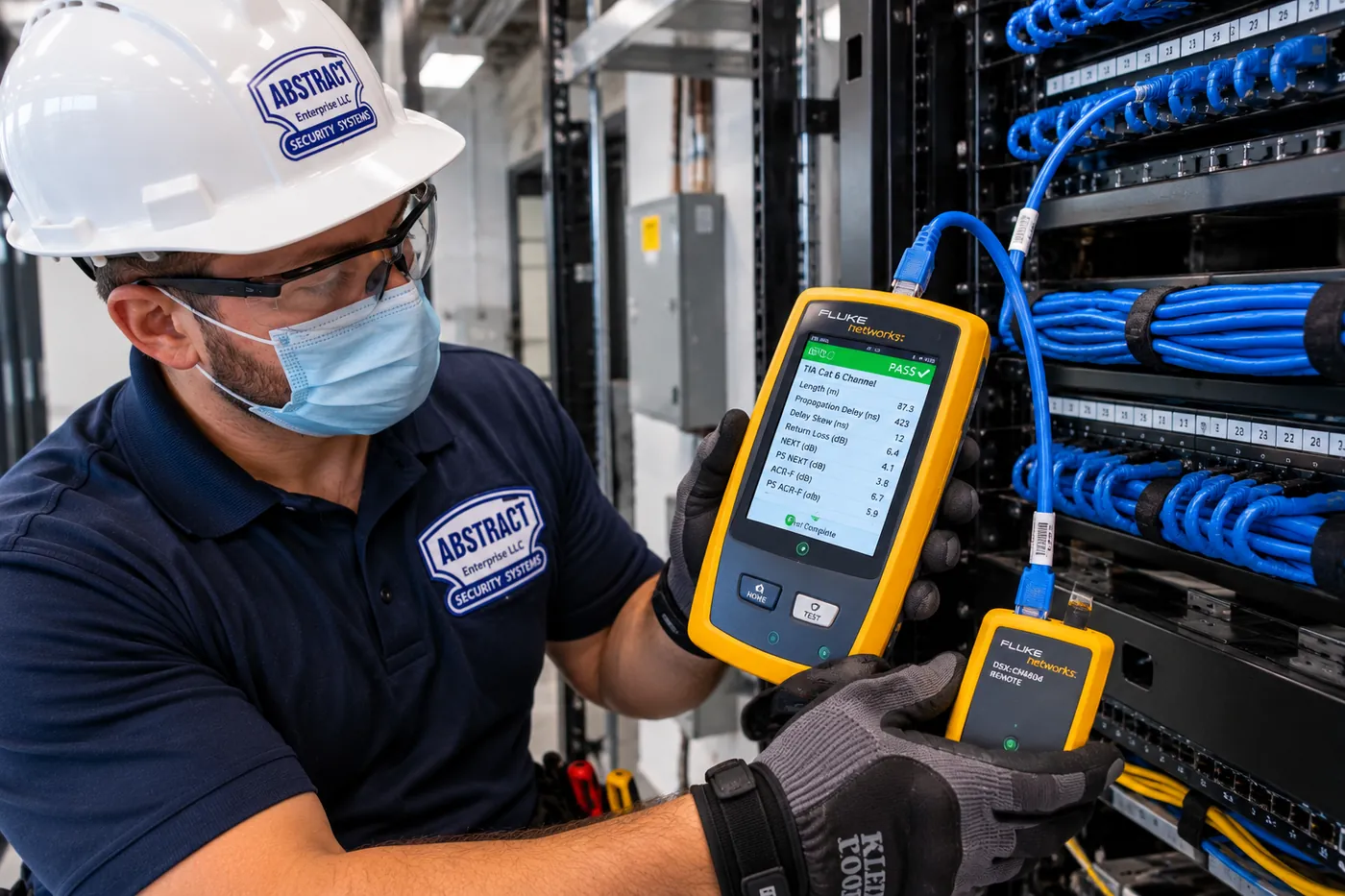
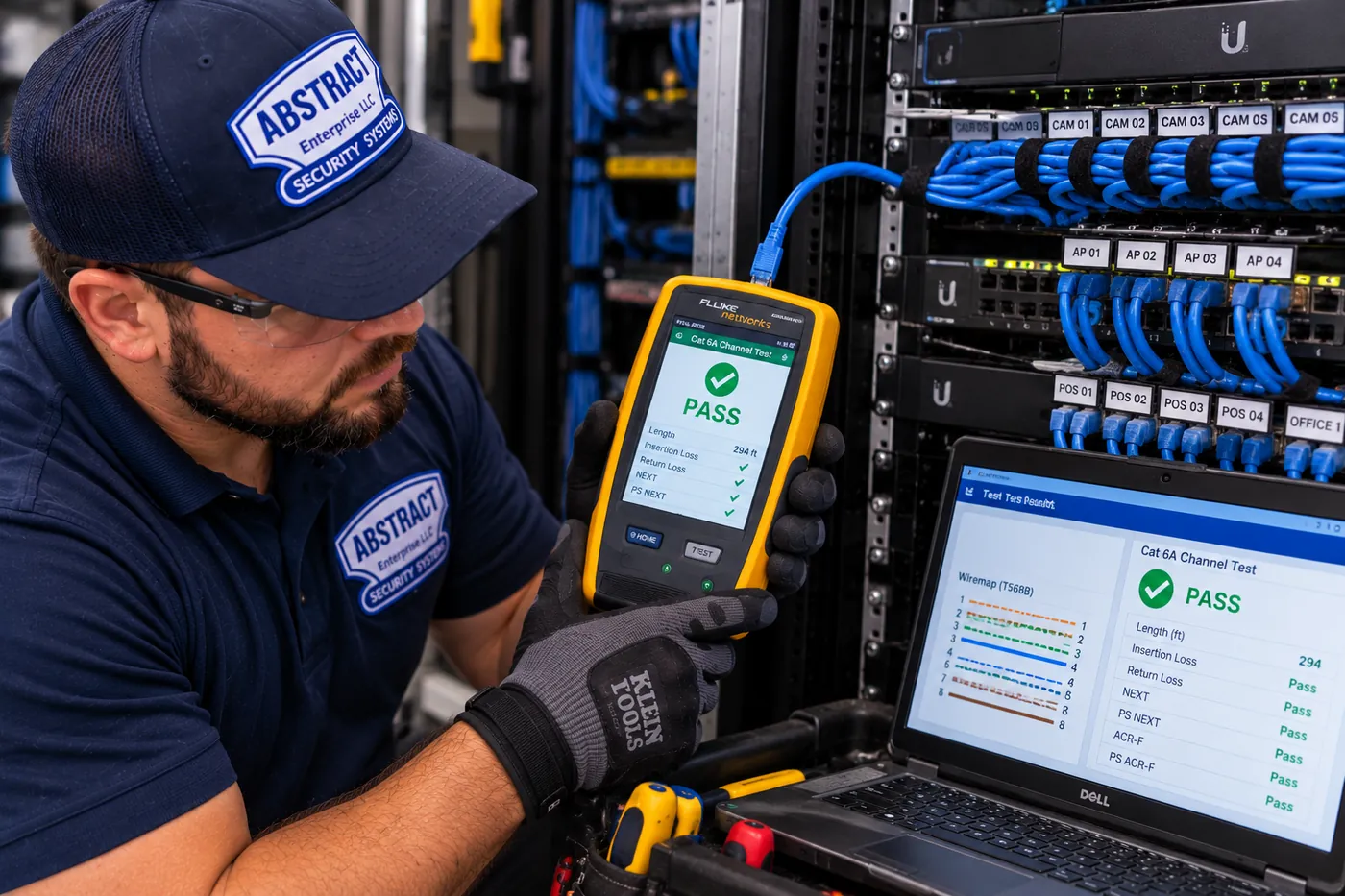
Channel test on the repaired link, with the results on screen before we sign off.
What We Repair
Cat6 Repair Services in the Hudson Valley
These are the repairs Hudson Valley owners, facility managers and IT providers ask us for most. Each finishes the same way: the link is tested against the limit for its category, the result is saved, and you get a plain account of the cause.
Storm and Surge Damage Assessment
After a nearby strike or a hard power return, we test every link that leaves a building or feeds PoE, separate damaged switch ports from damaged cable and terminations, and repair what the surge reached.
Outdoor and Building-to-Building Runs
Runs to garages, barns, sheds, pole cameras and gate posts: outdoor plugs remade with weather-suited connectors, damaged lengths replaced with outdoor-rated cable, and entries sealed with drip loops.
Data-Line Protection at Entries
Listed protectors fitted near the point where a Cat6 run enters a building and bonded to its grounding, then tested in the channel so protection does not cost the link its category.
Buried Conduit and Frost Damage
Runs in water-logged or frozen conduit located by distance, pulled out and replaced with cable suited to wet locations, with the conduit drained or re-routed where it keeps filling.
Rodent-Damage Repair
Chewed jackets in barns, attics, crawlspaces and drop ceilings found along the run, damaged lengths repaired or replaced, and the new cable lifted or sleeved so it is not the next meal.
Keystone, Plate and Floor-Box Re-Termination
Failed jacks at desks, conference tables and floor boxes cut back to clean cable and remade on matched Cat6 or Cat6A hardware, with the pair twist carried to the contacts.
Patch Panel and Closet Repair
Bad panel ports re-punched, damaged modules replaced, and the inherited closets of office parks traced so you know which live link sits behind which port before anything is cut.
PoE Device Link Repair
Yard and warehouse cameras, access points, door readers and gate stations that brown out or reboot: weak terminations, high-resistance cable and outdoor water ingress separated from switch power problems.
Certification After Repair
Every repaired link tested against TIA permanent-link or channel limits, with saved results that show the margin — the baseline to compare against after the next storm, freeze or renovation.
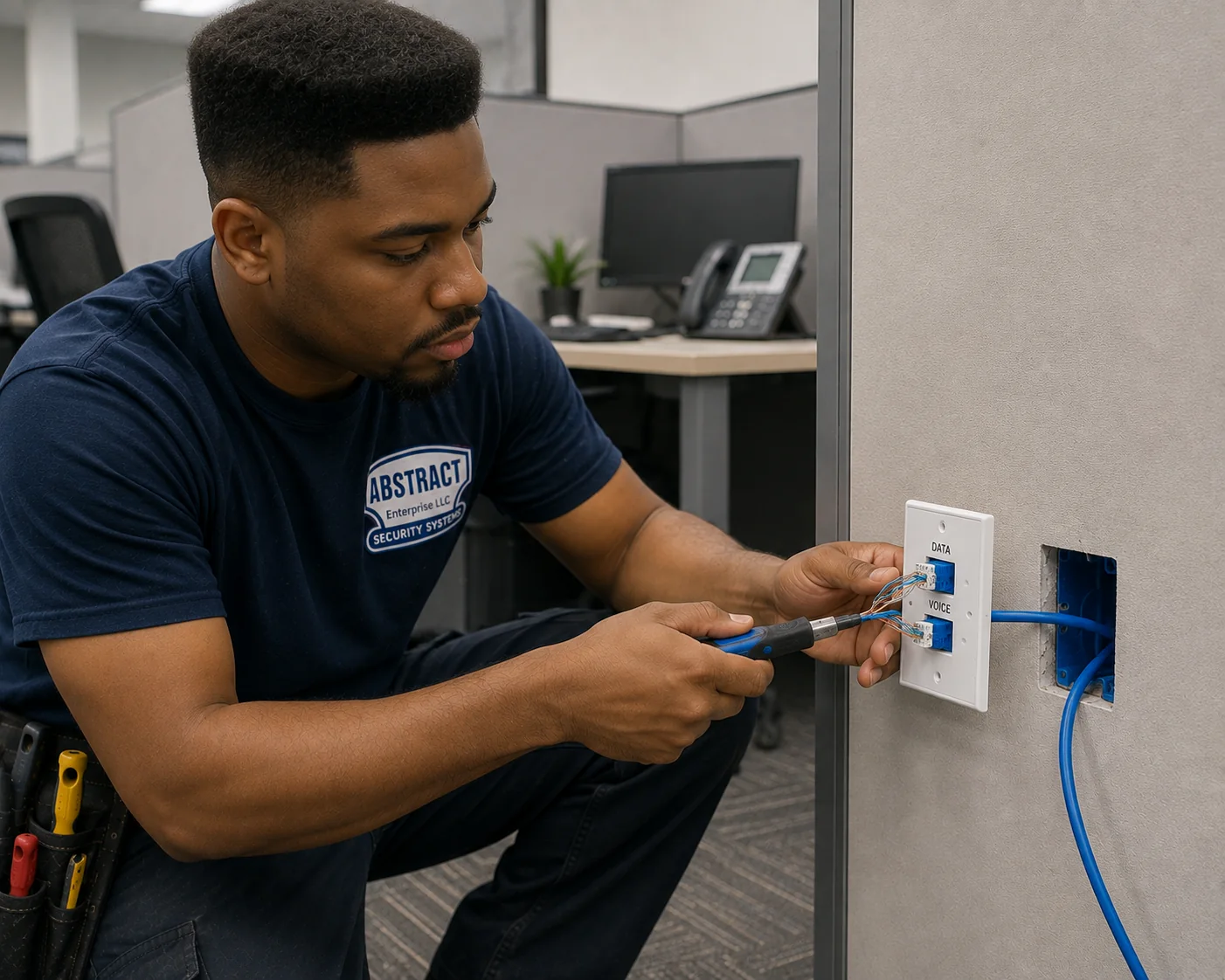
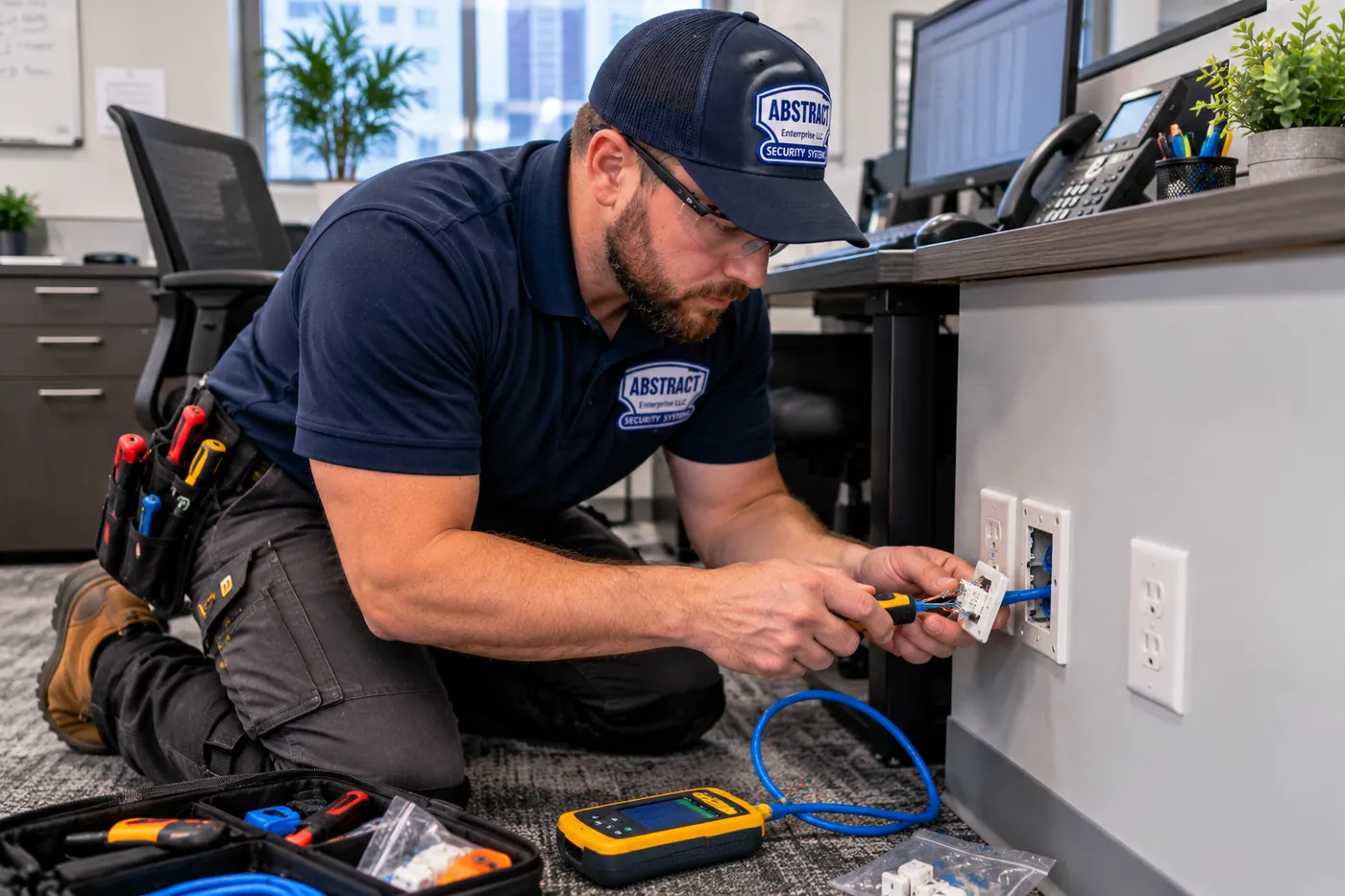
A kneeling technician holds a white two-port plate marked Data and Voice away from its blue electrical box and works a tool into the back of one keystone, with blue cable hanging from the opening.
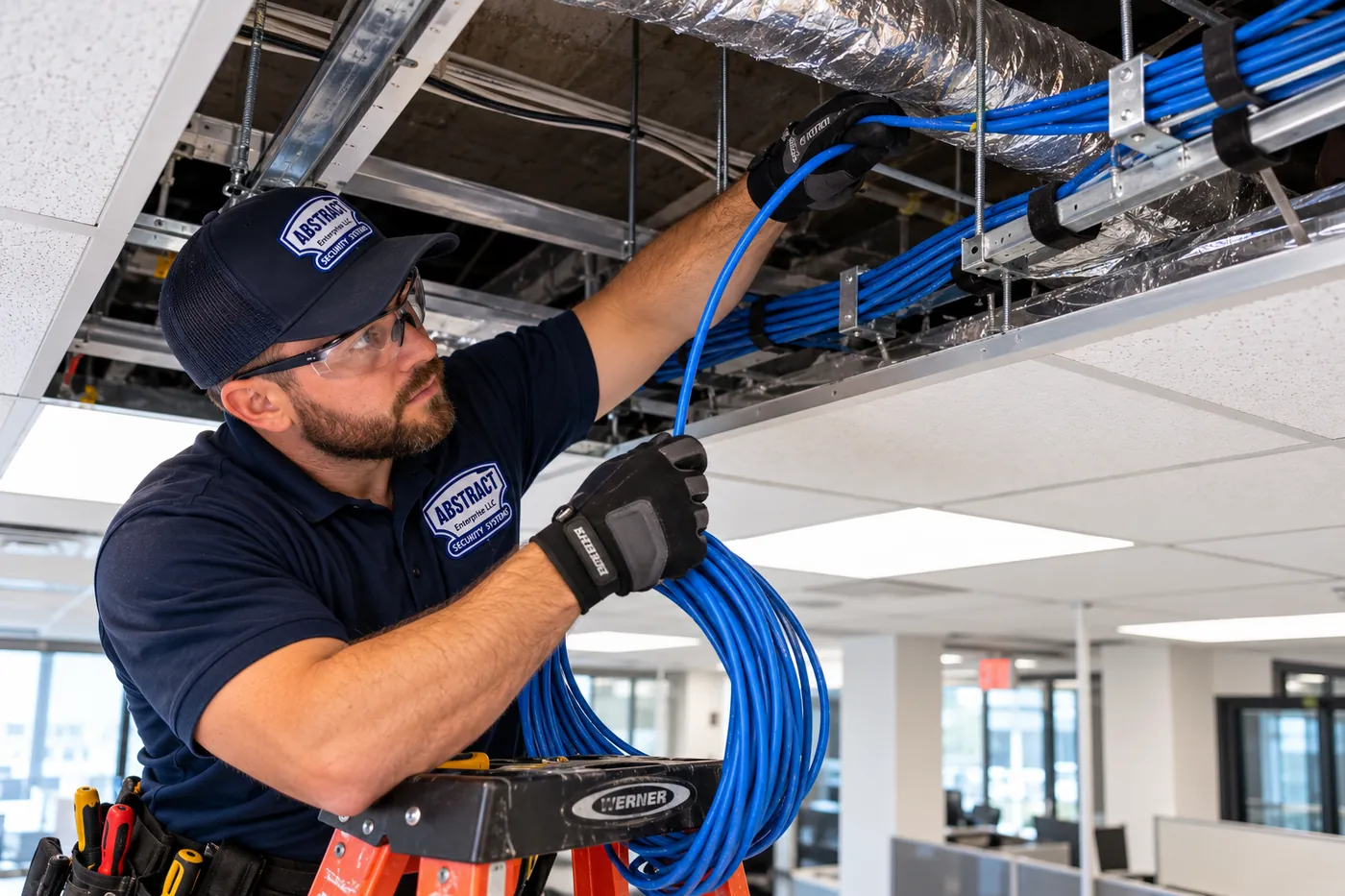
When a run is damaged inside the ceiling, we pull a new one along the supported pathway instead of splicing.
Building Specialists
Cat6 Repair for the Hudson Valley’s Architecture
The building decides how the cable fails and what it takes to reach the damage. These are the property types that make up most of our Cat6 repair work between the Bronx line and the Catskills, and what each one tends to do to a link.
1970s–1980s Office Parks
Low-rise and mid-rise buildings along I-287, Route 9 and Route 59, re-tenanted many times. Expect ceilings carrying three generations of cable, unlabeled panels, Cat5e cords in Cat6 channels and runs extended with couplers during a past fit-out.
Former Corporate and Manufacturing Campuses
Large sites in Kingston, Poughkeepsie, East Fishkill and Westchester that were built for one owner and are now shared. Long horizontal runs, separate electrical services between buildings and abandoned backbone pathways are typical.
Distribution and Logistics Buildings
High-bay warehouses near Stewart, along Route 17K, I-84 and the Thruway. Runs to cameras and access points at height, near the length limit, crossed by forklifts and lifts and terminated in field-made plugs at the device end.
Brick and Stone Historic Buildings
Kingston’s Stockade, Newburgh’s East End and the old downtowns of Peekskill, Beacon, Nyack and Poughkeepsie. Thick masonry, runs on the surface or in old chases, staples, and sleeves packed full during past work.
Farms, Estates and Rural Homes
Main houses with barns, garages, studios, pool houses and well houses spread across acres. Outdoor and buried runs, unheated outbuildings, separate electric meters and rodents are the main causes of failure.
Schools, Libraries and Municipal Buildings
Main buildings with additions from several decades, sometimes portable classrooms or detached garages. Runs cross expansion joints and old-to-new transitions, and test results are often a contract deliverable.
Medical and Professional Suites
Practices in converted houses and small office buildings across the region. Downtime is costly, rooms are finished and occupied, and the fault is usually at a jack, a floor box or behind furniture.
Retail Centres and Farm Stores
Shopping plazas on Route 59 and Central Avenue, outlet and mall tenants, and seasonal farm markets. Point-of-sale and camera runs pass through stockrooms and unheated spaces, and counter-end terminations take a beating.
Material and method checks we make on every valley repair
Is the cable rated for where it actually runs? Indoor communications cable carries markings like CM, CMR or CMP for indoor spaces. Outdoor and buried runs need cable made for sunlight and water. One of the most common causes of a slow Cat6 decline in the region is indoor cable run along an exterior wall, across a roof or through buried pipe, where the jacket cracks in sunlight and water reaches the pairs. If the cable is wrong for the location, re-terminating it buys months, not years.
Where does the run cross between buildings or electrical services? When a copper run connects two structures with separate grounding, any difference in ground potential and any induced storm surge travel along it. We look at how that run enters each building, whether there is protection and bonding at the entry, and whether a link of that length and exposure should be fiber instead. Our fiber optic installation service in the Hudson Valley handles the cases where it should.
What temperature does the run see? Insertion loss rises with heat, so a long Cat6 run in a summer attic, under a warehouse roof or bundled tightly with other PoE cables can fail a test it passed when it was installed. In winter, cable in unheated spaces stiffens and the terminations of flexed runs crack. We record where the run goes so the repair matches the conditions.
Is it genuine solid-copper Cat6? We check the conductors at the cut. Silver at the core means copper-clad aluminium, which cannot certify and fares badly with PoE and in outdoor runs. We also check for stranded patch cable used as a permanent run, and for couplers hidden above tiles or inside boxes.
What is chewing on it, and where? When the fault-location reading shows damage spread along a run rather than at one point, rodents are a leading suspect. We trace the run, check where it lies on beams or insulation, and plan the repair so the new length is in conduit or off the surfaces animals travel along.
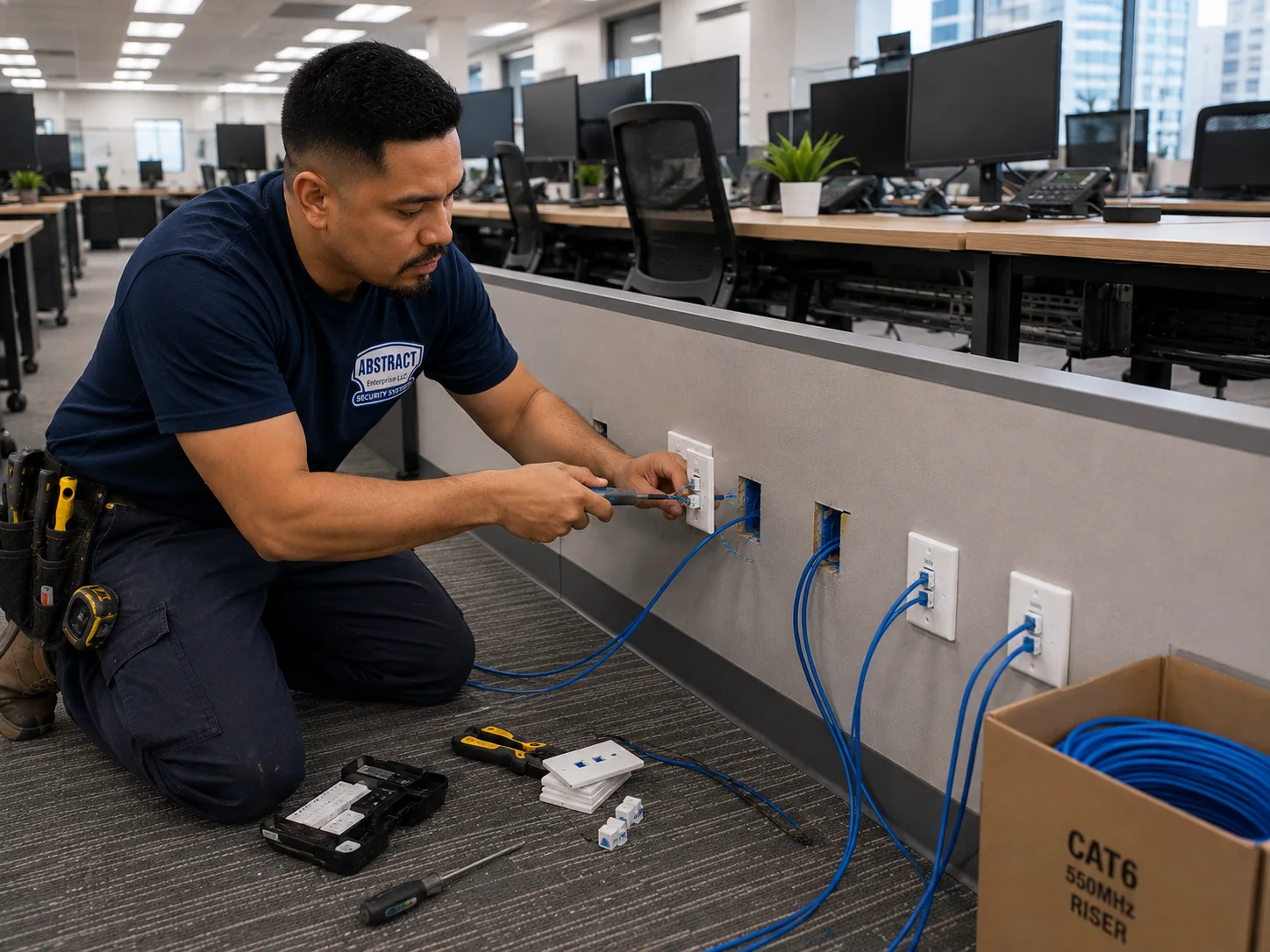
In an open-plan office, a kneeling technician works on one of several wall plates set into a low partition; blue cables hang from the openings, a toolkit and spare plates lie on the carpet and a carton marked CAT6 550MHz Riser sits in the corner.
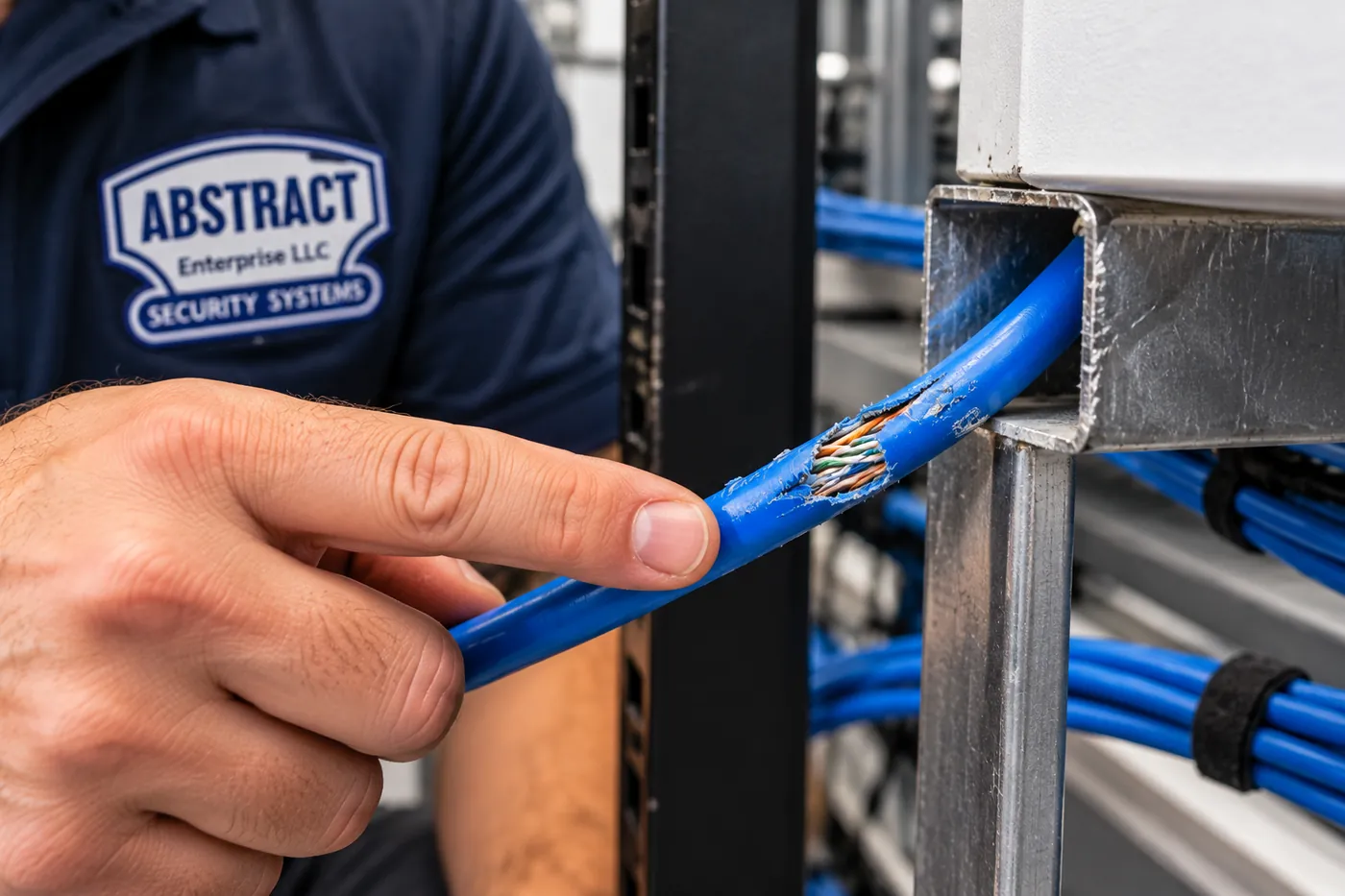
A jacket chewed through on a sharp metal edge: one of the most common causes of a link that drops in and out.
Commercial Cat6 Repair
Business Cat6 Repair in the Hudson Valley
Most of the Cat6 we repair in the valley carries a business, a school or a farm operation. The places below are real and are named for the kind of building and the kind of fault each district tends to produce, not as a list of our jobs.
Platinum Mile and the I-287 Corridor, Westchester
Office buildings along Westchester Avenue in White Plains and Harrison, such as the roughly 335,000 square feet at 1111 and 1129 Westchester Avenue that Westfair reported sold to Onyx Equities. Re-tenanted floors bring unlabeled panels and mixed-category channels.
Valhalla and Tarrytown Medical and Research Campuses
Westchester Medical Center’s $220 million critical care tower, under construction since 2024, and Regeneron’s Tarrytown campus expansion of about 900,000 square feet. Campuses where new and decades-old buildings share pathways and where test records matter.
Route 17K and Stewart, Orange County
The Town of Montgomery sites where construction began in 2020 on an Amazon distribution centre of 1,015,740 square feet and a 1.2-million-square-foot Medline building, per the Hudson Gateway Association of Realtors. High-bay ceilings, long runs, cameras and lifts.
Route 59, Rockland
The retail and office corridor through Nanuet and West Nyack, anchored by the Palisades Center of about 2.36 million square feet, which Hoodline reported changed hands at a February 2026 foreclosure auction. Tenant turnover leaves cabling nobody owns.
South Road, Poughkeepsie, Dutchess
IBM’s Poughkeepsie site at 2455 South Road, where the Dutchess IDA project summary describes a new facility of about 300,000 square feet and the renovation of Building 416. Around it sit decades of office and light-industrial plant on older cabling.
Enterprise Drive, Town of Ulster
The iPark 87 campus, the former IBM Kingston plant on 200 acres with over a million square feet of buildings, now partly reused by Ulster BOCES and Archtop Fiber. Large, partly vacant structures with abandoned pathways and runs that cross between wings.
Compliance callouts for business Cat6 repairs in the valley
Protection at building entry. The National Electrical Code requires listed primary protection for communications circuits exposed to lightning or power contact where they enter a building, with grounding near the entrance (Article 800, as summarised by EC&M). Cat6 between buildings is exactly the kind of run that exposure rule was written for.
Abandoned cable. The accessible portions of abandoned communications cable must be removed unless tagged for future use (section 800.25 in the edition EC&M discussed). Replacing a run means taking the old one out where it can be reached.
County and municipal licensing. Westchester requires home improvement contractors to hold a county licence through its Department of Consumer Protection, and Rockland licenses trades under its own county code, including Chapter 250 for electricians and electrical inspections. Permits, where needed, come from the local building department, so requirements change from town to town. AESS works under NYS licence #12000287431.
Digging. Any repair that means excavating a buried run starts with the free one-call notice to have utility lines marked, given at least two and no more than ten working days ahead, as Central Hudson’s Dig Safely guidance sets out.
Watershed land. Parts of Westchester, Putnam, Orange and Ulster lie in New York City’s reservoir watersheds, where DEP regulations govern land disturbance and stormwater. A short trench repair is rarely affected, but a long new route across open ground deserves a check first.
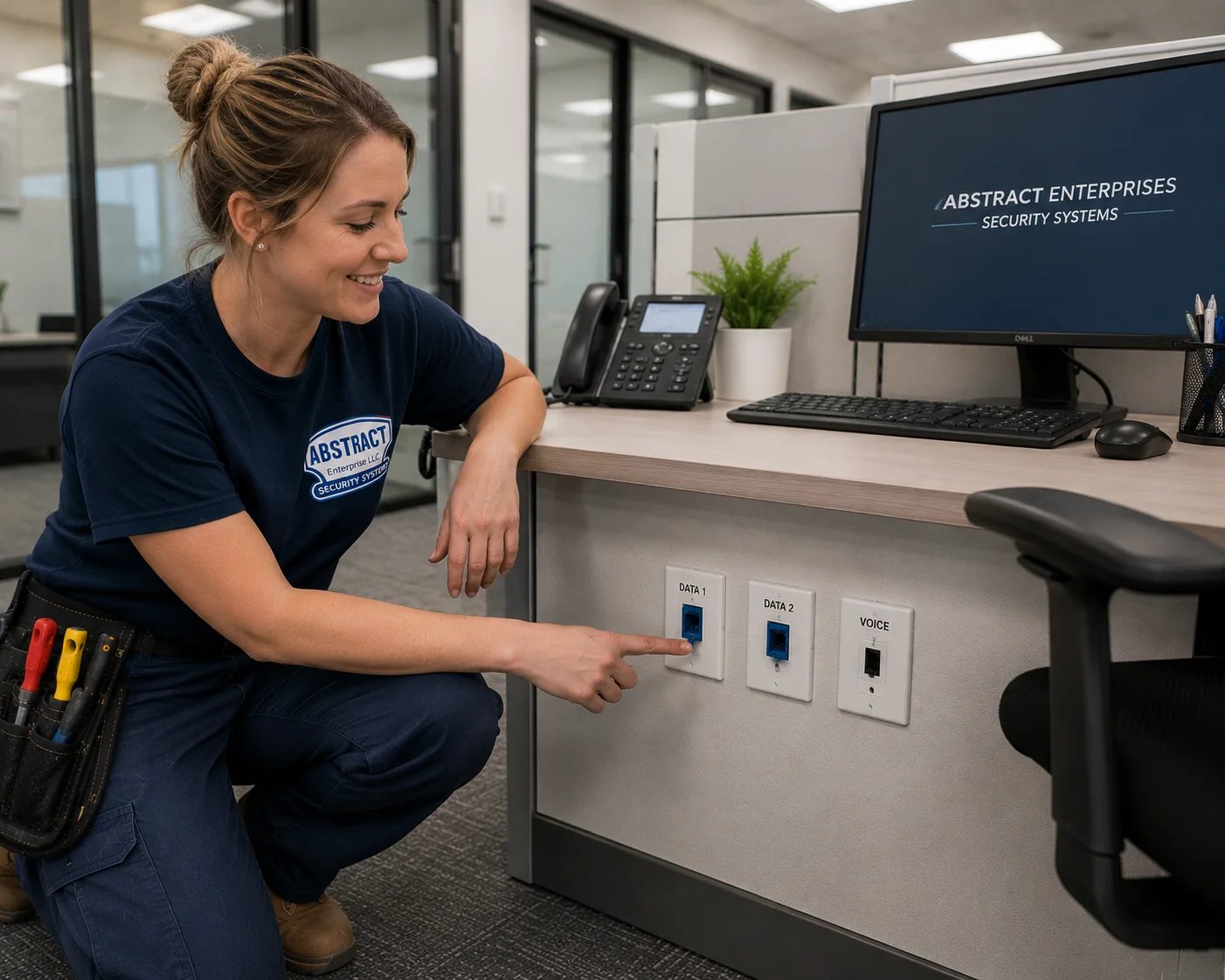
A smiling technician crouches beside a desk and points at a row of three single-port plates under the worktop labelled Data 1, Data 2 and Voice, with a desk phone and monitor above.
Your Questions Answered
Cat6 Repair in the Hudson Valley: Questions Answered
These are the questions we hear from facility managers, farm and estate owners, school and municipal IT staff, office-park tenants and homeowners once a Cat6 link has started misbehaving north of the city. They are grouped by what usually caused the problem: storms and power, cold and heat, animals and outbuildings, outdoor runs and PoE devices, the region’s older commercial buildings, and distance. Shorter practical questions are in the FAQ further down.
After a storm or a power event
Why did a storm kill the switch ports for the barn and the yard cameras but leave the office desk ports working?
When several ports fail together during a storm, the switch is the first suspect and the cable runs that leave the building are the second. A nearby strike induces voltage on long copper runs, especially ones that run outdoors, across a parking lot or to another structure. That energy travels to the switch, where the port electronics are the weakest point, and to the device at the other end. Ports that fed only short indoor runs to desks often survive while ports that fed the yard camera, the barn and the gate do not, which is a useful clue in itself.
We sort it out in a set order. First, the dead ports are tested with a known-good cable and device, which tells you whether the switch hardware survived. Then each affected run is tested on its own against its category limit, looking for burned or open conductors, damaged terminations and protectors that sacrificed themselves. Then the far-end device is checked. Often the answer is a mix: two switch ports gone, one camera gone, and every cable still passing. Sometimes a termination or protector has failed open and needs replacing. Either way, you replace only what the testing shows is damaged.
Which Cat6 runs should be tested after a strike near the property, even if they still seem to work?
By testing every run that could have been exposed, not just the ones that obviously stopped. A surge can leave a link working but weakened: one pair partly damaged, a keystone contact pitted, a protector degraded. Those links may light up and pass traffic, then fail weeks later or run at reduced speed. The runs most at risk are the ones that leave the building, the longest ones, those that share a pathway with power or with a downspout or gutter, and those that feed outdoor PoE devices.
We make a short list with you from the site layout, then certify each run on it and compare the results with any earlier test reports you have. Margins that have collapsed since the last test, resistance imbalance between pairs and failures on a single pair all point to surge damage. Links that pass with healthy margins are left alone and documented. That record also helps if you are making an insurance claim, because it separates storm damage from cabling that was already failing.
The power came back after an outage, but some Cat6 links never did — what failed?
Usually not the cable itself, but something the cable connects. Outages in the valley can be long, and the moment power returns is hard on equipment: surges on restoration, devices restarting in the wrong order, and PoE switches trying to power every port at once. A switch that comes back with a reduced power budget, or ports that failed during the restoration surge, can leave cameras and access points offline while the cabling is perfectly fine. A camera that needs more power than its port now offers will simply stay dark.
The cabling does fail in some cases, and the pattern is recognisable. Runs that were already marginal — a loose termination, a pair with a nick in it, an outdoor plug with a little water in it — can fail completely when equipment powers up and draws current through them again. So we start at the switch: port status, PoE allocation, any logged faults. Then we test the runs feeding the devices that stayed down. That order keeps you from paying to replace cable when a switch reset, a port move or a power budget change is the real fix.
Cold, heat and the seasons
Why does a Cat6 link to an unheated garage or barn only fail in the coldest weeks of winter?
Because something in it moves when it gets cold. Cable and connectors contract in freezing temperatures, and a termination that was barely seated, a conductor nicked during installation, or an outdoor plug with a hairline crack can open up just enough to drop the link when the building drops below freezing. The fault comes back when the space warms up, so by the time someone looks in spring, everything works again. Water in an outdoor connector or an entry box makes this much worse, because it freezes and pushes the contacts apart.
The most reliable way to fix it is to test the link while it is cold, or to find the weak point regardless of temperature. A certification test usually shows a marginal termination even on a mild day, as a poor return-loss or crosstalk reading at a particular end or distance. We repair that point, replace outdoor plugs with connectors and boxes suited to cold and damp, add a drip loop where cable enters a wall, and make sure any cable in the unheated space is rated for the conditions. If the run was indoor cable stapled to an outside wall, replacing that section is usually the honest answer.
Our outdoor Cat6 runs through buried conduit — can ice in the pipe damage it?
Yes. Buried conduit very often fills with water, through joints, condensation or an open end, and if any of it sits above the frost line, that water can freeze around the cable. Electricians discussing exactly this on Mike Holt’s forum describe the danger plainly: freezing water crushes the conductors, damaging the insulation or jacket, and conductor failure follows. Cat6 depends on the precise geometry of its pairs, so pressure that would not bother a power cable can be enough to fail a crosstalk or return-loss test.
The repair depends on what the testing shows. If the fault sits at one distance, typically where the conduit runs shallowest or where it rises to the building, that is where the damage is. Indoor-rated cable in a wet conduit is not a repair candidate; it gets replaced with cable made for wet locations, and the conduit is drained, sealed at the ends or re-routed where it keeps filling. If the run is long, between buildings with separate power, or keeps failing, we discuss fiber in the same conduit as the longer-lasting fix.
A Cat6 run crosses from the original school building into its addition and keeps failing at the joint — why there?
Because that is where the building moves. Schools, libraries and town halls across the valley have often grown in stages, with a wing added in one decade and a gym or classroom block in another. Where an addition meets the original structure there is usually an expansion joint, a change in ceiling height and a fire-rated wall, and the cable that crosses it was frequently pulled tight, squeezed through a sleeve sized for the old telephone wiring, or tied hard to the structure on both sides. As the two parts of the building expand, contract and settle at slightly different rates, the stress concentrates on that one short stretch of cable.
The fault-location reading tends to give it away, putting the damage at the same distance on every run that crosses the joint. We open the ceiling there, look for stretching, kinks or crushing, and replace the damaged length with a little slack on each side so the joint can move without pulling on the pairs. Each side is supported independently, the penetration through the rated wall is firestopped again to its rating, and the repaired links are certified, with results in the format the district or municipality asks for. When several runs cross the same joint, we plan them as one repair rather than several visits.
Animals, outbuildings and outdoor runs
Mice got into the barn ceiling — how much of the chewed Cat6 has to be replaced?
Less than you might fear, if the damage can be located. Rodent damage is rarely one clean cut. It is usually a series of bites along a stretch of cable where it crosses a beam, a joist or insulation that animals travel along. Some bites only scuff the jacket; others reach the pairs. A cable with exposed but unbroken pairs may still pass a basic continuity test while failing its category, and it will get worse as moisture and dust reach the conductors.
We test the run and use the fault-location reading to find where along it the damage sits, then look at that stretch. If the damage is confined to a short, reachable section and the link’s job allows it, a rated in-line repair can bring it back to a passing test. If the bites are spread along the run, or the run feeds something important like a camera or a farm office, we replace that length or the whole run in conduit or on supports away from beams and insulation. Repairing chewed cable without changing where it lies just schedules the next repair.
Someone ran indoor Cat6 along the outside of the house to the shed — it still works, so does it need replacing?
Eventually, yes, and usually before it fails at the worst moment. Indoor communications cable is not made for sunlight or standing water. Over a few seasons the jacket on an exposed run hardens, cracks and lets water reach the pairs; stapled sections split where the staples pinch; and the plug at the shed end, often a field-made connector, corrodes. Before the link fails completely, it tends to slow down, drop out in wet weather and fail certification. A copper run between two structures with no protection at the entry also leaves both ends exposed to storm surges.
If the link still passes its category, there is no emergency, but it is worth planning a replacement on a better path: outdoor-rated or direct-burial cable, or conduit, a proper entry with a drip loop at each building, and protection where the run comes inside. If the shed or studio is far enough away, or has its own electrical service, fiber with media converters is often the more durable link. Either way, we test the existing run first, so you know how much life it has left.
Water got into the plug at a pole-mounted camera — can the run be saved, or does it have to come back to the building?
Often the run can be saved, and the repair is at the camera end. Field-made plugs at pole and wall cameras are a classic failure point outdoors: water gets in around the cable, wicks into the plug and corrodes the contacts. The camera starts rebooting in wet weather, then drops altogether. If the water stayed at the plug, cutting back past the corroded section and terminating with a connector designed for outdoor use, inside a weather-sealed box or boot, is enough to restore the link.
The question is how far the water went. Moisture can wick along the cable under the jacket for some distance, especially if the cable was cut open or the end was left pointing upward without a drip loop. We cut back, test, and keep cutting back only while the readings improve. If return loss or insertion loss still fails after the end has been remade, the moisture has travelled into the run and that length needs replacing. On a tall pole, the plan also covers how the new end is reached, whether by ladder, by lift, or with the help of the site’s own equipment.
Our Cat6 to cameras and access points in a high-bay warehouse keeps getting damaged — what is hitting it?
Usually the operation. In tall distribution buildings, Cat6 to cameras, scanners and access points runs high along racking, joists and structure, and the things that damage it are the things that work at height: lift baskets, forklift masts, pallets lifted too high, and contractors fitting lights or sprinklers. Cable laid across the top of racking or tied tightly to structure gets pinched, crushed and abraded. At the device end, plugs made in the field are often loaded by the weight of the cable hanging off them.
We locate each fault by distance so the lift only goes up where the damage is, repair the termination or replace the damaged length, and look at the pathway. Supporting cable on proper hangers clear of moving equipment, protecting vertical drops near aisles, and giving each device a short, supported service loop removes most of the cause. Where runs are close to the 100-metre limit because the building is so long, we may recommend a closer switch location rather than a repair that will always be marginal. Lift hire, where the site has none, is shown as its own line, as on our Orange County repair pricing.
The region’s older commercial buildings
Our office-park suite shares a telecom room with the tenant next door — can a Cat6 repair be done without touching their equipment?
Yes, if the work is planned with the landlord and the room is mapped first. Many of the region’s office parks put one telecom room on each floor or wing, shared by several tenants, with panels from different fit-outs side by side and patch cords that wander between racks. The risk is not your repair; it is someone pulling or re-punching a neighbour’s live link by mistake because the labels are wrong or missing.
We start by confirming with building management which panels and pathways belong to your suite. Then we trace your failing links with a tone and probe and by testing from your outlets, so we know exactly which ports are yours before anything is unplugged. Repairs happen only on those ports, and any cords that cross to another tenant’s equipment are left as found and noted for management. When we leave, your ports are labelled at both ends, so the next technician on either side of the room does not repeat the guesswork.
The failed Cat6 in our brick townhouse office runs along the baseboards and door casings — what is the least visible way to replace it?
Usually a different route rather than the same one. In older brick and stone buildings like those in Newburgh’s East End or Kingston’s Stockade, solid masonry walls leave nowhere to fish cable, so earlier installers ran it along baseboards, picture rails and door casings. Re-running a replacement along the same path keeps every visible length and every fixing in the woodwork. Before choosing, we look at what the building offers: a cellar or crawlspace under the room, a closet or stair void that runs between floors, an old chimney chase that is no longer used, or the back of built-in cabinetry.
Where one of those exists, the new run comes up through the floor at the desk or inside the closet, and the surface cable is removed. Where none does, a slim surface raceway painted to match, following the line of the trim, is far tidier than loose cable and protects the run from furniture and cleaning. In listed or historic interiors we agree the route and any fixings with you before work starts, and we avoid drilling original mouldings or masonry joints where an alternative exists. The failed run is tested first so you know the fault is not simply at a jack, which would make the whole question unnecessary.
How is a Cat6 run repaired where it passes through a thick stone wall and the old sleeve is packed full?
Carefully, because the wall is usually the hardest part of the run to replace. Stone and brick walls in the valley’s older buildings can be very thick, and the one sleeve or hole through them tends to carry everything: phone lines, coax, old Cat5e, and the Cat6 that has failed. When the sleeve is packed, pulling a new cable through it risks damaging the cables that still work, and drilling a new hole through historic masonry is a decision of its own.
First we confirm the fault is actually inside the wall. Often it is at one side or the other, where the cable bends sharply out of the sleeve, and that can be repaired without touching the section inside. If the damage really is within the wall, we look at what in the sleeve is abandoned: removing dead cable often frees enough space to pull a replacement. Only when there is no other path do we discuss a new penetration, its size and location, and how it will be sealed against water and pests afterwards.
Distance and remote sites
We are an hour from most contractors — what can we send so the first Cat6 repair visit finishes the job?
More than most people expect, and it makes the biggest difference to the cost of a repair in the outer counties. Photos of the switch with its port lights, the patch panel, the failing jacks and any outdoor entries or devices tell us what hardware is installed and what parts to bring. A note of what fails and when — after rain, in the cold, at night, after a storm — narrows the likely cause. If a previous installer left a test report or a port map, send that too.
From that we plan the visit: which parts and cable types to load, whether a ladder or a lift is needed, which buildings and gates need to be open, and whether anyone has to be present to manage animals, tenants or alarms. The aim is that the technician who arrives can test, locate and repair in one visit, rather than diagnosing on the first trip and fixing on the second. If what you send suggests the problem is not cabling at all, we say so before anyone drives out.
Can a Cat6 fault at a weekend house be narrowed down before anyone is there?
Partly, and that can save a wasted trip. If the house has a managed switch, a network controller app or a camera system with remote access, it often records which devices dropped and when, whether a port lost power or link, and whether the drop coincided with a power cut or storm. That history, with photos from the last visit, tells us whether we are looking at a single run, a switch, a power issue or the internet connection itself. Your internet provider can usually tell you separately whether the line to the house is up.
What cannot be done remotely is the physical test that proves where a cable is damaged. For that, someone has to be on site with the tester. So we use the remote information to plan the visit, agree access with you or a caretaker, and repair in one trip. Second homes often have outdoor runs to gates, docks, pool houses and garages that sit unused for weeks, so a test of all of them while we are there is usually worthwhile.
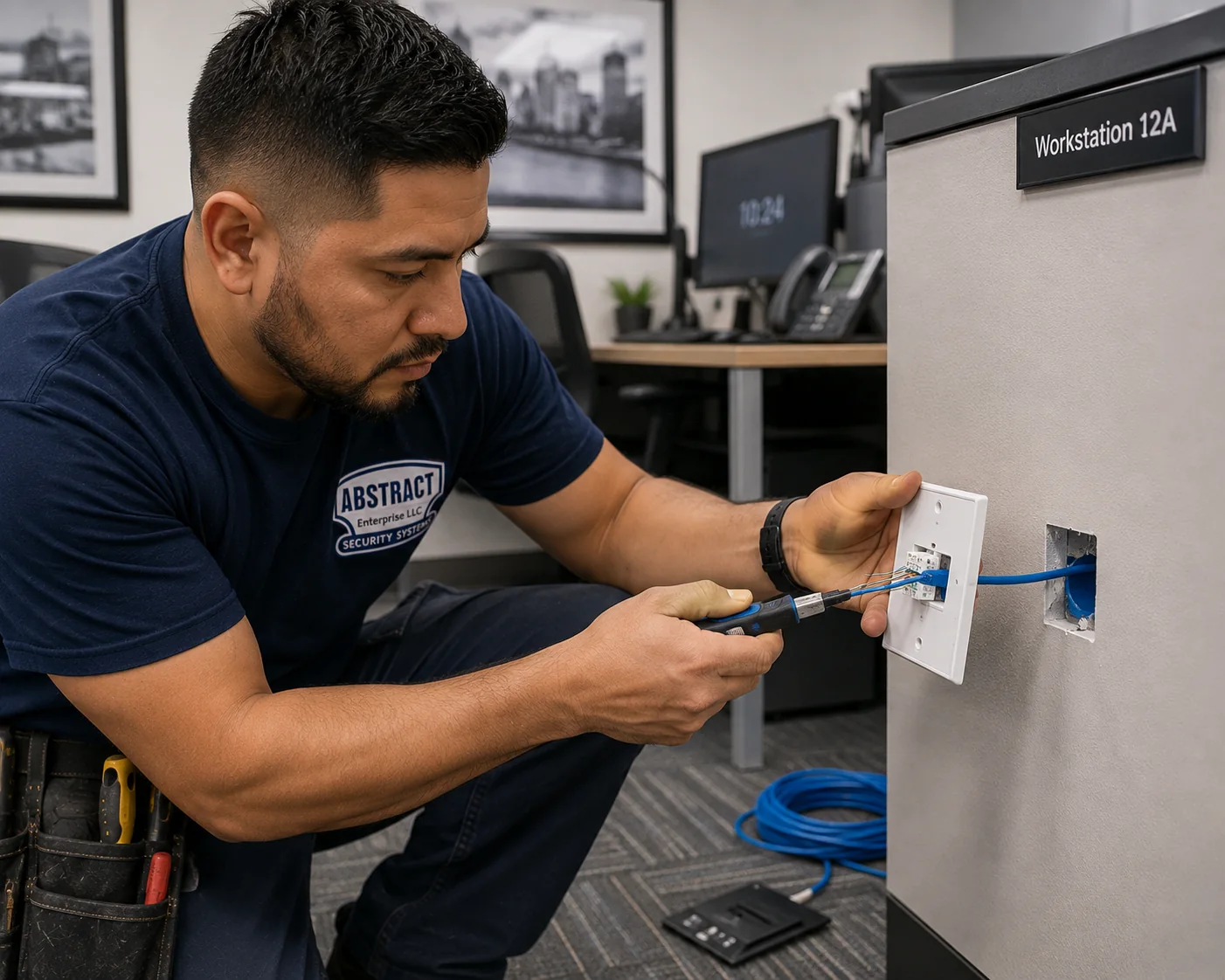
A technician in a navy work shirt holds a single-port white plate in one hand and a tool in the other at a partition wall, a blue cable running from the opening; a sign above reads Workstation 12A and a coil of cable lies on the carpet.
Test results saved for your records, next to a rack labeled by camera, access point, POS and office.
Equipment
Test Gear and Parts on a Hudson Valley Cat6 Repair Van
Because the next supply house can be a long way off, the van carries what the region’s faults call for. These are the categories of equipment and material that go out on every Cat6 repair north of the city.
Certification Tester
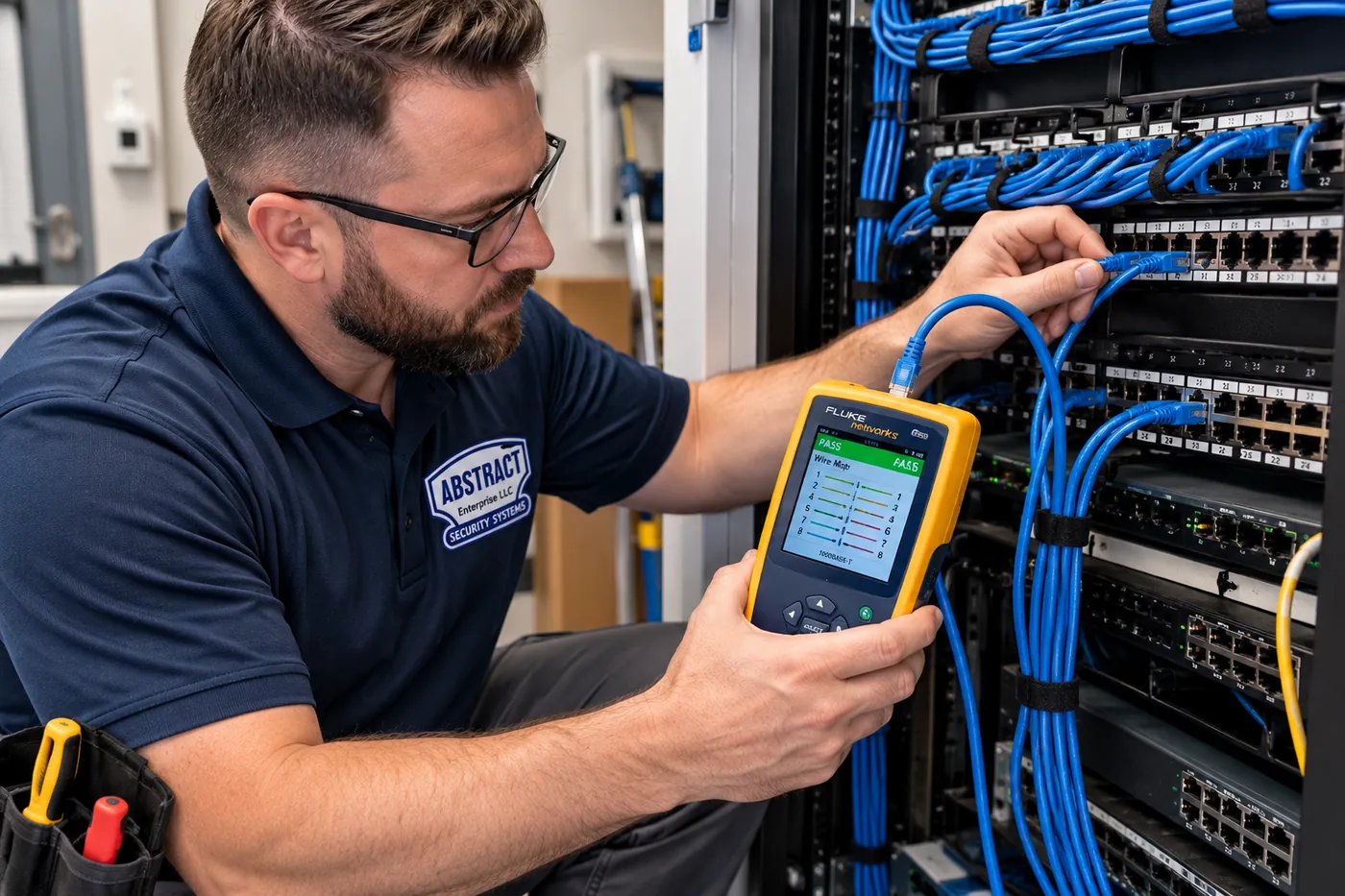
Measures each link against TIA limits for its category — wire map, length, insertion loss, NEXT, return loss and the related parameters — and saves the result as the baseline for the next storm or season.
Fault Location by Distance
Crosstalk and reflection plots that place damage at a termination, at a building entry or a measured distance along a run, so the lift, the ladder or the shovel goes to the right spot.
PoE and Link Qualification Tester
Checks whether a switch port still delivers power and at what class, and what speed a link negotiates. The quickest way to separate a storm-damaged port from a damaged cable.
Tone Generator and Probe
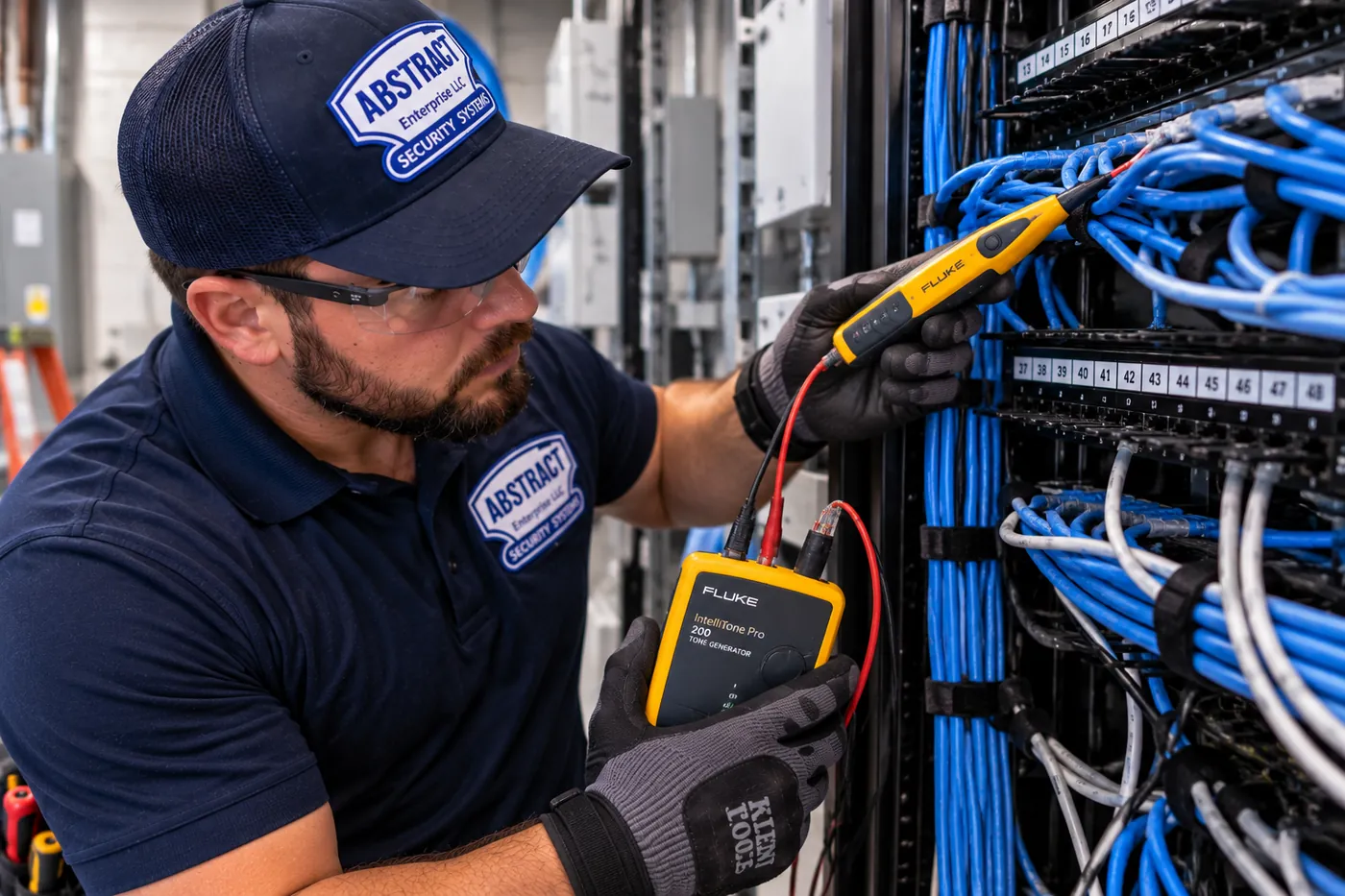
Follows one cable through a shared telecom room, a barn ceiling or a packed wall sleeve without cutting anything, and identifies your ports before a neighbour’s are touched.
Outdoor-Rated Connectors and Enclosures
Connectors and sealed boxes for camera, gate and pole ends, with the materials for drip loops and sealed entries, so an outdoor termination survives rain and frost.
Data-Line Surge Protectors
Listed protectors for Ethernet and PoE runs that enter a building from outside, fitted near the entry and bonded to the building’s grounding.
Cat6 and Cat6A Keystones and Modules
Matched to the category of the link and, where possible, to the brand already installed, for wall plates, floor boxes and modular patch panels.
Cable for Every Location
Solid-copper Cat6 and Cat6A in riser and plenum ratings for indoors, plus outdoor and direct-burial cable for runs that leave the building.
Conduit, Supports and Labels
Flexible conduit and hangers to keep repaired runs off beams, racking and soil, and both-end labels with an updated port map.
Why the tester matters more than the toolbox. A light-up continuity tester shows that each conductor reaches the right pin, and nothing else. It cannot see a surge-weakened pair, a frost-crushed length of cable in a conduit, or a chewed jacket that still has every wire intact. A storm or a winter can leave a Cat6 link connected but far outside its category, so a repair that ends with eight green lights is not a repair to the standard Cat6 was bought for.
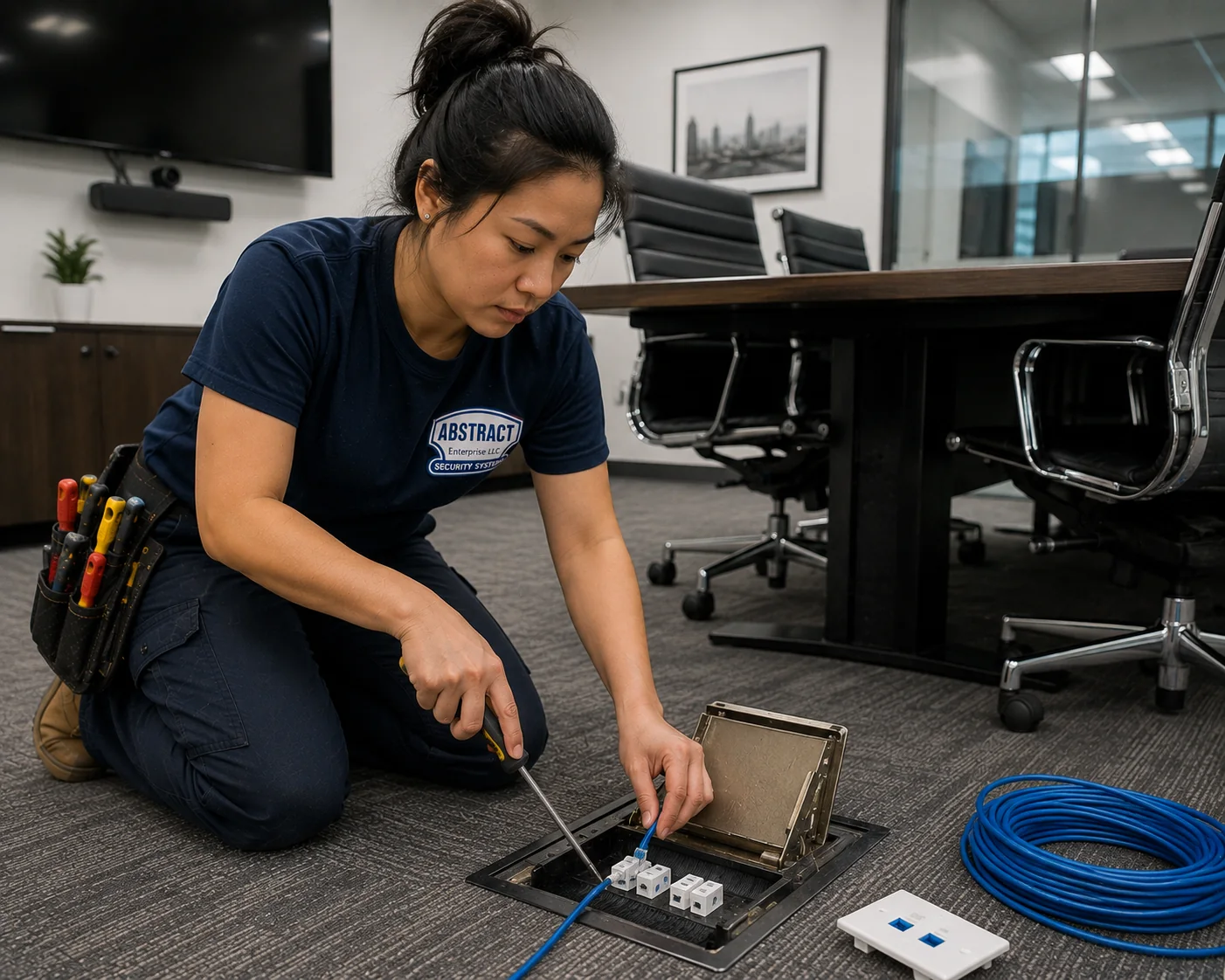
A technician kneels on carpet beside a conference table with the brass lid of a floor box tipped open, working a screwdriver into a row of white jacks; a coil of blue cable and a two-port plate lie beside her.
AI Overview Reality Check
What AI Gets Wrong About Cat6 Repair in the Hudson Valley
A note on method: Google’s AI Overview could not be viewed from the tools used to research this page, so nothing below is presented as its exact wording. Each heading is a claim that general how-to guides, forums, retailers and cost sites commonly publish and that answer engines tend to repeat. Under each is what changes when the Cat6 is in a valley barn, warehouse, office park or stone building.
“Ethernet is isolated, so lightning can’t travel along it”
Forum threads on linking outbuildings often include someone saying that Ethernet’s isolation transformers make lightning a non-issue for a copper run between buildings. A thread on the MikroTik forum captures both sides, including one participant calling the lightning concern a myth.
Another participant in the same thread makes the point that matters: Ethernet’s isolation is functional, not a safety rating, and each building has its own grounding electrode. A long run between two structures connects two different ground references and acts as an antenna for induced surges. In a county that, by Earth Networks’ count, sees hundreds of thousands of lightning pulses a year, the damaged switch ports we test after storms are not a myth.
That is why a valley Cat6 repair on an outdoor run includes asking what protects each end. A protector bonded at the entry, or fiber for the exposed stretch, is part of fixing the link, not an upsell.
“Any Cat6 will do outdoors if it’s inside conduit”
Plenty of advice treats conduit as weatherproofing, and indoor cable gets pulled into buried pipe on that basis all the time.
Buried conduit is a wet location. It collects water from joints and condensation, and in this climate that water can freeze. Electricians describe freezing water in conduit crushing conductors and damaging jackets, and cable makers’ outdoor guidance calls for direct-burial or outdoor-rated cable in underground conduit, with slack left to allow for freeze and thaw.
So when a buried run fails, the cable type is the first thing we check. Indoor cable in a wet conduit gets replaced with the right cable, not re-terminated.
“If the cable still lights up, the storm didn’t damage it”
The usual home check after a storm is to see whether the device comes back. If it does, the cabling is assumed fine.
Surges do not always destroy. They can weaken a pair, pit a contact or degrade a protector, leaving a link that works today and fails next month or negotiates a lower speed. A continuity check cannot see any of that.
Certification testing can, especially when there is an earlier result to compare against. That is why we save the results of every repaired link: after the next storm, the comparison takes minutes.
“Chewed cable just needs electrical tape”
Taping over a nicked jacket is common advice for minor cable damage, and on a power cord it at least keeps fingers off the conductors.
On Cat6, tape does nothing for the pairs underneath. Bites that disturb the twist or nick a conductor change the link’s crosstalk and return loss whether or not the jacket is covered, and taped damage in a damp barn keeps letting moisture in.
Rodent damage gets located, cut out and either repaired with rated in-line hardware or replaced, and the new cable is moved off the route the animals use.
“A Cat6 drop costs a couple of hundred dollars anywhere”
National cost guides publish per-drop figures for new Cat6 — Fixr’s January 2025 guide puts it at $125 to $250 including materials and labour — and those numbers are often quoted as if they applied to any cable job.
They describe new drops in open, accessible spaces. A valley repair is mostly diagnosis across buildings and distances: which runs failed, where each fault sits, whether it was storm, frost or animals, and what the repaired link needs to survive. A run to a barn or a pole camera also has outdoor ends and an entry to make good.
So we price the two parts apart: time on site at $195 an hour against a three-hour minimum, and any run that must be replaced from $175 per drop, the figures on our Hudson Valley repair pages.
“Long runs just need a better cable”
When a long Ethernet link misbehaves, the internet often suggests buying a higher grade of cable, as if Cat6A or “Cat7” extended the distance.
Every twisted-pair category is designed around the same 100-metre channel, and higher grades buy speed and headroom within that distance, not more of it. Warehouses and estates in the valley regularly have runs at or past that limit, and heat adds to the loss.
The fix for a too-long run is a closer switch, a shorter path or fiber. We measure length first, so you do not pay for a premium cable that cannot solve the problem.
“You can find a cable fault by eye”
DIY advice usually starts with walking the cable looking for damage, and when a run is short and exposed that can work.
Runs in the valley disappear into barn ceilings, buried pipe, stone walls and warehouse structure thirty feet up. Looking along them means ladders, lifts and opening things up, often in the wrong place.
Fault-location testing reads the distance to the damage from the end of the cable. We go to that distance, look there, and repair there.
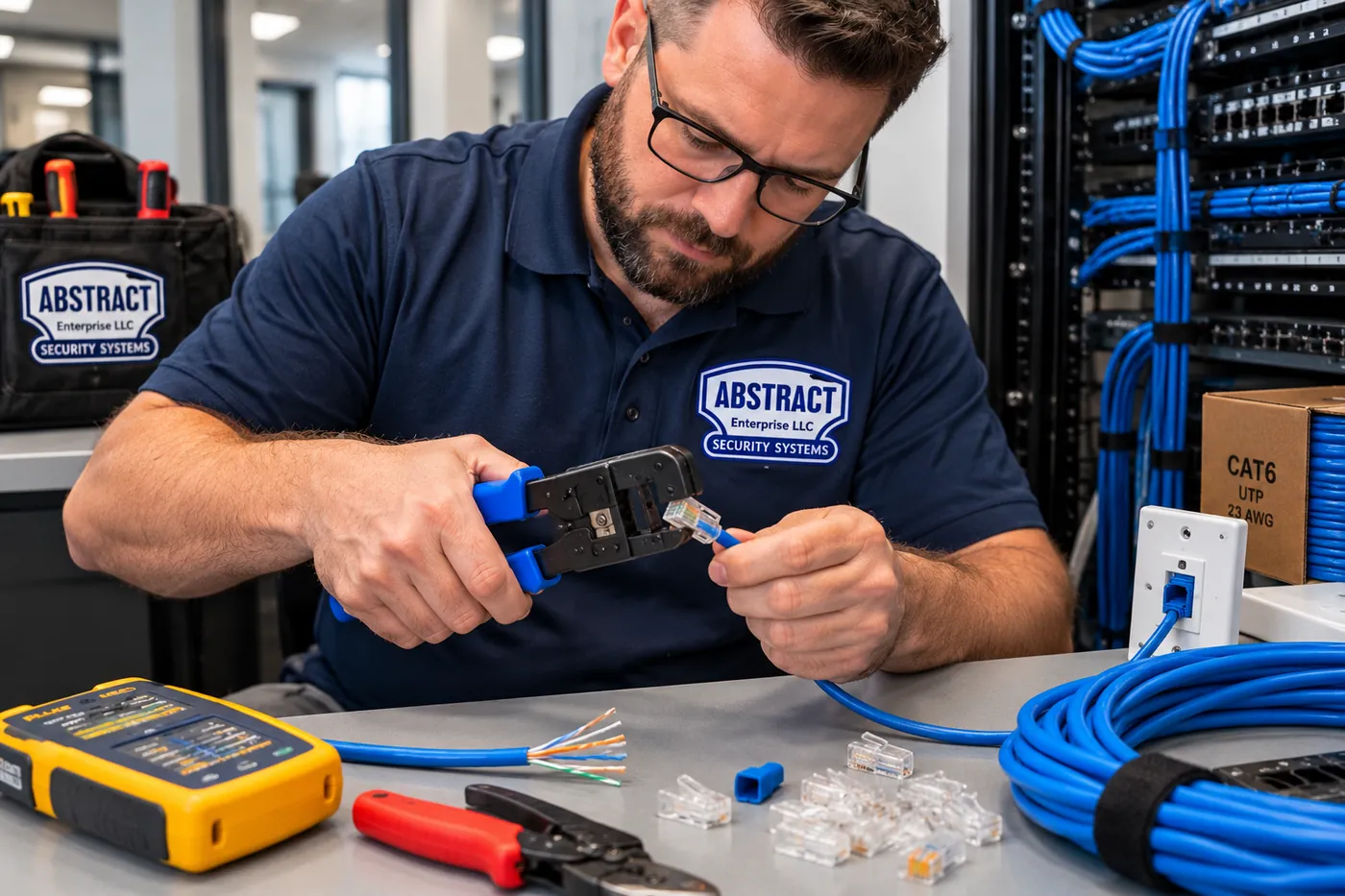
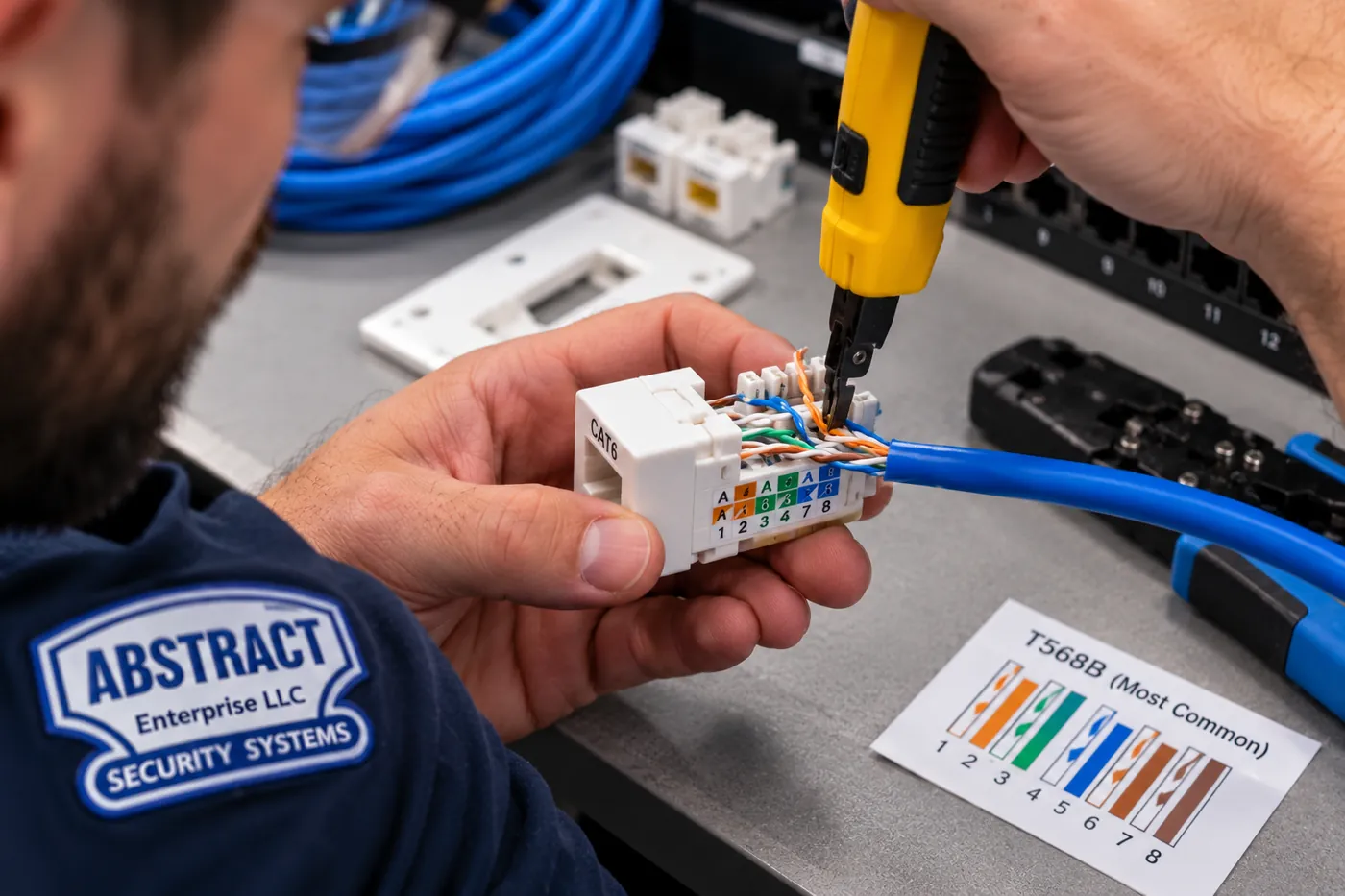
A fresh RJ45 crimped on a repaired run, with the tester on the bench to check it right after.
Get the Far Building Back Online
Tell us which runs failed, which buildings they connect and when the trouble started. We will tell you what the cause most likely is and what to expect on the first visit.
Office park, warehouse, school, farm, estate or historic building — describe the failing links and the buildings they run between, and a written answer comes back the same business day. Prefer to talk? Dial (800) 486-0943.
✅
We Got Your Request!
A technician will reply the same business day. For a link that is down right now, ring (800) 486-0943.
How It Works
Our Cat6 Repair Process
Six steps, built around one idea: the trip should finish the job, whether it is a single jack in a White Plains suite or a run to a barn outside New Paltz.
1. Describe the fault and the site
You tell us which links fail, what they feed, when it happens and which buildings they run between. Photos of the switch, the patch panel and any outdoor entry let us judge the likely cause before anyone drives out.
2. Plan the trip so it finishes
We confirm access to every building, gate and closet on the run, check whether a lift or ladder height is needed, and load matching Cat6 or Cat6A parts, outdoor connectors and replacement cable for the most likely fixes.
3. Test and locate on site
Each failing link is tested against its category limit from both ends. Fault-location readings put the problem at a termination, at an outdoor entry or at a distance along the run.
4. Agree the repair
For each link you get the finding and the fix: re-terminate, replace a cord or outdoor plug, protect an entry, repair a damaged length or replace the run. Nothing beyond the agreed work starts without your approval.
5. Repair for the conditions
Terminations are remade on matched hardware, outdoor ends get connectors and entries suited to weather, damaged lengths are repaired or replaced with cable rated for where it runs, and abandoned lengths are removed.
6. Retest, label and record
Every repaired link is tested again and labelled at both ends. You receive the saved results and a short record of what was found, so the next storm or season can be compared against it.
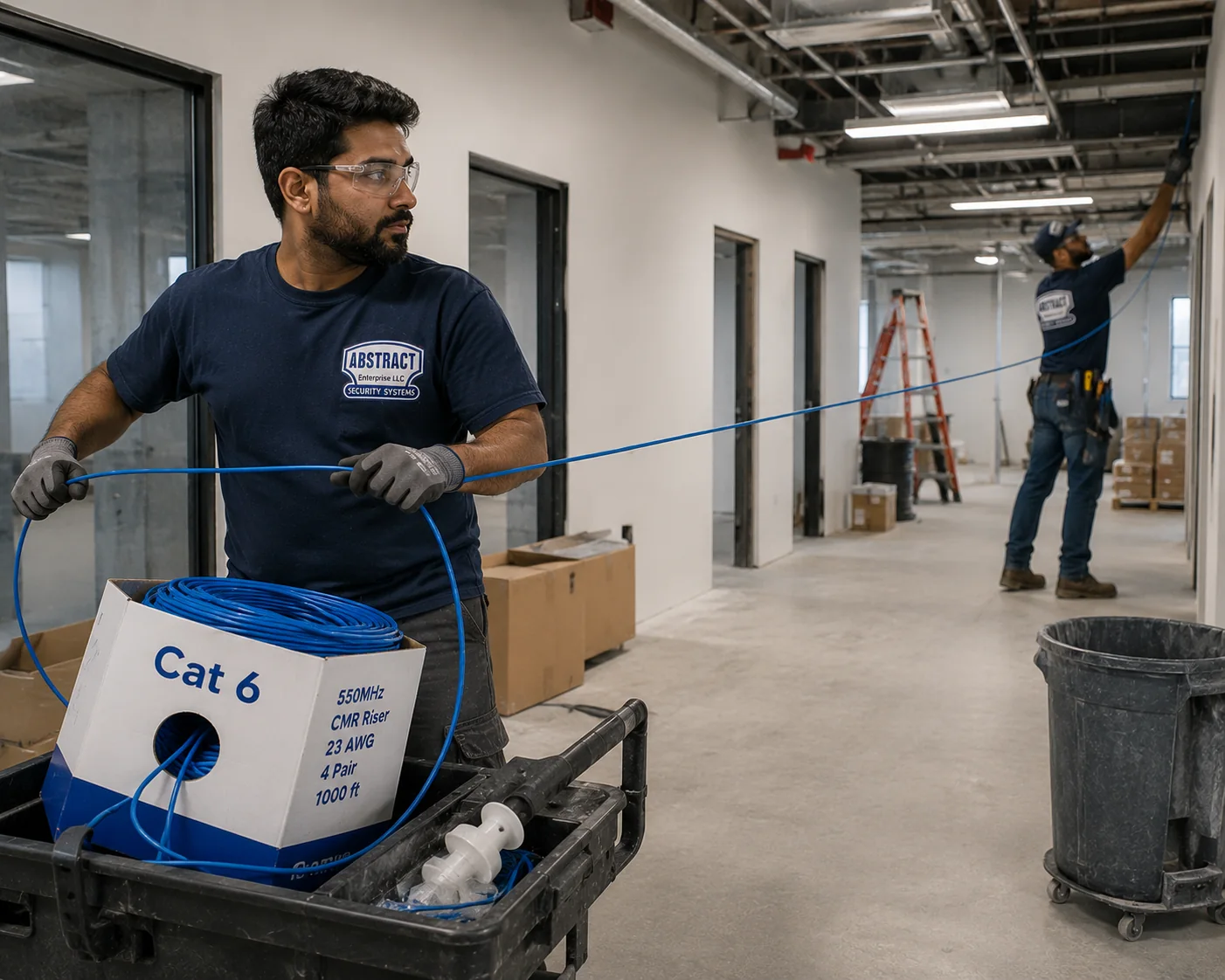
In a corridor with an exposed ceiling, one technician pays blue cable off a carton marked Cat 6, 550MHz, CMR Riser, 23 AWG, 4 Pair, 1000 ft on a cart while a second technician on the far side feeds it up toward the ceiling.
Coverage Area
Cat6 Repair Near the Hudson Valley’s Landmarks
These six places say a lot about the building stock the region’s Cat6 runs through, and how it ages. Each is a reference point for the kind of property around it, not a claim of work inside it.
Kingston Stockade District, Ulster
Eight blocks and 32 acres of the original Dutch settlement, listed on the National Register in 1975, with Colonial stone houses on all four corners of Crown and John streets and the Senate House of 1676. Thick walls, surface runs and packed sleeves.
East End Historic District, Newburgh
445 acres and 2,217 buildings, including Washington’s Headquarters State Historic Site, largely two- and three-storey Italianate brick townhouses. Offices and apartments in masonry where Cat6 is stapled, surface-run or fished through old chases.
Stewart International Airport, New Windsor
About 1,552 acres in the towns of Newburgh and New Windsor, with runways of 11,817 and 6,004 feet and the Air National Guard’s 105th Airlift Wing. A reference point for the logistics and warehouse belt that has grown around it.
Vassar College, Poughkeepsie
Roughly 1,000 acres and more than 100 buildings, founded in 1861, with the Main Building by James Renwick Jr. completed in 1865. Campus settings like this pair 19th-century masonry with modern networks.
Vanderbilt Mansion, Hyde Park
The National Historic Site keeps 211 acres of an estate of about 600, with the 1896–1899 mansion, carriage house and a former hydroelectric plant. A picture of the estate landscape in Dutchess, where buildings sit far apart.
Palisades Center, West Nyack
About 2.36 million square feet of retail on Route 59 in Rockland, sold at a February 2026 foreclosure auction according to Hoodline. Large shopping centres and their neighbouring plazas carry decades of tenant-installed cabling.
We also repair Cat6 in Yonkers, Mount Vernon, New Rochelle, White Plains, Harrison, Rye, Port Chester, Tarrytown, Sleepy Hollow, Elmsford, Valhalla, Armonk, Mount Kisco, Peekskill and Yorktown; Nyack, Nanuet, Pearl River, Orangeburg, Suffern, Spring Valley and New City; Newburgh, Middletown, Goshen, Chester, Monroe, Montgomery, Warwick and Port Jervis; Brewster, Carmel, Mahopac and Cold Spring; Poughkeepsie, Beacon, Fishkill, Wappingers Falls, Hyde Park, Rhinebeck and Millbrook; and Kingston, New Paltz, Saugerties, Woodstock, Highland and Ellenville — and the towns between them.
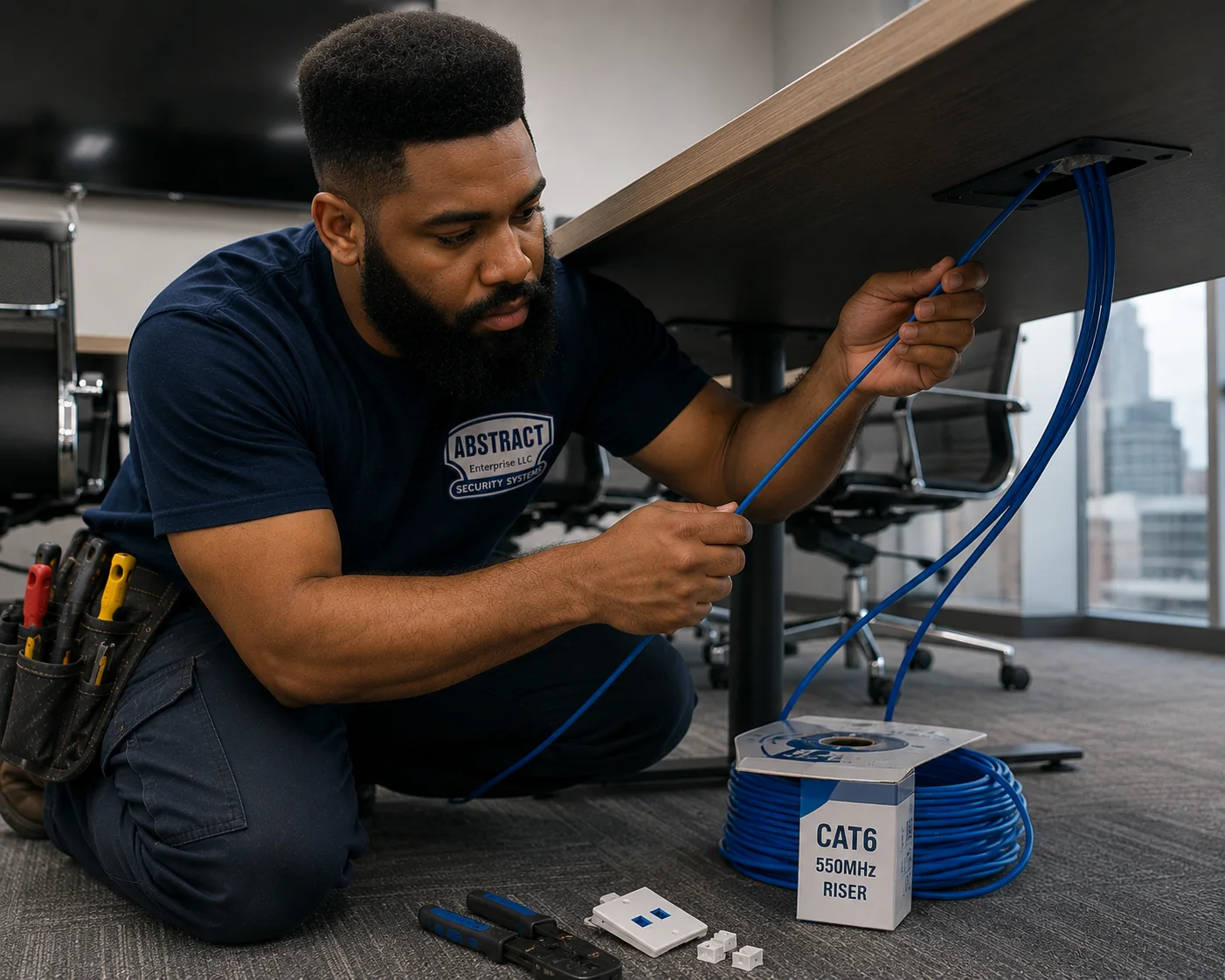
Kneeling under the edge of a dark conference table, a bearded technician feeds two blue cables up through a grommet in the tabletop; a carton labelled CAT6 550MHz Riser, crimpers and plates sit on the floor.
Pricing
Cat6 Repair Cost in the Hudson Valley
Every figure below is one we already publish on our own Hudson Valley pages, and the table says which. Where a job depends on what the testing finds, or on site logistics such as a lift, it is quoted in writing before the work starts. Repair time and replacement cable appear as separate lines, so you can see which one you are paying for.
Item
Price
Scope and source
Technician time on site: certify, locate faults, remake jacks and weather-facing plugs, prove the result
$195/hr, 3-hour minimum ($585)
The specialty rate printed on our Hudson Valley network cable repair hub; the block is spent on however many links the technician can bring back
Additional time beyond the minimum
$195/hr
Billed in hourly increments, as published on the same page
Replacement Cat6 run where the cable cannot be saved
From $175 per drop
The figure on our Hudson Valley repair hub and county pages, which bundles the new cable, jack, faceplate, panel termination, test, labels at each end and a cord
New Cat6 drop up to 100 ft (installation pricing, for comparison)
$309 per drop
From the Hudson Valley Cat6 installation price table, which lists $265 for Cat5e and $441 for Cat6A on the same terms
Link between buildings corrected — fiber conversion or listed, bonded protection at each entry
Quoted per run
Listed this way on our Hudson Valley repair hub, with the recommendation given in writing
Lift hire where the site has none
At cost, quoted per day
Shown as its own line, as on our Orange County repair pricing, rather than folded into the hourly rate
Closet audit, mapping and labelling
Quoted by port count
Jack-to-port map, live-versus-abandoned identification, durable labels and legend
Excavation of buried runs, new wall penetrations, after-hours windows
Quoted after testing and a site look
Depends on route, ground, masonry and building rules
What the three-hour block covers on a valley visit
The minimum buys a technician’s time on site with the full test kit. On a typical repair it covers testing every link you are worried about, locating each fault, re-terminating jacks and panel ports, remaking an outdoor plug or two and certifying the result. When a storm or a winter has affected several runs at once, they are usually tested and most repaired inside the same block. If testing shows runs that need replacing or excavating, you get a price for those before any cable is pulled or ground is opened.
Where these figures come from
The repair rate and the replacement-run figure here are the ones printed on our Hudson Valley network cable repair hub, and this page uses them rather than inventing a second set. Your written quote confirms the figures for your county and site before anything is booked. Work that genuinely costs more in one place than another — longer excavations, lift hire, unusual access — is measured and quoted for the site.
What moves a Hudson Valley Cat6 repair bill
Where the damage is: faults at jacks, panels and outdoor plugs are quick; damage inside buried conduit, at height in a warehouse or inside a stone wall takes access work.
What caused it: a single bad termination is one fix; storm damage, frost or rodents often affect several runs and their pathways.
Whether the run leaves the building: outdoor ends, entries and protection add parts and time, and sometimes change the recommendation to fiber.
The cable itself: genuine solid-copper Cat6 rated for its location can be repaired; indoor cable outdoors, CCA and stranded patch cable used as permanent runs generally cannot.
Site logistics: lifts, gates, animals, shared telecom rooms, tenants and the distance to the site all shape how the visit is planned.
About the national numbers you may have seen. Cost sites such as Fixr (January 2025 update) list $125–$250 for a new Cat6 drop with materials and $45–$75 an hour for installer labour across the United States. Those figures describe new work in open spaces; they are not ours, and they do not cover diagnosing a storm-damaged run to a barn.
Full terms — including 50% deposit, one-year parts-only warranty on AESS-supplied products, and the late-fee schedule — are set out in the service agreement.
Wire-map test at the patch panel, so a split pair or crossed wire shows up before we close anything.
Shop Our Systems
Cat6 Repair Packages & Pricing
Most Cat6 repairs in the six counties fit one of these three. Each uses only figures we already publish.
Starter — One Failed Link
$585
Three hours on site at $195 an hour. Suits a single dead link to a gate, a garage, a yard camera or a desk: we certify it, find the bad end or the damaged stretch, remake what failed and prove it passes. If that leaves time in the block, it goes on any other suspect runs you point us to.
Standard — Storm or Season Recovery
$195/hr after the first 3 hours
For a site where a storm, a power event or a winter has hit several runs: every exposed link tested, surge, frost and rodent damage separated from ordinary faults, terminations and outdoor ends remade, protectors fitted where agreed, and a full set of saved results handed over.
Premium — Repair Plus Replacement Runs
Repair time + from $175 per run
Where testing finds runs that cannot be saved: repair time for everything that can, plus replacement runs from $175 per drop in cable rated for where they go, abandoned lengths removed where accessible, and an updated port map. Links between buildings that need fiber or bonded protection are quoted per run.
Bring Your Own Parts — Labour Only
Already have keystones, outdoor connectors, protectors or a spool from the original job? We can use them, billed as repair time only, provided they suit the link: Cat6A parts on Cat6A runs, solid-copper cable for permanent links, outdoor-rated cable for anything that leaves the building. Everything installed is tested either way. Parts you supply carry their manufacturer’s warranty rather than ours, and if they cannot produce a passing link we tell you before the work is done.
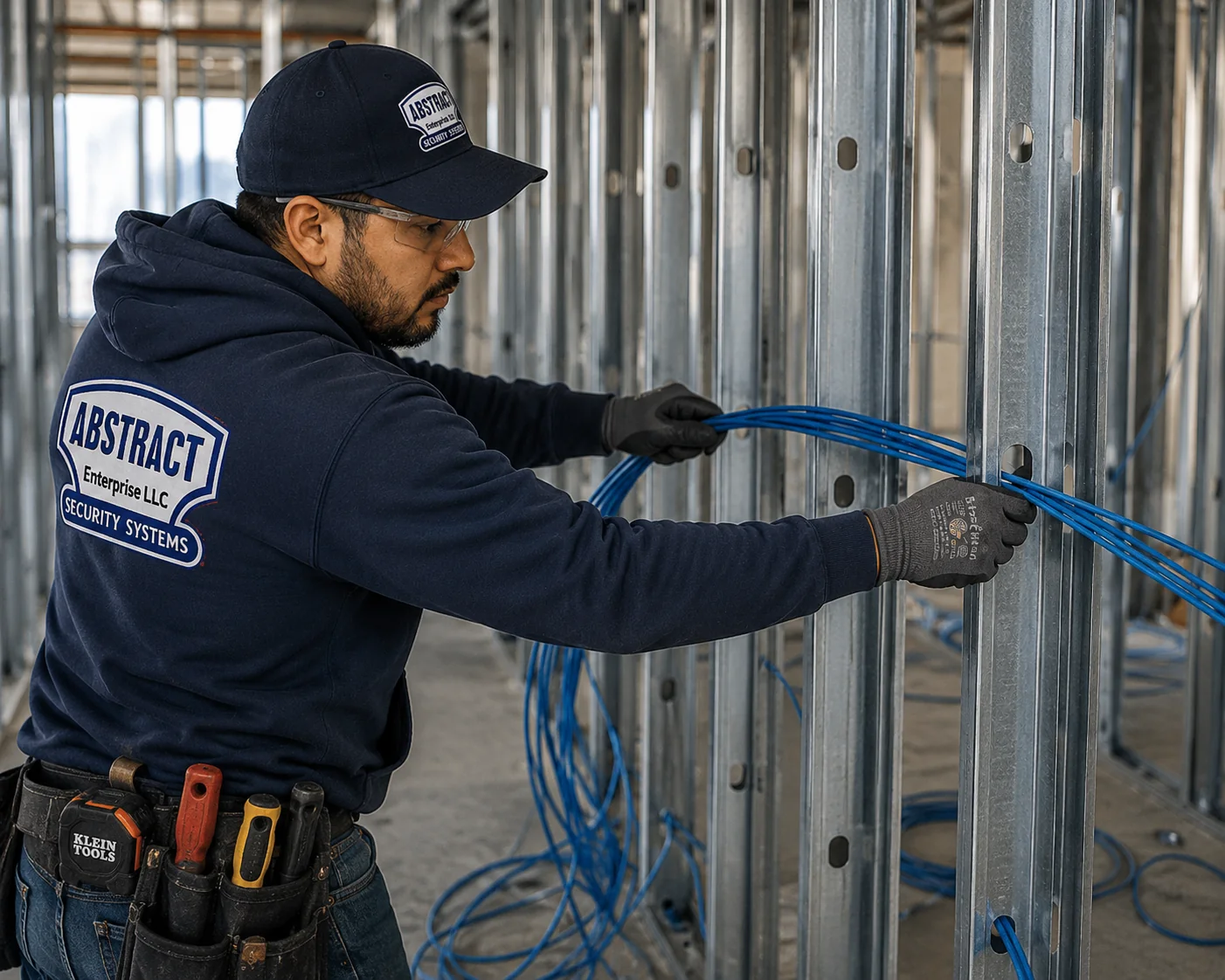
A technician in a cap and gloves leans into a framed wall of bare steel studs, guiding a loose bundle of blue cable through the punched openings.
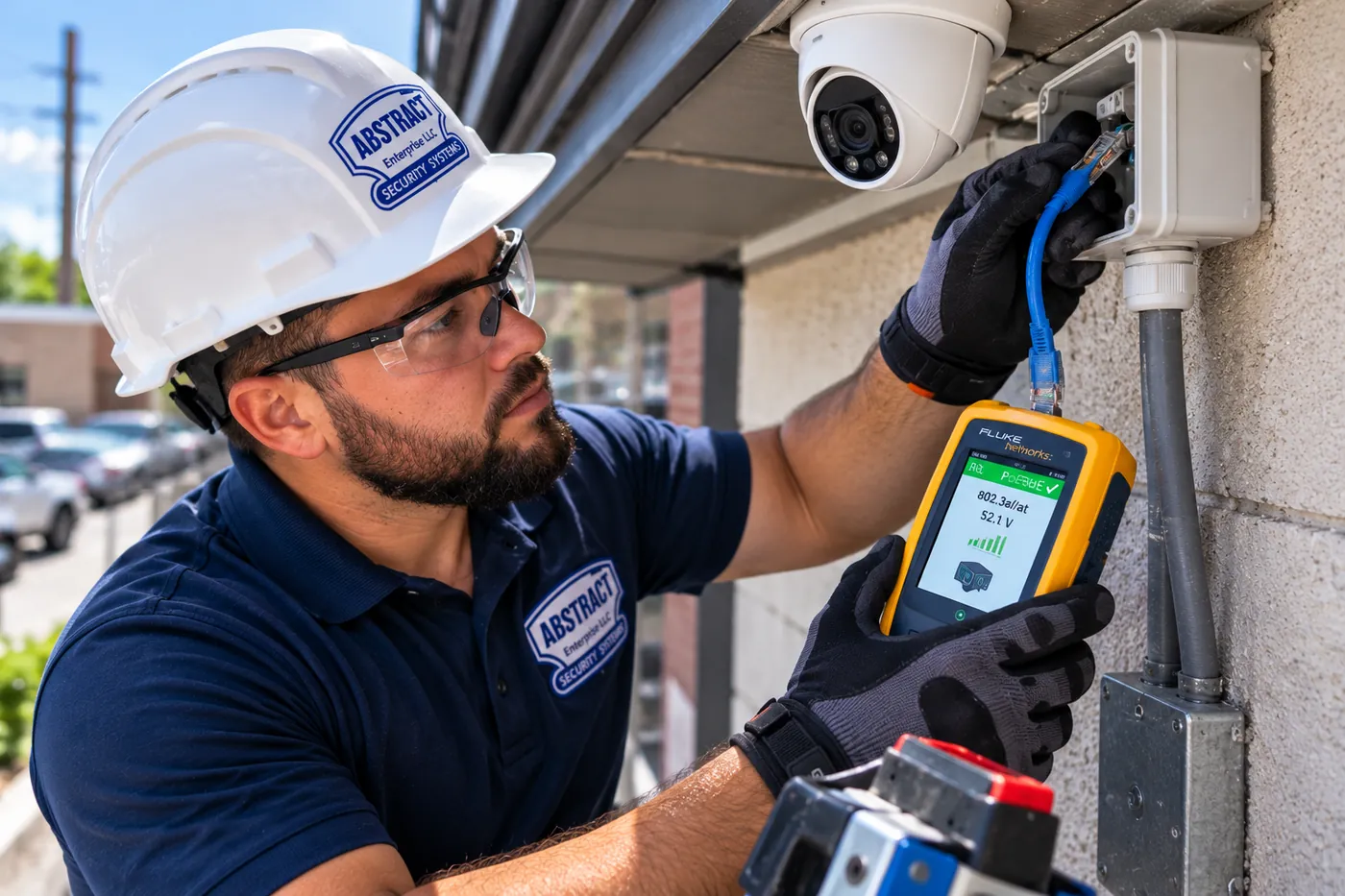
Camera offline? We test the cable and the PoE at the camera, not just at the switch.
Before the Next Storm Finds the Weak Run
Send photos of the switch and any outdoor entries, and a list of the runs that leave your buildings. We will tell you which are most exposed and what a visit would cover.
A failed keystone is the same failure in Yonkers and in Woodstock. What changes is the building around it, how far the run goes and what the weather has been doing to it. County Cat6 repair pages that are already live are linked below; the other county links open our quote form until their pages are ready, and our existing county network cable repair pages cover general Ethernet faults.
Westchester’s Cat6 is mostly in offices, medical buildings and dense suburbs. The I-287 and Platinum Mile office stock, much of it decades old, brings shared telecom rooms and inherited panels; the medical and research campuses at Valhalla and Tarrytown bring documentation requirements; and the low-lying parts of the Sound shore, where Ida put water into basements in 2021, bring corroded lower-level closets. The county licenses home improvement contractors through its Department of Consumer Protection. See also our Westchester network cable repair page.
Rockland combines the Route 59 retail corridor around the Palisades Center, office and light-industrial buildings in Orangeburg and Pearl River, and suburban houses with detached garages and studios. Tenant turnover in shopping centres leaves cabling nobody owns, and runs from houses to outbuildings are often indoor cable laid outdoors. Rockland’s county code, including Chapter 250 on electricians and electrical inspections, sets its own trade rules. Our Rockland network cable repair service covers wider Ethernet faults.
Orange had the most lightning pulses of any New York county in Earth Networks’ 2020 count, and it is home to the warehouse belt around Stewart, Route 17K and I-84. That combination means two dominant fault types: surge damage on runs that leave buildings, and damage at height in high-bay distribution buildings where long runs feed cameras and access points. Newburgh’s East End adds historic masonry. See our Orange County network cable repair page, which also lists lift hire.
Putnam is smaller and more spread out, with Brewster, Carmel, Mahopac and Cold Spring as its centres and a lot of rural and estate property in between, much of it in New York City’s reservoir watersheds. Runs to garages, barns and gates, outdoor PoE cameras and long driveways dominate, and the distance to sites makes planning a one-trip repair especially important. Our Putnam network cable repair page covers general faults.
Dutchess spans the IBM and South Road corridor in Poughkeepsie, the Route 9 commercial strip through Fishkill and Wappingers Falls, Beacon’s converted industrial buildings, Vassar and other campuses, and the estates and farms around Hyde Park, Rhinebeck and Millbrook — 620 farms in the 2022 agriculture census. Summer attics, unheated barns and long runs between buildings are the typical causes of failure. Our Dutchess network cable repair service covers the wider Ethernet side.
Ulster runs from Kingston’s Stockade and the former IBM site at iPark 87 to New Paltz, Saugerties, Woodstock and the Catskill hamlets. Stone buildings with packed sleeves, large partly reused industrial structures, and studios and outbuildings on rural land all show up in the faults we repair. Ulster County’s September 2025 announcement of $20.8 million in state broadband funding for nearly 1,300 unserved locations pending federal approval at the time, points to more rural sites connecting new service to existing cabling. See our Ulster network cable repair page.
Seasonal Guide
The Hudson Valley Cat6 Year: What Fails When
Cat6 faults in the valley follow the calendar more than they do in the city. Knowing what each season tends to break helps you notice a problem early and helps us bring the right parts. This is the pattern we work to; individual sites vary.
Season
What tends to fail
Why
Worth doing
Late winter
Runs to unheated garages, barns and gates; buried runs in conduit
Freeze–thaw at marginal terminations and outdoor plugs; ice in conduit
Note which links drop on the coldest days so they can be tested before spring
Spring thaw and rain
Outdoor camera and gate ends, basement and crawlspace runs
Water in plugs and entry boxes; rising groundwater in conduit and cellars
Pre-season test of seasonal buildings before they reopen
Early summer storms
Switch ports, outdoor PoE devices, runs between buildings
Induced surges from nearby lightning; power restoration after outages
Fit protection at entries; save test results as a baseline
High summer
Long runs in attics, barn and warehouse roofs, dense PoE bundles
Heat raises insertion loss on runs already near the limit
Measure lengths; loosen bundles; move runs off the hottest spaces
Autumn
Runs in barns, sheds, attics and drop ceilings
Rodents move indoors as temperatures fall and chew cable
Lift cable off beams and insulation; sleeve runs in outbuildings
Year-round
Jacks and floor boxes in offices, panels in shared closets
Furniture moves, cleaning, fit-outs and other trades
Label both ends; keep the port map current
The common thread is that most seasonal failures start as a weakness that a certification test can see long before the link drops. A saved test result from a calm month is the cheapest storm insurance a multi-building site can have, because it turns the post-storm question from “what broke?” into “what changed?”
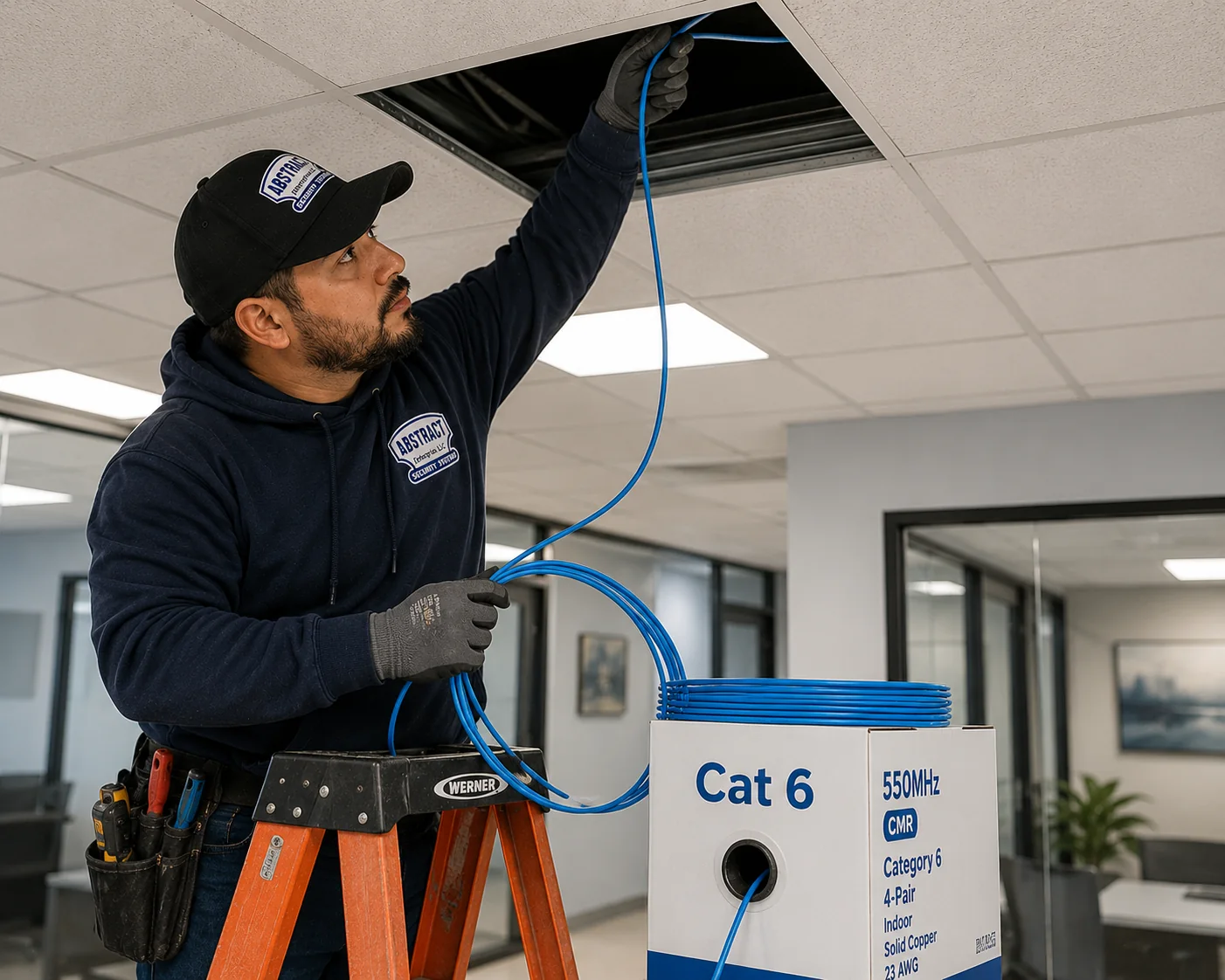
Standing on an orange stepladder, a technician in a cap pushes blue cable up through a lifted ceiling tile; the carton below reads Cat 6, 550MHz, CMR, Category 6, 4-Pair, Indoor, Solid Copper, 23 AWG.
A dead desk jack re-terminated in the wall, then tested from the jack back to the panel.
After a Storm
A Storm-Recovery Checklist for Multi-Building Sites
When the storm has passed and some of the network has not come back, the order you check things in saves time and money. These are the steps we walk callers through, starting with safety. None of them involves opening cable or electrical equipment.
Step
What to do
What it tells us
1. Safety first
Stay away from downed lines and wet electrical equipment; let the utility and an electrician deal with power damage
Nothing on the network is worth a risk; cabling work waits until the site is safe
2. Note what is down
List devices that did not come back: cameras, access points, desks, gate, outbuildings
Which runs to test first, and whether the pattern points to outdoor runs
3. Look at the switch
Photograph the port lights; check whether the switch itself restarted normally
Dark ports in a group usually mean switch damage; scattered ones point to cables or devices
4. Try a known-good port
Move one failed device’s cord to a port you know works
Separates a dead port from a dead cable or device
5. Check power budgets
If the switch has a management page or app, look at PoE status
A switch that came back with less power can leave cameras dark with healthy cable
6. Look at outdoor ends
From the ground, check camera and gate connections for visible damage or water
Burned or wet outdoor ends are often the only damaged part of a run
7. Send it to us
Photos, the list from step 2 and what you tried
Enough to plan a one-trip repair with the right parts
Two things to avoid: replacing a switch before the cables have been tested, and re-crimping outdoor plugs by hand, which often gets a camera back for a week and then fails again in the next rain. If you have earlier test results for the site, find them; comparing old and new readings is the fastest way to see what the storm changed.
Decision Guide
Repair the Copper or Change the Link: Runs That Leave the Building
Most indoor Cat6 faults end in a repair. Runs that cross open ground, connect two structures or feed a device on a pole deserve a second look at whether copper is still the right medium. This is how we weigh it with you, run by run, once the testing is done. The choice is always yours, and the recommendation is put in writing.
What we find
Usually the right call
Why
Fault at an outdoor plug or entry box; rest of the run tests clean
Repair the end with an outdoor connector, seal the entry, add a drip loop
The copper is healthy; the weather-facing termination was the weak point
Indoor-rated cable used outdoors or in buried conduit
Replace that length with outdoor or wet-location cable
The jacket was never made for sunlight or standing water and will keep degrading
Run between two buildings with separate electrical services, damaged in a storm
Fiber for that link, or copper with listed, bonded protection at each entry
A copper path between two ground references carries surges into both buildings
Run longer than the 100-metre channel, or close to it in a hot space
Closer switch, shorter route or fiber
No grade of twisted-pair cable extends the distance limit
Rodent damage confined to one reachable stretch
Rated in-line repair or partial replacement, rerouted off the animals’ path
The rest of the run is sound; the route caused the damage
Rodent or frost damage spread along most of the run
Replace the run in conduit or on supports
Many small faults add up to a link that cannot hold its category
PoE device at the far end browns out after the repair
Check the switch power budget and the device class before more cable work
A healthy cable cannot fix a port that no longer delivers enough power
Two practical notes. First, fiber does not carry power, so a camera or access point at the far end of a fiber link needs power at that building, a media converter or a switch, and sometimes a small battery backup; we include that in any recommendation. Second, where copper stays, a saved test result and a protector at each entry turn the next storm from a mystery into a short visit. Our AESS fiber crews for the Hudson Valley quote the fiber option whenever it is on the table.
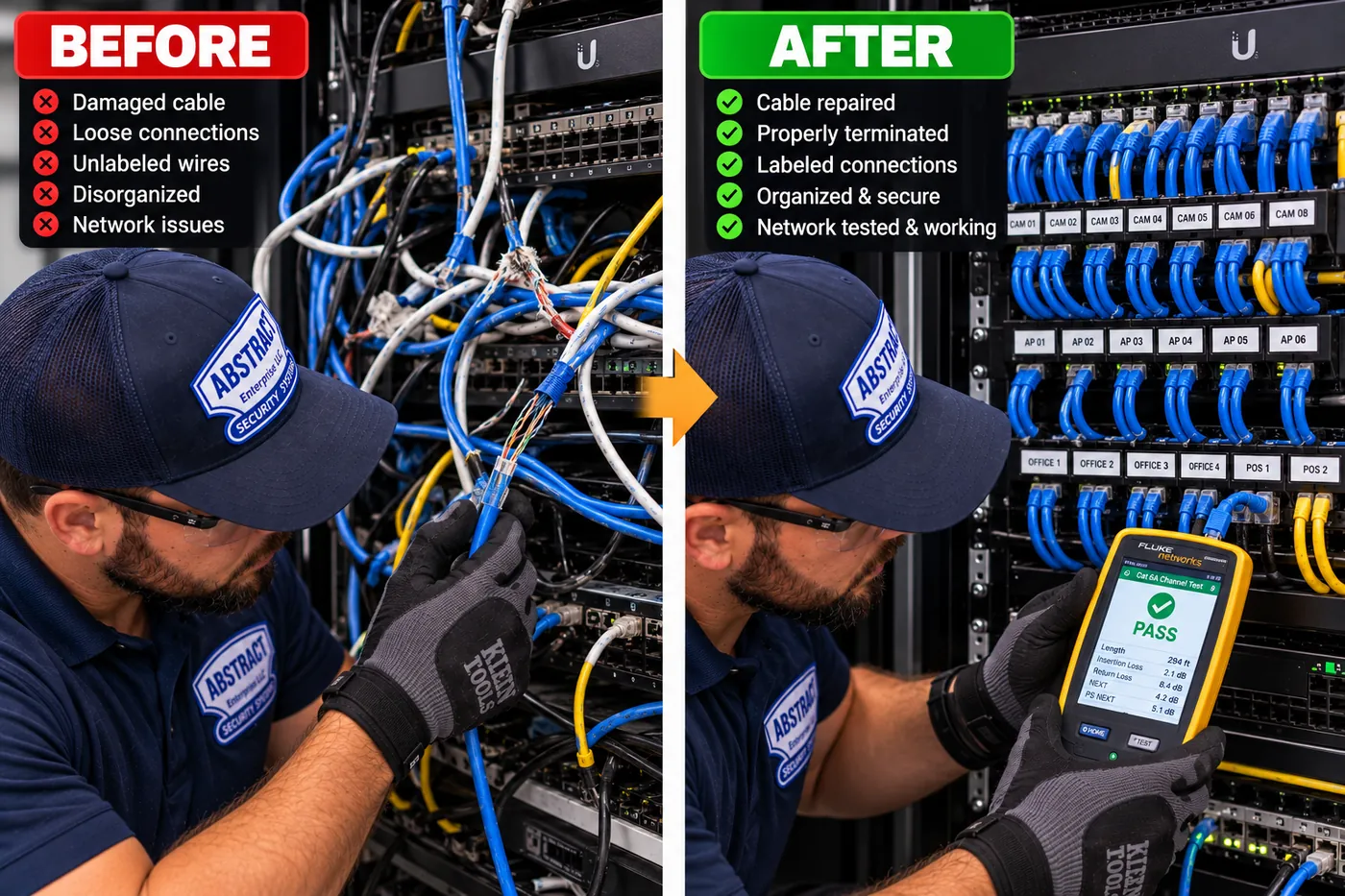
Before and after: damaged and loose runs replaced, every port re-terminated and labeled, then tested.
Complete Services
Every Cat6 Repair Service in the Hudson Valley
A failed Cat6 run north of the city often brings a camera, a switch or a building link into the same conversation. These are the related services across the six counties.
What we do first, second and last on a valley outdoor run — general practice rather than one particular call
We start at the ends that face the weather. The plug at a camera, the box on the side of a barn, the place where the cable turns into the wall: in this region those are where most outdoor faults live, and they are the cheapest to fix. We open them before anything else and look for water, corrosion, burn marks and cracked jackets.
Then we ask what connects the two buildings electrically. Separate meters, a subpanel, a generator, a protector at one end but not the other. That answer often decides whether we repair the copper or recommend replacing that link with something that does not carry current between buildings.
We test the run from the inside end, read the distance to the fault, and only then walk, climb or dig to it. And before we leave, the result goes on file with the date. On a site that sees storms every summer, the most useful thing we can hand over is a number to compare against next time.
Full Service List
Every Cat6 Cable Repair Service We Handle in the Hudson Valley
Across the Hudson Valley, Cat6 repair calls come from Westchester and Rockland offices, Orange County warehouses, and shops, schools and homes in Putnam, Dutchess and Ulster.
Diagnostics and Tracing in the Hudson Valley
Every visit starts with finding the real problem. Our Cat6 cable troubleshooting and Cat6 cable diagnostics begin at the dead device and work back to the rack, so we repair the fault instead of guessing. Network cable troubleshooting, Ethernet cable troubleshooting, network cable diagnostics and Ethernet connection diagnostics tell us whether it's the cable, the jack, the patch cord or the switch port. Hudson Valley offices, warehouses and homes often have runs nobody labeled when they were installed.
When nothing is labeled, network cable tracing comes first. Ethernet cable tracing and Cat6 cable tracing use tone generator cable tracing and network toner and probe testing to find which cable goes where. Ethernet cable fault detection and Cat6 cable fault detection with Cat6 cable tester diagnostics and Cat6 cable continuity testing then show where a run is open, shorted or split. That covers network connectivity troubleshooting and low voltage network troubleshooting from end to end.
Cat6 Cable Repair and Replacement
Damaged Cat6 cable repair is the core of this service. Cat6 cable damage from furniture, Cat6 cable damage from metal edges, rodents and renovations all show up as Ethernet cable jacket damage or crushed pairs. Damaged Ethernet cable repair, cut Ethernet cable repair, crimped Ethernet cable repair and broken Cat6 cable repair are matched to what we find, and when a section can't be trusted, Cat6 cable replacement, Ethernet cable replacement and network cable replacement swap the bad run for a new one. Warehouses, basements and outbuildings are where most Hudson Valley cable damage happens.
A lot of this work happens overhead. Cat6 cable repair above drop ceiling tiles, Cat6 cable replacement above ceiling grids and commercial ceiling network cable repair include overhead Cat6 cable routing and Cat6 cable support installation with J-hooks, so new runs don't sag on the tiles or rub the same edge again. Where a new drop makes more sense than a repair, we handle the Cat6 cable installation too.
Connectors, Jacks and Wiring
Many dead links come down to the ends. RJ45 connector repair, RJ45 connector replacement and broken RJ45 connector repair fix snapped clips and bad crimps, with RJ45 connector installation and RJ45 cable termination done to standard. Cat6 connector repair, Cat6 connector replacement, Cat6 cable termination and Cat6 cable retermination handle the same problem on Cat6 hardware. Hudson Valley homes and offices often have jacks with mixed wiring from different installers.
At the wall, we do Cat6 wall jack repair, Ethernet wall jack repair and network wall jack repair, plus Cat6 keystone jack repair, Cat6 keystone jack installation and Cat6 keystone jack termination. Ethernet outlet repair, network outlet repair, data jack repair and data jack replacement bring dead desk and wall ports back.
Some jacks were never wired right. Cat6 wiring repair, Cat6 wiring troubleshooting and incorrect Cat6 wiring repair find crossed or split pairs, and Cat6 wiring correction, T568A wiring repair and T568B wiring repair put both ends on the same standard. A clean Cat6 punch down repair finishes the job.
Patch Panels, Racks and Cleanup
Cat6 patch panel repair and network patch panel repair fix loose punch-downs and dead ports, and Ethernet patch panel troubleshooting finds which port feeds which desk. Cat6 patch panel termination is redone wherever a port fails testing. Hudson Valley office and warehouse racks are where cleanup and labeling help most.
Network rack cable repair goes hand in hand with network rack cable management and network cable organization. Patch cable replacement and network patch cord replacement swap worn cords, and network cable labeling and Cat6 cable labeling mark both ends. Network cable cleanup is where our before and after network cable repair photos come from: before and after Cat6 cable repair shows a tangled rack turned into a labeled, tested one.
Security Cameras, PoE and Wi-Fi
Cat6 cable repair for security cameras is one of our most common calls. PoE camera cable repair, security camera Ethernet cable repair and offline security camera network repair start with PoE connection troubleshooting at the camera, not just at the switch. Outdoors, weatherproof Ethernet connector repair and outdoor Cat6 termination repair stop water from killing the connection again. Hudson Valley properties use outdoor PoE cameras on long runs that take the weather.
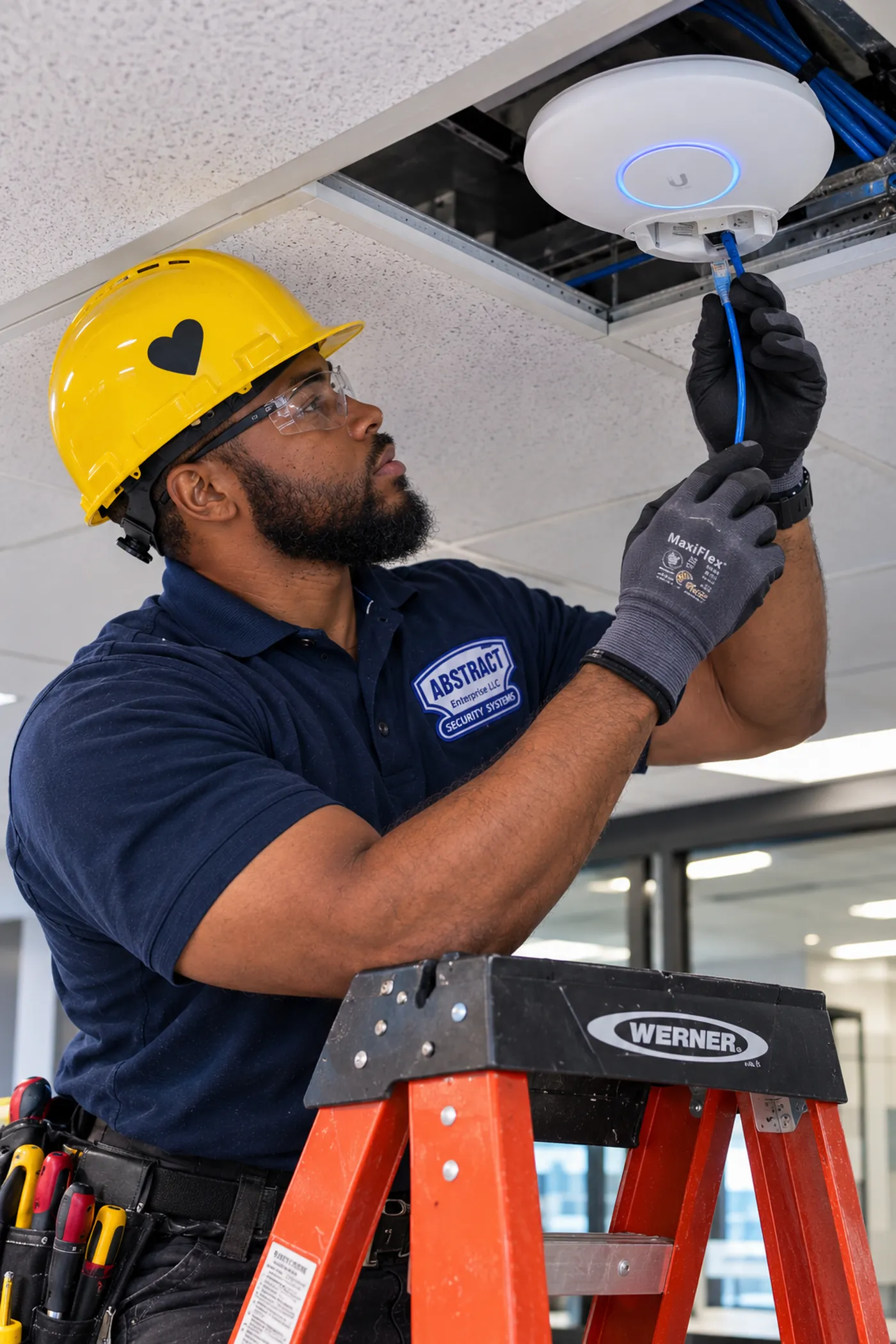
Wi-Fi drops often have the same cause. Cat6 cable repair for WiFi access points, wireless access point cable repair, ceiling mounted access point repair and PoE access point troubleshooting check the cable and connector feeding the AP before anyone blames the access point itself.
Offices, Retail and POS
Commercial office Cat6 repair covers office workstation network repair, office Ethernet connection repair and desktop computer Ethernet troubleshooting when a desk loses its link. Disconnected Ethernet connection repair and network connection restoration get people working again. Hudson Valley retail needs POS systems online all day.
For stores, retail store network cable repair, POS network cable repair, checkout counter Ethernet repair and retail POS connectivity troubleshooting keep registers and card readers online. We handle commercial network cable repair and residential network cable repair alike, along with low voltage cable repair for the rest of the building.
Testing, Certification and Maintenance
Every run we touch ends up Cat6 cable repaired and tested. Cat6 cable testing, network cable testing, Cat6 cable signal testing and Cat6 performance testing confirm the link works, and Cat6 cable certification, Cat6 cable certification testing, network cable certification and Ethernet cable certification give you a report when your landlord or IT team needs one. That's what we mean by certified Cat6 cable repair and network cable testing and certification. Hudson Valley owners keep the test results on file for their IT provider.
Structured cabling repair, structured cabling troubleshooting, structured cabling testing and structured cabling maintenance keep the whole system healthy as the building changes. As a licensed low-voltage Cat6 cable repair contractor, every Cat6 repair technician and Ethernet repair technician we send provides Cat6 cable repair services, network cabling repair services and Ethernet cable repair the same way. That is what professional Cat6 cable repair services look like, and why owners call us for network cable repair.
FAQ
Hudson Valley Cat6 Repair FAQ
Can you repair Cat6 in an older house that still has knob-and-tube or other old electrical wiring?
+
Yes, as long as the data work stays clear of it. We do not touch or move electrical wiring, we keep the Cat6 run separated from old power wiring where they share a cavity or joist bay, and we tell you if we see wiring that looks unsafe so an electrician can assess it. Old wiring in a wall can also limit where a replacement run can go, which we take into account when choosing the route.
Can you repair the Cat6 between a Starlink dish or rural internet antenna and the router?
+
Yes. That run usually leaves the house, crosses a roof or a wall and ends in a weather-exposed plug, which makes it one of the most common outdoor Cat6 faults we see in rural parts of the valley. We test it, replace the outdoor termination with a connector made for the cable, check how it enters the building and leave the link tested. The dish or antenna itself stays with your internet provider.
Do you repair Cat6 that feeds a driveway gate, keypad or intercom post?
+
Yes. Gate and entry posts are often fed by a long Cat6 run that was buried shallow or laid in a flexible pipe beside the driveway. We find whether the fault is in the post, the run or the building end, repair the termination or the damaged length, and tell you if the run needs a better pathway before it fails again.
Can you repair a Cat6 run that feeds a well house or pump house?
+
Yes. Well houses and pump houses are small, damp and often unheated, so the Cat6 serving a controller, a sensor or a camera there usually fails from moisture and cold at the termination. We test the run, remake the end inside a sealed enclosure, check the entry for water and make sure the cable is rated for a damp location. If the building has its own electrical service, we also look at how the run is protected where it enters each building.
Will you match the existing jacks and plates in a finished house or office?
+
We try to. Tell us the brand or send a photo of a plate when you book, and we bring matching keystones and inserts where they are still made. In a finished house where only one jack in a room has failed, matching colour and style matters as much as performance, and where an exact match is no longer available we tell you before we start.
Can you repair Cat6 in the crawlspace under an older house?
+
Yes, if the space can be entered safely. Crawlspaces in older valley houses are damp, low and often shared with plumbing and ducts, so cable there tends to fail from moisture, rodents and staples rather than from use. We locate the fault from the jacks first so we only crawl to the point that needs work, and we lift any cable lying on bare soil onto supports.
Can you repair Cat6 in a converted barn or carriage house now used as an office or studio?
+
Yes, and it is one of the most common calls we get north of the city. Conversions often reuse cable that was run while the building was still a barn or garage, rarely with a finished interior in mind. We test what is there, repair the runs that are sound, and replace those that are indoor cable laid outdoors, chewed or too long, routing new cable inside the finished walls or in raceway so it stays protected.
Can you work in a barn with horses or livestock in it?
+
We can, with your staff there to manage the animals. Cable in working barns needs to be out of reach of animals and protected from dust, moisture and chewing, so a repair there often includes moving the run into conduit or raising it out of the way. We agree with you beforehand where the animals will be while the ladder and the tools are out.
Can you come back and retest a repaired link after the next big storm?
+
Yes. Some owners on exposed sites ask for exactly that, particularly for runs that feed gates, outbuildings or yard cameras. A retest compares the link against the saved result from the repair, which shows quickly whether a storm has changed anything. Ask for it when you book and we will note the links on the record.
What should we have ready for a technician arriving at a remote site?
+
Access to every building the run touches, the location of the switch and any network closet, and the name of whoever manages the internet and network equipment. A list or photo of the failing devices and a note of when they fail helps more than anything else, because it lets us bring the right parts and finish in one trip rather than two.
Toning out an unlabeled run to find which cable goes where before anything gets cut.
All Areas Served
Cat6 Repair Across the Hudson Valley and Beyond
You are on the Hudson Valley Cat6 repair hub. County pages for Westchester, Rockland, Orange and Putnam are live; Dutchess and Ulster are on the way, and for now those two open our quote form, and the technicians who would serve them already work there. Our Cat6 repair hubs for New York City and Long Island cover the rest of the region.
Wi-Fi access point down? Often it's the cable or connector feeding it, not the AP itself.
Outbuilding or Yard Camera Offline This Week?
If the barn, the gate, the pole camera or half the warehouse dropped off the network, call (800) 486-0943. We book the next open 2-hour window, bring the parts the symptom points to, and most termination and outdoor-plug faults are found and fixed in one to two hours on site.
Re-terminating a keystone to T568B: a bad punch-down is behind a lot of slow or dead jacks.
Cat6 Repair Hudson Valley — Licensed, Insured, Tested to Category
Abstract Enterprises Security Systems · 460 E Fordham Rd, Bronx, NY 10458 · (800) 486-0943 · WhatsApp (718) 679-0359 via wa.me
NYS Low-Voltage Licence #12000287431 · 100% Licensed & Insured · Same-Day Estimates · Rated 4.7★ from 201 Google Reviews
Customer-supplied parts are covered by their maker, not by AESS. Our warranty page and the service agreement hold the full terms.
Code, standard and regulation references on this page are short summaries written for property owners in the six Hudson Valley counties; they are not legal or engineering advice. Page reviewed and updated October 17, 2026. Changelog: first publication of the Hudson Valley Cat6 repair hub.