What are you looking for?
About Us Contact Us Careers Get a Free Quote (800) 486-0943
Pick a service
✅ Got Your Own System?
🎬 Home TheatreQuote 🎶 AV SoundQuote 🔑 Access ControlQuote
Now pick your area
Pick your area
Long Island
Hudson Valley
Services available
Pricing & Tools
Pick a service for pricing
🚪 Intercom Pricing 🔔 Buzzer Repair Pricing
Calculators
📹 Camera System Calculator 🚨 Alarm Calculator ⚡ Cabling Quote Builder ✅ Got Your Own System?
Select your area
Home › Cat6 Repair NYC › Manhattan › Midtown
Midtown Cat6 Repair · 34th to 59th Street · Towers, Garment Lofts, Hotels & Theatres

Cat6
Repair in
Midtown

Ceilings Reopened by Other Trades · Hot Desks & Docks · Combined Suites · Plenum Replacement Runs · Garment Workrooms

The Cat6 above a Midtown office ceiling is never left alone for long. Lighting crews working through a building upgrade, mechanical contractors swapping ductwork, sprinkler fitters, furniture installers and the next tenant’s fit-out team all reach into the same few feet of space, and the cable that feeds your desks is the softest thing up there. We find which links the latest round of work disturbed, repair them with matching parts and plenum-listed cable, and certify every one before the floor fills up again.

Page by Anwar Timothy (NYS licence #12000287431), last checked October 17, 2026 · Midtown jobs are booked through (929) 560-0737

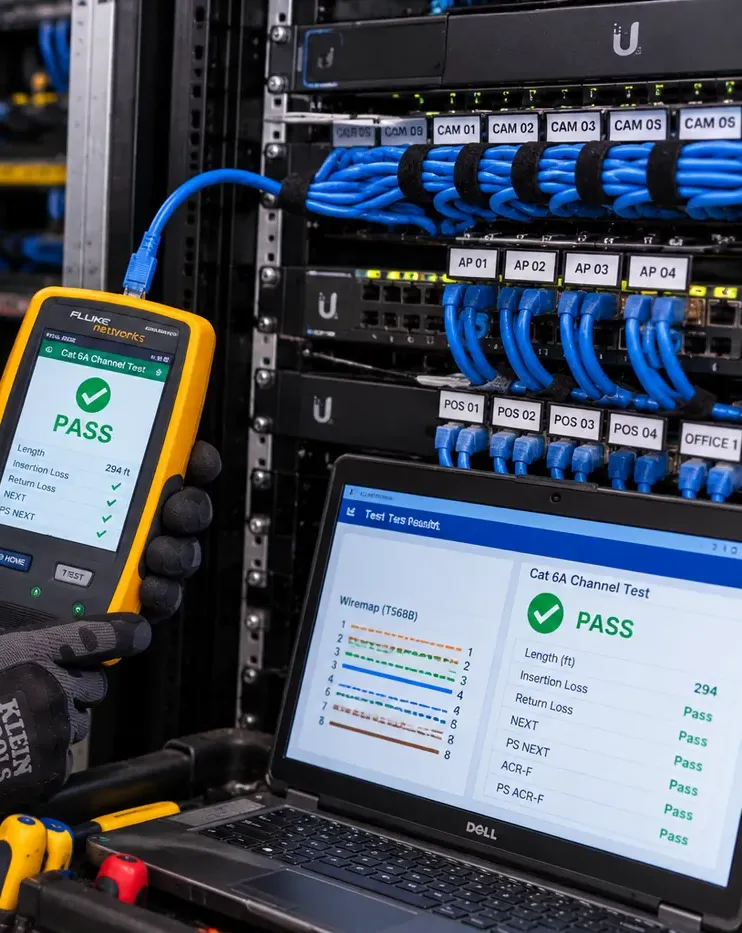
Gloved hand holding a handheld cable certifier showing a green PASS beside a laptop with the same channel test result, in front of a rack with ports labelled CAM, AP and POS — Cat6 repair certification in Midtown Manhattan
A yellow handheld certifier with a blue cord in its top reads PASS on a channel test; the open laptop below shows the same result with a wire map, and the rack behind carries printed labels for camera, access-point and point-of-sale ports.
Midtown Cat6 Repair Quote
Name the building, the floor and what stopped working — our Manhattan desk calls back the same business day

✅
Request Received
Our Manhattan desk will ring you today about the Midtown job.
25+
Years Experience
✓
Same-Day Estimates
100%
Licensed & Insured
4.7★
201 Google Reviews

Came in on Monday to a row of dark desks after a weekend of ceiling work? Call (929) 560-0737 or use the 60-second form. Tell us which trade was up there and where; most of the time that alone tells us which runs to certify first and which parts to load.

  • Every suspect link certified before anything is opened, so the fix goes where the fault is and nowhere else
  • Replacement lengths in plenum-listed Cat6 or Cat6A, terminated on the same parts family your floor already uses
  • NYS licence #12000287431 · insured · results saved, both ends labelled, and a note of what the other trade disturbed
Where this page sits. This is the Midtown branch of our Manhattan Cat6 repair page, which covers the whole island from the Battery to Inwood and explains how we work inside a building’s contractor window. Here we stay between roughly 34th and 59th Streets, river to river, and deal with the faults Midtown floors produce most: links knocked out by other people’s ceiling work, hot-desk floors, merged suites, garment workrooms and round-the-clock hotels and venues. The citywide picture, including how certification failures are read, is on our New York City Cat6 repair hub.
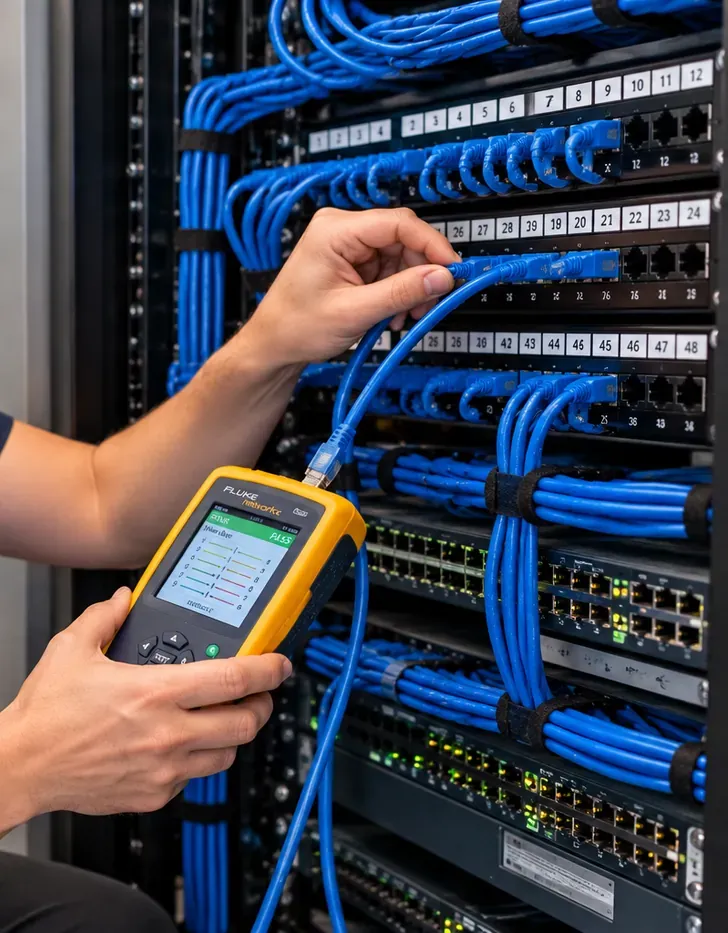
Hand seating a blue patch cord in a numbered patch panel while the other hand holds a yellow cable tester, dense blue bundles on the rack — Midtown Manhattan Cat6 link test
One hand seats a blue cord in a numbered panel port while the other holds a yellow tester with a lit screen; dressed blue bundles fill the rack around it.
The Neighborhood

Why Midtown Properties Need Cat6 Repair: Somebody Else Is Always Working in the Ceiling

Most Midtown Cat6 does not wear out. It gets disturbed. A horizontal link that ran perfectly for years can stop overnight because an electrician lifted a bundle to fit a new light fixture, a duct installer pushed it aside to hang a new box, or a furniture crew dragged it across a grid edge to reach a power feed. Nobody meant to touch it. The cable was simply in the way of work the building or a neighbouring tenant had to do, and in Midtown there is an unusual amount of that work going on at any one time.

The reason is density. The Grand Central Partnership describes its district, roughly 35th to 54th Street between Second and Fifth Avenues, as about 70 blocks holding 76 million square feet of commercial, residential and retail space, with more than a quarter of a million office workers spending their day there. The Times Square Alliance counts nearly 180,000 workers, more than 19,000 hotel rooms and 31 million square feet of office space in its own district a few blocks west. Put that much occupied floor area under one set of streets and something is always being fitted out, upgraded, moved or repaired above somebody’s desk.

City law adds to the traffic. Local Law 26 of 2004 required full sprinkler systems in office buildings over 100 feet tall, with the work due by July 1, 2019, so many Midtown ceilings have had new branch piping threaded through them in the last two decades. Local Law 88 required the lighting in buildings over 25,000 gross square feet to meet the current energy code by January 1, 2025, and tenant spaces over 5,000 square feet to have electrical sub-meters from the same date. Local Law 97 now sets greenhouse-gas limits for most buildings over 25,000 square feet, with stricter limits arriving in 2030, which pushes owners toward mechanical and controls upgrades. Every one of those programmes is carried out above a ceiling grid, in the same band of space where tenant Cat6 hangs.

Tenant movement is the other half. The city Comptroller’s November 2025 office-market spotlight, using CoStar data, found that occupied space in Manhattan’s top-rated five-star buildings grew by about 3.3 million square feet in fiscal 2025 while lower-rated buildings lost about 1.1 million, and noted that five-star space sits almost entirely in the business district south of 59th Street. Tenants trading up leave floors behind and fit out new ones; the floors they leave are re-let, re-cut and re-wired. Each move means another crew in another ceiling, and the outgoing tenant’s Cat6 is frequently cut, coiled or abandoned in the process.

So the Midtown version of a Cat6 repair is closely tied to whatever happened last. The question we ask first is not “how old is the cable?” but “who has been up there since it last worked?” The answer tells us where along the run to look, how many neighbouring links to test as well, and whether the damage is the kind that a re-termination will cure or the kind that needs a fresh length of plenum-listed cable pulled along a better-supported route.

Midtown facts that shape a Cat6 repair

  • 76 million square feet in about 70 blocks: the Grand Central Partnership’s description of its district from 35th to 54th Street, Second to Fifth Avenue, with more than a quarter of a million office workers.
  • 31 million square feet of offices and 19,000-plus hotel rooms: the Times Square Alliance’s count for its district, alongside nearly 180,000 workers.
  • January 1, 2025: the Local Law 88 deadline for bringing lighting in buildings over 25,000 gross square feet up to the energy code, and for sub-metering tenant spaces over 5,000 square feet — work done largely above office ceilings.
  • July 1, 2019: the date by which Local Law 26 of 2004 required office buildings over 100 feet tall to be fully sprinklered.
  • About 3.3 million square feet gained, 1.1 million lost: the fiscal 2025 change in occupied space for five-star versus lower-rated Manhattan office buildings in the Comptroller’s November 2025 spotlight — a measure of how many tenants are on the move.
  • 42 blocks rezoned: the Midtown South Mixed-Use Plan approved by the City Council on August 14, 2025, covering roughly West 23rd to West 40th Street between Fifth and Eighth Avenues and bringing residential zoning to blocks previously limited to commercial and industrial uses, including the southern part of the Garment District.

None of this is a complaint about the trades. The lighting crew has a deadline, the duct installer has drawings to follow, and the sprinkler fitter must put a head where the code says. Our job is to make the Cat6 survive their work and, when it has not, to find the damage quickly and leave the cable better supported than before so the next crew is less likely to repeat it.

Where a failed link is part of a wider network problem, our network cable repair team for Manhattan looks at switches and mixed older cabling too, and if a floor really needs new drops rather than repairs, the Abstract Enterprises Cat6 installation service in Manhattan prices them. For the fiber backbone between your floors and the building’s telecom room, see our Midtown fiber optic installation page.

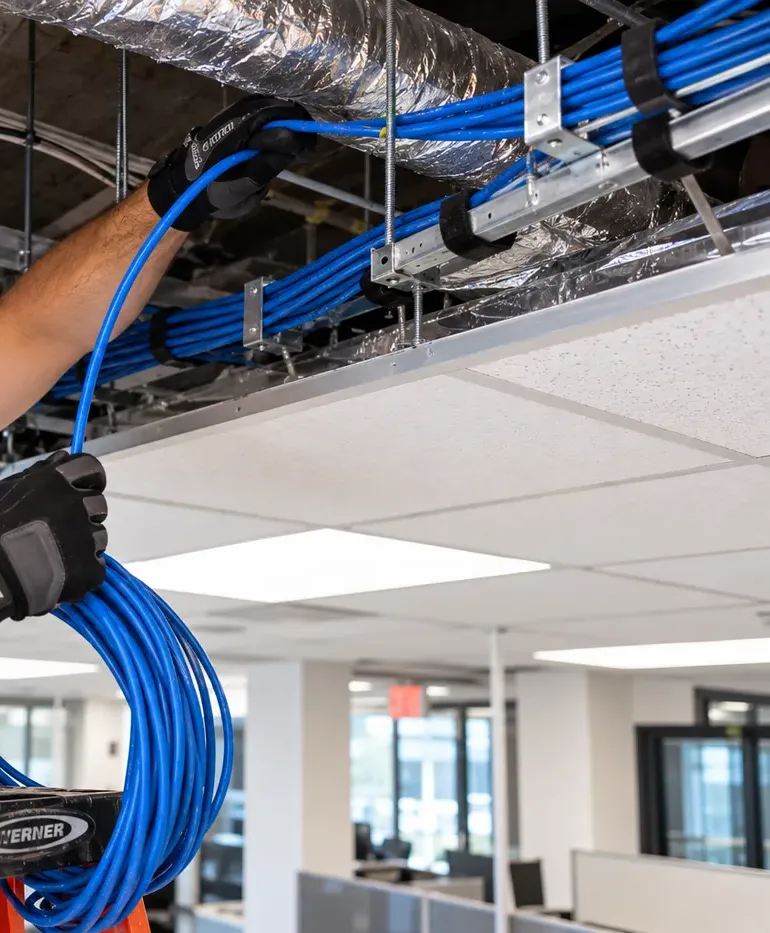
Gloved hands feeding a coil of blue cable up into an open ceiling grid beside supported cable bundles and silver ductwork, open-plan office below — Cat6 replacement run in Midtown Manhattan
Blue cable is fed from a coil on one arm up through an open ceiling grid, where existing blue bundles run in supports beside insulated silver ductwork; desks and glass-fronted rooms are visible across the floor below.
Repair Capture

Network Jack Dead on a Midtown Floor This Morning?

A finance team near Grand Central cannot dock its laptops, a Sixth Avenue agency’s meeting-room panel shows offline, a Garment District showroom’s card terminal has no network, or a Times Square hotel’s back office lost its printers after the night shift. Those are repair calls. We book the first 2-hour arrival window that fits the building’s contractor rules and come with a certifier, a toner, Cat6 and Cat6A keystones and panel modules in shielded and unshielded versions, factory-made cords and plenum-listed cable. Faults at a jack, a cord or a panel port are usually located and fixed within one to two hours on the floor. Repair time is $195 an hour against a three-hour minimum ($585), the rate on our Manhattan network cable repair page. Ring (929) 560-0737 with the address and the floor.

What We Install

Cat6 Repair Services in Midtown

Named after what usually breaks the cable on a Midtown floor. Every service ends the same way: each repaired link certified against its category limit, the results saved, both ends labelled and a one-paragraph note of the cause.

Post-Trade Ceiling Sweep

After lighting, duct, sprinkler or sub-metering crews leave a floor, we certify the links that run through the area they worked in, repair what they disturbed and re-hang bundles that were left lying on the grid or on new fixtures.

Hot-Desk and Dock Link Repair

Shared desks with docking stations put a link, a desk cord and a dock in series. We test each piece separately, so you learn whether the Cat6 is actually at fault before anyone replaces docks.

Combined-Suite Untangling

When two suites become one, two closets, two numbering schemes and two sets of labels end up serving one floor. We trace which jack lands where, repair the failures and leave one consistent port map.

Phone-Booth and Pod Re-Feeds

Prefabricated booths and focus pods dropped onto an existing layout often sit on floor boxes or cords. We free the trapped links, repair the damage and re-route feeds so the pod and the desks beside it both work.

Plenum-Listed Replacement Lengths

Where a run cannot be saved, the new length is plenum-listed Cat6 or Cat6A, matched to the category on the floor, supported off the ceiling grid and terminated on the parts already in your panel.

Relocated-Closet Recovery

Small telecom closets turned into pantries or phone rooms in a renovation can leave punch blocks behind millwork. We find them, test what still runs through them and rebuild the connection somewhere a technician can reach.

Garment Workroom and Showroom Links

Lofts with cutting tables, pressing equipment and rolling racks are hard on floor-level and ceiling cable alike. We repair the links, then move or protect the parts of the route the work keeps damaging.

Hotel and Venue Back-of-House

Front desks, offices, kitchens and staff areas in Midtown hotels and theatres are repaired in sequence, one area at a time, so the building keeps running while each link is rebuilt and certified.

Room-Panel, Display and AP Feeds

PoE-powered room-booking panels, ceiling access points and lobby displays depend on short runs that often hang near the grid. We test them for power as well as data and repair the termination or cord at fault.

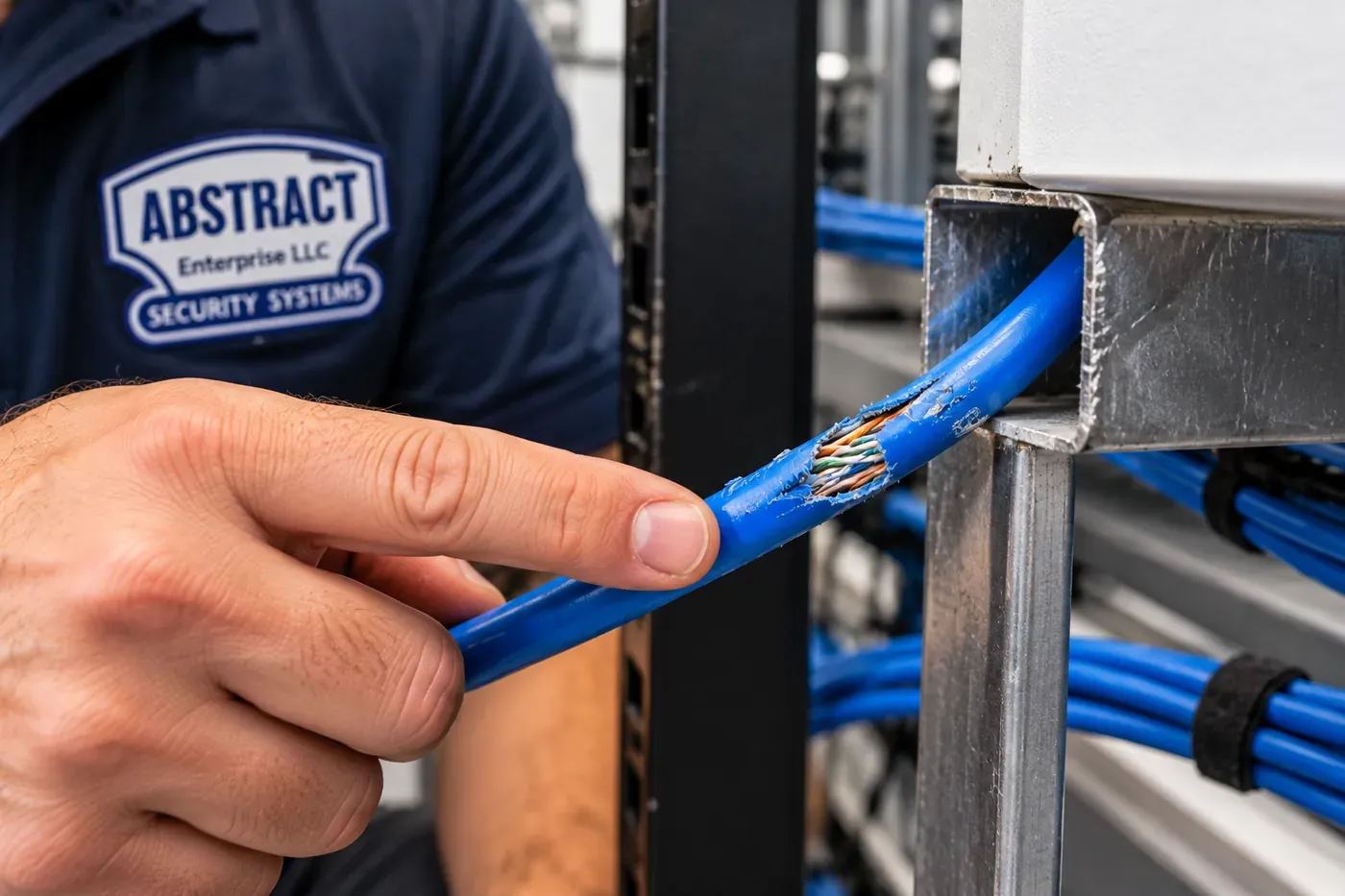
Fingers holding a blue cable whose jacket is torn open, exposing coloured pairs where it passes over the edge of a steel channel — disturbed Cat6 found during Midtown Manhattan repair
A finger points at a blue cable where the jacket has torn open and the twisted pairs show through, right where the cable bends over the cut edge of a galvanised steel channel; more blue cable runs in bundles behind.
Building Specialists

Cat6 Repair for Midtown's Architecture

Six kinds of Midtown building, six different places a link tends to give up. These are the structures between 34th and 59th Street we are called into most, and what each one means for the cable inside it.

Setback Towers of the 1920s and 1930s

The masonry towers around Grand Central, Bryant Park and the Garment District, renovated many times inside. Floor plates shrink above each setback, so horizontal runs are short but crowded, and the ceiling space above old plaster soffits is tight and full of newer sprinkler and lighting work.

Post-War Avenue Slabs

The Sixth, Park and Third Avenue towers of the 1950s to 1970s: deep floors, hung ceilings used as return-air plenums, perimeter units along the windows and core walls far from the desks. Long runs, many trades in one ceiling and furniture moved every few years.

Glass Towers of the Late Century

The 1980s and 1990s buildings along Broadway, Seventh Avenue and the Times Square blocks. Raised floors in some, glass meeting rooms everywhere, and floor plates that have been carved into smaller suites and then merged again.

New East Midtown Towers

One Vanderbilt beside Grand Central and 270 Park Avenue, which opened in October 2025 under the Greater East Midtown zoning. Newer, documented plant, landlord smart-building systems sharing the ceiling, and tenant cabling expected to match the building’s standard.

Garment District Lofts

Store, showroom and loft buildings of the early twentieth century between Broadway and Ninth Avenue: high ceilings, exposed sprinkler mains, heavy floors and a mix of showrooms, offices and workrooms that still cut, sew and press.

Hotels, Theatres and Mixed Buildings

Times Square and Theater District hotels, Broadway houses and the mixed retail-office buildings around them. Never-closed operations, back-of-house rooms below grade and staff areas where cable is pulled, kicked and cleaned around every day.

How the repair changes with each building

Setback towers: work in short sections. When a run fails above an old plaster soffit, there is rarely room to pull a new cable alongside the old one. We locate the fault by distance from the panel, open the nearest accessible tile, and, where the run must be replaced, draw the old cable out first and use it to guide the new one through the same narrow route instead of forcing a second cable in beside it.

Post-war slabs: assume the ceiling is a plenum. On most of these floors the space above the tiles returns air to the mechanical system, so any replacement length is plenum-listed cable, supported independently of the grid wires and kept off light fixtures, ducts and sprinkler branch lines. We also check the length: deep floors put runs close to the 90-metre permanent-link limit, and a reroute around new ductwork can push a marginal link over.

Glass towers: follow the suite history. On floors that have been divided and re-joined, the run you are tracing may cross a demising line that no longer exists, terminate on a panel in a closet that now belongs to someone else, or pass through a consolidation box left from an earlier layout. We map those boundaries first, then repair.

New towers: build to the house standard. Newer Midtown buildings typically publish a cabling standard for tenant work and run their own building network above the same ceiling. We identify which cable belongs to the landlord before touching anything, use the category, colour, labelling and parts family the standard expects, and supply the test results in the format the building asks for.

Garment lofts: protect the low and the high. In workrooms, cable at floor level is rolled over by racks and carts and near pressing equipment it sees heat and moisture; up high it often runs exposed along sprinkler mains and beams. Repairs move terminations off the floor, add protection where traffic crosses a run, and secure exposed cable to its own supports.

Hotels and venues: one area at a time. A hotel front desk, a kitchen office and a security room cannot all be out together. We repair in an agreed order, bring each link back and confirm it with the staff who use it before moving on, and leave nothing open overnight in a staff corridor.

Most Midtown offices that call about Cat6 also have a camera or a door reader on the same floor. When the failing run feeds one, our Manhattan security camera repair service can look at the device, and the AESS access control team for Manhattan handles suite-door readers in the same visit.

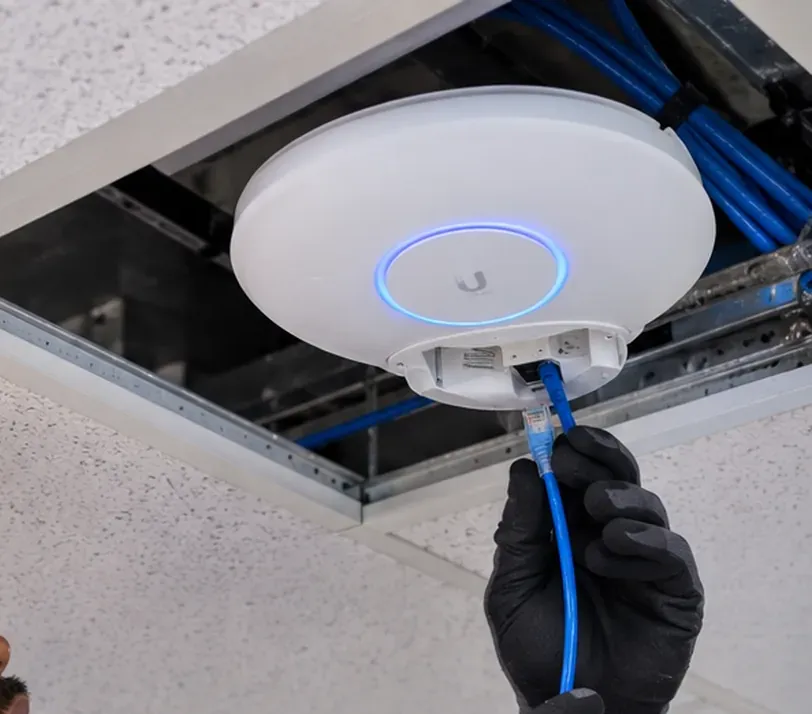
White round ceiling access point lowered from an open ceiling tile while a gloved hand holds the blue cable plugged into its base — access point link repair in Midtown Manhattan
A round white access point with a blue status ring hangs just below an open ceiling tile; a black-gloved hand holds the blue cable seated in the port on its underside, with more blue cable visible in the ceiling space above.
Commercial Cat6 Repair

Business Cat6 Repair in Midtown

Midtown is several business districts stacked side by side, and the Cat6 problems change as you walk across it. These are the six we are called into most often.

Grand Central and East Midtown

Park, Madison, Lexington and Vanderbilt Avenues: law firms, banks and corporate headquarters in pre-war towers, post-war slabs and the newest towers built under the 2017 rezoning. Expect floors in the middle of a landlord upgrade, strict contractor procedures and large tenant moves in and out.

Plaza District and 57th Street

Fifth, Madison and Park above 50th Street: investment firms, family offices and galleries on smaller, finished floors. Repairs are usually a handful of links, and the expectation is that nobody can tell a technician was there.

Sixth Avenue and Rockefeller Center

The post-war towers lining Sixth Avenue and the 19-building Rockefeller Center complex between 48th and 51st Streets: media, publishing and professional firms on large floors with frequent furniture reconfigurations and many meeting rooms.

Times Square and the Theater District

Office towers above the signs, hotels with thousands of rooms, Broadway theatres and the restaurants around them. Back-of-house links, round-the-clock operations and work that must avoid show times and peak check-in.

Garment District and Penn Plaza

Lofts from Broadway to Ninth Avenue between 34th and 42nd Streets, now mixing fashion firms and showrooms with tech, media and non-profit tenants, plus the large office buildings around Penn Station. Older cable, heavy use and buildings changing under the Midtown South rezoning.

East of Lexington: Turtle Bay to Murray Hill

Missions, non-governmental organisations, medical and professional suites in mid-size buildings east of Lexington. Mixed residential and office buildings where the management office decides access and repairs are often scheduled around diplomatic and patient calendars.

Retail, restaurants and hospitality at street level

Ground-floor businesses in Midtown live on lunchtime and pre-theatre trade. When a register, a kitchen order screen or a reservation stand drops off the network, the cable is usually somewhere awkward: under a stainless counter, through a basement prep area, or up the back of a display wall. Because these spaces are cleaned hard every night, floor-level jacks and cords take most of the damage, and many of the faults we find are corroded or crushed terminations rather than broken cable.

We book before opening wherever the landlord allows, restore payment first, then kitchen and back-office links, and replace any floor-level termination that keeps getting soaked with one mounted higher on the counter body or wall. When a run must be replaced and the restaurant cannot close, a tested temporary cord keeps the register working until the new length can go in after service.

Hotels add scale. With more than 19,000 rooms in the Times Square district alone by the Alliance’s count, back-of-house networks run through basements, service corridors and offices that operate around the clock. We agree an order of work with the engineering or IT department, restore one area before opening the next, and leave a labelled record they can use for the next repair without calling us.

Compliance callouts for Cat6 repair in Midtown buildings

  • Licensing. The permit exemption for data and communication wiring under 50 volts in Administrative Code §28-105.4.7 applies only when the person doing the work is a licensed master electrician, a special electrician or a qualified person as the electrical code defines it. Our NYS low-voltage licence number is 12000287431.
  • Cable listed for the space. The city’s electrical code, built on the 2020 National Electrical Code with city amendments, has been fully in effect since December 21, 2025. Where a Midtown ceiling or raised floor carries return air, the code treats it as one of the “other spaces used for environmental air,” and communications cable run there is plenum-type (CMP) or protected as the code allows. Every replacement length we pull above a Midtown office ceiling is plenum-listed.
  • After-hours work. The Department of Buildings requires an After Hours Variance for construction activity before 7 a.m., after 6 p.m. or at weekends. A repair that grows into permitted construction — coring a slab, for instance — is scheduled with that in mind, and the building’s own rules decide when quieter testing and termination work may happen.
  • Abandoned cable. Accessible lengths of communications cable that are no longer used, and not tagged for future use, are meant to come out. Runs we replace are removed where they can be reached, or clearly tagged if you want to keep them as spares.
  • Fire separation. If a replacement length has to pass a rated wall or slab, the opening is closed with a listed firestop product the same day; an unsealed hole left by an earlier trade is photographed and sent to the managing agent.
  • Designated buildings. According to the Landmarks Preservation Commission, routine repairs and maintenance need no LPC permit; for interior work, a permit comes into play only if a Buildings permit is needed, the exterior is affected or the interior itself is designated. On August 12, 2025 the Commission designated five garment-industry buildings in Midtown South as individual landmarks, among them the Lefcourt Clothing Center and Fashion Tower; a Cat6 repair kept inside, along existing routes, normally falls outside those cases.
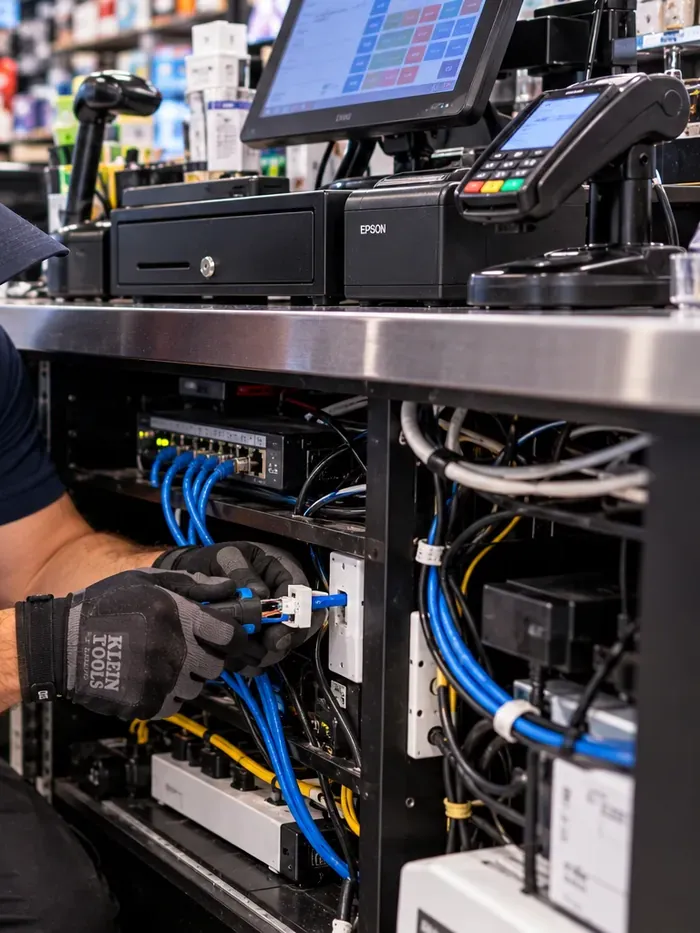
Retail checkout counter with a register screen, card terminal and cash drawer on top and a small network switch with blue cables underneath, a gloved hand at the ports — point-of-sale Cat6 repair in Midtown Manhattan
On top of a stainless counter sit a touchscreen register, a card terminal on a stand and a cash drawer; in the open cabinet underneath, a gloved hand works at a small switch where several blue cables are plugged in among power bricks and grey cables.
Your Questions Answered

Cat6 Repair in Midtown: Questions Answered

These come from facilities managers, office managers, IT leads and showroom owners between 34th and 59th Street. They are grouped by what set the fault off. General certification questions are answered on our five-borough page, building-window and riser questions on the Manhattan page, and practical booking questions in the FAQ lower down.

When the building’s own programmes reach your ceiling

The building’s Local Law 88 lighting upgrade is moving floor by floor — what should we test before and after the electricians reach us?

Test a sample before they arrive and the affected area after they leave. Local Law 88 required lighting in buildings over 25,000 square feet to meet the current energy code by January 1, 2025, and some Midtown owners are still finishing, correcting or extending that work, often a floor at a time. Each new fixture and its controls are mounted from the same ceiling space your Cat6 crosses, and the crew has to lift tiles, move bundles and sometimes pass sensor and control wiring alongside your cable.

A short baseline visit before the lighting crew starts gives you saved certification results for the links that pass under their work area, and photographs of how the bundles are supported. After they finish, the same links are certified again. Any link whose margin has dropped, or which now fails, points to a disturbance at a measurable distance from the panel, and the comparison shows clearly when it happened. That record is more useful to the building and the lighting contractor than a complaint that “the network has been bad since the electricians came.”

Typical findings are bundles left lying across the top of a new fixture, cable ties pulled tight to fit a fixture whip, a keystone pulled out of a ceiling-mounted access-point box, and cable re-hung from the grid wires that hold the tiles. We repair what failed, re-support the bundles on their own hangers clear of the fixtures, and re-test so the floor goes back into use with a clean set of results.

The mechanical contractor is replacing ductwork and air boxes above our ceiling for the building’s emissions work — should our Cat6 be moved first or repaired afterwards?

Where the new duct or box will sit directly on the cable route, moving the affected runs first is usually cheaper. Local Law 97 sets greenhouse-gas limits for most buildings over 25,000 square feet, with stricter limits from 2030, and many Midtown owners are responding with ventilation, controls and equipment upgrades. New ductwork is bulky, it is lifted into place in sections, and installers need a clear path; cable in that path is either moved by someone who knows how, or moved anyway by someone who does not.

The decision depends on the drawings. If the mechanical contractor can show where new duct, boxes and access panels will go, we walk the ceiling with that sheet, identify the runs that cross those positions and either re-route them in advance on new supports or leave them alone where they will be clear. Where re-routing adds length, we measure first, because a detour around a new trunk duct can push a long post-war run past what the category allows.

If no drawings are available, the safer approach is to certify the floor before the work and again afterwards, then repair the links the work actually affected. Both approaches keep the cable plenum-listed and independently supported, and both leave you with results showing the state of the floor before and after the building’s contractor was there.

Hybrid floors and reshaped suites

Since prefabricated phone booths and focus pods went onto our floor, the desks beside them keep losing network — how are those two things connected?

Usually by the floor box or the cord underneath the pod. Prefabricated booths are heavy, self-contained units that installers set down on top of whatever finished floor they are given. When they are added to an existing layout, their footprint often lands over a floor box, a cord channel or a poke-through that used to serve the desk next to them, or the installer moves a desk cluster a metre to make room and stretches its cords.

The result shows up as a link that drops when someone walks into the booth, a desk that negotiates at a lower speed, or a floor box that has been half-closed with cables pinched under its lid. Some pods also take their own power and data from the same floor box, so the box now carries more cords than it was designed for. Certification from the panel shows a fault close to the desk end, and a look under the edge of the pod usually confirms it.

The repair means lifting or sliding the pod with the people who installed it, or working from the floor box’s other access point, freeing the trapped cords, re-terminating or replacing the damaged section and giving the pod its own route so it stops sharing the desks’ cords. We then certify both the pod’s link and the desks around it.

Our booking system shows hot desks as “offline” even when people are sitting at them — is that the dock, the desk cord or the Cat6 in the floor?

Any of the three, and the only quick way to know is to test them separately. A hot-desking floor puts three things in series: the permanent Cat6 link from the panel to the outlet, a desk cord to a docking station, and the dock itself, which may pass network to the laptop and report presence to the booking system. When the system marks a desk as unavailable, the cause can be anywhere along that chain, and replacing docks at random is an expensive way to find out.

We certify the permanent link from the panel to the outlet first. If it passes, the in-wall or in-floor Cat6 is not the problem. Then we test the desk cord on its own; shared desks see cords kinked under monitor arms and pulled by people adjusting chairs, and a cord that passes in the morning can fail by the afternoon. Only when both pass do we tell you the dock or its configuration is the likely cause and hand the result to your IT team.

On floors with dozens of shared desks, the pattern of failures is itself a clue. Desks that fail together in one row point to a shared floor box or consolidation point; scattered failures point to cords; failures on one dock model point away from the cable altogether.

Our suite was combined with the one next door, and the two old telecom closets were never merged — why do some desks fail whenever the other closet’s switch is restarted?

Because those desks are still cabled to the other closet. When two Midtown suites are joined, the demising wall comes down but the cable behind it often stays as it was: desks on one side land on closet A, desks on the other side land on closet B, and a few runs that were moved during the combination now land on whichever closet was closest at the time. If closet B’s switch reboots for an update, every desk still wired to it goes dark, and the people at those desks may be sitting well inside what used to be suite A.

Two numbering schemes make it worse. Closet A might label ports by desk number and closet B by room, so the same jack label appears twice and the patch panel records no longer match the floor plan. Repairs made since then may have been made to the wrong closet’s panel.

We tone and test every outlet to establish which closet and port each one lands on, repair the faults we find on the way, and produce a single port map for the combined floor. If you want to consolidate onto one closet, that map shows which runs are long enough to re-terminate there and which would need replacing, so the decision is made on measurements rather than guesses.

In our last renovation the small telecom closet on the floor became a pantry — where did its Cat6 go, and can it still be repaired?

Often it never left. Renovations in Midtown frequently reclaim a small intermediate closet for a pantry, a phone room or storage, and the cheapest way to do that is to extend or splice the existing horizontal runs to a new rack elsewhere, or to leave a punch block or consolidation box behind new millwork. The cable that used to end in the closet now passes through a hidden connection point that nobody documented.

The symptom is a group of desks that fail together, or links whose certification shows an extra connection at a fixed distance from the new rack. That distance is usually where the old closet was. We find the hidden point from the ceiling or through an access panel, test what passes through it, and either re-terminate it properly in an accessible box or replace the affected runs so they reach the new rack directly.

Wherever the connection point ends up, it gets a label, an access route and an entry on the port map, so the next repair on that part of the floor starts at the right place instead of at the pantry cabinets.

New towers, conversions and the Garment District

In our new East Midtown tower the landlord’s smart-building network runs through the same ceiling — how do we know which Cat6 is ours before anything is cut?

By identifying the landlord’s cable first and leaving it alone. The newest Midtown towers, such as One Vanderbilt and 270 Park Avenue, are marketed on their technology, and owners of new buildings commonly run their own networks for sensors, controls, occupancy counting and building Wi-Fi. Those cables often share tenant ceilings, may use the same category of cable, and sometimes the same colour.

Before any repair we ask the building for its cabling standard and the colours, labels and pathways it uses for base-building systems. On site, we trace the run we are repairing from your panel, not from the ceiling, so we know it is yours from end to end. Cable that cannot be traced back to your closet is treated as the landlord’s until the building says otherwise.

If testing shows the fault is in base-building cable, or a building device is the thing that has failed, we stop and give the building’s engineer the result. Tenant repairs in new towers go smoothly when the building can see we touched only tenant cable and left a labelled record.

Our showroom stays open while the floors above are converted to apartments under the Midtown South rezoning — how do we keep our Cat6 working through the construction?

Find out where your cable passes through their work area, document it and protect it before demolition starts. The Midtown South Mixed-Use Plan, approved by the City Council on August 14, 2025, rezoned 42 blocks around the Garment District and brought residential zoning to an area previously limited to commercial and industrial uses. Some owners will convert buildings in stages, with ground-floor and lower-floor tenants staying while the upper floors are rebuilt.

Your showroom’s connections may depend on things in the construction zone: the building’s telecom room, a riser shared with upper floors, or a carrier entrance moved during the works. We trace and certify your links before work begins, record where each one passes outside your space, and give the owner’s construction team a marked-up plan of what must not be cut or disconnected.

During construction we can re-test after major phases, such as demolition of the floor above or a riser change, and repair anything damaged with the result in hand. If the conversion moves the telecom room, we plan your re-termination with the developer’s electrical and low-voltage contractors so your links move once.

Our Garment District workroom still cuts, sews and presses on the same floor as the office — what does that do to the Cat6, and how should it be repaired?

Workrooms are hard on cable in three ways: traffic, heat and dust. Rolling racks, carts and cutting tables are moved across floors daily, so any cable or floor box at ground level gets rolled over and kicked. Pressing equipment brings heat and moisture to its area. Lint and fibre dust settle in floor boxes, open jacks and the ventilation slots of small switches.

The faults look different from office faults. We find crushed floor-level cords and boxes, jacks clogged with lint, plugs with bent contacts from repeated pulls, and runs dropped from the ceiling to a work table that have been snagged by racks. In older loft buildings, cable often runs exposed along sprinkler mains and beams, where it is easy to snag or sag.

The repair goes beyond re-terminating. We move outlets for work tables up onto the table frame or the nearest column, protect drops with a cord cover or raceway where racks pass, put exposed ceiling runs on their own supports, and use outlets with covers where dust is heavy. The office side of the floor is repaired as usual and certified together with the workroom links, so the whole space ends with one set of results.
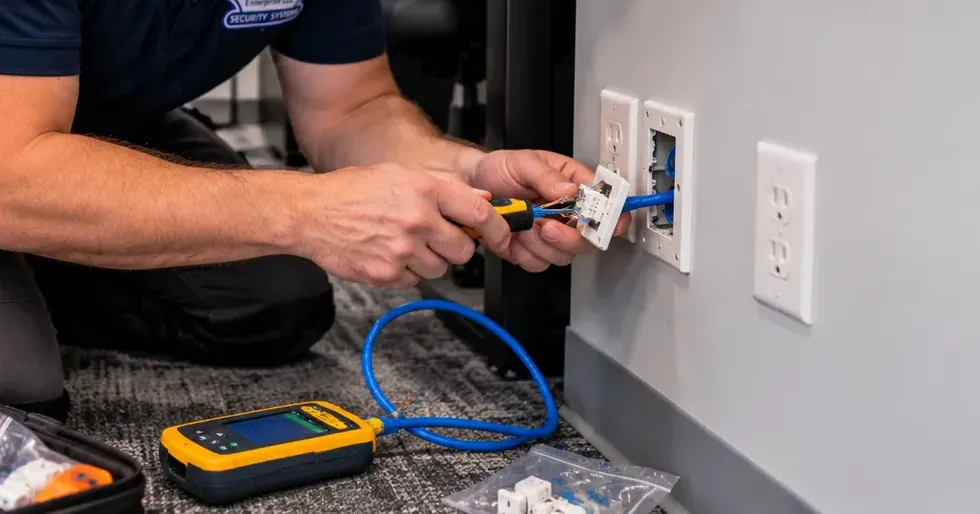
Kneeling technician holding a wall plate with a blue cable attached beside a duplex power outlet, a yellow tester and blue cord on the carpet below — desk jack repair in a Midtown Manhattan office
Under a desk, hands hold a white wall plate pulled from its box with a blue cable attached, a screwdriver in the other hand; a white power outlet sits beside it and a yellow tester with a coiled blue cord lies on the carpet.
Equipment

Cat6 Repair Tools Carried Up to Midtown Floors

A Midtown repair usually happens on an occupied floor, often in the evening, after a freight-elevator booking. What comes up in the elevator has to cover every likely fault, because a missing part means another booking.

Certifier With Distance-to-Fault

Certifies each link to its category and reports how far along the run a crosstalk or reflection problem sits, which tells us which ceiling tile to lift on a floor full of people.

Saved-Result Software

Results are stored per link and exported in the format your IT team or the building asks for, so before-and-after comparisons around other trades’ work are possible.

Tone Generator and Probe

Identifies one cable among hundreds in a ceiling or panel without unplugging live desks, essential on merged suites and floors with two numbering systems.

Plenum-Listed Cat6 and Cat6A

Solid-copper replacement cable listed for air-handling ceilings, in both categories, so a repaired run is legal for the space it passes through.

Matched Modules and Keystones

Cat6 and Cat6A, shielded and unshielded, in the parts families most common in Midtown fit-outs, plus covered outlets for dusty workrooms.

Independent Supports

J-hooks, hangers and fasteners so re-hung bundles hang from their own supports rather than the ceiling grid wires, light fixtures or sprinkler pipe.

Factory-Made Cords

Slim and standard cords in several lengths for docks, floor boxes, pods and crowded panels, replacing field-made and damaged cords.

Low-Dust Access Kit

Tile handling gear, drop cloths, a vacuum and covers for nearby smoke detectors when the building asks, so ceiling work on an occupied floor stays clean.

Labels and Port-Map Forms

A label printer and a blank floor map we fill in while testing; merged and reshaped suites need the map more than the parts.

Who should repair Cat6 on a Midtown floor: a comparison

What the job needsBuilding’s general contractor or other tradeMarketplace handymanLicensed cabling contractor
Legal to repair data wiring in the cityOnly if a licensed electrician or qualified person does itRarelyNYS low-voltage licence #12000287431
Proof the repaired link meets Cat6Usually not part of their scopeContinuity check at bestCertification with saved results
Finding damage caused by other tradesNot their interest to find itOpens tiles until something looks wrongMeasures distance to the fault; before-and-after results
Plenum-listed replacement and proper supportVariesOften whatever cable is on handPlenum-listed cable on its own supports
Working inside tower contractor rulesYesOften unfamiliarInsurance certificate, scope and bookings handled

National alarm and camera brands such as ADT, Ring and SimpliSafe sell their own devices and services; diagnosing a building’s horizontal Cat6 is not what they do. If the failed run feeds one of their cameras, the cable is still a cabling repair and that is the part we fix.

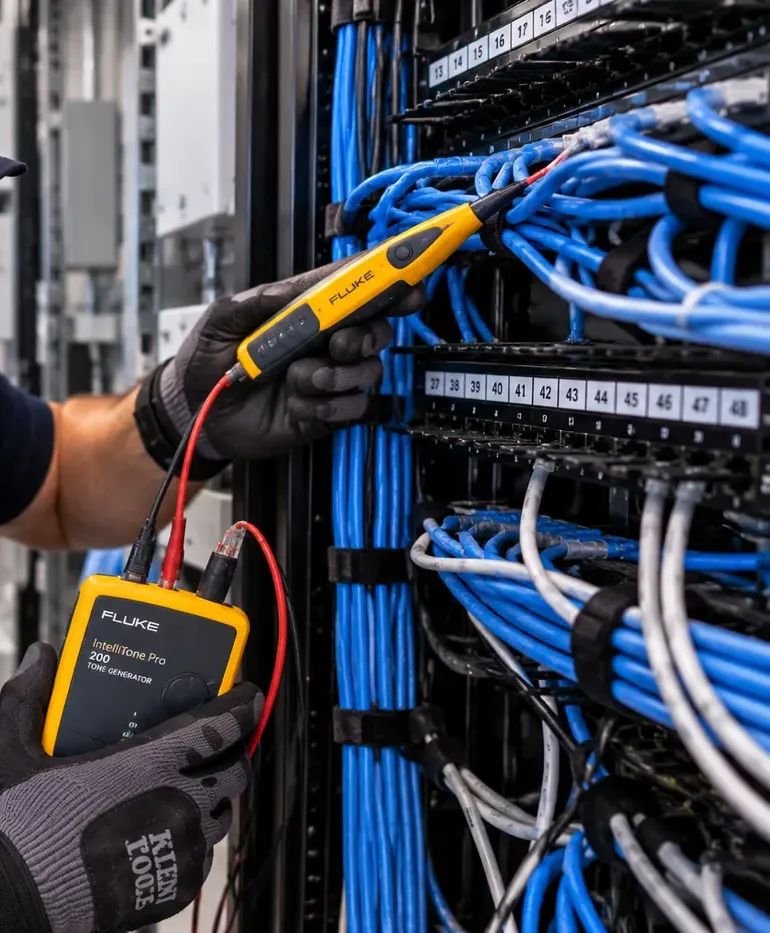
Yellow inductive probe held against blue cables at a patch panel numbered 37 to 48 while a gloved hand holds the tone generator with red and black leads — cable tracing on a Midtown Manhattan floor
A yellow probe touches blue cables just below a patch panel numbered 37 to 48, while a gloved hand below holds a yellow tone generator with red and black clip leads; dense blue and grey bundles fill the rack.
AI Overview Reality Check

What AI Gets Wrong About Cat6 Repair in Midtown

A note on method: our research tools could not open Google’s AI Overview for these searches, so the headings below are not quotations from it. They are claims that cost guides, marketplaces such as Angi and HomeAdvisor, product pages and forums publish often enough that answer engines repeat them. Under each is what is different on a Midtown office floor.

“If the network worked yesterday, the cabling can’t be the problem”

General troubleshooting guides start with devices and settings, on the assumption that cable in a ceiling does not change. Answer engines often repeat that order: restart, update, swap the laptop, and only then suspect the wiring.

In Midtown, the ceiling changes all the time. A lighting upgrade, a duct replacement, a sprinkler change or a neighbour’s fit-out can disturb a run overnight. If desks in one part of a floor failed after a weekend of work above them, the cable is the first suspect, not the last.

The quick check is to certify the affected links from the panel. If they pass, look at devices. If they fail at a distance that matches the work area, you have both the answer and the evidence for the building.

“Any Cat6 cable will do for a replacement run”

Retail listings sell Cat6 by the box with little mention of jacket ratings, and how-to articles suggest grabbing whatever is on the shelf to replace a damaged length.

Most Midtown office ceilings return air to the building’s mechanical system. The electrical code treats that space as one used for environmental air, and cable run in it is plenum-type or otherwise protected as the code allows. A replacement in ordinary jacketed cable may work electrically and still be the wrong cable for the ceiling.

The fix is simple: use plenum-listed cable for every replacement length above an office ceiling, of the same category as the rest of the floor, and support it independently.

“The building handles all the wiring in a managed office tower”

Renter and small-business guides often say that in a managed building the landlord looks after wiring, and answer engines pass that on to office tenants.

In Midtown towers, the building usually looks after base-building systems: risers, telecom rooms, its own smart-building network. Cable installed for your fit-out, inside your suite, is commonly yours to maintain, depending on the lease. When another trade working for the landlord damages it, the building may well take responsibility, but someone still has to show where the damage is.

We test and document which cable is yours, where it failed and, with before-and-after results, when. The lease and the managing agent decide who pays.

“Hot-desk problems are always the docking station”

Vendor support articles focus on dock firmware and drivers, and that is where answer engines send people whose shared desks keep showing offline.

Docks do fail, but on a busy shared floor desk cords are pulled, kinked and re-plugged dozens of times a week, floor boxes get kicked and permanent links get disturbed by ceiling work. Replacing docks without testing the cord and the link can mean buying new hardware for a cable fault.

Test the link, then the cord, then the dock. It takes minutes per desk with a certifier, and the pattern of results across a floor usually shows the real cause.

“Old loft buildings can’t carry modern cabling”

Articles about pre-war buildings often warn that brick walls, thick floors and old construction make modern networks impractical, and answer engines repeat the warning for the Garment District.

The Garment District’s loft buildings were built for heavy manufacturing, with high ceilings and open floors that are in many ways easier to cable than a partitioned office. The difficulties are different: exposed runs, workroom traffic, dust and heat. Those affect how a repair is protected, not whether it can be done.

Repairs there succeed when cable is supported on its own fixings, terminations are raised off the floor and protected where carts pass, and outlets near dusty work are covered.

“Shielded cable is needed for every Midtown office”

Because Midtown is dense with radio transmitters, elevators and electrical equipment, some sources suggest shielded cable is necessary everywhere, and answer engines recommend switching to shielded parts during a repair.

Shielding works only as a complete, bonded system. Most Midtown office floors are unshielded and perform well. Adding shielded jacks to an unshielded run, or the reverse, does not add protection and can make troubleshooting harder.

The repair matches the floor. If a floor is shielded, every repair keeps the shield continuous and bonded; if it is not, a genuine noise problem calls for a planned change, not a patch on one run.

“A Cat6 repair costs a few dollars a foot, so expect a small bill”

The figures behind this claim are national ones for new work: Fixr, in a guide it last updated in January 2025, puts a Cat6 drop at $125–$250 and labour at $45–$75 an hour, and marketplace listings invite people to shop on those numbers.

Those are national averages for new installation. A Midtown repair involves building paperwork, an elevator booking, often evening hours, testing on an occupied floor and plenum-listed cable. The time goes into finding and proving the fault, not the material.

Compare quotes on what they prove at the end: saved results for every link touched, both ends labelled, cable listed for the ceiling, and a note of anything another trade disturbed.

Trades Were in Your Ceiling? We’ll Find What They Disturbed

Tell us which crew was up there, which desks failed and when the building lets us in. We will tell you what to test first and what it will cost.

Get In Touch

Request a Free Quote

Send the building, the floor, what failed and what work has happened above the ceiling recently; we answer in writing the same business day. Prefer the phone? Our Manhattan line is (929) 560-0737.

✅

Request Received

Thanks — a technician from the Manhattan desk will phone you before the end of the business day. Desks offline this minute? Ring (929) 560-0737.

How It Works

Our Midtown Cat6 Repair Process

Seven steps built around one Midtown fact: the fault was usually caused by work somebody else did, so the repair has to find it, prove it and stop it happening again.

1. Ask what happened above the ceiling

You tell us which trade worked where and when, and send any drawings or old test results. From that we choose the links to certify first and the parts to bring.

2. Book around the building

The managing agent receives our insurance certificate and a short written scope, and a 2-hour arrival slot is fixed inside the building's contractor hours and freight booking.

3. Certify from the closet

Every reported link and its neighbours are certified from the panel before a tile is lifted, and each fault is placed by its distance along the run.

4. Confirm the cause in the ceiling

Only the tiles over measured faults are opened. We photograph what the other trade left behind and agree the repair list with you before starting it.

5. Repair and re-support

Terminations are remade on matching parts, damaged lengths are replaced with plenum-listed cable, and bundles go back on their own supports clear of fixtures, duct and pipe.

6. Re-certify and label

Each link we touched is certified again, labelled at both ends and entered on a port map for the floor.

7. Report to you and the building

Results, photos and a note of what was disturbed go to you and, if you choose, the managing agent. Tiles go back and the area is cleaned before we leave.

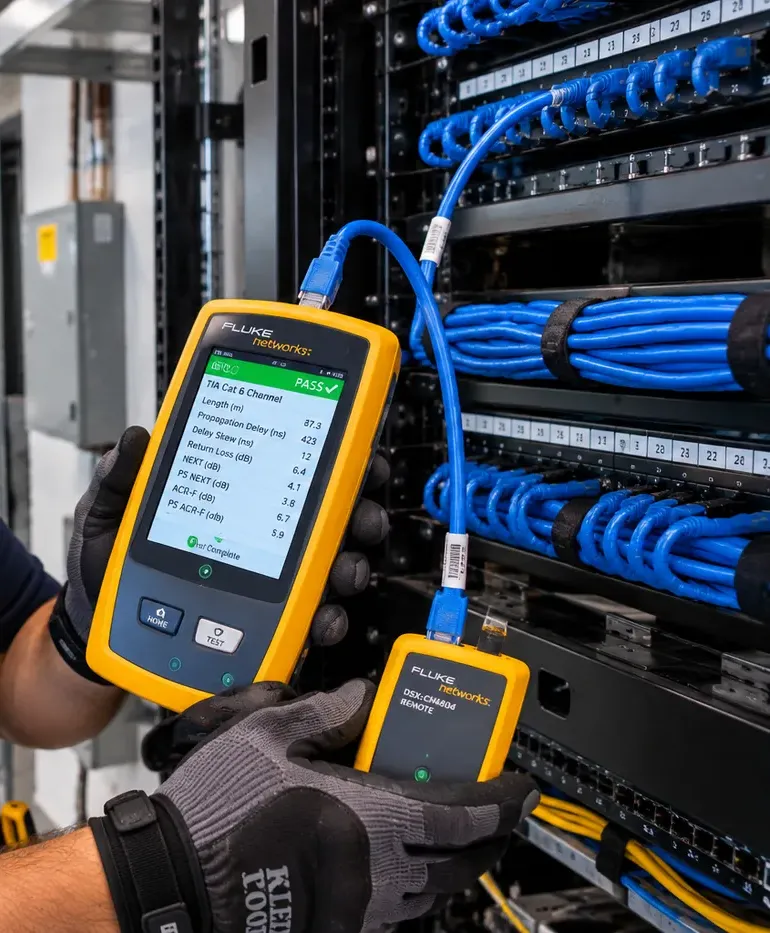
Gloved hands holding a yellow cable certifier showing a passing result list, with a blue cord running to the rack and a small remote unit below — Cat6 certification after repair in Midtown Manhattan
A yellow certifier held in a gloved hand displays a column of passing measurements with a green tick at the top; a blue cord rises from it into the patch rack, and a smaller yellow unit is held in the other glove below.
Coverage Area

Cat6 Repair Near Midtown's Landmarks

Six Midtown landmarks that stand for the building types we repair in. They are reference points for the blocks around them; we are not claiming to have worked inside any of them.

Grand Central and its district

The Grand Central Partnership’s district runs from about 35th to 54th Street between Second and Fifth Avenues: some 70 blocks and 76 million square feet, with more than a quarter of a million office workers.

One Vanderbilt

The tower beside Grand Central that City Planning says gained extra floor area in return for about $225 million of improvements to the terminal; its owner, SL Green, describes a terracotta façade drawing on the terminal’s own ceiling tiles.

270 Park Avenue

JPMorganChase’s 60-storey headquarters, opened on October 21, 2025 with 2.5 million square feet for about 10,000 employees; a state senator’s statement at the opening called it the first new office tower built under the East Midtown rezoning.

Rockefeller Center

The Art Deco complex that anchors the Sixth Avenue corridor: 22 acres from 48th to 51st Street, construction begun in 1931, and today 19 commercial buildings sharing one name.

Times Square

A district the Times Square Alliance credits with nearly 180,000 workers, more than 19,000 hotel rooms and 31 million square feet of office space, on about 0.1% of the city’s land.

The Lefcourt Clothing Center and Fashion Tower

Two Garment District buildings designated individual landmarks on August 12, 2025: 275 Seventh Avenue, a 27-storey store, office and manufacturing building designed in 1927, and the 20-storey Fashion Tower at 135 West 36th Street, built in 1924–1925.

We also repair Cat6 throughout Murray Hill, Kips Bay, Turtle Bay, Tudor City, Sutton Place, the Plaza District, Midtown East, Bryant Park, Herald Square, Koreatown, NoMad, Penn Plaza, the Theater District, Hell’s Kitchen, Columbus Circle and the edge of Hudson Yards. For the rest of the island, our Cat6 repair page for Manhattan covers everything from the Financial District to Inwood.

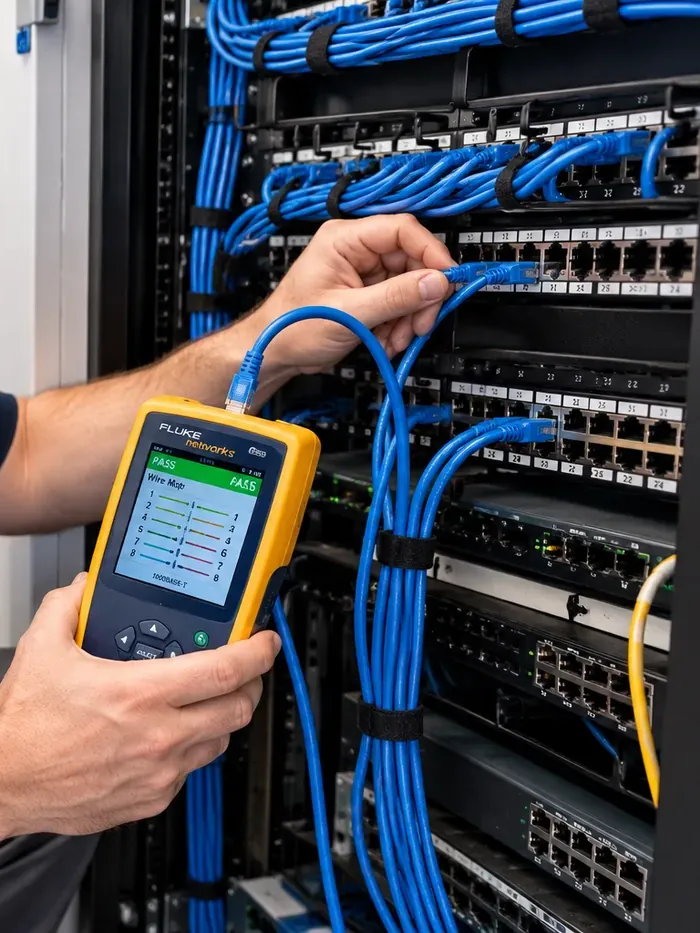
Hand holding a yellow tester whose screen shows a wire map with PASS while a blue cord runs into a patch panel among dense blue bundles — wire-map check on a Midtown Manhattan floor
A yellow handheld tester shows a coloured wire map with PASS along the top; its blue cord climbs into a patch panel where another hand seats the plug, surrounded by dressed bundles of blue cable and switch ports.
Pricing

Cat6 Repair Cost in Midtown

Midtown uses our published Manhattan figures, unchanged, and each one below says where it is published. Anything set by the building — evening freight bookings, coring, firestopping, large re-routes around new ductwork — is priced in writing after testing.

ItemPriceWhat it covers, and where the figure comes from
Hourly repair: testing, finding the fault, new terminations or cords, re-support and a final certification$195/hr, 3-hour minimum ($585)Same $195 our Manhattan network cable repair page lists; the booked hours are spent on as many failed links as they allow
Replacing a run that cannot be savedFrom $175 per dropThe “from” price we publish for Manhattan network cable repair; the new length arrives terminated at both ends, tested, labelled and with a cord
Benchmark — installing a brand-new Cat6 outlet (run under 100 ft)$296 per dropListed on our Manhattan Cat6 installation page, where Cat5e drops are $254 and Cat6A drops $424
Evening or weekend freight-elevator bookingsNamed premium line, quoted beforehandKept separate from the $195 rate so you can see exactly what the building’s timing adds
Re-routes around new ductwork, slab coring, firestopping, large re-supportsQuoted after testingSet once we have measured the run and seen the other trade’s layout and the house rules

Why there is no separate Midtown surcharge

Our pricing rules apply a Manhattan factor to borough work, and the figures above are the ones already live on our Manhattan pages, so Midtown uses them as published instead of adding a second adjustment. Where a Midtown job costs more, it is because the building requires something specific, such as an evening booking or a re-route around new mechanical work, and that appears as its own line on the quote.

Where three hours go on a typical post-trade sweep

Check-in, protection and a walk of the area the other trade worked in come first. Then each link that runs through that area is certified, the failures are located by distance, and the cause is confirmed by lifting the nearest tile. Re-terminations, cord swaps and re-supports follow, with a final certification of every repaired link. On a floor where one crew disturbed a single bundle, several links are often fixed inside one block; runs that need replacing are priced before any cable is pulled.

What makes a Midtown repair bill larger or smaller

  • Before-and-after results: if a baseline was taken before the other trade worked, finding what changed takes minutes.
  • Drawings: mechanical or lighting layouts show where the work was, so we start in the right ceiling bay.
  • Access: a daytime visit on an empty floor is quicker than an evening visit around a booked freight car.
  • The floor’s history: merged suites and removed closets take longer to trace than a floor with one panel and one numbering scheme.
  • The cable on the floor: Cat6A and shielded systems cost more to repair than standard Cat6, and plenum-listed cable costs more than ordinary jacketed cable.

A note on the cheaper numbers you may find online: they are almost always averages for brand-new drops across the whole country, such as the per-drop and hourly ranges in Fixr’s cost guide. A repair on a Midtown floor that is in use, after another trade has been through the ceiling, is a different job, and those ranges are not AESS prices.

Full terms — including 50% deposit, one-year parts-only warranty on AESS-supplied products, and the late-fee schedule — are set out in the service agreement.

Shop Our Systems

Cat6 Repair Packages & Pricing

Most Midtown bookings fall into one of these three shapes. None of them uses a number we have not already published for the borough.

Starter — One Dead Area

$585

Three hours at $195. One row of desks, a meeting room, a register or an access point: certified, the fault found and repaired, re-certified and labelled. Leftover time goes on the next items on your list.

Standard — Before and After

$195/hr after the first 3 hours

For floors facing a lighting, mechanical or fit-out programme above the ceiling: baseline certification of the affected links, a second round after the trade leaves, and repair of whatever changed, with both sets of results.

Premium — Repair, Replace and Re-Support

Repair time + from $175 per run

For floors where some cable cannot be saved: hourly repair where it can, new plenum-listed runs from $175 each where it cannot, bundles moved onto their own supports, abandoned lengths taken out and one port map for the whole floor.

Bring Your Own Equipment — Labour-Only Repair

Midtown fit-outs often leave a box of the original modules or a part-reel of the building-standard cable in the closet. Give it to us and we will use it, charged as repair time only, provided it matches the link: same category, same shielding, plenum-listed cable above the ceiling and factory-made cords. We certify the result either way. Parts you supply carry their maker’s warranty rather than ours, and if they will not produce a passing link we tell you before fitting them.

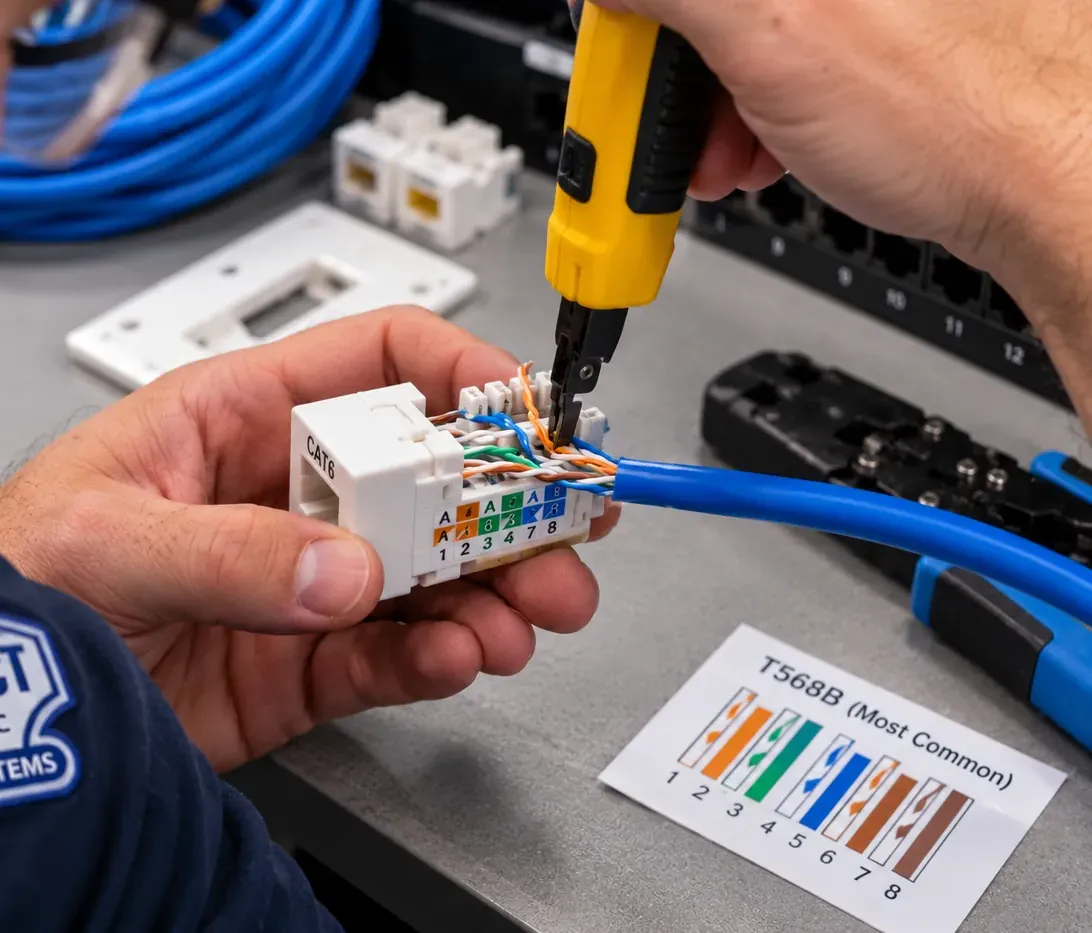
Hand holding a white Cat6 keystone with coloured pairs seated while a yellow punch-down tool presses them in, a T568B colour chart card and spare keystones on the bench — Midtown Manhattan jack repair
A white keystone marked CAT6 is held in one hand with its orange, green, blue and brown pairs laid in the slots while a yellow punch-down tool seats them; a printed T568B colour chart, a blank wall plate and spare keystones sit on the grey bench.

Building Work Coming to Your Floor? Test Before It Starts

A baseline before the lighting, duct or fit-out crew arrives turns any later argument about damaged cable into a simple comparison.

After the Other Trades

What Each Trade Tends to Disturb, and What We Test Afterwards

Different crews leave different marks on Cat6. Knowing who was in the ceiling tells us where to start, which saves time on a floor that has to be back in use the next morning. This is the checklist we work from in Midtown.

Trade in the ceilingWhat it usually does to the cableWhere we look firstWhat we leave behind
Lighting and controls (energy-code upgrades, sensors, sub-meters)Bundles lifted and laid on new fixtures; cable ties tightened around fixture whips; ceiling access-point boxes knockedLinks under the new fixtures and at ceiling-mounted devicesBundles on their own hangers, clear of fixtures; re-certified links
Mechanical (duct, air boxes, controls for emissions work)Runs pushed aside or crushed under new duct sections; cable moved onto duct hangersRuns crossing new trunk ducts and boxes; any re-routed lengthRe-routes measured against the length limit; independent supports
Sprinkler (new branch lines, relocated heads)Cable pulled tight around new pipe; cable left resting on branch linesRuns near relocated heads and new branchesCable taken off the pipe and supported separately
Furniture installersFloor boxes overfilled or closed on cords; power-pole tops pulled; cords stretchedDesk ends of every link in the reconfigured areaNew factory cords; floor boxes re-dressed
Neighbouring tenant’s fit-outRuns crossing the old demising line cut or re-routed; shared ceilings openedLinks ending near the boundary; any run that crosses itA marked plan of what is ours on both sides of the line
Phone booth or pod supplierFloor boxes covered; desk cords trapped under the pod baseFloor boxes within the pod footprint and the adjacent desksA separate route for the pod; desks re-certified

The common thread is support. Cable that hangs from its own J-hooks or hangers, at a known height, is far less likely to be disturbed by the next crew than cable resting on the ceiling grid or draped over whatever was there first. So nearly every Midtown repair ends with some re-supporting, even when the fault itself was a single termination.

The second habit is documentation. A short email to the building with the before-and-after results, the location of the damage and photographs takes ten minutes and puts the floor on record. Managing agents in Midtown tend to respond quickly to evidence like that, and it often changes how the next contractor is briefed.

Finally, timing. If you know a programme is coming — lighting this quarter, ductwork next — a baseline certification of the affected links before it starts is the cheapest insurance on this page. It takes a few hours, it leaves you with saved results, and it turns any later dispute into a comparison rather than an opinion.

Quiet Work, Loud Work

Splitting a Midtown Repair Between Office Hours, Evenings and Weekends

Not every part of a repair has to wait for the evening. Midtown floors are occupied all day, freight cars are booked in slots, and buildings set their own rules on noise and ceiling access. Dividing the job by how disruptive each part is lets a floor keep working while most of the repair gets done.

Usually fine during the working day

  • Certifying links from the panel. It is silent, happens in the closet and needs only a few seconds per desk at the far end.
  • Toning and tracing. Identifying which cable is which, with no tiles lifted.
  • Cord and dock-side work. Replacing a desk cord or re-terminating an outlet at an empty desk.
  • Closet re-terminations on ports that serve desks nobody is using that day.

Usually kept for evenings or quiet hours

  • Lifting tiles over occupied desks and anything that brings dust down onto people and equipment.
  • Re-supporting bundles across a working area, which means ladders in walkways.
  • Pulling replacement runs that cross several bays of ceiling.

Usually needs its own planning

  • Anything that becomes construction, such as coring a slab or opening a rated wall. The Department of Buildings requires an After Hours Variance for construction activity before 7 a.m., after 6 p.m. or at weekends, filed at least three business days before the first day of work; we scope those items separately so a small repair is not held up by them.
  • Work above another tenant’s ceiling, which depends on that tenant and the managing agent.

A typical Midtown plan therefore has a daytime visit to certify, trace and fix what can be fixed at desk level, and an evening visit to lift tiles, re-support and pull anything that needs replacing. Many single-area faults are finished in the daytime visit alone, because the certifier shows the problem at the desk end and nothing above the ceiling needs to be touched.

Complete Services

Every Cat6 Repair Service in Midtown

A failed Cat6 link on a Midtown floor often comes with other work. These Manhattan services can join the same visit.

AESS Cat6 Repair Across Manhattan

The borough page this Midtown page belongs to.

Network Cable Repair, Manhattan

When the fault may be a switch, a Cat5e leftover or a mix of both.

New Cat6 Drops in Manhattan

Priced per run when a floor needs new cable rather than repair.

Fiber Optic Installation in Midtown

Backbones between your floors and the building’s telecom room.

Structured Cabling, Manhattan

Closets, panels and floor-wide cable plans.

Network Installation

The switching and wireless layer the desks depend on.

AV and Sound for Meeting Rooms

Displays, room systems and booking panels.

Low-Voltage Installation

Cameras, doors, speakers and data handled by the same licensed team.

Send One Request

List everything on the floor in a single form.

Field Notes

From the Closet: How We Approach Midtown Cat6 Calls

Working habits our technicians follow on Midtown floors — general practice, not an account of any one job

We ask what happened above the ceiling recently before we ask what is broken. On a Midtown floor that question usually leads straight to the right bay of tiles.

We start in the closet. Certifying from the panel first means we can rule cable in or out for every reported desk before we disturb anyone at work, and the results show which part of the floor to look at.

We trace our run from end to end. In new towers the landlord’s cable shares the ceiling; on merged floors two closets serve one suite. If we cannot follow a cable back to your panel, we do not cut it.

We re-support as we repair. A link fixed and left lying on the grid is a link the next crew will disturb, so repaired bundles go back on their own hangers.

We write it down for the building. Results, photos and a short note go to you and, if you want, to the managing agent. On a floor where many trades work, that record is often what stops the same damage happening twice.

Full Service List

Every Cat6 Cable Repair Service We Handle in Midtown, Manhattan

Below is the complete list of what we repair on Midtown floors, from Murray Hill and Grand Central across to the Garment District, Times Square and Columbus Circle, grouped the way the jobs usually arrive.

Finding the Fault on a Midtown Floor

On a floor where lighting, duct and furniture crews have all been through the ceiling, the first job is working out which link actually failed and why. That is what our Cat6 cable diagnostics and Cat6 cable troubleshooting are for: we start at the dead desk, dock or panel, test back to the closet, and use network cable diagnostics and Ethernet connection diagnostics to separate the cable from the switch, the cord and the device. The same approach covers network cable troubleshooting, Ethernet cable troubleshooting, network connectivity troubleshooting and low voltage network troubleshooting on mixed floors.

Unlabelled or merged-suite cabling needs identifying before anyone cuts anything. Network cable tracing, Ethernet cable tracing and Cat6 cable tracing are done with tone generator cable tracing and network toner and probe testing, so live desks stay connected while we work. Cat6 cable tester diagnostics, Cat6 cable continuity testing, Ethernet cable fault detection and Cat6 cable fault detection then show whether a run is open, shorted, split or simply damaged at one point.

Repairing and Replacing Damaged Runs

In Midtown the cause is usually somebody else’s work. Cat6 cable damage from furniture moves and Cat6 cable damage from metal edges on new ductwork and fixtures show up as Ethernet cable jacket damage, pinched pairs or a cut. We match the fix to the damage: damaged Cat6 cable repair, damaged Ethernet cable repair, cut Ethernet cable repair, crimped Ethernet cable repair or broken Cat6 cable repair where the run can be saved, and Cat6 cable replacement, Ethernet cable replacement or network cable replacement in plenum-listed cable where it cannot.

Much of this happens above the grid. Commercial ceiling network cable repair, Cat6 cable repair above drop ceiling tiles and Cat6 cable replacement above ceiling grids go together with overhead Cat6 cable routing and Cat6 cable support installation on J-hooks and hangers of their own. Where new cable is the better answer, we also handle Cat6 cable installation.

Jacks, Plugs and Terminations

Hot desks and floor boxes wear out plugs faster than anything else on a Midtown floor, because cords there are pulled and re-seated all day. A snapped latch or a loose crimp is handled through RJ45 connector repair or RJ45 connector replacement; broken RJ45 connector repair covers plugs crushed under chair casters; and new plugs go on by RJ45 connector installation with RJ45 cable termination checked on the certifier. On the Cat6 side, the equivalent jobs are Cat6 connector repair, Cat6 connector replacement, Cat6 cable termination and Cat6 cable retermination.

Desk-side ports on Midtown floors live in floor boxes, power poles, furniture raceways and walls. Whatever the housing, the jobs are Cat6 wall jack repair, Ethernet wall jack repair, network wall jack repair, data jack repair and data jack replacement, with Ethernet outlet repair and network outlet repair for ports built into furniture. Inside each of those sits a keystone, so Cat6 keystone jack repair, Cat6 keystone jack termination and, where a module is cracked, Cat6 keystone jack installation are part of the same visit. Where suites have been merged, Cat6 wiring repair, Cat6 wiring troubleshooting, incorrect Cat6 wiring repair and Cat6 wiring correction — including T568A wiring repair and T568B wiring repair — put both ends of each link on the same standard, finished with a proper Cat6 punch down repair.

Closets, Panels and Rack Order

Midtown closets that have served several tenants are often crowded. Cat6 patch panel repair, network patch panel repair and Ethernet patch panel troubleshooting fix loose punch-downs and dead ports and show which port serves which desk, with Cat6 patch panel termination redone wherever a port fails. Network rack cable repair, network rack cable management and network cable organization tidy what is left.

Worn cords are replaced through patch cable replacement and network patch cord replacement, and network cable labeling and Cat6 cable labeling mark both ends to one scheme. Network cable cleanup is where before and after network cable repair and before and after Cat6 cable repair are clearest: a closet that two tenants left behind becomes one labelled, tested rack.

Cameras, Access Points and PoE Devices

Ceiling devices are the first to suffer when other trades work overhead. Cat6 cable repair for WiFi access points, wireless access point cable repair, ceiling mounted access point repair and PoE access point troubleshooting check the cable and plug feeding an access point before it is blamed. PoE camera cable repair, security camera Ethernet cable repair, Cat6 cable repair for security cameras and offline security camera network repair begin with PoE connection troubleshooting at the device, and for building entrances and roofs we also do weatherproof Ethernet connector repair and outdoor Cat6 termination repair.

Offices, Shops, Hotels and Registers

For tenants, the visible problem is a person who cannot work. Commercial office Cat6 repair is how we get them back: desktop computer Ethernet troubleshooting at the seat, office workstation network repair and office Ethernet connection repair on the link behind it, then disconnected Ethernet connection repair and network connection restoration until the desk is live again. For Midtown shops and restaurants, retail store network cable repair, POS network cable repair, checkout counter Ethernet repair and retail POS connectivity troubleshooting keep the register and card reader online. We handle commercial network cable repair, residential network cable repair in Midtown’s apartment buildings, and low voltage cable repair for the rest of the building.

Testing, Certification and Keeping It Working

Nothing leaves our hands until it is Cat6 cable repaired and tested. Day to day that means Cat6 cable testing, network cable testing, Cat6 cable signal testing and Cat6 performance testing; when a building, a landlord or an IT department wants a file, it means Cat6 cable certification, Cat6 cable certification testing, network cable certification and Ethernet cable certification with every result saved. That is certified Cat6 cable repair, and it is the basis of the before-and-after network cable testing and certification we recommend around building work.

Over the longer term, structured cabling repair, structured cabling troubleshooting, structured cabling testing and structured cabling maintenance keep a floor reliable through the next round of trades. Our Cat6 repair technician or Ethernet repair technician works as part of a licensed low-voltage Cat6 cable repair contractor, delivering Cat6 cable repair services, network cabling repair services, Ethernet cable repair and network cable repair to the same standard on every floor — what professional Cat6 cable repair services should look like.

FAQ

Midtown Cat6 Repair FAQ

Do you need the building's loading dock booked, or can a repair technician come in through the main lobby?
+

It depends on the building and on what we are carrying. Many Midtown towers send all contractors and tools through the loading dock and the freight elevator, while some allow a technician with a small tool bag through the lobby once the managing agent has our insurance certificate. A repair that needs a ladder, a reel of cable or replacement panels nearly always goes through the dock. Tell us what the building's contractor rules say when you book, and we will plan the arrival, the elevator booking and the parts so nobody is turned away at the door.

Some Midtown buildings only allow union contractors — can you work in those?
+

Tell us when you book. Some Midtown buildings' contractor rules set labour requirements for certain kinds of work, and the managing agent can confirm what applies to a tenant repair on your floor. We check the building's written rules against the visit before scheduling it, and if we cannot meet a requirement we say so at that point rather than arriving and being refused at the dock.

Do you repair the Cat6 behind the room-booking panels outside our meeting rooms?
+

Yes. Room-booking panels on Midtown floors are usually small touchscreens powered over the network cable, mounted on a glass mullion or a short wall beside the door. When one goes blank or shows offline, the cause is often the short run to it: a termination squeezed into a shallow back box, a cord pinched by the glass frame, or a cable re-routed when the room was refitted. We test the run for both data and power, repair the termination or the cord, and re-mount the panel as it was.

Our floor has blue, yellow and grey Cat6 — does the colour matter when a run is repaired?
+

The colour itself does not change how the cable performs, but on many Midtown floors it carries meaning. A building standard or a previous fit-out may have used one colour for desks, another for wireless access points or cameras and another for building systems, and in newer towers a particular colour may mark the landlord's cable. Before a repair we ask whether a colour scheme exists, match it on any replacement length, and note it on the port map so the scheme survives the repair.

Will lifting ceiling tiles set off the smoke detectors or the building's fire alarm?
+

It can if dust is disturbed near a detector, which is why we ask the building how it wants ceiling work handled before we start. Some buildings have their fire-safety staff place nearby devices in test or cover them for the duration; others simply want to know where tiles will be lifted. We lift tiles slowly, vacuum as we go, and keep the opening as small as the repair allows. We never cover or disable a fire-alarm device ourselves; that is the building's decision.

Our new floor uses PoE-powered lighting on Cat6 — do you repair those links as well?
+

Yes, the cabling side of it. Some newer fit-outs power and control light fixtures over Cat6 from a PoE switch, which means a cable fault can leave a group of fixtures dark or uncontrollable. We test the affected runs for continuity, performance and the power the fixtures need, repair or replace the damaged cable or termination, and re-certify. The fixtures, drivers and lighting-control software stay with the lighting contractor or manufacturer; we hand them the cable results so they can rule the wiring in or out.

Can a Midtown repair visit cover our office and our second suite in another building on the same day?
+

Usually, yes, if both buildings allow us in at times that fit together. Many Midtown firms have a main floor and an overflow suite a few blocks away, and both can often be covered in one booking: the three-hour minimum applies to the visit, and the time is split between the two addresses as the work needs. Each building gets its own insurance certificate and scope, and each suite gets its own results and port map.

All Areas Served

Cat6 Repair Across Manhattan, New York City and Beyond

This page covers Midtown. It sits under our Manhattan Cat6 repair page, which in turn sits under the NYC Cat6 repair hub for all five boroughs. Our Cat6 repair service covers all sixteen areas below.

Cable is only one of the systems we look after. Cameras, intercoms, door access and alarms are all reachable from the AESS home page, and the people and licence behind each visit are on our about page.

Sources

Sources Behind the Midtown Facts on This Page

Every local figure on this page comes from a published source, listed here so you can check it. Where a source is a summary of law, read the law itself or ask your building before relying on it.

Districts and the office market

  • Grand Central Partnership, “About Us”: founded in the mid-1980s; about 70 blocks from 35th to 54th Street and Second to Fifth Avenue; 76 million square feet; more than a quarter million office workers.
  • Times Square Alliance, “Market Research & Data”: about 0.1% of the city’s land area; nearly 180,000 workers, 19,000+ hotel rooms and 31 million square feet of office space.
  • Office of the New York City Comptroller, “NYC’s Office Market: Doom Loop or Boom Loop?”, November 13, 2025: CoStar-based figures showing occupied five-star space up 3,348,666 square feet and lower-rated space down 1,092,097 square feet in fiscal 2025; five-star space almost all in the business district south of 59th Street; Manhattan business-district availability of 14.3% in the fourth quarter of 2025.
  • New York City Council press release, August 14, 2025: approval of the Midtown South Mixed-Use Plan, described as the largest residential neighbourhood rezoning in two decades. Community Board 5 describes the plan area as about 42 blocks between West 23rd and West 40th Streets from Fifth to Eighth Avenues; New York YIMBY reports that it introduces residential zoning to an area previously limited to commercial and industrial uses.
  • Garment District Alliance, “History”: the district settled between Ninth Avenue and Broadway, 34th and 42nd Streets; the Special Garment Center District of 1987 restricted some 8 million square feet to manufacturing uses.

Buildings and landmarks

  • Landmarks Preservation Commission press release, August 12, 2025: designation of five garment-industry buildings, including the Lefcourt Clothing Center (275 Seventh Avenue, 27 storeys, designed in 1927 by Ely Jacques Kahn) and Fashion Tower (135 West 36th Street, 20 storeys, built 1924–1925, designed by Emery Roth).
  • JPMorganChase press release, October 21, 2025: opening of 270 Park Avenue, 60 storeys, 2.5 million square feet, designed for 10,000 employees; State Senator Liz Krueger’s statement in the release calls it the first new office tower built under the East Midtown rezoning.
  • NYC Department of City Planning, “Greater East Midtown”: One Vanderbilt received a special permit for additional floor area in return for about $225 million of improvements to Grand Central Terminal. SL Green’s opening release describes the tower’s terracotta façade.
  • Rockefeller Center: 19 commercial buildings on 22 acres between 48th and 51st Streets, the 14 originals built from 1931 and the core completed in 1939 (Wikipedia summary, carried from our Manhattan research).

Codes and building rules

  • NYC Department of Buildings, “LL88: Lighting System Upgrades & Sub-metering”: covered buildings over 25,000 gross square feet; lighting to meet the energy code and covered tenant spaces over 5,000 square feet sub-metered by January 1, 2025.
  • NYC Department of Buildings, Local Law 26 of 2004 reminder: full sprinkler systems in office buildings over 100 feet tall, to be completed on or before July 1, 2019.
  • NYC Department of Buildings, “LL97 Greenhouse Gas Emissions Reduction”: most buildings over 25,000 square feet subject to emissions limits from 2024, with stricter limits from 2030.
  • NYC Department of Buildings, “After Hour Variances”: an AHV is required for construction activity before 7:00 a.m., after 6:00 p.m. or on a Saturday or Sunday, filed at least three business days before the first work day.
  • NYC Administrative Code §28-105.4.7 (Local Law 128 of 2024): no electrical permit for wiring under 50 volts for data and communication when the work is done by a licensed master electrician, special electrician or qualified person. NYC Department of Buildings, “Electrical Code”: city amendments to the 2020 National Electrical Code, fully in effect from December 21, 2025.
  • Cabling Installation & Maintenance, “Data-communications cables in air ducts and plenums”: a ceiling cavity plenum is an example of the NEC’s “other spaces used for environmental air,” where plenum-type communications cable (CMP) is permitted.
  • Landmarks Preservation Commission, “Permits and Making Alterations”: the Commission’s own page on when its permits apply, including the exemption for ordinary repairs and the three cases in which interior work needs one.

Prices and forum context

  • AESS published prices: $195 an hour with a three-hour minimum and replacement runs from $175, from our Manhattan network cable repair page; new-drop prices from our Manhattan Cat6 installation page.
  • Fixr, “Upgrading to Cat6 Cabling”, updated January 2025: national figures of $125–$250 per drop and $45–$75 an hour for labour, quoted only for comparison.
  • Reddit, r/lowvoltage and r/sysadmin: threads from people looking for cabling contractors for Midtown offices, read as background on what tenants ask; nothing is quoted from them.

Midtown Desks Still Offline After the Trades Went Home?

If a row of desks, a meeting room, a register or a hotel office lost its network after work in the ceiling, call (929) 560-0737. Tell us which crew was up there and when the building can let us in, and we will plan the repair around that.

Cat6 Repair in Midtown — Found, Fixed, Re-Supported and Documented

Abstract Enterprises Security Systems · 460 E Fordham Rd, Bronx, NY 10458 · Manhattan line (929) 560-0737 · WhatsApp (718) 679-0359 via wa.me

NYS Low-Voltage Licence #12000287431 · 100% Licensed & Insured · Same-Day Estimates · Rated 4.7★ from 201 Google Reviews

Customer-supplied modules and cable are covered by whoever made them; our own commitments are explained on the AESS warranty page.

Where this page mentions Local Laws 26, 88 and 97, after-hours variances, the electrical code or Landmarks rules, it paraphrases them for planning only; the sources section names each one so you or your building can read the original. Last reviewed October 17, 2026. Changelog: Midtown Cat6 repair page first published.