What are you looking for?
About Us Contact Us Careers Get a Free Quote (800) 486-0943
Pick a service
✅ Got Your Own System?
🎬 Home TheatreQuote 🎶 AV SoundQuote 🔑 Access ControlQuote
Now pick your area
Pick your area
Long Island
Hudson Valley
Services available
Pricing & Tools
Pick a service for pricing
🚪 Intercom Pricing 🔔 Buzzer Repair Pricing
Calculators
📹 Camera System Calculator 🚨 Alarm Calculator ⚡ Cabling Quote Builder ✅ Got Your Own System?
Select your area
Licensed Low-Voltage Contractor · Based on East Fordham Road · New Towers, Pre-War Apartment Houses, Storefronts & Campuses

Cat6
Repair in
the Bronx

New-Building Defects · Dead Apartment Jacks · Hallway Raceway Damage · Intercom & Camera Runs · Cellar & Riser Faults · Re-Termination & Recertification

Bronx Cat6 comes in two ages. Some of it went into the towers that have gone up along the Harlem River, Jerome Avenue and the Concourse in the last few years; some of it was threaded, much later, into apartment houses built when the Grand Concourse was new. The two fail for different reasons, and a good repair starts by working out which one is in front of us — an installer's shortcut that was there from day one, or damage done to cable that once tested fine. We locate the fault, fix only what is broken, and hand back a link that tests to Category 6 again.

Reviewed and updated October 17, 2026 · Written by Anwar Timothy, NYS licence #12000287431

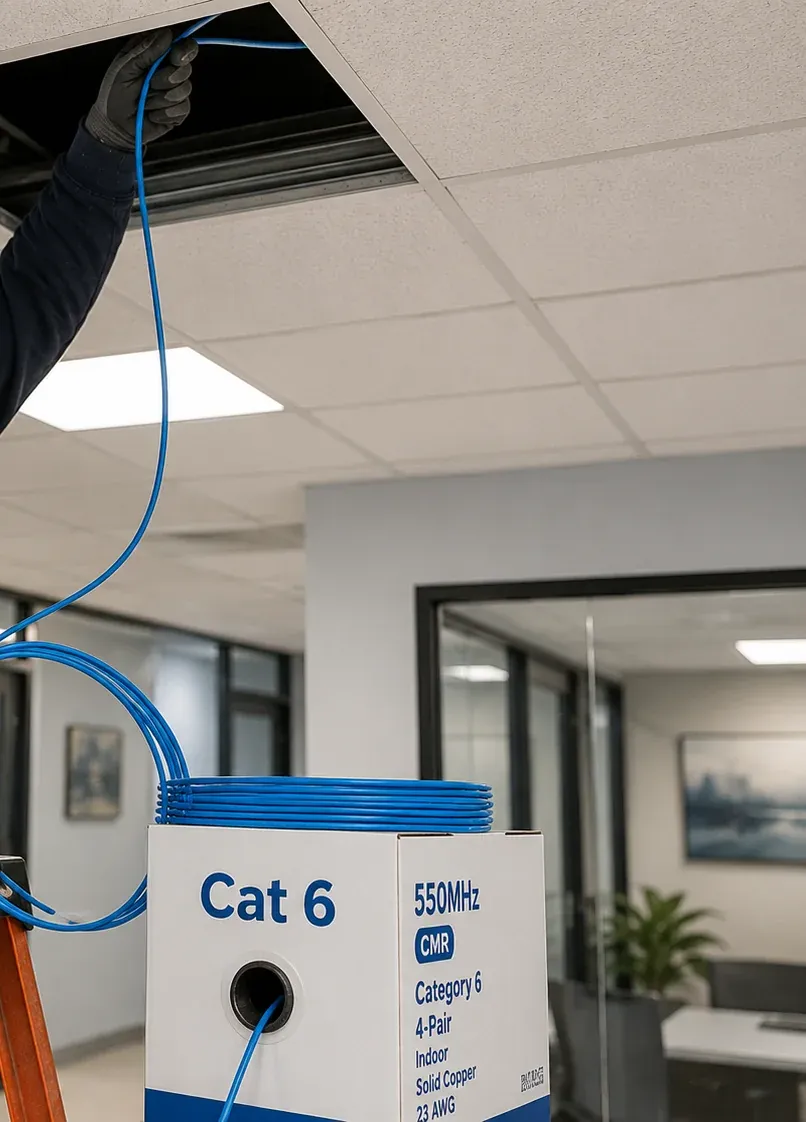
Gloved hand feeding blue Cat6 up through an open ceiling tile from a Cat 6 CMR cable box, Cat6 repair in the Bronx
A gloved hand pushes a blue cable up into an open ceiling-tile bay while it pays out from a box printed Cat 6, 550MHz, CMR, solid copper, 23 AWG; the top of an orange stepladder is at the left edge.
Get a Free Bronx Cat6 Repair Quote
Say what the link feeds and how old the building is — a technician answers the same business day

✅
Request Sent!
A technician will call you back the same business day.
25+
Years Experience
✓
Same-Day Estimates
100%
Licensed & Insured
4.7★
201 Google Reviews

A jack that has never worked, or one that just quit? Those are different repairs, and the first phone call usually tells us which. Ring (646) 490-0629 or send the 60-second form; a licensed technician reads it and tells you, before anything is booked, whether it sounds like an unfinished installation, a damaged run, a bad termination or something that is not cabling at all.

  • Faults placed by distance along the run before a wall, a hallway raceway or a ceiling is opened
  • Saved test results go to whoever runs the building — owner, managing agent or board — not just to the person at the jack
  • NYS licence #12000287431 · insured · dispatched from 460 East Fordham Road
The Neighborhood

Why Bronx Properties Need Cat6 Repair That Starts With the Building's Age

No borough has added housing faster in the last few years, and no borough has more of its life inside five- and six-storey apartment houses from the 1920s and 1930s. Those two facts sit side by side on almost every Bronx block, and they decide how Cat6 fails here. In 2023 the Bronx produced roughly 35 percent of the city's net new housing units, more than Brooklyn, according to the State Comptroller. Much of it arrived in towers of a hundred units or more on the rezoned Harlem River waterfront and along Jerome Avenue. Every one of those buildings was wired for data, intercoms, cameras, package rooms and building management, usually by subcontractors working against an opening date. A block away, the Cat6 serving a lobby camera or a video intercom was added to a building that was designed for steam heat, a doorman bell and a telephone in the hall.

Cable from those two worlds goes wrong in opposite ways. In new construction, the commonest faults were built in: a keystone punched with an inch of untwist, a pair split at one end, a home run that was never connected to anything in the apartment's media panel, a link that was quietly left failing when the test results were never asked for. Then come the other trades. Drywall crews drive screws through cable that was not kept back from the stud face, ceiling installers rest grid wire on bundles, and the painter's ladder lands on the run that was left loose at the closet door. By the time a tenant or an office moves in, the cable looks finished, the wall is closed, and the fault has been sealed inside it.

In older stock, the Cat6 was nearly always an afterthought. It climbs a light well or an old pipe chase because there was no riser for it; it runs along a public hallway in plastic surface raceway because nobody wanted to open plaster on six floors; it crosses a cellar ceiling beside steam mains and sprinkler pipe; it is stapled up a stairwell to reach a camera over the roof door. Those runs are damaged by the life of the building rather than by the people who installed them: a moving dolly catches the raceway lid, a tenant tugs at a cable to free a stuck door, a renovation crew in one apartment cuts what serves the whole floor, and a superintendent with a roll of tape does his best to keep the camera alive until somebody qualified can come.

The decision that follows is different for each. A defect from the original installation is often a re-termination and a test — and sometimes a conversation with whoever was paid to install it. Damage to an older retrofit run is often about the route: whether the same raceway, chase or cellar path can take a replacement, and how to protect it so the same thing does not happen next month. A Bronx repair that skips that first question tends to fix the symptom and leave the cause in the wall.

Most Bronx buildings that call about a failing Cat6 link are also living with the systems on the end of it. When the trouble is a video intercom, our intercom repair team in the Bronx deals with the stations and the panel; when it is a camera, the Bronx security camera repair service looks after the recorder side while we certify the cable between them.

Bronx facts that shape a Cat6 repair

  • About 35 percent: the Bronx share of the city's net new housing units in 2023, ahead of Brooklyn's 34 percent, per the Office of the State Comptroller's 2025 housing production report. The same report counts 8,093 new Bronx units in 2024.
  • 3,270 units in 11 towers: very large buildings completed in 2023 on or near the rezoned Bronx waterfront, plus 1,019 units in four 100-plus-unit buildings in the Jerome Avenue Neighborhood Plan area, according to the Comptroller.
  • 63,066 units: homes built in Bronx buildings of four or more units between 2010 and 2025, according to the NYU Furman Center — a decade and a half of new low-voltage plant.
  • 61 apartment houses, 1917–1959: the core of the Grand Concourse Historic District, which the Landmarks Preservation Commission describes as one mile of the Concourse between East 153rd and 167th Streets, and which records that the five- and six-storey apartment house became the dominant building type in the Bronx.
  • 19.7 percent: the Bronx homeownership rate in 2024 against 32.7 percent citywide, per the Furman Center. Most Cat6 repairs here are arranged through a landlord, a co-op board or a managing agent rather than by the person sitting at the dead jack.
  • 15,372 apartments: Co-op City's total across 35 high-rise buildings and seven townhouse clusters, according to Riverbay, the cooperative's management company — one address with more units than many towns.

Put those together and the picture is a borough with a great deal of young Cat6 that was never properly proved, a great deal of older building stock that was never designed to carry it, and a decision-maker who is often one step removed from the problem. That is what this page is written around.

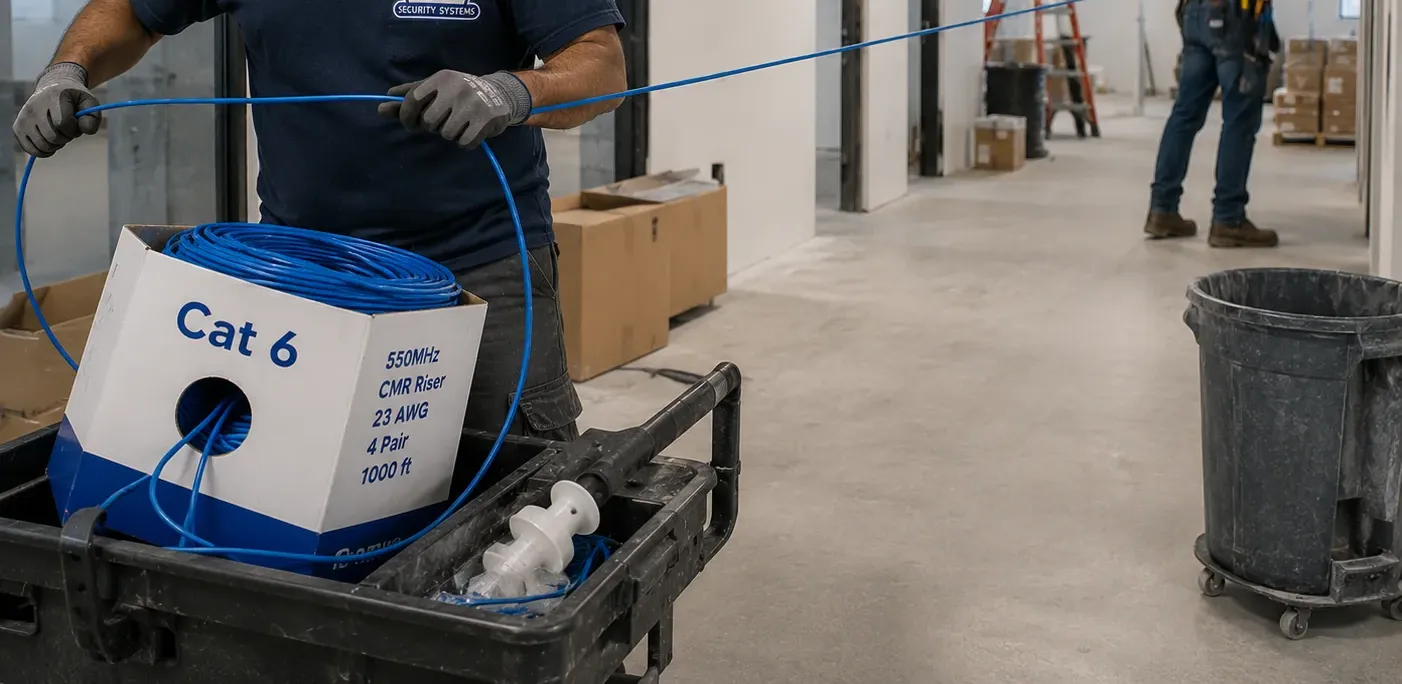
Technicians pulling blue Cat6 down an unfinished corridor from a box on a cart in a new Bronx building
A technician pays blue cable from a Cat 6 CMR riser box sitting on a black cart in an unfinished corridor with a bare concrete floor, while a second worker at the far end, beside a ladder and stacked boxes, lifts the cable toward the ceiling.
Repair Capture

Cat6 Link Down Somewhere in the Bronx?

A front-door intercom that shows no picture upstairs, a lobby camera missing from the recorder, a register on Fordham Road that will not take cards, a doctor's office on the Concourse with no network at the front desk: those are service calls and we treat them as such. We work out of 460 East Fordham Road, book the next open two-hour window, and come with a certification tester, a toner, Cat6 and Cat6A keystones and panel modules, surface raceway and cable on the van. Once a technician is standing at the fault, most single-link problems at a termination or a cord are found and fixed in one to two hours. Repair time is $195 an hour with a three-hour minimum ($585). Call (646) 490-0629 and say it is a Cat6 fault; if the trouble turns out to be older Cat5e or the network equipment rather than the cable, our network cable repair service for the Bronx takes it from there.

What We Repair

Cat6 Repair Services in the Bronx

These are the repairs Bronx buildings actually ask us for, grouped by what has gone wrong rather than by part number. All of them end the same way: the link is retested against its category limit, the result is saved, and the person who arranged the visit is told in plain words what was found.

New-Building Defect Repair

Links in recently completed buildings that never passed, or never worked: split pairs, untwisted terminations, swapped T568A/B ends and unseated conductors. We test, find the end at fault, re-terminate and give you a result you can hold the installer to.

Apartment Media-Panel Activation

Every room has a jack and none of them connect. Usually the home runs end at a panel in a closet with no switch or no patching. We identify each run, test it, terminate it properly at the panel and connect it to equipment you choose.

Hallway Raceway Run Repair

Cat6 for cameras, intercoms and access readers that runs in surface raceway along public corridors: crushed lids, pulled cable, cut runs. We locate the damage, replace or splice to category where suitable, and fit raceway that can take the traffic.

Riser, Chase and Light-Well Runs

Vertical runs in pre-war buildings that were added later through old chases, light wells or stairwells. We trace them floor to floor, find the damaged section by distance and decide with you whether the same path can take a replacement.

Cellar Run Recovery

Cat6 crossing boiler rooms, laundry rooms and storage cellars: runs too close to steam pipes, wet terminations, and cable left lying where porters move carts. We test, re-route away from heat and water, and remake the terminations.

Keystone, Plate and Panel Re-Termination

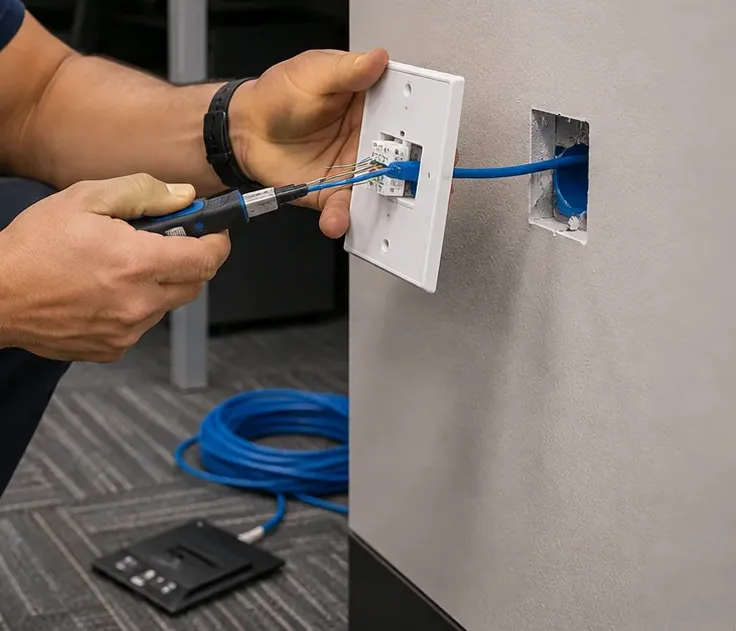
Cut back to clean cable, re-terminate on Cat6 or Cat6A parts that match the link, retest. Still the commonest cure for crosstalk failures at either end, whether the building is two years old or ninety.

Intercom and Camera Link Repair

Video intercom stations, lobby panels and PoE cameras that lose picture or power. We separate a cable fault from a panel, a power-budget or a configuration fault, so the right trade fixes the right thing.

Storefront and Office Repairs

Registers, printers, phones and cameras on Bronx commercial strips: runs crushed behind counters, plugs crimped in a hurry, cable sharing a path with gate motors and sign wiring. Repairs scheduled around trading hours.

Certification and Handover Testing

Testing a building's Cat6 against TIA permanent-link limits when it changes hands, when a tenant moves in, or when nobody can find the original results — with failures repaired and every link left labelled.

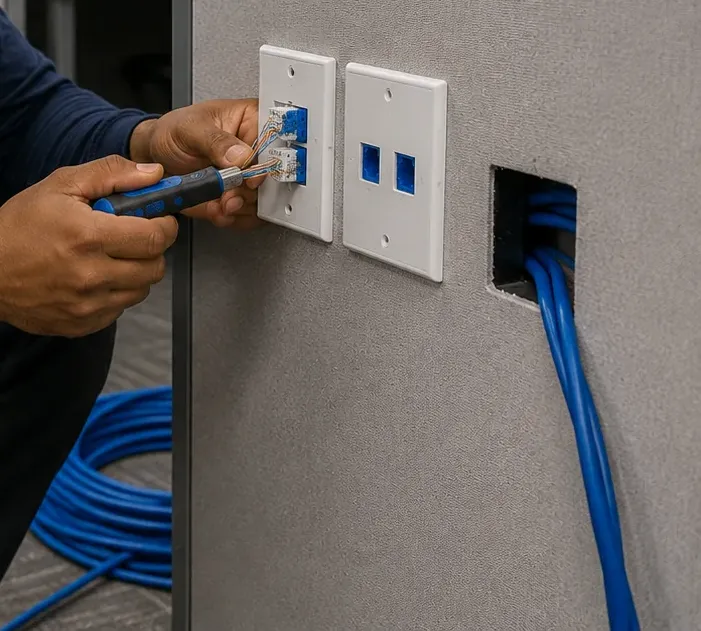
Technician punching down a keystone on a cubicle wall plate beside a cable opening, Bronx Cat6 re-termination
Hands press a blue-handled punch-down tool against a keystone on a white plate fixed to a grey cubicle panel; a bundle of blue cable comes out of a rectangular opening beside a second two-port plate.
Building Specialists

Cat6 Repair for the Bronx's Architecture

The building tells us how the Cat6 got in, and that tells us how it is most likely to have failed. These are the building types we meet most often across the borough.

New Mid- and High-Rise Rentals

Towers on the Harlem River waterfront in Mott Haven, along Jerome Avenue and around the Concourse: Cat6 to every apartment's media panel, plus cameras, intercoms, package lockers and amenity Wi-Fi. Faults cluster at terminations and wherever another trade worked after the cable was pulled.

Pre-War Five- and Six-Storey Apartment Houses

Brick and terra-cotta buildings from the 1920s and 1930s on the Concourse, in Highbridge, University Heights, Fordham, Bedford Park and Norwood. Cat6 arrives through light wells, old chases or hallway raceway; damage is from traffic, renovation and well-meant amateur repairs.

Large Co-op and Housing Complexes

Co-op City, Parkchester and the tower-in-the-park complexes: many buildings, long horizontal runs between them in tunnels or basements, and a management office that needs to know exactly which link failed and why.

Storefront Buildings on Commercial Strips

Two- and three-storey mixed-use buildings on Fordham Road, Third Avenue at the Hub, White Plains Road, East Tremont and Westchester Square. The shop's network shares a cellar with the building's meters and the tenants' storage.

Hospitals, Clinics and Campuses

Medical offices along the Concourse, community health centres, and the colleges in University Heights, Fordham and Bedford Park. Repairs go through facilities departments with their own rules for ceilings, hours and documentation.

One- and Two-Family Houses

The detached and semi-detached houses of Throgs Neck, Pelham Bay, Country Club, Morris Park, Riverdale and Wakefield. Cat6 here is often owner-installed or added by a camera company, and stapled through basements and attics.

How the repair method changes with the building

New construction. The cable is usually in good condition along its length; the faults are at the ends or at a single point where a screw, a nail or a sharp stud edge caught it. That makes testing from both ends with time-domain readings unusually productive: a reading that puts a fault 40 centimetres from the wall plate points at the first stud bay, not the closet. We open the smallest access cut that reaches it, repair or re-pull, and leave the cut neat for the painter. Where a whole floor of terminations shows the same habit, we re-terminate the floor rather than chase links one by one.

Pre-war apartment houses. Plaster over terra-cotta block or brick does not forgive guesswork, and many owners would rather not open it at all. We trace the existing path first, because the Cat6 almost always followed something older — a disused gas line, an abandoned bell wire, the edge of a light well — and the best replacement route is often the same one, protected properly this time. Surface raceway in public halls gets a lid that clips firmly and a fixing pattern that does not let the cable sag at corners.

Complexes. Between-building runs in tunnels and basements are long, so length and insertion loss come first. A link that tests near the 90-metre permanent-link limit and fails only at its far end is a design problem, not a termination problem, and the honest answer may be a switch closer to the users or a fiber link between buildings.

Commercial strips. In a shared cellar, the store's runs often cross the building's electrical service and the neighbouring tenant's space. Data cable that shares a path with the power feed to a roll-down gate motor or an illuminated sign can drop a marginal link whenever that equipment starts, so we keep the two apart, label everything at both ends so the next trade cannot mistake it, and schedule around the shop's opening hours.

Houses. Basement and attic runs are usually reachable, which makes a re-pull more practical than in an apartment building. The commonest find is cable that was never solid-copper Cat6 in the first place, and stapling that crushed the jacket.

Most of the older apartment houses that ask us to repair camera and intercom cable eventually pair the repair with better door control, and our access control installation team in the Bronx works on the same buildings.

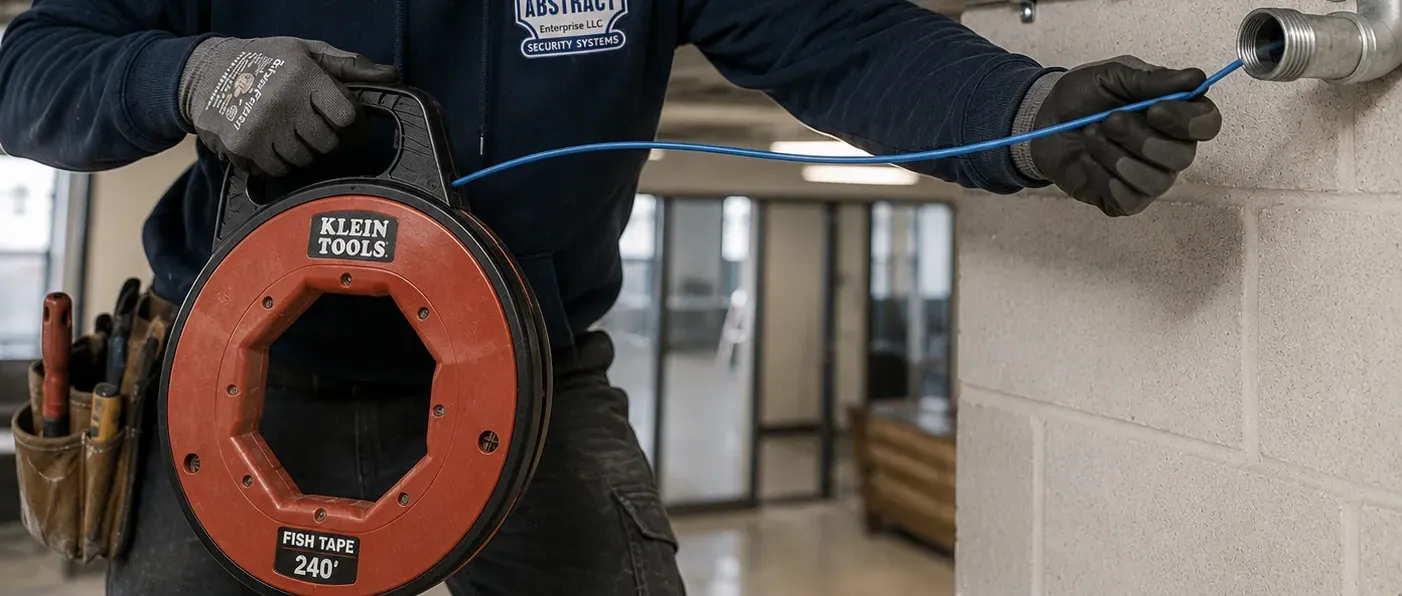
Gloved hands feeding blue cable from a fish tape reel into steel conduit on a cinder-block wall, Bronx Cat6 re-pull
Gloved hands guide a blue cable into the open end of a steel conduit fitting on a painted cinder-block wall, the cable drawn from an orange Klein 240-foot fish-tape reel held at the left.
Commercial Cat6 Repair

Business Cat6 Repair in the Bronx

The Bronx's commercial Cat6 is spread across a handful of very different places, and each one breaks cable in its own way. These are the corridors we work in most.

Fordham Road

The city's Small Business Services directory lists the Fordham Road BID with 35 block faces and 333 ground-floor retail businesses. Narrow shop floors, deep cellars and frequent fit-outs mean point-of-sale and camera runs that get crushed behind counters and re-crimped on the spot.

The Hub at Third Avenue and 149th Street

A dense shopping crossroads above the 2 and 5 trains, with retail, offices and services stacked in older buildings. Cat6 here commonly shares cellars and back stairs with several tenants, so tracing comes before cutting.

Bronx Terminal Market and the Yankee Stadium Area

Big-box retail on a 17-acre site south of the stadium, with roughly 913,000 square feet of leasable space according to its listings. Long runs to cameras, registers and stock rooms, and frequent tenant changeovers that leave abandoned cable behind.

Hunts Point

The food distribution centre on 329 acres, with more than 155 wholesalers by the city food-policy centre's count. Office and dock runs fail at cold-room transitions and where forklifts work; we handle the Cat6 links, while our network cable repair page covers the cold-chain environment in depth.

Bay Plaza and Co-op City

Bay Plaza, at the Hutchinson River Parkway and I-95, grew to about two million square feet when its enclosed mall opened on August 14, 2014. Tenant fit-outs, back-of-house camera runs and kiosks generate a steady stream of terminations to check.

Medical and Campus Corridors

Practices along the Grand Concourse and around the hospitals, and campuses such as Fordham's 85-acre Rose Hill grounds. Repairs here run through facilities teams, with ceiling-access rules and a firm requirement for test documentation.

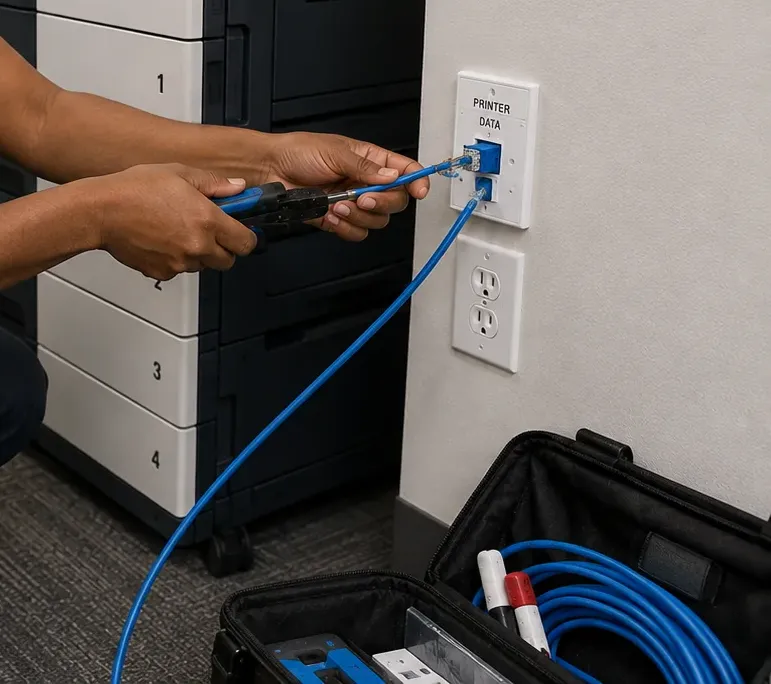
Technician working at a printer data jack beside an office copier with a blue cord, Bronx office Cat6 repair
Two hands hold a small tool at a wall plate labelled Printer Data next to a large office copier, a blue cord running down to an open case of blue cable and test leads on the floor.

Compliance on a Bronx Cat6 repair

  • New York City Electrical Code. The current code is the city's amendments to the 2020 National Electrical Code and took full effect on December 21, 2025, per the Department of Buildings. Cable listings — CMR in risers, CMP where a ceiling is used for return air — apply to replacement runs exactly as to new ones.
  • Abandoned cable. Accessible portions of abandoned communications cable must be removed under NEC Article 800, unless tagged for future use. In buildings that have been re-cabled two or three times, that is often the first job before a repair run can go in.
  • Firestopping. A replacement run through a floor or a rated wall in an apartment building must be sealed with a listed firestop system. Old penetrations stuffed with insulation or left open are noted on the repair record for the owner.
  • Landmarked buildings. Inside the Grand Concourse Historic District and other designated areas, exterior changes — including cable on a facade — can need Landmarks approval. We keep repairs and re-routes inside the building unless the owner has the approvals in hand.
  • Managed and institutional buildings. Certificates of insurance, contractor hours and access rules come from the managing agent, co-op office or facilities department; we sort them before the visit, not on the doorstep.

This section summarises codes and rules as they apply to typical Cat6 repairs; it is not legal advice, and building-specific requirements come from the owner, the Department of Buildings and the Landmarks Preservation Commission.

Your Questions Answered

Cat6 Repair in the Bronx: Questions Answered

These are the questions Bronx owners, managing agents, superintendents and tenants put to us, grouped by the kind of building they come from. Each answer is the one we would give on the phone.

Cable from the building boom

Our Bronx building opened last year and some jacks never worked — is that a repair job or the builder's punch list?

If a link never passed traffic from the day the building was handed over, it is almost certainly an installation defect, and the first call should go to the developer or general contractor, because most new-building contracts make the cabling subcontractor responsible for links that fail at turnover. What we can do is test the failing links, show where each fault sits and what it is — a split pair at the panel, an open conductor at the plate, a run that ends nowhere — and give you a written result you can put in front of them. If the contractor is unavailable or the warranty period has lapsed, we repair the links ourselves at our normal rate. Either way, knowing the cause before anyone argues about it saves weeks.

Links in our new building passed at handover but started failing once tenants moved in — what changed?

Usually the occupants' first few months. Move-in is when televisions are wall-mounted with long screws, picture hooks go up, furniture is pushed hard against floor-level jacks, internet and cable installers drill for their own service, and the first small renovations happen. Each can damage a run that was perfectly sound at handover. The handover results, if you have them, are valuable here: a link that passed with good margin and now fails points at damage in that apartment, usually close to the plate, and a time-domain test shows how far into the wall to look.

Why do the cameras on our new building's roof and amenity floors fail more often than the apartment jacks?

Because they are the longest, the most exposed and usually the last runs finished. Roof, courtyard and amenity cameras sit at the far end of long runs, take their power over the cable, and are often terminated on field-made plugs in the final weeks before opening. Outdoor sections and roof entries add weather. A link that is long, powered and hurriedly terminated has the least margin in the building, so it is the first to show faults. We test those runs as a group, re-terminate the camera ends on proper hardware and check the power at each camera.

The developer handed over the building with no Cat6 test results — can installation defects be told apart from later damage?

Mostly, yes. Installation defects have a pattern: the same termination habit at many outlets, wire-map errors at one end only, untwisted pairs at the panel, runs over the length limit from the start. Damage is usually single and physical — one link, one point along its length, a crushed or pierced jacket. Testing the whole building, or a sample of floors, against permanent-link limits shows which you have. It also gives the building the baseline it should have received at handover, so the next fault can be compared against a known-good result.

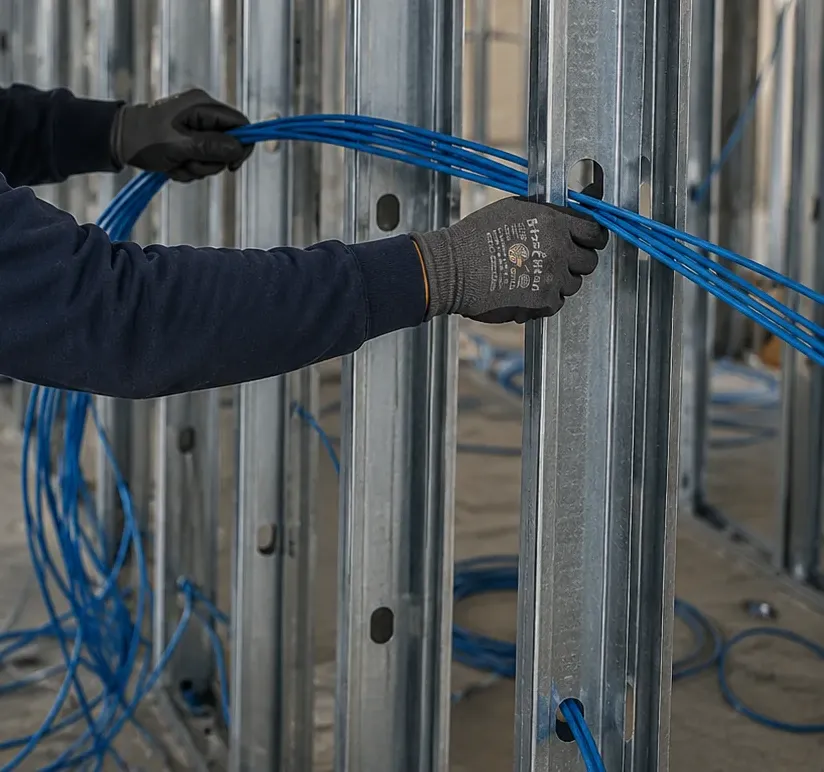
Gloved hands drawing a bundle of blue Cat6 through holes in metal studs, Bronx new-construction Cat6 repair
Gloved hands draw a bundle of blue cables through the punched holes of galvanized metal studs in an open partition, with loose loops of blue cable on the floor behind.

Cable retrofitted into older apartment houses

In a 1920s apartment house, what usually breaks the Cat6 running in surface raceway along the public hallway?

Traffic and leverage. Hallway raceway lives at the height of handcarts, furniture and strollers; once a lid is cracked or a fixing comes loose, the cable inside is bent hard at that point or pulled out of the channel. At corners and doorways, where the raceway changes direction, cable is often bent tighter than Cat6 tolerates, which shows up as crosstalk or return-loss faults rather than a dead link. We locate the point by distance, replace that section of cable and raceway, and use corner fittings and fixings that hold under knocks.

Only the upper-floor video intercom stations lost picture — is the riser Cat6 to blame?

It is the first suspect, but not the only one. When every station above a certain floor fails at once, the fault is usually on a shared run or at a junction point where the riser feeds branch off, often in a closet or a stairwell box. A failing power supply or a panel port can look the same, so we test the riser run and the branches before anything is replaced. If the cable is sound, we hand the result to the intercom technician and the stations or the panel are looked at next.

Our super patched a broken Cat6 run with tape and a coupler — what has to be undone?

The coupler and anything twisted together inside the tape. Inline couplers and hand-twisted splices add crosstalk and reflections that a Category 6 link cannot absorb, and taped joints let in moisture and come apart when the cable is moved. They often keep a camera alive for a while, which is all they were meant to do. We cut back to undamaged cable on both sides and either replace the section with a rated in-line connection suitable for the link's job, or replace the run, then test it properly. None of that is a criticism of the superintendent; it usually means the camera stayed up long enough for the building to call us.

Why would a cellar Cat6 run start failing only once the boiler is on for the winter?

Heat. A Cat6 link's insertion loss rises with temperature, and cable measurement guidance cited by Fluke Networks calls for derating unscreened cable length as the temperature climbs above 20 °C. A run strapped to a steam main or laid across a hot pipe in a boiler room can sit far above that all winter. A link that only just passed when it was installed in summer can then fail its margin from October to April. The repair is to move the cable off the heat, not to re-terminate it, and to retest once it is in a cooler path.

Can a damaged Cat6 run that shares an old pipe chase or abandoned dumbwaiter shaft be replaced in the same space?

Often, and it is usually the least disruptive route in a pre-war building. Before we pull anything we check that the space is clear to work in, that the new run will not lie against hot pipes or sharp edges, and that the floor penetrations are firestopped when we leave. Where the old cable is abandoned, the accessible length comes out so the chase does not fill with dead runs. If the space is shared with other utilities in a way that makes it unsafe or unworkable, we look for the next-best path and price it before starting.

Public halls, shafts and renovations

Can the old intercom or buzzer conduit in our building carry a replacement Cat6 run?

Often, and in many pre-war Bronx buildings it is the only vertical pathway that already exists. The conduit or chase that carried the original bell or audio intercom wiring usually runs from the lobby past every floor. If the old wiring has been abandoned, the accessible length can come out and the space be reused; if it is still live, we check the fill and whether data cable can share the space safely. We test the new run end to end once it is in, and note what was removed for the building's records.

Tenants keep pulling at the Cat6 to a hallway camera — what kind of repair holds up in a public corridor?

One where there is nothing left to grab. That means cable fully enclosed from the ceiling or raceway into the camera's base or a junction box, no loose service loop at reachable height, and raceway fixed at short intervals so its lid cannot be prised off. Where the run passes a door, it goes over the frame rather than around it. We repair the damaged link, test it, and change the last few metres of the route so the same thing does not happen next week.

A gut renovation in one apartment cut the Cat6 that serves the whole floor's cameras — is it best fixed before the new walls close?

Usually, if the renovation is still open. With the walls or ceiling exposed, we can find both cut ends, repair or re-pull that section and test the whole link before the unit is closed up. Once the walls are finished, the repair is harder and may mean a new route along the hallway instead. Owners who know a gut renovation is coming can save a lot by having us mark and protect common-system cable in that unit before work starts.

Decision Guide

Defect or Damage? Dating a Failing Bronx Cat6 Link

Before we decide how to repair a link, we work out what kind of failure it is. In the Bronx that question has real consequences: a built-in defect in a building finished last year may be someone else's to pay for, while damage to a twenty-year-old retrofit run is a route problem that will come back unless the route changes. This is how the evidence usually reads.

What we findWhat it usually meansWhat happens next
Same wire-map or crosstalk failure at many outlets on one floorInstaller's termination habit — built inTest the floor, document, re-terminate as a batch; results for the owner's claim if wanted
Run that tests open at the closet with no cable on the panelHome run never terminated at handoverIdentify, terminate, patch and test
Single fault 30–60 cm from a plate in a new drywall partitionFastener through the cable during board installationSmall access cut, repair or re-pull, retest
Fault part-way along a hallway raceway runImpact or leverage damage in the public corridorReplace the section and the raceway; re-route away from reach if needed
Link passing in summer, failing margin in winterRun in contact with heating pipeworkRe-route off the heat, retest
Insertion-loss failure on a between-building run of near 90 mDesign length problem, present from day oneCloser switch or fiber link; re-termination will not help
Silver-coloured core when a conductor is cutCopper-clad aluminium, not genuine Cat6Replace the run; no termination will certify it
Coupler, tape or twisted splice in the runEarlier emergency patchRemove, repair to category or replace the section

Two cautions sit alongside the table. First, the tester has to be set to the right limit: a Cat6 link judged against Cat6A limits will “fail” and should not be “repaired” into passing. Second, defects and damage can stack. A link that was marginal from day one is the first to fail when a ladder leans on it, and in that case the honest report says both.

When the evidence points at the original installation, we write it down in terms a developer or general contractor can check: which links, which parameter, which end, and the measured margin. Many owners use that to get the work done under the installer's warranty; others prefer to have us fix it and move on. We are happy either way, but the decision belongs to the owner, not the repair contractor.

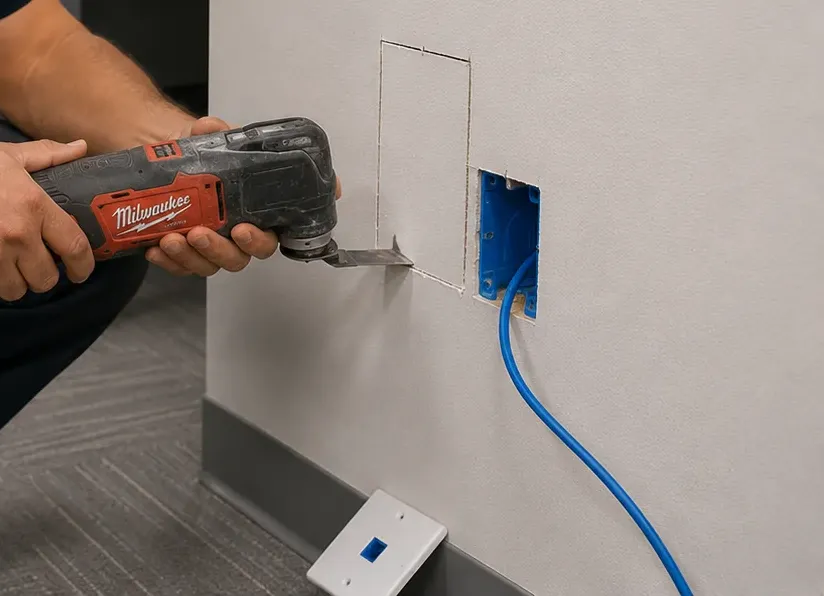
Oscillating multi-tool cutting an access opening in drywall beside a blue box with Cat6, Bronx Cat6 repair
Close-up of a battery multi-tool with a red body slicing a neat square into a pale partition wall; to its right a blue low-voltage box sits in the wall with one blue cable dropping toward the carpet, where a loose white plate waits.
Equipment

Types of Cat6 Repair Work We Carry Out in the Bronx

What comes off the van on a Bronx Cat6 repair, and why each item earns its space.

Certification Tester

Tests each link against TIA Cat6 or Cat6A permanent-link and channel limits, saves the result and, with time-domain diagnostics, shows where along the cable a crosstalk or reflection fault sits.

Tone Generator and Probe

Finds which apartment, desk or camera a run serves when the media panel or the closet carries no labels, without disconnecting anything that works.

Matched Keystones and Panel Modules

Cat6 and Cat6A parts in the formats Bronx buildings most often use, so a repaired outlet matches the plate and the panel stays one system.

Surface Raceway and Fittings

Lidded raceway, inside and outside corners, and junction boxes for public hallways and stairwells where the cable cannot go inside the wall.

Solid-Copper Riser and Plenum Cable

CMR for vertical runs and CMP where a ceiling is a return-air plenum. Never copper-clad aluminium, and never stranded patch cable used as a permanent link.

Fish Tapes, Rods and Access Tools

For pulling replacements through chases, conduit and light wells, and for the small, square access cuts that let us reach a fault in drywall without wrecking the wall.

Firestop Materials

Listed sealants and sleeves for the penetrations a replacement run passes through between floors and apartments.

Factory-Made Patch Cords

Cat6 and Cat6A cords for the panel and the outlet ends, because a field-crimped cord is a common reason a sound permanent link fails as a channel.

PoE Load Checking

To confirm a camera or intercom station is actually receiving the power it needs over the repaired link before we call it fixed.

Who else could fix it — and when they are the right call

Your IT provider is the right first call when the switch, the router or the device configuration is in doubt. Most are not equipped to certify cable or open a hallway raceway, and many will ask a cabling contractor to prove the run before they change anything else.

The original installer should be asked first when a link in a new building never worked; if they come back and fix it, so much the better. Where they will not, or cannot, a test report from us usually settles the question.

The building's own staff are invaluable for access, history and knowing which camera serves which hallway. They are not expected to re-terminate Cat6, and patches made under pressure are best replaced once a cabling technician can attend.

A general electrician can pull cable, but certification-grade testing and termination to Category 6 are a different discipline. If an electrician is already on site for other work, we are happy to test and terminate runs they pull.

Lead-generation directories will pass your number to several firms; what they cannot tell you is whether any of them will bring a certification tester or leave a result behind. Ask for that before booking anyone, including us.

Technician terminating a blue cable on a single-port wall plate held away from a cubicle panel, Bronx Cat6 jack repair
Hands hold a white single-port wall plate away from its opening in a grey cubicle panel and seat a blue cable onto the keystone with a punch-down tool, a coil of blue cable and a black tester on the carpet below.
AI Overview Reality Check

What AI Gets Wrong About Cat6 Repair in the Bronx

Google's AI-generated summary for Bronx Cat6 repair searches was not visible to us when this page was written, so none of the text below claims to quote it. Instead, each heading is a belief that turns up again and again in cost guides, forum threads and how-to articles — the raw material such summaries are built from — followed by what Bronx buildings actually show.

1. “A new building has new cable, so the cable won't be the problem”

The assumption is understandable. New cable has not been crushed, soaked or chewed, and its jacket still looks perfect. Summaries of network troubleshooting usually start with the router, the switch and the device for exactly that reason, and leave the in-wall cable until last.

In new Bronx construction, the cable is often the first thing to suspect. Links are terminated in a hurry near the opening date, test results are not always demanded, and the walls close over whatever was done. A building that went up in two years has had dozens of trades working around the same cable during that time.

So in a new building we test the cable early in the diagnosis, not last. If the link fails, the pattern of the failure tells us whether to look at termination quality across the building or at a single point of damage.

2. “Ethernet jacks in an apartment should just work”

Tenants moving into new apartments often expect the wall jacks to behave like power outlets: plug in, and the internet is there. Forum threads from people in exactly that position are common, and generic answers tend to jump straight to “the jack is broken”.

A data jack is the end of a cable, not a source of network. In most new Bronx apartments every jack is a home run to a media panel, and until those runs are terminated and connected to a switch or router, none of them will do anything. That is a setup task, not a fault.

We check that first, because it is cheaper for everybody. Only once the runs are connected and a particular jack still fails do we treat it as a cable repair.

3. “Cat6 work costs $125–$250 a drop”

Ask a search engine what Cat6 work costs and the answer usually leans on national cost guides such as Fixr's, whose January 2025 edition gives $125–$250 a drop. For a new run through an open, easy building somewhere in the country, that is a sensible ballpark.

It does not describe repair. A repair is priced by the time it takes to test, locate and fix faults, and in a pre-war Bronx apartment house that time is spent in hallways, chases and cellars rather than in an open ceiling. A per-drop figure for new cable tells you very little about a crushed run behind a raceway lid on the fourth floor.

Our own figures are published further down this page, with the source of each. A repair visit is priced by time; a run that genuinely has to be replaced is priced per run.

4. “You don't need conduit for low-voltage cable in New York City”

A version of this circulates on r/AskNYC, where a commenter told someone asking about running Ethernet along an apartment's outside wall that city code does not require conduit for low-voltage cabling. For many indoor runs, that is broadly the practical experience.

It leaves out the rules that still apply. Communications cable has to be listed for where it runs — riser-rated in vertical shafts, plenum-rated in return-air ceilings — and penetrations through floors and rated walls must be firestopped. On a facade in a historic district, other approvals may come into play.

It also leaves out practicality. In a public hallway, cable without raceway or conduit is cable waiting to be pulled. Whether the code demands protection or not, a repair in a corridor usually needs it to last.

5. “If a Cat6 cable stops working, just re-crimp the end”

Plenty of how-to articles and videos treat a failing Ethernet cable as a crimping problem: cut off the plug, put a new one on, test with a cheap continuity tester. For a patch cord that is sometimes reasonable.

Building cable is different. Most Bronx runs end on keystones and panel ports, not plugs, and a Cat6 termination has to keep the pair twists almost to the contacts. A re-crimp that lights the port can still fail crosstalk badly, and a continuity tester will not show it.

The cure for a termination fault is a fresh termination on the right hardware, followed by a test against the category limit. If the fault is in the cable rather than at the end, no amount of re-crimping will help.

6. “Mesh Wi-Fi makes in-wall cable unnecessary”

For a single apartment with laptops and phones, mesh Wi-Fi often works well, and summaries say so. It is a reasonable answer to “my bedroom has weak signal”.

It is not an answer for a building. Video intercom stations, lobby and hallway cameras, access readers, laundry payment systems and package lockers are mostly wired devices, many of them powered over the same cable. In pre-war buildings with masonry walls, wireless backhaul between floors is unreliable at best.

So in the Bronx, the in-wall Cat6 is usually carrying the building's own systems, not just a tenant's laptop. Repairing it is what keeps the front door, the cameras and the mailroom working.

7. “Indoor cable doesn't have heat problems”

Discussions of cable and temperature usually focus on attics, rooftops and outdoor runs. Indoor cable is assumed to live at room temperature, and summaries rarely mention heat as a cause of an indoor link failing.

Bronx apartment houses are largely heated by steam or hot water, with mains and risers running through cellars, chases and closets. Cable strapped to that pipework sits well above room temperature for half the year, and insertion loss rises with it.

That is why we ask when a link fails. A run that misbehaves only in the heating season usually needs a new route, not a new termination.
Find Out Whether It Was Built In or Broken Later

Tell us the address or cross streets, roughly when the building was finished, and what the failing links feed. We will tell you what the fault most likely is and how a visit is billed.

Get In Touch

Request a Free Quote

Superintendents, managing agents, shop owners and tenants all use this form. Tell us which devices have gone dark and where, and we reply in writing within the business day. Rather talk? Dial (646) 490-0629.

✅

We Got Your Request!

Thanks — it is with a Bronx technician now. For anything that cannot wait until our reply, ring (646) 490-0629.

How It Works

Our Cat6 Repair Process in the Bronx

Seven steps, whether it is one hallway camera in Highbridge or a floor of dead apartment jacks in a new Mott Haven tower.

1. Phone triage and building history

You tell us what stopped working, when, and roughly when the building was finished. We ask for a photo of the closet or media panel and any test results, and tell you what the fault most likely is.

2. Access arranged

We send the certificate of insurance to the managing agent or co-op office, agree times with the superintendent, and arrange entry to any apartment, cellar or roof the run passes through.

3. Route walk

With the super, we walk the route from the closet to the device: raceway, chases, cellar crossings and stairwells. Visible damage, renovations and hot pipework are noted before testing.

4. Test from both ends

The tester goes on both ends of every suspect run. It judges the link against Cat6 or Cat6A limits and reports whether the trouble sits at the near end, the far end or some measured metres in between.

5. Defect or damage, and the plan

For each link you hear two things: whether it was an installation defect or later damage, and our proposed cure. You approve the list before we pick up a tool, and anything new we find goes back to you first.

6. Repair and protect

Terminations are remade on matched Cat6 or Cat6A parts, damaged sections are repaired or replaced with solid-copper cable, runs are moved off heat and out of reach, and penetrations are firestopped.

7. Retest, label and report

We run the certification again on everything we touched, put durable labels at the plate and the panel, update or start the port map, and email the results with a plain-English summary to the owner, agent or board.

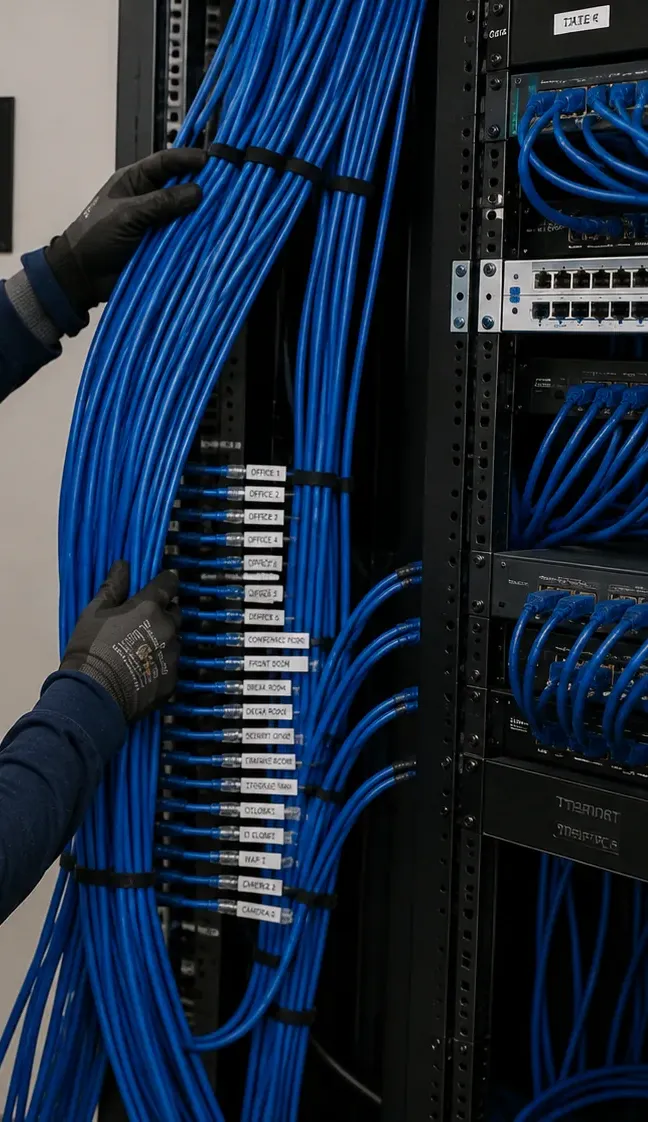
Gloved hands dressing a labelled bundle of blue Cat6 at a network rack in a Bronx telecom closet
Gloved hands hold a tall bundle of blue cables beside a black rack, each cable carrying a white label where it meets the patch panel, with a switch and more blue cords in the rack to the right.
Coverage Area

Cat6 Repair Near the Bronx's Landmarks

Six places that explain the borough's Cat6 — and the kinds of repair we carry out around each of them.

Grand Concourse Historic District

One mile of the Concourse from East 153rd to 167th Street, with 61 apartment houses built between 1917 and 1959, per the Landmarks Preservation Commission. Retrofit Cat6 for cameras and intercoms in landmark-district buildings, kept inside the walls.

Bronx Point and the Harlem River Waterfront

The roughly 530,000-square-foot Bronx Point development beside Mill Pond Park, and the new towers along Exterior Street to its south, including One River Park at 355 Exterior Street. New-building turnover testing and defect repair.

Fordham Road and Rose Hill

The borough's main shopping street and Fordham University's 85-acre Rose Hill campus, both a short walk from our 460 East Fordham Road base. Storefront, office and campus-adjacent repairs.

The Hub at 149th Street

The commercial crossroads at Third Avenue and East 149th Street, above the 2 and 5 trains. Shared cellars, several tenants per building and point-of-sale runs.

Hunts Point Food Distribution Center

329 acres of wholesale markets and cold storage on the peninsula. Office and dock Cat6 links on the edge of refrigerated space.

Co-op City and Bay Plaza

15,372 cooperative apartments in the northeast Bronx beside Bay Plaza, which reached about two million square feet in 2014. Long between-building runs and busy retail back rooms.

We also repair Cat6 in Mott Haven, Port Morris, Melrose, Longwood, Morrisania, Highbridge, Concourse Village, Mount Eden, Morris Heights, University Heights, Tremont, Belmont, Bedford Park, Norwood, Kingsbridge, Riverdale, Spuyten Duyvil, Woodlawn, Wakefield, Williamsbridge, Allerton, Pelham Parkway, Morris Park, Parkchester, Castle Hill, Soundview, Unionport, Westchester Square, Throgs Neck, Country Club, Pelham Bay and City Island — and across the Harlem River in Upper Manhattan and over the line into Yonkers and Mount Vernon on request.

Pricing

Cat6 Repair Cost in the Bronx

The Bronx is priced at parity with Brooklyn, our base rate, so the figures below are the same ones we publish for the city as a whole. Each comes from one of our live pages, named in the table. A repair is billed in two parts that we keep separate on the invoice: the time to find and fix faults, and any run that genuinely has to be replaced.

ItemPriceScope and source
Technician time on site: tracing, testing both ends, fixing terminations and cords, certifying, writing up$195/hr, 3-hour minimum ($585)Same hourly figure our Bronx network cable repair page lists; a single visit often clears more than one failing link
Additional time beyond the minimum$195/hrBilled in hourly increments, same source
A new run to replace one that is beyond repairFrom $175 per dropStarting figure from our Bronx network cable repair page; the new run arrives terminated at both ends, labelled, tested and patched
Exterior entry made good — sealed and bondedFrom $185 per penetrationFor roof, yard or facade runs entering without a proper seal or bond, per our Bronx network cable repair page
Comparison point — what we charge to install a fresh Cat6 outlet (runs to 100 ft)$272 per dropTaken from our Bronx installation pricing, where the neighbouring rows show Cat5e at $233 and Cat6A at $388
Hallway raceway replacement, chase re-pulls, firestopping, out-of-hours workQuoted after testing and walkthroughDepends on length, route, building rules and the number of floors involved

Where the first three hours go in a Bronx building

In a new building, the block usually covers finding the media panel or the closet, testing the failing links from both ends, re-terminating the ones at fault and certifying the result — often for several apartments or desks in one visit. In an older apartment house, more of it goes on tracing: which raceway, which chase, which stairwell box. If testing shows a run has to be replaced, you get a price for that run before any cable is pulled.

What moves the bill

  • Location of the damage. A bad plate or panel port is a short job. A nick halfway up a stairwell or behind a freshly painted partition takes more time to reach and close up.
  • How many links share the cause. A floor of identical termination faults is efficient to repair in one go.
  • What the jacket is hiding. Runs that turn out to be aluminium with a copper coating, or stranded patch cable used in the wall, are replaced rather than repaired.
  • Access. Superintendent availability, apartments that need entry, managing-agent paperwork and contractor hours.
  • Protection. Repairs in public corridors usually include new raceway, which is part of making the repair last.

If you have seen lower numbers online, they are probably national installation averages. Fixr's January 2025 guide, for example, lists $125–$250 per new Cat6 drop and $45–$75 an hour for labour across the US. Those are a third party's figures for new cable, and they are not what we charge to repair a Bronx run.

Full terms — including 50% deposit, one-year parts-only warranty on AESS-supplied products, and the late-fee schedule — are set out in the service agreement.

Shop Our Systems

Cat6 Repair Packages & Pricing

Three ways Bronx buildings usually book us. Every number on these cards appears in the pricing table above; nothing new is introduced here.

Starter — One Building System Back Online

$585

A single $585 block. Typical use: the lobby intercom has no picture on two floors, or one hallway camera is missing from the recorder. We trace it, test it, fix what the tester points at and certify it. Spare minutes go on whatever else the super has been meaning to mention.

Standard — New-Building Defect Sweep

$585 + $195/hr after 3 hours

For a recently finished building or floor where links never worked: every suspect link tested, faults grouped by cause, terminations remade as a batch, media-panel runs identified and patched, and a full set of results you can hold the original installer to. Time estimated in writing after the first round of tests.

Premium — Repair Plus Replacement Runs

Repair time + from $175 per run

Usually an older walk-up or elevator building where testing shows that a few runs are past saving. Those are replaced from $175 each, everything else is repaired on the hourly rate, dead cable comes out where it can be reached, and roof or facade entries are sealed from $185.

Bring Your Own Parts — Labour Only

New buildings often have leftover keystones, plates or a spare panel in the super's storeroom from the fit-out. If those parts match the run's category, we fit them and charge only for our time. They remain under their maker's warranty, not ours, and we still certify the result; if the leftovers will not give a passing link, you hear that before we fit them.

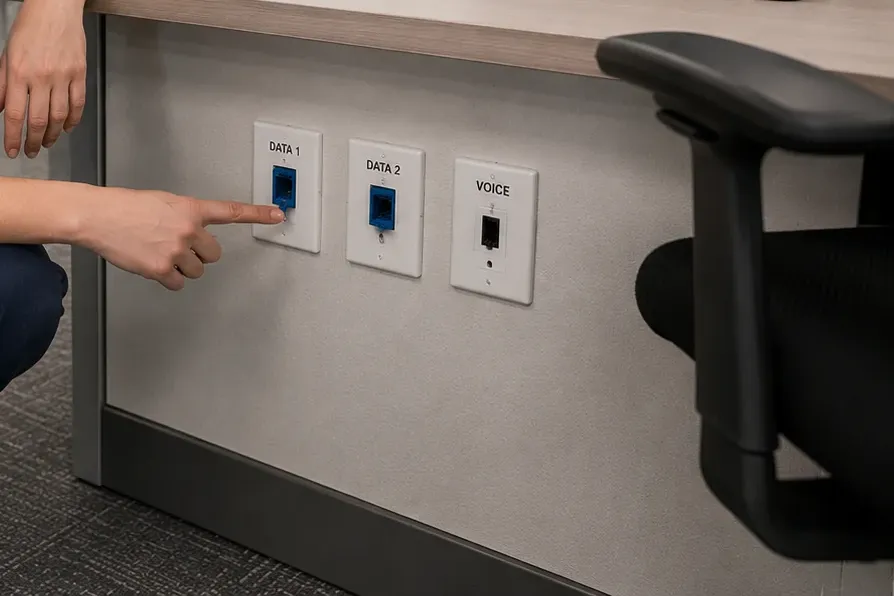
Finger pointing to the Data 1 jack among Data 1, Data 2 and Voice plates under a desk, identifying Bronx Cat6 links
A finger points at the blue jack on a plate labelled Data 1, next to plates labelled Data 2 and Voice, mounted on the panel beneath a desk with an office chair at the right.

Get the Hallway Cameras and the Front Door Back

Send a photo of the panel or the closet and a list of what has stopped working. We will tell you what the fault probably is and what a visit will cost before anyone comes out.

Across the Borough

How Cat6 Faults Differ From the South Bronx to the Sound

The two ages of Bronx cable are not spread evenly. Some neighbourhoods are almost all new towers; others have hardly changed since the 1930s. This is what we tend to meet in each part of the borough.

Mott Haven, Port Morris and the Lower Concourse

The 30-block Lower Concourse area along the Harlem River was rezoned in 2009, according to NYCEDC, and the towers that followed — Bronx Point, One River Park and their neighbours — are where we see the most turnover-stage defects: media-panel runs left unterminated, amenity-floor cameras on runs nobody tested, and package-room equipment on links that were finished in a hurry. Port Morris adds converted industrial buildings where offices and studios have strung Cat6 across exposed ceilings and brick walls. Both are areas where a building-wide test pays for itself quickly.

Highbridge, Concourse, Mount Eden and Morris Heights

The heart of the pre-war apartment-house Bronx, plus a newer layer along Jerome Avenue, where the City Council approved a 92-block rezoning in 2018. Older buildings bring hallway raceway, stairwell runs and cellar crossings for cameras and intercoms. New Jerome Avenue buildings bring new-construction faults, sometimes within sight of each other. Elevated-line vibration is not a cause we can prove, so we do not blame it; the fault is usually at a termination or a point of physical damage, and the tester shows which.

Fordham, Belmont, University Heights and Bedford Park

Our own neighbourhood. Fordham Road's storefronts, Arthur Avenue's shops and restaurants, medical offices and the campuses make this the busiest area for commercial repairs. Expect point-of-sale runs crushed behind counters, cameras added by several different vendors over the years, and apartment houses above the shops where the building's own systems share a cellar with the store's.

Norwood, Kingsbridge, Riverdale and Spuyten Duyvil

A mix of large pre-war elevator buildings, post-war co-ops, and houses on the Riverdale hills. In the co-ops, repairs go through the board and the managing agent, and Cat6 for lobby systems often runs in risers shared with older telephone and intercom wiring. In the houses, the work is closer to a suburban job: basements, attics and runs to garages and gates.

Parkchester, Castle Hill, Soundview and Unionport

Large planned complexes and the rows of houses around them. Complex runs are long and often cross between buildings underground, which brings length and insertion-loss questions to the front. Houses here are attached and semi-detached, often with Cat6 added for cameras by the owner or a camera installer, sometimes not genuine solid copper.

Co-op City, Pelham Bay, Throgs Neck, Country Club and City Island

The northeast corner: Co-op City's 35 towers, Bay Plaza's retail, and the detached houses and waterfront streets of Throgs Neck, Country Club and City Island. Rooftop and exterior camera runs are common here, so cable listing, entries and weather come into the repair. Where an outdoor run enters a building without a seal or bond, our published figure for making the entry good starts at $185 per penetration.

Wakefield, Williamsbridge, Woodlawn and Allerton

The north Bronx along White Plains Road and up to the city line is mostly two- and three-family houses, small apartment buildings and shops under the elevated line. Cat6 here is usually a short run to a camera, a home office or a store's register, often installed by whoever sold the equipment. Faults are rarely subtle: crushed cable at a basement beam, a plug crimped without its strain relief, a run tacked along a fence to a garage. Repairs are quick when the route is reachable, and replacement is often cheaper than tracing a run that was never properly fixed in the first place.

Hunts Point, Longwood and West Farms

Industry, distribution and dense residential blocks side by side. Office and dock Cat6 in the distribution centre sits close to refrigerated space; the apartment houses nearby share the same retrofit story as the Concourse. Our Bronx network cable repair page covers the cold-room and wash-down side of Hunts Point in more depth.

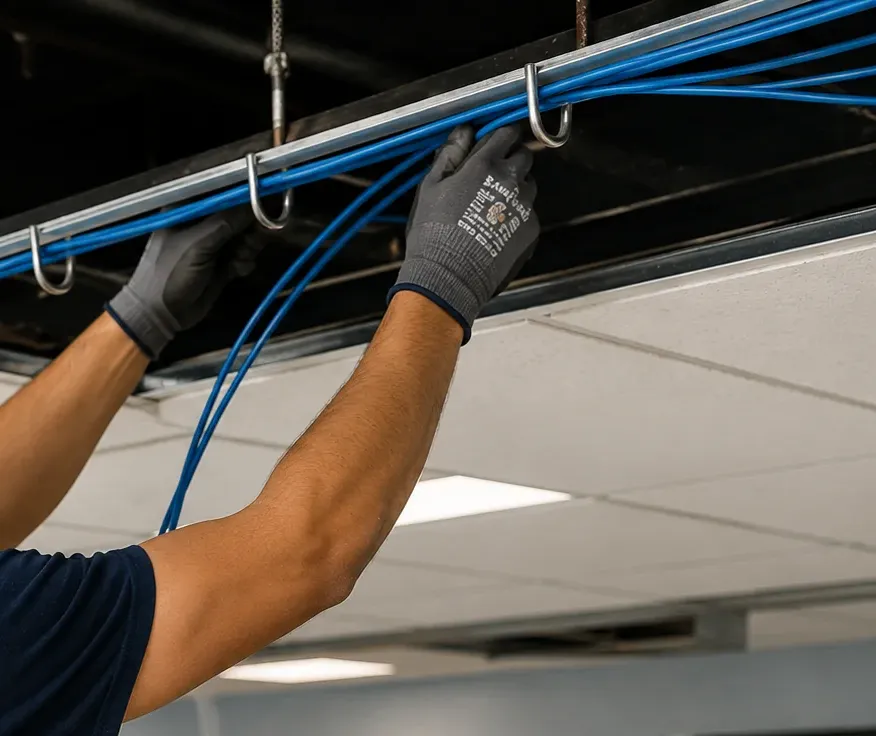
Gloved hands laying blue Cat6 into J-hooks above a suspended ceiling grid, Bronx Cat6 pathway repair
Gloved hands lay several blue cables into a row of metal J-hooks hanging from threaded rod above an open suspended-ceiling grid, with ceiling tiles and lights beyond.
For Building Staff

Checks a Superintendent Can Make Before Calling

A good superintendent is the most useful person in a Bronx Cat6 repair. These checks are safe, take minutes, and either clear the problem or tell us where to start. None of them involves opening a wall, a panel or a neighbour's apartment.

CheckSafe for building staff?What it tells us
Note exactly which devices stopped, and since whenYesOne camera points at one run; every station above a floor points at a shared riser or junction.
Look along the hallway raceway for a cracked or missing lidYesVisible damage usually marks the fault location and saves testing time.
Check whether any apartment on that line is being renovatedYesRenovations are one of the commonest causes of cut common-system cable.
Power-cycle the camera recorder or intercom panelYes, if you normally doSeparates an equipment hang from a cable fault.
Swap the patch cord at the closet endYes, with a factory-made cordDamaged cords are a frequent cause and a cheap fix.
Look for cable resting on steam pipes in the cellarYes, without touching hot pipeworkPoints to a heat-related, seasonal failure.
Tape or couple a broken cableOnly as a short-term emergencyIt may keep a camera up; it will need to be properly repaired.
Re-punch a keystone or panel portNot recommendedCat6 terminations are unforgiving; a port that lights up after a home re-punch may still be well outside the standard.

Jot the results on the back of the work order or in a text to us. Knowing, say, that the cord swap made no difference but the recorder restart did, lets the technician arrive with the right parts in the van.

New Buildings

What to Ask For When a New Bronx Building Is Handed Over

Many of the repairs we do in new Bronx buildings would have been caught by one document at handover. If you are an owner, managing agent or commercial tenant taking over a recently built space, these are the items worth asking the general contractor or cabling subcontractor for before the warranty clock runs down.

  • Saved certification results for every link, tested against Cat6 or Cat6A permanent-link limits as specified, with margins — not a list of passes typed into a spreadsheet.
  • A port map tying each panel port to an apartment, room, camera, reader or locker, matching the labels on the plates.
  • The cable and connectivity manufacturer and part numbers, so repairs match the system and any manufacturer warranty can be checked.
  • Riser and floor diagrams showing where vertical runs travel and where each floor's cable is consolidated.
  • Firestop details for the penetrations the cable passes through.
  • The warranty terms, in writing, including who to call and for how long.

If any of that is missing, we can produce the testing and the port map independently. It is quicker and cheaper to do it once, at the start, than to rediscover it a link at a time over the next few years.

Buildings that are still at the design stage are better served by our structured cabling installation service in the Bronx and the AESS Cat6 installation team for the Bronx, who build the testing into the job from the start.

Building Systems

The Building Systems That Ride on Bronx Cat6

In an office, a failing Cat6 link usually means one person without a network. In a Bronx apartment building it more often means a front door, a hallway or a mailroom that has stopped working for everyone. These are the systems we find on the end of the runs we repair, what typically goes wrong with each, and where our job ends and another trade's begins.

SystemTypical Cat6 faultWho fixes what
Video intercom — lobby panel and apartment stationsShared riser runs or junction points failing, so whole groups of stations lose picture together; stations powered over the cable browning out on a weak pairWe test and repair the cable from the panel to each station; the intercom technician deals with the panel, the stations and their programming
Hallway, lobby and stairwell camerasRuns pulled or crushed in public raceway; field-made plugs at the camera; long runs to roof doors and rear yardsWe repair the link and confirm power reaches the camera; recorder settings and camera faults go to the camera service
Access readers and door controllersCable damaged where it passes through or around door frames; terminations disturbed when a door is rehungWe repair and test the cable; the access-control installer handles the reader, the lock hardware and the controller
Package lockers and mailroom systemsOne or two links serving the whole controller, often terminated late in constructionWe certify the link to the controller; faults inside the locker go to the vendor
Laundry-room payment and card systemsCellar runs near heating pipework and water; cable left on the floor where carts rollWe re-route and repair the cable; the laundry operator services the machines and readers
Boiler, building-management and metering linksRuns through boiler rooms exposed to heat; terminations corroded by dampWe repair the data link only; heating and controls contractors handle the equipment
Common-area and amenity Wi-FiAccess-point runs in ceilings crushed by other trades or ended on poor plugsWe repair and certify the run to the access point; the network provider manages the Wi-Fi system
Apartment home runs to media panelsNever terminated at the panel, or terminated and never patchedWe identify, terminate, test and connect; the internet service itself comes from the tenant's or building's provider

The split matters for two reasons. It stops the building paying two trades to look at the same fault, and it gives each of them evidence. When we hand an intercom or camera technician a saved test showing that the cable to a station passes with margin, they can go straight to the device instead of spending the first hour proving the wiring.

When the cable turns out to be fine

About the most useful thing a cable test can do is clear the cable. When a run passes with healthy margin from end to end, the fault is in the device, its power supply, the switch port or the configuration, and the building can send the right trade without paying anyone to dig into walls. We leave the saved result with the superintendent or managing agent in that case too, so the next technician starts from a known-good link rather than a suspicion.

Power over the same cable

Many of these devices take their power down the Cat6 as well as their data. That makes a marginal link more visible than it would be in an office: a camera or intercom station may power up and then reset whenever it draws more current, at night when infrared lights come on, or when a station's screen wakes. Before we call a repair finished, we check that the device is receiving power and staying up under load, not just that the link shows as connected.

Cat6 or Cat6A in the newer towers

Some of the buildings completed in the Bronx in recent years used Cat6A for backbone links, access points or particular floors, and Cat6 elsewhere. A repaired link has to be finished on parts of its own category and tested against its own limits; mixing a Cat6 keystone onto a Cat6A run, or testing a Cat6 run against Cat6A limits, produces a link that either underperforms or appears to fail when it is healthy. We check the cable jacket and the existing parts before we cut anything, and match them.

Where the systems on the end of the cable are due for replacement anyway, the repair visit is a good moment to plan it. Our commercial security camera installation team in the Bronx and the AESS network installation service for the Bronx can take the planning from there.

Complete Services

Every Cat6 Repair Service in the Bronx

A failing Cat6 link usually has a device on one end and a building around it. These are the Bronx services that most often join a repair visit.

Network Cable Repair Bronx

Ethernet faults of every category, cold rooms, yards and wash-down areas.

Cat6 Installation in the Bronx

For extra apartments, desks or cameras that need brand-new runs.

Intercom Repair Bronx

Lobby panels and apartment stations on the end of the run.

Abstract Enterprises Security Camera Repair

Cameras and recorders for hallways, lobbies and storefronts.

Access Control Installation Bronx

Fob readers, door controllers and entry hardware for lobbies and side doors.

Structured Cabling in the Bronx

Closets, risers, panels and building backbones.

Fiber Optic Installation Bronx

For complex-wide backbones and links too long for copper.

Network Installation

Switches, access points and media panels for apartments and offices.

Low-Voltage Installation Bronx

The wider low-voltage plant in Bronx buildings.

Get a Quote

Several of these at once? Describe the building and we will scope it together.

Field Notes

Field Notes on Bronx Cat6

Habits our Bronx technicians bring to every call — a description of method, not an account of one particular job

We ask when the building was finished before we ask anything else. The answer changes where we look first. In a building from the last few years we go straight to the ends of the run and the panel; in a 1930s apartment house we walk the route, because the cable almost always followed something older and the damage is usually where that route meets people.

We talk to the super. Nobody else knows which camera was added by which company, which apartment had its kitchen redone in the spring, or which cellar pipe gets too hot to touch in January. Ten minutes with the superintendent often saves an hour with the tester.

We look at one termination closely before cutting it off. If it has an inch of untwisted pair, the chances are that the whole floor does too, and the owner deserves to know that before we fix one jack and leave.

And we leave every link we touched labelled, mapped and tested, with the result sent to whoever is responsible for the building, so the next call is shorter than this one.

FAQ

Bronx Cat6 Repair FAQ

Can you handle a repair for an owner who lives out of state and leaves everything to a managing agent?
+

Yes, and many Bronx buildings work that way. The managing agent approves the visit and the scope, the superintendent gives access on the day, and we send photographs, the test results and a written summary of what was found and fixed to the agent and, if they wish, the owner. Any extra work found during the visit is quoted in writing to the agent before we start it, so nobody has to be on site to make a decision.

Is Cat6 repair priced any differently in the Bronx than elsewhere in the city?
+

No. The Bronx is priced at parity with our Brooklyn base, so the repair rate is the same $195 an hour with a three-hour minimum, $585, and replacement runs start at the same $175 per drop. What changes the total in the Bronx is the building: how far the run travels, how much tracing an older apartment house needs, and whether apartments or roofs have to be opened up for access.

Will you tell us if a failure is the original installer's workmanship so we can send it back to them?
+

Yes. When the evidence points to the installation rather than later damage, the written findings say so plainly: which links, which test parameter failed, at which end, and by how much. That is usually enough for a developer, general contractor or cabling subcontractor to check for themselves. Whether you send it back to them or have us repair it is your decision.

Can you repair Cat6 in a building that is still under construction, before it has a certificate of occupancy?
+

Yes, usually for the owner or the general contractor, and fitted around the construction schedule. Testing and repairing links before ceilings and walls close is far cheaper than doing it afterwards, so we would rather be called while the cable is still exposed. Site safety rules, access and insurance requirements come from the general contractor, and we work under them.

Can you repair the Cat6 feeding a camera inside an elevator cab?
+

Only up to the elevator equipment. The cable that travels with the cab belongs to the elevator system and is serviced by the building's elevator contractor. We can test and repair the Cat6 from the recorder or switch to the machine room or hoistway connection point, show whether the fault is on our side, and hand a clear result to the elevator contractor if it is not.

Do you take on one- and two-family houses in the Bronx, or only larger buildings?
+

Houses too. Many detached and semi-detached homes in Throgs Neck, Pelham Bay, Morris Park, Riverdale and Wakefield have Cat6 for cameras, home offices or doorbells, often added by the owner or a camera company. Basement and attic runs are usually easier to reach than in an apartment building, which makes repairs and replacements more practical, and the same pricing applies.

Do you repair the Cat6 behind package lockers and smart mailroom equipment?
+

Yes. Package lockers and mailroom systems in newer Bronx buildings usually depend on one or two network links, and when those drop the whole mailroom stops. We test the link from the closet to the locker controller, repair it, and confirm the controller is back on the network. Faults inside the locker unit itself go to the locker vendor.

What should we do to an occupied apartment before a technician repairs a jack inside it?
+

Very little. Clear about a metre of floor in front of the jack, and make sure someone over 18 is home or the superintendent can let us in. If the run may need tracing to the media panel or closet, leave that clear as well. We work from drop cloths, keep the access cut as small as the fault allows, and tell you before anything is opened.

Can you repair the Cat6 that crosses our roof to the rooftop cameras?
+

Yes. Roof runs suffer from sun, foot traffic and roofers, and the point where the cable comes back into the building is often where water gets in. We repair or replace the run with cable rated for the location, support it off the roof surface, and make the entry good. Our published figure for sealing and bonding an entry starts at $185 per penetration.

Can you repair camera or intercom cable disturbed by facade work or a sidewalk shed?
+

Yes. Facade repairs and sidewalk sheds often mean cameras are taken down, moved onto the shed or left hanging, and the cable to them is cut, stretched or re-joined in a hurry. Once the work is finished, or while the shed is still up if the cameras are needed, we test each affected run, repair or replace damaged sections, re-terminate the camera ends properly and make good any entry through the wall.

All Areas Served

Cat6 Repair Across New York City and Beyond

You are on the Bronx Cat6 repair page. It sits under our New York City Cat6 repair hub, which explains how Cat6 links fail and are repaired across all five boroughs. Each borough page below is written for its own buildings.

Cameras, intercoms, locks and alarms are on the services list; company background is on the about page, and the AESS home page ties it all together.

Bronx Cat6 Link Still Failing Tonight?

Dark intercom screens upstairs, a gap on the camera recorder, a mailroom locker that has gone offline: ring (646) 490-0629 from anywhere in the borough. The next free two-hour slot is yours, and a fault at a jack, a panel port or a cord rarely takes more than an hour or two to put right once the technician is standing beside it.

Cat6 Repair Bronx — Licensed, Insured, Tested to Category

Abstract Enterprises Security Systems · 460 E Fordham Rd, Bronx, NY 10458 · (646) 490-0629 · WhatsApp (718) 679-0359 via wa.me

NYS Low-Voltage Licence #12000287431 · 100% Licensed & Insured · Same-Day Estimates · Rated 4.7★ from 201 Google Reviews

Parts you supply carry their manufacturer's warranty. See our warranty page and the service agreement for full terms.

Written for Bronx owners, agents, superintendents and tenants. Where the page mentions codes, standards or published statistics it paraphrases the named source and is not a substitute for legal or engineering advice. Page reviewed and updated October 17, 2026. Changelog: October 2026 — first publication of the Bronx Cat6 repair page.