On Staten Island the Cat6 usually lives in a house — a detached frame home, a two-family with a shared cellar, a shore bungalow that was lifted after Sandy, or a house that now carries a dental practice or an accounting office. Those links fail in their own ways: terminations corroding on a damp block wall, runs crushed in the open space under a raised house, jacks left unpunched behind a builder's media panel. We find the fault by distance, fix the link at the right end, move anything that sits below the water line up out of harm's way when that is the sensible repair, and hand back a run that tests to Category 6 again.
Reviewed and updated October 17, 2026 · Written by Anwar Timothy, NYS licence #12000287431
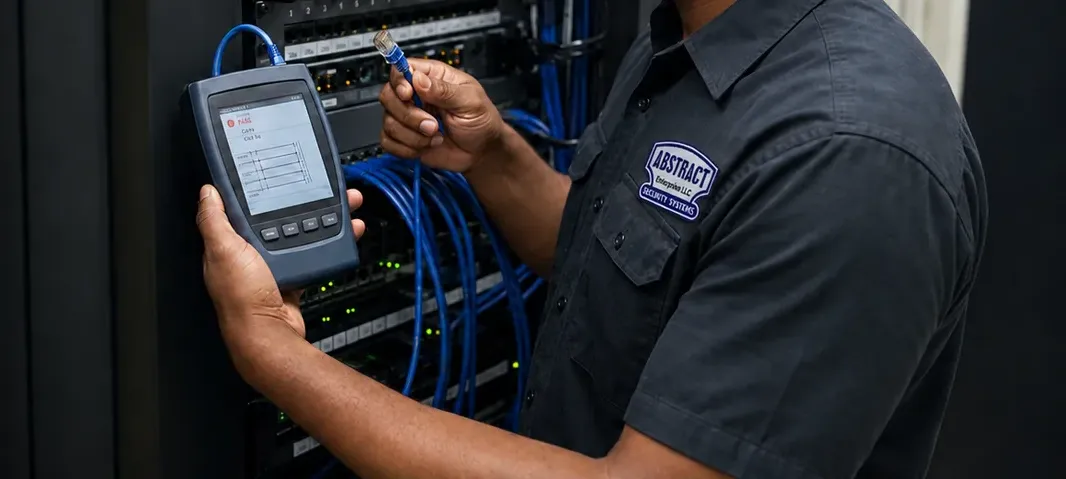
One hand holds a grey handheld tester showing a wire-map diagram while the other lifts a blue cable with a clear plug out of a rack full of blue patch cords and green port lights.
Staten Island Cat6 Repair Quote
Say what the link does and which floor it is on — a technician replies the same business day
✅
Request Sent!
A technician will call you back the same business day.
25+
Years Experience
✓
Same-Day Estimates
100%
Licensed & Insured
4.7★
201 Google Reviews
A dead jack in the den, a register that keeps dropping, or a whole basement panel that has not been right since the last storm? Ring (347) 934-8335 or fill in the 60-second form. A licensed technician reads it and tells you, before anything is booked, whether it sounds like a termination, a wet connection, a damaged run or a device problem that no cable work will touch.
Faults placed by distance on the tester, so a finished ceiling or paneled wall is opened only at the damage
Terminations below the flood line moved up where that is the lasting fix, with the extra cable priced before it is pulled
NYS licence #12000287431 · insured · one quote that covers the whole visit, with no separate charge for the bridge
Why Staten Island Properties Need Cat6 Repair Planned Around the Water Line
Staten Island is the borough of houses, and that changes what a Cat6 repair is. The Citizens Housing & Planning Council's look at the city's housing stock found that 83 percent of the island's homes sit in one- or two-family buildings, against almost none in Manhattan. So the network that fails here is rarely a tower floor behind a managing agent. It is the run from a basement router to a second-floor office, the cable the previous owner stapled across the cellar joists to the back bedroom, the line feeding a camera over the driveway, or the drop to a reception desk in a house on a busy boulevard that was turned into a practice decades ago. Somebody can usually reach both ends. The question is what has happened to the cable between them.
On this island, the answer very often involves water. Hurricane Sandy's storm surge killed 24 Staten Islanders in 2012, more than in any other borough, and the East Shore, from South Beach to Oakwood Beach, was flooded by the surge, with many houses destroyed. The rebuilding left behind a building stock no other borough has in the same concentration: houses lifted onto new foundations, whole homes replaced, modular units set on cleared lots, and basements that were dried out, re-sheetrocked and re-wired by whoever was available that winter. Fourteen years on, the network links that were patched back together in those cellars are the ones we are now asked to diagnose.
Storm surge is not the only source. On July 14, 2025, a cloudburst turned Hylan Boulevard near New Dorp Lane into what the Staten Island Advance described as a river, shut the Staten Island Railway between Huguenot and Tottenville, and left the basements of several houses on Poplar Avenue in Rossville under water. Flash flooding of that kind reaches basements far from the shoreline, and it reaches them fast. Even in houses that never flood at all, below-grade block walls stay damp, and a network jack mounted on one slowly turns green. Each of those situations ends in the same phone call: the internet works upstairs on Wi-Fi, but the wired links that run through the basement have become slow, intermittent or dead.
That is why Cat6 repair here is planned around the water line. Re-terminating a corroded jack in the same damp spot only resets the clock. Sometimes the right repair is exactly that, done with fresh hardware and a sealed box. Often the better one moves the patch panel, the switch and the terminations up out of the cellar to a closet on the first floor, extends or replaces the affected runs, and leaves only cable — never connections — in the part of the house that gets wet. In buildings inside the mapped flood zones, the city's flood-resistant construction rules point the same way, requiring utilities and their equipment to sit at or above the design flood elevation or be built to keep water out.
The other thread running through island repairs is that the original Cat6 was often put in by someone who was not a cabling contractor. A cable or phone company technician, the electrician who rewired the house, a builder fitting “Ethernet in every bedroom” as a selling point, a handy previous owner. Their runs can be perfectly good copper with poor terminations, they can share holes with the electrical wiring, or they can stop behind the drywall without ever being connected. A certification tester shows all of it, which is why every repair starts and ends with one.
Staten Island facts that shape a Cat6 repair
83 percent: share of Staten Island housing units in one- and two-family homes, according to the Citizens Housing & Planning Council's October 2024 “Taking Stock” analysis — the reason most island Cat6 runs through basements, crawlspaces and finished living space rather than shared risers.
82 percent: the combined share of new-building units on the island that were single-family (33.1 percent) or two-unit (49.1 percent) homes, in the State Comptroller's March 2025 report on city housing production — new houses keep adding to the same pattern.
24 lives: the number of Staten Islanders Hurricane Sandy's surge killed in 2012, more than any other borough, as the Staten Island Advance has recorded.
838 and 492: Staten Island homes repaired and elevated above base flood elevation, and homes completely rebuilt (103 of them modular), under the city's Build It Back program, which served 1,982 island homeowners according to NYC Housing Recovery.
About 5 miles at 21 feet: the length and elevation given in an October 2024 Army article on DVIDS for the East Shore seawall running from the edge of Fort Wadsworth, just south of the Verrazzano-Narrows Bridge, to Oakwood Beach.
July 14, 2025: the evening flash flooding that closed the Staten Island Railway between Huguenot and Tottenville and flooded basements on Poplar Avenue in Rossville, per the Staten Island Advance.
Read together, those figures describe an island where most Cat6 is in houses, a large share of those houses sit near water or below a hill that sheds it, and much of the cabling was installed or re-installed in a hurry. The repair that lasts is the one that takes all three into account.
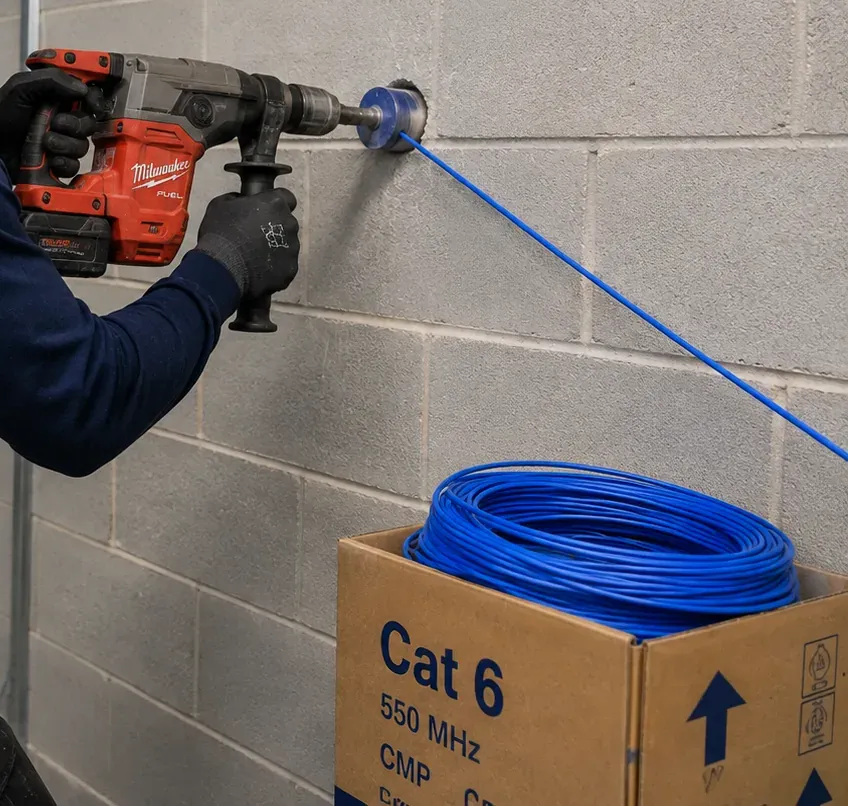
Gloved hands steer a red cordless rotary hammer fitted with a core bit into a grey concrete-block wall; a blue cable runs from the hole down to an open carton printed Cat 6, 550 MHz, CMP, holding a coil of blue cable.
Repair Capture
Wired Link Dead on Staten Island This Morning?
A register that will not take cards, a reception PC with no network, a doorbell or driveway camera gone dark on the recorder, or a home office that lost its wired connection after a storm — we book those as service calls and bring the next open two-hour window. The van carries a certification tester, a toner and probe, Cat6 and Cat6A keystones, panel modules, sealed surface boxes, factory-made cords and cable, so most termination, plug and cord faults are found and fixed in one to two hours once a technician is at the panel. Repair time is billed at $195 an hour with a three-hour minimum ($585), the same specialty rate published on our Staten Island network cable repair page, and there is no separate charge for coming over the bridge. Call (347) 934-8335 and say it is a Cat6 fault, or see our Staten Island security camera repair service if the device itself may be the problem.
What We Repair
Cat6 Repair Services in Staten Island
Nine kinds of work make up almost every island call. Whichever applies, the job closes with a certification test against the link’s own category, a copy of the result for you, and a plain-language line on the invoice saying what failed.
Wet and Corroded Termination Replacement
Jacks, plugs and panel ports that have oxidised in a damp cellar or after water got in: cut back past the corrosion to clean copper, new hardware, and a sealed box where the termination has to stay low.
Moving Terminations Above the Flood Line
Relocating a patch panel, switch or wall jack from a basement that floods to a first-floor closet or wall, then extending or replacing the runs so no connection is left where water reaches.
Runs Through Raised-House Enclosures
Repairing Cat6 that crosses the open or lattice-walled space under an elevated house, where cable gets snagged, stepped on, chewed or soaked, and rerouting it inside the living space where possible.
Finding and Finishing “Pre-Wired” Runs
Tracing builder-installed cable back to a media panel or a coil in the basement, terminating the runs that were never connected, and labelling which jack goes where.
Two-Family House Link Repair
Fixing the runs that serve one unit but pass through the other, and separating a shared house network into two when the downstairs becomes an office or a rental.
Fault Location in Finished Rooms
Time-domain testing that puts a crush or a staple at a measured distance, so a finished basement ceiling or a paneled wall is opened in one place rather than along the whole run.
Point-of-Sale and Counter Links
Registers, card terminals and receipt printers in island shops and restaurants: the jack under the counter, the patch cord that gets kicked, and the run back to the back-room switch.
PoE Camera and Access Point Links
Driveway, storefront and parking-lot cameras and ceiling access points that power-cycle or will not power up, with the cable tested for resistance and the termination at each end checked.
Recertification After Repair
Testing to Cat6 or Cat6A permanent-link limits once the work is done, with margins recorded, so you can see which links are healthy and which are only just passing.
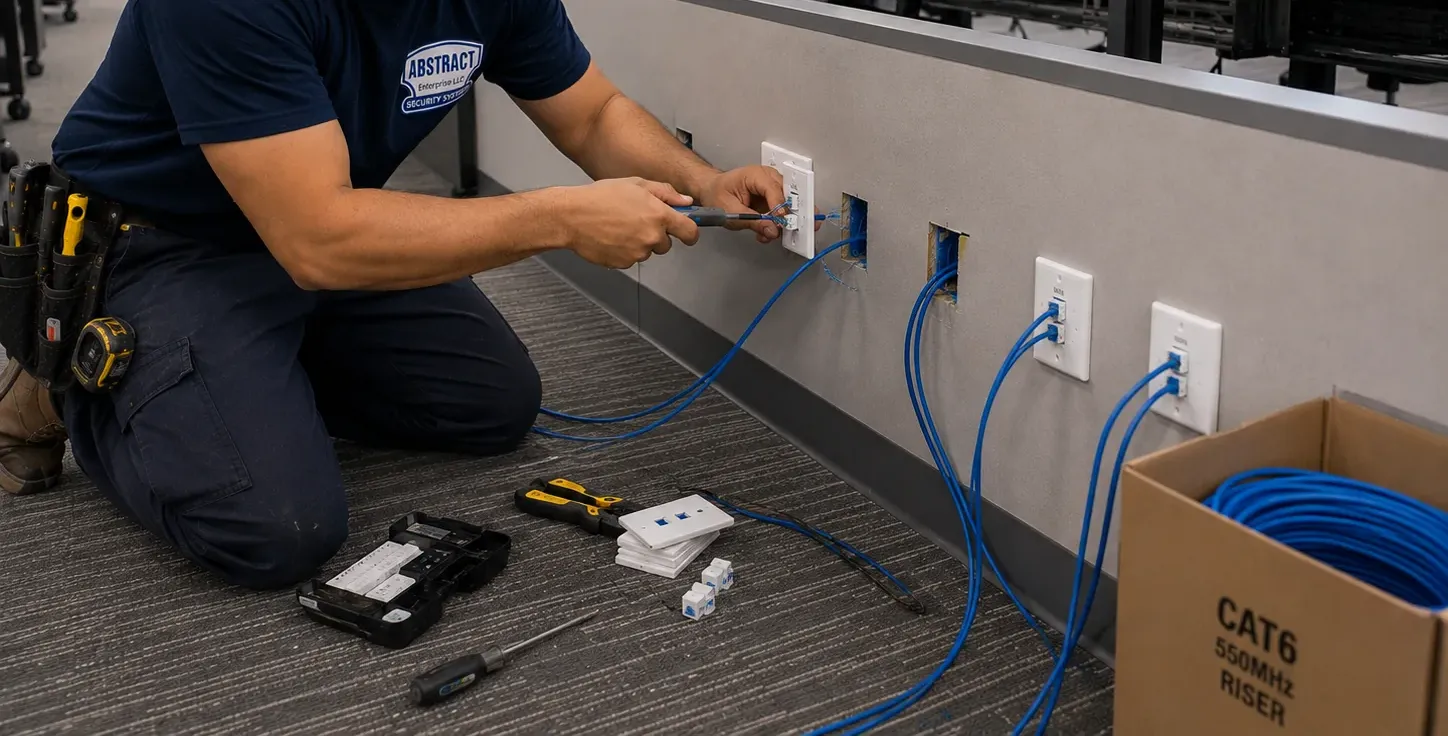
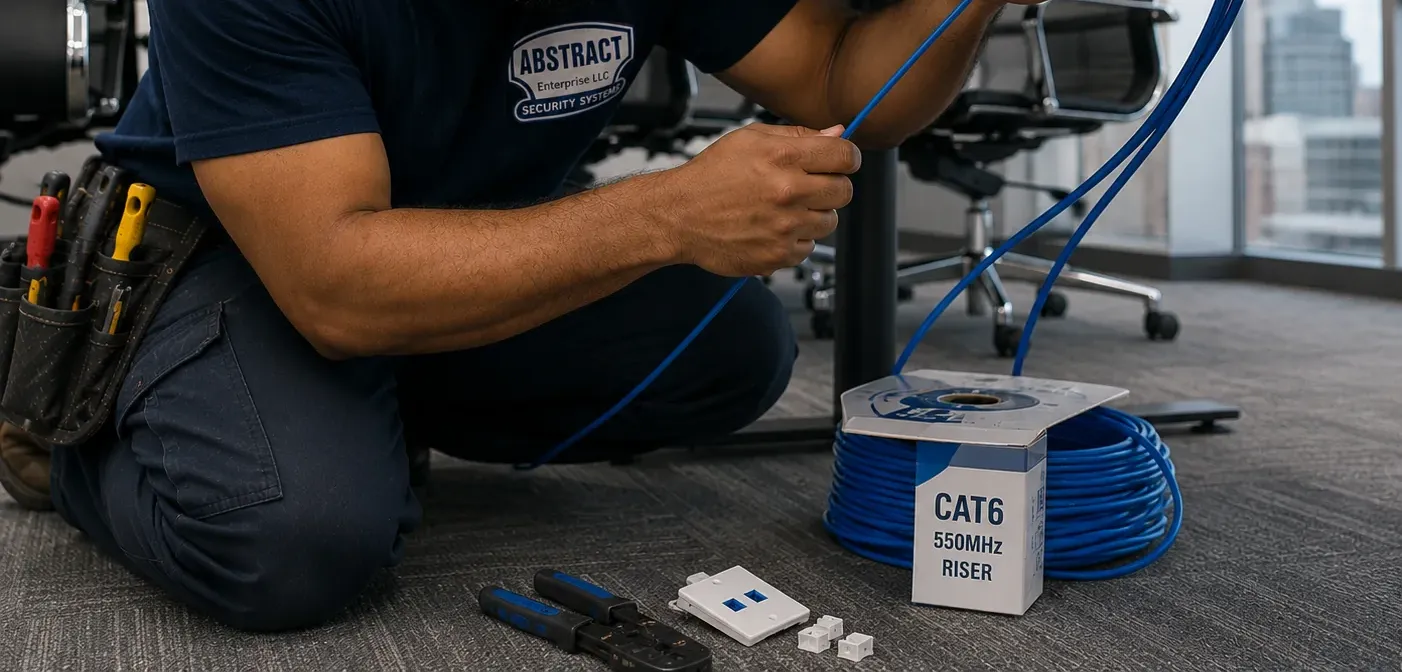
A kneeling technician in a navy T-shirt works a tool into the back of a white wall plate on a low grey partition; blue cables come out of a row of openings and finished plates, with keystones, plates, a screwdriver and a carton marked CAT6 550MHz RISER on the carpet.
Building Specialists
Cat6 Repair for Staten Island's Architecture
The building decides where a run goes, where it gets hurt, and how much of the house has to be disturbed to fix it. These are the property types we repair Cat6 in most across the island, from the North Shore's older streets to the newer developments of the South Shore.
Detached Frame Houses
Wood-framed, often with a full basement and an attic. Runs usually go down from the router into the cellar, across the joists and up through a wall cavity or a closet. Faults collect where cable was stapled hard to a joist or pulled tight around a duct.
Two-Family Houses
The island's signature building, with one household above another and a shared basement. The upper unit's Cat6 often passes through the lower unit's ceiling, so a repair has to be planned around a tenant's space and sometimes split into two separate networks.
Raised Shore Houses
Homes lifted onto piers or new foundations after Sandy, mostly on the East and South Shores. Cable that once ran through a basement now crosses an open or lattice-enclosed space below the living floor, exposed to weather, animals and anything stored there.
Rebuilt and Modular Homes
Houses replaced from the ground up, including modular units set on site. The cabling is newer, but it was often installed by a general trade to a schedule, and links that cross from one section of the house to another deserve a test rather than an assumption.
Houses Converted to Offices
Dental and medical practices, law and accounting firms working out of former homes along the main roads. Residential walls, a basement equipment corner and runs added room by room as the practice grew.
Strip Centers and Shopping Plazas
Single-storey retail with shared roofs and hung ceilings, where counter and camera links run through soffits and back rooms. Kicked cords, crushed runs behind fixtures and wet roof penetrations are the usual faults.
Townhouse and Condo Complexes
Attached rows built in the later decades of the island's growth, with garages at grade and living space above. Runs pass from garage to upper floors through tight chases, and an association may govern the exterior.
West Shore Warehouses
Large single-storey distribution buildings with long runs to dock doors, cameras and wireless access points. Length, lift traffic and heat at roof level are the repair questions there.
Cable and method specifics we check in island buildings
Where does the run cross the water line? Before testing anything in a basement or the space under a raised house, we ask how high water has reached and look for the evidence ourselves: tide marks on block, rust lines on the boiler jacket, new drywall stopping at a consistent height. Every connection below that line is treated as suspect even if it tests cleanly today, because corrosion that has started inside a contact keeps going.
Is the termination on a block wall or a framed one? A jack screwed straight to a foundation wall takes moisture from the masonry behind it. When a link that starts on block keeps failing, the cure is usually to stand the box off the wall on a backer, use a sealed surface box, or move the termination to a framed partition, not simply to re-punch it.
Does the Cat6 share a path with the electrical wiring? In houses wired in one pass, data cable is often pulled through the same bored holes as the power cable. The indoor separation rule for communications cable — at least 2 inches from electric light and power conductors, as OSHA's 29 CFR 1910.308 states it, with the exceptions the code lists — exists for safety, and runs that hug a power cable for a long stretch are also more exposed to noise. When we re-route a run, we keep it apart.
Who installed it, and was it ever finished? Builder runs that end in a coil behind a blank plate, cable-company runs crimped onto plugs at both ends, and runs that were never punched down at the panel all look the same from a room. The tester tells them apart in seconds, and the repair is different for each.
What is on the far end, and does it draw power? A camera on the garage or a ceiling access point pulls power over the cable. A corroded or half-seated termination that a laptop would barely notice can be enough to brown out a PoE device, so powered links are tested for resistance as well as for the category limits.
Practices and house-offices that get their links repaired often ask for the equipment corner to be rebuilt properly while we are there. Our structured cabling installation service on Staten Island takes on new panels, racks and closet moves when the repair list grows into a rebuild.
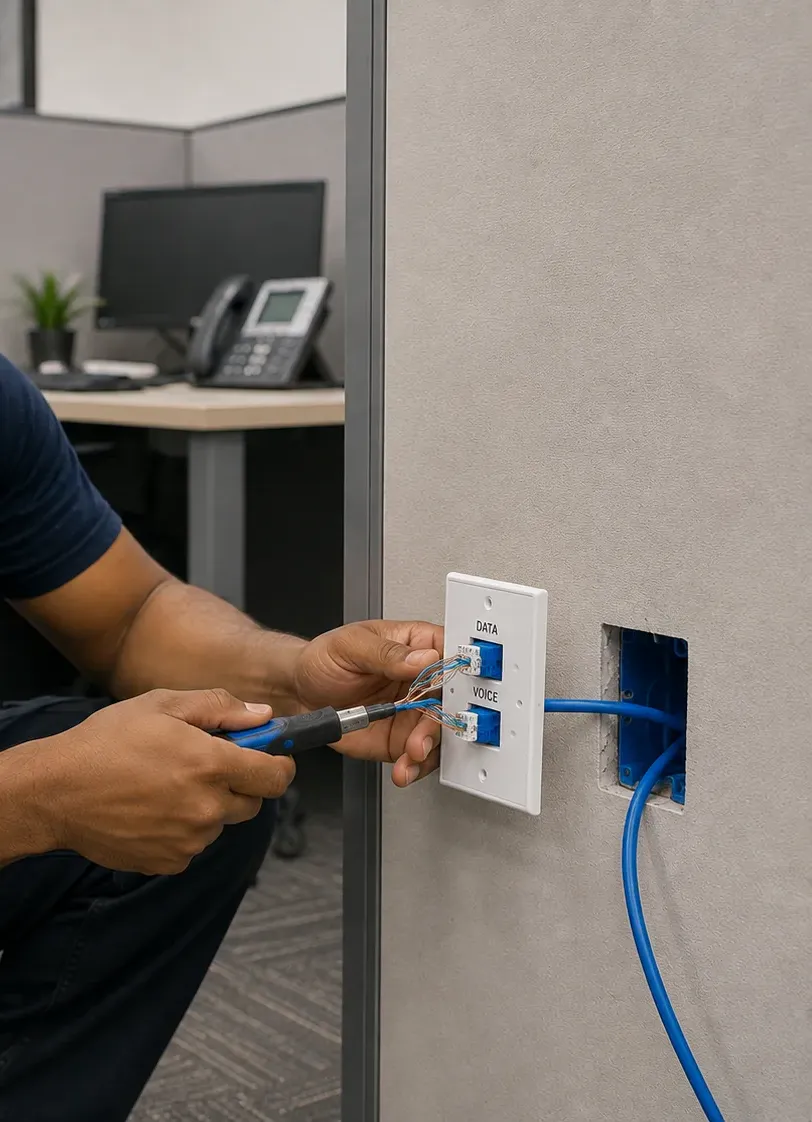
Two hands work a blue-handled punch-down tool into the back of a white two-port wall plate marked DATA and VOICE, held beside an open blue box in a grey partition; a desk with a phone and monitor sits behind.
Commercial Cat6 Repair
Business Cat6 Repair in Staten Island
Island businesses run on short, hard-working links: a counter, a front desk, a handful of cameras, an exam room or two. The corridors below are real places with distinct building types. They are named for the faults those buildings tend to produce, not as a list of customers.
Hylan Boulevard and New Dorp Lane
The long spine of the East and South Shores, lined with storefronts, plazas and medical offices — Richmond University Medical Center runs a walk-in care center at 4360 Hylan, and orthopedic and urgent-care practices sit along the same road. It is also the road the Advance watched run like a river in July 2025, so ground-floor and basement links here are tested with water in mind.
Seaview Avenue
Home to Staten Island University Hospital's North campus at 475 Seaview Avenue, part of a 668-bed, two-campus teaching hospital that moved there in 1979. The private practices and support offices around a hospital of that size depend on dependable links to imaging, records and phones.
Richmond Avenue, New Springville
The island's big-box and mall corridor around the Staten Island Mall, which opened on August 9, 1973 with Macy's and Sears as anchors. Pad sites and plazas mean long runs from a back-office switch to registers, kiosks and parking-lot cameras.
St. George and Bay Street
The North Shore's ferry-side business district, with Empire Outlets' 350,000 square feet of retail steps from the terminal and the Bay Street corridor's mix of new mixed-use buildings and older storefronts. Older buildings here carry cable added by tenant after tenant.
Bloomfield and the West Shore
The Matrix Global Logistics Park was built on a former oil-tank storage site of about 200 acres; its first building is a single-storey, 975,000-square-foot facility with a 40-foot clear height. Warehouses on that scale have runs measured in hundreds of feet and cameras mounted high above the floor.
Forest Avenue and Victory Boulevard
Older commercial strips running across the North Shore and Mid-Island, where many businesses occupy converted houses or mixed-use buildings with apartments above. Those buildings bring residential walls, cellar equipment and runs that were never planned as a network.
Codes and rules that touch a business repair here
Flood-zone buildings. Appendix G of the New York City Building Code requires utilities and their attendant equipment in covered flood-zone construction to sit at or above the design flood elevation, or be built to keep water from entering or accumulating in them, and limits materials below that elevation to flood-damage-resistant ones. The appendix was amended by Local Law 77 of 2023. When a repair moves network equipment, we place it with that line in mind and ask for the building's elevation information if there is any doubt.
Enclosed space under raised buildings. In coastal high-hazard areas, the appendix allows the space below the lowest floor to be enclosed only with breakaway walls and used solely for parking, building access, storage or crawl space. Network equipment does not belong there; at most, cable passes through.
Separation from power. Indoor communications cable is kept at least 2 inches from electric light and power conductors under the separation rule OSHA reproduces in 29 CFR 1910.308, subject to the listed exceptions. Repaired and replacement runs are routed to respect it.
Old runs left behind. Code expects abandoned communications cable to come out where it can be reached, so a replaced run’s old length is taken away unless you ask for it to be tagged as a spare.
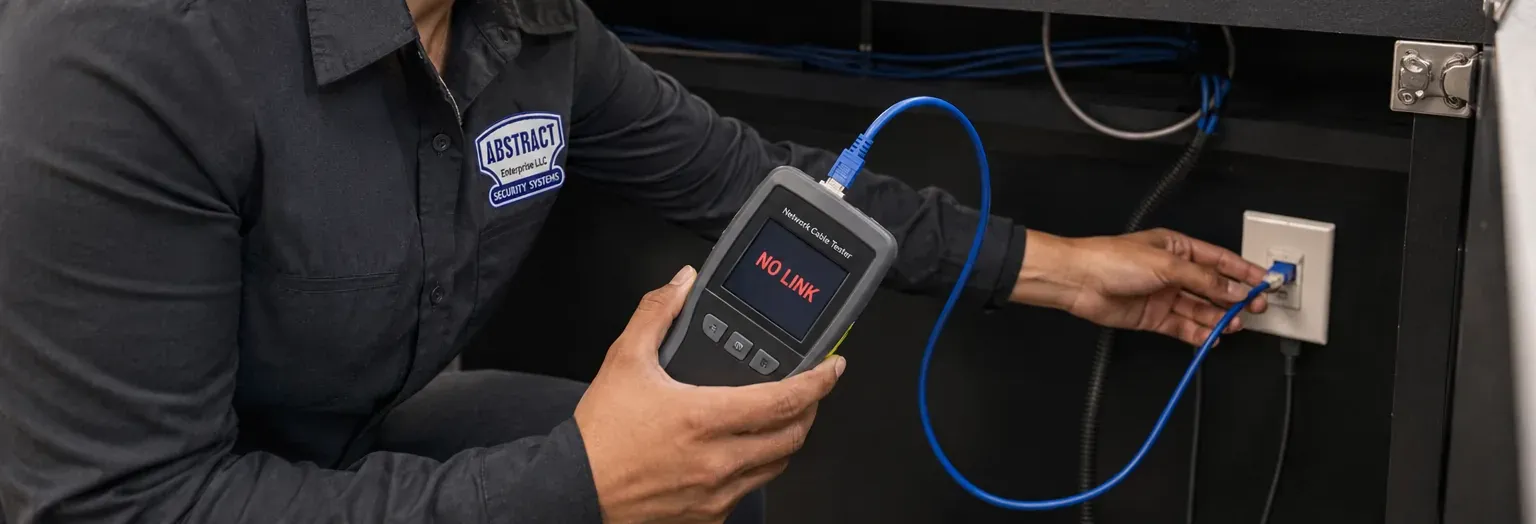
Crouched under a checkout counter, a technician in a dark shirt with an Abstract Enterprise patch holds a grey tester whose screen reads NO LINK, a blue patch cord running from it to a white wall jack below the counter top.
Your Questions Answered
Cat6 Repair in Staten Island: Questions Answered
Island owners, landlords, office managers and shopkeepers tend to arrive with one of the questions below. We have sorted them by where the trouble lives — below the water line, inside houses shared by two households or a business, and at shop counters — and left booking details and smaller points for the FAQ near the end of the page.
Below the water line
Our house was raised after Sandy — why do the Cat6 runs that cross the space underneath keep failing?
Because that space is now the outside of the house in everything but name. When a home is lifted onto piers or a new foundation, the cable that used to run through a dry, heated basement often ends up stapled to the underside of the new floor or tucked along a beam in an area that is open to the weather or closed in only with lattice or breakaway panels. It sees damp air, freezing winters, wind-driven rain, animals looking for shelter and whatever gets stored down there. Indoor Cat6 jackets are not made for that, and the cable was frequently re-hung in a hurry during the rebuild, with sharp bends where it turns up into the living space.
On the tester these runs usually show return-loss or crosstalk faults at the distance where they enter or leave the enclosure, or rising insertion loss across the exposed stretch. We confirm where the damage is, then look for an interior path: through a closet, a chase beside the plumbing or the void between floors. When the run genuinely has to stay below the house, we replace it with cable rated for the conditions, support it properly off the structure, and make sure every termination is up inside the heated envelope rather than in the enclosure.
Should the router, switch and patch panel come up out of a basement that has flooded before, and what happens to the Cat6 if they move?
If water has reached them once, moving them is usually the better repair. Every connection in a link — the panel port, the switch port, the patch cords between them — is a point where water and corrosion do their damage, while a continuous run of cable shrugs off a brief wetting far better than a contact does. Lifting the equipment to a first-floor closet, a utility room above grade or a high shelf leaves only cable in the part of the house that gets wet. In buildings covered by the city's flood-zone rules, keeping equipment at or above the design flood elevation is also what those rules expect.
The cabling has to follow. Runs that were cut to reach a basement panel are often too short for the new position, so we either extend them with a properly rated, tested connection placed above the water line, or replace them end to end where length, category or the link's job makes a joint a bad idea. The internet provider's own box at the service entrance stays where the provider put it; our runs simply begin above it. We price the relocation, the extra cable and the retest together before anything is pulled.
What does a flood-zone building's code allow below the design flood elevation when a Cat6 run is repaired?
In plain terms: cable can pass through, but equipment and materials that water would ruin should not live there. Appendix G of the New York City Building Code, which governs construction in the mapped flood zones, requires utilities and their attendant equipment to be at or above the design flood elevation, or constructed to prevent water entering or accumulating in them, and restricts materials below that elevation to flood-damage-resistant ones. In coastal high-hazard areas, the space under the lowest floor may only be enclosed with breakaway walls and used for parking, access, storage or crawl space.
For a Cat6 repair, that translates into a few working rules we follow: no patch panels, switches or wall jacks put back below the elevation in a covered building; cable that must cross the low area routed so it can be wetted and dried without harm, with no splices or couplers down there; and any surface boxes that must stay low chosen and sealed for the location. The code text is the authority, not this summary, and where a building's elevation is unclear we ask for its elevation certificate before deciding where things go.
Why does a jack screwed straight onto the foundation block fail when the same kind of jack on a stud wall nearby keeps working?
Because the mounting surface matters more than people expect, and concrete block below grade is never truly dry. Moisture moves through it from the soil outside, condenses on cool surfaces in humid weather, and leaves the white mineral streaks you can often see on the face of the wall. A jack or surface box screwed straight onto that wall sits in a pocket of damp air against the masonry, and over a few seasons its contacts and the exposed copper at the punch-down oxidise. The link first slows, then drops in wet spells, then fails outright, all without a drop of standing water.
Re-terminating in the same spot buys time but not much. We cut back past the corroded copper, which can mean several inches, and then either mount the new termination on a standoff or backer board away from the block, use a sealed surface box, or move the termination onto a framed wall or up to the floor above. A dehumidifier in the basement helps the whole house, but on its own it does not fix a connection that is already green inside.
Houses with two households or a business inside
The upstairs unit's Cat6 passes through the downstairs apartment's ceiling — can the fault be pinned down before anyone opens the tenant's ceiling?
Usually, yes. Most two-family houses bring every service into a shared basement, so a link to the upper floor typically leaves a panel or router in the cellar, rises through the first-floor unit inside a wall or closet, and reaches the second floor. Time-domain testing from both ends tells us whether the fault is at a termination we can reach from the basement or the upper unit, or at a measured distance that falls inside the lower unit. Very often it is one of the two ends, and the tenant downstairs never sees us.
When the damage really is inside the first-floor unit, we give the owner the location, what opening it will take and how long we need, so the visit can be arranged with the tenant for a set window. Sometimes the better repair is a new route that avoids the lower unit entirely — up an exterior chase box, through a shared hall closet, or from the attic down — and we will price that alternative alongside the repair in place.
The internet provider moved our router to a new spot during an upgrade, and the wired rooms stopped working — how do the runs get re-pointed?
This happens a lot when a house switches provider or service type and the new equipment lands somewhere else: the garage instead of the basement, the living room instead of a closet. The Cat6 to each room still ends where the old router was, so every wired jack is now connected to nothing.
There are two clean fixes, and we price both. One is a single tested run, or two for redundancy, from the new router position back to where the house's runs gather, with a switch there to feed every room. The other is to bring the room runs to the new location, which is only sensible when that spot is central and the runs are long enough. Either way each room's link is certified afterwards and the old, orphaned equipment corner is tidied so nobody plugs into a dead port again.
Our Cat6 goes through the same drilled holes as the house's electrical cable — could that explain the errors?
It can contribute, and it is worth fixing whether or not it is the cause. Houses wired in one pass by an electrician often carry data cable through the same bored holes in the studs and joists as the power cable, sometimes taped to it for long stretches. The rule for indoor communications cable, as OSHA reproduces it in 29 CFR 1910.308, is a separation of at least 2 inches from electric light and power conductors, subject to the exceptions the rule lists. That rule is about safety, but long parallel runs beside power circuits feeding motors, compressors or dimmers also expose a link to electrical noise.
The tester tells us whether the copper itself is damaged; a link that tests cleanly but errors in use, especially when an appliance starts, points toward noise or a grounding issue rather than the cable. Where we find data cable bundled with power, we re-route the affected stretch with proper separation and, if the run was nicked by a staple or a drill bit on the way through, replace it.
We are turning the ground floor into an office and renting out the upstairs — can the existing Cat6 be split into two separate networks?
Yes, and it is far cheaper than rewiring if the runs were home-run to one central point in the first place. Most decent house wiring brings each jack back individually to a panel or enclosure, which means each room's link can be assigned to whichever network it belongs to. We test every run, identify which rooms belong to which unit, terminate them on separate panels or separate sections of one panel, and label the result so a future tenant or IT provider can follow it.
The awkward cases are runs that were daisy-chained or spliced between rooms, a single run serving rooms in both units through a cheap switch hidden in a wall, or cable the two units would share inside a common wall. Those get rerouted or replaced. If the office will need its own internet service, we leave a clear place for the provider to land it and run the office's links to that point.
When a Cat6 run inside a two-storey island house has to be replaced, what routes avoid opening finished walls?
Houses offer more of them than people expect. Closets that stack from one floor to the next make natural vertical paths; the cavity beside a plumbing stack or a chimney chase often has room; an unfinished basement ceiling and an accessible attic let a run cross the house without touching a finished room; and an existing low-voltage run can sometimes be used to pull its own replacement if it was never stapled. Cold-air returns and other duct spaces are not used.
We test and locate first, then walk the house with you to agree the route before anything is cut. Where an opening is unavoidable, it is a small rectangle at a stud bay chosen to be patched easily, not a trench along the wall.
Island shops and counters
A register at our shop drops off whenever the walk-in cooler or the air compressor kicks on — is the Cat6 to blame?
Sometimes, but the timing is a clue that points beyond the cable. A link that fails the moment a motor starts is reacting to something electrical: noise coupled into a data run that is lashed alongside the motor's power feed, a voltage dip on a shared circuit that resets the register or the switch, or a grounding difference between equipment on different circuits. A damaged Cat6 run with poor crosstalk margin will be the first to suffer from any of those, so the cable and the electrical side often have to be looked at together.
We test the run to category first. If it fails, we repair or replace it and route the new cable away from the motor feeds. If it passes comfortably, we check whether the register and the switch share a circuit with the compressor, whether the switch is on a battery backup, and whether the cords at the counter are factory-made and intact. Where the evidence points to the electrical installation, we say so in writing so your electrician has something specific to work from.
Why do the Cat6 links at a strip-mall counter fail more often than the ones in the back office?
Because counters are where cable gets abused. Jacks mounted low under a counter get kicked, mopped around and hit by stock carts; patch cords get pinched in drawers and cabinet doors; and runs dropped down through a soffit or a hollow counter leg are often bent hard to make the turn. Many shopfit contractors also finish counter runs on field-made plugs rather than jacks, so the cable ends in a crimped connector that loosens over time with every bump.
The repair is usually at the counter end: a proper surface-mount or in-counter jack positioned out of harm's way, a short factory-made cord, a cable guard where the run passes through a gap in the fixture, and a retest to confirm the run back to the switch passes. When the run itself was crushed behind a fixture, we locate the point by distance, and if the fixture cannot be moved, we route a replacement around it.
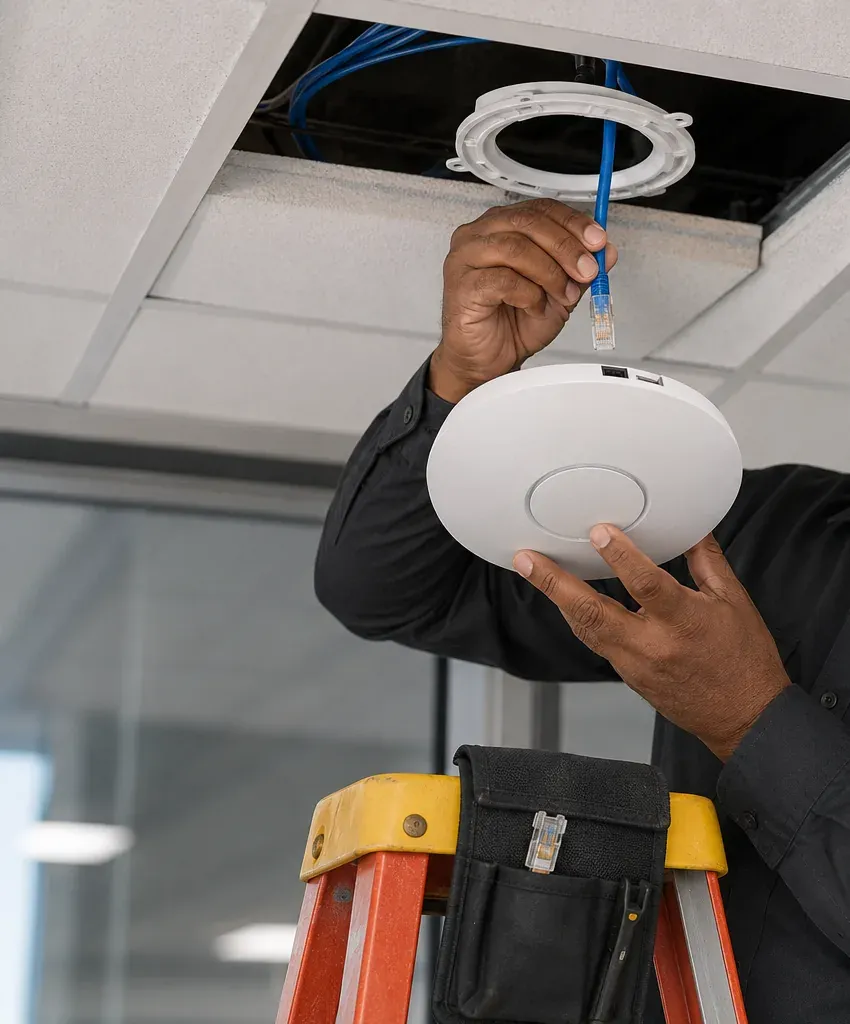
Below an open ceiling tile with blue cables in the void and a white mounting ring, one hand holds a blue cable ending in a clear plug while the other supports a round white access point; a tool pouch hangs on the stepladder below.
The Flood Line
Where Each Part of a Cat6 Link Belongs in a House That Takes Water
Most of the island's Cat6 problems below grade come down to one decision made years ago: where the connections were put. Copper cable tolerates a brief soaking far better than a contact does, so in any building that has taken water, or might, we sort the parts of a link by how much they can stand. This is the arrangement we work toward when a repair gives us the chance.
Part of the link
Where it should sit
What we do when we find it low
Router, switch and any PoE injectors
Above the highest water the building has seen, and above the design flood elevation in a covered flood-zone building
Relocate to a first-floor closet, utility room or high wall shelf; extend or replace runs to reach
Patch panel or media enclosure
With the switch, on a framed wall, not on block
Re-terminate every run on a new panel at the new height; retest each link
Wall jacks in a finished basement
Only where the room is above any recorded water; otherwise on the floor above
Move the jack to a higher box or abandon the basement outlet and extend the run upstairs
Joints and in-line repairs
Never below the water line
Replace the run, or relocate the joint above the line inside a proper box
Cable passing through the low area
Supported off the structure, in one continuous length, rated for where it runs
Re-hang, protect at edges, replace with suitably rated cable where it is outside the heated envelope
Terminations that must stay low
In sealed boxes on standoffs, never directly on masonry
Fresh hardware, sealed enclosure, cable cut back past corrosion
Internet provider's equipment
Where the provider placed it
Left alone; we start our runs above it and tell you if it sits somewhere it is likely to get wet
There are buildings where the ideal is not practical: a shop with no space above the cellar, a house where the only closet is a bedroom's. In those, the sealed-box and standoff approach keeps the remaining low connections as protected as they can be, and we tell you plainly which links will be at risk the next time water arrives.
One more point people often miss: after any wetting, a link can pass a simple light-up test while its margins have quietly collapsed. A certification test that records margins is the only way to know which basement links will fail next, and it is the record you want on file before the next storm rather than after it.
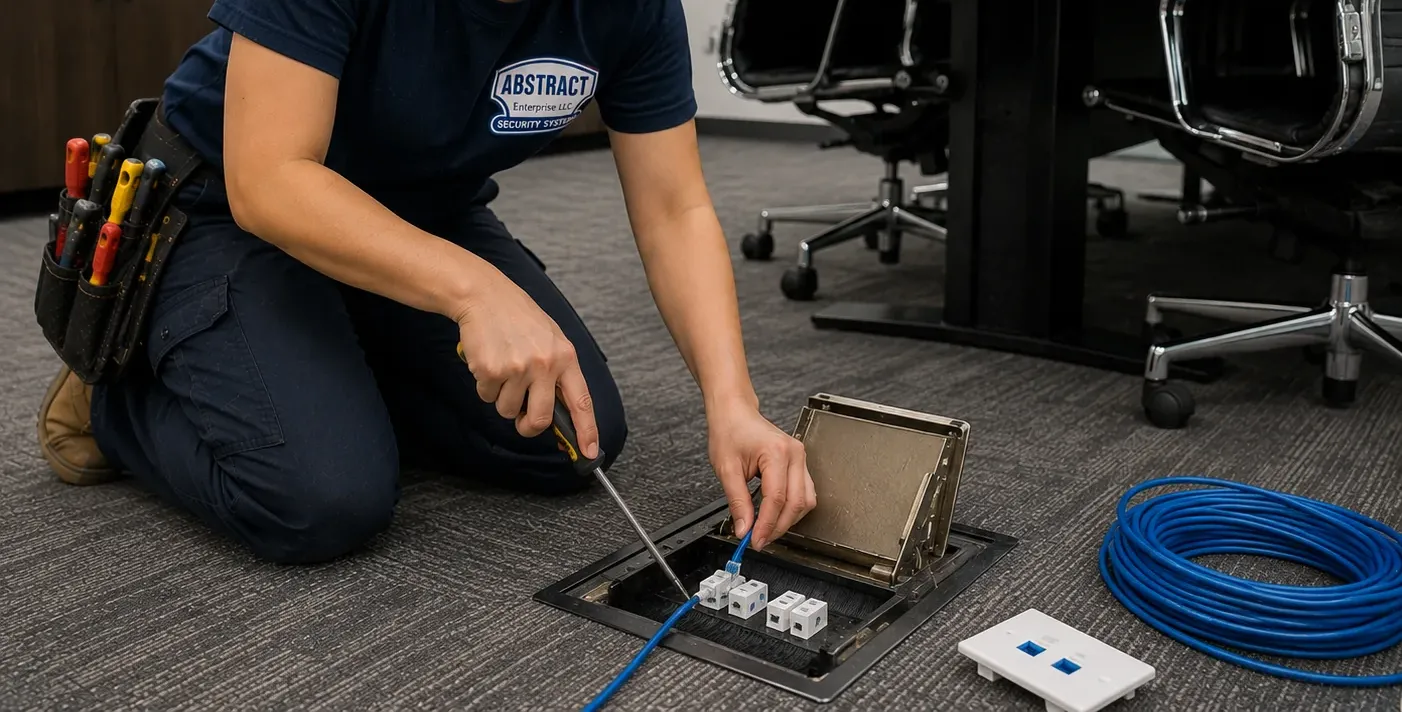
A technician kneeling on grey carpet works a screwdriver into an open floor box holding four white keystone jacks and a blue cable; a coil of blue cable and a white two-port wall plate lie on the carpet beside office chairs.
Equipment
Tools and Parts on a Staten Island Cat6 Repair Visit
A repair is proven by the instrument, and it lasts because of the parts. This is what comes on the van to an island job, and why each item matters in the buildings we work in here.
Certification Tester
Measures each link against the Cat6 or Cat6A limit and saves the result with its margins. After a flood or a damp season, the margins are what reveal the links that still light up but are close to failing.
Distance-to-Fault Readings
The tester's time-domain plots put a reflection or a crosstalk problem at a measured point, which is how we choose the one ceiling bay in a finished basement that needs opening.
Toner and Inductive Probe
Traces a dead bedroom jack back to the coil behind the electrical panel, or finds which cable in a builder's media enclosure serves which room.
Sealed Surface Boxes and Standoffs
For terminations that have to stay low in a basement or garage: boxes that keep damp air off the contacts and mount clear of the masonry.
Cat6 and Cat6A Keystones and Panels
Chosen to suit each link’s category and, where a panel belongs to one maker’s system, from that same maker.
Factory-Made Patch Cords
Tested cords in several lengths to replace crimped, kinked or kicked cords at counters, desks and media panels.
Cable Rated for Where It Runs
Solid-copper Cat6 and Cat6A for indoor runs, and suitably rated cable for stretches that cross the open space under a raised house or other locations exposed to the weather.
Fish Tapes, Rods and Access Saws
For pulling a replacement through a closet stack or a wall cavity, and for cutting the one small, patchable opening the tester has pointed to.
Labels and a Room-by-Room Map
Both ends of every link we touch get labelled, and you get a simple map of which jack is which — something most houses have never had.
Why the instrument matters more than the brand of cable. A light-up tester from a hardware store confirms that eight wires reach eight pins. It cannot see corrosion that has raised a contact's resistance, a run that has lost its crosstalk margin after a wetting, or a split pair a builder's crew introduced at both ends. Those are exactly the faults island basements produce, and only a certification tester measures them.
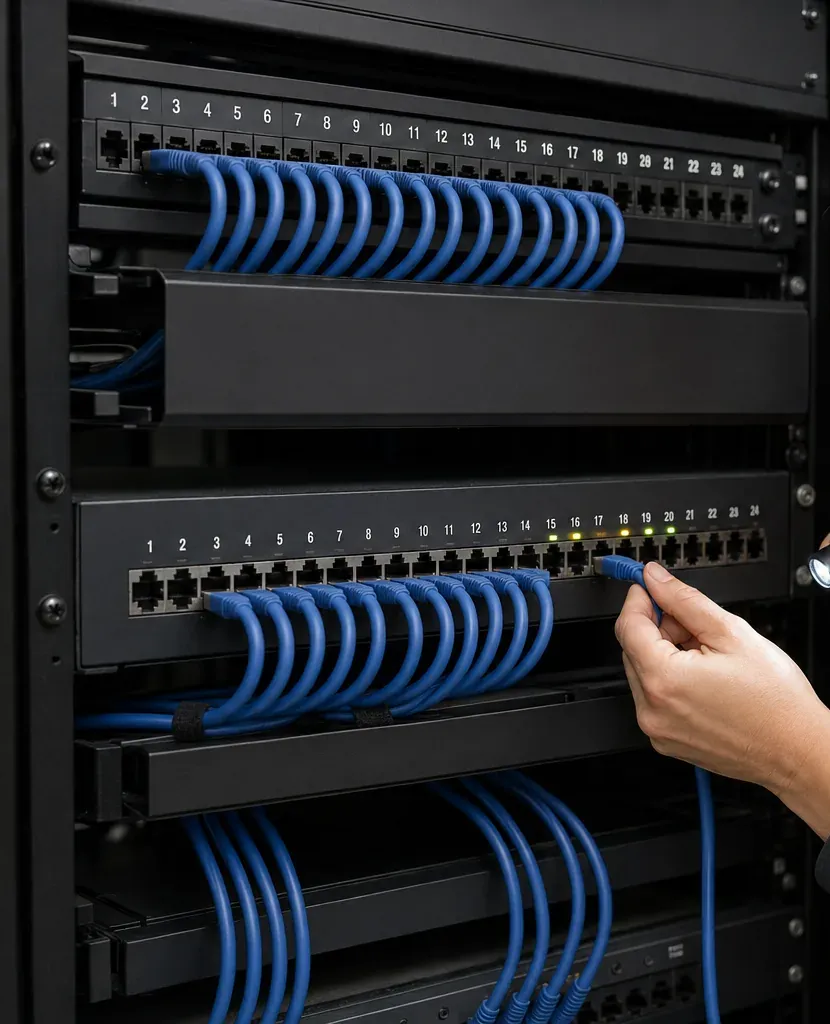
Two rack-mounted units with numbered ports from 1 to 24 are filled with looped blue patch cords; one hand presses a blue cord into port 18 while the other holds a small black flashlight toward the port lights.
AI Overview Reality Check
What AI Gets Wrong About Cat6 Repair in Staten Island
Method first: the tools used to research this page could not display Google's AI Overview, so none of the headings below are its words. They are statements found widely in cost guides, store listings and general home advice, and search assistants tend to echo them. After each one comes what an island house or shop actually shows us.
“Once the water is pumped out, the network is fine”
General flood-recovery advice tends to focus on what visibly stops working: appliances, the boiler, the electrical panel. Network cabling is rarely mentioned, and if the internet comes back on, the assumption is that the wiring is fine.
Wet terminations do not fail all at once. Corrosion inside a jack or a plug raises resistance and erodes margins gradually, so links that came back after the water went down can fail weeks or months later, often during the next damp spell. Powered links to cameras and access points usually go first, because they are the most sensitive to added resistance.
After water has reached a basement panel or jacks, we certify the affected links and look at the margins, not just at whether they light up. The links with collapsed margins get repaired before they fail, and the rest go on record as healthy.
“A powerline adapter does the same job as a repaired run”
Plugging a pair of powerline adapters into the wall is a popular suggestion when a wired jack dies, because it needs no tools and no access to the walls.
How well they work depends entirely on the house's electrical wiring, the circuits the two outlets are on, and what else shares those circuits. In a two-family house, where each unit typically has its own panel, adapters in different units may struggle to talk at all, and motors, dimmers and chargers on the same circuits drag throughput down. None of them can power a PoE camera or match a certified link for steady speed.
They can be a reasonable stopgap while a repair is scheduled. As a replacement for a Cat6 link to a home office, a register or a camera, we would rather fix the cable, and we will tell you honestly if a particular run is not worth saving.
“The internet company will sort out the wiring inside the house”
When the connection is bad, the first call is usually to the provider, and it is easy to assume their technician will fix whatever is wrong between their box and the computer.
Providers generally look after their own service and equipment. The Cat6 runs that carry the connection from the router to the rooms, the office or the cameras belong to the property, and if the provider's technician finds their side healthy, the visit often ends with the advice to have the inside wiring checked.
That is the job we do. If our testing shows the inside wiring is sound and the fault lies on the provider's side, we write down what we measured so the next call to them is short and specific.
“A cable fix should cost less than the price of a new drop online”
Search for what Ethernet work costs and the answer usually comes from a national guide; Fixr's January 2025 update, for instance, lists a new Cat6 drop with materials in a band from $125 up to $250, and labour between $45 and $75 an hour. For fresh cable through open framing somewhere in the country, that is a fair yardstick.
A repair is a different job. Most of the time goes into finding which links fail and why: tracing a builder's runs to a coil behind a panel, working out whether a basement link failed from water or from a staple, or locating a crush under a raised house. That diagnosis is the same whether the fix turns out to be one keystone or a new run.
So we publish the time on its own — $195 an hour, three hours minimum — and price any run that truly needs replacing separately from $175 per drop, the same figures our Staten Island network cable repair page shows, with nothing added for crossing the bridge.
“Raise the outlets and the flood problem is solved”
Flood-proofing guides rightly tell owners to raise electrical outlets, equipment and appliances above expected water levels, and many island homes were rebuilt that way.
Network cabling is often left out of that work. We regularly find raised power outlets in a basement with the Cat6 jacks still at skirting height beside them, a patch panel left on the original cellar wall while the boiler was moved up, or a new home with its media enclosure in the lowest closet in the house.
When we repair a link in a house that has been flood-proofed, we bring the network up to the same standard as the rest of the work: connections above the line, only continuous cable below it.
“A pre-wired house means every jack works”
Listings and builders often describe a home as wired for Ethernet, and buyers reasonably take that to mean plug in and go.
In practice, “pre-wired” can mean cable was pulled to each room and never terminated at the far end, terminated at a panel that was never connected to anything, or wired to a phone distribution block. Some is good cable waiting to be finished; some was damaged before the walls were closed.
A certification test of every run tells you which is which in one visit. The good runs get finished and labelled; the failed ones are repaired or replaced individually.
“Corroded connectors just need cleaning”
Contact cleaner and a brush are commonly recommended for corroded electrical connections, and for some exposed contacts that helps for a while.
In a Cat6 termination the corrosion is rarely only on the surface you can see. It travels into the insulation-displacement contacts and up the copper conductors under the jacket, and a cleaned jack on corroded copper will drift back to failing.
We cut the cable back until the copper is bright, sometimes several inches, then re-terminate on new hardware and retest. If cutting back leaves the run too short to reach, we extend it from a point above the water line or replace it.
Get the Basement Links Back Above the Line
Tell us which jacks fail, where the router lives, and whether water has ever reached the basement. We will tell you what the visit covers and how it is billed before you book.
From a Tottenville two-family to a Bloomfield warehouse, tell us what is failing and you will have a written reply within the business day. Rather talk it through? Call (347) 934-8335.
✅
We Got Your Request!
Expect a call from a technician within the business day; for anything urgent, ring (347) 934-8335.
How It Works
Our Cat6 Repair Process on Staten Island
Seven steps, whether the job is one dead bedroom jack in Great Kills or a basement panel full of corroded ports in a practice on Victory Boulevard. The visit is scoped to finish, because a second trip over the bridge helps nobody.
1. A short call about the building
House, two-family, office or shop; where the router and any panel sit; which links fail and when; and whether water has ever reached the basement or the space under the house.
2. Photos before we come
A picture of the panel or router corner and of one failing jack, front and back if it comes off easily, so the right hardware, boxes and cable lengths are on the van.
3. Test every suspect link
Each link is certified from both ends against its category, and every fault is placed at a termination or a measured distance along the run.
4. Mark the water line
In basements and raised-house enclosures we note how high water has been, and flag every connection below it, whether or not it is failing today.
5. Agree the fix, link by link
For each link: re-terminate, replace the cord, move the termination higher, reroute, or replace the run. Prices for any new cable are given before it is pulled.
6. Repair with matched parts
Cable cut back to bright copper, new Cat6 or Cat6A hardware, sealed boxes where a termination stays low, runs kept clear of power cable, and abandoned lengths removed where accessible.
7. Certify, label and hand over
A final certification on each link we touched, labels at both ends, and a written list showing which room each jack feeds, plus the saved test files.
A kneeling technician draws blue cables down from under a wooden table toward a carton marked CAT6 550MHz RISER with a coil of blue cable; a crimping tool, a two-port white plate and loose keystones lie on the carpet.
Coverage Area
Cat6 Repair Near Staten Island's Landmarks
The island is easier to read through a few well-known places. These six anchor the neighbourhoods we describe; naming them says nothing about work inside them.
Snug Harbor Cultural Center, North Shore
An 83-acre campus of more than two dozen architecturally significant buildings along the Kill Van Kull on the North Shore. The older streets around it are full of large frame houses whose network runs were added long after the walls were closed.
College of Staten Island, Willowbrook
A 204-acre campus completed in 1994 and, at that size, the largest college campus in New York City. Mid-Island neighbourhoods around it mix detached houses, garden apartments and small offices.
Staten Island Mall, New Springville
Opened on August 9, 1973 on Richmond Avenue at Richmond Hill Road. The retail corridor around it is where long runs from back offices to registers and parking-lot cameras are the norm.
Empire Outlets, St. George
A 350,000-square-foot retail complex steps from the Staten Island Ferry terminal, at the heart of the North Shore's ferry-side business district and the Bay Street corridor.
Freshkills Park
About 2,200 acres of the former Fresh Kills landfill, once the world’s largest, being turned into what the park’s own site calls the largest landfill-to-park project in the world, including 360 acres of restored wetlands. The West Shore's warehouses and houses sit around its edges.
Fort Wadsworth and the East Shore
The northern end of the roughly five-mile seawall the Army Corps of Engineers is building to Oakwood Beach, along the stretch of shoreline where Sandy's surge did its worst damage and many of the island's raised houses now stand.
We also repair Cat6 in St. George, Tompkinsville, Stapleton, Clifton, Rosebank, West Brighton, Port Richmond, Mariners Harbor, Westerleigh, Castleton Corners, Grymes Hill, Todt Hill, Dongan Hills, Grant City, Midland Beach, South Beach, New Dorp, Oakwood, Bay Terrace, Great Kills, Eltingville, Annadale, Huguenot, Prince's Bay, Pleasant Plains, Tottenville, Rossville, Charleston, Woodrow, Arden Heights, Travis, Bloomfield, Bulls Head, New Springville and Heartland Village, and in Brooklyn, Manhattan, Queens and the Bronx through our New York City Cat6 repair hub.
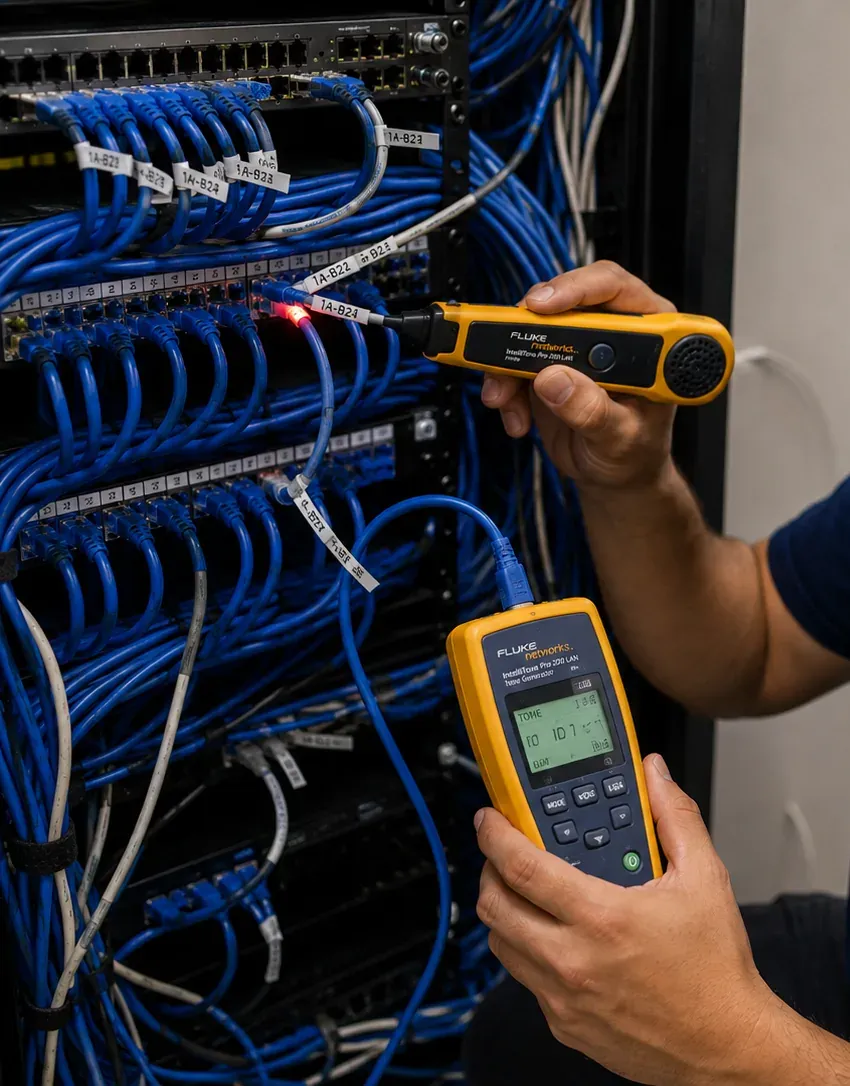
A yellow inductive probe is pressed against one labelled patch cord in a rack crowded with blue cords and printed tags, a red port light glowing beside it, while the other hand holds a yellow handheld tester connected by a blue cord.
Pricing
Cat6 Repair Cost in Staten Island
Nothing in this table is new: each number already appears on one of our island pages, which we name. Two things drive the bill — hours spent locating and fixing faults, and any cable that has to be added or replaced — and the quote lists them on separate lines.
Item
Price
Scope and source
Repair labour on Cat6 or Cat6A links: testing, locating, re-terminating, cords, moving terminations, retest
$195/hr, 3-hour minimum ($585)
Island specialty rate, as on our Staten Island network cable repair page; every link that fits in the time is included
Additional time beyond the minimum
$195/hr
Same page; billed in hourly increments
Cat6 run replaced or extended when the old one is beyond saving
From $175 per drop
Includes cable, keystone, plate, panel punch-down, the test, labels at both ends and a patch cord, per our Staten Island network cable repair page
Wall or floor entry finished properly: sleeve, seal, bond and drip loop
From $185 per penetration
Published on the same Staten Island page, priced per penetration
For comparison: one new Cat6 drop up to 100 ft at installation price
$296 per drop
From the price table on our Staten Island Cat6 installation page, which lists Cat5e at $254 and Cat6A at $424
Travel over the bridge
No separate charge
As stated on our Staten Island network cable repair page; visits are scoped to finish in one trip instead
Long reroutes, opening and patching finished surfaces, after-hours work
Quoted after testing
Depends on the route and the building
A typical three-hour block in an island house
In a typical island house, the block is enough to test every suspect link from both ends, trace any dead jacks back to where they land, re-terminate the corroded or badly made ends, replace the worst cords and certify what was repaired. Where the job turns into moving a panel up out of the basement or replacing runs, you get a price for that work, built from the figures above, before any cable is pulled. Time left over in the block goes to the links you want checked next.
Why these figures match the rest of the city
Our published replacement-run figure of $175 per drop and the $195 hourly repair rate are the same on our Staten Island network cable repair page as on the five-borough Cat6 repair hub, and we keep them identical here rather than create a separate island price list. What varies from job to job is how much cable is needed and how hard the route is, and that is what the written quote after testing covers.
What pushes an island Cat6 repair bill up or down
Whether the faults are at the ends: termination and cord faults are quick; mid-run damage in a finished room or under a raised house takes longer.
Whether equipment moves: lifting a panel and switch out of a basement means new terminations on every run and often extra cable.
How much corrosion there is: a light film is cut back in minutes; corrosion that has crept along the conductors can shorten runs until they need extending.
The route available: stacked closets and open basement ceilings make reroutes easy; finished basements and plaster walls do not.
What the cable carries: PoE camera and access point links are tested for resistance as well as category, and may need Cat6A parts.
For context only: the national numbers Fixr published in January 2025 — $125–$250 for a new Cat6 drop with materials, and $45–$75 an hour for labour — describe new installations around the country. They are a third party's averages, not our prices, and not a repair rate.
Full terms — including 50% deposit, one-year parts-only warranty on AESS-supplied products, and the late-fee schedule — are set out in the service agreement.
Shop Our Systems
Cat6 Repair Packages & Pricing
Three shapes cover nearly every island job, and every price in them is one already on our site.
Starter — Fix the Failing Links
$585
The three-hour minimum at $195 an hour. The failing jacks, plugs, cords or panel ports in a house or small office tested from both ends, corroded or badly made terminations cut back and remade, and every repaired link certified. Leftover time goes to any other links you want checked.
Standard — Basement Panel Rescue
$195/hr after the first 3 hours
For a panel, switch or bank of jacks that has suffered from water or damp: every run tested and the margins recorded, terminations remade on new hardware, sealed boxes where connections must stay low, and the time estimated in writing after the first round of testing.
Premium — Move It Above the Line
Repair time + from $175 per run
Equipment and terminations lifted out of the basement to a closet or room above the water line, runs extended or replaced from $175 per drop, penetrations made good from $185 each where cable passes outside, everything certified, labelled and mapped room by room.
Bring Your Own Parts — Labour Only
Still got the leftover reel from when the house went up, a bag of jacks, or a panel bought online? Hand them over and the visit is billed as labour alone, provided the parts fit the job — Cat6A hardware on a Cat6A link, solid copper for anything inside a wall, and boxes suited to a damp or dry spot. The tester checks the result the same way. Anything you supply is covered by its maker, not by us, and if your parts will not give a passing link you hear that before we start.
Want Every Jack in the House Working and Labelled?
Snap the media panel or the corner where the router sits, list the rooms without a connection, and we will come back with the likely cause and a price for a single visit.
A corroded jack is a corroded jack anywhere on the island. What changes from one shore to the next is the age of the houses, how close they sit to water, and what kind of business occupies the corner.
North Shore
The oldest part of the island, around St. George, Tompkinsville, Stapleton, West Brighton and Port Richmond, has older frame houses on hills, mixed-use buildings along Bay Street, Forest Avenue and Richmond Terrace, and the newer apartment and retail buildings near the ferry. Network runs in the older houses were added decade by decade through plaster and around balloon-framed walls, so tracing and route-finding take most of the time. Low-lying blocks near the waterfront bring the water question back in.
Mid-Island
Willowbrook, Castleton Corners, Todt Hill, Dongan Hills and New Springville carry a mix of detached houses, attached rows, garden apartments, the Richmond Avenue retail corridor and practices around the hospitals. Higher ground keeps surge away, but flash flooding still finds low roads and cellars, as Richmond Avenue near Nome Avenue showed in July 2025. The typical repair is a house or practice network that grew room by room and needs to be traced, tidied and certified.
East Shore
From South Beach and Midland Beach through New Dorp Beach and Oakwood, this is the shoreline Sandy's surge struck hardest and where the seawall now runs. Raised and rebuilt houses are common, and so are basements that were dried out and re-wired after the storm. Expect runs under raised floors, corroded basement terminations and equipment that should be moved up.
South Shore
Great Kills, Eltingville, Annadale, Huguenot, Prince's Bay, Rossville and Tottenville have many newer detached and two-family houses, plenty of them sold as wired for Ethernet, along with Hylan Boulevard's plazas and medical offices. Dead builder runs, finished basements with no ceiling access and flash-flooded cellars like the ones on Poplar Avenue are the patterns there.
West Shore
Bloomfield, Travis, Chelsea and Charleston hold the island's large warehouses and industrial sites around the Matrix Global Logistics Park, along with older office parks. Long runs, high-mounted cameras, dock doors and forklift traffic shape the work there, and distances to a single closet need checking against the length limit.
Where the Fault Usually Is in an Island House, and What Fixes It
Houses fail in more predictable places than offices do. This is how a symptom in a Staten Island home or house-office usually maps to a location and a repair, once the tester has confirmed it.
Symptom and tester result
Most likely location
Usual repair
Basement links slow or dropping in wet weather; high resistance or poor return loss at the near end
Corroded panel ports or jacks on a block wall
Cut back to bright copper, new hardware on a standoff or sealed box, or move the termination higher
Upstairs office drops since a renovation; fault at a set distance mid-run
Staple, nail or crush where the run crosses joists or a new wall
Open at the measured point and repair, or reroute through a closet stack
Bedroom jack dead; tone does not reach any panel port
Builder run never terminated, coiled near the electrical panel or service entrance
Trace, terminate on a panel, test and label
Jack lights up but only runs at 100 Mbps
One pair open or split at a field-made termination
Remake that end with every pair in its proper position
Camera over the garage reboots; link passes but resistance high
Corroded or poorly made plug at the camera end, often outdoors
New weather-protected termination at the camera, retest under PoE load
Links that cross under a raised house fail after storms
Exposed cable in the enclosure below the living floor
Reroute inside, or replace with suitably rated, supported cable
Register or PC errors when motors start; cable passes certification
Electrical noise or a shared circuit, not the cable
Re-route data away from motor feeds; written note for the electrician
Some jacks in both units of a two-family dead after one tenant's renovation
Run damaged where it passes through the renovated unit
Locate by distance, repair or reroute around the unit
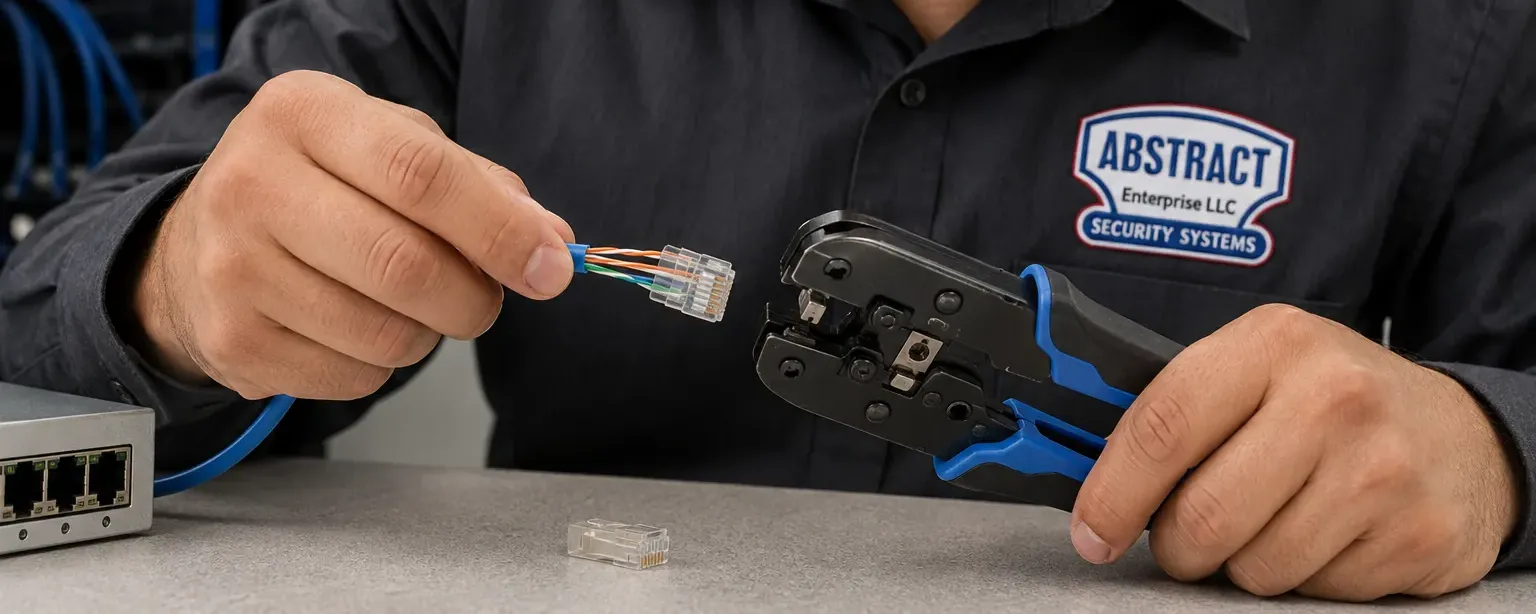
Close-up over a light grey bench: a clear RJ45 plug is threaded onto coloured conductors from a blue cable, a black-and-blue crimper waits in the right hand, and a second unused plug and the corner of a small network switch sit on the bench.
Before You Call
Checks an Island Homeowner or Office Manager Can Make First
A few minutes with these checks either clears the problem or tells us exactly where to start. None of them risks making the cabling worse, and the safety ones matter most after any water.
Check
Safe to do yourself?
What it tells us
After water, stay out of a wet basement with live power
Yes — and leave breakers alone if you would be standing in water
Safety first. Electrical equipment and wiring that has been in floodwater should be checked before anything is plugged back in.
Look at the jacks and plugs nearest the floor
Yes, by eye
Green or white crust on contacts, rust on the box or tide marks on the wall tell us the termination is part of the problem.
Try a known-good cord at the failing jack
Yes
Rules out the cord, which at counters and desks is the most common culprit.
Find where the bedroom runs end
Yes, if the panel or coil is easy to reach
A photo of the media panel or the bundle near the service entrance saves a lot of tracing time.
Note whether failures follow rain, heat or a motor starting
Yes
Rain points to water, motors to noise or circuits, and a renovation to physical damage.
Check which unit's panel the equipment is on in a two-family
Yes
Tells us whose space we need to enter and whom to coordinate with.
Clean corroded contacts with spray
Not recommended
It hides the damage for a short while and leaves residue in the jack.
Cut into a finished ceiling to look for the fault
No
A measured distance from the tester finds it with one small opening instead of several large ones.
Write down what you tried and what changed. It shortens the first half-hour of the visit and sometimes lets us bring the exact boxes and cable lengths for a one-trip fix.
Complete Services
Every Cat6 Repair Service in Staten Island
A failing link often arrives alongside other work: a camera that needs replacing, a closet that needs rebuilding, a house that needs more drops. These are the related services on the island.
Put everything that needs doing on a single request.
Field Notes
Field Notes on Failing Cat6 in Island Houses
Habits our crew brings into island basements — general practice drawn from many visits, not one job story
We go to the basement first, even when the complaint is upstairs. That is where the router, the panel or the coil of builder cable usually is, and it is where we can see the history of the house: how high water has been, whether the wiring was redone, whether the network was moved or left behind.
We look at the lowest connection before we test anything. If the contacts on the jack nearest the floor are green, the rest of that wall usually is too, and the conversation turns from one link to where the network should live.
We test every run, not just the one that failed. In houses wired by one crew on one day, a fault on one link is often the same fault on several, and finding them all now saves you a second visit.
And we leave a list. Every jack labelled, every run tested, and a note on paper of which room is which. Most houses have never had one, and the next time something stops working it turns an afternoon into a quick phone call.
FAQ
Staten Island Cat6 Repair FAQ
Do you need to see the house's elevation certificate before moving network equipment out of the basement?
+
Not always, but it helps in a flood-zone building. An elevation certificate records the height of the house relative to the flood zone and the base flood elevation, so it tells us how high the router, switch and panel need to go to be clear of the expected water. If you do not have one, we work from the water marks and the history of the house and keep every connection as high as the space allows.
Can the basement links be tested before storm season so we know which ones are weak?
+
Yes, and it is a sensible thing to do in a house that has taken water before. We certify each basement link and record its margins, so you have a baseline showing which links are healthy and which are close to failing. The weak ones can be fixed or moved up on the same visit, and if water does come, a fresh test can be compared against the record instead of guessing what changed.
Can you repair the network cable to a standby generator or a heating system controller?
+
Yes. Generators and boiler or heat-pump controllers that report over the internet usually connect with an ordinary network cable, and those runs often cross a basement or go outside, where they take the same damp and physical damage as any other link. We test and repair the data run and keep it away from the equipment's power wiring; the generator or heating equipment itself stays with the company that services it.
Do you repair the Cat6 that connects a solar inverter or battery system to the home network?
+
Yes, the data cable between the inverter or battery gateway and your router is ordinary network cabling, often run through a garage or along a basement wall. We test it, re-terminate or replace it, and keep it clear of the power wiring. The solar or battery equipment itself, and anything on its power side, stays with the company that installed or services it.
Can you repair a network cable that runs out to an EV charger in the driveway or garage?
+
Yes. Many chargers can use a wired connection for their app and updates, and the run usually crosses a garage or goes outside, where damp and physical damage are common. We test the run, replace damaged or unsuitable cable, protect the termination at the charger end, and keep the data cable apart from the charger's power circuit. Electrical work on the charger itself is for a licensed electrician.
Does the power to the house have to be shut off while you work on the Cat6?
+
No. Network cabling is low-voltage and we work on it with the house powered. Your internet will be down for the minutes it takes to re-terminate the panel or move the router, and we will tell you before that happens. The only exception is a basement that has recently flooded, where the electrical equipment should be cleared as safe before anyone works around it.
Do you repair Cat6 in a modular home?
+
Yes. Once a modular house is set on its foundation and finished, its network cabling behaves like any other house's. The one place we look closely is where runs pass between sections of the house that were joined on site, because any connection or tight bend made there during assembly is a likely fault point. The tester tells us quickly whether that is where the problem is.
Can a repair at a home office be booked on a Saturday?
+
Yes, weekend slots are available, and many island customers who work from home prefer them so the network is not down during the working week. Ask for a Saturday window when you book and we will confirm what is open. The billing is set out in the written quote before the visit.
Can you leave the basement wall looking tidy after moving the panel upstairs?
+
Yes. Unneeded boxes and plates are removed or blanked, accessible abandoned cable comes out unless you want a spare kept, and the remaining runs are dressed and supported along the joists. Small openings we make in finished surfaces are left neat and ready for patching and paint; full drywall finishing can be quoted if you want it done.
All Areas Served
Cat6 Repair Across New York City
You are on the Staten Island Cat6 repair page. The five-borough hub explains how we approach Cat6 repair across the city, and each borough and region has its own page written for its buildings.
Cameras, intercoms, alarms and the rest of what we do are one click away on the AESS home page; the story of the company is on our about page.
Island Network Link Failing Today?
Whatever has failed — corroded ports downstairs, a dead jack in the den, a driveway camera cycling on and off, a card terminal going offline — dial (347) 934-8335. We book the next open two-hour window, and most termination, plug and cord faults are found and fixed in one to two hours once we are at the panel.
Cat6 Repair Staten Island — Licensed, Insured, Tested to Category
Abstract Enterprises Security Systems · 1282 Troy Ave, Brooklyn, NY 11203 · (347) 934-8335 · WhatsApp (718) 679-0359 via wa.me
NYS Low-Voltage Licence #12000287431 · 100% Licensed & Insured · Same-Day Estimates · Rated 4.7★ from 201 Google Reviews
Parts you supply carry their manufacturer's warranty. See our warranty page and the service agreement for full terms.
Code references on this page — Appendix G, the separation rule and abandoned-cable removal — are plain-language summaries to help island owners plan a repair; they are not legal or engineering advice. Page reviewed and updated October 17, 2026. Changelog: first publication of the Staten Island Cat6 repair page.