Patient Floors · Production Lines · Cleanroom-Adjacent Space · Classrooms & Multi-Gig Wi-Fi · Restaurant Kitchens · Retail Checkouts
In Dutchess County a broken Cat6 link is rarely just a cable problem. It sits above a hospital corridor where the ceiling cannot be opened without an infection-control permit, beside a drive cabinet on a production floor in East Fishkill, behind a classroom projector at one of the county’s colleges, or six feet from a fryer in a Hyde Park kitchen. We find the fault, repair it to its category, and do the work the way that room demands — with the containment, the firestop, the shielding or the shift-change timing the site needs, and the test record to show it.
Reviewed and updated October 17, 2026 · Written by Anwar Timothy, NYS licence #12000287431
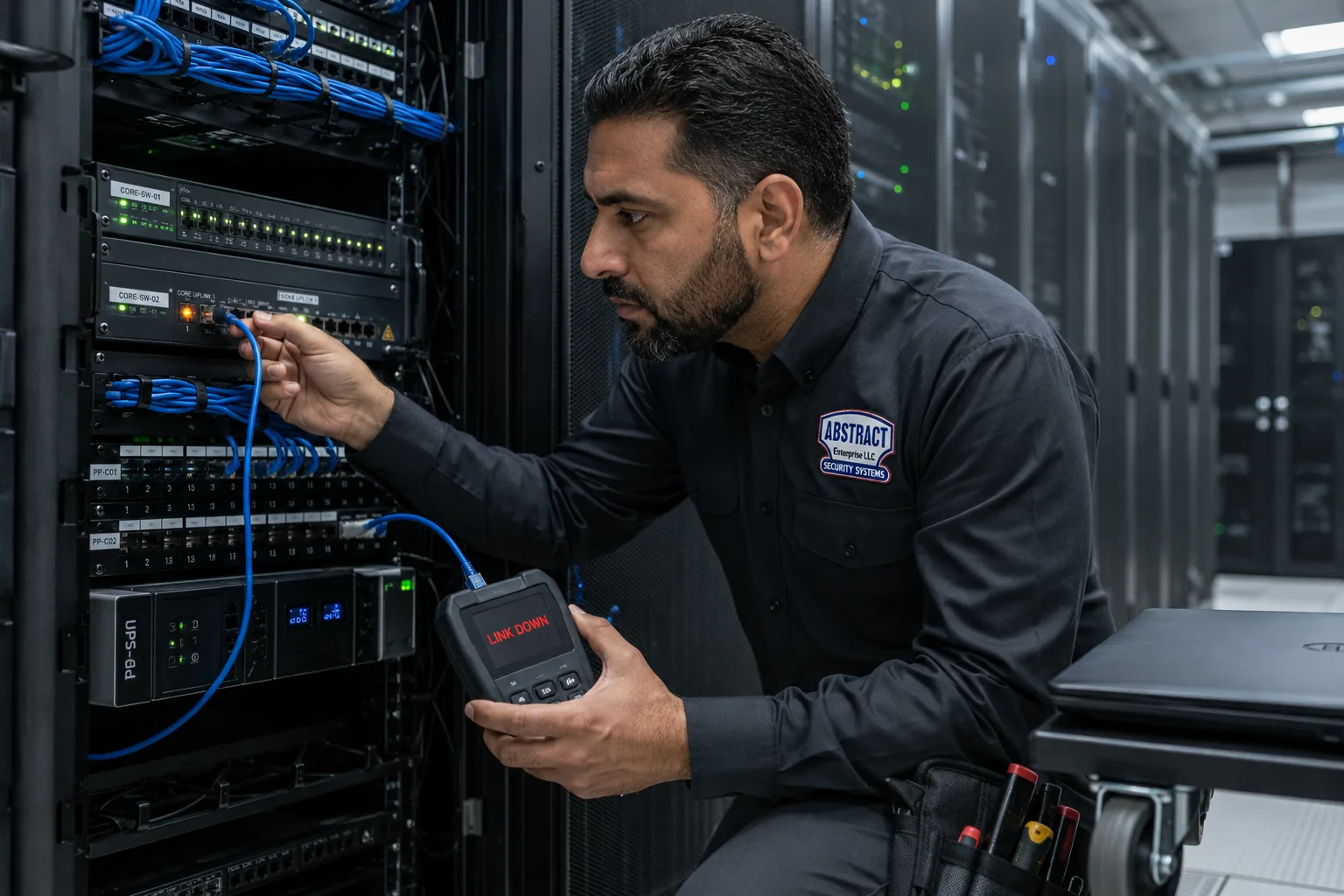
A bearded technician crouches at an open equipment rack, seating a blue patch cord in a switch labelled CORE-SW-02 while the handheld tester in his other hand shows LINK DOWN in red; more server racks line the aisle behind him.
Dutchess County Cat6 Repair Quote
Tell us what kind of room the failing link runs through — we reply the same business day
✅
Request Sent!
We'll get back to you the same business day.
25+
Years Experience
✓
Same-Day Estimates
100%
Licensed & Insured
4.7★
201 Google Reviews
A nurse station dropped off the network, a line controller keeps losing its connection, or the new access points refuse to run faster than a gigabit? Ring our Dutchess line, (845) 640-3835, or use the 60-second form. A licensed technician reads it, asks what the building’s own rules require — a permit, an escort, a gowning room, a quiet window between shifts — and tells you what the fault probably is before anyone is booked.
Work planned around infection-control, firestop, cleanroom and plant-safety rules, not in spite of them
Every repaired link certified to its category, with the saved result handed over
Licensed in New York (#12000287431) and insured, with our rate on the page and your figure in writing before we book
Why Dutchess County Properties Need Cat6 Repair Shaped by the Room It Runs Through
Dutchess is a county of institutions and industry wrapped in small towns. Its biggest buildings are not office towers but a regional hospital on the Poughkeepsie riverfront, a semiconductor fab and a redeveloped research campus in East Fishkill, IBM’s long-running plant on South Road, four colleges with campuses of their own, a culinary school that runs public restaurants, and a retail strip along Route 9 anchored by the county’s largest enclosed mall. In each of those places, Cat6 shares space with something that has rules: patients, wafers, students, food, cash. When a link fails, the repair has to respect those rules before it can fix anything.
That changes what a good repair looks like. Above a patient corridor, lifting a ceiling tile is an infection-control decision, and the hospital’s own risk assessment tells the technician how to contain dust before a cable is touched. On a production floor, the run that keeps throwing errors may sit inches from a motor drive, and a replacement that ignores that will fail the same way. In a classroom, a projector fed over Cat6 can lose its picture because of a single keystone the network never notices. In a kitchen, the cable that runs to the order screens above the line is living close to its temperature rating every service. The tester tells us that a link fails; the room usually tells us why.
The county’s buildings add their own history. The former IBM East Fishkill campus has been re-let to new owners and tenants, so plant installed for one company now serves several. Beacon’s nineteenth-century mills along Fishkill Creek have become lofts, a hotel and workspaces, with cable threaded through brick that was built for looms. Many of the county’s homes and small commercial buildings predate 1980, which brings lead paint and asbestos rules into what looks like a two-hour job. And because a large share of residents commute or work remotely, a dead jack in a home office in Fishkill or a rental near a campus is as urgent to its owner as a closet failure is to a facilities manager.
So the Dutchess version of Cat6 repair starts with a question most contractors skip: what does this room require? Then it does the ordinary things properly — locates the fault by distance, re-terminates or replaces what failed, matches the category, certifies the result — and finishes by putting the room back the way the building’s rules say it must be left: sealed penetrations, closed and cleaned ceilings, grounded shields, and a record your facilities, compliance or IT team can file.
Dutchess County facts that shape the repairs we do
752,610 square feet: the eight-level patient pavilion that Walsh Construction and Consigli completed at Vassar Brothers Medical Center in Poughkeepsie, a $545 million project, according to Walsh; WAMC reported its opening in January 2021. The hospital is now listed by Northwell Health. Buildings like this run nurse call, telemetry, security and data cabling side by side above finished ceilings.
More than 1,000 technologists and engineers: joined onsemi when it completed the purchase of GlobalFoundries’ 300 mm fab in East Fishkill, effective December 31, 2022, making it onsemi’s largest US manufacturing facility, the company said in February 2023.
300 acres and over two million square feet: the former IBM East Campus in East Fishkill now marketed as iPark 84, according to its developer. The Poughkeepsie Journal reported in July 2021 that Amazon had taken 124 acres of the former plant for a 629,186-square-foot warehouse, and that roughly 2,000 people already worked on the east campus.
About 300,000 square feet: the new IBM quantum facility planned at 2455 South Road in the Town of Poughkeepsie, alongside a renovation of Building 416, per the Dutchess County IDA project summary, which listed a September 2026 construction start.
Four college campuses with their own networks: Vassar (about 1,000 acres, founded 1861), Marist (180 acres on Route 9, 6,382 students by its own count), Bard (more than 70 buildings across a campus that reached about 1,260 acres after the 2016 Montgomery Place purchase, per Wikipedia), and SUNY Dutchess, whose Poughkeepsie campus covers 130 acres and eleven buildings.
18 percent of homes built before 1940: Dutchess’s median home dates from 1971 and about 22,056 homes were built in 1939 or earlier, according to the Stacker analysis of Census data used in our county research. In the City of Poughkeepsie, rental buildings of two or more units built before 1980 must register and obtain a lead safety certificate under the county’s rental registry program.
93.5 percent of households: have a broadband subscription and the mean commute is 31.2 minutes, per the Census QuickFacts for Dutchess County. A lot of the county’s work happens on home and small-office networks that depend on one or two Cat6 runs.
Taken together, those facts explain the calls we get. The failing link in Dutchess is as likely to be in a patient room, a gowned manufacturing area or a lecture hall as in a cubicle, and the repair has to be planned for that room before the van leaves.
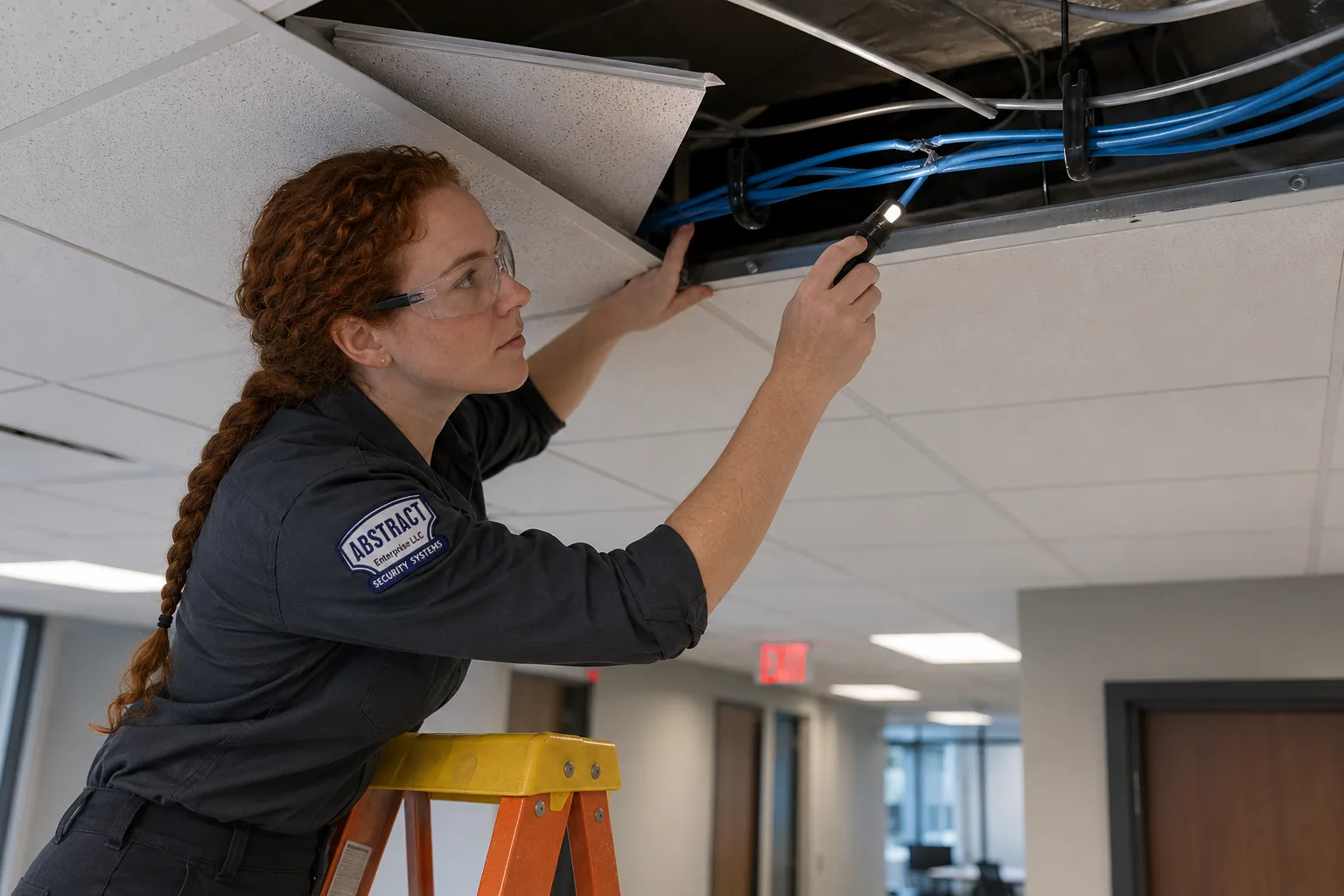
A technician with a long braid and safety glasses stands on an orange stepladder in an office corridor, holding a ceiling tile up with one hand and shining a flashlight on a bundle of blue cables hung in black J-hooks; an exit sign glows at the end of the hall.
Repair Capture
Cat6 Down at a Dutchess Plant, Practice or Campus?
A charting station on a clinic floor, a barcode printer at the end of a packing line, a lecture-hall projector before a morning class, a register at a Route 9 store on a Saturday — when one of those stops, it is a service call, not a project. Tell us what failed, what the device or tester shows, and what the building requires before work can start. We book the next open 2-hour window and arrive with the parts the symptom points to: Cat6 and Cat6A keystones and panel modules, shielded jacks and plugs for runs that use them, replacement cord and cable in riser and plenum ratings, firestop sealant for rated walls, and a certification tester. A single fault at a jack, a panel port or a cord is usually found and fixed in one to two hours on site. Repair time is $195 an hour with a three-hour minimum ($585), the rate published on our Dutchess and Hudson Valley repair pages. Call (845) 640-3835 and say it is a Cat6 fault.
What We Install
Cat6 Repair Services in Dutchess County
These are the repairs Dutchess facilities teams, practice managers, plant engineers and property owners ask for most. Every one ends with the link tested against its category limit and the result saved for you.
Above-Ceiling Repair in Healthcare Space
Failed runs to nurse stations, exam rooms, imaging suites and offices repaired under the facility’s infection-control permit: containment set up as the permit class requires, cable supported on its hangers, tiles replaced and the area cleaned before we sign off.
Production-Floor and Plant Links
Runs to line controllers, scanners, printers and HMIs that drop when machinery starts. We separate cabling faults from noise and routing problems, re-route away from drive and motor cables, and repair shielded links with shielded parts.
Shielded Cat6 Repair
Foil-screened and shielded runs re-terminated on shielded jacks and plugs with the drain wire and shield bonded properly, so the shield does its job instead of becoming an antenna or a path for ground current.
Classroom and Conference AV Links
Cat6 that carries HDBaseT video to projectors, displays and lecterns: extra connection points removed, terminations remade to the tighter tolerance video needs, and the link proven with the AV gear connected, not just a cable tester.
Multi-Gig Access Point Runs
Existing Cat6 to new Wi-Fi access points that will not hold 2.5 or 5 Gb/s. We find the weak link — a termination, a cord, a crowded bundle — and repair or re-route it so the link stops downshifting.
Kitchen and Hot-Space Runs
Links to order screens, printers and POS stations near cooking lines, dish areas and mechanical rooms, repaired with cable and routes that keep the jacket inside its temperature rating and away from grease and steam.
Firestop Restoration
Where a repaired or replacement run passes through a fire-rated wall or floor, the penetration is resealed with a listed firestop method and photographed, so the repair does not leave a hole in the building’s fire separation.
Mixed-Standard and Inherited Plant
Re-tenanted buildings where some jacks are wired T568A and others T568B, where panels were re-punched by different contractors, or where nobody can say which port is live. Mapped, corrected and labelled before repairs are signed off.
Rental and Student-Housing Jacks
Wall jacks broken by furniture, yanked cords and frequent moves, replaced with sturdier hardware and strain relief, and tested between tenancies so the next occupant moves into working connections.
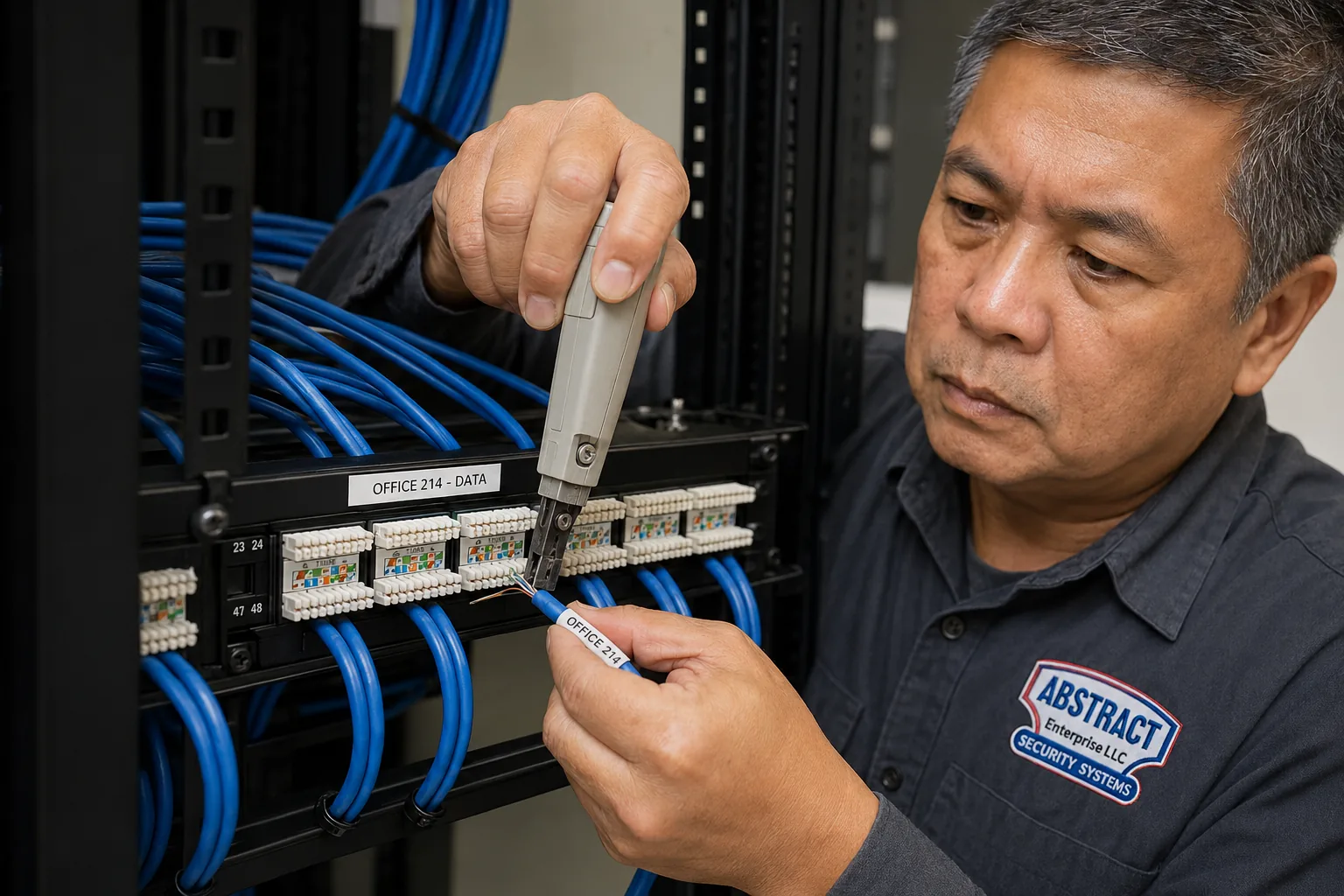
A grey-haired technician presses a punch-down tool onto the rear of a patch panel module while holding a blue cable tagged OFFICE 214; a label reading OFFICE 214 – DATA sits above the row of terminations.
Building Specialists
Cat6 Repair for Dutchess County’s Architecture
The same failed keystone takes ten minutes in one Dutchess building and half a day in another. The difference is almost never the cable. It is what surrounds it.
Hospitals and Outpatient Buildings
Large modern additions like the Vassar Brothers pavilion and the many outpatient and medical-office buildings around Poughkeepsie, Fishkill and Rhinebeck. Ceilings carry several low-voltage systems on shared pathways; rated corridor walls are everywhere; work above clinical areas runs on permits.
Semiconductor and Research Campuses
East Fishkill’s fab and the redeveloped iPark 84 buildings, IBM’s South Road site and smaller labs. Badged entry, safety orientations, gowned or controlled areas, high-bay ceilings and a mix of original and tenant-added cabling.
College Buildings
Nineteenth-century halls at Vassar and Bard, newer academic buildings at Marist and SUNY Dutchess, residence halls and dining halls. Thick walls and protected interiors in the old buildings; dense AV and access-point cabling in the new ones.
Converted Mills and Factories
Beacon’s brick mill complexes along Fishkill Creek and other conversions to lofts, offices, studios and hospitality. Exposed structure, long open ceilings, cable in surface raceway and very few concealed paths.
Route 9 and Route 44 Retail
Enclosed-mall units at the Poughkeepsie Galleria, big-box stores and strip plazas from Wappingers Falls to Hyde Park, and village shops along Route 44 in Millbrook and Pleasant Valley. Checkout, scanner and camera runs in stockrooms and bulkheads, often shared with the landlord’s systems.
Restaurants and Commercial Kitchens
Dining rooms and kitchens from Beacon’s Main Street to Rhinebeck and Hyde Park, including the culinary college’s campus. Heat, grease, steam, daily wash-downs and stainless surfaces that leave little room to route cable well.
Older Homes and Small Rentals
Pre-war houses in the City of Poughkeepsie, Beacon and the river villages, many converted to two- to four-family rentals or home offices. Plaster, balloon framing, painted trim that may contain lead, and cable fished in after the fact.
Flex, Warehouse and Light-Industrial
Buildings along I-84 in Fishkill and East Fishkill, Route 55 in LaGrange and the Route 9 corridor. High bays, forklifts, dock doors and long runs to scanners and cameras at height.
Checks built into every Dutchess job, whatever the building
What the room requires first. Permit class above a clinical area, gowning or escort rules, hot-work or lockout rules on a plant floor, lead or asbestos status in an older building — settled before tools come out.
Shielded or unshielded. We look at the cable jacket and the existing jacks before choosing parts. A shielded run repaired with unshielded hardware loses its protection; an unshielded run fitted with shielded jacks gains nothing.
Category of the whole channel. Cat6 parts on Cat6 runs, Cat6A parts on Cat6A runs, and cords that match. A single lower-grade cord or coupler can be the reason an AV or multi-gig link fails.
Cable rating for the space. Plenum-rated cable where the ceiling is an air-handling space, riser where it climbs between floors, and a jacket that suits the heat near kitchens and mechanical equipment.
Penetrations. Every rated wall or floor the run crosses is identified, and any opening we disturb or create is resealed with a listed firestop method.
Support and separation. Repaired runs go back on J-hooks or tray, not on ceiling tiles or pipes, and are kept clear of motor, drive and power cables.
The record. Saved test results, both-end labels and photos of any firestop or containment, so the next inspection or audit has something to read.
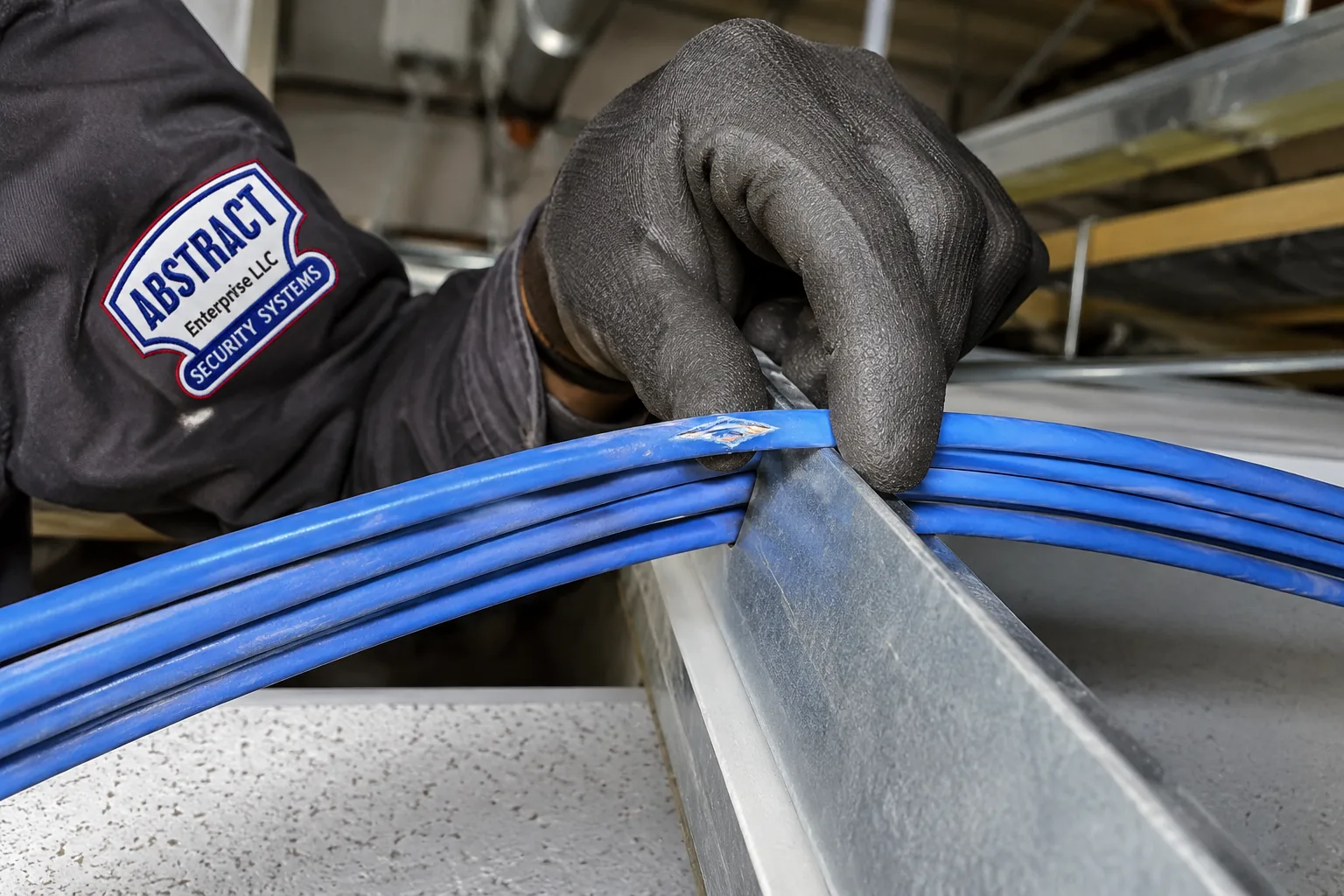
A gloved hand with a company patch on the sleeve lifts four blue cables where they rest across a galvanized ceiling grid rail; one jacket has been cut through, showing coloured conductors underneath.
Commercial Cat6 Repair
Business Cat6 Repair in Dutchess County
Dutchess’s commercial Cat6 is concentrated in a handful of corridors, and each has its own typical failure. These are the ones we plan for.
The Hospital Campus on the Poughkeepsie Riverfront
Vassar Brothers Medical Center and the practices, labs and outpatient offices that cluster around it. Expect permit-controlled ceilings, rated corridors, shared pathways with nurse call and telemetry, and repairs scheduled around clinical hours rather than office hours.
Route 52 and I-84, East Fishkill and Hopewell Junction
The onsemi fab, the iPark 84 buildings on the former IBM East Campus — where state documents show the Office of General Services leasing roughly 305,000 square feet of warehouse space in one building — and the distribution use that followed. Badges, safety briefings, high bays and EMI from production equipment.
South Road, Town of Poughkeepsie
IBM’s long-standing Poughkeepsie site, where the county IDA summary describes a new quantum facility of about 300,000 square feet. Large-campus plant, controlled areas, and the contractor coordination that comes with active construction next to occupied buildings.
Route 9, Poughkeepsie to Wappingers Falls and Fishkill
The Poughkeepsie Galleria — which describes itself as the largest enclosed shopping center in Dutchess with 110 stores — plus big-box and strip retail, car dealers, banks and medical offices. Checkout and kiosk runs, camera cabling in bulkheads, and landlord-controlled ceilings.
Main Street, Beacon
The converted mills, galleries, restaurants and shops between the train station and the Fishkill Creek end of Main Street, including Dia Beacon’s 1929 former box-printing factory. Exposed brick and timber, surface raceway, and kitchens on narrow lots.
Route 9 North: Hyde Park and Rhinebeck
The Culinary Institute of America’s campus between the Hudson and Route 9, with its public restaurants, plus hotels, inns and restaurants in Hyde Park and the village of Rhinebeck. Commercial kitchens, event spaces and historic interiors.
Compliance callouts for business Cat6 repairs in Dutchess
Infection control above healthcare ceilings. In the ASHE ICRA 2.0 matrix used by many hospitals, work above the ceiling that includes “installation of conduit and/or cabling” is listed as a Type B activity, while a non-existing cable pathway or invasive electrical work above ceilings is listed as Type C. The facility combines that with the risk group of the area to set the precautions. We work to the permit the facility issues.
Firestopping. The National Electrical Code requires openings around communications cable penetrations through fire-resistance-rated walls, partitions, floors or ceilings to be firestopped using approved methods to maintain the rating (section 800.26, as summarised by Mike Holt). A repair that pulls a new cable through a rated wall reopens that obligation.
Old runs left behind. Under section 800.25 as EC&M explains it, communications cable that is no longer used has to come out wherever it is accessible, unless someone tags it for future use. When we replace a run in a Dutchess ceiling, the dead one is pulled rather than left in the bundle.
Asbestos survey before repair work. New York’s Industrial Code Rule 56 (12 NYCRR Part 56) applies statewide and requires an asbestos survey before demolition, renovation, remodeling or repair work in the affected part of a building. Older ceilings, plaster and pipe wrap in Dutchess buildings make this a real question, which we raise before cutting or drilling.
Lead-safe practice in older rentals. In the City of Poughkeepsie, rental buildings of two or more units built before 1980 fall under the county rental registry and lead safety certificate program. Under the EPA’s renovation rule, disturbing six square feet or less of interior painted surface counts as minor repair and maintenance, provided prohibited practices are not used — a cable repair normally stays well inside that.
Local permits. Building permits in Dutchess are issued by the city, town or village rather than the county, and the Town of Poughkeepsie, for example, publishes its own electric and low-voltage permit application. We check the municipality for the address when a repair goes beyond like-for-like work.
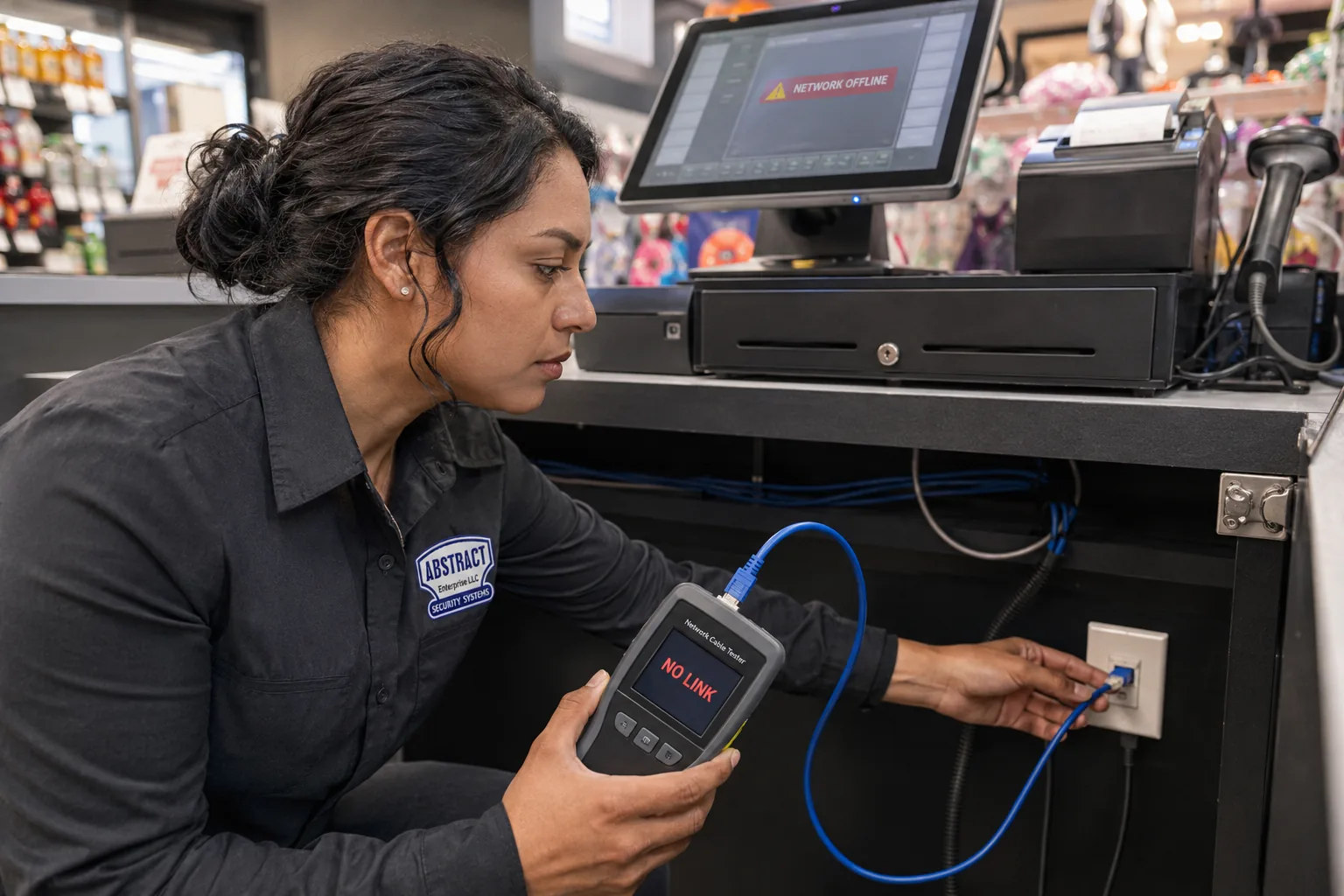
Under a shop counter, a technician with her hair pinned up connects a blue lead to the wall plate below the till; her handheld screen shows NO LINK in red, and the touchscreen above warns NETWORK OFFLINE next to the cash drawer, printer and barcode scanner.
Your Questions Answered
Cat6 Repair in Dutchess County: Questions Answered
These are the questions Dutchess facility managers, practice administrators, plant engineers, IT staff and landlords bring to us. They are grouped by the kind of room the failing cable lives in, because in this county that is what decides the answer.
Hospitals, clinics and labs
Our failed Cat6 is above the ceiling of a patient floor — what has to happen before a tile can come down?
The facility decides, not the contractor. Most hospitals and many outpatient buildings require an infection control risk assessment and a permit for work above the ceiling. Under the ASHE ICRA 2.0 matrix widely used for this, above-ceiling work that includes cabling is listed as a small-scale Type B activity, and opening a new cable pathway is listed as Type C; the facility combines that with the risk group of the area below — an office, a lab, an operating suite — to set the class of precautions. In practice that can mean a portable containment cube or plastic sheeting, a HEPA vacuum, sticky mats, work outside patient hours, and replacing every tile we move before we leave the room.
What we need from you is the permit, or the name of the person in facilities or infection prevention who issues it. We plan the repair so the ceiling is open for as short a time as possible: the fault is located from the jack and the closet first, so only the tiles at the fault come out. We bring our own containment if the permit calls for it and photograph the finished ceiling as part of the repair record.
When a replacement Cat6 run passes through a fire-rated corridor wall, who restores the firestop — and how do we prove it?
Whoever disturbs the penetration is responsible for sealing it again, and on a Cat6 repair that is us. The National Electrical Code requires openings around communications cable through fire-resistance-rated walls, floors and ceilings to be firestopped by approved methods so the assembly keeps its rating. Pulling an old cable out and a new one through a sleeve or a cored hole breaks whatever seal was there.
We identify the rated walls on the route before we start, use a listed firestop system that suits the penetration — sealant, pillows or a reusable device in a sleeve — and photograph each penetration after it is sealed, with its location noted on the repair record. Healthcare and education buildings in Dutchess usually have a facilities or life-safety manager who will want those photos; if yours keeps a penetration log or uses labels on each seal, tell us and we will follow it.
A lab instrument depends on one Cat6 link that cannot drop mid-run — how is a repair scheduled around it?
By finding the fault without touching the live link, then cutting over in the instrument’s idle window. Many intermittent faults can be located from the far side of the patch panel or from the switch’s own port statistics, and a certification tester can be run on a spare or neighbouring link to confirm the pathway before the live run is opened.
Where the instrument has no idle window long enough, we can run a temporary cord or a parallel cable so the device stays connected while the permanent run is repaired, then move it across in minutes. You tell us when the acquisition or batch finishes; we agree the cut-over time with your lab manager in writing beforehand.
Production floors, fabs and flex buildings
Ethernet errors on our production line climb whenever the drives and motors are running — is the Cat6 the problem?
Often it is the route rather than the cable. Twisted pair rejects a lot of noise, but in industrial settings with 480-volt conductors and variable-frequency-drive output cables nearby it can need help; Control Design’s guidance on industrial Ethernet makes the same point. A run tied to a drive cable, or crossing a cabinet beside one, can pass a test with the line stopped and still corrupt frames when it runs.
We test with the equipment off and then watch error counters with it running, which separates a bad termination from interference. The fix may be re-routing the run away from power and drive cables, crossing them at right angles, moving it into separate tray or conduit, replacing it with shielded cable bonded correctly, or, for the worst spots, using fiber for that segment. We will not simply re-terminate a link whose real problem is where it lies.
Someone repaired our shielded Cat6 with ordinary unshielded jacks — does that matter?
Yes. A shield only works when it is terminated on shielded connectors and bonded to ground; Control Design notes that shielded eight-position connectors are needed to terminate shielded twisted pair. An unshielded jack leaves the foil floating at that end, so the noise protection you paid for is gone, and a shield that is floating or bonded at the wrong points can pick up noise rather than block it.
We replace the unshielded hardware with shielded jacks and plugs of the right category, terminate the drain wire and foil properly, and check how the shield is grounded across the run. Some industrial engineers prefer grounding the shield at one end only to avoid carrying current between two ground points; we follow your plant’s standard where it has one and explain the choice where it does not.
Can a Cat6 fault inside a cleanroom or gowned area be repaired without breaking the room’s protocol?
Yes, if the work is planned with the people who own the room. Cleanroom repairs depend on the room’s class and the site’s procedures: gowning, which tools and materials may enter, how they are wiped down, how ceiling or wall panels are opened and resealed, and who has to witness or approve the work. Vendor guidance for cleanroom cabling stresses protocol at every stage — gowning, tool preparation, material selection, penetration sealing and post-work cleaning.
We locate the fault from outside the controlled area wherever possible, so as little work as possible happens inside it. When we must go in, we follow your gowning and material rules, bring only the cleaned tools and parts you approve, and leave any panel or penetration sealed to your procedure. Facilities on the East Fishkill and South Road campuses will have their own contractor rules; we ask for them before booking.
The Cat6 patch cords on our moving machinery keep breaking every few months — what lasts longer?
Ordinary office patch cords are not built for repeated flexing, vibration and oil. On equipment that moves, tilts or vibrates, the conductors fatigue at the plug and the jacket cracks, which shows up as a link that drops when the machine is in a particular position.
The repair is to make the moving part the right kind of cable: a flex-rated industrial cord with a strain-relieved, ideally latching or locking connector, a service loop that lets the machine move without pulling on the plug, and a fixed solid-copper run that ends in a jack or bulkhead at the edge of the moving zone. We replace the failed cords, fit the transition point and leave the permanent run tested to category.
Campuses, classrooms and Wi-Fi upgrades
A classroom projector fed over Cat6 (HDBaseT) flickers or goes black — is it the cable, the wall plate or the extender?
Very often the cable path, and particularly the number of connection points in it. HDBaseT pushes far more bandwidth through a Cat6 run than ordinary Ethernet, and AV makers such as Atlona recommend a home run from transmitter to receiver without keystones, couplers or punch-downs, shielded cable for long bundled runs, and no zip ties tight enough to deform the pairs. Atlona also notes that typical cable testers cannot say whether a run will pass HDBaseT.
We start by confirming the extender pair’s distance rating — Atlona’s 70-metre products, for example, are rated to about 40 metres on Cat6 at 4K — then certify the run and look for extra wall plates, couplers or a patch panel in the path. Removing a coupler, re-terminating a poor plug or replacing a damaged section usually ends the flicker. If the run is simply too long or too crowded for the extenders, we tell you that rather than repairing it twice.
We installed new multi-gig access points, but they only link at 1 Gb/s on the existing Cat6 — can the cable be fixed?
Often, yes. 2.5GBASE-T and 5GBASE-T were designed to run over installed Cat5e and Cat6, but they use far more of the cable’s bandwidth than gigabit Ethernet. The NBASE-T Alliance’s white paper on “downshift” explains that when noise is too high for a speed, the link drops to the next lower speed rather than failing — and that the worst case is a dense bundle running a long distance, because of crosstalk from neighbouring cables.
So a gigabit link on a multi-gig port points us at margin, not continuity. We certify the run, look for a weak termination, an old cord, a coupler or a ceiling bundle that has been tightly lashed, and fix those first. If the run is long and packed into a full bundle, loosening and separating it, or moving the access point’s cable into a less crowded pathway, may be what restores the higher rate. We confirm the result on your access point, not just on our tester.
On a campus or a large office, it is worth testing a sample of the existing runs before buying more multi-gig hardware. A short survey of the longest, most crowded runs shows how many will hold 2.5 or 5 Gb/s as they are, how many need a repair, and how many are better served by a new run or a different access-point location. That turns an expensive surprise after installation into a line in the budget beforehand.
Tenants keep breaking the wall jacks in our rental units — is there a sturdier repair?
Yes. In student houses near the colleges and in small rentals across Poughkeepsie and Beacon, most broken jacks are mechanical: a bed or desk pushed against the plate, a cord yanked sideways, a jack recessed too shallowly in an old plaster wall. Replacing like for like just resets the clock.
We replace the jack and plate with heavier-duty hardware, use angled plates where furniture sits against the wall, add strain relief behind the plate, and make sure the box or mounting bracket is actually secure in the plaster. Between tenancies we can test every unit’s jacks in one visit and give you a short pass list to keep with the lease file. In pre-1980 City of Poughkeepsie rentals we keep any disturbance of painted surfaces within minor-repair limits and clean up lead-safely.
Kitchens, shops and inherited plant
The Cat6 to our kitchen order screens keeps failing — what in a commercial kitchen damages it?
Usually a mix of heat, grease, steam and cleaning. Common riser-rated Cat6 is specified for operation up to about 60 °C (140 °F), and cable routed over a hood, behind a fryer bank or along a dish machine’s exhaust can sit near that temperature for hours every service. Heat also raises insertion loss on a long run, and grease and steam attack jackets and corrode plugs.
We test the run, inspect where it passes hot equipment and replace the damaged length along a cooler route — through the ceiling away from the hood, down a wall away from the line — ending at a jack positioned so cords are not left hanging in the splash zone. Where a route cannot avoid a hot area, we discuss a higher-temperature-rated cable or protective conduit. The screen’s mount and power supply stay with your POS vendor.
Cleaning is the other half of kitchen failures. Daily wash-downs push water into wall boxes near the floor and into plugs left hanging below counters, and degreasers soften some jackets over time. Raising jacks above the splash line, using sealed or covered boxes in wet zones and keeping cords short and supported removes most of the repeat calls we see from restaurant kitchens.
Some jacks in our building are wired T568A and some T568B — is that why certain links fail?
It can be. A run terminated T568A at one end and T568B at the other is effectively a crossover cable, with the orange and green pairs swapped. Modern switches often cope with a full crossover, but a mixed or partly corrected run — one pair swapped, or split across pairs — fails a wire map or runs at reduced speed, and it fails certification either way.
Mixed schemes are common in Dutchess buildings that have changed owners or tenants, such as the redeveloped East Fishkill campus buildings and older office suites along Route 9, where different contractors terminated different floors. We test every suspect link, standardise each run on one scheme at both ends — usually whichever the building already uses most — and note the scheme on the labels so the next contractor does not undo it.
If a tenant’s equipment depends on the current wiring — an old phone system that uses specific pairs, or a device cabled with a fixed crossover — we check before changing anything. Re-terminating to one scheme is quick, but only once we know nothing on the floor relies on the mismatch. The port map we leave shows which links were changed and when.
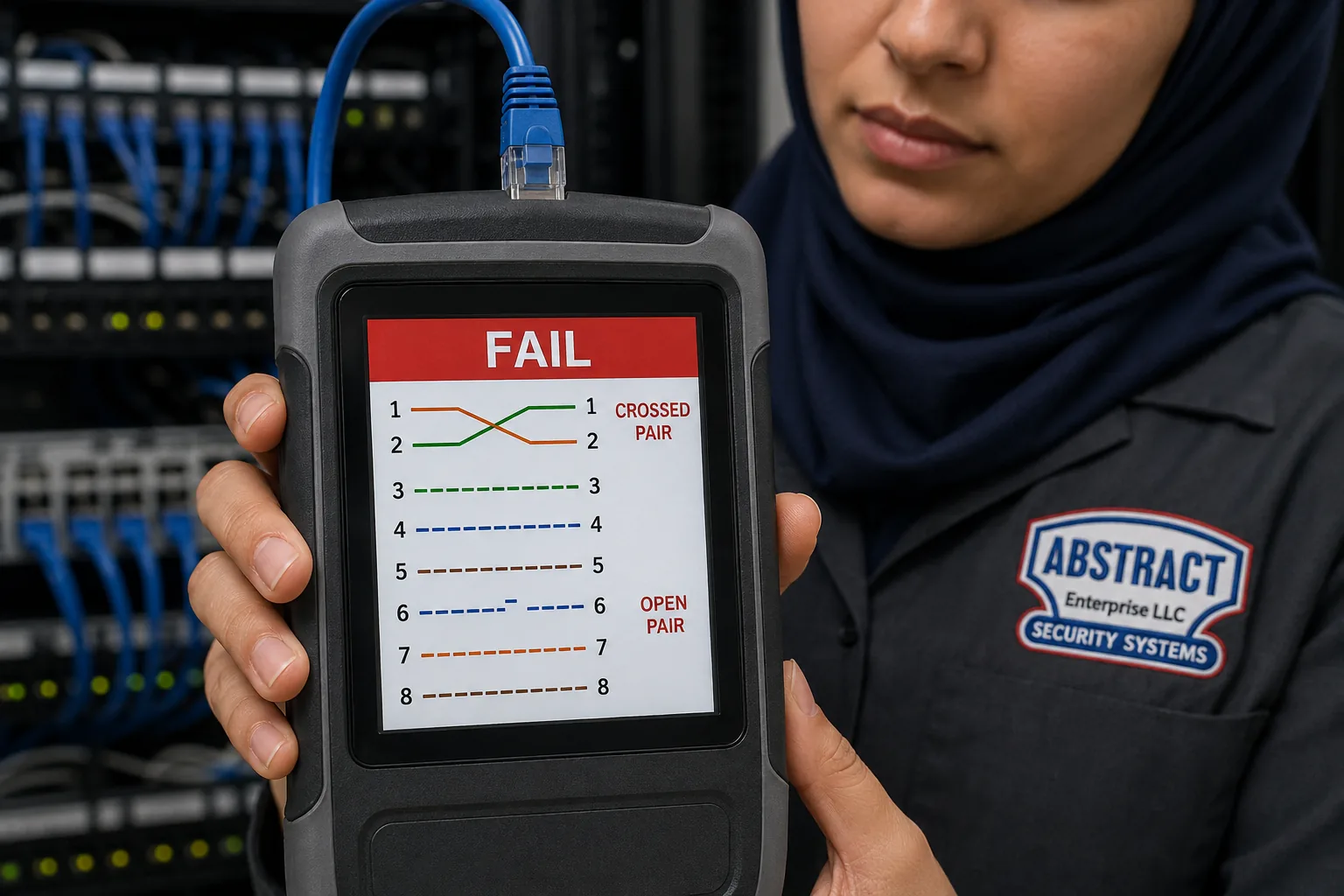
A technician in a navy headscarf holds a tester close to the camera; its screen shows FAIL in a red banner over a wire map, with pins 1 and 2 marked CROSSED PAIR and pin 6 marked OPEN PAIR, and a rack of blue cables behind.
Equipment
Types of Cat6 Repair Equipment We Bring to Dutchess Sites
The van carries two kinds of kit: what proves a link, and what lets us work inside the building’s rules. In Dutchess the second list matters as much as the first.
Certification Tester
Measures the whole link against the TIA pass/fail limits for Cat6 or Cat6A, from crosstalk and loss to pair order and length, and stores each result so a hospital, college or plant has something to file.
Link and Speed Qualification
Shows what speed a port actually negotiates and whether it delivers PoE, which is how we confirm a multi-gig access point or a classroom device is working at the rate it should after the repair.
Tone and Trace Tools
Follows one cable through a crowded hospital ceiling or a mixed-tenant closet without cutting anything, so the right run is opened the first time.
Shielded Jacks, Plugs and Modules
Category-matched shielded hardware for screened runs on production floors and in labs, with the bonding parts needed to terminate the drain wire properly.
Unshielded Cat6 and Cat6A Hardware
Keystones, panel modules and faceplates for ordinary runs, including heavier-duty and angled plates for rentals and student housing.
Plenum and Riser Cable
Solid-copper Cat6 and Cat6A rated for air-handling ceilings and vertical risers, plus flex-rated industrial cord for the moving parts of machinery.
Listed Firestop Materials
Sealant and devices for the penetrations a repaired run passes through in rated walls and floors, with the labels and photos that document them.
Containment and Clean-Up
Plastic sheeting, a HEPA vacuum and sticky mats for above-ceiling work where an infection-control permit or a clean area requires them.
Supports and Labels
J-hooks, hangers and hook-and-loop straps to get repaired runs off tiles and pipes, and durable both-end labels that follow your existing numbering.
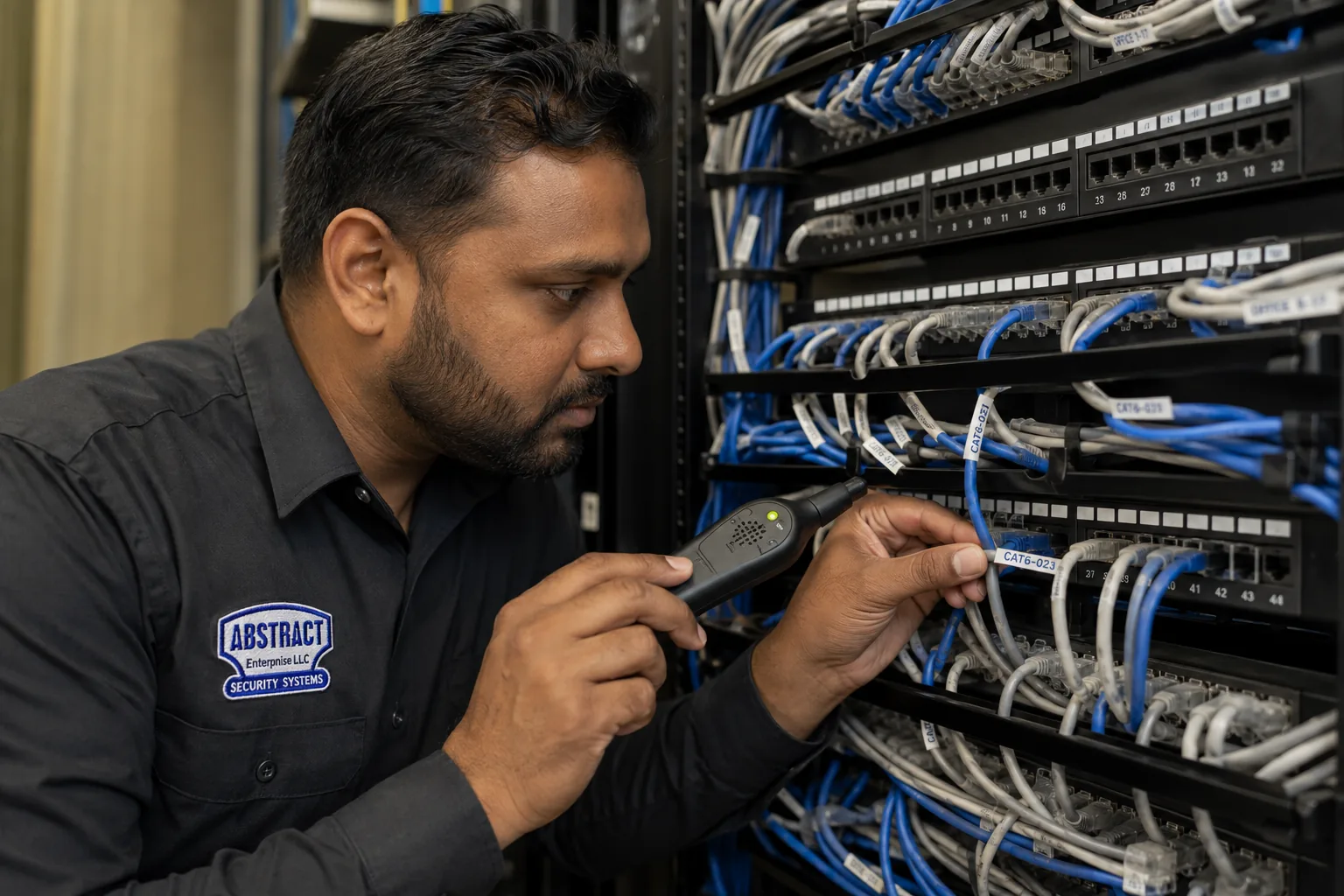
A bearded technician leans close to a crowded rack, holding a handheld tone probe beside a blue patch cord tagged CAT6-023; numbered patch-panel ports and labelled grey and blue cords fill the frame.
AI Overview Reality Check
What AI Gets Wrong About Cat6 Repair in Dutchess County
We could not view Google’s AI Overview from our build environment, so the claims below are ones we see repeated in generic how-to articles, product listings and cost guides of the kind AI summaries draw on. Each is answered with what actually happens in Dutchess buildings.
“Fixing a network cable is the same job in any building”
Generic advice treats Cat6 repair as cut, crimp and test. That is the core of it, and it is the same core in a Pawling house and a Poughkeepsie hospital. What is not the same is everything around it.
Above a clinical area, the ceiling is controlled by an infection-control permit. In a semiconductor or research building, access is badged and some areas require gowning. On a plant floor there are lockout, hot-work and safety-orientation rules. In a pre-1980 rental, painted surfaces and old ceilings bring lead and asbestos rules into play. Ignoring those does not make the repair faster; it gets the technician walked off site.
That is why our first question on a Dutchess call is about the room, not the cable. The answer decides who has to approve the work, what we bring, when we can do it and how long the ceiling or wall can be open — and it is built into the quote rather than discovered on the day.
“Shielded cable is always better, so use it for every repair”
Shielded Cat6 helps where there is real interference, such as beside motor drives and heavy power cables. It is not automatically better anywhere else, and it only works when the whole channel is shielded and properly bonded.
Splicing a shielded section into an unshielded run, or terminating shielded cable on ordinary jacks, gives you the cost of shielding with none of the benefit. A shield bonded at two points with different ground potential can even carry current, which is why industrial engineers quoted in Control Design often ground it at one end only.
Our rule on Dutchess repairs is to match what is there and fix what is wrong with it. Unshielded office runs get unshielded parts; screened plant runs get shielded parts terminated and bonded correctly; and where an unshielded run keeps failing near equipment, we discuss re-routing or fiber before we discuss shielding.
“Eight green lights on a pocket tester mean the run is good for any device”
A continuity tester proves the wires connect in the right order. It says nothing about crosstalk, return loss or insertion loss — the measurements that decide whether a run carries 2.5 or 5 gigabit Ethernet to an access point, or HDBaseT video to a projector.
The NBASE-T Alliance’s downshift paper describes links falling back to lower speeds as noise rises, without ever showing as “broken”. Atlona states plainly that typical cable testers cannot determine whether a cable will pass HDBaseT. Both describe the faults we are called to most often on Dutchess campuses: links that test “good” and still do not perform.
Certification to the category limit, plus a check on the actual device, is what settles it. That is the test we run before and after every repair, and the result you keep.
“Twisted pair is immune to interference from machinery”
Twisting gives Ethernet good noise rejection, and in offices that is usually enough. Factories are different: drive output cables, large motors, welders and 480-volt feeders put out fields that a run laid alongside them for any distance can pick up.
The result is not a dead link but a noisy one — CRC errors, retransmissions, controllers that lose their connection and reconnect. Those symptoms come and go with the machinery, which is why a link can pass a test at seven in the morning and fail at ten.
On Dutchess production floors we test with the line stopped and running, trace the route against the power cabling, and repair the route as well as the termination. Separation, crossing at right angles, separate pathways, shielded cable bonded correctly, or fiber for the noisiest segments are all on the table.
“Low-voltage work is exempt from asbestos and lead rules”
There is no general low-voltage exemption. New York’s Industrial Code Rule 56 requires an asbestos survey before demolition, renovation, remodeling or repair work in the affected part of a building, and consultants who work with the rule say there are effectively no exceptions by building age.
Lead is handled differently: the EPA treats disturbing six square feet or less of interior paint as minor repair and maintenance rather than renovation, as long as prohibited practices are avoided. Most cable repairs stay well under that, but they still deserve lead-safe habits in older homes and the City of Poughkeepsie’s registered rentals.
So on older Dutchess buildings we ask about surveys before we cut into ceilings, plaster or pipe chases, use existing openings where we can, and keep dust down regardless. If the owner does not know whether materials have been tested, we say so before the work starts rather than after.
“Any indoor Cat6 is fine anywhere indoors”
Indoor ratings cover fire behaviour — riser, plenum, general purpose — and a temperature range. Common riser Cat6 is specified to about 60 °C, which a run over a cooking hood, inside a hot mechanical room or in an unconditioned high-bay roof space can reach.
An air-handling ceiling also needs plenum-rated cable, which is common in hospital, college and newer office buildings across the county. Using riser or general-purpose cable there to save money on a repair puts the building out of compliance.
We choose the cable for the space it will live in: plenum where the ceiling is a return air path, riser between floors, higher-temperature cable or a cooler route near kitchen and process equipment, and flex-rated cord on moving machinery.
“Sealing the hole in the wall is someone else’s job”
Generic guides end at “pull the new cable through”. In a hospital corridor, a school stairwell or a multi-tenant building, that hole may be in a fire-rated wall or floor, and the code requires it to be firestopped by an approved method.
If the cabling contractor leaves it open, it is usually found later by a fire marshal, an accreditation survey or an insurer’s inspector — long after anyone remembers who left it. The building owner pays for that finding, not the contractor who opened it.
On every Dutchess repair we treat the penetration as part of the job: identify rated assemblies on the route, reseal what we disturb with a listed system, and photograph it for your records.
Get the Station, the Line or the Classroom Back
Tell us what the link feeds and what the building requires before work starts. We will tell you what the fault probably is and what the visit will involve.
Whether it is a clinic, a production line, a lecture hall, a kitchen, a shop or a rented flat, list what has stopped working and what the building asks of contractors; we answer in writing the same business day. Prefer to talk? Dial (845) 640-3835.
✅
We Got Your Request!
Expect a written reply today. If something is down at this moment, phone (845) 640-3835.
How It Works
Our Cat6 Repair Process
Six steps, the same on every Dutchess job. The second one is where this county differs most from anywhere else we work.
1. Tell us the fault and the room
Which links fail, what they feed, what the device or tester shows, and what kind of space the cable runs through — clinical area, plant floor, clean area, classroom, kitchen, rental or office.
2. Clear the site rules
We get the infection-control permit, contractor orientation, badge and escort, gowning procedure, asbestos survey status or work window the building requires, and agree who signs off before anyone arrives.
3. Locate before opening
Each failing link is certified from both ends and the fault placed by distance, so only the ceiling tile, wall plate or panel at the fault is opened, and only for as long as the work takes.
4. Agree the repair
You get the finding and the fix for each link — re-terminate, replace a cord, re-route away from heat or noise, convert to shielded, or replace the run — with any extra cost in writing before it starts.
5. Repair inside the rules
Category-matched parts, shield bonding where the run is screened, cable rated for the space, supports restored, abandoned lengths removed where reachable, and every disturbed rated penetration firestopped.
6. Prove it and close the room
Each repaired link is certified and checked on its device, labelled at both ends, the ceiling or wall closed and cleaned, and you receive the saved results with photos of firestop and containment.
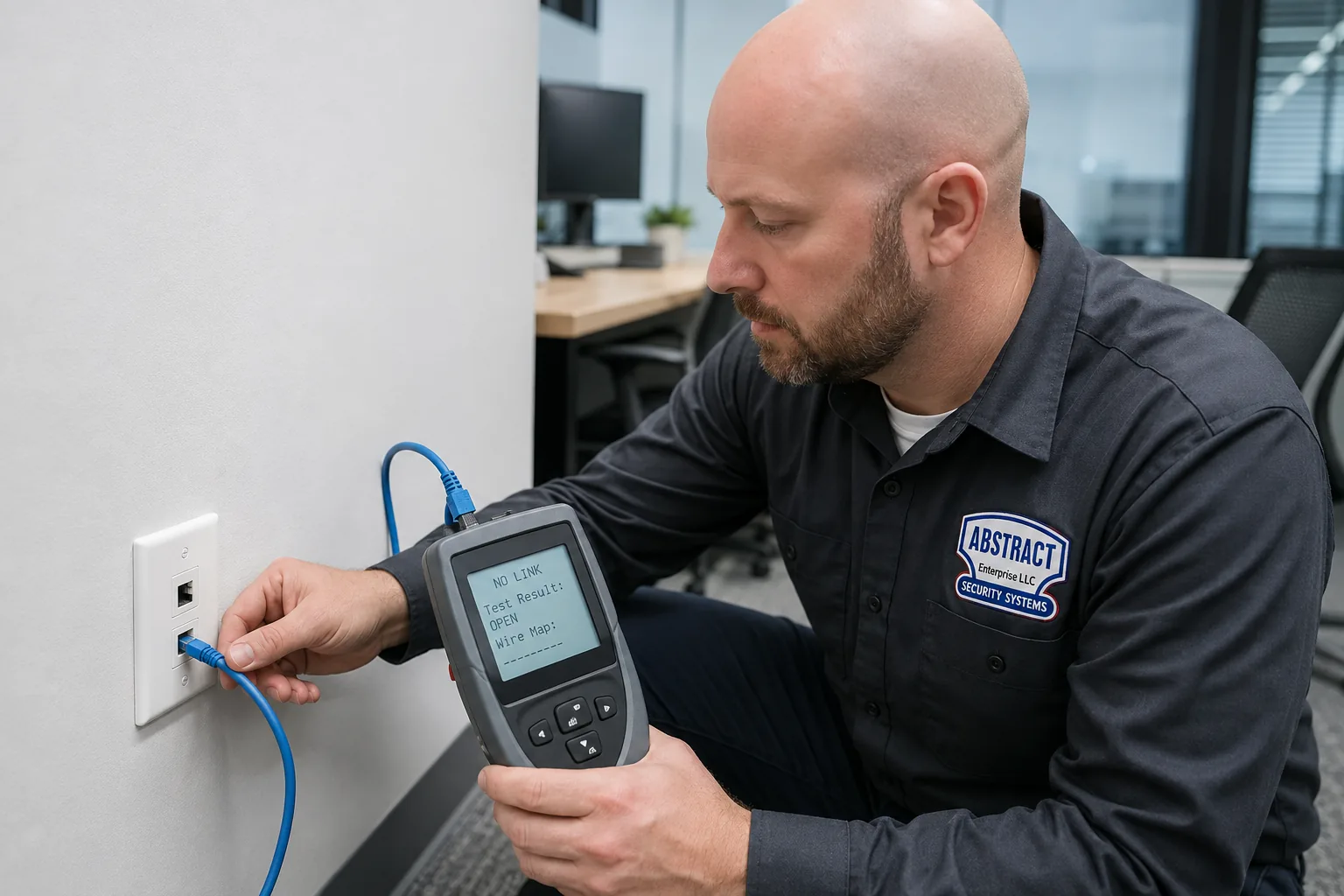
A bald, bearded technician kneels beside a white two-port wall plate in an office, holding a tester whose screen reads NO LINK, Test Result: OPEN, with a blue cord running from the tester into the lower jack.
Coverage Area
Cat6 Repair Near Dutchess County’s Landmarks
We work across the county, from the river cities to the Harlem Valley. These six places show the range of buildings our Dutchess repairs happen in or near.
Vassar Brothers Medical Center, Poughkeepsie
The riverfront hospital whose 752,610-square-foot patient pavilion opened in 2021. Surrounding medical offices and outpatient sites follow the same above-ceiling permit and firestop discipline we bring to every healthcare repair.
Former IBM East Campus, East Fishkill
About 300 acres and two million square feet now marketed as iPark 84, beside onsemi’s 300 mm fab — a campus where plant installed for one company now serves warehouses, offices and manufacturers.
The Culinary Institute of America, Hyde Park
A riverside main campus between the Hudson and Route 9 that the college describes as 170 acres, with student-run restaurants open to the public — a reminder of how many commercial kitchens line this stretch of Route 9.
Marist University, Town of Poughkeepsie
A 180-acre campus on the east bank of the Hudson along Route 9. Campuses like this mix historic and new buildings, dense access-point cabling and classroom AV over Cat6.
Groveville Mill, Beacon
The carpet mill A.T. Stewart built after acquiring the site in 1876, once employing more than 700 people, now lofts beside the tallest dam on Fishkill Creek, according to its current operator — typical of the brick conversions where cable has nowhere to hide.
Dutchess County Fairgrounds, Rhinebeck
Home of the six-day county fair and events through the year, with commercial exhibit buildings, barns and a main stage on its site map. Event venues across the county need temporary and permanent links that work on the day.
We also repair Cat6 in the City and Town of Poughkeepsie, Arlington, Beacon, Fishkill, East Fishkill and Hopewell Junction, Wappingers Falls and the Town of Wappinger, LaGrange, Pleasant Valley, Hyde Park, Staatsburg, Rhinebeck and Rhinecliff, Red Hook, Tivoli and Annandale-on-Hudson, Millbrook, Washington, Stanford, Pine Plains, Dover, Amenia, Millerton, Pawling, Beekman and Union Vale.
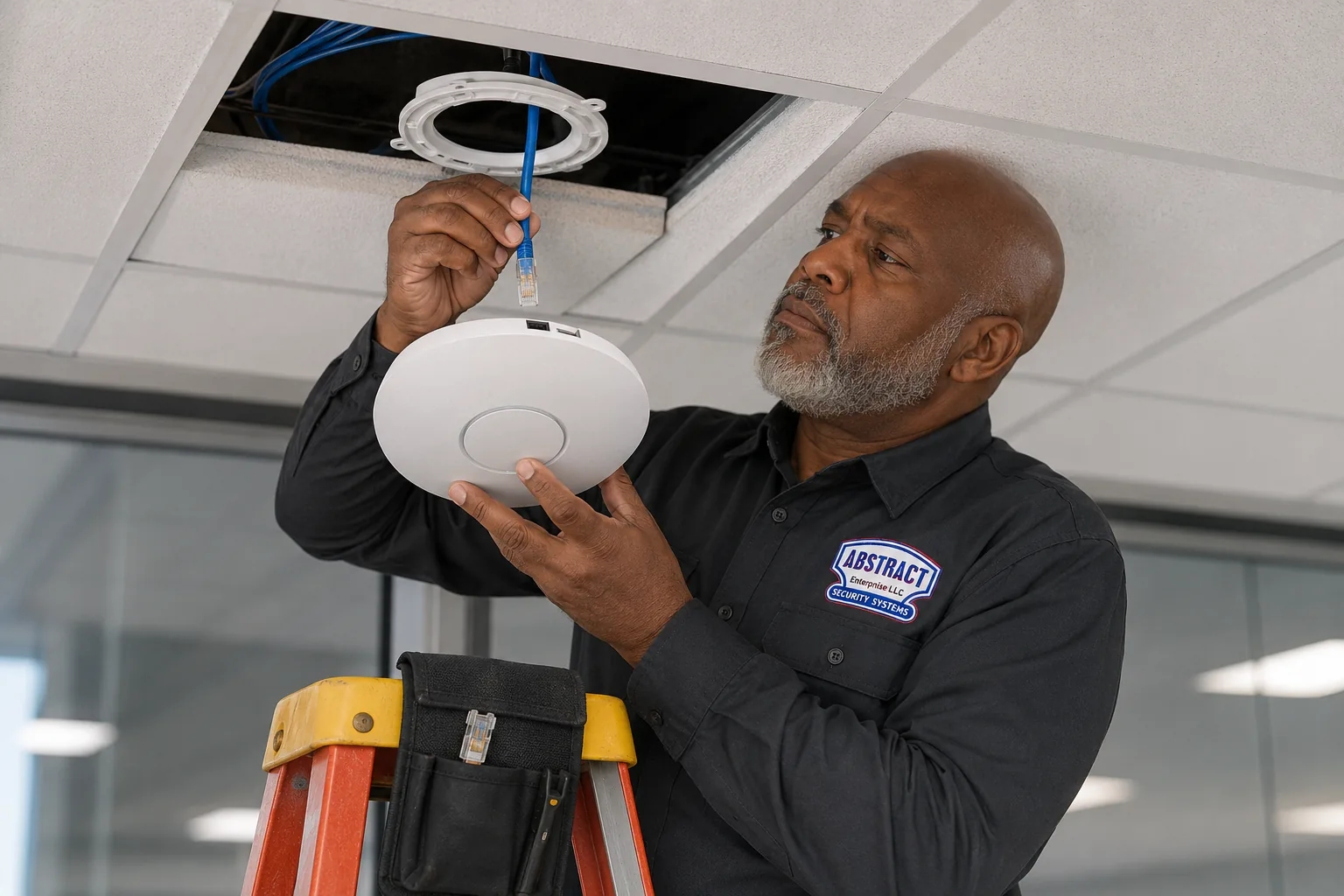
A grey-bearded technician on an orange stepladder holds a round white access point in one hand and a blue cable with a clear RJ45 plug in the other, below the mounting ring in an open ceiling tile; a tool pouch hangs on the ladder top.
Pricing
Cat6 Repair Cost in Dutchess County
Every figure here is already published on one of our own live pages, and the table names which. Anything that depends on testing or on the building’s rules is quoted in writing before work starts.
Item
Price
Scope and source
Repair time on site: certify, locate, re-terminate, re-route, firestop what we disturb, retest
$195/hr, 3-hour minimum ($585)
The hourly specialty rate on our Dutchess network cable repair page and our Hudson Valley Cat6 and network cable repair hubs
Hours after the first three
$195/hr
Charged at the same published rate for each further hour on site
Run replaced because repair is not possible
From $175 per drop
The figure printed on our Dutchess network cable repair page (and our Hudson Valley hub): fresh cable, jack and plate, the panel punch-down, certification, labels at each end and one patch cord
For comparison: a brand-new Cat6 drop to 100 ft
$333 per drop
Our Dutchess Cat6 installation price list, where Cat5e is $286 and Cat6A $477 per drop on matching terms
Closet mapping and correction of mixed T568A/B wiring
Quoted by port count
Jack-to-port map, scheme standardised, labels and legend; listed this way on our Hudson Valley repair hub
Links needing fiber or re-routing away from plant equipment
Quoted per run
Recommendation given in writing after testing
Containment, firestop materials, after-hours or shift-change windows
Quoted for the site
Depends on the permit class, the number of rated penetrations and the hours the building allows
Where the first three hours go in a Dutchess building
The minimum buys a technician’s time on site with the full test kit. On a straightforward repair it covers certifying the links you are worried about, locating the faults, re-terminating jacks and panel ports, replacing cords and proving the result. In buildings with permits, escorts or gowning, some of that time goes to the building’s own procedures; we tell you how much we expect when we quote, so it is not a surprise on the invoice.
Why these Dutchess figures match our Hudson Valley hub
We have not made up a separate Dutchess price list: the hourly rate and the per-drop replacement figure are copied from repair pages we already publish for this county and the region. The written quote for your building restates them before anything is booked. What genuinely changes from building to building in this county — containment, firestop, permitted hours, distance across a large campus — is measured and quoted for that site.
What moves a Dutchess Cat6 repair bill
The room’s rules: permit-controlled ceilings, gowning, escorts and shift windows add time that has nothing to do with the cable.
Where the fault is: a jack or a panel port is quick; a fault inside a packed hospital ceiling, a high-bay roof or a brick wall takes access work.
Why it failed: a single bad termination is one fix; noise from equipment, heat from a kitchen or repeated tenant damage means the route or the hardware changes too.
Penetrations: every rated wall or floor the repaired run crosses needs firestopping.
The cable itself: sound solid-copper Cat6 can be repaired; damaged, overheated or mismatched cable is replaced at the replacement-run price.
Numbers you may see online. National cost sites put a new Cat6 drop at roughly $125 to $250 including materials and installer labour at $45 to $75 an hour (Fixr, updated January 2025). Those are averages for fresh installs in open construction, not our prices, and none of them allow for containment, firestop or escorts inside an occupied Dutchess hospital or plant.
Full terms — including 50% deposit, one-year parts-only warranty on AESS-supplied products, and the late-fee schedule — are set out in the service agreement.
Shop Our Systems
Cat6 Repair Packages & Pricing
Three ways a Dutchess repair is usually scoped, priced only with numbers that already appear on our live pages.
Starter — One Failed Link
$585
Three hours on site at $195 an hour. Suits one dead or slow link to a workstation, a register, a projector or an access point: certified, the fault found and fixed, the result proven on the device. Time left in the block goes on any other links you want checked.
Standard — Rules-Heavy Site
$195/hr after the first 3 hours
For hospitals, plants, labs and campuses where permits, escorts or gowning add time, or where several links fail together: containment as the permit requires, faults located and repaired, shields bonded, penetrations firestopped and a full set of results handed over.
Premium — Repair Plus Replacement Runs
Repair time + from $175 per run
For sites where some cable is beyond saving — cooked near a hood, crushed under a fixture, trapped beside a drive or the wrong category. The salvageable links are billed as repair time; each run we replace starts at $175 a drop, goes in with the right rating, and the old length comes out wherever it can be reached. A fresh port map closes the job.
Bring Your Own Parts — Labour Only
Many Dutchess facilities keep their own stock of jacks, panels and cable to a house standard. We are happy to install it, billed as repair time only, provided it suits the link: shielded parts on shielded runs, Cat6A on Cat6A, plenum cable in plenum ceilings, and a listed firestop product your facility approves. Everything is tested either way. Parts you supply carry their maker’s warranty rather than ours, and if they cannot give a passing link we say so before the work is finished.
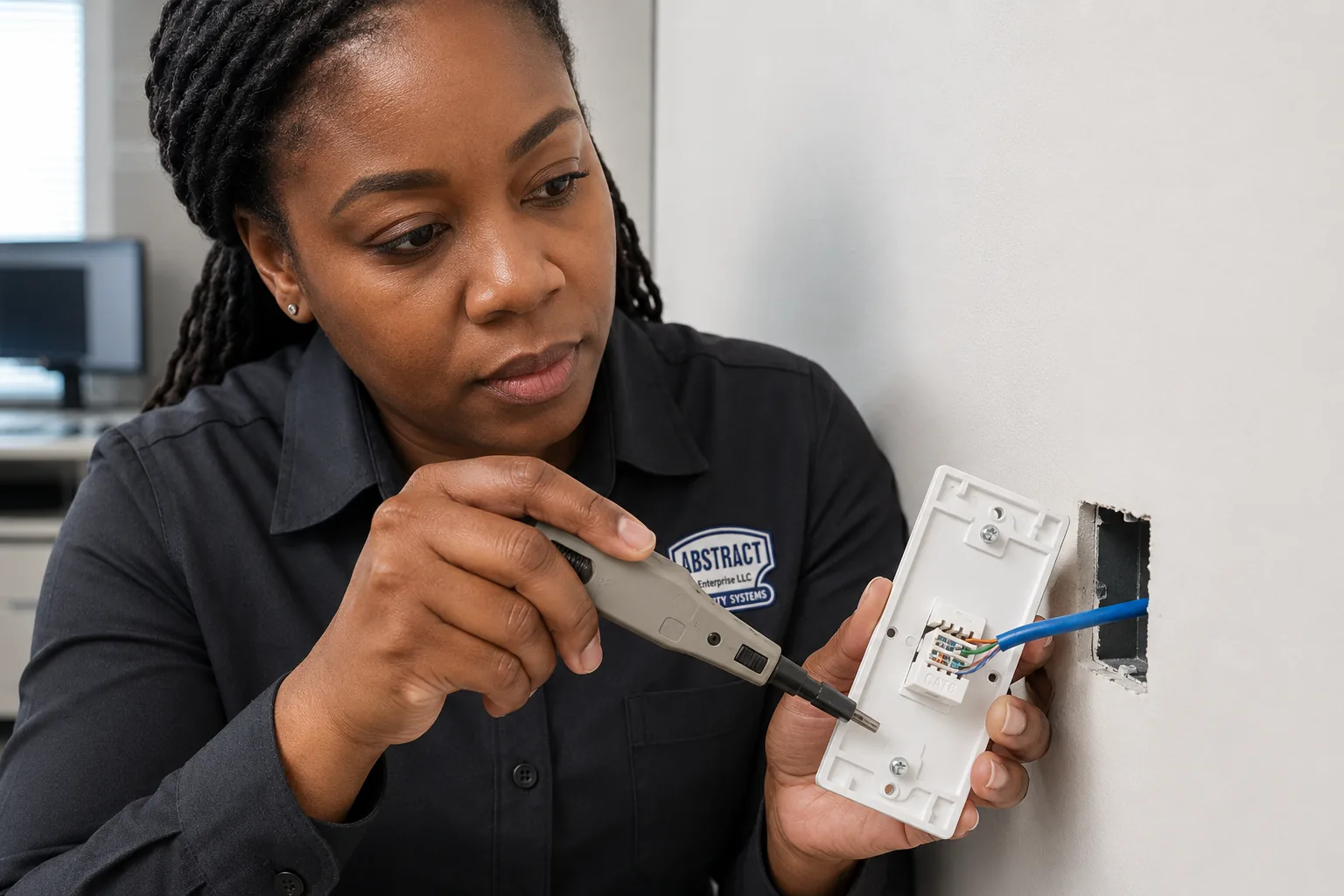
A technician with long braids holds a white single-port wall plate away from the wall, pressing a grey punch-down tool onto the back of a Cat6 keystone; the blue cable runs from an open box cut into the drywall.
Repairs Your Facilities Team Can Sign Off
Send the permit requirements, the floor or area and a list of the failing links. We will plan the work around them and tell you what the record will include.
Dutchess runs from the Hudson River cities to the Connecticut line, and the buildings change as you go. Here is what we tend to meet in each part of the county.
City and Town of Poughkeepsie
The county’s densest mix: the hospital campus and medical offices near the river, Vassar in Arlington and Marist on Route 9, IBM’s South Road site, the Galleria and the retail strip, and a large stock of older two- to four-family houses. Expect healthcare permits on one call, campus AV and access points on the next, and lead-safe practice in pre-1980 registered rentals on the one after. When a Verizon fiber cut took out internet and phone service across the Poughkeepsie area in October 2019, the Poughkeepsie Journal reported problems in parts of Hyde Park and Wappingers Falls and scattered reports in Beacon too — a reminder that not every outage is inside the building, which is why we test before we repair.
Beacon
Converted mills and factories along Fishkill Creek — the Groveville mill lofts, the Roundhouse at Main and East Main Streets on the old Matteawan Manufacturing Company buildings, and Dia Beacon in its 1929 box-printing plant — plus Main Street’s restaurants, galleries and shops. Cable is often in sight, so repairs have to be tidy as well as sound, and kitchens on narrow lots leave little room for good routes.
Fishkill, East Fishkill and Hopewell Junction
The I-84 and Route 52 corridors: the onsemi fab and the iPark 84 buildings on the former IBM East Campus, warehouse and flex space, and the retail and medical offices around the Route 9 interchange. Industrial noise, high bays, badged entry and buildings re-let since IBM’s time drive most of our repairs here.
Wappingers Falls, Wappinger and LaGrange
Route 9 retail and service businesses, office parks, schools and suburban homes with home offices, with Route 55 running east through LaGrange. Checkout links, small-office closets and home-office runs fished through finished walls are the common calls.
Hyde Park, Rhinebeck, Red Hook and the river villages
The culinary college and the restaurants and inns along Route 9, village commercial streets, Bard’s campus at Annandale-on-Hudson, the fairgrounds and older houses near the river. Commercial kitchens, event venues and historic interiors where cable has to be routed carefully set the pattern.
Millbrook, Pleasant Valley and the eastern towns
Route 44 village centres, schools, private estates and small businesses running from Pleasant Valley through Millbrook toward Amenia, Millerton and Pawling. Fewer large buildings, more single-site businesses that depend on one or two links, and longer drives — so the first visit is planned to finish the job.
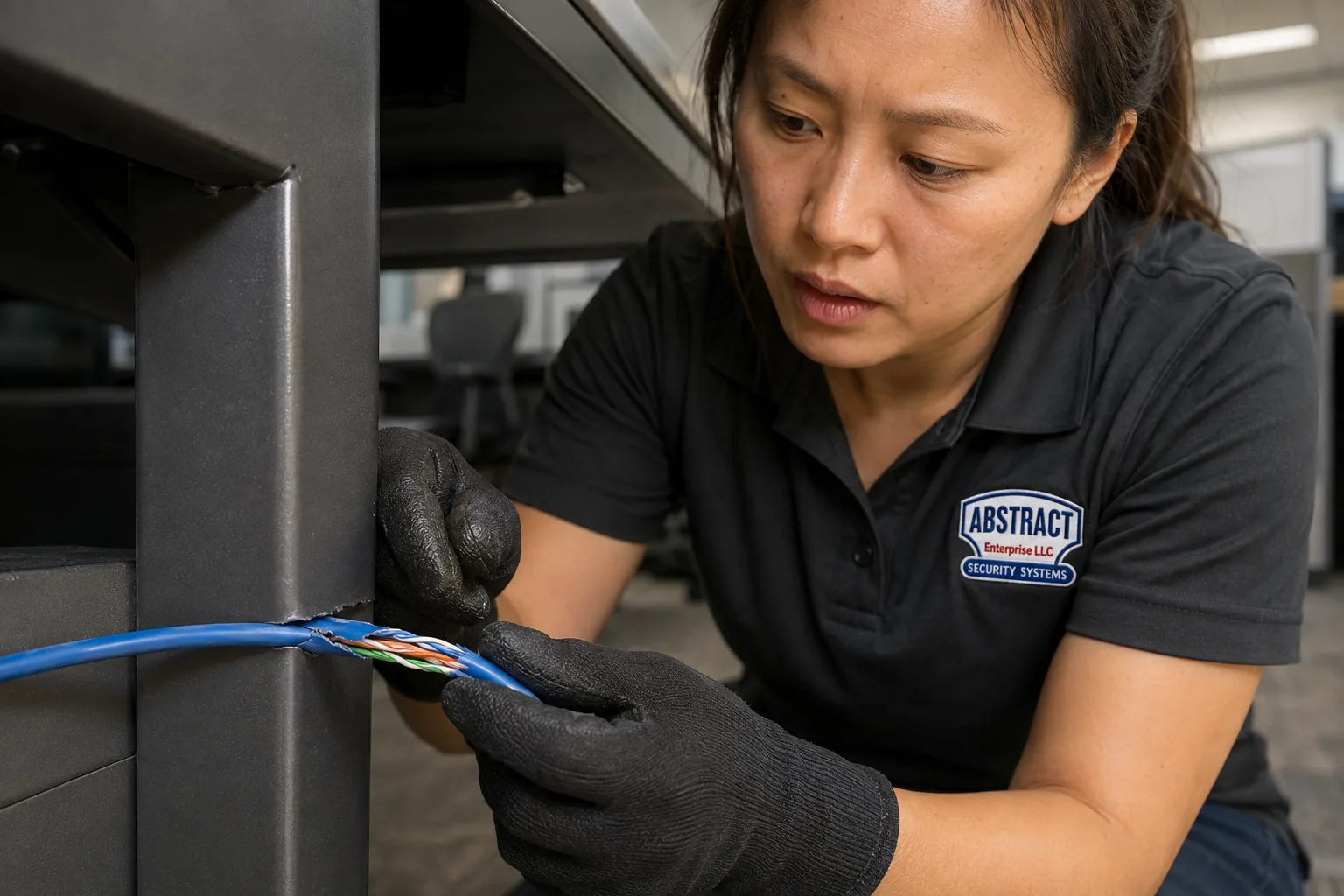
A technician in a black polo and black gloves crouches beside a steel desk leg, holding a blue cable whose outer jacket has been split where the frame pinched it, with orange, green and white pairs showing through.
Before the Visit
What to Send Us First, by Type of Building
The quickest Dutchess repairs are the ones where the building’s rules arrive with the request. This is what helps us most for each kind of site.
Hospital, surgery centre or clinic: the room numbers or area, whether it is clinical or non-clinical space, who issues the above-ceiling or infection-control permit, and any hours when the area is closed to patients.
Manufacturing, fab or lab: the contractor safety orientation or badge process, whether the work area is gowned or controlled, lockout or hot-work requirements, and the times when the line or instrument is idle.
College or school: the building and room, what the link feeds (projector, display, access point, lab bench), the AV or IT contact, and dates when the room is free between classes or terms.
Restaurant or kitchen: the screens, printers and terminals affected, where the cable runs relative to the line, and the hours between services when the kitchen is clear.
Store or plaza unit: whether the ceiling and closet belong to you or to the landlord, the registers and scanners affected, and any trading hours when work cannot happen at the counter.
Rental or student housing: the units and rooms, whether the building is a registered pre-1980 City of Poughkeepsie rental, and the turnover dates between tenants.
Any older building: whether an asbestos survey has been done for the area, and where the report is kept.
Photos help more than anything. A picture of the patch panel and switch, the failing jack with its label, the ceiling or wall where the cable runs and any sticker on the device is often enough for us to bring exactly the right parts. On a site with permits or escorts, getting the parts right the first time matters even more, because a second visit means a second round of paperwork.
If you do not know some of it, say so. We will ask the right person on your behalf where we can, and the quote will say what still needs confirming.
Healthcare Ceilings
Inside a Hospital Ceiling: Why Cat6 Repairs Take Care There
Above the tiles of a hospital corridor, Cat6 is one system among many. A March 2023 article in Health Facilities Management by Michael Huff lists the low-voltage cabling that can share that space: network, nurse call, security, building automation, telemetry, infant abduction, fire alarm and even pneumatic tube system communication cabling. The same article notes how hard it is to work in a maze of loose and disorganised cable, and says low-voltage cabling should be properly supported by cable tray or J-hooks rather than run across the ceiling or left unsupported.
That is the environment a Cat6 repair at a Dutchess hospital or large outpatient building walks into. The run we need may be bundled with nurse-call or telemetry cable, so we identify it by tone and label before touching anything, never by colour or guesswork. We do not cut, move or re-hang another system’s cable; where the only route for a replacement run means disturbing one, we stop and involve the facility.
Huff’s article also describes a 360-degree inspection whenever the ceiling is opened — damaged or stained tiles, gaps that break the smoke seal, debris, and abandoned cable or devices that do not belong there. We follow the same habit. If we see a stained tile that suggests a leak, an open penetration, or abandoned cable above the area we are working in, it goes on the repair record so your facilities team can deal with it, even when it is not ours to fix.
The practical effect for you is predictability. The ceiling is open only where the fault is, for as short a time as the repair needs, inside whatever containment the permit specifies; the repaired run goes back on proper supports; and the record shows exactly what was touched. That is what allows a facilities manager to approve a contractor for the next repair without a second meeting.
Decision Guide
Re-Terminate, Re-Route or Replace: How We Decide in Dutchess Buildings
The test result tells us what failed; the room tells us whether fixing that part alone will last. This is how we weigh the common findings with you, link by link. The choice is always yours, and the recommendation is in writing.
What we find
Usually the right call
Why
Failed jack or panel port; cable tests clean between them
Re-terminate on matched hardware
Nothing is wrong with the copper itself, so only the connection at the end needs remaking
Errors only when nearby machinery runs
Re-route away from drive and power cables, or shielded cable bonded correctly, or fiber for the segment
Re-terminating a run that sits in a noise field does not stop the noise
Shielded run repaired with unshielded parts
Replace with shielded jacks and plugs, bond the shield
The shield only works when it is terminated and grounded
Multi-gig or HDBaseT link short of its rate; passes basic continuity
Remove extra connection points, fix weak terminations, separate crowded bundles
These links fail on margin, not continuity
Jacket hardened, discoloured or greasy near kitchen or process heat
Replace that length along a cooler route
Heat-damaged cable keeps losing margin and will fail again
Mixed T568A and T568B terminations
Standardise both ends on the building’s scheme and label it
Mismatched ends cause crossed or split pairs
Crushed or cut cable in a rated or permit-controlled ceiling
Replace the run, firestop the penetrations, close the ceiling under the permit
A splice inside a packed ceiling becomes the next fault
Home Offices
Home-Office and Small-Office Cat6 for Dutchess Commuters
Not every Dutchess repair is in a big building. Census QuickFacts puts the county’s mean commute at 31.2 minutes, and the Hudson Line out of Poughkeepsie and Beacon carries many residents to jobs in Westchester and the city. Plenty of those same people work from home part of the week, from houses in Fishkill, Wappingers Falls, LaGrange, Hyde Park and the river villages. For them, the one Cat6 run from the router to the desk is the office network, and when it fails the working day stops.
Home-office runs fail for ordinary reasons. A jack behind a desk is crushed by the desk itself; a cable stapled along a basement joist is nicked by a later renovation; a cord between the wall and the dock has been bent sharply for years. In older houses, where many of the county’s homes date from before 1940, the run was usually fished in after the fact through plaster and balloon framing, with a coupler hidden somewhere along the way.
Shops, Restaurants & Venues
Cat6 Repairs Around Trading Hours, Services and Events
For a store, a restaurant or a venue, the clock matters more than the cable. A register that fails at the Galleria on a Saturday, an order screen that drops on a Friday night in Beacon, or a ticketing link at a fairgrounds building on the morning of an event all have the same deadline: the next customer.
Retail repairs along Route 9 usually start with ownership. In an enclosed mall or a strip plaza, the ceiling, the risers and sometimes the closet belong to the landlord, and work there may need the management office’s approval and a certificate of insurance on file. Inside the unit, the common faults are jacks behind counters kicked by staff, cords crushed under fixtures and runs damaged during a refit. We work before opening or after close where the counter cannot be disturbed, and we test each register, scanner and card terminal on its own port before we leave.
Restaurants have shorter windows still. Kitchens from Main Street in Beacon to Route 9 in Hyde Park and the village of Rhinebeck are usually free between lunch and dinner, or after the last ticket. We plan the repair to fit that gap, keep tools and cable out of the food areas, and route new cable away from the hood, the fryers and the dish area so it is not back in a month. If a temporary link will keep the order screens running through service, we leave one and return for the permanent repair.
Event venues work to a calendar rather than a clock. Barns, halls and exhibition buildings — including the commercial exhibit buildings shown on the Dutchess County Fairgrounds site map in Rhinebeck — often have a few long Cat6 runs that sit unused between events and are expected to work perfectly on the day.
Early Warning
Signs a Cat6 Link Is Failing Before It Goes Dead
Most Cat6 links in Dutchess buildings do not die at once. They degrade, and the building usually notices before the network does. These are the early signs we hear about, by setting. Any of them is worth a test before the link fails completely at the worst moment.
Clinical areas: a workstation on wheels or a charting PC that loses its session when moved near one wall jack; a phone or badge reader that reboots now and then; a printer at a nurse station that needs re-adding every few days.
Production and labs: controllers or scanners that drop for seconds when a particular machine starts; error counters on one switch port that climb during shifts and stay flat at night; an instrument that uploads its data late.
Classrooms and conference rooms: a projector that shows sparkles or blanks for a second, a display that needs its input re-selected, a lectern PC that is fine until the extender is switched on.
Access points: a new multi-gig access point that reports 1 Gb/s while its neighbours report 2.5 or 5; clients on one floor that roam constantly; an AP that reboots under load because its PoE drops.
Kitchens and counters: order screens that freeze during the dinner rush and recover later; a receipt printer that goes offline when the dish machine runs; a card terminal that needs a cable wiggled to connect.
Homes and small offices: a desk that connects at 100 Mb/s instead of a gigabit; video calls that stutter on the wired PC but not on Wi-Fi; a jack that only works with one particular cord.
Each of those points at a link with shrinking margin — a loose termination, a damaged section, noise or heat — rather than a dead cable. Caught at this stage, the repair is usually a re-termination or a short replacement, done in a planned window. Left until it fails, it tends to be the same repair done in a hurry, during the shift, the class or the service it interrupts.
Questions to ask any Cat6 repair contractor in Dutchess
Will you certify the repaired link to its category and give me the saved result, or only check continuity?
How will you work under our permit, orientation or gowning rules, and is that time in the quote?
Who seals the fire-rated penetrations you open, and will I get photos?
Will you match the shielding, category and termination scheme already in the building?
If the link fails because of heat, noise or the route, will you fix the cause or only the symptom?
What happens to the old cable you replace?
Our answers to all six are on this page. Whoever you hire, those are the answers that decide whether the link stays fixed.
The Repair Record
A Repair Record Your Facilities, IT and Compliance Teams Can Use
In the buildings that dominate Dutchess, the paperwork outlives the repair. A hospital’s life-safety manager, a plant’s quality team, a college’s network office and a landlord’s insurer all ask, sooner or later, what was done above that ceiling and whether it was done properly. We build the record as we work, so nobody has to reconstruct it later.
Test results: the saved certification result for every repaired link, against the limit for its category, with the date and the link’s label. Where we tested before repairing, the failing result is included too, so the improvement is visible.
Device confirmation: the speed each repaired port negotiated with its device — a multi-gig access point, a projector extender, a line controller — noted alongside the cable result.
Firestop photos: each rated penetration we disturbed or created, photographed after sealing, with its location and the product used.
Containment and closure: for permit-controlled ceilings, photos of the containment in place and of the ceiling after the tiles were replaced, to attach to the facility’s permit when it is closed.
Labels and port map: both-end labels that follow your existing numbering, and an updated list of which panel port serves which jack, including any T568A/B corrections.
What was removed: abandoned lengths taken out where reachable, and any we could not reach, so the next contractor knows what remains.
The record arrives as a single file you can attach to a work order, a permit closure or a tenant’s fit-out folder. If your organisation has its own template — many hospitals and colleges do — send it and we will fill it in instead.
Complete Services
Every Cat6 Repair Service in Dutchess County
Cat6 repair is one part of what Abstract Enterprises does in Dutchess. These pages cover the work around it.
One form for any of the above, answered the same business day.
Field Notes
Field Notes on Repairing Cat6 Where the Building Has Rules
How we work in permit-controlled, gowned and occupied spaces — general practice, not a single job
The first thing we ask for is the rulebook, not the floor plan. Who issues the permit, what class it is, whether there is a contractor orientation, whether anyone has to escort us. Getting that wrong costs a day; getting it right costs a phone call.
Then we find the fault without opening anything we do not have to. Testing from the closet and from the jack usually puts the fault within a tile or two, which keeps containment small and the ceiling open for minutes rather than hours. In a clinical or clean area that is the difference between a repair the staff barely notice and one that disrupts the day.
Last, we leave the room the way the building expects to find it: tiles back and wiped, penetrations sealed and photographed, cable on its supports, labels on both ends. The test result goes in the same folder as the photos. When an inspector or an accreditation surveyor looks above that ceiling later, the work should explain itself.
FAQ
Dutchess County Cat6 Repair FAQ
Can your technician work under badge, escort and safety-orientation rules on a secured manufacturing campus?
+
Yes. Send us the site’s contractor requirements when you book — orientation videos or forms, insurance documents, badge requests and escort arrangements — and we complete them before the visit. We build the time for check-in and escort into the quote, and we follow the site’s rules on photography, restricted areas and tools for the whole visit.
Our plant runs three shifts. How do you repair a Cat6 link that can never be down for long?
+
We locate the fault while the link is still in use, then run a temporary cord or a parallel cable so the device stays connected while the permanent repair is made. The final cut-over takes minutes and is timed for a shift change or a planned stop that your supervisor agrees in advance. The temporary run comes out when the permanent one has been certified.
Can a Cat6 fault at a wedding or event venue be fixed before a booked weekend?
+
Usually, if you call as soon as it fails. Tell us the event date, what the link feeds — ticketing, point of sale, a band’s stream, the venue’s Wi-Fi — and when the space is free. Most termination and cord faults are fixed in one visit; if a run needs replacing and time is short, we can leave a tested temporary link in place for the event and return afterwards for the permanent repair.
Do you repair Cat6 in older buildings where the ceiling tiles or pipe wrap might contain asbestos?
+
Yes, once the materials in the work area are known. New York’s Industrial Code Rule 56 calls for an asbestos survey before repair work that disturbs building materials, so we ask whether one exists before we cut, drill or move suspect tiles. Where materials have tested clear, we proceed normally; where they have not been tested, we use existing openings and jacks or wait for the survey rather than disturbing them.
Is a Cat6 repair in a pre-1978 Poughkeepsie house or rental done lead-safe?
+
Yes. Most cable repairs disturb far less than the six square feet of interior paint the EPA treats as minor repair and maintenance, but we still work lead-safe in older homes: plastic under the work area, no dry sanding or power-cutting of painted trim, and a wet wipe and HEPA vacuum of the area afterwards. If a repair would disturb more painted surface than that, we tell you first.
Does a Cat6 repair in a Dutchess town need a permit?
+
A like-for-like repair usually does not, but the answer belongs to the municipality, not the county. Building permits in Dutchess are issued by each city, town and village, and some, such as the Town of Poughkeepsie, publish their own electric and low-voltage permit application. When a repair becomes new work — new routes, new penetrations in rated walls — we check with the building department for the address.
Our Cat6 runs under a raised computer-room floor. Can it be repaired without powering anything down?
+
Normally, yes. We lift only the floor panels above the fault after locating it from the rack, keep power and data cabling separated as we work, and replace panels as soon as each section is done so airflow is not disturbed for long. Nothing is unplugged without your approval, and any cut-over of a live link is scheduled with your IT team.
Is it worth repairing Cat6 in a building we plan to renovate next year?
+
Usually, for the links people need now. Re-terminating a jack or replacing a cord costs little compared with a year of a dead workstation or classroom. What we avoid recommending is replacing whole runs in areas the renovation will open anyway; we tell you which repairs will survive the renovation and which are stop-gaps, so you can decide.
Our electrician is already on site for other work. Can you coordinate the Cat6 repair with them?
+
Yes. Sharing a ceiling or a lift with another trade can save both of you time. Give us the electrician’s contact and schedule, and we agree who opens and closes which areas, who seals which penetrations and how power and data cable are kept separated. Our test results cover the data links; the electrical work stays theirs.
After a provider outage, how do we know whether our own Cat6 was damaged too?
+
Start with what changed. If every device lost the internet at once and came back when the provider restored service, the cabling is probably fine. If some devices still fail after the provider is back, or only links to certain rooms are down, the fault is inside the building. We test those links, check the switch ports they land on, and tell you which side of the demarcation the problem is on.
All Areas Served
Cat6 Repair Across the Hudson Valley and Beyond
You are on the Dutchess County Cat6 repair page. It sits under our Hudson Valley Cat6 repair hub, which covers the six counties together. Other county pages are listed below; the Ulster link opens our quote form for now.
Lost a charting station, a line controller, a classroom display or a till? Phone (845) 640-3835. We book the next open 2-hour window, sort out the building’s rules before we arrive, and most jack, panel and cord faults are found and fixed in one to two hours on site.
Cat6 Repair Dutchess County — Licensed, Insured, Tested to Category
Abstract Enterprises Security Systems · 460 E Fordham Rd, Bronx, NY 10458 · Dutchess line (845) 640-3835 · WhatsApp (718) 679-0359 via wa.me
NYS Low-Voltage Licence #12000287431 · 100% Licensed & Insured · Same-Day Estimates · Rated 4.7★ from 201 Google Reviews
Parts a client provides are warranted by whoever made them; for everything AESS supplies, see our warranty page and the service agreement.
Where this page mentions a code, a standard or a state rule, it is a plain-language pointer for Dutchess owners and facility staff, not legal, engineering or infection-control advice; the permits and procedures of each building always take precedence. Page reviewed and updated October 17, 2026. Changelog: first publication of the Dutchess County Cat6 repair page.