Licensed Low-Voltage Contractor · Based on Troy Avenue, East Flatbush · Brownstones, Frame Houses, Co-ops, Towers & Industrial Floors
Cat6 Repair in Brooklyn
Coupler Plates · Bad Keystones · Chewed or Nailed Runs · Structured-Media Panels · Flood-Line Moves · Recertification
Brooklyn's Cat6 lives in a dozen kinds of building, and each one breaks it in its own place. A brownstone renovation leaves runs that fail where they bend up out of the floor; a Flatbush frame house invites rodents into open stud bays; a Williamsburg condo hides every termination in a closet media box; a Sunset Park factory shakes its plugs loose. We start from the building, read the link on a certification tester to find exactly where it has gone wrong, repair only what is broken by the route the building allows, and leave the link testing to Category 6 again.
Reviewed and updated October 17, 2026 · Written by Anwar Timothy, NYS licence #12000287431 · Brooklyn direct line (347) 934-8335
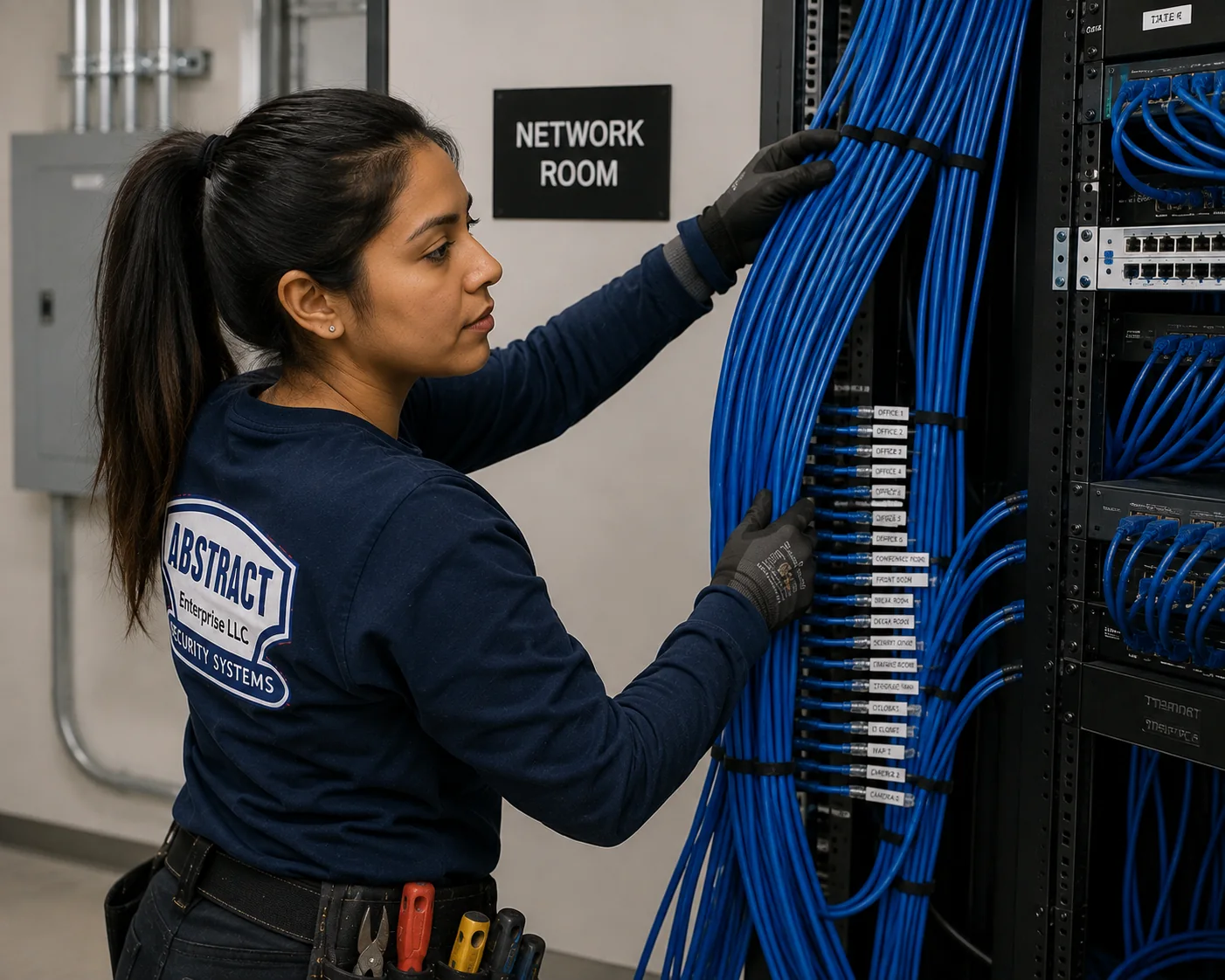
A technician in black work gloves holds a dense run of blue patch cords against an open black rack. Each cord carries a printed white label, switches sit to the right, and a sign on the wall behind reads Network Room.
Brooklyn Cat6 Repair — Free Quote
Tell us the building type and what the link is doing — a technician replies the same business day
✅
Request Received
Thanks — it is with our Brooklyn team now, and you will hear back before the business day ends.
25+
Years Experience
✓
Same-Day Estimates
100%
Licensed & Insured
4.7★
201 Google Reviews
A jack gone dead in the parlour, a condo closet full of blinking lights, a camera on a Bushwick loft ceiling that dropped off the recorder? Ring the Brooklyn line, (347) 934-8335, or fill in the short form. The person who answers is a licensed technician, and before anything is booked you will hear whether the symptom sounds like a termination, a damaged run, a moved router or something that is not cabling at all.
The tester measures how far along the cable the trouble is, so walls stay shut except at that one spot
A saved certification record for every link we fix, measured against the Cat6 or Cat6A limit it was built to
NYS licence #12000287431 · insured · dispatched from 1282 Troy Avenue in East Flatbush
Why Brooklyn Properties Need Cat6 Repair Shaped to the Building
Ask where a Brooklyn Cat6 run failed and the honest first answer is another question: what kind of building is it in? The borough is not one building stock but several laid side by side. A belt of row houses runs from Bay Ridge up through Park Slope, Bedford-Stuyvesant and Bushwick. South and east of Prospect Park sit the freestanding wooden houses of Victorian Flatbush. Along the East River and the Upper Bay stand nineteenth-century warehouses, a former naval shipyard and a ring of city-owned industrial campuses. Since the mid-2000s, rezonings in Downtown Brooklyn and on the Williamsburg–Greenpoint waterfront have added a whole generation of residential towers. Each of those families installed its Cat6 differently, protects it differently and damages it differently, so the same failed test result means different things on Union Street and on the Kent Avenue waterfront.
In the row houses, most Cat6 arrived during a renovation. Owners gutting a brownstone pulled two or four runs to every room, back to a cabinet in the cellar or a closet on the parlour floor, and the walls were closed again within weeks. That is good news for the copper, which is usually genuine solid Cat6 in decent condition, and bad news for the ends of it. Renovation crews were often in a hurry at the termination stage: runs finished on pre-made cords snapped into coupler plates, keystones punched down by whoever was closest, and service loops cut off to tidy the closet. Years later, when the house is full of cameras, access points and a home office that needs a steady wired link, those shortcuts surface as jacks that train at 100 Mbps or drop out at random.
The frame houses and the older two-family buildings bring a different problem: open cavities. Wood-frame walls and floors give cable an easy route, but they give rodents and other trades an easy route too. A run fished through a Ditmas Park stud bay can be nicked by a plumber's saw, chewed in a cellar where the joists meet the foundation, or crushed under a new subfloor. In the co-ops and the newer towers the cable is better protected but harder to reach: it sits in a structured-media enclosure in a coat closet, in conduit cast into a concrete slab, or behind a finish that the board or the developer's warranty makes nobody keen to cut. And in the converted factories of Sunset Park, Gowanus, Bushwick and the Navy Yard, runs cross open ceilings above machinery, forklifts and kitchens, where vibration, heat and impact work on the terminations every day.
Then there is water. Long stretches of Brooklyn's shoreline sit low, and the borough has been tested twice in recent memory. During Sandy in 2012 the surge reached 11 feet above ground level near Sea Gate on the Coney Island peninsula, and the city's own post-storm report recorded flood damage to building telecommunications equipment and cabling causing long-term outages in coastal areas. In 2021 the remnants of Ida brought rain falling at 3.5 inches an hour in places, double what the sewers can carry, and flooded basements far from any waterfront. Many Brooklyn network closets are still in cellars, and many owners are now moving them upstairs. Moving a closet is itself a Cat6 repair job: every run has to reach the new location and still test to category when it gets there.
None of this makes Brooklyn Cat6 hard to fix. It makes it a job where knowing the building comes first. The tester tells us where along the cable the fault is; the building tells us what we are allowed to open, what is likely to be behind it, and whether the fix will last. A repair that ignores either half tends to be repeated.
Brooklyn facts behind the way we repair Cat6
217,000 row houses citywide: more than a quarter of New York's 761,000 residential properties, by Neil Freeman's count for Urban Omnibus (2016), with a continuous row-house belt across Brooklyn from Bay Ridge to Bushwick — and a rare tract of wood-frame row houses in southern Bushwick.
The largest concentration of wooden Victorian homes in the country: how the Historic Districts Council describes Victorian Flatbush, eleven neighbourhoods with five city historic districts among them, built as a suburb after Flatbush joined the City of Brooklyn in 1894.
26,253 new housing units: added in Greenpoint and Williamsburg in the thirteen years to May 2024, following the 2005 rezoning of roughly 180 waterfront blocks, as reported by Greenpointers. Downtown Brooklyn's own rezoning was approved in June 2004, and the core of Downtown has since seen roughly a tenfold rise in housing units, according to a twenty-year retrospective story map on Downtown Brooklyn's growth.
11 feet above ground level: the depth Sandy's floodwater reached near Sea Gate, according to the City's Special Initiative for Rebuilding and Resiliency report, which also records landline and Internet service in Red Hook disrupted for up to 11 days by flood damage at critical facilities.
More than 550 businesses and 13,000 jobs: on the Brooklyn Navy Yard's 300-plus waterfront acres, per its FY25 impact report published in January 2026 — one of the densest concentrations of manufacturing tenants and exposed-ceiling cabling in the city.
3.5 inches of rain an hour: the peak rate during Ida in 2021 recorded by the city health department, against a sewer capacity of 1.75 inches an hour. The department notes that rainfall flooding, unlike Sandy's surge, can happen anywhere in the city — which is why cellar closets far from the water still get wet.
Taken together those numbers describe a borough where a great deal of Cat6 was installed in a short burst of renovation and construction, much of it in buildings that either flood, flex or invite damage. That is the case for a Brooklyn Cat6 repair that is built around the building: find the fault precisely, fix it by the least destructive route the structure allows, and change whatever caused it so it does not come back.
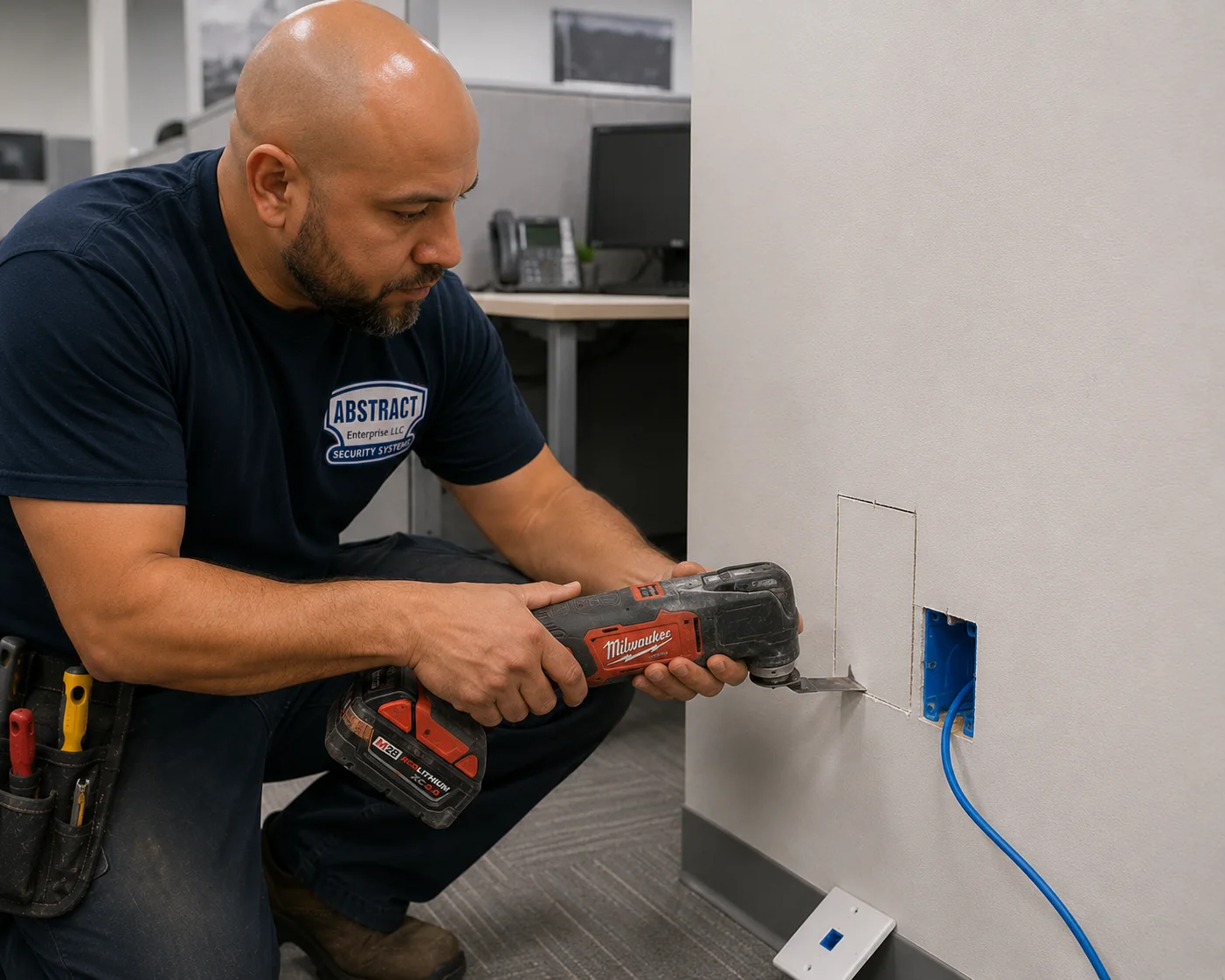
A technician kneels at a painted wall and cuts a neat rectangle with a cordless oscillating multi-tool, next to a blue low-voltage mounting bracket with a blue cable leaving it; a single-port wall plate lies on the floor.
Repair Capture
Need Cat6 Repair in Brooklyn Today?
A register at a Fulton Street shop that stopped taking cards, a home office in Clinton Hill with no wired link an hour before a client call, a camera over a Red Hook loading door that disappeared from the recorder overnight — those are service calls and we schedule them that way. We offer the next open two-hour arrival window, and the van carries a certification tester, a toner, Cat6 and Cat6A keystones, panel inserts, factory cords and cable. Once a technician is standing at the closet, most faults at a jack, a panel port or a cord are found and fixed within one to two hours. Time is billed at $195 an hour with a three-hour minimum ($585), and any time left after the urgent fault goes on the next suspect link on your list. Call (347) 934-8335 or send a photo of the cabinet on WhatsApp.
What We Repair
Cat6 Repair Services in Brooklyn
Nine kinds of job make up nearly all the Cat6 work this borough sends us. Whichever it is, you end up with a link that has been put back on the tester and passed, a copy of that result, and a short note in ordinary language saying what broke and what caused it.
Renovation-Era Termination Rework
Coupler plates, pre-made cords pushed into wall boxes and keystones punched with the pairs untwisted: the shortcuts of a fast brownstone renovation. We replace them with properly terminated Cat6 jacks on the same plates and the same cable.
Fault Location Inside Finished Walls
Time-domain readings on the tester put a fault at a measured distance from the jack. Laid against the route through a rowhouse, that usually narrows the problem to one bend, one floor crossing or one fastener before any plaster is touched.
Rodent and Trade Damage Repair
Runs chewed in cellars and stud bays, nicked by saws or pierced by a renovation screw. We replace the damaged run or section, then protect the new cable where it is exposed so the same spot is not hit again.
Structured-Media Enclosure Service
The closet media boxes in post-2005 condos and gut renovations: re-terminating the module, replacing a failed insert, sorting the patching and labelling which room each port serves.
Equipment Moves Above the Flood Line
When a cellar cabinet moves upstairs, every run has to be extended or replaced to reach it. We decide run by run which can be extended within the category limits and which must be pulled new, then certify the lot.
Industrial and Kitchen Link Repair
Links on factory ceilings, near ovens and fryers, or over loading doors, where vibration, heat and grease degrade the ends. Terminations are remade with strain relief and the run re-routed away from the cause where possible.
Router and Demarc Relocation Fixes
When an internet provider moves the router or the fiber terminal, home runs that met in the old spot are left dangling. We trace them, bring them to the new location properly and patch them so every jack works again.
Recertification After Repair
Testing repaired links, or a whole house or floor, against TIA permanent-link or channel limits so you, your IT person or the next owner has a saved record of what passed and by how much.
PoE Links to Cameras and Access Points
Cameras on stoops and in yards, Wi-Fi access points on loft ceilings, doorbells and readers powered over the Cat6: we separate a weak pair or bad plug from a power-budget problem at the switch.
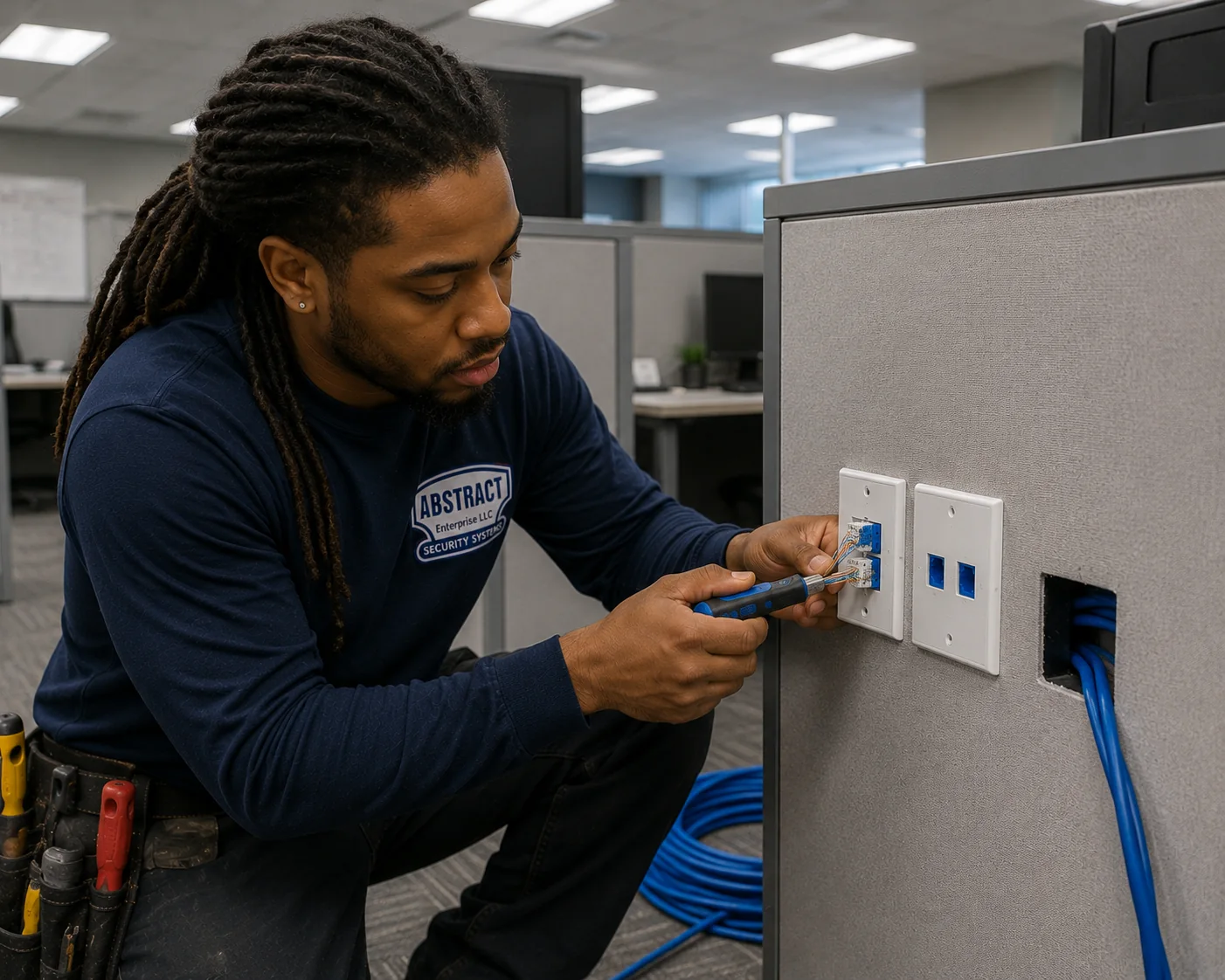
A technician with a tool belt kneels at a grey fabric partition and seats a keystone in a white wall plate with a punch-down tool; a second two-port plate sits beside it and blue cables emerge from a cut-out to the right.
Building Specialists
Cat6 Repair for Brooklyn's Architecture
Seven building families cover almost every Cat6 repair we are called to in the borough. For each one, the card says where the cable usually fails and what route a repair usually takes.
Brownstones and Brick Row Houses
Park Slope, Bed-Stuy, Fort Greene, Clinton Hill, Crown Heights, Bay Ridge. Runs fished from a cellar or parlour-floor cabinet up through plaster and lath, often during a gut renovation. Failure points: the termination at each end, and the tight turn where a run comes up through the floor into a wall cavity. Repair route: re-terminate first; where the cable itself is damaged, re-use the original fishing path, which is usually still open behind the plate.
Wood-Frame Houses
Victorian Flatbush, Ditmas Park, Prospect Park South, Midwood, and the frame row houses of southern Bushwick. Open stud and joist bays make re-pulls easier than in masonry, but they also expose cable to rodents, plumbers and later renovations. Repair route: pull new along the bay where possible and protect the run where it crosses the cellar.
Two- and Three-Family Houses
Throughout East Flatbush, Canarsie, Bensonhurst and Sunset Park. One basement and one meter room serve several households, each with its own provider, and runs for different units share joist bays. Repair route: identify and tone the run before anything is cut, so the neighbour's service is never touched.
Pre-War and Mid-Century Co-ops
Mid-rise elevator buildings such as those along Ocean Parkway in Kensington and Midwood, many of them mid-twentieth century. In-unit Cat6 was usually added by shareholders over the years and runs in surface raceway, behind built-ins or in old telephone conduit. Repair route: work inside the unit under the building's paperwork, keep common walls and hallways untouched where the job allows.
Post-Rezoning Towers
Downtown Brooklyn, the Williamsburg and Greenpoint waterfront, Fourth Avenue, Gowanus. Developer-installed Cat6 from each room to a structured-media enclosure in a closet, sometimes in conduit cast into concrete. The cable is often fine; the enclosure module and its patching are the usual fault. Repair route: service the enclosure, and pull new through existing conduit rather than cut a slab.
Mill-Construction Warehouses and Lofts
DUMBO, Vinegar Hill, Williamsburg's older factory blocks, Gowanus. Heavy timber or early concrete frames, brick walls, often no hung ceiling. Runs are visible and supported on the structure, so faults usually show as damage you can see. Repair route: replace the damaged length on proper supports, and keep the route where tenants and landlords expect it.
Waterfront Industrial Campuses
Brooklyn Navy Yard, Brooklyn Army Terminal, Industry City, MADE Bush Terminal. Large floors, long runs to the edge of the 90-metre limit, machinery, forklifts and loading doors. Repair route: locate by distance, replace damaged sections out of harm's way, and certify against the channel limit because length is often tight.
Materials and methods by building type
Plaster and lath. In a rowhouse we avoid opening plaster at all if the tester places the fault at a termination. When the cable itself has to be reached, a small access opening is cut where the run bends, at the base of the wall above the floor plate or just below the ceiling where it turns horizontal. Openings are sized for the work and kept clean-edged so they can be patched and painted without a visible ridge. Old lath can be brittle; we support it while cutting so a small hole does not become a cracked wall.
Wood frame. In a frame house the fastest honest repair is often a new run fished down the same stud bay from the attic or up from the cellar. Where the old cable cannot be pulled out, it is cut back and abandoned inside the closed bay, and the accessible lengths in the cellar or attic are removed, as the electrical code expects. Where the new run crosses open joists in a basement, it is supported off the joist faces rather than stapled through the jacket.
Concrete and masonry. In towers and industrial buildings we work with existing conduit and sleeves first. A damaged cable in conduit is pulled out and replaced through the same pipe, with a pull string left behind. Coring concrete or brick is a last resort that needs the building's engineer or owner involved, and in a tower the slab may carry structural elements that nobody should drill blind.
Finishes that matter. Brooklyn owners care about mouldings, original floors and exposed brick. We plan the repair around them: cable dressed into a corner or along a joist rather than across a decorative ceiling, raceway painted to match where surface work is the only option, and the route agreed with you before any cable is run.
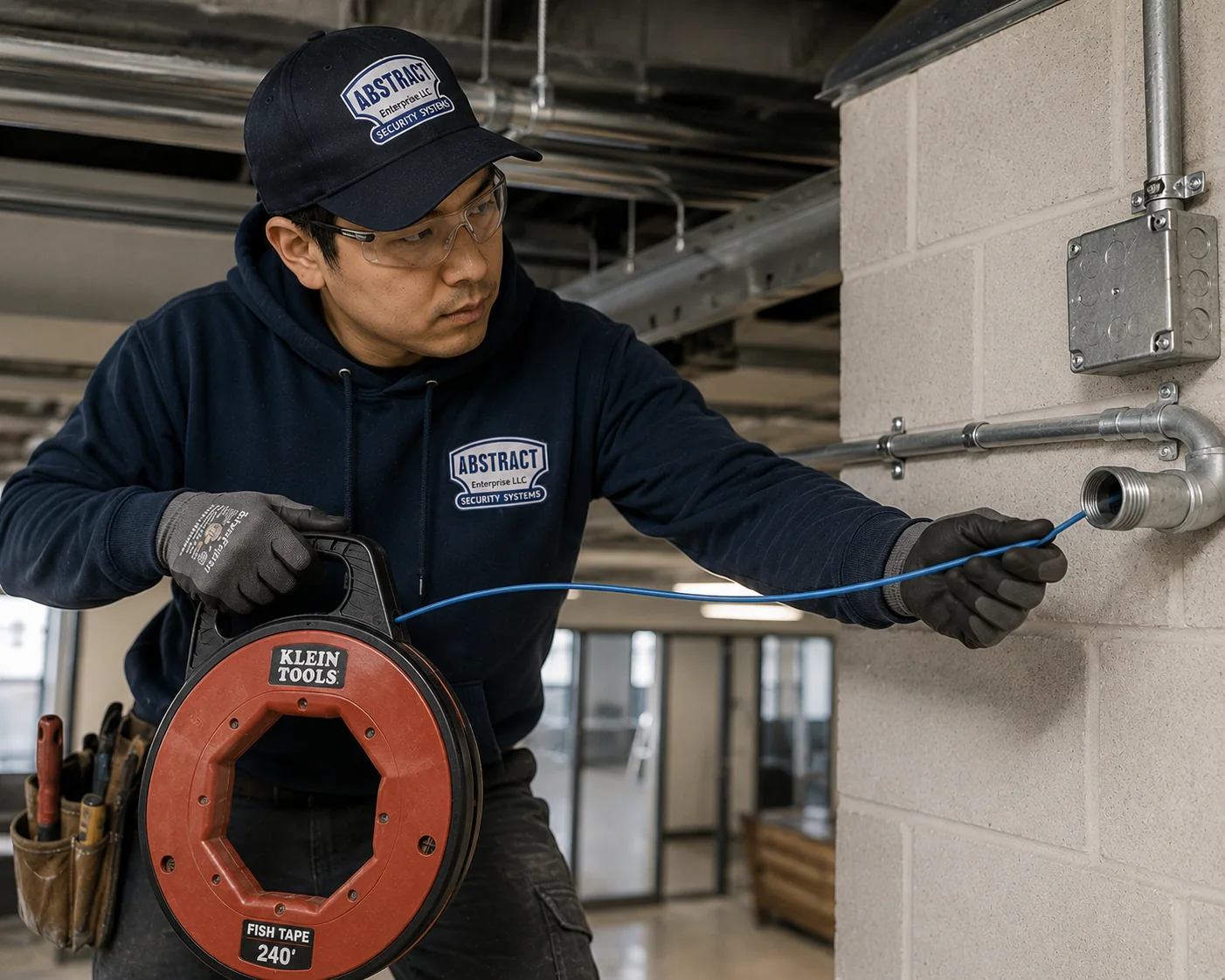
The red reel in the technician's left hand is a 240-foot fish tape; with the right hand he steers a blue cable toward the mouth of a steel elbow mounted on grey block, a pull box fixed above it.
Commercial Cat6 Repair
Business Cat6 Repair in Brooklyn
Brooklyn's commercial cabling is concentrated in six kinds of place, each with its own repair pattern. These are the corridors where most business calls come from, and what we usually find there.
Brooklyn Navy Yard
More than 550 businesses across 17 industries on 300-plus acres, per the Yard's FY25 impact report. Tenants inherit floors that have been re-fitted several times. Typical repairs: runs damaged by fit-outs above them, terminations at machines, long runs that pass wire map and fail length or insertion loss.
Sunset Park Waterfront
The city's Sunset Park District spans 200 acres and four campuses, including the 4-million-square-foot Brooklyn Army Terminal and the 36-acre MADE Bush Terminal; Industry City alongside it has more than 650 businesses in 16 buildings. Typical repairs: Cat6 across loading areas and rolling-door tracks, re-tenanted suites with unlabelled panels.
DUMBO and Vinegar Hill
The DUMBO Historic District, designated in December 2007, takes in about 91 buildings, the earliest in slow-burning mill construction. Creative offices and studios on exposed-ceiling floors. Typical repairs: visible runs damaged by later trades, access-point and camera links on high ceilings, terminations remade after a tenant reconfigures.
Downtown Brooklyn and MetroTech
Office floors around MetroTech and the residential towers that followed the June 2004 rezoning. Typical repairs: suite-level links in hung ceilings, structured-media enclosures in the towers, and Cat6 in conduit through concrete where the only route is the original pipe.
Williamsburg and Greenpoint
Ground-floor retail and restaurants along Bedford Avenue and Manhattan Avenue, converted industrial floors, and the waterfront towers of the 2005 rezoning. Typical repairs: point-of-sale and camera links behind counters and through basements, plus condo media panels.
Gowanus and Red Hook
A neighbourhood plan adopted in November 2021 is bringing new buildings to the canal blocks, beside warehouses, studios and makers that have been there for decades. Both areas sit low. Typical repairs: closet relocations above the flood line, corroded cellar terminations, and runs on warehouse ceilings near loading doors.
Retail corridors further out — Flatbush Avenue, Church Avenue, Nostrand Avenue, Kings Highway, Eighty-Sixth Street, Fifth Avenue in Sunset Park, Brighton Beach Avenue — generate a steady stream of smaller jobs: a register link through a basement, a camera over a gate, a back-office desk. Those are single-visit repairs in almost every case.
Rules that shape a Brooklyn Cat6 repair
Landmarks
If your house is on a protected block — the borough got the city's very first district, Brooklyn Heights, in 1965, and rowhouses in Park Slope, Fort Greene, Clinton Hill, Cobble Hill, Boerum Hill and Prospect Heights are frequently covered — the rule book is the LPC's. The Landmarks Preservation Commission states that ordinary repairs and maintenance need no LPC permit, and that interior work needs one only when it requires a Buildings Department permit, affects the exterior, or is in a designated interior landmark. A Cat6 repair kept inside the house is almost always outside its reach; anything fixed to a facade or run through a front wall is not.
Electrical code
Since December 21, 2025 the New York City Electrical Code has been the city's amendments to the 2020 National Electrical Code. When a run is replaced, the accessible part of the abandoned cable is removed unless it is tagged for future use, and new cable carries the listing its location requires.
Co-op and condo paperwork
Boards set out what work needs a full alteration agreement and what can go through the managing agent as a smaller decoration agreement, and most require the contractor to be licensed and insured with the building named on the certificate. We supply the certificate and licence details for the package before the visit.
Lead-safe work in older houses
In housing built before 1978, federal rules require paid work that disturbs painted surfaces to follow lead-safe practices, triggered by more than six square feet of interior surface in a room; New York City's Local Law 1 has owners of pre-1960 buildings presume paint is lead-based. Our access openings are kept far smaller than that wherever possible, and you are told in advance if a repair would need more.
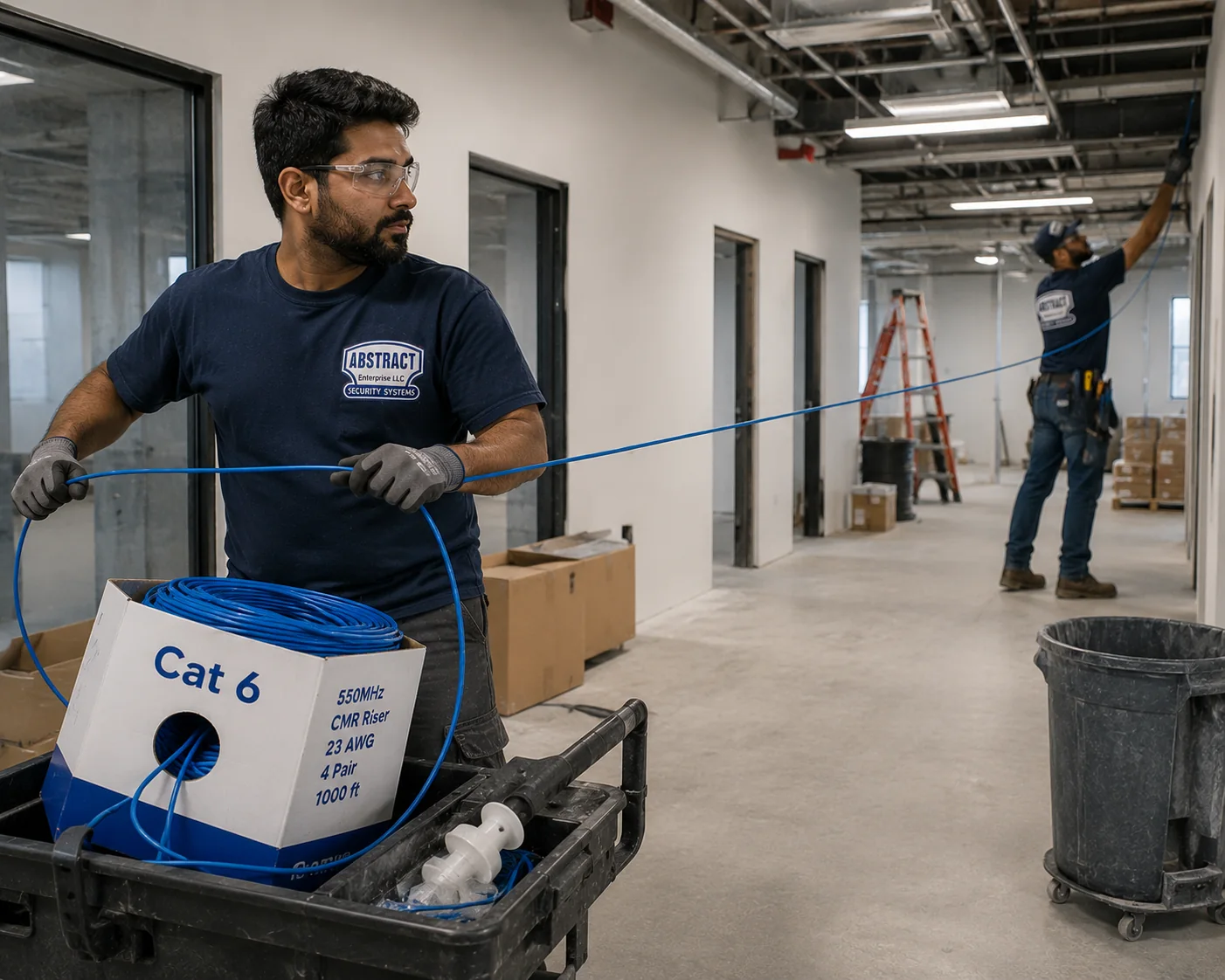
Two technicians work a long, unfinished hallway: the nearer one, beside a grey bin and a cart, lets blue cable run from a 1000 ft Cat 6 riser box, and the other stands far down the hall with one arm raised into the open ceiling.
Your Questions Answered
Cat6 Repair in Brooklyn: Questions Answered
These are the questions Brooklyn owners, tenants and office managers ask once a Cat6 link has let them down, grouped by the kind of building they come from. Each is answered straight away; the reasoning follows.
Brownstones and row houses
The Cat6 from our brownstone renovation ends on wall plates with snap-in couplers instead of punched-down jacks. Is that why it is unreliable?
Very often, yes. A coupler plate joins a cord plugged in from the front to a cord plugged in from behind, so every link has two extra plug-and-socket connections buried in the wall box, and the pre-made cords behind the plate are usually stranded patch cable rather than solid in-wall cable. Fluke's troubleshooting guidance lists female couplers among the things that should not be used in a data installation, because each one adds crosstalk and reflection that a punched-down keystone does not. The approach was common advice in the renovation years: a Brooklyn renovation forum thread more than a decade old suggests buying pre-terminated cables and wall plates with built-in female connectors as the easy route when nobody on site can terminate cable.
The fix is usually quick and cheap relative to the trouble. We open each plate, check what is behind it, and where the in-wall cable is genuine solid Cat6 we cut back the cord, terminate the cable on a proper Cat6 keystone, refit the plate and certify the link. Where the in-wall length is itself a stranded cord, it has to be replaced, and we tell you which plates are in which group before starting.
Why do Cat6 runs fished through a rowhouse so often fail right where they leave the floor and turn up into the wall?
Because that is the tightest bend on the whole route, and it is where the cable gets pinched. When a run is fished up from a cellar or across a floor and then turned up into a stud or furring cavity, it often passes through a hole in a floor plate or a gap in old masonry with no room to sweep. The cable gets bent sharper than its rated radius and then held there by the plaster, the plate or a fastener. Over time the pairs inside deform, the twist rate changes, and the link starts to fail crosstalk or return loss at that spot.
On the tester the fault shows up a few metres from the jack, at the same distance on several runs that share the route. That pattern is a gift: one small access opening at the base of the wall usually exposes every damaged bend at once. We replace the damaged length or the whole run from that point, give it a proper sweep through an enlarged opening or a short sleeve, and close up.
Landmark rules and a Cat6 run inside a brownstone
Not if the work stays inside the house and needs no Buildings Department permit. The Commission's own guidance says ordinary repairs and maintenance do not need an LPC permit, and that interior work needs one only when it requires a DOB permit, when it affects the exterior, or when the interior itself is a designated interior landmark. Re-terminating jacks, replacing a run inside the walls and moving a cabinet from cellar to parlour floor are interior work with no exterior effect.
What changes the answer is anything you can see from outside: a cable clipped to the front facade, a new hole through a brownstone or brick front wall, equipment fixed to a cornice or a stoop. If the only way to reach a camera or an outbuilding is across an exterior wall, we tell you before work starts so you can check with the Commission. This is general guidance, not a ruling on your building; the LPC's permit staff are the authority.
Wood-frame houses and pests
Is a dead Cat6 run easier to replace in a Flatbush wood-frame house than in a brick rowhouse?
Usually yes, because the cavities are open from cellar to attic in many places. Victorian Flatbush is the largest concentration of wooden Victorian houses in the country, according to the Historic Districts Council, and freestanding frame houses give a cable installer something a party-walled masonry row seldom does: stud bays that can be reached from above or below, and a basement with open joists. A failed run can often be replaced by fishing a new one down the same bay from the attic or up from the cellar, without opening finished walls in between.
The limits are fire blocking, insulation added later, and the occasional bay a previous renovation closed off. Fire blocks are drilled through cleanly and re-sealed with a listed product, never left open. Where insulation has been blown into a wall, we use a fish rod and a camera rather than force, and if a bay is blocked we tell you which wall will need a small opening before cutting it.
Rats got into the walls and chewed through a Cat6 run. Once it is replaced, how do we stop it happening again?
Seal the way in, and give the new cable a protected route where the animals travel. Rodents follow pipes, wires and gaps at the bottom of walls. News 12 Brooklyn reported in July 2026 on a Crown Heights building where a tenant found golf-ball-sized holes beneath her kitchen cabinets and could hear rats in the walls; the same openings that let them into the apartment are the paths they use inside the cavities. A replacement run laid along the same unprotected path tends to be chewed again.
After pest control has dealt with the infestation, we replace the chewed run, and where it crosses a cellar, a crawlspace or the bottom of a wall cavity we put it in conduit or flexible tubing rather than leave bare jacket exposed. Penetrations the cable passes through are sealed. We do not carry out pest control; if animals are still active we recommend waiting until the exterminator has finished so the new cable is not the next meal.
Co-ops, condos and newer towers
Co-op house rules and a small Cat6 repair
It depends on your building's rules, but most small repairs fall on the lighter side. Brick Underground's guide to co-op and condo renovations explains that an alteration agreement is the full contract with the board for renovation work, while a decoration agreement can sometimes be approved by the managing agent without a full board review, often within a week. Replacing a jack, re-terminating a media panel or swapping a damaged cable inside your own walls usually looks much more like the second than the first.
Ask the managing agent which form applies before booking, as the same guide advises when work is borderline. Either way, most boards want the contractor licensed and insured with the building named on the insurance certificate; send us the building's wording and we return the certificate and our NYS licence number for your package. Work that would open a common wall or pass through a hallway is a different matter and is planned with the building, not around it.
Every Cat6 run in our condo ends in a white structured-media box in a closet. Can that box be repaired, or does it have to be replaced?
In most cases it can be repaired in place. Structured-media enclosures of the kind fitted in newer condos and gut renovations are usually simple metal boxes with a data module, a few cable organisers and room for the provider's router. The Cat6 runs to each room are usually in good order; what fails is the module's punch-down block, a cheap insert that has loosened over the years, or the patching after somebody unplugged everything to swap routers. Greenpoint and Williamsburg alone added more than 26,000 housing units in the thirteen years to May 2024, so a great deal of in-unit cabling went in over a short period and is now reaching the age when modules and patching start to give trouble.
We test each room's run from its wall jack to the module. Runs that pass are left alone; terminations that fail are remade, a failed module is replaced with a Cat6 one that fits the same enclosure, and each port is labelled with the room it serves. Only if the enclosure has no space for the equipment you now need, such as a PoE switch for cameras, do we suggest a larger box.
Our Cat6 runs in conduit buried in the concrete floor of a newer tower. If the cable inside is damaged, does the slab have to be cored?
Almost never. The point of conduit in a slab is that the cable can be replaced without touching the concrete. If the conduit is intact, the damaged cable is pulled out, often with a new one or a pull string attached to it so the path is never lost, and the new run is terminated and certified at both ends.
The difficult cases are conduit crushed during construction, a pipe already too full to accept a new cable, or a run where the original installer left no slack at either end. We find out which applies with the old cable still in place, before committing. Drilling or coring a tower slab is never our first move: it needs the building's engineer or owner involved, because modern floors can carry structural elements that must not be cut blind.
Industrial floors, kitchens and storefronts
Can machine vibration in a converted factory loosen Cat6 terminations over time?
It can, especially where the cable hangs free and the plug carries its weight. On a Sunset Park or Navy Yard production floor, a run dropped from the ceiling to a machine or a wall-mounted switch often has no strain relief: the plug holds the cable up, the cable swings with every vibration, and the contacts and the cable's conductors at the back of the plug fatigue. The link fails intermittently long before it fails outright, which is why it gets blamed on the switch.
The repair is the termination plus the support. We remake the end, on a jack in a surface box where a fixed outlet is practical, and fix the cable to the structure a short distance back so the termination carries no load. If the link runs over a press, a compressor or a dock leveller, we re-route it a little further away where the building allows.
The Cat6 behind our restaurant's cookline keeps failing. Is that heat, grease or the cable?
Usually all three working together at the termination. Cable that runs above or behind a range or fryer sits in heat that raises its insertion loss and, over months, hardens and cracks the jacket. Grease-laden air settles on jacks and plugs, works into the contacts and attracts dust. Most cookline failures we see are at the jack or the plug closest to the heat, not along the cable.
We test to confirm where the fault is, then move the termination out of the hot zone if possible — a jack at the end of the counter rather than behind the line — and replace any length that is discoloured or brittle. Where a register or kitchen display has to sit near the heat, a short factory cord to a jack placed away from it is far easier to replace than a cable buried in the wall behind the stove.
Flood-exposed blocks and moved equipment
We are raising our network equipment above the flood line. Can the existing Cat6 be extended to the new height, or does every run need replacing?
Some runs can be extended; others must be replaced, and the tester decides which. A Cat6 permanent link has a length limit, and a run that came down to a cellar and now has to go back up two floors may exceed it once extended. Each extension also adds a connection that must still meet the category. Runs that were already long, or that sat in water during a storm, are better replaced outright than spliced onto.
The decision matters in Brooklyn because flooding has reached places owners did not expect. The City's post-Sandy report found that more than half of the buildings in the area Sandy flooded were outside FEMA's 100-year floodplain, and Ida's cloudburst flooding in 2021 hit cellars nowhere near the water. We measure every run, extend those with length and margin to spare using a rated connection in an accessible box, pull new runs for the rest, and certify the whole set at its new home.
After the internet provider moved the router to the front of the house, half our Cat6 wall jacks went dead. What happened?
The jacks did not fail; their other ends were left behind. In most renovated Brooklyn houses every Cat6 run goes back to one place, usually where the router first sat. When a provider installs new service at the front of the house and moves the router there, the home runs still end at the old location, now with nothing plugged into them. Only the jacks that happen to be near the new router, or that someone patched by hand, still work.
The repair is to bring the network back to where the cables meet, or the cables to where the network now is. Usually the simplest answer is one good Cat6 run from the new router location to the old cabinet, with a small switch there that feeds every room again. We trace and label each run, test it, and leave a diagram so the next provider visit does not repeat the problem.
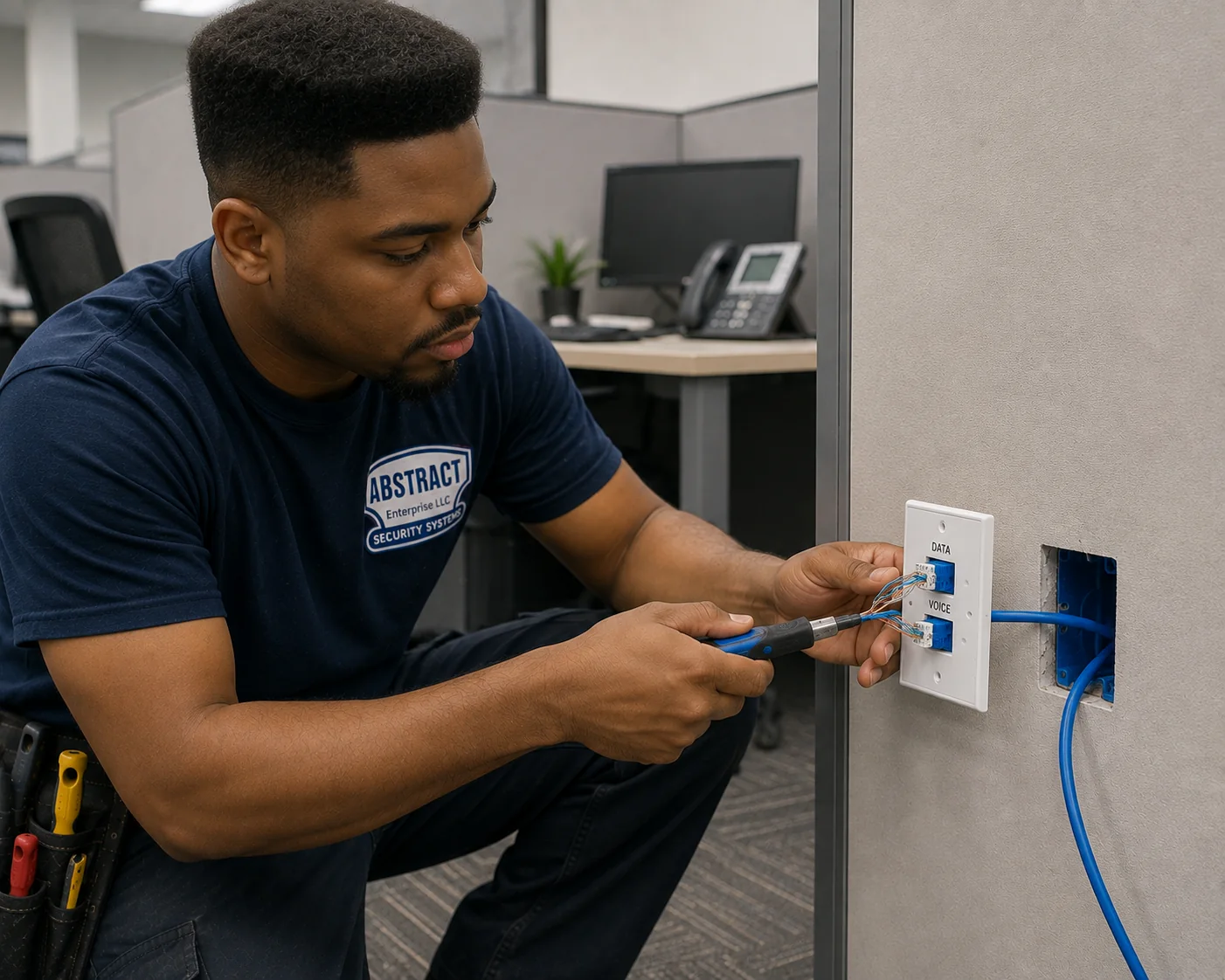
Crouched at a cubicle wall, a technician eases a small tool into the back of a plate whose two blue ports are marked Data and Voice; the opening in the panel shows the box the cable comes from.
Equipment
Tools and Parts on a Brooklyn Cat6 Repair Visit
What comes off the van on a typical Brooklyn job, and why each item matters in this borough's buildings.
Certification Tester
Tests a link against its Cat6 or Cat6A limit and reports by distance where crosstalk or reflection originates. In a four-storey rowhouse that distance, read against the route, usually names the floor and the wall before anything is opened.
Toner and Inductive Probe
Finds which cable in a cellar bundle or a shared basement belongs to which jack, so a two-family house or a mixed-use building never loses a neighbour's service to a wrong cut.
Inspection Camera and Fish Rods
For frame-house stud bays and plaster cavities: see what is behind the wall through a small hole, then steer a new run past fire blocks and insulation without opening the wall twice.
Cat6 and Cat6A Keystones and Inserts
Matched to the existing plates and to the module in a structured-media enclosure, so a repaired brownstone or condo keeps one consistent system rather than a mix of parts.
Solid-Copper Riser and Plenum Cable
Listed cable for permanent runs, chosen for where it goes: riser-rated in walls and between floors, plenum-rated where a ceiling is used as an air path. Never stranded cord in a wall.
Small-Cut Tools and Patch Materials
Oscillating saw for clean access openings in plaster and drywall, lath supports, and setting compound so openings close flush. Brooklyn owners notice a bad patch on a parlour wall.
Flexible Conduit and Sealant
For runs that cross cellars and the bottom of wall cavities where rodents travel, and for penetrations that must be sealed after the cable passes through.
Strain-Relief Hardware and Surface Boxes
For factory and loft floors: fixed outlets and supports that take the load off a termination exposed to vibration.
Factory-Made Patch Cords
Category-matched cords for every repaired link, because a hand-crimped or tired cord can fail a link that is otherwise sound.
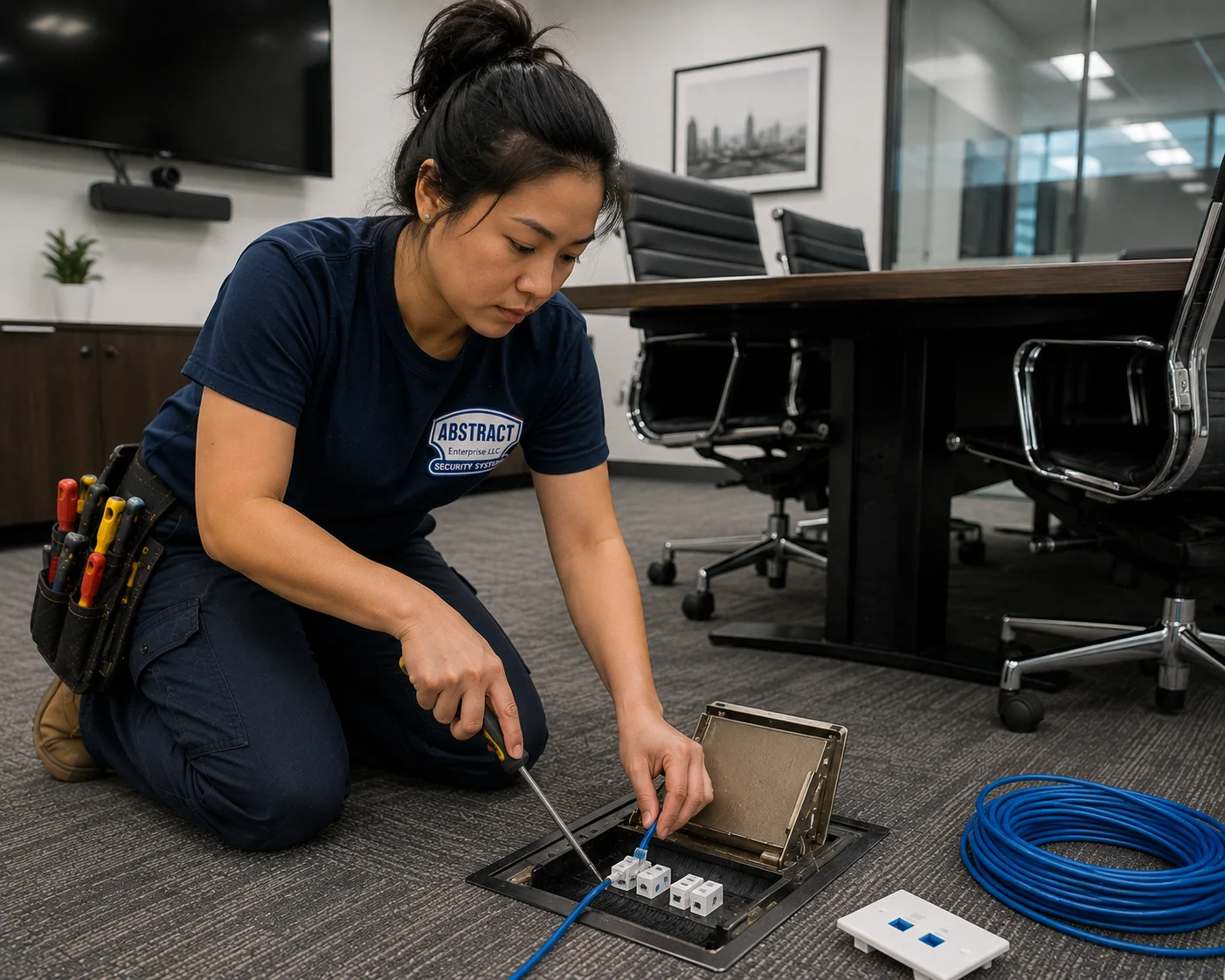
Under the edge of a long meeting table, a recessed box in the carpet stands open with its lid up; a technician works a screwdriver among the white modules inside, with spare cable coiled to one side.
AI Overview Reality Check
What AI Gets Wrong About Cat6 Repair in Brooklyn
We could not view Google's AI Overview for these searches from our build environment, so we have not quoted it. What follows are claims that appear again and again in forum answers, how-to articles and cost guides about fixing Ethernet at home and at work, set against what Brooklyn's buildings actually do to Cat6. Where a cost-guide platform such as Fixr is named, it is for its published figures, not for anyone's workmanship; homeowner marketplaces such as Angi and HomeAdvisor are where many of these claims circulate.
“Eight green lights on a cheap tester means the run is healthy”
A continuity tester proves that each conductor connects end to end in the right order. It says nothing about whether the link meets Category 6. A run with a crushed bend at the floor of a brownstone, or one finished on a coupler plate, can show eight green lights and still fail crosstalk badly enough to drop from gigabit to 100 Mbps.
So when someone in the house has already “tested the cable” with a cheap tester, it is useful information but not a verdict. We certify the link, which turns “it is fine” or “it is broken” into a distance and a cause.
“Snap a coupler on it — a joined cable is as good as a whole one”
Couplers are sold everywhere and recommended in countless forum replies, including an old Brooklyn renovation thread that suggested pre-terminated cables and coupler wall plates as the easy option. They work for a quick test or a temporary patch. As permanent parts of a Cat6 link, they add connections that the standard never allowed for.
Fluke's troubleshooting guidance for crosstalk failures names female couplers as something that should not be used in a data installation. We find them inside rowhouse wall boxes, joining a cut run in a cellar, and behind television mounts, and a large share of the “slow jack” calls we get from renovated houses trace back to one.
Where a run genuinely has to be joined — extending to a raised closet, for example — the right part is a rated in-line connection or a punched-down jack in an accessible box, and the link is certified afterwards to prove the joint is within limits.
“Whoever wired your outlets can sort out the data jacks too”
Many can make a jack light up. Making it meet Category 6 is a narrower skill: keeping the pair twist to the contacts, choosing a keystone that matches the cable, and proving the result with a certification test rather than by plugging in a laptop.
In Brooklyn, the trade question is also a building question. A co-op board will usually ask for a licensed and insured contractor with the building named on the certificate. An owner in a historic district needs someone who knows where interior work ends and Landmarks Commission territory begins.
We hold NYS low-voltage licence #12000287431 and carry insurance for exactly this kind of work, and each repaired link leaves with a saved test result that anybody, including the next contractor, can read.
“A flooded cable is ruined, so every run in a wet basement must be replaced”
Water is genuinely bad for Cat6, mostly at the terminations, where contacts corrode, and in cable whose jacket was cut or whose ends sat submerged. It does not follow that every cable that passed through a damp cellar is finished. Runs that stayed dry inside a raised conduit or a wall can be perfectly sound.
The City's report on Sandy recorded flood damage to building telecommunications equipment and cabling as a cause of long outages in coastal areas, and Brooklyn's waterfront blocks saw a great deal of it. The same report notes how much flooding happened outside the mapped floodplain, so owners of cellars that stayed dry should not assume their luck holds.
The rational response is to test every run, replace the ones that fail or that sat in water, and move the terminations above the likely water level. That is usually far less cable than a blanket replacement, and it makes the next storm a smaller event.
“National cost guides tell you what a Brooklyn repair will cost”
The most widely quoted national guide, Fixr's January 2025 update, gives $125–$250 for each new Cat6 drop with materials included, and an hourly labour range of $45–$75. Those are national figures for new installation in average buildings, and they are the kind of number homeowners bring to a repair conversation.
A repair in a Brooklyn rowhouse or a Navy Yard suite is a different job from a new drop in an open suburban basement. Most of the cost is in finding the fault and reaching it without damaging finishes, and the hourly figure for licensed, insured low-voltage work in this city is not the national average.
Our own published figures are on this page: $195 an hour with a three-hour minimum for repair time, and replacement runs from $175 each where the cable cannot be saved. You get a written estimate after testing, before any run is replaced.
“Cat6 is Cat6 — it does not matter what the jacket says”
Plenty of cable printed “Cat6” is not. Copper-clad aluminium sold with a Cat6 jacket has much higher resistance than copper and cannot form part of a certified channel, because the standard specifies solid copper conductors. Stranded patch cable used as a permanent run behaves differently again.
We check the conductors whenever a run fails without an obvious cause. If the cable itself is the problem, re-terminating will not help, and you are told so before money is spent on new keystones.
Get the Wired Link Back Where You Need It
Say which part of Brooklyn you are in, what sort of building it is and which outlets have gone quiet. You get a likely diagnosis and a price for the visit first; booking comes after.
From a Bed-Stuy parlour floor to a Sunset Park production suite, the details below are enough for us to reply in writing before close of business. Rather talk it through? The Brooklyn line is (347) 934-8335.
✅
Request Received
Thanks — our Brooklyn team has it and will phone you before the business day is out. Something down right now? Ring (347) 934-8335.
How It Works
Our Brooklyn Cat6 Repair Process
Six steps, whether the job is one coupler plate in a Prospect Heights parlour or a row of failed links on a Sunset Park production floor.
1. Building and symptom check by phone
You tell us the building type, the neighbourhood, which jacks fail and what changed recently. We ask for a photo of the cabinet or media box and tell you what the fault most likely is before booking.
2. Paperwork and access sorted
A co-op or condo certificate, the superintendent's hours, a campus loading-dock slot, or simply which door and which floor: arranged first, then a two-hour arrival window is booked.
3. Every run tested from where they meet
We plug in where the runs come together, whether that is a cellar cabinet, a closet media box or a rack, and test each one to its category. The readings say how many metres out each problem lies.
4. Fault mapped onto the building
That distance is laid against the route through the house or floor. For each link you get the finding and the proposed fix, and nothing is opened or replaced until you agree.
5. Repair by the least destructive route
Terminations remade, damaged lengths replaced through existing bays or conduit, small openings closed flush, new runs protected from rodents, heat or vibration, and accessible abandoned cable removed.
6. Certify, label and hand over
Nothing is finished until it passes a fresh certification test. Both ends get a label, the results are saved for you, and a one-page room-to-port sheet goes on the cabinet door.
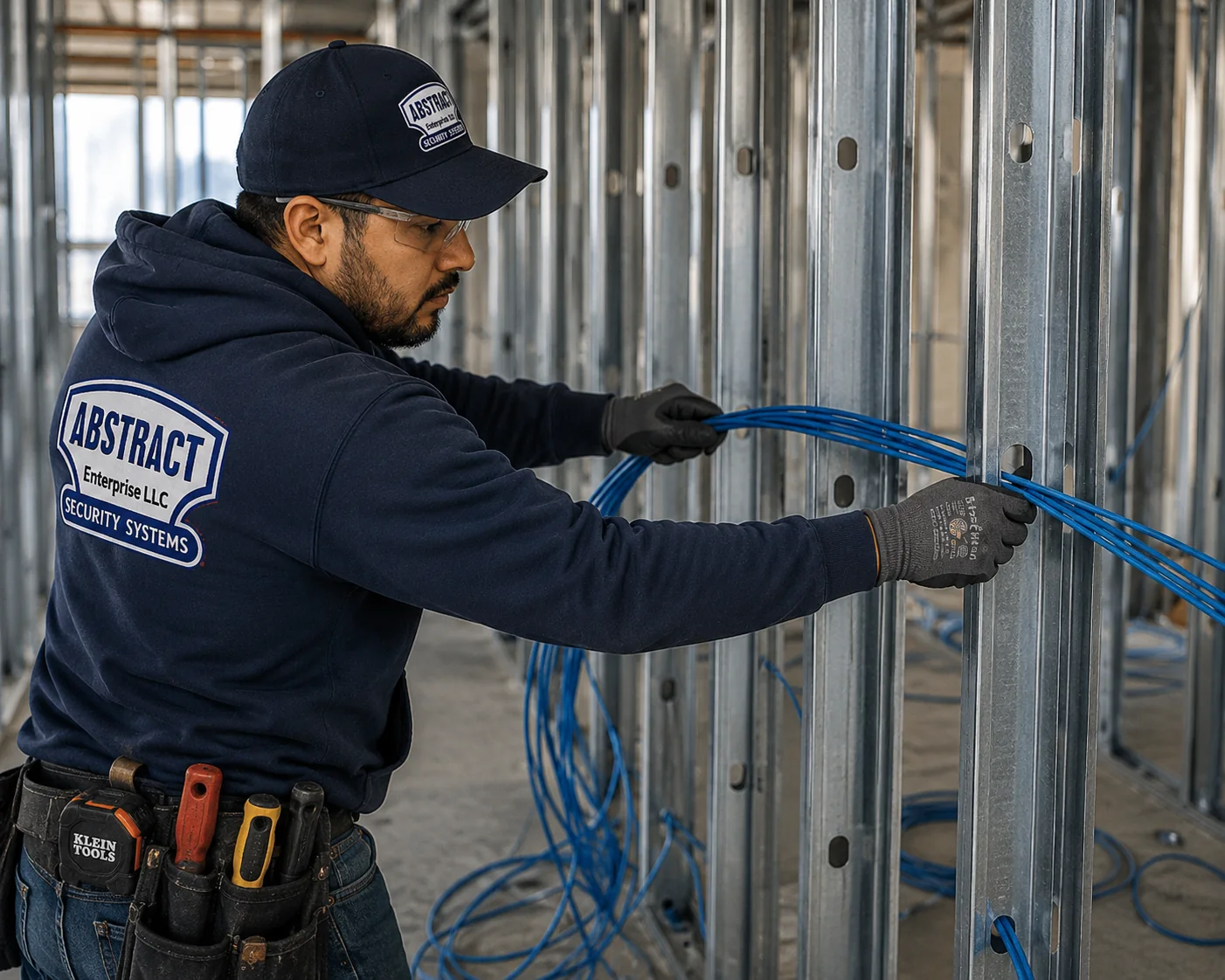
A technician in a cap, safety glasses and gloves draws a bundle of blue cables through the punched holes of a row of galvanised metal studs, with more coils of cable on the concrete floor.
Coverage Area
Cat6 Repair Near Brooklyn's Landmarks
Each card below is a well-known Brooklyn place chosen because the buildings around it show one of the borough's cabling patterns. We name them as reference points for those neighbourhoods; none is presented as a job we did there.
Brooklyn Heights Historic District
New York City's first historic district, designated on November 23, 1965. Row houses of brownstone and brick, many now home to offices and practices, where Landmarks rules mark the line between interior repair and anything that touches a facade.
Victorian Flatbush
Eleven neighbourhoods including Prospect Park South and Ditmas Park, with five city historic districts, described by the Historic Districts Council as the country's largest concentration of wooden Victorian homes. Open frame cavities, cellars and attics shape every re-pull.
Brooklyn Navy Yard
A former naval shipyard of more than 300 waterfront acres, now home to over 550 businesses and more than 13,000 jobs. Re-fitted industrial floors with long runs and exposed cable.
Brooklyn Army Terminal
The anchor of the city's 200-acre Sunset Park District, a 4-million-square-foot waterfront campus beside MADE Bush Terminal and Industry City. Manufacturing suites where length, loading areas and re-tenanting decide most repairs.
DUMBO Historic District
About 91 warehouse and factory buildings, designated in December 2007, the earliest of them in mid-to-late nineteenth-century slow-burning mill construction. Offices and studios with visible cable runs on timber and brick.
Coney Island and Sea Gate
The peninsula where Sandy's water reached 11 feet above ground near Sea Gate in 2012, and where dozens of food stores in Coney Island and Brighton Beach were hit. Cellar closets here are the first candidates for moving above the flood line.
We also repair Cat6 in Williamsburg, Greenpoint, Bushwick, Bedford-Stuyvesant, Clinton Hill, Fort Greene, Downtown Brooklyn, Boerum Hill, Cobble Hill, Carroll Gardens, Red Hook, Gowanus, Park Slope, Windsor Terrace, Prospect Heights, Crown Heights, East Flatbush, Flatbush, Midwood, Kensington, Borough Park, Sunset Park, Bay Ridge, Dyker Heights, Bensonhurst, Gravesend, Sheepshead Bay, Brighton Beach, Marine Park, Mill Basin, Canarsie, Flatlands, Brownsville, East New York and Cypress Hills — and across the rest of the city from our New York City Cat6 repair hub.
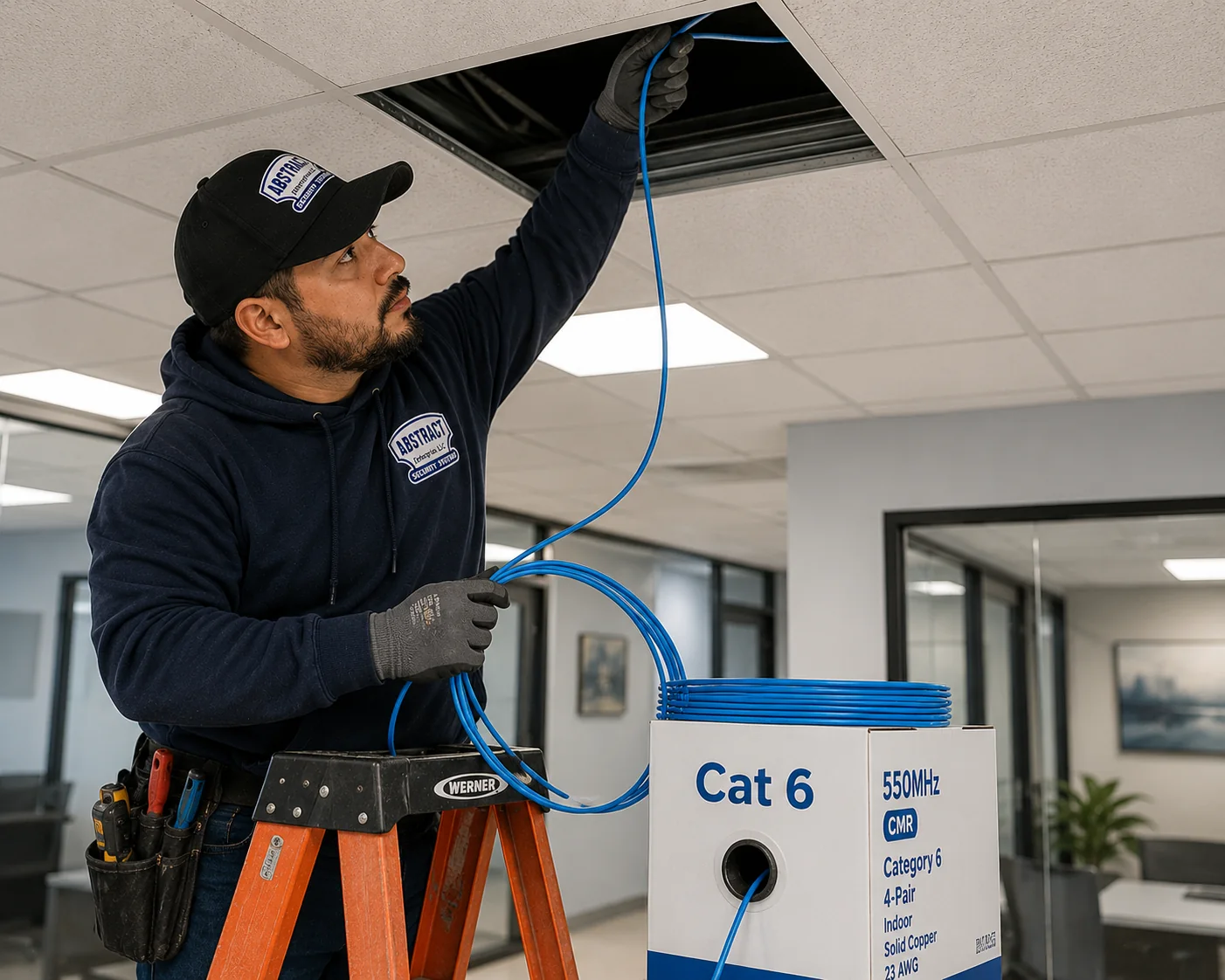
One gloved hand disappears through a gap in the ceiling grid while the other gathers slack; below the orange stepladder sits the cable box, its side printed with Cat 6, 550 MHz and CMR.
Pricing
Cat6 Repair Cost in Brooklyn
Brooklyn is the base area for our pricing, so the figures below are the published base figures with no area adjustment. They are the same numbers that appear on our New York City Cat6 repair hub and our Brooklyn network cable repair page. A Cat6 repair has two very different parts: the technician's time to find and fix faults, and any cable that really has to be replaced. They are listed separately and invoiced separately.
Item
Price
What it covers
Technician time on site: tests, fault finding, new terminations, cords and certification
$195/hr, 3-hour minimum ($585)
The specialty rate AESS publishes for this work. Within the block we keep going down your list, Cat6 or Cat6A, until the time runs out.
New run to replace a Cat6 cable that is beyond repair
From $175 per run
Starting price when a run must be pulled new, including the cable, a keystone and plate, the punch-down at the panel, a test, a label at each end and a cord.
Exterior wall entry for an outdoor run, sealed and bonded
From $185 per penetration
For yard cameras, rear extensions and garden studios where the run enters through an exterior wall.
Long runs, conduit with no pull string, opening and patching finishes, after-hours work
Quoted after testing
Depends on the route, the finishes and the building's rules; priced in writing before work.
What a three-hour visit usually covers in a Brooklyn house
In a renovated rowhouse or frame house, the first block typically covers testing every jack in the house from the cabinet, re-terminating the coupler plates or jacks that fail, sorting the patching at the cabinet, and certifying the result. Houses where the problem is one moved router or one chewed cellar run often finish well inside the block, and the remaining time is spent on whatever else you want checked — a camera link, an access point, the run to the back extension.
What a three-hour visit usually covers on a commercial floor
On a loft, office or industrial floor the block usually covers testing the reported links, locating each fault, remaking the terminations at fault, swapping suspect cords and certifying. Where testing shows runs that need replacing — typically damaged sections on a factory ceiling or over a loading area — you receive a per-run price before any cable is pulled.
Why two Brooklyn Cat6 repairs rarely cost the same
Termination or cable: faults at jacks, coupler plates and media-box modules are quick; damage inside plaster, under floors or in slab conduit takes longer to reach.
How the house was wired: runs that all meet in one cabinet are fast to test and repair; daisy-chained or undocumented runs need tracing first.
Finishes: a painted plaster wall that must be opened and patched costs more time than a drop ceiling or an exposed loft run.
Paperwork and access: co-op certificates, a superintendent's hours, a campus loading dock or a shared basement key.
What the cable is made of: real solid-copper Cat6 can be re-terminated and kept; aluminium-cored cable sold as Cat6, or patch cord buried in a wall, only gets more expensive the longer it stays.
A national yardstick, not our price: the January 2025 Fixr guide lists $125–$250 per new Cat6 drop and $45–$75 per labour hour across the United States. Those are someone else's averages for fresh installation; they are not what AESS charges and they do not describe repair work.
Full terms — including 50% deposit, one-year parts-only warranty on AESS-supplied products, and the late-fee schedule — are set out in the service agreement.
Shop Our Systems
Cat6 Repair Packages & Pricing
Three ways Brooklyn Cat6 repairs are usually packaged. Every figure comes from the price table above; nothing is added for being in Brooklyn.
Starter — House or Suite Link Check
$585
The three-hour minimum at $195 an hour. The failing jack or jacks tested from the cabinet, faults located, coupler plates or keystones re-terminated, the cabinet patching sorted and each repaired link certified. Leftover time goes on the other links in the house or suite.
Standard — Whole-Building Repair and Certification
$195/hr after the first 3 hours
Suited to a gut-renovated house, a condo whose closet box keeps misbehaving or an open-plan loft. We put every run on the tester, sort the failures by what caused them, rebuild the bad ends on matching parts and leave you the complete set of results. After the first tests you get a written time estimate for the rest.
Premium — Repair Plus Replacement Runs
Repair time + from $175 per run
For houses and floors where some cable is past saving — gnawed, screwed through, flattened or simply too long. Hourly time covers everything that can be kept; each new run starts at $175; old cable we can reach comes out; the cabinet ends up labelled and drawn.
Bring Your Own Parts — Labour Only
Renovators often leave a bag of keystones, a spare media-box module or half a box of cable in the cellar. Hand them over and you pay for our time alone, provided they suit the link: Cat6A hardware for Cat6A runs, solid-copper cable inside walls, cords made in a factory. We put the same tester on links built with your parts as with ours. Their warranty is the manufacturer's, not AESS's, and if a part cannot pass you hear so before it is fitted.
One Visit, Every Jack in the House Tested
Send a photo of the cabinet or media box and a list of the jacks that misbehave. You will hear what the fault most likely is and what it will cost to fix.
The borough's building families cluster by area, so the faults do too. This is what a technician expects to find on arrival in each part of Brooklyn, before the tester confirms it.
North Brooklyn: Williamsburg, Greenpoint, Bushwick
Two kinds of job dominate. In the waterfront towers and the newer mid-rises that followed the 2005 rezoning, the call is usually about a structured-media box: a router swap left the patching scrambled, a module failed, or a camera system was added with no room for a PoE switch. In the older blocks inland, including the frame row houses of southern Bushwick that Urban Omnibus singles out, Cat6 was added by owners and renovators and runs through open joists and cellar ceilings, where it gets nicked and chewed. Loft offices along the industrial edges add exposed ceiling runs damaged by later trades.
Brownstone Brooklyn: Park Slope to Bed-Stuy
Park Slope, Prospect Heights, Fort Greene, Clinton Hill, Bedford-Stuyvesant, Crown Heights, Cobble Hill, Carroll Gardens and Boerum Hill share the rowhouse pattern: renovation-era home runs to a cellar or closet cabinet, coupler plates and hurried keystones at the ends, and pinched bends where runs leave the floor. Home offices, therapists, architects and small practices on parlour floors depend on one or two wired links, so a single failure matters. Most repairs here never touch plaster; the ones that do are kept to one small opening.
Downtown, DUMBO and the waterfront north
Office suites around MetroTech, creative offices in DUMBO's warehouses, and the residential towers that followed the 2004 rezoning. Hung-ceiling suites behave like any city office floor; the warehouse floors have visible runs on timber and brick; the towers have Cat6 in slab conduit and closet enclosures. Navy Yard tenants sit just to the east, with long runs across re-fitted industrial floors.
Central Brooklyn: Flatbush, Ditmas Park, East Flatbush, Midwood
Victorian frame houses, mid-century apartment buildings along the parkways, and two- and three-family homes. Re-pulls through open frame cavities are often straightforward here; the commoner problems are rodent damage in cellars, runs shared between units of a multi-family house, and co-op paperwork in the apartment buildings. Our base on Troy Avenue is in East Flatbush, so this is the area we reach fastest.
South Brooklyn: Bay Ridge to Coney Island
Bay Ridge and Dyker Heights add row houses and detached homes; Bensonhurst, Gravesend and Borough Park add two-family houses and busy retail strips; Sheepshead Bay, Gerritsen Beach, Brighton Beach, Coney Island and Sea Gate add the flood exposure Sandy made plain. Here the jobs that stand out are cellar closets being moved upstairs, corroded terminations, and store links that run through basements.
East Brooklyn and the shoreline: Canarsie to Cypress Hills
Canarsie, Flatlands, Mill Basin, Marine Park, Brownsville, East New York and Cypress Hills mix detached and attached houses, two-family homes, public and private apartment complexes and industrial strips. Repairs are typically residential links in multi-family houses, camera links for small businesses, and occasional storm-related cellar damage on the low ground near Jamaica Bay.
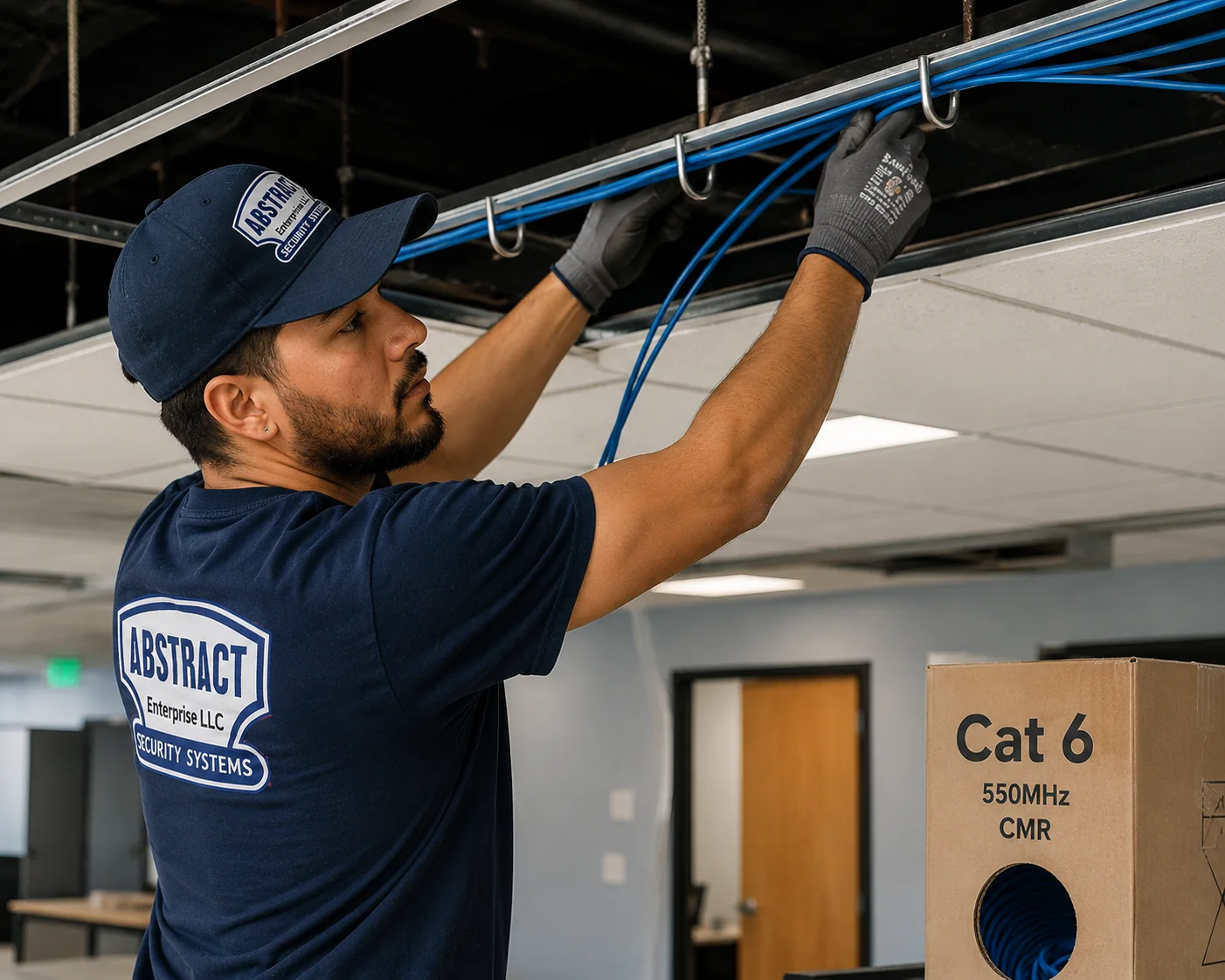
A technician in gloves lays a group of blue cables into metal J-hooks hanging from rods above a suspended ceiling, with tiles removed and a box of Cat 6 CMR cable standing on the floor.
Diagnosis
Where the Fault Sits Decides the Brooklyn Repair
The tester gives a distance; the building tells us what lies there. Put together, they point to the repair. This is how the most common Brooklyn findings translate into work.
What the test shows
Where it usually is in a Brooklyn building
Usual repair
Crosstalk failure within a metre of the jack
Coupler plate, hurried keystone or a cord pushed into the wall box
Re-terminate on a Cat6 keystone; replace the in-wall length if it is stranded cord
Return-loss or crosstalk fault a few metres in, on several runs
The bend where rowhouse runs come up through the floor
One access opening at the base of the wall; replace the damaged lengths with a proper sweep
Open or short partway along the run
Cellar or stud bay where rodents or a fastener reached it
Replace the run or section; protect it where it crosses the cellar
Failures at the closet end only
Structured-media module, panel insert or scrambled patching
Remake or replace the module; label and re-patch
Intermittent failure that comes and goes
Unsupported termination on a factory floor, or a heat-cycled jack behind a cookline
New termination with strain relief; move the jack out of the heat
Length or insertion-loss failure
Long campus runs, or runs extended to a raised closet
Shorten the route or replace with a new run inside the limit
Every link tests clean, but rooms have no service
Router or fiber terminal moved away from where the runs meet
Link the new router location to the cabinet; re-patch and label
If testing does not match any of these patterns, we check the cable itself. A run of copper-clad aluminium or stranded cord explains failures that move around and resist re-termination, and finding it early saves a wasted morning of new keystones.
Complete Services
Every Cat6 Repair Service in Brooklyn
Cat6 rarely fails in isolation. When a brownstone, a loft or a shop calls about one link, one of these Brooklyn services is often useful on the same visit.
Send a single request covering cabling, cameras, intercoms or all three.
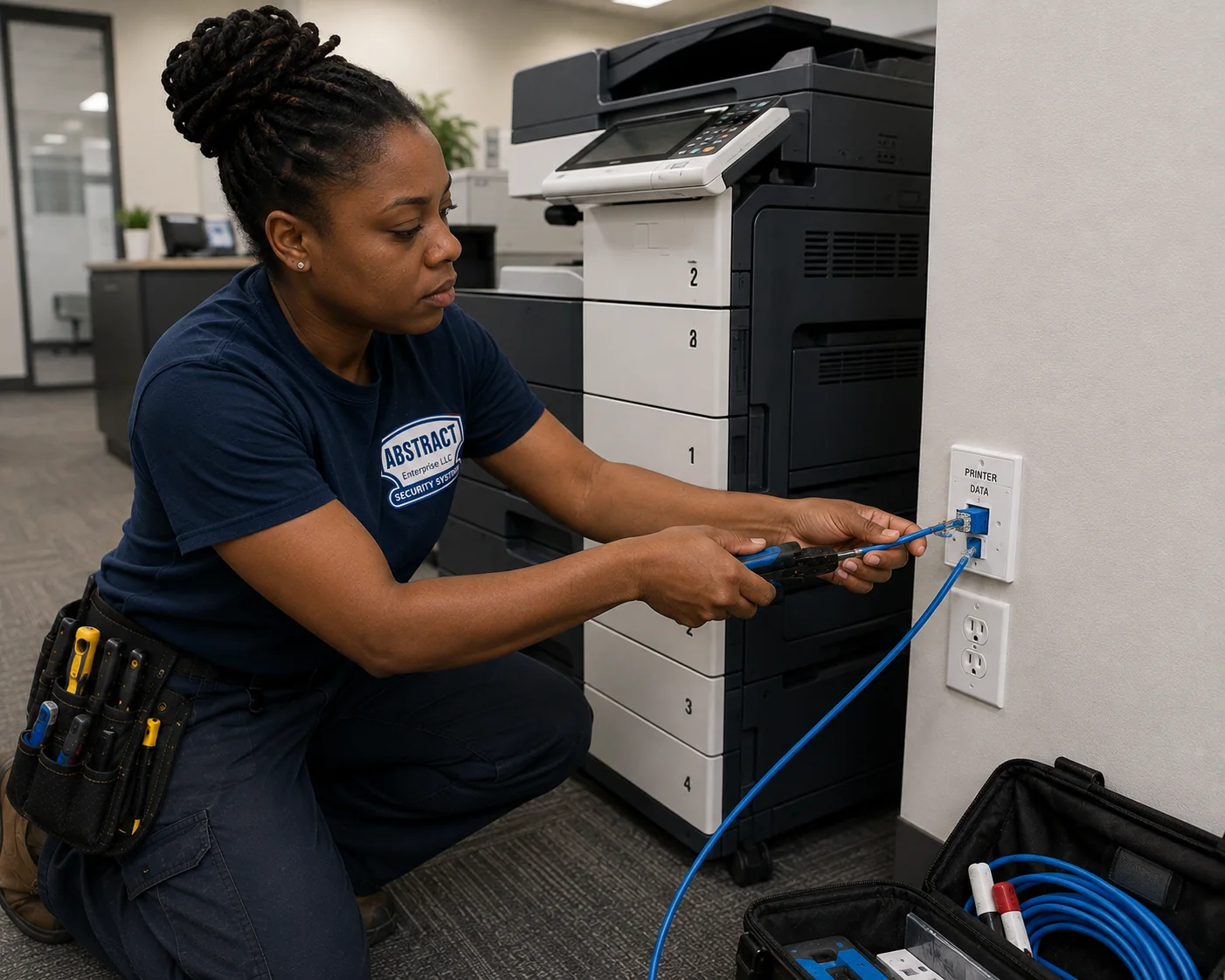
Next to a tall multifunction copier, a kneeling technician works on the blue port of a plate marked Printer Data, its cord trailing to an open case of cable and tools at her knee.
Field Notes
Field Notes on Brooklyn Cat6
What a Brooklyn call looks like from our side — the routine we follow, not a story about one job
In a house, we start at the cabinet, not the dead jack. Every run in a renovated brownstone usually meets in one place, and testing them all from there takes minutes. The pattern tells us more than any single result: three failures at the same short distance means one pinched floor crossing; failures only on the plates with couplers means termination work, not cable work.
Before cutting anything in a two-family house or a shared basement, we tone the run and confirm it with whoever uses the other services. A wrong cut there costs a neighbour their internet.
When a wall has to be opened, we choose the spot from the tester's distance and the building's construction together, and we cut once. In a co-op or a landmarked house, we have already agreed with you where that opening may go.
We leave every run we touched labelled, tested and drawn on a simple sheet for the cabinet door, so the next router change or renovation does not start from zero.
FAQ
Brooklyn Cat6 Repair FAQ
Can you leave a pull string or conduit so the next Cat6 repair is easier?
+
Yes, and in a renovated house it is the cheapest insurance against the next repair. When a run is replaced through an open bay or an existing conduit, we can leave a pull string beside it, and where a wall is open anyway we can add a short length of flexible conduit between the cabinet and an access box. Owners on a Brooklyn renovation forum were recommending conduit with access boxes more than a decade ago for the same reason: cable can then be swapped without opening the wall again.
Our house is more than a century old. What about lead paint when a wall is opened?
+
It is a fair question in Brooklyn. Federal rules require paid work that disturbs painted surfaces in homes built before 1978 to follow lead-safe practices, with the requirements triggered when more than six square feet of interior surface in a room is disturbed, and New York City’s Local Law 1 has owners of pre-1960 buildings presume their paint contains lead. Our access openings are normally a small fraction of that size and are cut with dust kept to a minimum. If a repair would need more, you are told before any work begins.
I rent my apartment. Do I need the landlord’s permission for a Cat6 repair?
+
For anything inside the walls, in practice yes. Re-terminating a jack on its existing plate or replacing a patch cord changes nothing in the building, but opening plaster, drilling through a floor or replacing a run is work on the owner’s property, and most leases reserve that. We ask renters to get the owner’s or managing agent’s written go-ahead before we open anything, and we are happy to explain the work to them directly. This is practical guidance, not legal advice; your lease governs.
Can the old telephone wiring in the walls stand in for a failed Cat6 run?
+
Not as a replacement. Telephone wiring in older houses was installed for voice and does not meet the standard Ethernet needs; gigabit Ethernet uses all four twisted pairs of a cable rated Cat5e or better. Where an old phone cable follows the same route as a failed Cat6 run, though, it can sometimes be used as a pull line to draw the new Cat6 through the wall, which may save opening plaster. Once it has done that job, the accessible part of it is removed.
A jack was ripped out of the wall when furniture was moved. Can it be fixed without re-pulling the cable?
+
Usually, yes. When a plate is dragged off the wall, the damage is normally at the termination: conductors torn out of the keystone and a short length of cable kinked behind it. If there is enough slack in the box, we cut back to undamaged cable, terminate a new keystone, secure the box or bracket back into the wall and certify the link. If the run was pulled tight with no slack, a small opening may be needed to reach a joint point, and you are told before that happens.
In a two-family house, do you need to get into the other apartment to repair our Cat6?
+
Usually not. In most two-family houses each unit’s runs go back to its own router or cabinet, and the shared parts are the basement and the meter area, which the owner controls. We need access to both ends of your run and to the route between them. If that route passes through the other unit’s walls or ceiling, that part of the work needs the owner’s and the other occupant’s agreement, and we plan the repair to avoid their space wherever possible.
Can you tell whether a renovation damaged our Cat6 or whether it failed on its own?
+
Often, yes. Renovation damage leaves recognisable signs: a sudden open or short at a measured distance that matches where a wall, cabinet or floor was worked on, a jacket pierced by a screw or nail, a run flattened under new subfloor. A slow decline at a termination, or corrosion at a cellar jack, points instead to age, workmanship or moisture. We record what the tester shows and photograph any physical damage we expose, so you have the facts; we report the evidence rather than assign blame.
All Areas Served
Cat6 Repair Across New York City and Beyond
Brooklyn has its own page because its buildings break Cat6 in their own ways. For the city-wide picture, go up a level to the NYC Cat6 repair hub; for other regions, use the links below. One crew, one set of testers and one published rate card cover them all.
Looking for something other than cabling? Our full list of services starts on the AESS home page, and the about page explains who we are.
Still Fighting a Bad Cat6 Link in Brooklyn?
The Brooklyn line, (347) 934-8335, goes straight to a technician. You are offered the next free two-hour arrival slot, and a bad jack, coupler plate or cabinet module is normally put right inside an hour or two of the van pulling up.
Last reviewed: October 17, 2026 · Next scheduled review: January 2027 Changelog: Oct 2026 — page published. Building-type thesis for Brooklyn (row houses, frame houses, co-ops, post-rezoning towers, mill-construction lofts, industrial campuses, flood-exposed blocks); twelve building-specific questions and ten FAQs added; pricing set at the Brooklyn base rates published on our NYC Cat6 repair and Brooklyn network cable repair pages.
Cat6 Repair Brooklyn — Licensed, Insured, Tested to Category
Abstract Enterprises Security Systems · 1282 Troy Ave, Brooklyn, NY 11203 · (347) 934-8335 · WhatsApp (718) 679-0359 via wa.me
NYS Low-Voltage Licence #12000287431 · 100% Licensed & Insured · Same-Day Estimates · Rated 4.7★ from 201 Google Reviews
If you supplied a part, any claim on it goes to whoever made it. Everything else is explained on our warranty page and in the service agreement.
Everything here about codes, landmark districts, lead paint and co-op paperwork is a plain-language summary to help you plan; it is not legal or engineering advice for your particular building. Page reviewed and updated October 17, 2026.